


MATH 117 - ELEMENTS OF
MATHEMATICS - Gradient,
divergence, and curl
Question Bank - Set 1
Liberty University
Question 1
Question
Let F(x, y, z)=(x2y, y2z, z2x) be a vector field in R3. Compute ∇ · F.
Solution
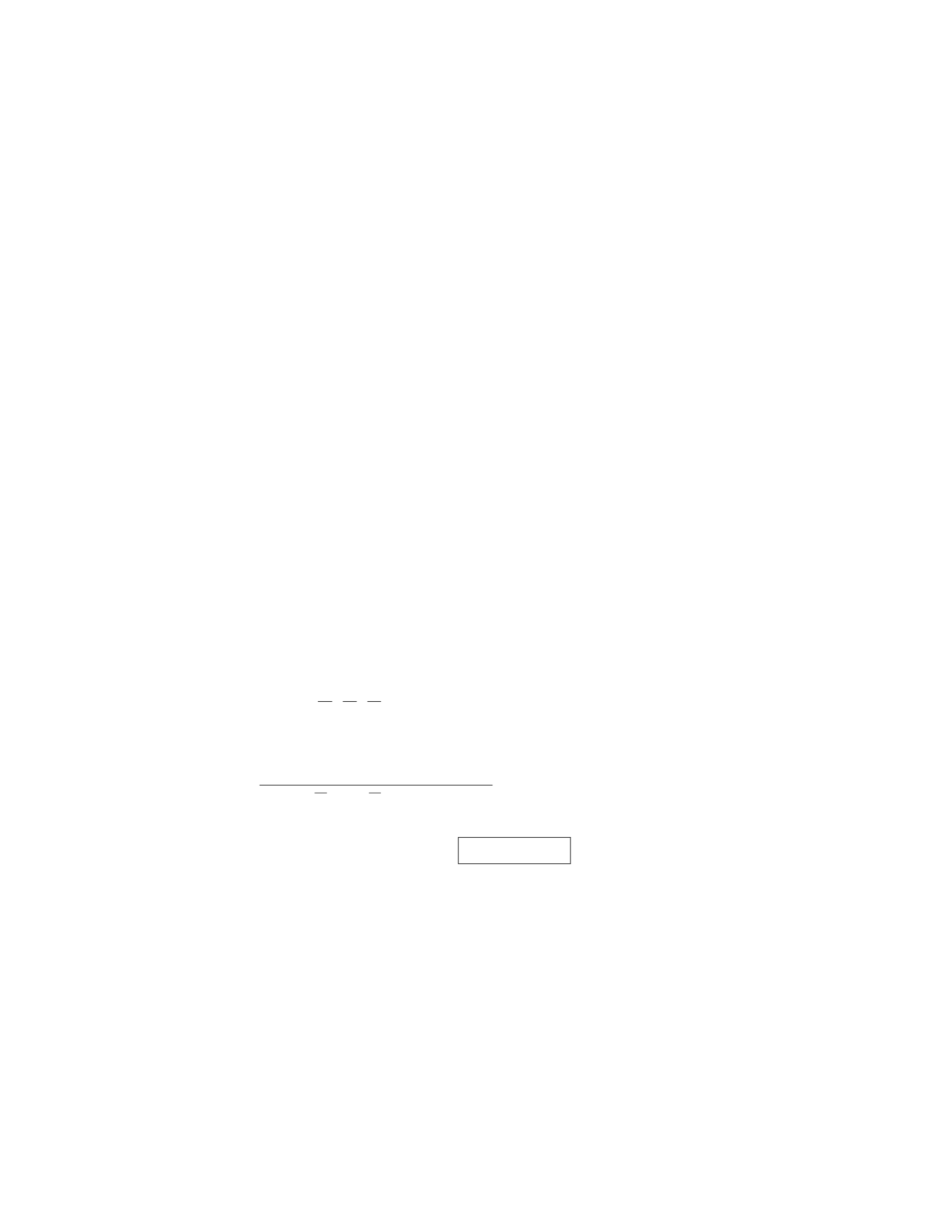
To find the divergence of F, we need to compute the dot product of the del
operator ∇= ( ∂
∂x ,∂
∂y ,∂
∂z ) with the vector field Fand take the sum of these
products.
=∂∂x(x2y)+ ∂
∂y (y2z)+ ∂
∂z (z2x)=2xy+y2+2xz
Therefore, the divergence of Fis 2xy +y2+ 2xz .
Question 2
Question
Let F(x, y, z) = (3x2y+z2, x3+ 2yz, 2xyz) be a vector field in R3. Compute
∇ · F.
Solution
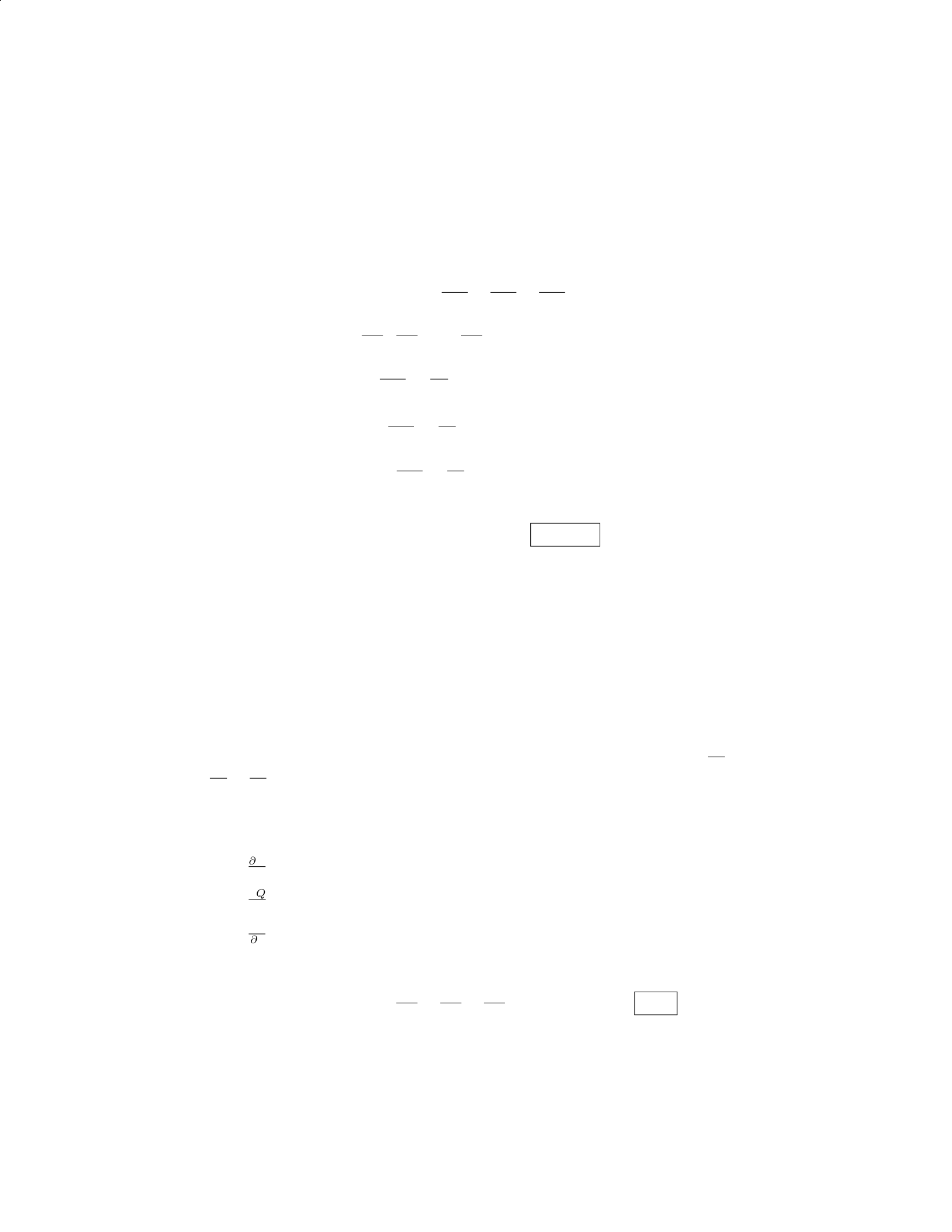
To find the divergence of the vector field F= (3x2y+z2, x3+ 2yz, 2xyz), we
need to compute ∇ · Fusing the formula:
∇ · F=∂F1
∂x +∂F2
∂y +∂F3
∂z
Step 1: Compute ∂F1
∂x ,∂F2
∂y , and ∂F3
∂z .
∂F1
∂x =∂
∂x (3x2y+z2) = 6xy
∂F2
∂y =∂
∂y (x3+ 2yz)=2z
∂F3
∂z =∂
∂z (2xyz)=2xy
Step 2: Sum the partial derivatives to find the divergence.
∇ · F= 6xy + 2z+ 2xy = 8xy + 2z
Therefore, the divergence of the vector field Fis 8xy + 2z.
Question 3
Question
Let F(x, y, z) = ⟨x2yz, xz3, x3y⟩. Compute the divergence of F.
Solution
To compute the divergence of F, we use the formula: div(F) = ∇ · F=∂P
∂x +
∂Q
∂y +∂R
∂z , where F=⟨P, Q, R⟩.
Step 1: Identify P,Q, and R. Here, P(x, y, z) = x2yz,Q(x, y, z) = xz3,
and R(x, y, z) = x3y.
Step 2: Compute partial derivatives.
∂P
∂x = 2xyz
∂Q
∂y = 0
∂R
∂z = 0
Step 3: Calculate the divergence.
div(F) = ∇ · F=∂P
∂x +∂Q
∂y +∂R
∂z = 2xyz + 0 + 0 = 2xyz
Therefore, the divergence of Fis 2xyz.
2
Question 4
Question
Let F(x, y, z) = x2yi−xyzj+z2kbe a vector field in R3. Determine the curl
of Fat the point (1,−2,3).
Solution
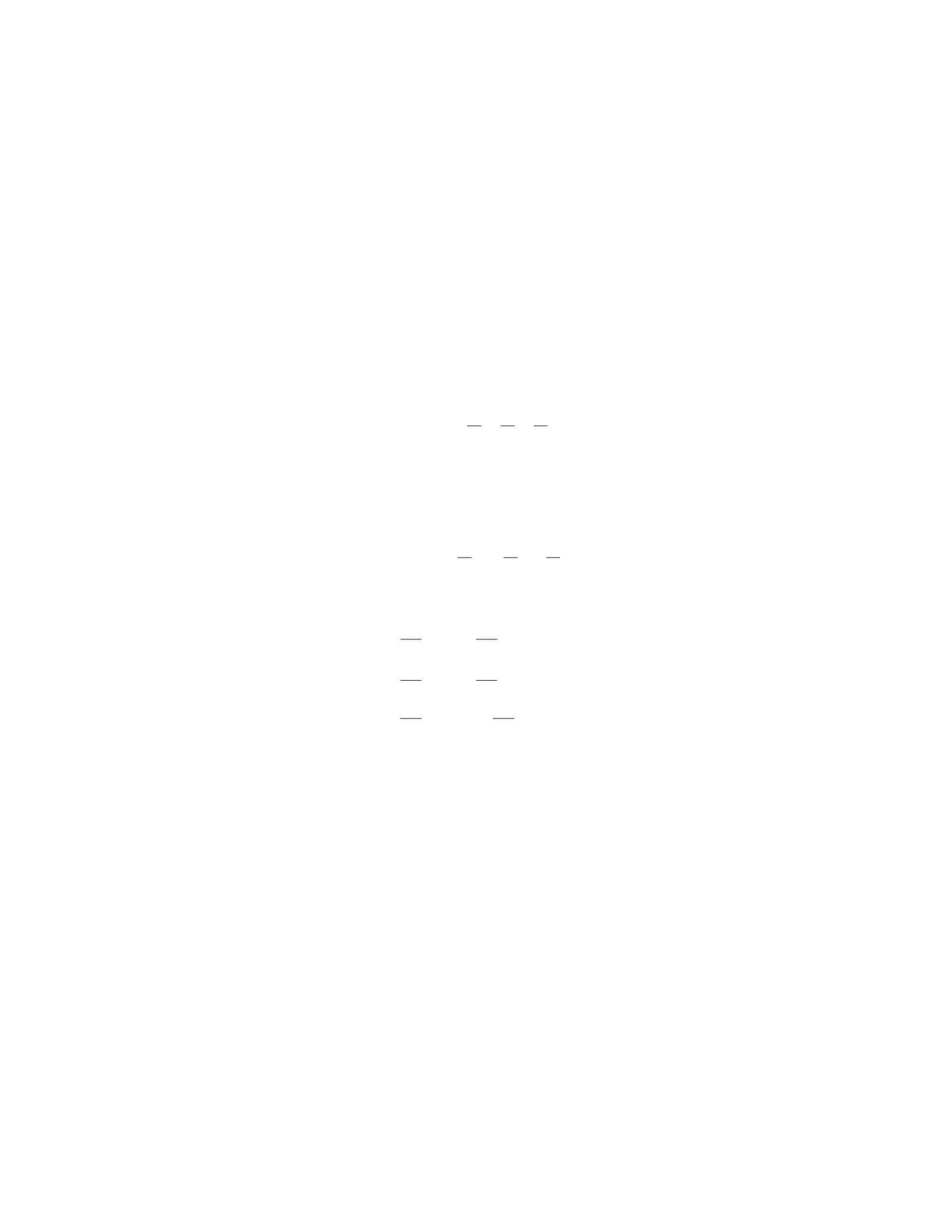
To find the curl of a vector field F(x, y, z) = P(x, y, z)i+Q(x, y, z)j+R(x, y, z)k
at a point (a, b, c), we use the formula:
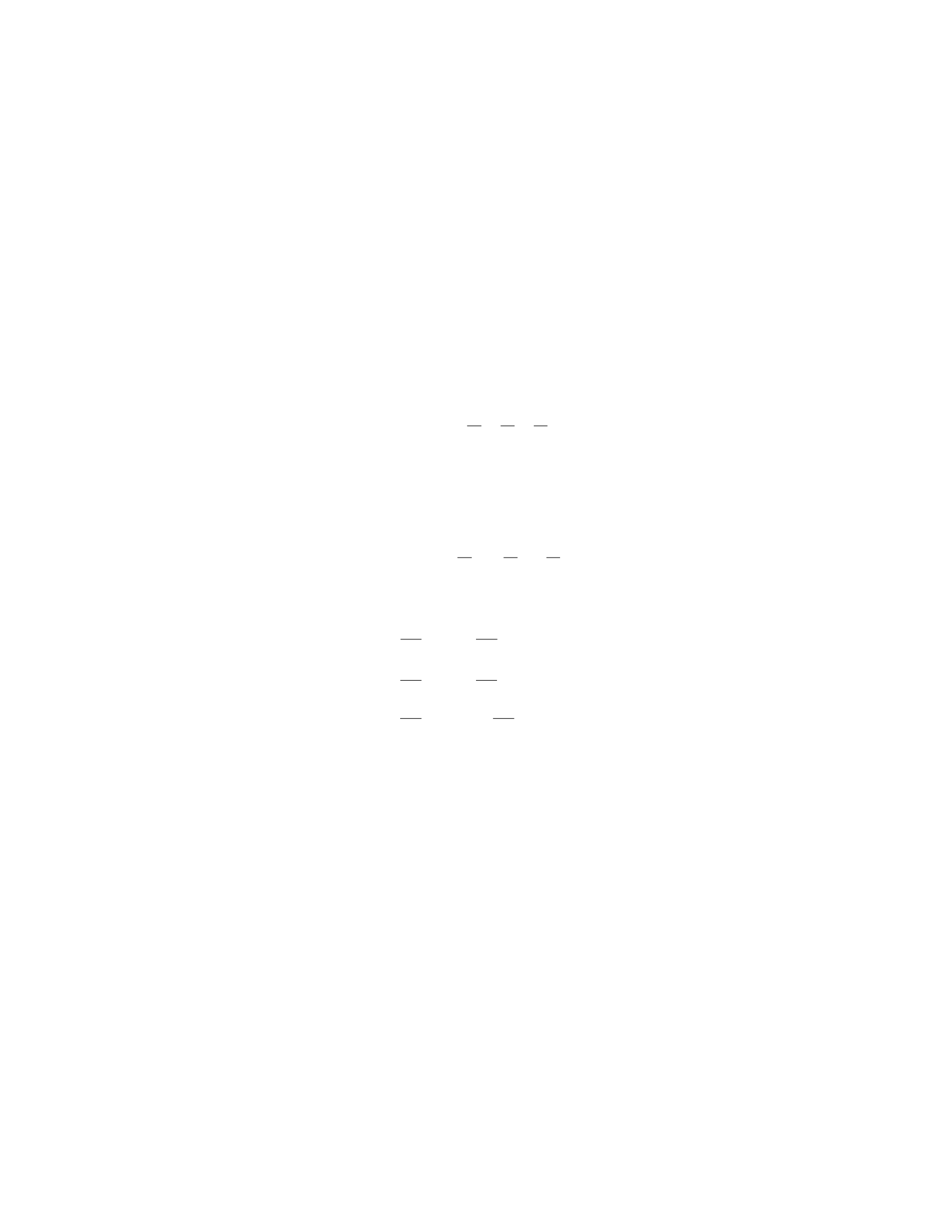
∇ × F=
i j k
∂
∂x
∂
∂y
∂
∂z
P Q R
Given F(x, y, z) = x2yi−xyzj+z2k, we have P(x, y, z) = x2y,Q(x, y, z) =
−xyz, and R(x, y, z) = z2.
Step 1: Compute the curl of Fusing the formula above:
∇ × F=
i j k
∂
∂x
∂
∂y
∂
∂z
x2y−xyz z2
Step 2: Compute the partial derivatives:
∂R
∂y = 0,∂Q
∂z =−x
∂P
∂z = 0,∂R
∂x = 0
∂Q
∂x = 2xy, ∂P
∂y =x2
Step 3: Plug these partial derivatives into the determinant and evaluate:
∇ × F= (i(−x)−j0 + k(2xy))
=−xi+ 2xyk
Step 4: Evaluate the curl of Fat the point (1,−2,3):
∇ × F=−1i+ 2(−2)(3)k
=−i−12k
Therefore, the curl of Fat the point (1,−2,3) is −i−12k.
Question 5
Question
Let F(x, y, z) = x2yi+z3j+exyzkbe a vector field. Compute ∇·∇×Fwhere
∇is the gradient operator and ×denotes the cross product.
3
Solution
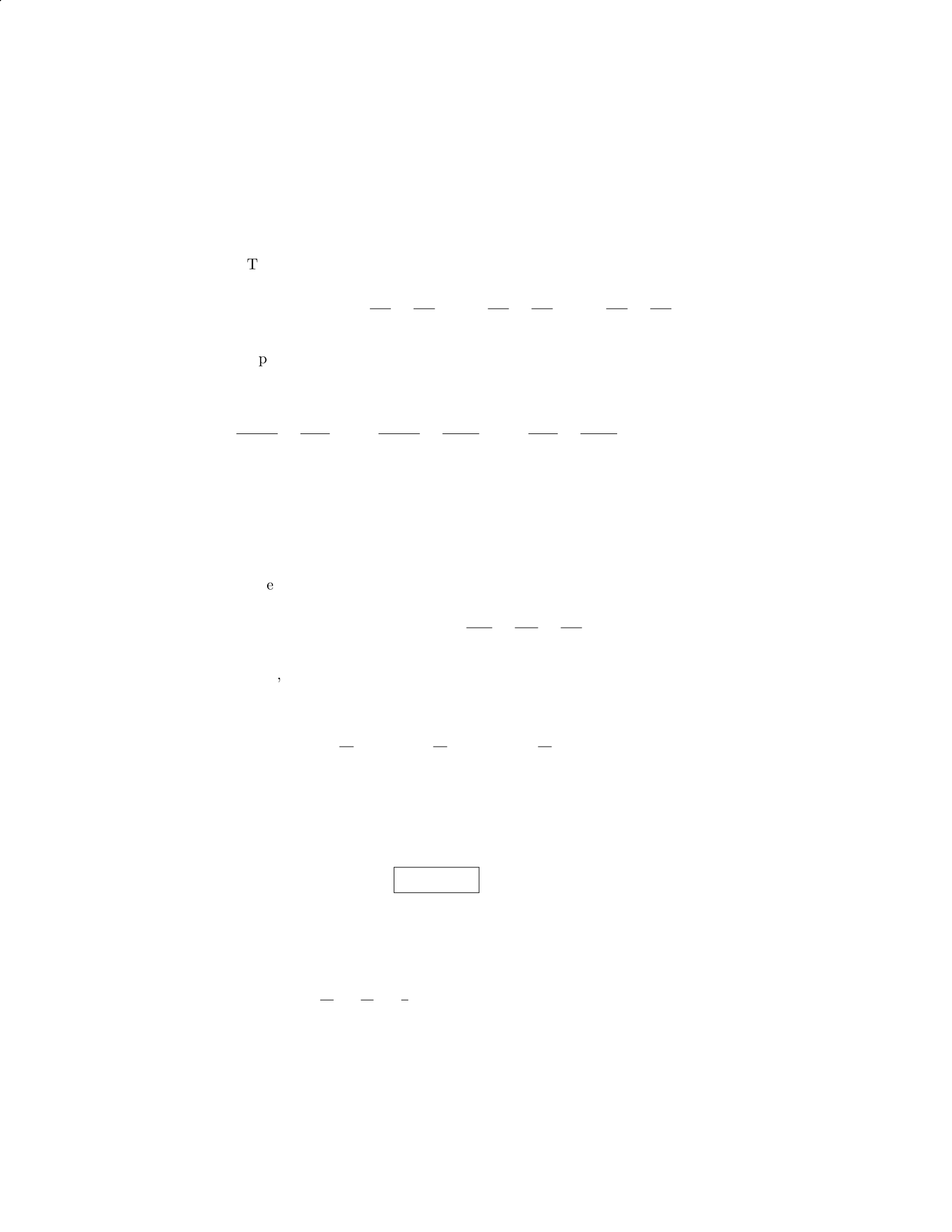
Step 1: Calculate ∇ × F.
The curl of a vector field F(x, y, z) = Pi+Qj+Rkis given by:
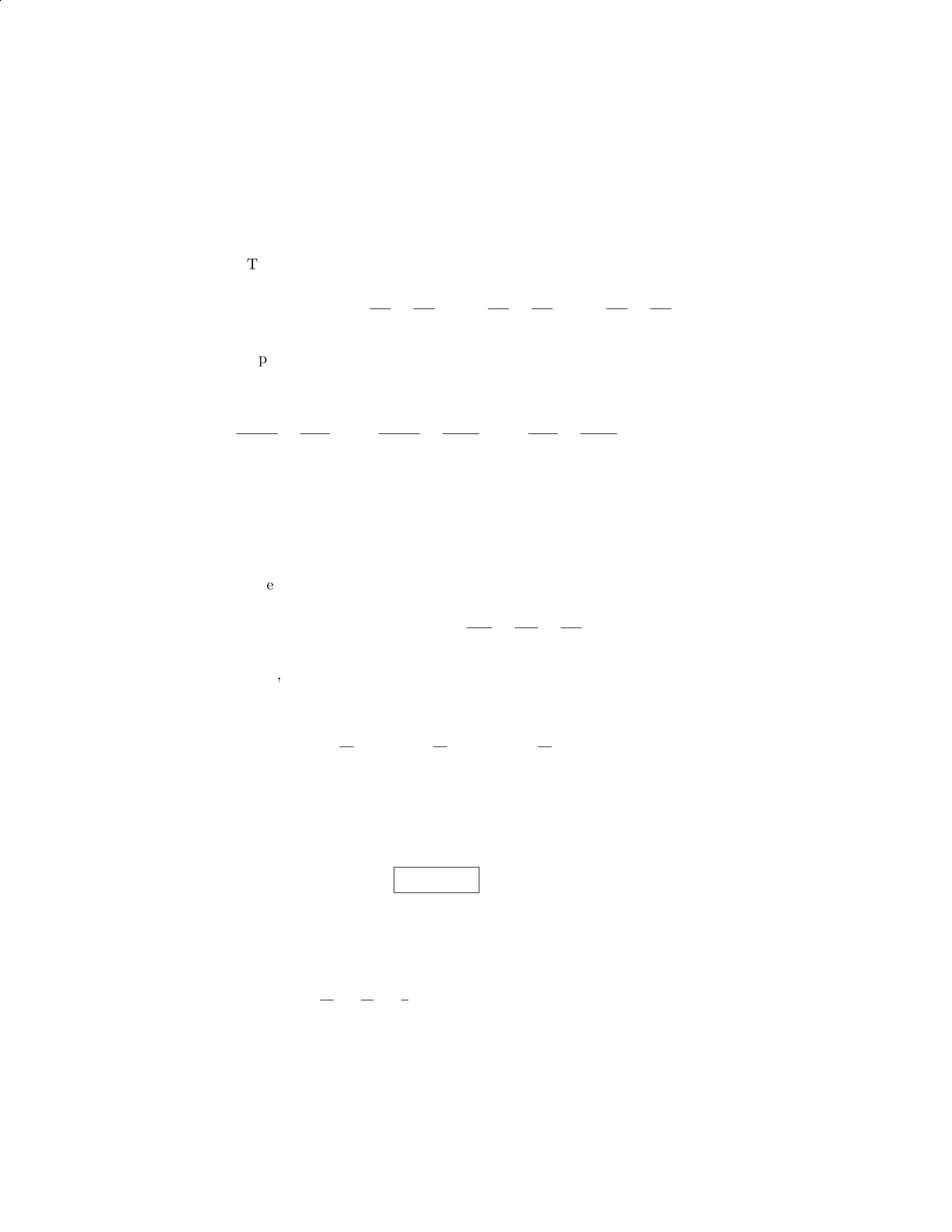
∇ × F=∂R
∂y −∂Q
∂z i−∂R
∂x −∂P
∂z j+∂Q
∂x −∂P
∂y k
Applying this formula to F(x, y, z) = x2yi+z3j+exyzk, we have:
=∂(exyz )
∂y −∂(z3)
∂z i−∂(exyz )
∂x −∂(x2y)
∂z j+∂(z3)
∂x −∂(x2y)
∂y k
= (xzexyz −0) i−(yzexyz −2xy)j+0−x2k
=xzexyzi−yzexyz j−x2k
Step 2: Compute ∇ · ∇ × F.
The divergence of a vector field G(x, y, z) = Mi+Nj+Pkis given by:
∇ · G=∂M
∂x +∂N
∂y +∂P
∂z
Now, to calculate ∇ · ∇ × F, apply the divergence operator to the result
obtained previously:
- yzexyzj−x2k) = ∂
∂x (xzexyz) + ∂
∂y (−yzexyz) + ∂
∂z (−x2)
=zexyz +yzexyz + 0
=zexyz +yzexyz
= (z+y)exyz
Therefore, ∇ · ∇ × F= (z+y)exyz .
Question 6
Question
Let F(x, y, z) = xz
y2i+y2
zj+y
xk. Find the divergence of Fat the point (1,1,1).
4

Solution
To find the divergence of a vector field F=Pi+Qj+Rkat a point, we use the
formula:
div(F) = ∂P
∂x +∂Q
∂y +∂R
∂z
Given F(x, y, z) = xz
y2i+y2
zj+y
xk, we have P=xz
y2,Q=y2
z, and R=y
x.
Step 1: Calculate ∂P
∂x .
∂P
∂x =z
y2
Step 2: Calculate ∂Q
∂y .
∂Q
∂y =2y
z
Step 3: Calculate ∂R
∂z .
∂R
∂z = 0
Step 4: Find the divergence of Fat the point (1,1,1).
div(F) = ∂P
∂x +∂Q
∂y +∂R
∂z =z
y2+2y
z+ 0
Substitute (x, y, z) = (1,1,1) into the expression above:
div(F)
(1,1,1) =1
12+2·1
1= 1 + 2 = 3
Therefore, the divergence of Fat the point (1,1,1) is 3.
Question 7
Question
Let F(x, y, z) = x2yi+xyzj+yz2kbe a vector field. Compute ∇ · (∇ × F).
Solution
Step 1: Compute ∇ × F.
=
i j k
∂
∂x
∂
∂y
∂
∂z
x2y xyz yz2
=∂(yz2)
∂y −∂(xyz)
∂z i−∂(x2y)
∂x −∂(yz2)
∂z j+∂(xyz)
∂x −∂(x2y)
∂y k
= (z2−y)i−(2xy −0)j+ (yz −2xy)k
= (z2−y)i−2xyj+ (yz −2xy)k
5

Step 2: Compute ∇ · (∇ × F).
) = ∇ · (z2−y)i−2xyj+ (yz −2xy)k
=∂
∂x (z2−y) + ∂
∂y (−2xy) + ∂
∂z (yz −2xy)
= 0 −2x+ 0
=−2x
Therefore, ∇ · (∇ × F) = −2x.
Question 8
Question
Let F(x, y, z) = x2yi+y2zj+z2xkbe a vector field. Compute ∇ · F.
Solution
Step 1: The divergence of a vector field F(x, y, z) = P(x, y, z)i+Q(x, y, z)j+
R(x, y, z)kis given by the following formula:
∇ · F=∂P
∂x +∂Q
∂y +∂R
∂z
Step 2: Given that F(x, y, z) = x2yi+y2zj+z2xk, we can identify P(x, y, z) =
x2y,Q(x, y, z) = y2z, and R(x, y, z) = z2x.
Step 3: Now, we can calculate the partial derivatives:
∂P
∂x = 2xy
∂Q
∂y = 2yz
∂R
∂z = 2zx
Step 4: Substitute the partial derivatives back into the formula for the di-
vergence:
∇ · F= 2xy + 2yz + 2zx
Step 5: Simplifying the expression, we get:
∇ · F= 2(xy +yz +zx)
Therefore, the divergence of the vector field F(x, y, z) = x2yi+y2zj+z2xk
is 2(xy +yz +zx).
6
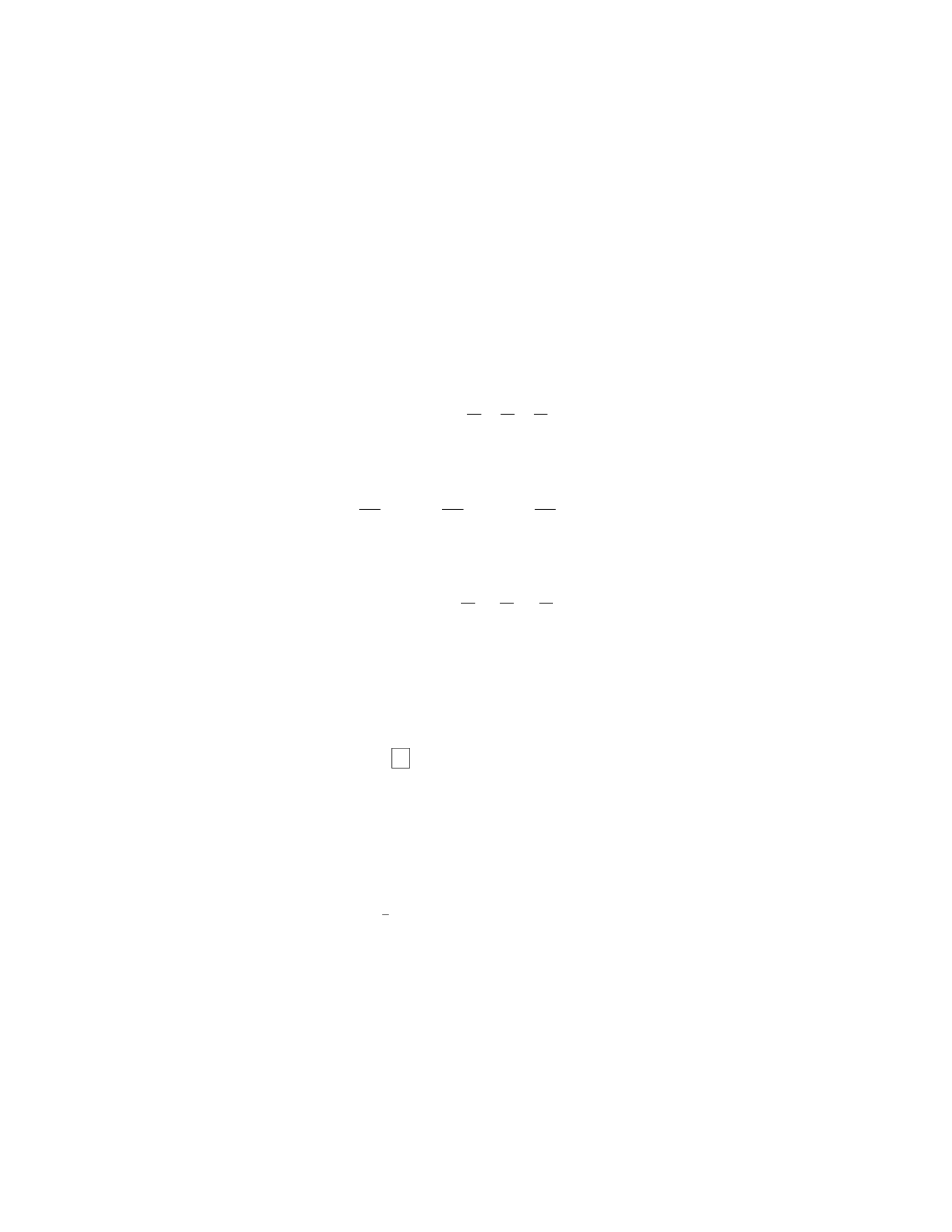
Question 9
Question
Let F(x, y, z)=(yz2, xz2, xy2). Compute the curl of F.
Solution
Step 1: The curl of a vector field F(x, y, z)=(P, Q, R) is given by the determi-
nant of the following matrix:
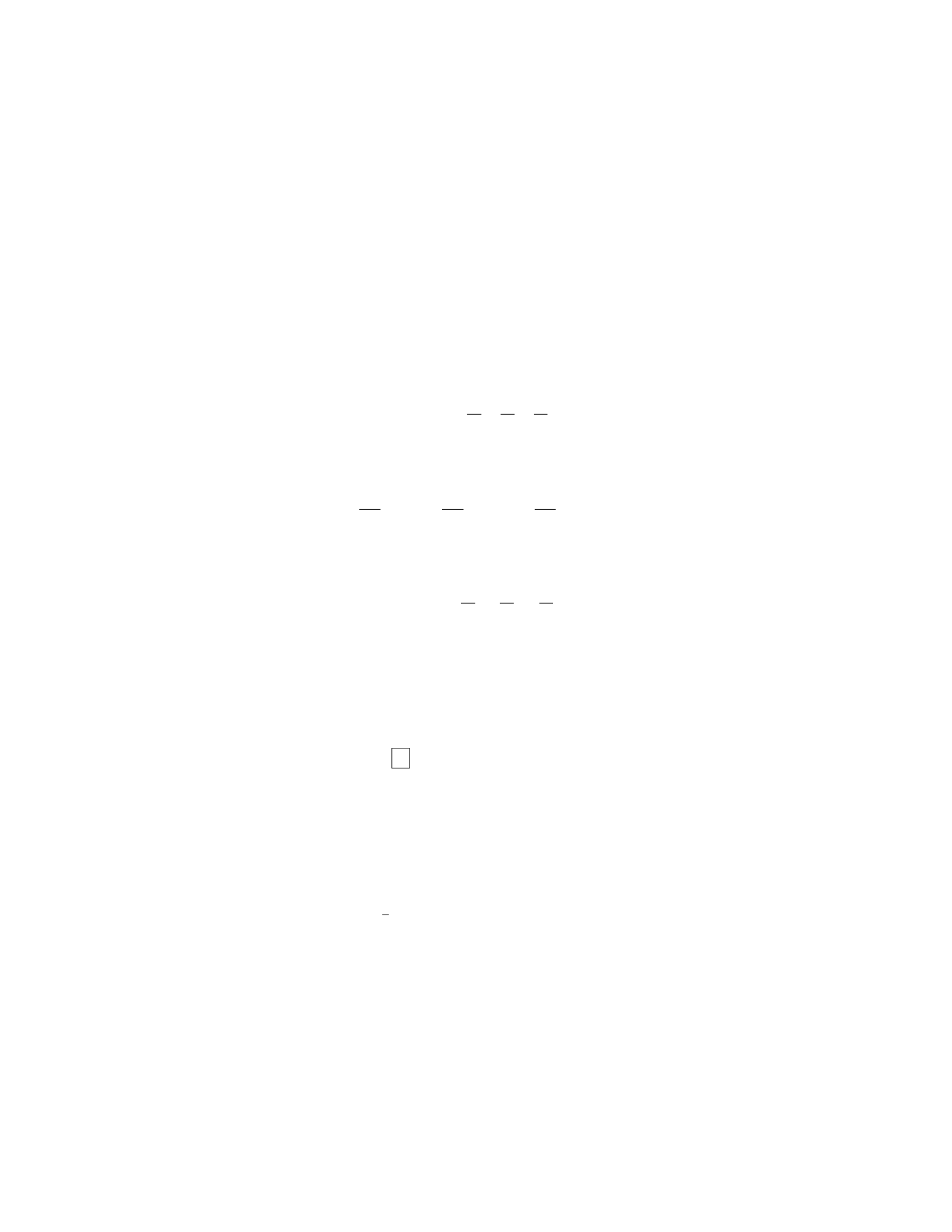
∇ × F=
i j k
∂
∂x
∂
∂y
∂
∂z
P Q R
Step 2: Let’s first find the partial derivatives of P,Q, and R.
∂P
∂y =z2,∂Q
∂z = 2xz, ∂R
∂x =y2
Step 3: Now, we substitute into the formula for the curl:
∇ × F=
i j k
∂
∂x
∂
∂y
∂
∂z
yz2xz2xy2
Step 4: Evaluating the determinant gives:
∇×F= (2xz−2xz, y2−z2, z2−y2)·i−(0−0,0−0, x2−y2)·j+(0−0,0−0, x2−2yz)·k
Step 5: Simplifying the expression, we get:
∇ × F= 0 ·i+ (y2−z2)·j+ (z2−y2)·k
Therefore, the curl of Fis ∇ × F= (0, y2−z2, z2−y2).
Question 10
Question
Let F(x, y, z) = x2y2z2,1
y−cos(z), xy. Calculate curl(F).
Solution
To find the curl of a vector field F=Pi+Qj+Rk, where P,Q, and Rare
functions of x,y, and z, we compute the determinant of the curl operator:
7
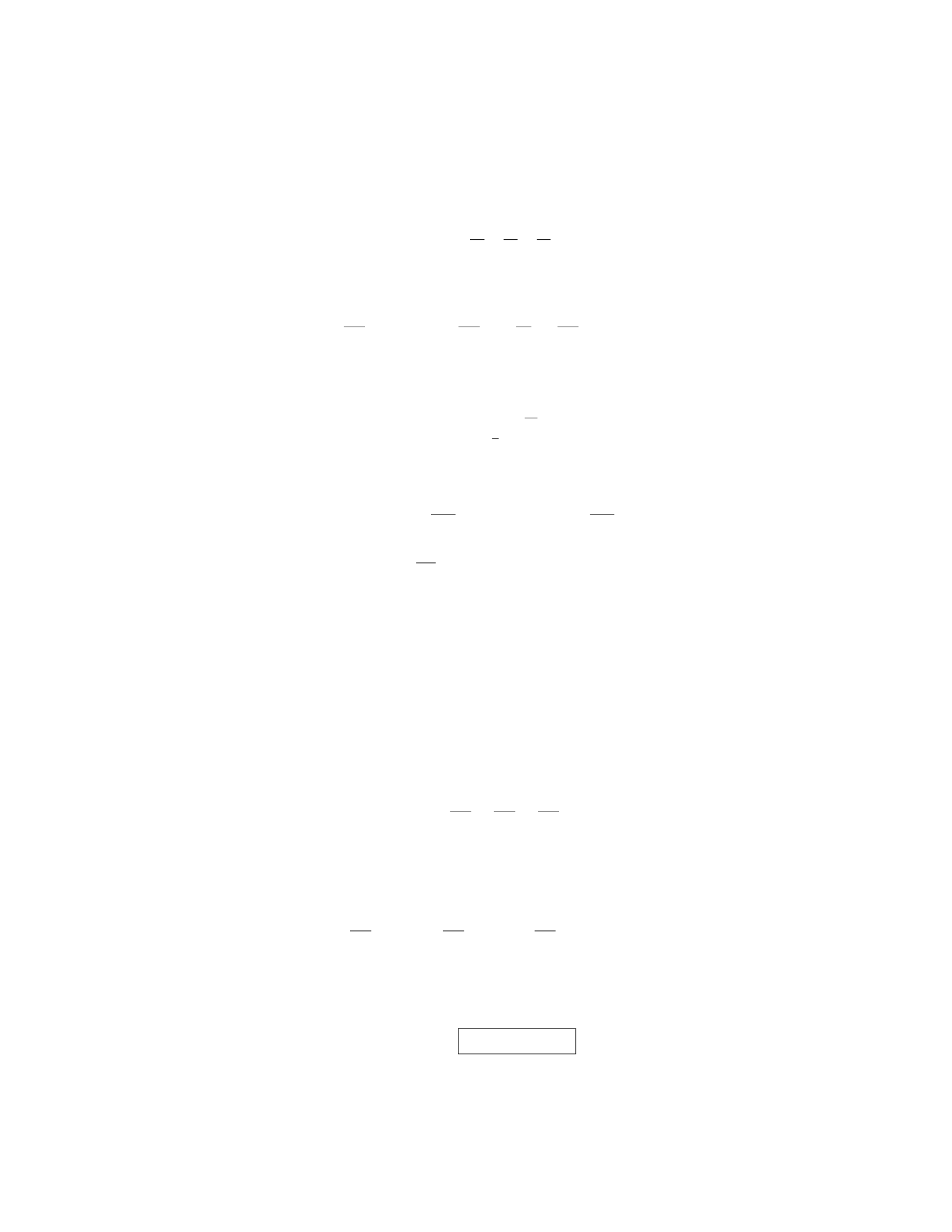
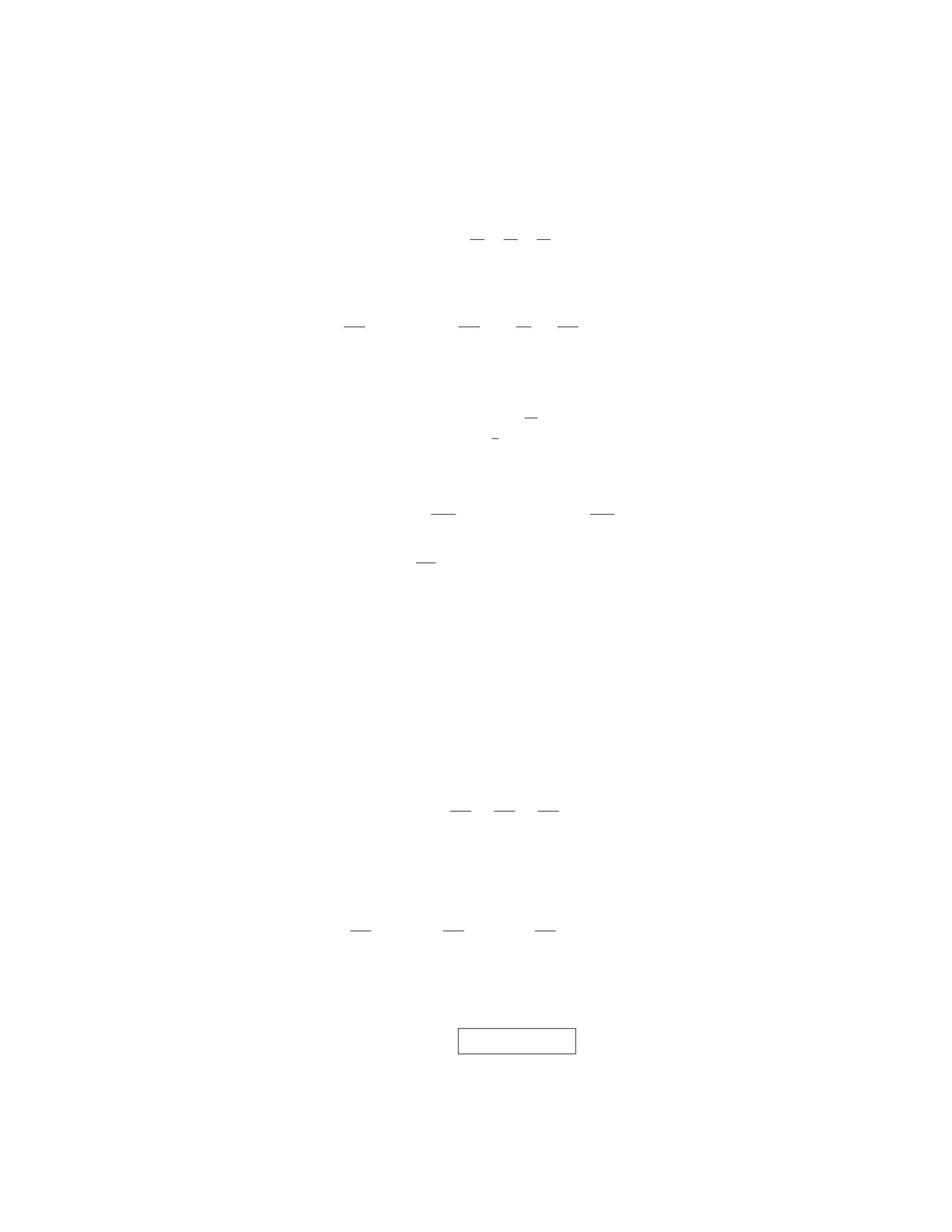
curl(F) =
i j k
∂
∂x
∂
∂y
∂
∂z
P Q R
Step 1: Compute the partial derivatives of P,Q, and R.
∂P
∂x = 2xy2z2,∂Q
∂y =−1
y2,∂R
∂z = 0
Step 2: Plug the partial derivatives into the determinant formula.
curl(F) =
i j k
2xy2z2−1
y20
x2y2z21
y−cos(z)xy
Step 3: Expand the determinant to compute the curl.
curl(F) = 0−0,0−0,2xz
y−sin(z)=0,0,2xz
y−sin(z)
Therefore, curl(F) = 0,0,2xz
y−sin(z).
Question 11
Question
Let F(x, y, z) = x2yi+y2zj+z2xk. Compute div F.
Solution
Step 1: The divergence of a vector field F(x, y, z) = P(x, y, z)i+Q(x, y, z)j+
R(x, y, z)kis given by:
div F=∂P
∂x +∂Q
∂y +∂R
∂z
Step 2: Given F(x, y, z) = x2yi+y2zj+z2xk, we have: P(x, y, z) = x2y,
Q(x, y, z) = y2z, and R(x, y, z) = z2x.
Step 3: Compute the partial derivatives:
∂P
∂x = 2xy, ∂Q
∂y = 2yz, ∂R
∂z = 2zx
Step 4: Calculate the divergence:
div F= 2xy + 2yz + 2zx = 2(xy +yz +zx)
Therefore, the divergence of Fis 2(xy +yz +zx) .
8

Question 12
Question
Let F(x, y, z)=3x2yi+ 2xyzj+yexyzkbe a vector field in R3. Find the
divergence of F.
Solution
Step 1: The divergence of a vector field F(x, y, z) = P(x, y, z)i+Q(x, y, z)j+
R(x, y, z)kis given by the expression:
div(F) = ∂P
∂x +∂Q
∂y +∂R
∂z
Step 2: In this case, P(x, y, z) = 3x2y,Q(x, y, z) = 2xyz, and R(x, y, z) =
yexyz. We need to calculate the partial derivatives of P,Q, and Rwith respect
to x,y, and z.
Step 3: ∂P
∂x = 6xy
∂Q
∂y = 2xz
∂R
∂z =y2exyz
Step 4: Now, we can find the divergence of Fby adding these partial deriva-
tives:
div(F)=6xy + 2xz +y2exyz
Therefore, the divergence of the vector field Fis 6xy + 2xz +y2exyz.
Question 13
Question
Let F(x, y, z) = (x2+y2+z2)1/2ˆ
i+ (x2+y2+z2)1/2ˆ
j+ (x2+y2+z2)1/2ˆ
kbe
a vector field. Calculate the curl of Fat the point (1,2,3).
Solution
To find the curl of F, we use the formula:
curl F=∇ × F=
ˆ
iˆ
jˆ
k
∂
∂x
∂
∂y
∂
∂z
P Q R
Where P, Q, R are the components of the vector field F.
9
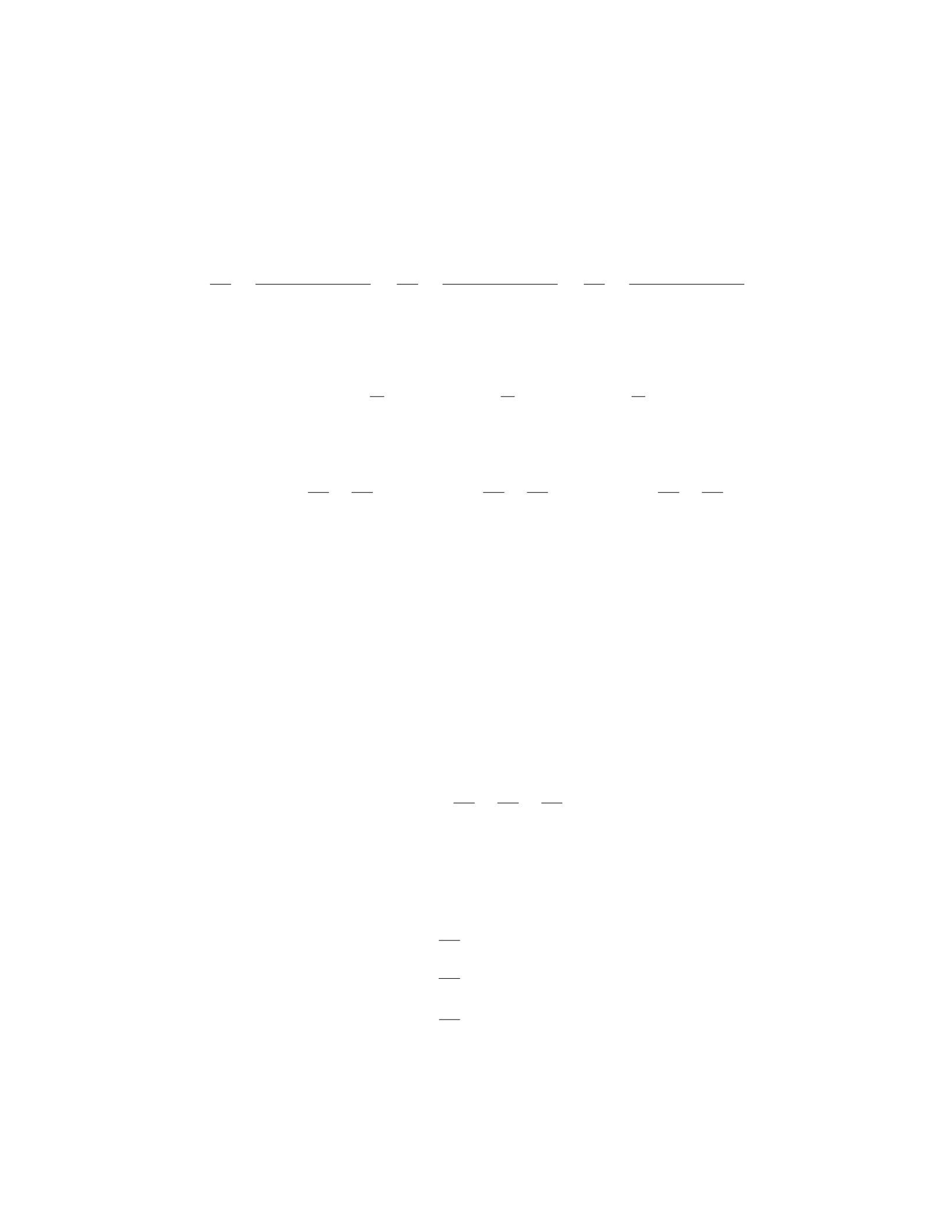
Step 1: Calculate the components P,Q, and Rof F:P= (x2+y2+z2)1/2,
Q= (x2+y2+z2)1/2,R= (x2+y2+z2)1/2.
Step 2: Calculate the partial derivatives of P,Q, and R:
∂P
∂x =x
(x2+y2+z2)1/2,∂Q
∂y =y
(x2+y2+z2)1/2,∂R
∂z =z
(x2+y2+z2)1/2.
Step 3: Substitute the components and their derivatives into the formula for
the curl:
∇ × F=
ˆ
iˆ
jˆ
k
∂
∂x
∂
∂y
∂
∂z
(x2+y2+z2)1/2(x2+y2+z2)1/2(x2+y2+z2)1/2
Step 4: Evaluate the determinant:
(∇ × F)x=∂R
∂y −∂Q
∂z ,(∇ × F)y=∂P
∂z −∂R
∂x ,(∇ × F)z=∂Q
∂x −∂P
∂y .
Step 5: Evaluate the curl of Fat the given point (1,2,3): Substitute x= 1,
y= 2, z= 3 into the components and their derivatives, then calculate the curl.
Question 14
Question
Let F(x, y, z) = (2xy2, x2z, xz3) be a vector field. Calculate the divergence of
F.
Solution
Step 1: The divergence of a vector field F= (P, Q, R) is given by the formula:
div(F) = ∂P
∂x +∂Q
∂y +∂R
∂z
Step 2: Given F(x, y, z) = (2xy2, x2z, xz3), we have P= 2xy2,Q=x2z,
and R=xz3.
Step 3: Find the partial derivatives of P,Q, and Rwith respect to x,y, and
z:
∂P
∂x = 2y2
∂Q
∂y = 0
∂R
∂z = 3xz2
10
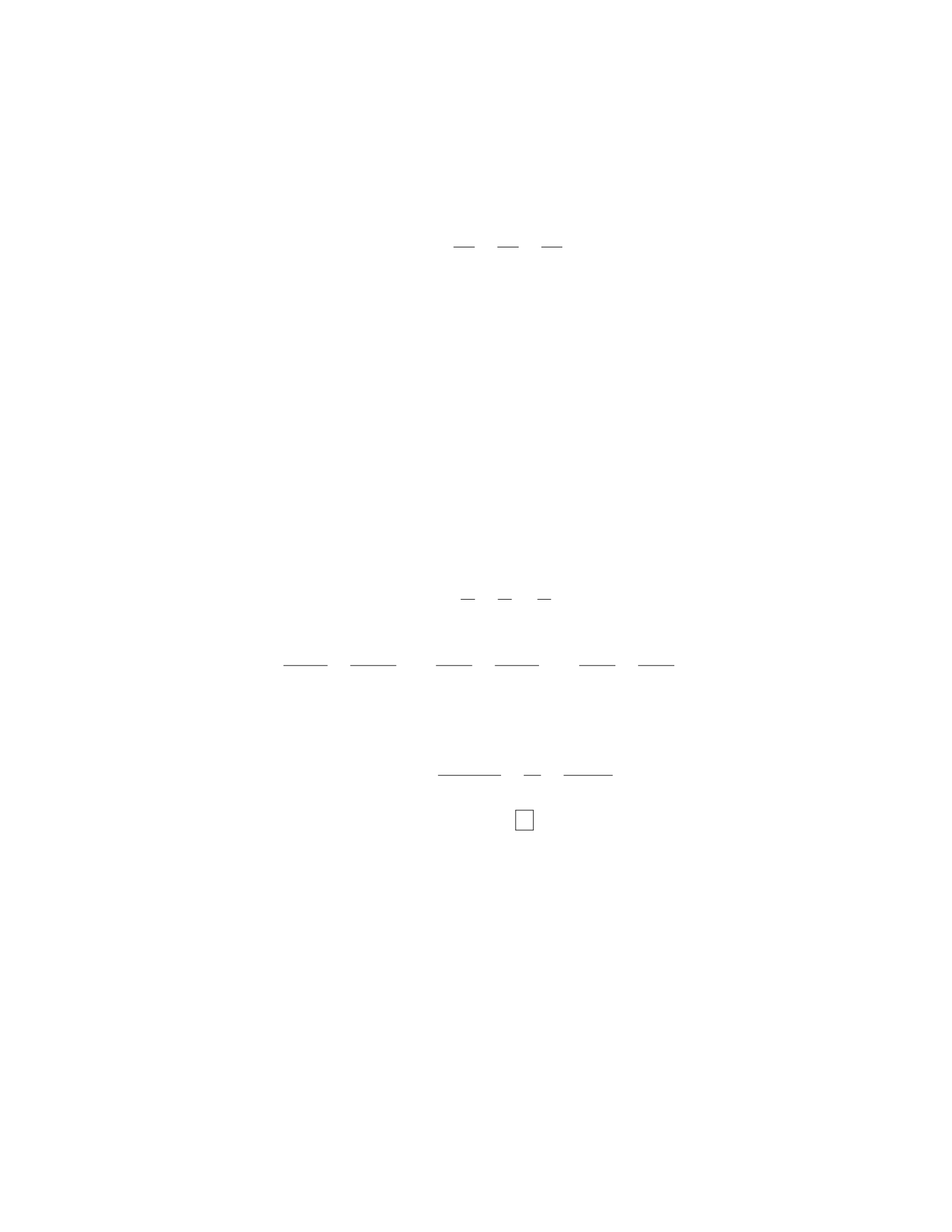
Step 4: Now, calculate the divergence of F:
div(F) = ∂P
∂x +∂Q
∂y +∂R
∂z
= 2y2+ 0 + 3xz2
= 2y2+ 3xz2
Therefore, the divergence of the vector field F(x, y, z) = (2xy2, x2z, xz3) is
div(F)=2y2+ 3xz2.
Question 15
Question
Let F(x, y, z) = y2i+xyzj+yz2kbe a vector field in R3. Compute ∇·∇×F.
Solution
Step 1: Compute ∇ × F.
∇ × F=
i j k
∂
∂x
∂
∂y
∂
∂z
y2xyz yz2
= (∂(yz2)
∂y −∂(xyz)
∂z )i−(∂(y2)
∂z −∂(yz2)
∂x )j+ ( ∂(y2)
∂x −∂(y2)
∂y )k
= (z2−y)i−(0 −z)j+ (0 −2y)k= (z2−y)i+zj−2yk
Step 2: Compute ∇ · (∇ × F).
∇ · (∇ × F) = ∂(z2−y)
∂x +∂z
∂y +∂(−2y)
∂z
= 0 + 0 + 0 = 0
Question 16
Question
Let F(x, y, z) = x2yi+xyzj+xz2k. Compute ∇ · ∇ × F.
11
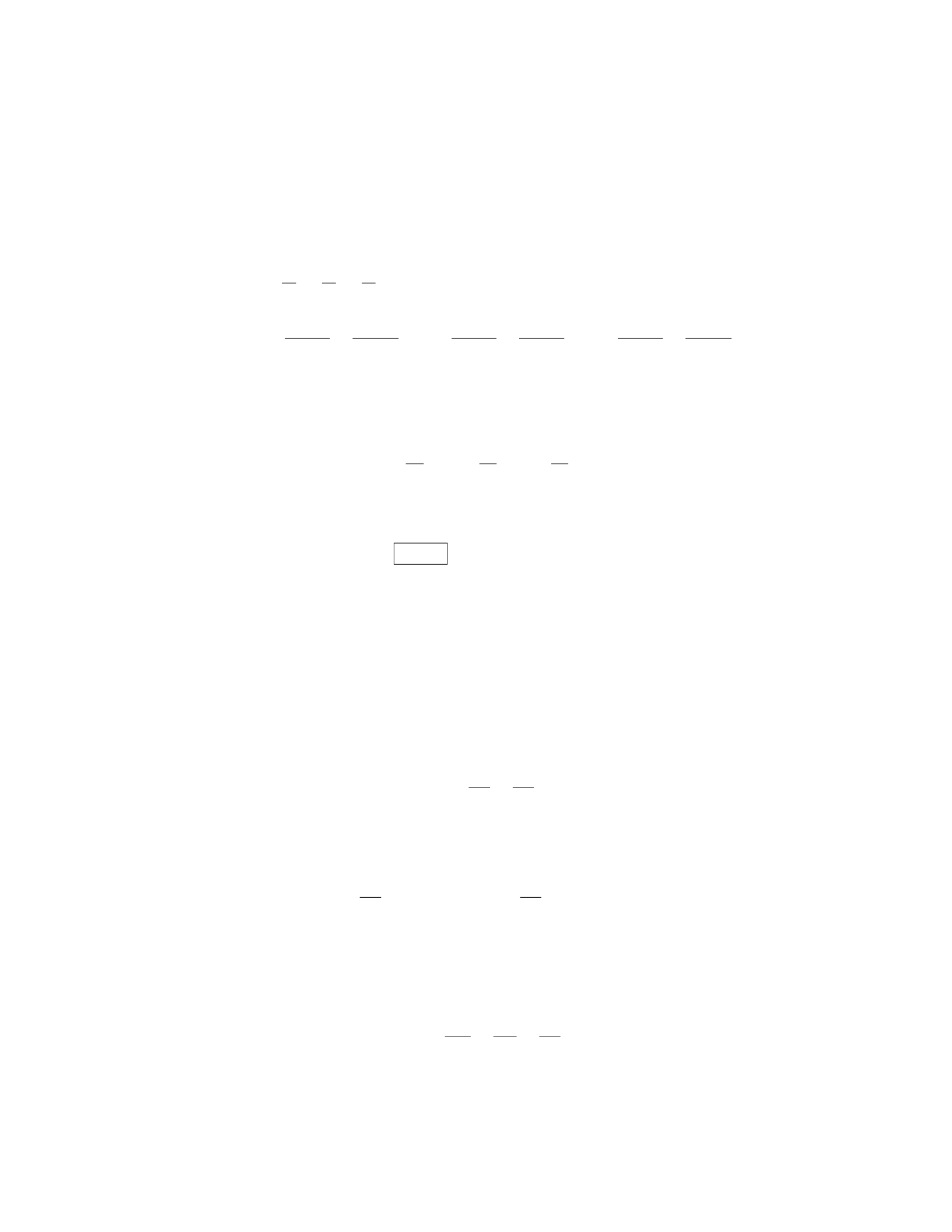
Solution
Step 1: Calculate the curl of F.
∇ × F=
i j k
∂
∂x
∂
∂y
∂
∂z
x2y xyz xz2
=∂(xz2)
∂y −∂(xyz)
∂z i−∂(xz2)
∂x −∂(x2y)
∂z j+∂(x2y)
∂x −∂(xyz)
∂y k
= (0 −x)i−(z−0)j+ (2xy −x)k
=−xi−zj+ (2xy −x)k
Step 2: Compute the divergence of ∇ × F.
∇ · ∇ × F=∂
∂x (−x) + ∂
∂y (−z) + ∂
∂z (2xy −x)
=−1−0+2x
= 2x−1
Therefore, ∇ · ∇ × F= 2x−1 .
Question 17
Question
Let F(x, y) = (2xy2+ex)i+ (x2+yex)jbe a vector field. Compute ∇ · ∇ × F.
Solution
Step 1: Compute ∇ × F. The curl of a vector field F(x, y) = P(x, y)i+Q(x, y)j
is given by
∇ × F=∂Q
∂x −∂P
∂y k
where kis the unit vector in the z-direction.
For F(x, y) = (2xy2+ex)i+ (x2+yex)j, we have P(x, y) = 2xy2+exand
Q(x, y) = x2+yex. Calculating the partial derivatives, we find
∂Q
∂x = 2x+yexand ∂P
∂y = 4xy,
thus
∇ × F= (2x+yex−4xy)k.
Step 2: Compute ∇ · ∇ × F. The divergence of a vector field G(x, y, z) =
M(x, y, z)i+N(x, y, z)j+P(x, y, z)kis given by
∇ · G=∂M
∂x +∂N
∂y +∂P
∂z .
12
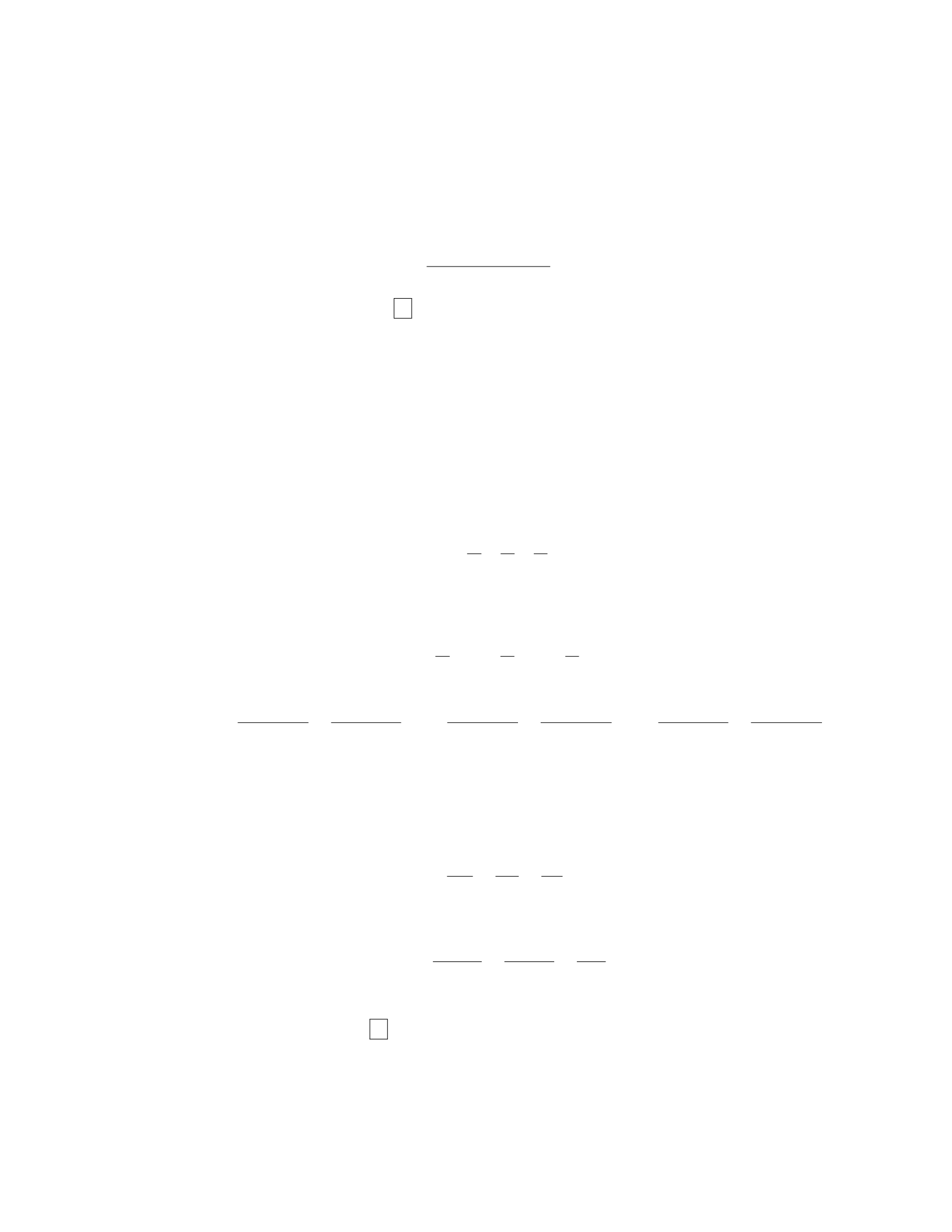
In our case, G(x, y, z) = (2x+yex−4xy)k. Since Gonly has a z-component,
the divergence in this case simplifies to
∇ · G=∂(2x+yex−4xy)
∂z = 0.
Therefore, ∇ · ∇ × F= 0 .
Question 18
Question
Let F(x, y, z) = ⟨x2+y2, y2+z2, z2+x2⟩. Compute ∇ · ∇ × F.
Solution
Step 1: Compute ∇×F. The curl of a vector field F(x, y, z) = ⟨P, Q, R⟩is given
by:
∇ × F=
i j k
∂
∂x
∂
∂y
∂
∂z
P Q R
Here, F(x, y, z) = ⟨x2+y2, y2+z2, z2+x2⟩=⟨P, Q, R⟩. So, we have:
∇ × F=
i j k
∂
∂x
∂
∂y
∂
∂z
x2+y2y2+z2z2+x2
=∂(z2+x2)
∂y −∂(y2+z2)
∂z i−∂(z2+x2)
∂x −∂(x2+y2)
∂z j+∂(y2+z2)
∂x −∂(x2+y2)
∂y k
= (0 −2z)i−(2x−0)j+ (2y−2y)k
=−2zi−2xj
Step 2: Compute ∇ · ∇ × F. The divergence of a vector field G(x, y, z) =
⟨M, N, P ⟩is given by:
∇ · G=∂M
∂x +∂N
∂y +∂P
∂z
Here, G(x, y, z) = ∇ × F=⟨−2z, −2x, 0⟩=⟨M, N, P ⟩. Therefore,
∇ · ∇ × F=∂(−2z)
∂x +∂(−2x)
∂y +∂(0)
∂z
= 0 + 0 + 0 = 0
Hence, ∇ · ∇ × F= 0 .
13
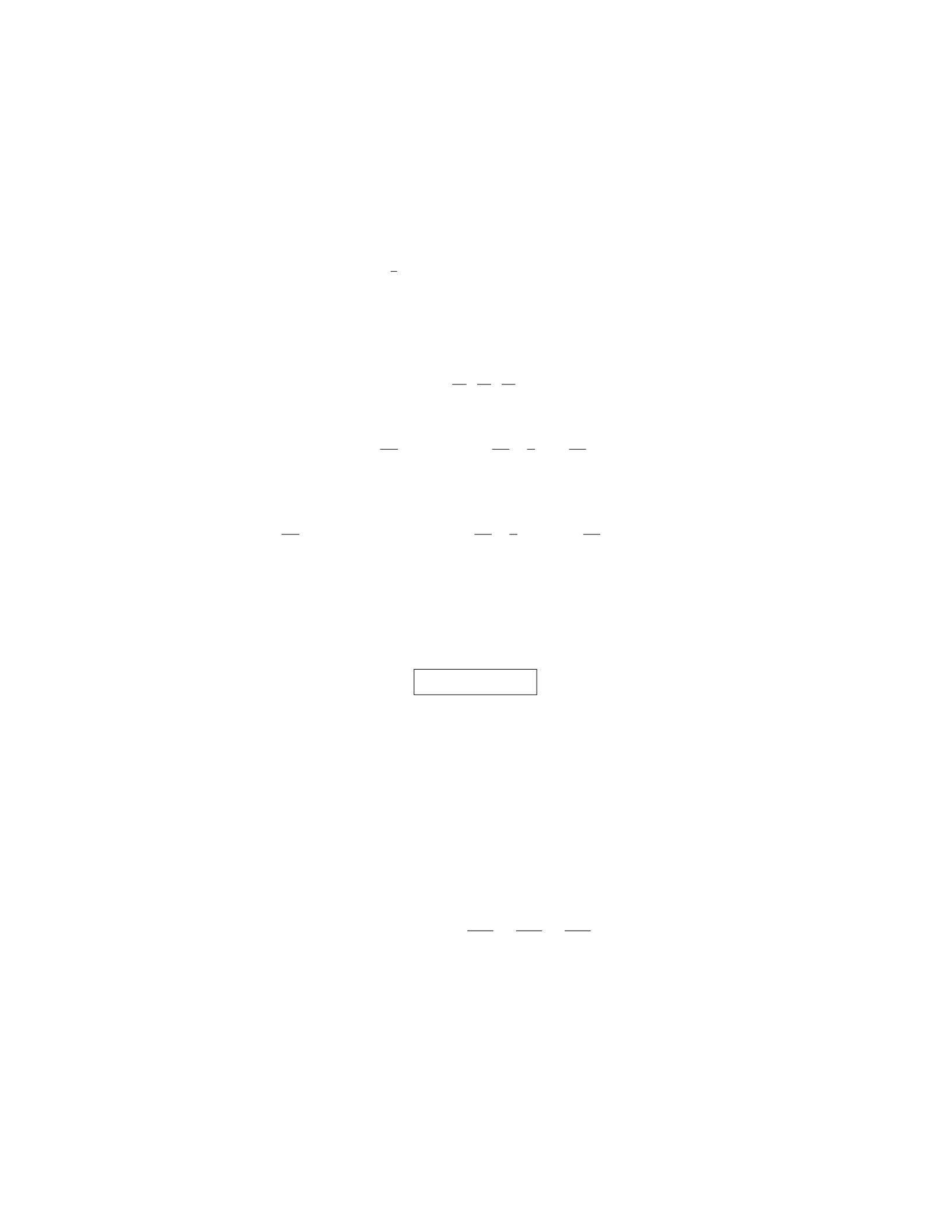
Question 19
Question
Let F(x, y, z) = exsin(y),1
z, x2ybe a vector field. Calculate the divergence of
F.
Solution
To find the divergence of F, we need to determine the dot product of the vector
field Fwith the del operator ∇=∂
∂x ,∂
∂y ,∂
∂z .
Step 1: Find the components of ∇ · F.
∇ · F=∂
∂x (exsin(y)) + ∂
∂y 1
z+∂
∂z x2y
Step 2: Calculate the partial derivatives.
∂
∂x (exsin(y)) = exsin(y),∂
∂y 1
z= 0,∂
∂z x2y= 0
Step 3: Substitute the results back into the expression for ∇ · F.
∇ · F=exsin(y)+0+0
Step 4: Simplify the expression.
∇ · F=exsin(y)
Question 20
Question
Let F(x, y, z) = (x2y, yz, xyz) be a vector field in R3. Compute the divergence
of F.
Solution
To compute the divergence of F, we’ll use the formula
div F=∇ · F=∂F1
∂x +∂F2
∂y +∂F3
∂z .
Step 1: Write Fin component form:
F= (x2y, yz, xyz)=(F1, F2, F3).
14
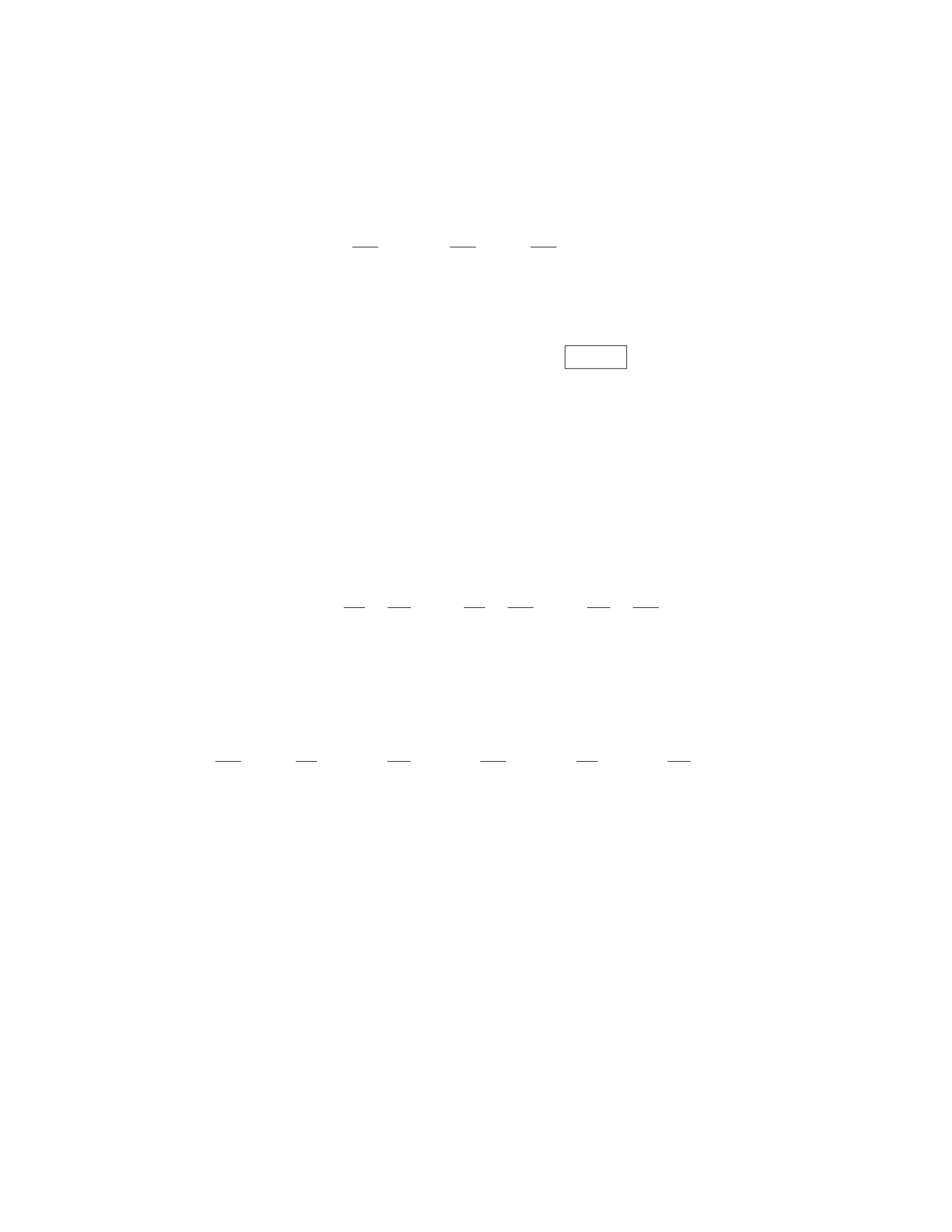
Step 2: Compute the partial derivatives of each component:
∂F1
∂x = 2xy, ∂F2
∂y =z, ∂F3
∂z =xy.
Step 3: Add up the partial derivatives to find the divergence:
div F= 2xy +z+xy = 3xy +z.
Therefore, the divergence of the vector field Fis 3xy +z.
Question 21
Question
Let F(x, y, z) = x3yi+xy2zj+xyz3kbe a vector field in R3. Calculate the curl
of Fat the point (1,2,3).
Solution
To find the curl of a vector field F(x, y, z) = Mi+Nj+Pk, we use the formula:
∇ × F=∂P
∂y −∂N
∂z i−∂P
∂x −∂M
∂z j+∂N
∂x −∂M
∂y k
Given F(x, y, z) = x3yi+xy2zj+xyz3k, we have:
M=x3y, N =xy2z, P =xyz3
Now, we calculate the partial derivatives:
∂M
∂z = 0,∂P
∂y =xz3,∂N
∂x =y2z, ∂M
∂y = 3x2,∂P
∂x =yz3,∂N
∂z =xy2
Finally, plug these values into the formula for the curl:
∇ × F= (xz3−xy2)i−(yz3−0)j+ (y2z−3x2)k
At the point (1,2,3), the curl is:
∇ × F(1,2,3) = (3 −4)i−(3 −0)j+ (4 −3)k=−i−3j+k
Question 22
Question
Let F(x, y) = x3yi+x2y2j. Compute ∇ · ∇ × F.
15
Solution
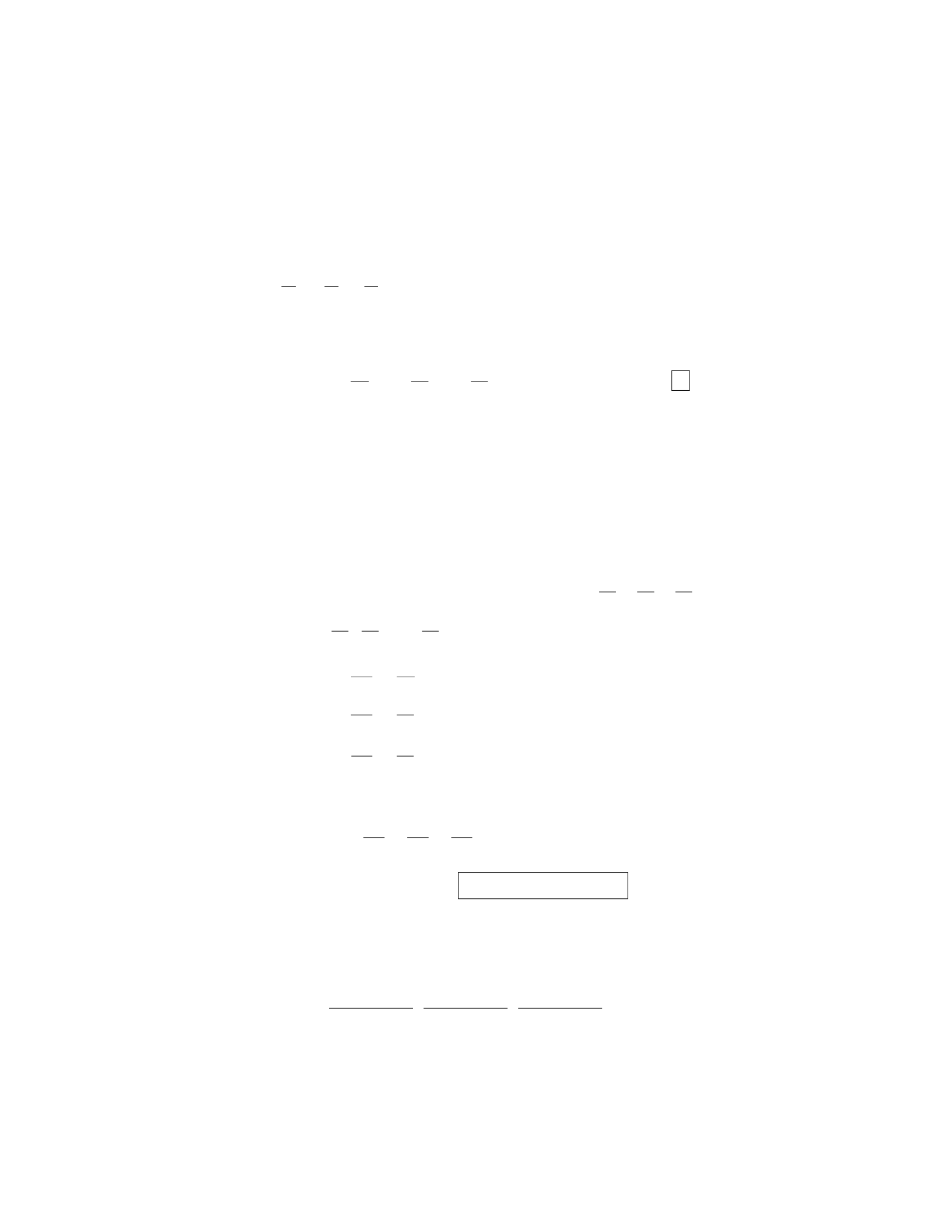
Step 1: Calculate ∇ × F.
∇ × F=
i j k
∂
∂x
∂
∂y
∂
∂z
x3y x2y20
= (0 −0)i−(0 −0)j+ (2xy −3x2)k= (2xy −3x2)k
Step 2: Compute ∇ · ∇ × F.
∇ · ∇ × F=∂
∂x (0) + ∂
∂y (0) + ∂
∂z (2xy −3x2) = 0 + 0 + 0 = 0
Question 23
Question
Let F(x, y, z) = 3x2yz −y3z2, x3z−2xyz2,−2x2y2+ 3y2z. Calculate the di-
vergence of F.
Solution
To find the divergence of F, we use the formula div(F) = ∂P
∂x +∂Q
∂y +∂R
∂z , where
F= (P, Q, R).
Step 1: Find ∂P
∂x ,∂Q
∂y , and ∂R
∂z .
∂P
∂x =∂
∂x 3x2yz −y3z2= 6xyz
∂Q
∂y =∂
∂y x3z−2xyz2=x3−2xz2
∂R
∂z =∂
∂z −2x2y2+ 3y2z= 3y2
Step 2: Calculate the divergence div(F).
div(F) = ∂P
∂x +∂Q
∂y +∂R
∂z = 6xyz +x3−2xz2+ 3y2
Therefore, the divergence of Fis 6xyz +x3−2xz2+ 3y2.
Question 24
Question
Let F(x, y, z) = y
(x2+y2+z2)3/2,x
(x2+y2+z2)3/2,z
(x2+y2+z2)3/2be a vector field in
R3. Compute the divergence of F.
16
Solution
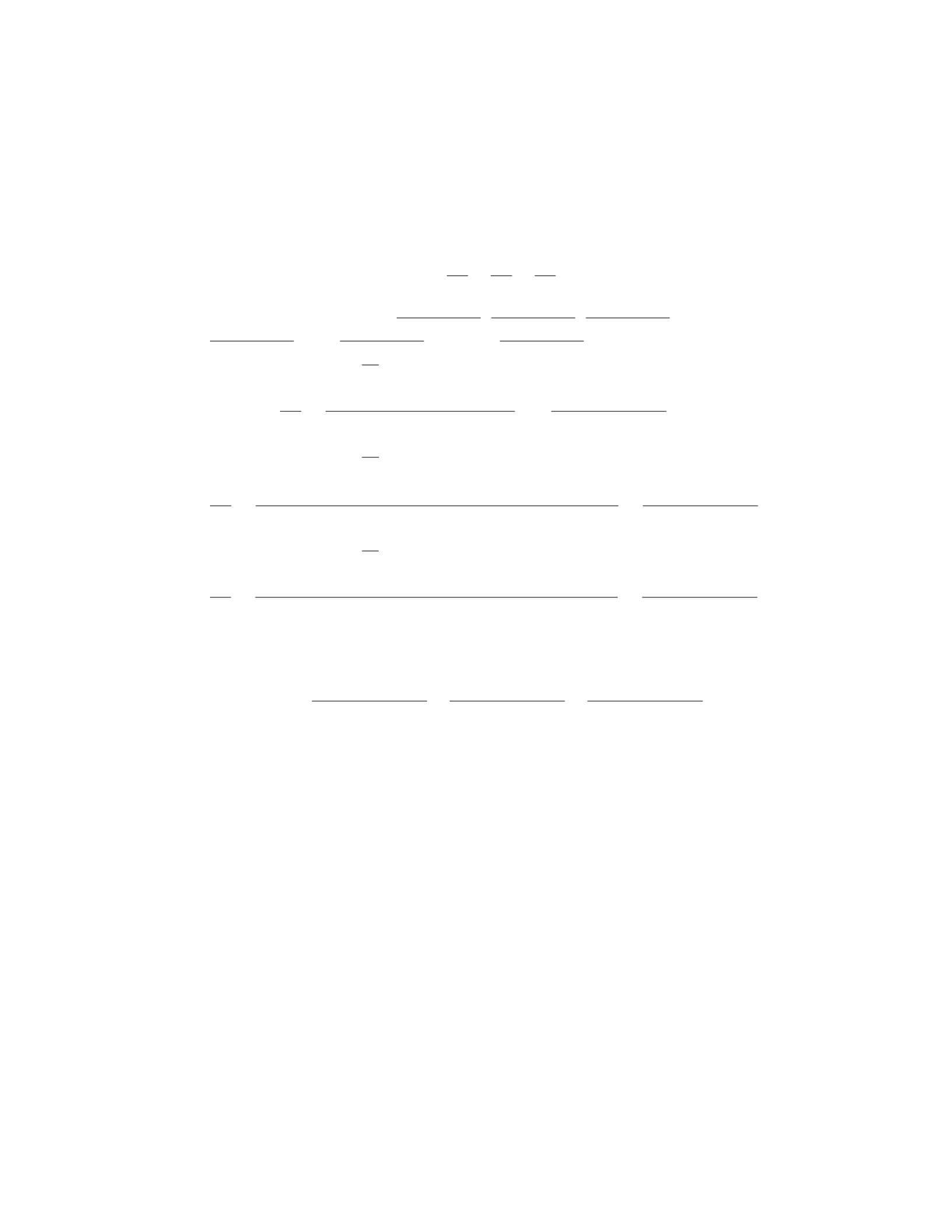
To compute the divergence of a vector field F(x, y, z) = (P, Q, R), we use the
formula
∇ · F=∂P
∂x +∂Q
∂y +∂R
∂z .
In this case, F(x, y, z) = y
(x2+y2+z2)3/2,x
(x2+y2+z2)3/2,z
(x2+y2+z2)3/2, so P=
y
(x2+y2+z2)3/2,Q=x
(x2+y2+z2)3/2, and R=z
(x2+y2+z2)3/2.
Step 1: Compute ∂P
∂x ,
∂P
∂x =−(3/2)yx(x2+y2+z2)−5/2
(x2+y2+z2)3/2=−3xy
(x2+y2+z2)5/2.
Step 2: Compute ∂Q
∂y ,
∂Q
∂y =(x)2(x2+y2+z2)−3/2−(3/2)x2y2(x2+y2+z2)−5/2
(x2+y2+z2)3/2=x2−3y2
(x2+y2+z2)5/2.
Step 3: Compute ∂R
∂z ,
∂R
∂z =(x)2(x2+y2+z2)−3/2−(3/2)x2z2(x2+y2+z2)−5/2
(x2+y2+z2)3/2=x2−3z2
(x2+y2+z2)5/2.
Step 4: Add the partial derivatives computed in Steps 1, 2, and 3 to find
the divergence,
∇ · F=−3xy
(x2+y2+z2)5/2+x2−3y2
(x2+y2+z2)5/2+x2−3z2
(x2+y2+z2)5/2.
Question 25
Question
Let F(x, y, z) = (2xy +z)i+ (x2+z)j+ (y2+x)kbe a vector field in R3.
Determine whether the vector field F(x, y, z) is conservative or not. If it is
conservative, find the potential function f(x, y, z).
Solution
Step 1: Check if the vector field is conservative by verifying the curl of F. Step
2: Calculate the curl of F. Step 3: If the curl of Fis the zero vector, then Fis
conservative. Determine the potential function by integrating the components
of F. Step 4: If the curl of Fis not the zero vector, then Fis not conservative.
Step 1: Check if the vector field is conservative by verifying the curl of F.
A vector field F(x, y, z) is conservative if and only if its curl is the zero vector,
i.e., ∇ × F= 0.
17

Step 2: Calculate the curl of F. The curl of a vector field F(x, y, z) =
P(x, y, z)i+Q(x, y, z)j+R(x, y, z)kis given by:
∇ × F=∂R
∂y −∂Q
∂z i−∂R
∂x −∂P
∂z j+∂Q
∂x −∂P
∂y k
For F(x, y, z) = (2xy +z)i+ (x2+z)j+ (y2+x)k, we have:
∇×F=∂(y2+x)
∂y −∂(x2+z)
∂z i−∂(y2+x)
∂x −∂(2xy +z)
∂z j+∂(2xy +z)
∂x −∂(x2+z)
∂y k
Step 3: If the curl of Fis the zero vector, then Fis conservative. Determine
the potential function by integrating the components of F.
∇ × F= (−1)i−(−1)j+ (2y)k
Simplify the curl to obtain ∇ × F=k+i+ 2yk. Since the curl is not zero, F
is not conservative.
Step 4: Since the vector field F(x, y, z) is not conservative, a potential
function f(x, y, z) does not exist for F.
Question 26
Question
Let F(x, y, z) = x2yz, xz2,−xy2be a vector field in R3. Find the curl of F.
Solution
To find the curl of a vector field F= (P, Q, R), we use the formula:
curl(F) = ∇ × F=
i j k
∂
∂x
∂
∂y
∂
∂z
P Q R
Step 1: Calculate the partial derivatives of P,Q, and R.
∂P
∂x = 2xyz, ∂Q
∂y = 0,∂R
∂z =−2xy
Step 2: Substitute the partial derivatives into the formula.
curl(F) =
i j k
2xyz 0−2xy
x2yz xz2−xy2
Step 3: Expand the determinant using cofactor expansion along the first
row.
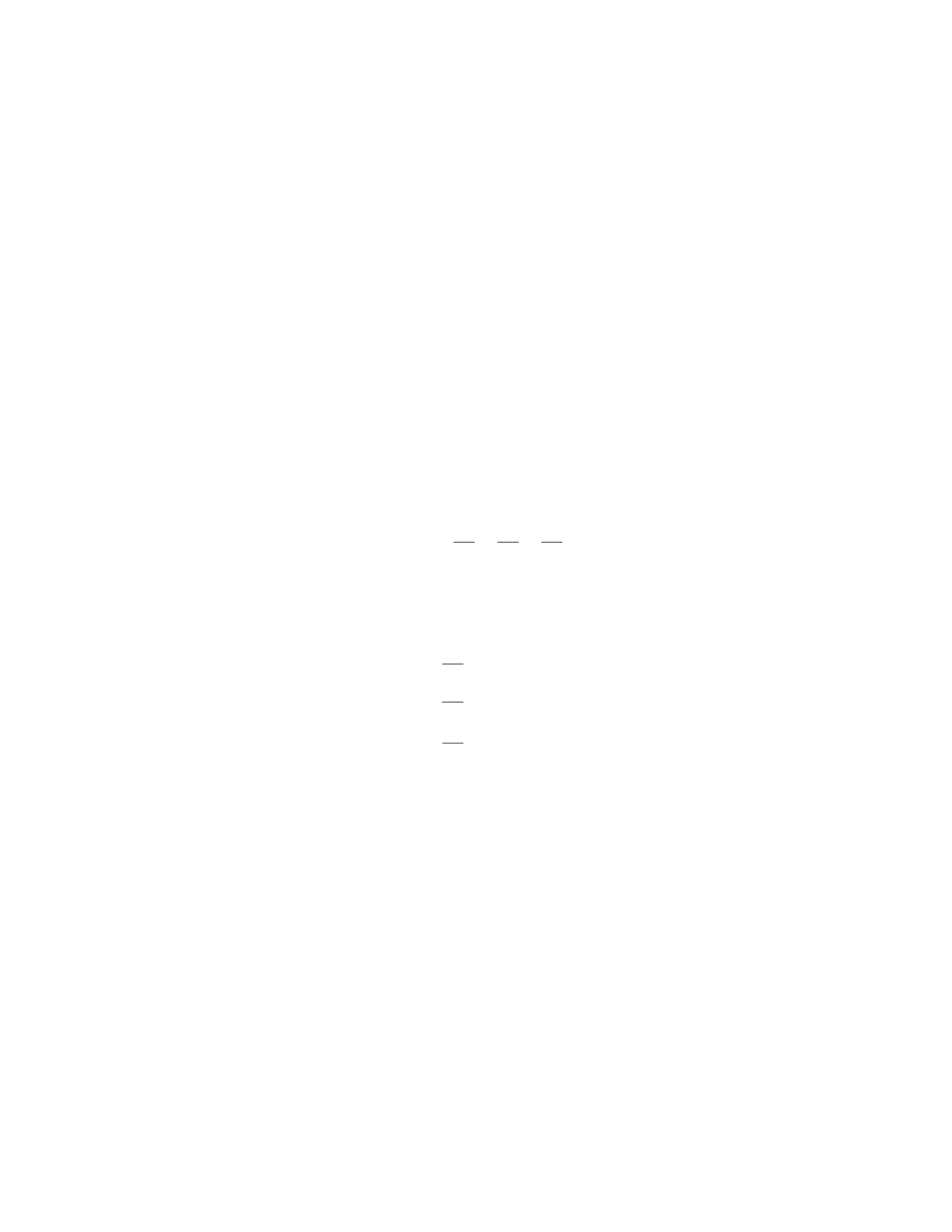
curl(F) = (0 −0) i−−2xyz + 2xz2j+0−2x2yk
18
Step 4: Simplify the result.
curl(F) = 2(xz2−xyz)j−2x2yk
Therefore, the curl of the vector field F(x, y, z) = x2yz, xz2,−xy2is
curl(F) = 2(xz2−xyz)j−2x2yk.
Question 27
Question
Let F(x, y, z) = x2yi+xyzj+x2zk. Find the divergence of F.
Solution
To find the divergence of a vector field F(x, y, z) = P(x, y, z)i+Q(x, y, z)j+
R(x, y, z)k, we use the formula:
div(F) = ∂P
∂x +∂Q
∂y +∂R
∂z
Step 1: Identify P,Q, and R. In this case, P(x, y, z) = x2y,Q(x, y, z) =
xyz, and R(x, y, z) = x2z.
Step 2: Calculate the partial derivatives.
∂P
∂x = 2xy
∂Q
∂y =xz
∂R
∂z =x2
Step 3: Find the divergence of F.
div(F) = 2xy +xz +x2
Therefore, the divergence of F(x, y, z) = x2yi+xyzj+x2zkis 2xy +xz +x2.
Question 28
Question
Let F(x, y, z) = ⟨ex+ysin z, xex+ycos z, yex+ycos z⟩. Compute the curl of F.
19

Solution
To find the curl of F, denoted as ∇ × F, we need to compute the determinant
of the following matrix:
∇ × F=
i j k
∂
∂x
∂
∂y
∂
∂z
ex+ysin z xex+ycos z yex+ycos z
Step 1: Compute the partial derivatives Compute the partial deriva-
tives of the vector field components:
∂
∂x (ex+ysin z) = ex+ysin z, ∂
∂y (xex+ycos z) = xex+ycos z+ex+ycos z
∂
∂z (yex+ycos z) = −yex+ysin z
Step 2: Calculate the curl Now, plug these derivatives into the determi-
nant formula and simplify:
∇ × F=∂
∂y (yex+ycos z)−∂
∂z (xex+ycos z),
∂
∂z (ex+ysin z)−∂
∂x (yex+ycos z),
∂
∂x (xex+ycos z)−∂
∂y (ex+ysin z)
= (ex+ycos z+yex+ysin z, ex+ycos z−0, ex+ycos z−xex+ysin z)
Therefore, the curl of Fis ∇×F=⟨ex+ycos z+yex+ysin z, ex+ycos z, ex+ycos z−
xex+ysin z⟩.
Question 29
Question
Let F(x, y, z) = yzi+xzj+xykbe a vector field. Calculate the curl of F.
Solution
To find the curl of a vector field F(x, y, z) = P(x, y, z)i+Q(x, y, z)j+R(x, y, z)k,
we use the formula:
curl F=∇ × F=
i j k
∂
∂x
∂
∂y
∂
∂z
P Q R
20
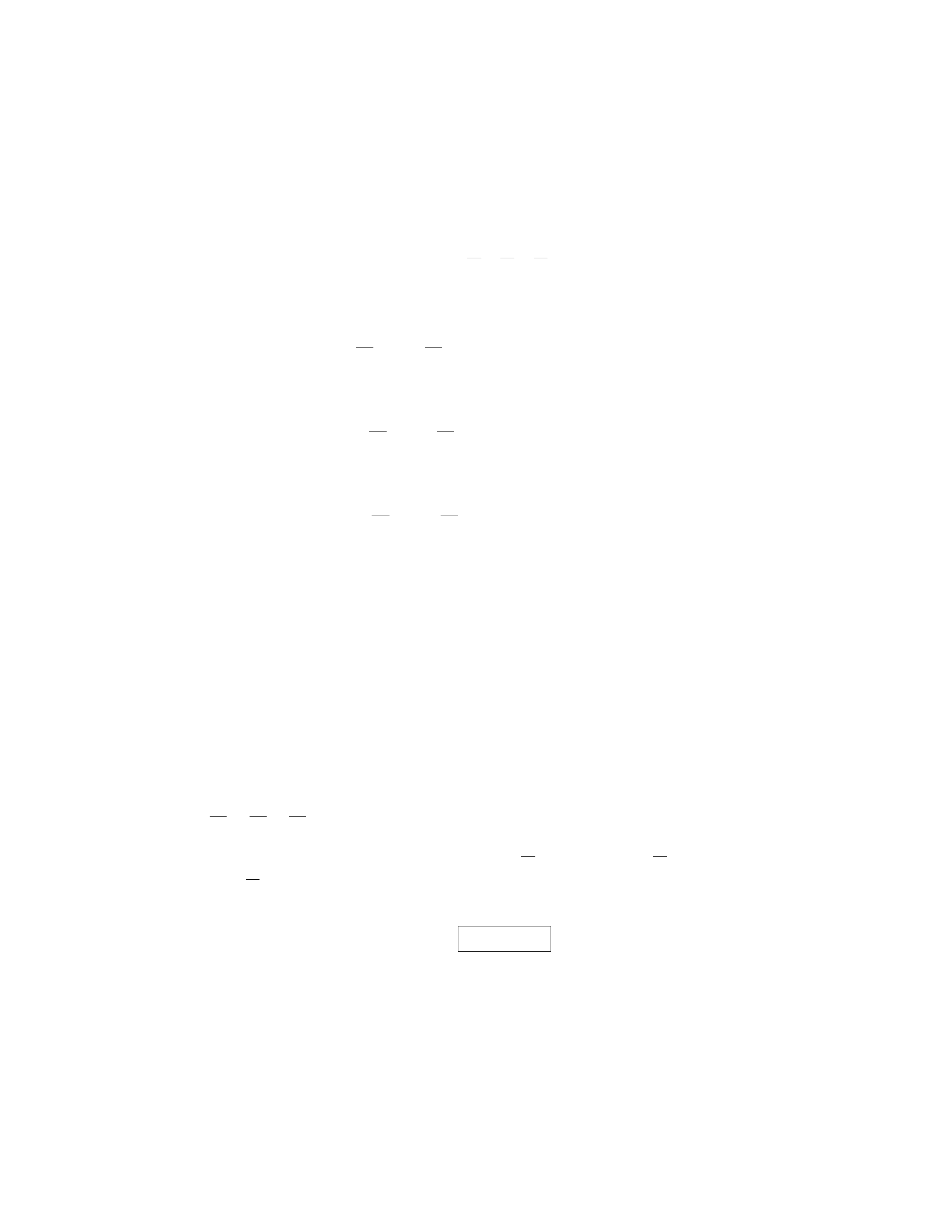
In this case, P(x, y, z) = yz,Q(x, y, z) = xz, and R(x, y, z) = xy. Hence,
the curl of Fis:
∇ × F=
i j k
∂
∂x
∂
∂y
∂
∂z
yz xz xy
Step 1: Calculate the x-component:
∂
∂y (xy)−∂
∂z (xz) = x−(−x)=2xi
Step 2: Calculate the y-component:
−∂
∂x (yz)−∂
∂z (xy)=−(z−z)=0j
Step 3: Calculate the z-component:
∂
∂x (xz)−∂
∂y (yz) = z−z= 0k
Therefore, the curl of Fis:
∇ × F= 2xi
Question 30
Question
Let F(x, y, z)=(x2−y2)i+ (y2−z2)j+ (z2−x2)kbe a vector field in R3.
Calculate the divergence of F.
Solution
Step 1: The divergence of a vector field F=Pi+Qj+Rkis given by ∇ · F=
∂P
∂x +∂Q
∂y +∂R
∂z .
Step 2: In this case, F(x, y, z)=(x2−y2)i+ (y2−z2)j+ (z2−x2)k.
Step 3: Calculate the partial derivatives: - ∂
∂x (x2−y2)=2x, - ∂
∂y (y2−z2) =
2y, - ∂
∂z (z2−x2)=2z.
Step 4: Add the partial derivatives together to find the divergence: ∇ · F=
2x+ 2y+ 2z= 2(x+y+z).
Therefore, the divergence of Fis 2(x+y+z) .
21
Solution
To find the divergence of the vector field F= (3x2y+z2, x3+ 2yz, 2xyz), we
need to compute ∇ · Fusing the formula:
∇ · F=∂F1
∂x +∂F2
∂y +∂F3
∂z
Step 1: Compute ∂F1
∂x ,∂F2
∂y , and ∂F3
∂z .
∂F1
∂x =∂
∂x (3x2y+z2) = 6xy
∂F2
∂y =∂
∂y (x3+ 2yz)=2z
∂F3
∂z =∂
∂z (2xyz)=2xy
Step 2: Sum the partial derivatives to find the divergence.
∇ · F= 6xy + 2z+ 2xy = 8xy + 2z
Therefore, the divergence of the vector field Fis 8xy + 2z.
Question 3
Question
Let F(x, y, z) = ⟨x2yz, xz3, x3y⟩. Compute the divergence of F.
Solution
To compute the divergence of F, we use the formula: div(F) = ∇ · F=∂P
∂x +
∂Q
∂y +∂R
∂z , where F=⟨P, Q, R⟩.
Step 1: Identify P,Q, and R. Here, P(x, y, z) = x2yz,Q(x, y, z) = xz3,
and R(x, y, z) = x3y.
Step 2: Compute partial derivatives.
∂P
∂x = 2xyz
∂Q
∂y = 0
∂R
∂z = 0
Step 3: Calculate the divergence.
div(F) = ∇ · F=∂P
∂x +∂Q
∂y +∂R
∂z = 2xyz + 0 + 0 = 2xyz
Therefore, the divergence of Fis 2xyz.
2
Question 4
Question
Let F(x, y, z) = x2yi−xyzj+z2kbe a vector field in R3. Determine the curl
of Fat the point (1,−2,3).
Solution
To find the curl of a vector field F(x, y, z) = P(x, y, z)i+Q(x, y, z)j+R(x, y, z)k
at a point (a, b, c), we use the formula:
∇ × F=
i j k
∂
∂x
∂
∂y
∂
∂z
P Q R
Given F(x, y, z) = x2yi−xyzj+z2k, we have P(x, y, z) = x2y,Q(x, y, z) =
−xyz, and R(x, y, z) = z2.
Step 1: Compute the curl of Fusing the formula above:
∇ × F=
i j k
∂
∂x
∂
∂y
∂
∂z
x2y−xyz z2
Step 2: Compute the partial derivatives:
∂R
∂y = 0,∂Q
∂z =−x
∂P
∂z = 0,∂R
∂x = 0
∂Q
∂x = 2xy, ∂P
∂y =x2
Step 3: Plug these partial derivatives into the determinant and evaluate:
∇ × F= (i(−x)−j0 + k(2xy))
=−xi+ 2xyk
Step 4: Evaluate the curl of Fat the point (1,−2,3):
∇ × F=−1i+ 2(−2)(3)k
=−i−12k
Therefore, the curl of Fat the point (1,−2,3) is −i−12k.
Question 5
Question
Let F(x, y, z) = x2yi+z3j+exyzkbe a vector field. Compute ∇·∇×Fwhere
∇is the gradient operator and ×denotes the cross product.
3
Solution
Step 1: Calculate ∇ × F.
The curl of a vector field F(x, y, z) = Pi+Qj+Rkis given by:
∇ × F=∂R
∂y −∂Q
∂z i−∂R
∂x −∂P
∂z j+∂Q
∂x −∂P
∂y k
Applying this formula to F(x, y, z) = x2yi+z3j+exyzk, we have:
=∂(exyz )
∂y −∂(z3)
∂z i−∂(exyz )
∂x −∂(x2y)
∂z j+∂(z3)
∂x −∂(x2y)
∂y k
= (xzexyz −0) i−(yzexyz −2xy)j+0−x2k
=xzexyzi−yzexyz j−x2k
Step 2: Compute ∇ · ∇ × F.
The divergence of a vector field G(x, y, z) = Mi+Nj+Pkis given by:
∇ · G=∂M
∂x +∂N
∂y +∂P
∂z
Now, to calculate ∇ · ∇ × F, apply the divergence operator to the result
obtained previously:
- yzexyzj−x2k) = ∂
∂x (xzexyz) + ∂
∂y (−yzexyz) + ∂
∂z (−x2)
=zexyz +yzexyz + 0
=zexyz +yzexyz
= (z+y)exyz
Therefore, ∇ · ∇ × F= (z+y)exyz .
Question 6
Question
Let F(x, y, z) = xz
y2i+y2
zj+y
xk. Find the divergence of Fat the point (1,1,1).
4

Solution
To find the divergence of a vector field F=Pi+Qj+Rkat a point, we use the
formula:
div(F) = ∂P
∂x +∂Q
∂y +∂R
∂z
Given F(x, y, z) = xz
y2i+y2
zj+y
xk, we have P=xz
y2,Q=y2
z, and R=y
x.
Step 1: Calculate ∂P
∂x .
∂P
∂x =z
y2
Step 2: Calculate ∂Q
∂y .
∂Q
∂y =2y
z
Step 3: Calculate ∂R
∂z .
∂R
∂z = 0
Step 4: Find the divergence of Fat the point (1,1,1).
div(F) = ∂P
∂x +∂Q
∂y +∂R
∂z =z
y2+2y
z+ 0
Substitute (x, y, z) = (1,1,1) into the expression above:
div(F)
(1,1,1) =1
12+2·1
1= 1 + 2 = 3
Therefore, the divergence of Fat the point (1,1,1) is 3.
Question 7
Question
Let F(x, y, z) = x2yi+xyzj+yz2kbe a vector field. Compute ∇ · (∇ × F).
Solution
Step 1: Compute ∇ × F.
=
i j k
∂
∂x
∂
∂y
∂
∂z
x2y xyz yz2
=∂(yz2)
∂y −∂(xyz)
∂z i−∂(x2y)
∂x −∂(yz2)
∂z j+∂(xyz)
∂x −∂(x2y)
∂y k
= (z2−y)i−(2xy −0)j+ (yz −2xy)k
= (z2−y)i−2xyj+ (yz −2xy)k
5

Step 2: Compute ∇ · (∇ × F).
) = ∇ · (z2−y)i−2xyj+ (yz −2xy)k
=∂
∂x (z2−y) + ∂
∂y (−2xy) + ∂
∂z (yz −2xy)
= 0 −2x+ 0
=−2x
Therefore, ∇ · (∇ × F) = −2x.
Question 8
Question
Let F(x, y, z) = x2yi+y2zj+z2xkbe a vector field. Compute ∇ · F.
Solution
Step 1: The divergence of a vector field F(x, y, z) = P(x, y, z)i+Q(x, y, z)j+
R(x, y, z)kis given by the following formula:
∇ · F=∂P
∂x +∂Q
∂y +∂R
∂z
Step 2: Given that F(x, y, z) = x2yi+y2zj+z2xk, we can identify P(x, y, z) =
x2y,Q(x, y, z) = y2z, and R(x, y, z) = z2x.
Step 3: Now, we can calculate the partial derivatives:
∂P
∂x = 2xy
∂Q
∂y = 2yz
∂R
∂z = 2zx
Step 4: Substitute the partial derivatives back into the formula for the di-
vergence:
∇ · F= 2xy + 2yz + 2zx
Step 5: Simplifying the expression, we get:
∇ · F= 2(xy +yz +zx)
Therefore, the divergence of the vector field F(x, y, z) = x2yi+y2zj+z2xk
is 2(xy +yz +zx).
6
Question 9
Question
Let F(x, y, z)=(yz2, xz2, xy2). Compute the curl of F.
Solution
Step 1: The curl of a vector field F(x, y, z)=(P, Q, R) is given by the determi-
nant of the following matrix:
∇ × F=
i j k
∂
∂x
∂
∂y
∂
∂z
P Q R
Step 2: Let’s first find the partial derivatives of P,Q, and R.
∂P
∂y =z2,∂Q
∂z = 2xz, ∂R
∂x =y2
Step 3: Now, we substitute into the formula for the curl:
∇ × F=
i j k
∂
∂x
∂
∂y
∂
∂z
yz2xz2xy2
Step 4: Evaluating the determinant gives:
∇×F= (2xz−2xz, y2−z2, z2−y2)·i−(0−0,0−0, x2−y2)·j+(0−0,0−0, x2−2yz)·k
Step 5: Simplifying the expression, we get:
∇ × F= 0 ·i+ (y2−z2)·j+ (z2−y2)·k
Therefore, the curl of Fis ∇ × F= (0, y2−z2, z2−y2).
Question 10
Question
Let F(x, y, z) = x2y2z2,1
y−cos(z), xy. Calculate curl(F).
Solution
To find the curl of a vector field F=Pi+Qj+Rk, where P,Q, and Rare
functions of x,y, and z, we compute the determinant of the curl operator:
7
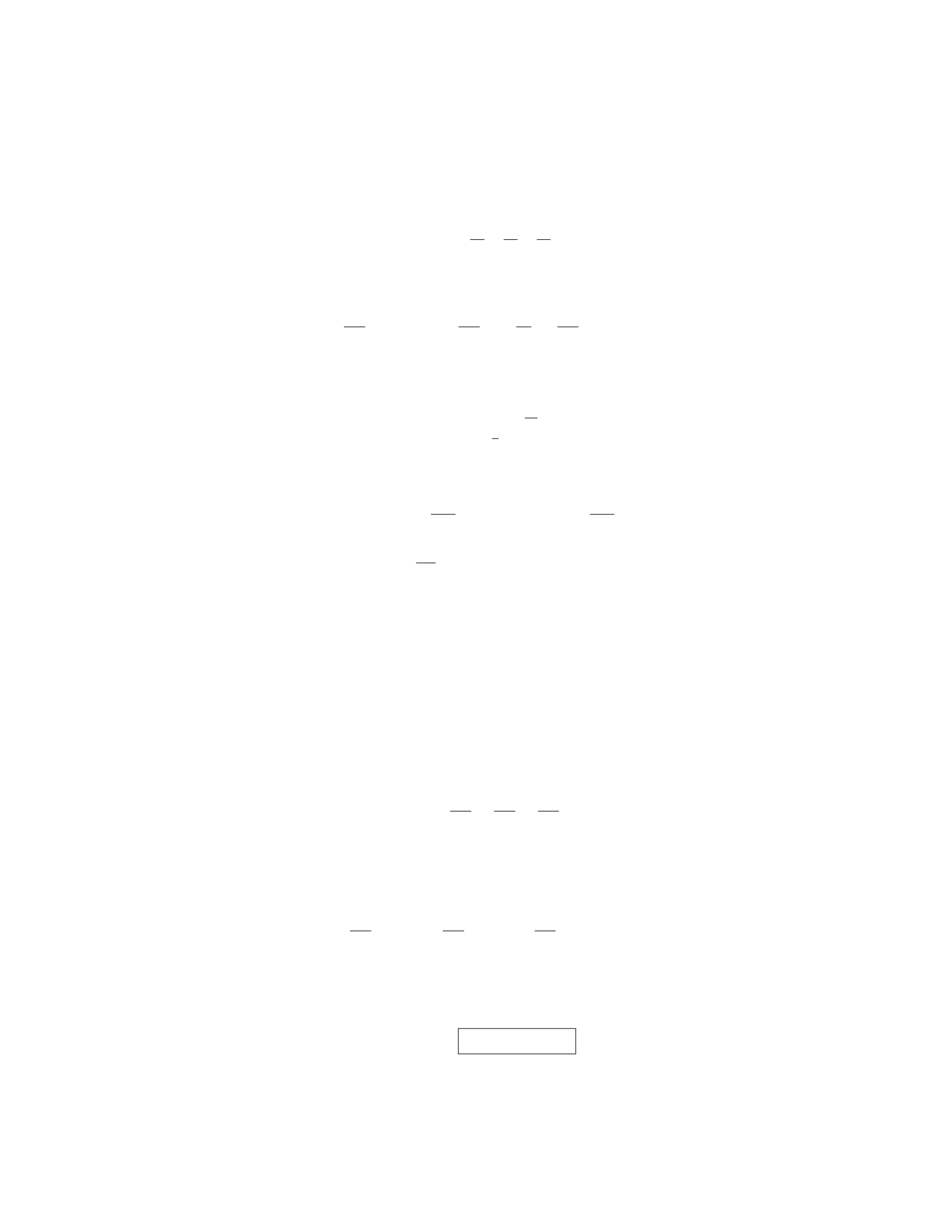
curl(F) =
i j k
∂
∂x
∂
∂y
∂
∂z
P Q R
Step 1: Compute the partial derivatives of P,Q, and R.
∂P
∂x = 2xy2z2,∂Q
∂y =−1
y2,∂R
∂z = 0
Step 2: Plug the partial derivatives into the determinant formula.
curl(F) =
i j k
2xy2z2−1
y20
x2y2z21
y−cos(z)xy
Step 3: Expand the determinant to compute the curl.
curl(F) = 0−0,0−0,2xz
y−sin(z)=0,0,2xz
y−sin(z)
Therefore, curl(F) = 0,0,2xz
y−sin(z).
Question 11
Question
Let F(x, y, z) = x2yi+y2zj+z2xk. Compute div F.
Solution
Step 1: The divergence of a vector field F(x, y, z) = P(x, y, z)i+Q(x, y, z)j+
R(x, y, z)kis given by:
div F=∂P
∂x +∂Q
∂y +∂R
∂z
Step 2: Given F(x, y, z) = x2yi+y2zj+z2xk, we have: P(x, y, z) = x2y,
Q(x, y, z) = y2z, and R(x, y, z) = z2x.
Step 3: Compute the partial derivatives:
∂P
∂x = 2xy, ∂Q
∂y = 2yz, ∂R
∂z = 2zx
Step 4: Calculate the divergence:
div F= 2xy + 2yz + 2zx = 2(xy +yz +zx)
Therefore, the divergence of Fis 2(xy +yz +zx) .
8

Question 12
Question
Let F(x, y, z)=3x2yi+ 2xyzj+yexyzkbe a vector field in R3. Find the
divergence of F.
Solution
Step 1: The divergence of a vector field F(x, y, z) = P(x, y, z)i+Q(x, y, z)j+
R(x, y, z)kis given by the expression:
div(F) = ∂P
∂x +∂Q
∂y +∂R
∂z
Step 2: In this case, P(x, y, z) = 3x2y,Q(x, y, z) = 2xyz, and R(x, y, z) =
yexyz. We need to calculate the partial derivatives of P,Q, and Rwith respect
to x,y, and z.
Step 3: ∂P
∂x = 6xy
∂Q
∂y = 2xz
∂R
∂z =y2exyz
Step 4: Now, we can find the divergence of Fby adding these partial deriva-
tives:
div(F)=6xy + 2xz +y2exyz
Therefore, the divergence of the vector field Fis 6xy + 2xz +y2exyz.
Question 13
Question
Let F(x, y, z) = (x2+y2+z2)1/2ˆ
i+ (x2+y2+z2)1/2ˆ
j+ (x2+y2+z2)1/2ˆ
kbe
a vector field. Calculate the curl of Fat the point (1,2,3).
Solution
To find the curl of F, we use the formula:
curl F=∇ × F=
ˆ
iˆ
jˆ
k
∂
∂x
∂
∂y
∂
∂z
P Q R
Where P, Q, R are the components of the vector field F.
9
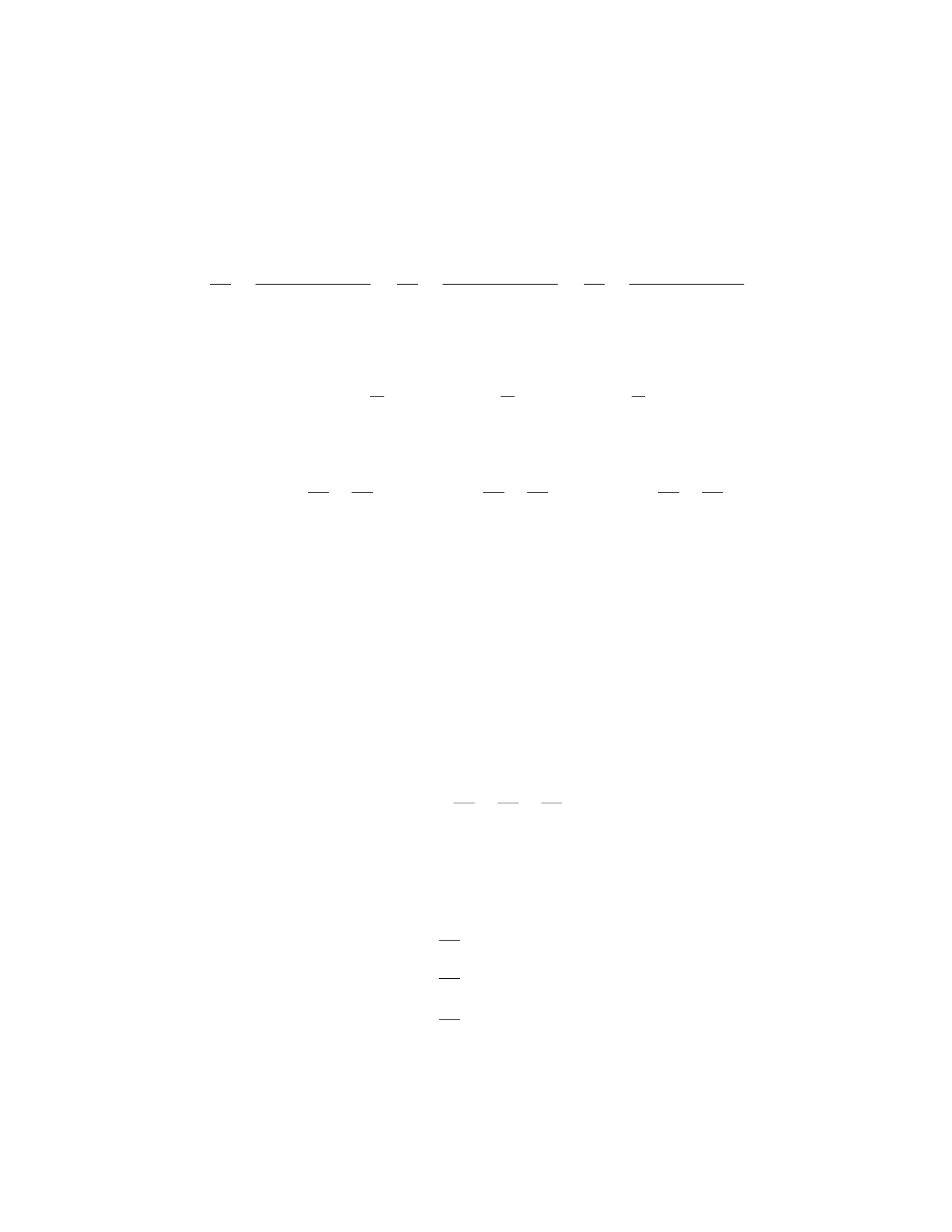
Step 1: Calculate the components P,Q, and Rof F:P= (x2+y2+z2)1/2,
Q= (x2+y2+z2)1/2,R= (x2+y2+z2)1/2.
Step 2: Calculate the partial derivatives of P,Q, and R:
∂P
∂x =x
(x2+y2+z2)1/2,∂Q
∂y =y
(x2+y2+z2)1/2,∂R
∂z =z
(x2+y2+z2)1/2.
Step 3: Substitute the components and their derivatives into the formula for
the curl:
∇ × F=
ˆ
iˆ
jˆ
k
∂
∂x
∂
∂y
∂
∂z
(x2+y2+z2)1/2(x2+y2+z2)1/2(x2+y2+z2)1/2
Step 4: Evaluate the determinant:
(∇ × F)x=∂R
∂y −∂Q
∂z ,(∇ × F)y=∂P
∂z −∂R
∂x ,(∇ × F)z=∂Q
∂x −∂P
∂y .
Step 5: Evaluate the curl of Fat the given point (1,2,3): Substitute x= 1,
y= 2, z= 3 into the components and their derivatives, then calculate the curl.
Question 14
Question
Let F(x, y, z) = (2xy2, x2z, xz3) be a vector field. Calculate the divergence of
F.
Solution
Step 1: The divergence of a vector field F= (P, Q, R) is given by the formula:
div(F) = ∂P
∂x +∂Q
∂y +∂R
∂z
Step 2: Given F(x, y, z) = (2xy2, x2z, xz3), we have P= 2xy2,Q=x2z,
and R=xz3.
Step 3: Find the partial derivatives of P,Q, and Rwith respect to x,y, and
z:
∂P
∂x = 2y2
∂Q
∂y = 0
∂R
∂z = 3xz2
10
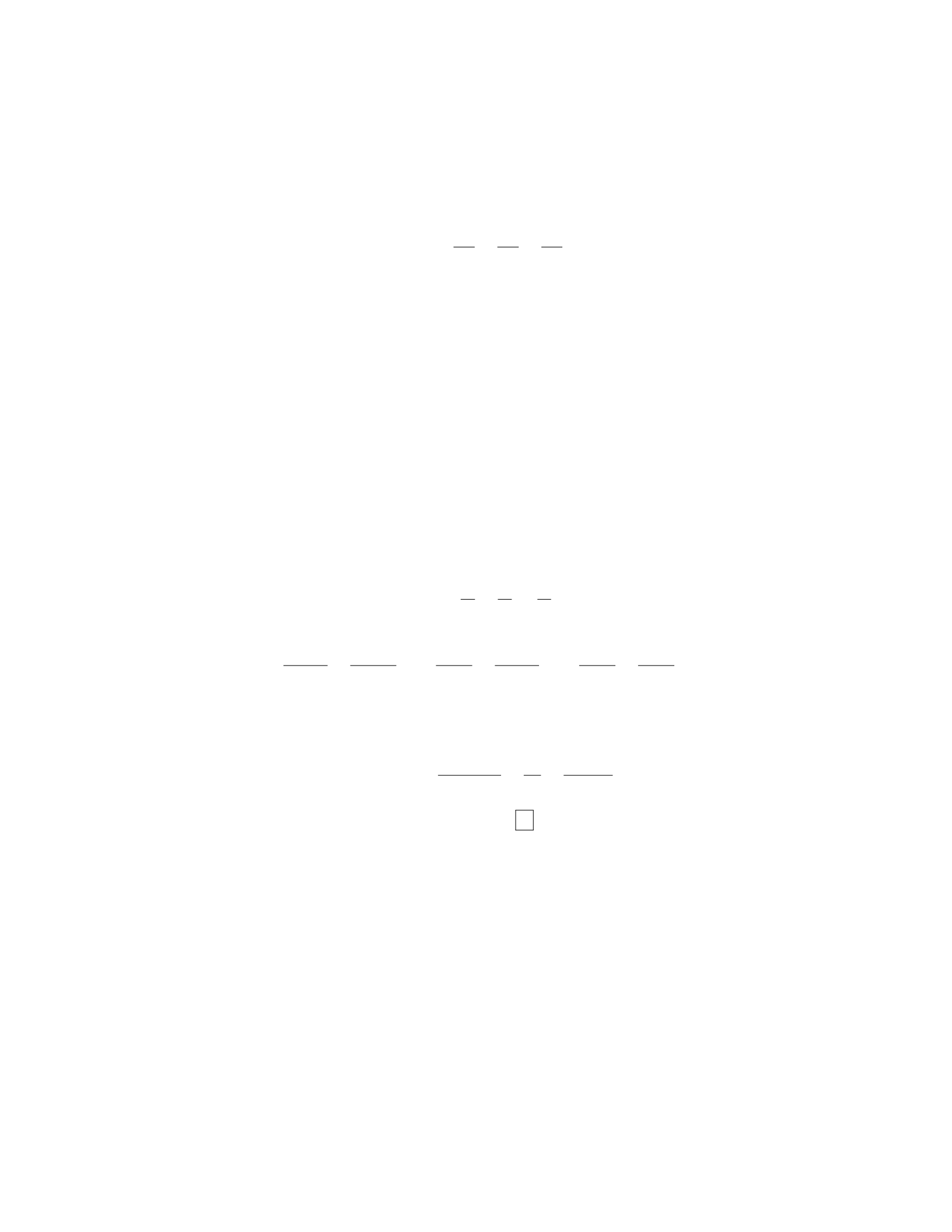
Step 4: Now, calculate the divergence of F:
div(F) = ∂P
∂x +∂Q
∂y +∂R
∂z
= 2y2+ 0 + 3xz2
= 2y2+ 3xz2
Therefore, the divergence of the vector field F(x, y, z) = (2xy2, x2z, xz3) is
div(F)=2y2+ 3xz2.
Question 15
Question
Let F(x, y, z) = y2i+xyzj+yz2kbe a vector field in R3. Compute ∇·∇×F.
Solution
Step 1: Compute ∇ × F.
∇ × F=
i j k
∂
∂x
∂
∂y
∂
∂z
y2xyz yz2
= (∂(yz2)
∂y −∂(xyz)
∂z )i−(∂(y2)
∂z −∂(yz2)
∂x )j+ ( ∂(y2)
∂x −∂(y2)
∂y )k
= (z2−y)i−(0 −z)j+ (0 −2y)k= (z2−y)i+zj−2yk
Step 2: Compute ∇ · (∇ × F).
∇ · (∇ × F) = ∂(z2−y)
∂x +∂z
∂y +∂(−2y)
∂z
= 0 + 0 + 0 = 0
Question 16
Question
Let F(x, y, z) = x2yi+xyzj+xz2k. Compute ∇ · ∇ × F.
11
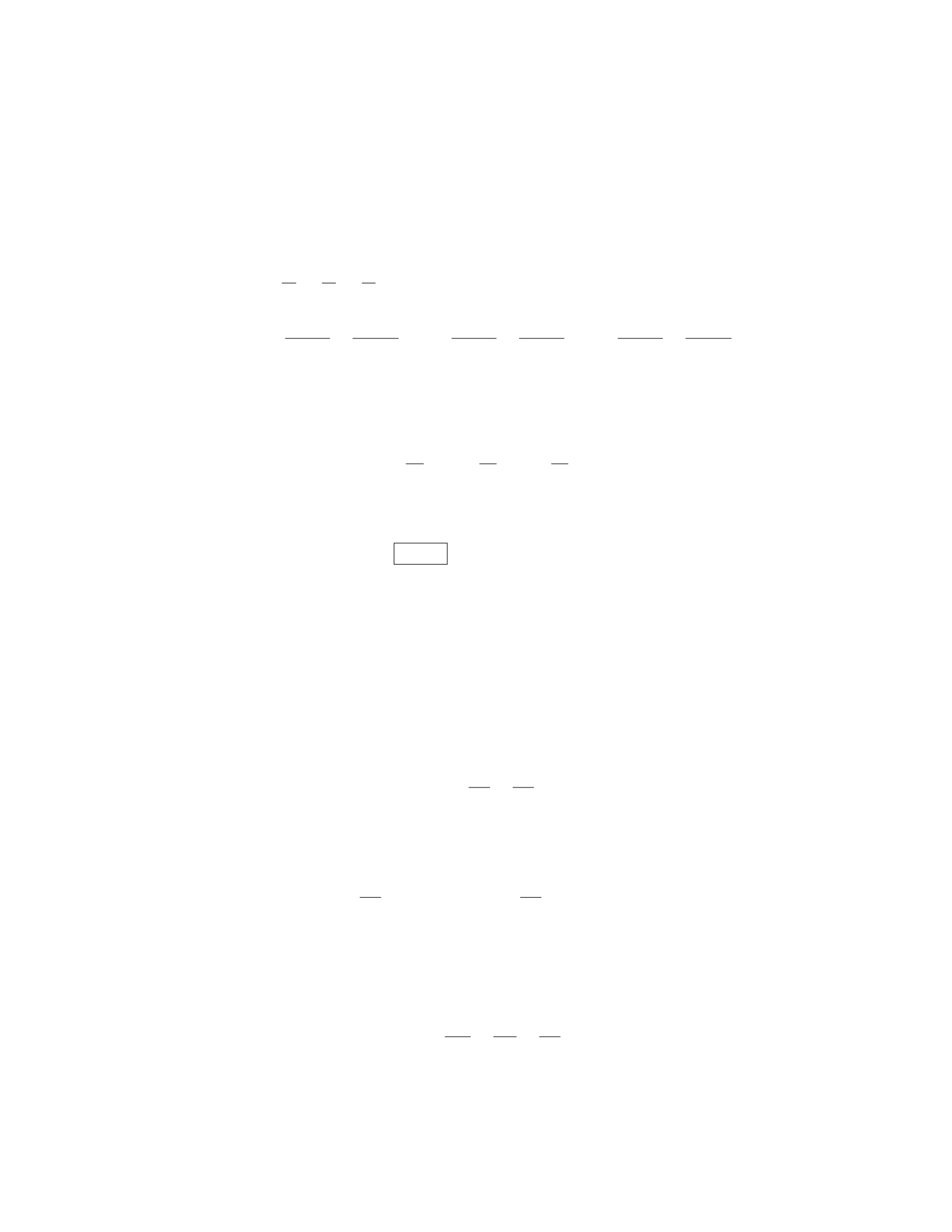
Solution
Step 1: Calculate the curl of F.
∇ × F=
i j k
∂
∂x
∂
∂y
∂
∂z
x2y xyz xz2
=∂(xz2)
∂y −∂(xyz)
∂z i−∂(xz2)
∂x −∂(x2y)
∂z j+∂(x2y)
∂x −∂(xyz)
∂y k
= (0 −x)i−(z−0)j+ (2xy −x)k
=−xi−zj+ (2xy −x)k
Step 2: Compute the divergence of ∇ × F.
∇ · ∇ × F=∂
∂x (−x) + ∂
∂y (−z) + ∂
∂z (2xy −x)
=−1−0+2x
= 2x−1
Therefore, ∇ · ∇ × F= 2x−1 .
Question 17
Question
Let F(x, y) = (2xy2+ex)i+ (x2+yex)jbe a vector field. Compute ∇ · ∇ × F.
Solution
Step 1: Compute ∇ × F. The curl of a vector field F(x, y) = P(x, y)i+Q(x, y)j
is given by
∇ × F=∂Q
∂x −∂P
∂y k
where kis the unit vector in the z-direction.
For F(x, y) = (2xy2+ex)i+ (x2+yex)j, we have P(x, y) = 2xy2+exand
Q(x, y) = x2+yex. Calculating the partial derivatives, we find
∂Q
∂x = 2x+yexand ∂P
∂y = 4xy,
thus
∇ × F= (2x+yex−4xy)k.
Step 2: Compute ∇ · ∇ × F. The divergence of a vector field G(x, y, z) =
M(x, y, z)i+N(x, y, z)j+P(x, y, z)kis given by
∇ · G=∂M
∂x +∂N
∂y +∂P
∂z .
12
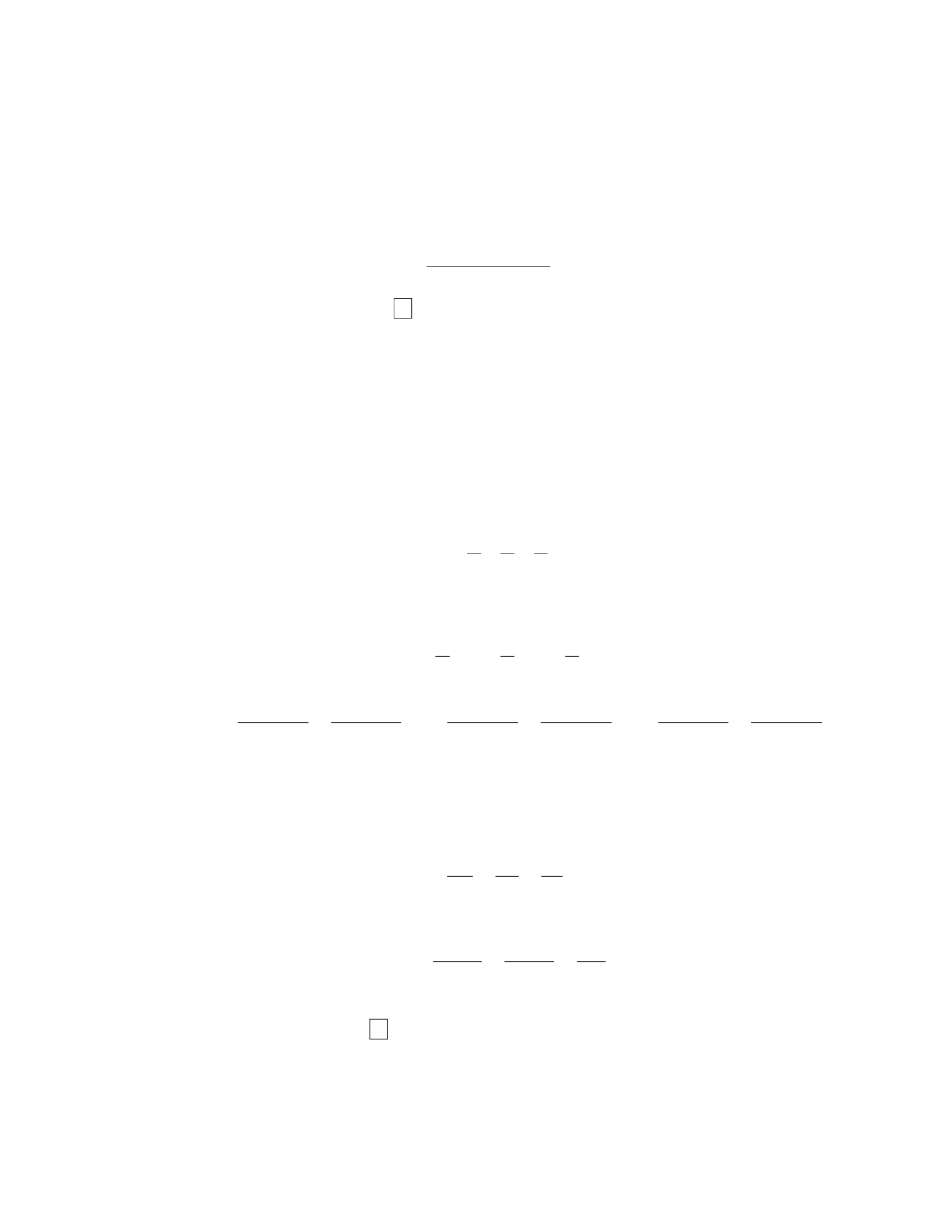
In our case, G(x, y, z) = (2x+yex−4xy)k. Since Gonly has a z-component,
the divergence in this case simplifies to
∇ · G=∂(2x+yex−4xy)
∂z = 0.
Therefore, ∇ · ∇ × F= 0 .
Question 18
Question
Let F(x, y, z) = ⟨x2+y2, y2+z2, z2+x2⟩. Compute ∇ · ∇ × F.
Solution
Step 1: Compute ∇×F. The curl of a vector field F(x, y, z) = ⟨P, Q, R⟩is given
by:
∇ × F=
i j k
∂
∂x
∂
∂y
∂
∂z
P Q R
Here, F(x, y, z) = ⟨x2+y2, y2+z2, z2+x2⟩=⟨P, Q, R⟩. So, we have:
∇ × F=
i j k
∂
∂x
∂
∂y
∂
∂z
x2+y2y2+z2z2+x2
=∂(z2+x2)
∂y −∂(y2+z2)
∂z i−∂(z2+x2)
∂x −∂(x2+y2)
∂z j+∂(y2+z2)
∂x −∂(x2+y2)
∂y k
= (0 −2z)i−(2x−0)j+ (2y−2y)k
=−2zi−2xj
Step 2: Compute ∇ · ∇ × F. The divergence of a vector field G(x, y, z) =
⟨M, N, P ⟩is given by:
∇ · G=∂M
∂x +∂N
∂y +∂P
∂z
Here, G(x, y, z) = ∇ × F=⟨−2z, −2x, 0⟩=⟨M, N, P ⟩. Therefore,
∇ · ∇ × F=∂(−2z)
∂x +∂(−2x)
∂y +∂(0)
∂z
= 0 + 0 + 0 = 0
Hence, ∇ · ∇ × F= 0 .
13
Question 19
Question
Let F(x, y, z) = exsin(y),1
z, x2ybe a vector field. Calculate the divergence of
F.
Solution
To find the divergence of F, we need to determine the dot product of the vector
field Fwith the del operator ∇=∂
∂x ,∂
∂y ,∂
∂z .
Step 1: Find the components of ∇ · F.
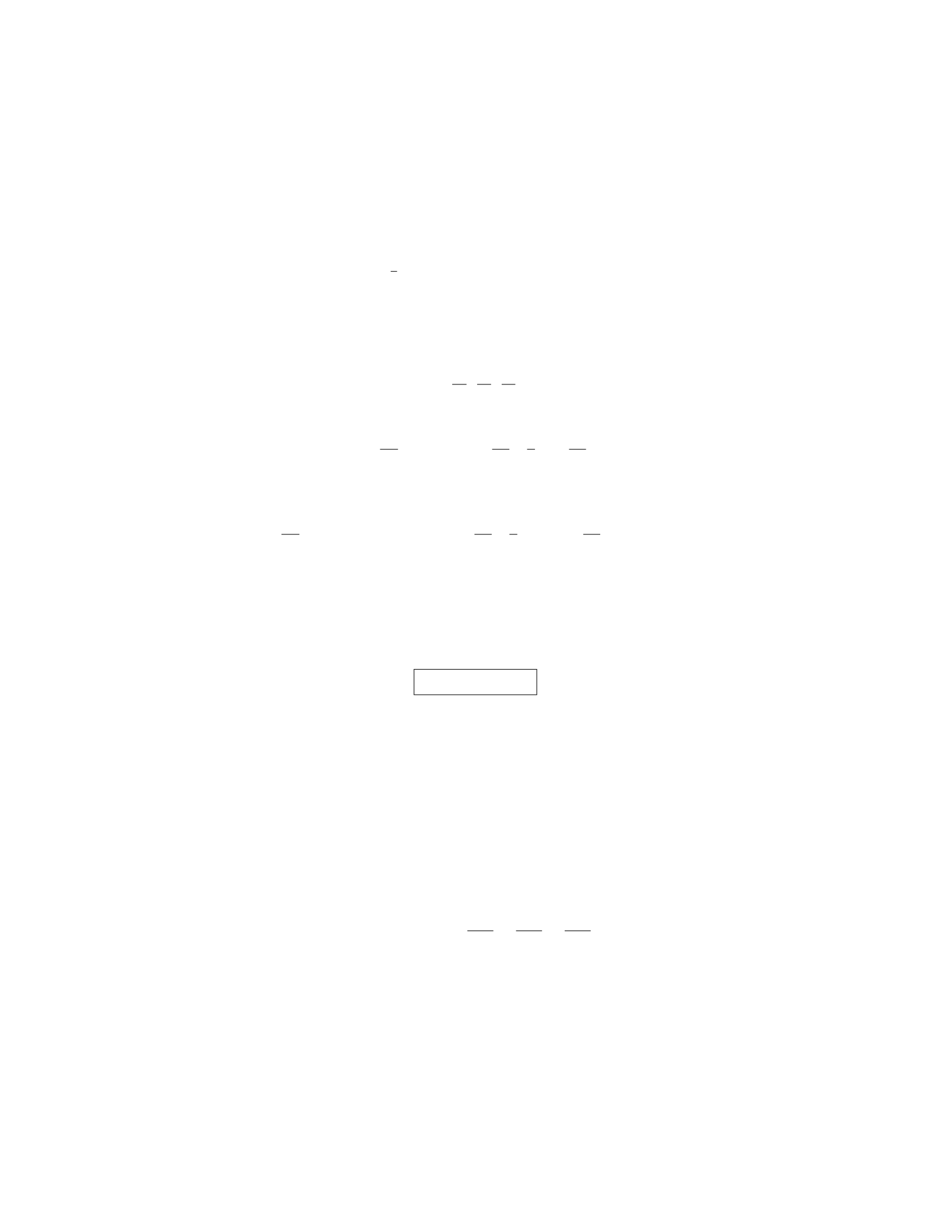
∇ · F=∂
∂x (exsin(y)) + ∂
∂y 1
z+∂
∂z x2y
Step 2: Calculate the partial derivatives.
∂
∂x (exsin(y)) = exsin(y),∂
∂y 1
z= 0,∂
∂z x2y= 0
Step 3: Substitute the results back into the expression for ∇ · F.
∇ · F=exsin(y)+0+0
Step 4: Simplify the expression.
∇ · F=exsin(y)
Question 20
Question
Let F(x, y, z) = (x2y, yz, xyz) be a vector field in R3. Compute the divergence
of F.
Solution
To compute the divergence of F, we’ll use the formula
div F=∇ · F=∂F1
∂x +∂F2
∂y +∂F3
∂z .
Step 1: Write Fin component form:
F= (x2y, yz, xyz)=(F1, F2, F3).
14
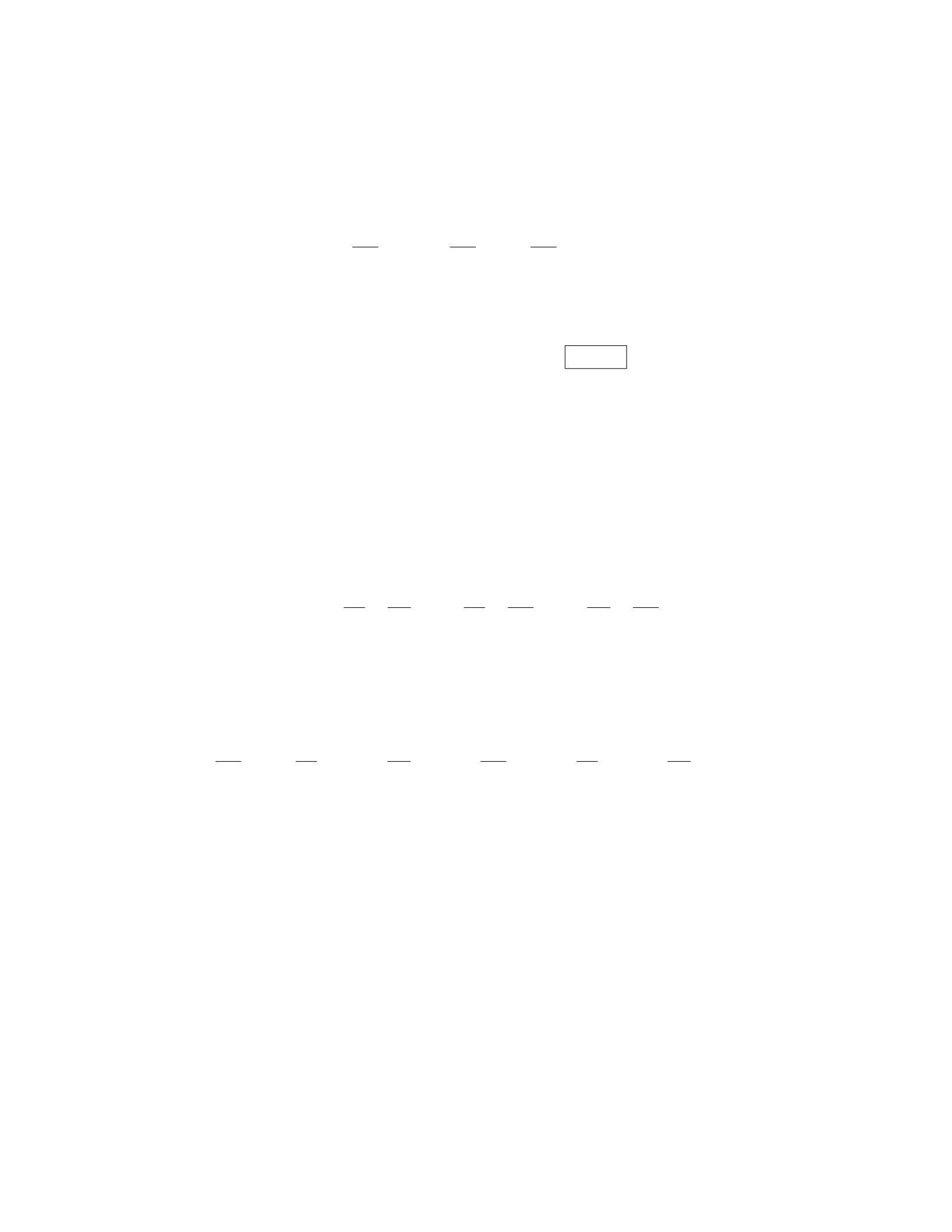
Step 2: Compute the partial derivatives of each component:
∂F1
∂x = 2xy, ∂F2
∂y =z, ∂F3
∂z =xy.
Step 3: Add up the partial derivatives to find the divergence:
div F= 2xy +z+xy = 3xy +z.
Therefore, the divergence of the vector field Fis 3xy +z.
Question 21
Question
Let F(x, y, z) = x3yi+xy2zj+xyz3kbe a vector field in R3. Calculate the curl
of Fat the point (1,2,3).
Solution
To find the curl of a vector field F(x, y, z) = Mi+Nj+Pk, we use the formula:
∇ × F=∂P
∂y −∂N
∂z i−∂P
∂x −∂M
∂z j+∂N
∂x −∂M
∂y k
Given F(x, y, z) = x3yi+xy2zj+xyz3k, we have:
M=x3y, N =xy2z, P =xyz3
Now, we calculate the partial derivatives:
∂M
∂z = 0,∂P
∂y =xz3,∂N
∂x =y2z, ∂M
∂y = 3x2,∂P
∂x =yz3,∂N
∂z =xy2
Finally, plug these values into the formula for the curl:
∇ × F= (xz3−xy2)i−(yz3−0)j+ (y2z−3x2)k
At the point (1,2,3), the curl is:
∇ × F(1,2,3) = (3 −4)i−(3 −0)j+ (4 −3)k=−i−3j+k
Question 22
Question
Let F(x, y) = x3yi+x2y2j. Compute ∇ · ∇ × F.
15
Solution
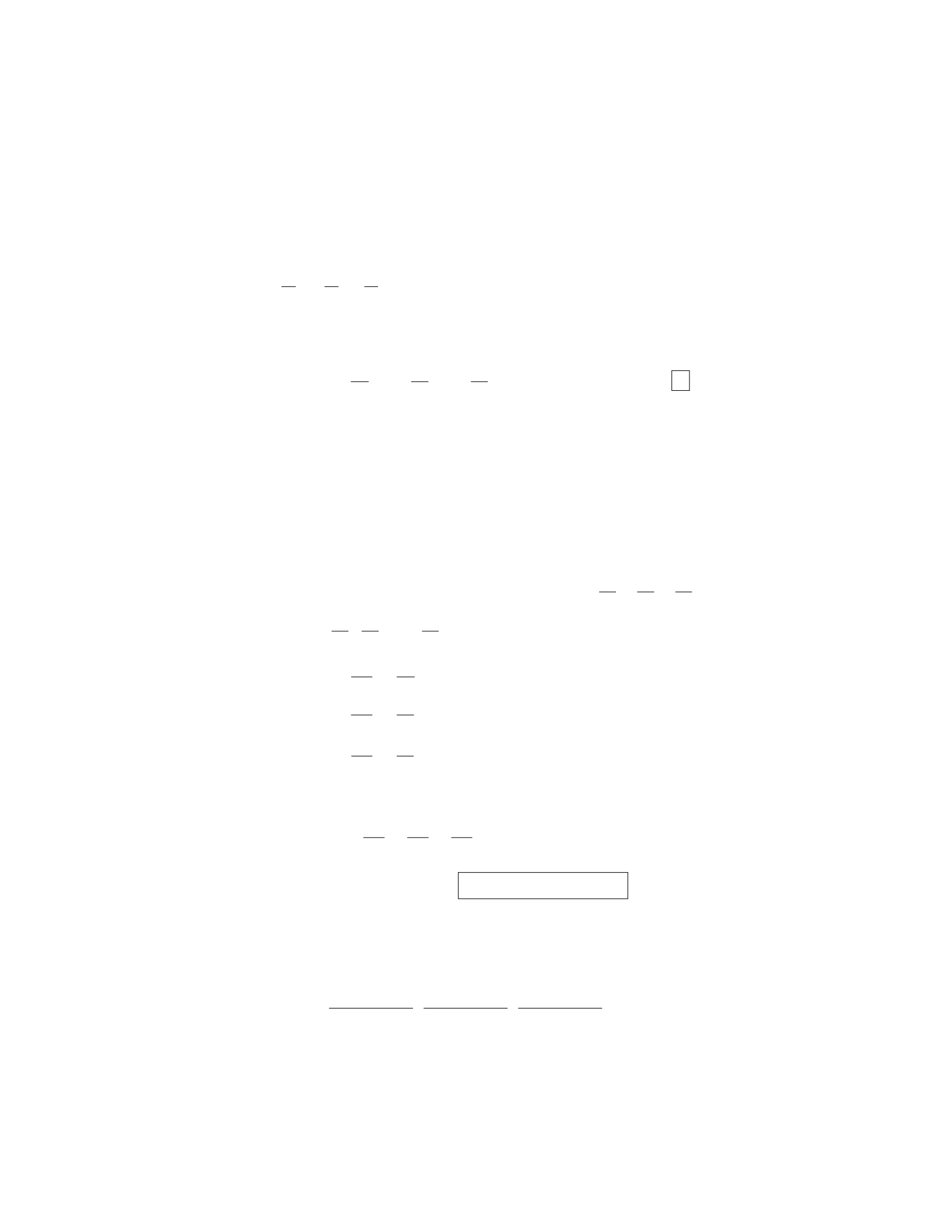
Step 1: Calculate ∇ × F.
∇ × F=
i j k
∂
∂x
∂
∂y
∂
∂z
x3y x2y20
= (0 −0)i−(0 −0)j+ (2xy −3x2)k= (2xy −3x2)k
Step 2: Compute ∇ · ∇ × F.
∇ · ∇ × F=∂
∂x (0) + ∂
∂y (0) + ∂
∂z (2xy −3x2) = 0 + 0 + 0 = 0
Question 23
Question
Let F(x, y, z) = 3x2yz −y3z2, x3z−2xyz2,−2x2y2+ 3y2z. Calculate the di-
vergence of F.
Solution
To find the divergence of F, we use the formula div(F) = ∂P
∂x +∂Q
∂y +∂R
∂z , where
F= (P, Q, R).
Step 1: Find ∂P
∂x ,∂Q
∂y , and ∂R
∂z .
∂P
∂x =∂
∂x 3x2yz −y3z2= 6xyz
∂Q
∂y =∂
∂y x3z−2xyz2=x3−2xz2
∂R
∂z =∂
∂z −2x2y2+ 3y2z= 3y2
Step 2: Calculate the divergence div(F).
div(F) = ∂P
∂x +∂Q
∂y +∂R
∂z = 6xyz +x3−2xz2+ 3y2
Therefore, the divergence of Fis 6xyz +x3−2xz2+ 3y2.
Question 24
Question
Let F(x, y, z) = y
(x2+y2+z2)3/2,x
(x2+y2+z2)3/2,z
(x2+y2+z2)3/2be a vector field in
R3. Compute the divergence of F.
16
Solution
To compute the divergence of a vector field F(x, y, z) = (P, Q, R), we use the
formula
∇ · F=∂P
∂x +∂Q
∂y +∂R
∂z .
In this case, F(x, y, z) = y
(x2+y2+z2)3/2,x
(x2+y2+z2)3/2,z
(x2+y2+z2)3/2, so P=
y
(x2+y2+z2)3/2,Q=x
(x2+y2+z2)3/2, and R=z
(x2+y2+z2)3/2.
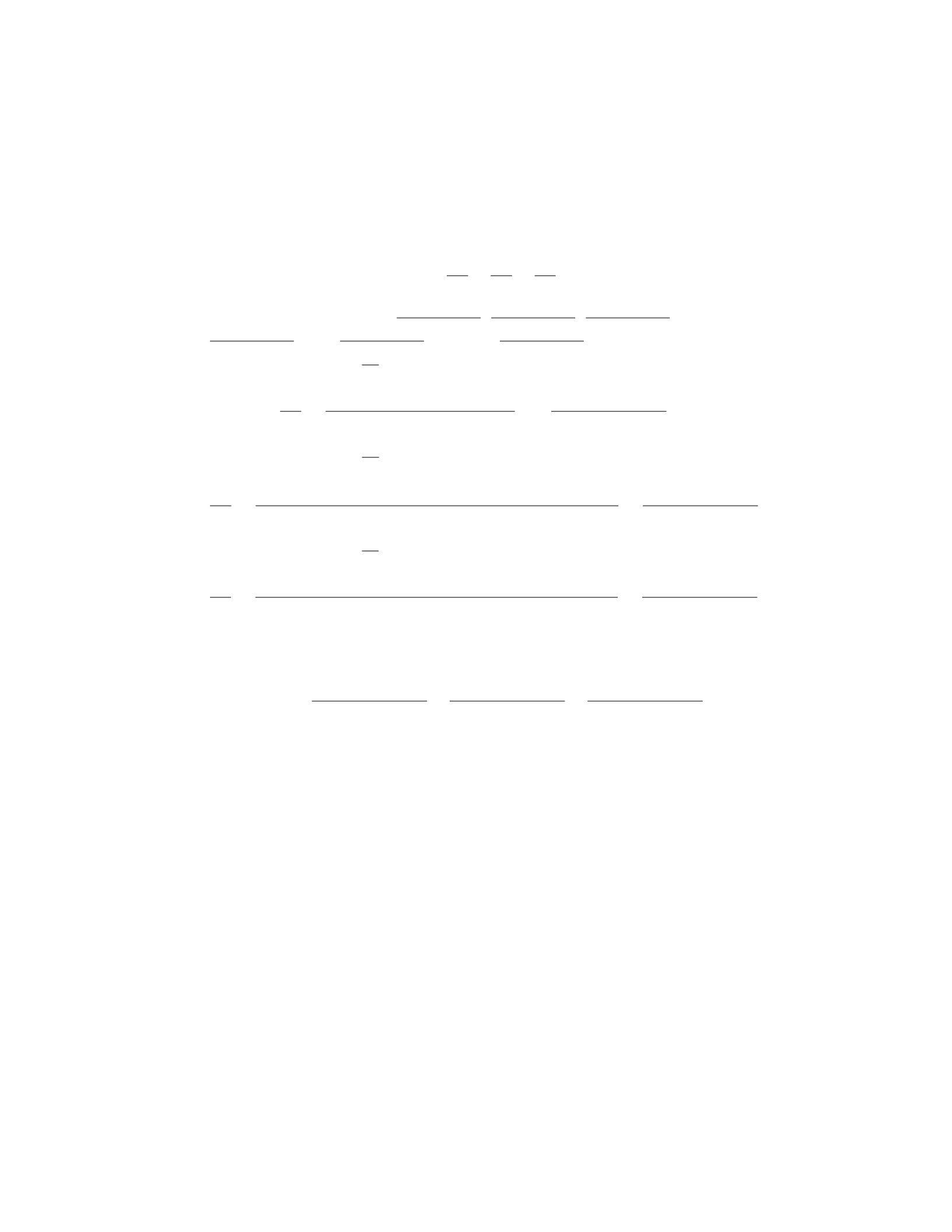
Step 1: Compute ∂P
∂x ,
∂P
∂x =−(3/2)yx(x2+y2+z2)−5/2
(x2+y2+z2)3/2=−3xy
(x2+y2+z2)5/2.
Step 2: Compute ∂Q
∂y ,
∂Q
∂y =(x)2(x2+y2+z2)−3/2−(3/2)x2y2(x2+y2+z2)−5/2
(x2+y2+z2)3/2=x2−3y2
(x2+y2+z2)5/2.
Step 3: Compute ∂R
∂z ,
∂R
∂z =(x)2(x2+y2+z2)−3/2−(3/2)x2z2(x2+y2+z2)−5/2
(x2+y2+z2)3/2=x2−3z2
(x2+y2+z2)5/2.
Step 4: Add the partial derivatives computed in Steps 1, 2, and 3 to find
the divergence,
∇ · F=−3xy
(x2+y2+z2)5/2+x2−3y2
(x2+y2+z2)5/2+x2−3z2
(x2+y2+z2)5/2.
Question 25
Question
Let F(x, y, z) = (2xy +z)i+ (x2+z)j+ (y2+x)kbe a vector field in R3.
Determine whether the vector field F(x, y, z) is conservative or not. If it is
conservative, find the potential function f(x, y, z).
Solution
Step 1: Check if the vector field is conservative by verifying the curl of F. Step
2: Calculate the curl of F. Step 3: If the curl of Fis the zero vector, then Fis
conservative. Determine the potential function by integrating the components
of F. Step 4: If the curl of Fis not the zero vector, then Fis not conservative.
Step 1: Check if the vector field is conservative by verifying the curl of F.
A vector field F(x, y, z) is conservative if and only if its curl is the zero vector,
i.e., ∇ × F= 0.
17

Step 2: Calculate the curl of F. The curl of a vector field F(x, y, z) =
P(x, y, z)i+Q(x, y, z)j+R(x, y, z)kis given by:
∇ × F=∂R
∂y −∂Q
∂z i−∂R
∂x −∂P
∂z j+∂Q
∂x −∂P
∂y k
For F(x, y, z) = (2xy +z)i+ (x2+z)j+ (y2+x)k, we have:
∇×F=∂(y2+x)
∂y −∂(x2+z)
∂z i−∂(y2+x)
∂x −∂(2xy +z)
∂z j+∂(2xy +z)
∂x −∂(x2+z)
∂y k
Step 3: If the curl of Fis the zero vector, then Fis conservative. Determine
the potential function by integrating the components of F.
∇ × F= (−1)i−(−1)j+ (2y)k
Simplify the curl to obtain ∇ × F=k+i+ 2yk. Since the curl is not zero, F
is not conservative.
Step 4: Since the vector field F(x, y, z) is not conservative, a potential
function f(x, y, z) does not exist for F.
Question 26
Question
Let F(x, y, z) = x2yz, xz2,−xy2be a vector field in R3. Find the curl of F.
Solution
To find the curl of a vector field F= (P, Q, R), we use the formula:
curl(F) = ∇ × F=
i j k
∂
∂x
∂
∂y
∂
∂z
P Q R
Step 1: Calculate the partial derivatives of P,Q, and R.
∂P
∂x = 2xyz, ∂Q
∂y = 0,∂R
∂z =−2xy
Step 2: Substitute the partial derivatives into the formula.
curl(F) =
i j k
2xyz 0−2xy
x2yz xz2−xy2
Step 3: Expand the determinant using cofactor expansion along the first
row.
curl(F) = (0 −0) i−−2xyz + 2xz2j+0−2x2yk
18
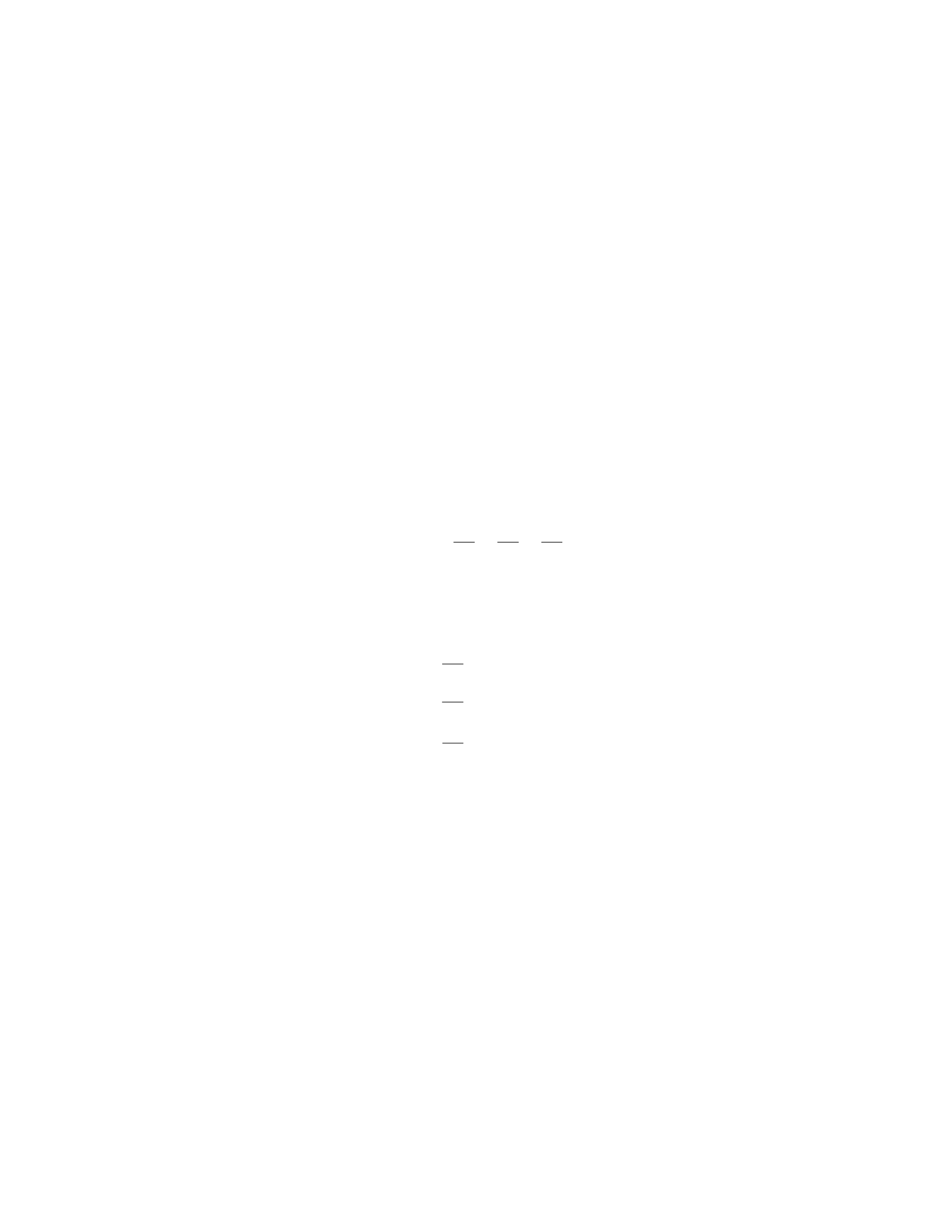
Step 4: Simplify the result.
curl(F) = 2(xz2−xyz)j−2x2yk
Therefore, the curl of the vector field F(x, y, z) = x2yz, xz2,−xy2is
curl(F) = 2(xz2−xyz)j−2x2yk.
Question 27
Question
Let F(x, y, z) = x2yi+xyzj+x2zk. Find the divergence of F.
Solution
To find the divergence of a vector field F(x, y, z) = P(x, y, z)i+Q(x, y, z)j+
R(x, y, z)k, we use the formula:
div(F) = ∂P
∂x +∂Q
∂y +∂R
∂z
Step 1: Identify P,Q, and R. In this case, P(x, y, z) = x2y,Q(x, y, z) =
xyz, and R(x, y, z) = x2z.
Step 2: Calculate the partial derivatives.
∂P
∂x = 2xy
∂Q
∂y =xz
∂R
∂z =x2
Step 3: Find the divergence of F.
div(F) = 2xy +xz +x2
Therefore, the divergence of F(x, y, z) = x2yi+xyzj+x2zkis 2xy +xz +x2.
Question 28
Question
Let F(x, y, z) = ⟨ex+ysin z, xex+ycos z, yex+ycos z⟩. Compute the curl of F.
19

Solution
To find the curl of F, denoted as ∇ × F, we need to compute the determinant
of the following matrix:
∇ × F=
i j k
∂
∂x
∂
∂y
∂
∂z
ex+ysin z xex+ycos z yex+ycos z
Step 1: Compute the partial derivatives Compute the partial deriva-
tives of the vector field components:
∂
∂x (ex+ysin z) = ex+ysin z, ∂
∂y (xex+ycos z) = xex+ycos z+ex+ycos z
∂
∂z (yex+ycos z) = −yex+ysin z
Step 2: Calculate the curl Now, plug these derivatives into the determi-
nant formula and simplify:
∇ × F=∂
∂y (yex+ycos z)−∂
∂z (xex+ycos z),
∂
∂z (ex+ysin z)−∂
∂x (yex+ycos z),
∂
∂x (xex+ycos z)−∂
∂y (ex+ysin z)
= (ex+ycos z+yex+ysin z, ex+ycos z−0, ex+ycos z−xex+ysin z)
Therefore, the curl of Fis ∇×F=⟨ex+ycos z+yex+ysin z, ex+ycos z, ex+ycos z−
xex+ysin z⟩.
Question 29
Question
Let F(x, y, z) = yzi+xzj+xykbe a vector field. Calculate the curl of F.
Solution
To find the curl of a vector field F(x, y, z) = P(x, y, z)i+Q(x, y, z)j+R(x, y, z)k,
we use the formula:
curl F=∇ × F=
i j k
∂
∂x
∂
∂y
∂
∂z
P Q R
20
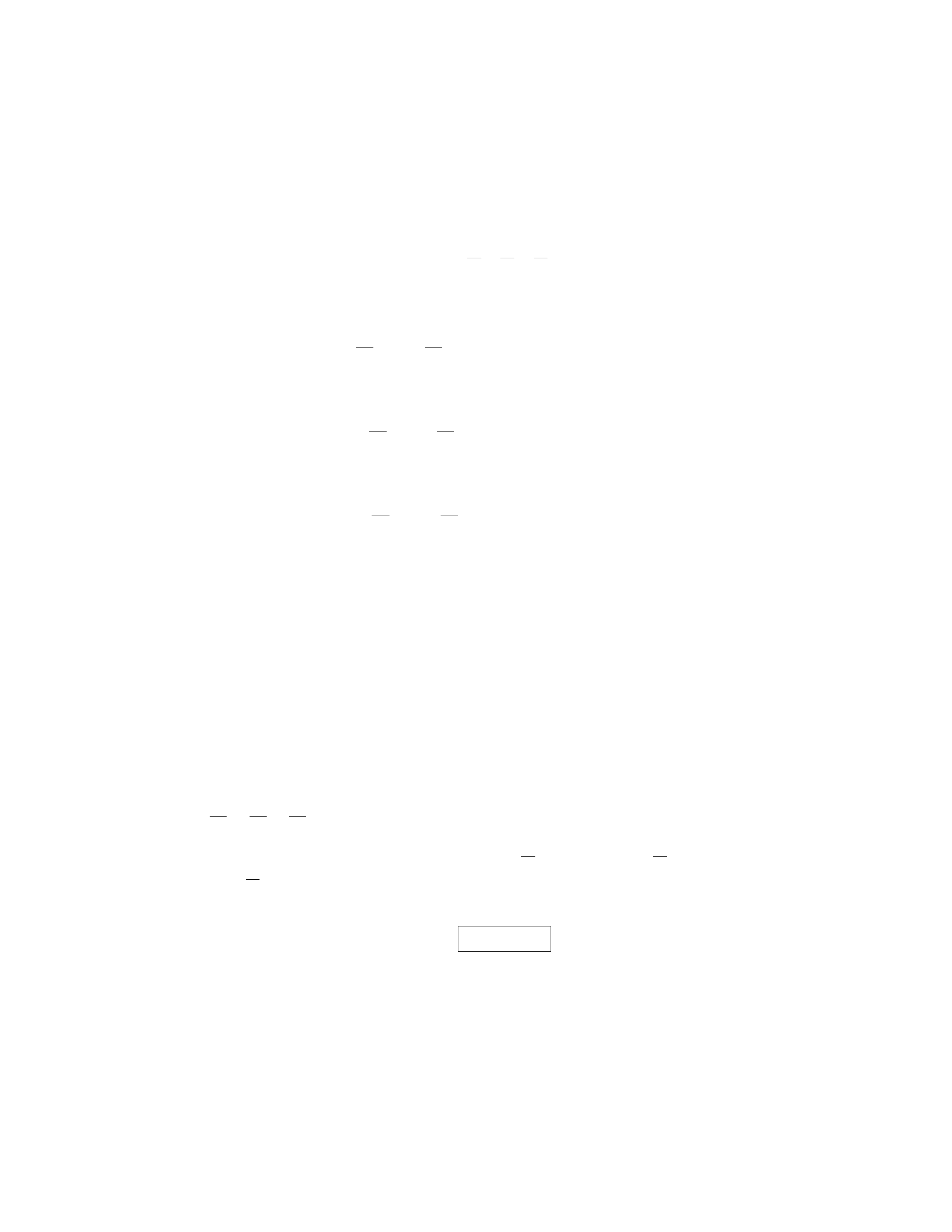
In this case, P(x, y, z) = yz,Q(x, y, z) = xz, and R(x, y, z) = xy. Hence,
the curl of Fis:
∇ × F=
i j k
∂
∂x
∂
∂y
∂
∂z
yz xz xy
Step 1: Calculate the x-component:
∂
∂y (xy)−∂
∂z (xz) = x−(−x)=2xi
Step 2: Calculate the y-component:
−∂
∂x (yz)−∂
∂z (xy)=−(z−z)=0j
Step 3: Calculate the z-component:
∂
∂x (xz)−∂
∂y (yz) = z−z= 0k
Therefore, the curl of Fis:
∇ × F= 2xi
Question 30
Question
Let F(x, y, z)=(x2−y2)i+ (y2−z2)j+ (z2−x2)kbe a vector field in R3.
Calculate the divergence of F.
Solution
Step 1: The divergence of a vector field F=Pi+Qj+Rkis given by ∇ · F=
∂P
∂x +∂Q
∂y +∂R
∂z .
Step 2: In this case, F(x, y, z)=(x2−y2)i+ (y2−z2)j+ (z2−x2)k.
Step 3: Calculate the partial derivatives: - ∂
∂x (x2−y2)=2x, - ∂
∂y (y2−z2) =
2y, - ∂
∂z (z2−x2)=2z.
Step 4: Add the partial derivatives together to find the divergence: ∇ · F=
2x+ 2y+ 2z= 2(x+y+z).
Therefore, the divergence of Fis 2(x+y+z) .
21
Solution
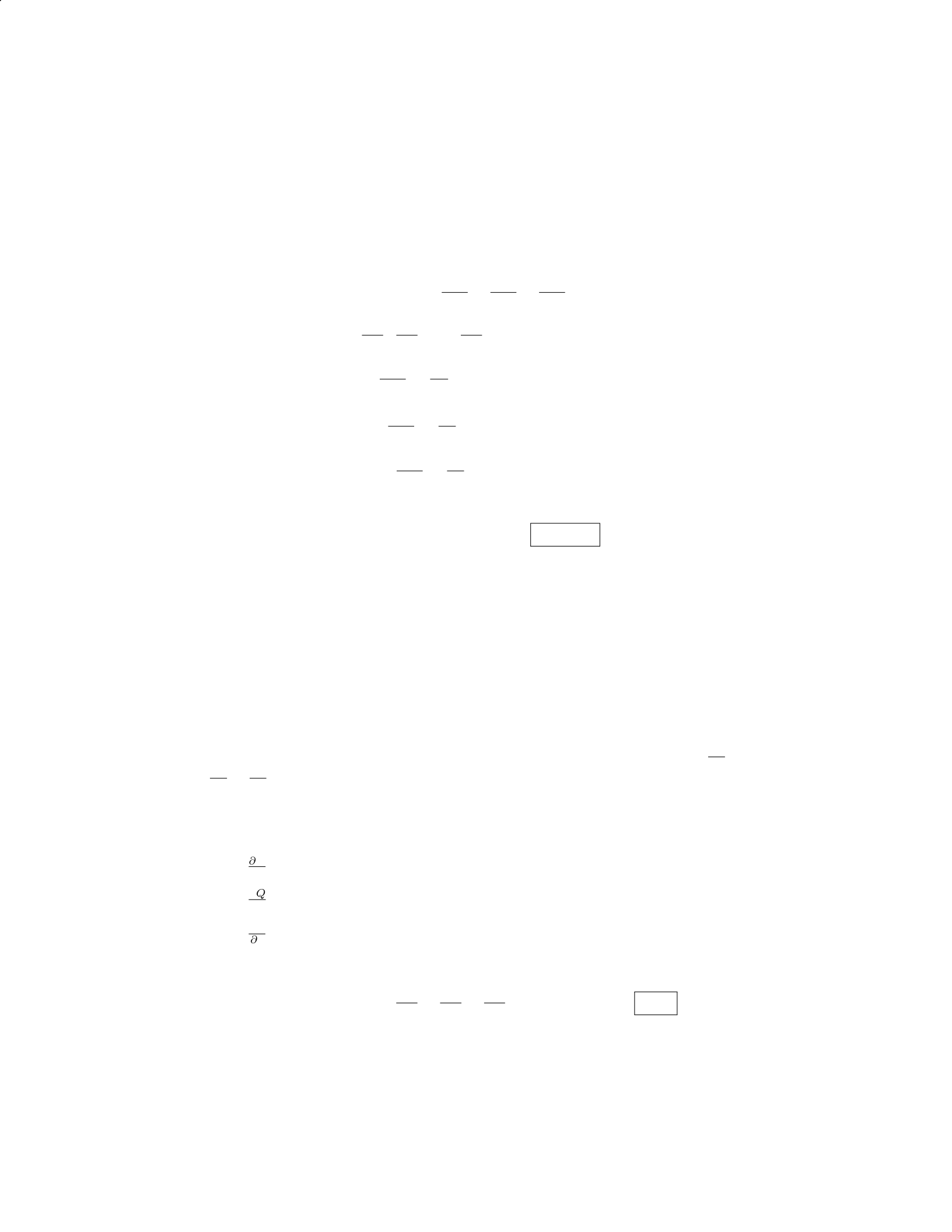
To find the divergence of the vector field F= (3x2y+z2, x3+ 2yz, 2xyz), we
need to compute ∇ · Fusing the formula:
∇ · F=∂F1
∂x +∂F2
∂y +∂F3
∂z
Step 1: Compute ∂F1
∂x ,∂F2
∂y , and ∂F3
∂z .
∂F1
∂x =∂
∂x (3x2y+z2) = 6xy
∂F2
∂y =∂
∂y (x3+ 2yz)=2z
∂F3
∂z =∂
∂z (2xyz)=2xy
Step 2: Sum the partial derivatives to find the divergence.
∇ · F= 6xy + 2z+ 2xy = 8xy + 2z
Therefore, the divergence of the vector field Fis 8xy + 2z.
Question 3
Question
Let F(x, y, z) = ⟨x2yz, xz3, x3y⟩. Compute the divergence of F.
Solution
To compute the divergence of F, we use the formula: div(F) = ∇ · F=∂P
∂x +
∂Q
∂y +∂R
∂z , where F=⟨P, Q, R⟩.
Step 1: Identify P,Q, and R. Here, P(x, y, z) = x2yz,Q(x, y, z) = xz3,
and R(x, y, z) = x3y.
Step 2: Compute partial derivatives.
∂P
∂x = 2xyz
∂Q
∂y = 0
∂R
∂z = 0
Step 3: Calculate the divergence.
div(F) = ∇ · F=∂P
∂x +∂Q
∂y +∂R
∂z = 2xyz + 0 + 0 = 2xyz
Therefore, the divergence of Fis 2xyz.
2
Question 4
Question
Let F(x, y, z) = x2yi−xyzj+z2kbe a vector field in R3. Determine the curl
of Fat the point (1,−2,3).
Solution
To find the curl of a vector field F(x, y, z) = P(x, y, z)i+Q(x, y, z)j+R(x, y, z)k
at a point (a, b, c), we use the formula:
∇ × F=
i j k
∂
∂x
∂
∂y
∂
∂z
P Q R
Given F(x, y, z) = x2yi−xyzj+z2k, we have P(x, y, z) = x2y,Q(x, y, z) =
−xyz, and R(x, y, z) = z2.
Step 1: Compute the curl of Fusing the formula above:
∇ × F=
i j k
∂
∂x
∂
∂y
∂
∂z
x2y−xyz z2
Step 2: Compute the partial derivatives:
∂R
∂y = 0,∂Q
∂z =−x
∂P
∂z = 0,∂R
∂x = 0
∂Q
∂x = 2xy, ∂P
∂y =x2
Step 3: Plug these partial derivatives into the determinant and evaluate:
∇ × F= (i(−x)−j0 + k(2xy))
=−xi+ 2xyk
Step 4: Evaluate the curl of Fat the point (1,−2,3):
∇ × F=−1i+ 2(−2)(3)k
=−i−12k
Therefore, the curl of Fat the point (1,−2,3) is −i−12k.
Question 5
Question
Let F(x, y, z) = x2yi+z3j+exyzkbe a vector field. Compute ∇·∇×Fwhere
∇is the gradient operator and ×denotes the cross product.
3
Solution
Step 1: Calculate ∇ × F.
The curl of a vector field F(x, y, z) = Pi+Qj+Rkis given by:
∇ × F=∂R
∂y −∂Q
∂z i−∂R
∂x −∂P
∂z j+∂Q
∂x −∂P
∂y k
Applying this formula to F(x, y, z) = x2yi+z3j+exyzk, we have:
=∂(exyz )
∂y −∂(z3)
∂z i−∂(exyz )
∂x −∂(x2y)
∂z j+∂(z3)
∂x −∂(x2y)
∂y k
= (xzexyz −0) i−(yzexyz −2xy)j+0−x2k
=xzexyzi−yzexyz j−x2k
Step 2: Compute ∇ · ∇ × F.
The divergence of a vector field G(x, y, z) = Mi+Nj+Pkis given by:
∇ · G=∂M
∂x +∂N
∂y +∂P
∂z
Now, to calculate ∇ · ∇ × F, apply the divergence operator to the result
obtained previously:
- yzexyzj−x2k) = ∂
∂x (xzexyz) + ∂
∂y (−yzexyz) + ∂
∂z (−x2)
=zexyz +yzexyz + 0
=zexyz +yzexyz
= (z+y)exyz
Therefore, ∇ · ∇ × F= (z+y)exyz .
Question 6
Question
Let F(x, y, z) = xz
y2i+y2
zj+y
xk. Find the divergence of Fat the point (1,1,1).
4

Solution
To find the divergence of a vector field F=Pi+Qj+Rkat a point, we use the
formula:
div(F) = ∂P
∂x +∂Q
∂y +∂R
∂z
Given F(x, y, z) = xz
y2i+y2
zj+y
xk, we have P=xz
y2,Q=y2
z, and R=y
x.
Step 1: Calculate ∂P
∂x .
∂P
∂x =z
y2
Step 2: Calculate ∂Q
∂y .
∂Q
∂y =2y
z
Step 3: Calculate ∂R
∂z .
∂R
∂z = 0
Step 4: Find the divergence of Fat the point (1,1,1).
div(F) = ∂P
∂x +∂Q
∂y +∂R
∂z =z
y2+2y
z+ 0
Substitute (x, y, z) = (1,1,1) into the expression above:
div(F)
(1,1,1) =1
12+2·1
1= 1 + 2 = 3
Therefore, the divergence of Fat the point (1,1,1) is 3.
Question 7
Question
Let F(x, y, z) = x2yi+xyzj+yz2kbe a vector field. Compute ∇ · (∇ × F).
Solution
Step 1: Compute ∇ × F.
=
i j k
∂
∂x
∂
∂y
∂
∂z
x2y xyz yz2
=∂(yz2)
∂y −∂(xyz)
∂z i−∂(x2y)
∂x −∂(yz2)
∂z j+∂(xyz)
∂x −∂(x2y)
∂y k
= (z2−y)i−(2xy −0)j+ (yz −2xy)k
= (z2−y)i−2xyj+ (yz −2xy)k
5

Step 2: Compute ∇ · (∇ × F).
) = ∇ · (z2−y)i−2xyj+ (yz −2xy)k
=∂
∂x (z2−y) + ∂
∂y (−2xy) + ∂
∂z (yz −2xy)
= 0 −2x+ 0
=−2x
Therefore, ∇ · (∇ × F) = −2x.
Question 8
Question
Let F(x, y, z) = x2yi+y2zj+z2xkbe a vector field. Compute ∇ · F.
Solution
Step 1: The divergence of a vector field F(x, y, z) = P(x, y, z)i+Q(x, y, z)j+
R(x, y, z)kis given by the following formula:
∇ · F=∂P
∂x +∂Q
∂y +∂R
∂z
Step 2: Given that F(x, y, z) = x2yi+y2zj+z2xk, we can identify P(x, y, z) =
x2y,Q(x, y, z) = y2z, and R(x, y, z) = z2x.
Step 3: Now, we can calculate the partial derivatives:
∂P
∂x = 2xy
∂Q
∂y = 2yz
∂R
∂z = 2zx
Step 4: Substitute the partial derivatives back into the formula for the di-
vergence:
∇ · F= 2xy + 2yz + 2zx
Step 5: Simplifying the expression, we get:
∇ · F= 2(xy +yz +zx)
Therefore, the divergence of the vector field F(x, y, z) = x2yi+y2zj+z2xk
is 2(xy +yz +zx).
6
Question 9
Question
Let F(x, y, z)=(yz2, xz2, xy2). Compute the curl of F.
Solution
Step 1: The curl of a vector field F(x, y, z)=(P, Q, R) is given by the determi-
nant of the following matrix:
∇ × F=
i j k
∂
∂x
∂
∂y
∂
∂z
P Q R
Step 2: Let’s first find the partial derivatives of P,Q, and R.
∂P
∂y =z2,∂Q
∂z = 2xz, ∂R
∂x =y2
Step 3: Now, we substitute into the formula for the curl:
∇ × F=
i j k
∂
∂x
∂
∂y
∂
∂z
yz2xz2xy2
Step 4: Evaluating the determinant gives:
∇×F= (2xz−2xz, y2−z2, z2−y2)·i−(0−0,0−0, x2−y2)·j+(0−0,0−0, x2−2yz)·k
Step 5: Simplifying the expression, we get:
∇ × F= 0 ·i+ (y2−z2)·j+ (z2−y2)·k
Therefore, the curl of Fis ∇ × F= (0, y2−z2, z2−y2).
Question 10
Question
Let F(x, y, z) = x2y2z2,1
y−cos(z), xy. Calculate curl(F).
Solution
To find the curl of a vector field F=Pi+Qj+Rk, where P,Q, and Rare
functions of x,y, and z, we compute the determinant of the curl operator:
7
curl(F) =
i j k
∂
∂x
∂
∂y
∂
∂z
P Q R
Step 1: Compute the partial derivatives of P,Q, and R.
∂P
∂x = 2xy2z2,∂Q
∂y =−1
y2,∂R
∂z = 0
Step 2: Plug the partial derivatives into the determinant formula.
curl(F) =
i j k
2xy2z2−1
y20
x2y2z21
y−cos(z)xy
Step 3: Expand the determinant to compute the curl.
curl(F) = 0−0,0−0,2xz
y−sin(z)=0,0,2xz
y−sin(z)
Therefore, curl(F) = 0,0,2xz
y−sin(z).
Question 11
Question
Let F(x, y, z) = x2yi+y2zj+z2xk. Compute div F.
Solution
Step 1: The divergence of a vector field F(x, y, z) = P(x, y, z)i+Q(x, y, z)j+
R(x, y, z)kis given by:
div F=∂P
∂x +∂Q
∂y +∂R
∂z
Step 2: Given F(x, y, z) = x2yi+y2zj+z2xk, we have: P(x, y, z) = x2y,
Q(x, y, z) = y2z, and R(x, y, z) = z2x.
Step 3: Compute the partial derivatives:
∂P
∂x = 2xy, ∂Q
∂y = 2yz, ∂R
∂z = 2zx
Step 4: Calculate the divergence:
div F= 2xy + 2yz + 2zx = 2(xy +yz +zx)
Therefore, the divergence of Fis 2(xy +yz +zx) .
8

Question 12
Question
Let F(x, y, z)=3x2yi+ 2xyzj+yexyzkbe a vector field in R3. Find the
divergence of F.
Solution
Step 1: The divergence of a vector field F(x, y, z) = P(x, y, z)i+Q(x, y, z)j+
R(x, y, z)kis given by the expression:
div(F) = ∂P
∂x +∂Q
∂y +∂R
∂z
Step 2: In this case, P(x, y, z) = 3x2y,Q(x, y, z) = 2xyz, and R(x, y, z) =
yexyz. We need to calculate the partial derivatives of P,Q, and Rwith respect
to x,y, and z.
Step 3: ∂P
∂x = 6xy
∂Q
∂y = 2xz
∂R
∂z =y2exyz
Step 4: Now, we can find the divergence of Fby adding these partial deriva-
tives:
div(F)=6xy + 2xz +y2exyz
Therefore, the divergence of the vector field Fis 6xy + 2xz +y2exyz.
Question 13
Question
Let F(x, y, z) = (x2+y2+z2)1/2ˆ
i+ (x2+y2+z2)1/2ˆ
j+ (x2+y2+z2)1/2ˆ
kbe
a vector field. Calculate the curl of Fat the point (1,2,3).
Solution
To find the curl of F, we use the formula:
curl F=∇ × F=
ˆ
iˆ
jˆ
k
∂
∂x
∂
∂y
∂
∂z
P Q R
Where P, Q, R are the components of the vector field F.
9
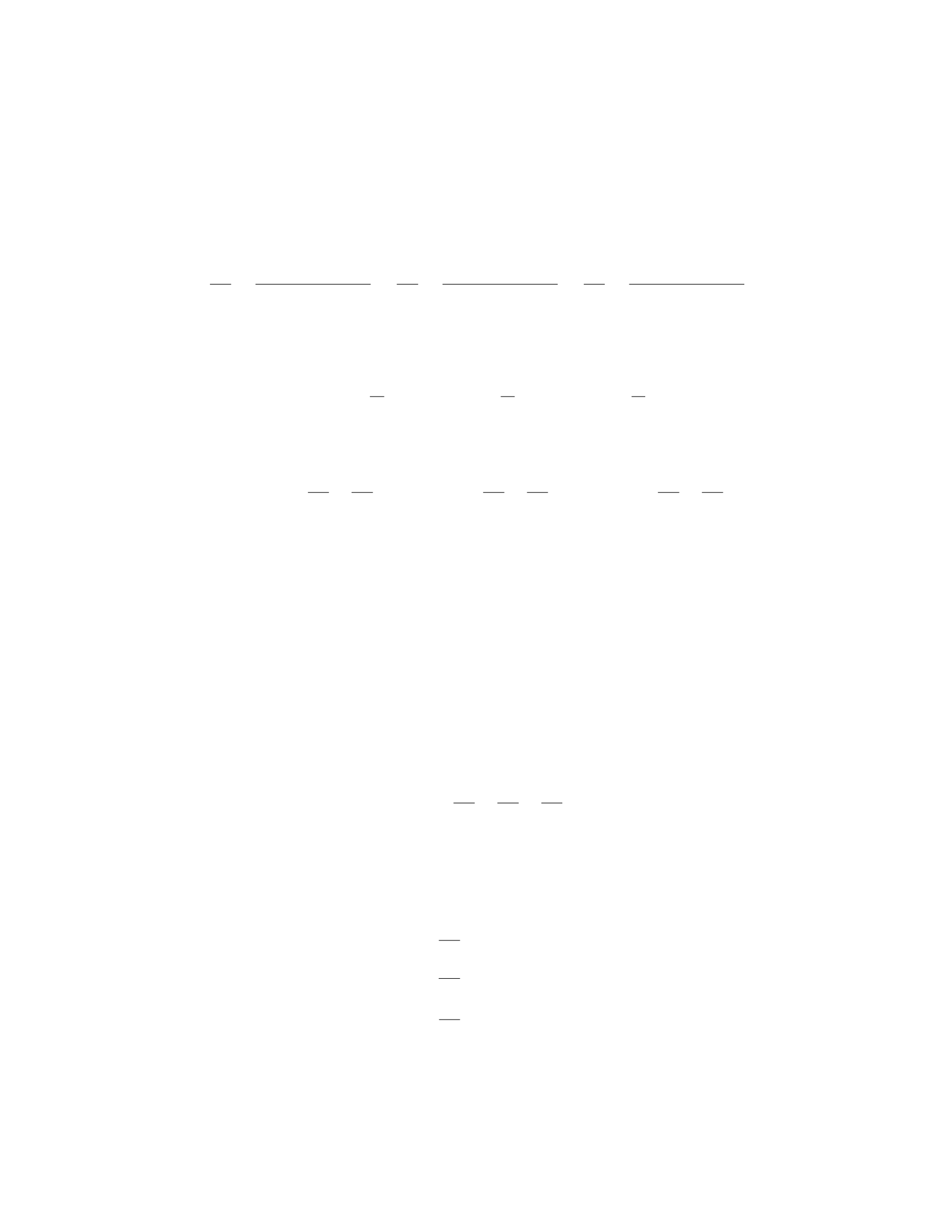
Step 1: Calculate the components P,Q, and Rof F:P= (x2+y2+z2)1/2,
Q= (x2+y2+z2)1/2,R= (x2+y2+z2)1/2.
Step 2: Calculate the partial derivatives of P,Q, and R:
∂P
∂x =x
(x2+y2+z2)1/2,∂Q
∂y =y
(x2+y2+z2)1/2,∂R
∂z =z
(x2+y2+z2)1/2.
Step 3: Substitute the components and their derivatives into the formula for
the curl:
∇ × F=
ˆ
iˆ
jˆ
k
∂
∂x
∂
∂y
∂
∂z
(x2+y2+z2)1/2(x2+y2+z2)1/2(x2+y2+z2)1/2
Step 4: Evaluate the determinant:
(∇ × F)x=∂R
∂y −∂Q
∂z ,(∇ × F)y=∂P
∂z −∂R
∂x ,(∇ × F)z=∂Q
∂x −∂P
∂y .
Step 5: Evaluate the curl of Fat the given point (1,2,3): Substitute x= 1,
y= 2, z= 3 into the components and their derivatives, then calculate the curl.
Question 14
Question
Let F(x, y, z) = (2xy2, x2z, xz3) be a vector field. Calculate the divergence of
F.
Solution
Step 1: The divergence of a vector field F= (P, Q, R) is given by the formula:
div(F) = ∂P
∂x +∂Q
∂y +∂R
∂z
Step 2: Given F(x, y, z) = (2xy2, x2z, xz3), we have P= 2xy2,Q=x2z,
and R=xz3.
Step 3: Find the partial derivatives of P,Q, and Rwith respect to x,y, and
z:
∂P
∂x = 2y2
∂Q
∂y = 0
∂R
∂z = 3xz2
10
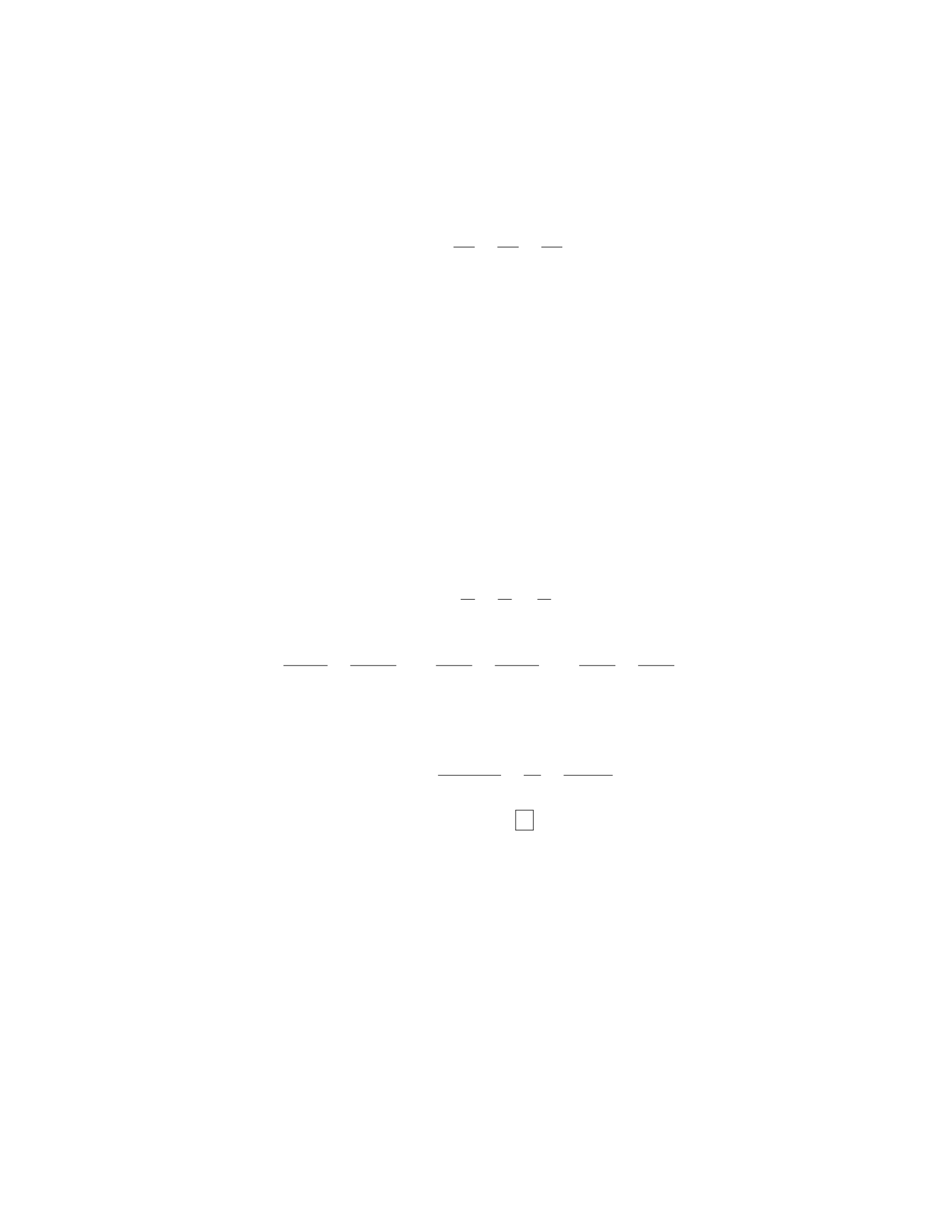
Step 4: Now, calculate the divergence of F:
div(F) = ∂P
∂x +∂Q
∂y +∂R
∂z
= 2y2+ 0 + 3xz2
= 2y2+ 3xz2
Therefore, the divergence of the vector field F(x, y, z) = (2xy2, x2z, xz3) is
div(F)=2y2+ 3xz2.
Question 15
Question
Let F(x, y, z) = y2i+xyzj+yz2kbe a vector field in R3. Compute ∇·∇×F.
Solution
Step 1: Compute ∇ × F.
∇ × F=
i j k
∂
∂x
∂
∂y
∂
∂z
y2xyz yz2
= (∂(yz2)
∂y −∂(xyz)
∂z )i−(∂(y2)
∂z −∂(yz2)
∂x )j+ ( ∂(y2)
∂x −∂(y2)
∂y )k
= (z2−y)i−(0 −z)j+ (0 −2y)k= (z2−y)i+zj−2yk
Step 2: Compute ∇ · (∇ × F).
∇ · (∇ × F) = ∂(z2−y)
∂x +∂z
∂y +∂(−2y)
∂z
= 0 + 0 + 0 = 0
Question 16
Question
Let F(x, y, z) = x2yi+xyzj+xz2k. Compute ∇ · ∇ × F.
11
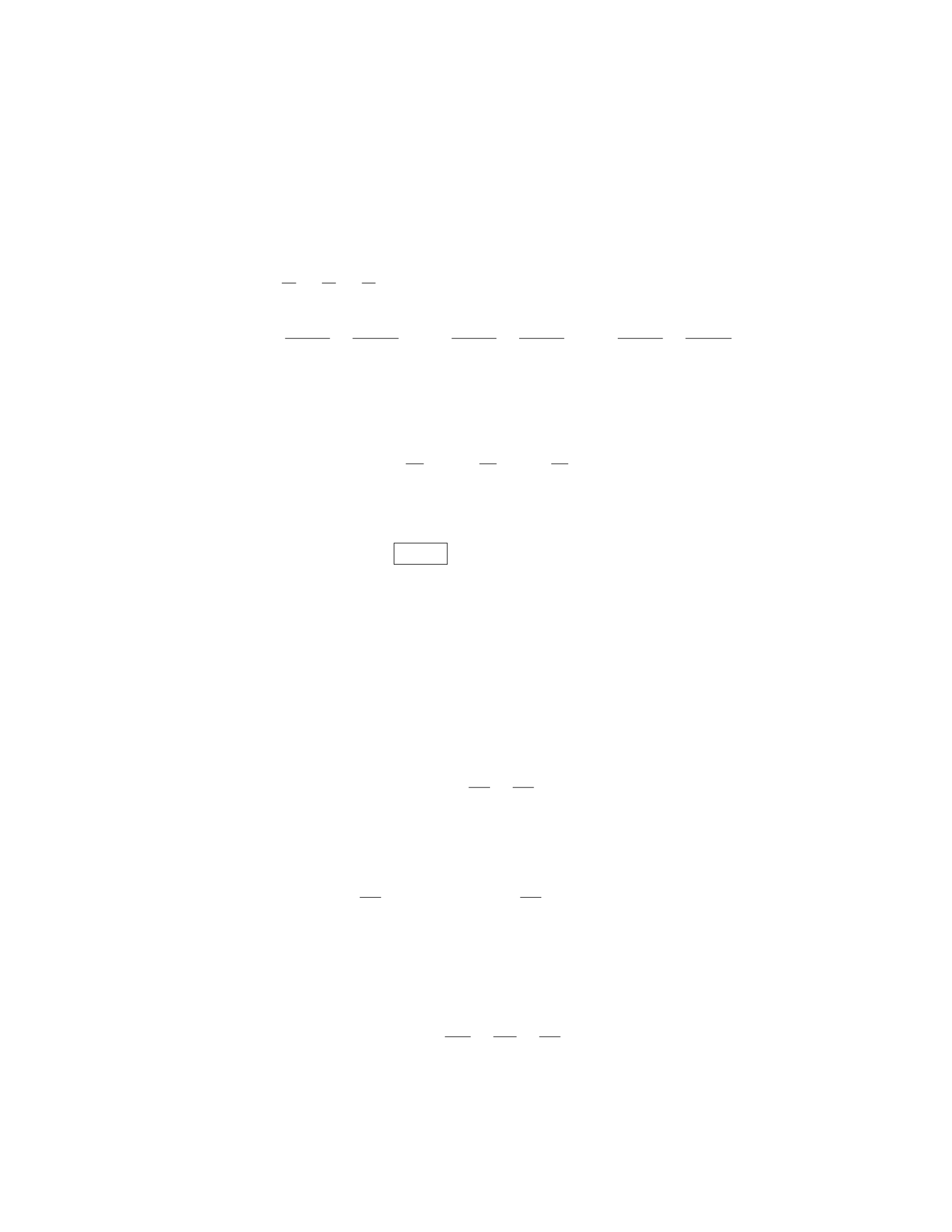
Solution
Step 1: Calculate the curl of F.
∇ × F=
i j k
∂
∂x
∂
∂y
∂
∂z
x2y xyz xz2
=∂(xz2)
∂y −∂(xyz)
∂z i−∂(xz2)
∂x −∂(x2y)
∂z j+∂(x2y)
∂x −∂(xyz)
∂y k
= (0 −x)i−(z−0)j+ (2xy −x)k
=−xi−zj+ (2xy −x)k
Step 2: Compute the divergence of ∇ × F.
∇ · ∇ × F=∂
∂x (−x) + ∂
∂y (−z) + ∂
∂z (2xy −x)
=−1−0+2x
= 2x−1
Therefore, ∇ · ∇ × F= 2x−1 .
Question 17
Question
Let F(x, y) = (2xy2+ex)i+ (x2+yex)jbe a vector field. Compute ∇ · ∇ × F.
Solution
Step 1: Compute ∇ × F. The curl of a vector field F(x, y) = P(x, y)i+Q(x, y)j
is given by
∇ × F=∂Q
∂x −∂P
∂y k
where kis the unit vector in the z-direction.
For F(x, y) = (2xy2+ex)i+ (x2+yex)j, we have P(x, y) = 2xy2+exand
Q(x, y) = x2+yex. Calculating the partial derivatives, we find
∂Q
∂x = 2x+yexand ∂P
∂y = 4xy,
thus
∇ × F= (2x+yex−4xy)k.
Step 2: Compute ∇ · ∇ × F. The divergence of a vector field G(x, y, z) =
M(x, y, z)i+N(x, y, z)j+P(x, y, z)kis given by
∇ · G=∂M
∂x +∂N
∂y +∂P
∂z .
12
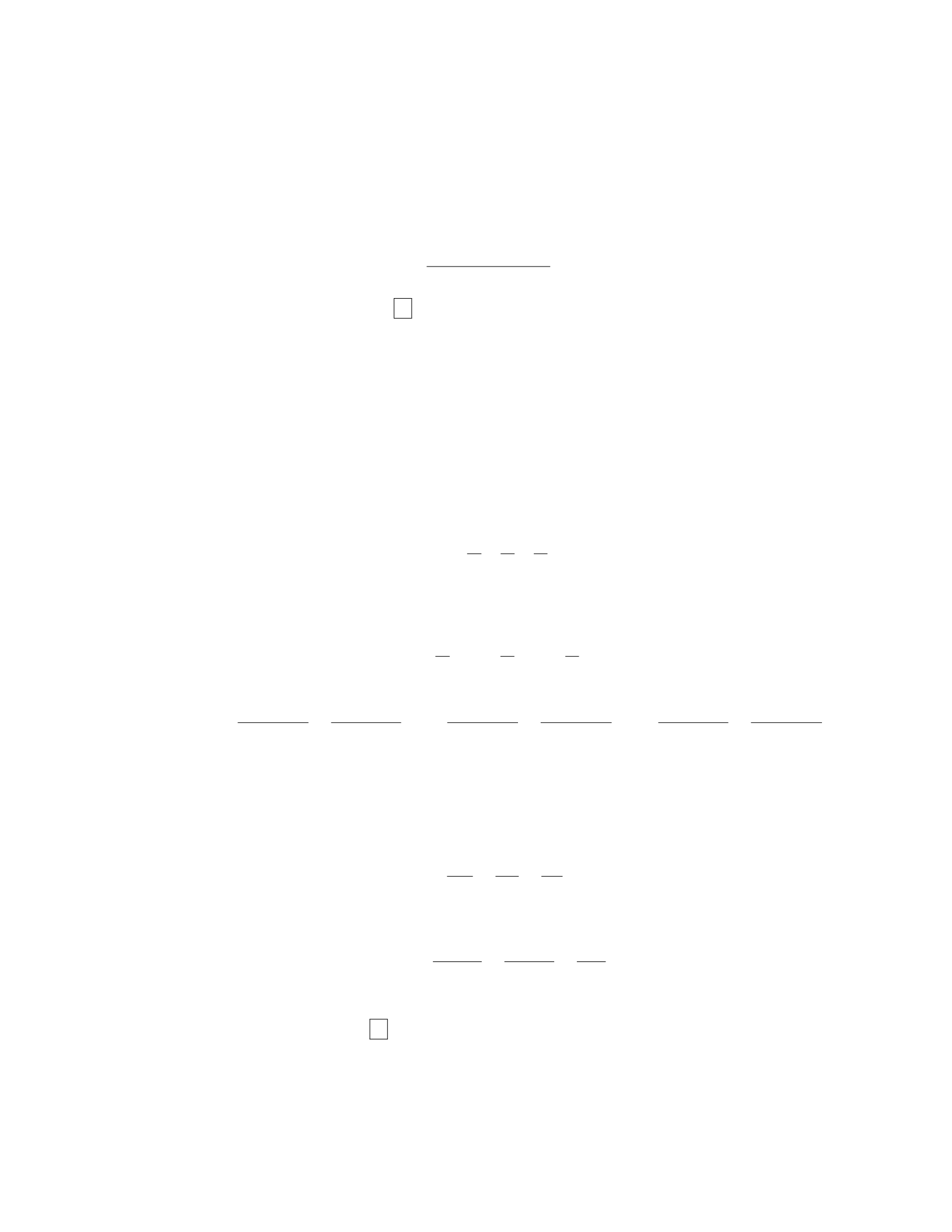
In our case, G(x, y, z) = (2x+yex−4xy)k. Since Gonly has a z-component,
the divergence in this case simplifies to
∇ · G=∂(2x+yex−4xy)
∂z = 0.
Therefore, ∇ · ∇ × F= 0 .
Question 18
Question
Let F(x, y, z) = ⟨x2+y2, y2+z2, z2+x2⟩. Compute ∇ · ∇ × F.
Solution
Step 1: Compute ∇×F. The curl of a vector field F(x, y, z) = ⟨P, Q, R⟩is given
by:
∇ × F=
i j k
∂
∂x
∂
∂y
∂
∂z
P Q R
Here, F(x, y, z) = ⟨x2+y2, y2+z2, z2+x2⟩=⟨P, Q, R⟩. So, we have:
∇ × F=
i j k
∂
∂x
∂
∂y
∂
∂z
x2+y2y2+z2z2+x2
=∂(z2+x2)
∂y −∂(y2+z2)
∂z i−∂(z2+x2)
∂x −∂(x2+y2)
∂z j+∂(y2+z2)
∂x −∂(x2+y2)
∂y k
= (0 −2z)i−(2x−0)j+ (2y−2y)k
=−2zi−2xj
Step 2: Compute ∇ · ∇ × F. The divergence of a vector field G(x, y, z) =
⟨M, N, P ⟩is given by:
∇ · G=∂M
∂x +∂N
∂y +∂P
∂z
Here, G(x, y, z) = ∇ × F=⟨−2z, −2x, 0⟩=⟨M, N, P ⟩. Therefore,
∇ · ∇ × F=∂(−2z)
∂x +∂(−2x)
∂y +∂(0)
∂z
= 0 + 0 + 0 = 0
Hence, ∇ · ∇ × F= 0 .
13
Question 19
Question
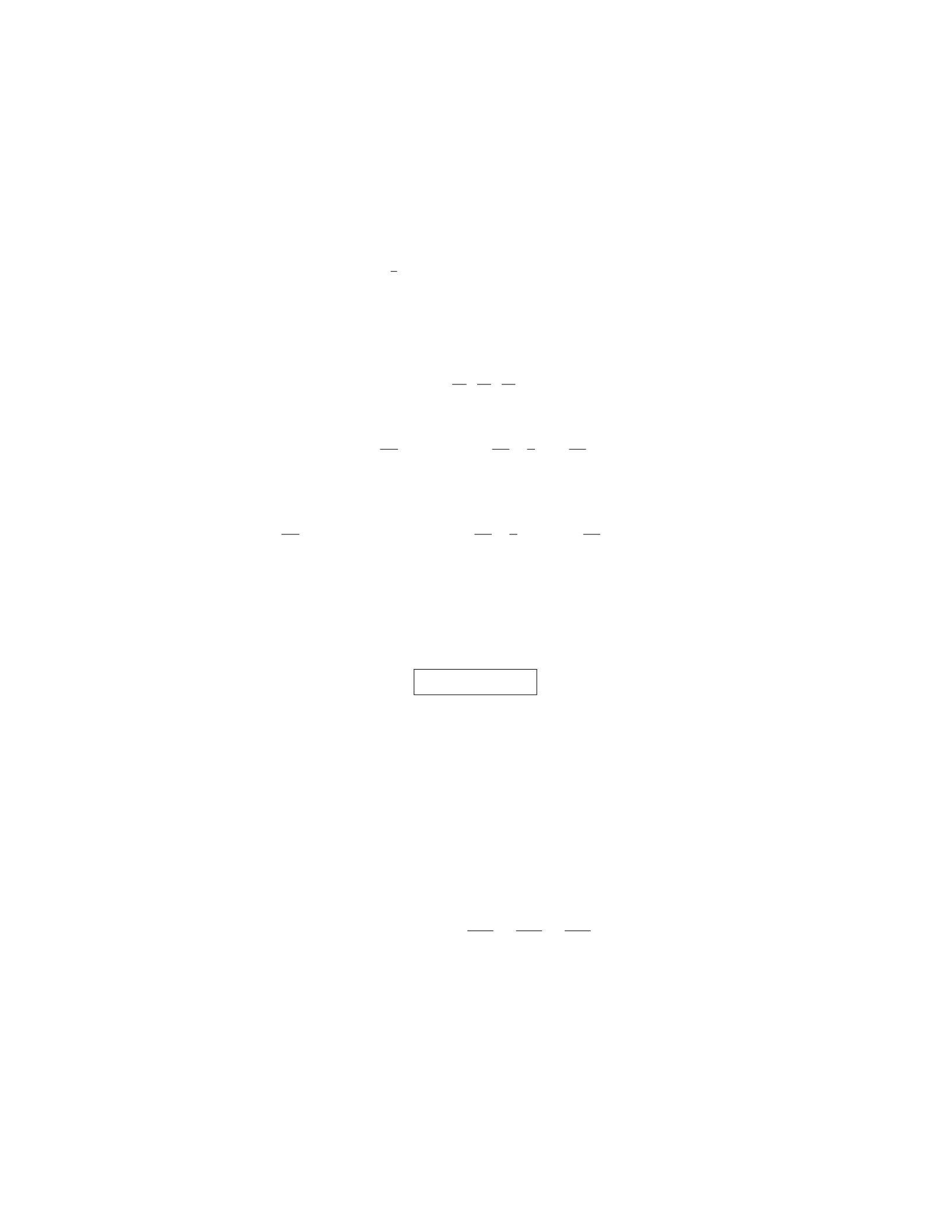
Let F(x, y, z) = exsin(y),1
z, x2ybe a vector field. Calculate the divergence of
F.
Solution
To find the divergence of F, we need to determine the dot product of the vector
field Fwith the del operator ∇=∂
∂x ,∂
∂y ,∂
∂z .
Step 1: Find the components of ∇ · F.
∇ · F=∂
∂x (exsin(y)) + ∂
∂y 1
z+∂
∂z x2y
Step 2: Calculate the partial derivatives.
∂
∂x (exsin(y)) = exsin(y),∂
∂y 1
z= 0,∂
∂z x2y= 0
Step 3: Substitute the results back into the expression for ∇ · F.
∇ · F=exsin(y)+0+0
Step 4: Simplify the expression.
∇ · F=exsin(y)
Question 20
Question
Let F(x, y, z) = (x2y, yz, xyz) be a vector field in R3. Compute the divergence
of F.
Solution
To compute the divergence of F, we’ll use the formula
div F=∇ · F=∂F1
∂x +∂F2
∂y +∂F3
∂z .
Step 1: Write Fin component form:
F= (x2y, yz, xyz)=(F1, F2, F3).
14
Step 2: Compute the partial derivatives of each component:
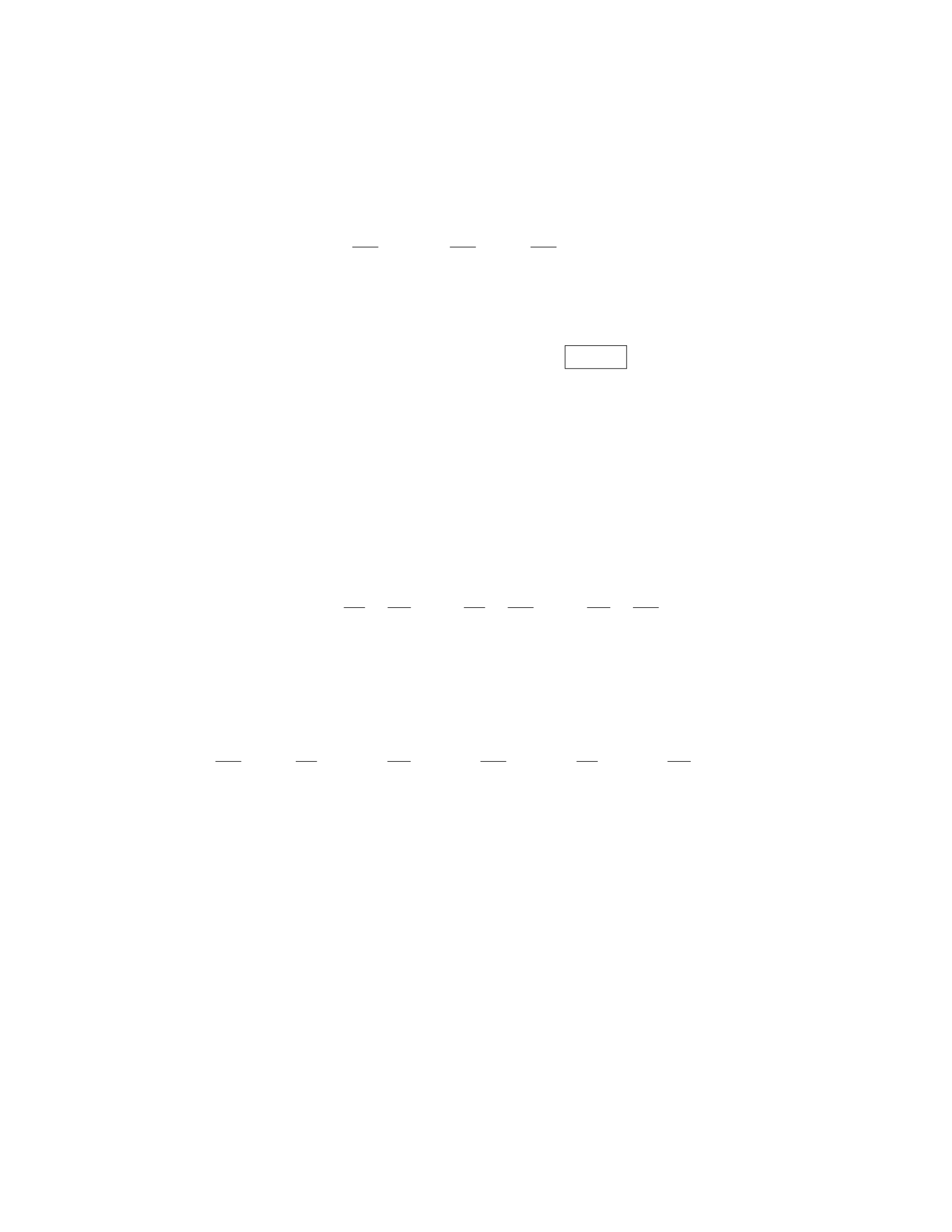
∂F1
∂x = 2xy, ∂F2
∂y =z, ∂F3
∂z =xy.
Step 3: Add up the partial derivatives to find the divergence:
div F= 2xy +z+xy = 3xy +z.
Therefore, the divergence of the vector field Fis 3xy +z.
Question 21
Question
Let F(x, y, z) = x3yi+xy2zj+xyz3kbe a vector field in R3. Calculate the curl
of Fat the point (1,2,3).
Solution
To find the curl of a vector field F(x, y, z) = Mi+Nj+Pk, we use the formula:
∇ × F=∂P
∂y −∂N
∂z i−∂P
∂x −∂M
∂z j+∂N
∂x −∂M
∂y k
Given F(x, y, z) = x3yi+xy2zj+xyz3k, we have:
M=x3y, N =xy2z, P =xyz3
Now, we calculate the partial derivatives:
∂M
∂z = 0,∂P
∂y =xz3,∂N
∂x =y2z, ∂M
∂y = 3x2,∂P
∂x =yz3,∂N
∂z =xy2
Finally, plug these values into the formula for the curl:
∇ × F= (xz3−xy2)i−(yz3−0)j+ (y2z−3x2)k
At the point (1,2,3), the curl is:
∇ × F(1,2,3) = (3 −4)i−(3 −0)j+ (4 −3)k=−i−3j+k
Question 22
Question
Let F(x, y) = x3yi+x2y2j. Compute ∇ · ∇ × F.
15
Solution
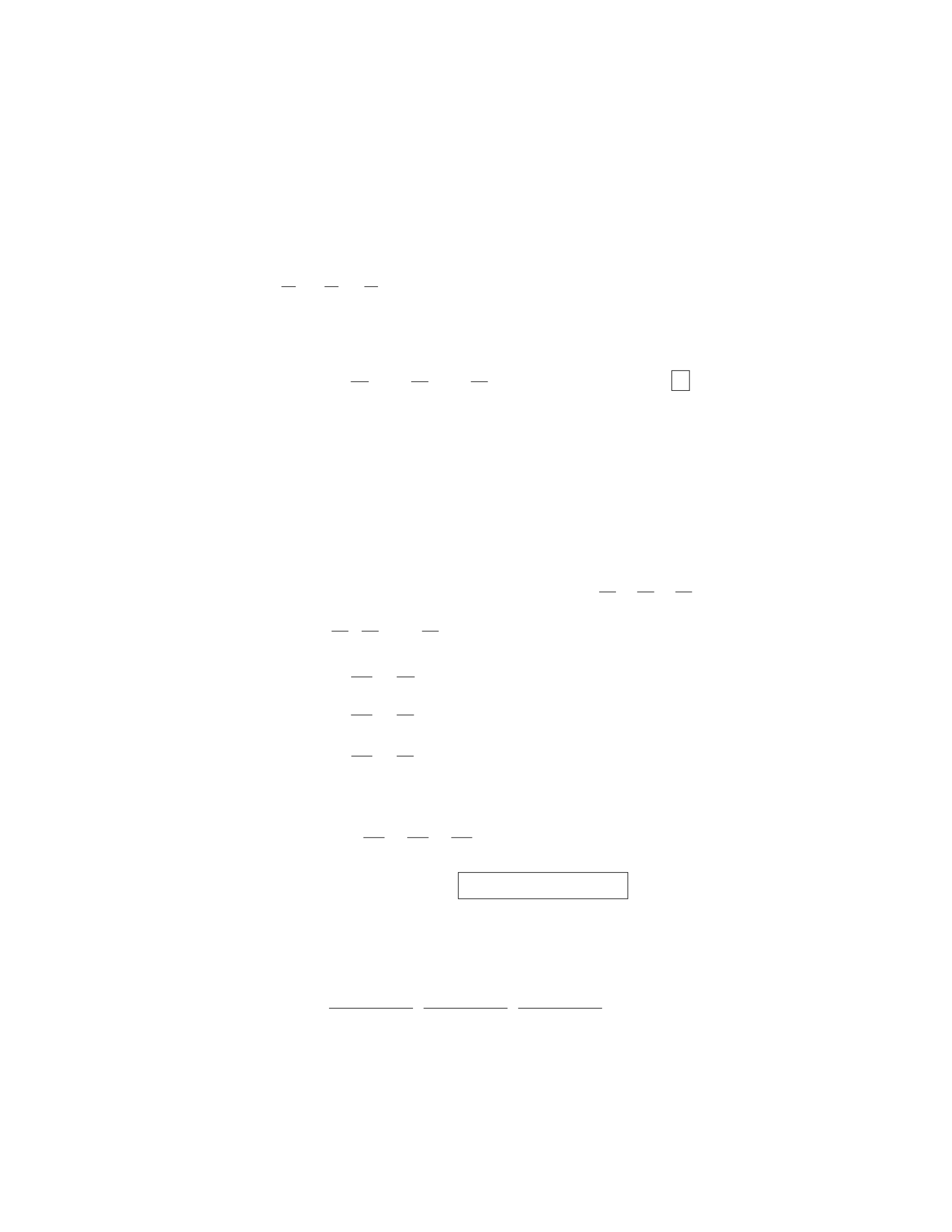
Step 1: Calculate ∇ × F.
∇ × F=
i j k
∂
∂x
∂
∂y
∂
∂z
x3y x2y20
= (0 −0)i−(0 −0)j+ (2xy −3x2)k= (2xy −3x2)k
Step 2: Compute ∇ · ∇ × F.
∇ · ∇ × F=∂
∂x (0) + ∂
∂y (0) + ∂
∂z (2xy −3x2) = 0 + 0 + 0 = 0
Question 23
Question
Let F(x, y, z) = 3x2yz −y3z2, x3z−2xyz2,−2x2y2+ 3y2z. Calculate the di-
vergence of F.
Solution
To find the divergence of F, we use the formula div(F) = ∂P
∂x +∂Q
∂y +∂R
∂z , where
F= (P, Q, R).
Step 1: Find ∂P
∂x ,∂Q
∂y , and ∂R
∂z .
∂P
∂x =∂
∂x 3x2yz −y3z2= 6xyz
∂Q
∂y =∂
∂y x3z−2xyz2=x3−2xz2
∂R
∂z =∂
∂z −2x2y2+ 3y2z= 3y2
Step 2: Calculate the divergence div(F).
div(F) = ∂P
∂x +∂Q
∂y +∂R
∂z = 6xyz +x3−2xz2+ 3y2
Therefore, the divergence of Fis 6xyz +x3−2xz2+ 3y2.
Question 24
Question
Let F(x, y, z) = y
(x2+y2+z2)3/2,x
(x2+y2+z2)3/2,z
(x2+y2+z2)3/2be a vector field in
R3. Compute the divergence of F.
16
Solution
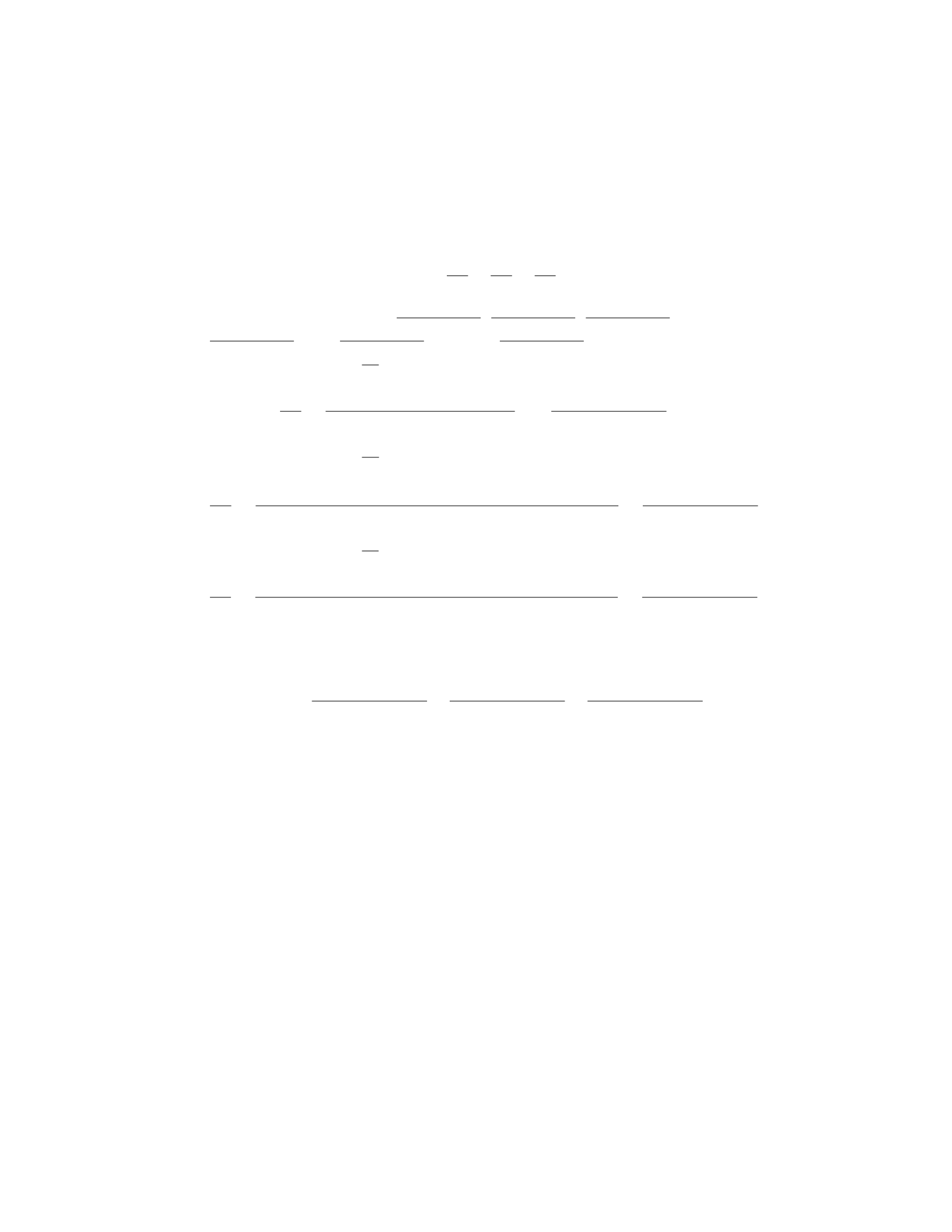
To compute the divergence of a vector field F(x, y, z) = (P, Q, R), we use the
formula
∇ · F=∂P
∂x +∂Q
∂y +∂R
∂z .
In this case, F(x, y, z) = y
(x2+y2+z2)3/2,x
(x2+y2+z2)3/2,z
(x2+y2+z2)3/2, so P=
y
(x2+y2+z2)3/2,Q=x
(x2+y2+z2)3/2, and R=z
(x2+y2+z2)3/2.
Step 1: Compute ∂P
∂x ,
∂P
∂x =−(3/2)yx(x2+y2+z2)−5/2
(x2+y2+z2)3/2=−3xy
(x2+y2+z2)5/2.
Step 2: Compute ∂Q
∂y ,
∂Q
∂y =(x)2(x2+y2+z2)−3/2−(3/2)x2y2(x2+y2+z2)−5/2
(x2+y2+z2)3/2=x2−3y2
(x2+y2+z2)5/2.
Step 3: Compute ∂R
∂z ,
∂R
∂z =(x)2(x2+y2+z2)−3/2−(3/2)x2z2(x2+y2+z2)−5/2
(x2+y2+z2)3/2=x2−3z2
(x2+y2+z2)5/2.
Step 4: Add the partial derivatives computed in Steps 1, 2, and 3 to find
the divergence,
∇ · F=−3xy
(x2+y2+z2)5/2+x2−3y2
(x2+y2+z2)5/2+x2−3z2
(x2+y2+z2)5/2.
Question 25
Question
Let F(x, y, z) = (2xy +z)i+ (x2+z)j+ (y2+x)kbe a vector field in R3.
Determine whether the vector field F(x, y, z) is conservative or not. If it is
conservative, find the potential function f(x, y, z).
Solution
Step 1: Check if the vector field is conservative by verifying the curl of F. Step
2: Calculate the curl of F. Step 3: If the curl of Fis the zero vector, then Fis
conservative. Determine the potential function by integrating the components
of F. Step 4: If the curl of Fis not the zero vector, then Fis not conservative.
Step 1: Check if the vector field is conservative by verifying the curl of F.
A vector field F(x, y, z) is conservative if and only if its curl is the zero vector,
i.e., ∇ × F= 0.
17

Step 2: Calculate the curl of F. The curl of a vector field F(x, y, z) =
P(x, y, z)i+Q(x, y, z)j+R(x, y, z)kis given by:
∇ × F=∂R
∂y −∂Q
∂z i−∂R
∂x −∂P
∂z j+∂Q
∂x −∂P
∂y k
For F(x, y, z) = (2xy +z)i+ (x2+z)j+ (y2+x)k, we have:
∇×F=∂(y2+x)
∂y −∂(x2+z)
∂z i−∂(y2+x)
∂x −∂(2xy +z)
∂z j+∂(2xy +z)
∂x −∂(x2+z)
∂y k
Step 3: If the curl of Fis the zero vector, then Fis conservative. Determine
the potential function by integrating the components of F.
∇ × F= (−1)i−(−1)j+ (2y)k
Simplify the curl to obtain ∇ × F=k+i+ 2yk. Since the curl is not zero, F
is not conservative.
Step 4: Since the vector field F(x, y, z) is not conservative, a potential
function f(x, y, z) does not exist for F.
Question 26
Question
Let F(x, y, z) = x2yz, xz2,−xy2be a vector field in R3. Find the curl of F.
Solution
To find the curl of a vector field F= (P, Q, R), we use the formula:
curl(F) = ∇ × F=
i j k
∂
∂x
∂
∂y
∂
∂z
P Q R
Step 1: Calculate the partial derivatives of P,Q, and R.
∂P
∂x = 2xyz, ∂Q
∂y = 0,∂R
∂z =−2xy
Step 2: Substitute the partial derivatives into the formula.
curl(F) =
i j k
2xyz 0−2xy
x2yz xz2−xy2
Step 3: Expand the determinant using cofactor expansion along the first
row.
curl(F) = (0 −0) i−−2xyz + 2xz2j+0−2x2yk
18
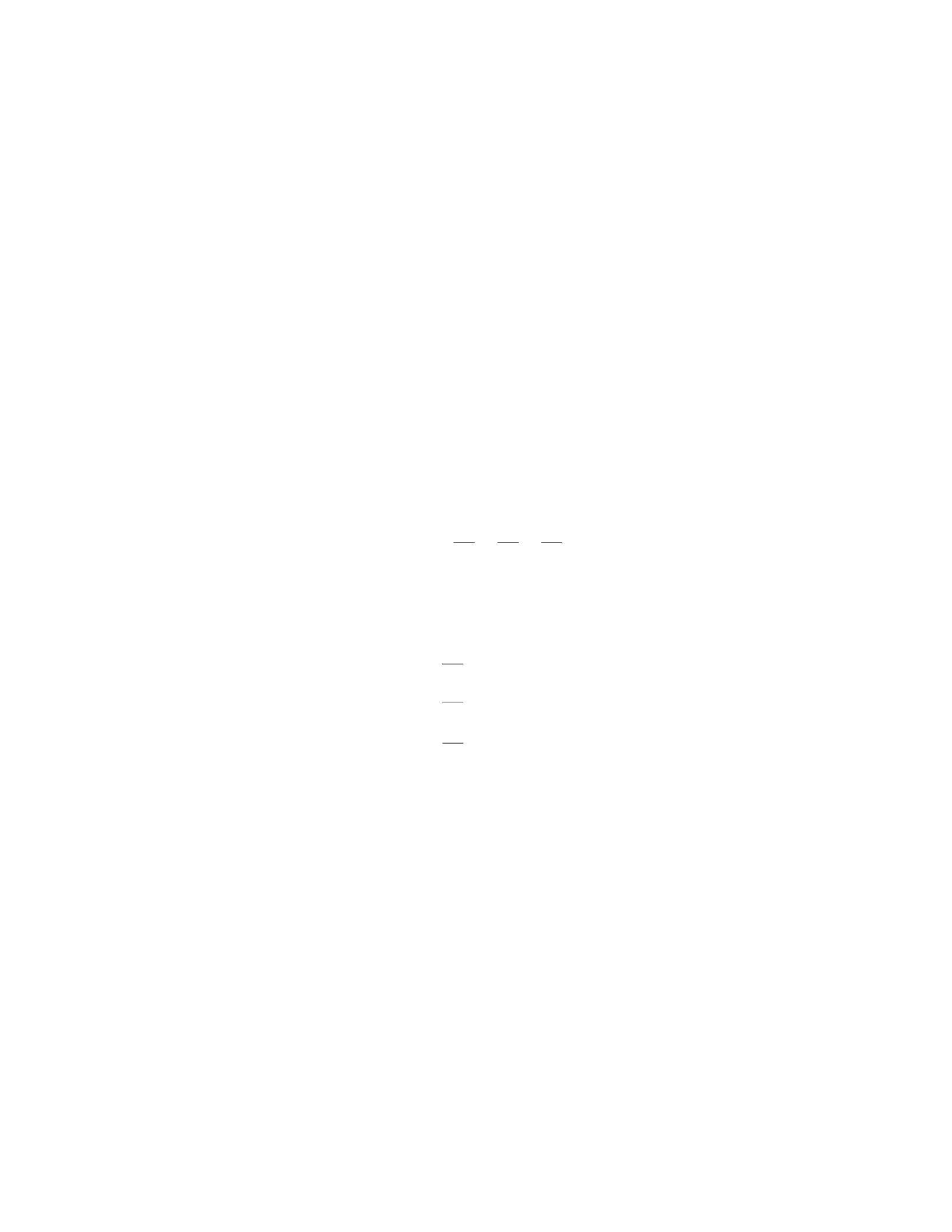
Step 4: Simplify the result.
curl(F) = 2(xz2−xyz)j−2x2yk
Therefore, the curl of the vector field F(x, y, z) = x2yz, xz2,−xy2is
curl(F) = 2(xz2−xyz)j−2x2yk.
Question 27
Question
Let F(x, y, z) = x2yi+xyzj+x2zk. Find the divergence of F.
Solution
To find the divergence of a vector field F(x, y, z) = P(x, y, z)i+Q(x, y, z)j+
R(x, y, z)k, we use the formula:
div(F) = ∂P
∂x +∂Q
∂y +∂R
∂z
Step 1: Identify P,Q, and R. In this case, P(x, y, z) = x2y,Q(x, y, z) =
xyz, and R(x, y, z) = x2z.
Step 2: Calculate the partial derivatives.
∂P
∂x = 2xy
∂Q
∂y =xz
∂R
∂z =x2
Step 3: Find the divergence of F.
div(F) = 2xy +xz +x2
Therefore, the divergence of F(x, y, z) = x2yi+xyzj+x2zkis 2xy +xz +x2.
Question 28
Question
Let F(x, y, z) = ⟨ex+ysin z, xex+ycos z, yex+ycos z⟩. Compute the curl of F.
19

Solution
To find the curl of F, denoted as ∇ × F, we need to compute the determinant
of the following matrix:
∇ × F=
i j k
∂
∂x
∂
∂y
∂
∂z
ex+ysin z xex+ycos z yex+ycos z
Step 1: Compute the partial derivatives Compute the partial deriva-
tives of the vector field components:
∂
∂x (ex+ysin z) = ex+ysin z, ∂
∂y (xex+ycos z) = xex+ycos z+ex+ycos z
∂
∂z (yex+ycos z) = −yex+ysin z
Step 2: Calculate the curl Now, plug these derivatives into the determi-
nant formula and simplify:
∇ × F=∂
∂y (yex+ycos z)−∂
∂z (xex+ycos z),
∂
∂z (ex+ysin z)−∂
∂x (yex+ycos z),
∂
∂x (xex+ycos z)−∂
∂y (ex+ysin z)
= (ex+ycos z+yex+ysin z, ex+ycos z−0, ex+ycos z−xex+ysin z)
Therefore, the curl of Fis ∇×F=⟨ex+ycos z+yex+ysin z, ex+ycos z, ex+ycos z−
xex+ysin z⟩.
Question 29
Question
Let F(x, y, z) = yzi+xzj+xykbe a vector field. Calculate the curl of F.
Solution
To find the curl of a vector field F(x, y, z) = P(x, y, z)i+Q(x, y, z)j+R(x, y, z)k,
we use the formula:
curl F=∇ × F=
i j k
∂
∂x
∂
∂y
∂
∂z
P Q R
20
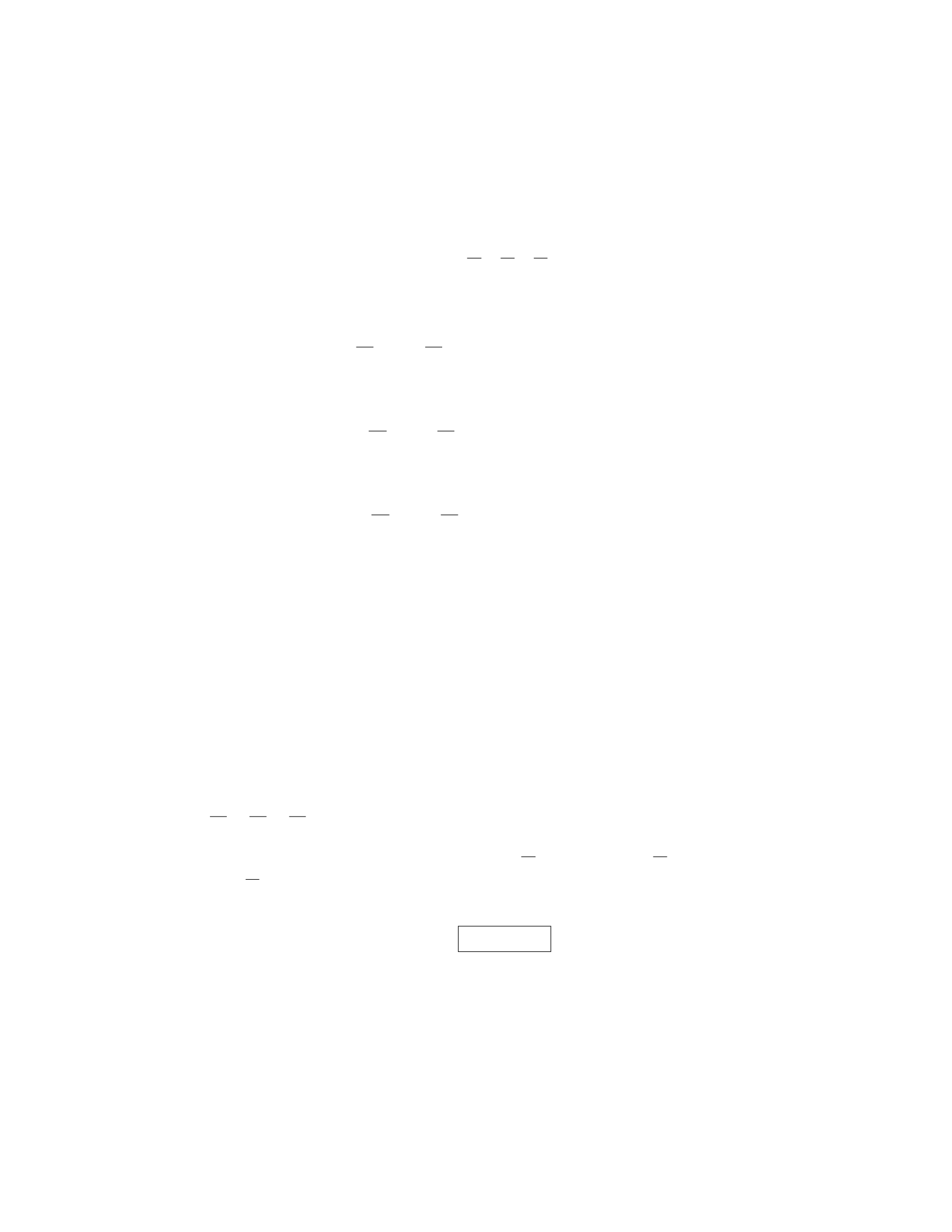
In this case, P(x, y, z) = yz,Q(x, y, z) = xz, and R(x, y, z) = xy. Hence,
the curl of Fis:
∇ × F=
i j k
∂
∂x
∂
∂y
∂
∂z
yz xz xy
Step 1: Calculate the x-component:
∂
∂y (xy)−∂
∂z (xz) = x−(−x)=2xi
Step 2: Calculate the y-component:
−∂
∂x (yz)−∂
∂z (xy)=−(z−z)=0j
Step 3: Calculate the z-component:
∂
∂x (xz)−∂
∂y (yz) = z−z= 0k
Therefore, the curl of Fis:
∇ × F= 2xi
Question 30
Question
Let F(x, y, z)=(x2−y2)i+ (y2−z2)j+ (z2−x2)kbe a vector field in R3.
Calculate the divergence of F.
Solution
Step 1: The divergence of a vector field F=Pi+Qj+Rkis given by ∇ · F=
∂P
∂x +∂Q
∂y +∂R
∂z .
Step 2: In this case, F(x, y, z)=(x2−y2)i+ (y2−z2)j+ (z2−x2)k.
Step 3: Calculate the partial derivatives: - ∂
∂x (x2−y2)=2x, - ∂
∂y (y2−z2) =
2y, - ∂
∂z (z2−x2)=2z.
Step 4: Add the partial derivatives together to find the divergence: ∇ · F=
2x+ 2y+ 2z= 2(x+y+z).
Therefore, the divergence of Fis 2(x+y+z) .
21

