



MATH 112 - TECHNICAL
MATHEMATICS - Vector operations
Question Bank - Set 1
Liberty University
Question 1
Question
Let u =3
−1and v =−2
5. Find the scalar projection of u onto v.
Solution
To find the scalar projection of u onto v, we will use the formula:
Scalar Projection = u ·v
||v||
Step 1: Calculate the dot product of u and v:
u ·v = (3)(−2) + (−1)(5) = −6−5 = −11
Step 2: Calculate the magnitude of v:
||v|| =p(−2)2+ (5)2=√4 + 25 = √29
Step 3: Substitute the dot product and magnitude back into the formula
to find the scalar projection:
Scalar Projection = −11
√29 =−11√29
29
Therefore, the scalar projection of u onto v is −11√29
29 .

Question 2
Question
Let a=
2
−3
5
and b=
−1
4
−2
. Determine the magnitude of the vector a−2b.
Solution
Step 1: Find a−2b.
a−2b=
2
−3
5
−2
−1
4
−2
=
2
−3
5
−
−2
8
−4
=
4
−11
9
Step 2: Find the magnitude of a−2b. The magnitude of a vector v=
v1
v2
v3
is given by ∥v∥=pv2
1+v2
2+v2
3. So, for v=
4
−11
9
,
∥v∥=p42+ (−11)2+ 92=√16 + 121 + 81 = √218
Therefore, the magnitude of the vector a−2bis √218.
Question 3
Question
Let v=⟨2,4,−1⟩and w=⟨−3,1,5⟩. Find the angle between vectors vand w
in degrees.
Solution
To find the angle between two vectors vand w, we can use the dot product
formula:
v·w=|v||w|cos(θ)
where θrepresents the angle between the two vectors.
Step 1: Calculate the dot product of vand w:
v·w= (2)(−3) + (4)(1) + (−1)(5)
v·w=−6+4−5 = −7
2

Step 2: Calculate the magnitudes of vand w:
|v|=p22+ 42+ (−1)2=√4 + 16 + 1 = √21
|w|=p(−3)2+ 12+ 52=√9 + 1 + 25 = √35
Step 3: Substitute the values into the dot product formula to solve for θ:
−7 = √21 ·√35 cos(θ)
cos(θ) = −7
√21 ·√35
cos(θ)≈ −0.477
Step 4: Find the angle θin degrees using the arccosine function:
θ= arccos(−0.477)
θ≈119.6 degrees
Therefore, the angle between vectors vand wis approximately 119.6 degrees.
Question 4
Question
Let u=3
−4and v=−5
2. Determine ∥u−2v∥.
Solution
Step 1: Find 2v.
−5
2×2 = −10
4
Step 2: Find u−2v.
3
−4−−10
4=3 + 10
−4−4=13
−8
Step 3: Find ∥u−2v∥.
13
−8
=p132+ (−8)2=√169 + 64 = √233
Therefore, ∥u−2v∥=√233.
3

Question 5
Question
Let a= 3i−2j+ 4kand b= 2i+ 3j−k. Find the vector projection of aonto
b.
Solution
To find the vector projection of aonto b, we use the formula:
projba=a·b
∥b∥2b
Step 1: Calculate the dot product of aand b.
a·b= (3)(2) + (−2)(3) + (4)(−1) = 6 −6−4 = −4
Step 2: Find the magnitude of b.
∥b∥=p(2)2+ (3)2+ (−1)2=√4 + 9 + 1 = √14
Step 3: Substitute the dot product and the magnitude of binto the formula
to calculate the vector projection.
projba= −4
√142!(2i+ 3j−k)
projba=−4
14 (2i+ 3j−k)
projba=−2
7i−6
7j+4
7k
Therefore, the vector projection of aonto bis −2
7i−6
7j+4
7k.
Question 6
Question
Let a=2
−1and b=4
3. Determine the angle between aand bin degrees.
Solution
Step 1: Calculate the dot product of vectors aand b.
a·b=2
−1·4
3= 2(4) + (−1)(3) = 8 −3=5
4

Step 2: Calculate the magnitudes of vectors aand b.
|a|=p22+ (−1)2=√4 + 1 = √5
|b|=p42+ 32=√16 + 9 = √25 = 5
Step 3: Use the formula for the angle between two vectors:
cos(θ) = a·b
|a|·|b|=5
√5·5=5
√5·5=1
√5
Step 4: Solve for the angle θin degrees.
θ= cos−11
√5≈cos−11
√5≈63.43◦
Therefore, the angle between vectors aand bis approximately 63.43◦.
Question 7
Question
Let a=
3
−1
2
,b=
−2
4
0
, and c=
1
2
3
. Determine if the vectors a,b, and c
are linearly independent.
Solution
To determine if the vectors are linearly independent, we need to see if there
exist scalars x,y, and z, not all zero, such that xa+yb+zc=0.
Step 1: Set up the equation We need to solve the equation xa+yb+zc=
0:
3
−1
2
x+
−2
4
0
y+
1
2
3
z=
0
0
0
Step 2: Write the equation in component form This gives us the
system of equations:
3x−2y+z= 0
−x+ 4y+ 2z= 0
2x+ 3z= 0
Step 3: Solve the system of equations Solving the system of equations,
we find x=6
23 ,y=3
23 , and z=−4
23 .
Step 4: Determine linear independence Since there exist non-zero val-
ues of x,y, and zthat satisfy the equation xa+yb+zc=0, the vectors a,b,
and care linearly dependent.
5

Question 8
Question
Let u=
−2
5
3
and v=
4
−1
2
. Find the angle between vectors uand v,
rounded to the nearest degree.
Solution
To find the angle between two vectors uand v, we can use the dot product
formula:
u·v=|u|·|v| · cos(θ)
where θis the angle between uand v.
Step 1: Calculate the dot product of uand v:
u·v= (−2)(4) + (5)(−1) + (3)(2) = −8−5 + 6 = −7
Step 2: Find the magnitudes of uand v:
|u|=p(−2)2+ 52+ 32=√4 + 25 + 9 = √38
|v|=p42+ (−1)2+ 22=√16 + 1 + 4 = √21
Step 3: Substitute the dot product and magnitudes into the formula and
solve for θ:
−7 = √38 ·√21 ·cos(θ)
cos(θ) = −7
√38 ·√21
θ= arccos −7
√38 ·√21
Using a calculator, we find θ≈99 degrees. Thus, the angle between vectors
uand vis approximately 99 degrees.
Question 9
Question
Let u =
3
−2
1
and v =
−2
1
−4
. Determine the angle between vectors u and v.
6

Solution
To find the angle between vectors u and v, we can use the dot product formula
for vectors:
u ·v =|u||v|cos(θ),
where θis the angle between the two vectors.
Step 1: Calculate the dot product of u and v.
u ·v = (3)(−2) + (−2)(1) + (1)(−4) = −6−2−4 = −12.
Step 2: Find the magnitudes of vectors u and v.
|u|=p32+ (−2)2+ 12=√9 + 4 + 1 = √14,
|v|=p(−2)2+ 12+ (−4)2=√4 + 1 + 16 = √21.
Step 3: Substitute the dot product and magnitudes into the formula:
−12 = √14 ·√21 ·cos(θ).
Step 4: Solve for θ:
cos(θ) = −12
√14 ·√21 =−2
√14 ·√21 =−2
√294.
Step 5: Finally, find the angle θ:
θ= arccos −2
√294≈111.61◦.
Therefore, the angle between vectors u and v is approximately 111.61 de-
grees.
Question 10
Question
Let a = 3
i−2
j+
kand
b= 2
i+ 4
j−5
k. Find the angle between vectors a and
b.
Solution
Step 1: Calculate the dot product of a and
b.
a ·
b= (3)(2) + (−2)(4) + (1)(−5)
= 6 −8−5
=−7
7
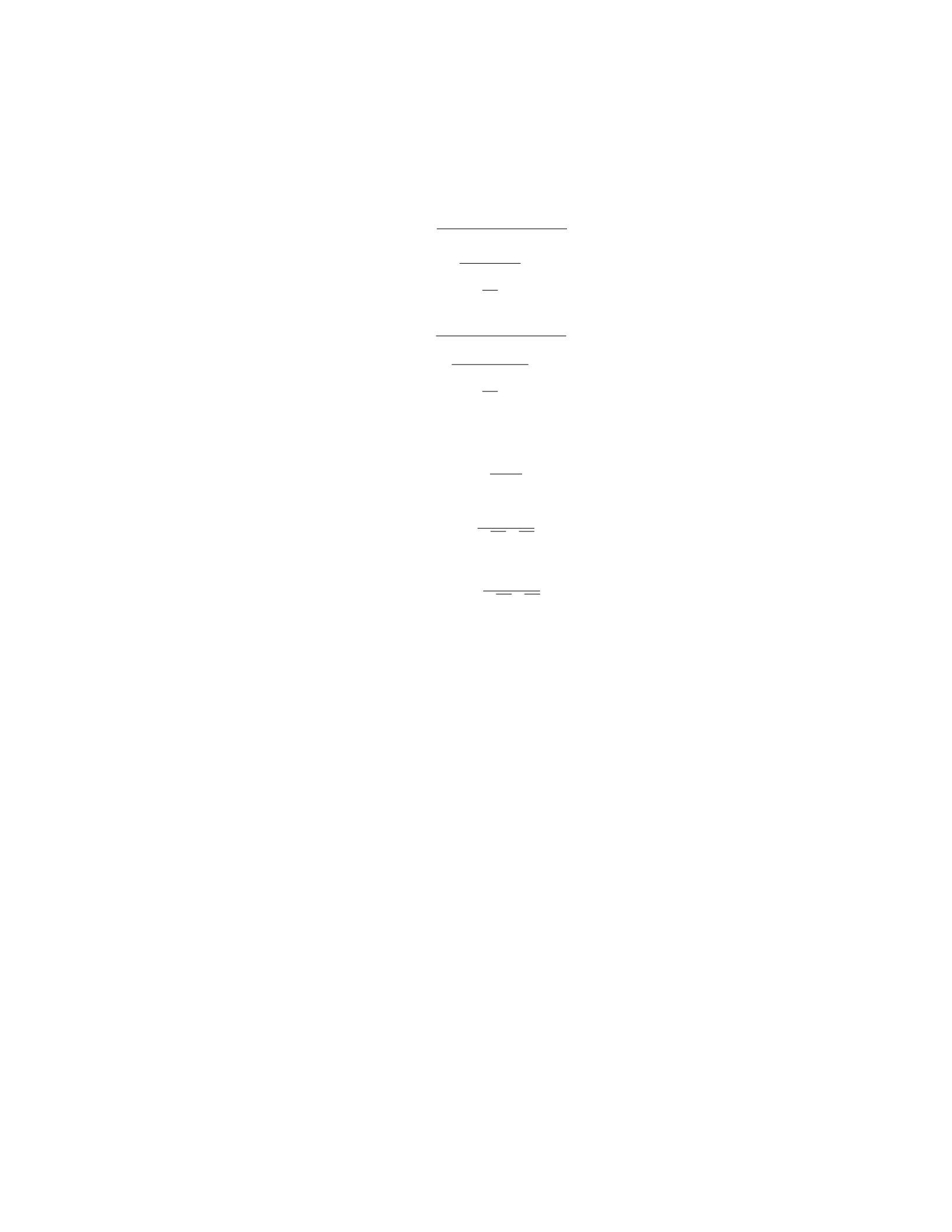
Step 2: Calculate the magnitude of a and
b.
|a|=p(3)2+ (−2)2+ (1)2
=√9+4+1
=√14
|
b|=p(2)2+ (4)2+ (−5)2
=√4 + 16 + 25
=√45
Step 3: Use the formula for finding the angle between two vectors:
cos(θ) = a ·
b
|a||
b|
cos(θ) = −7
√14√45
Step 4: Solve for θ.
θ= arccos −7
√14√45
θ≈124.37◦
Therefore, the angle between vectors a and
bis approximately 124.37◦.
Question 11
Question
Let a =
3
−2
4
and
b=
−1
5
2
.
Determine the vector c such that 2a −3
b=c.
Solution
Step 1: Calculate 2a and 3
b.
2a = 2
3
−2
4
=
6
−4
8
3
b= 3
−1
5
2
=
−3
15
6
8

Step 2: Find 2a −3
b.
2a −3
b=
6
−4
8
−
−3
15
6
=
9
−19
2
Therefore, c =
9
−19
2
.
Question 12
Question
Let u =3
−2and v =−5
4. Find the angle between the vectors u and v (in
radians).
Solution
Step 1: To find the angle between two vectors, we can use the dot product
formula: u ·v =∥u∥∥v∥cos(θ), where θis the angle between the two vectors.
Step 2: Calculate the dot product of u and v:
u ·v = (3)(−5) + (−2)(4) = −15 −8 = −23
Step 3: Calculate the magnitudes of u and v:
∥u∥=p32+ (−2)2=√9 + 4 = √13
∥v∥=p(−5)2+ 42=√25 + 16 = √41
Step 4: Substitute the dot product and magnitudes into the dot product
formula and solve for θ:
−23 = √13√41 cos(θ)
cos(θ) = −23
√13√41
θ= arccos −23
√13√41
Therefore, the angle between the vectors u and v is arccos −23
√13√41 radians.
Question 13
Question
Given two vectors a= 3i−2j+kand b=−i+ 4j−2k, find the angle between
the two vectors.
9

Solution
Step 1: Recall that the dot product of two vectors aand bis given by:
a·b=|a||b|cos(θ),
where |a|and |b|are the magnitudes of vectors aand b, respectively, and θis
the angle between the two vectors.
Step 2: First, let’s find the magnitudes of vectors aand b. The magnitude
of a vector v=ai+bj+ckis given by:
|v|=pa2+b2+c2.
Step 3: For vector a, the magnitude is:
|a|=p(3)2+ (−2)2+ (1)2=√14.
Step 4: For vector b, the magnitude is:
|b|=p(−1)2+ (4)2+ (−2)2=√21.
Step 5: Now, let’s find the dot product of vectors aand b:
a·b= (3)(−1) + (−2)(4) + (1)(−2) = −3−8−2 = −13.
Step 6: Substitute the magnitudes and dot product into the dot product
formula to solve for θ:
−13 = √14 ·√21 cos(θ).
Step 7: Solve for θ:
cos(θ) = −13
√14 ·√21 =−13
√294.
Step 8: Thus, the angle between vectors aand bis:
θ= cos−1−13
√294.
Question 14
Question
Let a= 3i−2j+ 5kand b=−i+ 4j−6k. Find:
a·band projb(a)
10

Solution
Step 1: Calculate the dot product a·b:
a·b= (3)(−1) + (−2)(4) + (5)(−6)
a·b=−3−8−30
a·b=−41
Step 2: Calculate the projection of aonto b, denoted as projb(a):
projb(a) = a·b
∥b∥2b
projb(a) = −41
(−1)2+ 42+ (−6)2(−i+ 4j−6k)
projb(a) = −41
1 + 16 + 36(−i+ 4j−6k)
projb(a) = −41
53 (−i+ 4j−6k)
projb(a) = −41
53i+164
53 j−246
53 k
Therefore, a·b=−41 and projb(a) = −41
53 i+164
53 j−246
53 k.
Question 15
Question
Let a = 3
i−2
j+ 4
kand
b= 2
i+ 5
j−3
k. Determine the angle between the
vectors a and
b.
Solution
Step 1: Find the dot product of vectors a and
b.
a ·
b= (3)(2) + (−2)(5) + (4)(−3) = 6 −10 −12 = −16
Step 2: Calculate the magnitudes of vectors a and
b.
|a|=p32+ (−2)2+ 42=√9 + 4 + 16 = √29
|
b|=p22+ 52+ (−3)2=√4 + 25 + 9 = √38
Step 3: Use the formula cos(θ) = a·
b
|a||
b|to find the cosine of the angle between
vectors a and
b.
cos(θ) = −16
√29 ·√38 =−16
√29 ·38
Step 4: Solve for the angle θusing the arccosine function.
θ= arccos −16
√29 ·38
11

Question 16
Question
Let a=
3
−4
5
and b=
−1
2
1
. Find the angle between vectors aand b.
Solution
Step 1: Find the dot product of vectors aand b.
a·b= (3)(−1) + (−4)(2) + (5)(1) = −3−8 + 5 = −6
Step 2: Find the magnitudes of vectors aand b.
|a|=p32+ (−4)2+ 52=√9 + 16 + 25 = √50 = 5√2
|b|=p(−1)2+ 22+ 12=√1 + 4 + 1 = √6
Step 3: Calculate the angle between vectors aand busing the formula
cos θ=a·b
|a||b|.
cos θ=−6
(5√2)(√6) =−6
5√12 =−3√3
5
Step 4: Find the angle θbetween the vectors using the inverse cosine func-
tion.
θ= arccos −3√3
5!≈118.28◦
Therefore, the angle between vectors aand bis approximately 118.28◦.
Question 17
Question
Let u=
3
−2
5
and v=
−1
4
2
. Determine the angle between uand v.
Solution
Step 1: Calculate the dot product of uand v:
u·v= (3) ·(−1) + (−2) ·4+5·2
u·v=−3−8 + 10 = −1
12

Step 2: Calculate the magnitudes of uand v:
||u|| =p32+ (−2)2+ 52=√9 + 4 + 25 = √38
||v|| =p(−1)2+ 42+ 22=√1 + 16 + 4 = √21
Step 3: Calculate the cosine of the angle between uand vusing the formula:
cos(θ) = u·v
||u|| · ||v||
cos(θ) = −1
√38 ·√21
cos(θ) = −1
√798
Step 4: Calculate the angle θusing the inverse cosine function:
θ= cos−1−1
√798
θ≈104.56◦
Therefore, the angle between uand vis approximately 104.56◦.
Question 18
Question
Let v=
3
−1
4
and w=
2
5
−2
. Determine the angle between vectors vand w.
Solution
Step 1: Find the dot product of vand w.
v·w= (3)(2) + (−1)(5) + (4)(−2) = 6 −5−8 = −7
Step 2: Find the magnitude of v.
||v|| =p32+ (−1)2+ 42=√9 + 1 + 16 = √26
Step 3: Find the magnitude of w.
||w|| =p22+ 52+ (−2)2=√4 + 25 + 4 = √33
Step 4: Use the dot product formula to find the angle θbetween vectors v
and w.
cos θ=v·w
||v|| · ||w||
13

cos θ=−7
√26 ·√33 =−7
√858
Step 5: Calculate the angle θ.
θ= arccos −7
√858≈116.57◦
Therefore, the angle between vectors vand wis approximately 116.57◦.
Question 19
Question
Let a= 3i−2j+kand b= 2i+ 4j−5k. Find the angle between vectors aand
b.
Solution
To find the angle between vectors aand b, we can use the dot product formula:
a·b=|a||b|cos(θ)
where θis the angle between aand b.
Step 1: Calculate the dot product of aand b.
a·b= (3)(2) + (−2)(4) + (1)(−5) = 6 −8−5 = −7
Step 2: Calculate the magnitudes of vectors aand b.
|a|=p32+ (−2)2+ 12=√9 + 4 + 1 = √14
|b|=p22+ 42+ (−5)2=√4 + 16 + 25 = √45
Step 3: Substitute the dot product and magnitudes into the formula to
solve for θ.
−7=(√14)(√45) cos(θ)
cos(θ) = −7
√14 ×√45 =−7
√630
θ= cos−1−7
√630
Step 4: Calculate the angle θusing a calculator.
θ≈122.18◦
Therefore, the angle between vectors aand bis approximately 122.18◦.
14

Question 20
Question
Let a = 3ˆ
i−2ˆ
j+ 5ˆ
kand
b=−2ˆ
i+ 4ˆ
j−ˆ
k. Determine the angle between a and
bin degrees.
Solution
Step 1: Find the dot product of a and
b.
a ·
b= (3)(−2) + (−2)(4) + (5)(−1)
a ·
b=−6−8−5
a ·
b=−19
Step 2: Find the magnitudes of a and
b.
|a|=p(3)2+ (−2)2+ (5)2=√9 + 4 + 25 = √38
|
b|=p(−2)2+ 42+ (−1)2=√4 + 16 + 1 = √21
Step 3: Use the formula for the angle between two vectors: cos θ=a·
b
|a||
b|.
cos θ=−19
√38 ·√21
cos θ=−19
√798
θ= arccos −19
√798
Step 4: Calculate the angle in degrees.
θ≈arccos −19
√798≈121.63◦
Therefore, the angle between a and
bis approximately 121.63◦.
Question 21
Question
Let v=
−2
3
1
,w=
4
−1
2
, and u=
1
−2
0
. Determine the vector athat is
perpendicular to both vand wand is parallel to u.
15

Solution
Step 1: Find a vector that is perpendicular to both vand wby taking their
cross product.
a=v×w
a=
−2
3
1
×
4
−1
2
a=
3(2) −1(1)
1(4) −2(2)
−2(−1) −3(4)
a=
5
0
−14
Step 2: Determine a scalar ksuch that a=ku.
5
0
−14
=k
1
−2
0
From this, we can see that k= 5.
Therefore, the vector athat is perpendicular to both vand wand parallel
to uis
5
−10
0
.
Question 22
Question
Let u=⟨3,−2,5⟩and v=⟨−1,4,2⟩be two vectors. Find a unit vector in the
direction of the vector u−2v.
Solution
Step 1: Find the vector u−2v.
u−2v=⟨3,−2,5⟩ − 2⟨−1,4,2⟩
=⟨3,−2,5⟩ − ⟨−2,8,4⟩
=⟨3+2,−2−8,5−4⟩
=⟨5,−10,1⟩.
Step 2: Find the magnitude of u−2v.
|u−2v|=p52+ (−10)2+ 12=√25 + 100 + 1 = √126.
16

Step 3: Find the unit vector in the direction of u−2v.
u−2v=⟨5,−10,1⟩
√126 =5
√126,−10
√126,1
√126.
Therefore, a unit vector in the direction of u−2vis D5
√126 ,−10
√126 ,1
√126 E.
Question 23
Question
Let u =
3
−1
2
,v =
−4
0
5
, and w =
2
−3
1
. Determine if the vectors u,v,w
are linearly independent.
Solution
Step 1: To determine if the vectors u,v,w are linearly independent, we need
to solve the equation c1u +c2v +c3w =
0 for constants c1,c2,c3not all zero.
This is equivalent to solving the system of equations:
3c1−4c2+ 2c3= 0
−c1+ 5c3= 0
2c1+ 5c2+c3= 0
Step 2: We can represent the system of equations as an augmented matrix:
3−4 2 |0
−105|0
2 5 1 |0
Step 3: Perform row operations to put the system in row-echelon form. Start
by adding 3 times the second row to the first row:
0−4 17 |0
−1 0 5 |0
2 5 1 |0
Step 4: Next, add 1
4times the first row to the second row:
0−4 17 |0
−1 0 5 |0
2 5 1 |0
→
0−4 17 |0
−1 1 5
4|0
2 5 1 |0
Step 5: Finally, add 2 times the second row to the third row:
0−4 17 |0
−1 1 5
4|0
2 5 1 |0
→
0−4 17 |0
−1 1 5
4|0
0 7 13
2|0
17

Step 6: This matrix corresponds to the system:
−4c2+ 17c3= 0
c1−c2+5
4c3= 0
7c2+13
2c3= 0
Step 7: The system has infinitely many solutions, so the vectors u,v,w are
linearly dependent.
Question 24
Question
Let a=3
−1and b=−2
4. Find the vector csuch that 2a−3c= 4b.
Solution
Step 1: Begin by expanding the given equation.
2a−3c= 4b
23
−1−3c= 4 −2
4
6
−2−3c=−8
16
Step 2: Now, isolate −3cin the equation.
6
−2−3c=−8
16
−3c=−8
16 −6
−2
−3c=−14
18
Step 3: Finally, solve for cby dividing both sides by −3.
−3c=−14
18
c=1
−3−14
18
c=14
3
−6
Therefore, the vector cis 14
3
−6.
18

Question 25
Question
Let u=
3
−1
2
and v=
4
0
−1
. Find the angle between vectors uand v.
Round your answer to the nearest degree.
Solution
Step 1: Calculate the dot product of vectors uand vusing the formula u·v=
∥u∥∥v∥cos(θ), where θis the angle between the vectors.
u·v= 3 ·4+(−1) ·0+2·(−1) = 12 −2 = 10
Step 2: Calculate the magnitudes of vectors uand v.
∥u∥=p32+ (−1)2+ 22=√9 + 1 + 4 = √14
∥v∥=p42+ 02+ (−1)2=√16 + 0 + 1 = √17
Step 3: Substitute the dot product and magnitudes into the formula to solve
for cos(θ).
10 = √14√17 cos(θ)
cos(θ) = 10
√14√17 =10
√238 =10
√2·119 =10
√2·1
√119 =10√119
2·√119 =5√119
√119 = 5
Step 4: Find the value of θusing the inverse cosine function.
θ= arccos(5) ≈arccos(0.99619469809) ≈5.74 radians
Step 5: Convert the angle from radians to degrees.
θ≈5.74 ×180
π≈328.6 degrees
Therefore, the angle between vectors uand vis approximately 329 degrees.
Question 26
Question
Let a= 2i−3j+ 4kand b=i+ 2j−k. Find the angle between vectors aand
b.
19

Solution
To find the angle θbetween vectors aand b, we can use the dot product formula:
a·b=|a||b|cos θ
Step 1: Calculate the dot product First, we compute the dot product
of aand b:
a·b= (2)(1) + (−3)(2) + (4)(−1)
a·b= 2 −6−4 = −8
Step 2: Find the magnitudes of vectors a and b Next, we find the
magnitudes of vectors aand b:
|a|=p22+ (−3)2+ 42=√4 + 9 + 16 = √29
|b|=p12+ 22+ (−1)2=√1 + 4 + 1 = √6
Step 3: Calculate the angle between the vectors Substitute the dot
product and magnitudes into the dot product formula:
−8 = √29 ·√6 cos θ
cos θ=−8
√29 ·√6=−8
√174
Step 4: Find the angle θFinally, we find the angle between vectors aand
busing the inverse cosine function:
θ= cos−1−8
√174≈126.34◦
Therefore, the angle between vectors aand bis approximately 126.34◦.
Question 27
Question
Let a = 2ˆ
i−3ˆ
j+ˆ
kand
b= 3ˆ
i+ 4ˆ
j−2ˆ
kbe two vectors. Find the vector
projection of a onto
b.
Solution
Step 1: Calculate the dot product of a and
b.
a ·
b= (2)(3) + (−3)(4) + (1)(−2)
a ·
b= 6 −12 −2
a ·
b=−8
20

Step 2: Calculate the magnitude of
bsquared.
|
b|2= (3)2+ (4)2+ (−2)2
|
b|2= 9 + 16 + 4
|
b|2= 29
Step 3: Calculate the vector projection of a onto
busing the formula:
proj
ba = a ·
b
|
b|2!
b
proj
ba =−8
29 (3ˆ
i+ 4ˆ
j−2ˆ
k)
proj
ba =−24
29ˆ
i−32
29ˆ
j+16
29 ˆ
k
Therefore, the vector projection of a onto
bis −24
29ˆ
i−32
29 ˆ
j+16
29 ˆ
k.
Question 28
Question
Let u=
2
−1
3
and v=
1
4
−2
. Find a vector wsuch that w·u= 0 and
|w|= 1.
Solution
Step 1: To find a vector wsuch that w·u= 0, we can choose wto be orthogonal
to u. This means that wmust be perpendicular to uand their dot product
should be zero. One way to achieve this is to find the cross product of u.
Step 2: The cross product of uand vis given by the formula
u×v=
a
b
c
,
where a=u2v3−u3v2,b=u3v1−u1v3, and c=u1v2−u2v1.
Step 3: Calculating the cross product, we have
u×v=
(−1)(−2) −(3)(4)
(3)(1) −(2)(−2)
(2)(4) −(−1)(1)
=
10
7
9
.
21

Step 4: To ensure that |w|= 1, we normalize the vector wby dividing by
its magnitude:
w=u
×v|u×v|=
10
7
9
√102+ 72+ 92=
10
7
9
√170 =1
√170
10
7
9
.
Therefore, a vector wsuch that w·u= 0 and |w|= 1 is 1
√170
10
7
9
.
Question 29
Question
Let u =
3
−1
2
and v =
−2
4
1
. Find the vector w that is orthogonal to both u
and v.
Solution
Step 1: To find the vector w that is orthogonal to both u and v, we can take
the cross product of u and v.
Step 2: The cross product of two vectors u =
u1
u2
u3
and v =
v1
v2
v3
is given
by:
u ×v =
ˆ
iˆ
jˆ
k
u1u2u3
v1v2v3
Step 3: Applying this formula, we find:
u ×v =
ˆ
iˆ
jˆ
k
3−1 2
−2 4 1
Step 4: Calculating the determinant gives:
u ×v =
−1(1) −2(4)
−(3(1) −2(−2))
3(4) −(−1(−2))
=
−9
7
14
Step 5: So, the vector w that is orthogonal to both u and v is
−9
7
14
.
22

Question 30
Question
For vectors u=3
−2and v=−1
4, find a vector wsuch that ∥2u−w∥= 8.
Solution
Step 1: Find the vector 2u.
Substitute u=3
−2into the scalar multiplication:
2u= 2 3
−2=6
−4
Step 2: Find the vector w.
Given: ∥2u−w∥= 8
Substitute 2u=6
−4into the equation:
∥6
−4−w∥= 8
Rewrite the equation as: ∥6
−4−w∥=∥ − w+6
−4∥= 8
This implies that: ∥ − w+6
−4∥=∥w−6
4∥= 8
Step 3: Find the vector w.
From Step 2, we have: ∥w−6
−4∥= 8
Therefore, w−6
−4has magnitude 8
The vector w−6
−4is either parallel to 6
−4or −6
4
Thus, we can write w−6
−4=k6
−4for some scalar k
Solving for w
w=6
−4+k6
−4=6+6k
−4−4k
Thus, the vector wis 6+6k
−4−4k.
23

Question 31
Question
Let u= 3i−4j+ 2kand v= 2i+j+ 5kbe two vectors. Find the angle between
uand v.
Solution
Step 1: Calculate the dot product of uand v:
u·v= (3)(2) + (−4)(1) + (2)(5) = 6 −4 + 10 = 12
Step 2: Calculate the magnitudes of uand v:
|u|=p32+ (−4)2+ 22=√9 + 16 + 4 = √29
|v|=p22+ 12+ 52=√4 + 1 + 25 = √30
Step 3: Use the formula cos(θ) = u
·v|u||v|to find the angle between uand
v:
cos(θ) = 12
√29 ·√30
Step 4: Solve for θusing θ= cos−112
√29·√30 . Therefore, the angle between
uand vis θ= cos−112
√29·√30 .
Question 32
Question
Let a =
2
−1
3
and
b=
−4
0
1
be two vectors. Determine the angle between a
and
bin degrees.
Solution
Step 1: Find the dot product of the two vectors a and
b.
a ·
b= (2)(−4) + (−1)(0) + (3)(1)
a ·
b=−8 + 0 + 3 = −5
Step 2: Calculate the magnitudes of vectors a and
b.
|a|=p22+ (−1)2+ 32=√4 + 1 + 9 = √14
|
b|=p(−4)2+ 02+ 12=√16 + 0 + 1 = √17
24

Step 3: Use the dot product formula to find the angle θbetween the vectors.
cos(θ) = a ·
b
|a|·|
b|
cos(θ) = −5
√14 ·√17
Step 4: Calculate the angle θbetween the vectors.
θ= cos−1−5
√14 ·√17≈116.83◦
Therefore, the angle between vectors a and
bis approximately 116.83◦.
Question 33
Question
Let a =
2
−1
3
and
b=
4
0
−5
. Determine the vector projection of
bonto a.
Solution
To find the vector projection of
bonto a, we use the formula:
proja(
b) = a ·
b
∥a∥!a
∥a∥
Step 1: Calculate the dot product a ·
b.
a ·
b= (2)(4) + (−1)(0) + (3)(−5) = 8 −15 = −7
Step 2: Calculate the norm of a, denoted as ∥a∥.
∥a∥=p22+ (−1)2+ 32=√4 + 1 + 9 = √14
Step 3: Substitute the calculated values into the formula to find the vector
projection.
proja(
b) = −7
√141
√14
2
−1
3
=−1
14
2
−1
3
=
−1/7
1/14
−3/14
Therefore, the vector projection of
bonto a is
−1/7
1/14
−3/14
.
25

Question 34
Question
Given two vectors a=
2
−3
4
and b=
−1
2
−2
, find:
a·b+a×b
Solution
Step 1: Calculate the dot product of vectors aand b.
a·b= (2)(−1) + (−3)(2) + (4)(−2) = −2−6−8 = −16
Step 2: Calculate the cross product of vectors aand b.
a×b=
i j k
2−3 4
−1 2 −2
= (i)((−3)(−2) −(4)(2)) −(j)((2)(−2) −(4)(−1)) + (k)((2)(2) −(−3)(−1))
= (i)(6 −8) −(j)(−4 + 4) + (k)(4 + 3)
= (i)(−2) −(j)(0) + (k)(7)
=−2i+ 7k
Step 3: Hence, the expression a·b+a×bis:
−16 + (−2i+ 7k) = −2i+ 7k−16
Therefore, a·b+a×b=−2i+ 7k−16.
Question 35
Question
Let a = 3
i−5
j+ 2
kand
b=
i+ 4
j−3
k. Determine the angle between vectors
a and
b.
Solution
To find the angle between two vectors a and
b, we can use the dot product
formula:
a ·
b=|a|·|
b|cos(θ)
26

Question 2
Question
Let a=
2
−3
5
and b=
−1
4
−2
. Determine the magnitude of the vector a−2b.
Solution
Step 1: Find a−2b.
a−2b=
2
−3
5
−2
−1
4
−2
=
2
−3
5
−
−2
8
−4
=
4
−11
9
Step 2: Find the magnitude of a−2b. The magnitude of a vector v=
v1
v2
v3
is given by ∥v∥=pv2
1+v2
2+v2
3. So, for v=
4
−11
9
,
∥v∥=p42+ (−11)2+ 92=√16 + 121 + 81 = √218
Therefore, the magnitude of the vector a−2bis √218.
Question 3
Question
Let v=⟨2,4,−1⟩and w=⟨−3,1,5⟩. Find the angle between vectors vand w
in degrees.
Solution
To find the angle between two vectors vand w, we can use the dot product
formula:
v·w=|v||w|cos(θ)
where θrepresents the angle between the two vectors.
Step 1: Calculate the dot product of vand w:
v·w= (2)(−3) + (4)(1) + (−1)(5)
v·w=−6+4−5 = −7
2

Step 2: Calculate the magnitudes of vand w:
|v|=p22+ 42+ (−1)2=√4 + 16 + 1 = √21
|w|=p(−3)2+ 12+ 52=√9 + 1 + 25 = √35
Step 3: Substitute the values into the dot product formula to solve for θ:
−7 = √21 ·√35 cos(θ)
cos(θ) = −7
√21 ·√35
cos(θ)≈ −0.477
Step 4: Find the angle θin degrees using the arccosine function:
θ= arccos(−0.477)
θ≈119.6 degrees
Therefore, the angle between vectors vand wis approximately 119.6 degrees.
Question 4
Question
Let u=3
−4and v=−5
2. Determine ∥u−2v∥.
Solution
Step 1: Find 2v.
−5
2×2 = −10
4
Step 2: Find u−2v.
3
−4−−10
4=3 + 10
−4−4=13
−8
Step 3: Find ∥u−2v∥.
13
−8
=p132+ (−8)2=√169 + 64 = √233
Therefore, ∥u−2v∥=√233.
3

Question 5
Question
Let a= 3i−2j+ 4kand b= 2i+ 3j−k. Find the vector projection of aonto
b.
Solution
To find the vector projection of aonto b, we use the formula:
projba=a·b
∥b∥2b
Step 1: Calculate the dot product of aand b.
a·b= (3)(2) + (−2)(3) + (4)(−1) = 6 −6−4 = −4
Step 2: Find the magnitude of b.
∥b∥=p(2)2+ (3)2+ (−1)2=√4 + 9 + 1 = √14
Step 3: Substitute the dot product and the magnitude of binto the formula
to calculate the vector projection.
projba= −4
√142!(2i+ 3j−k)
projba=−4
14 (2i+ 3j−k)
projba=−2
7i−6
7j+4
7k
Therefore, the vector projection of aonto bis −2
7i−6
7j+4
7k.
Question 6
Question
Let a=2
−1and b=4
3. Determine the angle between aand bin degrees.
Solution
Step 1: Calculate the dot product of vectors aand b.
a·b=2
−1·4
3= 2(4) + (−1)(3) = 8 −3=5
4

Step 2: Calculate the magnitudes of vectors aand b.
|a|=p22+ (−1)2=√4 + 1 = √5
|b|=p42+ 32=√16 + 9 = √25 = 5
Step 3: Use the formula for the angle between two vectors:
cos(θ) = a·b
|a|·|b|=5
√5·5=5
√5·5=1
√5
Step 4: Solve for the angle θin degrees.
θ= cos−11
√5≈cos−11
√5≈63.43◦
Therefore, the angle between vectors aand bis approximately 63.43◦.
Question 7
Question
Let a=
3
−1
2
,b=
−2
4
0
, and c=
1
2
3
. Determine if the vectors a,b, and c
are linearly independent.
Solution
To determine if the vectors are linearly independent, we need to see if there
exist scalars x,y, and z, not all zero, such that xa+yb+zc=0.
Step 1: Set up the equation We need to solve the equation xa+yb+zc=
0:
3
−1
2
x+
−2
4
0
y+
1
2
3
z=
0
0
0
Step 2: Write the equation in component form This gives us the
system of equations:
3x−2y+z= 0
−x+ 4y+ 2z= 0
2x+ 3z= 0
Step 3: Solve the system of equations Solving the system of equations,
we find x=6
23 ,y=3
23 , and z=−4
23 .
Step 4: Determine linear independence Since there exist non-zero val-
ues of x,y, and zthat satisfy the equation xa+yb+zc=0, the vectors a,b,
and care linearly dependent.
5

Question 8
Question
Let u=
−2
5
3
and v=
4
−1
2
. Find the angle between vectors uand v,
rounded to the nearest degree.
Solution
To find the angle between two vectors uand v, we can use the dot product
formula:
u·v=|u|·|v| · cos(θ)
where θis the angle between uand v.
Step 1: Calculate the dot product of uand v:
u·v= (−2)(4) + (5)(−1) + (3)(2) = −8−5 + 6 = −7
Step 2: Find the magnitudes of uand v:
|u|=p(−2)2+ 52+ 32=√4 + 25 + 9 = √38
|v|=p42+ (−1)2+ 22=√16 + 1 + 4 = √21
Step 3: Substitute the dot product and magnitudes into the formula and
solve for θ:
−7 = √38 ·√21 ·cos(θ)
cos(θ) = −7
√38 ·√21
θ= arccos −7
√38 ·√21
Using a calculator, we find θ≈99 degrees. Thus, the angle between vectors
uand vis approximately 99 degrees.
Question 9
Question
Let u =
3
−2
1
and v =
−2
1
−4
. Determine the angle between vectors u and v.
6

Solution
To find the angle between vectors u and v, we can use the dot product formula
for vectors:
u ·v =|u||v|cos(θ),
where θis the angle between the two vectors.
Step 1: Calculate the dot product of u and v.
u ·v = (3)(−2) + (−2)(1) + (1)(−4) = −6−2−4 = −12.
Step 2: Find the magnitudes of vectors u and v.
|u|=p32+ (−2)2+ 12=√9 + 4 + 1 = √14,
|v|=p(−2)2+ 12+ (−4)2=√4 + 1 + 16 = √21.
Step 3: Substitute the dot product and magnitudes into the formula:
−12 = √14 ·√21 ·cos(θ).
Step 4: Solve for θ:
cos(θ) = −12
√14 ·√21 =−2
√14 ·√21 =−2
√294.
Step 5: Finally, find the angle θ:
θ= arccos −2
√294≈111.61◦.
Therefore, the angle between vectors u and v is approximately 111.61 de-
grees.
Question 10
Question
Let a = 3
i−2
j+
kand
b= 2
i+ 4
j−5
k. Find the angle between vectors a and
b.
Solution
Step 1: Calculate the dot product of a and
b.
a ·
b= (3)(2) + (−2)(4) + (1)(−5)
= 6 −8−5
=−7
7
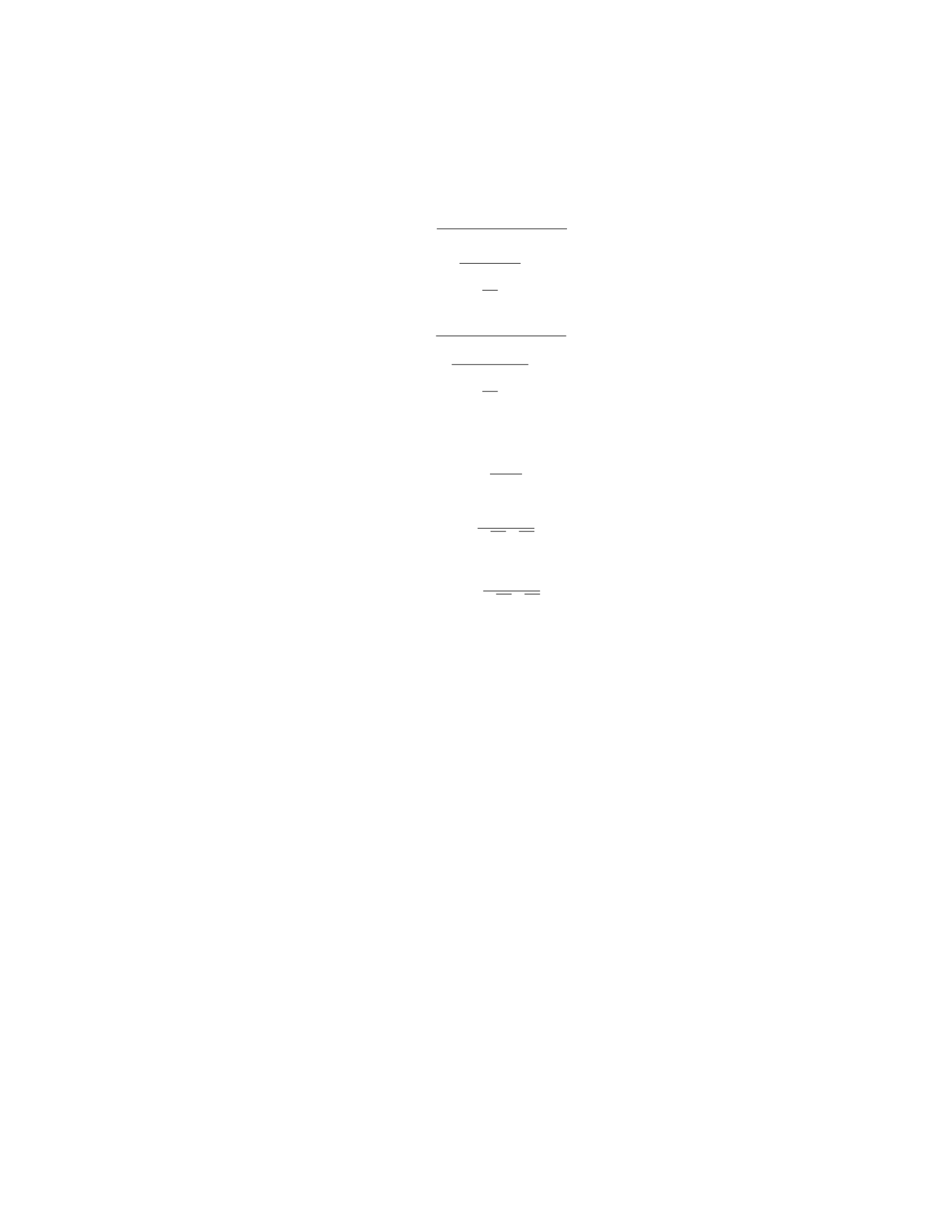
Step 2: Calculate the magnitude of a and
b.
|a|=p(3)2+ (−2)2+ (1)2
=√9+4+1
=√14
|
b|=p(2)2+ (4)2+ (−5)2
=√4 + 16 + 25
=√45
Step 3: Use the formula for finding the angle between two vectors:
cos(θ) = a ·
b
|a||
b|
cos(θ) = −7
√14√45
Step 4: Solve for θ.
θ= arccos −7
√14√45
θ≈124.37◦
Therefore, the angle between vectors a and
bis approximately 124.37◦.
Question 11
Question
Let a =
3
−2
4
and
b=
−1
5
2
.
Determine the vector c such that 2a −3
b=c.
Solution
Step 1: Calculate 2a and 3
b.
2a = 2
3
−2
4
=
6
−4
8
3
b= 3
−1
5
2
=
−3
15
6
8

Step 2: Find 2a −3
b.
2a −3
b=
6
−4
8
−
−3
15
6
=
9
−19
2
Therefore, c =
9
−19
2
.
Question 12
Question
Let u =3
−2and v =−5
4. Find the angle between the vectors u and v (in
radians).
Solution
Step 1: To find the angle between two vectors, we can use the dot product
formula: u ·v =∥u∥∥v∥cos(θ), where θis the angle between the two vectors.
Step 2: Calculate the dot product of u and v:
u ·v = (3)(−5) + (−2)(4) = −15 −8 = −23
Step 3: Calculate the magnitudes of u and v:
∥u∥=p32+ (−2)2=√9 + 4 = √13
∥v∥=p(−5)2+ 42=√25 + 16 = √41
Step 4: Substitute the dot product and magnitudes into the dot product
formula and solve for θ:
−23 = √13√41 cos(θ)
cos(θ) = −23
√13√41
θ= arccos −23
√13√41
Therefore, the angle between the vectors u and v is arccos −23
√13√41 radians.
Question 13
Question
Given two vectors a= 3i−2j+kand b=−i+ 4j−2k, find the angle between
the two vectors.
9

Solution
Step 1: Recall that the dot product of two vectors aand bis given by:
a·b=|a||b|cos(θ),
where |a|and |b|are the magnitudes of vectors aand b, respectively, and θis
the angle between the two vectors.
Step 2: First, let’s find the magnitudes of vectors aand b. The magnitude
of a vector v=ai+bj+ckis given by:
|v|=pa2+b2+c2.
Step 3: For vector a, the magnitude is:
|a|=p(3)2+ (−2)2+ (1)2=√14.
Step 4: For vector b, the magnitude is:
|b|=p(−1)2+ (4)2+ (−2)2=√21.
Step 5: Now, let’s find the dot product of vectors aand b:
a·b= (3)(−1) + (−2)(4) + (1)(−2) = −3−8−2 = −13.
Step 6: Substitute the magnitudes and dot product into the dot product
formula to solve for θ:
−13 = √14 ·√21 cos(θ).
Step 7: Solve for θ:
cos(θ) = −13
√14 ·√21 =−13
√294.
Step 8: Thus, the angle between vectors aand bis:
θ= cos−1−13
√294.
Question 14
Question
Let a= 3i−2j+ 5kand b=−i+ 4j−6k. Find:
a·band projb(a)
10

Solution
Step 1: Calculate the dot product a·b:
a·b= (3)(−1) + (−2)(4) + (5)(−6)
a·b=−3−8−30
a·b=−41
Step 2: Calculate the projection of aonto b, denoted as projb(a):
projb(a) = a·b
∥b∥2b
projb(a) = −41
(−1)2+ 42+ (−6)2(−i+ 4j−6k)
projb(a) = −41
1 + 16 + 36(−i+ 4j−6k)
projb(a) = −41
53 (−i+ 4j−6k)
projb(a) = −41
53i+164
53 j−246
53 k
Therefore, a·b=−41 and projb(a) = −41
53 i+164
53 j−246
53 k.
Question 15
Question
Let a = 3
i−2
j+ 4
kand
b= 2
i+ 5
j−3
k. Determine the angle between the
vectors a and
b.
Solution
Step 1: Find the dot product of vectors a and
b.
a ·
b= (3)(2) + (−2)(5) + (4)(−3) = 6 −10 −12 = −16
Step 2: Calculate the magnitudes of vectors a and
b.
|a|=p32+ (−2)2+ 42=√9 + 4 + 16 = √29
|
b|=p22+ 52+ (−3)2=√4 + 25 + 9 = √38
Step 3: Use the formula cos(θ) = a·
b
|a||
b|to find the cosine of the angle between
vectors a and
b.
cos(θ) = −16
√29 ·√38 =−16
√29 ·38
Step 4: Solve for the angle θusing the arccosine function.
θ= arccos −16
√29 ·38
11

Question 16
Question
Let a=
3
−4
5
and b=
−1
2
1
. Find the angle between vectors aand b.
Solution
Step 1: Find the dot product of vectors aand b.
a·b= (3)(−1) + (−4)(2) + (5)(1) = −3−8 + 5 = −6
Step 2: Find the magnitudes of vectors aand b.
|a|=p32+ (−4)2+ 52=√9 + 16 + 25 = √50 = 5√2
|b|=p(−1)2+ 22+ 12=√1 + 4 + 1 = √6
Step 3: Calculate the angle between vectors aand busing the formula
cos θ=a·b
|a||b|.
cos θ=−6
(5√2)(√6) =−6
5√12 =−3√3
5
Step 4: Find the angle θbetween the vectors using the inverse cosine func-
tion.
θ= arccos −3√3
5!≈118.28◦
Therefore, the angle between vectors aand bis approximately 118.28◦.
Question 17
Question
Let u=
3
−2
5
and v=
−1
4
2
. Determine the angle between uand v.
Solution
Step 1: Calculate the dot product of uand v:
u·v= (3) ·(−1) + (−2) ·4+5·2
u·v=−3−8 + 10 = −1
12

Step 2: Calculate the magnitudes of uand v:
||u|| =p32+ (−2)2+ 52=√9 + 4 + 25 = √38
||v|| =p(−1)2+ 42+ 22=√1 + 16 + 4 = √21
Step 3: Calculate the cosine of the angle between uand vusing the formula:
cos(θ) = u·v
||u|| · ||v||
cos(θ) = −1
√38 ·√21
cos(θ) = −1
√798
Step 4: Calculate the angle θusing the inverse cosine function:
θ= cos−1−1
√798
θ≈104.56◦
Therefore, the angle between uand vis approximately 104.56◦.
Question 18
Question
Let v=
3
−1
4
and w=
2
5
−2
. Determine the angle between vectors vand w.
Solution
Step 1: Find the dot product of vand w.
v·w= (3)(2) + (−1)(5) + (4)(−2) = 6 −5−8 = −7
Step 2: Find the magnitude of v.
||v|| =p32+ (−1)2+ 42=√9 + 1 + 16 = √26
Step 3: Find the magnitude of w.
||w|| =p22+ 52+ (−2)2=√4 + 25 + 4 = √33
Step 4: Use the dot product formula to find the angle θbetween vectors v
and w.
cos θ=v·w
||v|| · ||w||
13

cos θ=−7
√26 ·√33 =−7
√858
Step 5: Calculate the angle θ.
θ= arccos −7
√858≈116.57◦
Therefore, the angle between vectors vand wis approximately 116.57◦.
Question 19
Question
Let a= 3i−2j+kand b= 2i+ 4j−5k. Find the angle between vectors aand
b.
Solution
To find the angle between vectors aand b, we can use the dot product formula:
a·b=|a||b|cos(θ)
where θis the angle between aand b.
Step 1: Calculate the dot product of aand b.
a·b= (3)(2) + (−2)(4) + (1)(−5) = 6 −8−5 = −7
Step 2: Calculate the magnitudes of vectors aand b.
|a|=p32+ (−2)2+ 12=√9 + 4 + 1 = √14
|b|=p22+ 42+ (−5)2=√4 + 16 + 25 = √45
Step 3: Substitute the dot product and magnitudes into the formula to
solve for θ.
−7=(√14)(√45) cos(θ)
cos(θ) = −7
√14 ×√45 =−7
√630
θ= cos−1−7
√630
Step 4: Calculate the angle θusing a calculator.
θ≈122.18◦
Therefore, the angle between vectors aand bis approximately 122.18◦.
14

Question 20
Question
Let a = 3ˆ
i−2ˆ
j+ 5ˆ
kand
b=−2ˆ
i+ 4ˆ
j−ˆ
k. Determine the angle between a and
bin degrees.
Solution
Step 1: Find the dot product of a and
b.
a ·
b= (3)(−2) + (−2)(4) + (5)(−1)
a ·
b=−6−8−5
a ·
b=−19
Step 2: Find the magnitudes of a and
b.
|a|=p(3)2+ (−2)2+ (5)2=√9 + 4 + 25 = √38
|
b|=p(−2)2+ 42+ (−1)2=√4 + 16 + 1 = √21
Step 3: Use the formula for the angle between two vectors: cos θ=a·
b
|a||
b|.
cos θ=−19
√38 ·√21
cos θ=−19
√798
θ= arccos −19
√798
Step 4: Calculate the angle in degrees.
θ≈arccos −19
√798≈121.63◦
Therefore, the angle between a and
bis approximately 121.63◦.
Question 21
Question
Let v=
−2
3
1
,w=
4
−1
2
, and u=
1
−2
0
. Determine the vector athat is
perpendicular to both vand wand is parallel to u.
15

Solution
Step 1: Find a vector that is perpendicular to both vand wby taking their
cross product.
a=v×w
a=
−2
3
1
×
4
−1
2
a=
3(2) −1(1)
1(4) −2(2)
−2(−1) −3(4)
a=
5
0
−14
Step 2: Determine a scalar ksuch that a=ku.
5
0
−14
=k
1
−2
0
From this, we can see that k= 5.
Therefore, the vector athat is perpendicular to both vand wand parallel
to uis
5
−10
0
.
Question 22
Question
Let u=⟨3,−2,5⟩and v=⟨−1,4,2⟩be two vectors. Find a unit vector in the
direction of the vector u−2v.
Solution
Step 1: Find the vector u−2v.
u−2v=⟨3,−2,5⟩ − 2⟨−1,4,2⟩
=⟨3,−2,5⟩ − ⟨−2,8,4⟩
=⟨3+2,−2−8,5−4⟩
=⟨5,−10,1⟩.
Step 2: Find the magnitude of u−2v.
|u−2v|=p52+ (−10)2+ 12=√25 + 100 + 1 = √126.
16

Step 3: Find the unit vector in the direction of u−2v.
u−2v=⟨5,−10,1⟩
√126 =5
√126,−10
√126,1
√126.
Therefore, a unit vector in the direction of u−2vis D5
√126 ,−10
√126 ,1
√126 E.
Question 23
Question
Let u =
3
−1
2
,v =
−4
0
5
, and w =
2
−3
1
. Determine if the vectors u,v,w
are linearly independent.
Solution
Step 1: To determine if the vectors u,v,w are linearly independent, we need
to solve the equation c1u +c2v +c3w =
0 for constants c1,c2,c3not all zero.
This is equivalent to solving the system of equations:
3c1−4c2+ 2c3= 0
−c1+ 5c3= 0
2c1+ 5c2+c3= 0
Step 2: We can represent the system of equations as an augmented matrix:
3−4 2 |0
−105|0
2 5 1 |0
Step 3: Perform row operations to put the system in row-echelon form. Start
by adding 3 times the second row to the first row:
0−4 17 |0
−1 0 5 |0
2 5 1 |0
Step 4: Next, add 1
4times the first row to the second row:
0−4 17 |0
−1 0 5 |0
2 5 1 |0
→
0−4 17 |0
−1 1 5
4|0
2 5 1 |0
Step 5: Finally, add 2 times the second row to the third row:
0−4 17 |0
−1 1 5
4|0
2 5 1 |0
→
0−4 17 |0
−1 1 5
4|0
0 7 13
2|0
17

Step 6: This matrix corresponds to the system:
−4c2+ 17c3= 0
c1−c2+5
4c3= 0
7c2+13
2c3= 0
Step 7: The system has infinitely many solutions, so the vectors u,v,w are
linearly dependent.
Question 24
Question
Let a=3
−1and b=−2
4. Find the vector csuch that 2a−3c= 4b.
Solution
Step 1: Begin by expanding the given equation.
2a−3c= 4b
23
−1−3c= 4 −2
4
6
−2−3c=−8
16
Step 2: Now, isolate −3cin the equation.
6
−2−3c=−8
16
−3c=−8
16 −6
−2
−3c=−14
18
Step 3: Finally, solve for cby dividing both sides by −3.
−3c=−14
18
c=1
−3−14
18
c=14
3
−6
Therefore, the vector cis 14
3
−6.
18

Question 25
Question
Let u=
3
−1
2
and v=
4
0
−1
. Find the angle between vectors uand v.
Round your answer to the nearest degree.
Solution
Step 1: Calculate the dot product of vectors uand vusing the formula u·v=
∥u∥∥v∥cos(θ), where θis the angle between the vectors.
u·v= 3 ·4+(−1) ·0+2·(−1) = 12 −2 = 10
Step 2: Calculate the magnitudes of vectors uand v.
∥u∥=p32+ (−1)2+ 22=√9 + 1 + 4 = √14
∥v∥=p42+ 02+ (−1)2=√16 + 0 + 1 = √17
Step 3: Substitute the dot product and magnitudes into the formula to solve
for cos(θ).
10 = √14√17 cos(θ)
cos(θ) = 10
√14√17 =10
√238 =10
√2·119 =10
√2·1
√119 =10√119
2·√119 =5√119
√119 = 5
Step 4: Find the value of θusing the inverse cosine function.
θ= arccos(5) ≈arccos(0.99619469809) ≈5.74 radians
Step 5: Convert the angle from radians to degrees.
θ≈5.74 ×180
π≈328.6 degrees
Therefore, the angle between vectors uand vis approximately 329 degrees.
Question 26
Question
Let a= 2i−3j+ 4kand b=i+ 2j−k. Find the angle between vectors aand
b.
19

Solution
To find the angle θbetween vectors aand b, we can use the dot product formula:
a·b=|a||b|cos θ
Step 1: Calculate the dot product First, we compute the dot product
of aand b:
a·b= (2)(1) + (−3)(2) + (4)(−1)
a·b= 2 −6−4 = −8
Step 2: Find the magnitudes of vectors a and b Next, we find the
magnitudes of vectors aand b:
|a|=p22+ (−3)2+ 42=√4 + 9 + 16 = √29
|b|=p12+ 22+ (−1)2=√1 + 4 + 1 = √6
Step 3: Calculate the angle between the vectors Substitute the dot
product and magnitudes into the dot product formula:
−8 = √29 ·√6 cos θ
cos θ=−8
√29 ·√6=−8
√174
Step 4: Find the angle θFinally, we find the angle between vectors aand
busing the inverse cosine function:
θ= cos−1−8
√174≈126.34◦
Therefore, the angle between vectors aand bis approximately 126.34◦.
Question 27
Question
Let a = 2ˆ
i−3ˆ
j+ˆ
kand
b= 3ˆ
i+ 4ˆ
j−2ˆ
kbe two vectors. Find the vector
projection of a onto
b.
Solution
Step 1: Calculate the dot product of a and
b.
a ·
b= (2)(3) + (−3)(4) + (1)(−2)
a ·
b= 6 −12 −2
a ·
b=−8
20

Step 2: Calculate the magnitude of
bsquared.
|
b|2= (3)2+ (4)2+ (−2)2
|
b|2= 9 + 16 + 4
|
b|2= 29
Step 3: Calculate the vector projection of a onto
busing the formula:
proj
ba = a ·
b
|
b|2!
b
proj
ba =−8
29 (3ˆ
i+ 4ˆ
j−2ˆ
k)
proj
ba =−24
29ˆ
i−32
29ˆ
j+16
29 ˆ
k
Therefore, the vector projection of a onto
bis −24
29ˆ
i−32
29 ˆ
j+16
29 ˆ
k.
Question 28
Question
Let u=
2
−1
3
and v=
1
4
−2
. Find a vector wsuch that w·u= 0 and
|w|= 1.
Solution
Step 1: To find a vector wsuch that w·u= 0, we can choose wto be orthogonal
to u. This means that wmust be perpendicular to uand their dot product
should be zero. One way to achieve this is to find the cross product of u.
Step 2: The cross product of uand vis given by the formula
u×v=
a
b
c
,
where a=u2v3−u3v2,b=u3v1−u1v3, and c=u1v2−u2v1.
Step 3: Calculating the cross product, we have
u×v=
(−1)(−2) −(3)(4)
(3)(1) −(2)(−2)
(2)(4) −(−1)(1)
=
10
7
9
.
21

Step 4: To ensure that |w|= 1, we normalize the vector wby dividing by
its magnitude:
w=u
×v|u×v|=
10
7
9
√102+ 72+ 92=
10
7
9
√170 =1
√170
10
7
9
.
Therefore, a vector wsuch that w·u= 0 and |w|= 1 is 1
√170
10
7
9
.
Question 29
Question
Let u =
3
−1
2
and v =
−2
4
1
. Find the vector w that is orthogonal to both u
and v.
Solution
Step 1: To find the vector w that is orthogonal to both u and v, we can take
the cross product of u and v.
Step 2: The cross product of two vectors u =
u1
u2
u3
and v =
v1
v2
v3
is given
by:
u ×v =
ˆ
iˆ
jˆ
k
u1u2u3
v1v2v3
Step 3: Applying this formula, we find:
u ×v =
ˆ
iˆ
jˆ
k
3−1 2
−2 4 1
Step 4: Calculating the determinant gives:
u ×v =
−1(1) −2(4)
−(3(1) −2(−2))
3(4) −(−1(−2))
=
−9
7
14
Step 5: So, the vector w that is orthogonal to both u and v is
−9
7
14
.
22

Question 30
Question
For vectors u=3
−2and v=−1
4, find a vector wsuch that ∥2u−w∥= 8.
Solution
Step 1: Find the vector 2u.
Substitute u=3
−2into the scalar multiplication:
2u= 2 3
−2=6
−4
Step 2: Find the vector w.
Given: ∥2u−w∥= 8
Substitute 2u=6
−4into the equation:
∥6
−4−w∥= 8
Rewrite the equation as: ∥6
−4−w∥=∥ − w+6
−4∥= 8
This implies that: ∥ − w+6
−4∥=∥w−6
4∥= 8
Step 3: Find the vector w.
From Step 2, we have: ∥w−6
−4∥= 8
Therefore, w−6
−4has magnitude 8
The vector w−6
−4is either parallel to 6
−4or −6
4
Thus, we can write w−6
−4=k6
−4for some scalar k
Solving for w
w=6
−4+k6
−4=6+6k
−4−4k
Thus, the vector wis 6+6k
−4−4k.
23

Question 31
Question
Let u= 3i−4j+ 2kand v= 2i+j+ 5kbe two vectors. Find the angle between
uand v.
Solution
Step 1: Calculate the dot product of uand v:
u·v= (3)(2) + (−4)(1) + (2)(5) = 6 −4 + 10 = 12
Step 2: Calculate the magnitudes of uand v:
|u|=p32+ (−4)2+ 22=√9 + 16 + 4 = √29
|v|=p22+ 12+ 52=√4 + 1 + 25 = √30
Step 3: Use the formula cos(θ) = u
·v|u||v|to find the angle between uand
v:
cos(θ) = 12
√29 ·√30
Step 4: Solve for θusing θ= cos−112
√29·√30 . Therefore, the angle between
uand vis θ= cos−112
√29·√30 .
Question 32
Question
Let a =
2
−1
3
and
b=
−4
0
1
be two vectors. Determine the angle between a
and
bin degrees.
Solution
Step 1: Find the dot product of the two vectors a and
b.
a ·
b= (2)(−4) + (−1)(0) + (3)(1)
a ·
b=−8 + 0 + 3 = −5
Step 2: Calculate the magnitudes of vectors a and
b.
|a|=p22+ (−1)2+ 32=√4 + 1 + 9 = √14
|
b|=p(−4)2+ 02+ 12=√16 + 0 + 1 = √17
24

Step 3: Use the dot product formula to find the angle θbetween the vectors.
cos(θ) = a ·
b
|a|·|
b|
cos(θ) = −5
√14 ·√17
Step 4: Calculate the angle θbetween the vectors.
θ= cos−1−5
√14 ·√17≈116.83◦
Therefore, the angle between vectors a and
bis approximately 116.83◦.
Question 33
Question
Let a =
2
−1
3
and
b=
4
0
−5
. Determine the vector projection of
bonto a.
Solution
To find the vector projection of
bonto a, we use the formula:
proja(
b) = a ·
b
∥a∥!a
∥a∥
Step 1: Calculate the dot product a ·
b.
a ·
b= (2)(4) + (−1)(0) + (3)(−5) = 8 −15 = −7
Step 2: Calculate the norm of a, denoted as ∥a∥.
∥a∥=p22+ (−1)2+ 32=√4 + 1 + 9 = √14
Step 3: Substitute the calculated values into the formula to find the vector
projection.
proja(
b) = −7
√141
√14
2
−1
3
=−1
14
2
−1
3
=
−1/7
1/14
−3/14
Therefore, the vector projection of
bonto a is
−1/7
1/14
−3/14
.
25

Question 34
Question
Given two vectors a=
2
−3
4
and b=
−1
2
−2
, find:
a·b+a×b
Solution
Step 1: Calculate the dot product of vectors aand b.
a·b= (2)(−1) + (−3)(2) + (4)(−2) = −2−6−8 = −16
Step 2: Calculate the cross product of vectors aand b.
a×b=
i j k
2−3 4
−1 2 −2
= (i)((−3)(−2) −(4)(2)) −(j)((2)(−2) −(4)(−1)) + (k)((2)(2) −(−3)(−1))
= (i)(6 −8) −(j)(−4 + 4) + (k)(4 + 3)
= (i)(−2) −(j)(0) + (k)(7)
=−2i+ 7k
Step 3: Hence, the expression a·b+a×bis:
−16 + (−2i+ 7k) = −2i+ 7k−16
Therefore, a·b+a×b=−2i+ 7k−16.
Question 35
Question
Let a = 3
i−5
j+ 2
kand
b=
i+ 4
j−3
k. Determine the angle between vectors
a and
b.
Solution
To find the angle between two vectors a and
b, we can use the dot product
formula:
a ·
b=|a|·|
b|cos(θ)
26

where θis the angle between the two vectors, |a|is the magnitude of a, and
|
b|is the magnitude of
b.
Step 1: Calculate the dot product Calculate the dot product of a and
b:
a ·
b= (3)(1) + (−5)(4) + (2)(−3)
a ·
b= 3 −20 −6
a ·
b=−23
Step 2: Calculate the magnitudes Calculate the magnitudes of a and
b:
|a|=p(3)2+ (−5)2+ (2)2=√9 + 25 + 4 = √38
|
b|=p(1)2+ (4)2+ (−3)2=√1 + 16 + 9 = √26
Step 3: Calculate the angle Now, substitute a ·
b=−23, |a|=√38,
|
b|=√26, and θ
−23 = √38 ·√26 cos(θ)
−23 = √988 cos(θ)
cos(θ) = −23
√988
Solving for θ, we get:
θ≈cos−1−23
√988
θ≈123.5◦
Therefore, the angle between vectors a and
bis approximately 123.5◦.
27

