



MATH 110 - INTERMEDIATE
ALGEBRA - Applications of quadratic
equations
Question Bank - Set 1
Liberty University
Question 1
Question
A manufacturer produces and sells a certain quantity of a product. The total
cost to produce xunits of the product is given by the polynomial C(x) =
0.02x2+ 20x+ 5000 dollars, and the revenue generated from selling xunits is
given by R(x) = 30x−0.5x2dollars. Determine the number of units that must
be sold to maximize profit, and find the maximum profit.
Solution
Step 1: To find the profit function, we subtract the cost function from the
revenue function:
P(x) = R(x)−C(x) = (30x−0.5x2)−(0.02x2+ 20x+ 5000)
Step 2: Simplify the profit function:
P(x) = 29.5x−0.52x2−5000
Step 3: To find the number of units that must be sold to maximize profit, we
need to find the critical points of the profit function. The critical points occur
where the derivative of the profit function is zero:
P′(x) = 29.5−1.04x= 0
Step 4: Solve for x:
1.04x= 29.5 =⇒x=29.5
1.04 ≈28.37

Step 5: Since the number of units must be a whole number, the company
must sell 28 units to maximize profit.
Step 6: To find the maximum profit, we substitute x= 28 into the profit
function:
P(28) = 29.5(28) −0.52(28)2−5000
Step 7: Calculate the maximum profit:
P(28) = 826 −405.44 −5000 = −3679.44 dollars
Therefore, the company must sell 28 units to maximize profit and the max-
imum profit is
$
3679.44.
Question 2
Question
A rectangular garden is to be created in a backyard. The length of the garden
is to be 3 meters longer than twice its width. If the area of the garden is 72
square meters, find the dimensions of the garden.
Solution
Let’s denote the width of the garden as wmeters. Therefore, the length of the
garden would be 2w+ 3 meters.
We know that the area of a rectangle is given by the formula:
Area = Length ×Width
Given that the area of the garden is 72 square meters, we can set up the
equation:
(2w+ 3) ×w= 72
Expanding the left side of the equation, we get:
2w2+ 3w= 72
Now, we have a quadratic equation that we can solve to find the dimensions
of the garden.
Step 1: Rearrange the equation to standard quadratic form ax2+bx+c= 0.
2w2+ 3w−72 = 0
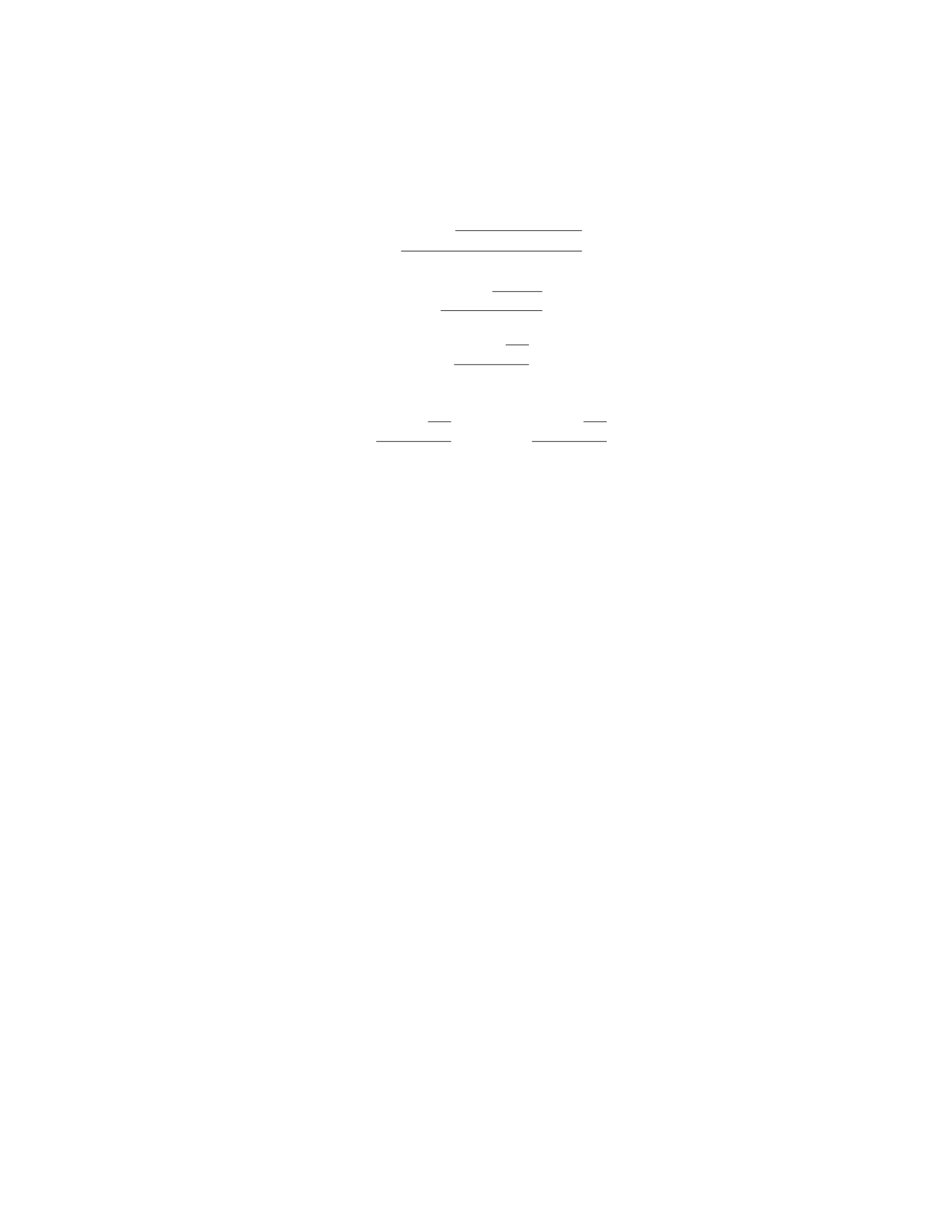
Step 2: To solve the quadratic equation, we can use the quadratic formula:
w=−b±√b2−4ac
2a
where a= 2, b= 3, and c=−72.
2
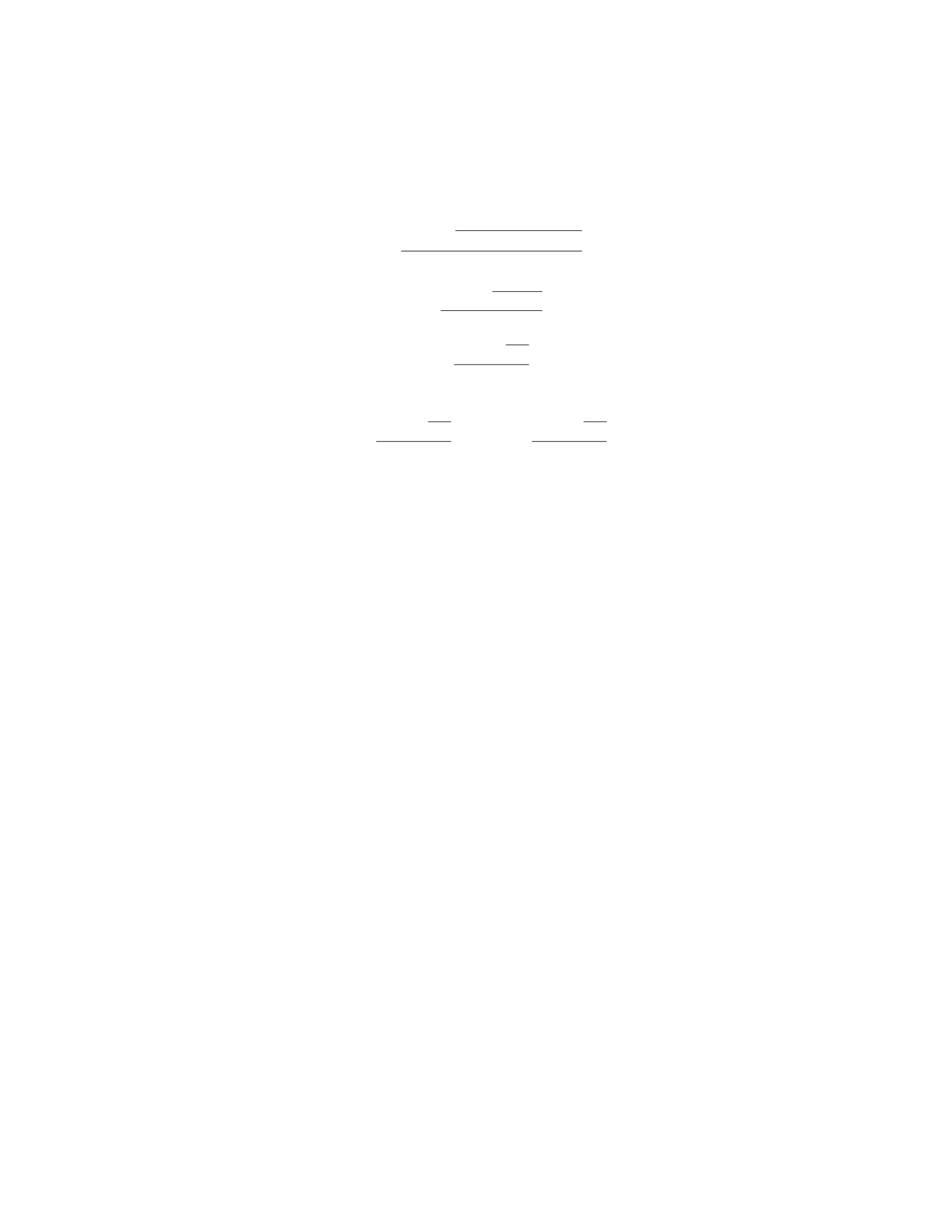
Step 3: Substitute the values of a,b, and cinto the quadratic formula:
w=−3±p32−4×2×(−72)
2×2
w=−3±√9 + 576
4
w=−3±√585
4
Step 4: So, the possible values for ware:
w=−3 + √585
4or w=−3−√585
4
We can approximate these values to find the exact dimensions of the garden.
Question 3
Question
A rectangular garden is to be fenced off on three sides using 150 meters of fencing
material. If the area of the garden is 1000 square meters, find the dimensions
of the garden that will maximize the area.
Solution
Step 1: Let xand ybe the dimensions of the rectangular garden. Since the
fencing will be done on three sides, the perimeter equation can be written as
x+ 2y= 150.
Step 2: We are given that the area of the rectangular garden is 1000 square
meters, so we have the equation xy = 1000.
Step 3: We can solve the perimeter equation for xto get x= 150 −2y.
Step 4: Substitute this expression for xinto the area equation to get (150 −
2y)y= 1000.
Step 5: Expand the equation to get 150y−2y2= 1000.
Step 6: Rearrange the equation into standard quadratic form: 2y2−150y+
1000 = 0.
Step 7: We can now solve this quadratic equation for y. The roots are y= 20
and y= 25.
Step 8: Since the dimensions cannot be negative, we discard the root y= 20.
This leaves us with y= 25.
Step 9: Substitute y= 25 back into the equation x= 150 −2yto find x. We
get x= 100.
Step 10: Therefore, the dimensions of the garden that will maximize the
area are 100 meters by 25 meters.
3

Question 4
Question
A rectangular garden has a length that is 2 meters longer than its width. If the
area of the garden is 45 square meters, find the dimensions of the garden.
Solution
Let’s denote the width of the garden as xmeters. According to the problem,
the length of the garden is x+ 2 meters. We are given that the area of the
garden is 45 square meters.
Step 1: Write down the equation representing the area of the garden. The
area of a rectangle is given by the formula A= length ×width. Since the area
of the garden is 45 square meters, we can write:
(x+ 2) ×x= 45
Step 2: Simplify the equation.
x2+ 2x= 45
Step 3: Rearrange the equation into standard quadratic form.
x2+ 2x−45 = 0
Step 4: Solve the quadratic equation. To factorize the quadratic equation,
we need to find two numbers that multiply to -45 and add up to 2. The numbers
are 9 and -5.
x2+ 9x−5x−45 = 0
x(x+ 9) −5(x+ 9) = 0
(x−5)(x+ 9) = 0
Thus, x−5 = 0 or x+ 9 = 0. If x−5 = 0, then x= 5. If x+ 9 = 0, then
x=−9. However, since the width cannot be negative, we reject x=−9.
Step 5: Determine the dimensions of the garden. Since x= 5, the width of
the garden is 5 meters and the length is 5 + 2 = 7 meters.
Therefore, the dimensions of the garden are 5 meters by 7 meters.
Question 5
Question
A company manufactures and sells a certain product. The cost of manufacturing
xunits of the product is given by the function C(x) = 800x+ 10000, while the
revenue from selling xunits is given by the function R(x) = 1600x−0.2x2. Find
the number of units the company needs to sell in order to break even (i.e., when
the revenue equals the cost).
4

Solution
Step 1: To break even, the revenue must equal the cost. Therefore, we set
R(x) = C(x) and solve for x.
1600x−0.2x2= 800x+ 10000
1600x−0.2x2−800x−10000 = 0
−0.2x2+ 800x−10000 = 0
Step 2: To solve the quadratic equation −0.2x2+ 800x−10000 = 0, we can
divide by -0.2 to simplify the equation. This gives us:
x2−4000x+ 50000 = 0
Step 3: Now, we can solve for xusing the quadratic formula x=−b±√b2−4ac
2a
where a= 1, b=−4000, and c= 50000. Plugging in the values, we get:
x=4000 ±p40002−4(1)(50000)
2
x=4000 ±√16000000 −200000
2
x=4000 ±√15760000
2
x=4000 ±3970
2
Step 4: This gives us two possible solutions: x= 3985 or x= 15. Since
the company cannot sell a negative number of units, the number of units the
company needs to sell in order to break even is 3985.
Question 6
Question
A rectangular garden has a perimeter of 70 meters. If the length of the garden
is 5 meters more than twice the width, find the dimensions of the garden.
Solution
Let’s denote the width of the rectangular garden as wmeters. Since the length
of the garden is 5 meters more than twice the width, we can express the length
las 2w+ 5 meters.
The perimeter of a rectangle is given by P= 2l+ 2w. Substituting the given
values into the equation, we have:
70 = 2(2w+ 5) + 2w
5

Solve for wto find the width, then substitute back to find the length.
Step 1: Simplify the equation for the perimeter:
70 = 4w+ 10 + 2w
Step 2: Combine like terms:
70 = 6w+ 10
Step 3: Solve for w:
6w= 60 =⇒w= 10
So, the width of the rectangular garden is 10 meters.
Step 4: Substitute w= 10 back into the expression for the length l= 2w+5:
l= 2(10) + 5 = 25
Therefore, the length of the rectangular garden is 25 meters.
Step 5: Check the dimensions by calculating the perimeter:
P= 2l+ 2w= 2(25) + 2(10) = 50 + 20 = 70
Thus, the dimensions of the garden are a width of 10 meters and a length of
25 meters.
Question 7
Question
A rectangular garden is 20 meters longer than it is wide. If the area of the
garden is 375 square meters, find the dimensions of the garden.
Solution
Let xbe the width of the garden in meters. Since the garden is 20 meters longer
than it is wide, the length of the garden is x+ 20 meters.
We are given that the area of the garden is 375 square meters. The area of
a rectangle is given by the formula A= width ×length. Substituting the given
values, we have:
x(x+ 20) = 375
Now we can solve this quadratic equation to find the dimensions of the
garden.
Step 1: Expand and simplify the quadratic equation.
x2+ 20x= 375
6

Step 2: Rearrange the equation into the standard form (ax2+bx +c= 0).
x2+ 20x−375 = 0
Step 3: Factor the quadratic equation or use the quadratic formula to solve
for x.
x2+ 25x−15x−375 = 0
x(x+ 25) −15(x+ 25) = 0
(x−15)(x+ 25) = 0
This gives us two possible solutions: x= 15 or x=−25. Since the width of
the garden cannot be negative, we discard the negative solution.
Step 4: Find the length of the garden using x+ 20.
Width = 15 meters
Length = 15 + 20 = 35 meters
Step 5: Therefore, the dimensions of the garden are 15 meters by 35 meters.
Question 8
Question
A rectangular garden is to be constructed using a straight river as one side and
a 300-meter-long fence to enclose the other three sides. If the area of the garden
is to be 3000 square meters, find the dimensions of the garden that will minimize
the amount of fencing used.
Solution
Let xbe the width of the garden perpendicular to the river and ybe the length
of the garden parallel to the river.
Step 1: Write the area of the garden in terms of xand y. The area of a
rectangle is given by A=xy. We are given that A= 3000 square meters, so we
have:
xy = 3000
Step 2: Write the equation for the amount of fencing used. The amount
of fencing used is the sum of the three sides not adjacent to the river, which is
2x+y. Given that the length of fencing available is 300 meters, we have:
2x+y= 300
Step 3: Rewrite the equation for yin terms of x. From the equation
xy = 3000, we can express yin terms of xas:
y=3000
x
7

Substitute this expression into 2x+y= 300 to get:
2x+3000
x= 300
Step 4: Find the dimensions that minimize the amount of fencing used.
To minimize the amount of fencing used, we need to minimize the expression
2x+3000
x. Taking the derivative with respect to xand setting it equal to zero:
d
dx 2x+3000
x= 2 −3000
x2= 0
Solving for x, we find x=√1500 = 30√2 meters.
Step 5: Find the corresponding value of y. Using xy = 3000 and x= 30√2,
we can find y=3000
30√2=100
√2= 50√2 meters.
Therefore, the dimensions of the garden that minimize the amount of fencing
used are width 30√2 meters and length 50√2 meters.
Question 9
Question
A fence is to be built to enclose a rectangular area of 200 square meters. The
fence along three sides will use expensive fencing costing
$
20 per meter, while
the fourth side will use less expensive fencing costing
$
10 per meter. Find the
dimensions of the rectangular area that will minimize the cost of the fence.
Solution
Let xbe the length of the rectangle and ybe the width. Since the area of the
rectangle is 200 square meters, we have the equation:
xy = 200
We are trying to minimize the cost, which can be represented by the following
equation:
C(x, y) = 20(2x+y) + 10x
Substitute y=200
xinto the cost equation to get only one variable:
C(x) = 20(2x+200
x) + 10x
Step 1: Find the derivative of C(x) with respect to x.
C′(x) = 40 −4000
x2+ 10
8

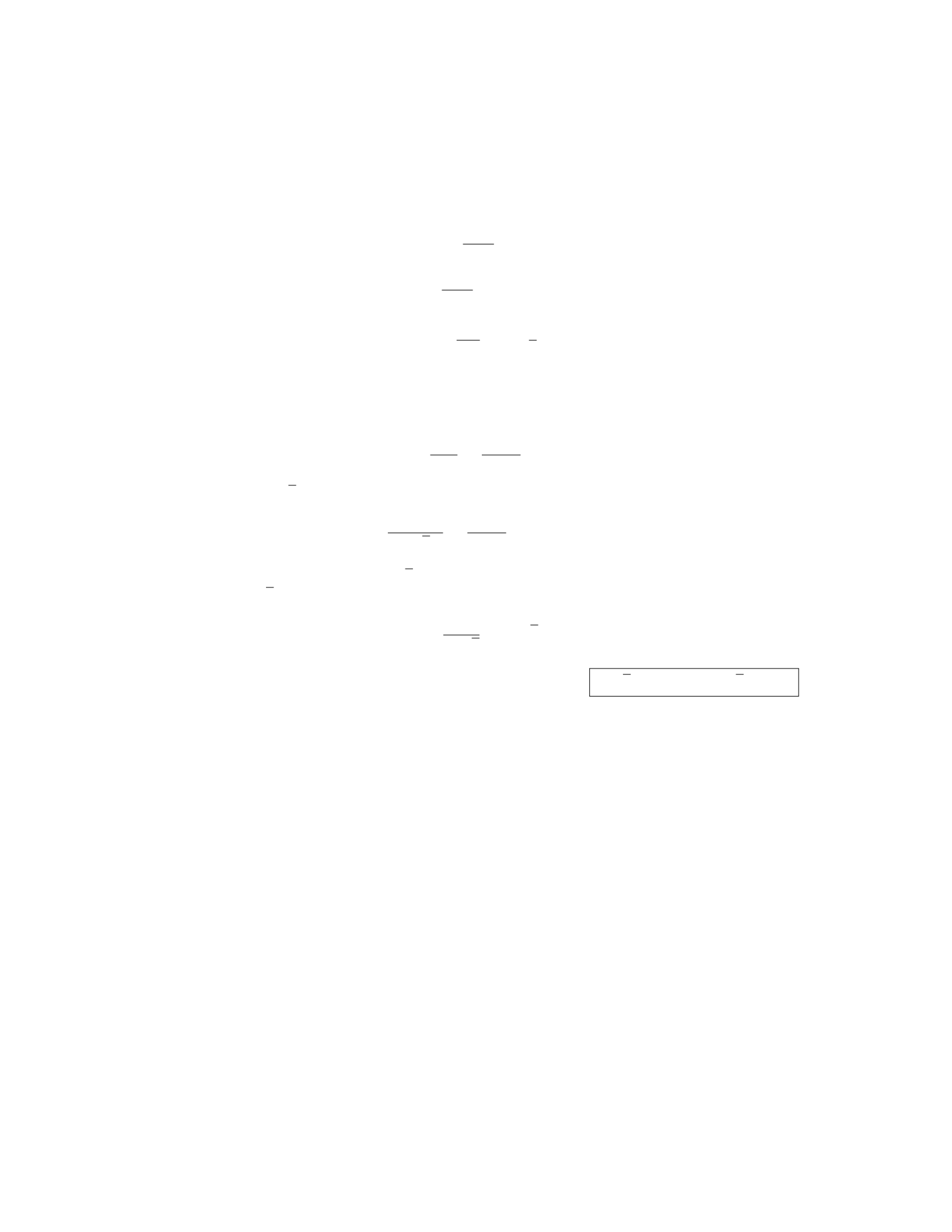
Step 2: Set C′(x) = 0 to find the critical points.
40 −4000
x2+ 10 = 0
4000
x2= 50
x2= 80
x=√80 = 4√5
Since C′(x) is decreasing for x < 4√5 and increasing for x > 4√5, x= 4√5
is the value that minimizes the cost.
Step 3: Find the corresponding value of y:
y=200
x=200
4√5= 10√5
Therefore, the dimensions of the rectangular area that will minimize the cost
of the fence are 4√5 meters by 10√5 meters.
Question 10
Question
A rectangular garden is to be created by fencing off three sides with a wall
forming the fourth side. If the area of the garden is 500 square meters, find the
dimensions of the garden that would require the least amount of fencing.
Solution
Let’s denote the lengths of the two sides perpendicular to the wall as xand the
length along the wall as y.
Step 1: Write the constraint equation for the area of the garden. The area
of a rectangle is given by the formula A=xy. Since the area of the garden is
given as 500 square meters, we have the constraint equation:
xy = 500
Step 2: Write the equation for the amount of fencing needed. The amount
of fencing needed is the sum of the three sides not attached to the wall, which
is 2x+y.
Step 3: Express the amount of fencing in terms of a single variable. Using
the constraint equation xy = 500, we can express yin terms of xas y=500
x.
So, the amount of fencing can be expressed as 2x+500
x.
Step 4: Find the value of xthat minimizes the amount of fencing. To find
the value of xthat minimizes the amount of fencing, we need to find the value
of xthat minimizes the function f(x) = 2x+500
x.
9

Step 5: Find the derivative of the function f(x).
f′(x)=2−500
x2
Step 6: Set the derivative equal to zero and solve for x. Setting f′(x) = 0,
we get:
2−500
x2= 0
2x2= 500
x2= 250
x=√250 = 5√10
Step 7: Calculate the corresponding value of y. Using the constraint equa-
tion, we find:
y=500
x=500
5√10 =100√10
10 = 10√10
Step 8: Write the dimensions of the garden. Therefore, the dimensions of
the garden that require the least amount of fencing are 5√10 meters by 10√10
meters.
Question 11
Question
A car rental company charges a daily rate of
$
40 plus an additional fee of
$
0.25
per kilometer driven. If a customer is charged
$
110 for a rental, how many
kilometers did they drive?
Solution
Let xrepresent the number of kilometers driven by the customer.
Step 1: Write the equation representing the total cost of the rental:
40 + 0.25x= 110
Step 2: Solve for xby isolating xon one side of the equation:
0.25x= 110 −40
0.25x= 70
x=70
0.25
x= 280
Step 3: The customer drove 280 kilometers during the rental.
10

Question 12
Question
A car rental company charges a fixed rate per day to rent a car, plus a one-time
insurance fee. A customer paid
$
135 to rent a car for 3 days, including the
insurance fee. Another customer paid
$
140 to rent the same car for 4 days, also
including the insurance fee. Find the daily rate and the insurance fee for renting
the car.
Solution
Let xbe the daily rate and ybe the insurance fee. We can set up a system of
equations based on the given information.
Step 1: Write the system of equations.
3x+y= 135
4x+y= 140
Step 2: Solve the system of equations. Subtract the first equation from the
second to eliminate y:
(4x+y)−(3x+y) = 140 −135
4x−3x= 5
x= 5
Step 3: Substitute x= 5 into one of the equations to solve for y. Using the
first equation:
3(5) + y= 135
15 + y= 135
y= 120
Step 4: State the daily rate and insurance fee. Therefore, the daily rate is
$
5 and the insurance fee is
$
120.
Question 13
Question
A rectangular garden has a fixed perimeter of 60 meters. If its length is 4 meters
longer than its width, find the dimensions of the garden that maximize its area.
Solution
Let wbe the width of the garden in meters. Since the length is 4 meters longer
than the width, its length is w+ 4 meters.
11

Step 1: Set up the equation for the perimeter of the rectangle. The perime-
ter of a rectangle is given by 2(length + width). We are given that the fixed
perimeter is 60 meters, so we have:
2(w+w+ 4) = 60
Step 2: Simplify the equation to find the value of w.
2(2w+ 4) = 60
4w+ 8 = 60
4w= 52
w= 13
Step 3: Find the length of the garden using the value of w. The length of
the garden is w+ 4 = 13 + 4 = 17 meters.
Step 4: Calculate the area of the garden. The area of a rectangle is given
by A= length ×width. Substituting the values we found:
A= 17 ×13 = 221
Step 5: Conclusion. Therefore, the dimensions of the garden that maximize
its area are a width of 13 meters and a length of 17 meters, resulting in an area
of 221 square meters.
Question 14
Question
A rectangular garden is 30 meters longer than it is wide. If the area of the
garden is 1800 square meters, find the dimensions of the garden.
Solution
Let the width of the garden be wmeters. Since the garden is 30 meters longer
than it is wide, the length is w+ 30 meters.
Step 1: Write the equation for the area of the garden. The area Aof a
rectangle is given by the formula A= length ×width. So, we have:
w(w+ 30) = 1800
Step 2: Simplify the equation. Expand the left side of the equation:
w2+ 30w= 1800
Step 3: Rewrite the equation in standard form. Rearrange the terms to set
the equation equal to zero:
w2+ 30w−1800 = 0
12

Step 4: Solve the quadratic equation. We can factor the quadratic equation
or use the quadratic formula. Let’s use the quadratic formula which states that
for ax2+bx +c= 0, the solutions are given by:
x=−b±√b2−4ac
2a
So, for w2+ 30w−1800 = 0, we have:
w=−30 ±p302−4(1)(−1800)
2(1)
w=−30 ±√900 + 7200
2
w=−30 ±√8100
2
w=−30 ±90
2
Step 5: Find the dimensions of the garden. We have two possible values for
w:
w1=−30 + 90
2= 30
w2=−30 −90
2=−60
Since the width cannot be negative, the width of the garden is 30 meters,
and the length is 30 + 30 = 60 meters.
Therefore, the dimensions of the garden are 30 meters by 60 meters.
Question 15
Question
A rectangular field has a length that is 6 meters longer than its width. If the
area of the field is 297 square meters, find the length and width of the field.
Solution
Let the width of the field be xmeters. Then the length of the field is x+ 6
meters.
Step 1: Write an equation for the area of the field. The area of a rectangle
is given by the formula A= length ×width. Substituting the given values, we
have:
x(x+ 6) = 297
Step 2: Solve the equation for x. Expanding the left side of the equation,
we get:
x2+ 6x= 297
13

x2+ 6x−297 = 0
Step 3: Factor the quadratic equation. Factor the quadratic equation x2+
6x−297 = 0 to solve for x:
(x−9)(x+ 15) = 0
Step 4: Find the possible values for x. Setting each factor to zero, we get:
x−9 = 0 or x+ 15 = 0
Step 5: Determine the width and length of the field. Since the width cannot
be negative, we use x= 9. The width of the field is 9 meters, and the length is
9 + 6 = 15 meters.
So, the width of the field is 9 meters and the length is 15 meters.
Question 16
Question
A rectangular garden is to be enclosed by a fence on three sides and the fourth
side is a brick wall. The area of the garden is 600 square meters. If the cost of
the fence is
$
10 per meter, find the dimensions of the garden that will minimize
the cost of the fence.
Solution
Let’s denote the length of the garden as xmeters and the width as ymeters.
Since the area of the garden is 600 square meters, we have the equation:
xy = 600
We want to minimize the cost of the fence, which is given as
$
10 per meter. The
cost of the fence will be the cost of the three sides that need fencing, given by
10(2x+y). We can rewrite this cost function in terms of one variable using the
area equation. We can solve for yin terms of x:
y=600
x
Substitute this into the cost function:
C(x) = 10(2x+600
x)
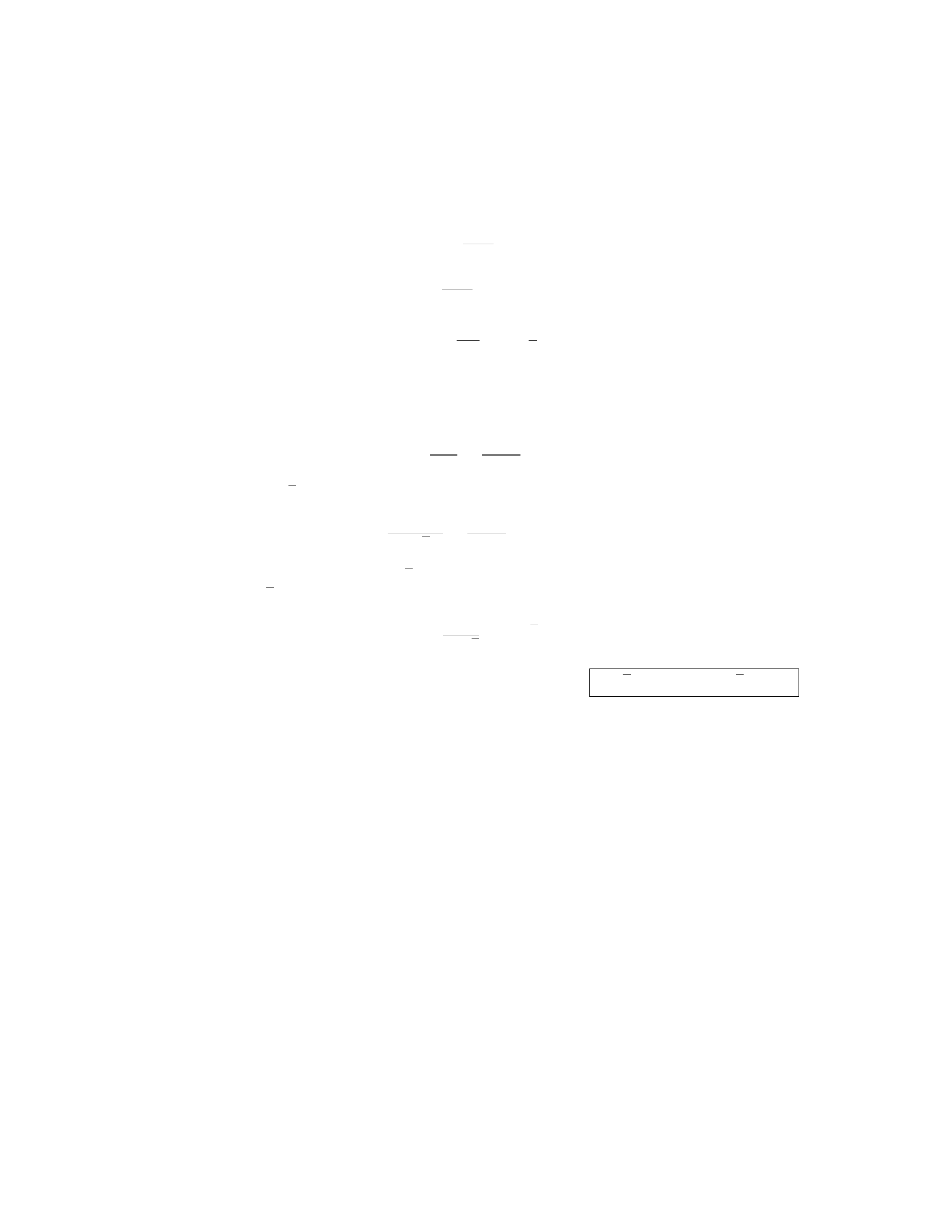
Now, we need to find the critical points of the cost function by taking the
derivative and setting it equal to zero:
dC
dx = 20 −6000
x2
14
Setting this equal to zero and solving for x:
20 −6000
x2= 0
6000
x2= 20
x2= 300
x=√300 = 10√3
Since we are dealing with a cost function, the minimum occurs at a critical
point. To confirm that this is a minimum, we will use the second derivative
test. Take the second derivative of the cost function with respect to x:
d2C
dx2=12000
x3
At x= 10√3, we have:
12000
(10√3)3=12000
3000 = 4 >0
Therefore, the point x= 10√3 gives a minimum cost for the fence. Substituting
x= 10√3 back into the equation xy = 600, we find:
y=600
10√3= 20√3
So, the dimensions that minimize the cost of the fence are 10√3 meters by 20√3 meters .
Question 17
Question
A rectangular garden is three times as long as it is wide. If the perimeter of the
garden is 80 feet, what are the dimensions of the garden?
Solution
Let xrepresent the width of the garden. Since the length is three times the
width, the length is 3x.
Step 1: Write the equation for the perimeter of the garden using the given
information. The perimeter (P) of a rectangle is given by the formula 2(length+
width). So, we have:
2(3x+x) = 80
Step 2: Simplify the equation by combining like terms and solve for x.
2(4x) = 80
15

8x= 80
x=80
8
x= 10
Step 3: Find the dimensions of the garden. Since the width, x, is 10 feet,
the length, 3x, is:
3×10 = 30 feet
Therefore, the dimensions of the garden are 10 feet by 30 feet.
Question 18
Question
A rectangular garden is to be constructed along the side of a house. If the length
of the garden is to be 5 meters longer than its width and the area of the garden
is 84 square meters, find the dimensions of the garden.
Solution
Let the width of the garden be xmeters. Since the length of the garden is 5
meters longer than its width, the length of the garden is x+ 5 meters.
Given that the area of the garden is 84 square meters, we can write the
following equation:
x(x+ 5) = 84
Expanding the left side of the equation, we get:
x2+ 5x= 84
Rearranging the terms, we have a quadratic equation in standard form:
x2+ 5x−84 = 0
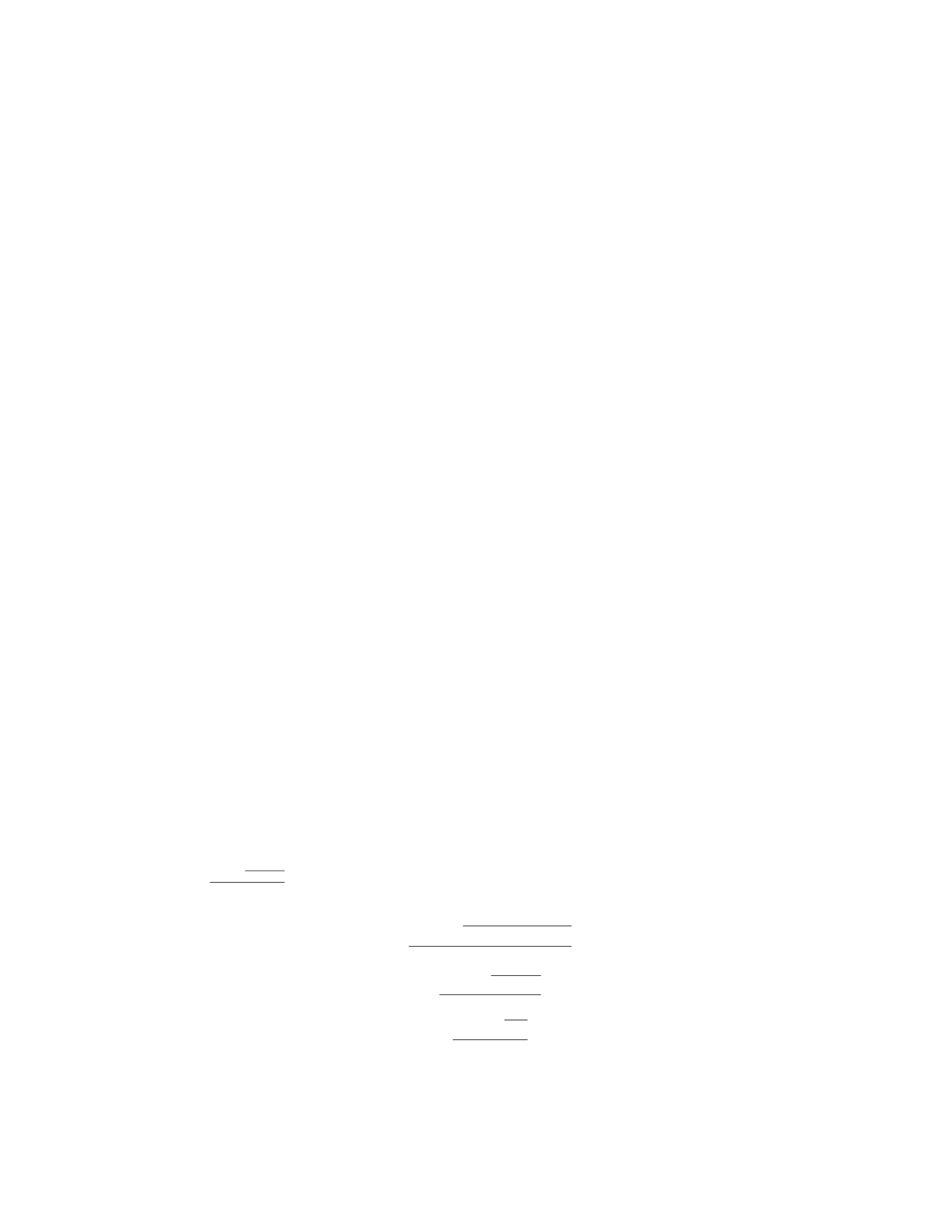
To solve this quadratic equation, we can factor it or use the quadratic for-
mula.
Step 1: Factoring the Quadratic Equation
Since the quadratic equation is factorable, we can factor it as follows:
(x+ 12)(x−7) = 0
Setting each factor to zero, we find the possible values for x:
x+ 12 = 0 =⇒x=−12
x−7 = 0 =⇒x= 7
However, the width cannot be negative, so we consider x= 7 as the valid
solution.
16
Step 2: Finding the Dimensions of the Garden
Using the width x= 7 in x+ 5 to find the length, we get:
x+ 5 = 7 + 5 = 12
Therefore, the width of the garden is 7 meters and the length is 12 meters.
So, the dimensions of the garden are 7 meters by 12 meters.
Question 19
Question
Find two consecutive even integers whose sum of the squares is 340.
Solution
Let the first even integer be xand the next consecutive even integer be x+ 2.
Step 1: Write the equation based on the problem statement.
The sum of the squares of the two consecutive even integers is given by:
(x)2+ (x+ 2)2= 340
Step 2: Expand and simplify the equation.
(x)2+ (x+ 2)2= 340
x2+ (x+ 2)(x+ 2) = 340
x2+ (x2+ 4x+ 4) = 340
2x2+ 4x+ 4 = 340
Step 3: Rearrange the equation into standard form.
2x2+ 4x+ 4 −340 = 0
2x2+ 4x−336 = 0
x2+ 2x−168 = 0
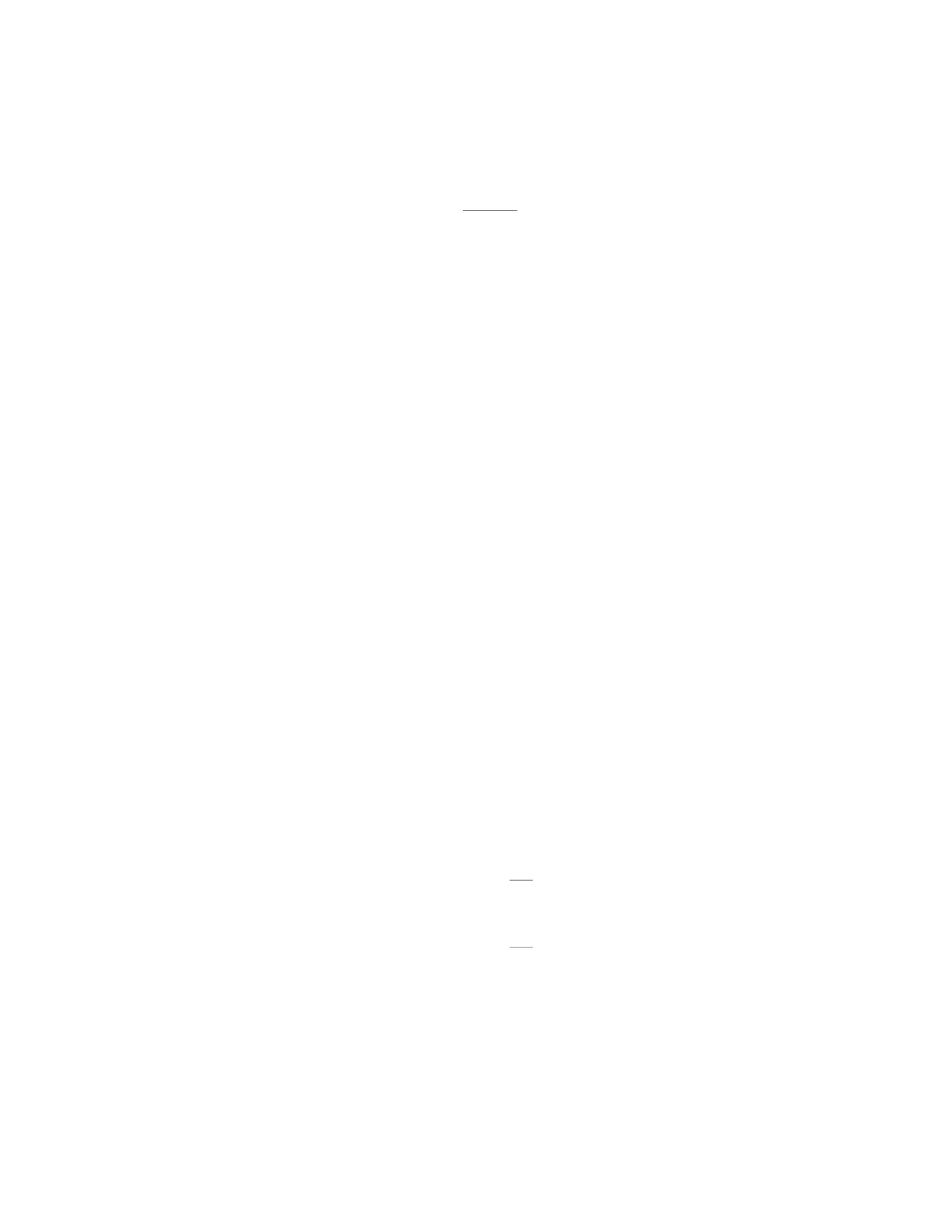
Step 4: Solve the quadratic equation using the quadratic formula: x=
−b±√b2−4ac
2a.
a= 1, b = 2, c =−168
x=−2±p22−4(1)(−168)
2(1)
x=−2±√4 + 672
2
x=−2±√676
2
17
x=−2±26
2
Thus, x= 12 or x=−14. Since we are looking for even integers, x= 12.
Hence, the two consecutive even integers are 12 and 14.
Question 20
Question
A rectangular garden has a length of 20 meters more than its width. If the area
of the garden is 600 square meters, find the dimensions of the garden.
Solution
Step 1: Let’s denote the width of the garden as wmeters. Step 2: Since
the length is 20 meters more than the width, the length can be represented
as w+ 20 meters. Step 3: The area of a rectangle is given by the formula
A= length ×width. So we have the equation:
w(w+ 20) = 600
Step 4: Simplify the equation by expanding the left side:
w2+ 20w= 600
Step 5: Rearrange the equation into a quadratic equation in standard form:
w2+ 20w−600 = 0
Step 6: To solve the quadratic equation, we can factorize it or use the quadratic
formula. Alternatively, we can complete the square. Let’s complete the square
by adding (20/2)2= 100 to both sides to create a perfect square trinomial:
w2+ 20w+ 100 = 600 + 100
(w+ 10)2= 700
Step 7: Take the square root of both sides:
w+ 10 = ±√700
Step 8: Solve for wby subtracting 10 from both sides:
w=−10 ±√700
Since the width cannot be negative, we consider only the positive solution. Step
9: Calculate the numerical value for w:
w≈ −10 + 26.46
18

w≈16.46
Step 10: Now, find the length by adding 20 to the width:
Length = 16.46 + 20
Length ≈36.46
Step 11: Therefore, the dimensions of the garden are approximately 16.46 meters
by 36.46 meters.
Question 21
Question
A rectangular garden is 20 meters longer than it is wide. If the area of the
garden is 384 square meters, find the dimensions of the garden.
Solution
Let’s denote the width of the garden as xmeters. Since the length is 20 meters
longer than the width, the length can be represented as x+ 20 meters.
We know that the area of a rectangle is given by the formula:
Area = length ×width
Given that the area of the garden is 384 square meters, we have:
x(x+ 20) = 384
Expanding the left side of the equation, we get:
x2+ 20x= 384
Rearranging the equation, we have a quadratic equation in standard form:
x2+ 20x−384 = 0
Now, we can solve this quadratic equation to find the width of the garden
(x) and then calculate the length (x+ 20).
Step 1: Solve the quadratic equation using the quadratic formula:
The quadratic formula is given by:
x=−b±√b2−4ac
2a
where the quadratic equation is in the form ax2+bx +c= 0. In this case,
a= 1, b= 20, and c=−384.
Calculating the discriminant:
19

b2−4ac = 202−4(1)(−384) = 400 + 1536 = 1936
The solutions for xare:
x=−20 ±√1936
2(1)
x=−20 ±44
2
So, x1= 12 and x2=−32. Since the width cannot be negative, the width
must be 12 meters.
Step 2: Calculate the length of the garden.
The length can be calculated as:
Length = Width + 20 = 12 + 20 = 32
Therefore, the dimensions of the garden are width = 12 meters and length
= 32 meters.
Question 22
Question
A rectangular garden is to be constructed using a fence on three sides and a wall
on the fourth side. The area of the rectangular garden is 400 square meters.
If the cost of the fence is
$
20 per meter and the cost of the wall is
$
50 per
meter, find the dimensions of the garden that minimize the cost of enclosing the
garden.
Solution
Let xand ybe the dimensions of the rectangular garden. We are given that the
area of the garden is 400 square meters, so xy = 400.
We are trying to minimize the cost, which is given by C= 20(2x+y) + 50y.
We can substitute the expression for yin terms of xfrom xy = 400, into the
cost function, to have C= 20(2x+400
x) + 50400
x.
Now, to find the values of xand ythat minimize the cost C, we need to find
the critical points of Cby finding where its derivative is zero.
Step 1: Compute the derivative of Cwith respect to x.
dC
dx = 40 −800
x2−20000
x2
Step 2: Set the derivative to zero and solve for x.
40 −800
x2−20000
x2= 0
20

Step 3: Simplify the equation:
40x2−800 −20000 = 0
40x2−20800 = 0
x2= 520
x=±√520 = ±20√13
Since the dimensions cannot be negative, we have x= 20√13.
Step 4: Find the corresponding value of yusing xy = 400.
y=400
x=400
20√13 = 20√13
Therefore, the dimensions of the rectangular garden that minimize the cost
of enclosing the garden are 20√13 meters by 20√13 meters.
Question 23
Question
A rectangular garden has a length that is 4 meters longer than its width. The
area of the garden is 60 square meters. Find the dimensions of the garden.
Solution
Let’s denote the width of the garden as xmeters. Since the length is 4 meters
longer than the width, we can denote the length as x+ 4 meters.
We are given that the area of the garden is 60 square meters. The area of a
rectangle is given by the formula:
Area = Length ×Width
So we can write the given information as:
60 = (x+ 4) ×x
Now, we need to solve this quadratic equation to find the dimensions of the
garden.
Step 1: Expand the equation and set it equal to zero.
60 = x2+ 4x
x2+ 4x−60 = 0
Step 2: Factor the quadratic equation.
(x+ 10)(x−6) = 0
21

Step 3: Set each factor to zero and solve for x. From x+ 10 = 0, we get
x=−10. Since the width cannot be negative, we discard this solution. From
x−6 = 0, we get x= 6.
Step 4: Find the dimensions of the garden. The width is x= 6 meters, and
the length is x+ 4 = 10 meters.
Therefore, the dimensions of the garden are 6 meters by 10 meters.
Question 24
Question
A rectangular garden is to be enclosed by a fence on three sides and a hedges
on the fourth side. If the total length of the fence is 200 meters, express the
area of the garden in terms of the length xof the hedges.
Solution
Let the length of the garden be lmeters and the width be wmeters. Since the
garden is rectangular, we have l=w.
Step 1: Express the total length of the fence in terms of l,w, and x. The
total length of the fence is the sum of three sides covered by the fence and one
side covered by the hedges:
200 = 2l+w+x
Step 2: Express the width in terms of the length l. Since the garden is
rectangular, we have w=l.
Step 3: Substitute the expression for win terms of linto the equation from
Step 1. Substitute w=linto the equation 200 = 2l+w+xto get:
200 = 2l+l+x
Step 4: Simplify the equation.
200 = 3l+x
Step 5: Solve for lin terms of x.
l=200 −x
3
Step 6: Express the area of the garden in terms of x. The area of the garden
is given by A=l×w, substituting the expression for l:
A=200 −x
32
Therefore, the area of the garden in terms of the length xof the hedges is
(200−x)2
9.
22

Question 25
Question
A manufacturer produces bicycles at a cost of 100 dollars each. The demand
equation for these bicycles is given by p= 400 −q, where pis the price at which
the bicycles will be sold and qrepresents the quantity demanded. Find the
number of bicycles that must be produced and sold in order to maximize the
manufacturer’s profit.
Solution
Step 1: To find the profit function, we first need to determine the revenue and
cost functions. The revenue is given by R=pq, where pis the price and qis
the quantity demanded. Since p= 400 −q, we have R= (400 −q)q. The cost
function is C= 100qsince each bicycle costs 100 dollars to produce.
Step 2: The profit function Pis the revenue minus the cost, so P=R−C=
(400 −q)q−100q= 400q−q2−100q.
Step 3: To maximize profit, we need to find the critical points of the profit
function. We take the derivative of Pwith respect to qand set it equal to 0:
dP
dq = 400 −2q−100 = 0
−2q+ 300 = 0
2q= 300
q= 150
Step 4: Now, we need to check the endpoints of the feasible interval. Since
we cannot have a negative quantity of bicycles, q≥0. It also cannot exceed the
demand, so q≤400. Therefore, 0 ≤q≤400.
Step 5: Evaluate the profit at the critical point and the endpoints: At q= 0:
P(0) = 400(0) −(0)2−100(0) = 0 At q= 150: P(150) = 400(150) −(150)2−
100(150) = 22500
Step 6: Since 22500 >0, the maximum profit occurs when q= 150 bicycles
are produced and sold.
Therefore, the number of bicycles that must be produced and sold in order
to maximize the manufacturer’s profit is 150.
Question 26
Question
A rectangular garden is to be constructed along a house with 60 meters of
fencing material. If the house forms one side of the garden, express the area of
the garden in terms of the length of the side perpendicular to the house.
23

Solution
Let the length of the garden (parallel to the house) be xmeters and the width
of the garden (perpendicular to the house) be ymeters.
Step 1: Write the constraint equation based on the given information. The
total length of fencing material is equal to the perimeter of the garden:
60 = x+ 2y
Step 2: Express xin terms of yin the constraint equation.
x= 60 −2y
Step 3: We need to find an expression for the area Aof the garden in terms
of y. The area of a rectangle is given by A=xy.
Step 4: Substitute x= 60 −2yinto the area formula to get Ain terms of
y:
A= (60 −2y)y
Step 5: Simplify the expression for the area:
A= 60y−2y2
Step 6: Therefore, the area of the garden in terms of the side length per-
pendicular to the house, y, is given by A= 60y−2y2.
Question 27
Question
A rectangular garden has a length that is 3 meters more than its width. If the
area of the garden is 56 square meters, find the dimensions of the garden.
Solution
Let’s denote the width of the garden as xmeters. Then, the length of the garden
would be x+ 3 meters.
Step 1: Write the equation for the area of the garden. The area of a rectangle
is given by A= length ×width. Given that the area is 56 square meters, we
have the equation:
x(x+ 3) = 56
Step 2: Expand and simplify the equation.
x2+ 3x−56 = 0
Step 3: Solve the quadratic equation. To solve x2+ 3x−56 = 0, we can
factorize the quadratic or use the quadratic formula. Factorizing, we have:
(x+ 8)(x−5) = 0
24

Step 4: Find the possible values of x. Setting each factor to zero, we find
x=−8 or x= 5. Since the width cannot be negative, we take x= 5 as the
width of the garden.
Step 5: Find the length of the garden. Since the length is x+ 3, the length
is 5 + 3 = 8.
Therefore, the dimensions of the garden are 5 meters by 8 meters.
Question 28
Question
A rectangle has a length 4 cm longer than its width. The area of the rectangle
is 60 cm2. Find the dimensions of the rectangle.
Solution
Step 1: Let’s denote the width of the rectangle as xcm. Since the length is 4
cm longer than the width, the length can be expressed as x+ 4 cm.
Step 2: The area of a rectangle is given by the formula A= length ×width.
Substituting the given area of 60 cm2and the expressions for length and width
into this formula, we get:
x(x+ 4) = 60
Step 3: Expand the left side of the equation:
x2+ 4x= 60
Step 4: Rearrange the equation into standard quadratic form by moving 60
to the left side:
x2+ 4x−60 = 0
Step 5: To solve this quadratic equation, we can factor it as (x+10)(x−6) =
0. Setting each factor to zero gives us two possible solutions: x=−10 or x= 6.
Since the width cannot be negative, we discard x=−10.
Step 6: Therefore, the width of the rectangle is x= 6 cm. Now, we can find
the length by substituting x= 6 into the expression for length: x+ 4 = 6 + 4 =
10.
Step 7: Thus, the dimensions of the rectangle are width: 6 cm and length:
10 cm.
Question 29
Question
A manufacturer produces and sells x units of a certain product per week. The
total cost (in dollars) for producing these x units is given by the function C(x) =
0.1x2+ 40x+ 2000, and the total revenue (in dollars) from selling these x units
25

is given by the function R(x)=0.5x2+ 50x. How many units must be sold per
week in order for the manufacturer to break even (i.e., have total cost equal to
total revenue)?
Solution
Step 1: To find the break-even point, we need to set the total cost equal to the
total revenue and solve for x. This gives us the equation C(x) = R(x).
0.1x2+ 40x+ 2000 = 0.5x2+ 50x
Step 2: Subtract 0.1x2+40xfrom both sides to get the equation in standard
form:
0.4x2+ 10x−2000 = 0
Step 3: To solve the quadratic equation 0.4x2+ 10x−2000 = 0, we can use
the quadratic formula:
x=−b±√b2−4ac
2a
where a= 0.4, b= 10, and c=−2000.
Step 4: Substitute the values of a, b, and c into the quadratic formula and
calculate:
x=−10 ±p102−4(0.4)(−2000)
2(0.4)
x=−10 ±√100 + 3200
0.8
x=−10 ±√3300
0.8
Step 5: Since the manufacturer cannot sell a negative number of units,
we only consider the positive solution. Therefore, the manufacturer must sell
approximately 44 units per week in order to break even.
Question 30
Question
A rectangular garden has an area of 300 square meters. The length of the garden
is 4 meters longer than the width. Find the dimensions of the garden in meters.
Solution
Step 1: Let’s denote the width of the garden as xmeters. Since the length of
the garden is 4 meters longer than the width, the length can be represented as
x+ 4 meters.
26

Step 2: We know that the area of the rectangle is the product of its length
and width. So, we have the equation:
x(x+ 4) = 300
Step 3: Expand the left-hand side of the equation:
x2+ 4x= 300
Step 4: Rearrange the equation into a quadratic equation form:
x2+ 4x−300 = 0
Step 5: Now, we need to solve this quadratic equation to find the value of
x. We can either factorize the quadratic equation or use the quadratic formula.
Let’s use the quadratic formula:
x=−b±√b2−4ac
2a
Step 6: For x2+4x−300 = 0, the coefficients are a= 1, b= 4, and c=−300.
Plugging these values into the quadratic formula, we get:
x=−4±p42−4(1)(−300)
2(1)
Step 7: Simplifying inside the square root:
x=−4±√16 + 1200
2=−4±√1216
2=−4±34
2
Step 8: Considering both the positive and negative roots separately, we find
two potential values for x:x1=−4+34
2= 15 meters and x2=−4−34
2=−19
meters.
Step 9: Since the width of the garden cannot be negative, we discard the
negative value for x. Therefore, the width of the garden is 15 meters.
Step 10: Finally, we find the length of the garden by substituting the width
back into x+ 4:
Length = 15 + 4 = 19 meters
Step 11: Hence, the dimensions of the garden are 15 meters by 19 meters.
Question 31
Question
A farmer wants to create a rectangular pen for his animals using one side of his
barn as one of the sides of the pen. If he has 200 meters of fencing material to
use and the barn will be used as one side, what dimensions should the farmer
make the rectangular pen to maximize the area for his animals?
27

Solution
Let the two equal sides of the pen be xmeters each, and let the side along
the barn be ymeters. Since the farmer has 200 meters of fencing material, the
perimeter of the pen must be equal to 200 meters:
2x+y= 200
We want to maximize the area of the rectangular pen, which is given by A=xy.
Step 1: Express yin terms of xfrom the perimeter equation:
y= 200 −2x
Step 2: Substitute the expression for yinto the area equation to get the area
in terms of xonly:
A=x(200 −2x)
A= 200x−2x2
A=−2x2+ 200x
Step 3: To find the maximum area, we need to find the vertex of the parabola
A=−2x2+ 200x. The x-coordinate of the vertex is given by x=−b
2a, where
a=−2 and b= 200:
x=−200
2(−2) = 50
Step 4: Substitute x= 50 back into the expression for yto find the corre-
sponding value of y:
y= 200 −2(50) = 100
Therefore, the farmer should create a rectangular pen with dimensions 50
meters by 100 meters to maximize the area for his animals.
Question 32
Question
A rectangular garden has a fixed perimeter of 80 meters. The area of the
garden is maximized when the length is 20 meters longer than the width. Find
the dimensions of the garden.
Solution
Step 1: Let’s denote the width of the garden as xmeters. Since the length is 20
meters longer than the width, the length can be represented as x+ 20 meters.
Step 2: The perimeter of a rectangle is given by 2(length + width). Since
the perimeter is fixed at 80 meters, we have the equation: 2(x+x+ 20) = 80.
Simplifying, we get 4x+ 40 = 80.
28

Step 3: Solving for xin the equation 4x+ 40 = 80, we have 4x= 40 which
gives x= 10. So, the width of the garden is 10 meters.
Step 4: Substituting x= 10 back into x+ 20 to find the length, we get
10 + 20 = 30. Therefore, the length of the garden is 30 meters.
Step 5: The area of a rectangle is given by the formula length ×width.
Substituting the length and width we found, the area of the garden is 30 ×10 =
300 square meters.
Step 6: Thus, the dimensions of the garden that maximize the area are a
width of 10 meters and a length of 30 meters.
Question 33
Question
A ball is thrown upwards from the top of a 50 m tall building with an initial
velocity of 30 m/s. The height of the ball above the ground after tseconds is
given by the function h(t) = −4.9t2+ 30t+ 50.
1. Find the time it takes for the ball to hit the ground.
2. At what time(s) is the height of the ball above the ground 20 m?
Solution
1. To find the time it takes for the ball to hit the ground, we need to solve the
equation h(t) = 0. Given h(t) = −4.9t2+ 30t+ 50, setting h(t) = 0 gives:
0 = −4.9t2+ 30t+ 50
2. Next, we can solve this quadratic equation by using the quadratic formula:
t=−b±√b2−4ac
2a
where a=−4.9, b= 30, and c= 50. Plugging in these values, we get:
t=−30 ±p302−4(−4.9)(50)
2(−4.9)
t=−30 ±√900 + 980
−9.8
t=−30 ±√1880
−9.8
Since time cannot be negative, we only consider the positive value:
t=−30 + √1880
−9.8≈5.07 seconds
29

Therefore, it takes approximately 5.07 seconds for the ball to hit the ground.
3. To find the time(s) when the height of the ball above the ground is 20
m, we need to solve the equation h(t) = 20. Given h(t) = −4.9t2+ 30t+ 50,
setting h(t) = 20 gives:
20 = −4.9t2+ 30t+ 50
4. Similar to part 2, we can solve this equation using the quadratic formula:
t=−b±√b2−4ac
2a
where a=−4.9, b= 30, and c= 30. Plugging in these values gives:
t=−30 ±p302−4(−4.9)(−30)
2(−4.9)
t=−30 ±√900 + 588
−9.8
t=−30 ±√1488
−9.8
Solving for tgives two values:
t1≈5.54 seconds, t2≈1.77 seconds
Thus, the height of the ball is 20 m above the ground at approximately 5.54
seconds and 1.77 seconds.
Question 34
Question
A rectangle has a fixed perimeter of 30 units. Find the dimensions of the
rectangle that maximize its area.
Solution
Let xand yrepresent the dimensions of the rectangle. We are given the perime-
ter is fixed at 30 units, so we have the equation:
2x+ 2y= 30
x+y= 15
We need to maximize the area of the rectangle, which is given by:
A=xy
30

Since x= 15 −y, we can rewrite the area in terms of a single variable y:
A=y(15 −y) = 15y−y2
To maximize A, we need to find the critical points by taking the derivative and
setting it equal to 0: dA
dy = 15 −2y= 0
2y= 15
y=15
2= 7.5
Substitute y= 7.5 back into x+y= 15 to find x:
x+ 7.5 = 15
x= 15 −7.5=7.5
So, the dimensions of the rectangle that maximize its area are 7.5 units by 7.5
units.
Question 35
Question
A rectangle has a perimeter of 40 cm. The length of the rectangle is 6 cm longer
than its width. Find the dimensions of the rectangle.
Solution
Let the width of the rectangle be xcm. Then the length of the rectangle will
be x+ 6 cm.
Step 1: Write an expression for the perimeter of the rectangle. The perime-
ter Pof a rectangle is given by 2(length + width). So, we have:
2(x+x+ 6) = 40
Step 2: Simplify the expression for the perimeter.
2(2x+ 6) = 40
4x+ 12 = 40
Step 3: Solve for x.
4x= 28
x= 7
Step 4: Find the dimensions of the rectangle. The width of the rectangle
is x= 7 cm, and the length is x+ 6 = 7 + 6 = 13 cm.
Step 5: Write the final answer. Therefore, the dimensions of the rectangle
are 7 cm by 13 cm.
31

Step 5: Since the number of units must be a whole number, the company
must sell 28 units to maximize profit.
Step 6: To find the maximum profit, we substitute x= 28 into the profit
function:
P(28) = 29.5(28) −0.52(28)2−5000
Step 7: Calculate the maximum profit:
P(28) = 826 −405.44 −5000 = −3679.44 dollars
Therefore, the company must sell 28 units to maximize profit and the max-
imum profit is
$
3679.44.
Question 2
Question
A rectangular garden is to be created in a backyard. The length of the garden
is to be 3 meters longer than twice its width. If the area of the garden is 72
square meters, find the dimensions of the garden.
Solution
Let’s denote the width of the garden as wmeters. Therefore, the length of the
garden would be 2w+ 3 meters.
We know that the area of a rectangle is given by the formula:
Area = Length ×Width
Given that the area of the garden is 72 square meters, we can set up the
equation:
(2w+ 3) ×w= 72
Expanding the left side of the equation, we get:
2w2+ 3w= 72
Now, we have a quadratic equation that we can solve to find the dimensions
of the garden.
Step 1: Rearrange the equation to standard quadratic form ax2+bx+c= 0.
2w2+ 3w−72 = 0
Step 2: To solve the quadratic equation, we can use the quadratic formula:
w=−b±√b2−4ac
2a
where a= 2, b= 3, and c=−72.
2
Step 3: Substitute the values of a,b, and cinto the quadratic formula:
w=−3±p32−4×2×(−72)
2×2
w=−3±√9 + 576
4
w=−3±√585
4
Step 4: So, the possible values for ware:
w=−3 + √585
4or w=−3−√585
4
We can approximate these values to find the exact dimensions of the garden.
Question 3
Question
A rectangular garden is to be fenced off on three sides using 150 meters of fencing
material. If the area of the garden is 1000 square meters, find the dimensions
of the garden that will maximize the area.
Solution
Step 1: Let xand ybe the dimensions of the rectangular garden. Since the
fencing will be done on three sides, the perimeter equation can be written as
x+ 2y= 150.
Step 2: We are given that the area of the rectangular garden is 1000 square
meters, so we have the equation xy = 1000.
Step 3: We can solve the perimeter equation for xto get x= 150 −2y.
Step 4: Substitute this expression for xinto the area equation to get (150 −
2y)y= 1000.
Step 5: Expand the equation to get 150y−2y2= 1000.
Step 6: Rearrange the equation into standard quadratic form: 2y2−150y+
1000 = 0.
Step 7: We can now solve this quadratic equation for y. The roots are y= 20
and y= 25.
Step 8: Since the dimensions cannot be negative, we discard the root y= 20.
This leaves us with y= 25.
Step 9: Substitute y= 25 back into the equation x= 150 −2yto find x. We
get x= 100.
Step 10: Therefore, the dimensions of the garden that will maximize the
area are 100 meters by 25 meters.
3

Question 4
Question
A rectangular garden has a length that is 2 meters longer than its width. If the
area of the garden is 45 square meters, find the dimensions of the garden.
Solution
Let’s denote the width of the garden as xmeters. According to the problem,
the length of the garden is x+ 2 meters. We are given that the area of the
garden is 45 square meters.
Step 1: Write down the equation representing the area of the garden. The
area of a rectangle is given by the formula A= length ×width. Since the area
of the garden is 45 square meters, we can write:
(x+ 2) ×x= 45
Step 2: Simplify the equation.
x2+ 2x= 45
Step 3: Rearrange the equation into standard quadratic form.
x2+ 2x−45 = 0
Step 4: Solve the quadratic equation. To factorize the quadratic equation,
we need to find two numbers that multiply to -45 and add up to 2. The numbers
are 9 and -5.
x2+ 9x−5x−45 = 0
x(x+ 9) −5(x+ 9) = 0
(x−5)(x+ 9) = 0
Thus, x−5 = 0 or x+ 9 = 0. If x−5 = 0, then x= 5. If x+ 9 = 0, then
x=−9. However, since the width cannot be negative, we reject x=−9.
Step 5: Determine the dimensions of the garden. Since x= 5, the width of
the garden is 5 meters and the length is 5 + 2 = 7 meters.
Therefore, the dimensions of the garden are 5 meters by 7 meters.
Question 5
Question
A company manufactures and sells a certain product. The cost of manufacturing
xunits of the product is given by the function C(x) = 800x+ 10000, while the
revenue from selling xunits is given by the function R(x) = 1600x−0.2x2. Find
the number of units the company needs to sell in order to break even (i.e., when
the revenue equals the cost).
4

Solution
Step 1: To break even, the revenue must equal the cost. Therefore, we set
R(x) = C(x) and solve for x.
1600x−0.2x2= 800x+ 10000
1600x−0.2x2−800x−10000 = 0
−0.2x2+ 800x−10000 = 0
Step 2: To solve the quadratic equation −0.2x2+ 800x−10000 = 0, we can
divide by -0.2 to simplify the equation. This gives us:
x2−4000x+ 50000 = 0
Step 3: Now, we can solve for xusing the quadratic formula x=−b±√b2−4ac
2a
where a= 1, b=−4000, and c= 50000. Plugging in the values, we get:
x=4000 ±p40002−4(1)(50000)
2
x=4000 ±√16000000 −200000
2
x=4000 ±√15760000
2
x=4000 ±3970
2
Step 4: This gives us two possible solutions: x= 3985 or x= 15. Since
the company cannot sell a negative number of units, the number of units the
company needs to sell in order to break even is 3985.
Question 6
Question
A rectangular garden has a perimeter of 70 meters. If the length of the garden
is 5 meters more than twice the width, find the dimensions of the garden.
Solution
Let’s denote the width of the rectangular garden as wmeters. Since the length
of the garden is 5 meters more than twice the width, we can express the length
las 2w+ 5 meters.
The perimeter of a rectangle is given by P= 2l+ 2w. Substituting the given
values into the equation, we have:
70 = 2(2w+ 5) + 2w
5

Solve for wto find the width, then substitute back to find the length.
Step 1: Simplify the equation for the perimeter:
70 = 4w+ 10 + 2w
Step 2: Combine like terms:
70 = 6w+ 10
Step 3: Solve for w:
6w= 60 =⇒w= 10
So, the width of the rectangular garden is 10 meters.
Step 4: Substitute w= 10 back into the expression for the length l= 2w+5:
l= 2(10) + 5 = 25
Therefore, the length of the rectangular garden is 25 meters.
Step 5: Check the dimensions by calculating the perimeter:
P= 2l+ 2w= 2(25) + 2(10) = 50 + 20 = 70
Thus, the dimensions of the garden are a width of 10 meters and a length of
25 meters.
Question 7
Question
A rectangular garden is 20 meters longer than it is wide. If the area of the
garden is 375 square meters, find the dimensions of the garden.
Solution
Let xbe the width of the garden in meters. Since the garden is 20 meters longer
than it is wide, the length of the garden is x+ 20 meters.
We are given that the area of the garden is 375 square meters. The area of
a rectangle is given by the formula A= width ×length. Substituting the given
values, we have:
x(x+ 20) = 375
Now we can solve this quadratic equation to find the dimensions of the
garden.
Step 1: Expand and simplify the quadratic equation.
x2+ 20x= 375
6

Step 2: Rearrange the equation into the standard form (ax2+bx +c= 0).
x2+ 20x−375 = 0
Step 3: Factor the quadratic equation or use the quadratic formula to solve
for x.
x2+ 25x−15x−375 = 0
x(x+ 25) −15(x+ 25) = 0
(x−15)(x+ 25) = 0
This gives us two possible solutions: x= 15 or x=−25. Since the width of
the garden cannot be negative, we discard the negative solution.
Step 4: Find the length of the garden using x+ 20.
Width = 15 meters
Length = 15 + 20 = 35 meters
Step 5: Therefore, the dimensions of the garden are 15 meters by 35 meters.
Question 8
Question
A rectangular garden is to be constructed using a straight river as one side and
a 300-meter-long fence to enclose the other three sides. If the area of the garden
is to be 3000 square meters, find the dimensions of the garden that will minimize
the amount of fencing used.
Solution
Let xbe the width of the garden perpendicular to the river and ybe the length
of the garden parallel to the river.
Step 1: Write the area of the garden in terms of xand y. The area of a
rectangle is given by A=xy. We are given that A= 3000 square meters, so we
have:
xy = 3000
Step 2: Write the equation for the amount of fencing used. The amount
of fencing used is the sum of the three sides not adjacent to the river, which is
2x+y. Given that the length of fencing available is 300 meters, we have:
2x+y= 300
Step 3: Rewrite the equation for yin terms of x. From the equation
xy = 3000, we can express yin terms of xas:
y=3000
x
7

Substitute this expression into 2x+y= 300 to get:
2x+3000
x= 300
Step 4: Find the dimensions that minimize the amount of fencing used.
To minimize the amount of fencing used, we need to minimize the expression
2x+3000
x. Taking the derivative with respect to xand setting it equal to zero:
d
dx 2x+3000
x= 2 −3000
x2= 0
Solving for x, we find x=√1500 = 30√2 meters.
Step 5: Find the corresponding value of y. Using xy = 3000 and x= 30√2,
we can find y=3000
30√2=100
√2= 50√2 meters.
Therefore, the dimensions of the garden that minimize the amount of fencing
used are width 30√2 meters and length 50√2 meters.
Question 9
Question
A fence is to be built to enclose a rectangular area of 200 square meters. The
fence along three sides will use expensive fencing costing
$
20 per meter, while
the fourth side will use less expensive fencing costing
$
10 per meter. Find the
dimensions of the rectangular area that will minimize the cost of the fence.
Solution
Let xbe the length of the rectangle and ybe the width. Since the area of the
rectangle is 200 square meters, we have the equation:
xy = 200
We are trying to minimize the cost, which can be represented by the following
equation:
C(x, y) = 20(2x+y) + 10x
Substitute y=200
xinto the cost equation to get only one variable:
C(x) = 20(2x+200
x) + 10x
Step 1: Find the derivative of C(x) with respect to x.
C′(x) = 40 −4000
x2+ 10
8

Step 2: Set C′(x) = 0 to find the critical points.
40 −4000
x2+ 10 = 0
4000
x2= 50
x2= 80
x=√80 = 4√5
Since C′(x) is decreasing for x < 4√5 and increasing for x > 4√5, x= 4√5
is the value that minimizes the cost.
Step 3: Find the corresponding value of y:
y=200
x=200
4√5= 10√5
Therefore, the dimensions of the rectangular area that will minimize the cost
of the fence are 4√5 meters by 10√5 meters.
Question 10
Question
A rectangular garden is to be created by fencing off three sides with a wall
forming the fourth side. If the area of the garden is 500 square meters, find the
dimensions of the garden that would require the least amount of fencing.
Solution
Let’s denote the lengths of the two sides perpendicular to the wall as xand the
length along the wall as y.
Step 1: Write the constraint equation for the area of the garden. The area
of a rectangle is given by the formula A=xy. Since the area of the garden is
given as 500 square meters, we have the constraint equation:
xy = 500
Step 2: Write the equation for the amount of fencing needed. The amount
of fencing needed is the sum of the three sides not attached to the wall, which
is 2x+y.
Step 3: Express the amount of fencing in terms of a single variable. Using
the constraint equation xy = 500, we can express yin terms of xas y=500
x.
So, the amount of fencing can be expressed as 2x+500
x.
Step 4: Find the value of xthat minimizes the amount of fencing. To find
the value of xthat minimizes the amount of fencing, we need to find the value
of xthat minimizes the function f(x) = 2x+500
x.
9

Step 5: Find the derivative of the function f(x).
f′(x)=2−500
x2
Step 6: Set the derivative equal to zero and solve for x. Setting f′(x) = 0,
we get:
2−500
x2= 0
2x2= 500
x2= 250
x=√250 = 5√10
Step 7: Calculate the corresponding value of y. Using the constraint equa-
tion, we find:
y=500
x=500
5√10 =100√10
10 = 10√10
Step 8: Write the dimensions of the garden. Therefore, the dimensions of
the garden that require the least amount of fencing are 5√10 meters by 10√10
meters.
Question 11
Question
A car rental company charges a daily rate of
$
40 plus an additional fee of
$
0.25
per kilometer driven. If a customer is charged
$
110 for a rental, how many
kilometers did they drive?
Solution
Let xrepresent the number of kilometers driven by the customer.
Step 1: Write the equation representing the total cost of the rental:
40 + 0.25x= 110
Step 2: Solve for xby isolating xon one side of the equation:
0.25x= 110 −40
0.25x= 70
x=70
0.25
x= 280
Step 3: The customer drove 280 kilometers during the rental.
10

Question 12
Question
A car rental company charges a fixed rate per day to rent a car, plus a one-time
insurance fee. A customer paid
$
135 to rent a car for 3 days, including the
insurance fee. Another customer paid
$
140 to rent the same car for 4 days, also
including the insurance fee. Find the daily rate and the insurance fee for renting
the car.
Solution
Let xbe the daily rate and ybe the insurance fee. We can set up a system of
equations based on the given information.
Step 1: Write the system of equations.
3x+y= 135
4x+y= 140
Step 2: Solve the system of equations. Subtract the first equation from the
second to eliminate y:
(4x+y)−(3x+y) = 140 −135
4x−3x= 5
x= 5
Step 3: Substitute x= 5 into one of the equations to solve for y. Using the
first equation:
3(5) + y= 135
15 + y= 135
y= 120
Step 4: State the daily rate and insurance fee. Therefore, the daily rate is
$
5 and the insurance fee is
$
120.
Question 13
Question
A rectangular garden has a fixed perimeter of 60 meters. If its length is 4 meters
longer than its width, find the dimensions of the garden that maximize its area.
Solution
Let wbe the width of the garden in meters. Since the length is 4 meters longer
than the width, its length is w+ 4 meters.
11

Step 1: Set up the equation for the perimeter of the rectangle. The perime-
ter of a rectangle is given by 2(length + width). We are given that the fixed
perimeter is 60 meters, so we have:
2(w+w+ 4) = 60
Step 2: Simplify the equation to find the value of w.
2(2w+ 4) = 60
4w+ 8 = 60
4w= 52
w= 13
Step 3: Find the length of the garden using the value of w. The length of
the garden is w+ 4 = 13 + 4 = 17 meters.
Step 4: Calculate the area of the garden. The area of a rectangle is given
by A= length ×width. Substituting the values we found:
A= 17 ×13 = 221
Step 5: Conclusion. Therefore, the dimensions of the garden that maximize
its area are a width of 13 meters and a length of 17 meters, resulting in an area
of 221 square meters.
Question 14
Question
A rectangular garden is 30 meters longer than it is wide. If the area of the
garden is 1800 square meters, find the dimensions of the garden.
Solution
Let the width of the garden be wmeters. Since the garden is 30 meters longer
than it is wide, the length is w+ 30 meters.
Step 1: Write the equation for the area of the garden. The area Aof a
rectangle is given by the formula A= length ×width. So, we have:
w(w+ 30) = 1800
Step 2: Simplify the equation. Expand the left side of the equation:
w2+ 30w= 1800
Step 3: Rewrite the equation in standard form. Rearrange the terms to set
the equation equal to zero:
w2+ 30w−1800 = 0
12

Step 4: Solve the quadratic equation. We can factor the quadratic equation
or use the quadratic formula. Let’s use the quadratic formula which states that
for ax2+bx +c= 0, the solutions are given by:
x=−b±√b2−4ac
2a
So, for w2+ 30w−1800 = 0, we have:
w=−30 ±p302−4(1)(−1800)
2(1)
w=−30 ±√900 + 7200
2
w=−30 ±√8100
2
w=−30 ±90
2
Step 5: Find the dimensions of the garden. We have two possible values for
w:
w1=−30 + 90
2= 30
w2=−30 −90
2=−60
Since the width cannot be negative, the width of the garden is 30 meters,
and the length is 30 + 30 = 60 meters.
Therefore, the dimensions of the garden are 30 meters by 60 meters.
Question 15
Question
A rectangular field has a length that is 6 meters longer than its width. If the
area of the field is 297 square meters, find the length and width of the field.
Solution
Let the width of the field be xmeters. Then the length of the field is x+ 6
meters.
Step 1: Write an equation for the area of the field. The area of a rectangle
is given by the formula A= length ×width. Substituting the given values, we
have:
x(x+ 6) = 297
Step 2: Solve the equation for x. Expanding the left side of the equation,
we get:
x2+ 6x= 297
13

x2+ 6x−297 = 0
Step 3: Factor the quadratic equation. Factor the quadratic equation x2+
6x−297 = 0 to solve for x:
(x−9)(x+ 15) = 0
Step 4: Find the possible values for x. Setting each factor to zero, we get:
x−9 = 0 or x+ 15 = 0
Step 5: Determine the width and length of the field. Since the width cannot
be negative, we use x= 9. The width of the field is 9 meters, and the length is
9 + 6 = 15 meters.
So, the width of the field is 9 meters and the length is 15 meters.
Question 16
Question
A rectangular garden is to be enclosed by a fence on three sides and the fourth
side is a brick wall. The area of the garden is 600 square meters. If the cost of
the fence is
$
10 per meter, find the dimensions of the garden that will minimize
the cost of the fence.
Solution
Let’s denote the length of the garden as xmeters and the width as ymeters.
Since the area of the garden is 600 square meters, we have the equation:
xy = 600
We want to minimize the cost of the fence, which is given as
$
10 per meter. The
cost of the fence will be the cost of the three sides that need fencing, given by
10(2x+y). We can rewrite this cost function in terms of one variable using the
area equation. We can solve for yin terms of x:
y=600
x
Substitute this into the cost function:
C(x) = 10(2x+600
x)
Now, we need to find the critical points of the cost function by taking the
derivative and setting it equal to zero:
dC
dx = 20 −6000
x2
14
Setting this equal to zero and solving for x:
20 −6000
x2= 0
6000
x2= 20
x2= 300
x=√300 = 10√3
Since we are dealing with a cost function, the minimum occurs at a critical
point. To confirm that this is a minimum, we will use the second derivative
test. Take the second derivative of the cost function with respect to x:
d2C
dx2=12000
x3
At x= 10√3, we have:
12000
(10√3)3=12000
3000 = 4 >0
Therefore, the point x= 10√3 gives a minimum cost for the fence. Substituting
x= 10√3 back into the equation xy = 600, we find:
y=600
10√3= 20√3
So, the dimensions that minimize the cost of the fence are 10√3 meters by 20√3 meters .
Question 17
Question
A rectangular garden is three times as long as it is wide. If the perimeter of the
garden is 80 feet, what are the dimensions of the garden?
Solution
Let xrepresent the width of the garden. Since the length is three times the
width, the length is 3x.
Step 1: Write the equation for the perimeter of the garden using the given
information. The perimeter (P) of a rectangle is given by the formula 2(length+
width). So, we have:
2(3x+x) = 80
Step 2: Simplify the equation by combining like terms and solve for x.
2(4x) = 80
15

8x= 80
x=80
8
x= 10
Step 3: Find the dimensions of the garden. Since the width, x, is 10 feet,
the length, 3x, is:
3×10 = 30 feet
Therefore, the dimensions of the garden are 10 feet by 30 feet.
Question 18
Question
A rectangular garden is to be constructed along the side of a house. If the length
of the garden is to be 5 meters longer than its width and the area of the garden
is 84 square meters, find the dimensions of the garden.
Solution
Let the width of the garden be xmeters. Since the length of the garden is 5
meters longer than its width, the length of the garden is x+ 5 meters.
Given that the area of the garden is 84 square meters, we can write the
following equation:
x(x+ 5) = 84
Expanding the left side of the equation, we get:
x2+ 5x= 84
Rearranging the terms, we have a quadratic equation in standard form:
x2+ 5x−84 = 0
To solve this quadratic equation, we can factor it or use the quadratic for-
mula.
Step 1: Factoring the Quadratic Equation
Since the quadratic equation is factorable, we can factor it as follows:
(x+ 12)(x−7) = 0
Setting each factor to zero, we find the possible values for x:
x+ 12 = 0 =⇒x=−12
x−7 = 0 =⇒x= 7
However, the width cannot be negative, so we consider x= 7 as the valid
solution.
16
Step 2: Finding the Dimensions of the Garden
Using the width x= 7 in x+ 5 to find the length, we get:
x+ 5 = 7 + 5 = 12
Therefore, the width of the garden is 7 meters and the length is 12 meters.
So, the dimensions of the garden are 7 meters by 12 meters.
Question 19
Question
Find two consecutive even integers whose sum of the squares is 340.
Solution
Let the first even integer be xand the next consecutive even integer be x+ 2.
Step 1: Write the equation based on the problem statement.
The sum of the squares of the two consecutive even integers is given by:
(x)2+ (x+ 2)2= 340
Step 2: Expand and simplify the equation.
(x)2+ (x+ 2)2= 340
x2+ (x+ 2)(x+ 2) = 340
x2+ (x2+ 4x+ 4) = 340
2x2+ 4x+ 4 = 340
Step 3: Rearrange the equation into standard form.
2x2+ 4x+ 4 −340 = 0
2x2+ 4x−336 = 0
x2+ 2x−168 = 0
Step 4: Solve the quadratic equation using the quadratic formula: x=
−b±√b2−4ac
2a.
a= 1, b = 2, c =−168
x=−2±p22−4(1)(−168)
2(1)
x=−2±√4 + 672
2
x=−2±√676
2
17
x=−2±26
2
Thus, x= 12 or x=−14. Since we are looking for even integers, x= 12.
Hence, the two consecutive even integers are 12 and 14.
Question 20
Question
A rectangular garden has a length of 20 meters more than its width. If the area
of the garden is 600 square meters, find the dimensions of the garden.
Solution
Step 1: Let’s denote the width of the garden as wmeters. Step 2: Since
the length is 20 meters more than the width, the length can be represented
as w+ 20 meters. Step 3: The area of a rectangle is given by the formula
A= length ×width. So we have the equation:
w(w+ 20) = 600
Step 4: Simplify the equation by expanding the left side:
w2+ 20w= 600
Step 5: Rearrange the equation into a quadratic equation in standard form:
w2+ 20w−600 = 0
Step 6: To solve the quadratic equation, we can factorize it or use the quadratic
formula. Alternatively, we can complete the square. Let’s complete the square
by adding (20/2)2= 100 to both sides to create a perfect square trinomial:
w2+ 20w+ 100 = 600 + 100
(w+ 10)2= 700
Step 7: Take the square root of both sides:
w+ 10 = ±√700
Step 8: Solve for wby subtracting 10 from both sides:
w=−10 ±√700
Since the width cannot be negative, we consider only the positive solution. Step
9: Calculate the numerical value for w:
w≈ −10 + 26.46
18

w≈16.46
Step 10: Now, find the length by adding 20 to the width:
Length = 16.46 + 20
Length ≈36.46
Step 11: Therefore, the dimensions of the garden are approximately 16.46 meters
by 36.46 meters.
Question 21
Question
A rectangular garden is 20 meters longer than it is wide. If the area of the
garden is 384 square meters, find the dimensions of the garden.
Solution
Let’s denote the width of the garden as xmeters. Since the length is 20 meters
longer than the width, the length can be represented as x+ 20 meters.
We know that the area of a rectangle is given by the formula:
Area = length ×width
Given that the area of the garden is 384 square meters, we have:
x(x+ 20) = 384
Expanding the left side of the equation, we get:
x2+ 20x= 384
Rearranging the equation, we have a quadratic equation in standard form:
x2+ 20x−384 = 0
Now, we can solve this quadratic equation to find the width of the garden
(x) and then calculate the length (x+ 20).
Step 1: Solve the quadratic equation using the quadratic formula:
The quadratic formula is given by:
x=−b±√b2−4ac
2a
where the quadratic equation is in the form ax2+bx +c= 0. In this case,
a= 1, b= 20, and c=−384.
Calculating the discriminant:
19

b2−4ac = 202−4(1)(−384) = 400 + 1536 = 1936
The solutions for xare:
x=−20 ±√1936
2(1)
x=−20 ±44
2
So, x1= 12 and x2=−32. Since the width cannot be negative, the width
must be 12 meters.
Step 2: Calculate the length of the garden.
The length can be calculated as:
Length = Width + 20 = 12 + 20 = 32
Therefore, the dimensions of the garden are width = 12 meters and length
= 32 meters.
Question 22
Question
A rectangular garden is to be constructed using a fence on three sides and a wall
on the fourth side. The area of the rectangular garden is 400 square meters.
If the cost of the fence is
$
20 per meter and the cost of the wall is
$
50 per
meter, find the dimensions of the garden that minimize the cost of enclosing the
garden.
Solution
Let xand ybe the dimensions of the rectangular garden. We are given that the
area of the garden is 400 square meters, so xy = 400.
We are trying to minimize the cost, which is given by C= 20(2x+y) + 50y.
We can substitute the expression for yin terms of xfrom xy = 400, into the
cost function, to have C= 20(2x+400
x) + 50400
x.
Now, to find the values of xand ythat minimize the cost C, we need to find
the critical points of Cby finding where its derivative is zero.
Step 1: Compute the derivative of Cwith respect to x.
dC
dx = 40 −800
x2−20000
x2
Step 2: Set the derivative to zero and solve for x.
40 −800
x2−20000
x2= 0
20

Step 3: Simplify the equation:
40x2−800 −20000 = 0
40x2−20800 = 0
x2= 520
x=±√520 = ±20√13
Since the dimensions cannot be negative, we have x= 20√13.
Step 4: Find the corresponding value of yusing xy = 400.
y=400
x=400
20√13 = 20√13
Therefore, the dimensions of the rectangular garden that minimize the cost
of enclosing the garden are 20√13 meters by 20√13 meters.
Question 23
Question
A rectangular garden has a length that is 4 meters longer than its width. The
area of the garden is 60 square meters. Find the dimensions of the garden.
Solution
Let’s denote the width of the garden as xmeters. Since the length is 4 meters
longer than the width, we can denote the length as x+ 4 meters.
We are given that the area of the garden is 60 square meters. The area of a
rectangle is given by the formula:
Area = Length ×Width
So we can write the given information as:
60 = (x+ 4) ×x
Now, we need to solve this quadratic equation to find the dimensions of the
garden.
Step 1: Expand the equation and set it equal to zero.
60 = x2+ 4x
x2+ 4x−60 = 0
Step 2: Factor the quadratic equation.
(x+ 10)(x−6) = 0
21

Step 3: Set each factor to zero and solve for x. From x+ 10 = 0, we get
x=−10. Since the width cannot be negative, we discard this solution. From
x−6 = 0, we get x= 6.
Step 4: Find the dimensions of the garden. The width is x= 6 meters, and
the length is x+ 4 = 10 meters.
Therefore, the dimensions of the garden are 6 meters by 10 meters.
Question 24
Question
A rectangular garden is to be enclosed by a fence on three sides and a hedges
on the fourth side. If the total length of the fence is 200 meters, express the
area of the garden in terms of the length xof the hedges.
Solution
Let the length of the garden be lmeters and the width be wmeters. Since the
garden is rectangular, we have l=w.
Step 1: Express the total length of the fence in terms of l,w, and x. The
total length of the fence is the sum of three sides covered by the fence and one
side covered by the hedges:
200 = 2l+w+x
Step 2: Express the width in terms of the length l. Since the garden is
rectangular, we have w=l.
Step 3: Substitute the expression for win terms of linto the equation from
Step 1. Substitute w=linto the equation 200 = 2l+w+xto get:
200 = 2l+l+x
Step 4: Simplify the equation.
200 = 3l+x
Step 5: Solve for lin terms of x.
l=200 −x
3
Step 6: Express the area of the garden in terms of x. The area of the garden
is given by A=l×w, substituting the expression for l:
A=200 −x
32
Therefore, the area of the garden in terms of the length xof the hedges is
(200−x)2
9.
22

Question 25
Question
A manufacturer produces bicycles at a cost of 100 dollars each. The demand
equation for these bicycles is given by p= 400 −q, where pis the price at which
the bicycles will be sold and qrepresents the quantity demanded. Find the
number of bicycles that must be produced and sold in order to maximize the
manufacturer’s profit.
Solution
Step 1: To find the profit function, we first need to determine the revenue and
cost functions. The revenue is given by R=pq, where pis the price and qis
the quantity demanded. Since p= 400 −q, we have R= (400 −q)q. The cost
function is C= 100qsince each bicycle costs 100 dollars to produce.
Step 2: The profit function Pis the revenue minus the cost, so P=R−C=
(400 −q)q−100q= 400q−q2−100q.
Step 3: To maximize profit, we need to find the critical points of the profit
function. We take the derivative of Pwith respect to qand set it equal to 0:
dP
dq = 400 −2q−100 = 0
−2q+ 300 = 0
2q= 300
q= 150
Step 4: Now, we need to check the endpoints of the feasible interval. Since
we cannot have a negative quantity of bicycles, q≥0. It also cannot exceed the
demand, so q≤400. Therefore, 0 ≤q≤400.
Step 5: Evaluate the profit at the critical point and the endpoints: At q= 0:
P(0) = 400(0) −(0)2−100(0) = 0 At q= 150: P(150) = 400(150) −(150)2−
100(150) = 22500
Step 6: Since 22500 >0, the maximum profit occurs when q= 150 bicycles
are produced and sold.
Therefore, the number of bicycles that must be produced and sold in order
to maximize the manufacturer’s profit is 150.
Question 26
Question
A rectangular garden is to be constructed along a house with 60 meters of
fencing material. If the house forms one side of the garden, express the area of
the garden in terms of the length of the side perpendicular to the house.
23

Solution
Let the length of the garden (parallel to the house) be xmeters and the width
of the garden (perpendicular to the house) be ymeters.
Step 1: Write the constraint equation based on the given information. The
total length of fencing material is equal to the perimeter of the garden:
60 = x+ 2y
Step 2: Express xin terms of yin the constraint equation.
x= 60 −2y
Step 3: We need to find an expression for the area Aof the garden in terms
of y. The area of a rectangle is given by A=xy.
Step 4: Substitute x= 60 −2yinto the area formula to get Ain terms of
y:
A= (60 −2y)y
Step 5: Simplify the expression for the area:
A= 60y−2y2
Step 6: Therefore, the area of the garden in terms of the side length per-
pendicular to the house, y, is given by A= 60y−2y2.
Question 27
Question
A rectangular garden has a length that is 3 meters more than its width. If the
area of the garden is 56 square meters, find the dimensions of the garden.
Solution
Let’s denote the width of the garden as xmeters. Then, the length of the garden
would be x+ 3 meters.
Step 1: Write the equation for the area of the garden. The area of a rectangle
is given by A= length ×width. Given that the area is 56 square meters, we
have the equation:
x(x+ 3) = 56
Step 2: Expand and simplify the equation.
x2+ 3x−56 = 0
Step 3: Solve the quadratic equation. To solve x2+ 3x−56 = 0, we can
factorize the quadratic or use the quadratic formula. Factorizing, we have:
(x+ 8)(x−5) = 0
24

Step 4: Find the possible values of x. Setting each factor to zero, we find
x=−8 or x= 5. Since the width cannot be negative, we take x= 5 as the
width of the garden.
Step 5: Find the length of the garden. Since the length is x+ 3, the length
is 5 + 3 = 8.
Therefore, the dimensions of the garden are 5 meters by 8 meters.
Question 28
Question
A rectangle has a length 4 cm longer than its width. The area of the rectangle
is 60 cm2. Find the dimensions of the rectangle.
Solution
Step 1: Let’s denote the width of the rectangle as xcm. Since the length is 4
cm longer than the width, the length can be expressed as x+ 4 cm.
Step 2: The area of a rectangle is given by the formula A= length ×width.
Substituting the given area of 60 cm2and the expressions for length and width
into this formula, we get:
x(x+ 4) = 60
Step 3: Expand the left side of the equation:
x2+ 4x= 60
Step 4: Rearrange the equation into standard quadratic form by moving 60
to the left side:
x2+ 4x−60 = 0
Step 5: To solve this quadratic equation, we can factor it as (x+10)(x−6) =
0. Setting each factor to zero gives us two possible solutions: x=−10 or x= 6.
Since the width cannot be negative, we discard x=−10.
Step 6: Therefore, the width of the rectangle is x= 6 cm. Now, we can find
the length by substituting x= 6 into the expression for length: x+ 4 = 6 + 4 =
10.
Step 7: Thus, the dimensions of the rectangle are width: 6 cm and length:
10 cm.
Question 29
Question
A manufacturer produces and sells x units of a certain product per week. The
total cost (in dollars) for producing these x units is given by the function C(x) =
0.1x2+ 40x+ 2000, and the total revenue (in dollars) from selling these x units
25

is given by the function R(x)=0.5x2+ 50x. How many units must be sold per
week in order for the manufacturer to break even (i.e., have total cost equal to
total revenue)?
Solution
Step 1: To find the break-even point, we need to set the total cost equal to the
total revenue and solve for x. This gives us the equation C(x) = R(x).
0.1x2+ 40x+ 2000 = 0.5x2+ 50x
Step 2: Subtract 0.1x2+40xfrom both sides to get the equation in standard
form:
0.4x2+ 10x−2000 = 0
Step 3: To solve the quadratic equation 0.4x2+ 10x−2000 = 0, we can use
the quadratic formula:
x=−b±√b2−4ac
2a
where a= 0.4, b= 10, and c=−2000.
Step 4: Substitute the values of a, b, and c into the quadratic formula and
calculate:
x=−10 ±p102−4(0.4)(−2000)
2(0.4)
x=−10 ±√100 + 3200
0.8
x=−10 ±√3300
0.8
Step 5: Since the manufacturer cannot sell a negative number of units,
we only consider the positive solution. Therefore, the manufacturer must sell
approximately 44 units per week in order to break even.
Question 30
Question
A rectangular garden has an area of 300 square meters. The length of the garden
is 4 meters longer than the width. Find the dimensions of the garden in meters.
Solution
Step 1: Let’s denote the width of the garden as xmeters. Since the length of
the garden is 4 meters longer than the width, the length can be represented as
x+ 4 meters.
26

Step 2: We know that the area of the rectangle is the product of its length
and width. So, we have the equation:
x(x+ 4) = 300
Step 3: Expand the left-hand side of the equation:
x2+ 4x= 300
Step 4: Rearrange the equation into a quadratic equation form:
x2+ 4x−300 = 0
Step 5: Now, we need to solve this quadratic equation to find the value of
x. We can either factorize the quadratic equation or use the quadratic formula.
Let’s use the quadratic formula:
x=−b±√b2−4ac
2a
Step 6: For x2+4x−300 = 0, the coefficients are a= 1, b= 4, and c=−300.
Plugging these values into the quadratic formula, we get:
x=−4±p42−4(1)(−300)
2(1)
Step 7: Simplifying inside the square root:
x=−4±√16 + 1200
2=−4±√1216
2=−4±34
2
Step 8: Considering both the positive and negative roots separately, we find
two potential values for x:x1=−4+34
2= 15 meters and x2=−4−34
2=−19
meters.
Step 9: Since the width of the garden cannot be negative, we discard the
negative value for x. Therefore, the width of the garden is 15 meters.
Step 10: Finally, we find the length of the garden by substituting the width
back into x+ 4:
Length = 15 + 4 = 19 meters
Step 11: Hence, the dimensions of the garden are 15 meters by 19 meters.
Question 31
Question
A farmer wants to create a rectangular pen for his animals using one side of his
barn as one of the sides of the pen. If he has 200 meters of fencing material to
use and the barn will be used as one side, what dimensions should the farmer
make the rectangular pen to maximize the area for his animals?
27

Solution
Let the two equal sides of the pen be xmeters each, and let the side along
the barn be ymeters. Since the farmer has 200 meters of fencing material, the
perimeter of the pen must be equal to 200 meters:
2x+y= 200
We want to maximize the area of the rectangular pen, which is given by A=xy.
Step 1: Express yin terms of xfrom the perimeter equation:
y= 200 −2x
Step 2: Substitute the expression for yinto the area equation to get the area
in terms of xonly:
A=x(200 −2x)
A= 200x−2x2
A=−2x2+ 200x
Step 3: To find the maximum area, we need to find the vertex of the parabola
A=−2x2+ 200x. The x-coordinate of the vertex is given by x=−b
2a, where
a=−2 and b= 200:
x=−200
2(−2) = 50
Step 4: Substitute x= 50 back into the expression for yto find the corre-
sponding value of y:
y= 200 −2(50) = 100
Therefore, the farmer should create a rectangular pen with dimensions 50
meters by 100 meters to maximize the area for his animals.
Question 32
Question
A rectangular garden has a fixed perimeter of 80 meters. The area of the
garden is maximized when the length is 20 meters longer than the width. Find
the dimensions of the garden.
Solution
Step 1: Let’s denote the width of the garden as xmeters. Since the length is 20
meters longer than the width, the length can be represented as x+ 20 meters.
Step 2: The perimeter of a rectangle is given by 2(length + width). Since
the perimeter is fixed at 80 meters, we have the equation: 2(x+x+ 20) = 80.
Simplifying, we get 4x+ 40 = 80.
28

Step 3: Solving for xin the equation 4x+ 40 = 80, we have 4x= 40 which
gives x= 10. So, the width of the garden is 10 meters.
Step 4: Substituting x= 10 back into x+ 20 to find the length, we get
10 + 20 = 30. Therefore, the length of the garden is 30 meters.
Step 5: The area of a rectangle is given by the formula length ×width.
Substituting the length and width we found, the area of the garden is 30 ×10 =
300 square meters.
Step 6: Thus, the dimensions of the garden that maximize the area are a
width of 10 meters and a length of 30 meters.
Question 33
Question
A ball is thrown upwards from the top of a 50 m tall building with an initial
velocity of 30 m/s. The height of the ball above the ground after tseconds is
given by the function h(t) = −4.9t2+ 30t+ 50.
1. Find the time it takes for the ball to hit the ground.
2. At what time(s) is the height of the ball above the ground 20 m?
Solution
1. To find the time it takes for the ball to hit the ground, we need to solve the
equation h(t) = 0. Given h(t) = −4.9t2+ 30t+ 50, setting h(t) = 0 gives:
0 = −4.9t2+ 30t+ 50
2. Next, we can solve this quadratic equation by using the quadratic formula:
t=−b±√b2−4ac
2a
where a=−4.9, b= 30, and c= 50. Plugging in these values, we get:
t=−30 ±p302−4(−4.9)(50)
2(−4.9)
t=−30 ±√900 + 980
−9.8
t=−30 ±√1880
−9.8
Since time cannot be negative, we only consider the positive value:
t=−30 + √1880
−9.8≈5.07 seconds
29

Therefore, it takes approximately 5.07 seconds for the ball to hit the ground.
3. To find the time(s) when the height of the ball above the ground is 20
m, we need to solve the equation h(t) = 20. Given h(t) = −4.9t2+ 30t+ 50,
setting h(t) = 20 gives:
20 = −4.9t2+ 30t+ 50
4. Similar to part 2, we can solve this equation using the quadratic formula:
t=−b±√b2−4ac
2a
where a=−4.9, b= 30, and c= 30. Plugging in these values gives:
t=−30 ±p302−4(−4.9)(−30)
2(−4.9)
t=−30 ±√900 + 588
−9.8
t=−30 ±√1488
−9.8
Solving for tgives two values:
t1≈5.54 seconds, t2≈1.77 seconds
Thus, the height of the ball is 20 m above the ground at approximately 5.54
seconds and 1.77 seconds.
Question 34
Question
A rectangle has a fixed perimeter of 30 units. Find the dimensions of the
rectangle that maximize its area.
Solution
Let xand yrepresent the dimensions of the rectangle. We are given the perime-
ter is fixed at 30 units, so we have the equation:
2x+ 2y= 30
x+y= 15
We need to maximize the area of the rectangle, which is given by:
A=xy
30

Since x= 15 −y, we can rewrite the area in terms of a single variable y:
A=y(15 −y) = 15y−y2
To maximize A, we need to find the critical points by taking the derivative and
setting it equal to 0: dA
dy = 15 −2y= 0
2y= 15
y=15
2= 7.5
Substitute y= 7.5 back into x+y= 15 to find x:
x+ 7.5 = 15
x= 15 −7.5=7.5
So, the dimensions of the rectangle that maximize its area are 7.5 units by 7.5
units.
Question 35
Question
A rectangle has a perimeter of 40 cm. The length of the rectangle is 6 cm longer
than its width. Find the dimensions of the rectangle.
Solution
Let the width of the rectangle be xcm. Then the length of the rectangle will
be x+ 6 cm.
Step 1: Write an expression for the perimeter of the rectangle. The perime-
ter Pof a rectangle is given by 2(length + width). So, we have:
2(x+x+ 6) = 40
Step 2: Simplify the expression for the perimeter.
2(2x+ 6) = 40
4x+ 12 = 40
Step 3: Solve for x.
4x= 28
x= 7
Step 4: Find the dimensions of the rectangle. The width of the rectangle
is x= 7 cm, and the length is x+ 6 = 7 + 6 = 13 cm.
Step 5: Write the final answer. Therefore, the dimensions of the rectangle
are 7 cm by 13 cm.
31

