



MATH 100 - FUNDAMENTALS OF
MATHEMATICS - Vector
Differentiation
Question Bank - Set 4
Liberty University
Question 1
Question
Let v= 3i−2j+ 4kand u= 2i+j−3k. Find the derivative of v·uwith
respect to t, where vand uare functions of t.
Solution
Step 1: Calculate v·u.
v·u= (3i−2j+ 4k)·(2i+j−3k)
= (3 ×2) + (−2×1) + (4 × −3)
= 6 −2−12
=−8
Step 2: Differentiate v·uwith respect to t.
d
dt (v·u) = d
dt (−8)
d
dt (v·u)=0
Therefore, the derivative of v·uwith respect to tis 0.

Question 2
Question
Let v=
x2
ex
ln(y)
and w=
sin(y)
y2
cos(x)
. Find d
dx (v·w).
Solution
Step 1: Compute v·wThe dot product of two vectors vand wis given by:
v·w=v1w1+v2w2+v3w3, where v=
v1
v2
v3
and w=
w1
w2
w3
. So, v·w=
x2sin(y) + exy2+ ln(y) cos(x).
Step 2: Differentiate the expression with respect to xTo find d
dx (v·w), we
differentiate the expression v·wwith respect to x.d
dx (v·w) = d
dx (x2sin(y) +
exy2+ ln(y) cos(x)).
Step 3: Apply the chain rule to differentiate each term We will differenti-
ate each term with respect to x: - For the first term x2sin(y), we apply the
chain rule: d
dx (x2) sin(y) + x2d
dx (sin(y)). - For the second term exy2, we have
exd
dx (y2)+y2d
dx (ex). - For the third term ln(y) cos(x), we get d
dx (ln(y)) cos(x)+
ln(y)d
dx (cos(x)).
Step 4: Finalize the solution This will depend on the specific expressions
obtained after applying the chain rule. Just make sure to simplify the final
expression.
Question 3
Question
Let uand vbe two vectors in R3. If u=
x2
2y
z3
and v=
exy
3z2
√x
, find the
derivative of u·vwith respect to x.
Solution
Given u=
x2
2y
z3
and v=
exy
3z2
√x
, we first compute the dot product u·v:
u·v=x2·exy + 2y·3z2+z3·√x.
Step 1: Find the derivative of u·vwith respect to xusing the product rule:
d
dx (u·v) = d
dx (x2·exy) + d
dx (2y·3z2) + d
dx (z3·√x).
2

Step 2: Calculate each of the individual derivatives:
d
dx (x2·exy)=2x·exy +x2·y·exy,
d
dx (2y·3z2) = 2 ·3z2dy
dx = 6z2dy
dx ,
d
dx (z3·√x)=3z2·1
2√x=3z2
2√x.
Step 3: Substitute the calculated derivatives back into the original expres-
sion: d
dx (u·v) = (2x·exy +x2·y·exy)+6z2dy
dx +3z2
2√x.
Therefore, the derivative of u·vwith respect to xis (2x·exy +x2·y·exy) +
6z2dy
dx +3z2
2√x.
Question 4
Question
Let v=2x3y
3xy2be a vector-valued function. Find dv
dx .
Solution
To find dv
dx , we differentiate each component of vwith respect to x.
Step 1: Differentiate the first component 2x3yof vwith respect to x:
d
dx (2x3y)=6x2y
Step 2: Differentiate the second component 3xy2of vwith respect to x:
d
dx (3xy2)=3y2
Therefore, dv
dx =6x2y
3y2.
Question 5
Question
Let u= 3i+ 2j−kand v= 2i−j+ 4k. Find d
dt (u·v).
3

Solution
Step 1: Recall that the dot product of two vectors uand vis given by u·v=
uxvx+uyvy+uzvz.
Step 2: Compute the dot product u·v.
u·v= (3)(2) + (2)(−1) + (−1)(4) = 6 −2−4 = 0
Step 3: Differentiate both sides of the equation with respect to t.
d
dt (u·v) = d
dt (0)
Step 4: Simplify the derivative.
d
dt (u·v) = 0
Step 5: Therefore, d
dt (u·v) = 0 .
Question 6
Question
Let u= 2i−3j+ 4kand v= 5i+ 2j−k. Find d
dt (u·v).
Solution
Step 1: Recall the formula for the derivative of the dot product of two vectors.
If u(t) = u1(t)i+u2(t)j+u3(t)kand v(t) = v1(t)i+v2(t)j+v3(t)k, then
d
dt (u·v) = d
dt (u1v1+u2v2+u3v3).
Step 2: Compute the dot product u·v.
u·v= 2 ·5+(−3) ·2+4·(−1) = 10 −6−4=0
Step 3: Differentiate the dot product with respect to t.
d
dt (u·v) = d
dt (0) = 0
Therefore, d
dt (u·v) = 0.
Question 7
Question
Let u= 3i−2j+kand v=i+ 2j−4k. Compute the gradient of the scalar
field f(r) = u·v.
4

Solution
Step 1: Calculate the dot product of uand v.
u·v= (3i−2j+k)·(i+ 2j−4k)
= 3i·i+ 3i·2j−3i·4k−2j·j−2j·2k+k·2k
= 3 + 6 −12 −1−4−16
=−24
Step 2: Now, determine the gradient of the scalar field f(r) = u·v.
∇f=
∂f
∂x
∂f
∂y
∂f
∂z
Step 3: Recall that the dot product rule states ∇(u·v) = v∇ · u+u∇ · v.
Step 4: Apply the dot product rule to find ∇f.
∇f=v∇ · u+u∇ · v
Step 5: Substitute the given vectors uand vinto the formula to find the
gradient ∇f.
∇f= (i+ 2j−4k)· ∇(3i−2j+k) + (3i−2j+k)· ∇(i+ 2j−4k)
Step 6: Calculate the gradients of uand vusing the standard formula for
differentiation of vector components to obtain the final result.
Question 8
Question
Let u=
x2−y
xy −z2
yz −x
. Find ∇ · ∇ × u.
Solution
Step 1: Calculate ∇×u. We have ∇×u=
i j k
∂
∂x
∂
∂y
∂
∂z
x2−y xy −z2yz −x
. Expand-
ing the determinant: ∇×u=∂(yz−x)
∂y −∂(xy−z2)
∂z i−∂(x2−y)
∂x −∂(yz−x)
∂z j+
∂(xy−z2)
∂x −∂(x2−y)
∂y k. Simplifying, we get: ∇ × u=
−1
−1
0
.
Step 2: Calculate ∇ · ∇ × u. We have ∇ · ∇ × u=∂(−1)
∂x +∂(−1)
∂y +∂(0)
∂z .
Thus, ∇ · ∇ × u= 0.
5

Question 9
Question
Let u=
3
−4
5
and v=
2
1
−3
. Find ∇(u·v).
Solution
Step 1: First, we find the dot product of uand v:
u·v= 3(2) + (−4)(1) + 5(−3) = 6 −4−15 = −13.
Step 2: Next, we differentiate the dot product with respect to each compo-
nent of uand v:
For ∂(u·v)
∂ui:
∂(u·v)
∂ui
=∂
∂ui
(
3
X
j=1
ujvj) =
3
X
j=1
∂
∂ui
(ujvj).
Step 3: Now we find the gradient of u·v:
∇(u·v) =
∂(u·v)
∂u1
∂(u·v)
∂u2
∂(u·v)
∂u3
.
Step 4: The components of ∇(u·v) are calculated as:
∂(u·v)
∂u1
=v1= 2,∂(u·v)
∂u2
=v2= 1,∂(u·v)
∂u3
=v3=−3.
Step 5: Thus, the gradient of (u·v) is:
∇(u·v) =
2
1
−3
.
Question 10
Question
Let u= 3i−2j+ 5kand v= 2i+ 4j−k. Find the derivative of u·vwith
respect to t, where uand vare functions of t.
6

Solution
Step 1: Recall that the dot product of two vectors uand vis given by u·v=
u1v1+u2v2+u3v3where u=u1i+u2j+u3kand v=v1i+v2j+v3k.
Step 2: We can calculate the dot product of uand vas:
u·v= (3)(2) + (−2)(4) + (5)(−1) = 6 −8−5 = −7
Step 3: To find the derivative of u·vwith respect to t, we differentiate each
component of uand vwith respect to tand then apply the dot product rule.
Step 4: Let u=u(t)=3i−2j+ 5kand v=v(t) = 2i+ 4j−k.
Step 5: Differentiating uwith respect to tgives du
dt =d
dt (3i−2j+ 5k) =
0−0+0=0.
Step 6: Differentiating vwith respect to tgives dv
dt =d
dt (2i+ 4j−k) =
0+0−0=0.
Step 7: Therefore, the derivative of u·vwith respect to tis d
dt (u·v) = 0.
Question 11
Question
Let v= (3x2+ 2y)i+ (4xy −z)j+ (5z2−6xz)kbe a vector-valued function.
Find dv
dt .
Solution
Step 1: Write the given vector-valued function in terms of x(t), y(t), and z(t).
v= (3x2+ 2y)i+ (4xy −z)j+ (5z2−6xz)k
= (3x(t)2+ 2y(t))i+ (4x(t)y(t)−z(t))j+ (5z(t)2−6x(t)z(t))k
Step 2: Differentiate each component with respect to t.
dv
dt =d
dt [(3x(t)2+ 2y(t))i+ (4x(t)y(t)−z(t))j+ (5z(t)2−6x(t)z(t))k]
=d
dt [(3x(t)2+ 2y(t))i] + d
dt [(4x(t)y(t)−z(t))j] + d
dt [(5z(t)2−6x(t)z(t))k]
= (6x(t)dx
dt +2dy
dt )i+(4(dx
dt y(t)+x(t)dy
dt )−dz
dt )j+(10z(t)dz
dt −6(dx
dt z(t)+x(t)dz
dt ))k
Thus, dv
dt = (6xdx
dt + 2 dy
dt )i+ (4( dx
dt y+xdy
dt )−dz
dt )j+ (10zdz
dt −6(dx
dt z+xdz
dt ))k.
7

Question 12
Question
Let v=
3t2
2t
t
be a vector-valued function. Find dv
dt , the derivative of vwith
respect to t.
Solution
Step 1: To find the derivative of vwith respect to t, we need to take the
derivative of each component of vseparately.
Step 2: The derivative of the first component 3t2is 6t, the derivative of the
second component 2tis 2, and the derivative of the third component tis 1.
Step 3: Therefore, the derivative of v=
3t2
2t
t
with respect to tis dv
dt =
6t
2
1
.
Question 13
Question
Let uand vbe vectors in R3. Suppose u=
2
4
6
and v=
1
3
5
. Find d(u·v)
du.
Solution
To find the derivative of the dot product of two vectors with respect to one of
the vectors, we can use the property: d(u·v)
du=v.
Step 1: Compute the dot product of uand v.
u·v=
2
4
6
·
1
3
5
= 2(1) + 4(3) + 6(5) = 2 + 12 + 30 = 44.
Step 2: Derive the dot product with respect to u.
d(44)
du=44
du=
1
3
5
=v.
Therefore, d(u·v)
du=
1
3
5
.
8

Question 14
Question
Let v=
3x2y
x3
2xy2
. Find dv
dx .
Solution
To find dv
dx , we differentiate each component of vwith respect to x.
Step 1: Differentiate the first component: 3x2y.
d
dx (3x2y)=6xy
Step 2: Differentiate the second component: x3.
d
dx (x3) = 3x2
Step 3: Differentiate the third component: 2xy2.
d
dx (2xy2)=2y2
Step 4: Therefore, dv
dx =
6xy
3x2
2y2
.
Question 15
Question
Let v=3x2+ 2xy
x2+y2. Find dv
dx .
Solution
To find dv
dx , we will differentiate each component of vwith respect to x.
Step 1: Differentiate the first component of vwith respect to x:
d
dx (3x2+ 2xy)=6x+ 2ydy
dx
Step 2: Differentiate the second component of vwith respect to x:
d
dx (x2+y2)=2x+ 2ydy
dx
Therefore, dv
dx =6x+ 2ydy
dx
2x+ 2ydy
dx .
9

Question 16
Question
Find the derivative of the vector function r(t) = ⟨t2,sin(t), et⟩.
Solution
Step 1: The derivative of a vector function is found by taking the derivative of
each component separately. Therefore, we need to find the derivative of each
component of r(t). Let r(t) = ⟨f(t), g(t), h(t)⟩, where f(t) = t2,g(t) = sin(t),
and h(t) = et.
Step 2: Find the derivative of the first component f(t) = t2.
d
dt (t2)=2t
Step 3: Find the derivative of the second component g(t) = sin(t).
d
dt (sin(t)) = cos(t)
Step 4: Find the derivative of the third component h(t) = et.
d
dt (et) = et
Step 5: Assemble the derivatives of the components into a vector expression
to find r′(t).
r′(t) = ⟨2t, cos(t), et⟩
Therefore, the derivative of the vector function r(t) = ⟨t2,sin(t), et⟩is r′(t) =
⟨2t, cos(t), et⟩.
Question 17
Question
Let u=x2
2xyand v=sin y
ex. Find the derivative of u·vwith respect to x.
Solution
Step 1: Compute u·v:
u·v=x2
2xy·sin y
ex=x2sin y+ 2xyex
Step 2: Differentiate u·vwith respect to x:
d
dx (u·v) = d
dx (x2sin y+ 2xyex)
10

Step 3: Apply the product rule to differentiate x2sin y+ 2xyex:
d
dx (x2sin y+ 2xyex) = d
dx (x2) sin y+x2d
dx (sin y) + d
dx (2xy)ex+ 2yd
dx (xex)
= 2xsin y+x2cos y+ 2yex+ 2xyex
Therefore, the derivative of u·vwith respect to xis 2xsin y+x2cos y+
2yex+ 2xyex.
Question 18
Question
Let aand bbe two vectors in R3defined as a= 2i−3j+4kand b= 3i+ 2j−k.
Compute the derivative of a·bwith respect to t, where aand bare functions
of t.
Solution
Given two vectors aand bin R3as functions of t:
a(t)=2i−3j+ 4k,b(t)=3i+ 2j−k.
The dot product of two vectors aand bis defined as:
a·b=|a||b|cos θ,
where θis the angle between the two vectors. It can also be written as:
a·b=a1b1+a2b2+a3b3,
where a=a1i+a2j+a3kand b=b1i+b2j+b3k.
The derivative of a·bwith respect to tis given by:
d
dt (a·b) = d
dt (a1b1+a2b2+a3b3).
Now, substitute a(t) and b(t) into the equation:
d
dt (2 ·3+(−3) ·2+4·(−1)) = d
dt (6 −6−4).
Thus, the derivative of a·bwith respect to tis 0 .
Question 19
Question
Let v= (x2+y2)i−2xyjbe a vector field in R2. Compute ∇ · v, where ∇is
the del operator.
11

Solution
Step 1: Find the components of the del operator in 2 dimensions.
∇=∂
∂x i+∂
∂y j
Step 2: Compute the divergence of v.
∇ · v=∂
∂x (x2+y2)−∂
∂y (2xy)
Step 3: Simplify the expression using partial derivative rules.
∇ · v= 2x−2x= 0
Step 4: Therefore, the divergence of the vector field vis ∇ · v= 0.
Question 20
Question
Let v=
2x2y
3xy
x2z
. Find dv
dx .
Solution
To find dv
dx , we will differentiate each component of vwith respect to x.
Step 1: Differentiate the first component of v, 2x2y, with respects to x:
d
dx (2x2y)=4xy
Step 2: Differentiate the second component of v, 3xy, with respects to x:
d
dx (3xy)=3y
Step 3: Differentiate the third component of v,x2z, with respects to x:
d
dx (x2z)=2xz
Step 4: Putting it all together, we have:
dv
dx =
4xy
3y
2xz
12

Question 21
Question
Let u=2
3and v=4
−1. Find d
dt (u·v).
Solution
Step 1: Recall that the dot product u·vis given by u·v=u1v1+u2v2.
Step 2: Calculate d
dt (u·v) using the chain rule:
d
dt (u·v) = d
dt (2 ·4+3· −1)
Step 3: Simplify the expression:
d
dt (u·v) = d
dt (8 −3) = d
dt (5)
Step 4: Since 5 is a constant, its derivative with respect to tis 0:
d
dt (u·v)=0
Therefore, d
dt (u·v) = 0.
Question 22
Question
Let u(t)=(e3t, e2t, et) and v(t)=(tsin(t), t cos(t), t2). Find d
dt (u(t)·v(t)).
Solution
Step 1: Compute u(t)·v(t).
u(t)·v(t) = (e3t, e2t, et)·(tsin(t), t cos(t), t2)
=e3t·tsin(t) + e2t·tcos(t) + et·t2
=te3tsin(t) + te2tcos(t) + t2et
Step 2: Differentiate u(t)·v(t) with respect to t.
d
dt (u(t)·v(t)) = d
dt (te3tsin(t) + te2tcos(t) + t2et)
=e3tsin(t) + te3tcos(t) + e2tcos(t)−te2tsin(t)+2tet
Therefore, d
dt (u(t)·v(t)) = e3tsin(t)+te3tcos(t)+e2tcos(t)−te2tsin(t)+2tet.
13

Question 23
Question
Let u= 3i−2j+ 4kand v= 2i+ 5j−k. Find the derivative of the vector
function f(t) = ut3+vt2with respect to t.
Solution
Step 1: First, we need to expand the vector function f(t).
f(t) = (3i−2j+ 4k)t3+ (2i+ 5j−k)t2
= 3it3−2jt3+ 4kt3+ 2it2+ 5jt2−kt2
Step 2: Now, we will find the derivative of f(t) with respect to t.
df(t)
dt =d
dt (3it3−2jt3+ 4kt3+ 2it2+ 5jt2−kt2)
= 3 d
dt (it3)−2d
dt (jt3)+4d
dt (kt3)+2d
dt (it2)+5d
dt (jt2)−d
dt (kt2)
Step 3: Now, differentiate each term with respect to t.
d
dt (it3) = 3it2
d
dt (jt3) = 3jt2
d
dt (kt3) = 3kt2
d
dt (it2)=2it
d
dt (jt2)=2jt
d
dt (kt2)=2kt
Step 4: Substitute these derivatives back into the expression.
df(t)
dt = 3it2−2jt2+ 4kt2+ 2it+ 5jt−kt
Therefore, the derivative of the vector function f(t) with respect to tis
df(t)
dt = 3it2−2jt2+ 4kt2+ 2it+ 5jt−kt.
14

Question 24
Question
Let u=
x2
y3
z4
and v=
ex
sin(y)
cos(z)
. Find d(u·v)
dt , where tis a scalar parameter.
Solution
Step 1: Compute the dot product u·v.
u·v= (x2)(ex)+(y3)(sin(y)) + (z4)(cos(z))
Step 2: Differentiate u·vwith respect to tusing the product rule.
d(u·v)
dt =d
dt [(x2)(ex)] + d
dt [(y3)(sin(y))] + d
dt [(z4)(cos(z))]
Step 3: Apply the chain rule and basic differentiation rules.
d(u·v)
dt = 2xexdx
dt +x2ex+3y2sin(y)dy
dt +y3cos(y)+4z3cos(z)dz
dt +z4(−sin(z))
Step 4: Simplify the expression.
d(u·v)
dt =x2ex2dx
dt + 1+y3sin(y)3dy
dt + 1+z4cos(z)4dz
dt −1
Therefore, d(u·v)
dt =x2ex2dx
dt + 1+y3sin(y)3dy
dt + 1+z4cos(z)4dz
dt −1.
Question 25
Question
Let v= (2x3−y2)i+ (3xy +z2)j−(4xz + 2yz2)k. Find ∂v
∂y .
Solution
Step 1: To find ∂v
∂y , we differentiate each component of vwith respect to y.
∂v
∂y =∂
∂y [(2x3−y2)i+ (3xy +z2)j−(4xz + 2yz2)k]
Step 2: Differentiating the xcomponent of v, 2x3−y2, with respect to y
gives 0.
∂(2x3−y2)
∂y = 0
15

Step 3: Differentiating the ycomponent of v, 3xy +z2, with respect to y
gives 3x.
∂(3xy +z2)
∂y = 3x
Step 4: Differentiating the zcomponent of v,−4xz + 2yz2, with respect to
ygives 2z2.
∂(−4xz + 2yz2)
∂y = 2z2
Step 5: Combining the components with respect to y, we have
∂v
∂y = 0i+ 3xj+ 2z2k= 3xj+ 2z2k
Therefore, ∂v
∂y = 3xj+ 2z2k.
Question 26
Question
Let v(t) =
tet
t2
sin(t)
. Find
dt.
Solution
Step 1: To find
dt, wedifferentiateeachcomponentofv(t)withrespecttot.
Step 2: Differentiating the first component tetwith respect to t, we get
d
dt (tet) = et+tet
Step 3: Differentiating the second component t2with respect to t, we get
d
dt (t2)=2t
Step 4: Differentiating the third component sin(t) with respect to t, we get
d
dt (sin(t)) = cos(t)
Step 5: Combining the results from Steps 2, 3, and 4, we have
16

dt =
et+tet
2t
cos(t)
Therefore,
dt =
et+tet
2t
cos(t)
.
Question 27
Question
Let u= 2i−3j+ 4kand v= 5i+ 6j−2k. Find d
dt (u·v).
Solution
Step 1: Recall that the dot product of two vectors u·vis given by |u||v|cos(θ),
where θis the angle between the two vectors.
Step 2: Calculating d
dt (u·v) involves finding the derivative of |u||v|cos(θ).
Step 3: The magnitude of a vector u=ai+bj+ckis given by |u|=
√a2+b2+c2.
Step 4: Let’s calculate |u|and |v|.
|u|=p(2)2+ (−3)2+ (4)2
=√4 + 9 + 16
=√29
|v|=p(5)2+ (6)2+ (−2)2
=√25 + 36 + 4
=√65
Step 5: The dot product u·vcan be written as 2 ×5 + (−3) ×6 + 4 ×(−2).
Step 6: Therefore, u·v= 10 −18 −8 = −16.
Step 7: Now, let’s differentiate u·vwith respect to t.
d
dt (u·v) = d
dt (−16)
= 0
Step 8: Thus, d
dt (u·v) = 0.
Question 28
Question
Let u= 3xi+eyjand v=exi+ 4yj. Find d(u
·v)dx.
17

Solution
Step 1: Compute the dot product of uand v:
u·v= (3xi+eyj)·(exi+ 4yj)
u·v= 3xex+ 4yey
Step 2: Differentiate the dot product with respect to x:
d(u
·v)dx =d(3xex+ 4yey)
dx
d(u
·v)dx =d(3xex)
dx +d(4yey)
dx
Step 3: Differentiate each term using the product rule: For the first term
3xex, differentiate 3xwith respect to xand exwith respect to x:
d(3xex)
dx = 3ex+ 3xex
Step 4: For the second term 4yey, differentiate 4ywith respect to xand ey
with respect to x:
d(4yey)
dx = 4eydy
dx
Step 5: Therefore, the final result is:
d(u
·v)dx = 3ex+ 3xex+ 4eydy
dx
Question 29
Question
Consider a vector function u(t) =
2t3
√t
et
. Find the derivative of u(t) with
respect to t, denoted by du
dt .
Solution
To find the derivative of u(t) with respect to t, we differentiate each component
of useparately.
Step 1: Find d
dt (2t3).
d
dt (2t3)=6t2
Step 2: Find d
dt (√t).
d
dt (√t) = 1
2√t=1
2t1/2
18
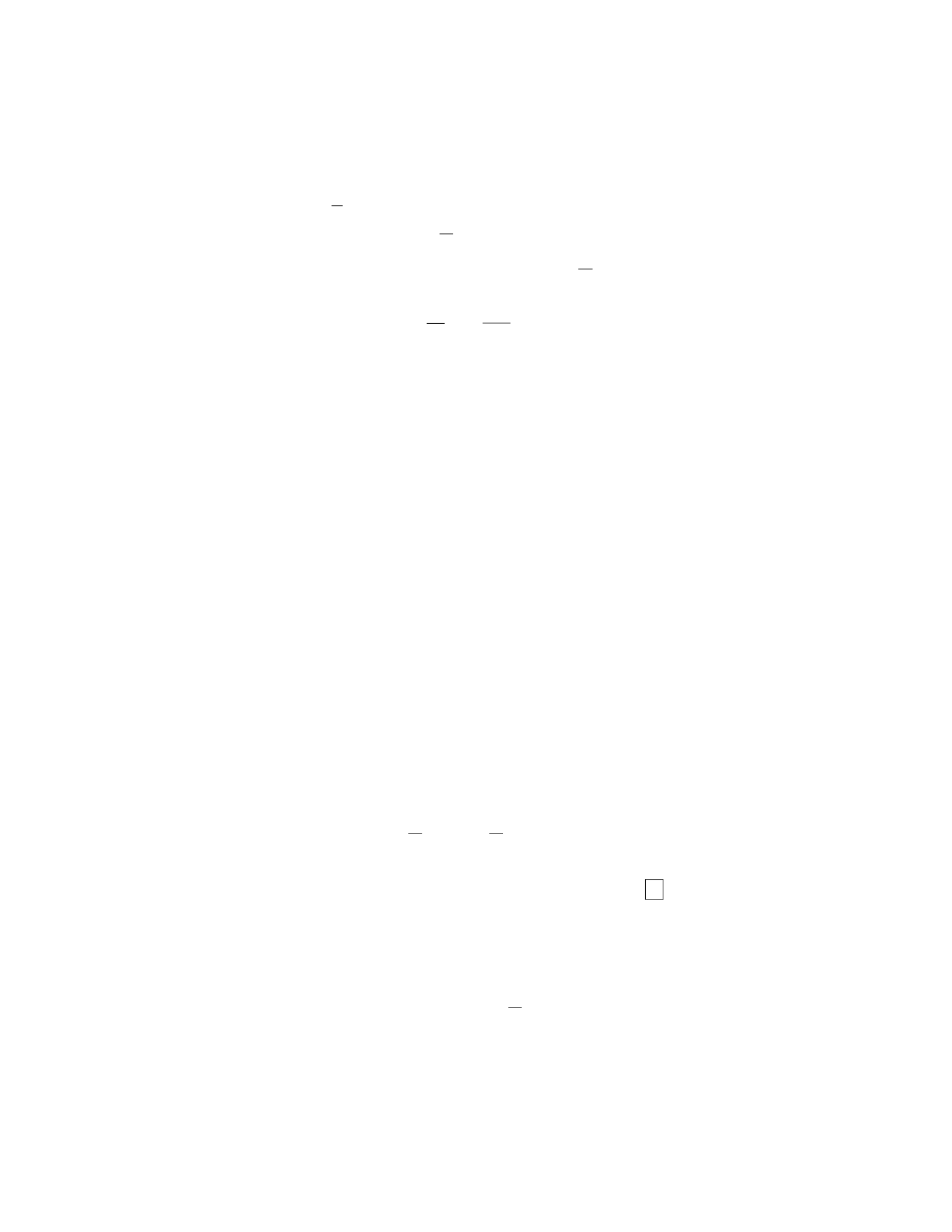
Step 3: Find d
dt (et).
d
dt (et) = et
Therefore, the derivative of u(t) with respect to t,du
dt , is:
du
dt =
6t2
1
2t1/2
et
Question 30
Question
Let v= 3i−2j+ 5kand u= 2i+ 6j−4k. Find the derivative of u·vwith
respect to t, where i,j, and kare the unit vectors in the x,y, and zdirections,
respectively.
Solution
Step 1: Recall that for vectors u=u1i+u2j+u3kand v=v1i+v2j+v3k, we
have u·v=u1v1+u2v2+u3v3.
Step 2: Substitute the given values u1= 2, u2= 6, u3=−4, v1= 3,
v2=−2, v3= 5 into the dot product formula:
u·v= 2(3) + 6(−2) + (−4)(5)
Step 3: Simplify the dot product:
u·v= 6 −12 −20 = −26
Step 4: Now, differentiate both sides of the equation u·v=−26 with respect
to t.
Step 5: On the left-hand side, we have:
d
dt (u·v) = d
dt (−26)
Step 6: Differentiating the right-hand side gives us 0.
Step 7: Therefore, the derivative of u·vwith respect to tis 0 .
Question 31
Question
Let v= 3xi+ 4yjand w= 2xi+ 5yj. Find d
dx (v·w).
19

Solution
Step 1: Compute the dot product of vand w.
v·w= (3xi+ 4yj)·(2xi+ 5yj) = 6x2+ 20y2
Step 2: Differentiate v·wwith respect to x.
d
dx (v·w) = d
dx (6x2+ 20y2) = d
dx (6x2) + d
dx (20y2)
Step 3: Apply the chain rule to find d
dx (6x2).
d
dx (6x2) = 2(6)x2−1= 12x
Step 4: Apply the chain rule to find d
dx (20y2). Note: Since we are differen-
tiating with respect to x, we treat yas a constant.
d
dx (20y2) = 0
Step 5: Combine the results to find the final answer.
d
dx (v·w) = 12x+ 0 = 12x
Question 32
Question
Let v=
3t2
et
ln(t)
be a vector function. Find dv
dt .
Solution
Step 1: Compute the derivative of each component of vwith respect to t.
For the first component, we have:
d
dt (3t2)=6t
For the second component, we have:
d
dt (et) = et
For the third component, we have:
d
dt (ln(t)) = 1
t
Therefore, we have:
dv
dt =
6t
et
1
t
20

Question 33
Question
Let y=
ex
sin(x)
ln(x)
, where x∈R. Find dy
dx .
Solution
To find dy
dx , we will differentiate each component of ywith respect to x.
Step 1: Differentiate the first component ex:
d
dx (ex) = ex
Step 2: Differentiate the second component sin(x):
d
dx (sin(x)) = cos(x)
Step 3: Differentiate the third component ln(x):
d
dx (ln(x)) = 1
x
Therefore, dy
dx =
ex
cos(x)
1
x
.
Question 34
Question
Let v= 3i−2j+ 4kand u= 2i+ 5j−k. Find d
dt (u·v).
Solution
Step 1: Recall that the dot product of two vectors u=u1i+u2j+u3kand
v=v1i+v2j+v3kis given by u·v=u1v1+u2v2+u3v3.
Step 2: Calculate u·v:
u·v= (2)(3) + (5)(−2) + (−1)(4) = 6 −10 −4 = −8.
Step 3: Differentiate u·vwith respect to t:
d
dt (u·v) = d
dt (−8) = 0.
Therefore, d
dt (u·v) = 0.
21
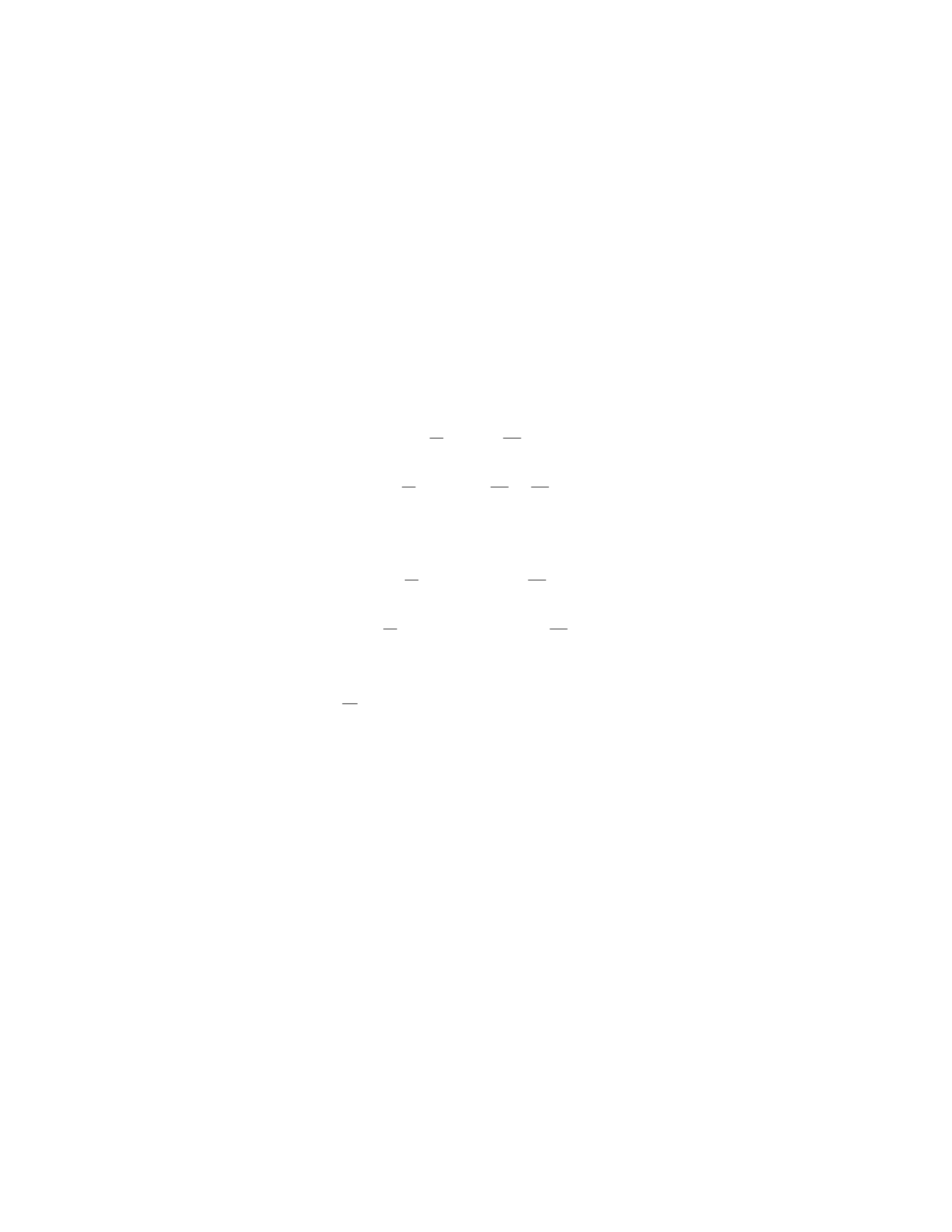
Question 35
Question
Let u=2
3and v=4
−1. Find the derivative of the following function with
respect to t:
f(t)=3tu−2t2v
Solution
Step 1: Use the properties of vector derivatives:
d
dt (cu) = cdu
dt
d
dt (u+v) = du
dt +dv
dt
where cis a constant.
Step 2: Find the derivative of f(t) term by term:
d
dt (3tu) = 3u+ 3tdu
dt
d
dt (−2t2v) = −4tv−2t2dv
dt
Step 3: Substitute the given values and simplify:
df
dt = 3 2
3+ 3t0
0−4t4
−1−2t20
0
=6
9−16t
−4t
=6−16t
9+4t
Therefore, the derivative of f(t) with respect to tis 6−16t
9+4t.
22

Question 2
Question
Let v=
x2
ex
ln(y)
and w=
sin(y)
y2
cos(x)
. Find d
dx (v·w).
Solution
Step 1: Compute v·wThe dot product of two vectors vand wis given by:
v·w=v1w1+v2w2+v3w3, where v=
v1
v2
v3
and w=
w1
w2
w3
. So, v·w=
x2sin(y) + exy2+ ln(y) cos(x).
Step 2: Differentiate the expression with respect to xTo find d
dx (v·w), we
differentiate the expression v·wwith respect to x.d
dx (v·w) = d
dx (x2sin(y) +
exy2+ ln(y) cos(x)).
Step 3: Apply the chain rule to differentiate each term We will differenti-
ate each term with respect to x: - For the first term x2sin(y), we apply the
chain rule: d
dx (x2) sin(y) + x2d
dx (sin(y)). - For the second term exy2, we have
exd
dx (y2)+y2d
dx (ex). - For the third term ln(y) cos(x), we get d
dx (ln(y)) cos(x)+
ln(y)d
dx (cos(x)).
Step 4: Finalize the solution This will depend on the specific expressions
obtained after applying the chain rule. Just make sure to simplify the final
expression.
Question 3
Question
Let uand vbe two vectors in R3. If u=
x2
2y
z3
and v=
exy
3z2
√x
, find the
derivative of u·vwith respect to x.
Solution
Given u=
x2
2y
z3
and v=
exy
3z2
√x
, we first compute the dot product u·v:
u·v=x2·exy + 2y·3z2+z3·√x.
Step 1: Find the derivative of u·vwith respect to xusing the product rule:
d
dx (u·v) = d
dx (x2·exy) + d
dx (2y·3z2) + d
dx (z3·√x).
2
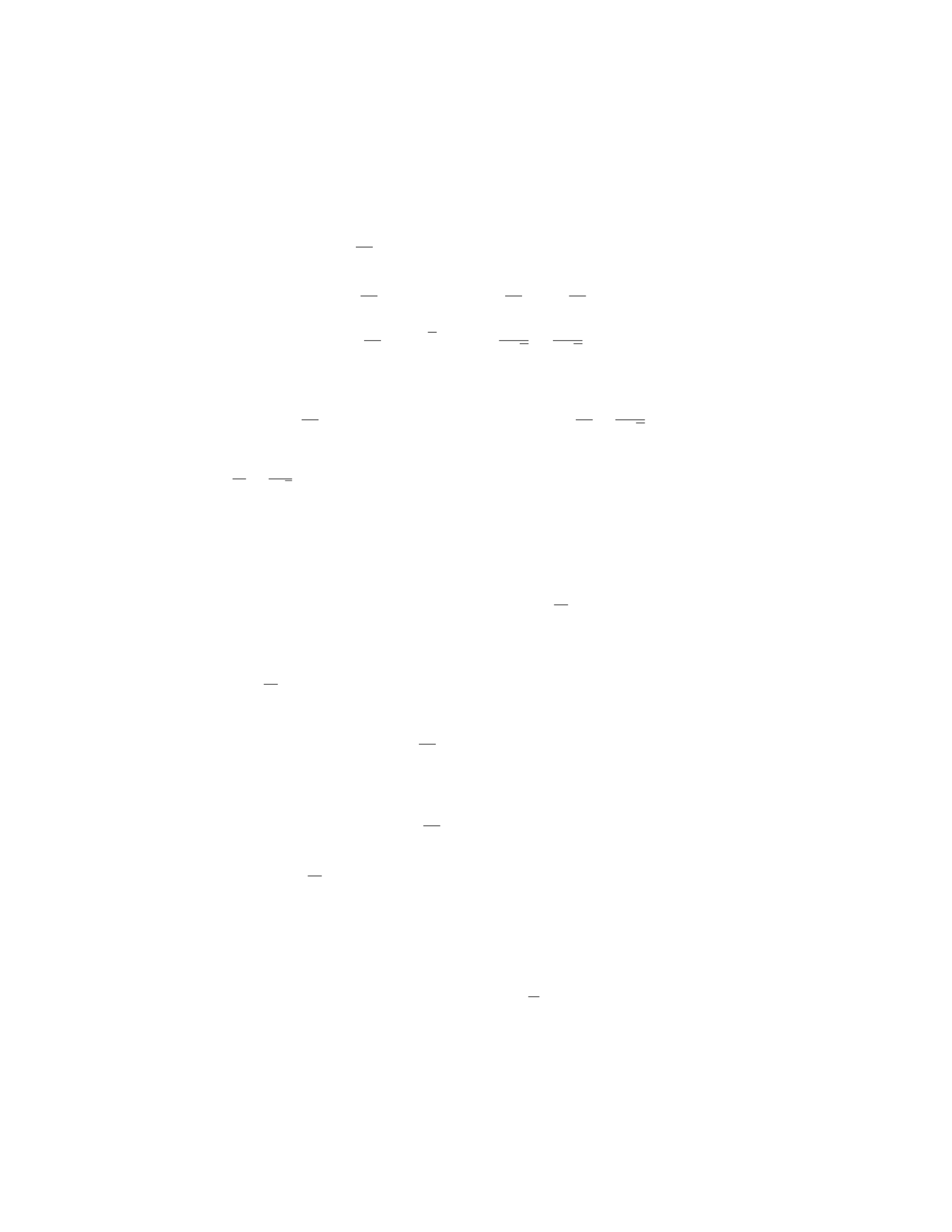
Step 2: Calculate each of the individual derivatives:
d
dx (x2·exy)=2x·exy +x2·y·exy,
d
dx (2y·3z2) = 2 ·3z2dy
dx = 6z2dy
dx ,
d
dx (z3·√x)=3z2·1
2√x=3z2
2√x.
Step 3: Substitute the calculated derivatives back into the original expres-
sion: d
dx (u·v) = (2x·exy +x2·y·exy)+6z2dy
dx +3z2
2√x.
Therefore, the derivative of u·vwith respect to xis (2x·exy +x2·y·exy) +
6z2dy
dx +3z2
2√x.
Question 4
Question
Let v=2x3y
3xy2be a vector-valued function. Find dv
dx .
Solution
To find dv
dx , we differentiate each component of vwith respect to x.
Step 1: Differentiate the first component 2x3yof vwith respect to x:
d
dx (2x3y)=6x2y
Step 2: Differentiate the second component 3xy2of vwith respect to x:
d
dx (3xy2)=3y2
Therefore, dv
dx =6x2y
3y2.
Question 5
Question
Let u= 3i+ 2j−kand v= 2i−j+ 4k. Find d
dt (u·v).
3

Solution
Step 1: Recall that the dot product of two vectors uand vis given by u·v=
uxvx+uyvy+uzvz.
Step 2: Compute the dot product u·v.
u·v= (3)(2) + (2)(−1) + (−1)(4) = 6 −2−4 = 0
Step 3: Differentiate both sides of the equation with respect to t.
d
dt (u·v) = d
dt (0)
Step 4: Simplify the derivative.
d
dt (u·v) = 0
Step 5: Therefore, d
dt (u·v) = 0 .
Question 6
Question
Let u= 2i−3j+ 4kand v= 5i+ 2j−k. Find d
dt (u·v).
Solution
Step 1: Recall the formula for the derivative of the dot product of two vectors.
If u(t) = u1(t)i+u2(t)j+u3(t)kand v(t) = v1(t)i+v2(t)j+v3(t)k, then
d
dt (u·v) = d
dt (u1v1+u2v2+u3v3).
Step 2: Compute the dot product u·v.
u·v= 2 ·5+(−3) ·2+4·(−1) = 10 −6−4=0
Step 3: Differentiate the dot product with respect to t.
d
dt (u·v) = d
dt (0) = 0
Therefore, d
dt (u·v) = 0.
Question 7
Question
Let u= 3i−2j+kand v=i+ 2j−4k. Compute the gradient of the scalar
field f(r) = u·v.
4

Solution
Step 1: Calculate the dot product of uand v.
u·v= (3i−2j+k)·(i+ 2j−4k)
= 3i·i+ 3i·2j−3i·4k−2j·j−2j·2k+k·2k
= 3 + 6 −12 −1−4−16
=−24
Step 2: Now, determine the gradient of the scalar field f(r) = u·v.
∇f=
∂f
∂x
∂f
∂y
∂f
∂z
Step 3: Recall that the dot product rule states ∇(u·v) = v∇ · u+u∇ · v.
Step 4: Apply the dot product rule to find ∇f.
∇f=v∇ · u+u∇ · v
Step 5: Substitute the given vectors uand vinto the formula to find the
gradient ∇f.
∇f= (i+ 2j−4k)· ∇(3i−2j+k) + (3i−2j+k)· ∇(i+ 2j−4k)
Step 6: Calculate the gradients of uand vusing the standard formula for
differentiation of vector components to obtain the final result.
Question 8
Question
Let u=
x2−y
xy −z2
yz −x
. Find ∇ · ∇ × u.
Solution
Step 1: Calculate ∇×u. We have ∇×u=
i j k
∂
∂x
∂
∂y
∂
∂z
x2−y xy −z2yz −x
. Expand-
ing the determinant: ∇×u=∂(yz−x)
∂y −∂(xy−z2)
∂z i−∂(x2−y)
∂x −∂(yz−x)
∂z j+
∂(xy−z2)
∂x −∂(x2−y)
∂y k. Simplifying, we get: ∇ × u=
−1
−1
0
.
Step 2: Calculate ∇ · ∇ × u. We have ∇ · ∇ × u=∂(−1)
∂x +∂(−1)
∂y +∂(0)
∂z .
Thus, ∇ · ∇ × u= 0.
5
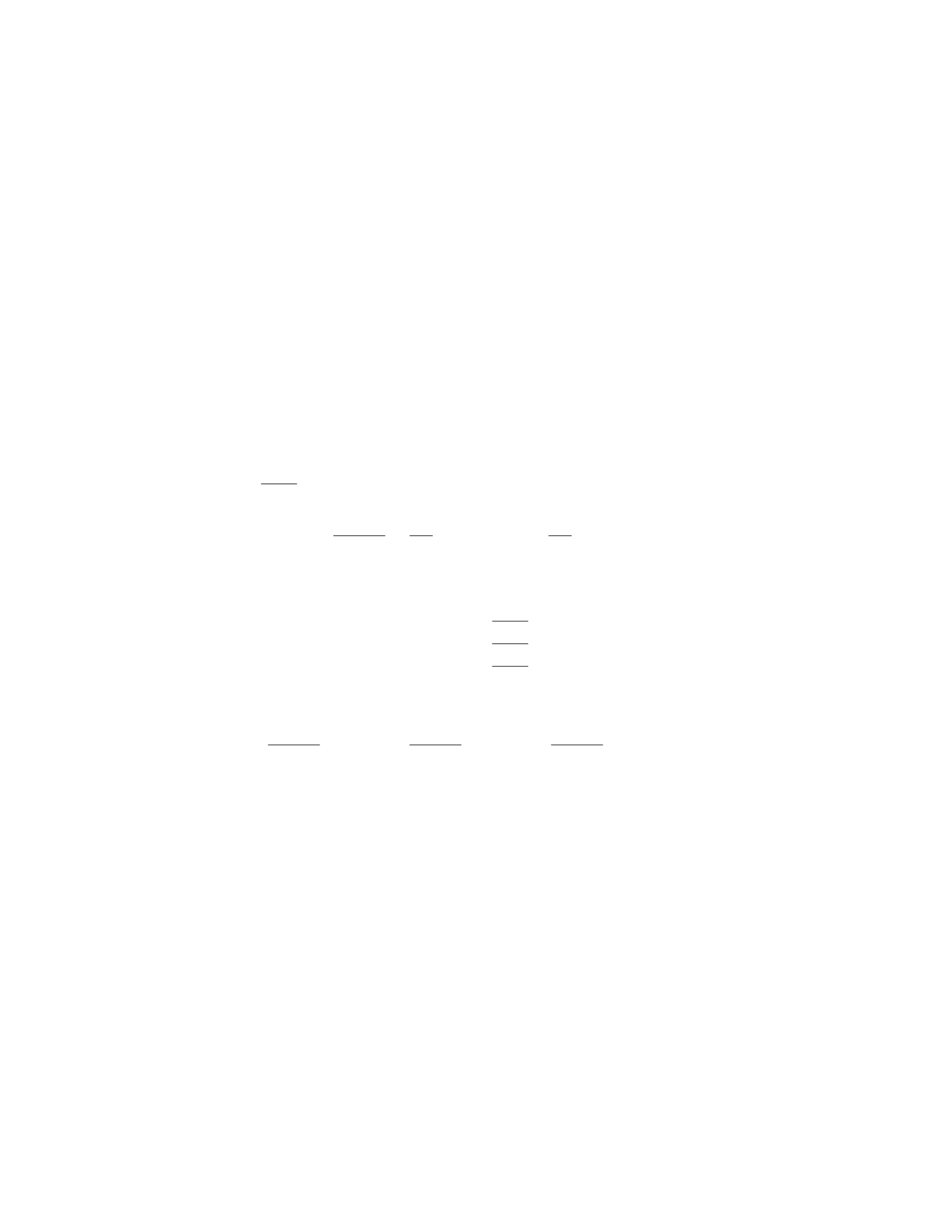
Question 9
Question
Let u=
3
−4
5
and v=
2
1
−3
. Find ∇(u·v).
Solution
Step 1: First, we find the dot product of uand v:
u·v= 3(2) + (−4)(1) + 5(−3) = 6 −4−15 = −13.
Step 2: Next, we differentiate the dot product with respect to each compo-
nent of uand v:
For ∂(u·v)
∂ui:
∂(u·v)
∂ui
=∂
∂ui
(
3
X
j=1
ujvj) =
3
X
j=1
∂
∂ui
(ujvj).
Step 3: Now we find the gradient of u·v:
∇(u·v) =
∂(u·v)
∂u1
∂(u·v)
∂u2
∂(u·v)
∂u3
.
Step 4: The components of ∇(u·v) are calculated as:
∂(u·v)
∂u1
=v1= 2,∂(u·v)
∂u2
=v2= 1,∂(u·v)
∂u3
=v3=−3.
Step 5: Thus, the gradient of (u·v) is:
∇(u·v) =
2
1
−3
.
Question 10
Question
Let u= 3i−2j+ 5kand v= 2i+ 4j−k. Find the derivative of u·vwith
respect to t, where uand vare functions of t.
6

Solution
Step 1: Recall that the dot product of two vectors uand vis given by u·v=
u1v1+u2v2+u3v3where u=u1i+u2j+u3kand v=v1i+v2j+v3k.
Step 2: We can calculate the dot product of uand vas:
u·v= (3)(2) + (−2)(4) + (5)(−1) = 6 −8−5 = −7
Step 3: To find the derivative of u·vwith respect to t, we differentiate each
component of uand vwith respect to tand then apply the dot product rule.
Step 4: Let u=u(t)=3i−2j+ 5kand v=v(t) = 2i+ 4j−k.
Step 5: Differentiating uwith respect to tgives du
dt =d
dt (3i−2j+ 5k) =
0−0+0=0.
Step 6: Differentiating vwith respect to tgives dv
dt =d
dt (2i+ 4j−k) =
0+0−0=0.
Step 7: Therefore, the derivative of u·vwith respect to tis d
dt (u·v) = 0.
Question 11
Question
Let v= (3x2+ 2y)i+ (4xy −z)j+ (5z2−6xz)kbe a vector-valued function.
Find dv
dt .
Solution
Step 1: Write the given vector-valued function in terms of x(t), y(t), and z(t).
v= (3x2+ 2y)i+ (4xy −z)j+ (5z2−6xz)k
= (3x(t)2+ 2y(t))i+ (4x(t)y(t)−z(t))j+ (5z(t)2−6x(t)z(t))k
Step 2: Differentiate each component with respect to t.
dv
dt =d
dt [(3x(t)2+ 2y(t))i+ (4x(t)y(t)−z(t))j+ (5z(t)2−6x(t)z(t))k]
=d
dt [(3x(t)2+ 2y(t))i] + d
dt [(4x(t)y(t)−z(t))j] + d
dt [(5z(t)2−6x(t)z(t))k]
= (6x(t)dx
dt +2dy
dt )i+(4(dx
dt y(t)+x(t)dy
dt )−dz
dt )j+(10z(t)dz
dt −6(dx
dt z(t)+x(t)dz
dt ))k
Thus, dv
dt = (6xdx
dt + 2 dy
dt )i+ (4( dx
dt y+xdy
dt )−dz
dt )j+ (10zdz
dt −6(dx
dt z+xdz
dt ))k.
7

Question 12
Question
Let v=
3t2
2t
t
be a vector-valued function. Find dv
dt , the derivative of vwith
respect to t.
Solution
Step 1: To find the derivative of vwith respect to t, we need to take the
derivative of each component of vseparately.
Step 2: The derivative of the first component 3t2is 6t, the derivative of the
second component 2tis 2, and the derivative of the third component tis 1.
Step 3: Therefore, the derivative of v=
3t2
2t
t
with respect to tis dv
dt =
6t
2
1
.
Question 13
Question
Let uand vbe vectors in R3. Suppose u=
2
4
6
and v=
1
3
5
. Find d(u·v)
du.
Solution
To find the derivative of the dot product of two vectors with respect to one of
the vectors, we can use the property: d(u·v)
du=v.
Step 1: Compute the dot product of uand v.
u·v=
2
4
6
·
1
3
5
= 2(1) + 4(3) + 6(5) = 2 + 12 + 30 = 44.
Step 2: Derive the dot product with respect to u.
d(44)
du=44
du=
1
3
5
=v.
Therefore, d(u·v)
du=
1
3
5
.
8

Question 14
Question
Let v=
3x2y
x3
2xy2
. Find dv
dx .
Solution
To find dv
dx , we differentiate each component of vwith respect to x.
Step 1: Differentiate the first component: 3x2y.
d
dx (3x2y)=6xy
Step 2: Differentiate the second component: x3.
d
dx (x3) = 3x2
Step 3: Differentiate the third component: 2xy2.
d
dx (2xy2)=2y2
Step 4: Therefore, dv
dx =
6xy
3x2
2y2
.
Question 15
Question
Let v=3x2+ 2xy
x2+y2. Find dv
dx .
Solution
To find dv
dx , we will differentiate each component of vwith respect to x.
Step 1: Differentiate the first component of vwith respect to x:
d
dx (3x2+ 2xy)=6x+ 2ydy
dx
Step 2: Differentiate the second component of vwith respect to x:
d
dx (x2+y2)=2x+ 2ydy
dx
Therefore, dv
dx =6x+ 2ydy
dx
2x+ 2ydy
dx .
9

Question 16
Question
Find the derivative of the vector function r(t) = ⟨t2,sin(t), et⟩.
Solution
Step 1: The derivative of a vector function is found by taking the derivative of
each component separately. Therefore, we need to find the derivative of each
component of r(t). Let r(t) = ⟨f(t), g(t), h(t)⟩, where f(t) = t2,g(t) = sin(t),
and h(t) = et.
Step 2: Find the derivative of the first component f(t) = t2.
d
dt (t2)=2t
Step 3: Find the derivative of the second component g(t) = sin(t).
d
dt (sin(t)) = cos(t)
Step 4: Find the derivative of the third component h(t) = et.
d
dt (et) = et
Step 5: Assemble the derivatives of the components into a vector expression
to find r′(t).
r′(t) = ⟨2t, cos(t), et⟩
Therefore, the derivative of the vector function r(t) = ⟨t2,sin(t), et⟩is r′(t) =
⟨2t, cos(t), et⟩.
Question 17
Question
Let u=x2
2xyand v=sin y
ex. Find the derivative of u·vwith respect to x.
Solution
Step 1: Compute u·v:
u·v=x2
2xy·sin y
ex=x2sin y+ 2xyex
Step 2: Differentiate u·vwith respect to x:
d
dx (u·v) = d
dx (x2sin y+ 2xyex)
10

Step 3: Apply the product rule to differentiate x2sin y+ 2xyex:
d
dx (x2sin y+ 2xyex) = d
dx (x2) sin y+x2d
dx (sin y) + d
dx (2xy)ex+ 2yd
dx (xex)
= 2xsin y+x2cos y+ 2yex+ 2xyex
Therefore, the derivative of u·vwith respect to xis 2xsin y+x2cos y+
2yex+ 2xyex.
Question 18
Question
Let aand bbe two vectors in R3defined as a= 2i−3j+4kand b= 3i+ 2j−k.
Compute the derivative of a·bwith respect to t, where aand bare functions
of t.
Solution
Given two vectors aand bin R3as functions of t:
a(t)=2i−3j+ 4k,b(t)=3i+ 2j−k.
The dot product of two vectors aand bis defined as:
a·b=|a||b|cos θ,
where θis the angle between the two vectors. It can also be written as:
a·b=a1b1+a2b2+a3b3,
where a=a1i+a2j+a3kand b=b1i+b2j+b3k.
The derivative of a·bwith respect to tis given by:
d
dt (a·b) = d
dt (a1b1+a2b2+a3b3).
Now, substitute a(t) and b(t) into the equation:
d
dt (2 ·3+(−3) ·2+4·(−1)) = d
dt (6 −6−4).
Thus, the derivative of a·bwith respect to tis 0 .
Question 19
Question
Let v= (x2+y2)i−2xyjbe a vector field in R2. Compute ∇ · v, where ∇is
the del operator.
11

Solution
Step 1: Find the components of the del operator in 2 dimensions.
∇=∂
∂x i+∂
∂y j
Step 2: Compute the divergence of v.
∇ · v=∂
∂x (x2+y2)−∂
∂y (2xy)
Step 3: Simplify the expression using partial derivative rules.
∇ · v= 2x−2x= 0
Step 4: Therefore, the divergence of the vector field vis ∇ · v= 0.
Question 20
Question
Let v=
2x2y
3xy
x2z
. Find dv
dx .
Solution
To find dv
dx , we will differentiate each component of vwith respect to x.
Step 1: Differentiate the first component of v, 2x2y, with respects to x:
d
dx (2x2y)=4xy
Step 2: Differentiate the second component of v, 3xy, with respects to x:
d
dx (3xy)=3y
Step 3: Differentiate the third component of v,x2z, with respects to x:
d
dx (x2z)=2xz
Step 4: Putting it all together, we have:
dv
dx =
4xy
3y
2xz
12

Question 21
Question
Let u=2
3and v=4
−1. Find d
dt (u·v).
Solution
Step 1: Recall that the dot product u·vis given by u·v=u1v1+u2v2.
Step 2: Calculate d
dt (u·v) using the chain rule:
d
dt (u·v) = d
dt (2 ·4+3· −1)
Step 3: Simplify the expression:
d
dt (u·v) = d
dt (8 −3) = d
dt (5)
Step 4: Since 5 is a constant, its derivative with respect to tis 0:
d
dt (u·v)=0
Therefore, d
dt (u·v) = 0.
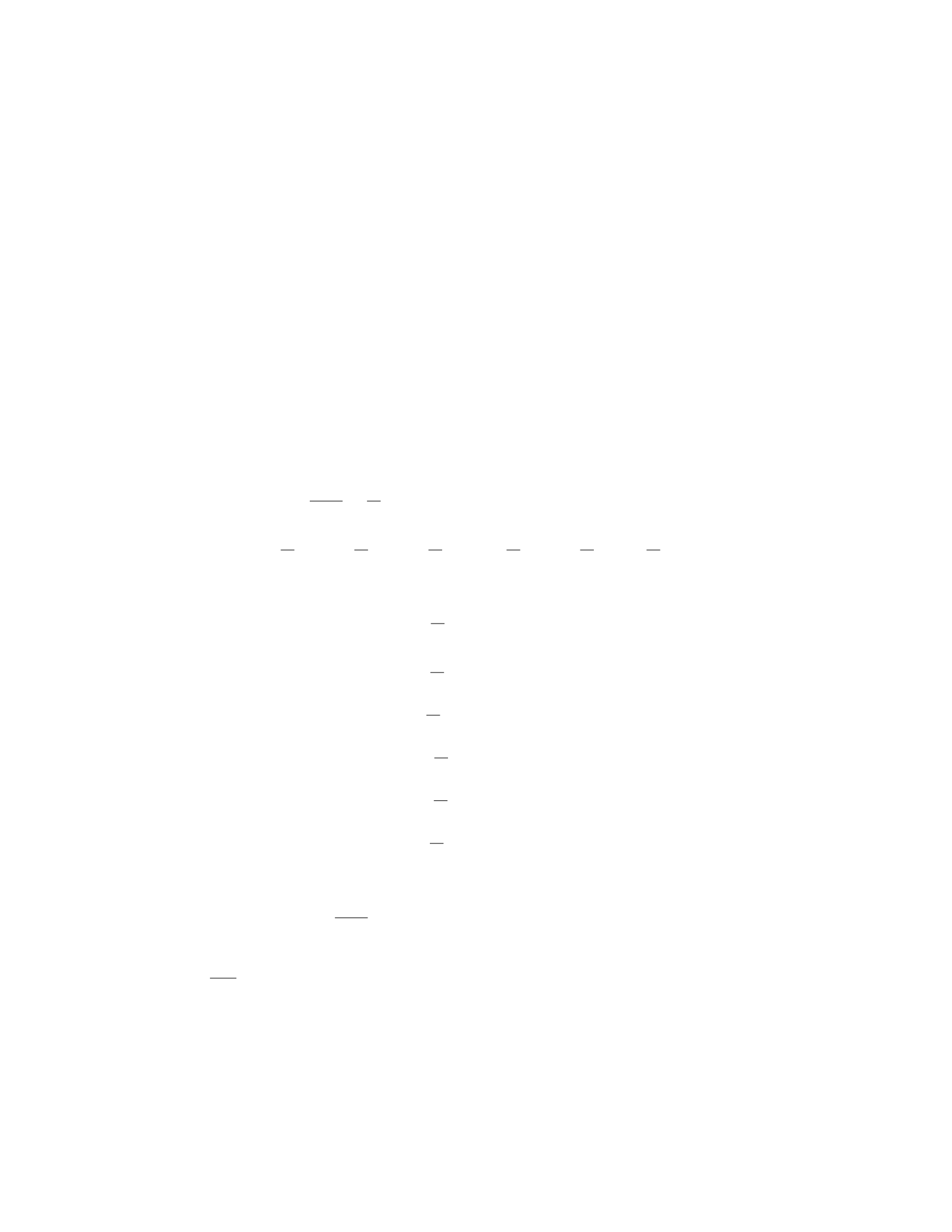
Question 22
Question
Let u(t)=(e3t, e2t, et) and v(t)=(tsin(t), t cos(t), t2). Find d
dt (u(t)·v(t)).
Solution
Step 1: Compute u(t)·v(t).
u(t)·v(t) = (e3t, e2t, et)·(tsin(t), t cos(t), t2)
=e3t·tsin(t) + e2t·tcos(t) + et·t2
=te3tsin(t) + te2tcos(t) + t2et
Step 2: Differentiate u(t)·v(t) with respect to t.
d
dt (u(t)·v(t)) = d
dt (te3tsin(t) + te2tcos(t) + t2et)
=e3tsin(t) + te3tcos(t) + e2tcos(t)−te2tsin(t)+2tet
Therefore, d
dt (u(t)·v(t)) = e3tsin(t)+te3tcos(t)+e2tcos(t)−te2tsin(t)+2tet.
13
Question 23
Question
Let u= 3i−2j+ 4kand v= 2i+ 5j−k. Find the derivative of the vector
function f(t) = ut3+vt2with respect to t.
Solution
Step 1: First, we need to expand the vector function f(t).
f(t) = (3i−2j+ 4k)t3+ (2i+ 5j−k)t2
= 3it3−2jt3+ 4kt3+ 2it2+ 5jt2−kt2
Step 2: Now, we will find the derivative of f(t) with respect to t.
df(t)
dt =d
dt (3it3−2jt3+ 4kt3+ 2it2+ 5jt2−kt2)
= 3 d
dt (it3)−2d
dt (jt3)+4d
dt (kt3)+2d
dt (it2)+5d
dt (jt2)−d
dt (kt2)
Step 3: Now, differentiate each term with respect to t.
d
dt (it3) = 3it2
d
dt (jt3) = 3jt2
d
dt (kt3) = 3kt2
d
dt (it2)=2it
d
dt (jt2)=2jt
d
dt (kt2)=2kt
Step 4: Substitute these derivatives back into the expression.
df(t)
dt = 3it2−2jt2+ 4kt2+ 2it+ 5jt−kt
Therefore, the derivative of the vector function f(t) with respect to tis
df(t)
dt = 3it2−2jt2+ 4kt2+ 2it+ 5jt−kt.
14

Question 24
Question
Let u=
x2
y3
z4
and v=
ex
sin(y)
cos(z)
. Find d(u·v)
dt , where tis a scalar parameter.
Solution
Step 1: Compute the dot product u·v.
u·v= (x2)(ex)+(y3)(sin(y)) + (z4)(cos(z))
Step 2: Differentiate u·vwith respect to tusing the product rule.
d(u·v)
dt =d
dt [(x2)(ex)] + d
dt [(y3)(sin(y))] + d
dt [(z4)(cos(z))]
Step 3: Apply the chain rule and basic differentiation rules.
d(u·v)
dt = 2xexdx
dt +x2ex+3y2sin(y)dy
dt +y3cos(y)+4z3cos(z)dz
dt +z4(−sin(z))
Step 4: Simplify the expression.
d(u·v)
dt =x2ex2dx
dt + 1+y3sin(y)3dy
dt + 1+z4cos(z)4dz
dt −1
Therefore, d(u·v)
dt =x2ex2dx
dt + 1+y3sin(y)3dy
dt + 1+z4cos(z)4dz
dt −1.
Question 25
Question
Let v= (2x3−y2)i+ (3xy +z2)j−(4xz + 2yz2)k. Find ∂v
∂y .
Solution
Step 1: To find ∂v
∂y , we differentiate each component of vwith respect to y.
∂v
∂y =∂
∂y [(2x3−y2)i+ (3xy +z2)j−(4xz + 2yz2)k]
Step 2: Differentiating the xcomponent of v, 2x3−y2, with respect to y
gives 0.
∂(2x3−y2)
∂y = 0
15

Step 3: Differentiating the ycomponent of v, 3xy +z2, with respect to y
gives 3x.
∂(3xy +z2)
∂y = 3x
Step 4: Differentiating the zcomponent of v,−4xz + 2yz2, with respect to
ygives 2z2.
∂(−4xz + 2yz2)
∂y = 2z2
Step 5: Combining the components with respect to y, we have
∂v
∂y = 0i+ 3xj+ 2z2k= 3xj+ 2z2k
Therefore, ∂v
∂y = 3xj+ 2z2k.
Question 26
Question
Let v(t) =
tet
t2
sin(t)
. Find
dt.
Solution
Step 1: To find
dt, wedifferentiateeachcomponentofv(t)withrespecttot.
Step 2: Differentiating the first component tetwith respect to t, we get
d
dt (tet) = et+tet
Step 3: Differentiating the second component t2with respect to t, we get
d
dt (t2)=2t
Step 4: Differentiating the third component sin(t) with respect to t, we get
d
dt (sin(t)) = cos(t)
Step 5: Combining the results from Steps 2, 3, and 4, we have
16

dt =
et+tet
2t
cos(t)
Therefore,
dt =
et+tet
2t
cos(t)
.
Question 27
Question
Let u= 2i−3j+ 4kand v= 5i+ 6j−2k. Find d
dt (u·v).
Solution
Step 1: Recall that the dot product of two vectors u·vis given by |u||v|cos(θ),
where θis the angle between the two vectors.
Step 2: Calculating d
dt (u·v) involves finding the derivative of |u||v|cos(θ).
Step 3: The magnitude of a vector u=ai+bj+ckis given by |u|=
√a2+b2+c2.
Step 4: Let’s calculate |u|and |v|.
|u|=p(2)2+ (−3)2+ (4)2
=√4 + 9 + 16
=√29
|v|=p(5)2+ (6)2+ (−2)2
=√25 + 36 + 4
=√65
Step 5: The dot product u·vcan be written as 2 ×5 + (−3) ×6 + 4 ×(−2).
Step 6: Therefore, u·v= 10 −18 −8 = −16.
Step 7: Now, let’s differentiate u·vwith respect to t.
d
dt (u·v) = d
dt (−16)
= 0
Step 8: Thus, d
dt (u·v) = 0.
Question 28
Question
Let u= 3xi+eyjand v=exi+ 4yj. Find d(u
·v)dx.
17
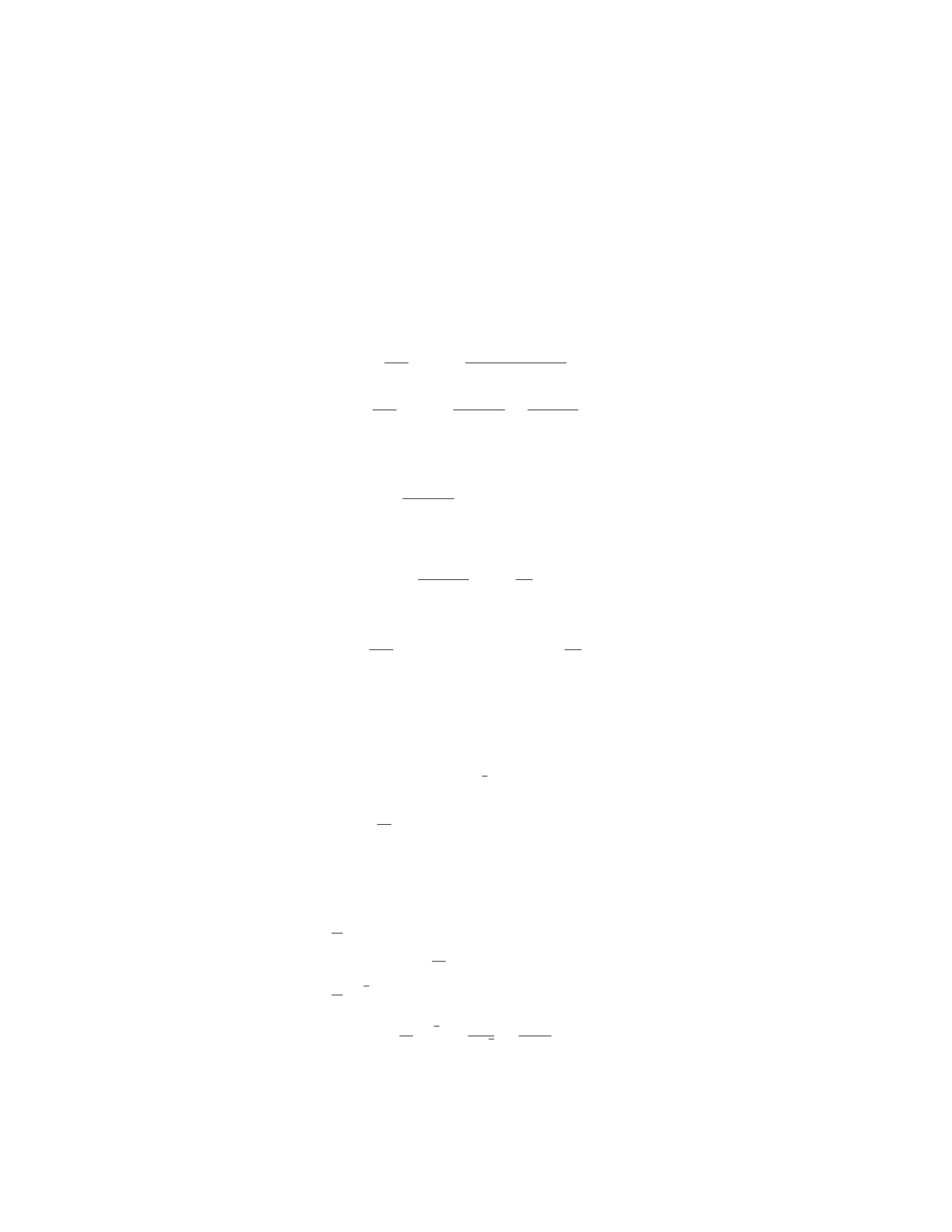
Solution
Step 1: Compute the dot product of uand v:
u·v= (3xi+eyj)·(exi+ 4yj)
u·v= 3xex+ 4yey
Step 2: Differentiate the dot product with respect to x:
d(u
·v)dx =d(3xex+ 4yey)
dx
d(u
·v)dx =d(3xex)
dx +d(4yey)
dx
Step 3: Differentiate each term using the product rule: For the first term
3xex, differentiate 3xwith respect to xand exwith respect to x:
d(3xex)
dx = 3ex+ 3xex
Step 4: For the second term 4yey, differentiate 4ywith respect to xand ey
with respect to x:
d(4yey)
dx = 4eydy
dx
Step 5: Therefore, the final result is:
d(u
·v)dx = 3ex+ 3xex+ 4eydy
dx
Question 29
Question
Consider a vector function u(t) =
2t3
√t
et
. Find the derivative of u(t) with
respect to t, denoted by du
dt .
Solution
To find the derivative of u(t) with respect to t, we differentiate each component
of useparately.
Step 1: Find d
dt (2t3).
d
dt (2t3)=6t2
Step 2: Find d
dt (√t).
d
dt (√t) = 1
2√t=1
2t1/2
18

Step 3: Find d
dt (et).
d
dt (et) = et
Therefore, the derivative of u(t) with respect to t,du
dt , is:
du
dt =
6t2
1
2t1/2
et
Question 30
Question
Let v= 3i−2j+ 5kand u= 2i+ 6j−4k. Find the derivative of u·vwith
respect to t, where i,j, and kare the unit vectors in the x,y, and zdirections,
respectively.
Solution
Step 1: Recall that for vectors u=u1i+u2j+u3kand v=v1i+v2j+v3k, we
have u·v=u1v1+u2v2+u3v3.
Step 2: Substitute the given values u1= 2, u2= 6, u3=−4, v1= 3,
v2=−2, v3= 5 into the dot product formula:
u·v= 2(3) + 6(−2) + (−4)(5)
Step 3: Simplify the dot product:
u·v= 6 −12 −20 = −26
Step 4: Now, differentiate both sides of the equation u·v=−26 with respect
to t.
Step 5: On the left-hand side, we have:
d
dt (u·v) = d
dt (−26)
Step 6: Differentiating the right-hand side gives us 0.
Step 7: Therefore, the derivative of u·vwith respect to tis 0 .
Question 31
Question
Let v= 3xi+ 4yjand w= 2xi+ 5yj. Find d
dx (v·w).
19

Solution
Step 1: Compute the dot product of vand w.
v·w= (3xi+ 4yj)·(2xi+ 5yj) = 6x2+ 20y2
Step 2: Differentiate v·wwith respect to x.
d
dx (v·w) = d
dx (6x2+ 20y2) = d
dx (6x2) + d
dx (20y2)
Step 3: Apply the chain rule to find d
dx (6x2).
d
dx (6x2) = 2(6)x2−1= 12x
Step 4: Apply the chain rule to find d
dx (20y2). Note: Since we are differen-
tiating with respect to x, we treat yas a constant.
d
dx (20y2) = 0
Step 5: Combine the results to find the final answer.
d
dx (v·w) = 12x+ 0 = 12x
Question 32
Question
Let v=
3t2
et
ln(t)
be a vector function. Find dv
dt .
Solution
Step 1: Compute the derivative of each component of vwith respect to t.
For the first component, we have:
d
dt (3t2)=6t
For the second component, we have:
d
dt (et) = et
For the third component, we have:
d
dt (ln(t)) = 1
t
Therefore, we have:
dv
dt =
6t
et
1
t
20

Question 33
Question
Let y=
ex
sin(x)
ln(x)
, where x∈R. Find dy
dx .
Solution
To find dy
dx , we will differentiate each component of ywith respect to x.
Step 1: Differentiate the first component ex:
d
dx (ex) = ex
Step 2: Differentiate the second component sin(x):
d
dx (sin(x)) = cos(x)
Step 3: Differentiate the third component ln(x):
d
dx (ln(x)) = 1
x
Therefore, dy
dx =
ex
cos(x)
1
x
.
Question 34
Question
Let v= 3i−2j+ 4kand u= 2i+ 5j−k. Find d
dt (u·v).
Solution
Step 1: Recall that the dot product of two vectors u=u1i+u2j+u3kand
v=v1i+v2j+v3kis given by u·v=u1v1+u2v2+u3v3.
Step 2: Calculate u·v:
u·v= (2)(3) + (5)(−2) + (−1)(4) = 6 −10 −4 = −8.
Step 3: Differentiate u·vwith respect to t:
d
dt (u·v) = d
dt (−8) = 0.
Therefore, d
dt (u·v) = 0.
21

Question 35
Question
Let u=2
3and v=4
−1. Find the derivative of the following function with
respect to t:
f(t)=3tu−2t2v
Solution
Step 1: Use the properties of vector derivatives:
d
dt (cu) = cdu
dt
d
dt (u+v) = du
dt +dv
dt
where cis a constant.
Step 2: Find the derivative of f(t) term by term:
d
dt (3tu) = 3u+ 3tdu
dt
d
dt (−2t2v) = −4tv−2t2dv
dt
Step 3: Substitute the given values and simplify:
df
dt = 3 2
3+ 3t0
0−4t4
−1−2t20
0
=6
9−16t
−4t
=6−16t
9+4t
Therefore, the derivative of f(t) with respect to tis 6−16t
9+4t.
22

Question 2
Question
Let v=
x2
ex
ln(y)
and w=
sin(y)
y2
cos(x)
. Find d
dx (v·w).
Solution
Step 1: Compute v·wThe dot product of two vectors vand wis given by:
v·w=v1w1+v2w2+v3w3, where v=
v1
v2
v3
and w=
w1
w2
w3
. So, v·w=
x2sin(y) + exy2+ ln(y) cos(x).
Step 2: Differentiate the expression with respect to xTo find d
dx (v·w), we
differentiate the expression v·wwith respect to x.d
dx (v·w) = d
dx (x2sin(y) +
exy2+ ln(y) cos(x)).
Step 3: Apply the chain rule to differentiate each term We will differenti-
ate each term with respect to x: - For the first term x2sin(y), we apply the
chain rule: d
dx (x2) sin(y) + x2d
dx (sin(y)). - For the second term exy2, we have
exd
dx (y2)+y2d
dx (ex). - For the third term ln(y) cos(x), we get d
dx (ln(y)) cos(x)+
ln(y)d
dx (cos(x)).
Step 4: Finalize the solution This will depend on the specific expressions
obtained after applying the chain rule. Just make sure to simplify the final
expression.
Question 3
Question
Let uand vbe two vectors in R3. If u=
x2
2y
z3
and v=
exy
3z2
√x
, find the
derivative of u·vwith respect to x.
Solution
Given u=
x2
2y
z3
and v=
exy
3z2
√x
, we first compute the dot product u·v:
u·v=x2·exy + 2y·3z2+z3·√x.
Step 1: Find the derivative of u·vwith respect to xusing the product rule:
d
dx (u·v) = d
dx (x2·exy) + d
dx (2y·3z2) + d
dx (z3·√x).
2

Step 2: Calculate each of the individual derivatives:
d
dx (x2·exy)=2x·exy +x2·y·exy,
d
dx (2y·3z2) = 2 ·3z2dy
dx = 6z2dy
dx ,
d
dx (z3·√x)=3z2·1
2√x=3z2
2√x.
Step 3: Substitute the calculated derivatives back into the original expres-
sion: d
dx (u·v) = (2x·exy +x2·y·exy)+6z2dy
dx +3z2
2√x.
Therefore, the derivative of u·vwith respect to xis (2x·exy +x2·y·exy) +
6z2dy
dx +3z2
2√x.
Question 4
Question
Let v=2x3y
3xy2be a vector-valued function. Find dv
dx .
Solution
To find dv
dx , we differentiate each component of vwith respect to x.
Step 1: Differentiate the first component 2x3yof vwith respect to x:
d
dx (2x3y)=6x2y
Step 2: Differentiate the second component 3xy2of vwith respect to x:
d
dx (3xy2)=3y2
Therefore, dv
dx =6x2y
3y2.
Question 5
Question
Let u= 3i+ 2j−kand v= 2i−j+ 4k. Find d
dt (u·v).
3

Solution
Step 1: Recall that the dot product of two vectors uand vis given by u·v=
uxvx+uyvy+uzvz.
Step 2: Compute the dot product u·v.
u·v= (3)(2) + (2)(−1) + (−1)(4) = 6 −2−4 = 0
Step 3: Differentiate both sides of the equation with respect to t.
d
dt (u·v) = d
dt (0)
Step 4: Simplify the derivative.
d
dt (u·v) = 0
Step 5: Therefore, d
dt (u·v) = 0 .
Question 6
Question
Let u= 2i−3j+ 4kand v= 5i+ 2j−k. Find d
dt (u·v).
Solution
Step 1: Recall the formula for the derivative of the dot product of two vectors.
If u(t) = u1(t)i+u2(t)j+u3(t)kand v(t) = v1(t)i+v2(t)j+v3(t)k, then
d
dt (u·v) = d
dt (u1v1+u2v2+u3v3).
Step 2: Compute the dot product u·v.
u·v= 2 ·5+(−3) ·2+4·(−1) = 10 −6−4=0
Step 3: Differentiate the dot product with respect to t.
d
dt (u·v) = d
dt (0) = 0
Therefore, d
dt (u·v) = 0.
Question 7
Question
Let u= 3i−2j+kand v=i+ 2j−4k. Compute the gradient of the scalar
field f(r) = u·v.
4

Solution
Step 1: Calculate the dot product of uand v.
u·v= (3i−2j+k)·(i+ 2j−4k)
= 3i·i+ 3i·2j−3i·4k−2j·j−2j·2k+k·2k
= 3 + 6 −12 −1−4−16
=−24
Step 2: Now, determine the gradient of the scalar field f(r) = u·v.
∇f=
∂f
∂x
∂f
∂y
∂f
∂z
Step 3: Recall that the dot product rule states ∇(u·v) = v∇ · u+u∇ · v.
Step 4: Apply the dot product rule to find ∇f.
∇f=v∇ · u+u∇ · v
Step 5: Substitute the given vectors uand vinto the formula to find the
gradient ∇f.
∇f= (i+ 2j−4k)· ∇(3i−2j+k) + (3i−2j+k)· ∇(i+ 2j−4k)
Step 6: Calculate the gradients of uand vusing the standard formula for
differentiation of vector components to obtain the final result.
Question 8
Question
Let u=
x2−y
xy −z2
yz −x
. Find ∇ · ∇ × u.
Solution
Step 1: Calculate ∇×u. We have ∇×u=
i j k
∂
∂x
∂
∂y
∂
∂z
x2−y xy −z2yz −x
. Expand-
ing the determinant: ∇×u=∂(yz−x)
∂y −∂(xy−z2)
∂z i−∂(x2−y)
∂x −∂(yz−x)
∂z j+
∂(xy−z2)
∂x −∂(x2−y)
∂y k. Simplifying, we get: ∇ × u=
−1
−1
0
.
Step 2: Calculate ∇ · ∇ × u. We have ∇ · ∇ × u=∂(−1)
∂x +∂(−1)
∂y +∂(0)
∂z .
Thus, ∇ · ∇ × u= 0.
5
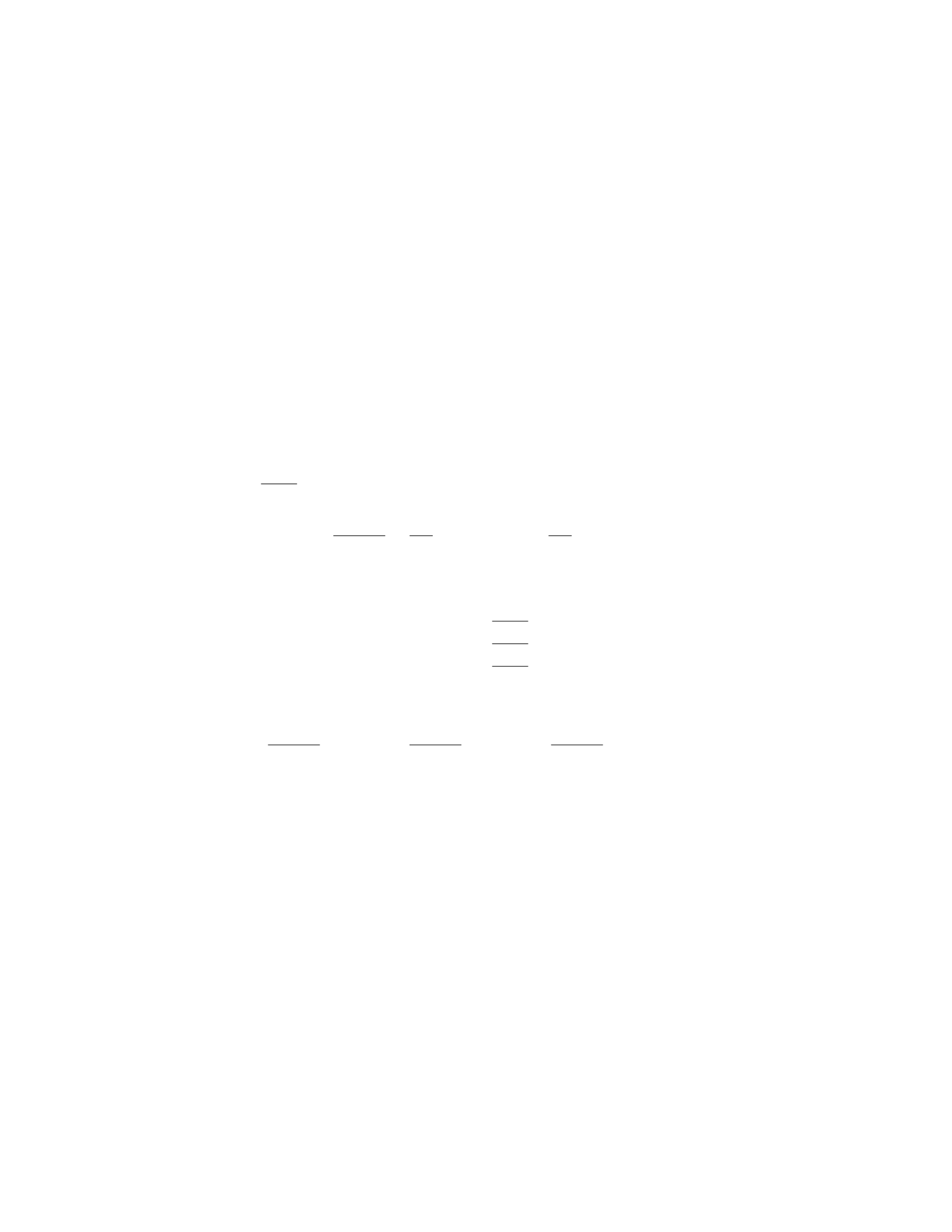
Question 9
Question
Let u=
3
−4
5
and v=
2
1
−3
. Find ∇(u·v).
Solution
Step 1: First, we find the dot product of uand v:
u·v= 3(2) + (−4)(1) + 5(−3) = 6 −4−15 = −13.
Step 2: Next, we differentiate the dot product with respect to each compo-
nent of uand v:
For ∂(u·v)
∂ui:
∂(u·v)
∂ui
=∂
∂ui
(
3
X
j=1
ujvj) =
3
X
j=1
∂
∂ui
(ujvj).
Step 3: Now we find the gradient of u·v:
∇(u·v) =
∂(u·v)
∂u1
∂(u·v)
∂u2
∂(u·v)
∂u3
.
Step 4: The components of ∇(u·v) are calculated as:
∂(u·v)
∂u1
=v1= 2,∂(u·v)
∂u2
=v2= 1,∂(u·v)
∂u3
=v3=−3.
Step 5: Thus, the gradient of (u·v) is:
∇(u·v) =
2
1
−3
.
Question 10
Question
Let u= 3i−2j+ 5kand v= 2i+ 4j−k. Find the derivative of u·vwith
respect to t, where uand vare functions of t.
6

Solution
Step 1: Recall that the dot product of two vectors uand vis given by u·v=
u1v1+u2v2+u3v3where u=u1i+u2j+u3kand v=v1i+v2j+v3k.
Step 2: We can calculate the dot product of uand vas:
u·v= (3)(2) + (−2)(4) + (5)(−1) = 6 −8−5 = −7
Step 3: To find the derivative of u·vwith respect to t, we differentiate each
component of uand vwith respect to tand then apply the dot product rule.
Step 4: Let u=u(t)=3i−2j+ 5kand v=v(t) = 2i+ 4j−k.
Step 5: Differentiating uwith respect to tgives du
dt =d
dt (3i−2j+ 5k) =
0−0+0=0.
Step 6: Differentiating vwith respect to tgives dv
dt =d
dt (2i+ 4j−k) =
0+0−0=0.
Step 7: Therefore, the derivative of u·vwith respect to tis d
dt (u·v) = 0.
Question 11
Question
Let v= (3x2+ 2y)i+ (4xy −z)j+ (5z2−6xz)kbe a vector-valued function.
Find dv
dt .
Solution
Step 1: Write the given vector-valued function in terms of x(t), y(t), and z(t).
v= (3x2+ 2y)i+ (4xy −z)j+ (5z2−6xz)k
= (3x(t)2+ 2y(t))i+ (4x(t)y(t)−z(t))j+ (5z(t)2−6x(t)z(t))k
Step 2: Differentiate each component with respect to t.
dv
dt =d
dt [(3x(t)2+ 2y(t))i+ (4x(t)y(t)−z(t))j+ (5z(t)2−6x(t)z(t))k]
=d
dt [(3x(t)2+ 2y(t))i] + d
dt [(4x(t)y(t)−z(t))j] + d
dt [(5z(t)2−6x(t)z(t))k]
= (6x(t)dx
dt +2dy
dt )i+(4(dx
dt y(t)+x(t)dy
dt )−dz
dt )j+(10z(t)dz
dt −6(dx
dt z(t)+x(t)dz
dt ))k
Thus, dv
dt = (6xdx
dt + 2 dy
dt )i+ (4( dx
dt y+xdy
dt )−dz
dt )j+ (10zdz
dt −6(dx
dt z+xdz
dt ))k.
7

Question 12
Question
Let v=
3t2
2t
t
be a vector-valued function. Find dv
dt , the derivative of vwith
respect to t.
Solution
Step 1: To find the derivative of vwith respect to t, we need to take the
derivative of each component of vseparately.
Step 2: The derivative of the first component 3t2is 6t, the derivative of the
second component 2tis 2, and the derivative of the third component tis 1.
Step 3: Therefore, the derivative of v=
3t2
2t
t
with respect to tis dv
dt =
6t
2
1
.
Question 13
Question
Let uand vbe vectors in R3. Suppose u=
2
4
6
and v=
1
3
5
. Find d(u·v)
du.
Solution
To find the derivative of the dot product of two vectors with respect to one of
the vectors, we can use the property: d(u·v)
du=v.
Step 1: Compute the dot product of uand v.
u·v=
2
4
6
·
1
3
5
= 2(1) + 4(3) + 6(5) = 2 + 12 + 30 = 44.
Step 2: Derive the dot product with respect to u.
d(44)
du=44
du=
1
3
5
=v.
Therefore, d(u·v)
du=
1
3
5
.
8

Question 14
Question
Let v=
3x2y
x3
2xy2
. Find dv
dx .
Solution
To find dv
dx , we differentiate each component of vwith respect to x.
Step 1: Differentiate the first component: 3x2y.
d
dx (3x2y)=6xy
Step 2: Differentiate the second component: x3.
d
dx (x3) = 3x2
Step 3: Differentiate the third component: 2xy2.
d
dx (2xy2)=2y2
Step 4: Therefore, dv
dx =
6xy
3x2
2y2
.
Question 15
Question
Let v=3x2+ 2xy
x2+y2. Find dv
dx .
Solution
To find dv
dx , we will differentiate each component of vwith respect to x.
Step 1: Differentiate the first component of vwith respect to x:
d
dx (3x2+ 2xy)=6x+ 2ydy
dx
Step 2: Differentiate the second component of vwith respect to x:
d
dx (x2+y2)=2x+ 2ydy
dx
Therefore, dv
dx =6x+ 2ydy
dx
2x+ 2ydy
dx .
9

Question 16
Question
Find the derivative of the vector function r(t) = ⟨t2,sin(t), et⟩.
Solution
Step 1: The derivative of a vector function is found by taking the derivative of
each component separately. Therefore, we need to find the derivative of each
component of r(t). Let r(t) = ⟨f(t), g(t), h(t)⟩, where f(t) = t2,g(t) = sin(t),
and h(t) = et.
Step 2: Find the derivative of the first component f(t) = t2.
d
dt (t2)=2t
Step 3: Find the derivative of the second component g(t) = sin(t).
d
dt (sin(t)) = cos(t)
Step 4: Find the derivative of the third component h(t) = et.
d
dt (et) = et
Step 5: Assemble the derivatives of the components into a vector expression
to find r′(t).
r′(t) = ⟨2t, cos(t), et⟩
Therefore, the derivative of the vector function r(t) = ⟨t2,sin(t), et⟩is r′(t) =
⟨2t, cos(t), et⟩.
Question 17
Question
Let u=x2
2xyand v=sin y
ex. Find the derivative of u·vwith respect to x.
Solution
Step 1: Compute u·v:
u·v=x2
2xy·sin y
ex=x2sin y+ 2xyex
Step 2: Differentiate u·vwith respect to x:
d
dx (u·v) = d
dx (x2sin y+ 2xyex)
10

Step 3: Apply the product rule to differentiate x2sin y+ 2xyex:
d
dx (x2sin y+ 2xyex) = d
dx (x2) sin y+x2d
dx (sin y) + d
dx (2xy)ex+ 2yd
dx (xex)
= 2xsin y+x2cos y+ 2yex+ 2xyex
Therefore, the derivative of u·vwith respect to xis 2xsin y+x2cos y+
2yex+ 2xyex.
Question 18
Question
Let aand bbe two vectors in R3defined as a= 2i−3j+4kand b= 3i+ 2j−k.
Compute the derivative of a·bwith respect to t, where aand bare functions
of t.
Solution
Given two vectors aand bin R3as functions of t:
a(t)=2i−3j+ 4k,b(t)=3i+ 2j−k.
The dot product of two vectors aand bis defined as:
a·b=|a||b|cos θ,
where θis the angle between the two vectors. It can also be written as:
a·b=a1b1+a2b2+a3b3,
where a=a1i+a2j+a3kand b=b1i+b2j+b3k.
The derivative of a·bwith respect to tis given by:
d
dt (a·b) = d
dt (a1b1+a2b2+a3b3).
Now, substitute a(t) and b(t) into the equation:
d
dt (2 ·3+(−3) ·2+4·(−1)) = d
dt (6 −6−4).
Thus, the derivative of a·bwith respect to tis 0 .
Question 19
Question
Let v= (x2+y2)i−2xyjbe a vector field in R2. Compute ∇ · v, where ∇is
the del operator.
11

Solution
Step 1: Find the components of the del operator in 2 dimensions.
∇=∂
∂x i+∂
∂y j
Step 2: Compute the divergence of v.
∇ · v=∂
∂x (x2+y2)−∂
∂y (2xy)
Step 3: Simplify the expression using partial derivative rules.
∇ · v= 2x−2x= 0
Step 4: Therefore, the divergence of the vector field vis ∇ · v= 0.
Question 20
Question
Let v=
2x2y
3xy
x2z
. Find dv
dx .
Solution
To find dv
dx , we will differentiate each component of vwith respect to x.
Step 1: Differentiate the first component of v, 2x2y, with respects to x:
d
dx (2x2y)=4xy
Step 2: Differentiate the second component of v, 3xy, with respects to x:
d
dx (3xy)=3y
Step 3: Differentiate the third component of v,x2z, with respects to x:
d
dx (x2z)=2xz
Step 4: Putting it all together, we have:
dv
dx =
4xy
3y
2xz
12

Question 21
Question
Let u=2
3and v=4
−1. Find d
dt (u·v).
Solution
Step 1: Recall that the dot product u·vis given by u·v=u1v1+u2v2.
Step 2: Calculate d
dt (u·v) using the chain rule:
d
dt (u·v) = d
dt (2 ·4+3· −1)
Step 3: Simplify the expression:
d
dt (u·v) = d
dt (8 −3) = d
dt (5)
Step 4: Since 5 is a constant, its derivative with respect to tis 0:
d
dt (u·v)=0
Therefore, d
dt (u·v) = 0.
Question 22
Question
Let u(t)=(e3t, e2t, et) and v(t)=(tsin(t), t cos(t), t2). Find d
dt (u(t)·v(t)).
Solution
Step 1: Compute u(t)·v(t).
u(t)·v(t) = (e3t, e2t, et)·(tsin(t), t cos(t), t2)
=e3t·tsin(t) + e2t·tcos(t) + et·t2
=te3tsin(t) + te2tcos(t) + t2et
Step 2: Differentiate u(t)·v(t) with respect to t.
d
dt (u(t)·v(t)) = d
dt (te3tsin(t) + te2tcos(t) + t2et)
=e3tsin(t) + te3tcos(t) + e2tcos(t)−te2tsin(t)+2tet
Therefore, d
dt (u(t)·v(t)) = e3tsin(t)+te3tcos(t)+e2tcos(t)−te2tsin(t)+2tet.
13

Question 23
Question
Let u= 3i−2j+ 4kand v= 2i+ 5j−k. Find the derivative of the vector
function f(t) = ut3+vt2with respect to t.
Solution
Step 1: First, we need to expand the vector function f(t).
f(t) = (3i−2j+ 4k)t3+ (2i+ 5j−k)t2
= 3it3−2jt3+ 4kt3+ 2it2+ 5jt2−kt2
Step 2: Now, we will find the derivative of f(t) with respect to t.
df(t)
dt =d
dt (3it3−2jt3+ 4kt3+ 2it2+ 5jt2−kt2)
= 3 d
dt (it3)−2d
dt (jt3)+4d
dt (kt3)+2d
dt (it2)+5d
dt (jt2)−d
dt (kt2)
Step 3: Now, differentiate each term with respect to t.
d
dt (it3) = 3it2
d
dt (jt3) = 3jt2
d
dt (kt3) = 3kt2
d
dt (it2)=2it
d
dt (jt2)=2jt
d
dt (kt2)=2kt
Step 4: Substitute these derivatives back into the expression.
df(t)
dt = 3it2−2jt2+ 4kt2+ 2it+ 5jt−kt
Therefore, the derivative of the vector function f(t) with respect to tis
df(t)
dt = 3it2−2jt2+ 4kt2+ 2it+ 5jt−kt.
14

Question 24
Question
Let u=
x2
y3
z4
and v=
ex
sin(y)
cos(z)
. Find d(u·v)
dt , where tis a scalar parameter.
Solution
Step 1: Compute the dot product u·v.
u·v= (x2)(ex)+(y3)(sin(y)) + (z4)(cos(z))
Step 2: Differentiate u·vwith respect to tusing the product rule.
d(u·v)
dt =d
dt [(x2)(ex)] + d
dt [(y3)(sin(y))] + d
dt [(z4)(cos(z))]
Step 3: Apply the chain rule and basic differentiation rules.
d(u·v)
dt = 2xexdx
dt +x2ex+3y2sin(y)dy
dt +y3cos(y)+4z3cos(z)dz
dt +z4(−sin(z))
Step 4: Simplify the expression.
d(u·v)
dt =x2ex2dx
dt + 1+y3sin(y)3dy
dt + 1+z4cos(z)4dz
dt −1
Therefore, d(u·v)
dt =x2ex2dx
dt + 1+y3sin(y)3dy
dt + 1+z4cos(z)4dz
dt −1.
Question 25
Question
Let v= (2x3−y2)i+ (3xy +z2)j−(4xz + 2yz2)k. Find ∂v
∂y .
Solution
Step 1: To find ∂v
∂y , we differentiate each component of vwith respect to y.
∂v
∂y =∂
∂y [(2x3−y2)i+ (3xy +z2)j−(4xz + 2yz2)k]
Step 2: Differentiating the xcomponent of v, 2x3−y2, with respect to y
gives 0.
∂(2x3−y2)
∂y = 0
15

Step 3: Differentiating the ycomponent of v, 3xy +z2, with respect to y
gives 3x.
∂(3xy +z2)
∂y = 3x
Step 4: Differentiating the zcomponent of v,−4xz + 2yz2, with respect to
ygives 2z2.
∂(−4xz + 2yz2)
∂y = 2z2
Step 5: Combining the components with respect to y, we have
∂v
∂y = 0i+ 3xj+ 2z2k= 3xj+ 2z2k
Therefore, ∂v
∂y = 3xj+ 2z2k.
Question 26
Question
Let v(t) =
tet
t2
sin(t)
. Find
dt.
Solution
Step 1: To find
dt, wedifferentiateeachcomponentofv(t)withrespecttot.
Step 2: Differentiating the first component tetwith respect to t, we get
d
dt (tet) = et+tet
Step 3: Differentiating the second component t2with respect to t, we get
d
dt (t2)=2t
Step 4: Differentiating the third component sin(t) with respect to t, we get
d
dt (sin(t)) = cos(t)
Step 5: Combining the results from Steps 2, 3, and 4, we have
16

dt =
et+tet
2t
cos(t)
Therefore,
dt =
et+tet
2t
cos(t)
.
Question 27
Question
Let u= 2i−3j+ 4kand v= 5i+ 6j−2k. Find d
dt (u·v).
Solution
Step 1: Recall that the dot product of two vectors u·vis given by |u||v|cos(θ),
where θis the angle between the two vectors.
Step 2: Calculating d
dt (u·v) involves finding the derivative of |u||v|cos(θ).
Step 3: The magnitude of a vector u=ai+bj+ckis given by |u|=
√a2+b2+c2.
Step 4: Let’s calculate |u|and |v|.
|u|=p(2)2+ (−3)2+ (4)2
=√4 + 9 + 16
=√29
|v|=p(5)2+ (6)2+ (−2)2
=√25 + 36 + 4
=√65
Step 5: The dot product u·vcan be written as 2 ×5 + (−3) ×6 + 4 ×(−2).
Step 6: Therefore, u·v= 10 −18 −8 = −16.
Step 7: Now, let’s differentiate u·vwith respect to t.
d
dt (u·v) = d
dt (−16)
= 0
Step 8: Thus, d
dt (u·v) = 0.
Question 28
Question
Let u= 3xi+eyjand v=exi+ 4yj. Find d(u
·v)dx.
17

Solution
Step 1: Compute the dot product of uand v:
u·v= (3xi+eyj)·(exi+ 4yj)
u·v= 3xex+ 4yey
Step 2: Differentiate the dot product with respect to x:
d(u
·v)dx =d(3xex+ 4yey)
dx
d(u
·v)dx =d(3xex)
dx +d(4yey)
dx
Step 3: Differentiate each term using the product rule: For the first term
3xex, differentiate 3xwith respect to xand exwith respect to x:
d(3xex)
dx = 3ex+ 3xex
Step 4: For the second term 4yey, differentiate 4ywith respect to xand ey
with respect to x:
d(4yey)
dx = 4eydy
dx
Step 5: Therefore, the final result is:
d(u
·v)dx = 3ex+ 3xex+ 4eydy
dx
Question 29
Question
Consider a vector function u(t) =
2t3
√t
et
. Find the derivative of u(t) with
respect to t, denoted by du
dt .
Solution
To find the derivative of u(t) with respect to t, we differentiate each component
of useparately.
Step 1: Find d
dt (2t3).
d
dt (2t3)=6t2
Step 2: Find d
dt (√t).
d
dt (√t) = 1
2√t=1
2t1/2
18

Step 3: Find d
dt (et).
d
dt (et) = et
Therefore, the derivative of u(t) with respect to t,du
dt , is:
du
dt =
6t2
1
2t1/2
et
Question 30
Question
Let v= 3i−2j+ 5kand u= 2i+ 6j−4k. Find the derivative of u·vwith
respect to t, where i,j, and kare the unit vectors in the x,y, and zdirections,
respectively.
Solution
Step 1: Recall that for vectors u=u1i+u2j+u3kand v=v1i+v2j+v3k, we
have u·v=u1v1+u2v2+u3v3.
Step 2: Substitute the given values u1= 2, u2= 6, u3=−4, v1= 3,
v2=−2, v3= 5 into the dot product formula:
u·v= 2(3) + 6(−2) + (−4)(5)
Step 3: Simplify the dot product:
u·v= 6 −12 −20 = −26
Step 4: Now, differentiate both sides of the equation u·v=−26 with respect
to t.
Step 5: On the left-hand side, we have:
d
dt (u·v) = d
dt (−26)
Step 6: Differentiating the right-hand side gives us 0.
Step 7: Therefore, the derivative of u·vwith respect to tis 0 .
Question 31
Question
Let v= 3xi+ 4yjand w= 2xi+ 5yj. Find d
dx (v·w).
19

Solution
Step 1: Compute the dot product of vand w.
v·w= (3xi+ 4yj)·(2xi+ 5yj) = 6x2+ 20y2
Step 2: Differentiate v·wwith respect to x.
d
dx (v·w) = d
dx (6x2+ 20y2) = d
dx (6x2) + d
dx (20y2)
Step 3: Apply the chain rule to find d
dx (6x2).
d
dx (6x2) = 2(6)x2−1= 12x
Step 4: Apply the chain rule to find d
dx (20y2). Note: Since we are differen-
tiating with respect to x, we treat yas a constant.
d
dx (20y2) = 0
Step 5: Combine the results to find the final answer.
d
dx (v·w) = 12x+ 0 = 12x
Question 32
Question
Let v=
3t2
et
ln(t)
be a vector function. Find dv
dt .
Solution
Step 1: Compute the derivative of each component of vwith respect to t.
For the first component, we have:
d
dt (3t2)=6t
For the second component, we have:
d
dt (et) = et
For the third component, we have:
d
dt (ln(t)) = 1
t
Therefore, we have:
dv
dt =
6t
et
1
t
20

Question 33
Question
Let y=
ex
sin(x)
ln(x)
, where x∈R. Find dy
dx .
Solution
To find dy
dx , we will differentiate each component of ywith respect to x.
Step 1: Differentiate the first component ex:
d
dx (ex) = ex
Step 2: Differentiate the second component sin(x):
d
dx (sin(x)) = cos(x)
Step 3: Differentiate the third component ln(x):
d
dx (ln(x)) = 1
x
Therefore, dy
dx =
ex
cos(x)
1
x
.
Question 34
Question
Let v= 3i−2j+ 4kand u= 2i+ 5j−k. Find d
dt (u·v).
Solution
Step 1: Recall that the dot product of two vectors u=u1i+u2j+u3kand
v=v1i+v2j+v3kis given by u·v=u1v1+u2v2+u3v3.
Step 2: Calculate u·v:
u·v= (2)(3) + (5)(−2) + (−1)(4) = 6 −10 −4 = −8.
Step 3: Differentiate u·vwith respect to t:
d
dt (u·v) = d
dt (−8) = 0.
Therefore, d
dt (u·v) = 0.
21

Question 35
Question
Let u=2
3and v=4
−1. Find the derivative of the following function with
respect to t:
f(t)=3tu−2t2v
Solution
Step 1: Use the properties of vector derivatives:
d
dt (cu) = cdu
dt
d
dt (u+v) = du
dt +dv
dt
where cis a constant.
Step 2: Find the derivative of f(t) term by term:
d
dt (3tu) = 3u+ 3tdu
dt
d
dt (−2t2v) = −4tv−2t2dv
dt
Step 3: Substitute the given values and simplify:
df
dt = 3 2
3+ 3t0
0−4t4
−1−2t20
0
=6
9−16t
−4t
=6−16t
9+4t
Therefore, the derivative of f(t) with respect to tis 6−16t
9+4t.
22

