


MATH 100 - FUNDAMENTALS OF
MATHEMATICS - Line Integral Question Bank -
Set 3
Question 1
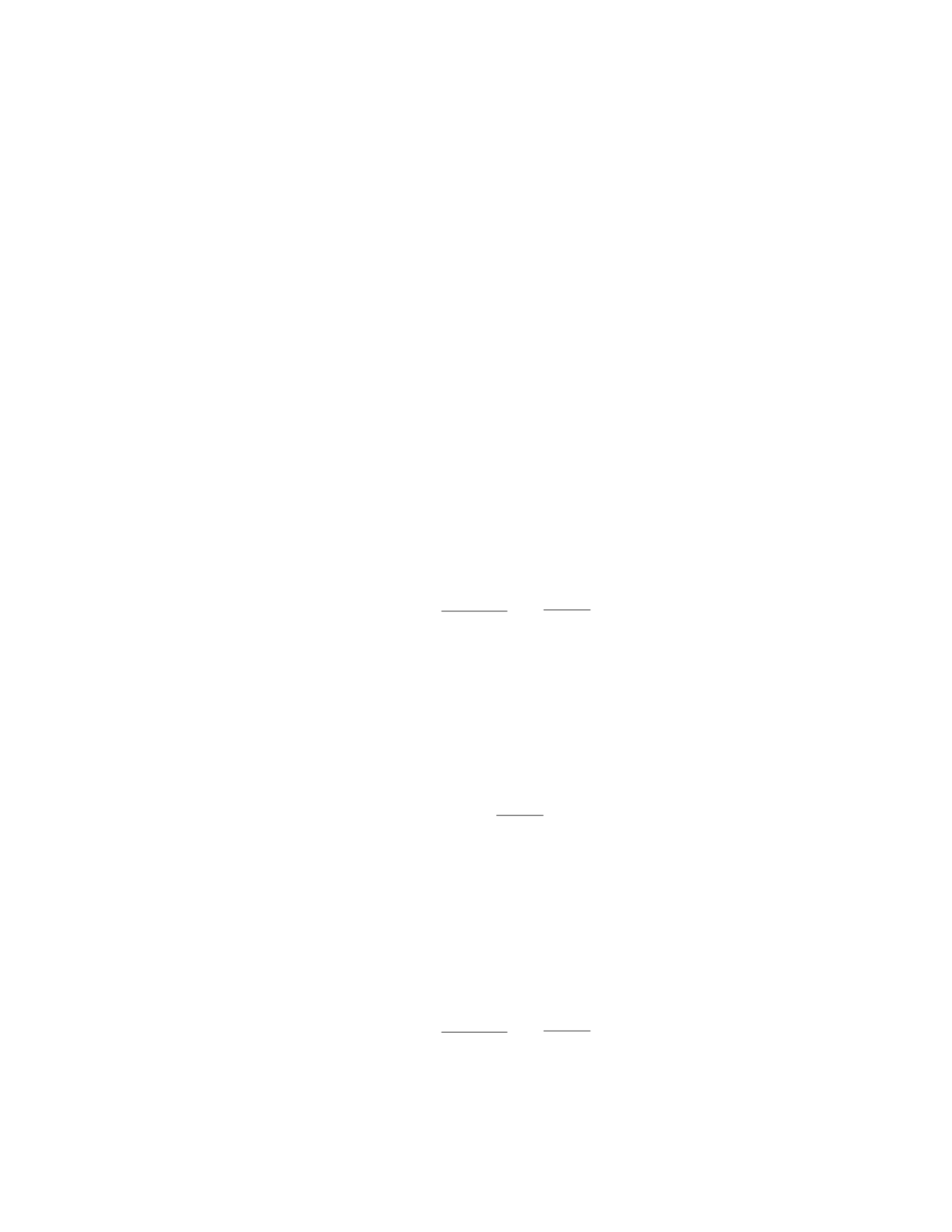
Evaluate the line integral RC(x2+y2)ds, where Cis the curve defined by
r(t) = ⟨t, t2⟩for 0 ≤t≤1.
Step-by-step solution: 1. First, we need to parameterize the curve Cby
finding r′(t):
r′(t) = ⟨1,2t⟩
2. Next, find the magnitude of r′(t):
∥r′(t)∥=p12+ (2t)2=p1+4t2
3. Now, express xand yin terms of t:
x=t, y =t2
4. Substitute xand yinto the integrand to get the function in terms of t:
f(t) = x2+y2=t2+ (t2)2=t2+t4
5. The line integral becomes:
Z1
0
(t2+t4)·p1+4t2dt
6. Integrate the function with respect to tover the interval [0,1] to find the
final answer.Question 1:
Evaluate the line integral RC(x2+y2)ds, where Cis the curve defined
by r(t) = ⟨t, t2⟩for 0≤t≤1.
Step-by-step solution: 1. First, we need to parameterize the curve
Cby finding r′(t):
r′(t) = ⟨1,2t⟩
2. Next, find the magnitude of r′(t):
∥r′(t)∥=p12+ (2t)2=p1+4t2
1
3. Now, express xand yin terms of t:
x=t, y =t2
4. Substitute xand yinto the integrand to get the function in
terms of t:
f(t) = x2+y2=t2+ (t2)2=t2+t4
5. The line integral becomes:
Z1
0
(t2+t4)·p1+4t2dt
6. Integrate the function with respect to tover the interval [0,1]
to find the final answer.
Question 2
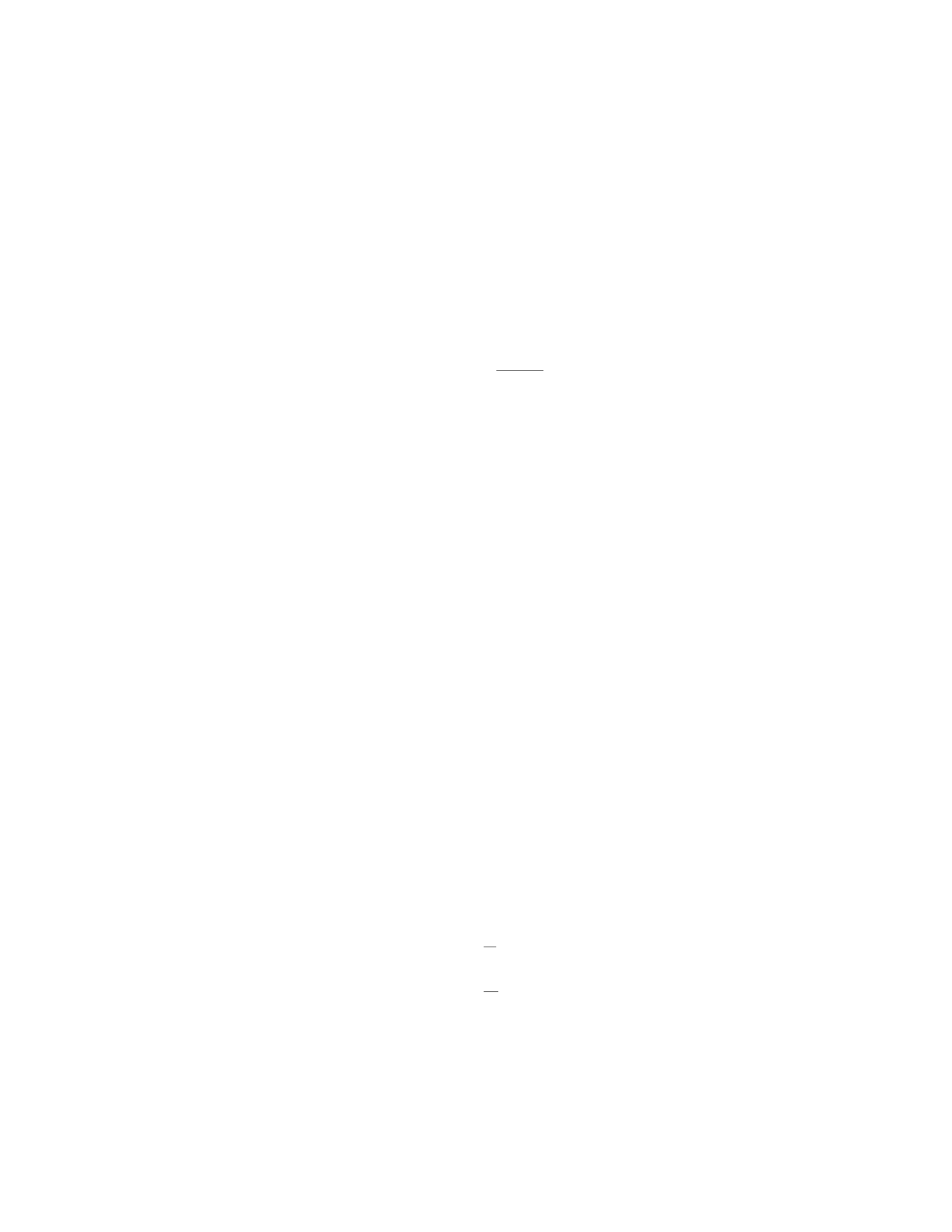
Find the work done by the force field F(x, y) = ⟨2y, x⟩in moving a
particle along the curve Cdefined by y=x2from the point (0,0) to
the point (2,4).
Step-by-step solution:
Given: F(x, y) = ⟨2y, x⟩,y=x2,P1= (0,0),P2= (2,4)
1. Find the parametric equations for the curve C: Let x=t, then
y=t2for 0≤t≤2.
2. Find the differential elements: dx =dt and dy = 2t dt.
3. Find the line integral:
ZC
F·dr=Z2
0
F(t2, t)· ⟨dt, 2t dt⟩
=Z2
0⟨2t, t2⟩·⟨dt, 2t dt⟩
=Z2
0
(2t·dt +t2·2t dt)
=Z2
0
(2t+ 2t3)dt
=Z2
0
2t(1 + t2)dt
=t2+t4
22
0
= (22+24
2)−(0 + 0)
= 4 + 8
= 12
2
4. Therefore, the work done by the force field F(x, y) = ⟨2y, x⟩
in moving a particle along the curve Cfrom (0,0) to (2,4) is 12
units.Question 2:
Find the work done by the force field F(x, y) = ⟨2y, x⟩in moving a
particle along the curve Cdefined by y=x2from the point (0,0) to
the point (2,4).
Step-by-step solution:
Given: F(x, y) = ⟨2y, x⟩,y=x2,P1= (0,0),P2= (2,4)
1. Find the parametric equations for the curve C: Let x=t, then
y=t2for 0≤t≤2.
2. Find the differential elements: dx =dt and dy = 2t dt.
3. Find the line integral:
ZC
F·dr=Z2
0
F(t2, t)· ⟨dt, 2t dt⟩
=Z2
0⟨2t, t2⟩·⟨dt, 2t dt⟩
=Z2
0
(2t·dt +t2·2t dt)
=Z2
0
(2t+ 2t3)dt
=Z2
0
2t(1 + t2)dt
=t2+t4
22
0
= (22+24
2)−(0 + 0)
= 4 + 8
= 12
4. Therefore, the work done by the force field F(x, y) = ⟨2y, x⟩in
moving a particle along the curve Cfrom (0,0) to (2,4) is 12 units.
Question 3
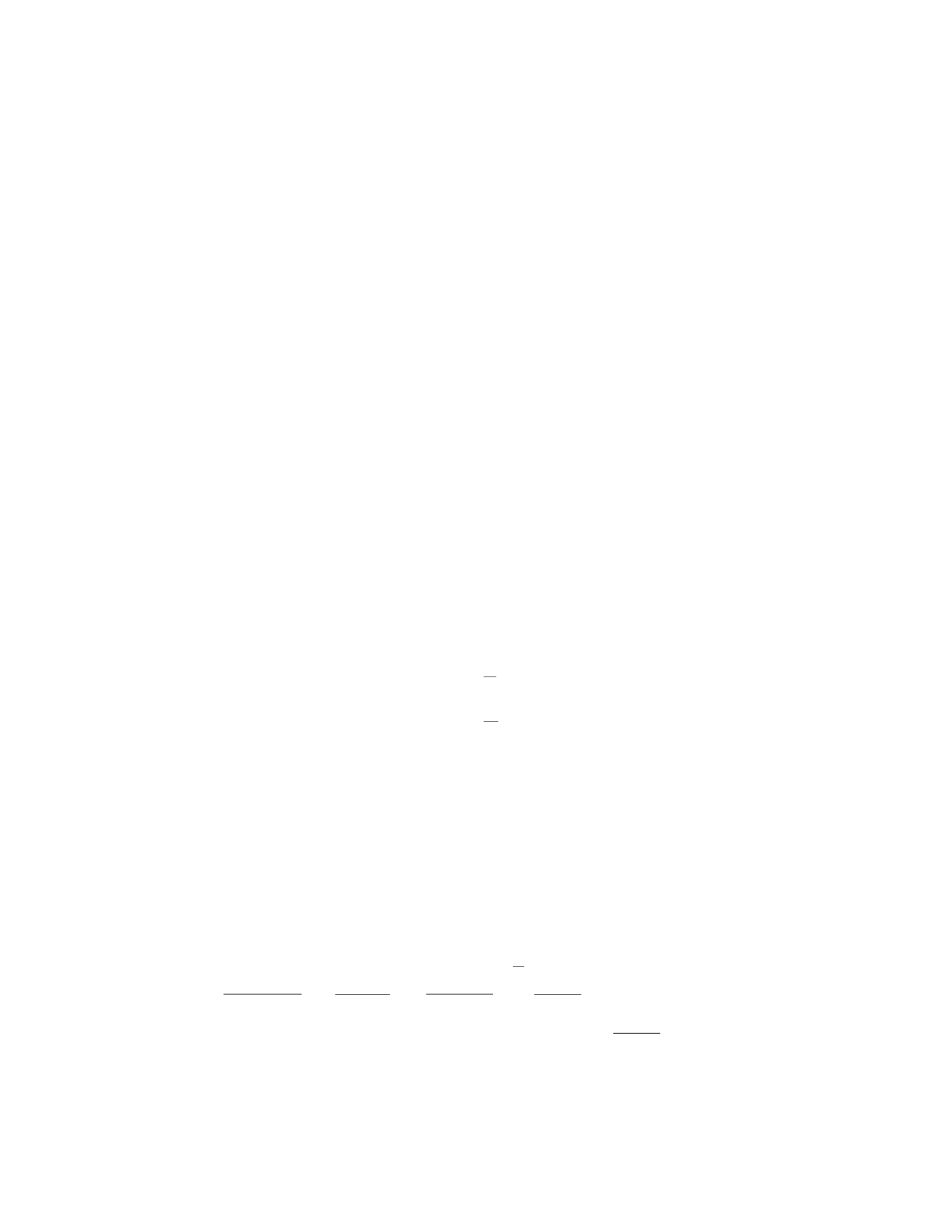
Question 3: Calculate the line integral RC(x2+y2)ds, where Cis
the curve given by r(t) = ⟨2t, 3t2⟩for 0≤t≤2.
Step-by-step solution: 1. First, we need to find the differential of
the curve r(t)with respect to t:r′(t) = d
dt ⟨2t, 3t2⟩=⟨2,6t⟩
2. Next, calculate the magnitude of the derivative vector: ||r′(t)|| =
p(2)2+ (6t)2=√4 + 36t2=p4(1 + 9t2)=2√1+9t2
3. Now, substitute the given curve and its derivative into the line
integral formula: RC(x2+y2)ds =R2
0((2t)2+ (3t2)2)·2√1+9t2dt
3
4. Simplify the integrand: R2
0(4t2+ 9t4)·2√1+9t2dt
5. Integrate with respect to t:R2
0(8t2√1+9t2+ 18t4√1+9t2)dt
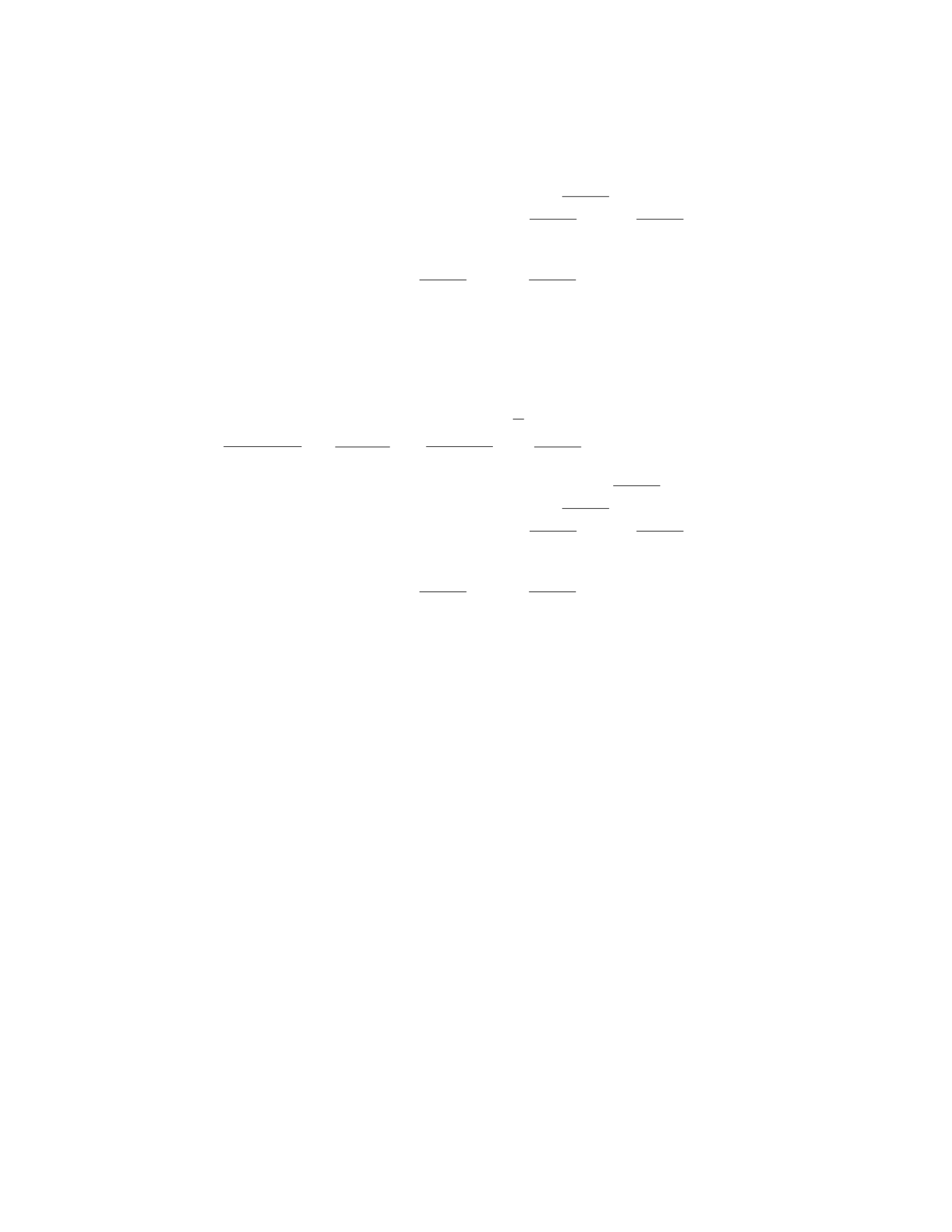
Therefore, the line integral of (x2+y2)ds over the given curve Cis:
Z2
0
(8t2p1+9t2+ 18t4p1+9t2)dt
Certainly! Here is a Line Integral question along with its step-by-step
solution in LateX code:
Question 3: Calculate the line integral RC(x2+y2)ds, where Cis
the curve given by r(t) = ⟨2t, 3t2⟩for 0≤t≤2.
Step-by-step solution: 1. First, we need to find the differential of
the curve r(t)with respect to t:r′(t) = d
dt ⟨2t, 3t2⟩=⟨2,6t⟩
2. Next, calculate the magnitude of the derivative vector: ||r′(t)|| =
p(2)2+ (6t)2=√4 + 36t2=p4(1 + 9t2)=2√1+9t2
3. Now, substitute the given curve and its derivative into the line
integral formula: RC(x2+y2)ds =R2
0((2t)2+ (3t2)2)·2√1+9t2dt
4. Simplify the integrand: R2
0(4t2+ 9t4)·2√1+9t2dt
5. Integrate with respect to t:R2
0(8t2√1+9t2+ 18t4√1+9t2)dt
Therefore, the line integral of (x2+y2)ds over the given curve Cis:
Z2
0
(8t2p1+9t2+ 18t4p1+9t2)dt
Question 4
Step-by-step solution:
1. First, calculate the derivative of the parameterization vector:
r′(t) = ⟨1,2t⟩
2. Next, substitute the parameterization into the vector field:
F(r(t)) = ⟨t2, t⟩
3. Then, find the dot product of F(r(t)) and r′(t):
F(r(t)) ·r′(t) = ⟨t2, t⟩·⟨1,2t⟩=t2+ 2t2= 3t2
4. Integrate the dot product along the curve Cfrom 0to 1:
Z1
0
3t2dt = [t3]1
0= 13−03= 1
Therefore, the line integral of the vector field F(x, y) = ⟨y, x⟩along
the curve Cis 1.Question 4: Find the line integral of the vector field
F(x, y) = ⟨y, x⟩along the curve Cparameterized by r(t) = ⟨t, t2⟩for
0≤t≤1.
4

Step-by-step solution:
1. First, calculate the derivative of the parameterization vector:
r′(t) = ⟨1,2t⟩
2. Next, substitute the parameterization into the vector field:
F(r(t)) = ⟨t2, t⟩
3. Then, find the dot product of F(r(t)) and r′(t):
F(r(t)) ·r′(t) = ⟨t2, t⟩·⟨1,2t⟩=t2+ 2t2= 3t2
4. Integrate the dot product along the curve Cfrom 0to 1:
Z1
0
3t2dt = [t3]1
0= 13−03= 1
Therefore, the line integral of the vector field F(x, y) = ⟨y, x⟩along
the curve Cis 1.
Question 5
Question 5: Calculate the line integral RC(x−y)ds, where Cis the
curve given by r(t) = ⟨t2, t3⟩for 0≤t≤1.
Solution: The line integral of a vector field F =⟨P, Q⟩along a curve
Cparametrized by r(t) = ⟨x(t), y(t)⟩is given by:
ZC
F·dr=Zb
a
F(r(t)) ·r′(t)dt
Here, P=x−yand Q= 0, so F =⟨x−y, 0⟩.
Substitute the parametric equations of the curve into F:
F(r(t)) = ⟨t2−t3,0⟩
Differentiate the parametric equations to find r′(t):
r′(t) = ⟨2t, 3t2⟩
Now, we can write the line integral as:
ZC
(x−y)ds =Z1
0
(t2−t3)· ⟨2t, 3t2⟩dt
Evaluate the dot product and the integral to get the final an-
swer.Certainly! Here is the question and solution in LateX code for-
mat:
Question 5: Calculate the line integral RC(x−y)ds, where Cis the
curve given by r(t) = ⟨t2, t3⟩for 0≤t≤1.
5
Solution: The line integral of a vector field F =⟨P, Q⟩along a curve
Cparametrized by r(t) = ⟨x(t), y(t)⟩is given by:
ZC
F·dr=Zb
a
F(r(t)) ·r′(t)dt
Here, P=x−yand Q= 0, so F =⟨x−y, 0⟩.
Substitute the parametric equations of the curve into F:
F(r(t)) = ⟨t2−t3,0⟩
Differentiate the parametric equations to find r′(t):
r′(t) = ⟨2t, 3t2⟩
Now, we can write the line integral as:
ZC
(x−y)ds =Z1
0
(t2−t3)· ⟨2t, 3t2⟩dt
Evaluate the dot product and the integral to get the final answer.
Question 6
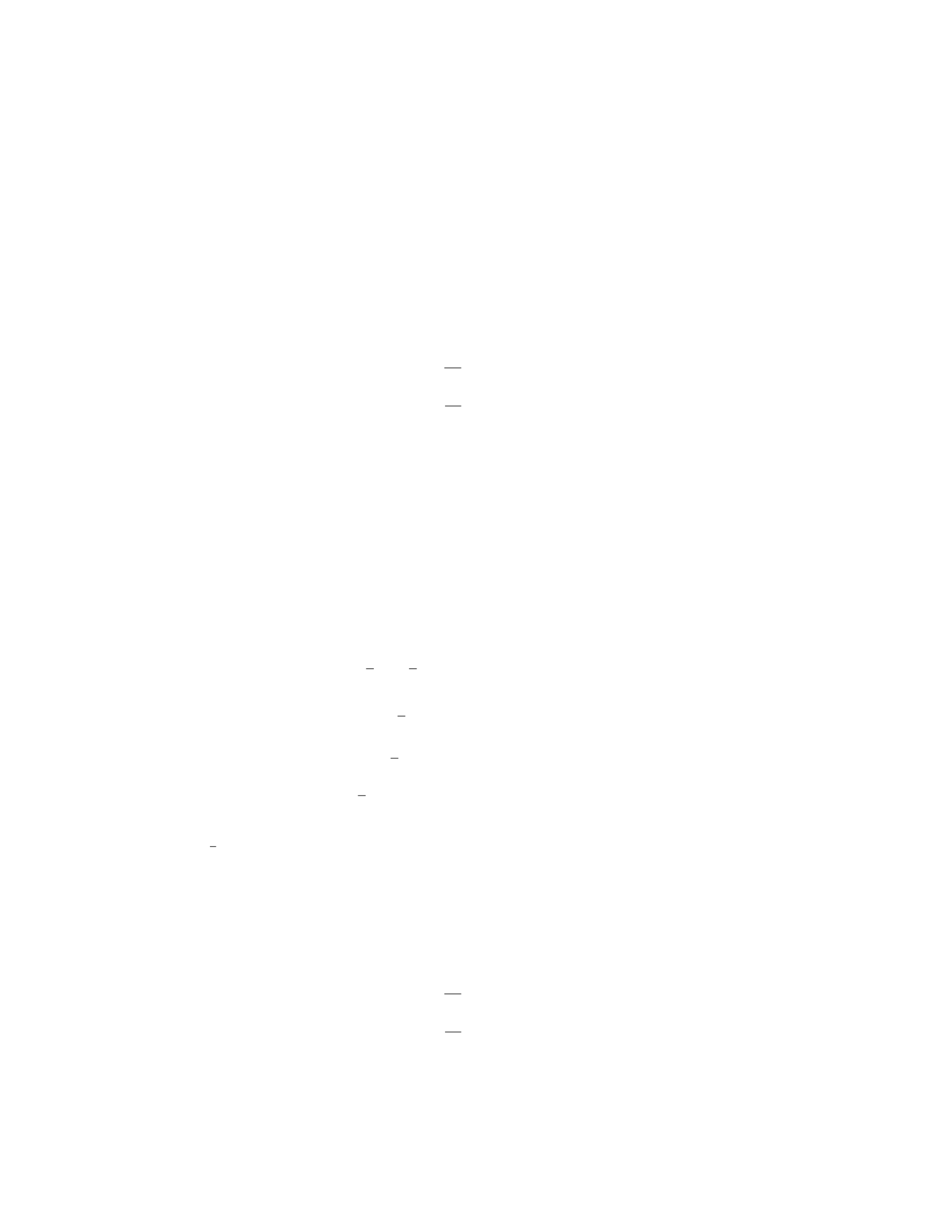
Step-by-step solution: 1. The curve Cis defined by r(t)=(t2, t)for
0≤t≤2. 2. We need to compute the line integral RC(2x+y)ds along
this curve. 3. First, we parameterize the curve Cby r(t) = (t2, t). 4.
The derivative of r(t)is r′(t) = (2t, 1). 5. The arc length element ds
is given by ds =∥r′(t)∥dt =√4t2+ 1 dt. 6. Substitute x=t2and y=t
into the integrand (2x+y)to get 2(t2) + t= 2t2+t. 7. Rewrite the
line integral as R2
0(2t2+t)√4t2+ 1 dt. 8. Now, evaluate the integral by
finding the antiderivative of the integrand and plugging in the limits
of integration. 9. After evaluating the integral, the final answer will
be the numerical value of the line integral along the curve Cdefined
by r(t) = (t2, t)for 0≤t≤2.Question 6: Compute the line integral
RC(2x+y)ds, where Cis the curve defined by r(t) = (t2, t)for 0≤t≤2.
Step-by-step solution: 1. The curve Cis defined by r(t)=(t2, t)for
0≤t≤2. 2. We need to compute the line integral RC(2x+y)ds along
this curve. 3. First, we parameterize the curve Cby r(t) = (t2, t). 4.
The derivative of r(t)is r′(t) = (2t, 1). 5. The arc length element ds
is given by ds =∥r′(t)∥dt =√4t2+ 1 dt. 6. Substitute x=t2and y=t
into the integrand (2x+y)to get 2(t2) + t= 2t2+t. 7. Rewrite the
line integral as R2
0(2t2+t)√4t2+ 1 dt. 8. Now, evaluate the integral by
finding the antiderivative of the integrand and plugging in the limits
of integration. 9. After evaluating the integral, the final answer will
be the numerical value of the line integral along the curve Cdefined
by r(t)=(t2, t)for 0≤t≤2.
6
Question 7
Evaluate the line integral IC
(x+ 2y)dx + (x−y)dy, where Cis the
curve parametrized by r(t) = ⟨t2, t3⟩for 0≤t≤1.
Step-by-step solution:
1. First, we need to calculate the differential elements dx and dy
by differentiating the given parametric equations:
dx
dt = 2t,
dy
dt = 3t2.
2. Next, we evaluate the line integral using the parametric equa-
tions:
IC
(x+ 2y)dx + (x−y)dy
=Z1
0
((t2) + 2(t3))(2t)+(t2−t3)(3t2)dt
=Z1
0
(2t3+ 2t4+ 3t4−3t5)dt
=Z1
0
(5t4−t5)dt
=5
5t5−1
6t61
0
=t5−1
6t61
0
= (1 −1
6)−(0 −0)
=5
6.
Therefore, the value of the line integral along the curve Cis
5
6.Question 7:
Evaluate the line integral IC
(x+ 2y)dx + (x−y)dy, where Cis the
curve parametrized by r(t) = ⟨t2, t3⟩for 0≤t≤1.
Step-by-step solution:
1. First, we need to calculate the differential elements dx and dy
by differentiating the given parametric equations:
dx
dt = 2t,
dy
dt = 3t2.
7

2. Next, we evaluate the line integral using the parametric equa-
tions:
IC
(x+ 2y)dx + (x−y)dy
=Z1
0
((t2) + 2(t3))(2t)+(t2−t3)(3t2)dt
=Z1
0
(2t3+ 2t4+ 3t4−3t5)dt
=Z1
0
(5t4−t5)dt
=5
5t5−1
6t61
0
=t5−1
6t61
0
= (1 −1
6)−(0 −0)
=5
6.
Therefore, the value of the line integral along the curve Cis 5
6.
Question 8
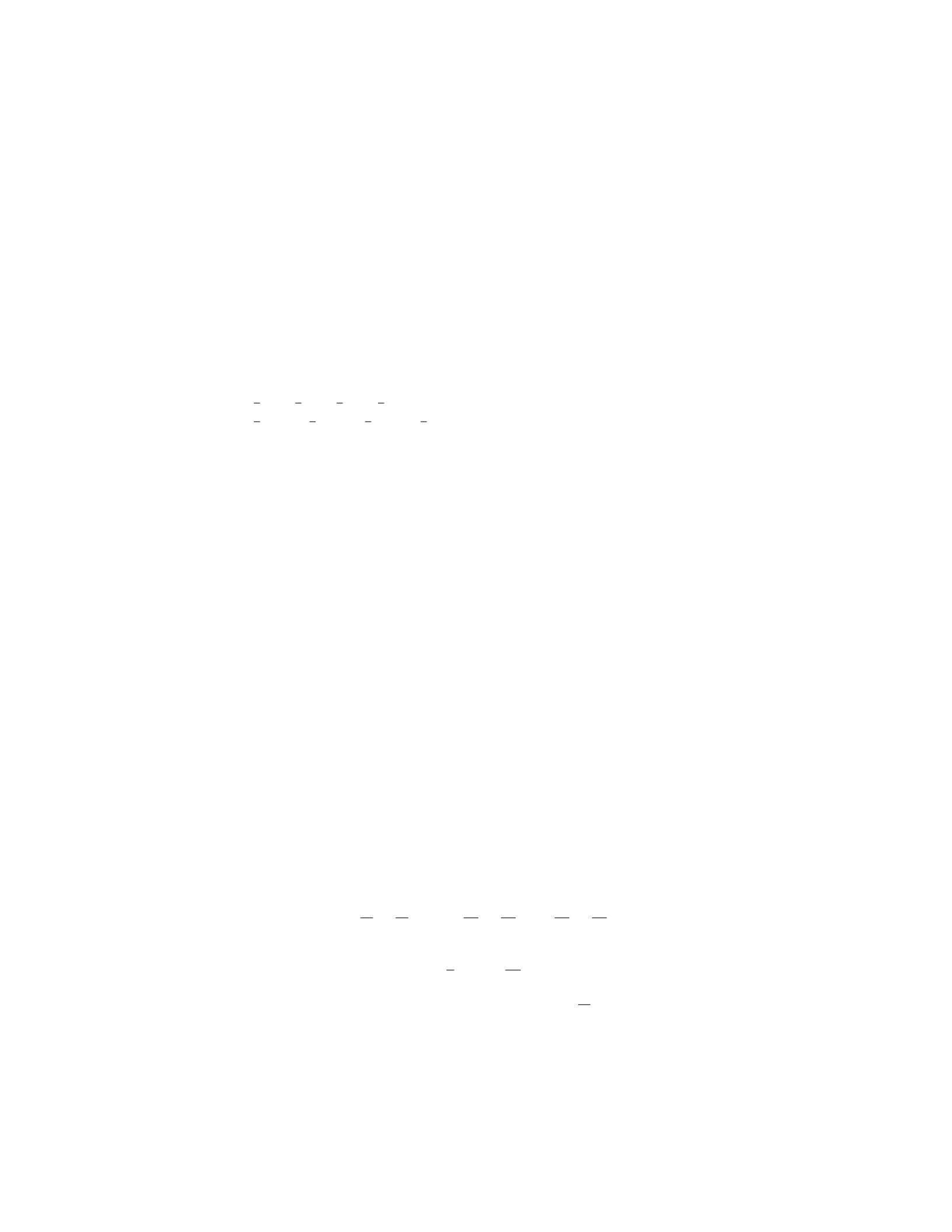
Calculate the line integral HC(3x2y+ 2y)dx + (x3+ 3xy)dy, where C
is the curve given by y=x2from (0,0) to (2,4).
Solution:
Given curve C:y=x2from (0,0) to (2,4).
Parameterize the curve as follows:
Let x=t, then y=t2.
For 0≤t≤2, the parameterization of the curve Cis: r(t)=(t, t2).
The differential dx =dt and dy = 2tdt.
Now, rewrite the line integral in terms of t:
HC(3x2y+2y)dx+(x3+3xy)dy =R2
0[(3t2(t2)+2(t2))(dt)+(t3+3t(t2))(2tdt)]
=R2
0(3t4+ 2t2+ 2t6+ 6t3)dt
=R2
0(2t6+ 6t4+ 6t3+ 2t2)dt
= [2
7t7+6
5t5+3
2t4+2
3t3]2
0
= [2
7(2)7+6
5(2)5+3
2(2)4+2
3(2)3]
≈63.43
Therefore, the line integral along the curve Cis approximately
63.43.Question 8:
Calculate the line integral HC(3x2y+ 2y)dx + (x3+ 3xy)dy, where C
is the curve given by y=x2from (0,0) to (2,4).
8
Solution:
Given curve C:y=x2from (0,0) to (2,4).
Parameterize the curve as follows:
Let x=t, then y=t2.
For 0≤t≤2, the parameterization of the curve Cis: r(t)=(t, t2).
The differential dx =dt and dy = 2tdt.
Now, rewrite the line integral in terms of t:
HC(3x2y+2y)dx+(x3+3xy)dy =R2
0[(3t2(t2)+2(t2))(dt)+(t3+3t(t2))(2tdt)]
=R2
0(3t4+ 2t2+ 2t6+ 6t3)dt
=R2
0(2t6+ 6t4+ 6t3+ 2t2)dt
= [2
7t7+6
5t5+3
2t4+2
3t3]2
0
= [2
7(2)7+6
5(2)5+3
2(2)4+2
3(2)3]
≈63.43
Therefore, the line integral along the curve Cis approximately
63.43.
Question 9
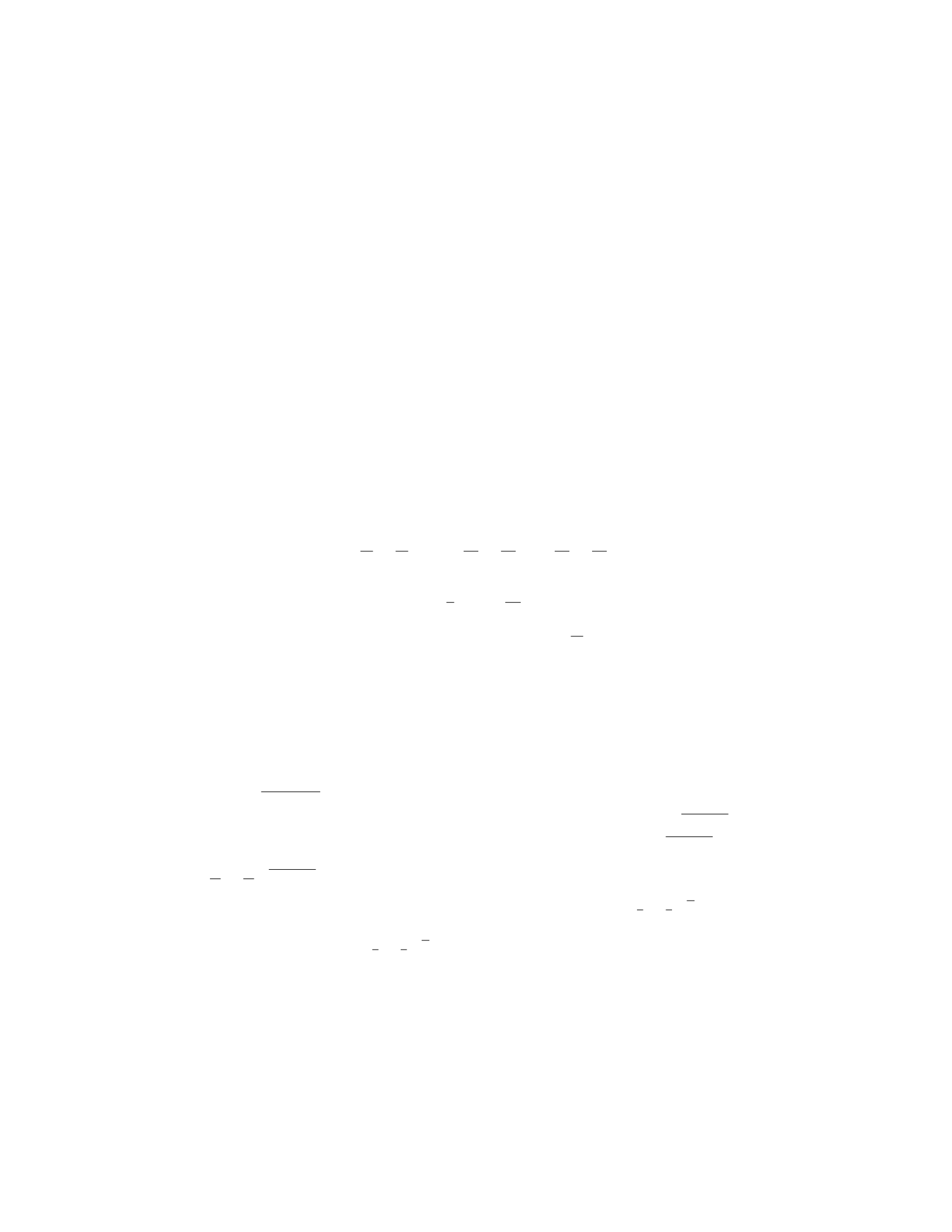
Solution: To find the line integral of F along C, we first need to
parameterize the curve C:
r(t) = ti+ (t2)j,0≤t≤2
Now, we can compute the line integral using the formula:
ZC
F·dr=Zb
a
F(r(t)) ·r′(t)dt
Substitute r(t)and F(r(t)) into the integral:
ZC
(x2i+yj)·(dxi+dyj) = Z2
0
(t2i+ (t2)j)·(i+ 2tj)dt
=Z2
0
(t2+ 2t3)dt
Integrate with respect to t:
=t3
3+t4
2
2
0=23
3+24
2−03
3+04
2
=8
3+ 8 = 32
3
Therefore, the line integral of F along Cis 32
3. Question 9: Find
the line integral of the given vector field F(x, y) = x2i+yj along the
curve Cgiven by y=x2from (0,0) to (2,4).
9
Solution: To find the line integral of F along C, we first need to
parameterize the curve C:
r(t) = ti+ (t2)j,0≤t≤2
Now, we can compute the line integral using the formula:
ZC
F·dr=Zb
a
F(r(t)) ·r′(t)dt
Substitute r(t)and F(r(t)) into the integral:
ZC
(x2i+yj)·(dxi+dyj) = Z2
0
(t2i+ (t2)j)·(i+ 2tj)dt
=Z2
0
(t2+ 2t3)dt
Integrate with respect to t:
=t3
3+t4
2
2
0=23
3+24
2−03
3+04
2
=8
3+ 8 = 32
3
Therefore, the line integral of F along Cis 32
3.
Question 10
Step-by-step solution: 1. First, parameterize the curve C:y=x2
from (0,0) to (1,1): Let x=tand y=t2where 0≤t≤1.
2. Calculate dx and dy in terms of dt:dx =dt and dy = 2tdt
3. Write the line integral in terms of t:RC(x2+y2)ds =R1
0((t2+
(t2)2)p1 + (2t)2)dt
4. Simplify the expression inside the integral: R1
0(t2+t4)√1+4t2dt
5. Integrate the expression with respect to t:R1
0(t2+t4)√1+4t2dt =
t3
3+t5
5√1+4t2
1
0
6. Plug in the limits of integration and evaluate: =1
3+1
5√5
Therefore, the line integral RC(x2+y2)ds along the curve y=x2
from (0,0) to (1,1) is 1
3+1
5√5.Question 10: Calculate the line integral
RC(x2+y2)ds where Cis the path along the curve y=x2from (0,0) to
(1,1).
Step-by-step solution: 1. First, parameterize the curve C:y=x2
from (0,0) to (1,1): Let x=tand y=t2where 0≤t≤1.
2. Calculate dx and dy in terms of dt:dx =dt and dy = 2tdt
10
3. Write the line integral in terms of t:RC(x2+y2)ds =R1
0((t2+
(t2)2)p1 + (2t)2)dt
4. Simplify the expression inside the integral: R1
0(t2+t4)√1+4t2dt
5. Integrate the expression with respect to t:R1
0(t2+t4)√1+4t2dt =
t3
3+t5
5√1+4t2
1
0
6. Plug in the limits of integration and evaluate: =1
3+1
5√5
Therefore, the line integral RC(x2+y2)ds along the curve y=x2
from (0,0) to (1,1) is 1
3+1
5√5.
Question 11
Solution: To evaluate the line integral RC(x2−y2)ds, we first need
to parameterize the curve Cusing the given equation r(t) = ⟨t2, t⟩for
0≤t≤2.
The position vector is given by r(t) = ⟨t2, t⟩.
The derivative of r(t)gives us the tangent vector:
r′(t) = ⟨2t, 1⟩
The magnitude of the tangent vector is:
∥r′(t)∥=p(2t)2+ 1 = p4t2+ 1
The line integral becomes:
ZC
(x2−y2)ds =Z2
0
((t2)2−t2)p4t2+ 1 dt
Now, we can substitute x=t2and y=tinto the line integral above
and simplify it:
Z2
0
(t4−t2)p4t2+ 1 dt
Next, we integrate the expression:
Z2
0
(t4−t2)p4t2+ 1 dt =9
5(√17 −1)
Therefore, the value of the line integral RC(x2−y2)ds along the
curve Cis 9
5(√17 −1).Question 11: Evaluate the line integral RC(x2−
y2)ds, where Cis the curve given by the equation r(t) = ⟨t2, t⟩for
0≤t≤2.
Solution: To evaluate the line integral RC(x2−y2)ds, we first need
to parameterize the curve Cusing the given equation r(t) = ⟨t2, t⟩for
0≤t≤2.
11
The position vector is given by r(t) = ⟨t2, t⟩.
The derivative of r(t)gives us the tangent vector:
r′(t) = ⟨2t, 1⟩
The magnitude of the tangent vector is:
∥r′(t)∥=p(2t)2+ 1 = p4t2+ 1
The line integral becomes:
ZC
(x2−y2)ds =Z2
0
((t2)2−t2)p4t2+ 1 dt
Now, we can substitute x=t2and y=tinto the line integral above
and simplify it:
Z2
0
(t4−t2)p4t2+ 1 dt
Next, we integrate the expression:
Z2
0
(t4−t2)p4t2+ 1 dt =9
5(√17 −1)
Therefore, the value of the line integral RC(x2−y2)ds along the
curve Cis 9
5(√17 −1).
Question 12
Question 12:
Let Cbe the curve given by y=x2for 0≤x≤1. Calculate the line
integral RC(2x+y)ds, where ds denotes the element of arc length.
Step-by-step Solution:
1. First, we parameterize the curve Cusing x=tand y=t2
for 0≤t≤1. 2. We express the element of arc length ds as ds =
p(dx)2+ (dy)2. 3. Calculate dx =dt and dy = 2t dt. 4. Substitute x=t
and y=t2into the integrand (2x+y)to get 2t+t2. 5. Now, write
the line integral in terms of tas R1
0(2t+t2)p1 + (2t)2dt. 6. Simplify
the expression under the square root to get √1+4t2. 7. Integrate the
expression with respect to tfrom 0 to 1: R1
0(2t+t2)√1+4t2dt. 8. After
integration, the final result will be the value of the line integral.
That’s the solution for question 12 on Line Integral. Let me know if
you need more assistance!Certainly! Here is a Line Integral question
and step-by-step solution in LateX code:
Question 12:
Let Cbe the curve given by y=x2for 0≤x≤1. Calculate the line
integral RC(2x+y)ds, where ds denotes the element of arc length.
12
Step-by-step Solution:
1. First, we parameterize the curve Cusing x=tand y=t2
for 0≤t≤1. 2. We express the element of arc length ds as ds =
p(dx)2+ (dy)2. 3. Calculate dx =dt and dy = 2t dt. 4. Substitute x=t
and y=t2into the integrand (2x+y)to get 2t+t2. 5. Now, write
the line integral in terms of tas R1
0(2t+t2)p1 + (2t)2dt. 6. Simplify
the expression under the square root to get √1+4t2. 7. Integrate the
expression with respect to tfrom 0 to 1: R1
0(2t+t2)√1+4t2dt. 8. After
integration, the final result will be the value of the line integral.
That’s the solution for question 12 on Line Integral. Let me know
if you need more assistance!
Question 13
Question 13: Calculate the line integral RC(x2+y2)ds along the
curve Cparametrized by r(t) = (2 cos t, 3 sin t), where 0≤t≤π/2.
Step-by-step Solution: 1. The line integral along curve Cis given
by:
ZC
(x2+y2)ds =Zb
a
(x(t)2+y(t)2)px′(t)2+y′(t)2dt
2. Given the parametric equations for curve Cas r(t) = (2 cos t, 3 sin t),
with 0≤t≤π/2, we have: x(t) = 2 cos tand y(t) = 3 sin t. 3. Calculating
the derivatives: x′(t) = −2 sin tand y′(t) = 3 cos t. 4. Substituting the
values into the line integral formula:
Zπ/2
0
((2 cos t)2+ (3 sin t)2)p(−2 sin t)2+ (3 cos t)2dt
5. Simplifying the integrand:
Zπ/2
0
(4 cos2t+ 9 sin2t)p4 sin2t+ 9 cos2tdt
6. Further simplifying the expression and integrating will yield the
final result.
This completes the step-by-step solution for calculating the line
integral along the given curve.Certainly! Here is a question and step-
by-step solution on Line Integral for Liberty university in LaTeX
code:
Question 13: Calculate the line integral RC(x2+y2)ds along the
curve Cparametrized by r(t) = (2 cos t, 3 sin t), where 0≤t≤π/2.
Step-by-step Solution: 1. The line integral along curve Cis given
by:
ZC
(x2+y2)ds =Zb
a
(x(t)2+y(t)2)px′(t)2+y′(t)2dt
13

2. Given the parametric equations for curve Cas r(t) = (2 cos t, 3 sin t),
with 0≤t≤π/2, we have: x(t) = 2 cos tand y(t) = 3 sin t. 3. Calculating
the derivatives: x′(t) = −2 sin tand y′(t) = 3 cos t. 4. Substituting the
values into the line integral formula:
Zπ/2
0
((2 cos t)2+ (3 sin t)2)p(−2 sin t)2+ (3 cos t)2dt
5. Simplifying the integrand:
Zπ/2
0
(4 cos2t+ 9 sin2t)p4 sin2t+ 9 cos2tdt
6. Further simplifying the expression and integrating will yield the
final result.
This completes the step-by-step solution for calculating the line
integral along the given curve.
Question 14
“‘latex Question 14:
Compute the line integral RC(x2+y2)ds, where Cis the curve de-
fined by r(t) = ⟨2 cos t, 2 sin t⟩with 0≤t≤π
2.
Solution:
The line integral can be computed as follows:
Given the curve r(t) = ⟨2 cos t, 2 sin t⟩with 0≤t≤π
2, we have:
dx =−2 sin t dt and dy = 2 cos t dt
The arc length ds is given by ds =pdx2+dy2=p(−2 sin t)2+ (2 cos t)2dt =
√4dt = 2 dt
Therefore, the line integral becomes:
RC(x2+y2)ds =Rπ
2
0((2 cos t)2+(2 sin t)2)·2dt =Rπ
2
0(4 cos2t+4 sin2t)·2dt =
Rπ
2
08dt = 8 [t]
π
2
0= 8 π
2= 4π
Therefore, the line integral RC(x2+y2)ds = 4π. “‘
Feel free to let me know if you need further assistance or more
questions.Sure! Here is a question on Line Integral for Liberty Uni-
versity in LateX code:
“‘latex Question 14:
Compute the line integral RC(x2+y2)ds, where Cis the curve de-
fined by r(t) = ⟨2 cos t, 2 sin t⟩with 0≤t≤π
2.
Solution:
The line integral can be computed as follows:
Given the curve r(t) = ⟨2 cos t, 2 sin t⟩with 0≤t≤π
2, we have:
dx =−2 sin t dt and dy = 2 cos t dt
The arc length ds is given by ds =pdx2+dy2=p(−2 sin t)2+ (2 cos t)2dt =
√4dt = 2 dt
14
Therefore, the line integral becomes:
RC(x2+y2)ds =Rπ
2
0((2 cos t)2+(2 sin t)2)·2dt =Rπ
2
0(4 cos2t+4 sin2t)·2dt =
Rπ
2
08dt = 8 [t]
π
2
0= 8 π
2= 4π
Therefore, the line integral RC(x2+y2)ds = 4π. “‘
Feel free to let me know if you need further assistance or more
questions.
Question 15
Calculate the line integral RCx2y ds, where Cis the arc of the curve
y=x2from (0,0) to (1,1).
Step-by-step solution:
Given that the curve Cis defined by y=x2. We need to find the
line integral RCx2y ds on the arc from (0,0) to (1,1).
1. Parameterize the curve C: Let x=tand y=t2, where tranges
from 0to 1. The curve Cis parameterized as r(t)=(t, t2)for 0≤t≤1.
2. Find the differential element ds: The differential element ds is
given by ds =pdx2+dy2. Substitute x=tand y=t2into the equation
to get ds =√1+4t2dt.
3. Compute the line integral: The line integral RCx2y ds can be
expressed as R1
0(t2)(t2)√1+4t2dt.
4. Simplify and integrate: R1
0t4√1+4t2dt. Let u= 1 + 4t2, then
du = 8t dt. The integral becomes 1
8R5
1u3/2du. Integrate to get 1
8[2
5u5/2]5
1.
Substitute back u= 1 + 4t2to find the final result.
Therefore, the line integral RCx2y ds along the curve Cfrom (0,0)
to (1,1) is given by the final result.Question 15:
Calculate the line integral RCx2y ds, where Cis the arc of the curve
y=x2from (0,0) to (1,1).
Step-by-step solution:
Given that the curve Cis defined by y=x2. We need to find the
line integral RCx2y ds on the arc from (0,0) to (1,1).
1. Parameterize the curve C: Let x=tand y=t2, where tranges
from 0to 1. The curve Cis parameterized as r(t)=(t, t2)for 0≤t≤1.
2. Find the differential element ds: The differential element ds is
given by ds =pdx2+dy2. Substitute x=tand y=t2into the equation
to get ds =√1+4t2dt.
3. Compute the line integral: The line integral RCx2y ds can be
expressed as R1
0(t2)(t2)√1+4t2dt.
4. Simplify and integrate: R1
0t4√1+4t2dt. Let u= 1 + 4t2, then
du = 8t dt. The integral becomes 1
8R5
1u3/2du. Integrate to get 1
8[2
5u5/2]5
1.
Substitute back u= 1 + 4t2to find the final result.
Therefore, the line integral RCx2y ds along the curve Cfrom (0,0)
to (1,1) is given by the final result.
15
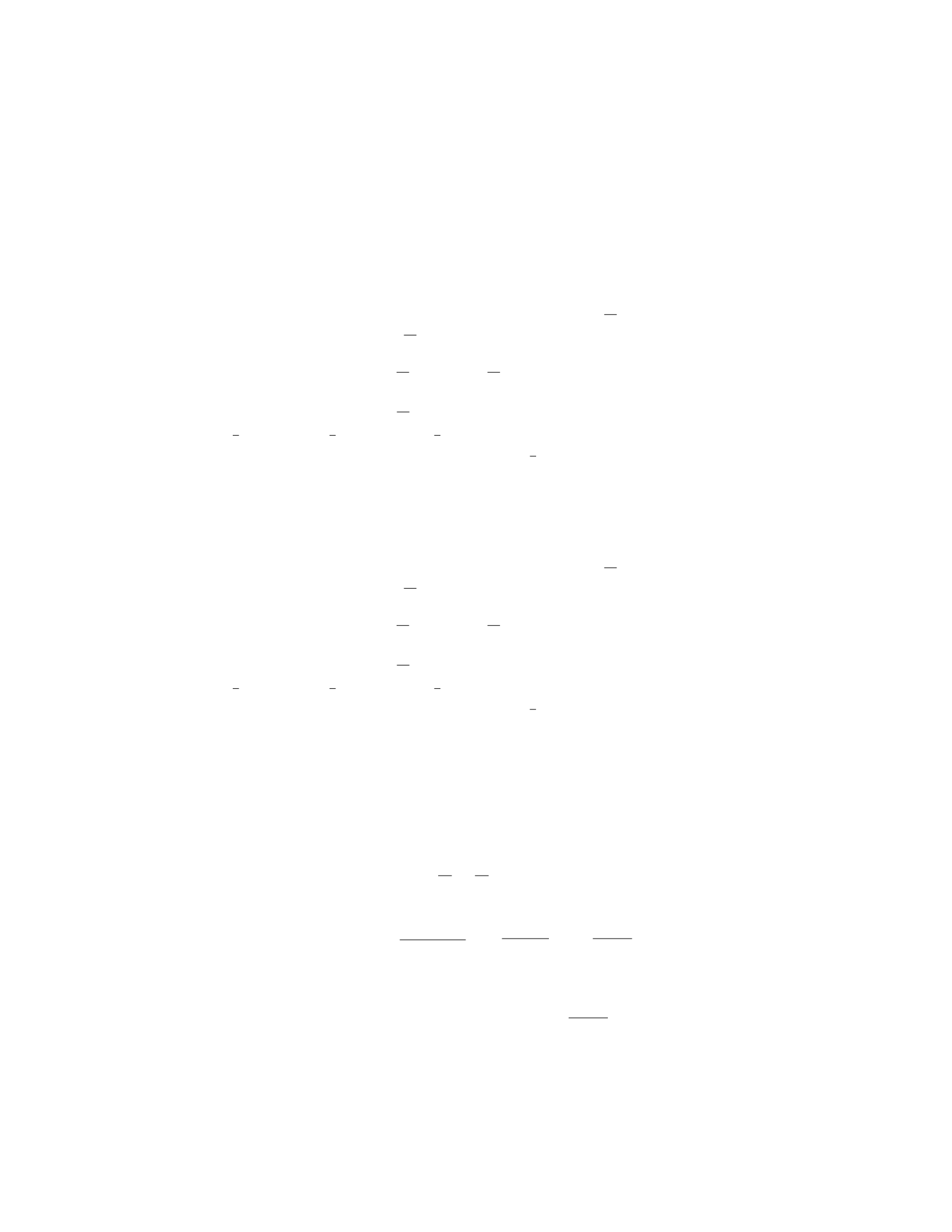
Question 16
Question 16: Calculate the line integral RCF·dr, where F(x, y) =
(x2+y, 2x+y2)and Cis the curve defined by r(t)=(t2, t)for 0≤t≤1.
Step-by-step Solution: 1. Parameterize the curve Cusing r(t) =
(t2, t):r(t) = (x(t), y(t)) = (t2, t)for 0≤t≤1.
2. Find the derivative of r(t)with respect to t:dr
dt = (2t, 1).
3. Substitute r(t)and dr
dt into F(x, y)=(x2+y, 2x+y2)to get F(r(t)):
F(r(t)) = (t2+t, 2t+t2).
4. Calculate F(r(t)) ·dr
dt :F(r(t)) ·dr
dt = (t2+t, 2t+t2)·(2t, 1) = (2t3+
t2) + (2t+t3) = 3t3+ 3t2.
5. Integrate F(r(t)) ·dr
dt over the interval 0≤t≤1:R1
0(3t3+ 3t2)dt
=3
4t4+t31
0=3
4+ 1−(0) = 7
4.
Therefore, the line integral RCF·dr =7
4.Sure, here is the question
and step-by-step solution for Line Integral:
Question 16: Calculate the line integral RCF·dr, where F(x, y) =
(x2+y, 2x+y2)and Cis the curve defined by r(t)=(t2, t)for 0≤t≤1.
Step-by-step Solution: 1. Parameterize the curve Cusing r(t) =
(t2, t):r(t) = (x(t), y(t)) = (t2, t)for 0≤t≤1.
2. Find the derivative of r(t)with respect to t:dr
dt = (2t, 1).
3. Substitute r(t)and dr
dt into F(x, y)=(x2+y, 2x+y2)to get F(r(t)):
F(r(t)) = (t2+t, 2t+t2).
4. Calculate F(r(t)) ·dr
dt :F(r(t)) ·dr
dt = (t2+t, 2t+t2)·(2t, 1) = (2t3+
t2) + (2t+t3) = 3t3+ 3t2.
5. Integrate F(r(t)) ·dr
dt over the interval 0≤t≤1:R1
0(3t3+ 3t2)dt
=3
4t4+t31
0=3
4+ 1−(0) = 7
4.
Therefore, the line integral RCF·dr =7
4.
Question 17
Compute the line integral RC(x2+y)ds, where Cis the curve parametrized
by r(t)=(t2,2t),0≤t≤1.
Step-by-step solution: 1. Find the derivative of r(t)with respect
to t:
r′(t) = d
dtt2,d
dt2t= (2t, 2)
2. Calculate the magnitude of r′(t):
∥r′(t)∥=p(2t)2+ 22=p4t2+ 4 = 2pt2+ 1
3. Now, substitute r(t)and r′(t)into the line integral formula:
ZC
(x2+y)ds =Z1
0
[(t2)2+ 2t]·2pt2+ 1 dt
16
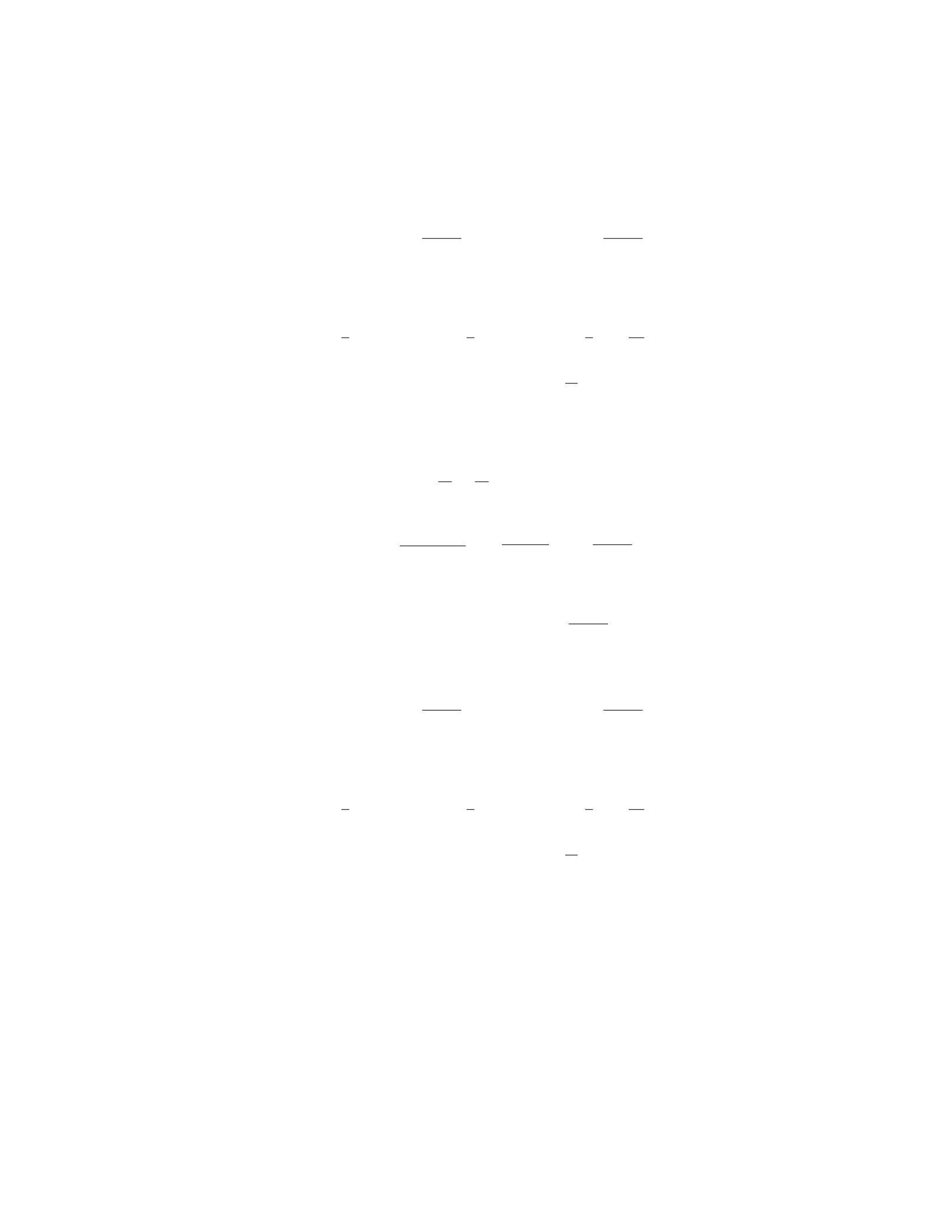
4. Simplify the integrand:
=Z1
0
(t4+ 2t)·2pt2+ 1 dt = 2 Z1
0
(t4+ 2t)pt2+ 1 dt
5. Integrate with respect to t:
= 2 1
5(t5) + t21
0
= 2 1
5+ 1 −0= 2 6
5=12
5
Therefore, the value of the line integral is 12
5.Question 17:
Compute the line integral RC(x2+y)ds, where Cis the curve parametrized
by r(t)=(t2,2t),0≤t≤1.
Step-by-step solution: 1. Find the derivative of r(t)with respect
to t:
r′(t) = d
dtt2,d
dt2t= (2t, 2)
2. Calculate the magnitude of r′(t):
∥r′(t)∥=p(2t)2+ 22=p4t2+ 4 = 2pt2+ 1
3. Now, substitute r(t)and r′(t)into the line integral formula:
ZC
(x2+y)ds =Z1
0
[(t2)2+ 2t]·2pt2+ 1 dt
4. Simplify the integrand:
=Z1
0
(t4+ 2t)·2pt2+ 1 dt = 2 Z1
0
(t4+ 2t)pt2+ 1 dt
5. Integrate with respect to t:
= 2 1
5(t5) + t21
0
= 2 1
5+ 1 −0= 2 6
5=12
5
Therefore, the value of the line integral is 12
5.
Question 18
Question 18:
Consider the curve defined by the vector function r(t) = ⟨t2, t, t3⟩
for 1≤t≤2.
Find the line integral of the vector field F(x, y, z) = ⟨x2, yz, z⟩along
the given curve.
Solution:
17

The line integral of a vector field F(x, y, z)along a curve r(t) =
⟨x(t), y(t), z(t)⟩for a≤t≤bis given by
ZC
F·dr=Zb
a
F(r(t)) ·r′(t)dt
Given that r(t) = ⟨t2, t, t3⟩, we have r′(t) = ⟨2t, 1,3t2⟩.
Now, the vector field F(r(t)) = F(t2, t, t3) = ⟨t4, t2·t3, t3⟩=⟨t4, t5, t3⟩.
Therefore, the line integral becomes
ZC
F·dr=Z2
1⟨t4, t5, t3⟩·⟨2t, 1,3t2⟩dt
=Z2
1
(2t5+t5+ 3t5)dt
=Z2
1
6t5dt
=6t6
62
1
= 26−16
= 64 −1
= 63
Therefore, the line integral of F(x, y, z) = ⟨x2, yz, z⟩along the given
curve is 63 .Certainly! Here is the question along with the step-by-
step solution in LateX code for Line Integral for Liberty University.
Question 18:
Consider the curve defined by the vector function r(t) = ⟨t2, t, t3⟩
for 1≤t≤2.
Find the line integral of the vector field F(x, y, z) = ⟨x2, yz, z⟩along
the given curve.
Solution:
The line integral of a vector field F(x, y, z)along a curve r(t) =
⟨x(t), y(t), z(t)⟩for a≤t≤bis given by
ZC
F·dr=Zb
a
F(r(t)) ·r′(t)dt
Given that r(t) = ⟨t2, t, t3⟩, we have r′(t) = ⟨2t, 1,3t2⟩.
Now, the vector field F(r(t)) = F(t2, t, t3) = ⟨t4, t2·t3, t3⟩=⟨t4, t5, t3⟩.
Therefore, the line integral becomes
18
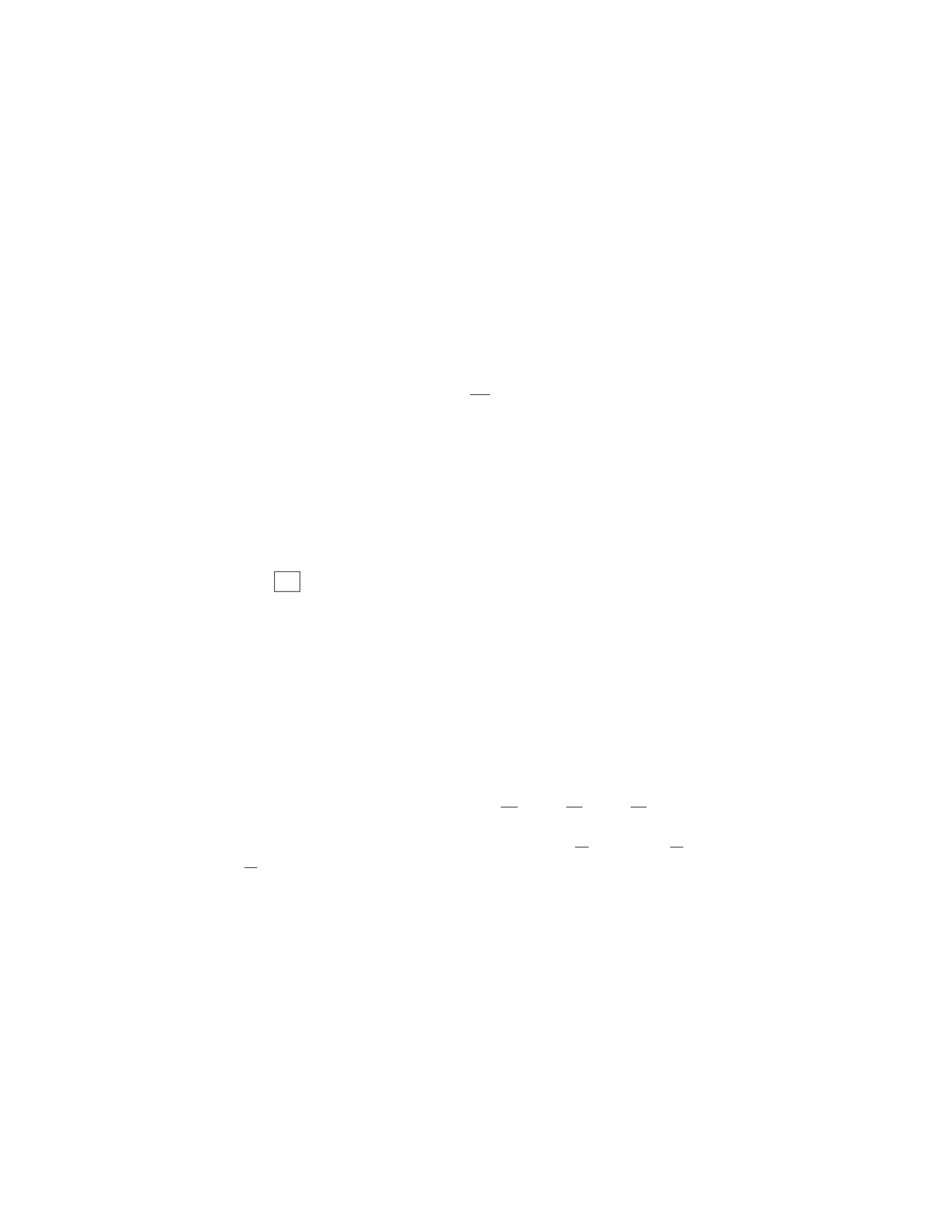
ZC
F·dr=Z2
1⟨t4, t5, t3⟩·⟨2t, 1,3t2⟩dt
=Z2
1
(2t5+t5+ 3t5)dt
=Z2
1
6t5dt
=6t6
62
1
= 26−16
= 64 −1
= 63
Therefore, the line integral of F(x, y, z) = ⟨x2, yz, z⟩along the given
curve is 63 .
Question 19
Question 19:
Let Cbe the curve given by r(t) = (cos t, sin t, t2)for 0≤t≤2π.
Calculate the line integral RCx dx +y dy +z dz.
Solution:
Given the curve Cdefined by r(t) = (cos t, sin t, t2)for 0≤t≤2π.
The line integral RCx dx +y dy +z dz can be written as:
ZC
x dx +y dy +z dz =Zb
ax(t)dx
dt +y(t)dy
dt +z(t)dz
dt dt
Substitute x(t) = cos t,y(t) = sin t,z(t) = t2,dx
dt =−sin t,dy
dt = cos t,
and dz
dt = 2tinto the integral:
ZC
x dx +y dy +z dz =Z2π
0cos t(−sin t) + sin tcos t+t2(2t)dt
Simplify the integral:
ZC
x dx +y dy +z dz =Z2π
0
(−cos tsin t+ sin tcos t+ 2t3)dt
19
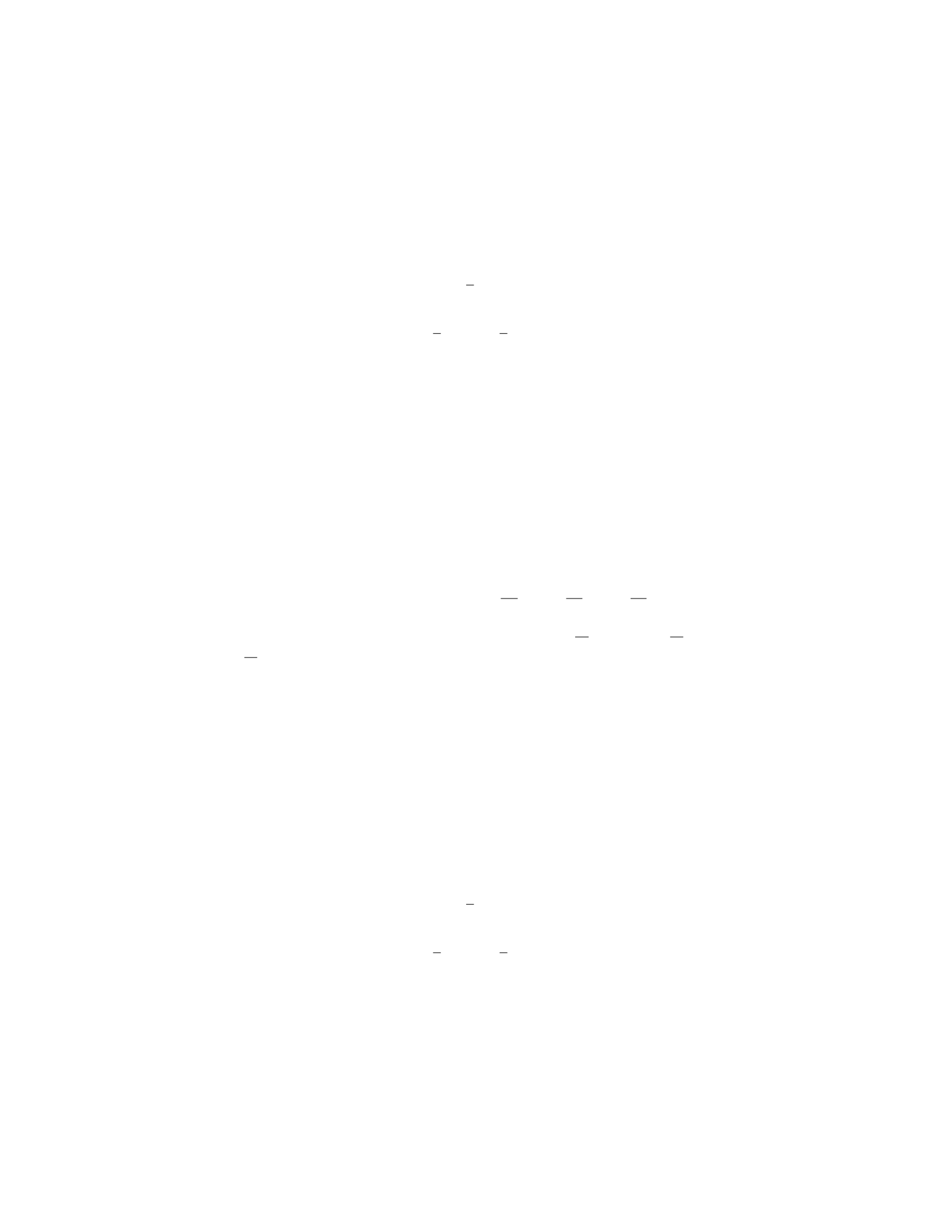
=Z2π
0
2t3dt
=1
2t42π
0
=1
2(2π)4−1
2(0)4
= 8π4
Therefore, the line integral RCx dx +y dy +z dz along the curve C
is 8π4.Certainly! Here is the LateX code for question number 19 on
Line Integral for Liberty University:
Question 19:
Let Cbe the curve given by r(t) = (cos t, sin t, t2)for 0≤t≤2π.
Calculate the line integral RCx dx +y dy +z dz.
Solution:
Given the curve Cdefined by r(t) = (cos t, sin t, t2)for 0≤t≤2π.
The line integral RCx dx +y dy +z dz can be written as:
ZC
x dx +y dy +z dz =Zb
ax(t)dx
dt +y(t)dy
dt +z(t)dz
dt dt
Substitute x(t) = cos t,y(t) = sin t,z(t) = t2,dx
dt =−sin t,dy
dt = cos t,
and dz
dt = 2tinto the integral:
ZC
x dx +y dy +z dz =Z2π
0cos t(−sin t) + sin tcos t+t2(2t)dt
Simplify the integral:
ZC
x dx +y dy +z dz =Z2π
0
(−cos tsin t+ sin tcos t+ 2t3)dt
=Z2π
0
2t3dt
=1
2t42π
0
=1
2(2π)4−1
2(0)4
= 8π4
Therefore, the line integral RCx dx +y dy +z dz along the curve Cis
8π4.
20
Question 20
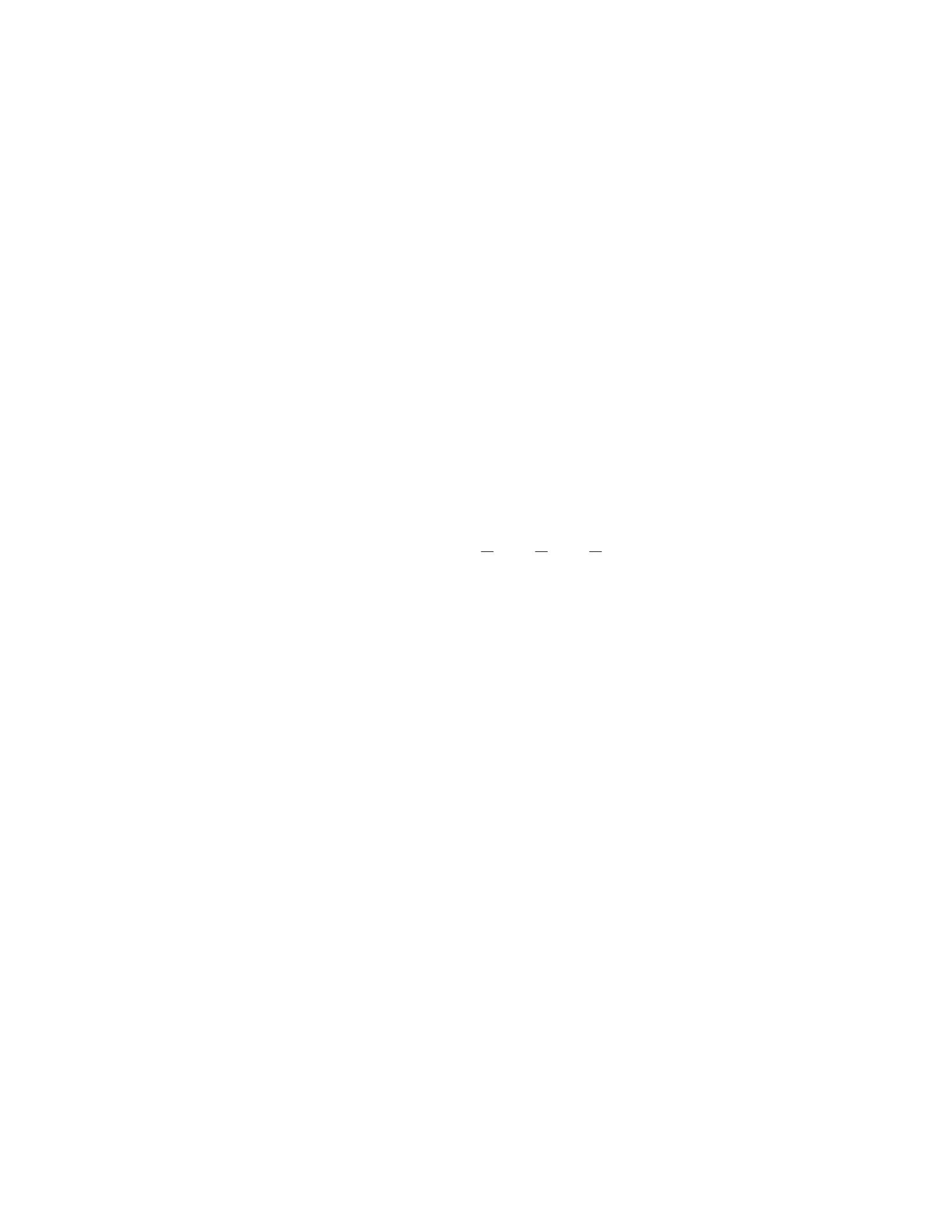
Question 20:
Evaluate the line integral RC(3x2−y2)dx + (2y−x)dy where Cis the
curve given by r(t) = ⟨t2,2t⟩for 0≤t≤1.
Solution:
The line integral is given by:
ZC
(3x2−y2)dx + (2y−x)dy =Z1
0
(3(t2)2−(2t)2)·2t+ (2(2t)−t)·2dt
=Z1
0
(3t4−4t2)·2t+ (4t−t)·2dt
=Z1
0
(6t5−8t3+ 8t−2t)dt
=Z1
0
(6t5−8t3+ 6t)dt
= [(6 ·t6
6−8·t4
4+ 6 ·t2
2)]1
0
= (t6−2t4+ 3t2)|1
0
= (1 −2 + 3) −(0 −0 + 0)
= 2.
Therefore, the value of the line integral is 2.Sure! Here is the
question and solution in LateX code:
Question 20:
Evaluate the line integral RC(3x2−y2)dx + (2y−x)dy where Cis the
curve given by r(t) = ⟨t2,2t⟩for 0≤t≤1.
Solution:
The line integral is given by:
21
ZC
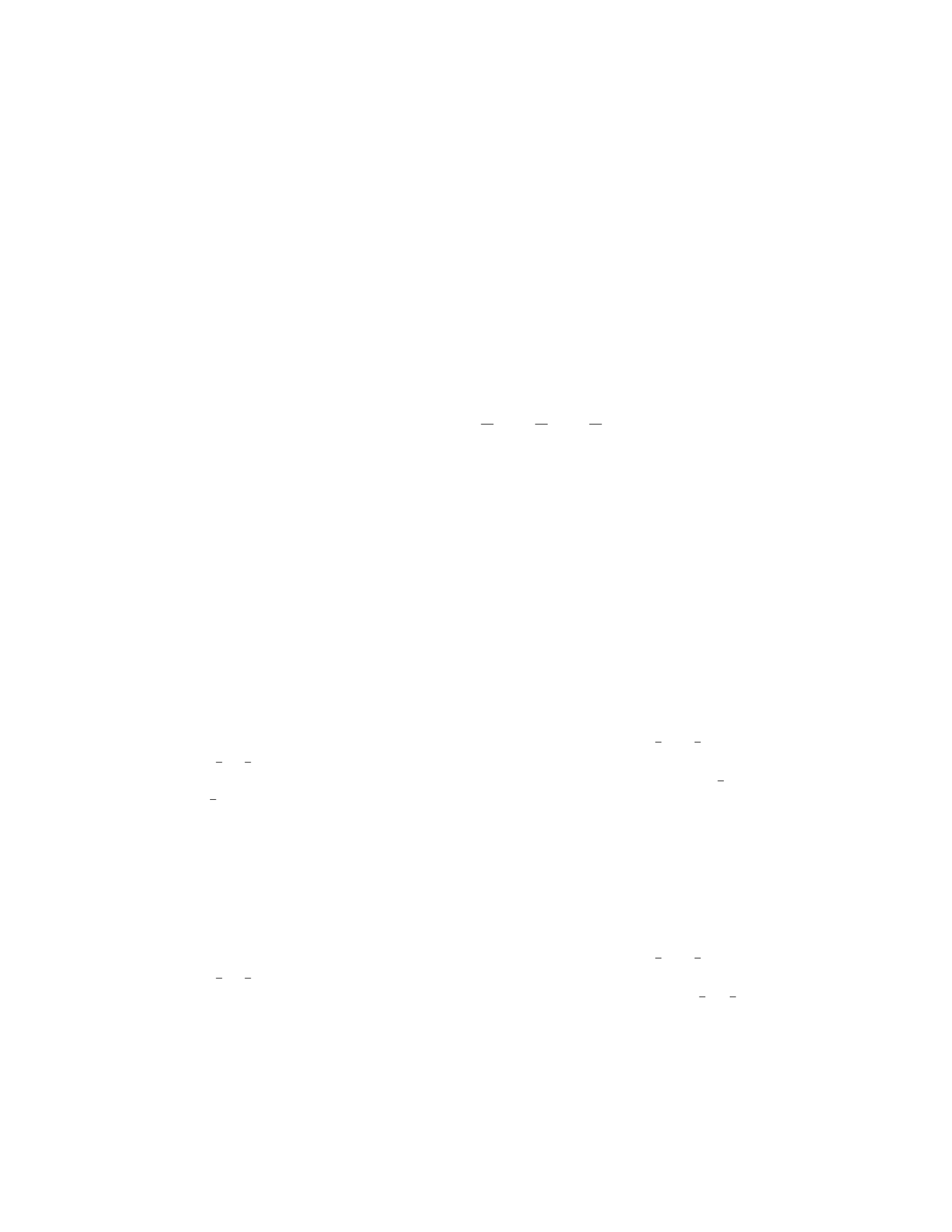
(3x2−y2)dx + (2y−x)dy =Z1
0
(3(t2)2−(2t)2)·2t+ (2(2t)−t)·2dt
=Z1
0
(3t4−4t2)·2t+ (4t−t)·2dt
=Z1
0
(6t5−8t3+ 8t−2t)dt
=Z1
0
(6t5−8t3+ 6t)dt
= [(6 ·t6
6−8·t4
4+ 6 ·t2
2)]1
0
= (t6−2t4+ 3t2)|1
0
= (1 −2 + 3) −(0 −0 + 0)
= 2.
Therefore, the value of the line integral is 2.
Question 21
Step-by-step solution: 1. First, parameterize the path C: Let x=t
and y=t2where 0≤t≤1.
2. Calculate dx and dy:dx =dt and dy = 2t dt.
3. Substitute the parameterized path and differentials into the
line integral: RC(x2+y2)dx + 2xy dy =R1
0((t2+t4)·dt + 2(t)(t2)·2t dt).
4. Simplify the integrand: R1
0(t2+t4+ 4t4)dt.
5. Integrate the simplified expression: R1
0(5t4+t2)dt = [5
5t5+1
3t3]1
0=
(5
5+1
3)−(0 + 0).
6. Calculate the final result: The line integral is equal to 1 + 1
3=
4
3.Question 21: Calculate the line integral HC(x2+y2)dx+ 2xy dy, where
Cis the path given by y=x2from (0,0) to (1,1).
Step-by-step solution: 1. First, parameterize the path C: Let x=t
and y=t2where 0≤t≤1.
2. Calculate dx and dy:dx =dt and dy = 2t dt.
3. Substitute the parameterized path and differentials into the
line integral: RC(x2+y2)dx + 2xy dy =R1
0((t2+t4)·dt + 2(t)(t2)·2t dt).
4. Simplify the integrand: R1
0(t2+t4+ 4t4)dt.
5. Integrate the simplified expression: R1
0(5t4+t2)dt = [5
5t5+1
3t3]1
0=
(5
5+1
3)−(0 + 0).
6. Calculate the final result: The line integral is equal to 1 + 1
3=4
3.
22
Question 22
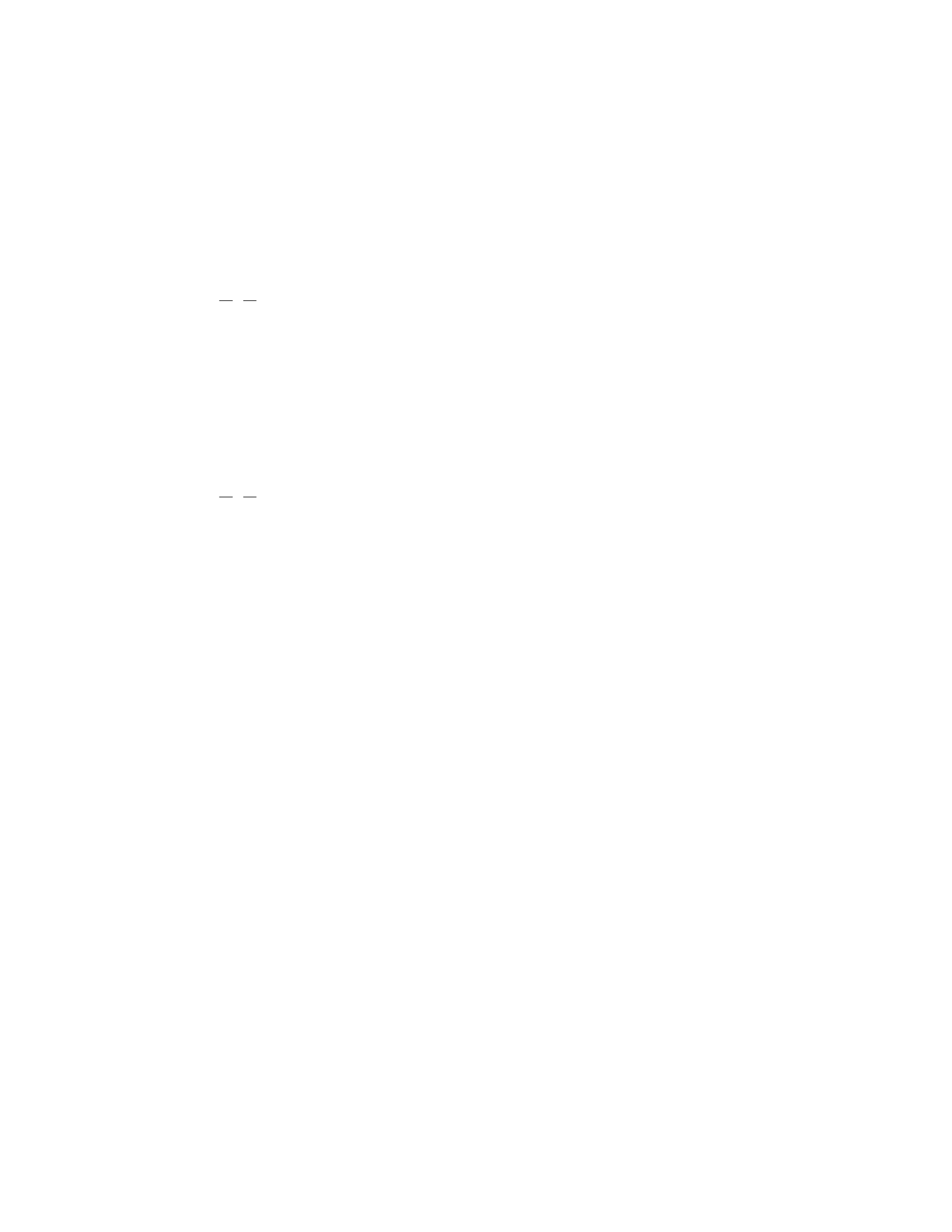
Question 22: Evaluate the line integral RCx2y dx +xy2dy, where C
is the curve parametrized by r(t) = (sin t, cos t)for 0≤t≤π.
Step-by-step solution: 1. Calculate the derivatives of r(t): r′(t) =
dx
dt ,dy
dt = (cos t, −sin t).
2. Substitute the parametric equations and derivatives into the
line integral: RCx2y dx+xy2dy =Rπ
0(sin2tcos t)(cos t)dt+(sin tcos2t)(−sin t)dt.
3. Simplify the integral: Rπ
0(sin2tcos2t−sin2tcos2t)dt = 0.
Therefore, the value of the line integral is 0.Sure, here is a question
and step-by-step solution on Line Integral for Liberty University in
LateX code:
Question 22: Evaluate the line integral RCx2y dx +xy2dy, where C
is the curve parametrized by r(t) = (sin t, cos t)for 0≤t≤π.
Step-by-step solution: 1. Calculate the derivatives of r(t): r′(t) =
dx
dt ,dy
dt = (cos t, −sin t).
2. Substitute the parametric equations and derivatives into the
line integral: RCx2y dx+xy2dy =Rπ
0(sin2tcos t)(cos t)dt+(sin tcos2t)(−sin t)dt.
3. Simplify the integral: Rπ
0(sin2tcos2t−sin2tcos2t)dt = 0.
Therefore, the value of the line integral is 0.
Question 23
Step-by-step solution: 1. Find the derivative of r(t)with respect
to t:
r′(t) = ⟨cos t, −sin t, 1⟩
2. Evaluate the dot product of Fand r′(t):
F·r′(t) = ⟨sin tcos t, −sin tcos t, sin tcos t⟩·⟨cos t, −sin t, 1⟩
= sin tcos t·cos t−sin tcos t·sin t+ sin tcos t
= cos2tsin t−sin2tcos t+ sin tcos t
3. Integrate the dot product over the curve C:
ZC
F·dr =Zπ
0
(cos2tsin t−sin2tcos t+ sin tcos t)dt
Question 23: Let Cbe the curve given by r(t) = ⟨sin t, cos t, t⟩for 0≤t≤
π, and let F(x, y, z) = ⟨yz, xz, xy⟩. Calculate the line integral RCF·dr.
Step-by-step solution: 1. Find the derivative of r(t)with respect
to t:
r′(t) = ⟨cos t, −sin t, 1⟩
23

2. Evaluate the dot product of Fand r′(t):
F·r′(t) = ⟨sin tcos t, −sin tcos t, sin tcos t⟩·⟨cos t, −sin t, 1⟩
= sin tcos t·cos t−sin tcos t·sin t+ sin tcos t
= cos2tsin t−sin2tcos t+ sin tcos t
3. Integrate the dot product over the curve C:
ZC
F·dr =Zπ
0
(cos2tsin t−sin2tcos t+ sin tcos t)dt
Question 24
Question 24: Evaluate the line integral RCyex2dx +ex2dy, where C
is the curve given by the equation y=x3from (0,0) to (1,1).
Solution: To evaluate the line integral, we need to parametrize
the curve C. Since C is given by y=x3, we can parameterize it as
r(t) = ⟨t, t3⟩, where 0≤t≤1.
Now, we need to find dx and dy in terms of dt:
dx =dx
dt dt =dt
dy =dy
dt dt = 3t2dt
Next, we compute the line integral:
ZC
yex2dx +ex2dy
=Z1
0
t3et2dt +et2·3t2dt
=Z1
0
t3et2dt + 3t2et2dt
To evaluate the integrals, we use integration by parts for the first
term and the power rule for the second term.
Zt3et2dt
Let u=t2and dv =tet2dt, then du = 2t dt and v=et2.
=t2et2−Z2t·et2dt
=t2et2−et2+C1
24
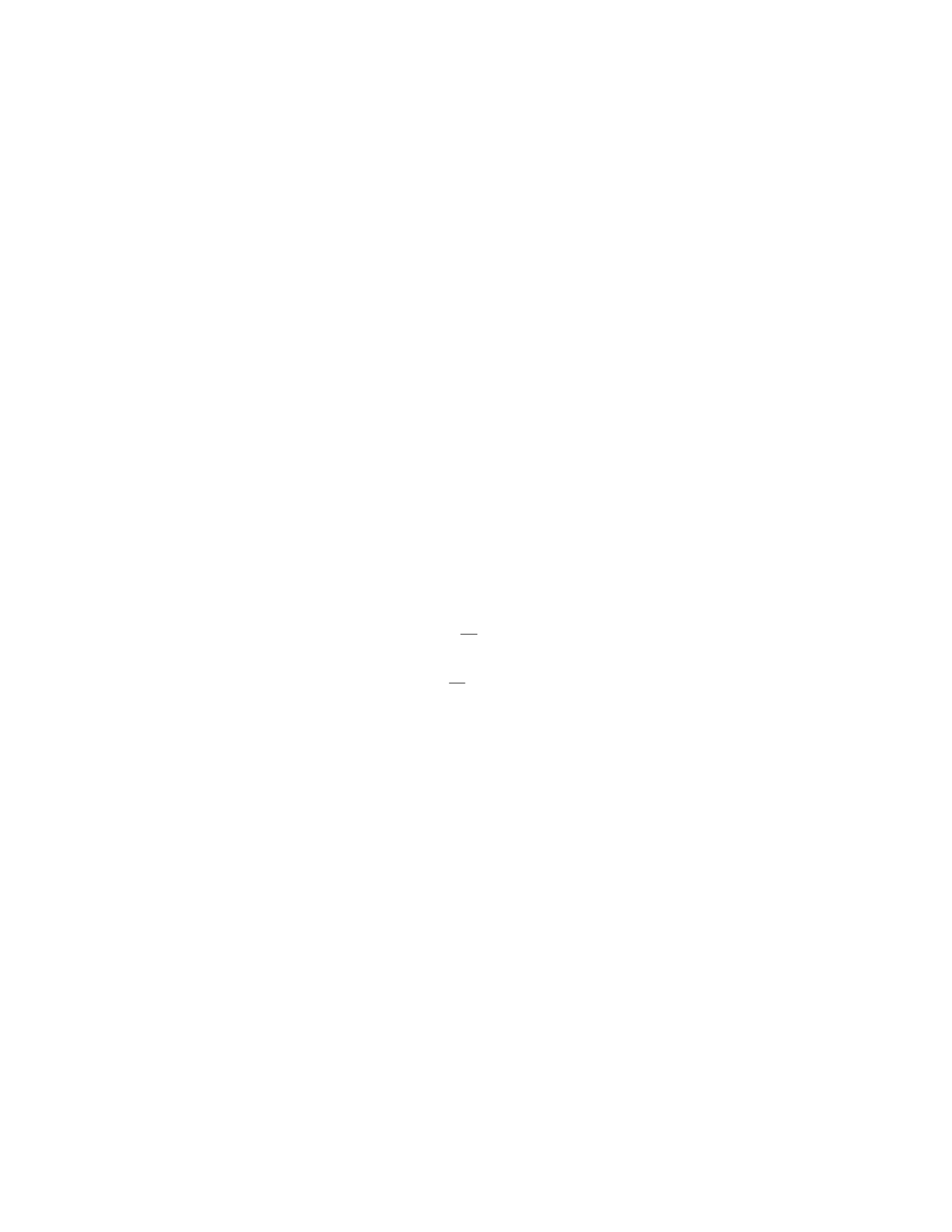
Z3t2et2dt
Let u=t2and dv = 3tet2dt, then du = 2t dt and v=et2.
= 3t2et2−Z6t·et2dt
= 3t2et2−3et2+C2
So, the final answer for the line integral is:
t2et2−et2+ 3t2et2−3et2
1
0
Let me know if you need any further clarification or assistance!Certainly!
Here is the question along with its solution in LateX code:
Question 24: Evaluate the line integral RCyex2dx +ex2dy, where C
is the curve given by the equation y=x3from (0,0) to (1,1).
Solution: To evaluate the line integral, we need to parametrize
the curve C. Since C is given by y=x3, we can parameterize it as
r(t) = ⟨t, t3⟩, where 0≤t≤1.
Now, we need to find dx and dy in terms of dt:
dx =dx
dt dt =dt
dy =dy
dt dt = 3t2dt
Next, we compute the line integral:
ZC
yex2dx +ex2dy
=Z1
0
t3et2dt +et2·3t2dt
=Z1
0
t3et2dt + 3t2et2dt
To evaluate the integrals, we use integration by parts for the first
term and the power rule for the second term.
Zt3et2dt
Let u=t2and dv =tet2dt, then du = 2t dt and v=et2.
=t2et2−Z2t·et2dt
25
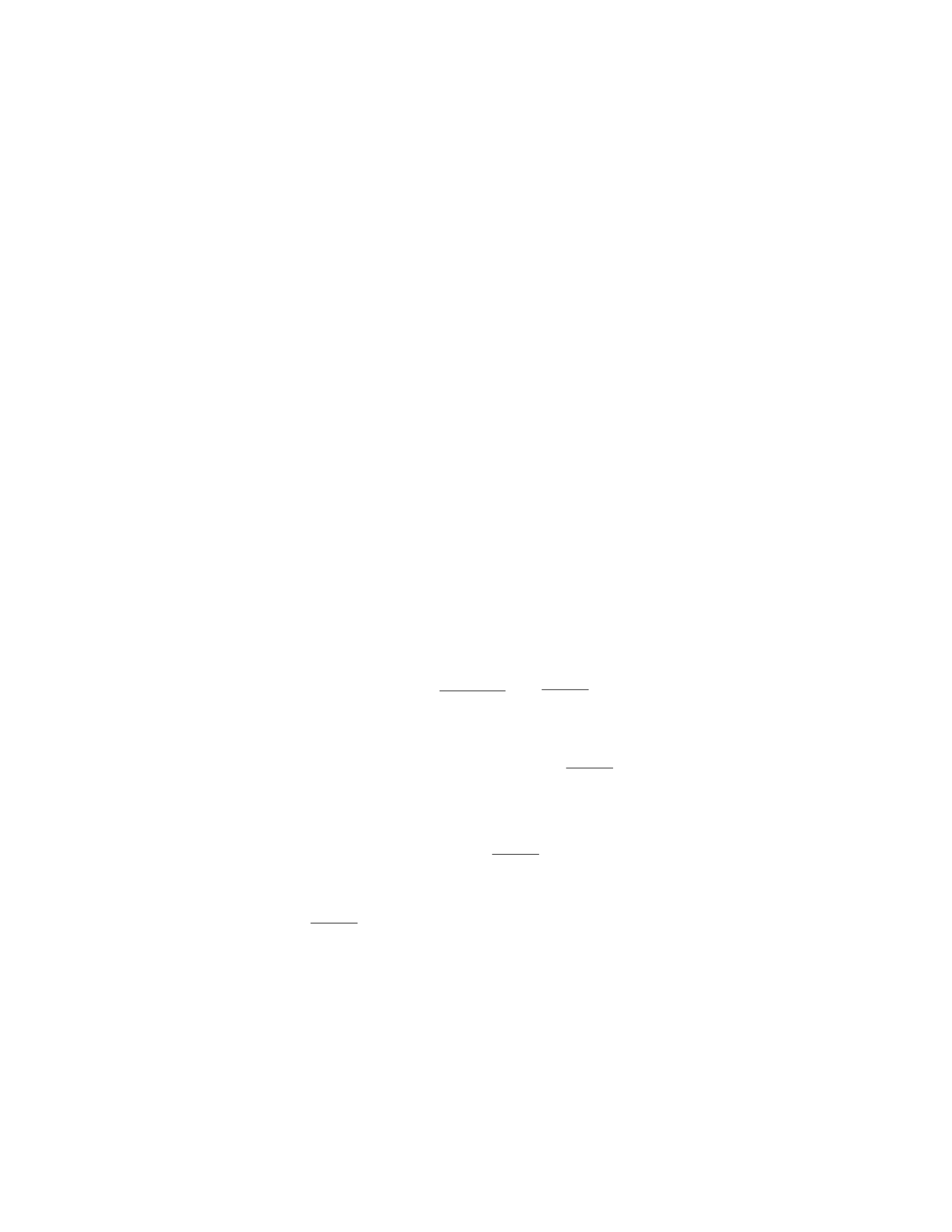
=t2et2−et2+C1
Z3t2et2dt
Let u=t2and dv = 3tet2dt, then du = 2t dt and v=et2.
= 3t2et2−Z6t·et2dt
= 3t2et2−3et2+C2
So, the final answer for the line integral is:
t2et2−et2+ 3t2et2−3et2
1
0
Let me know if you need any further clarification or assistance!
Question 25
Step-by-step Solution: 1. Find the derivative of r(t)with respect
to tto get the velocity vector, v(t):
v(t) = ⟨1,2t⟩
2. Determine the magnitude of the velocity vector:
∥v(t)∥=p12+ (2t)2=p1+4t2
3. Rewrite the line integral in terms of a parameter t:
ZC
(x2+y2)ds =Z2
0
((t)2+ (t2)2)p1+4t2dt
4. Evaluate the integral:
Z2
0
(t2+t4)p1+4t2dt
Therefore, the line integral RC(x2+y2)ds along the curve Cis equal
to R2
0(t2+t4)√1+4t2dt.Question 25: Find the line integral RC(x2+y2)ds,
where Cis the curve given by r(t) = ⟨t, t2⟩for 0≤t≤2.
Step-by-step Solution: 1. Find the derivative of r(t)with respect
to tto get the velocity vector, v(t):
v(t) = ⟨1,2t⟩
26
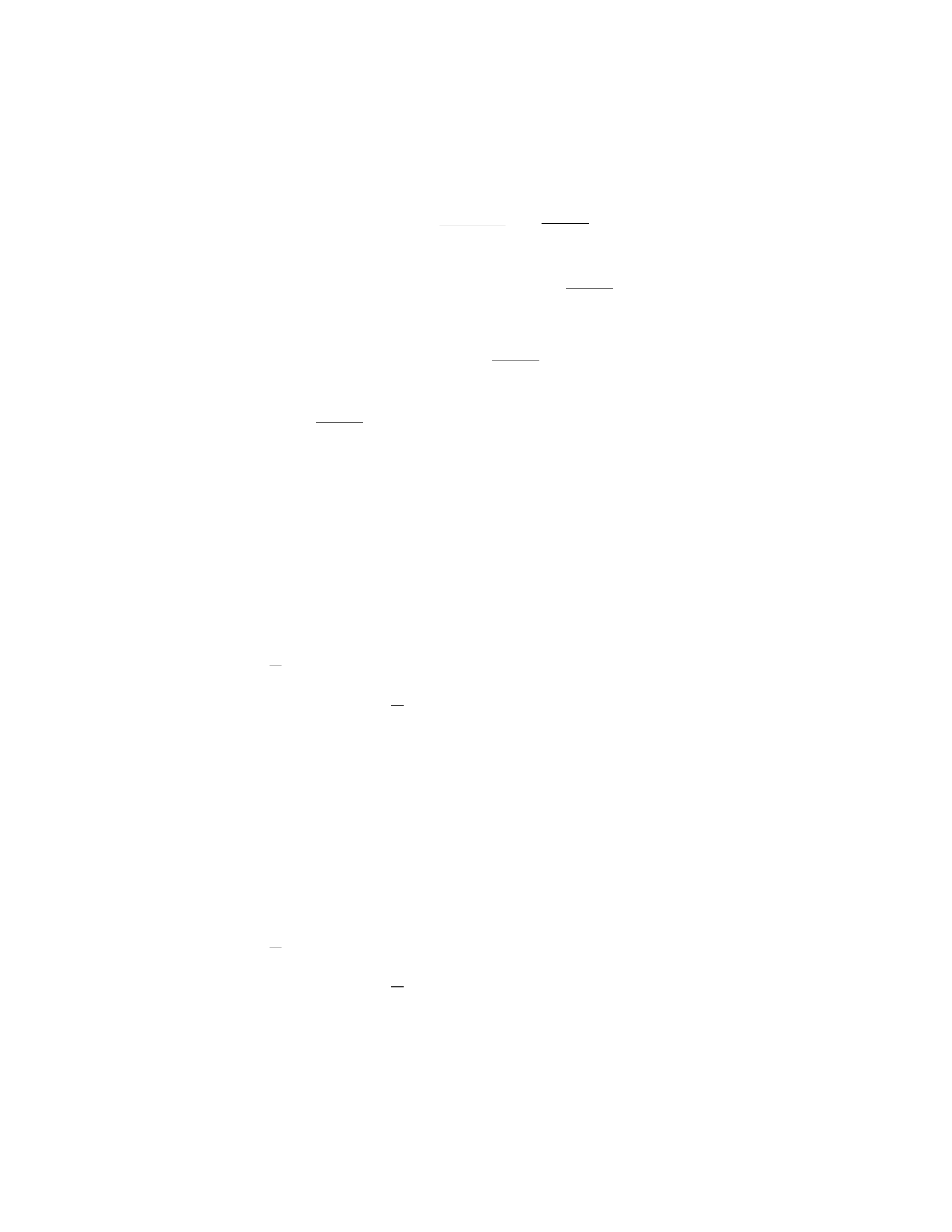
2. Determine the magnitude of the velocity vector:
∥v(t)∥=p12+ (2t)2=p1+4t2
3. Rewrite the line integral in terms of a parameter t:
ZC
(x2+y2)ds =Z2
0
((t)2+ (t2)2)p1+4t2dt
4. Evaluate the integral:
Z2
0
(t2+t4)p1+4t2dt
Therefore, the line integral RC(x2+y2)ds along the curve Cis equal
to R2
0(t2+t4)√1+4t2dt.
Question 26
Question 26:
Consider the curve given by r(t) = ti+t2j−t3k and the vector field
F(x, y, z) = (yz +x)i+ (xz +y)j+ (xy +z)k.
Calculate the line integral RCF·dr over the curve Cfrom (0,0,0)
to (1,1,−1).
Solution: First, we need to parameterize the curve Cusing r(t):
r(t) = ti+t2j−t3k, where 0≤t≤1.
Next, we calculate the differential of r:
dr=dr
dt dt =idt + 2tjdt −3t2kdt.
Now, we substitute r(t)and dr into the line integral formula:
RCF·dr=R1
0F(r(t)) ·dr
dt dt.
After substituting r(t),dr, and F into the integral, simplify and
evaluate the integral to find the final answer.
Good luck!Sure! Here is a Line Integral question along with its
step-by-step solution in LateX code:
Question 26:
Consider the curve given by r(t) = ti+t2j−t3k and the vector field
F(x, y, z) = (yz +x)i+ (xz +y)j+ (xy +z)k.
Calculate the line integral RCF·dr over the curve Cfrom (0,0,0)
to (1,1,−1).
Solution: First, we need to parameterize the curve Cusing r(t):
r(t) = ti+t2j−t3k, where 0≤t≤1.
Next, we calculate the differential of r:
dr=dr
dt dt =idt + 2tjdt −3t2kdt.
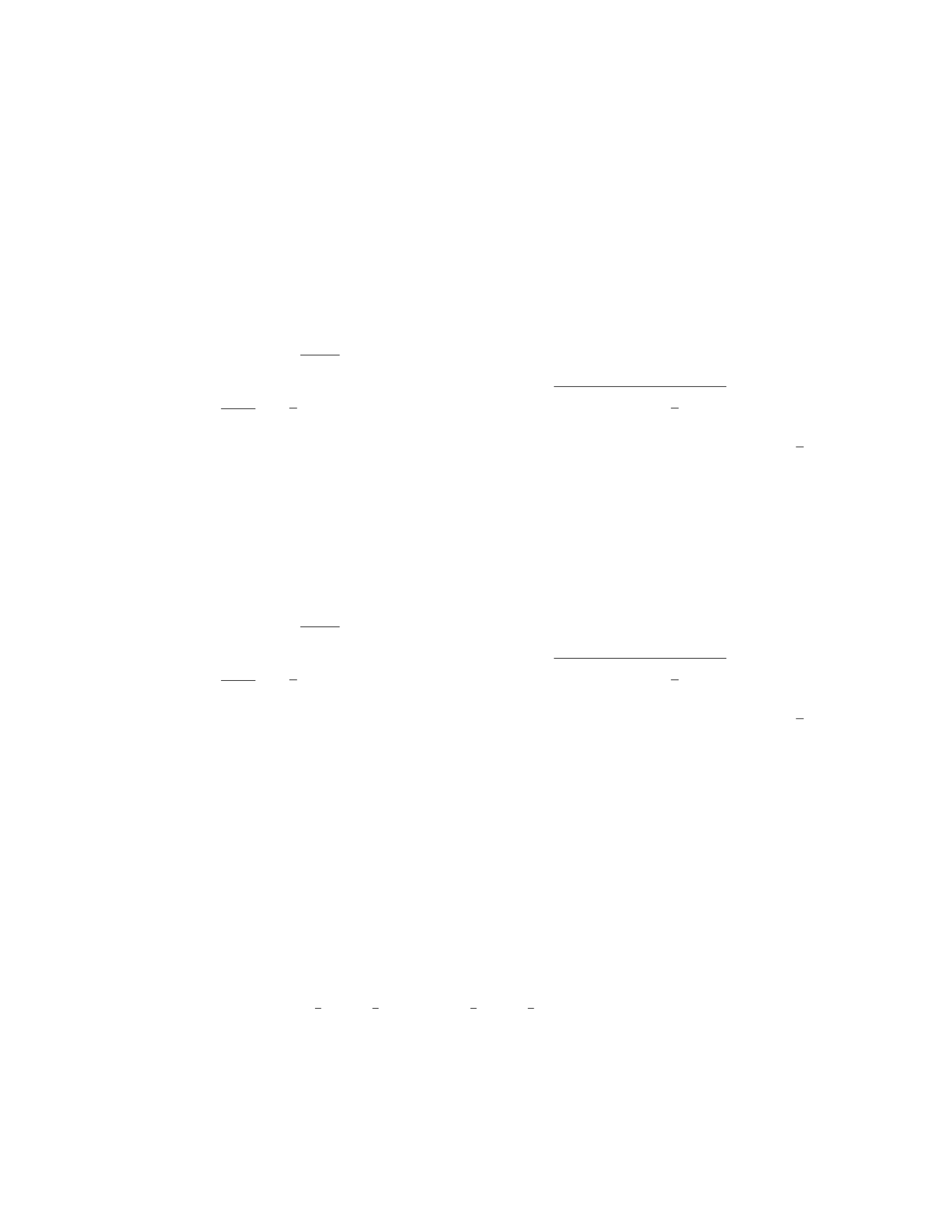
Now, we substitute r(t)and dr into the line integral formula:
RCF·dr=R1
0F(r(t)) ·dr
dt dt.
After substituting r(t),dr, and F into the integral, simplify and
evaluate the integral to find the final answer.
Good luck!
27
Question 27
Question 27: Let Cbe the curve defined by r(t) = ⟨2 cos t, 2 sin t, t⟩
for 0≤t≤2π. Calculate the line integral RCxey+zds.
Solution: Given curve Cwith parameterization r(t) = ⟨2 cos t, 2 sin t, t⟩
for 0≤t≤2π, we can calculate the line integral as follows:
The curve starts at t= 0 and ends at t= 2π. The differential
of arc length ds is given by ds =||r′(t)||dt. The unit tangent vec-
tor is T=r′(t)
||r′(t)|| . Substitute x= 2 cos t,y= 2 sin t, and z=tinto
the given function: xey+z= 2 cos te2 sin t+t. The line integral becomes
RC2 cos te2 sin t+t||r′(t)||dt. Calculate ||r′(t)|| =p(−2 sin t)2+ (2 cos t)2+ 1 =
√4 + 1 = √5. The line integral simplifies to RC2 cos te2 sin t+t√5dt. Inte-
grate with respect to tover 0≤t≤2πto find the final result.
Therefore, the line integral RCxey+zds over the curve Cis R2π
02 cos te2 sin t+t√5dt.Certainly!
Here is question number 27 on Line Integral for Liberty University
in LateX code:
Question 27: Let Cbe the curve defined by r(t) = ⟨2 cos t, 2 sin t, t⟩
for 0≤t≤2π. Calculate the line integral RCxey+zds.
Solution: Given curve Cwith parameterization r(t) = ⟨2 cos t, 2 sin t, t⟩
for 0≤t≤2π, we can calculate the line integral as follows:
The curve starts at t= 0 and ends at t= 2π. The differential
of arc length ds is given by ds =||r′(t)||dt. The unit tangent vec-
tor is T=r′(t)
||r′(t)|| . Substitute x= 2 cos t,y= 2 sin t, and z=tinto
the given function: xey+z= 2 cos te2 sin t+t. The line integral becomes
RC2 cos te2 sin t+t||r′(t)||dt. Calculate ||r′(t)|| =p(−2 sin t)2+ (2 cos t)2+ 1 =
√4 + 1 = √5. The line integral simplifies to RC2 cos te2 sin t+t√5dt. Inte-
grate with respect to tover 0≤t≤2πto find the final result.
Therefore, the line integral RCxey+zds over the curve Cis R2π
02 cos te2 sin t+t√5dt.
Question 28
Question 28:
Evaluate the line integral RC(x2+y)dx + (x+ sin y)dy, where C is the
curve given by x=t,y=t2,0≤t≤1.
Solution: To evaluate the line integral, we need to parameterize
the curve C by expressing x and y in terms of a parameter t:
x=t y =t2dx =dt dy = 2tdt
Substitute these into the given line integral:
RC(x2+y)dx+ (x+ sin y)dy =R1
0((t2+t2)dt+ (t+ sin(t2))(2tdt)) = R1
0(2t2+
2t3+ 2t2+ 2tsin(t2))dt =R1
0(4t2+ 2t3+ 2tsin(t2))dt
Now, integrate each term separately:
R1
04t2dt =4
3t31
0=4
3R1
02t3dt =1
2t41
0=1
2R1
02tsin(t2)dt (this integral
might need further manipulation with substitution)
28
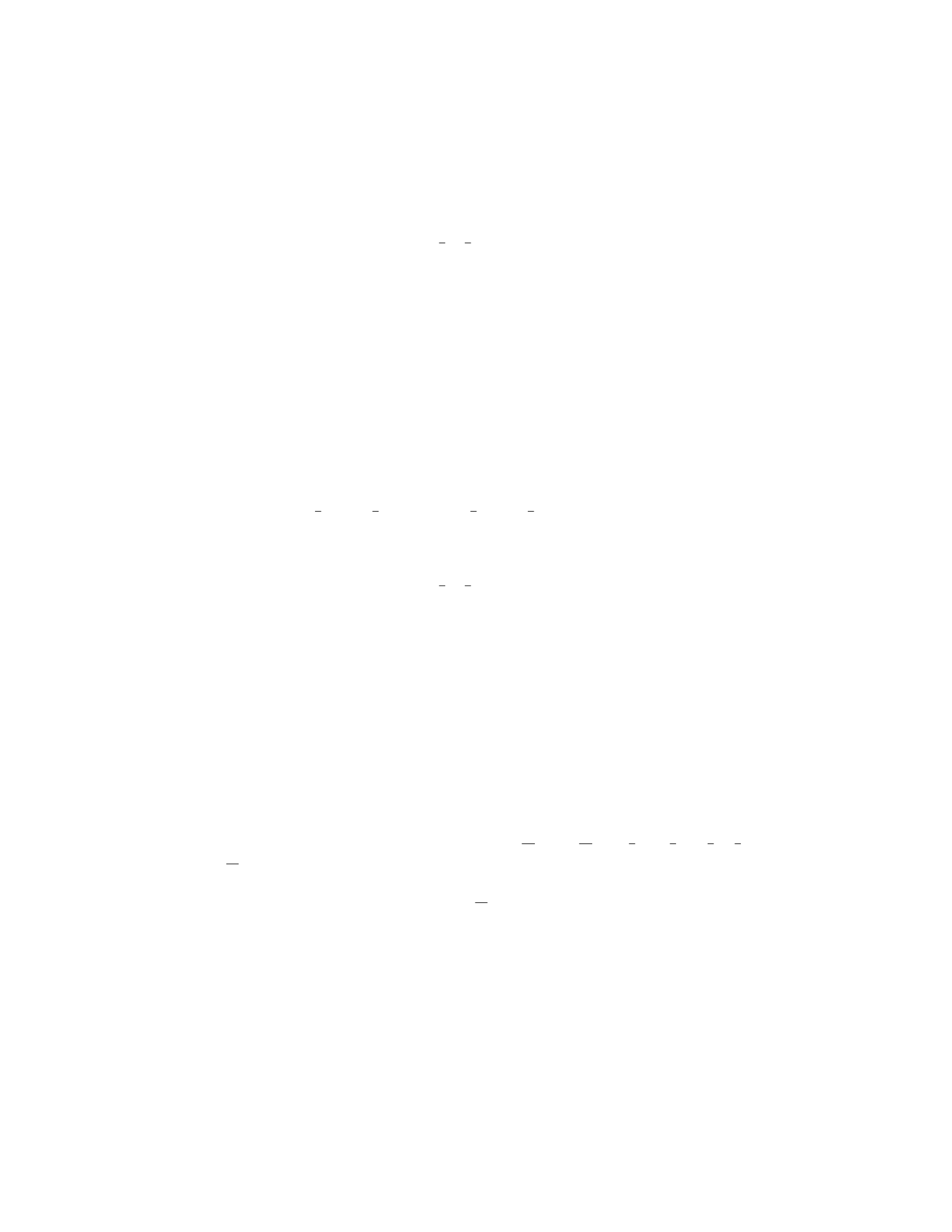
Finally, calculate the value of the line integral by summing up the
results of individual integrals:
RC(x2+y)dx+ (x+ sin y)dy =4
3+1
2+(value of the remaining integral)
You can now calculate the remaining integral or further simplify
the expression if needed.Certainly! Here is a Line Integral question
along with step-by-step solutions in LateX code:
Question 28:
Evaluate the line integral RC(x2+y)dx + (x+ sin y)dy, where C is the
curve given by x=t,y=t2,0≤t≤1.
Solution: To evaluate the line integral, we need to parameterize
the curve C by expressing x and y in terms of a parameter t:
x=t y =t2dx =dt dy = 2tdt
Substitute these into the given line integral:
RC(x2+y)dx+ (x+ sin y)dy =R1
0((t2+t2)dt+ (t+ sin(t2))(2tdt)) = R1
0(2t2+
2t3+ 2t2+ 2tsin(t2))dt =R1
0(4t2+ 2t3+ 2tsin(t2))dt
Now, integrate each term separately:
R1
04t2dt =4
3t31
0=4
3R1
02t3dt =1
2t41
0=1
2R1
02tsin(t2)dt (this integral
might need further manipulation with substitution)
Finally, calculate the value of the line integral by summing up the
results of individual integrals:
RC(x2+y)dx+ (x+ sin y)dy =4
3+1
2+(value of the remaining integral)
You can now calculate the remaining integral or further simplify
the expression if needed.
Question 29
Question 29: Calculate the line integral RCy2dx +x2dy, where Cis
the curve defined by y=x2from (0,0) to (1,1).
Solution: Given curve Cis defined by y=x2from (0,0) to (1,1).
The line integral is given by RCy2dx +x2dy.
First, express yin terms of xalong the curve: y=x2
Now, calculate dx and dy: Since dy/dx = 2x,dx =dx and dy = 2xdx.
Substitute y=x2,dx, and dy into the line integral: RCy2dx +x2dy =
R1
0x4dx +x2(2xdx) = R1
0x4dx + 2 R1
0x3dx = [x5
5]1
0+ 2[x4
4]1
0=1
5+ 2(1
4) = 1
5+1
2
=3
10 .
Therefore, the line integral RCy2dx +x2dy over the curve Cdefined
by y=x2from (0,0) to (1,1) is 3
10 .Sure, here is the question and
step-by-step solution for Line Integral question number 29:
Question 29: Calculate the line integral RCy2dx +x2dy, where Cis
the curve defined by y=x2from (0,0) to (1,1).
Solution: Given curve Cis defined by y=x2from (0,0) to (1,1).
The line integral is given by RCy2dx +x2dy.
First, express yin terms of xalong the curve: y=x2
Now, calculate dx and dy: Since dy/dx = 2x,dx =dx and dy = 2xdx.
29
Substitute y=x2,dx, and dy into the line integral: RCy2dx +x2dy =
R1
0x4dx +x2(2xdx) = R1
0x4dx + 2 R1
0x3dx = [x5
5]1
0+ 2[x4
4]1
0=1
5+ 2(1
4) = 1
5+1
2
=3
10 .
Therefore, the line integral RCy2dx +x2dy over the curve Cdefined
by y=x2from (0,0) to (1,1) is 3
10 .
Question 30
Calculate the line integral RCx2y dx + 3x2y dy, where Cis the line
segment from (1,0) to (2,4).
Step-by-step solution:
Given line integral: RCx2y dx + 3x2y dy
The parameterization of the line segment from (1,0) to (2,4) can
be written as follows:
x(t) = 1 + t, y(t)=4t, 0≤t≤1
Now, we can express dx and dy in terms of dt:
dx =x′(t)dt =dt
dy =y′(t)dt = 4 dt
Substitute x(t),y(t),dx, and dy into the line integral:
RCx2y dx + 3x2y dy =R1
0(1 + t)2(4t)dt + 3(1 + t)2(4t)(4) dt
Simplify the integrand:
=R1
0(4t+ 4t2)(4t)dt + 48(1 + t)2t dt
=R1
0(16t2+ 16t3)dt + 48(1 + t)2t dt
=16
3t3+ 4t41
0+48t(1 + t)3+ 3t2(1 + t)21
0
=16
3+ 4 + 48(2)3+ 3(2)2
=16
3+ 4 + 48(8) + 3(4)
=16
3+ 4 + 384 + 12
=16
3+ 4 + 384 + 12
= 416 + 16
3
Therefore, the value of the line integral RCx2y dx + 3x2y dy over the
line segment from (1,0) to (2,4) is 416 + 16
3.Question 30:
Calculate the line integral RCx2y dx + 3x2y dy, where Cis the line
segment from (1,0) to (2,4).
Step-by-step solution:
Given line integral: RCx2y dx + 3x2y dy
The parameterization of the line segment from (1,0) to (2,4) can
be written as follows:
x(t) = 1 + t, y(t)=4t, 0≤t≤1
Now, we can express dx and dy in terms of dt:
dx =x′(t)dt =dt
dy =y′(t)dt = 4 dt
Substitute x(t),y(t),dx, and dy into the line integral:
RCx2y dx + 3x2y dy =R1
0(1 + t)2(4t)dt + 3(1 + t)2(4t)(4) dt
30
3. Now, express xand yin terms of t:
x=t, y =t2
4. Substitute xand yinto the integrand to get the function in
terms of t:
f(t) = x2+y2=t2+ (t2)2=t2+t4
5. The line integral becomes:
Z1
0
(t2+t4)·p1+4t2dt
6. Integrate the function with respect to tover the interval [0,1]
to find the final answer.
Question 2
Find the work done by the force field F(x, y) = ⟨2y, x⟩in moving a
particle along the curve Cdefined by y=x2from the point (0,0) to
the point (2,4).
Step-by-step solution:
Given: F(x, y) = ⟨2y, x⟩,y=x2,P1= (0,0),P2= (2,4)
1. Find the parametric equations for the curve C: Let x=t, then
y=t2for 0≤t≤2.
2. Find the differential elements: dx =dt and dy = 2t dt.
3. Find the line integral:
ZC
F·dr=Z2
0
F(t2, t)· ⟨dt, 2t dt⟩
=Z2
0⟨2t, t2⟩·⟨dt, 2t dt⟩
=Z2
0
(2t·dt +t2·2t dt)
=Z2
0
(2t+ 2t3)dt
=Z2
0
2t(1 + t2)dt
=t2+t4
22
0
= (22+24
2)−(0 + 0)
= 4 + 8
= 12
2
4. Therefore, the work done by the force field F(x, y) = ⟨2y, x⟩
in moving a particle along the curve Cfrom (0,0) to (2,4) is 12
units.Question 2:
Find the work done by the force field F(x, y) = ⟨2y, x⟩in moving a
particle along the curve Cdefined by y=x2from the point (0,0) to
the point (2,4).
Step-by-step solution:
Given: F(x, y) = ⟨2y, x⟩,y=x2,P1= (0,0),P2= (2,4)
1. Find the parametric equations for the curve C: Let x=t, then
y=t2for 0≤t≤2.
2. Find the differential elements: dx =dt and dy = 2t dt.
3. Find the line integral:
ZC
F·dr=Z2
0
F(t2, t)· ⟨dt, 2t dt⟩
=Z2
0⟨2t, t2⟩·⟨dt, 2t dt⟩
=Z2
0
(2t·dt +t2·2t dt)
=Z2
0
(2t+ 2t3)dt
=Z2
0
2t(1 + t2)dt
=t2+t4
22
0
= (22+24
2)−(0 + 0)
= 4 + 8
= 12
4. Therefore, the work done by the force field F(x, y) = ⟨2y, x⟩in
moving a particle along the curve Cfrom (0,0) to (2,4) is 12 units.
Question 3
Question 3: Calculate the line integral RC(x2+y2)ds, where Cis
the curve given by r(t) = ⟨2t, 3t2⟩for 0≤t≤2.
Step-by-step solution: 1. First, we need to find the differential of
the curve r(t)with respect to t:r′(t) = d
dt ⟨2t, 3t2⟩=⟨2,6t⟩
2. Next, calculate the magnitude of the derivative vector: ||r′(t)|| =
p(2)2+ (6t)2=√4 + 36t2=p4(1 + 9t2)=2√1+9t2
3. Now, substitute the given curve and its derivative into the line
integral formula: RC(x2+y2)ds =R2
0((2t)2+ (3t2)2)·2√1+9t2dt
3
4. Simplify the integrand: R2
0(4t2+ 9t4)·2√1+9t2dt
5. Integrate with respect to t:R2
0(8t2√1+9t2+ 18t4√1+9t2)dt
Therefore, the line integral of (x2+y2)ds over the given curve Cis:
Z2
0
(8t2p1+9t2+ 18t4p1+9t2)dt
Certainly! Here is a Line Integral question along with its step-by-step
solution in LateX code:
Question 3: Calculate the line integral RC(x2+y2)ds, where Cis
the curve given by r(t) = ⟨2t, 3t2⟩for 0≤t≤2.
Step-by-step solution: 1. First, we need to find the differential of
the curve r(t)with respect to t:r′(t) = d
dt ⟨2t, 3t2⟩=⟨2,6t⟩
2. Next, calculate the magnitude of the derivative vector: ||r′(t)|| =
p(2)2+ (6t)2=√4 + 36t2=p4(1 + 9t2)=2√1+9t2
3. Now, substitute the given curve and its derivative into the line
integral formula: RC(x2+y2)ds =R2
0((2t)2+ (3t2)2)·2√1+9t2dt
4. Simplify the integrand: R2
0(4t2+ 9t4)·2√1+9t2dt
5. Integrate with respect to t:R2
0(8t2√1+9t2+ 18t4√1+9t2)dt
Therefore, the line integral of (x2+y2)ds over the given curve Cis:
Z2
0
(8t2p1+9t2+ 18t4p1+9t2)dt
Question 4
Step-by-step solution:
1. First, calculate the derivative of the parameterization vector:
r′(t) = ⟨1,2t⟩
2. Next, substitute the parameterization into the vector field:
F(r(t)) = ⟨t2, t⟩
3. Then, find the dot product of F(r(t)) and r′(t):
F(r(t)) ·r′(t) = ⟨t2, t⟩·⟨1,2t⟩=t2+ 2t2= 3t2
4. Integrate the dot product along the curve Cfrom 0to 1:
Z1
0
3t2dt = [t3]1
0= 13−03= 1
Therefore, the line integral of the vector field F(x, y) = ⟨y, x⟩along
the curve Cis 1.Question 4: Find the line integral of the vector field
F(x, y) = ⟨y, x⟩along the curve Cparameterized by r(t) = ⟨t, t2⟩for
0≤t≤1.
4

Step-by-step solution:
1. First, calculate the derivative of the parameterization vector:
r′(t) = ⟨1,2t⟩
2. Next, substitute the parameterization into the vector field:
F(r(t)) = ⟨t2, t⟩
3. Then, find the dot product of F(r(t)) and r′(t):
F(r(t)) ·r′(t) = ⟨t2, t⟩·⟨1,2t⟩=t2+ 2t2= 3t2
4. Integrate the dot product along the curve Cfrom 0to 1:
Z1
0
3t2dt = [t3]1
0= 13−03= 1
Therefore, the line integral of the vector field F(x, y) = ⟨y, x⟩along
the curve Cis 1.
Question 5
Question 5: Calculate the line integral RC(x−y)ds, where Cis the
curve given by r(t) = ⟨t2, t3⟩for 0≤t≤1.
Solution: The line integral of a vector field F =⟨P, Q⟩along a curve
Cparametrized by r(t) = ⟨x(t), y(t)⟩is given by:
ZC
F·dr=Zb
a
F(r(t)) ·r′(t)dt
Here, P=x−yand Q= 0, so F =⟨x−y, 0⟩.
Substitute the parametric equations of the curve into F:
F(r(t)) = ⟨t2−t3,0⟩
Differentiate the parametric equations to find r′(t):
r′(t) = ⟨2t, 3t2⟩
Now, we can write the line integral as:
ZC
(x−y)ds =Z1
0
(t2−t3)· ⟨2t, 3t2⟩dt
Evaluate the dot product and the integral to get the final an-
swer.Certainly! Here is the question and solution in LateX code for-
mat:
Question 5: Calculate the line integral RC(x−y)ds, where Cis the
curve given by r(t) = ⟨t2, t3⟩for 0≤t≤1.
5
Solution: The line integral of a vector field F =⟨P, Q⟩along a curve
Cparametrized by r(t) = ⟨x(t), y(t)⟩is given by:
ZC
F·dr=Zb
a
F(r(t)) ·r′(t)dt
Here, P=x−yand Q= 0, so F =⟨x−y, 0⟩.
Substitute the parametric equations of the curve into F:
F(r(t)) = ⟨t2−t3,0⟩
Differentiate the parametric equations to find r′(t):
r′(t) = ⟨2t, 3t2⟩
Now, we can write the line integral as:
ZC
(x−y)ds =Z1
0
(t2−t3)· ⟨2t, 3t2⟩dt
Evaluate the dot product and the integral to get the final answer.
Question 6
Step-by-step solution: 1. The curve Cis defined by r(t)=(t2, t)for
0≤t≤2. 2. We need to compute the line integral RC(2x+y)ds along
this curve. 3. First, we parameterize the curve Cby r(t) = (t2, t). 4.
The derivative of r(t)is r′(t) = (2t, 1). 5. The arc length element ds
is given by ds =∥r′(t)∥dt =√4t2+ 1 dt. 6. Substitute x=t2and y=t
into the integrand (2x+y)to get 2(t2) + t= 2t2+t. 7. Rewrite the
line integral as R2
0(2t2+t)√4t2+ 1 dt. 8. Now, evaluate the integral by
finding the antiderivative of the integrand and plugging in the limits
of integration. 9. After evaluating the integral, the final answer will
be the numerical value of the line integral along the curve Cdefined
by r(t) = (t2, t)for 0≤t≤2.Question 6: Compute the line integral
RC(2x+y)ds, where Cis the curve defined by r(t) = (t2, t)for 0≤t≤2.
Step-by-step solution: 1. The curve Cis defined by r(t)=(t2, t)for
0≤t≤2. 2. We need to compute the line integral RC(2x+y)ds along
this curve. 3. First, we parameterize the curve Cby r(t) = (t2, t). 4.
The derivative of r(t)is r′(t) = (2t, 1). 5. The arc length element ds
is given by ds =∥r′(t)∥dt =√4t2+ 1 dt. 6. Substitute x=t2and y=t
into the integrand (2x+y)to get 2(t2) + t= 2t2+t. 7. Rewrite the
line integral as R2
0(2t2+t)√4t2+ 1 dt. 8. Now, evaluate the integral by
finding the antiderivative of the integrand and plugging in the limits
of integration. 9. After evaluating the integral, the final answer will
be the numerical value of the line integral along the curve Cdefined
by r(t)=(t2, t)for 0≤t≤2.
6
Question 7
Evaluate the line integral IC
(x+ 2y)dx + (x−y)dy, where Cis the
curve parametrized by r(t) = ⟨t2, t3⟩for 0≤t≤1.
Step-by-step solution:
1. First, we need to calculate the differential elements dx and dy
by differentiating the given parametric equations:
dx
dt = 2t,
dy
dt = 3t2.
2. Next, we evaluate the line integral using the parametric equa-
tions:
IC
(x+ 2y)dx + (x−y)dy
=Z1
0
((t2) + 2(t3))(2t)+(t2−t3)(3t2)dt
=Z1
0
(2t3+ 2t4+ 3t4−3t5)dt
=Z1
0
(5t4−t5)dt
=5
5t5−1
6t61
0
=t5−1
6t61
0
= (1 −1
6)−(0 −0)
=5
6.
Therefore, the value of the line integral along the curve Cis
5
6.Question 7:
Evaluate the line integral IC
(x+ 2y)dx + (x−y)dy, where Cis the
curve parametrized by r(t) = ⟨t2, t3⟩for 0≤t≤1.
Step-by-step solution:
1. First, we need to calculate the differential elements dx and dy
by differentiating the given parametric equations:
dx
dt = 2t,
dy
dt = 3t2.
7
2. Next, we evaluate the line integral using the parametric equa-
tions:
IC
(x+ 2y)dx + (x−y)dy
=Z1
0
((t2) + 2(t3))(2t)+(t2−t3)(3t2)dt
=Z1
0
(2t3+ 2t4+ 3t4−3t5)dt
=Z1
0
(5t4−t5)dt
=5
5t5−1
6t61
0
=t5−1
6t61
0
= (1 −1
6)−(0 −0)
=5
6.
Therefore, the value of the line integral along the curve Cis 5
6.
Question 8
Calculate the line integral HC(3x2y+ 2y)dx + (x3+ 3xy)dy, where C
is the curve given by y=x2from (0,0) to (2,4).
Solution:
Given curve C:y=x2from (0,0) to (2,4).
Parameterize the curve as follows:
Let x=t, then y=t2.
For 0≤t≤2, the parameterization of the curve Cis: r(t)=(t, t2).
The differential dx =dt and dy = 2tdt.
Now, rewrite the line integral in terms of t:
HC(3x2y+2y)dx+(x3+3xy)dy =R2
0[(3t2(t2)+2(t2))(dt)+(t3+3t(t2))(2tdt)]
=R2
0(3t4+ 2t2+ 2t6+ 6t3)dt
=R2
0(2t6+ 6t4+ 6t3+ 2t2)dt
= [2
7t7+6
5t5+3
2t4+2
3t3]2
0
= [2
7(2)7+6
5(2)5+3
2(2)4+2
3(2)3]
≈63.43
Therefore, the line integral along the curve Cis approximately
63.43.Question 8:
Calculate the line integral HC(3x2y+ 2y)dx + (x3+ 3xy)dy, where C
is the curve given by y=x2from (0,0) to (2,4).
8
Solution:
Given curve C:y=x2from (0,0) to (2,4).
Parameterize the curve as follows:
Let x=t, then y=t2.
For 0≤t≤2, the parameterization of the curve Cis: r(t)=(t, t2).
The differential dx =dt and dy = 2tdt.
Now, rewrite the line integral in terms of t:
HC(3x2y+2y)dx+(x3+3xy)dy =R2
0[(3t2(t2)+2(t2))(dt)+(t3+3t(t2))(2tdt)]
=R2
0(3t4+ 2t2+ 2t6+ 6t3)dt
=R2
0(2t6+ 6t4+ 6t3+ 2t2)dt
= [2
7t7+6
5t5+3
2t4+2
3t3]2
0
= [2
7(2)7+6
5(2)5+3
2(2)4+2
3(2)3]
≈63.43
Therefore, the line integral along the curve Cis approximately
63.43.
Question 9
Solution: To find the line integral of F along C, we first need to
parameterize the curve C:
r(t) = ti+ (t2)j,0≤t≤2
Now, we can compute the line integral using the formula:
ZC
F·dr=Zb
a
F(r(t)) ·r′(t)dt
Substitute r(t)and F(r(t)) into the integral:
ZC
(x2i+yj)·(dxi+dyj) = Z2
0
(t2i+ (t2)j)·(i+ 2tj)dt
=Z2
0
(t2+ 2t3)dt
Integrate with respect to t:
=t3
3+t4
2
2
0=23
3+24
2−03
3+04
2
=8
3+ 8 = 32
3
Therefore, the line integral of F along Cis 32
3. Question 9: Find
the line integral of the given vector field F(x, y) = x2i+yj along the
curve Cgiven by y=x2from (0,0) to (2,4).
9
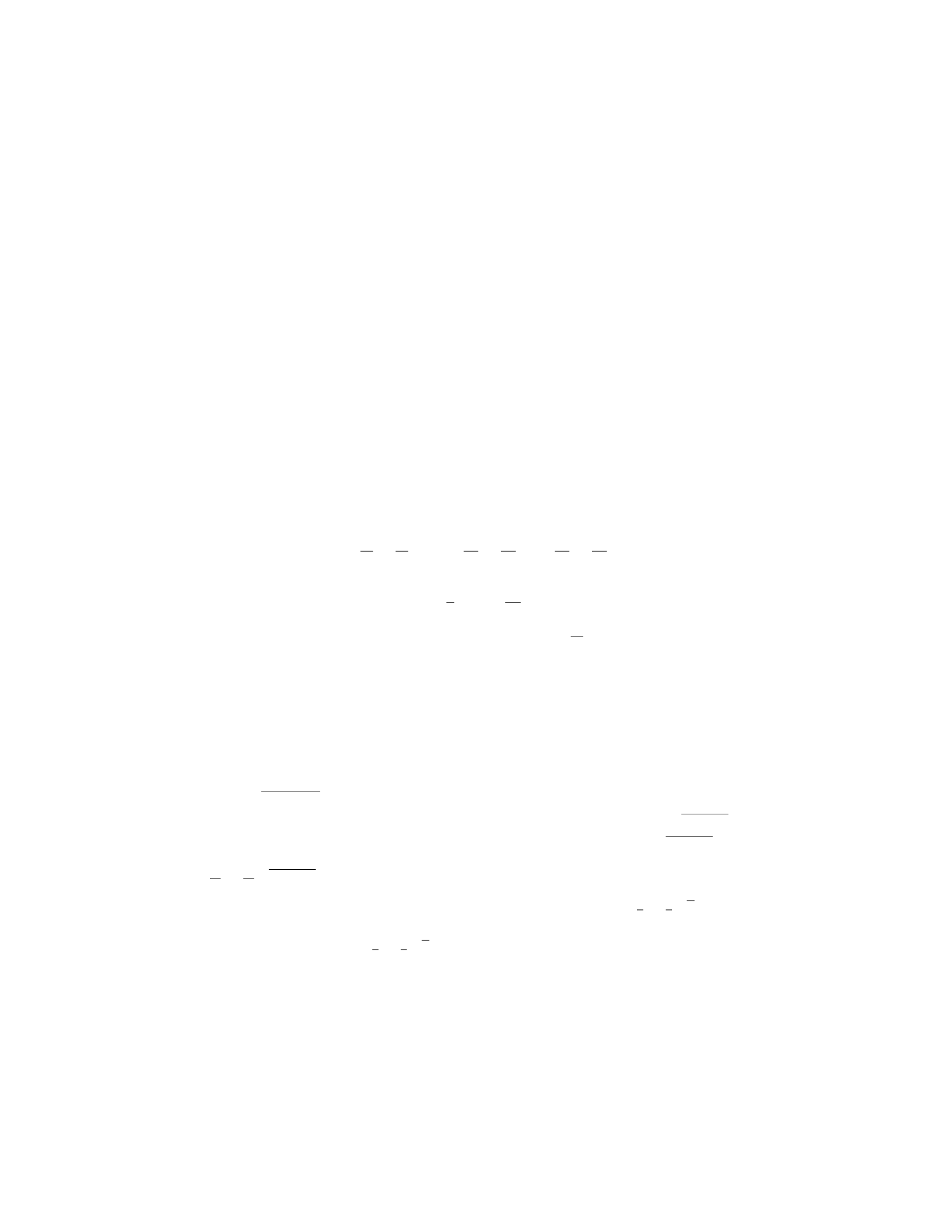
Solution: To find the line integral of F along C, we first need to
parameterize the curve C:
r(t) = ti+ (t2)j,0≤t≤2
Now, we can compute the line integral using the formula:
ZC
F·dr=Zb
a
F(r(t)) ·r′(t)dt
Substitute r(t)and F(r(t)) into the integral:
ZC
(x2i+yj)·(dxi+dyj) = Z2
0
(t2i+ (t2)j)·(i+ 2tj)dt
=Z2
0
(t2+ 2t3)dt
Integrate with respect to t:
=t3
3+t4
2
2
0=23
3+24
2−03
3+04
2
=8
3+ 8 = 32
3
Therefore, the line integral of F along Cis 32
3.
Question 10
Step-by-step solution: 1. First, parameterize the curve C:y=x2
from (0,0) to (1,1): Let x=tand y=t2where 0≤t≤1.
2. Calculate dx and dy in terms of dt:dx =dt and dy = 2tdt
3. Write the line integral in terms of t:RC(x2+y2)ds =R1
0((t2+
(t2)2)p1 + (2t)2)dt
4. Simplify the expression inside the integral: R1
0(t2+t4)√1+4t2dt
5. Integrate the expression with respect to t:R1
0(t2+t4)√1+4t2dt =
t3
3+t5
5√1+4t2
1
0
6. Plug in the limits of integration and evaluate: =1
3+1
5√5
Therefore, the line integral RC(x2+y2)ds along the curve y=x2
from (0,0) to (1,1) is 1
3+1
5√5.Question 10: Calculate the line integral
RC(x2+y2)ds where Cis the path along the curve y=x2from (0,0) to
(1,1).
Step-by-step solution: 1. First, parameterize the curve C:y=x2
from (0,0) to (1,1): Let x=tand y=t2where 0≤t≤1.
2. Calculate dx and dy in terms of dt:dx =dt and dy = 2tdt
10
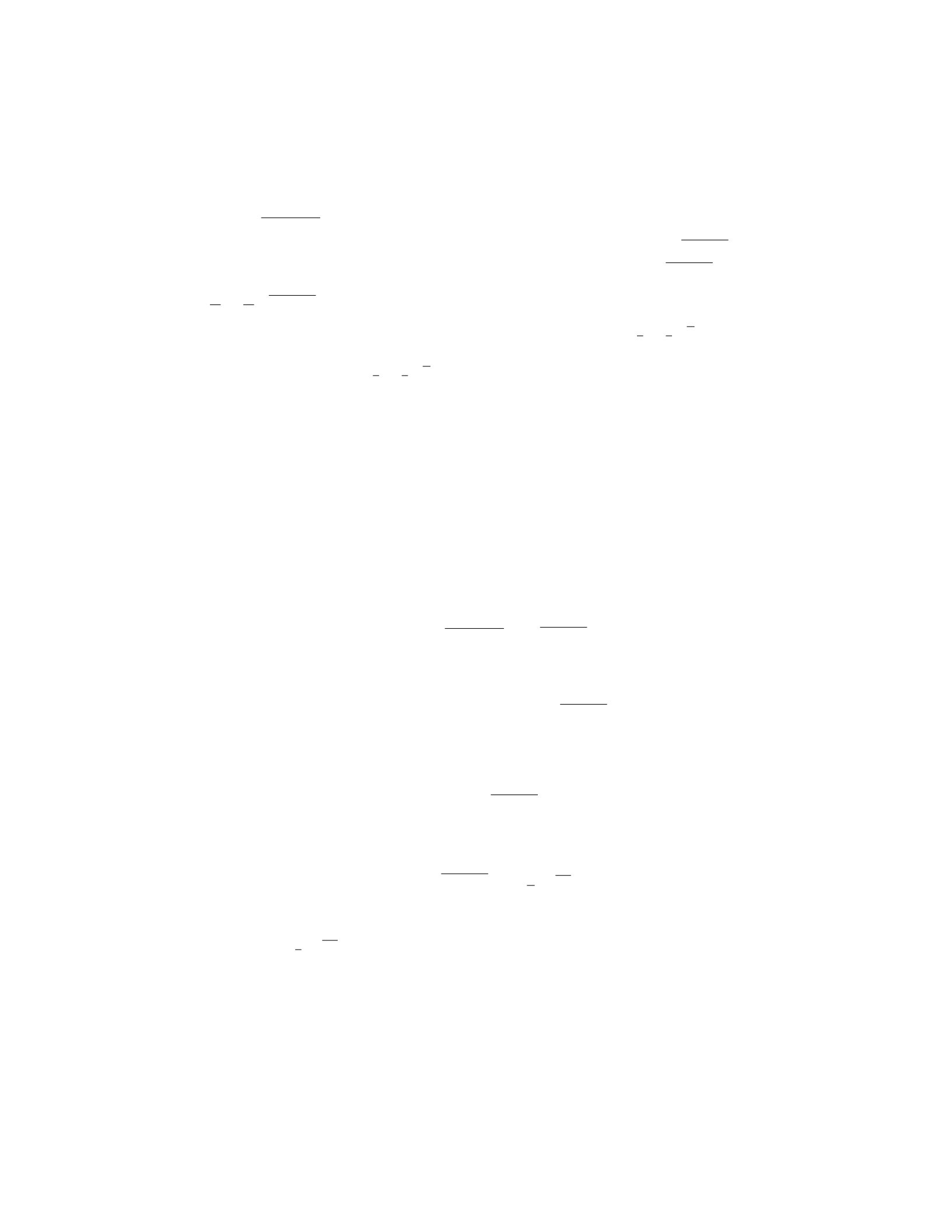
3. Write the line integral in terms of t:RC(x2+y2)ds =R1
0((t2+
(t2)2)p1 + (2t)2)dt
4. Simplify the expression inside the integral: R1
0(t2+t4)√1+4t2dt
5. Integrate the expression with respect to t:R1
0(t2+t4)√1+4t2dt =
t3
3+t5
5√1+4t2
1
0
6. Plug in the limits of integration and evaluate: =1
3+1
5√5
Therefore, the line integral RC(x2+y2)ds along the curve y=x2
from (0,0) to (1,1) is 1
3+1
5√5.
Question 11
Solution: To evaluate the line integral RC(x2−y2)ds, we first need
to parameterize the curve Cusing the given equation r(t) = ⟨t2, t⟩for
0≤t≤2.
The position vector is given by r(t) = ⟨t2, t⟩.
The derivative of r(t)gives us the tangent vector:
r′(t) = ⟨2t, 1⟩
The magnitude of the tangent vector is:
∥r′(t)∥=p(2t)2+ 1 = p4t2+ 1
The line integral becomes:
ZC
(x2−y2)ds =Z2
0
((t2)2−t2)p4t2+ 1 dt
Now, we can substitute x=t2and y=tinto the line integral above
and simplify it:
Z2
0
(t4−t2)p4t2+ 1 dt
Next, we integrate the expression:
Z2
0
(t4−t2)p4t2+ 1 dt =9
5(√17 −1)
Therefore, the value of the line integral RC(x2−y2)ds along the
curve Cis 9
5(√17 −1).Question 11: Evaluate the line integral RC(x2−
y2)ds, where Cis the curve given by the equation r(t) = ⟨t2, t⟩for
0≤t≤2.
Solution: To evaluate the line integral RC(x2−y2)ds, we first need
to parameterize the curve Cusing the given equation r(t) = ⟨t2, t⟩for
0≤t≤2.
11
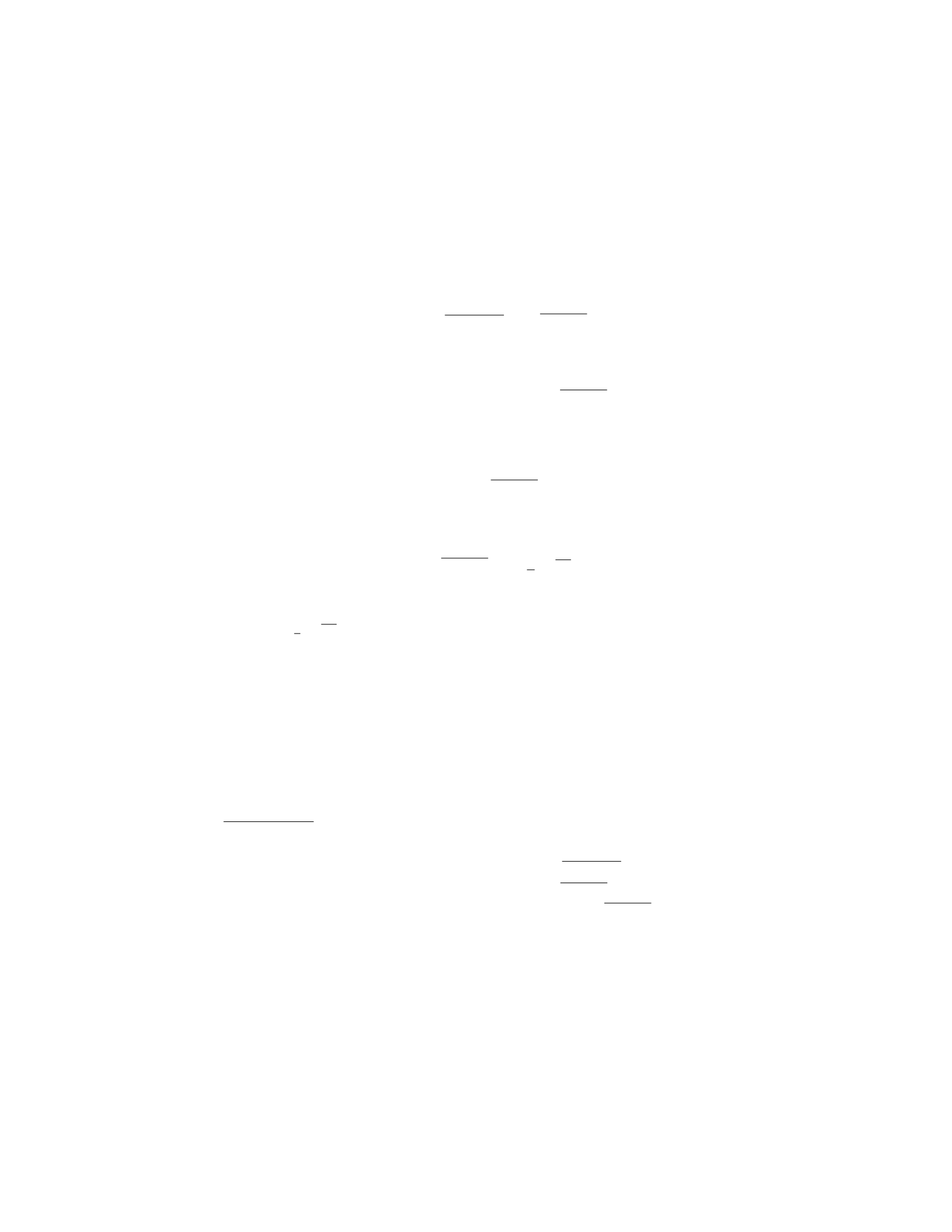
The position vector is given by r(t) = ⟨t2, t⟩.
The derivative of r(t)gives us the tangent vector:
r′(t) = ⟨2t, 1⟩
The magnitude of the tangent vector is:
∥r′(t)∥=p(2t)2+ 1 = p4t2+ 1
The line integral becomes:
ZC
(x2−y2)ds =Z2
0
((t2)2−t2)p4t2+ 1 dt
Now, we can substitute x=t2and y=tinto the line integral above
and simplify it:
Z2
0
(t4−t2)p4t2+ 1 dt
Next, we integrate the expression:
Z2
0
(t4−t2)p4t2+ 1 dt =9
5(√17 −1)
Therefore, the value of the line integral RC(x2−y2)ds along the
curve Cis 9
5(√17 −1).
Question 12
Question 12:
Let Cbe the curve given by y=x2for 0≤x≤1. Calculate the line
integral RC(2x+y)ds, where ds denotes the element of arc length.
Step-by-step Solution:
1. First, we parameterize the curve Cusing x=tand y=t2
for 0≤t≤1. 2. We express the element of arc length ds as ds =
p(dx)2+ (dy)2. 3. Calculate dx =dt and dy = 2t dt. 4. Substitute x=t
and y=t2into the integrand (2x+y)to get 2t+t2. 5. Now, write
the line integral in terms of tas R1
0(2t+t2)p1 + (2t)2dt. 6. Simplify
the expression under the square root to get √1+4t2. 7. Integrate the
expression with respect to tfrom 0 to 1: R1
0(2t+t2)√1+4t2dt. 8. After
integration, the final result will be the value of the line integral.
That’s the solution for question 12 on Line Integral. Let me know if
you need more assistance!Certainly! Here is a Line Integral question
and step-by-step solution in LateX code:
Question 12:
Let Cbe the curve given by y=x2for 0≤x≤1. Calculate the line
integral RC(2x+y)ds, where ds denotes the element of arc length.
12
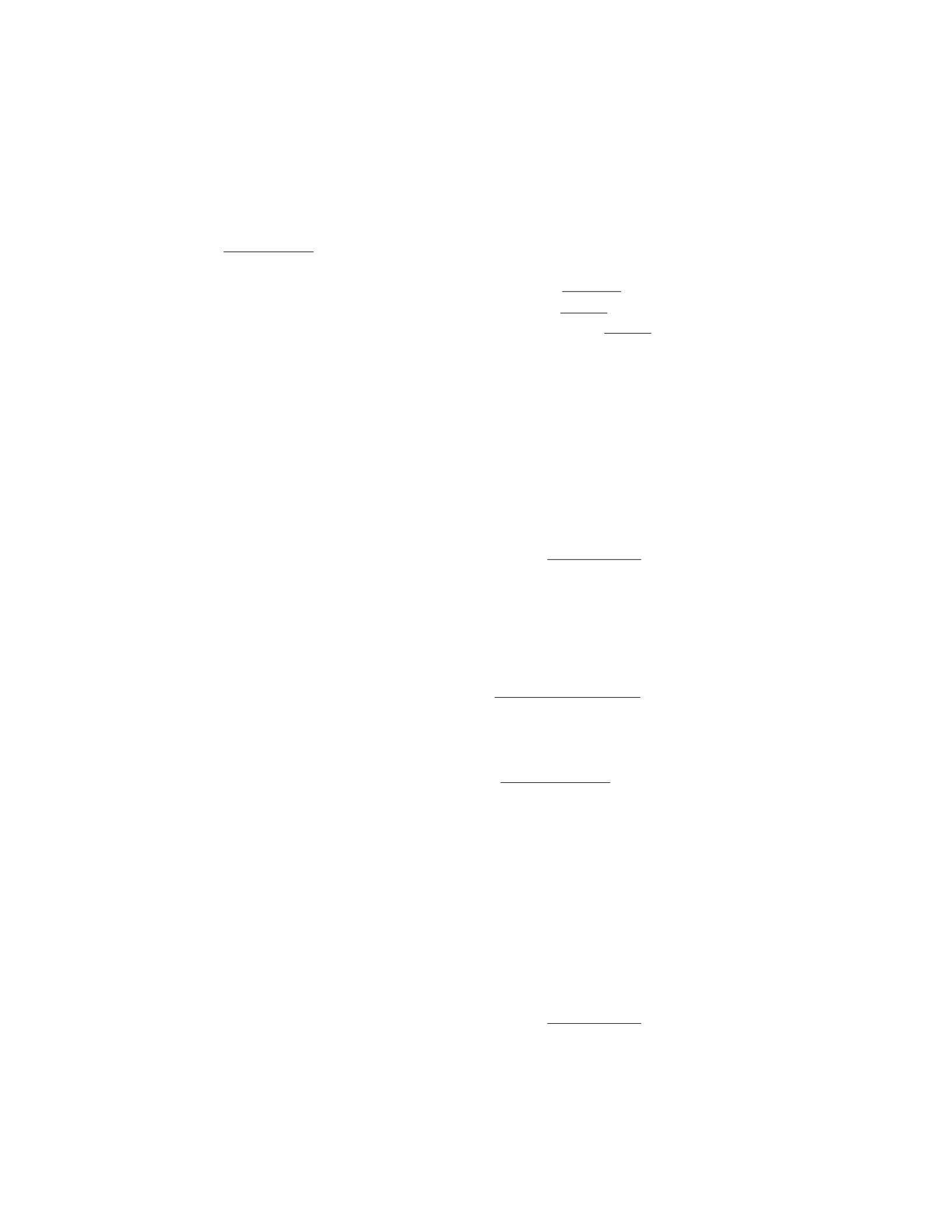
Step-by-step Solution:
1. First, we parameterize the curve Cusing x=tand y=t2
for 0≤t≤1. 2. We express the element of arc length ds as ds =
p(dx)2+ (dy)2. 3. Calculate dx =dt and dy = 2t dt. 4. Substitute x=t
and y=t2into the integrand (2x+y)to get 2t+t2. 5. Now, write
the line integral in terms of tas R1
0(2t+t2)p1 + (2t)2dt. 6. Simplify
the expression under the square root to get √1+4t2. 7. Integrate the
expression with respect to tfrom 0 to 1: R1
0(2t+t2)√1+4t2dt. 8. After
integration, the final result will be the value of the line integral.
That’s the solution for question 12 on Line Integral. Let me know
if you need more assistance!
Question 13
Question 13: Calculate the line integral RC(x2+y2)ds along the
curve Cparametrized by r(t) = (2 cos t, 3 sin t), where 0≤t≤π/2.
Step-by-step Solution: 1. The line integral along curve Cis given
by:
ZC
(x2+y2)ds =Zb
a
(x(t)2+y(t)2)px′(t)2+y′(t)2dt
2. Given the parametric equations for curve Cas r(t) = (2 cos t, 3 sin t),
with 0≤t≤π/2, we have: x(t) = 2 cos tand y(t) = 3 sin t. 3. Calculating
the derivatives: x′(t) = −2 sin tand y′(t) = 3 cos t. 4. Substituting the
values into the line integral formula:
Zπ/2
0
((2 cos t)2+ (3 sin t)2)p(−2 sin t)2+ (3 cos t)2dt
5. Simplifying the integrand:
Zπ/2
0
(4 cos2t+ 9 sin2t)p4 sin2t+ 9 cos2tdt
6. Further simplifying the expression and integrating will yield the
final result.
This completes the step-by-step solution for calculating the line
integral along the given curve.Certainly! Here is a question and step-
by-step solution on Line Integral for Liberty university in LaTeX
code:
Question 13: Calculate the line integral RC(x2+y2)ds along the
curve Cparametrized by r(t) = (2 cos t, 3 sin t), where 0≤t≤π/2.
Step-by-step Solution: 1. The line integral along curve Cis given
by:
ZC
(x2+y2)ds =Zb
a
(x(t)2+y(t)2)px′(t)2+y′(t)2dt
13
2. Given the parametric equations for curve Cas r(t) = (2 cos t, 3 sin t),
with 0≤t≤π/2, we have: x(t) = 2 cos tand y(t) = 3 sin t. 3. Calculating
the derivatives: x′(t) = −2 sin tand y′(t) = 3 cos t. 4. Substituting the
values into the line integral formula:
Zπ/2
0
((2 cos t)2+ (3 sin t)2)p(−2 sin t)2+ (3 cos t)2dt
5. Simplifying the integrand:
Zπ/2
0
(4 cos2t+ 9 sin2t)p4 sin2t+ 9 cos2tdt
6. Further simplifying the expression and integrating will yield the
final result.
This completes the step-by-step solution for calculating the line
integral along the given curve.
Question 14
“‘latex Question 14:
Compute the line integral RC(x2+y2)ds, where Cis the curve de-
fined by r(t) = ⟨2 cos t, 2 sin t⟩with 0≤t≤π
2.
Solution:
The line integral can be computed as follows:
Given the curve r(t) = ⟨2 cos t, 2 sin t⟩with 0≤t≤π
2, we have:
dx =−2 sin t dt and dy = 2 cos t dt
The arc length ds is given by ds =pdx2+dy2=p(−2 sin t)2+ (2 cos t)2dt =
√4dt = 2 dt
Therefore, the line integral becomes:
RC(x2+y2)ds =Rπ
2
0((2 cos t)2+(2 sin t)2)·2dt =Rπ
2
0(4 cos2t+4 sin2t)·2dt =
Rπ
2
08dt = 8 [t]
π
2
0= 8 π
2= 4π
Therefore, the line integral RC(x2+y2)ds = 4π. “‘
Feel free to let me know if you need further assistance or more
questions.Sure! Here is a question on Line Integral for Liberty Uni-
versity in LateX code:
“‘latex Question 14:
Compute the line integral RC(x2+y2)ds, where Cis the curve de-
fined by r(t) = ⟨2 cos t, 2 sin t⟩with 0≤t≤π
2.
Solution:
The line integral can be computed as follows:
Given the curve r(t) = ⟨2 cos t, 2 sin t⟩with 0≤t≤π
2, we have:
dx =−2 sin t dt and dy = 2 cos t dt
The arc length ds is given by ds =pdx2+dy2=p(−2 sin t)2+ (2 cos t)2dt =
√4dt = 2 dt
14
Therefore, the line integral becomes:
RC(x2+y2)ds =Rπ
2
0((2 cos t)2+(2 sin t)2)·2dt =Rπ
2
0(4 cos2t+4 sin2t)·2dt =
Rπ
2
08dt = 8 [t]
π
2
0= 8 π
2= 4π
Therefore, the line integral RC(x2+y2)ds = 4π. “‘
Feel free to let me know if you need further assistance or more
questions.
Question 15
Calculate the line integral RCx2y ds, where Cis the arc of the curve
y=x2from (0,0) to (1,1).
Step-by-step solution:
Given that the curve Cis defined by y=x2. We need to find the
line integral RCx2y ds on the arc from (0,0) to (1,1).
1. Parameterize the curve C: Let x=tand y=t2, where tranges
from 0to 1. The curve Cis parameterized as r(t)=(t, t2)for 0≤t≤1.
2. Find the differential element ds: The differential element ds is
given by ds =pdx2+dy2. Substitute x=tand y=t2into the equation
to get ds =√1+4t2dt.
3. Compute the line integral: The line integral RCx2y ds can be
expressed as R1
0(t2)(t2)√1+4t2dt.
4. Simplify and integrate: R1
0t4√1+4t2dt. Let u= 1 + 4t2, then
du = 8t dt. The integral becomes 1
8R5
1u3/2du. Integrate to get 1
8[2
5u5/2]5
1.
Substitute back u= 1 + 4t2to find the final result.
Therefore, the line integral RCx2y ds along the curve Cfrom (0,0)
to (1,1) is given by the final result.Question 15:
Calculate the line integral RCx2y ds, where Cis the arc of the curve
y=x2from (0,0) to (1,1).
Step-by-step solution:
Given that the curve Cis defined by y=x2. We need to find the
line integral RCx2y ds on the arc from (0,0) to (1,1).
1. Parameterize the curve C: Let x=tand y=t2, where tranges
from 0to 1. The curve Cis parameterized as r(t)=(t, t2)for 0≤t≤1.
2. Find the differential element ds: The differential element ds is
given by ds =pdx2+dy2. Substitute x=tand y=t2into the equation
to get ds =√1+4t2dt.
3. Compute the line integral: The line integral RCx2y ds can be
expressed as R1
0(t2)(t2)√1+4t2dt.
4. Simplify and integrate: R1
0t4√1+4t2dt. Let u= 1 + 4t2, then
du = 8t dt. The integral becomes 1
8R5
1u3/2du. Integrate to get 1
8[2
5u5/2]5
1.
Substitute back u= 1 + 4t2to find the final result.
Therefore, the line integral RCx2y ds along the curve Cfrom (0,0)
to (1,1) is given by the final result.
15
Question 16
Question 16: Calculate the line integral RCF·dr, where F(x, y) =
(x2+y, 2x+y2)and Cis the curve defined by r(t)=(t2, t)for 0≤t≤1.
Step-by-step Solution: 1. Parameterize the curve Cusing r(t) =
(t2, t):r(t) = (x(t), y(t)) = (t2, t)for 0≤t≤1.
2. Find the derivative of r(t)with respect to t:dr
dt = (2t, 1).
3. Substitute r(t)and dr
dt into F(x, y)=(x2+y, 2x+y2)to get F(r(t)):
F(r(t)) = (t2+t, 2t+t2).
4. Calculate F(r(t)) ·dr
dt :F(r(t)) ·dr
dt = (t2+t, 2t+t2)·(2t, 1) = (2t3+
t2) + (2t+t3) = 3t3+ 3t2.
5. Integrate F(r(t)) ·dr
dt over the interval 0≤t≤1:R1
0(3t3+ 3t2)dt
=3
4t4+t31
0=3
4+ 1−(0) = 7
4.
Therefore, the line integral RCF·dr =7
4.Sure, here is the question
and step-by-step solution for Line Integral:
Question 16: Calculate the line integral RCF·dr, where F(x, y) =
(x2+y, 2x+y2)and Cis the curve defined by r(t)=(t2, t)for 0≤t≤1.
Step-by-step Solution: 1. Parameterize the curve Cusing r(t) =
(t2, t):r(t) = (x(t), y(t)) = (t2, t)for 0≤t≤1.
2. Find the derivative of r(t)with respect to t:dr
dt = (2t, 1).
3. Substitute r(t)and dr
dt into F(x, y)=(x2+y, 2x+y2)to get F(r(t)):
F(r(t)) = (t2+t, 2t+t2).
4. Calculate F(r(t)) ·dr
dt :F(r(t)) ·dr
dt = (t2+t, 2t+t2)·(2t, 1) = (2t3+
t2) + (2t+t3) = 3t3+ 3t2.
5. Integrate F(r(t)) ·dr
dt over the interval 0≤t≤1:R1
0(3t3+ 3t2)dt
=3
4t4+t31
0=3
4+ 1−(0) = 7
4.
Therefore, the line integral RCF·dr =7
4.
Question 17
Compute the line integral RC(x2+y)ds, where Cis the curve parametrized
by r(t)=(t2,2t),0≤t≤1.
Step-by-step solution: 1. Find the derivative of r(t)with respect
to t:
r′(t) = d
dtt2,d
dt2t= (2t, 2)
2. Calculate the magnitude of r′(t):
∥r′(t)∥=p(2t)2+ 22=p4t2+ 4 = 2pt2+ 1
3. Now, substitute r(t)and r′(t)into the line integral formula:
ZC
(x2+y)ds =Z1
0
[(t2)2+ 2t]·2pt2+ 1 dt
16
4. Simplify the integrand:
=Z1
0
(t4+ 2t)·2pt2+ 1 dt = 2 Z1
0
(t4+ 2t)pt2+ 1 dt
5. Integrate with respect to t:
= 2 1
5(t5) + t21
0
= 2 1
5+ 1 −0= 2 6
5=12
5
Therefore, the value of the line integral is 12
5.Question 17:
Compute the line integral RC(x2+y)ds, where Cis the curve parametrized
by r(t)=(t2,2t),0≤t≤1.
Step-by-step solution: 1. Find the derivative of r(t)with respect
to t:
r′(t) = d
dtt2,d
dt2t= (2t, 2)
2. Calculate the magnitude of r′(t):
∥r′(t)∥=p(2t)2+ 22=p4t2+ 4 = 2pt2+ 1
3. Now, substitute r(t)and r′(t)into the line integral formula:
ZC
(x2+y)ds =Z1
0
[(t2)2+ 2t]·2pt2+ 1 dt
4. Simplify the integrand:
=Z1
0
(t4+ 2t)·2pt2+ 1 dt = 2 Z1
0
(t4+ 2t)pt2+ 1 dt
5. Integrate with respect to t:
= 2 1
5(t5) + t21
0
= 2 1
5+ 1 −0= 2 6
5=12
5
Therefore, the value of the line integral is 12
5.
Question 18
Question 18:
Consider the curve defined by the vector function r(t) = ⟨t2, t, t3⟩
for 1≤t≤2.
Find the line integral of the vector field F(x, y, z) = ⟨x2, yz, z⟩along
the given curve.
Solution:
17
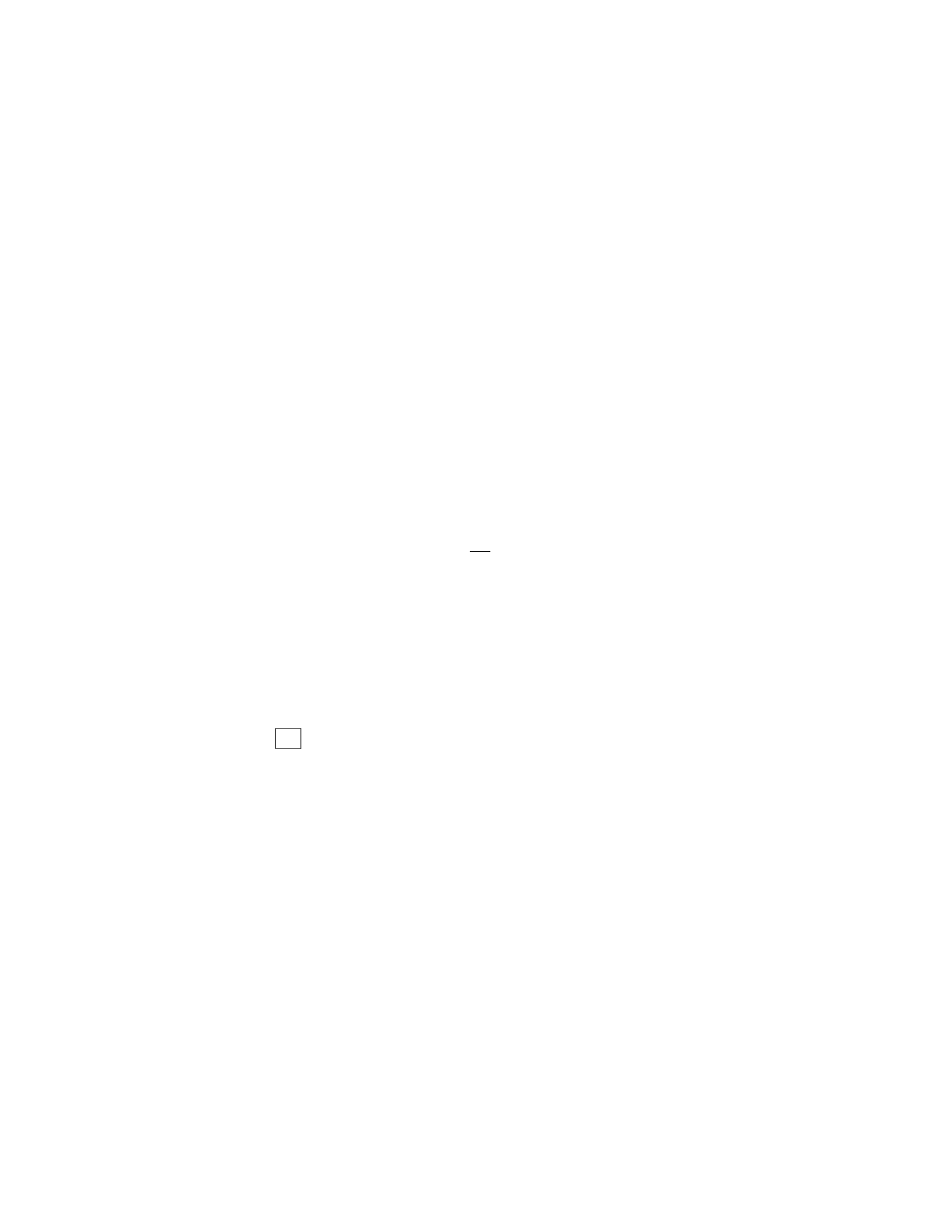
The line integral of a vector field F(x, y, z)along a curve r(t) =
⟨x(t), y(t), z(t)⟩for a≤t≤bis given by
ZC
F·dr=Zb
a
F(r(t)) ·r′(t)dt
Given that r(t) = ⟨t2, t, t3⟩, we have r′(t) = ⟨2t, 1,3t2⟩.
Now, the vector field F(r(t)) = F(t2, t, t3) = ⟨t4, t2·t3, t3⟩=⟨t4, t5, t3⟩.
Therefore, the line integral becomes
ZC
F·dr=Z2
1⟨t4, t5, t3⟩·⟨2t, 1,3t2⟩dt
=Z2
1
(2t5+t5+ 3t5)dt
=Z2
1
6t5dt
=6t6
62
1
= 26−16
= 64 −1
= 63
Therefore, the line integral of F(x, y, z) = ⟨x2, yz, z⟩along the given
curve is 63 .Certainly! Here is the question along with the step-by-
step solution in LateX code for Line Integral for Liberty University.
Question 18:
Consider the curve defined by the vector function r(t) = ⟨t2, t, t3⟩
for 1≤t≤2.
Find the line integral of the vector field F(x, y, z) = ⟨x2, yz, z⟩along
the given curve.
Solution:
The line integral of a vector field F(x, y, z)along a curve r(t) =
⟨x(t), y(t), z(t)⟩for a≤t≤bis given by
ZC
F·dr=Zb
a
F(r(t)) ·r′(t)dt
Given that r(t) = ⟨t2, t, t3⟩, we have r′(t) = ⟨2t, 1,3t2⟩.
Now, the vector field F(r(t)) = F(t2, t, t3) = ⟨t4, t2·t3, t3⟩=⟨t4, t5, t3⟩.
Therefore, the line integral becomes
18
ZC
F·dr=Z2
1⟨t4, t5, t3⟩·⟨2t, 1,3t2⟩dt
=Z2
1
(2t5+t5+ 3t5)dt
=Z2
1
6t5dt
=6t6
62
1
= 26−16
= 64 −1
= 63
Therefore, the line integral of F(x, y, z) = ⟨x2, yz, z⟩along the given
curve is 63 .
Question 19
Question 19:
Let Cbe the curve given by r(t) = (cos t, sin t, t2)for 0≤t≤2π.
Calculate the line integral RCx dx +y dy +z dz.
Solution:
Given the curve Cdefined by r(t) = (cos t, sin t, t2)for 0≤t≤2π.
The line integral RCx dx +y dy +z dz can be written as:
ZC
x dx +y dy +z dz =Zb
ax(t)dx
dt +y(t)dy
dt +z(t)dz
dt dt
Substitute x(t) = cos t,y(t) = sin t,z(t) = t2,dx
dt =−sin t,dy
dt = cos t,
and dz
dt = 2tinto the integral:
ZC
x dx +y dy +z dz =Z2π
0cos t(−sin t) + sin tcos t+t2(2t)dt
Simplify the integral:
ZC
x dx +y dy +z dz =Z2π
0
(−cos tsin t+ sin tcos t+ 2t3)dt
19
=Z2π
0
2t3dt
=1
2t42π
0
=1
2(2π)4−1
2(0)4
= 8π4
Therefore, the line integral RCx dx +y dy +z dz along the curve C
is 8π4.Certainly! Here is the LateX code for question number 19 on
Line Integral for Liberty University:
Question 19:
Let Cbe the curve given by r(t) = (cos t, sin t, t2)for 0≤t≤2π.
Calculate the line integral RCx dx +y dy +z dz.
Solution:
Given the curve Cdefined by r(t) = (cos t, sin t, t2)for 0≤t≤2π.
The line integral RCx dx +y dy +z dz can be written as:
ZC
x dx +y dy +z dz =Zb
ax(t)dx
dt +y(t)dy
dt +z(t)dz
dt dt
Substitute x(t) = cos t,y(t) = sin t,z(t) = t2,dx
dt =−sin t,dy
dt = cos t,
and dz
dt = 2tinto the integral:
ZC
x dx +y dy +z dz =Z2π
0cos t(−sin t) + sin tcos t+t2(2t)dt
Simplify the integral:
ZC
x dx +y dy +z dz =Z2π
0
(−cos tsin t+ sin tcos t+ 2t3)dt
=Z2π
0
2t3dt
=1
2t42π
0
=1
2(2π)4−1
2(0)4
= 8π4
Therefore, the line integral RCx dx +y dy +z dz along the curve Cis
8π4.
20
Question 20
Question 20:
Evaluate the line integral RC(3x2−y2)dx + (2y−x)dy where Cis the
curve given by r(t) = ⟨t2,2t⟩for 0≤t≤1.
Solution:
The line integral is given by:
ZC
(3x2−y2)dx + (2y−x)dy =Z1
0
(3(t2)2−(2t)2)·2t+ (2(2t)−t)·2dt
=Z1
0
(3t4−4t2)·2t+ (4t−t)·2dt
=Z1
0
(6t5−8t3+ 8t−2t)dt
=Z1
0
(6t5−8t3+ 6t)dt
= [(6 ·t6
6−8·t4
4+ 6 ·t2
2)]1
0
= (t6−2t4+ 3t2)|1
0
= (1 −2 + 3) −(0 −0 + 0)
= 2.
Therefore, the value of the line integral is 2.Sure! Here is the
question and solution in LateX code:
Question 20:
Evaluate the line integral RC(3x2−y2)dx + (2y−x)dy where Cis the
curve given by r(t) = ⟨t2,2t⟩for 0≤t≤1.
Solution:
The line integral is given by:
21
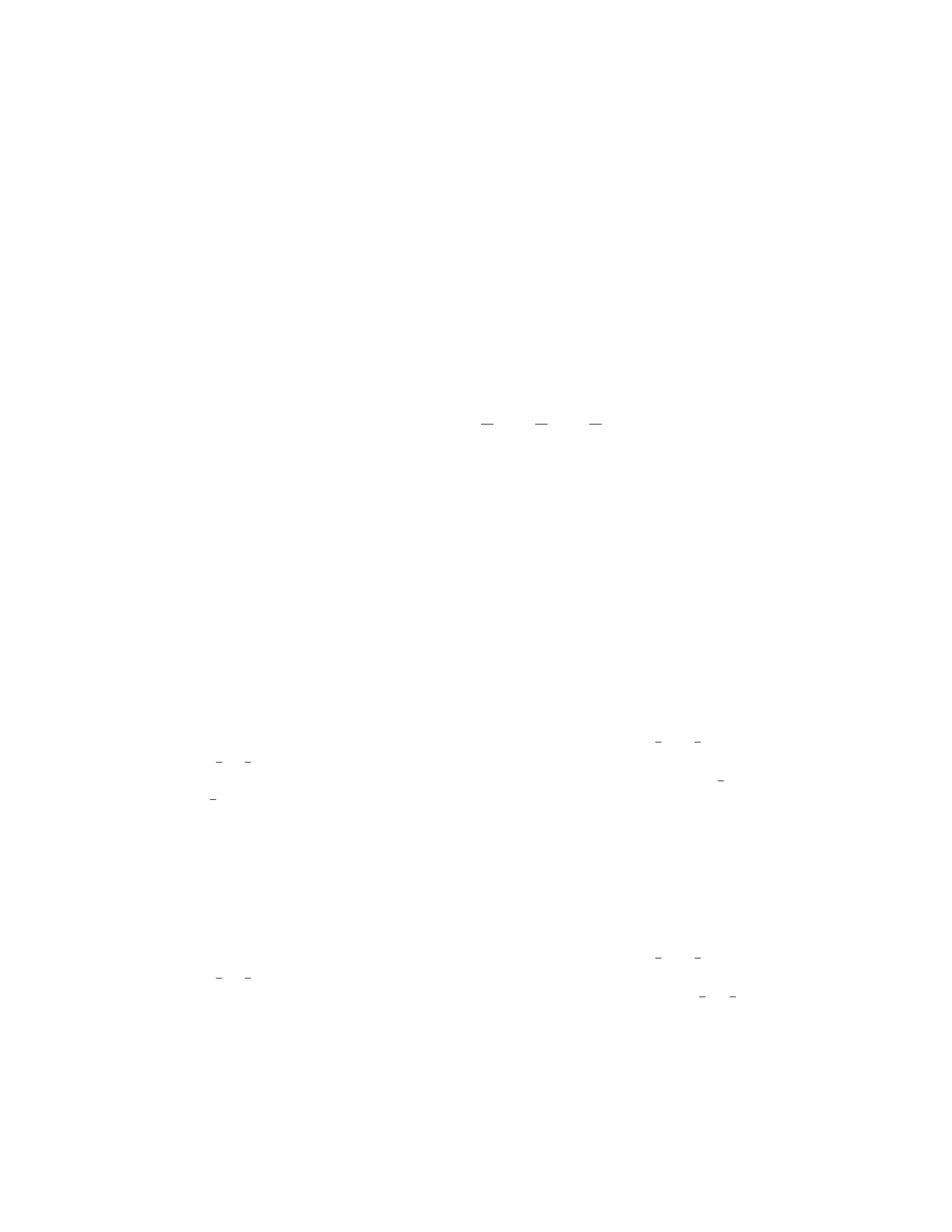
ZC
(3x2−y2)dx + (2y−x)dy =Z1
0
(3(t2)2−(2t)2)·2t+ (2(2t)−t)·2dt
=Z1
0
(3t4−4t2)·2t+ (4t−t)·2dt
=Z1
0
(6t5−8t3+ 8t−2t)dt
=Z1
0
(6t5−8t3+ 6t)dt
= [(6 ·t6
6−8·t4
4+ 6 ·t2
2)]1
0
= (t6−2t4+ 3t2)|1
0
= (1 −2 + 3) −(0 −0 + 0)
= 2.
Therefore, the value of the line integral is 2.
Question 21
Step-by-step solution: 1. First, parameterize the path C: Let x=t
and y=t2where 0≤t≤1.
2. Calculate dx and dy:dx =dt and dy = 2t dt.
3. Substitute the parameterized path and differentials into the
line integral: RC(x2+y2)dx + 2xy dy =R1
0((t2+t4)·dt + 2(t)(t2)·2t dt).
4. Simplify the integrand: R1
0(t2+t4+ 4t4)dt.
5. Integrate the simplified expression: R1
0(5t4+t2)dt = [5
5t5+1
3t3]1
0=
(5
5+1
3)−(0 + 0).
6. Calculate the final result: The line integral is equal to 1 + 1
3=
4
3.Question 21: Calculate the line integral HC(x2+y2)dx+ 2xy dy, where
Cis the path given by y=x2from (0,0) to (1,1).
Step-by-step solution: 1. First, parameterize the path C: Let x=t
and y=t2where 0≤t≤1.
2. Calculate dx and dy:dx =dt and dy = 2t dt.
3. Substitute the parameterized path and differentials into the
line integral: RC(x2+y2)dx + 2xy dy =R1
0((t2+t4)·dt + 2(t)(t2)·2t dt).
4. Simplify the integrand: R1
0(t2+t4+ 4t4)dt.
5. Integrate the simplified expression: R1
0(5t4+t2)dt = [5
5t5+1
3t3]1
0=
(5
5+1
3)−(0 + 0).
6. Calculate the final result: The line integral is equal to 1 + 1
3=4
3.
22
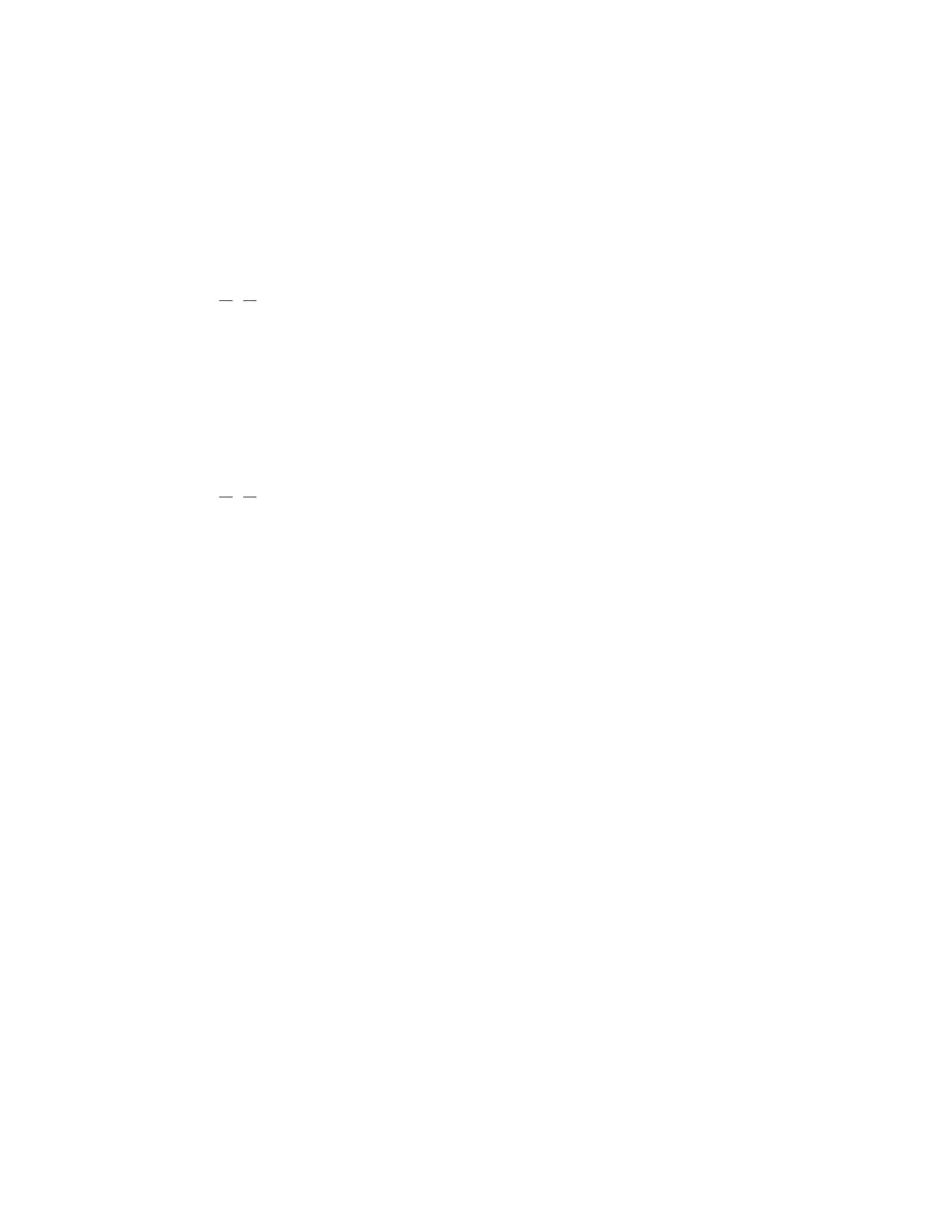
Question 22
Question 22: Evaluate the line integral RCx2y dx +xy2dy, where C
is the curve parametrized by r(t) = (sin t, cos t)for 0≤t≤π.
Step-by-step solution: 1. Calculate the derivatives of r(t): r′(t) =
dx
dt ,dy
dt = (cos t, −sin t).
2. Substitute the parametric equations and derivatives into the
line integral: RCx2y dx+xy2dy =Rπ
0(sin2tcos t)(cos t)dt+(sin tcos2t)(−sin t)dt.
3. Simplify the integral: Rπ
0(sin2tcos2t−sin2tcos2t)dt = 0.
Therefore, the value of the line integral is 0.Sure, here is a question
and step-by-step solution on Line Integral for Liberty University in
LateX code:
Question 22: Evaluate the line integral RCx2y dx +xy2dy, where C
is the curve parametrized by r(t) = (sin t, cos t)for 0≤t≤π.
Step-by-step solution: 1. Calculate the derivatives of r(t): r′(t) =
dx
dt ,dy
dt = (cos t, −sin t).
2. Substitute the parametric equations and derivatives into the
line integral: RCx2y dx+xy2dy =Rπ
0(sin2tcos t)(cos t)dt+(sin tcos2t)(−sin t)dt.
3. Simplify the integral: Rπ
0(sin2tcos2t−sin2tcos2t)dt = 0.
Therefore, the value of the line integral is 0.
Question 23
Step-by-step solution: 1. Find the derivative of r(t)with respect
to t:
r′(t) = ⟨cos t, −sin t, 1⟩
2. Evaluate the dot product of Fand r′(t):
F·r′(t) = ⟨sin tcos t, −sin tcos t, sin tcos t⟩·⟨cos t, −sin t, 1⟩
= sin tcos t·cos t−sin tcos t·sin t+ sin tcos t
= cos2tsin t−sin2tcos t+ sin tcos t
3. Integrate the dot product over the curve C:
ZC
F·dr =Zπ
0
(cos2tsin t−sin2tcos t+ sin tcos t)dt
Question 23: Let Cbe the curve given by r(t) = ⟨sin t, cos t, t⟩for 0≤t≤
π, and let F(x, y, z) = ⟨yz, xz, xy⟩. Calculate the line integral RCF·dr.
Step-by-step solution: 1. Find the derivative of r(t)with respect
to t:
r′(t) = ⟨cos t, −sin t, 1⟩
23
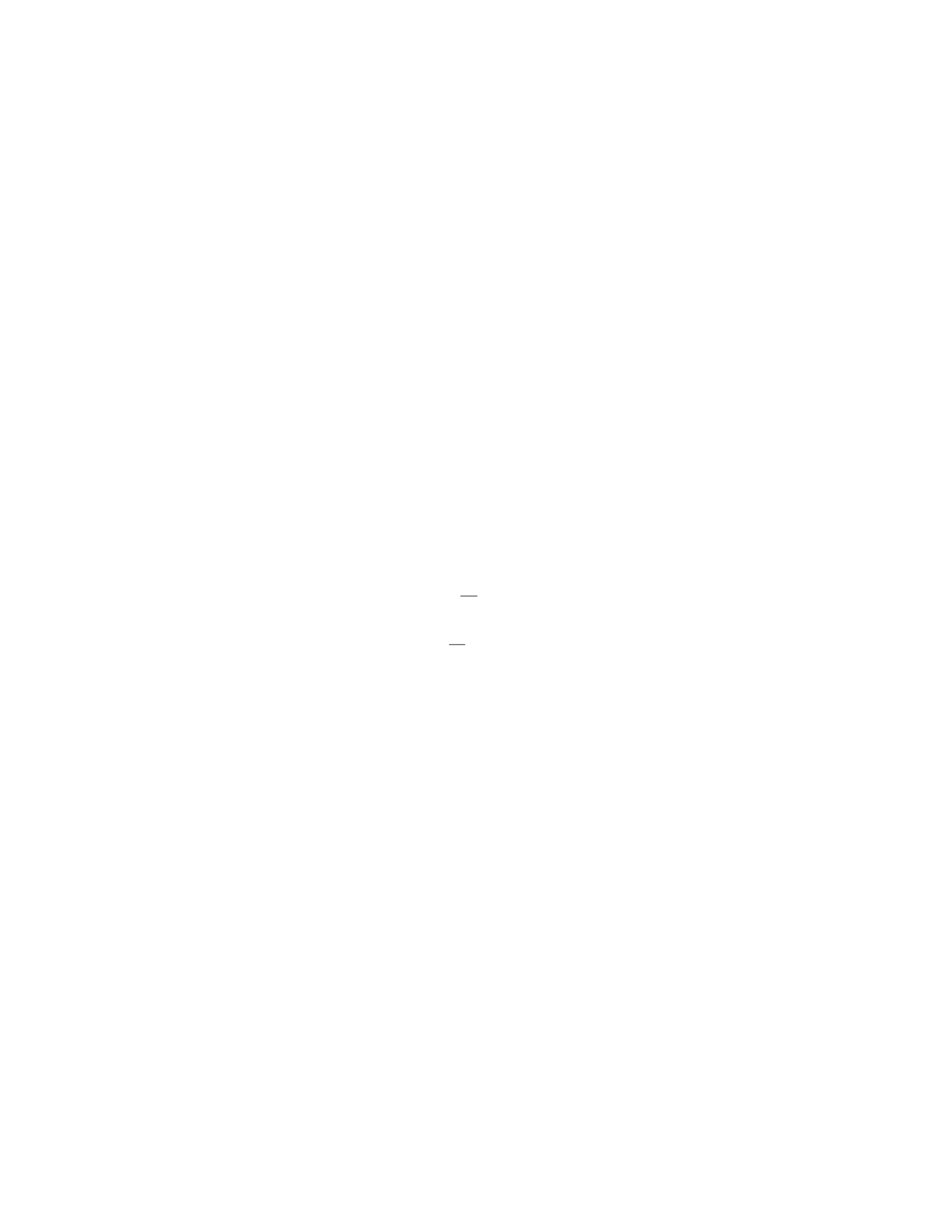
2. Evaluate the dot product of Fand r′(t):
F·r′(t) = ⟨sin tcos t, −sin tcos t, sin tcos t⟩·⟨cos t, −sin t, 1⟩
= sin tcos t·cos t−sin tcos t·sin t+ sin tcos t
= cos2tsin t−sin2tcos t+ sin tcos t
3. Integrate the dot product over the curve C:
ZC
F·dr =Zπ
0
(cos2tsin t−sin2tcos t+ sin tcos t)dt
Question 24
Question 24: Evaluate the line integral RCyex2dx +ex2dy, where C
is the curve given by the equation y=x3from (0,0) to (1,1).
Solution: To evaluate the line integral, we need to parametrize
the curve C. Since C is given by y=x3, we can parameterize it as
r(t) = ⟨t, t3⟩, where 0≤t≤1.
Now, we need to find dx and dy in terms of dt:
dx =dx
dt dt =dt
dy =dy
dt dt = 3t2dt
Next, we compute the line integral:
ZC
yex2dx +ex2dy
=Z1
0
t3et2dt +et2·3t2dt
=Z1
0
t3et2dt + 3t2et2dt
To evaluate the integrals, we use integration by parts for the first
term and the power rule for the second term.
Zt3et2dt
Let u=t2and dv =tet2dt, then du = 2t dt and v=et2.
=t2et2−Z2t·et2dt
=t2et2−et2+C1
24
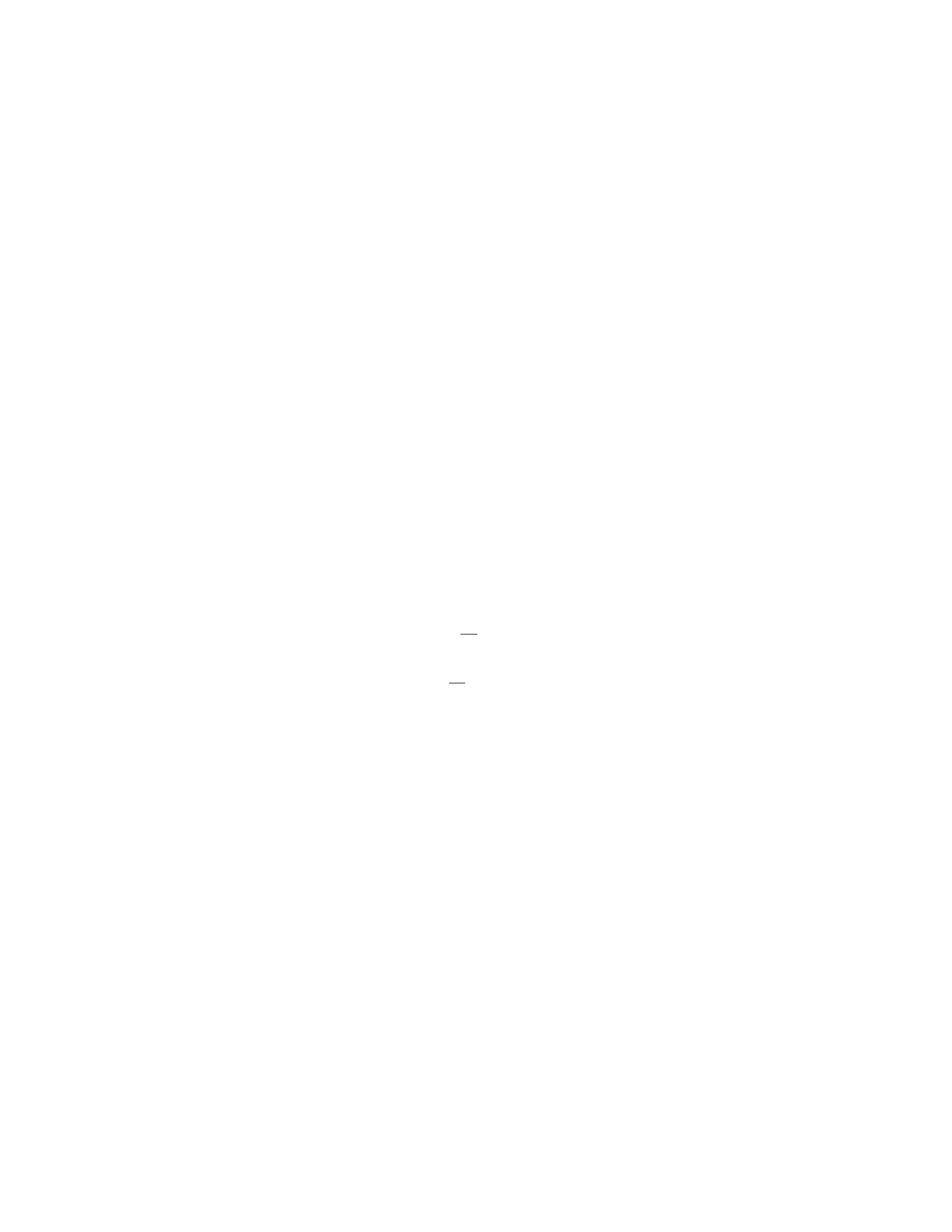
Z3t2et2dt
Let u=t2and dv = 3tet2dt, then du = 2t dt and v=et2.
= 3t2et2−Z6t·et2dt
= 3t2et2−3et2+C2
So, the final answer for the line integral is:
t2et2−et2+ 3t2et2−3et2
1
0
Let me know if you need any further clarification or assistance!Certainly!
Here is the question along with its solution in LateX code:
Question 24: Evaluate the line integral RCyex2dx +ex2dy, where C
is the curve given by the equation y=x3from (0,0) to (1,1).
Solution: To evaluate the line integral, we need to parametrize
the curve C. Since C is given by y=x3, we can parameterize it as
r(t) = ⟨t, t3⟩, where 0≤t≤1.
Now, we need to find dx and dy in terms of dt:
dx =dx
dt dt =dt
dy =dy
dt dt = 3t2dt
Next, we compute the line integral:
ZC
yex2dx +ex2dy
=Z1
0
t3et2dt +et2·3t2dt
=Z1
0
t3et2dt + 3t2et2dt
To evaluate the integrals, we use integration by parts for the first
term and the power rule for the second term.
Zt3et2dt
Let u=t2and dv =tet2dt, then du = 2t dt and v=et2.
=t2et2−Z2t·et2dt
25
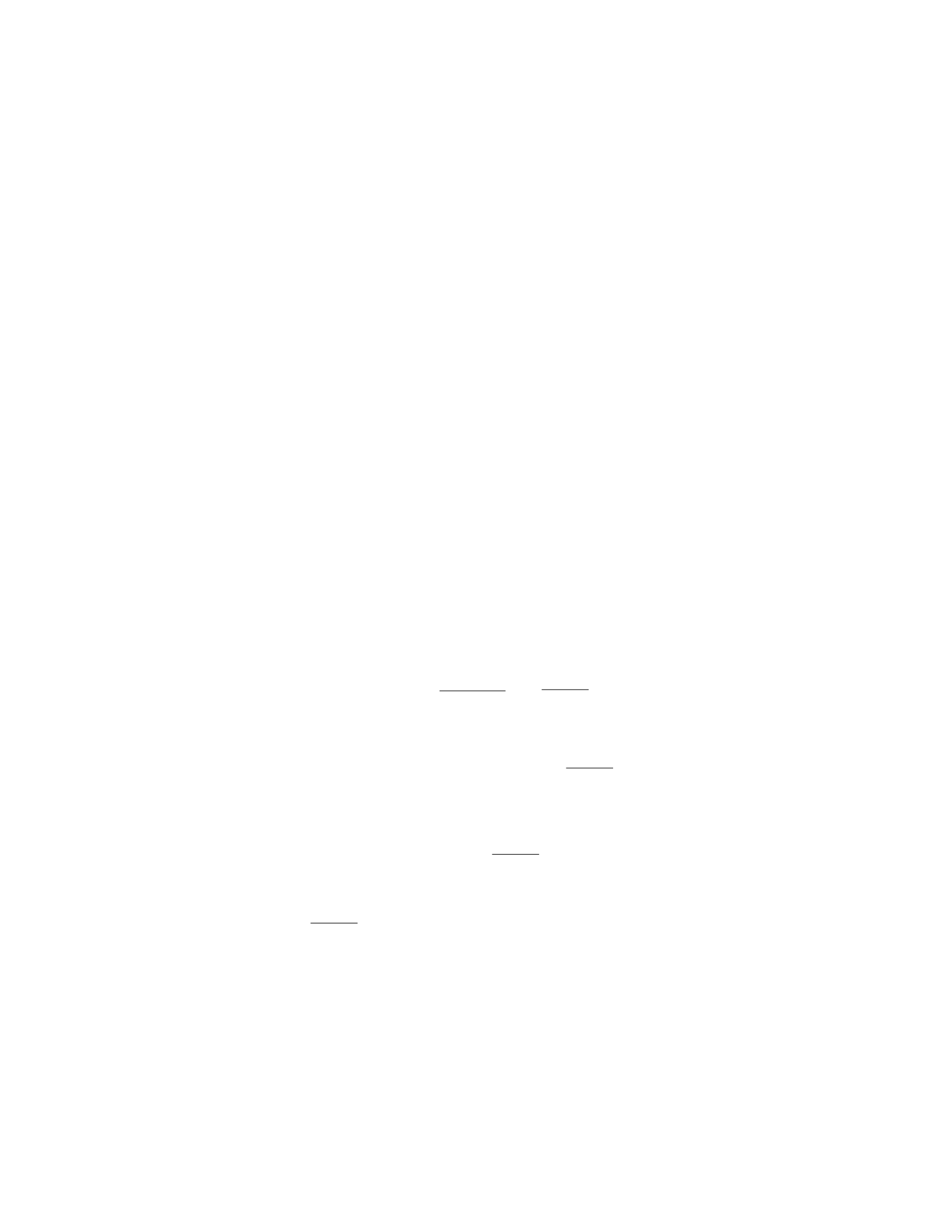
=t2et2−et2+C1
Z3t2et2dt
Let u=t2and dv = 3tet2dt, then du = 2t dt and v=et2.
= 3t2et2−Z6t·et2dt
= 3t2et2−3et2+C2
So, the final answer for the line integral is:
t2et2−et2+ 3t2et2−3et2
1
0
Let me know if you need any further clarification or assistance!
Question 25
Step-by-step Solution: 1. Find the derivative of r(t)with respect
to tto get the velocity vector, v(t):
v(t) = ⟨1,2t⟩
2. Determine the magnitude of the velocity vector:
∥v(t)∥=p12+ (2t)2=p1+4t2
3. Rewrite the line integral in terms of a parameter t:
ZC
(x2+y2)ds =Z2
0
((t)2+ (t2)2)p1+4t2dt
4. Evaluate the integral:
Z2
0
(t2+t4)p1+4t2dt
Therefore, the line integral RC(x2+y2)ds along the curve Cis equal
to R2
0(t2+t4)√1+4t2dt.Question 25: Find the line integral RC(x2+y2)ds,
where Cis the curve given by r(t) = ⟨t, t2⟩for 0≤t≤2.
Step-by-step Solution: 1. Find the derivative of r(t)with respect
to tto get the velocity vector, v(t):
v(t) = ⟨1,2t⟩
26
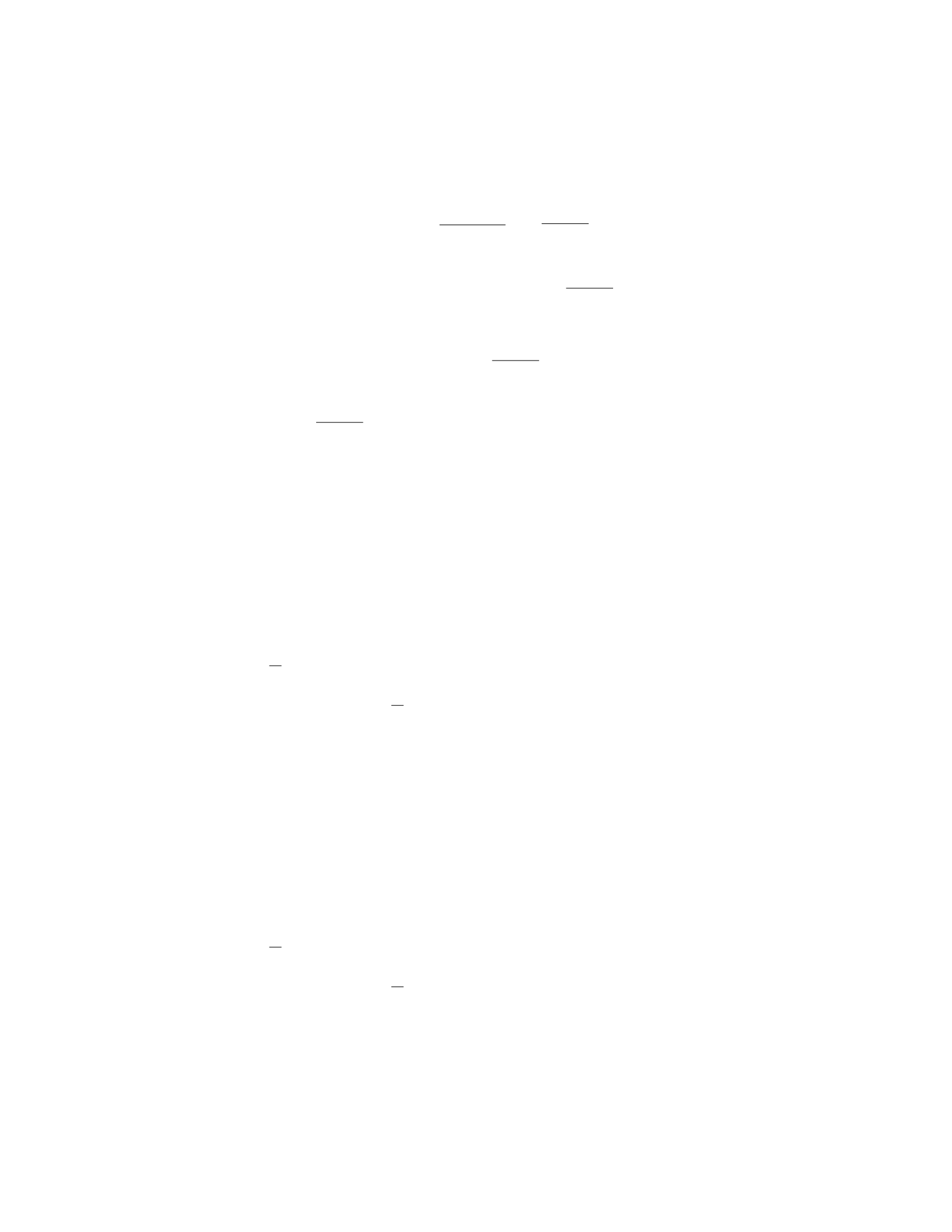
2. Determine the magnitude of the velocity vector:
∥v(t)∥=p12+ (2t)2=p1+4t2
3. Rewrite the line integral in terms of a parameter t:
ZC
(x2+y2)ds =Z2
0
((t)2+ (t2)2)p1+4t2dt
4. Evaluate the integral:
Z2
0
(t2+t4)p1+4t2dt
Therefore, the line integral RC(x2+y2)ds along the curve Cis equal
to R2
0(t2+t4)√1+4t2dt.
Question 26
Question 26:
Consider the curve given by r(t) = ti+t2j−t3k and the vector field
F(x, y, z) = (yz +x)i+ (xz +y)j+ (xy +z)k.
Calculate the line integral RCF·dr over the curve Cfrom (0,0,0)
to (1,1,−1).
Solution: First, we need to parameterize the curve Cusing r(t):
r(t) = ti+t2j−t3k, where 0≤t≤1.
Next, we calculate the differential of r:
dr=dr
dt dt =idt + 2tjdt −3t2kdt.
Now, we substitute r(t)and dr into the line integral formula:
RCF·dr=R1
0F(r(t)) ·dr
dt dt.
After substituting r(t),dr, and F into the integral, simplify and
evaluate the integral to find the final answer.
Good luck!Sure! Here is a Line Integral question along with its
step-by-step solution in LateX code:
Question 26:
Consider the curve given by r(t) = ti+t2j−t3k and the vector field
F(x, y, z) = (yz +x)i+ (xz +y)j+ (xy +z)k.
Calculate the line integral RCF·dr over the curve Cfrom (0,0,0)
to (1,1,−1).
Solution: First, we need to parameterize the curve Cusing r(t):
r(t) = ti+t2j−t3k, where 0≤t≤1.
Next, we calculate the differential of r:
dr=dr
dt dt =idt + 2tjdt −3t2kdt.
Now, we substitute r(t)and dr into the line integral formula:
RCF·dr=R1
0F(r(t)) ·dr
dt dt.
After substituting r(t),dr, and F into the integral, simplify and
evaluate the integral to find the final answer.
Good luck!
27
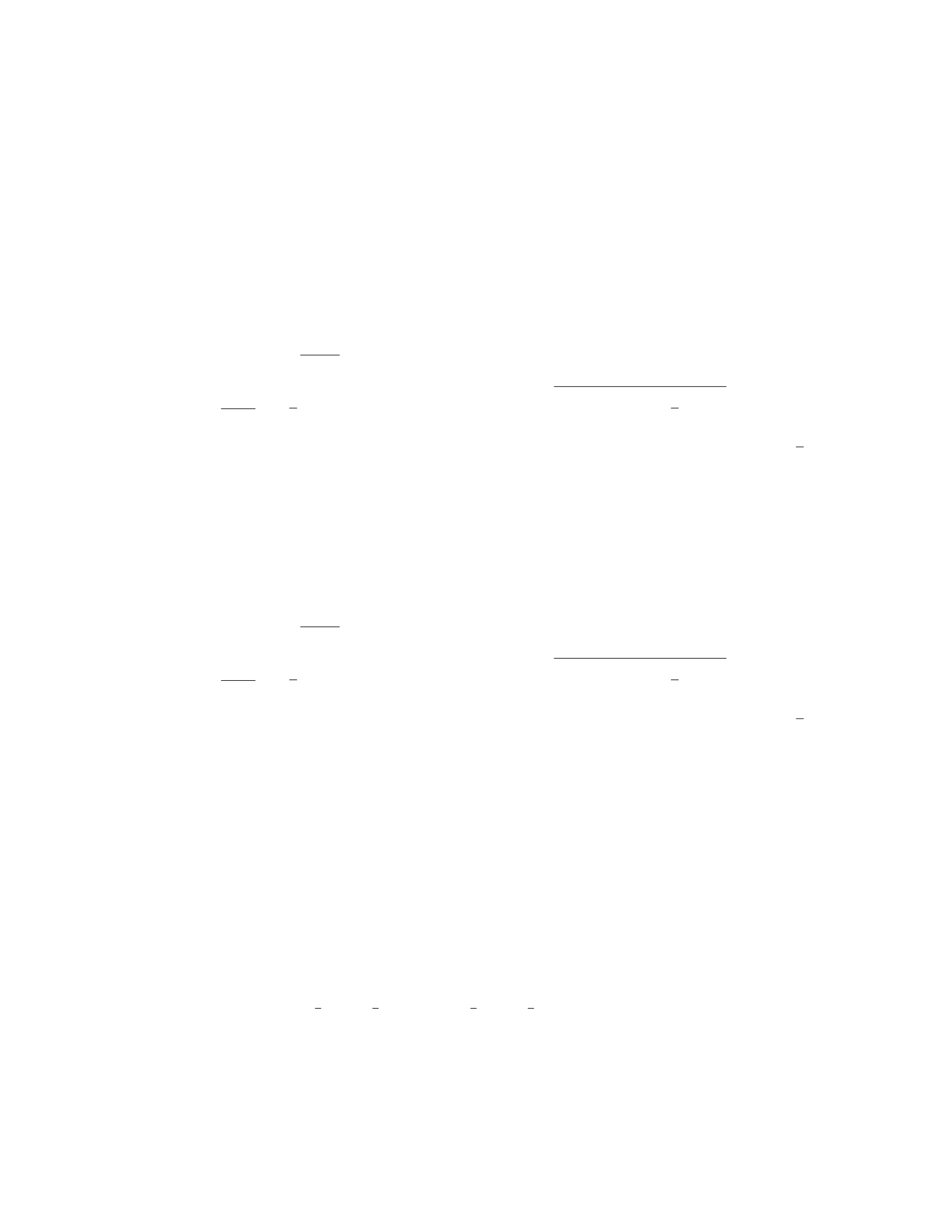
Question 27
Question 27: Let Cbe the curve defined by r(t) = ⟨2 cos t, 2 sin t, t⟩
for 0≤t≤2π. Calculate the line integral RCxey+zds.
Solution: Given curve Cwith parameterization r(t) = ⟨2 cos t, 2 sin t, t⟩
for 0≤t≤2π, we can calculate the line integral as follows:
The curve starts at t= 0 and ends at t= 2π. The differential
of arc length ds is given by ds =||r′(t)||dt. The unit tangent vec-
tor is T=r′(t)
||r′(t)|| . Substitute x= 2 cos t,y= 2 sin t, and z=tinto
the given function: xey+z= 2 cos te2 sin t+t. The line integral becomes
RC2 cos te2 sin t+t||r′(t)||dt. Calculate ||r′(t)|| =p(−2 sin t)2+ (2 cos t)2+ 1 =
√4 + 1 = √5. The line integral simplifies to RC2 cos te2 sin t+t√5dt. Inte-
grate with respect to tover 0≤t≤2πto find the final result.
Therefore, the line integral RCxey+zds over the curve Cis R2π
02 cos te2 sin t+t√5dt.Certainly!
Here is question number 27 on Line Integral for Liberty University
in LateX code:
Question 27: Let Cbe the curve defined by r(t) = ⟨2 cos t, 2 sin t, t⟩
for 0≤t≤2π. Calculate the line integral RCxey+zds.
Solution: Given curve Cwith parameterization r(t) = ⟨2 cos t, 2 sin t, t⟩
for 0≤t≤2π, we can calculate the line integral as follows:
The curve starts at t= 0 and ends at t= 2π. The differential
of arc length ds is given by ds =||r′(t)||dt. The unit tangent vec-
tor is T=r′(t)
||r′(t)|| . Substitute x= 2 cos t,y= 2 sin t, and z=tinto
the given function: xey+z= 2 cos te2 sin t+t. The line integral becomes
RC2 cos te2 sin t+t||r′(t)||dt. Calculate ||r′(t)|| =p(−2 sin t)2+ (2 cos t)2+ 1 =
√4 + 1 = √5. The line integral simplifies to RC2 cos te2 sin t+t√5dt. Inte-
grate with respect to tover 0≤t≤2πto find the final result.
Therefore, the line integral RCxey+zds over the curve Cis R2π
02 cos te2 sin t+t√5dt.
Question 28
Question 28:
Evaluate the line integral RC(x2+y)dx + (x+ sin y)dy, where C is the
curve given by x=t,y=t2,0≤t≤1.
Solution: To evaluate the line integral, we need to parameterize
the curve C by expressing x and y in terms of a parameter t:
x=t y =t2dx =dt dy = 2tdt
Substitute these into the given line integral:
RC(x2+y)dx+ (x+ sin y)dy =R1
0((t2+t2)dt+ (t+ sin(t2))(2tdt)) = R1
0(2t2+
2t3+ 2t2+ 2tsin(t2))dt =R1
0(4t2+ 2t3+ 2tsin(t2))dt
Now, integrate each term separately:
R1
04t2dt =4
3t31
0=4
3R1
02t3dt =1
2t41
0=1
2R1
02tsin(t2)dt (this integral
might need further manipulation with substitution)
28
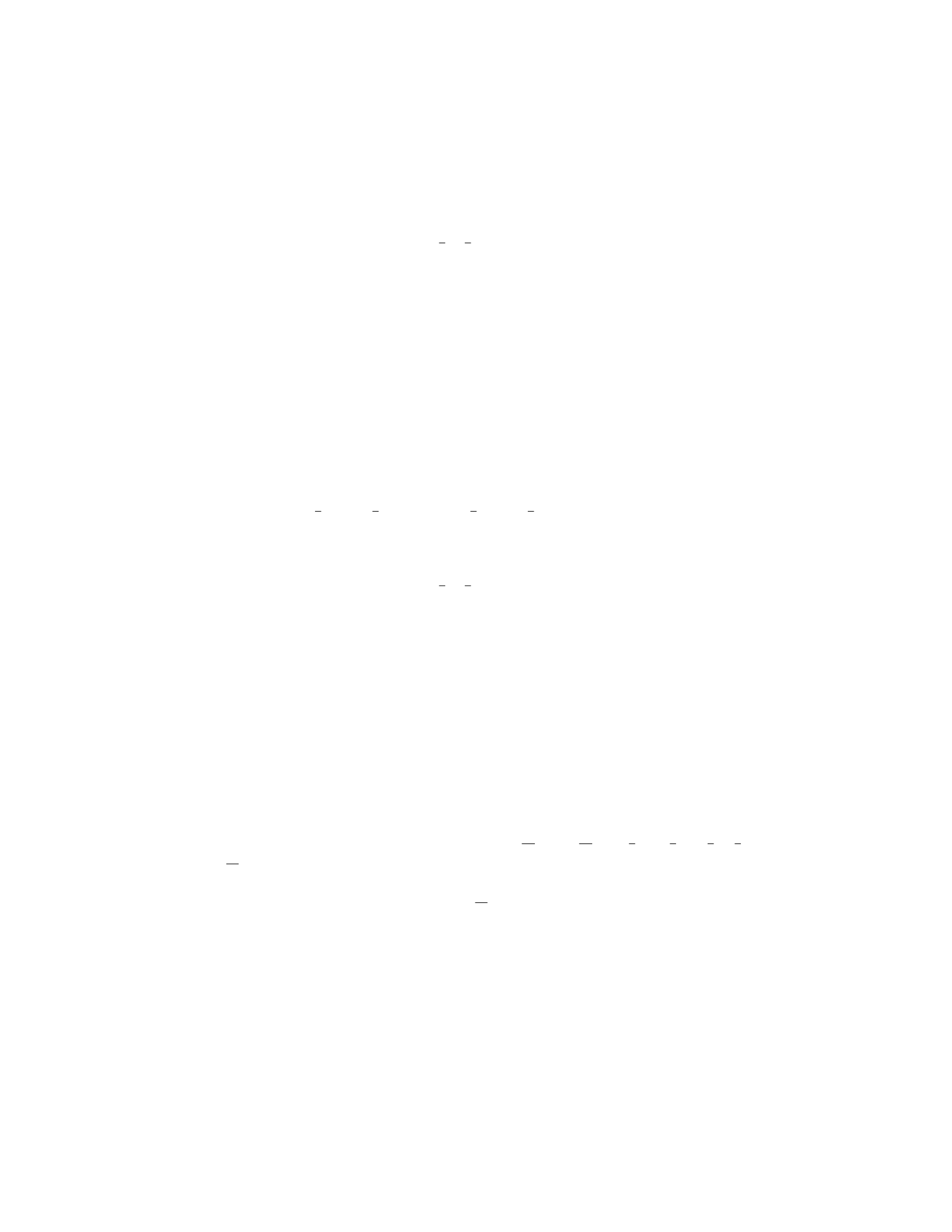
Finally, calculate the value of the line integral by summing up the
results of individual integrals:
RC(x2+y)dx+ (x+ sin y)dy =4
3+1
2+(value of the remaining integral)
You can now calculate the remaining integral or further simplify
the expression if needed.Certainly! Here is a Line Integral question
along with step-by-step solutions in LateX code:
Question 28:
Evaluate the line integral RC(x2+y)dx + (x+ sin y)dy, where C is the
curve given by x=t,y=t2,0≤t≤1.
Solution: To evaluate the line integral, we need to parameterize
the curve C by expressing x and y in terms of a parameter t:
x=t y =t2dx =dt dy = 2tdt
Substitute these into the given line integral:
RC(x2+y)dx+ (x+ sin y)dy =R1
0((t2+t2)dt+ (t+ sin(t2))(2tdt)) = R1
0(2t2+
2t3+ 2t2+ 2tsin(t2))dt =R1
0(4t2+ 2t3+ 2tsin(t2))dt
Now, integrate each term separately:
R1
04t2dt =4
3t31
0=4
3R1
02t3dt =1
2t41
0=1
2R1
02tsin(t2)dt (this integral
might need further manipulation with substitution)
Finally, calculate the value of the line integral by summing up the
results of individual integrals:
RC(x2+y)dx+ (x+ sin y)dy =4
3+1
2+(value of the remaining integral)
You can now calculate the remaining integral or further simplify
the expression if needed.
Question 29
Question 29: Calculate the line integral RCy2dx +x2dy, where Cis
the curve defined by y=x2from (0,0) to (1,1).
Solution: Given curve Cis defined by y=x2from (0,0) to (1,1).
The line integral is given by RCy2dx +x2dy.
First, express yin terms of xalong the curve: y=x2
Now, calculate dx and dy: Since dy/dx = 2x,dx =dx and dy = 2xdx.
Substitute y=x2,dx, and dy into the line integral: RCy2dx +x2dy =
R1
0x4dx +x2(2xdx) = R1
0x4dx + 2 R1
0x3dx = [x5
5]1
0+ 2[x4
4]1
0=1
5+ 2(1
4) = 1
5+1
2
=3
10 .
Therefore, the line integral RCy2dx +x2dy over the curve Cdefined
by y=x2from (0,0) to (1,1) is 3
10 .Sure, here is the question and
step-by-step solution for Line Integral question number 29:
Question 29: Calculate the line integral RCy2dx +x2dy, where Cis
the curve defined by y=x2from (0,0) to (1,1).
Solution: Given curve Cis defined by y=x2from (0,0) to (1,1).
The line integral is given by RCy2dx +x2dy.
First, express yin terms of xalong the curve: y=x2
Now, calculate dx and dy: Since dy/dx = 2x,dx =dx and dy = 2xdx.
29
Substitute y=x2,dx, and dy into the line integral: RCy2dx +x2dy =
R1
0x4dx +x2(2xdx) = R1
0x4dx + 2 R1
0x3dx = [x5
5]1
0+ 2[x4
4]1
0=1
5+ 2(1
4) = 1
5+1
2
=3
10 .
Therefore, the line integral RCy2dx +x2dy over the curve Cdefined
by y=x2from (0,0) to (1,1) is 3
10 .
Question 30
Calculate the line integral RCx2y dx + 3x2y dy, where Cis the line
segment from (1,0) to (2,4).
Step-by-step solution:
Given line integral: RCx2y dx + 3x2y dy
The parameterization of the line segment from (1,0) to (2,4) can
be written as follows:
x(t) = 1 + t, y(t)=4t, 0≤t≤1
Now, we can express dx and dy in terms of dt:
dx =x′(t)dt =dt
dy =y′(t)dt = 4 dt
Substitute x(t),y(t),dx, and dy into the line integral:
RCx2y dx + 3x2y dy =R1
0(1 + t)2(4t)dt + 3(1 + t)2(4t)(4) dt
Simplify the integrand:
=R1
0(4t+ 4t2)(4t)dt + 48(1 + t)2t dt
=R1
0(16t2+ 16t3)dt + 48(1 + t)2t dt
=16
3t3+ 4t41
0+48t(1 + t)3+ 3t2(1 + t)21
0
=16
3+ 4 + 48(2)3+ 3(2)2
=16
3+ 4 + 48(8) + 3(4)
=16
3+ 4 + 384 + 12
=16
3+ 4 + 384 + 12
= 416 + 16
3
Therefore, the value of the line integral RCx2y dx + 3x2y dy over the
line segment from (1,0) to (2,4) is 416 + 16
3.Question 30:
Calculate the line integral RCx2y dx + 3x2y dy, where Cis the line
segment from (1,0) to (2,4).
Step-by-step solution:
Given line integral: RCx2y dx + 3x2y dy
The parameterization of the line segment from (1,0) to (2,4) can
be written as follows:
x(t) = 1 + t, y(t)=4t, 0≤t≤1
Now, we can express dx and dy in terms of dt:
dx =x′(t)dt =dt
dy =y′(t)dt = 4 dt
Substitute x(t),y(t),dx, and dy into the line integral:
RCx2y dx + 3x2y dy =R1
0(1 + t)2(4t)dt + 3(1 + t)2(4t)(4) dt
30
Simplify the integrand:
=R1
0(4t+ 4t2)(4t)dt + 48(1 + t)2t dt
=R1
0(16t2+ 16t3)dt + 48(1 + t)2t dt
=16
3t3+ 4t41
0+48t(1 + t)3+ 3t2(1 + t)21
0
=16
3+ 4 + 48(2)3+ 3(2)2
=16
3+ 4 + 48(8) + 3(4)
=16
3+ 4 + 384 + 12
=16
3+ 4 + 384 + 12
= 416 + 16
3
Therefore, the value of the line integral RCx2y dx + 3x2y dy over the
line segment from (1,0) to (2,4) is 416 + 16
3.
31

