


08/24/2020 HLTH 645
Jennifer William
Liberty University
Nutrition Knowledge Survey Part 1
HLTH 645-B02 LUO
08/24/2020 HLTH 645
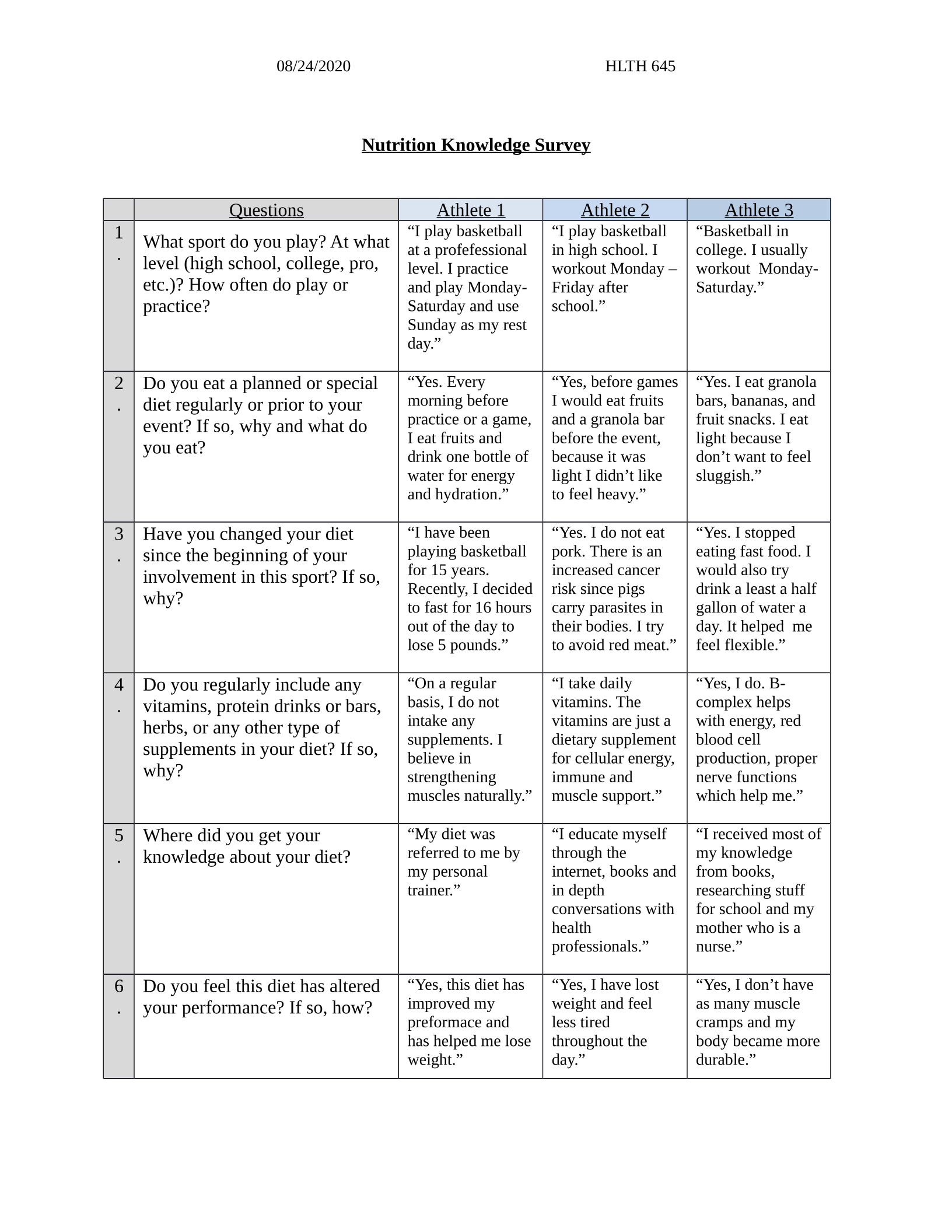
Nutrition Knowledge Survey
Questions Athlete 1 Athlete 2 Athlete 3
1
.What sport do you play? At what
level (high school, college, pro,
etc.)? How often do play or
practice?
“I play basketball
at a profefessional
level. I practice
and play Monday-
Saturday and use
Sunday as my rest
day.”
“I play basketball
in high school. I
workout Monday –
Friday after
school.”
“Basketball in
college. I usually
workout Monday-
Saturday.”
2
.
Do you eat a planned or special
diet regularly or prior to your
event? If so, why and what do
you eat?
“Yes. Every
morning before
practice or a game,
I eat fruits and
drink one bottle of
water for energy
and hydration.”
“Yes, before games
I would eat fruits
and a granola bar
before the event,
because it was
light I didn’t like
to feel heavy.”
“Yes. I eat granola
bars, bananas, and
fruit snacks. I eat
light because I
don’t want to feel
sluggish.”
3
.
Have you changed your diet
since the beginning of your
involvement in this sport? If so,
why?
“I have been
playing basketball
for 15 years.
Recently, I decided
to fast for 16 hours
out of the day to
lose 5 pounds.”
“Yes. I do not eat
pork. There is an
increased cancer
risk since pigs
carry parasites in
their bodies. I try
to avoid red meat.”
“Yes. I stopped
eating fast food. I
would also try
drink a least a half
gallon of water a
day. It helped me
feel flexible.”
4
.
Do you regularly include any
vitamins, protein drinks or bars,
herbs, or any other type of
supplements in your diet? If so,
why?
“On a regular
basis, I do not
intake any
supplements. I
believe in
strengthening
muscles naturally.”
“I take daily
vitamins. The
vitamins are just a
dietary supplement
for cellular energy,
immune and
muscle support.”
“Yes, I do. B-
complex helps
with energy, red
blood cell
production, proper
nerve functions
which help me.”
5
.
Where did you get your
knowledge about your diet?
“My diet was
referred to me by
my personal
trainer.”
“I educate myself
through the
internet, books and
in depth
conversations with
health
professionals.”
“I received most of
my knowledge
from books,
researching stuff
for school and my
mother who is a
nurse.”
6
.
Do you feel this diet has altered
your performance? If so, how?
“Yes, this diet has
improved my
preformace and
has helped me lose
weight.”
“Yes, I have lost
weight and feel
less tired
throughout the
day.”
“Yes, I don’t have
as many muscle
cramps and my
body became more
durable.”
08/24/2020 HLTH 645
Summary
The athletes that I interviewed all played basketball at different levels, ranging from high
school, college and professional. Their love and commitment to basketball has them in the gym
or in the weight room conditioning their bodies 5-6 days out of the week. Prior to a practice or a
game, all of the athletes eat fruits, and/or granola bars either for a high boost in energy and/or to
feel light which creates less bloating in the stomach area during the events. All of the athletes
have either made recent changes to their diets or long term changes – these changes include,
fasting for 16 hours out of the day, elimatinating pork/red meat and avoiding fast food dining. Of
the three athletes, two of them intake daily vitamins to enchance their energy, immune system,
and muscle support. Athlete 1 has a personal trainer who provides meal plans and weight goals
every week and she is satisfied with her progress. Athlete 2 and 3 self educate themselves on a
healthy nutritious diet by reading, researching and speaking with health professionals. All three
athletes believe that their diets have significantly improved their performance on the courts. Each
athlete has stated that their bodies feel much more healthier, their endurance has increased and
they have ultimately been able to lose a few extra pounds.
Interpretation
At the most essential level, nourishment is significant for athletes since it gives a
wellspring of energy needed to play out the movement. The food we eat impacts our quality,
preparing, execution and recuperation. Nutrients can be isolated into 2 classes: macronutrients,
and micronutrients. Macronutrients are those nutrients that the body needs in enormous sums.
These furnish the body with vitality (calories). Micronutrients are those nutrients that the body
needs in littler sums.1 A solid and adjusted diet, including an assortment of fruits, ought to give
all the micronutrients most dynamic individuals need.
08/24/2020 HLTH 645
We get our energy and enhancements generally from the three macronutrients:
carbohydrates, protein and fat. Carbohydrates are a significant wellspring of vitality. An ordinary
diet, where roughly half (45-55%) of the every day calories originate from carbohydrates, gives
enough to most respectably dynamic individuals.2 A customary diet containing 1,800-2,400
calories for every day as a rule gives enough energy to burn 200-400 calories. Extremely
athlethic individuals, who perform high force practice consistently for 2-3 hours intense exercise
for 5-6 times each week, should expend additional vitality and increment carbohydrate admission
to 55-65% of absolute every day calories.2 Meat, fish, eggs, and milk are excellent protein
sources, as they contain elevated levels of fundamental amino acids, which are required for
protein blend in muscles. Dynamic individuals need a moderate measure of fat (about 30% of
every day calories), which can undoubtedly be accomplished by including oily fish (like
salmon), vegetable oils or spreads, nuts, seeds and avocado in the diet.
08/24/2020 HLTH 645
References
1. Jenner SL, Buckley GL, Belski R, Devlin BL, Forsyth AK. Dietary Intakes of
Professional and Semi-Professional Team Sport Athletes Do Not Meet Sport Nutrition
Recommendations-A Systematic Literature Review. Nutrients. 2019;11(5):1160.
Published 2019 May 23. doi:10.3390/nu11051160
2. Potgieter S. Sport Nutrition: A Review Of The Latest Guidelines For Exercise And
Sport Nutrition From The American College Of Sport Nutrition, The International
Olympic Committee And The International Society For Sports Nutrition. South
African J. 2013;26(6-16) Pubished 2013 January 17. doi:10.1080/nul16070658
Powered by TCPDF (www.tcpdf.org)

