


Problem
A significant issue in the United States of America today is the growing rate of cases of
obesity in children. Overweight and obesity are defined as abnormal or excessive fat
accumulation that presents a risk to health. Body mass index (BMI) is a measure used to
determine childhood overweight and obesity. Overweight is defined as a BMI at or above the
85th percentile and below the 95th percentile for children and teens of the same age and sex.
Obesity is defined as a BMI at or above the 95th percentile for children and teens of the same
age and sex.¹ There are many socioeconomic factors that can influence the possibility of a child
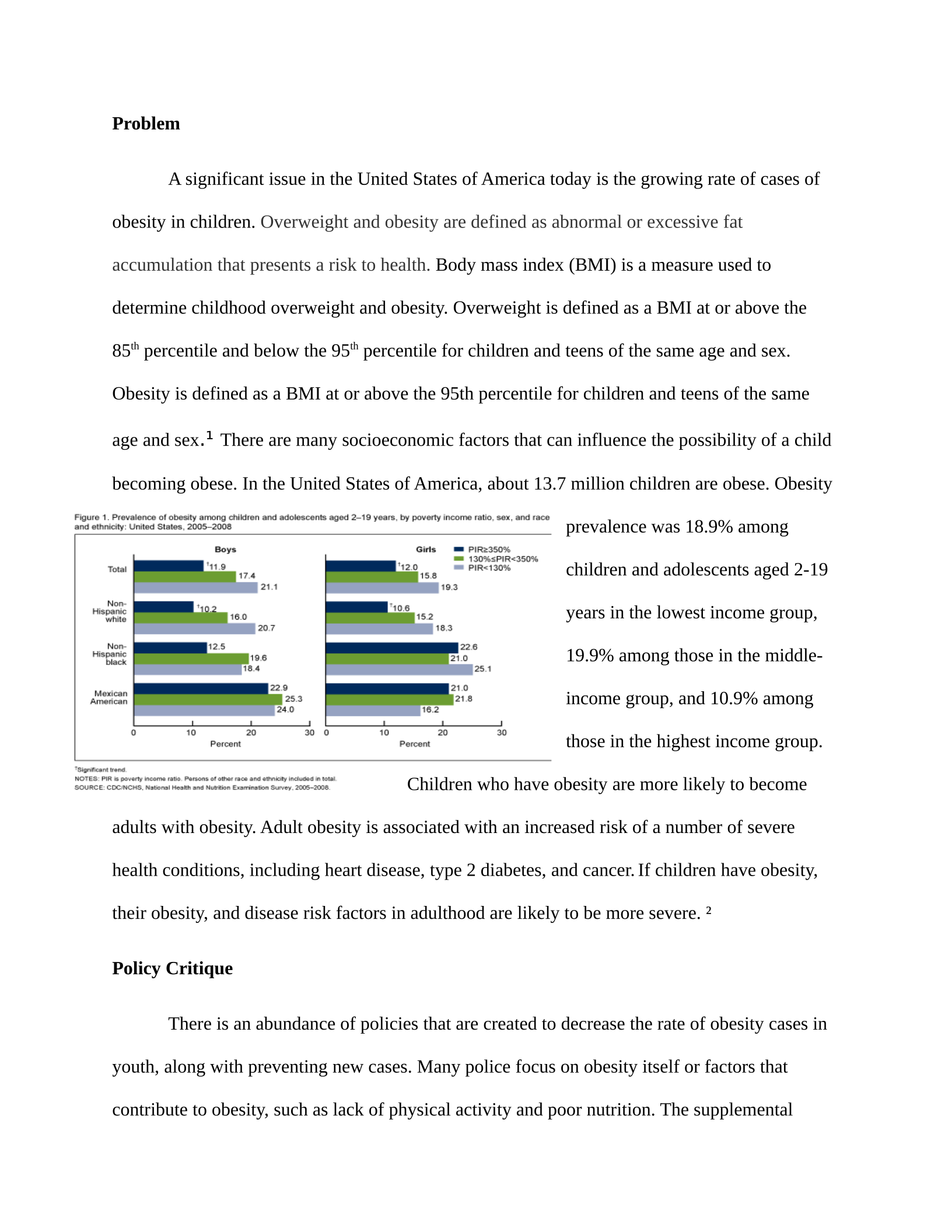
becoming obese. In the United States of America, about 13.7 million children are obese. Obesity
prevalence was 18.9% among
children and adolescents aged 2-19
years in the lowest income group,
19.9% among those in the middle-
income group, and 10.9% among
those in the highest income group.
Children who have obesity are more likely to become
adults with obesity. Adult obesity is associated with an increased risk of a number of severe
health conditions, including heart disease, type 2 diabetes, and cancer. If children have obesity,
their obesity, and disease risk factors in adulthood are likely to be more severe. ²
Policy Critique
There is an abundance of policies that are created to decrease the rate of obesity cases in
youth, along with preventing new cases. Many police focus on obesity itself or factors that
contribute to obesity, such as lack of physical activity and poor nutrition. The supplemental

program, physical education, and school environment changes are all policy options when
combating childhood obesity. An issue with many of the polices for supplemental programs is
that they do not provide adequate nutrition education. Recently the USDA offered policies that
will help low-income families that receive Supplemental Nutrition Assistance Program (SNAP)
to have better access to healthy foods. The 2014 Farm Bill, a policy makes it so that for stores to
participate, that wants to participate in SNAP offer a verity of healthy food choices. The issue
with this proposed policy is that even if the stores begin to carry more healthy food choices does
not mean that individuals will buy them. However, if individuals had better nutrition education,
they would more likely buy healthier foods.
Programs have been recently more focused on the school environment. The USDA
provided the Smart Snack in School policy, which makes it so all competitive foods and
beverages sold during the school day must meet or exceed Smart Snacks in School nutrition
standards, which include limits on fat, sugar, sodium, and calorie content. These standards are
the minimum requirement for schools, but states and local education agencies can continue to
implement stronger nutrition standards for all competitive foods in schools. In Colorado, there ⁴
is an enacted policy that bands trans fats in school foods. Many high-fat foods, such as baked
goods and fried foods, have much trans fat. Eating too much trans fat can cause you to gain
weight. Although focusing on the school environment is important, it has been shown that ⁵
parental influence is very high on eating behaviors. Caregivers play a critical role in determining
which kinds of foods will become familiar to their children – from the foods kept routinely in the
cupboard to those served regularly at the family table and even those consumed away from
home. Caregivers also act as important gatekeepers to the social influences surrounding
children's eating, including access to media and modeling. ⁶
A practical choice for a policy for combating childhood obesity would focus on early
intervention through nutrition education, and exposure to physical activity before the child enters
the school system. The policy will ensure standards are set for early childcare provides on the
amount of nutritional education and physical activity is provided to the families they support.
This would include care provides to work with parents on meal plans for young children as well
as a program to help measure if the child is receiving the proper amount of physical activity
daily. There may be an issue with getting every parent involved because of work and limited time
availability. This issue may be solved by using a communication app to have these discussions.
Eating behaviors evolve during the first years of life; children learn what, when, and how much
to eat through direct experiences with food and by observing the eating behaviors of others. In
light of the increasing prevalence of overweight and obesity in North America among all age
groups, including very young children, an understanding of the factors that influence eating
behaviors during childhood is needed to improve the dietary patterns and health status of this age
group. ⁷Child care providers are in a unique position to educate parents about healthy eating and
activity habits, and also to provide a healthy environment for children to eat, play, and grow.
They can serve children age-appropriate healthy foods, and limit junk food, sugary drinks, and
juice. They can offer children lots of opportunities for active play, in fun, short bursts throughout
the day. And they can keep televisions turned off and away from areas where children sleep.
When parents also adopt these practices at home, children are assured the best chance of growing
into a healthy weight. As you can see from the chart young children are start to spend more ⁸
time in the care of center based programs over the past few years. This would make sense to
implement this policy where young children spend a large amount of their time. The Bible says
References
1. Cdc.gov. (2020). Defining Childhood Obesity | Overweight & Obesity | CDC. [online] Available at:
https://www.cdc.gov/obesity/childhood/defining.html [Accessed 4 Mar. 2020].
2. Centers for Disease Control and Prevention. (2020). Causes and Consequences of Childhood
Obesity. [online] Available at: https://www.cdc.gov/obesity/childhood/causes.html [Accessed 4
Mar. 2020].
3. Usda.gov. (2020). USDA Proposes Policies to Improve Food Access, Healthy Choices for Low-
income Americans. [online] Available at: https://www.usda.gov/media/press-
releases/2016/02/16/usda-proposes-policies-improve-food-access-healthy-choices-low
[Accessed 4 Mar. 2020].
4. Cdc.gov. (2020). Smart Snacks | Healthy Schools | CDC. [online] Available at:
https://www.cdc.gov/healthyschools/npao/smartsnacks.htm [Accessed 4 Mar. 2020].
5. fats, F. (2020). Facts about trans fats: MedlinePlus Medical Encyclopedia. [online]
Medlineplus.gov. Available at: https://medlineplus.gov/ency/patientinstructions/000786.htm
[Accessed 4 Mar. 2020].
6. Savage, J., Fisher, J. and Birch, L. (2007). Parental Influence on Eating Behavior: Conception to
Adolescence. The Journal of Law, Medicine & Ethics, 35(1), pp.22-34.
7. Dr. Leann Birch, A. (2020). Influences on the Development of Children's Eating Behaviours: From
Infancy to Adolescence. [online] PubMed Central (PMC). Available at:
https://www.ncbi.nlm.nih.gov/pmc/articles/PMC2678872/#__ffn_sectitle [Accessed 4 Mar. 2020].
8. Obesity Prevention Source. (2020). Early Child Care Obesity Prevention Recommendations:
Complete List. [online] Available at: https://www.hsph.harvard.edu/obesity-prevention-
source/obesity-prevention/early-child-care/early-child-care-obesity-prevention-recommendation-
complete-list/ [Accessed 4 Mar. 2020].
Powered by TCPDF (www.tcpdf.org)

