


INTERACTIVITY AND ENGAGEMENT BLOG POST 2
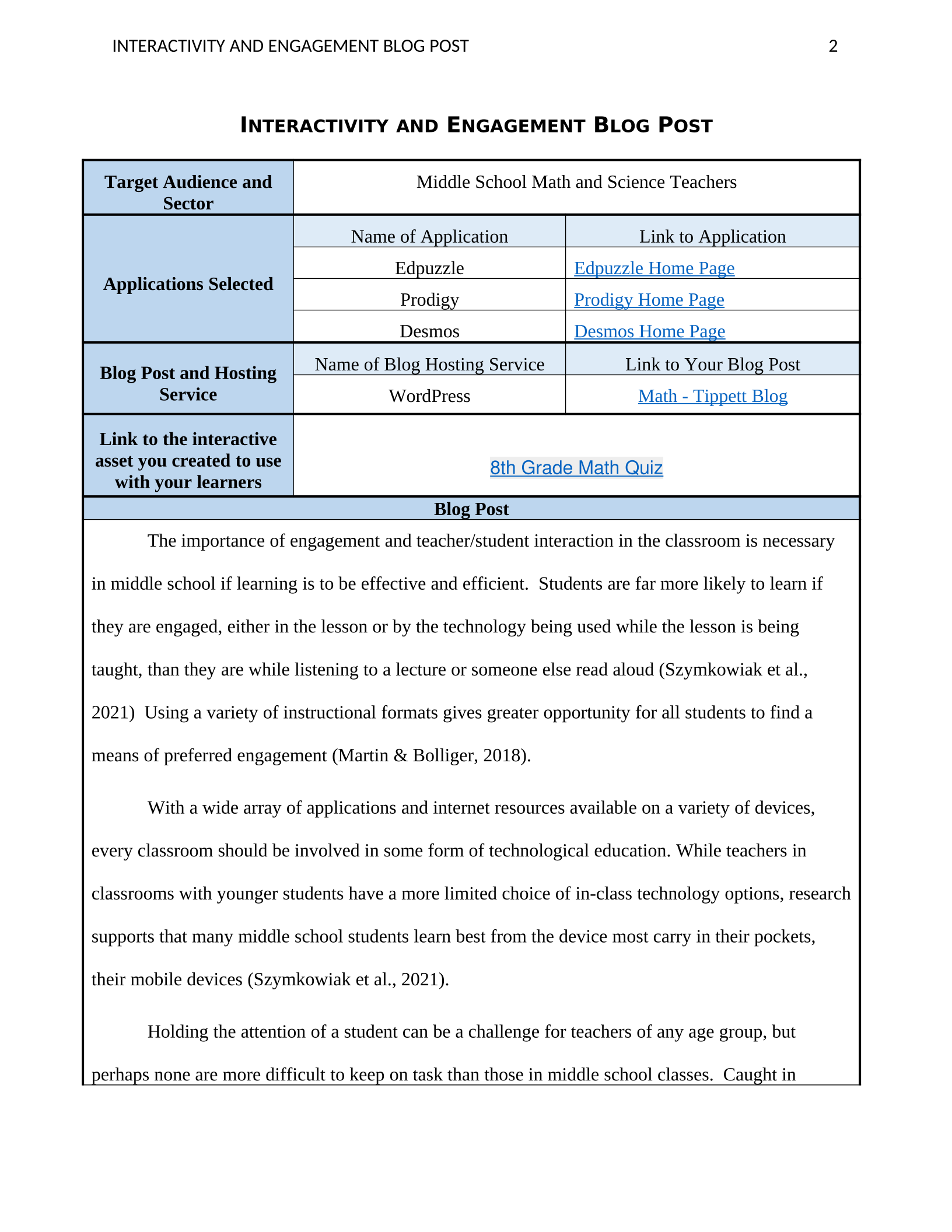
INTERACTIVITY AND ENGAGEMENT BLOG POST
Target Audience and
Sector
Middle School Math and Science Teachers
Applications Selected
Name of Application Link to Application
Edpuzzle Edpuzzle Home Page
Prodigy Prodigy Home Page
Desmos Desmos Home Page
Blog Post and Hosting
Service
Name of Blog Hosting Service Link to Your Blog Post
WordPress Math - Tippett Blog
Link to the interactive
asset you created to use
with your learners 8th Grade Math Quiz
Blog Post
The importance of engagement and teacher/student interaction in the classroom is necessary
in middle school if learning is to be effective and efficient. Students are far more likely to learn if
they are engaged, either in the lesson or by the technology being used while the lesson is being
taught, than they are while listening to a lecture or someone else read aloud (Szymkowiak et al.,
2021) Using a variety of instructional formats gives greater opportunity for all students to find a
means of preferred engagement (Martin & Bolliger, 2018).
With a wide array of applications and internet resources available on a variety of devices,
every classroom should be involved in some form of technological education. While teachers in
classrooms with younger students have a more limited choice of in-class technology options, research
supports that many middle school students learn best from the device most carry in their pockets,
their mobile devices (Szymkowiak et al., 2021).
Holding the attention of a student can be a challenge for teachers of any age group, but
perhaps none are more difficult to keep on task than those in middle school classes. Caught in
INTERACTIVITY AND ENGAGEMENT BLOG POST 3
between doing only what they are told in elementary school and the autonomy that comes with high
school, middle school students are, as a general rule, impetuous, bold, inattentive, and constantly on
the move. To properly educate a student in those middle school years, teachers must perform
miraculous feats of coordination and control, much like a ringmaster at the circus. Classrooms must
be ever-changing and never silent. Lessons must be short, informative, to the point, and easily
repeatable a minimum of six times.
Game-based learning has brought a new dimension to the middle school classroom in recent
years. There are a multitude of mobile applications, web-based learning platforms, and instructional
videos for every topic imaginable. Research supports the observation, in my own classrooms, that
students prefer to learn at a fast pace, quickly shifting from topic to topic, due to a technology-
induced short attention span (Szymkowiak et al., 2021). Due to this trend, teachers have become
more digital in their teaching, often offering game-based reviews by way of online options such as
Kahoot! and Nearpod (Al Redhaei et al., 2022).
Given the increased student engagement created by a greater use of technology in the
classroom, it only makes sense to keep in step with the newest apps available for instruction. One
such application available both online and on mobile devices is Desmos. Desmos is an online
learning platform for mathematics, with games, instruction, and lessons available for every age
group. With a selection of free calculator apps, it can provide the latest in graphing technology from
a student’s cell phone or laptop. The platform, which will work on any device which can connect to
the internet, offers free membership, while allowing teachers to create classrooms for their students,
including assigning lessons and games for remediation or enjoyable skills practice. Desmos does
offer an online curriculum which is available for purchase, but the platform works well with any text-
INTERACTIVITY AND ENGAGEMENT BLOG POST 4
based curriculum.
Desmos is user-friendly, for teachers as well as students. Teachers can assign material in the
platform or create links for email and LMS sites. The graphing calculator functions are more easily
accessible than a hand-held calculator, offering intuitive menus and helpful instructions for novice
users and more experienced graphing students. This program is designed for use both in the
classroom during face-to-face instruction, as well as offering the student an engaging site to practice
necessary skills on their own time. Teachers can demonstrate in graphing functions in real time for
all the students in class much more quickly than with traditional graphing tools.
Another online platform offering game-based lessons and skills practice is Prodigy. Prodigy
offers both at home and in class learning platforms in math and English for students in grades
kindergarten through 8th grade. Teachers can find games and supplemental lesson content based on
the state standard they are currently teaching. The content on the site is very rigorous and offers
multiple levels of difficulty, providing remediation for weaker students as well as challenges for
those that are more advanced. Prodigy offers teachers a free option to create an online classroom
where students can be assigned placement testing and then given games and lessons specifically
designed to increase their knowledge base in areas where they are shown to have gaps or weaknesses.
Parents may also create pages for their child, for supplemental learning or for remediation over the
summer.
Prodigy can be used on tablets, on both Android and iOS operating systems, As well as
mobile devices, laptops, and desktop computer systems. One drawback to prodigy is its ease of use.
The games are not well explained, and younger students would need assistance and most likely
supervision throughout the gaming process. There were links for customer support but the chat
function did not work well and communication was very fragmented and delayed. However, once a
INTERACTIVITY AND ENGAGEMENT BLOG POST 5
student mastered the concept of the game, they would be very successful in learning new skills. This
system would work well in the classroom, but parent support would be needed if used with online
students, as they would need help setting up their account and finding their way around the site.
Edpuzzle is a website offering an interesting option for content delivery and review to
teachers in a variety of educational fields. Teachers may register for this service and create multiple
classrooms free on this website. The site is user-friendly, with instant support for most questions, as
well as tutorials available for special features. The online platform does work best on a laptop or
desktop computer. Students can have issues signing into their classroom account from a mobile
device.
Edpuzzle allows teachers to import their own video content, or search for content from other
sites, such as YouTube. PowerPoint presentations converted to videos is a great way to create unique
classroom content. Once the content has been imported, it may be edited to suit the teacher’s needs.
Videos may be cropped, voiceover added, and questions or notes inserted for review. These videos
can be assigned as classwork or homework, and will be graded by Edpuzzle for the students in real
time. Teachers may then review each student’s work, looking for mastery of content or areas of
weakness. Students receive a login code via email from the teacher for each assignment. Because of
the video format, students cannot skip to the end of the video, they must watch each segment and
answer all questions or their work will not be graded.
A link has been provided for a sample Edpuzzle created as a demonstration of what the
website can offer. Could You Pass 8 th
Grade Math Test? will allow visitors to experience the
finished product of an Edpuzzle. While students seem to enjoy the method of learning and review,
most instructors enjoy the creation process as well.
INTERACTIVITY AND ENGAGEMENT BLOG POST 6
All of these methods of introducing technology into the classroom for learning and
engagement are useful. There are possibly hundreds of other applications online that offer similar
experiences in the field of education. However, it is important to remember that the technology does
not take the place of effective and inspired teaching (Sadeghi, 2019). The personal relationship
achieved between student and teacher cannot be replaced by gaming consoles and mobile devices.
Teacher-student interaction is still the primary source of motivation for most students in the
classroom and online. Without this interaction, students must be self-motivated and focused to be
successful, which is possible for younger students, but not plausible (Greipl et al., 2020).
The correlation between the instruction provided by the teacher in the classroom and the
content of the technology resources is also a determining factor in the success of the online
instruction and increased engagement. Teachers unfamiliar with the content of the online
instructional offerings saw less improvement in their students’ achievement (Tokac et al., 2019).
This shows that gaming or online instruction alone is not enough. Teachers must provide the
personal connections, the encouragement, and control the overall pace and flow of the lessons before
students will be successful in the classroom.
INTERACTIVITY AND ENGAGEMENT BLOG POST 7
References
Al Redhaei, A., Awad, M., & Salameh, K. (2022). Assessing the impact of gamification in
higher education: An experimental study using Kahoot! and Nearpod during COVID-19
pandemic. Paper presented at theC2022 Advances in Science and Engineering Technology
International Conferences (ASET),1-6.
BG Mines (2017, December 7). Could you pass 8th grade math test? [Video file]. YouTube.
https://youtu.be/KDO0NbOlN1w
Greipl, S., Moeller, K., & Ninaus, M. (2020). Potential and limits of game-based
learning.International Journal of Technology Enhanced Learning,12(4), 363-
389. https://doi.org/10.1504/IJTEL.2020.110047
Martin, F., & Bolliger, D. U. (2018). Engagement matters: Student perceptions on the
importance of engagement strategies in the online learning environment.Online
Learning,22(1), 205-222.
Sadeghi, M. (2019). A shift from classroom to distance learning: Advantages and
limitations.International Journal of Research in English Education,4(1), 80-88.
Szymkowiak, A., Melović, B., Dabić, M., Jeganathan, K., & Kundi, G. S. (2021). Information
technology and gen Z: The role of teachers, the internet, and technology in the education
of young people.Technology in Society,65, 101565.
Tokac, U., Novak, E., & Thompson, C. G. (2019). Effects of game-based learning on students'
mathematics achievement: A meta-analysis.Journal of Computer Assisted
Learning,35(3), 407-420.Chttps://doi.org/10.1111/jcal.12347
Powered by TCPDF (www.tcpdf.org)

