


2
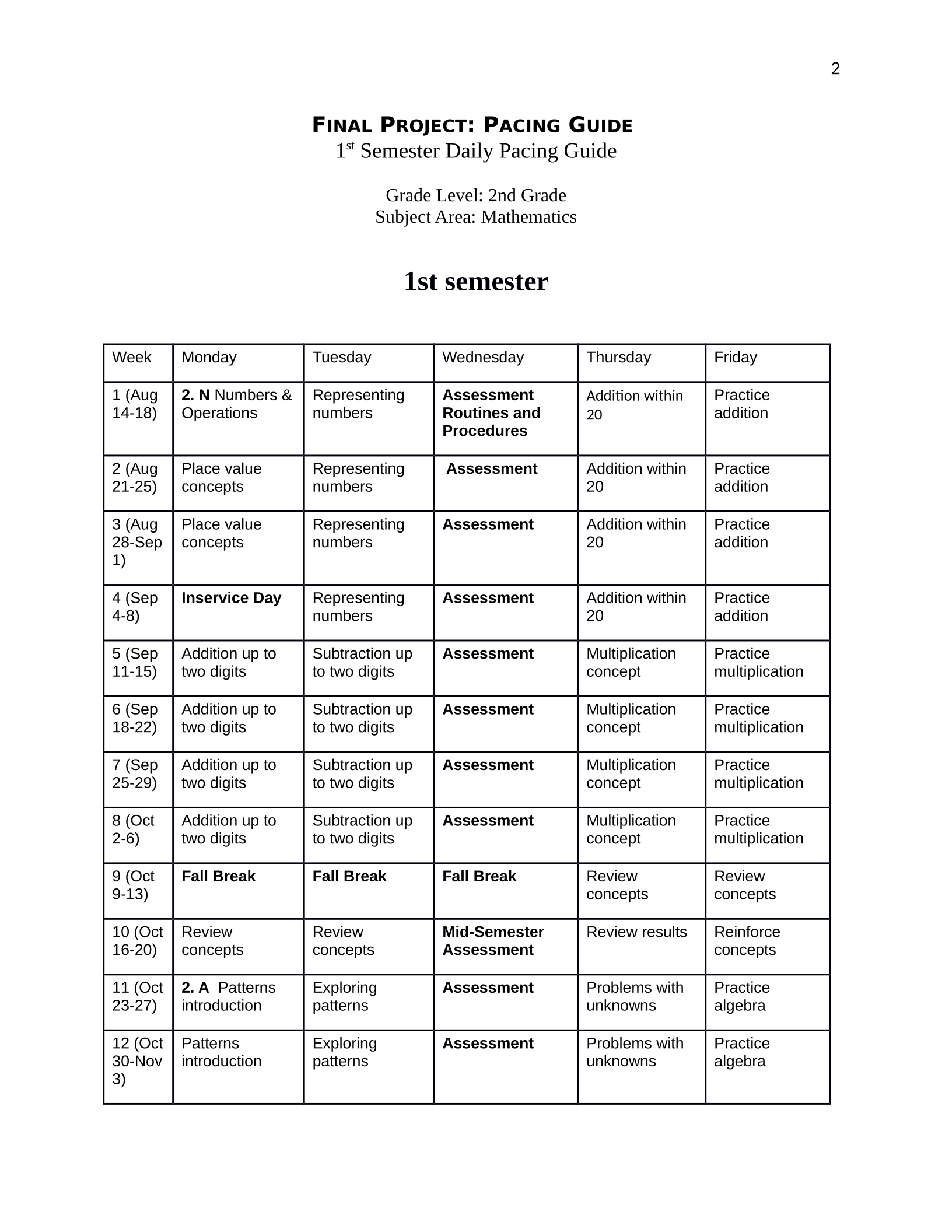
FINAL PROJECT: PACING GUIDE
1st Semester Daily Pacing Guide
Grade Level: 2nd Grade
Subject Area: Mathematics
1st semester
Week Monday Tuesday Wednesday Thursday Friday
1 (Aug
14-18)
2. N Numbers &
Operations
Representing
numbers
Assessment
Routines and
Procedures
Addition within
20
Practice
addition
2 (Aug
21-25)
Place value
concepts
Representing
numbers
Assessment Addition within
20
Practice
addition
3 (Aug
28-Sep
1)
Place value
concepts
Representing
numbers
Assessment Addition within
20
Practice
addition
4 (Sep
4-8)
Inservice Day Representing
numbers
Assessment Addition within
20
Practice
addition
5 (Sep
11-15)
Addition up to
two digits
Subtraction up
to two digits
Assessment Multiplication
concept
Practice
multiplication
6 (Sep
18-22)
Addition up to
two digits
Subtraction up
to two digits
Assessment Multiplication
concept
Practice
multiplication
7 (Sep
25-29)
Addition up to
two digits
Subtraction up
to two digits
Assessment Multiplication
concept
Practice
multiplication
8 (Oct
2-6)
Addition up to
two digits
Subtraction up
to two digits
Assessment Multiplication
concept
Practice
multiplication
9 (Oct
9-13)
Fall Break Fall Break Fall Break Review
concepts
Review
concepts
10 (Oct
16-20)
Review
concepts
Review
concepts
Mid-Semester
Assessment
Review results Reinforce
concepts
11 (Oct
23-27)
2. A Patterns
introduction
Exploring
patterns
Assessment Problems with
unknowns
Practice
algebra
12 (Oct
30-Nov
3)
Patterns
introduction
Exploring
patterns
Assessment Problems with
unknowns
Practice
algebra

3
Week Monday Tuesday Wednesday Thursday Friday
13
(Nov 6-
10)
Patterns
introduction
Exploring
patterns
Assessment Problems with
unknowns
Practice
algebra
14
(Nov
13-17)
Patterns
introduction
Exploring
patterns
Assessment Problems with
unknowns
Practice
algebra
15
(Nov
20-24)
Thanksgiving
Break
Thanksgiving
Break
Thanksgiving
Break
Thanksgiving
Break
Thanksgiving
Break
16
(Nov
27-Dec
1)
2GM Shapes
and properties
Length and
capacity
Assessment Time concepts Practice time
17
(Dec 4-
8)
Shapes and
properties
Length and
capacity
Assessment Time concepts Practice time
18
(Dec
11-15)
2.D Data
collection
Data
interpretation
Assessment Pictographs Bar graphs
19
(Dec
18-22)
Data collection Data
interpretation
Assessment Pictographs Bar graphs
20
(Dec
25-29)
Semester
review
Semester
review
End of Semester
Assessment
Discuss results Final activities
Standards Integration
•Weeks 1-8 (Number & Operations - 2. N): Compare and represent whole numbers up to 1000,
focusing on place value and equality. Add and subtract one and two-digit numbers in real-world
and mathematical problems.
•Weeks 11-14 (Algebraic Reasoning & Algebra - 2. A): Describe relationships found in patterns
to solve real-world and mathematical problems.
•Weeks 15-17 (Geometry & Measurement - 2. GM): Analyze attributes of two-dimensional
figures and develop generalizations about their properties. Understand length as a measurable
attribute, explore capacity, and tell time to the quarter-hour.
•Weeks 18-20 (Data & Probability - 2.D): Collect, organize, and interpret data.
Abstract

4
This Math Pacing Guide is for second-grade teachers in Oklahoma and aligns with the state's
academic standards for mathematics. It covers an entire academic semester, commencing on
August 14, and accommodates holidays, in-service days, and breaks. The guide is structured into
weekly segments, each focusing on essential mathematical domains: Numbers and Operations,
Algebraic Reasoning and Algebra, Geometry and Measurement, and Data and Probability. The
initial phase of the semester emphasizes Numbers and Operations, focusing on place value and
fundamental arithmetic. A mid-semester review is incorporated to evaluate student
comprehension.
The curriculum transitions to Algebraic Reasoning as the semester unfolds, exploring
patterns and relationships. This is followed by the Geometry and Measurement phase, where
students engage with concepts related to shapes and measurements. The semester concludes with
Data & Probability, concentrating on data collection, organization, and interpretation. One
distinctive aspect of this guide is the inclusion of designated Wednesdays for assessments,
ensuring consistent evaluation and reinforcement of taught concepts. Its flexibility allows
educators to tailor the curriculum based on individual student progress and comprehension levels
(David, 2023). The guide also promotes the integration of various mathematical domains and
highlights the significance of regular formative assessments. The guide also encourages
enrichment activities for advanced learners and supports students who may require additional
assistance (Ornstein & Hunkins,2016). Overall, this pacing calendar serves as a roadmap for
second-grade educators, providing a structured yet adaptable approach to teaching mathematics
and fostering a comprehensive understanding of fundamental mathematical concepts.

5
References
David, J. (2023, September 1). What research says about Pacing guides. ASCD.
https://www.ascd.org/el/articles/pacing-guides
Ornstein, A. C., & Hunkins, F. P. (2016). Curriculum (7th ed.). Pearson Education
(US). https://mbsdirect.vitalsource.com/books/9780134058795
Powered by TCPDF (www.tcpdf.org)

