


SCIENCE EXPIRMENT PROPOSAL PROJECT 2
Science Experiment Proposal Project
Problem/Question
Does colored sugar and salt dissolve equally well in water, vegetable oil, and alcohol?
Literature Review
The standard that will be covered in this experiment is the Virginia Science Standards of
Learning, Matter 1.3. The standard states that the student will investigate and understand how
different common materials interact with water. Key concepts include
a. some liquids will separate when mixed with water, but others will not;
b. some solids will dissolve in water, but others will not; and
c. some substances will dissolve more readily in hot water than in cold water.
The focus will be on 1.3b, some solids will dissolve in water, but others will not.
It will also cover the national standard: PS1.A: Structure and Properties of
Matter - Different kinds of matter exist and many of them can be either solid or liquid,
depending on temperature. Matter can be described and classified by its observable properties.
Before the science experiment takes place, the students will learn about matter. They will
learn exactly what matter is, what it is made up of, and how it affects the world around them.
Matter is everything around us. The air we breathe is matter, the water we drink is matter, and
the food we eat is matter. While they are all matter, they are each different forms of matter. If it
takes up space then it is considered matter (Reilly, 2014). Matter is made up of tiny particles, and
the particles are called molecules. When matter is discussed, it is usually described by physical
properties. These forms of matter are called solids, liquids, and gasses. (DeRosa and Abruscato,
SCIENCE EXPIRMENT PROPOSAL PROJECT 3
2019). Some forms of matter can change easily. Take water for example, it can be a liquid, solid,
or a gas. Water is a liquid when it starts out. If you freeze water, then it becomes a solid. If you
boil water, then it becomes a gas. Some solids require a force to help them change form. In this
experiment matter will be described by the extent it takes to dissolve in a liquid. Solids require a
force to help them change form.
The students will also learn about solvents and solutes. Liquids that will dissolve a solid
are solvents and the solids are the solutes. Not all solvents will dissolve all solutes. “Whether a
solvent will dissolve a solute depends on the polarity of both the solvent and the solute. Solvents
and solutes can be either polar or non-polar"(Aston, 2015, p.60). Due to how the components in
the solvent and solute are bound together, they have polarity. Nonpolar solvents dissolve only
nonpolar solutes, whereas polar solvents dissolve only polar solutes. Water is a polar solvent that
can dissolve a wide spectrum of solutes and is sometimes referred to as the "universal solvent."
Vegetable oil on the other hand is a non-polar solvent. Because of this, polar solutes will not
dissolve in it. “When a substance dissolves its particles become separated and spread out
throughout the solvent. That is why they seem to ‘disappear” (Aston, 2015, p.58).
The dependent variable is the measured change. The dependent variable in the
experiment is how much the colored sugar and salt dissolves in each liquid. By adding the solids
into the water, a mixture is created. “A mixture is anything that is combination of more than one
type of element or compound” (Reilly, 2014, page 72).
The independent variable would be the different liquids added to the colored sugar and
salt. The controlled variables are the variables that stay the same for an experiment to be
informative.

SCIENCE EXPIRMENT PROPOSAL PROJECT 4
The controlled variables would be the colored sugar, salt, the temperature of each liquid
and the time each mixture was stirred.
Hypothesis
Since water and rubbing alcohol are polar they will dissolve the solids, but vegetable oil
will not since it is nonpolar.
Variables
The dependent variable in the experiment is how much the colored sugar and salt
dissolves in each liquid. The independent variable would be the different liquids added to the
colored sugar and salt. The controlled variables would be the colored sugar, salt, the temperature
of each liquid and the time each mixture was stirred.
Materials
The materials include colored sugar, salt, water, vegetable oil, rubbing alcohol, six clear
containers that can hold 8 ounces or more liquid in them. A measuring cup for measuring the
liquids and a tablespoon measuring spoon to correctly measure each solid. A stirrer will also be
needed to stir the mixtures.
Plan/Procedure
Before starting the experiment, we will talk about which solutes we think will dissolve in
which solvents, why we believe some solutes will dissolve and others will not dissolve? (Aston,
2015). The first step will be to collect all the materials needed to complete the experiment. The
materials that need to be collected are sugar, salt, food coloring, water, vegetable oil, and rubbing
alcohol, six clear containers, a permanent marker, tap water, measuring cup, measuring spoon,
and a stirrer. Once all the materials are collected write with a permanent marker on the outside of
each clear container of which liquid will be placed in each container after the sugar is added. The
SCIENCE EXPIRMENT PROPOSAL PROJECT 5
students will then mix 5 drops of food coloring to the sugar. Then fill the six clear containers
with 8 oz of liquids. After the liquid has been added to all containers, take six tablespoons of the
colored sugar, and place it in the correctly labeled container. Then stir the substance for thirty
seconds and observe what happens in the container. Record your findings of the mixture.
Complete the same steps for the next liquids.
Data/Graph of Results
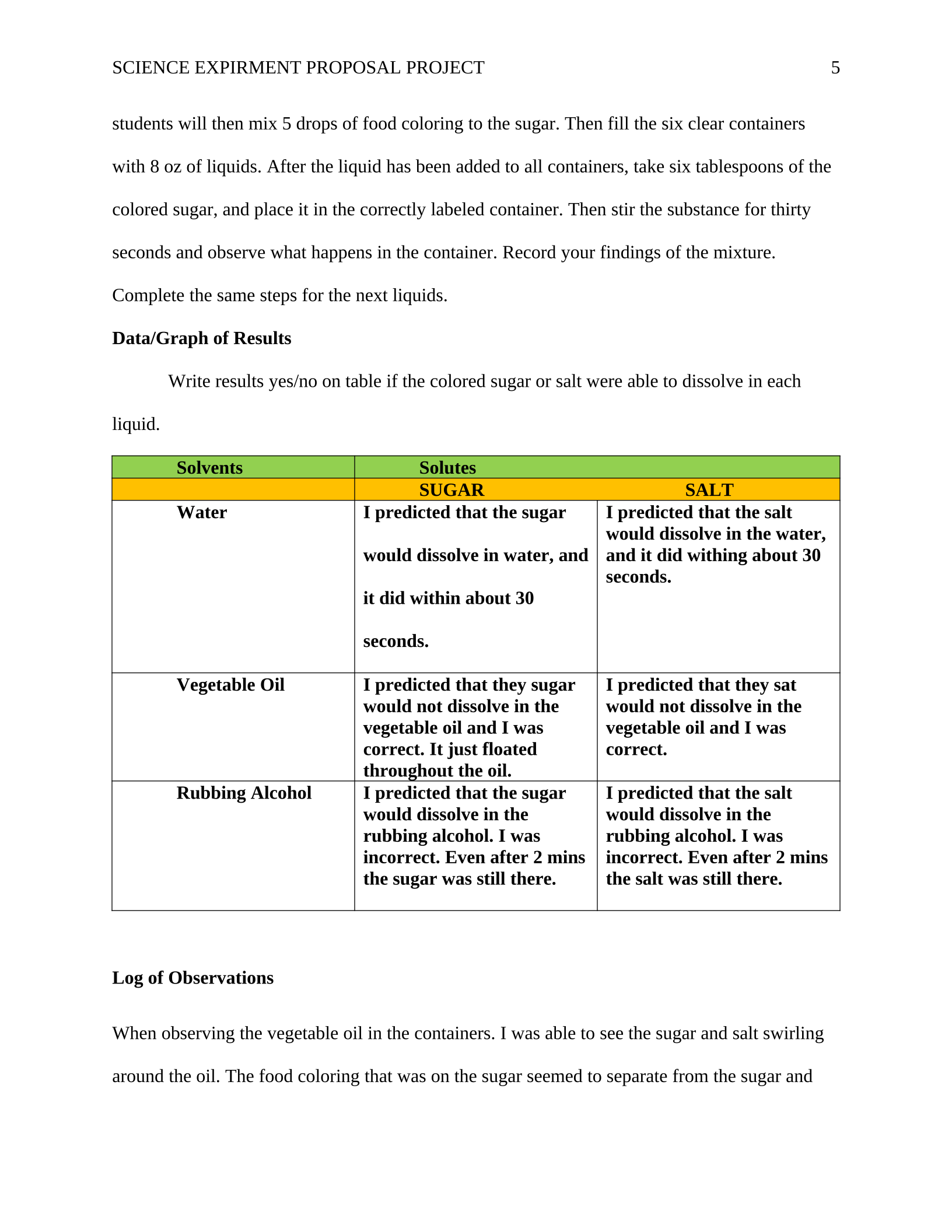
Write results yes/no on table if the colored sugar or salt were able to dissolve in each
liquid.
Solvents Solutes
SUGAR SALT
Water I predicted that the sugar
would dissolve in water, and
it did within about 30
seconds.
I predicted that the salt
would dissolve in the water,
and it did withing about 30
seconds.
Vegetable Oil I predicted that they sugar
would not dissolve in the
vegetable oil and I was
correct. It just floated
throughout the oil.
I predicted that they sat
would not dissolve in the
vegetable oil and I was
correct.
Rubbing Alcohol I predicted that the sugar
would dissolve in the
rubbing alcohol. I was
incorrect. Even after 2 mins
the sugar was still there.
I predicted that the salt
would dissolve in the
rubbing alcohol. I was
incorrect. Even after 2 mins
the salt was still there.
Log of Observations
When observing the vegetable oil in the containers. I was able to see the sugar and salt swirling
around the oil. The food coloring that was on the sugar seemed to separate from the sugar and

SCIENCE EXPIRMENT PROPOSAL PROJECT 6
floated to the bottom of the container. When observing the water with sugar and salt the solids
are mixed into the water. The colored sugar turned the water a light red color. The rubbing
alcohol did not dissolve the sugar or salt. While it did not dissolve the solids the container with
the sugar did change colors because of the food coloring in the sugar.
Conclusion
After completing the experiment students will be able to better understand polar and nonpolar
solvents, ad understand that there are different layers to that. Once conducting the experiment, I
was able to conclude that the hypothesis was partially correct. Both the salt and sugar were able
to dissolve in the water, but they were not able to dissolve in the rubbing alcohol and vegetable
oil. While rubbing alcohol physically looks like water the makeup of it is completely different.
Even after two minutes of stirring the sugar and salt in their own containers with the rubbing
alcohol barley any of solids had dissolved. Due to vegetable oil being nonpolar the solids were
unable to dissolve into the mixtures as they are opposites. The solids were able to dissolve in the
water as they are also polar.
SCIENCE EXPIRMENT PROPOSAL PROJECT 7
References
Aston, T.-A. (2015). The Really Useful Book of Science Experiments: 100 easy ideas for
primary school teachers (1st ed.). Routledge.
https://doi-org.ezproxy.liberty.edu/10.4324/9781315768304
DeRosa, D. A., & Abruscato, J. (2019). Teaching children science: a discovery approach.
Pearson.
Reilly, K. (2014). Explore solids and liquids! Nomad Press.
Powered by TCPDF (www.tcpdf.org)

