


EDUC 554
Lesson Plan Template (edTPA – Student Teaching)
This is the only approved template for EDUC 554, no other template will be accepted. All
sections should be clearly addressed with specific details in the instructional sections. Be clear
and concise with what you are teaching. Maximum page length per lesson plan is 4 pages.
LESSON #
Subject/Topic: Language Arts/Phonics
Grade Level: Kindergarten
Lesson Structure or Grouping:
Whole Class ☒ Small Group ☐ 1:1 ☐
Other (specify): Diversity in this class of 13
includes 5 Caucasian students, 4 African
American students, and 4 Hispanic students.
Needs consist of 2 ELL students, 2 students
with ADHD, 1 student with a hearing disability,
and 1 gifted student.
Learning Segment Theme:
Short vowel sounds: I as in inchworm
Learning letter sounds using multiple
modalities.
Resources and Materials:
•
Access to tablets or computer for online practice games
•
Book: The Little Pink Pig by Liza Charlesworth
•
Iggy the iguana puppet
•
Summative assessment short i worksheet (x13)
•
Six sensory bins with 20 various objects (10 short i, 10 without); Six baking sheets
•
Pencils
•
Pictures: Pig, lips, cat, and fish
•
Letter picture flashcards and large phonics flashcards from Abeka
•
Large, lined writing paper
•
Word circle worksheet (x13)
Standards:
State: K.6 The student will develop an understanding of basic phonetic principles. B) Match
consonant, short vowel, and initial consonant digraph sounds to appropriate letters.
National: CCSS.ELA-Literacy.RF.K.3.B Associate long and short sounds with the common
spellings (graphemes) for the five major vowels.
Objective:
Given 10 pairs of various pictures, the student will be able to identify the pictures that contain
the short vowel sound of I with 9/10 circled correctly.
ACADEMIC LANGUAGE DEMANDS
Language Demands: Oral and written identification of words with the short I sound.
Students must be able to differentiate between words that contain and do not contain the
short I sound. Students must be able to recognize uppercase and lowercase I. Differentiate
between vowels and consonants.
Language Supports: Review/teach pre-requisite knowledge during previous lessons,
assess student’s current understanding of the topic prior to starting the lesson, and provide
pictures/words that contain the short I sound. Review, repetition, and adding more days of
direct instruction if students are struggling with short vowel concept.
Essential Vocabulary: Students must be able to comprehend instructions and lessons that
use words such as vowel, consonant, short vowel sound, circle, find, identify, hear, and
picture.
INSTRUCTION
Direct Instruction/Modeling: Hook: The teacher will call students to the carpet and show
them a picture of a pig and lips. The teacher will ask students to identify each picture. Then
1

EDUC 554
the teacher will slowly say pig and have students repeat. Do the same for lip. Ask students if
they hear a sound that is the same in each word. After calling on a few students to answer the
questions have students return to their desks. Direct Instruction: In a whole group setting,
review letter names by singing the ABCs as a class. Then remind students that all letters
have a name and a sound. Point to a letter on the letter wall that students already know and
ask for its name and sound. Review the concept of vowel and consonant by having students
stand for vowels and sit for consonants. Tell students we are going to learn a new vowel
today and show students the large flashcard for I with the picture of an inchworm on it. Tell
students this is letter i then model the short i sound (I says /i/, /i/, /i/). Model it again and have
students repeat after you. Tell students we are going to learn a sentence to help us remember
the /i/ sound and have them stand up behind their chairs. Teach students the sign language
for letter i and the hand motion for inchworm then model the whole sentence with hand
motions (I says /i/, /i/, /i/, inchworm). Model it again, have students echo (motions and sound),
then have everyone sit down again. Put the pig and lip pictures on the whiteboard. Write the
words under each picture while slowly saying them out loud. Ask students what sound they
hear that is the same. Next put a picture of a cat and fish on the board. Ask students what
they are and slowly say the name of each out loud. Have students echo you. Ask students to
stand for the picture that has the /i/ sound and sit if it does not. Circle the picture that has
the /i/ sound and leave the example on the board for reference during guided practice. If
students are struggling to identify the picture with the /i/ sound, repeat this process with two
more pictures.
Guided Practice: Pair students together of mixed ability based on pre-assessment results.
Give each pair of students a sensory bin filled with 20 different items (10 containing the /i/
sound). Tell students that they will be working together to find items in their sensory bin that
have the /i/ sound and that those items should be placed on the metal tray. Explain to
students that there are 10 items in the bin that have the /i/ sound and that once they have all
ten raises their hands so the teacher can check their work. The teacher will be walking
around the room to answer questions, aid, observe progress, and check each groups work.
After a group has correctly found all 10 items they may play with the sensory bin until all the
groups have finished.
Independent Practice: Once all groups have correctly completed the guided practice
activity, clean up the sensory bins and have students return to their assigned desks. Show the
class the independent worksheet (Summative Assessment) and explain the directions (circle
the picture in each set that contains the short i sound). After students have completed the
worksheet they may go to the computers to play one of the following phonics games:
https://www.education.com/game/vowel-pair-cat-food-spelling/,
https://www.education.com/game/vowel-pair-cat-food-spelling/, or
https://www.education.com/game/word-families-at/.
Closure: Call students to the carpet and review the I sentence again as a class. Then read
aloud the book “The Little Pink Pig” by Liza Charlesworth and tell students to be listening for
words that have the /i/ sound in it. After reading the book, bring out Iggy the Iguana (puppet).
Tell students that Iggy wants to know what words they heard from the story that had the /i/
sound. Call on each student to give a word and let them pet Iggy as a reinforcer if they give a
correct word. If they give an incorrect word, have Iggy tell the student the I sentence again,
send them back to the carpet, and give them another turn.
DIFFERENTIATION
Supporting Students with Special Needs: To support the two ELL students written
materials will be printed in both English and Spanish, they will be provided read aloud
directions for all activities, as well as extra time on all portions of the lesson. To support the
two ADHA students, the teacher will use limited worksheets, provided fidgets during direct
2
EDUC 554
3
instruction, allow students to use flexible seating options, and provide breaks if necessary. To
support the student with a hearing disability, the teacher will provide priority seating closest to
the teacher, ensure the student has their hearing device, use as many pictures as possible
during the lesson, and minimize background noise as much as possible.
Challenging Above-Average Students: Above-average students and the gifted students in
the class will have a differentiated guided practice assignment. Their sensory bin will contain
10 various one-syllable pictures and a mat with the words listed on it. These words include all
the short vowel sounds (a, e, I, o, and u). The students will find the item/picture from the bin
and match it to the word on the mat. For example, there will be a picture of map in the bin and
the student must place it on the word Map on the mat. These students will also have a
differentiated summative assessment that will include one-syllable word pictures for all five
vowels that they will match up with the vowel sound heard in each picture.
Facilitating a Classroom Environment that Supports Student Learning: The teacher will
design a classroom layout that is organized, spacious, and easily navigated. The teacher will
consider all learners and diversities while choosing seating, classroom decorations, and
activities. Classroom routines and procedures will be taught to all students to ensure an
orderly and smooth flowing classroom. Students will also be given choice in lesson activities,
classroom rules, and rewards when possible. A consistent behavior management plan will be
in place using a token system to reward positive behaviors and encourage kindness to
everyone.
Extension: Picture sorts: Students will have pictures for two sounds (i.e. /i/ and /a/) and
flashcards for the corresponding letters (I and a). The students will cut out the pictures, say
the name of each picture out loud, and sort them by the vowel sound heard. As students learn
more vowels sounds more pictures can be added to the sorting activity.
ASSESSMENT
Diagnostic/Pre-Assessment: The teacher will provide a differentiated pre-assessment
before the lesson that includes questions below, at, and above grade level for the short I
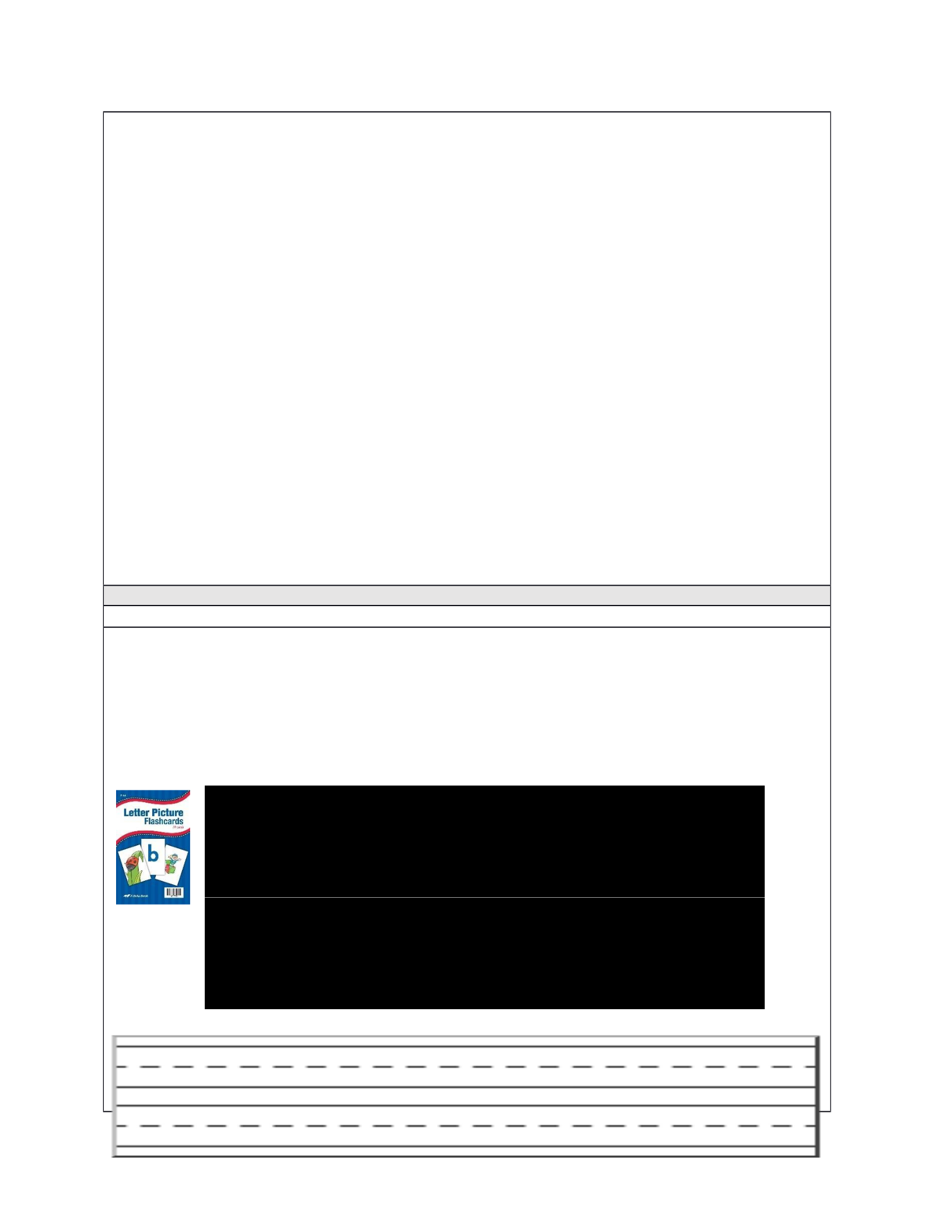
sound. Students will be asked to choose letter picture flashcards that contain the short I
sound from a group of ten flashcards, write the letter I (uppercase and lowercase), and circle
one-syllable words that have the short I sound. This assessment will be completed a day
before the lesson and will be used to guide instruction to review or focus on areas where
students struggled. Flashcards retrieved from:
https://www.abeka.com/abekaonlline/bookdescription.aspx?sbn=167177.
(Flashc
ard picture example)
EDUC 554
Auth
or is
licens
ed
unde
r
by
Unkn
own
Unkno
wn
Unkno
wn
Author
is
license
d
under
4
Word List: 1. Sit 2. Mat 3. Cot 4. Hit 5. Zip 6. Mop 7. Fit 8. Hen 9. Net 10. Big
Formative Assessment: To assess progress during the lesson, the teacher will assign and
observe a guided practice sensory bin activity that will enable students to find objects that
contain the short I sound. The bin will contain 10 items; five that contain the short I sound and
five that do not. Students will be asked to place the objects with the desired sound on a tray
while leaving the other objects in the bin. The teacher will provide an example of the process
before letting students work through the bin on their own. Sensory bin
materials retrieved from: https://www.michaels.com/creativity-for-kids-outer-space-sensory-
bin/10652859.html?r=g&cm_mmc=PLASearch-_-google-_-
MICH_Shopping_US_N_Kids_N_Smart_BOPIS_N-_-&Kenshoo_ida=&kpid=go_cmp-
9638984798_adg-99988418355_ad-425991104288_pla-1354017696659_dev-c_ext-_prd-
10652859&gclid=CjwKCAjwj8eJBhA5EiwAg3z0m5SOS9E5WU7P3zkkSseuohC6oppawdoUd
QpoUVVT-RyyRIJiT_UtIxoCgJoQAvD_BwE
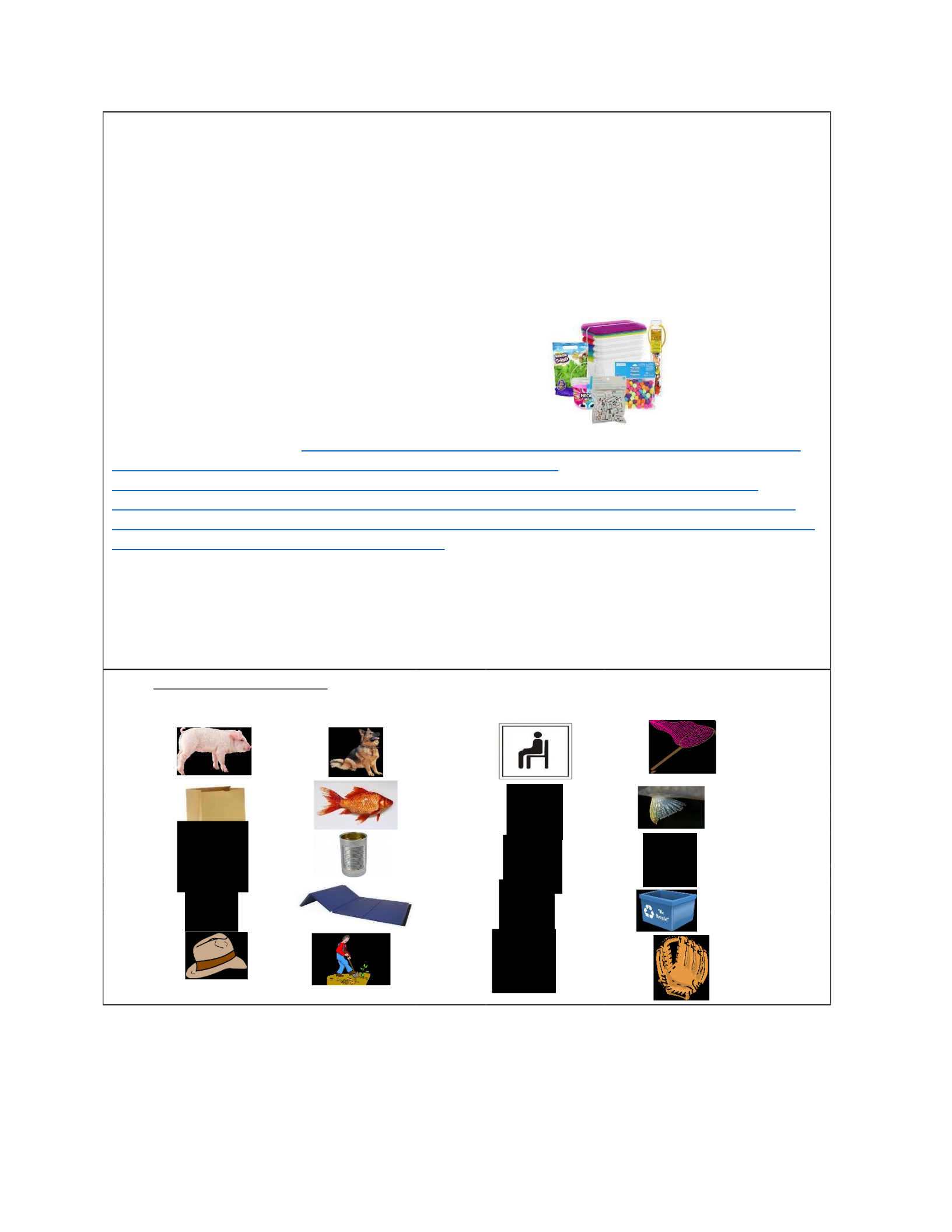
Summative Assessment: During independent practice students will be given a worksheet
that contains ten pairs of pictures. These pictures will all be one-syllable words and pictures
that are easily recognizable by the students (cup, pin, mitt, etc.). Students will be asked to
circle the picture in each pair that contains the short I sound. All pictures on the summative
assessment will be items that were used during the direct instruction and guided practice
portions of the lesson.
Name
Circle the picture that has the/i/ sound.
1.
by
2. Unknow
n Author
is
3. blyicensed
Un
uk
nn
do
ew
r n
4. Author is
licensed
under
5.
by Unknown
Author is
by licensed under
6.
by
by
Author
Uniskno
wn
license
Au
d
th
uo
nr
der
is
license
d
under
by
7.
Unknow
n Author
8.
is
licensed
under
9.
10.

