


Differentiating Literacy Assignment
Gracie Frame
Department of Education, Liberty University
EDUC 319: Teaching Writing and Language Arts to Diverse Learners
Dr. Sasha Crocker
July 31, 2023
1. Comprehension- Ask, Answer, Search, Look.
2nd Grade
Reading Difficulty
Diagnostic/Pre-
assessment(s)
I will conduct a fluency assessment. First, I will select a passage
and have a student read a short section out loud. Then, I will time
the student as they read and record how many words they read
correctly. Additionally, I might have the student re-read the
passage multiple times to see if the fluency improves with
practice.
Formative
Assessments/Feedbac
k to Learners
The teacher will put together a short passage and include a short
slideshow with pictures to go along with it. Before allowing the
students to start the teacher will go over a few essential
vocabulary words. Next, the students will use a tablet and read
the story. Once the students finish, the teacher will have them
come one at a time and she will ask them to summarize what they
read and give a couple of supporting details. Then the teacher will
ask a question relating to the story to get an idea of what the
student is comprehending from their reading.
Summative
Assessment
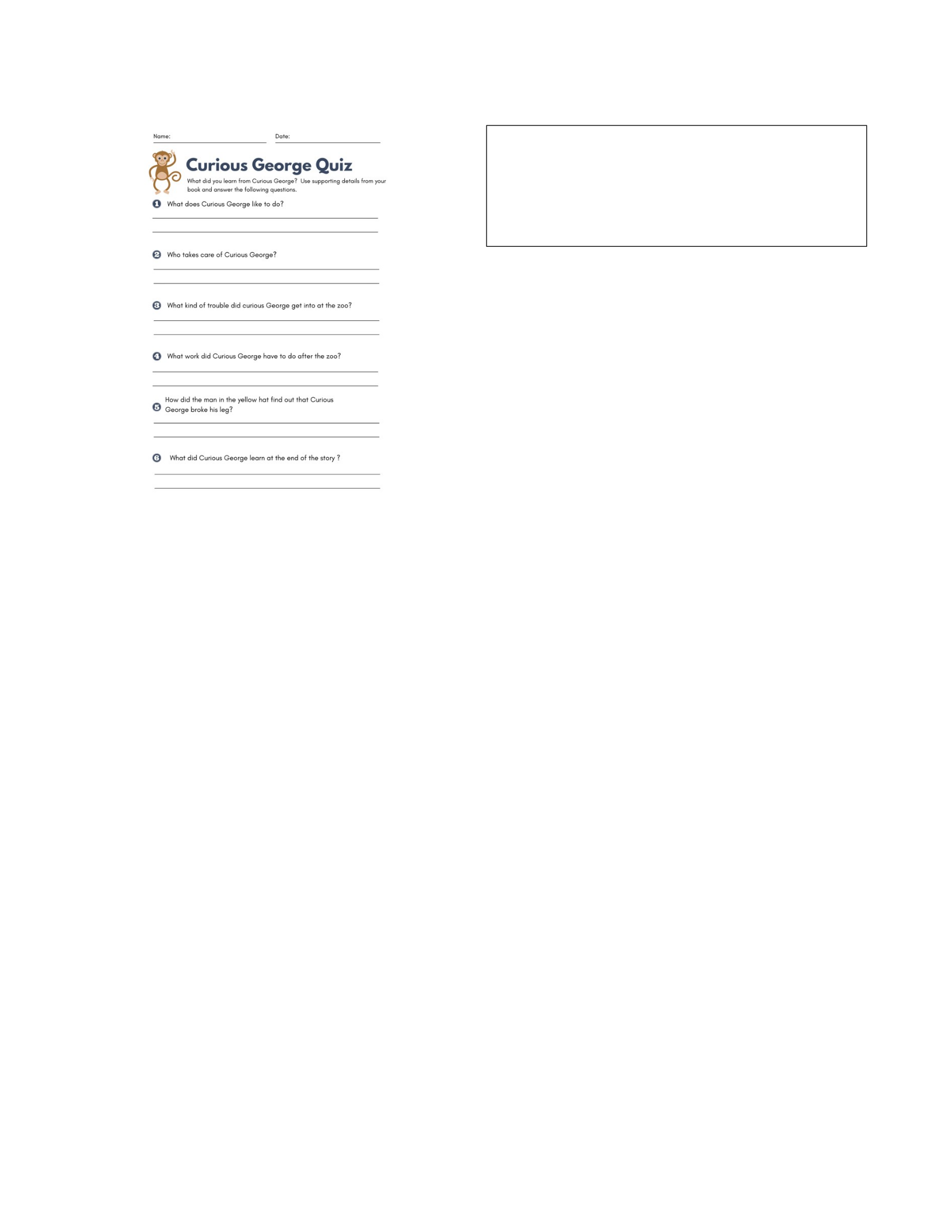
The student will be given the story “Curious George” with 6
questions that relate to the story. The student will be required to
read the story and take a short quiz covering the main ideas of the
text. The student will need to look at the main ideas and provide
the supporting details with 4/6 correct.
Instruction/Modeling 1. I will begin by reading the beginning of the story
“Curious George” aloud to the class, emphasizing the
main idea and key details.
2. Then, I will ask the students to share what they
remember from the beginning of the story and write
their responses on the whiteboard.
3. Next, I will use the responses on the whiteboard to
guide the class in identifying the main idea of the story.
4. Then, we will look at a few questions from the beginning
section of the story and allow time to answer the
questions together. As we look at the questions
together, I will show students where to find the answer
within the story.
5. Lastly, I will ask the students if they have any questions.
If there are any questions or I feel the class needs more
detailed instruction I will go back and make any
clarification as needed.
Guided Practice 1. I will have the students read the next few pages of the
story “Curious George” again silently, highlighting or
underlining key details as they go.
2. After the students have finished reading, I will ask them
to share the details they identified. Write their
responses on the whiteboard.
3. We will use the responses on the whiteboard to guide
the class in identifying the key details of the story.
4. Once the students have finished their responses, I will
read some questions regarding the text and allow the
students to answer them orally. I will walk them through
the questions and make corrections where needed.
5. Showing the students where the answers to the
questions are will allow them to see how we use
information in the text to support our answers.
6. Following this practice, I will ask if there are any
questions, and I will go back and explain where needed.
Independent Practice 1. Before having the students work on the next section, I
will allow them to move around in the class and get their
colored pencils and put them in small groups to draw a
picture or comic strip on the information they have
learned so far.
2. Next, the summative assessment will begin. I will provide
each student with a package containing the last few
pages of “Curious George.”
3. I will explain to the students that they are to read the
pages provided and I will explicitly explain the directions
to them.
4. The students will read the required pages assigned and
then look at the questions on the worksheet. Using the
text, the students will look back and answer the
questions with their supporting details. The student
should achieve 4/6 correctly to show mastery of the skill.
Step 3 – Written report.
The literacy focus for the struggling readers in this lesson is reading comprehension,
explicitly identifying the story's main idea and key details by asking, searching, answering, and
looking. By focusing on these skills, students will be better equipped to understand and
remember what they read, improving their overall reading ability. Differentiation is seen in this
lesson in a few ways. First, I can provide audio recordings of the students who struggle with
reading, allowing them to listen to the story as they read along. Additionally, I can pair
struggling readers with stronger readers to work on this activity together, providing support and
guidance as needed. Finally, the teacher can create a word bank of key vocabulary words from
the story to help students with reading difficulty. By providing multiple ways for students to
engage with the text, I can differentiate instruction and meet the diverse needs of the class
(Learning A-Z, 2022).
There are many ways that I can differentiate and provide support for students with
reading difficulty. First, I can use graphic organizers to help students organize their thoughts and
make connections between ideas. Providing word banks is another strategy I can use to put the
key vocabulary words in to help make the text more understandable. Another strategy would be
using leveled text. Providing leveled text will help me ensure that my students are not
overwhelmed by the text and can focus on comprehension. Another tool would be providing
extra time to ensure my students have the time to read and comprehend the text. Lastly, using
technological tools like text-to-speech software can help students struggling with their writing.
2. Resources: WhiteBoard, Pencils, Paper,
Copies of the last few pages of “Curious
George,” question worksheet.

Reference:
Differentiated instruction and how to implement it: Learning A-Z. (2022, July 27).
https://www.learninga-z.com/site/company/what-we-do/differentiated-instruction

