


Discussion Board #1
EDCO 725:
Using Discussion for Critical Thinking
The most common way to foster active learning is through
discussion (Svinicki & McKeachie, 2014, p.38). Mayer (2008)
defines active learning as “paying attention to relevant
information, organizing it into coherent mental representations,
and integrating representations with other knowledge” (p.17).
Active learning activities help to promote higher order thinking
skills (HOTS) such as application of knowledge, analysis, and
synthesis. Through active learning activities students will learn
how to integrate, apply, and think for themselves (Svinicki &
McKeachie, 2014, p.38). Active learning exercises can last
anywhere from a few minutes to an entire class period, or they
can span numerous class periods.
Active learning activities can be used to:
a. Get students attention and increase motivation
b. Assess students prior to knowledge
c. Assess whether the students understood the assigned
materials
d. Promote problem solving and application separate from the
instructor
Compared to passive methods like lectures, active learning
approaches lay more responsibility on the learner, although in an
active learning setting, instructor direction is still essential. It is
the instructor’s job to help students prepare, maintaining student
participation, facilitating discussion, and listening and supporting
the students and their ideas (Svinicki & McKeachie, 2014, p.39).
Techniques of Discussion
There are multiple teaching strategies that an instructor can use
to promote student engagement and learning. Amongst these
teaching strategies is discussions. Discussions are useful for
engaging students and encouraging them to think more intensely
about a particular issue or concept (Svinicki & McKeachie, 2014).
When preparing for a class discussion an instructor can utilize

several different approaches. These approaches can be used solo
or in collaboration with one another. Svinicki & McKeachie 2014
outlined several types of discussion techniques in chapter 5
including:
A. The use of common experience. According to Svinicki &
McKeachie 2014, one of the best to start a discussion is by
referring to a common experience. This can be done through
film, role play, short skirt, or brief reading (p. 41).
B. Identifying controversy. While this method can stimulate
discussion and student participation, it has its risk including
students losing trust in the instructor (Svinicki & McKeachie,
2014, p.42).
C. Identifying a problem. Discussions can arise from a case or a
hypothetical problem. Regardless of where the problem
originates from, it must be meaningful to the students. This
approach allows the students to come up with their own
solutions rather than depending on the instructor (Svinicki &
McKeachie, 2014, p.44).
D. Asking a question. This is considered to be the most common
discussion opener and depending on the questions asked the
time given to thoroughly process these questions, great
feedback and engagement can be received (Svinicki &
McKeachie, 2014, p.42) (factual, application and
interpretation, connection and casual effective, and
comparative).
Here is a list of critical thinking components that can be utilized in a
good discussion:
a. Discussions are useful for engaging students in the
material and encouraging them to think more deeply
about an issue or concept.
b. Discussions allow the professor/ instructor to assess the
students understanding and performance.
c. Discussions allow students the opportunity to articulate
what they’ve learned during class.
d. Discussions give students the opportunity to
collaborate with one another, providing one another
with insightful commentary and feedback (Discussion
boards).
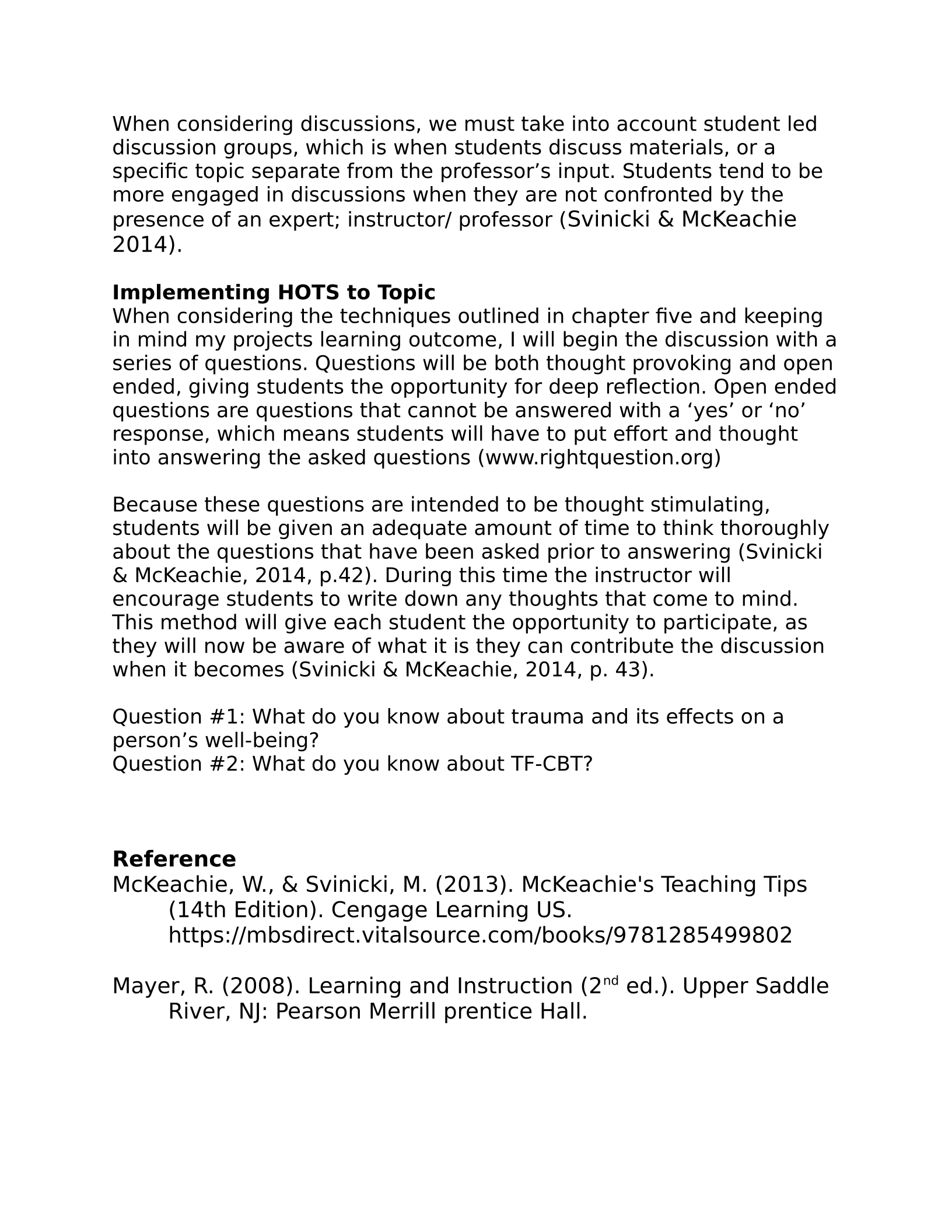
When considering discussions, we must take into account student led
discussion groups, which is when students discuss materials, or a
specific topic separate from the professor’s input. Students tend to be
more engaged in discussions when they are not confronted by the
presence of an expert; instructor/ professor (Svinicki & McKeachie
2014).
Implementing HOTS to Topic
When considering the techniques outlined in chapter five and keeping
in mind my projects learning outcome, I will begin the discussion with a
series of questions. Questions will be both thought provoking and open
ended, giving students the opportunity for deep reflection. Open ended
questions are questions that cannot be answered with a ‘yes’ or ‘no’
response, which means students will have to put effort and thought
into answering the asked questions (www.rightquestion.org)
Because these questions are intended to be thought stimulating,
students will be given an adequate amount of time to think thoroughly
about the questions that have been asked prior to answering (Svinicki
& McKeachie, 2014, p.42). During this time the instructor will
encourage students to write down any thoughts that come to mind.
This method will give each student the opportunity to participate, as
they will now be aware of what it is they can contribute the discussion
when it becomes (Svinicki & McKeachie, 2014, p. 43).
Question #1: What do you know about trauma and its effects on a
person’s well-being?
Question #2: What do you know about TF-CBT?
Reference
McKeachie, W., & Svinicki, M. (2013). McKeachie's Teaching Tips
(14th Edition). Cengage Learning US.
https://mbsdirect.vitalsource.com/books/9781285499802
Mayer, R. (2008). Learning and Instruction (2nd ed.). Upper Saddle
River, NJ: Pearson Merrill prentice Hall.
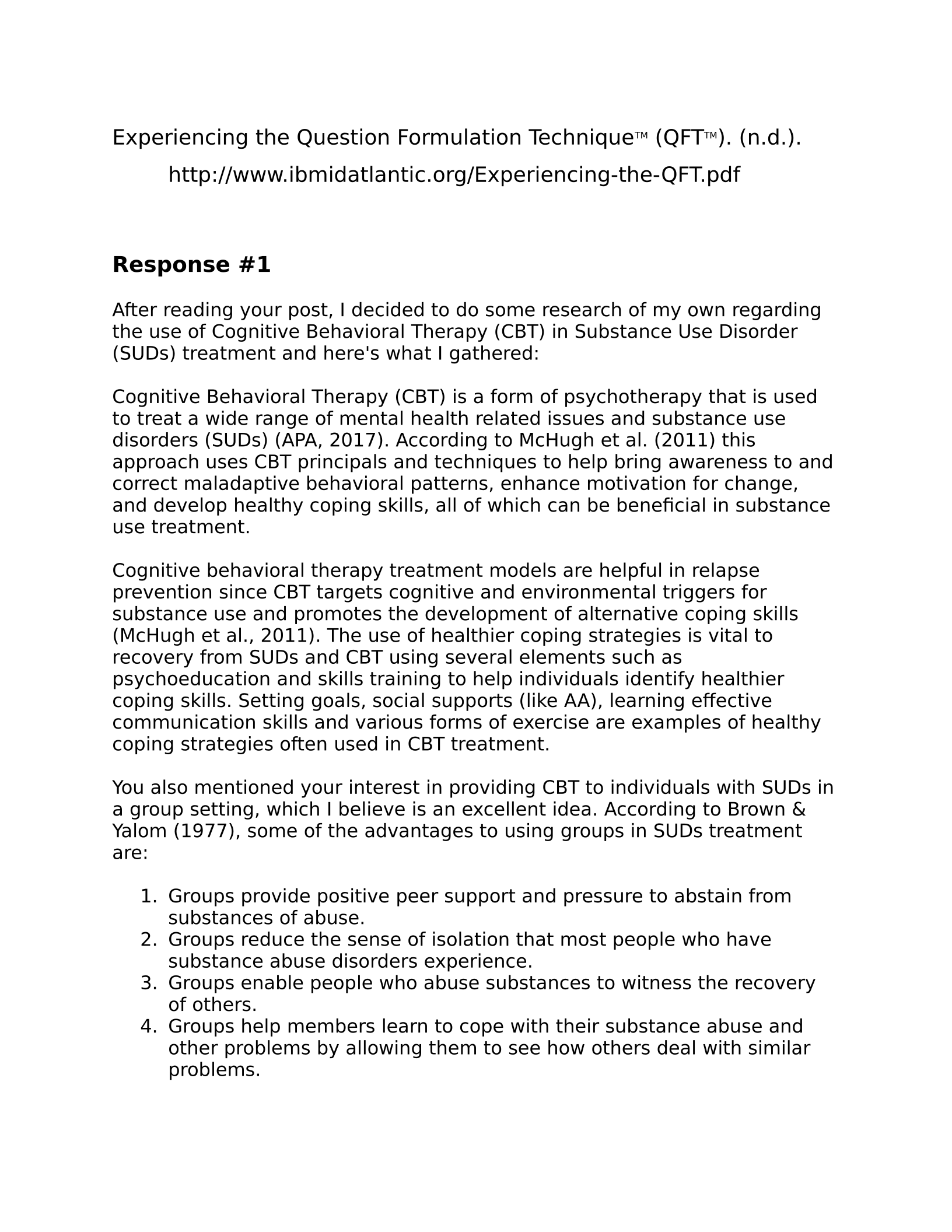
Experiencing the Question Formulation TechniqueTM (QFTTM). (n.d.).
http://www.ibmidatlantic.org/Experiencing-the-QFT.pdf
Response #1
After reading your post, I decided to do some research of my own regarding
the use of Cognitive Behavioral Therapy (CBT) in Substance Use Disorder
(SUDs) treatment and here's what I gathered:
Cognitive Behavioral Therapy (CBT) is a form of psychotherapy that is used
to treat a wide range of mental health related issues and substance use
disorders (SUDs) (APA, 2017). According to McHugh et al. (2011) this
approach uses CBT principals and techniques to help bring awareness to and
correct maladaptive behavioral patterns, enhance motivation for change,
and develop healthy coping skills, all of which can be beneficial in substance
use treatment.
Cognitive behavioral therapy treatment models are helpful in relapse
prevention since CBT targets cognitive and environmental triggers for
substance use and promotes the development of alternative coping skills
(McHugh et al., 2011). The use of healthier coping strategies is vital to
recovery from SUDs and CBT using several elements such as
psychoeducation and skills training to help individuals identify healthier
coping skills. Setting goals, social supports (like AA), learning effective
communication skills and various forms of exercise are examples of healthy
coping strategies often used in CBT treatment.
You also mentioned your interest in providing CBT to individuals with SUDs in
a group setting, which I believe is an excellent idea. According to Brown &
Yalom (1977), some of the advantages to using groups in SUDs treatment
are:
1. Groups provide positive peer support and pressure to abstain from
substances of abuse.
2. Groups reduce the sense of isolation that most people who have
substance abuse disorders experience.
3. Groups enable people who abuse substances to witness the recovery
of others.
4. Groups help members learn to cope with their substance abuse and
other problems by allowing them to see how others deal with similar
problems.
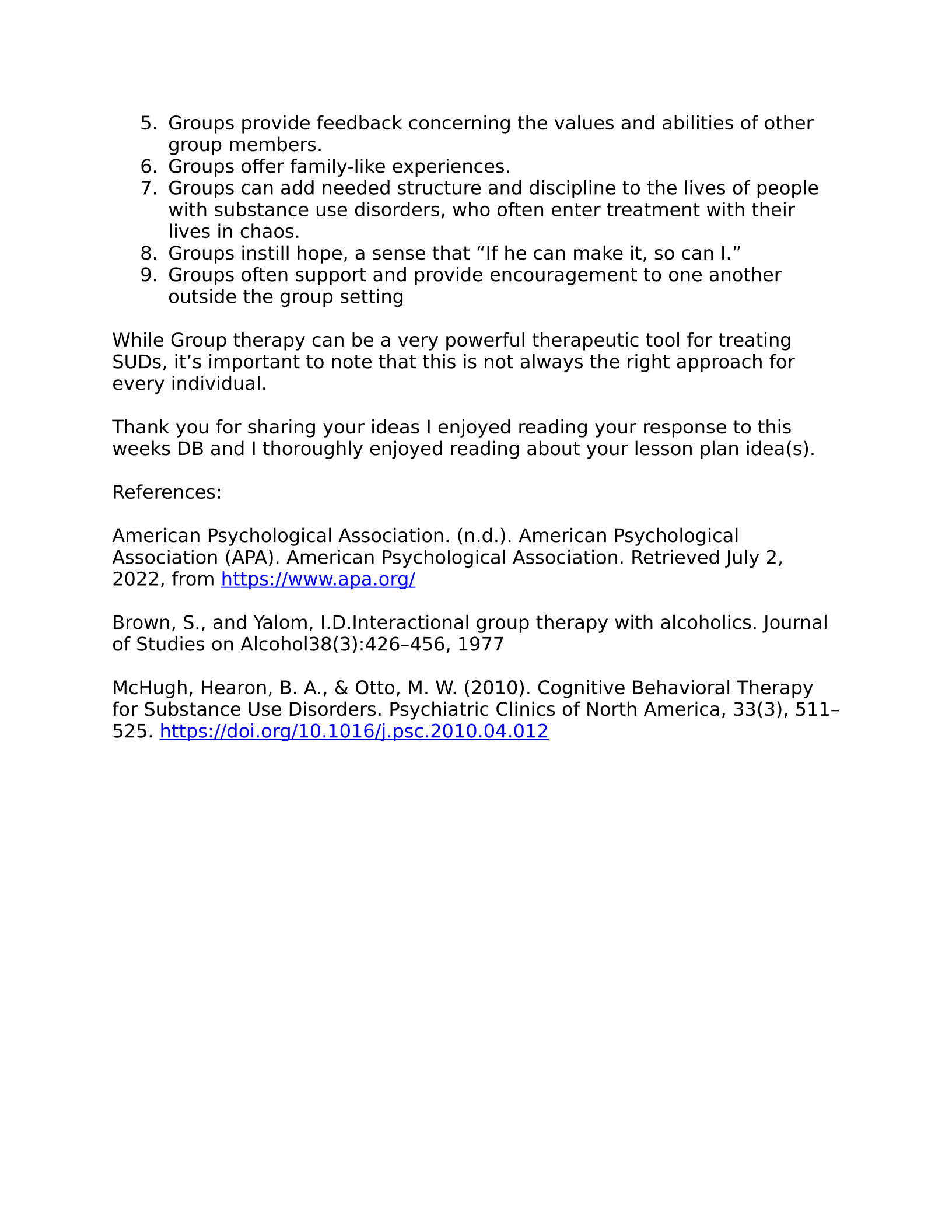
5. Groups provide feedback concerning the values and abilities of other
group members.
6. Groups offer family-like experiences.
7. Groups can add needed structure and discipline to the lives of people
with substance use disorders, who often enter treatment with their
lives in chaos.
8. Groups instill hope, a sense that “If he can make it, so can I.”
9. Groups often support and provide encouragement to one another
outside the group setting
While Group therapy can be a very powerful therapeutic tool for treating
SUDs, it’s important to note that this is not always the right approach for
every individual.
Thank you for sharing your ideas I enjoyed reading your response to this
weeks DB and I thoroughly enjoyed reading about your lesson plan idea(s).
References:
American Psychological Association. (n.d.). American Psychological
Association (APA). American Psychological Association. Retrieved July 2,
2022, from https://www.apa.org/
Brown, S., and Yalom, I.D.Interactional group therapy with alcoholics. Journal
of Studies on Alcohol38(3):426–456, 1977
McHugh, Hearon, B. A., & Otto, M. W. (2010). Cognitive Behavioral Therapy
for Substance Use Disorders. Psychiatric Clinics of North America, 33(3), 511–
525. https://doi.org/10.1016/j.psc.2010.04.012
Powered by TCPDF (www.tcpdf.org)

