


Data Application Assignment
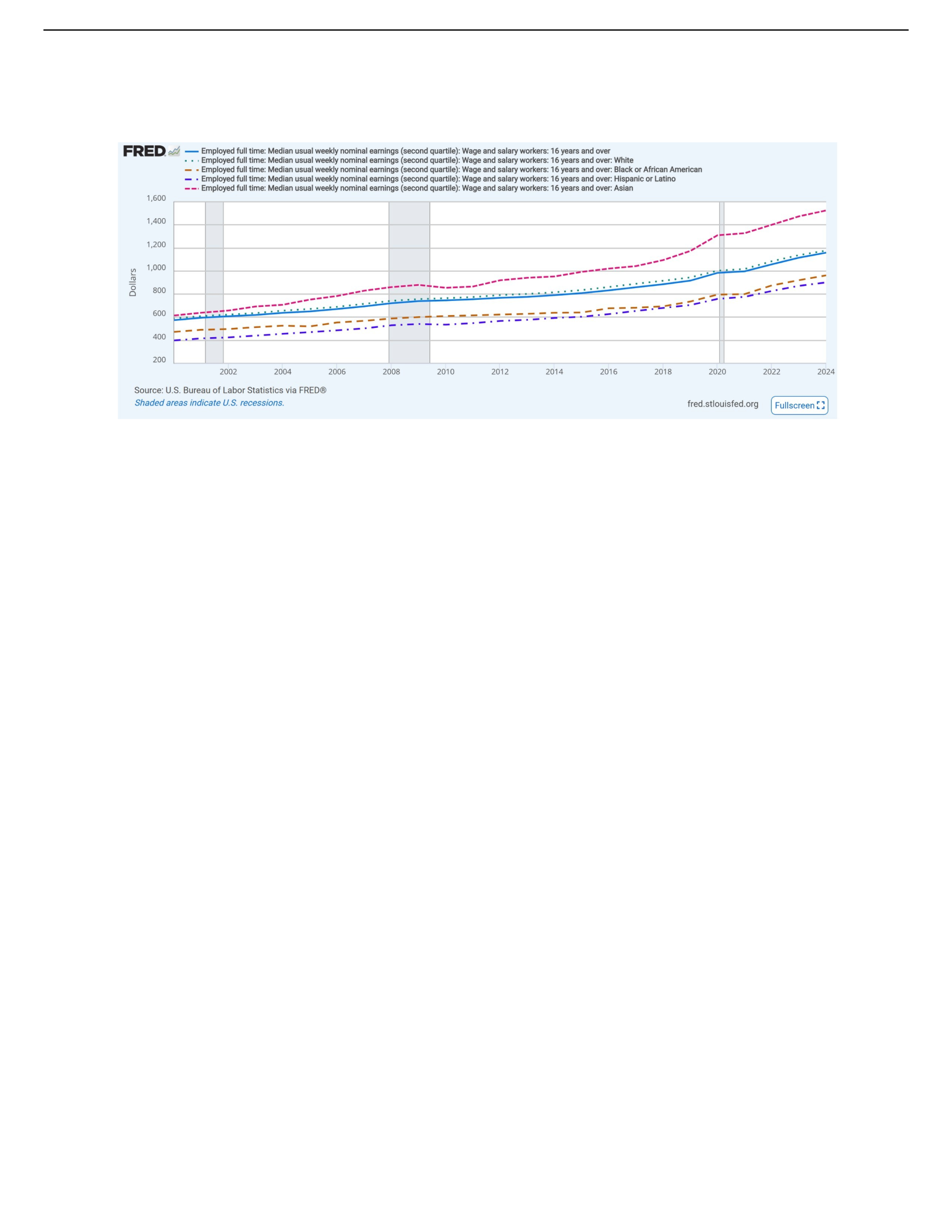
To gather the necessary data required for this assignment the graph depicted above was
created which examines the wages earned across four different ethnic groups in comparison to
the median wage. The graph constructed ranges across twenty-four years gathering beginning
data in 2000 and providing the most recent data in 2024. All points of analysis for this
assignment will utilize data from the most recent findings. The first point of analysis with the
presented data will be to explore the wage difference between white and black workers. White
workers earned a wage of $1,177 while black workers earned a wage of $963 which is a
differential of $214. Second, the difference in wages between whites and hispanics is $275 as
hispanics wages were $902. Finally, white workers earned $348 less than Asian workers who
earned $1,525. These three points of analysis show us that on average black and hispanic
workers earn less than white workers while asian workers are the highest earning ethnic group
above all other three groups including white workers. When comparing the individual results of
each ethnic group to the overall median which sits at a wage of $1,159 only white and asian
workers are above the median while black and hispanic workers fall below.
To continue this dive into the existing wage gap it is crucial that a potential cause of
these differentials be examined. One possible explanation is found in the concept of human
capital.

Human capital is the accumulation of investments in people the greatest of which is education
(Mankiw, 2018). College educated individuals earn almost twice as much as individuals who
only completed high school showing that the more human capital someone possesses the more
wages they earn on average. Furthermore, higher education can signal to employers that an
individual may be more productive and higher-skilled than an individual who did not obtain
higher education. This can be connected to the information recorded in the previous paragraph
as research supports the fact that individuals of color are less likely to obtain higher education.
For example, 2019 data shows that 36% of white men had obtained bachelor's degrees while
only 26% of black men held that same level of education (Mankiw, 2018). Considering that
higher levels of human capital results in higher wages this theory would support the lower
wages for black individuals as they have lower levels of human capital. Continuously, higher
education is often necessary to go into higher paying fields such as medicine, technology, or law.
These facts relating to human capital and the wage differentials would lead to the conclusions
that whites and asians are more likely to obtain higher education as they both earn above
average wages than blacks and hispanics who do not obtain higher education at the same rate
and are earning below average wages.
Having established a possible explanation to the wage differential, how could such a gap
be addressed? Understanding the context of the schooling systems is required for further
analysis. Historically, the public schools located in black areas are lower quality than those
located in white areas (Mankiw, 2018). This disadvantages people of color who do not grow up
with a solid foundation that can adequately prepare them for higher education. Certainly, each
individual must take charge of their own education and their own life decisions. However, each
person should be provided with the same opportunities. A possible solution to bridging this
wage gap would be to ensure that each individual regardless of ethnicity is provided with the
opportunity to receive a high quality education growing up. Although some individuals may not
take proper advantage of this opportunity or use it to pursue higher education, it is wrong to
disadvantage one ethnic group. Each individual ought to work personally to develop a strong

work ethic and continue learning and sharpening whatever skills they already possess. However,
being provided with the same quality of education especially through public school systems
should be the pursuit of policymakers. Education is what you make of it but all people should be
given the chance to make the most of it.

References
Mankiw, Gregory. (2018). Principles of microeconomics (8th ed.). Cengage Learning.
Powered by TCPDF (www.tcpdf.org)

