


Wells 1
Liberty Theological Seminary
Spheres and Stages of Discipleship Assignment
A Written Assignment
Submitted to Dr. Jay Sulfridge
In Partial Fulfillment
Of the Requirements for the Course
Discipleship Ministries
DSMN-500-B06-LUO
By:
Phil Wells
February 7, 2021
Wells 2
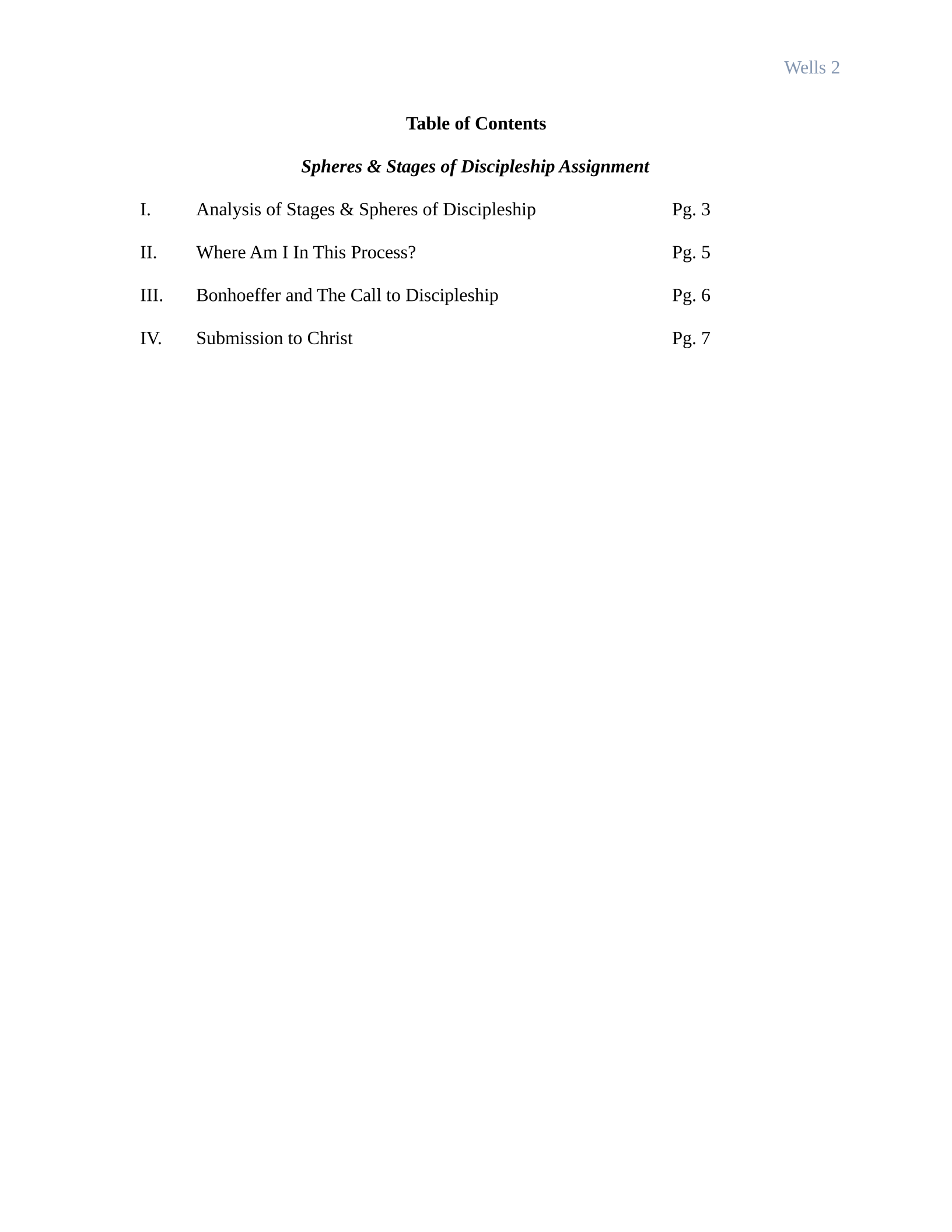
Table of Contents
Spheres & Stages of Discipleship Assignment
I. Analysis of Stages & Spheres of Discipleship Pg. 3
II. Where Am I In This Process? Pg. 5
III. Bonhoeffer and The Call to Discipleship Pg. 6
IV. Submission to Christ Pg. 7
Wells 3
Analysis of Stages & Spheres of Discipleship
This weekend, I was privileged to facilitate the logistics behind the baptisms of eight
individuals at my local campus! What’s exciting is many things within this process, but one of
the most thought-provoking questions when one is prepared to take this next step, is where I ask
the question, “When did Jesus become more than just a name to you?” I mean, really when did
Jesus become more than just a religious figure, a character found within some incredible stories
you’ve maybe heard about from somewhere or more than just the ‘big man upstairs’ or a ‘higher
power’?
Dempsey & Earley help us pave the way towards a process to help guide us on what the
author of this assignment aims to accomplish which is thoughtfully analyze how one moves from
Believer, to Disciple and ultimately onto a Disciple Maker. Stage One is where we begin which
is all about Jesus. The first stage of discipleship is a call to investigate the person and work of
Jesus. Questions typically asked in this stage whether introspectively or else, are: (1) Is Jesus the
Messiah (2) Can He be trusted? (3) Does He merit an intense investigation and sincere pursuit?
And (4) Is He someone worth giving everything up for? 1“The time promised by God has come
at last! he announced. The Kingdom of God is near! Repent of your sins and believe the Good
News.” 2
The summation of this first step truly results in this alliteration of 4 key words, (1)
Curious (curious about who Jesus is and what He can do for you) (2) Convicted (Convicted by
1 Earley, Dave, and Rod Dempsey. 2013. “Understanding The First Step of Obedience.”
In Disciple Making Is: How To Live The Great Commission With Passion And
Confidence, 63. Nashville, TN: Broadman & Holman.
2 Unless otherwise noted, all biblical passages referenced employ the New Living
Translation by Tyndale House Publishers.
Wells 4
the Holy Spirit of your sin and the resulting judgment) (3) Convinced that Jesus is the sinless So
of God and that salvation only comes through Him) (4) Converted (through active faith that leads
you to turn from sin and turn to God for salvation). 3 Stage two takes us towards one of the most
important formative components which is the immersion into Christian community or
Development. This stage once again aims to prove the point that we were not made to do life
alone, life is truly better together. Life is not meant to be lived as only “Jesus and me.” It is
meant to be lived as “Jesus and we.” No human can be complete without healthy relationships
with other humans. Community is what you and I were created for. 4
The third and final stage seeks to answer the question of the disciple, “are you a
multiplying leader?” In other words, are you seeking to make a difference with the purpose and
skillset God has uniquely equipped us with? Likening it to one of my most memorable stops in
ministry, this stage according to the author of this examination would say, Discover, Develop &
Deploy.
Putman & Harrington help us see how synonymous the Four Spheres of Discipleship are
with the Stages of Discipleship. The four spheres range from Relationships to the four key areas:
(1) Relationship with God (2) Relationship with the World (3) Relationship in the Home (4)
Relationships with Gods Family/Church). The core that obviously unites all of the spheres
together is our relationship with God. John 15 indicates that our most important sphere is that of
life in Christ.
The benefit of using the four spheres means that all of these can if done correctly
positively affect and change the believer under Christ’s control. Even as I speak of baptizing
eight individuals this weekend, I’m acutely aware as Putman & Harrington indicate of churches
3 Ibid., 66.
4 Ibid., 71.
Wells 5
making the dangerous conclusion of baptizing someone, handing them a bible and invite them to
come back next week. It’s empty, dangerous and typically that person never ends up following
through on that commitment having encountered a different world from off of their spiritual
pedestal. New believers need a pathway to follow and a model to indicate growth and define
purpose. If churches miss this, we as pastors will continue to see more spiritual consumers rather
than what we all seek which is spiritual contributors.
Where Am I In This Process?
This examination of the spheres and stages of discipleship has forced me to identify some
difficult but helpful conclusions about my life. I consider myself a good leader in my career, but
I’m constantly asking myself and my wife, “How am I doing at leading my family?” Recently, as
I lead a group of men through an online life Group, we’re working through a study by John
Eldredge titled, “Wild Life.” In the first couple days of the study, John asks us to identify our one
question about ourselves that we all as men have. Mine comes back to my family in brief
summary as, “Am I leading my family well” or, “Am I doing this right?”
The sphere of Relationships at Home is most identifiable to me at this time in my life
because of my love and affection for my wife of nearly twelve years and my two boys (ages 7
and 4). It is possible, writes Putman and Harrington to grasp the concepts of the gospel but fail to
apply them in the home. 5
In many ways, I get concerned about how I allow my emotions and desires to come into
abrupt conflict with me and my boys when situations get excessively difficult. Paul writes in
Ephesians 6:4, “Fathers, do not provoke your children to anger by the way you treat them.
5 Putman, Jim And Bobby Harrington. 2013. “The Four Spheres.” In DiscipleShift: Five
Steps That Help Your Church To Make Disciples Who Make Disciples, 87. Grand Rapids,
MI: Zondervan.
Wells 6
Rather, bring them up with the discipline and instruction that comes from the Lord.” It’s possible
to grasp the concepts of the gospel but fail to apply them in the home. As a pastor, I’m
continuously reminded of a statement that rings true with me by a former pastor I worked
alongside in Craig Groeschel, “doing the work of God, destroyed the work of God in me.”
Bonhoeffer and The Call to Discipleship
Dietrich Bonhoeffer in his work, “Chapter Two: The Call to Discipleship” walks us
through variety of calls in which again, have unifying overtones of the spheres and stages of
discipleship. I find myself in need of further assistance, growth and submission in the Sphere of
Relationship to God. As Bonhoeffer states, “he wants to follow” referring to the third one called
by Jesus, but he wants to set his own conditions for following. Discipleship is a possibility for
him, whose implementation requires fulfilling conditions and prerequisites. 6 Following Christ
means taking certain steps. The first step, which responds to the call, separates followers from
their previous existence. 7
I’ve found myself at multiple stopping points in my personal journey with Jesus simply
over double standards or contradictions in my leadership and correlating to my personal
discipline/devotion to Jesus. This could be tithing, consistent quiet time, etc. I set my own terms
but lead others a whole different path. This doesn’t work, it will never work and is in direct
violation with my ability to be formidable in the hands of God. “Those called, as Bonhoeffer
reads, must get out of their situations, in which they cannot believe, into a situation where faith
can begin.” 8
6 Bonhoeffer, Dietrich. 2003. “The Call To Discipleship.” In Discipleship, edited by John
D. Godsey and Geoffrey B. Kelly, 61. Minneapolis, MN: Augsburg Fortress. https://tcr1-
alexanderstreet-com.ezproxy.liberty.edu/philologic/TCRT/navigate/72/1/3/.
7 Ibid., 61.
8 Ibid., 62.
Wells 7
Submission to Christ
In submission to Christ, it is not a binding or a lesser distinction of freedom rather, it is
the opposite. It is in Jesus that we find our freedom as we engage with the four spheres and
stages of discipleship. Philippians 2:12-13 reads, “Work hard to show the results of your
salvation, obeying God with deep reverence and fear. For God is working in you, giving you the
desire and the power to do what pleases him.” Deep reverence and fear, when is the last time you
or I experienced fear and conviction brought by the Holy Spirit? Submission is indicative of fear,
in obedience it does, however, bring an aroma of freedom based on our actions of repentance to
Jesus.
As our character is formed, we relinquish all control and allow freedom to begin. Steven
Porter writes in his work, Discipleship That Forms Christian Character,
“In order for us to remain with the one who remains with us, we must listen to his
commands, his words, his instructions on how to live life with him by his Spirit in his
Father’s kingdom. To study and listen to his word is itself a practice or discipline, and it
is an essential part of an overall way of life with Jesus. Indeed, as we practice that
discipline of study and meditation, we learn from him that there are other embodied
practices that bring our wills into alignment with his will.” 9
9 Porter, Steven L. "Will/Heart/Spirit: Discipleship that Forms the Christian
Character." Christian Education Journal 16, no. 1 (04, 2019): 79-94,
http://ezproxy.liberty.edu/login?qurl=https%3A%2F%2Fwww.proquest.com
%2Fscholarly-journals%2Fwill-heart-spirit-discipleship-that-forms%2Fdocview
%2F2184328075%2Fse-2%3Faccountid%3D12085.

Wells 8
I’m learning that immersing myself in these instructions and practices are what will truly
align me back on the path of growth in which I belong. I’m not called to stay where I am, or my
leadership and influence will stall out long before I recognize it.
Bibliography
Earley, Dave, and Rod Dempsey. 2013. “Understanding The First Step of Obedience.”
In Disciple Making Is: How To Live The Great Commission With Passion And
Confidence. Nashville, TN: Broadman & Holman.
Wells 9
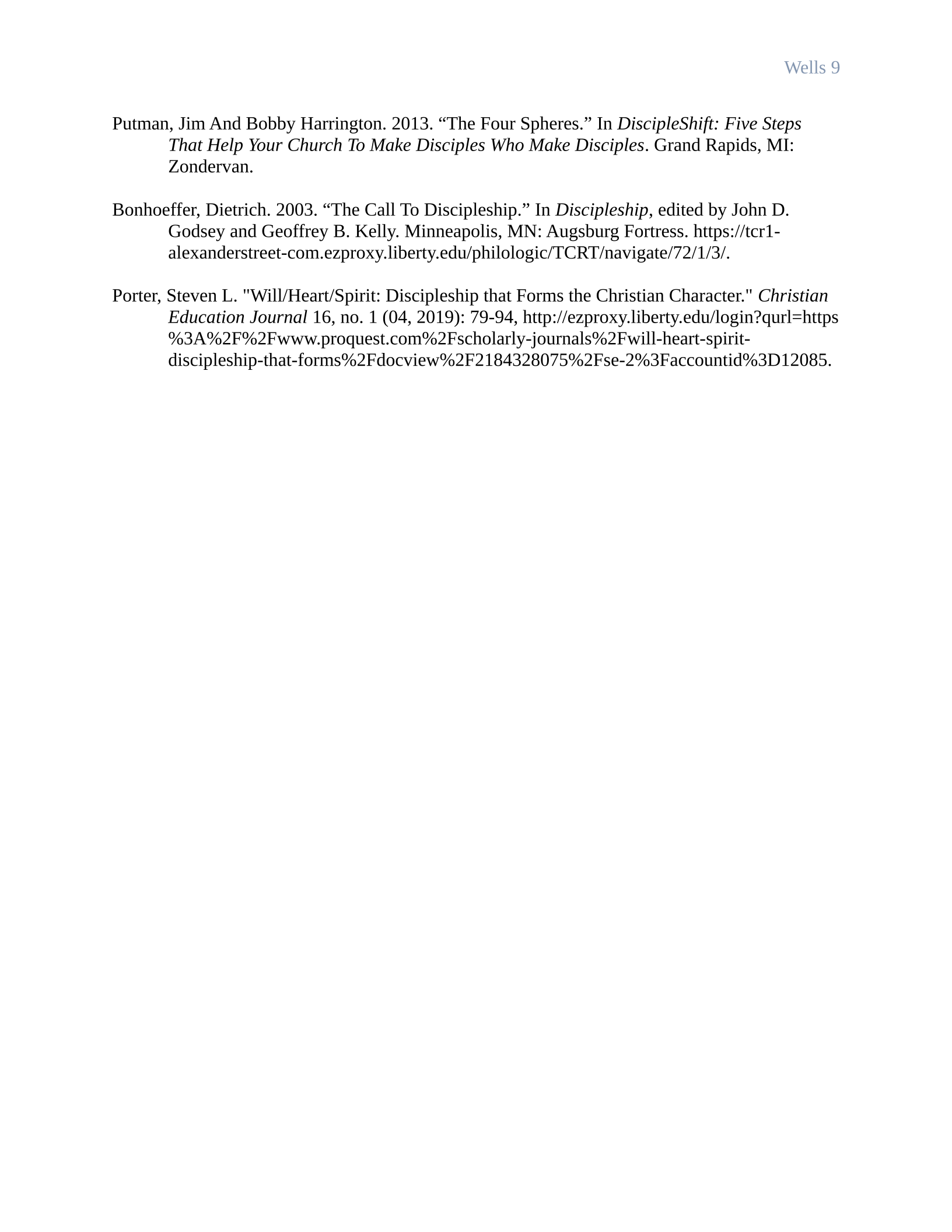
Putman, Jim And Bobby Harrington. 2013. “The Four Spheres.” In DiscipleShift: Five Steps
That Help Your Church To Make Disciples Who Make Disciples. Grand Rapids, MI:
Zondervan.
Bonhoeffer, Dietrich. 2003. “The Call To Discipleship.” In Discipleship, edited by John D.
Godsey and Geoffrey B. Kelly. Minneapolis, MN: Augsburg Fortress. https://tcr1-
alexanderstreet-com.ezproxy.liberty.edu/philologic/TCRT/navigate/72/1/3/.
Porter, Steven L. "Will/Heart/Spirit: Discipleship that Forms the Christian Character." Christian
Education Journal 16, no. 1 (04, 2019): 79-94, http://ezproxy.liberty.edu/login?qurl=https
%3A%2F%2Fwww.proquest.com%2Fscholarly-journals%2Fwill-heart-spirit-
discipleship-that-forms%2Fdocview%2F2184328075%2Fse-2%3Faccountid%3D12085.
Powered by TCPDF (www.tcpdf.org)

