


Running head: AMD VS. INTEL PROCESSORS 1
AMD vs. Intel Processors
Name
Institution

AMD VS. INTEL PROCESSORS 2
Abstract
The central processor of the PC is perhaps the main part of a PC. It's the PC's brain, and
without it, every piece of the PC is a hunk of metal and plastic that lacks usage. Therefore,
settling on the best computer chip for your business is vital (Clemons, 2020). The two significant
makers of central processors are AMD and Intel. The computer chips delivered by every
producer possess their one-of-a-kind intensities, shortcomings, and features that should be well-
thought-out before selecting the correct processor for your business (Kumar, 2019). In this paper,
I will give a concise outline of each manufacturer and thoroughly contrast their processors
dependent on performance, cost, and use by key organizations. As a summary, I will clarify
which brand is ideal and why.

AMD VS. INTEL PROCESSORS 3
AMD vs. Intel Processors
Introduction
In the age where technology is continually developing and the need for performance is
escalating, the central processing unit (CPU), similarly called processor, is a primary concern for
business PC purchasers. Numerous considerations occur while choosing a processor. For
example, whether the PC will be utilized for computing or storage, will the corporate be
searching for performance in speed or graphics and the corporate budget (Kumar, 2019). Among
every one of the various brands, the two major corporations considered rivals are AMD and
Intel. Even though each corporation might have an edge in specific areas, the two corporations
proceed to continually make changes and upgrades to their products in an attempt to stay
cutthroat (Clemons, 2020). The reason for this paper is to take a gander at the two organizations
to ascertain whether one organization's processor is better compared to the other for corporate
computing reasons.
Intel and AMD Backgrounds
Intel company is an American multinational and innovation corporation headquartered in
Santa Clara, California. The Intel Corporation was established in 1968 by American engineers
Gordon Moore and Robert Noyce, which was originally a producer of memory chips
(Abdullayevich, 2020). In 1971, Intel made its first microchip, the 4004 microcomputers; the
4004 was then launched and was equipped for performing twice as numerous tasks each second
as the earlier chip. In 1979, Intel presented the 8008 and was selected by IBM to be the processor
utilized in the first mass-created personal computer, attaining Intel a viable and brilliant future
before them. Intel is continually improving processor speed to captivate clients to update their
computers (Abdullayevich, 2020). In 1991, Intel became a phenomenon in homes when they

AMD VS. INTEL PROCESSORS 4
manufactured their "Intel inside" advertisement, which recorded what PCs had Intel processors.
They additionally started a collaboration that is as yet going on today with Apple. In 2005, when
Apple reported, they would be evolving to the Intel x86 design (Abdullayevich, 2020). Intel is
among the world's largest semiconductors based on revenue; its performance is what helps
render the difference in choosing the correct semiconductor for the corporate
AMD (Advanced micro devices) is a multinational semiconductor corporation situated in
California, Santa Clause Clara province, creating PC processors and associated innovations for
corporate and customer marketplaces. The organization was established in 1968 by Walter
Sanders Jeremiah, an ex-director at Fairchild Semiconductor Enterprise, and seven others (AMD,
n.d.). In 1970, the organization delivered its first product, and after two years opened up to the
world where the organization started creating central processors (Butler, 2020). AMD released
the Am386 microprocessor family in 1991, a reverse-engineered chip comparable with Intel's
next-generation 32-bit microprocessor. AMD acquired a microprocessor company known as
NexGen in 1996 and begun branching out from the Intel comparable chip market. In 2000 AMD
introduced the Athlon processor, which was designed to run the Microsoft Corporation Windows
system (Butler, 2020). With the Athlon processor release, AMD became the first company to
produce a gigahertz microprocessor, which marked AMD as a serious competitor in the chip
market
Contrast and Comparison
Speed
Speed is a major concern, which it is to numerous computing organizations. Intel has
demonstrated to be a better product. As indicated by Venkataraman & Dew, an Intel processor
provides an organization a higher clocking speed, which implies they have a higher recurrence of

AMD VS. INTEL PROCESSORS 5
work performed each second (Venkataraman & Dew, 2017). Intel is devised unique compared to
AMD since it separates the absolute work into the littlest conceivable division and afterward
goes through it in a high recurrence; AMD goes through its process slower yet processes more
information each cycle. Consequently, one can't make a supposition that Intel is superior because
it is quicker (Clemons, 2020). Moreover, AMD made assertions that their novel Piledriver
processor will introduce solid rivalry for Intel's Ivy Bridge processor.
Overclocking vs. Hyperthreading
Perhaps the biggest distinction between the two microchips is Intel's add-on of
hyperthreading to their microprocessors and AMD's scarcity in that department. Hyperthreading
is an exclusive framework presented by Intel on a strain of Xeon processors. The execution of
hyperthreading implied that two threads could be operated on each core of the computer
processor, in turn, successfully multiplying the conceivable number of threads that could be
operated concurrently (Jindal & Gupta, 2013). Even though AMD has used a form of
synchronous multithreading called Cluster-based Multithreading (CTM), it has proven to be
substantially less proficient than Intel hyperthreading (Kumar, 2019). Over the years, AMD has
sought to expand the absolute number of cores rather than the thread limit of each, a path that has
led to the higher average core to count on AMD processors. But are less effective; nevertheless,
they have historically manufactured significantly more strong processors and have provided a lot
simpler methods for overclocking their chips. This implies that much ground can be rendered up
amid the processor after the retail location by the client (Alcon, 2021). However, even though the
processing aptitudes of the two chips are amazing, there are very characterizing qualities that
characterize the normal use-case situations that each chip is by and large utilized for.

AMD VS. INTEL PROCESSORS 6
Best performance
Contingent upon your needs, performance can be deciphered diversely. If you compare
processors with the same rating side by side, it is clear that Intel is the better performer. In any
case, if it's a gamer or video and photograph editing business, you'll find that AMD is a superior
selection (Venkataraman & Dew, 2017). When you look into AMD versus Intel chips, AMD
computer processors are incredible at performing multiple tasks, while Intel computer chips
achieve single-thread errands better. Assignments that employ manifold cores comprise video
and photograph altering. AMD processors are considerably more well-matched with ATI graphic
cards (Clemons, 2020). To most gamers, corporation's graphics are everything, and when
searching for a processor to coordinate with an ATI graphic card, AMD is the ideal selection. On
the off chance that an organization doesn't plan on utilizing their PCs for gaming purposes and
essentially might want computing performances, Intel is the better decision (Jindal & Gupta,
2013). Intel has excellent multitasking capabilities, which according to Jindal & Gupta, is the
capability to separate work into lesser pieces for quicker processing.
Pricing
Nowhere is the Intel vs. AMD battle more pronounced than pricing. Being the market
leader for decades has allowed Intel the power to drive up its prices. AMD's main draw is its
aggressive pricing strategy. AMD offers more cores and better performance at a lower cost,
challenging intel's ability to charge premium prices. Since AMD released the Ryzen series in
2017, Intel has introduced products at different price points to avoid price cuts (Kumar, 2019).
Although performance statistics show, Intel is slightly better overall. AMD is priced 20% to 60%
cheaper. For gamers, this difference in price makes AMD the favorable processor. To those
businesses with money and who are looking for performance, Intel would be the better choice.

AMD VS. INTEL PROCESSORS 7
AMD leads the game (Clemons, 2020). For instance, AMD's budget dual-core Athlon 200GE
processor costs around $55. It is cheaper than Intel's budget counterpart Gold G5400, which is
priced at around $65. Ultimately, deciding between AMD vs. Intel depends on your preferences,
specific use case, and budget (Alcon, 2021). However, a good rule of thumb to follow is to stick
with AMD for low-end to mid-range chips and Intel for high-end, energy-efficient models.
Security
The last few years have found security researchers poking and prodding at the speculative
execution engine, one of the key performance-boosting features behind modern chips. The
resulting research has spawned an almost never-ending onslaught of new vulnerabilities that
threaten a company's system and private data safety. Unfortunately, these types of vulnerabilities
are incredibly dangerous because they are undetectable; these tactics steal data by using the
processor exactly as it was designed; thus, they are undetectable by any known anti-virus
program (Alcon, 2021). The rash of fixes required to plug these holes also continues to grow,
and many of them result in reduced performance. That's particularly painful for Intel because it
suffers from far more of these vulnerabilities than AMD. Intel currently has 242 publicly
disclosed vulnerabilities, while AMD has only 16. That's a 15.1 difference in AMD favor. It's
hard to ascertain if these limited discoveries in AMD processors are due to a security-first
approach to hardened processor design or if researchers and attackers merely focus on Intel's
processor due to their commanding market share (Alcon, 2021). Regardless, right now, AMD
has had far fewer security holes to plug, and it made a few targeted in-silicon fixes for its Ryzen
5000 processor, thus lowering its exposure to the vulnerabilities. There have been fixes drop
performance more than two or three architecture updates on Intel, which is particularly painful,
and there's no end to these exploits’ insight (Clemons, 2020). The gap in AMD vs. Intel CPU
AMD VS. INTEL PROCESSORS 8
security is just too large to ignore. AS things stand, Intel is susceptible to far more vulnerabilities
than AMD. That could change as AMD gains market share and security researchers increasingly
turn their microscopes on its architecture (Venkataraman & Dew, 2017). For now, Intel
processors require far more mitigations to improve their security standing
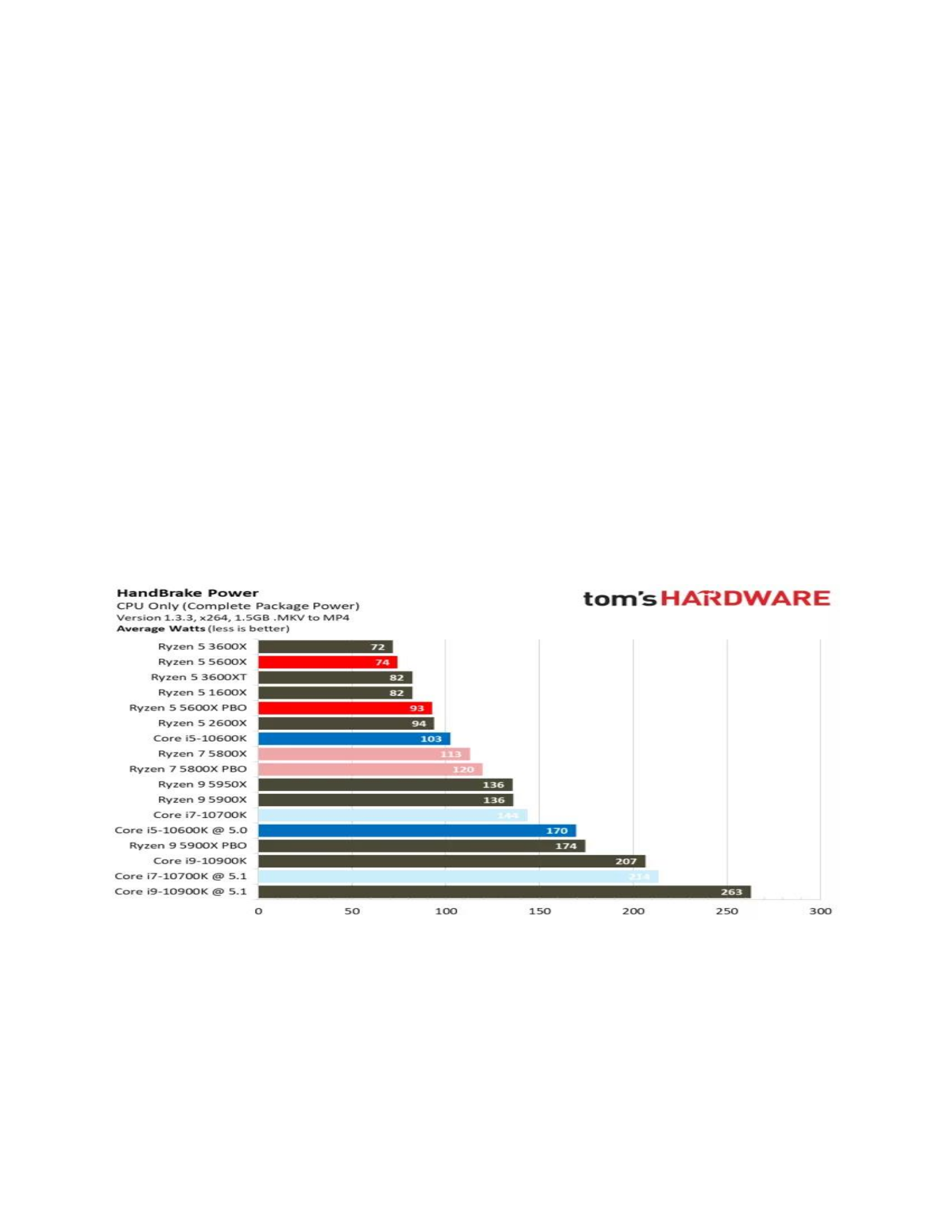
Power Consumption and Heat
The previous' 7nm process node has an immense difference when comparing Intel versus
AMD power and heat utilization. Power utilization comes as a byproduct of design choice, like
lithography and design (Alcon, 2021). However, higher power consumption often correlates to
more heat generation, so you'll need beefier coolers to offset the heat output of greedier chips.
Source: Tom’s Hardware (2021)
Intel has improved its 14nm processes to strengthen its power-to-performance ratio by more than
70% in the five long years it's been on the market, but it's no coincidence that Intel's latest chips
are known for high power consumption and heat. That's because Intel has had to turn the power

AMD VS. INTEL PROCESSORS 9
dial-up further with each generation of chips to provide more performance as it fends off the
resurgent AMD (Venkataraman & Dew, 2017). Unfortunately, that leads to some stock coolers
and requires full power delivery on a motherboard. Those factors combined; make Intel a
notorious power guzzler. In contrast, AMD has the benefit of TSMC'S 7nm node, which is more
efficient than Intel's 14nm. However, AMD does lose some of that advantage in its Ryzen 3000
and 5000 series processors due to the large central 14nm I/O die that comes as part of the
package.
The Processor I consider the Best
AMD's relentless onslaught with its Zen-based processors has redefined my expectations
for both the mainstream desktop and the HEDT markets, catching Intel flatfooted as it remains
mired on the 14nm process and Skylake architecture; making me chose it over Intel. The past
several years has seen AMD processors go from value-focused and power-hungry solutions to
leading-end designs that deliver more cores, more performance, and more power requirements
(Alcon, 2021). Intel has fought back by slowly adding features and cores across its product stack,
but that has also resulted in negative side effects, like more power consumption and heat
generation. These only serve to highlight the company's struggles on the design and fabrication
side of its operations. The AMD vs. Intel processor conversation is changing as Intel lowers
pricing on its mainstream lineup (Clemons, 2020). However, Intel still hasn't eased its draconian
segmentation policies that limit features, like pricey chips to motherboards. Intel's tactics of
squeezing every penny out of every feature have allowed AMD to offer a more compelling value
story across the full breadth of the consumer processor market (Clemons, 2020). In conclusion,
AMD wins the processor war overall right now, but the Intel processor could be a better choice
depending on a person's need.

AMD VS. INTEL PROCESSORS 10
References
Abdullayevich, H. Z. (2020). History, Structure and Types of Microprocessors. The American
Journal of Interdisciplinary Innovations and Research, 2(11), 39-46.
Alcon P. (2021). AMD vs Intel: Who Makes the Best CPU’s. Tom’s Hardware. Retrieved from
https://www.tomshardware.com/features/amd-vs-intel-cpus
AMD. (n.d.). About AMD: Technology changes the world, but not on its own. Retrieved from
https://www.amd.com/en/corporate/about-amd
Butler, D. (2020). History of AMD: Timeline and Facts. The street. Retrieved from
https://www.thestreet.com/technology/history-of-amd
Clemons, T. (2020). AMD vs Intel: Which Chipmaker does processors better? Tech radar
Retrieved from https://www.techradar.com/news/amd-vs-intel
Jindal, G., & Gupta, M. (2013). Processor efficiency: A comparative analysis of and intel.
EXCEL International Journal of Multidisciplinary Management Studies, 3(1), 244-248.
Kumar, S. S. (2019). A Comparative Study of Best Processors Intel and AMD.
Venkataraman, S., & Dew, N. (2017). Intel Corporate Venturing. Darden Business Publishing
Cases.

