


Criminal Justice
System in France
A Note
A. B
I no known conflict of to disclose.
C conc this article should be addressed to A. B
asbradley2@liberty.edu
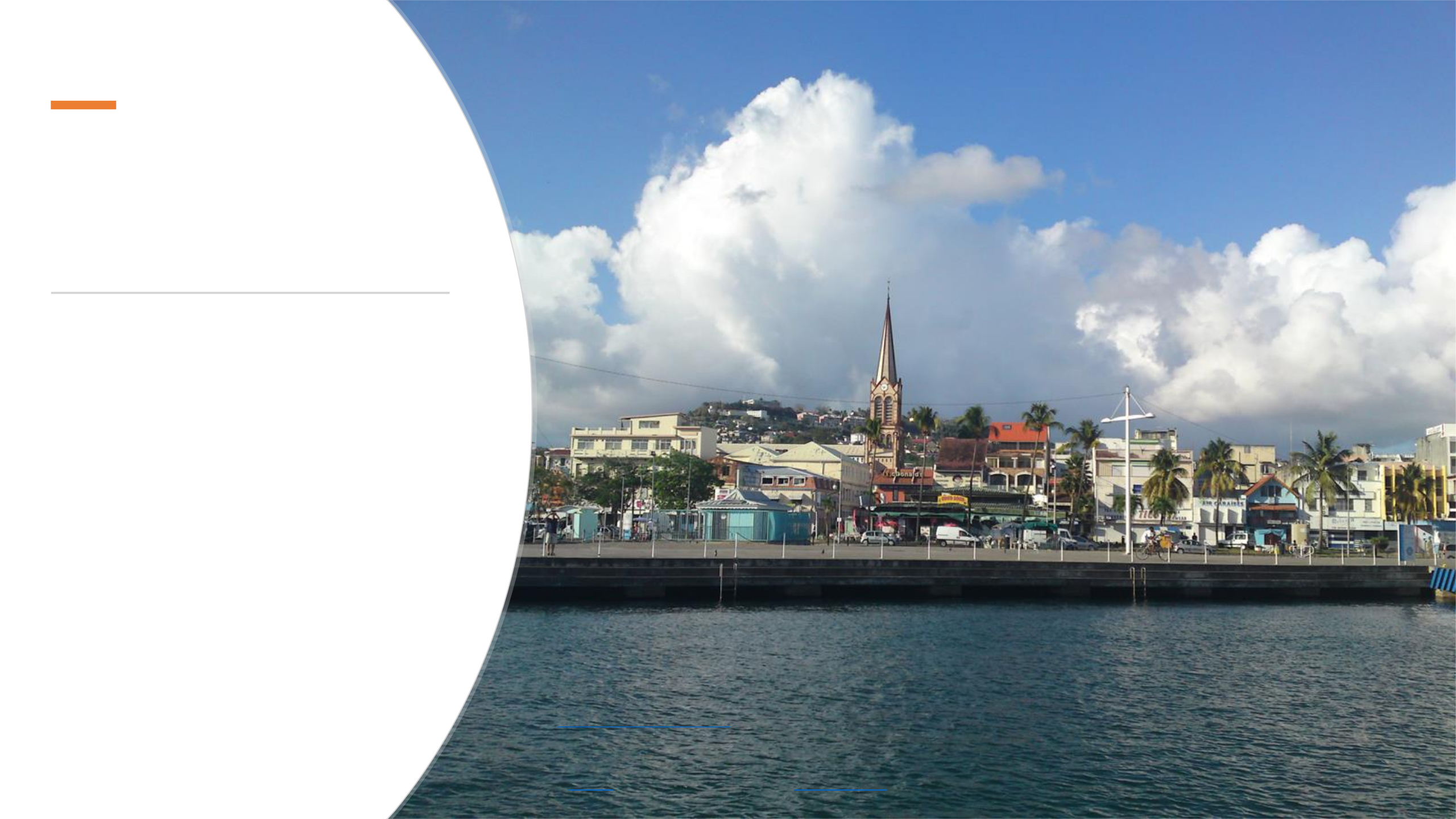
Photo Jean-L Lascoux / CC BY-SA 3.0
Andrea Bradley
Doctorate in Criminal Justice, Liberty University
CJUS 701: Comparative Criminal Justice Systems
Dr. Kim Miller
March 27, 2022
France
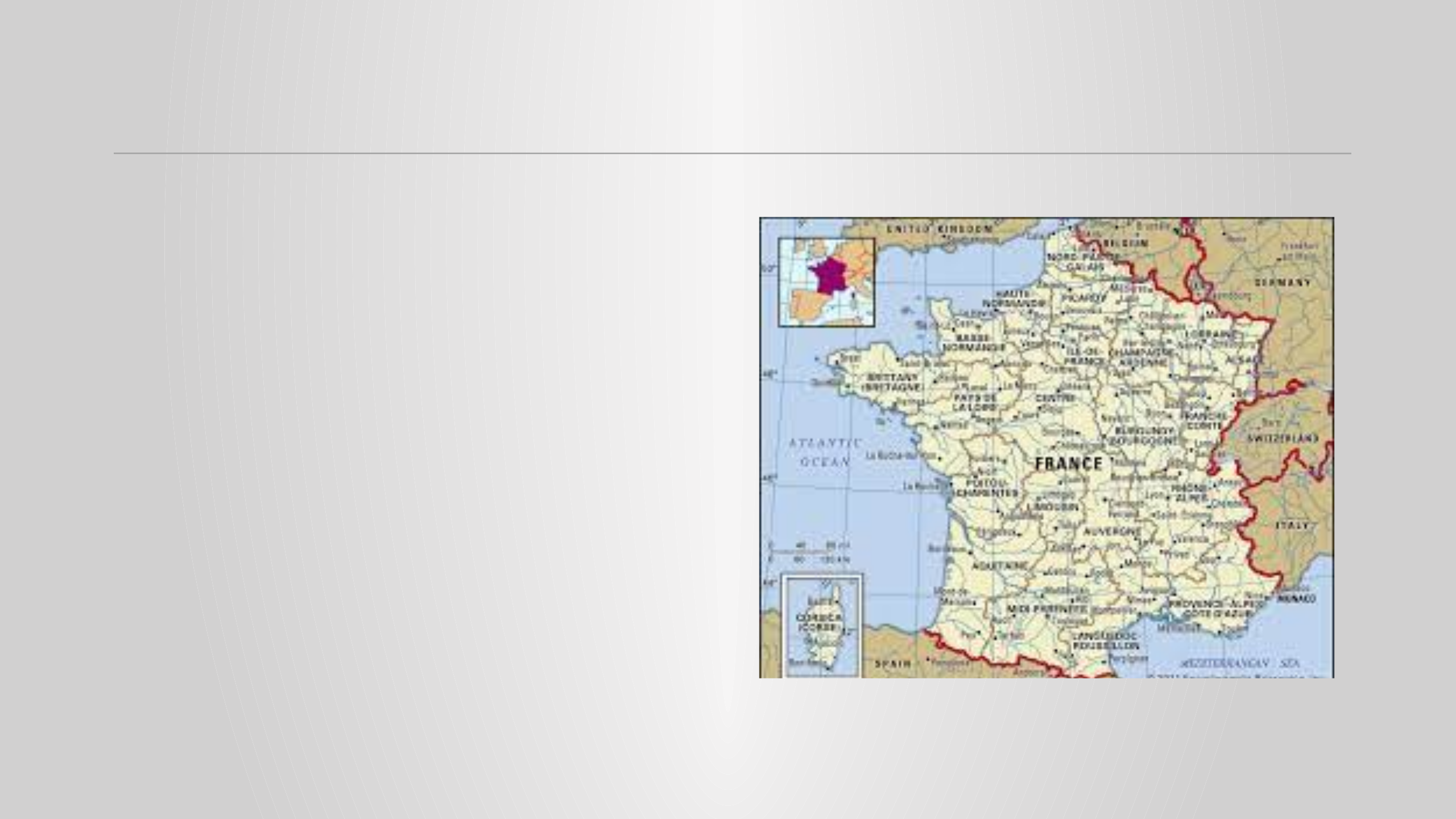
•France is 2220,668 square miles wide and is the largest
country in continental Europe (Terrill, 2016, p.131).
•Spain, Italy, Switzerland, Germany, Luxembourg, and
Belgium are countries that border France (Terrill, 2016,
p.131).
•The English Chanel, Atlantic Ocean, and Mediterranean
Sea are its coastal boundaries (Terrill, 2016, p.131).
•Paris is its capital and home of the Eiffel Tower (Tuppen,
2022).
•Paris is the premier city of the country because of it is
the political, financial, and cultural center of the
country (Terrill, 2016, p.133; Tuppen, 2022). Paris also
has the largest number of industrial complexes (Terrill,
2016, p.133; Tuppen, 2022).
•France is Europe’s most important agricultural producer
and has major industrial power in the fields of;
automobiles, airplanes, chemicals, electronics, and
energy (Terrill, 2016, p.133; Tuppen, 2022). www.Britannica.com
People and Society
•France has approximately 65,000,000 citizens (Tuppin, 2022).
•The official language is French (Terrill, 2016, p.133).
•French is a Catholic country and celebrates mostly Catholic
holidays (Terrill, 2016, p.133).
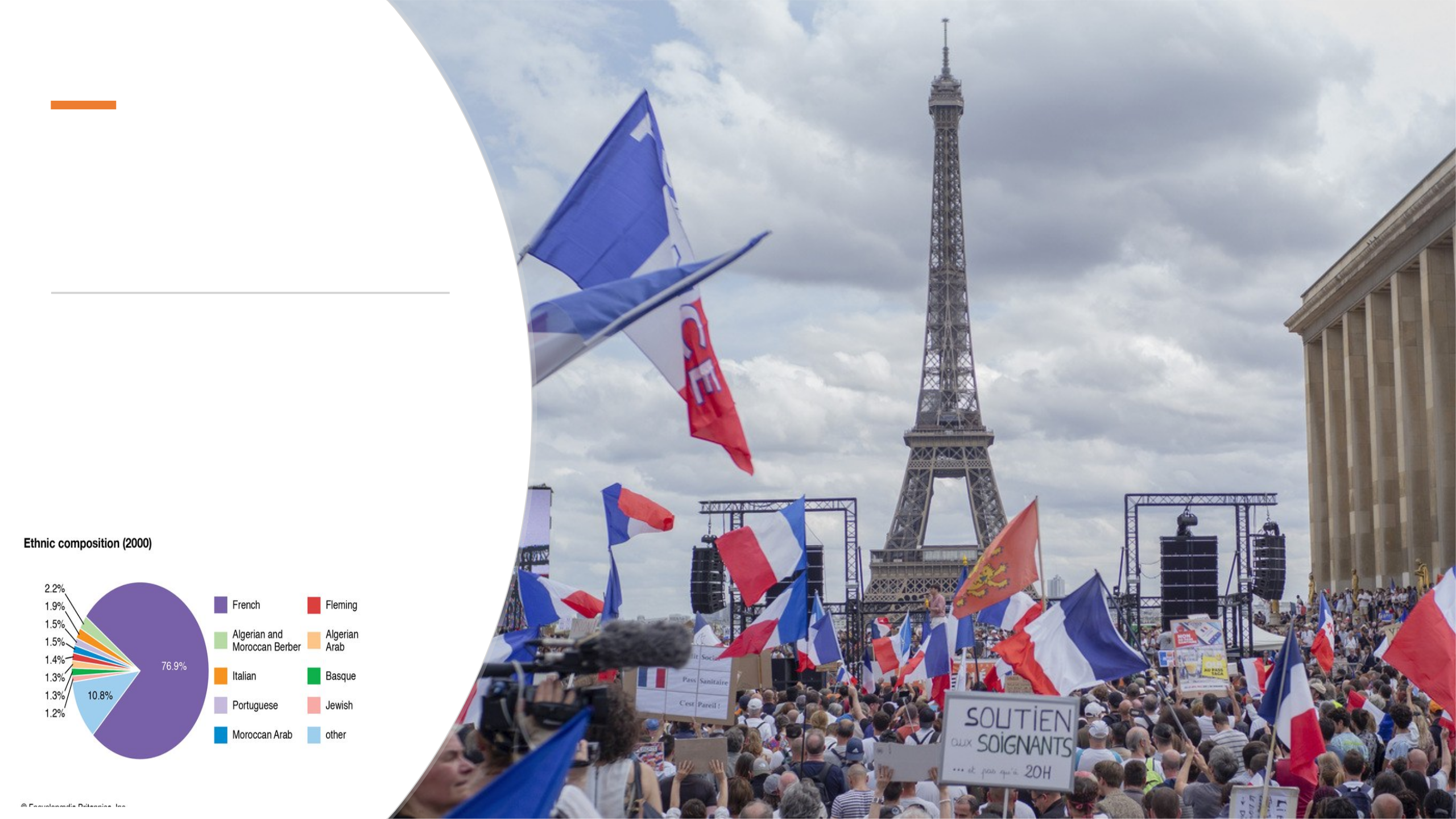
•Research has shown that France is a mixing pot of ethnicities
from around the world (Hardy, 2020; Tuppin, 2022).
•Although France is a Catholic country, many of its citizens do
not affiliate with a religious group (Hardy, 2020).
•Following the Arab Spring of Tunisia in 2010, a high
population of Muslim’s began to migrate to Europe, with
largest amount occurring in 2015 (Hardy, 2020).
www.npr.org

Relations with the
United States
•Documentation shows the 1700’s being to
first time communication between the United
States and France (Smoot, 2017).
•The relationship between the United States
and France first formed during World War I
(Smoot, 2017).
•Both countries are apart of North Atlantic
Treaty Organization (NATO) (Charillon, 2010
;Smoot, 2017).
•In 2002-2003, the French president opposed
the Bush administration during the Iraqi crisis,
causing diplomatic tension between the
United States and France (Charillon, 2010).
•Today, France and the U.S. continue to be
allies and do their best to work through their
differences peacefully (Charillon, 2010). Courtesy of shutterfly.com

Government Structure
According to Georgetown Law Library, France’s government is structured as follows;
•A new president is elected every 5 years.
•The president chooses a Prime Minister from the parliamentary majority.
•Parliament consist of The National Assembly and the Senate, and both pass statues.
Legislation
According to Georgetown Law Library, France’s legislation is structured as follows;
•Dual system that consists of; Public Law (droit public) and Private Law (droit privé). The public law branch
defines how the state and public bodies should operate. The private law branch defines how private individual
and private entities should operate.
•France’s laws also follow an order of hierarchy, and the laws are known as;
1. institutional acts related to the constitution known as loi organique
2. typical deeds that Parliament voted on regarding matters left within the reach of Parliament by the
Constitution known as loi ordinaire
3. the precautions the government takes to keep the country operating normally known as
ordonnance
According to Georgetown Law library, the executive power issues regulations that are broken down into décrets
and arrêtés. Décrets are for the the President and the Prime Minister, and arrêtés are for members of the
executive branch that are not the President and Primes Minister. The Journal official de la République français
(the official gazette) publishes all lois, décrets, and important arrêtés.
http://www.gouvernement.fr/en/how-government-works

Government Structure Continued…
According to Terrill (2016), the Constitution of the Fifth Republic was used to organize and administer the French government (p. 135).
General Charles de Gaulle
•General Charles de Gaulle became the prime minster of French on June 1, 1958, while the Constitution of the Fourth Republic was in effect
(Terrill, 2016, p. 135). He was given the task of revising the constitution (Terrill, 2016, p.136). In September of 1958, General Charles de
Gaulle gave his revisions to the people through a national referendum (Terrill, 2016, p.136). This referendum became the Constitution of
the Fifth Republic (Terrill, 2016, p.136).
Constitution of the Fifth republic
•It is divided into 24 titles that address a specific issue of constitutional authority and has 92 articles (Terrill, 2016, p.136).
•Although it does not have a bill of rights, article 2 does provide instructions for the law to be distributed equally to all citizens regardless of
race or religion (Terrill, 2016, p.136).
•General Charles de Gaulle’s political views are heavily reflected in the Constitution of the Fifth Republic, hence the reason it is also referred
to as the Gaullist (Terrill, 2016, p. 135 and 136).
President
•As of 2008, the president is re-elected every five years (Terrill, 2016, p. 136).
•Considered the head of state, and he or she is responsible for making assuring the country remains nationally independent and adheres to
the constitution (Terrill, 2016, p. 136).
•The president of France is also responsible for appointing the the premier (head of the government), can dissolve the National Assembly at
any time, can issue referendums to the people on certain issues that deal with governmental powers, and take any measures necessary to
resolve any issue that endangers the country, or a government authority is disrupted (Terrill, 2016, p. 136).

Government Structure Continued….
Premier/ Prime Minister
•Chosen by the president to be the head of the government, he or she is responsible for directing government operations, serve as a
connection between parliament and the president, stands before parliament to explain government policy, shapes the structure of the
Council of Ministers, leads its meetings, and oversees administering various departments of the government (Terrill, 2016, p.137).
Council of Ministers
According to How the Government Works on gouvernement.fr, the Council of Ministers brings all ministers together to demonstrate unity
between government entities and is the only government body the Constitution defines. The Council meets every Wednesday at the Elysée
Palace to follow an agenda that was created by the president and the prime minister. Each meeting is made up of the following three stages:
•Stage One- focuses on bills, ordinances, and decrees.
•Stage Two-individual decisions that relate to the appointment of senior civil servants are discussed.
•Stage Three- A minister gives a presentation on the state of progress of a reform that they are in charge of, the President gives a
speech which may include request the opinions of those participating in the meeting, and the Minister of Foreign Affairs gives an
update on the international situation.
The General Secretary of the Government draws up a statement that reports and confirms decisions made during the meeting, and a
comprehensive minutes (gouvernement.fr).
Parliament
According to How the Government Works on gouvernement.fr, parliament has two assemblies that examine and pass laws, monitor government,
and assess public process. They are:
The Senate (upper chamber) (Terrill, 2016, p. 137)
•Composed of 348 senators who are elected every 6 years by an electoral college
•1/3 of the members are elected every 3 years by an electoral college
•The electoral college consist of approximately 145,00 people.
The National Assembly (lower chamber) (Terrill, 2016, p.137)
•elected directly by the people every 5 years
•consisted of 577 deputies
•considered more powerful than the Senate
•shares legislative duties with the Senate

Police
•According to Terrill (2016), the first
police force in French was formed by
King Hugh Capet when he created the
position of Provost of Paris (p.142). This
positioned combined the
responsibilities of the President of the
Court of Justice, Military Governor, and
Governor of the Police (p.142). Today,
France’s national police system is the
largest of the two principal systems in
France and its employee’s police any
town that has more the 16,000 citizens
(p. 144). The National Police has
approximately 150,000 employees,
more than 125,000 field officers, 15,00
in administration, and almost 10,000
auxiliary police (p.144).

Police Continued…
Minister of the Interior
•The most important ministry within the Council of
Minsters (Terrill, 2016, p.144).
•A civilian that has had a career in the civil service
(Terrill, 2016, p.145).
•Responsible for the administration, enforcement,
and overseeing many services that the national
government provides (Terrill, 2016, p.145).
Director General of the National Police
•This position is civilian appointed position by the
government (Terrill, 2016, p. 145).
•Focuses on the central administration of the
National Police (Terrill, 2016, p.145).
Perfects
•A perfect is also the national executive officer of a
department (Terrill, 2016, p.145).
•The perfect coordinates the work of the National
Police (Terrill, 2016, p.145).
•Often meet with the director of the National Police
and National Gendarmerie (Terrill, 2016, p.146).
Ministry of the Interior
Director General of the National Police
Administrative
Division
Prefects Operational Divisions*
M
Inspector General of
Police
MJudicial Police
MPublic Safety
MGeneral Internal
Security
MControl of the Borders
M
Republican Security
Company
*Some of these divisions operate at the regional or
department level and administered by a perfect (Terrill,
2016, p.145).
Figure 2.2 Organization of the National Police (Terrill, 2016, p.
145)

Judicial Police
According to Terrill (2016), the judicial police are
responsible for conducting criminal investigations
and is divided into four sub-directorates:
1. Criminal affairs
2. Economic affairs
3. Financial affairs
4. Forensic science
5. External liaison (Terrill, 2016, p.146).
Public Security Directorate
This division includes the urban police/uniformed
branch, and they are responsible for patrolling
the urban areas of the country (Terrill, 2016,
p.147). Members are responsible for most day-to-
day police matters (Terrill, 2016, p.147).
Police Functions
France published legislation in 1995 that explained
the role of law enforcement as having five main goals
(Terrill, 2016, p.146. Those goals are:
1. to provide a sense of security to the public,
2. to control the flow of illegal immigration,
3. combat organized crime such as big drug dealers,
4. to keep the country protected against terrorism,
and
5. to maintain public order (Terrill, 2016, p.146).
The Office of the Inspector General of Police
In 1974, the office of the inspector general of police
were assigned three tasks:
6. Conduct an inspection of all the units of the
National Police throughout the country (Terrill,
2016, p.146).
7. To investigate all wrongdoing on the part of the
police for both internal and external complaints
that were brought to the attention of the
Inspector General (Terrill, 2016, p.146).
8. Determines the authenticity of the complaints
(Terrill, 2016, p.146).
9. Conducts studies designed to improve the
efficiency of the police (Terrill, 2016, p.146).

Police Functions Continued…
•The General Intelligence Directorate and the Territorial Surveillance Directorate were merged forming the
General Directorate for Internal Security (Terrill, 2016, p.147). This department is now responsible for; (1)
collecting information for the national government, (2) the collection, examination, and centralization of
political, social, and economic intelligence necessary to keep the country safe, (3) watching groups that pose a
threat to national security, (4) protecting people for international terrorist attacks, (5) protecting the industrial,
scientific, and technical information, and (6) preventing nuclear, biological, chemical material misuse (Terrill,
2016, p. 147).
•The Control of the Borders focuses of the issues of illegal immigration (Terrill, 2016, p.147).
•The Republican Security Company is divided into 22 regions that align with France’s 22 administrative regions
and is divided into 66 companies, with 250 officers in each company (Terrill, 2016, p.147). The Company has
the responsibility to end public disorders, handling natural disasters, and conducting rescue missions for
stranded skiers and mountain climbers, patrol camp and beach sites, and serve as lifeguards (Terrill, 2016, p.
148).
Judiciary
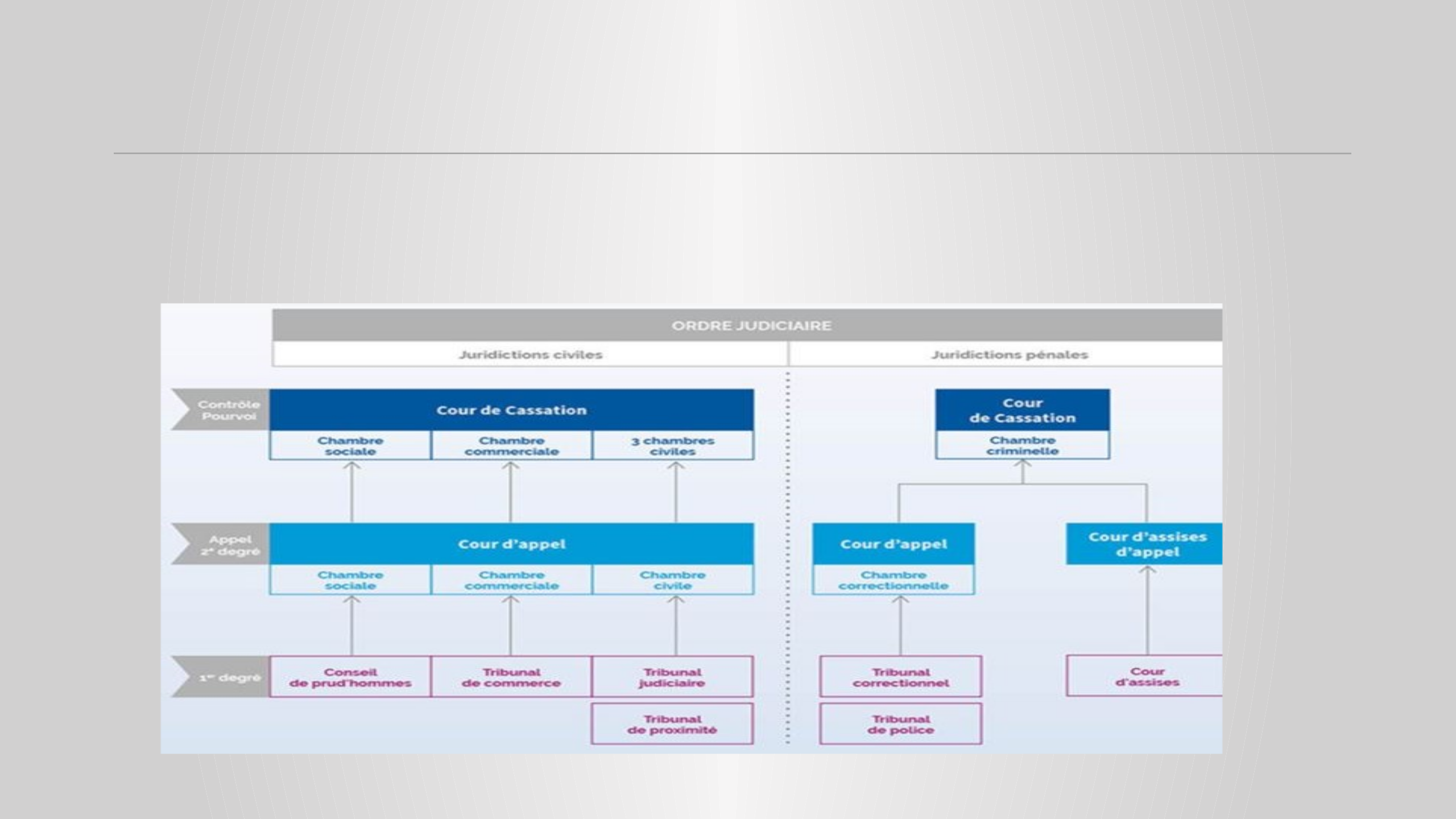
According to the Ministry of Justice website, the judiciary is divided into two courts: civil courts and criminal
courts. The civil courts settle disputes that reference rent, divorce, consumption, inheritance and much more.
The court of judge to hear the case depends on the nature of the case and the amount of money lot. The
criminal courts focuses on physical and non-physical attacks on people, property, and society. The court that will
the case depends on the level of seriousness of the offense of crime. If the accused is under the age of 18 years
old, they will proceed through the juvenile justice system (justice.gouv.fr).
Image from
justice.gouv.fr

Crime Committed
A group of friends went to visit France during Spring Break. Instead of paying for a hotel they decided to
rent an AirBnB instead. Upon arrival, the group was not satisfied with the place and called the owner
demanding to be refunded so they could get another place. Living right next door, the owner of the AirBnB
thought that he might be able to diffuse to situation through conversation face-to-face. The owner goes to
the rental, and as the conversation begins, one of the girls pulls out her phone and starts recording the
conversation. The owner states that he does not consent to be recording and asks her to stop. She refuses,
and the owner leaves.
The group is now angry and proceeds to call the police. During questioning, the police find out about the
recording. He informs the group that recording a conversation without the consent of everyone involved is
illegal in France. He then proceeds to ask the owner if he would like for the one with the recording to be
arrested and he declines, only wanting it to be deleted. The girl deletes the audio, and they proceeded with
rectifying the original issue. They owner was not able to refund the girls, but he did clean the place up.

Conclusion/Biblical View
•The instruction given to us in the Bible about following the law of the land is for everywhere we go
(Romans 13:1-7). Even within the United States, there are different laws for many of the same things
depending on the state you are in. We must do our best to learn the laws of the areas we plan to visit
and follow them. The same is even more true when visiting other countries, as we must be careful not to
be offensive to the culture as well as not break any laws. The Bible also ask that we do not take our
neighbors to court hastily (Proverbs 25:8). In the scenario provided the owner of the rental property
decided not to move forward with legal action and asked only that the girl deleted the video. Although,
most French citizens do not identify as serving any religion, this citizen decided that while he was done
wrong, he not allow any anger he may have felt control what he did next. He simply chose to work out
the problem within group.
•The government departments in both France and the United States operate in many of the same ways.
Each different within the government has a specific set of duties and rules they must complete and
adhere to to keep each country running. Between both countries, many of the duties are the same.

References
1. Charillon, F. (2010). France and the US: From Reluctant Alliance to Ambiguous Rapprochement.EuropeanPoliticalScience:EPS,9(2), 189-198.
http://dx.doi.org/10.1057/eps.2010.4
2. “French Legal Research Guide: The Layout of the French Legal System.” (2022, March 26). Guides, https://guides.ll.georgetown.edu/c.php?g=362135&p=2446075.
3. Hardy, R. (2020). Europe, or the "original west," Muslims, and migration: The peculiar history of France and west Africans with broader implications. Journal of the
Middle East and Africa, 11(4), 381-391. https://doi.org/10.1080/21520844.2020.1842708
4. “How Government Works.” Gouvernement.fr, https://www.gouvernement.fr/en/how-government-works.
5. “Liste Des Articles.” Justice/Portail/L'ordreJudiciaire, http://www.justice.gouv.fr/organisation-de-la-justice-10031/lordre-judiciaire-10033/.
6. Mucchielli, L. (2017). Sociology of deviance and criminology in France: History and controversies. The American Sociologist, 48(3/4), 276-296.
https://doi.org/10.1007/s12108-017-9340-6
7. NewKingJamesVersionHolyBible. (2013). Holman Bible Publishers
8. Smoot, B. R., (2017) Impermanent alliances: cryptologic cooperation between the United States, Britain, and France on the Western Front, 1917–1918, Intelligence and
National Security, 32:3, 365-377, DOI: 10.1080/02684527.2016.1270996
9. Smoot, B. R. (2017). Impermanent alliances: Cryptologic cooperation between the united states, Britain, and France on the western front, 1917-1918. Intelligence and
National Security, 32(3), 365-377. https://doi.org/10.1080/02684527.2016.1270996.
10. Terrill, Richard J. (2016). World Criminal Justice Systems A Comparative Survey. Routledge, New York. PG 17-129.
11. Tuppen, J. N. , Drinkwater, . John Frederick , Higonnet, . Patrice Louis-René , Bisson, . T.N. , Flower, . John E. , Shennan, . J.H. , Elkins, . Thomas Henry , Blondel, . Jean
F.P. , Bernard, . François , Wright, . Gordon , Popkin, . Jeremy David , Bachrach, . Bernard S. , Weber, . Eugen , Fournier, . Gabriel and Woloch, . Isser (2022, March
23). France. EncyclopediaBritannica. https://www.britannica.com/place/France

