


Quiz: Sampling, Design, and Self-
Reporting
Points 30
Questions 15
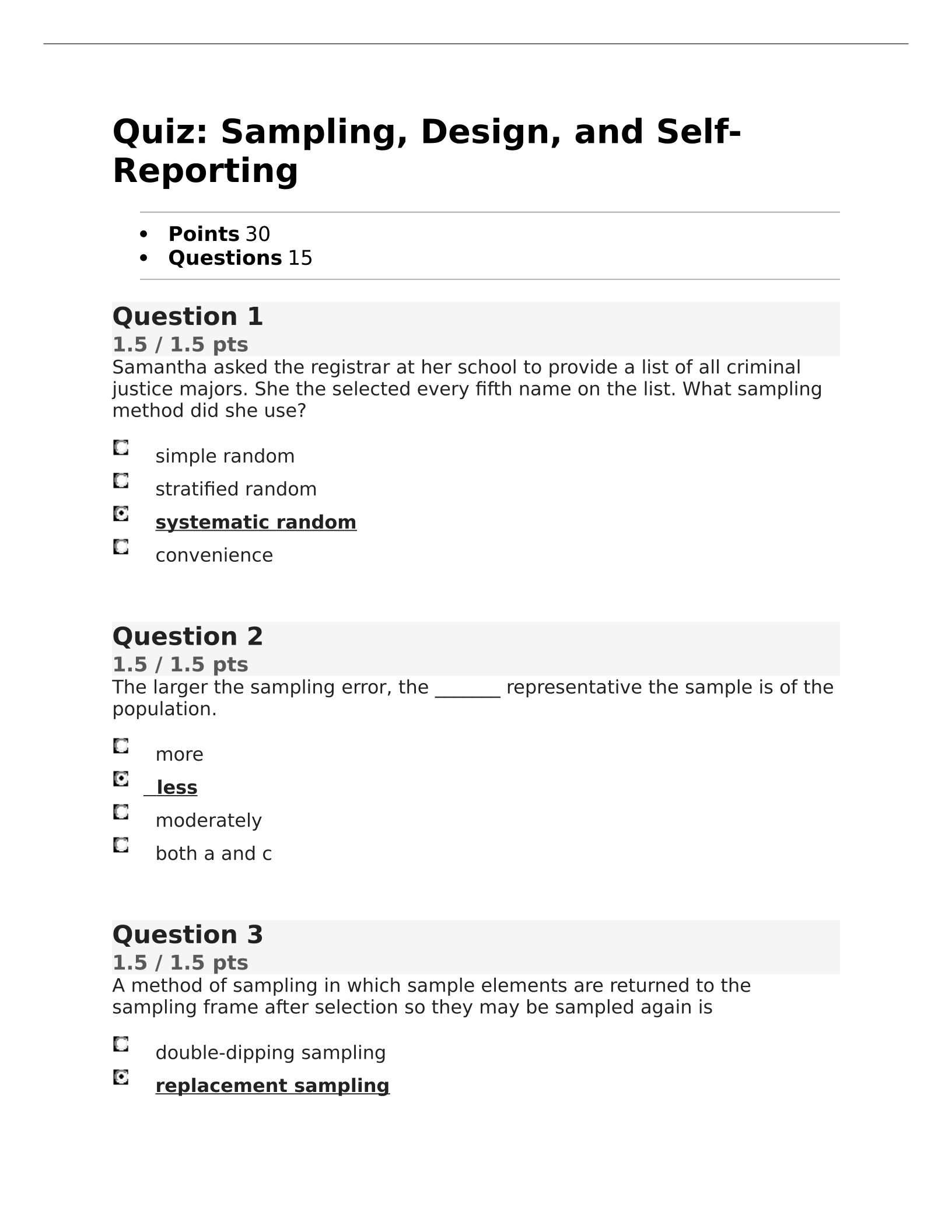
Question 1
1.5 / 1.5 pts
Samantha asked the registrar at her school to provide a list of all criminal
justice majors. She the selected every fifth name on the list. What sampling
method did she use?
simple random
stratified random
systematic random
convenience
Question 2
1.5 / 1.5 pts
The larger the sampling error, the _______ representative the sample is of the
population.
more
less
moderately
both a and c
Question 3
1.5 / 1.5 pts
A method of sampling in which sample elements are returned to the
sampling frame after selection so they may be sampled again is
double-dipping sampling
replacement sampling

selection sampling
None of the above
Question 4
1.5 / 1.5 pts
A nonprobability sampling method in which elements are selected to ensure
that the sample represents certain characteristics in proportion to their
prevalence in the population is
proportionate stratified sampling
quota sampling
purposive sampling
snowball sampling
Question 5
1.5 / 1.5 pts
A researcher who draws conclusions about individual-level processes from
group-level data is constructing
reductionism
an ecological fallacy
an individual propensity fallacy
a reductionist fallacy
Question 6
1.5 / 1.5 pts
The list of all elements of a population from which a sample is actually
selected is known as the
sample frame
population
sampling unit
sampling interval

Question 7
1.5 / 1.5 pts
In order to keep experimental staff from subtly conveying their enthusiasm
for an experimental program to subjects, experimenters may
use blind procedures so that subjects are not aware of who is receiving
the actual treatment
use blind, double-blind procedures so that the experimenter is unaware
of who is receiving the treatment
use double-blind procedures so that neither the experimenter nor the
subjects know who is receiving the treatment
change to another type of experimental process in order to keep from
having problems
Question 8
1.5 / 1.5 pts
When a conclusion based on a sample of a larger population holds true for
that population is known as
cross-population generalizability
sample generalizability
sampling error
none of the above
Question 9
1.5 / 1.5 pts
When subjects develop or change during the experiment as part of an
ongoing process independent of the experimental treatment is known as
exogenous change
contamination effects
selection bias
endogenous change
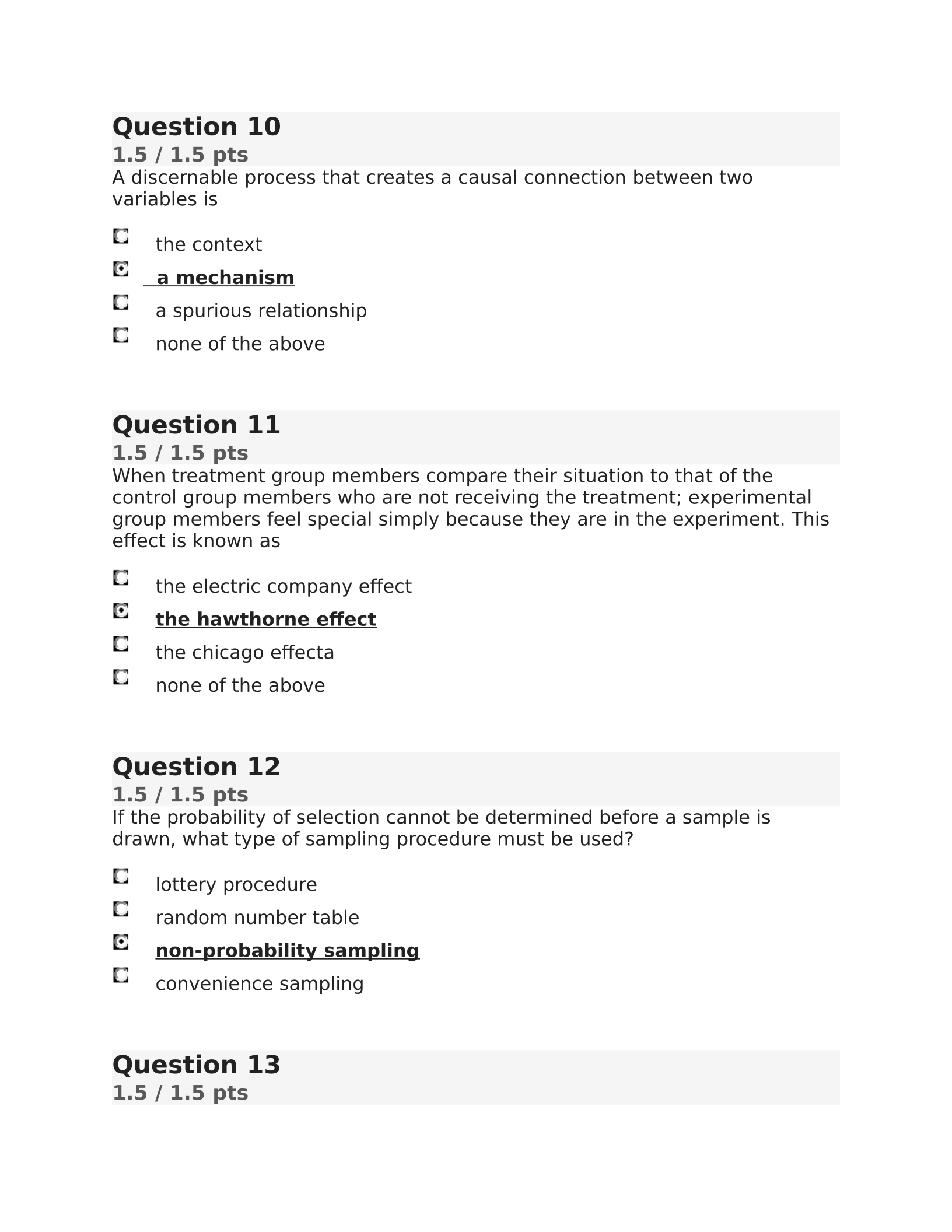
Question 10
1.5 / 1.5 pts
A discernable process that creates a causal connection between two
variables is
the context
a mechanism
a spurious relationship
none of the above
Question 11
1.5 / 1.5 pts
When treatment group members compare their situation to that of the
control group members who are not receiving the treatment; experimental
group members feel special simply because they are in the experiment. This
effect is known as
the electric company effect
the hawthorne effect
the chicago effecta
none of the above
Question 12
1.5 / 1.5 pts
If the probability of selection cannot be determined before a sample is
drawn, what type of sampling procedure must be used?
lottery procedure
random number table
non-probability sampling
convenience sampling
Question 13
1.5 / 1.5 pts

The method of sampling in which sample elements are selected separately
from population strata identified in advance by the researcher is
simple random sampling
systematic random sampling
stratified random sampling
Convenience random sampling
Question 14
1.5 / 1.5 pts
Rubin and Rubin (1995) suggest three guidelines for selecting informants
when designing a purposive sampling strategy. What is one of these
guidelines?
informants should be knowledgeable about the cultural arena or
situation or experience being studied
informant are selected in advance by the researcher.
informants should not be representative of the range of points of view.
elements are selected to ensure that the sample represents certain
characteristics in proportion to their prevalence in the population.
Question 15
9 / 9 pts
Explain the ecological fallacy and reductionism. What can be done to reduce
these concerns?
Your Answer:
Ecological fallacy and reductionism are two common concerns in research,
particularly in criminology and criminal justice (Bachman & Schutt, 2021).
Ecological fallacy refers to the assumption that relationships observed at the
group level also hold at the individual level, which can occur when
researchers make inferences about individuals based on aggregate data or
assume that relationships observed in one context (between neighborhood
crime rates and poverty levels) necessarily hold in other contexts - between
an individual's crime rate and income. The danger of ecological fallacy is that
it can lead to incorrect conclusions about the causes of crime and justice-
related phenomena (Bachman & Schutt, 2021).

The reductionist fallacy occurs when researchers use data about individuals
and make inferences about group-level processes (Bachman & Schutt, 2021).
To avoid reductionism and the ecological fallacy, researchers should consider
the units of analysis and observation used in their study when concluding.
While it is not necessary to reject conclusions that refer to a different level of
analysis than what was studied, it is crucial to assess the likelihood of an
ecological or reductionist fallacy when evaluating the validity of the
conclusions (Bachman & Schutt, 2021).
The use of a multi-dimensional approach that considers the complex
interplay of multiple factors contributing to crime and justice-related
outcomes rather than reducing phenomena to a single cause or element can
help to avoid reductionism and provide a more precise understanding of the
complex nature of crime and justice-related phenomena (Bachman & Schutt,
2021).
In addition, using mixed-methods research that combines quantitative and
qualitative data can provide a more comprehensive understanding of crime
and justice-related phenomena.
Using multiple levels of analysis, a multi-dimensional approach, and mixed-
methods research, researchers can help reduce the concerns of ecological
fallacy and reductionism in criminology and criminal justice research
(Bachman & Schutt, 2021).
Reference
Bachman, R., & Schutt, R. K. (2021). Fundamentals of research in
criminology and criminal justice (5th ed.). Los Angeles, CA: Sage
Publications, Inc.
Powered by TCPDF (www.tcpdf.org)

