


DISCUSSION BOARD 2 1
Discussion Board 2
BUSI 680: Advanced Project Management I
DISCUSSION BOARD 2 2
Given the inadequacy of resources including time, money, materials, manpower, etc.,
deciding which projects to fund is a constant and continuous challenge for key decision-makers
in an organization (Jafarzadeh et al., 2022). Without a clear project priority system set in place, it
is difficult to decide which projects to prioritize which can result in spending resources on
projects that do not provide the greatest return. A project priority system uses certain criteria for
evaluating and selecting projects based on the organization’s operational strategy and objectives
(Gray & Larson, 2021). Within the project team and priority system, it is vital to define the musts
and wants so that the team can decide which projects to take on to ensure maximum success for
the organization. In addition to the must and want objectives, one must also consider the rest of
the project portfolio with a holistic approach (San Cristóbal et al., 2018). For instance,
companies must consider how the project will fit in with the rest of the projects in the queue or
already completed.
As a project manager, one must keep an open mind and stick to the objectives set by top
management and not bring in their own biased opinions into the priority decision-making
process. We are reminded of this in 1 Peter 3:16 which states “Having a good conscience, so that,
when you are slandered, those who revile your good behavior in Christ may be put to shame”
(English Standard Version Bible, 2001). Gray and Larson (2021) explain how must objectives
are criteria determined by executive management that must be met to even consider a project
proposal to be executed. In other words, these are mandatory targets that must be fully
determined in the objective formulation stage which have maximum priority where if the
proposal does not meet these targets, it is off the table (Gisler et al., 2018). Examples of these
must objectives in the case study include that any projects must meet current legal, safety, and
DISCUSSION BOARD 2 3
environmental standards, they should receive a PG or lower advisory rating, and they should not
have an adverse effect on current or planned operations within the company.
On the other hand, want objectives do not need to be met to carry out a project, however,
they are objectives that support the company’s strategy and mission that would enhance the
organization if met (Gray & Larson, 2021). Examples of these want objectives from the case
study include being nominated for and winning an Academy Award, generating additional
merchandise revenue, raising public consciousness about environmental concerns, generating a
profit of at least 18 percent, advancing the state of art in film animation, and providing the basis
for the development of a new ride at the company-owned theme park.
As a member of the priority team in charge of evaluating and selecting film proposals in
the case study, I evaluated each proposal based on the must and want objectives set forth by the
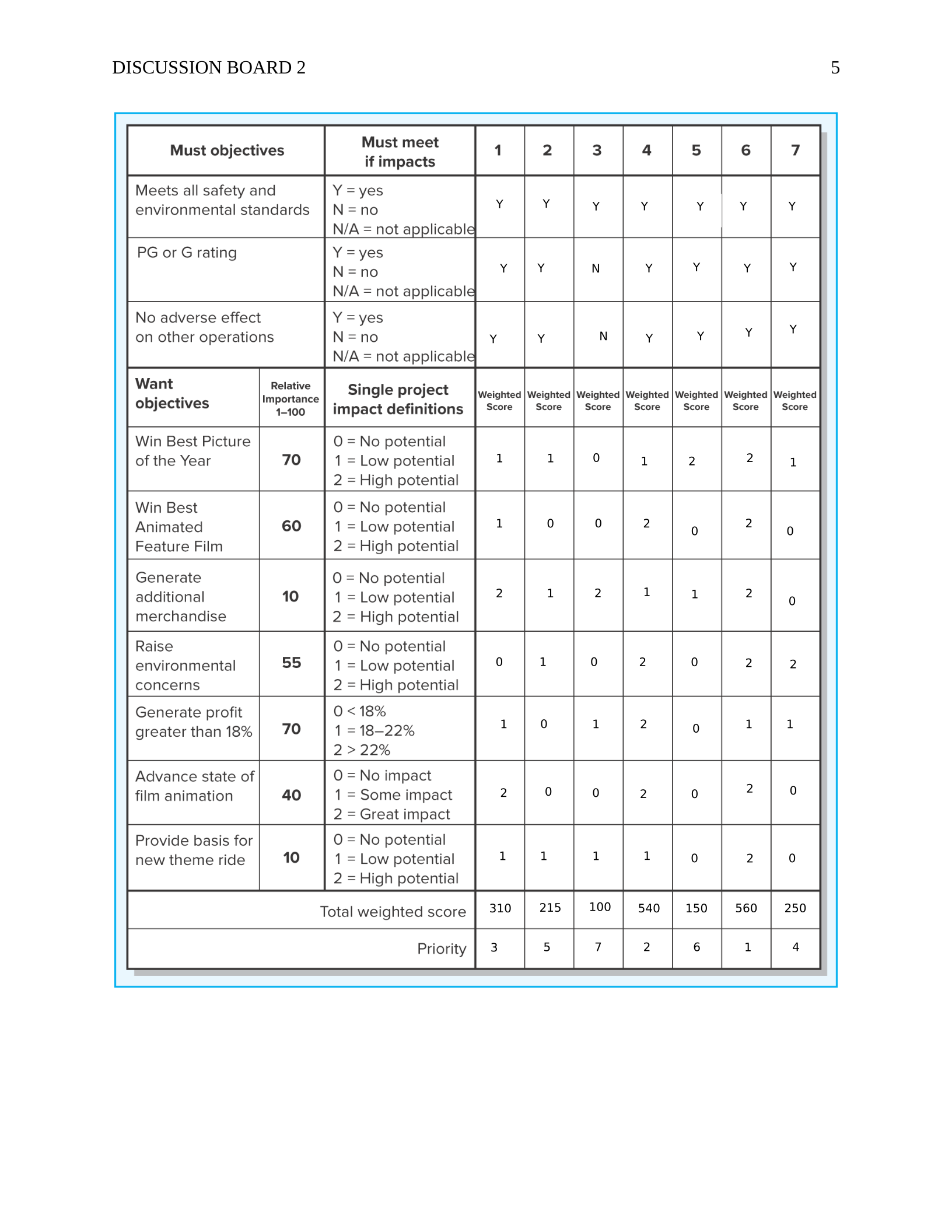
company. In proposal 1, the must objectives were met due to it meeting legal standards, having a
PG or less rating, and not hindering other operations. Also, this project meets the objective of
advancing the animation film industry, having the potential of selling additional merchandise,
and having a good ROI. For these reasons, this project is ranked number 3. For proposal 2, all the
must objectives were met, but the ROI is low due to the amount it will cost to produce the
project. Also, there is a low potential for winning best picture of the year, generating additional
merchandise, and raising environmental concerns. For these reasons, this proposal is ranked
number 5. For proposal 3, even though the ROI is high, the must objectives are not met due to
the rating not being below a PG as it would show sex and drugs. Also, it would most likely
hinder the goals of the company. Because of these reasons, this project will not even be
considered. For proposal 4, the must objectives are met and several of the want objectives are
strong as well. It has a high ROI, it raises environmental concerns by discussing the devastation
DISCUSSION BOARD 2 4
of clear-cutting, and it advances the state of film animation as it is an animated feature set. It is
ranked number 2. For proposal 5, it is a feel-good story that highlights the adversity the Olympic
gymnast had to overcome. Though it has the potential to win the best picture of the year, it will
not raise environmental concerns, advance the state of film animation, and has a low ROI. This is
ranked number 6. For proposal 6, it meets all the must objectives and has a great amount of
potential as it meets many of the want objectives as well. It has a high ROI, addresses
environmental concerns, could win awards, and advances the animated film industry as it
integrates real-life footage with animation. Due to these reasons, this project is ranked number 1
for execution. Lastly, for proposal 7, it meets all must objectives and raises awareness of
environmental concerns but has an average ROI and is not animated. For these reasons, it is
ranked number 4. The below project priority evaluation form displays the results of my project
proposal analysis.
DISCUSSION BOARD 2 5
Y
YY
675 4
321
250
1
1
0
0
0
0
Y
Y
Y
2
560
Y
Y
2
1
2
2
2
2
2
Y
150
0
0
0
0
1
0
2
Y
Y
540
1
2
2
2
1
2
1
Y
Y
Y
100
2
1
0
1
0
0
0
Y
N
N
215
1
0
0
1
1
0
1
310
1
2
1
0
2
1
1
Y
Y
Y
Y
DISCUSSION BOARD 2 6
References
English Standard Version Bible. (2001). ESV Online. https://esv.literalword.com/
Gisler, T., Capezzali, M., Guittet, M., Burkhard, R., & Favrat, D. (2018). Evaluation and
recommendation of a subsidy instrument for new large hydropower plants, use case of
switzerland. Sustainable Energy Technologies and Assessments, 26, 6-
16. https://doi.org/10.1016/j.seta.2017.12.004
Gray, C. F., & Larson, E. W. (2021). Project Management: The managerial process (8th ed.).
McGraw-Hill Education.
Jafarzadeh, H., Heidary-Dahooie, J., Akbari, P., & Qorbani, A. (2022). A project prioritization
approach considering uncertainty, reliability, criteria prioritization, and
robustness. Decision Support Systems, 156, 1. https://doi.org/10.1016/j.dss.2022.113731
San Cristóbal, J. R., Carral, L., Diaz, E., Fraguela, J. A., & Iglesias, G. (2018). Complexity and
project management: A general overview. Complexity, 2018.
Powered by TCPDF (www.tcpdf.org)

