Integrative Learning Project: TeslaAbstract 5
Integrative Learning Project: Transforming Tesla Toward Triumph 6
Organizational Setting 6
Organizational Mission 6
Customers 7
Process Improvement Value Added 7
Biblical Values and the Organization 8
Organizational Concepts for Tesla’s Consideration 9
Strategy 9
Comprehensive Description 9
Benefit 10
Implementation 10
Biblical Integration 11
Innovation 11
Comprehensive Description 11
Benefit 12
Implementation 12
Biblical Integration 13
Customer Value 13
Comprehensive Description 13
Benefit 13
Implementation 14
Biblical Integration 15
Organizing the Project Team 16
Comprehensive Description 16
Benefit 16

Implementation 17
Biblical Integration 18
Capacity Planning 19
Comprehensive Description 19
Benefit 20
Implementation 20
Biblical Integration 21
Supply Chain Management 21
Comprehensive Description 21
Benefit 22
Implementation 22
Biblical Integration 23
Role of Information Technology 23
Comprehensive Description 23
Benefit 23
Implementation 24
Biblical Integration 24
Lean 25
Comprehensive Description 25
Benefit 25
Implementation 26
Biblical Integration 26
Conclusion 27
Summative Conclusion 27
Major Recommendations 27
References 28
Appendix A 31

Appendix B 32
Appendix C 33
Charles A.W. Treadwell
Liberty University
Author Note
Charles Aiji Watanabe Treadwell
I have no known conflict of interest to disclose.
Correspondence concerning this article should be addressed to
Charles Aiji Watanabe Treadwell. Email: catreadwell@liberty.edu Table of Contents
Abstract
This integrative learning project offers Tesla Motors recommendations on how they might
improve their organizational operations. It begins by providing an organizational setting that
describes the mission of the organization to include: the products offered by Tesla, its current
markets, and its organizational distinctions compared to its competitors. Both internal and

external customers are also defined. How organizational value increases and the role
Christianity currently and Christian values play at Tesla Motors is also discussed. Following the
organizational setting presentation is a comprehensive discussion of eight organizational
concepts and how their integration and implementation into Tesla’s business operations might
provide considerable benefits to the organization. The concepts discussed are strategy,
innovation, customer value, project team, capacity planning, supply chain management,
utilization of information technology, and lean practices. With each concept discussed there are
biblical references provided that offer additional considerations of how business operations at
Tesla might be enhanced in conjunction with adoption of the principles discussed in the Word of
God. The paper concludes with a summative conclusion for Tesla Motors and major
recommendations for Tesla in light of the findings of this integrative learning project.
Integrative Learning Project: Transforming Tesla Toward Triumph
Tesla Motors has become the pinnacle organization in the electric vehicle
manufacturing industry. They are even breaking ground and stealing shares in the automotive
industry as a whole. However, Tesla has some clear-cut problems. Tesla has been over
promising and under delivering. This comes directly from their manufacturing operations and
its clear they must be reformed if they are to alleviate stakeholder concerns. Before Tesla, Ford
and General Motors dominated the automotive industry for generations. Foreign automotive
makers such as Toyota have recently grabbed hold of large shares in the market due to their
innovation as well. But Tesla hopes to emerge as a new giant in the automotive industry. To do
so, Tesla must revisit its innovation strategy and its project teams and manufacturing capacity
must be reconsidered as well. Adopting lean practices, strategic use of information technology

and careful supply chain management, Tesla can resolve its problems and generate more
customer value.
Organizational Setting
Organizational Mission
Known as the 9th most valuable brand in the world and a notable Fortune 50 company,
Tesla, the electric vehicle tycoon, is on a mission to “accelerate the world’s transition to
sustainable energy. In pursuit of this goal, [they] build products that are designed to replace
some of the planet’s biggest polluters – while trying to do the right thing along the way.” (Tesla,
2024a). Tesla primary products are its electric vehicles. Tesla sells its Model 3, Model Y, Model X,
Model S, and new to the market Cybertruck. In addition to its electric vehicles Tesla has become
a dominant force in the solar panel industry offer solar panels, solar roofs for homes and
businesses, and Powerwalls, an integrated battery system that stores solar energy to protect
against power outages (Tesla, 2024b). The primary markets that Tesla sells its products in are
the obvious automotive industry and the sustainable energy markets. What makes Tesla
distinguished amongst its competitors is its inherent uniqueness. Tesla is not just an automaker
but tech company as well. They are offering the latest advancements in electric vehicles and
truly set the standard. But its not just their technological advancements that set them apart.
Tesla is also redefining the automotive industry business model for the way they sell and deliver
their vehicles. Tesla is certainly a force to be reckoned with in multiple industries and its evident
in their technology, business operations, marketing, and mission.
Customers
Because of the products and mission of Tesla, their target market is somewhat specific.
Tesla is in the automotive industry, so their customers are those who are after an automobile,

but not just any automobile. Tesla’s vehicles are not exactly cheap nor are they like a traditional
gas vehicle. These high-end vehicles initially targeted the higher income class due to their
affordability and their goal of positioning themselves as a luxury vehicle. However, Tesla has
expressed its interest in being able to target the general middle class by offering a more
affordable electric vehicle. Tesla also offers a unique set of facets in its vehicles. Primarily that
they are fully electric which means their vehicle emissions are slim to none. This is an important
factor for customers who are eco-friendly. Other external customers include the United States
government who has eco-friendly concerns and offers tax credits toward these vehicles as well
as the investors who are determined to see the fruits of Tesla’s labor. Many of the internal
customers of Tesla are its employees, who are working to accomplish its mission, business
leaders and owners such as Elon Musk, and even some suppliers whose products contribute
toward the greater mission.
Process Improvement Value Added
Despite new electric vehicle market share and recording setting sales in the electric
vehicle market, electric vehicle growth is starting to slow and lose its appeal to consumers (St.
John, 2023). The introduction of the electric vehicle into the market was at first met with a great
deal of speculation and criticism, but after the early adopters came a great deal of hype and
excitement surrounding the industry. But as of recent, the electric vehicle industry and Tesla in
particular has lost some of its momentum. In order to regain that momentum and maintain its
dominance to reach its mission, Tesla must make some improvements to its processes so that it
can cut costs, increase efficiency and ensure that its products are meeting the needs of its
customers and addressing the concerns that are holding the company back from overtaking its
gas-powered competitors. Reevaluating quality, strategy, global trends, and innovativeness will

propel Tesla into modifying its project plans, sustainability, and development models to meet
the evolving needs of its customers.
Biblical Values and the Organization
Tesla is not a Christian company and holds a very secular stance, however most of its
core values can be traced directly to biblical principles. Tesla’s core values are “doing the best,
taking risks, respect, constant learning, and environmental consciousness” (Pereira, 2023).
Tesla’s first core value is do your best, Colossian 3:23 instructs us in “Whatever you do, do your
work heartily, as for the Lord and nor for people,” (New American Standard Bible, 2020). God
instructs us to do our work heartily and to offer our best in all that we do. Tesla’s second core
value is to take risks. Deuteronomy 31:6 reminds us to “Be strong and of good courage, do not
fear nor be afraid…” (New American Standard Bible, 2020). The Bible does not directly
encourage us to take risks but to be of good courage and to not fear with resembles the
characteristics of calculated risk takers. Tesla’s third core value is respect. Matthew 7:12 tells us
of the golden rule “In everything, therefore, treat people the same way you want them to treat
you, for this is the Law and the Prophets.” (New American Standard Bible, 2020). We as
believers are instructed to respect and love others the way we desire to be respected and loved.
Tesla’s fourth core value is constant learning. In Psalm 119:66, the psalmist asks the Lord to
“Teach [him] knowledge and good judgment, for [he trusts the Lords] commands” (New
American Standard Bible, 2020). We are encouraged to be constantly seeking after knowledge
and wisdom to grow in our maturity in the Lord. And lastly, Tesla desire to be environmentally
conscientious. Genesis 2:15 says “Then the Lord God took the man and put him in the Garden
of Eden to cultivate it and tend it.” (New American Standard Bible, 2020). One of God’s very first
commandments to man was to care for the Earth that He gave to man to rule over. While we

are not directly told to be hyper environmentalists we are told to care for and tend to
environment that God gave us to rule over.
Organizational Concepts for Tesla’s Consideration
Strategy
Comprehensive Description
According to Meredith and Shaefer, business strategy is a set of objectives, plans, and
policies that an organization attempts to complete successfully in its respective market (2023).
Meredith and Shaefer continue on by saying that the business strategy an organization chooses
will specifically state its competitive advantage and how that competitive advantage will be
utilized and maintained in the execution of business. The way to ensure that a strategy is
successful is to make sure that it is implemented at the appropriate time and to also ensure that
the organization sticks to the strategy that it desires to use. More often than not, organizations
strategies fail, not because the strategy is poor, but because of the way the strategy was
implemented and executed. According to Han, strategy is more of a focus on a firm’s theory
about how to gain competitive advantages (2021).
Benefit
Strategy is everything in a business setting. Strategy not only ensures you have goals and
objectives, but that you have clear direction on how you intend to meet those goals and
objectives. The free capitalist market is ruthless. Companies work meticulously to maintain
positive growth at all costs in order to meet shareholder expectations. If Tesla desires to
maintain its growth and competitive advantage in the market, especially with clear decades long
dominance by General Motors and Ford, it must have a clear strategy for where its heading and
how it plans to get there. Tesla has presented its operating plan which is part 3 of its master

plan and this should be in alignment with its intended strategy (see Appendix B). Now, Elon
Musk, the chief executive officer of Tesla Motors, is a visionary and has spent his lifetime
building some of the largest and most successful companies the world has ever seen. His vision
was to bring fully electric vehicles to the average consumer. This is a great vision and certainly
one to catch the attention of investors and consumers; however, Tesla must consider if after 20
years of business if its strategy has led it to its goal or if its strategy should be revisited.
Implementation
Tesla’s strategy to get fully electric vehicles to the average consumer began by first
entering the market by offering expensive high-end vehicles to target to upper and upper-
middle class (Han, 2021). Once its product and business had been established, it generate funds
to build a more affordable electric vehicle that could be offered to average consumer. Up to this
point, Tesla has arguably been successful. Tesla has leveraged their brand awareness to promote
their corporate strategy and has convinced consumers that they are the standard for “forward-
thinking design, high-quality products, overall futuristic appearance” (Liu, 2023). To continue in
their success, Tesla needs to revisit is strategy because now, consumer confidence in the
practicality of electric vehicles in the long-term is beginning to ween. While Tesla has
successfully completed its strategy to offer their electric vehicles to the average consumer, they
now need to strategy how they will regain consumer confidence by creating greater
infrastructure around their electric vehicles to ensure its longevity. Additional Tesla should
consider its strength, weaknesses, opportunities and threats when considering the development
of their strategy (see
Appendix A).

Biblical Integration
Proverbs 23:3-4 says “By wisdom a house is built, and by understanding it is established.
By knowledge the rooms are filled with all precious and pleasant riches.” (New American
Standard Bible, 2020). Proverbial wisdom here suggests that careful contemplation with wisdom
and understanding allows for things, such as a business, to be built and established. With
knowledge these things will be prosperous. Careful contemplation with wisdom, understanding,
and knowledge is like a modern business strategy. If carefully devised, a strategy can lead to
success and prosperity.
Innovation
Comprehensive Description
Innovation is best defined as an introduction of some new or improved product, process,
or service (Meredith & Shafer, 2023). Innovation can even include branding, strategy, or
profiting. What makes innovation significant is that it offers something new that creates value
that will inherently generate profit. Innovation fosters new ways of doing things that will
eventually lead to increased efficiency and effectiveness and will increase performance which
makes a business such as Tesla more profitable (Qin, 2022).
Benefit
Tesla is currently witnessing a decrease in consumer and investor confidence in the
longterm sustainability of the electric vehicle due to the reliability of the current electric vehicle
infrastructure. In order for electric vehicles to run they need to be charged and charging takes
significantly longer than the tradition fill up time of a vehicle that runs on gas or diesel. If Tesla
were to think innovatively with the infrastructure that pertains to the electric vehicles, they

would be able to potentially increase consumer and investor confidence, thereby, maintain the
longevity of the business and competitive advantage over other automakers.
Implementation
Tesla is not novice when it comes to innovation. Tesla generates exponential innovation
through its innovative management practices. Tesla, according to Denning, “combines a
combination of big vision, leading-edge technology and decentralized decision-making that
enables exponential innovation and ultra-rapid product development” (2023). Tesla expects its
managers and staff to function as entrepreneurs and even grants sovereignty over budgetary
spending. This same approach must be taken to consider how to build the necessary
infrastructure effectively and efficiently in a timely and costly matter so that there is still a
suitable and potentially developable market for Tesla to continue to do its business. Tesla needs
to utilize its more than 37 locations throughout the world, and lean on its experience from its
more than 1,300 successfully completed projects (Qin, 2022). If Tesla is able to properly
implement continued innovation into its business model and practices, it will surely solve the
problems its facing about the concerns over the electric vehicle market.
Biblical Integration
Consider Ecclesiastes 10:10 which says “If the axe is dull and he does not sharpen its
edge, then he must exert more strength. Wisdom has the advantage of giving success.” (New
American Standard Bible, 2020). Sometimes innovation is not necessarily about creating
something new but about making something you already have function better by doing
something new to it. Take the axe for example. When an axe becomes dull, more strength is
required. More energy required means less energy available for more wood cutting which
means that wood chopping becomes less productive. If man recognizes that by sharpening the

axe at the beginning of each day, he will not need to exert as much strength when chopping
wood. This might be a new process he engages in but his innovative approach to wood chopping
will surely benefit him by allowing him to save strength for cutting more wood. A new approach
means new success for the wood chopper.
Customer Value
Comprehensive Description
Customer value is best described as the purpose for which organizations exist. According
to Meredith & Shafer, customer value is the value that customers place on a good or service
(2023). They go on to say that value is defined as the perceived benefit divided by the costs,
which can include the upfront costs of the product or service, other life-cycle costs of using the
product or service such as maintenance, and the other hassles involved in obtaining the product
or service such as travel, obtaining financing and so on.
Benefit
There are several reasons why generating customer value is critically important to a
business. First, generating customer value helps businesses attain and sustain competitive
advantage. Providing unique value propositions helps businesses differentiate themselves from
their competitors which helps them maintain a competitive edge. Second, customer value can
likely help generate customer satisfaction and customer loyalty. When a company like Tesla sells
an electric vehicle to its customers that the customers value, the customer will have high levels
of satisfaction. If a customer is satisfied with their product, they are more inclined to remain
loyal to that business because there has been trust established in the quality of the product.
Third, good products mean good business which means good revenues. If customers perceive a
product to be valuable and believe that product is of high quality, they are inclined to pay higher

prices which means greater revenues for a business. Fourth, generating customer value
increases brand reputation. When a company like Tesla generates consumer confidence from
their consumer value, they eventually establish themselves as a company that is valuable and
reputable. Increased reputability leads to the final point which is continued success. If a
company, continuously generates customer value and customer satisfaction, they will realize all
the previous benefits which in turn will yield long-term success. This long-term success is what
every business if after.
Implementation
As previously discussed, in order for Tesla to generate value, it must create value
propositions. Value propositions primarily refer to products and services that create value in
various customer segments and for Tesla these segments are vehicle innovation, battery
innovation, and innovation in infrastructure. Li et al., discuss Tesla’s value propositions in the
following: First, Tesla offers considerable autonomous driving and connection technology that
support customer needs to navigate to charging stations and connects customers to
maintenance and infotainment centers; second, Tesla has manufactured their vehicles to have
outstanding battery management systems which conserve fuel consumptions allowing
customers to get the best use out of their electric charges; lastly, Tesla has many charging
stations that help ensure customers can get access to the fuel that they need to charge their
vehicles no matter where they are or what they are doing (2021). But as previously mentioned,
customer value and customer satisfaction is weaning because of consumer confidence in the
infrastructure and longevity of electric vehicles. In order for Tesla to maintain its long-term
success and brand reputability, Tesla must reform and revitalize its value propositions, especially
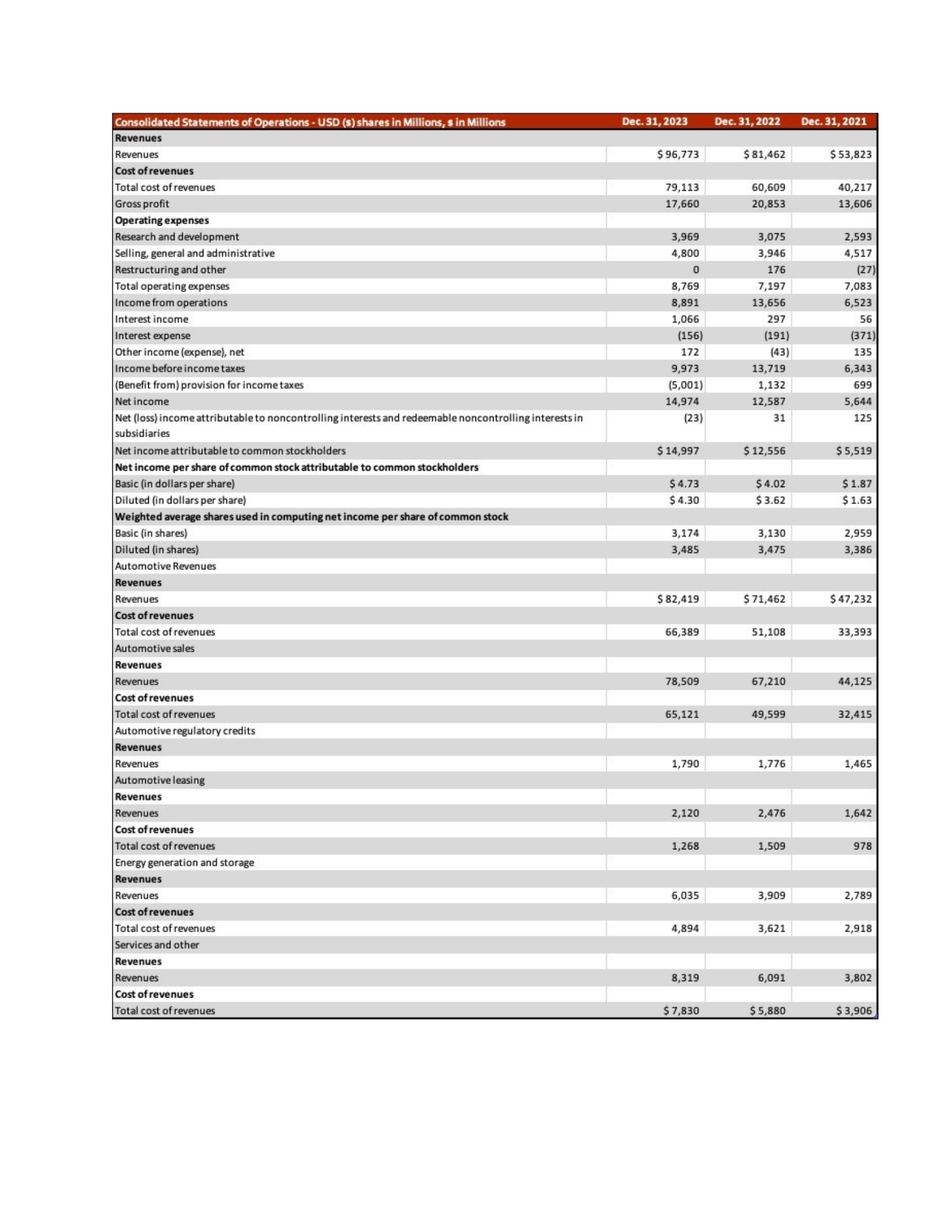
with its infrastructure and fuel management. Tesla should consider its financials. If it continues

to increase its revenues due to its value propositions while having its operating stay steady, they
will maintain their desired growth (see Appendix C).
Biblical Integration
In Paul’s epistle to the church at Philippi in 2:3-4 Paul instructs believers “Do nothing
from selfishness or empty conceit, but with humility consider one another as more important
than yourselves; do not merely look out for your own personal interests, but also for the
interests of others.” (New American Standard Bible, 2020). Paul emphasizes the importance of
humility and putting the needs of others above our own personal needs. For an organization,
their personal needs might be generating profits and demonstrating growth to shareholders. For
consumers and customers, their needs likely lie with what they perceive as value. This value
includes their safety, product reliability, product functionality, and the cost of the product.
Scripture tells us that we are to prioritize the customers desire of a safe, affordable, reliable, and
functional product over a product that generates a ton of revenue for a business at the expense
of these things. Tesla can and would abide by this instruction if they were to make vehicles and
offer services that would reflect the customer first over the needs of the business.
Organizing the Project Team
Comprehensive Description
Organizing the project team refers to the composition of members will who lead and
execute a project or organization (Meredith & Shafer, 2023). Meredith and Shafer say that there
are four types of team members that make up a team. The first is the project manager. The
project manager is the person responsible for leading the team and executing the project.
Project managers are typically responsible for managing the cost, schedule, and performance of
any given project. The second type of team member is those who have a long-term relationship

with the project. These are individuals who will ensure continuity throughout the project and
will be critical parts of ensuring its success. The third type is those who work hand-in-hand with
the project manager. These are individuals who communicate closely and continuously with the
project manager and can ensure that the project succeeds in its execution. The last type of team
member are those subject matter experts also known as SMEs who possess the rare and refined
skillsets necessary to see the project to success.
Benefit
There are numerous benefits of organizing a project team and making sure that the
project team has all of the previously described types of members. First and foremost, having a
team, in most cases, means that executing a project will be done much for efficiently.
Productivity is key in making sure a project succeeds and when work is assigned to team
members based on their skills and expertise it is much more likely that the work will be
completed in a more productive manner. By leveraging these skills and expertise projects can be
tackled in a more effective fashion allows for costs, schedule, and performance to be better
managed by the project manager and team. Secondly, having an organized project team means
risk can be mitigated much better. In any project there is risk and risk will affect the cost of a
project, the schedule of a project, or the performance of a product or service. If any of these are
affected outside the scope of what is manageable, the success of the project will clearly be at
risk. In order to make sure that the project is successful, team members can work cohesively to
identify risks and brainstorm ways to either eliminate, mitigate, or manage these risks moving
forward. A single individual leading a team might otherwise miss these risks. Lastly, having a
project team means better problem solving. In any project, you are bound to run into problems
and issues. More often than not, these problems are not simple. They are complex in nature

because they are multi-faceted. Multi-faceted problems require multi-faceted solutions. In
order for a multi-faceted solution to be made, many considerations must be made, and it is very
difficult for one person to do this alone. Especially since one person is not likely an expert in all
things. Having multiple team members whose focus is a certain part of a project means that
they are better qualified to speak to its nuances and better suited to assist in solving the
problem that relates to specific part.
Implementation
In order to organize the best team, it is critical to have a strategy that focuses on
gathering the best people. Tesla’s human resources strategy is to “hire exceptional people who
enjoy pushing themselves to perform at the highest levels every day.” (Jie et al., 2023). Tesla has
its sights set on ensuring they have the best people for the job. A consideration for Tesla is to
constantly be evaluating whether the people they currently have are the best people for the
job.
The reason why is because the job changes. Customer needs and wants are never static.
Consumer challenges are certainly dynamic. These means that if the problems change, the
people solving them will need to change. This does not mean that people necessarily need to
be replaced but their training or focus might need to be tailored in order to solve new problems
and meet new challenges. In some cases, the initial solutions created by the founding members
of an organization might be what is causing the problems that customers are experiencing
today. These founding members might have difficulty addressing the problems with their
solutions because they are the ones who believed them to be wholly successful to begin with.
Sometimes fresh solutions require fresh minds which is why replacing people on a team is
unfortunately, sometimes necessary for a team. In a study on Elon Musk’s leadership style, it

was said that Mr. Musk has a tendency “to endeavor to do the whole thing by himself” and one
employee even can be quoted saying “Elon’s worst trait by far, in my opinion, is a complete lack
of loyalty or human connection” (Khan, 2021). When assembling a team, the project manager
and leader plays a critical role in the success of a project. Project leaders must be able to lead
the team and ensure the team is in alignment with the vision of the project or else the project
suffers. Mr. Musk might need to carefully consider the feedback of his employees if he intends
to continue to successfully lead his organization to solves its problems and maintain its success.
This could even mean stepping back to find better suited individuals to lead the team and make
decisions.
Biblical Integration
When considering Proverbs 11:14 which says that “where there is no guidance the
people fall, but in abundance of counselor there is victory”, it is easy to see and understand why
having a team is extremely beneficial for the success of a project (New American Standard Bible,
2020). As previously discussed, dividing work, problem solving, and risk mitigation all work
better when there is a team that is involved. Wise counselors could be considered subject
matter experts in the business environment. Having these subject matter experts can help
project managers
make the best decisions to ensure the project stays within expected costs, is completed on time
or ahead of schedule, and meets the performance criteria that was established.
Capacity Planning
Comprehensive Description
To better understand capacity planning, it is first important to define what capacity is in
the context of business. According to Meredith and Shafer, capacity is defined as the “rate at

which a transformation system can produce outputs” (2023). Therefore, capacity planning is
planning around the production of outputs of these transformation systems. It is often that
capacity will change in a project, so key management decisions and capacity planning must take
place because it plays a significant role in an organization’s strategy. Capacity planning also
requires significant financial resources and is often a multi-year endeavor. There are generally
two types of capacity planning that are discussed in the textbook, the first is long-term capacity
planning and the second is short-term capacity planning. Long-term capacity planning is
significant because the decisions made for the long-term cannot be easily changed or reversed.
In most cases they will require significant capital expenditures. Consider the location and size of
a factory being built. Where a factory is built and how big the factory is built will certainly have
implications are future capacity and strategic planning for an organization. Facility size,
economies of scale and scope, multiple output production, timing, and environmental
considerations are all important factors to consider. There is also short-term capacity planning.
Short-term capacity planning focuses on issues such as “scheduling, labor shifts, balancing of
resource capacities, and other issues (Meredith & Shafer, 2023). This requires careful
consideration of the process- flow in production.
Benefit
The benefit of capacity planning are significant. Most of the benefits have to do with
reduction of costs and increased efficiency. Organizations would plan carefully for their capacity
to produce outputs and whether or not their long-term capacity needs are met will surely end
up spending less. In the short-term they will also be more efficient and save on costs because
they are making sure that each area of the process-flow is optimized to maximum output with
cost as a primary consideration. Another example is better resource utilization. A small or

medium enterprise does not need to need to build, rent, or purchase a factory the size that
Amazon or Walmart might have for their distribution. There might be quite a bit of space that
will not be utilized effectively and could have a high opportunity cost for the capital that went
into acquiring that space. However, if an organization expects to grow over the next several
years it is in a space, it might make more sense to move into a space that is greater than what
they need initially with the hopes of being able to fill the space in the coming years. This
eliminates the need for a second move later on. These are just some of the benefits that can be
reaped with careful capacity planning.
Implementation
Tesla has ample room to benefit from the careful consideration of its capacity planning.
Tesla has demonstrated its success in capacity planning when it decided to open its “wholly
owned Gigafactory in Shanghai in 2019” which led to it quickly capturing 13% of the shares of
China’s electric vehicle market (Harwit, 2022). Tesla considered carefully how their capacity to
produce electric vehicles might disrupt the Chinese electric vehicle market and additionally help
them capture foreign revenues to bolster their brand presence. Tesla now has opportunity to
consider other foreign markets where building their gigafactories might benefit the organization
in their scalability in these markets. Another example of opportunity for capacity planning in the
short-term is for Tesla to utilize human-robot collaboration in order to increase capacity for
production. Much of vehicle manufacturing is an automated process, however the automation
of the final assembly is still only at 5% meaning that utilizing Cobots or collaborative robots also
known as human-robot collaboration, Tesla could plan to increase capacity of their gigafactories
(Lee et al., 2022). Tesla’s capacity planning should also be a continuous iterative process. With
the understanding that there is need to increase infrastructure to maintain electric vehicle

usage and consumer confidence, Tesla might consider reforming their capacity planning for both
the short-run and long-run to be in strategical alignment.
Biblical Integration
When considering capacity planning, it would be wise to look to Luke 14:28 which says,
“For which one of you, when he wants to build a tower, does not first sit down and calculate the
cost to see if he has enough to complete it?” (New American Standard Bible, 2020). Any
capacity planner should be careful to consider the costs, the time, and the capacity for whatever
they intend to supply. Failure to do so might otherwise result in a failed project or certainly one
that is run inefficiently.
Supply Chain Management
Comprehensive Description
According to Meredith and Shafer, supply chain management refers to the “process of
trying to manage the entire supply chain from the initial receipt of the customer’s order all the
way back to the raw material providers and then ultimate delivery back to the consumer”
(2023).
Supply chain management is significant in that it in order for it to be done properly and
effectively, other forms of management such as quality management, inventory management,
enterprise resource planning and lean production must be utilized in the process.
Benefit
Supply chain management is a critical process in producing value for an organization. At
any point along the supply chain if something were not to go as planned, it could have drastic
consequences for the rest of the supply chain. Consider the recent chip shortage. There were
innumerable cases where development and production of certain technologies came to a

complete halt due to the availability of computer chips. Despite having all the materials to
produce a new vehicle which includes the metal for the frame and engine, the rubber for the
tires, and the various other materials needed for the interior, many vehicles were unable to
leave the production line because they did not have the computer chips that manage much of
the vehicles electric systems. Tesla must ensure they carefully manage each part of their supply
chain so that they are not in a difficult position when it comes to producing their vehicles and
electric vehicle infrastructure.
Implementation
Tesla has implemented this beautifully in their electric vehicle production. According to
Lv et al., Tesla uses a very unique supply chain and logistics management approach as compared
to traditional car manufactures. Tesla maintains a reliance on in-house expertise to produce
certain critical parts in the manufacturing process and direct selling to the consumers. In
contrast, traditional car companies rely on suppliers to produce critical components in the
manufacturing process and use franchised dealers to sell to customers (2023). This allows Tesla
to have a greater deal of sovereignty over their own supply chain, preventing them from
encountering difficult situations that might certainly ruin them if they otherwise left it
completely to their suppliers. According to research, Tesla must ensure that they focus on the
environmental, industrial, and organization risks along the supply chain if they are to
successfully produce their electric vehicles and electric vehicle infrastructure without any issues
(Bai et al., 2023).
Biblical Integration
Psalm 128:2 says, “When you shall eat of the fruit of your hands, you will be happy and
it will be well with you” (New American Standard Bible, 2020). Scripture tells us that how is sow

is how we shall reap. When we so carefully and meticulously, we will certain reap the benefits.
This prosperity will make us joyful because the Lord surely honors the diligent and careful hand.
Role of Information Technology
Comprehensive Description
The role of information technology, according to Meredith and Shafer, refers to the role
of information technology in the manufacturing process (2023). According to the textbook,
there are two laws that that any information technology officer for any manufacturing company
should be well aware of. The firs is Moore’s Law which states that computer power doubles
nearly every year and a half to two years. The second is Metcalfe’s law which says that the value
of a network is proportional to the square of the number of users connected to a network.
Information technology, any software or hardware, plays a key role in facilitating information
exchange in business operations.
Benefit
There are considerable benefits to the utilization of information technology in business
operations. Technology has the benefit of making things faster and better. When a business
becomes more effective and efficient, they have the ability to decrease costs and increase
production which means that they will generate higher revenues and greater growth for their
organization. This supports the ultimate goal of satisfying key stakeholders such as the
shareholders on a board or consumers who use the technology.
Implementation
A considerable technological development that Tesla could adopt and implement into its
operations is the combination of machine learning and artificial intelligence into the
management of its master production schedule (Maxwell, 2022). Machine learning and artificial

intelligence are fantastic new technologies that have the capability of augmenting human
capital, optimizing operations, and supplementing processes so that an organization can
maximize its efficiency and effectiveness. Tesla has ample opportunity to utilize machine
learning and artificial intelligence in its endeavor not only to develop an infrastructure solution,
but manufacture its components as well. A way to aid in this development is to utilize
Explainable AI also known as XAI. XAI is a “rapidly evolving field that addresses the challenge of
providing human-understandable explanations of AI decisions” (Naqvi et al., 2024). By utilize
such technologies Tesla would surely be able to devise key solutions that would regain
consumer confidence in the electric vehicle industry.
Biblical Integration
Consider Isaiah 10:5 which says, “Woe to Assyria, the rod of My anger and the staff in
whose hands is My indignation,” (New American Standard Bible, 2020). In this context, through
the prophet Isaiah, God is declaring that the nation of Assyria is a tool and staff that God uses to
fulfil His purposes in regard to his anger and indignation. Like God, we also have tools that we
can utilize to fulfill a purpose. Tools can be utilized strategically to accomplish a goal. In this
case, Tesla should use the tools that it has available to them to accomplish their goals in the
development of their products.
Lean
Comprehensive Description
According to Meredith and Shafer, lean is considered a philosophy that works to
eliminate all types of waste in an organization (2023). They says that these wastes include, but
are not limited to, excessive delays in treating patients, excessive lead times, carrying excessive
levels of inventory, workers or parts traveling excessive distances, spending too much time

setting up equipment, unneeded space, reworking defective products, clarifying patient orders,
idle facilities, and scrap. Lean thinking includes five lean principles that should be implemented
to make lean work. These principles include identifying value from the customers point of view,
identifying the value stream, eliminating nonvalue-added activities in the value stream, having
customers pull value through the stream, and pursuing perfection (Meredith & Shafer, 2023).
Benefit
Implementing lean has some considerable benefits for the organization that implements
it. The greatest of these is the reduction of waste. Eliminating waste helps reduce costs and
increase inefficiency. This also helps increase productivity. By eliminating non-value-added
activities, the organization can focus on the value-added ones. This also decreases lead times
because more work is able to be accomplished in a shorter amount of time because less focus is
placed on activities that ultimately do not matter. Lean has the benefit of making an
organization much more efficient and effective by optimizing processes and eliminating the
unnecessary ones.
Implementation
The best way for Tesla to continue to implement lean practices in their organization is to
be familiarized with the newest and most efficient ways to develop the technologies used in
their electric vehicles. Stock et al., state that waste commonly occurs in various forms in lithium-
ion battery development in areas such as “over-processing, waiting, excess transportation or
insufficient batch sizes” (2021). Tesla has ample opportunity to review either their own
processes for battery development or event audit the processes of their suppliers to make sure
that the development process is lean and without wasteful practices. Another example for Tesla
to implement lean practices is to transition from preventative maintenance to predictive

maintenance, which is maintenance that focuses on eliminating premature maintenance in
order to reduce unnecessary downtime (Powell, 2023). Tesla can take its current processes and
review them thoroughly to see how they can use technology like artificial intelligence and
machine learning to compliment human capacity so that inefficiency and waste will be
eliminated.
Biblical Integration
A clear example of scripture of God’s disapproval of wastefulness is in Jesus’ telling of
the parable of talents in Matthew 25 (New American Standard Bible, 2020). Jesus tells the story
of a few servants who were each entrusted with various amounts of talents. Each were
instructed to use what they were given to produce more. One servant did not produce much
with what he was given and as a result lost what he had. So also should we make mindful
consideration in our work and use of our resources. Wasting what God has given to use is
blatant misuse. Lean thinking helps us to use what has been given in the best way possible.
Conclusion
Summative Conclusion
It is no secret that Tesla is a notable organization that is highly influential and very
profitable. In order for Tesla to maintain this dominance and increase some lost consumer
confidence they should look to their strategy, innovation, customer value, project team,
capacity planning, supply chain management, utilization of information technology, and lean
practices. Each of these topics should be under ongoing review and management because there
is constant opportunity for optimization. Ultimately, if the organization yields itself to the Word
of God and its teachings, they will find themselves not needing to worry about their prosperity.

Major Recommendations
Tesla must consider further utilizing artificial intelligence and machine learning to
augment their current practices to ensure their organization’s dominance. It is the industry
standard, and Tesla will lose its competitive edge if they fail to adopt these state-of-the-art
technologies.
References
Bai, E., Yan, G., & Yan, X. (2023). Sustainable supply chain of new energy vehicles: A case study
of Tesla. Advances in Economics, Management and Political Sciences 32(1), 175–
181. EWA Publishing. https://doi.org/10.54254/2754-1169/32/20231592
Han, J. (2021). How does Tesla Motors achieve competitive advantage in the global automobile
industry? In Journal of Next-generation Convergence Information Services Technology
10(5), 573–582. Next-Generation Convergence Information Service Technology Society.
https://doi.org/10.29056/jncist.2021.10.09
Denning, S. (2023), "How Tesla’s management innovations operationalize its “Deep Purpose” to
save the planet". Strategy & Leadership, 51(5), 3-10. https://doi.org/10.1108/SL-07-
2023-0069
Harwit, E. (2022). Tesla goes to China. East-West Center.
http://www.jstor.org/stable/resrep41312
Jie, Z., Ma, T. H., Wu, X., & Xia, M. (2023). Tesla’s global talent strategy research and prospects.
In Applied Economics and Policy Studies, 1097–1107. Springer Nature
Singapore. https://doi.org/10.1007/978-981-19-7826-5_105
Khan, Md. R. (2021). A critical analysis of Elon Musk’s leadership in Tesla Motors. Journal of
Global Entrepreneurship Research 11(1), 213–222. Springer Science and Business

Media LLC. https://doi.org/10.1007/s40497-021-00284-z
Lee, J., Chua, P. C., Chen, L., Ng, P. H. N., Kim, Y., Wu, Q., Jeon, S., Jung, J., Chang, S., & Moon, S.
K. (2023). Key enabling technologies for smart factory in automotive industry:
status and applications. International Journal of Precision Engineering and
Manufacturing-Smart Technology 1(1), 93–105.
https://doi.org/10.57062/ijpem st.2022.0017
Li, Y., Lin, J., & Xu, S. (2021). Analysis of Tesla’s business model: A comparison with Toyota.
Proceedings of the 2021 International Conference on Financial Management and
Economic Transition (FMET 2021). Atlantis Press.
https://doi.org/10.2991/aebmr.k.210917.006
Liu, C. (2023). Comparison of corporate strategies adopted by Tesla and BYD. In Advances in
Economics, Management and Political Sciences 25(1), 170–175. EWA Publishing.
https://doi.org/10.54254/2754-1169/25/20230494
Lv, L., Zhu, C., Chen, X., Lin, Y., & Ma, T. (2023). Analyze of the supply chain management
advantages of Tesla and the impact of the epidemic. Advances in Economics,
Management and Political Sciences 17(1), 209–214. EWA Publishing.
https://doi.org/10.54254/2754-1169/17/20231098
Maxwell, M. (2022). Improving the Tesla master production schedule using AI and ML.
https://doi.org/10.13140/RG.2.2.35831.09124
Meredith, J. R. & Shafer, S. M. (2023). Operations and Supply Chain Management for MBAs
(8th ed.). Wiley Global Education US.
Naqvi, M. R., Elmhadhbi, L., Sarkar, A., Archimede, B., & Karray, M. H. (2024). Survey on
ontology-based explainable AI in manufacturing. Journal of Intelligent Manufacturing.

Springer Science and Business Media LLC. https://doi.org/10.1007/s10845-023-02304-z
New American Standard Bible. (2020). LaHabra, CA: The Lockman Foundation.
https://www.bible.com/bible/2692/ (Original work published 1971)
Pereira, D. (2023). Tesla Mission and Vision Statement. The Business Model Analyst.
https://businessmodelanalyst.com/tesla-mission-and-vision-statement/#Core_Values
Powell, Daryl. (2023). Artificial intelligence in lean manufacturing: Digitalization with a human
touch?. International Journal of Lean Six Sigma.
https://www.researchgate.net/publication/376722677_Artificial_intelligence_in_lean_m
a nufacturing_Digitalization_with_a_human_touch
Qin, K. (2022). Analysis of Tesla’s innovation strategy and influence of leadership. Proceedings of
the 2022 2nd International Conference on Financial Management and Economic
Transition (FMET 2022), 228–238. https://doi.org/10.2991/978-94-6463-054-1_26
St. John, A. (2023). The electric vehicle math isn’t adding up, with average transaction price
around $50,000 and gas price nationwide falling to $3 a gallon. Fortune.
https://fortune.com/2023/12/07/electric-vehicle-sales-growth-slows-rapidly-2023-
ford gm-white-house-goals/
Stock, S., Ceruti, A., Günter, F. J., & Reinhart, G. (2021). Introducing inline process and product
analysis for the lean cell finalization in lithium-ion battery production. Procedia CIRP
104(1), 1052–1058. Elsevier BV. https://doi.org/10.1016/j.procir.2021.11.177
Tesla. (2023). Master plan part 3. Tesla. https://www.tesla.com/ns_videos/Tesla-Master-Plan-
Part-3.pdf
Tesla. (2024a). Impact Report 2022. Tesla.
https://www.tesla.com/impact#:~:text=Our%20mission%20is%20to%20accelerate,right

%20thing%20along%20the%20way.
Tesla. (2024b). Tesla - Homepage. Tesla. https://www.tesla.com
Appendix A
SWOT Analysis
S W
Innovative Automotive Company
Top Rated Electric Vehicle
Company
Influential Chief Executive Officer
Highly Valuable Brand
Manufacturing Complications
Shortage of Lithium-Ion Batteries
Financial Uncertainty
Volume Production
O T
Increase Vehicle Production
Expand into International Markets
Increase Consumer Confidence
Develop Fully Autonomous
Vehicles
Competition from Traditional
Auto Makers
Supply Chain Disruptions
Economic Uncertainty
Electric Vehicle Uncertainty
Appendix B
Tesla Operating Plan
Published in April 2023, Tesla released part 3 of its master plan (Tesla, 2023). The
following is an executive summary of that master plan that will be utilized as Tesla’s operating
plan for the foreseeable future. It includes key steps that Tesla will focus on and the estimated
resources required they will be working toward to complete their goal of the world only using
renewable energy.
The Plan to Eliminate Fossil Fuels

1. Repower the Existing Grid with Renewables
2. Switch to Electric Vehicles
3. Switch to Heat Pumps in Residential, Business & Industry
4. Electrify High Temperature Heat Delivery and Hydrogen
5. Sustainably Fuel Planes & Boats
6. Manufacture the Sustainable Energy Economy
Estimated Resources and Investments Required
•Storage: 240 terawatt hours
•Renewable Power: 30 terawatts
•Manufacturing Investment: $10,000,000,000,000
•Total Land Required: 0.21% of total land area on Earth
Appendix C
Tesla Financial Reports