


CRITICAL ANALYSIS ASSIGNMENT: BMAL560-B01
1
Obligation Conflict Between Stakeholders and Shareholders
Kenneth B. Falk
Business Department, Liberty University
BMAL560 – B01, Summer 2024

CRITICAL ANALYSIS ASSIGNMENT: BMAL560-B01
2
Name: Kenneth Falk Class: BMAL 560 Section: B01 Summer 2024
Critical Analysis Topic: Obligation conflict between stakeholders and shareholders
PRINCIPLE:
The concept of conflicting obligations refers to a situation where fulfilling the obligations to
one group may hinder or contradict fulfilling the obligations to another. (Smith, 2003)
Shareholder theory is based on maximizing long-term market value, profits
Stakeholder theory is based on serving a broad public purpose: to create value for society
(Lawrence & Weber, 2023)
Some shareholders are stakeholders, prompting debate as to whether managers are one or the
other, or both
Shareholders expect the company to maximize profits, which may involve cost-cutting
measures like layoffs or reducing employee benefits. On the other hand, employees expect
fair wages, job security, and good working conditions.
PRACTICE:
Both shareholder and stakeholder theories are generally accepted in business
Shareholder and stakeholder theories are said to conflict with each other
A shift to stakeholder from shareholder theory began during the pandemic (Loeb &
Gemmill,2022)
In some instances, the law requires managers to manage on behalf of the full range of
stakeholder groups (Lawrence & Weber, 2023)
PARTICULARS:

CRITICAL ANALYSIS ASSIGNMENT: BMAL560-B01
3
Debate on shareholder versus the stakeholder view on the company goes back to the1930s
Friedman’s doctrine states it is the social responsibility to maximize profits
Berle argued the role of the shareholder was to control company management (Berle &
Means, 1931)
Dodd argued that business had obligations to the community (Dodd,1932)
Zingales challenges Friedman’s theory stating that two conditions must exist for Friedman’s
doctrine to hold (Schoenmaker et al.,2023)
oFirst, companies do not have market or political power
oThe second is that companies do not pose externalities or, alternatively, that the
government could address these externalities perfectly through regulation
Jensen’s enlightened shareholder model notes the flaws in each theory
o The manager has to serve all interests and in the end will serve none (Schoenmaker et
al., 2023)
PERSONS:
Adolf Berle Jr. and Gardiner Means authored a separation of ownership and control thesis
that dominant shareholders would be defunct in large U.S. companies by 1932 (Berle &
Means, 1931)
Merrick Dodd disputed Berle & Means by predicting that ‘public opinion will demand a
much greater degree of protection to the worker’. In his view, the company should be run in
the interests of its stakeholders (Dodd, 1932)
Milton Friedman is considered the “father” of shareholder theory

CRITICAL ANALYSIS ASSIGNMENT: BMAL560-B01
4
Michael Jensen authored the ‘Enlightened Partnership Theory’ which states: “that if a
company's interest is not equal to the interests of its shareholders, a proposal will be made
that board members should always highlight social interests” (Jensen, 2005)
Luigi Zingales counters Friedman’s doctrine citing unrealistic ‘norms’ by continuing to
assume we live in a society where there are no monopolies and where corporations do not
have much influence on legislation (Zingales, 2020)
PERIOD:
1919 Michigan Supreme Court decision in Dodge v. Ford Motor Company, in which the
view that a corporation must endeavor to maximize its shareholder value was endorsed
1930 Irving Fisher introduced his ’separation theory’ widely regarded as laying a foundation
for many financial theories
1931-1932 The debate between law Professors Adolf Berle and E. Merrick Dodd in the
Harvard Law Review
1970 Friedman’s article appears in the New York Times (Friedman, 1970)
1984 R. Edward Freeman contradicts Friedman with his view of stakeholder theory (
2000 Luigi Zingales revisits Friedman’s work after 50 years
2022 Larry Fink comes out in support of stakeholder theory in furthering profitability (Fink,
2022)
PLACES:
Companies with strong stakeholder theory utilization:
oApple
oGoogle
oAflac
CRITICAL ANALYSIS ASSIGNMENT: BMAL560-B01
5
PHRASES:
Shareholder theory synonyms
oFriedman doctrine
oShareholder capitalism
oAgency theory
Stakeholder theory synonyms
oCorporate Social Responsibility (CSR)
oStakeholder capitalism
oStakeholder Management
PICTURES:
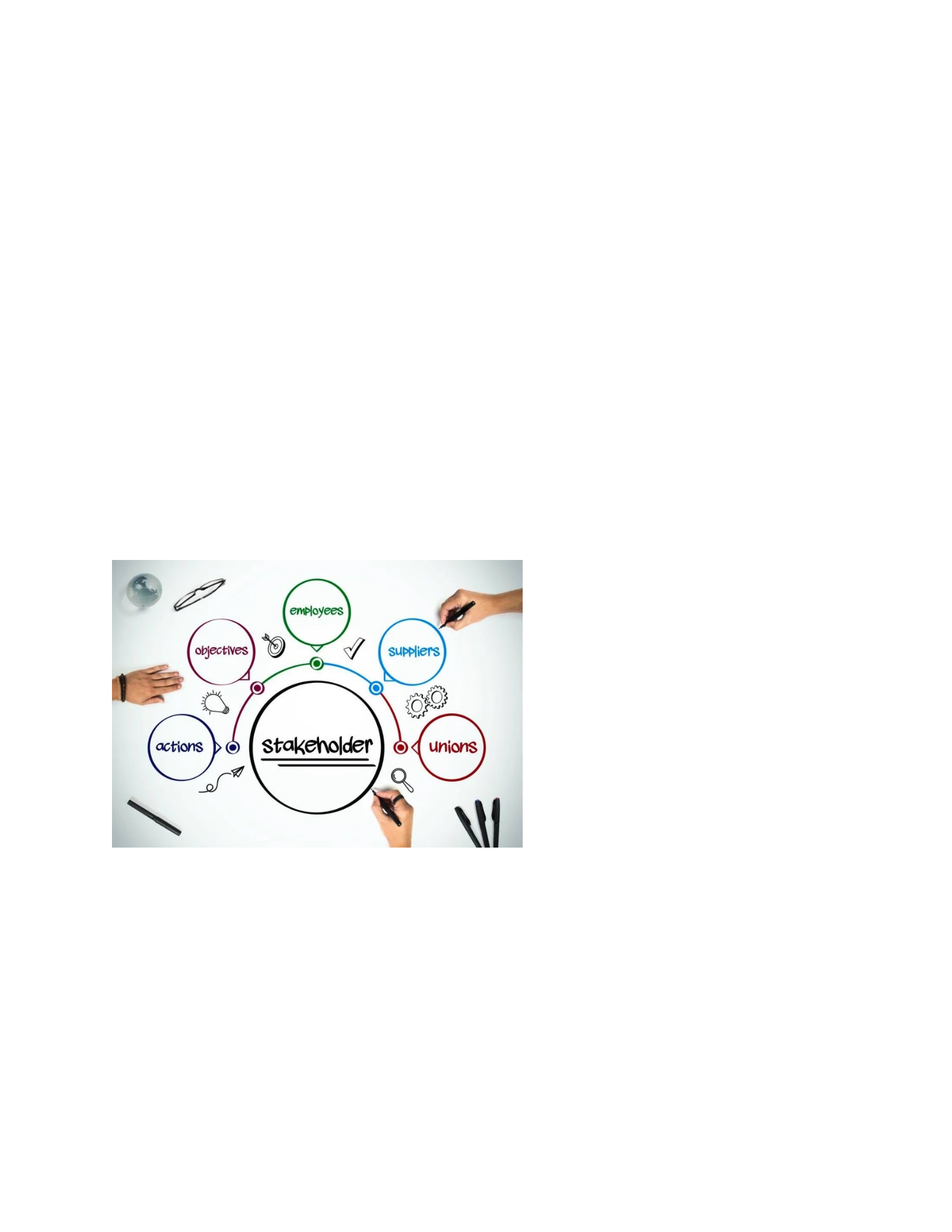
GETTY (2022). Business people are preparing a graph about "Stakeholder" on the desk
CRITICAL ANALYSIS ASSIGNMENT: BMAL560-B01
6
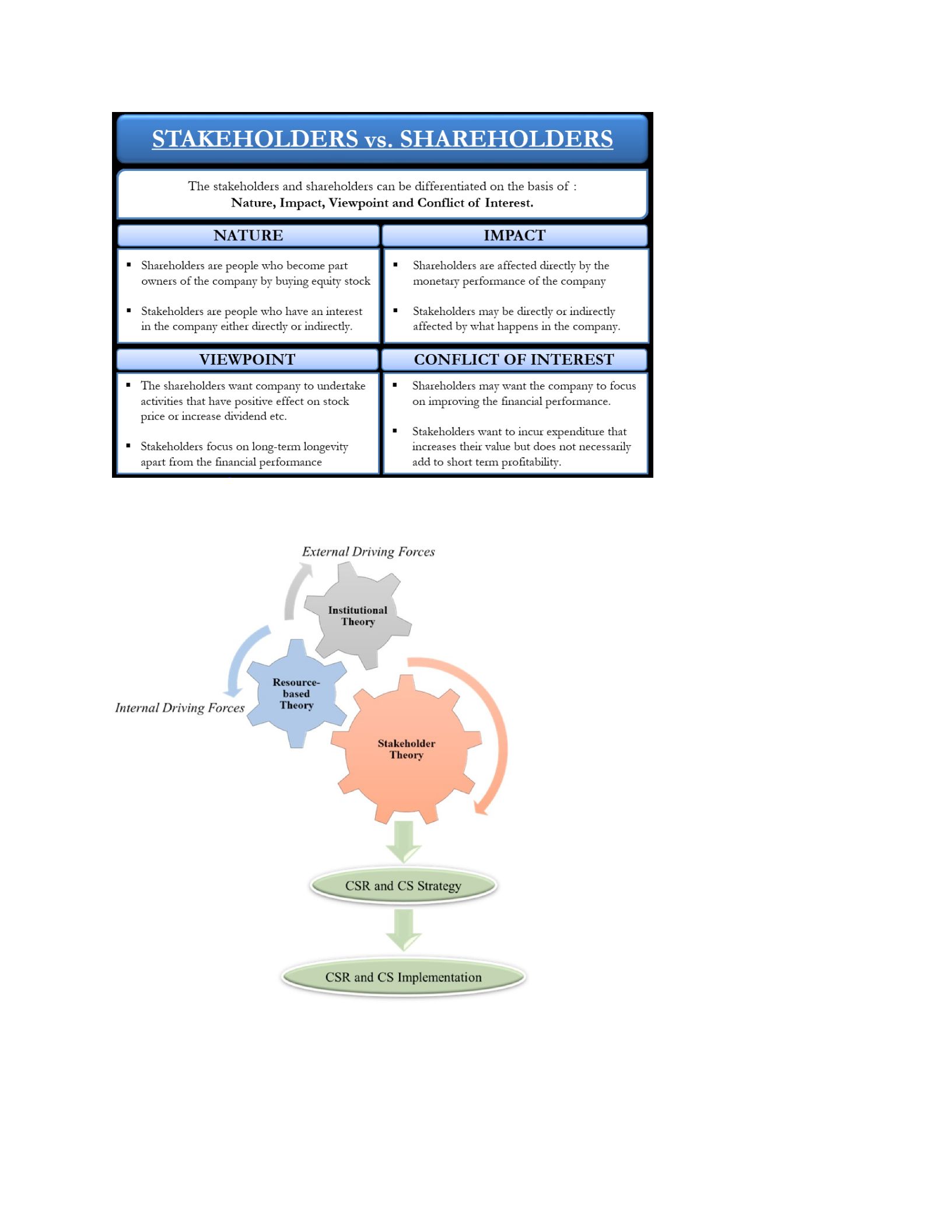
([Stakeholder vs Shareholders], 2024) Differences between Shareholder and Stakeholder
https://www.mdpi.com/sustainability/
sustainability-12-00760/article _deploy/html/ images /sustainability-12-00760-g003-550.jpg

CRITICAL ANALYSIS ASSIGNMENT: BMAL560-B01
7
PROSPECTS:
Companies are reworking their mission statements to focus more on their stakeholders
oThey must look after their employees and their communities wellbeing
oThey must ensure they best serve their customers and suppliers, protect the
environment, and weigh in on critical social issues
“Social and corporate governance (ESG) is the new corporate buzzword” (Loeb & Gemmill,
2022)
Ninety percent of global executives agree that the shift from shareholder to stakeholder
capitalism will continue (Lipton et al., 2017)
oManagers are more focused on ESG
oBoards are being counseled by a larger scope of advisors
Directors of Diversity
HR
Directors of ESR
Corporate social responsibility (CSR) is consistent with corporation maximization (Barnea &
Rubin, 2010)
Corporations will make shareholders happy if they:
o Serve customers brilliantly
oBe a fabulous place to work
oContribute meaningfully to the communities in which they operate
PROBLEMS:
Company managers may seek to over-invest in CSR for their private benefit to improve their
reputations as good global citizens and have a “warm-glow” effect. (Barnea & Rubin, 2010)

CRITICAL ANALYSIS ASSIGNMENT: BMAL560-B01
8
A company’s policy concerning CSR can create a conflict between different shareholders by
assuming that shareholder and stakeholder views are the same.
If companies make it their purpose to maximize shareholder value, shareholders are likely to
suffer because that gutlessness turns off customers, employees, and the world in general
(Martin, 2014)
The shareholder approach blurs the differences between social institutions and omits the
justification discourse
Action-oriented categories have misled both approaches
A great irony of the history of the theory of organizations is that both arguments, the
shareholder and the stakeholder approach, are flawed in the same way (Waldkirch, 2008)
Shareholder theory may present with the manager serving all interests and in the end will
serve none
PERFORMANCE:
Extremes on either theory can directly affect the other
Understanding the delicate balance between shareholder and stakeholder theories
Lipton et. al., (2017) envisions The New Paradigm as the relationship between corporations
and their stakeholders as one of collaboration and cooperation around the common goal of
creating sustainable long-term value
The New Paradigm underscores the need for long-term thinking by corporations and their
stakeholders to avoid crises that threaten the survival of businesses and the welfare and
prosperity of all market participants (Lipton et al.,2017)

CRITICAL ANALYSIS ASSIGNMENT: BMAL560-B01
9
The debate does have a resolution: To be aligned with Friedman’s optimization program,
stakeholders must be part of managers’ decisions so that firms internalize the wider
consequences of their actions (Bo & Lyons, 2020)
PUBLICATIONS:
References Cited:
Alon-Beck, A. (2022, March 30). We Are All ‘stakeholderists’ Now: Looks Like The Debate
Over The Purpose Of Corporations Might Be Settled.
https://www.forbes.com/sites/anatalonbeck/2022/03/28/we-are-all-stakeholderists-
now-looks-like-the-debate-over-the-purpose-of-corporations-might-be-settled/
Barnea, A., & Rubin, A. (2010). Corporate social responsibility as a conflict between
shareholders. Journal of Business Ethics, 97, 71-86. https://doi.org/10.1007/s10551-
010-0496-z
Berle, A. A., Means, G. C. (1934). The Modern Corporation and Private Property. United
States: Macmillan.
Bo, E. D., & Lyons, R. (2020, November 16). Corporate Responsibility and The Two Minds
of Milton Friedman. ProMarket. https://www.promarket.org/2020/11/16/corporate-
responsibility-milton-friedman-problem/
Borad, S. B. (2024). [Stakeholder vs Shareholders] [Graphic]. Efinancemanagment.com.
https://efinancemanagement.com/sources-of-finance/shareholders-vs-stakeholders
Dodd. E.M. (1932). For whom are corporate managers trustees? Harvard Law Review 45(7).
1145.
Friedman, M. (1970, September 13). A Friedman doctrine: The social responsibility of
business is to increase its profits. New York Times, Section SM, 17.
Fink, L. (2022). 2022 letter to CEOs: The power of capitalism. BlackRock.com.
https://www.blackrock.com/corporate/investor-relations/larry-fink-ceo-letter
Fisher, I. (1930). The theory of interest. New York: Macmillan.
Freeman, R.E. (1984). Strategic management: A stakeholder approach. Pitman, Boston

CRITICAL ANALYSIS ASSIGNMENT: BMAL560-B01
10
GETTY (2022). Business people are preparing a graph about "Stakeholder" on the desk
[Photograph]. Forbes.com.
https://imageio.forbes.com/specials-images/imageserve/6241ffb0278bd264569d02f1/
Grzegorzek, J. (2024, April 22). Stakeholder Conflict. Medium.
https://medium.com/@JerryGrzegorzek/stakeholder-conflict-6ac43061096bhttps://
www.mdpi.com/sustainability/sustainability-12-00760/article _deploy/html/ images
/sustainability-12-00760-g003-550.jpg
Jackson, K. V., (2011). Towards a stakeholder-shareholder theory of corporate governance:
A comparative analysis, Hastings Business Law Journal (7)30.
https://doi.org/10.1027/f10251-010-0012-zJensen, M. C. (2005). Value Maximization,
stakeholder theory, and the corporate objective function. Journal of Applied
Corporate Finance, 14(3), 8-21. https://doi.org/10.1111/j.1745-6622.2001.tb00434.x
Lawrence, A. T., Weber, J., Hill, V. D., & Wasieleski, D. (2023). Business and society:
Stakeholders, ethics, public policy (4th ed.). McGraw Hill
Loeb, H., & Gemmill, R. (2022, February 1). Managing shareholder vs. Stakeholder conflict
[Interview]. Financier Worldwide. https://www.financierworldwide.com/managing-
shareholder-vs-stakeholder-conflict
Lipton, M., Rosenblum, S. A., Niles, S. V., Lewis, S. J., Watanabe, K (2017, January 11).
The new paradigm: A roadmap for an implicit corporate governance partnership
between corporations and investors to achieve sustainable long-term investment and
growth. Harvard Law School Forum on Corporate Governance.
Martin, R. L. (2014, June 2). How to win an argument with Milton Friedman. Harvard
Business Review. https://hbr.org/2014/06/how-to-win-the-argument-with-milton-
friedman
Schoenmaker, D., Schramade, W., & Winter, J. (2023). Corporate governance beyond the
shareholder and stakeholder model. Erasmus Law Review, (1).
https://doi.org/10.5553/ELR.000237
Smith, H. J. (2003, July 15). The shareholder vs. Stakeholders debate. MITSloan
Management Review. https://sloanreview.mit.edu/article/the-shareholders-vs-
stakeholders-debate/

CRITICAL ANALYSIS ASSIGNMENT: BMAL560-B01
11
Waldkirch, R. W. (2008). The shareholder vs stakeholder debate reconsidered. Wcge.org.
https://www.wcge.org/images/wissenschaft/publikationen/DP_2008-
2_Ruediger_W._Waldkirch_-
_The_Shareholder_vs._Stakeholder_Debate_reconsidered.pdf
Zingales, L. (2020, October 13). Friedman's legacy: From doctrine to theorem. Promarket.
https://www.promarket.org/2020/10/13/milton-friedman-legacy-doctrine-theorem/
Websites and Internet Resources:
https://www.mdpi.com/sustainability/sustainability-12-00760/article _deploy/html/ images
/sustainability-12-00760-g003-550.jpg
https://www.investopedia.com/ask/answers/08/difference-between-a-shareholder-and-a-
stakeholder
https://corporatefinanceinstitute.com/resources
https://www.chuckgallagher.com/2013/04/24/business-ethics-theories-looking-at-the-
stockholder-theory-is-it-really-valid-today/
Journals, Periodicals, Brochures, etc.:
Harvard Business Review
Cambridge Law Review
Journal of Business Ethics
Journal of Applied Corporate Finance
Additional Resources for Further Study:
Anderson, S. R., Bryson, J. M. and Crosby, B. C. (1999). Leadership for the Common Good
Fieldbook, St. Paul, MN: University of Minnesota Extension Service.
Bryson, J. (2004). What to do when Stakeholders matter. Public Management Review, 6:1,
21-53.
Campbell, H. and Marshall, R. (2002). ‘Utilitarianism’s Bad Breath? A Re-evaluation of the
Public Interest Justification for Planning’. Planning Theory, 1:2 pp. 163 – 87
Phillips, R., Freeman, R. E., & Wicks, A. C. (2003). What Stakeholder Theory is Not.
Business Ethics Quarterly, 13(4), 479–502. doi:10.5840/beq200313434

CRITICAL ANALYSIS ASSIGNMENT: BMAL560-B01
12
Kaler, J. (2006). Evaluating Stakeholder Theory. Journal of Business Ethics
https://doi.org/10.1007/s10551-006-9089-2
• List publications, related references or links concerning this subject which can
serve as useful resources (they may or may not have been used in preparing the
template).
• List all bibliographic material using APA format.
• Annotate each entry in the list.

