


Project 2
Jeromy M. Sutphin
24622041
Liberty University
BMAL 500
Project 2
Abstract
This paper will serve as a synopsis of my participation in the MyManagementLab
assignments and “The Gospel and Personal Reflection. After reading our text and the provided
online assessments I feel that I have made strides and taken awareness in what it means to be a
more effective leader and professional. We all have our personal drives and finding out what
makes us tick is important to being able to work on bettering ourselves professionally.
Project 2
Step 1
Part 1
After taking the first few assessments in this assignment and reading about the
descriptions for my results it became apparent to me that I needed to be more honest or answer in
more detail about each question. I feel that I gave each question the right about time and correct
answers but I couldn’t help to try and be modest or not feel like I was bragging in certain
situations.
My personality insights were things that have become very aware to me over the years
and trying to be a better person, not just professionally but individually as a person, husband,
father, and soldier. One insight that stood out to me came from the self-awareness assessment
and stated that “to enhance your ability to increase self-awareness, take some time to write down
how you think you process information, what it means to you to be emotionally mature, how
your values align with those of your organization, and what it means to have a strong sense of
control over your emotions.” (Pearson, 2016) After looking at this assessment and what it means
to increase self-awareness I can see that leading up to the present I have taken strides in
particularly with that it means to be emotionally mature. Proverbs 14:29 comes to mind as
example of being emotionally mature, it states that “whoever is patient has great understanding,
but one who is quick tempered displays folly. (Holy Bible, NIV, 2011)
Not being quick tempered or quick to react in certain situations makes for good
leadership but it doesn’t account for anything if you cannot keep a calm head about you and
make good decisions when complications arise. This also comes from your values and
Project 2
motivations for success. Ethics will always be apparent to those around us in the workplace. We
were given an assessment on ethical leadership and I was told that “in this instrument the
concept of ethical leadership relates to your cognizance of the complex and competing values of
what is right or wrong.” (Pearson, 2016) What you deem as success will also lead to the display
of your value system and what motivates you to be a professional each day.
Part 2
Looking at what it takes to be a great communicator and leader is something I always
take great pride in. I claim to be no great leader but I understand something about
communication is not always what you’re saying but how you say it. People don’t like to be
talked down to or spoken at. The assessments we were given allowed us to gauge ourselves and
how we are as coworkers, leaders, and professionals. We looked at things like diagnosing the
need for team building exercises and what those can do for workplace morale.
Another section to look at for communication in the workplace is how to hand power and
conflict. Conflict is something that can be handled on any level and by every employee at some
point or another. As a supervisor you may deal with competing co-workers who are looking to
gain an edge on a promotion, you don’t want to damage their good work or their loyalty to their
career fields. In our text, Organizational Behavior, we read about how “effective teams need to
work together and take collective responsibility for completing significant tasks.” (Robbins and
Judge, 2009, p. 334) After reviewing the assessment and looking at the descriptions, it stood out
to me that my score from strategies for handling conflict shed light that “this means that you
probably have experience with more than one of these strategies but do not use them all
frequently, or you have one that you prefer over the others.”( Pearson, 2016) Working in the
Project 2
Department of Corrections we often deal with conflict and try to teach offenders how we can
better make decisions what using programming. This program is called “Thinking for a Change,
and defined as an integrated cognitive behavioral change program authored by Jack Bush, Ph.D.,
Barry Glick, Ph.D., and Juliana Taymans, Ph.D.” (Thinking for a Change, 2014) This program
was developed for the National Institute of Corrections and has been vital in the success of
helping inmates and youths to deal with conflict resolution and look at what it does to all those
involved.
Part 3
When looking at change and stress in the workplace I think it’s important to talk about
what stress can come from change. When it comes to organization structure it was stated in our
text Organizational Behavior that “teams can’t function if they can’t agree on who is to do what
and ensure that all members contribute equally in sharing the work load.” (Robbins & Judge,
2009, p. 328) When it deals with structure I think that a lot of stress can come from how teams
are developed and who ends up with leadership or seniority positions. Not all stress is bad
though, I think stress in the workplace will drive people to perform well and meet certain
deadlines. As and ENTJ it was easy for me to see my independent side and how I like to work in
relation to that fact. There were three categories given in our assessment for stress and were
listed as eliminating stressors, developing resiliency, and developing coping strategies.
Looking at how to deal with my career and where I want to go I think it’s vital that
dealing with stress be consistent. After scoring a high level and reading about how to deal with
stress effectively I think that allows for me to be able to work as a professional in many career
fields and have interests that range across the board. Organizational structure can deal with
Project 2
others stress by allowing for team building events or get-togethers to help people to relax.
Another option might be corporate gym memberships or having a stress free zone put in a vacant
area to allow for people to go an unwind during their break time and not be bothered with
deadlines or advancement.
Step 2
I think the first thing I learned about organizational behavior in the workplace is how I
can be an effective communicator to those around me and help them to feel less stressed or
involve them with hobbies or interests we may have in common. As far as being a manager and
dealing this these things I think it’s important to look at how I can be a better professional and
provide a more stable vision. Our text defined it as “interpersonal trust among team members
facilitates cooperation, reduces the need to monitor each other’s behavior, and bonds members
around the belief that others on the team won’t take advantage of them.” (Robbins & Judge,
2009, p.329)
Second, coming straight from the personality tests and their assessments I think I gained
an overall appreciation for the leader and professional I have become. Before starting the
assessment I wasn’t sure about what it would be like but after looking at the questions and seeing
my results I figured out that being modest was skewing my results. I don’t mean this to sound
arrogant but more reflective on being able to give myself credit for the growth in my career and
still being mindful of how to work on each deficiency from the personality tests. Displaying a
certain amount of confidence at work can allow for many opportunities to be a better co-worker,
employee, and supervisor.
Step 3
Project 2
I was labeled as and ENTJ and it’s described as being life’s natural leader. Growing up
and becoming a professional I didn’t really tend to think of myself as a leader or even see the
biblical importance that it held. Growing up through high school and college I was given the
opportunity to play basketball at a high level and make many friends through that time in my life.
The people-oriented energy leads me to being the life of the party and always being able to have
a good time. This is where the sin nature comes in and living a life of partying, drinking, and a
few other vices.
Stay with that point because it leads up to my weaknesses and God’s power to show love
through an unbelievable soul. After my collegiate years and trying to find a job I have bounced
through a few civilian careers and still spend time with the Army on weekends. Being an ENTJ
leads me to being independent and having weaknesses like being impatient or sometimes
insensitivity. To wrap all this up it’s as if I had my own Damascus road experience when one day
I saw the Light, Jesus Christ. I grew up in church and always knew about sin and where it would
take me but I didn’t really have a relationship with God until I was an adult. Since being saved I
have answered a call to share God’s word and done it through avenues I didn’t think possible.
God used those friendships I had from strength in my personality to take the weakness when I let
sin in my life. Those same friends I have had the privilege to preach in front of and even mentor
some in their own growth with God.
Matthew 5:16 is the verse that I try to keep with me always, it reads “ in the same way, let
your light shine before others, that they may see your good deeds and glorify your Father in
heaven.” (Holy Bible, NIV, 2011) When Jesus spoke those words I have to think he knew we
could apply this personally and professionally. Those words have helped lead my heart to caring
for others and not being so focused solely on my success and not worrying about others. I was
Project 2
given a gift of leadership and influence and thankfully God has shown me through knowledge
and continuing education what it means to be a true servant of others and how that is what
leadership is founded upon.
Project 2
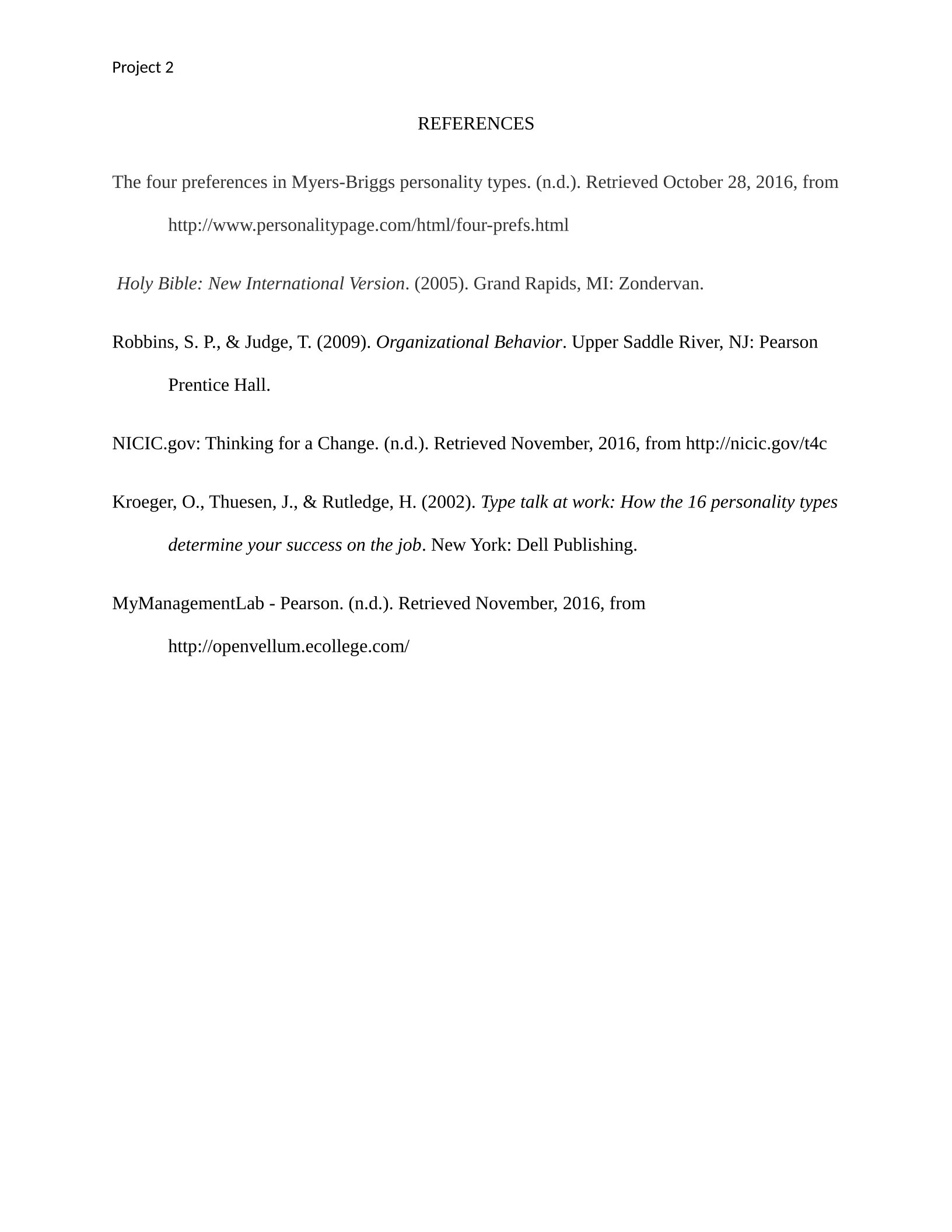
REFERENCES
The four preferences in Myers-Briggs personality types. (n.d.). Retrieved October 28, 2016, from
http://www.personalitypage.com/html/four-prefs.html
Holy Bible: New International Version. (2005). Grand Rapids, MI: Zondervan.
Robbins, S. P., & Judge, T. (2009). Organizational Behavior. Upper Saddle River, NJ: Pearson
Prentice Hall.
NICIC.gov: Thinking for a Change. (n.d.). Retrieved November, 2016, from http://nicic.gov/t4c
Kroeger, O., Thuesen, J., & Rutledge, H. (2002). Type talk at work: How the 16 personality types
determine your success on the job. New York: Dell Publishing.
MyManagementLab - Pearson. (n.d.). Retrieved November, 2016, from
http://openvellum.ecollege.com/
Powered by TCPDF (www.tcpdf.org)

