


Name: Grace Runkle
Date: December 3, 2023
VERSES STUDY WORKSHEET
SELECT THE VERSES:
Verses for study: Galatians 4:8-11
Allowed Verses of study you were assigned:
Galatians 4:8-20
EXAMINE, COMPARE, & CONTRAST TRANSLATIONS:
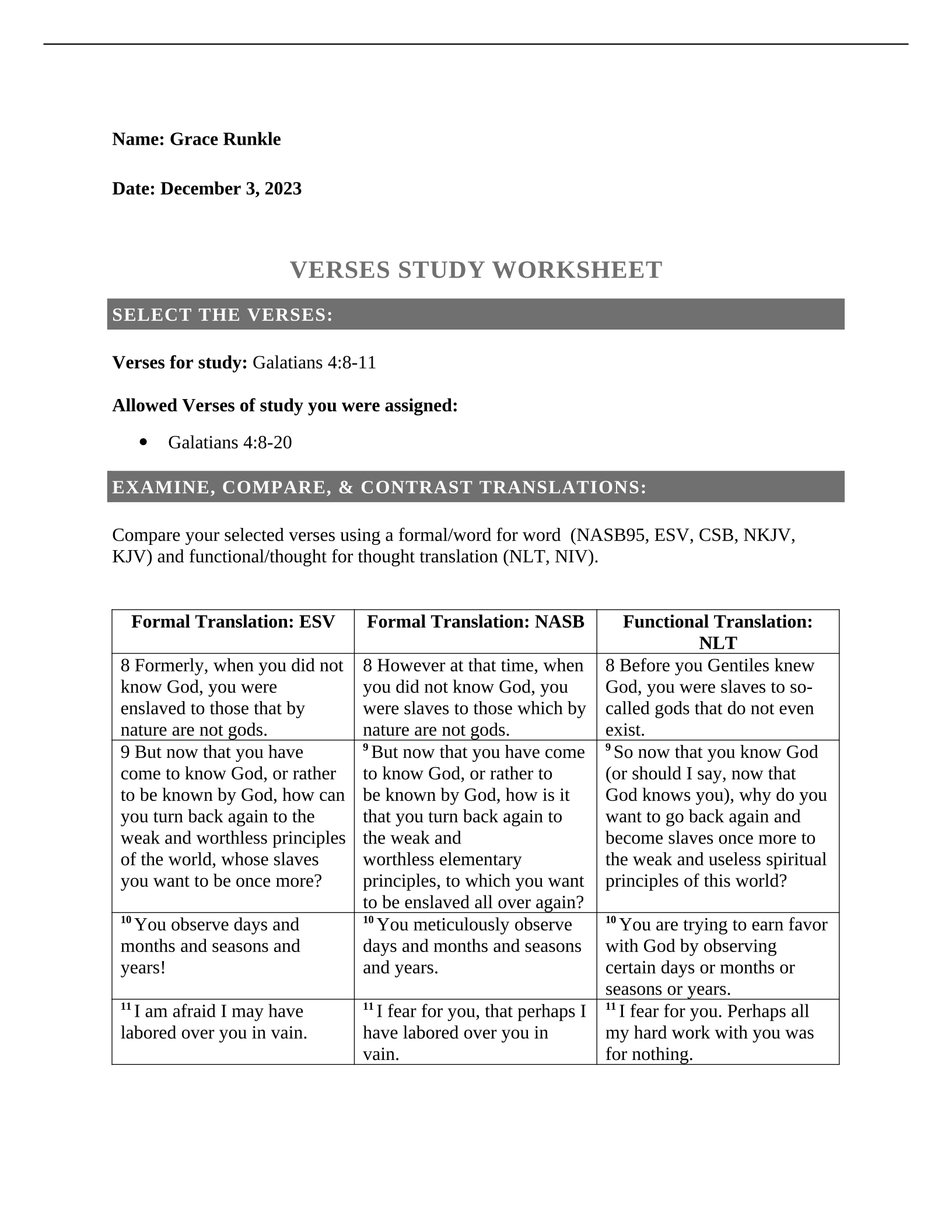
Compare your selected verses using a formal/word for word (NASB95, ESV, CSB, NKJV,
KJV) and functional/thought for thought translation (NLT, NIV).
Formal Translation: ESV Formal Translation: NASB Functional Translation:
NLT
8 Formerly, when you did not
know God, you were
enslaved to those that by
nature are not gods.
8 However at that time, when
you did not know God, you
were slaves to those which by
nature are not gods.
8 Before you Gentiles knew
God, you were slaves to so-
called gods that do not even
exist.
9 But now that you have
come to know God, or rather
to be known by God, how can
you turn back again to the
weak and worthless principles
of the world, whose slaves
you want to be once more?
93But now that you have come
to know God, or rather to
be7known by God,7how is it
that you turn back again to
the weak and
worthless7elementary
principles, to which you want
to be enslaved all over again?
93So now that you know God
(or should I say, now that
God knows you), why do you
want to go back again and
become slaves once more to
the weak and useless spiritual
principles of this world?7
103You observe days and
months and seasons and
years!7
103You7meticulously observe
days and months and seasons
and years.7
103You are trying to earn favor
with God by observing
certain days or months or
seasons or years.
113I am afraid7I may have
labored over you in vain.
113I fear for you, that perhaps I
have labored7over you in
vain.
113I fear for you. Perhaps all
my hard work with you was
for nothing.7

Similarities: There will undeniably be many similarities between the text, given that the Bible
has been scrutinized for parallels to ensure its legitimacy. Between the formal and functional
translation, a big similarity that one can notice is that many of the verses appear to be about the
same length. Many words are either exactly the same or are replaced by a close synonym of the
word. The sentence structure and order lines up in many verses, and if it does not exactly line up,
the meaning remains the same, with the order being the only thing that changed.
Differences: The major differences in this verse study are between the functional and formal
translations. Between the formal translations themselves, there are very few differences to be
noted. However, when comparing the functional NLT translation, there is a noticeable change in
the formality of the language. For example, in verse 9, parenthesis are used in the NLT
translation but not in the others. It seems as if the translation goes into more detail when it comes
to how the messages are conveyed.
EXPLORE THE VERSES IN-DEPTH AND DETAIL IN CONTEXT:
List your verses of study from your focal passage and then observe, interpret, explore these
verses:
*** Disclaimer: I could not find the New American Commentary & Dictionary in my Logos
library.
When observing and interpreting the context for Galatians 4:8-11, the use of resources in
this process provides a substantial and important basis for determining the proper translation and
meaning. The IVP Commentary tells us that for initial context, the Jewish faith in this timeline
was very knowledgeable about God, and that the pagans did not personally know their gods1.
This gives context to verse 8 and 9, explaining what Paul means when he says that the Jews did
not know God truly in the past. Macarthur shares information about the things Paul has
witnessed such as stonings in response to the gospel2. Yet even after witnessing these kinds of
troubles, he continues to fervently preach the gospel. Understanding this context demonstrates an
extra layer of loyalty as Paul urges the Galatians to not return back to a pointless slavery. Even
after everything, life in the Spirit is worth such a greater purpose and for such a more meaningful
existence.
Macarthur writes that verse 10 can either be interpreted as a question or as a fact3. This
verse points to the fact that Judaism participates in a special calendar containing “holy days, new
moons, sabbatical years and so forth4”. Paul’s meaning behind pointing this out is that he is
comparing this kind of requirement to pagan bondage. The Galatians are almost worshipping this
1 Craig S. Keener, The IVP Bible Background Commentary: New Testament, Second Edition. (Downers Grove, IL:
IVP Academic: An Imprint of InterVarsity Press, 2014), 533.
2 MacArthur, John.-Galatians. (Chicago: Moody Publishers, 1987), 115.
3 George, Timothy.-Galatians. Nashville, Tenn: Broadman Press, 1994, 270.
4 Keener, IVP Commentary, 533.
2
schedule, focusing on the things that connect them to the law rather than on their relationship in
Christ and highlighting faith.
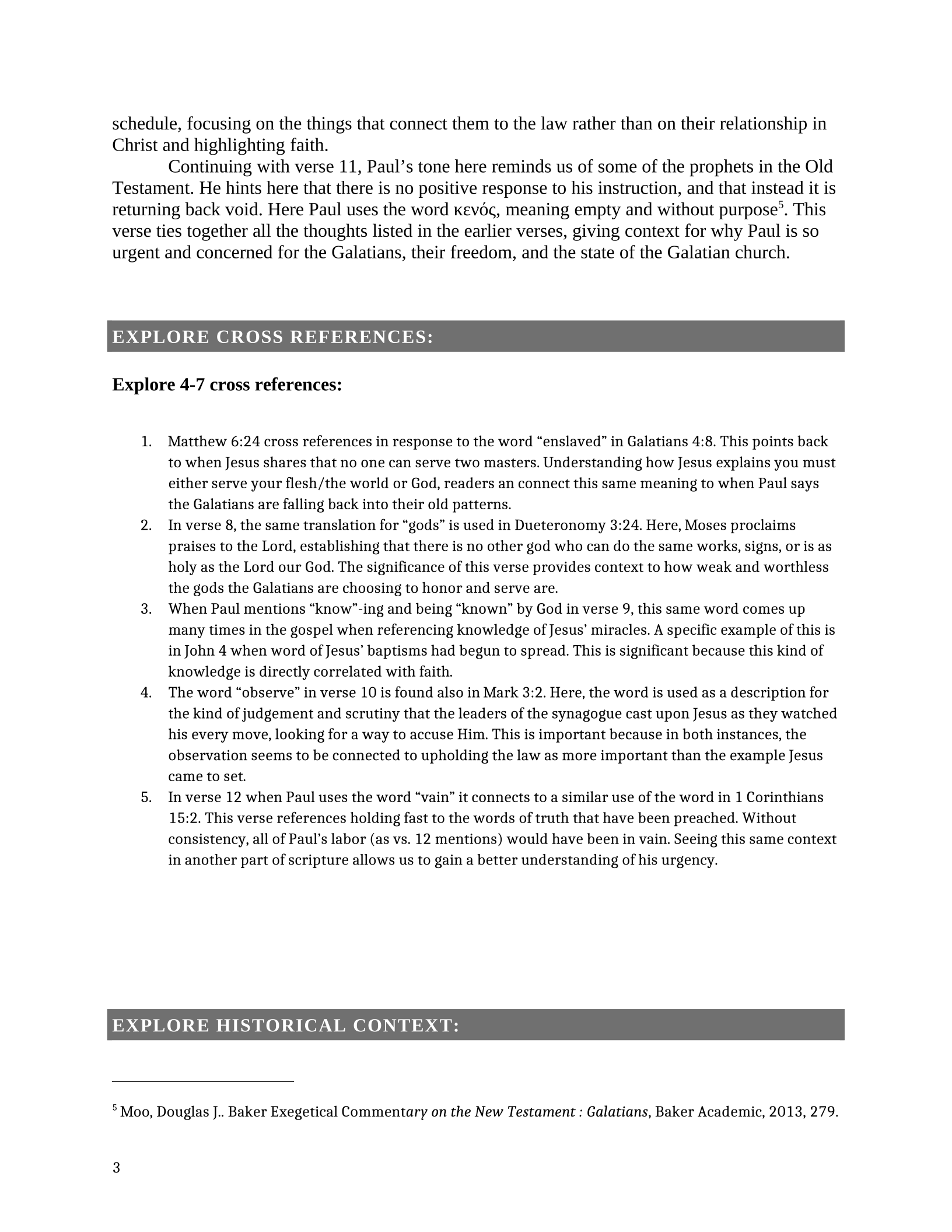
Continuing with verse 11, Paul’s tone here reminds us of some of the prophets in the Old
Testament. He hints here that there is no positive response to his instruction, and that instead it is
returning back void. Here Paul uses the word κενKς, meaning empty and without purpose5. This
verse ties together all the thoughts listed in the earlier verses, giving context for why Paul is so
urgent and concerned for the Galatians, their freedom, and the state of the Galatian church.
EXPLORE CROSS REFERENCES:
Explore 4-7 cross references:
1. Matthew 6:24 cross references in response to the word “enslaved” in Galatians 4:8. This points back
to when Jesus shares that no one can serve two masters. Understanding how Jesus explains you must
either serve your flesh/the world or God, readers an connect this same meaning to when Paul says
the Galatians are falling back into their old patterns.
2. In verse 8, the same translation for “gods” is used in Dueteronomy 3:24. Here, Moses proclaims
praises to the Lord, establishing that there is no other god who can do the same works, signs, or is as
holy as the Lord our God. The significance of this verse provides context to how weak and worthless
the gods the Galatians are choosing to honor and serve are.
3. When Paul mentions “know”-ing and being “known” by God in verse 9, this same word comes up
many times in the gospel when referencing knowledge of Jesus’ miracles. A specific example of this is
in John 4 when word of Jesus’ baptisms had begun to spread. This is significant because this kind of
knowledge is directly correlated with faith.
4. The word “observe” in verse 10 is found also in Mark 3:2. Here, the word is used as a description for
the kind of judgement and scrutiny that the leaders of the synagogue cast upon Jesus as they watched
his every move, looking for a way to accuse Him. This is important because in both instances, the
observation seems to be connected to upholding the law as more important than the example Jesus
came to set.
5. In verse 12 when Paul uses the word “vain” it connects to a similar use of the word in 1 Corinthians
15:2. This verse references holding fast to the words of truth that have been preached. Without
consistency, all of Paul’s labor (as vs. 12 mentions) would have been in vain. Seeing this same context
in another part of scripture allows us to gain a better understanding of his urgency.
EXPLORE HISTORICAL CONTEXT:
5 Moo, Douglas J..-Baker Exegetical Commentary on the New Testament : Galatians, Baker Academic, 2013, 279.
3
Author: Paul
Audience: The churches of Galatia
Date: A.D. 49-50
Purpose:
Paul’s purpose in writing Galatians was to call out negative legalism in their church culture,
teaching lessons like justification by faith, freedom and life in the Spirit, and unity within the
church body, directing back their actions to honor and prioritize the Lord.
DETERMINE THE MAIN POINT (WHAT IS TIMELESS PASSAGE
PRINCIPLE):
State: in 2-5 sentences the main thing the author is communicating through the passage.
Paul’s main thing he is communicating in Galatians 4:8-11 is that he is calling the believers in
the local church to the reality of the slavery to their flesh that they used to live in, showing how it
is an identity of bondage. Furthermore, he calls them to pursue the Lord rather than these old
bonds, because they now have access to truly know God through faith.
State: Use Elevator and Coffee Shop Illustration Process from Class
1. In Galatians 4, Paul talks about slavery in sin compared to freedom.
2. In the book of Galatians chapter 4, verses 8-11, Paul shares a unique perspective, comparing slavery
to sin with the now attainable freedom in Christ because of faith and because of His sacrifice.
3. When reading Galatians chapter 4, in verses 8-11, Paul calls out the churches of Galatia
in a unique way. Rather than just telling them of the goodness of life with Jesus, he calls
them out on their bad behavior. He says that they are going back to being slaves to the
“weak and miserable forces” that they once served before they truly knew God. He calls
them out on their judgments according to the law and explains his fear that all his efforts
are in vain.
DETERMINE THE APPLICATION (WHAT IS TIMELY):
A. Things to Know (God, Jesus Christ, The Holy Spirit, Humanity, Sin, Salvation, The
Church, Future Things, Doctrine & Theology):
After reading Galatians 4:8-11, you should know that God is a God who is willing and
able to be known. He is greater than the false gods of this world and of the culture when
4
this letter was written to the church of Galatia. Verse 9 shows us that knowing God is the
better alternative to slavery. This kind of knowledge brings freedom. We know that our
humanity can try to pull us back into slavery, as verse 8 states. Our sinful nature finds
comfort in bondage to other gods and fleshly desires. Yet because of salvation, we now
have access to freedom and personal knowledge/relationship with God. Verse 11 shows
Paul’s urgency in writing the church, desiring for their fruit to be unto the Lord not unto
the flesh. From the text, we can also know that if the church continues as it is, they will
continue to fall back into the old bondage they once lived in. This is why Paul is writing.
We also can observe here that there is one or the other. You are either in slavery to the
flesh, or finding freedom through your knowledge of God and His grace.
B. Things to Do (Repent, Believe, Grow, Love):
Now What?-
In response to this passage, repentance is the first step towards honoring the Lord. Now
having gained insight into the way that serving our flesh puts us in bondage, to break free
of this, we must fully repent from that sin. Practically speaking, I must get on my face
before the Lord, speaking out what I am turning away from and rebuking any hold the
sinful stronghold may have claimed on my life.
The next step is to seek the Lord wholeheartedly, seeking to know Him deeper and more
personally. Verses 8-9 alert me to the fact that there is indeed an opportunity to know
God if I just choose Him instead of our fleshly desires. There must be a commitment
made to the Lord in this step because this is something that must directly follow
repentance.
The next thing to do in response to this passage is to dive into more scripture passages
that focus on my identity in Christ and what it looks like to live that out. I must ask the
Lord to meet me in your prayer time. I will ask Him to give me visions, dreams, and
guidance on how to live set apart, a slave to righteousness, honoring Him in everything I
do.
C. What the Lord has shown me about me….
The Lord has shown me more about my righteous identity as an heir, as righteous, not as
a slave to sin and idolatry. Understanding this has given me a deeper and more beautiful
look into what it means to be a daughter of God, seeing Him as a gentle Father worthy of
praise, honor, and glory. He has shown me that the more time I spend with Him, reading
His word and pouring into Christian community, it allows me to grow deeper in my
relationship with Him and deeper in understanding of my true identity. It is a joy to help
share this knowledge with other believers. It is important to let them know that living
bound in their sin is not the fullness that Christ died for. He saved us so that we could
know Him. I can help others grow by walking in intentional discipleship. This semester, I
started disciplining a girl who is a year younger than me. It has been such a blessing to
help her grow into a relationship with God, knowing Him more this semester each day.
5
PRAYER:
Reflecting on your study, write out a prayer to God.
Dear Abba,
It’s an honor to know you. Thank you for loving me. Thank you for the opportunity to grow
closer to you in both my special time with you and in my classes. Thank you for giving me the
strength to make it through this semester. I have found so much joy in studying Galatians, and
have learned so much during my time reaching and responding to its wisdom. I’m so grateful
that you have shown me what it is to walk life with you, not living in slavery to my flesh
anymore. I am free to walk in righteousness through faith in my salvation, and that is the biggest
gift of all. I want to seek you more fervently every day. I repent from the ways that I have been
prioritizing things above you, and I cannot wait for what you have in store. It is a joy to do life
with you, Jesus. Please continue to meet me in your Word. I trust in you. In Jesus name, Amen.
RESOURCES USED:
Craig S. Keener, The IVP Bible Background Commentary: New Testament, Second Edition.
Downers Grove, IL: IVP Academic: An Imprint of InterVarsity Press, 2014.
George, Timothy.7Galatians. Nashville, Tenn: Broadman Press, 1994.
MacArthur, John.7Galatians. Chicago: Moody Publishers, 1987.
Moo, Douglas J..7Baker. Exegetical Commentary on the New Testament : Galatians, Baker
Academic, 2013.
6
Powered by TCPDF (www.tcpdf.org)

