


1
Chapter 1
Background of the Problem
Technology use is ubiquitous in daily life, and as it becomes further integrated into
society, it becomes essential that it also be integrated within classrooms and school curricula
(Alvermann, 2012; Merchant, 2008; Mills & Exley, 2014). Technology and its effects on
communication are changing the world of literacy within society, and students must be prepared
to contend with this new reality. To address this change, the National Council of Teachers of
English (NCTE) released a position statement regarding 21st century literacies stating, “Because
technology has increased the intensity and complexity of literate environments, the 21st century
demands that a literate person possess a wide range of abilities and competencies, many
literacies. These literacies are multiple, dynamic, and malleable” (NCTE, 2013, para. 1). These
new literacies, sometimes called multimodal literacies, are the ways we interact with technology
to communicate, create, receive, and represent information, and these new literacies are
continuously changing (Leu, Forzani, & Kennedy, 2013).
This concept of multimodal literacies is a key turning point in literacy education. Jewitt
(2008) argues, “It is not possible to think about literacy solely as a linguistic accomplishment….
The time for the habitual conjunction of language, print literacy, and learning is over” (p. 241).
Education must now address the use and instruction of multiple literacies, but research is needed
to ensure its implementation is appropriate and effective. Literacy researchers are attempting to
explore and examine these new literacies and their effects on literacy instruction and student
learning. One specific new literacies topic which needs more examination is digital writing with
young learners (Brown, 2014; Grünke, & Leonard-Zabel, 2015; Rowe, Miller, & Pacheco, 2014;
Sessions, Kang, & Womack, 2016).

2
Two arguments can be made for focusing research on digital writing with young learners.
First, as stated earlier, literacy, its use and instruction, is changing, and students must be prepared
to utilize technology in their day-to-day lives. Offering digital writing opportunities to even our
youngest students should be a priority (Sampson, Ortlieb, & Leung, 2016; Swaggerty, Atkinson,
& Cannon, 2015). Rowe et al. (2014) state, “To become effective twenty-first century
communicators, children need early opportunities to explore ways of combining print, images,
and other modalities to create interesting and effective digital texts” (p. 300). With more
research, school administrators and educators will understand the need to implement digital
writing with elementary students into their curricula. Mills and Exley (2014) state,
It is timely for governing agencies to reconsider the changing nature of writing across
levels of schooling… The systematic and continual inclusion of writing in digital formats
and specialist discourses of written communication needs to become a fundamental part
of transformed evaluative criteria. (p. 464)
Young students need experience with digital tools, and research can assist educators with
implementing these effectively in literacy instruction.
A second reason digital writing with young learners is an important topic for research has
a more pragmatic basis; overall, students’ writing skills need improvement. The most current
National Assessment of Educational Progress (NAEP) writing assessment for eighth and 12th
grades was conducted during 2011 and executed that year as a computer-based test for the first
time. The results revealed approximately 74% of eighth graders and 73% of 12th graders scored
below proficient with females scoring higher than males and suburban students scoring higher
than those in rural, town, or urban areas (National Center for Education Statistics, 2012). These

3
results attest to the crucial need for focused writing instruction and for that instruction to include
training with digital writing tools.
Writing instruction and student writing skills have gained more attention recently as the
use of national and state-mandated writing assessments have increased. One concern is that
often these assessments are executed on a digital platform though not all students have skilled
experience writing this way (Cheung, 2012; Sampson et al., 2016). As the NAEP results
communicate, students need more help with writing skills, and need it via digital tools. But, if
schools aren’t meeting the need for digital writing instruction, there are other avenues to
supplement instruction. One venue that could incorporate digital writing is afterschool
programs.
According to the Afterschool Alliance’s 2014 report, “Nearly one-quarter of families and
18% of children rely on afterschool programs to provide a safe and supportive environment,
inspire learning, and fill the gap between when the school day ends and when the work day ends”
(p.7). With the growing formation of afterschool programs, tutoring with digital writing is one
way to provide academic skills to students, preparing them for writing assessments, while also
helping them with technology skills they will need in the future workforce. Including digital
writing instruction in afterschool programs offers students more opportunities to improve their
writing abilities, a needed reinforcement with the increased focus on writing assessments and
current low-performance scores.
More research is needed on the digital writing process and its use by elementary students
so educators will know successful ways to help children with their writing (Brown, 2014, Grünke
& Leonard-Zabel, 2015; Sessions et al., 2016). This study examined elementary students’
experiences and perceptions with the digital writing process in an afterschool program to help

4
inform educators who seek to implement digital writing in classroom settings. With the
increased attention on writing skills and the growth of writing assessments for elementary ages,
this is a timely study focusing on children working through the digital writing process.
Personal Context
The focus of this study stems from my experiences with an undergraduate course I have
taught and have been assisting with throughout my tenure in the doctoral program. The class
involves training honors and education students to tutor second grade children in an afterschool
literacy program. Each tutor works with two children through a digital writing process to create
an e-book that is ultimately published into a hard copy. I taught the class during the first
semester it was offered. That semester, due to it being part of a revitalization effort of the
college literacy center to offer off-campus activities, an outside group was hired to evaluate the
afterschool program. Findings were complimentary with positive feedback from tutor, child, and
parent participants. Evaluators raised concerns regarding the lack of parent involvement, but
ultimately the report strengthened the belief that the program was beneficial to our
undergraduates and the children being tutored. However, with the evaluation completed, I still
had questions about the program and how the children were influenced by the digital writing
process.
The children were engaged and excited during the semester, and their end products were
well done. Their pride at being authors was evident, but there were still unknowns. Did the
children feel differently about themselves as writers now? Had their writing skills been
impacted? Did they find the use of digital technology more interesting and engaging than they
would had the project been done with paper and pencil? The semester I spent with the program

5
caused me to consider how the digital writing process was influencing the children and how they
were perceiving the program.
The next semester I continued to work with the afterschool program through my graduate
assistantship with the university’s literacy center. That semester a faculty professor taught the
course, and my schedule only allowed me to attend the first hour of the class. My role was to
help with set-up, bring the children from the cafeteria to our tutoring room, and assist with any
technology problems. During the rest of the week I graded assignments and handled class
communication. On Thursdays I helped organize a new facet of the program, book clubs. Four
volunteers and I led small-group book discussions on multicultural literature with the same
children who participated in the Tuesday tutoring. Since research has demonstrated that
academic tutoring is more effective if implemented at least twice a week (Cobb, 2001; Ellson,
Harris, & Barber, 1968; Juel, 1996), the book club was created to give the students in the
program a second opportunity to work on literacy skills.
This course was offered a third time and through my dissertation work I had an
opportunity to answer some of my questions about how the digital writing process influences the
children and their perceptions of themselves and their writing. I did not teach but again fulfilled
duties as a graduate assistant. My responsibilities were the same as the previous semester though
I was able to attend the entire class session assisting with any needs as they arose. This scenario
gave me full access for data collection with the program.
In regards to my position as a researcher, I am a Caucasian woman raised in rural West
Tennessee. I moved to a larger town in the region for undergraduate work and since then, I have
lived in Memphis for 12 years. I have much experience working with children and youth in an
academic capacity through classroom teaching, private tutoring, and afterschool care.

6
Theoretical Context
This study was grounded in the epistemology of constructionism (Berger & Luckmann,
1966). Crotty (1998) defines constructionism stating, “There is no objective truth waiting for us
to discover it. Truth, or meaning, comes into existence in and out of our engagement with the
realities of our world. Meaning is not discovered, but constructed” (pp. 8-9). To this definition,
Burr (2003) adds that “all ways of understanding are historically and culturally relative” (p. 4).
Therefore, constructed meaning (knowledge) is manifested from our cultural and social
interactions situated in a certain context of time or history. This epistemology creates the
foundation for the next layer of theory in this study, sociocultural theory.
The broad framework of sociocultural theory is derived from the work of Vygotsky
(1978) in which he states, “human learning presupposes a specific social nature and a process by
which children grow into the intellectual life of those around them” (p. 88). Therefore,
sociocultural theory views literacy as “a situated social practice” (Brandt & Clinton, 2002, p.
337). Barton and Hamilton (2000) point out, “Text does not have a set of functions independent
of the social meanings with which it is imbued” (p. 12). This theory allows for cultural and
social influences to be recognized in literacy activities. For example, words identified as slang
with connotative meanings in one ethnicity, social class, or generation can be read by others and
understood with an entirely different meaning due to each groups’ differing social
understandings and interactions. A table of high schoolers might refer to something innovative
and interesting as “sick” whereas a teacher overhearing the conversation unknowledgeable of the
slang meaning of the word would assume that the topic of discussion was of something
disgusting or gross. Thus, the social meaning determines the meaning of the word and affects
how people perceive it in their literacy practices. This theory acknowledges that social and

7
cultural influences affect literacy practices and events and affect those participating in these acts
of literacy.
The mid-level theory of New Literacies theory (Lankshear & Knobel, 2011; Leu, Kinzer,
Coiro, Castek, & Henry, 2013) was the final layer used to frame this study. This theory
acknowledges the variety of ways people can communicate through the use of technology, and
therefore, is used to broaden our understanding of literacy to include more than print text.
Knobel and Lankshear (2014) define the framework stating, “the idea of ‘new literacies’ focuses
on ways in which meaning-making practices are evolving under contemporary conditions that
include, but are in no way limited to, technological changes associated with the rise and
proliferation of digital electronics” (p. 97). New Literacies theory incorporates the
multimodality of literacy, which means through technology, communication can now be
transmitted not only via text, but sounds, images, and video. This theoretical framework allows
a place for multimodality to be considered and included in a more broadly defined literacy.
In sum, the epistemological and theoretical frameworks of this study were grounded first
with constructionism, a belief that the participants’ constructed reality is the truth that will define
the study’s outcome. Since the research was an examination of the children’s experiences and
perspectives, the foundation for this study was a belief that truth and knowledge are defined and
understood though individuals’ interactions with the world. Secondly, sociocultural theory was
used to acknowledge the social and cultural aspects that impact learning. This was important
with this study because the children participating in the digital writing process brought with them
social and cultural understandings of writing and of technology use. These understandings also
impacted how they interacted with their tutors and participated in the literacy activities. These
factors impacted their learning and involvement with the digital writing process. Finally, New

8
Literacies theory was an essential component of this framework since it acknowledges the
revolutionary effect technology has had on literacy and on society’s means of communication.
Through this lens, the study recognized how digital writing can be developed through
nontraditional avenues and helped examine how children were influenced by the digital writing
process.
Statement of the Problem and Research Questions
This qualitative case study grounded in sociocultural and New Literacies theories was
conducted with eight tutors and sixteen children from a university-sponsored off-campus
afterschool literacy program located in a medium-sized urban city in the Mid-South. Data
included semi-structured interviews with six child participants, participant observation, program
artifacts, and a researcher’s journal. The purpose of this study was to examine how a digital
writing process influences the second-grade participants according to the students and their
tutors. The following questions guided this study: (a) How does a digital writing process
influence children’s motivation in writing? (b) How does a digital writing process influence
children’s engagement in writing? (c) How does a digital writing process influence children’s
writing skills and performance? (d) How does a digital writing process influence children’s
writing identities? (e) What are the issues and concerns with this digital writing process?
Researchers have called for more data regarding the digital writing process as it impacts
student learning (Hutchison, Beschorner, & Schmidt-Crawford, 2012; Sessions et al., 2016;
Zheng, Warschauer, & Farkas, 2013). Sessions et al. (2016) state, “Although there has been
much research into technology integration in literacy instruction, it has focused primarily on
reading instruction.…Technology integration, specifically integration of iPad and writing-
specific educational applications, in writing instruction in elementary classrooms has barely been

9
discussed” (p. 219). Regarding this study’s specific questions on motivation and engagement,
Vue et al. (2016) assert, “There is a significant need for more research to understand the role of
motivation in writing and ways that digital technology can enhance writing instruction and
student engagement in writing” (p. 92).
This study sought to extend knowledge on the effects of the digital writing process with
elementary children, a need which the literature points to as lacking (Brown, 2014; Sessions et
al., 2016). The digital writing process is now one of many ways written communication can
occur and the lack of research on this facet of literacy is a detriment to students and teachers
(Northrop & Killeen, 2013; Wollscheid, Sjaastad, Tømte, & Løver, 2016). This study sought to
expound on how the digital writing process influences children’s motivation and engagement
toward writing, their skills and performance, and their writing identities.
Summary
This chapter introduced the background of the problem, which includes, first, the
complex change occurring with literacy instruction due to the increase of communicative
technologies and, second, the increase in state and national writing assessments on digital
platforms and students’ subsequent poor performance on these tests. The need for more research
to examine the impact of the digital writing process on early elementary children was presented
as the focus of the research study. The following chapter discusses the theory that grounded this
study as well as the literature from the field which sets the context and understanding needed for
this study. The literature review begins with an overview of afterschool programs and an outline
of the digital writing process. It continues with a review of literature on the use of technology in
educational settings while next focusing on research involving digital writing. Chapter three
details the methodology and methods selected as appropriate for examining a digital writing

10
process in an afterschool program and also provides an overview of the data analysis techniques
to be used.

11
Chapter 2
Theory and Literature
The following chapter covers two sections pertinent to this study: the theoretical
framework and a review of literature. The theory section begins with the epistemology and
macro level theory that supported this study followed by the mid-level, discipline-specific theory
that framed this work. The second section covers the literature regarding research on afterschool
programs as well as a definition and description of the digital writing process. This is followed
by a review of literature on technology use in literacy education and how digital writing
influences students’ performance, engagement and motivation, and their writing identities.
Theoretical Framework
Epistemology and Macro Level Theory
The theoretical framework of this study was grounded in the epistemology of
constructionism which holds that knowledge and truth are subjective. Crotty (1998) cites
constructionism as the belief that “truth, or meaning, comes into existence in and out of our
engagement with the realities of our world. Meaning is not discovered, but constructed” (pp. 8-
9). Research from this standpoint seeks to explore “the way people interpret and make sense of
their experiences” (Grbich, 2009, p.8). Therefore, reality is personally constructed, and this idea
creates the foundation for the tenets of sociocultural theory.
Further narrowing a researcher’s beliefs, the theoretical perspective is used as the lens
that focuses her research and, therefore, must fit with the underlying tenets of the chosen
epistemology. Theory is essential in research as it is the filter through which the experiences are
understood and analyzed. A theoretical perspective is “a way of looking at the world and
making sense of it” (Crotty, 1998, p. 8). The chosen framework of sociocultural theory

12
essentially views literacy as “a situated social practice” where literacy activities are entrenched
in social structures and thus help shape those structures (Brandt & Clinton, 2002, p. 337).
Furthering the concept of the sociocultural underpinnings of literacy, Barton and
Hamilton (2000) point out, “Text also does not have a set of functions independent of the social
meanings with which it is imbued” (p. 12). Gee (1999) also makes this point writing, “The fact
is that words give meaning to contexts just as surely as contexts give meaning to words. Words
and context are two mirrors facing each other, infinitely and simultaneously reflecting each
other” (p. 187). Consequently, this theory acknowledges that social and cultural interactions
affect literacy and those participating in literacy.
Sociocultural theory is derived from the work of Vygotsky (1978) and is an overarching
concept that covers several specific theories including the mid-level theory of this study, New
Literacies theory. What unites these specific theories under the umbrella of sociocultural theory,
according to Perry (2012), is emphasis “on the social and cultural contexts in which literacy is
practiced” (p. 51). Being within the sociocultural spectrum, these various theories often utilize
themes of “culture, activity, identity, power, and the sociocultural contexts in which literacy
occurs” (p. 51). By looking at the context in which literacy is situated, we can “illuminate the
diverse forms and meanings that literacy takes on” (Brandt & Clinton, 2002, p. 340). Therefore,
with this theory, “Writing does not occur in a vacuum but is affected by social relationships,
institutional belongings, membership in various communities, and so on” (Slavok, 2015, p. 82).
Along with considering this study through its social and cultural context, New Literacies theory
was applied as the mid-level theory.

13
Mid-level Theory
While considering the situated social practice of a literacy event, adding the layer of New
Literacies theory allows an examination of communicative technology and the implications this
technology brings to discussions of literacy. New Literacies theorists argue that literacy can no
longer be examined or studied without considering technology’s impact (Coiro, Knobel,
Lankshear, & Leu, 2008; Jewitt, 2008; Rowsell & Walsh, 2011). Kress (2003) states, “The
major change is that we can no longer treat literacy (or language) as the sole, the main, let alone
the major means for representation and communication" (p. 35). Leu, Kinzer, et al. (2013) agree
that new literacies have created new social practices and outline eight tenants of New Literacies
theory,
1. The Internet is this generation’s defining technology for literacy and learning within our
global community.
2. The Internet and related technologies require new literacies to fully access their potential.
3. New literacies are deictic; they rapidly change.
4. New literacies are multiple, multi-modal, and multi-faceted, and, as a result, our
understanding of them benefits from multiple points of view.
5. Critical literacies are central to new literacies.
6. New forms of strategic knowledge are required with new literacies.
7. New social practices are a central element of new literacies.
8. Teachers become more important, though their role changes, within new literacy
classrooms. (p. 1158)
Leu, Kinzer, et al.’s list offers a glimpse of the difficultly in encapsulating new literacies. They
are multiple, ever-changing, and require a new way of thinking.

14
Lankshear and Knobel (2011) define New Literacies theory as “the idea that changes
have occurred in the character and substance of literacies that are associated with larger changes
in technology, institutions, media and the economy and [the globalization of] manufacture,
finance, communications, and so on” (p.28). New Literacies theory allows the researcher to
consider two issues with literacy: (1) the technological changes to communication and (2) how
those changes have impacted the social practices of literacy. This first change to literacy is
realized through the varied ways communication now occurs. The electronic creation,
distribution, and receipt of textual information is now manifested in a variety of multimodal
forms, much more than ink and paper texts. These multiple means of communication are the
basis for the term literacies. Rowsell and Walsh (2011) state, “Making literacy plural signals
that there is more than simply one model of literacy, there are many different literacies that shift
with contexts, texts, and the identities of people using literacy” (p.55). Images, hyperlinks, and
sound are a few of the technological changes now incorporated into digital writing with text
messaging, wikis, and blogs being platforms for digital writing. Each of these are examples of
ways technology has transformed communication.
Secondly, Lankshear and Knobel (2011) state these changes have altered “values” and
“social and cultural relations” so that it is “plausible to distinguish between conventional and
new literacies in a broad way” (p. 29). These social changes include how information is
accessed and received. For example, the authors explain that new literacies tend to be more
“participatory” and “distributed” rather than “individuated” and “published” (p. 29). Kress
(2003) states, “The new information and communication technologies have produced the
technological condition where all can publish to all, and by means of the enormous change they
have abolished the era of mass communication" (p. 17). Digital formats have multiplied student

15
options for sharing their writing and multimodal compositions (Kress, 2003). With a click of a
button, students can have a global audience for their work. This change has not only altered the
way we identify literacy, but it has also affected the way we participate in the social practice of
literacy, “what people do with reading, writing, and texts in real world contexts and why they do
it” (Perry, 2012, p. 54).
This paradigm shift in literacy has altered the way it is acknowledged and taught, with
written and spoken means no longer the central focus (Kress, 2000; Kress & Van Leeuwen,
2001). Bailey (2009) writes, “An ability to read visual and aural texts is increasingly regarded as
a skill embedded in literacy practices” (p. 209). These visual and aural components of new
literacies create meanings, according to Lemke (1998), that “are not fixed and additive (the word
meaning plus the picture meaning), but multiplicative (word meaning modified by image
context, image meaning modified by textual context), making a whole far greater than the simple
sum of its parts” (p. 283–284). New Literacies theory was an essential framework for this study
since the research incorporates technology use, and this theory allows for the research to be
viewed through this altered understanding of literacy.
Literature Review
The purpose of this literature review is to help situate the reader in the scholarly research
of which this study was based. Due to the research being set in an afterschool program, this
section begins with current relevant findings dealing with afterschool programs. The review then
defines and describes the digital writing process which is followed by pertinent research on the
topic of technology use in literacy education. Finally, the review ends with findings regarding
student experiences with digital writing, specifically how the digital writing process influences

16
students’ skills and performance, their motivation and engagement, and finally, their writing
identities.
Afterschool Programs
Afterschool programs have been a mainstay of society starting in the late 1800s as the
creation of child labor laws liberated children’s afterschool time (Halpern, 2002). Programs
continued to increase in popularity during the mid-1900’s as mothers steadily joined the
workforce (Lauzon, 2013). There are as many variances in afterschool program content as there
are sites that implement them, but tutoring through skills reinforcement is a common theme.
Consequently, research has established that students who participate in academic afterschool
programs perform better in the classroom than their peers who do not attend (Vandell, Reisner,
& Pierce, 2007). A focus on academics continues to be a main afterschool purpose in the 21st
century (Reisman, 2005) and now many programs seek to implement technology to prepare their
students for the 21st century workforce and make their curriculum relevant and current to our
tech-laden society.
Research reveals afterschool sites offer a variety of tech integration for students from
STEM programs (Eglash, Gilbert, Taylor, & Geier, 2013; Schnittka, Brandt, Jones, & Evans,
2012) to tech integration with project-based learning (Bell, 2010) to movie-making programs
with multimodal literacy (Brass, 2008). Conversely, some programs utilize technology such as
webcams and video conferencing as a means to provide academic tutoring in afterschool
programs for geographical areas where high-quality tutoring services are lacking (Houge,
Peyton, Geier, & Petrie, 2007; Vasquez & Slocum, 2012). However, a key component to a
successful tech-centric afterschool program is the proper implementation and integration of
technology based on what the participants need (Biancarosa & Griffiths, 2012; Fokkena, 2011).

17
Lauzon (2013) argues that afterschool programs are perfect opportunities for students
who are pushed to the margins in the traditional classroom to find the infrastructure needed to
“potentially mitigate some of the more negative impacts of the changing formal educational
system” (p. 776). Engaging struggling students in an afterschool program, especially one that
utilizes technology, can not only improve their academic skills but offer them a better chance of
success in post-graduation society. Since students in low socio-economic situations often do not
have access to technology at home, afterschool programs with technology embedded can be an
important avenue for students to have exposure to and practice with technology.
An important issue to note is that blindly integrating technology into a program will not
automatically solve the problem of a student’s lack of tech knowledge, and successful
technology implementation "stems from the types of learning opportunities that are made
available to students" (Willmett & Curwood, 2014, p. 255). Fokkena (2011) discusses her
experience working in various afterschool programs, all of which had some form of technology
use, and warns, “Without a clear plan for technology’s integration into afterschool programming,
the haves are able to build on their existing experience and resources to make dynamic use of
new media and new technologies, while the have-nots struggle to keep up” (pp. 26-27). As with
any instructional tool, the use of technology in an afterschool program must have a rationale that
is tied to student learning and skill improvement.
Defining the Digital Writing Process
The idea of instructing writing through a process approach versus writing to create a
product began with research and theories in the 1970s by researchers such as Janet Emig (1977),
Donald Graves (1975), and Donald Murray (1972/1997). Theories of the cognitive processes
needed to compose became clearer with work by John Hayes and Linda Flower (1980). These

18
initial frameworks included three steps to writing: prewriting, writing, rewriting (Murray,
1972/1997) or with terms similar to these. Current pedagogy defines the writing process in five
stages, though it is imperative to remember these stages are recursive and writers move through
and revisit each as needed (Graves, 1983).
The instructional phases of the writing process are the cyclical progression through pre-
writing, drafting, revising, editing, and publishing written material with much feedback (teacher
and peer) given during the drafting, revising, and editing phases. In the pre-writing stage, writers
decide on a topic. Sometimes topics have to be assigned, but research has substantiated that
students are more motivated when they are allowed to choose their own (Graves, 1976). During
this stage writers also decide their purpose for writing which leads to determining their audience
and the form their writing will take. Having an authentic audience encourages students to
identify themselves as authors (Rubenstein, 1998). Finally, writers in this stage collect ideas and
organize their thoughts about their topic. This involves activating prior knowledge and
organizing thoughts through using concept maps and graphic organizers, drawing, talking,
researching and/or reading about the topic. In a digital environment, this stage could utilize the
Internet for research, or writers may communicate electronically with others about ideas.
Drafting is the stage where writers focus on creating the bulk of their content. Errors are
common during this phase and should not be pointed out or corrected; otherwise, students will
believe correctness is more important than content (Sommers, 1982). Using digital means for
drafting could save time if students have strong typing skills. Next, revising work incorporates
personal rereading, feedback from the teacher and peers to strengthen the work, then rewriting
based on reader suggestions. Students (especially inexperienced writers) may see this phase as a
negative assessment and become discouraged (Heard, 2002), but it is a vital step where students

19
learn over time and through lessons on effective writing how to spot weak work. Revisions
include moving, deleting, adding, and/or substituting text (Faigley & Witte, 1981). Technology
allows for comments and tracked changes to be inserted directly into documents as writers seek
feedback for revising.
Writers then move into the editing phase. Here, errors are located through proofreading
and are corrected. With a digital process, computer word processing software aids the editing
process with automatic spelling and grammar corrections. After (possibly several) reiterations of
these stages, the final step is publishing—an essential stage to encourage students to persevere
through revisions and editing (Elbow, 2002). Publishing can occur through sharing with
classmates or family, and simple binding by stapling can create booklets. Students can share
writing via public digital postings on class websites, blogs, or wikis. When students have a
purposeful, “real-world writing experience” and authentic audience during this final stage, it
helps “to promote the formation of their identity as a writer” (Spanke & Paul, 2015, p. 179).
Finally, an important aspect which can aid the writing process is the creation of a
environment of support. Angelillo (2008) cites the need for trust and honesty as this affects
students' motivation and writing development. Students need a safe place for sharing their ideas
and compositions, a community that nurtures creativity. This atmosphere should pervade all
stages of the writing process to support and foster effective writers.
Technology Implementation in Literacy Education
Technology use has been incorporated in literacy education in varying degrees for years,
but as information and communication technologies evolve and change, educators must strive to
keep the pace so students are prepared for our digital society. In 2009, the International Literacy
Association (ILA) issued this position regarding technology implementation,

20
To become fully literate in today’s world, students must become proficient in the new
literacies of 21st-century technologies. As a result, literacy educators have a
responsibility to effectively integrate these new technologies into the curriculum,
preparing students for the literacy future they deserve. (ILA, 2009, p. 1)
Along with ILA, some researchers have cited the need for technology use to be incorporated into
school standards and curricular plans (Mills & Exley, 2014; Rowe et al., 2014). Specific to
digital writing, Mills and Exley (2014) argue for digital writing and multimodal text to be
included and required in school curricula, “It is timely for governing agencies to reconsider the
changing nature of writing across levels of schooling, and … to accommodate new specialist
forms of digital text creation” (p. 464). With a regulated emphasis from governing school
agencies, consistent implementation of information and communication technologies would be
required. Rowe et al. (2014) argue this implementation of new literacies needs to begin at an
early age,
To become effective twenty-first century communicators, children need early
opportunities to explore ways of combining print, images, and other modalities to create
interesting and effective digital texts. While young children are often offered
opportunities to be consumers of electronic games and digital stories, we believe that it is
also important to give them opportunities to be active designers of digital content. (p.
300)
Exposing students to the technology tools that broaden our understanding of literacy will provide
them with much needed practice and preparation for a 21st century workforce.
Conversely, as discussed with afterschool programs, there is a danger of technology
being required in educational spaces without a clear, established purpose (Graham & Harris,

21
2016). In regards to technology being used with literacy instruction, Biancarosa and Griffiths
(2012) warn, “Students need more than access to technology; they need to learn how to apply it
strategically to advance their literacy skills— especially the conceptual and knowledge based
capacities that become crucial in later literacy tasks” (p. 142). Obviously technology use will not
magically cure students’ literacy issues, and these tools must be applied with thought to the
individual learner and what best will support his or her learning. Again, Biancarosa and Griffiths
(2012) advocate that technology use with instruction “must be embedded strategically within
cohesive, evidence-based educational programs” (p. 142). Teachers should be wary of putting
technology in a program for literacy development without a focused purpose for skill instruction.
Finding the proper technology fit for students’ needs is not an easy task. The explosion
of tech products makes for difficult navigation when deciding what will be most effective with
literacy education. Looking at research on literacy technology can be a difficult task as
Biancarosa and Griffiths (2012) state the difficulty with generalizing research conclusions, “it
[is] hard to draw generalized conclusions from research, because each device and application has
specific features and limitations. Thus, claims made about one form of technology with specific
features may not apply to another form” (p. 143). It is important to know not only what the
technology can offer, but also to consider how the technology will best fit into the instructional
needs for improving literacy.
Teachers must be wary of the pitfall of using technology only to improve students’ tech
skills when it could also be used as a tool to specifically improve literacy skills (Hutchison et al.,
2012). Schugar, Smith, and Schugar’s (2013) research found that teachers’ classroom tablet use,
“sometimes focused on the usability of the device instead of the content they were trying to
teach” (p. 618). Northrop and Killeen (2013) state iPads should be implemented with instruction

22
in a “careful and deliberate way to ensure learning and development of early literacy skills” (p.
531). Scaffolding is key (Willmett & Curwood, 2014). Consequently, Hutchison and Reinking
(2011) and Hutchison et al. (2012) cite technology use in literacy classrooms is more often
implemented for improving technology skills rather than integrated within the curriculum for the
purpose of supporting the learning of literacy skills.
Research also voices another concern of which educators must be aware, one that stems
from assumptions students may make regarding their own abilities with technology (Hutchison,
Woodward, & Colwell, 2016). Willmett and Curwood (2014) explain that students may have
social knowledge of how to use technology but often there is a lack of knowledge with the
educational function of technology. Their research findings from 40 eighth graders revealed the
students believed they were quite adept with iPad technology but classroom observations and
teacher interviews determined quite the opposite. Hutchison et al. (2016) state,
Teachers should assess the practices in which students engage on digital devices when
not in school, and make explicit connections for students to in-school instructional
activities. Building these connections for students will not only strengthen their
understanding of how to use digital tools for school purposes but also model the
possibilities through demonstration of the relevance of their out-of-school lives to in-
school learning. (p. 16)
Educators and students alike must remember that though we are surrounded by technology in our
everyday lives, it does not always equate to educational expertise with these devices.
Remembering that students may need guided instruction for using technology for
educational functions leads to interesting research from Hutchison et al. (2016). These
researchers targeted preadolescents (defined 9-12 years old) and their findings communicate

23
many misconceptions on how pre-adolescents use and perceive technology. In their study,
fourth and fifth graders (n = 1,262) were surveyed to gain insight to their “online activities,
perceptions, preferences, and skills” (p. 1). The participants were mainly Caucasian and from a
relatively affluent community with ubiquitous access to technology including access in schools.
The researchers’ findings cite these preadolescents are participating in more digital tasks in
school than out, and the in-school digital tasks were reported as mainly information consumption
rather than the production of creative media. Online social activities to connect and
communicate were the least of the activities as these preadolescents mainly used the Internet to
consume information. Students reported preferring Internet use, yet claimed reading a book is
easier and a way to learn more than using the Internet.
These findings drive home the point that making assumptions about student abilities with
technology or with how they use technology is a dangerous proposition in educational settings
and reinforces Hutchison et al.’s (2016) previously cited statement that teachers should access
how students use devices outside of school so that connections to their existing practice can be
made to classroom practices (p.16). Conversely, educators should be wary to assume all children
have had technology access. Martin and Lambert (2015) write, “Broad assumptions about
today’s adolescents may mask important differences in their digital writing experiences” (p.
219). The authors cite their research with a middle school class whose students had various
exposure to digital tools, some of which was very limited. The authors acknowledged how
“adolescents’ prior experiences with technology and digital texts appeared to shape the
possibilities that they envisioned for their writing” (p. 217). Thus, previous experience must be
taken into account and instruction must be differentiated.

24
Digital Writing and Skills Improvement
Biancarosa and Griffiths (2012) make an insightful and perceptive point, “The question is
not the narrow one of how to fit technology into literacy education, but the broader one of how to
transform literacy education to meet today’s changing demands” (p. 142). A review of the
literature supports the connection between writing though digital means and improvement in
writing skills. With a tablet-based tool that facilitate reading to writing literacy skills, Cordero et
al. (2015) investigated 237 third graders’ use of a gaming mechanism that encouraged the
creation of multimodal narratives. They stated a general finding that “interactive, co-
constructive tools in a technological format can serve as bridges between elementary schoolers'
reading and writing” and also found this digital tool fostered storytelling skills (p. 486).
Another study links laptop use to the improvement of writing skills. Zheng et al. (2013)
suggest from their study of 2,158 upper elementary students that “well-planned use of laptops
and digital media can help diverse learners improve their literacy processes and outcomes” (p.
267). Their study also cites the need for more research involving digital writing and one-to-one
laptop programs (p. 271). Also, in a separate iPad specific study, the researchers cite the
multimodal component to iPad digital writing allows for struggling writers to express themselves
in a variety of ways and offers students an autonomy to their creations and learning (Willmett &
Curwood, 2014), each important factors to improving writing skills.
Other research that illustrates writing skills improvement through technology use
includes the study from Sessions et al. (2016). The researchers compared students’ pencil and
paper writing to the writing created with the help of an iPad app in a fifth-grade classroom. The
authors investigated differences specifically between each group’s practice of visualizing,
sequencing, and use of sensory details. Through narrative inquiry analysis of student learning

25
journals and writing activities along with student interviews, the researchers found little
difference in use of sensory details, but cite “apps affected the sequencing of events in narrative
writing, influenced students to visualize the coherence of the story, and directed the decisions
students made about pacing the plot” (p. 224). Ultimately, students demonstrated improvement
in sequencing skills due to their improved visualization abilities fostered through tablet
technology.
Encheff (2013) examined how a fifth-grade classroom implemented iPad e-book writing
with science content. After teaching a two-week unit on writing skills and technology use, the
classroom teacher had students create iBooks of science concepts through the use of various iPad
apps and technology tools. Though student surveys and observations, the researcher found this
authentic learning experience improved writing including, “better organization and connection of
ideas, increased use of academic vocabulary, and an increased use of clarifying details and
analogies” (p. 61). Students being supported in their writing through tools that help them “SEE
ideas” was a theme also explicitly discussed by the students in the Sessions et al. (2016) study (p.
224), and is cited by Rhodes’s (2013) case study of an iPad app helping a student with thought
organization (p.64).
Digital Writing and Student Engagement and Motivation
For a general definition of student engagement with literacy, Guthrie and Wigfield (2000)
broadly state, “Some students are intent on reading and writing to understand. They focus on
text meaning and avoid distractions…exchange ideas and interpretations of text with peers” (p.
403). They cite disengaged students as “inactive and inert.… [They] avoid reading and minimize
effort" (p. 403). Thus, engagement is evidenced through student behavior. With more specific
terms, Guthrie and Wigfield (2000) present three elements that are needed for students to be

26
engaged: cognitive skills, a social community, and motivation. They explain, “Engaged readers
in the classroom or elsewhere coordinate their strategies and knowledge (cognition) within a
community of literacy (social) in order to fulfill their personal goals, desires and intentions
(motivation)” (p. 405). Motivation will be discussed more below as it is imperative to initiating
engaged behavior.
Vue et al. (2016) cites engagement as a key component to writing development (p. 85).
Research has revealed the use of digital tools with writing increases student engagement
(Cordero et al., 2015; Siegle, 2012; Vasudevan, Schultz, & Bateman, 2010). Hutchison et al.
(2012) found their fourth-grade classroom was more engaged and “able to demonstrate unique
and creative ways of responding to text” with their iPad use during literacy instruction (p. 23).
There is also research to support that student-centered learning environments are created and
encouraged from engagement with the digital writing process (Encheff, 2013; Rhodes, 2013;
Willmett & Curwood, 2014). In Sessions et al.’s (2016) study, the researchers examined how
iPad apps influenced students’ “social relations during writing instruction” (p. 218). A key
finding included new collaborations of student-to-student or teacher-to-student alignments, each
manifested from strong student engagement.
As mentioned previously, a vital component of engagement is motivation (Guthrie &
Wigfield, 2000). This inward impetus drives the action of student engagement and is a complex
and multifaceted concept. Guthrie and Wigfield list five facets to motivation that exist in literacy
students in varying extents. First, literacy students may be motivated due to a desire to learn and
understand new content. Likewise, they may be driven by performance and the desire to excel
more than their peers. Also, motivation can manifest through intrinsic enjoyment of an activity
(Deci, 1992) or due to extrinsic motivation to receive rewards or incentives (Deci, Vallerand,

27
Pelletier, & Ryan, 1991). Finally, one’s self-efficacy, “people's judgment of their capabilities to
organize and execute courses of action required to attain designated types of performances”
factors greatly in a student’s motivation with literacy (Bandura, 1986, p. 391). Guthrie and
Wigfield (2000) express that student motivation shifts over time due to a student’s
increasing capacity to understand their own performance, [a] realization that they are not
as capable as other children. And, practices that focus on social comparison between
children, with too much competition between them, can lead to declines in competence
beliefs, learning goals, and intrinsic motivation.” (p. 408)
Guthrie and Wigfield (2000) conclude that motivation guides cognition. With motivation, a
student will persist with difficult reading and writing assignments as he has goals for completing
the task and believes he is competent. The completion of these tasks of increasing difficulty then
continues to strengthen his skill set and literacy understanding.
Within this section, it is important to note Paris and Turner’s (1994) warning of applying
motivation as a universal experience to every child. The authors state, “Analyses of motivation
should consider the characteristics of individuals in specific situation because a person’s
motivational beliefs and behavior are derived from contextual transactions” (pp. 213-214). Thus,
it is crucial to be cognizant that the five facets of motivation can be impacted to varying degrees
through a student’s environment and social interactions.
Jang, Conradi, McKenna, and Jones (2015) and others decry the fact that use of the term
motivation in literacy research is often vague (Conradi, Jang, & McKenna, 2014; Schiefele,
Schaffner, Möller, & Wigfield, 2012). Jang et al. (2015) cite after a systematic review of reading
research on motivation only 17% of the 92 articles defined motivational constructs, 20% had
erroneous definitions, 32% used terms synonymously though they have different meanings, and

28
19% did not list a definition. In the research reviewed for this study, none gave a definition for
motivation though many studies reported improved student motivation with the use of digital
writing (Brown, 2014; Cordero et al., 2015; Encheff, 2013; Rhodes, 2013; Sessions et al., 2016).
Sessions et al. (2016) cite observations from their study which support that students persisted
more at writing due to the use of tablet devices. Rhodes’ (2013) case study student was more
motivated to write as her narrative structure was clearer due to the organizational help from a
tablet app (p.64). Brown’s (2014) research discussed the benefit of immediate feedback with the
DrawWriteRead app as it allowed children to move through the writing process at a faster pace
than they would with pencil and paper drafting, revising, editing, and publishing steps. She
found the immediacy of feedback to be a motivating factor to the children and noted this
advantage was inherent to digital writing with that tablet app.
Digital Writing and Writing Identities
It is important to note for this research the concept of identity is specific to the students’
understanding of themselves as writers and how if at all that understanding changes from the
beginning of the afterschool program to the end. Juzwik, Cushman, and McKenzie (2016) warn
researchers of considering identity as a “static [concept] rather than fluid, given rather than
made” (p. 9). They cite Wortham (2006) to encourage researchers to consider student
identification versus identity as identification is “a more process-oriented term,” and they
support that identities should be delineated at the end of a study once there has been analysis of
classroom discourse (p. 9). Vasudevan et al. (2010) also state this idea of student identity as
“constructed in the moment” and write that identity as seen through sociocultural theory allows
“people take on identities in relation to context and experience” (p. 445).

29
In a review of literacy research on identity, Moje and Luke (2009) cite the multiple
meanings that literacy researchers apply to the term identity and argue that “the subtle
differences in identity theories have widely different implications for how one thinks about both
how literacy matters to identity and how identity matters to literacy” (p. 416). Therefore, the
authors identify five metaphors that can be used to conceptualize the idea of identity. Identity
can be understood as (1) difference, (2) sense of self/subjectivity, (3) consciousness, (4)
narrative, and (5) position. They also delineate three assumptions that were found throughout the
literacy research on identity. First, identities are socially constructed, not individually created.
Second, as mentioned previously, these studies also acknowledged identity as fluid and dynamic,
and recognized that individuals embody multiple identities due to their contextual situation and
development. Finally, identities exist because others recognize them. The authors cite James
Gee (2001) who argued “identities are not inherent in individuals but are only brought into being
when recognized within a relationship or social context” (p. 419).
Digital writing allows children to develop their writing identities in a space that paper and
pencil writing does not, often manifesting in improved confidence (Bogard & McMackin, 2012).
Findings from Vasudevan et al. (2010) state, “the introduction of new composing tools and
processes provided students with the opportunity to take on a broader range of available
identities as ‘successful’ students in an academic setting” (p. 443). In Brown’s (2014) study of
second graders creating e-books with Nooks, she found students’ sense of agency increased.
“The use of Nooks either assisted students in constructing/co-constructing identities as writers or
confirmed existing identities of themselves as authors" (p. 316). In Hines, Kersulov, Rowland,
and Rupert’s (2014) case study, the researchers study the development of students’ writing
identities as they “resisted and embraced” writing technology (p. 483). Encheff (2013) states the

30
students involved with iBook creation in her study commented on gaining a more thorough
understanding of the science concepts and their confidence and self-efficacy increased with the
publishing of their books to the iBookstore.
Looking at digital writing apps’ influence on children’s writing, Sessions et al. (2016)
found the classroom teacher in their study observed many students “perceived as low achievers
and had lower status relative to other class members had heretofore hidden technology aptitude”
which altered students’ perceptions of each other and affected their perceptions of themselves (p.
224). Hutchison et al. (2016) state their findings, “indicate a need to understand further how
literacy identities are developed in digital spaces and the role that gender plays in the
development of those identities” (p. 16). These researchers found pre-adolescent boys reported
watching and creating online videos and reading more fanfiction than did girls. Both of these
behaviors are opposite of what research has found for adolescents. Again, this illustrates the
need for more research in how children perceive themselves as writers.
Conclusion
This study was grounded in a theoretical framework of sociocultural theory and New
Literacies theory. Sociocultural theory allowed for the influence of the children’s social and
cultural backgrounds to be acknowledged in their digital writing and allowed for the social
context of the children’s writing to be acknowledged. New Literacies theory allowed for the
inclusion of the multimodal aspects of literacy. Since the children in this study were writing
using nontraditional, digital methods for writing, this theory was critical in its inclusion and
acknowledgement of technological changes to communication and literacy.
A review of the literature has provided an overview of topics relating to afterschool
programs, defined the digital writing process, and summarized issues with technology use and

31
writing. Finally, research specific to digital writing and skills improvement, engagement, and
motivation has been reviewed along with research on how digital writing influences students’
writing identities. This study sought to provide more research to broaden our understanding of
how the digital writing process influences students. Regarding this point Wollscheid et al.
(2016) argue,
Literacy including writing and reading is more complex today than several decades ago.
This has implications for further research that should take into account that complexity
by drawing on a broader range of writing tools and broader definitions of writing in
literacy instruction. (p.30)
This study took the complexity of literacy into account striving to provide insight into children’s
perceptions and experiences with a digital writing process.
Other researchers have called for more research on digital writing with elementary
students (Bogard & McMackin, 2012; Grünke & Leonard-Zabel, 2015). Sessions et al. (2016)
state, “Technology integration, specifically integration of iPad and writing-specific educational
applications, in writing instruction in elementary classrooms has barely been discussed” (p. 219).
Brown (2014) cites, "Research has been limited in early digital writing for a couple of reasons”
including that education is “uncertain about the role of digital tools for young children” and that
curriculum “narrows opportunities for the development of new literacies” (p.309). Brown (2014)
and Wollscheid et al. (2016) lament the lack of attention paid to early writing instruction for
elementary-aged students. Wollscheid et al. state, “We argue that early writing skills are a
prerequisite for further learning and academic achievement, particularly in the digital age” (p.
20). Specific to this study’s question of student motivation with digital writing, Vue et al. (2016)
write, “Little research in the last three decades directly addresses motivational aspects in the

32
instruction of writing” (p. 92). There is a need for digital writing to be encouraged and utilized
in classroom settings which makes this study dealing with the perceptions and experiences of
second grade students timely and needed scholarship.

33
Chapter 3
Methodology
As the literature supports, there is need for more research understanding the use of digital
tools with young elementary writers. Therefore, this study sought to examine second grade
elementary students’ use of a digital writing process in a university-sponsored off-campus
afterschool program from the perspectives of the students, their tutors, and their parents.
Questions guiding this study include 1.) How does a digital writing process influence children’s
motivation with writing? 2.) How does a digital writing process influence children’s
engagement? 3.) How does a digital writing process influence children’s writing skills and
performance? 4.) How does a digital writing process influence children’s writing identities? 5.)
What are the issues and concerns with this digital writing process?
In this chapter the research methodology is discussed and the rationale for each chosen
method is described. Details are provided for the site selection and participants. Analysis and
representation are also discussed along with the trustworthiness and ethics interwoven
throughout the study.
Rationale for Qualitative Case Study Methodology
The research design of this study utilized a qualitative, descriptive, single case study
methodology. Denzin and Lincoln (2005) define qualitative research as, “a situated activity that
locates the observer in the world. It consists of a set of interpretive, material practices that make
the world visible” (p. 3). Therefore, the use of qualitative research is aligned with a study that
examines student experiences and perspectives with a digital writing process, and also, according
to Graue and Walsh (1998), an appropriate choice for studying children in context. Furthermore,
case study was the chosen methodology because, as Baxter and Jack (2008) state, “rigorous

34
qualitative case studies afford researchers opportunities to explore or describe a phenomenon in
context using a variety of data sources” (p. 544). Yin cites the descriptive case study as one
which “describes an intervention and the real-life context in which it occurs” (p. 20). Applying
the methodology to this research allowed the bounded system of the afterschool program to be
the context of the study while describing the phenomenon of the digital writing events and its
effects on the child participants.
Brief History of Case Study
According to Tellis (1997) case studies came to prominence in the United States through
research at the department of sociology at the University of Chicago in the early 1900s. Platt
(1992) reports that this work was comprised mainly of life histories and social work, but over the
years other research methodologies gained favor and the use of case study diminished. Denzin
and Lincoln (2005) describe how quantitative methods dominated research until the 1960s when
concern developed with the natural limitations of quantitative work. As researchers sought
methodology that would allow them to address research questions of why and how, interest and
use of case study methodology was renewed (Tellis, 1997). At this point, several important
milestones occurred, including Strauss and Glaser’s development of grounded theory as a
qualitative methodology. By the late 1900s, work by researchers such as Robert Yin (1984) and
Robert Stake (1995) had taken case study methodology to a level of clear design and rigorous
standards. Many neophyte researchers turn to their work and guidelines for proper use and
implementation of case study research.
Case Study and Theories
A case study methodology allows for inspection of multiple facets of the case
simultaneously. According to Stake (2003), a case study is a “bounded system” with “certain

35
features…within the system, within the boundaries of the case, and other features outside” (p.
135). Sociocultural theory (Barton & Hamilton, 2000; Heath, 1983; Vygotsky, 1978) and New
Literacies theory (Kress, 2003; Lankshear & Knobel, 2011; Leu, Kinzer, et al., 2013) are
complemented by this methodology as they each account for how literacy is perceived and acted
upon by participants within a bounded system. Sociocultural theory calls for the examination of
the social and cultural space of the case to be studied which allows for the children’s social and
cultural backgrounds to be acknowledged and taken into consideration. The use of New Literacy
theory was also appropriate as it allowed the inclusion of the technological component of the
literacy events in the afterschool program.
Baxter and Jack (2008) write, “[A qualitative case study] ensures that the issue is not
explored through one lens, but rather a variety of lenses which allows for multiple facets of the
phenomenon to be revealed and understood” (p. 544). The case study methodology paired with
these two theories allowed for the research to be seen through the lenses of the sociocultural
perspective as well as the expanded view of multimodality in literacy. It allowed the digital
writing experiences of the elementary children to be examined, the children’s social and cultural
backgrounds and interactions to be acknowledged, and the focus to be placed on the
technological premise of the writing experience of the children.
Case Study and Research Questions
Ultimately, methodology should be chosen based on what methods of data collection will
best help address or answer one’s research questions. Yin (2009) states, “The more your
questions seek to explain some present circumstance (e.g., ‘how’ or ‘why’ some social
phenomenon works), the more the case study method will be relevant” (p. 4). The use of case
study methodology was applicable with this research since the questions examined how the

36
second graders were influenced by the phenomenon of digital writing and sought to examine
issues in its “real-life context” (p. 20). Also, examining the specific questions of how the
children’s motivation, engagement, writing skills, and writing identities were influenced was best
accomplished with a methodology that permits each of these facets of phenomenon to be
investigated at once. Case study allowed for collection of the various data needed to answer
these questions.
Site Selection
This study was set in an afterschool program housed in a public, urban PK-5 elementary
school in the Mid-South. The school opened in the fall of 2013 and functions under a
“community school” plan, meaning they offer and encourage community involvement and
activities for children and adults during and after school hours. During this study the school
served a population that was 84% African American, 13% Hispanic, and 3% Caucasian, and
slightly over 76% of the school’s students were on free or reduced lunch rates. Reports from the
past three years of state testing attest to consecutive failing grades for literacy achievement with
77% of the school population reading below grade level. During the year in which this study
took place, school enrollment was at 1,190 students and over 100 of these students were enrolled
in the afterschool program. The school’s aftercare services began at 3:15 PM with parent pick
until 6:00 PM.
The afterschool literacy program was operated and funded through the literacy center of a
large university in the Mid-South region of the United States. The program was implemented
through the work of a faculty professor and this researcher in her role as graduate assistant, as
well as undergraduate students who signed up for class credit to work as tutors in the program.
In the spring of 2015, the university literacy center director reached out to the principal of the

37
school to discuss the possibility of working with her elementary students through a university
class offering afterschool literacy tutoring. Program and research approval through the school
system were obtained and the necessary background checks and protocols required by the school
system were administered.
Since the study was conducted in the second year (and third semester) of the afterschool
program, there was an established relationship between the literacy center staff and school
administration. As the graduate assistant for the literacy center, this site was a convenient
location to research and offered the researcher ease of access as a university representative. But
this site was also selected due to the researcher having previous knowledge of the academic
struggles of students in this school. Since the opening of the school three years ago, the
researcher has been made aware of the school’s material and volunteer needs through a church
partnership and was eager to help facilitate a literacy initiative through the university literacy
center.
Participants and Setting
The children enrolled in the afterschool literacy program were the focus of this study.
Information from the children, tutors, and parents was utilized to help examine the children’s
perspectives and experiences with the digital writing process. Recruitment and enrollment
numbers of children in the afterschool literacy program were linked to the number of
undergraduate tutors who enrolled for the university class. For the duration of this study, there
were 16 African American children participating in the program, 15 second graders and 1 fourth
grader. Eight of the children were male and 8 were female. Six children with varying writing
abilities were selected as focal students for the study. Each were 7 years old at the beginning of
the study. Four of these students were female, and 2 were male.

38
Elementary school administration was in charge of child selection for the program.
Criteria for child participants was limited to second grade children who were already enrolled in
the school’s aftercare services. School administration chose to focus the program on second
graders as this is part of a crucial time to master literacy skills. Research has established if
reading skills are not mastered by the end of third grade, children struggle academically in later
grades (Center for Public Education, 2015). Children in this grade level were given a university
program signup packet from the school staff which included research consent forms for the
parents. The enrollment was then on a first-come, first-serve basis in the order in which signup
packets were returned to the school.
There were eight university tutors, all female with four identifying as African American
and four identifying as Caucasian. Their ages ranged from 19 to 24 and half reported they had
tutored previous to the course while the other half had not. There was one sophomore, two
juniors, and five seniors with three taking the class for credit through the education department
and five for credit with the university’s honors program. All reported a GPA of 3.0 or higher.
Each tutor worked with two elementary children.
These undergraduate honors and education students enrolled for an elective three-hour
credit course and participated in training by the class instructor for nine hours over three weeks
prior to beginning tutoring sessions. Training covered how to implement the stages of the digital
writing process throughout each tutoring session. During this time, tutors also familiarized
themselves with the iPad app used to record and create the children’s book. Also, discussion and
instruction on culturally responsive teaching was provided.
Each tutor was assigned two elementary students to work with once a week on writing a
digital book. At the end of the program these e-books were published as a hard copy, given to
39
the tutors and children, and distributed to patients at a local children’s hospital. Book topics
revolved around activities and tourist attractions in the children’s city with the following themes:
museums, music, restaurants, sports, outdoor locations, zoo, downtown sites, and famous people.
Child-chosen writing topics within the theme were researched each week by the children and
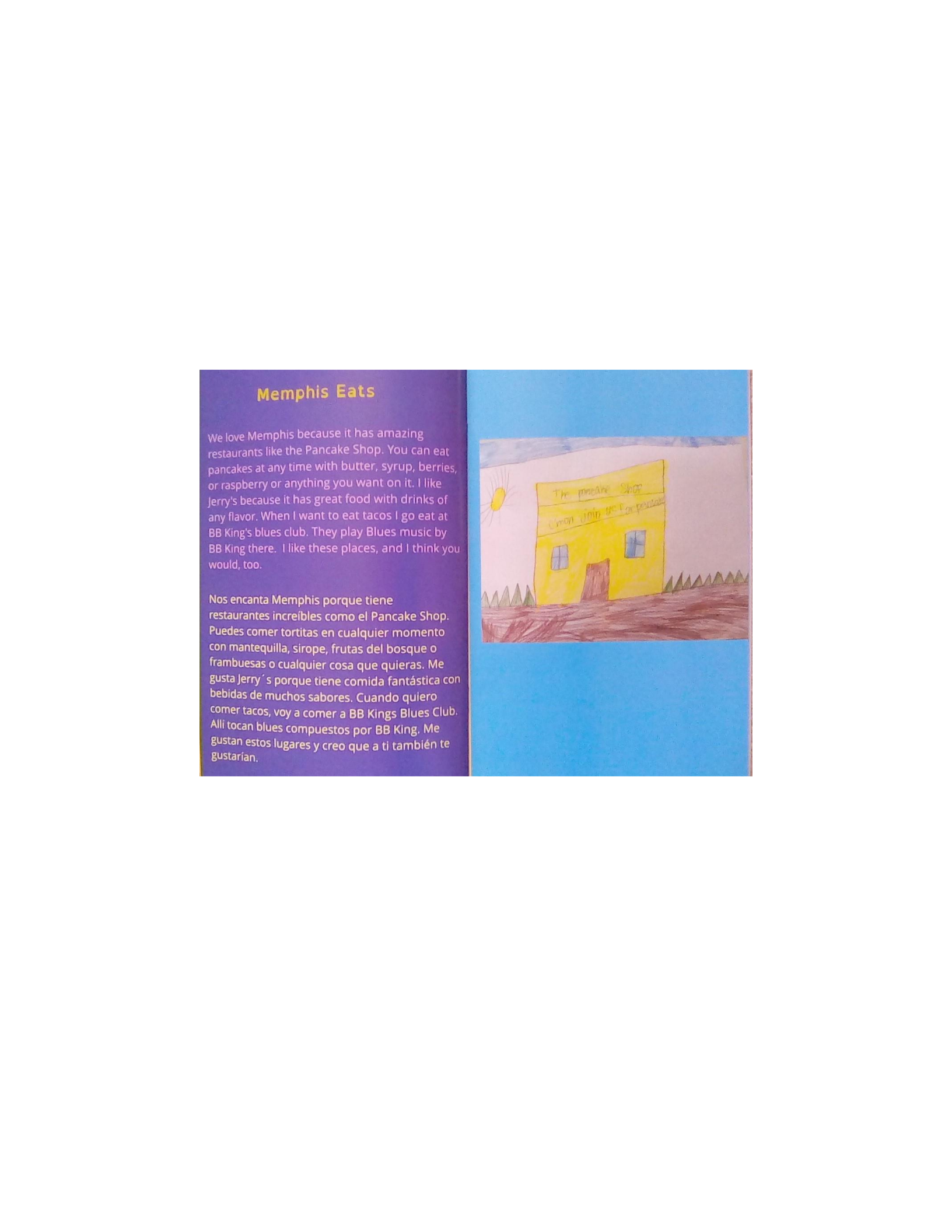
tutors. Each child wrote and illustrated one page on his or her chosen subject as seen in the
example in Figure 1.
Figure 1. Children’s book sample pages from restaurant theme writing.
These tutoring sessions occurred once a week for one and a half hours for ten weeks.
During the tutoring sessions elementary children and tutors were spaced out in a large room with
tables. The university class instructor monitored all sessions. Tutors were given a lesson plan
format during training to ensure children received consistent instruction using the writing process
(see Appendix A for the lesson plan format).

40
In sum, the lesson content sequence consisted of reading classroom blog comments from
the previous week’s writing, conducting a mini-lesson on a writing skill, revising the previous
week’s writing, introducing the week’s theme, researching a writing topic, completing a graphic
organizer, typing a composition in the iPad, connecting writing and literature, and dictating an
end of session reflection. The mini-lesson format involved explaining a writing topic or skill,
showing an example either from a book or a tutor-written composition, engaging the child in a
hands-on activity with the skill, and applying the lesson to the child’s writing. For the
connection to literature portion, each tutor used the same picture books chosen by the literacy
professor. Also, end of session reflections were posted on the classroom blog along with that
day’s writing for parents and instructors to leave comments and feedback.
At the end of each session, children picked out a picture book to take home to keep.
These donated books were used to increase the children’s exposure to and excitement about
literacy. The children were encouraged to read their books to a family member, and at the
beginning of their next tutoring session tutors questioned them about who listened to them read
that week. During the last session of the program, parents were invited to attend a parents’
celebration to preview the children’s e-books prior to the hard copy publication.
Methods
Data collection for this study included semi-structured interviews, participant
observations, program artifacts, and a researcher’s journal. Semi-structured interviews
questioned participants about their experiences with the digital writing process. Participant
observation allowed details of the afterschool tutoring space to be recorded, while program
artifacts allowed viewing of material objects that play a role in the literacy phenomenon of the

41
digital writing experience. Finally, a researcher’s journal was utilized as data on the researcher’s
actions and reflections of the study.
Participant Interviews
According to Savin-Baden and Howell Major (2013), “Interviews are the most common
method of gathering data for qualitative research and are an integral part of most of the research
traditions” (p. 357). They allow a researcher to “probe deeply into a participant’s experiences”
(p. 357). This study included semi-structured participant interviews conducted with six children
from the afterschool program using questions piloted prior to the data collection. Semi-
structured interviews follow a predetermined question guide but also can allow for “additional
questions in response to participant comments and actions” (Savin-Baden & Howell Major,
2013, p. 359). With these interviews, the researcher occasionally “strays from the guide as
appropriate” (p. 359). Semi-structured interviews do not adhere as rigidly to the guide as
structured interviews but are also not as “broad and free ranging” as unstructured interviews (p.
359).
The six child participants were selected for interviews based on scores from a writing
sample administered to all child participants at the beginning of the afterschool program (see
Appendix B for writing sample prompts). Six children were chosen so that two children at each
skill level would be represented in the perspectives garnered from interviews: two children above
grade level, two at grade level, and two below grade level. The children’s technology
background from the child demographic survey was considered in selecting the child
interviewees as well (see Appendix C for the child demographic survey). Ideally one child with
low technology experience and one with high technology experience was to be paired for each
literacy level to broaden the perspectives garnered from the interview data. The demographic

42
surveys reported all children had some degree of technology exposure at home, so pairing
varying technology experience was not possible. The six children to be interviewed were given
pseudonyms for data collection purposes.
Since the interview participants for this study were children, the researcher was aware of
the sensitivity needed. Graue and Walsh (1998) state, “Most of what kids know, they know
implicitly. Knowledge is not filed away in kids' heads in answer form waiting for the stimulus of
the perfect question to release it” (p. 114). This required the researcher to be attentive, patient,
and persistent. Danby, Ewing, and Thorpe (2011) cite that when interviewing children it is
important “the researcher listen to the total views given and not just the ones that fit the agenda
of the researcher” (p. 74). Tone and inflection were used as helpful tools in conveying meaning,
and the researcher was cognizant of the need to ask age-appropriate questions due to the
participants’ developmental vocabulary. Interview guides were tested for reading level to keep
the question content at the appropriate grade level.
Interviews were conducted once at the beginning of the semester-long program, once at
the mid-point, and once at the end (see Appendix D for the initial interview guide, Appendix E
for the mid-point interview guide, and Appendix F for the final interview guide). The six
children were individually interviewed three times during the study to examine how the students’
motivation and engagement were influenced by the digital writing process and to examine the
impact to their writing identities. After the initial interview, the other interviews also examined
the children’s perceptions with issues and concerns regarding the digital writing process.
Transcripts from previous interviews were reread before conducting the next set. Participant
interviews lasted approximately 20 min and were audiotaped and transcribed for analysis.

43
These interviews were conducted after school on days when the tutoring program did not
meet. During these days, children were working on homework in the school’s regular
afterschool program and interviewing was not a disruption to any other activities. Interviews
occurred in one of four quiet locations in the school depending which space was unoccupied.
Some were conducted in the computer lab where weekly tutoring was held. Others occurred in
the library where there was only occasional noise from patrons. The third and fourth areas were
small, vacant teaching classrooms located within the library and were chosen if the other two
spaces were occupied.
Participant Observations
The researcher’s role as a graduate assistant to this program allowed for the
implementation of participant observations. There was some interaction with the tutors and
children during observations as they had questions or needed assistance during sessions.
According to DeWalt and DeWalt (2002),
Participant observation is a method in which a researcher takes part in the daily activities,
rituals, interactions, and events of a group of people as one of the means of learning the
explicit and tacit aspects of their life routines and their culture. (p. 1)
Field notes and jot notes were taken on site, and expanded notes were written immediately after
sessions to record details and ensure proper documentation. Emerson, Fretz, and Shaw (1995)
state the manner of writing field notes during participant observation “involves active processes
of interpretation and sense-making” (p. 4). Also, experiencing the program as an insider can
enhance the quality of fieldwork data since there is a “tacit understanding” of the phenomenon
being observed (DeWalt & DeWalt, 2002, p. 8). Again, as studying children is a more difficult
undertaking than research with adults, Graue and Walsh (1998) stress, “Once in the field with

44
children, one must continually find new and different ways to listen to and observe children, and
to collect physical traces of their lives” (p.95). The researcher was sensitive to the flexibility and
tenacity needed to observe the child participants in this study.
Ten weeks of observations in the afterschool program were conducted in order to observe
the six focus children’s writing skills and performance and their motivation and engagement with
the digital writing process. Two of the six children were paired with the same tutor, so five
groups were observed. The researcher spent 10 to 15 min per group and rotated the order groups
were observed each week in order to see each child at a different point in the lesson.
Observations also allowed for first-hand data of how the children were producing their writing
through the recursive writing process and how they were interacting with their tutor and peers.
A formal protocol was not used; the researcher focused on the children’s interactions with
technology and comments made by them and their tutors especially regarding identity and skills.
Attention was also placed on the children’s actions reflecting engagement and motivation and
their activities with the writing process, such as leaning in to the iPad screen and comments
about their excitement with writing. Field notes recorded how the children participated in digital
reading and writing tasks during tutoring sessions as well as any comments the children made
about their writing identities or issues and concerns with the digital writing process.
Program Artifacts
According to Marshall and Rossman (2016), “The artifacts that individuals,
organizations, agencies, townships, or larger social groups produce take multiple forms. Some
are documents…. Documents, in particular, often are drawn on in a qualitative study” (p. 164).
Bowen (2009) defines documents as “both printed and electronic (computer-based and Internet-
transmitted) material” (p. 27). Graue and Walsh (1998) extol the use of artifacts in research with

45
children, “Much of children's lives is hidden, however, and artifacts from that hidden life can
illuminate it” (p. 123). For this study a total of 12 types of document artifacts from the program
were studied. Only the artifacts from the six focal students, their parents, and their tutors were
analyzed.
The first three were collected before the afterschool program began as each of these
provided context for the researcher on the children’s backgrounds and ability levels.
A parent-administered child demographic survey which included questions regarding
their children’s technology background and attitude toward writing was collected.
This data set offered a glimpse from the parents’ perspective on how the children use
literacy and technology in their homes.
The PAWS writing interest survey was conducted by the researcher with the children
to determine their attitudes towards writing (see Appendix G for the PAWS writing
interest survey).
Writing samples from the children were taken by the researcher. These were assessed
using a second-grade level writing rubric to determine a baseline idea of their writing
abilities and were scored by an outside evaluator (see Appendix B for the writing
sample rubric). The writing samples provided academic data from which interview
participants were chosen: two above grade level, two at grade level, and two below
grade level.
Also note, the PAWS writing interest inventory and a writing sample were also administered at
the end of the program to examine how, if at all, the children’s abilities, skill levels, and/or
attitudes toward writing changed.

46
Through the duration of the program, the following eight artifacts were collected from
both children and tutors.
Children’s prewriting activities were collected at each weekly tutoring session to
note the writing strategies and skills they were using. These activities consisted
of hard copy graphic organizers taken up at the end of each session.
Rough drafts of digital book content were collected weekly and examined for
writing strategies and skills. These artifacts were photographed by the tutors, then
posted and available for access by the researcher through the program blog.
Final drafts of digital book content were emailed to the researcher for data
collection. A comparison of these artifacts allowed for examination of strategy
usage and editing changes as the children and their tutors worked through the
digital writing process.
Children’s weekly session reflections, part of the class assignments, were dictated
by the children to their tutors who posted them on the class blog (see Appendix H
for the children’s weekly session reflections in the class syllabus). These
reflections contained the children’s thoughts on their writing work for the day and
were examined for themes regarding their writing identities and/or their
motivation and engagement with writing.
Parent comments made on the children’s blog postings were taken as a data
source to compare parental involvement and the children’s motivation and
engagement.
Tutor-written, end of session debriefs were taken from writing prompts (see
Appendix I for the tutor end of session writing prompts). At the end of each

47
weekly session the instructor had tutors free-write about the children’s
participation that day.
Audio recordings of debriefing discussions between the instructor and tutors over
the topics covered in the writing prompts were also be made and transcribed as
needed.
Weekly tutor teaching reflections, part of course assignments, were submitted to
the university’s online course dropbox (to which the researcher has access) two
days after each session (see Appendix H for tutor reflection questions in the class
syllabus).
The tutor debriefing free-writes, debriefing audio recordings, and tutor teaching reflections were
collected for data on the tutor’s perspective of children’s motivation, engagement, skills
improvement, and/or comments on their writing identities. These data sources also offered
insight to issues and concerns with the program.
At the closing of the program the PAWS interest survey and post-writing sample
mentioned above were re-administered to determine any changes to the children’s motivation,
engagement, and skills. Also at the end of the program per class requirements, tutor-written case
studies on each child’s development were submitted to the university’s online course dropbox to
which the researcher has access (see Appendix H for the case study assignment in the class
syllabus). These provided tutor insights about the children’s motivation, engagement, skills
improvement, and/or changes in their writing identities.
Researcher’s Journal
A record of the researcher’s actions and thoughts regarding this study were kept in a
researcher’s journal. Janesick (1999) states, “Journal writing may be incorporated into the

48
research process to provide a data set of the researcher’s reflections on the research act” (p. 505).
This personal writing was a tool to help the researcher think through the data and inform her
thinking as it pertained to all the research questions of the study. Richardson and St. Pierre
(2005) argue that qualitative researchers should “think of writing as a method of qualitative
inquiry” (p. 967). Janesick (1999) also states that in qualitative research “because the researcher
is the research instrument, keeping a journal is a check and balance in the entire course of a
qualitative research project” (p.521).
The researcher’s journal is one method which promotes confirmability for the research.
Petty, Thomson, and Stew (2012) define confirmability as, “The extent to which the findings are
the product of the inquiry and not the bias of the researcher” (p.382). Recording perception and
actions in a researcher’s journal allowed for reflexivity and for sensitivity to unwitting biases.
Journal entries were written weekly with multiple entries made in some weeks. Entries were
recorded digitally on the researcher’s laptop computer.
The following table delineates the timeframe for collection of data and also the alignment
of research question to data collection method.
Plans for Confidentiality
It is the purpose of this researcher to protect the anonymity of all participants in this
study. Consent forms were distributed to the tutors serving in the afterschool program by the
program instructor (see Appendix J for the tutor consent form). Parents of elementary students
received consent forms from their school administration (see Appendix K for the parent
permission form). Once parent permission forms had been returned with approval to participate,
the children had an assent read to them by their tutors so they could agree or disagree to
participate in the study (see Appendix L for the child assent form). Data collect began after their

49
assent was received. Confidentiality of all participants was protected by assigning each person a
number identifier. Direct identifiers were removed and labeled with each participant’s assigned
number at the time data was taken. Therefore, participants’ names were not utilized during
analysis and write-up of the study. All data collected from children, tutors, and parents remained
secure either through locked environments or in password-protected hardware and accessible
only to the researcher, a peer researcher for debriefing, and the dissertation chair.
Trustworthiness and Ethics
It is the desire of this researcher to conduct this study in an ethical manor so that the work
will be considered trustworthy. Steps were taken to ensure trustworthiness such as striving for
transferability, using multiple collection methods for triangulation, and keeping a researcher’s
journal for review of decisions and the “development of thinking” as the research progresses
(Silverman, 2000, p. 193). Interviews and observations were conducted in such a way to gather
rich, thick descriptions which allowed for evidence to illustrate the phenomenon being analyzed.
Thick, rich descriptions are used in qualitative research to promote transferability. Petty
et al. (2012) define transferability as “the extent to which the findings can be applied in other
contexts or with other participants” (p. 382). Unlike generalizability used in quantitative
research which purports research findings can be replicated in other settings, qualitative research
seeks for transferability of study findings to other contexts. It was the goal of this researcher that
this study be conducted in such a way that the findings have a transferability to other scenarios of
digital writing with elementary students.
Triangulation, member checking, and peer debriefing were used to promote credibility in
the research. Credibility is defined as “the degree to which the findings can be trusted or
believed by the participants of the study” (Petty et al., 2012, p. 382). Each of these strategies

50
were implemented to work toward trustworthiness in the research with the expectation that the
findings will be transferable to other settings where the digital writing process is utilized. The
use of interviews, observations, and program artifacts allowed for triangulation. “The use of
multiple methods, or triangulation, reflects an attempt to secure an in-depth understanding of the
phenomenon in question…. Triangulation is not a tool or strategy of validation, but an alternative
to validation” (Denzin & Lincoln, 2005, p. 5). Triangulating the findings promoted
dependability, which is defined as, “The extent to which the study could be repeated and
variations understood” (Petty et al., 2012, p. 382).
Also, member checking was utilized by providing summaries of the study to the tutors.
With member checking, “the researcher devises a way to ask the participants whether he ‘got it
right.’ Most often, he gives summaries to participants before writing up his study and asks for
reactions, corrections, and further insights” (Marshall & Rossman, 2016, p. 230). To accomplish
this, once analysis was in its final stages, tutors were emailed summaries of findings to ask for
their input on content and any perceived discrepancies. This allowed the tutors to contribute
feedback on the researcher’s analysis and voice if a proper understanding of their perspective is
portrayed. Finally, to implement peer debriefing Marshall and Rossman (2016) state, “The
researcher makes arrangements with knowledgeable and available colleagues to get reactions to
the coding, case summaries, analytic memos written during data analysis” (p. 230). Analysis
completed with thematic coding was sent for peer debriefing to another doctoral student as a
consultant to check analysis decisions. The credibility of the research was improved with each
of these safeguards in place.
All questions and data collection methods adhered to upholding participants’ human
rights especially since the research included children, a vulnerable population. Research was

51
performed sensitively and ethically so as not to exploit or dehumanize any participant. An IRB
approval was acquired from the researcher’s institution as well as from the child participants’
school district. Ethical sensitivity and moral obligations were considered throughout each phase
of this study.
The researcher was sensitive to perceived power dynamics between herself and the
college tutors stemming from her role as the graduate assistant to the class. Tutors were
informed that their grades were in no way affected by their actions in this study, and they were
made aware that participant observations focused on the children and not the tutors’
performance. The researcher was also aware of the perceived power dynamics between herself
and the children with her position as an assistant for the sessions in the afterschool program.
Children were informed that interviews were only a time to talk with no right or wrong answers,
and observations were conducted with little intrusion to prevent children from being
conscientious of their actions. The researcher was sensitive to the need to explain the purpose
and intent of the study in a way the children will understand.
Subjectivity Statement
Identifying one’s subjectivity involves identifying one’s “own views and how they have
been constructed” (Grbich, 2009, p.8). I am a Caucasian, middle-aged female who has worked
in educational settings for over 15 years. I am mindful that due to my two-year involvement
with this literacy center project, I will bring personal assumptions to this study due to my prior
experiences. I am also aware I am an insider with personal knowledge of the participants and the
program to which an outsider with this study would not have access. As mentioned previously, I
became aware of this school through its partnership with my United Methodist church. Many
opportunities to donate and volunteer have been presented there during the three years since the

52
school has opened. I began working on this afterschool literacy program with the university
while it was still in its preliminary stages. During this time I have built strong ties to the school
administration and staff who logistically make the program possible, and I have spent many
hours working with children there through program testing and the Thursday book club I
organize and lead for them.
Throughout this study I sought to employ measures to counteract any bias. Graue and
Walsh (1998) state,
Bias can be introduced into the data record by attitudes and beliefs brought into the field.
One cannot be free of attitudes and beliefs. Who one is affects how one sees the world.
The trick is to develop a strong sense of that identity and how it affects one as a
researcher in the specific contexts within which one is working. Bias cannot be removed.
It can be identified and its effects explicitly monitored. p. 126
In order to monitor my bias, I strived for reflexivity as I conducted this research. Preissle and
Grant (2004) define reflexivity as, “The fieldworkers’ self-conscious and critical study of their
own standpoints and assumptions and of how these change or remain stable throughout the
fieldwork and analysis and in relationship to participants, funding sources, and other interested
parties” (p. 175). The use of triangulation, member checking, peer debriefing were each applied
to combat any biases that might have unknowingly occurred. Reflexivity also occurred through
analytic memos and journaling. Analysis was performed with specific attention to personal
interpretations that could have stemmed from partiality.
Data Analysis
Data analysis occurred throughout the study. Preliminary analysis occurred as data were
collected (Charmaz, 2006) and continued with a final analysis after all data were collected. Due

53
to the nature of case study methodology, data was “converged in an attempt to understand the
overall case” (Baxter & Jack, 2008, p. 555). Interview transcripts, observation field notes, and
the program artifacts of child reflections, tutor reflections, tutor end of session writings, and tutor
end of session discussions were coded for thematic analysis. “Qualitative coding is a way of
opening up avenues of inquiry: the researcher identifies and develops concepts and analytic
insights through close examination of and reflection on fieldnote data” (Emerson et al., 1995, p.
23). These data sources were analyzed regarding information about students’ motivation and
engagement toward writing, their skills and performance, their perceived writing identities, and
any issues and concerns they had with the digital writing process.
Contextual background information was collected from the program artifacts of the child
demographic survey, PAWS writing interest inventory, writing sample, parent blog comments,
and tutor-written case studies. Student prewriting activities and digital drafts and final drafts
from weekly sessions were not analyzed for skills improvement. Observational data indicated
tutors did much editing to the initial and final drafts without input from the children and the
researcher determined that an analysis of the children’s skills improvement would be invalid.
Interview transcripts and observation field notes were coded with no initial a priori codes.
The program artifacts of tutor reflections, tutor end of session writings, tutor end of session
discussions, and child reflections were analyzed through Structural Coding (Saldaña, 2016).
“Structural Coding applies a content-based or conceptual phrase representing a topic of inquiry
to a segment of data to both code and categorize the data corpus. Structural Codes are generally
foundation work for further detailed coding” (Saldaña, 2016, p. 97). The focus of each research
question was used as the Structural Codes for these program artifacts as Saldaña (2016) states,
“A provisional list of codes should be determined beforehand to harmonize with your study’s

54
conceptual framework…and to enable an analysis that directly answers your research questions
and goals” (p. 71). Therefore, unlike the interview transcripts and observational field notes,
these documents were analyzed with categories of each topic of the research questions set a
priori.
Initial Coding (Saldaña, 2009) was utilized as the first step of analysis (p. 4). For the
interview transcripts and observation field notes, initial codes were formed through In Vivo and
Descriptive Codes (pp. 6-7). The process was repeated for a Second Cycle of coding as Saldaña
writes, “Recoding can occur with a more attuned perspective using First Cycle methods again,
while Second Cycle methods describe those processes that might be employed during the second
(and third and possibly fourth …) review of data” (p. 10).
Repetitive patterns were determined, refined, and codes were collapsed into categories of
descriptions and processes. Since some codes were interrelated, care was given to categorize
based on the original intent or context of the code source. For example, one of the categories
was audience but original codes for this category ranged from “giving the child a sense of
purpose” to “affected writing content.” Therefore, this nuanced information was retained so that
the broad themes have data-specific support in the findings of this study.
After categories were determined, in order to keep the tutors’ perspective separate from
the children’s data, the categories from the tutor weekly reflections, tutor end of session writing,
and tutor end of session discussions were amassed together for thematic analysis and presented
in findings as tutor perceptions on the children's experiences. The interviews, observations, and
children’s weekly reflections categories were then analyzed together and are presented in
findings as the six focal students’ experiences and perceptions. Saldaña (2009) states, “When the
major categories are compared with each other and consolidated in various ways, you begin to

55
transcend the ‘reality’ of your data and progress toward the thematic, conceptual, and
theoretical” (p. 11).
As analysis progressed, three themes emerged and findings took shape. Categories of
peer interactions, scaffolding, and instructional methods were identified in relationship to 1)
social interactions, categories of writing topics and child choice were identified in relationship to
2) personal cultural connections, and categories of audience, end product, and technology use
were identified in relationship to 3) linking text to their world. These themes will be referred to
in future chapters as findings and will be discussed in relation to each of the five research
questions.
The theoretical framework of sociocultural theory (Barton & Hamilton, 2000; Heath,
1983; Vygotsky, 1978) and New Literacies theory (Kress, 2003; Lankshear & Knobel, 2011;
Leu, Kinzer, et al., 2013) allowed the analysis of the transcripts, field notes, and documents to be
performed through a lens of social and cultural context as well as a lens that recognized digital
writing as a literacy event. Since sociocultural theory allows one to look at data through the
social and cultural context of the phenomenon, the coding analysis incorporated of categories
from the social interactions between the tutors and children in afterschool program setting. This
theory lens also allowed for contextual data from the children’s backgrounds to be included.
New Literacies theory allowed data analysis to include the technological aspect of the literacy in
the afterschool program. With this theory the digital writing was recognized as literacy and
codes such as digital tool use, iPads, and blog postings were utilized in the analysis.
Findings and themes were triangulated. According to Creswell (2012), this is completed
as the researcher “examines each information source and finds evidence to support a theme. This
ensures that the study will be accurate because the information draws on multiple sources” (p.

56
259). Triangulation was used as a way to make the study more rigorous and reliable. No
inconsistencies with data analysis appeared.
Representation
This data is represented through the themes determined in the thematic analysis of the
data. These have been shared through a traditional method of written results through findings,
discussion, conclusions, and implications of the study.
Summary
In this chapter the research design was discussed, and the chosen methodology, case
study, was reviewed. Site selection and participants (tutors and elementary students) were
detailed, and methods for data collection were listed (semi-structured interviews, participant
observation, program artifacts) along with a timetable for data collection. An overview of data
analysis was furnished (thematic analysis) while reliability and ethics were also discussed. The
next chapter will discuss findings of the research study, and chapter 5 will include the discussion,
conclusions, and implications of the study.

57
Chapter 4
Findings and Interpretations
The purpose of this case study was to examine how a digital writing process influences
the second-grade participants according to the children and their tutors. The following questions
guided this study: (a) How does a digital writing process influence children’s motivation in
writing? (b) How does a digital writing process influence children’s engagement in writing? (c)
How does a digital writing process influence children’s writing skills and performance? (d) How
does a digital writing process influence children’s writing identities? (e) What are the issues and
concerns with this digital writing process? This chapter begins by establishing the backgrounds
of the six focal children of this study and ends by outlining the findings as they pertain to each
research question. Within the findings, tutor perceptions are given first with findings from the
children’s experiences and perceptions second. All findings from tutors were obtained from
tutor weekly teaching reflections, tutor-written weekly end of session prompts, and tutor end of
session debrief discussion recordings. All findings from the children’s perceptions were
obtained from observation notes from each tutoring session, three sets of child interviews with
the six focal students, and child weekly session reflections. The researcher’s journal and analytic
memos were also utilized in the analysis process. Background context on the children was built
through the following program artifacts: child demographic survey, pre- and post-PAWS writing
interest inventories, pre- and post-writing samples, parent blog comments, and tutor-written case
studies. This section ends with the interpretations of the findings along with a model of the
instructional factors that are conducive for a digital writing process.

58
Child Backgrounds
Six children were chosen for this study based on rubric scores on a researcher-
administered writing sample. Two children were chosen with above-grade level scores, two with
scores on-grade level, and two who scored below-grade level. All children who had enrolled in
the program were asked to write from one of three writing prompts and these writing samples
were then scored by an outside evaluator. Children within each grade-level grouping were
randomly chosen. Avery and Nora were selected as above grade-level participants, Morris and
Jasmine on grade-level, and Kenan and Jalisa below grade-level.
All children were seven years old at the beginning of the study with Nora and Morris
each turning eight one month into the program. Initially, all children scored between indifferent
(2.5) and slightly enjoy (3.0) on the PAWS writing interest inventory with the exception of
Jasmine who scored 3.7 placing her interest closer to the highly enjoy (4.0) category. Post-
interest scores showed a slight increase as all children moved closer to the slightly enjoy category
with scores ranging from 2.7-3.3 and Jasmine’s decreasing to 3.3.
All children reported they did not use digital tools in any capacity at school or with any
school assignments unless it was a special report that could be typed at home if desired. None of
the children had written a book before with the exception of Jasmine who shared how she
sometimes rewrote and changed stories from current books when at home and her mom would
staple these into a book. All children reported enjoying their time in tutoring and, overall, each
were observed to be having positive experiences. The following sections provide specific
background context for each of the six focal students.
Avery. Avery was an outgoing African American female with an advanced verbal and
written vocabulary. She developed a strong bond with her tutor, commenting on the fun and

59
creativity her tutor brought to the sessions. As Avery discussed the importance of typing to
being able to use digital tools, she commented how she “admired” her tutor’s typing skills and
“wanted to type” as well as her tutor could. Her interviews were always the longest as she had
much to share about the topics of school, tutoring, writing, and her home. Most of the interviews
were conducted with Avery standing up and occasionally walking around the room though she
was always attentive to the discussion.
Avery was selected as an above grade-level participant after scoring at the accomplished
range on the writing sample rubric (3.1). Her writing attitude survey score placed her with an
overall positive outlook on writing which stayed consistent in the post survey. Her parent-
administered demographic survey reported a positive attitude toward school with her favorite
subjects as science and social studies and least favorite as math. The parent survey reported she
likes to write which Avery confirmed during interviews. When asked how she felt about writing
in school she replied, “I love writing, so, I’m great. I’m okay whatever, whatever writing
assignment you give me… I’ll just do the work because I have to get a good grade.” Avery
mentioned good grades as an incentive during other interviews as well.
Avery reported she sees her mother, father, and brother write at home: her brother while
doing homework, and her mother and father completing family administrative tasks. Avery
shared that she and her mother use digital tools while her dad and brother are more “old-
fashioned.” The parent survey shared that Avery has Internet access at home along with the
following technology tools: smartphone, tablet, e-reader, and video game system. Avery
reported she had little experience using digital tools but shared her tutor sometimes let her type
her story in the iPad; this was never observed. No one from Avery’s family ever logged in to the
class blog.

60
Nora. Nora was a reserved African American female with a sweet smile and little
verbosity to her interview answers. She was thoughtful before replying and her pithy style led to
the need for probing questions. Even so, during interviews she easily projected a student who
cared about learning and doing well in school.
Nora was selected as an above grade-level participant after scoring 3.1, within the
accomplished range, on the writing sample rubric. She scored at the indifferent (2.5) range with
a 2.6 initially on the writing attitude survey but scored 3.2 in the post survey which placed her at
the slightly enjoy (3.0) category. Her parent-administered demographic survey reported a
positive attitude toward school with her favorite subject as language arts and least favorite as
math. The survey also stated she likes to write which was confirmed during interviews. When
asked how she felt about writing in school, Nora answered “Well, I feel good because, like, it
can, um, get me ready for third grade.”
Nora shared she did not see anyone at home write very much except she often sees her
grandma writing scripture verses. Nora commented she does not use digital tools frequently
though the parent survey shared there is Internet access at home and a PC and smartphone.
Nora’s tutor let her type her story in the iPad if she requested and Nora’s mother logged in to the
class blog leaving two comments on separate sessions praising Nora’s work.
Jasmine. Jasmine was a soft-spoken African American female who freely shared her
thoughts during interviews. She had a timid personality that made it easy for her more forceful
partner (Morris) to sometimes dominate tutoring activities and discussions. She talked of
playing “school” at home and of writing up fake homework and of all the focal children, seemed
the most interested in writing for fun during her free time, usually at home.

61
Jasmine was selected as an on grade-level participant after her score of 2.4 fell between
the developing (2.0) and accomplished (3.0) range on the writing sample rubric. Her writing
attitude survey score was the highest at 3.7 and placed her closer to the highly enjoy level (4.0).
Her post interest survey came down to a 3.3 still revealing a positive outlook on writing at the
slightly enjoy range. Her parent-administered demographic survey reported a positive attitude
toward school with math as her favorite subject and nothing listed as least favorite. The survey
also stated she likes to write which she confirmed in interviews. She shared she felt good about
writing in school “because I write at home, and I, like, write weird stories at school. Sometimes
I, like, find a book and I write my own book sometimes.”
Jasmine discussed how her mother wrote often at home on a computer when she used to
go to school. She also talked about communicating with her grandmother via text messages on
her mother’s smartphone at times and explained how her own smartwatch, which she was
wearing during the interview, allows her to send pre-written messages to her mother whenever
she needs to. The parent survey stated Jasmine had Internet access at home and access to a PC,
smartphone, tablet, and video game system. Jasmine reported she was good at using digital tools
because she knows what she is doing and how to work them. Jasmine’s tutor did not let her type
her story in the iPad and no one from her family logged in to the class blog.
Morris. Morris was a friendly African American male who easily veered into tangents
during interviews. These tangents at times manifested into long soliloquies as the researcher
tried to refrain from cutting him off. He particularly enjoyed describing the details of the writing
competitions in his classroom which resulted in a prize given to someone selected as the best
writer for the week, a prize he was determined to win. Due to a speech pattern that the

62
researcher sometimes had trouble understanding, he was occasionally asked to repeat
information which he graciously did with no sign of self-consciousness.
Morris was selected as an on grade-level participant with a 2.3 score falling between the
developing and accomplished range on the writing sample rubric. His initial writing attitude
survey score placed him at indifferent (2.6) which increased to slightly enjoy (3.1) in the post
survey. Nothing was marked for school attitude on his parent-administered demographic survey
but spelling was cited as a favorite subject and math as least favorite. The survey also reported
he likes to write and Morris said he felt “happy” about writing in school because of the
opportunity to win prizes as best in the class during weekly ceremonies.
Morris shared when his uncle was in school he often saw him writing and that he sees his
neighbors who are in high school write when they work on their homework. Each of these used
paper as the medium. Morris cited video games as the main technology he uses and does not use
any digital tools at home. Morris stated he does not have Internet at home which the parent
survey confirmed but the survey did list a PC, smartphone, tablet, and video game system as
technology used there. Morris’s tutor (who was also Jasmine’s tutor) did not let him type his
story in the iPad and no one from Morris’s family logged in to the class blog.
Jalisa. Jalisa was a good-natured African American female who sometimes answered
interview questions with an upturn in pitch as though she was answering with a question. Due to
what sounded like unsure responses, the researcher at times wondered if Jalisa felt the need to
answer in a way that the researcher would deem “right” as opposed to giving her true opinion.
Jalisa also often answered non-verbally with head nods or shakes, so interview transcripts
include the researcher narrating her body movements.

63
Jalisa was selected as a below grade-level participant after scoring 1.3 on the writing
sample placing her between beginning (1.0) and developing (2.0) on the second-grade rubric.
Her 3.0 writing attitude survey score placed her at slightly enjoy (3.0) which increased
marginally to 3.1 in the post survey. Her parent-administered demographic survey reported a
positive attitude toward school with her favorite subject listed as math. It was reported she likes
to write but when asked about how she felt about writing in school she replied “not much” after a
six second pause.
Jalisa reported she sees her mother and father write at home, specifically stating her
mother signs her weekly conduct sheet. Jalisa mentioned typing in web addresses to access
educational websites like ABCya or other websites that would help her with her homework. The
parent survey shared that Jalisa has Internet access at home where there is also a PC, smartphone,
and tablet. Jalisa’s interviews were the most difficult to conduct as she at times did not
understand the questions which resulted in long pauses and she needed explanation for
vocabulary such as “often.” Many questions were answered with “I don’t know.” Jalisa
described using tablets to access websites, but not to write other than typing in web addresses.
Her tutor did not let her type her story in the iPad. Jalisa’s mom logged in to the class blog but
did not leave comments.
Kenan. Kenan was a slightly taciturn African American male. In each interview, he
freely answered questions though normally without much detail. He enjoyed talking the most
about the technology he had at home and how he would be getting a smartphone at Christmas.
Just as Jalisa, he also often used non-verbal answers such as shoulder shrugs and head nods;
therefore, the researcher narrated his actions so as to have them recorded on interview
transcripts.

64
Kenan was selected as a below grade-level participant after scoring between beginning
(1.0) and developing (2.0) on the second-grade rubric with a 1.3. His writing attitude survey
score of 2.5 placed him at indifferent though it was raised to 2.9 on the post survey, much closer
to slightly enjoy (3.0). His parent-administered demographic survey reported an indifferent
attitude toward school with math as the favorite subject and reading the least. The parent survey
also reported he did not like to write and when asked about his feelings toward writing in school
he answered, “fine.”
Kenan reported he sees his mother and father writing on paper during family
administrative tasks and seldom writing with digital tools. The parent survey described that
Kenan has Internet access at home with a smartphone and tablet in the house. Kenan reported he
had his own tablet and used a smartphone to message his friends to come over. He was proud to
state “I’m beginning to type fast.” Kenan’s tutor did not let him type his story in the iPad. No
one from his family logged in to the class blog.
Findings
Three broad themes of the digital writing process emerged from data analysis examining
student experiences and perspectives: 1) social interactions, 2) personal connections, and 3)
technology-based text. These findings will be discussed in-depth in relation to each research
question with tutor data reported first and experiences and perspectives from the children’s data
second.
Finding 1: Social Interactions Were Crucial to Children’s Participation and Growth in the
Digital Writing Process
Analysis revealed social interactions within the digital writing process significantly
influenced children’s motivation, engagement, skills and performance, writing identities, and

65
issues and concerns. These social interactions such as instructional discussions, feedback on
writing, and conversations about the children’s prior knowledge on writing topics occurred
between the children and their tutors, the class instructors, and their peers.
Motivation. Tutor data reflected social interactions with the tutors and instructor were
motivating factors, specifically through tutor scaffolding and feedback from the class instructor.
Child data also found praise to be motivating.
Social interactions: Motivation
Tutor perspective
Scaffolding: prompts and praise, graphic organizers
Feedback from class instructor
Child perspective
Praise
Scaffolding. First, tutors’ use of scaffolding influenced motivation. In this study
scaffolding is defined as, “the assistance that adults and more competent peers provide during
learning episodes” (Tracey & Morrow, 2006, p.109). Specifically, this support can be identified
as, “clues, reminders, encouragement, breaking down the problem into steps, providing an
example, or anything else that allows the student to grow in independence as a learner” (Slavin,
1997, p. 48). Tutors’ specific scaffolds from the data included the use of prompts, praise, and
graphic organizers.
Prompts and praise. Tutors cited their interactions, specifically prompts and praise, as a
way of encouraging children throughout the writing process. Verbal prompts could be in the
form of questions, hints, reminder statements, etc. that would be helpful to a child stuck on a
writing task. These prompts were offered by tutors as a way to assist the child without doing the
task for him. For example, one tutor reflected on her use of prompts, “[My student] has trouble
being motivated to write, but it helps him when I give him a jumping off question.” When her

66
student seemed unable to come up with writing ideas, this tutor questioned him on topics he
might have experienced in order to get him excited to write about a memory he wanted to share.
Secondly, tutor praise inspired children to completed writing tasks. One tutor wrote, “My
students LOVE when I stop and tell them how great they are doing and it makes them that more
excited to write.” Praise was used effusively by tutors to motivate and inspire children to
continue writing and was often offered as encouragement on a specific writing skill rather than a
general comment.
Graphic organizers. Next, tutors voiced that graphic organizers were a motivating factor
in their children’s writing during both the pre-writing and drafting stages. These graphic
organizers, or concept maps, consisted of spaces where children could write in a topic and its
details. These spaces were linked or connected in a way to provide the children with a visual
representation of their writing. These tools offered a scaffold for tutors to help their children
brainstorm, organize, and think through their writing. Children were driven by the task of filling
in all the components of the graphic organizer during pre-writing as one tutor wrote, “She loves
creating the graphic organizer.” Other tutors stated the finished graphic organizer was essential
in the drafting phase, as children could be motivated to continue composing by referring back to
these. For example, one tutor reflected, “I feel that the graphic organizers and illustrations are
some of the most effective aspects of the lesson and, as far as I can tell, the most motivating for
my students…. They stay on task with their graphic organizers.” Tutor use of scaffolds,
specifically prompts, praise, and graphic organizers helped children stay focused on their tasks
and motivated them throughout sessions.
Instructor feedback. The second social interaction which influenced children’s
motivation was their contact with the class instructor. The class instructor visited each group

67
during the last half of sessions asking children to read their compositions. Children were excited
to read their drafts, proud to share their work, and were pleased to get feedback from her. One
tutor commented, “She loves it when [the instructor] asks her to read.” Tutors used this
consistent weekly event to encourage children to write their drafts and make revision changes
that had been discussed from her feedback. One tutor reflected, “They really enjoy reading their
writing out loud to the teacher as well, and I think seeing their words and hearing them is
validating.” Reading their compositions to the class instructor allowed the children interaction
with an adult other than their tutors. The instructor feedback regarding their writing and its
quality motivated the children to excel and make revisions and edits as suggested.
Praise. In an overlap with tutor data, child data revealed that praise was a motivating
factor from their perspective. These positive remarks from tutors and the instructor inspired the
children to write their best during all aspects of the digital writing process. During participant
observations, the researcher had focal students express appreciation for the blog comments she
had made regarding their rough drafts. For example, in an observed session after the tutoring
group had checked their blog comments, Morris turned to the researcher and said, “Thank you
for saying our writing was good,” to which the researcher replied, “Well, thank you guys too for
doing great writing.” During an interview session, Jasmine stated how reading the blog postings
praising her work made her “happy.” Children were also observed throughout sessions receiving
praise from tutors and the instructor. While drafting, one tutor was observed discussing content
with Kenan when she told him, “That’s a really good way to end your paragraph.” Similarly,
during a mini-lesson on writing with detail Avery received a high five from her tutor after
correctly defining the term adjective. All data sources suggest children’s willingness to compose
was heightened through praise.

68
Engagement. According to tutor data, there were two types of social interactions that
influenced the children’s engagement during the digital writing process: peer collaboration and
scaffolding through tutor-written stories about themselves and graphic organizers. Child data
also revealed similar social interactions affected engagement, specifically peer collaborations
and scaffolding specific to the tutors’ teaching styles.
Social interactions: Engagement
Tutor perspective
Peer collaboration
Scaffolding: tutor-written stories and graphic organizers
Child perspective
Peer collaboration
Scaffolding: tutor teaching styles, creativity, and relatability
Peer collaboration from tutors’ perspective. Partner collaboration increased children’s
interest in writing as having a peer to share in the fun of the project kept children enthusiastic
about their writing tasks. It should be noted that while there were activities and tasks that the
paired children did together, the composing component was planned so that one child worked on
writing while the other illustrated. Then those tasks were swapped so as to always give the tutor
one-on-one time with the child who was writing. The amount of peer collaboration varied
between groups depending on the tutors’ teaching style and the children’s personalities.
Peer collaborations could occur during pre-writing as topics were being discussed and
sometimes during drafting or revisions as partners gave suggestions for content and corrections.
One mid-semester session also had tutoring groups share their e-books with other groups to see
the progress that had been made so far and offer suggestions in the form of “Three Stars and a
Wish.” In one reflection, a tutor wrote that her children “feed off each other’s excitement” as
they compose. Another tutor wrote how she utilized collaboration during the revision stage,
“Having them read their stories to me and each other is working well because they are more

69
engaged and alert this way.” The pair structure, in this context, was a positive influence as
children had a partner with whom to enjoy the session activities and tasks making for an
engaging environment.
Scaffolding from tutors’ perspective. Two areas of scaffolding affected children’s
engagement: tutor-written instructional samples and graphic organizers.
Tutor-written compositions. The scaffolding technique of tutor-written stories influenced
child engagement. These writings were personal in nature and were used in mini-lesson
instruction as examples on the week’s theme. Tutors intentionally wrote about themselves as a
strategy to keep children engaged. Due to their personal content, children were interested and
more inclined to participate in writing tasks. For example, one tutor commented, “I always show
my children drafts that I have written to help spark their interest.” Another wrote, “I try to come
up with funny/interesting stories relative to the topic that I’m sure would get kids interested in
writing.” These personal, written anecdotes drew children in and made them more attentive to
the mini-lesson objective.
Graphic organizers. Also, scaffolding with graphic organizers worked to engage students
throughout the digital writing process. These tools helped the session pacing and the children’s
focus while the children also enjoyed completing them. One tutor commented how during pre-
writing she would write the graphic organizer content as her children dictated. This was so the
session pace could move quicker thus keeping them more engaged. Other tutors wrote that using
the graphic organizers during drafting helped keep the children from getting distracted. One
stated, “The graphic organizer is a great way to keep the children’s focus.” Just as with
motivation, graphic organizers were an engaging component because the students enjoyed filling
out the content. The scaffolding techniques of both graphic organizers and tutor-written

70
instructional examples comprised social interactions that helped children’s enthusiasm about
writing.
Peer collaboration from children’s perspective. According to data from the children, the
same social interactions as reported from tutor data impacted children’s engagement,
collaborations and scaffolding, though with different applications. Based on observational data,
peer collaboration influenced child engagement not only through teamwork and cooperation but
also through wait time. During a mini-lesson on writing with detail Morris and Jasmine were
observed working together to place sentence cards in order and then to find the adjectives. Field
notes read,
[The tutor] has cards out with words on them to be used to make a sentence. Jasmine is
saying it doesn’t make sense. They talk about needing a capital at the beginning and a
period at the end. Jasmine and Morris talk together about where to put them. ‘Eager’ and
‘adventurous’ are the only cards they have left to place.
Another opportunity for engaging teamwork arose midway through the program when groups
were asked to pair up and swap their iPads to give feedback on their e-book progress. This
provided a collaborative opportunity with new people as children and their tutors were able to
view another’s e-book and discuss what was going well and what might need to be adjusted.
Children were excited to see another group’s vision of the assignment and pleased to offer
feedback.
Partners sometimes affected engagement due to one child having downtime while the
tutor was working with the other. Often the child would watch and sometimes even help their
partner while that child was working. Observation notes of Kenan and his partner working on
revisions read,

71
[Kenan’s partner] reads his paragraph and Kenan watches the screen. [The tutor] makes
suggestions. [Kenan’s partner] agrees. Kenan leans forward to watch [tutor] type the
changes on the iPad. “Can I do mine?” Kenan says…. Kenan looks around the room,
then turns his attention back to [tutor] and is listening to her makes another editing
suggestion. Kenan says, ‘You can say, “I saw a rabbit before he jumped.”’ [Tutor] says,
‘That’s a good one.’ [Tutor and partner] makes changes and now it’s Kenan’s turn.
Other instances of downtime resulted in seemingly disengaged behavior from the
children such as was observed with Avery, “Avery listens to [partner and tutor] talk about
football (the writing topic of the day.) Avery is drawing hearts on a page…. She is making a
colored border around the edge of her paper.” In another observation with Nora, “Nora tells
[tutor] she is done. She stands up and dances, tapping her feet and snapping her fingers while
[tutor] finishes up with [partner.]” After these instances children resumed work and interest in
the writing once the tutor was ready to interact with them again. Therefore, wait time was
sometimes utilized as an opportunity to help their partner, but it was also occasionally time
wasted as they waited for their partners to catch-up.
Scaffolding from children’s perspective. Child data pointed to how interactions with the
tutors’ teaching styles, creativity, and relatability influenced how enthusiastic and willing
children were to write. Nora and Avery’s tutors had laidback teaching styles and they allowed
their students to personally type their stories into the iPad which each enjoyed doing. On the
other hand, Morris and Jasmine’s tutor liked to have more control over the process. Yet, they
each commented how they enjoyed writing in sessions because, with their tutor typing
everything, it made writing much easier than in school. Avery’s tutor used her creativity to
hand-draw graphic organizers and inspire her children to write. Avery commented how she

72
enjoyed filling these out, “[Our tutor] makes it out of different shapes. She makes it in an ice
cream cone, a burger.” Other children commented on feeling comfortable with their tutor. For
example, Jalisa talked about being glad her tutor helped her with spelling and Kenan stated
tutoring was fun because “I liked my tutor teacher. I had fun with her.” Tutors’ teaching styles
and personalities created interactions which helped children stay engaged throughout the digital
writing process.
Skills and performance. According to tutor data, for the research question regarding
skills and performance, scaffolding was an influencing social interaction, specifically the use of
graphic organizers and mini-lessons. Children’s data also corroborated scaffolding as an
influence on skills and performance, specifically citing the use of the “good writers” phrase,
mini-lessons, graphic organizers, revisions, and questioning/prompts.
Social interactions: Skills/performance
Tutor perspective
Scaffolding: graphic organizers, mini-lessons
Child perspective
Scaffolding: “good writers” phrase, mini-lessons,
graphic organizers, revisions, questions/prompts
Scaffolding from tutors’ perspective. According to tutor data, two scaffolding techniques
were important to children’s understanding of quality writing, their development of skills, and
their performance with those skills: graphic organizers and mini-lessons.
Graphic organizers. Tutors cited their use of graphic organizers as helpful to children’s
overall performance since these tools streamlined brainstorming thoughts, assisted children with
content, and helped structure their writing into a coherent flow. One tutor wrote of their use in
the pre-writing stage, “The concept map was a great way to let the student brainstorm ideas for
the downtown page.” Later in the semester, another tutor reflected on the improvement she saw

73
in writing content and structure, “I think the use of graphic organizers is improving as the kids
are adding more details and they definitely are getting into the swing of writing their entries in a
structure, so I think the reinforcement of a pattern has really helped them.” Graphic organizers
allowed for social interactions as the tutors and children discussed the content and tutors made
suggestions and asked questions. Tutors cited improvement in content and structure skills with
the use of graphic organizers and often touted them as beneficial to children’s performance.
Mini-lessons. Interactive mini-lessons also had an influence on the children’s writing
skills and performance. These lessons highlighted writing concepts which tutors then saw
utilized in children’s compositions. Tutors also consistently reinforced previous mini-lesson
content to help solidify children’s understanding and application of the skills. Tutors remarked
how their children use mini-lessons topics in their weekly writing such as, “I’ve seen
improvement in the way they write beginning, middle, and end.” Another tutor wrote, “I am
seeing more use of mini-lessons [content] being implemented every week.” During an end of
session debrief, one tutor discussed how she thought the mini-lessons were helping as she would
“go back and reinforce what [they] already learned” from these lessons each week as a way to
facilitate skill improvement. Tutors also linked the mini-lesson content back to the phrase “this
is what good writers do” and reinforced with their children that as they utilized these mini-lesson
skills in their writing, it made them good writers as well. The specific scaffolds of graphic
organizers and mini-lessons were found to influence children’s writing skills and performance.
Scaffolding from children’s perspective. Similar to tutor data, child data reflected
scaffolding was the main social interaction influencing children’s skills and performance, but
this scaffolding included the repetition of the “good writers” phrase, mini-lessons, graphic
organizers, revisions, and tutor questions and prompts.

74
“Good writers” phrase. First, one scaffold that impacted children’s understanding of
quality writing was the repetition of what “good writers” do. Both tutors and the instructor used
this phrase throughout the sessions. This could come up when tutors were teaching mini-lessons
explaining what “good writers” do, or when they wanted their children to revise their work and
would remind them of a “good writer” rule, or when they were praising their children for
composing with a writing skill just as a “good writer” would do. For example, use of the “good
writers” phrase was observed as Morris was dictating to his tutor and his story became stream of
consciousness. His tutor reminded him his writing must have an end stating, “Good writers have
beginning, middle, and end.” Also, “good writers” phrases often appeared in children’s weekly
blog post reflections as they answered what they had learned that day about being a great writer.
In one instance, Jalisa wrote about the topic of her mini-lesson, “Good writers use strong verbs.”
The repetition of this phrase made an impact on children’s knowledge and skills base for how to
write well.
Mini-lessons. Mini-lesson topics were often repeated in conjunction with the “good
writers” phrase and were the second scaffold that impacted children’s skills and performance.
These short lessons helped children understand and practice specific writing skills. Tutors
presented an objective, showed an example through their own writing or a piece of literature, and
then had the child practice the skill in some type of hand-on activity. As illustrated above, mini-
lesson topics were also often recounted in children’s weekly blog post reflections as they
answered what they had learned in the day’s session. The “good writer” phrase and the
implementation of mini-lessons were instructional scaffolds which influenced children’s skills
and performance.

75
Graphic organizers. Use of graphic organizers was another social interaction cited in the
children’s data which influenced skills and performance. Several observations cite the children’s
use of graphic organizers during pre-writing to formulate thoughts and to structure their writing
content. For example, “All circles of [Nora’s] graphic organizer are filled out. McDonald’s has
two foods connected. Olive Garden has two other foods connected. The other two main circles
have ‘who go with’ and four names listed.” In the same session Jalisa is observed brainstorming
content with her tutor for her graphic organizer. Field notes state, “[Tutor] asks Jalisa what she
likes about the restaurant. Jalisa answers the rice and writes I love you in one of the circles off
the main circle of China House…. [Tutor] asks her about different foods like egg rolls and
fortune cookies but Jalisa has not heard of these. She writes rice in one of her circles.” Graphic
organizers provided another social interaction between the tutor and children as they discussed
content for their book and the children formulated their thoughts for writing. These tools helped
children develop writing sequence skills and for some pushed them to think and write more as
they strived to fill the chart.
Revisions. During final interviews, four children verbalized interactions during the
revising stage were a valuable part of improving their skills and performance as a writer. During
the revising stage, tutors would have children read their writing aloud and then discuss what, if
anything they thought needed to be changed. If children did not catch errors, tutors would
prompt and hint but sometimes they had to reveal areas and assist the children in correcting
them. In one interview Jasmine commented, “[Revising] made me a better writer just in case
you get a word wrong,” while Avery said, “[Checking over work] has helped me write better
because I think [it] is good because you don’t want any mistakes on your paper.” Revisions

76
created more teaching opportunities for tutors to interact with children on writing skills and
technique.
Prompts. Data also demonstrated tutors often used prompts and questions while
interacting with children to improve their writing skills. As mentioned above, these interactions
often occurred during the revising portion of the session. In one observation, Jasmine’s tutor
prompts her to make a correction as she worked with her during revisions,
[Tutor] brings up their restaurant writing to edit. Jasmine reads hers out loud…. [Tutor]
prompts at one sentence and asks if she wants to change or take anything out. Jasmine
says no. [Tutor] reads it out loud and Jasmine suggests a sentence that doesn’t make
much sense. [Tutor] suggests something else and Jasmine agrees.
Here the tutor helps Jasmine see the need for revision and scaffolds a revision when Jasmine is
unable to reword an improvement. Prompts were used often throughout the digital writing
process and as shown here, were frequently utilized during revisions to influence the skills and
performance of the children.
Writing identities. Both tutor and child data found social interactions influenced
children’s writing identities from the repetition of the phrase “what good writers do” linked to
specific writing skills.
Social interactions: Writing identities
Tutor perspective
Use of the phrase “what good writers do”
Child perspective
Use of the phrase “what good writers do”
Good writers phrase from tutors’ perspective. Tutors and the instructor consistently
commented about various writing skills that “good writers do” and children were praised when
they used these skills in their writing. One tutor shared how she witnessed her children “say they

77
are good writers and apply ‘what good writers do’ into their stories.” Another tutor wrote, “My
girls are now so much more acclimated to the idea that THEY are writers. Not just writers, but
great writers – according to themselves – because they are doing what great writers do each and
every week.” This verbal reinforcement from tutors and the instructor impacted how students
identified themselves as writers.
Good writers phrase from children’s perspective. Child data also substantiated the use of
“what good writers do” influenced children’s writing identities. For example, field notes detail
how Kenan was reading his writing to the class instructor who then reinforces the idea that his
good writing skills make him a good writer, “Your story has a beginning, middle, and ending.
That’s what good writers do. Very nice!” Social interactions such as these helped children
internalize the belief that they were authors and had skills equal to capable and competent
authors.
Issues and concerns. From the tutor perspective, there were two concerns regarding this
digital writing process evolving from social interactions: the revision stage and the partner
structure. From the child perspective, there were also two issues that interfered with the digital
writing process: partner interactions and tutor instructional ability.
Social interactions: Issues and concerns
Tutor perspective
Revisions
Partner structure
Child perspective
Partner interactions
Tutor instructional ability
Revisions. In one concern, tutors reported children were sometimes disinterested in
correcting or changing their work during the revision phase. This process was seen as boring
especially compared to the activities of composing or researching. One tutor specifically said

78
her children wanted to skip over this task so they could move into pre-writing and drafting on a
new topic. “I’ve tried different approaches to get students to revise, but they seem to be too
excited to get to the writing portion.” Another tutor voiced her concerns with revisions,
“Revising seems to be where I struggle the most when it comes to getting my kids engaged.”
Though four of the interviewees discussed its importance to their performance, tutors spoke of
difficulties in keeping children willing and inspired to revise writing drafts.
Partner structure. Data also revealed concerns with the paired tutoring structure. Tutors
specifically cited issues with meeting the needs of two children during the digital writing
process. These concerns included the children’s varying ability levels, behavior, and levels of
engagement. In the beginning of the semester, one tutor shared her concern of the amount of
attention given to one student’s needs, “It is taking away from my other student’s time.”
Another tutor wrote of her children’s behavior distracting them from the writing tasks, “I’ve tried
multiple times to get them back on track. They’re also friends so I think that makes it worse.”
Other tutors commented on their pair having different interest levels toward the writing process,
“One of my kids…enjoys coming up with her stories. [The other] has trouble being motivated to
write.” Balancing two children, their instructional needs and differing personalities, created
concerns for some tutors during the writing process.
Partner interactions. According to the child data, at times some children were
overpowered by their partner during the digital writing process. This was observed with Morris
taking over lesson discussion from Jasmine as she had a more reserved personality. Nora, who
had a disposition similar to Jasmine, was also observed in a session being overpowered by her
partner when they were being quizzed on mini-lesson content. Avery, who was quite
independent, was matched with a like-minded and strong-willed partner but Avery was seen

79
allowing her partner to have her way in order to keep the peace. Also, during interviews children
discussed their dislike at having to draw first while their partner was allowed to draft first.
Jasmine voiced her desire to “write my book first” while Kenan stated what was not fun in
tutoring was “when [my partner] get to write his story first…. I didn’t want to draw. So you just
had to wait and, and you were supposed to be drawing.” Due to the balance of two children,
tutors had to split their time and the partner work was at times considered a negative aspect by
the children.
Tutor instructional ability. Finally, tutor instructional knowledge and ability factored
into concerns with the digital writing process. As most of the tutors were non-education majors
with little tutoring experience, they did not always know how to help their children or at times
even recognize their instruction was not developmentally appropriate. This was seen
predominately with Jalisa, who was functioning below grade level and working with a non-
education major tutor with little experience tutoring young children. In one session, the tutor had
brought a mad lib activity for Jalisa to fill in blanks with the correct part of speech. Field notes
read,
The first blank to be filled is an adjective. Jalisa doesn’t remember adjectives. [Tutor]
reminds her what nouns are. Jalisa puts head down on table…. [Tutor] asks what kind of
park she wants it to be. Jalisa can’t think of anything. [Tutor] pulls up list of adjective
[on iPad.] Jalisa picks ‘new.’ [Tutor] replies that works. Jalisa asks if she is going to
help her with the rest. [Tutor] has Jalisa read the next sentence and asks if she knows
what a plural noun is. Jalisa remembers nouns but not singular and plural.

80
In the final interview, when asked what could be done to make the tutoring program better, Jalisa
replied, “Help everyone.” Probed further, she shared that she did not always feel that she had
gotten the help she needed.
In sum, social interactions were found to influence children’s perceptions and
experiences in this digital writing process. With motivation, tutor data reflected the scaffolding
techniques of prompts, praise, and the use of graphic organizers along with class instructor visits
were each elements that had positive impacts on children’s willingness to write. Child data also
revealed praise as a motivating factor.
Social interactions influencing engagement according to tutor data were positive peer
collaborations and the scaffolds of graphic organizers and tutor-written instructional
compositions. Child data cited scaffolding actions of tutors regarding their teaching styles,
creativity, and relatability as well as partner interactions as factors that influenced engagement.
For children’s skills and performance both tutor and child data reflected instructional
scaffolds of graphic organizers and mini-lessons with child data also including the “good
writers” phrase, revisions, and questions and prompts as important social aspects to building
their writing ability.
Only tutor data reflected influences on children’s writing identities through social
interactions. The use of the phrase “good writers” linked to the children’s actions as writers was
cited as a dynamic within their identity development.
Finally, social interactions were the only finding for features that impacted issues and
concerns with the digital writing process. Specifically, these interactions according to tutor data
were concerns with child participation in the revision stage and the partner structure requiring
tutors to balance two children throughout the digital writing process. Child data revealed two

81
concerns: partner interactions and tutor instructional ability. Partner interactions were two
pronged. First, one child overpowering the other was occasionally an issue, and second, during
interviews children complained of not enjoying waiting on their partner to draft first as they
would rather be the first one to write each week. Also, lack of experience on the part of the
tutors also led to concerns of their ability to best instruct children during the digital writing
process.
Finding 2: Children’s Personal Connections to the Writing Topic Brought Meaning to the
Digital Writing Process
Analysis revealed the digital writing process influenced children’s motivation,
engagement, skills and performance, and writing identities through personal connections. These
personal connections were the various ways children were able to make meaningful cultural
connections during the digital writing process through their background knowledge and personal
experiences. These personal connections could also manifest through the desire to learn more
about specific topics or locations.
Motivation. Only tutor data suggested that children’s motivation was influenced by
personal connections. The two areas cited were prior knowledge of weekly program themes and
the ability of children to choose their topic.
Personal connections: Motivation
Tutor perspective
Weekly themes (prior knowledge)
Topic choice
Weekly themes. First, data revealed children were motivated to write due to prior
knowledge of the broad weekly themes. It was found weekly themes, determined by the literacy
professor and graduate student who designed the program, were broad concepts constraining the

82
children to topics within the parameters of tourist attractions, yet they were familiar enough that
all children were able to select a topic from them. When children had been to locations or had
personal experiences regarding the theme, tutors found the children to be more inspired to write
than when they had no prior exposure. In one instance, a tutor commented her children were
especially excited with the zoo theme because they had visited there recently on a field trip.
Another tutor wrote, “The topic has a lot to do with their willingness to write. If it is something
they can relate to, they tend to have more to say than other times.” When beginning the digital
writing process with prior knowledge and experience on the weekly theme, tutors found their
children more motivated to write.
Topic choice. Second, it was also found that allowing children to make choices regarding
their writing was a motivating factor in the digital writing process. Throughout the program
children chose their book titles, specific writing topics, and content. One tutor wrote, “[The
children] are very enthusiastic about having their ideas heard.” Having choice led to ownership
as this tutor explained, “I am able to motivate them by saying, ‘This is your book. What do you
want your story to say?’” Children were empowered and felt ownership of their compositions
due to their ability to choose and this was a motivating factor throughout the digital writing
process.
Engagement. Personal connections influenced children’s engagement due to prior
knowledge with weekly topics and the enjoyment children had in picking out the writing topic.
Personal connections: Engagement
Tutor perspective
Weekly topic
Child perspective
Topic choice

83
Weekly topics. Tutor data also revealed weekly topics were a factor in children’s
engagement. Children were allowed to choose their writing topic within the weekly theme, and
most often they choose a subject with which they were familiar. Tutors spoke of the direct
correlation between children’s enthusiasm and their personal experience with topics. For
example, one tutor penned, “Personal experience with the topic makes a huge difference in how
engaged and enthused they are about writing.” There were situations in which a child had little
knowledge from which to draw. One tutor reflected on the power of weekly topics to cause
disengagement, “I think that [the child] disengages himself or becomes discouraged when he
sees that he has less exposure to things we have in our city than the other student has and finds
himself feeling inadequate and doesn’t like to participate anymore.” In one instance, this child
was disappointed he had not visited any of the iconic city restaurants and felt he had nothing to
write since he had no experiences with them. Another tutor cited her use of children’s personal
experience and new information to keep engagement high,
I keep my girls engaged in their writing by digging for personal experience and prior
knowledge while contributing bits of new information. This way they have personal
investment in what they are doing, but they are also continuing in knowledge expansion.
The child’s engagement or lack of engagement with topics had consequences throughout each
stage of the digital writing process either helping or hindering the child’s writing output.
Topic choice. Just as tutor data revealed, child data also reflected that having personal
choice regarding the book content impacted child engagement. During her final interview, Nora
explained she liked writing in tutoring better than school because of the choice she was allowed.
She explained, “Because, like, we write about different places and stuff [in tutoring] but in class
we have to write about stories.” Jalisa was observed engaging more in her writing once the

84
research moved to the topic of her choice. As the tutor was showing her group pictures from a
local iconic restaurant, Jalisa is observed asking questions off topic to her partner and tutor,
disengaged with the iPad research. Later, when the tutor has passed out graphic organizers and
Jalisa has chosen a restaurant, field notes report, “[Tutor] has pulled up the China House
restaurant which is what Jalisa wants to write about. [Tutor] reads on the iPad they have a buffet
and asks Jalisa if she wants to write about that. She says yes and starts looking at the webpage.”
Another session observation cited Jasmine’s excitement over choosing her writing topic. As the
tutor tells them they will write about famous people, Jasmine says, “Famous people?” and in
whispered excitement to no one in particular, “I know what I’ll write.” Choice empowered and
enthused the children and encouraged them to focus on their writing tasks.
Skills and performance. There was no tutor data regarding personal connections
influencing children’s writing skills and performance. From child data, children’s skills and
performance were influenced by their personal connections to the topics. Child perceptions of
their skill with digital tools is also discussed.
Personal connections: Skills and performance
Child perspective
Topic knowledge
Child perceptions of digital tool skills
Topic knowledge. Children shared it was “easy” to think of subjects to write about from
the weekly themes which in turn benefitted their ability to write. During interviews, each child
commented on how it was not hard to think of what to write. Though none of the children
verbalized why, it is surmised that they found writing about the themes easy since they were
topics with which children would be familiar. Avery shared that the topics were “really easy for
us to learn and write.” In another discussion, Jasmine stated, “telling the story and [the tutor]

85
writing it down was the easiest part of making the book.” When talking about the difference
between writing in tutoring and writing in school, Morris stated, “You could just think of
something. You don’t have to think of something in a book or text,” referring to the need in
school to support his written answers with a textual reference. Children cited this ease of
composing as a different experience from their classroom writing and having the option to
choose familiar topics perhaps was liberating to them compared with their writing regimen in the
classroom.
Child perceptions of digital tool skills. Children verbalized their personal perceptions of
their digital writing skills during the interview process. During the initial, midpoint, and final
interviews, children were asked what skills they thought were necessary for successful use of
digital writing tools. With the exception of Jalisa who replied each time she did not know what
skills were needed, all other children answered one needed to know how to type. Nora also
commented spelling knowledge was required while Avery and Jasmine also added that one must
be responsible when using digital tools. When asked if being able to write with paper and pencil
makes one able to write with digital tools, all answered yes except for Morris and Kenan who
voiced one would also need to know how to type. Child interviews reveal they see typing as the
main skill needed to use digital tools, but when asked if writing with paper and pencil would
make one proficient writing with digital tools, all said yes except two who repeated the
importance of typing.
Nora was the only child observed writing with digital tools as the others had tutors who
did the typing for them. Avery shared that her tutor sometimes let her type her story on the iPad,
but this was not observed. The following is an excerpt from field notes during the first session
when Nora requests to type on the iPad,

86
Nora begins dictating her writing to [the tutor] and then asks, “What if I write it in?”
[The tutor] says, “If you want to.” She passes the iPad to Nora. (I interviewed Nora
yesterday. Many questions centered around had she used digital tools to write. This was
possibly the reason she wanted to write herself.) Nora asks her how to capitalize. [The
tutor] shows her the arrow key…. She uses one finger while holding the tablet. She looks
at the keyboard while typing and stops to look up at the screen…. Nora looks at the
graphic organizer then returns to typing. She has put an underscore instead of an
apostrophe. There are some double spaces between the words. She has four short
sentences by the time I leave.
Though her typing was slow and deliberate, Nora had the opportunity through the duration of the
project to work on her typing skills using a digital tool. These interview and observation
examples highlight the children’s perceptions of digital tool skills.
Writing identities. In this section, the children’s perceptions of their writing identities as
articulated during individual interviews will be discussed. This finding links to personal
connections as it is the children’s personal beliefs about their writing abilities.
Personal connections: Writing identities
Child perspective
Interviews
Child perspectives. During the interviews, all children, with the exception of Jalisa,
reported they thought of themselves as writers because writing was fun or because they were
good at it. In discussions of what makes someone a writer, children verbalized that knowledge
of writing mechanics, specifically spelling, capitalization, and punctuation, are essential. Kenan
answered that someone is a writer just by “starting to do it” while Morris and Jasmine equated
being a writer with being famous.

87
Though Jalisa did not recognize herself as a writer in the initial or midpoint interviews,
during the midpoint she did acknowledge that the class instructor thought she was a good writer.
During the final interview, Jalisa voiced she felt better about her writing than she did when she
started tutoring and had decided she was a writer because “I have grown up.”
On the topic of how the children perceived themselves as writers with digital tools,
Avery, Kenan, Nora, and Jasmine said they were good writers with digital tools though Avery
and Nora reported little experience using them. Jasmine stated, “I know what I’m doing until
you get frustrated and then you need help.” Kenan connected his skills to typing, commenting,
“I’m starting to type fast.” Since Jalisa did not perceive herself as a writer in general, she also
did not see herself as a writer with digital tools. Morris also did not consider himself as a writer
with digital tools. He seemed to have had little exposure at home and reported that his lack of
typing skills prevented him from being a good writer with digital tools; his convictions continued
throughout the study. On the other hand, by the final interview Jalisa answered she was good at
using digital tools because she now saw herself as a good writer. These excerpts from the child
interviews are included in the personal connections finding as they are personal beliefs voiced by
the children and help explain the children’s perceptions of themselves as writers.
Participation and completion of the bookmaking project. As this is the last finding in
which writing identities will be discussed, the bookmaking project is placed here since working
through the bookmaking process was an influence on children’s writing identities and worthy of
discussion, though it is not completely explained through personal connections.
Writing identities
Tutor perspective
Participation and completion of the
bookmaking project

88
Tutor data revealed children’s writing identities were influenced by participation in and
completion of the bookmaking project. The program assignment required children to author a
book with the help of their tutors and this impacted how the children perceived themselves as
writers. For example, one tutor reflected how with their role in the project the children were
“very enthused to become authors themselves.” Another tutor spoke of her initial concerns with
how her children were viewing the work, “I had been worried that they don’t think of themselves
as writers because I’m doing the typing but today one of my students said ‘my story.’” These
examples illustrate how children began identifying themselves not only as writers, but authors.
As children began to take on the identity of author, they also began to claim ownership of
the project. For example, later in the program a tutor proudly wrote how her students see the
book as their own creation. She shared, “They take ownership of their book and their
paragraphs.” At the end of the program another tutor wrote, “I think their accomplishments have
impressed not only myself and their parents, but they’ve surprised themselves, I think, with how
much they’ve done.” Children claimed the project book as their own, which in turn
strengthening their writing identities as authors.
Finally, the bookmaking project impacted children’s writing identities through writing for
their main audience, the children at the hospital. As the program children considered what their
readers would want and need to know about local tourist attractions, they had to adjust their
perspective to that of their audience. This task helped build an empathy and awareness of their
readers’ point of view and children tailored their writing content with the consideration that their
audience might not initially be well enough to visit tourist sites. The project allowed children to
experience how a writer must change their personal perceptions and take on their audience’s
point of view. Overall, working through the bookmaking process and publishing a book

89
influenced the children’s identities of themselves as writers, their belief that they were authors,
promoted a sense of ownership with their book creation, and helped them identify with their
audience’s point of view.
In sum, personal connections influenced children’s motivation, engagement, skills and
performance, and writing identities throughout the digital writing process. Tutor data reflected
children’s prior knowledge with weekly theme topics and their ability to choose their specific
writing topic were motivating aspects of the digital writing process. According to tutor and child
data, engagement was impacted through the personal connections children could make with
choosing their writing topic. For skills and performance, only child data revealed children’s
assertion that the writing topics were “easy” influenced their abilities while interviews revealed
children’s perceptions of their skills writing with digital tools. Writing identities were influenced
through children’s personal perceptions of themselves as writers which was shared through
interview accounts. Finally, the impact of the bookmaking project, though not quite a fit with
the personal connections theme, was included in this section as it was an important element in
the children’s writing identities giving the children a sense of ownership and authorship of their
compositions.
Finding 3: Technology-based Text Opened Writing Possibilities That Would Have
Otherwise Been Impossible
According to the data, analysis revealed technology-based text in the digital writing
process influenced children’s motivation, engagement, and skills and performance. Digital
literacies assisted the children in making broad cultural connections by bridging gaps in their
knowledge and allowing them to communicate to a more expansive audience. Through
technology, children could access new information and share their compositions in varied ways.

90
Motivation. Tutor data reported technology-based text influenced motivation in four
areas: learning, audience, blog postings, and end product. Child data also reflected technology-
based text influenced their motivation by having an authentic audience and their sense of
accomplishment.
Technology-based text: Motivation
Tutor perspective
Learning new information
Audience
Blog postings
End product
Child perspective
Audience
Accomplishment
Learning new information. According to the data, when children had no background
knowledge on topics, they were motivated by learning new information through their digital
research. Since some weekly themes required children to choose a specific topic with which
they had no prior experience, the digital research provided an avenue for learning. One tutor
wrote, “They love being introduced to new topics.” Another tutor expressed, “The kids have
found a lot of info about their subjects they write about so I think informing themselves and their
readers is their main motivation.” Children were excited to see and learn new things about their
city during the pre-writing phase which was made possible through technology.
Audience from tutors’ perspective. Data also revealed children could be motivated to do
their best work when reminded of their main audience, the children at the hospital. Audience is
included in the finding of technology-based text because technology provided the means by
which children could reach their audience. The digital tools of the Book Creator app provided
the conduit for children to compile and share their compositions and ultimately to have them
published for the children in the hospital. The audience allowed a sense of purpose to their

91
writing, and children were inspired by the task of sharing their knowledge with children who
were ill. One tutor stated, “They also love the idea they are making other kids feel better through
their writing.” Many tutors commented how the children “love they are writing to [the children
in the hospital].” Another tutor wrote of her desire to help the children understand their writing
would be read far beyond the setting of their tutoring sessions. She shared, “I also try to keep
reminding them that ‘the world’ will read their stories so they have to put their best writing
inside.” This component of the digital writing process worked to energize and motivate as
another tutor shared, “[My students] were adamant about finishing their books so that the
children at [the hospital] could receive them.” Book publication to a wide audience was made
possible due to the digital nature of their compositions and this authentic audience was a
motivating factor that tutors believed kept children determine to write.
Blog posting. Data also found children were motivated by the responsibility to post on
the class blog. The class blog created another technology-based text assignment which not only
provided children with a second audience, but motivated them, knowing parents and the
instructor would be reading their compositions. Since parents and the instructor read and
commented on these posts, children knew it was a weekly requirement they had to complete. If
children began to lose interest or focus during the drafting phase, tutors at times reminded them
of their obligation to post on the class blog to keep them on track. One tutor recalled a session
where her child was unmotivated to complete her draft, “but she was able to pull it together,
especially after I told her that I wouldn’t have anything for the blog or to show her parents if she
didn’t do the writing.” This reminder of their weekly commitment to a “drafting-stage audience”
was a motivating responsibility.

92
End product. Finally, according to the tutor data, children found the impending
accomplishment of creating the book to be motivating. Children were thrilled with being
published authors which they knew would occur with the completion of the book. One tutor
reported how her children seemed to be mindful of this, “Mine are motivated by achievement, by
having a product, like having a good thing to hold up and say, ‘I made this.’” Their enthusiasm
was stoked by watching their book come together. When her children began to seem less
interested, one tutor discussed her plans to show them their progress in the Book Creator app as a
way to keep them driven. Another tutor reflected how she had done this throughout, “My girls
are very excited to see the book grow in the book app.” The digital format of their book creation
allowed them immediate access to their creation and helped motivate them to complete the
project.
Audience from children’s perspective. As with the tutor perspective, child data indicated
children were motivated by the importance of having the hospital children as their audience.
Again, this audience was made possible through the use of digital tools and children were
motivated through the desire to share their compositions with the hospitalized children. During
the first tutoring session, all tutors shared information about the hospital and showed children
pictures via the iPad. This was a cultural connection most of the children had not experienced.
Field notes recorded Kenan intently watching the screen during this portion of the session.
During the final interview when Jasmine and Avery were separately asked if they preferred
writing in tutoring or in school, both replied tutoring and each cited the hospital as a reason.
Jasmine stated, “Because it’s fun in tutoring … and you get to write a book for [the hospital].”
Later as she discussed how she learned about author’s purpose from her tutor, Jasmine stated,
“My purpose [in writing the book] is to help [the hospital].”

93
From the children’s perspective, motivation occurred not only due to their sense of
purpose but the audience also motivated them to consider their writing content. For example, in
one session, Nora’s tutor reminded her of potential readers in order to help her with content.
Field notes state as Nora writes in her graphic organizer, “Nora adds ‘famous people buy guitars’
and ‘they make guitars’ under the [guitar factory] circle. [Tutor] reminds her the [hospital
children] might want to take a tour.” Program artifacts reflect Nora did add guitar factory tours
to her draft. With the text being transmitted to an audience beyond the children’s personal
connections, some began to consider a broader view as they composed, taking their audiences’
interests and concerns into consideration with their content. This broader audience was made
possible through the implementation of digital tools.
Accomplishment. Children were also motivated throughout the digital writing process
due to the pride at being the author of a book. Children voiced pleasure with the accomplishment
of being authors and were motivated throughout the writing process to see the digital project
through to the publishing stage. During the initial interviews all the children indicated they had
never made a book before except Jasmine who talked of sometimes making books at home with
her mom stapling them for her. During Avery’s final interview, when asked about her tutoring
experience she commented, “I think it was really awesome because I never, I’ve never made a
book by myself before.” Each of the children viewed the books as an accomplishment and were
excited to see the final product as these field notes from Kenan’s last session state, “[Tutor] asks
if children want to see what she’s done with [the e-book.] [The children] both say yes! They
lean in close to the screen as [tutor] explains she has put the Spanish text in.” Children’s pride
stemmed from their accomplishment of creating a book and having their digital text published to
reach a wider audience than the classroom or their parents.

94
Engagement. Both tutor and child data reflected the technology-based text of the iPads
affected child engagement.
Technology-based text: Engagement
Tutor perspective
iPads
Child perspective
iPads
iPads from tutors’ perspective. Data demonstrated the iPads, a tool for technology-based
text, influenced engagement during the digital writing process. The iPads specifically influenced
engagement with their research capabilities, the children’s desire to use them, and their penchant
for being a distraction. Tutors acknowledged the iPads were invaluable during pre-writing and
drafting phases for research and keeping children engaged during research. For example, one
tutor wrote, “[The children] enjoy looking at pictures of things that we are writing about. We
have watched videos… [and] I think it helps the students understand.” Another tutor
commented, “They take full advantage of being able to look up resources or pictures to aid them
in their storytelling and authoring.” Other tutors pointed to the excitement children displayed
over being able to use the iPads themselves. One tutor wrote, “The kids like to use the iPad to
look at things for themselves, and I think they get excited when it’s their turn to use the iPad
because they want to learn on their own parameters.” Another tutor reflected on her plans to
implement “something that involves the iPad” for a child who seemed bored during sessions
“since he likes it.”
Tutors also found the iPads could negatively impact their children’s engagement due to
the distractions they could cause. One tutor explained, “[The iPad] also distracts them from their
research because they want to look up so many things that do not relate to their topic.” The
iPads allowed for an abundance of digitally-based, topical information which helped children

95
make connections to experiences beyond their knowledge base. This feature heightened
engagement though the plethora and options of content could encumber and sidetrack writing
research. Therefore, tutor data reflects the positive aspects of engagement from iPads, research
capabilities and strong child interest, as well as the negative iPad aspect of distraction due to the
vast and tangential research possibilities.
iPads from children’s perspective. The enthusiasm from iPad use was also cited in child
data as a factor in child engagement. Data continually demonstrated children’s high interest in
iPad work, especially since they allowed for the investigation of various topics via pictures and
videos. These technology tools broadened children’s cultural backgrounds through digital means
and inspired and excited the children throughout the pre-writing and drafting phases. For
example, field notes describe a scene from Morris and Jasmine’s session on restaurant writing,
[Tutor] asks them their favorite restaurant again. She pulls up pictures on the iPad of
[restaurant’s] giant burger. They gasp and laugh. Morris leans in to the iPad picture.
Jasmine asks if those are onion rings. They talk about who could eat a burger that big.
Morris asks to see another burger like that.
During the famous people session, field notes from Kenan’s group stated, “[Tutor] says let’s find
a video and pulls up [famous singer’s] new song. Kenan leans on the table watching the video.
He laughs as the people on the screen dance.”
Also recorded in observational data, iPads were an engaging tool when midway through
the program tutoring groups were asked to pair up, swap iPads, and share their progress with
their e-books. The tablets made it simple for groups to evaluate the writing, illustrating, and
formatting within the e-books so they could give feedback to each other. Due to the ease of
creating with the iPad Book Creator app, the groups already had text and photos inserted and

96
children were enthusiastic about the opportunity to offer feedback on another groups’ work.
Since this also allowed a takeaway of new ideas when one group had a feature that the other
decided to implement too, children were excited and inspired through this exercise.
Conversely, iPads could promote child disengagement as one observation revealed a
negative scenario. In this observation Nora’s tutor allowed her children to hold the iPad to
choose a video to research zoo animals. Nora had already been observed moving from one side
of the table to the other to improve her view of the screen. When Nora’s partner takes the iPad,
Nora becomes disengaged since she can no longer see the screen at all. The field notes describe,
“[Tutor] puts the iPad screen back to the search results so [other child] can pick a video. He
takes the screen close to his face and Nora picks up a book off the table and flips through the
pages.” The iPads had limitations as this example of disengagement due to the small screen
attests. But more often than not, iPads were a major factor in child engagement due to the ease
at which tutors could share a vast array of digital information to which their children would
otherwise not have access.
Skills and performance. Tutor data demonstrated technology-based text influenced
children’s skills and performance through their authentic audience while child data reflected an
influence through their use of iPads.
Technology-based text: Skills and performance
Tutor perspective
Audience
Child perspective
iPads
Audience. Tutor data established children’s skills and performance were influenced by
being able to share their text to a wide, authentic audience. Knowing their writing would be read
by children in a hospital who had probably never been to their city before, children adjusted the

97
voice and purpose of their compositions to meet the needs of their audience. One tutor wrote
that as her children were drafting, “They are conscious of their audience and they make their
writing uniquely expressive in order to reach that audience.” In another reflection a tutor wrote
how the audience gives her children “a very strong sense of purpose for their writing.” As
children knew the purpose of the book was to inform visiting children of the best places to go,
they learned to adjust their content to that purpose. That sense of purpose also helped children
maintain proper voice, a skill that is built by writing to an authentic audience. These skills were
demonstrated throughout the digital writing process.
iPads. According to child data the iPads were a major influence on their knowledge and
performance throughout the digital writing process. The technology-based text and information
the iPads provided were essential in bridging gaps in the children’s background knowledge
helping them make connections to broader cultural understandings in their world. Observation
notes describe Jalisa and her tutor researching information about a local museum,
[The tutor] pulls up more information and pictures on the iPad. Jalisa has her chin in her
hand watching and leans closer to the screen…. [Tutor], “They have movies. You can
add that. And they have a planetarium.” Jalisa says she has never been to one. [The
tutor] explains you can watch stars on the ceiling screen. Jalisa talks about glow in the
dark stars she’s seen on walls. They look at more picture on the iPad and Jalisa adds
planetarium to her graphic organizer.
Another observation illustrates the power technology had in bridging children’s gaps in
understanding. During their writing on the theme of the zoo, Morris had decided to write about
otters, but Jasmine did not know what otters were.

98
Morris dictates about otters doing tricks. Jasmine looks at the iPad while [the tutor]
types. Morris asks her to search for a video of otters with a ball. She pulls up a video of
otters swimming and dunking a small ball in a hoop. [Tutor] to Jasmine, ‘Now you know
what an otter is.’
The iPads were used in each session with each child to elucidate topics and provide interactive
opportunities that otherwise would not have been possible with traditional texts and, therefore,
influenced their skills and performance during the digital writing process.
In sum, technology-based text influenced children’s motivation, engagement, and skills
and performance. With motivation, children were excited to learn new information via digital
research; the audience, reached by digital means, motivated them through a sense of purpose;
children were motivated by the sense of accomplishment with their end product; and weekly blog
postings motivated children through a sense of responsibility to their draft-reading audience.
Child data also suggested the audience motivated children to complete their writing and give
consideration to the content and that the end product motivated them through the pride they felt
at becoming authors. Engagement was influenced positively and negatively by iPads while skills
and performance were impacted through children’s adjustment of voice and purpose to the
audience and through the iPad work bridging gaps in their background knowledge.
Interpretations
Three broad factors were found to influence children’s motivation, engagement, skills
and performance, writing identities, and issues and concerns while participating in a digital
writing process: 1) social interactions, 2) personal connections, and 3) technology-based text.
These general aspects were detailed in the previous section by connecting them to specific events

99
recorded from the data. Here interpretations are given for these factors and their impact on the
digital writing process.
First, social interactions are an essential element to learning environments grounded in
sociocultural learning theories (Vygotsky, 1978). Honig and McDonald (2005) discuss how the
concept of learning from a sociocultural view “contrasts sharply with traditional cognitive and
psychological theories that view learning as involving a relatively solitary learner acquiring a
body of knowledge” (p. 6). The foundation to sociocultural theory “emphasizes the social nature
of learning” (Tracey & Morrow, 2006, p. 105) and within this study the social interactions
between the tutors and children, the instructor and children, as well as between the child partners
were found to have positive effects through scaffolding, collaborations, and feedback. This
finding is congruent to established understandings that social learning environments, inviting co-
construction of knowledge and guided assistance, can support scholarship.
One of the main social interactions of this study was executed through scaffolding.
Scaffolding was provided by the tutors and helped children learn when tasks were leveled within
their “zone of proximal development” (ZPD), a term coined by Vygotsky (1978, p. 87).
Vygotsky’s idea of ZPD is the area where a learner can complete a task with guided assistance,
an area between a learner’s independent ability and inability to complete a task. Coltman,
Petyaeva, and Anghileri (2002) write of how ZDP scaffolding transpires,
Activity is followed by support and instruction and a cycle is established which takes the
learning forward beyond the level which the child would have reached alone. Eventually
a point is reached at which the child has constructed an understanding with support. (p.
42)

100
Though the tutors in this study had limited teacher training, when scaffolds were used within the
children’s ZPD, tutors’ implementation of mini-lessons on writing topics, use of graphic
organizers, and properly placed prompts and praise facilitated growth in the children’s writing
knowledge and performance, influenced their writing identities, and promoted motivation and
engagement with the digital writing process. This is congruent with research regarding
scaffolding and writing improvement (Willmett & Curwood, 2014).
Social interactions was the only area in the study in which issues and concerns were
found. These specifically were issues with child revisions of their writing, tutors’ ability with
instruction and behavior management, and children partner interactions. The first, a lack of child
interest in the revision stage of process writing, occurred during the formal revision time of
sessions when groups would review the previous week’s writing though this was not reported for
every session. Dislike of revision is a well-documented in research as children often do not want
to dwell on what they perceive is a negative aspect of writing (Heard, 2002). Second, concerns
arose with tutors’ capability to balance two children and to provide instruction at varying ability
levels. The tutors in this study had limited experience and training which attributes to these
findings. Discrepancy dominates in research regarding the use of volunteers for tutoring and
little research has been done on tutor training (Elbaum, Vaughn, Hughes and Moody, 2000;
Shanahan, 1998). While some studies caution their use (Shanahan, 1998), others support
volunteer tutors who have been trained and are supervised by literacy specialists (Elbaum et al.,
2000; Wasik, 1998, Woolley and Hay, 2007). Finally, partner interactions were a concern as it
was observed that some children were overpowered by partners who were more outspoken,
outgoing, or engaged than the other.

101
Second, the children’s personal connections, their ability to access their personal cultural
backgrounds and knowledge, influenced the digital writing process. According to sociocultural
theory, background knowledge and prior experiences help shape new learning and, therefore,
learning is more strongly supported when children connect their cultural backgrounds and
experiences to instruction (Shepard, 2000). Honig and McDonald (2005) discuss the importance
of this concept and how, in making these personal connections with new content, children
“actively engage material and participate in activities in ways that allow them to integrate new
knowledge into their own understanding and experiences” (p. 7). Mills (2016) advocates the
importance of linking children’s culture and knowledge to media text stating, “Students [from
the study] were most engaged in text when the teachers selected multimedia and print-based text
that addressed themes that were familiar in some way to the students’ experiences” (p. 12).
Likewise, findings of this study revealed the child’s choice of writing topics and the use of
familiar, broad weekly themes positively impacted the digital writing process due to the
children’s ability to draw on their personal connections to the writing content. The children’s
freedom to choose from pre-established, culturally relevant themes was a factor in children’s
motivation, engagement, skills, and performance, which is consistent with previous research
(Graves, 1976; Harris, Graham, & Mason, 2006; Pajares, 2003) linking student choice as a
positive influence on motivation. By promoting choice, the session structure was a catalyst for
the children’s empowerment and feelings of ownership with the bookmaking project. Their
agency was acknowledged and encouraged along with their background and traditions from their
freedom to choose writing topics.
Third, the influence of technology-based text through the use of digital tools and
platforms was predominate throughout this study. Children consumed digital information and

102
created digital text through their e-book and blog postings, each a far cry from traditional text.
Using the lens of New Literacies theory, Mills (2016) discusses the imperativeness of broadening
the definition of literacy beyond print-based text,
At a time when technologies and their texts are endlessly superseded by new affordances
of communication media, literacy practices encompass an ever-broadening range of
textual features and structures, and possible formats and sites of digital display, and these
concerns [of literacy interpretation] extend to anyone who claims to be a teacher or
researcher of language and literacies. (p. 19)
The need for technology integration in educational settings is one of practicality and necessity as
tech use permeates culture and society.
The use of the iPads and blog was a critical component to the digital writing process in
this study, and the importance here is the digital application and its consequence, not just the
implementation, of the digital tools. In this study, the iPads for research and drafting and the
blog for parent and instructor communication were used for instruction in literacy skills, not just
to teach technology skills, a concern voiced by previous research (Biancarosa & Griffiths, 2012;
Hutchison et al., 2012; Northrop & Killeen, 2013). Each of these tools became conduits to a
broader audience and established an ease of composing and creating while the children worked
through the digital writing process.
In this study, the use of iPads for composing and especially for pre-writing research were
strongly linked to child engagement. The technology-based text children were responsible for
posting on the classroom blog for parent and instructor feedback was also cited as a motivator in
the digital writing process. Much research has substantiated how digital tools improve

103
motivation and engagement in instructional settings which aligns with the findings of this study
(Cordero et al., 2015; Siegle, 2012; Vue et al., 2016).
Two other major factors from this finding included the impact of the audience and of the
end product. The audiences were reached through the creation of the e-book on the iPad app and
through posting on the classroom blog, therefore tying the digital text to this finding. With the
children writing to other children and also to parents and instructors, the children were afforded
readership outside the physical boundaries of their classroom. Children frequently referred to
their excitement at sharing their knowledge with the hospital children as they instructed their
peers in the best places to visit in their city. Research supports that real-world writing purposes
that are shared with genuinely interested, concerned readers promotes children’s growth as
writers (Duke, Purcell-Gates, Hall, & Tower, 2006; Spanke & Paul, 2015). Also supported by
research, children developed a sense of accomplishment from the completion of the book and
having an end product helped them identify themselves as authors (Cooper, 2014; Pajares,
Johnson, & Usher, 2007).
Summary
As the findings from the study are interpreted, a process is revealed that highlights how children
experience a digital writing process. Taken from the findings of social interactions, personal
connections, and technology-based text, a model was created of the instructional factors
conducive to a digital writing process. As Figure 2 illustrates, the three factors of 1)
sociocultural instructional techniques, 2) literacy skills taught through digital tools, and 3) a
purposeful project work together to create an environment beneficial for a digital writing
process.

104
Figure 2. A Model of Instructional Factors Conducive to a Digital Writing Process
Chapter Summary
This section outlined three findings from the study. The first finding indicated social
interactions influence children’s motivation, engagement, skills and performance, writing
identities, and issues and concerns in this digital writing process. Various factors were involved
with this influence including scaffolding, instructor feedback, praise, peer collaboration and
interactions, use of the phrase “what good writers do,” revisions, partner structure, and tutor
instructional ability.
With the second finding, children’s motivation, engagement, skills and performance, and
writing identities were influenced by personal connections to the writing topics. These
connections incorporated areas such as prior knowledge of weekly themes and topics;
S
L
w
P

105
empowerment, enjoyment and ease through choice of topic; and children’s perspective on their
writing identities. The children’s feelings of ownership during the bookmaking project were also
discussed through the lens of writing identities.
Finally, the third finding discussed the influence technology-based text had on children’s
motivation, engagement, skills, and performance. This finding incorporated the broad cultural
connections children were able to make due to the digital format of the program. Factors that
caused this influence were the ability to learn new information, to reach a wider audience
through blog postings, and the use of iPad to research and bridge gaps in children’s background
knowledge. Also, the project’s authentic audience of hospital children and the end product of the
book were each made possible through the use of digital tools and the technology-based text that
the children composed.
In the last section, interpretations of the findings were presented in light of theory and
research. A model was offered of the instructional factors conducive to a digital writing process.
Three factors were outlined that work together to create an environment beneficial for a digital
writing process: 1) sociocultural instructional techniques, 2) literacy skills taught through digital
tools, and 3) a purposeful project.

106
Chapter 5
Discussions, Conclusions, Implications, and Future Research
The previous chapters presented the rationale, theoretical framework, review of literature,
methodology, methods, and findings and interpretations of the study. Chapter 1 outlined the
problem and purpose of the study. In chapter 2, the theoretical perspectives of sociocultural and
New Literacies theories were discussed. Also, the scholarly context was provided with an
overview of research in afterschool programs, the digital writing process, and how the digital
writing process influences motivation, engagement, skills, performance, and writing identities.
Chapter 3 included the methodology of the study along with the methods for data collection and
analysis. Chapter 4 detailed the three findings of the study: social interactions, personal
connections, and technology-based text. These were determined as factors that influenced
children’s motivation, engagement, skills, performance, and writing identities as well as
contributed to issues and concerns in this digital writing process. Interpretations of the findings
were discussed in relation to the literature and the theoretical framework and a model was
created outlining three instructional factors conducive to a learning environment for digital
writing process approach: 1) sociocultural instructional techniques, 2) literacy skills taught
through digital tools, and 3) a purposeful project. Within this chapter, a discussion of the findings
in relation to the research questions are offered, the researcher’s conclusions are shared,
implications are presented, and limitations are outlined with recommendations for further
research.
Discussion
The following section outlines the findings in relation to the five research questions of
this study: (a) How does a digital writing process influence children’s motivation in writing? (b)

107
How does a digital writing process influence children’s engagement in writing? (c) How does a
digital writing process influence children’s writing skills and performance? (d) How does a
digital writing process influence children’s writing identities? (e) What are the issues and
concerns with this digital writing process? The literature and theory that supports these findings
are also discussed.
Research Question 1: How Does a Digital Writing Process Influence Children’s Motivation
in Writing?
Findings revealed eight factors influenced children’s motivation during the digital writing
process: scaffolding (use of graphic organizers, praise, and prompts), visits by the class
instructor, use of preassigned common weekly themes, child choice of topic, ability to learn new
information, responsibility of blog postings, audience, and end product. According to Guthrie
and Wigfield (2000) motivation toward literacy activities can evolve from five elements: desire
to learn, desire to excel, enjoyment of an activity, rewards from participating in an activity,
and/or one’s self-efficacy.
First, the specific scaffolds of graphic organizers, praise, and prompting children to assist
with their performance were social interactions between the tutors and children that improved
their motivation. Second, visits by the class instructor in which she also praised children’s work
or questioned their writing product in order to improve their compositions were also cited as
factors that increased children’s motivation. As sociocultural theory postulates, “language is
influenced and constituted by social relations” (Mills, 2016, p. 20). Each of these interactions
was necessary to help the children improve their writing, yet they were also factors that inspired
and motivated children to do their best work. Research shows a one-to-one scaffolding approach
benefits children’s motivation (Neumann, Hood, & Neumann, 2009; Thompson, 2009). Also,

108
the class instructor visits, use of the graphic organizer, and tutor prompts and praise were
opportunities for the children to learn how to progress as writers and clarify what was expected
from their compositions which can directly impact motivation. As Hyland (2007) states,
By making clear to students what teachers value in writing and emphasizing exactly what
is expected from them in any writing task, students know how they will be assessed and
what they have to do to be successful, and this gives them greater motivation and
confidence to write. (p. 161)
Third, within this digital writing process predetermined common weekly themes were
used and, fourth, from these children were allowed to pick their own specific writing topic.
These two factors centered on the children’s ability to base their composition content on their
prior knowledge and experience. Research acknowledges the importance of connecting students’
learning to their background and prior knowledge (Tobias, 1994), and studies have also linked
increased motivation when children unite their experiences with literacy learning (Winstead,
2004). Conversely, the fifth finding of this research question revealed the children were also
driven by the prospect of learning new information when writing on topics with which they had
little experience. Gaining new knowledge also has been cited in the literature as a motivating
factor (Blumenfeld, 1992; Guthrie & Wigfield, 2000).
Six, during this study tutors posted the children’s weekly rough draft on a blog so parents
and the instructor could leave comments on their writing. The responsibility of blog postings
was a motivator as tutors reminded children their compositions had to be ready to post by the end
of the session. Harris et al. (2006) report responsibility as one of “a variety of practices believed
to facilitate effort and intrinsic motivation” (p. 302). Likewise, the use of an authentic audience,
the seventh factor, for writing instruction has been determined to facilitate students’ motivation

109
as it provides a purpose and meaning to the task. As Ames (1992) details, “students are more
likely to approach and engage in learning in a manner consistent with a mastery goal when they
perceive meaningful reasons for engaging in an activity” (p. 263). Finally, children in this study
were motivated by the accomplishment of their end product, namely an authored, published
book. Pajares and Valiante (2006) discuss, “Students’ confidence in their writing capabilities
influences their writing motivation, as well as various writing outcomes in school” (p.158-9).
The students had confidence they had the self-efficacy needed to accomplish the task and that
coupled with the impending achievement of composing a book was an inspiring element for
them.
In sum, findings from this study suggest eight factors influenced children’s motivation
during the digital writing process: scaffolding (use of graphic organizers, praise, and prompts),
visits by the class instructor, use of preassigned common weekly themes, child choice of topic,
ability to learn new information, responsibility of blog postings, audience, and end product.
These findings are backed by the literature and concurrent with other literacy studies regarding
motivation.
Research Question 2: How Does a Digital Writing Process Influence Children’s
Engagement in Writing?
Findings cite five factors influenced children’s engagement during the digital writing
process: child’s choice of topic, tutor-written stories, peer collaboration, scaffolds (graphic
organizers; tutor teaching style, creativity, relatability), and technology use. Guthrie and
Wigfield (2000) posit engagement can be evidenced through behavior and cite three components
for engagement to occur: cognitive ability, a social community, and motivation.

110
First, as with motivation, children’s engagement was influenced by their ability to choose
their own writing topic. Similarly, in a study conducted by Mills (2016) regarding students
literacy work with technology, she reports, “The students’ engagement with the task was not
simply tied to the novelty of the technology, but to the activity structures that invited them to
share the cultural experiences of their lifeworlds” (p. 12). This idea of sharing one’s background
and experiences accounts for the second finding that children were engaged by the personal
writing examples tutors created. The content of these stories were specific to the tutor’s life and
used during mini-lessons as an instructional tool. As Mills states that engagement manifests
from children’s shared experiences, the same held true for engagement from tutors’ shared
personal stories.
Third, also during this study, peer collaboration was found to influence children’s
engagement with the digital writing process. Multiple studies have concurred that peer work
fosters engagement (O’Sullivan & Cleary, 2014; Vass, Littleton, Miell, & Jones, 2008). Fourth,
tutor scaffolds also impacted children’s engagement, specifically the use of graphic organizers
and the tutor’s teaching style, creativity, and relatability. As children make meaning from the
social interactions in their world, tutor scaffolds such as these assist learning and promote
engagement as children feel successful (Tracey & Marrow, 2006). Finally, in the fifth finding,
technology was a source of engagement for the children in this study which aligns with several
other research studies (Campbell, 2012; Encheff, 2013; Ntelioglou, Fannin, Montanera, &
Cummins, 2014). The novelty and innovation correlated with technology makes it an engaging
tool.
In sum, the findings from this study suggest five factors influenced children’s
engagement during the digital writing process: child’s choice of topic, tutor-written stories, peer

111
collaboration, scaffolds (graphic organizers; tutor teaching style, creativity, relatability), and
technology use. These findings are corroborated by the literature from other literacy studies.
Research Question 3: How Does a Digital Writing Process Influence Children’s Writing
Skills and Performance?
Findings revealed four factors influenced children’s writing skills and performance
during the digital writing process: scaffolds (graphic organizers, mini-lessons, “good writers”
phrase, revisions, questions, and prompts), audience, iPads, and writing topics. It is well
documented and researched that the writing process approach promotes student understanding of
and improvement with writing skills (Bayat, 2014; Graham, Gillespie, & McKeown, 2013;
Graham, McKeown, Kiuhara, & Harris, 2012). This section examines the specific tools and
events used in this study’s digital writing process that influenced knowledge and performance.
First, scaffolding incorporates the social interaction needed for learning with the
information and tools needed to improve writing performance. This study’s use of graphic
organizers, mini-lessons, the “good writers” phrase, the revision stage, and tutor questioning and
prompts were utilized as support for children working within their Zone of Proximal
Development to promote skill improvement (Vygotsky, 1978). Each of these scaffolding
techniques have been substantiated by research to be beneficial to students’ skills and
performance improvement (Graham & Harris, 2005) specifically, graphic organizers (DiCecco &
Gleason, 2002), mini-lessons (Dowis & Schloss, 1992), using the “good writers” phrase as
feedback (Cowie, 1995), implementing writing revisions (Graham & Harris, 2003), as well as
questioning and prompting for improved performance (Willmett & Curwood, 2014).
Second, audience was also cited in this study as a factor in children’s performance.
Magnifico (2010) discusses the role of sociocultural theory with writing audience stating,

112
The sociocultural framework places the audience in a more active role. Beyond a
conceptual tool that writers use to frame their writing, audience members here are the
receivers of written communications and the arbiters of social standing within a group.
(p. 175)
Writing content and performance can be impacted based on what perspective a writer, in this
study—the children, decides to use as she communicates with others.
Third, iPads were found to assist students’ performance as they could bridge the gaps in
children’s background knowledge, helping them to research the content needed for their
compositions. Research from Cardullo, Zygouris-Coe, and Wilson’s (2017) study cites the
benefit iPads provided to secondary students reading nonfiction text, as they could easily
research the subject matter to help fill in knowledge gaps and improve literacy performance.
This is similar in nature to the performance benefit found in this study of the children unfamiliar
with some of the real-world content needed in their compositions and the ease to which the iPads
helped them bridge gaps.
Finally, as also cited in motivation and engagement, the writing topics were found to
impact children’s skills and performance. The children discussed in interviews how they found
the weekly writing assignments easy due to writing topics, which for the most part, were subjects
with which they were familiar. In Olinghouse, Graham, and Gillespie’s (2015) study they
discovered, “Topic knowledge predicted story, persuasive, and informational writing quality” (p.
391). Since the children in this study were allowed to pick their own focus, they often had prior
knowledge on the topic or it was a topic they were highly motivated to learn and write about
making these findings concurrent with the literature.

113
In sum, findings suggest four factors influenced children’s writing skills and performance
during the digital writing process: scaffolds (graphic organizers, mini-lessons, “good writers”
phrase, revisions, questions, and prompts), audience, iPads, and writing topics. These findings
were substantiated by theoretical underpinnings and research with similar outcomes.
Research Question 4: How Does a Digital Writing Process Influence Children’s Writing
Identities?
Findings revealed three factors influenced children’s writing identities during the digital
writing process: use of the phrase “what good writers do,” working through the bookmaking
project, and identifying with their audience. At the beginning of the project all focus children
stated they identified themselves as writers except one. By the end, all six children commented
they believed they were writers. The child who changed her thoughts on her identity as a writer,
Jalisa, seemed to be swayed most strongly by the phrase “what good writers do” used by her
tutor and the class instructor. Juzwik et al. (2016) posits identity should be viewed as a fluid
concept as portrayed by Jalisa’s changing thoughts. Writing feedback and identity are
intertwined with concepts of power, authority, and subjectivity as the writer often has an
emotional investment in the composition while the instructor has a position of authority.
Comments can impact identity, and therefore, assessment feedback should be considered
carefully (Higgins, Hartley, & Skelton, 2001). In this study, the “good writers” phrase was
executed positively so children would know they were doing what good writers do, which
changed Jalisa’s perception of her writing identity.
In this study, the children linked their progress and completion of the bookmaking project
with their identity as authors. Spanke and Paul (2015) discuss how writing assignments with
authentic audiences, as this one was, can cause children to “promote the formation of their

114
identity as a writer” (p. 179). Children reported in interviews a feeling of accomplishment and
some cited they had never had a book published before. Seen through the lens of sociocultural
theory, writing is an act which allows one to align with certain cultural positions, in this case of
the children identifying themselves as authors (Ivanič, 1998). As Moje and Luke (2009) cite,
identities exist through social constructions and because others recognize them. With this
project, children were able to see themselves as authors through the social construct surrounding
the publishing of the book which was recognized by others in their environment as something
that happens to writers and authors.
Children’s identities as writers were also affected by their main audience. Children
adjusted their perspectives, sought to see through their audience’s point of view, to form a voice
that was appropriate and entertaining for the children in the hospital. This ability to broaden
understanding and step into another perspective builds cross-cultural awareness (Gay, 2002) and
an empathy and compassion for others. Sociocultural theory acknowledges the societal and
cultural dynamics involved in this process and how the children’s perception is influenced by
taking on another worldview, thus impacting their writing development and learning (Gee, 2000;
Rogoff, 2003) while breaking the barriers of social justice.
In sum, the findings for this research question revealed three factors influenced children’s
writing identities during the digital writing process: use of the phrase “what good writers do,”
working through the bookmaking project, and identifying with their audience. These findings
are supported and corroborated by the theory and literature undergirding this study.

115
Research Question 5: What Are the Issues and Concerns with This Digital Writing
Process?
Findings revealed four issues and concerns cited with the digital writing process: the
revision stage, the partner structure, tutor instructional ability, and partner interactions. Tutors
complained that their children often did not want to take the time to revise their work. This is a
common theme in writing research as children can perceive correcting their work as a negative
experience that points out their mistakes (Heard, 2002).
The second issue involved the tutors working with two children at one time. Tutors were
concerned that they were not dividing their time equally and also that having pairs instigated
behavior problems. This connects to the third issue of the tutors’ ability to instruct and manage
children with little experience and limited training. Due to the tutors’ lack of educational
training, they at times felt overwhelmed working with two children, and data supports that some
tutors were at a loss for how to best meet their children’s developmental literacy needs or even
unaware that their instruction was not at the proper instructional level. These concerns are
common when utilizing tutors who are not specializing in education (Wasik, 1998). These tutors
did have consistent and on-going supervision from a literacy specialist, the professor of the class,
as research cites this is most beneficial when working with non-educators (Woolley & Hay,
2007).
Finally, partner interactions were found at times to be a concern as it was observed that
some children were overpowered by a partner who was more dominant. Morcom (2016) states,
“Collaborative learning is a pedagogy that is values-focused and student-centered because
students need to demonstrate mutual respect to learn to work together” (p. 95). Morcom relates
it is sometimes assumed that children have the skills and understanding needed to work together

116
in partnership and when this is not the case, it often falls to teachers “to diagnose the needs of
students so they develop the skills and confidence to work together” (p. 83). Again, this
situation can be linked back to the concerns which manifest due to the tutors’ lack of knowledge
and experience in instructional settings with children.
In sum, in the final research question of the study, findings revealed four issues and
concerns cited with this digital writing process: the revision stage, the partner structure, tutor
instructional ability, and partner interactions. Concerns with children’s lack of interest with the
revision stage is established in the literature. Program issues with a paired partner structure,
tutors’ instructional ability, and partner interactions can be traced back to the use of tutors with
little experience and limited training in educational settings.
Conclusions
In addition to the discussion and interpretations of the findings, conclusions are presented
concerning children’s experiences and perceptions of the digital writing process and its
implementation. Though this study is limited in scope and content, suggestions are made
connecting the initial problem cited at the beginning of the report with the results of the study
and current literature.
Initial concerns which were the impetus for this study included the overall need for more
writing instruction as standardized writing assessments reveal poor performance (National
Center for Education Statistics, 2012) along with the need for young children to be exposed to
digital tools for writing (Swaggerty et al., 2015). For these goals to be accomplished, writing
instruction on digital platforms should be incorporated into classroom settings (Sampson et al.,
2016). Therefore, this study examined second graders’ experiences and perceptions with the
digital writing process to help inform educators who seek to implement digital literacy

117
instruction in educational settings. As a result, conclusions are drawn from the findings, which
supported positive experiences and perceptions from the child participants, with the intent of
advising on the implementation of a digital writing process. Five conclusions are expounded
below: 1) Children are empowered through a digital writing process, 2) Multiple audiences can
assist with the digital writing process, 3) Afterschool programs can be a productive setting for
the digital writing process, 4) Technology use is requisite and non-negotiable in the digital
writing process, and 5) Writing themes should include facets that draw on prior knowledge and
foster knowledge growth in a digital writing process.
Children Are Empowered through a Digital Writing Process
The first conclusion of this study is based on four elements found within this digital
writing process which allowed for child empowerment. Rappaport (1987) states the concept of
empowerment, “suggests both individual determination over one's own life and democratic
participation in the life of one's community” (p. 121). In this study, providing opportunities for
peer collaboration, allowing choice of topic, establishing an authentic audience, and providing an
authentic purpose were each factor with the potential to foster a sense of empowerment in the
children as they worked through the digital writing process.
Opportunity for peer collaboration. First, children are empowered in the digital writing
process through the role they fulfill as a productive member of a group. By offering the chance
to collaborate in a digital writing process, children are emboldened with the knowledge of their
critical role to the joint project and as they understand the interdependency of their participation
(Wenger, 1998). In this study, children experienced how their writing and collaborative work
were tied to the outcome of the book. Each child had a role to play so that the final product
would be ready for publication. This collaboration impacted engagement with the digital writing

118
process, fostered excitement, and provided opportunities for the children to take on roles
requiring them to offer feedback and assistance throughout the process stages.
Writing research from Schwieter (2010) suggests peer-editing with feedback is an
optimal way to utilize peer collaboration combined with scaffolding during the writing process.
This instructional approach allows children to take on the role of guiding and helping with
revision and editing while collaborating on compositions. Although collaborating through peer
feedback is one option, any collaboration through the digital writing process can offer children
the chance to see themselves as an important member of a group with a stake in the completed
composition. Peer collaboration is a mainstay of sociocultural theory which purports “learning is
a social process by turning attention to the relationships both among learners and between
learners and the activities in which they engage” (Honig & McDonald, 2005, p. 8).
Allowing choice of topic. Second, children can also experience a sense of empowerment
from the ability to choose their own writing topic. This can foster a sense of agency as children
are allowed to determine the content of their composition. In this study, children’s motivation,
engagement, writing skills, and performance were impacted by their ability to choose their
writing topic. Personal choice allowed the children to take on a position of authority and
decision-making in their roles as authors.
Opportunities for the learner to make personal connections during the digital writing
process make the task and learning more meaningful (Rogoff, 1994). Honig and McDonald
(2005) also suggest that children do not have to be put in a position of being the designer or
complete decision-maker in projects, but providing “significant input into the activities in which
they are involved” is beneficial to the learning task (p. 7). As in this study, the literacy professor
and graduate assistant established the broad themes for weekly writing, but within those themes,

119
children could choose their own topics for composition. As children realize they have control
over the content in the digital writing process, they are empowered through the agency they
develop as writers.
Establishment of authentic audience. Third, as children compose through the digital
writing process, they can be empowered by knowing an authentic audience will hear their voice,
opinions, and thoughts. In this study, an authentic audience impacted motivation and children’s
writing skills and performance as these children knew their writing would be read by other
children interested in their city’s tourist attractions. With an authentic audience, the program
children knew their written thoughts would be read and their opinions would be heard.
Audience is considered a crucial component to the writing process (Duke et al., 2006).
Regarding an authentic audience, Duke, Purcell-Gates, Hall, and Tower (2006) state, “Language
learning occurs best when the learning context matches the real functional context” (p.345).
Research has shown when students write to an audience other than their teacher, they place more
importance on their compositions (Graves, 1994; Kelley, 2009; Schwieter, 2010) and it is easier
for children to learn when the context is meaningful to them (Duke et al., 2006). Establishing an
audience in a digital writing process provides children with the knowledge that their voice will
matter because the ones who read their writing matter. Often determining the audience then
creates the purpose for writing, the final component explained here.
Providing an authentic purpose. Finally, children can be empowered during the digital
writing process by providing an authentic purpose as it offers meaningful work in which the
children can engage. In this study, motivation and the children’s writing identities were
influenced by having an authentic purpose. The bookmaking project allowed the children to
share their opinions and give their audience valuable information on the best places to visit in

120
their city. The project purpose also promoted their understandings of themselves as authors and
elicited a sense of ownership to the books they created. An authentic purpose can move mere
participation into empowerment when the end product has intent and meaning.
Duke et al. (2006) define authentic purpose as when “the activity serves a true
communicative purpose” (p. 346). This implies when establishing an environment for a digital
writing process, children’s compositions must be written for the purpose of being read, not
evaluated. Prior (2006) states, “Sociocultural theory argues for viewing writing as a mode of
social action, not simply as a means of communication” (p. 58). Much of the benefit of this
study centered around the fact that the children found writing to other children in the hospital a
significant purpose for writing, a purpose that consequently helped them broaden their
worldview and develop empathy and compassion as they put themselves in the place of someone
in the hospital (Aronson & Laughter, 2016). Honig and McDonald (2005) cite sociocultural-
based learning environments need “genuine, meaningful work” with “joint enterprise [and]
decision-making roles” (p. 7) while culturally relevant pedagogy advocates for instruction that
empowers children to be change agents and caring members of their society (Ladson-Billings,
1995). In this way, an authentic, meaningful purpose can offer children another avenue for
empowerment during the digital writing process.
In sum, by proving opportunities for peer collaboration, allowing choice of topic,
establishing an authentic audience, and providing an authentic purpose, educators can implement
an instructional environment that empowers children through digital writing process.
Multiple Audiences Can Assist with the Digital Writing Process
The second conclusion of this study focuses on the possible benefits from having
multiple audiences for children’s work in a digital writing process. In this study, the children

121
had the opportunity for their writing to be read in three different contexts. First, children were
furnished with immediate feedback from their partners, tutors, and the instructor as they wrote
within the classroom. Also, the drafts posted on the class blog gave parents and the instructor
the opportunity to comment, praise, and motivate the children. Finally, the children at the
hospital were the final, wider audience for their books and the primary focus for writing. These
multiple audiences provided benefits that would not have been possible with only the main
audience of the children in the hospital.
A more expansive role can be engendered with multiple audiences, a role beyond only
offering meaning to the project. In this study, feedback in the form of various comments,
positive reinforcements, and corrections on compositions were given at various times and stages
of the writing process. Parr (2017) states, “Feedback is vital if students are to have information
that helps them to learn and to take responsibility for regulating their own learning” (p. 54).
Research has revealed multiple audiences can also benefit children as they learn to develop a
writing voice since “writing to different audiences requires translating across various
communities of language” (Gunel, Hand, & McDermott, 2009, p. 356). Multiple audiences can
require children to consider different worldviews and develop a voice for social justice (Prior,
2006; Aronson & Laughter, 2016). Content and linguistic choice factor in to any communication
and multiple audiences could give children practice developing various voices (Bremner, 2006).
In sum, multiple audiences not only bring meaning to the digital writing process but can
also provide feedback at various stages of the writing process, facilitate children’s development
of voice, and compel children to consider other perspectives and needs for social change.

122
Afterschool Programs Can Be a Productive Setting for the Digital Writing Process
The third conclusion of this study is afterschool programs can be a productive setting for
the digital writing process. With the nationwide growth of afterschool programs (Afterschool
Alliance, 2014), these numerous settings become consummate environments to offer enrichment
or remediation in writing skills. In this study, all children met the program requirements with
the assistance of their tutors, creating a book per assignment criteria. All focus children reported
being happy with the program though Jalisa, a below-grade level participant, did share concerns
that she did not always receive the help she needed from her tutor.
Afterschool programs could easily replicate the instructional format of this study and use
staff who are not formally trained in education. The digital writing program from this study
could easily be implemented with tutors, from high school honors students to a myriad of
community volunteers. It is important to remember in an afterschool setting with workers who
are not educators, children’s needs could supersede tutors’ ability and knowledge to care for
them and supervision by a literacy specialist is highly recommended (Woolley & Hay, 2007).
Research is conflicting regarding the role volunteers play in literacy instruction (Ritter,
Barnett, Denny, & Albin, 2009). Wasik (1998) reviewed tutoring programs with both minimal
and extensive training concluding training is most required when “there is an emphasis on (a)
having the students actively involved in higher level reading and writing activities, and (b) the
use of informed judgment on the part of the tutor” (p. 283). In her conclusion regarding sessions
with less-trained tutors, Wasik states those programs “emphasize basic skills using tutor-proof
materials” (p. 283). In this study, three instructional techniques were implemented by tutors with
little training but on-going support to positive results: use of graphic organizers, implementation
of mini-lessons, and repetition of “good writers” phrase.

123
Use of graphic organizers. First, in this study the scaffolding technique of graphic
organizers was found to influence motivation, engagement, and writing skills and performance.
Graphic organizers were used as tools to help children brainstorm, organize, and think through
their writing during the pre-writing phase and used again during drafting as children referred
back to them to keep a logical flow to their writing. Tutors cited them as a motivating factor in
this sense and also cited them as essential with engagement as they helped with the pacing of the
session and keeping the children focused. Graphic organizers also assisted children’s writing
skills and performance by helping structure their writing into a coherent flow and encouraging
them to add more details.
Research has shown the use of graphic organizers help students grasp, retain, and write
about relational and hierarchal knowledge (DiCecco & Gleason, 2002; Robinson & Kiewra,
1995). In this writing setting, children and tutors discussed what content should be included in
the graphic organizer, allowing for social exchanges and conversations about how to best
formulate the writing. These interactions align with the tenants of sociocultural theory which
“views learning as a social endeavor” (Honig & McDonald, 2005, p. 6). Due to its ease of
implementation, graphic organizers would be a helpful tool to implement with minimally-trained
tutors in a digital writing process program.
Implementation of mini-lessons. Secondly, mini-lessons are another technique that can
be implemented by volunteer tutors. These short-timed lessons are an opportunity “for teaching
skills within the writing process… so that skills and content can develop concurrently” (Dowis &
Schloss, 1992, p. 35). In this study, mini-lessons influenced children’s writing skills and
performance. Tutors often saw children apply mini-lesson skills into their writing and lesson
topics were often the reflection answer children gave for what they had learned that day. Tutors

124
also consistently reinforced previous mini-lesson content to help solidify children’s
understanding and application of the skills.
Research has shown students do not learn as well when writing skills and grammar rules
are taught in isolation but they retain and implement them much better when taught concurrently
within the writing process (Dowis & Schloss, 1992; Graves, 1985; Isaacson, 1989). Following
sociocultural principles, mini-lessons should be executed with tutors introducing a skill,
modeling its purpose and implementation, and allowing the child an opportunity to practice with
tutor assistance as needed. These lessons structured with demonstrations and supervision
provide an “apprenticeship relationship” (Honig & McDonald, 2005, p. 8) that allow children to
practice and learn writing skills within their Zone of Proximal Development (Lave & Wenger,
1991; Vygotsky, 1978)
Repetition of “good writers” phrase. Finally, minimally-trained tutors can explicitly
tell children what “good writers” do and how “good writers” create quality compositions. In this
study, the repetition of the “good writers” phrase impacted writing skills and performance as
well as the children’s writing identities. Throughout tutoring sessions tutors and the instructor
repeatedly made comments about what “good writers” do and applied them to the children’s
writing. The phrase was used as a way to give specific feedback to help children improve their
writing such as if a child had information in the composition that was off-topic, a tutor might
say, “Good writers have a main idea and make sure all their sentences support that main idea.”
This phrase was also used to give specific praise so children would know the specific writing
skill they correctly utilized.
Cowie (1995) states, “Feedback will improve student writing if students are given
appropriate and timely information, and are trained in ways to use it” (p. 187). This form of

125
feedback can be used to reinforce or adjust children’s performance as they write and in an
informal way. This feedback can prevent miscommunication regarding what corrections should
be made since a specific skill is coupled with the phrase. Often in this study the comments of
what “good writers” do were coupled with mini-lesson topics. This reinforced the information,
improving children’s skills and performance. When it was used to praise children for what they
had done, it reinforced their beliefs of themselves as good writers. This illustrates how learning
can be a social process, here through the interactions of the tutors/instructors and children (Honig
& McDonald, 2005; Vygotsky, 1978)
In sum, afterschool programs can be a productive educational environment to implement
a digital writing process approach, especially when the concepts being taught and/or the tools
being used need minimal training for application. This study specifically found the use of
graphic organizers, mini-lessons, and repetition of “good writers” phrase as scaffolding
techniques that tutors with little training could utilize with positive outcomes.
Technology Use is Requisite and Non-negotiable to the Digital Writing Process
The fourth conclusion from this study is that technology use is requisite and non-
negotiable to a digital writing process. In this study, the application of technology impacted
motivation, engagement, skills, and performance and it aided research, communication with
audiences, and the creation of the book. Obviously, technology would be a requirement for a
program supporting a digital writing process, but the findings suggest technology was a crucial
part of this program.
The digital component made certain activities and tasks possible that could not have been
done with paper and pencil compositions. Understandably, revisions and edits were much easier
with a digital format than the erasing and rewriting that would be necessary with paper. This

126
saved time and moved the writing process forward at a quicker pace. Also, besides the face-to-
face classroom feedback, the other major forum for comments on the children’s writing was
possible due to digital means. Screenshots of the children’s rough drafts were posted to the blog
where the instructor and parents could then leave feedback in the form of blog comments.
Additionally, Internet access through the iPads made the research possible which helped bridge
the gaps in the children’s understandings of their writing topic. Also, because of the capabilities
of the iPad and Book Creator app, children had choice regarding the design and layout of their e-
book and the app functions were much easier to use than creating the book from paper. Digital
photographs were subsequently easily inserted into the e-book authors’ pages before printing,
allowing the audience to see who wrote their book and facilitating a more personal connection.
In this setting, the purpose of the technology use was a means to instruct digital literacy
skills in an authentic way, not to solely teach tech skills, though these skills were explained and
practiced. For example, the iPad was used to teach skills in the brainstorming stage of the
writing process, but concurrently, the children could learn how to operate the iPad as they were
researching. Though there were disadvantages to using the iPads such as the ease of getting off
track during research or the wait time due to having one tablet per group, the advantages
massively outweigh these limitations.
One framework advocated for use in implementing technology in a learning environment
is the technological pedagogical content knowledge (TPACK) framework from Mishra and
Koehler (2006). Cited by Hutchison et al. (2012) as a supportive framework leading to practical
implications for teachers, they acknowledge how it assists in “identifying and understanding the
complex interplay of teachers' technological knowledge, pedagogical knowledge, and content
knowledge and how these knowledge bases influence how a teacher effectively integrates

127
technology into classroom instruction” (p. 16). Ultimately, being wary of implementing
technology for the sake of technology is key, and with this model, technology can be applied so
that literacy skills are introduced, learned, and reinforced through a digital platform.
In sum, technology can play a critical role in the digital writing process. In this study,
writing via the iPads expedited the revision and editing stages, the blog provided another outlet
in which to share their writing with parents, and iPad functions allowed for screenshots of the
writing to be posted on the blog. Also, Internet access through iPads established the means for
writing research, and the Book Creator app permitted design and layout choice as well as digital
photographs to be used for authors’ pages. During a digital writing process, literacy skills can be
taught authentically through the use of technology with the practice of tech skills being an
additional benefit. Though this study revealed technology made it easy to get off track during
research and resources were limited to one tablet per group, the advantages of technology use far
outweighed the negatives.
Writing Themes Should Include Facets That Draw on Prior Knowledge and Foster
Knowledge Growth in a Digital Writing Process
The fifth and final conclusion from this study is the recommendation that writing topics
in a digital writing process be chosen from themes which provide a balance between topics
children will find familiar and topics that allow for knowledge expansion. In this study,
children’s motivation was impacted from their ability to choose their writing focus from broad,
common subject areas such as sports, the zoo, and music. Most sessions, children found topics
within the assigned themes that they were excited to write about because of their previous
experiences. But some themes such as restaurants and museums were subjects with which
children had little background requiring research to gain new knowledge. In these cases,

128
depending on the child, unfamiliar themes could inspire one to learn new information or to
become disengaged from the writing process.
When children had prior knowledge dealing with the themes, they were more inspired to
write. Mills (2016) states, “By beginning with familiar [themes] from students’ homes and
communities, teachers can embrace the diversity of interests and experiences of the class, while
leading them to new experiences of the world” (p. 12). Children have what Moll and Greenburg
(1990) term funds of knowledge specific to their experiences, background, and culture. Utilizing
these funds of knowledge in writing instruction is beneficial to learning (Prior, 2006). Behizadeh
(2014) advocates for defining a writing assignment as authentic based on the children’s
perspective, not to the teacher’s definition; therefore, by upholding the children’s perspective of
importance, their funds of knowledge will more likely be accessed. Behizadeh (2014) states,
“The focus has generally been on making [writing] tasks authentic to college, careers, or
researcher-determined notions of authenticity rather than making tasks authentic to students and
their funds of knowledge” (p. 27). The digital writing process can be a positive experience using
themes commonplace to children and based in their cultural backgrounds.
Though research has proven motivation and engagement are higher when children are
writing on familiar topics, there must also be opportunities for exposure to information and
experiences that will broaden children’s understanding of the world. Therefore, balancing theme
content with familiarity and with options for new knowledge is important. Research has
revealed children can be motivated with an opportunity to learn new information (Blumenfeld,
1992; Guthrie & Wigfield, 2000) as was found in this study. Yet, also in this study there were
instances where children were disheartened by being asked to write on an unfamiliar topic.
Technology played a large role in knowledge expansion due to the ease and novelty with which

129
research could be completed and at times this helped to renew children’s interest and
engagement with an unfamiliar topic.
In sum, the writing themes are a seminal element of the digital writing process. Finding a
balance between familiar subjects and those that will expose children to new information is an
important component. Though children need the opportunity to write what they know,
technology can be a key factor in helping children bridge background gaps to be able to write
about new information.
Implications
As the purpose of this study was to examine how children were influenced by the digital
writing process, implications are provided in the next section to help inform educators who seek
to implement digital writing in classroom settings. Three implications are presented for
consideration: 1) implementation of a digital writing process takes time and focus, 2)
implementation of a digital writing process requires access to technology, and 3) implementation
of a digital writing process must consider diverse learners.
Implementation of a Digital Writing Process Takes Time and Focus
Since writing is a skill that must be honed, time must be allotted for practice and for
realistic navigation through the recursive process of writing. The current climate of high-stakes
testing can tempt instructors to find a quick-and-dirty pedagogy that might help their students
meet writing standards, yet leave them unable to actually compose for audiences other than
standardized test evaluators (Beck & Jeffery, 2007; Luxia, 2007). As stated by Ortlieb, Verlaan,
Cheek, and DiMarco (2017),
When prescribed ways of writing determine whether a student passes a grade level,
teaching to the test becomes commonplace to ensure no child is left behind (that grade

130
level), leading to a narrowing of the curriculum. These approaches come at the cost of
implementing best practices in writing pedagogy toward students’ development as
competent writers capable of doing what real writers do – engage in story creation, plot
development, content knowledge extension, and image creation. (p. 3)
Ortlieb et al. continue with delineating the consequences of a testing mindset which places the
focus on the writing product, not the process, and therefore “do not adequately assess all that
students need to know and be able to do as successful writers” (p. 3). The rise of high-stakes
testing has done much to put a spotlight on writing, but teaching only to the test can be a
detriment to student skill development (Dutro, Selland, & Bien, 2013; Gregg, Coleman, David,
& Chalk, 2007).
The digital writing process in this study allowed children to pre-write and draft in one
session, then revisit the writing in the next session for revisions and editing. Though children do
need to gain skills for timed writing and producing a product on demand, there must be
instructional balance between a testing environment and the organic process in which students
can navigate through the stages of writing recursively as needed. Instructors have a
responsibility to provide support and learning environments conducive to skill development.
Therefore, educators must be mindful of the need for proper pedagogy and execution of writing
instruction which requires time and focus.
Implementation of a Digital Writing Process Requires Access to Technology
The implication of technology access it two pronged. First, schools, afterschool
programs, and other educational venues may not have the resources required to provide digital
writing instruction. Computer and mobile technology is expensive and organizations and
institutions often seek help from grants and other national and local funding sources. In this

131
study, the afterschool program received funding through university and donor resources in order
to provide iPad use to each tutoring group. Locating funds to supply technology for the digital
writing process must be considered and could possibly present a challenge.
Second, it is important to note that just as schools and other educational facilities have
difficulty funding technology, some families have limited access to technology as well. It is
never safe to assume the children working through the digital writing process have an immediate,
basic understanding of operating digital tools (Hutchison et al., 2016; Willmett & Curwood,
2014). The children in this study did have prior knowledge of touch screen usage, but due to the
paired grouping, the tutors were the main operators of the iPads. It is often easy to assume with
the representation of computer use today that all children will have rudimentary technology
skills, but they may have more social knowledge than knowledge of the educational functions of
the digital tools. Therefore, though technology use is ubiquitous in today’s society, there are
those, organizations and individuals, with limited access and this must be kept in mind when
implementing a digital writing process.
Implementation of a Digital Writing Process Must Consider Diverse Learners
Due to the current rise of diverse learners in this country, any implementation of a digital
writing process must consider the instructional and curricular needs for non-native English
speakers (Lincoln & Idris, 2015; McMartin-Miller, 2014). Designing writing programs for
English language learners means special needs must be considered and instruction altered to
meet their development stage. Though this study’s participants were English-only speakers with
similar cultural backgrounds, attention was given to the literature component of the program
making sure multicultural titles were chosen, and children were also given the option of

132
researching and writing on topics with which they had no prior experience in order to broaden
their background knowledge.
Culturally responsive teaching is a pedagogy in which instructors acknowledge and
celebrate diversity and utilize instructional strategies to do so (Ladson-Billings, 1994). This
pedagogy helps engage and motivate learners as they see themselves in the curriculum. Also,
targeting diverse learners for writing instruction is currently an essential need (Schwieter, 2010)
as writing test scores for this demographic are poor (National Center for Education Statistics,
2012). Consideration for diverse learners’ unique literacy needs should be integrated in any
writing instruction program and culturally responsive teaching promotes appropriate, research-
based methods in which to do so (Gay, 2010, 2013; Ladson-Billings 1995, 1999).
Future Research
As stated at the beginning of this study, there is a need for research on digital writing
with young learners (Brown, 2014; Ortieb et al., 2017; Rowe et al., 2014) and this study sought
to provide more information. As further questions are explored to fill the dearth of research in
this area, it should be stated that considerations for future research are taken from the context of
the limitations of this study. Consequently, limitations of this study will be presented first
followed by recommendations for further research.
Limitations of Study
This qualitative study was limited in scope and is not generalizable to other bodies of
research. The participants were homogeneous in racial status and age. Though the school itself
services a large majority of low socioeconomic students, the specific socioeconomic status of the
students in the study is unknown. Furthermore, not all children’s perspectives and experiences
were taken into account. Though this study focused on children from a variety of ability levels,

133
all children’s perceptions were not examined. The format of the program allowed for weekly
instruction executed afterschool and there is no definitive way to know if skill and performance
gains were made due to weekly enrichment or class instruction. The following research
possibilities stem from limitations of the current study.
Future Research Questions
At the conclusion of this study, questions arise regarding the implementation of a digital
writing process. 1) How would the use of more multimodal literacies impact the digital writing
process? This would allow for the use of more technology and for the children to experience
sound, video, pictures, etc. in the compositions, expanding their understanding of communication
and technology’s role in this expansion. How would this inclusion influence children’s
perceptions and experiences? 2) How, if at all, do partner personalities impact the digital writing
process? One concern cited in this study was of partner pairings causing one child to be
overpowered by a more dominant personality. How could this be mitigated? What impact does
this have on learning? 3) How could the implementation of a wider digital audience impact the
digital writing process? The authentic audience was a major component of this study but what if
the children’s e-books were distributed electronically on the web for anyone with Internet access
to see them or if their blog postings were accessible to more than their parents and instructor.
How would extending the authentic audience impact children’s perceptions and experiences of
the digital writing process, if at all? 4) Some students in the study linked effective use of digital
tools to one’s typing proficiency. What are the potential implications for this belief and students’
writing identities regarding digital tool use? 5) How can tutors with little tutoring or educational
experience best be trained implement a digital writing process? The tutors in this study had
limited experience or background with educational instruction and were prepared for these

134
sessions with three weeks of training while continuing to receive instructor support throughout
the program. How would more training impact the digital writing experience and what should it
include?
Chapter Summary
This study examined second graders’ experiences and perspectives with the digital
writing process in an afterschool setting. The findings in relation to the five research questions
were discussed in light of the theoretical framework and literature which supports this study.
Five conclusions were presented as recommendations for those seeking to implement a digital
writing approach in an educational setting: 1) Children are empowered through a digital writing
process, 2) Multiple audiences can assist with the digital writing process, 3) Afterschool
programs can be a productive setting for the digital writing process, 4) Technology use is
requisite and non-negotiable to the digital writing process, 5) Writing themes should include
facets that draw on prior knowledge and foster knowledge growth in a digital writing process.
Implications from this study were discussed in light of educators who might consider
establishing a digital writing approach with three points of concern highlighted: 1)
implementation of a digital writing process takes time and focus, 2) implementation of a digital
writing process requires access to technology, and 3) implementation of a digital writing process
must consider diverse learners. Finally, future research was discussed through the context of the
limitations of this study while drawing on the review of the research literature and the findings of
this study.

