


PHY 361: INTRODUCTORY MODERN PHYSICS -
Equilibrium and Elasticity Practice Material - Set 3
1. Find the elongation of a steel rod with a cross-sectional area of 5cm2and a Young’s modulus
of 2×10¹¹ N/m2, when a force of 10,000 N is applied to it.
Ans. Let’s denote the elongation of the rod as ∆L. We can find it using Hooke’s Law,
F=k∆L, where Fis the force applied, kis the spring constant (Young’s modulus in this case),
and ∆Lis the elongation of the rod.
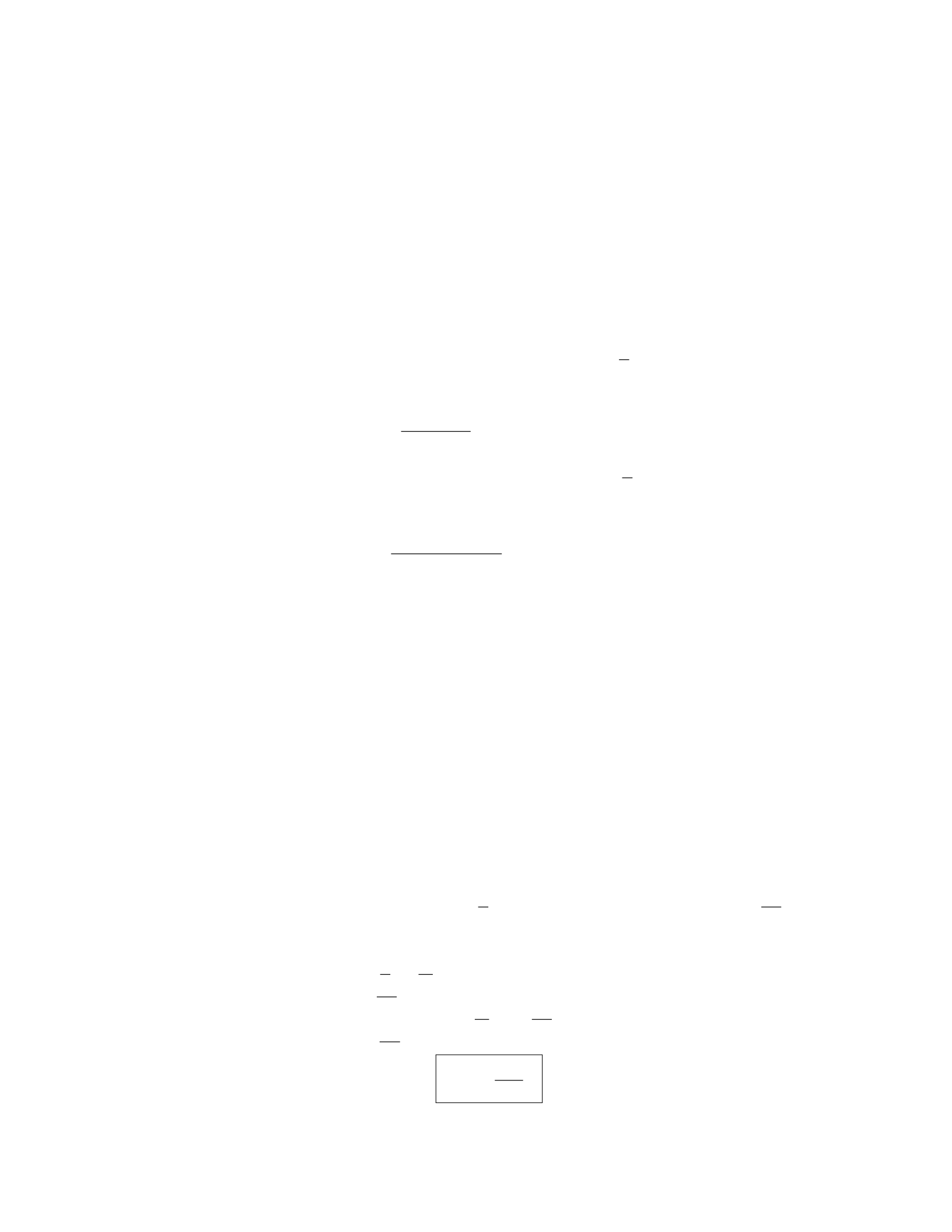
1. First, calculate the stress on the rod using the formula σ=F
A, where σis the stress, Fis
the force applied, and Ais the cross-sectional area.
σ=10,000 N
5cm2= 2,000 N/m2
2. Next, calculate the strain on the rod using the formula ε=σ
E, where εis the strain, σis
the stress, and Eis Young’s modulus.
ε=2,000 N/m2
2×10¹¹ N/m2= 1 ×10⁻⁸
3. Finally, find the elongation of the rod using the formula ∆L=ε·L, where Lis the original
length of the rod.
∆L= 1 ×10⁻⁸·L
2. Question: A uniform bar of length Land cross-sectional area Ais suspended vertically from
its top end. A weight Wis attached to the bottom end of the bar. If the Young’s modulus of
the material is Y, determine the elongation of the bar.
Ans. Let’s denote the original length of the bar as Land the elongation as ∆L. The weight of
the bar is acting downwards at the bottom end and the tensile force is acting upwards at the top
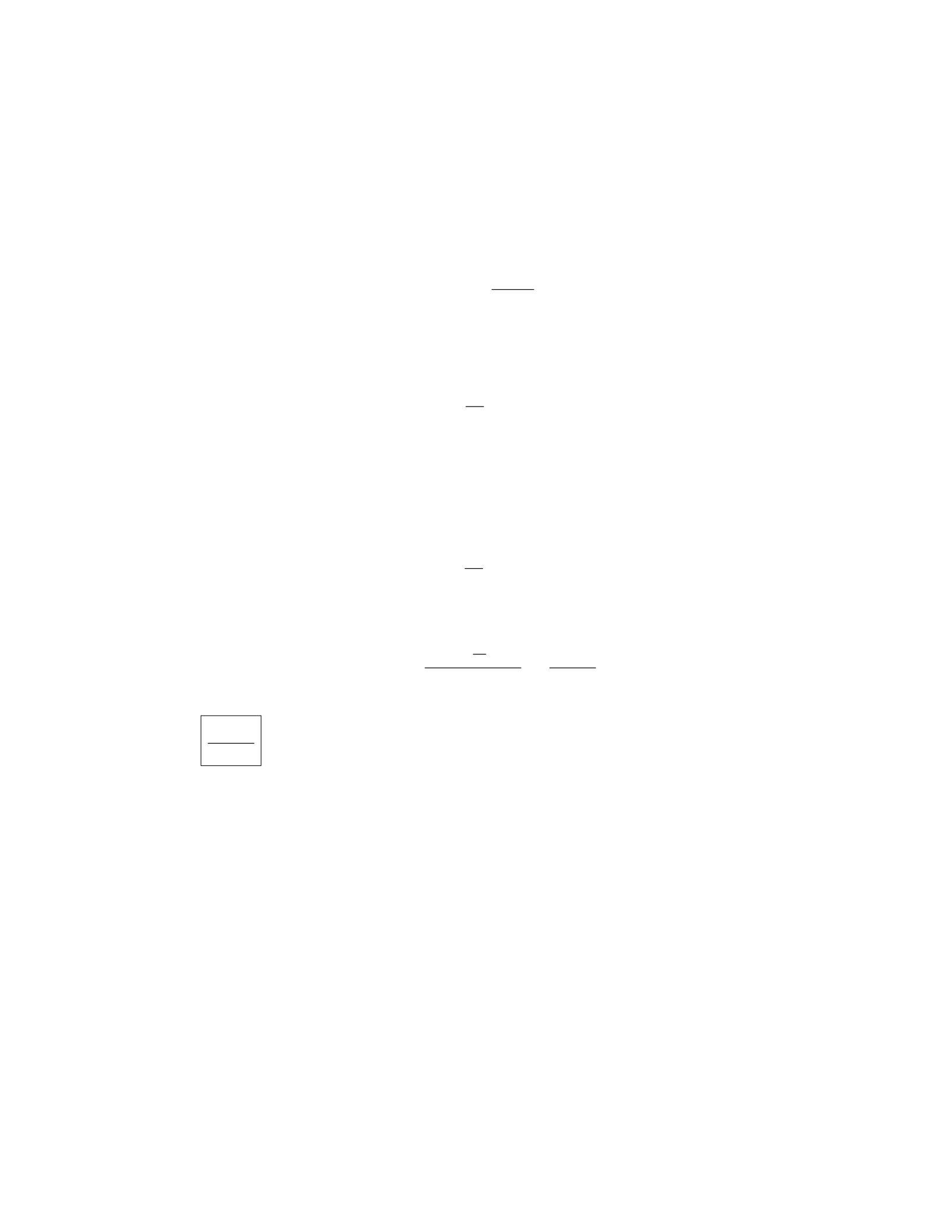
end. The stress (σ) in the bar is given by σ=F
Aand the strain (ϵ) is given by ϵ=∆L
L. Using
Hooke’s law, which states σ=Y ϵ, we can relate stress and strain.
Solution: 1. The weight Wwill create a tensile force F=Won the bar.
2. The stress in the bar is σ=F
A=W
A.
3. The strain in the bar is ϵ=∆L
L.
4. According to Hooke’s law, σ=Y ϵ gives W
A=Y∆L
L.
5. Solving for ∆Lgives ∆L=W
AY L.
Therefore, the elongation of the bar is ∆L=W
AY L.
3. A rectangular beam of length Land width wis subjected to a load of magnitude Pat
its midpoint. The beam is made of a material with Young’s modulus Eand Poisson’s ratio ν.
Determine the magnitude of the load that will cause the beam to buckle. Assume that the beam
is supported at its ends and that buckling occurs in the weakest direction.
Ans. Let’s determine the load Pthat will cause the beam to buckle.
1. The critical load for buckling can be found using the Euler buckling formula:
Pcritical =π2EI
L2
where Iis the moment of inertia of the beam’s cross-sectional area about the axis of buckling.
For a rectangular beam of width wand height h, the moment of inertia is given by
I=1
12wh3.
2. Now, we need to find the height hof the beam in terms of its width wsuch that buckling
occurs in the weakest direction. Buckling in the weakest direction happens when the beam is
oriented vertically, so hbecomes the length of the beam.
3. Substituting h=Linto the moment of inertia formula, we obtain
I=1
12wL3.
4. Substituting the moment of inertia Iinto the Euler buckling formula and solving for P,
we have
Pcritical =π2E·1
12 wL3
L2=π2Ew
12 .
5. Therefore, the magnitude of the load that will cause the beam to buckle in its weakest
direction is π2Ew
12 .
4. Question:
A block of mass mis placed on an inclined plane with an angle θwith respect to the horizontal.
The coefficient of friction between the block and the plane is µ. Find the minimum force Fparallel
to the plane needed to keep the block in equilibrium.
Ans. Solution:
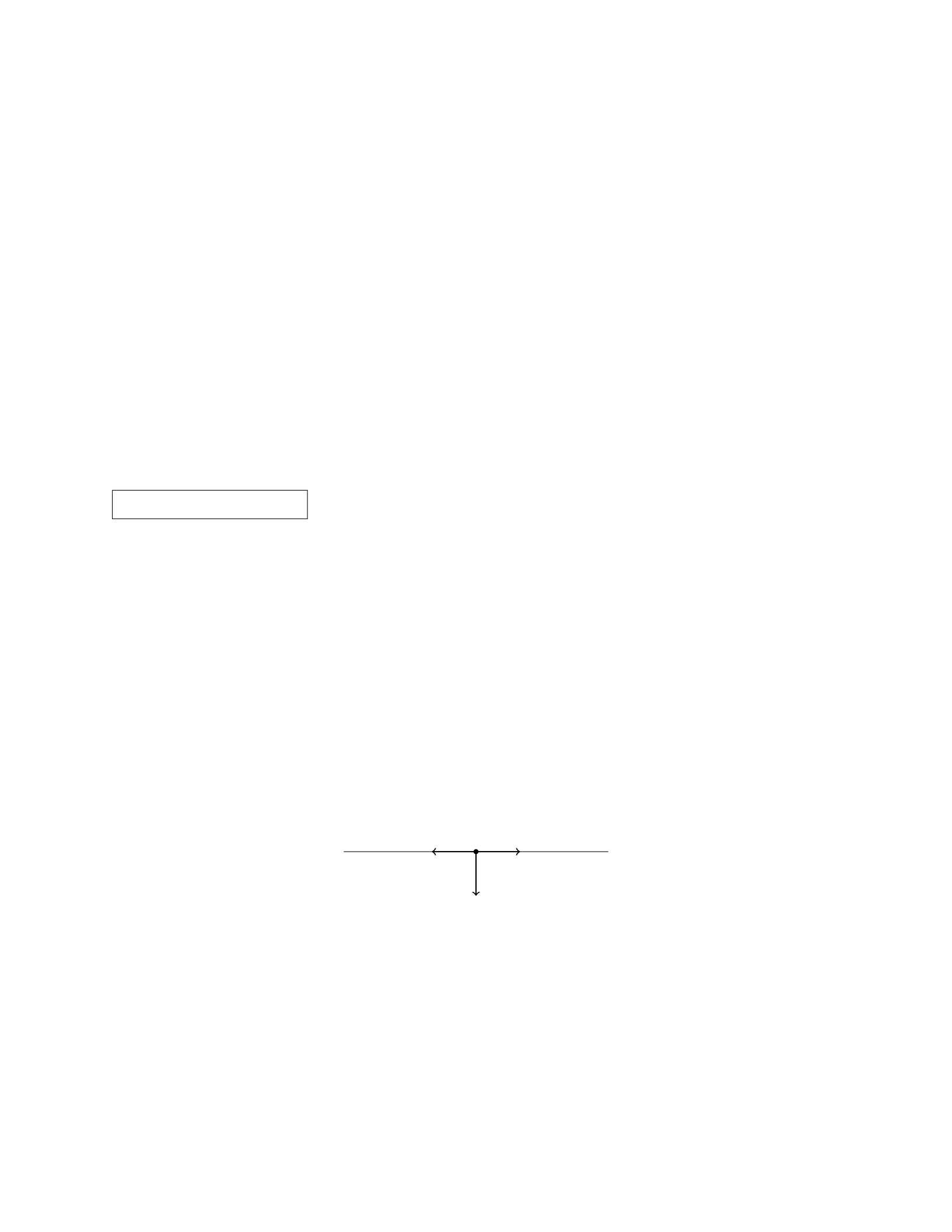
Let’s consider the forces acting on the block:
1. The weight of the block mg acts vertically downwards. 2. The normal force Nfrom the
inclined plane acts perpendicular to the plane. 3. The frictional force fopposes the motion and
acts parallel to the plane. 4. The force Fparallel to the plane.
Since the block is in equilibrium, the sum of forces in both the horizontal and vertical directions
must be zero.
In the vertical direction:
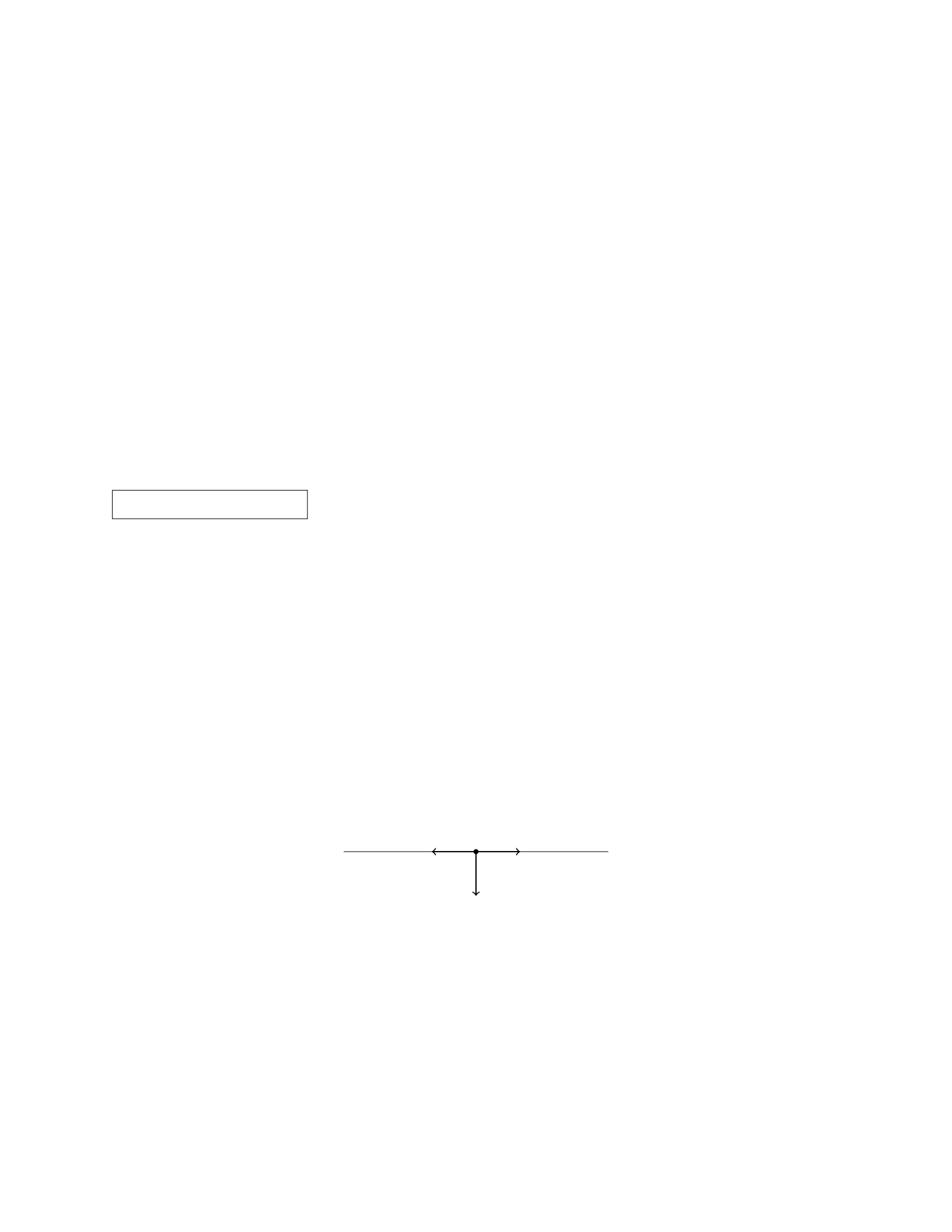
N=mg cos θ
In the horizontal direction:
∑Fhorizontal =F−mg sin θ−f= 0
Next, we find the expression for the frictional force f. The maximum value of the frictional
force is given by µN.
f=µN =µmg cos θ
Substitute this expression for fback into the horizontal equilibrium equation:
F−mg sin θ−µmg cos θ= 0
Solving for F, we get:
F=mg(sin θ+µcos θ)
So, the minimum force Fparallel to the plane needed to keep the block in equilibrium is
F=mg(sin θ+µcos θ).
5. A thin rod of length Land mass Mis suspended horizontally by two vertical wires of length
Lat each end. A small weight of mass mis hung from the center of the rod. The system is in
equilibrium.
Calculate the tension in each wire.
Ans. To solve this problem, we will first draw a free body diagram of the forces acting on the
rod and then apply the conditions for equilibrium in both the horizontal and vertical directions.
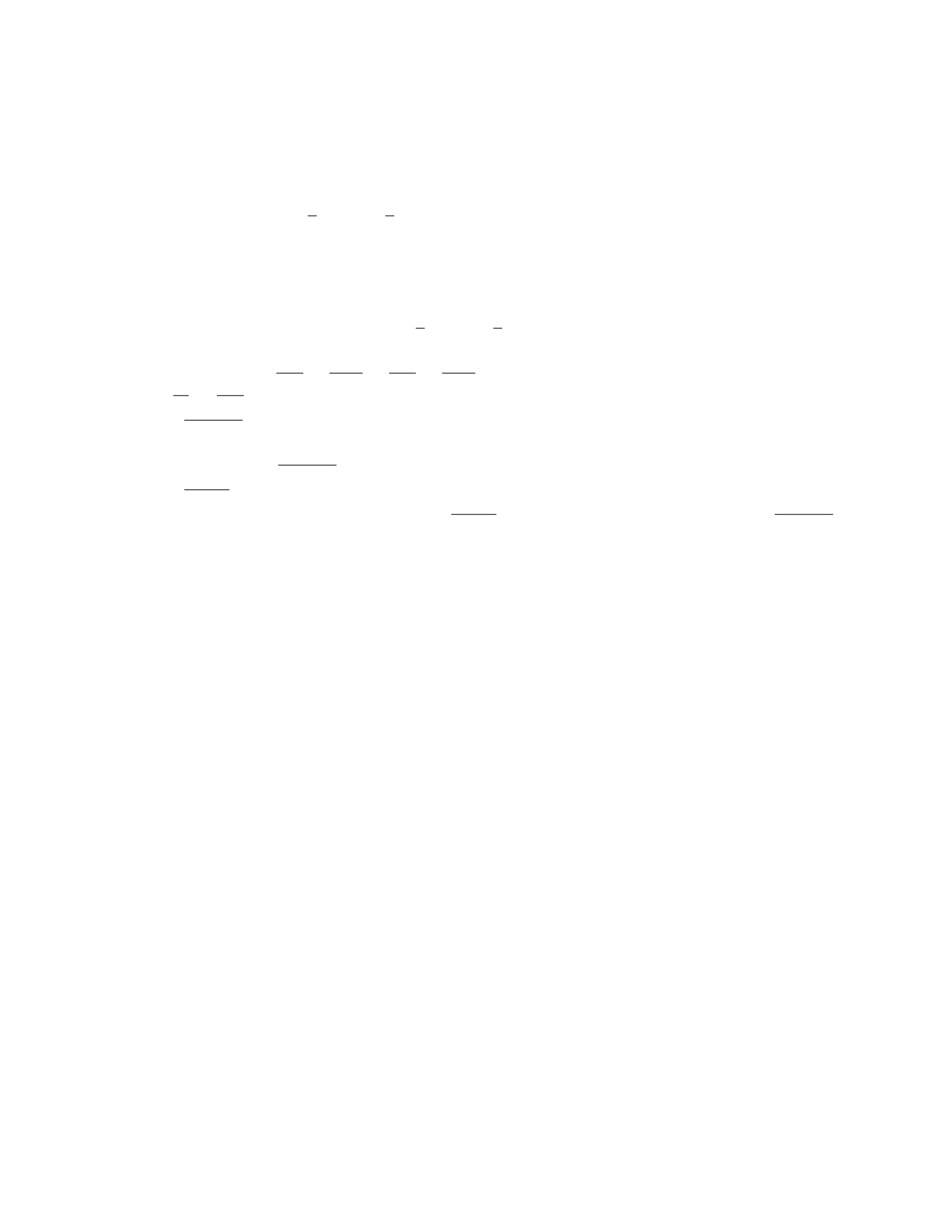
1. Free Body Diagram: Let T1and T2be the tensions in the wires, and mg be the weight
of mass m.
T1T2
mg
2. Equilibrium in the Horizontal Direction: There are no horizontal forces acting on the
system, so the sum of the horizontal components of the tensions must cancel out:
T1=T2
3. Equilibrium in the Vertical Direction: The sum of the vertical forces must be zero for
equilibrium:
T1+T2=mg

4. Solve for Tension in Each Wire: Substitute T1=T2from the horizontal equilibrium
into the vertical equilibrium equation:
2T1=mg
T1=mg
2
Thus, the tension in each wire is mg
2.
6. A uniform beam of length Land mass Mis supported by a pivot at the left end, with a
cable attached to the right end to keep it horizontal. The beam is also subject to a concentrated
load of weight Wat a distance afrom the left end. Find the tension in the cable.
Ans. Let’s denote the tension in the cable as T. To find the tension in the cable, we need to
consider the rotational equilibrium of the beam about the pivot point.
1. Summing the torques about the pivot point: The torque due to the weight Wis W(a).
The torque due to the beam’s weight acts at the center of mass, which is at a distance of L/2
from the pivot point. The weight of the beam is Mg, so the torque due to the weight of the
beam is Mg(L/2). Since the beam is in equilibrium, the sum of these torques must be zero:
T(L)−W(a)−Mg(L/2) = 0
2. Solving for T:
T(L) = W(a) + Mg(L/2)
T=W(a) + Mg(L/2)
L
T=W a
L+Mg
2
Therefore, the tension in the cable is T=W a
L+Mg
2.
7. A uniform rod of length Land mass Mis supported horizontally at its ends by two vertical
strings. A weight Wis hung from the rod at a distance xfrom the left end. Determine the
tension in each string in terms of W,L, and x.
Ans. Let’s denote the tension in the left string as T1and the tension in the right string as T2.
1. Consider the forces acting on the rod. There are two vertical forces acting at each end
of the rod. The left end has tension T1acting upwards, and the right end has tension T2acting
upwards. There are also two downward forces acting: the weight Wand the weight of the rod
Mg acting at the center of mass L
2.
2. Write down the equilibrium equations in the vertical direction. Since the rod is in equilib-
rium, the sum of the forces in the vertical direction is zero. This gives us:
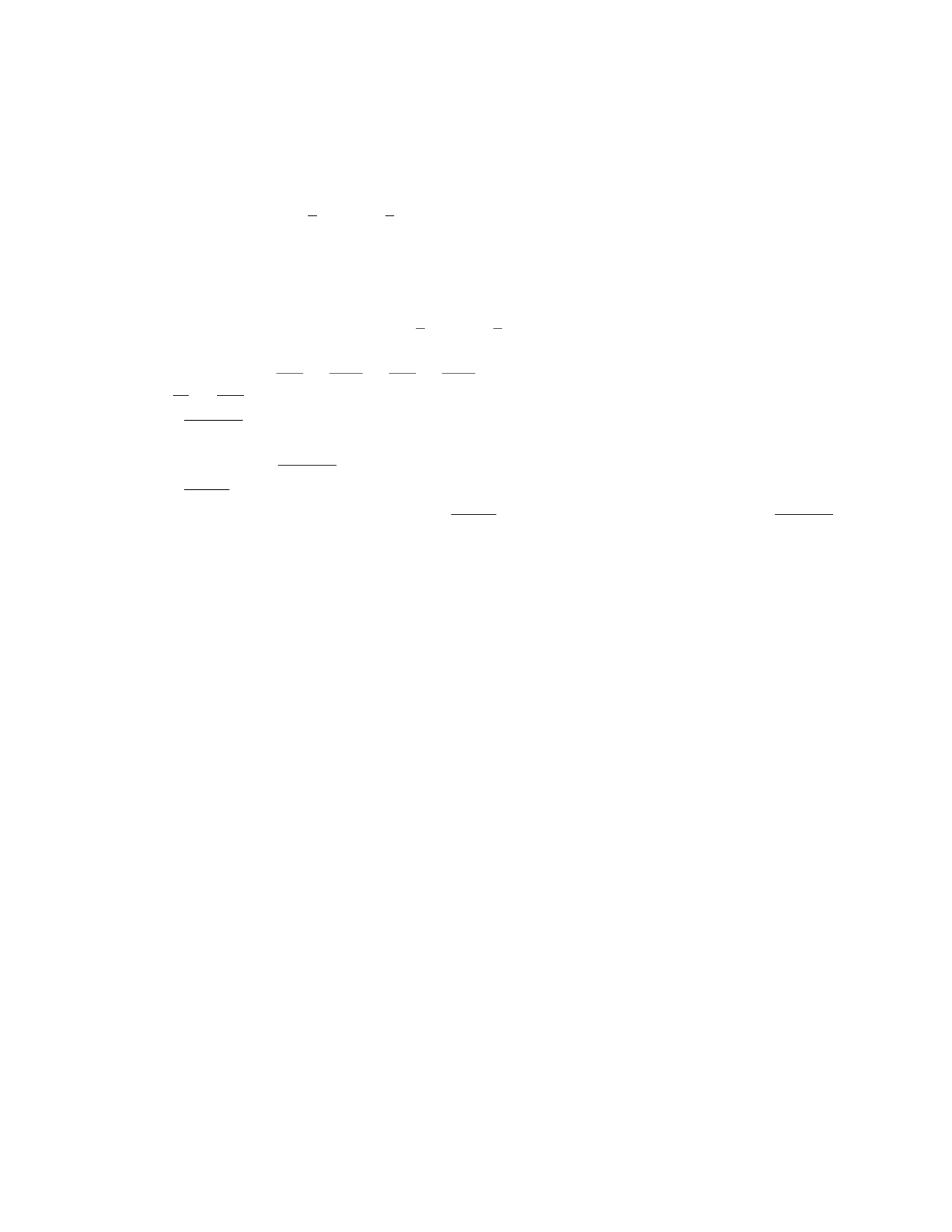
T1+T2=W+Mg
3. Next, consider the torques about a point at the left end of the rod. The torques due to
T2and Ware clockwise, while the torques due to T1and Mg are counterclockwise. The torques
contribute the following:
T2·L−W·x=T1·L
2+Mg ·L
2
4. Solve the system of equations obtained in steps 2 and 3 to find expressions for T1and T2
in terms of W,L, and x:
From step 2: T1=W+Mg −T2
Substitute into step 3:
T2·L−W·x= (W+Mg −T2)·L
2+Mg ·L
2
5. Simplify the equation and solve for T2:
T2·L−W·x=W·L
2+Mg·L
2−T2·L
2+Mg·L
2
T2·3L
2=W·L
2+Mg ·L
T2=2W+2Mg
3
6. Finally, substitute the expression for T2back into the equation from step 2 to find T1:
T1=W+Mg −2W+2Mg
3
T1=W+Mg
3
Therefore, the tension in the left string is W+M g
3and the tension in the right string is 2W+2M g
3.
8. Question: A steel cylindrical rod with a length of 2 m is hanging vertically from the ceiling.
The rod has a diameter of 3 cm. If the density of steel is 7850 kg/m³ and the rod is in equilibrium,
find the stress in the rod near the top end. Assume the acceleration due to gravity is 9.81 m/s2.
Ans. Step-by-step solution: 1. First, we need to calculate the weight of the rod. The volume
of the rod can be calculated using the formula for the volume of a cylinder: V=πr2h, where r
is the radius and his the height. Given that the diameter is 3 cm, the radius r= 1.5cm = 0.015
m, and the height h= 2 m.
2. The volume Vof the rod is:
V=π(0.015 m)2×2m
3. The weight Wof the rod can be calculated using the formula W=mg, where mis the
mass of the rod and gis the acceleration due to gravity:
m=density ×V= 7850 kg/m3×V
4. Substituting the values, the mass mof the rod is:
m= 7850 kg/m3×π(0.015 m)2×2m
5. The weight Wof the rod is:
W= 7850 kg/m3×π(0.015 m)2×2m×9.81 m/s2
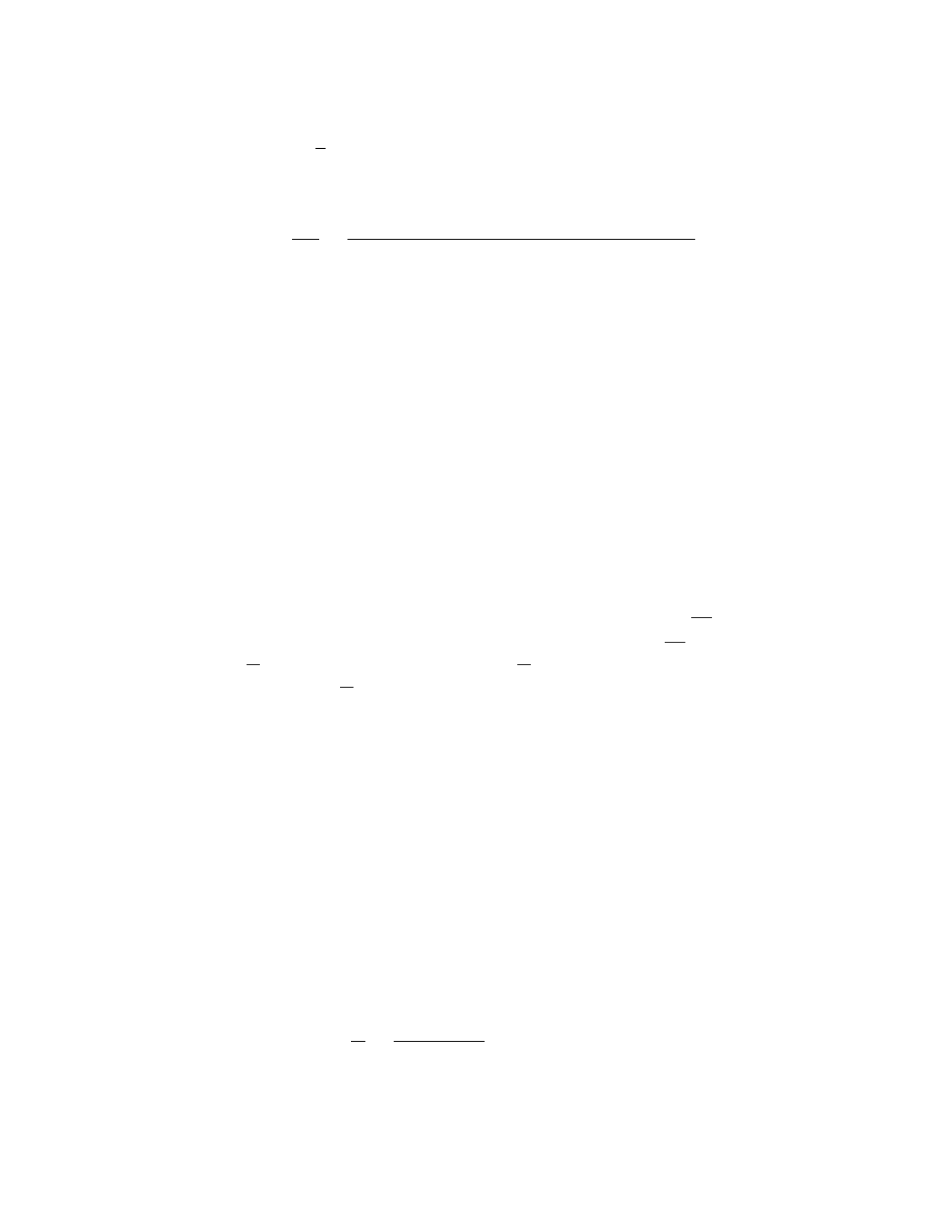
6. Now that we have the weight Wof the rod, we can calculate the stress near the top end.
The stress is given by σ=F
A, where Fis the force applied and Ais the area over which the force
is applied. Near the top end, the area is the cross-sectional area of the rod, which is πr2.
7. The stress near the top end σis:
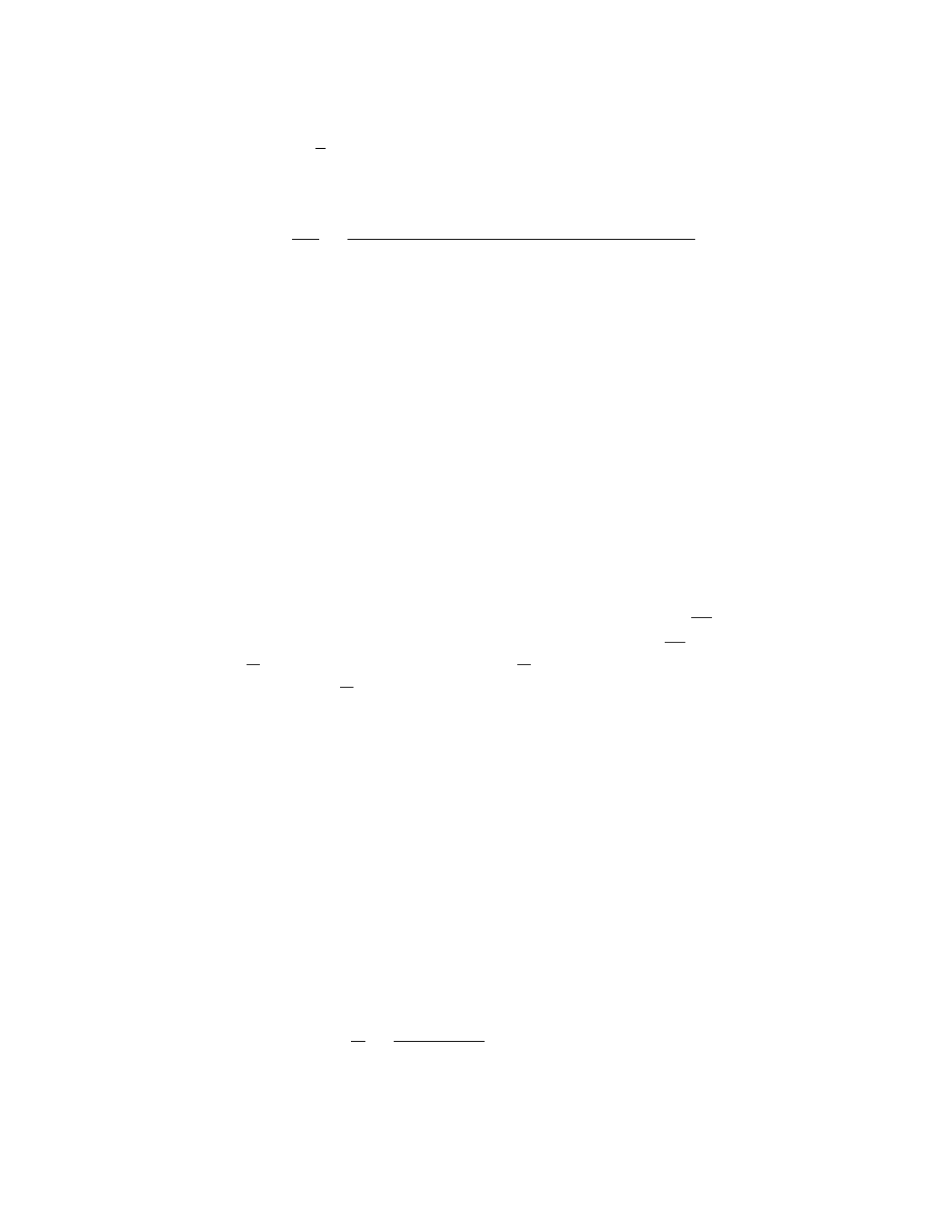
σ=W
πr2=7850 kg/m3×π(0.015 m)2×2m×9.81 m/s2
π(0.015 m)2
9. Suppose a uniform rod of length Land mass Mis suspended horizontally from two vertical
walls via two strings of length Leach, attached to the ends of the rod. The walls are a distance
dapart. The strings each make an angle θwith the vertical. If the tension in each string is T,
find an expression for θin terms of the given variables.
Ans. We can solve this problem by analyzing the forces acting on the rod. 1. Draw a free-
body diagram for the rod. The forces acting on the rod are the gravitational force Mg acting
downwards, the tensions Tacting upwards and the horizontal forces at the point of contact with
the walls. 2. Resolve the forces perpendicular to the rod. The vertical components of the tensions
cancel out the gravitational force, so 2Tcos(θ) = M g. 3. Resolve the forces parallel to the rod.
The horizontal components of the tensions provide the net force required for equilibrium in the
horizontal direction, so 2Tsin(θ) = Fwall. We know that Fwall =Ttan(θ) = M g
2tan(θ). 4. Since
the net horizontal force must be zero for equilibrium, we set Ttan(θ) = M g
2tan(θ). Simplifying,
we find tan(θ) = g
2d. 5. Finally, we have θ=arctan (g
2d). Therefore, the angle θin terms of the
given variables is θ=arctan (g
2d).
10. A steel wire of length 2.0 m and radius 1.0 mm is stretched by a force of 500 N. The
Young’s modulus of the steel wire is 2.0×10¹¹ N/m2. Calculate the extension of the wire using
Hooke’s Law.
Ans. Let’s denote the original length of the wire as L, the force applied as F, the radius of the
wire as r, the Young’s modulus as Y, and the extension as ∆L.
1. First, let’s calculate the cross-sectional area of the wire using its radius:
A=πr2=π(1.0×10⁻³)2= 3.14 ×10⁻⁶m2
2. Next, we can calculate the stress applied to the wire using the formula:
σ=F
A=500
3.14 ×10−6= 1.59 ×10⁸N/m2
3. Now, using Hooke’s Law, we can find the strain in the wire:
σ=Y·ϵ
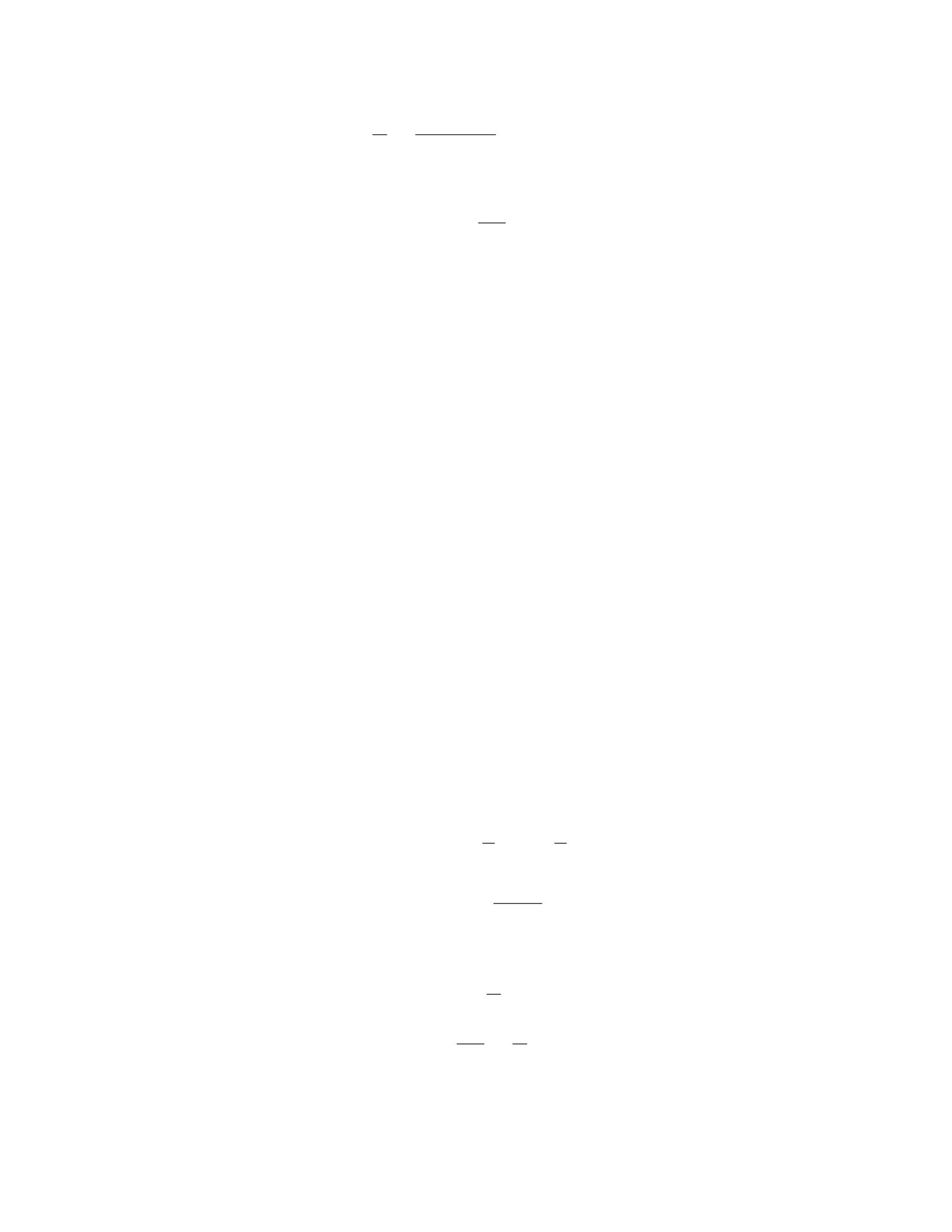
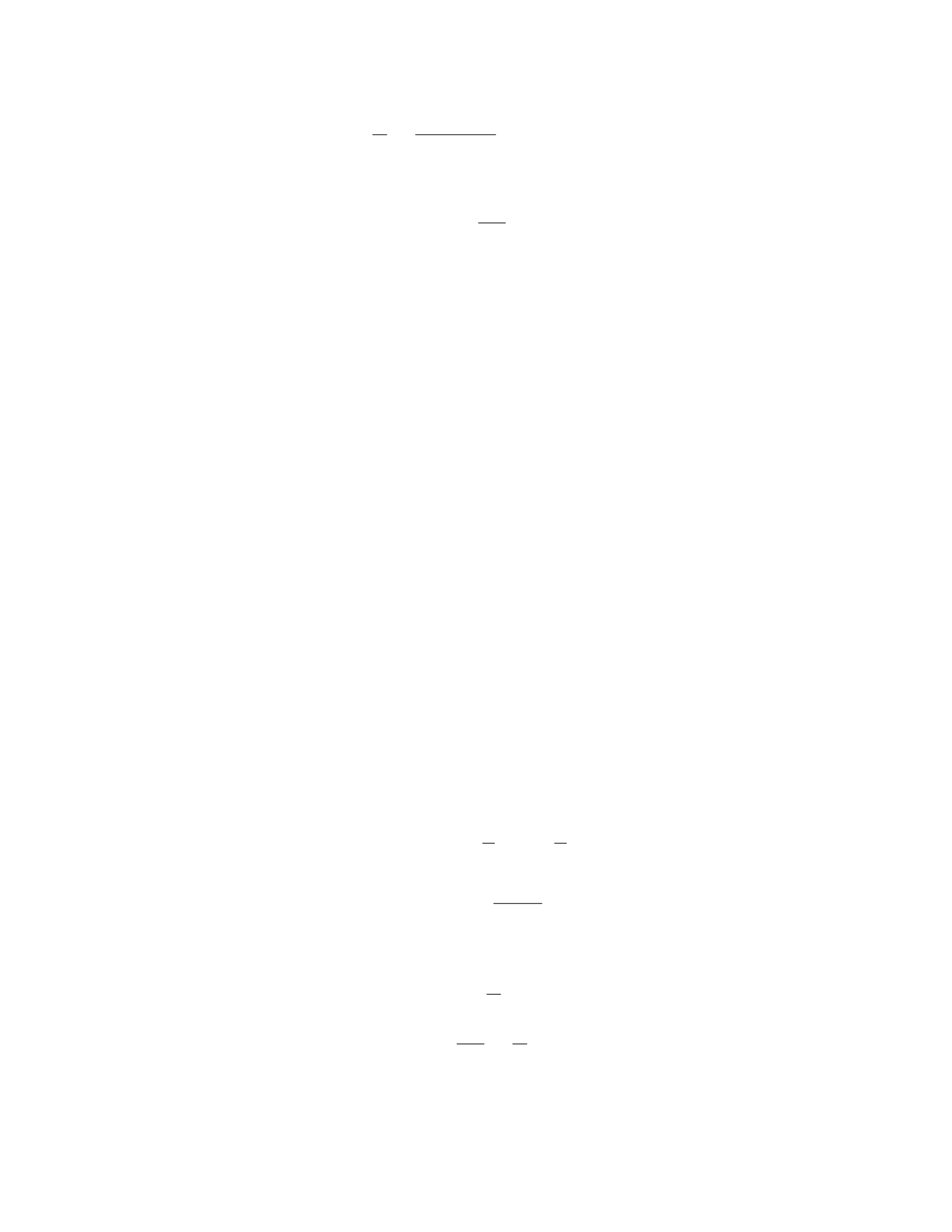
ϵ=σ
Y=1.59 ×10⁸
2.0×1011 = 7.95 ×10⁻⁴
4. Finally, we can calculate the extension of the wire using the formula for strain:
ϵ=∆L
L
∆L=ϵ·L= 7.95 ×10−4×2.0 = 1.59 ×10⁻³m
Therefore, the extension of the wire is 1.59 ×10⁻³m.
11. A uniform rod AB of length Land mass Mis supported by a hinge at A and a cable which
is attached to the rod at a distance dfrom A. The cable makes an angle θwith the horizontal.
The rod is in equilibrium and the tension in the cable is T. If the rod is made of a material with
a Young’s modulus Y, find the change in length of the rod due to the tension in the cable.
Ans. Let’s denote the original length of the rod as L0, the tension in the cable as T, the change
in length of the rod as ∆L, the cross-sectional area of the rod as A, and the Young’s modulus
of the material as Y. We are given that the tension in the cable is T.
1. Free Body Diagram: Consider the forces acting on the rod: - The weight, W=Mg,
acting at the center of mass of the rod. - The tension in the cable, T, at an angle θto the
horizontal. - The reaction force at the hinge, RA, acting vertically upwards.
Since the rod is in equilibrium, the sum of the forces in the vertical direction must be zero.
This gives us:
RA+Tcos θ−Mg = 0
RA=Mg −Tcos θ
The sum of the torques about point A must also be zero since the rod is in equilibrium.
Taking the torque about point A gives us:
T·dsin θ=L
2·Mg ·L
2
T d sin θ=MgL2
4
2. Calculating Change in Length: The change in length of a material under stress can be
calculated using Hooke’s Law:
σ=F
A
ϵ=∆L
L0
=σ
Y
∆L=ϵ·L0
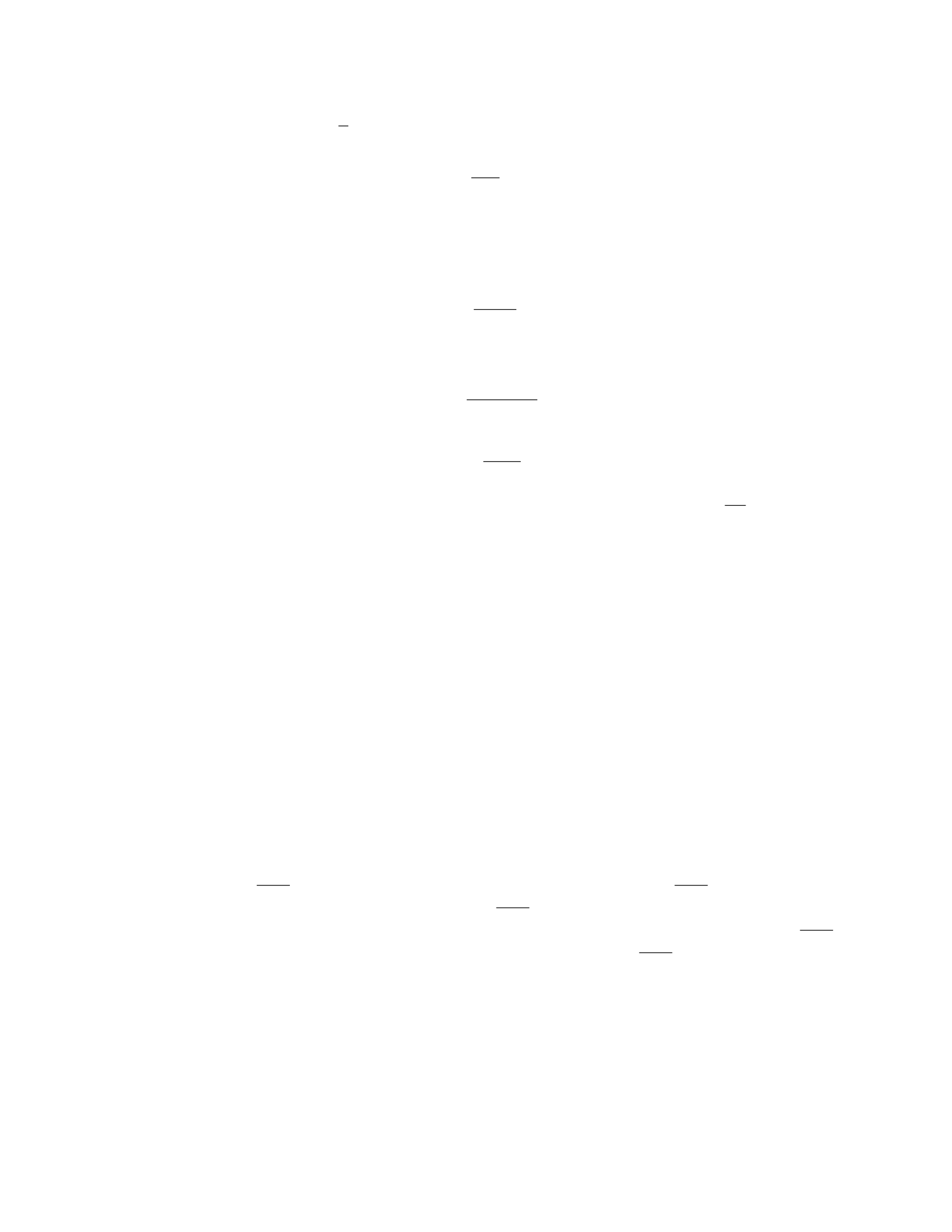
Substitute the stress σ=T
Ainto the strain equation:
∆L=T
Y A ·L0
3. Solving for ∆L:To find the cross-sectional area A, we can relate it to the mass of the
rod:
M=ρ·V=ρ·A·L0
A=M
ρ·L0
Substitute the expression for Ainto our equation for ∆L:
∆L=T·L0
Y·ρ·L0
∆L=T
Y·ρ
Therefore, the change in length of the rod due to the tension in the cable is T
Y·ρ.
12. Question: A uniform, horizontal beam of length Land mass Mis supported by two vertical
ropes attached at its ends. If a person of mass mstands at a distance xfrom one end of the
beam, find the tension in each rope.
Ans. Let’s denote the tension in the rope attached to the left end of the beam as T1and the
tension in the rope attached to the right end as T2.
1. The sum of the torques about the left end of the beam must be zero in order for the beam
to be in equilibrium. This gives us the equation: T2·L−m·g·x= 0, where gis the acceleration
due to gravity.
2. The sum of the vertical forces must also be zero in order for the beam to be in equilibrium.
This gives us the equation: T1+T2−M·g−m·g= 0.
3. We can solve the system of equations to find the tensions in the ropes. From equation
(1), we have T2=m·g·x
L. Substituting T2into equation (2) gives us: T1+m·g·x
L=M·g+m·g.
4. Solving for T1, we get T1= (M+m)·g−m·g·x
L.
Therefore, the tension in the rope attached to the left end of the beam is (M+m)·g−m·g·x
L,
and the tension in the rope attached to the right end of the beam is m·g·x
L.
13. A uniform rod of length Land mass Mis supported by a pivot at one end, with the other
end attached to a spring of spring constant k. The system is in equilibrium when the spring is

stretched a distance x0. If the rod makes an angle θwith the vertical, determine the expression
for θin terms of L,k,x0, and M.
Ans. To solve this problem, we need to analyze the forces acting on the rod and the spring at
equilibrium. 1. At equilibrium, the torque about the pivot point due to the spring force and the
gravitational force equals zero. 2. The torque due to the spring force is given by (−kx0)Lsin θ. 3.
The torque due to the gravitational force acting at the center of mass of the rod is −1
2Mg L
2sin θ.
4. Set the sum of torques equal to zero and solve for θ.
14. Question: A thin rod of length Land uniform cross-sectional area Ais supported horizontally
at its ends. A vertical force Fis applied at the midpoint of the rod. What is the expression for
the vertical displacement of the midpoint of the rod from its original position?
Ans. Let’s denote the Young’s modulus of the material as Y. The rod will deform under the
applied force and this deformation can be analyzed using the theory of elasticity.
1. The force applied at the midpoint of the rod will create a downward deformation in
the middle of the rod, while the ends of the rod will experience upward reactions to maintain
equilibrium.
2. We can calculate the Young’s modulus Yin terms of stress and strain. The stress σis the
force divided by the cross-sectional area: σ=F
A. The strain ϵis the change in length divided by
the original length: ϵ=∆L
L.
3. Using Hooke’s Law for linear elasticity, we have σ=Y ϵ. Rearranging, we get ∆L=F L
AY .
Since the force is applied at the midpoint, the vertical displacement of the midpoint from its
original position will be half of the total deformation: ∆y=1
2∆L.
4. Substituting in the expression for ∆L, we get ∆y=1
2(F L
AY )=F L
2AY .
Therefore, the expression for the vertical displacement of the midpoint of the rod from its
original position under the applied force Fis F L
2AY .
15. Question: A uniform rod of length Land mass Mis pivoted at one end. A force Fis
applied horizontally at the other end of the rod. Find the distance from the pivot point where a
supporting force should be applied perpendicular to the rod in order to keep it in equilibrium.
Ans. Let’s denote the distance from the pivot point where the supporting force should be
applied as x.
1. The net torque about the pivot point must be zero for the rod to remain in equilibrium.
The torque due to the force Fabout the pivot point is F(L−x). The torque due to the
supporting force about the pivot point is M g(x/2), where gis the acceleration due to gravity.
Setting the sum of torques equal to zero:

F(L−x) = Mg
2x
2. Solving the equation for x:
x=2F L
2F+Mg
3. Therefore, the supporting force should be applied at a distance x=2F L
2F+Mg from the pivot
point in order to keep the rod in equilibrium.
16. A uniform rod of length Land mass Mis hinged at one end and supported horizontally
at a distance xfrom the hinge. A weight Wis hung at the free end of the rod. Determine the
required force Fto keep the rod in equilibrium. (Hint: The rod will be in equilibrium if the sum
of the forces in the vertical direction and the sum of the moments about the hinge point are both
equal to zero.)
Ans. Let’s denote the distance between the hinge and the center of mass of the rod as d. We
have d=L
2. The sum of the forces in the vertical direction is given by:
F+W−Mg = 0
where gis the acceleration due to gravity. The sum of the moments about the hinge point is
given by:
F x −W(L−d) = 0
1. Solve the force equation to find F: From F+W−M g = 0, we can solve for F:
F=Mg −W
2. Solve the moment equation to find F: Substitute d=L
2and solve for F:
F x −W(L−L
2)= 0
F x −W
2L= 0
F x =W
2L
F=W
2x
3. Equate the two expressions for F: Set Mg −W=W
2xand solve for x:
Mg −W=W
2x

2x(Mg −W) = W
2xMg −2xW =W
2xMg = 3W
x=3W
2Mg
Therefore, the required force Fto keep the rod in equilibrium is:
F=Mg −W=Mg −3W
2
17. Question:
A steel cable with a length of 10 m and a diameter of 2 mm is used to support a load of 5000
N. The cable has a Young’s modulus of 2×10¹¹ Pa. Determine the elongation of the cable when
the load is applied.
Ans. Let’s denote the original length of the cable as L, the change in length as ∆L, the applied
load as F, the cross-sectional area as A, the Young’s modulus as Y, and the original modulus of
elasticity as ϵ. To find the elongation of the cable, we can use Hooke’s Law:
1. The cross-sectional area of the cable is given by:
A=πd2
4=π(2×10⁻³)2
4= 3.14 ×10⁻⁶m2
2. The original modulus of elasticity can be calculated by:
ϵ=F
A=5000
3.14×10−6= 1.59 ×10⁹Pa
3. Now, we can calculate the elongation of the cable using the formula:
∆L=F·L
A·Y=5000·10
3.14×10−6·2×1011 = 0.079m
Therefore, the elongation of the cable when the load is applied is 0.079 m.
18. A metal rod of length Land cross-sectional area Ais supported horizontally at its ends. A
force Fis applied at the midpoint of the rod perpendicular to its length. The Young’s modulus
of the material is Y. Determine the displacement at the midpoint of the rod due to the applied
force.
Ans. To determine the displacement at the midpoint of the rod, we will analyze the equilibrium
of forces and apply the concept of elasticity.
1. First, consider the free body diagram of the rod. The force Fapplied at the midpoint will
result in tension on the upper half and compression on the lower half. Let xbe the displacement
at the midpoint of the rod.
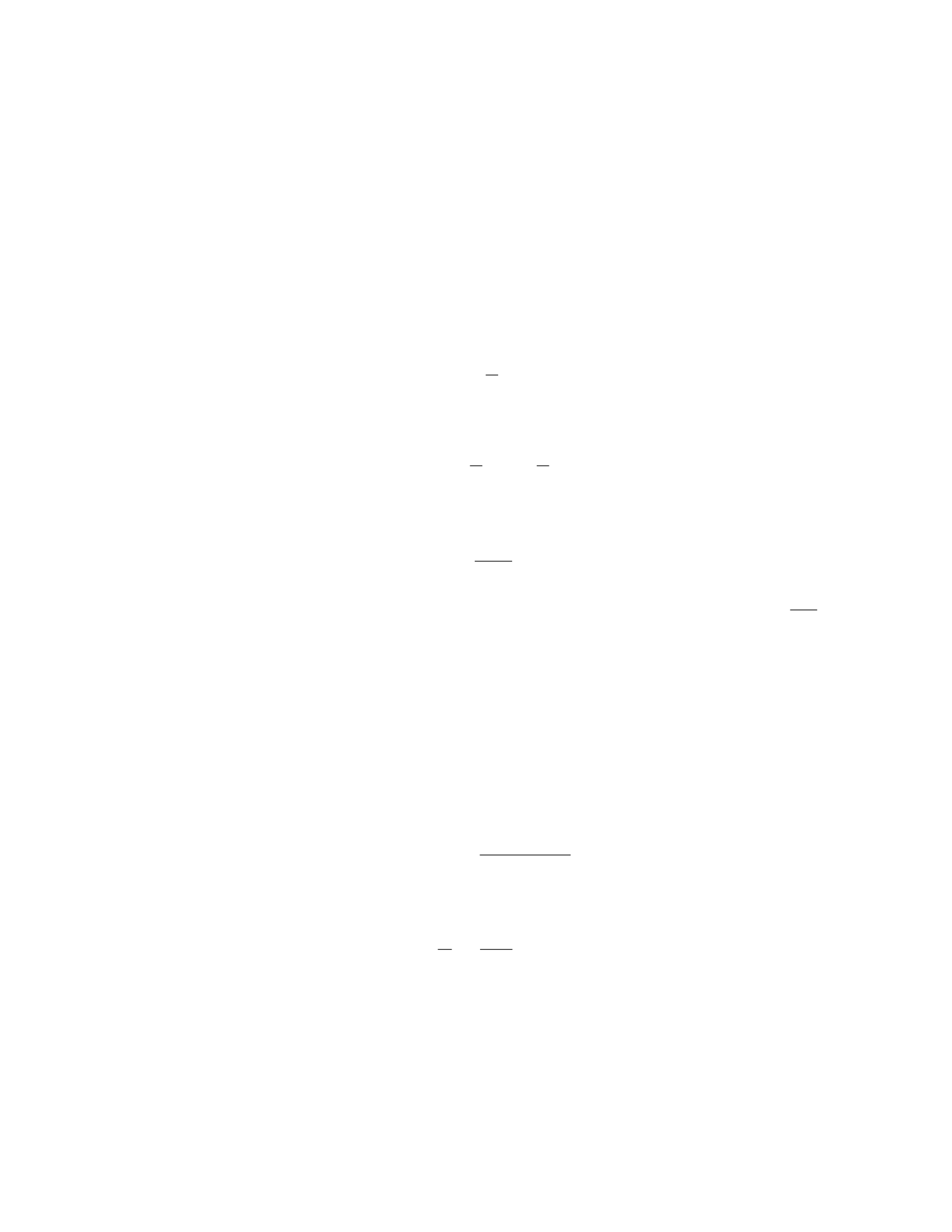
2. Using the equilibrium condition, the sum of forces in the vertical direction at the midpoint
is zero:
F=Aσ +Aσ
where σis the stress in the rod.
3. Using Hooke’s Law, the stress σis related to the strain ϵby:
σ=Y ϵ
where Yis the Young’s modulus.
4. The strain ϵis related to the displacement xby:
ϵ=x
L
5. Substituting the expressions for stress and strain into the equilibrium equation, we get:
F=AY x
L+AY x
L
6. Simplifying the equation, we find the displacement x:
x=F L
2AY
Therefore, the displacement at the midpoint of the rod due to the applied force Fis F L
2AY .
19. A 2 kg mass hangs from a vertical rod by a lightweight string. The mass causes the rod to
bend by 2 cm. If the radius of the rod is 1 cm and the modulus of elasticity of the material is
2×10¹¹ N/m2, find the stress experienced by the rod.
Ans. Let’s denote the Young’s modulus as Y, the radius of the rod as R, the distance
the rod bends as δ, and the stress experienced by the rod as σ. 1. First, let’s calculate the
strain experienced by the rod using the formula change in length
original length . Since the rod bends by 2 cm, the
elongation δis 2 cm or 0.02 m. The original length of the rod is the radius Rwhich is 0.01 m.
Therefore, the strain ϵis given by:
ϵ=δ
R=0.02
0.01 = 2
2. Next, we can use Hooke’s Law which states that stress σis equal to Young’s modulus Y
multiplied by strain ϵ. Therefore, we have:
σ=Y·ϵ= (2 ×1011)·2 = 4 ×10¹¹ N/m2
Therefore, the stress experienced by the rod is 4×10¹¹ N/m2.

20. A steel rod of length 2 m and diameter 2 cm is hung vertically from one end. If the
Young’s modulus of steel is 2×10¹¹ N/m2and the density of steel is 7,800 kg/m3, calculate the
elongation of the rod due to its own weight.
Ans. Let’s denote the elongation of the rod as ∆L. We will calculate the elongation step-by-
step:
1. First, let’s find the weight of the rod. The weight Wof the rod can be calculated using
the formula:
W=mg
where mis the mass of the rod and gis the acceleration due to gravity. The mass mof the rod
can be calculated using its volume V, density ρ, and the formula:
m=V ρ
The volume of the rod Vcan be calculated using its length Land cross-sectional area A:
V=AL
The cross-sectional area Aof the rod can be calculated using its diameter d:
A=πd2
4
2. Substitute the given values into the equations to find the weight Wof the rod.
3. Now, we will calculate the stress σexperienced by the rod due to its own weight. Stress
is defined as the force per unit area:
σ=W
A
4. Using Hooke’s Law, we can relate the stress σto the strain ϵ(elongation per unit length)
and Young’s modulus Y:
σ=Y ϵ
5. Rearrange the formula to solve for the elongation ϵ:
ϵ=σ
Y
6. Substitute the stress σcalculated in step 3 and the Young’s modulus Yto find the
elongation per unit length ϵ.
7. Finally, calculate the total elongation ∆Lby multiplying the elongation per unit length ϵ
by the length Lof the rod:
∆L=ϵL
21. A uniform rod of length Land mass Mis suspended horizontally by two vertical wires
attached to its ends. If a weight Wis suspended from the rod at a distance dfrom one end,
determine the tension in each wire.
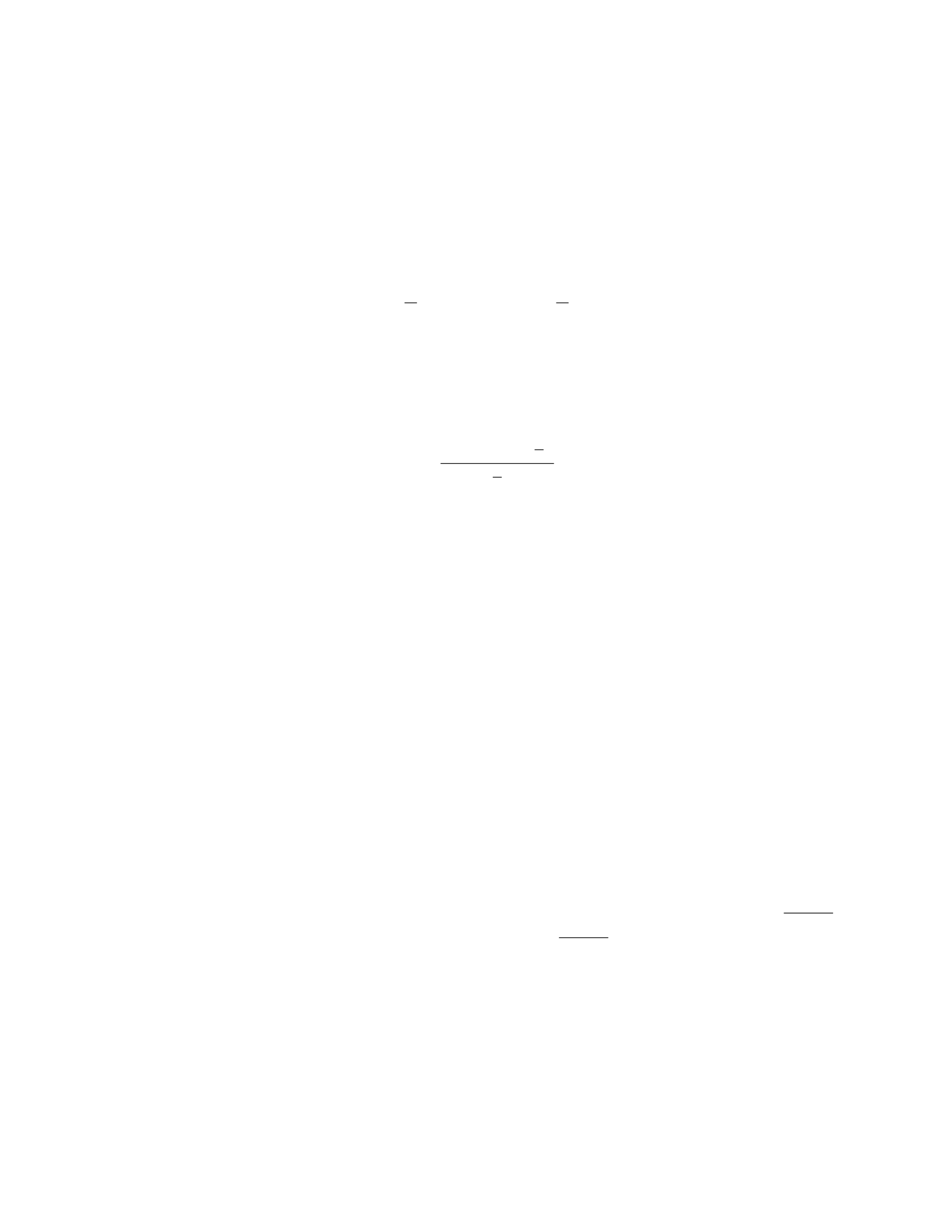
Ans. Let’s denote the tensions in the wires as T1and T2, and the weight Was acting downwards
at a distance dfrom the end where T2is applied. Since the system is in equilibrium, the sum of
the torques acting on the rod must be zero.
1. The torque due to Wabout the point where T2is applied is W d clockwise.
2. The torque due to T1about the point where T2is applied is T1(L/2) counterclockwise.
3. The torque due to M g about the point where T2is applied is Mg(L/2) clockwise.
4. Write the equation for equilibrium in terms of torque:
T1(L
2)=W d +Mg (L
2)
5. In the vertical direction, we have:
T1+T2=Mg +W
6. Since the system is in equilibrium, solving the system of equations will give the tensions
in the wires:
T1=W d +Mg (L
2)
(L
2)
T2=Mg +W−T1
22. Question: A uniform rod of length Land mass Mis suspended horizontally from two
vertical strings attached to its ends. A block of mass mis hung from the center of the rod. The
system is in equilibrium. Find the tensions in the strings.
Ans. Step-by-step solution: 1. We will start by drawing a free-body diagram of the system.
Let T1and T2be the tensions in the strings attached to the ends of the rod, and W1and W2
be the weights of the rod and the block, respectively. 2. The forces acting on the rod are the
tension forces T1and T2, and the weight of the rod W1=M g. The forces acting on the block
are the tension forces T1and T2, and the weight of the block W2=mg. 3. Since the system is
in equilibrium, the sum of all the forces in the horizontal direction and the vertical direction must
be zero. 4. In the horizontal direction, the tension forces T1and T2must balance each other,
so T1=T2. 5. In the vertical direction, the sum of the forces must also be zero. We have:
2T1=W1+W2. 6. Substituting the expressions for W1and W2into the equation above, we get:
2T1=Mg +mg. 7. Simplifying the equation, we find the tension in each string: T1=Mg+mg
2.
8. Therefore, the tensions in the strings are both equal to M g+mg
2.
23. A steel cable with a length of 10 m and a cross-sectional area of 2 cm2is stretched between
two fixed points. If the Young’s modulus of the steel is 2×10¹¹ N/m2, determine the force
required to stretch the cable by 2 mm.
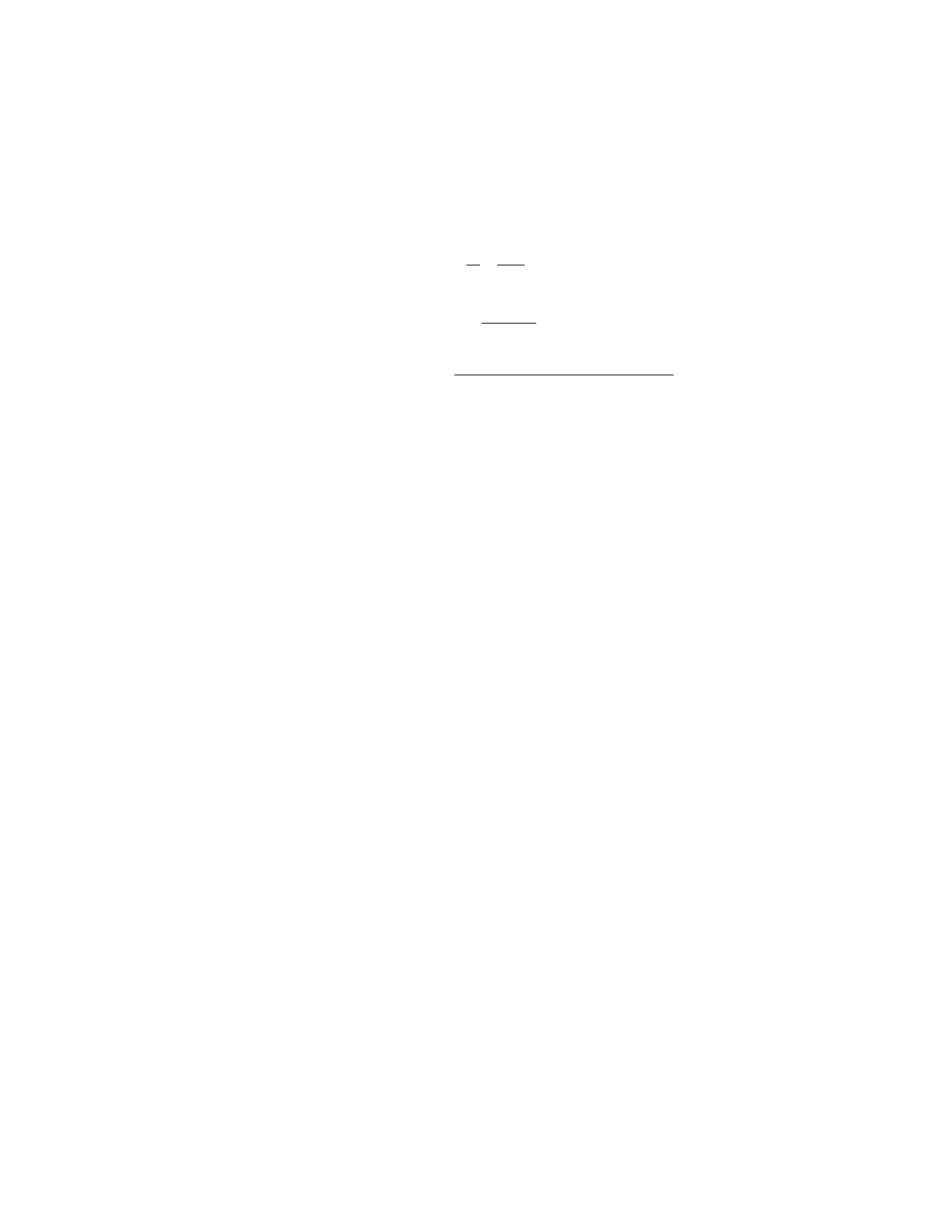
Ans. Let’s denote the original length of the steel cable as L= 10 m. The cross-sectional area of
the cable is A= 2 cm2= 2 ×10⁻⁴m2. The Young’s modulus of the steel is Y= 2 ×10¹¹ N/m2.
We need to find the force required to stretch the cable by ∆L= 2 mm = 2 ×10⁻³m.
1. Calculate the original tension in the cable:
The original tension in the cable can be found using the equation for Young’s modulus:
Y=T
A·∆L
L
T=Y·A·∆L
L
T= (2 ×10¹¹ N/m2)·(2 ×10−4m2)·(2 ×10−3m)
10 m
T= 8 ×10⁴N
2. Calculate the force required to stretch the cable:
To find the force required to stretch the cable by 2 mm, we can use the equation:
F=A·∆L·Y
F= (2 ×10⁻⁴m2)·(2 ×10−3m)·(2 ×10¹¹ N/m2)
F= 8 kN
Therefore, the force required to stretch the steel cable by 2 mm is 8 kN.
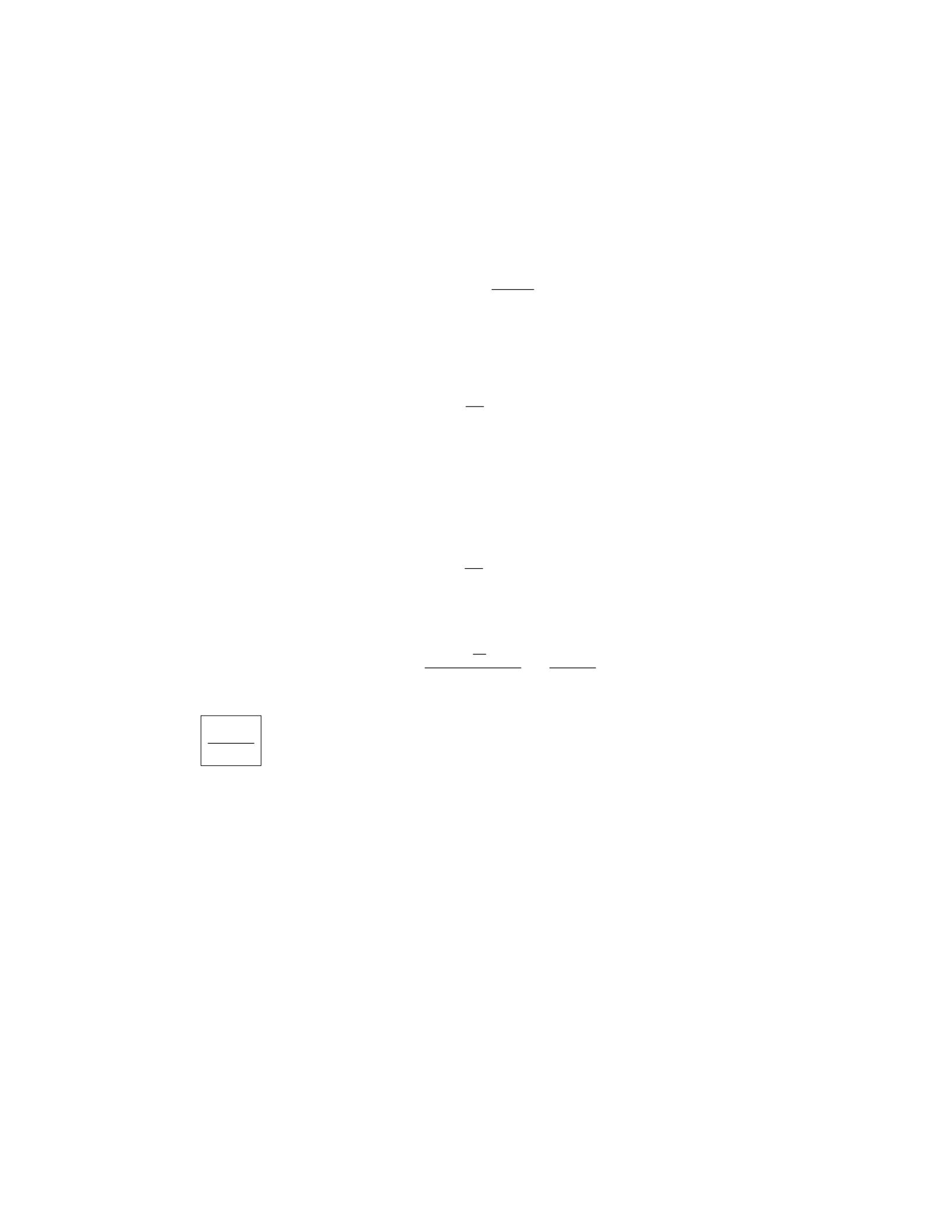
3. A rectangular beam of length Land width wis subjected to a load of magnitude Pat
its midpoint. The beam is made of a material with Young’s modulus Eand Poisson’s ratio ν.
Determine the magnitude of the load that will cause the beam to buckle. Assume that the beam
is supported at its ends and that buckling occurs in the weakest direction.
Ans. Let’s determine the load Pthat will cause the beam to buckle.
1. The critical load for buckling can be found using the Euler buckling formula:
Pcritical =π2EI
L2
where Iis the moment of inertia of the beam’s cross-sectional area about the axis of buckling.
For a rectangular beam of width wand height h, the moment of inertia is given by
I=1
12wh3.
2. Now, we need to find the height hof the beam in terms of its width wsuch that buckling
occurs in the weakest direction. Buckling in the weakest direction happens when the beam is
oriented vertically, so hbecomes the length of the beam.
3. Substituting h=Linto the moment of inertia formula, we obtain
I=1
12wL3.
4. Substituting the moment of inertia Iinto the Euler buckling formula and solving for P,
we have
Pcritical =π2E·1
12 wL3
L2=π2Ew
12 .
5. Therefore, the magnitude of the load that will cause the beam to buckle in its weakest
direction is π2Ew
12 .
4. Question:
A block of mass mis placed on an inclined plane with an angle θwith respect to the horizontal.
The coefficient of friction between the block and the plane is µ. Find the minimum force Fparallel
to the plane needed to keep the block in equilibrium.
Ans. Solution:
Let’s consider the forces acting on the block:
1. The weight of the block mg acts vertically downwards. 2. The normal force Nfrom the
inclined plane acts perpendicular to the plane. 3. The frictional force fopposes the motion and
acts parallel to the plane. 4. The force Fparallel to the plane.
Since the block is in equilibrium, the sum of forces in both the horizontal and vertical directions
must be zero.
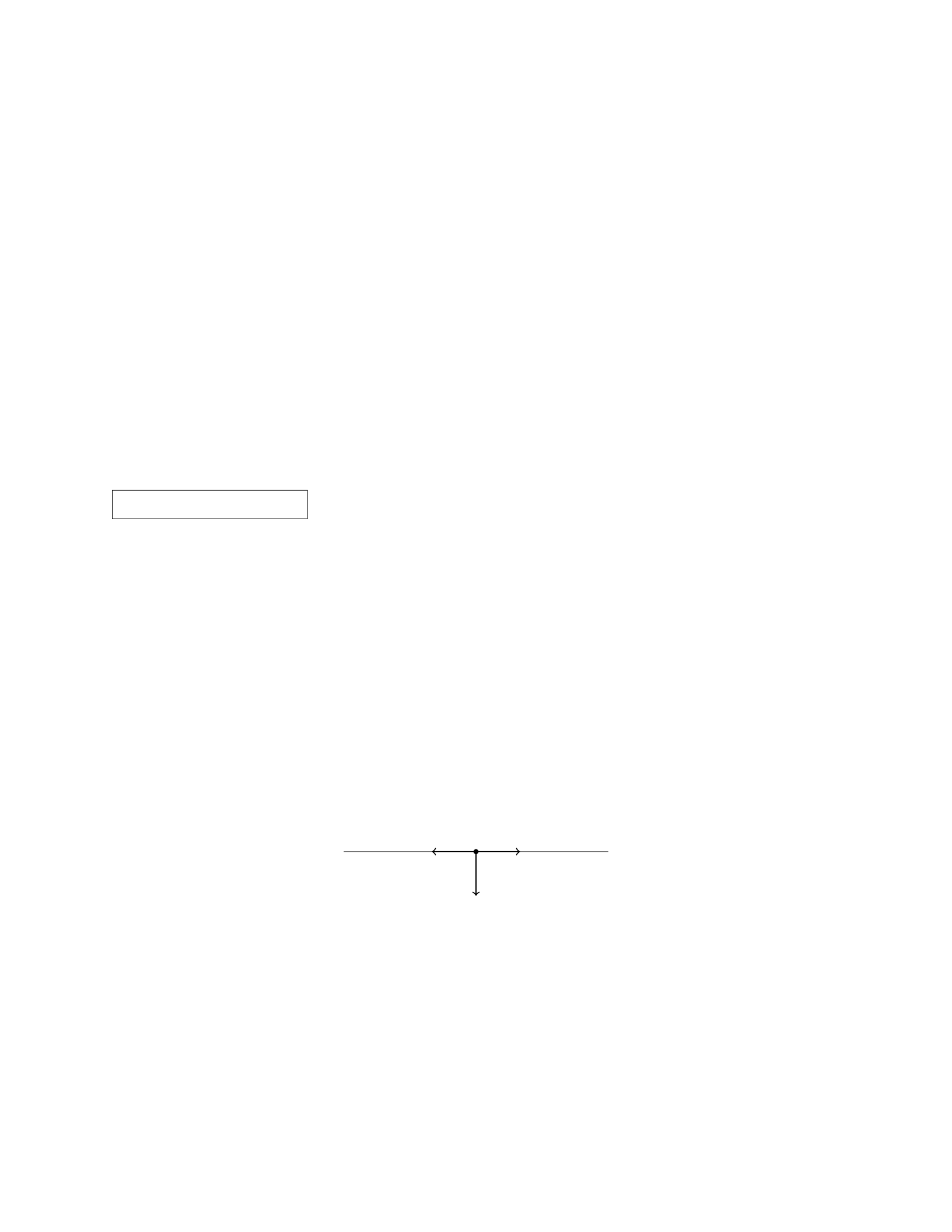
In the vertical direction:
N=mg cos θ
In the horizontal direction:
∑Fhorizontal =F−mg sin θ−f= 0
Next, we find the expression for the frictional force f. The maximum value of the frictional
force is given by µN.
f=µN =µmg cos θ
Substitute this expression for fback into the horizontal equilibrium equation:
F−mg sin θ−µmg cos θ= 0
Solving for F, we get:
F=mg(sin θ+µcos θ)
So, the minimum force Fparallel to the plane needed to keep the block in equilibrium is
F=mg(sin θ+µcos θ).
5. A thin rod of length Land mass Mis suspended horizontally by two vertical wires of length
Lat each end. A small weight of mass mis hung from the center of the rod. The system is in
equilibrium.
Calculate the tension in each wire.
Ans. To solve this problem, we will first draw a free body diagram of the forces acting on the
rod and then apply the conditions for equilibrium in both the horizontal and vertical directions.
1. Free Body Diagram: Let T1and T2be the tensions in the wires, and mg be the weight
of mass m.
T1T2
mg
2. Equilibrium in the Horizontal Direction: There are no horizontal forces acting on the
system, so the sum of the horizontal components of the tensions must cancel out:
T1=T2
3. Equilibrium in the Vertical Direction: The sum of the vertical forces must be zero for
equilibrium:
T1+T2=mg

4. Solve for Tension in Each Wire: Substitute T1=T2from the horizontal equilibrium
into the vertical equilibrium equation:
2T1=mg
T1=mg
2
Thus, the tension in each wire is mg
2.
6. A uniform beam of length Land mass Mis supported by a pivot at the left end, with a
cable attached to the right end to keep it horizontal. The beam is also subject to a concentrated
load of weight Wat a distance afrom the left end. Find the tension in the cable.
Ans. Let’s denote the tension in the cable as T. To find the tension in the cable, we need to
consider the rotational equilibrium of the beam about the pivot point.
1. Summing the torques about the pivot point: The torque due to the weight Wis W(a).
The torque due to the beam’s weight acts at the center of mass, which is at a distance of L/2
from the pivot point. The weight of the beam is Mg, so the torque due to the weight of the
beam is Mg(L/2). Since the beam is in equilibrium, the sum of these torques must be zero:
T(L)−W(a)−Mg(L/2) = 0
2. Solving for T:
T(L) = W(a) + Mg(L/2)
T=W(a) + Mg(L/2)
L
T=W a
L+Mg
2
Therefore, the tension in the cable is T=W a
L+Mg
2.
7. A uniform rod of length Land mass Mis supported horizontally at its ends by two vertical
strings. A weight Wis hung from the rod at a distance xfrom the left end. Determine the
tension in each string in terms of W,L, and x.
Ans. Let’s denote the tension in the left string as T1and the tension in the right string as T2.
1. Consider the forces acting on the rod. There are two vertical forces acting at each end
of the rod. The left end has tension T1acting upwards, and the right end has tension T2acting
upwards. There are also two downward forces acting: the weight Wand the weight of the rod
Mg acting at the center of mass L
2.
2. Write down the equilibrium equations in the vertical direction. Since the rod is in equilib-
rium, the sum of the forces in the vertical direction is zero. This gives us:
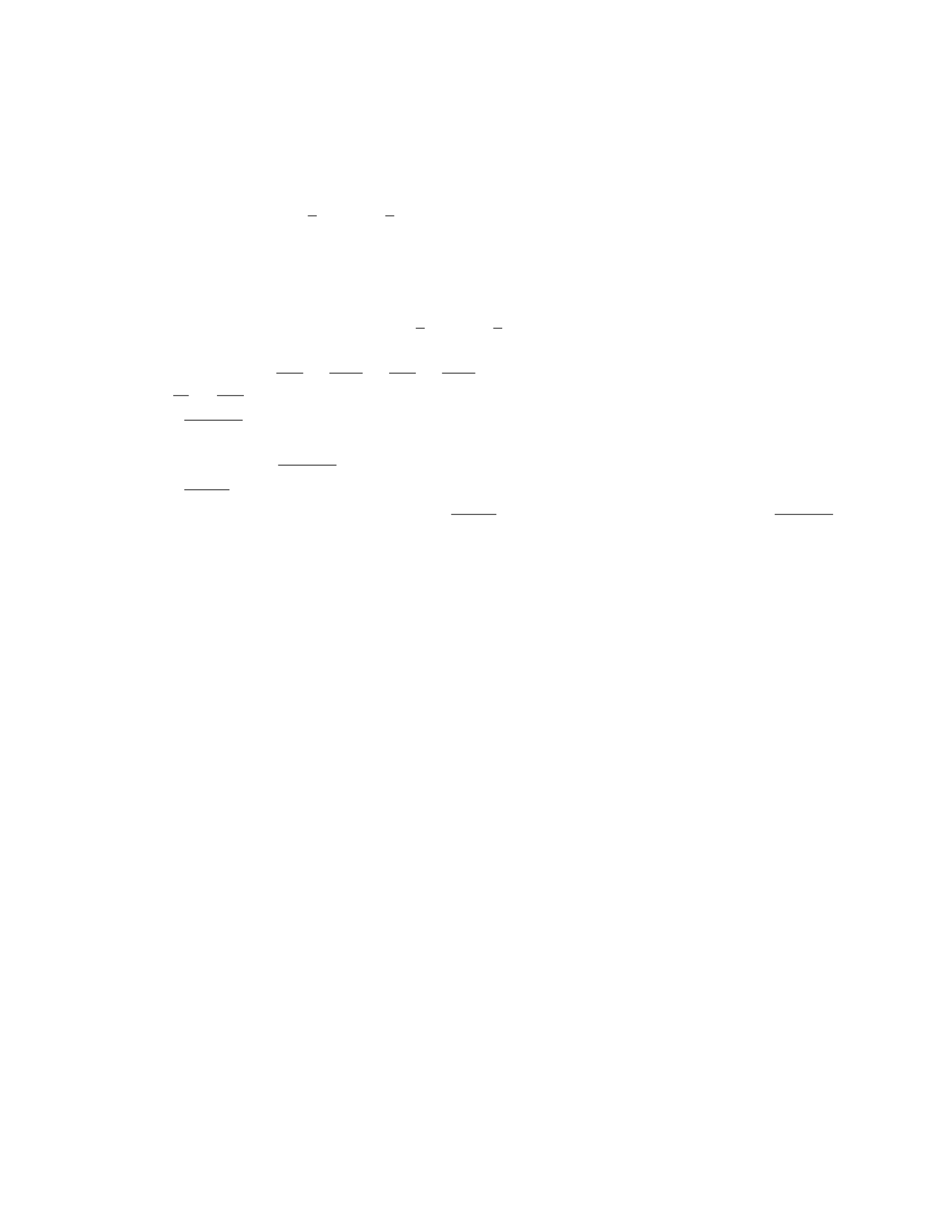
T1+T2=W+Mg
3. Next, consider the torques about a point at the left end of the rod. The torques due to
T2and Ware clockwise, while the torques due to T1and Mg are counterclockwise. The torques
contribute the following:
T2·L−W·x=T1·L
2+Mg ·L
2
4. Solve the system of equations obtained in steps 2 and 3 to find expressions for T1and T2
in terms of W,L, and x:
From step 2: T1=W+Mg −T2
Substitute into step 3:
T2·L−W·x= (W+Mg −T2)·L
2+Mg ·L
2
5. Simplify the equation and solve for T2:
T2·L−W·x=W·L
2+Mg·L
2−T2·L
2+Mg·L
2
T2·3L
2=W·L
2+Mg ·L
T2=2W+2Mg
3
6. Finally, substitute the expression for T2back into the equation from step 2 to find T1:
T1=W+Mg −2W+2Mg
3
T1=W+Mg
3
Therefore, the tension in the left string is W+M g
3and the tension in the right string is 2W+2M g
3.
8. Question: A steel cylindrical rod with a length of 2 m is hanging vertically from the ceiling.
The rod has a diameter of 3 cm. If the density of steel is 7850 kg/m³ and the rod is in equilibrium,
find the stress in the rod near the top end. Assume the acceleration due to gravity is 9.81 m/s2.
Ans. Step-by-step solution: 1. First, we need to calculate the weight of the rod. The volume
of the rod can be calculated using the formula for the volume of a cylinder: V=πr2h, where r
is the radius and his the height. Given that the diameter is 3 cm, the radius r= 1.5cm = 0.015
m, and the height h= 2 m.
2. The volume Vof the rod is:
V=π(0.015 m)2×2m
3. The weight Wof the rod can be calculated using the formula W=mg, where mis the
mass of the rod and gis the acceleration due to gravity:
m=density ×V= 7850 kg/m3×V
4. Substituting the values, the mass mof the rod is:
m= 7850 kg/m3×π(0.015 m)2×2m
5. The weight Wof the rod is:
W= 7850 kg/m3×π(0.015 m)2×2m×9.81 m/s2
6. Now that we have the weight Wof the rod, we can calculate the stress near the top end.
The stress is given by σ=F
A, where Fis the force applied and Ais the area over which the force
is applied. Near the top end, the area is the cross-sectional area of the rod, which is πr2.
7. The stress near the top end σis:
σ=W
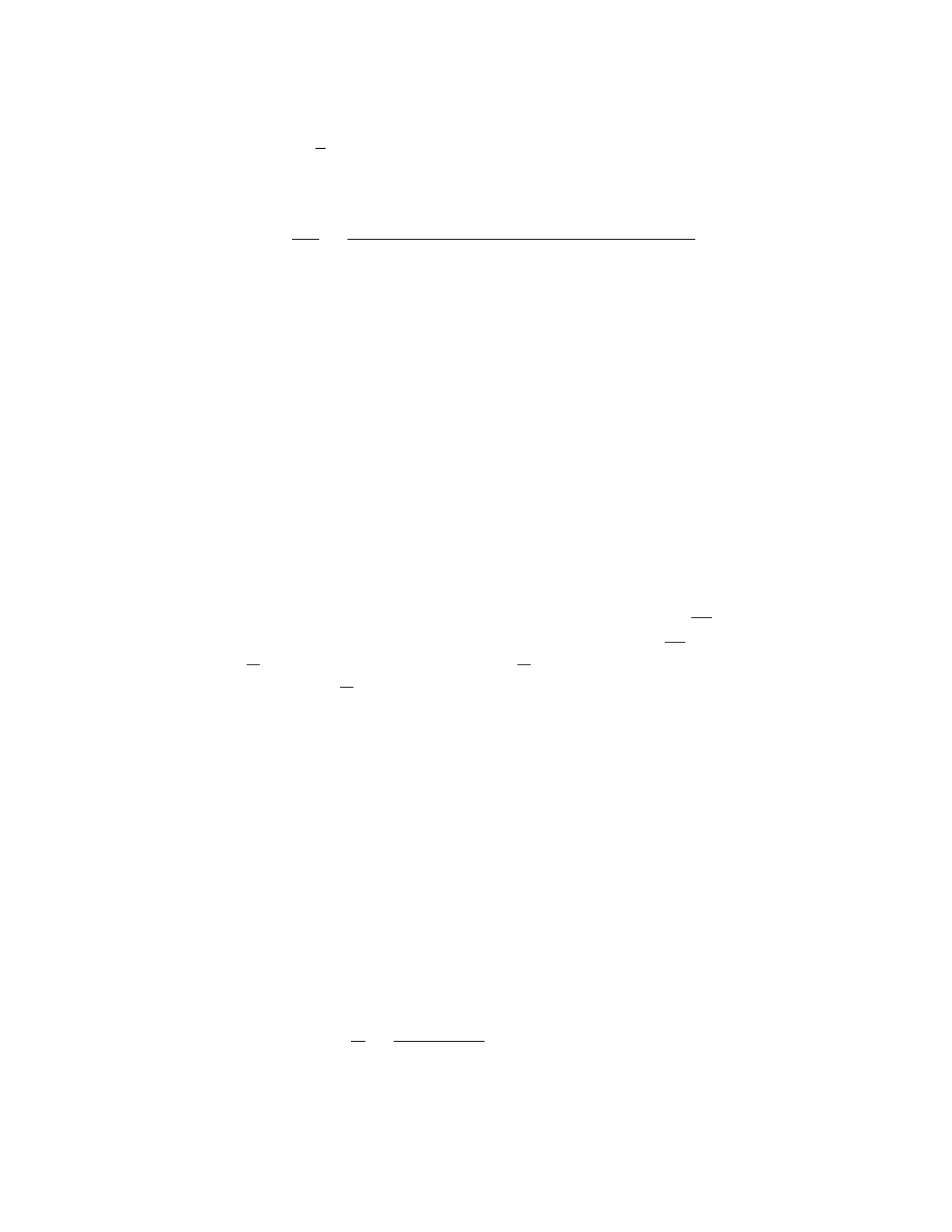
πr2=7850 kg/m3×π(0.015 m)2×2m×9.81 m/s2
π(0.015 m)2
9. Suppose a uniform rod of length Land mass Mis suspended horizontally from two vertical
walls via two strings of length Leach, attached to the ends of the rod. The walls are a distance
dapart. The strings each make an angle θwith the vertical. If the tension in each string is T,
find an expression for θin terms of the given variables.
Ans. We can solve this problem by analyzing the forces acting on the rod. 1. Draw a free-
body diagram for the rod. The forces acting on the rod are the gravitational force Mg acting
downwards, the tensions Tacting upwards and the horizontal forces at the point of contact with
the walls. 2. Resolve the forces perpendicular to the rod. The vertical components of the tensions
cancel out the gravitational force, so 2Tcos(θ) = M g. 3. Resolve the forces parallel to the rod.
The horizontal components of the tensions provide the net force required for equilibrium in the
horizontal direction, so 2Tsin(θ) = Fwall. We know that Fwall =Ttan(θ) = M g
2tan(θ). 4. Since
the net horizontal force must be zero for equilibrium, we set Ttan(θ) = M g
2tan(θ). Simplifying,
we find tan(θ) = g
2d. 5. Finally, we have θ=arctan (g
2d). Therefore, the angle θin terms of the
given variables is θ=arctan (g
2d).
10. A steel wire of length 2.0 m and radius 1.0 mm is stretched by a force of 500 N. The
Young’s modulus of the steel wire is 2.0×10¹¹ N/m2. Calculate the extension of the wire using
Hooke’s Law.
Ans. Let’s denote the original length of the wire as L, the force applied as F, the radius of the
wire as r, the Young’s modulus as Y, and the extension as ∆L.
1. First, let’s calculate the cross-sectional area of the wire using its radius:
A=πr2=π(1.0×10⁻³)2= 3.14 ×10⁻⁶m2
2. Next, we can calculate the stress applied to the wire using the formula:
σ=F
A=500
3.14 ×10−6= 1.59 ×10⁸N/m2
3. Now, using Hooke’s Law, we can find the strain in the wire:
σ=Y·ϵ
ϵ=σ
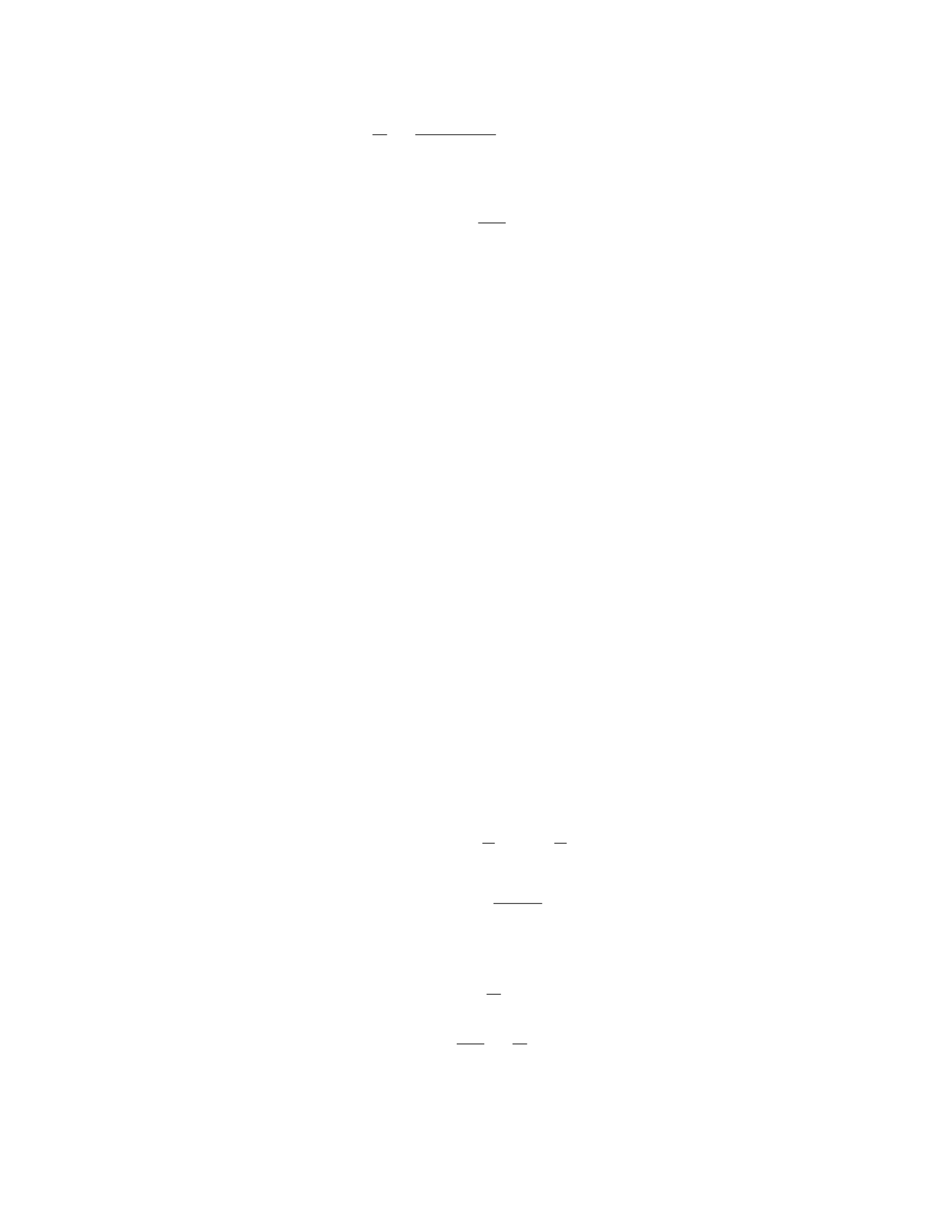
Y=1.59 ×10⁸
2.0×1011 = 7.95 ×10⁻⁴
4. Finally, we can calculate the extension of the wire using the formula for strain:
ϵ=∆L
L
∆L=ϵ·L= 7.95 ×10−4×2.0 = 1.59 ×10⁻³m
Therefore, the extension of the wire is 1.59 ×10⁻³m.
11. A uniform rod AB of length Land mass Mis supported by a hinge at A and a cable which
is attached to the rod at a distance dfrom A. The cable makes an angle θwith the horizontal.
The rod is in equilibrium and the tension in the cable is T. If the rod is made of a material with
a Young’s modulus Y, find the change in length of the rod due to the tension in the cable.
Ans. Let’s denote the original length of the rod as L0, the tension in the cable as T, the change
in length of the rod as ∆L, the cross-sectional area of the rod as A, and the Young’s modulus
of the material as Y. We are given that the tension in the cable is T.
1. Free Body Diagram: Consider the forces acting on the rod: - The weight, W=Mg,
acting at the center of mass of the rod. - The tension in the cable, T, at an angle θto the
horizontal. - The reaction force at the hinge, RA, acting vertically upwards.
Since the rod is in equilibrium, the sum of the forces in the vertical direction must be zero.
This gives us:
RA+Tcos θ−Mg = 0
RA=Mg −Tcos θ
The sum of the torques about point A must also be zero since the rod is in equilibrium.
Taking the torque about point A gives us:
T·dsin θ=L
2·Mg ·L
2
T d sin θ=MgL2
4
2. Calculating Change in Length: The change in length of a material under stress can be
calculated using Hooke’s Law:
σ=F
A
ϵ=∆L
L0
=σ
Y
∆L=ϵ·L0
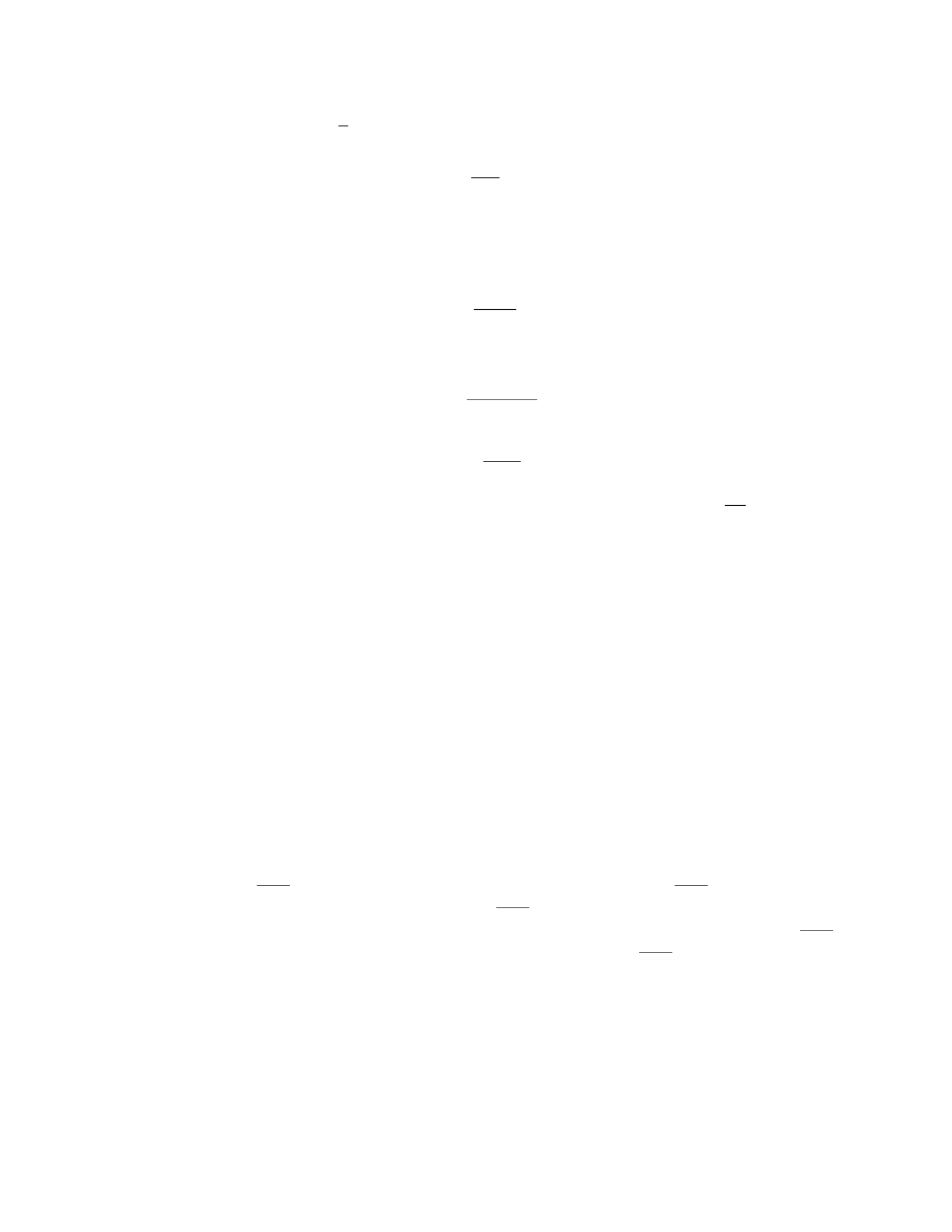
Substitute the stress σ=T
Ainto the strain equation:
∆L=T
Y A ·L0
3. Solving for ∆L:To find the cross-sectional area A, we can relate it to the mass of the
rod:
M=ρ·V=ρ·A·L0
A=M
ρ·L0
Substitute the expression for Ainto our equation for ∆L:
∆L=T·L0
Y·ρ·L0
∆L=T
Y·ρ
Therefore, the change in length of the rod due to the tension in the cable is T
Y·ρ.
12. Question: A uniform, horizontal beam of length Land mass Mis supported by two vertical
ropes attached at its ends. If a person of mass mstands at a distance xfrom one end of the
beam, find the tension in each rope.
Ans. Let’s denote the tension in the rope attached to the left end of the beam as T1and the
tension in the rope attached to the right end as T2.
1. The sum of the torques about the left end of the beam must be zero in order for the beam
to be in equilibrium. This gives us the equation: T2·L−m·g·x= 0, where gis the acceleration
due to gravity.
2. The sum of the vertical forces must also be zero in order for the beam to be in equilibrium.
This gives us the equation: T1+T2−M·g−m·g= 0.
3. We can solve the system of equations to find the tensions in the ropes. From equation
(1), we have T2=m·g·x
L. Substituting T2into equation (2) gives us: T1+m·g·x
L=M·g+m·g.
4. Solving for T1, we get T1= (M+m)·g−m·g·x
L.
Therefore, the tension in the rope attached to the left end of the beam is (M+m)·g−m·g·x
L,
and the tension in the rope attached to the right end of the beam is m·g·x
L.
13. A uniform rod of length Land mass Mis supported by a pivot at one end, with the other
end attached to a spring of spring constant k. The system is in equilibrium when the spring is

stretched a distance x0. If the rod makes an angle θwith the vertical, determine the expression
for θin terms of L,k,x0, and M.
Ans. To solve this problem, we need to analyze the forces acting on the rod and the spring at
equilibrium. 1. At equilibrium, the torque about the pivot point due to the spring force and the
gravitational force equals zero. 2. The torque due to the spring force is given by (−kx0)Lsin θ. 3.
The torque due to the gravitational force acting at the center of mass of the rod is −1
2Mg L
2sin θ.
4. Set the sum of torques equal to zero and solve for θ.
14. Question: A thin rod of length Land uniform cross-sectional area Ais supported horizontally
at its ends. A vertical force Fis applied at the midpoint of the rod. What is the expression for
the vertical displacement of the midpoint of the rod from its original position?
Ans. Let’s denote the Young’s modulus of the material as Y. The rod will deform under the
applied force and this deformation can be analyzed using the theory of elasticity.
1. The force applied at the midpoint of the rod will create a downward deformation in
the middle of the rod, while the ends of the rod will experience upward reactions to maintain
equilibrium.
2. We can calculate the Young’s modulus Yin terms of stress and strain. The stress σis the
force divided by the cross-sectional area: σ=F
A. The strain ϵis the change in length divided by
the original length: ϵ=∆L
L.
3. Using Hooke’s Law for linear elasticity, we have σ=Y ϵ. Rearranging, we get ∆L=F L
AY .
Since the force is applied at the midpoint, the vertical displacement of the midpoint from its
original position will be half of the total deformation: ∆y=1
2∆L.
4. Substituting in the expression for ∆L, we get ∆y=1
2(F L
AY )=F L
2AY .
Therefore, the expression for the vertical displacement of the midpoint of the rod from its
original position under the applied force Fis F L
2AY .
15. Question: A uniform rod of length Land mass Mis pivoted at one end. A force Fis
applied horizontally at the other end of the rod. Find the distance from the pivot point where a
supporting force should be applied perpendicular to the rod in order to keep it in equilibrium.
Ans. Let’s denote the distance from the pivot point where the supporting force should be
applied as x.
1. The net torque about the pivot point must be zero for the rod to remain in equilibrium.
The torque due to the force Fabout the pivot point is F(L−x). The torque due to the
supporting force about the pivot point is M g(x/2), where gis the acceleration due to gravity.
Setting the sum of torques equal to zero:

F(L−x) = Mg
2x
2. Solving the equation for x:
x=2F L
2F+Mg
3. Therefore, the supporting force should be applied at a distance x=2F L
2F+Mg from the pivot
point in order to keep the rod in equilibrium.
16. A uniform rod of length Land mass Mis hinged at one end and supported horizontally
at a distance xfrom the hinge. A weight Wis hung at the free end of the rod. Determine the
required force Fto keep the rod in equilibrium. (Hint: The rod will be in equilibrium if the sum
of the forces in the vertical direction and the sum of the moments about the hinge point are both
equal to zero.)
Ans. Let’s denote the distance between the hinge and the center of mass of the rod as d. We
have d=L
2. The sum of the forces in the vertical direction is given by:
F+W−Mg = 0
where gis the acceleration due to gravity. The sum of the moments about the hinge point is
given by:
F x −W(L−d) = 0
1. Solve the force equation to find F: From F+W−M g = 0, we can solve for F:
F=Mg −W
2. Solve the moment equation to find F: Substitute d=L
2and solve for F:
F x −W(L−L
2)= 0
F x −W
2L= 0
F x =W
2L
F=W
2x
3. Equate the two expressions for F: Set Mg −W=W
2xand solve for x:
Mg −W=W
2x

2x(Mg −W) = W
2xMg −2xW =W
2xMg = 3W
x=3W
2Mg
Therefore, the required force Fto keep the rod in equilibrium is:
F=Mg −W=Mg −3W
2
17. Question:
A steel cable with a length of 10 m and a diameter of 2 mm is used to support a load of 5000
N. The cable has a Young’s modulus of 2×10¹¹ Pa. Determine the elongation of the cable when
the load is applied.
Ans. Let’s denote the original length of the cable as L, the change in length as ∆L, the applied
load as F, the cross-sectional area as A, the Young’s modulus as Y, and the original modulus of
elasticity as ϵ. To find the elongation of the cable, we can use Hooke’s Law:
1. The cross-sectional area of the cable is given by:
A=πd2
4=π(2×10⁻³)2
4= 3.14 ×10⁻⁶m2
2. The original modulus of elasticity can be calculated by:
ϵ=F
A=5000
3.14×10−6= 1.59 ×10⁹Pa
3. Now, we can calculate the elongation of the cable using the formula:
∆L=F·L
A·Y=5000·10
3.14×10−6·2×1011 = 0.079m
Therefore, the elongation of the cable when the load is applied is 0.079 m.
18. A metal rod of length Land cross-sectional area Ais supported horizontally at its ends. A
force Fis applied at the midpoint of the rod perpendicular to its length. The Young’s modulus
of the material is Y. Determine the displacement at the midpoint of the rod due to the applied
force.
Ans. To determine the displacement at the midpoint of the rod, we will analyze the equilibrium
of forces and apply the concept of elasticity.
1. First, consider the free body diagram of the rod. The force Fapplied at the midpoint will
result in tension on the upper half and compression on the lower half. Let xbe the displacement
at the midpoint of the rod.
2. Using the equilibrium condition, the sum of forces in the vertical direction at the midpoint
is zero:
F=Aσ +Aσ
where σis the stress in the rod.
3. Using Hooke’s Law, the stress σis related to the strain ϵby:
σ=Y ϵ
where Yis the Young’s modulus.
4. The strain ϵis related to the displacement xby:
ϵ=x
L
5. Substituting the expressions for stress and strain into the equilibrium equation, we get:
F=AY x
L+AY x
L
6. Simplifying the equation, we find the displacement x:
x=F L
2AY
Therefore, the displacement at the midpoint of the rod due to the applied force Fis F L
2AY .
19. A 2 kg mass hangs from a vertical rod by a lightweight string. The mass causes the rod to
bend by 2 cm. If the radius of the rod is 1 cm and the modulus of elasticity of the material is
2×10¹¹ N/m2, find the stress experienced by the rod.
Ans. Let’s denote the Young’s modulus as Y, the radius of the rod as R, the distance
the rod bends as δ, and the stress experienced by the rod as σ. 1. First, let’s calculate the
strain experienced by the rod using the formula change in length
original length . Since the rod bends by 2 cm, the
elongation δis 2 cm or 0.02 m. The original length of the rod is the radius Rwhich is 0.01 m.
Therefore, the strain ϵis given by:
ϵ=δ
R=0.02
0.01 = 2
2. Next, we can use Hooke’s Law which states that stress σis equal to Young’s modulus Y
multiplied by strain ϵ. Therefore, we have:
σ=Y·ϵ= (2 ×1011)·2 = 4 ×10¹¹ N/m2
Therefore, the stress experienced by the rod is 4×10¹¹ N/m2.

20. A steel rod of length 2 m and diameter 2 cm is hung vertically from one end. If the
Young’s modulus of steel is 2×10¹¹ N/m2and the density of steel is 7,800 kg/m3, calculate the
elongation of the rod due to its own weight.
Ans. Let’s denote the elongation of the rod as ∆L. We will calculate the elongation step-by-
step:
1. First, let’s find the weight of the rod. The weight Wof the rod can be calculated using
the formula:
W=mg
where mis the mass of the rod and gis the acceleration due to gravity. The mass mof the rod
can be calculated using its volume V, density ρ, and the formula:
m=V ρ
The volume of the rod Vcan be calculated using its length Land cross-sectional area A:
V=AL
The cross-sectional area Aof the rod can be calculated using its diameter d:
A=πd2
4
2. Substitute the given values into the equations to find the weight Wof the rod.
3. Now, we will calculate the stress σexperienced by the rod due to its own weight. Stress
is defined as the force per unit area:
σ=W
A
4. Using Hooke’s Law, we can relate the stress σto the strain ϵ(elongation per unit length)
and Young’s modulus Y:
σ=Y ϵ
5. Rearrange the formula to solve for the elongation ϵ:
ϵ=σ
Y
6. Substitute the stress σcalculated in step 3 and the Young’s modulus Yto find the
elongation per unit length ϵ.
7. Finally, calculate the total elongation ∆Lby multiplying the elongation per unit length ϵ
by the length Lof the rod:
∆L=ϵL
21. A uniform rod of length Land mass Mis suspended horizontally by two vertical wires
attached to its ends. If a weight Wis suspended from the rod at a distance dfrom one end,
determine the tension in each wire.
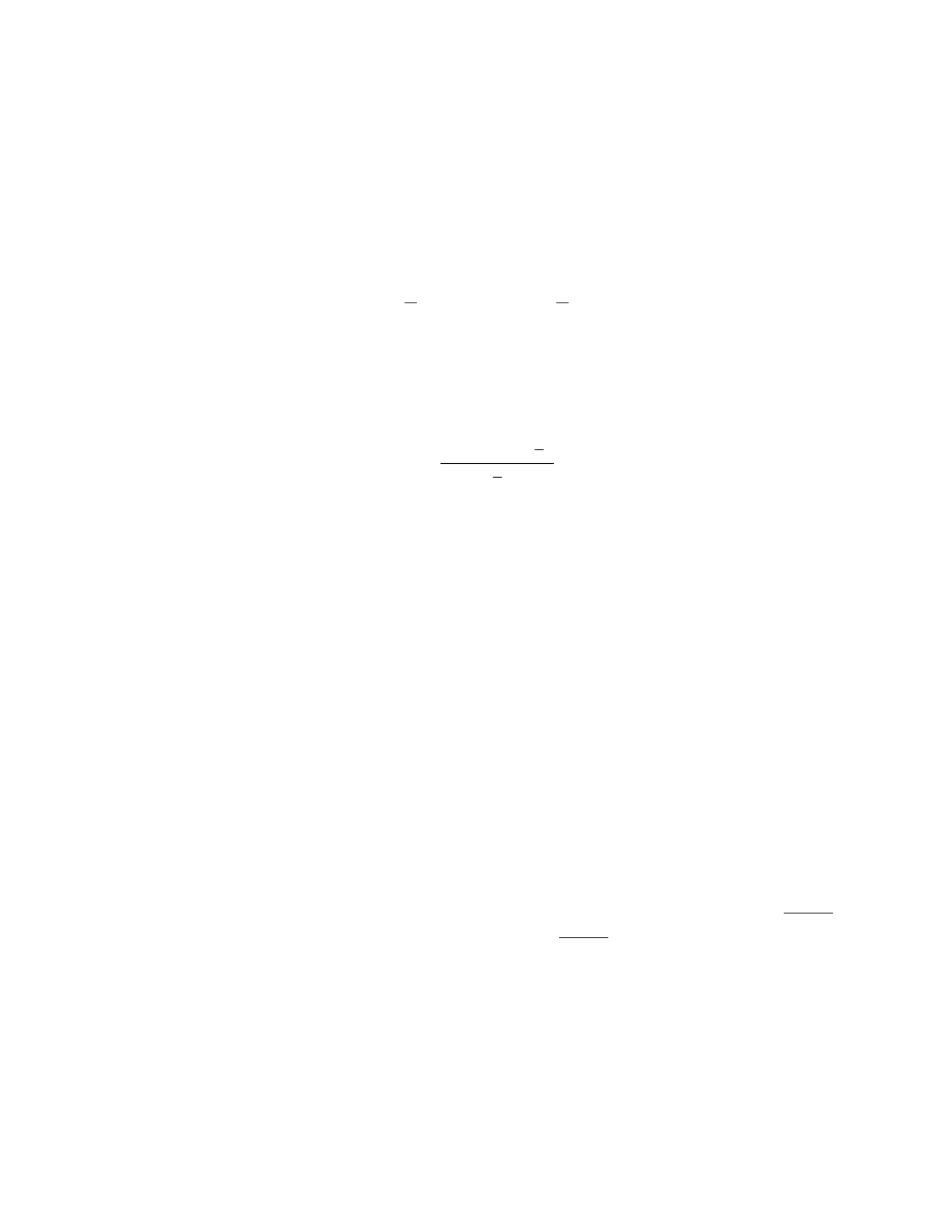
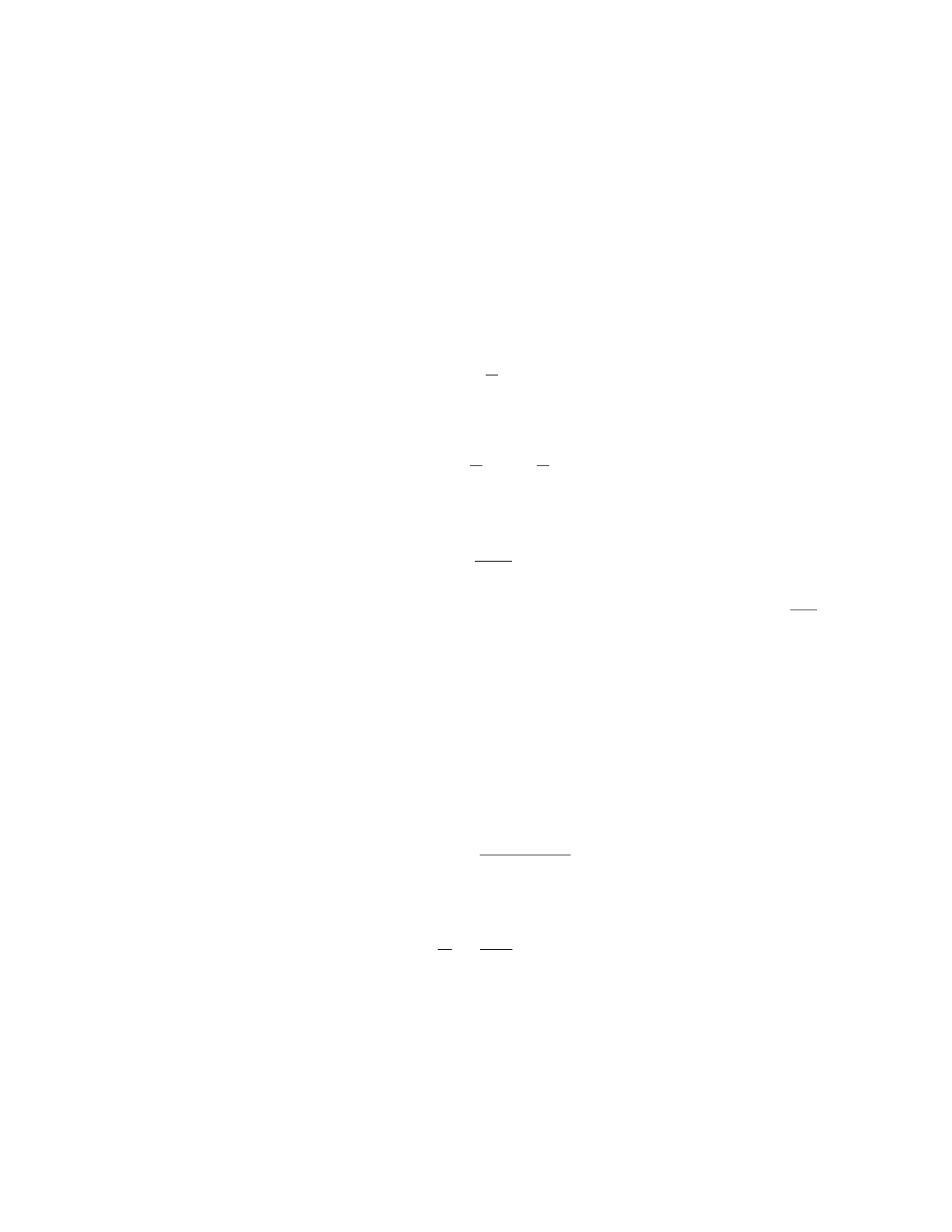
Ans. Let’s denote the tensions in the wires as T1and T2, and the weight Was acting downwards
at a distance dfrom the end where T2is applied. Since the system is in equilibrium, the sum of
the torques acting on the rod must be zero.
1. The torque due to Wabout the point where T2is applied is W d clockwise.
2. The torque due to T1about the point where T2is applied is T1(L/2) counterclockwise.
3. The torque due to M g about the point where T2is applied is Mg(L/2) clockwise.
4. Write the equation for equilibrium in terms of torque:
T1(L
2)=W d +Mg (L
2)
5. In the vertical direction, we have:
T1+T2=Mg +W
6. Since the system is in equilibrium, solving the system of equations will give the tensions
in the wires:
T1=W d +Mg (L
2)
(L
2)
T2=Mg +W−T1
22. Question: A uniform rod of length Land mass Mis suspended horizontally from two
vertical strings attached to its ends. A block of mass mis hung from the center of the rod. The
system is in equilibrium. Find the tensions in the strings.
Ans. Step-by-step solution: 1. We will start by drawing a free-body diagram of the system.
Let T1and T2be the tensions in the strings attached to the ends of the rod, and W1and W2
be the weights of the rod and the block, respectively. 2. The forces acting on the rod are the
tension forces T1and T2, and the weight of the rod W1=M g. The forces acting on the block
are the tension forces T1and T2, and the weight of the block W2=mg. 3. Since the system is
in equilibrium, the sum of all the forces in the horizontal direction and the vertical direction must
be zero. 4. In the horizontal direction, the tension forces T1and T2must balance each other,
so T1=T2. 5. In the vertical direction, the sum of the forces must also be zero. We have:
2T1=W1+W2. 6. Substituting the expressions for W1and W2into the equation above, we get:
2T1=Mg +mg. 7. Simplifying the equation, we find the tension in each string: T1=Mg+mg
2.
8. Therefore, the tensions in the strings are both equal to M g+mg
2.
23. A steel cable with a length of 10 m and a cross-sectional area of 2 cm2is stretched between
two fixed points. If the Young’s modulus of the steel is 2×10¹¹ N/m2, determine the force
required to stretch the cable by 2 mm.
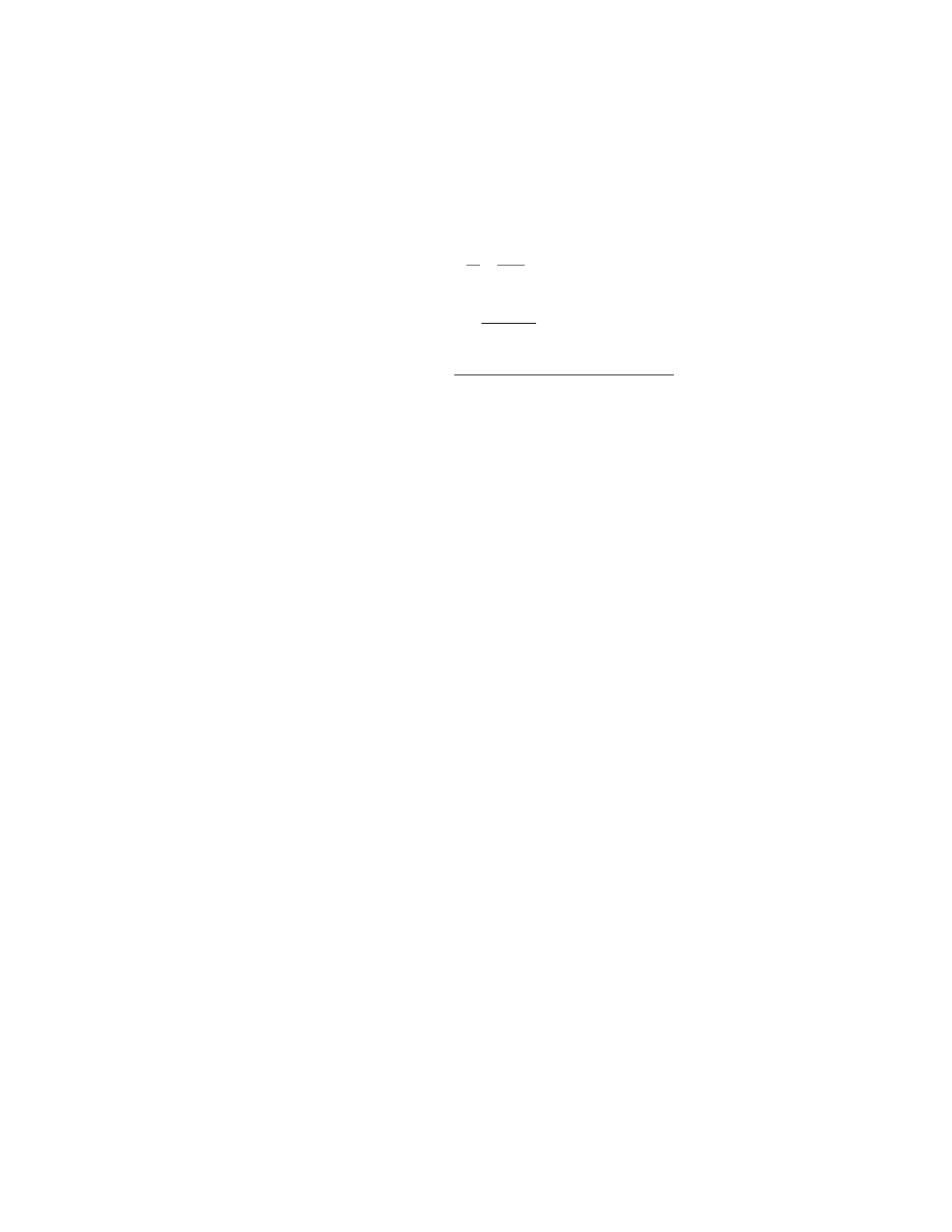
Ans. Let’s denote the original length of the steel cable as L= 10 m. The cross-sectional area of
the cable is A= 2 cm2= 2 ×10⁻⁴m2. The Young’s modulus of the steel is Y= 2 ×10¹¹ N/m2.
We need to find the force required to stretch the cable by ∆L= 2 mm = 2 ×10⁻³m.
1. Calculate the original tension in the cable:
The original tension in the cable can be found using the equation for Young’s modulus:
Y=T
A·∆L
L
T=Y·A·∆L
L
T= (2 ×10¹¹ N/m2)·(2 ×10−4m2)·(2 ×10−3m)
10 m
T= 8 ×10⁴N
2. Calculate the force required to stretch the cable:
To find the force required to stretch the cable by 2 mm, we can use the equation:
F=A·∆L·Y
F= (2 ×10⁻⁴m2)·(2 ×10−3m)·(2 ×10¹¹ N/m2)
F= 8 kN
Therefore, the force required to stretch the steel cable by 2 mm is 8 kN.
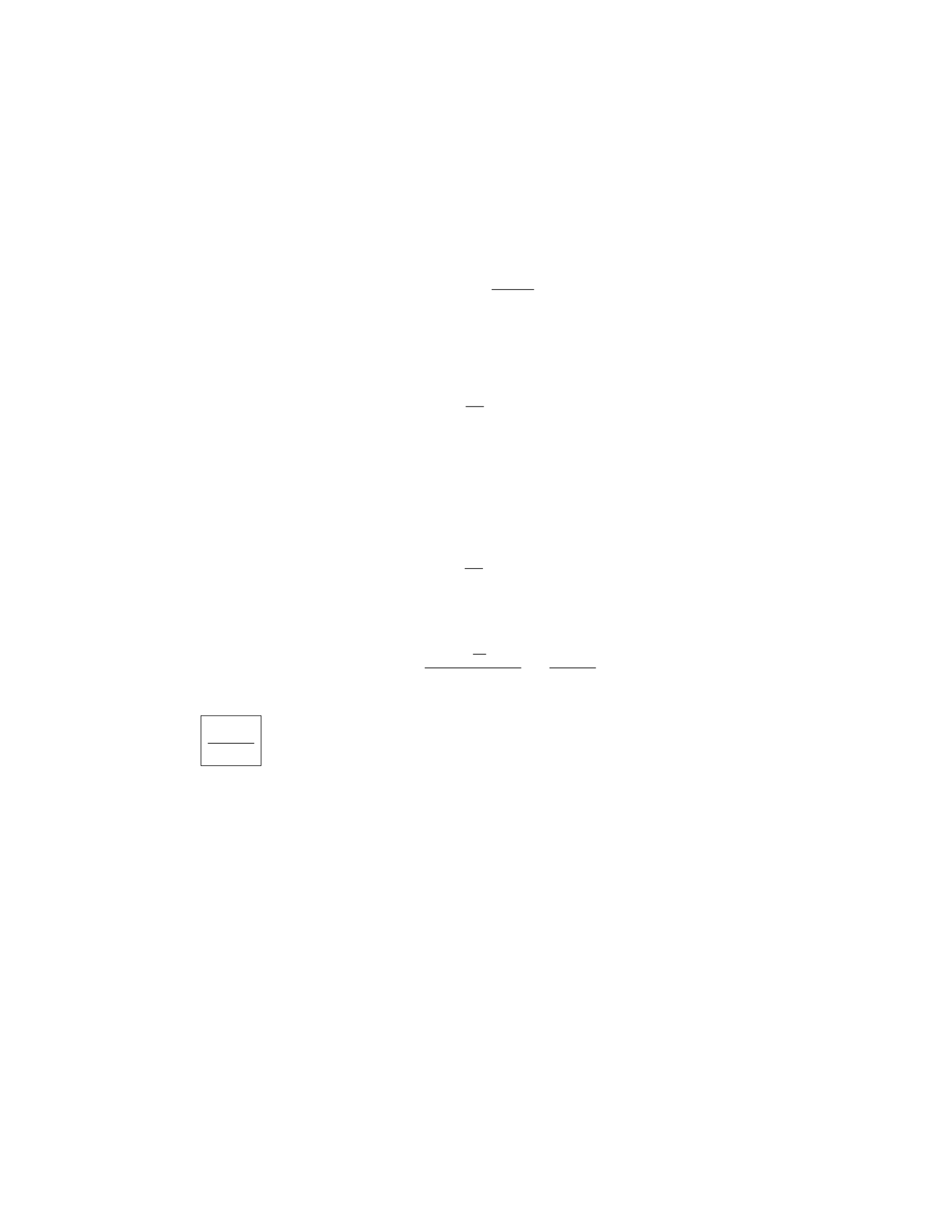
3. A rectangular beam of length Land width wis subjected to a load of magnitude Pat
its midpoint. The beam is made of a material with Young’s modulus Eand Poisson’s ratio ν.
Determine the magnitude of the load that will cause the beam to buckle. Assume that the beam
is supported at its ends and that buckling occurs in the weakest direction.
Ans. Let’s determine the load Pthat will cause the beam to buckle.
1. The critical load for buckling can be found using the Euler buckling formula:
Pcritical =π2EI
L2
where Iis the moment of inertia of the beam’s cross-sectional area about the axis of buckling.
For a rectangular beam of width wand height h, the moment of inertia is given by
I=1
12wh3.
2. Now, we need to find the height hof the beam in terms of its width wsuch that buckling
occurs in the weakest direction. Buckling in the weakest direction happens when the beam is
oriented vertically, so hbecomes the length of the beam.
3. Substituting h=Linto the moment of inertia formula, we obtain
I=1
12wL3.
4. Substituting the moment of inertia Iinto the Euler buckling formula and solving for P,
we have
Pcritical =π2E·1
12 wL3
L2=π2Ew
12 .
5. Therefore, the magnitude of the load that will cause the beam to buckle in its weakest
direction is π2Ew
12 .
4. Question:
A block of mass mis placed on an inclined plane with an angle θwith respect to the horizontal.
The coefficient of friction between the block and the plane is µ. Find the minimum force Fparallel
to the plane needed to keep the block in equilibrium.
Ans. Solution:
Let’s consider the forces acting on the block:
1. The weight of the block mg acts vertically downwards. 2. The normal force Nfrom the
inclined plane acts perpendicular to the plane. 3. The frictional force fopposes the motion and
acts parallel to the plane. 4. The force Fparallel to the plane.
Since the block is in equilibrium, the sum of forces in both the horizontal and vertical directions
must be zero.
In the vertical direction:
N=mg cos θ
In the horizontal direction:
∑Fhorizontal =F−mg sin θ−f= 0
Next, we find the expression for the frictional force f. The maximum value of the frictional
force is given by µN.
f=µN =µmg cos θ
Substitute this expression for fback into the horizontal equilibrium equation:
F−mg sin θ−µmg cos θ= 0
Solving for F, we get:
F=mg(sin θ+µcos θ)
So, the minimum force Fparallel to the plane needed to keep the block in equilibrium is
F=mg(sin θ+µcos θ).
5. A thin rod of length Land mass Mis suspended horizontally by two vertical wires of length
Lat each end. A small weight of mass mis hung from the center of the rod. The system is in
equilibrium.
Calculate the tension in each wire.
Ans. To solve this problem, we will first draw a free body diagram of the forces acting on the
rod and then apply the conditions for equilibrium in both the horizontal and vertical directions.
1. Free Body Diagram: Let T1and T2be the tensions in the wires, and mg be the weight
of mass m.
T1T2
mg
2. Equilibrium in the Horizontal Direction: There are no horizontal forces acting on the
system, so the sum of the horizontal components of the tensions must cancel out:
T1=T2
3. Equilibrium in the Vertical Direction: The sum of the vertical forces must be zero for
equilibrium:
T1+T2=mg

4. Solve for Tension in Each Wire: Substitute T1=T2from the horizontal equilibrium
into the vertical equilibrium equation:
2T1=mg
T1=mg
2
Thus, the tension in each wire is mg
2.
6. A uniform beam of length Land mass Mis supported by a pivot at the left end, with a
cable attached to the right end to keep it horizontal. The beam is also subject to a concentrated
load of weight Wat a distance afrom the left end. Find the tension in the cable.
Ans. Let’s denote the tension in the cable as T. To find the tension in the cable, we need to
consider the rotational equilibrium of the beam about the pivot point.
1. Summing the torques about the pivot point: The torque due to the weight Wis W(a).
The torque due to the beam’s weight acts at the center of mass, which is at a distance of L/2
from the pivot point. The weight of the beam is Mg, so the torque due to the weight of the
beam is Mg(L/2). Since the beam is in equilibrium, the sum of these torques must be zero:
T(L)−W(a)−Mg(L/2) = 0
2. Solving for T:
T(L) = W(a) + Mg(L/2)
T=W(a) + Mg(L/2)
L
T=W a
L+Mg
2
Therefore, the tension in the cable is T=W a
L+Mg
2.
7. A uniform rod of length Land mass Mis supported horizontally at its ends by two vertical
strings. A weight Wis hung from the rod at a distance xfrom the left end. Determine the
tension in each string in terms of W,L, and x.
Ans. Let’s denote the tension in the left string as T1and the tension in the right string as T2.
1. Consider the forces acting on the rod. There are two vertical forces acting at each end
of the rod. The left end has tension T1acting upwards, and the right end has tension T2acting
upwards. There are also two downward forces acting: the weight Wand the weight of the rod
Mg acting at the center of mass L
2.
2. Write down the equilibrium equations in the vertical direction. Since the rod is in equilib-
rium, the sum of the forces in the vertical direction is zero. This gives us:
T1+T2=W+Mg
3. Next, consider the torques about a point at the left end of the rod. The torques due to
T2and Ware clockwise, while the torques due to T1and Mg are counterclockwise. The torques
contribute the following:
T2·L−W·x=T1·L
2+Mg ·L
2
4. Solve the system of equations obtained in steps 2 and 3 to find expressions for T1and T2
in terms of W,L, and x:
From step 2: T1=W+Mg −T2
Substitute into step 3:
T2·L−W·x= (W+Mg −T2)·L
2+Mg ·L
2
5. Simplify the equation and solve for T2:
T2·L−W·x=W·L
2+Mg·L
2−T2·L
2+Mg·L
2
T2·3L
2=W·L
2+Mg ·L
T2=2W+2Mg
3
6. Finally, substitute the expression for T2back into the equation from step 2 to find T1:
T1=W+Mg −2W+2Mg
3
T1=W+Mg
3
Therefore, the tension in the left string is W+M g
3and the tension in the right string is 2W+2M g
3.
8. Question: A steel cylindrical rod with a length of 2 m is hanging vertically from the ceiling.
The rod has a diameter of 3 cm. If the density of steel is 7850 kg/m³ and the rod is in equilibrium,
find the stress in the rod near the top end. Assume the acceleration due to gravity is 9.81 m/s2.
Ans. Step-by-step solution: 1. First, we need to calculate the weight of the rod. The volume
of the rod can be calculated using the formula for the volume of a cylinder: V=πr2h, where r
is the radius and his the height. Given that the diameter is 3 cm, the radius r= 1.5cm = 0.015
m, and the height h= 2 m.
2. The volume Vof the rod is:
V=π(0.015 m)2×2m
3. The weight Wof the rod can be calculated using the formula W=mg, where mis the
mass of the rod and gis the acceleration due to gravity:
m=density ×V= 7850 kg/m3×V
4. Substituting the values, the mass mof the rod is:
m= 7850 kg/m3×π(0.015 m)2×2m
5. The weight Wof the rod is:
W= 7850 kg/m3×π(0.015 m)2×2m×9.81 m/s2
6. Now that we have the weight Wof the rod, we can calculate the stress near the top end.
The stress is given by σ=F
A, where Fis the force applied and Ais the area over which the force
is applied. Near the top end, the area is the cross-sectional area of the rod, which is πr2.
7. The stress near the top end σis:
σ=W
πr2=7850 kg/m3×π(0.015 m)2×2m×9.81 m/s2
π(0.015 m)2
9. Suppose a uniform rod of length Land mass Mis suspended horizontally from two vertical
walls via two strings of length Leach, attached to the ends of the rod. The walls are a distance
dapart. The strings each make an angle θwith the vertical. If the tension in each string is T,
find an expression for θin terms of the given variables.
Ans. We can solve this problem by analyzing the forces acting on the rod. 1. Draw a free-
body diagram for the rod. The forces acting on the rod are the gravitational force Mg acting
downwards, the tensions Tacting upwards and the horizontal forces at the point of contact with
the walls. 2. Resolve the forces perpendicular to the rod. The vertical components of the tensions
cancel out the gravitational force, so 2Tcos(θ) = M g. 3. Resolve the forces parallel to the rod.
The horizontal components of the tensions provide the net force required for equilibrium in the
horizontal direction, so 2Tsin(θ) = Fwall. We know that Fwall =Ttan(θ) = M g
2tan(θ). 4. Since
the net horizontal force must be zero for equilibrium, we set Ttan(θ) = M g
2tan(θ). Simplifying,
we find tan(θ) = g
2d. 5. Finally, we have θ=arctan (g
2d). Therefore, the angle θin terms of the
given variables is θ=arctan (g
2d).
10. A steel wire of length 2.0 m and radius 1.0 mm is stretched by a force of 500 N. The
Young’s modulus of the steel wire is 2.0×10¹¹ N/m2. Calculate the extension of the wire using
Hooke’s Law.
Ans. Let’s denote the original length of the wire as L, the force applied as F, the radius of the
wire as r, the Young’s modulus as Y, and the extension as ∆L.
1. First, let’s calculate the cross-sectional area of the wire using its radius:
A=πr2=π(1.0×10⁻³)2= 3.14 ×10⁻⁶m2
2. Next, we can calculate the stress applied to the wire using the formula:
σ=F
A=500
3.14 ×10−6= 1.59 ×10⁸N/m2
3. Now, using Hooke’s Law, we can find the strain in the wire:
σ=Y·ϵ
ϵ=σ
Y=1.59 ×10⁸
2.0×1011 = 7.95 ×10⁻⁴
4. Finally, we can calculate the extension of the wire using the formula for strain:
ϵ=∆L
L
∆L=ϵ·L= 7.95 ×10−4×2.0 = 1.59 ×10⁻³m
Therefore, the extension of the wire is 1.59 ×10⁻³m.
11. A uniform rod AB of length Land mass Mis supported by a hinge at A and a cable which
is attached to the rod at a distance dfrom A. The cable makes an angle θwith the horizontal.
The rod is in equilibrium and the tension in the cable is T. If the rod is made of a material with
a Young’s modulus Y, find the change in length of the rod due to the tension in the cable.
Ans. Let’s denote the original length of the rod as L0, the tension in the cable as T, the change
in length of the rod as ∆L, the cross-sectional area of the rod as A, and the Young’s modulus
of the material as Y. We are given that the tension in the cable is T.
1. Free Body Diagram: Consider the forces acting on the rod: - The weight, W=Mg,
acting at the center of mass of the rod. - The tension in the cable, T, at an angle θto the
horizontal. - The reaction force at the hinge, RA, acting vertically upwards.
Since the rod is in equilibrium, the sum of the forces in the vertical direction must be zero.
This gives us:
RA+Tcos θ−Mg = 0
RA=Mg −Tcos θ
The sum of the torques about point A must also be zero since the rod is in equilibrium.
Taking the torque about point A gives us:
T·dsin θ=L
2·Mg ·L
2
T d sin θ=MgL2
4
2. Calculating Change in Length: The change in length of a material under stress can be
calculated using Hooke’s Law:
σ=F
A
ϵ=∆L
L0
=σ
Y
∆L=ϵ·L0
Substitute the stress σ=T
Ainto the strain equation:
∆L=T
Y A ·L0
3. Solving for ∆L:To find the cross-sectional area A, we can relate it to the mass of the
rod:
M=ρ·V=ρ·A·L0
A=M
ρ·L0
Substitute the expression for Ainto our equation for ∆L:
∆L=T·L0
Y·ρ·L0
∆L=T
Y·ρ
Therefore, the change in length of the rod due to the tension in the cable is T
Y·ρ.
12. Question: A uniform, horizontal beam of length Land mass Mis supported by two vertical
ropes attached at its ends. If a person of mass mstands at a distance xfrom one end of the
beam, find the tension in each rope.
Ans. Let’s denote the tension in the rope attached to the left end of the beam as T1and the
tension in the rope attached to the right end as T2.
1. The sum of the torques about the left end of the beam must be zero in order for the beam
to be in equilibrium. This gives us the equation: T2·L−m·g·x= 0, where gis the acceleration
due to gravity.
2. The sum of the vertical forces must also be zero in order for the beam to be in equilibrium.
This gives us the equation: T1+T2−M·g−m·g= 0.
3. We can solve the system of equations to find the tensions in the ropes. From equation
(1), we have T2=m·g·x
L. Substituting T2into equation (2) gives us: T1+m·g·x
L=M·g+m·g.
4. Solving for T1, we get T1= (M+m)·g−m·g·x
L.
Therefore, the tension in the rope attached to the left end of the beam is (M+m)·g−m·g·x
L,
and the tension in the rope attached to the right end of the beam is m·g·x
L.
13. A uniform rod of length Land mass Mis supported by a pivot at one end, with the other
end attached to a spring of spring constant k. The system is in equilibrium when the spring is

stretched a distance x0. If the rod makes an angle θwith the vertical, determine the expression
for θin terms of L,k,x0, and M.
Ans. To solve this problem, we need to analyze the forces acting on the rod and the spring at
equilibrium. 1. At equilibrium, the torque about the pivot point due to the spring force and the
gravitational force equals zero. 2. The torque due to the spring force is given by (−kx0)Lsin θ. 3.
The torque due to the gravitational force acting at the center of mass of the rod is −1
2Mg L
2sin θ.
4. Set the sum of torques equal to zero and solve for θ.
14. Question: A thin rod of length Land uniform cross-sectional area Ais supported horizontally
at its ends. A vertical force Fis applied at the midpoint of the rod. What is the expression for
the vertical displacement of the midpoint of the rod from its original position?
Ans. Let’s denote the Young’s modulus of the material as Y. The rod will deform under the
applied force and this deformation can be analyzed using the theory of elasticity.
1. The force applied at the midpoint of the rod will create a downward deformation in
the middle of the rod, while the ends of the rod will experience upward reactions to maintain
equilibrium.
2. We can calculate the Young’s modulus Yin terms of stress and strain. The stress σis the
force divided by the cross-sectional area: σ=F
A. The strain ϵis the change in length divided by
the original length: ϵ=∆L
L.
3. Using Hooke’s Law for linear elasticity, we have σ=Y ϵ. Rearranging, we get ∆L=F L
AY .
Since the force is applied at the midpoint, the vertical displacement of the midpoint from its
original position will be half of the total deformation: ∆y=1
2∆L.
4. Substituting in the expression for ∆L, we get ∆y=1
2(F L
AY )=F L
2AY .
Therefore, the expression for the vertical displacement of the midpoint of the rod from its
original position under the applied force Fis F L
2AY .
15. Question: A uniform rod of length Land mass Mis pivoted at one end. A force Fis
applied horizontally at the other end of the rod. Find the distance from the pivot point where a
supporting force should be applied perpendicular to the rod in order to keep it in equilibrium.
Ans. Let’s denote the distance from the pivot point where the supporting force should be
applied as x.
1. The net torque about the pivot point must be zero for the rod to remain in equilibrium.
The torque due to the force Fabout the pivot point is F(L−x). The torque due to the
supporting force about the pivot point is M g(x/2), where gis the acceleration due to gravity.
Setting the sum of torques equal to zero:

F(L−x) = Mg
2x
2. Solving the equation for x:
x=2F L
2F+Mg
3. Therefore, the supporting force should be applied at a distance x=2F L
2F+Mg from the pivot
point in order to keep the rod in equilibrium.
16. A uniform rod of length Land mass Mis hinged at one end and supported horizontally
at a distance xfrom the hinge. A weight Wis hung at the free end of the rod. Determine the
required force Fto keep the rod in equilibrium. (Hint: The rod will be in equilibrium if the sum
of the forces in the vertical direction and the sum of the moments about the hinge point are both
equal to zero.)
Ans. Let’s denote the distance between the hinge and the center of mass of the rod as d. We
have d=L
2. The sum of the forces in the vertical direction is given by:
F+W−Mg = 0
where gis the acceleration due to gravity. The sum of the moments about the hinge point is
given by:
F x −W(L−d) = 0
1. Solve the force equation to find F: From F+W−M g = 0, we can solve for F:
F=Mg −W
2. Solve the moment equation to find F: Substitute d=L
2and solve for F:
F x −W(L−L
2)= 0
F x −W
2L= 0
F x =W
2L
F=W
2x
3. Equate the two expressions for F: Set Mg −W=W
2xand solve for x:
Mg −W=W
2x

2x(Mg −W) = W
2xMg −2xW =W
2xMg = 3W
x=3W
2Mg
Therefore, the required force Fto keep the rod in equilibrium is:
F=Mg −W=Mg −3W
2
17. Question:
A steel cable with a length of 10 m and a diameter of 2 mm is used to support a load of 5000
N. The cable has a Young’s modulus of 2×10¹¹ Pa. Determine the elongation of the cable when
the load is applied.
Ans. Let’s denote the original length of the cable as L, the change in length as ∆L, the applied
load as F, the cross-sectional area as A, the Young’s modulus as Y, and the original modulus of
elasticity as ϵ. To find the elongation of the cable, we can use Hooke’s Law:
1. The cross-sectional area of the cable is given by:
A=πd2
4=π(2×10⁻³)2
4= 3.14 ×10⁻⁶m2
2. The original modulus of elasticity can be calculated by:
ϵ=F
A=5000
3.14×10−6= 1.59 ×10⁹Pa
3. Now, we can calculate the elongation of the cable using the formula:
∆L=F·L
A·Y=5000·10
3.14×10−6·2×1011 = 0.079m
Therefore, the elongation of the cable when the load is applied is 0.079 m.
18. A metal rod of length Land cross-sectional area Ais supported horizontally at its ends. A
force Fis applied at the midpoint of the rod perpendicular to its length. The Young’s modulus
of the material is Y. Determine the displacement at the midpoint of the rod due to the applied
force.
Ans. To determine the displacement at the midpoint of the rod, we will analyze the equilibrium
of forces and apply the concept of elasticity.
1. First, consider the free body diagram of the rod. The force Fapplied at the midpoint will
result in tension on the upper half and compression on the lower half. Let xbe the displacement
at the midpoint of the rod.
2. Using the equilibrium condition, the sum of forces in the vertical direction at the midpoint
is zero:
F=Aσ +Aσ
where σis the stress in the rod.
3. Using Hooke’s Law, the stress σis related to the strain ϵby:
σ=Y ϵ
where Yis the Young’s modulus.
4. The strain ϵis related to the displacement xby:
ϵ=x
L
5. Substituting the expressions for stress and strain into the equilibrium equation, we get:
F=AY x
L+AY x
L
6. Simplifying the equation, we find the displacement x:
x=F L
2AY
Therefore, the displacement at the midpoint of the rod due to the applied force Fis F L
2AY .
19. A 2 kg mass hangs from a vertical rod by a lightweight string. The mass causes the rod to
bend by 2 cm. If the radius of the rod is 1 cm and the modulus of elasticity of the material is
2×10¹¹ N/m2, find the stress experienced by the rod.
Ans. Let’s denote the Young’s modulus as Y, the radius of the rod as R, the distance
the rod bends as δ, and the stress experienced by the rod as σ. 1. First, let’s calculate the
strain experienced by the rod using the formula change in length
original length . Since the rod bends by 2 cm, the
elongation δis 2 cm or 0.02 m. The original length of the rod is the radius Rwhich is 0.01 m.
Therefore, the strain ϵis given by:
ϵ=δ
R=0.02
0.01 = 2
2. Next, we can use Hooke’s Law which states that stress σis equal to Young’s modulus Y
multiplied by strain ϵ. Therefore, we have:
σ=Y·ϵ= (2 ×1011)·2 = 4 ×10¹¹ N/m2
Therefore, the stress experienced by the rod is 4×10¹¹ N/m2.

20. A steel rod of length 2 m and diameter 2 cm is hung vertically from one end. If the
Young’s modulus of steel is 2×10¹¹ N/m2and the density of steel is 7,800 kg/m3, calculate the
elongation of the rod due to its own weight.
Ans. Let’s denote the elongation of the rod as ∆L. We will calculate the elongation step-by-
step:
1. First, let’s find the weight of the rod. The weight Wof the rod can be calculated using
the formula:
W=mg
where mis the mass of the rod and gis the acceleration due to gravity. The mass mof the rod
can be calculated using its volume V, density ρ, and the formula:
m=V ρ
The volume of the rod Vcan be calculated using its length Land cross-sectional area A:
V=AL
The cross-sectional area Aof the rod can be calculated using its diameter d:
A=πd2
4
2. Substitute the given values into the equations to find the weight Wof the rod.
3. Now, we will calculate the stress σexperienced by the rod due to its own weight. Stress
is defined as the force per unit area:
σ=W
A
4. Using Hooke’s Law, we can relate the stress σto the strain ϵ(elongation per unit length)
and Young’s modulus Y:
σ=Y ϵ
5. Rearrange the formula to solve for the elongation ϵ:
ϵ=σ
Y
6. Substitute the stress σcalculated in step 3 and the Young’s modulus Yto find the
elongation per unit length ϵ.
7. Finally, calculate the total elongation ∆Lby multiplying the elongation per unit length ϵ
by the length Lof the rod:
∆L=ϵL
21. A uniform rod of length Land mass Mis suspended horizontally by two vertical wires
attached to its ends. If a weight Wis suspended from the rod at a distance dfrom one end,
determine the tension in each wire.
Ans. Let’s denote the tensions in the wires as T1and T2, and the weight Was acting downwards
at a distance dfrom the end where T2is applied. Since the system is in equilibrium, the sum of
the torques acting on the rod must be zero.
1. The torque due to Wabout the point where T2is applied is W d clockwise.
2. The torque due to T1about the point where T2is applied is T1(L/2) counterclockwise.
3. The torque due to M g about the point where T2is applied is Mg(L/2) clockwise.
4. Write the equation for equilibrium in terms of torque:
T1(L
2)=W d +Mg (L
2)
5. In the vertical direction, we have:
T1+T2=Mg +W
6. Since the system is in equilibrium, solving the system of equations will give the tensions
in the wires:
T1=W d +Mg (L
2)
(L
2)
T2=Mg +W−T1
22. Question: A uniform rod of length Land mass Mis suspended horizontally from two
vertical strings attached to its ends. A block of mass mis hung from the center of the rod. The
system is in equilibrium. Find the tensions in the strings.
Ans. Step-by-step solution: 1. We will start by drawing a free-body diagram of the system.
Let T1and T2be the tensions in the strings attached to the ends of the rod, and W1and W2
be the weights of the rod and the block, respectively. 2. The forces acting on the rod are the
tension forces T1and T2, and the weight of the rod W1=M g. The forces acting on the block
are the tension forces T1and T2, and the weight of the block W2=mg. 3. Since the system is
in equilibrium, the sum of all the forces in the horizontal direction and the vertical direction must
be zero. 4. In the horizontal direction, the tension forces T1and T2must balance each other,
so T1=T2. 5. In the vertical direction, the sum of the forces must also be zero. We have:
2T1=W1+W2. 6. Substituting the expressions for W1and W2into the equation above, we get:
2T1=Mg +mg. 7. Simplifying the equation, we find the tension in each string: T1=Mg+mg
2.
8. Therefore, the tensions in the strings are both equal to M g+mg
2.
23. A steel cable with a length of 10 m and a cross-sectional area of 2 cm2is stretched between
two fixed points. If the Young’s modulus of the steel is 2×10¹¹ N/m2, determine the force
required to stretch the cable by 2 mm.
Ans. Let’s denote the original length of the steel cable as L= 10 m. The cross-sectional area of
the cable is A= 2 cm2= 2 ×10⁻⁴m2. The Young’s modulus of the steel is Y= 2 ×10¹¹ N/m2.
We need to find the force required to stretch the cable by ∆L= 2 mm = 2 ×10⁻³m.
1. Calculate the original tension in the cable:
The original tension in the cable can be found using the equation for Young’s modulus:
Y=T
A·∆L
L
T=Y·A·∆L
L
T= (2 ×10¹¹ N/m2)·(2 ×10−4m2)·(2 ×10−3m)
10 m
T= 8 ×10⁴N
2. Calculate the force required to stretch the cable:
To find the force required to stretch the cable by 2 mm, we can use the equation:
F=A·∆L·Y
F= (2 ×10⁻⁴m2)·(2 ×10−3m)·(2 ×10¹¹ N/m2)
F= 8 kN
Therefore, the force required to stretch the steel cable by 2 mm is 8 kN.
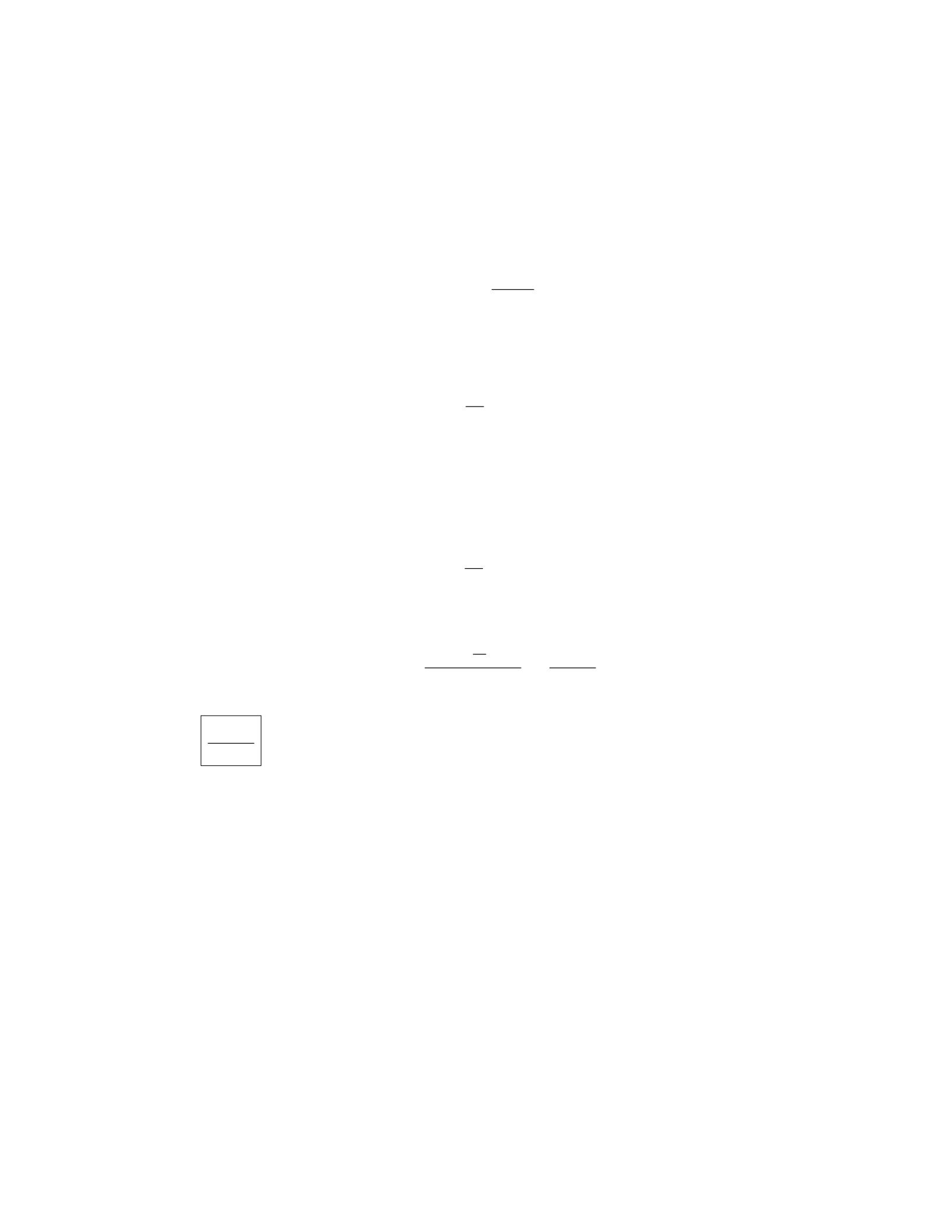
3. A rectangular beam of length Land width wis subjected to a load of magnitude Pat
its midpoint. The beam is made of a material with Young’s modulus Eand Poisson’s ratio ν.
Determine the magnitude of the load that will cause the beam to buckle. Assume that the beam
is supported at its ends and that buckling occurs in the weakest direction.
Ans. Let’s determine the load Pthat will cause the beam to buckle.
1. The critical load for buckling can be found using the Euler buckling formula:
Pcritical =π2EI
L2
where Iis the moment of inertia of the beam’s cross-sectional area about the axis of buckling.
For a rectangular beam of width wand height h, the moment of inertia is given by
I=1
12wh3.
2. Now, we need to find the height hof the beam in terms of its width wsuch that buckling
occurs in the weakest direction. Buckling in the weakest direction happens when the beam is
oriented vertically, so hbecomes the length of the beam.
3. Substituting h=Linto the moment of inertia formula, we obtain
I=1
12wL3.
4. Substituting the moment of inertia Iinto the Euler buckling formula and solving for P,
we have
Pcritical =π2E·1
12 wL3
L2=π2Ew
12 .
5. Therefore, the magnitude of the load that will cause the beam to buckle in its weakest
direction is π2Ew
12 .
4. Question:
A block of mass mis placed on an inclined plane with an angle θwith respect to the horizontal.
The coefficient of friction between the block and the plane is µ. Find the minimum force Fparallel
to the plane needed to keep the block in equilibrium.
Ans. Solution:
Let’s consider the forces acting on the block:
1. The weight of the block mg acts vertically downwards. 2. The normal force Nfrom the
inclined plane acts perpendicular to the plane. 3. The frictional force fopposes the motion and
acts parallel to the plane. 4. The force Fparallel to the plane.
Since the block is in equilibrium, the sum of forces in both the horizontal and vertical directions
must be zero.
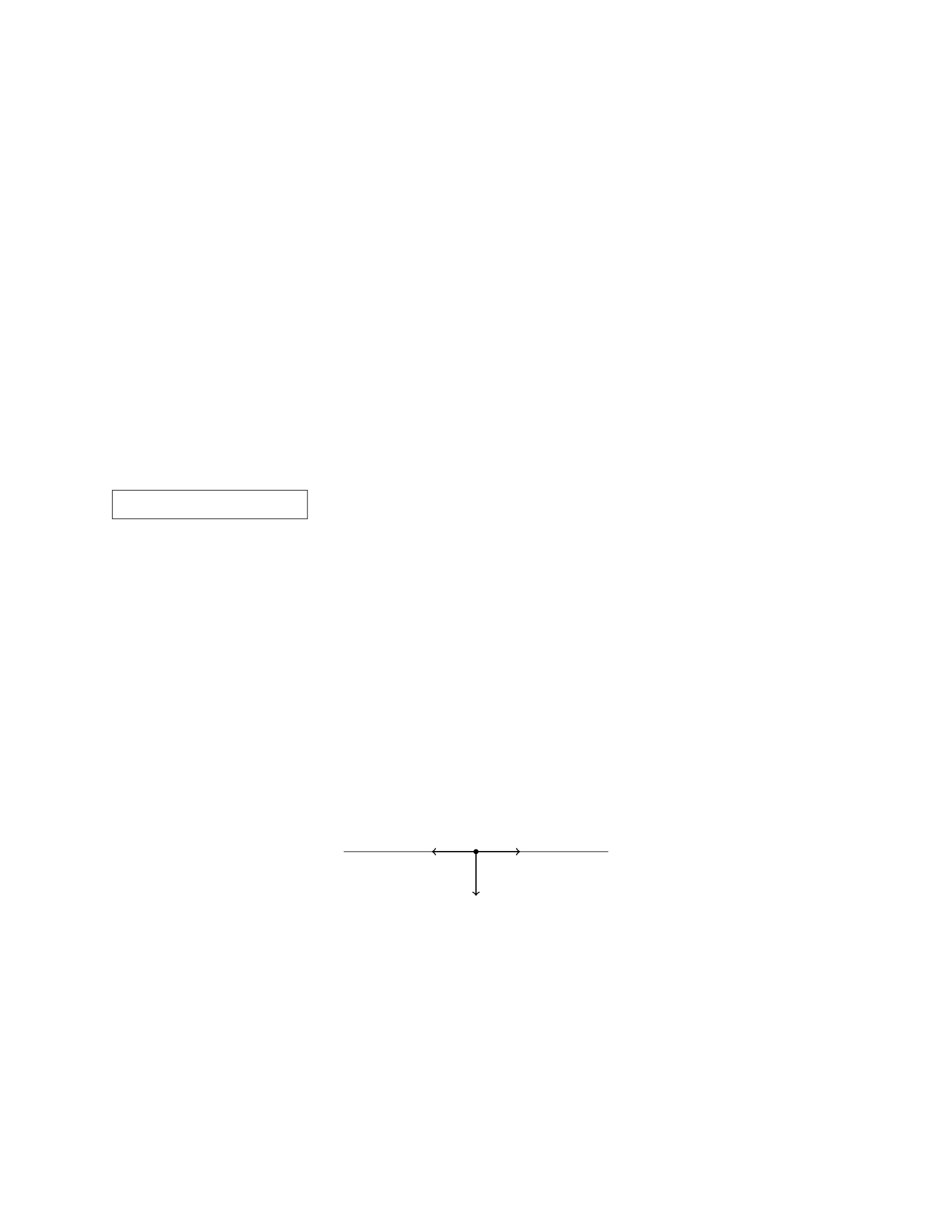
In the vertical direction:
N=mg cos θ
In the horizontal direction:
∑Fhorizontal =F−mg sin θ−f= 0
Next, we find the expression for the frictional force f. The maximum value of the frictional
force is given by µN.
f=µN =µmg cos θ
Substitute this expression for fback into the horizontal equilibrium equation:
F−mg sin θ−µmg cos θ= 0
Solving for F, we get:
F=mg(sin θ+µcos θ)
So, the minimum force Fparallel to the plane needed to keep the block in equilibrium is
F=mg(sin θ+µcos θ).
5. A thin rod of length Land mass Mis suspended horizontally by two vertical wires of length
Lat each end. A small weight of mass mis hung from the center of the rod. The system is in
equilibrium.
Calculate the tension in each wire.
Ans. To solve this problem, we will first draw a free body diagram of the forces acting on the
rod and then apply the conditions for equilibrium in both the horizontal and vertical directions.
1. Free Body Diagram: Let T1and T2be the tensions in the wires, and mg be the weight
of mass m.
T1T2
mg
2. Equilibrium in the Horizontal Direction: There are no horizontal forces acting on the
system, so the sum of the horizontal components of the tensions must cancel out:
T1=T2
3. Equilibrium in the Vertical Direction: The sum of the vertical forces must be zero for
equilibrium:
T1+T2=mg

4. Solve for Tension in Each Wire: Substitute T1=T2from the horizontal equilibrium
into the vertical equilibrium equation:
2T1=mg
T1=mg
2
Thus, the tension in each wire is mg
2.
6. A uniform beam of length Land mass Mis supported by a pivot at the left end, with a
cable attached to the right end to keep it horizontal. The beam is also subject to a concentrated
load of weight Wat a distance afrom the left end. Find the tension in the cable.
Ans. Let’s denote the tension in the cable as T. To find the tension in the cable, we need to
consider the rotational equilibrium of the beam about the pivot point.
1. Summing the torques about the pivot point: The torque due to the weight Wis W(a).
The torque due to the beam’s weight acts at the center of mass, which is at a distance of L/2
from the pivot point. The weight of the beam is Mg, so the torque due to the weight of the
beam is Mg(L/2). Since the beam is in equilibrium, the sum of these torques must be zero:
T(L)−W(a)−Mg(L/2) = 0
2. Solving for T:
T(L) = W(a) + Mg(L/2)
T=W(a) + Mg(L/2)
L
T=W a
L+Mg
2
Therefore, the tension in the cable is T=W a
L+Mg
2.
7. A uniform rod of length Land mass Mis supported horizontally at its ends by two vertical
strings. A weight Wis hung from the rod at a distance xfrom the left end. Determine the
tension in each string in terms of W,L, and x.
Ans. Let’s denote the tension in the left string as T1and the tension in the right string as T2.
1. Consider the forces acting on the rod. There are two vertical forces acting at each end
of the rod. The left end has tension T1acting upwards, and the right end has tension T2acting
upwards. There are also two downward forces acting: the weight Wand the weight of the rod
Mg acting at the center of mass L
2.
2. Write down the equilibrium equations in the vertical direction. Since the rod is in equilib-
rium, the sum of the forces in the vertical direction is zero. This gives us:
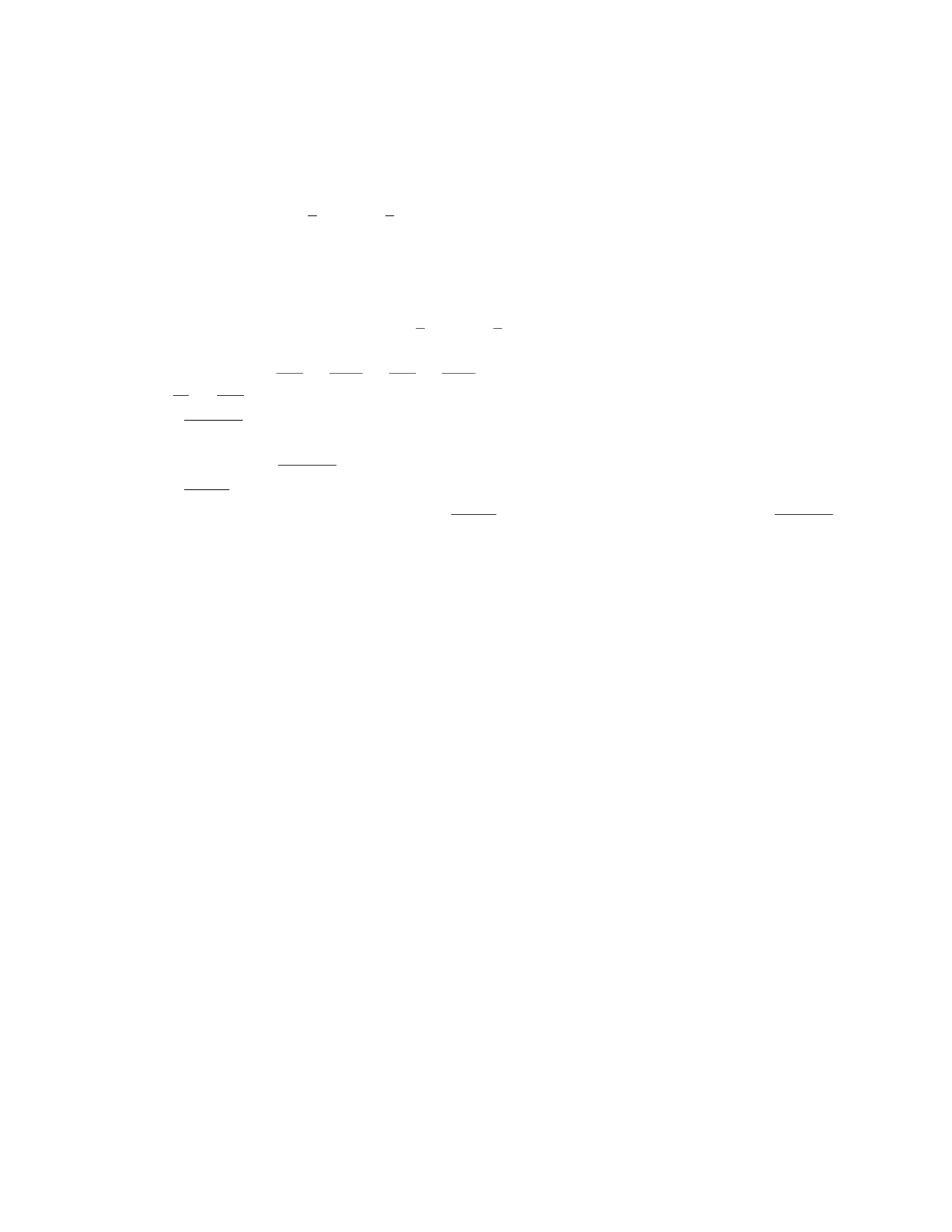
T1+T2=W+Mg
3. Next, consider the torques about a point at the left end of the rod. The torques due to
T2and Ware clockwise, while the torques due to T1and Mg are counterclockwise. The torques
contribute the following:
T2·L−W·x=T1·L
2+Mg ·L
2
4. Solve the system of equations obtained in steps 2 and 3 to find expressions for T1and T2
in terms of W,L, and x:
From step 2: T1=W+Mg −T2
Substitute into step 3:
T2·L−W·x= (W+Mg −T2)·L
2+Mg ·L
2
5. Simplify the equation and solve for T2:
T2·L−W·x=W·L
2+Mg·L
2−T2·L
2+Mg·L
2
T2·3L
2=W·L
2+Mg ·L
T2=2W+2Mg
3
6. Finally, substitute the expression for T2back into the equation from step 2 to find T1:
T1=W+Mg −2W+2Mg
3
T1=W+Mg
3
Therefore, the tension in the left string is W+M g
3and the tension in the right string is 2W+2M g
3.
8. Question: A steel cylindrical rod with a length of 2 m is hanging vertically from the ceiling.
The rod has a diameter of 3 cm. If the density of steel is 7850 kg/m³ and the rod is in equilibrium,
find the stress in the rod near the top end. Assume the acceleration due to gravity is 9.81 m/s2.
Ans. Step-by-step solution: 1. First, we need to calculate the weight of the rod. The volume
of the rod can be calculated using the formula for the volume of a cylinder: V=πr2h, where r
is the radius and his the height. Given that the diameter is 3 cm, the radius r= 1.5cm = 0.015
m, and the height h= 2 m.
2. The volume Vof the rod is:
V=π(0.015 m)2×2m
3. The weight Wof the rod can be calculated using the formula W=mg, where mis the
mass of the rod and gis the acceleration due to gravity:
m=density ×V= 7850 kg/m3×V
4. Substituting the values, the mass mof the rod is:
m= 7850 kg/m3×π(0.015 m)2×2m
5. The weight Wof the rod is:
W= 7850 kg/m3×π(0.015 m)2×2m×9.81 m/s2
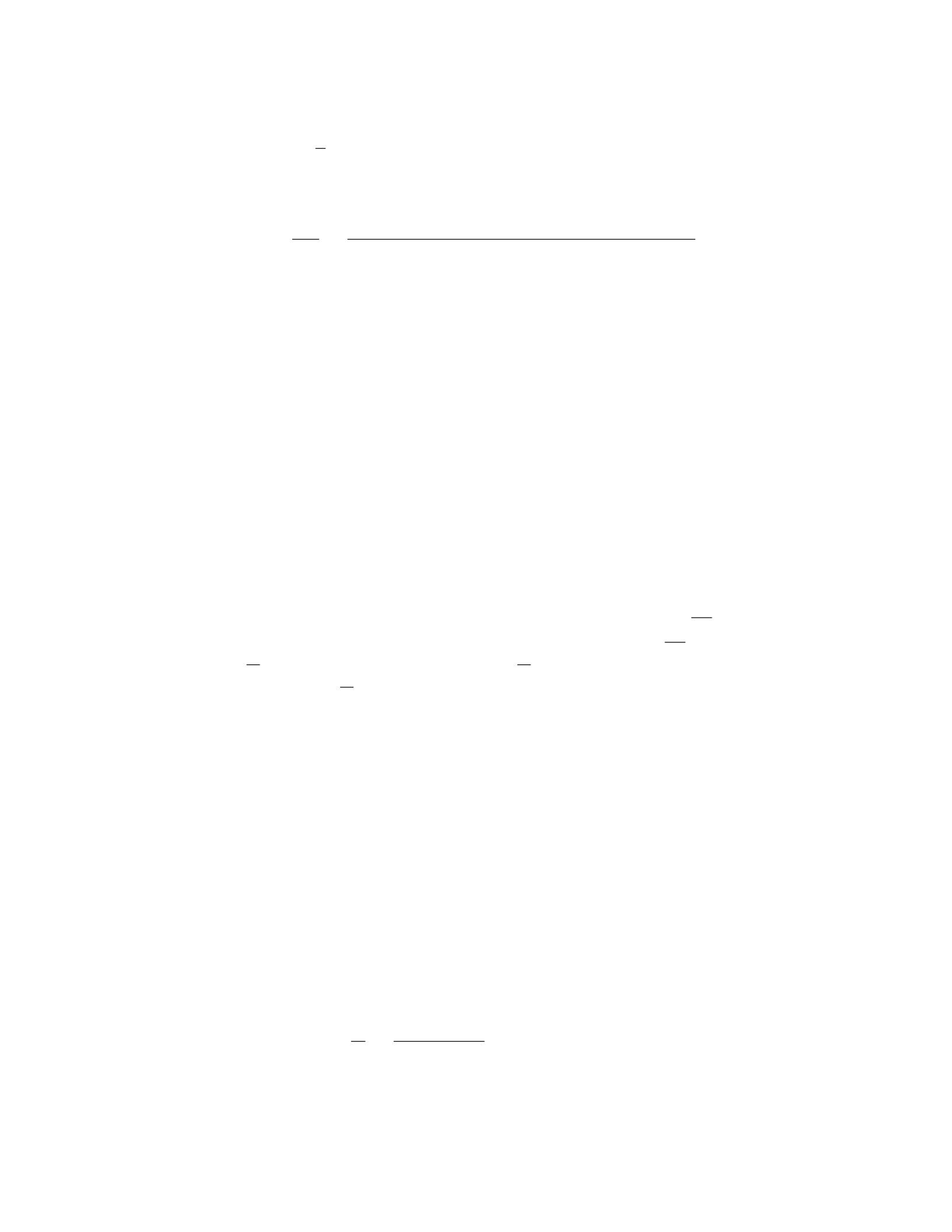
6. Now that we have the weight Wof the rod, we can calculate the stress near the top end.
The stress is given by σ=F
A, where Fis the force applied and Ais the area over which the force
is applied. Near the top end, the area is the cross-sectional area of the rod, which is πr2.
7. The stress near the top end σis:
σ=W
πr2=7850 kg/m3×π(0.015 m)2×2m×9.81 m/s2
π(0.015 m)2
9. Suppose a uniform rod of length Land mass Mis suspended horizontally from two vertical
walls via two strings of length Leach, attached to the ends of the rod. The walls are a distance
dapart. The strings each make an angle θwith the vertical. If the tension in each string is T,
find an expression for θin terms of the given variables.
Ans. We can solve this problem by analyzing the forces acting on the rod. 1. Draw a free-
body diagram for the rod. The forces acting on the rod are the gravitational force Mg acting
downwards, the tensions Tacting upwards and the horizontal forces at the point of contact with
the walls. 2. Resolve the forces perpendicular to the rod. The vertical components of the tensions
cancel out the gravitational force, so 2Tcos(θ) = M g. 3. Resolve the forces parallel to the rod.
The horizontal components of the tensions provide the net force required for equilibrium in the
horizontal direction, so 2Tsin(θ) = Fwall. We know that Fwall =Ttan(θ) = M g
2tan(θ). 4. Since
the net horizontal force must be zero for equilibrium, we set Ttan(θ) = M g
2tan(θ). Simplifying,
we find tan(θ) = g
2d. 5. Finally, we have θ=arctan (g
2d). Therefore, the angle θin terms of the
given variables is θ=arctan (g
2d).
10. A steel wire of length 2.0 m and radius 1.0 mm is stretched by a force of 500 N. The
Young’s modulus of the steel wire is 2.0×10¹¹ N/m2. Calculate the extension of the wire using
Hooke’s Law.
Ans. Let’s denote the original length of the wire as L, the force applied as F, the radius of the
wire as r, the Young’s modulus as Y, and the extension as ∆L.
1. First, let’s calculate the cross-sectional area of the wire using its radius:
A=πr2=π(1.0×10⁻³)2= 3.14 ×10⁻⁶m2
2. Next, we can calculate the stress applied to the wire using the formula:
σ=F
A=500
3.14 ×10−6= 1.59 ×10⁸N/m2
3. Now, using Hooke’s Law, we can find the strain in the wire:
σ=Y·ϵ
ϵ=σ
Y=1.59 ×10⁸
2.0×1011 = 7.95 ×10⁻⁴
4. Finally, we can calculate the extension of the wire using the formula for strain:
ϵ=∆L
L
∆L=ϵ·L= 7.95 ×10−4×2.0 = 1.59 ×10⁻³m
Therefore, the extension of the wire is 1.59 ×10⁻³m.
11. A uniform rod AB of length Land mass Mis supported by a hinge at A and a cable which
is attached to the rod at a distance dfrom A. The cable makes an angle θwith the horizontal.
The rod is in equilibrium and the tension in the cable is T. If the rod is made of a material with
a Young’s modulus Y, find the change in length of the rod due to the tension in the cable.
Ans. Let’s denote the original length of the rod as L0, the tension in the cable as T, the change
in length of the rod as ∆L, the cross-sectional area of the rod as A, and the Young’s modulus
of the material as Y. We are given that the tension in the cable is T.
1. Free Body Diagram: Consider the forces acting on the rod: - The weight, W=Mg,
acting at the center of mass of the rod. - The tension in the cable, T, at an angle θto the
horizontal. - The reaction force at the hinge, RA, acting vertically upwards.
Since the rod is in equilibrium, the sum of the forces in the vertical direction must be zero.
This gives us:
RA+Tcos θ−Mg = 0
RA=Mg −Tcos θ
The sum of the torques about point A must also be zero since the rod is in equilibrium.
Taking the torque about point A gives us:
T·dsin θ=L
2·Mg ·L
2
T d sin θ=MgL2
4
2. Calculating Change in Length: The change in length of a material under stress can be
calculated using Hooke’s Law:
σ=F
A
ϵ=∆L
L0
=σ
Y
∆L=ϵ·L0
Substitute the stress σ=T
Ainto the strain equation:
∆L=T
Y A ·L0
3. Solving for ∆L:To find the cross-sectional area A, we can relate it to the mass of the
rod:
M=ρ·V=ρ·A·L0
A=M
ρ·L0
Substitute the expression for Ainto our equation for ∆L:
∆L=T·L0
Y·ρ·L0
∆L=T
Y·ρ
Therefore, the change in length of the rod due to the tension in the cable is T
Y·ρ.
12. Question: A uniform, horizontal beam of length Land mass Mis supported by two vertical
ropes attached at its ends. If a person of mass mstands at a distance xfrom one end of the
beam, find the tension in each rope.
Ans. Let’s denote the tension in the rope attached to the left end of the beam as T1and the
tension in the rope attached to the right end as T2.
1. The sum of the torques about the left end of the beam must be zero in order for the beam
to be in equilibrium. This gives us the equation: T2·L−m·g·x= 0, where gis the acceleration
due to gravity.
2. The sum of the vertical forces must also be zero in order for the beam to be in equilibrium.
This gives us the equation: T1+T2−M·g−m·g= 0.
3. We can solve the system of equations to find the tensions in the ropes. From equation
(1), we have T2=m·g·x
L. Substituting T2into equation (2) gives us: T1+m·g·x
L=M·g+m·g.
4. Solving for T1, we get T1= (M+m)·g−m·g·x
L.
Therefore, the tension in the rope attached to the left end of the beam is (M+m)·g−m·g·x
L,
and the tension in the rope attached to the right end of the beam is m·g·x
L.
13. A uniform rod of length Land mass Mis supported by a pivot at one end, with the other
end attached to a spring of spring constant k. The system is in equilibrium when the spring is

stretched a distance x0. If the rod makes an angle θwith the vertical, determine the expression
for θin terms of L,k,x0, and M.
Ans. To solve this problem, we need to analyze the forces acting on the rod and the spring at
equilibrium. 1. At equilibrium, the torque about the pivot point due to the spring force and the
gravitational force equals zero. 2. The torque due to the spring force is given by (−kx0)Lsin θ. 3.
The torque due to the gravitational force acting at the center of mass of the rod is −1
2Mg L
2sin θ.
4. Set the sum of torques equal to zero and solve for θ.
14. Question: A thin rod of length Land uniform cross-sectional area Ais supported horizontally
at its ends. A vertical force Fis applied at the midpoint of the rod. What is the expression for
the vertical displacement of the midpoint of the rod from its original position?
Ans. Let’s denote the Young’s modulus of the material as Y. The rod will deform under the
applied force and this deformation can be analyzed using the theory of elasticity.
1. The force applied at the midpoint of the rod will create a downward deformation in
the middle of the rod, while the ends of the rod will experience upward reactions to maintain
equilibrium.
2. We can calculate the Young’s modulus Yin terms of stress and strain. The stress σis the
force divided by the cross-sectional area: σ=F
A. The strain ϵis the change in length divided by
the original length: ϵ=∆L
L.
3. Using Hooke’s Law for linear elasticity, we have σ=Y ϵ. Rearranging, we get ∆L=F L
AY .
Since the force is applied at the midpoint, the vertical displacement of the midpoint from its
original position will be half of the total deformation: ∆y=1
2∆L.
4. Substituting in the expression for ∆L, we get ∆y=1
2(F L
AY )=F L
2AY .
Therefore, the expression for the vertical displacement of the midpoint of the rod from its
original position under the applied force Fis F L
2AY .
15. Question: A uniform rod of length Land mass Mis pivoted at one end. A force Fis
applied horizontally at the other end of the rod. Find the distance from the pivot point where a
supporting force should be applied perpendicular to the rod in order to keep it in equilibrium.
Ans. Let’s denote the distance from the pivot point where the supporting force should be
applied as x.
1. The net torque about the pivot point must be zero for the rod to remain in equilibrium.
The torque due to the force Fabout the pivot point is F(L−x). The torque due to the
supporting force about the pivot point is M g(x/2), where gis the acceleration due to gravity.
Setting the sum of torques equal to zero:

F(L−x) = Mg
2x
2. Solving the equation for x:
x=2F L
2F+Mg
3. Therefore, the supporting force should be applied at a distance x=2F L
2F+Mg from the pivot
point in order to keep the rod in equilibrium.
16. A uniform rod of length Land mass Mis hinged at one end and supported horizontally
at a distance xfrom the hinge. A weight Wis hung at the free end of the rod. Determine the
required force Fto keep the rod in equilibrium. (Hint: The rod will be in equilibrium if the sum
of the forces in the vertical direction and the sum of the moments about the hinge point are both
equal to zero.)
Ans. Let’s denote the distance between the hinge and the center of mass of the rod as d. We
have d=L
2. The sum of the forces in the vertical direction is given by:
F+W−Mg = 0
where gis the acceleration due to gravity. The sum of the moments about the hinge point is
given by:
F x −W(L−d) = 0
1. Solve the force equation to find F: From F+W−M g = 0, we can solve for F:
F=Mg −W
2. Solve the moment equation to find F: Substitute d=L
2and solve for F:
F x −W(L−L
2)= 0
F x −W
2L= 0
F x =W
2L
F=W
2x
3. Equate the two expressions for F: Set Mg −W=W
2xand solve for x:
Mg −W=W
2x

2x(Mg −W) = W
2xMg −2xW =W
2xMg = 3W
x=3W
2Mg
Therefore, the required force Fto keep the rod in equilibrium is:
F=Mg −W=Mg −3W
2
17. Question:
A steel cable with a length of 10 m and a diameter of 2 mm is used to support a load of 5000
N. The cable has a Young’s modulus of 2×10¹¹ Pa. Determine the elongation of the cable when
the load is applied.
Ans. Let’s denote the original length of the cable as L, the change in length as ∆L, the applied
load as F, the cross-sectional area as A, the Young’s modulus as Y, and the original modulus of
elasticity as ϵ. To find the elongation of the cable, we can use Hooke’s Law:
1. The cross-sectional area of the cable is given by:
A=πd2
4=π(2×10⁻³)2
4= 3.14 ×10⁻⁶m2
2. The original modulus of elasticity can be calculated by:
ϵ=F
A=5000
3.14×10−6= 1.59 ×10⁹Pa
3. Now, we can calculate the elongation of the cable using the formula:
∆L=F·L
A·Y=5000·10
3.14×10−6·2×1011 = 0.079m
Therefore, the elongation of the cable when the load is applied is 0.079 m.
18. A metal rod of length Land cross-sectional area Ais supported horizontally at its ends. A
force Fis applied at the midpoint of the rod perpendicular to its length. The Young’s modulus
of the material is Y. Determine the displacement at the midpoint of the rod due to the applied
force.
Ans. To determine the displacement at the midpoint of the rod, we will analyze the equilibrium
of forces and apply the concept of elasticity.
1. First, consider the free body diagram of the rod. The force Fapplied at the midpoint will
result in tension on the upper half and compression on the lower half. Let xbe the displacement
at the midpoint of the rod.
2. Using the equilibrium condition, the sum of forces in the vertical direction at the midpoint
is zero:
F=Aσ +Aσ
where σis the stress in the rod.
3. Using Hooke’s Law, the stress σis related to the strain ϵby:
σ=Y ϵ
where Yis the Young’s modulus.
4. The strain ϵis related to the displacement xby:
ϵ=x
L
5. Substituting the expressions for stress and strain into the equilibrium equation, we get:
F=AY x
L+AY x
L
6. Simplifying the equation, we find the displacement x:
x=F L
2AY
Therefore, the displacement at the midpoint of the rod due to the applied force Fis F L
2AY .
19. A 2 kg mass hangs from a vertical rod by a lightweight string. The mass causes the rod to
bend by 2 cm. If the radius of the rod is 1 cm and the modulus of elasticity of the material is
2×10¹¹ N/m2, find the stress experienced by the rod.
Ans. Let’s denote the Young’s modulus as Y, the radius of the rod as R, the distance
the rod bends as δ, and the stress experienced by the rod as σ. 1. First, let’s calculate the
strain experienced by the rod using the formula change in length
original length . Since the rod bends by 2 cm, the
elongation δis 2 cm or 0.02 m. The original length of the rod is the radius Rwhich is 0.01 m.
Therefore, the strain ϵis given by:
ϵ=δ
R=0.02
0.01 = 2
2. Next, we can use Hooke’s Law which states that stress σis equal to Young’s modulus Y
multiplied by strain ϵ. Therefore, we have:
σ=Y·ϵ= (2 ×1011)·2 = 4 ×10¹¹ N/m2
Therefore, the stress experienced by the rod is 4×10¹¹ N/m2.

20. A steel rod of length 2 m and diameter 2 cm is hung vertically from one end. If the
Young’s modulus of steel is 2×10¹¹ N/m2and the density of steel is 7,800 kg/m3, calculate the
elongation of the rod due to its own weight.
Ans. Let’s denote the elongation of the rod as ∆L. We will calculate the elongation step-by-
step:
1. First, let’s find the weight of the rod. The weight Wof the rod can be calculated using
the formula:
W=mg
where mis the mass of the rod and gis the acceleration due to gravity. The mass mof the rod
can be calculated using its volume V, density ρ, and the formula:
m=V ρ
The volume of the rod Vcan be calculated using its length Land cross-sectional area A:
V=AL
The cross-sectional area Aof the rod can be calculated using its diameter d:
A=πd2
4
2. Substitute the given values into the equations to find the weight Wof the rod.
3. Now, we will calculate the stress σexperienced by the rod due to its own weight. Stress
is defined as the force per unit area:
σ=W
A
4. Using Hooke’s Law, we can relate the stress σto the strain ϵ(elongation per unit length)
and Young’s modulus Y:
σ=Y ϵ
5. Rearrange the formula to solve for the elongation ϵ:
ϵ=σ
Y
6. Substitute the stress σcalculated in step 3 and the Young’s modulus Yto find the
elongation per unit length ϵ.
7. Finally, calculate the total elongation ∆Lby multiplying the elongation per unit length ϵ
by the length Lof the rod:
∆L=ϵL
21. A uniform rod of length Land mass Mis suspended horizontally by two vertical wires
attached to its ends. If a weight Wis suspended from the rod at a distance dfrom one end,
determine the tension in each wire.
Ans. Let’s denote the tensions in the wires as T1and T2, and the weight Was acting downwards
at a distance dfrom the end where T2is applied. Since the system is in equilibrium, the sum of
the torques acting on the rod must be zero.
1. The torque due to Wabout the point where T2is applied is W d clockwise.
2. The torque due to T1about the point where T2is applied is T1(L/2) counterclockwise.
3. The torque due to M g about the point where T2is applied is Mg(L/2) clockwise.
4. Write the equation for equilibrium in terms of torque:
T1(L
2)=W d +Mg (L
2)
5. In the vertical direction, we have:
T1+T2=Mg +W
6. Since the system is in equilibrium, solving the system of equations will give the tensions
in the wires:
T1=W d +Mg (L
2)
(L
2)
T2=Mg +W−T1
22. Question: A uniform rod of length Land mass Mis suspended horizontally from two
vertical strings attached to its ends. A block of mass mis hung from the center of the rod. The
system is in equilibrium. Find the tensions in the strings.
Ans. Step-by-step solution: 1. We will start by drawing a free-body diagram of the system.
Let T1and T2be the tensions in the strings attached to the ends of the rod, and W1and W2
be the weights of the rod and the block, respectively. 2. The forces acting on the rod are the
tension forces T1and T2, and the weight of the rod W1=M g. The forces acting on the block
are the tension forces T1and T2, and the weight of the block W2=mg. 3. Since the system is
in equilibrium, the sum of all the forces in the horizontal direction and the vertical direction must
be zero. 4. In the horizontal direction, the tension forces T1and T2must balance each other,
so T1=T2. 5. In the vertical direction, the sum of the forces must also be zero. We have:
2T1=W1+W2. 6. Substituting the expressions for W1and W2into the equation above, we get:
2T1=Mg +mg. 7. Simplifying the equation, we find the tension in each string: T1=Mg+mg
2.
8. Therefore, the tensions in the strings are both equal to M g+mg
2.
23. A steel cable with a length of 10 m and a cross-sectional area of 2 cm2is stretched between
two fixed points. If the Young’s modulus of the steel is 2×10¹¹ N/m2, determine the force
required to stretch the cable by 2 mm.
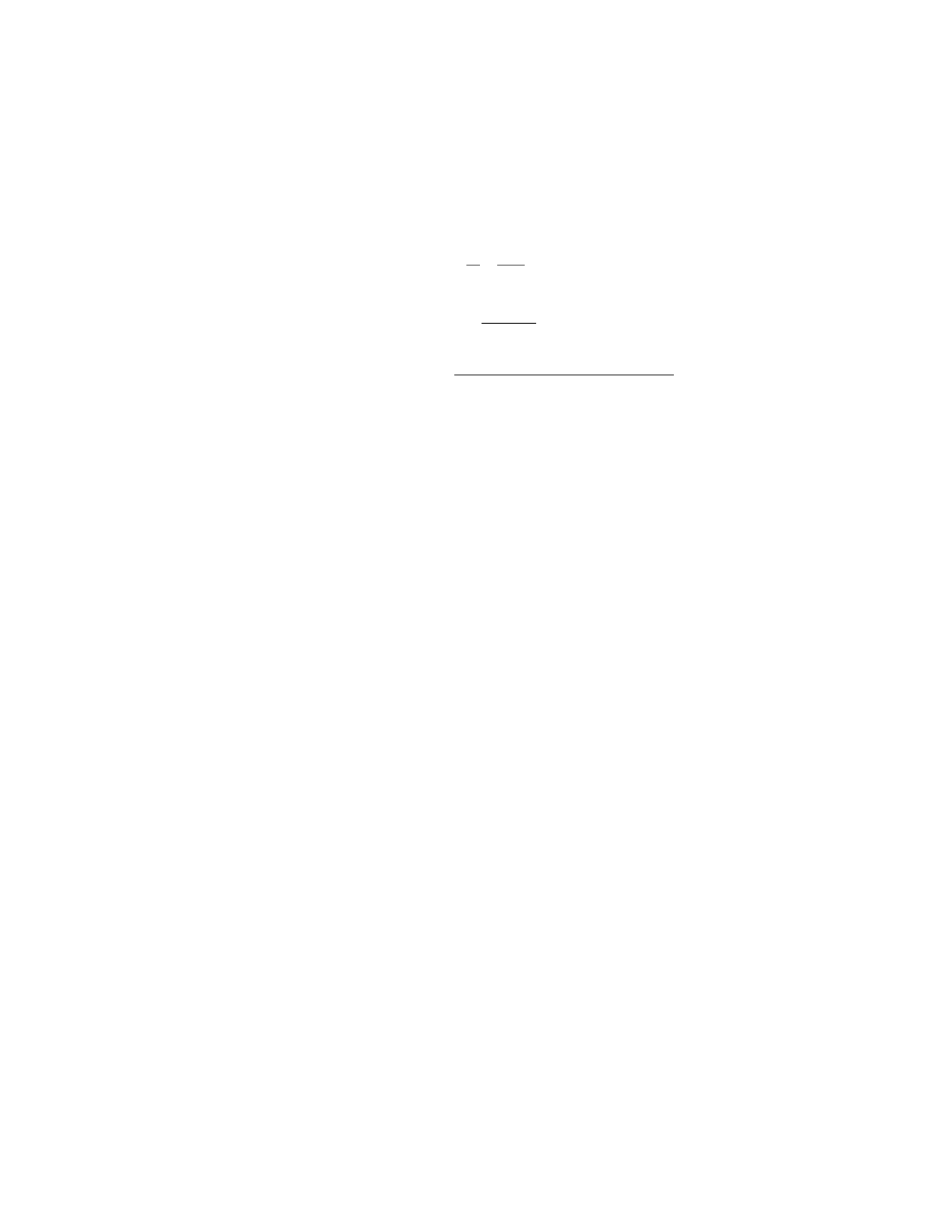
Ans. Let’s denote the original length of the steel cable as L= 10 m. The cross-sectional area of
the cable is A= 2 cm2= 2 ×10⁻⁴m2. The Young’s modulus of the steel is Y= 2 ×10¹¹ N/m2.
We need to find the force required to stretch the cable by ∆L= 2 mm = 2 ×10⁻³m.
1. Calculate the original tension in the cable:
The original tension in the cable can be found using the equation for Young’s modulus:
Y=T
A·∆L
L
T=Y·A·∆L
L
T= (2 ×10¹¹ N/m2)·(2 ×10−4m2)·(2 ×10−3m)
10 m
T= 8 ×10⁴N
2. Calculate the force required to stretch the cable:
To find the force required to stretch the cable by 2 mm, we can use the equation:
F=A·∆L·Y
F= (2 ×10⁻⁴m2)·(2 ×10−3m)·(2 ×10¹¹ N/m2)
F= 8 kN
Therefore, the force required to stretch the steel cable by 2 mm is 8 kN.

