


Conflict Resolution
Whether a small irritation or a large problem, conflict with others can contribute to negative
feelings and stress. Conflicts can occur with family members, friends, and with your coworkers
and supervisors. It is important to understand how conflicts arise and how to successfully
resolve them.
Understanding Conflict
Who do you have the most conflict with right now? Your answer to this question probably
depends on the various contexts in your life. If you still live at home with a parent or parents,
you may have daily conflicts with your family as you try to balance your autonomy, or desire
for independence, with the practicalities of living under your family’s roof. If you’ve recently
moved away to go to college, you may be negotiating roommate conflicts as you adjust to
living with someone you may not know at all. You probably also have experiences managing
conflict in romantic relationships, friendships, and in the workplace. In this module, we will
introduce some introductory concepts and explore why understanding conflict is important for
your career success and interpersonal relationships.
There are many different definitions of conflict existing in the literature. For our purposes,
conflict occurs in interactions in which there are real or perceived incompatible goals, scarce
resources, or opposing viewpoints. Conflict can vary in severity from mild to grievous and can
be expressed verbally or nonverbally along a continuum ranging from a nearly imperceptible
cold shoulder to a very obvious blowout.
Elements of Conflict
There are six elements to a conflict described by Rice (2000):
1. Conflict is inevitable. Because we do not all think and act the same, disagreements will
occur.
2. Conflict by itself is neither good nor bad. Leaving conflict unresolved can result in
negative outcomes. It is important to work toward resolving conflict and achieving a
positive outcome.

3. Conflict is a process. We choose how to respond to others and can escalate or
deescalate a conflict.
4. Conflict and avoid conflict both consume energy. The longer we avoid working on a
resolution for a conflict with someone else, the more energy we spend on it.
5. Conflict has elements of both content and feeling. While conflict often arises from a
specific behavior or action, it often involves underlying emotions. For example, if your
significant other always left dirty dishes in the sink, despite your requests to rinse and
put them in the dishwasher, you may feel like your partner doesn’t respect you. This
may lead to a conflict over doing the dishes.
6. We can choose to be proactive or reactive in a conflict. Taking a proactive approach to
resolving conflict when it arises can lead to more positive outcomes.
Other Key Terms
Some people use the terms conflict, competition, dispute, and violence interchangeably. While
these concepts are similar, they aren’t exactly the same. We will define each of these terms to
ensure that we have a shared understanding of how they are used.
Dispute is a term for a disagreement between parties. Typically, a dispute is adversarial in
nature. While conflict can be hostile, it isn’t always . Dispute also sometimes carries with it a
legal connotation.
Competition is a rivalry between two groups or two individuals over an outcome that they
both seek. In a competition there is a winner and a loser. Parties involved in a conflict may or
may not view the situation as a competition for resources. Ideally, parties in a conflict will
work together rather than compete.
The term interpersonal violence is also not synonymous with conflict. Although some conflict
situations escalate to include acts of aggression and hostility, interpersonal violence involves
acts of aggression such as an intent to harm or actual physical or psychological harm to
another or their property. Ideally, conflict will be productive, respectful, and non-violent.
Levels of Conflict
In addition to different views of conflict, there exist several different levels of conflict. By level
of conflict, we are referring to the number of individuals involved in the conflict. That is, is the
conflict within just one person, between two people, between two or more groups, or
between two or more organizations? Both the causes of a conflict and the most effective
means to resolve it can be affected by level. Four levels can be identified: within an individual
(intrapersonal conflict), between two parties (interpersonal conflict), between groups
(intergroup conflict), and between organizations (inter-organizational conflict).

Different Levels of Conflict. Fanshawe College. – CC BY-NC-SA 4.0.
Intrapersonal Conflict
Intrapersonal conflict arises within a person. In the workplace, this is often the result of
competing motivations or roles. We often hear about someone who has an approach
avoidance conflict; that is, they are both attracted to and repelled by the same object.
Similarly, a person can be attracted to two equally appealing alternatives, such as two good
job offers (approach-approach conflict) or repelled by two equally unpleasant alternatives,
such as the threat of being fired if one fails to identify a coworker guilty of breaking company
rules (avoidance-avoidance conflict). Intrapersonal conflict can arise because of differences in
roles.
A role conflict occurs when there are competing demands on our time, energy, and other
resources. For example, a conflict may arise if you’re the head of one team but also a member
of another team. We can also have conflict between our roles at work and those roles that we
hold in our personal lives.
Another type of intrapersonal conflict involves role ambiguity. Perhaps you’ve been given the
task of finding a trainer for a company’s business writing training program. You may feel
unsure about what kind of person to hire—a well-known but expensive trainer or a local,
unknown but low-priced trainer. If you haven’t been given guidelines about what’s expected,
you may be wrestling with several options.
Interpersonal Conflict
Interpersonal conflict is among individuals such as coworkers, a manager and an employee, or
CEOs and their staff. Many companies suffer because of interpersonal conflicts as it results in
loss of productivity and employee turnover. According to one estimate, 31.9% of CEOs

resigned from their jobs because they had conflict with the board of directors (Whitehouse,
2008). Such conflicts often tend to get highly personal because only two parties are involved
and each person embodies the opposing position in the conflict. Hence, it is sometimes
difficult to distinguish between the opponent’s position and the person. Keeping conflicts
centered around ideas rather than individual differences is important in avoiding a conflict
escalation.
Intergroup Conflict
Intergroup conflict is conflict that takes place among different groups and often involves
disagreement over goals, values, or resources. Types of groups may include different
departments, employee unions, or management in a company or competing companies that
supply the same customers. Departments may conflict over budget allocations, unions and
management may disagree over work rules, and suppliers may conflict with each other on the
quality of parts.
Merging two groups together can lead to friction between the groups—especially if there are
scarce resources to be divided among the group. For example, in what has been called “the
most difficult and hard-fought labor issue in an airline merger,” Canadian Air and Air Canada
pilots were locked into years of personal and legal conflict when the two airlines’ seniority lists
were combined following the merger (Stoykewch, 2003). Seniority is a valuable and scarce
resource for pilots, because it helps to determine who flies the newest and biggest planes,
who receives the best flight routes, and who is paid the most. In response to the loss of
seniority, former Canadian Air pilots picketed at shareholder meetings, threatened to call in
sick, and had ongoing conflicts with pilots from Air Canada. The history of past conflicts among
organizations and employees makes new deals challenging. As the Canadian airline WestJet is
now poised to takeover Sunwing, WestJet has stated that they will respect existing union
agreements (Mallees, 2022). Intergroup conflict can be the most complicated form of conflict
because of the number of individuals involved. Coalitions can form and result in an “us-
against-them” mentality. Here, too, is an opportunity for groups to form insulated ways of
thinking and problems solving, thus allowing groupthink to develop and thrive.
Interorganizational Conflict
Finally, we can see interorganizational conflict in disputes between two companies in the
same industry (for example, a disagreement between computer manufactures over computer
standards), between two companies in different industries or economic sectors (for example, a
conflict between real estate interests and environmentalists over land use planning), and even
between two or more countries (for example, a trade dispute between the United States and
Russia). In each case, both parties inevitably feel the pursuit of their goals is being frustrated
by the other party.
Types of Conflict
If we are to try to understand conflict, we need to know what type of conflict is present. At
least four types of conflict can be identified:
1. Goal conflict can occur when one person or group desires a different outcome than
others do. This is simply a clash over whose goals are going to be pursued.
2. Cognitive conflict can result when one person or group holds ideas or opinions that are
inconsistent with those of others. Often cognitive conflicts are rooted in differences in
attitudes, beliefs, values, and worldviews, and ideas may be tied to deeply held culture,
politics, and religion. This type of conflict emerges when one person’s or group’s
feelings or emotions (attitudes) are incompatible with those of others.
3. Affective conflict is seen in situations where two individuals simply don’t get along
with each other.
4. Behavioral conflict exists when one person or group does something (i.e., behaves in a
certain way) that is unacceptable to others. Dressing for work in a way that “offends”
others and using profane language are examples of behavioral conflict.
Each of these types of conflict is usually triggered by different factors, and each can lead to
very different responses by the individual or group. It is important to note that there are many
types of conflict and that not all researchers use this same four-type classification. For
example, Gallo (2015) has characterized conflict as being rooted in relationships, tasks (what
to do), process (how to do things), or status. Regardless, when we find ourselves in a conflict
situation, it can be helpful to try and take a step back and identify what type of conflict it is. It
can also be helpful to acknowledge that what may look like a goal conflict may actually also
have components of affective or cognitive conflict.
The Conflict Process
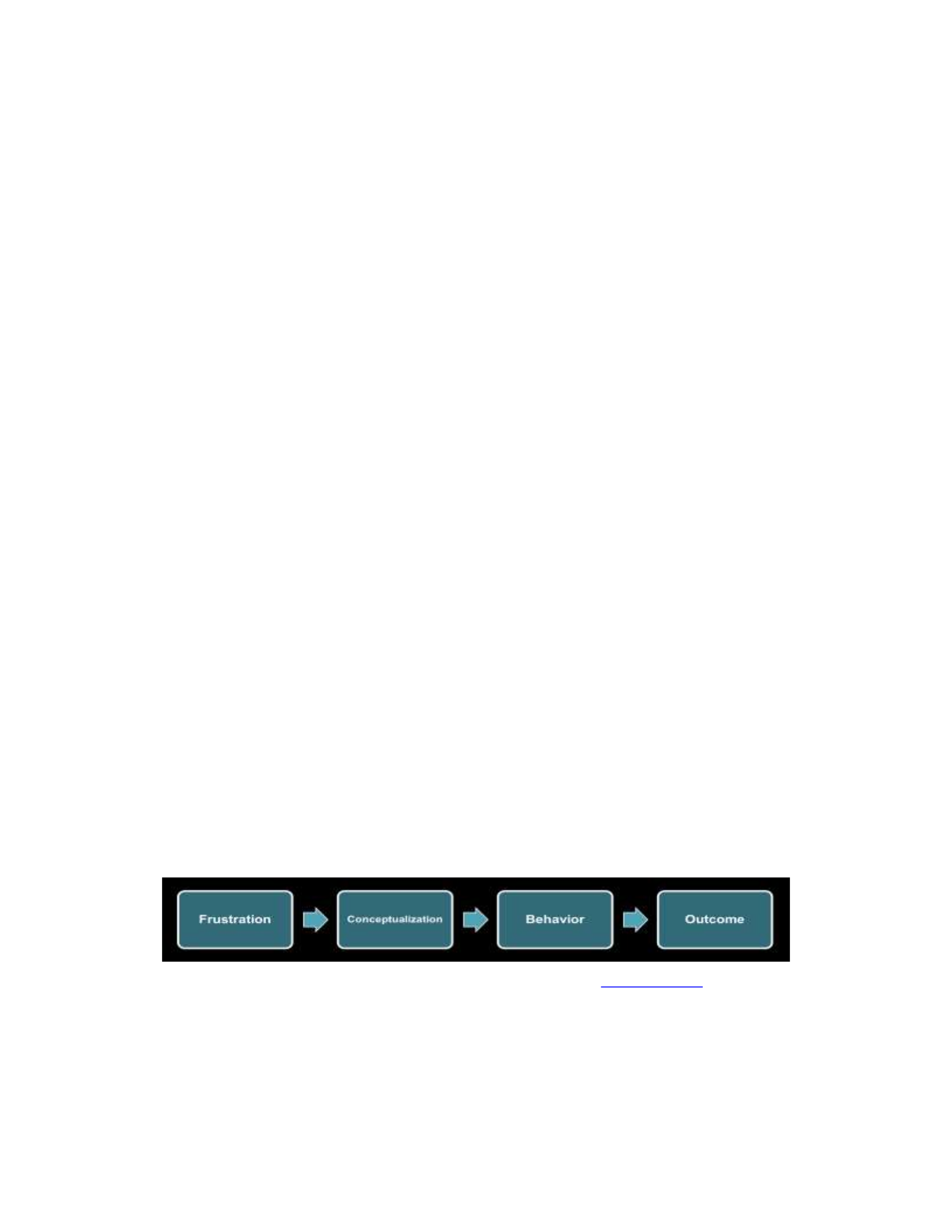
The most commonly accepted model of the conflict process consists of four stages:
(1) frustration, (2) conceptualization, (3) behavior, and (4) outcome (Thomas, 1976).
The Conflict Process: Fanshawe College. Original Image – CC BY-NC-SA 4.0.
Stage 1: Frustration
As we have seen, conflict situations originate when an individual or group feels frustration in
the pursuit of important goals. This frustration may be caused by a wide variety of factors,
including disagreement over performance goals, failure to get a promotion or pay raise, a fight

over scarce economic resources, new rules or policies, and so forth. In fact, conflict can be
traced to frustration over almost anything a group or individual cares about.
Stage 2: Conceptualization
In stage 2, the conceptualization stage of the model, parties to the conflict attempt to
understand the nature of the problem, what they themselves want as a resolution, what they
think their opponents want as a resolution, and various strategies they feel each side may
employ in resolving the conflict. This stage is really the problem-solving and strategy phase.
For instance, when management and union negotiate a labor contract, both sides attempt to
decide what is most important and what can be bargained away in exchange for these priority
needs.
Stage 3: Behavior
The third stage in Thomas’s model is actual behavior. As a result of the conceptualization
process, parties to a conflict attempt to implement their resolution mode by competing or
accommodating in the hope of resolving problems. A major task here is determining how best
to proceed strategically. That is, what tactics will the party use to attempt to resolve the
conflict? Thomas has identified five modes for conflict resolution:
(1) competing, (2) collaborating, (3) compromising, (4) avoiding, and (5) accommodating. We
will discuss these modes in further detail in the next section.
Stage 4: Outcome
Finally, as a result of efforts to resolve the conflict, both sides determine the extent to which a
satisfactory resolution or outcome has been achieved. Where one party to the conflict does
not feel satisfied or feels only partially satisfied, the seeds of discontent are sown for a later
conflict. One unresolved conflict episode can easily set the stage for a second episode.
Managerial action aimed at achieving quick and satisfactory resolution is vital; failure to
initiate such action leaves the possibility (more accurately, the probability) that new conflicts
will soon emerge.
Conflict Escalation
Many academics and conflict resolution practitioners have observed predictable patterns in
the way conflict escalates. Conflict is often discussed as though it is a separate entity, and in
fact it is true that an escalating dispute may seem to take on a life of its own. Conflict will often
escalate beyond reason unless a conscious effort is made to end it.
Tornada Conflict demonstrates how conflict can quickly escalate out of control. By observing
and listening to individuals in dispute, it is often possible to determine where they are in the
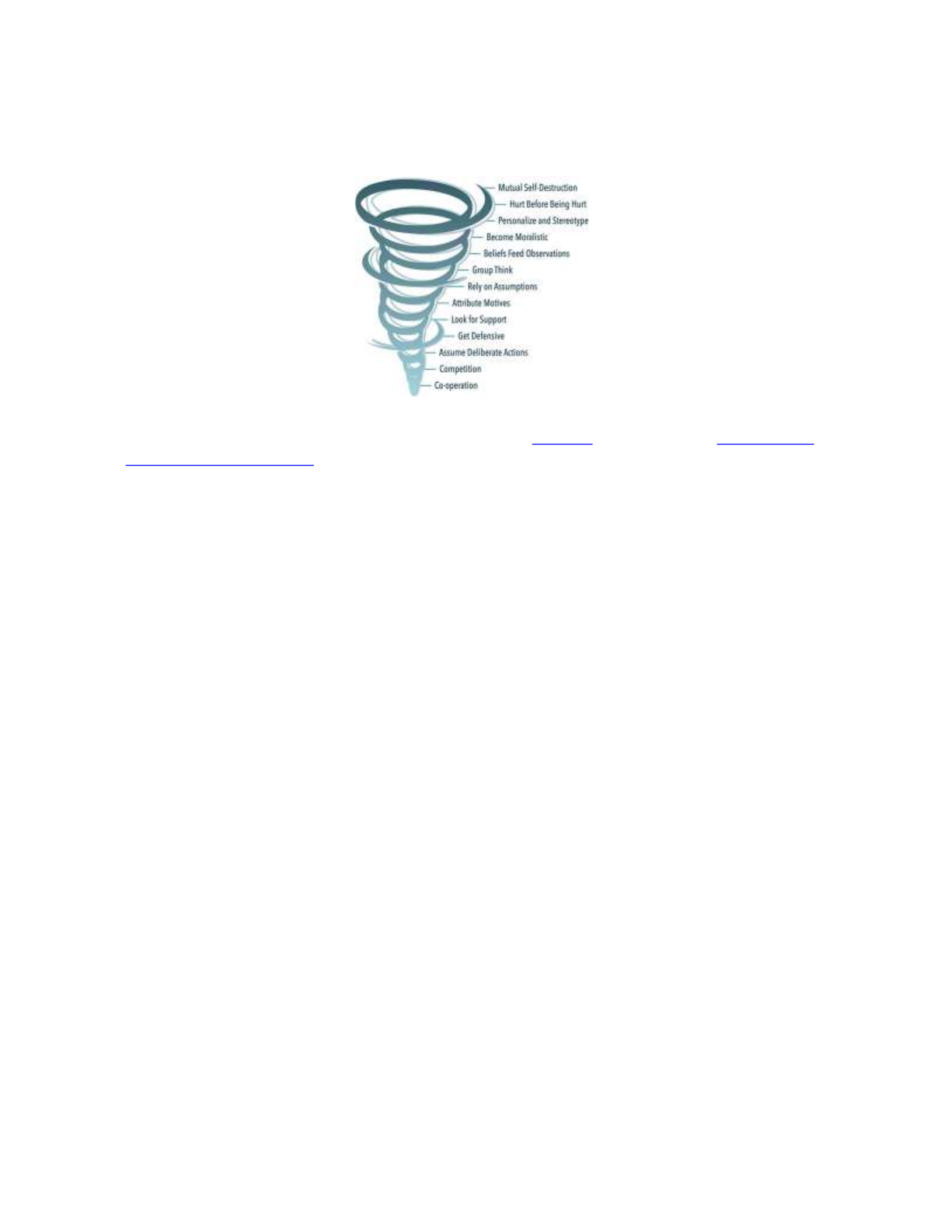
escalation process and anticipate what might occur next. In doing so, one can develop timely
and appropriate approaches to halt the process.
“Conflict Escalation Tornado,” by the Dispute Resolution Office, Ministry of Justice (Government of
Saskatchewan), redesigned by JVDW Designs, is licensed under CC BY 4.0. Reproduced from Leadership and
Influencing Change In Nursing by Joan Wagner. Color altered from original.
Culture and Conflict
Culture is an important context to consider when studying conflict. While there are some
generalizations we can make about culture and conflict, it is better to look at more specific
patterns of how interpersonal communication and conflict management are related. We can
better understand some of the cultural differences in conflict management by further
examining the concept of face.
What does it mean to “save face?” This saying generally refers to preventing embarrassment
or preserving our reputation or image, which is similar to the concept of face in interpersonal
and intercultural communication. Our face is the projected self we desire to put into the
world, and facework refers to the communicative strategies we employ to project, maintain, or
repair our face or maintain, repair, or challenge another’s face. Face negotiation theory argues
that people in all cultures negotiate face through communication encounters, and that cultural
factors influence how we engage in facework, especially in conflict situations (Oetzel & Ting-
Toomey, 2003). These cultural factors influence whether we are more concerned with self-face
or other-face and what types of conflict management strategies we may use. One key cultural
influence on face negotiation is the distinction between individualistic and collectivistic
cultures.
The distinction between individualistic and collectivistic cultures is an important dimension
across which all cultures vary. Individualistic cultures like the United States and most of Europe
emphasize individual identity over group identity and encourage competition and self-reliance.
Collectivistic cultures like Taiwan, Colombia, China, Japan, Vietnam, and Peru value in-group
identity over individual identity and value conformity to social norms of the in-group (Dsilva &
Whyte, 1998). However, within the larger cultures, individuals will vary in the degree to which

they view themselves as part of a group or as a separate individual, which is called self-
construal. Independent self-construal indicates a perception of the self as an individual with
unique feelings, thoughts, and motivations. Interdependent self-construal indicates a
perception of the self as interrelated with others (Oetzel & Ting-Toomey, 2003). Not
surprisingly, people from individualistic cultures are more likely to have higher levels of
independent self-construal, and people from collectivistic cultures are more likely to have
higher levels of interdependent selfconstrual. Self-construal and individualistic or collectivistic
cultural orientations affect how people engage in facework and the conflict management
styles they employ.
Self-construal alone does not have a direct effect on conflict style, but it does affect face
concerns, with independent self-construal favoring self-face concerns and interdependent self-
construal favoring other-face concerns. There are specific facework strategies for different
conflict management styles, and these strategies correspond to self-face concerns or other-
face concerns.
• Accommodating. Giving in (self-face concern).
• Avoiding. Pretending conflict does not exist (other-face concern).
• Competing. Defending your position, persuading (self-face concern).
• Collaborating. Apologizing, having a private discussion, remaining calm (other-face
concern) (Oetzel, Garcia, & Ting-Toomey, 2008).
Research done on college students in Germany, Japan, China, and the United States found that
those with independent self-construal were more likely to engage in competing, and those
with interdependent self-construal were more likely to engage in avoiding or collaborating
(Oetzel & Ting-Toomey, 2003). And in general, this research found that members of
collectivistic cultures were more likely to use the avoiding style of conflict management and
less likely to use the integrating or competing styles of conflict management than were
members of individualistic cultures. The following examples bring together facework
strategies, cultural orientations, and conflict management style: Someone from an
individualistic culture may be more likely to engage in competing as a conflict management
strategy if they are directly confronted, which may be an attempt to defend their reputation
(self-face concern). Someone in a collectivistic culture may be more likely to engage in
avoiding or accommodating in order not to embarrass or anger the person confronting them
(other-face concern) or out of concern that their reaction could reflect negatively on their
family or cultural group (other-face concern). While these distinctions are useful for
categorizing large-scale cultural patterns, it is important not to essentialize or arbitrarily group
countries together, because there are measurable differences within cultures. For example,

expressing one’s emotions was seen as demonstrating a low concern for other-face in Japan,
but this was not so in China, which shows there is variety between similarly collectivistic
cultures. Culture always adds layers of complexity to any communication phenomenon, but
experiencing and learning from other cultures also enriches our lives and makes us more
competent communicators.
Conflict Management Strategies
Would you describe yourself as someone who prefers to avoid conflict? Do you like to get your
way? Are you good at working with someone to reach a solution that is mutually beneficial?
Odds are that you have been in situations where you could answer yes to each of these
questions, which underscores the important role context plays in conflict and conflict
management styles in particular. The way we view and deal with conflict is learned and
contextual. Research does show that there is intergenerational transmission of traits related to
conflict management. As children, we test out different conflict resolution styles we observe in
our families with our parents and siblings. Later, as we enter adolescence and begin
developing platonic and romantic relationships outside the family, we begin testing what
we’ve learned from our parents in other settings. If a child has observed and used negative
conflict management styles with siblings or parents, he or she is likely to exhibit those
behaviors with non–family members (Reese-Weber & Bartle-Haring, 1998).
There has been much research done on different types of conflict management styles, which
are communication strategies that attempt to avoid, address, or resolve a conflict. Keep in
mind that we don’t always consciously choose a style. We may instead be caught up in
emotion and become reactionary. The strategies for more effectively managing conflict that
will be discussed later may allow you to slow down the reaction process, become more aware
of it, and intervene in the process to improve your communication. A powerful tool to mitigate
conflict is information exchange. Asking for more information before you react to a conflict-
triggering event is a good way to add a buffer between the trigger and your reaction. This can
be accomplished through the practice of perception checking that you learned about in
chapter 6 on perception. Another key element is whether or not a communicator is oriented
toward self-centered or other-centered goals. For example, if your goal is to “win” or make the
other person “lose,” you show a high concern for self and a low concern for other. If your goal
is to facilitate a “win/win” resolution or outcome, you show a high concern for self and other.
In general, strategies that facilitate information exchange and include concern for mutual
goals will be more successful at managing conflict (Sillars, 1980).
Five Styles of Conflict Management
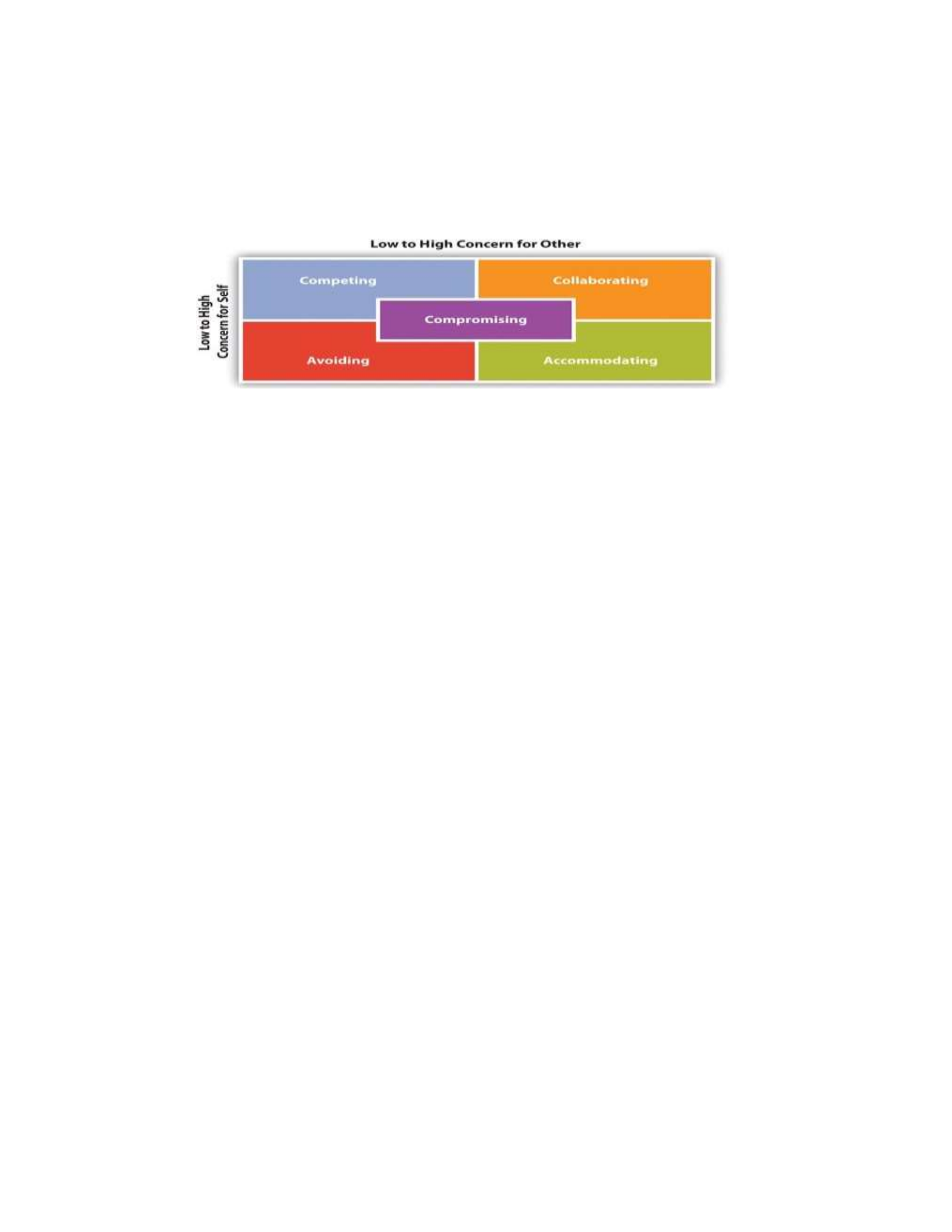
The five strategies for managing conflict we will discuss are competing, avoiding,
accommodating, compromising, and collaborating. Each of these conflict styles accounts for
the concern we place on self-versus other.
Five Styles of Interpersonal Conflict Management. Adapted from M. Afzalur Rahim, “A Measure of Styles of
Handling Interpersonal Conflict,” Academy of Management Journal 26, no. 2 (1983): 368–76.
In order to better understand the elements of the five styles of conflict management, we will
apply each to the follow scenario:
Rosa and D’Shaun have been partners for seventeen years. Rosa is growing frustrated
because D’Shaun continues to give money to their teenage daughter, Casey, even though
they decided to keep the teen on a fixed allowance to try to teach her more responsibility.
While conflicts regarding money and child rearing are very common, we will see the
numerous ways that Rosa and D’Shaun could address this problem.
Competing
The competing style indicates a high concern for self and a low concern for other. When we
compete, we are striving to “win” the conflict, potentially at the expense or “loss” of the other
person. One way we may gauge our win is by being granted or taking concessions from the
other person. For example, if D’Shaun gives Casey extra money behind Rosa’s back, he is
taking an indirect competitive route resulting in a “win” for him because he got his way. The
competing style also involves the use of power, which can be noncoercive or coercive (Sillars,
1980). Noncoercive strategies include requesting and persuading. When requesting, we
suggest the conflict partner change a behavior. Requesting doesn’t require a high level of
information exchange. When we persuade, however, we give our conflict partner reasons to
support our request or suggestion, meaning there is more information exchange, which may
make persuading more effective than requesting. Rosa could try to persuade D’Shaun to stop
giving Casey extra allowance money by bringing up their fixed budget or reminding him that
they are saving for a summer vacation. Coercive strategies violate standard guidelines for
ethical communication and may include aggressive communication directed at rousing your
partner’s emotions through insults, profanity, and yelling, or through threats of punishment if
you do not get your way. If Rosa is the primary income earner in the family, she could use that

power to threaten to take D’Shaun’s ATM card away if he continues giving Casey money. In all
these scenarios, the “win” that could result is only short term and can lead to conflict
escalation. Interpersonal conflict is rarely isolated, meaning there can be ripple effects that
connect the current conflict to previous and future conflicts. D’Shaun’s behind-the-scenes
money giving, or Rosa’s confiscation of the ATM card could lead to built-up negative emotions
that could further test their relationship.
Competing has been linked to aggression, although the two are not always paired. If
assertiveness does not work, there is a chance it could escalate to hostility. There is a pattern
of verbal escalation: requests, demands, complaints, angry statements, threats, harassment,
and verbal abuse (Johnson & Roloff, 2000). Aggressive communication can become patterned,
which can create a volatile and hostile environment. The reality television show The Bad Girls
Club is a prime example of a chronically hostile and aggressive environment. If you do a
Google video search for clips from the show, you will see yelling, screaming, verbal threats,
and some examples of physical violence. The producers of the show choose houseguests who
have histories of aggression, and when the “bad girls” are placed in a house together, they fall
into typical patterns, which creates dramatic television moments. Obviously, living in this type
of volatile environment would create stressors in any relationship, so it’s important to monitor
the use of competing as a conflict resolution strategy to ensure that it does not lapse into
aggression.
The competing style of conflict management is not the same thing as having a competitive
personality. Competition in relationships isn’t always negative, and people who enjoy engaging
in competition may not always do so at the expense of another person’s goals. In fact,
research has shown that some couples engage in competitive shared activities like sports or
games to maintain and enrich their relationship (Dindia & Baxter, 1987). And although we may
think that competitiveness is gendered, research has often shown that women are just as
competitive as men (Messman & Mikesell, 2000).
Avoiding
The avoiding style of conflict management often indicates a low concern for self and a low
concern for other, and no direct communication about the conflict takes place. However, as
we will discuss later, in some cultures that emphasize group harmony over individual interests,
and even in some situations in the United States, avoiding a conflict can indicate a high level of
concern for the other. In general, avoiding doesn’t mean that there is no communication
about the conflict. Remember, you cannot not communicate.
Even when we try to avoid conflict, we may intentionally or unintentionally give our feelings
away through our verbal and nonverbal communication. Rosa’s sarcastic tone as she tells
D’Shaun that he’s “Soooo good with money!” and his subsequent eye roll both bring the
conflict to the surface without specifically addressing it. The avoiding style is either passive or

indirect, meaning there is little information exchange, which may make this strategy less
effective than others. We may decide to avoid conflict for many different reasons, some of
which are better than others. If you view the conflict as having little importance to you, it may
be better to ignore it. If the person you’re having conflict with will only be working in your
office for a week, you may perceive a conflict to be temporary and choose to avoid it and hope
that it will solve itself. If you are not emotionally invested in the conflict, you may be able to
reframe your perspective and see the situation in a different way, therefore resolving the
issue. In all these cases, avoiding doesn’t really require an investment of time, emotion, or
communication skill, so there is not much at stake to lose.
Avoidance is not always an easy conflict management choice, because sometimes the person
we have conflict with isn’t a temp in our office or a weekend houseguest. While it may be easy
to tolerate a problem when you’re not personally invested in it or view it as temporary, when
faced with a situation like Rosa and D’Shaun’s, avoidance would just make the problem worse.
For example, avoidance could first manifest as changing the subject, then progress from
avoiding the issue to avoiding the person altogether, to even ending the relationship.
Indirect strategies of hinting and joking also fall under the avoiding style. While these indirect
avoidance strategies may lead to a buildup of frustration or even anger, they allow us to vent a
little of our built-up steam and may make a conflict situation more bearable. When we hint,
we drop clues that we hope our partner will find and piece together to see the problem and
hopefully change, thereby solving the problem without any direct communication. For the
most part, the person dropping the hints overestimates their partner’s detective abilities. For
example, when Rosa leaves the bank statement on the kitchen table in hopes that D’Shaun
will realize how much extra money he is giving Casey, D’Shaun may simply ignore it or even get
irritated with Rosa for not putting the statement with all the other mail. We also overestimate
our partner’s ability to decode the jokes we make about a conflict situation. It is more likely
that the receiver of the jokes will think you’re genuinely trying to be funny or feel provoked or
insulted than realize the conflict situation that you are referencing. So, more frustration may
develop when the hints and jokes are not decoded, which often leads to a more extreme form
of hinting/joking: passive-aggressive behavior.
Passive-aggressive behavior is a way of dealing with conflict in which one person indirectly
communicates their negative thoughts or feelings through nonverbal behaviors, such as not
completing a task. For example, Rosa may wait a few days to deposit money into the bank so
D’Shaun can’t withdraw it to give to Casey, or D’Shaun may cancel plans for a romantic dinner
because he feels like Rosa is questioning his responsibility with money. Although passive-
aggressive behavior can feel rewarding in the moment, it is one of the most unproductive
ways to deal with conflict. These behaviors may create additional conflicts and may lead to a
cycle of passive-

aggressiveness in which the other partner begins to exhibit these behaviors as well, while
never actually addressing the conflict that originated the behavior. In most avoidance
situations, both parties lose. However, as noted above, avoidance can be the most appropriate
strategy in some situations—for example, when the conflict is temporary, when the stakes are
low or there is little personal investment, or when there is the potential for violence or
retaliation.
Accommodating
The accommodating style indicates a low concern for self and a high concern for other and is
often viewed as passive or submissive, in that someone complies with or obliges another
without providing personal input. The context for and motivation behind accommodating play
an important role in whether or not it is an appropriate strategy. Accommodating can be
appropriate when there is little chance that our own goals can be achieved, when we don’t
have much to lose by accommodating, when we feel we are wrong, or when advocating for
our own needs could negatively affect the relationship (Isenhart & Spangle, 2000). The
occasional accommodation can be useful in maintaining a relationship—remember earlier we
discussed putting another’s needs before your own as a way to achieve relational goals. For
example, Rosa may say, “It’s OK that you gave Casey some extra money; she did have to spend
more on gas this week since the prices went up.” However, being a team player can slip into
being a pushover, which people generally do not appreciate. If Rosa keeps telling D’Shaun, “It’s
OK this time,” they may find themselves short on spending money at the end of the month. At
that point, Rosa and D’Shaun’s conflict may escalate as they question each other’s motives, or
the conflict may spread if they direct their frustration at Casey and blame it on her
irresponsibility.
Research has shown that the accommodating style is more likely to occur when there are time
restraints and less likely to occur when someone does not want to appear weak (Cai & Fink,
2002). If you’re standing outside the movie theatre and two movies are starting, you may say,
“Let’s just have it your way,” so you don’t miss the beginning. If you’re a new manager at an
electronics store and an employee wants to take Sunday off to watch a football game, you may
say no to set an example for the other employees. As with avoiding, there are certain cultural
influences we will discuss later that make accommodating a more effective strategy.
Compromising
The compromising style shows a moderate concern for self and other and may indicate that
there is a low investment in the conflict and/or the relationship. Even though we often hear
that the best way to handle a conflict is to compromise, the compromising style isn’t a
win/win solution; it is a partial win/lose. In essence, when we compromise, we give up some
or most of what we want. It’s true that the conflict gets resolved temporarily, but lingering
thoughts of what you gave up could lead to a future conflict. Compromising may be a good

strategy when there are time limitations or when prolonging a conflict may lead to
relationship deterioration. Compromise may also be good when both parties have equal
power or when other resolution strategies have not worked (Macintosh & Stevens, 2008).
A negative of compromising is that it may be used as an easy way out of a conflict. The
compromising style is most effective when both parties find the solution agreeable. Rosa and
D’Shaun could decide that Casey’s allowance does need to be increased and could each give
ten more dollars a week by committing to taking their lunch to work twice a week instead of
eating out. They are both giving up something, and if neither of them has a problem with
taking their lunch to work, then the compromise was equitable. If the couple agrees that the
twenty extra dollars a week should come out of D’Shaun’s golf budget, the compromise isn’t
as equitable, and D’Shaun, although he agreed to the compromise, may end up with feelings
of resentment. Wouldn’t it be better to both win?
Collaborating
The collaborating style involves a high degree of concern for self and other and usually
indicates investment in the conflict situation and the relationship. Although the collaborating
style takes the most work in terms of communication competence, it ultimately leads to a
win/win situation in which neither party has to make concessions because a mutually
beneficial solution is discovered or created. The obvious advantage is that both parties are
satisfied, which could lead to positive problem solving in the future and strengthen the overall
relationship. For example, Rosa and D’Shaun may agree that Casey’s allowance needs to be
increased and may decide to give her twenty more dollars a week in exchange for her
babysitting her little brother one night a week. In this case, they didn’t make the conflict
personal but focused on the situation and came up with a solution that may end up saving
them money. The disadvantage is that this style is often time consuming, and only one person
may be willing to use this approach while the other person is eager to compete to meet their
goals or willing to accommodate.
Here are some tips for collaborating and achieving a win/win outcome (Hargie, 2011):
• Do not view the conflict as a contest you are trying to win.
• Remain flexible and realize there are solutions yet to be discovered.
• Distinguish the people from the problem (don’t make it personal).
• Determine what the underlying needs are that are driving the other person’s demands
(needs can still be met through different demands).
• Identify areas of common ground or shared interests that you can work from to
develop solutions.
• Ask questions to allow them to clarify and to help you understand their perspective.

• Listen carefully and provide verbal and nonverbal feedback.
STLC Conflict Model
Cahn and Abigail (2014) created a very simple model when thinking about how we
communicate during conflict. They called the model the STLC Conflict Model because it stands
for stop, think, listen, and then communicate.
STLC Conflict Model. Interpersonal Communication – Jason S. Wrench; Narissra M. Punyanunt-Carter;
and Katherine S. Thweatt – CC BY-NC-SA 4.0.
Stop
The first thing an individual needs to do when interacting with another person during conflict
is to take the time to be present within the conflict itself. Too often, people engaged in a
conflict say whatever enters their mind before they’ve really had a chance to process the
message and think of the best strategies to use to send that message. Others end up talking
past one another during a conflict because they simply are not paying attention to each other
and the competing needs within the conflict.
Communication problems often occur during conflict because people tend to react to conflict
situations when they arise instead of being mindful and present during the conflict itself. For
this reason, it’s always important to take a breath during a conflict and first stop.
Sometimes these “time outs” need to be physical. Maybe you need to leave the room and go
for a brief walk to calm down, or maybe you just need to get a glass of water. Whatever you
need to do, it’s important to take this break. This break helps you to be proactive rather than
reactive (Cahn & Abigail, 2014).
Think
Once you’ve stopped, you now have the ability to really think about what you are
communicating. You want to think through the conflict itself. What is the conflict really about?
Often people engage in conflicts about superficial items when there are truly much deeper
issues that are being avoided. You also want to consider what possible causes led to the
conflict and what possible courses of action you think are possible to conclude the conflict.
Cahn and Abigail argue that there are four possible outcomes that can occur: do nothing,

change yourself, change the other person, or change the situation. First, you can simply sit
back and avoid the conflict. Maybe you’re engaging in a conflict about politics with a family
member, and this conflict is actually just going to make everyone mad. For this reason, you opt
just to stop the conflict and change topics to avoid making people upset.
Second, we can change ourselves. Often, we are at fault and start conflicts. We may not even
realize how our behavior caused the conflict until we take a step back and really analyze what
is happening. When it comes to being at fault, it’s very important to admit that you’ve done
wrong. Nothing is worse (and can stoke a conflict more) than when someone refuses to see
their part in the conflict.
Third, we can attempt to change the other person. Let’s face it, changing someone else is
easier said than done. Just ask your parents/guardians! All of our parents/guardians have
attempted to change our behaviors at one point or another, and changing people is very hard.
Even with the powers of punishment and reinforcement, a lot of the time change only lasts as
long as the punishment or the reinforcer is active.
Lastly, we can just change the situation. Having a conflict with your roommates? Move out.
Having a conflict with your boss? Find a new job. Having a conflict with a professor? Drop
the course. Admittedly, changing the situation is not necessarily the first choice people
should take when thinking about possibilities, but often it’s the best decision for long-term
happiness. In essence, some conflicts will not be settled between people. When these
conflicts arise, you can try and change yourself, hope the other person will change (they
probably won’t, though), or just get out of it altogether.
Listen
The third step in the STLC model is listen. Humans are not always the best listeners. Listening
is a skill. Unfortunately, during a conflict situation, this is a skill that is desperately needed and
often forgotten. When we feel defensive during a conflict, our listening becomes spotty at best
because we start to focus on ourselves and protecting ourselves instead of trying to be
empathic and seeing the conflict through the other person’s eyes.
One mistake some people make is to think they’re listening, but in reality, they’re listening for
flaws in the other person’s argument. We often use this type of selective listening as a way to
devalue the other person’s stance. In essence, we will hear one small flaw with what the other
person is saying and then use that flaw to demonstrate that obviously everything else must be
wrong as well.
The goal of listening must be to suspend your judgment and really attempt to be present
enough to accurately interpret the message being sent by the other person. When we listen in

this highly empathic way, we are often able to see things from the other person’s point-of-
view, which could help us come to a better-negotiated outcome in the long run.
Communicate
Lastly, but certainly not least, we communicate with the other person. Notice that Cahn and
Abigail (2014) put communication as the last part of the STLC model because it’s the hardest
one to do effectively during a conflict if the first three are not done correctly. When we
communicate during a conflict, we must be hyper-aware of our nonverbal behavior (eye
movement, gestures, posture, etc.). Nothing will kill a message faster than when it’s
accompanied by bad nonverbal behavior. For example, rolling one’s eyes while another person
is speaking is not an effective way to engage in conflict.
During a conflict, it’s important to be assertive and stand up for your ideas without becoming
verbally aggressive. Conversely, you have to be open to someone else’s use of assertiveness as
well without having to tolerate verbal aggression. We often end up using mediators to help
call people on the carpet when they communicate in a fashion that is verbally aggressive or
does not further the conflict itself.
Teamwork and Conflict in the Workplace
Group dynamics involve the interactions and processes of a team and influence the degree to
which members feel a part of the goal and mission. A team with a strong identity can prove to
be a powerful force. One that exerts too much control over individual members, however,
runs the risk or reducing creative interactions, resulting in tunnel vision. A team that exerts
too little control, neglecting all concern for process and areas of specific responsibility, may go
nowhere. Striking a balance between motivation and encouragement is key to maximizing
group productivity.
A skilled communicator creates a positive team by first selecting members based on their
areas of skill and expertise. Attention to each member’s style of communication also ensures
the team’s smooth operation. If their talents are essential, introverts who prefer working
alone may need additional encouragement to participate. Extroverts may need
encouragement to listen to others and not dominate the conversation. Both are necessary,
however, so the selecting for a diverse group of team members deserves serious
consideration.

Stages of Team Development
For teams to be effective, the people in the team must be able to work together to contribute
collectively to team outcomes. But this does not happen automatically: it develops as the
team works together. You have probably had an experience when you have been put on a
team to work on a school assignment or project. When your team first gets together, you likely
sit around and look at each other, not knowing how to begin. Initially you are not a team; you
are just individuals assigned to work together. Over time you get to know each other, to know
what to expect from each other, to know how to divide the labor and assign tasks, and to
know how you will coordinate your work.
Through this process, you begin to operate as a team instead of a collection of individuals.
This process of learning to work together effectively is known as team development.
Research has shown that teams go through definitive stages during development.
Tuckman (1965) identified a five-stage development process that most teams follow to
become high performing. He called the stages: forming, storming, norming, performing, and
adjourning.
Most high-performing teams go through five stages of team development. Tuckman’s Stages of Group Development
– pngegg.com – CC BY NC 4.0
Forming stage
The forming stage involves a period of orientation and getting acquainted.
Uncertainty is high during this stage, and people are looking for leadership and authority. A
member who asserts authority or is knowledgeable may be expected to take control. Team
members are asking such questions as “What does the team offer me?” “What is expected of
me?” “Will I fit in?” Most interactions are social as members get to know each other.
Forming a team at work often involves a period of getting to know each other
Coworkers in – 089photoshootings – CC BY 4.0

Storming stage
The storming stage is the most difficult and critical stage to pass through. It is a period marked
by conflict and competition as individual personalities emerge. Team performance may
actually decrease in this stage because energy is put into unproductive activities. Members
may disagree on team goals, and subgroups and cliques may form around strong personalities
or areas of agreement. To get through this stage, members must work to overcome obstacles,
to accept individual differences, and to work through conflicting ideas on team tasks and
goals. Teams can get bogged down in this stage. Failure to address conflicts may result in long-
term problems.
Norming stage
If teams get through the storming stage, conflict is resolved, and some degree of unity
emerges. In the norming stage, consensus develops around who the leader or leaders are, and
individual member’s roles. Interpersonal differences begin to be resolved, and a sense of
cohesion and unity emerges. Team performance increases during this stage as members learn
to cooperate and begin to focus on team goals. However, the harmony is precarious, and if
disagreements re-emerge the team can revert to storming.
A Norming group develops a degree of cooperation and smooth work flow. Group Working Together on a Project –
StockSnap – Pixabay License
Performing stage
In the performing stage, consensus and cooperation have been well-established and the team
is mature, organized, and well-functioning. There is a clear and stable structure, and members
are committed to the team’s mission. Problems and conflicts still emerge, but they are dealt
with constructively. The team is focused on problem solving and meeting team goals.

Adjourning stage
In the adjourning stage, most of the team’s goals have been accomplished. The emphasis is on
wrapping up final tasks and documenting the effort and results. As the work load is
diminished, individual members may be reassigned to other teams, and the team disbands.
There may be regret as the team ends, so a ceremonial acknowledgement of the work and
success of the team can be helpful. If the team is a standing committee with ongoing
responsibility, members may be replaced by new people and the team can go back to a
forming or storming stage and repeat the development process.
Positive and Negative Team Roles
When a manager selects a team for a particular project, its success depends on its members
filling various positive roles. There are a few standard roles that must be represented to
achieve the team’s goals, but diversity is also key. Without an initiatorcoordinator stepping
up into a leadership position, for instance, the team will be a nonstarter because team
members such as the elaborator will just wait for more direction from the manager, who is
busy with other things. If all the team members commit to filling a leadership role, however,
the group will stall from the get-go with power struggles until the most dominant personality
vanquishes the others, who will be bitterly unproductive relegated to a subordinate worker-
bee role. A good manager must therefore be a good psychologist in building a team with
diverse personality types and talents. Below captures some of these roles.
Positive Roles in Teams
Role
Actions
Initiator-Coordinator
Suggests new ideas or new ways of looking at the problem
Elaborator
Builds on ideas and provides examples
Coordinator
Brings ideas, information, and suggestions together
Evaluator-Critic
Evaluates ideas and provides constructive criticism
Recorder
Records ideas, examples, suggestions, and critiques

Comic Relief
Uses humor to keep the team happy
Of course, each team member here contributes work irrespective of their typical roles.
The groupmate who always wanted to be recorder in high school because they thought that all
they had to do what jot down some notes about what other people said and did, and
otherwise contributed nothing, would be a liability as a slacker in a workplace team. We must
therefore contrast the above roles with negative roles, some of which are captured.
Negative Roles in Teams
Dominator
Dominates discussion so others can’t take their turn
Recognition Seeker
Seeks attention by relating discussion to their actions
Special-Interest Pleader
Relates discussion to special interests or personal agenda
Blocker
Blocks attempts at consensus consistently
Slacker
Does little-to-no work, forcing others to pick up the slack
Joker or Clown
Seeks attention through humor and distracting members
Whether a team member has a positive or negative effect often depends on context. Just as
the class clown can provide some much-needed comic relief when the timing’s right, they can
also impede productivity when they merely distract members during work periods. An
initiator-coordinator gets things started and provides direction, but a dominator will put down
others’ ideas, belittle their contributions, and ultimately force people to contribute little and
withdraw partially or altogether.
Perhaps the worst of all roles is the slacker. If you consider a game of tug-o-war between two
teams of even strength, success depends on everyone on the team pulling as hard as they
would if they were in a one-on-one match. The tendency of many, however, is to slack off a
little, thinking that their contribution won’t be noticed and that everyone else on the team will

make up for their lack of effort. The team’s work output will be much less than the sum of its
parts, however, if everyone else thinks this, too. Preventing slacker tendencies requires clearly
articulating in writing the expectations for everyone’s individual contributions. With such a
contract to measure individual performance, each member can be held accountable for their
work and take pride in their contribution to solving all the problems that the team overcame
on its road to success.
Cultivating a Supportive Group Climate
Any time a group of people comes together, new dynamics are put into place that differ from
the dynamics present in our typical dyadic interactions. The impressions we form about other
people’s likeability and the way we think about a group’s purpose are affected by the climate
within a group that is created by all members.
When something is cohesive it sticks together, and the cohesion within a group helps establish
an overall group climate. Group climate refers to the relatively enduring tone and quality of
group interaction that is experienced similarly by group members. To better understand
cohesion and climate, we can examine two types of cohesion: task and social.
Task cohesion refers to the commitment of group members to the purpose and activities of
the group. Social cohesion refers to the attraction and liking among group members. Ideally,
groups would have an appropriate balance between these two types of cohesion relative to
the group’s purpose, with task-oriented groups having higher task cohesion and relational-
oriented groups having higher social cohesion. Even the most task-focused groups need some
degree of social cohesion, and vice versa, but the balance will be determined by the purpose
of the group and the individual members. For example, a team of workers from the local car
dealership may join a local summer softball league because they’re good friends and love the
game. They may end up beating the team of faculty members from the community college
who joined the league just to get to know each other better and have an excuse to get
together and drink beer in the afternoon. In this example, the players from the car dealership
exhibit high social and task cohesion, while the faculty exhibit high social but low task
cohesion. Cohesion benefits a group in many ways and can be assessed through specific group
behaviors and characteristics. Groups with an appropriate level of cohesiveness (Hargie,
2011):
• set goals easily;
• exhibit a high commitment to achieving the purpose of the group;
• are more productive;
• experience fewer attendance issues;
• have group members who are willing to stick with the group during times of difficulty;

• have satisfied group members who identify with, promote, and defend the group;
• have members who are willing to listen to each other and offer support and
constructive criticism; and
• experience less anger and tension.
Appropriate levels of group cohesion usually create a positive group climate, since group
climate is affected by members’ satisfaction with the group. Climate has also been described
as group morale. The following are some qualities that contribute to a positive group climate
and morale (Marston & Hecht, 1988):
• Participation. Group members feel better when they feel included in the discussion
and a part of the functioning of the group.
• Messages. Confirming messages help build relational dimensions within a group, and
clear, organized, and relevant messages help build task dimensions within a group.
• Feedback. Positive, constructive, and relevant feedback contribute to the group
climate.
• Equity. Aside from individual participation, group members also like to feel as if
participation is managed equally within the group and that appropriate turn-taking is
used.
• Clear and accepted roles. Group members like to know how status and hierarchy
operate within a group. Knowing the roles isn’t enough to lead to satisfaction,
though—members must also be comfortable with and accept those roles.
• Motivation. Member motivation is activated by perceived connection to and relevance
of the group’s goals or purpose.
Group cohesion and climate are also demonstrated through symbolic convergence (Bormann,
1985). Have you ever been in a group that had ‘inside jokes’ that someone outside the group
just would not understand? Symbolic convergence refers to the sense of community or group
consciousness that develops in a group through non-task-related communication such as
stories and jokes. The originator of symbolic convergence theory, Ernest Bormann, claims that
the sharing of group fantasies creates symbolic convergence. Fantasy, in this sense, doesn’t
refer to fairy tales, sexual desire, or untrue things. In group communication, group fantasies
are verbalized references to events outside the “here and now” of the group, including
references to the group’s past, predictions for the future, or other communication about
people or events outside the group (Griffin, 2009).
In any group, you can tell when symbolic convergence is occurring by observing how people
share such fantasies and how group members react to them. If group members react

positively and agree with or appreciate the teller’s effort or other group members are
triggered to tell their own related stories, then convergence is happening and cohesion and
climate are being established. Over time, these fantasies build a shared vision of the group
and what it means to be a member that creates a shared group consciousness. By reviewing
and applying the concepts in this section, you can hopefully identify potential difficulties with
group cohesion and work to enhance cohesion when needed to create more positive group
climates and enhance your future group interactions.
The Benefits of Team Diversity
Rock and Grant (2016) assert that increasing workplace diversity is a good business decision.
Hunt, Layton, and Prince (2015) conducted a study of 366 public companies and found that
those in the top quartile for ethnic and racial diversity in management were 35% more likely
to have financial returns above their industry mean, and those in the top quartile for gender
diversity were 15% more likely to have returns above the industry mean. Similarly, Curtis,
Schmid, and Struber (2012) found that organizations with at least one female board member
yielded a higher return on equity and higher net income growth than those that did not have
any women on the board.
Teams made up of diverse members tend to perform better than teams of similar backgrounds. wocintech
(Microsoft) – 134 – Women of Color in Tech Chat – CC BY 2.0.
Additional research on diversity has shown that diverse teams are better at decisionmaking
and problem-solving because they tend to focus more on facts (Rock & Grant, 2016). Phillips,
Liljenquist, and Neale (2008) found that when working together, people from diverse
backgrounds can potentially alter the group’s behaviors, leading to more accurate and
improved thinking. In their study, the diverse panels raised more facts related to the case than
homogeneous panels and made fewer factual errors while discussing available evidence.
Additionally, Levine, Apfelbaum, and Bernard (2014) showed that diverse teams are more
likely to constantly reexamine facts and remain objective. They may also encourage greater
scrutiny of each member’s actions, keeping their joint cognitive resources sharp and vigilant.

By breaking up workforce homogeneity, you can allow your employees to become more aware
of their own potential biases—entrenched ways of thinking that can otherwise blind them to
key information and even lead them to make errors in decision-making processes. In other
words, when people are among homogeneous and like-minded (nondiverse) teammates, the
team is susceptible to groupthink and may be reticent to think about opposing viewpoints
since all team members are in alignment. In a more diverse team with a variety of
backgrounds and experiences, the opposing viewpoints are more likely to come out and the
team members feel obligated to research and address the questions that have been raised.
Again, this enables a richer discussion and a more indepth fact-finding and exploration of
opposing ideas and viewpoints to solve problems.
Diversity in teams also leads to greater innovation. Lorenzo, Yoigt, Schetelig, Zawadzki, Welpe,
& Brosi (2017) sought to understand the relationship between diversity in managers (all
management levels) and innovation. The key findings of this study show that:
• The positive relationship between management diversity and innovation is statistically
significant—and thus companies with higher levels of diversity derive more revenue
from new products and services.
• The innovation boost isn’t limited to a single type of diversity. The presence of
managers who are either female or are from other countries, industries, or companies
can cause an increase in innovation.
• Management diversity seems to have a particularly positive effect on innovation at
complex companies—those that have multiple product lines or that operate in
multiple industry segments.
• To reach its potential, gender diversity needs to go beyond tokenism. In the study,
innovation performance only increased significantly when the workforce included
more than 20% women in management positions. Having a high percentage of female
employees doesn’t increase innovation if only a small number of women are
managers.
• At companies with diverse management teams, openness to contributions from lower-
level workers and an environment in which employees feel free to speak their minds
are crucial for fostering innovation.
When you consider the impact that diverse teams have on decision-making and problem-
solving—through the discussion and incorporation of new perspectives, ideas, and data—it is
no wonder that the BCG study shows greater innovation. Team leaders need to reflect upon
these findings during the early stages of team selection so that they can reap the benefits of
having diverse voices and backgrounds.

Challenges and Best Practices of Working in Multicultural Teams
As globalization has increased over the last decades, workplaces have felt the impact of
working within multicultural teams. The earlier section on team diversity outlined some of the
benefits of working on diverse teams, and a multicultural group certainly qualifies as diverse.
However, some key practices are recommended to those who are leading multicultural teams
to navigate the challenges that these teams may experience.
People may assume that communication is the key factor that can derail multicultural teams,
as participants may have different languages and communication styles. However, Brett,
Behfar, and Kern (2006) outline four key cultural differences that can cause destructive
conflicts in teams. The first difference is direct versus indirect communication, also known as
high-context vs low-context orientation. Some cultures are very direct and explicit in their
communication, while others are more indirect and ask questions rather than pointing out
problems. This difference can cause conflict because, at the extreme, the direct style may be
considered offensive by some, while the indirect style may be perceived as unproductive and
passive-aggressive in team interactions.
The second difference that multicultural teams may face is trouble with accents and fluency.
When team members don’t speak the same language, there may be one language that
dominates the group interaction—and those who don’t speak it may feel left out. The
speakers of the primary language may feel that those members don’t contribute as much or
are less competent. The next challenge is when there are differing attitudes toward hierarchy.
Some cultures are very respectful of the hierarchy and will treat team members based on that
hierarchy. Other cultures are more egalitarian and don’t observe hierarchical differences to
the same degree. This may lead to clashes if some people feel that they are being
disrespected and not treated according to their status. The final difference that may challenge
multicultural teams is conflicting decisionmaking norms. Different cultures make decisions
differently, and some will apply a great deal of analysis and preparation beforehand. Those
cultures that make decisions more quickly (and need just enough information to make a
decision) may be frustrated with the slow response and relatively longer thought process.
These cultural differences are good examples of how everyday team activities
(decisionmaking, communication, interaction among team members) may become points of
contention for a multicultural team if there isn’t an adequate understanding of everyone’s
culture. The authors propose that there are several potential interventions to try if these
conflicts arise. One simple intervention is adaptation, which is working with or around
differences. This is best used when team members are willing to acknowledge the cultural
differences and learn how to work with them. The next intervention technique is structural
intervention, or reorganizing to reduce friction on the team. This technique is best used if
there are unproductive subgroups or cliques within the team that need to be moved around.

Managerial intervention is the technique of making decisions by management and without
team involvement. This technique should be used sparingly, as it essentially shows that the
team needs guidance and can’t move forward without management getting involved. Finally,
exit is an intervention of last resort and is the voluntary or involuntary removal of a team
member. If the differences and challenges have proven to be so great that an individual on the
team can no longer work with the team productively, then it may be necessary to remove the
team member in question.
Conflict Within Teams
Conflict occurs wherever people interact, both at home and at work. If employees don’t get
along with one another or their employers, there’s very little motivation to do good work.
Learning how to identify and navigate conflict is an important life skill that will prove to be
extremely helpful, especially in the workplace. Professionally managing conflict will help to
foster healthy working environments and create strong working relationships amongst
coworkers and managers alike.
Any time individuals interact, there is potential for conflict. Conflict occurs when differing
interests and ideas collide, creating tension. Conflict is a natural part of everyday life,
especially in the workplace. With compensation, deadlines, clients, etc. on the line, it is
normal for the workplace to add additional stress and pressure to the challenges of everyday
life. Therefore, it is more likely people will encounter conflict at work.
Common Types of Team Conflict
Conflict is a common occurrence on teams. Conflict itself can be defined as antagonistic
interactions in which one party tries to block the actions or decisions of another party.
Bringing conflicts out into the open where they can be resolved is an important part of the
team leader’s or manager’s job.
There are two basic types of team conflict: substantive (sometimes called task) and emotional
(or relationship).
• Substantive conflicts arise over things such as goals, tasks, and the allocation of
resources. When deciding how to track a project, for example, a software engineer
may want to use a certain software program for its user interface and customization
capabilities. The project manager may want to use a different program because it
produces more detailed reports. Conflict will arise if neither party is willing to give way
or compromise on his position.
• Emotional conflicts arise from things such as jealousy, insecurity, annoyance, envy, or
personality conflicts. It is emotional conflict when two people always seem to find
themselves holding opposing viewpoints and have a hard time hiding their personal

animosity. Different working styles are also a common cause of emotional conflicts.
Julia needs peace and quiet to concentrate, but her office mate swears
that playing music stimulates his creativity. Both end up being frustrated if they can’t
reach a workable resolution.
Common Causes of Conflict
Some common causes of negative conflict in teams are identified as follows:
• Conflict often arises when team members focus on personal (emotional) issues rather
than work (substantive) issues. Enrico is attending night school to get his degree, but
he comes to work late and spends time doing research instead of focusing on the job.
The other team members have to pick up his slack. They can confront Enrico and
demand his full participation, they can ignore him while tensions continue to grow, or
they can complain to the manager. All the options will lower team performance.
• Competition over resources, such as information, money, supplies or access to
technology, can also cause conflict. Maria is supposed to have use of the laboratory in
the afternoons, but Jason regularly overstays his allotted time, and Maria’s work
suffers. Maria might try to “get even” by denying Jason something he needs, such as
information, or by complaining to other team members.
• Communication breakdowns cause conflict—and misunderstandings are exacerbated
in virtual teams and teams with cross-cultural members. The project manager should
be precise in his expectations from all team members and be easily accessible. When
members work independently, it is critical that they understand how their
contributions affect the big picture in order to stay motivated. Carl couldn’t understand
why Latisha was angry with him when he was late with his reports—he didn’t report to
her. He didn’t realize that she needed his data to complete her assignments. She
eventually quit, and the team lost a good worker.
• Team morale can be low because of external work conditions such as rumors of
downsizing or fears that the competition is beating them to market. A manager needs
to understand what external conditions are influencing team performance.

