


Data and Measurement Overview
The variables discussed above will be used to test hypothesis that explain the varied
constitutional rights of Latin America’s indigenous peoples. Multiple models are run to account
for all relevant inputs and control variables. The DV of this work is indigenous constitutional
rights outcomes that fall into four categories: recognition, representation, resources, and
autonomy. IV’s of theoretical importance measured above include democracy, indigenous
mobilization, indigenous political representation, resource rent dependence, and state capacity.
These factors are expected to impact the likelihood of the adoption of indigenous constitutional
protection. But the impact that domestic variables have on adoption varies, dependent on the
current stage of the adoption process. A summary chart of the rights adoption process is presented
in this chapter before the discussion of statistical results. The next section moves to discuss
quantitative models and then the results and implications of their output.
Statistical Models
The variables discussed in the previous section will be tested through quantitative
modelling in this section of the chapter. I use survival modelling wherever possible to best
represent the evolution of indigenous rights in state constitutions over time. Cox Proportional
Hazards models are used to test the effects of input variables on the “hazard rate”. The
underlying assumption of this model is that timing matters and changing values of the
independent variables will either serve to increase or decrease the risk of an event (Bueno
de Mesquita 1995; Hutchison 1988).

In this work, independent variables impact the hazard of indigenous rights adoption in
the nation’s constitution. Adoption models are divided according to rights type and run
separately. Domestic inputs are assessed in terms of their impact on the likelihood of
constitutional adoption of indigenous recognition, representation, resources, and resource rights
across these models. Since the adoption of autonomy rights are rare, different models are used
and discussed in sections below.
The resulting output of the survival models are hazard functions. The hazard function shows
a variable's predicted impact on an event. A hazard ratio of 1 represents that the factor has no effect
on the likelihood of an adoption event. A hazard ratio less than 1 means that a factor caused a
reduction in the likelihood of an adoption event. Ratios greater than one show a positive impact on
the likelihood of an adoption event.
For the adoption of indigenous autonomy rights, I use firth logistic regression models.
These types of models are created to measure the impacts of variables on rare events. Firth logistic
modelling is ideal for outcomes with limited sample sizes. The model employs a penalty on the
standard maximum likelihood function and creates less biased results for small sample sizes (Firth
1993). Autonomous indigenous rights only occur in three country cases and constitute a rarely
observed outcome in the region. Outcomes for these rights are binary in the logit model. A value
of 1 represents the adoption of autonomy rights in the national constitution, and non-adoptions are
recorded as 0’s.
Output from the logit models provide insight into which domestic factors significantly
impact the adoption of autonomy rights. Though not as temporally accurate as the survival
models used for the other three categories of indigenous constitutional rights, future chapters of

this work will continue to address these shortcomings and continue to test factors that impact this
type of indigenous rights adoption. This chapter now moves to present the results of these models
along with a discussion of these outcomes.
Explaining Variance in Constitutional Outcomes for Indigenous Peoples in Latin America:
Quantitative Results
The following models present the results of the survival and firth logit statistical tests.
Tables 10, 11, and 12 summarize the statistical results for the adoptions of indigenous
recognition, representation, and resource rights in national constitutions. This is followed by
table 13, which shows the output for penalized firth logistic models that test for impacts on the
adoption of indigenous autonomy rights. Table 14 summarizes the findings across all models.
Following these summaries, I summarize and discuss the meaning of these results, before
offering this chapter’s conclusions.

Table :
125
10 Determinants of Indigenous Recognition Adoption 1960-2016
Independent
Variable
Model 1
Model 2
Model 3
Model 4
Democracy
Hazard
Coefficient
.08
-1.39(.15)
------------
-
.00
-2.95(3.40)*
.00
-2.51(2.35)**
Indigenous
Movement
Hazard
Coefficient
.90
-.32.(.28)
.77
-.77(.26)
1.02
.04(.39)
4.01
1.49(3.75)
Indigenous Political
Rep.
Hazard
Coefficient
1.57
1.11(.64)
2.73
2.29(1.20)*
.83
-.35(.43)
.53
-.96(.35)
Resource Rents
Hazard
Coefficient
.56
-2.19(.15)
.60
-1.50(.20)
State Capacity
Hazard
Coefficient
.30
-2.03(.18)*
.14
-2.86(.09)***
.09
-2.70(.08)*
.02
-2.28(.03)*
Judicial Strength
Hazard
Coefficient
2.41
.51(4.18)
Neighborhood Effect
Hazard
Coefficient
.03
-2.70(.03)
.01
-1.99(.01)*
Indigenous Population
Hazard
Coefficient
1.00
.23(.02)
.85
-1.44(.09)
N
368
368
252
252
DV = Recognition Rights Adoption in Constitutional Law. Exit Value = 1 Analysis conducted via Cox Proportional Hazard
modelling. Summaries include Hazard Ratios and Coefficients. Standard errors in parentheses. *** p<.000 **p<.01 *p<.05

Table :
126
11 Determinants of Indigenous Representation Adoption 1960-2016
Independent
Variable
Model 1
Model 2
Model 3
Model 4
Democracy
Hazard
Coefficient
.01
-2.22(.01)*
.01
-2.15(.02)*
.01
-1.94(.02)*
Indigenous
Movement
Hazard
Coefficient
1.16
.72(.24)
1.47
1.59(.36)
1.21
.85(.28)
1.25
.93(.30)
Indigenous Political Rep.
Hazard
Coefficient
3.78
4.30(.24)***
5.69
4.01(2.47)***
2.76
2.79(1.01)**
5.75
3.31(3.03)**
Resource Rents
Hazard
Coefficient
1.06
.79(.08)
1.09
1.04(.09)
State Capacity
Hazard
Coefficient
1.06
.05(1.10)
1.99
.64(2.16)
.40
-.84(.43)
1.81
.64(2.30)
Judicial Strength
Hazard
Coefficient
.01
-2.55(.00)**
Neighborhood Effect
Hazard
Coefficient
.01
-2.84(.00)**
.01
-2.59(.02)**
Indigenous Population
Hazard
Coefficient
1.04
2.05(.02)*
1.04
1.77(.02)
N
669
669
501
501

Table :
127
DV = Representation Rights Adoption in Constitutional Law. Exit Value = 1 Analysis conducted via Cox Proportional Hazard
modelling. Summaries include Hazard Ratios and Coefficients. Standard errors in parentheses. *** p<.000 **p<.01 *p<.05
12 Determinants of Indigenous Resource Adoption 1960-2016
Independent
Variable
Model 1
Model 2
Model 3
Model 4
Democracy
Hazard
Coefficient
.01
-1.20(.50)*
.01
-1.36(.48)**
.01
-2.72(.00)**
Indigenous
Movement
Hazard
Coefficient
1.05
.23(.25)
1.29
1.03(.32)
.92
-.34(.22)
1.74
1.54(.63)
Indigenous Political Rep.
Hazard
Coefficient
1.52
2.51(.26)**
1.30
1.57(.22)
1.53
2.71(.24)**
1.46
2.13(.26)*
Resource Rents
Hazard
Coefficient
1.11
1.84(.07)
1.11
1.71(.07)
State Capacity
Hazard
Coefficient
1.03
.04(.88)
1.31
.29(1.24)
.59
-.66(.47)
.59
-.55(.57)
Judicial Strength
Hazard
Coefficient
.02
-1.88(.04)
Neighborhood Effect
Hazard
Coefficient
.01
-3.54(.00)***
.00
-3.46(.00)**

Table :
128
Indigenous Population
Hazard
Coefficient
1.01
.26(.02)
.97
-1.31(.02)
N
665
665
495
495
DV = Resource Rights Adoption in Constitutional Law. Exit Value=1. Analysis conducted via Cox Proportional Hazard
modelling. Summaries include Hazard Ratios and Coefficients.
Standard errors in parentheses. *** p<.000 **p<.01 *p<.05

129
Table 13. Determinants of Indigenous Autonomy Adoption 1960-2016
Independent
Variable
Model 1
Model 2
Model 3
Model 4
Democracy
3.17(2.10)
1.80(2.22)
2.70(2.83)
Indigenous
Movement
.82(.27)**
1.15(.28)***
1.18(.32)***
1.70(.43)***
Indigenous
Political Rep.
1.82(.24)***
1.99(.24)***
2.29(.30)***
2.32(.35)***
Resource Rents
-.15(.05)**
-.17(.06)**
State Capacity
.26(.87)
.70(.88)
.88(.99)
.81(1.02)
Judicial Strength
2.91(1.10)***
Neighborhood
Effect
-.60(1.44)
-.19(1.50)
Indigenous
Population
.01(.05)*
.
-.27(.08)**
.
N
933
933
776
776
DV = Autonomy Rights Adoption. Analysis conducted via Firth Logit for Rare Events. Standard errors in parentheses. *** p<.000
**p<.01 *p<.05

130
Table 14: Summary Table of Indigenous Rights Adoption in Latin American Constitutions
Rights Adoption
Type
IV’s
Indigenous
Recognition
Indigenous
Representation
Indigenous
Resources
Indigenous
Autonomy
Democracy
Negative
Negative
Negative
Indigenous
Movement
Positive
Indigenous Political
Rep.
Positive
Positive
Positive
Positive
Resource Rents
Negative
State Capacity
Judicial Strength
Negative
Positive
Neighborhood
Effect
Negative
Negative
Indigenous Positive Mixed
Population
Discussion
Impacts of Democracy on Indigenous Rights Adoption
Table 14 summarizes the results from all quantitative models. Results are discussed by
domestic factors that influence the adoption of indigenous constitutional rights. Democracy
negatively impacts the likelihood of adoption of constitutional rights in the recognition category.
Simply, regimes with very low democracy scores are more likely to adopt indigenous recognition

131
rights into constitutional law. Many indigenous recognition rights in Latin American
constitutions are adopted early in the observation period when democracy scores in the region
are low. This signals that democracy may be a pre-condition for any indigenous recognition in
national constitutional law.
Also contrary to expectations, democracy negatively predicts the adoption of recognition
rights in the constitution. Regional patterns do not support the theoretical proposition that
democratization facilitates the adoption of rights that both recognize populations as legitimate
political actors and establish terms of equal political access. This challenges contemporary wisdom
of rights expansion that associate democracy with expanded political inclusion to minority
populations. Democracy is also negatively associated with expansion of resource rights (p<.05
and p<.01). This result shows that increased democracy negatively impacts the adoption of
indigenous rights that correct political and societal imbalances based on indigenous status.
Per expectations, increased democracy scores are unrelated to indigenous autonomy in
national constitutions. This supports the hypothesis that democracy does not positively impact
rights that create divisive national identities and legitimate indigenous self-government.
Indigenous Mobilization
Indigenous mobilization was proposed to predict rights adoption across all categories after
recognition, but especially after indigenous recognition is adopted in the constitution, legitimizing
their political participation. But indigenous mobilization strength falls short of statistical
significance across models that predict the adoption of recognition, representation, and resource
rights. This result is surprising and contrary to expectations.

132
Indigenous mobilization is associated with the adoption of autonomy rights, however.
Firth logit models show that mobilization strength significantly predicts the adoption of
indigenous autonomy rights in the constitution (p<.05 and p <.01). These results provide
evidence that significant mobilization pressure will bring state entities to the table to negotiate
rights that are considered more nationally divisive.
In sum, indigenous mobilization significantly predicts rights adoption in constitutional law.
But its importance and positive impacts are felt later on during the rights adoption process at a
regional level.
Indigenous Government Representation
Indigenous government representation is a positive influence on the likelihood of all
indigenous rights adoption. First, indigenous representation in national government positively
predicts the adoption of recognition rights in the constitution. States with increased indigenous
representation are 4.01 to 7.07 times more likely to adopt indigenous recognition rights.
Similarly, indigenous representation rights adoption is positively impacted by indigenous
representation in government. Increased representation make governments anywhere from 2.76
to 5.75 times more likely to adopt representation rights for original populations.
Increased representation is also related to the creation of resource provisions for original
populations. A unit increase of indigenous political representation increases the likelihood of
resource rights adoption by 1.46 to 1.53 times. These results show the continued importance of
indigenous representation in government in order to facilitate the creation of protectional
provisions for these populations.

133
Last, indigenous political representatives also motivate the adoption of indigenous
autonomy adoption. High levels of indigenous representation in government are associated with
the adoption of autonomy rights in the constitution at p<.000. Indigenous representation in the
national state apparatus makes it more likely that these policies are discussed and eventually
implemented.
Resource Rents
A state’s dependence on resource rents as a percentage of its national GDP is, at first,
unrelated to the adoption of indigenous rights provisions. Resource rent dependence is unrelated
to the creation of indigenous recognition, representation, and resource rights in the state
constitution.
As expected, resource rents are negatively related to the adoption of indigenous autonomy rights
in constitutional law (p<.01). This is evidence that states who rely on valuable resources on
indigenous lands are less likely to cede territorial control to the populations that traditionally
call them home.
State Capacity
State capacity was found to be statistically unrelated to the adoption of any indigenous provisions
across models. This is against theoretical expectations, which predicted that strong violent capacity
and extractive ability at the state level would negatively impact the likelihood of more divisive
indigenous provisions, such as resource and autonomy rights. However, regional patterns do not
support this proposition.

134
Controls
The first control variable, the strength of the judicial branch is unrelated to the adoption
of indigenous recognition in the constitution. Like democracy scores, the strength of the judiciary
is negatively predictive of recognition rights in the constitution. Decreased judicial independence
makes a state almost twice as likely to adopt indigenous representation rights. This is a peculiar
result. But as expected, a strong judicial branch is related to the creation of indigenous
autonomy rights. This supports the perspective that a strong judiciary must be present in order to
implement collective rights, plurinational courts, and territorial rights for indigenous
communities. More work should be done to fully examine this relationship, and the negative
relationship between strong judicial branches and adoption of indigenous representation rights.
Importantly, neighborhood effects did not have the predicted result as informed by recent
literature. Simply, as regional neighbors increasingly adopt indigenous provisions, a state is less
likely to adopt similar representation and resource provisions. This goes against expectations,
which posit that the more neighbors adopt indigenous rights into national constitutional law, the
more likely one is to follow suit. But results for representation and resource rights show a negative
relationship, while for other rights adoption, neighborhood effects are insignificant.
These results challenge our current knowledge on norm diffusion of human rights laws.
As another control, higher shares of native populations were predicted to positively impact
rights adoption. But the results are mixed. Large indigenous populations are unrelated to the
adoption of initial constitutional recognition. For the adoption of representation rights, on the other
hand, large populations are associated with an increased likelihood of rights creation and
implementation. Increased population proportions lead to a 4% increase in the likelihood of
representation rights adoption for rights in this category. This result aligns with expectations, since

135
state entities will negotiate access to representation for larger populations to prevent political
instability. Indigenous population proportions are unrelated to regional patterns of resource rights
in constitutional law. Last, in some models that predict autonomy rights adoption population size
positively impacts the process, and in others this result is negative. Future work should investigate
this result more thoroughly.
Summary
In sum, the substantive content of indigenous constitutional provisions impacts the
likelihood of adoption. The basest level right afforded to indigenous populations in Latin America
is recognition in constitutional law. Beyond recognition, there is indigenous representation that
establishes rights that create terms of equal citizenship in constitutional law. Resource rights come
afterward and are the first to correct inequalities historically rooted in indigenous status. Finally,
resource rights draw new national borders, and establish plurinational institutions. The results
presented above shows that democracy is not positively related to any rights adoption for
indigenous populations in Latin America. At most, recognition may occur early in the adoption
process, leading to a negative score for democracy in this category of adoption. Democracy was
also found to be negatively related to the adoption of rights that correct indigenous social and
economic inequalities. Next, indigenous mobilization encourages the adoption of the most divisive
rights – indigenous autonomy. But the importance of mobilization regionally comes later in the
rights adoption process than theorized. Indigenous government representation is positively related
to the creation of all indigenous provisions examined in this research. This provides clear evidence
that indigenous representatives are key in the creation of protectional laws for these populations.
Resource rent dependence negatively predicts the adoption of autonomy rights over resource rich
lands. This is an important insight into the motives of national government when creating

136
constitutional provisions. Governments are not likely to create indigenous autonomies where they
are heavily reliant on resource revenues. Next, state capacity is found to be unrelated to the
creation of all indigenous provisions in state constitutions. Finally, control variables like judicial
strength and population proportions produced interesting results and deserve future attention.
Conclusion
The evidence presented by statistical models first show that democracy does not have the
expected impact on indigenous constitutional rights adoption. Democracy is negatively related to
the adoption of indigenous recognition in constitutional law, against conventional perspectives of
increased representation under democratic transition. Democracy scores are also unrelated to
indigenous recognition rights, which are theorized to be compatible with ideals of equal
democratic citizenship. This is evidence against conventional wisdom, which argues that
democracy is associated with rights that define terms of equal political access to marginalized
populations. Last, democracy is negatively related to the adoption of indigenous resource rights
that mobilize state political goods to address economic and societal imbalances. This is consistent
with expectations, as democracy is not associated with rights that correct class and societal
imbalances. But the overlapping ideals of democracy support private rights, which likely work
against the adoption of indigenous provisions that protect original land and resources. Future work
in this field should continue to examine this relationship.
Importantly, I find that the presence of indigenous mobilization efforts predicts the
adoption of autonomy rights across the region during the observation period. These indigenous
provisions are a focus of these movements, and regional patterns show that mobilization efforts
are important for future rights adoption after initial recognition, as predicted in the theoretical
section of this work. However, the measurement of indigenous mobilization strength is

137
imperfect, and warrants more detailed analysis of the current variation of indigenous
mobilization that will be carried out in case study chapters later in this dissertation. Impacts of
mobilization strength are also seen later on in the adoption process than theorized. Looking
forward, future work should pursue to accurately capture indigenous mobilization strength more
accurately across the region and examine these relationships.
Indigenous representation in national government is important for the creation of all
indigenous provisions in state constitutions in Latin America. This result shows the importance
of required government representation for marginalized, minority populations. Increases in
indigenous representation positively predict the adoption of rights across all categories. These
results show the importance of the inclusion of these communities in the central government,
which is clearly related to the implementation of numerous minority rights.
Next, the state’s reliance on resource rents is negatively related to the creation of
indigenous autonomy provisions in constitutional law. This supports the theoretical prospect that
the more invested the state is in lucrative resource in indigenous territories, the less likely the
adoption of rights that protect lands from state and private encroachment. Last, state capacity is
found to be unrelated to all indigenous rights creation over the observation period.
Chapter 4 goes a step further in testing the assumptions of this work’s theories and
hypotheses. Specifically, chapter four provides quantitative support for the temporal components
of this work’s theory. Survival and logit models are used to test the sequential order of
indigenous rights adoption in Latin American constitutional law. Then, I move to test theories
and quantitative results in country case level studies.

138
Chapter IV: The Evolution of Indigenous Constitutional Rights in Latin
America: Incremental Access
“We feel we’re hated by those who govern Peru. That hatred was
always there, but now people are getting organized to demand
respect for our fundamental rights to life, to equality, and to our
identity.” -Lucas Pari, representative of the National Union of
Aymara Communities, 2023
Introduction
What is the overall path of indigenous rights expansion? Democratic literature suggests
that constitutional rights expand to excluded groups in steps. However, these theories do not
include the consideration of indigenous political minorities that have aspirations and identities
that differ from those of the state apparatus. I argue that indigenous citizenship is expanded
incrementally. From uniform constitutional exclusion, indigenous constitutional provisions take
root in various forms in the region, but access follows a general path of incremental political
access.

139
First, I briefly review literature that explains the expansion of democratic constitutional
rights. This work finds that politically marginalized populations are slowly given access to rights
that represent their communities. Particularly, basic civil rights are likely to be adopted before
class-based rights (Marshall 1950). Similar work shows the state’s preference to adopt laws that
benefit society as a whole versus those that serve particular populations (Benhabib 2005; Shaman
2003). Additionally, marginalized populations will struggle to expand their political rights against
the interests of society at large (Koupman, et al. 2012). While these foundational theories are
informative, they are Western centric, and do not consider the expansion of rights in other regions
of the world. These studies also focus on citizenship in democracies with unified national
identities. In contrast, indigenous populations have separate national identities, and the expansion
of rights to include rights that support them are left undiscussed in current work.
After a discussion of the literature, I move to offer my own expectations that lay out the
incremental adoption of indigenous rights provisions in constitutional law in Latin America. I
argue that indigenous constitutional representation is adopted into domestic law in steps. Political
access for original populations first takes the form of recognition in national constitutions. From
this point, constitutional laws expand to representation rights that establish equal political rights
to indigenous culture, education, and political mobilization. After indigenous groups are
recognized as equal political citizens, resource rights that define guaranteed representation and
state funding are adopted. Finally, autonomy rights that establish new institutions and indigenous
regional self-government are adopted last in the rights expansion process. These rights are only
adopted in states where other forms of indigenous rights were included in past iterations of the
constitution. Simply, the evolution of indigenous rights in national constitutions are expected to
follow the following integral steps:

140
Recognition Representation Resources Autonomy
I test these theoretical expectations using survival and firth logit models. Statistical
results in this chapter support the position that indigenous constitutional rights in Latin America
are adopted in an incremental nature. I now move to discuss relevant literature on the expansion
of citizenship rights to politically marginalized populations before offering and testing my
hypotheses.
Overview of the Literature: The Evolution of Political Citizenship for Marginalized
Groups
Marshall’s (1950) foundational work on political citizenship argues that rights evolve out
of the state’s responsibility to represent its citizens. Constitutional rights evolve to allow the state’s
population to share in its national heritage and increase political inclusion of groups to establish a
more representative regime. This position argues that broad civil rights precede the adoption of
rights that provide a modicum of welfare to its citizens. The previously excluded working class in
democratizing Europe achieved rights in this manner. The rights of marginalized groups are based
on ideals of democratic equality. This contrasts with those rights that tackle socio-economic issues,
or class difference. Only after equal political rights are in place can people contest for rights that
correct societal inequalities. The logic is that rights that rights that allow for individual freedom of
expression are less difficult to implement than rights that correct inequalities. While there is sound
logic in this theoretical timeline of rights expansion, it assumes that all state citizens share a
common kinship or national identity. This perspective ignores the presence of ethnic minorities
that identify as a different nationality than the one instituted by the state apparatus. Indigenous
groups, for example, often have a separate national identity and their kinship is not tied to non-

141
indigenous citizens. Additionally, indigenous rights aspirations are different than the ideals of
equal citizenship discussed by Marshall (1950).
Indigenous peoples not only seek to be recognized as equal, but also to correct historical
inequalities and reclaim regional sovereignties. Since Marshall’s work is centered on Western
ideals of citizenship, indigenous perspectives are not considered.
The overwhelming evidence produced by similar findings is that constitutional law prefers
establishing rights of equality, that serve the public interest at large, and resist implementing rights
that promote divisive identities and interests (Benhabib 2005; Marshall 1950; Shaman 2003). For
example, ethnic minorities throughout Europe mobilized to claim rights after large populations
immigrated to these countries and established communities. At first, minority populations
successfully mobilized their electoral power and pushed for the expansion of citizenship. But
strong anti-mobilization stalled the adoption of more inclusive rights that would provide these
populations with more protection since 2002 (Koupman, et al. 2012). Groups against the expansion
of rights to these communities argue that the constitution should represent the will of the people
overall, and not serve specific populations. In Hungary, the post-communist constitution similarly
promoted a united ideological national and ethnic identity as the base definition of citizenship.
Traditional concepts of constitutional democracy in this case, and in others include only equal
citizenship, and representation (Batory 2010). Yet, many western democracies, such as the UK,
Spain, and Belgium are multiethnic states in their constitutional law. The research conducted here
also finds that Bolivia and Ecuador are defined as plurinational, or consisting of many nations, as
well. While scholars argue that constitutional rights overwhelmingly focus on creating equal
political access, rights can evolve beyond this point and include national and ethnic differences.

142
The process of constitutional change that leads to the adoption of these rights is left understudied,
and the evolution of indigenous access to constitutional representation is absent.
Foundational theories on evolution of constitutional citizenship discuss mostly
homogenous societies with kinship ties and unified historical national identities (Marshall 1950;
Murray 2015). The composition of Latin American nation states is not so straightforward.
Indigenous nations in the region have ties to national identities that are distinct from those of other
citizens. Some native aspirations are even more divisive than those that correct legacies of class
imbalances discussed in previous literature. Previous research in the field does not discuss the
evolution of state citizenship to include indigenous rights. Additionally, the uniqueness of the
indigenous political perspective, and the pathway to achieving rights of national difference are also
ignored. Some aspirations of Latin America’s original populations go beyond notions of
democratic equality, and instead provide privileged access, representation, and the creation of new
institutions. While at first the recognition of indigenous populations in constitutional law reflects
equal terms of democratic citizenship, they continue beyond traditionally defined rights to correct
historical economic and representative imbalances, and regional national sovereignties.
Theory and Hypotheses
Recognition Representation Resources Autonomy
I argue that indigenous constitutional representation in Latin America follows an
incremental process. Simply, this means that constitutional rights expand to indigenous
populations in steps. Native populations remained absent from the state-building process after
independence and have only recently acquired recognition in national state constitutions. From
this point, indigenous constitutional provisions have expanded.

143
As previous non-citizens, the recognition of indigenous peoples as legitimate citizens and
political actors is the minimum threshold of constitutional protection for these populations. The
adoption of representation is a necessary condition for further rights expansion, and every country
that has adopted indigenous rights into the constitution recognizes natives as political actors at the
bare minimum. As outlined in chapter 2, recognition rights simply acknowledge indigenous
populations as legal political participants and citizens and have no further implications.
The theory in this work argues that indigenous populations in the region were uniformly
excluded from constitutional citizenship from the time of colonial contact through the state
building process that followed. This remained unchanged until the 1930’s when some countries
began to recognize original populations as political citizens. In these adoptions, indigenous
recognition simply legitimizes indigenous peoples as citizens and does not define access to
political or economic resources.1 As a population that was not included in foundational
constitutional law, constitutional recognition occurs first in the rights adoption process.
H1: Recognition of indigenous populations is a necessary minimum condition and occurs first in
the rights adoption process.2
The adoption of indigenous recognition picked up from the 1960’s through 80’s and gave
way to the manifestation of another form of indigenous protections in the constitution-
representation rights. The adoption of indigenous representation is the natural expansion of
constitutional citizenship.
Recognition Rights Representation Rights
Representation rights are highly likely to be adopted by states that have established
indigenous recognition in previous iterations of their constitution. The theory here suggests that

144
recognition of native citizens in the law either precedes or is adopted alongside indigenous
recognition rights in state constitutions.3 Broadly, recognition of native citizens will come first,
followed by recognition rights that promote political equality at the national level.
H2: Indigenous recognition is adopted first or alongside other indigenous recognition in the
national constitution.
Constitutional representation provisions for indigenous populations promote ideals of
equal democratic citizenship and access. These rights are the extension of laws that promote
political participation and inclusion of indigenous communities as part of the national heritage.
Once states acknowledge the originals peoples as legitimate political actors, avenues of political
access are opened to indigenous communities. Citizens are owed a bare minimum of entitlements
from the government once recognized as political participants.
After constitutional representation is achieved, native populations are legitimized as
equal political citizens in national law. Access to these political and legal channels allows
communities to leverage for rights that better serve their peoples. At this point, constitutional
provisions expand to representation rights that establish rights to indigenous culture, education,
and political mobilization. These laws help equalize political recognition of indigenous
communities in national law vis a vis other citizens.
Representation rights are argued in chapter 2 to be compatible with democratic ideals of
representative citizenship. The adoption of rights that equalize indigenous peoples as citizens are
non-divisive to a unified national identity. They also do not allocate specific state funding or
representative thresholds in government. The adoption of indigenous representation rights is an
extension of democratic citizenship to the nation’s population at large.

145
According to previous literature, the adoption of representation provisions for indigenous
populations is consistent with the promotion of unified national identities, and equal rights
(Benhabib 2005; Marshall 1950; Shaman 2003). They promote the protection of indigenous
cultures and practices, but without establishing laws of preferred or elevated status. These are not
unlike those basic citizenship rights proposed by Marshall (1950) that promote equal political
access. But these protections do not go beyond steps that establish systems of equal protection.
They do not address inequalities in any specified way, nor do they establish quotas or budgeting
systems that promote indigenous interests.
Only once steps are taken to establish equal citizenship can indigenous populations appeal
for access to clearly defined political resources. After constitutional terms of equal citizenship are
created, indigenous populations appeal for rights that correct inequalities and other societal gaps
that inhibit political representation. Rights that correct economic and representative inequalities
are defined as resource rights (see chapter 2) and allocate state funding to indigenous targeted
programs and provide thresholds for native representation in political office. These laws are
implemented with the intention of elevating indigenous status and guaranteeing the salience of
indigenous issues at to national level. Resource rights adoption occurs after constitutional
recognition is already present in constitutional law. Representation creates opportunities and
political avenues that set the stage for more specifically targeted rights. Simply, representation
rights predict the adoption of resource rights for indigenous populations in Latin America in future
constitutional revisions.
Representation Resources

146
Resource rights are acquired after equal access has been achieved. These rights provide
targeted funding and thresholds for political participation for indigenous citizens, but function
within existing institutional arrangements of the state apparatus.
H3: Indigenous representation rights in the constitution predict the future adoption of resource
provisions in national law.
Finally, the adoption of resource rights in the past predicts the future adoption of autonomy
rights in national constitutions. Previous access to political representation and resources increases
the salience of indigenous political issues and perspectives. These states have also accepted
indigenous status of difference vis a vis other citizens in the past, making them more amenable to
changes that create new institutions for native populations.
Resources Autonomy
Indigenous rights that establish new institutions and legitimate regional sovereignties are
adopted last in the rights expansion process. Autonomy rights are adopted in states where
indigenous resource rights are included in past iterations of the constitution. With increased access
to state representation and resources, native populations can negotiate the creation of new
institutions in the form of autonomy rights. Chapter 2 discusses autonomy rights at length, but in
broad strokes they are rights that define territorial sovereignties of original nations, and create new
systems of representation, such as the plurinational courts found in Bolivia and Ecuador. The
creation of these types of rights in national law is a deviation from the typical legal structures that
promote a united national identity. These will be the last type of rights to be acquired and their
implementation occur in cases where indigenous citizens acquired rights that
first established rights that correct indigenous inequalities.

147
H3: Previous adoption of indigenous resource rights is associated with the future adoption of
indigenous autonomy rights in the constitution,
Summary of Theoretical Expectations
Recognition rights are the minimum rights adopted to protect indigenous populations in
regional constitutional law. Representation rights establish terms of equal political access for
previously excluded populations and are adopted after or alongside recognition rights in national
law. After representation rights are achieved in the constitution, steps are taken to adopt indigenous
resource rights. These rights correct issues of class or status that have come as a result of historic
political exclusion. For example, state directed funding toward indigenous programs like
education, health, poverty reduction. These also include provisions that guarantee indigenous
representation in state representative bodies like the legislature. Finally, after corrective resource
rights is achieved, indigenous populations will pursue the establishment of rights that create
regional autonomies and differentiate their national status in relation to the state apparatus. These
constitutional rights adoptions are the most extreme in terms of re-defining political institutions
and terms of indigenous citizenship and are adopted latest during the evolution of indigenous
rights.
Data and Methods
This chapter tests whether there is a sequential order to rights adoption. For this reason, I
measure the adoption of indigenous rights across all categories over the observation period.
Where state constitutions include indigenous representation, for example, it is predicted that
these rights will drive future resource rights adoption. I measure the previous adoption of
indigenous recognition, representation, resources, and adoption. Values for each variable are

148
recorded as either a 0 or 1, for the non-adoption or adoption of each category of indigenous
provision.4
DVs in these models are the adoption of indigenous resource rights, and autonomy rights
for the following sequencing models. Indigenous constitutional recognition is assumed to be the
minimum threshold of state citizenship and is directly related to the adoption of all other
categories of indigenous rights. Survival models that use indigenous recognition as a predictor of
representation, resource, and autonomy rights in the constitution show a direct relationship
between recognition and all other rights adoption. Simply, survival models that use indigenous
recognition in the constitution as an IV collapse due to this close relationship. The research
carried out here also finds that indigenous recognition in the constitution either occurs first, or
alongside other rights adoption. Therefore, I assume that this is the first and most minimal step in
the expansion of indigenous constitutional rights adoption.
The measurements for all other independent variables are the same as those discussed in
the last chapter. Please refer to the data section of chapter 3 for a thorough discussion of these
measurements.
Testing the Ordered Expansion of Indigenous Constitutional Provisions
The first set of models are conducted via survival modelling using cox proportional
hazards. These results show the impact of adopted indigenous constitutional representation rights
on the future implementation of indigenous resource rights. Survival models take timing into
account, and shows which inputs predict the occurrence of resource rights adoption. The second
set of models show the impact of indigenous resource rights on indigenous autonomy rights.
Since autonomy rights adoption are a rare occurrence in Latin American constitutions, I again

149
use firth logit modelling. These logistical models are ideal for rare events, like the implementation
of indigenous sovereignties in national constitutions.
This work argues that indigenous recognition in constitutional law is the minimum
threshold of rights adopted for these communities. Survival models that test this relationship
confirm these assumptions. This research finds that there is no case where indigenous recognition
is either not adopted first in constitutions or alongside other provisions. What this means for
survival modelling is that testing cannot be carried out. Since indigenous recognition is directly
related to every other form of rights adoption, statistical models collapse and cannot give
estimates for the relationship. Therefore, indigenous recognition in national constitutions serve
as the minimal starting point of indigenous rights that evolve over time. The following models
test the second hypothesis of this chapter, that indigenous representation rights predict the future
adoption of autonomy rights. These models are conducted via survival modelling, which takes
the timing of adoption into account. Simply, indigenous representation must clearly precede
resource rights adoption to gain statistical significance.
Table 15: Indigenous Constitutional Representation as a Predictor of Resource Rights Adoption

150
Independent
Variable
Model 1
Model 2
Model 3
Model 4
Indigenous Const.
Representation
Hazard
Coefficient
7.62
4.52(3.42)***
4.84
4.16(1.84)***
6.66
4.98(2.54)***
5.46
4.39(2.11)***
Democracy
Hazard
Coefficient
.00
-3.20(.00)**
.00
-2.96(.00)**
.01
-2.09(.00)*
Indigenous
Movement
Hazard
Coefficient
.42
-.2.68(.13)
.61
-1.18(.25)
.40
-2.06(.15)**
.56
-1.54(.21)
Indigenous Political
Rep.
Hazard
Coefficient
1.14
.79(.20)
1.12
.69(.18)
1.18
.94(.21)
Resource Rents
Hazard
Coefficient
1.13
1.45(.10)
State Capacity
Hazard
Coefficient
3.28
1.13(3.45)
1.04
.03(1.74)
2.32
.71(2.75)
.92
-.07(1.10)
Judicial Strength
Hazard
Coefficient
.03
-1.47(.08)
Neighborhood Effect
Hazard
Coefficient
.01
-3.06(.00)*
.01
-2.35(.00)*
Indigenous Population
Hazard
Coefficient
.99
-2.06(.00)
N
665
665
495
495

151
DV = Resource Rights Adoption in Constitutional Law. Exit Value = 1. Analysis conducted via Cox Proportional Hazard
modelling. Summaries include Hazard Ratios and Coefficients. Standard errors in parentheses. ***
p<.000 **p<.01 *p<.05
Table 16: Indigenous Constitutional Resource Rights as a Predictor of Autonomy Adoption
Independent
Variable
Model 1
Model 2
Model 3
Model 4
Indigenous Const.
Resources
Coefficient
.57(.20)**
1.04(.15)***
.55(.21)**
.50(.20)**
Democracy
Coefficient
.39(1.87)
.91(2.00)
1.39(2.24)
Indigenous
Movement
Coefficient
.51(.17)**
.54(.18)**
.44(.20)*
Indigenous Political Rep.
Coefficient
2.00(.26)***
2.11(.26)***
1.99(.24)***
Resource Rents
Coefficient
-.25(.07)***
-.24(.06)***
-.14(.05)*
State Capacity
Coefficient
-.35(.49)
.02(1.05)
Judicial Strength
Coefficient
1.79(.96)
Neighborhood Effect
Coefficient
3.50(1.48)*
3.30(1.46)*
Indigenous Population
Coefficient
-.04(.05)
-.08(.03)*
N
794
947
794
776

152
DV = Autonomy Rights Adoption in Constitutional Law. Exit Value = 1 Analysis conducted via Firth Logistical Regression modelling.
Standard errors in parentheses.
*** p<.000 **p<.01 *p<.05
The above models show that the presence of indigenous representation rights in
constitutions predicts the adoption of resource rights for these populations.5 Previous indigenous
representation rights in the constitution make a state anywhere from 4.84 to 7.62 times more
likely to adopt future resource rights in the presented models (p<.000). This result lends support
to this chapter’s second hypothesis, which posits that equal indigenous rights in the form of
representation creates the conditions necessary for the future adoption of indigenous resource
rights. Simply, terms of equal democratic constitutional representation is established before
rights go on to correct historical inequalities. This model is consistent with expectations that
there is an incremental nature to indigenous rights expansion.
Similarly, the presence of previous indigenous resource rights in the constitution is
positively and significantly related to the inclusion of future autonomy rights for these
populations. Resource rights predict autonomy rights across all presented models with a
significance of p<.01 to p<.000. These results lend further evidence that there is a sequential
order of rights adoption, with lower thresholds of indigenous constitutional protections being
predictive of the next level of political rights and inclusion.
Next, statistical models first show that democracy remains negatively related to the
adoption of resource rights that correct indigenous economic and social inequalities and is
unrelated to the adoption of autonomy rights. Democracy was expected to promote terms of
equal citizenship in their modern constitutions. These results are consistent with the theoretical

153
position that democracy does not motivate the adoption of divisive rights that serve specified
ethnic populations.
Oddly, and inconsistent with previous results, indigenous mobilization strength was negatively
related to resource adoption in one model where previous representation adoption was included.
But per expectations, indigenous mobilization positively predicts the adoption of autonomy
provisions, consistent with findings in chapter 3. Per the results, strong indigenous mobilization
remains important in the later stages of constitutional rights adoption.
Indigenous representation in national government does not have any impact in models
that account for previous representation rights when predicting the creation of future resource
provisions for indigenous populations in the constitution. But indigenous representation in state
government remains a positive predictor of autonomy provisions in national law.
Next, resource rent dependence is unrelated to the creation of resource rights in these
models. Per expectations, rent dependence is negatively associated with the adoption of
autonomy rights in the constitution that protect native lands and natural resources. These results
align with previous statistical outcomes and show the unwillingness of the state apparatus to
hand over regional control to original populations where they are more dependent on resource
rent revenue.
Neighborhood effects are negatively related to resource rights adoption for indigenous
populations. An increase in neighborhood effects is associated with a predicted decrease of
resource rights adoption by up to 99%. The same neighborhood effects, however, positively
predict the adoption of autonomy provisions. Simply, the more a state’s neighbors adopt resource
provisions the less likely they are to do the same for resource provisions, but the opposite

154
relationship is seen for indigenous autonomy rights adoption according to regional patterns and
statistical results. This means that positive diffusion effects are only statistically present for the
adoption of autonomy rights in a state’s constitution, otherwise no positive diffusion effects are
seen in regional patterns of constitutional change in Latin America.
Last, indigenous population proportions are shown to be unrelated to the patterns of
resource rights adoption in the region’s constitutional texts. But the output shows that states with
smaller indigenous populations are more likely to adopt indigenous autonomy rights into
constitutional law. Allowing the regional autonomy of smaller indigenous populations is less
threatening versus allowing the same freedoms for larger indigenous groups. Survival models
show that larger populations are predicted to reduce the likelihood of indigenous resource rights
adoption by 8% per unit increase in model 4.
Overall, these models show evidence of a sequential order to indigenous rights adoption.
The presence of indigenous representation rights predicts the adoption of future resource
provisions, according to survival model output. The next section will go on to test the next step
in this process: the adoption of indigenous autonomy rights.
Discussion
Both sets of survival and logit models lend support to the main hypothesis of this chapter,
that there is a sequence to the adoption of indigenous rights in national constitutions in Latin
America. I find preliminary evidence that recognition of indigenous communities as political
citizens is the minimum provision created in national laws to protect these communities. Survival
models that test the relationship between indigenous recognition and subsequent rights adoption
collapse. This work shows that indigenous recognition always occurs first, or alongside the
adoption of other protectional provisions in the constitution. Given these results, I expect

155
indigenous recognition to be the first step in the expansion of constitutional citizenship to these
communities.
Survival models go on to test the relationship between indigenous representation rights,
that protect rights to culture, education, health, and political representation, and the adoption of
resource rights into national law. Resource rights go on to guarantee state resources to correct
class and representative inequalities. The results here show that the presence of indigenous
representation rights does predict the adoption of future resource rights in national law. These
conclusions lend support to the theoretical propositions of this chapter.
When it comes to resource rights as a predictor of indigenous autonomy rights adoption in
the constitution, firth logistical models also provide support for the sequential model proposed in
this chapter. Resource rights are found to predict the adoption of indigenous autonomy in the
constitution, although this result is not consistent across all models.
Taken together, these results provide statistical evidence that there is a step-by-step process
to indigenous rights expansion in national constitutions. Formerly excluded indigenous groups are
first recognized as political citizens, followed by the adoption of representation rights that allow
equal civil and political rights. Then come rights that correct economic and representative
inequalities in the form of resource rights. Last, indigenous autonomy rights are adopted and define
terms of self-government and national recognition of original populations.
Per expectation, increased levels of democracy do not positively predict either the
adoption of indigenous resource rights, or autonomy rights. As outlined in chapter 1 of this
dissertation, democracy is expected to expand indigenous recognition and representation in
constitutions only. These rights are compatible with modern ideals of democratic citizenship
based on equal access to state resources and political representation.

156
Also as expected, indigenous mobilization strength is positively related to the adoption of
autonomy rights in national constitutions. Though the mobilization strength of indigenous groups
is important later than expected, these results provide evidence that mobilized groups encourage
state entities to adopt rights that otherwise would not be negotiated. These include rights that
provide indigenous targeted funding, and rights self-government. Results from both this chapter
and chapter 3 support this perspective.
Evidence for indigenous political representation shows that the inclusion of native
representatives is key in the creation of rights that protect their communities. The models in this
chapter show that increased indigenous representation is positively related to the adoption of
both resource and autonomy rights in constitutional texts. These outcomes show further support
to hypotheses that argue that minority representation in government increases the salience of
issues that impact their communities.
Moving to controls, resource rent dependence is negatively related to the adoption of
indigenous autonomy provisions. Rents were predicted to be negatively related to the adoption of
both resource rights and autonomy rights for indigenous populations in constitutional law. These
results show only partial support for these theories. Government investments and interest in rural,
predominantly indigenous territories in states with high rent dependence disincentivize the
creation of these rights. Simply, states that are dependent on natural resource wealth are less likely
to allow indigenous autonomies in their territories. These expectations are not confirmed for the
adoption of resource rights in the constitution, but are negatively associated with indigenous
autonomy rights, as theorized.
Similarly, neighborhood effects are negative in the adoption resource rights adoption but
is positive and significant in the firth logit models used to predict the adoption of autonomy rights.

157
This is an interesting result and shows the first positive relationship between neighborhood effects
and the adoption of autonomy rights, in particular. This result is positive evidence of a diffusion
effect, where states adopt similarly aimed minority rights.
Some evidence is found to support hypotheses that smaller indigenous populations are
more likely to live under governments that adopt autonomy rights into the constitution. Smaller
populations relative to the rest of the state population are allowed protections that let original
communities.
Conclusion
This chapter argues that constitutional citizenship for Latin America’s original populations
occurs in steps. From uniform exclusion, indigenous recognition in the national constitution is the
minimum political representation. From this point, constitutional rights evolve to take the form of
representation rights that create terms of equal citizenship for indigenous populations. Only once
terms of equal citizenship are present in the constitution can indigenous communities appeal for
rights that correct historical economic and societal imbalances due to their minority status. From
resource rights, which are fully compatible with existing institutional structures, rights evolve into
autonomy rights that create new institutions and recognized national identities. Statistical models
presented in this chapter offer supporting evidence to this perspective. Representation rights
significantly predict the adoption of indigenous resource rights in national constitutions in Latin
America. Resource rights then go on to predict the adoption of indigenous autonomy rights, that
legalize indigenous self-governments and regional sovereignties. These results offer preliminary
evidence of the incrementalism of indigenous rights adoption in Latin American constitutions. The
tests of other independent variables confirm some of the findings from the previous quantitative
models shown in chapter 3. Democracy is shown to be unrelated to rights expansion that define

158
specified indigenous resource and autonomy rights that are seen to serve only limited populations.
Strong indigenous mobilization predicts the adoption of only autonomy rights in the constitution
in the presented quantitative models. Results for indigenous representation are positively predicts
the both the implementation of resource and autonomy rights, as expected. Results for indigenous
population proportions are only negatively related to the state’s establishment of indigenous
autonomy rights, as smaller populations are less likely to be able to form formidable parallel states
with these policies of selfdetermination. Resource rent dependence in these models is negatively
associated with autonomy rights in the constitution. This result supports the position that state
entities who rely on natural resource wealth are less willing to cede autonomy to minority
populations in lucrative regions of state territory. Finally, state capacity is unrelated to the rights
adoption process in this chapter’s models.
The results of this chapter support theories of incremental rights. The next three chapters
of this dissertation examine the conclusions of both chapters in the context of qualitative case
studies. Hypotheses from both chapter 1 and chapter 4 are tested across these case studies and
examine both the incremental process of adoption but also the domestic factors that impact the
process along the way.
Chapter V: Bolivia

159
“They’ve been giving orders for 500 years, and now they want to
take away our 13 years. They will take away my pollera. They will
take away my voice,” Herlinda Cruz, coca farmer.
Intro
This chapter is the first of three state level case analyses to complement the nested
modelling approach used in this dissertation. Country cases are identified according to rights
outcomes, with each representing a high, medium, or low indigenous rights outcome. Joining
statistical analysis with country case studies illuminates causal mechanisms, further tests the
integrity of theoretical perspectives and quantitative results and can lead to the development of
new hypotheses and mechanisms not observed in the bird’s eye view model (Lieberman 2005).
Bolivia represents the ‘high’ indigenous rights case in the Latin American region. It is
currently the country with the most far-reaching indigenous rights adopted into constitutional law.
Beginning in 1994, Bolivian law underwent three major revisions that resulted in new
constitutional documents. Indigenous provisions range from generalized cultural protections and
legitimacy, to the creation of indigenous judicial councils and autonomous zones (Constitution of
Bolivia 2009). Comparatively, Bolivia affords its original nations the most legal autonomy and
political access in its governing constitution.
Given the current status of indigenous representation in the nation constitution in Bolivia,
current polls indicate a high indigenous satisfaction with the state’s government, political parties,
and democracy in general (LAPOP). More importance is weighted on issues that currently

160
impact all of Bolivia’s citizens, such as the economy and access to healthcare. But indigenous
involvement in national politics has only increased since constitutional rights were adopted for
these communities, and lowland groups are continuing to clamor for their own constitutional
protection vis a vis dominant highland population (Hammond 2011; Rodriguez 2020).
This chapter argues that indigenous populations were excluded from political citizenship
from the time of colonial contact. This exclusion continued through state-building and into the
modern era. The colonial history of indigenous populations in Bolivia is like the other cases
presented in this dissertation, and like others in the region. What differs is the eventual path that
the evolution of indigenous rights takes in Bolivia relative to the other cases presented in this work.
From political exclusion, indigenous rights adoptions in Bolivia’s constitution expanded
citizenship incrementally. Until 1994, the indigenous populations in Brazil did not have formal
constitutional citizenship. But from these initial modest revisions, Bolivian constitutional law is
the most representative of its indigenous populations in the entire Latin American region. At first,
rights focused on general recognitions and legitimacy before future adoptions established
plurinationalism, and finally, regional autonomies. I summarize and discuss the sequential nature
of these adoptions, along with the contextual implications of the various indigenous rights included
in the Bolivian constitution over the observation period. Bolivia supports theories that suggest
incrementalism of political inclusion of previously excluded populations is a viable strategy for
increased indigenous representation.
I first outline how Bolivia represents a case of high-level indigenous rights adoption. This
is a clear case where rights are expanded to previously excluded indigenous groups in steps. First,
state entities adopt indigenous recognition rights alongside some broad representation rights. Then,
constitutional representation expands and moves to include resource provisions.

161
Finally, in the latest phase of indigenous rights adoption, more resource rights were adopted
alongside numerous autonomy rights.
Then, this chapter moves to discuss the domestic impacts on the creation of indigenous
constitutional rights. The Bolivian case shows that increased democratization facilitated the
creation of indigenous constitutional recognition rights and other representational provisions in
Bolivian law. High rates of indigenous political mobilization and political representation are also
a preceding condition for the adoption of far-reaching provisions. Indigenous mobilization
networks survived throughout the colonial era, and gained traction in recent decades, resulting in
the adoption of far-reaching constitutional protections for their populations. Strong indigenous
representation in national government is also associated with the creation of many resource and
autonomy provisions. But the original populations in Bolivia are split among highland and lowland
communities, the first of which are much larger, more mobilized, and represented by current
constitutional arrangements. Therefore, high resource rent dependence in Bolivia has resulted in
the protection of highland indigenous territories, but the continued encroachment of less
represented lowland populations.
Finally, I assess the current political attitudes on indigenous rights in Bolivia. This is done
through a brief survey of recent public opinion polls. In broad strokes, Bolivia’s population sees
many indigenous issues as resolved, and are much more concerned about universal issues such as
access to health and education. Therefore, indigenous debates are not considered to be the most
pressing of issues. This chapter then concludes by summarizing insights derived through this case
analysis. I also recommend avenues for future research brought to light in these findings.
Bolivia: A Brief History of Indigenous Constitutional Revisions

162
Colonization and State Building in Bolivia
Indigenous constitutional rights in Bolivia started at the same point as every other case in
Latin America – from zero. The unfolding of Spanish occupation and indigenous domination in
Bolivia is not unlike the other patterns of violence and forced labor seen in the rest of Latin
America starting in the 16th century. Amazonian indigenous populations were used as disposable
laborers alongside imported African slaves under Spanish occupation. Native peoples were not
considered citizens, but were viewed as uncultured, and unable to use the land to its full potential.
Regional European political and economic elites quickly established control of native lands,
resources, and main waterways (Fabricant and Postero 2015).
During the formation of the Bolivian state as an independent entity from the Spanish
crown, elite control was further solidified. Property rights created during the independence
movement stressed that citizens of Spanish descent had an inalienable right to the land and its
resources (Constitution of Bolivia 1826). Under these laws, indigenous peoples could not claim
any of the wealth that came from the land, nor were they considered political citizens. These
rights belonged only to those citizens of European descent.
With private property protections in place, political elites accelerated state and private led
resource projects that primarily exploited indigenous lands. Specifically, increased rubber
extraction in native communities destroyed many of the original lowland populations. Indigenous
peoples were subjected to continued slavery on rubber plantations, often causing illness, death,
and birth defects under cruel working conditions. Women of indigenous heritage have been, and
continue to be, subject to torture and enslavement. The Bolivian state continued the mass
imprisonment, torture, and rape of indigenous women on rubber plantations and eliminated entire
communities throughout the tierras bajas (lowlands) (Fabricant and Postero 2015).

163
The enslavement of indigenous peoples across multiple rubber, sugar, oil, and hydrocarbon
sites was recorded up to the 1960’s. Corporate propaganda programs enticed native populations
from the Andean highlands to come to lowland extraction sites for the opportunity to work and
own land. Neither of these promises were true, and indigenous migrants were subject to forced
labor and generational debt that continues into the modern era. Additionally, national laws granted
private citizens and companies free reign to eliminate indigenous communities and claim their
lands for personal gain (Fabricant and Postero 2015). As in other countries across the Latin
American region, the colonial era brought the eradication of indigenous nations, and led to their
subsequent political exclusion.
20th Century Shifts and Incremental Indigenous Rights Adoption
Within a scope of 30 years, from a point of political marginalization, indigenous rights in
Bolivia have evolved to become some of the most far reaching in the world. Indigenous
constitutional protection went from non-existent to those that recognized and equalized political
representation for these communities in the 1990’s. Then, rights expanded to correct indigenous
inequalities, and ultimately create terms of their autonomy in 2009. This section summarizes the
incremental changes in indigenous rights in Bolivia in recent history.
The colonial model of indigenous political exclusion began to change in Bolivia during the
1960’s. Instead of continuing policies of indigenous exclusion, the government shifted to expand
human rights, such as the right to basic education, and the right to vote for “every citizen”
(Schilling-Vacaflor 2010). 1 But a period of authoritarianism from 1964 to 1982 temporarily stalled
continued efforts to expand political representation to politically marginalized populations.
Democratization beginning in and the Law of Popular Participation, initiated by President
Lozada in 1994 would usher in a dramatic period of electoral engagement by indigenous sectors.]

164
The law made it greatly easier for indigenous populations to participate in national elections.
Electoral reforms were mobilized in 1995 and provided eligible indigenous adults with the
identification documents needed to vote. Then, in 1995, the Law of Political Parties allowed
indigenous communities to nominate their own political candidates (Kuppe 2002; Albó-Barrios
2006). This shift in the inclusion of indigenous populations as part of the state apparatus coincides
with the first constitutional rights in Bolivia that protect their communities. Below is a summary
table of indigenous rights adoptions in the Bolivian constitution since the extension of mass
enfranchisement.
Table 17: Patterns of Indigenous Rights Adoption in Bolivia
1994 Adoptions
Rights Category
Political Citizenship (Art. 171)
Recognition
Right to Language (Art. 171)
Representation
Right to Land Use (Art. 171)
2004 Adoptions
Representation
Plurinationality (Preamble)
Resources
Right to Political Representation (Art. 26)
Representation
ILO 169 (Art. 11)
Representation
2009 Adoptions
State Funded Indigenous Education (Art. 2, 80)
Resources
National Indigenous Language (Art. 5)
Representation
Collective Land Rights (Art. 31,32)
Autonomy
Right to Culture (Art. 33,100)
Representation
Guaranteed Representation (Art. 146, 147)
Plurinational Judiciary (Art. 179)
Indigenous Constitutional Council (Art. 196-204)
Regional Autonomy (Art.289-338)
Resources
Autonomy
Autonomy
Autonomy
National Borders (Art. 287)
Prior Informed Consultation (Art. 388-403)
Autonomy
Resources
The Bolivian case demonstrates that where rights are adopted incrementally over time,
indigenous provisions evolve to include more indigenous aspirations. From political exclusion,
government policies first extended electoral rights to all citizens, though these provisions did not

165
mention indigenous populations specifically. The next phase in indigenous rights adoption came
in 1994, when populations were first officially recognized as political participants and were given
representation rights that protected their language use and right to occupy state lands. It is from
this point that indigenous political participation accelerated in Bolivia, and their political
aspirations more visible on the national level. The next steps in rights expansion in Bolivia were
taken in 2004, and extended indigenous provisions to include more representative rights and
recognized the state as pluricultural. Finally, in response to strong indigenous political activity, the
state’s 2009 reforms were overseen by indigenous leaders in national government and went on to
establish the most far-reaching provisions for original populations in Latin America. These include
the creation of national indigenous borders, indigenous autonomy rights, and the creation of new
institutions such as a plurinational judiciary. Where 60 years ago indigenous peoples were not
allowed in the main squares of towns, they have now occupied executive office and possess rights
that define regional self-autonomy.
Democracy and Indigenous Representation in Bolivia
Contrary to the statistical results presented in previous chapters, democratization
coincides with the expansion of indigenous rights provisions in Bolivia’s constitutional law per
theoretical expectations. In broad strokes, democracy preceded the initial recognition of
indigenous populations in Bolivian law. Additionally, provisions that are congruent with rights of
democratic equality were also adopted in this period, as hypothesized. This case provides support
for the perspective that democracy encourages the adoption of laws that equalize access to
political goods for marginalized groups. However, the expansion of these rights to account for
indigenous difference in class and national status do not come until well after this democratic
wave. This section will discuss how democratic changes impacted the adoption of indigenous

166
rights in the Bolivian constitution.
Though indigenous enslavement in Bolivia is on record up to the 1960’s, the state apparatus
began to shift its policies toward indigenous populations during this decade. Political perspectives
that classified citizenship according to ethnic characteristics were abandoned, and policies
promoting human rights, and equal access to political participation and education were expanded
(Kuppe 2002; Albo-Barrios 2006; Schilling-Vacaflor 2010). Importantly, a political revolution led
by the Movimiento Nacionalista Revolucionario party (MNR) in 1952 drastically reformed
indigenous access to the electoral process. New laws abolished literacy and educational tests
required to participate in Bolivia’s elections (Burrier 2012). Original populations gained the
opportunity to participate in national elections for the first time. However, a period of authoritarian
rule paused these efforts at extended state citizenship until a future wave of democracy.
Democratization came again to the country from 1980. From this point, the nation’s
democracy score increased sharply from 1980-1995. The country’s aggregate democracy score
increased from .12 to .75 during this time period and has remained relatively steady since. Over
the same period, the strength of Bolivia’s judicial branch also increased- from .07 to .56. Overall,
among the case studies presented in this dissertation, Bolivia has a higher democracy score than
Chile, but the country’s score is slightly lower than Brazil’s, which is roughly .83. Figures _ and _
illustrate the change in democracy and judicial strength in Bolivia over time.
Figure XXI:
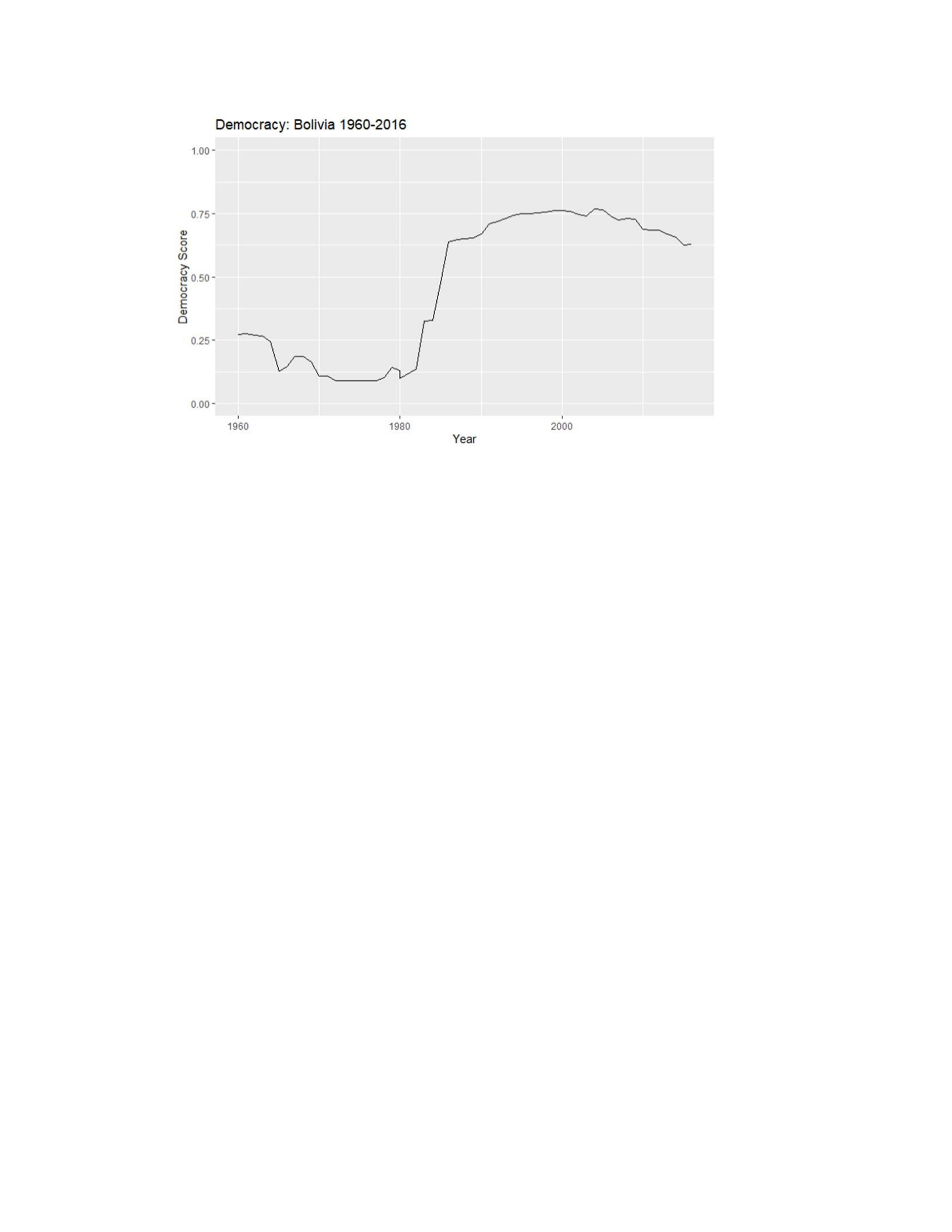
167
After the stabilization of democracy in Bolivia, indigenous political representation
became a nationally salient topic. Lozada’s government in 1994 worked to increase indigenous
enfranchisement with the Law of Popular Participation. During the same year, the Bolivian state
officially recognized its indigenous populations as political citizens in constitutional revisions as
the state’s democracy score began to stabilize (Constitution of Bolivia, 1994). These rights are
consistent with those that create terms of equal democratic citizenship. Soon after, in 2004, further
adoptions established Bolivia as a pluricultural state, or a state consisting of multiple legitimate
heritages. This same document encouraged indigenous political activity and representation at the
national level (Constitution of Bolivia, 2004).
Democracy ultimately brought two waves of constitutional reforms in favor of indigenous
populations and increased their access to political representation at the national level. Original
communities embraced a strategy of bottom-up political change through incremental access to
political power. This path was pursued in lieu of full-on, violent political revolution (Carriere
2010). During this same period, the Movimiento al Socialismo (MAS) party of Evo Morales, an
indigenous presidential candidate, gained steam in what was called the “indigenous awakening”

168
(Caressa 2014). The implications of the creation of a nationally representative indigenous party
are discussed in later sections of this chapter. Additionally, the constitutional reforms of 2009
established Bolivia’s cities as intercultural communities. City councils of indigenous
representatives were elected throughout the country. They pushed for culturally appropriate
healthcare access and traditional medicine systems, which were established in free state centers
since 2010 (Horn 2017; Tockman and Cameron 2014). The new constitution also facilitated
intercultural education reform, alongside the legitimization of indigenous regional
autonomies and collective rights (Constitution of Bolivia, 2009; Tockman and Cameron 2014).
In sum, Democratization in Bolivia is associated with the initial waves of reforms in the
constitution that brought indigenous issues to the national political discourse. Beginning in the
1980’s, democratization and political reforms increased the representation and inclusion of
marginalized indigenous populations in Bolivia. The expansion of universal suffrage coincided
with the adoption of constitutional recognition of the original populations. Per expectations, but
contrary to statistical results, this wave of democratization coincides with the adoption of rights
that create terms of equal access to political citizenship. Democratization and the constitutional
recognition and representation of indigenous populations also facilitated increased political
representation that further impacted the adoption process. These implications will be discussed in
future sections.
Indigenous Mobilization in Bolivia
“Historically, we have resorted to long marches as an extreme form of mobilization to draw attention
and seek justice. First, we marched for a constitution that recognized our rights as
Indigenous peoples. And for the past 13 years, we have marched to demand that those rights be
realized in practice. - Ruth Alipaz Cuqui, indigenous leader of the Bolivian Amazon and general

169
Coordinator for the Defense of Indigenous Peasant Territories and Protected Areas (CONTIOCAP)
February, 2022 (CIVICUS 2022).
The population proportion of Bolivia's indigenous populations vis-à-vis other citizens is
among the highest in the region. Roughly 32% of the country’s population identifies as
indigenous, second only to Paraguay, where 49% of peoples self-identify as having indigenous
ancestry (Latinobarometro). High populations of native communities relative to the rest of the
population give more leverage to their political claims and are associated with increased
mobilization capacity. Higher numbers of marginalized citizens on the peripheral of society
legitimately threaten political instability if they have substantial grievances.
Fractionalization among native populations in Bolivia is on the lower side compared to
other countries in Latin America at a state-level view. There is record of 36 different original
nations living in state territory, compared to over 300 in Brazil, and Uruguay with 4, the lowest
levels of fractionalization. Low levels of fractionalization mean lower coordination problems
among diverse communities and their political goals. Being on the lower end of the
fractionalization spectrum, native populations in Bolivia are more likely to coordinate and
mobilize, ultimately resulting in the negotiation of constitutional protection for their
communities.
The original populations in Bolivia have indeed been the most successful in negotiations
for constitutional rights for indigenous populations in national law. But a few large indigenous
groups constitute the majority of indigenous populations in Bolivia. These groups are
geographically concentrated in Bolivia’s highland regions, and are primarily made of Aymara,
Quechua, and Guarani indigenous groups. The distribution of lowland indigenous populations
are much smaller and more fragmented across Bolivia’s lowland regions that are historically more
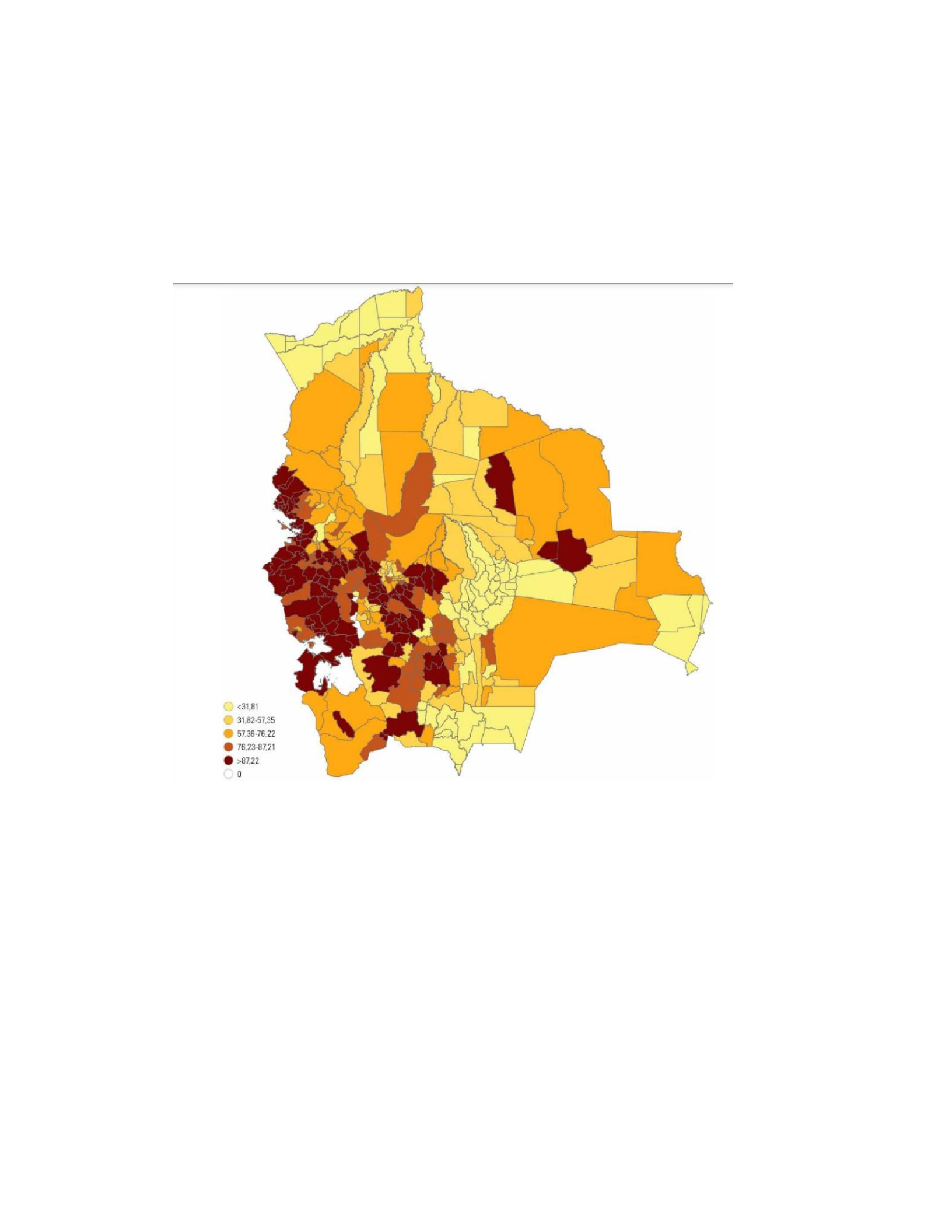
170
heavily occupied by white economic elites. The following figure illustrates the concentration of
large indigenous populations vis-à-vis primarily Spanish-speaking lowland
occupation (e.g. non-indigenous). (UN ECLAC 2020).
Figure XXII: Indigenous Populations in Bolivia
Map from ECLAC(2020)
Figure XXIII: Indigenous National Settlement in Bolivia
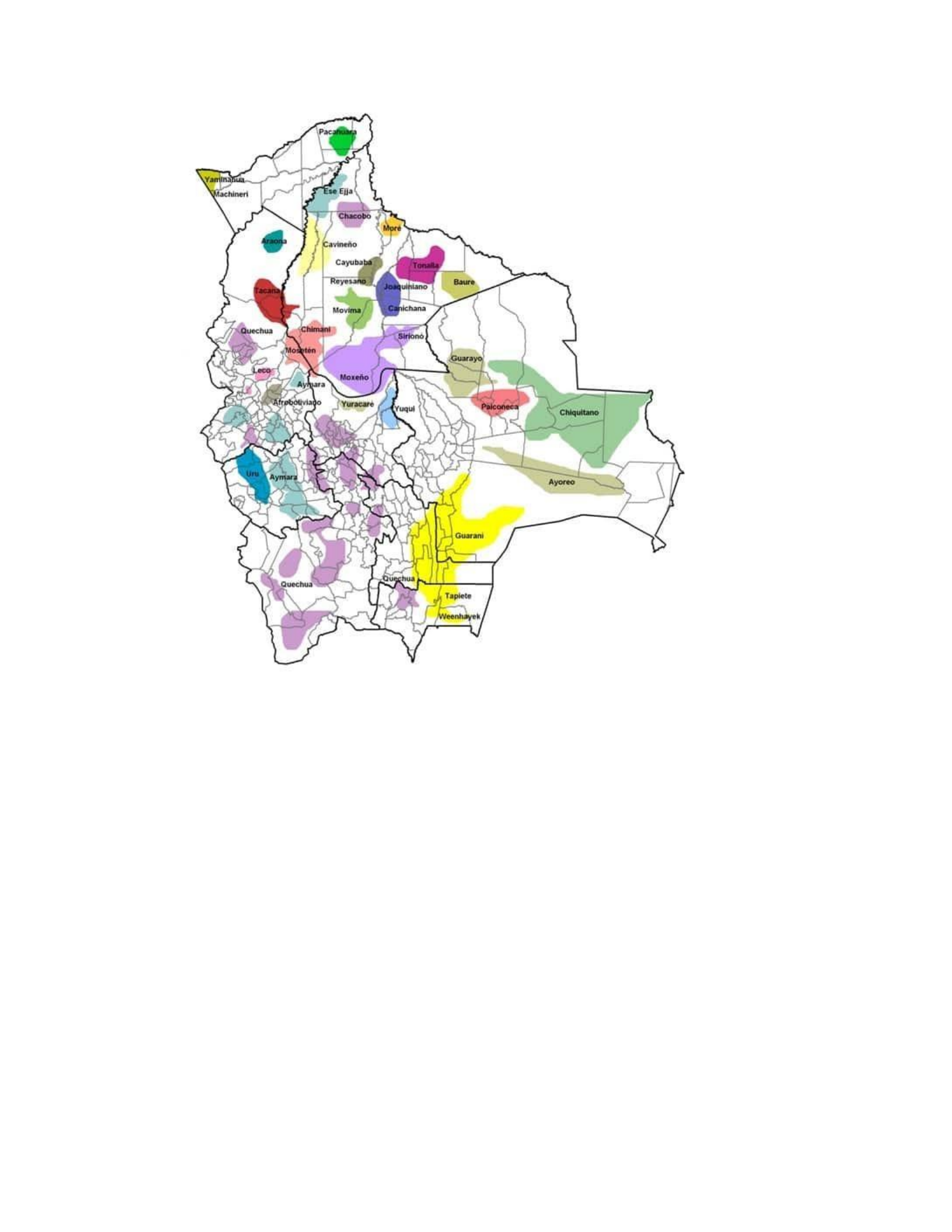
171
Map from UNFPA Bolivia (2008)
The larger indigenous populations, concentrated in the mountainous highland regions are
made up of the Quechua, at 30% of the total population of Bolivia, and Aymara communities which
constitute 25% of the total. The remaining 12% of the population that identify as indigenous are
concentrated mostly in the lowland regions and are small in comparison. These indigenous
communities range from only a few hundred to around 200,000 total, and some have had limited
contact with the outside world and with Bolivian political institutions (Hammond 2011).
Therefore, much of the political presence observed from indigenous populations in
Bolivia are likely to be through the lens of larger, more coordinated indigenous populations.
Highland populations make up half of the total population in Bolivia and have similar settlement
patterns. This leads to a more successful political coordination between the Aymara and Quechua

172
populations across nations compared to the dispersed, small, and more fractionalized indigenous
groups of the lowlands. This observation is indicative of indigenous political activity that are more
likely to primarily protect the interests of highland indigenous populations.
In broad strokes, statistical results indicate low fractionalization among comparatively
large native communities in Bolivia. There are 36 different indigenous nations identified in the
region and constitute over 30% of the total population in the state. These features are expected to
increase the capacity for indigenous political mobilization across these large communities and
positively impact the adoption of indigenous constitutional rights (Doyle and Sambanis 2006;
Fearon and Laitin 2003; Gurr 1970). This appears to be the case in Bolivia, at least among larger
indigenous communities in the highlands where low fractionalization and high population
proportions have helped facilitate the adoption of indigenous rights in the constitution.
The case study evidence indicates that the larger indigenous populations are more
represented in current political arrangements. Highland groups have privileged access to political
mechanisms and laws versus those from las tierras bajas (lowlands). Therefore, they are more
represented by national law compared to other native populations. This is evidence shows that
political rights among indigenous populations in Latin America can favor some groups to the
detriment of others and put groups at odds after political representation for native populations is
constitutionalized. These implications should be further studied in future work. However, the
marginalization of smaller indigenous populations in the lowland has not hurt the political
coordination and mobilization efforts of highland groups that constitute a significant proportion of
the indigenous populations in Bolivia.
Overall, indigenous population proportions are relatively high in Bolivia, with low
fractionalization. These conditions favor strong mobilization and coordination among various

173
indigenous groups. But most of the indigenous population proportion in Bolivia is made up of
Aymara and Quechua populations, meaning that strong mobilization is likely to be the most
visible among those indigenous communities.
Mobilization Capacity in Bolivia
Along with high native population proportions, and low initial fractionalization overall,
both which are associated with higher likelihood of political mobilization, Bolivia has the highest
number of established movement headquarters for indigenous interests within its borders. Bolivia
has six physical movement headquarters (Harvard Transnational Movement Database). Brazil, the
medium rights case has half this amount (3), while Chile, a country with no current constitutional
rights for native populations on record, has 0 established headquarters. Bolivia, with the strongest
established indigenous movement presence, has also adopted the most farreaching provisions for
these populations as a result.
Table 18: Record of Physical Mobilization Headquarters in Bolivia
Indigenous HQ Name
Year Est.
Location
Latin American Association for
Human Rights
1980
Cochabamba, Bolivia
Andean Information Network
1992
Cochabamba, Bolivia
Latin American and Caribbean
Agro-Ecological Movement
1992
Cochabamba, Bolivia
Earth Action International
1992
Cochabamba, Bolivia

174
World Coalition Against Water
Privatization and
Commodification
2003
Cochabamba, Bolivia
International Union for
Conservation of Nature and
Natural Resources
2003
Cochabamba, Bolivia
In general, Bolivian indigenous movements have been the most active and successful in
the region, with deep historical roots of mobilization recorded back to 1780 (Carriere 2010).
Sustained mobilization of these groups, especially in recent decades, is strongly associated with
their success in obtaining far-reaching constitutional provisions. Community structures remained
intact under colonization. Indigenous communities in Bolivia strongly resisted colonial
occupational forces, with many being successful in their pursuits. In many large indigenous
populations, social structures remained strong and served as pre-existing networks for heightened
ethnic mobilization that persisted into the modern era (Carriere 2010).
Early records of indigenous unions can be traced back to 1944, with the establishment of
the
Federación
Sindical de Trabajadores Mineros de Bolivia (FSTMB), a union made up of
primarily indigenous populations that worked in the state’s mines. This organization served as
one of the pillars for the creation of future political organizations. For example, indigenous
leaders from FSTMB went on to lead the Central Obrera Boliviana (COB), or the worker’s
union confederation in 1952. These groups both embraced the strategy of representing the
interest of miners at the national level, who were mostly indigenous, along with the political
interests of other working-class citizens (Chaplin 2010).
Indigenous ethnic consciousness increased in the 1960’s as a rejection toward state policies
of assimilation (Hammond 2011). This timing coincided with the creation of new indigenous
movements and political organizations like the Kataristas and the Confederación Sindical Unica

175
de Trabajadores del Campo de Bolivia (CSUTCB). Importantly, these organizations were made
up of mostly highland indigenous populations (Schilling-Vacaflor 2010). The platforms of these
organizations relied on appealing to large indigenous populations who were subject to continued
political discrimination under the Bolivian state apparatus. They also demanded that, as poor rural
workers, they were subject to economic discrimination as well.
By the 1970’s, NGOs began to invest into local indigenous mobilization networks and
focused on issues of indigenous political rights in Bolivia. NGOs backed the creation of four
separate indigenous organizations during this time period (Chaplin 2010). In 1979, the COB
organization of indigenous peoples specifically backed the creation the CSUTCB, a single
confederation of indigenous and working-class social movement groups (Schilling-Vacaflor
2010). These movements were critical in asserting the autonomy of indigenous movements in
Bolivia, which were manipulated under the Moviemiento Nacionalista Revolucionario (MNR)
party. MNR continued policies of indigenous repression and political from dictatorial rule into
the early 70’s (Chaplin 2010). Investment in mobilization establishments accelerated along with
democratization in the country from the late 1980’s according to the data citing headquarter
establishments. The success of indigenous movements through the 1970’s and early 1980’s
ensured independent indigenous political participation.
The year 1992 marked the 500th anniversary of the Spanish invasion. This event prompted
heightened ethnic mobilization and a resurgence of indigenous political identification and
recognition of oppression. The same year, the Consejo Indígena del Pueblo Tacana (CIPTA)
formed a council for funding organizations that support indigenous rights in Bolivia. Indigenous
organizations, such as the Confederación Indígena del Oriente Boliviano (CIDOB) also expanded
from being just concentrated in the highland regions, to include some of those in the lowlands

176
(Schilling-Vacaflor 2010). Overall, sustained ethnic mobilization since the 1990’s had political
success in the 1990’s. 1994’s constitutional adoptions were the first to recognize indigenous
populations as political participants and protect their culture and use of language. The growth of
indigenous organizations and their access to NGOs and funding entities is associated with these
adoptions.
Native communities showed strong activity throughout the early 2000’s. Aymaran and
Quechuan communities are credited with playing a major role in stopping the privatization of
water by Bechtel in the “water wars” of 2000. The privatization of water resources would have
disproportionately hurt poor and rural populations and make water unaffordable. A majority of
those impacted were also indigenous. Amid massive protests largely taking place in
Cochabamba, the military moved in to suppress the unrest, and the government ultimately
cancelled privatization plans (Forero 2004; Carriere 2010; Vargas and Viviana 2015).
These groups mobilized again to protect natural resources when a US proposed gas
pipeline threatened ancestral lands and resources. This conflict, termed the “gas wars” was
fought by a coalition of indigenous groups and other labor movements. Again, the most
mobilized indigenous groups came from highland communities. But during the gas wars,
indigenous groups demanded the drafting of a new constitution. Ultimately, indigenous
movements blockaded major highways throughout La Paz, and the pipeline plans were
cancelled by the government. Amid continuing unrest, serving President Sanchez was
removed from office soon after (Albro 2006; Caressa 2014).
The strong turnout of indigenous groups in both the water and gas wars signaled that they
could credibly impact government plans and policies. After these political successes, indigenous
movements began to demand reforms to Bolivia’s democracy. By 2004, there were over 20

177
different NGOs looking to collaborate with indigenous social movements toward achieving more
representative rights for their populations and strengthen their organizations. Organizations
included the Wildlife Conservation Society (WCS), Conservation International (CI), which greatly
supported the creation of protective land rights for indigenous populations (Lopez Pilla 2014).
With the backing of these organizations, mobilized groups stressed the need to push for
new constitutional arrangements from the government.
“Ustedes tienen que llevar este mensaje a nuestras bases. Todos tenemos que hablar de un
solo discurso: nueva Constitución, refundar el país. Estamos de un solo pié, de un solo sentir. Esto
lo tenemos que demostrar al país. Nos vamos a hacer escuchar y hacernos oír de nuestros
hermanos urbanos,” Román Loayza, 2004
“You need to carry this message to our bases. We all need to speak of a new discourse: a
new constitution, a refoundation of the country. We are of one footing, and one feeling. We have
to demonstrate this to the country. We are going to make ourselves heard by our urban brothers,”
Roman Loayza, 2004. (Valencia and Egido 2009)
Ultimately, the political goals of indigenous movements were realized. The constitutional
committees in 2004 and 2009 both made drastic changes in response to indigenous grievances,
and officially established Bolivia as plurinational- or recognizing the existence of multiple nations
within the territory (Constitution of Bolivia 2004; Constitution of Bolivia 2009). COB leader,
Pedro Montes, called for constitutional change:
“Esta no es una marcha cualquiera, al llegar a La Paz, seremos un milon y de alli no nos
moveremos sin convocatoria al referendum,” - lider de la COB, Pedro Montes 2008

178
“This is not just any march, once we arrive in La Paz, we will be one million strong, and
from there we will not move without the government calling for the referendum,” - leader of COB,
Pedro Montes 2008. (Quiroga 2008).
Such strong mobilization efforts did result in constitutional changes. Indigenous political
goals went from the periphery of society to establishing these communities as not only political
participants, but ultimately as sovereign entities with the right to self-government. The strongest
mobilization networks of original populations in Bolivia are overall associated with the most
constitutional protections in national law.
Importantly, since these successes in indigenous mobilization and constitutional reform,
there are more recent marked divides in their political goals. Autonomy, especially in the lowland
regions, is constrained by continued resource extraction projects. But these groups, though
smaller in number, have been more politically active in recent years. In 2011, the
Tsimanes, Moxeteres, and Yuracares protested the building of highways through native lands. But
many highlander indigenous citizens, such as the Aymara and Quechua, marched in favor of its
construction. Some highland communities view lowland populations as underutilizing the land,
alongside stereotypes of lowlanders being less educated and civilized. It is no coincidence that 11
of the 13 recognized indigenous territories are in the highland Andean region, compared to only
2 in the lowlands. Regional lowland autonomy is framed as against the national interest, and
strong indigenous movements actively support projects in these regions (Caressa 2014; Tockman
and Cameron 2014).
Despite recent conflict among indigenous mobilization efforts, there is evidence that they
are becoming more active and assertive in their respective territorial regions. Indigenous
movements took over state functions to protect their lands in 2021. They share information with

179
each other about potential threats to their lands, using advanced satellite technologies. These
resources allow groups to identify poachers, forest fires, and threats to water sources (Praeli 2021).
Communities can effectively coordinate, self-govern, and protect their lands where the central state
apparatus has failed to do so.
In sum, Bolivia is on record as the country with the most active and successful indigenous
social movements. Strong social networks have allowed groups to coordinate efforts and facilitated
constitutional revisions that established the state as plurinational. Importantly, the number of
indigenous mobilization headquarters increased after democratization in the 1980’s. Many
indigenous movement headquarters were established prior to and after the initial recognition and
representation of these citizens in constitutional law. This case shows that strong movements were
present prior to the adoption of any indigenous rights in the constitution, but their strength
continued to grow after they were. The ongoing success of these movements also helped create a
national constitution that is the most inclusive of its native populations to date. But since the
successes of 2009, there is increased evidence of divides amongst highland and lowland
communities and their political interests, and therefore, differences in their mobilization efforts.
Highland peoples are much more likely to support state policies, especially those that are
developmental projects in “underutilized” lowland regions. Despite recent divides and tensions
among regional native populations, Bolivian indigenous movements remain strong, and
demonstrate the ability to self-govern and mobilize resources to protect their lands and resources.
Indigenous Representation in Bolivian Government
This case shows that once indigenous political participation was constitutionally
legitimized in 1994, indigenous political parties were able to grow, and ultimately occupy the
executive office. Indigenous groups’ political goals shifted to reorient Bolivia’s democratic

180
structure and gain national representation. Indigenous political mobilization was also associated
with the removal of two Bolivian presidents through 2004. The establishment of the MAS party,
led by indigenous representative Evo Morales, represented movement to “decolonize” Bolivia’s
constitution (Fletcher 2009). Under MAS, further indigenous rights provisions were added to
Bolivia’s constitution. These include both resource and autonomy rights. This result partially
supports statistical results in chapter 3 and 4 that show indigenous representation as a motivator
for the adoption of autonomy rights into constitutional law.
Bolivia has had the most extensive indigenous representation in national government
over the past few decades. Native populations were first recognized in the constitution in 1994,
legitimizing their claims to political office and representation. The Movimiento al Socialismo
(MAS) party was created soon after in 1998, with foundational ideologies that promoted
indigenous identity, and anti-neoliberal policy positions. The party and the presidency
illuminated indigenous political platforms in the country and facilitated the change of multiple
national laws in favor of native communities.
The party was originally formed as an alliance of unionized peasant organizations. The
MAS platform stressed terms of Bolivian decolonization, indigenous constitutional
representation, and recovery of the state’s indigenous values to protect Bolivia’s land and
resources. The party aligned with common grievances against neoliberal policies that accelerated
natural resource extraction. Tangibly, this meant a commitment to the reduction of neo-liberal
policies that disproportionately hurt poor and indigenous populations (Caressa 2014; Fletcher
2009). Morales had broad appeal across a large underrepresented indigenous population, and
poor agrarian workers who had until recently been absent from the national political discourse.

181
President Morales ultimately won his campaign for presidency in 2006. Voters clearly
endorsed a platform that stressed the central government’s need to protect Bolivia’s lands and
natural resources. With 54% of the presidential vote, it was the first time in recent Bolivian
history where a presidential candidate won an outright majority (Hammond 2011). The MAS
party and its leader, Evo Morales, held executive office from 2006-2019 and positioned
indigenous peoples as the caretakers of the nation. MAS promoted policies that endorsed
indigenous populations as the caretakers of the nation. As the self-proclaimed leader of the
Aymara peoples, Morales also promised to renegotiate terms of indigenous constitution
citizenship (Caressa 2014; Horn 2017).
Under the MAS government, Bolivia became constitutionally multicultural and
plurinational. The reforms adopted under Morales in 2009 guarantee indigenous representation in
the state legislature, with two seats reserved for indigenous representatives in the senate, and one
seat in the lower chamber (Constitution of Bolivia 2009). To facilitate representation, indigenous
administration was dispatched as ministers of the state to all state department capitals (Caressa
2014). Increased representation on the national level allowed peoples to focus on properly
defining indigenous rights from within the state apparatus.
This new government forced political elites were forced to renegotiate regime structure
and access to political and state resources for indigenous populations. During his presidency, a
new constitutional assembly was created to constitutionalize formal recognition of indigenous
autonomy in 2009. The state officially became plurinational and recognized indigenous nations
in its territorial borders after constitutional debates resulted in the adoption of a new document.
Legally, state authorities share power with multiple indigenous nations under a system of legal
pluralism under the current constitutional structure. This includes the existence of plurinational

182
justice system that recognizes ethnic justice and claims (Constitution of Bolivia, 2009; Horn
2017).
Importantly, many communities have been able to install their own representatives and
indigenous justice systems under the new laws of the 2009 constitutional changes made under
MAS. But the legal process is highly complex and requires the help of legal experts to assist
communities to obtain their special legal status. As it turns out, as Evo Morales is the
selfproclaimed leader of the Aymara people, most recognized territories are in the Aymara and
Quechua highlanders, who also have more access to political infrastructure and more easily
navigate the legal technicalities of acquiring regional autonomy. Again, though Bolivia has the
most far-reaching indigenous protections in its national constitution, advantages after these
adoptions favor highland populations compared to those in the lowlands. Indigenous interests
and policy preferences have become increasingly oppositional between these regions and
peoples.
But even though these reforms afford Bolivia’s original nations the most freedoms
compared to other countries in the region, these rights have not been claimed without difficulty.
Between 2009 and 2019, only 3 of 33 claims for indigenous self-government in their respective
national territories have been approved (Rodriguez 2020). Many regions, mostly those in the
lowlands or tierras bajas, are subject to continued encroachment and its communities find
difficulty in navigating legal systems for proper representation (Hammond 2011). Most regional
protections continue to be claimed by highland communities.
Similarly, the Aymara and Quechua groups are the largest, most favored populations under
constitutional law. Most legally recognized lands, 11 of the total 13 currently recognized, are in
the Aymara and Quechua highlands. There are only two protected original nations in the lowlands,

183
which is occupied by various smaller indigenous communities. Not coincidentally, most extractive
projects in recent years have been in las tierras bajas (the lowlands). Highlander indigenous
communities consistently backed recent state led extraction projects in lowland regions.
Representatives from highland communities cite the need for these projects, since the indigenous
nations in the lowlands are unproductive, and not using the land to its full potential (Caressa 2014;
Tockman and Cameron 2014).
In broad strokes, the larger populations of the highland Aymara and Quechua nations are
much more represented and aligned with the current Bolivian government. Smaller indigenous
populations in the lowland regions, however, consider issues of state encroachment unresolved.
President Evo Morales who was in office from 2006-2019 was the self-proclaimed leader of the
Aymara peoples, the largest indigenous group in Bolivia. Constitutional adoptions under his
government favored highland culture, such as the mention of Aymara holidays as nationally
recognized holidays without mention of those of lowland nations (Constitution of Bolivia, 2009;
Caressa 2014). As the leader of highland indigenous interests, communities in these regions are
more likely to support state policies, even to the detriment of other native communities (Caressa
2014; Fabricant and Postero 2015).
Physical encroachment between communities has escalated since the 1980’s. The collapse
of the mining industry led many highland populations to relocate to lowland territories. This mass
movement itself began to stir tensions and claims to land rights in the region. Still, many Aymara
and Quechua see it as a necessity to “civilize” lowland populations. Older Quechua and Aymara
men continue to purchase young indigenous women as wives in the region for only a few pesos to
carry out this task (Caressa 2014).

184
This physical occupation occurs alongside political encroachment into the lowland regions.
The constitutional revisions adopted in 2009 created mechanisms for native consultation before
projects that impact ancestral territories (Constitution of Bolivia, 2009). During the Territorio
Indígena Parque Nacional Isiboro Sécure (TIPNIS) project, which was a highway infrastructure
project funded by Brazil, indigenous citizens were consulted. But not the populations from the
ancestral nations that would suffer from the project. Instead, the consulted indigenous citizens
were from larger populations that traditionally supported his policy positions. The project also
allowed for easier migration of displaced coca growers from the highland into these lowland
territories via highway (Caressa 2014; Tockman and Cameron 2014). The project was completed
in 2017, and was backed by colonial rhetoric from Evo Morales himself, who
called on young men to claim indigenous women and sway their political opinion on the project:
“If I had the time I would go and woo the Yuracare companeras and convince them not to
oppose the road. That is, young men, you have instructions from the President to seduce
(conquistar) the Yuracare women so that they won’t oppose the building of the road,” – President
Evo Morales (Caressa 2014).
The MAS party and Morales continued these transgressions while also becoming
increasingly centralized and focused on retaining political power over representing indigenous
interests. During his second term beginning in 2010, his government actively worked to reduce
and silence indigenous movements that opposed state led extraction projects. His government
during its second term weakened many indigenous movements, especially in the lowlands, and his
government did not pursue any further constitutional reformations to protect original nations.
Morales also weakened and packed courts from 2009 to 2019. Over 80% of judges remain

185
temporarily appointed to federals posts and are subject to politically motivated investigations
(Human Rights Watch 2022; Rodriguez 2020; Tockman and Cameron 2014).
Ultimately, Evo Morales was accused of electoral fraud in the 2019 presidential elections.
Amid social unrest and political violence, Morales resigned as the president of Bolivia on
November 10, 2019. A military government took power after he stepped out of office, and
indigenous flags and other cultural symbols were removed from government buildings (Human
Rights Watch 2022; Rodriguez 2020). This was a disappointing end to an era of indigenous
representation in the highest office of government.
Nonetheless, Bolivia is still the country that provides the most representation for its native
populations under current political arrangements. This representation sharply increased after the
adoption of indigenous recognition and representation into constitutional law in 1994.
Afterwards, legitimized indigenous political parties were elected to the highest national offices,
including the presidency. After these successful elections, President Evo Morales oversaw the
institution of various indigenous resource and autonomy rights in the 2009 constitutional reforms.
Most recently, in 2010, the Minister of Justice and Institutional Transparency created a directorate
for the protection of indigenous nations and peoples of Bolivia (Lima 2022). The same year, the
state created the People’s Conference on Climate Change, which renegotiated environmental and
land protections in the original nations (Rodriguez 2020). This case supports statistical evidence
that shows indigenous representation in national government motivates the adoption of
indigenous autonomy rights into the constitution. But future work must consider the ongoing
divides in the political representation of different indigenous nations, which is far from equal.
Nonetheless, indigenous mobilization has led to many successful constitutional revisions in
Bolivia. The right to indigenous constitutional protection of their communities remains strong.

186
“No estamos usurpándole nada a nadie, se nos viene criminalizando, acosando,
persiguiendo, diciendo que estamos cometiendo intromisión. Hay organizaciones que firman
para dar paso al gobierno, pero nosotros, si no hubiéramos hecho esa lucha férrea en nuestro
territorio, hace mucho que muchos de los proyectos se hubieran empezado a ejecutar,” - Ruth
Alipaz, lidresa Uchipiamona 2022.
“We are not usurping anything from anyone, we have been criminalized, harassed,
prosecuted, and told we are committing interference. There are organizations that sign off on the
government, but we, had we not waged that iron fight in our territory, many [extractive] projects
would have been started and carried out long ago,” Ruth Alipaz, Uchipiamona leader, 2022.
(Astrid 2022)
Resource Rents and State Capacity in Bolivia
When it comes to state motivations to guard land and resource rights, Bolivia has
fluctuating dependence on its natural resources, from anywhere to 5% to 15% of the country’s
total GDP. In recent decades, the government has pursued economic policies that accelerate
resource exports and is comparatively one of the most dependent countries on its natural
resources. Fluctuations in exports are caused by its resource curse- prices for natural gas and
other minerals boom and bust along with their values in the international market (ECCLAC
2012; Tockman and Cameron 2014). State capacity of the government to control native
territories and extract wealth, however, is low in Bolivia, and barely reaches positive values
over the observation period (See Model). Despite a boom-bust cycle of resource prices and a
low state capacity for resource extraction in native lands, low intensity conflict is sustained in
indigenous territories over access to valuable natural resources, especially natural gas (Horn
2017; Mahler and Pierskalla 2015).

187
Figure XXIV:
Figure XXV::
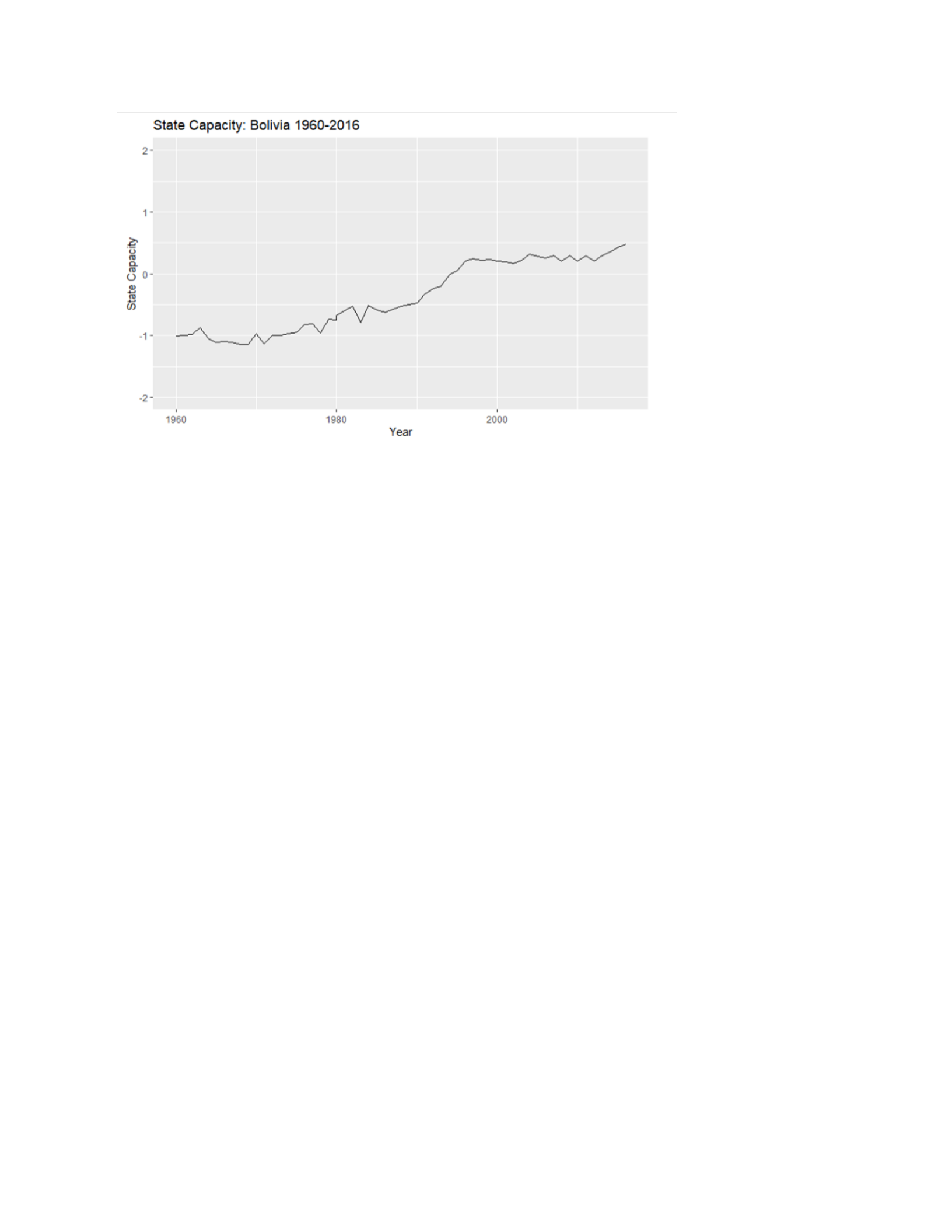
188
Since the colonial era, Bolivia has been reliant on the extraction of non-renewable
resources to the detriment of native lands. Hundreds of years of reliance on exports, state-owned
resources, and high inequality created an entrenched extractive economic model, that even
indigenous president Evo Morales promoted them under his term. After Bolivia’s wave of
constitutional reforms, autonomies to land remain constrained where the state and private
companies find resource wealth. The executive branch and national constitutional law stresses that
while indigenous peoples do have claim to their ancestral territories, ownership does not translate
to subsurface resources, such as hydrocarbons, metals, and other non-metals (Tockman and
Cameron 2014). Though native populations have the right to prior consultation before extractive
projects, as of 2022, only 3 of 33 indigenous claims for territorial autonomy have been approved
by the state due to these economic interests (Rodriguez 2020). Many extractive projects are
continued in the lowland regions of Bolivia, which are rich in natural resources and occupied by
smaller, more fractionalized indigenous communities.
Since 1994 the Bolivian state has slowly decentralized its protection over natural resource
industries and diversified Bolivia’s economy. The timing coincides with the creation of indigenous

189
political party MAS, and the growth of indigenous political mobilization. Along with elite
supported decentralization came the withdrawal of state support and protection of mineral exports,
which disproportionately hurt indigenous communities and their local economies through the
encroachment of private companies and interests. Indigenous movements and political parties
challenged the interests of economic elites that supported state decentralization of protective
policies, and successfully helped to remove two presidents (Sanchez in 2003, and
Mesa in 2005) that failed to nationalize Bolivia’s natural gas industry. Indigenous populations,
then more represented in the national government under an indigenous party and president were
able to challenge the interests and supported market reforms (Eaton 2007).2
In addition to these recent tensions, ongoing low intensity conflict between indigenous
groups and state and private groups over resource projects has continued mainly in the lowland
territories over the past three decades. Political campaigns and violence against indigenous
communities in these regions is sustained despite their legal claims to the land. Threatened
territories include Bolivia’s capital province, the Andes Ibaneza in Santa Cruz, and Oropeza in
Chuquisaca. These lands contain many of the resources that the government sees as
nonproductive and in need of economic development. They also contain the most natural gas in
the state (Mahler and Pierskalla 2015). Additionally, lowland indigenous populations are much
sparser and less densely populated in these lowland territories vis a vis non-indigenous
(Hammond 2011). Simply, more natural gas equals higher levels of violence in indigenous
lowland regions over extractive projects. Between 2010 and 2020 the Center for Legal Studies
and Social Research, a Bolivian non-profit organization, found that more than 42% of lowland
territories were subject to illegal occupation, illegal burning, and deforestation (Human Rights
Watch 2021).

190
Despite a low state capacity measured by quantitative means, recent analysis shows that state
presence in indigenous territories is increasing in recent years. State security forces currently
occupy lowland indigenous regions at much higher levels. Occupation is carried out in the interest
of securing access to natural resource wealth. Human Rights Watch (2021) finds increased rates
of illegal detentions, sexual violence, and torture of indigenous populations in the lowlands. Illegal
imprisonment and torture occur alongside forced labor, a continued legacy of colonial slavery.
Security forces carried out multiple massacres against native communities in both Cochabamba
and La Paz in the past decade (Human Rights Watch 2021).
Bolivia has historically embraced a model of resource extraction and exportation, despite
a volatile boom and bust cycle of resource value on the international market. High levels of
resource dependence did not impact the adoption of constitutional rights for native populations.
Levels of state investment and occupation of lucrative native territories in Bolivia has led to the
protection of less lucrative highland regions, but continued exploitation of lowland indigenous
nations. Ultimately, only some indigenous groups have benefitted from recent constitutional
revisions. Increased indigenous representation in the constitution and in the national government
facilitated the creation of rights that protect the indigenous right to land, autonomy, and
consultation over resource projects. Constitutional provisions, as currently defined in Bolivia’s
constitution, establish the right to representation, and autonomy rights for all indigenous nations
in Bolivia. But currently, highland communities with larger populations are those that have most
successfully benefitted from these national laws. In broad strokes, legal avenues are complex and
difficult to navigate. Highlander communities have much more success establishing the right to
self-government according to national law. Lowland communities are left vulnerable to

191
encroachment, state occupation, and violence in the name of profitable resource extraction
(Hammond 2011; Lopez Pila 2014; Fletcher 2009).
State occupation of the lowland regions in the interest of resource extraction is strong,
despite a low state capacity score. While these factors were expected to restrict the adoption of
indigenous rights that protect their land and resources from state and private encroachment, this
is not the case in Bolivia. Instead, the adopted provisions disproportionally benefit highland
indigenous populations, the Aymara and Quechua. Strong occupational forces, and ongoing
violence in lowland regions restrict access to constitutional protections for the smaller
indigenous groups that have ancestral roots in these territories. The occupation and exploitation
of the lowlands is likely to continue if current divides in indigenous representation is not
corrected. Central government entities stress the state ownership of natural resources and
continue to use occupational security forces to procure them.
Looking to the Future of Indigenous Rights Adoption in Bolivia: Public Opinion
Given that Bolivia’s constitutional law currently includes the most extensive indigenous
rights in the region, it is unlikely that they are to expand much further in the near future. The Latin
American Public Opinion Project gathered public opinion data on perceptions of indigenous
political rights in Bolivia after the most recent constitutional reforms of 2009. These revisions
were those that established multiple indigenous resource and autonomy rights that both strive to
correct historical inequalities, but also allow for indigenous self-representation and government.
Previous work using this data finds most support of indigenous representation is among female,
young, left leaning, and poorly educated citizens (Fernandez 2019). These features also describe
citizens that are more likely to support environmental protection, and the lower educated class
overlaps with indigenous identification.

192
But overall, citizens see issues such as economic crisis, unemployment, and poverty as
the most important political issues in the country, not indigenous issues. Data from
Latinobarometro’s public opinion project in 2022 show that indigenous autonomy and
environmental issues are categorized as low priority amongst Bolivian citizens: 18.3% of
respondents cited the economy as their number one concern for the country. Unemployment
came in at 12.8%. But issues such as discrimination by race and human rights earned scores of
1.1% and .5% respectively. Moreover, the poor are considered the class that is most discriminated
against amongst polled citizens, and only 8.4% think that indigenous citizens currently face the
most discrimination in Bolivia (Latinobarometro Case Report: Bolivia 2022). There is a clear focus
on neutral political issues in modern political discourse. These issues focus on policies that impact
all Bolivian citizens, and indigenous issues considered peripheral concerns amongst the general
population.
In the Bolivian government, legislative deputies in the 2010 congress similarly discount
the importance of indigenous issues. The most important issues identified are similarly neutral
issues that impact all the country’s citizens. Most deputies cite unemployment (74.4%),
government corruption (66.27%), education (60%), economic production (48.2%), and illegal drug
trade (47.7%) as the most pressing government problems. This compares to only 20.27% of
deputies listing indigenous human rights as a main concern to the current government (PELA).
Results from these opinion polls match that of the public- non-indigenous issues that impact all
citizens are the issue areas take precedence in modern political discourse in Bolivia.
Indigenous citizens have different political views compared to non-indigenous Bolivians.
First, significantly more indigenous respondents consider themselves “politically mobilized;”
33.6% of indigenous respondents self-identify as politically mobilized, versus only 18.1% of non-

193
indigenous respondents. Native populations are also slightly more satisfied with the current state
of democracy in Bolivia (62.6% highly satisfied) compared to non-indigenous citizens (55.2%).
Additionally, 60.4% of indigenous citizens view political parties as necessary to advance political
rights. Faith in parties also remains high among non-indigenous citizens as well, with 56% of
respondents indicating them as necessary (LAPOP; Inguanzo 2011). Overall, differences are
minimal apart from higher indigenous political mobilization. However, similarities in attitudes
about democracy and political parties show that native populations have just as much trust in
Bolivia’s political institutions, if not more than the public at large. This is likely a result of the
representativeness in the Bolivian constitution. Rights adopted in the past decades include not only
access to universal democratic rights, such as education and healthcare, but also allows for regional
indigenous sovereignties, plurinationalism, and new courts. Comparatively, these are the most
expanded constitutional rights for indigenous populations in the region, and many groups have
reason to look positively at the current state of democracy in Bolivia.
In sum, Bolivian citizens and politicians do not see indigenous political issues such as
autonomy and racial discrimination as important under its current government. Instead, there is
much more support for neutral issues that impact all the state’s citizens. These issue areas include
topics such as unemployment, the economy, and political corruption. Problems such as
indigenous land protection, and discrimination are peripheral interests. Since all survey data
presented in this chapter was collected after all constitutional reforms in Bolivia, which were
substantial, the timing impacts the results of the data. It is likely that many respondents see some
indigenous issues as resolved by previous constitutional negotiations, indigenous and
nonindigenous citizens alike. Polling data suggests that indigenous respondents are very
satisfied

194
with democracy in Bolivia, and faith in the political system is consistent across all respondents. 3
As Bolivia’s constitution contains the most far-reaching indigenous provisions in the Latin
American region, further expansion of these rights in the near future is unlikely. Attitudes across
Bolivia’s population show that indigenous specific issues are not considered important in the
modern political discourse. Perhaps many of these issues are continued resolved, since the
Bolivian government adopted various indigenous constitutional rights over the past 30 years.
Similar attitudes are seen in Bolivia’s legislature, where deputies consider universal issues more
pressing. Importantly, economic shocks that do impact all Bolivia’s citizens top the list of current
issues facing the country. After its resolution, attitudes may again change and/or diverge between
indigenous and non-indigenous citizens.
Discussion and Conclusion
In Bolivia, the expansion of indigenous constitutional citizenship occurred in steps. From
complete political exclusion established through colonialism, the first indigenous rights were
adopted into the constitution in 1994. The first indigenous rights in Bolivia included recognition
as national citizens, and the right to culturally appropriate education. From this point, rights further
expanded in 2004’s iteration of the constitution, which moved to establish a plurinational state and
encouraged indigenous political participation. Finally, revolutionary reforms in 2009 led to the
adoption of various rights that legalized indigenous regional autonomies and created new,
representative political institutions. This method of rights adoption in Bolivia’s constitution
supports statistical results in chapter 4. Simply, indigenous rights expand in steps, from indigenous
recognition, to representation, and finally resource and autonomy provisions.

195
Due to the wide range of indigenous protection included in Bolivia’s active version of its
constitution, many citizens and politicians do not consider indigenous issues as political problems
that the state needs to immediately address. This attitude is carried across indigenous citizens,
non-indigenous citizens, and legislative deputies. Bolivia’s indigenous rights in the constitution
are currently the most far reaching in the entire region and sets an example for other countries
globally. In respect to these constitutional changes, the average citizen’s political attention is
focused on non-indigenous issues. Recent survey data shows that Bolivia’s citizens and legislative
representatives consider issues such as economic performance, unemployment, and access to
universal healthcare as the most pressing issues in society versus indigenous issues. In fact, the
poor class is considered more discriminated against amongst polled citizens, and only
8.4% of respondents see indigenous peoples as facing the most discrimination in Bolivia
(Latinobarometro Case Report: Bolivia 2022). After the adoption of indigenous resource and
autonomy rights in 2009 that legitimized indigenous claims to regional self-government, it is
evident that many consider the current status of indigenous constitutional citizenship satisfactory
for the time being. This puts into question whether the incremental expansion of indigenous rights
will continue in Bolivia.4
Democratization also played a role in early constitutional amendments that established
indigenous recognition as political citizens and protection of their cultural heritage. Democracy
scores in Bolivia increased through the 1980’s and stabilized in the early 1990’s. Bolivia's first
indigenous rights adoption in the constitution were adopted soon after in 1994. These events
support theories from chapter 1, that argue that democracy facilitates the adoption of indigenous
constitutional provisions that are compatible with modern ideals of democratic citizenship.
Simply, democracy is associated with rights that define indigenous peoples as equal citizens with

196
equal status and protection. But this relationship does not apply to rights that are seen as serving
specifically indigenous interests, or those that create divisive national identities. After democratic
consolidation in Bolivia, additional domestic factors motivate the adoption of indigenous resource
and autonomy rights.
The political mobilization of indigenous communities has had a positive impact on the
constitutional citizenship of the original peoples of Bolivia. Indigenous populations constitute a
large proportion of the total population in Bolivia at 32% of the total population. Additionally, they
are fragmented among 36 different national identities, which is a medium level of fragmentation
vis a vis other states in the region. Large populations that are not highly fragmented are posited to
be associated with stronger indigenous political mobilization potential. This is indeed the case in
Bolivia, where indigenous mobilization is among the strongest and most active in Latin America.
Strong social networks that survived through colonization allowed groups to effectively coordinate
political efforts. Indigenous groups mobilized and sat in on multiple constitutional councils,
including those that adopted multiple indigenous resource and autonomy rights in 2009. But since
the successes of 2009, there is increased evidence of divides amongst highland and lowland
communities and their political interests, and therefore, differences in their mobilization efforts.
Highland peoples are much more likely to support state policies, especially those that are
developmental projects in “underutilized” lowland regions. Despite recent divides and tensions
among regional native populations, Bolivian indigenous movements remain strong, and
demonstrate the ability to motivate constitutional change. Here, the strength and
institutionalization of indigenous political movements increased after democratization in the early
1990’s. This means that strong indigenous mobilization preceded the adoption of all indigenous
provisions in the Bolivian constitution and played a positive role in these revisions along the way.

197
Another positive predictor of indigenous rights adoption in the constitution, indigenous
government representation, is also strong in the Bolivian case. The country’s constitution
legitimized indigenous political participation beginning in 1994, which legitimized indigenous
political party, MAS, that ultimately occupied executive office. This government, led by an
indigenous executive, oversaw the adoption of the most extensive indigenous constitutional
rights in the entire region. These results support theoretical arguments that indigenous
government representation brings salience to specifically indigenous issues that leads to the
adoption of resource and autonomy rights. Without indigenous representation, these issue topics
go unnoticed and are unlikely to be included in future constitutional law.
Against theoretical expectations, economic reliance on models of resource extraction did
not influence the adoption of Bolivia’s constitutional provisions that protect indigenous
communities. This includes those that protect original territories from state and private
encroachment. Statistically, Bolivia’s state capacity is low, and is associated with all indigenous
rights adoption per results in chapter 3. But only some indigenous groups have been able to
effectively defend their constitutional rights against invasion. Lowland indigenous communities,
which are much smaller and more fragmented, are left vulnerable to exploitative resource
projects, state occupation, and violence.
In sum, Bolivia followed a trajectory of incremental rights adoption. Previously excluded
indigenous populations were at first afforded equal recognition and rights in the constitution.
Then, more rights were adopted that are based on indigenous difference and structural
inequalities. As expected, democratization preceded the initial adoption of indigenous
constitutional citizenship. As democracy stabilized, however, the strength of both indigenous
mobilization and government representation oversaw the adoption of constitutional rights that

198
allocated state resources to original populations and established autonomies. Chapter 1 theorized
that strong indigenous movements would emerge after initial constitutional representation is
adopted. But in Bolivia, pre-existing networks oversaw the adoption of all constitutional
revisions, even before indigenous constitutional citizenship was established. Therefore, strong
indigenous mobilization is associated with the adoption of all indigenous rights in Bolivia, since
pressure from these groups was sustained prior to, and through, all constitutional changes after
democratization. Per expectations, indigenous political representation oversaw the adoption of
indigenous autonomy rights in Bolivia that mechanized regional self-government for original
populations. In contrast to theoretical expectations, Bolivia’s high investment in natural resource
rents and heavy occupations of resource rich regions in recent decades have not hindered the
adoption of indigenous constitutional protections. Finally, recent divides in indigenous political
interests between Bolivia’s highland and lowland populations should be further studied in future
work. On the ground, larger highland indigenous populations have been more politically
mobilized and represented by current constitutional arrangements and national representation.
Smaller, more fractionalized and politically absent lowland populations continue to experience
under representation.
Chapter VI: Brazil
“Indigenous people have constantly been the subject of discussions
and deliberations without proper participation. At this specific

199
moment, this gathering is even more important considering that we
have a government that is anti-indigenous, fascist,
antienvironmentalist and anti-human rights. I see myself as a
spokesperson who will take the indigenous voice further, to fight
for the defense of our rights so that we prevent further violations. It
is also incredibly important to raise more sympathy and empathy
among politicians in congress, who represent Brazilian society.”
Joênia Wapichana, Brazil’s first indigenous congresswoman, 2022
(Beldi De Alncantra 2023)
Introduction
The Brazilian case represents countries that fall in the “medium” range of adopted
indigenous constitutional rights. Unlike Bolivia, rights do not extend to provisions that allow for
regional self-government or indigenous national sovereignty. But also unlike Chile, the Brazilian
government managed to adopt some constitutional changes that protect native citizens. The
constitutional status of indigenous populations in Brazil falls in-between, and allows for
indigenous recognition as political citizens, and a few other representational provisions.
Taking a country case level approach complements the large n statistical models employed
in earlier chapters and strengthen causal inference where similarities are found. Case analysis also
identifies additional hypotheses and causal mechanisms that may be missed in regional patterns
and observations (Lieberman 2005).
The limited constitutional status vis-à-vis high tier countries means that original
populations in Brazil are still fighting for more legal protection. Citizens may recognize that

200
political discrimination against indigenous populations exists, but there is a preference to focus
on political policies that universally impact society (FPA 2010). Only recently have indigenous
populations gained national political platforms and are pushing for the recognition of their lands
and resources alongside the few rights that have already been adopted in the Brazilian
constitution. However, state interests continue to be at odds with the creation of such laws
(Machador and Loures 2020; Hanna, Langdon, and Varclay 2015).
First, I summarize the repression of indigenous political participation from the colonial
era onward. From this point of exclusion, indigenous rights in constitutional laws evolve to have
different forms and various degrees of political access. I discuss the evolution of indigenous
rights in Brazil’s constitution, along with their categorization and political implications. The
Brazilian case supports the argument for incremental adoption and is at an earlier stage of the
adoption process than Bolivia, the previous case.
After analyzing the evolution of indigenous rights in the Brazilian constitution over time,
I move to discuss domestic factors that impact the adoption process. Democratization in the
1980’s coincides with the creation of indigenous recognition and representation rights in the
1988 constitutional overhaul. This is consistent with theoretical expectations that democratization
facilitates the implementation of equal rights to politically excluded groups.
Next, indigenous populations in Brazil are overall expected to have a lower mobilization
capacity, since the original nations make up a small portion of the country’s total population
(3.4%), and they are fractionalized across more than 300 different nations. Historical restriction
of indigenous mobilization also impeded the strength of social movement networks in these
communities. But indigenous mobilization has increased in the past decades and is now at a
moderate level compared to other countries in the region. These movements are associated with
the adoption of the first, and only, constitutional changes made to represent the original

201
populations of Brazil. This evidence suggests that mobilization was important earlier in the rights
adoption process than expected. But indigenous movements have not yet gained enough traction
to motivate the adoption of resource and autonomy rights in the national constitution.
Low levels of indigenous political representation in national government during the
observation period means that grievances such as land rights and autonomy are largely left on the
periphery. Recent shifts to a more friendly regime under Lula da Silva have reignited the hope that
indigenous populations may yet see laws that protect their lands and resources.
Finally, although rent dependence in Brazil is on the lower side, heavy government
involvement and extractive capacity have thus far blocked efforts to expand indigenous rights to
resource and autonomy provisions. Simply, state interests work against the adoption of
indigenous rights in the constitution that protect original lands from encroachment.
Then, I assess the potential for future rights adoption based on public attitudes with a brief
summary of recent public opinion polls. Importantly, only some Brazilian citizens recognize
indigenous political issues as something in need of immediate government attention. Most
respondents consider universal rights to health, education, and welfare as the most pressing issues
facing indigenous populations today.
This chapter concludes by summarizing key findings and discussion points, offering
insights for future research where needed.
Colonization and State Building in Brazil: Creating Indigenous Political Exclusion The
Portuguese began its colonial campaigns in Brazilin territory in the 1500s. Upon the arrival of
Portuguese forces, the crown instituted a policy of indigenous eradication to pave way for
uninhibited resource extraction. Portugal authorized total war against Brazil’s indigenous
inhabitants, and the land’s populations were subjected to disease, enslavement, and ultimately,
genocide (Schwartzman and Pakararu 1996). Under occupation, native populations were

202
considered ethnically inferior, and unable to politically govern themselves. They were established
as non-citizens of the Portuguese colonies in Brazil.
Brazil declared independence in 1822. Nine years post-independence, the newly
sovereign state continued institutions of indigenous non-citizenship. The Brazilian government
created laws that defined indigenous populations as incapable of autonomous interaction with
“civilized” society. These laws defined native peoples custodians of the state, with the
government overseeing their rights. The perspective of indigenous custodianship was further
entrenched in the 1916 Brazilian code, which categorized indigenous citizens alongside the
mentally handicapped for whom the state needs to exercise rights for (Rodriguez 2002).
The legal code of 1916 also established the national values of the Brazilian state, that
stress individual rights and private property alongside the restriction of native citizenship. The
government’s continued position was that indigenous citizens were not capable of political
participation. This legislation left the original populations on the political periphery, with no
constitutional protection or path to legitimate self-representation. The practice and recognition of
indigenous custodianship continued until constitutional reforms retracted these laws in1988.
The colonial legacies of indigenous repression in Brazil are like those found in other
countries in the region. Colonial killing campaigns turned into legalized political repression and
exclusion. Indigenous citizens were considered equal to the mentally handicapped and under
state custodianship until recently. Below, I outline constitutional revisions that created
indigenous rights in Brazil over the past decades before moving to discuss the impact of
domestic influences on indigenous rights adoption.
Evidence of Incremental Adoption? Indigenous Constitutional Rights Over Time
The only revolutionary shift in indigenous constitutional rights in Brazil were adopted in
1988.1 These rights include the general recognition and protection of indigenous cultures and

203
practices (Article 215), state elementary education in native languages (Article 210), the right to
occupy land and use resources (Article 231), and mechanisms to bring suit if their communities
are put in danger because of resource extractive projects (Article 232) (Constitution of Brazil
1988). This is a drastic shift in policy regarding indigenous peoples, who were considered
nonpolitical actors in the prior draft.
Table 19: Patterns of Indigenous Rights Adoption in Brazil
1988 Adoptions Rights Category
Political Citizenship (Art. 22) Recognition
Right to indigenous education (Art. 210) Representation
Right to culture (Art. 215) Representation
Right to property (Art. 231) Representation
Right to sue after encroachment (Art. 232) Representation
In 1988, indigenous recognition and representation provisions were all adopted into
constitutional law in the same year. From this point, rights have failed to expand further.
Though indigenous rights have not changed since the adoptions made in 1988, this case offers
some evidence of theories of incremental expansion argued in chapter 4. Recognition is the
necessary minimum constitutional adoption needed before other rights can be present. Here,
indigenous recognition is adopted alongside various representation rights. Importantly, these
rights are argued to align with the natural progression of equal democratic citizenship.
Indigenous constitutional rights in the Brazilian case do not yet include those that correct class
inequalities, guarantee indigenous representation, or legitimize community self-government.
Naturally, this would be the next step in the expansion of indigenous constitutional citizenship.
Indigenous rights provisions in the current version of the Brazilian constitution are
abbreviated in the table above. Rights both recognize indigenous peoples as citizens and
facilitate equal right to indigenous culture, language, and education. Though the 1988 version of
the constitution created legal precedent for indigenous land occupation and territorial claims,

204
subsequent reforms outline state ownership of native lands and resources in the interest of the
general population (Article 109, Constitution of Brazil Actual). Indigenous populations can also
sue on behalf of their communities, but only after the damage is largely done, or when projects
are already underway. Furthermore, there are no specialized courts created to oversee indigenous
legal claims.2 The state’s federal judges and legislative councils are responsible for settling these
disputes (Article 20, 109, Constitution of Brazil Actual).
In sum, the Brazilian constitution recognizes and represents its native populations, but
only to a point. The text includes laws that create terms of equal citizenship, ones that are highly
compatible with modern democratic legal structures and terms of equal citizenship. While
indigenous citizens have been afforded rights that establish equality, to a degree, the constitution
in Brazil stops there. The laws do not include rights that are viewed as serving the indigenous
few or as divisive to national identity.
Next, I discuss the domestic impacts on the adoption of these rights. Then, I will briefly
assess public perception and salience of indigenous issues, which gives insights into current
discussions of minority rights in Brazil.
Democracy and Indigenous Rights Adoption in Brazil
The legal status of indigenous peoples in Brazil remained largely unchanged from
independence until the occupation of an authoritarian military regime from 1964-1984. Under
military rule, the state oversaw all indigenous properties, incomes, and their travel was restricted
and subject to approval by authorities (Rodriguez 2002). Indigenous citizens were subject to
increased state surveillance under this regime, and they were not afforded the right to represent
themselves in state politics. The state embraced policies of indigenous assimilation into Brazilian
society alongside these restrictions.

205
During this same period, the state engaged in violent campaigns against native populations
in the name of economic interests. Particularly, the government pursued policies that expanded the
rubber industry and engaged in warfare with native communities that stood in the way of the
building of plantations. Communities that were not killed in resource rich territories were forcibly
removed from their lands to pave the way for various government led economic projects. The
acceleration of these ambitious policies coincided with Brazil’s “economic miracle” that saw
increased exports and economic growth (Schwartzman and Pankararu 1996). The state remained
committed to neo-liberal policies that prioritized global growth that relied on natural resource
exports. The military regime's interests aligned with the suppression of native political rights in
favor of economic projects that exported natural resources from ancestral lands. In regions where
native communities stood in the way of these projects, the government engaged in all-out war
against them (Alfinito Veira and Quack 2016).
The government’s suppression of indigenous political activity and policies of assimilation
continued throughout the entirety of military rule. Not only were native peoples not recognized as
political citizens during this time, but they were seen as an inferior group that needed the guidance
and custodianship of the state. Where they stood in the way of economic projects, the military led
violent attacks against native communities. These policies continued through 1987, including the
Brazilian army’s “Projeto Calha Norte”, the north tributaries project, that reduced contiguous
native territories by creating national parks, reserves, and forests to fragment them. The creation
of these special territories established pathways for logging and mining industries that can now
easily travel through ancestral territories (Schwartzman and Pankararu 1996). A shift in the
government’s policies towards its native populations did not come until a democratic regime came
into power.

206
Democratization came to Brazil during the abertura política or political opening period
from 1974-1988. Support for the military regime’s economic policies waned with this democratic
turn, and discussions of the political status of indigenous peoples began. In 1986, the
democratizing government proposed revisions to the national constitution. Eight indigenous
community leaders from various nations ran as candidates for the national constitutional council
(Rodriguez 2002). Though none were elected due to lack of political resources and representation,
these candidacies exemplify a new indigenous involvement in national politics during turn toward
democracy. It is from this point that national constitutional law is amended to include various
indigenous rights provisions.
After democracy came to Brazil in the 1980’s, the government formally adopted a new
constitution in 1988. At least 35 indigenous community leaders attended constitutional debates
during the formulation of the new constitutional document. Ultimately, the new text ended the
policy of land fragmentation in ancestral regions and established the state’s first protective rights
for native populations (Constitution of Brazil 1988; Rodriguez 2002). Below is a graph of
Brazil’s democracy score over time. In 1988, Brazil adopted a more representative constitution
with the nation’s first indigenous rights.
Figure XXVI:

207
Since 1988, democracy scores in Brazil have remained relatively stable. The same can be
said for the status of indigenous constitutional representation. Since the 1988 revisions, no
progressive movements have been made to protect indigenous interests. The constitutional rights
adopted during democratization were general indigenous recognition, the right to culture,
education, the right to bring lawsuits when endangered, and the occupation of state-owned land
(Constitution of Brazil 1988). Since the adoption of these laws, native communities have taken
suits to federal courts, which have upheld the indigenous right to occupy lands since 1994
(Schwartzman and Pankakaru 1996).
The adoption of indigenous recognition and representation in the national constitution
coincided with democratization in Brazil. After its transition out of authoritarianism, the state
dismantled old laws that fragmented indigenous lands and pushed ethnic integration. The 1988
constitution established native peoples as political citizens, and offered some equalized rights,
such as access to education, and the right to language and culture. Since democratization, no
further provisions have been adopted in the interest of native populations in Brazil. Native
populations have encountered both friendly and non-friendly governments under democracy.

208
The future potential for indigenous rights adoption relies more on the attitudes of the government
in power, rather than increasing democracy scores in recent decades.
In broad strokes, Brazil’s case of democratization aligns with theoretical expectations.
Democracy coincided with the adoption of indigenous recognition and representation rights,
which chapter 1 argues are compatible with ideals of equal democratic citizenship. This result
differs from quantitative results, which show that democracy scores are negatively related to the
initial recognition of indigenous populations in constitutional law.
Indigenous Mobilization in Brazil
The estimated proportion of indigenous citizens is 3.4% of Brazil’s total population. This
proportion is higher than Chile’s (.03%) but is still small relative to other nations in Latin
America. For example, Bolivia’s indigenous population proportion is 31.9%, and Paraguay is
approximately 49% indigenous (Latinobarometro). These communities live in some 546 different
regions and have ancestral claim to 11% of Brazilian territory (Schwartzman and Pankararu 1996).
Small population proportions are expected to limit the mobilization capacity of indigenous social
movements, as outlined in chapter 1 of this dissertation. This case supports statistical results that
show that small indigenous populations proportions are more likely to live under governments that
adopt indigenous recognition and representation rights in the constitution. But small populations
have thus far not gained access to either resource or autonomy rights in Brazil’s national
constitution.
A long history of government campaigns aimed at reducing and fragmenting indigenous
nations limited the threat of indigenous mobilization capacity. Under authoritarianism in the
1960’s, the government pursued policies of native suppression and eradication. These years
represent the height of Brazil’s economic miracle. Its military government cut through entire

209
native communities, such as the Panaru land in the Amazon. Over two thirds of the small
community of 350 natives were killed in a few days. The remaining survivors were forced onto
reserves in the nationally founded Xingu indigenous park, over 120 miles away from their
original homelands. State and private encroachment continued in cases like this throughout
Brazil as the economy boomed on the back of extractive projects in ancestral lands.
Policies of indigenous land reduction and fractionalization instituted under Brazil’s
military regime continued until the 1980’s. During this period, the Yanomami peoples were
crippled by continued state and private land invasion. Yanomami lands, roughly 23.5 million
acres in size, were reduced by 70% under the state’s economic campaigns in 1987. Indigenous
populations continued to be reduced by illegal invasions by loggers, miners, ranchers, and small
farmers by 1990 (Schwartzman and Pankakaru 1996). Below is a rough estimate of indigenous
populations and their recent settlement territories.
Figure XXVII: Indigenous Populations in Brazil

210
Map from ECLAC (2020)
Figure XXVIII: Indigenous National Settlements in Brazil
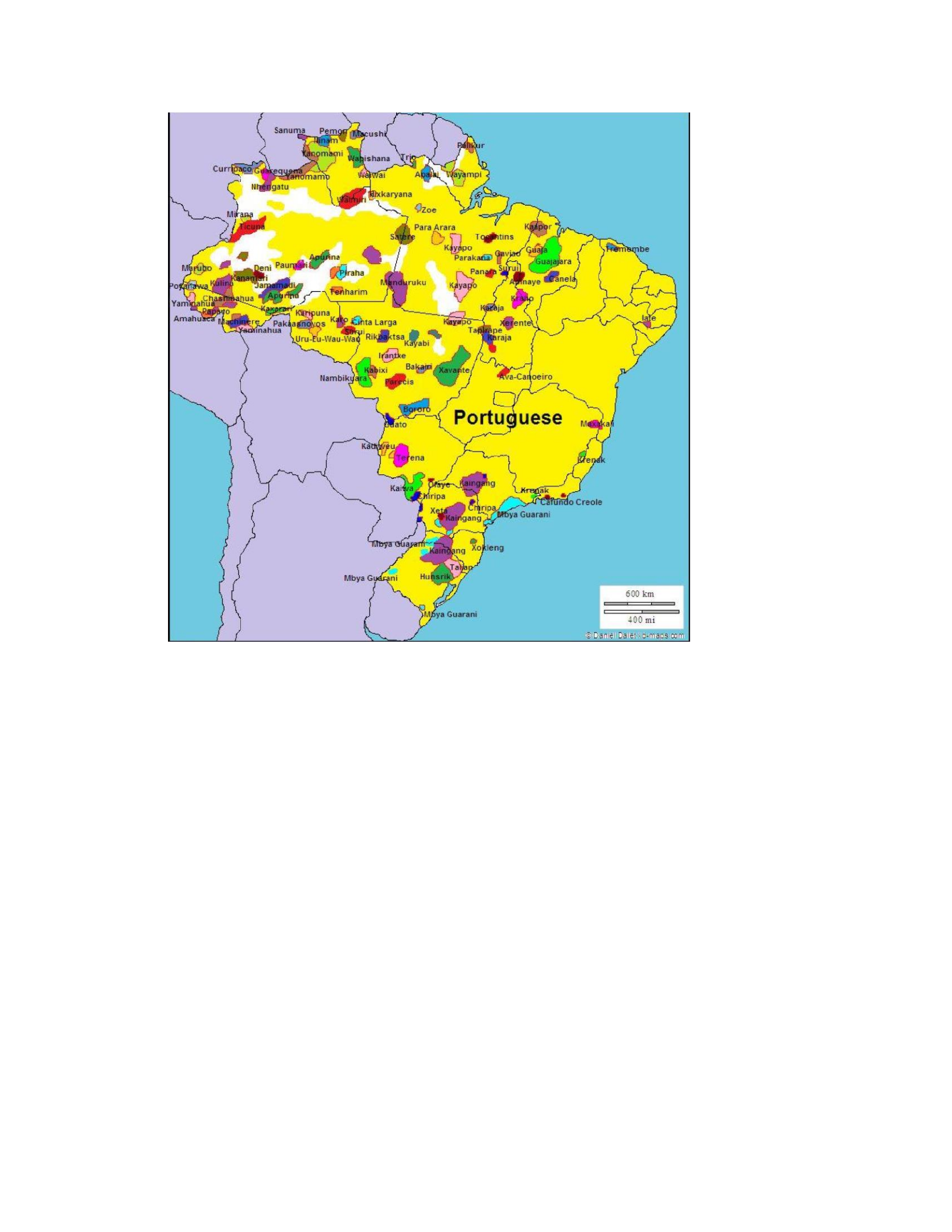
211
Map from the National Languages of the Americas
As shown in the demographic maps above, indigenous populations are very dispersed
throughout Brazil. Figure 29 shows the population proportion of indigenous peoples vis-à-vis
non-indigenous citizens across territories. There are very few where the population proportion is
high, and these regions are found within the Amazon region.
Due to aggressive state policies, there was an overall demographic decline of indigenous
populations that did not recover to pre-colonization until the late 1970’s and began to increase
again only in the late 1980’s to early 1990’s (Schwartzman and Pankakaru 1996). This shift is
roughly around the time of the adoption of Brazil’s indigenous rights in constitutional law. Since
these changes, scholars have identified an increase in indigenous identification in national census
data. Overall, there is an increase of 2% indigenous identification between national census data

212
in 2000 and 2010 (Bastos et al. 2017). Simply, this represents a change in national perspectives
on ethnic identification. National surveys were changed to ask which languages were spoken in
the home to measure indigenous populations, as opposed to the ambiguous mixed categories of
past surveys.
Of these indigenous populations, there are 305 recorded different original nations with
ancestral roots in Brazilian territory (Latinobarometro). This means that there are over 300 original
nations living in the state, with different languages, customs, and ancestry. Most populations reside
in the north of the country, where they make up 48.8% of the rural population, and 19% of the
urban population. Native peoples also constitute 33.8% of the northeastern urban population
(Bastos, et al. 2017; McSweeney and Arps 2005). Indigenous interests are therefore not only split
among the conflicting views of different nations, but also between urban and rural perspectives of
living.
In sum, political campaigns that dismantled native populations in the past, the presence of
hundreds of different indigenous nations, and splits between rural and urban interests signals a
potential coordination problem among indigenous groups. These factors are predicted to make it
more difficult for groups to focus political efforts, and negatively impacts rights outcomes.
Nonetheless, native citizens in Brazil have overcome some of these coordination problems to
obtain indigenous recognition and representation in national constitutional law. But strong groups
are needed for the adoption of resource and autonomy rights in the constitution, and these rights
are absent in current Brazilian law.
Brazil also lands in the mid-tier category for indigenous social movement strength. The
Harvard transnational movement database recorded the presence of 3 social movement
headquarters in Brazil, significantly more than in Chile, but less than in Bolivia, where there are
currently 6 headquarters (Harvard Transnational Movement Dataset 2020). This indicates a

213
presence of indigenous mobilization networks in Brazil, although not as strong compared to
other nations in the region, including Bolivia.
Table 20: Record of Indigenous Mobilization Headquarters in Brazil
HQ Name Year Est. Location
Committee for the Defense of Human Rights in the 1977 Sao Paulo, Brazil Southern Cone
Platforma Interamericana de Derechos Humanos, 1992 Rio de Jainero, Brazil Democracia, y
Desarrollo
Mercosur Social Forum 2003 Curitiba, Brazil
In more recent years, Brazil’s government shifted its policies to legitimize indigenous
political mobilization. In 1967, the government established the national indigenous foundation,
FUNAI, to formally negotiate rights with indigenous populations. Communities also benefitted
from domestic and transnational advocacy networks that promoted indigenous protection. For
example, the Catholic Church backed the creation of the Conselho Indigena Missionario (CIMI),
the indigenous missionary council, and the Ecumenical Center for Documentation and Education
(CEDI), the largest NGO in Latin America that tracks and documents indigenous issues (Rodriguez
2002; Schwartzman and Pankararu 1996). The state facilitated the creation of these state organs
long before constitutional provisions for native populations were adopted in 1988. They were also
created during the early years of authoritarianism, and social movements began to emerge in the
later years of military rule.
After Brazil’s transition out of dictatorship, indigenous movements emerged in earnest.
The transition from military rule also ended the state’s indigenous custodianship laws. As
legitimate political actors, community leaders began to attend congressional meetings whenever
important issues were debated. By the 1980’s, indigenous movement coalitions became key in
pushing for national constitutional reform. These far-reaching alliances included the Union of
Indigenous Nations (UNI), the Council for the Articulation of Indigenous Peoples and

214
Organizations in Brazil (CAPOIB), numerous scientific and environmental organizations, and
indigenous rights organizations such as CIMI, the Brazil and the Indigenist Work Center (CTI),
Oxfam, and Cultural Survival, among others. The main aim of the efforts of this coalition was to
procure indigenous representation in the national constitution (Carvalho 2000).
Thirty-five representatives from different original nations ultimately attended national
constitutional debates from 1987-88 (Alfinito Veira and Quack 2016; Rodriguez 2002). During
this time, native leadership became acquainted with political procedures, and institutional
frameworks. The 1987 constitutional debates, with sustained indigenous presence and mobilized
support, led to the state’s adoption of constitutional rights for these communities for the first time
in national history. The following excerpt describes the defense of proposed indigenous
amendments to the constitution.
“No dia quatro de setembro de 1987, chegara o momento da defesa das Emendas
Populares, perante o Plenário da Comissão de Sistematização. De todas as Emendas, as da
Nações Indígenas (n. 40) e Populações Indígenas (n˚39) foram as últimas a serem apresentadas,
num plenário esvaziado. [...] Primeiro a falar, o coordenador da UNI, Ailton Krenak, fez a defesa
da Emenda das Populações Indígenas. De paletó branco, ao discursar perante o plenário de
sistematização, Ailton pintava o rosto com tinta negra a base de jenipapo e declarava,
denunciando a campanha antiindígena deflagrada pelo Estadão,”.
“On September 4, 1987, the time had come to defend the Popular Amendments, before the
Plenary of the Committee on Systematization. Of all the Amendments, those of the Indigenous
Nations (n. 40) and Indigenous Populations (n˚39) were the last to be presented in an empty
plenary. [...] First to speak, the UNI coordinator, Ailton Krenak, defended the Amendment of

215
Indigenous Populations. In a white jacket, when speaking before the systematization plenary,
Ailton painted his face with a black ink genipap base and declared, denouncing the antiindigenous
campaign triggered by the Estadão,” (Barbosa and Gonzalez Brasil Fagundes 2018).
Despite the absence of a committee to speak their plights to, indigenous organizations
continued to make their case on a national stage. After sustained indigenous grassroots
involvement and pressure, the 1988 constitution recognized and provided some equal rights to
native populations. Article 232 of the document encourages the creation of indigenous
organizations on the local and regional level (Constitution of Brazil 1988). Post constitutional
recognition, indigenous mobilization networks continue to grow stronger in Brazil.
Since the late 1980’s communities have reacted when they are put in harm’s way. For
example, in 1989, the Kayapo peoples organized the first meeting of indigenous peoples of the
Xingu national reserve. This gathering was attended by over 600 community leaders,
government officials, and 300 national journalists to protest Eletronorte, a state-owned electric
company that planned construction in ancestral territories. These protests forced the companies
to change their plans.
Similarly, in 1996, indigenous citizens mobilized when over 1500 private lawsuits were
filed in Brazilian courts that made claim to indigenous lands and resources. The response was a
march of over 300 native community leaders and their supporters (Rodriguez 2002). Most
recently, strong indigenous mobilization took place in 2014, when indigenous groups stormed the
national congress building. Around 2500 protestors occupied the capital of Brasilia, and blocked
access to the state’s federal buildings and ministries. Indigenous protestors delivered a list of
demands to the Supreme Court, including the prosecution of two congressmen with a record of
making racist remarks against native communities. One member includes Senator

216
Eduardo Heinze, who claimed that “the government is in bed with the Blacks, Indians, gays,
lesbians, and all other losers”. After these protests, the government promised that all
antiindigenous legislation would not be approved without the full consensus of congress
members. (Hanna, Langdon, and Vanclay 2015; Rodriguez 2002).
The establishment of governmental organs that discuss indigenous issues, and the
legitimization of indigenous political movements and activism in 1988 reforms created avenues
for indigenous political activism. Despite small populations and high fractionalization, sustained
movements in Brazil helped pressure the state into the adoption of indigenous recognition and
representation rights in national law. But no further adoptions have been created in the Brazilian
constitution since, although movements continue to sit in on policy discussions, and react with
mass mobilization when the interests of native communities are endangered in legislative
discussions.
Indigenous mobilization in Brazil continues to rise, especially considering recent political
events. Under far right-wing President Jair Bolsonaro (2019-2022), indigenous populations
suffered. Bolsonaro’s political platform relied on radical changes to the state’s treatment of
indigenous populations in Brazil through heightened land and resource encroachment. Upon
election into office, he weakened FUNAI and de-legitimized indigenous claims to orginal lands.
His presidency was backed by non-indigenous ruralists, evangelicals, and the military, and
implemented ethno-centric political policies that revived anti-indigenous politics in the modern
era that ultimately . President Bolsonaro himself declared that “there will not be another square
centimeter of [indigenous land] demarcated,” (Domingos Neto and Gurreiro Moreira 2023).
Below, indigenous leader Jeonia Wapichana from the village of Wapichana describes
current demands of these movements, who have suffered under previous president Bolsonaro,
and hope for change under current President Lula da Silvia.

217
“Nosotros queremos acciones concretas, efectivas y necesarias ahora, no de aquí a 10
años. La COP coincidió con la entrada de Lula Da Silva y se lograron una serie de compromisos.
Él fue muy enfático en señalar que todos somos responsables de la crisis climática y Brasil cumple
un gran papel en la Amazonía. Y los pueblos indígenas son necesarios para proteger los bosques,
las nacientes de agua y el uso sustentable de recursos. Entonces hay que proteger a los defensores
de la Amazonía que están siendo asesinados. Están muriendo de malaria y de la contaminación
por mercurio. Hay que tomar acciones urgentes,”-Jeonia Wapichana del pueblo Wapichana (De
Lourdes Beldi de Alcantra 2023).
“We want concrete, effective actions, and these are needed immediately. The COP was
created in conjunction with the entrance of Lula Da Silva, and a series of commitments to
indigenous people were reached. He was very empathetic in pointing out that we are all
responsible for the current climate crisis and that Brazil plays a great role with the Amazon. And
indigenous peoples are necessary to protect the forests, water sources, and non-renewable
resources. So, you must protect the defenders of the Amazon that are being killed. They are dying
from malaria and mercury contamination. Urgent actions must be taken,”. - Jeonia Wapichana of
the Wapichana village (De Lourdes Beldi de Alcantra 2023).
There is hope that sustained indigenous involvement and appeal for representation at the
national level will continue the expansion of indigenous protections in Brazil’s constitution.
Statistical results in this work show that strong indigenous mobilization is associated with the
adoption of both resource and autonomy rights, both of which are not yet present in the Brazilian
constitution. Although indigenous movements are active in Brazil, the quantitative measure used
in the past chapter shows that indigenous movement presence is moderate in the country. The
evidence presented here suggests that indigenous movements in Brazil are not strong enough to

218
negotiate the adoption of indigenous resource and autonomy rights, both of which are associated
with strong indigenous mobilization.
But this case also presents contrasting evidence to the statistical results from previous
chapters. Simply, that moderately strong indigenous mobilization presence is associated with the
adoption of indigenous recognition and representation rights in 1988. Sustained indigenous
mobilization and involvement in the negotiation of this version of the constitution helped ensure
the adoption of these revisions. This case demonstrates the early importance of movements in
procuring rights. If the strength of these movements and their coalitions continue to grow, they
are likely to procure more rights in the future. But as of now, no further constitutional adoptions
have been made. Overall, the Brazilian case shows that indigenous mobilization is associated
with the adoption of indigenous recognition and representation but is perhaps not yet strong
enough to negotiate wider reaching provisions.
Indigenous Government Representation in Brazil
Like Chile, there is no constitutional law that ensures indigenous representation in national
politics in Brazil. The two countries also share a history of custodianship laws placed on
indigenous populations. In 1831, Brazilian legislators ruled that native peoples could not act for
themselves and were not allowed to own property (Rodriguez 2002). The state was the legal
caretaker of indigenous citizens, and like all states in this study, native populations remained non-
represented in national political discourse through state building.
But investment in indigenous representation in Brazilian politics shifted in 1967. The
government created Fundação Nacional do Índio (FUNAI, The National Indian Foundation) that
discusses indigenous political issues between indigenous representatives and state deputies. Soon
after the creation of FUNAI, el Cenro Ecumenico de Documentacao e Informacao (CEDI) was
created to document national information on indigenous populations in Brazil. CEDI began its

219
data collection on native issues in 1976 and remains one of the largest organizations that
documents information and statistics about indigenous populations in the region. Just two years
later after this, Brazil’s indigenous populations formed the first national indigenous organization,
the Union of Indigenous Nations (UNI) in 1978.
UNI increased the salience of indigenous issues in Brazil and coordinated efforts across
Brazil’s numerous indigenous nations. UNI’s creation coincided with waning support for
authoritarianism in Brazil and the opening of increased political opportunities for indigenous
citizens. Eight indigenous candidates formally participated in the 1986 elections for the
constitutional assembly (Rodriguez 2002). Though none were elected to be on the council in
1988, the Brazilian government adopted constitutional reforms that protect indigenous
populations. Community representatives also learned valuable information about the political
process.
But democracy in Brazil remains elite dominated, and no further adoptions were made to
ensure indigenous representation in politics since the 1988 reforms. Some significant change came
during the Lula presidency, which oversaw the legislature’s adoption of the UN’s ILO 169 in 2004
(UN). But the suggestions outlined in the convention are not yet ratified into constitutional law.
The adoption of the UN’s indigenous rights remains symbolic in Brazil.
President Jair Bolsonaro, however, actively spoke out against indigenous political
interests during his government. He infamously stated that the “American cavalry were the
competent ones because they eliminated their native populations, and now do not have this
[indigenous] issue in their country,” (Marquez and Rocha 2015). Indigenous representatives have
accused Bolsonaro of genocide caused by his policies that accelerated the destruction of the
Amazon Forest, home to most Brazil’s indigenous populations. At the beginning of his
presidency, Bolsonaro defunded institutions that protected the environment and indigenous

220
interests. Encroachment into indigenous lands accelerated during under his government, and the
situation escalated to the point that indigenous lawyers have taken their case to the international
criminal court (ICC) for the investigation of genocide and war crimes (Krenak Naknanuk 2021).
The progress if indigenous representation eroded under this presidency, and no new constitutional
rights were adopted.
In a close election, Lula was re-elected over incumbent Bolsonaro in 2022. The new
government took office on January 1, 2023. Many citizens are hopeful that there will be a shift in
the treatment of indigenous populations. In recent polls, 39% of the population stated that
President Lula had done more for native communities than other recent presidents (FPA 2010).
There is hope that the state will resume its adoption of indigenous protections established in
constitutional law under the new government. Indigenous communities hope that the change in
regime will result in the adoption of further indigenous protections and reverse the damage that
was done under the Bolsonaro regime.
“La politica de Bolsonaro, ha sido una política de muerte para los pueblos indígenas,
ahora vemos en Lula una esperanza......... Las políticas de pueblos indígenas tuvieron sus
comienzos en el reconocimiento en la constitución de 1988 y tuvieron sus avances con la
demarcación territorial pero estos procesos comenzaron a frenarse a partir de los años 2000,
cosa que no se había revertido durante los gobiernos del PT en Río Grande do Sul. Ahora con
Bolsonaro empeoró drásticamente en sólo un mandato y espero que sea solo este y nunca más
vuelva a acercarse a poder ganar algo en este país.”
"Bolsonaro's political platform has been a policy of death for indigenous peoples, now we
see hope in Lula............The policies of indigenous peoples had their beginnings of [political]
recognition in the 1988 constitution and had advances with territorial demarcation but these
processes slowed down from the 2000s, and this has not been reversed during the PT governments

221
in the Southern Rio Grande. Now with Bolsonaro, he drastically worsened our political status in
just one term, and I hope that he never comes close to being able to win in this country again," -
indigenous representative, Bruna Ukay (Delgado 2022)
Overall, low political representation in Brazil at the national level lend some evidence to
theoretical propositions that indigenous representation motivates rights adoption. There are
currently no national laws that require indigenous representation in national government bodies in
Brazil. Indigenous representatives bring relevant issues for their communities to the negotiating
table when they otherwise would be peripheral concerns the central government. The Brazilian
case partly supports this theory. But this case confirms the results of statistical models in chapter
three, that low representation is associated with constitutional rights that create democratic
equalities, like the recognition of native communities as political citizens, and representation rights
such as the right to health and education. This is exactly the outcome that we see in the Brazilian
case. Though representation of native populations in government is not constitutionally required,
there are some efforts at government implementation and the adoption of equal rights despite low
representation, such as the creation of deliberative bodies that discuss indigenous issues. Since
indigenous representation in Brazil is relatively weak, however, rights have not been adopted
beyond those that create terms of equal political access.
Resources and State Capacity in Brazil
Like many other countries in the region, Brazil has a government that is heavily invested
in its natural resources. But its dependence as a total percentage of its GDP only hits 5% between
2007 to 2008 at its highest point. Average rent dependence lands Brazil at around 3% total natural
resource rents as a percentage of its national GDP (WB). The state has a fairly high extractive
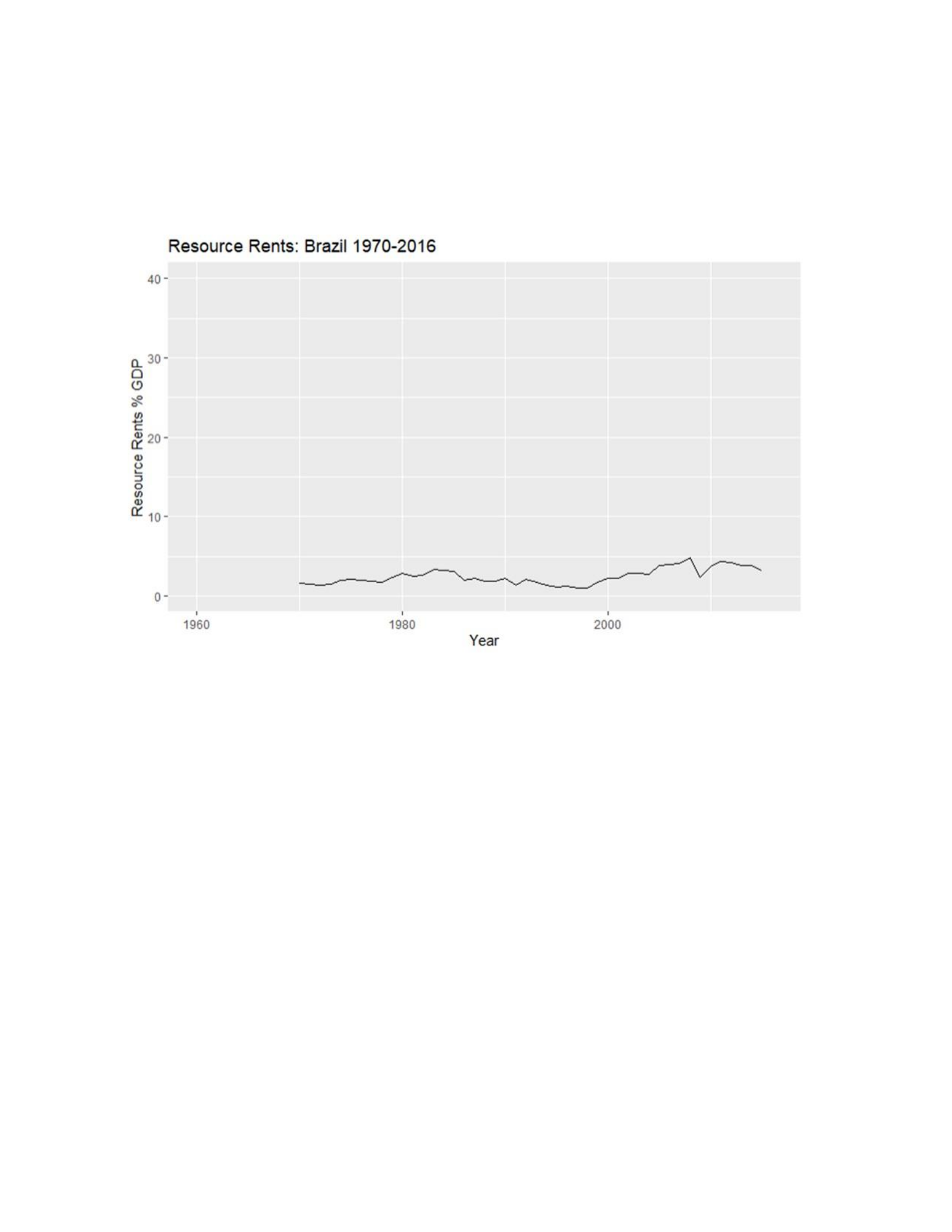
222
capacity compared to other countries in the region, although it is lower than Chile’s on average
(WB).
Figure XXIX:
Although indigenous activism and constitutional rights have been present since the
1980’s in Brazil, state interests regarding resources still threaten the well-being of these
communities and endanger their way of life. During the 1987 constitutional debates, two laws
were proposed to protect Amazon regions from indiscriminate mining projects. But these laws
were ultimately rejected, and congress continues to have sole approval power over state led
extractive programs (Constitution of Brazil 1988).
After Brazil’s democratic transition, indigenous mobilization faced ongoing resistance
from the military, which pursued state sponsored mining projects, and land claims from regional
military political elites from the former regime. Although the 1988 removed policies that
promoted indigenous land fragmentation, private titleholders and military leaders contested

223
indigenous land claims that resulted from the revised laws. These lawsuits cited the need for the
protection of private property and economic efficiency over the limited interests of indigenous
communities (Constitution of Brazil 1988; Schwartzman, Araujo, and Pankararu 1996). The
contestation against indigenous claims to land and resources continue, and legal cases remain in
the hands of Brazil’s state department of justice, per constitutional decree.
In addition to petitions against native land claims in the judicial branch, there are numerous
lobbyists in Brazil’s national congress that actively work against the adoption of indigenous rights.
These groups include large contractors and companies in the hydroelectric and foresting sectors.
Recently, the legislature approved the creation of the Xingu River mega-dam to be built in
ancestral lands. The project was completed in 2016 and was voted through Brazil’s legislature as
in the best interest of national well-being (Hanna, Langdon, and Vanclay 2015).
Mass military campaigns against native communities to secure natural resources and land
have not occurred since democratization in the early 1990’s. But state police forces still
demonstrate the capacity to suppress indigenous political activity when challenged. During the
2014 Brasilia protests led by indigenous community leaders, police greatly outnumbered
protestors and quickly suppressed the crowds. State police were heavily armed with tear gas, crowd
control bombs, rubber bullets, and 3 helicopters that it used to silence the protests (Hanna,
Langdon, and Vanclay 2015). Though the government ultimately gave in to some indigenous
demands, the state clearly demonstrated that they have the advantage in violent capacity. Statistical
evidence shows that state capacity in Brazil trends on the slightly higher than average side relative
to other regional cases.
Figure XXX:
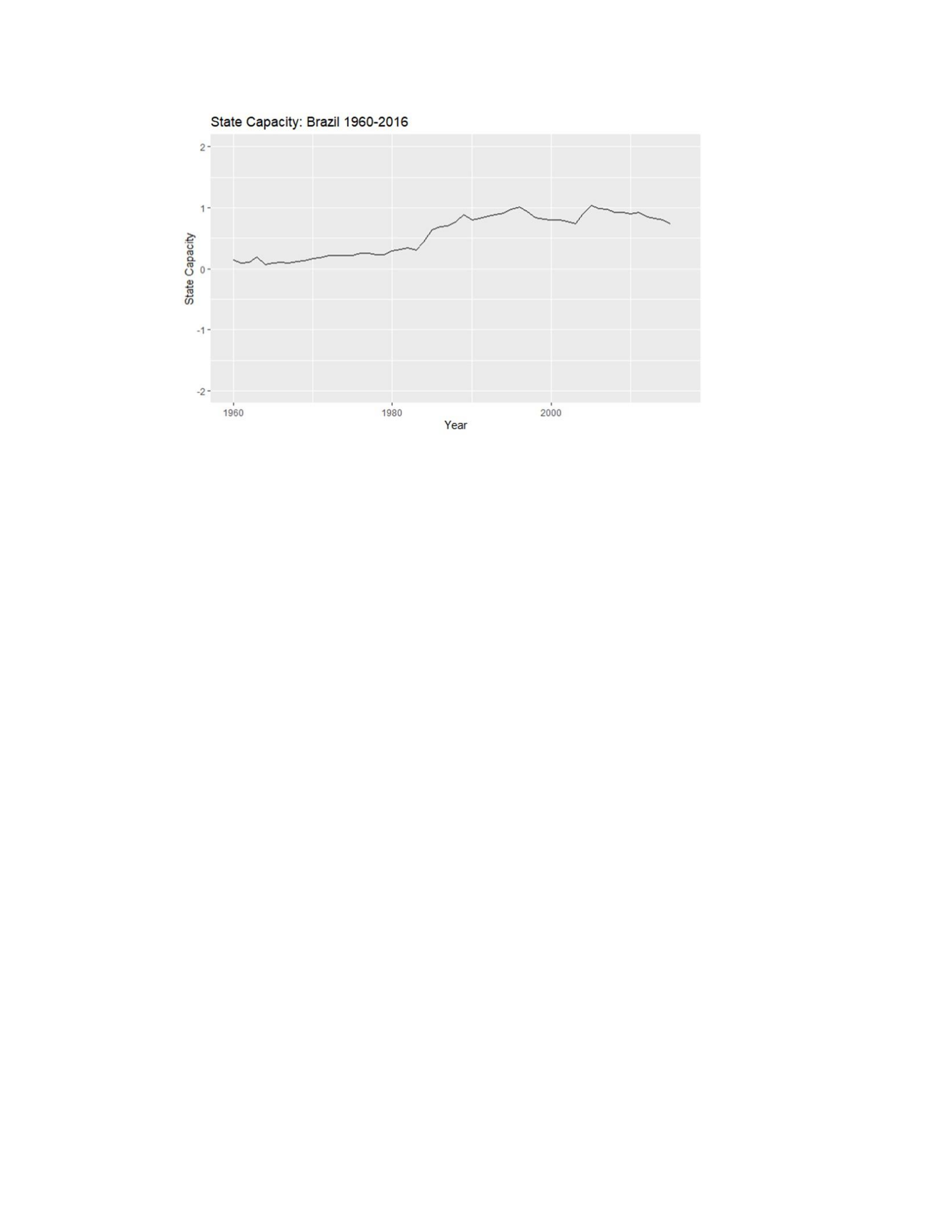
224
Currently, the non-protection of indigenous lands and resources in constitutional law
facilitates the exploitation of their resources and sacred lands. Continued land invasions, illegal
mining activities, and the compounded crisis of the Coronavirus pandemic, have created an
ongoing emergency for vulnerable indigenous communities. Increasingly, the invasion of
indigenous lands has created dangerous health conditions for these vulnerable populations
(Machado and Loures 2020). Below, an indigenous representative from these endangered
communities where mining activity has increased describes her point of view.
“Quando o vice-presidente diz que lideranças Munduruku apoiam o garimpo, é mentira.
Essas pessoas que são ouvidas pelo governo não são respeitadas pelo povo Munduruku, menos
ainda pelos caciques, pois não são consideradas lideranças. Isso porque liderança é aquele que
luta pela vida de seu povo, aquele que luta pela defesa de seu povo, não destruindo o território e
muito menos defendendo os empreendimentos do governo.............. Sendo mulher e mãe, mesmo
com os filhos no colo, sempre acompanhei os caciques nas reuniões e nas ações contra as
invasões, contra a destruição da mãe terra, sempre denunciamos à mídia e à imprensa que o

225
governo não estava e não está fazendo nada pela defesa do território e pela defesa da vida dos
povos indígenas. Quando ocorrem as assembleias sempre tem essas denúncias,”.
“When the vice president says that the Munduruku peoples were consulted, this is a lie.
This is because these [government] meetings are very small, and the caciques never participate.
In the big meetings, with the real leaders, those people who defend the mining projects go to these
meetings just to cause harm. The caciques decide for the majority, but those leaders with other
interests will always go there to interfere. We, the women, leave our homes, leave our children,
and go along with the warriors to protest and expel these miners from our land..................Being
a woman and a mother even with my children in my arms, I always accompanied the chiefs to the
meetings and actions against invasions, against the destruction of mother earth, we always
decreed to the media and the press that the government was not, and currently is not, doing
anything for the defense of the territory and lives of indigenous peoples.
When the assemblies take place, there are always complaints such as these,” Kabaiwum
Munduruku of the Munduruku village (Machador and Loures 2020).
Indigenous communities recognize the need to expand constitutional rights to further
protect their lands and resources from continued encroachment. The health of these populations
is closely linked to the environmental integrity of these resource rich regions, a fact which is not
currently recognized in Brazilian constitutional law. Efforts to ensure the protection of indigenous
land and resources is a current point of contention in Brazilian politics.
Overall, resource rent dependence in Brazil is on the lower side compared to the other
cases examined in this work. But its strong state capacity and consistent involvement in
indigenous, resource rich regions, alongside ongoing private suits against native land claims in
court suggest that the state is likely to resist the adoption of future indigenous provisions in the
constitution. Moreso, the state, while not having engaged in massive violent campaigns against

226
native communities in defense of national claims to land and resources, has demonstrated the
capacity for violence and suppression against indigenous protests when needed. State security
forces are equipped to deal with politically active minority populations and can sufficiently
suppress indigenous mobilization, as demonstrated in 2014. Statistical models in chapter 3 show
that states with a strong state capacity are less likely to adopt any types of indigenous rights into
constitutional law. In Brazil, native peoples are recognized and afforded some representative
rights like the protection of culture and education in the 1988 version of the constitution.
Therefore, this case partly supports quantitative conclusions. Rent dependence is on the lower
side, but the government continues to show vested interest in the resources overwhelmingly
located in indigenous territories. Consistent with previous statistical results, state investment in
natural resources first motivates the adoption of rights that establish equal citizenship, like
recognition and representation rights, but is not associated with the adoption of resource or
autonomy rights. Brazil’s government was willing to adopt some rights that establish equal access
to Amazonian regions but have failed to legitimize indigenous claims to the futures of those lands
and resources.
Public Perception of Indigenous Rights in Brazil: Future Potential Protection?
Next, I will use recent public opinion data to further explore the evolution of indigenous
rights in Brazil’s constitution. This includes an analysis of current attitudes on indigenous issues
and the potential for rights to evolve beyond those already adopted.
Many Brazilian citizens recognize that there is currently injustice in Brazil’s political
system against its indigenous populations, even though indigenous populations have some
representation in the current iteration of the nation’s constitution. In a recent survey, 79 % of
respondents said that injustice against indigenous populations exists, depending on the region in
which they reside. Before Jair Bolsonaro’s presidency in 2019, many citizens considered that the

227
situation for native populations had improved, especially under President Lula from 2003 to
2010; 43% of respondents note their condition as improved under the Lula regime (FPA 2010).
Under Bolsonaro, on the other hand, indigenous land recognition came to a halt, enforcement of
existing land protections was eroded, regulations were dismantled, and no further constitutional
protections were adopted into law.
Though injustice against indigenous citizens is widely accepted as an issue in Brazil, many
remain oblivious to their current demographics or specific political pursuits. Basic
knowledge about the status of indigenous peoples is strikingly low. For instance, 61% of
respondents in a survey data report that they have no idea how many native citizens reside in
Brazil today. Moreover, 43% of respondents do not know what current indigenous rights and
national directives exist in national law. But most think the government needs to defend whichever
rights the state has adopted for native communities under the 1988 constitutional text (FPA 2010).
There is some supportive evidence that Brazilians both recognize some indigenous issues
that are not yet protected in constitutional law. But many see universal issues as most important
for indigenous communities, including equal access to health, and education that are already
protected in the current version of the constitution. When it comes to citizens recognizing
indigenous issues outside of those rights already adopted into law, a large proportion of
respondents noted that land conflict and invasion as issues in need of the most attention (34%).
Land rights are not currently defined for indigenous populations in constitutional law. Their
adoption would be an expansion of indigenous rights provisions to include resource protection,
depending on the substantive content of the adopted laws. But many citizens consider access to
basic universal rights such as healthcare (29%), education (18%), anti-discrimination policies

228
(16%), and the protection of culture (15%) as the primary issues that need resolving (FPA 2010).
The protection of these basic rights was adopted in 1988 alongside the recognition of indigenous
populations as political citizens. This signals public attitudes that lean toward keeping indigenous
rights equal in nature. In broad strokes, while some citizens recognize land claims as the most
important issue that needs to be solved for Brazil’s indigenous populations, many consider issues
that impact all citizens as more important, such as universal healthcare, education, and job access.
The results of public attitudes are overall mixed, with some recognition of the need to expand
protection beyond current constitutional arrangements, and others seeing universal, already
adopted rights as in need of the most governmental attention.
The public broadly perceives the need for the government to protect indigenous
populations from private business interests. Most citizens do not blame the federal government for
current indigenous struggles. Instead, most respondents in a recent survey blame large foresting
companies (44%), compared to only 11% who state that the government is at fault (FPA 2010).
The federal government is seen as an entity that needs to come in and defend indigenous citizens
from the exploitation of large extractive companies, instead of being a part of the problem
preventing indigenous freedoms. These responses also show attitudes that the government need to
address protecting indigenous populations from private interests as a strategy for improving their
status.
Public opinion research tells us a few things. First, citizens recognize that there is injustice
against native populations in Brazil under the current constitutional arrangements. But while some
recognize indigenous aspirations such as land and resource protection that go beyond those laws
in the current constitution, others cite issues such as access to healthcare, and education as
preeminent. This also indicates some preference toward universal rights, versus rights that
establish special indigenous land and resource access. Next, most respondents see large foresting

229
companies, or madeireiras, as the primary threat to indigenous wellbeing. Only a small number of
respondents see the federal government as a primary problem, but rather consider it the force that
protects indigenous communities from private interests. While some citizens note the need for
indigenous rights to land, a significant portion stress instead the need for access to neutral universal
rights versus autonomy.
In sum, Brazil’s citizens are highly supportive of the government serving indigenous rights
to education, healthcare, and non-discrimination. A significant number of respondents did identify
indigenous land issues as the most pressing issue facing these populations. This is evidence that
there may be some public tolerance for the expansion of indigenous constitutional citizenship to
include rights that protect ancestral territories and resources. However, significant numbers of
respondents in this survey data identified universal issues as the most important, so the evidence
is mixed. Importantly, Brazilians stress the need for the government to protect indigenous
communities from private interests. This contrasts with state, or national interests, that are carried
out for the general good of the population. Finally, a significant proportion of citizens know little
about the current status of indigenous constitutional rights in Brazil. Overall, I conclude that there
is some recognition for the expansion of indigenous rights beyond their current definition in
Brazil’s constitutional protections despite this fact. But many citizens' perceptions align with the
continued protection of current rights and against private interests, but they do not consider the
need for protection against state encroachment in the name of national interests.
Though mass support is not the only indicator of the likelihood of indigenous communities
to gain expanded in the near future, public opinion indicates the salience of these issues on the
ground. Under democratic institutions, politicians are not likely to respond to demands that are
not universally popular among their constituents. However, in the future, other work should

230
further study indicators for the implementation of indigenous constitutional protection, including
the independence of the legislature.
Discussion
The case of Brazil supports theories of incremental rights adoption. Here, indigenous
recognition was adopted alongside various representation rights that expand equal democratic
citizenship to previously excluded groups. Recognition of indigenous populations as political
citizens is either adopted first or alongside other representative provisions, as seen in this case. If
indigenous constitutional rights expand in Brazil, it is likely that they will take form as resource
rights, as recognition and representation rights are pre-established.
Public opinion polls show some recognition of the need to address indigenous issues
concerning land titles and rights, but many also see universal rights such as healthcare, education,
and representation as the most important issues in need of solving. Overall, polling data is mixed,
but leans the preference to address very limited indigenous issues that do not recognize the federal
government as an instigator to current problems. Surveys suggest that some of the public
recognizes the need for further protection of indigenous ancestral lands, but the federal government
is largely not considered an instigator. These perspectives may create issues for future
constitutional changes that define indigenous resource and autonomy rights.
Per theoretical expectations, democratization in Brazil coincided with the adoption of
indigenous rights that are compatible with modern democratic ideals of equal citizenship.
Democracy is expected to be associated with indigenous rights that promote equal access to
political goods and representation. But it does not motivate the creation of indigenous rights that
correct historical economic and political inequalities or create divisive national identities. Thus
far, this is the case in Brazil. Without other motivating factors, rights that establish political
access based on indigenous status have not been adopted.

231
The indigenous population proportion in Brazil is low and is highly fractionalized among
hundreds of different nations. Additionally, movements were historically repressed under
restrictive authoritarian regimes. But recently indigenous mobilization networks have emerged.
Brazil is recorded as a mid-level country for indigenous mobilization strength, per recorded
mobilization headquarters from the Harvard transnational dataset (2020). Additionally, indigenous
mobilization was legalized prior to the state’s democratization, and protest activity continues
despite heavy state suppression. Indigenous movements and coalitions of NGOs and other
environmental groups were key in pushing for indigenous protection in 1988’s iteration of the
constitution. However, they have not yet gained the momentum needed to motivate state
implementation of more rights for their communities. These groups are expected to continue to
grow in strength, and push for the adoption of more indigenous protection in constitutional law in
Brazil in the near future.
There is still no required indigenous representation in national government in Brazil. As
in earlier chapters’ statistical models, low indigenous representation in government is associated
with the adoption of indigenous recognition and representation rights. This is the case seen in
Brazil. Furthermore, strong indigenous representation in government is associated with
indigenous autonomy rights in the constitution. Absence of strong indigenous representation in
government is associated with the non-adoption of these rights, which is the current case in Brazil.
Future work should continue to watch these shifts in indigenous representation in the country,
which are changing in recent years. It is likely that with increased indigenous representation in
national political bodies, issue salience will increase and motivate the expansion of constitutional
protections for these populations.
Last, government policies show a direct interest in the extraction of lucrative resources,
particularly in the Amazon regions predominantly occupied by indigenous communities.

232
Additionally, the comparative state capacity of the Brazilian government is on the higher end in
the region and has been used to suppress indigenous uprisings and occupy indigenous territories
in recent years. In broad strokes, a strong state capacity and interest in natural resources has
blocked the adoption of resource autonomy rights for indigenous populations that protect original
lands from encroachment.

233
Chapter VII: Chile
"Pinochet tried to homogenize us by saying that we are all
Chileans and that there is no room for any other identity. Many
Mapuche had to abandon their language and culture because
expressing it was linked to communism and could put their lives at
risk," Jaime Cuyanao, of the Mapuche nation.
Intro
The Chilean case represents the low-level indigenous rights outcome. The active
constitution has no formal recognition of indigenous populations. Taking a case level view of a
null case such as Chile allows important insights to be gathered from an outlier country, which
can inform further comparisons in the future. This analysis is part of the nested design used in
this work, which joins statistical analysis with in depth study of causal mechanisms on the
ground (Lieberman 2005).
Currently, Chile is one of only two nations in the Latin American region to not recognize
its indigenous population in constitutional law. Recent attempts to replace the Constitution in
2022 were rejected by Chilean citizens and leaves the status of native peoples in the state
unchanged. They have no legal right to their culture, language, lands, or resources, and remain on
the periphery of state politics. Moreover, recent attempts to legalize a new, highly inclusive
document that established social rights for all citizens, as well as numerous protections for

234
indigenous groups was rejected. Concerns centered around the opinion that some indigenous
rights were “too much for too few” and ran the risk of dividing national interests (IPSOS 2022;
NYT 2022). But indigenous groups in Chile continue to push for their recognition on the nation's
current constitutional council despite these setbacks.
First, this chapter will summarize the colonial and state building process in Chile, and how
this process excluded indigenous populations from constitutional representation. Then, I discuss
the non-adoption of indigenous rights in Chilean constitutional law over time. The arguments of
previous chapters posit that the content of indigenous rights have implications in their likelihood
of adoption. Additionally, rights should be adopted via an incremental process that expands
indigenous access to political resources in steps. Since there is an absence of both indigenous
provisions in the constitution, and only a failed constitutional referendum in recent years that did
not follow the path of incremental adoption, public opinion data is used to fill the gaps. Recent
polls offer insights into national divides over the content of the recent proposed draft of the
constitution that failed to pass. Results show that there is a divide over the content of some
proposed indigenous rights in the constitution that are seen as “too much for too few”.
Additionally, respondents rejected the suggestion of providing extensive rights to original
populations, like regional autonomies, as a political group that was previously excluded from
protection. Simply, Chile has not adopted indigenous rights into national constitutional law as of
2022. A proposed document that included sweeping protections for these communities was
rejected, with the absence of incremental adoption and overrepresentation of indigenous groups
seen as main issues.
After establishing the current status of indigenous representation in Chile, I move to
examine domestic factors that were found to be key in the rights adoption process. These include

