


1
Chapter 1: Introduction to the Study
Background
Ravensbergen and VanderPlaat (2010) alluded to the benefits of a working
relationship between the people and public institutions. If the public was involved in
policy design, they were more likely to support interventions that were put in place by
these public institutions related to the policies, whose design the people were involved in.
This position has been supported by Guo and Neshkova (2012), who noted that there was
a need to find the right balance of participation of the people in policy design as the
resultant effect was supportive of government interventions. In this analysis, the
nongovernmental organizations played an important role in ensuring that policy design
opportunities were known by the people, that the knowledge resident with the people was
effectively injected into policy design, and that trust between the people and the
government was sustainably nurtured during design of policy and eventually in policy
implementation (Alexander & Nank, 2009; Chaskin, Khare, & Joseph, 2012; Guo &
Neshkova, 2012; Ravensbergen & VanderPlaat, 2010). It has been shown that views of
the public on policy priorities and policy proposals, were relevant, but were also
dependent on policy relationships, either between people and public institutions, between
public institutions and nongovernmental organizations or between the people and the
nongovernmental organizations (Alexander & Nank, 2009; Chaskin et al., 2012; Guo and
Neshkova 2012; Ravensbergen & VanderPlaat, 2010).

2
People as a Source of Knowledge
The concept described previously of ensuring that perspectives of the local
population were received, synthesized, and taken up in policy design has been termed by
Guo and Neshkova (2012) and Mehrizi, Ghasemzadeh and Molas-Gallart (2009) as a
bottom-up approach to policy development. Ravensbergen and VanderPlaat (2010) noted
that there were multiple benefits that were associated with inclusion of the voice of the
people in policy design in a bottom up policy design approach. They specifically
highlighted that people were quite knowledgeable especially about those things that
affected their quality of life. This includes the kinds of options that needed to be
examined in relation to getting solutions to these circumstances and the kind of life that
they would live if such circumstances were dealt with. These views have been
emphasized by Alexander and Nank (2009), who outlined that the public possessed tacit
knowledge on a variety of life issues based on their lived experience. According to
Ravensbergen and VanderPlaat, such individuals were experts in their own right and in
the environment within which they dwelled, and they possessed information that could be
used to develop responsive and targeted action that yielded meaningful results (p. 390).
People as Policy Design Stakeholders
The notion of meaningful participation is further explored by Chaskin et al.
(2012) who regard the people as stakeholders in policy design. They advanced the idea of
having a robust public engagement environment, and a due process of engagement of the
public as active participants in policy design (p. 867). Their point of view also pertained

3
to ensuring that there were deliberate actions such as provision and availability of
necessary information. This they deemed as a key enabler for participation of the people.
Chaskin et al. (2012) highlighted, however, that direct participation of the people may at
times occasion additional marginalization especially if information on policies
themselves and requirements for engagement was not adequately available. This then
made the case for participation through representative institutions, the nongovernmental
organizations that kept a day to day engagement with public institutions in policy related
matters.
Nongovernmental Organizations as People Representatives in Policy Design
Following from the previous analysis, Kamruzzaman (2013) examined the issue
of engagement of the public through nongovernmental organizations in the context of
development of poverty reduction strategy papers (PRSP). Kamruzzaman noted the
connection and relationship emerging between the public and the nongovernmental
organizations in policy design. Advancements in these relationships have seen the
nongovernmental organizations regarded more as the de facto representatives of the
public in matters of policy (Kamruzzaman, 2013, p. 32). Kamruzzaman noted that
nongovernmental organizations collect and collate their (public) views, assess their
circumstances and direct their concerns in policy design environments. This relationship,
and the need for expanded spaces for nongovernmental organizations’ engagement,
advanced the notion of the bottom up policy development approaches articulated by Guo
and Neshkova (2012) and Mehrizi et al. (2009). The benefits of the emergent people-

4
nongovernmental relationships have been linked to enhancing mutual accountability in
policy. This relationship becomes additionally important in policy implementation where
interactions continue between the people, nongovernmental organization and the public
institutions, all of whom are key stakeholders in public policy (Kamruzzaman, 2013;
Kpessa, 2011).
External Environment and Policy Design
The environment against which public engagement through nongovernmental
organizations occurs is central in realizing aspiration of policy development. From the
onset, the research focused on a society with high poverty levels (Ravensbergen &
VanderPlaat, 2010) and also, socioeconomic characteristic of a mixed income society
(Chaskin et al., 2012). Such backgrounds define the people and their overall context and
as such forms important factors for consideration in policy design. Hajer (2005) noted the
importance of keeping aware of the technical, physical and theatrical or dramatic
background against which participation occurred as this could advance or curtail
participation (p. 625). The external environment, in this case the socioeconomic
characteristics, political circumstances, the policy context, requires specific
consideration. Hajer recommended the need to expand the voices that were coming into
the policy design situation in order to be able to deal with all the peculiarities of the
contexture and the importance of adaptable techniques of engagement and dialogue.
The role of the nongovernmental organizations in creating an environment that
expanded the views of the people and systematically channeled their voices into policy

5
cannot be overemphasized. Kamruzzaman (2013) echoed the centrality of
nongovernmental organizations in this analysis but also cautioned against overreliance on
this mechanism for enhancing public participation. He was opined that the political
environment was a critical determinant to, if, and how, participation would take place in a
policy design environment.
Looking closely at the theoretical framework that was adopted for this research
under Kingdon’s (1995) multiple streams framework, the three streams that need to be
taken into consideration in policy design were policy, politics, and problems. These
streams have to optimally combine to create a suitable environment for policy
development, amidst often chaotic policy environments (Kingdon, 1995). The external
environment has been cited as having the potential to brew mistrust across the three key
policy stakeholders, the people, the nongovernmental organizations, and the public
institutions. Woodford and Preston (2013) contend that years of limited engagement
between the people and the government, and policy implementation that did not give
priority to the people may brew mistrust between the people and their government. Their
analysis may be used to note and advance the role of nongovernmental organizations in
creating an environment that enhances such trust. On the other hand, Alexander and Nank
(2009) emphasized the significance of developing the people-nongovernmental
organization engagement in a manner that advances the principles of representation and
participation of the public in policy design environments.

6
Problem Statement
In 2010, Kenya adopted a new supreme law, the Constitution of Kenya 2010. One
of the provisions of the constitution called for inclusion of the public in all matters of
governance, including review of all existing legislation, and development of any new
legislation (Government of Kenya, 2010). This approach to policy development, where
priories from the public, derived from systematic public engagement, are reflected in
policy design has been referred to as a bottom up approach (Guo & Neshkova, 2012;
Mehrizi et al., 2009). Despite this well intended provision, meaningful involvement of the
public in policy development has largely failed to materialize (Commission for the
Implementation of the Constitution, 2015, pp. 99-101). Furthermore, there has not been
any adequate overarching policy framework and county specific adaptation to guide
realization of this constitution principle. The result of this has been a sustained top down
public policy development (Alexander & Nank, 2009; Chaskin et al., 2012;
Kamruzzaman, 2013).
Previous research demonstrates the importance of stakeholder engagement in
policy design, including nongovernmental organizations (Kamruzzaman, 2013).
Alexander and Nank (2009) emphasized the importance of building confidence in
citizens that governments would act in their favor but based on articulating an
understanding of how that may be achieved through relationships between
nongovernmental organizations and government in this respect (p. 365). In Nairobi
County, it remained unclear whether there was any policy relationship between the

7
Nairobi County government and nongovernmental organizations and how this
relationship influenced a bottom up approach to development of county government
policies.
Purpose of the Study
The purpose of this study was to improve the understanding on how public
participation was influenced by the relationships between nongovernmental organizations
and the Nairobi County government, while designing the Nairobi County public
participation policy.
Research Questions
The following three research questions guided this research:
a) How do the County Government of Nairobi and NGOs intend to work
together in designing a legally mandated Nairobi County Public Participation
Policy?
b) How do the County Government of Nairobi and NGOs describe the perceived
impact of their relationships on prospective public participation in local
governance?
c) How do the organizational cultures of the County Government of Nairobi and
NGOs affect their working relationship in designing a public participation
policy?

8
Theoretical Framework
Kingdon’s (1995) multiple streams framework situates three streams of policy,
politics, and problems in a policy development context, expressing the importance of
leveraging policy moments that emerge when the three streams converge to facilitate
policy design (Zahariadis, 2014). According to Kingdon, problems in society as
articulated in the problem stream converges with the political willpower to address the
societal problems and supported solutions to public policy based on a prevailing policy
change opportunity. In this analysis, as the three streams interact, policy relationships
form, and these are a central element in whether the policy moments are seized, and to
how policy priorities make their way up the prioritization mechanisms. Kingdon noted
that neither was this process automatic, nor was it based on any predictable pattern.
Kingdon did, however, note that such moments had to be taken advantage of when they
occurred. The theoretical framework notes the centrality of policy stakeholders across
these three streams. Policy stakeholders’ relationships was the main interest of this
research, seeking to understand how this unfolded in the design of the Nairobi County
public participation policy. Applying the theoretical framework, the research examined
policy stakeholders’ ability to influence each other, their ability to sustain policy
priorities defined by members of the public as important policy options in the design of
the Nairobi County public participation policy, and how feedback loops retained public
engagement to the time the policy design process was complete. The preceding literature
review supports Kingdon’s view by evaluating the need and functionality of partnerships

9
between the three main policy actors: people, government [politics] and nongovernmental
organizations.
The study adopted Kingdon’s (1995) model to assess how the relationship
between the county government and the nongovernmental organizations affected
participation of the people during design of Nairobi County government’s policy on
public participation. Understanding such a relationship enabled the researcher to derive
the implications of participation of the people in policy design, based on how policy
actors interacted. Previously, Kingdon’s theory has been tested and applied in the
developed countries’ context. Ridde (2009) assessed the applicability and transferability
of Kingdon’s theory in an African context, in a low-income country. Findings proposed
adequacy of applicability of the theory in policy design and research in the African
contexts (Ridde, 2009). Zahariadis (2014), on the other hand, examined and noted the
wide application of the theoretical framework in informing public policy design studies
across multiple policy environments, in many parts of the Western world.
Nature of the Study
The study was grounded in the qualitative research tradition. From the onset, the
scholarly work that had been reviewed had all been executed through qualitative research
methods. As a case study, the choice was to focus on the single bounded real-life issue of
public participation, within the design of one policy in Nairobi County, where
engagement relationships and influences were assessed (Creswell, 2013, pp. 97-98). The
research sought to capture the perceptions of people working in nongovernmental

10
organizations on the existing relationships with the government and the subsequent
influence of those relationships on the public’s engagement with policy making.
Types and Sources of Data
The research sought to generate information and data through a mixture of
approaches aimed at triangulating participation perspectives and enriching the context
and description of the case study (Creswell, 2013; Patton, 2002). Sources of data
included:
1. Interviews with selected members of the public participating in the process of
design of the Nairobi City County Public Participation Act of 2015.
2. Interviews with representatives from selected nongovernmental organizations
engaging with the county government in development of the public
participation policy for Nairobi County.
3. Interviews with government officials from the county government responsible
for the policy development.
4. Records, reports, publications and media accounts of the county government
affairs from the Nairobi County government generated from the process of
designing of the Nairobi City County Public Participation Act of 2015 and
National government as necessary on the development of a national policy on
public participation.
5. Reports and other publications from international institutions such as the
United Nations on legal and policy approaches to public participation.

11
6. Nongovernmental organizations’ reports, publications, and other documents.
Definitions
This research sought to generate and further knowledge on interaction between
the public and institutions of governance such as the nongovernmental organizations in
the development of public policy. Below are key terminology that will often be used in
the subsequent sections of this research:
The public: Key characteristics that define the public in this research include,
individual’s resident in Kenya, particularly in Nairobi County, possessing tacit
knowledge based on their lived experience (Nank, 2009), who are experts of their own
design (Hall, 2009; Ravensbergen & VanderPlaat, 2010) and are regarded as policy
stakeholders either directly or through their representatives (Kingdon, 1995).
Public participation: Are actions that create an enabling environment for which
the public either individually, as an organized group or organized through representative
organizations convene their ideas and submit for debate and consideration in the process
of development of public decisions and/or public policies (Snider, 2010).
Public policy: While often complex to define, considering its multiple
perspectives and applicability, public policy in this research is considered as those
decisions taken by government on behalf of its people or the public, that seeks to address
a common problem on the long term (Birkland, 2016; Kingdon, 1995).
Nongovernmental organizations: Are defined in this research as institutions
established not to make profit and whose function is to facilitate national development by

12
contributing and strengthening the interaction of the public with government and the
private sector in development, implementation and monitoring of public policy actions.
NGOs are considered therefore to possess certain expertise that may not be resident in the
public that they represent or government or the private sector (Bevir, 2011;
Kamruzzaman, 2013).
Assumptions
Public participation entails a cooperation between institutions, experts, and
individuals. It is demonstrated through the literature review to be a factor of politics,
systematic arrangements, willingness of parties to collaborate, and a couple of other
factors. From an ontology angle, the assumption therefore relates to the public feeling
self-compelled to engage in policy design, to consolidate their perspectives on the issue at
hand (among many) – participate out of their own accord, and to engage in actual policy
design individually through direct participation; or jointly, as a group, through
nongovernmental organizations that represent them in policy design debates (Creswell,
2009; Culbertson, 1981). This is also in part a recognition that there exist multiple other
realities that the public interact with in the realm of policy for development. From an
epistemological point of view therefore the assumption is that knowledge exists within
the people, based on their interactions with the reality of their interaction with their lived
experiences (Creswell, 2009; Culbertson, 1981). The contrary is also an assumption that
the NGOs would be engaging in policy design on their own conviction that this is the
right thing to do. This also coupled with the perspective that doing so would increase the

13
chance of the lived experiences of the public being better canvassed by them as
representatives of the public. This including in instances where all public are unable to
participate due to various circumstances. Further, an assumption was made that human
meaning of the participation phenomena would be adequately captured through
deployment of a case study approach and thus manifesting the interpretivism paradigm in
reaching full understanding by the end of the research (History and Foundations of
Interpretivist Research, 2007; Mills, Durepos, & Wiebe, 2010). In addition, John
Kingdon’s Multiple Streams Approach (MSA) (Kingdon, 1995) was used in advancing
this study. The application of the MSA in this research assumes a fit of its principals
when deployed through this research in a developing country context in Africa, different
from its earlier application in the West. The assumption is that policy design in Kenya
follows MSA through the interaction of the three policy streams when a policy window
opens, in this case for the public participation policy for Nairobi County. On the
methodological front, although I am an expert in the issue under investigation, there were
biases that needed to be recognized and addressed during the research so that they did do
not distort the process of collection of data or in the deduction of results. The assumption
was that all possible researcher bias and any personal values were identified, documented
and ways to avoid their negative impact or research neutrality outlined as an important
success factor for this research. For a qualitative research, in fulfilling the axiological
demands for this research, an engrained social change agenda is retained as one of the
fundamental purposes, seeking to demonstrate through recommendations, perspective of

14
better public engagement in policy design so as to progressively improve the application
of constitutional values in policy design as mandated (Creswell, 2009; Culbertson, 1981).
I have taken the time to refine the methodology for this research using literature, other
sources of secondary data, and in purposive selection of research participants with an
assumption that the resultant qualitative research method will generate as much
information as possible, information that is adequately triangulated, bias that is well
managed, and results that are well grounded in theoretical notions to give this research
credibility for its findings.
Scope and Delimitations
The design of public policy is a complex undertaking. To enable further focus
around the line of inquiry adopted by this research, the scope of inquiry on interactions
during the process of policy design is thus confined to one policy that is being developed
in one subnational level government. This will enable a detailed examination of the
interactions, the partnerships that emerge in the process, how views of the public are
consolidated and advanced in the policy design, and facilitate generalizations with respect
to the process of engagement of the public. The research sought to develop
recommendations that could be applied in other instances of similar policy design in this
county and probably beyond, to all the 47 counties. The analysis looked at whether
findings, recommendations and conclusions could be applied to national level policy
environments.

15
Limitations
The main limitation that was assessed related to the choice of the interviewees,
especially the sample size for the research. It was assumed that the sample size might
have been small, limiting a full understanding of the issue at hand. The choice to have a
mix of interviewees nonetheless was designed as a counter measure, as through this
approach, there would be a triangulative analysis that enabled key findings to be better
captured and address the issue of not needing to have an overly large sample size.
Strategic selection of interviewees as well as choice and use of qualitative analysis
instruments also helped to overcome this limitation.
Significance
The concept of public participation has been extensively researched. Nonetheless,
there was a gap in exploration of how relationships between government and
nongovernmental organizations influenced the engagement of the people in policy
design. The study sought to contribute to filling this research gap. The research explored
organizational interactions with respect to how relationships between nongovernmental
organizations and government, within Nairobi County, in a public policy design
environment, influenced public participation. The research explored a unique area and the
findings are instrumental in enhancing the overall understanding of various avenues of
public participation in policy design and implementation.

16
Summary
The introduction section provides a short highlight of the reasons for which the
study was selected, the key prevailing problem that the study sought to understand and
the research intervention. It includes an outline of the methodology applied to conduct the
research and thereby further understanding this problem. The section examines a variety
of academic resources and offers a synopsis of the academic grounding from which
additional knowledge has been sought to further reinforce the reasoning for conduct of
the research. The section also outlines the justification for the selection of the theoretical
framework applied for this research and its appropriateness for the qualitative study. The
main definitions pertaining to the research are provided, to outline conceptual boundaries
within which the study will remain. The section also outlines assumptions that the
research makes from the onset pertaining to the application of the notion of public
participation and on application of the theoretical framework. The subsequent section
provides an in-depth analysis of the theoretical and academic grounding for this research
and further justification for its conduct in Kenya.

17
Chapter 2: Literature Review
Introduction
The literature review section provides an in-depth review of prevailing research as
a grounding against which the current research is designed. During the research
development process, relevant scholarly articles on public participation have been
consulted and their thinking used in informing arguments that reinforce the reasoning for
this research. In addition, being a qualitative research, the section also seeks wisdom
from the seminal John Kingdon’s Multiple Steams Framework to understand the space of
formation of public policy and inform arguments around NGOs and their role in policy
formation with a view of advancing people participation through representation. In the
literature review section, I also examine counter arguments and apply them in further
shaping the notional choices and the approach to the research problem.
Literature Search Strategy
From the onset of my learning, I collected reviewed journals related to the topic
of public participation and nongovernmental organizations. I also collected necessary
content to help me build up the methodology section after completing the research
methods courses and starting to feel that the research was better aligned to the qualitative
methods approach. While writing sections and defining the flow of the literature review
section, I was able to outline potential reading that would be needed to strengthen these
sections and others that would follow. Therefore, I was able to later read broadly about
the areas I had taken note of and find relevant content from books and the reviewed

18
journals. I created a short document with the title to the documents and a brief of the
content that I had found to enable me to revert specifically to either of the document in
the future. I also used this document to build in the citations to the reference material that
would be transferred to this research.
Theoretical Framework
When considered holistically, public participation in policy takes many forms.
The public may participate directly or be represented through NGOs or government
institutions, but also, elected officials are important representatives of the people in the
legislature. In Kenya, representation of the public happens in this manner in the County
Assembly’s, in the National Assembly, as well as in Senate, with delineated
representation functions in line with the principles of devolved government. This
constitutes a sizeable politics influence. What this seemingly presents, therefore, is a
multitude of opportunities to design public policy, as well as to identify and advance a
particular policy agenda, in the interest of the public.
On the contrary, this newly designed devolved system of governance leaves
plenty of room for confusion, duplication and missing of opportunities by government for
effective engagement of the public. In the Kenyan case, being in the second cycle of
implementation of devolution, the government has largely been consolidating all the
systems, processes and mechanics of running a two-tier devolved government. Numerous
players from the nongovernment sector are also part of this cycle, providing much needed
support to government institutions by complementing their mandated service delivery

19
actions. These interactions range in complexity from easy relationships to complex ones
including between governmental institutions themselves. True to this recognition, Roig-
Dobón, and Sánchez-García (2015) highlighted the need for inter-government as well as
inter-agency coordination as an important factor in advancing governance and in this case
addressing the difficulties aforementioned (p. 1527).
John Kingdon’s Multiple Streams Approach
The literature reviewed in this section examined the issues of public concern
(problems) warranting government action, government commitment, and action (politics)
necessary to develop broad based interventions (policy) to deal with these circumstances,
as well as, partnerships (stakeholders and networks) that emerge around the impetus to
deal with the underlying problem. These elements constitute key parameters in John
Kingdon’s MSA, one that was used in advancing the study. The MSA as elaborated by
Kindgon’s seminal public policy and administration work under the title Agendas,
Alternatives, and Public Policies (Kingdon, 1995), offers insight on how, with
government on the driving seat, and, within confines of often ambiguous external
environments, public policy takes shape. The MSA outlines the formation of policy
relationships based on interaction of policy stakeholders, the kind of tradeoffs that occur
and the interaction of all these elements, deepening the understanding of how policy
emerges. The MSA elaborates how policy windows or moments, that were not available
too often, and neither in any predictable manner, presented a convergence moment for
these three streams of problems, politics and policy, to occasion policy change (Cairney

20
& Jones, 2016; Hoekstra & Kaptein, 2014; Kingdon, 1995; Mukherjee & Howlett, 2015;
Robinson & Eller, 2010; Zahariadis, 2014).
The MSA, at least in its contemporary sense (Robinson & Eller, 2010) is based on
assumptions, including that matters of a policy nature are many, and consistently being
paid attention to in parallel by policy makers, that policy makers time is limited and
therefore attention to policy issues is influenced by the time factor, and important to this
research, is the assumption that each of the three policy streams run independent of each
other (Zahariadis, 2014, pp. 28-29). The independence of the policy streams is of
particular importance as this is a precursor state, before internal or externally driven
focusing, forces the three streams to come together into a policy moment (Kingdon,
1995). The framework design does revolve around a state of chaos and confusion in
policy design, and order seems to come from the time the streams come together in policy
moments, and also a time when particular policy priority makes it to the top of the
agenda, for policy action and policy change (Cairney & Jones, 2016; Robinson & Eller,
2010; Zahariadis, 2014). This is a significant moment for reflection by this study as it
allows an introspection into how policy priorities make it to the top of the agenda. Also,
who is involved in ensuring that such priorities are not left behind when the order of
policy priorities is forming, and the convergence of the multiple streams is happening.
Nonetheless, this was not the main focus of the research, but how, the collective choice of
the public transcends the complexity of the policy making environment. How they are
advocated for by NGOs through the priority forming system as a result of NGOs being

21
better aware and engaged in relationships with other policy stakeholders including
government was a principle interest area of this research, and the MSA facilitated its
better understanding. The research takes note of Howlett, Mcconnell, and Perl (2015, pp.
420-422) arguments about criticism of Kingdon’s framework related to insufficiency of
political realism and chance, occasioned by policy moment emergence in a policy design
environment and their effects in practical application of Kingdon’s framework. These
dimensions will nonetheless not be investigated further through this research but these
offer important insights into complexity of understanding of policy development
exclusively from one theoretical framework or metaphorical argument. This evaluation of
how interaction of Kingdon’s stream and policy cycles provide for a strengthened
understanding of practical aspects of combining various metaphorical arguments to
continue to build understanding on policy development from the intersection of policy
cycles and policy streams, provides important insights nonetheless (Howlett et al., 2015,
pp. 421-422).
Policy Stakeholdership
Kammermann and Ingold (2019) introduced an important dimension of policy
development. They visualized policy development from three angled perspectives:
technocratic, democratic or governance. From the technocrats, policy is framed and
advanced by individuals in public administration, whereas on the other hand elected
individuals may also in their own right influence the process of policy development in the
democratic perspective. Their argument is that policy development can be driven by

22
either actors in government more so as is the case in the county government in Kenya,
where policy could emanate from the executive side of the government or the legislative
side of the government. Either being the case, theirs was a recommendation that a
consultative and widely acceptable process, featuring technocrats, elected individuals and
other stakeholders who have a role to play in addressing problems in the community
represented the most ideal approach to policy design, as the third option of a governance
approach. This builds on what Kammermann and Ingold (2019) referred to as a
collaborative system for policy design, which in the case of this research provides an
important opportunity to the public to participate meaningfully (pp. 46-47). The
environment against which public engagement through nongovernmental organizations
occurs is central in realizing aspiration of policy design. From the onset, the research
focused on a society with high poverty levels (Ravensbergen & VanderPlaat, 2010) and
also, socioeconomic characteristic of a mixed income society (Chaskin et al., 2012). Such
backgrounds define the people and their overall context and as such forms important
factors for consideration in policy design. Such facts reinforce the problems the public
are suffering from and that warrant particular policy action. This is either because they
(problems) violate the public’s values; or the public comparative assessment defines them
as issues warranting action; or, the public with support of policy actors classify these
issues as unjust conditions for their well-being (Kingdon, 1995, p. 85). These parameters
reinforce the important role of NGOs in helping elevate common problems into policy
priorities for and on behalf of the people. Hajer (2005) noted the importance of keeping

23
aware of the technical, physical and theatrical background against which participation
occurred as this could advance or curtail participation (p. 625). These dimensions that
need to be consider could emerge from how interaction between NGOs and government
is happening in policy design and how information based out of these interactions is
exchanged with the public and between the public and NGOs who represent them in the
policy making processes.
The external environment, in this case the socioeconomic characteristics, political
circumstances, the policy context, amongst others, require specific consideration. These,
in the context of the MSA form important components of the three streams that have been
earlier discussed. Hajer (2005) recommended the need to expand the voices that were
coming into the policy design situation to be able to deal with all the peculiarities of the
contexture and the importance of adaptable techniques of engagement and dialogue. The
role of the nongovernmental organizations in creating an environment that expanded the
views of the people and systematically channeled their voices into policy cannot thus be
overemphasized. Kamruzzaman (2013) echoed the centrality of nongovernmental
organizations in this analysis, but also cautioned against overreliance on this mechanism
for enhancing public participation. He was opined that the political environment was a
critical determinant to, if, and how, participation would take place in a policy design
environment. This position was also advocated for by Howlett et al. (2015), when they
noted the importance of political realism in policy design (p. 420). Woodford and Preston
(2013) cited that years of limited engagement between the people and the government,

24
and in policy implementation that did not give priority to the people may brew mistrust
between the people and their government. Their analysis may be used to note and
advance the role of nongovernmental organizations in creating an environment that
enhances such trust. On the other hand, Alexander and Nank (2009) emphasized the
significance of developing the people-nongovernmental organization engagement in a
manner that advances the principles of representation in policy design environments. This
analysis paves way for delving further into the area of policy networks and policy
stakeholdership within the MSA framework.
Mukherjee and Howlett (2015) outlined that formal and informal relationships
emerge in policy design processes. In their analysis of agency in Kingdon’s MSA they
brought to better understanding the issue of a policy stakeholder, being those with interest
in ensuring that an issue in the problem stream is advanced, and accepted by policy
makers, principally Government (p. 68). Nongovernmental institutions are a natural
policy actor whether their action relates to shaping problems in a manner that can be
appreciated by other policy actors or bringing important science, methodologies,
analyses, tools, system and process that inform viable policy options in policy design
(Mukherjee & Howlett, 2015, pp. 69-71). Furthermore, their role can also be in causing
for coming together of the three streams based on their persistence on certain policy lines
of action (Zahariadis, 2014, pp. 35-36). This paves way for deepened inquiry on the
efficacy of such relationships that bears in the process, and equally important, how those

25
influences public participation itself, and the movement of public choices from the public
to a priority policy agenda, to policy action.
For Nairobi County, the design of the public policy on participation, the Nairobi
City County Public Participation Act of 2015, particularly attracted interest for this study.
The county aimed to design and implement a policy that would define parameters of how
the public would remain engaged by government while governing the county. The
process had a number of actors in this respect, but, how in particular the interaction of the
county government and its policy actors the NGOs influenced the passage of this
participation policy was of particular interest. Further, how the NGOs interacted in the
past with the government in governance matters and whether those interactions had a role
to play in design of this policy was of additional interest. Also of interest was how these
interactions informed decision making as the three streams of problems, policy and
politics interacted in this case.
The Public
Kumar and Narain (2014) alluded to the changing governance context where
authority of the state and their ability to define and discharge public services has
progressively been influenced by contributions from other stakeholders. This contribution
by stakeholders other than the state itself has been visible at the national level. Also,
based on evolving multilateralism, this contribution has been influenced by interactions at
the regional and international level. This by itself places stakeholders other than
government, centrally in defining and implementing the governance agenda within the

26
country, but within confines of national sovereignty. The people or public is one such
governance stakeholder. This is important due to the fact that government services are
oriented to enhancing their (public) quality of life, or address an issue being faced by the
people. The public is therefore performing greater roles in shaping how government
works. The public in the context of this research are the people that are resident in Kenya
and whose concerns may be aggregated to express a national concern, for which the
government derives a responsibility to address. The public are those individuals or groups
of individuals that are affected by an issue. Bevan, Jennings, and Wlezien (2016)
identified that issues facing an individual may not necessarily be the issues facing a
country as a whole; however, there could be correlation or overlap of issues amongst a
larger segment of population of the public warranting such an issue to be of importance at
the national level and as part of a government’s solution and response to the issue (pp.
873-874).
The diversity of issues affecting the public within a country may be influenced by
a variety of factors that are dynamic to the country. Further, globalization, regionalization
and global policy direction may play an important role in creating public influence
(Bevan et al., 2016; Kumar & Narain, 2014). Coherence of ideas on matters affecting the
public on a domestic issue defines public opinion. Public opinion elevates the individual
perceptions on an issue to one that is more of a shared vision and that has the potential of
shaping government policy on an issue of public concern. Opinion therefore develops,
driven by a set of complex moral belief systems, normative beliefs, a combination of

27
formed experiences, influence from the media, manipulation by external factors and
associated human behavioral dynamics (Loureiro, Guimarães, & Schor, 2015, p. 101;
Neațu, 2015, pp. 256-258). Although this argument applies at the national level, a similar
argument holds for opinion formation at the subnational level, in the case of Kenya, in
either of the 47 counties.
When at the aggregate value individual issues warrant a response, the relationship
between the public and the government emerges in the form of priorities for public policy
considerations. Measures are instituted therefore by the government to address concerns
of the public based on these matters of common interest. At the same time, this gives rise
to a complex continuum of theories and models of governance that guide interaction
between government and its people during development of measures to address public
priorities. Deliberative democracy, deliberative models, deliberation, participation and
mass democracy (Lafont, 2015) are some of the few theories and models that aim to
deepen understanding of the interaction between government and the public during public
policy design. These theories advance inclusion of the voice of the public in public
policy, while recognizing existing conceptual conflicts, divergence and legitimacy of
results of their inclusion (Lafont, 2015).
Public in the Governance Architecture
Governments put measures in place through which the public are able to access
public benefits and resources of varying description, generally termed as government
services. The overall management of how the public accesses resources is referred to as

28
governance (Kumar & Narain, 2014, p. 257). Hai, Roig-Dobón, and Sánchez-García
(2015) linked governance to rule shaping (p. 1524), from which order is derived in how
public services are defined, administered, and delivered, and, against which measurement
may be done with respect to progress on governance in general. This dissertation does not
concern itself with measurement of successes or not, of this rule shaping processes of
governance, but, rather, seeks to inquire whether the format through which the public
interacts with government in the rule making processes was influenced by how the public
interacts with their representatives in the rule shaping processes. Nonetheless, such
measurement (successes or otherwise of this rule shaping processes) is proposed as an
area for further investigation noting that understanding the effectiveness of policy
implementation may better help inform policy design by itself. Proposal on furtherance of
this measurement understanding is also suggested in a related context by Huxley et al.
(2016).
Ravensbergen and VanderPlaat (2010) alluded to the benefits of a working
relationship between the people and public institutions of governance. If the public was
involved in policy design, they were more likely to support interventions that were put in
place by these public institutions related to the policies, whose design the people were
involved in. This position has been supported by Guo and Neshkova (2012), who noted
that there is need to find the right balance of participation of the people in policy design
as the resultant effect was supportive of government interventions. In this analysis,
nongovernmental organizations play an important role in ensuring that policy design

29
opportunities were: known by the people, that the knowledge resident with the people
effectively informed policy design, and that trust between the people and the government
was sustainably nurtured during design of policy, and eventually in policy
implementation (Alexander & Nank, 2009; Chaskin et al., 2012; Guo & Neshkova, 2012;
Ravensbergen & VanderPlaat, 2010).
It has been shown that views of the public on policy priorities and policy
proposals, were relevant, but were also dependent on policy relationships, either between
people and public institutions, between public institutions and nongovernmental
organizations or between the people and the nongovernmental organizations (Alexander
& Nank, 2009; Chaskin et al., 2012; Guo & Neshkova, 2012; Ravensbergen &
VanderPlaat, 2010). In similar analysis, Hai et al. (2015) pointed to overall governance
benefits of participation by nongovernmental organizations in policy processes (p. 1525).
They note that government desires the achievement of positive governance outcomes
geared to improved wellbeing of the public. Relationships between government and the
nongovernment entities enhance accountability in how government conducts its business
and also how benefits are accruing to the public. Therefore, engagement of the public in
rule making, in design of interventions that take on their priorities, and in measures that
assess the effectiveness and efficiency of government, constitutes a dimension of public
participation in governance. This government-public interaction through proxy
government-nongovernmental organizations relationships remained the principle focus of
inquiry for this study.

30
People as a Source of Knowledge
Government works for the people and when priorities for policy design are
identified, the principle intention is to deal with an issue of common interest amongst the
population. Neațu (2015) applied behavioral economics in understanding how the
public’s demeanor influences design of policies. In deepening the understanding on how
the public prioritizes key concerns, and how those inform policy design, Neațu identified
that, the public’s planning horizons, on welfare priorities, were fairly short in terms of
timelines. The public remained more concerned with immediate dimensions of their
development, which were in many cases influenced by the external environment with
which they interact (Neațu, 2015, p. 257). The external environment is manipulative of
the public choices available to them. An underlying reflection area relates to, how the
public retains which dimensions of their development as priority and how these become
available for public policy development. One may also wonder about how measures to
adapt to the prevailing external environment instituted by the public in this respect
contributes to a loss of a public policy design moment (Kingdon, 1995). Neațu therefore
noted the continued need for the government to take up the publics’ views and to use
these in exploring regulatory options, without leaving the public to market, socio and
other economic prevalent forces (p. 257). Before an issue becomes a policy priority, the
public have interacted with it over a duration of time, learning, accumulating knowledge
and information on the issue and creatively in certain extents, instituting local knowledge
to deal with its peculiarities. Rowe and Watermeyer (2018) reinforced this fact by noting

31
that the public posed significant local knowledge, they also posed wisdom, different from
their knowledge of the language of policy. Further, they were full of insights about the
popular agenda and issues in the liberal democratic communities that they resided
amongst. This then demonstrates public knowledge in an area or issue concerning them.
The Kenyan Constitution has adopted the principle of participation of the public
in policy design (Government of Kenya, 2010). The underlying principle included the
collection of concerns of the public, routing these effectively to government (Olavarria-
Gambi, 2016), and applying these in finding best fit governance instruments that elevated
positive governance (p. 157). Public participation also strengthens a two-way
communication system between government and members of the public during the
process of policy design, further strengthening policy development transparency (Arwati
& Latif, 2019; Widiati 2018). This two-way engagement departs from the previous
notions of public communication or public engagement which are discussed by Rowe and
Watermeyer (2018) as connoting a one sided and one-way system of interaction, and,
often signifying a top down policy development context (p. 205). This grounding allows
the prediction of the public as a source of knowledge for information on priorities with
regard to life influencing actions, albeit on the short to medium term. The dimensions
described, of ensuring that perspectives of the local population were received,
synthesized and taken up in policy design has been termed by Guo and Neshkova (2012)
and Mehrizi et al. (2009) as a bottom up approach to policy development. Ravensbergen
and VanderPlaat (2010) noted that there were multiple benefits associated with inclusion

32
of the voice of the people in policy design in a bottom up policy design approach. They
specifically highlighted that people were quite knowledgeable especially about those
things that affected their quality of life. This includes the kinds of options that needed to
be examined in relation to getting solutions to these circumstances and the kind of life
that they would live if such circumstances were dealt with. These views were emphasized
by Alexander and Nank (2009), who outlined that the public possessed tacit knowledge
on a variety of life issues based on their lived experience. According to Ravensbergen
and VanderPlaat, such individuals were experts by their own right and in the environment
within which they dwelled, and they possessed information that could be used to develop
responsive and targeted action that yielded meaningful results (p. 390). The question
then, was whether, through representative participation, and relationships between their
(public) representative organizations and the government facilitated inclusive design of
policy with public priorities in mind, when policy moments emerged.
Kenya’s Normative Framework on Public Participation
The preceding sections link issues of concern by the public, the responsibility of
the government in tackling such issues, the elevation of the issues for consideration and
action by government, and development of policy interventions that are responsive to
these public concerns. The chain of events takes cognizance of the need for periodic
examination of matters that affect the public and which limit the public from enjoyment
of their privileges as belonging to the country. Such examination may not be limited to a
public self-assessment alone but also reviews of previous policies to see how public

33
interests are being serviced. The interaction of the public and governance gives rise to the
notion of public participation. Public participation in this study simply points to the
channeling of concerns of the public for consideration by public institutions or
government in policy design and the methodology of their canvassing through NGOs.
Such consideration results in design of policy interventions aiming to deal with the larger
common public concern issue at a larger scale, at the national, subnational and local
levels. The Constitution of Kenya prescribes the inclusion of the public in all matters of
governance including in the development, review, and in policy implementation
(Government of Kenya, 2010). The importance of inclusion of the public is based on
appreciation of the premium that inclusion brings to development, and, unity of purpose
that derives from ownership of down the pipe activities emanating from implementation
of polices that the public was involved in their design in the first place. The Constitution
of Kenya has elevated the issue of public participation to being one of the national values
and principles of governance. This is also derived from the recognition that Kenyans are
the greatest resource to its inclusive and holistic human development (Government of
Kenya, 2010). To further strengthen this notion, Eckerd and Heidelberg (2020) alluded to
the connotation behind self-governance to effective public participation, and, they further
noted the importance of a balance between government action and claims relating to
those action (p. 133).
The words of the National anthem rallies Kenyans to nation building and calls for
government action that is grounded on unity. The impetus therefore for inclusive

34
development is prescribed. Upon coming into force, the Constitution of Kenya 2010
provided for transitional and consequential provisions, key of which was to enable
seamless transition between the two Constitutional orders. A key highlight in this respect
was the establishment of a Commission of Government, the Commission for the
Implementation of the Constitution (CIC), whose main objective was inter alia to
monitor, facilitate and oversee development of government policy and ensure that in
policy design, the letter and spirit of the Constitution were duly adhered to (Government
of Kenya, 2010). With the Constitution setting out public participation as one of its core
national values and principles of governance there was duty placed on each institution of
government to ensure that this was adhered to. This duty was laid across the two levels of
government that were established at the National and County level, and policy design
needed to ensure that public participation was guaranteed.
The County Government Act, 2012, (Government of Kenya, 2012) that
operationalizes Chapter 11 of this Constitution, on the area of devolution, makes explicit
reference to participation of the public in all matters of government at the county level,
including in the process of policy development and implementation. The County
Government Act, 2012 proposes the establishment of policy and administrative
mechanisms that would guarantee inclusive engagement by government. This aims to
ensure that public’s voices are informing governance processes at the local level, in
developing priority programs, and allocating county budgets across areas of public
service delivery. At the national level, efforts are still underway to define a public

35
participation legal framework to operationalize provisions of the Constitution on public
participation. The State law office working closely with development partners that
include nongovernmental organizations have been framing a National policy on public
participation that seeks to institutionalize coordination, define thresholds of public
participation and assign roles and responsibilities, address the ad hoc manner in which
this has been done in the past as well as reduce abuse of the concept by individuals,
institutions and politicians a like. These issues are highlighted by Widiati (2018) who
noted that a lack of guidelines to instruct effective and meaningful participation creates a
particular challenge. Where none exists, coupled by ignorance of the public with regard
to their role in shaping and executing public policies particularly leaves them (public) at a
disadvantaged position when policies have to be developed (pp. 391-392). The absence of
such guidelines at the national and county level poses a participation challenge at both
levels of government, yet public participation is both a policy objective but also requiring
policy guidance. Oppermann and Spencer (2016) associate a human behavioural
dimension to policy implementation in the context of fiasco’s in policy implementation.
Their analysis can be extrapolated backwards to policy design in that, design of policy
could be influenced by attitudes of a leader of the process. Thereby positively or
negatively affecting the whole notion of public participation. Such policy frameworks
would therefore provide uniform guidance and provide mechanism to minimize elitist
and political capture.

36
The end of term report that was developed by the CIC coming at the end of its
five-year constitutionally mandated term provided an assessment of its five-year
contribution to the policy shaping agenda. This report assessed progress post the coming
into force of the Constitution, with emphasis on input into development of legislation as
had been prescribed under the fifth schedule of the Constitution. In its assessment, the
country had developed, reviewed and amended over 150 different pieces of legislation
during the initial period of implementation of the Constitution 2010-2015 (Commission
for the Implementation of the Constitution, 2015b, pp. 179-190). A principle mandate of
the CIC was to ensure that public views were collected, considered and reflected in
policy development. How much this was achieved, through which approaches and to
which extent public views got into the policy framework remained to be clearly
understood. Further, whether representative institutions such as the nongovernmental
organizations involved in policy design enabled better and wider input into these
processes and to what extent that depended on their (NGOs) interaction or forged
relationship with government institution remained to be understood. The CIC was just
one institution, while the originators of the policy proposals were government institutions
at different levels. How the latter facilitated meaningful public engagement in aligning
the process of policy design, review and enactment with the letter and spirit of the
Constitution remained to be fully understood.

37
Public Participation in Public Policy Development
The notion of meaningful participation is explored by Chaskin et al. (2012) who
regard the people as stakeholders in policy design. Tortajada (2016) affirmed this by
noting that participation of the public was valuable by its own right (p. 271). There are
challenges of how meaningful participation applies in practice. While advocating for
inclusion and engagement early in policy design processes, Pluchinotta, Kazakçi,
Giordano and Tsoukiàs (2019) outlined that meaningful engagement can more effectively
contribute to policy innovation, when engagement is adopted much earlier in policy
development process than much later or not at all. Theirs was an argument that inclusion
of the public often happened later where policy framing has moved ahead much further
and the problem definition already finalised (pp. 323-344). For the public, it is often
difficult to be aware of when such decisions to develop policy are being made, let alone
finding an opportunity or content to enable them inform the design of policies from the
onset. Chaskin et al. advanced the idea of having a robust public engagement
environment, and a due process of engagement of the public as active participants in
policy design (p. 867). Their point of view also pertained to ensuring that there were
deliberate actions such as provision and availability of necessary information. This they
deemed as a key enabler for participation of the people. Participation of the public is
noted as being able to take a number of forms. Huxley et al. (2016) highlighted that
public participation became applicable across a spectrum of options from tokenistic
engagement of the public through different forms (meetings conferences, public

38
gatherings e.t.c.), to engagement that takes a form of dialogue, and is executed through
public opinions, citizen juries, focus group discussions amongst other (pp. 383-384).
Huxley et al. further allude to the entangling complexity of completing a successful
engagement of the public in public policy design. From the onset, public participation
could be expensive, present challenges in evaluation of benefits and impacts,
misconstrued or even carry political connotation (p. 384). These points have been further
elaborated by Wang, Cao, Yuan and Zhang (2020), while discussing the complex policy
development environment in China. They noted that the public remained conservative
about airing problems that could lead to policy solutions for a variety of reasons. These
including inability to express these concerns, limitations on options through which to
express these opinions, and a general reluctance to participate in policy development
related action based on perceptions that their views may not be considered anyway (p. 6).
It is many of these challenges that contribute to there being no definite way of the
entire public engaging in policy development processes and therefore representation
eventually emerges as the better alternative to channeling public opinion into policy
making conversations. Challenges of information sharing, adequate advance planning,
deadlines that are sometimes limiting to effective engagement, and, resource allocation
that may not adequately serve to advance participation are often visible. Language barrier
is also a limiting factor, keeping the larger population of the public at fringes of the actual
process of rule shaping. The mechanics of a fully-fledged participative public process
remains therefore as not fully functional. The policy relationships therefore described

39
earlier by Alexander and Nank (2009), Chaskin et al. (2012), Guo and Neshkova (2012)
and Ravensbergen and VanderPlaat (2010), remain largely theoretical and unachievable
and policy design remains within the confine of a few and also the process itself ends up
being a top down process with the public being largely excluded. This then perpetuates
the lack of uptake of the principles of engagement which would otherwise advance
inclusion, people-oriented development and public ownership of public policy
interventions and implementation. Huxley et al. (2016) noted nonetheless that there exists
good practice on how countries have approached adopted and succeeded in ensuring
public participation was integrated with public policy design.
Nongovernmental Organizations in Public Policy Design
Preceding sections of the literature review allude to the importance of
participation of the public in policy design. This then situates the principle responsibility
in policy design to institutions of government, responsible for advancing the realization
of public good dimensions of human development. Participation therefore brings in
important dimensions of stakeholder coordination, coherence, and targeted participation,
form of participation, as well as quality of participation. Further, as demonstrated earlier,
complexities of participation raise inquiries as to whether full and effective participation
leads to better policies or otherwise, and ultimately, whether there is correlation between
participation and improved quality of life of the general public eventually. Preceding
research has fortunately interrogated these areas, and in other cases proposed furtherance
of inquiry that enables answers to a number of these dimensions.

40
Oppermann and Spencer (2016), while examining fiascos in public policy
decisions noted the intersection between programmatic review and political judgement
that are important in the process of concluding, whether policy, was successful or not (p.
646). While this links directly to understanding how successful or not policy
implementation has been, it relates closely to the issue of how policy was made in the
first place. When policy is debated and found not to be suitable to serving a particular
issue or when policy is reviewed and found to fall short of achieving initially intended
objectives, questions linger as to how the design process was completed in the first place
and also creates inquiry as to how consultative the design process was. In addition,
questions could be asked as to whose priorities such a policy was serving in the first
place. Policy implementation challenges could be attributable to lack of stakeholder buy
in, stakeholders here being the people, politicians or other actors. As ownership of public
policy is ultimately by institutions of government, for and on behalf of the people, other
dynamics such as political consideration remains an important factor in policy design and
should not be left exclusively to government and government institutions responsible for
policy design. This then shapes the space for other policy actors to inform policy design,
including in this regard the public for whom, public policy is developed to support.
All of the public approach in feeding into policy development may not be the
optimal pathway to popular policies. Chaskin et al. (2012) have noted that direct
participation of the people in policy design processes may at times occasion additional
marginalization, especially if information on the policies themselves and requirements for

41
engagement were not adequately available. This made the case for participation through
representative institutions, the nongovernmental organizations (NGOs) that, kept a day to
day engagement with public institutions in policy related matters. Nongovernmental
organizations have continued to emerge as representative of the common voice of the
public in policy development. Nongovernmental organizations have been defined by
Tortajada (2016) as those entities that have been established around an issue of public
concern, working alongside the public, development partners and government in
advancing remedies and other measures to these issues and informing and shaping how
public services in response to these issues may be delivered, principally by government.
NGOs have been established at the international, national and subnational levels,
depending on the subject matter that they are pursuing. Their engagement spans the
multiple angles of the human development agenda. It includes acting as public service
agents themselves in complementing government service delivery efforts, mainly in the
area of public health administration. They take part in holding government to account on
behalf of the public, conducting advocacy on topical issues of public concern, and, as
related to this study, being part of public policy processes – design, implementation, and
monitoring (Tortajada, 2016, p. 266).
Increasingly, NGOs have been playing a part in advancing politics at the
subnational, national and international levels. This dimension has been criticized on the
basis of it reducing impartiality of these institution, a key character of NGOs in the past,
but which nonetheless may be useful in traversing the complex and often political public

42
policy design and implementation contexts (Olavarria-Gambi, 2016; Tortajada, 2016).
Representation (Tortajada, 2016) places emphasis on the need for value addition of
public participation processes across the areas for which this is applied (p. 271).
Tortajada noted that mechanisms for channeling input into public policy design needed to
streamline view shaping, engagement, reaching of consensus, and resolving inherent
disputes on these issues of common concern, for public participation processes to
effectively influence policy design. Further, Dogartu (2018) asserted that with the
complexity of policy making, time becomes an essential factor in policy development,
more so with respect to the quality of policies that result from policy making processes. It
remains clear that government by themselves my not necessarily deliver quality policies
in view of often-limited duration within which policy was developed. Time
notwithstanding, there are a variety and multiplicity of views that need to be collected
and synthesized, and the contextual dynamics that have to be reconciled. NGO’s
therefore emerge as an important avenue, in the representative sense for generating
consensus. They also channel the nonimposed views of the majority seamlessly, about
their policy choices, when policy moments manifest themselves. Tortajada refers to this
as legitimizing and creating transparency of governance in policy development.
Following from this analysis, Kamruzzaman (2013) examined the issue of
engagement of the public through nongovernmental organizations in the context of
development of PRSP. Kamruzzaman noted the connection and relationship emerging
between the public and the nongovernmental organizations in policy design.

43
Advancements in these relationships have seen the nongovernmental organizations
regarded more as the de facto representatives of the public in matters of policy
(Kamruzzaman, 2013, p. 32). Kamruzzaman noted that nongovernmental organizations
collected and collated their (public) views, assess their circumstances and direct their
concerns in policy design environments. This relationship, and the need for expanded
spaces for nongovernmental organizations’ engagement, furthers the notion of the bottom
up policy development approaches articulated by Guo and Neshkova (2012) and Mehrizi
et al. (2009). The benefits of the emergent people-nongovernmental relationships has
been further linked to enhancing mutual accountability in policy, especially ultimately
during policy implementation, between the people, nongovernmental organization and
the public institutions, all of whom are key stakeholders in public policy (Kamruzzaman,
2013; Kpessa, 2011).
Stakeholder Relationships in Public Policy Design
The importance of NGOs in shaping policy from both a representative perspective
as well as from their expert point of view has been defined. Nonetheless, how they forge
relationships as well as interact with government institutions in this case, at the two levels
of government, remains to be clearly understood, and remained the crux of this research
work. Precisely on how these relationships shaped, what sustained them, how they
contributed to solid outcomes and importantly, how they were used to elevate public
priorities into policies. Vuković and Babović (2013) alluded to this reality by noting that
policies emerged from policy network interactions that included a number of formal and

44
informal relationships between government and other actors such as NGOs. They
particularly note that these networks either “constrain or enable actors realize policy
reform or policy development agenda (p. 6).”. If opportunity to collaborate between the
actors is not adequately seized, this can lead to what Taeihagh (2017) mentioned as “the
design space being left largely unexploited” (p. 318) and loss of a variety of opportunities
to better intervene against a policy problem. Limitations related to time available for
policy design and financial and technical resources allocated to these processes have been
cited by Taeihagh as being some of the elements that could lead to a closure of such a
design space. But, building partnerships with policy stakeholders could offer significant
remedies to bridging such gaps. Furthermore, technological advancements present now
even more an opportunity to apply innovative policy development alternatives in seeking
collaborative options to strengthen policy design. Khusrini and Kurniawam (2019)
outlined that e-rulemaking, or utilization of internet communication technology in rule
making offered an opportunity to catalyze unique solutions to policy making that is also
culturally appropriate in the rapidly evolving world of technology (pp. 125-126).
Importantly, Vuković and Babović (2013) mentioned that it is through such interactive
relationships that interests of social groups are brought to fore for policy conversations.
Their paper examining labor market and social welfare reforms in Serbia made an
important observation on the issue of representation of the interest of the public
(employees and employers) in those policy processes through representative mechanisms
rather than by those persons directly. This mechanism highlights therefore the importance

45
of representative institution and their relationship with leading government entities in
these processes. This point has been emphasized by Aurich-Beerheide et al. (2015) and
Jordana et al. (2012) paving way for my inquiry in this dissertation, on one of the policy
network relations and its significance in advancing participation of the public in policy
design. Carefully assessing the preceding scholarly work, the necessity and timeliness of
shaping such an understanding was established. This considering that majority of the
preceding research has not entirely delved into the issue of assessing the policy
relationships between NGOs and government and how this particularly influenced public
participation in policy development.
Transferability of the Theoretical Framework in an African Context
In this study I recognize that the chosen theoretical framework was designed in
the policy context of the United States. Nonetheless, the literature thus far reviewed has
demonstrated the fact that the framework is applicable in other country contexts as well.
To begin, Robinson and Eller (2010) noted that the assumptions made in further
discussions on the model enable its application in other contexts outside of the earlier
defined one for the United States. Zahariadis (2014) alluded to the application of the
model across a number of policy fields, across time, across countries and issues, as well
as levels of governance and, also, offered examples of how the framework has been
applied in what they termed as “second generation scholars” (p. 44). While examining
transferability of the MSA in Bukina Faso’s health policy implementation, Ridde (2009),
assessed the applicability and transferability of MSA, in this low-income country. The

46
working context of Bukina Faso is similar to that of Kenya. Bukina Faso’s context was
that of implementation of decentralization, similar to what Kenya was currently working
through, in the form of devolution. Findings from the study proposed adequacy of
applicability of the theory in policy design and research in the African contexts (Ridde,
2009). The application of MSF in this research is also strengthened by the examination of
an ideal model of interaction of metaphorical arguments for policy design by Howlett et
al. (2015, pp. 426-428). Theirs was a suggestion of a refined model termed the five
stream ‘confluence’ model, which begins with the three Kingdon policy streams and
extends through the injection of the program and process streams, in no particular order,
to clarify political agency and predictability in metamorphosis of problems definition.
Lastly, there is also comfort in choice of MSA for this study largely focusing on a
democratic governance issue, noting that Zahariadis (2014) recommended further
research in the application of the framework in a democratic governance context.
Summary
The research has spent time to review and discuss the issue of participation from
the operational aspect of application in practice. The literature reviewed establishes that
while guaranteed through law, realization of views of the public in policy may not be a
given, rather, a process that encourages and advances their views. How and whether these
views find their way into policy during design deserves deeper examination. John
Kingdon demonstrates policy moments that appear in policy design and the role of
various stakeholders in shaping public policy. But still, even during these policy

47
windows, the role of actors is qualified including, the role of NGO’s. The literature
review section therefore situates the problem statement within the theoretical knowledge
and provided a useful setting against which the research was conducted. The next section
examines the methodological basis applied for conduct of this research.

48
Chapter 3: Research Method
Introduction
In this section, I introduce the methodology through which I completed the
research. I provide justification for the choice of the qualitative tradition over quantitative
and mixed method designs. In this research I adopted the use of a cases study around the
development of the Nairobi City County Public Participation Act of 2015. Therefore, I
outline the main aspects that were considered in adopting a case study strategy. I
elaborate on the approach to identification of the subjects for the research, the measures
toward their protection, and retention of ethical considerations throughout the research.
The main approaches to collection of data are presented and details on how information
collected from interviews and other sources were coded and analyzed. In addition,
besides information and data collected from interview sources, I outline the other sources
of data and how those were integrated to create a complete system of data for the
research.
Purpose of the Study
The purpose of this study was to improve the understanding on how public
participation was influenced by the relationships between nongovernmental organizations
and the Nairobi County government, while designing the Nairobi County public
participation policy.
Research Questions
The following research questions guided this research:

49
1. How do the county government of Nairobi and NGOs intend to work together
in designing a legally mandated Nairobi County public participation policy?
2. How do the county government of Nairobi and NGOs describe the perceived
impact of their relationships on prospective public participation in local
governance?
3. How do the organizational cultures of the county government of Nairobi and
NGOs affect their working relationship in designing a public participation
policy?
Research Methods and Making the Strategic Research Method Choice
In this section of the dissertation I made a case for the appropriateness of the
qualitative method for the conduct of the research. The qualitative tradition assesses the
what, why and how parameters of research, rather than the how much in the research, the
latter being a dominant characteristic of the quantitative tradition (Creswell, 2013;
Ritchie, Lewis, Nicholls, & Ormston, 2012, p. 3).
A Qualitative Research Approach to Public Participation Dynamics in Policy Design
Reviewed literature has demonstrated the need for further inquiry on the role of
the public in policy design. Literature has created interest in understanding how, and if,
there are guarantees that this public participation would be optimal, if conducted through
nongovernmental organizations’ interaction with governmental institutions, in a policy
window of opportunity (Kingdon, 1995). The grounding of this inquiry is in advancing an
argument that better participation may lead to better policies by way of: their design

50
being inclusive, carrying priorities of the public, receiving buy in from the public at the
level of policy implementation, and ultimately, improving governance as is defined in
constitutional and other legal provisions. Participation is therefore the social phenomenon
that could guarantee society well-being from the perspective of a bottom up policy
development, and inclusive implementation of social policy ultimately, thereby allowing
the research to be framed within the explanatory strategy of the qualitative methodology
(McNabb, 2013, p. 303).
Thus far, the analysis above alludes to the study bearing the following
characteristics: is framed within the context of appreciating interpreted knowledge of
phenomenon affecting society in Nairobi County; use of theory to advance the research;
conclusions emerging out of the study rather than being framed at the beginning;
researcher being part of the research process and central to understanding the framed
issues; data collection that is not tied down to numerical data collection (Creswell, 2013;
McNabb, 2013; Ritchie et al., 2012;). These resonate with the main characteristics of a
qualitative research method and thus the fit for use in this dissertation.
A Case Study Approach
Public participation is brought into this research from the perspective of a
constitutional guarantee. This notwithstanding, occurrence of public participation in
reality is influenced by the coming together of a variety of factors. These include external
factors in an environment of policy design; interaction between policy stakeholders; and
actions of the policy stakeholders to deliberately, or not, involve the public in the process.

51
In Kenya, the government, at either national or county level, is largely on the fore front of
policy design. They often take lead in identifying policy priorities and crafting relevant
public policies and seek deliberation around these policies and the priorities they address.
Birkland (2016), Innes and Booher (2010), and Zahariadis (2014) demonstrate
nonetheless that in other democracies and constitutional regimes, other entities, such as
members of the public or nongovernment bodies spearhead such policy reform and public
participation by extension. It could be assumed therefore in these circumstances that
interest of the public in policy design are advanced by those institutions or individuals
that advocate for policy design in these circumstances. In Kenya, it is the institutional
interactions that create spaces for conversation on what are the policy options, and which
are the priorities that need advancing. In this analysis, it may be easy to lose sight of the
need to include all segments of the population that are actually affected by policy
choices.
This research sought to establish therefore whether the channel of
nongovernmental organization as representatives of the people, created guarantees that
public priorities and options are not lost in the programmatic and political judgments and
decision-making processes that emerge with policy design processes. This research
applied the case study approach in understanding the design of one policy, by one county
government from the current 47 county governments. Delving into understanding how
the Nairobi City County Public Participation Act of 2015 was developed, and how
interactions between the Nairobi County government, NGOs and the public took place

52
will improve understanding on how things were done and why they were done in that
way (O’Sullivan, Rassel, & Berner, 2008). There is a finite timeline from when the policy
was scheduled for development to when it was completed and adopted, framing the
period for which this case study was considered. The case study looked at the processes
that were put in place by the county government of Nairobi to reach out to the NGOs and
members of the public directly, to engage in the design of this policy.
The case study examined the mechanisms of information sharing between
government and NGOs, between NGOs and the public and between the public and the
government during this period. It assessed how existing or new policy design
relationships between the government and the NGOs enabled or not, smoother processes
of public consultations. The case study also examined the processes of collecting,
documenting, synthesizing and drafting of the policy to see how perspectives from
stakeholders were received and formed into policy priorities in the draft policy versions
as well as the design of final versions that were approved through the county hierarchy
processes. The actors involved in these processes, during the period of the policy design
constituted the policy stakeholders and thus subjects for the research. The stakeholders
involved were known, having been listed down in lists of participants for every
interaction between the policy stakeholders that happened in this period. This was also in
fulfilment of local public participation requirements in policy design. These lists were a
basis for narrowing down to which particular subjects were interviewed during the
research. Documentation kept by the stakeholders during this process provided important

53
reference material for the research and was considered as secondary sources of data.
Access to secondary sources of data from government was not restricted as the material
remained publicly available. This policy for Nairobi County seeks to deepen how voice
of the public finds its way in matters of county governance in general. Therefore, a case
study in policy design practice becomes an important way to see how the interactions of
various institutions in the governance architecture influences county governance.
Conclusions and recommendations from this process will inform improvements in policy
development processes for Nairobi County and avail findings that could inform similar
considerations for other 46 counties and at the national level.
The data emerging from the qualitative case study assesses a combination of
effectiveness and efficiency parameters, of the NGO mechanisms for public engagement,
in descriptive terms enabling the drawing of conclusions. O’Sullivan et al. (2008) suggest
this as one benefit of a case study approach. They intimate that causality relationships
may be established through information that was collected from a case study approach.
The ability of the case study to combine information from a variety of sources, as well as
findings from the case study descriptive design is assessed by McNabb (2013) and
O’Sullivan et al. as being able to inform action by various stakeholders. The focus of the
research, being that it sought to look at a particular policy context and examined related
events with some level of flexibility is a characteristic of qualitative research (Creswell,
2009, p. 176; McNabb, 2013; O’Sullivan et al., 2008), but also underpins the choice of
this single case study design (McNabb, 2013). A case study approach also facilitates

54
documentation of elements that bring to the fore human meaning to the issue of
participation, resonating with the interpretivism paradigm and further strengthening the
validity of choice of the qualitative method (Mills et al., 2010; History and Foundations
of Interpretivist Research, 2007). The fact that I am knowledgeable in the field under
study and that this knowledge has to a partial extent informed the design also aligns with
the character of qualitative design (O’Sullivan et al., 2008, p. 39). The choice of a case
study approach finds suitability also in the character defined by O’Sullivan et al. (2008),
as having: good level of access to the subject, availability of a variety of information to
back the research, including for cross reference and ability to focus on particular portions
of a larger case (pp. 40-43).
The Sources of Data
The research sought to generate information and data through a mixture of
approaches aimed at triangulating participation perspectives and enriching the context
and description of the case study (Creswell, 2013; Patton, 2002). In the process of
development of the Nairobi City County Public Participation Act of 2015, at various
periods in the process, Nairobi County officials collected and stored information related
to the policy development process. They generated reports of policy development stages
and used mediums such as public forums, the internet and national newspapers to
communicate with the public. The records from these forums, information from the
internet and newspapers were important sources of information during the research.
Records such as attendance sheets with contact information of participants were used to

55
identify policy stakeholders that were involved and thus facilitated determination of those
selected to participate in the research. NGOs participating in these processes had held
their own series of engagements with the public. Their content was utilized as secondary
sources of information. Sources of data and relevant research information included:
1. Interviews with selected members of the public participating in the process of
design of the Nairobi City County Public Participation Act of 2015.
2. Interviews with representatives from selected nongovernmental organizations
engaging with the county government in development of the public
participation policy for Nairobi County.
3. Interviews with current and former government officials from the county
government responsible for the policy development.
4. Records, reports, publications and media accounts of the county government
affairs from the Nairobi County government generated from the process of
designing of the Nairobi City County Public Participation Act of 2015 and
National government as necessary on the development of a national policy on
public participation.
5. Reports and other publications from international institutions such as the
United Nations on legal and policy approaches to public participation.
6. Nongovernmental organizations’ reports, publications and other documents.

56
The Research Process and Role of Researcher
The choice of area of research aligns with my professional area of expertise. The
area of public participation remains unexploited fully in terms of its potential for
influencing public friendly public policies and the advancement of relationships within
the representative governance modality through NGOs. I posed the questions to the
subjects and listened to their responses, which were also digitally recorded for further
interpretation. I also managed the collection of data and was the main interphase between
the participants, the logic, context, and questions of the research.
Managing Research Bias
Preconception remains a greatest source of research bias. This research therefore
ensured that opportunity for introduction of research bias were minimized by ensuring:
the statement of the problems remained valid based on the information used to qualify it;
appropriate steps guided the research process, grounded on literature; clearly identified
and avoided bias in selection of research subjects; used assistive recording devices during
interviews; pre-tested questionnaires to see bias manifestation and made adjustive
measures; managed body language during interviews to avoid misleading signals and
managed the infiltration of personal views into the research design (Creswell, 2009;
Frankfort-Nachmias, & Nachmias, 2008; McNabb, 2013; O’Sullivan et al., 2008).
Participant Selection and Managing the Research Sample
The unit of analysis for the research was the people around which the issue of
public policy design is occurring (Patton, 2002). The research undertook to establish the

57
inclusion perspectives from when NGOs act as people representatives in policy design.
The research narrowed down to Nairobi County and to the design of one particular
policy, related to people’s participation. The research engaged with the following
subjects: with NGOs that were part of the policy design process; members of the Nairobi
County government that were involved in preparation of the policy; members of the
public that knew about the policy design or that were involved in any particular way
during the design of the policy. Working with these three policy stakeholders would help
to triangulate the issue of participation in the policy design process. While public
participation by definition traverses many conceptual and theoretical areas, this research
chose to narrow down public participation to the definitions provided within the context
of democratic governance, meaning, active and meaningful engagement of members of
the public and their representative institutions in the design and implementation of public
policies. The research in addition narrowed down to participation only within the scope
of policy design. The choice facilitated further narrowing down of the participant sample
size. The selection of the research participant sample size was refined based on a number
of criteria including: economy (time); effectiveness (appropriateness and efficiency) of
conduct of this research; and, based on judgement, under the purposive sampling
approach, as a number of the characteristics of the sample group were already understood
for this research (O’Sullivan et al., 2008, pp. 146-149).
There might be fewer stakeholders that participate in the process of policy design
than those that engage in subsequent processes of policy advocacy, policy

58
implementation, as well as in the process of monitoring policy progress. It would also
need to be determined whether some inherent prior partnerships between the policy actors
had a role to play in advancing the principles of public participation, providing an
important inclusion criterion. These inclusion and exclusion factors considered therefore,
the participant selection criteria for this research followed the logic above and also
included: a) 10 NGOs that were working in the democratic governance area and that were
involved in the design of the Nairobi County policy design; b) four government entities in
the county of Nairobi directly involved in the public participation policy design and its
approval; and c) six members of the public that consistently joined the policy design
process during its development. These formed the purposively selected research
participants. Participants not fitting in any of these parameters were not selected at first
instance, but could have been alternative participants, especially if there was a lower
number than anticipated in the final selected list. Regularity of participation in policy
formulation events was also used to determine who or which institution had participated
consistently in the process of policy design and therefore their selection as research
participants. This was part of the exclusion criteria.
In total 20 individuals belonging to these three categories were contacted and
interviewed. This sample was the main source of the research primary interview data.
The distribution of numbers amongst the three policy stakeholders paid attention to
having more NGOs, who were a principle focus group for this study as a facilitator of
public participation. The study engaged with members of the public, as those that were

59
represented by the NGOs in policy design processes as well as having ability to engage in
such processes on their own. Government, in this case in Nairobi County government
remained the main entity in policy design. They both lead the process and were charged
with developing the final product that reflected in as much as possible the will of the
people and other norms as may be pronounced in other policies and legislation. In
addition, they allocate financial resources to policy implementation.
Each step in the process of policy design requires documentation by the respective
institution of government in charge. Such documentation defines the character of the
engagement facilitated by the county government outlining: regularity and depth of
consultation; accountability, in terms of reaching out to as large a member of the public
as is required; and, forming official records for the policy design process which
ultimately captures the spirit of the conversations that would lead to adoption of the
policy. These sets of documentation were secondary sources of data. The information in
these documents was used in: determining which institutions were engaged (NGOs);
which members of the public participated and at which part of the process; examining the
reach of the government efforts towards members of the public for their engagement in
this policy design process; extent of balance of engagement between members of the
public directly or through their representative institutions (NGOs); number of
consultations held for this policy design process; and, other relevant elements such as
demographics and gender dynamics of those participating. This was useful in analysis,

60
strengthening arguments under the emerging themes and shaping findings and
conclusions.
The government data aided in participant selection for the sample of interviewees.
These records informed the selection of specific NGOs to be contacted, and which
members of the public to be reached out to for interviews, owing to their engagement in
this process. Upon receipt of copies of these records and based on the participant
selection logic outlined above, 10 most frequent NGOs in the consultative processes of
design of this policy qualified to be selected as NGO participants. Based on these county
government records, individuals representing the NGOs in these policy design
conversations were sought as the interviewees. In arriving at the six members of the
public research participants, a two-prong participant selection approach was adopted.
From the 10 NGOs selected, four members of the public, referred to me by four of the 10
NGOs (already selected and interviewed) were contacted for interviews. In addition, two
members of the public, that participated regularly in the policy design events on their
own accord, were contacted for interviews. Review of government records allowed for
identification of these two individuals, based on regularity of participation. This approach
allowed for a greater triangular examination of the issue of participation as is advanced
for this research.
Telephone calls and emails were the main avenues for recruitment of
interviewees. All interviewees received explanation about the study, its rationale, its
approach, reasons and methods for their selection and benefits of the study. They were

61
requested to participate on their own free choice. The contact details, email and
telephone, as was provided in the government records were used to create contact at the
individual and institutional level. Contact of the members of the public through NGOs
was based on the NGOs own records kept during this process. As for the current and
former members of the county government, the plan was to engage the two arms of the
county government, the County Executive and the County Assembly. It remained the
intention of the research to recruit the: Speaker of the County Assembly, the former
member of the County Assembly that drafted the private members Bill, County Executive
Committee member for public service, County Attorney and Clerk of the County
Assembly as the main respondents in respect to participation of the county of Nairobi in
the research process. These individuals played a role in the legislative and policy
formation processes at the county level. The County Executive Committee member for
public service would have been responsible for the development and implementation
eventually of this policy. Upon approval of the proposal by faculty and the IRB, a letter
was sent to these individuals at the government level, followed by telephone calls to
invite them to participate in the research.
The selection of the three categories of policy stakeholders generated data aligned
to the three blocks of research questions in a linked manner thus providing the broad
outlines for consolidation of the emerging data from their interviews. This was
instrumental already in defining the system of data management for a qualitative research
as elaborated by Frankfort-Nachmias and Nachmias (2008) and McNabb (2013).

62
Collection and Management of Data
Based on the analysis in the preceding section of this chapter, the research relied
on a variety of sources of data. Identified sources of the research data included: a)
Primary sources: from the interviews. Here, a majority of the data, as interview data were
collected. Some level of observation was proposed since I personally conducted the
interviews; b) County government documents: the county government was requested to
share its reports, correspondence, publications and any other forms of data collected
during the policy design process. This information became part of secondary information
sources. Credible information from preceding research had already been used to build a
rich set of references throughout the earlier sections. Some of these informed the
subsequent review of data and analysis and interpretation processes to enrich results and
findings. The United Nations and the NGOs that have worked in democratic governance
in the past have a rich array of publications, reports and own research papers on
participation for inclusive governance. The choice of use of a variety of sources of
information has strengths and weaknesses as part of the qualitative case study research.
But notably, the ability to use a variety or resources and validation in this regard
overcomes suggested limitations of value stance of the qualitative research regime
(Creswell, 2009). Similarly, Frankfort-Nachmias and Nachmias (2008) noted that when
applied in combination, different methods of collection of data can increase validity of
the findings based on application of the notion of triangulation (pp. 189-190).

63
Interview data was obtained from the three levels of policy stakeholders identified
in the participant recruitment section. It formed the majority the data from the identified
sources of information. It was collected and collated within perspectives outlined by
Creswell (2013) and Patton (2002), emphasizing the importance of providing rich context
or description for the case study. This establishment of facts, they noted, was important in
setting the foundation for subsequent analysis and reporting and also as the research may
be used in naturalistic generalization to a population of cases - in this case similar
processes of development of public participation polices in the remaining 46 counties.
Generalization applies in the research because the issue of participation was an important
consideration in policy design by each of the 47 county governments in Kenya and at the
national level in general, with these entities charged with development of similar but
differentiated policies of public participation.
The collection of primary data was based on interviews targeting three
purposively identified policy stakeholders. The aim was capturing information about their
lived experience. A set of open-ended questions sought to generate depth of experiences
and rich content from the individuals, providing each of them an opportunity to elaborate
on answers provided (O’Sullivan et al., 2008, p. 216). It was estimated that each of the
interviews would last between an hour 30 minutes and two hours. Each session was
recorded using a voice recording device to allow for transcription of the responses as
accurately as possible after the interviews. All interviews were preceded by an
introduction of the research, presentation of the outline of the questions, asking each

64
participant about willingness to participate, and, signing of a consent form in advance of
the interview. The question structure followed the outline of the interview tool, allowing
the sessions to ease in between the three main lines of inquiry as captured in the interview
questions. The structure of the individual interviews was such that each of the sessions
started in the same manner, including with the first sets of general interview questions
and thereafter differentiated into questions for each of the three categories of policy
stakeholders. The time allocation for each of the interview session and the burden of
processing each of the interview data was high, and noted as a disadvantage of this
method of data collection by O’Sullivan et al. (2008) and Frankfort-Nachmias and
Nachmias (2008). There were advantages, nonetheless, including receiving a higher
response rate, much more detailed information and inspiring a sense of confidence and
contribution to research by each of the respondents. This including government officials
that may want to see the research findings for purposes of policy process improvement.
Therefore, advantages outweighed the time and burden disadvantages (O’Sullivan et al.,
2008; Frankfort-Nachmias & Nachmias, 2008).
The data collected from each of the interviewed persons was stored in password
protected raw data files on my personal computer. This primary raw data was
simultaneously transferred into the choice NVivo software, from which coding and
analysis was completed. Data protection (recording, software, notepads, secondary data,
and others) was exercised in line with the focus on ethical considerations adopted for this
research. The information recorded through the voice recorder, my notebooks through

65
which additional notes were taken, and secondary data provided by the government were
safely kept in a locked cabinet.
Data Coding, Pattern Identification, and Analysis
The primary and secondary data collected was coded and analyzed by a computer
aided software (consolidating, further coding and analyzing), in this case NVivo
software. A critical starting point in the management of interview and observed data for
this research remained that of reading through the entire collected data towards
establishing order and structure (McNabb, 2013, p. 397). At the onset, I transcribed the
recordings and hand-written notes into computer word documents to allow ease of
uploading into NVivo. The interviews were spaced with one to one and a half days in
between so that transcribing was done while interviews were still fresh in my mind.
Thereafter, I started the process of establishing the general direction of the collected
interview data. This culminated in outlining of early patterns and feel, through which I
started organizing the data around specific codes. Any general or specific notations and
ideas as to how the data might be coded was documented in an iterative process. This
orientation with the unprocessed interview data has been termed by both McNabb (2013)
and Patton (2002) as being foundational to all subsequent processes of arranging and
managing data, from parts to wholes.
A majority of the data I collected was in text and narrative form and deriving
meaning from this data required a solid coding and analysis process. McNabb (2013)
terms this process as data reduction, where themes, clusters and summaries (pp. 396 –

66
397) are constructed from the raw data to systematically pave way for analysis and
presentation of the findings from the data collection process. Saldana (2013) termed this
process as distillation or summarization to a level where the information is of value
addition to the research process. The research questions requiring answers through this
research were: a. How do the county government of Nairobi and NGOs intend to work
together in designing a legally mandated Nairobi County public participation policy? b.
How do the county government of Nairobi and NGOs describe the perceived impact of
their relationship on prospective public participation in local governance? and c. How do
the organizational cultures of the county government of Nairobi and NGOs affect their
working relationship in designing a public participation policy?
With all the data in my computer, I started by arranging the information based on
how the patterns in the responses under each category of questions were forming (Patton,
2002, pp. 452-453). Saldana (2013) noted that it remains the key objective of a researcher
during analysis to find these patterns and consistencies from the interview data. All the
while, I paid attention to which evidences, from information collected, was enabling such
pattern formation (McNabb, 2013), in an open coding approach that was not necessarily
limited by numbers of categories that were now forming. These patterns across the entire
data set were then clustered into groups of patterns of different categories such that, ideas
that were forming based on the information started to be put together to create meaning
(McNabb, 2013; Frankfort-Nachmias & Nachmias, 2008).

67
Based on the very initial review of the computer inputted data, I applied open
coding hand in hand with In Vivo coding bringing out initial clusters of similar data, from
the three categories of interview results, therefore building initial themes. These
descriptive codes (McNabb, 2013, p. 403) were forming underneath each of the three
main interview questions and I started creating the building blocks for further analyzing,
comparing and assessing similarity and differences in the shaping data (McNabb, 2013;
Frankfort-Nachmias & Nachmias, 2008; Saldana, 2013). At this stage, I also looked at
statements of consensus, disparate statements, any controversies, any recommended
positive aspects, any parameters that demonstrate relationships, any behavioural linkages
any institutional challenges and other aspects to package specific clusters of data.
During this second stage of coding and pattern identification simultaneous coding
was also conducted (Saldana, 2013, p.5) with application of numbers to categories. Care
was taken to ensure that there is much more efficiency in the process of analysis and
reduce any errors that could be occasioned by redundancies such as mix up of patterns
under different codes. As the relationships that formed in this analysis under the evolving
patterns could traverse across the three main clusters of interview questions and
responses from individuals interviewed a simultaneous coding approach was assessed and
applied to identify such relationship across policy stakeholders’ views. Stakeholder
relationships was an interesting aspect to look out for as these started feeding into the
patterns to inform the overarching research question. It is during this stage that I applied
techniques such as searching segments of the data and the coded data itself, for certain

68
recurring words and emerging meanings that formed an important part of the data
analysis. This characteristic requiring the researcher to maneuver back and forth between
the raw data and the emerging patterns and code scheme resonates with the properties of
the inductive coding approach (Frankfort-Nachmias & Nachmias, 2008, pp. 307-309)
which was adopted as soon as data codes start forming across the three main
subcategories of questions. Ultimately, this process ensured that all coded categories
were mutually exclusive, belonged to only one category and that all categories were
exhaustively covered with each code scheme established, demonstrating the key tenets of
coding (McNabb, 2013; Frankfort-Nachmias & Nachmias, 2008). At this stage
interpretive codes were the main output enabling me to start to see behavioural linkages
but also the formation of thematic codes as the process eased into information being
available to facilitate data interpretation (McNabb, 2013, p. 404).
All the time, NVivo was the choice computer software, fed with the typed and
transcribed interview data from where I was able to see which patterns were forming and
using the software to cluster the data through the four coding schemes identified. NVivo
provided for ease of retrieval, ease of storage of data and also facilitate line by line
examination of the stored data (Creswell, 2013, pp. 201-202). In sorting and storing the
data in a computer program much of the redundancies were seen and addressed much
more easily (Not meaning throwing out information as a result, but noting that such
redundancies exist, which in any case can be the upcoming patterns that I was looking
for) (Patton, 2002, p. 449). The codes, themes and categories identified then paved way

69
for analysis of the data. During this stage, much more emphasis was placed on examining
the comparability of the coded information, emerging similarities and any contrasting
information from the extensive coding process. This exercise as noted by McNabb (2013)
builds confidence in the process of data coding by ensuring that any discrepancies are
identified and resolved, placement of data into specific categories is facilitated,
characteristics bringing together a set of data are ascertained, and any unclassified
categories are classified at this stage (p. 399). This was not a one-off process, rather, at
each step of the process, delving way into the subsequent parts of the research analysis,
pattern identification, coding and further coding continued as I organized the data further
and further, towards the ultimate objective of findings a structured and supported
response to each of the research questions. I also sought to reinforce those processes of
data organization with literature and secondary information that has preceded the data
collection exercise. After open coding to classify data into categories and further
reducing the data and establishing interpretive codes (McNabb, 2013, p. 404) and
establishing themes, attention shifted to thematic analysis which now examined meaning
from patterns and themes derived at this stage. McNabb (2013) refers to this stage as the
level of thematic development coding, where the information has been synthesized to
manifest outputs that can be shaped and consolidated for reporting of the results of the
research. Saldana (2013) categorizes this second-tier analysis as transition to second
cycle coding. The essence here was to consolidate the coded information and package it
into solid patterns that would then manifest categories and specific themes (p. 207). The
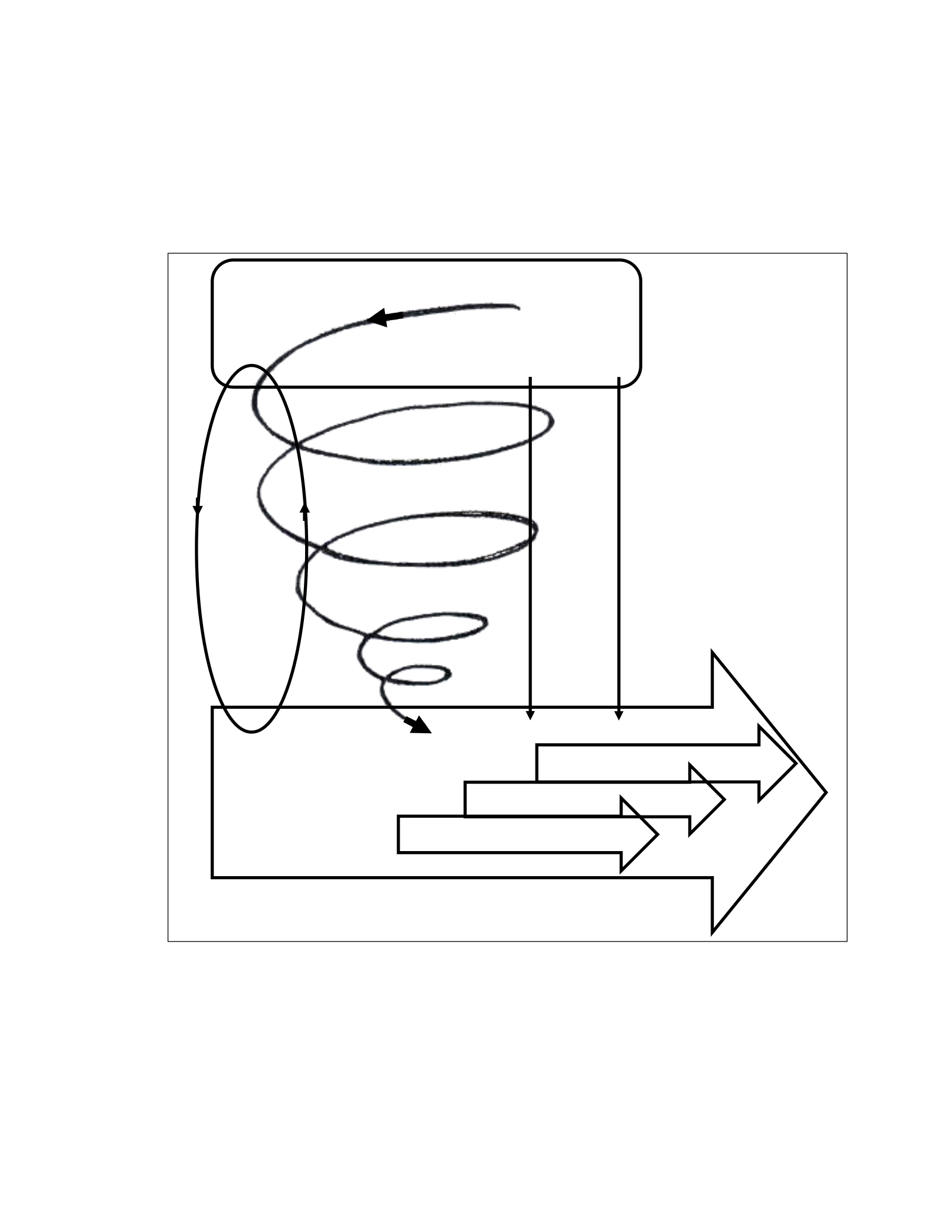
70
coding scheme and pattern identification plan was summarized in the diagram below,
demonstrating interphase of concepts and envisioned approaches.
Figure 1. Summary coding scheme (McNabb, 2013; Frankfort-Nachmias & Nachmias,
2008; Saldana, 2013).
NVivo platform
Interview data
Open coding
Simultaneous coding
In Vivo coding
Inductive
coding
Theming
Categorization
Pattern coding
Analysis

71
Thematic Analysis
Preceding sections allude to the fact that many patterns do emerge when coding is
done. Such patterns emerged as open, In Vivo, simultaneous and inductive coding were
applied to condense the data stored in the NVivo software. The ability therefore to
establish meaning and find relation of this meaning to the questions for which the data
was collected in the first place is mentioned by Braun and Clarke (2012) as being
fundamental to an effective process of thematic analysis. Moving from coding, thematic
analysis was employed to analyze resultant data for this research. While some analysis
emerged as consolidation was being done and patterns evolved speaking to the sub-
questions under which consolidation was happening, the broad research question
benefited from a systematic thematic analysis at the two levels of inquiry. This is
mentioned as an advantage of thematic analysis by Braun and Clarke, ability to apply
thematic analysis in its different forms thereby addressing basic to deep meanings from
data sets (p. 58). To arrive at effective application of thematic analysis, I applied the
following steps: a) allowed the codes to emerge from the data that had already been
collected and was condensed though a series of steps as outlined in Figure 1. This was
inspired by the inductive coding scheme; b) looked through the data, aggregated
categories and the codes. Then defined themes that I assessed were pointed and linked to
the three main research questions and that formed from a number of codes, categories and
patterns; c) adapted guidance from Braun and Clarke on reviewing the themes, codes and
transcribed data set for hallmarks of quality. Accomplished this by executing a systematic

72
process of reading through the data, looking at duplications redundancies, mistakes and
testing coherence of how the data flowed into codes and how these folded into themes; d)
outlined for each quality assured theme and its relevant subject’s short descriptive
phrases which Braun and Clarke mention that told a broader systematic story about the
selected data. Then demonstrated a level of analysis that is backed up with references to
the data through excerpts (p. 67). At this stage there was a clear picture on how the theme
spoke to the research question. I relied here on previously reviewed scholarly articles as
well as the guidance of the theoretical framework to create analytical themes enriched
with scholarly grounding; e) completed a narrative presentation of the findings in a
coherent and reflective manner woven together with reflection on the theoretical
framework and literature from all the sources outlined.
Braun and Clarke (2012) deter one from absolute thought that there are definite
number of themes that can be specified in a research as a guiding principle. Rather ask
for intuition in determining what works for one’s dataset. They also argue that with
qualitative research experience and experience in applying thematic analysis comes much
improved abilities for conducting thematic analysis in the first place. This research took
caution based on this guidance to ensure that such pitfalls were avoided.
Issues of Trustworthiness
Research Validity and Credibility
There continues to be scholarly dialogue on credibility in qualitative research
traditions. In overcoming challenges of credibility and transferability for this research the

73
processes of designing the research, engagement with the research subjects, writing up
the research, arguing emerging and final conclusions and presentation of findings were
developed in ways that demonstrate depth and mastery of the subject, and have to prove
beyond doubt about the thoroughness and quality of the research. In support to this
approach of elevating the level of research credibility, Patton (2002) emphasized the need
to consistently take into consideration the rigor of methods adopted, a close examination
of the researcher to ensure they exuded credibility and embedded the philosophy of value
addition, in use of qualitative research approaches (pp. 552-553). Accuracy of application
of the methods remained an integral factor of also ensuring dependability of the findings
of this research for any future reference. The research had planned to find and apply
secondary data as part of the research. The use of secondary data is a factor of
triangulating and structural corroboration as outlined by Creswell (2013) in which
multiple types of data may be consulted and used in applying contrast in analysis and
support emerging findings and directions and by extension credibility (p. 246). The
underlying angle in this regard was that of enhancing research quality through consensual
validation, and referential adequacy (Creswell, 2013), and goes further from only
ensuring credibility but also confirmability for the qualitative research (p. 246). The
participant selection and lines of interview for the three main categories of participants
was a deliberate means of applying Creswell’s argument about variation of participants
with a view of enhancing the research transferability. Applicability and transferability of

74
the theoretical framework to a low-income country context as Kenya has also been
discussed in the preceding chapters, further justifying its choice and use.
Protection of Research Subjects and Ethical Considerations
Concern with ethical considerations remained high during the research. While
ethical considerations could be considered largely during the interview and data
collection process as well as in the analysis of data, clear reflection on ethical issues was
taken into consideration including at the design stage of the research. McNabb (2013)
emphasizes ethical considerations in the planning, processing and dissemination of
research data for a number of reasons. Significant of these include the aspects of
volunteerism of participation, mental and physical protection from harm, free informed
consent, confidentiality, privacy and anonymity, all of which have to be respected and
protected at the planning, gathering of data, processing and interpreting, as well as in the
dissemination of the findings stages of this research (McNabb, 2013, pp. 27-32). All
research approvals were sought and received from the Institutional Review Board (IRB)
(IRB approval number 07-22-19-0370906) prior to making contact with the county
government and all the policy stakeholders involved and prior to commencement of the
data collection process. The following documents were prepared in readiness for
submission to the IRB: An adult consent form (Appendix B) and an invitation to
participate in research (Appendix C). This was considered as an important aspect of
subject protection, as there was a thin line between making initial contact, already
starting to seek for access to documentation, going into depth of explanation of what the

75
research was about, and the kind of help needed from the actors. In this way also, a
relationship started building with the county government as research subjects.
Relationship building while conducting research builds an enabling environment for
conduct of fieldwork (Frankfort-Nachmias & Nachmias, 2008, p. 263). Following IRB
approvals and as outlined by McNabb (2013), the following ethical considerations were
taken into account: all voluntarily recruited research participants were informed in
advance about the research, their consent received prior to conduct of interviews,
assurances provided with regard to confidentiality and anonymity of the data collected
from them and protection of their identity. Prior to even conducting interviews, while
recruiting participants over telephone or through email, I explained in depth but with
simplicity to ensure comprehension. This explanation included information about the
research being part of completion of academic requirements, the benefits of examining
such an issue, the methodology and the predicted social change elements. After accepting
to be part of the research, the subjects were on the day of the interview reminded about
their choice not to answer any questions that they felt uncomfortable with at any time.
Confidentiality of their details and participation and any the few risks already identified
by the researcher were re-confirmed to them on this day. They were assured that they
could stop the interview at any time if they felt uncomfortable. In line with the consent
forms, subjects were made aware of the contact details of the University of Walden and
the IRB for any validation with these institutions about sanctioning of this research, that
they could make out of their own free will. I recognized also as the researcher that at any

76
one point, a subject may have decided to opt out of this research for reasons of their
choice. Utilizing the strategy to find and reach out to the subjects as per the inclusion and
exclusion criteria applied, I did not only identify the exact 20 proposed subjects but went
beyond these numbers for each category of proposed respondents, to guard against not
staying within the respondents’ numbers proposed, should unexpectedly any respondent
opt out. At the level of the county government, other members of the government were
also contacted based on governmental reference, to ensure that more subjects were
available. Nonetheless, confidence building was maintained on the value stance of the
research as a mechanism of keeping respondents interested.
The data collection tools and information storage software were password
protected to ensure restricted access. In addition, recognizing the potential of researcher
bias as outlined by Creswell (2009), Frankfort-Nachmias, and Nachmias (2008), McNabb
(2013) O’Sullivan et al. (2008), related to the role of the researcher in qualitative studies,
all efforts were put in place to ensure that in the interview process, in analysis and
consolidation of the data, the perspectives of the researcher did not influence data being
collected or the emerging analysis.
Summary
The methodology section has looked into the process of selection of the best fit
research tradition. It has placed the choice through the process of looking at pros and
cons of each of the research tradition. The section was also able to look through the
choice of a case study approach, providing an outline of its perspectives and fit for

77
application in this research. The process of selection of interview subjects and the size of
the sample of those to be interviewed has been elaborated. Further, the procedures for
collection of the interview data as well as the processing of the data were discussed. At
the same time an interview instrument was developed and the templates that were used to
receive consent from research subjects and receive clearance from the IRB on ethical
considerations. The approach to coding and categorizing of the interview data has been
placed in perspective, paving way for a full analysis of the consolidated data into patterns
and themes in chapter four which follows.

78
Chapter 4: Results
Introduction
The purpose of this study was to improve the understanding on how public
participation was influenced by the relationships between nongovernmental organizations
and the Nairobi County government, while designing the Nairobi City County Public
Participation Act, 2015. This section outlines how the data collected from a cross section
of three policy stakeholders were processed through coding, pattern identification and
thematic analysis, seeking to establish how participation occurred in the context of the
development of the Nairobi City County Public Participation Act of 2015.
Interviews with government, nongovernmental organizations and members of the
public that participated in the design of this policy sought to contribute to answering the
three research questions:
a) How do the county government of Nairobi and NGOs intend to work together
in designing a legally mandated Nairobi County public participation policy?
b) How do the county government of Nairobi and NGOs describe the perceived
impact of their relationships on prospective public participation in local
governance?
c) How do the organizational cultures of the county government of Nairobi and
NGOs affect their working relationship in designing a public participation
policy?

79
This chapter outlines the main characteristics of the research participants,
describes the context within which the data collection was conducted, presents an
overview of the consolidation of interview data, presents the findings and results from the
process of data collection and data analysis, and discusses trustworthiness based on the
evidence from the process of collection of data. The chapter utilizes evidence from the
analysis to provide answers to the research questions.
Data Collection Setting
Data collection for the research started on the 6 March 2020, at a time when the
Corona Virus Disease (COVID-19) was spreading globally. By this time the disease had
not yet been detected in Kenya. Therefore, it was possible to conduct the first set of
interviews face to face. With the first case of the disease being detected on the 13th of
March 2020 in Kenya, measures were instituted by the government to try and limit the
spread of the virus by reducing human to human contacts. Face-to-face interviews were
therefore no longer viable for data collection. IRB soon issued guidance for data
collection, aligned with measures for social distancing and staying at home directives to
limit the spread of COVID-19.
These measures were adhered to for the remainder of the data collection process.
Observation of the interviewees was not possible for telephone interviews and therefore
the strategy of observing participants during interviews was not applied. The process of
interviewing revealed that the design of the Nairobi City County Public Participation Act
of 2015 was spearheaded by a private member of the Nairobi County assembly. The

80
assembly also supported the development of this Act through its established procedures.
The finalized Bill was submitted to the County Executive for their review and accent.
Through this process, majority of the policy development work was done and completed
in the county assembly. Based on this policy development discovery governmental
interviewees were selected largely on the county assembly side.
Interviewee Demographics
At the onset, the interview target sample set consisted of 21 individuals belonging
to each of the three categories of policy stakeholders. Of the anticipated figure of 21
interviewees only 20 were effectively reached. Four government, 10 nongovernmental
organizations, and six members of the public were successfully recruited as participants
in the research. Of the four government officials, two, who had served in the assembly in
2015 when the Act was being developed, had left the assembly in 2017 after the 2017
general elections.
All of the participants had interacted with the Nairobi City County Public
Participation Act, 2015 when it was being developed and therefore shared their
experiences with the process willingly and fairly easily. It was useful to note that a
number of participants’ involvement in the design of this policy was frequently referred
to by other participants, thus increasing the level of confidence about the right
participants selected for the study.
For instance, while speaking to the government and members of the public, each
referred to individuals from nongovernmental organizations by organization name or

81
individual name or a combination of both, as collaborators in the process. Also, NGO
participants variously referred to specific individuals in government as who they
interacted with during the process.
Participants from two policy stakeholders all held senior roles in government and
NGOs, while at the community these individuals played an important role in community
mobilization and in influencing community action. All the participants were residents of
Nairobi County, living and working in Nairobi for extended periods of time and therefore
confident about experiences of living within the capital. Importantly, all of the
participants had a variety of experiences with policy development in Nairobi as well as at
the national level, beyond experiences related to the development of the policy under
discussion. Each of the participant was fully versant with English, which was the choice
language for the interview and a national language in Kenya.
While a 50% gender parity would have been ideal, ensuring that an equal number
of males and females were participants to this study, this was not realized. A total of
seven participants were female (35%) and 13 participants were male (65%). Participant
age data was not collected for this research. Alphanumeric codes were generated and
assigned to each of the participants in line with retaining confidentiality throughout the
research. Table 1 below provides a summary of participant information.

82
Table 1
Summary Participant Information
Participant
reference
Gender
Gender by policy
stakeholder
Gender cumulative
PG01
M
Female: 25%
Male: 75%
Female:35%
Male: 65%
PG02
M
PG03
F
PG04
M
PN01
F
Female: 40%
Male: 60%
PN02
M
PN03
F
PN04
M
PN05
M
PN06
F
PN07
M
PN08
F
PN09
M
PN10
M
PP01
M
Female: 33%
Male: 67%
PP02
F
PP03
M
PP04
M
PP05
M
PP06
F
Data Collection Process
Following clearance by the IRB to conduct data collection on the 5 March 2020, I
scheduled the first interview on the 6 March 2020. This was the first in a series of four
interviews that were held face to face in the course of 1 week. Immediately thereafter,
with the advent of the coronavirus disease (COVID-19), measures to restrict the spread of

83
the disease in Kenya were instituted by the government and the remaining 16 interviews
were conducted over the phone. Each interview lasted between 45 and 60 minutes. The
interviewees met face to face were seen in their respective offices as this is what they
preferred, a setting which allowed for a private conversation.
All the interviews were preceded by a presentation of the overview of the study,
reading of the consent material, signature of the consent form for the face to face
interviews and verbal agreement for the telephone interviews. An explanation about
recording of the interview for purposes of capturing all the information that was being
relayed was given and recording was accepted by all participants. All interviews were
recorded using a voice recording device in English. All participants were versant with the
language.
Letters had initially been sent to all government interviewees in the assembly and
the executive seeking their participation in the research. Subsequently, all government
and NGO interviewees were contacted through email. The email included a brief of the
study and the research permit by the National commission for science, technology and
innovation. The email also requested for the telephone numbers for purpose of the
interview call. NGO partners shared the list and contact details of members of the public,
with whom they had interacted with in the course of the design of the policy. The consent
seeking process and especially the confidentiality elements had a particularly calming
effect to the participants, and all the participants contacted were available for the
interviews.

84
A total of 20 interviews were completed with the each of the policy stakeholders
(government, four; nongovernmental organizations, 10; members of the public, six). Each
participant accepted to be part of the study at the initial point of contact and therefore the
consent seeking process and the interviews themselves did not face any particular
challenge. The fact that the participants had engaged in the policy design process five
years earlier would seem rather distant, nonetheless each participant seemed to recollect
their involvement to the extent required in the interviews fairly easily.
All interviews were recorded with a voice recording device and each of the MP3
files downloaded into my personal computer that is password protected. I also created a
redundant external drive where copies of the interview files were saved with password
protection and stored under lock and key in my study cabinet at home.
I created a specific code structure for each of the three interview stakeholders in
adherence to the confidentiality requirements for the study, but also ensured the ability to
track inputs by that individual from the consent forms, to the data collected,
transcriptions, inputs into the NVivo software, in data presentation and interpretation in
keeping with data integrity and credibility. I am however the only one who is able to
understand this participant coding structure. Notes were taken during the interviews and
these were coded with a similar structure and stored in Microsoft Word format in my
personal computer. The combinations of raw data collected were retained in line with the
IRB data protection requirements.

85
Data Analysis
From the 6 March 2020 to the 10 June 2020 a total of 20 interviews were
completed with each of the three category of policy stakeholder. At the end of each
interview I transcribed the audio files verbatim into a word document for each of the
research participant, collecting perspectives of their lived experience during the design of
the Nairobi City County Public Participation Act of 2015.
Transcribing was a three-part manual process where, I listened to the audio files
while pausing and writing down the questions and responses. I listened to the audio files
once more after the first round of transcribing to correct for any errors and, finally after
all the files were transcribed, I listened through them a final time to confirm that all
information had been captured correctly. This ensured that the transcribed scripts were
accurate.
Transcripts ranging from four to six pagers per participant emerged from the
process, leading to a consolidated 85-page transcribed raw data file. To facilitate
migration of the data from the consolidated word file to NVivo, I cleaned the data into 20
individual files, representing each of the interviewee, now specifically identified with the
alphanumeric code Pxyz, where x represents the identifier for the policy stakeholder
category and xy representing options from 01 to 10 indicating the number of the
participants under each of the category. Confidentiality of participant information has
been emphasized from the onset of the study, aligned with McNabb (2013) and this
alphanumeric coding was an important part of assuring confidentiality. For each of the

86
transcripts further cleaning of the data was completed by creating headers and identifying
each response with the alphanumeric code of the participant in order to ensure that data
was easily manipulated once imported into NVivo.
All the alphanumerically coded data were imported into NVivo for further review
and analysis. In the third step during data transcribing, I generated a rough draft memo
capturing things I was hearing that I thought were important, this document was created
in NVivo and utilized also during the reading of the data to capture information that I
thought would be critical during the data analysis stage. I read through all the scripts and
built up a memo on general observations, and at this point I had a good understanding of
the data. I began the coding process, not from an established set of codes, but from
reading through the individual transcripts and creating short codes to represent the
significant information that I was coming across. This being application of what McNabb
(2013) referred to as open coding. While doing so, I was also doing in vivo coding line
by line. All significant information encountered was captured with codes representing a
summarized meaning of the information that I was coming across.
The packaging of information included statements from participants that either
expressed consensus, that were varied or that made recommendations on particular
elements of the interview questions. At the end of the process a total of 73 codes had
emerged. The next step involved a mixture of approaches. I reviewed each of the data
that was captured in the 73 codes, conducted further consultation with the raw data to
confirm that no significant information had been left out, reviewed the codes to confirm

87
they represented the significant information captured within them. This process
highlighted the importance of the approach termed by Frankfort-Nachmias and Nachmias
(2008) as inductive coding and which also ensures that coded information is retained
within a particular category.
The now 62 descriptive codes resulting from this process were then consolidated
into five categories consisting of three anchor codes (McNabb, 2013), representing each
of the three main research questions and two additional categories with contextual
information. Further verification of the categorization, including examining the frequency
information of the coded categories helped to support the data condensation exercise as
part of simultaneous coding (Saldana, 2013).
Based on memos created while reading through the data, conducting the coding
process and validating the coded information, three themes emerged out of this iterative
process, linked to the nature of policy relationships, how they were created and how those
depended on institutional culture and individual nature of policy stakeholders during the
design of this policy. Further, patterns had been emerging through the data analysis
informing the formation of the themes.
These patterns provided useful hints on how interaction of policy stakeholders
influenced the policy moment which emerged and was used effectively to ensure that the
development of the Nairobi City County Public Participation Act of 2015 was followed
through.

88
Table 2
Salient Codes in Data Analysis
Categories
Primary codes
Cooperation for policy design.
Benefits of cooperation for
policy design.
Institutional and individual
dynamics in cooperation for
policy design.
Contextual perspectives of
policy design.
Participation as a
constitutional requirement.
Relationship / Trust / Knowledge / Structure / Demand /
Principles /
Voice / Accountability / Feedback / Space / Awareness /
Legal compliance / Convergence / Confidence / Reach /
Memorandum of understanding / Capacity / Lobbying /
Ally / Technical support / Relationship / Women
leadership / Human nature /
Confidence / Information / Divergent views / Policy
record / Preconceptions / Accountability / Civic
awareness /
Constitution / Legal requirement / Court case / Delays /
Table 2 captures the main codes emanating from the coding process placed
alongside the emerging categories while Table 3 outlines the categories, patterns and
themes emerging from the coding exercise. Table 5 under appendix D details the
comprehensive coding structure for the study.

89
Table 3
Summary of Categories, Emergent Patterns, and Emergent Themes From Data Analysis
Categories
Patterns
Themes
Cooperation for policy design.
Benefits of cooperation for
policy design.
Institutional and individual
dynamics in cooperation for
policy design.
Contextual perspectives of
policy design.
Participation as a
constitutional requirement.
Practical, legal and legislative
challenges to collaboration.
Collaborative undertakings as
resolution options to challenges.
Formalized communication in
defining working arrangements.
Barriers and pessimism on public
voice in bottom up policy
development.
Architecture of response to
bottom up policy development.
Changing perceptions on policy
stakeholdership based on trust
building.
Memorandum of understanding
(MOU) for guiding principles on
collaboration.
Openness of government in
policy development.
Gender advocacy and policy
effect.
Human nature in policy.
Nature of working
arrangements
between Nairobi
County assembly
and
nongovernmental
organizations.
Implications of
working
relationships
between Nairobi
County assembly
and
nongovernmental
organizations.
Institutional culture
and individual nature
in informing
working relationship.

90
Trustworthiness
In the methodology chapter I set the pace for establishing and presenting how
quality for this dissertation would be assured. From the onset, I recognized the kinds of
bias that I would have as a researcher and enumerated them in the managing bias section
of this research which is referred in the field of qualitative research as reflexivity (Hadi &
Closs, 2016; Korstjens & Moser, 2018). In selecting participants, nongovernmental
organizations that were listed in reports collected from the public website of the Nairobi
County assembly became participants to the study. Similarly, the selection of government
participants was influenced only by the role they played in the process of development of
the policy, either by being elected or special elect members of the county assembly or
employees of the assembly. The selection of members of the public targeted those that
were part of consultations convened by the NGOs to review the draft bill and input into
memoranda of consolidated public views that were submitted to the assembly. This
together with use of an assistive recording device, which collected views from the
interviewees verbatim and transcription of those, word for word into scripts is a
significant part of reduction of bias associated with qualitative research (Creswell, 2009;
Frankfort-Nachmias, & Nachmias, 2008; McNabb, 2013; O’Sullivan et al., 2008). While
primary data were collected from an unbiased selection of interviewees, secondary data
were collected from the annals of the assembly. Records which in themselves tracked the
assembly process of policy design, the institutions involved, and the kind of discussions
held on the policy. These records alongside other secondary sources of information were

91
relied upon at the result presentation and research findings interpretation stage further
strengthen referential adequacy as noted by Creswell (2013, p. 246). During the
interviews, I noted continued reference to some of the NGOs that had been involved in
the process by assembly interviewees and members of the public and vice versa, without
prompting. This further validating that the individuals and institutions that were being
interviewed were the right ones for the research. When the data was gathered it was
consolidated in NVivo, where a multiple pronged process of rigorous coding through
open coding, in Vivo coding, and simultaneous coding was completed (Korstjens &
Moser, 2018). This allowed me to continue to gather deeper understanding of the data
and therefore better recognize emerging patterns and their transitions into themes. The
application of this reflexive approach, the use of triangulative and structurally
corroborated data from secondary sources, and application of research rigous combined
to promote dependability, credibility and confirmability of this research (Hadi & Closs,
2016; Korstjens & Moser, 2018; Nowell, Norris, White, & Moules, 2017).
Research Transferability
This section on presentation of results has provided a set of rich descriptions
including details about the setting within which the research was conducted. Further, the
criteria for inclusion of participants from either of the three category of policy
stakeholders (Inclusion and exclusion criteria) and the description of their characteristics
in writing up this section enables the research to be externally valid to other settings
(White, Oelke, & Friesen, 2012; Tracy, 2010). External validity creates the potential of

92
the research findings informing other similar policy development contexts. This
especially for policy development practice in a local context of counties in Kenya.
External validity may also be applicable to the process of policy design at the national
level. In the context of Kenya’s continued legislative progress, as part of implementing
its 2010 Constitution. These characteristics thereby strengthening research transferability.
Results of the Study
The Nairobi City County Public Participation Act of 2015 was the policy chosen
for this study. Findings seek to improve understanding on how public participation was
influenced by the relationships between nongovernmental organizations and the Nairobi
County government during policy design. A total of 20 policy stakeholders were
purposively selected representing government, nongovernmental organizations and
members of the public, all of whom participated in the development of the mentioned
policy. The investigation sought to appreciate whether in Nairobi County there existed
any policy relationship between the Nairobi County government and nongovernmental
organizations and how this relationship influenced a bottom up approach to development
of the Nairobi City County Public Participation Act of 2015.
The single bounded real-life issue being examined was public participation.
Participants in the research were selected from three categories of policy stakeholders
defined in line with the John Kingdon multiple streams framework. Each of them
responded to interview questions seeking to answer the three research questions:

93
a) How do the county government of Nairobi and NGOs intend to work together
in designing a legally mandated Nairobi County public participation policy?
b) How do the county government of Nairobi and NGOs describe the perceived
impact of their relationships on prospective public participation in local
governance?
c) How do the organizational cultures of the county government of Nairobi and
NGOs affect their working relationship in designing a public participation
policy?
In answering these research questions participants responded to 13 (Government);
13 (Nongovernmental organizations) and 10 (members of the public) open ended
interview questions based on their experience with the process of development of this
policy. Cluster of questions were linked to either of the three research questions and some
seeking to understand their experiences with the policy development process in general.
The responses from all participants were transcribed, reviewed and coded, and as a result
three themes emerged from the data analysis, which are discussed in detail below:
Theme 1: Nature of working arrangements between the Nairobi County assembly
and nongovernmental organizations.
Theme 2: Implications of working relationships between the Nairobi County
assembly and nongovernmental organizations in policy development.
Theme 3: Institutional culture and individual nature in informing working
relationships.

94
Nature of Working Arrangements Between Nairobi County Assembly and
Nongovernmental Organizations
In 2015 Kenya had transitioned to a new system of devolved governance after the
promulgation of a new Constitution in 2010. Following the general elections in 2013 a
two-tiered government system was established, one national government and 47 county
governments. The three arms of government at the national level were retained -
executive, legislature and judiciary, while two arms - executive and the county assembly
formed government at the county level. Therefore, the Nairobi County assembly was less
than three years in power by the time the Nairobi City County Public Participation Bill,
2015 was tabled in the assembly.
Similarly, the system of devolved governance was just starting to be fully
understood by the public and government alike, as remarked by participant PN08
“Because I remember back then that devolution was still a new concept.” There were
many appointed and elected individuals in government that were also fairly new. NGOs
in Nairobi County had been working on a variety of governance issues. Many of them
remained active in their various areas of competence in between the two periods
hallmarked by the transitions between two constitutional orders.
There was recognition of this by participant PG01 who mentioned that “ . . . the
NGOs have been there longer than government. Just to put it that way. They have been
there longer than government, so they understand the context and they know the issues
better than government does.”

95
Participant PG04 also stated that
. . . most of these NGOs that we were working with during this process is, they
have been there for a very long time, and therefore they have the, they have a lot
of information, they have a lot of technical expertise, they have been engaging
with the public for a longer time as opposed to the county assembly which was
elected for the first time in 2013, so it’s just new.
Engagement between NGOs and government around matters of policy in the
county was not a new thing and it included a variety of collaborations, both positive and
sometime perceived antagonistic interactions. This probably alluding to the dual function
of NGOs as watchdogs as well as partners in support of development actions of the
government.
Participant PG02 noted that
We started encountering challenges in implementing our legislation . . . we pass
legislation which affects the public . . . members of the public would go, they
challenge it in court and say they were not involved in the development . . . . the
NGOs, the same NGOs will go to court and challenge your document, so now you
are forced to accommodate them . . .
Participant PG01 mentioned that “ . . . the NGOs have really been on our case,
including even litigation. They have even gone to court and declared some of our Acts
unconstitutional.”
Similar sentiments were expressed by PN01

96
. . . we have very many cases to date . . . Cases filed in court. So, either NGOs
taking government to court because they have flouted you know a certain Act, a
certain section, maybe a certain way of executing a particular bill and so forth and
so on.
Participant PN02 also noted “ . . . many officials really had no choice particularly
when the court started making findings that would adversely affect these processes if they
are not properly done.”
It is possible to attribute such legal challenges of government by NGOs to a
variety of things, but the most manifest in the participant discussions pointed to
constitutional demands placed on policy makers to ensure public perspectives were being
systematically considered in policy processes. Participant PN06 mentioned that
I would say first it would give effect to the provision of chapter 11 of the
Constitution of Kenya 2010, which generally speaks on devolution, and we all
know the essence of devolution was to bring services closer to the people and then
the other thing would be to provide the framework for the public participation in
the affairs of the county through actively informing the form and the content of
legislation, policy, development plans formulated by the county government, I
would also say it generally gives effect to the principles of public participation
which are set out in articles for example article 1, on the sovereignty, and 10 and
also chapter 4 of the Constitution’s articles in the chapter, articles 35, 61, so all
these forms of, all these articles will be in the Constitution including the fourth

97
schedule of the Constitution and then also provide a framework for informed,
effective and sustainable engagement of the public in the county and in the
formulation of the policy, legislation and development plans.
PN08 also stated that “we passed the Constitution as you may well be aware, that
public participation was or is a key component of the Constitution and everybody seems
to recognize that, right?”
Participant PN07 mentioned that “Even though the Constitution is clear that
public participation should take place, the different entities, national and county
government needs to come up with their own legal framework to say, how it is supposed
to be done . . . ”
Participant PN04 outlined
. . . it will be very important for us to go to the citizens, to the residents to get
their views as part of implementing article 10 of the Constitution of Kenya . . .
which provides for people’s participation and is part of the values and principles
of governance.
Participant PN02 also noted that
from the point when the Constitution of Kenya was passed in 2010 requiring
public participation and the time when the government, the county governments
were elected in 2013, I think civil society organizations took up the imperative to
make sure that the county governments don’t just sit back and do things in the
usual manner but that they try to adhere to the new Constitution . . . there were

98
number of cases in the courts, judges found that certain processes fell below the
constitutional thresholds for public participation.
John Kingdon’s MSA recognizes that the emergence of policy moments is
conditional to externally influencing events that facilitate convergence of three policy
streams. NGOs assertion on the need to elevate the problems of the public into policy
action by the county, utilizing the letter and spirit of the new Constitution provides such
an externally influencing setting.
The many instances and variety of cases brought against the county could be a
manifestation of the need for cooperative engagement early with a view of addressing
some of the more practical challenges of engagement in policy development. A variety of
such challenges were highlighted by the participants and navigating these challenges by
itself becoming an integral dimension of building government-NGO working
arrangements. It was specifically noted by participants PG01 that
. . . we realized that a lot of the times government was very far removed from the
public . . . we had engagements with the public, so we did public participation
except we really didn’t go to the wards we just received people at the, it’s called
charter hall.
Participant PN02 outlined
. . . about pockets of resistance here and there . . . You know the county
governments increasingly are very circumspect when it comes to opening

99
themselves up for scrutiny in certain spaces. They would allow a space within
which you can engage but there would always be a space that you cannot.
Participant PN06 stated
Then we also have this other bit of state capture where, where we see that there
are different, there is a, where we find that there are different, that is a limitation
to public participation and this affects especially the government structures which
are also prone to elite capture. So, this basically means that there are a fewer
people within the government who will dictate how public participation is
managed within the county.
On structured and open participation, PP02 stated that
But you see if the government is left alone to develop a policy then automatically
they will develop it fitting what the government wants, and it will not look at what
the benefits that will the citizens get out of the policy.
PP03 mentioned that “They (Government) receive public views but they have
their own under the shelves.”
Further PP05 noted that “ . . . you know, because what people have seen many
times is that public participation tends to be done as some kind of a rubber stamp, as just
a way of saying that it was done.”
This view was shared by PP03 “ . . . but not out contributions as such because it is
like a rubber stamping what they have already passed”

100
A perspective reiterated by PN01 “So it has nothing to do with whether your
views are fantastic or not. It’s such that they tick a box . . . I think the structure of
participation is what is lacking.”
This relates also to the issue mentioned by PG01 about bringing people to charter
hall for a one-off interaction with the policy at the development stage, which is
considered ‘rubber stamping’ a process that was already going in a particular direction.
Thus demonstrating inadequacies about resultant quality of engagement and ability to
systematically collect content from the public that is all encompassing.
PG02 noted that public participation should be about meaningfulness and actual
contribution, stating that
. . . public participation should be, is it efficient or what, but there is something
about it, there is a, it’s not about cursory, to appear, we did a public participation,
people signing attendance sheets, and everything, but there will be actual input,
actual input from the public.
On timely sharing of information and giving advance notice for effective
participation there was also an issue as noted by PP03 who mentioned that “I can’t say I
was prepared because it was a surprise, suppose they want to do it maybe on Friday, they
post it on Thursday, now you are not prepared, sometimes you can’t even attend because
of inconvenience.”
The practical, legal and legislative challenges are many. They are nonetheless an
important part in building and strengthening working arrangements between the policy

101
stakeholders. While challenges show an adversarial engagement, they appear to have
informed learning and adjustment by the policy stakeholders. Some of the challenge areas
appear to have informed elements of renewed collaborative arrangements between the
three policy stakeholders for the policy in question. There is recognition by the county
assembly about the experience of NGOs on: public participation as a specific subject
matter, including application of methodologies for advancing meaningful public
participation; ability to reach very grassroot levels in communities; ability to create an
enabling policy environment through which views of the public can be collected and
consolidated; capability for channeling financial support towards policy development;
and, ability to build and transfer technical skills on policy design. This recognition has
been a basis of building and sustaining working arrangements with these areas
themselves becoming some of the areas of cooperation in the development of the Nairobi
City County Public Participation Act of 2015. Participants PG01 mentioned that
The reason we really worked with NGOs was because we realized that a lot of the
times government was very far removed from the public . . . You know, we’ve
been very intentional about engaging NGOs because you see where we are now, I
cannot go to any informal settlement in Nairobi, without the NGOs otherwise we
will be chased, and we have been chased before. We actually, we were actually
beaten . . . So, the NGOs have been very critical in helping us shape how we
engage. They help us manage that process, from that, because they have been
there longer that us. So, when you go there, they have done the ground work

102
already, they have told us who the voice, the leaders are, who do we engage, how
do we engage them, where do we do the meetings? So, they help us break the ice,
and then they help us mobilize, and help us organize. So, you see it makes it easy
for us to go and engage the public otherwise, if we go by ourselves usually we get
a lot of hostilities. So, for the NGOs, we’ve made it intentional that we must go
through them, so that by the time we get to the ground, they have done that
ground work of mobilizing and pacifying the citizenry for us so that by the time
tunafika (we arrive), ours is to do what we have come to do, then disappear. So,
we really insist that those who go for those engagements must try as much as
possible to use NGOs.
Participant PG02 highlighted that “ . . . so the NGOs they play a critical role in
providing technical support and also logistical support . . . the NGOs will also provide
the legislative, the technical experts, to draft the document . . . ”
Participant PG03 mentioned “ . . . they (NGOs) gave me a lawyer to help me out
and whatever they (Lawyer) came up with we took it to the clerk, the framework first.”
Participant PG04 also mentioned that “ . . . they have a lot of information, they
have a lot of technical expertise, they have been engaging with the public for a longer
time.”
Systematically responding to challenges has created an environment of
cooperation for the development of the Nairobi City County Public Participation Act of
2015. While the bill development started from the county assembly as a private member

103
bill, policy stakeholders prepared themselves in a variety of ways to support its
development and passing. Participants mentioned how they prepared for this process.
PN03 outlined that “we also had several meetings with the Nairobi County officials that
were responsible for the development of this policy to understand their needs to
understand their gaps and to understand the areas of support where we would engage with
them.”
Participant PN06 stated that preparations were also based on “reading vastly . . .
writing concept notes . . . writing request letters to various stakeholders . . . holding
introductory meetings with the county government”
Participant PN07 stated that they “ . . . shared it (contribution to this policy
development) with staff that had interest around such issues, and then I got feedback
from a number of them and then I convened a meeting which involved the country
director . . . ”
Participant PN02 stated that “Also, civil society organizations do a lot of research
including on this subject and it’s also another way of ensuring that the findings of those
studies also find application in real life through governance processes.”
Alongside this, an important observation about finding allies was outlined by a
participant as part of effective preparation for policy development engagement.
Participant PN06 outlined that
. . . it’s ensuring that this partnership also brings on board members within the
county who have interest in what you are trying to advance. The policy

104
development process not every member of the county maybe understands the
importance of policy . . . So, it’s basically doing a stakeholder mapping to
understand who your allies are and ensuring that you effectively engage the allies.
Preparation for engagement especially by the NGOs enabled them to envision and
overcome challenges that could limit meaningful bottom up participation. Participants
across the three policy stakeholders from the onset seemed to appreciate the ability of
NGO to facilitate effective policy development. This included based on how they
strengthened working relationships at a vertical level, between government, NGOs and
members of the public, but also at a horizontal level, between and amongst the NGOs
themselves. These working arrangements are seen to contribute to the development of the
policy from the dimensions of: unpacking the principles of meaningful public
participation, provision of technical assistance, policy advocacy and trust building,
building capacities of government and members of the public for policy design, reaching
the very grassroots members of the community and channeling their voice and concerns
vertically. Participant PG01 specifically outlined that
So, the reason we preferred NGOs was because NGOs really knew, if you wanted
to go to say an informal settlement to undertake public participation, what are the
things you need to, may be just observe as the minimum threshold. Then, what
kind of people do you want to talk to? Do you want to go straight to the public or
do you want to us the community, they are called what? Like the community
leaders, they are called champions? Do you want to cluster them, do you do

105
clustering? . . . so you say maybe I will speak to maybe wamama (Women), then I
will speak to the youth, then I will speak to business people? What is it that you
want to do and how do you want to go about it? So, the NGOs are very critical in
helping us design that process.
PN01 stated
I had, for us we had some suggestions on using ward administrators, village elders
at that point because they had been bypassed by the bill yet the structure of the
village elders I think the ward administrators is a devolution structure. Yes, so we
felt that we already have ward admins, they could do some of those things that
had been proposed to be taken to the executive level, because once you make
participation executive you continue limiting people participation.
PN02 mentioned that
I think we also knew that the voices of the people are critical in policy
development and accountability. But in this particular space I think that there was
a struggle about what exactly is public participation, what form should it take, and
what is adequate public participation.
On working arrangements based on technical capacity development, participant
PP01 mentioned that “ . . . technical issues like policy reforms and sometimes writing
petitions when you are complaining, we use NGOs to help us understand most of the
areas where may be the law is not clear . . . ”
PG02 said “So what they normally provide is the technical expertise . . . ”

106
PN03 referred to
our core mandate as (NGO) was to provide technical assistance to not only to
Nairobi County but in 22 counties that (NGO) was supporting to develop critical
and strategic policies that they wanted put in place and our role therefore entailed
giving the counties, this includes Nairobi technical expertise and any other
support that would, to facilitate for them to develop specific policies.
PG03 outlined
. . . and then so we had a discussion with also (NGO), and they could give use
somebody to guide us through the Constitution how do we go about this to make
it as a law? So just an expert to explain to us how we can structure this . . .
Whereby we got (NGO) to help me out with a lawyer . . . just to help me put it in
a language that is acceptable as a parliamentary language and then we went now
with the women caucus, with the women alone first, to discuss it.
While PG04 referred to “they have a lot of technical expertise.”
It was noted that working arrangements were also built around lobbying,
advocating for policy and building stakeholder trust around the issues that needed to be
reflected in the policy. Participants PN06 mentioned
So really that is important, if we do not get the buy in of these people from the
onset then definitely we are going to have a challenge when it comes to adoption
and implementation . . . we were able to reach out, she (sponsor of the bill) was
able to bring on board or get the buy in of other legislators her fellow colleagues

107
to come on board . . . So basically is to get the buy in of these the legislators and
also the executive at, from the onset of the design so that as we move forward,
they is that consensus between I would say nonstate actors and state actors.
Participant PN08 stated that
. . . advantage of working closely with the county government is what I
mentioned before for ownership and sustainability processes for sustainability
component. So basically, having them design the process simply guarantees that
they own the process and it’s much more sustainable as opposed to say an NGO
pushing through a you know a process.
PN08 mentioned
I would say just equipping the members of the county assembly (MCAs) with
lobbying and advocacy skills because you understand that this is a political
process so if there is or if your goal is to ensure that you know the proposal that
you are making is also in line with the priorities of the executive then there has to
be a bit of lobbying being done by the MCAs.
PN03 outlined
And then begin the process and then make sure the stakeholders, all the
stakeholders that have been identified in the policy development process are
aware are brought on board and have the buy in of the process and understand the
process both in terms of their inputs the timelines and the expectations and the
results that are needed. And once you do that you can begin the journey of

108
development of the policy and you keep on having regular meetings with the
stakeholders and ensuring that everybody is doing their part of the development
process and comparing notes to see what is working what is not working what
process can be enhanced, what processes can be changed in order to and aligning
ourselves to the fundamental policy development process that has been laid out in
law.
Participant PP02 said
So whenever they are there they could help the people to understand, one give
them education and two they will also help them to ensure that they are able to
now participate and be there when the policy is being done and they will also, the
NGOs will also help us in pushing for this policy to pass as an Act, by through
lobbying.
Participants PP03 said
Okay, NGOs, they have the space, they have the capacity, in terms of reaching the
legislators, so for me I think having meetings with the legislators they, like
normally have like breakfast meetings and they are so influential in terms of
mobilizing the legislators. I think that is good for them in terms of reaching the
policy makers.
Participants PP04 asserted that
I think NGOs have been sort of like a third eye, and in circumstances that where
there is no active position, then NGOs seem to be the, enter into that space and I

109
would say advocate for, lobby for the vulnerable ones, you know the people who
would be most affected by policy but who are never, who are rarely ever
consulted.
NGOs operating in Nairobi have varying spheres of influence, but this not
necessarily seen as a challenge. Self-organization and creating common positions enabled
greater connection, wider members of the public reach and broader sphere of engagement
amongst the community members which is particularly useful in ensuring a greater
proportion of the public participate in policy development from the bottom up.
Participant PN02 recollected that
. . . this was kind of space that lent itself to a multilateral approach, a multi-
stakeholder approach to engagement. So a number of civil society organizations
came together and decided to engage collectively . . . and then the other side of it
is that, is also to try and you know speak and agree within the civil society
coalitions what things are important and what minimums you can accept in such a
process so that as you go in there you truly represent the voices of the citizens in a
way that adds value into the entire process.
PN10 stated that
. . . we’ve been in different consortiums and in these consortiums we are able to
get information from point to point every time we are able to get information on
the policies that have come in whenever there is a policy that needs an

110
amendment . . . so any policy that directly affects the youth, then we are able to
get that information from the different consortiums of civil society.
The interviews highlighted how having the requisite capacities for effective
participation in policy development was a success factor to effective policy design.
Collaborations between these policy institutions were also influencing growth of
capacities at all levels for the development of the policy in discussion. It was noted by
PG01 that
they (members of the public) say it’s not right because they have seen what we do
and they have been told by the NGOs what is possible to do, we’ve had
engagements with them so that when they say that things are not right, they are
saying from a point of knowledge and experience and not really just speculation.
So, I think it has really helped heighten public awareness about what government
does and the NGOs have been very instrumental.
PG03 also noted that “The benefit was one, they (NGOs) have resources,
resources in terms of bringing us together for us to be educated on this particular policy
or bill.”
While PG04 mentioned that
. . . some of them (NGOs) we really write to ask for facilitation and they have
come through in terms of facilitating the committees to go out and be trained on
the best practices and all that so that we can build capacities. Some of these NGOs

111
are key partners in building capacities of the committees therefore they are key
stakeholders.
PN06 asserted that “So I would say, is basically also, the other thing was also
investing in civic education where we were also able to educate the communities that we
work with on matters public participation in different aspects.”
Participant PN08 said
So far I have participated in various ways, the first being to empower the county
leaders to be able to craft the necessary policies or be able to develop the
necessary laws that will help address the citizens priorities . . . by empowering the
citizens to be able 1) to organize themselves to have a collective voice and 2) to
be able to engage the county leaders in communicating their priorities to them and
the third way that I have supported the policy development process in Nairobi is
then 3) creating platforms where citizens and leaders can come together to discuss
community priorities and also subsequently craft ways of addressing those
priorities. For the citizens and I think what we did was to sort of take a bit longer
than we had expected with the public forum so that we were making sure that we
are taking time to be sure we are explaining to the citizens what the devolution
process entails, what the law making process entails so that and then also so that
they are able to sort of distinguish you know what the objectives of those forums
were.
Participant PN09 noted that

112
. . . in terms of capacity building what we did is we had a discussion with young
people within those areas notably key areas of Mukuru, Korogocho, Mathare,
Kibera, Kawangware, we had a discussion over how do they understand what is
public participation. Secondly we took them through the whole cycle of public
participation . . .
PN07 said that
there was interest but capacity gaps were lacking, so we were building their
capacity and in that process, we were working very closely with them (Members
of the public), they could share information we could also share information and
we used them to influence that process.
While PN01 stated
So with this analysis, then we went to the community and explained to them the
bill at large, what it has, what are the good parts, what are the more contentious
parts, what are the challenges that we anticipate, and most importantly how that
bill was going to be very hard to execute the way it was . . . for the community we
are continuously empowering them, we have sessions on how to do, how to
analyse a bill for example, what do you look at you know, what’s the long title,
what’s the short title, what are the key elements you should look at, participation,
how should it be? It’s not that there should be public participation that’s not
enough . . . usually its usually like a very organic process, so we tell them this is
the act, we don’t say section 1 section 2, it doesn’t matter, we simplify it related

113
to their own challenges and their day to day engagements and also how they
perceive participation. So, I think our role, our major role is equipping them with
the knowledge and information, but also helping them to understand how to
analyse a bill. For us we believe in putting people first and the community need to
talk on their own behalf. We don’t speak for them we facilitate them, we
empower them and then they talk on their behalf. I think it brings authenticity to
these participation processes.
PP01 specified that “ . . . some of the benefits is this that, we have been able to
interact with those duty bearers, we have been able to create awareness to our people
because of that capacity building.”
PP03 mentioned that
Firstly, at community level at grassroots level, NGOs are instrumental in terms of
building capacity of the community to realize, to articulate issues, to demand
rights where they are violated, yeah and also policy, their experts they can push
forward our voice by policy round table.
The design of the Nairobi City County Public Participation Act, 2015 was in itself
seeking to create a systematic way through which public policy concerns would enter the
policy space. Participant interviews outlined how those in the very grassroot level, were
reached, engaged and had their perspectives channeled to the development of this policy.
Participant PN02 noted that

114
Well, one is that you know the governments exist to serve the people it’s
something that sometimes we can pay lip service to but there is no single
government that will come into place and no single government officer comes
into place except through the processes that are laid down by the Constitution.
And in our case, the benefit that would derive from this is that we find
opportunity to express our wishes and the wishes of the people, to mobilize the
people and to make sure that their voices are channeled to policy spaces that can
give life into their views.
Participant PP05 stated
Now ordinarily that (public participation) would not be organized and the bill
would end up just going through without that enhanced participation, but NGOs
can do a lot in creating awareness amongst various stakeholders from people we
say, people on the ground you know the poorer people to also enhancing a lot of
awareness among professionals.
PP01 mentioned
We started getting those drafts, the concept papers and we went through the
concept papers and we were able now to see the gaps and then we called meetings
from our constituencies, we shared with the community members and then they
give their views. So, when we attend those forums which they (Government)
organize and then we are now able to present what the people wants there, to be in
that policy. We are able to participate in those public forums, without being

115
harassed by anybody because we are able to understand the process. So, it is a
community empowerment, it has helped us to mobilize more people when they
have the public participation forums so people can go there and they can question
which project is going on and how the previous project has been implemented . . .
You see the NGOs are like a torch in the, to the community. So, you find that
when they get those website information which most community members cannot
access it is easy for them to inform people like us the leaders to mobilize the
people to attend those forums that is one of the roles.
While PP03 outlined that
. . . because having missing out that is when NGOs chips in because that like a
community we don’t have a structure to reach the policy making table. But for me
I think using the village councils since if the NGOs can push for that to be
ratified, to be may be to be gazetted that it’s in operation, I propose direct through
village councils, but having no village councils at the moment, so we pass the ball
to NGOs because they are the ones that are being mindful of our welfare and the
community members.
Nairobi County assembly and the nongovernmental organizations have interacted
variously in the process of development of the Nairobi City County Public Participation
Act of 2015. This has included antagonistically as well as symbiotically based on legacy
circumstances as well as through a renewed structure that has been further catalyzed by
the advent of the new system of governance and devolution. There are clear advantages

116
of such collaboration, demonstrable from the foregoing analysis. Participants outlined the
usefulness and pragmatism about these collaborations in advancing a bottom up approach
to policy development. The preceding analysis demonstrates an active system of
engagement during the development of the current policy and what can be considered a
working arrangement structure for policy. Formalized communication between the
county assembly and NGOs was an important starting point in specific collaborative
initiatives. This as outlined in the preceding section on how NGOs prepared to engage
with the policy development process, but also on the part of the assembly while inviting
NGOs for such collaborations. Participant PG01 expressed that
. . . you must write to those specific NGOs and invite them, so that even they
could see the general advertisement, and send you memorandum, they would still
have a letter on their desk, at least the key ones telling them, we are doing a, b, c
and d, please come talk to us if you can or send us memorandum on the following
issues.
Participant PG03 mentioned “During my time in the first assembly, I could see
the NGOs write and say we have this particular issue, can we team up?”
PG04 stated that “ . . . when we have maybe a legislative proposal we normally
write to stakeholders, we write to certain NGOs . . . ”
While PG02 said
what we have are MoUs, we normally enter into MoUs with various NGOs who
are interested . . . To support us in various areas . . . those are the formal

117
mechanisms which we have in place with the NGOs. Entry points MOUs . . . We
have created departments . . . within the assembly . . . within the clerk’s chambers
who are responsible for engagement . . . So what we have done we have made it
part of our working procedures, standard procedures. These are called standard
SoPs. That if you get a document, you must engage the NGOs . . .
The participants responses under this theme demonstrate how interaction between
the county assembly and the NGOs has developed around policy design. The evidence
further outlines how these policy relationships has created an enabling environment for
the design of the Nairobi City County Public Participation Act of 2015 recognizing the
challenges of the past and offering solutions which have facilitated bottom up public
engagement in the design of this policy. These interactions have similar characteristics as
those outlined in the John Kingdon Multiple Streams Approach, for stakeholders and
networks and relationships emerging to respond to problems that require policy responses
(Kingdon,1995). Problem requiring policy attention outlined by the participants were
many and varied, including the particular problem of effective and meaningful
participation by members of the public that is the subject of this research. It is useful to
note that besides structural, institutional and legal challenges aforementioned, research
participants spoke of a variety of other issues requiring policy attention specifically:
“disasters” (PP04), “peace . . . culture” (PP06), “land administration . . . good governance
. . . so many projects which had stalled” (PP01), “land interest earning . . . transport . . .
pop up markets . . . informal vendors . . . water, (PP05), “lack of access to information”

118
(PP02), “urban renewal and regeneration . . . evictions . . . slum upgrading . . . houses”
(PN01), “provision for funding . . . for public participation . . . civic education” (PN07),
“water . . . roads . . . security . . . ECD (Early childhood development)” (PN09),
“education” (PN08), “sub-county administration lacking teeth . . . absence of a structured
framework for citizens engagement particularly the absence of grassroots structures
again, to bring on board the voice of citizens at the grassroots level . . . solid waste
management” (PN06), “You wake up you find a the street has been changed, without
even consultation with the people from that particular region . . . budget making process .
. . socioeconomic sphere of the county . . . information and communication sharing
between the governor, the executive, the county and the citizens . . . toilets . . . roads”
(PG03), “The general policy didn’t have the, a feedback mechanism, so we thought
quality was lacking . . . You know quality is, how much of that participation did you
actually take on board? . . . FGM (Female genital mutilation)” (PG01). The range of
problems warranting broad-based policy action were many, policy relationships as
outlined in this case however created an opportunity for public participation as an issue
by itself to be elevated for priority policy action (Kingdon, 1995).
Evidence presented in this section was consolidated into patterns that emerged
during the coding and aggregation process of the data analysis stage: practical, legal and
legislative challenges to collaboration; collaborative undertakings as resolution options to
challenges; formalized communication in defining working arrangements; were the
patterns under this theme. The patterns had a logical contribution to the theme: Nature of

119
working arrangements between Nairobi County assembly and nongovernmental
organizations, during the design of the Nairobi City County Public Participation Act of
2015. The theme emerged under the research question one on: How do county
government of Nairobi and NGOs intend to work together in designing a legally
mandated Nairobi County public participation policy? Information presented
demonstrates how working together enabled the policy stakeholders to overcome a
variety of barriers of a structural, legal and legislative nature. Learning from these
challenges enabled the three policy stakeholders to work together in the development of
the policy under consideration through: forming policy networks, defining ways of better
sharing information, instituting regular consultative arrangements, using one another’s
expertise and comparative advantages to build vertical and horizontal capacities for
public participation policy development, reaching the furthest members of the community
so that their concerns are appropriately channeled and registered in policy design.
Relationships created were formalized through exchange of letters, exchange of emails
and through memoranda of understanding defining these working arrangements.
Implications of Working Relationships Between Nairobi County Assembly and
Nongovernmental Organizations in Policy Development
Improved working arrangements between policy stakeholders was creating a
cooperative relationship for the development of the Nairobi City County Public
Participation Act of 2015. There were barriers that had been hindering the voice of the
public from reaching the policy development circle and therefore negatively affecting a

120
bottom up policy development approach and the downward policy feedback loop.
Participant PN05 highlighted that “And then I know that, I don’t know whether the
spread of communication and the avenues of communication are as sufficient to reach as
large a public as possible”
PN10 mentioned
There was not, awareness was not conducted thoroughly so effect was, we only
have a few individuals that would come on board, and having these few
individuals meaning that you are not able to get responses or comments from a
larger group.
In addition, there was pessimism on how the public views were being received
and as to whether they were being taken on board anyway. The feedback loop from
government back to the public on the policy development was stated as being a
challenge. Participant PN05 mentioned that
I think one of the biggest challenges is feedback. We do not get information back,
a collation of the interventions, and the views and the opinions that were shared
and what they mean and what actions or steps the county then sees that they will
take based on those views and then what documents are finally shaped out of that.
That I think those next step processes are a little bit opaque and the mechanisms
for those I think are . . . I think you head me saying that one of the big challenges
. . . the feedback mechanism I think is really wanting because over there we don’t
get a sense of what is the aggregated document and then what is the analysis what

121
does it show, how is that fed back to us, what are the questions and areas to be
further consulted on
PP05 stated “But that bottom up feedback mechanism is important in order to
actually achieve development goals that the people desire”
A complete communication system where voice shapes policy and options for
policy action taken on behalf of the people are translated into interventions with the
public being informed is important. It was noted by the participants that policy
relationships formed during this process were foundational in positive progress towards
the development of this policy. The architecture enabling voice of the public to enter into
the design of the policy had been created. Nongovernmental organizations had organized
themselves to: raise awareness around the issue of the policy under development, define
and adapt localized mechanisms for reaching out to the public to overcome challenges of
access to information, including simplification of the policy language, expanded the
avenues for public dialogue and rallied more members of the public to participate in
policy design. Participant PG01 noted that “So I think it has really helped heighten public
awareness about what government does and the NGOs have been very instrumental.”.
Participant PG03 said
(NGO) came up with an SMS platform, whereby people could just send in their
queries and say this is what we are undergoing and it is sent through toll-free
SMS and all those things are printed and brought to us. It was just to sensitize

122
people . . . we realized that may be as an individual it would be very difficult to
sensitize people.
PN06 stated
So basically as an institution it was investing more in citizen organization, so, it’s
bringing them together because they have a common understanding and
organizing them from that angle with the and ensuring that they can be able to
speak based on their interest. So I would say, is basically also, the other thing was
also investing in civic education where we were also able to educate the
communities that we work with on matters public participation in different
aspects.
PP02 outlined that
So whenever they are there they could help the people to understand, one give
them education and two they will also help them to ensure that they are able to
now participate and be there when the policy is being done.
While PP05 mentioned that “NGOs can do a lot to enhance awareness especially
among citizens”.
In terms of improving access to information and information that is simplified for
ease of understanding, participant PG04 noted that
NGOs actually sponsored the committee for a training and workshop not only in
Nairobi but also outside of Nairobi, so that they can take us through this process
and you know if they, if you find out that an NGO is willing even to spend

123
resources on this process, then it means that they really value and take this issue
of public participation very seriously. So, we were sponsored by a number of
NGOs in this process of developing the bill. Therefore, their input was very
valuable.
PN09 said “we did informal barazas (local level townhalls) with community
members in our areas of work, trying to understand their needs.”.
PP01 also mentioned
Second role is to simplify those policy documents. You find that a document is . .
. sometimes it is not easy for a common mwananchi (Citizen) to go through pages
and understand where a problem is. So their (NGO) work is to go inside and
check the weaknesses within that document and then now they call for meetings
where people now can come and share and so from there when the people they
share, they are able to now to come up with their proposal which now informs the
policy makers or the implementers . . .
Participant PN01 stated that
But for the community we are continuously empowering them, we have sessions
on how to do, how to analyse a bill for example, what do you look at you know,
what’s the long title, what’s the short title, what are the key elements you should
look at, participation, how should it be? It’s not that there should be public
participation that’s not enough . . . and the memorandum, as much as we do it, is
also authentic in a way, you know it doesn’t have legalese, it’s very simple

124
language, and its language that county officials can really, really resonate with as
well.
Appropriate spaces through which the voice of the public could be sufficiently
channeled into the policy development circle were created by policy stakeholders based
on the relationships created for the development of this policy. Participant PP02 noted
that
Because, you see as I have told you sometimes it is more easy for NGOs to reach
these entities, but as citizens you will just say we want, this is what we want. But
if you don’t have somebody, the people who are the technical know-how, the
people who have the voice, you see sometime the NGOs play like the voice of the
voiceless, because they would take the voice of what is actually the problem on
the ground and connect it to the policy makers. So, when it comes to me as a
person I would know what I want but you see how do I make this a policy? So it
still needs somebody is going to lift me up to make me, my voice be heard and
once my voice has been heard, then the policy maker will be able to make the
policy.
PN08 stated that
. . . creating platforms where citizens and leaders can come together to discuss
community priorities and also subsequently craft ways of addressing those
priorities . . . and then after that we supported them to go out to the public and

125
collect citizens views on this law and then after that the public input was
incorporated into the Act and then was debated and subsequently passed.
PN05 said
Solutions that are helpful to them and that are helpful more broadly, and so we see
the value of this in part of our own interest to see that as we work in community
that we are working in a space where we are building agency and enabling others
to take more charge of their own, the direction of their own livelihoods of their
own communities, in being able to give voice to their experiences and their
wishes through policy participation.
PN09 mentioned
. . . and also we did informal barazas (local level townhalls) with community
members in our areas of work, trying to understand their needs . . . So we felt like
if our work is to supplement what the government is doing in terms of access to
information at these levels, we need also to come out and say . . . how are we
involved, there is the participation exercise . . . for us it was more of an
intermediary action to support the Constitution and all the acts that are there to
support public participation and also to try to provide linkages between the
communities we work with and their leaders to have a common understanding and
dialogue in terms of engagement.
PN07 stated that

126
After that, we developed our position and then because we were I was also
convening what was called Nairobi accountability network. I thought instead of
me, taking this thing as (NGO), I called these organizations, Nairobi
accountability network members and we had a long discussion. This was a
discussion around three-four meetings, where we then documented the CSO
(Civil society organizations) views and put it together with the one we had. The
one we had for (NGO) was put together with the rest that the CSOs had because
we went through it one by one. So, I convened them in our office where we
discussed these issues. These were like around 15-20 organizations that were
interested in devolution issues and were working in Nairobi.
PN10 outlined
. . . if you bring people together and they understand what they are coming to do .
. . to comment on feedback you are looking for, I suppose you are going to get
more and precise contributions compared to, if you just bring people you know
you call people and to tell them we are going to have a meeting tomorrow and
county government or government is going to engage us so be there. So, I think
then having them prepared and bring them, having a larger number of citizens
contributing, would give more responses to the engagement.
PN01 mentioned
For us we believe in putting people first and the community need to talk on their
own behalf. We don’t speak for them we facilitate them, we empower them and

127
then they talk on their behalf. I think it brings authenticity to these participation
processes.
PN02 said
. . . but also reaching out to the publics so that the public is aware of the
opportunity to participate and give their views but also to, you know, create the
awareness that would be necessary for civil society. I think the other thing is
really just how to mobilize citizens and get them to be part of the process and I
know that is pretty much a challenge. Many civil society organizations have
community groups that they work with and so getting those to participate,
opening the space for them to participate is not very difficult, but the common
citizen in the street is a pretty difficult one to reach and remember that we may
assume that they have no view that is useful to this process but the truth of the
matter is that these process is being done in their name then their views have to be
heard and when the views are heard, they may not be as eloquent and as coherent
as many other processes, but one would imagine that you know the core of
democracy and democratic processes is to make sure that such people are heard.
The avenue for bottom up public policy development has been strengthened as is
demonstrated by the measures taken through collaboration of the NGOs and the members
of the public, a process that has been endorsed through working relationships of
government and NGOs. This has had a positive effect in advancing the policy priorities
and strengthening policy stakeholder trust during development of the policy in question.

128
This effect was mentioned by participants and also outlined in documentation from the
assembly and NGOs. Participant PG01 specifically noted that
Nairobi has changed a lot because of what we have done under this (Policy
development), because, it used to be that you, government would just do things
and then public would just see them . . . The reason we really worked with NGOs
was because we realized that a lot of the times government was very far removed
from the public . . . So this engagement has helped us and has also helped NGOs,
to really keep a check on government and we are happy . . . So, the NGOs have
been very critical in helping us shape how we engage. They help us manage that
process, from that, because they have been there longer that us (County assembly)
. . . And then the knowledge we had was that NGOs that had, I mean they had had
so many years of working in those communities . . .
PG03 also stated
They (NGO) are able to engage the county government with a framework that is
in place. So, without fearing that we are doing this illegally, there is a legal
framework, whereby individuals and NGOs and CBOs (Community based
organizations) in an area will take the bill and say, we are having our public
participation being anchored on this . . . So, and then the other benefits would be
critic, you are able to critique and you are also able to bring in your petitions
because people did not know how to bring in petitions. To petition as an
individual or as a community so those ones and also checks and balances . . . So,

129
people were able to, you could call and say you are calling in a meeting and to
participate we need to be informed of what has happened to this particular project.
So, they had a law, guide . . . there is a policy and a law guiding them on how to
meet and critic or appreciate, initially there wasn’t.
While PG02 expressed that
I think it’s a question of the document has become, the output has become
enriched. You have an enriched document . . . So, the framework might be there.
On paper, of course a very good framework because it has been informed by the
technical support from the NGOs.
PG04 mentioned that
Actually, most of the views (NGOs) were really good . . . Even this bill we
actually submitted it to national assembly. Because it actually had generated a lot
of interest therefore we were able to seek a lot of, we really consulted widely . . .
and in fact after doing so, you know it was subjected to thorough scrutiny and we
were able to come up with something, not for us not for the assembly but for the
greater good of Nairobi County.
PP05 stated
At the moment it seems that participation through organized groups tends to have
a lot more influence than that of individuals. Why, I cannot really explain but
given be it through an NGO, be it through a social group, be it through a

130
professional organization, it’s much easier to access the process or have influence
on the process than I think as an individual.
PP02 said
Because you see they (NGOs) are better placed in even getting these
appointments. You see as normal citizens when you go to visit someone, visit
these big offices, the ministers or who else, you will get a very difficult time to
reach this person. But as a nongovernmental organization it is sometimes very
easy for them, they would even call them to a meeting and they would all come
there.
PN03 mentioned that
Yes it is the public that will be participating but who is the owner of the policy?
Who will be rolling out the policy? Who will be implementing the policy? It is
Nairobi County. So it is very important to ensure that Nairobi County is involved
from the word go, if that policy is going to be successful.
PN06 stated that
Ok the effect has basically been the buy in, which I would say to that point, before
maybe there was change of guard I would say there was that positive, there was
positive reception of this whole process by the county government that both the
executive and the assembly and really there was a lot that was being pushed as a
result of this initiative.
PN08 outlined

131
. . . advantage of working closely with the county government is what I
mentioned before for ownership and sustainability processes for sustainability
component. So basically, having them design the process simply guarantees that
they own the process and it’s much more sustainable as opposed to say an NGO
pushing through a you know a process. I think one of the benefits that came from
the enactment of that law was that there was a structure, there was now a
structured way of engaging citizens and this process was budgeted for by the
county assembly so it was not the sole responsibility of individuals who used to
figure out how to call people into those kinds of meetings this was a process that
was now owned by the county government which in my view is a very sustainable
way of ensuring that the citizens voice is taken into account and is heard.
Participant PN09 stated that
. . . it also promotes issues of integrity in terms of working with the governments
and finally it will also provide an avenue for access to information, where the
information we have is the same information and is also the same information that
can be disseminated to other actors.
PN07 said
The thing is that the partnerships in government are very useful, if you want to
know the information, what is going on in government, that is what I benefitted
from, because I had relationships with both the executive and the assembly and

132
we were discussing with the executive how to draft the bill, but then the bill came
in as a private members bill in the assembly.
Participant PP02 stated that
biggest benefit is that we when we will be designing it will be owned by us, so it
will be a down up approach rather than people doing a policy and bringing it for
us, whereby we will not have engaged in it very well.
In a report obtained from The Institute for Social Accountability (TISA) one of
the nongovernmental organization that worked with the Nairobi County assembly during
this period, it was mentioned that under their programme, supporting the design of this
policy, they held several meetings with stakeholders on the proposed public participation
bill then. The article further mentioned that feedback received from Nairobi City county
legislature (Nairobi City County assembly) and the executive review meeting
fundamentally influenced the structure and content of the bill (The Institute for Social
Accountability, 2015, p. 32).
In a report of the sectorial committee on culture and community service on the
consideration of the Nairobi City County Public Participation Bill, 2015, signed by the
chairperson of the committee on 1 December 2015, the committee noted that
The committee would like to report it received submissions form six stakeholders
namely, National Gender and Equality Commission, The Institute for Social
Accountability, Oxfam GB, Economic and Social Rights Center, Transparency
International-Kenya Chapter and the Consumer Federation of Kenya, whose

133
views were taken into account in this report. In principle, the committee was in
agreement with the contents of the bill. However, the committee has proposed
amendments to some sections as contained in the “amendments” section of the
report.
These submissions or memoranda, outlined in this report are a fundamental part
of the convergence of the voice of the public into policy. Each of the NGO met with its
constituents shared about the upcoming policy in the ways outlined earlier, received input
and consolidated policy option to the assembly for consideration as the bill was further
taking shape. The report further on stated that
The committee is thankful to the officers of the Speaker and the Clerk of the
assembly for the logistical and technical support accorded to it during its sittings.
I also wish to express my appreciation to the members of the committee who
sacrificed their time in activities of the committee and preparation of this report.
Finally, I wish to express my appreciation for SUNY-Kenya through their
AHADI program for the logistical and technical support they offered this
committee during its deliberations and OXFAM for facilitating a meeting with the
members of Nairobi City County Assembly to take then through the Bill. (Nairobi
City County Assembly, 2015).
The working relationship had positively influenced shaping of the current policy
during design. Comments from the public around feedback deficiencies and the need to
effectively facilitate a process through which the public would receive feedback from the

134
county on matters of policy development were some of the things that became part of the
finalised law, being appropriately captured in the Nairobi City County Public
Participation Act of 2015. This specifically demonstrating the impact of trust building
through relationships established between the three policy stakeholders in bottom up
policy design. The Act, as was passed, outlines under clauses 3 that
The object and purpose of this Act is to – (h) enable citizens to hold the county
government accountable and to demand for feedback on progress of service
delivery and contribute in decision making process that include planning for
service provision, budgeting, implementation and policy-making.” and under
clause 25(1) that “ Every financial year, the sub-county administrators, ward
administrators and village administrators shall, in consultation with the member(s)
of the county assembly and the county executive committee, conduct at least two
civic education sessions to inform and receive feedback from county residents on
issues including but not limited to: (a) county policy making; (b) law making
processes; (c) public finance management processes; (d) development planning
processes; monitoring and evaluating county budget implementation; (e)
evaluating periodic county reports. (Nairobi City County Assembly, 2016).
Such meaningful adjustments that created an accountability system in policy
development and practical measures of their deployment during implementation would
probably not have found their way in policy if it was unilaterally developed by
government. Concerns had been earlier raised by participants about how policies are

135
sometimes developed without consultations and such deficiencies were reasons why
policies developed unilaterally would eventually be challenged in the court. Therefore,
policy relationships as aforementioned reduce court battles over the policy once they are
developed, and provide a clear and sustainable framework for public engagement,
enabling information sharing, structuring how public voice enters policy spaces that
affect the county in general and in shaping overall development programming.
The evidence and ensuing discussions demonstrate the benefit of a policy
stakeholder relationship in policy development, and specifically the impact in this case to
the design of the Nairobi City County Public Participation Act of 2015. The theme under
discussion - implications of working relationships between Nairobi County assembly and
nongovernmental organizations, emerged out of consolidation of a set of patterns from
the data on: barriers and pessimism on public voice in bottom up policy development;
architecture of response to bottom up policy development; changing perceptions on
policy stakeholdership based on trust building. This cluster was responsive to the
research question: How do the county government of Nairobi and NGOs describe the
perceived impact of their relationships on prospective public participation in local
governance? Participant data consolidated demonstrates that indeed policy networks were
established surrounding the three policy stakeholders (Kingdon,1995). These actions built
individual and institutional trust especially between NGOs and government but also
between NGOs and members of the public. Importantly, government recognizes and
capitalizes on the strengths of the NGO in the county in positively influencing policy

136
development. The overarching impact of this relationship as seen was the successful
development and passing of the policy, even amidst multiple other policy priorities.
Institutional Culture and Individual Nature in Informing Working Relationships
The ability to fully cooperate in development of the Nairobi City County Public
Participation Act of 2015 is demonstrated previously as being informed by partnerships
and relationships. These were built not only specifically for this particular policy
environment, but also emerging as a result of learning lessons from previous policy
formulation challenges. In order to formalize these working arrangements, participants
noted that it was useful to elaborate some guiding principles. These were packaged in the
form of memorandum of understanding (MoU), agreements containing these principles
and working arrangements. Participant PG02 noted
. . . what we have are MoUs, we normally enter into MoUs with various NGOs
who are interested . . . To support us in various areas . . . So within the
frameworks of those MOUs, that why we agree on areas where they have interest
in . . . So those are how we engage in the, those are the formal mechanisms which
we have in place with the NGOs. Entry points MOUs.
Participant PN06 stated that “ . . . having a clearer framework and then the other
arrangement again to effectively bring the stakeholders . . . ”
PN08 mentioned “There was a memorandum of understanding with the county
assembly related to the ongoing work on gender elements and which formed an important
basis for this particular work with the policy development . . . ”

137
PN07 outlined that
We had an MOU with the county assembly, on a working relationship, what they
were going to do, their contribution and what we were going to do. That one was
the beginning of our relationship with the assembly, not only on the bill, the bill
came along the way but we had the MoU as the beginning of our working
arrangement, prior to the bill coming to the assembly . . . the deputy clerk was
tracking and working with us, but for us, me I was tracking how we were
achieving what we had sought to achieve. So, there was a very clear process of
engagement and note therefore, I was not giving any other activities until we
achieved our workplan . . . we had to achieve it before I could be able to allow to
do another one . . .
PN01 specified that “ . . . we had an MOU with them (Assembly) . . . ”
Participant PN03 stated
First is to have an institutional relationship between our organization and the
county government. To formally ensure that the county government knows that
there is a partnership, introduce our organization, let them know what our
organization is doing, get their understanding and their buy-in to the partnership.
That was fundamental it had to be done from the word go and get the top
leadership of the county to understand what (NGO) was doing and get introduced
to the other technical officers that would be providing the support that would be
needed in the process of the development of the policy, and then begin the

138
technical journey to develop, even before the development, have discussions on
what the priorities of the county were. So that we are responding to the needs of
the county rather than to our own perceived needs of the county.”
One report by the organization TISA further clarified their position with regard to
this formal guiding principles, “TISA had a memorandum of understanding with the
county assembly. The good working relationship with the County Executive Member for
finance and economic planning was critical in the county planning and budget process.”
(The Institute for Social Accountability, 2015).
These agreements provided a useful starting point for collaboration and can be
considered part of the institutional culture of defining clear cut entry points for
cooperation in policy development between government and NGOs. However
institutional culture for working together seems to be linked also to the perceptions of the
members of the public and NGOs about the county assembly, in terms of perceived
openness to fruitful collaboration on policy design. While opinion was varied between
NGO and members of the public, generally, participants had optimism about the level of
openness of the county assembly to welcoming cooperation around the issue of a policy
on public participation, probably also shaping how they chose to engage. NGOs showed a
greater optimism than the members of the public, with the latter linking their optimism to
a variety of legacy issues, largely challenges. Openness is also seen as about participants
perceptions on the institutional culture of accountability and transparency in how
government conducts its business. When asked the question on perception of how open

139
the county government is to receiving and considering perspectives and priorities
participants shared in the development of a public participation policy for Nairobi
County, participant PN08 noted that
. . . county government was very receptive to the development of this law and the
MCAs (Members of the county assembly) and I will speak specifically about the
women MCAs and the women’s caucus, the first women’s caucus that was in
place from 2013 to 2017, was very receptive in you know basically understanding
how they could impact governance processes how they could contribute to better
governance of Nairobi County, and how they could put in place structures that
would ensure that, you know that citizens and the citizens voice is heard in the
development and governance process.
Similarly, participant PN07 mentioned
Now, I can say that by then they were receptive of how my perspectives, because
I don’t know if there were others that engaged them and individually I know that
they received views. But form my perspective, they were receptive and they took
the views we gave them very positively.
PN06 outlined “I would say 50/50, it all depends on the strategy that interested
parties have.”
Participant PN10 said
Ok, receiving views is one thing and including or adopting recommendations I
think is also another thing. So, they might be receptive when it comes to our

140
presentation, but they won’t take every recommendation that we would give. So,
it is more of a 50/50 engagement.
PN05 stated “I think I would say that since we have begun to interact with the
county, there is generally an openness, certainly one finds that in engaging with a county
officer there is openness, they listen”
Participant PN09 outlined that “My perception about it would be if I am to put it
in a scale of 1 to 5, I would put it at 3, averagely,”
Participant PN01 said that “Well, I think the Nairobi County undertook the
participation process of the participation bill because it’s a constitutional requirement.”
Participants PN02 stated that
Well I think from the beginning when the Constitution was promulgated, there
was a lot of good will, I think the walls that existed prior to that were brought
down, and so you found that the people, government was willing to engage with
citizens, and not just willing, but there was a constitutional imperative to engage
and that started off very well so there was the good will to do it but with the
struggle on how to do it . . . So there was a lot of emphasis being laid by counties
on these processes, but as time has gone by, there have been challenges that show
that the commitment is not uniform and is not sustained throughout so there are
pockets of absolute commitment there are pockets of resistance, so that really is
the space that we are operating in.
Another participant PN03 mentioned

141
Nairobi County was, I wouldn’t say they were very receptive. First I think that
their structures and systems were not working very well, there were high
turnovers of staff who were responsible in the development process, so that if you
went in and convened a meeting with a particular officer, the next time you would
be going there would be another officer, the next time you would be going there
would be changes. So, the whole process was interrupted, because there was no
consistency in terms of follow up or you would go and developing the policy
would be the priority, the next time you went it was another, they were asking for
another different sets of priorities. So just that consistency and commitment from
the county to allow for the development of the policy to run smoothly was
wanting.
While PP04 said
I think, they are very open, but the question is do they actually, do they pick some
of the submissions, do they integrate them into the policy. I would ideally on
paper it’s there. Because you know all these things are written somewhere in the
in one law or in another law you know. And these days you know the Constitution
tends to provide for some of these. But I have also seen a situation where, people
circumvent those policies . . . ”
Participant PP05 stated that
Well its mixed, 50/50, from my experience it depends on what the organization
has to offer and also the history the organization has with the county, so it goes

142
both ways. But we still have a long way to go before we fully have better
participation unfortunately.
Participant PP01 mentioned “ . . . the perception of the county government to
NGO? I think the level is not so high, it is around 40%.”
Participant PP06 outlined that
Like now, I would say it about 40% but as time goes, I hope it’s going to be like
80%. Because, on its own, because I live in Nairobi so I will just talk about
Nairobi County. County 047 (Nairobi County), really needs the NGO world to
enhance public participation. They shall not work on their own.
Participant PP03 said
For me the level is 0 percent. The county is doing nothing on it. So, I can say, I
never have seen county government maybe reaching out to the NGOs. I have
never seen that. And they can’t do it because we use NGOs to reach them and it is
not an easy task. So, the level is so down.
Finally, participant PP02 outlined that
I would rate it very low, because as everybody knows, you see corruption in our
county is very high, and most of these people fear the unknown so they will look
for their own ways to dilly dally and pass through other routes, so that the we do
not get a policy as soon as possible, whereby everything will come out openly.
The county assembly was the first house of assembly since the promulgation of
the new Constitution, under the new system of devolved governance. With just about

143
three years down the line from their election, members of the county assembly were still
maneuvering to understand the systems and structures of the assembly in order to
effectively perform their responsibilities. Organizational culture was also taking shape in
various ways. An important element of this was the convergence and the establishment of
the Nairobi City County assembly women caucus, perhaps one of the more influential
mechanism in the development of the Nairobi City County Public Participation Act of
2015. Women members of the county assembly had created the caucus with support of
nongovernmental organizations as a lobbying and advocacy mechanism for women’s
agenda in county assembly matters. This therefore became an important avenue for
consistent knowledge and experience building on the agenda of devolved governance,
advancing gender issues in all functions of the county assembly and it was the caucus that
originated and pushed for the adoption of the current policy. It was noted by participant
PN08 that
. . . we were supporting the Nairobi County assembly to institute its county
assembly women caucus. So the Nairobi County assembly women caucus is
basically, we were creating a caucus for all the female Member of the County
Assembly (MCAs) both nominated and elected and as we were engaging in that
process and given the challenges that the women MCAs were facing at that point
in terms of the delivery of their roles and responsibilities given that they were not
directly elected by the citizens per se through the ballot, but most of them were
nominated by their political parties into office.

144
The caucus was an additional way through which the county assembly further
interacted with NGOs in policy development, further strengthening this collaborative
culture. The women caucus provided the platform through which the agenda for
enhancing how the voice of the members of the public would find its way better into the
policy environment by initiating the call for a public participation policy for Nairobi
County. Participant PG03 noted that
So we came up together with the women in the women caucus and we decided
let’s have this moving . . . So, we came up with just our thinking, we went to the
clerk for this to be put in place, so personally I took up the initiative. I am a
special elect member, so I have been doing policy formulation at a committee
level and also pushing my own bills like now this public participation, and also
chairing the women caucus in the assembly. And you know first I started with a
small group this discussion I started with the women caucus so I had at least a
group of people who would believe that this is the way we should move . . . So
what happened is, initially people thought it was a joke, because they knew as a
woman, and as an MCA woman (Member of the County Assembly) this cannot
pass easily because it has to originate from, you know like a committee . . . So, it
was brought to the floor of the house. Initially people thought I would not have
numbers because it was a private members motion, because it had not originated
from the county CEC (County Executive Committee), so when I realized it was
taking so long for the CEC to bring it up, I decided just to bring it, take the chance

145
and bring it up. So, with the backing of the members, the members were taken
through this particular public participation bill, before it became an Act.
Participant PN08 also said
. . . the first women’s caucus that was in place from 2013 to 2017, was very
receptive in you know basically understanding how they could impact governance
processes how they could contribute to better governance of Nairobi County, and
how they could put in place structures that would ensure that, you know that
citizens and the citizens voice is heard in the development and governance
process. So the idea actually came from the members of the county assembly, the
women who were interested in crafting a law that then would then, first of all
ensure that there are structured ways and processes in which MCAs engage the
citizens and number two that public participation is budgeted for under the county
assembly, because as you may know that if there is in the county assembly and in
parliament, in such institutions, if you don’t have a supporting policy or
regulation then it will be very difficult to budget for a process.
From the foregoing, organization cultures took the form of more formal systems
and structures of engagement. An important part of it relates to how individuals in these
institutions organize themselves to work with each other in the institutions as well as
outside, with other institutions. A variety of perspectives were shared by participants
outlining the significance of individual nature in influencing the working relationship and
organizational culture during this policy design. Participant PN06 mentioned that

146
. . . county government is people, you see, like for example we have the
executive who really are in charge of initiating these processes of policy
development processes, but we see, some have, some have not, and this is also
based on vested interests. There are those who need these policies indeed and
there are those who do it for formality. And why I say that, is because, definitely
the vested interests will dictate the essence as to why a policy is being developed
or why it is being brought forward . . .
PN05 stated
. . . where we have very particular interest, we then follow up with the offices, the
county offices that we would have interacted with and we ask them to give us
feedback and if they have documents and they can share with us. I think at the
individual level of the officers, that one interacts with. I think there is generally an
openness.
PN09 outlined that
We also got the information from the then, what was his name? (Name), yes this
information was also gotten from the specific offices that also targeted working
with young people and youth organizations in Nairobi . . . at the same time you
realize some of the recommendations you’ve made might even not be included,
and it will take a que of where it will be for the benefit of that particular
administration or the person in charge of the process.
PN07 said

147
So, I had been pursuing this, so I knew very well that this is something we wanted
and I had put in place very clear advocacy processes, I had gotten in touch with
both the clerk, I had gotten in touch with both the clerk and the members of the
assembly . . . we were pursuing two perspectives. If the county executive was
going to introduce it we were in discussions with the county executive about that
and we were also in discussion with the clerk and a member that was supposed to
table a bill in case the county executive was not going to introduce. Then one day
he (Clerk) calls me and said, this bill, draft bill on public participation has been
tabled and this is what you have been asking me about. Is it possible for you to get
views and share with us views?
Participant PN04 stated
. . . so one is to engaging at different cadres, so number one is that you need to
have insiders, people who you know from inside as part of advocacy or lobbying
strategy, yeah. So, number one is get people from inside who you know who you
can actually be throwing dossiers to and they will push them to the next level. So,
I think this issue of ownership I think we have overcome it over time because we
say just let it go let somebody from the county own it ok, so that is number two . .
. also with the legislators, the MCAs you know, working very closely with them is
also very important into achieving your, into overcoming those obstacles. Because
if you have champions from legislations, then then it becomes more easer for your
ideas or your initiatives to go through . . . also having key persons in different

148
sectors, let’s say for example department of health, department of education,
department of planning, so having people from inside there that you already know
and then once in a while as I said, learning to let go. So, develop an initiative,
give it to someone from the county to run with, while you push from behind.
Participant PN01 mentioned “ . . . maybe you get into the devolution because the
devolution CEC is a good friend of mine . . . ”.
Participants PN02 outlined that
The other bit is also to find interlocutors not just at a policy level within the
county but also at a fairly technical level also, because this process is policy, but it
also has a lot of technical work that has to be done. So that would be my views
around it, so just having technical people, people who are dedicated to the process
that you can reach out to is, is important. You need the political buy in in the
county. So, people who work for government usually look for the tone at the top
from the top. So then if the tone from the top is that don’t do this they will not do
it. If the tone from the top is not clear, they will also not do it. So, they need a
very clear tone from the top. That this is something that the leadership values and
wants to work on, then you will have no, no significant challenges from there. So,
you need to keep the political engagement open and the technical engagement
open as well so those two are very important because they feed on each other. The
other bit is that from an internal perspective is to get people who, you know, to

149
dedicate people into the process so that you know you don’t keep on changing
representation.
Participant PN03 mentioned
. . . there were high turnovers of staff who were responsible in the development
process, so that if you went in and convened a meeting with a particular officer,
the next time you would be going there would be another officer, the next time
you would be going there would be changes. So, the whole process was
interrupted, because there was no consistency in terms of follow up or you would
go and developing the policy would be the priority, the next time you went it was
another, they were asking for another different sets of priorities. So just that
consistency and commitment from the county to allow for the development of the
policy to run smoothly was wanting. Now, you would go to Nairobi County and
get a very switched on officer who would give you the support that you needed at
one time, the next time you would get that that officer is no longer in that docket
and has moved on you would get somebody else who does not understand who is
not interested who doesn’t see the need of what you are doing.
Participant PP05 stated that “ . . . it’s quite obvious that many people getting in
public offices at the moment are there from a perspective of self-actualization or self-gain
or achieving some form of selfish desire . . . ”.
Participant PG03 stated that

150
So initially we had a push and pull by elected members saying the thinking we
need to, we are infiltrating their space . . . you know first I started with a small
group this discussion I started with the women caucus so I had at least a group of
people who would believe that this is the way we should move.
The movement of voice of the public into policy was therefore further facilitated
by the kind of individual relationships that could be formed between the policy
stakeholders, largely forming out of individual nature of these persons.
The theme institutional culture and individual nature in informing working
relationship has been supported by evidence consolidated from participant perspectives
and clustered to form the patterns on: memorandum of understanding (MOU) for guiding
principles on collaboration; openness of government in policy development; gender
advocacy and policy effect; and human nature in policy. Even within the county
assembly, alliances and strategic cooperation was built and applied as an avenue for
policy development. The women members of the county assembly caucus, working
collaboratively with the NGOs defined and pursued policy direction linked to
development of the Nairobi City County Public Participation Act of 2015. This
demonstrates that besides the constitutional requirements and legal challenges in court
against the government, brought about by NGOs, the internal (County assembly) policy
push by the women caucus, also supported by the NGOs, created a multi-pronged
deflection of John Kingdon’s policy streams of problems, policy, politics into
convergence in this instance (Kingdon, 1995). This enabling environment was further

151
supported by the guiding principles that allowed the assembly and NGOs to work
together, progressive human nature and human relationships at an individual level in
NGOs and in government. These then answering to the research question on: How do the
organizational cultures of the county government of Nairobi and NGOs affect their
working relationship in designing a public participation policy?

152
Table 4
Summary of Patterns, Themes, and Research Questions
Research question 1:
How do the County Government of
Nairobi and NGOs intend to work
together in designing a legally mandated
Nairobi County Public Participation
Policy?
Research question 2:
How do the County Government of
Nairobi and NGOs describe the
perceived impact of their relationships
on prospective public participation in
local governance?
Research question 1:
How do the organizational cultures of
the County Government of Nairobi and
NGOs affect their working relationship
in designing a public participation
policy?
Theme 1:
Nature of working arrangements
between Nairobi County assembly and
nongovernmental organizations.
Theme 2:
Implications of working relationships
between Nairobi County assembly and
nongovernmental organizations.
Theme 3:
institutional culture and individual
nature in informing working
relationship.
Patterns:
- Practical, legal and legislative
challenges to collaboration
- Collaborative undertakings as
resolution options to challenges
- Formalized communication in
defining working arrangements.
Patterns:
- Barriers and pessimism on public
voice in bottom up policy
development.
- Architecture of response to bottom up
policy development.
- Changing perceptions on policy
stakeholdership based on trust
building.
Patterns:
- Memorandum of understanding
(MOU) for guiding principles on
collaboration.
- Openness of government in policy
development.
- Gender advocacy and policy effect;
- Human nature in policy.

153
Summary
In this chapter I provided an analysis of the data collected from interviews with 20
policy stakeholders, of which 35% were female and 65% were male. I outlined how
quality of the research was maintained while the data was being collected, stored, coded,
analyzed and presented. Trustworthiness was ensured by a combination of approaches
including management of researcher bias, retaining rigor in collecting, managing,
packaging and presenting the data and using triangulation with a number of secondary
data sources. The analysis revealed a set of three themes contributing to answering the
three research questions established for this research and the themes were supported by a
consolidated set of ten patterns identified while the data was being condensed for
meaning. In answering the research question on how the county government of Nairobi
and NGOs intend to work together in designing a legally mandated Nairobi County
Public Participation Policy, the findings demonstrated how working together transformed
through learning from a previously strained past. County government and NGOs created
and strengthened policy networks, elaborated better information sharing mechanisms, had
regular consultations, capitalized on each institution’s comparative advantages and
expertise, built partnerships on capacity development for policy design and formalized
relationships for better cooperation. In answering the research question on how the
county government of Nairobi and NGOs describe the perceived impact of their
relationships on prospective public participation in local governance, increased policy

154
stakeholder trust was one of the greater effects of the policy relationships. The
relationships allowed greater reach to the local level members of the public to ensure
their views informed policy design, enabled public participation as the phenomenon
under investigation to permeate the obviously complex policy environment and become a
policy priority and passage of the Nairobi City County Public Participation Act of 2015.
In answering the research question on how the organizational cultures of the county
government of Nairobi and NGOs affected their working relationship in designing a
public participation policy, internal alliances, strategic cooperation’s within the assembly
and teamwork around thematic priorities such as gender created an avenue for further
strengthening working relationships between NGOs and the government. Finding and
utilizing policy oriented and individual champions for policy within government was an
important part of navigating organizational culture challenges, some of which previously
created negative perceptions on openness of government to engage around policy design.
A total of 21 research participants were initially targeted. The circumstances of the global
pandemic and restrictions occasioned by the Government of Kenya to prevent the spread
of Corona virus disease (COVID-19) as well as nonresponse from two participants
created a constrain with reaching two participants earlier envisioned to have been from
the executive side of the county government. Nonetheless, considering the policy was
developed largely by the county assembly two additional individuals from the county
assembly were incorporated to expand coverage of views from the assembly. With the
data consolidated, analyzed and packaged to demonstrate a response to the research

155
questions, the next chapter will offer interpretations based on these findings grounded in
literature and advanced by John Kingdon’s Multiple Streams Approach.

156
Chapter 5: Discussion, Conclusions, and Recommendations
Introduction
This research was designed against the backdrop of a fairly new constitutional
dispensation in Kenya. The 2010 Constitution includes overarching provisions seeking to
strengthen how the public could sustainably exercise their sovereign power through
participation in policy development. Policy development in this case is one of a variety of
ways through which the Constitution itself would continue to be implemented, and
therefore enabling the public to be better involved in policy design would contribute to
implementation of the Constitution. However, besides the clarity of the Constitution on
the need to consider voice of the public in informing policy development, reports from
the commission, established to facilitate transition between the two constitutional orders
had demonstrated that policy development did not adequately enable meaningful
involvement of the public (Commission for the Implementation of the Constitution, 2015,
pp. 99-101). A top down policy development becomes the result of policy designed
without intentional consideration of the perspectives of the public, or problems, as seen
from the perspective of the public, for which policy was developed for. A variety of
challenges could follow during policy implementation, where public priorities and policy
priorities are not reconciled. Public participation especially in a county as big as Nairobi,
with the 2019 census placing the population at 4,397,073 (Female 2,204,376; Male
2,192,452; Intersex 245) (Kenya National Bureau of Statistics, 2019) becomes a complex

157
undertaking, requiring strategy, balance, tradeoffs, collaboration and cooperation. The
literature reviewed as part of this research alluded to the need for partnerships between
government and nongovernmental organizations for a variety of reasons. Key among
these being to facilitate effective and meaningful engagement that would facilitate
participation of the public in policy development. Literature also demonstrated that for
this to be effective and sustainable, policy relationships must be forged between policy
stakeholders. In 2015, the Nairobi City County assembly, through a private members
motion, introduced the Nairobi City County Public Participation Bill, 2015, intended to
guide Nairobi County in how it structured public participation across spheres of
government work. The study therefore sought to improve the understanding on how
public participation was influenced by relationships between nongovernmental
organizations and the Nairobi County government, while designing the Nairobi City
County Public Participation Act of 2015. The study was designed as a case study,
focusing on the single bounded real-life issue of public participation. The study design
was specifically seeking to build knowledge around how policy relationships and
influences facilitated effective and meaningful public participation in policy by
enhancing bottom up policy development. Interviews with 20 policy stakeholders, of
which 35% were female and 65% were male (four Nairobi County assembly, 10
nongovernmental organizations, and six members of the public) sought to contribute to
this understanding by answering three research questions: How do the county
government of Nairobi and NGOs intend to work together in designing a legally

158
mandated Nairobi County public participation policy? How do the county government of
Nairobi and NGOs describe the perceived impact of their relationships on prospective
public participation in local governance? How do the organizational cultures of the
county government of Nairobi and NGOs affect their working relationship in designing a
public participation policy? The analysis of the interview results established a number of
important findings key of which include: constitutional demands, legal challenges and
county assembly coalitions created a policy moment; Nairobi County assembly considers
NGOs as partners, both stakeholders strengthening mutually reinforcing partnerships for
policy development; NGOs created spaces enabling the lived experience of the public to
directly shape the Nairobi City County Public Participation Act of 2015; Institutional
collaboration for policy development is as much a factor of formalized working
relationships as it is of trust, built between individuals;
Interpretation of the Findings
The study examined the points of view of three categories of policy stakeholders
in the process of development of the Nairobi City County Public Participation Act of
2015, from this analysis, the study confirms that policy relationships were in place for the
development of this policy. These relationships created an enabling environment for
members of the public to move their concerns into concrete policy action. Meaningful
participation of members of the public was not only in presenting problems that affected
them directly and for which they needed resolution. It was also constructive criticism of
what didn’t work based on their lived experience as Nairobi County residents. The

159
confirmations are grounded by literature reviewed as part of the study and discussed in
four emerging key findings.
Constitutional Demands, Legal Challenges and County Assembly Coalitions
Created a Policy Moment.
Perhaps one of the more important elements of the Constitution of Kenya 2010 is
its provision under article 10(2)(a) under National values and principles of governance,
that calls for participation of the people in matters of governance of the county
(Government of Kenya, 2010). The provision of this article is further articulated across a
variety of other parts of the Constitution. The County Governments Act of 2012 enabled
the establishment and operationalization of devolved units of government. This follows
the coming into force of a two-tier system of devolved government. The Act elaborated a
dedicated section, Part VIII – Citizen participation, to participation of the public in
matters of governance of county governments, including requiring participation in policy
development processes. The Act also provides for a county assembly to be able to
exercise legislative powers (Government of Kenya, 2012). The research established that
nongovernmental organizations had brought cases against Nairobi County in court,
challenging both legality of legislation that they had previously developed, and processes
put in place during the development of these legislation. The issue of deficiencies in
engagement with the members of the public was mentioned by participants as reasons
why NGOs sought to use the court to compel public participation in line with
constitutional and other legislation requirements. John Kingdon’s Multiple Stream

160
Approach (MSA) confirms that in any particular context there are a large range of issues
requiring policy (Kingdon, 1995; Robinson & Eller, 2010). There was a relatively new
government in place for Nairobi, only in power from 2013, both institutions and
individuals in these institutions were fairly new in 2015, cases against Nairobi County
government had been brought to court challenging its passed legal and policy
frameworks, there was an increasing call and demands for inclusion of public in
governance of the county aligned with constitutional and other provisions, the new
constitutional order was requiring things to be done in a particular way, all these
constituted ‘policy chaos’ outlined in the MSA as a precursor state in a policy
development environment (Kingdon, 1995). In the Nairobi County assembly, a women
caucus had organized itself around the agenda of enhancing gender in legislative
processes of the county. It was through their eagerness to pursue their political agenda as
elected and nominated members of the county assembly that policy order related to the
Nairobi County public participation policy started to form. The MSA states that in the
period preceding policy development, there exists three policy streams of problems,
politics and policy running independently, and opportunity for development of a
particular policy emerges only when there is a coupling of the problems and the politics
streams and subsequently both with the policy stream. (Ridde, 2009; Cairney & Jones,
2016; Robinson & Eller, 2010; Zahariadis, 2014). The timing about when such coupling
would happen in a policy development process is something that has not been defined by
Kingdon (1995). This timeline uncertainty, alongside MSA’s empirical nature rather than

161
being theoretically driven, and that the framework does not provide testable hypotheses
have been a basis for MSA’s criticism by a number of authors (Sabatier, 2007;
Zahariadis, 2007; Mukherjee & Howlett, 2015). The ability of the MSA nonetheless to
facilitate tracing of the course of the policy debate on public participation (Sarmiento-
Mirwaldt, 2015) is the underlying reason it was chosen and applied to this study. The
women caucus emerges in this case as an important policy stakeholder, whose
establishment and support by a number of NGOs, created further impetus for action on
this policy issue. An opportunity for coming together to address the consistent challenge
of the poor’s public voice intake in decision making was being pursued through their
political goodwill as a women’s caucus, with full support of the NGOs. The study
confirms the coupling of the problem stream and the politics stream supported by an
enabling policy environment – constitutional and other legal provisions for public
participation in governance, to create a policy moment for the development of legislation
that would facilitate effective and meaningful participation of the public in county
governance (Kingdon, 1995, Ridde, 2009; Zahariadis, 2014). While some of the issues
outlined as part of the chaotic environment would seem negative, like the cases in court,
each of these played a role in ensuring public participation as an agenda for policy action
rose to the top of the priority policy list (Almog-Bar, Weiss-Gal & Gal, 2015, pp. 393-
394). Nongovernmental organizations as part of their work had forged important
partnerships with the county assembly of Nairobi, designed to support their capacity
development to effectively participate in transition into the new system of governance.

162
Also, NGOs had legally challenged the way policy was previously being formed,
demonstrating that the previous practice of policy design had departed from alignment
with key constitutional principles requiring deliberate inclusion of the public through
public participation. The duality of engagement by NGOs in the policy spaces of Nairobi
County designated them as an important policy stakeholder (Kingdon, 1995). They had
not only advocated for the often-overlooked issue of public participation to find its way
into priority policy agenda but had also used their ability to seek remedies in court to
keep government on check. These had created a combination of factors influencing the
appearance of a policy moment and consequently the coupling of the three policy
streams. The NGOs remained adamant on pursuing the issue of public participation, they
crafted innovatively negotiated options for ensuring that public participation remained a
priority agenda amongst the legislators, they invested financially into the process,
providing technical assistance and enabling other policy actors to see the public
participation issue as a priority based on capacities that were developed, they had been in
the county and working with the issue longer than the new government, and, they had a
significant amount of expertise on the issue, all characteristics outlined for policy
stakeholders by Kingdon (1995) and confirmed by this study. The foregoing
notwithstanding, the research found out that in Nairobi County there were a significant
number of problems that the public consider as priority, including challenging:
environment for income generation for a particular segment of the population, access to
public services, infrastructure penetration, housing, sanitation and others. These remain

163
significant issue for policy attention, nonetheless public participation seems to permeate
each and every area of governance and as a policy issue in itself. This in addition
reinforces the observation by Eckerd and Heidelberg (2020, p. 133) that leaving
participation to be a matter of administrative process risks public participation remaining
less genuine and less substantively participatory. Therefore effective and meaningful
participation prevents public participation from being an entirely administrative issue and
subject to manipulation by individuals, to becoming a process of building democratic
governance or self-governance. Improved public participation would as a consequence
have far reaching implications for sustainable development, and in itself become a means
to how other priority problems of residents of Nairobi County could be addressed.
Nairobi County Assembly Considers NGOs as Partners, both Stakeholders
Strengthening Mutually Reinforcing Partnerships for Policy Development.
While being the capital city of Kenya, Nairobi city and indeed Nairobi County
possess the properties of a mixed income economy and boasts the largest population of
all the 47 counties. There is a large number of individuals that still feel that a variety of
their challenges as residents of the county remained largely unaddressed. The study
confirmed that there were a variety of issues that were considered pressing by the
residents of Nairobi County and for which policy action was still required for their
resolution. These problems are demonstrated by Kingdon (1995) as violating the ability
of the individuals to continue to live a productive life and they (problems) create a
continued sense of injustice in respect of inability of members of the public to fully

164
participate in effectively shaping their social and economic ways of life. Hajer (2005)
argued that when there are limited avenues for the people to use to pursue policy options
that could support the resolution of the problems they face, they will continue to feel the
violation of their values as a public. Hajer further outlined the need for expansion of such
avenues through which concerns of the public would transcend contextual limitations and
find their way through to policy actions and ready solutions through partnerships between
policy stakeholders. Hajer discussion not only argued for effective dialogue around a
policy issue but the conduct of it in a suitable environment. Not only the place and
location, but also an enabling political contexture, which when well set, would make the
act of dialogue successful. Nongovernmental organizations in this study were seen by
government counterparts as being able to set the contexture in a manner that facilitated an
effective consultative environment for the development of the policy. County assembly
participants underscored the fact that for the deliberations around this participation
policy, their work was easier when NGOs organized the public to participate and when
they directed the conversations between the three policy stakeholders - public-NGOs-
government. This confirming that NGOs were able to establish a suitable policy dialogue
environment that facilitated movement of the voice of the public more effectively into
policy during design. NGOs seemed to have been able to master the delicate ability to
create a suitable policy dialogue environment, shape messaging and conversation
between the three policy stakeholders so that policy priorities of the public are
understood in policy terminology by government and vice versa, while also being able to

165
effectively navigate the political environment which influences policy development. This
ability, determined through this study, supports the assertion by Kamruzzaman (2013)
that “Institutionalizing participation in policy-making would require that political
processes themselves become more open and participative” (p. 41). This position in
reiterated by Dogartu (2018) who argued that quality policy development, within the
often-limited timelines that it has to be developed, relies heavily on the ability to utilize
policy networks, either existing ones or newly established ones, to effectively support the
policy development process. The development and passing of the Nairobi City County
Public Participation Act of 2015 can be viewed as a positive governance outcome in the
words of Hai et al. (2015), who also reiterate the importance of NGOs in supporting
government to achieve such positive outcomes in the framework of their (Governments)
governance architecture. The study found out that Nairobi County assembly deliberately
interacted with NGOs during the design of this policy. Having signed memoranda of
understanding with NGOs ensured that both institutions were setting targets for results
that needed to be achieved and tracking progress towards their realization as part of
ensuring this policy was in place. It can be argued also that collaboration between
government and NGOs contributed to a level of accountability during the policy
development process, allowing setting of policy development goals and pursuing those
goals jointly. The provision of technical support by the NGOs to various parts of the
county assembly during the development of the policy and at various stages in the
processing of the policy development sought to ensure that any technical capacity gaps

166
were being addressed. These gaps would otherwise derail progress towards this positive
governance outcome. NGOs supported the design of the draft versions of the bill,
provided experts to accompany the legislators in the process of defining the letter of the
policy and they offered a variety of trainings to the committees of the county assembly
including the women caucus. All this assistance was geared to ensuring that a bill
espousing all the principles for effective public participation emerged out of the process.
This advances the knowledge from Mukherjee and Howlett (2015) who outlined that
nongovernmental institutions were a natural policy actor whether their action related to
shaping problems in a manner that can be appreciated by other policy actors, including by
bringing important science, methodologies, analyses, tools, system and process that
inform viable policy options in policy design (pp. 69-71). Success of development of
policy is as much a factor of how institutions navigate the processes and decisions that
have to be made during the policy development process as affirmed by Oppermann and
Spencer (2016). Such success points very much to a well serviced vertical relationship
between the county assembly and the NGOs. Nonetheless, horizontal relationships
between NGOs themselves around a policy issue remains instrumental in policy
development. The study confirmed that NGOs had a wide scope of issues and
constituency of people that they served, and, an important part of the successful
relationship with the county assembly in this regard related to the ability of the NGOs to
come together and ensure that a wider demography of individuals’ interests were
channeled to the policy development space. NGOs achieved this by building on their

167
horizontal collaborative advantage and self-organizing ability enabling them to reach a
significantly larger population of Nairobi County than would have been the case if this
was done on an individual basis, NGO by NGO. This confirms Tortajada (2016) assertion
of the ability of NGOs to bring together a variety of development angles based on the
specific issues they are dealing with to better shape policy. This ability to add value based
on NGO’s specific areas of interest is also an important dimension of navigating the
criticism offered by Olavarria-Gambi (2016) about NGOs themselves being perceived to
advance certain political dimensions of the local development. The study noted that
NGOs were seen as being able to reconcile tensions between government and the
members of the public in some of the locations where the public had developed hostilities
to elected county officials over time. This demonstrating mediation functionality and
neutral perception of their political alignment by the public, a quality that seemed to
strengthen the working relationship between them and the government and allays the
criticism of political sidedness of NGOs. This confirms the study’s finding about
perception of the NGOs as legitimate representatives of the people enabling the
movement of their voice into policy processes. This confirms Kamruzzaman’s (2013)
assessment of NGOs ability to collate their (public) views, assess their circumstances and
direct their concerns in policy design environments, thereby emerging as de facto
representatives of the public in matters of policy (p. 32). Further, as outlined by Arwati
and Latif (2019) and Widiati (2018), in these policy relationships, NGOs retained a
varied system of two-way communication, with and between other stakeholders,

168
highlighting the creation and sustaining of a two-way information sharing system during
policy design as an additional success factor. The preceding analysis points to important
policy relationships that were further strengthened in the process of development of the
Nairobi City County Public Participation Act of 2015 between the Nairobi County
assembly and governance nongovernmental organizations. These relationships becoming
a critical success factor in the development of the landmark legislation for the county.
NGOs Created Spaces Enabling the Lived Experience of the Public to Directly
Shape the Nairobi City County Public Participation Act of 2015.
The study interacted with members of the public that participated in the
development of the Nairobi City County Public Participation Act of 2015. They
identified a variety of challenges encountered while participating in this policy
development and a variety of others in the course of their daily life. The public had
varying abilities to respond to these challenges and influence their individual courses of
life. They also had the ability to come together to mutually support each other to navigate
these challenges. The study confirmed that members of the public were knowledgeable
about the things that affected their quality of life aligning with the findings of
Ravensbergen and VanderPlaat (2010) who highlighted that “individuals were knowing
persons” (p. 390). The study further confirmed a similar assertion by Alexander and
Nank (2009) about the public possessing tacit knowledge about a variety of life issues
based on their lived experience. The argument by Bevan et al. (2016) about the issues of
an individual not being necessarily an issue affecting the entire Nairobi County is valid.

169
The study found out that there not being appropriate ways of influencing policy
developed by county government of Nairobi was a shared concern amongst many
members of the public. The study confirmed Bevan et al. (2016) finding about deficiency
of meaningful participation being a concern shared by many Nairobi residents to the
extent that attention to it through policy action as a government solution was required.
The Constitution of Kenya 2010 set off a new governance architecture, requiring that the
public be engaged systematically in governance of their state of affairs and in shaping
and influencing the tools of governance, policies, that would improve their quality of life.
Foregoing findings demonstrated that NGOs in Nairobi County were building bridges
between the pressing public issues and policy priorities that were forming policy at the
county government. While foundational in the sense of the end result of an effective
stakeholder relationship, it begs further understanding about how the aggregate of
individual concerns from the public were sought, received and converted into policy
action. For the development of the Nairobi City County Public Participation Bill, 2015,
the study established that it was a challenge for members of the public to access public
spaces created by the county government to discuss policy priority and policy action.
While considerably improved nonetheless, following the transition to devolved
governance, where it was severally mentioned that government was closer to the people
with devolution, there were legacy challenging issues. These included: limited spaces for
inclusion of the public, perceptions of mischief in the way policy was developed,
challenges of accountability in policy design and subsequent allocation of finances in

170
response to these challenges. This had created a hostile environment emerging from
mistrust of county government by the public. Sessions organized by the county
government to discuss policy and other development issues often deviated to discussing a
variety of other issues. The basis being perceived inaction on the part of government, or
prioritization of policy action by government based on their own perceptions of the issues
they felt were a priority of the public or particular communities, yet the reality may have
been different. Policy dialogue with the public was therefore previously chaotic, limited
in terms of results, constrained in terms of meaningful collection and processing of public
inputs and therefore ineffective in channeling those up into concrete policy action. This
confirming Ravensbergen and VanderPlaat (2010) and Guo and Neshkova (2012)
findings that if a right balance of participation of the public was not put in place at the
level of policy development, there is often limited public support of policy and
programmes that result during implementation, limiting public ownership of projects and
plans meant to serve the same people. The NGOs, as was established from the study, had
been working at the community for longer than the new institutions of the devolved
government, and, individuals elected or appointed to these institutions. In the course of
their work, NGOs had developed local structures of consultation, community support and
collaboration as part of the system of governance that was in the old constitutional order
and adjusted when the constitutional change happened. When the Nairobi City County
Public Participation Bill, 2015 was availed to the NGOs for review and inputs, they
immediately within the policy development timeline constraints presented it to

171
community leaders, women, youth, disabled persons communities, communities in
informal settlements, business operators and other NGOs for deliberation. The NGOs
adopted the following approaches: raised community awareness about the new policy of
the county government; targeted particular demography of the community for
consultation; sought solidarity and further partnerships for reaching out to the public
through networks of NGOs; conducted local townhalls at the community level; simplified
policy language for understanding by the community and the different segments of the
community; shaped memoranda either individually as an NGO or jointly between a group
of NGOs for submission to county government consolidating public views and shaping
public views into policy options; helped county government to build an SMS platform to
receive public views on the policy; created opportunity for community members
themselves to participate in policy round tables with county government officials;
planned, orchestrated and supported structured county government dialogue with
community members on the policy; and feed back to community the results from the
policy roundtables and what had become the policy choices. NGOs had created an
effective consultative system, had built trust with the public and by extension between the
public and the government around the design of the policy and, defined and applied
parameters of a bottom up policy development approach. This approach was building
confidence amongst the public that government would act in their favor in the
development of this Act and setting the ground in enabling public voice to better
permeate future policy development, confirming similar findings by Alexander and Nank

172
(2009). The application of a bottom up approach to policy development also aligning
with what Guo and Neshkova (2012) and Mehrizi et al. (2009) alluded to in terms of
NGO public relationships and their ability to expanded spaces for public engagement and
making operational the notion of bottom up policy development. The bottom up
approaches as applied in the development of this policy demonstrated that it is indeed
possible to make popular policies. Methods chosen by NGOs to rally the public and
consolidate their views resonates with what Huxley et al. (2016) have highlighted about
the forms through which public participation becomes applicable, specifically taking the
forms of meetings, conferences, public gatherings or as may be managed through public
opinions, citizen juries and focus group discussions (pp. 383-384). The distinguishing
characteristics of the processes applied in this policy case by the NGOs was that of
ensuring that participation was successful, public views were reflected in policy
outcomes and public were informed of how their views shaped the resultant policy,
clearly demonstrating elements of meaningful public participation in policy design. This
further resonates with the observation by Pluchinotta, Kazakçi, Giordano and Tsoukiàs,
(2019) that having a decentralized policy development process was beneficial, based on
inputs from a wider range of views from stakeholders, and therefore increasingly
manifesting characteristics of being participatory and consultative (p. 345). These are
important because the study findings confirmed that trust of the public as to whether their
views would end up as policy options had previously been negatively affected as a result
of processes of public participation being conducted only for mere formalities. This being

173
previously done for purposes of documenting presence of the public in order to meet
procedural requirements for passing policies, other than enabling actual meaningful
collection of views and effective participation. Participants mentioned that such practices
in the past combined with limited information about what the legislative agenda of the
county assembly was, a perceived elitist targeted policy development process had
significantly reduced the quality of participation. This had further entrenched a top down
policy design problem which was the underlying challenge that informed the design of
this study.
Institutional Collaboration for Policy Development is as much a Factor of
Formalized Working Relationships as it is of Trust Built Between Individuals.
A network of institutions interacting vertically and horizontally formed around the
process of development of the Nairobi City County Public Participation Act of 2015. This
demonstrating as outlined in the preceding section, characteristics of policy entrepreneurs
(Policy stakeholders) and their role in policy development in accordance with the
Multiple Stream Approach (Kingdon, 1995). The study found out that memorandum of
understanding signed between the county assembly and NGOs on an individual basis
were useful tools in shaping the cooperation culture between these institutions. These
tools of collaboration set out objectives of the partnership, targets that needed to be met
over a duration of time and financial investments that would be involved in the
partnerships. Usefully, the tools allowed for a common understanding of what was
expected of each side in the collaboration. The tools facilitated the strengthening of

174
existing institutional collaborations and they also opened avenues for collaboration
around newer agenda, particular around the policy being studied. This forming part of
what Mukherjee and Howlett (2015) termed as the formal working relationships for
policy development. The institutional collaborative culture was therefore built on
formalities of the cooperation. While useful on one hand in driving the policy agenda, the
collaborative culture was useful on the other hand in driving positive perceptions about
openness of the county assembly to cooperation and collaboration on matters that were
relevant to the public. Confidence and trust that the government would consider priorities
of the public in policy design is linked to how relationships were formed and sustained
between and across the policy stakeholders, in this case through the formal working
arrangements. Mukherjee and Howlett (2015) and Vuković and Babović (2013) outlined
the importance also of informal relationships in advancing the interests of social groups
in policy conversations. The study confirmed their observation establishing that a variety
of informal relationships between and across the three policy stakeholders played an
important role in the development of this policy. Informal relationships were developed
between institutional leaders, at the technical level between technical officers, with
community members and in a variety of other combinations. The study noted that ally
building in the informal sense was an important part of the policy design process. The
resulting informal relationships enabled rapid communication, strengthened the working
of the structures of the formal relationship, strengthened trust between the institutions and
the individuals, and supported navigation through the complex bureaucratic processes.

175
Policy development involves navigating the political system and structure which can
often be complex and misunderstood, yet the functionality of informal relationships as
seen in this study contributed to an extent to the ability of NGOs to appreciate and
maneuver these complexities. Understanding the political tone at the top, or between
various groups within the county assembly enabled deployment of customized
approaches of a programmatic or political nature, or a mix of both. Informal political
networks may to an extent be also connected to the preceding argument on factors
combining to create a policy moment. From the study, informal relationships seemed to
depend also on the nature of individuals willingness to pursue policy action, mostly from
an individual conviction that a particular policy direction was the right thing to pursue.
The study established that there were a variety of hinderances in the process of
development of the policy including a divide amongst legislators and technocrats,
amongst the county assembly and the executive about whether this was the current policy
priority. These hinderances manifest a particular challenge in the policy process
particularly as has been demonstrated by Kammermann and Ingold (2019), that of not
having an optimal level of effective, meaningful and inclusive engagement of the
technocrats, legislators and the other actors in the governance agenda in adequate
measure. Perhaps an important lesson in future policy design processes. Individual
convictions about policy priorities is linked to Oppermann and Spencer (2016) suggestion
about policy development carrying an associated human behavioural dimension. The
development of the Nairobi City County Public Participation Act of 2015 had policy

176
champions in the county assembly who pursued the agenda, rallying individual and
collective convictions through a complex political environment.
Limitations of the Study
Identified from the onset, one limitation of the research is related to sample size.
The 20 research participants, while representative of the three main policy stakeholders -
government, NGOs and members of the public - could be still considered limited from
the point of view of the population of Nairobi County which is fairly large.
Generalizability of the findings in this instance to views affecting the population of
4,397,073 million persons could be a challenge. Further, an understanding of the full
extent of issues affecting public participation across the spectrum of the population, and
especially those affecting women may not have been fully captured. Secondly, while
research bias was identified at the beginning and measures to control it clearly
articulated, there could have been instances where this might not have been sufficient,
nonetheless the research applied all the bias control measures outlined for this study.
Finally, observation of research participants was severely affected by the advent of the
global pandemic, COVID-19. Inability to sit directly with the research participants to see
their reaction to particular questions and to build an environment of trust to be able to
fully share their lived experiences, in a face to face orientation, could have been affected
by data collection conducted through telephone interviews.

177
Recommendations
The study has established that NGOs are an important channel for advancing
bottom up policy development. The study has also demonstrated that there are varying
perspectives as to what is policy priority, based on how individuals interact with which
issues affecting them on a day to day basis, and at which particular period of time.
Therefore, the ability to find convergence of a variety of these issues affecting the public
and systematically analyzing whether they affect a significant segment of the population
to become a policy priority becomes the more challenging area. The relationships
established to rally stakeholders towards finding ways to deal with a policy priority have
been demonstrated as being instrumental in how policy development advances the voice
of the public in this process and also how such relationships allow policy stakeholders to
navigate the externally influencing policy environment. In view of the foregoing, the
research finds that there still remain important questions that can further deepen the
understanding on partnerships for policy development and how these can be fully utilized
in systematically influencing bottom up policy development and are recommended for
additional research. Specifically: Whether a triple collaborative framework consisting of
the county executive, county assembly and NGOs better navigates the political
environment during the processes of policy development and advances a full government
buy in of policies developed by either the executive or the assembly; Which mediums of
public engagement present the most optimal means of effectively collecting and
consolidating perspectives of the public and injecting those into policy design and

178
correspondingly what constitutes parameters of defining success; What combination of
factors constitutes minimum and maximum thresholds for meaningful public
participation at the point of policy development to be able to adjudge the process as
sufficiently meaningful; Whether a policy on public participation in the county influences
better public participation in development of other policies, including budgets and
development plans; and, whether meaningful public participation at policy design stage
has any correlation with improved quality of life over a period of time after policy has
been implemented.
Implications for Positive Social Change
It is 10 years since Kenya transitioned to the Constitution of Kenya 2010. A
Constitution provides overarching principles of how the governed and the governing
interact and how each create opportunity for prosperity of the individual and the
collective. County governments have only been in existence for 2 election cycles, and the
population census that was completed in 2019 shows that Kenya’s population is
increasing steadily. From these, the country and the county are in a path of renewal, and
therefore, getting right the involvement of the public in governance, in ways that enables
the government realize the development objectives for and on behalf of the people
becomes foundational. The effect would be the country and county remaining within the
spirit and the letter of the constitution and the system of devolved governance, which
advance the principles of keeping people closer to their governance system. The study

179
demonstrated that it was possible to shape popular policies, policies that took into
consideration views of the majority, to enable them navigate challenges from their lived
experience. The Nairobi City County Public Participation Act of 2015 is however one of
many that the county government of Nairobi has developed in 2015 and will continue to
develop for years to come. Getting right the participation of the public in defining
policies becomes therefore part and parcel of realizing the objectives of devolution and in
implementation of the constitution. The study demonstrated that this requires a renewal
and sustaining of a variety of partnerships in Nairobi County. Specifically, between
NGOs and the government, from the point of view of participation of the public through
representative institutions. Participation by the entire Nairobi population remains largely
unrealistic. The study demonstrated that effective public participation through NGOs
reinforces representative participation of the public through their elected officials in the
county assembly. A combination of these, well-orchestrated, opens up a variety of
channels allowing the public to be part of the governance agenda of the County from a
legislation angle. The government would be able to, in return, use these experiences and
networks to design other policies directly responding to the needs of the public thereby
progressively shaping the path to their prosperity as a collective. Doing so would improve
public perceptions about government acting in their favour to remove barriers limiting
them from enjoying the life that they envision for themselves and their families. When
members of the public, and members of NGOs who also belong to the same community
of Nairobi County see such responsiveness by the institutions created to provide

180
government services, this would increase support for devolved governance and at the
same time systematically contribute to implementation of the Constitution to the letter
and spirit.
Conclusion
The policy moment that birthed the Nairobi City County Public Participation Act
of 2015 was created by a variety of factors of a policy, institutional and individual nature.
While the combination of factors created an ideal environment for this particular policy,
the combination of factors may not be similar for a separate other policy. Individuals that
are part of institutions move, organizational cultures change, government priority and
government politics change for a variety of reasons and the external environment that
influences public perceptions and choices about policy priorities may occasionally shift.
NGOs and the county government of Nairobi chose to use memoranda of understanding
as a way of outlining the general direction of their cooperation. Such tools are useful in
selecting and setting the spectrum of areas for cooperation, especially when a variety of
the other elements as outlined are very fluid. Individual conviction about a policy
priority, action and direction, has been established by the research to be instrumental in
success of policy development. While in itself, it could be as a result of a variety of
factors, individual conviction on a policy direction, especially by persons in influential
position can inform the policy development tone in government. However, policy
development should be bigger than one individual’s conviction, to a widely valid issue as
is commonly shared by those that are affected directly, as well as those who feel that

181
something should be done about it. Public policy is and should remain about advancing a
common good as is perceived by the majority and is advanced through channels that are
purposefully created to enable a deliberate bottom up policy development.

