



PHY 361: INTRODUCTORY MODERN PHYSICS -
Equilibrium and Elasticity Practice Material - Set 2
1. Question: A uniform rod of length Land mass Mis supported by two vertical strings
attached to its ends. The rod is horizontal and the tension in the strings is T. If a mass mis
attached to the rod at a distance xfrom one end, find the tension in the string attached to that
end.
Ans. Step-by-step solution: 1. Draw a free-body diagram of the rod. The forces acting on
the rod are its weight (M g) acting at its center, the tension Tat each end, and the additional
weight mg acting at a distance xfrom one end. 2. Write the equations for equilibrium in the
horizontal and vertical directions. In the horizontal direction, the net force is zero:
T=Fapp =mg
In the vertical direction, the net force is zero:
2T=Mg
3. Substitute the known values of Mand ginto the equation and solve for T:
2T=Mg =⇒2T=M·9.8=⇒T=M·9.8
2
4. Therefore, the tension in the string attached to the end where the mass mis attached is M·9.8
2.
2. Question:
A steel rod of length 2 m and cross-sectional area 4 cm2is suspended vertically from the top
end. A weight of 2000 N is hung from the bottom end of the rod. If the Young’s modulus of
steel is 2×10¹¹ N/m2, calculate the elongation of the rod.
Ans. Let’s denote the elongation of the rod as ∆L, the force due to the weight as F, the
original length of the rod as L, the cross-sectional area as A, and the Young’s modulus as Y.
1. Calculate the stress (σ) on the rod: σ=F
A
Substitute the given values: σ=2000
4×10−4= 5 ×10⁶N/m2
2. Calculate the strain (ϵ) in the rod: ϵ=∆L
L
3. Use Hooke’s Law to relate stress and strain: σ=Y·ϵ
Substitute the known values and solve for ϵ:5×106= 2 ×10¹¹ ·ϵ ϵ =5×10⁶
2×1011 = 2.5×10⁻⁵
4. Finally, calculate the elongation of the rod: ∆L=ϵ·L
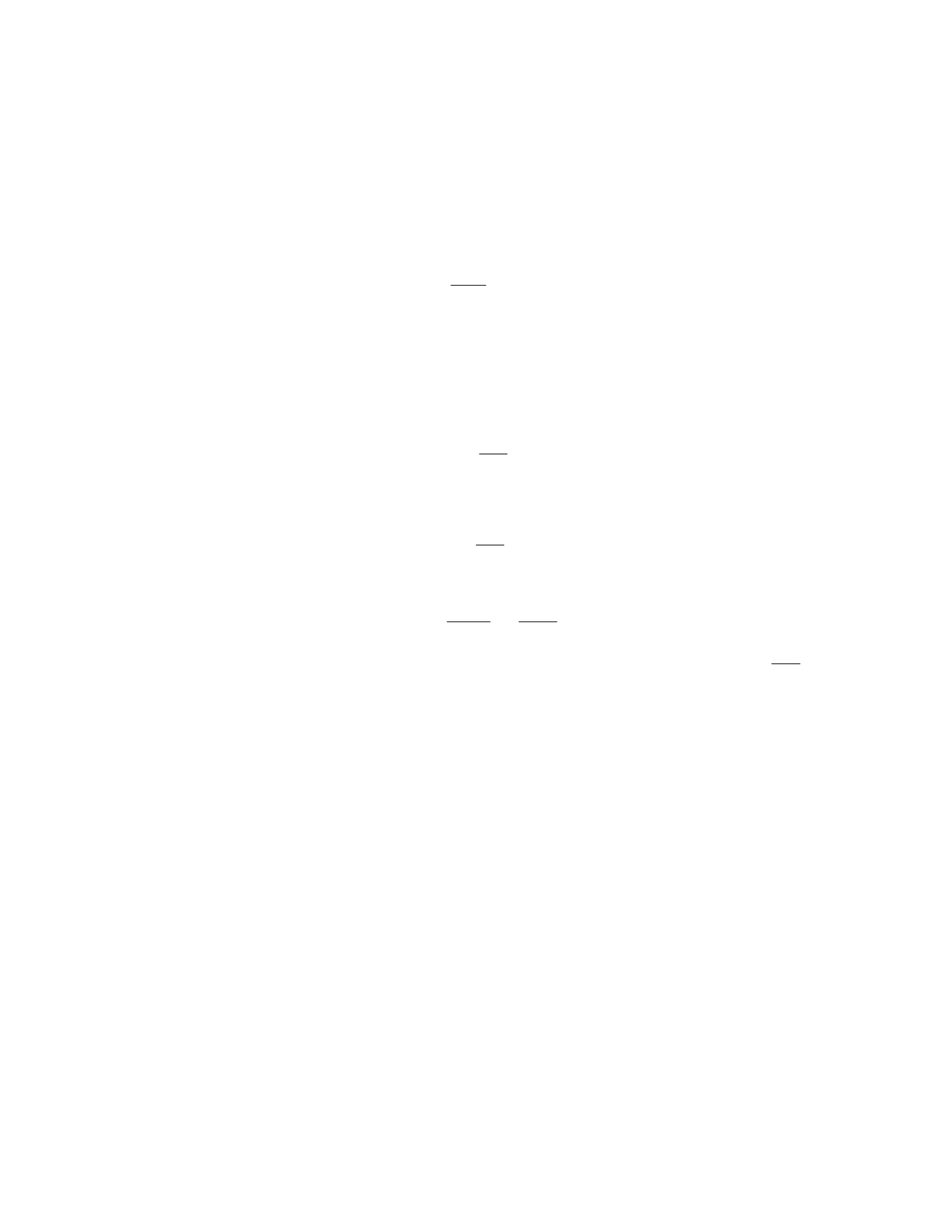
Substitute the values for ϵand L:∆L= 2.5×10−5·2 = 5 ×10⁻⁵m∆L= 5 ×10⁻⁵m
3. Question: A thin rod of length Land uniform density ρis hanging vertically from one end.
The rod has cross-sectional area Aand Young’s modulus Y. Find the elongation of the rod when
a mass mis attached to the free end.
Ans. Let’s denote the elongation of the rod as ∆L. To solve this problem, we will use the
concept of equilibrium and elasticity.
1. The weight of the mass is equal to the force required to stretch the rod:
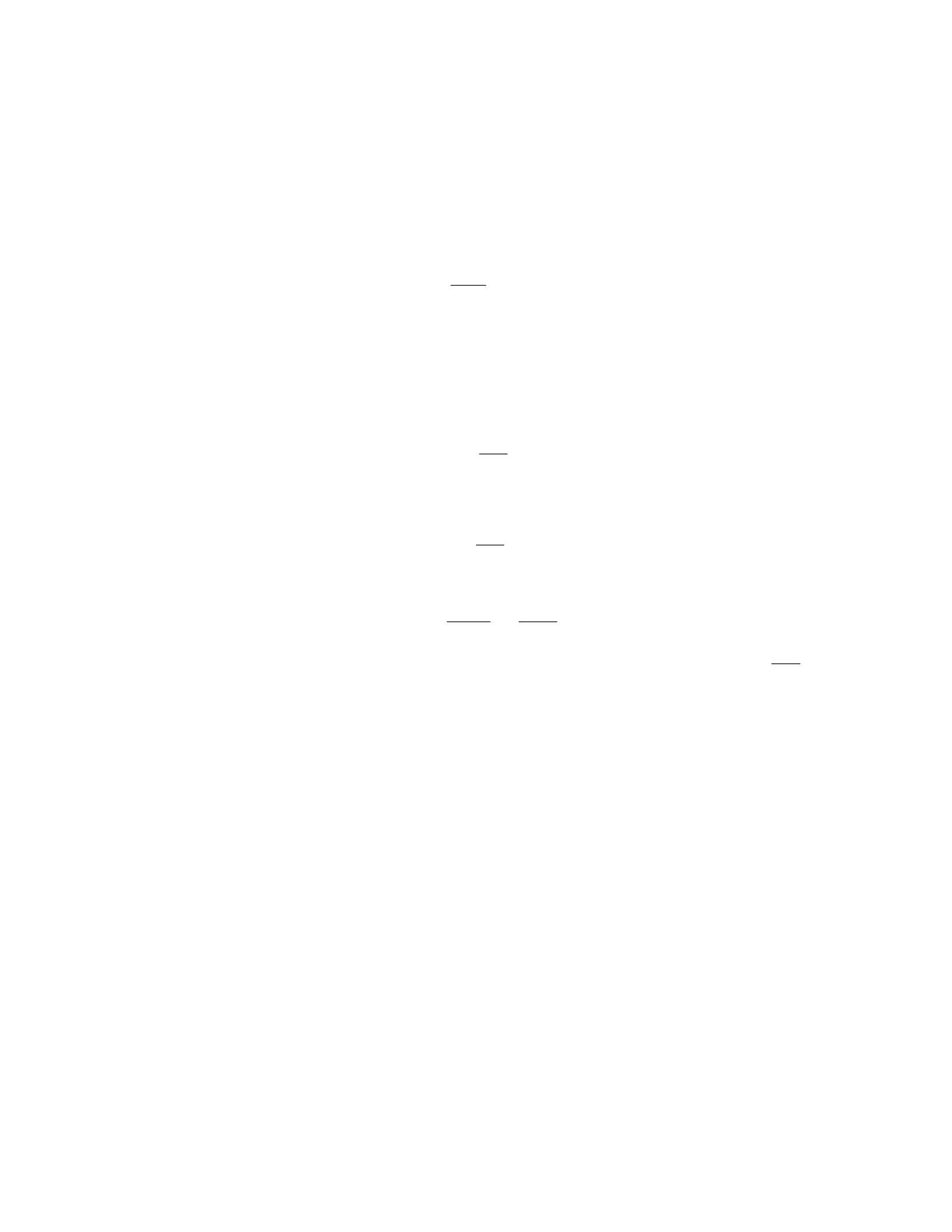
mg =ρAL
Ag=ρLg
2. The elongation of the rod can be calculated using Hooke’s Law:
F=k∆L
where kis the spring constant. In this case, the spring constant is given by:
k=Y A
L
3. Substituting Hooke’s Law and the calculated force into our equation, we get:
ρLg =Y A
L∆L
4. Solving for ∆L, we find:
∆L=ρLgL
Y A =ρgL2
Y
Therefore, the elongation of the rod when a mass mis attached to the free end is ρgL2
Y.
4. Question: A uniform beam of length Land mass Mis supported by two ropes attached to
its ends and hanging vertically. The beam is in equilibrium and the angle between each rope and
the vertical is θ. Find the tension in each rope.
Ans. Let’s denote the tensions in the ropes as T1and T2where T1is the tension in the left rope
(attached to the left end) and T2is the tension in the right rope (attached to the right end).
1. Draw a free-body diagram of the beam. Consider the forces acting on the beam: the
weight of the beam acting downwards, the tensions T1and T2acting upwards, the normal force
at the pivot point acting upward, and the reaction force at the pivot point acting to the right.
2. Write out the equilibrium conditions for the forces in the vertical and horizontal directions.
In the vertical direction, the sum of the forces must be zero:
T1cos(θ) + T2cos(θ)−Mg = 0
In the horizontal direction, the sum of the forces must also be zero:
T1sin(θ)−T2sin(θ) = 0
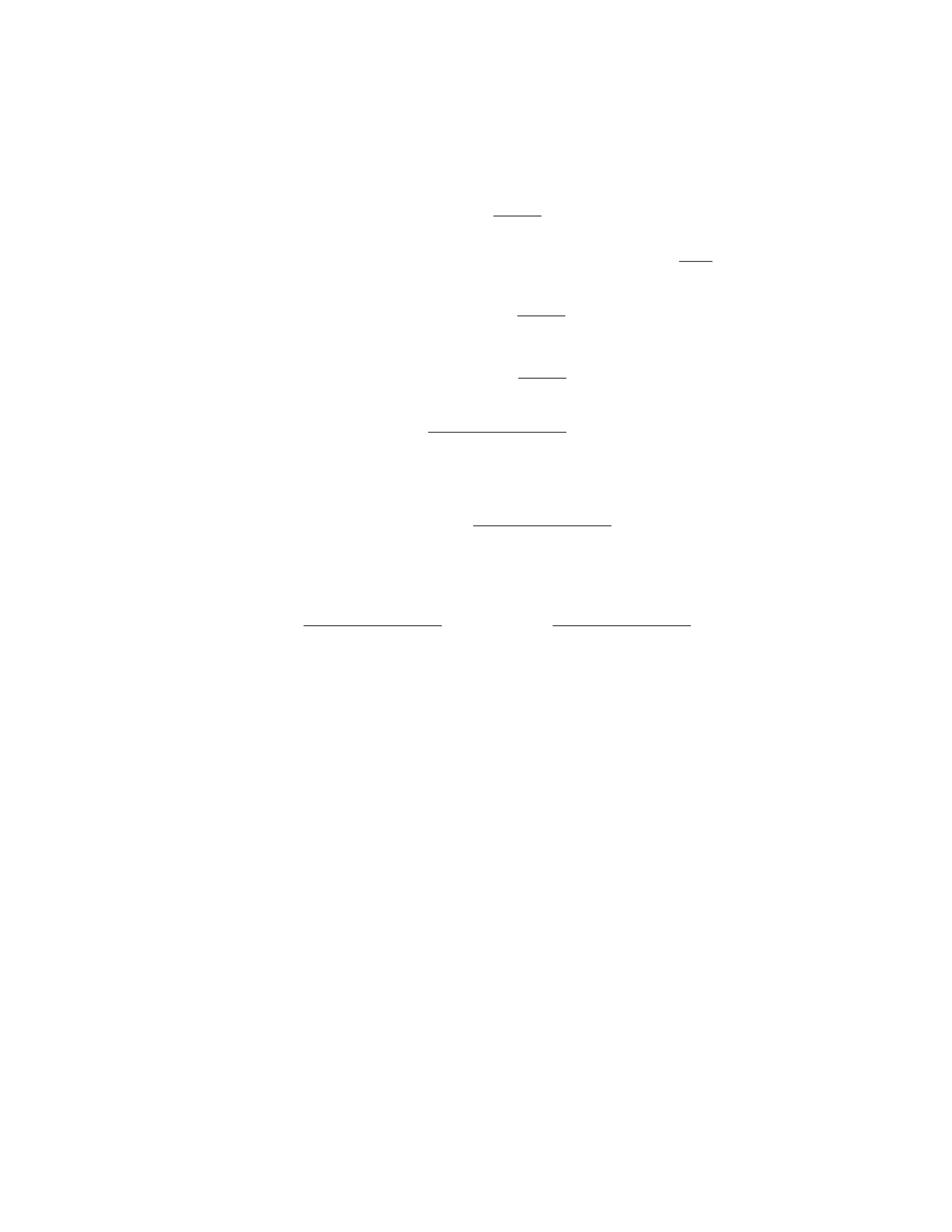
3. Solve the system of equations to find the tensions T1and T2. From the first equation:
T1cos(θ) + T2cos(θ) = Mg
T1+T2=Mg
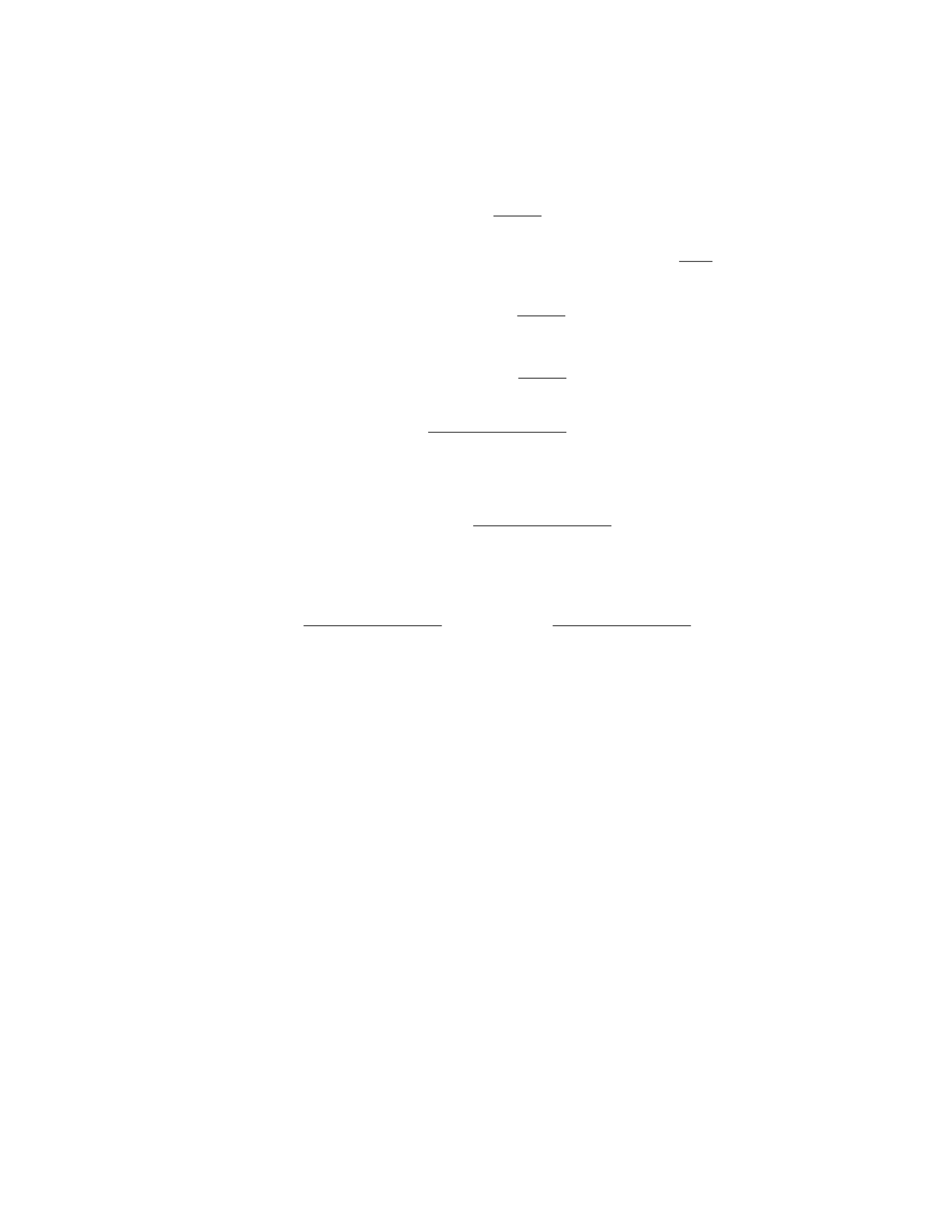
cos(θ)
4. Substitute T1=T2sin(θ)from the second equation into T1+T2=M g
cos(θ):
T2sin(θ) + T2=Mg
cos(θ)
T2(1 + sin(θ)) = Mg
cos(θ)
T2=Mg
cos(θ)(1 + sin(θ))
5. Similarly, find T1by substituting T2back into T1=T2sin(θ):
T1=T2sin(θ) = Mg sin(θ)
cos(θ)(1 + sin(θ))
Therefore, the tension in each rope is:
T1=Mg sin(θ)
cos(θ)(1 + sin(θ)) and T2=Mg
cos(θ)(1 + sin(θ))
5. A uniform rod of length Land mass Mis hanging vertically from a ceiling, with one end
attached to the ceiling by a hinge. A horizontal force Fis applied to the other end of the rod.
Determine the angle θthat the rod makes with the vertical when it is in equilibrium.
Ans. Let’s denote the angle that the rod makes with the vertical as θ. We can set up the
following equations of equilibrium:
1. Sum of forces in the horizontal direction:
Fhorizontal = 0
F=Tsin θ
where Tis the tension in the rod.
2. Sum of forces in the vertical direction:
Fvertical = 0
Tcos θ=Mg

where gis the acceleration due to gravity.
3. Sum of torque about the hinge point: The torque τdue to the force Fis given by:
τ=F·Lcos θ
The torque τ′due to the gravitational force Mg is given by:
τ′=Mg ·L
2sin θ
In equilibrium, these torques must sum to zero:
τ+τ′= 0
F·Lcos θ+Mg ·L
2sin θ= 0
From the equations above, we can solve for θin terms of F,M,L, and g.
6. A block of mass mis suspended by two strings of length Leach. The block is displaced
horizontally by a small distance x. The strings make an angle θwith the vertical. If the block is
released from this position, find the period of oscillation of the block.
Ans. To find the period of oscillation of the block, we first need to determine the effective
spring constant associated with the system. Then we can use this information to calculate the
period of oscillation. 1. The restoring force is provided by the horizontal components of tension
in the strings. The components of tension in each string are Tsin θ. Thus, the net restoring
force is 2Tsin θ. 2. The restoring force is equal to ma, where ais the acceleration of the block.
Since a=d2x
dt2, we have 2Tsin θ=md2x
dt2. 3. The tension in the strings is given by T=mg
2cos θ.
Substitute this into the equation from step 2 to get 2mg sin θ
2cos θ=md2x
dt2. 4. Simplify the equation
from step 3 to get gtan θ
cos θ=d2x
dt2. 5. Rewrite the kinematic equation for SHM as d2x
dt2+(g
L)x= 0.
Compare this with the equation from step 4 to get tan θ=g
ω2L, where ωis the angular frequency.
6. Solve for the angular frequency to get ω2=g
Lcos θ. The period of oscillation is T=2π
ω. 7.
Substitute ω2from step 6 into the expression for Tto get T= 2π√Lcos θ
g. Therefore, the period
of oscillation of the block is T= 2π√Lcos θ
g.
7. A uniform rod of length Land mass Mis supported horizontally at two points P and Q
which are at equal distance L/4 from the ends of the rod. A weight Wis suspended from the
rod at distance L/2 from P on the same side as Q. Determine the tension in the rod at point P.
(Hint: consider the equilibrium of the entire rod.)

Ans. Let’s denote the tension at point P as TP. We can solve this problem by analyzing the
forces and torques acting on the rod. 1. Consider the forces acting on the rod: The weight W
acts vertically downward at a distance L/2 from P. The tension TPat point P acts at an angle
θto the horizontal. The weight of the rod can be considered to act at its center of mass, which
is at a distance L/2 from P.
2. Write the force balance equations: Summing the forces in the vertical direction, we have:
TPsin(θ)−W= 0
3. Write the torque balance equations: Taking moments about point Q (where the rod
touches the surface), we have: TPcos(θ)·L
4−W·L
2= 0
4. Solve the equations simultaneously: From the force balance equation, we have TPsin(θ) =
W. Substituting this into the torque balance equation gives us: Wcos(θ)·L
4−W·L
2= 0
5. Calculate the tension TP: Solving the equation, we find: W(cos(θ)·L
4−L
2)=0
cos(θ)·1
4−1
2= 0 cos(θ) = 2
4=1
2θ=cos−1(1
2) = π
3
Substitute θ=π
3back into the force balance equation TPsin(θ) = Wto find: TPsin(π
3)=
W TP=W
sin(π
3)TP=W
√3/2 TP=2W
√3
Therefore, the tension at point P is 2W
√3.
8. A uniform rod of length Land mass Mis hanging vertically from one end. A small weight
mis attached to the free end. Determine the force exerted by the rod on the weight when the
system is in equilibrium.
Ans. To find the force exerted by the rod on the weight when the system is in equilibrium, we
need to analyze the forces acting on the system and set up the equilibrium conditions.
1. First, draw the free-body diagram of the system. The weight of the rod acts at its center
of mass, which is at a distance L
2from the end where the weight is attached. The weight mg of
the rod acts downward at its center of mass.
2. The tension Tin the rod acts upward at the point where the weight is attached.
3. The small weight mis acted upon by its weight mg and the force exerted by the rod. Let’s
denote this force as F.
4. Write down the equilibrium equations along the vertical direction: T−mg −F= 0
(Equation 1) F=mg(Equation 2)
5. Next, consider the torque about the point where the rod is attached. The torque due to
the weight mg is zero since its line of action passes through the point of rotation. The torque
due to the tension Tis also zero as the lever arm is zero. Hence only the torque due to the small
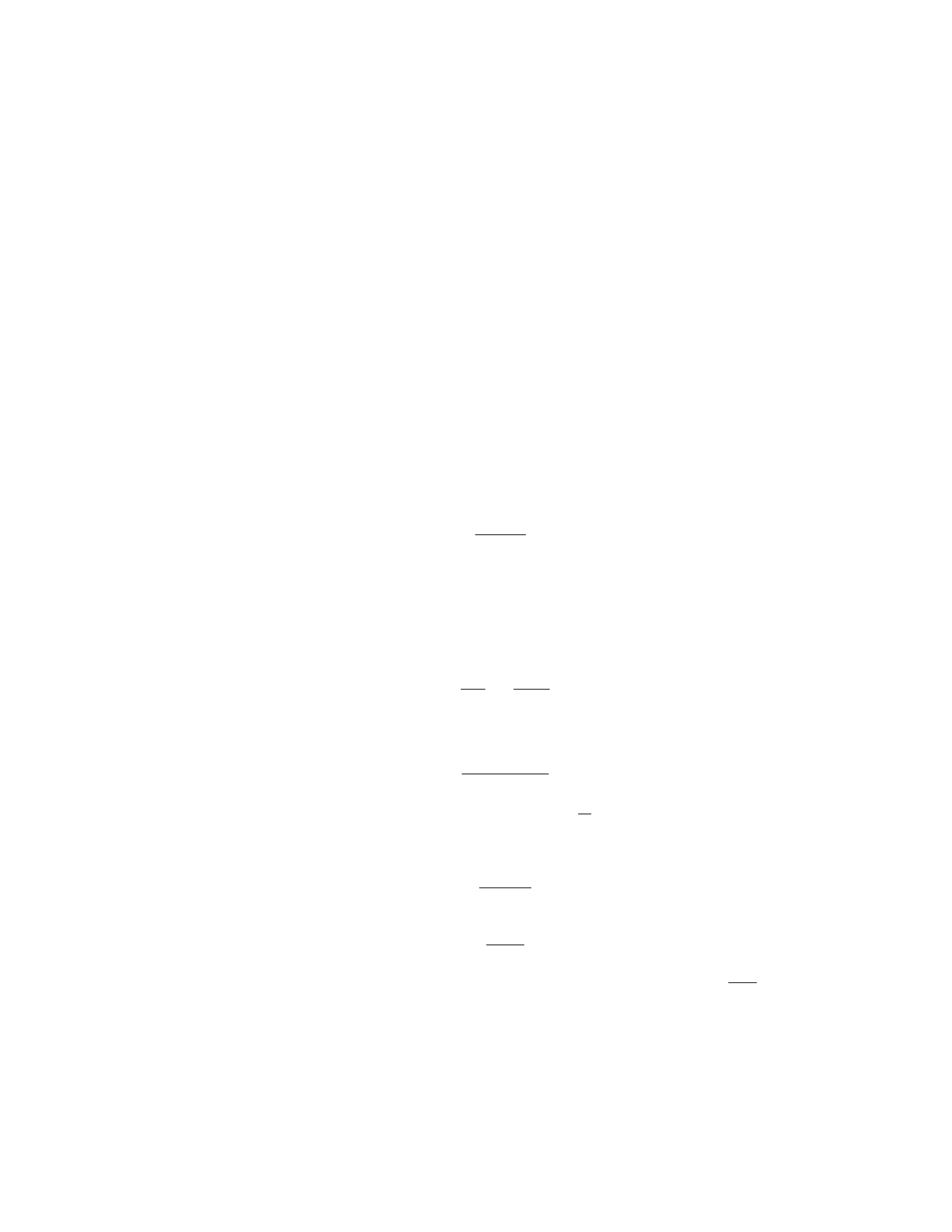
weight mis non-zero. This torque is given by m·g·L
2and it acts in the clockwise direction.
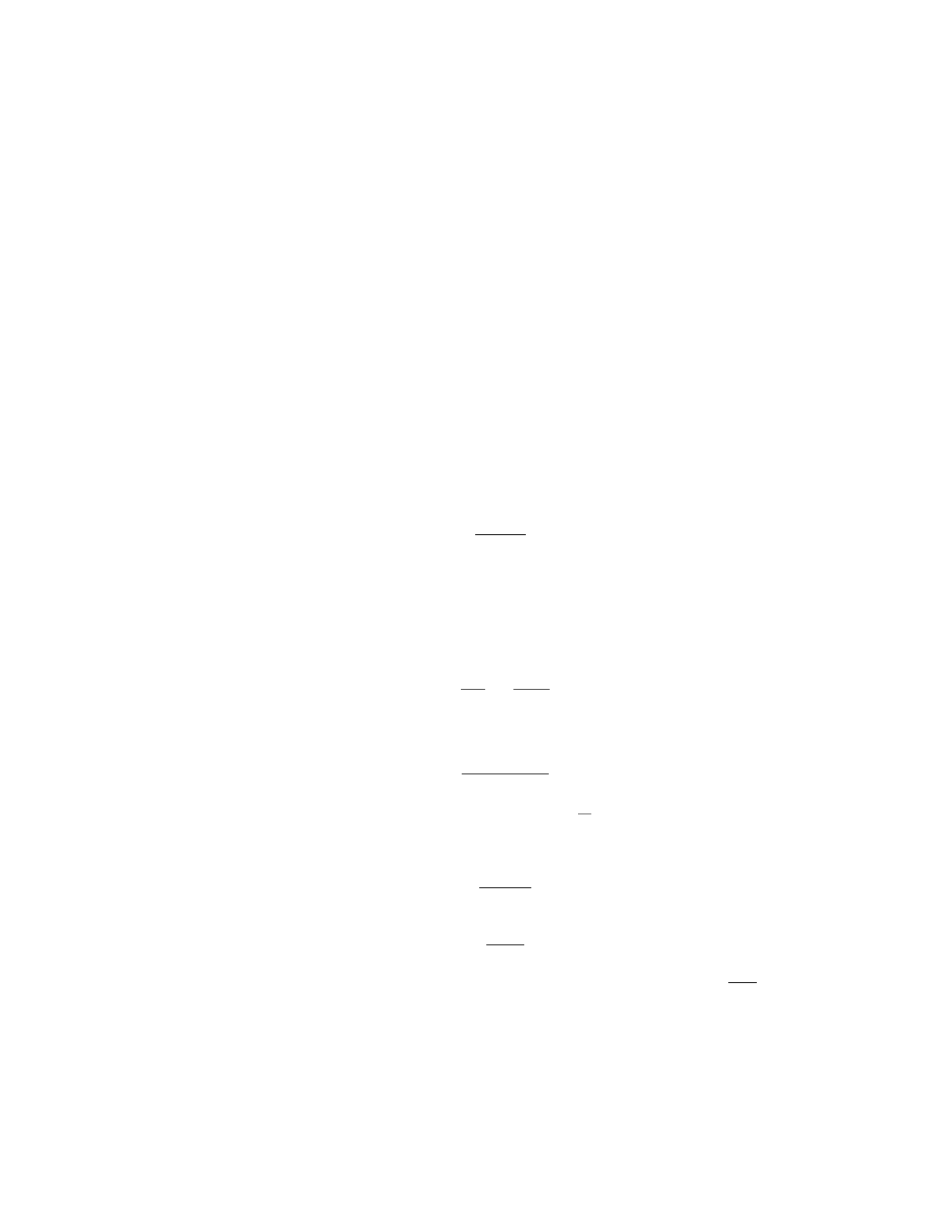
6. Write down the torque equilibrium equation: m·g·L
2= 0
7. Now, solve Equations 1 and 2 simultaneously to find the force F:T−Mg −F= 0
F=Mg
Therefore, the force exerted by the rod on the weight when the system is in equilibrium is
Mg.
9. Question:
A rectangular beam of length L, width W, and height His subjected to a uniform load
distributed over its length. The beam is made of a material with Young’s modulus E. Determine
the maximum tensile stress in the beam if the beam is just on the verge of buckling due to
compressive loads acting along its height.
Ans. Step-by-step solution:
1. The maximum compressive load that the beam can withstand without buckling is given
by the Euler buckling load formula:
Pcr =π2EI
(KL)2
where Kis the effective length factor that depends on the end support conditions. For a
simply supported beam, K= 1.
2. The maximum stress occurs at the top and bottom surfaces of the beam. At the top
surface (where tension occurs), the normal stress is given by:
σmax =Pcr
A=Pcr
W H
3. Substituting the expression for Pcr into the equation for σmax:
σmax =π2EI
(KL)2W H
4. To simplify the expression, we can substitute I=1
12 W H3(moment of inertia for a
rectangular cross-section) into the equation:
σmax =π2E
3(3L)2
σmax =π2E
27L2
5. Therefore, the maximum tensile stress in the beam just before buckling is π2E
27L2.
10. Question:

A uniform beam of length Land mass Mis supported by two vertical ropes attached at
points Aand Ba distance aand bfrom one end of the beam, respectively. The tension in the
rope at point Ais TAand the tension in the rope at point Bis TB. Find the horizontal force at
point C, located a distance cfrom the end where the ropes are attached, required to keep the
beam in equilibrium.
Ans. Let’s denote the weight of the beam as W. We can start solving this problem by drawing
a free-body diagram of the beam and analyzing the forces acting on it.
1. The beam is in rotational equilibrium. The sum of the torques about any point must be
zero. We can choose point Aas the pivot point, which makes the torque due to the tension at
Aequal to zero.
2. The torque due to TBabout point Ais TB·(L−b)and it causes a counterclockwise
rotation. The torque due to the weight Wabout point Ais W·(L/2 −a)and it causes a
clockwise rotation. The torque due to the force at Cabout point Ais FC·cand it causes a
counterclockwise rotation. Setting up the torque equation:
TB·(L−b)−W·(L
2−a)−FC·c= 0
3. The sum of the forces in the vertical direction must be zero to keep the beam in equilibrium.
The vertical forces are the tensions in the ropes TAand TBand the weight W:
TA+TB−W= 0
4. The sum of the forces in the horizontal direction must also be zero to keep the beam in
equilibrium. The only horizontal force is the force at C, denoted as FC:
FC= 0
5. Solving the equations simultaneously, we can find the expression for the horizontal force
FC:
FC=W−TA−TB
Thus, the horizontal force at point Crequired to keep the beam in equilibrium is W−TA−TB.
11. A uniform rod of length Land mass Mis attached to a wall by a hinge at one end and
supported by a cable of length Lattached to the other end. The cable makes an angle θwith
the rod. Find the tension in the cable and the reaction force at the hinge.
Ans. Let’s denote the tension in the cable as Tand the reaction force at the hinge as R.
We can start finding these forces by setting up equilibrium equations. 1. Consider the vertical
equilibrium for the rod: The sum of the vertical forces must be zero. We have:
Tcos θ=Mg

2. Consider the torque equilibrium about the hinge: The torque produced by the tension and the
weight of the rod must balance out. We have:
Tsin θ·L=Mg ·L
2
Now we can solve these equations simultaneously. 3. From the vertical equilibrium equation, we
find:
T=Mg
cos θ
4. Substitute the expression for T into the torque equilibrium equation:
Mg
cos θsin θ·L=Mg ·L
2
sin θ=1
2
θ=π
6
5. Finally, substitute this value of θback into the equation for Tto find the tension:
T=Mg
cos(π
6)=Mg√3
6. To find the reaction force R, we can use the vertical equilibrium equation:
R=Mg sin θ=M g 1
2=Mg
2
Therefore, the tension in the cable is M g√3and the reaction force at the hinge is Mg
2.
12. Question: A 2 m long rod with a Young’s modulus of 2×10¹¹ N/m² is supported at one
end and has a 10 kg weight hanging from the other end. Determine the stress and strain in the
rod when it is in equilibrium.
Ans. Step-by-step solution: 1. To find the stress (σ) in the rod, we will use the formula σ=F
A,
where Fis the force applied and Ais the cross-sectional area of the rod. 2. The force applied to
the rod is the weight of the 10 kg mass, which can be calculated as F=mg, where mis the mass
and gis the acceleration due to gravity (9.81 m/s2). 3. Thus, F= 10 kg ×9.81 m/s2= 98.1N.
4. The cross-sectional area of the rod can be calculated as A=πr2, where ris the radius
of the rod. Since the rod is assumed to be uniform, the radius will be constant along its
length. 5. Given that the rod is 2 m long, let’s assume a typical diameter of d= 1 cm =
0.01 m. Therefore, r= 0.005 m. 6. Substituting rinto the equation for the cross-sectional
area, we get A=π(0.005)2≈7.85 ×10⁻⁵m². 7. Now, we can calculate the stress in the rod:
σ=98.1
7.85×10⁻⁵≈1.25×10⁶N/m². 8. To find the strain in the rod (ε), we use the formula ε=σ
Y,

where σis the stress and Yis the Young’s modulus. 9. Substituting the values we calculated
earlier, we get ε=1.25×10⁶
2×1011 = 6.25 ×10⁻⁶. 10. Therefore, when the rod is in equilibrium, the
stress in the rod is approximately 1.25 ×10⁶N/m² and the strain is approximately 6.25 ×10⁻⁶.
13. A uniform rod of length Land mass Mis pivoted at one end and is in equilibrium in a
horizontal position. A force Fis applied at a distance xfrom the pivot, perpendicular to the
length of the rod. The rod makes an angle θwith the horizontal.
Find an expression for the angular acceleration αof the rod in terms of x,θ,L,M, and F.
Ans. Let’s denote the acceleration due to gravity as g. The angular acceleration αof the rod
can be expressed as:
α=3
2
F x cos θ
ML2−3
2gsin θ
where xis the distance from the pivot where the force is applied, θis the angle the rod makes
with the horizontal, Lis the length of the rod, Mis the mass of the rod, Fis the applied force,
and gis the acceleration due to gravity.
14. Question 14:
A uniform rod of length Land mass Mis supported by a pivot at one end. A block of mass
mis placed at a distance xfrom the pivot on the same side as the rod. The rod makes an angle
θwith the horizontal. Find the tension in the pivot.
Ans. Let’s denote the distance of the pivot from the center of mass of the rod as d. The center
of mass of the rod is at a distance L/2 from the pivot. We will use the fact that the net torque
about the pivot point is zero at equilibrium.
1. The torque due to the rod: The weight of the rod acts at its center of mass (at a distance
L/2 from the pivot), so the torque due to the rod is given by −(M g)(L/2) sin θ.
2. The torque due to the block: The weight of the block acts at a distance x+dfrom the
pivot. Therefore, the torque due to the block is −(mg)(x+d)sin θ.
3. The torque due to the tension: The tension in the pivot acts at a distance dfrom the
pivot in the opposite direction. Hence, the torque due to the tension is T d sin θ.
Since the net torque is zero at equilibrium, we have:
T d sin θ= (Mg)(L/2) sin θ+ (mg)(x+d)sin θ
Solving for T, we get:
T= (Mg)(L/2) + mg(x+d)
Therefore, the tension in the pivot is (M g)(L/2) + mg(x+d).

15. A uniform rod of length Land mass Mis initially hanging vertically from a fixed pivot
at one end. The rod is then pushed horizontally at the free end until it makes an angle θwith
the vertical. Given that the Young’s modulus of the rod is Yand the cross-sectional area is A,
determine the force required to hold the rod in equilibrium at this position.
Ans. To find the force required to hold the rod in equilibrium at an angle θwith the vertical,
we need to consider both the gravitational force acting down on the rod and the restoring torque
due to the deformation of the rod.
1. The weight of the rod can be resolved into two components: one acting vertically down-
wards and the other acting along the rod. The horizontal component is M g sin θand the vertical
component is Mg cos θ.
2. The restoring torque is due to the horizontal component of the deformation force in the
rod. The deformation can be calculated using the equation F
A=Y∆L
L. Here, ∆L=Lsin θ.
3. The moment arm for the torque due to the deformation is Lcos θ, and the torque due to
the weight of the rod is L
2cos θ.
4. Setting up the equilibrium conditions, we have two torques acting on the rod: one coun-
terclockwise due to the weight of the rod and another clockwise due to the deformation. The
sum of the torques must be zero for equilibrium.
5. Equating the two torques, we get Mg L
2cos θ=F(Lcos θ). Solving for Fgives F=
Mg
2cos θ.
Therefore, the force required to hold the rod in equilibrium at an angle θwith the vertical is
Mg
2cos θ.
16. A metal rod of length Land cross-sectional area Ais suspended vertically from the ceiling.
A weight W1is attached to the bottom end of the rod. Another weight W2is attached to a
platform that is placed on top of the rod at a distance xfrom the ceiling. The rod is in equilibrium.
Determine the expression for the Young’s Modulus Y of the material of the rod in terms of
L,A,W1,W2,x, and g, where gis the acceleration due to gravity.
Ans. Let’s denote the downward force acting on the bottom end of the rod as F1and the
upward force acting on the top end of the rod as F2. The total force on the rod can be expressed
as:
Ftotal =F1−F2= 0
Using Hooke’s Law, we can express F1and F2as:
F1=W1
rod’s length =W1
L
F2=W2
distance from platform to ceiling =W2
x
Substituting these expressions into the equation for equilibrium, we get:
W1
L=W2
x

Since Young’s Modulus Y can be defined as the ratio of stress to strain, where stress is force per
unit area (σ=F
A) and strain is the ratio of deformation to the original length (ε=∆L
L), we can
write the equation as:
W2
x
A=Y·∆L
L
Given that the deformation of the rod ∆Lcan be expressed as x(the distance from the platform
to the ceiling) minus L(the original length of the rod), we have ∆L=x−L. Substitute
∆L=x−Linto the equation, we get:
W2
x
A=Y·x−L
L
Y=A·W2
x
x−L
Therefore, the expression for the Young’s Modulus Y in terms of L,A,W1,W2,x, and gis:
Y=A·W2
x
x−L
17. In a physics lab experiment, a spring with a spring constant of 450 N/m is used to support
an object of mass 0.5kg. The object is then displaced vertically from its equilibrium position
and released. Determine the maximum displacement of the object from its equilibrium position
before it starts oscillating. Assume the elastic limit of the spring is not exceeded.
Ans. Let’s denote the maximum displacement of the object from its equilibrium position as
xmax.
1. The force exerted by the spring on the object when displaced a distance xfrom equilibrium
is given by Hooke’s Law: F=−kx, where kis the spring constant. At maximum displacement,
the spring force will be equal in magnitude to the gravitational force on the object:
kxmax =mg
where mis the mass of the object and gis the acceleration due to gravity.
2. Substituting the values k= 450 N/m, m= 0.5kg, and g= 9.81 m/s2, we can solve for
xmax:
450xmax = 0.5×9.81
xmax =0.5×9.81
450
xmax = 0.0109 m
Therefore, the maximum displacement of the object from its equilibrium position before it
starts oscillating is 0.0109 m.
18. Question:
A cylindrical rod with a length of 2 meters and a diameter of 10 cm is suspended horizontally
between two walls. The rod is made of a steel alloy with a Young’s modulus of 2×10¹¹ N/m2.
A weight of 500 N is hung from the center of the rod. Determine the elongation of the rod.
Ans. Step-by-step solution:
1. First, we need to find the cross-sectional area of the rod: The diameter of the rod is 10
cm, so the radius is 10/2 = 5 cm = 0.05 m. The cross-sectional area is given by A=πr2.
Plugging in the values, we have A=π×(0.05)2= 0.00785 m2.
2. Next, calculate the stress applied to the rod: Stress (σ) is defined as the force per unit
area. In this case, the force is 500 N and the area is 0.00785 m2. So, σ=F
A=500
0.00785 = 63694.27
N/m2.
3. Now, we can use Hooke’s Law for elasticity to find the elongation of the rod: Hooke’s
Law states that the stress is proportional to the strain, where the proportionality constant is the
Young’s modulus (Y). The equation is σ=Y·ε, where εis the strain. Therefore, ε=σ
Y=
63694.27
2×1011 = 3.18 ×10⁻⁴.
4. Finally, calculate the elongation of the rod: The elongation (∆L) can be calculated using
the formula ∆L=ε·L, where Lis the original length of the rod. Plugging in the values, we
have ∆L= 3.18 ×10−4×2 = 6.36 ×10⁻⁴m.
Therefore, the elongation of the rod is 6.36 ×10⁻⁴meters.
19. A uniform rod of length Land mass Mis attached to a fixed pivot at one end and
suspended vertically. A small object of mass mis attached to the rod a distance dfrom the pivot
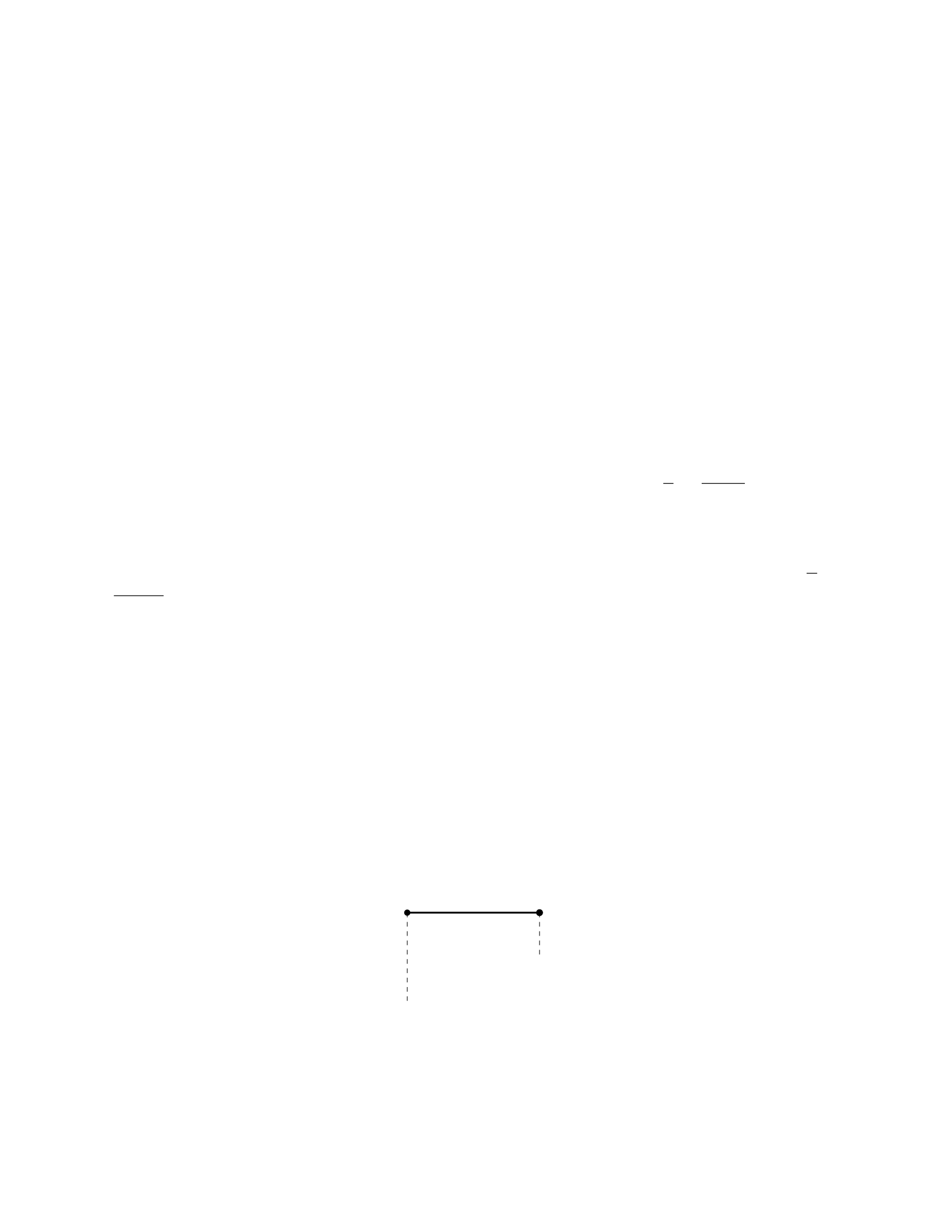
point, as shown in the figure below. The system is in equilibrium.
Pivot Object
m
L
d
Given that the rod is of negligible mass and the acceleration due to gravity is g, determine
the tension in the rod.
Ans. Let’s consider the forces acting on the small object attached to the rod. 1. The force of

gravity acts downwards, with a magnitude of mg. 2. The tension in the rod acts both horizontally
and vertically. 3. The normal force acts perpendicular to the rod. 4. The frictional force acts
parallel to the rod. Since the system is in equilibrium, the sum of the forces in the horizontal and
vertical directions must be zero.
1. In the vertical direction: The sum of the vertical components of the forces must be zero:
Tcos(θ)−mg = 0
Tcos(θ) = mg
2. In the horizontal direction: The sum of the horizontal components of the forces must be
zero:
Tsin(θ) = Ffriction
Since the object is in equilibrium and the rod is of negligible mass, there is no angular acceleration
and the frictional force is zero. Thus,
Tsin(θ) = 0
T= 0
20. Question:
A solid cylinder of radius Rand height his placed on a rough horizontal surface. A horizontal
force Fis applied tangentially to the cylinder at a height h/3 above the base. The coefficient of
friction between the cylinder and surface is µ. Determine the maximum value of Fthat can be
applied without causing the cylinder to tip over.
Ans. Step-by-step solution:
1. First, we need to determine the conditions for the cylinder not to tip over. The net torque
about the point where the cylinder touches the surface must be zero. Since the force is applied
at a height of h/3 above the base, the lever arm is h/3. The weight Wof the cylinder acts at the
center of mass, which is at a height of h/2 above the base. The frictional force acts horizontally
in the direction opposite to the applied force F. Let Rbe the reaction force at the contact point.
The torque equation can be written as:
F·h
3−µ·R·(h/2) = 0
2. Next, we need to consider the conditions for the cylinder not to slide. The force of friction
must be less than or equal to the maximum static friction force which is µR. The equilibrium
equation in the vertical direction can be written as:
R=W
R=mg

3. By substituting R=mg into the torque equation, we get:
F·h
3−µ·mg ·h
2= 0
F=µmg ·3
2
F=3
2µmg
Therefore, the maximum value of Fthat can be applied without causing the cylinder to tip
over is 3
2µmg.
21. A uniform rod of length Land mass Mis in equilibrium, with one end of the rod is on a
rough horizontal surface and the other end is against a smooth vertical wall. The coefficient of
static friction between the rod and the surface is µs. Find the minimum value of µsfor which
the rod remains in equilibrium.
Ans. Let’s denote the angle between the rod and the horizontal surface as θ.
1. Draw a free body diagram of the rod. By resolving forces horizontally and vertically, we
have: Horizontal forces: N=fwall
Vertical forces: ffloor =Mg
where Nis the normal reaction force exerted by the wall on the rod, fwall is the frictional force
between the rod and the wall, ffloor is the frictional force between the rod and the floor, and gis
the acceleration due to gravity.
2. Write the torque equation about the point of contact between the rod and the floor. The
forces Nand M g do not contribute to the torque since their lines of action pass through this
point. The torques due to the frictional forces are:
τfwall =fwall ·Lsin θand τffloor =ffloor ·L/2 cos θ
3. For equilibrium, the net torque must be zero, so:
fwall ·Lsin θ=Mg ·L/2 cos θ
4. Substitute the expressions for the frictional forces:
µsMg ·Lsin θ=M g ·L/2 cos θ
5. Simplify the equation and solve for the minimum value of µs:
µs=1
2tan θ
6. The minimum value of µsoccurs when θis maximum. Therefore, θ=arctan(1
2).

Hence, the minimum value of µsfor which the rod remains in equilibrium is µs=1
2tan(arctan(1
2))=
1
√5.
22. Question 22:
A block of wood of mass 2 kg is hung from a uniform steel rod that is 2 m long and has a
mass of 1 kg. The steel rod is attached to a wall at one end, and the block of wood is attached
to the other end. If the system is in equilibrium and the elastic modulus of steel is 2×10¹¹ N/m2,
calculate the extension of the steel rod.
Ans. Let’s denote the extension of the steel rod as x. To find x, we need to consider the
equilibrium of forces acting on the rod.
1. The weight of the block of wood is acting downwards, and it exerts a force on the steel
rod given by F1=m1·gwhere m1= 2 kg and g= 9.8m/s2.
2. The weight of the steel rod is acting downwards towards the wall, and it exerts a force on
the steel rod given by F2=m2·gwhere m2= 1 kg.
3. The tension in the steel rod is acting upwards and is equal to the force exerted by the
block of wood. This tension F3can be written as F3=m1·g.
4. The extension xcreated in the steel rod due to the weight of the block of wood can be
expressed as x=F3·L
A·E, where L= 2 m is the length of the rod, Ais the cross-sectional area of
the rod, and E= 2 ×10¹¹ N/m2is the elastic modulus of steel.
5. The cross-sectional area Aof the steel rod can be calculated using the formula A=π·r2
4,
where ris the radius of the rod.
6. Finally, substituting all the known values into the equation x=m1·g·L
π·r2
4·Eand solving for x
will give us the extension of the steel rod.
This problem requires the application of both equilibrium and elasticity concepts to find the
extension of the steel rod under the given conditions.
23. Question:
A block of mass mis hanging from the ceiling by a wire of length L. The block is pulled to
one side until the wire makes an angle θwith the vertical wall. Find an expression for the tension
in the wire as a function of the angle θ.
Ans. Let’s consider the forces acting on the block:
1. The weight of the block mg acting vertically downwards. 2. The tension Tin the wire
acting along the wire. 3. The horizontal component of the tension Tsin θ. 4. The vertical
component of the tension Tcos θ. 5. The centripetal force mv2
Ldirected towards the center,
where vis the velocity of the block.
Since the block is in equilibrium, the sum of the forces in the horizontal direction is equal to

zero:
Tsin θ=mv2
L(1)
The forces in the vertical direction also sum up to zero:
Tcos θ=mg (2)
From equation (2), we can express the tension Tas:
T=mg
cos θ
Therefore, the tension in the wire as a function of the angle θis given by T=mg
cos θ.
24. A rectangular wooden block of dimensions 20 cm ×10 cm ×5cm floats in water with the
20 cm side horizontal. Determine the density of the wood.
Ans. Let’s denote the density of water as ρw= 1000 kg/m3. 1. First, we need to determine the
volume of the block. The volume of the block is given by the product of its three dimensions, so
Vblock = 20 cm ×10 cm ×5cm = 1000 cm3= 0.001 m3. 2. Since the block floats in water, the
weight of the block is equal to the buoyant force acting on it. Using the formula for buoyant force
Fb=ρw·Vblock ·g, where g= 9.81 m/s2is the acceleration due to gravity, we have the weight
of the block Wblock =ρw·Vblock ·g. 3. The weight of the block can also be calculated using
its density ρwood and the acceleration due to gravity, so Wblock =ρwood ·Vblock ·g. Substituting
Vblock = 0.001 m3and g= 9.81 m/s2, we get an equation in terms of the density of wood ρwood.
4. Equating the weights from steps 2 and 3, we have ρwood ·Vblock ·g=ρw·Vblock ·g. Cancelling
out Vblock ·gfrom both sides gives us ρwood =ρw. 5. Therefore, the density of the wood is the
same as the density of water, ρwood = 1000 kg/m3.
3. Question: A thin rod of length Land uniform density ρis hanging vertically from one end.
The rod has cross-sectional area Aand Young’s modulus Y. Find the elongation of the rod when
a mass mis attached to the free end.
Ans. Let’s denote the elongation of the rod as ∆L. To solve this problem, we will use the
concept of equilibrium and elasticity.
1. The weight of the mass is equal to the force required to stretch the rod:
mg =ρAL
Ag=ρLg
2. The elongation of the rod can be calculated using Hooke’s Law:
F=k∆L
where kis the spring constant. In this case, the spring constant is given by:
k=Y A
L
3. Substituting Hooke’s Law and the calculated force into our equation, we get:
ρLg =Y A
L∆L
4. Solving for ∆L, we find:
∆L=ρLgL
Y A =ρgL2
Y
Therefore, the elongation of the rod when a mass mis attached to the free end is ρgL2
Y.
4. Question: A uniform beam of length Land mass Mis supported by two ropes attached to
its ends and hanging vertically. The beam is in equilibrium and the angle between each rope and
the vertical is θ. Find the tension in each rope.
Ans. Let’s denote the tensions in the ropes as T1and T2where T1is the tension in the left rope
(attached to the left end) and T2is the tension in the right rope (attached to the right end).
1. Draw a free-body diagram of the beam. Consider the forces acting on the beam: the
weight of the beam acting downwards, the tensions T1and T2acting upwards, the normal force
at the pivot point acting upward, and the reaction force at the pivot point acting to the right.
2. Write out the equilibrium conditions for the forces in the vertical and horizontal directions.
In the vertical direction, the sum of the forces must be zero:
T1cos(θ) + T2cos(θ)−Mg = 0
In the horizontal direction, the sum of the forces must also be zero:
T1sin(θ)−T2sin(θ) = 0
3. Solve the system of equations to find the tensions T1and T2. From the first equation:
T1cos(θ) + T2cos(θ) = Mg
T1+T2=Mg
cos(θ)
4. Substitute T1=T2sin(θ)from the second equation into T1+T2=M g
cos(θ):
T2sin(θ) + T2=Mg
cos(θ)
T2(1 + sin(θ)) = Mg
cos(θ)
T2=Mg
cos(θ)(1 + sin(θ))
5. Similarly, find T1by substituting T2back into T1=T2sin(θ):
T1=T2sin(θ) = Mg sin(θ)
cos(θ)(1 + sin(θ))
Therefore, the tension in each rope is:
T1=Mg sin(θ)
cos(θ)(1 + sin(θ)) and T2=Mg
cos(θ)(1 + sin(θ))
5. A uniform rod of length Land mass Mis hanging vertically from a ceiling, with one end
attached to the ceiling by a hinge. A horizontal force Fis applied to the other end of the rod.
Determine the angle θthat the rod makes with the vertical when it is in equilibrium.
Ans. Let’s denote the angle that the rod makes with the vertical as θ. We can set up the
following equations of equilibrium:
1. Sum of forces in the horizontal direction:
Fhorizontal = 0
F=Tsin θ
where Tis the tension in the rod.
2. Sum of forces in the vertical direction:
Fvertical = 0
Tcos θ=Mg

where gis the acceleration due to gravity.
3. Sum of torque about the hinge point: The torque τdue to the force Fis given by:
τ=F·Lcos θ
The torque τ′due to the gravitational force Mg is given by:
τ′=Mg ·L
2sin θ
In equilibrium, these torques must sum to zero:
τ+τ′= 0
F·Lcos θ+Mg ·L
2sin θ= 0
From the equations above, we can solve for θin terms of F,M,L, and g.
6. A block of mass mis suspended by two strings of length Leach. The block is displaced
horizontally by a small distance x. The strings make an angle θwith the vertical. If the block is
released from this position, find the period of oscillation of the block.
Ans. To find the period of oscillation of the block, we first need to determine the effective
spring constant associated with the system. Then we can use this information to calculate the
period of oscillation. 1. The restoring force is provided by the horizontal components of tension
in the strings. The components of tension in each string are Tsin θ. Thus, the net restoring
force is 2Tsin θ. 2. The restoring force is equal to ma, where ais the acceleration of the block.
Since a=d2x
dt2, we have 2Tsin θ=md2x
dt2. 3. The tension in the strings is given by T=mg
2cos θ.
Substitute this into the equation from step 2 to get 2mg sin θ
2cos θ=md2x
dt2. 4. Simplify the equation
from step 3 to get gtan θ
cos θ=d2x
dt2. 5. Rewrite the kinematic equation for SHM as d2x
dt2+(g
L)x= 0.
Compare this with the equation from step 4 to get tan θ=g
ω2L, where ωis the angular frequency.
6. Solve for the angular frequency to get ω2=g
Lcos θ. The period of oscillation is T=2π
ω. 7.
Substitute ω2from step 6 into the expression for Tto get T= 2π√Lcos θ
g. Therefore, the period
of oscillation of the block is T= 2π√Lcos θ
g.
7. A uniform rod of length Land mass Mis supported horizontally at two points P and Q
which are at equal distance L/4 from the ends of the rod. A weight Wis suspended from the
rod at distance L/2 from P on the same side as Q. Determine the tension in the rod at point P.
(Hint: consider the equilibrium of the entire rod.)

Ans. Let’s denote the tension at point P as TP. We can solve this problem by analyzing the
forces and torques acting on the rod. 1. Consider the forces acting on the rod: The weight W
acts vertically downward at a distance L/2 from P. The tension TPat point P acts at an angle
θto the horizontal. The weight of the rod can be considered to act at its center of mass, which
is at a distance L/2 from P.
2. Write the force balance equations: Summing the forces in the vertical direction, we have:
TPsin(θ)−W= 0
3. Write the torque balance equations: Taking moments about point Q (where the rod
touches the surface), we have: TPcos(θ)·L
4−W·L
2= 0
4. Solve the equations simultaneously: From the force balance equation, we have TPsin(θ) =
W. Substituting this into the torque balance equation gives us: Wcos(θ)·L
4−W·L
2= 0
5. Calculate the tension TP: Solving the equation, we find: W(cos(θ)·L
4−L
2)=0
cos(θ)·1
4−1
2= 0 cos(θ) = 2
4=1
2θ=cos−1(1
2) = π
3
Substitute θ=π
3back into the force balance equation TPsin(θ) = Wto find: TPsin(π
3)=
W TP=W
sin(π
3)TP=W
√3/2 TP=2W
√3
Therefore, the tension at point P is 2W
√3.
8. A uniform rod of length Land mass Mis hanging vertically from one end. A small weight
mis attached to the free end. Determine the force exerted by the rod on the weight when the
system is in equilibrium.
Ans. To find the force exerted by the rod on the weight when the system is in equilibrium, we
need to analyze the forces acting on the system and set up the equilibrium conditions.
1. First, draw the free-body diagram of the system. The weight of the rod acts at its center
of mass, which is at a distance L
2from the end where the weight is attached. The weight mg of
the rod acts downward at its center of mass.
2. The tension Tin the rod acts upward at the point where the weight is attached.
3. The small weight mis acted upon by its weight mg and the force exerted by the rod. Let’s
denote this force as F.
4. Write down the equilibrium equations along the vertical direction: T−mg −F= 0
(Equation 1) F=mg(Equation 2)
5. Next, consider the torque about the point where the rod is attached. The torque due to
the weight mg is zero since its line of action passes through the point of rotation. The torque
due to the tension Tis also zero as the lever arm is zero. Hence only the torque due to the small
weight mis non-zero. This torque is given by m·g·L
2and it acts in the clockwise direction.
6. Write down the torque equilibrium equation: m·g·L
2= 0
7. Now, solve Equations 1 and 2 simultaneously to find the force F:T−Mg −F= 0
F=Mg
Therefore, the force exerted by the rod on the weight when the system is in equilibrium is
Mg.
9. Question:
A rectangular beam of length L, width W, and height His subjected to a uniform load
distributed over its length. The beam is made of a material with Young’s modulus E. Determine
the maximum tensile stress in the beam if the beam is just on the verge of buckling due to
compressive loads acting along its height.
Ans. Step-by-step solution:
1. The maximum compressive load that the beam can withstand without buckling is given
by the Euler buckling load formula:
Pcr =π2EI
(KL)2
where Kis the effective length factor that depends on the end support conditions. For a
simply supported beam, K= 1.
2. The maximum stress occurs at the top and bottom surfaces of the beam. At the top
surface (where tension occurs), the normal stress is given by:
σmax =Pcr
A=Pcr
W H
3. Substituting the expression for Pcr into the equation for σmax:
σmax =π2EI
(KL)2W H
4. To simplify the expression, we can substitute I=1
12 W H3(moment of inertia for a
rectangular cross-section) into the equation:
σmax =π2E
3(3L)2
σmax =π2E
27L2
5. Therefore, the maximum tensile stress in the beam just before buckling is π2E
27L2.
10. Question:

A uniform beam of length Land mass Mis supported by two vertical ropes attached at
points Aand Ba distance aand bfrom one end of the beam, respectively. The tension in the
rope at point Ais TAand the tension in the rope at point Bis TB. Find the horizontal force at
point C, located a distance cfrom the end where the ropes are attached, required to keep the
beam in equilibrium.
Ans. Let’s denote the weight of the beam as W. We can start solving this problem by drawing
a free-body diagram of the beam and analyzing the forces acting on it.
1. The beam is in rotational equilibrium. The sum of the torques about any point must be
zero. We can choose point Aas the pivot point, which makes the torque due to the tension at
Aequal to zero.
2. The torque due to TBabout point Ais TB·(L−b)and it causes a counterclockwise
rotation. The torque due to the weight Wabout point Ais W·(L/2 −a)and it causes a
clockwise rotation. The torque due to the force at Cabout point Ais FC·cand it causes a
counterclockwise rotation. Setting up the torque equation:
TB·(L−b)−W·(L
2−a)−FC·c= 0
3. The sum of the forces in the vertical direction must be zero to keep the beam in equilibrium.
The vertical forces are the tensions in the ropes TAand TBand the weight W:
TA+TB−W= 0
4. The sum of the forces in the horizontal direction must also be zero to keep the beam in
equilibrium. The only horizontal force is the force at C, denoted as FC:
FC= 0
5. Solving the equations simultaneously, we can find the expression for the horizontal force
FC:
FC=W−TA−TB
Thus, the horizontal force at point Crequired to keep the beam in equilibrium is W−TA−TB.
11. A uniform rod of length Land mass Mis attached to a wall by a hinge at one end and
supported by a cable of length Lattached to the other end. The cable makes an angle θwith
the rod. Find the tension in the cable and the reaction force at the hinge.
Ans. Let’s denote the tension in the cable as Tand the reaction force at the hinge as R.
We can start finding these forces by setting up equilibrium equations. 1. Consider the vertical
equilibrium for the rod: The sum of the vertical forces must be zero. We have:
Tcos θ=Mg

2. Consider the torque equilibrium about the hinge: The torque produced by the tension and the
weight of the rod must balance out. We have:
Tsin θ·L=Mg ·L
2
Now we can solve these equations simultaneously. 3. From the vertical equilibrium equation, we
find:
T=Mg
cos θ
4. Substitute the expression for T into the torque equilibrium equation:
Mg
cos θsin θ·L=Mg ·L
2
sin θ=1
2
θ=π
6
5. Finally, substitute this value of θback into the equation for Tto find the tension:
T=Mg
cos(π
6)=Mg√3
6. To find the reaction force R, we can use the vertical equilibrium equation:
R=Mg sin θ=M g 1
2=Mg
2
Therefore, the tension in the cable is M g√3and the reaction force at the hinge is M g
2.
12. Question: A 2 m long rod with a Young’s modulus of 2×10¹¹ N/m² is supported at one
end and has a 10 kg weight hanging from the other end. Determine the stress and strain in the
rod when it is in equilibrium.
Ans. Step-by-step solution: 1. To find the stress (σ) in the rod, we will use the formula σ=F
A,
where Fis the force applied and Ais the cross-sectional area of the rod. 2. The force applied to
the rod is the weight of the 10 kg mass, which can be calculated as F=mg, where mis the mass
and gis the acceleration due to gravity (9.81 m/s2). 3. Thus, F= 10 kg ×9.81 m/s2= 98.1N.
4. The cross-sectional area of the rod can be calculated as A=πr2, where ris the radius
of the rod. Since the rod is assumed to be uniform, the radius will be constant along its
length. 5. Given that the rod is 2 m long, let’s assume a typical diameter of d= 1 cm =
0.01 m. Therefore, r= 0.005 m. 6. Substituting rinto the equation for the cross-sectional
area, we get A=π(0.005)2≈7.85 ×10⁻⁵m². 7. Now, we can calculate the stress in the rod:
σ=98.1
7.85×10⁻⁵≈1.25×10⁶N/m². 8. To find the strain in the rod (ε), we use the formula ε=σ
Y,

where σis the stress and Yis the Young’s modulus. 9. Substituting the values we calculated
earlier, we get ε=1.25×10⁶
2×1011 = 6.25 ×10⁻⁶. 10. Therefore, when the rod is in equilibrium, the
stress in the rod is approximately 1.25 ×10⁶N/m² and the strain is approximately 6.25 ×10⁻⁶.
13. A uniform rod of length Land mass Mis pivoted at one end and is in equilibrium in a
horizontal position. A force Fis applied at a distance xfrom the pivot, perpendicular to the
length of the rod. The rod makes an angle θwith the horizontal.
Find an expression for the angular acceleration αof the rod in terms of x,θ,L,M, and F.
Ans. Let’s denote the acceleration due to gravity as g. The angular acceleration αof the rod
can be expressed as:
α=3
2
F x cos θ
ML2−3
2gsin θ
where xis the distance from the pivot where the force is applied, θis the angle the rod makes
with the horizontal, Lis the length of the rod, Mis the mass of the rod, Fis the applied force,
and gis the acceleration due to gravity.
14. Question 14:
A uniform rod of length Land mass Mis supported by a pivot at one end. A block of mass
mis placed at a distance xfrom the pivot on the same side as the rod. The rod makes an angle
θwith the horizontal. Find the tension in the pivot.
Ans. Let’s denote the distance of the pivot from the center of mass of the rod as d. The center
of mass of the rod is at a distance L/2 from the pivot. We will use the fact that the net torque
about the pivot point is zero at equilibrium.
1. The torque due to the rod: The weight of the rod acts at its center of mass (at a distance
L/2 from the pivot), so the torque due to the rod is given by −(M g)(L/2) sin θ.
2. The torque due to the block: The weight of the block acts at a distance x+dfrom the
pivot. Therefore, the torque due to the block is −(mg)(x+d)sin θ.
3. The torque due to the tension: The tension in the pivot acts at a distance dfrom the
pivot in the opposite direction. Hence, the torque due to the tension is T d sin θ.
Since the net torque is zero at equilibrium, we have:
T d sin θ= (Mg)(L/2) sin θ+ (mg)(x+d)sin θ
Solving for T, we get:
T= (Mg)(L/2) + mg(x+d)
Therefore, the tension in the pivot is (M g)(L/2) + mg(x+d).

15. A uniform rod of length Land mass Mis initially hanging vertically from a fixed pivot
at one end. The rod is then pushed horizontally at the free end until it makes an angle θwith
the vertical. Given that the Young’s modulus of the rod is Yand the cross-sectional area is A,
determine the force required to hold the rod in equilibrium at this position.
Ans. To find the force required to hold the rod in equilibrium at an angle θwith the vertical,
we need to consider both the gravitational force acting down on the rod and the restoring torque
due to the deformation of the rod.
1. The weight of the rod can be resolved into two components: one acting vertically down-
wards and the other acting along the rod. The horizontal component is M g sin θand the vertical
component is Mg cos θ.
2. The restoring torque is due to the horizontal component of the deformation force in the
rod. The deformation can be calculated using the equation F
A=Y∆L
L. Here, ∆L=Lsin θ.
3. The moment arm for the torque due to the deformation is Lcos θ, and the torque due to
the weight of the rod is L
2cos θ.
4. Setting up the equilibrium conditions, we have two torques acting on the rod: one coun-
terclockwise due to the weight of the rod and another clockwise due to the deformation. The
sum of the torques must be zero for equilibrium.
5. Equating the two torques, we get Mg L
2cos θ=F(Lcos θ). Solving for Fgives F=
Mg
2cos θ.
Therefore, the force required to hold the rod in equilibrium at an angle θwith the vertical is
Mg
2cos θ.
16. A metal rod of length Land cross-sectional area Ais suspended vertically from the ceiling.
A weight W1is attached to the bottom end of the rod. Another weight W2is attached to a
platform that is placed on top of the rod at a distance xfrom the ceiling. The rod is in equilibrium.
Determine the expression for the Young’s Modulus Y of the material of the rod in terms of
L,A,W1,W2,x, and g, where gis the acceleration due to gravity.
Ans. Let’s denote the downward force acting on the bottom end of the rod as F1and the
upward force acting on the top end of the rod as F2. The total force on the rod can be expressed
as:
Ftotal =F1−F2= 0
Using Hooke’s Law, we can express F1and F2as:
F1=W1
rod’s length =W1
L
F2=W2
distance from platform to ceiling =W2
x
Substituting these expressions into the equation for equilibrium, we get:
W1
L=W2
x

Since Young’s Modulus Y can be defined as the ratio of stress to strain, where stress is force per
unit area (σ=F
A) and strain is the ratio of deformation to the original length (ε=∆L
L), we can
write the equation as:
W2
x
A=Y·∆L
L
Given that the deformation of the rod ∆Lcan be expressed as x(the distance from the platform
to the ceiling) minus L(the original length of the rod), we have ∆L=x−L. Substitute
∆L=x−Linto the equation, we get:
W2
x
A=Y·x−L
L
Y=A·W2
x
x−L
Therefore, the expression for the Young’s Modulus Y in terms of L,A,W1,W2,x, and gis:
Y=A·W2
x
x−L
17. In a physics lab experiment, a spring with a spring constant of 450 N/m is used to support
an object of mass 0.5kg. The object is then displaced vertically from its equilibrium position
and released. Determine the maximum displacement of the object from its equilibrium position
before it starts oscillating. Assume the elastic limit of the spring is not exceeded.
Ans. Let’s denote the maximum displacement of the object from its equilibrium position as
xmax.
1. The force exerted by the spring on the object when displaced a distance xfrom equilibrium
is given by Hooke’s Law: F=−kx, where kis the spring constant. At maximum displacement,
the spring force will be equal in magnitude to the gravitational force on the object:
kxmax =mg
where mis the mass of the object and gis the acceleration due to gravity.
2. Substituting the values k= 450 N/m, m= 0.5kg, and g= 9.81 m/s2, we can solve for
xmax:
450xmax = 0.5×9.81
xmax =0.5×9.81
450
xmax = 0.0109 m
Therefore, the maximum displacement of the object from its equilibrium position before it
starts oscillating is 0.0109 m.
18. Question:
A cylindrical rod with a length of 2 meters and a diameter of 10 cm is suspended horizontally
between two walls. The rod is made of a steel alloy with a Young’s modulus of 2×10¹¹ N/m2.
A weight of 500 N is hung from the center of the rod. Determine the elongation of the rod.
Ans. Step-by-step solution:
1. First, we need to find the cross-sectional area of the rod: The diameter of the rod is 10
cm, so the radius is 10/2 = 5 cm = 0.05 m. The cross-sectional area is given by A=πr2.
Plugging in the values, we have A=π×(0.05)2= 0.00785 m2.
2. Next, calculate the stress applied to the rod: Stress (σ) is defined as the force per unit
area. In this case, the force is 500 N and the area is 0.00785 m2. So, σ=F
A=500
0.00785 = 63694.27
N/m2.
3. Now, we can use Hooke’s Law for elasticity to find the elongation of the rod: Hooke’s
Law states that the stress is proportional to the strain, where the proportionality constant is the
Young’s modulus (Y). The equation is σ=Y·ε, where εis the strain. Therefore, ε=σ
Y=
63694.27
2×1011 = 3.18 ×10⁻⁴.
4. Finally, calculate the elongation of the rod: The elongation (∆L) can be calculated using
the formula ∆L=ε·L, where Lis the original length of the rod. Plugging in the values, we
have ∆L= 3.18 ×10−4×2 = 6.36 ×10⁻⁴m.
Therefore, the elongation of the rod is 6.36 ×10⁻⁴meters.
19. A uniform rod of length Land mass Mis attached to a fixed pivot at one end and
suspended vertically. A small object of mass mis attached to the rod a distance dfrom the pivot
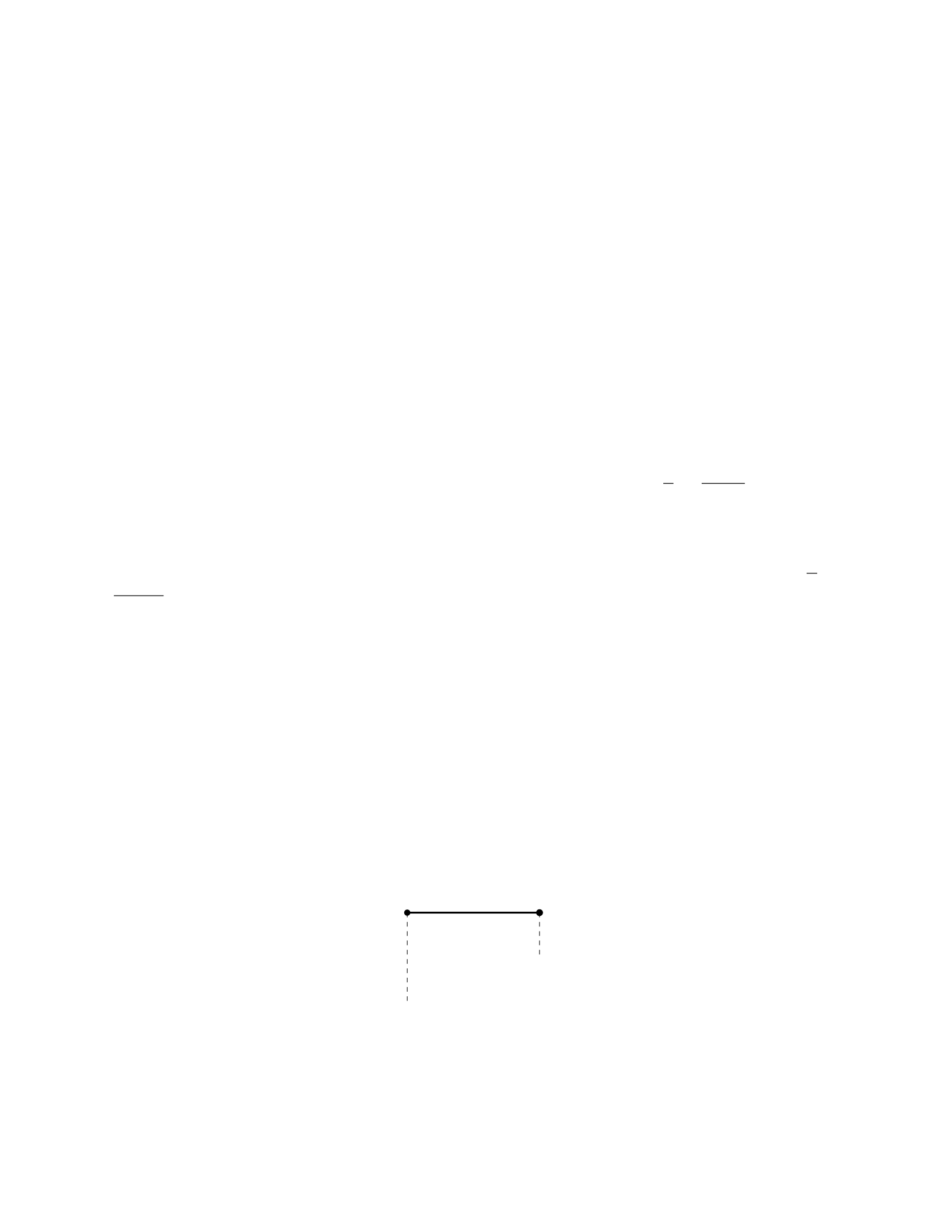
point, as shown in the figure below. The system is in equilibrium.
Pivot Object
m
L
d
Given that the rod is of negligible mass and the acceleration due to gravity is g, determine
the tension in the rod.
Ans. Let’s consider the forces acting on the small object attached to the rod. 1. The force of

gravity acts downwards, with a magnitude of mg. 2. The tension in the rod acts both horizontally
and vertically. 3. The normal force acts perpendicular to the rod. 4. The frictional force acts
parallel to the rod. Since the system is in equilibrium, the sum of the forces in the horizontal and
vertical directions must be zero.
1. In the vertical direction: The sum of the vertical components of the forces must be zero:
Tcos(θ)−mg = 0
Tcos(θ) = mg
2. In the horizontal direction: The sum of the horizontal components of the forces must be
zero:
Tsin(θ) = Ffriction
Since the object is in equilibrium and the rod is of negligible mass, there is no angular acceleration
and the frictional force is zero. Thus,
Tsin(θ) = 0
T= 0
20. Question:
A solid cylinder of radius Rand height his placed on a rough horizontal surface. A horizontal
force Fis applied tangentially to the cylinder at a height h/3 above the base. The coefficient of
friction between the cylinder and surface is µ. Determine the maximum value of Fthat can be
applied without causing the cylinder to tip over.
Ans. Step-by-step solution:
1. First, we need to determine the conditions for the cylinder not to tip over. The net torque
about the point where the cylinder touches the surface must be zero. Since the force is applied
at a height of h/3 above the base, the lever arm is h/3. The weight Wof the cylinder acts at the
center of mass, which is at a height of h/2 above the base. The frictional force acts horizontally
in the direction opposite to the applied force F. Let Rbe the reaction force at the contact point.
The torque equation can be written as:
F·h
3−µ·R·(h/2) = 0
2. Next, we need to consider the conditions for the cylinder not to slide. The force of friction
must be less than or equal to the maximum static friction force which is µR. The equilibrium
equation in the vertical direction can be written as:
R=W
R=mg

3. By substituting R=mg into the torque equation, we get:
F·h
3−µ·mg ·h
2= 0
F=µmg ·3
2
F=3
2µmg
Therefore, the maximum value of Fthat can be applied without causing the cylinder to tip
over is 3
2µmg.
21. A uniform rod of length Land mass Mis in equilibrium, with one end of the rod is on a
rough horizontal surface and the other end is against a smooth vertical wall. The coefficient of
static friction between the rod and the surface is µs. Find the minimum value of µsfor which
the rod remains in equilibrium.
Ans. Let’s denote the angle between the rod and the horizontal surface as θ.
1. Draw a free body diagram of the rod. By resolving forces horizontally and vertically, we
have: Horizontal forces: N=fwall
Vertical forces: ffloor =Mg
where Nis the normal reaction force exerted by the wall on the rod, fwall is the frictional force
between the rod and the wall, ffloor is the frictional force between the rod and the floor, and gis
the acceleration due to gravity.
2. Write the torque equation about the point of contact between the rod and the floor. The
forces Nand M g do not contribute to the torque since their lines of action pass through this
point. The torques due to the frictional forces are:
τfwall =fwall ·Lsin θand τffloor =ffloor ·L/2 cos θ
3. For equilibrium, the net torque must be zero, so:
fwall ·Lsin θ=Mg ·L/2 cos θ
4. Substitute the expressions for the frictional forces:
µsMg ·Lsin θ=M g ·L/2 cos θ
5. Simplify the equation and solve for the minimum value of µs:
µs=1
2tan θ
6. The minimum value of µsoccurs when θis maximum. Therefore, θ=arctan(1
2).

Hence, the minimum value of µsfor which the rod remains in equilibrium is µs=1
2tan(arctan(1
2))=
1
√5.
22. Question 22:
A block of wood of mass 2 kg is hung from a uniform steel rod that is 2 m long and has a
mass of 1 kg. The steel rod is attached to a wall at one end, and the block of wood is attached
to the other end. If the system is in equilibrium and the elastic modulus of steel is 2×10¹¹ N/m2,
calculate the extension of the steel rod.
Ans. Let’s denote the extension of the steel rod as x. To find x, we need to consider the
equilibrium of forces acting on the rod.
1. The weight of the block of wood is acting downwards, and it exerts a force on the steel
rod given by F1=m1·gwhere m1= 2 kg and g= 9.8m/s2.
2. The weight of the steel rod is acting downwards towards the wall, and it exerts a force on
the steel rod given by F2=m2·gwhere m2= 1 kg.
3. The tension in the steel rod is acting upwards and is equal to the force exerted by the
block of wood. This tension F3can be written as F3=m1·g.
4. The extension xcreated in the steel rod due to the weight of the block of wood can be
expressed as x=F3·L
A·E, where L= 2 m is the length of the rod, Ais the cross-sectional area of
the rod, and E= 2 ×10¹¹ N/m2is the elastic modulus of steel.
5. The cross-sectional area Aof the steel rod can be calculated using the formula A=π·r2
4,
where ris the radius of the rod.
6. Finally, substituting all the known values into the equation x=m1·g·L
π·r2
4·Eand solving for x
will give us the extension of the steel rod.
This problem requires the application of both equilibrium and elasticity concepts to find the
extension of the steel rod under the given conditions.
23. Question:
A block of mass mis hanging from the ceiling by a wire of length L. The block is pulled to
one side until the wire makes an angle θwith the vertical wall. Find an expression for the tension
in the wire as a function of the angle θ.
Ans. Let’s consider the forces acting on the block:
1. The weight of the block mg acting vertically downwards. 2. The tension Tin the wire
acting along the wire. 3. The horizontal component of the tension Tsin θ. 4. The vertical
component of the tension Tcos θ. 5. The centripetal force mv2
Ldirected towards the center,
where vis the velocity of the block.
Since the block is in equilibrium, the sum of the forces in the horizontal direction is equal to

zero:
Tsin θ=mv2
L(1)
The forces in the vertical direction also sum up to zero:
Tcos θ=mg (2)
From equation (2), we can express the tension Tas:
T=mg
cos θ
Therefore, the tension in the wire as a function of the angle θis given by T=mg
cos θ.
24. A rectangular wooden block of dimensions 20 cm ×10 cm ×5cm floats in water with the
20 cm side horizontal. Determine the density of the wood.
Ans. Let’s denote the density of water as ρw= 1000 kg/m3. 1. First, we need to determine the
volume of the block. The volume of the block is given by the product of its three dimensions, so
Vblock = 20 cm ×10 cm ×5cm = 1000 cm3= 0.001 m3. 2. Since the block floats in water, the
weight of the block is equal to the buoyant force acting on it. Using the formula for buoyant force
Fb=ρw·Vblock ·g, where g= 9.81 m/s2is the acceleration due to gravity, we have the weight
of the block Wblock =ρw·Vblock ·g. 3. The weight of the block can also be calculated using
its density ρwood and the acceleration due to gravity, so Wblock =ρwood ·Vblock ·g. Substituting
Vblock = 0.001 m3and g= 9.81 m/s2, we get an equation in terms of the density of wood ρwood.
4. Equating the weights from steps 2 and 3, we have ρwood ·Vblock ·g=ρw·Vblock ·g. Cancelling
out Vblock ·gfrom both sides gives us ρwood =ρw. 5. Therefore, the density of the wood is the
same as the density of water, ρwood = 1000 kg/m3.
3. Question: A thin rod of length Land uniform density ρis hanging vertically from one end.
The rod has cross-sectional area Aand Young’s modulus Y. Find the elongation of the rod when
a mass mis attached to the free end.
Ans. Let’s denote the elongation of the rod as ∆L. To solve this problem, we will use the
concept of equilibrium and elasticity.
1. The weight of the mass is equal to the force required to stretch the rod:
mg =ρAL
Ag=ρLg
2. The elongation of the rod can be calculated using Hooke’s Law:
F=k∆L
where kis the spring constant. In this case, the spring constant is given by:
k=Y A
L
3. Substituting Hooke’s Law and the calculated force into our equation, we get:
ρLg =Y A
L∆L
4. Solving for ∆L, we find:
∆L=ρLgL
Y A =ρgL2
Y
Therefore, the elongation of the rod when a mass mis attached to the free end is ρgL2
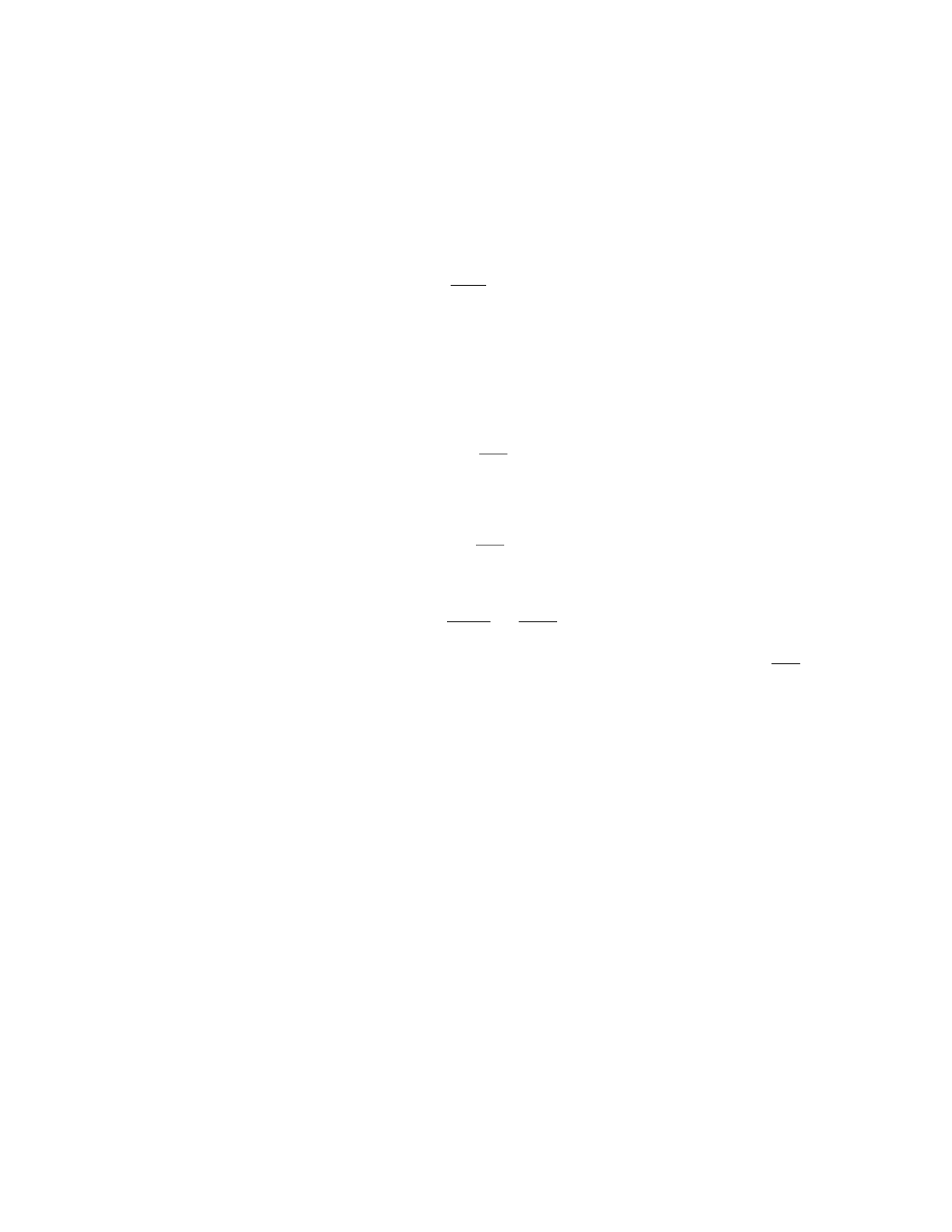
Y.
4. Question: A uniform beam of length Land mass Mis supported by two ropes attached to
its ends and hanging vertically. The beam is in equilibrium and the angle between each rope and
the vertical is θ. Find the tension in each rope.
Ans. Let’s denote the tensions in the ropes as T1and T2where T1is the tension in the left rope
(attached to the left end) and T2is the tension in the right rope (attached to the right end).
1. Draw a free-body diagram of the beam. Consider the forces acting on the beam: the
weight of the beam acting downwards, the tensions T1and T2acting upwards, the normal force
at the pivot point acting upward, and the reaction force at the pivot point acting to the right.
2. Write out the equilibrium conditions for the forces in the vertical and horizontal directions.
In the vertical direction, the sum of the forces must be zero:
T1cos(θ) + T2cos(θ)−Mg = 0
In the horizontal direction, the sum of the forces must also be zero:
T1sin(θ)−T2sin(θ) = 0
3. Solve the system of equations to find the tensions T1and T2. From the first equation:
T1cos(θ) + T2cos(θ) = Mg
T1+T2=Mg
cos(θ)
4. Substitute T1=T2sin(θ)from the second equation into T1+T2=M g
cos(θ):
T2sin(θ) + T2=Mg
cos(θ)
T2(1 + sin(θ)) = Mg
cos(θ)
T2=Mg
cos(θ)(1 + sin(θ))
5. Similarly, find T1by substituting T2back into T1=T2sin(θ):
T1=T2sin(θ) = Mg sin(θ)
cos(θ)(1 + sin(θ))
Therefore, the tension in each rope is:
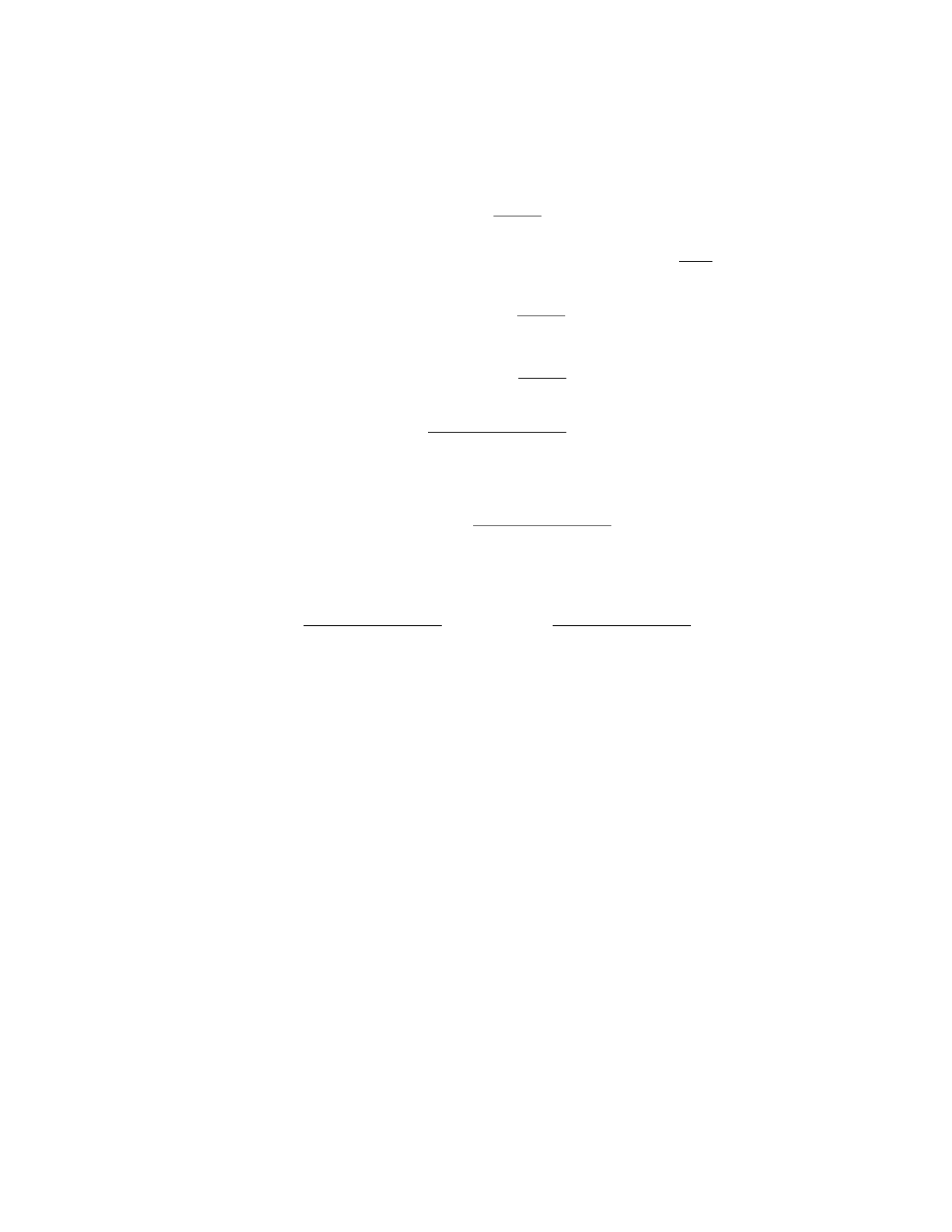
T1=Mg sin(θ)
cos(θ)(1 + sin(θ)) and T2=Mg
cos(θ)(1 + sin(θ))
5. A uniform rod of length Land mass Mis hanging vertically from a ceiling, with one end
attached to the ceiling by a hinge. A horizontal force Fis applied to the other end of the rod.
Determine the angle θthat the rod makes with the vertical when it is in equilibrium.
Ans. Let’s denote the angle that the rod makes with the vertical as θ. We can set up the
following equations of equilibrium:
1. Sum of forces in the horizontal direction:
Fhorizontal = 0
F=Tsin θ
where Tis the tension in the rod.
2. Sum of forces in the vertical direction:
Fvertical = 0
Tcos θ=Mg

where gis the acceleration due to gravity.
3. Sum of torque about the hinge point: The torque τdue to the force Fis given by:
τ=F·Lcos θ
The torque τ′due to the gravitational force Mg is given by:
τ′=Mg ·L
2sin θ
In equilibrium, these torques must sum to zero:
τ+τ′= 0
F·Lcos θ+Mg ·L
2sin θ= 0
From the equations above, we can solve for θin terms of F,M,L, and g.
6. A block of mass mis suspended by two strings of length Leach. The block is displaced
horizontally by a small distance x. The strings make an angle θwith the vertical. If the block is
released from this position, find the period of oscillation of the block.
Ans. To find the period of oscillation of the block, we first need to determine the effective
spring constant associated with the system. Then we can use this information to calculate the
period of oscillation. 1. The restoring force is provided by the horizontal components of tension
in the strings. The components of tension in each string are Tsin θ. Thus, the net restoring
force is 2Tsin θ. 2. The restoring force is equal to ma, where ais the acceleration of the block.
Since a=d2x
dt2, we have 2Tsin θ=md2x
dt2. 3. The tension in the strings is given by T=mg
2cos θ.
Substitute this into the equation from step 2 to get 2mg sin θ
2cos θ=md2x
dt2. 4. Simplify the equation
from step 3 to get gtan θ
cos θ=d2x
dt2. 5. Rewrite the kinematic equation for SHM as d2x
dt2+(g
L)x= 0.
Compare this with the equation from step 4 to get tan θ=g
ω2L, where ωis the angular frequency.
6. Solve for the angular frequency to get ω2=g
Lcos θ. The period of oscillation is T=2π
ω. 7.
Substitute ω2from step 6 into the expression for Tto get T= 2π√Lcos θ
g. Therefore, the period
of oscillation of the block is T= 2π√Lcos θ
g.
7. A uniform rod of length Land mass Mis supported horizontally at two points P and Q
which are at equal distance L/4 from the ends of the rod. A weight Wis suspended from the
rod at distance L/2 from P on the same side as Q. Determine the tension in the rod at point P.
(Hint: consider the equilibrium of the entire rod.)

Ans. Let’s denote the tension at point P as TP. We can solve this problem by analyzing the
forces and torques acting on the rod. 1. Consider the forces acting on the rod: The weight W
acts vertically downward at a distance L/2 from P. The tension TPat point P acts at an angle
θto the horizontal. The weight of the rod can be considered to act at its center of mass, which
is at a distance L/2 from P.
2. Write the force balance equations: Summing the forces in the vertical direction, we have:
TPsin(θ)−W= 0
3. Write the torque balance equations: Taking moments about point Q (where the rod
touches the surface), we have: TPcos(θ)·L
4−W·L
2= 0
4. Solve the equations simultaneously: From the force balance equation, we have TPsin(θ) =
W. Substituting this into the torque balance equation gives us: Wcos(θ)·L
4−W·L
2= 0
5. Calculate the tension TP: Solving the equation, we find: W(cos(θ)·L
4−L
2)=0
cos(θ)·1
4−1
2= 0 cos(θ) = 2
4=1
2θ=cos−1(1
2) = π
3
Substitute θ=π
3back into the force balance equation TPsin(θ) = Wto find: TPsin(π
3)=
W TP=W
sin(π
3)TP=W
√3/2 TP=2W
√3
Therefore, the tension at point P is 2W
√3.
8. A uniform rod of length Land mass Mis hanging vertically from one end. A small weight
mis attached to the free end. Determine the force exerted by the rod on the weight when the
system is in equilibrium.
Ans. To find the force exerted by the rod on the weight when the system is in equilibrium, we
need to analyze the forces acting on the system and set up the equilibrium conditions.
1. First, draw the free-body diagram of the system. The weight of the rod acts at its center
of mass, which is at a distance L
2from the end where the weight is attached. The weight mg of
the rod acts downward at its center of mass.
2. The tension Tin the rod acts upward at the point where the weight is attached.
3. The small weight mis acted upon by its weight mg and the force exerted by the rod. Let’s
denote this force as F.
4. Write down the equilibrium equations along the vertical direction: T−mg −F= 0
(Equation 1) F=mg(Equation 2)
5. Next, consider the torque about the point where the rod is attached. The torque due to
the weight mg is zero since its line of action passes through the point of rotation. The torque
due to the tension Tis also zero as the lever arm is zero. Hence only the torque due to the small
weight mis non-zero. This torque is given by m·g·L
2and it acts in the clockwise direction.
6. Write down the torque equilibrium equation: m·g·L
2= 0
7. Now, solve Equations 1 and 2 simultaneously to find the force F:T−Mg −F= 0
F=Mg
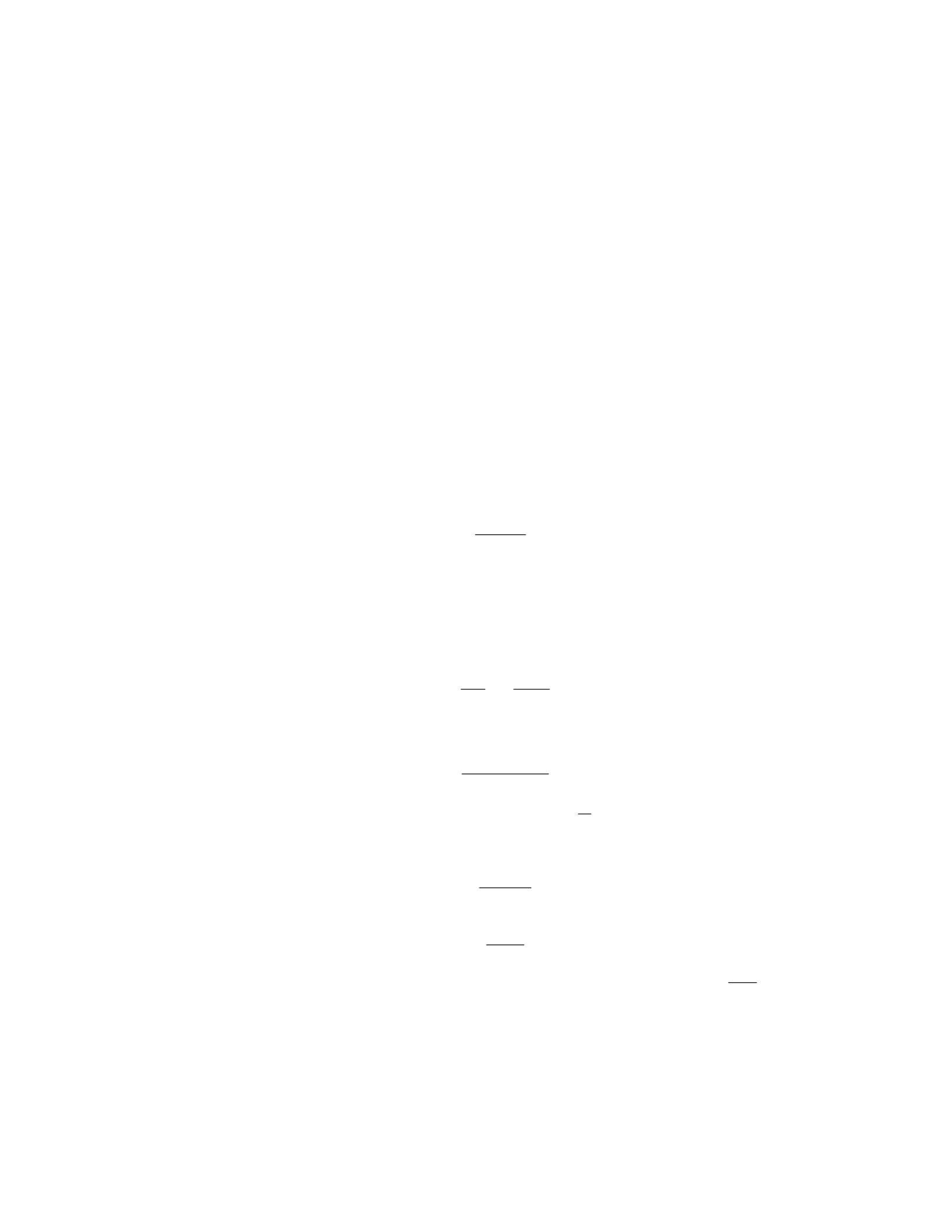
Therefore, the force exerted by the rod on the weight when the system is in equilibrium is
Mg.
9. Question:
A rectangular beam of length L, width W, and height His subjected to a uniform load
distributed over its length. The beam is made of a material with Young’s modulus E. Determine
the maximum tensile stress in the beam if the beam is just on the verge of buckling due to
compressive loads acting along its height.
Ans. Step-by-step solution:
1. The maximum compressive load that the beam can withstand without buckling is given
by the Euler buckling load formula:
Pcr =π2EI
(KL)2
where Kis the effective length factor that depends on the end support conditions. For a
simply supported beam, K= 1.
2. The maximum stress occurs at the top and bottom surfaces of the beam. At the top
surface (where tension occurs), the normal stress is given by:
σmax =Pcr
A=Pcr
W H
3. Substituting the expression for Pcr into the equation for σmax:
σmax =π2EI
(KL)2W H
4. To simplify the expression, we can substitute I=1
12 W H3(moment of inertia for a
rectangular cross-section) into the equation:
σmax =π2E
3(3L)2
σmax =π2E
27L2
5. Therefore, the maximum tensile stress in the beam just before buckling is π2E
27L2.
10. Question:

A uniform beam of length Land mass Mis supported by two vertical ropes attached at
points Aand Ba distance aand bfrom one end of the beam, respectively. The tension in the
rope at point Ais TAand the tension in the rope at point Bis TB. Find the horizontal force at
point C, located a distance cfrom the end where the ropes are attached, required to keep the
beam in equilibrium.
Ans. Let’s denote the weight of the beam as W. We can start solving this problem by drawing
a free-body diagram of the beam and analyzing the forces acting on it.
1. The beam is in rotational equilibrium. The sum of the torques about any point must be
zero. We can choose point Aas the pivot point, which makes the torque due to the tension at
Aequal to zero.
2. The torque due to TBabout point Ais TB·(L−b)and it causes a counterclockwise
rotation. The torque due to the weight Wabout point Ais W·(L/2 −a)and it causes a
clockwise rotation. The torque due to the force at Cabout point Ais FC·cand it causes a
counterclockwise rotation. Setting up the torque equation:
TB·(L−b)−W·(L
2−a)−FC·c= 0
3. The sum of the forces in the vertical direction must be zero to keep the beam in equilibrium.
The vertical forces are the tensions in the ropes TAand TBand the weight W:
TA+TB−W= 0
4. The sum of the forces in the horizontal direction must also be zero to keep the beam in
equilibrium. The only horizontal force is the force at C, denoted as FC:
FC= 0
5. Solving the equations simultaneously, we can find the expression for the horizontal force
FC:
FC=W−TA−TB
Thus, the horizontal force at point Crequired to keep the beam in equilibrium is W−TA−TB.
11. A uniform rod of length Land mass Mis attached to a wall by a hinge at one end and
supported by a cable of length Lattached to the other end. The cable makes an angle θwith
the rod. Find the tension in the cable and the reaction force at the hinge.
Ans. Let’s denote the tension in the cable as Tand the reaction force at the hinge as R.
We can start finding these forces by setting up equilibrium equations. 1. Consider the vertical
equilibrium for the rod: The sum of the vertical forces must be zero. We have:
Tcos θ=Mg

2. Consider the torque equilibrium about the hinge: The torque produced by the tension and the
weight of the rod must balance out. We have:
Tsin θ·L=Mg ·L
2
Now we can solve these equations simultaneously. 3. From the vertical equilibrium equation, we
find:
T=Mg
cos θ
4. Substitute the expression for T into the torque equilibrium equation:
Mg
cos θsin θ·L=Mg ·L
2
sin θ=1
2
θ=π
6
5. Finally, substitute this value of θback into the equation for Tto find the tension:
T=Mg
cos(π
6)=Mg√3
6. To find the reaction force R, we can use the vertical equilibrium equation:
R=Mg sin θ=M g 1
2=Mg
2
Therefore, the tension in the cable is M g√3and the reaction force at the hinge is M g
2.
12. Question: A 2 m long rod with a Young’s modulus of 2×10¹¹ N/m² is supported at one
end and has a 10 kg weight hanging from the other end. Determine the stress and strain in the
rod when it is in equilibrium.
Ans. Step-by-step solution: 1. To find the stress (σ) in the rod, we will use the formula σ=F
A,
where Fis the force applied and Ais the cross-sectional area of the rod. 2. The force applied to
the rod is the weight of the 10 kg mass, which can be calculated as F=mg, where mis the mass
and gis the acceleration due to gravity (9.81 m/s2). 3. Thus, F= 10 kg ×9.81 m/s2= 98.1N.
4. The cross-sectional area of the rod can be calculated as A=πr2, where ris the radius
of the rod. Since the rod is assumed to be uniform, the radius will be constant along its
length. 5. Given that the rod is 2 m long, let’s assume a typical diameter of d= 1 cm =
0.01 m. Therefore, r= 0.005 m. 6. Substituting rinto the equation for the cross-sectional
area, we get A=π(0.005)2≈7.85 ×10⁻⁵m². 7. Now, we can calculate the stress in the rod:
σ=98.1
7.85×10⁻⁵≈1.25×10⁶N/m². 8. To find the strain in the rod (ε), we use the formula ε=σ
Y,

where σis the stress and Yis the Young’s modulus. 9. Substituting the values we calculated
earlier, we get ε=1.25×10⁶
2×1011 = 6.25 ×10⁻⁶. 10. Therefore, when the rod is in equilibrium, the
stress in the rod is approximately 1.25 ×10⁶N/m² and the strain is approximately 6.25 ×10⁻⁶.
13. A uniform rod of length Land mass Mis pivoted at one end and is in equilibrium in a
horizontal position. A force Fis applied at a distance xfrom the pivot, perpendicular to the
length of the rod. The rod makes an angle θwith the horizontal.
Find an expression for the angular acceleration αof the rod in terms of x,θ,L,M, and F.
Ans. Let’s denote the acceleration due to gravity as g. The angular acceleration αof the rod
can be expressed as:
α=3
2
F x cos θ
ML2−3
2gsin θ
where xis the distance from the pivot where the force is applied, θis the angle the rod makes
with the horizontal, Lis the length of the rod, Mis the mass of the rod, Fis the applied force,
and gis the acceleration due to gravity.
14. Question 14:
A uniform rod of length Land mass Mis supported by a pivot at one end. A block of mass
mis placed at a distance xfrom the pivot on the same side as the rod. The rod makes an angle
θwith the horizontal. Find the tension in the pivot.
Ans. Let’s denote the distance of the pivot from the center of mass of the rod as d. The center
of mass of the rod is at a distance L/2 from the pivot. We will use the fact that the net torque
about the pivot point is zero at equilibrium.
1. The torque due to the rod: The weight of the rod acts at its center of mass (at a distance
L/2 from the pivot), so the torque due to the rod is given by −(M g)(L/2) sin θ.
2. The torque due to the block: The weight of the block acts at a distance x+dfrom the
pivot. Therefore, the torque due to the block is −(mg)(x+d)sin θ.
3. The torque due to the tension: The tension in the pivot acts at a distance dfrom the
pivot in the opposite direction. Hence, the torque due to the tension is T d sin θ.
Since the net torque is zero at equilibrium, we have:
T d sin θ= (Mg)(L/2) sin θ+ (mg)(x+d)sin θ
Solving for T, we get:
T= (Mg)(L/2) + mg(x+d)
Therefore, the tension in the pivot is (M g)(L/2) + mg(x+d).

15. A uniform rod of length Land mass Mis initially hanging vertically from a fixed pivot
at one end. The rod is then pushed horizontally at the free end until it makes an angle θwith
the vertical. Given that the Young’s modulus of the rod is Yand the cross-sectional area is A,
determine the force required to hold the rod in equilibrium at this position.
Ans. To find the force required to hold the rod in equilibrium at an angle θwith the vertical,
we need to consider both the gravitational force acting down on the rod and the restoring torque
due to the deformation of the rod.
1. The weight of the rod can be resolved into two components: one acting vertically down-
wards and the other acting along the rod. The horizontal component is M g sin θand the vertical
component is Mg cos θ.
2. The restoring torque is due to the horizontal component of the deformation force in the
rod. The deformation can be calculated using the equation F
A=Y∆L
L. Here, ∆L=Lsin θ.
3. The moment arm for the torque due to the deformation is Lcos θ, and the torque due to
the weight of the rod is L
2cos θ.
4. Setting up the equilibrium conditions, we have two torques acting on the rod: one coun-
terclockwise due to the weight of the rod and another clockwise due to the deformation. The
sum of the torques must be zero for equilibrium.
5. Equating the two torques, we get Mg L
2cos θ=F(Lcos θ). Solving for Fgives F=
Mg
2cos θ.
Therefore, the force required to hold the rod in equilibrium at an angle θwith the vertical is
Mg
2cos θ.
16. A metal rod of length Land cross-sectional area Ais suspended vertically from the ceiling.
A weight W1is attached to the bottom end of the rod. Another weight W2is attached to a
platform that is placed on top of the rod at a distance xfrom the ceiling. The rod is in equilibrium.
Determine the expression for the Young’s Modulus Y of the material of the rod in terms of
L,A,W1,W2,x, and g, where gis the acceleration due to gravity.
Ans. Let’s denote the downward force acting on the bottom end of the rod as F1and the
upward force acting on the top end of the rod as F2. The total force on the rod can be expressed
as:
Ftotal =F1−F2= 0
Using Hooke’s Law, we can express F1and F2as:
F1=W1
rod’s length =W1
L
F2=W2
distance from platform to ceiling =W2
x
Substituting these expressions into the equation for equilibrium, we get:
W1
L=W2
x

Since Young’s Modulus Y can be defined as the ratio of stress to strain, where stress is force per
unit area (σ=F
A) and strain is the ratio of deformation to the original length (ε=∆L
L), we can
write the equation as:
W2
x
A=Y·∆L
L
Given that the deformation of the rod ∆Lcan be expressed as x(the distance from the platform
to the ceiling) minus L(the original length of the rod), we have ∆L=x−L. Substitute
∆L=x−Linto the equation, we get:
W2
x
A=Y·x−L
L
Y=A·W2
x
x−L
Therefore, the expression for the Young’s Modulus Y in terms of L,A,W1,W2,x, and gis:
Y=A·W2
x
x−L
17. In a physics lab experiment, a spring with a spring constant of 450 N/m is used to support
an object of mass 0.5kg. The object is then displaced vertically from its equilibrium position
and released. Determine the maximum displacement of the object from its equilibrium position
before it starts oscillating. Assume the elastic limit of the spring is not exceeded.
Ans. Let’s denote the maximum displacement of the object from its equilibrium position as
xmax.
1. The force exerted by the spring on the object when displaced a distance xfrom equilibrium
is given by Hooke’s Law: F=−kx, where kis the spring constant. At maximum displacement,
the spring force will be equal in magnitude to the gravitational force on the object:
kxmax =mg
where mis the mass of the object and gis the acceleration due to gravity.
2. Substituting the values k= 450 N/m, m= 0.5kg, and g= 9.81 m/s2, we can solve for
xmax:
450xmax = 0.5×9.81
xmax =0.5×9.81
450
xmax = 0.0109 m
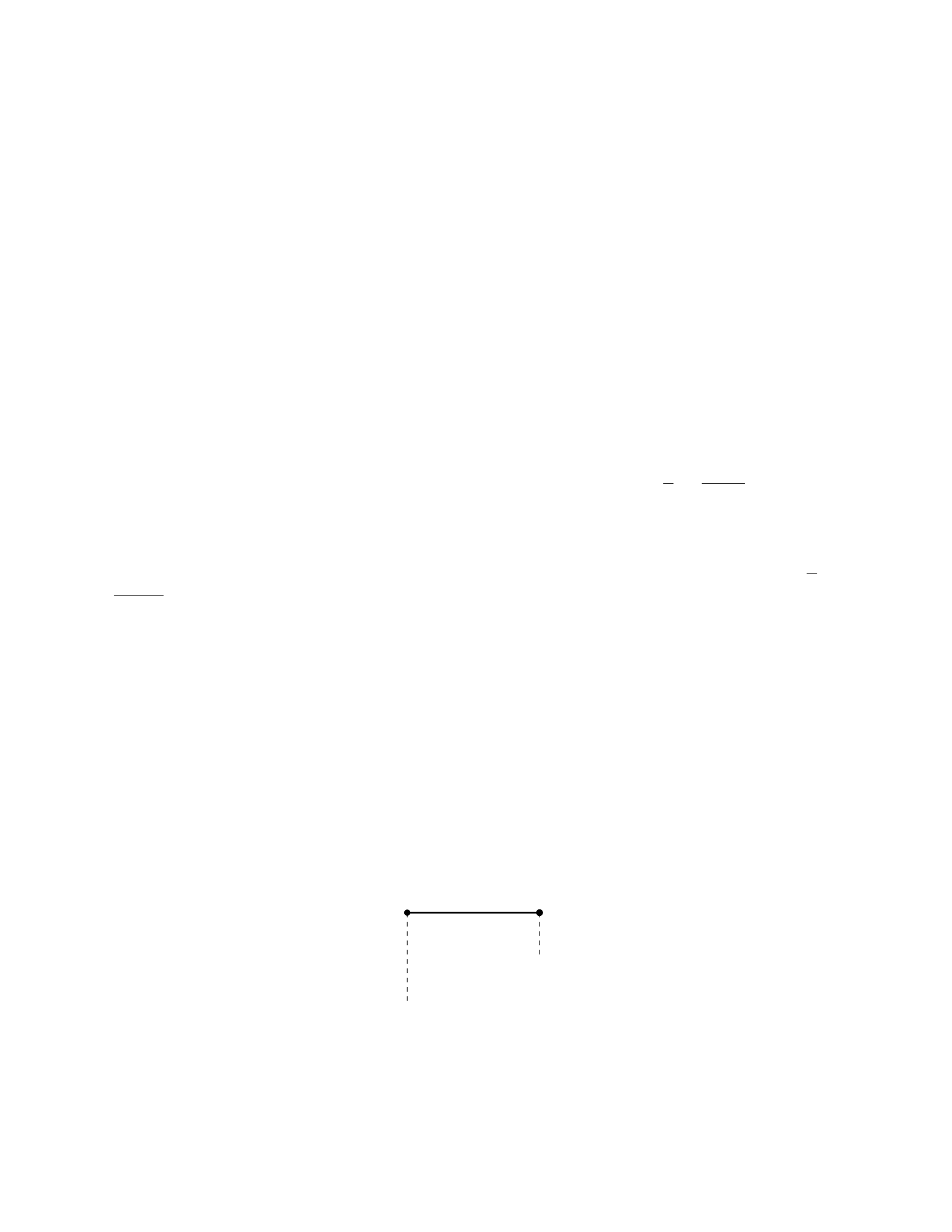
Therefore, the maximum displacement of the object from its equilibrium position before it
starts oscillating is 0.0109 m.
18. Question:
A cylindrical rod with a length of 2 meters and a diameter of 10 cm is suspended horizontally
between two walls. The rod is made of a steel alloy with a Young’s modulus of 2×10¹¹ N/m2.
A weight of 500 N is hung from the center of the rod. Determine the elongation of the rod.
Ans. Step-by-step solution:
1. First, we need to find the cross-sectional area of the rod: The diameter of the rod is 10
cm, so the radius is 10/2 = 5 cm = 0.05 m. The cross-sectional area is given by A=πr2.
Plugging in the values, we have A=π×(0.05)2= 0.00785 m2.
2. Next, calculate the stress applied to the rod: Stress (σ) is defined as the force per unit
area. In this case, the force is 500 N and the area is 0.00785 m2. So, σ=F
A=500
0.00785 = 63694.27
N/m2.
3. Now, we can use Hooke’s Law for elasticity to find the elongation of the rod: Hooke’s
Law states that the stress is proportional to the strain, where the proportionality constant is the
Young’s modulus (Y). The equation is σ=Y·ε, where εis the strain. Therefore, ε=σ
Y=
63694.27
2×1011 = 3.18 ×10⁻⁴.
4. Finally, calculate the elongation of the rod: The elongation (∆L) can be calculated using
the formula ∆L=ε·L, where Lis the original length of the rod. Plugging in the values, we
have ∆L= 3.18 ×10−4×2 = 6.36 ×10⁻⁴m.
Therefore, the elongation of the rod is 6.36 ×10⁻⁴meters.
19. A uniform rod of length Land mass Mis attached to a fixed pivot at one end and
suspended vertically. A small object of mass mis attached to the rod a distance dfrom the pivot
point, as shown in the figure below. The system is in equilibrium.
Pivot Object
m
L
d
Given that the rod is of negligible mass and the acceleration due to gravity is g, determine
the tension in the rod.
Ans. Let’s consider the forces acting on the small object attached to the rod. 1. The force of

gravity acts downwards, with a magnitude of mg. 2. The tension in the rod acts both horizontally
and vertically. 3. The normal force acts perpendicular to the rod. 4. The frictional force acts
parallel to the rod. Since the system is in equilibrium, the sum of the forces in the horizontal and
vertical directions must be zero.
1. In the vertical direction: The sum of the vertical components of the forces must be zero:
Tcos(θ)−mg = 0
Tcos(θ) = mg
2. In the horizontal direction: The sum of the horizontal components of the forces must be
zero:
Tsin(θ) = Ffriction
Since the object is in equilibrium and the rod is of negligible mass, there is no angular acceleration
and the frictional force is zero. Thus,
Tsin(θ) = 0
T= 0
20. Question:
A solid cylinder of radius Rand height his placed on a rough horizontal surface. A horizontal
force Fis applied tangentially to the cylinder at a height h/3 above the base. The coefficient of
friction between the cylinder and surface is µ. Determine the maximum value of Fthat can be
applied without causing the cylinder to tip over.
Ans. Step-by-step solution:
1. First, we need to determine the conditions for the cylinder not to tip over. The net torque
about the point where the cylinder touches the surface must be zero. Since the force is applied
at a height of h/3 above the base, the lever arm is h/3. The weight Wof the cylinder acts at the
center of mass, which is at a height of h/2 above the base. The frictional force acts horizontally
in the direction opposite to the applied force F. Let Rbe the reaction force at the contact point.
The torque equation can be written as:
F·h
3−µ·R·(h/2) = 0
2. Next, we need to consider the conditions for the cylinder not to slide. The force of friction
must be less than or equal to the maximum static friction force which is µR. The equilibrium
equation in the vertical direction can be written as:
R=W
R=mg

3. By substituting R=mg into the torque equation, we get:
F·h
3−µ·mg ·h
2= 0
F=µmg ·3
2
F=3
2µmg
Therefore, the maximum value of Fthat can be applied without causing the cylinder to tip
over is 3
2µmg.
21. A uniform rod of length Land mass Mis in equilibrium, with one end of the rod is on a
rough horizontal surface and the other end is against a smooth vertical wall. The coefficient of
static friction between the rod and the surface is µs. Find the minimum value of µsfor which
the rod remains in equilibrium.
Ans. Let’s denote the angle between the rod and the horizontal surface as θ.
1. Draw a free body diagram of the rod. By resolving forces horizontally and vertically, we
have: Horizontal forces: N=fwall
Vertical forces: ffloor =Mg
where Nis the normal reaction force exerted by the wall on the rod, fwall is the frictional force
between the rod and the wall, ffloor is the frictional force between the rod and the floor, and gis
the acceleration due to gravity.
2. Write the torque equation about the point of contact between the rod and the floor. The
forces Nand M g do not contribute to the torque since their lines of action pass through this
point. The torques due to the frictional forces are:
τfwall =fwall ·Lsin θand τffloor =ffloor ·L/2 cos θ
3. For equilibrium, the net torque must be zero, so:
fwall ·Lsin θ=Mg ·L/2 cos θ
4. Substitute the expressions for the frictional forces:
µsMg ·Lsin θ=M g ·L/2 cos θ
5. Simplify the equation and solve for the minimum value of µs:
µs=1
2tan θ
6. The minimum value of µsoccurs when θis maximum. Therefore, θ=arctan(1
2).

Hence, the minimum value of µsfor which the rod remains in equilibrium is µs=1
2tan(arctan(1
2))=
1
√5.
22. Question 22:
A block of wood of mass 2 kg is hung from a uniform steel rod that is 2 m long and has a
mass of 1 kg. The steel rod is attached to a wall at one end, and the block of wood is attached
to the other end. If the system is in equilibrium and the elastic modulus of steel is 2×10¹¹ N/m2,
calculate the extension of the steel rod.
Ans. Let’s denote the extension of the steel rod as x. To find x, we need to consider the
equilibrium of forces acting on the rod.
1. The weight of the block of wood is acting downwards, and it exerts a force on the steel
rod given by F1=m1·gwhere m1= 2 kg and g= 9.8m/s2.
2. The weight of the steel rod is acting downwards towards the wall, and it exerts a force on
the steel rod given by F2=m2·gwhere m2= 1 kg.
3. The tension in the steel rod is acting upwards and is equal to the force exerted by the
block of wood. This tension F3can be written as F3=m1·g.
4. The extension xcreated in the steel rod due to the weight of the block of wood can be
expressed as x=F3·L
A·E, where L= 2 m is the length of the rod, Ais the cross-sectional area of
the rod, and E= 2 ×10¹¹ N/m2is the elastic modulus of steel.
5. The cross-sectional area Aof the steel rod can be calculated using the formula A=π·r2
4,
where ris the radius of the rod.
6. Finally, substituting all the known values into the equation x=m1·g·L
π·r2
4·Eand solving for x
will give us the extension of the steel rod.
This problem requires the application of both equilibrium and elasticity concepts to find the
extension of the steel rod under the given conditions.
23. Question:
A block of mass mis hanging from the ceiling by a wire of length L. The block is pulled to
one side until the wire makes an angle θwith the vertical wall. Find an expression for the tension
in the wire as a function of the angle θ.
Ans. Let’s consider the forces acting on the block:
1. The weight of the block mg acting vertically downwards. 2. The tension Tin the wire
acting along the wire. 3. The horizontal component of the tension Tsin θ. 4. The vertical
component of the tension Tcos θ. 5. The centripetal force mv2
Ldirected towards the center,
where vis the velocity of the block.
Since the block is in equilibrium, the sum of the forces in the horizontal direction is equal to

zero:
Tsin θ=mv2
L(1)
The forces in the vertical direction also sum up to zero:
Tcos θ=mg (2)
From equation (2), we can express the tension Tas:
T=mg
cos θ
Therefore, the tension in the wire as a function of the angle θis given by T=mg
cos θ.
24. A rectangular wooden block of dimensions 20 cm ×10 cm ×5cm floats in water with the
20 cm side horizontal. Determine the density of the wood.
Ans. Let’s denote the density of water as ρw= 1000 kg/m3. 1. First, we need to determine the
volume of the block. The volume of the block is given by the product of its three dimensions, so
Vblock = 20 cm ×10 cm ×5cm = 1000 cm3= 0.001 m3. 2. Since the block floats in water, the
weight of the block is equal to the buoyant force acting on it. Using the formula for buoyant force
Fb=ρw·Vblock ·g, where g= 9.81 m/s2is the acceleration due to gravity, we have the weight
of the block Wblock =ρw·Vblock ·g. 3. The weight of the block can also be calculated using
its density ρwood and the acceleration due to gravity, so Wblock =ρwood ·Vblock ·g. Substituting
Vblock = 0.001 m3and g= 9.81 m/s2, we get an equation in terms of the density of wood ρwood.
4. Equating the weights from steps 2 and 3, we have ρwood ·Vblock ·g=ρw·Vblock ·g. Cancelling
out Vblock ·gfrom both sides gives us ρwood =ρw. 5. Therefore, the density of the wood is the
same as the density of water, ρwood = 1000 kg/m3.
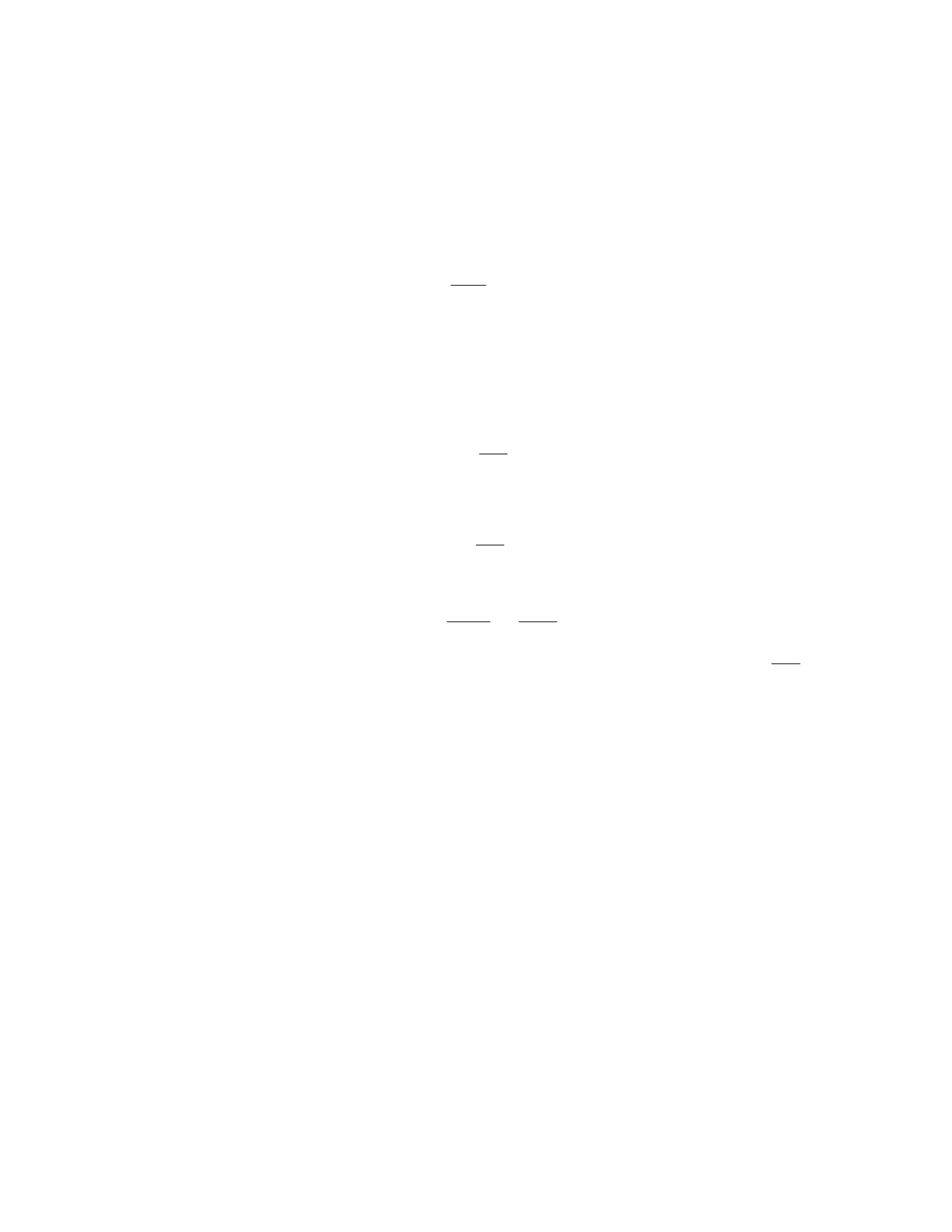
3. Question: A thin rod of length Land uniform density ρis hanging vertically from one end.
The rod has cross-sectional area Aand Young’s modulus Y. Find the elongation of the rod when
a mass mis attached to the free end.
Ans. Let’s denote the elongation of the rod as ∆L. To solve this problem, we will use the
concept of equilibrium and elasticity.
1. The weight of the mass is equal to the force required to stretch the rod:
mg =ρAL
Ag=ρLg
2. The elongation of the rod can be calculated using Hooke’s Law:
F=k∆L
where kis the spring constant. In this case, the spring constant is given by:
k=Y A
L
3. Substituting Hooke’s Law and the calculated force into our equation, we get:
ρLg =Y A
L∆L
4. Solving for ∆L, we find:
∆L=ρLgL
Y A =ρgL2
Y
Therefore, the elongation of the rod when a mass mis attached to the free end is ρgL2
Y.
4. Question: A uniform beam of length Land mass Mis supported by two ropes attached to
its ends and hanging vertically. The beam is in equilibrium and the angle between each rope and
the vertical is θ. Find the tension in each rope.
Ans. Let’s denote the tensions in the ropes as T1and T2where T1is the tension in the left rope
(attached to the left end) and T2is the tension in the right rope (attached to the right end).
1. Draw a free-body diagram of the beam. Consider the forces acting on the beam: the
weight of the beam acting downwards, the tensions T1and T2acting upwards, the normal force
at the pivot point acting upward, and the reaction force at the pivot point acting to the right.
2. Write out the equilibrium conditions for the forces in the vertical and horizontal directions.
In the vertical direction, the sum of the forces must be zero:
T1cos(θ) + T2cos(θ)−Mg = 0
In the horizontal direction, the sum of the forces must also be zero:
T1sin(θ)−T2sin(θ) = 0
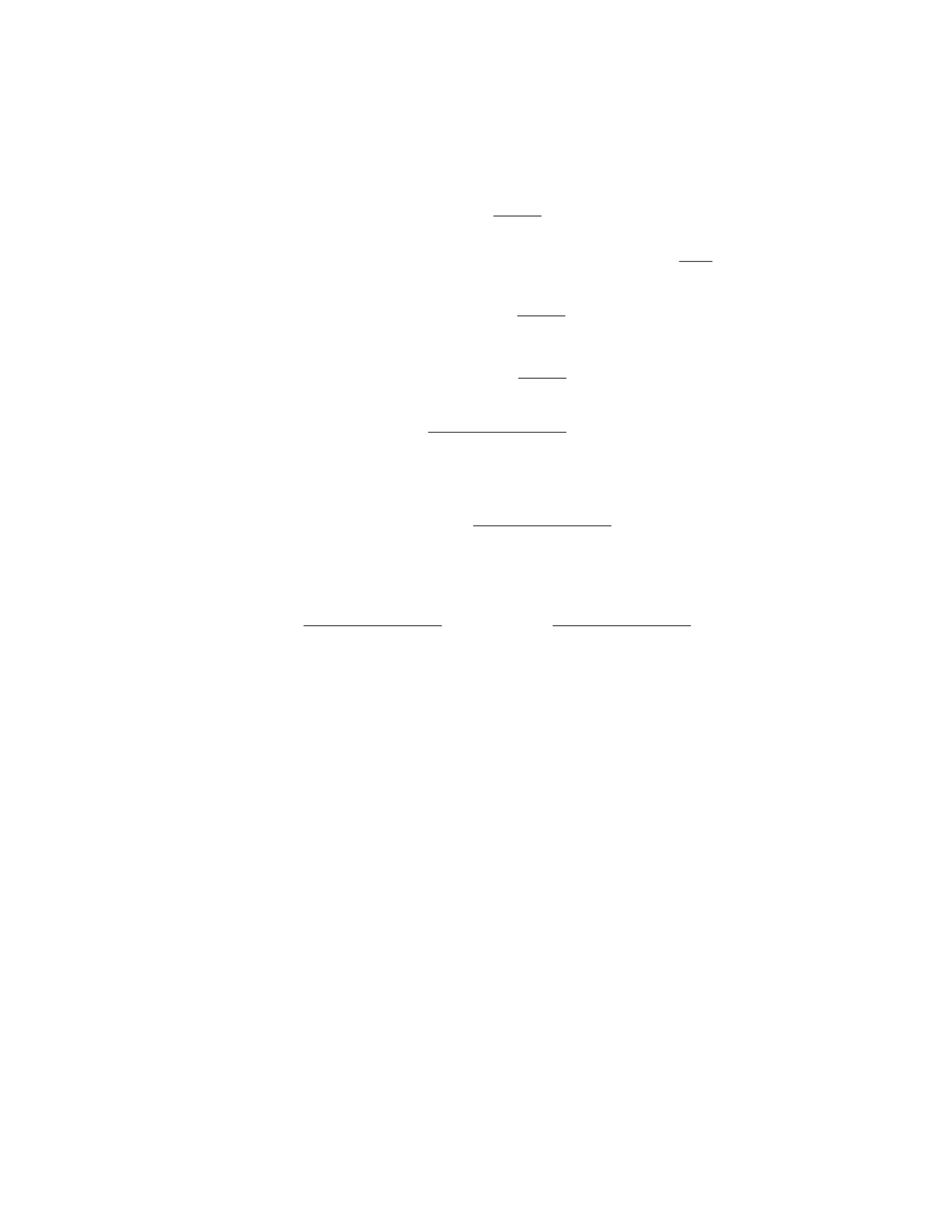
3. Solve the system of equations to find the tensions T1and T2. From the first equation:
T1cos(θ) + T2cos(θ) = Mg
T1+T2=Mg
cos(θ)
4. Substitute T1=T2sin(θ)from the second equation into T1+T2=M g
cos(θ):
T2sin(θ) + T2=Mg
cos(θ)
T2(1 + sin(θ)) = Mg
cos(θ)
T2=Mg
cos(θ)(1 + sin(θ))
5. Similarly, find T1by substituting T2back into T1=T2sin(θ):
T1=T2sin(θ) = Mg sin(θ)
cos(θ)(1 + sin(θ))
Therefore, the tension in each rope is:
T1=Mg sin(θ)
cos(θ)(1 + sin(θ)) and T2=Mg
cos(θ)(1 + sin(θ))
5. A uniform rod of length Land mass Mis hanging vertically from a ceiling, with one end
attached to the ceiling by a hinge. A horizontal force Fis applied to the other end of the rod.
Determine the angle θthat the rod makes with the vertical when it is in equilibrium.
Ans. Let’s denote the angle that the rod makes with the vertical as θ. We can set up the
following equations of equilibrium:
1. Sum of forces in the horizontal direction:
Fhorizontal = 0
F=Tsin θ
where Tis the tension in the rod.
2. Sum of forces in the vertical direction:
Fvertical = 0
Tcos θ=Mg

where gis the acceleration due to gravity.
3. Sum of torque about the hinge point: The torque τdue to the force Fis given by:
τ=F·Lcos θ
The torque τ′due to the gravitational force Mg is given by:
τ′=Mg ·L
2sin θ
In equilibrium, these torques must sum to zero:
τ+τ′= 0
F·Lcos θ+Mg ·L
2sin θ= 0
From the equations above, we can solve for θin terms of F,M,L, and g.
6. A block of mass mis suspended by two strings of length Leach. The block is displaced
horizontally by a small distance x. The strings make an angle θwith the vertical. If the block is
released from this position, find the period of oscillation of the block.
Ans. To find the period of oscillation of the block, we first need to determine the effective
spring constant associated with the system. Then we can use this information to calculate the
period of oscillation. 1. The restoring force is provided by the horizontal components of tension
in the strings. The components of tension in each string are Tsin θ. Thus, the net restoring
force is 2Tsin θ. 2. The restoring force is equal to ma, where ais the acceleration of the block.
Since a=d2x
dt2, we have 2Tsin θ=md2x
dt2. 3. The tension in the strings is given by T=mg
2cos θ.
Substitute this into the equation from step 2 to get 2mg sin θ
2cos θ=md2x
dt2. 4. Simplify the equation
from step 3 to get gtan θ
cos θ=d2x
dt2. 5. Rewrite the kinematic equation for SHM as d2x
dt2+(g
L)x= 0.
Compare this with the equation from step 4 to get tan θ=g
ω2L, where ωis the angular frequency.
6. Solve for the angular frequency to get ω2=g
Lcos θ. The period of oscillation is T=2π
ω. 7.
Substitute ω2from step 6 into the expression for Tto get T= 2π√Lcos θ
g. Therefore, the period
of oscillation of the block is T= 2π√Lcos θ
g.
7. A uniform rod of length Land mass Mis supported horizontally at two points P and Q
which are at equal distance L/4 from the ends of the rod. A weight Wis suspended from the
rod at distance L/2 from P on the same side as Q. Determine the tension in the rod at point P.
(Hint: consider the equilibrium of the entire rod.)

Ans. Let’s denote the tension at point P as TP. We can solve this problem by analyzing the
forces and torques acting on the rod. 1. Consider the forces acting on the rod: The weight W
acts vertically downward at a distance L/2 from P. The tension TPat point P acts at an angle
θto the horizontal. The weight of the rod can be considered to act at its center of mass, which
is at a distance L/2 from P.
2. Write the force balance equations: Summing the forces in the vertical direction, we have:
TPsin(θ)−W= 0
3. Write the torque balance equations: Taking moments about point Q (where the rod
touches the surface), we have: TPcos(θ)·L
4−W·L
2= 0
4. Solve the equations simultaneously: From the force balance equation, we have TPsin(θ) =
W. Substituting this into the torque balance equation gives us: Wcos(θ)·L
4−W·L
2= 0
5. Calculate the tension TP: Solving the equation, we find: W(cos(θ)·L
4−L
2)=0
cos(θ)·1
4−1
2= 0 cos(θ) = 2
4=1
2θ=cos−1(1
2) = π
3
Substitute θ=π
3back into the force balance equation TPsin(θ) = Wto find: TPsin(π
3)=
W TP=W
sin(π
3)TP=W
√3/2 TP=2W
√3
Therefore, the tension at point P is 2W
√3.
8. A uniform rod of length Land mass Mis hanging vertically from one end. A small weight
mis attached to the free end. Determine the force exerted by the rod on the weight when the
system is in equilibrium.
Ans. To find the force exerted by the rod on the weight when the system is in equilibrium, we
need to analyze the forces acting on the system and set up the equilibrium conditions.
1. First, draw the free-body diagram of the system. The weight of the rod acts at its center
of mass, which is at a distance L
2from the end where the weight is attached. The weight mg of
the rod acts downward at its center of mass.
2. The tension Tin the rod acts upward at the point where the weight is attached.
3. The small weight mis acted upon by its weight mg and the force exerted by the rod. Let’s
denote this force as F.
4. Write down the equilibrium equations along the vertical direction: T−mg −F= 0
(Equation 1) F=mg(Equation 2)
5. Next, consider the torque about the point where the rod is attached. The torque due to
the weight mg is zero since its line of action passes through the point of rotation. The torque
due to the tension Tis also zero as the lever arm is zero. Hence only the torque due to the small
weight mis non-zero. This torque is given by m·g·L
2and it acts in the clockwise direction.
6. Write down the torque equilibrium equation: m·g·L
2= 0
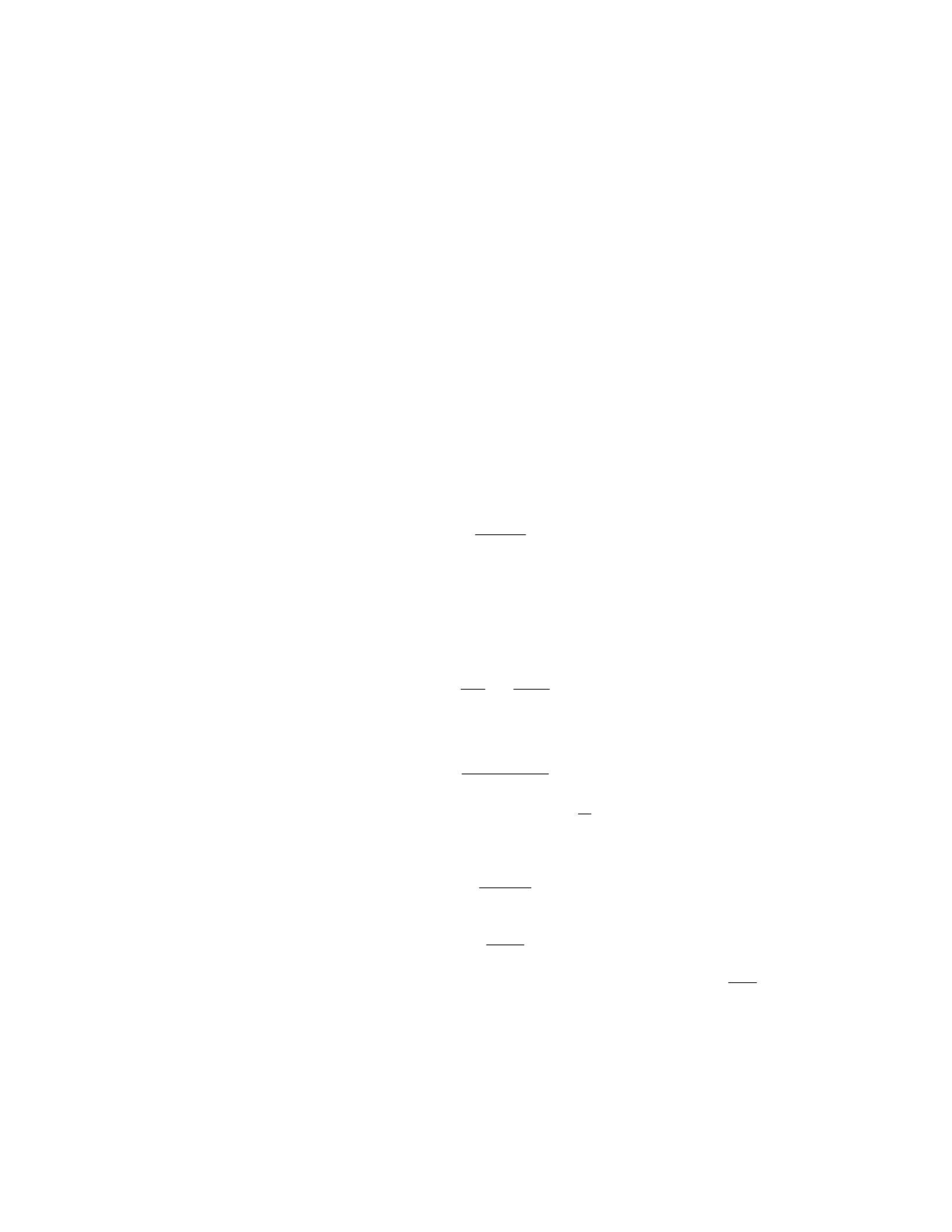
7. Now, solve Equations 1 and 2 simultaneously to find the force F:T−Mg −F= 0
F=Mg
Therefore, the force exerted by the rod on the weight when the system is in equilibrium is
Mg.
9. Question:
A rectangular beam of length L, width W, and height His subjected to a uniform load
distributed over its length. The beam is made of a material with Young’s modulus E. Determine
the maximum tensile stress in the beam if the beam is just on the verge of buckling due to
compressive loads acting along its height.
Ans. Step-by-step solution:
1. The maximum compressive load that the beam can withstand without buckling is given
by the Euler buckling load formula:
Pcr =π2EI
(KL)2
where Kis the effective length factor that depends on the end support conditions. For a
simply supported beam, K= 1.
2. The maximum stress occurs at the top and bottom surfaces of the beam. At the top
surface (where tension occurs), the normal stress is given by:
σmax =Pcr
A=Pcr
W H
3. Substituting the expression for Pcr into the equation for σmax:
σmax =π2EI
(KL)2W H
4. To simplify the expression, we can substitute I=1
12 W H3(moment of inertia for a
rectangular cross-section) into the equation:
σmax =π2E
3(3L)2
σmax =π2E
27L2
5. Therefore, the maximum tensile stress in the beam just before buckling is π2E
27L2.
10. Question:

A uniform beam of length Land mass Mis supported by two vertical ropes attached at
points Aand Ba distance aand bfrom one end of the beam, respectively. The tension in the
rope at point Ais TAand the tension in the rope at point Bis TB. Find the horizontal force at
point C, located a distance cfrom the end where the ropes are attached, required to keep the
beam in equilibrium.
Ans. Let’s denote the weight of the beam as W. We can start solving this problem by drawing
a free-body diagram of the beam and analyzing the forces acting on it.
1. The beam is in rotational equilibrium. The sum of the torques about any point must be
zero. We can choose point Aas the pivot point, which makes the torque due to the tension at
Aequal to zero.
2. The torque due to TBabout point Ais TB·(L−b)and it causes a counterclockwise
rotation. The torque due to the weight Wabout point Ais W·(L/2 −a)and it causes a
clockwise rotation. The torque due to the force at Cabout point Ais FC·cand it causes a
counterclockwise rotation. Setting up the torque equation:
TB·(L−b)−W·(L
2−a)−FC·c= 0
3. The sum of the forces in the vertical direction must be zero to keep the beam in equilibrium.
The vertical forces are the tensions in the ropes TAand TBand the weight W:
TA+TB−W= 0
4. The sum of the forces in the horizontal direction must also be zero to keep the beam in
equilibrium. The only horizontal force is the force at C, denoted as FC:
FC= 0
5. Solving the equations simultaneously, we can find the expression for the horizontal force
FC:
FC=W−TA−TB
Thus, the horizontal force at point Crequired to keep the beam in equilibrium is W−TA−TB.
11. A uniform rod of length Land mass Mis attached to a wall by a hinge at one end and
supported by a cable of length Lattached to the other end. The cable makes an angle θwith
the rod. Find the tension in the cable and the reaction force at the hinge.
Ans. Let’s denote the tension in the cable as Tand the reaction force at the hinge as R.
We can start finding these forces by setting up equilibrium equations. 1. Consider the vertical
equilibrium for the rod: The sum of the vertical forces must be zero. We have:
Tcos θ=Mg

2. Consider the torque equilibrium about the hinge: The torque produced by the tension and the
weight of the rod must balance out. We have:
Tsin θ·L=Mg ·L
2
Now we can solve these equations simultaneously. 3. From the vertical equilibrium equation, we
find:
T=Mg
cos θ
4. Substitute the expression for T into the torque equilibrium equation:
Mg
cos θsin θ·L=Mg ·L
2
sin θ=1
2
θ=π
6
5. Finally, substitute this value of θback into the equation for Tto find the tension:
T=Mg
cos(π
6)=Mg√3
6. To find the reaction force R, we can use the vertical equilibrium equation:
R=Mg sin θ=M g 1
2=Mg
2
Therefore, the tension in the cable is M g√3and the reaction force at the hinge is M g
2.
12. Question: A 2 m long rod with a Young’s modulus of 2×10¹¹ N/m² is supported at one
end and has a 10 kg weight hanging from the other end. Determine the stress and strain in the
rod when it is in equilibrium.
Ans. Step-by-step solution: 1. To find the stress (σ) in the rod, we will use the formula σ=F
A,
where Fis the force applied and Ais the cross-sectional area of the rod. 2. The force applied to
the rod is the weight of the 10 kg mass, which can be calculated as F=mg, where mis the mass
and gis the acceleration due to gravity (9.81 m/s2). 3. Thus, F= 10 kg ×9.81 m/s2= 98.1N.
4. The cross-sectional area of the rod can be calculated as A=πr2, where ris the radius
of the rod. Since the rod is assumed to be uniform, the radius will be constant along its
length. 5. Given that the rod is 2 m long, let’s assume a typical diameter of d= 1 cm =
0.01 m. Therefore, r= 0.005 m. 6. Substituting rinto the equation for the cross-sectional
area, we get A=π(0.005)2≈7.85 ×10⁻⁵m². 7. Now, we can calculate the stress in the rod:
σ=98.1
7.85×10⁻⁵≈1.25×10⁶N/m². 8. To find the strain in the rod (ε), we use the formula ε=σ
Y,

where σis the stress and Yis the Young’s modulus. 9. Substituting the values we calculated
earlier, we get ε=1.25×10⁶
2×1011 = 6.25 ×10⁻⁶. 10. Therefore, when the rod is in equilibrium, the
stress in the rod is approximately 1.25 ×10⁶N/m² and the strain is approximately 6.25 ×10⁻⁶.
13. A uniform rod of length Land mass Mis pivoted at one end and is in equilibrium in a
horizontal position. A force Fis applied at a distance xfrom the pivot, perpendicular to the
length of the rod. The rod makes an angle θwith the horizontal.
Find an expression for the angular acceleration αof the rod in terms of x,θ,L,M, and F.
Ans. Let’s denote the acceleration due to gravity as g. The angular acceleration αof the rod
can be expressed as:
α=3
2
F x cos θ
ML2−3
2gsin θ
where xis the distance from the pivot where the force is applied, θis the angle the rod makes
with the horizontal, Lis the length of the rod, Mis the mass of the rod, Fis the applied force,
and gis the acceleration due to gravity.
14. Question 14:
A uniform rod of length Land mass Mis supported by a pivot at one end. A block of mass
mis placed at a distance xfrom the pivot on the same side as the rod. The rod makes an angle
θwith the horizontal. Find the tension in the pivot.
Ans. Let’s denote the distance of the pivot from the center of mass of the rod as d. The center
of mass of the rod is at a distance L/2 from the pivot. We will use the fact that the net torque
about the pivot point is zero at equilibrium.
1. The torque due to the rod: The weight of the rod acts at its center of mass (at a distance
L/2 from the pivot), so the torque due to the rod is given by −(M g)(L/2) sin θ.
2. The torque due to the block: The weight of the block acts at a distance x+dfrom the
pivot. Therefore, the torque due to the block is −(mg)(x+d)sin θ.
3. The torque due to the tension: The tension in the pivot acts at a distance dfrom the
pivot in the opposite direction. Hence, the torque due to the tension is T d sin θ.
Since the net torque is zero at equilibrium, we have:
T d sin θ= (Mg)(L/2) sin θ+ (mg)(x+d)sin θ
Solving for T, we get:
T= (Mg)(L/2) + mg(x+d)
Therefore, the tension in the pivot is (M g)(L/2) + mg(x+d).

15. A uniform rod of length Land mass Mis initially hanging vertically from a fixed pivot
at one end. The rod is then pushed horizontally at the free end until it makes an angle θwith
the vertical. Given that the Young’s modulus of the rod is Yand the cross-sectional area is A,
determine the force required to hold the rod in equilibrium at this position.
Ans. To find the force required to hold the rod in equilibrium at an angle θwith the vertical,
we need to consider both the gravitational force acting down on the rod and the restoring torque
due to the deformation of the rod.
1. The weight of the rod can be resolved into two components: one acting vertically down-
wards and the other acting along the rod. The horizontal component is M g sin θand the vertical
component is Mg cos θ.
2. The restoring torque is due to the horizontal component of the deformation force in the
rod. The deformation can be calculated using the equation F
A=Y∆L
L. Here, ∆L=Lsin θ.
3. The moment arm for the torque due to the deformation is Lcos θ, and the torque due to
the weight of the rod is L
2cos θ.
4. Setting up the equilibrium conditions, we have two torques acting on the rod: one coun-
terclockwise due to the weight of the rod and another clockwise due to the deformation. The
sum of the torques must be zero for equilibrium.
5. Equating the two torques, we get Mg L
2cos θ=F(Lcos θ). Solving for Fgives F=
Mg
2cos θ.
Therefore, the force required to hold the rod in equilibrium at an angle θwith the vertical is
Mg
2cos θ.
16. A metal rod of length Land cross-sectional area Ais suspended vertically from the ceiling.
A weight W1is attached to the bottom end of the rod. Another weight W2is attached to a
platform that is placed on top of the rod at a distance xfrom the ceiling. The rod is in equilibrium.
Determine the expression for the Young’s Modulus Y of the material of the rod in terms of
L,A,W1,W2,x, and g, where gis the acceleration due to gravity.
Ans. Let’s denote the downward force acting on the bottom end of the rod as F1and the
upward force acting on the top end of the rod as F2. The total force on the rod can be expressed
as:
Ftotal =F1−F2= 0
Using Hooke’s Law, we can express F1and F2as:
F1=W1
rod’s length =W1
L
F2=W2
distance from platform to ceiling =W2
x
Substituting these expressions into the equation for equilibrium, we get:
W1
L=W2
x

Since Young’s Modulus Y can be defined as the ratio of stress to strain, where stress is force per
unit area (σ=F
A) and strain is the ratio of deformation to the original length (ε=∆L
L), we can
write the equation as:
W2
x
A=Y·∆L
L
Given that the deformation of the rod ∆Lcan be expressed as x(the distance from the platform
to the ceiling) minus L(the original length of the rod), we have ∆L=x−L. Substitute
∆L=x−Linto the equation, we get:
W2
x
A=Y·x−L
L
Y=A·W2
x
x−L
Therefore, the expression for the Young’s Modulus Y in terms of L,A,W1,W2,x, and gis:
Y=A·W2
x
x−L
17. In a physics lab experiment, a spring with a spring constant of 450 N/m is used to support
an object of mass 0.5kg. The object is then displaced vertically from its equilibrium position
and released. Determine the maximum displacement of the object from its equilibrium position
before it starts oscillating. Assume the elastic limit of the spring is not exceeded.
Ans. Let’s denote the maximum displacement of the object from its equilibrium position as
xmax.
1. The force exerted by the spring on the object when displaced a distance xfrom equilibrium
is given by Hooke’s Law: F=−kx, where kis the spring constant. At maximum displacement,
the spring force will be equal in magnitude to the gravitational force on the object:
kxmax =mg
where mis the mass of the object and gis the acceleration due to gravity.
2. Substituting the values k= 450 N/m, m= 0.5kg, and g= 9.81 m/s2, we can solve for
xmax:
450xmax = 0.5×9.81
xmax =0.5×9.81
450
xmax = 0.0109 m
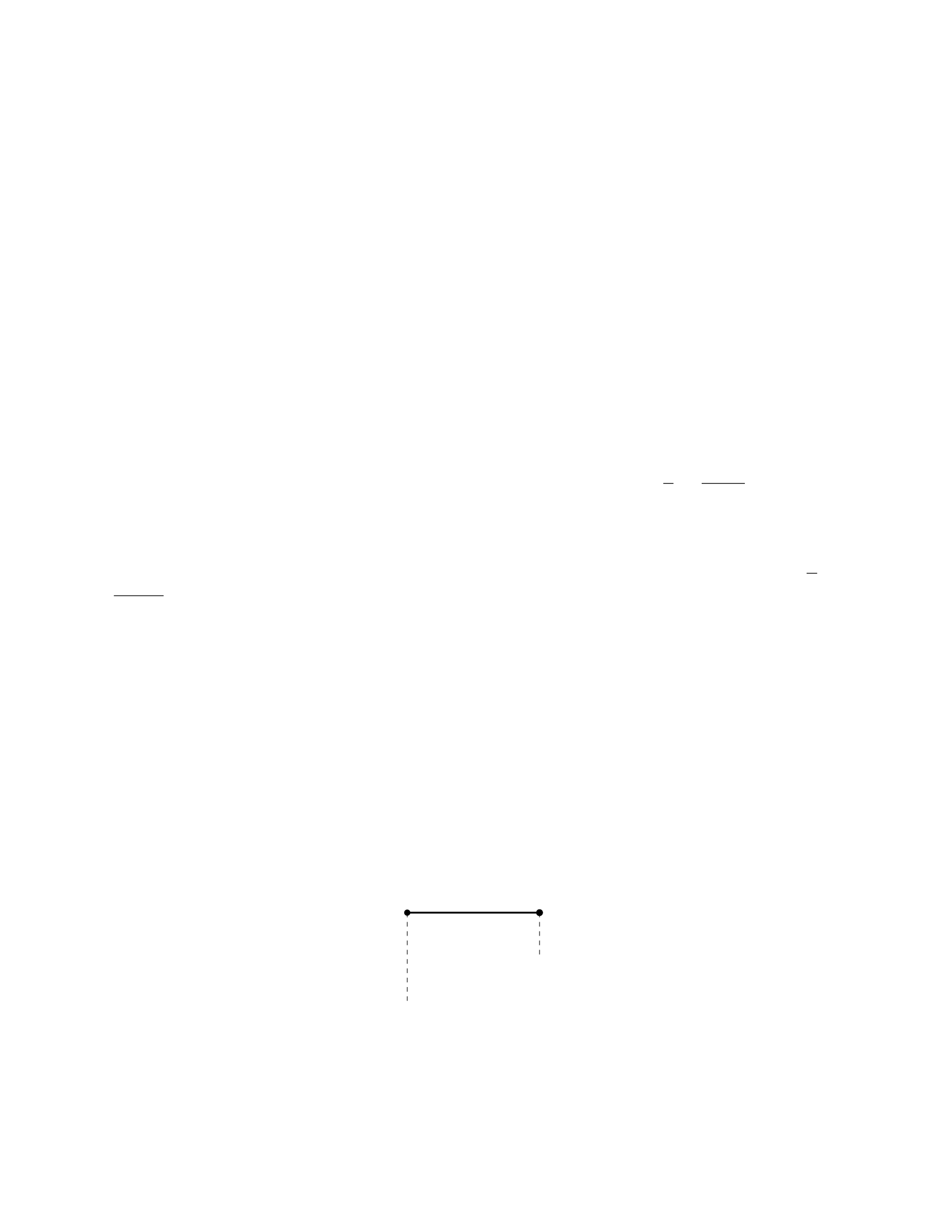
Therefore, the maximum displacement of the object from its equilibrium position before it
starts oscillating is 0.0109 m.
18. Question:
A cylindrical rod with a length of 2 meters and a diameter of 10 cm is suspended horizontally
between two walls. The rod is made of a steel alloy with a Young’s modulus of 2×10¹¹ N/m2.
A weight of 500 N is hung from the center of the rod. Determine the elongation of the rod.
Ans. Step-by-step solution:
1. First, we need to find the cross-sectional area of the rod: The diameter of the rod is 10
cm, so the radius is 10/2 = 5 cm = 0.05 m. The cross-sectional area is given by A=πr2.
Plugging in the values, we have A=π×(0.05)2= 0.00785 m2.
2. Next, calculate the stress applied to the rod: Stress (σ) is defined as the force per unit
area. In this case, the force is 500 N and the area is 0.00785 m2. So, σ=F
A=500
0.00785 = 63694.27
N/m2.
3. Now, we can use Hooke’s Law for elasticity to find the elongation of the rod: Hooke’s
Law states that the stress is proportional to the strain, where the proportionality constant is the
Young’s modulus (Y). The equation is σ=Y·ε, where εis the strain. Therefore, ε=σ
Y=
63694.27
2×1011 = 3.18 ×10⁻⁴.
4. Finally, calculate the elongation of the rod: The elongation (∆L) can be calculated using
the formula ∆L=ε·L, where Lis the original length of the rod. Plugging in the values, we
have ∆L= 3.18 ×10−4×2 = 6.36 ×10⁻⁴m.
Therefore, the elongation of the rod is 6.36 ×10⁻⁴meters.
19. A uniform rod of length Land mass Mis attached to a fixed pivot at one end and
suspended vertically. A small object of mass mis attached to the rod a distance dfrom the pivot
point, as shown in the figure below. The system is in equilibrium.
Pivot Object
m
L
d
Given that the rod is of negligible mass and the acceleration due to gravity is g, determine
the tension in the rod.
Ans. Let’s consider the forces acting on the small object attached to the rod. 1. The force of

gravity acts downwards, with a magnitude of mg. 2. The tension in the rod acts both horizontally
and vertically. 3. The normal force acts perpendicular to the rod. 4. The frictional force acts
parallel to the rod. Since the system is in equilibrium, the sum of the forces in the horizontal and
vertical directions must be zero.
1. In the vertical direction: The sum of the vertical components of the forces must be zero:
Tcos(θ)−mg = 0
Tcos(θ) = mg
2. In the horizontal direction: The sum of the horizontal components of the forces must be
zero:
Tsin(θ) = Ffriction
Since the object is in equilibrium and the rod is of negligible mass, there is no angular acceleration
and the frictional force is zero. Thus,
Tsin(θ) = 0
T= 0
20. Question:
A solid cylinder of radius Rand height his placed on a rough horizontal surface. A horizontal
force Fis applied tangentially to the cylinder at a height h/3 above the base. The coefficient of
friction between the cylinder and surface is µ. Determine the maximum value of Fthat can be
applied without causing the cylinder to tip over.
Ans. Step-by-step solution:
1. First, we need to determine the conditions for the cylinder not to tip over. The net torque
about the point where the cylinder touches the surface must be zero. Since the force is applied
at a height of h/3 above the base, the lever arm is h/3. The weight Wof the cylinder acts at the
center of mass, which is at a height of h/2 above the base. The frictional force acts horizontally
in the direction opposite to the applied force F. Let Rbe the reaction force at the contact point.
The torque equation can be written as:
F·h
3−µ·R·(h/2) = 0
2. Next, we need to consider the conditions for the cylinder not to slide. The force of friction
must be less than or equal to the maximum static friction force which is µR. The equilibrium
equation in the vertical direction can be written as:
R=W
R=mg

3. By substituting R=mg into the torque equation, we get:
F·h
3−µ·mg ·h
2= 0
F=µmg ·3
2
F=3
2µmg
Therefore, the maximum value of Fthat can be applied without causing the cylinder to tip
over is 3
2µmg.
21. A uniform rod of length Land mass Mis in equilibrium, with one end of the rod is on a
rough horizontal surface and the other end is against a smooth vertical wall. The coefficient of
static friction between the rod and the surface is µs. Find the minimum value of µsfor which
the rod remains in equilibrium.
Ans. Let’s denote the angle between the rod and the horizontal surface as θ.
1. Draw a free body diagram of the rod. By resolving forces horizontally and vertically, we
have: Horizontal forces: N=fwall
Vertical forces: ffloor =Mg
where Nis the normal reaction force exerted by the wall on the rod, fwall is the frictional force
between the rod and the wall, ffloor is the frictional force between the rod and the floor, and gis
the acceleration due to gravity.
2. Write the torque equation about the point of contact between the rod and the floor. The
forces Nand M g do not contribute to the torque since their lines of action pass through this
point. The torques due to the frictional forces are:
τfwall =fwall ·Lsin θand τffloor =ffloor ·L/2 cos θ
3. For equilibrium, the net torque must be zero, so:
fwall ·Lsin θ=Mg ·L/2 cos θ
4. Substitute the expressions for the frictional forces:
µsMg ·Lsin θ=M g ·L/2 cos θ
5. Simplify the equation and solve for the minimum value of µs:
µs=1
2tan θ
6. The minimum value of µsoccurs when θis maximum. Therefore, θ=arctan(1
2).

Hence, the minimum value of µsfor which the rod remains in equilibrium is µs=1
2tan(arctan(1
2))=
1
√5.
22. Question 22:
A block of wood of mass 2 kg is hung from a uniform steel rod that is 2 m long and has a
mass of 1 kg. The steel rod is attached to a wall at one end, and the block of wood is attached
to the other end. If the system is in equilibrium and the elastic modulus of steel is 2×10¹¹ N/m2,
calculate the extension of the steel rod.
Ans. Let’s denote the extension of the steel rod as x. To find x, we need to consider the
equilibrium of forces acting on the rod.
1. The weight of the block of wood is acting downwards, and it exerts a force on the steel
rod given by F1=m1·gwhere m1= 2 kg and g= 9.8m/s2.
2. The weight of the steel rod is acting downwards towards the wall, and it exerts a force on
the steel rod given by F2=m2·gwhere m2= 1 kg.
3. The tension in the steel rod is acting upwards and is equal to the force exerted by the
block of wood. This tension F3can be written as F3=m1·g.
4. The extension xcreated in the steel rod due to the weight of the block of wood can be
expressed as x=F3·L
A·E, where L= 2 m is the length of the rod, Ais the cross-sectional area of
the rod, and E= 2 ×10¹¹ N/m2is the elastic modulus of steel.
5. The cross-sectional area Aof the steel rod can be calculated using the formula A=π·r2
4,
where ris the radius of the rod.
6. Finally, substituting all the known values into the equation x=m1·g·L
π·r2
4·Eand solving for x
will give us the extension of the steel rod.
This problem requires the application of both equilibrium and elasticity concepts to find the
extension of the steel rod under the given conditions.
23. Question:
A block of mass mis hanging from the ceiling by a wire of length L. The block is pulled to
one side until the wire makes an angle θwith the vertical wall. Find an expression for the tension
in the wire as a function of the angle θ.
Ans. Let’s consider the forces acting on the block:
1. The weight of the block mg acting vertically downwards. 2. The tension Tin the wire
acting along the wire. 3. The horizontal component of the tension Tsin θ. 4. The vertical
component of the tension Tcos θ. 5. The centripetal force mv2
Ldirected towards the center,
where vis the velocity of the block.
Since the block is in equilibrium, the sum of the forces in the horizontal direction is equal to

zero:
Tsin θ=mv2
L(1)
The forces in the vertical direction also sum up to zero:
Tcos θ=mg (2)
From equation (2), we can express the tension Tas:
T=mg
cos θ
Therefore, the tension in the wire as a function of the angle θis given by T=mg
cos θ.
24. A rectangular wooden block of dimensions 20 cm ×10 cm ×5cm floats in water with the
20 cm side horizontal. Determine the density of the wood.
Ans. Let’s denote the density of water as ρw= 1000 kg/m3. 1. First, we need to determine the
volume of the block. The volume of the block is given by the product of its three dimensions, so
Vblock = 20 cm ×10 cm ×5cm = 1000 cm3= 0.001 m3. 2. Since the block floats in water, the
weight of the block is equal to the buoyant force acting on it. Using the formula for buoyant force
Fb=ρw·Vblock ·g, where g= 9.81 m/s2is the acceleration due to gravity, we have the weight
of the block Wblock =ρw·Vblock ·g. 3. The weight of the block can also be calculated using
its density ρwood and the acceleration due to gravity, so Wblock =ρwood ·Vblock ·g. Substituting
Vblock = 0.001 m3and g= 9.81 m/s2, we get an equation in terms of the density of wood ρwood.
4. Equating the weights from steps 2 and 3, we have ρwood ·Vblock ·g=ρw·Vblock ·g. Cancelling
out Vblock ·gfrom both sides gives us ρwood =ρw. 5. Therefore, the density of the wood is the
same as the density of water, ρwood = 1000 kg/m3.

