



PRACTICE PROBLEMS CHAPTER 6 AND 7
I. Laplace Transform
1. Find the Laplace transform of the following functions.
(a)
ft=sin 2tcos 2t
(b)
ft=cos23t
(c)
ft=t e2tsin 3t
(d)
ft=t3u7t
(e)
ft=t2u3t
(f)
ft=
{
1, if 0≤t2,
t2−4t4, if t≥2
(g)
ft=
{
t , if 0≤t3,
5, if t≥3
(h)
ft=
{
0, if t ,
t− ,if ≤t2
0,if t≥2
(i)
ft=
{
cos t,if t4,
0, if t≥4
(j)
ft=
{
t , if 0≤t1,
et,if t≥1
2. Find the inverse Laplace Transform:
(a)
Fs= 1
s1 s2−1
(b)
Fs= 2s3
s24s13
(c)
Fs= e−3s
s−2
(d)
Fs= 1e−2s
s26

3. The transform of the solution to a certain differential equation is given by
Xs=1−e−2s
s21.
Determine the solution x(t) of the differential equation.
4. Suppose that the function
yt
satisfies the DE
y ' ' −2y' −y=1,
with initial values,
y0=−1, y ' 0=1.
Find the Laplace transform of
yt
5. Consider the following IVP:
y ' ' −3y '−10 y=1, y0=−1, y ' 0=2
(a) Find the Laplace transform of the solution y(t).
(b) Find the solution y(t) by inverting the transform.
6. Consider the following IVP:
y ' ' 4y=4u5t, y0=0, y' 0=1
(a) Find the Laplace transform of the solution y(t).
(b) Find the solution y(t) by inverting the transform.
7. A mass m =1 is attached to a spring with constant k =5 and damping constant c = 2. At the instant
t=
the mass is struck with a hammer, providing an impulse p = 10. Also,
x0=0
and x'(0)=0.
a) Write the differential equation governing the motion of the mass.
b) Find the Laplace transform of the solution x(t).
c) Apply the inverse Laplace transform to find the solution.
II. Linear systems
1. Verify that
x=et
1
0
2t et
1
1
is a solution of the system
x'=
2−1
3−2
xet
1
−1
2. Given the system
x' =t x−yetz , y '=2xt2y−z , z ' =e−t3t yt3z
, define x, P(t) and
ft
such that the system is represented as
x'=Ptxft
3. Consider the second order initial value problem:
u ' '2u '2u=3sin t , u0=2,u ' 0=−1
Change the IVP into a first-order initial value system and write the resulting system in matrix form.
4. Are the vectors
x1=
1
−1
1
,
x2=
0
1
1
and
x3=
1
1
1
linearly independent?
5. Consider the system
x'=
−2−6
0 1
x
Two solutions of the system are
x1=et
−2
1
and
x2=e−2t
1
0
(a) Use the Wronskian to verify that the two solutions are linearly independent.
(b) Write the general solution of the system.
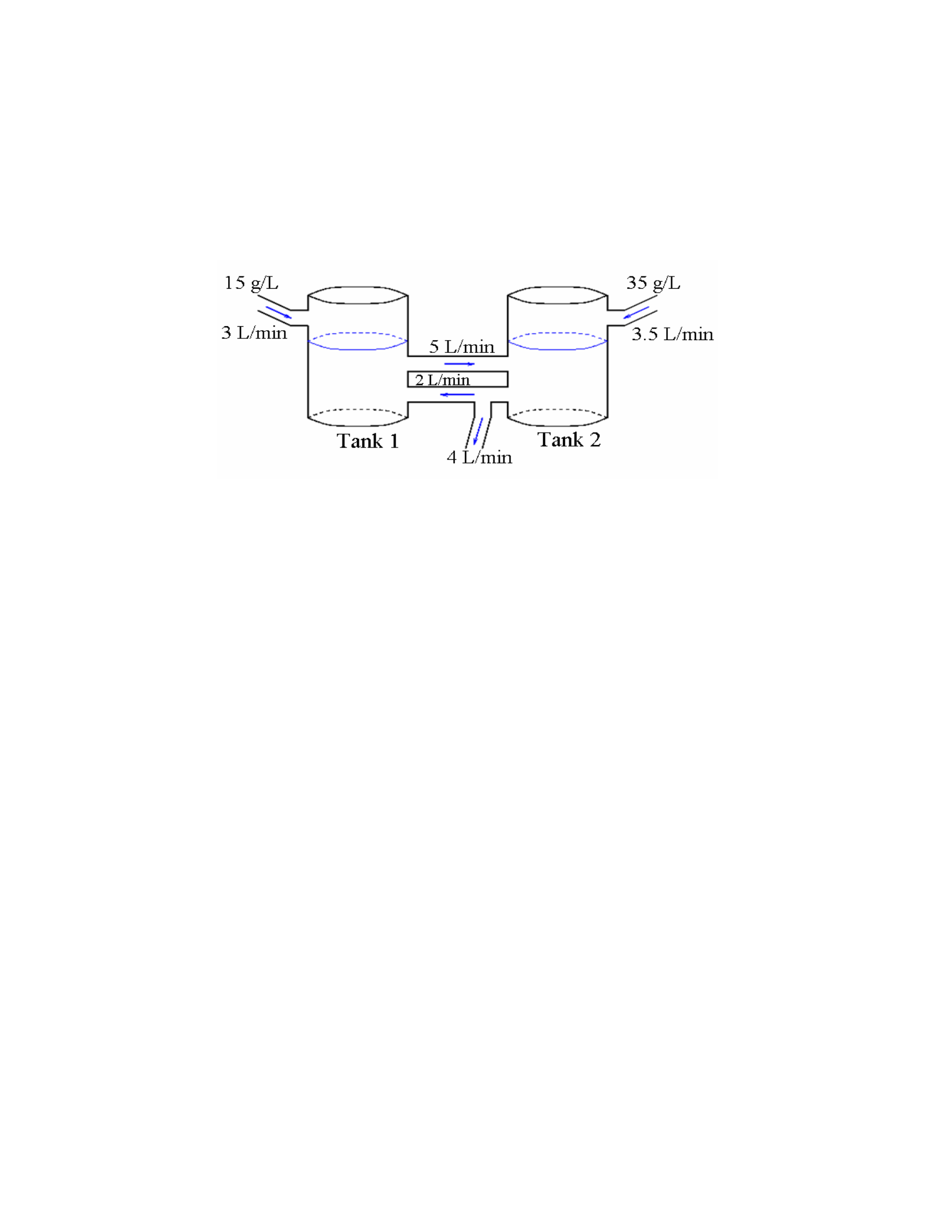
6. Consider two interconnecting tanks as shown in the figure. Tank 1 initially contains 80 L (liters) of
water and 100 g (grams) of salt, while Tank 2 initially contains 20 L of water and 50 g of salt. Water
containing 15g/L of salt is poured into tank 1 at a rate of 3 L/m while the mixture flowing into tank
2 contains a salt concentration of 35 g/L and is flowing at a rate of 3.5 L/min. The mixture flows
from tank 1 to tank 2 at a rate of 5 L/min. The mixture drains from tank 2 at a rate of 6 L/min, of
which some flows back into Tank 1 at a rate of 2 L/min, while the remainder leaves the tank.
Let Q1 and Q2, respectively, be the amount of salt in each tank at time t.
Write down differential equations and initial conditions that model the flow process.
7. Suppose the system
x'=Ax
has the general solution
xt=
x1t
x2t
x3t
=c1et
−2
1
0
c2e−2t
1
0
1
c3e−t
0
1
1
Given the initial condition
x0=
1
1
−1
,
find
x1t, x2t
and
x3t.
8. Solve the IVP
x'=Ax
with
A=
1−3
0−2
and
x0=
1
3
9. Solve the IVP
x ' =x2y
y' = 4 x3y
with
x0=3, y0=0 .
10. Suppose that A is a real
3×3
matrix that has the following eigenvalues and eigenvectors
−2,
1
1
1
,1i ,
1−i
2
1
,1−i ,
1i
2
1
Find a fundamental set of real valued solutions to the system
x'=Ax.
11. Solve the initial value problem
x1'=x1−2x2, x2'=2x1x2, x10=0, x20=4
using the
eigenvalue method. Express the solution in terms of real functions only (no complex functions).

ANSWERS TO PRACTICE PROBLEMS CHAPTER 6 AND 7
I. Laplace Transform
1. (a) Using the double angle trigonometric identity, the function
ft
can be rewritten as
ft= 1
2sin 4t .
Thus
L{ft}= 2
s216
(b) Using the half angle trigonometric identity, the function
ft
can be rewritten as
ft= 1
21cos6t .
Thus
L{ft}= 1
2
1
ss
s236
(c) Using the property
L{t f t}=−F ' s
with
Fs=L{e2tsin 3t}= 3
s−229
yields
L{t e2tsin 3t}= 6s−2
s−229
2
(d)
ft=[t−710]u7t.
Thus
L{ft}=e−7sL{t10}=e−7s
1
s210
s
(e)
L{ft}=e−3sL{t32}=e−3sL{t26t9}=e−3s
2
s36
s29
s
(f)
ft=1u2tt2−4t3=1u2t
[
t−22−1
]
Thus
L{ft}=1
se−2sL{t2−1}=1
se−2s
2
s3−1
s
(g)
ft=t−u3tt−5=t−u3t[t−3−2].
Thus
L{ft}= 1
s2−e−3sL{t−2}= 1
s2−e−3s
1
s2−2
s
(h)
ft=utt−−u2tt−=utt−−u2tt−2
Thus
L{ft}=e−sL{t}−e−2sL{t}= e− s
s2−e−2s
1
s2
s
(i)
ft=cost−u4tcos t=cost−u4tcos t−4
Thus
L{ft}= s
2s2−e−4sL{cos t}= s
2s2−e−4ss
2s2
(j)
ft=tu1t[et−t]=tu1t[et−11−t−1−1]
Thus
L{ft}= 1
s2e−sL{et1−t−1}= 1
s2e−s
e
s−1−1
s2−1
s
2.
(a) Using PFD,
Fs=− 1
4
1
s1−1
2
1
s121
4
1
s−1.
Thus
ft=−1
4e−t−1
2t e−t1
4et
(b) F(s) can be rewritten as
Fs= 2s3
s229=2s2−1
s229=2s2
s229−1
3
3
s229.
Thus
ft=e−2t
2 cos 3t−1
3sin 3t
(c) The inverse Laplace is
u3tft−3
where
ft=L−1
{
1
s−2
}
=e2t.
Thus
L−1
{
e−3s
s−2
}
=u3te2t−3
(d)
Fs= 1
6
6
s26e−2s
6
6
s26
thus
L−1
{
Fs
}
=1
6sin
6t 1
6u2tsin
6t−2
3.
1−u2tsin t
4.
Ys= −s3
s2−2s−11
ss2−2s−1
5. (a)
Ys= 1
ss−5 s2−1
s2.
(b)
yt=− 1
10 1
35 e5t−13
14 e−2t
6. (a)
Ys= 1
s24e−5s
1
s−s
s24
.
(b)
yt= 1
2sin2tu5t[1−cos 2t−10]
7. (a)
x' '2x '5x=10t−
(b)
Xs= 10 e− s
s22s5=5e−s2
s124
(c)
xt=5ute−t−sin 2t−=5ute−t sin 2t
II. Linear Systems
1. Differentiating the given x yields
x'=et
1
0
2et2t et
1
1
=
3et2t et
2et2t et
Substituting x into the right hand side of the DE yields:
2−1
3−2
et2t et
2t et
et
1
−1
=
2et4t et−2t et
3et6t et−4t et
et
−et
=
3et2t et
2et2t et
=x'
2.
x=
x
y
z
Pt=
t−1et
2t2−1
0 3 t t3
ft=
0
0
e−t
3.
u'
v '
=
0 1
−2−2
u
v
0
3sin t
u0
v0
=
2
−1
4.
c1
1
−1
1
c2
0
1
1
c3
1
1
1
=
0
0
0
yields
c1c3=0
−c1c2c3=0
c1c2c3=0
The only solution is
c1=c2=c3=0,
thus the vectors are linearly independent.
5. (a)
Wx1, x2=
∣
−2ete−2t
et0
∣
=−e−t≠0
Thus the two solutions are linearly independent and form a
fundamental set.
(b)
xt=c1et
−2
1
c2e−2t
1
0
6.
dQ1
dt =452Q2
202.5t−5Q1
80 , Q10=100
dQ2
dt =122.55Q1
80 −6Q2
202.5 t, Q20=50
7.
x1t=6et−5e−2t
x2t=−3et4e−t
x3t=−5e−2t4e−t
8.
xt=−2et
1
0
3e−2t
1
1
=
−2et3e−2t
3e−2t
9.
xt=2e−te5t
yt=−2e−t2e5t
10. The first eigenvalue/eigenvector pair gives the solution:
x1t=e−2t
1
1
1
The second eigenvalue/eigenvector pair gives the two solutions:
x2t=et
cos tsin t
2 cos t
cos t
,
x3t=et
−cos tsin t
2sin t
sin t
.
11.
xt=−4etsin 2t
yt=4etcos2t

