%Question 1
Part a:
function LAB06ex1
clc
omega0 = 2; c = 1; omega = 1.4;
param = [omega0,c,omega];
t0 = 0; y0 = 0; v0 = 0; Y0 = [y0;v0]; tf = 50;
options = odeset( ,1e-10);'AbsTol' 'relTol',1e-10,
[t,Y] = ode45(@f,[t0,tf],Y0,options,param);
y = Y(:,1); v = Y(:,2);
figure(1)
plot(t,y, ;'b-'); ylabel('y'); grid on
t1 = 25; i = find(t>t1);
C = (max(Y(i,1))-min(Y(i,1)))/2;
disp(['computed amplitude of forced oscillation = ' num2str(C)]);
Ctheory = 1/sqrt((omega0^2-omega^2)^2+(c*omega)^2);
disp(['theoretical amplitude = ' num2str(Ctheory)]);
%----------------------------------------------------------------
functiondYdt = f(t,Y,param)
y = Y(1); v = Y(2);
omega0 = param(1); c = param(2); omega = param(3);
dYdt = [ v ; cos(omega*t)-omega0^2*y-c*v ];
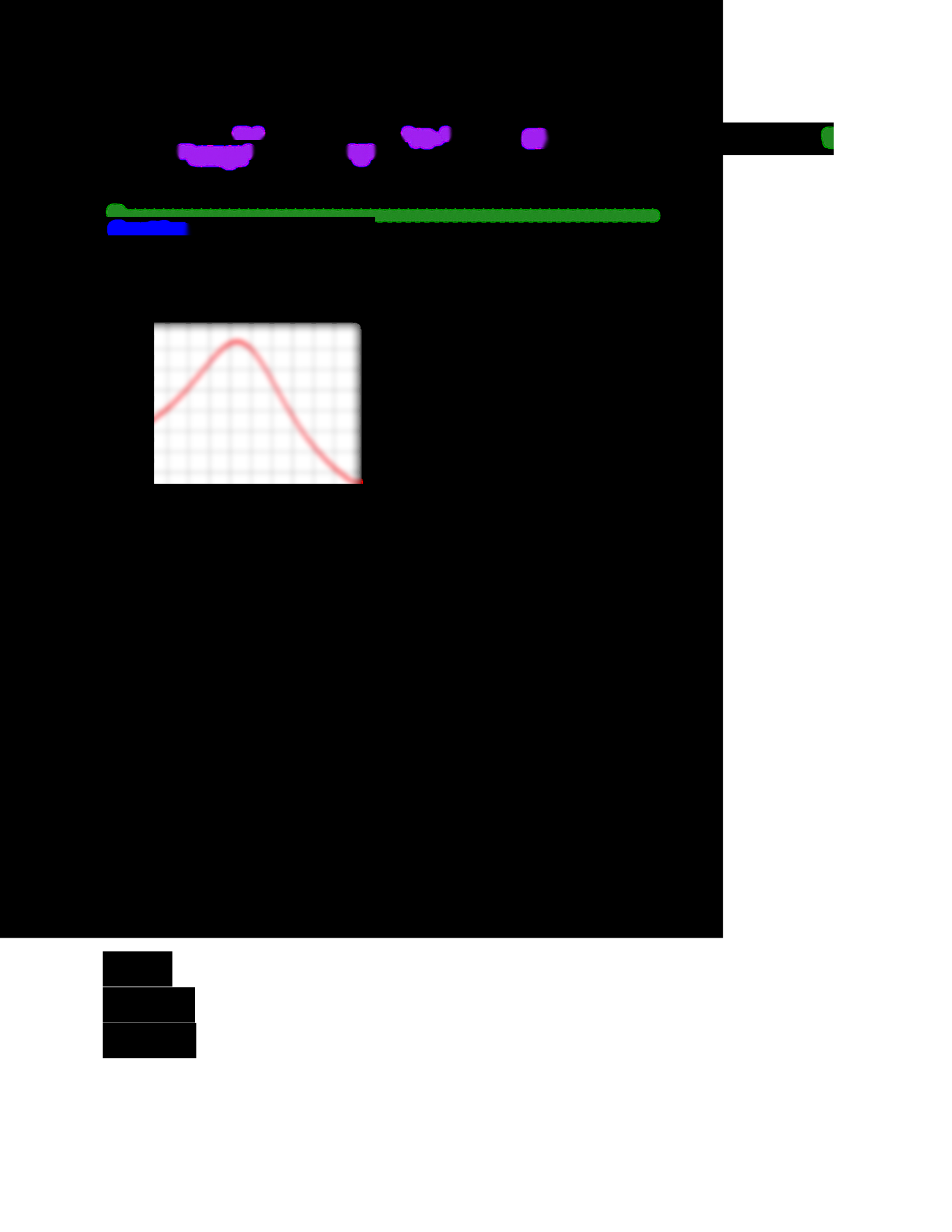
0 5 10 15 20 25 30 35 40 45 50
-0.5
-0.4
-0.3
-0.2
-0.1
0
0.1
0.2
0.3
0.4
0.5
y
computed amplitude of forced oscillation = 0.40417
theoretical amplitude = 0.40417
T=2pi/w=2pi/1.4=4.49 seconds
alpha=arctan(cw/(w0squared-wsquared))
alpha=atan(c*omega/(omega0^2-omega^2)) = .6015 radians
Part b:
function LAB06ex1
clc
omega0 = 2; c = 1; omega = 1.4;
param = [omega0,c,omega];
t0 = 0; y0 = 0; v0 = 0; Y0 = [y0;v0]; tf = 50;
options = odeset('AbsTol',1e-10,'relTol',1e-10);

[t,Y] = ode45(@f,[t0,tf],Y0,options,param);
y = Y(:,1); v = Y(:,2);
alpha=atan(c*omega/(omega0^2-omega^2));
figure(1)
plot(t,y,'b-'); ylabel('y'); grid on;
t1 = 25; i = find(t>t1);
C = (max(Y(i,1))-min(Y(i,1)))/2;
disp(['computed amplitude of forced oscillation = ' num2str(C)]);
Ctheory = 1/sqrt((omega0^2-omega^2)^2+(c*omega)^2);
disp(['theoretical amplitude = ' num2str(Ctheory)]);