


Austin Cholley Zhu MAT 267 ONLINE A Fall 2021
Assignment Final Fall 2021 due 10/08/2021 at 08:42pm MST
Problem 1. (1 point)
Let F=h4xy,7y2ibe a vector field in the plane, and Cthe path
y=7x2joining (0,0)to (1,7)in the plane.
A. Evaluate RCF·dr
B. Does the integral in part (A) depend on the path joining (0,0)
to (1,7)? (y/n)
Solution:
SOLUTION
A. The curve Ccan be parametrized by r(t) = ht,7t2i,0≤t≤1.
We have F(r(t)) = h28t3,343t4iand r0(t) = h1,14ti,0≤t≤1.
Thus
ZC
F·dr=Z1
0h28t3,343t4i·h1,14tidt
=Z1
0
(28t3+4802t5)dt
=28
4+4802
6
=2422
3
B. Since ∂
∂x(7y2) = 06=4x=∂
∂y(4xy), the vector field is not
independent of path, thus the integral in part A. does depend on
the path.
Answer(s) submitted:
•12pi
•y
(score 0.5)
Correct Answers:
•807.333333333333
•Y
Problem 2. (1 point)
Evaluate the triple integral
ZZZE
zdV where Eis the solid bounded by the cylinder y2+z2=
324 and the planes x=0,y=3xand z=0 in the first octant.
Solution:
SOLUTION
A picture of the solid Eis given below.
ZZZE
zdV =Z6
0Z18
3xZ√324−y2
0
zdz dydx =Z6
0Z18
3x
1
2324 −y2dy dx
=1
2Z6
0324y−y3
3y=18
y=3x
dx =1
2Z6
05832 −1944 −972x+9x3dx
=1
23888x−972 x2
2+9x4
46
0
=1
2(23328 −17496 +2916) = 4374
Answer(s) submitted:
•4374
(correct)
Correct Answers:
•4374
1

Problem 3. (1 point)
Find the volume of the solid enclosed by the paraboloids z=
25x2+y2and z=2−25x2+y2.
Solution:
SOLUTION
The paraboloids intersect when 25x2+y2=2−25x2+y2⇒
x2+y2=1
25 , thus the intersection is the circle x2+y2=1
25 ,z=1.
The projection of Eonto the xy-plane is the disk x2+y2≤1
25 , so
E=(x,y,z)|x2+y2≤1
25 ,25x2+y2≤z≤2−25x2+y2
Let D=(x,y)|x2+y2≤1
25 .
Then using polar coordinates x=rcosθand y=rsinθ,we have
V=ZZZE
dV =ZZDZ2−25(x2+y2)
25(x2+y2)dz dA =ZZD2−50 x2+y2dA
=Z2π
0Z1
5
02−50r2r dr dθ=Z2π
0
dθZ1
5
02r−50r3dr
= [θ]2π
01r2−25
2r4
1
5
0=1
25 π
Answer(s) submitted:
•((49pi )/(62500))
(incorrect)
Correct Answers:
•0.125664
Problem 4. (1 point)
Evaluate the line integral RCF·drwhere F=
h−4sinx,−3cosy,10xziand Cis the path given by r(t) =
(t3,2t2,2t)for 0 ≤t≤1
RCF·dr=
Solution:
The relevant vectors are:
F(r(t)) = −4sin(t3),−3cos(2t2),20t4
r0(t) = 3t2,4t,2
F(r(t)) ·r0(t) = −4sin(t3),−3cos(2t2),20t4·3t2,4t,2
=−12t2sin(t3)−12tcos(2t2) + 40t4
The line integral is then:
ZC
F·dr=Z1
0
F(r(t))·r0(t)dt =Z1
0−12t2sin(t3)−12tcos(2t2)+40t4dt
=h4cos(t3)−3sin(2t2) + 8t5i1
0
=4cos(1)−3sin(2) + 4
Answer(s) submitted:
•7.47923
(incorrect)
Correct Answers:
•3.43332
2

Problem 5. (1 point)
Compute the flux of ~
F=x
~
i+y~
j+z
~
kthrough the curved surface of
the cylinder x2+y2=1 bounded below by the plane x+y+z=2,
above by the plane x+y+z=8, and oriented away from the z-
axis.
flux =
Solution:
SOLUTION
The curved surface of the circular cylinder is parameterized by
~r=x
~
i+y~
j+z
~
k=cost
~
i+sint~
j+s
~
k,
where 0 ≤t≤2πand 2 −cost−sint≤s≤8−cost−sint.
The vector ∂~r/∂t×∂~r/∂spoints away from the z-axis, so d~
A=
(∂~r/∂t×∂~r/∂s)dsdt and
~
F·d~
A=
x y z
−sintcost0
0 0 1
ds dt = (xcost+ysint)dsdt.
Plugging in for xand y, this is
~
F·d~
A= (cos2t+sin2t)ds dt =dsdt.
Hence,
ZS
~
F·d~
A=Z2π
0Z8−cost−sint
2−cost−sint
ds dt =Z2π
0
6dt =12π.
Answer(s) submitted:
•8pi
(incorrect)
Correct Answers:
•12*pi
Problem 6. (1 point)
Suppose ~
F(x,y) = −xy
~
i+y2~
j.
(a) Find a vector parametric equation for the parabola y=x2
from the origin to the point (2,4)using tas a parameter.
~r(t) =
(b) Find the line integral of ~
Falong the parabola y=x2from
the origin to (2,4).
Solution:
SOLUTION:
(a) Usng the natural parametrization x=t,y=t2, the parabola
has vector parametric equation~r(t) = ht,t2i,0≤t≤2.
(b) F(r(t)) = −t(t2),(t2)2=h−t3,t4iand r0(t) = h1,2ti. Then
ZC
F·dr=Z2
0
F(r(t)) ·r0(t)dt
=Z2
0
(−t3+2t5)dt
=−t4
4+t6
32
0
=−24
4+26
3
=52
3
Answer(s) submitted:
•<t,tˆ(2)>
•((52)/3)
(correct)
Correct Answers:
•<t,tˆ2>
•-2ˆ4/4+2ˆ6/3
3

Problem 7. (1 point)
A)
Consider the vector field F(x,y,z) = h−9yz,−6xz,−2xyi.
Find the divergence and curl of F.
div(F) = ∇·F=.
curl(F) = ∇×F=h, , i.
B)
Consider the vector field F(x,y,z) = h−8x2,−8(x+y)2,7(x+y+
z)2i.
Find the divergence and curl of F.
div(F) = ∇·F=.
curl(F) = ∇×F=h, , i.
Solution:
SOLUTION
A)
∇·F=∂
∂x(−9yz) + ∂
∂y(−6xz) + ∂
∂z(−2xy) = 0+0+0=0
∇×F=
i j k
∂
∂x
∂
∂y
∂
∂z
−9yz −6xz −2xy
=∂
∂y(−2xy)−∂
∂z(−6xz)i−∂
∂x(−2xy)−∂
∂z(−9yz)j
+∂
∂x(−6xz)−∂
∂y(−9yz)k
= (−2x+6x)i−(−2y+9y)j+ (−6z+9z)k
=h4x,−7y,3zi
B)
∇·F=∂
∂x(−8x2) + ∂
∂y(−8(x+y)2) + ∂
∂z(7(x+y+z)2)
=−16x−16(x+y) + 14(x+y+z)
=−18x−2y+14z
∇×F=
i j k
∂
∂x
∂
∂y
∂
∂z
−8x2−8(x+y)27(x+y+z)2
=∂
∂y(7(x+y+z)2)−∂
∂z(−8(x+y)2)i
−∂
∂x(7(x+y+z)2)−∂
∂z(−8x2)j
+∂
∂x(−8(x+y)2)−∂
∂y(−8x2)k
= (14(x+y+z)−0)i−(14(x+y+z)−0)j+ (−16(x+y)−0)k
=h14(x+y+z),−14(x+y+z),−16(x+y)i
Answer(s) submitted:
•0
•(-2+6)x
•(-9+2)y
•(-6+9)z
•2(-8)x+2(-8)(x+y)+2(7)(x+y+z)
•2(7)(x+y+z)
•-2(7)(x+y+z)
•2(-8)(x+y)
(correct)
Correct Answers:
•0
•(-2 - -6)*x
•(-9 - -2)*y
•(-6 - -9)*z
•2*-8*x + 2*-8*(x+y) + 2*7*(x+y+z)
•2*7*(x+y+z)
•-2*7*(x+y+z)
•2*-8*(x+y)
4
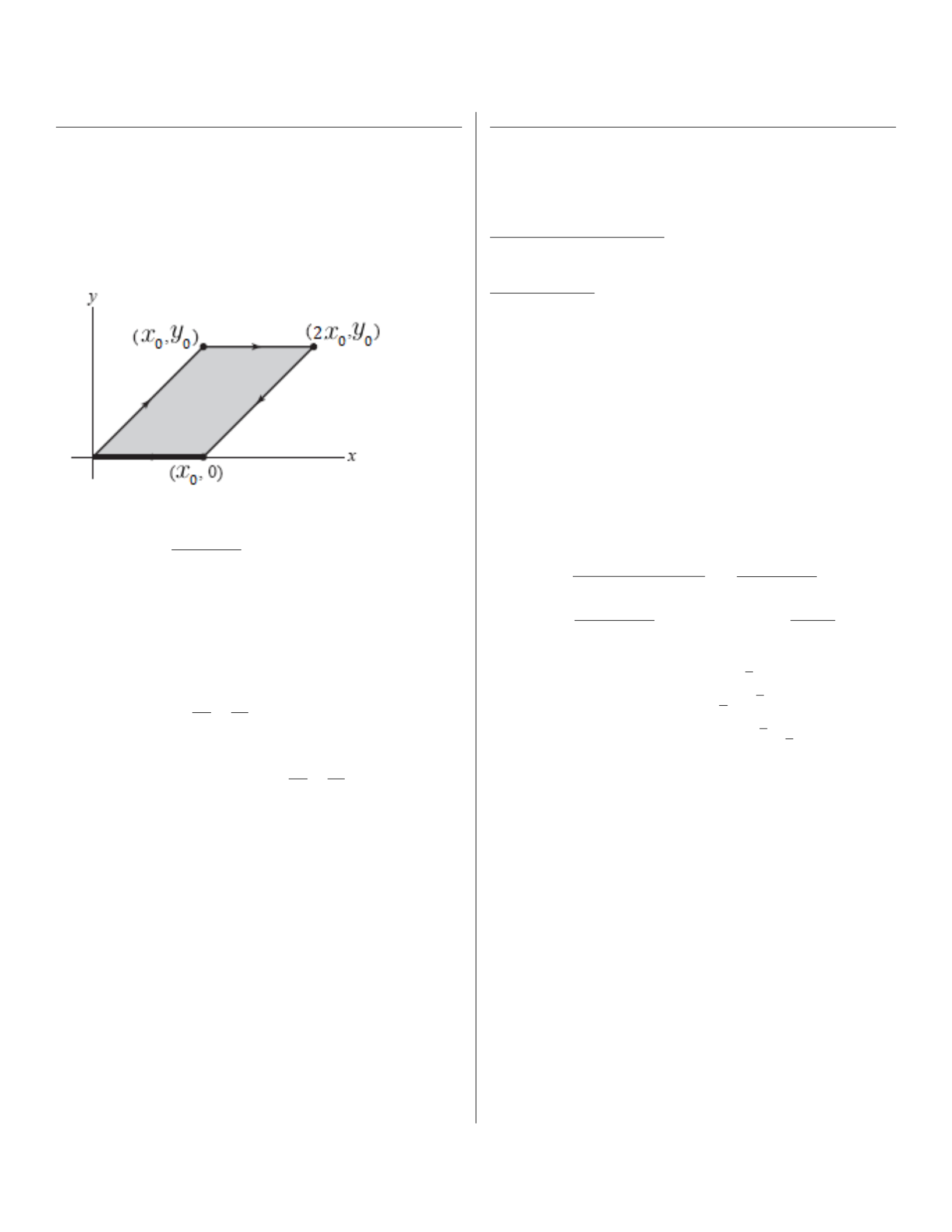
Problem 8. (1 point)
Use Green’s Theorem to evaluate the line integral of F=x8,2x
around the boundary of the parallelogram in the following figure
(note the orientation).
With x0=6
and y0=6.
RCx8dx +2x dy =
Solution:
Solution: First note that the orientation of the boundary curve
is clockwise. We will use Green’s Theorem remembering that
the boundary curve must be oriented counterclockwise. We have
P=x8and Q=2x, therefore
∂Q
∂x−∂P
∂y=2−0=2
Hence, Green’s Theorem implies
Z∂D
x8dx +2x dy =ZZD∂Q
∂x−∂P
∂ydA =
ZZD
2dA =2ZZD
dA =2 Area(D) = 2·36 =72
So now accounting for the orientation,
ZC
x8dx +2x dy =−Z∂D
x8dx +2x dy =−72
Answer(s) submitted:
•-16
(incorrect)
Correct Answers:
•-72
Problem 9. (1 point)
Consider the surface with parametric equations r(s,t) = hst,s+
t,s−ti.
A) Find the equation of the tangent plane at (2,3,1).
.
B) Find the surface area under the restriction s2+t2≤1
Solution:
SOLUTION
A)
rt(s,t) = hs,1,−1iand rs(s,t) = ht,1,1i. Since the point (2,3,1)
corresponds to s=2,t=1, a normal vector to the surface at
(2,3,1)is given by
rs(2,1)×rt(2,1) = h1,1,1i×h2,1,−1i=h−2,3,−1i.
An equation of the tangent plane is
−2(x−2) + 3(y−3)−(z−1) = 0
B)
rs×rt=h−2,s+t,t−siand
|rs×rt|=p4+ (s+t)2+ (t−s)2=√4+2s2+2t2.
The surface area under the given restrictions is then
ZZs2+t2≤1p4+2s2+2t2dA =Z2π
0Z1
0
rp4+2r2dr
=2π1
6(4+2r2)3/21
0
=π
3(6√6−8)
=π2√6−8
3
Answer(s) submitted:
•-2(x-2)+3(y-3)-(z-1)=0
•7.01301
(correct)
Correct Answers:
•-2*(x-2)+3*(y-3)-(z-1)=0
•7.01301755236959
5

Problem 10. (1 point)
Use spherical coordinates to evaluate the triple integral
ZZZE
e−(x2+y2+z2)
px2+y2+z2dV ,
where Eis the region bounded by the spheres x2+y2+z2=9 and
x2+y2+z2=36.
Solution:
SOLUTION
The region of integration is given in spherical coordinates by
E={(ρ,θ,φ)|3≤ρ≤6,0≤θ≤2π,0≤φ≤π}
This represents the region between the spheres ρ=3 and ρ=6.
ZZZE
e−(x2+y2+z2)
px2+y2+z2dV =Z2π
0Zπ
0Z6
3
e−ρ2
pρ2ρ2sinφdρdφdθ
=Z2π
0
dθZπ
0
sinφdφZ6
3
ρe−ρ2dρ
= [θ]2π
0[−cosφ]π
0−1
2e−ρ26
3
=2π(2)−1
2e−36 +1
2e−9
=2πe−9−e−36
Answer(s) submitted:
•2pi ((1/(eˆ(9)))-(1/(eˆ(36))))
(correct)
Correct Answers:
•0.000775406667797879
Problem 11. (1 point)
Let F=h4xyz +5sin x,2x2z,2x2yi.
Find a function fso that F=∇f, and f(0,0,0) = 0.
Solution:
SOLUTION
fx(x,y,z) = 4xyz +5sin ximplies f(x,y,z) = 2x2yz −5cosx+
g(y,z)and fy(x,y,z) = 2x2z+gy(y,z).
But fy(x,y,z) = 2x2z, so g(y,z) = h(z)and f(x,y,z) = 2x2yz −
5cosx+h(z).
Thus fz(x,y,z) = 2x2y+h0(z), but fz(x,y,z) = 2x2yso h(z) = K, a
constant.
Hence a potential function for Fis f(x,y,z) = 2x2yz −5cosx+K.
Since f(0,0,0) = 0, we have −5+K=0 and K=5.
Thus f(x,y,z) = 2x2yz −5cosx+5
Answer(s) submitted:
•2xxyz-5cos(x)+5
(correct)
Correct Answers:
•2*x*x*y*z - 5*cos(x) + 5
6

Problem 12. (1 point)
Use cylindrical coordinates to evaluate the triple integral
RRREpx2+y2dV , where Eis the solid bounded by the circular
paraboloid z=9−9x2+y2and the xy-plane.
Solution:
SOLUTION
The paraboloid z=9−9x2+y2=9−9r2intersects the xy-
plane in the circle x2+y2=1 or r2=1⇒r=1, so in cylindrical
coordinates, Eis given by
E=(r,θ,z)|0≤θ≤2π,0≤r≤1,0≤z≤9−9r2.
Thus
ZZZEpx2+y2dV =Z2π
0Z1
0Z9−9r2
0
√r2r dz dr dθ
=Z2π
0
dθZ1
0Z9−9r2
0
r2dz dr
=2πZ1
0
r2(9−9r2)dr
=2πZ1
0
(9r2−9r4)dr
=2π9r3
3−9r5
51
0
=12
5π
Answer(s) submitted:
•-60461.8355
(incorrect)
Correct Answers:
•7.53982
Generated by ©WeBWorK, http://webwork.maa.org, Mathematical Association of America
7

