



Surgent MAT 267 ONLINE A Spring 2019
Assignment Section 13.6 due 02/25/2019 MST
1. (1 point) Match the parametric equations with the verbal
descriptions of the surfaces by putting the letter of the verbal
description to the left of the letter of the parametric equation.
1. r(u,v) = ui+ucosvj+usinvk
2. r(u,v) = ucosvi+usinvj+u2k
3. r(u,v) = ui+cosvj+sinvk
4. r(u,v) = ui+vj+ (2u−3v)k
A. circular cylinder
B. cone
C. plane
D. circular paraboloid
Solution:
SOLUTION
1. The corresponding parametric equations for the surface
are x=u,y=ucosv,z=usinv. For any point (x,y,z)on the sur-
face, we have x2=y2+z2, which we recognized as the equation
of a cone. Thus the answer is B.
2. The corresponding parametric equations for the surface
are x=ucosv,y=usinv,z=u2. For any point (x,y,z)on the
surface, we have x2+y2=z, which we recognize as the equa-
tion of a circular paraboloid. Thus the answer is D.
3. The corresponding parametric equations for the surface
are x=u,y=cosv,z=sinv. For any point (x,y,z)on the sur-
face, we have y2+z2=1. With no restritions on the parameters,
the surface is y2+z2=1 which we recognize as a circular cylin-
der. Thus the answer is A.
4. The corresponding parametric equations are x=u,y=
v,z=2u−3v. For any point (x,y,z)on the surface, we have
z=2x−3y, which we recognize as the equation of a plane.
Thus the answer is C.
Answer(s) submitted:
•B
•D
•A
•C
(correct)
Correct Answers:
•B
•D
•A
•C
2. (1 point) Consider x=h(y,z)as a parametrized surface
in the natural way. Write the equation of the tangent plane to
the surface at the point (−4,1,−4)given that ∂h
∂y(1,−4) = 3 and
∂h
∂z(1,−4) = −2.
.
Solution:
SOLUTION
The natural parametrization of the surface is
r(y,z) = hh(y,z),y,zi.
We have ry(1,−4) = D∂h
∂y(1,−4),1,0E=h3,1,0iand
rz(1,−4) = D∂h
∂z(1,−4),0,1E=h−2,0,1i.
A normal to the tangent plane is given by ry(1,−4)×
rz(1,−4) = h3,1,0i×h−2,0,1i=h1,−3,2i.
Thus the equation of the tangent plane is
x+4−3(y−1) + 2(z+4) = 0
or, in simplified form,
x−3y+2z=−15
Answer(s) submitted:
•x-3y+2z=-15
(correct)
Correct Answers:
•x - -4 - 3*(y - 1) - -2 * (z - -4)=0
3. (1 point) Consider the surface with parametric equations
r(s,t) = hst,s+t,s−ti.
A) Find the equation of the tangent plane at (2,3,1).
.
B) Find the surface area under the restriction s2+t2≤1
Solution:
SOLUTION
A)
rt(s,t) = hs,1,−1iand rs(s,t) = ht,1,1i. Since the point
(2,3,1)corresponds to s=2,t=1, a normal vector to the
surface at (2,3,1)is given by
rs(2,1)×rt(2,1) = h1,1,1i×h2,1,−1i=h−2,3,−1i.
An equation of the tangent plane is
−2(x−2) + 3(y−3)−(z−1) = 0
B)
rs×rt=h−2,s+t,t−siand
|rs×rt|=p4+ (s+t)2+ (t−s)2=√4+2s2+2t2.
1

The surface area under the given restrictions is then
ZZs2+t2≤1p4+2s2+2t2dA =Z2π
0Z1
0
rp4+2r2dr
=2π1
6(4+2r2)3/21
0
=π
3(6√6−8)
=π2√6−8
3
Answer(s) submitted:
•-2(x-2)+3(y-3)-1(z-1)=0
•2pi(sqrt(6)-(4/3))
(correct)
Correct Answers:
•-2*(x-2)+3*(y-3)-(z-1)=0
•7.01301755236959
4. (1 point) Use Equation 9 from section 13.6 to find the
surface area of that part of the plane 4x+3y+z=7 that lies
inside the elliptic cylinder x2
49 +y2
100 =1
Surface Area =
Solution:
SOLUTION
We have z=f(x,y) = 7−4x+3yand Dis the elliptic disk
x2
49 +y2
100 ≤1, so by Formula 9, the area of the surface is
A(S) = RRDr1+∂z
∂x2+∂z
∂y2
dA
=RRDp1+ (−4)2+ (−3)2dA
=√26RRDdA
=√26 ·Area(D)
=√26π(7)(10)
=70√26π
Answer(s) submitted:
•70pisqrt(26)
(correct)
Correct Answers:
•1121.33295710899
5. (1 point) Write down the iterated integral which expresses
the surface area of z=y8cos5xover the triangle with vertices
(−1,1),(1,1),(0,2):
Zb
aZg(y)
f(y)ph(x,y)dxdy
a=
b=
f(y) =
g(y) =
h(x,y) =
Solution:
SOLUTION
The line between the points (−1,1)and (0,2)has equation
x=y−2, while the line between the points (1,1)and (0,2)has
equation x=2−y. Thus the region of integration, D, is
D={(x,y)|1≤y≤2,y−2≤x≤2−y}.
The surface area is
A(S) = ZZDs1+∂z
∂x2
+∂z
∂y2
dA
=Z2
1Z2−y
y−2q1+ (−5y8cos4xsinx)2+ (8y7cos5x)2dxdy
Answer(s) submitted:
•1
•2
•y-2
•2-y
•(-5yˆ(8)cosˆ(5)(x)sin(x))ˆ(2)+(8yˆ(7)cosˆ(5)(x))ˆ(2)+1
(correct)
Correct Answers:
•1
•2
•y-2
•2-y
•1 + y**(2*8) * 5**2 * cos(x)**(2*5-2)* sin(x)**2 + 8**2 * y**(2*8-2) * cos(x)**(2*5)
6. (1 point) The vector equation r(u,v) = ucosvi+usinvj+
vk, 0 ≤v≤3π, 0 ≤u≤1, describes a helicoid (spiral ramp).
What is the surface area?
Solution:
SOLUTION
ru=cosvi+sinvj,rv=−usinvi+ucosvj+kand ru×rv=
sinvi−cosvj+uk.
Then |ru×rv|=psin2v+cos2v+u2=√1+u2and the sur-
face area is given by
A(S) = Z3π
0Z1
0p1+u2dudv
=Z3π
0
dv Z1
0p1+u2du
=3π
2(√2+ln(1+√2))
.
Answer(s) submitted:
•(3pi/2)(sqrt(2)+ln(1+sqrt(2)))
(correct)
Correct Answers:
•10.8176995863106
7. (1 point) Find the surface area of the part of the sphere
x2+y2+z2=49 that lies above the cone z=px2+y2
Solution:
SOLUTION
Since the cone intersects the sphere in the circle x2+y2=49
2,z=
q49
2and we want the portion of the sphere above this, we can
parametrize the surface as x=x,y=y,z=p49 −x2−y2where
2

x2+y2≤49
2. The surface area is
A(S) = RRx2+y2≤49
2r1+∂z
∂x2+∂z
∂y2
dA
=RRx2+y2≤49
2s1+−2x
2√49−x2−y22
+−2y
2√49−x2−y22
dA
=RRx2+y2≤49
2q1+x2
49−x2−y2+y2
49−x2−y2dA
=RRx2+y2≤49
2q49
49−x2−y2dA
=7Rq49
2
0R2π
0
r
√49−r2dθdr
=14πRq49
2
0
r
√49−r2dr
Using the substitution u=49 −r2,du =−2rdr, yields
A(S) = −7πR
49
2
49 u−1/2du
=7π[2√u]49
49
2
=14πh7−7
√2i
=98π1−1
√2
Answer(s) submitted:
•(98-(49sqrt(2)))pi
(correct)
Correct Answers:
•90.1748160820398
8. (1 point) Find the area cut out of the cylinder x2+z2=49
by the cylinder x2+y2=49.
Solution:
SOLUTION
We first find the area of the face of the surface that intersects
the positive zaxis. Let S1be this surface. A parametric rep-
resentation of the surface is x=x,y=y,z=√49 −x2with
x2+y2≤49.
Then
A(S1) = RRx2+y2≤49 r1+∂z
∂x2+∂z
∂y2
dA
=RRx2+y2≤49 s1+−2x
√49−x22
+02dA
=RRx2+y2≤49 q1+x2
49−x2dA
=RRx2+y2≤49
√49
√49−x2dA
=7R7
−7R√49−x2
−√49−x2
1
√49−x2dydx
=4(7)R7
0R√49−x2
0
1
√49−x2dydx (by the symmetry of the surface)
This integral is improper when x=7, so
A(S1) = 28limt→7−Rt
0R√49−x2
0
1
√49−x2dydx
=28limt→7−Rt
0
√49−x2
√49−x2dx
=28limt→7−Rt
0dx
=28limt→7−t
=196.
Since the complete surface consists of two congruent faces, the
total surface is A(S) = 2·196 =392.
Answer(s) submitted:
•392
(correct)
Correct Answers:
•392
9. (1 point) If a parametric surface given by r1(u,v) =
f(u,v)i+g(u,v)j+h(u,v)kand −4≤u≤4,−5≤v≤5, has
surface area equal to 3, what is the surface area of the paramet-
ric surface given by r2(u,v) = 5r1(u,v)with −4≤u≤4,−5≤
v≤5?
Solution:
SOLUTION
Let S2be the surface parametrized by r2and S1the surface
parametrized by r1. We have, ∂r2
∂u=5∂r1
∂u,∂r2
∂v=5∂r1
∂v,and
∂r2
∂u×∂r2
∂v
=52
∂r1
∂u×∂r1
∂v
.
Thus
A(S2) = Z4
−4Z5
−5
∂r2
∂u×∂r2
∂v
dvdu
=25Z4
−4Z5
−5
∂r1
∂u×∂r1
∂v
dudv
=25 ·A(S1)
=25(3) = 75
Answer(s) submitted:
•25(3)
(correct)
Correct Answers:
•75
10. (1 point)
Parameterize the plane through the point (1,−5,−5)with the
normal vector h5,−1,−3i
~r(s,t) =
(Use s and t for the parameters in your parameterization, and
enter your vector as a single vector, with angle brackets: e.g.,
as ¡1+s+t,s-t,3-t¿.)
Solution:
SOLUTION
To parameterize the plane we need two nonparallel vectors
~v1and~v2that are parallel to the plane. Such vectors are perpen-
dicular to the normal vector to the plane, ~n=h5,−1,−3i. We
can choose any vectors ~v1and ~v2such that ~v1·~n=~v2·~n=0.
3
One choice is
~v1=h1,5,0i, ~v2=h3,0,5i.
Letting~r0=h1,−5,−5i, we have the parameterization
~r(s,t) =~r0+s~v1+t~v2=h1+s+3t,5s−5,5t−5i.
Answer(s) submitted:
•<(1/5)(s+3t+25),s,t>
(correct)
Correct Answers:
•<1+s+3*t,5*s-5,5*t-5>
11. (1 point)
For a sphere parameterized using the spherical coordinates
θand φ, describe in words the part of the sphere given by the
restrictions
π/6≤θ≤π/4 0 ≤φ≤π
and
π/4≤θ≤π/2 0 ≤φ≤π/2.
Then pick the figures below that match the surfaces you de-
scribed.
π/6≤θ≤π/4 0 ≤φ≤π: [?/1/2/3/4/5/6/7/8]
π/4≤θ≤π/2 0 ≤φ≤π/2 : [?/1/2/3/4/5/6/7/8]
(Click on any graph to see a larger version.)
1. 2. 3. 4.
5. 6. 7. 8.
Solution:
SOLUTION
The restrictions π/6≤θ≤π/4 0 ≤φ≤π: correspond to 7.
The restrictions π/4≤θ≤π/2 0 ≤φ≤π/2 : correspond
to 1.
Answer(s) submitted:
•7
•1
(correct)
Correct Answers:
•7
•1
12. (1 point)
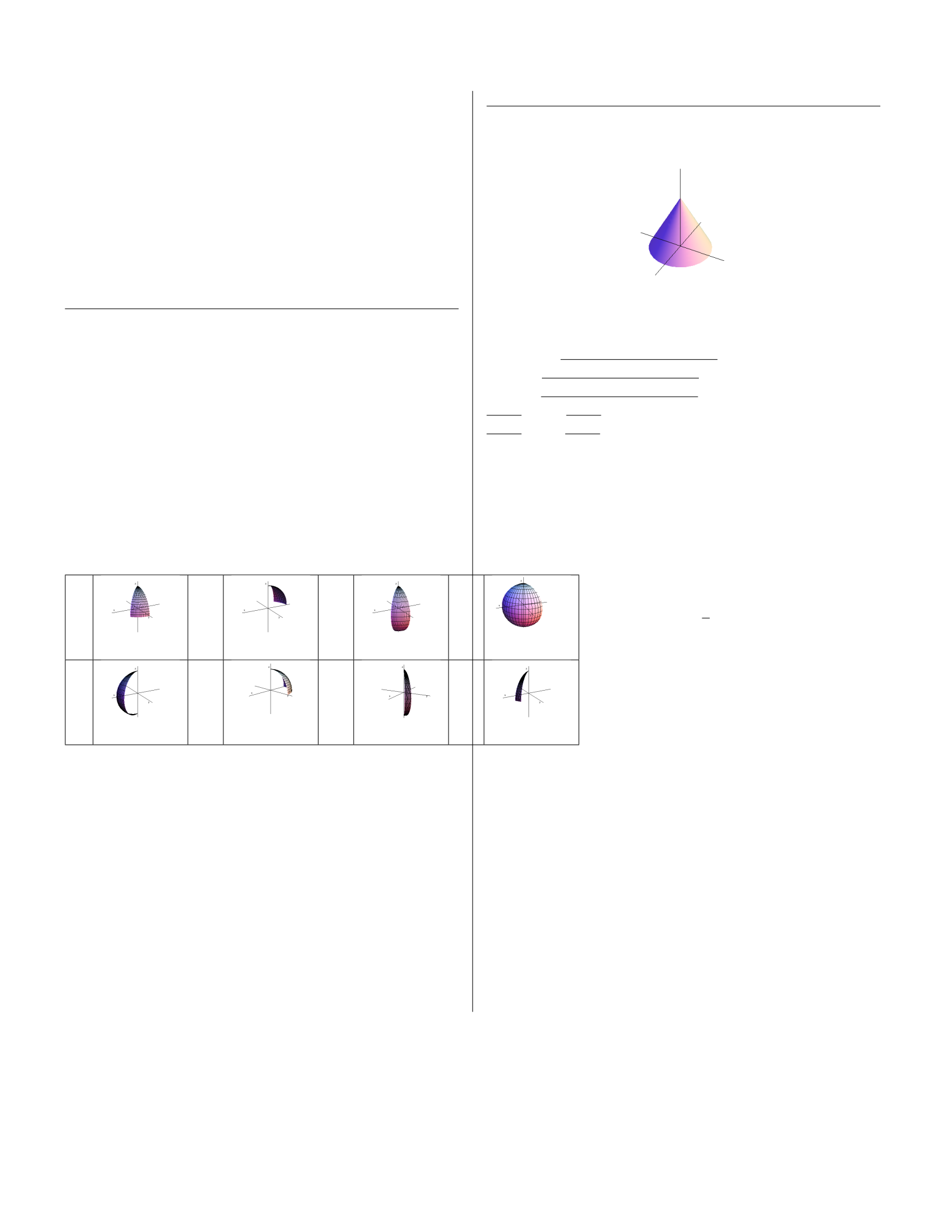
Consider the cone shown below.
If the height of the cone is 7 and the base radius is 3, write a
parameterization of the cone in terms of r=sand θ=t.
x(s,t) = ,
y(s,t) = , and
z(s,t) = , with
≤s≤and
≤t≤.
Solution:
SOLUTION
Since the parameterization is specified to be in terms of the
radius rand angle θ, we find x,yand zin terms of the parameters
r=sand θ=t. We have
x=scost,
y=ssint,
and
z=7(1−1
3s),
with
0≤s≤3 and 0 ≤t≤2π.
There are, of course, other parameterizations, but they will not
be in terms of rand θ, as required in this problem.
Answer(s) submitted:
•scos(t)
•ssin(t)
•7(1-(s/3))
•0
•3
•0
•2pi
(correct)
Correct Answers:
•s*cos(t)
•s*sin(t)
•7-7/3*s
•0
•3
•0
•2*pi
Generated by c
WeBWorK, http://webwork.maa.org, Mathematical Association of America
4

