


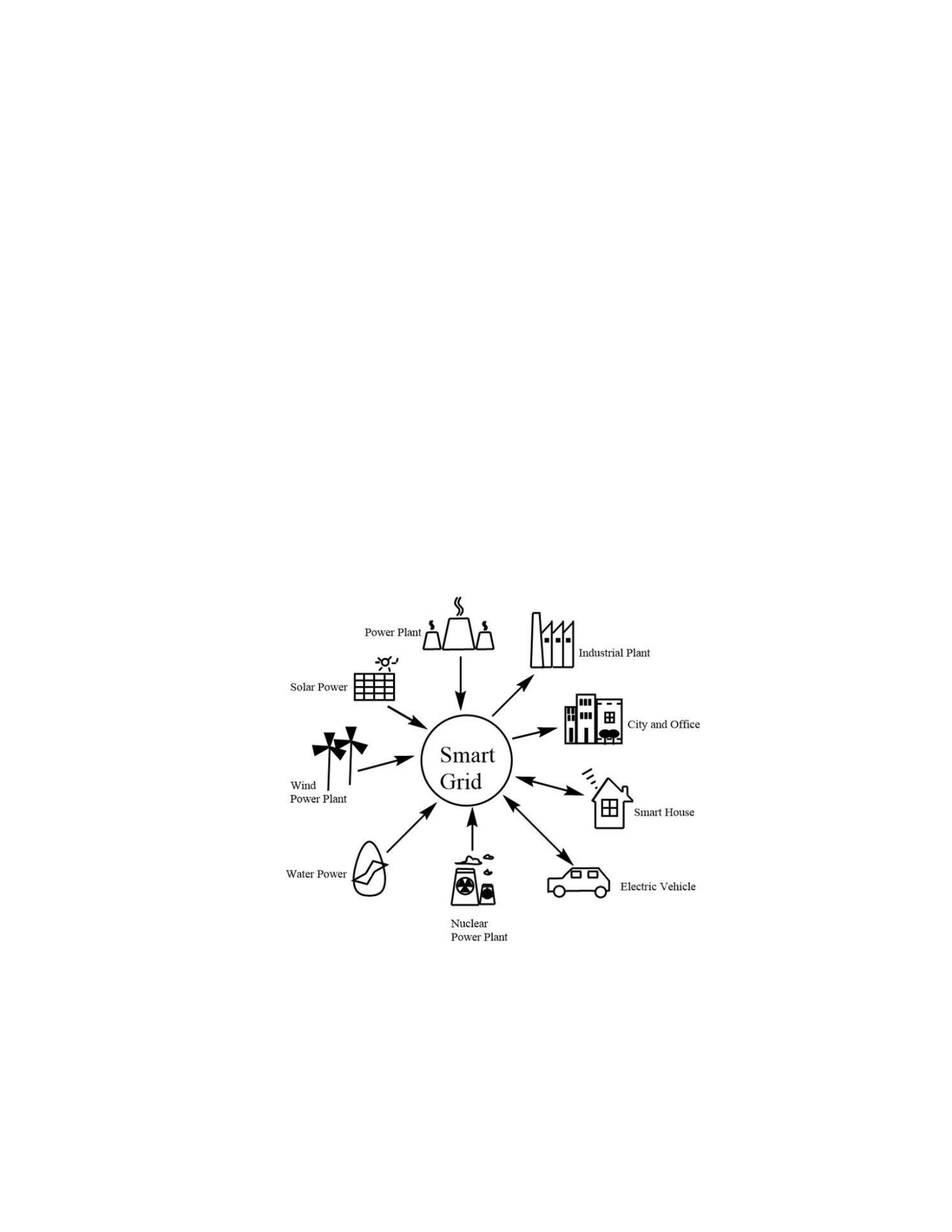
INTRODUCTION Summaries Smart grid is an infrastructure
Smart grid is an infrastructure that uses digital computation and communication
technologies to transform the conventional centralized grid into a more responsive, efficient, and
intelligent energy access and delivery network system [1]. People have realized that our
dependence on fossil fuel energy and accelerating climate change must be stopped to keep us on
a sustainable path. Thus, it is essential that various renewable energy sources be developed. The
goal of the transformation is to reform the energy landscape by integrating and utilizing such
renewable energy resources and reducing the dependence on fossil fuel energy. While the
conventional legacy grid serves consumers via centralized long-distance transmission lines, the
future smart grid paradigm brings energy producers and consumers together in a distributed
manner. See Figure 1.
Figure 1. Smart Grid

1.2 Blockchain
1.2.1 Blockchain Definition
Blockchain technology, introduced in [2], is a distributed ledger or distributed database
technology [3], [4], [5], which is a consensus of replicated, shared, and synchronized digital data
[1]. Blockchain technology is a secure, decentralized, trusted cyber infrastructure, where
multiple entities in the network can create, maintain, and store a chain of blocks. It includes
fault-tolerant consensus algorithms, smart contracts, public-key cryptography, peer-to-peer
networks, and database management technologies that form a low-cost, secure, and efficient
operational management system [6].
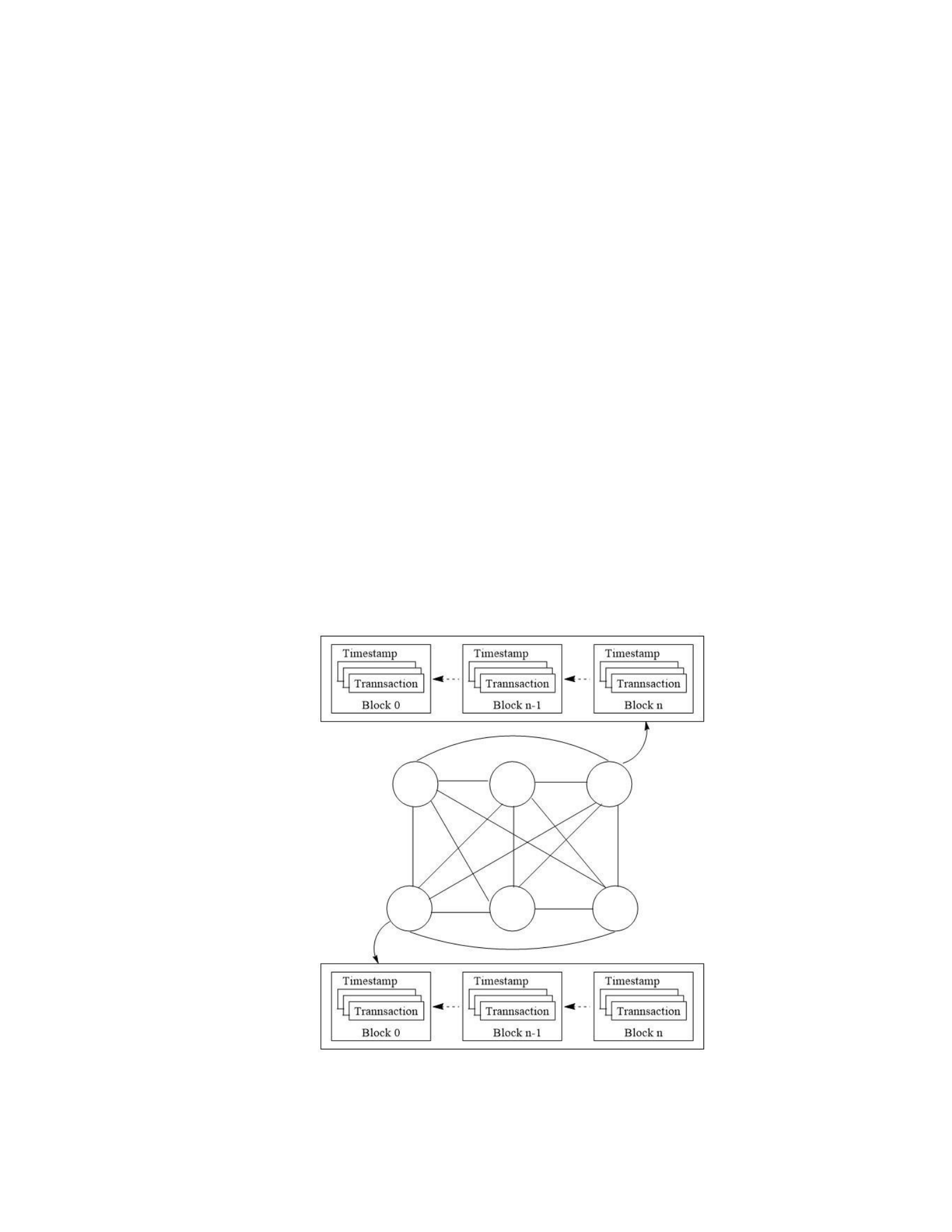
In blockchain, as shown in Figure 2, each block registers different records of data or
transactions. A record of data or a transaction is the message that is sent by one node to other
nodes. Each transaction contains the address of the recipient, transaction data payload, and a
transaction value. Transactions are signed by the sender’s private key and the state of the
network is changed only by such transactions [5].
A block may include timestamp, nonce, a hash tree named Merkle tree [7], hash, smart
contract scripts, and so on [8],[9]. Merkle Tree is used to efficiently summarize and verify the
large sets of data in a block. Markle Trees are suitable for devices that do not have enough space
to store the entire blockchain to search and verify data quickly. The timestamp in each block,
which shows the time of block creation [10], creates a source of variation for block hash, and
makes tampering a blockchain more difficult. The hash is the cryptographic hash of the block, all
blocks are attached together, and each block references the hash of the previous blocks. The hash
and Merkle Tree are to ensure data integrity by allowing the verification that the content of the
blocks is intact [4].
Each node in the network continuously adds newly validated blocks to its local chain at
regular intervals. Therefore, the blockchain’s data is spread across numerous sites, countries, and
institutions geographically and can be accessed by all participants of the network. To alter any
block’s content, all the block’s corresponding data must be changed due to the mechanism that
each block has the previous block’s hash. In a linear chain-based structure, each bock only
connects to the previous block. If each block references multiple previous blocks, it is called
Directed Acyclic Graph (DAG) [1]. Blockchain technology creates redundant systems, which is
why it is resilient to single point failure and cyber-attacks [11].
1.2.2 Blockchain Types
There are primarily two main types of blockchains - private blockchain and public
blockchain, and one major variation - consortium blockchain.
1. Public Blockchain. Public blockchain is a non-restrictive distributed ledger system. Anyone
Figure 2. Schematic Representation of Blockchain

can join the blockchain network and the nodes do not need authentication by others [10].
All nodes are authorized to create blocks, access any records in the network, verify
transactions for an incoming block, and save blocks, which makes the entire blockchain
system completely open and transparent to all participating nodes. The nodes in a public
blockchain is not trusted. However, a public blockchain is trustable, and it is much safer
than private ones due to thoughtful cryptogenic encrypting methods, the consensus
mechanism that make every transaction and block legitimate, a larger network, and
distribution of records, which thwarts hackers from invading the network. A public
blockchain is typically a huge network with a lot of nodes. For every node to verify a
transaction and do proof-of-work is time-consuming, which causes low TPS (Transactions
Per Second) and higher energy consumption [4]. Public blockchain’s slow rate of
processing and completing transactions also causes scalability issues. The most basic use of
public blockchain is for mining and exchanging cryptocurrencies, such as Bitcoin and
Ethereum [12].
2. Private Blockchain. Private blockchain is a restrictive blockchain that is usually created
within an organization and only selected members can join the network. The controlling
organization is in charge of the security, authorization, and accessibility. Because of the
limited number of nodes, a private blockchain has a much higher TPS rate and consumes
less energy. Both the consensus process of a block and adding new transactions to a block
are fast [13]. Because private blockchains are relatively small, they have good scalability.
Furthermore, since the nodes need to build trust in order to transmit confidential
information within the network, the network runs a higher risk of security breach. Private
blockchains need a control unit and Identity Access Management (IAM) system to monitor

and administer rights, which defies the concept of decentralization and contradicts the idea
of blockchain technology. Private blockchain networks are deployed for voting, supply
chain management [12], such as Hyperledger Fabric [14].
3. Consortium Blockchain. Consortium blockchain is semi-decentralized and managed by
more than one organization [12]. Consortium blockchain integrates the features of public
and private systems, with open consensus for public systems and centralized control for
private systems. Consortium blockchains are typically used by companies to create a
broadbased platform for sharing data with stakeholders [15], [16]. The key features of these
blockchain taxonomies are summarized in Table 1 [4], [10], [13], [17].
1.2.3 Blockchain Features
Blockchain has the following desirable characteristics [1], [13], [18], [19].
1. Decentralization. Blockchain networks are managed by decentralized nodes through
consensus protocols. Such networks run in a peer-to-peer manner without trusted
centralized management units.
2. Scalability. The decentralized nature of blockchain network dictates that many nodes can
join the system to scale up the network.
3. Trustless but Secure System. Blockchain network is a trustless but secure system. Individual
nodes in blockchain network are not trusted. All transactions are encrypted with asymmetric
cryptography. A block can only be permanently saved if it passes the consensus mechanism.
4. Immutability. Since blockchain technology utilizes cryptographic techniques, and a
blockhash connects the chain structure and maintains a global ledger that is synchronized
among the nodes, it is extremely difficult to alter the contents of the blocks unless the
majority of the nodes have become malicious.

5. Transparency and Auditability. The blocks in blockchain are open to any nodes in the
blockchain network. The nodes can audit the blocks and verify the authenticity of the
transactions to assure that the blocks are not altered.
6. Resiliency. The resiliency comes from blockchain’s decentralization, which can avoid single
point failure. Storing the entire chain by every node in the blockchain network makes
blockchain a fault-tolerant network. Any fault or malicious activities can be identified and
corrected quickly.
7. Smart Contracts. Introduced by Nick Szabo [20], [21], smart contract is a computerized
protocol that can execute the terms and conditions of an agreement [1]. They are securely
deployed inside the blockchain in the same fashion as transactions. As a computer script, a
smart contract records the conditions and events, such as an asset’s target value, an ending
date, or transaction information. When a smart contract is deployed in the blockchain, if the
condition is reached or an event triggers, the contract will be executed automatically
without any centralized intervention[22]. Ethereum [8] is the most popular smart contract
platform based on blockchain [1], [5]. Smart contract’s ultimate goals include elimination of
trusted intermediaries, less human intervention, reduction of enforcement costs, and
eradication of intentional or unintentional fraud and security risks.
1.2.4 The Attacks and Problems of Blockchain
Blockchain, although considered a safe technology, is still vulnerable to certain types of
threats that are associated with PoW and PoS protocols. [1], [10], [23], [24], [25].
Table 1. Different Features of blockchain Classifications
Item Public Private Consortium
Join Permissionless Strictly
Permissioned Permissioned

Governance None Managed by one
administrator
Managed by a set of
participants
Access right Any node can read,
write, leave, and join
Only authorized
nodes
Only a set of
authorized nodes
Anonymity Yes No No
Nodes Not trusted Trusted Trusted
Consensus
mechanism
Proof of Work
(PoW),
Proof of Stake (PoS)
Multi-part voting
Strictly preapproved
node’s voting
Cryptocurrency Bult-in
cryptocurrency
No No
Security
performance
High security. 51%
attack tolerance, hard
to tamper, no finality
Low security.
33.33% attack
tolerance, could be
tampered,
enabled finality
High-end security
Transactions per
second (TPS)
Bitcoin 7 TPS;
Ethereum network 15
TPS
VISA 24,000 TPS
1000 - 2000 TPS
Computation
complexity High Low Middle
Decentralization
level Highly decentralized Highly centralized Semi-centralized
Transaction
Validation
Incentive-based
mining by any node
List of authorized validators, no incentive
required
Energy
consumption
High Low Middle
Scalability Low High Middle
1. Attack of 51%. 51% attack occurs when one or a group of malicious nodes take control of
51% of processing power in the blockchain network.
Distributed Denial of Services (DDoS) attack. Denial of Services (DoS) attacks aim to
overwhelm the network services by inundating them with requests [26]. A protection
mechanism against in DDoS attack is to limit size of a block up to 1 MB and the size of

each script up to 10000 bytes. Up to 20000 of the signatures can check and at maximum of
the multiple signatures is 20 keys.
2. Double Spending attacks. Double Spending is the risk that a digital currency can be spent
twice. It is a potential problem unique to digital currencies because digital information can
be reproduced easily by savvy individuals who understand the blockchain network and the
computing power necessary to manipulate it.
3. Sybil’s attack. It is possible that one node has several fake identities, because the
blockchain network cannot authentically distinguish the physical machines. The malicious
node may fill the blockchain with fake users under its control, which can lead to 51%
attack and/or double-spending attack.
4. Replay attack. Replay attack attempts to reuse transactions and replay them in order to
increase the impact of the same transaction. By carrying out such attack, a malicious
participant can claim it has been involved.
in a transaction that is profitable for itself multiple times. It can also be used to undermine
honest participants.
5. Selfish mining attack. A selfish mining attack or block withholding attack attempts to
discredit blockchain network integrity. Selfish mining attacks occur when an individual
attempts to withhold a successfully validated block from being broadcasted to the rest
network.
6. Eclipse attacks. In eclipse attack, an attacker capable of delaying information that a victim
expects to receive can launch double spending attacks and selfish attacks.

7. Flash attack. In flash attack, an attacker is able to obtain a temporary majority of
computing power by renting enough mining capacity. This would break the security
assumption of classic PoW-based systems.
8. Content Poisoning Attack. A node’s information was changed.
9. On-off attack. On-off attack refers to irregular behaviors of attackers, which means that
malicious nodes can behave well or badly alternately in order to remain undetected while
causing damage.
10. Cracking encryption. Quantum algorithms, such as ‘Shora’, make it possible to break the
RSA encryption.
11. Blockchain consistency and system liveness. Distributed systems, such as blockchains,
have a concept of correctness, which includes two parts: safety and liveness. Liveness
means that something good will happen. In a blockchain consensus mechanism, liveness is
the guarantee that all validators will agree on a value eventually. Safety is the guarantee
that nothing bad will ever happen in the system. In terms of consensus, this means that no
two processes/validators/actors will ever come up with different values.
1.2.5 Blockchain Challenges
Blockchain has the following challenges [27], [28], [29], [30].
1. High energy consumption. The main disadvantage of blockchain is its high energy
consumption. Keeping a real-time ledger, all nodes communicating with each other, all
miners validating transactions, all nodes giving extreme levels of fault tolerance and
ensuring zero downtime, all nodes storing data on the blockchain, all of these actions burn
electricity. Each node repeats the achievement of consensus, signing each transaction with a

cryptographic scheme needs high computing power, and creating more blocks due to fixed
block size also cause high energy consumption.
2. Latency. For security reason, the blocks in blockchains are kept to a fixed size, around 1
MB. Therefore, some transactions must be processed later, which causes processing latency
for these transactions.
3. Huge storage requirement. Every node in the blockchain network needs to store a copy of
the blockchain, which causes high storage demanding.
4. Scalability. The blockchain consensus involves all nodes and takes a long time to
accomplish. The more node joins the network, the longer time will be needed to finish the
consensus procedure, which, in turn, seriously lowers the network throughput and
performance.
5. A fault-tolerant network. A network that has resistance against availability attacks needs to
be developed.
6. Privacy-preserving capacity. Blockchain lacks the capacity to leverage advanced
privacypreserving techniques to protect information disclosure and increase trust,
transparency, and democracy among all the entities.
1.2.6 Consensus Mechanism
Consensus mechanism ensures the trust in the network, which is why it is a key
component of blockchain technology. During consensus process, a set of validators reach an
agreement whether a block is valid or not. Consensus algorithms are in both public and private
blockchains. Every node can participate in the procedure in public blockchain, whereas only
selected nodes can be a part of the process in private blockchain. Due to the limited number of
validators, private blockchain has simpler consensus mechanism and better network performance

[1]. Depending on the specifications of blockchain applications, the components of a transaction
block and consensus algorithms may vary. Below are some of the most popular consensus
mechanisms.
1. Proof of Work (PoW). PoW is introduced in Bitcoin and is the first public blockchain
consensus [2]. In PoW, the consensus nodes compete to solve a computationally expensive
puzzle, named as PoW problem, which is hard to solve but easy to verify. Whoever solves
the problem will attach the solution to a new block and broadcast the block across the
network so the other nodes can verify its correctness. The process of cracking the puzzle
and verifying the block is called mining. PoW attempts to prevent various kinds of
cyberattacks, but is vulnerable to 51% attack, where one or a group of malicious nodes
may take control of 51% of the network’s processing power. PoW suffers from inefficient
throughput, high latency, and high energy consumption, which reduces its utility in other
blockchain applications [1], [31], [32].
2. Proof of Stake (PoS). PoS [33], [34], [20] is an alternative mechanism of PoW, intending
to overcome PoW’s common limitations. In PoS-based blockchain, the blocks are
commonly validated rather than mined. The algorithm randomly assigns validators to
create new blocks, and the probability of a node selected to validate the next new block is
proportional to the stakes/assets it owns. Since the wealthiest validators administer the
blockchain, it inherently makes PoS mechanism unfair [1], [32].
3. Delegated Proof of Stake (DPoS). DPoS [35] is a variant of PoS. The main difference
between PoS and DPoS is that PoS is directly democratic, while DPoS is delegated
democratic. In DPoS, only a number of selected delegates can generate and validate the
blocks. Since fewer nodes engage in the validation process, DPoS is faster than PoS.

4. Leased Proof of Stake (LPoS). LPoS [36] allows nodes to lease their own assets to others.
This leasing can increase the probability for the borrowing nodes to be selected as
validators. More voteable participants can reduce the chance that a single group of nodes
dominate the blockchain network.
5. Proof of Activity (PoAc). PoAc [37] is developed based on PoW and PoS. The new block
creators initially work as miners using PoW mechanism to defend security attacks, and
hence, they start to receive the rewards. Once the miners collect enough coins (assets), they
utilize PoS mechanism to publish new blocks [38], [39]. PoAc ensures that tokens offered
as rewards are on time.
6. Proof of Burn (PoB). PoB [40] is an alternative of PoW and PoS. Once the nodes burn
their own coins/assets by delivering them to verifiable, public, and un-spendable addresses,
PoB allows the nodes to become authorized validators so they can create a new block and
get rewarded This spent coin is considered an investment. In contrast to PoW and PoS,
PoB does not require high energy consumption. Slimcoin [41] is developed based on PoB.
7. Proof of Inclusion (PoI). Merkle tree root [7] in the block can be used as a proof of the
inclusion of records. Merkle tree root enables nodes to verify individual records without
reviewing and comparing the entire chain. If a blockchain has an identical Merkle tree root
as another node’s blockchain, it can be said that the blocks of two nodes are verified and
consistent. Ethereum blockchain presented in [8] utilizes PoI.
8. Proof of Elapsed Time (PoET). PoET [42] is designed to address the challenges of
expensive investment of energy in PoW. In PoET, the computationally expensive work is
replaced with the proof of elapsed time. PoET randomly chooses the next leader among the
entire population of the validators to publish the block, and the validators request a random

wait time from their enclaves. The validator having the shortest wait time for a particular
block is elected as the leader, which can publish the new block after the wait time has
expired. The trust is established in the hardware that produces the time. Hyperledger
Sawtooth [43] is based on PoET.
9. Proof of Authority (PoA). PoA [44] is designed particularly for permissioned blockchain
and considers a participant’s identity as a stake. Before becoming an authority to publish a
block, the participant must confirm its identity in the network. The authorities are
preselected and trusted to publish a block. It is also convenient to detect malicious
authorities and inform other nodes about the malicious activities. Parity Ethereum [45] is
developed based on PoA.
10. Proof of Reputation (PoR). PoR [46] is an upgraded, stronger, and more secure form of
PoA, whose blockchain consensus mechanism depends on the reputation of the
participants to keep the network secure [47]. In PoR, if any nodes were to attempt to cheat
the system, they would face significant financial and brand consequences. PoR was
implemented in
[48].
11. Practical Byzantine Fault Tolerance (PBFT). PBFT [49] provides a solution to the
Byzantine Generals Problems [50] for asynchronous environment. One validator can
bundle multiple transactions to create a new block. This consensus mechanism uses game
theory to verify blocks among professional miners. PBFT works on the assumption that at
least two thirds of the total number of nodes are honest. PBFT was used in [51].
12. Verifiable Random Function (VRF). A VRF is the public-key version of a keyed
cryptographic hash. Only the holder of the private VRF key can compute the hash for any

given data. Anyone with the corresponding public key can verify the correctness of the
hash without knowing the actual data [52]. The VRF algorithm is:
(a) A VRF’s key generation algorithm generates a pair of public-private keys <pk,sk>
(b) A VRF hashes an input message using the private VRF key sk to obtain an output hash:
hash = VRF hash(sk,message) (1)
(c) The VRF hash algorithm uses the private sk to construct a proof that the hash is the
correct hash output:
proof = VRF prove(sk,message) (2)
(d) The prover sends out the <hash,proof> to the verifier.
(e) The verifier gets <hash,proof> and calculates the hash directly from the proof as:
hash = VRF_proof2hash(proof) (3)
(f) The verifier will determine if there is a unique correspondence between the message
and the hash:
True/False = VRF_verify(pk,message,proof) (4)
If the last equation is true, the verification is determined to be successful; otherwise, it
has failed. Since VRF’s security properties are unique, including collision resistance
and pseudo randomness, VRF is often used in blockchain consensus mechanism to
select the master node and verify transactions [53].
13. Other Consensus Mechanism. In Proof-of-Importance (PoImportance), the chance a node
can participate in verifying transactions depends on the stakes it has and the number and
the quality of the transactions it has processed in the past [54]. Proof-of-Capacity (PoC) is
used especially for decentralized storage as it utilizes the availability and capacity of
storage space on a user’s drive [55]; Proof-of-Weight (PoWeight) assigns each user a

certain “weight”, which is relative to a selected value that represents a user’s contribution
to the network. All weighted users play an integral role in the process of achieving
consensus [56].
1.3 Cyber Security
The NIST Computer Security Handbook [NIST95] defines the term computer security as
”The protection afforded to an automated information system in order to achieve the applicable
objectives of preserving the integrity, availability, and confidentiality of information system
resources (includes hardware, software, firmware, information/data, and telecommunications)”.
This definition introduces three key objectives of computer security – confidentiality, integrity
and availability, which forms the CIA triad. Besides the CIA triad, authenticity and
accountability are commonly included in security fields [57].
1. Confidentiality includes data confidentiality and privacy. Data confidentiality assures that
private or confidential information is not made available or disclosed to unauthorized
individuals; Privacy assures that individuals control or influence what information related to
them may be collected, stored, and by whom and to whom that information may be
disclosed.
2. Integrity consists of data integrity and system integrity. Data integrity assures that
information and programs are changed only in a specified and authorized manner, while
system integrity assures that a system performs its intended function in an unaffected
manner, free from deliberate or unauthorized manipulation of the system.
3. Availability assures that systems work immediately, and service is not denied to authorized
users.

4. Authenticity is “the property of being genuine and being able to be verified and trusted,
confidence in the validity of a transmission, a message, or message originator. This means
verifying that users are who they say they are and that each input arriving at the system
came from a trusted source.”
5. Accountability is “the security goal that generates the requirement for actions of an entity to
be traced uniquely to that entity. This supports nonrepudiation, deterrence, fault isolation,
intrusion detection and prevention, and after-action recovery and legal action”.
The security features applied in different types of applications include authentication,
authorization, encryption, logging, and application security testing. Developers can also code
applications to reduce security vulnerabilities[58].
1. Authentication. Authentication procedures ensure that users are who they say they are, and
only authorized users have access to the application. This can be accomplished by requiring
the user to provide a username and password when logging into an application. Multi-factor
authentication is a common practice now.
2. Authorization. After a user has been authenticated, the user may be authorized to use the
application and its data.
3. Encryption. All the sensitive data are encrypted to maintain data security. Only authorized
users can decrypt the sent message and see the data.
4. Logging. Logging can help identify who has access to the data and how. Application log
files provide time-stamped records about application accessing information, such as who,
when, what, and activities. Logging can identify who made a security breach in an
application.

5. Application security testing. A process to ensure that all these security controls work as
intended.
1.4 Trust and Reputation
Trust plays an especially important role in our daily life. Very often we say we trust a
person or a company’s products. Trust is also a required character in many organization’s
operations, such as nuclear power plant and electricity delivery. Trust is defined as someone or
something is good, honest, and not harmful to you [59], [60], [61]. In [62], trust is defined as
assured reliance on the character, ability, strength, or truth of someone or something. In [63],
“Trust is a subjective expectation an agent has about another’s future behavior based on the
history of their encounters”. Reputation is the opinion that people have about
somebody/something, based on what has happened in the past [59], [60] or based on overall
character [61] or quality as judged by people in general [62]. In [63], reputation is defined as
”perception that an agent creates through past actions about its intentions and norms”. In
blockchain network, the trust we have on any nodes must build on their ability, strength and
reputation, which comes from their past actions or behaviors.
Trust = Direct Experience + Indirect Experience (5)
Business Action = trust + resource + ability (6)
1.5 Motivation
To meet the demand for power in modern society, smart grids have been developed to
trade energy via central systems in traditional solutions [64]. However, besides the single-point
failure issue, smart grids are susceptible to cybersecurity attacks through scanning IP addresses,
hacking communication devices, visible pores, and soft viruses [65]; these systems also lack the
trust of customers and privacy [66]. Due to blockchain’s nature of trustworthiness, transparency,
built-in security features, and immunity of records, with its distributed platform and smart
contracts, blockchain has the potential to replace centralized power systems, providing an
opportunity against security threats and hacking to serve consumers in a secure way [67], [68].

Applying blockchain to smart grid will enhance the trustworthiness and preserve the integrity of
the data - two major challenges that currently threaten the security of electrical infrastructure
[69]. Blockchain brings its strength to smart grid, along with its intrinsic problems, such as
trustless network environments and risking violating user’s privacy due to its transparency.
The future smart grid not only needs to connect traditional power consuming devices, it
also needs to connect the power-thirsty appliances, ranging from electric vehicles [70] to smart
phones and wearable devices in our society. Thus, smart grid must face security, privacy, trust
concerns and various innovative technologies that embody them [66], [71], [72], [73], [74], [75].
[76] The Advanced Metering Infrastructure (AMI) is one of the key technologies of smart grid.
AMI achieves two-way communication between the utility provider and the customers. Smart
meter (SM) is an important part in AMI and large quantities of SMs have been installed in users’
homes to collect near real-time electricity consumption data on a requested or scheduled basis
[77] and power consumption requests. The data collected by SMs may disclose user privacy.
With non-intrusive appliance load monitors (NALM), an adversary could analyze the user’s
electricity consumption profile and the power consumption requests to infer user’s behaviors.
Also, because the blocks are transparent to all the nodes in the network, user’s identity and
behavior can be inferred from the collected information, which further threatens user’s identity
privacy [78] [79]. Keke Gai implemented a consortium blockchain-based technique to solve
privacy issue and data leakages in smart grids, which can lead to leakage of the customer
locations [80]. Adversaries can use this information to attack the users, such as stealing their
power or meddling with their smart meters [81]. Due to the trustless nature of the nodes in
blockchain network, consensus mechanism is used to ensure data integrity. Consensus
mechanism assumes that most nodes are honest, which may not be true. Therefore, having a

strategy to encourage nodes to behave honestly is critical. In this study, we have designed three
systems to protect user privacy and enhance the security of blockchain network.

CHAPTER 2
LITERATURE REVIEW
2.1 Related Work in Privacy
A customer’s privacy includes user or object identity and user data [82]. The proposed
techniques to address the problem can be classified into two categories – protecting user identity
and protecting user data. Common privacy protection techniques are pseudonyms, data
aggregation, and anonymity. Common data privacy techniques are data encryption, data
obfuscation, and anonymity. This section discusses the techniques used in these fields.
2.1.1 Protecting Identity and Data Privacy
Preserving identity with pseudonyms and anonymity. A method was presented in [76] to
protect user privacy by dividing the users into separate groups according to their electricity
consumption profiles. Each group has a private blockchain for data recording. The user data was
held in a group protected from others in the same group through creating and assigning multiple
pseudonyms to each user. However, an attacker can use cluster and time analysis to estimate the
relationship between the input and output addresses, mapping pseudonyms to uncover the user’s
real identity. [83] proposed a blockchain-based V2G payment method that is capable of sharing
user data without revealing the identity. The RA registers users by hiding their identities and
using their public keys to create signatures for them. The users create their accounts with their
signatures to hide their true identities. The auditing of payments is performed by privileged
users. [84] introduced two approaches (token-based and Pederson Commitment Scheme-based)
to preserve the privacy of EVs during their charging process. These two methods combine zero
knowledge proofs with blockchain and smart contracts to protect the privacy of the charging EV
when authenticating for charging. [85] aimed to protect the privacy of the users in a smart grid

by incorporating a permissioned blockchain with smart contracts and edge computing in which
group signatures and covert channel authorization techniques are utilized. [86] addressed the
problem of uncoordinated charging of Energy Storage Units (ESUs) by constructing a
decentralized charging coordination mechanism to which ESUs can perform anonymous
authentication.
Preserve data privacy. a) Preserving data privacy with data encryption. The commonly
used encryption to protect data is homomorphic encryption, which allows the intermediary agent
to operate the encrypted data with no information about the plaintext. The property of additive
homomorphism is often used to calculate the sum of electricity consumption data. A typical
homomorphic encryption is Paillier encryption, which can be used in electronic voting and
electronic cash. Paillier is a type of key pair-based cryptography. Unlike other key pair
cryptosystems, Paillier provides “additive homomorphism”, which means that messages can be
added together while they are encrypted, and they will decrypt correctly. The Paillier method
also includes a zero-knowledge proof property, which can verify an encrypted message that
follows a specific format without de-encrypting the message. [87] proposes a secret sharing
method to protect user data privacy. TCA creates private-public keys and send them to the users
and GW. The users use the private keys to encrypt their data and create signatures to protect data
privacy and for GWs to do authentication. The GWs use their private keys to create signatures so
CC can validate them. b) Preserving data with data obfuscation: Data obfuscation adds noise into
the data to obfuscate (i.e., hide) the original data. The noise can be random [88] or user specific
[89]. The noise will be managed by the control center so it can be canceled out properly later. c)
Preserving data with group signature. In [53], any member of a group can sign a message on
behalf the group and no one knows who really has sent out this information, except the control

center. The group signature protects user privacy and data traceability, which can be used as a
privacy-preserving scheme. Our design uses the concept of group signature; however, our groups
are information groups, not user groups.
Preserving privacy with other methods. [90] addressed the problem of the privacy and
security of consumption and trading data using a blockchain-based energy scheduling model
whose optimization is separated into trivial scheduling problems, which are then solved by
consensus algorithm and smart contracts. [91] devised a framework to provide data privacy and
security in smart power networks with two modules. The first is a two-level module that is
dedicated to verifying data integrity using proof of work blockchain along with applying a
variational autoencoder to transform data, and the second is an anomaly detection module for
training and validating the output of the first module. The second module uses deep learning
techniques. Experiments show its competitiveness against state-of-the-art techniques in
protecting data and identify anomalies. [92] proposed to not only help users secure their data
against the service providers but also share credits with other blockchain users. Electric vehicle’s
information may also be linked to its owner, which reveals the identity of the owner. Exposing
this kind of information may lead to PII being leaked, including physical locations, times of
movement, and extrapolated information. Their design aimed to protect user’s privacy whilst
charging Electrical Vehicles (EV) in a Vehicle-to-grid (V2G) environment.
2.1.2 Research Justification
Security and privacy are the key concerns for every system. Many strategies have been
proposed to meet these needs but they all with some limitations. We would like to make our
contributions in these areas. We hereby propose to ensure user’s privacy by encrypting the

transactions to protect user data, encrypting user’s public keys to protect user’s identity, and
using group signature to hide the data source.
2.2 Related Work in Trust
Consensus is the key mechanism to keep the data integrity. Many general or
applicationspecific consensus mechanisms have been proposed. Reputation based consensus is
quite different from other consensus mechanisms on how to select the block leader and
consensus group members, how to produce reputation scores, and how to calculate reputation
scores.
2.2.1 Related Research
In RepuCoin [93], the leader is randomly selected from the most reputable miners and the
members of the consensus group are selected from the miners with the highest reputation scores.
A miner’s reputation score is based on the correctness of its behavior and is related to its
computing power. The key block creator obtains a fixed mining fee and a share of the
transactions according to its reputation. The selected leader takes the remaining transaction fees.
The consensus group validates the blocks but receives no benefit from their work, which is
unfair. A Proof of Reputation method was proposed in [94]. The node with the highest reputation
score is selected as the leader to create a new block, the top 20% nodes in the reputation list are
high-reputation nodes and participate in the consensus process. A node’s reputation score is
updated according to historical transactions, current age, participation in consensus, and illegal
behavior. Another Proof of Reputation consensus mechanism was designed by [95]. The node
with the highest score will be the leader, which constructs and publishes a block. Other nodes
will verify that the block’s sender is valid and consensus the block’s transactions. A node’s
reputation is based on good behavior and block publication. At the end of each interaction, the

service requester will generate a rating for the service and broadcast it. Other nodes will verify it
and save the rating locally. A reputation-based neighborhood-watch mechanism [96] is used to
detect and counteract the impact of data integrity attacks. The reputation is defined as
trustworthy level that one controller could put on another controller. This design can detect
colluding attacks that use false praise/false accusation. However, this mechanism would fail if
multiple neighbors shared elaborate information to help each other to pass the block validation
phase. A dynamic reputation–based consensus mechanism was proposed by Cai et al.[97]. In this
design, a monitoring node selects consensus nodes according to their reputation ranking. Among
the consensus nodes, the monitoring node randomly selects a primary node, which creates
transactions and blocks. A node’s reputation is based on its hardware memory, accessing system
time, and storage performance. However, the functions of nodes were not considered.
A Proof-of-Review was designed in [98]. The node with the most positive reviews will be
selected as the round leader and can publish new blocks to earn more positive reviews. The
nodes with the longest online time will be selected as consensus nodes. A node’s trust value is
based on the reviews it receives on previous transactions and interactions it had with other nodes.
Trust-management toolkit combines reputation-based trust with network-flow algorithms to
identify and migrate faulty protection nodes [99]. The protection nodes monitor common
powergrid variables and send them to the designated central node, which is selected from all the
protection nodes. This design increases the robustness and lowers the risk of faulty node power
outages. However, the central node selection and function defeats the basic purpose of
blockchain. In R-CoDEMS framework, each agent monitors the correctness of received
consensus estimation and assesses the reputation of its neighbors [100]. This design overcomes
single and coordinated profit-driven attacks but cannot handle a local majority collusion. RBT is

a distributed reputation system which is designed to improve blockchain consensus and peer-
topeer energy trading fairness [101]. The reputation is based on three roles: consensus node,
energy seller, and energy buyer. However, this design only took the functions of nodes into
consideration.
2.2.2 Research Justification
In the reported research, only a few dimensions have been used to evaluate the reputation
of a node, whereas in some cases, some nodes are selected as judges/monitors to evaluate other
nodes. Such designs are vulnerable and have inherent flaws. For example, a node that provides
good services might have attacked other nodes. A node with many resources may launch selfish
attacks. The process of monitor selection might be biased. Overall security can be greatly
enhanced by adding additional security measures [102]. In this research, we attempt to measure a
node’s reputation in multiple dimensions and provide all nodes with equal opportunities in order
to overcome these flaws and potential biases. We name our reputation measurement system
R360, in which we evaluate every node by its function, defense capability, offense, quality of
service, availability, and resources. Our system also takes time decay into account. A node’s
behavior and ability determine its reputation scores, which in turn renders qualifications and
privileges to the node. Penalties will be assessed for a node’s incorrect decisions or inaction with
free rides. Any serious offenses will wipe out all of a node’s positive reputation scores. If a node
makes a correct decision on a block, it will be rewarded even if the block failed to be validated.
All nodes in the blockchain network form a self-managed dynamic system to provide a relatively
trusted network environment.

2.3 Related work on double spending countermeasure
A secure blockchain network depends on the safety and security of the participating
nodes. As more nodes join the blockchain network, the ingenuity of attacks in the chain have
progressively become worse. Among all the security attacks, double spending is one of the most
concerned attacks. Double spending usually targets sellers or vendors. Double spending is a
single digital token was spent more than once [103]. A successful attack would be that the money
and service are taken by the attacker, leaving the seller with nothing. This would cause honest
nodes to stop working due to the lack of security in their transactions. Much research has been
done to find solutions to mitigate or eliminate double spending attack in blockchain network.
2.3.1 Related Research
A method that blocks incoming connection requests as a countermeasure [104]. This
essentially prevents one kind of double spending that requires that the attacker connect to the
vendor directly. By blocking incoming connection requests, the attacker cannot establish a direct
connection to the vendor to send the vendor the offensive transaction. However, newly joined
vendors must request connections to other peers to ensure they have the latest block chain
information. The attacker can use this opportunity and create several malicious nodes which will
be distributed throughout the network, and vendors could randomly connect to one of them and
become victims.
A forwarding framework in [105] increases the amount of confirmation to make it harder
to attack. Increasing confirmation would require more authentications to be made in the system
in order to confirm a transaction. Based on the hash rate of a sender, the amount of confirmation
was calculated, which would be adequate to mitigate double spending attacks. The researcher
concluded that when their probability methods to combat attacks is applied, if an attacker

controls more hash rate than the honest mining network, the success rate of the attack will still be
100%. A forwarding mechanism in [106] uses peer monitoring techniques to alert the nodes in
the system that there are attacks on the blockchain. If the nodes configure the alert system to
avoid receiving alerts, they will be vulnerable to attacks. A method proposed in [104] requires
the vendor to wait for a transaction to propagate a number of steps before accepting it. The idea
is that if more nodes have seen the transaction, it is more likely trustworthy such that greater
depth is assumed to be better. However, with a chain of malicious nodes, an attacker could
simply move offensive transactions along until the propagation reaches the required depth.
A dynamic observation method in [107] proposed the ENHOBS (enhanced observers)
method, which used active observers with indistinguishable traffic patterns for valuable
transaction inspection. To detect double spending attack on the network, a one-time scan was run
on the blockchain to find duplicate transactions. When matching transactions were detected, an
alert would be sent through the network. Once the alert was received and was seen as having
verifiable proof of an attack, any transactions matching the same input value would be dropped
from the memory pool immediately. A method proposed in [108] requires peers to conduct a
deeper investigation of conflicting transactions and broadcast alerts to all peers if a
doublespending attack is detected. This approach can catch double spenders only after an attack
has occurred, and there is no prevention for future occurrence. Even if the attacker was put on a
blacklist, the attacker could create a new pseudonym easily and attack again.
A listening period was used in [109] to monitor all transactions that have been previously
received and checked if there were attempts to double spend. If there were, an alert would be
sent out to the network. This will not be effective in detecting attacks because the attacker can
delay sending the attacking transactions until the monitoring window has expired. Another

technique proposed in [109] is to randomly insert observers across the P2P network, which
forwards all transactions in the monitoring period to help detect double spending because at least
one of the observers will receive conflicting transactions, if there are any. If an attack is detected,
an alert message will be sent to the network. This approach is somewhat effective. However, it
does not directly prevent the double-spending attack or the propagation of the offensive
transaction. Plus, the observer’s traffic patterns can be easily analyzed by an attacker [110], who
can carry out DDoS attacks against the observers and re-enable double spending.
A broadcasting programming strategy in [111] proposed a mechanism to construct special
transaction outputs to combat double spending. The output of a bitcoin transaction includes two
fields. The first one indicates the amount of bitcoins that will be deposited. The second field,
named FR-P2PK (fixed-rpay-to-pubkey), defines the conditions under which this output could be
spent. Such output can be spent with a single signature but has the property that if two different
signatures have the same output, which indicates a double spending attack, the private key used
to sign the transaction is revealed. Then the observer can generate a third transaction spending
the same output and send the amount himself.
A detection method in [112] uses blind signature cryptography with a publicly verifiable
time-based payment transcript as double spending countermeasure. In order for the coin to be
cashed by the client, the vendor must present a NIZK (non-interactive zero-knowledge) proof,
which will bind the payment transcript to the target client and time. Another solution presented in
[112] is a coin renewal protocol which provides a coin with three stages. Before reaching the
dates, the coins can be cashed or renewed. If the coin reaches the first date, it can only be
renewed. If it reaches the second date, the coin will be totally void.

2.3.2 Research Justification
In the strategies discussed above, the conflicting transactions were not handled, the
resources were wasted because all peers were checking double-spending transactions, the
monitoring window was short, and the observers inserted into the network required management
overhead, demanding increased network traffic and CPU utilization. The observers may also
cause DDoS attack due to its special traffic pattern. These strategies do not explain how
conflicting transactions will affect the consensus results and how to prevent the offending nodes
to implement double spending attack again. Another issue with blockchain is even a block passed
the consensus, it only means that all the nodes received the same set of transactions. It dose not
mean that all the transactions in the block are truly accurate, even when all the nodes are honest.
This is because there IS no mechanism to test if these transactions are correct from their sources,
e.g., one node’s evaluations on another node, the money a node needs to pay. Incorrect
transactions will cause disputes among users and damage the network reputation. In this
research, we propose a design to address these issues.

CHAPTER 3
INFORMATION-CENTRIC MODEL
3.1 Preliminaries
3.1.1 Information Centric Orientation
The consumers in any network are mainly interested in the information rather than the
network locations of the data sources or destinations. This is commonly phrased as
InformationCentric Networking (ICN) [113]. ICN places data at the center of the networking
landscape where information is published, resolved, delivered, and stored [114]. ICN names
schemes based on the content and hides sender’s and receiver’s IP addresses, which reduces the
risk of networkborne attacks, especially for the measurement devices, such as Phaser
Management Unit (PMUs) and smart meters that have limited resources to defend themselves
against attacks [52]. PMUs are used for recording synchronized measurements across a wide
area. This is a part of the effort to develop a new communication network in order to provide
real-time monitoring of the PMUs.
When there are many parties exchanging and sharing information in the blockchain environment,
ICN provides more flexibility than traditional host-centric solutions. In our paper, we apply this
ICN concept and divide the transactions into different information groups to hide data sources
and preserve user privacy.
3.1.2 Group Signature
The group signature [53] is used to protect the privacy and traceability. In the group
signature scheme, each member of the group can send transactions on behalf of the group
without disclosing its own identity. The nodes with the group public keys can verify whether a
signature is from someone in the group and determine if the received transaction is valid.

3.1.3 Information Classification
An important function of smart grid is to communicate and share information in the
network, which is paramount for smart grid to operate effectively and efficiently. We are going to
classify the information into the following categories:
1. Energy consumption. This information will be created by smart meters.
2. Energy generation. This information will be produced by PMUs.
3. Energy storage. This information will be sent out by IoT.
4. Energy trading is buying and dispatching. This information will be put into computers
manually.
5. Control. This information will be sent out by the control center.
6. Others.
All nodes in the blockchain network will be assigned to at least one of these groups. A
node can be in more than one group. For simplification, we assume each node only belongs to a
single group. If a node participates in more than one group, each group’s transactions will be
saved in distinct locations. In our discussion, we only cover two kinds of user cases: energy
consumption and energy trading. There are three parts in each information group. a) The
publishers that generate the transactions, such as the smart meters, PMU (Phasor Measurement
Unit), and computers for information input in the data input layer. b) The relays that consent to
verify, store, and broadcast the transactions, such as the nodes in the blockchain layer. c) The
information consumers, also called subscribers, such as the billing center, control center in the
receiver layer, and the users who receive data from others, such as available energy data and
energy trading related information.

3.1.4 Data Encryption and Verification
1. Suppose the transactions in the network are grouped into m groups and each group is
assigned a group message, group i’s group message will be mi.
2. Public keys
Priv,Pub = CreateKeyPair()
3. Encryption
(7)
Cipher = Encrypt(msg,Pub)
4. Decryption.
(8)
msg = Decrypt(Cipher,Priv)
5. Create Signature
(9)
Sign = CreateSign(mi,Priv)
6. Signature validation
(10)
Err = V erifySign(mi,Pub,Sign)
No Err means success.
7. Block validation. Suppose there are two blocks, b1 and b2, if
(11)
hash(b1) = hash(b2) (12)
we will say b1 is the same as b2.
3.2 Privacy-Preserving Information Centric Scheme
3.2.1 System Model
There are four layers in our design - data input layer, blockchain layer, which is for data
collection, verification, and storage, communication layer, and receiving layer, which includes
control center, billing center, and common receivers. The Public Key Infrastructure (PKI) spans
across all the four layers, see Figure 3. The colored circles in the blockchain layer represent
different information groups.
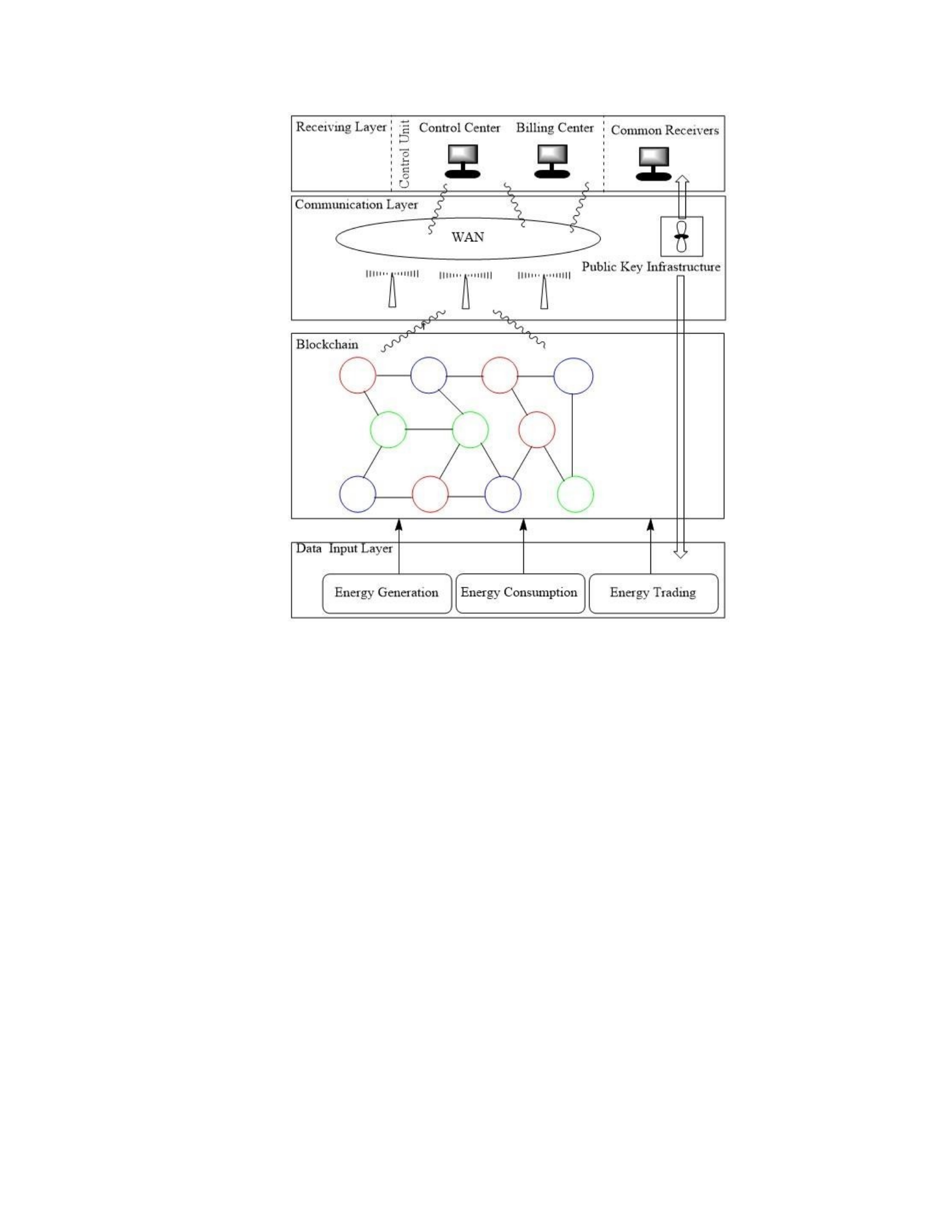
Figure 3. System Model
1. Data input layer. All publishers are in this layer, such as smart meters, PMUs, and
computers used by users to enter their energy buying information. This layer is where all
new transactions are created. Each new transaction includes the encrypted core message,
group signature, encrypted sender’s public key, and the information type. After a new
transaction is created, it will be broadcasted to the entire network.
2. Blockchain layer. This layer is for transaction audit, validation, and blockchain storage. A
valid block will be broadcasted to the network for subscribers/receivers to process.
3. Communication layer. In this layer, all needed information passes through the entire
network.

4. Receiving layer. There are two parts in this layer, the general customers, such as users
receiving their trading information, and the management departments, such as the control
center and billing center. The control center will be responsible for each group’s
registration, and power dispatching.
5. Public Key Infrastructure (PKI). PKI creates public-private keys for all the participants,
including each information group. Every group will get a group message and two pairs of
public-private keys, one for the publishers PUgp-PRgp and one for the subscribers PUgs-
PRgs.
3.2.2 System Initialization
Key Generation and Group Membership
1. All the participants in the system must acquire public-private key pairs. For receivers, we
use PUr-PRr.
2. All publishers will get control center’s public key, PUc , the group message, the group
publisher’s private key, PRgp, receiver’s public key, PUr, and subscriber’s public key, PUgs.
3. All receivers will get the group message and the group publisher’s public key, PUgp, and
the group subscriber’s private key, PRgs.
3.3 System Smart Contract
3.3.1 Transaction Creation
The smart contract will be installed on every device in the data input layer and executed
according to their schedules, such as time interval, a signal, or as requested. There are four parts
in a newly created transaction. a) Group type. b) The core message encrypted by the group’s
subscriber’s public key PUgs, and the receiver public key PUr if the data is for a specific
receiver. The core message includes energy data and time stamp, and the energy data can be
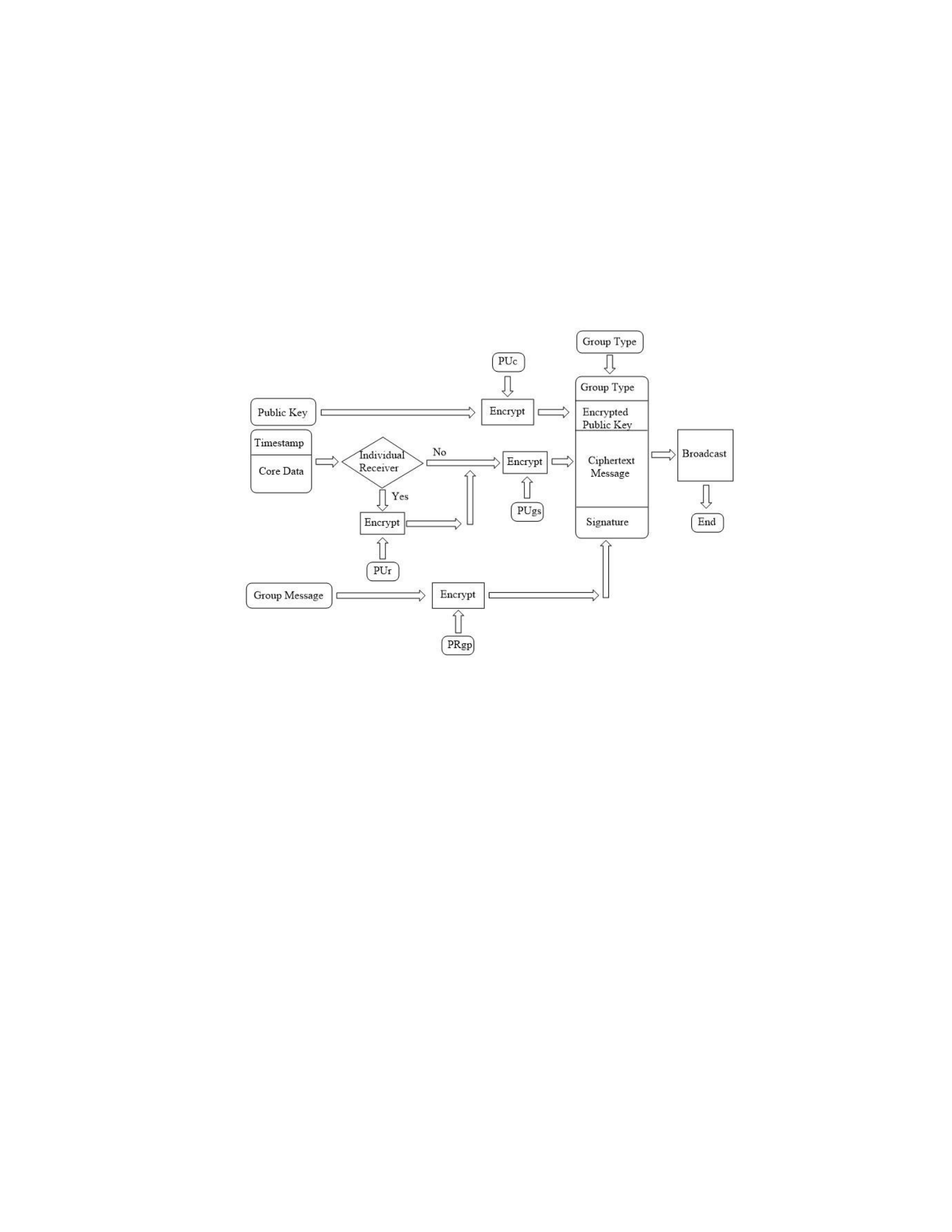
power consumption data, available power, appliance states, or energy order information. c) The
sender’s public key PUs encrypted by the control center’s public key, PUc. d) The transaction
signature created by the group message and the group publisher’s private key PRgp. After the
transaction is created, it will be broadcasted to the network. See Figure 4.
Figure 4. Transaction Creation
3.3.2 Consensus Mechanism
The consensus smart contract will be installed on all the nodes in the blockchain layer
because it is responsible for verifying and storing various information groups. The VRF function
will be used to select a master node and the consensus mechanism will be based on PBFT as
shown in Figure 5.
1. When a node receives a new transaction, if the transaction belongs to the right group and
the publisher is valid, it will save the transaction locally; otherwise, the node will drop this
transaction.

2. Iteratively, every 15 minutes, the group nodes start to vote for a master node using VRF.
Each group starts at a different time, e.g., at a 2-minute interval, in order to avoid conflict
among information groups.
3. When a master node is selected, the master node will pack all this group’s transactions in its
local pool in the past 15 minutes and broadcast the block to the entire network.
4. When receiving the block, non-master nodes will use the VRF function to compare the
transactions in the block with the transactions in their local pools. If the verification fails,
the block will be discarded. Otherwise the block will be saved and a message “confirm” will
be broadcasted.
5. When a non-master node receives more than two-thirds of the group nodes agreeing on the
candidate block, it will write the new block to the local blockchain and delete the
transactions in its transaction pool. Otherwise, both the block and the local transactions will
be discarded.
6. When the master node receives the results from at least two-thirds of the group nodes
agreeing on that candidate block, the master node will write the block to the blockchain and
broadcast it to the entire network to subscribers or receivers. If the block failed to pass, the
master will delete its local transactions and broadcast a failed block notification. If there is
no transactions during this time period, the master will broadcast a null-transaction
notification to prevent an adversary from creating a fake block [115].
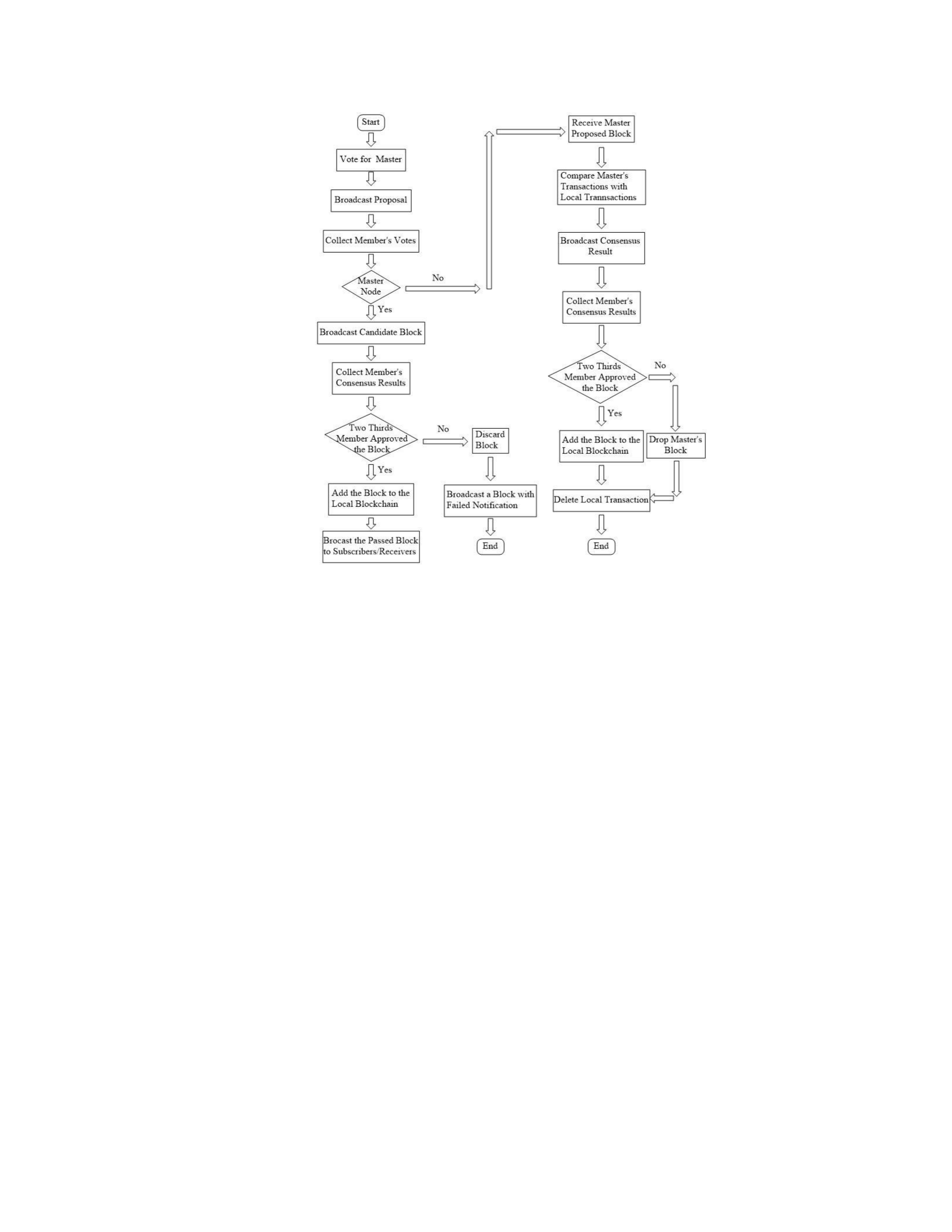
Figure 5. Information Centric Consensus Mechanism
3.3.3 Transaction Receiving
When the subscribers/receivers receive a block, they will go through the block. If a
transaction is not in the right information group or from a valid publisher, the transaction will be
discarded. Otherwise, the transaction will be first decrypted with the group-subscriber private
key PRgs, then decrypted with the receiver’s private key PRr, if the transaction is for a specific
user. The decrypted transaction will be processed according to its group. See Figure 6.
3.4 System Analysis
3.4.1 Security Analysis
The three basic security requirements are confidentiality, integrity, and availability. In our
design, the user’s public key and core data are encrypted and only the legal users with the
corresponding private keys can decrypt them. For example, information group’s nodes can verify
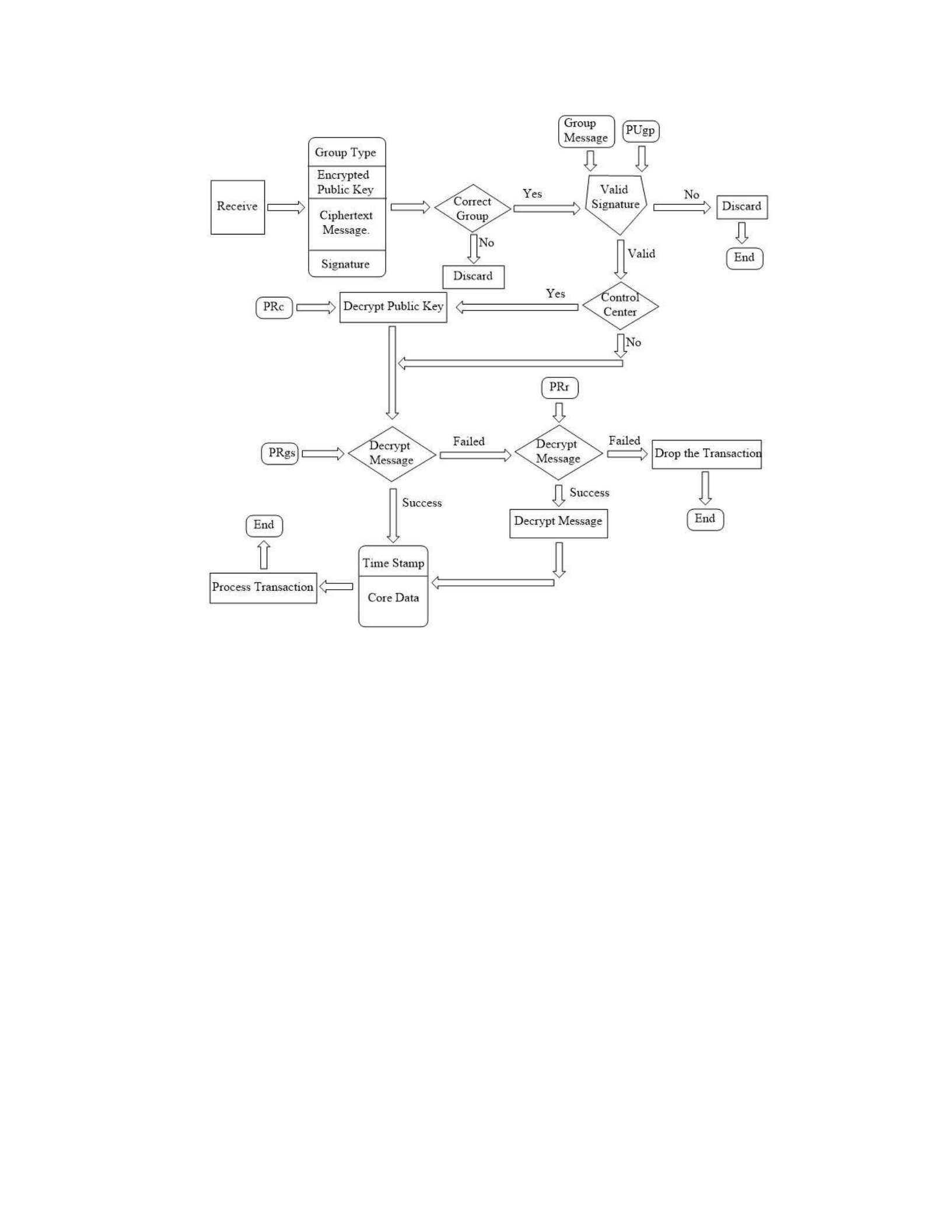
Figure 6. Subscriber Receive
if a transaction comes from a valid publisher and compare the core data without knowing it. The
subscriber/receivers can decrypt the publisher’s core data with its group private key and/or the
receiver’s private key. Only the control center can decrypt user’s public key, which is the
publisher’s identity. This keeps the publisher’s identity private and ensures data confidentiality
and integrity. In a blockchain environment, each information group contains many nodes, which
avoids single point failure and therefore ensures resource availability. Below are the common
security attack analyses:
1. Denial of Services (DoS) Attack. In our design, all transactions are saved first, then
processed by its information group nodes in a fixed interval. The service request rate is
limited by its processing time interval [116] and almost all the information passed in the

energy network follows the predefined frequency. Any abnormal transaction frequency will
alert the system.
2. Single Data Point Failure. In our design, the network nodes are divided into different
information groups. Each group will have at least three nodes, this redundancy prevents
single point failure.
3. Content Poisoning Attack. If any node’s information has been changed, it will be
discovered by other nodes during the consensus process.
4. Data manipulation in Data Input Layer. Since almost all the transactions, such as energy
consumption, energy availability, are created by smart contracts automatically, no human
interference is needed. Smart meters and PMUs usually are secured both physically and
through software, it is very difficult to change the core data and forge transactions. A fake
energy trading transaction can be made, but this will be discovered quickly by the users
from the control center’s confirmations or billing information.
5. Forged transaction. In order to forge a transaction, an adversary needs the control center’s
public key, the group subscriber’s public key, the receiver’s public key, and the group
message. Unless all of these keys and messages are saved in the same place and stolen, the
chance to obtain all of them is extremely low.
6. Null transaction block. Stopping an adversary from sending out blocks when there are no
transactions in a time slot for some information groups. If in a time slot there are no
transactions to process for any information groups, the selected master will send a null
transaction block to report its group’s status. More than one node broadcasting a block for
the same information group in the same time period will alert the system.

3.4.2 Privacy
1. Identity privacy. All sender’s public keys are encrypted by the control center’s public key.
Only the control center can decrypt a user’s identity. This strategy protects the publisher’s
privacy and information sources.
2. Data privacy. All the publisher’s data are encrypted, first by the receiver’s public key if the
transaction is for an individual receiver, then by its group public key. Only the intended
receivers or subscribers will be able to decrypt the data with proper private keys.
3. Information origin privacy. Each transaction’s signature will be created by its group
message and the publisher’s private key. The consensus nodes and the receivers or
subscribers can verify that this transaction comes from a valid publisher by using the same
group message and the group publisher’s public key. All publishers from the same group use
the same group message and the publisher’s private key. By bundling the transactions,
group message, and the publisher’s private key together, the origin of the transaction is
hidden from potential adversaries.
3.4.3 Scalability Analysis
Each blockchain’s consensus takes some time to ensure that all the involved nodes
receive responses from other nodes and finish the consensus process. This adaption negatively
impacts the network throughput. Because our system classifies the blockchain’s transactions into
various categories and these different information groups execute their consensus in a
simultaneous manner, in any time slot, more transactions will be processed than current
blockchain systems. Additionally, because fewer nodes are involved in each group’s consensus,
the time required for each group’s consensus will be reduced also, which enhances the network
throughput.

3.4.4 Reduced Storage Redundancy
Suppose there are n nodes in the network. If there is only one information group, which
means the information in the blockchain is not classified and not divided, all n nodes will save
the same transactions and the storage redundancy is n; if the blockchain’s information is divided
into k groups, the redundancy will be reduced to n/k.
3.4.5 Enhanced Search Efficiency
Since we save different information in each blockchain based on its type, if the system
needs to search for some transactions, the search will be faster because it only needs to go
through the specific blockchain.
3.5 Implementation
Figure 7 shows transaction creation flow chart
3.5.1 Transaction Creation Contract
1. Transaction creation. The sender’s account is encrypted by the control center’s public
key. The core data, time stamp, and energy consumption or energy ordering information
are encrypted. If this transaction is for an individual receiver, this transaction will be
encrypted by the receiver’s public key first, then encrypted by the subscriber’s public
key. If this transaction is for group subscribers, it will be only encrypted by the group
subscriber’s public key. The transaction’s signature will be created by using the group
message and the publisher’s private key. The transaction ID will be created by hashing
the sender’s account, core data, signature, and group number.
2. Sub Functions. We use Golang to implement consumer transaction forming and
sending. Our implementation includes the following functions: create public-private
key, create signature, verify signature, read consumer information, encrypt message,
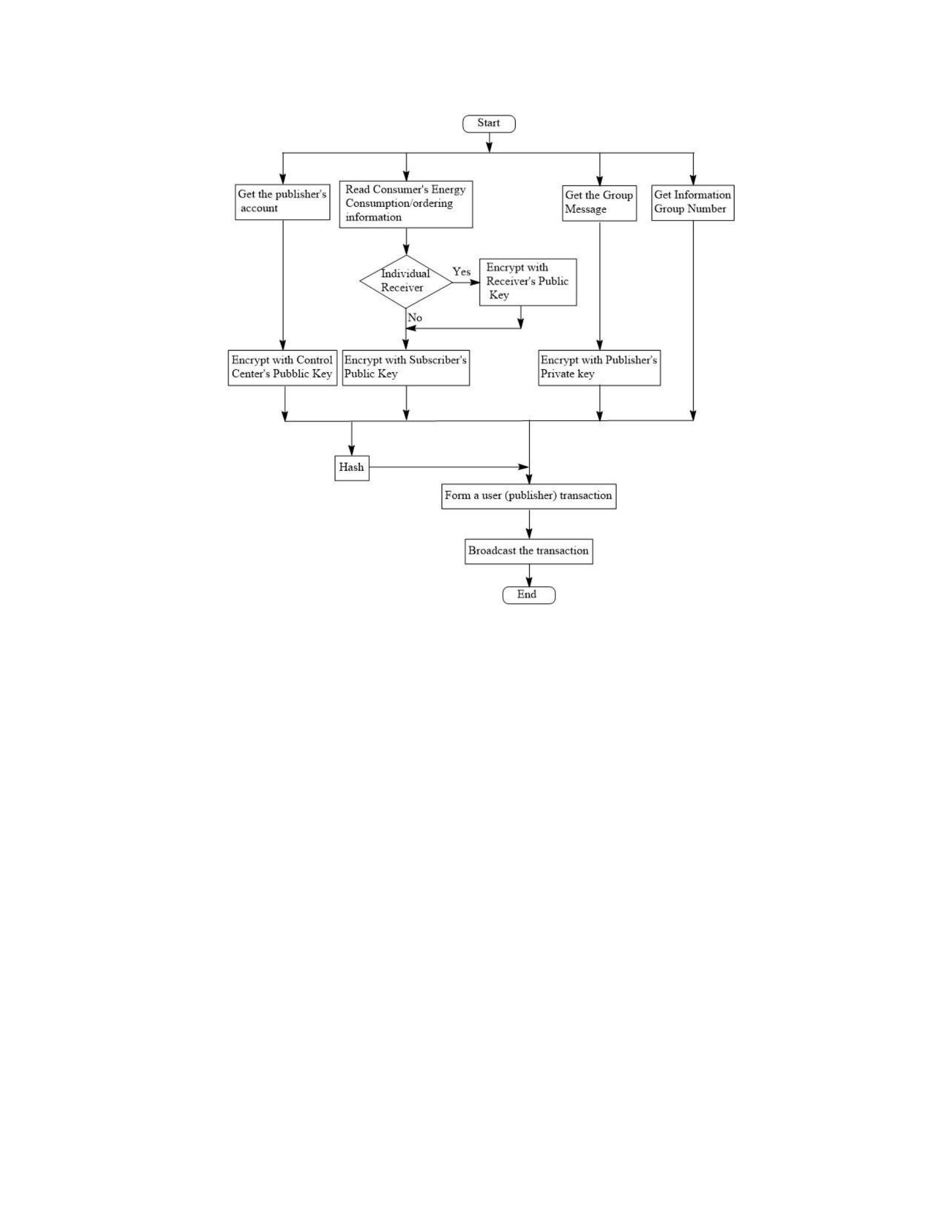
Figure 7. Transaction Creation Flow Chart
decrypt message, broadcast transaction, receive information, and append message.
3. Transaction components. A transaction includes information group number, transaction
hash, encrypted core information, encrypted sender’s account, and transaction signature.
3.5.2 Consensus Contract
Figure 8 shows the consensus flow chart.
The consensus nodes constantly check on transactions. When they receive a transaction,
they check the transaction’s group and verify the signature. If the group is correct and the
signature is valid, this transaction will be saved locally. Otherwise, the transaction will be
discarded. If it is consensus time, the nodes.
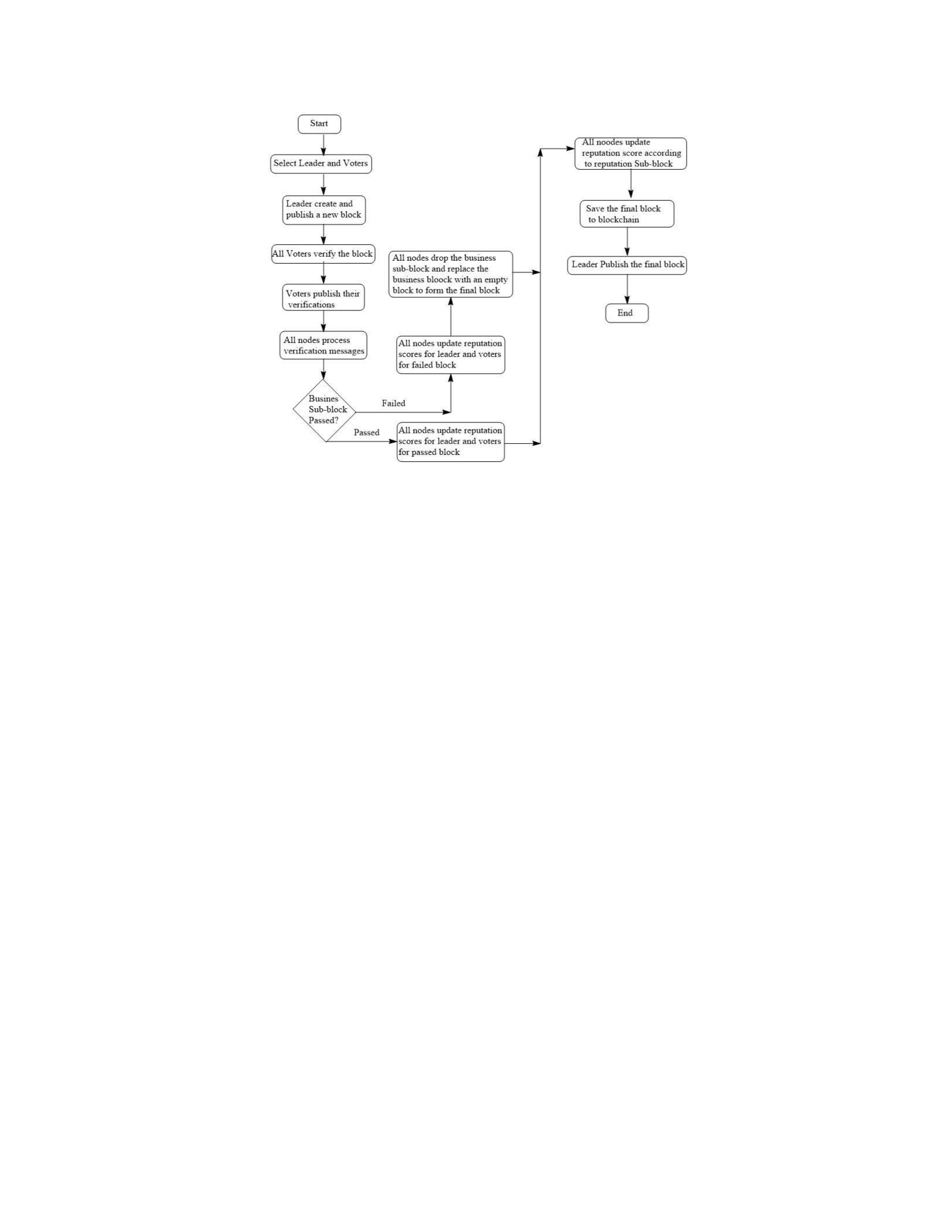
Figure 8. Consensus Flow Chart
start to elect a leader and broadcast their proposals. Each node calculates its votes. If it receives
the most votes, it will know it is the leader and it will pack its local transactions and broadcast it.
When the non-leader nodes receive the block, they start to compare the block’s transactions with
their local transactions one by one. If any transaction’s group, signature, or the data fails during
the comparison, the consensus will fail, and consensus procedure will be ended. If all the
transactions in the block are the same as the local transactions, the consensus is passed. Each
node broadcasts its consensus result and waits for other’s results. If a node received two thirds
passing notifications from the members, it will permanently save the block to its blockchain and
delete its local transactions. When the leader receives two thirds passing notification, it will save
the block to its blockchain and broadcast the final block to the subscribers/receivers.
3.5.3 Receive Contract
Figure 9 shows the receive flow chart.
When a subscriber receives the final block sent by the group leader, it will go through the
block’s transactions one by one. If the subscriber finds that a transaction belongs to the right
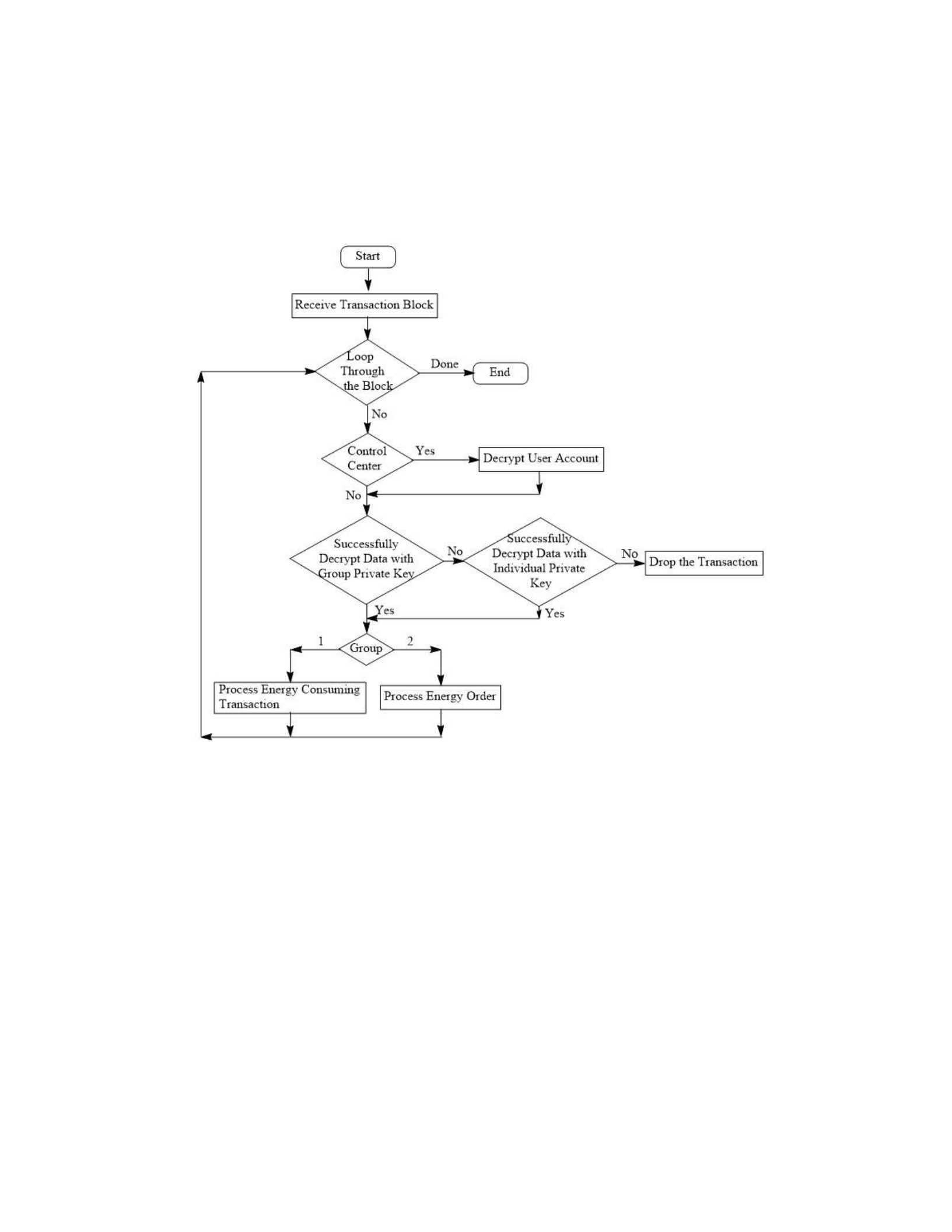
group, the signature is valid, and it decrypts the data with the group receiver’s private key
correctly, it will process this transaction according to its groups, such as energy consumption or
energy order. If the first data decryption failed, the specific receiver’s private key will be used.
Figure 9. Receive Flow Chart
to decrypt this data. If the second decryption is successful, this transaction will be processed
accordingly. If both decryptions failed, this transaction will be discarded. If the subscriber is the
controller, it can decrypt the transaction with sender’s public key also and will know who sends
this transaction.
3.6 Conclusion
In this design, we have proposed an information-centric blockchain technology for smart
grids to enhance security. Our implementation has demonstrated that our proposed design is

feasible, and it can protect sender’s identity, camouflage transaction’s sources, and protect data
privacy. However, our implementation has been done with a simplified model with limited data.
A comprehensive implementation needs to be carried out, and a more thorough testing needs to
be performed.

CHAPTER 4
REPUTATION-BASED CONSENSUS MODEL
4.1 System Design Considerations
Consensus mechanisms are vulnerable to certain attacks. Double spending attacks,
eclipse attacks, selfish attacks, and flash attacks are all examples [117]. By and large, all the
existing contemporary consensus mechanisms, such as proof-of-work, proof-of-stack, and the
variants based on them, rely on the assumption that most nodes are honest [118]. Although this
assumption is reasonable, it is not based on facts, which brought out reputation-based consensus
mechanism. Proof of Reputation (PoR) is an upgraded, stronger, and more secure form of Proof
of Authority (PoA) [119]. PoR consensus model depends on the reputation of the participants to
keep the network secure. A node must have a reputation that is important such that they would
face significant financial and brand value loss if they were to attempt to subvert the system.
A reputation system must have the following three properties: (1) it must provide
information that allows buyers to distinguish between trustworthy and non-trustworthy sellers;
(2) it must encourage sellers to be trustworthy, and (3) it must discourage participation from
those who are not trustworthy [120]. Below are the design principles for our reputation system.
1. The basic properties of reputation. The concept of trust is always related to behavior or
context [121]. A high level of reputation and trust obtained in context or through behavior is
not transferable. For example, being a good doctor should not imply the person would be a
good manager. The reputation of a person acting as a doctor, or a manager needs to be
treated separately. In the application to smart grid, a node’s leadership reputation and voting
reputation must be managed separately.

2. Fairness. A node’s computation power, online time, etc., will be considered towards the
node’s reputation score. Time decay is also considered.
3. Reputation-based qualifications and privileges. A node’s qualifications and privileges to
create or vote for blocks depend on its reputation scores.
4. Multidimensionality. We introduce the R360 concept, which encapsulates the notion that a
node’s reputation will be measured in multiple dimensions. According to [122], a reputation
system should include the following fundamental dimensions: history, context, collection,
representation, aggregation, entities, presence, governance, fabric, interoperability, control,
evaluation, data filtering, and data aging. Based on these dimensions, we elaborate the
design of our reputation system.
5. Two-tier block leader and voter selection. We first screen potential block leaders and voters
by their total reputation scores to make sure they are good nodes in general. Then the leader
will be selected by its block creation score and the remaining members of the consensus
group will be selected by their voting scores. This strategy is extensively used as common
selection principles in society, such as human employment practice.
4.2 System Model
4.2.1 System Composition
Whether a node is trustworthy or not depends on several factors. The R360 reputation
system includes the following components, shown in Figure 10.
1. Resources. CPU, memory, and storage are necessary resources of any nodes and will
seriously affect a node’s performance.
2. Defense history. A secure node should be safe and free from security breach. A node that
frequently or recently experienced security breaches will be less trustworthy.

Figure 10. Reputation Structure
3. Offenses. This score is related to a node’s serious offensive behavior, which is not tolerated
and subject to harsh penalty.
4. Function. In blockchain context, the core functions of any nodes include creating
transactions, creating a new block and publishing it, and participating in consensus. A
reputable node should function as expected.
5. Service. The service score of a node is given by those who receive its services. For example,
the receiver can create transactions to evaluate the solar energy quality it received from a
producer. It can rate the accuracy and timeliness of the information or assistance it obtained
from a node.
6. Dependence or Availability. This score measures a node’s online time. A reliable node must
be available to provide services when needed.
4.2.2 Assumption and Reputation Estimation
1. The resource scores are not cumulative and the resources a node has will seriously affect its
performance, which affects its reputation. There are three kinds of resource, CPU, Memory,
and Storage. Three of them form the resource total score. The point that a node gets for a
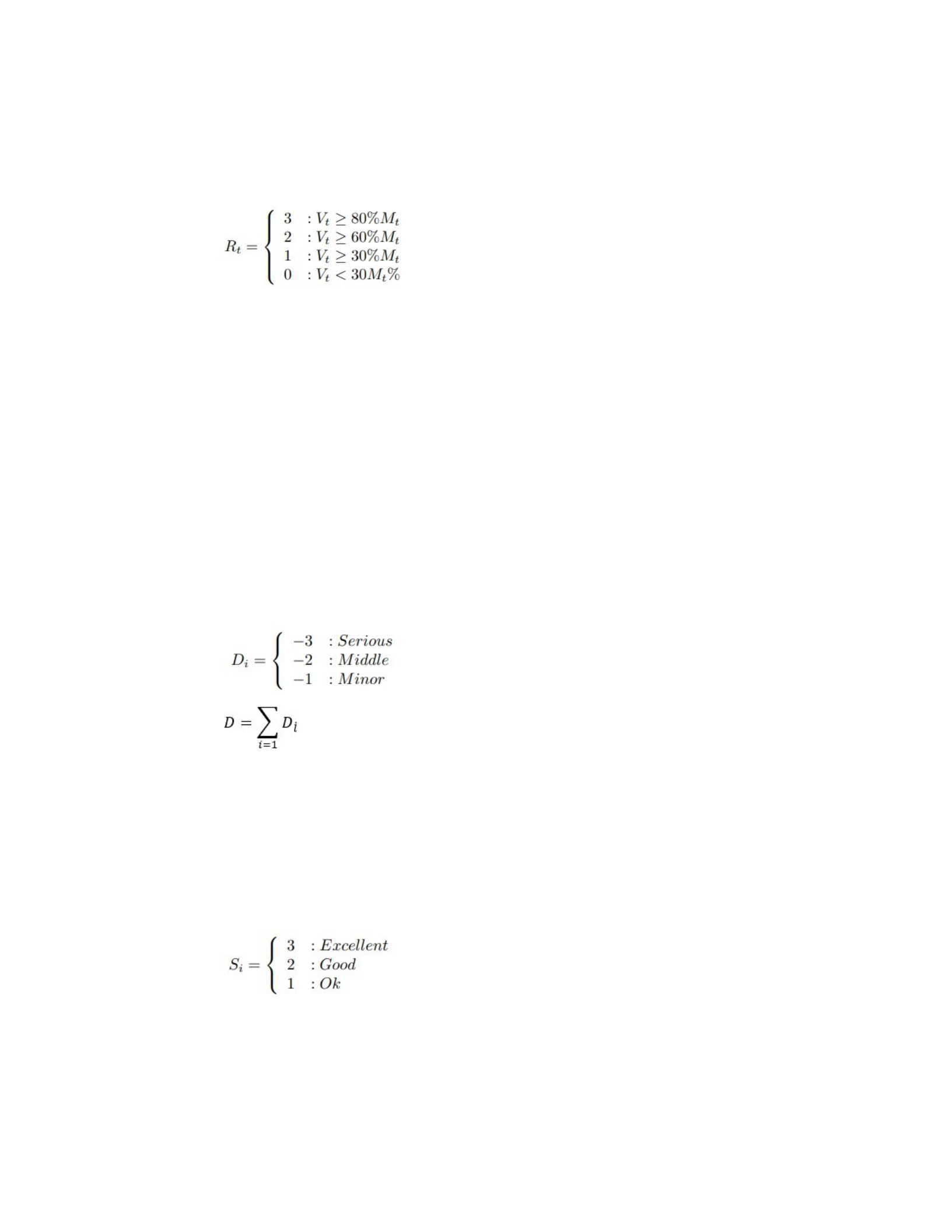
specific type of resource is decided by its value Vt related to the highest value Mt any node
has in the network.
(13)
R = Rcpu + Rmem + Rstorage (14)
2. The defense capability score is cumulative, and a node that can effectively defend itself will
gain other’s trust. Based on the assessment of the damage caused by a security breach, the
score can be -1, -2, -3, with -3 being the value for the most serious. According to [17], the
impact of data breach will likely diminish over time. In our design, we assume the impact of
a breach will be completely erased after 5 years. Each year, 20% of defense score is
reduced.
(15)
D = D ∗ 80%
(16)
(17)
where i means the ith security breach.
3. The service score is cumulative. A node that provides good service will get better service
evaluation and win trust from other nodes.
(18)
𝑆 = ∑ 𝑆𝑙 Type equation here. (19)
𝑖=1
where i means the ith service transaction. A node will give a service provider a possible score
of 1, 2, or 3, depending on how well it values the service it received.

4. The function score is cumulative as a result of the work a node has performed in history.
There are three kinds of function scores: transaction score for creating transactions, leading
score for creating and publishing blocks, and voting score for participating consensus. All
function scores are related to the number of transactions in the current blocks. If the number
of transactions in a block Tb is at least 80% of the highest number of transactions in a block
in history Tmbh, the voting score will be set to 3. If Tb is at least 50% of Tmbh, the voting score
will be set to 2. If Tb is below 50% of Tmbh, the voting score will be set to 1. If there is no
transaction in the block, the voting score will be 0.
(20)
A voter will receive the voting score, and the leader will earn twice as many points. If a
block fail, the voters who has failed the block will receive the voting points, but the other
voters and the leader of the block will receive the corresponding negative voting points. i
means the ith block.
(21)
(22)
Vi = ±Point (23)
(24)
For the transaction creation score, if the number of transactions a node created Tc is at least
80% of the maximum number of transactions created by a node in the current block Tmb, the node
will be assigned 3 points; if the Tc of a node is at least 50% of Tmb, it will be assigned 2 points;

the nodes that created at least one transaction will be assigned 1 point; if a node did not create
any transactions, it will receive 0 points. If a block fails, the nodes that has created transactions
in the failed block will receive the corresponding negative points. j means the jth transaction.
(25)
(26)
5. The availability score is not cumulative, and it is only effective for one year. A node that has
longer uptime will more likely win other’s trust.
(27)
Ninety-nine percent uptime, called “two-nines”, will earn 1 point, ”five nines” (99.999%)
will earn 2 points, “Six-nines” (99.9999%) will earn 3 points. The node whose uptime is
below 99% will earn 0 points. If a node’s uptime changes, the node will broadcast a
transaction to inform others about its uptime or availability status.
6. The offense score is cumulative, and a high offense score means less trusted by others. The
node will get Oi points for each offensive behavior. In this design, Oi equals to -3.
(28)
where i means the ith offense.
7. The total reputation score of a node will be the sum of its six scores obtained in individual
attributes:
Reputation = Resource + Defense + Availability + Offense
+ Service + Function (29)

4.2.3 Consensus Mechanism
Figure 11 is the block structure and Figure 12 is the reputation consensus flow chart.
1. Each node selects nodes with at least 90% of the highest total reputation score among all
nodes as potential leaders.
2. Select the node with the highest block creation score from the potential leaders as the
leader.
3. Each node selects nodes with at least 10% of the highest total reputation score as potential
voters.
4. From the potential voter pool, select nodes with at least 10% of the highest voting score as
voters.
5. The leader creates a new block and publishes it.
6. The voters receive the block, verify the normal transactions, the reputation transactions,
and publish their verification results.
7. When the consensus time expires, late responses will be ignored.
8. All the nodes process the received verification results, record the nodes that have validated
or failed the block or failed to send out their verifications.
9. If the block is validated, all nodes that have voted for validation will receive a positive
voting score. Those voters that have failed the block or failed to send out their verification
responses will receive negative voting points.
10. If the block is validated, all nodes will update any node’s reputation according to the
reputation transactions in the reputation sub-block.
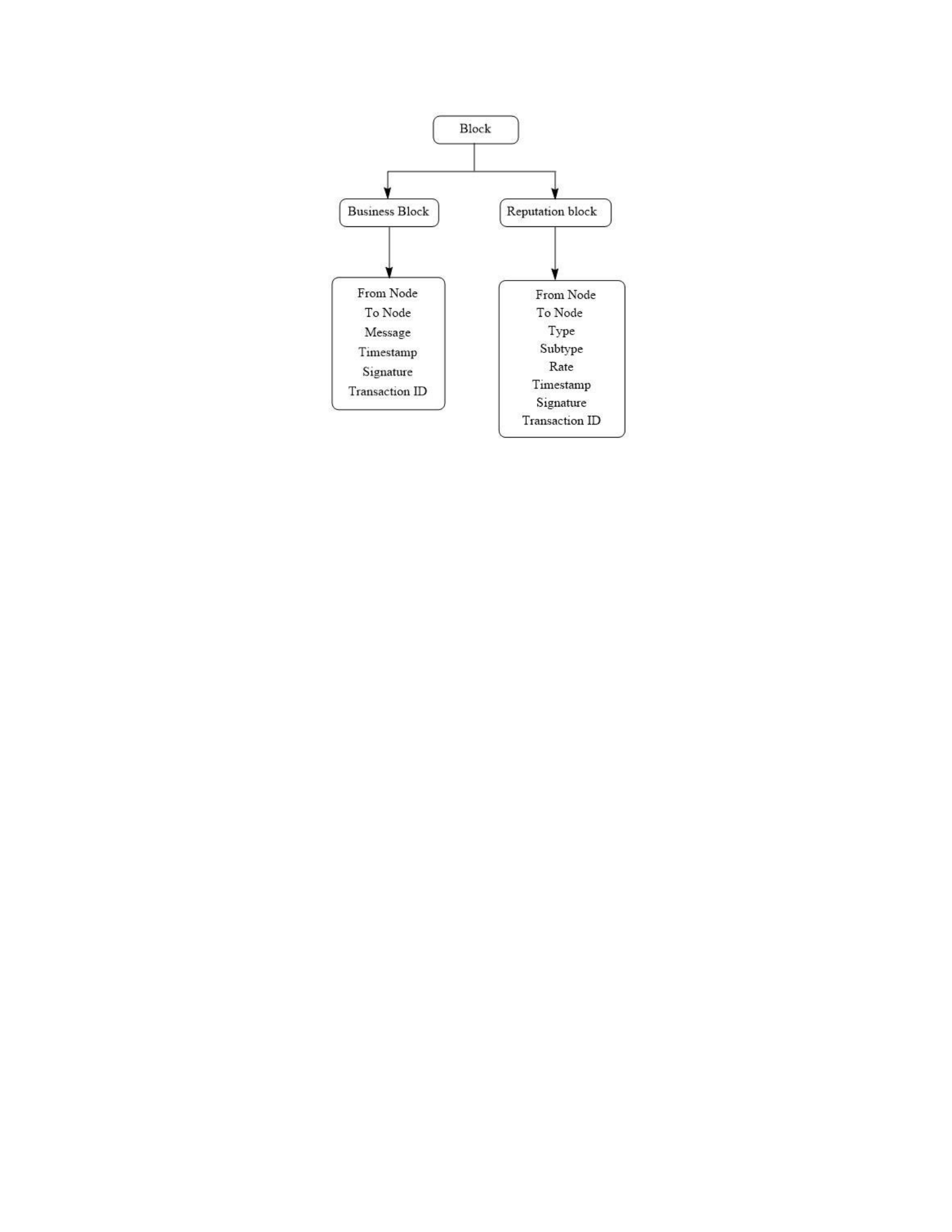
Figure 11. Block Structure
11. The validated block will be added to the blockchain, including business and reputation
sub-blocks, voters, and the maximum transactions in the blockchain so far.
12. If the block failed to be validated, all nodes that have voted for validation or failed to send
out their verification responses will receive a negative voting score. Those voters that have
voted to fail the block will receive positive voting points. The failed block will be dropped.
13. The leader publishes the validated block or a failed block message.
4.3 Implementation and Evaluation
4.3.1 Block Composition and Block Voting
Each block contains two sub-blocks as shown in Figure 11. One is normal transaction
block, named business block, and the other is reputation transaction block, named reputation
block, which contains reputation transactions.
1. Business transaction contains information of from node, to node, message, timestamp,
signature, and transaction ID, which is the hash of all the components in the transaction
except the transaction ID itself.
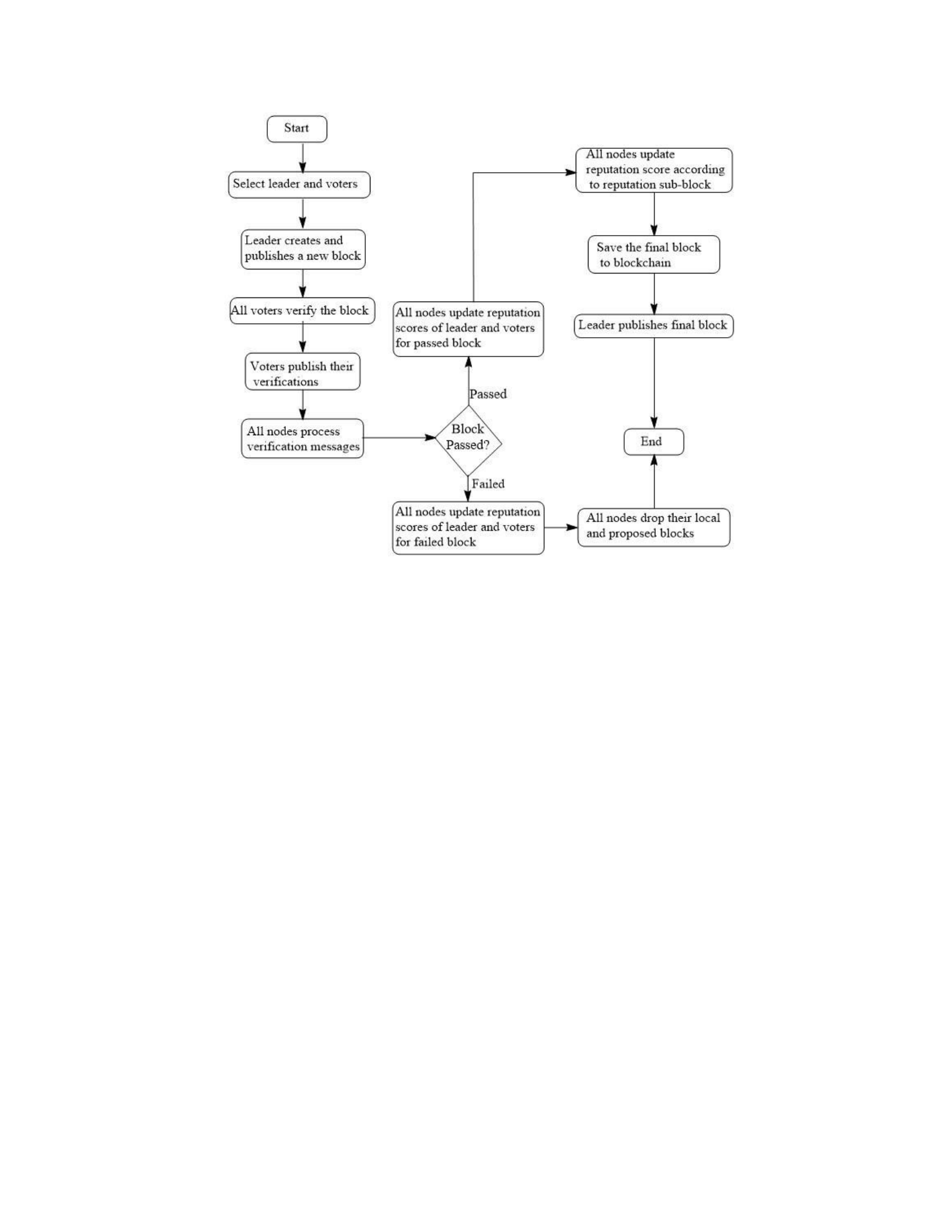
Figure 12. The Reputation Consensus Process
2. Reputation transaction contains information of from node, to node, evaluation type,
subtype, rate, timestamp, signature, and transaction ID, which is the hash of all the
components in the reputation transaction except transaction ID itself. The evaluation type
will be resource, defense, service, offense, and availability. If the evaluation type is
resource, it will have three subtypes: CPU, memory, and storage. If the evaluation type is
service, more detailed information about this service can be put into the subtype field.
3. A node will validate a block only when all business and reputation transactions are the same
as its local business and reputation transactions.
4. A node’s voting response contains voter, verification status, signature, and timestamp. The
verification status has two possible values: 0 and 1, with 0 meaning fail, and 1 denoting
validation.

5. A block will be validated only when both sub-blocks are validated by at least 2/3 of the
voters.
4.3.2 Consensus Algorithms
Table 2 lists the nomenclature for the consensus algorithms.
Algorithm 1 is run by all nodes to select the block leader and the group of voters. Algorithm 2
updates the block leader’s and voter’s reputation scores after a block is validated. Algorithm 3
updates all node’s transaction creation scores after a block is validated. Algorithm 4 updates the
block leader’s and voter’s reputation scores when a block fails to be validated. Algorithm 5 will
run after a block is validated and will update all node’s reputation according to the reputation
transactions in the reputation block. The transactions in the reputation block are sorted by
timestamps before the update to ensure the correct chronological order of transaction creation.
4.3.3 Experimental Environment
1. The design was implemented on a MacBook Pro with MacOS Monterey, 2.7GHz Dual-
Core Intel Core i5 processor, and 8GB 1867 MHZ DDR3 memory.
2. The programming language was Golang, Version Go1.17.6 Darwin/AMD64.
3. We created ten potential nodes to participate the implementation, eight of which, including
the leader, were selected to vote.
4. Each node had its own directory. All the related information, e.g., blockchain, node name,
starting balance, private key, was saved in that location.
Table 2. Nomenclature
Variable Meaning
Leader Block leader
MaxNumBT The highest number of transactions
MaxTR The maximum total reputation score among all nodes
MaxTrans The maximum transactions created by any node in a block

MaxVR The maximum voting reputation score
NodeAR Node’s availability score
NodeCPU Node’s CPU core
NodeDFR Node’s defense reputation score
NodeMEM Node’s memory score
NodeRR Node’s resource reputation score
NodeSR Node’s service reputation score
NodeSTOR Node’s storage score
NodeTCR Node’s transaction creation score
NodeTR Node’s total reputation score
NodeTrans The number of transactions created by a node
NodeVR Node’s voting score
NumBT Number of transactions in a block, including transactions in business and
reputation blocks
perTrans The percentage of transactions created by a node relative to MaxTrans
PLeaders Potential block leaders
PVoter Potential voters
Rate The value given to a reputation transaction
Voters The group of voters
ir
Node r is evaluated in transaction i, e.g.,
NodeRRir represents one of node r’s subtype resources being evaluated in
transaction i;
NodeTRir - the total reputation score of node r being evaluated in
transaction i;
NodeSRir - the service score of node r being evaluated in transaction i;
NodeDFRir - the defense score of node r being evaluated in transaction i
Algorithm 1. Select leader and voters
Find the potential leaders and potential voters: for
all nodes do
if NodeTRi ≥ 90% of MaxTR then
Nodei ⇒ PLeaders else if NodeTRi
≥ 10% of MaxTR then
Nodei ⇒ PVoters
end if

end for
Find the voters:
for all PVoters do if NodeV Ri ≥
10% of MaxVR then
Nodei ⇒ voters
end if
end for
Find the leader:
for all PLeaders do if
Nodei has MaxLR then
Nodei is the leader end
if
end for
The block leader packs all its transactions in a defined period to create a new block and
publishes it
Algorithm 2. Update leader’s and voter’s reputation scores after a block’s validatio n.
Find the voting point:
if NumBT ≥ 90% of MaxNumBT then
point ← 3
else if NumBT ≥ 50% of MaxNumBT then
point ← 2
else if NumBT ≥ 1 then
point ← 1
else point
← 0
end if
Update the leader’s and all voter’s voting and total reputation scores: for
all nodes in voters do
if Nodei is the block leader then NodeV Ri ← NodeV Ri + point
NodeLRi ← NodeLRi + point
NodeTRi ← NodeTRi + 2×point
else if Nodei validated the block then
NodeV Ri ← NodeV Ri + point
NodeTRi ← NodeTRi + point
else if Nodei failed the block then
NodeV Ri ← NodeV Ri − point

NodeTRi ← NodeTRi − point else if Nodei failed to
send verification response then
NodeV Ri ← NodeV Ri − point
NodeTRi ← NodeTRi − point end
if
end for
Algorithm 3. Update all node’s transaction creation scores
Find MaxTrans created by a node in the block for
all Nodes in the network do
PerTrans ← (NodeTransi/MaxTrans) 100
if PerTrans ≥ 80 then
NodeTCRi ← NodeTCRi + 3
NodeTRi ← NodeTRi + 3 else
if PerTrans ≥ 50 then
NodeTCRi ← NodeTCRi + 2
NodeTRi ← NodeTRi + 2 else
if PerTrans ≥ 1 then
NodeTCRi ← NodeTCRi + 1
NodeTRi ← NodeTRi + 1 end
if
end for
Algorithm 4. Update reputation scores after a block fails to validate
Find the voting point:
if NumBT ≥ 90% of MaxNumBT then
point ← 3
else if NumBT ≥ 50% of MaxNumBT then
point ← 2
else if NumBT ≥ 1 then
point ← 1
else point
← 0
end if
Update all the voter’s voting and total scores:
for all Node in voters do
if Nodei is the block leader then NodeV Ri ← NodeV Ri − point

NodeLRi ← NodeLRi − point
NodeTRi ← NodeTRi − 2 point
else if Nodei failed the block then
NodeV Ri ← NodeV Ri + point
NodeTRi ← NodeTRi + point else
if Nodei validated the block then
NodeV Ri ← NodeV Ri − point
NodeTRi ← NodeTRi − point else if Nodei failed to
send verification response then
NodeV Ri ← NodeV Ri − point
NodeTRi ← NodeTRi – point end
if
end for
Algorithm 5. Update reputation scores according to reputation transactions
for all Transactions in the reputation-block do if
Resource Transaction then
if Subtype Is CPU then
NodeCPUir = Rate else if
Subtype Is MEM then
NodeMEMir = Rate else if
Subtype Is STOR then
NodeSTORir = Rate end if
NodeTRir ← NodeTRir − NodeRRir
NodeRRir = NodeCPUir + NodeMEMir + NodeSTORir
NodeTRir = NodeTRir + NodeRRir else if Service
Transaction then
NodeSRir ← NodeSRir + Rate
NodeTRir ← NodeTRir + Rate else
if Available Transaction then
NodeTRir ← NodeTRir − NodeARir
NodeARir ← Rate
NodeTRir ← NodeTRir + Rate else if Defense Transaction then
NodeDFRir ← NodeDFRir + Rate
NodeTRir ← NodeTRir + Rate else if Offense Transaction then
NodeLR ← 0
NodeV R ← 0
NodeTCRir ← 0
NodeRRir ← 0
Keep NodeDFRir unchanged
NodeARir ← 0

NodeSRir ← 0
NodeOFRir ← NodeOFRir − 3
NodeTCRir ← 0
NodeCPURir ← 0
NodeMEMRir ← 0
NodeSTORir ← 0
NodeTRir ← NodeDFRir + NodeOFRir end
if
end for
5. Two nodes actively created transactions and performed the consensus procedure.
6. The nodes were connected to each other through their private keys.
7. When a new node joined the network, it would receive an initial base balance - the initial
scores, node name, and a private key.
8. In our experiment, we limited our block size to 1.1 MB[123], which contains a maximum
of 2000 transactions.
9. Both business and reputation transactions were created in the same loop. In each loop, at
Table 3. Function Performance
Trial Number of Transactions
Consensus Time
(Seconds) Block Size Block Status
1 4 6 3 KB validated
2 50 6 29 KB validated
3 100 6 56 KB validated
4 200 6 111 KB validated
5 400 7 222 KB validated
6 600 9 333 KB validated
7 800 12 443 BB validated
8 1000 19 554 KB validated
9 2000 52 1.1 MB validated
most only one transaction was created for each type.

4.3.4 Consensus Performance Evaluation
We evaluated the performance of R360 relative to other reputation systems in three
scenarios. The first one was business transactions only, with no reputation transactions, which
was named Function. A node’s trustworthiness is measured by its leading score and voting score.
The second scenario included business and service reputation transactions. In this model, each
run contained half business transactions and half service reputation transactions. The third was
R360, which measures a node’s trustworthiness from six dimensions, including function,
resource, availability, defense, offense, and service. In R360, half of the total transactions were
business transactions, and half were reputation transactions.
As we can see from Figure 13, the time needed to reach consensus increased as the
number of transactions went up. This is understandable because the complexities of our design
are O(N2) for finding leader and voters, O(NT) for updating reputation scores, and (T2) for
consensus, where N is the number of nodes in the network system, and T is the number of
transactions in a block.
Table 3, 4, and 5 display Function, Service, and R360 performances, respectively. Table
6 lists the sub-reputation systems and their corresponding transaction types.
With the same number of transactions, R360 took the shortest consensus time, followed
by service reputation, and function reputation model took the longest. This is because the
complexity for the consensus algorithm is O(T2). For R360, the total transactions are divided
equally between business transactions and reputation transactions, and its complexity is half of
O(T2). The service reputation transactions contained more information in its subtype than other
reputation transactions, which was why the service model took a little more time than R360.
However, the time difference is insignificant. As the number of transactions went Table
4. Service Performance

Trial
Number of
Transactions
Consensus Time
(Seconds) Block Size Block Status
1 4 6 3 KB validated
2 52 6 30 KB validated
3 100 6 58 KB validated
4 200 6 114 KB validated
5 400 6 228 KB validated
6 800 9 454 KB validated
7 1200 13 681 KB validated
8 1600 19 908 KB validated
9 2000 29 1.1 MB validated
Table 5. R360 Performance
Trial
Number of
Transactions
Consensus Time
(Seconds) Block Size Block Status
1 4 6 3 KB validated
2 52 6 30 KB validated
3 100 6 57 KB validated
4 200 6 113 KB validated
5 400 7 226 KB validated
6 800 8 451 KB validated
7 1200 14 675 KB validated
8 1600 18 901 KB validated
9 2000 22 1.1 MB validated

Number Of Transactions
Figure 13. Consensus Performance
Table 6. Reputation System Transactions
No.
Subreputatio
n
System
Having
Business
Transactions
Types of
Reputation
Transactions
Note
1 Function Yes 0 Business transactions only
2 Resource Yes 3
Resource Transaction: CPU,
Memory, and Storage
3 Availability Yes 1 Online time rate per year
4 Defense Yes 1 Security breach transactions
5 Offense Yes 1
Transactions attacking other nodes
or network
6 Services Yes 1
Service transactions to other nodes
or system
7 R360 Yes 7 All the transactions listed above
Table 7. Selfish Attack

Case
Original
Transaction Changes
Number of
Transaction in
Block
Block Status
1 Not
Existing
Add a Transaction 40 Failed
2 Existing Change Rate Value 40 Failed
3 Existing Remove a
Transaction
40 Failed
4 Existing Change Receiver 40 Failed
up, the difference in time among the three models increased. R360 increased more slowly than
the other two models. If R360 system can greatly increase a node’s defensibility and reduce its
offense ability, the reputation transactions can be reduced to contain only resource, availability,
and service transactions, the block can have more business transactions while maintaining the
security of the network. However, because R360 collects more information to measure a node’s
trustworthiness, more bandwidths will be required. More extensive experiments are needed to
evaluate how R360 affects the overall network traffic.
4.3.5 Security Testing
We also carried out a security test with selfish attack in four scenarios: the leading node
added an extra transaction to the to-be-proposed block, removed a transaction from the block,
changed a transaction’s rate value, and changed the evaluation’s receiver. From Table 7, we can
see that the consensus failed when the block leader modified a transaction. This is because the
voters uncovered their local blocks were not the same as the altered blocks, so they failed the
proposed blocks.

4.4 Security Analysis
We tested selfish attack with R360 system. In this section, we analyze the threats of other
common security attacks on R360.
1. Bad-mouthing attack [94], [95]. Bad-mouthing attack provides dishonest recommendations
to defame good nodes, which is the most straightforward attack [124]. In our protocol, a
reputation transaction must obtain the consensus of two thirds of voters in order to be
effective, so malicious nodes cannot continuously malign a specific node or any other nodes
and hope to improve its own trustworthiness ranking in return.
2. Replay attack. If the same transaction was used multiple times, other nodes that were
involved in this transaction would take notice. If such malicious behavior is uncovered, the
offensive node’s positive reputation scores will be all wiped out.
3. On-off attack. A node’s malicious behavior will result in a bad reputation score, which will
negatively impact its future reputation scores by reducing this node’s chance to become a
leader or a voter. Losing chance means losing the opportunities to improve its reputation.
4. Sybil attack. In R360, each node has a public key that is tied to a personal identification
when a node is registered, no node can “legally” create multiple IDs. Therefore, Sybil attack
cannot occur.
5. Flash attack. Our reputation system is resilient to flash attacks. Even an attacker with high
computing power, depending on when that attacker joins, needs to accumulate good scores
over a very long period of time before being able to gain enough reputation to harm the
system. For example, a node has to accumulate enough high leader score in order to be a
leader, enough high voting score in order to be a voter.
6. Blockchain consistency and system liveness. R360 is built on blockchain network concept,
the voters must either validate or fail a block.

7. Double spending attacks. Since digital currency is not used in R360 system, double
spending attacks will not occur in our system.
8. Eclipse attacks and isolated leaders. Since all voters broadcast their results to the entire
network, the leader will be able to receive the messages too. If a voter refuses to send its
response, it will be penalized with a negative reputation score.
4.5 Conclusion
A new system, R360, has been designed to thoroughly measure and maintain the
reputation of nodes in an untrusted network. The design has been implemented to test the
consensus performance and security. The results showed that R360 took less consensus time and
enhanced system security. Our experiments showed R360 can prevent selfish attack. Further
analysis illustrated that it could prevent common attacks on blockchain reputation system. By
putting on strict reputation evaluation rules, R360 can greatly enhance the security in untrusted
blockchain smart grid. However, it also increases the network traffic. Our design was simulated
on a single computer. Future work should implement R360 on real network systems to test its
network performance and security. Additionally, the scoring system may need to be optimized.
Further study on how such reputation scores affect individual node’s behavior is also desirable.
CHAPTER 5
A COUNTERMEASURE FOR DOUBLE SPENDING
5.1 System Design
5.1.1 The key points of the proposed design
1. The detection results of double spending attacks will be included in the block consensus.

2. Only one of the most reputable nodes is selected as the detector, which frees up other nodes
to perform other duties. This detector checks the transactions during the entire transaction
receiving period.
3. The detector changes frequently and its communication style is not much different than
other nodes. These two features reduce the chance that the detection node becomes the
target of DDoS.
4. The detector and other nodes work in a parallel fashion. The detector checks double
spending during the whole transaction collecting time interval and sends out a warning
message upon finding any conflicting transactions.
5. Upon discovering a conflicting transaction, as a penalty to the attacker, the detector will
create two penalizing transactions, one requiring the offending node to pay the detector the
same payment as in the conflicting transaction, the other one reducing the offending node’s
reputation scores. Lower reputation scores will reduce the node’s chance to participate in
important tasks in the future, including creating transactions.
6. Upon receiving double spending warning message, all nodes remove the conflicting
transaction from their memory pools and add the two penalizing transactions to their
memory pools.
7. Our final plan is to check all transaction’s correctness before consensus.
5.1.2 Double Spending Occurrence Scenarios
To implement a double spending attack, the attacker first creates two transactions. The
first transaction TV, transaction to vendor, lists the vendor as the recipient of the payment, and
the second transaction TA, transaction to attacker, lists the attacker as the recipient of the
payment. The attacker’s goal is to have the vendor accept TV long enough to deliver the goods or
services and have the rest of the network accept TA so that the attacker keeps the money. The

attacker sends out both transactions. TV is transmitted directly to the vendor, while TA is
broadcasted to the rest of the network. In order for a double-spending attack to be successful, 1)
The attacker must know the vendor’s IP address so it can connect to the vendor directly and send
TV to the vendor; 2) The vendor must receive TV before TA arrives [104] to ensure that TA will
be automatically dropped when the vendor eventually receives it; 3) TA must be confirmed in the
block chain first or else TV will actually be confirmed and that block will become the accepted
block in the network; 4) Given an equal propagation of both transactions, there is a 50 percent
chance for either transaction to be confirmed. More nodes are required to work on TA than on
TV to increase TA’s likelihood of being accepted into the blockchain, and it requires that the
vendor only sees TV. Because the neighbors of the vendor will likely get TV first (directly from
the vendor) and thus drop TA rather than propagate it to the vendor. This kind of doublespending
can succeed in fast-paying transactions in which the vendor does not wait for confirmation.
Another form of double-spending attack is the block withholding attack [125], [126] in
which the attacker pools resources to create a block BV, which contains TV. The attacker blocks
all other connections to the vendor and prevents the vendor from ever receiving all other blocks
confirming TA while sending BV the moment it is calculated. BV represents the block containing
TV. The attacker essentially creates a fork in the block chain containing BV that will eventually
be disregarded since no other mining pools work to extend this side of the fork [108]. This
method of double-spending can succeed in slow-pay transactions in which the vendor awaits
confirmation.
5.1.3 Design Assumptions
1. Our design is based on energy trading in smart grid and the payment methods can be tokens,
money orders, checks, or any other payments that can be defined as unique and reusable.

2. Our double spending countermeasure is for slow-payment situations, such as paying for
electricity bill or buying renewable energy by consumers. We assume the attacker will try to
use the same payment in at most two consecutive blocks, one is a previously validated block
and the other is currently collecting transactions. If there are two conflicting transactions in
one validated block, the transaction with the later timestamp will decide the block’s final
status.
3. Our design is based on our previous paper [127] and adds another reputation score,
detection, to the reputation formula. The score of detection DT is cumulative and DT is
calculated the same way as voter’s score.
DTi = ±Point (30)
(31)
The offense score is calculated with all offense behaviors except double spending. The total
reputation score is:
Reputation = Resource + Defense + Availability + Offense + Service (32)
+ Function + Detection + DoubleSpend
4. We also use a similar consensus algorithm as in [127] by adding detection steps to the
consensus in [127].
5. All the fields in the business transactions, except these two fields: the timestamp and the
payment’s receiver [127], are compared to decide if two transactions are conflicting or not.
6. The experimental environment is the same as in [127].
5.1.4 Double Spending Attack Models
1. Case 1: suppose the attacker only sends a vendor TV, and only the vendor’s block BV

(block created by vender) contains TV. When the vendor receives the leader’s block BL
(block created by leader) and finds out:
BV ≠ BL
The vendor will fail the BL block. If BL is passed, the vendor will drop its local block BV
and take BL. The attacker will not get the goods or service.
2. Case 2: if both TV and TA are put into the current block, the transaction with the later
timestamp will be discovered by the detector. If BL is validated, the attacker either gets the
service or keeps its money. It also gets two penalty transactions at the same time.
3. Case 3: TV is in a validated block and TA is added to the current block. Upon discovering
TA conflicts with a transaction in the previously validated block, the detector asks all nodes
to drop TA and add two penalty transactions in their memory pools. The attacker will not get
its money back.
4. Case 4: The victim is the block leader and TA was only sent to the leader, a special case for
Case 1. BL is dropped and the attacker failed its purpose. The detector is unaware of the
attack so there will be no penalty for the attacker.
5. Case 5: The detector is the victim, another special case for Case 1. Any double spending
will be discovered.
5.2 Double Spending Detection Procedure
Figure 14 shows the double-spending detection flow chart.
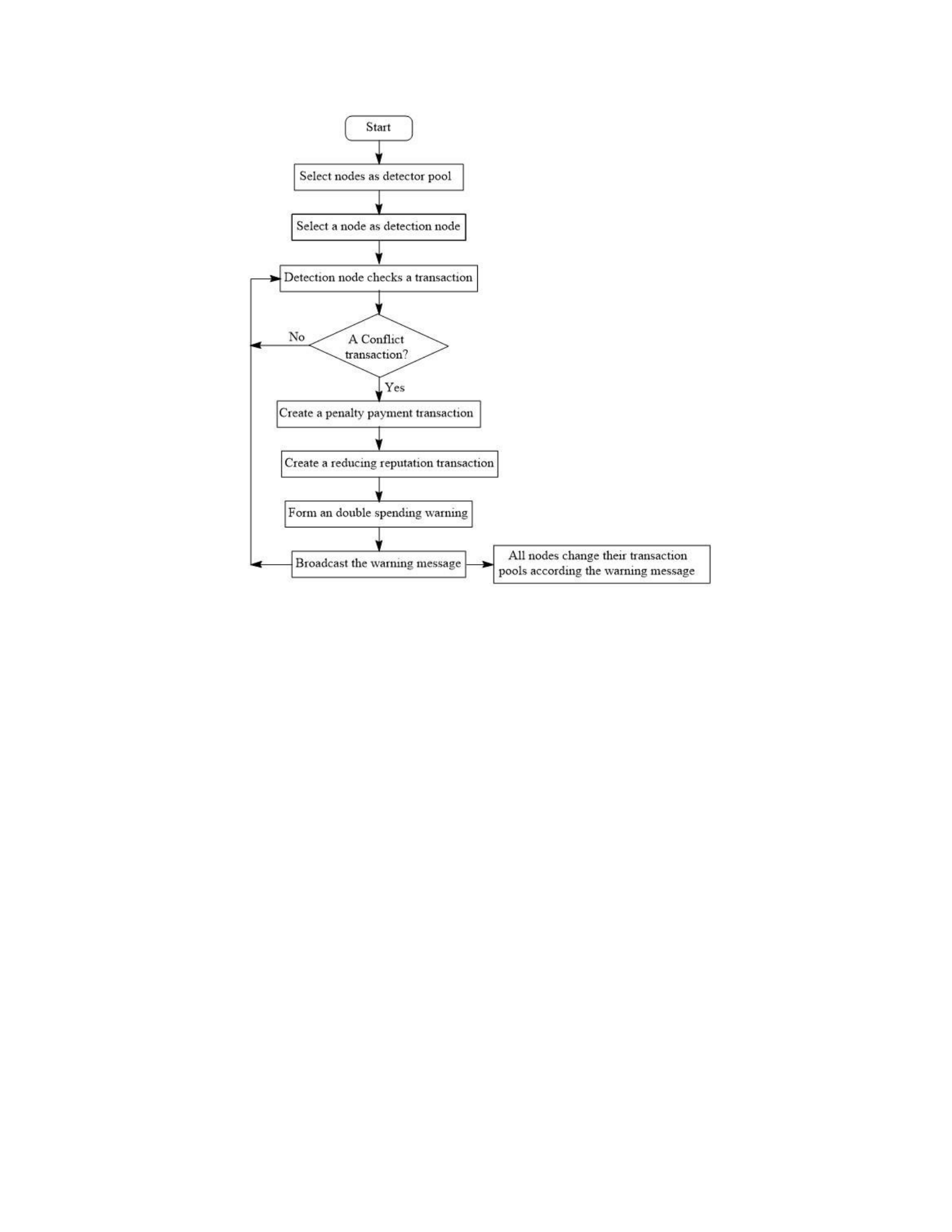
Figure 14. Double-Spending Detection Flow Chart
1. At the beginning of each time interval, each node selects nodes with at least 90% of the
highest total reputation score among all nodes as potential detector pool.
2. Select the node with the highest detection score from the potential detector pool as the
detector.
3. The detector continuously checks and broadcasts conflicting transactions against the
previously validated block and the transactions in current time interval. If an offending
transaction is discovered, as a reward to the detector and a penalty to the attacker, the
detector will create two transactions, one transaction will pay the same amount as in the
conflicting transaction to the detector, the other one will be an offending reputation
transaction to the attacker. The offending transaction and the two penalty transactions will
form a warning message and be broadcasted to all nodes in the network.

Table 8. Detection and Consensus Performance
Testing
Number of
Transaction
Time of
Consensus
Time of
Detection
Status
of
Block
Double
Spending
Detected
Size of
Block
1 7 5 5 Passed Yes 4KB
2 53 5 5 Passed Yes 32KB
3 103 5 5 Passed Yes 58KB
4 203 5 5 Passed Yes 115KB
5 403 6 5 Passed Yes 227KB
6 803 8 5 Passed Yes 452KB
7 1203 12 5 Passed Yes 677KB
8 1603 18 5 Passed Yes 902KB
9 2003 19 5 Passed Yes 1.1MB
4. Upon receiving the detector’s warning message, all nodes replace the offending transaction
with the detector’s reward transaction and add the attacker’s offending reputation
transaction in their memory pools.
Upon finishing the consensus, all nodes update the offending node’s scores accordingly,
and update the detector’s reputation scores the same way as updating a node’s voting scores.
5.3 Experimental Results and Analysis
5.3.1 Detection and Consensus Performance
Table 8 and Figure 15 display the experimental data and graph. The normal detection
time was five seconds for one double-spending detection, which was not affected by the number
of transactions in the block, the time was just necessary to run the detection program, which
performed much better than all the three cases in [107], All ENHOBS, 1% Skinny and 2%
Skinny. The consensus time did not change until the number of transactions reached 400. The
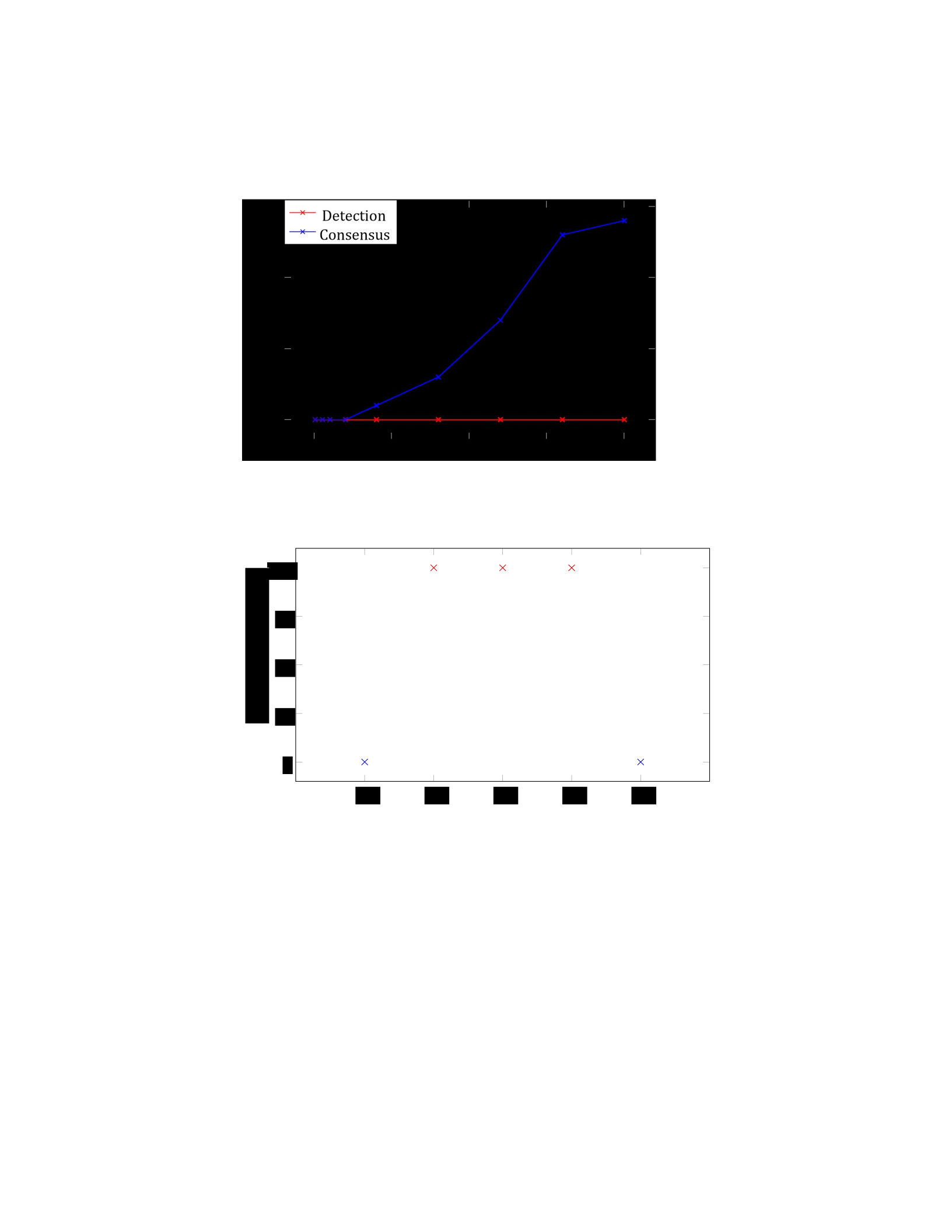
pattern and values of the consensus are similar to the results we found previously [127]. This is
expected because the consensus was conducted in a similar way.
Number of Transactions
Figure 15. Double-Spending Consensus and Detection Performance
Test Cases
Figure 16. Double-Spending Detection Effectiveness
Our approach used much less CPU time than [107]. Our detection node used 0.1% CPU,
while with every node acting as observers in [107], the CPU utilization jumped from 31% to
50.6%, with the maximum CPU utilization reaching as high as 96%. This is understandable
because one detection node will definitely use much less resources than many nodes as detection
nodes at the same time.
C1 C2 C3 C4 C5
0
25
50
75
100

We tested all five double spending attack cases, the detection rate was 100% for C2, C3,
C4, and 0 for C1 and C5, as shown in Figure 16. We tested the detection rates with blockchain
standard maximum block size 1.1 MB, which is equivalent to 2000 transactions. Worth noticing
is that the detection rate is 0 when the double spending victim is the vendor or the block leader.
This is because the conflicting transaction was only sent to the vendor or leader and the detector
didn’t receive TA. In both situations, the local block was not the same as the proposed block.
More system resources were wasted when the leader was the victim than when non-leader node
was attacked. This is because non-leader node only needs to drop its local block while the
leader’s block was dropped after all the nodes in the network had verified it.
5.3.2 Detection Complexity
The complexity of the double spending detection is O(N), where N is the number of
transactions in a block. The conflicting transaction will be searched throughout the previously
validated block and current block, so the detection time is 2O(N). The complexity of consensus
algorithm is O(N2) because two block transactions are compared.
5.3.3 Security Analysis
1. TV was only sent to the vendor, whereas other nodes received TA. The block BL, which
contained TA, was validated, and the vendor dropped its local block BV, which contained
TV. The attack failed to get the service and kept its money. No penalty was given to the
attacker either because the attack was not uncovered.
2. When TV was included in the previous block and TA was in current block. The detector
found TA was a conflicting transaction and sent a rewarding transaction to itself and a
penalty reputation transaction to the attacker.
The block BL without TA was validated. The attacker only got the service.

3. When TV was in current block already and TA was broadcasted again, the detector found
TA and sent a rewarding transaction to itself and a penalty reputation transaction to the
attacker. The block containing TV not TA was validated the attacker only received the
service.
4. When the leader was attacked, the detection failed. The attacker either got the service if TV
was in the previous block or got nothing if both TV and TA in current block. No damage to
any nodes but the system resources were wasted.
5. When the detector was attacked, the double spending detection rate is 100%. Other nodes
did not need to change their memory pools. The attacker got the service and two penalty
transactions.
5.4 Conclusion
In this design, we proposed a double spending countermeasure which can effectively
detect double spending in two consecutive blocks. Our design puts detection results into the
consensus mechanism, handles the offending transaction, and has a mechanism to prevent the
perpetrator to double spend again. Comparing to other countermeasures, such as time-period
monitoring and inserting observers, our method constantly monitors transactions, uses less
computing resources, and reduces network traffic and the management overhead on observers.
Another advantage of our design is our detection node is not fixated and it does not have a
specific communication pattern, which will less likely attract DDoS attack. Future research will,
1) handle the situation when the block leader is attacked; 2) check all kinds of transactions, such
as sybil attack, selfish mining attack, business and service transactions; 3) expand the detection
to the entire blockchain rather than just two consecutive blocks. 2) and 3) are parts of the reasons

we chose to have a single node to perform the detection duty. 4) select a set of nodes as the
detectors to share the checking responsibilities and avoid malicious detectors.

CHAPTER 6
SUMMARY AND FUTURE WORK
6.1 Dissertation Summary
The rapid advancement of modern technology demands that the power system be
transformed from traditional centralized system to a distributed system dubbed smart grid, which
should connect existing and emerging energy producers and consumers efficiently and
seamlessly through a highly effective two-way communication network. However, such an open
network will create unprecedented challenges to its security and management, as it must be
secure, fault-tolerant, and available to the users.
Blockchain technology is a transparent, secure, decentralized, and trusted cyber
infrastructure that shares, replicates, and synchronizes data across the entire network to achieve
security through consensus and redundancy. This technology has found applications in various
fields, e.g., cryptocurrency, medical data sharing, and personal identity security. However,
because of transparency, blockchain also has its inherent disadvantages, e.g., violating user
privacy, low network throughput, and trustless network environment.
The research in this dissertation aims to mitigate some of the challenges that blockchain
faces when it is applied to smart grid. Specifically, three systems have been designed to tackle
some of these problems.
In the first study, the information-centric blockchain model, we have focused on data
privacy. Because blockchain is transparent, and all data can be seen by every node in the
network, this may expose user’s IP address, violating privacy and making the user vulnerable to
attacks. We have built the information centric blockchain model to hide the sources and
destinations of data. In this model, the transactions created by nodes in the network are

categorized into different groups and encrypted by asymmetric keys, which guarantees that only
the intended receivers can see the data so that data confidentiality is preserved. All transactions
are sent on behalf of their groups, rather than individual users, which hides the data sources to
preserve the privacy. Preliminary implementation has verified the feasibility of the model, and
our analysis has demonstrated its effectiveness in securing data source privacy, increasing
network throughput, and reducing storage usage in a simulated environment.
In the second study, we aim to increase the trustworthiness in an untrusted network
environment. Blockchain network is composed of trustless nodes. To enhance the trustworthiness
of such network and encourage honest behavior among the participating nodes, an R360
reputation system has been designed to evaluate the behaviors of all nodes. In the R360 system,
the computing power, online time, defense ability, function, offense, and service quality of the
nodes are assigned scores and constantly monitored and evaluated. All nodes can create and be
involved in validating blocks. The performance of a node in the measured dimensions will affect
its reputation scores, which in turn will affect its future qualification, privileges, and job
assignments either positively or negatively. Preliminary implementation showed that our
thorough, self-operated, and closed-loop design enhanced network security by preventing both
internal and external attacks. Further security analysis showed that the reputation model is
feasible and enhances blockchain system’s security.
Double spending is one of the most concerned security attacks for blockchain networks
where payments are involved. In the third study, a countermeasure for double spending has been
designed, where one of the most reputable nodes was selected as the detector. The detector
continuously monitors transactions in two consecutive blocks to uncover any conflicting
transactions. When such transactions are uncovered, the perpetrating node will be identified and

penalized for the current attack. Additionally, the perpetrating node will also damage its
reputation score. This mechanism can be used to prevent potential attacks from the same node in
the future. Our experiment has shown our design can detect double spending effectively while
using much less detection time and resources than other designs reported previously.
6.2 Summary of Research Contributions and Technical Insights
This dissertation provides three novel approaches that address the challenges that arise
when blockchain technology is applied in smart grid.
1. Protect user’s privacy and mitigate some blockchain-associated problems in
informationcentric model.
(a) A user’s public key is encrypted and only the authority can decrypt it. This protects
user’s identity.
(b) All transactions are encrypted and only the intended users can decrypt them. This
keeps the information confidential.
(c) All transactions are sent based on information groups, not individual nodes, which
hides the true sources of transactions.
(d) All nodes and transactions are divided into groups. The nodes will only save
transactions that belong to the same group, avoiding the requirement that every node
stores all transactions in the entire network. This reduces storage redundancy, lowers
energy consumption with increased efficiency.
(e) All group’s consensuses are executed at the same time, which increases the network
throughput and the network’s scalability.
(f) Transactions are saved in different blockchains based on the types, which simplifies
transaction searching overload and enhances search efficiency.

2. Enhance network security and mitigate security attacks.
(a) Our design is the first research to measure a node’s trustworthiness in a more thorough
manner.
(b) All node’s reputation scores are based on their the computing power, online time,
defense ability, function, offense, and service quality, which are designed to control
node’s behavior, privileges, and job assignments.
(c) The experiment showed that the reputation-based consensus model performs better
than models with no reputation considerations.
(d) The experiment showed the reputation-based model can prevent selfish attack.
3. A countermeasure for double spending.
(a) This model provides a systematic method against double spending, which not only
detects, warning, and punishing the attacker but also uses this information to set up a
strategy to prevent future attacks.
(b) Because only one node acts as the detector, system resources will be saved and
management overhead will be reduced.
(c) The perpetrating node will be penalized for its misbehaving and be prevented from
double spending again.
(d) A validated transaction does not necessarily mean it is an accurate transaction. It only
means that every node has received the same transaction. Our design can be used to
check if a transaction is truly accurate.
6.3 Future Work
In this section, we briefly discuss some limitations of the three studies and potential
future work.

1. In the information-centric blockchain model for smart grids, we have implemented the
model and demonstrated the feasibility for its application to enhance blockchain security.
However, our implementation is on a simplified model with limited testing data. A more
comprehensive study needs to be carried out, and a more thorough testing with a large data
set needs to be performed.
2. In the reputation-based model, our design was simulated on a single computer. Future work
should implement the R360 system on real network systems to test its network performance
and security. Additionally, the scoring system may need to be fine-tuned and optimized.
Further study on how such reputation scores affect individual node’s behavior in real world
is also desirable.
3. Double spending countermeasure may be expanded to detect other types of attacks, e.g.,
sybil attack, and check all transactions; the current design only check against the two
consecutive blocks, this checking can be applied on the whole blockchain; in current model,
only one node was used as the detection node. In future research, a set of nodes can be used
as the detectors; this design also needs to be tested in real network for its effectiveness and
impact on network’s overall performance.

