


GROWTH THEORY PRELIMINARIES
The diversity across countries in measured per capita income levels is literally too great
to be believed. Rates of growth of real per capita GNP are also diverse, even over sustained
periods. For 1960-198- we observe, for example: India, 1,4% per year; Egypt, 3.4%; South
Korea, 7.0%; Japan, 7.1%; the United States, 2.3%; the industrial economies averaged 3.6%.
(..) An Indian will, on average, be twice as well off as his grandfather; a Korean 32 times. (...) I do
not see how one can look at figures like these without seeing them as representing possibilities.
Is there some action a government of India could take that would lead the Indian economy to
grow like Indonesia’s or Egypt’s? If so, what, exactly? If not, what is it about the ‘nature of India’
that makes it so? The consequences for human welfare involved in questions like these are
simply staggering: Once one starts to think about them, it is hard to think about anything else.’
Lucas Jr. (1988) (emphasis added)
While it is common to think about growth today as being somehow natural, even expected
– in fact, if world growth falls from 3.5 to 3.2%, it is perceived as a big crisis – it is worthwhile to
acknowledge that this was not always the case. Pretty much until the end of the 18th century
growth was quite low, if it happened at all. In fact, it was so low that people could not see it
during their lifetimes. They lived in the same world as their parents and grandparents. For many
years it seemed that growth was actually behind as people contemplated the feats of antiquity
without understanding how they could have been accomplished. Then, towards the turn of the
18th century, as shown in Figure 2.1 something happened that created explosive economic
growth as the world had never seen before. Understanding this transition will be the purpose of
Chapter 10. Since then, growth has become the norm. This is the reason the first half of this
book, in fact up to Chapter 10, will deal with understanding growth. As we proceed we will ask
about the determinants of capital accumulation (Chapters 2 through 5, as well as 8 and 9), and
discuss the process of technological progress (Chapter 6). Institutional factors will be
addressed in Chapter 7.The growth process raises many interesting questions: should we
expect this growth to continue? Should we expect it eventually to decelerate? Or, on the
contrary, will it accelerate without bound?
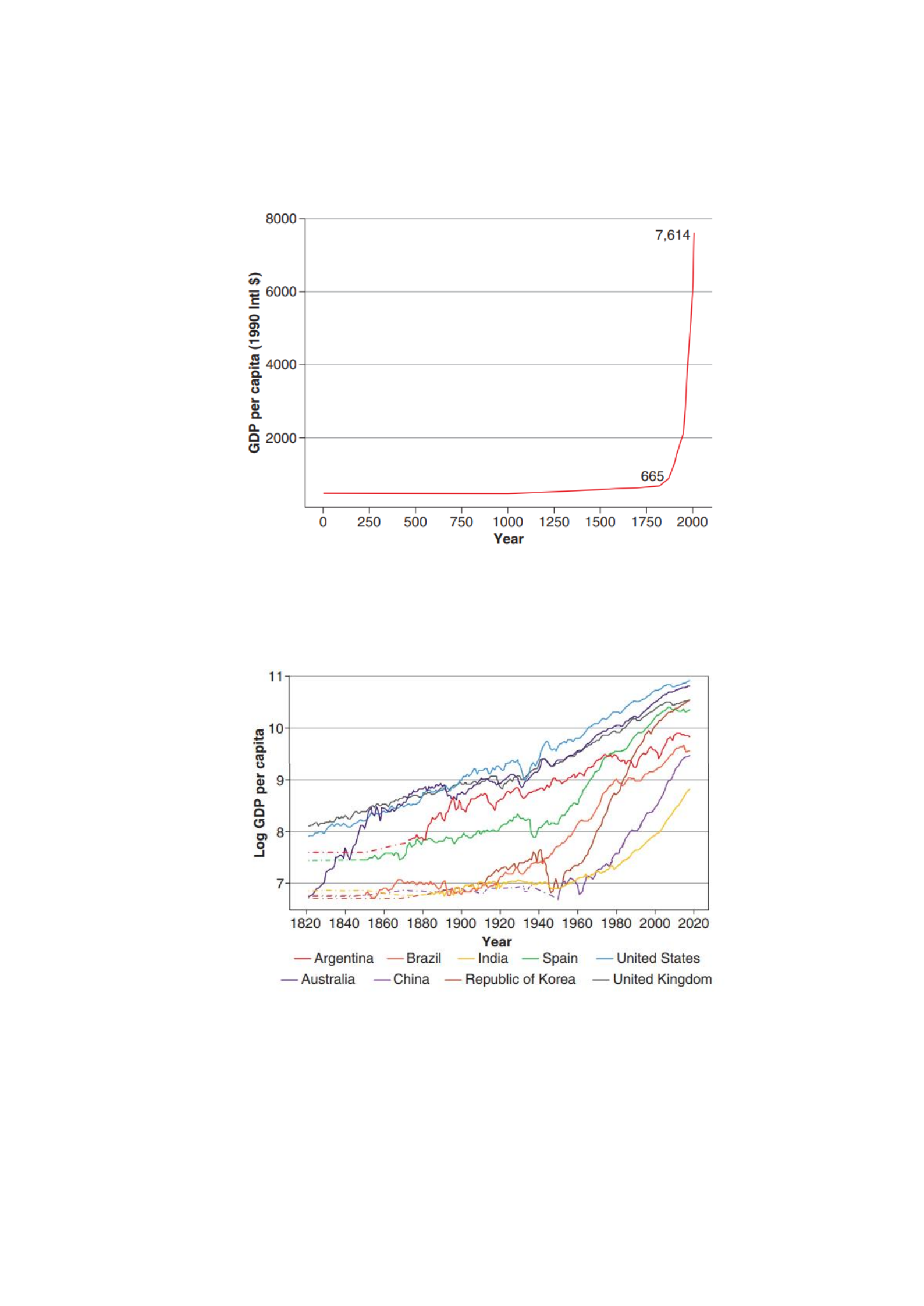
The Evolution of the World GDP per capita over the years 1-2008
Log GDP per capita of selected countries (1820-2018)
But the fundamental point of Lucas’s quote is to realise that the mind-boggling differences
in income per capita across countries are to a large extent due to differences in growth rates
over time; and the power of exponential growth means that even relatively small differences in
the latter will build into huge differences in the former.
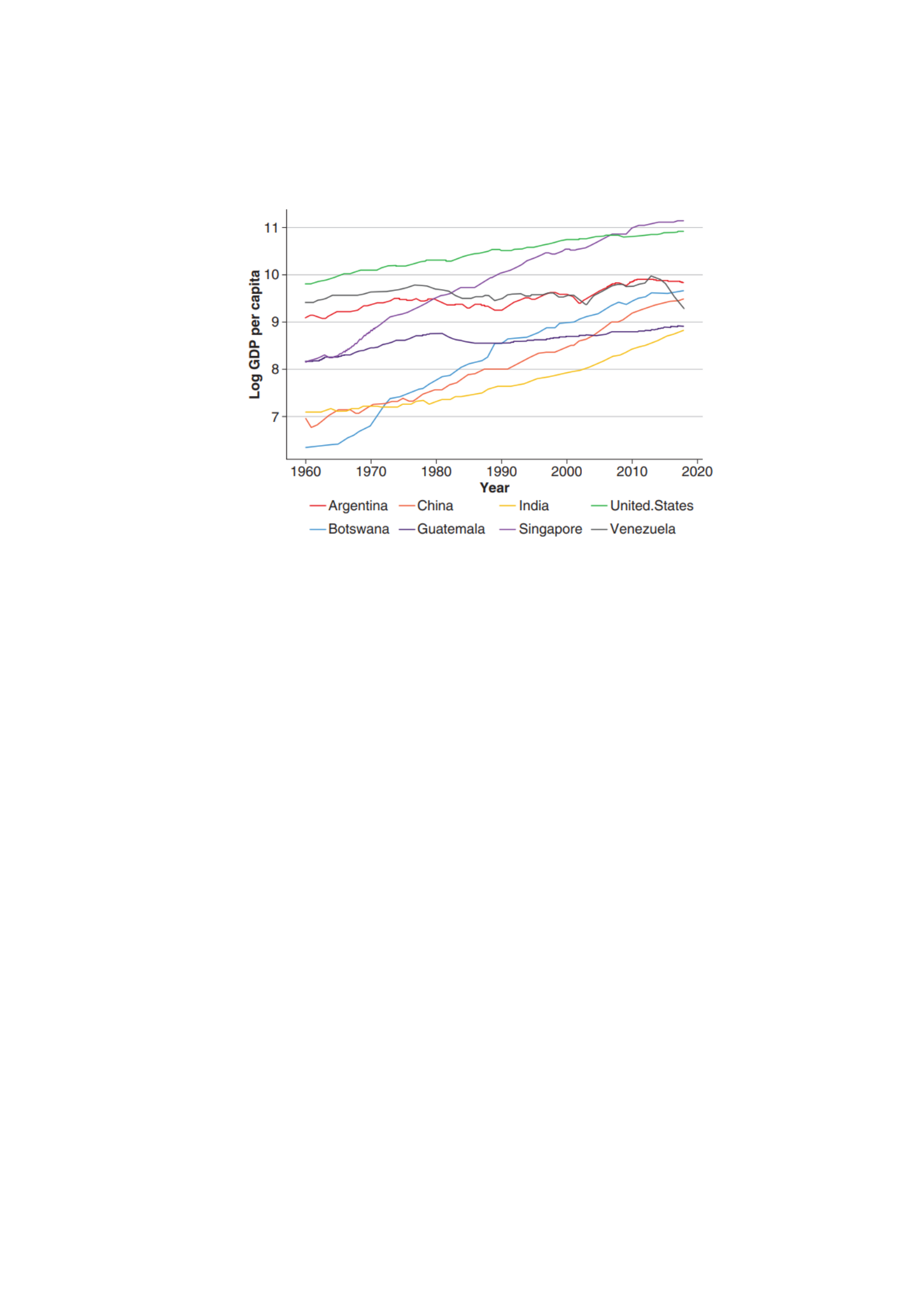
Log GDP per capita of selected countries (1960-2018)
The richest countries have been growing steadily over the last two centuries, and some
countries have managed to converge to their income levels. Some of the performances are
really stellar. On Log GDP per capita of selected countries (1820-2018) shows how South
Korea, with an income level that was 16% of that of the U.S. in 1940, managed to catch up in
just a few decades. Today it’s income is 68.5% compared to the U.S. Likewise, Spain’s income
in 1950 was 23% that of the U.S. Today it is 57%. At the same time other countries lagged.
Argentina for example dropped from an income level that was 57% of U.S. income at the turn of
the century to 33.5% today.
These are crucial reasons why we will spend about the initial half of this book in
understanding growth. But those are not the only reasons! You may be aware that
macroeconomists disagree on a lot of things; however, the issue of economic growth is one
where there is much more of a consensus. It is thus helpful to start off on this relatively more
solid footing. Even more importantly, the study of economic growth brings to the forefront two
key ingredients of essentially all of macroeconomic analysis: general equilibrium and dynamics.
First, understanding the behaviour of an entire economy requires thinking about how different
markets interact and affect one another, which inevitably requires a general equilibrium

approach. Second, to think seriously about how an economy evolves over time we must
consider how today’s choices affect tomorrow’s – in other words, we must think dynamically!
As such, economic growth is the perfect background upon which to develop the main
methodological tools in macroeconomics: the model of intertemporal optimisation, known as
the neoclassical growth model (NGM for short, also known as the Ramsey model), and the
overlapping generations model (we’ll call it the OLG model). A lot of what we will do later, as we
explore different macroeconomic policy issues, will involve applications of these dynamic
general-equilibrium tools that we will learn in the context of studying economic growth.

