


Predictive Maintenance: Improving the Accuracy of Predictive Maintenance Systems to
Reduce Downtime and Maintenance Costs
Introduction
Predictive maintenance (PdM) has emerged as a critical component of Industry 4.0 by
leveraging modern technologies like the Internet of Things (IoT), artificial intelligence (AI),
and Big data, among others. Also referred to as the Fourth Industrial Revolution, Industry 4.0
is a range of industries that adopt technologies that blend the real and the virtual environment.
In manufacturing, this revolution refers to smart factories where all the machines and
operational systems are integrated, making real-time data sharing and knowledge-based
decision-making possible (Culot et al., 2020).
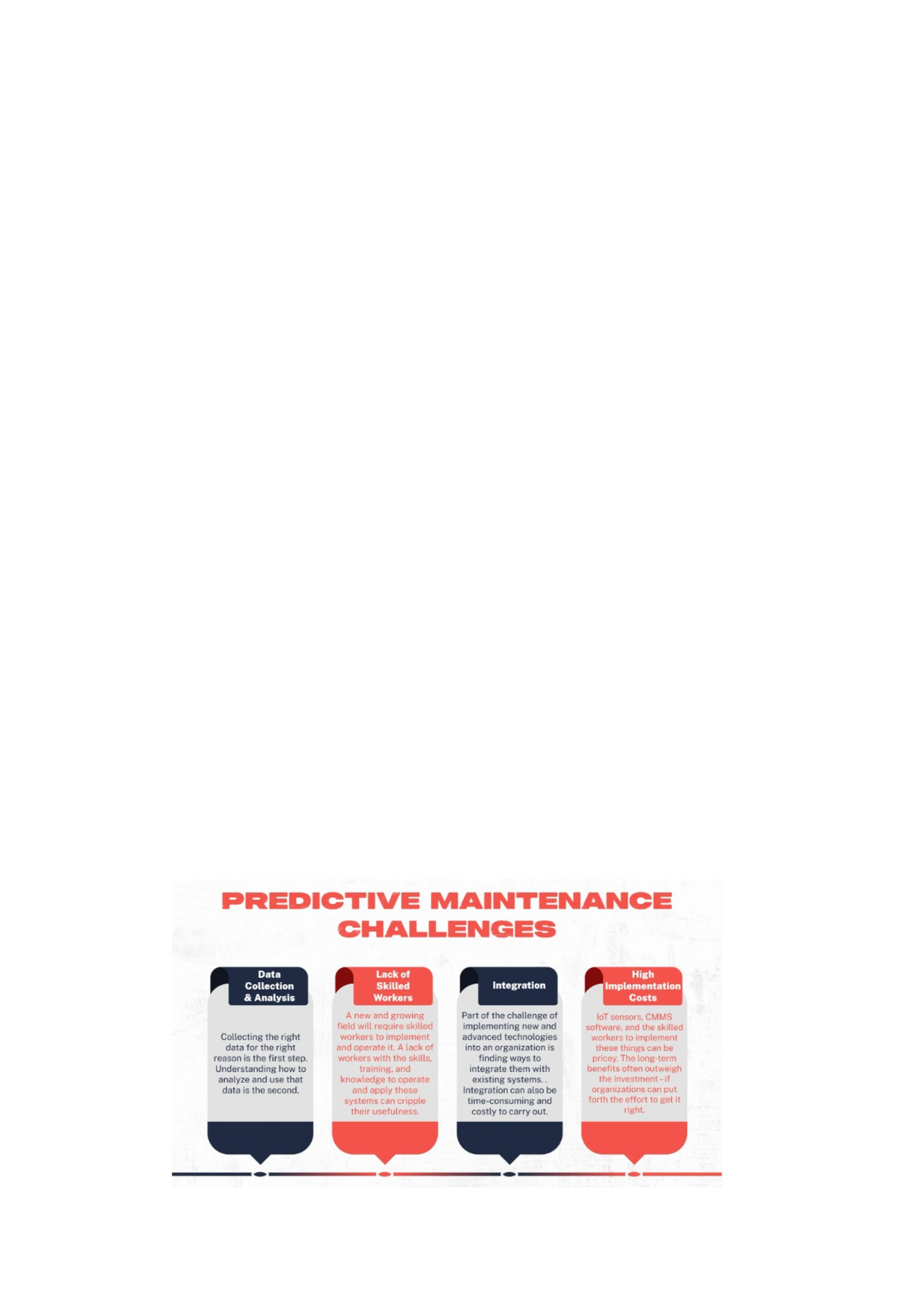
PdM is a critical tenets of Industry 4. 0, and accuracy is paramount when using
predictive maintenance systems (Lughofer & Sayed-Mouchaweh, 2019). It is affected by
factors such as the quality and consistency of the data collected from many sensors and
integrating it into an efficient system, effective development of accurate and reliable
predictive models that can adequately forecast equipment failures, scalability of predictive
maintenance solutions over vast and diverse manufacturing facilities, and the high costs that
come with the implementation of predictive maintenance systems including buying hardware,
software, and training (Van Dinter et al., 2020).
Figure 1 shows predictive maintenance challenges (Dozuki, 2023)

Secondary Research: Defining the Challenge and Identifying Knowledge Gaps
There is a growing application of predictive maintenance systems across industries to
improve performance and lower expenses. Cheng et al. (2022) indicated that organizations
implementing predictive maintenance had noted enhanced equipment availability and
decreased maintenance expenses. Nevertheless, there is continued difficulty in achieving the
best results for these systems. Lucic et al. (2019) state that data quality and integration remain
an issue, which means that poor quality and unreliable data impact the quality of the model in
predicting with high accuracy.
Current information also reveals that many areas still need further research, especially
concerning the application of the interval-based approaches to the Australian context of
various industries. As mentioned by Ynad et al. (2020), with machine learning algorithms,
although they display much potential, the results can be pretty moderate due to the high
variability in data acquisition processes across different regions and the requirement for
creating unique algorithms to adapt to specific operational environments.
Moreover, Kortian et al. (2024) show that many Australian companies are
encountering high implementation costs and a deficiency of qualified personnel, exacerbating
the Australian organizations' challenges in deploying predictive maintenance systems. Filling
these gaps by focusing on integrating data and seeking ways to implement a low-cost,
efficient approach to predictive maintenance may help expand the predictive maintenance's
efficacy and effectiveness in Australia.
Knowledge Gaps in PM
Despite the increase in the rate of the implementation of predictive maintenance
technologies, there is still some gap that needs to be fully addressed in the current literature,
especially concerning the Australian environment. First, a significant area that needs proper
coverage includes the management of data generated and collected while conducting

business. It needs to be clarified how so much data produced by IoT can be efficiently
managed, and there needs to be a clear, universally acceptable way of dealing with it.
Building on the above findings, in Australia, this challenge is compounded by the interfacing
of old systems with new IoT system architectures, leading to data credibility and management
complications. Data management for PM is critical since it determines the data quality used
in making the predictions (Aivaloglou et al., 2023).
Secondly, human factors are also important when deciding on the specifics of
predictive maintenance systems (Seifert, 2023). The relationship between such systems and
humans is still unknown, especially regarding how human judgment may enrich automated
predictions. Additional studies are needed to identify the optimal integration of human
decision-making and 'smart systems' and their impact on predicting and improving
maintenance.
Explanation and Analysis of Primary Research Tools
Interviews
Interviewing people such as the representatives of industries, the maintenance
engineers, and the data scientists would make it possible to understand real-life issues and
possible solutions for enhancing predictive maintenance systems (Cataldi & Sena, 2021).
These interviews should focus on several key areas:
Experiences with Current Tools: Awareness of the existing predictive
maintenance solution and their performance in practice.
Data Collection and Integration Challenges: Finding deficiencies in
data acquisition from multiple sensors and integrating the collected data.

Balancing Automation and Human Expertise: Examining people's
ideas on how to orchestrate the software solutions with the consideration of their
discretion to improve maintenance choices.
Cost-Benefit Analysis: Collect stakeholders' impressions of costs
incurred in applying the predictive maintenance approach and costs to be saved in the
long run.
In a broader Australian manufacturing industry, these interviews can also identify
challenges and potentialities in a particular branch and on more and less extended levels of
the company's functioning. For this reason, this qualitative method is significant as it supports
detailed information that may be obscure using quantitative techniques.
Surveys
Amplified surveys in manufacturing organizations can gather quantitative data on the
take-up and efficiency of the predictive maintenance systems (Shane et al., 2021). Key
metrics to explore include: Key metrics to explore include:
Adoption Rates: Estimating the degree of adoption of the predictive
maintenance technologies by various sectors.
Accuracy and Reliability: Measuring the level of confidence customers
have in the predictions made by the predictive maintenance.
Downtime and Cost Reduction: Surveying those to determine the
actual decrease of downtime and maintenance costs following the implementation of
predictive maintenance.
Satisfaction Levels: Determining the customers' awareness and
perception of current solutions in predictive maintenance.

Surveys can be conducted flexibly to differentiate between various subcategories in
the manufacturing industry, such as the food processing subsector, subsector machinery, and
equipment. This approach ensures that the collected data is appropriate primarily and has the
potential to offer insights into the elements of predictive maintenance and its effects. The
survey data adds to the interviews' qualitative findings, which provides a more extensive
analysis of the modern state and prospects for using predictive maintenance systems in
Australia.
Considerations on Limitations and Ethics in Market Research
Limitations
Some potential problems are encountered when conducting primary research in
predictive maintenance. Interviewing and self-administered questionnaires pose a risk for
response bias in that subjects may provide responses that they want to be true instead of
politically incorrect responses. Thirdly, unlike surveys, interviews and observations often
have a small sample size, which could impact the outcome's generalization ability. This
constraint is somewhat relevant when operating in different manufacturing settings in
Australia. Moreover, it is not easy to obtain data on maintenance practices from different
companies because such data is often confidential, which may restrict the quality of the
research (Heiervang & Goodman, 2011).
Ethical Considerations
The use of ethics when conducting market research is considered crucial. Protecting
the rights of all the people involved in interviews, surveys, and observations is paramount;
this is called informed consent, where the subjects understand the purpose of the research and
what they are getting into. Privacy and confidentiality of the participants' data are also
essential concerns when addressing operational and maintenance data from the companies

involved in the study. S Goes hand in hand with the idea that it is crucial to remain honest
regarding the aims and methods of the research, in addition to the expected effects on the
participants and their organizations. Adherence to such ethical practices ensures that the
research is carried out responsibly and that the research findings are accepted (Matanda &
Mawere, 2022).
Conclusion and recommendations
An essential element for Industry 4. to be implemented is predictive maintenance, also
referred to as PdM. 0 technologies such as IoT, AI, and Big data to predict equipment failures
and plan maintenance, reducing equipment's time in the workshop, durability, and cost
reduction. However, four drawbacks are yet to be resolved: data quality issues, algorithms'
effectiveness, system scalability issues, and high implementation costs. Furthermore, some
knowledge gaps are shown in the literature, including the understanding of model accuracy,
data handling, and people's involvement, which should be filled. Due to the structure,
versatility, and distribution of manufacturing facilities in Australia, this sector urgently needs
urgent and practical solutions to these challenges.
To address such problems, it is suggested that data quality and integration processes
are boosted through protocolization while advancing the elements of the predictive models by
applying new AI and ML techniques to minimize false positive and false negative results. A
hybrid human and computer intelligence model can be applied again, as well as training for
maintenance personnel. Industry solutions focusing on the specific needs of Australian
manufacturing can help to overcome specific issues in a particular sector. Further
development of primary data collection through interviews, observations, and surveys will
collect more specific information about the implementation of PdM systems, measure the
current practical issues and achievements, and contribute to Australian manufacturers'

decrease in downtime costs and improvement in effectiveness to maintain competitiveness on
the global market.
References
Lughofer, E., & Sayed-Mouchaweh, M. (2019).>Predictive Maintenance in Dynamic
Systems : Advanced Methods, Decision Support Tools and Real-World
Applications>(1st ed.). Springer International Publishing : Imprint: Springer.
Culot, G., Nassimbeni, G., Orzes, G., & Sartor, M. (2020). Behind the definition of Industry
4.0: Analysis and open questions.>International Journal of Production
Economics,>226, 107617. https://doi.org/10.1016/j.ijpe.2020.107617
Van Dinter, R., Tekinerdogan, B., & Catal, C. (2022). Predictive maintenance using digital
twins: A systematic literature review.>Information and Software Technology,>151,
107008. https://doi.org/10.1016/j.infsof.2022.107008
MarketsandMarkets. (2020). Predictive Maintenance Market by Component, Deployment
Mode, Organization Size, Vertical And Region - Global Forecast to 2025. Retrieved
from MarketsandMarkets
Cardoso, D., & Ferreira, L. (2021). Application of Predictive Maintenance Concepts Using
Artificial Intelligence Tools.>Applied Sciences,>11(1), 18.
https://doi.org/10.3390/app11010018
Lobo, S. R., Matawie, K. M., & Samaranayake, P. (2012). Assessment and improvement of
quality management capabilities for manufacturing industries in Australia.>Total
Quality Management & Business Excellence,>23(1), 103–121.
https://doi.org/10.1080/14783363.2011.639561

Caldera, H. T. S., Desha, C., & Dawes, L. (2018). Exploring the characteristics of sustainable
business practice in small and medium-sized enterprises: Experiences from the
Australian manufacturing industry.>Journal of Cleaner Production,>pp. 177, 338–349.
https://doi.org/10.1016/j.jclepro.2017.12.265
Aremu, O. (2020).>Achieving a representation of asset data conducive to machine learning-
driven predictive maintenance>[The University of Queensland, School of Mechanical
and Mining Engineering]. https://doi.org/10.14264/uql.2020.763
Aivaloglou, E., Fletcher, G., & Miedema, D. (2023).>Proceedings of the 2nd International
Workshop on Data Systems Education : Bridging education practice with education
research. Association for Computing Machinery.
Seifert, M. (2023).>Judgment in Predictive Analytics>(1st ed.). Springer International
Publishing : Imprint: Springer.
Cheng, X., Chaw, J. K., Goh, K. M., Ting, T. T., Sahrani, S., Ahmad, M. N., Abdul Kadir, R.,
& Ang, M. C. (2022). Systematic Literature Review on Visual Analytics of Predictive
Maintenance in the Manufacturing Industry.>Sensors (Basel, Switzerland),>22(17),
6321. https://doi.org/10.3390/s22176321
Lučić, B., Batista, J., Bojović, V., Lovrić, M., Kržić, A. S., Bešlo, D., Nadramija, D., &
Vikić-Topić, D. (2019). Estimation of Random Accuracy and its Use in Validation of
Predictive Quality of Classification Models within Predictive Challenges.>Croatica
Chemica Acta,>92(3), 379–391. https://doi.org/10.5562/cca3551
Yang, Y., Xia, X., Lo, D., Bi, T., Grundy, J., & Yang, X. (2022). Predictive Models in
Software Engineering: Challenges and Opportunities.>ACM Transactions on Software
Engineering and Methodology,>31(3), 1–72. https://doi.org/10.1145/3503509

Kortian, V., Pal, S., Ghevondian, N., & Harrison, N. (2024). Challenges and Issues in
Implementing & Operationalising Big Data Analytics Capabilities in a Major
Australian Railway Organisation: A Case Study. SN Computer Science,>5(5), 639.
https://doi.org/10.1007/s42979-024-02953-8
Cataldi, S., & Sena, B. (2021).>Mixed-methods data collection in a study on interprofessional
care : interviews, a survey, and the Delphi technique. SAGE Publications Ltd.
Shane, J., Reigada, C., Laura, Amada, M., Nicole, & Niwa, Y., Erika. (2022).>Lessons in
quantitative and qualitative data collection using online surveys. SAGE Publications,
Ltd.
Heiervang, E., & Goodman, R. (2011). Advantages and limitations of web-based surveys:
evidence from a child mental health survey.>Social Psychiatry and Psychiatric
Epidemiology,>46(1), 69–76. https://doi.org/10.1007/s00127-009-0171-9
Matanda, E., & Mawere, M. (2022).>Research Methods and Statistics for Cross-Cutting
Research : Handbook for Multidisciplinary Research.>(1st ed). Langaa RPCIG.

