


1
I CAN, BUT I WON’T: AN EXPLORATORY STUDY OF PEOPLE AND NEW
INFORMATION TECHNOLOGIES
I. Introduction
Overview
According to the National Institute of Standards and Technology (NIST), cloud
computing “is a computing model that enables convenient, on-demand network access to
a shared pool of configurable computing resources (hardware and software) that can be
rapidly provisioned and released with minimal management effort or service provider
interaction.” In September 2009, the Federal Chief Information Officer, Vivek Kundra,
announced the Federal Government’s Cloud Computing Initiative. This initiative laid the
groundwork for the future rapid deployment of technology solutions supporting the
Federal Government without developing stove-piped systems (GSA, 2009). Currently,
the Federal Government, considered the world’s largest purchaser of information technology,
spends over $76 billion per year on more than 10,000 systems (Kundra, 2009). Correctly
implemented, the cloud computing model has the potential to dramatically decrease
information system cost via virtualization, reducing related infrastructure, building,
power, and staffing expenditures (GSA, 2009) making it attractive to any cost-crunched
organization.
Cloud computing centers provide a foundation to run enterprise services securely
and reliably across the DoD. By leveraging cloud computing techniques, the Department
of Defense (DoD) can transform its infrastructure from its legacy system-specific
infrastructures to a shared infrastructure (CIO/DoD, 2010). Some recent examples of

2
recent cloud computing successes in commercial industry include Kenworth and Coca-
Cola Enterprises. Engineers at Kenworth, lacking organic high-powered computing
capacities, rented time on a supercomputer thousands of miles away to help find gas-
guzzling design flaws. The Kenworth engineers took advantage of cloud computing and
discovered the mud flaps were a major source of drag. Redesigning the mud flaps will
save about $400 on a typical truck’s annual fuel bill (Fortt, 2009). Coca-Cola Enterprises
uses a cloud-based logistics system to optimize operations with merchandisers in the
field. Using smart phones and a cloud computing setup, personnel responsible for
restocking Coke products in stores stay in constant contact with their bosses and the
company’s information storehouse. This allows the field personnel to provide automatic
inventory updates and last minute changes to merchandising schedules.
Cloud computing, while trendy as a new computing model, it is not new. Since
2009, federal agencies have been able to buy cloud computing applications and services
at Apps.gov. GSA’s Apps.gov storefront offers an array of business applications,
productivity software, and services ranging from social networking, to website hosting,
and data storage (Helft, 2009). The government has approved these cloud-based
applications and services to replace more costly and demanding computing services that
are owned and operated by federal agencies. Government organizations seeking to tap
cloud-computing benefits are not constrained to simply the GSA storefront. In July 2010,
Google announced the launch of Google Apps for Government; a suite of Federal
Information Security Management Act (FISMA) approved cloud services for "moderate"-
level security requirements (Google, 2010). With FISMA approval, government
organizations can hire Google to provide secure sensitive, but not classified information

3
systems, processes, and data. This blend of government and commercial providers
affords options for dramatically changing the way organizations answer their IT needs.
Early Successes of Cloud Computing
Williams F1, a Formula 1 race team based in Oxfordshire, U.K., turned to AT&T
Global Services for a cloud computing solution. The Williams F1 race team is on the
road for 9 months out of the year competing in 19 Formula 1 Grand Prix races that make
up the race calendar. Its headquarters contains a fully managed enhanced virtual private
network that allows engineers, mechanics, car designers and drivers to run the business
while they are on the road. Alex Burns, CEO of Williams F1, states that their IT strategy
used to be about speed and the speed of decision-making on testing and accessing the
results with little regard for security. While Williams F1 is a tech savvy race team in a
competitive and high profile environment replete with espionage, it knew little about
security. To correct this, the team turned to a cloud provider for a highly secure
infrastructure service, allowing their own IT department to focus on helping the
organization build winning racecars. AT&T’s cloud security services enables the
Williams F1 staff to receive encrypted data from the car to make decisions during the
race. Alex Burns said that by using cloud computing, the team saves time and money
since security services require constant management, patches, new hardware, and the IT
department's time (Del Nibletto, 2010). Burns states that Williams F1's core competency
is building racecars, not IT security, nor should it be.
In the military arena, the armed services were assigned the task of finding more
than $100 billion in overhead savings over the next five years (Gates, 2010). Any

4
savings the services generate can be reinvested in war-fighting modernization. At least
one service, the U.S. Army, has recently stepped out and looked toward cloud computing
as a means to cut costs and increase efficiency. In a move to reduce its $10 billion IT
budget, the Army issued a moratorium on server purchases (Foley, 2010) to reduce server
counts and consolidate the 200+ Army data-centers. Spearheading one of these cost-
cutting efforts is the United States Army Recruiting Command. Their Army Recruiting
Information Support System was over 10 years old and in need of an upgrade (Kundra,
2010). Therefore, they embarked on a pilot program designed to explore new
technologies that the Army could leverage to improve efficiencies of its recruiting
operations. Initial bids from traditional IT vendors that met the required functions ranged
from $500,000 to over $1 million. Instead of accepting these solutions, the Army
Recruiting Command chose a customized version of a cloud-based Customer Resource
Management (CRM) tool from Salesforce. The CRM tool from Salesforce provided all
the functions without needing to acquire all the necessary hardware needed to operate a
traditional system. The Army Recruiting Command is currently piloting this cloud-based
solution at an annual cost of only $54,000.
In a broader example of the cloud computing movement, in 2011, the Army will
start migrating its Microsoft Exchange email users to an enterprise-wide email that will
leverage Army-owned Microsoft licenses and the DoD cloud managed by the Defense
Information Systems Agency (DISA). The base email service enables the Army to
modernize its Microsoft Server software and increase email capabilities while
simultaneously substantially reducing hardware and storage expenses. Estimated savings
may reach 40% (DISA, 2010). According to the DISA press release, the DISA-managed

5
Enterprise Email will employ fewer servers and administrators, increase security and
eliminate thousands of existing heterogeneous local networks. This change will expand
the email capability with email storage growing to 4 gigabytes for most users. In
contrast, the Air Force’s Air Mobility Command (AMC) revised its newly restrictive e-
mail limit policy in January 2009. The new limits for e-mail size are divided into three
Tiers. Tier I, which includes Group CC\CV and CMSgt has unlimited size of e-mail
boxes. Tier II includes CC, CV, CEM, First Sergeant, and organization accounts are
limited to 250MB. Finally, normal users, Tier III are limited to only 50MB for their e-
mail box storage. This is one of the many examples where the use of cloud computing
resources can reduce costs and increase efficiencies while maintaining performance and
security. These examples of the early success of cloud computing reinforce the need for
this research.
Motivations for Research
The motivations for this research stems from personal experiences as a Signal
Officer for an Infantry Battalion and a Company Commander for an Operational-base
Signal Company. While serving as a deployed Signal Officer at a remote Forward
Operating base in Operation IRAQI FREEDOM, there were many areas in which
communications efficiency and capabilities could be improved. During the pre-
deployment and post-deployment process, the Signal section had to transfer data to hard
drives and file servers in order to re-image computers so they could connect to the
respective local networks. While the imaging process was not difficult, the process of
backing up the users’ data multiple times over eighteen months due to training exercises

6
and deployments was time consuming. For a training exercise at the National Training
Center, users’ data had to be backed up so computers could be re-imaged for the network
used for training. This process was done after returning to the home station, before
deployment to Iraq, and upon returning to home station. By comparison, using a cloud-
based data service during the training exercises and deployments would eliminate the
need to repeatedly move 150 users’ data back and forth from individual computers to a
server. Instead, the data would reside in the cloud and always be available.
At another time, as a Company Commander serving in Alaska, I encountered
another problem with a potential cloud-computing solution. The Stryker Brigade soldiers
possessed multiple email addresses that were used during deployments. There was an
Army email address (xxx.us.army.mil), an email address at work (xxx.post.army.mil), an
email address for the Brigade that was used for training and deployments
(xxx.unit.army.mil), and SIPRnet email addresses for the Army, Post, and unit. Multiple
e-mail addresses used during garrison and deployed operations meant multiple accounts
to manage at one time; users had to check several accounts for messages, and IT
personnel had to provide support for each set of exchange servers. Using a cloud-based
email service, like the DISA Enterprise Email, would overcome this obstacle since doing
so would eliminate the need for separate post and unit email accounts. Since
implementing cloud-computing solutions does not rely on multiple exchange servers, it
eliminates the need to manage multiple email accounts. These examples lead to the
following question: If cloud computing can provide cost savings while still meeting the
computing needs of the organization, then why is it not readily implemented through the
Department of Defense?

7
Research Goals
In the commercial industry, Kenworth, Coca-Cola Enterprises, and Williams F1
are just a three of the success stories of how cloud computing has helped organizations
save time and money. Whether saving money by redesigning the aerodynamics of a
truck, or optimizing the workload of merchandisers working in the field, or collaborating
on data gathered from a car during a race, cloud computing is providing advantages in
commercial industries.
The same advantages are only beginning to be seen in the government sector.
The Army Recruiting Command is saving money on a pilot cloud computing solution for
the aging Recruiting Information System. Similarly, on a larger scale, the Army is
transitioning to a cloud-based Enterprise E-mail system that is supposed to increase
capabilities while reducing costs. If there are numerous successes using cloud computing
technologies in commercial industries, then why has it not been implemented as quickly
in the government sector? The answer to this question is the thrust of this research.
There are two main research goals in the thesis. The first goal is to determine if
there is a perceived difference of opinion between commercial and government sectors on
issues concerning cloud computing. By comparing the results from a 2009 IDC
Enterprise survey with the results from a military IT Personnel survey, the thesis will
determine if there is a significant difference in the perception of cloud computing issues.
Commercial and government sectors might have a different perception on cloud
computing issues due to the nature of their organizations. Government and commercial
industries have different customers, stakeholders, and goals driven by the nature of the

8
two industries. For one example, expenses and income do not drive the government
sector, whereas the commercial sector pays attention to profit of the organization. The
differences in public and private industry can mean a difference in technology needs and
opinion about a new technology. In fact, studies on information systems (IS) projects in
the commercial sector may have limited relevance due to differences between the
government and commercial industries (Bozeman and Bretschneider 1986; Bretschneider
1990) and any recommendations derived from commercial sector studies might not
necessarily apply to the government sector (Coase 1937).
The second goal of the thesis is to understand the relationship between the
perceived viability of cloud computing and perceived willingness to implement it in the
organization. Is it possible that cloud computing is not seen as a viable technology in the
military environment? Conversely, is it viable and IT professionals in the military are
just unwilling to make the changes needed to implement it in their organizations. The
previous discussions on the success of cloud computing leads us to the following
questions.
Research Questions
With the benefits of cloud computing seemingly apparent, the reasons why it has
not yet been adopted may lie in the human element of the people, process, and
technology equation. This thesis is an exploratory examination of the opinions military
IT personnel of cloud computing in the in the Department of Defense and the Army. The
research presented is motivated by a desire to understand two overall research questions:

9
(1) Is cloud computing perceived as a viable technology in the DoD/Army?
(2) Is there a perceived willingness to implement cloud computing in the
DoD/Army?
The research will provide an understanding of whether DoD IT personnel think
cloud computing is a viable technology for their organization as well as examine the
connection between the perceived viability of new technologies and the willingness of IT
personnel to implement them. Answering these questions will provide a framework for
determining whether new technologies are viable for the organization and the perceived
willingness to implement the technology.
Thesis Overview
The remainder of this thesis includes four more chapters and supporting
information found in the appendices. This next chapter introduces cloud computing,
defining and explaining the varying characteristics, service models, and deployment
models. Chapter three then discusses the research strategy and survey methodology used
to collect the data required to address the research questions. Then, chapter four presents
the analysis of the survey data and tests the research model to answer the primary
research questions. Chapter five discusses the results, providing recommendations along
with possible limitations and future research ideas.

10
II. Background
History of Cloud Computing
Recently, cloud computing has become one of the most talked about topics in
information technology (Gartner, 2010). The Gartner Group (2010) identified cloud
computing as the primary source of growth in IT spending with global revenues surging
to over $130 billion in 2013. Cloud computing is on-demand access to virtualized IT
resources that are located outside of your own datacenter (Marks and Lozano, 2010).
These virtualized IT resources are accessed over the Web, shared by others, easy to use,
and paid-for through subscriptions. Significant innovations in virtualization and
distributed computing, as well as improved access to high-speed Internet and a weak
economy, have accelerated interest in cloud computing (Lee, 2010).
The idea behind cloud computing dates back to the 1960s when John McCarthy, a
computer scientist, stated in a speech given at MIT, “That computing may someday be
organized as a public utility” (Biswiss, 2011). Cloud computing gets its name from a
metaphor for the Internet (Velte et al., 2010) and was probably copied from internet
diagrams (Biswiss, 2011) where data is depicted as traveling from one computing device
to another through a nonspecific cloud (Figure 1).

11
Figure 1. The Internet Cloud
(http://singularityhub.com/)
In such a model, cloud computing providers allow users to remotely access
hardware, software, and data resources for a fee. Users essentially store data and
applications in the “cloud” for easy access (Figure 2). There are several commercial
applications utilizing cloud computing. For example, OnLive, an online gaming service,
provides access to games instantly over a broadband connection using a browser.
Similarly, Google Docs provides a web-based document editing and management service,
while Bing Maps provides an on-line mapping service. The breadth of commercially
available services available via this model continues to grow (Geelan, 2009).

12
Figure 2. Cloud Computing (Velte, 2010)
What is Cloud Computing?
Commercial industry leaders have many variations of the cloud computing
definition and its characteristics. Accenture, a consulting firm, defines cloud computing
as the dynamic provisioning of IT capabilities (hardware, software or services) from third
parties over a network. In another view, Kevin Fogarty, a contributing editor at CIO
magazine (2009), states that the cloud-computing model has all applications, services and
networks available to IT and end users via the Internet. Meanwhile, Jeff Kaplan from
ThinkITStrategies views cloud computing “as a broad array of web-based services aimed
at allowing users to obtain a wide range of functional capabilities on a ‘pay-as-you-go’
basis (Geeelan, 2009).” While different, at the core these definitions all have
organizations or users accessing and purchasing IT capabilities from a third party.
Nonetheless, they are not the only ones that show the variety of perceptions about what
cloud computing is.

13
According to TechTarget, a publicly traded IT marketing company, cloud
computing is a general term for anything that involves delivering hosted services over the
Internet. Under such a vision, cloud computing has all three distinct characteristics that
distinguish it from traditional IT hosting: services are sold on demand (usually by the
minute or the hour), services are elastic (so a user can have as much or as little of a
service as they want at any given time), and the services are fully managed by an external
provider allowing consumers access with nothing more than a personal computer and
internet. One consulting firm Lexnet Consulting Group, defines cloud computing as a
delivery of services that replace the need for an organization to incur infrastructure costs;
it can be thought of as an “outsourced” IT network (Chipman, 2010). This cloud
represents a shift away from computing as a product to computing as a service delivered
over the Internet (Khajeh-Hosseini, Sommerville and Sriram, 2010). Knorr and Gruman
(Infoworld, n.d.) state cloud computing comes into focus when one considers what IT
departments and organizations always lack: a way to increase capacity or capabilities
when needed without investing in new infrastructure, training, or software licenses.
Thus, the term cloud computing can be used to cover any subscription-based or pay per
use service that extends existing IT capabilities (Knorr and Gruman, n.d.).
There is one commonality for almost all papers and definitions of cloud
computing: they all refer to or reference the National Institute of Standards and
Technology (NIST) cloud computing model. For example, see: Bambacus, 2008,
Biswas, 2011, Chipman, 2009, DoD/CIO, 2010, Foarty, 2009, Geelan, 2009, Khajeh-
Hosseini et al., 2010, Kundra, 2008 and 2010, Knorr and Gruman, 2010, Lee, 2010,
Lewin, 2009, Marks, 2010, Rhoton, 2009, Rittinghouse and Ransome, 2010, and Wyld,

14
2009 and 2010. Since the NIST model is fundamental to so many commercial cloud
computing visions, this thesis will use the government’s definition of cloud computing
which was published in January 2011 under the Federal Information Security
Management Act (FISMA of 2002 in Special Publication 800-145). The NIST defines
cloud computing as a “model for enabling ubiquitous, convenient, on-demand network
access to a shared pool of configurable computing resources (e.g. networks, servers,
storage, applications, and services) that can be rapidly provisioned and released with
minimal management and effort or service provider interaction.” The cloud model
promotes availability and is composed of five essential characteristics, three service
models and four deployment models that are explained below.
The five essential characteristics are on-demand self-service, broad network
access, resource pooling, rapid elasticity, and a measured service. The three service
models are Software as a Service (SaaS), Platform as a Service (PaaS) and Infrastructure
as a Service (IaaS). The four deployment models outlined by the NIST are private cloud,
public cloud, community cloud, and hybrid cloud. Further details are provided below.
Five Essential Characteristics
Characteristic #1: On Demand Self-Service.
On-demand self-service occurs when a consumer can automatically and
unilaterally provision computing capabilities, such as server time and network storage,
without requiring contact with the providers’ customer service representative. It means
the consumer can use the cloud service as needed without any customer service
interaction with the cloud provider (Ruggles, 2010). One example is from VMware.

15
Their vCloudTM Express offers an on-demand service, where developers can use the
service at their convenience to address various infrastructure and programming needs
such as experimentation, prototyping and testing. A vCloudTM customer can create a
virtualized server, add storage, configure a firewall, and scale additional capabilities in
and out according to what and when they need it.
Characteristic #2: Broad Network Access.
Broad network access is an essential characteristic defined by the NIST as
capabilities that are available over the network and accessed through standard
mechanisms that promote use by heterogeneous thin or thick client platforms (e.g.,
mobile phones, laptops, PDAs). This is the most vital characteristic of cloud computing
since it is network based, and accessible from anywhere, from any standardized platform
(Velte, 2010). This does not necessarily mean Internet access. A private cloud is
accessible only behind a firewall, regardless of the type of network (Ruggles, 2010). The
main point of this characteristic is that the service is accessible from anywhere.
Characteristic #3: Resource Pooling.
Resource pooling is the next characteristic. In resource pooling, numerous clients
use the same set of resources at the same time (Rhoton, 2009). It works on economies of
scale: users do not have their own resources, so a provider gives multiple parties access
to a large pool of shared resources at efficiencies no one user could match. The cloud
computing service providers make their resources available to anyone who is willing to
pay for access.

16
Characteristic #4: Rapid Elasticity.
The characteristic of rapid elasticity is defined as the ability to scale computing
resources both up and down, as needed. To the consumer, the cloud appears to be
infinite, and the consumer can purchase as much or as little computing power as needed
(Ruggles, 2010). This characteristic not only allows the services to be scaled both up and
down (scalability), but per-usage billing is common with this characteristic and this leads
to direct cost savings.
Characteristic #5: Measured Service.
The last characteristic is called a measured service. NIST defines this as the
leveraging of a metering capability; usage can be monitored, controlled and reported,
providing clear usage details for the provider and consumer, like a utility service model.
Measured services allow the cloud provider to charge for exactly what the customer is
using. The customer can track usage and costs and align them with their specific
business units or functions for cost accountability.
Three Service Models
Besides containing the five essential characteristics, cloud computing
implementations are available in three service models: Software as a Service (SaaS),
Platform as a Service (PaaS), and Infrastructure as a Service (IaaS). These models
describe the level of functionality offered by the cloud provider. Figure 3 depicts the
relationships between the models as a pyramid. At the highest or software as a service
level, the consumer receives more functionality and customization and knows less about
the implementation details. At the lower levels, the consumer receives more components
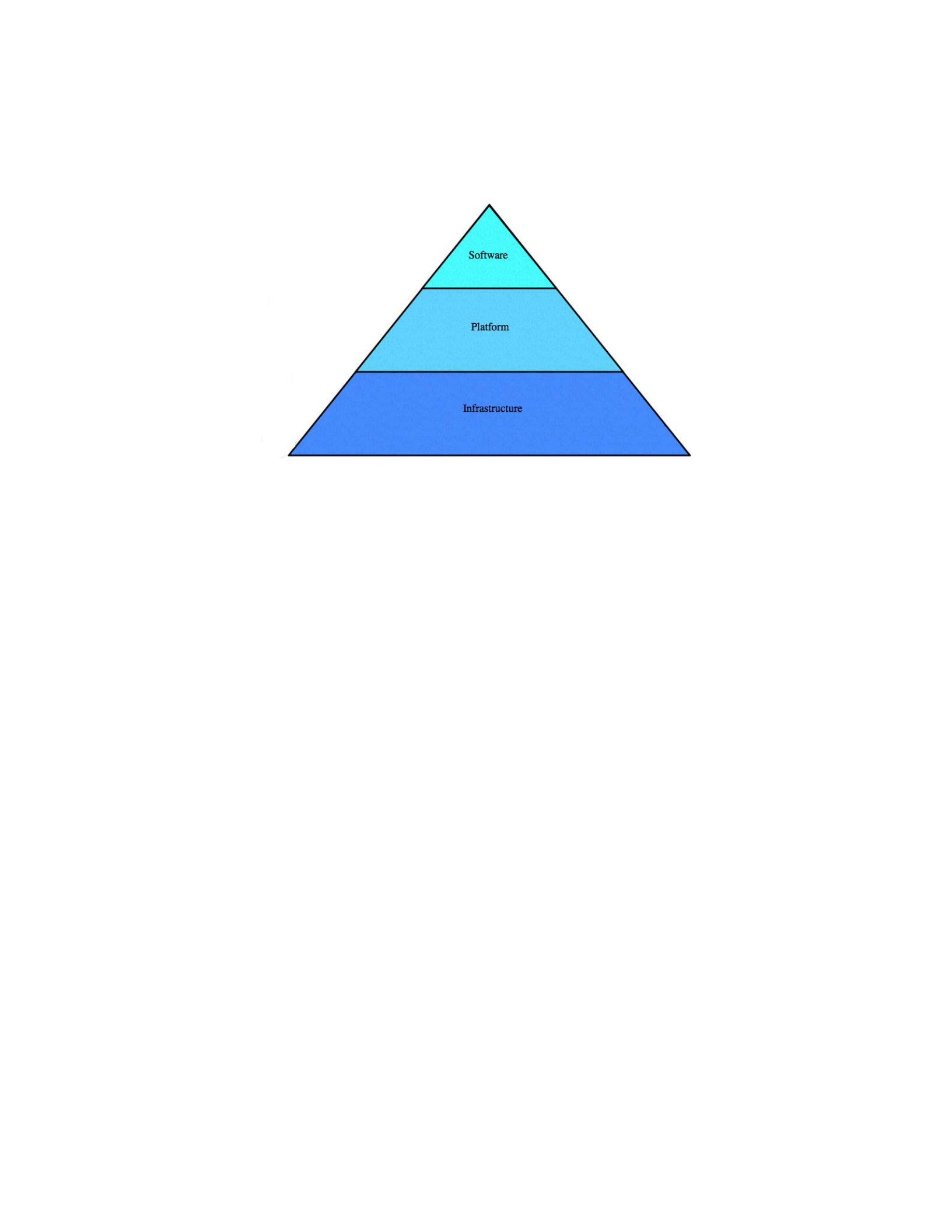
17
in the service and a higher degree of control over the infrastructure, platform, and
software.
Figure 3. Cloud Service Models
Service Model #1: Software as a Service.
Software as a Service (SaaS) provides the customer the ability to use applications
running on a cloud infrastructure (NIST, 2011). SaaS offers fully functional applications
on-demand to provide specific services such as e-mail, customer relationship
management, web conferencing, and other applications. The applications are accessible
from various devices though a thin client interface (e.g., web browser) allowing
consumers to avoid upfront investment in servers or software. Salesforce.com is the most
well known example among enterprise applications (Knorr and Gruman, 2010). Onlive,
Google Docs and Bing Maps are other well-known examples the growing number of
SaaS providers. For example, Google Docs allows you to upload files, then edit, and
view the documents from any computer or smartphone. This fosters real-time
collaboration with other authorized users, while shielding the company from
implementation details such as software installation, updates, and patches.

18
Service Model #2: Platform as a Service.
NIST defines Platform as a Service (PaaS) as another service model. PaaS allows
the consumer to deploy their own applications that are created using approved software
tools, onto the cloud. PaaS falls between SaaS and Infrastructure as a Service since it
balances functionality with control. Consumers use PaaS to generate custom applications
using software development languages and tools offered by the vendor. PaaS offers an
operating environment that includes the operating system and application services. These
services are constrained by the vendor’s design and capabilities. PaaS solutions are
development platforms in which the development tool itself is hosted by the provider and
accessed through a web browser. Due to this, developers can build web applications
without installing any tools on their computer and can deploy those applications without
any special system administration tools. Examples include Force.com by Salesforce.com,
Google App Engine, and Microsoft’s Azure.
Service Model #3: Infrastructure as a Service.
Infrastructure as a Service (IaaS) is where the consumers are provisioned with
processing, storage, networks, and other fundamental computing resources on which to
deploy and run any software, including operating systems and applications (NIST, 2010).
The IaaS vendor provides a virtual machine to the consumer allowing them to manage
applications and data while the vendor manages which physical machine executes the
code. Virtualization enables IaaS providers to offer almost limitless instances of servers
to customers and make cost-effective use of the hosting hardware. IaaS users enjoy

19
access to enterprise-grade IT infrastructure and resources that would be prohibitively
costly if purchased on their own. Commercial IaaS providers include Amazon’s Elastic
Compute Cloud (EC2), Rackspace, and GoGrid.
Four Deployment Models
Each of the preceding characteristics and platforms are accessed through different
types of clouds, also known as deployment models. The NIST lists four different
deployment models in SP 800-145: private, public, community, and hybrid (Figure 4).
As explained below, their differences are primarily in the way the consumer or
organization access services.
Deployment Model #1: Private Cloud.
Under NIST, one deployment model is the private cloud infrastructure, which is
operated solely for the use of one organization. It may be managed by the organization
or a third party and may exist on premise or off premise. The private cloud is operated to
maintain a consistent level of security, privacy, and governance control. Organizations
use their own infrastructure and private cloud to operate and protect mission critical
systems. By operating and maintaining a private cloud, the organization has to buy and
manage the infrastructure, and does not benefit from lower upfront capital costs (Foley,
2008).

20
Deployment Model #2: Public Cloud.
The public cloud infrastructure is made available to the general public or a large
industry group and is owned by an organization selling some type of cloud services. In
such a situation, the cloud service provider makes resources available to the general
public over the Internet. These services may be free or on a pay-per-usage model. The
benefits of a public cloud service are that they are easy and inexpensive to set up since
the provider absorbs the hardware, application, and bandwidth costs. In addition, they
are easily scalable to meet the needs of the consumer and are paid per usage.
Deployment Model #3: Community Cloud
A community cloud infrastructure is one shared by several organizations and
supports a specific community that has shared requirements (e.g., mission, security
requirements, policy, and compliance considerations) (NIST, 2011). This type of model
can be managed by the organizations (members of the community) or a third party and
may exist on premise or off premise. For example, a financial services community cloud
would bring together cloud-based services needed to assist their customers while still
meeting industry-specific security and auditing requirements.
Deployment Model #4: Hybrid Cloud.
The last deployment model is a hybrid cloud. NIST states that the hybrid cloud
infrastructure is a composition of two or more clouds (private, community, or public) that
remain unique entities but are bound together by standardized or proprietary technology
that enables data and application portability. For example, an organization that keeps
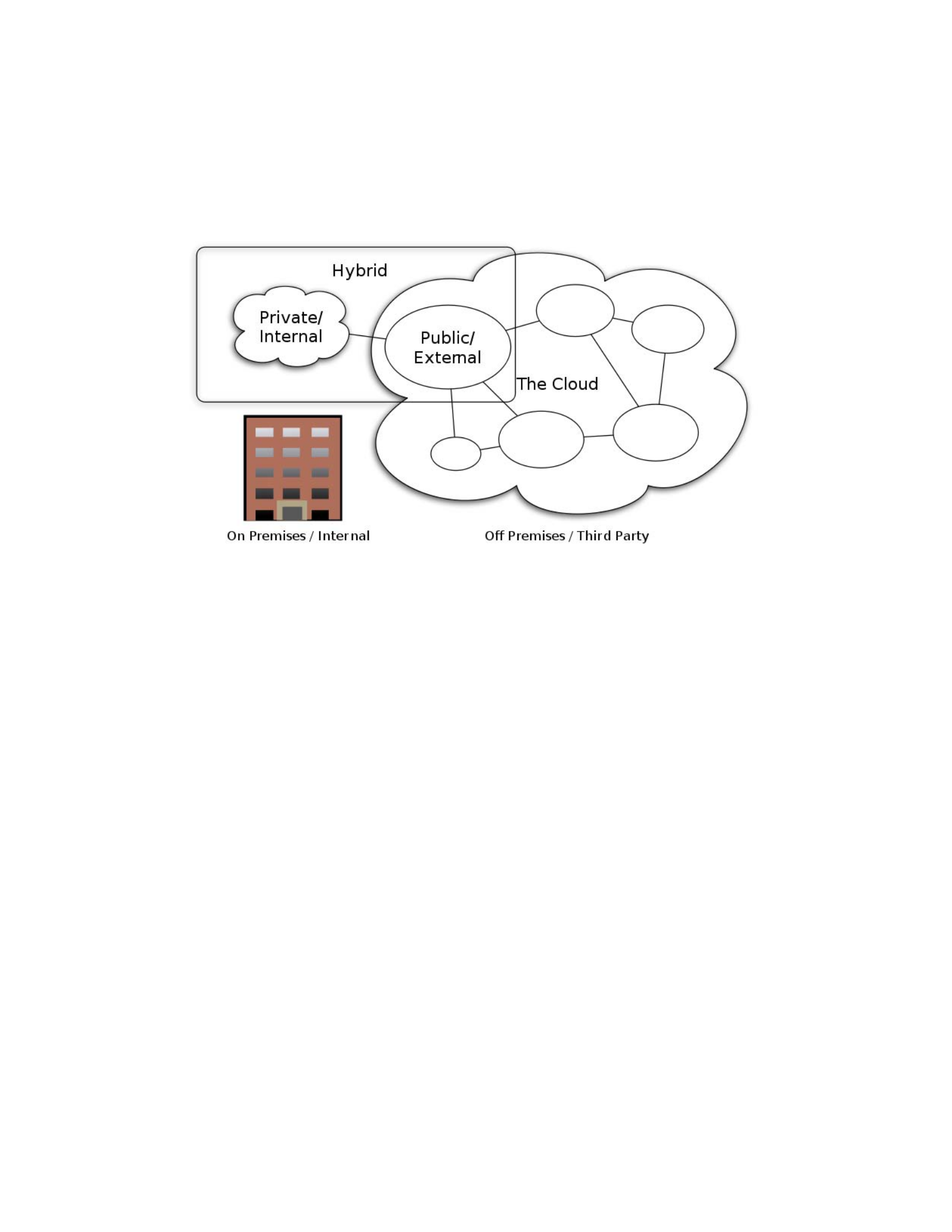
21
their data in a private cloud while using the processing resources of a community cloud is
one type of a hybrid cloud.
Figure 4. Types of Cloud Deployment Models
(Sam Johnston, 2009)
The Silver Lining of Cloud Computing
In an effort to reduce costs during tough economic times, cloud computing offers
a way to significantly reduce waste, increase data center efficiency and utilization rates,
and lower operational costs (Kundra, 2010). Cloud computing benefits are analogous to
public utilities (Kundra, 2010). Public utilities provide access to clean water and
electricity; just turn on the faucet or the light switch and the service is there, and the
consumer pays for only what they use. Cloud computing services can be turned on and
off, as the organization needs them, and provide a pay-as-you-go capability. In such an
approach, only a low initial investment is required to get started (Kundra, 2010). This
lowers the barrier of entry for new or small organizations (Jaeger et al., 2008). Besides

22
the direct economical benefit, cloud computing can save maintenance and downtime,
reduce human capital required to manage a data center, and better accommodate business
growth (Joyent, 2009). Organizations can get its cloud service operational in record time
at a fraction of the cost of an on-premise solution (Waxer, 2010).
Reducing risk is another benefit of cloud computing. Cloud computing allows
individuals and businesses to reduce some risk by stating in the service contract that data
protection and disaster recovery provisions are maintained and the provider is liable in
the case of failures (Rhoton, 2009). Furthermore, by using a cloud provider, an
organization can reduce the likelihood of not provisioning enough resources for
fluctuating demand and reducing the risk of lost revenue due to unplanned downtime.
Elasticity, which can also be called scalability (Waxer, 2010) allows IT departments to
have an abundance of resources for peak demand can add or subtract capacity as its
network loads dictate (Waxer, 2010). This elasticity allows for the organization to pay
for only what is used (Kundra, 2010) rather than purchasing, installing, and configuring
new equipment (Velte et al, 2010).
Cloud computing also offers firms potential security. System security under
cloud computing promised to be as good as traditional systems since cloud providers can
devote resources to solving security issues that smaller business cannot afford (Marks and
Lozano, 2010). Google (2010) states cloud computing provides improved security
through multiple levels of redundancy across multiple datacenters, thereby ensuring data
integrity while obscuring it from tampering. Cloud providers can offer services that
include disaster recovery, monitoring, forensic readiness, password assurance, and
security testing (Rhoton, 2009).

23
There are several different types of efficiency gains realized through cloud
computing. Energy efficiency is gained through the use of higher utilization rates, fewer
servers and less energy consumption (Kundra, 2010). Organization and IT department
efficiency is gained by allowing IT personnel to concentrate on mission-critical tasks and
less time on IT operations and maintenance (Kundra, 2010; Golden, 2008). Moreover,
cloud computing allows organizations to convert fixed costs to variable costs, which are
only paid by usage and can be tracked by the departments using the service (Marks and
Lozano, 2010). Cloud computing allows for the increased efficiencies in several areas
that would not be possible using traditional computing methods.
As discussed above, cloud computing offers many potential benefits. From low
initial investment, to reducing maintenance and down time costs, to increasing security
and monitoring, cloud systems allow the organization to be more flexible. Even though
cloud computing implementations offer these potential benefits, no implementation is
risk free.
The Dark Side of the Cloud
There are also some risks involved in implementing cloud computing. Despite
vendor claims of improved security through improved expertise and redundancy, security
remains a sticking point for this new model. Information Security Magazine (2009)
states that information security is the most crucial risk associated with cloud computing.
Making intellectual property, trade secrets, personally identifiable information, or other
sensitive information available on a network requires a large investment in security

24
controls. In highly sensitive situations, security and other business requirements may
dictate using something other than a public cloud regardless of vendor assurances.
One of cloud computing’s characteristics, broad network access, is a both benefit
and a risk. The benefit, mentioned above, is that employees can access data from
anywhere. The risk involved is that network connections are susceptible to outages and
subject to bandwidth issues. If employees try to access their data during “peak hours”
(e.g., 0900 hours on Monday), then the connection speed could suffer. Should the
organization be driven to purchase more bandwidth to support cloud access, the
expensive upgrade would reduce the cost benefit of cloud computing.
Finally, data privacy is another issue. Users are giving their data to a cloud
provider. Cloud service providers are the holders of very large amounts of sensitive data
and law enforcement officials only need a subpoena to access a user’s data (Zittrain,
2009). When users place their data and applications on centralized servers, they lose
direct control of that information. Sensitive information that was once stored on
organizational computers now resides on the servers of cloud service companies.
Examples include user email, banking information, and backups of individuals’ hard
drive. This creates a risk for the users since storing data in the cloud could increase the
possibility that unwanted third parties will access this data. Some cloud computing
providers store data in clear text, leaving it vulnerable to a security violation. By stating
in the contract with the cloud service provider, data can be encrypted in transit and during
storage at a specified provider location.

25
The State of Commercial Industry Cloud Computing
Spending on worldwide cloud services is expected to surpass $130 billion in 2013
(Gartner, 2010) and the Cloud Expo in Santa Clara, CA, drew more than 5,000 delegates
and over 100 sponsors and exhibitors in November, 2010. Indeed, many organizations in
the commercial sector are using cloud computing to attain tremendous savings and
reorganize their operations (Kundra, 2010). For example, the NASDAQ is using cloud
computing to give customers a snapshot of information about market conditions at the
time of the trade (Crosman, 2009). Further, a list of some companies that have saved
money by using Google Apps include: Genetech (biotech industry), Virgin America
(airline industry), Salesforce,com (customer relationship management industry), and
Heinz (U.S.-based food industry). Related to this, Morgans Hotel Group deployed
Google Apps for messaging and collaboration needs to its 1,750 employees (Google,
2009). Additionally, JohnsonDiversey, a global provider of commercial cleaning and
hygiene products and solutions chose Google Apps. Google helped JohnsonDiversey
migrate its 12,000 employees to one communications platform, lowering its IT costs and
furthering its commitment to sustainability through the elimination of energy-intensive
email servers. These are just a few examples of commercial industry using a cloud
service provider to obtain cost savings and reorganize their operations.
The State of Government Sector Cloud Computing
Cloud Computing is currently being implemented in government sectors all
around the world. In some instances, government will be the leading sector in the
development of cloud computing (Wyld, 2010). In January 2011, the NIST published a

26
draft document on the Guidelines on Security and Privacy in Public Cloud Computing
that provides an overview of public cloud computing and the security and privacy
challenges involved with implementing cloud computing in the government sector.
Even though moving to a cloud computing environment can reduce costs,
standards must be in place that maintain the security of government information, protect
the privacy of the citizens, and safeguard national security interests. The Federal
Information Security Management Act (FISMA) of 2002 requires each federal agency to
develop, document, and implement a government-wide program to provide information
security for the information and information systems that support the operations and
assets of the government, including those provided or managed by another agency,
contractor, or other source.
Under FISMA, the NIST was tasked with developing the standards and guidelines
for categorizing all information and information systems, recommending the types of
information and information systems to be included in each category, and developing the
minimum information security requirements for information and information systems in
each category. FISMA defines three security objectives for information and information
systems that serve as the basis for NIST’s analysis: confidentiality, integrity, and
availability. Confidentiality means, “Preserving authorized restrictions on information
access and disclosure, including means for protecting personal privacy and proprietary
information.” Integrity means “guarding against improper information modification or
destruction, and includes ensuring information nonrepudiation and authenticity.” Finally,
availability means “ensuring timely and reliable access to and use of information” (44
U.S.C., Sec. 3542). Overall, the adoption of cloud computing in the government sector is

27
still in its infancy though. NIST’s Guidelines on Security and Privacy in Public Cloud
Computing and other government organizations are still just beginning to examine the
concerns and issues of cloud computing.
The General Services Administration (GSA) is one of the larger cloud computing
users. Recently, the GSA moved their primary information portal (USA.gov) to
Terremark’s Enterprise Cloud Service (Staten et al., 2009). In doing so, GSA migrated
all core resources for the USA.gov web portal to an IaaS platform giving them the ability
to deploy on-demand resources as web traffic increases. Migration to the cloud has
brought benefits and savings, such as avoiding idle server costs while still
accommodating web traffic spikes, acting on users’ requests in real time, and applying
security constraints on top of this platform (Staten et al., 2009).
The GSA and NASA are already using cloud implementations to their advantages
and realizing some benefits or using the services. As the success stories become more
prevalent, the future of cloud computing in the government sector will likely grow.
U.S. Government Public Sector Cloud Providers.
NASA recently launched NEBULA, a cloud computing based service that
provides highly-scalable, high performance, on demand infrastructure, platform, and
software as a service (Bambacus, 2010). Nebula is an open-source cloud computing
project developed to provide an alternative to building new data centers whenever NASA
requires additional data processing (NASA, 2010). Nebula’s IaaS provides scalable
computing and storage for NASA users’ scientific applications. Nebula enables
significant cost savings through better resource utilization, reduced energy consumption

28
and reduced labor costs associated with procuring infrastructure and creating new web
applications (NASA, 2010). Additionally, the Nebula cloud computing platform has
become the home of the Federal Government’s flagship website USAspending.gov
(Kundra, 2010). USAspending.gov 2.0 was completely reengineered to take advantage
of the cloud computing platform at Nebula. By tapping the capabilities of NASA’s
Nebula platform, unused capacity is available for use by other government agencies.
Beyond the NASA, the Department of Interior’s National Business Center (NBC)
provides payroll and personnel services for a number of government agencies (Wyld,
2010), as well. The NBC offers a prepackaged, integrated development environment
including a software development tool, applications and testing tools (NBC, 2010).
NBC’s private federal cloud gives federal users the advantage of using a pool of
networks, servers, storage capabilities, and desktop applications (SaaS) in a NIST-
certified secure dedicated federal environment. Federal organizations and agencies can
take advantage of end-to-end development and production pipelines on an as-needed
basis in a hosted environment (NBC, 2010).
These two examples of cloud computing service providers can be classified as
government sector clouds that provide for themselves and other government sector
consumers. By using available resources from other government agencies, the Federal
Government can increase the efficiency of its resources and reduces IT costs.
U. S. Government Sector Cloud Consumers.
GSA anticipates that cloud computing will become a major factor in reducing the
environmental impact of technology and help achieve important sustainability goals
29
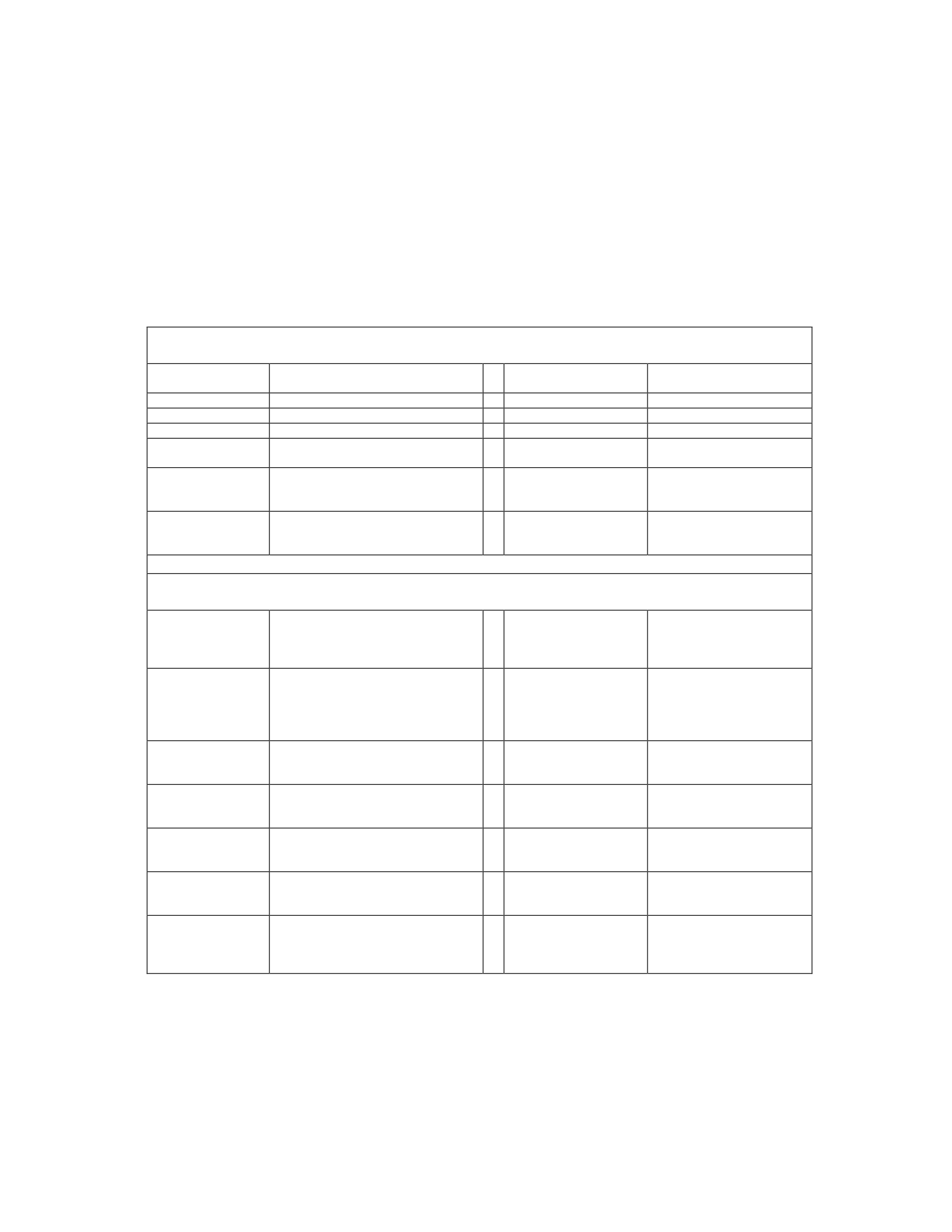
(McClure, 2010), Besides the NASA, GSA and NBC, other examples of federal, state
and local government agencies using cloud-computing technology are listed in Table 1.
Table 1. Federal, State, and Local Agencies using Cloud Computing
(Kundra, State of Government Sector Cloud Computing, 2010)
FEDERAL AGENCIES
DoD (U.S. Army)
Army Experience Center
Department of the
Interior
Agency-wide E-mail
DoD (U.S. Army)
Enterprise E-mail
GSA
USA.gov
DoD (DISA)
Rapid Access Computing Environment
GSA
Agency-wide E-mail
DoD (DISA)
Forge.mil
NASA (Ames Research)
World-Wide Telescope
DoD (USAF) Personnel Services Delivery
Transformation NASA (Jet Propulsion
Laboratory) Be A Martian
DoE (Lawrence
Berkeley National
Labs)
Cloud Computing Migration
Social Security
Administration
Online Answers
Knowledgebase
Department of
Health and Human
Services
Supporting Electronic Health Records Recovery Accountability
and Transparency Board Recovery.gov Cloud
Computing Migration
STATE AND LOCAL AGENCIES
State of Colorado
(Office of
Information
Technology)
Launching an Enterprise Cloud
City of Canton (Georgia)
E-mail
State of Michigan
(Department of
Technology
Management and
Budget)
MiCloud
City of Carlsbad
(California)
Communication and
Collaboration Services
State of New Jersey
(NJ Transit
Authority)
Customer Relation Management
City of Los Angeles
(California)
E-mail and Office
Productivity
State of New
Mexico (Attorney
General’s Office)
E-mail & Office Productivity
City of Miami (Florida)
311 Services
Commonwealth of
Virginia (IT
Agency)
Application Development Platform
City of Orlando (Florida)
E-mail
State of Wisconsin
(Department of
Natural Resources)
Collaboration
Klamath County
(Oregon)
Office Productivity
State of Utah
(Department of
Technology
Services)
Cloud Computing Services
Prince George’s County
(Maryland)
School District E-mail

30
Foreign Government Public Sector Cloud Computing
Governments in other countries have adopted cloud computing technologies as
well. The government of the United Kingdom has created the “G-cloud,” a government-
wide cloud computing network, as a basis for funding a standardized environment for
running public services (Glick, 2009). European nations are also implementing IT
solutions around cloud computing services in health services, management of
government sector housing, transportation service networks, and education services
(Wyld, 2010). Japan’s Ministry of Internal Affairs and Communications plans to build a
massive cloud-computing infrastructure to support all the government’s IT systems
allowing the various ministries to integrate hardware and platforms to promote
standardization and consolidation of government’s IT resources (Rosenberg, 2009).
China’s efforts in cloud computing have been organized by local governments
and leaders. The government of Wuxi, in order to attract more firms to it’s local
economic development project, is working with IBM to build a cloud computing center to
provide on-demand computing services. (Wyld, 2010). The Vietnamese government and
universities are working with IBM to leverage the cloud computing model to help
establish a new department called Service Science Management and Engineering in
Hanoi (Nystedt, 2009). The government of Thailand is preparing to set up a private
cloud-computing platform in efforts to improve development and implementation of e-
commerce applications (Hicks, 2009).
Cloud computing is being implemented in both the commercial and government
sectors. Both sectors are taking advantage of using either using a public, private,
community or hybrid deployment clouds. While cloud computing is still in the beginning

31
stages in the government sector, commercial industry is more established in the use of
cloud computing. Unfortunately, the successes of cloud computing in the commercial
industry might not translate to success in the government sector. By examining current
IS theories, the perceived viability and its relationship to the willingness to implement a
new technology can be ascertained.
Current Theories
There are several theories that might be used to test the adoption, implementation
and success of information systems (IS) and information technologies (IT). Since the
seventies, research has contributed to develop a better of understanding of the causes for
low success rates of implementing costly information systems. The Technology
Acceptance Model proposes that perceived ease of use and perceived usefulness
influence other variables on technology acceptance (Davis, 1989). The DeLone and
McLean IS Success Model created a multidimensional measuring model with
interdependencies between different success categories (DeLone and McLean, 1992).
The Computer Self-Efficacy Theory demonstrated the utility of self-efficacy to
understand individual computing behavior (Compeau and Higgins, 1995). The Model of
PC Utilization confirms the importance of the expected consequences of using PC
Technology (Thompson et al., 1991). Task-Technology Fit states that IT will have a
positive impact if the IT capabilities match the task performed by the use (Goodhue,
1998). The Fit-Viability Model proposes that the fit and viability of the technology will
increase the performance (Liang, 2007), and the Fit-Appropriation Model, which argues
that IS performance is affected by fit and appropriation support (Dennis, et al., 2001).

32
These theories have been used to both predict and facilitate the use of IS. Several of
these theories are reviewed in the following pages.
Technology Acceptance Model (TAM)
The Technology Acceptance Model (TAM) was written by Fred Davis in 1986 as
a Doctoral dissertation and published in 1989 in Management Information Systems,
Quarterly (MISQ). TAM posits that perceived ease of use and perceived usefulness are
of primary relevance in the acceptance of computers and IT (Figure 5). Davis defined
“perceived ease of use” as the degree to which an individual believes that it would be
effortless to use a particular system. He defined “perceived usefulness” as the degree to
which an individual believes that use of a particular system would improve job
performance. Thus, TAM posits that, taken together, these two beliefs lead to a
behavioral intention to use the target information system and that it is this intention that
leads to actual system use. He tested his model and survey scales in both a real-world
setting and a lab experiment and found good support for it.
Since then, TAM has been used as a foundation to study many different
information systems and technologies. For example, Lederer et al (2000) extended TAM
to examine the World Wide Web (WWW). They revealed that the ease of understanding
a web site by a user and the ease of finding the web site by a user predicted ease of use
while information quality predicted usefulness in a revised web site. In another study,
Viability of TAM in Multimedia Learning Environments: A Comparative Study (Saade,
Nebebe, and Tan, 2007) extended TAM to create a Multimedia Acceptance Model. Their
testing determined TAM is a solid theoretical model, which can extend to the

33
multimedia-learning environment. These examples show the utility of TAM in predicting
users acceptance of a variety of technologies.
As applied to cloud computing, the Technology Acceptance Model predicts that
cloud computing services would be accepted as long as a user believed it would be easy
to use and would improve their job performance. Some of the benefits of cloud
computing, such as flexibility, increased efficiency, cost-reductions and reliability, can
affect whole organization. Cloud computing is not directly aimed at improving any
particular user’s job performance, but a benefit is that it allows the organization to devote
more resources to running the business instead of running an in-house IT department.
The TAM model focuses on the end-user of a system, whereas cloud computing affects
the entire organization. Therefore, this individual-level model is not the appropriate
model to use to answer an organization-level research question.
Figure 5. Technology Acceptance Model
Source: Davis (1989), Venkatesh et al. (2003)

34
Task Technology Fit (TTF)
While TAM states the perceived usefulness and ease of use are relevant to
acceptance of computers and IT, Task Technology Fit (TTF) (Figure 6) can be described
as “the extent that technology functionality matches task requirements” (Goodhue, 1995).
TTF argues that the use of information technologies can produce different results
dependent on the configuration of the technology and the specific task that is used being
accomplished. Much like TAM, TTF has been extensively tested.
Figure 6. Task-Technology Fit
The Task Technology Fit Theory proposes that when the technology fits the task
and user abilities, then performance gains should be expected. Goodhue and Thompson
studied TTF and Individual Performance (1995) and their new model asserts that
information technology must be used and be a good fit with the tasks that it supports to
have a positive impact on individual performance. Zigurs and Buckland (1998) studied
TTF and Group Support Systems. Their research showed that an appropriate
task/technology fit should result in higher performing groups. They found that fit was

35
explicitly defined and linked to group performance. They also found that task complexity
is a fundamentally important aspect of task and is relevant in a Group Support System
environment.
Fit has been studied at many levels. Task-Technology Fit (Goodhue, 1995 and
Goodhue and Thompson, 1995) measure fit at the individual level. Zigurs and Buckland
(1998) measure TTF at the group level. TTF has also been measured at the user level in
e-tourism, user computer self-efficacy and in knowledge management (Turner et al.,
2006). Usoro et al. (2010) combined TTF and TAM to study e-Tourism. They chose
TTF since it was reasonable to expect that the consumer will favor e-commerce
applications that match their shopping tasks. Another example of examining TTF was by
Gebauer, Shaw and Gribbins (2010). They built on previous TTF research and presented
a model establishing the fit between managerial tasks, mobile information technology,
and the mobile use context, supporting that a good fit positively affects task performance.
Cloud computing provides benefits at the organization level, so expanding TTF to
examine if the cloud computing technology would fit with the organizations computing
tasks/needs is the next step in examining TTF.
Fit-Viability Model (FVM)
The Fit Viability Model (FVM) expands on the task-technology fit model.
Anthony Tijan, founder and executive vice president of a consulting firm, developed the
original Fit-Viability Model (FVM) in 2001. Developed from working on more than 100
consulting projects with a wide range of companies that were examining Internet
initiatives, Tijan replaced two criteria used in portfolio analysis with business viability

36
and business fit. Business viability captured qualitative data about a likely payoff or an
investment and fit measured the degree in which the investment matches a company’s
processes, capabilities, and culture. Taken together, these two constructs were used to
predict the eventual performance of a portfolio. With only slight modifications, this
model has been used to specifically address the adoption of a new technology.
Liang and Wei (2004) studied the adoption of mobile technology in business. At
the time, there were few studies on how organizations decide on adopting new (mobile)
technologies and which factors determine the success or failure of adopting this new
technology. In the revised FVM (Liang and Wei, 2004; Liang et al., 2007), the Fit-
Viability model integrates task-technology fit with the general belief of organizational
viability of information technology. According to their model, fit measured the extent to
which a feature of a technology matches the needs of the task. Viability measured the
extent to which the organizational infrastructure is prepared for adopting the technology
(Figure 7).
Figure 7. Fit-Viability Model
In FVM, the TTF framework is modified to use more objective assessment of the
match between the task and the technology without considering the abilities of the
37
individual. In their Adoption of Mobile Technology in Business (2007), only the nature of
the technology and the requirement of the task were considered for fit. For mobile
technology, mobility and reachability were two features for measuring fit. If the
requirements of task coincide with these qualities, its fit with mobile technology would
be high and higher performance would be expected.
In the FVM, viability was defined as the extent to which the organization is ready
for the technology and was posited to be influenced by economic feasibility, technical
infrastructure, and the social readiness of the organization (Liang et al, 2007). Economic
feasibility was measured by assessing the cost benefit of an IT project to determine
whether it can bring financial or intangible returns and determine whether the IT project
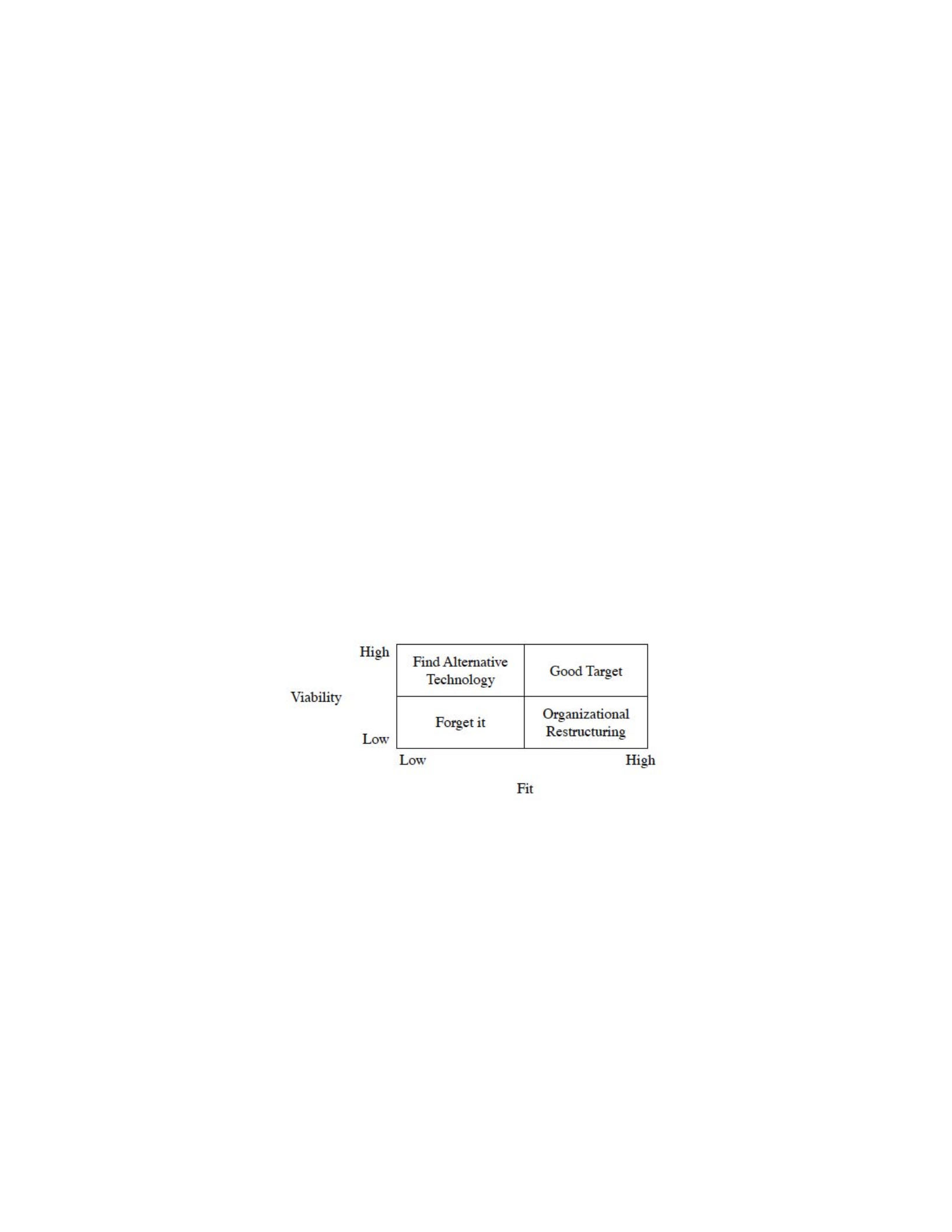
could bring a competitive advantage. In the Fit-Viability framework (Figure 8), a high
viability and high fit would result in the technology being a good target to implement.
Figure 8. Fit-Viability Framework
In the FVM (Liang et al., 2007), the technical infrastructure was defined as being
composed of the IT platform and the information service required for supporting the
application. Liang et al., (2007) concluded that the technical infrastructure of an
organization includes computing, information management, and the associated

38
communication platform. The IT infrastructure provides the basis that supports
technological operations and augments business development.
The final factor of viability includes the social readiness of the organization.
Liang et al., (2007), state that user satisfaction and system usage are two common criteria
for evaluating the success of IS implementation. The organizational factors used in the
FVM model include the process reengineering, employee acceptance, and top
management support. Liang and colleagues saw the influence of business processing
reengineering, user competence and top management support as fundamental influences
indicating organizational readiness.
Several theoretical and practical contributions resulted from their study. They
concluded that organizations should consider both system fit and viability when
considering adoption of a new technology, mobile technology in this case. Previous
research focused on either the fit or organizational factors, which were not complete by
themselves. The Liang study validated the FVM framework and showed its practical
applicability. Using the framework in Figure 8, organizations can determine whether an
information technology is fit and viable for the organization, or whether changes need to
be made to the organization or the technology.
One limitation of this theory was that it needed to be expanded to other
technologies or issues other than mobile technology (Liang et al., 2007). One of the
goals of this thesis was to test a new model where fit and viability affect organizational
willingness to implement cloud computing.

39
Viability-Willingness Model for Cloud Computing
The fit-viability model was adapted to help answer this thesis’ second research
question. It was specifically adapted to help determine whether a new technology (i.e.,
cloud computing) is a viable option for implementing in an organization and if the
organization is willing to implement the technology. This new Viability-Willingness
Model (VWM) posits that the cost of the technology, along with the organizational inertia
and the fit of the technology leads to a perception of viability, which in turns leads to a
perception of willingness to implement the technology. Cost has both a direct and an
indirect relationship with perceptions of willingness. Further definitions and related
hypotheses are detailed below (Figure 9).
Figure 9. Research Model: Viability-Willingness Model
Cost.
Gartner (2008) states the total cost of ownership (TCO) model includes the cost of
hardware installation, software optimization, warranty and any license or maintenance
agreements, IT labor and PC support costs, maintaining security assurance and software
upgrades. Gartner (2008) also includes cost analysis of mobility requirements; migration
costs and planned long-term expenses such as capital expenditures, and lifecycle
replacement. The TCO model should act as a framework to help understand major cost

40
categories associated with cost-ownership. In addition, cost/benefit analysis must include
tangible and intangible costs and benefits including network stability and bandwidth
constraints. Cloud computing promises to cut operational and capital costs and let IT
departments focus on strategic projects instead of keeping datacenters operational (Velte
et al., 2010).
The VWM proposes that if costs of a new technology are perceived to be more
than the current technologies, then the perceptions of viability of the new technology
would be expected to decrease. Cost, while related to the perceived viability, could also
be directly related to the perceived willingness to implement the technology. Perceptions
of only a limited cost savings from implementing a new technology would be expected to
adversely affect the organization’s willingness to adopt that technology. Therefore it is
hypothesized that:
H1: Cost is negatively related to the organization’s willingness to implement
cloud computing in the Department of Defense.
H2: Cost is negatively related to the perceived viability of cloud computing in the
Department of Defense.
Organizational Inertia.
Organizational inertial is the degree to which members of the organization have
been motivated to learn, use and accept new systems (Seddon, 2010). The unit of
analysis chosen for assessing organizational inertia is the organization, not the individual.
In older organizations, systems and behavior tend to become institutionalized, acting as a
source of organizational inertia, which limits the ability of organizations to adapt

41
(Hannan and Freeman, 1977). As organizations age and get better at replicating routine,
they also become more inert (Hannan and Freeman, 1984). Hannan and Freeman (1984)
also argue that an organizational change creates a liability of newness that exposes
organizations to a higher risk of failure.
Change in an older organization creates new roles and new relationships similar to
those of a new organization (Brown, 2002). During implementation of the technology
and follow-on upgrades, substantial energy is spent on change-management, training, and
support to overcome organizational inertia. Each project is different, so organizational
inertia is measured for each project (Seddon, 2010). Since cloud computing has different
service models, implementing cloud computing is considered one project for this thesis
instead of multiple projects encompassing different services. Organizational inertia is
important for determining whether the organization is likely to accept change or not.
Since inertia limits the ability of the organization to adapt, high organizational inertia
would reduce the viability of a new technology. Thus:
H3: Organizational inertia is negatively related to the viability of cloud
computing.
Fit.
Drawing from Zigurs and Buckland’s (1998) definition of fit, we define fit as the
match of the computing platform with the computing needs of the organization. Fit is
important to determine whether cloud computing technology is suitable for the
organization’s computing needs. If the IT staffing personnel do not agree that it is a good
fit for the organization, then viability is expected to decrease. Therefore:

42
H4: The fit between cloud computing and the organization’s computing needs are
positively related to viability of cloud computing.
Viability.
Viability is defined as the extent to which the organization is ready to implement
new technologies considering the economic feasibility, IT infrastructure, and readiness of
the organization (Liang et al., 2007). The viability construct has three influences that
determine whether a new technology, cloud computing in this case, is viable for an
organization. The total cost of ownership of using or operating the technology
determines the economic benefits. The inertia of the organization determines if the
organization quickly adapts to new ideas and technologies. Finally, the technology must
fit the needs of the organization. Those three forces influence whether a new technology
will be viable. Viability is important in determining if the technology is of practical use
in the organization and helps determine the willingness to adopt a new technology.
H5: Viability of cloud computing is positively related to the willingness to adopt
of cloud computing.
Willingness.
Willingness is defined as being disposed to, inclined toward or openness to
something. While there are not many studies in willingness to implement or adopt
information systems, there are several conceptual models that discuss willingness.
Werner (2004) proposes that a willingness to use telemedicine was affected by the
participants’ attitudes towards telemedicine, the relationship between the patient and

43
physician and the level of anxiety toward technology. Chambers et al. (2003) examined
the impact of certain personality types and inclination to use technology. Using the
Myers-Briggs Type Indicator and a questionnaire designed to use technology, they found
that intuitive/thinking types of personalities were more likely to use technology. Turner,
Thomas, and Reinsch (2004) followed communication scholars in predicting that the
perceived attributes of a new technology will significantly affect the willingness to try the
technology. They argued that task situations (types of medical care in their study) would
affect the relative importance of the perceived attributes.
In applying the VWM to cloud computing, the perception of willingness is
defined as the openness to implement cloud computing in the organization. The
perceived viability of cloud computing and the cost of cloud computing are posited to
affect the willingness construct. Perceived willingness is how comfortable or open the
organization is to the new technology. Cost is directly and negatively related to
perceived willingness since the cost of implementing and using the technology could
affect whether the technology is implemented. In addition, viability is positively related
to the perceived willingness. If the technology is a viable option for the organization,
than there should be an increase in the willingness to implement the technology. Having
established the theoretical foundation for this thesis, chapter three discusses how the
subsequent research was conducted.

44
III. Methodology
The Research Strategy
This thesis examines the appropriateness of cloud computing as an IT model for
the DoD. To address the two research questions and test the hypotheses takes two
complimentary approaches. The first approach is to compare perceptions of cloud
computing between the commercial industry IT personnel and DoD IT personnel. The
second approach is to test the theory and relationships in the Viability-Willingness Model
for cloud computing in order to examine the relationship between viability and
willingness to implement a new technology. The results from these two efforts will
provide answers to the research questions.
A survey methodology was selected for both approaches. The survey method was
selected since its purpose is to describe attitudes, beliefs, and behaviors and is also a
common tool used for testing a certain theory or causal relationships. Surveys are
developed to describe the attitudes, beliefs and behaviors of a population (Patten, 2009).
Researchers select a sample of the population, study the sample, and then make an
inference to the population from the sample data. Surveys can also be quantitative
research. That is, results from the survey are easy to quantify which allows for statistical
analysis.
Survey Development
This survey was developed specifically to address the viability of cloud
computing and the willingness to adopt cloud computing. Throughout the research, it
was discovered that there were few studies that addressed cloud computing at the

45
organization level. The vast amount of surveys addressed the use or acceptance of a
technology that was already implemented. Since such approaches do not specifically
meet the needs of this research, a survey was exclusively designed for the VWM. The
only construct for which questions were previously validated was the organizational
inertia questions. The remainder of the questions was developed to address the constructs
in the model and to match a question in the IDC Enterprise panel survey. All questions
were tested in a pilot study to verify that they addressed the individual constructs. After
editing the questions, the survey was tested one final time before being distributed to the
sample.
Survey Structure
All questions that address hypotheses in the model are based on a five-point
Likert scale where 1 is represented as the strongly disagree or the most negative aspect of
the question and 5 represents strongly agree or the most positive aspect of the question.
The survey is broken down into multiple sections (Appendix B), each section addresses a
hypothesis of the model. The sections of the survey are: Cloud Computing, Economic
Impact, Organization Information, Reforming Federal Information Technology
Management, and Demographics.
The sections relate to hypotheses and have several specific questions that address
aspects of each hypothesis. The first part of the survey develops the respondents’
knowledge of cloud computing, how well cloud computing aligns with their
organization’s computing needs, and the issues surrounding cloud computing. The next
section, Economic Impact addressed economic aspects of implementing cloud

46
computing. The third section of the survey, Organization Information, examines the
effect of cloud computing in the organization. The fourth section, Reforming Federal
Information Technology Management, analyzes whether organizations are willing to
implement cloud computing using different types of service providers. The last section
records the demographics of the sample.
Survey Sample
A sample of convenience was used in this study since it was not possible to
contact all IT personnel across the Armed Services, the DoD, and the various DoD
civilians and contractors. The sample is from a list of IT personnel from the U.S. Army
Information Systems Managers Functional Area 53 list hosted by the U.S. Army Military
Academy (53Listserve).
Army Information Systems Managers were selected as the primary sample from
the DoD IT personnel population. Information Systems Managers are usually trained at
Fort Gordon, work in a variety of positions ranging from Automation Staff Officers, who
work on computers, networks, and manage information systems to positions in the DoD
and Army CIO/G6 that work in policy and procedures. Additionally, other DoD
information technology personnel were invited to participate in the survey.
Data Analysis
To determine the appropriate sample size needed to answer the research
questions, a power analysis was conducted according to the procedure outlined by Cohen
(1992). The power analysis revealed 64 survey responses were required to detect the

47
expected medium effect size statistical difference in the sample. Therefore, data
collection continued until 83 useable responses were obtained.
To compare the results on the question on the issues of cloud computing between
the two surveys, a Z-test is used. A Z-test compares the sample and population means to
determine if there is a significant difference between the samples when the sample is
large (n>30). The Z-value for the 95% confidence interval is +- 1.960. If the sample
returns a test statistic of less than 1.960 then we fail to reject the null hypothesis. If the
test statistic is more than +- 1.960, then we reject the null hypothesis since the samples
returned are significantly different.
Next, the appropriateness of the Viability-Willingness model was assessed using
SmartPLS 2.0. SmartPLS is a structural equation-modeling tool based on Partial Least
Squares (PLS). PLS has an advantage over traditional statistical techniques since it is
able to concurrently test the measurement and structural models without being covariance
based. Additionally, PLS is not constrained to data sets that meet homogeneity and
normality requirements (Chin et al., 2003). A significant advantage of PLS is that it can
handle smaller sample sizes relative to other structural techniques. These inherent
strengths make PLS a highly appropriate approach to analyzing the data set.
Using SmartPLS version 2.0 (Ringle, Wende & Will, 2005), the model was
evaluated to assess the measurement model and the structural paths between the
constructs. To obtain reliable results and t-values, 200 random samples of 83 were
generated using a bootstrap procedure. Finally, the hypotheses were evaluated by
assessing the sign and significance of the structural path coefficients using two-tailed t-
test statistics. Since SmartPLS does not calculate goodness-of-fit statistics. R2 values

48
were evaluated to assess the ability of various proposed relationships to predict a
significant degree of explanatory power in each construct and t-values were evaluated to
determine the strength of the various paths (Schuessler, 2009).
Instrument Validation
The validation process started by constructing a PLS model where the individual
survey questions were assessed to determine how well they measured their associated
construct. First, the internal consistency (reliability) statistics were examined. Reliability
tests determine if the set of variables are consistent with the intended item being
measured. All reliability measures meet the acceptable lower limits of .70, and one
exceeds the lower limit of .60 (see table 2) for a newly defined scale (Hair et al., 2006).
Next, the survey items are assessed for construct validity by performing a factor
analysis of each item in the survey and calculating the reliability of the resulting factors.
According to Hair et al. (2006), item loadings of .5 or greater represent items of practical
significance. After removing any items that that fail reach .5 on any factor, it was
determined if the items for each construct loaded higher on their own construct than on
other constructs. All survey items loaded above the threshold (see table 3) and were kept
for the remaining analysis.
Finally, determining discriminant validity requires testing the average variance
shared between a construct and its measures (AVE) (Gefen et al., 2000). The average
variance shared between the constructs and their measures should be greater than the
benchmark of .5 (Fornell and Larcker, 1981) and greater than the corresponding
correlations between constructs themselves (see table 4). The matrix supports the

49
discriminant validity of our scales in that the elements in the matrix diagonal are higher
than .5 in all cases, and higher than the off-diagonal correlations between the elements in
their corresponding row and column. Therefore, the variables and the constructs pass the
tests for reliability and validity as noted in chapter 4.
Chapter Summary
This chapter outlined the methodology of this research demonstrating one way to
analyze survey samples. By adapting the FVM to a Viability-Willingness model, we are
attempting to determine the perceived viability and the perceived willingness to
implement cloud computing in the Department of Defense.

50
IV. Analysis and Discussion
Chapter Overview
This chapter presents the results from the survey and the tests of the model
proposed in Chapter 2. First, the results from the cloud computing survey of DoD IT
personnel are compared with the survey results from the International Data Corporation
Enterprise Panel, 2009 Survey on Cloud Services. Since government and commercial
industries have different customers, stakeholders, and goals driven by the nature of the
two industries, a comparison of the question regarding the issues associated with cloud
computing is used. The second part of this chapter presents the results of the analysis of
the Viability-Willingness Model using SmartPLS.
Comparative Analysis: Commercial and government sectors
International Data Corporation conducted a survey of its commercial enterprise
panel in 2009 on the top challenges and issues of cloud computing. Two-hundred sixty-
three IT executives/CIOs and their line-of-business colleagues completed the survey
about their companies’ use of, and views about, IT Cloud Services. As part of the survey,
the respondents were asked to rate the challenges/issues ascribed to the cloud/on-demand
model (Figure 10). The Y-axis is the concerns with cloud computing, while the X-axis is
the number of personnel that stated the concern was significant. The survey used a 5-
point Likert scale ranging from 1=Not Significant/Concerned to 5=Very
Significant/Concerned.

51
The top three issues for the commercial industry as noted from the IDC survey
were security, availability, and performance (Figure 10). These issues were also rated as
the most significant in 2008. IDC explains this as a call for better service level assurance.
The number four issue in the survey was a concern that cloud computing might cost more
than current computing models. This perception seems to contradict what proponents of
the cloud model tout, which is that implementing cloud computing leads to cost savings
(Kundra, 2010). The issue of bringing the data or services back in house was rated as the
fifth most important. That is, the survey respondents were concerned that if the cloud
computing model did not work, it would be more difficult to move the services back
under the organization’s control. The last two issues that the survey members stated were
an issue was the ability to integrate with in-house services and the ability to customize
the service to what is needed. These are important since they both convey the amount of
organizational control over their data and services.
The IDC Enterprise panel survey from 2009 shows that there are still major
concerns about cloud computing. While it was expected to find that security,
performance and availability were issues with a majority of the respondents; on-demand
costs and the ability to bring the services back in house were not. There is still
uncertainty about the overall cost of cloud computing and whether it will be a success as
a computing platform for organizations.
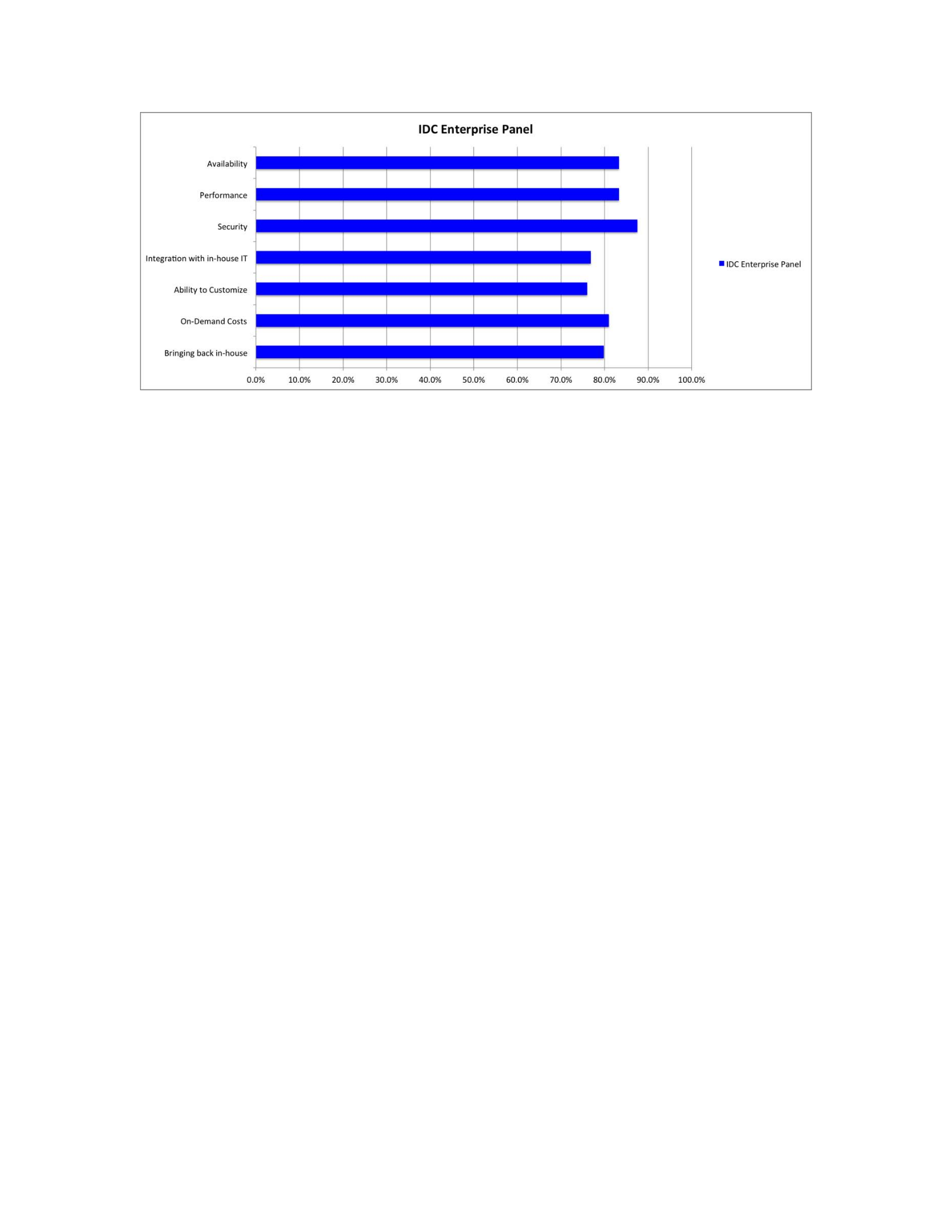
52
Figure 10. IDC Commercial Enterprise Panel 3Q09 Survey Results
For comparison to the IDC Commercial Enterprise Panel survey, the 2010-2011
cloud computing in the military survey done in this research sampled DoD IT personnel
(n=83) on the same issues of cloud computing. On the military IT survey, the
respondents rated the challenges/issues ascribed to the cloud/on-demand model (Figure
11). The Y-axis is the concerns with cloud computing, while the X-axis is the number of
personnel that stated the concern was significant. Both surveys used a 5-point Likert
scale ranging from 1=Not Significant to 5=Extremely Significant. Following the IDC’s
method, the results were taken from the respondents that selected 3, 4, or 5 and measured
in percentages. For an accurate comparison of commercial and government industries,
scales and questions were maintained for data integrity.
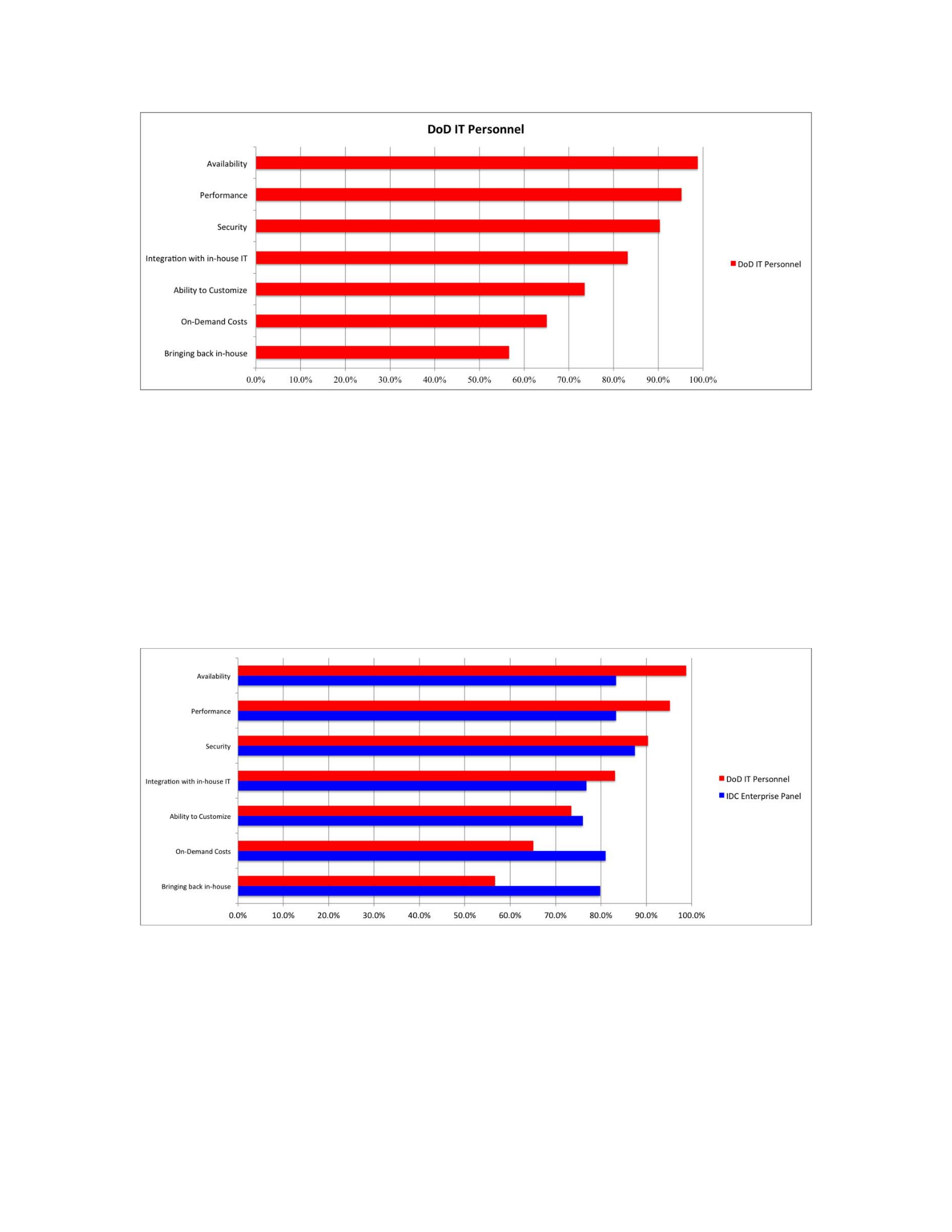
53
Figure 11. Military IT Personnel Survey Results
A comparison of the results of the question of rate the challenges/issues ascribed
to the cloud/on-demand model shows similarities and differences between the two
samples (Figure 12). The results are taken, and measured in percentage of the
respondents that selected 3, 4, or 5.
Figure 12. Comparison of Survey Results

54
Availability.
Availability is the first issue compared between the two surveys. Availability is
the state of being able to ensure users can use any information resource when ever and
whenever it is needed. There is a significant difference (Z = 3.464) between the numbers
of military IT personnel (98.8%) that rated Availability as a significant issue compared to
the number of IDC Enterprise personnel (82.9%). Availability depends on the
accessibility of the data, the system, the applications and the infrastructure used to access
that data. The loss of availability is critical if there is a serious incident, network failure,
or natural disaster. The difference between the two surveys for availability is significant.
For the military IT personnel, the availability of the data and services could be critical to
the completion of mission in a combat zone. For example, the Army mission is to
provide to combatant commanders the forces and capabilities necessary to execute the
National Security, National Defense, and National Military Strategies. The Army’s
Signal Corps supports this mission by providing and managing communications and
information systems support for the command and control of combined arms forces. The
lack of availability of the network, data, or information systems could affect the mission.
The commercial industry does not have the same mission as the Department of Defense.
Where loss of availability would impact the commercial organization in terms of time
and profit, it might not affect National Security, which would be a reason for the
significant difference in the number of personnel that annotated availability as a
significant concern.

55
Performance.
The next issue selected as significant was performance. Cloud computing
performance can either be client-oriented or cloud-oriented (Linthicum, 2010). Client-
oriented performance is where users constantly interact with the cloud provider where
there is latency with the constant back-end machine-to-machine communications that
occurs between the SaaS provider and the browser. Cloud-oriented performance is where
the processing occurs in the “cloud” and is compared to the performance of completing
the processing on-premise. There is a significant difference (Z = 2.553) between the
numbers of military IT personnel (95.2%) that rated Performance as a significant issue
compared to the number of IDC Enterprise personnel (83.3%). While it was not defined
as whether performance was client-oriented or cloud-oriented performance, more military
IT personnel thought performance was an issue. Client oriented performance issues may
not be as noticeable in terms of latency unless there is network saturation (Linthicum,
2010). Whereas cloud-oriented performance can be an advantage, performing large
amounts of processor intensive calculations or queries can take many hours on the local
network. The scalable nature of the cloud allows additional processors to be quickly
added resulting in calculation or queries taking minutes to complete. Commercial
industry has more experience with cloud computing and a lower number of the IDC
Enterprise panel survey respondents stated that performance is an issue. For DoD IT
personnel, latency on a bandwidth constricted tactical network is not acceptable and
therefore more survey respondents would rate this as an issue.

56
Security.
While respondents from both surveys feel that security is a significant issue in
itself, there was no difference (Z = 0.537) between the numbers of DoD IT personnel
(90.4%) and the IDC Enterprise sample (87.5%). While security was not explicitly
defined in either survey, as stated in chapter 2, FISMA defines three security objectives
for information and information systems that serve as the basis for NIST’s analysis:
Confidentiality, Integrity, and Availability. In both surveys, the respondents thought
security was a significant issue. Security of the cloud service, whether protecting mission
essential data or services for the military or protecting the security of the customers’ data
and information for the commercial sector, is important for their organization. Losing the
security of data or information in the cloud for government or commercial industries can
have severe consequences. The security of the cloud may provide a roadblock on its
implementation.
Integrate with in-house IT.
The ability to integrate cloud computing offerings and services with in-house IT is
the next issue compared between the two surveys. There is not a significant difference (Z
= 1.009) between the numbers of military IT personnel (83.1%) that rated the ability to
integrate with in-house IT as a significant issue compared to the IDC Enterprise
personnel (76.8%). Organizations that use cloud computing want to maximize the
control of their business core systems, which can be in-house legacy systems and
integrate these systems across externally sourced cloud services (Gens, 2008).
Both government and commercial industry can feel this integration between in-
house and cloud computing systems is more of an issue. The military has a large number

57
of program-managed systems that perform specific functions. For example, the Army
uses a number or Army Battlefield Command Systems (ABCS) that provide specific
services for the commander and integration with these systems might prove to be
difficult. In the commercial industry, an organization’s inventory management systems
could be core business systems that is proprietary and could be difficult to integrate with
cloud services. In both cases, these systems could be more difficult to integrate with
other systems that use cloud services.
Ability to customize services.
Next, the number of personnel stating that the ability to customize software and
applications is a significant issue is compared between the two surveys. There was no
difference (Z = 0.223) between the numbers of military IT personnel (73.5%) that rated
the ability to customize services as a significant issue compared to the IDC Enterprise
personnel (76.0%). One of the advantages of cloud computing is the ability to quickly
customize software, platforms and cloud infrastructures. Organizations want to
customize “off-the-shelf” cloud services and tailor these services to the needs of their
businesses (Gens, 2008). It is plausible that the need for better fitting services drove a
large number of respondents in both surveys to report customization as an issue with
cloud computing.
On-demand costs.
On-demand cost is the next issue in the survey. On-demand costs are costs
incurred when using cloud computing in the organization. There is a significant
difference (Z = 2.878) between the numbers of military IT personnel (65.1%) that rated
On-demand costs as a significant issue compared to the IDC Enterprise sample (81.0%).

58
The on-demand cost issue may seem to contradict the reason for moving to a cloud
computing technology, given that cost savings are purported to be a benefit. One reason
behind this discrepancy is organizations fear that employees may use the service more
than what is budgeted. Commercial industry is conscious of what they spend and of their
profits, where the government sector does not necessarily see the bottom line, but they
work within budgets. The difference in the number of respondents stating on-demand
costs is an issue between the two samples is expected. The commercial industry has
more experience in implementing cloud computing, therefore they may see on-demand
costs exceed their initial expectations whereas the government sector is just beginning to
implement cloud services. Cloud computing can allow their organization to save money
on infrastructure (Del Nibletto, 2010), IT staffing and maintenance costs (Kundra, 2010).
If on-demand costs start to exceed the previous budget for the same type of services, then
the cloud computing service model would become an issue.
Bringing IT services back in-house.
Bringing IT services back in-house is the last issue compared between the two
surveys. There is a significant difference (Z = 4.202) between the numbers of military IT
personnel (56.6%) that rated bringing IT services back in-house as a significant issue
compared to the IDC Enterprise personnel (79.8%). Organizations wonder whether using
cloud services will lead to the same type of proprietary services that are dealt with today.
Proprietary services and software make it difficult to move services back in-house if they
are not satisfied with the cloud (Gens, 2009). Military IT personnel either do not think
they will move to cloud computing or only move limited services to the cloud and leave

59
core processes in-house. Therefore, there would be less military IT personnel that
thought this was an issue compared to their civilian counterparts.
Summary.
The comparative analysis of the IDC Enterprise panel 2009 IT Cloud Services
Survey and the 2010-2011 military IT personnel cloud computing in the military survey
had interesting results. More military IT personnel cited availability, performance and in-
house integration as significant issues than did personnel on the IDC Enterprise panel.
There was also a significant difference between the number of IDC Enterprise panel
personnel citing on-demand costs and bringing the IT services back in-house as concerns
than the number of personnel in the military IT survey. Cost may be expected to be more
important to commercial industry than the government sector, but cloud computing costs
are supposed to be lower than current computing methods and technologies. Conversely,
there was no difference in the number of respondents that rated security as a significant
issue, nor was there a difference in the number of respondents who saw the ability to
customize software as a major issue. Interestingly, stating that on-demand costs are a
significant issue goes against the reasons for implementing cloud computing. Bringing
services back in-house could be an issue if the cloud computing model does not work.
Since more than 79% of the commercial industry survey respondents rate this as an issue,
it could mean there is a lack of confidence in the long term viability of the cloud
computing model.
The survey comparison looked at the issues and concerns with cloud computing.
These issues are part of the viability of cloud computing. The needs of the organization
are considered when determining if the new information technology, or cloud computing,

60
is a viable technology. As noted above, there are ideas in the military about cloud
computing, which directly affect the perceived viability and perceived willingness to
implement the technology.
The remainder of the data in the military IT cloud computing survey was used to
examine the perceived viability and its relationship with the willingness of IT personnel
to implement cloud computing in the military. The following section examines the
relationship between the perceived system viability and perceived willingness to
implement cloud computing.
Discriminant Validity and Reliability
The Viability-Willingness Model for cloud computing looks at the relationship
between the perceived viability and perceived willingness. In the VWM, perceived
viability is directly determined by cost, organizational inertia and fit. Viability and cost
determine organizational willingness to implement. To test the model and its constructs,
the validity and reliability must first be tested.
Discriminant validity and reliability of the constructs were tested using Conbach’s
Alpha, as recommended by Hair et al. (2006). Reliability tests determine if the set of
variables are consistent with the intended item being measured. The internal consistency
(reliability) statistics using PLS results were: .691 for Fit; .845 for Inertia; .785 for
Viability; and .904 for Willingness (Table 2). The reliability thresholds for Inertia,
Viability and Willingness meet the acceptable lower limits of .70, while Fit exceeds the
lower limit of .60 for a newly defined scale (Hair et al., 2006).

61
Table 2. Reliability Statistics
Next, the convergent validity was determined by examining whether all items
loaded highly on their respective construct on PLS. A common rule of thumb is a
loading greater than .70 (Yoo and Alavi, 2001). In the Viability-Willingness Model, all
items loaded on their respective constructs from .783 to .899 (Table 3). All values lower
than .40 were removed for easier interpretation.

62
Table 3. Convergent Validity
In the cost construct, COST2 and COST3 did not load on the Cost construct and
were removed from the model. Additionally FIT3, FIT4, FIT5, FIT6, WILL5, WILL6,
WILL7, and WILL8 did not load on adequately on their construct and were therefore
removed from the model.
Determining discriminant validity requires testing the average variance shared
between a construct and its measures (AVE) (Gefen et al., 2000). Table 4 presents the
AVE matrices and construct correlations for the model. The matrix supports the
discriminant validity of our scales in that the elements in the matrix diagonal (AVE
results are bold) are higher in all cases than the off-diagonal elements in their
corresponding row and column. Each construct AVE should be higher than the
benchmark of .60 as recommended by Fornell and Larcker (1981). In addition, the AVE

63
must be larger than its correlation with other construct, and each time should load more
highly on its assigned construct than other constructs (Gefen, 2000).
Table 4. Discriminant Validity
Results
After assessing discriminant reliability and validity, the model is then processed
using SmartPLS. The results are depicted in Figure 13. All hypothesized relationships
except for one were supported. Path significance was estimated using a bootstrapping
procedure with 200 resamples, which tends to provide reasonable standard error estimates
(Mathieson, et al., 2001; Ravichandran and Rai, 2000). There was not a significant direct
affect of Cost on Willingness (-0.132 n.s.), which means that cost was not directly related
to Willingness (H1). There was a significant direct effect of Cost on Viability (-0.188*),
which supported H2: Cost is negatively related to Viability. Hypothesis 3 theorized that
Inertia is negatively related to and has a direct effect on Viability. PLS showed that
Inertia had a significant affect Viability (0-0.332*), supporting H3. H4 hypothesized that
Fit would be positively related to Viability. H4 was supported in that Fit had a
significant direct affect on Viability (0.601*). Lastly, H5 stated that Viability was
positively related to Willingness. Viability had a significant direct affect on Willingness
(0.457*) and therefore supported H5.

64
Figure 13. Viability-Willingness Model Structural Results
The Viability-Willingness Model explained 48.5% of the variance for viability
perceptions and 26.2% of the variance for the perceived willingness to implement cloud
computing. The model measures whether cost, inertia, and fit are significant predictors
of viability. Viability of cloud computing is partially formed by cost, organizational
inertia and the fit of the technology with the needs of the organization. Willingness is
only partially predicted by the viability of cloud computing. Performance, availability
and security might be significant factors in predicting viability since over 90% of military
IT personnel respondents cited those issues as significant.
The other, unmeasured, perceived attributes of cloud computing could also have a
direct affect on the perceived willingness to implement it. While viability contributed to
26% of the variance explained, the attitude towards cloud computing might be more of a
factor than whether the technology is viable for the organization. All questions on the
issues of cloud computing were selected by more than 50% of the respondents in the

65
military IT cloud computing survey as being significant. The perception that cloud
computing has multiple significant issues reduces the willingness to implement the
technology. Therefore, just because cloud computing is viable for an organization does
not mean there is going to be a willingness towards implementation; nonetheless it is a
major factor.
Chapter Summary
The collected data from the 2010-2011 Cloud Computing in the Military survey
suggests that cost, inertia, and fit were significant in predicting viability; additional
modifications to the survey instrument would increase the explained variance at the cost
of the parsimony of the instrument. This modification would also increase variance
explained in willingness, although adjusting the survey to include personality and attitude
might also significantly increase the perceived willingness.

66
V. Conclusions and Recommendations
Chapter Overview
This chapter reviews the two research questions and presents the conclusion of
this study. Sections discussing research limitations, follow-on research, and
recommendations for future research follow this section. In the general conclusion, the
benefits of this research are highlighted.
Research questions and Conclusions
This research was an exploratory examination of the opinions military IT
personnel of cloud computing in the in the Department of Defense and the Army. Its
research was motivated by desire to understand two overall research questions:
(1) Is cloud computing perceived as a viable technology in the DoD/Army?
(2) Is there a perceived willingness to implement cloud computing in the
DoD/Army?
The research provided an understanding whether military IT personnel perceive
cloud computing as a viable technology for their organization as well as the connection
between the perceived viability of new technologies and the willingness of IT personnel
to implement them.

67
A Difference Between Government and Commercial Industry.
A comparative analysis between IDC Enterprise Panel personnel and military IT
personnel demonstrated several differences between commercial and government sectors.
Availability, performance, and integration with in-house IT were identified by a higher
percentage of military IT personnel as significant issues than the IDC Enterprise panel.
Security and the ability to customize had the same significance between the two groups,
while the IDC Enterprise panel rated on-demand costs and bringing the IT services back
in house as more of an issue than did military IT personnel. The military IT personnel
appear more worried about availability, performance and integrating with in-house IT
systems and less concerned with cloud computing costs and the ability to bring services
back in-house at a later date.
Perceived Viability of Cloud Computing.
The Viability-Willingness Model was an exploratory model designed to
understand the interaction of the perceived viability of cloud computing and the
willingness to use it. While the model measured 48.5% of the variance in the viability of
cloud computing, there are other factors discovered in the survey that might also predict
the viability of cloud computing. The VWM demonstrated that cost, inertia and fit play a
role in the determining the viability of cloud computing.
Perceived Willingness to Implement Cloud Computing.
Perceived willingness to implement cloud computing can be more of an attitude
towards cloud computing. The VWM examined viability and cost as measures that

68
would have a direct affect on the perceived willingness to implement. The variance
explained was 26.2%, which indicates other measures would also have a direct affect on
the perceived willingness. Other measures that could affect the willingness to implement
cloud computing include personality traits (Chambers et al., 2003), attitudes towards the
technology (Werner, 2004), and actual task situations that would affect the relative
importance of the perceived attributes of the technology (Turner, Thomas, and Reinsch,
2004). Successful implementation of a new technology (cloud computing) could partially
depend on the willingness to make the changes necessary to make the technology work.
Limitations
There are several limitations to this research. The sample size (n=83) was large
enough to perform the needed analysis. However, a larger sample might allow for
additional statistically robust analysis, which may lead to an increased accuracy of the
inferences about the population, and refined detection of effects in the model. A broader
sample will expand the available tools used for analysis to include covariance-based
analysis. Expanding the sample demographic to include additional IT personnel more
evenly across the Department of Defense and the Federal government would allow for
additional analysis. By increasing the sample frame to include every member of the DoD
IT community from which the sample is taken increases the randomness of the survey
and reduces any biases in the sample.
The survey instrument had limitations. As an exploratory study, some items did
not initially load properly and therefore were not included in the analysis. This might

69
have occurred due to a misunderstanding of words in the question or the question itself.
It can also happen if the questions of the survey measured something other than the intent
of the construct. One set of questions was previously validated and two others loaded
properly on their respective constructs. Using previously validated questions or survey
instrument can lead to an increase of rigor, an increase of data quality and prevent
inaccurate conclusions. The wrong instrument of questions could increase the error in the
model and analysis.
Recommendations for Future Research
This research provided a starting point on determining the perceived viability and
perceived willingness to implement cloud computing in the military. Follow on research
should include increasing the sample frame and sample size to further validate this study.
Other areas for research should include perception differences among armed services,
different IT skill sets, and duty positions. Furthermore, additional research into the top
issues of cloud computing would be valuable in determining why those issues are thought
to be so significant. Additional research is also needed to clarify the relationship between
viability and willingness. This research highlighted that a technology can be a viable in
the organization, yet the organization still won’t implement it. Additional research
should be conducted on why an organization is not willing to implement a technology it
sees as viable. Further analysis is also needed on the difference between government and
commercial industry and the possible implications of implementing a new information
technology.

70
The VWM can be refined through additional research to increase the variance
determined in viability and willingness. A redesign of the cost construct by adding more
dimensions would help to see if a multidimensional construct plays a greater role in the
viability and willingness to implement a new technology. There may be specific parts of
the cost of implementation that affect viability and willingness differently. The
willingness construct should be examined for the influence of personality characteristics,
attitudes toward the new technology and possibly positive and negative affect. A more
in-depth study examining the perceptions of the different types of deployment cloud
models would provide the framework that organizations could use in examining the
viability and willingness to implement the latest technology trends.
Conclusion
Overall, findings suggest that cloud computing may be a viable option for the
Department of Defense, but willingness to implement cloud computing is not the same as
viability. This research indicates that simply because a technology has the potential to
improve an organization, it still may not be implemented. This thesis defined criteria for
measuring the viability and willingness to implement cloud computing. Viability was
affected by cost, organization inertia, and the fit of the technology with the organization.
Willingness was partially determined by viability perceptions, which supports previous
research that organizational attitude toward the technology also affects the willingness to
implement a new technology.

71
Today, the federal government is concentrated on reducing the budget deficit,
while completing the same missions and functions at a reduced cost. Whether it is
freezing pay wages, reducing work force, reengineering business processes or improving
efficiencies, technology can be used as an enabler for working smarter and more
efficiently. There are several areas discussed in the thesis that demonstrated the ability to
use cloud computing to support non-core business functions. Different commercial
industries use cloud computing differently. The DoD can learn from other government
agencies and commercial industries in ways to use cloud computing to reduce costs,
either through reduced hardware purchases, reorganization of personnel and jobs, or by
shifting non-mission essential processes to a cloud provider which would reduce
personnel needed to perform those functions. This research showed that just because
cloud computing is a viable alternative to the current desktop computing platform, the
organization might have a perception that cloud computing would not work. This
perception could hinder how quickly cloud computing is accepted in the DoD.
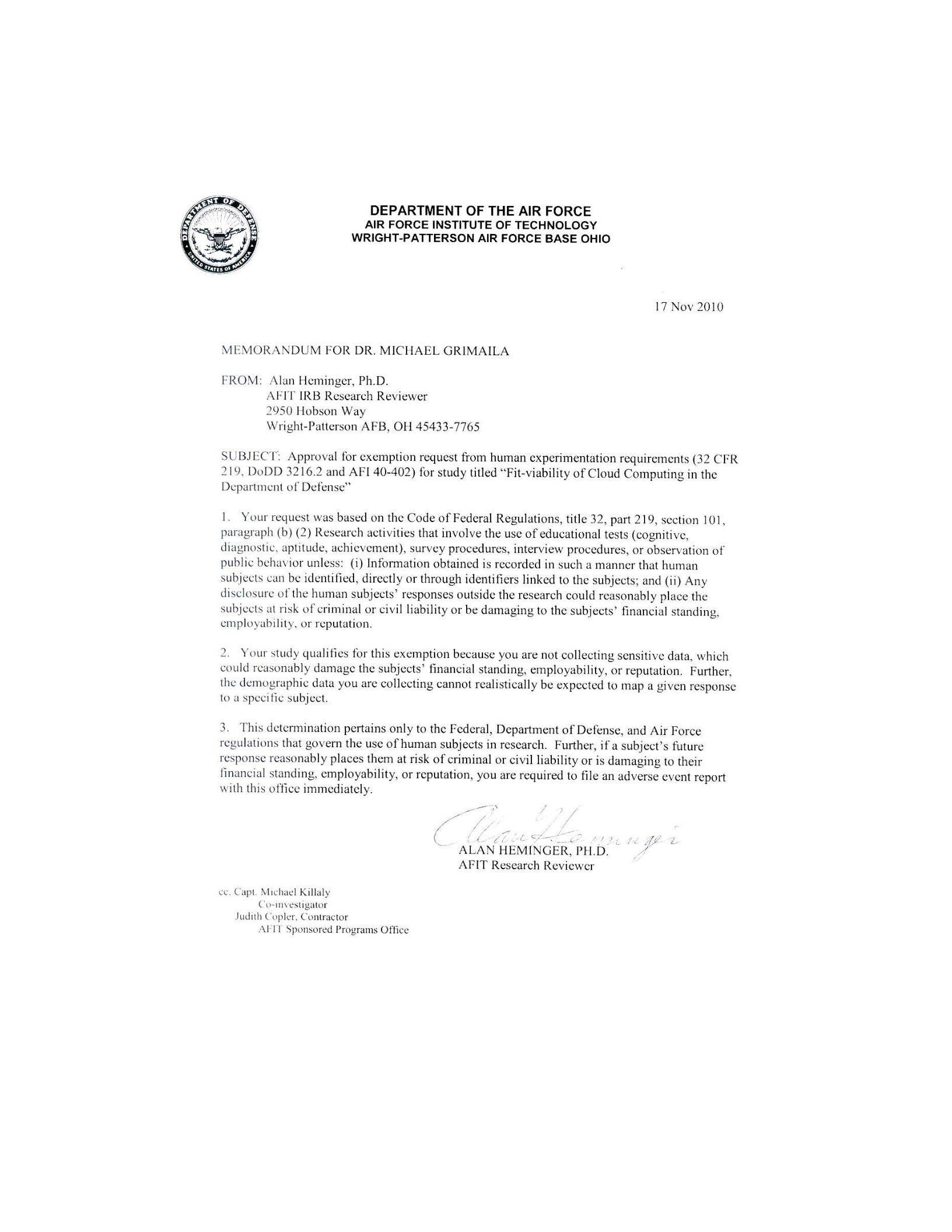
72
Appendix A: SRB Information
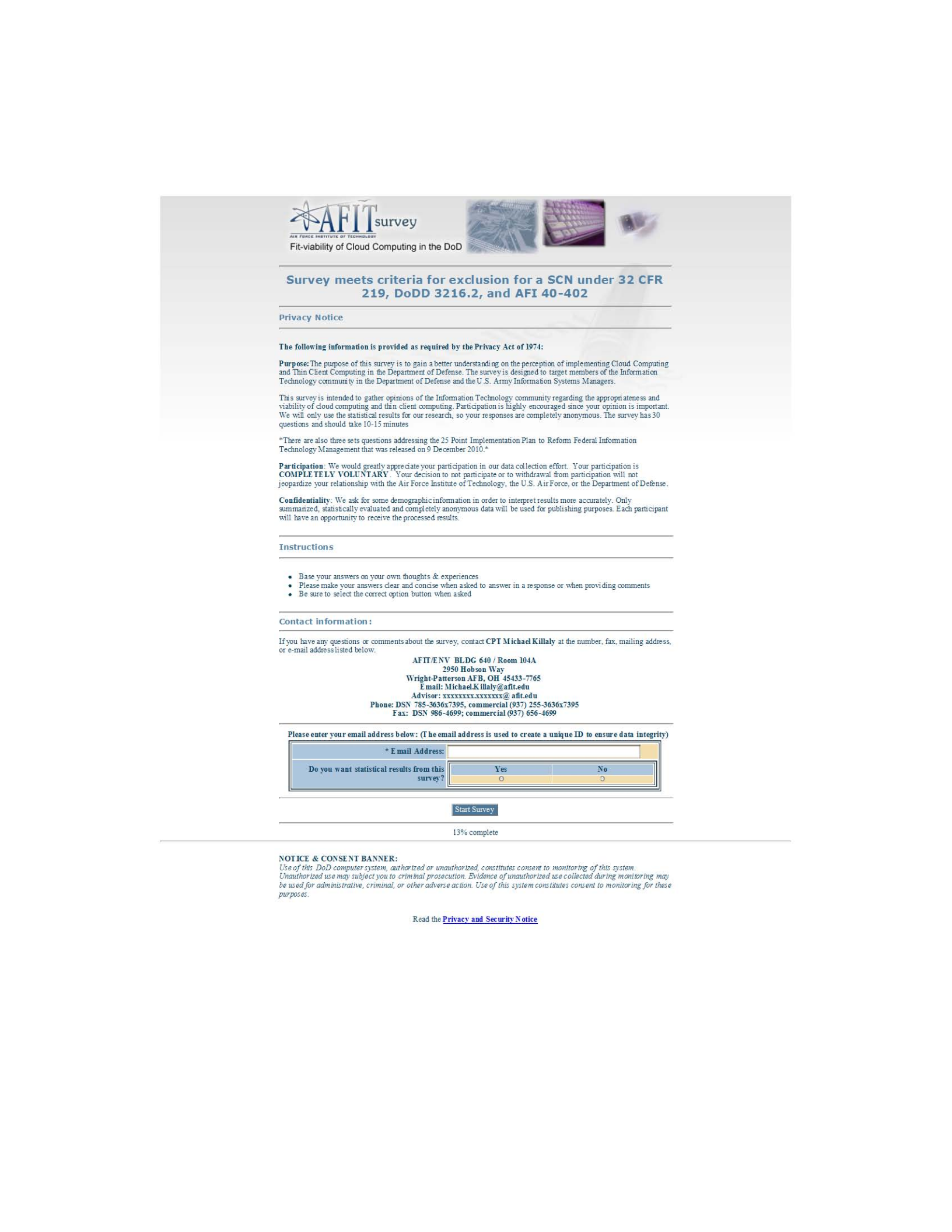
73
Appendix B: Survey Instrument
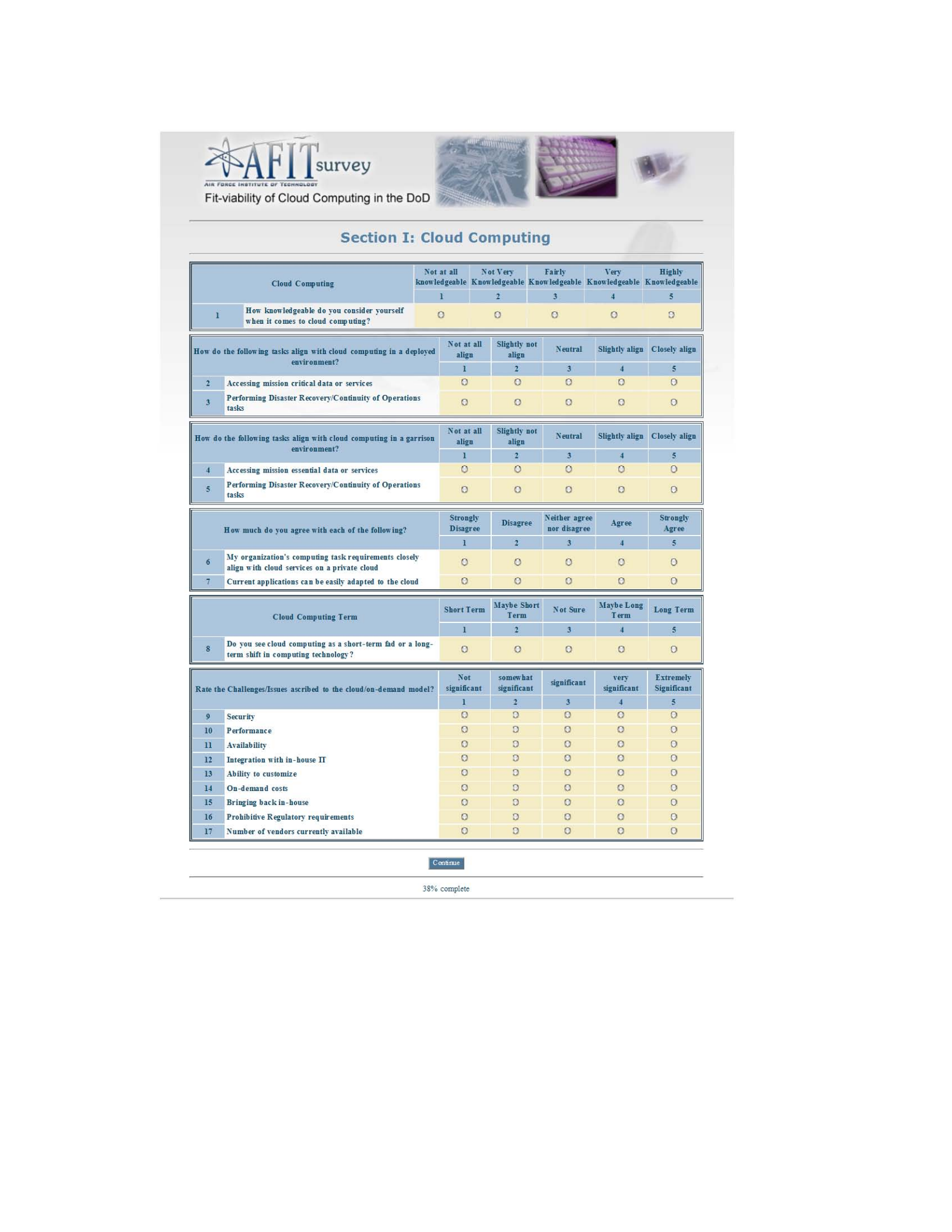
74
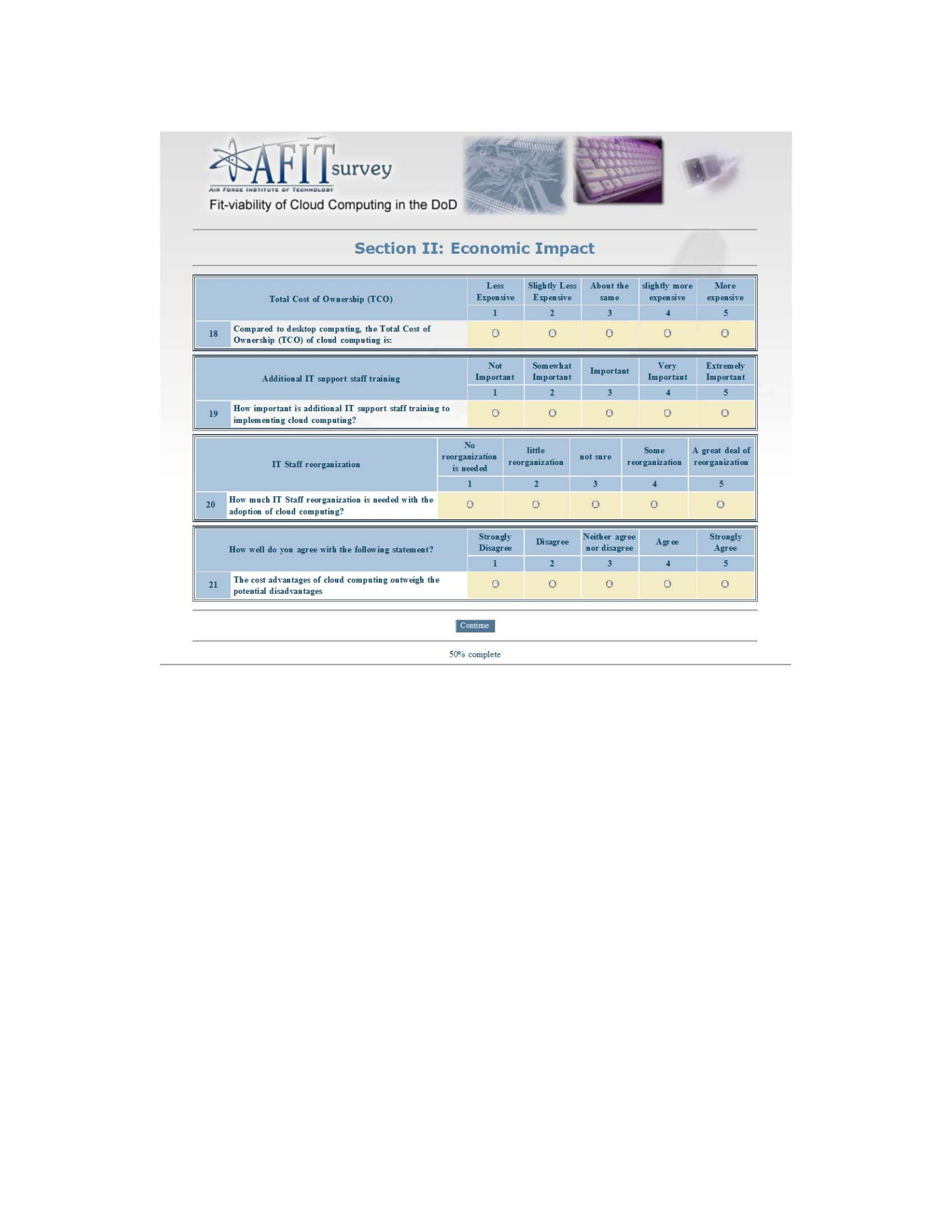
75
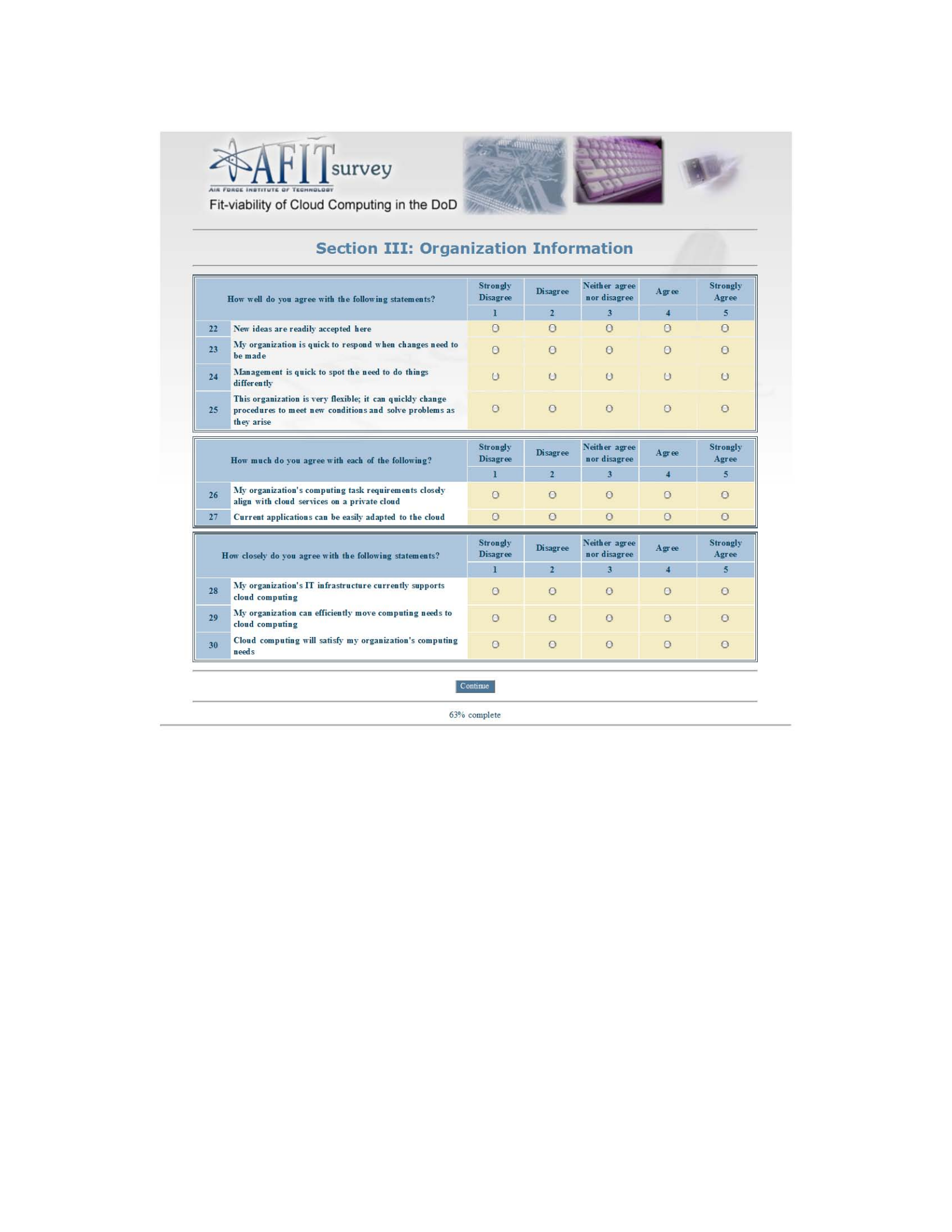
76
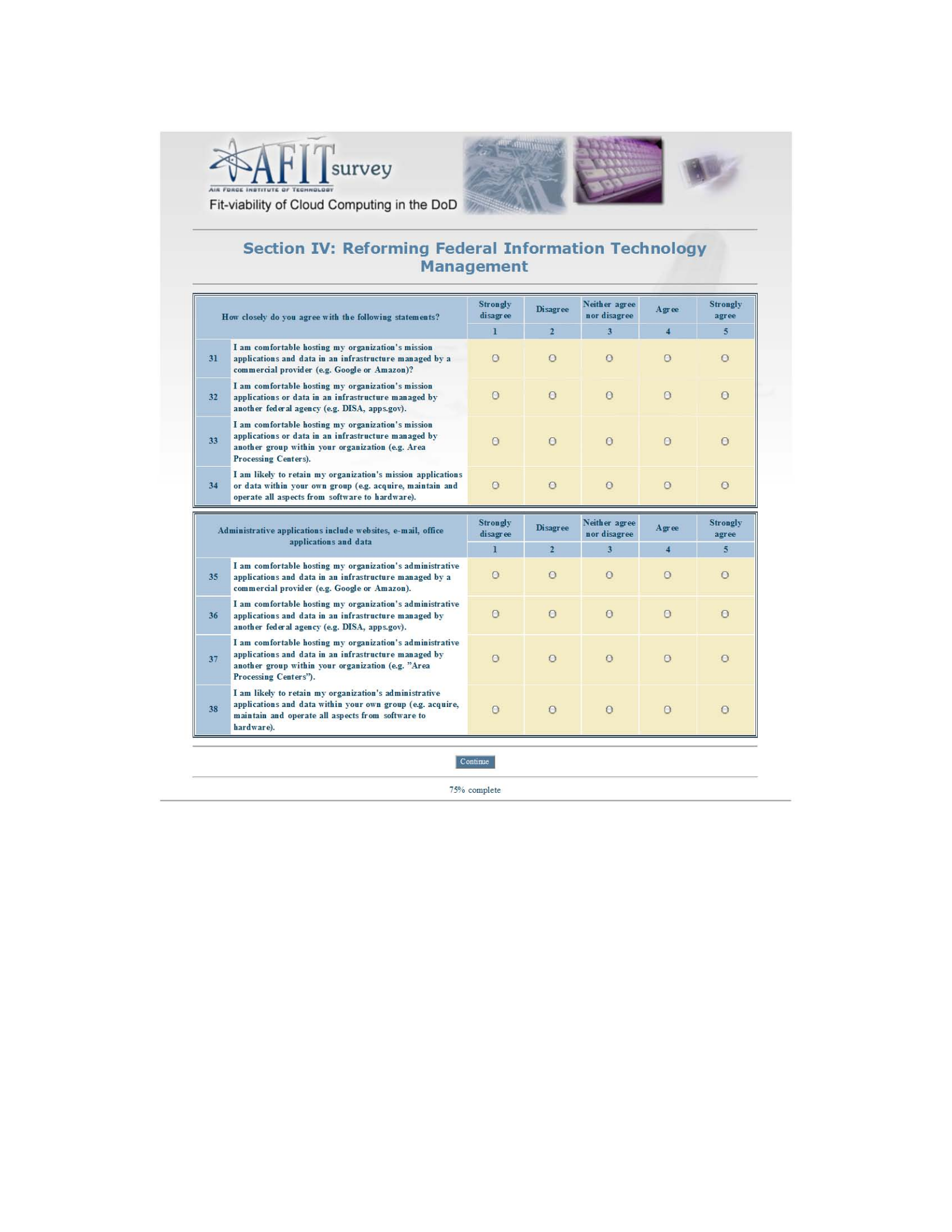
77
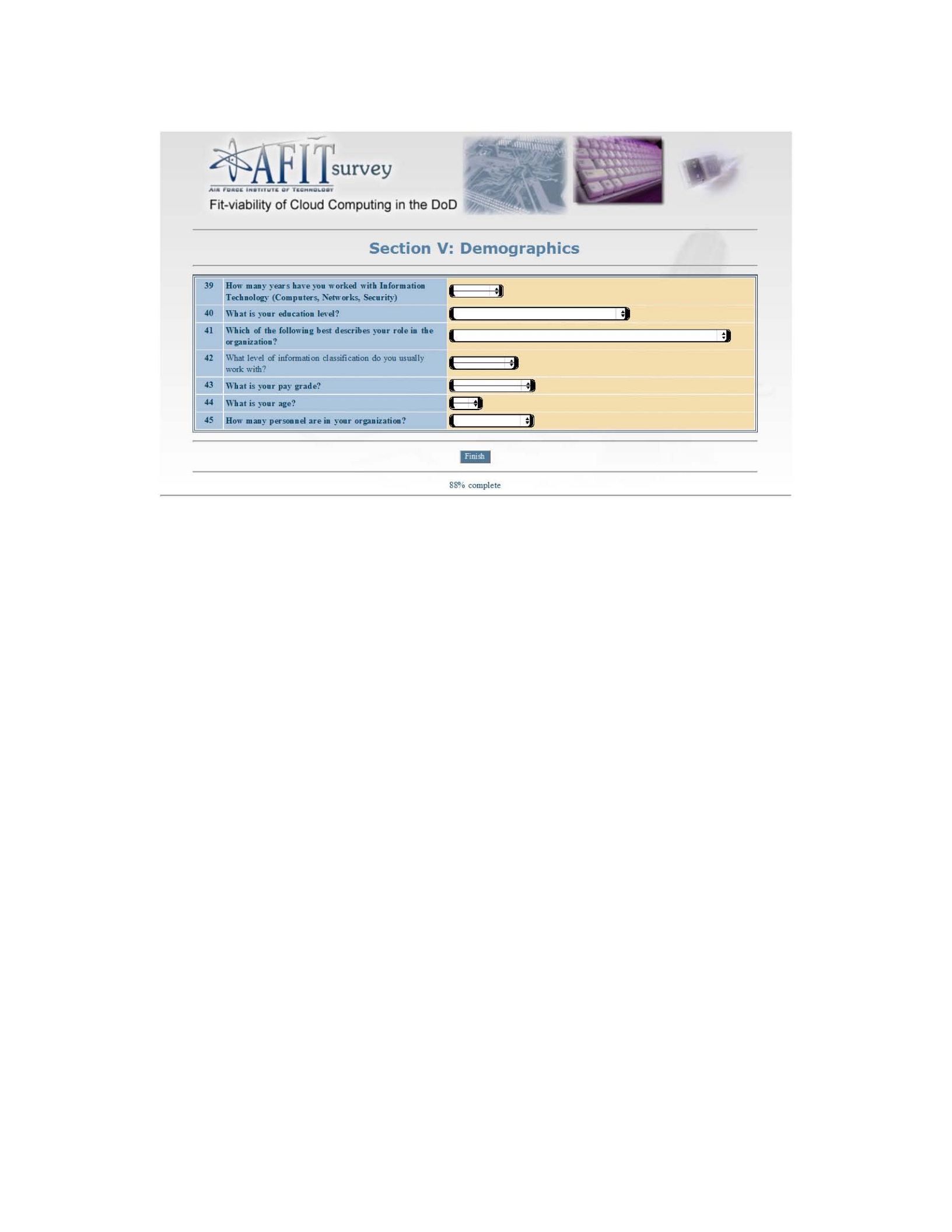
78
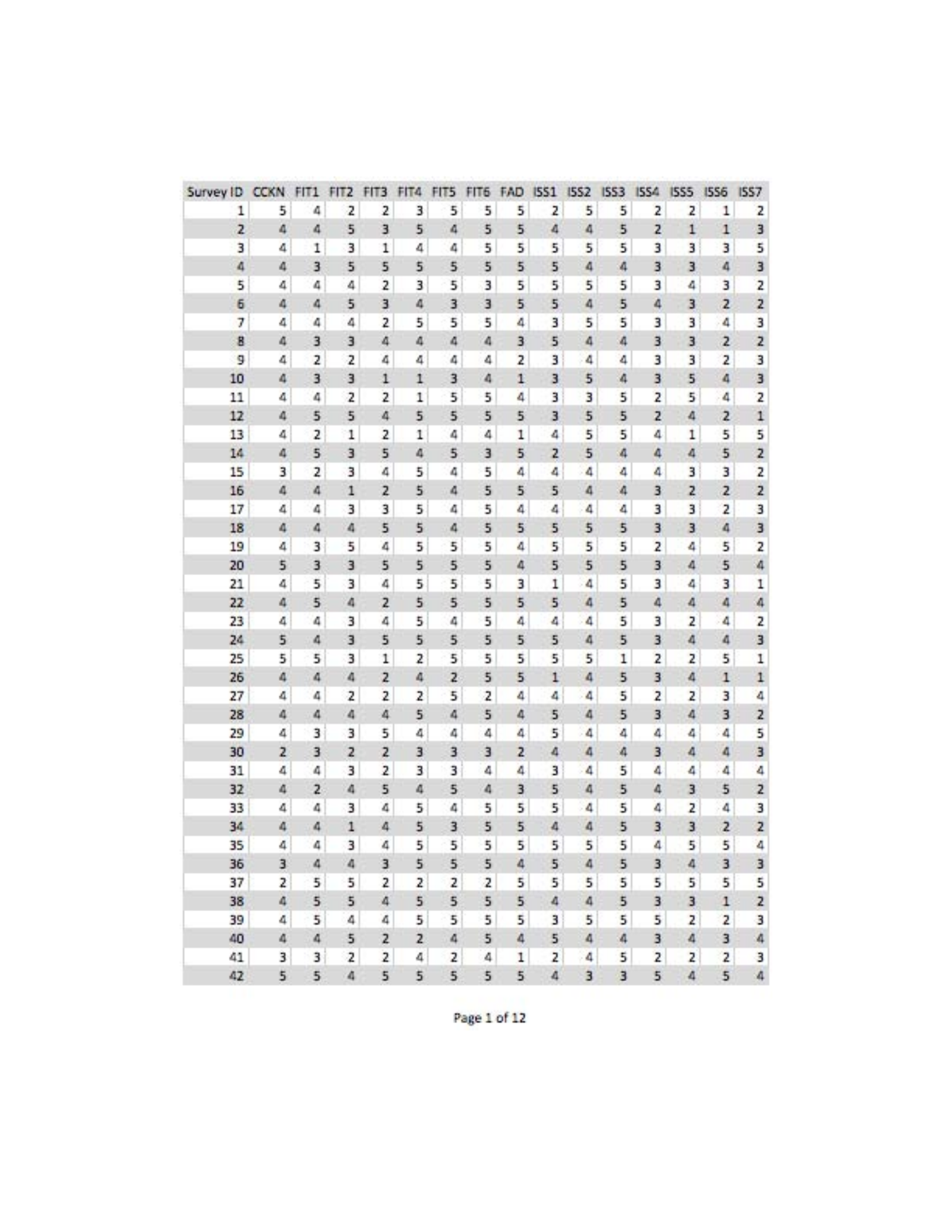
79
Appendix C: Survey Data
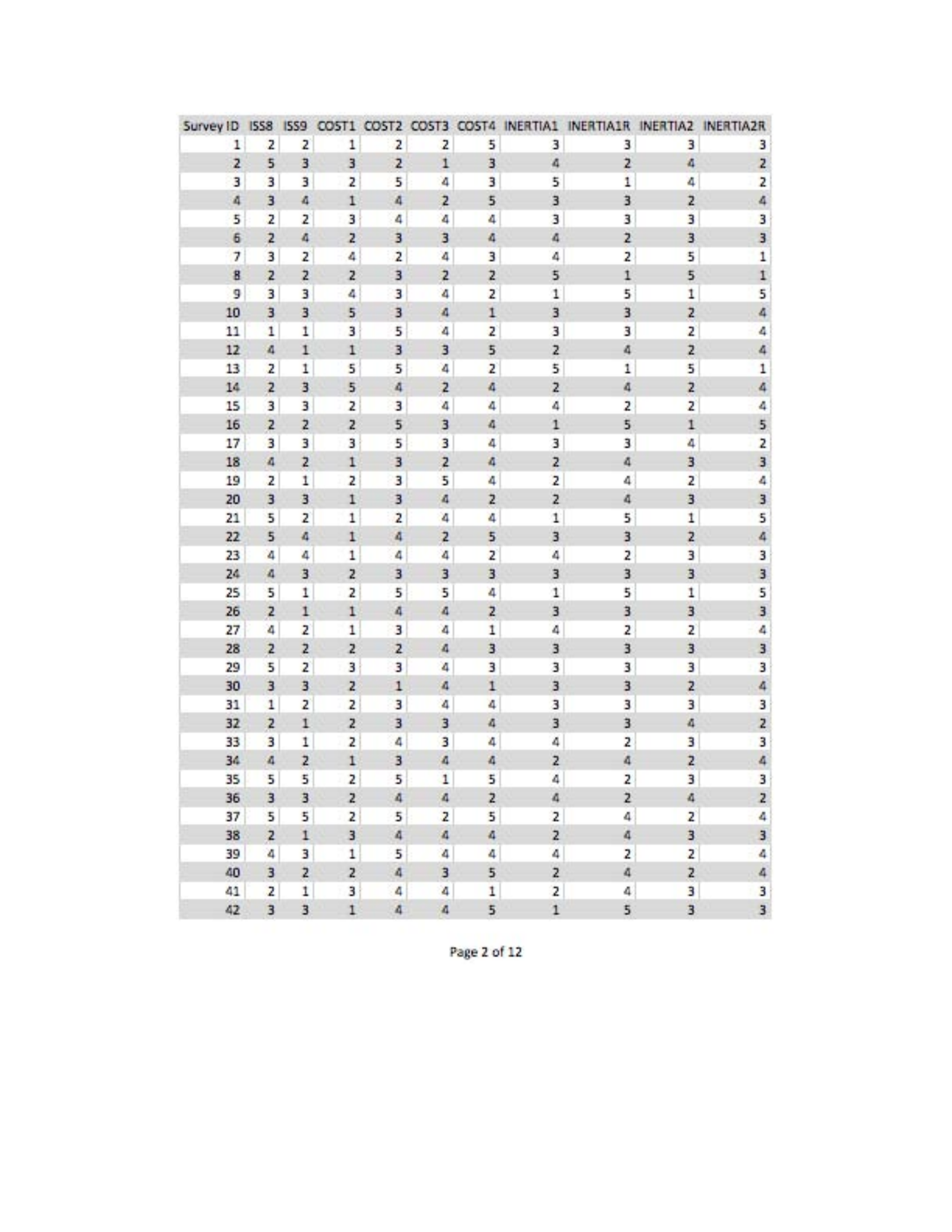
80
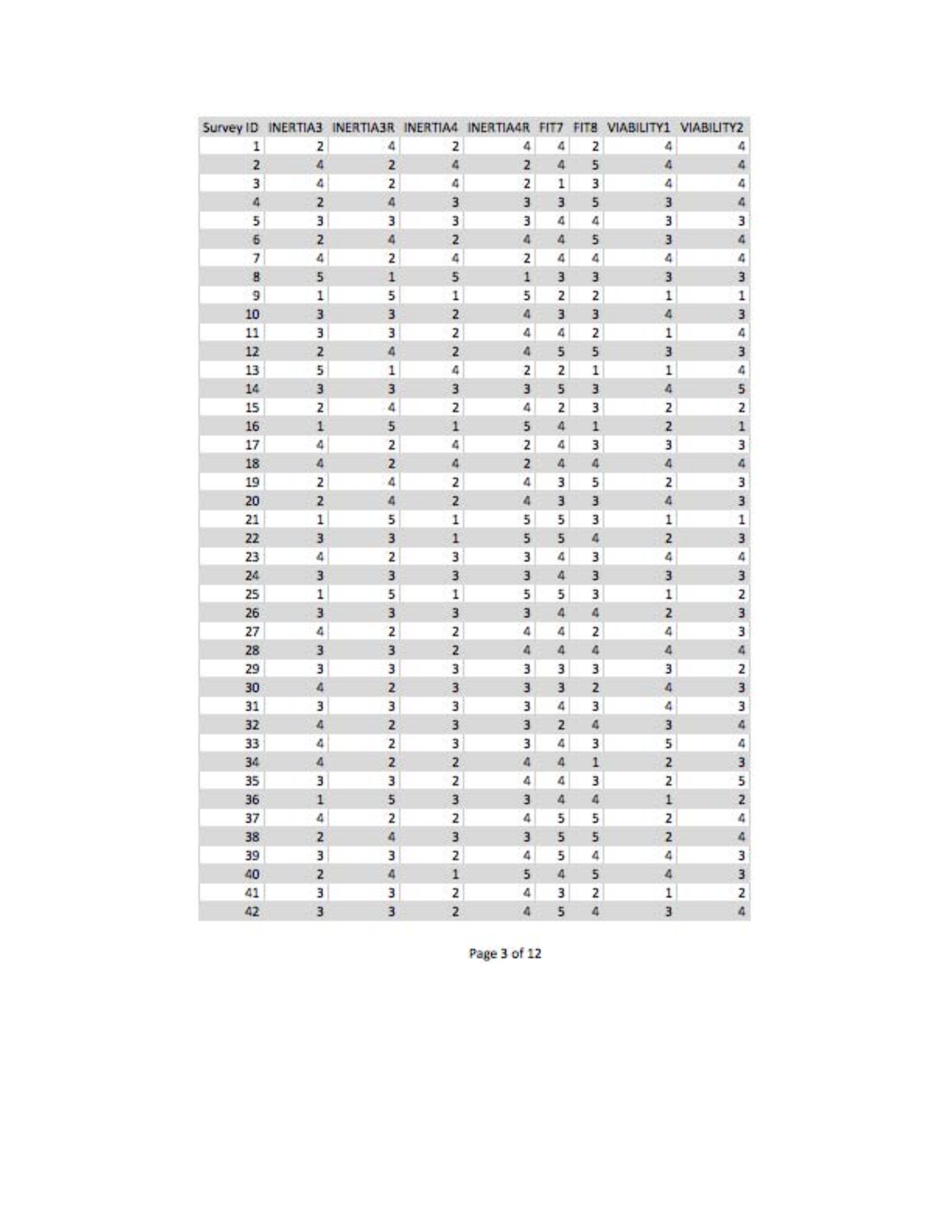
81
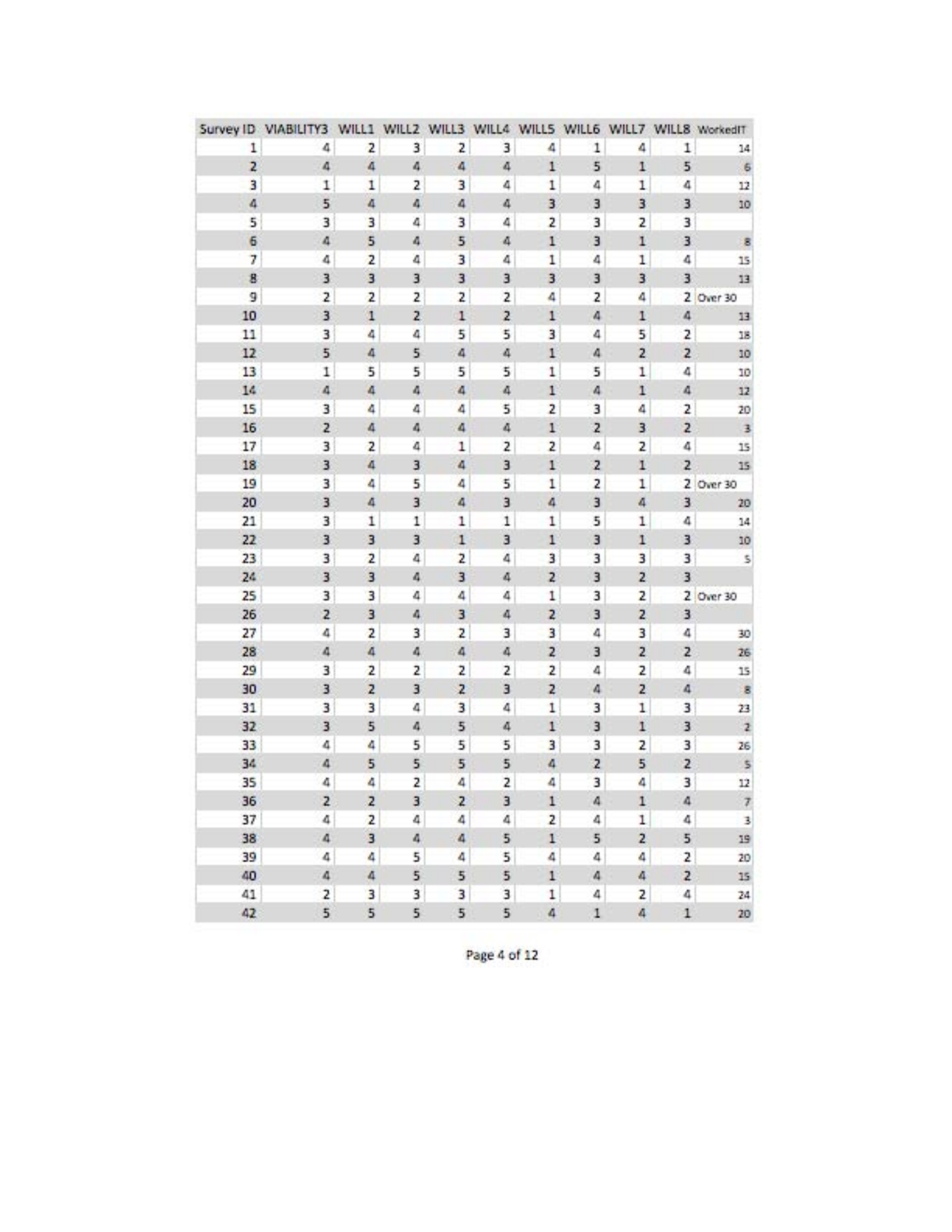
82
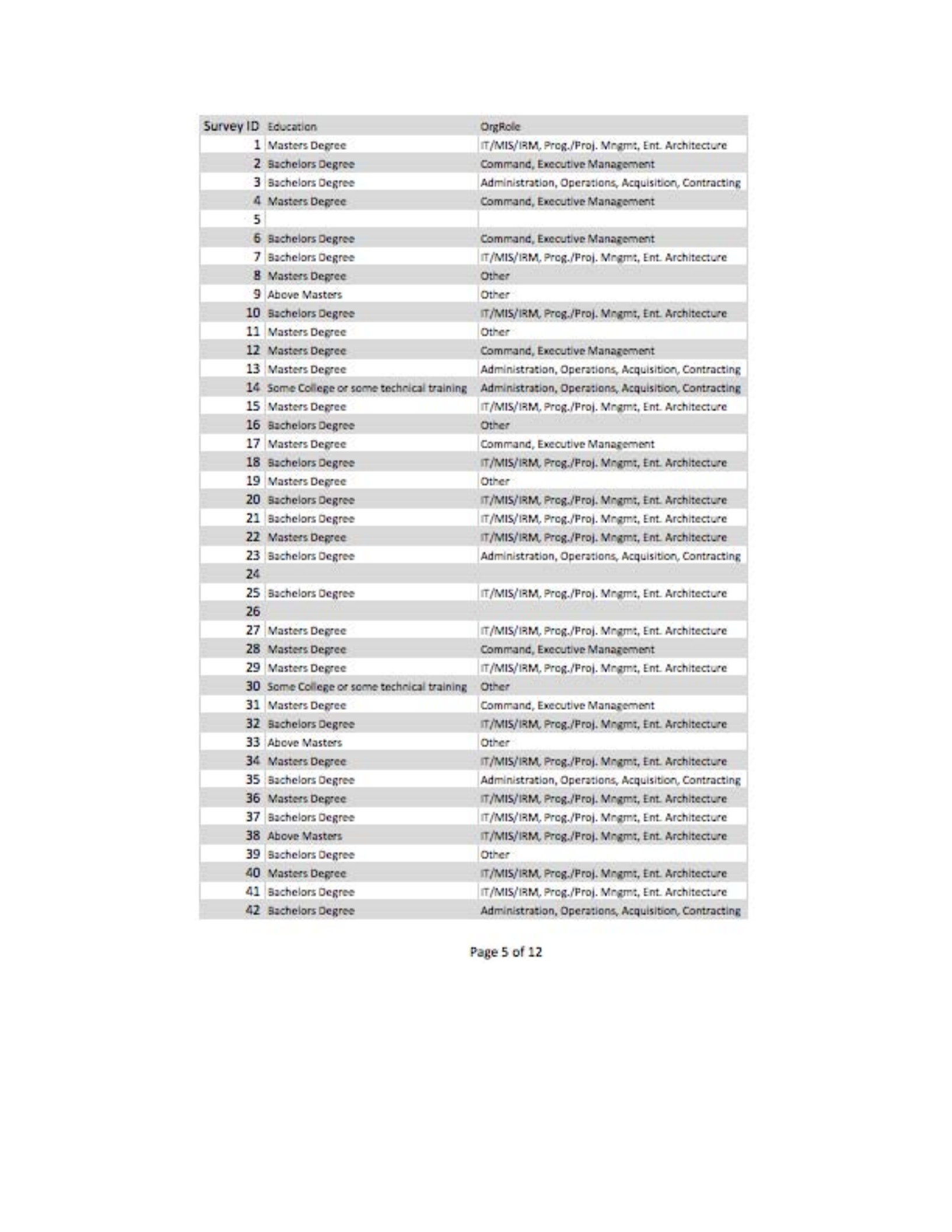
83
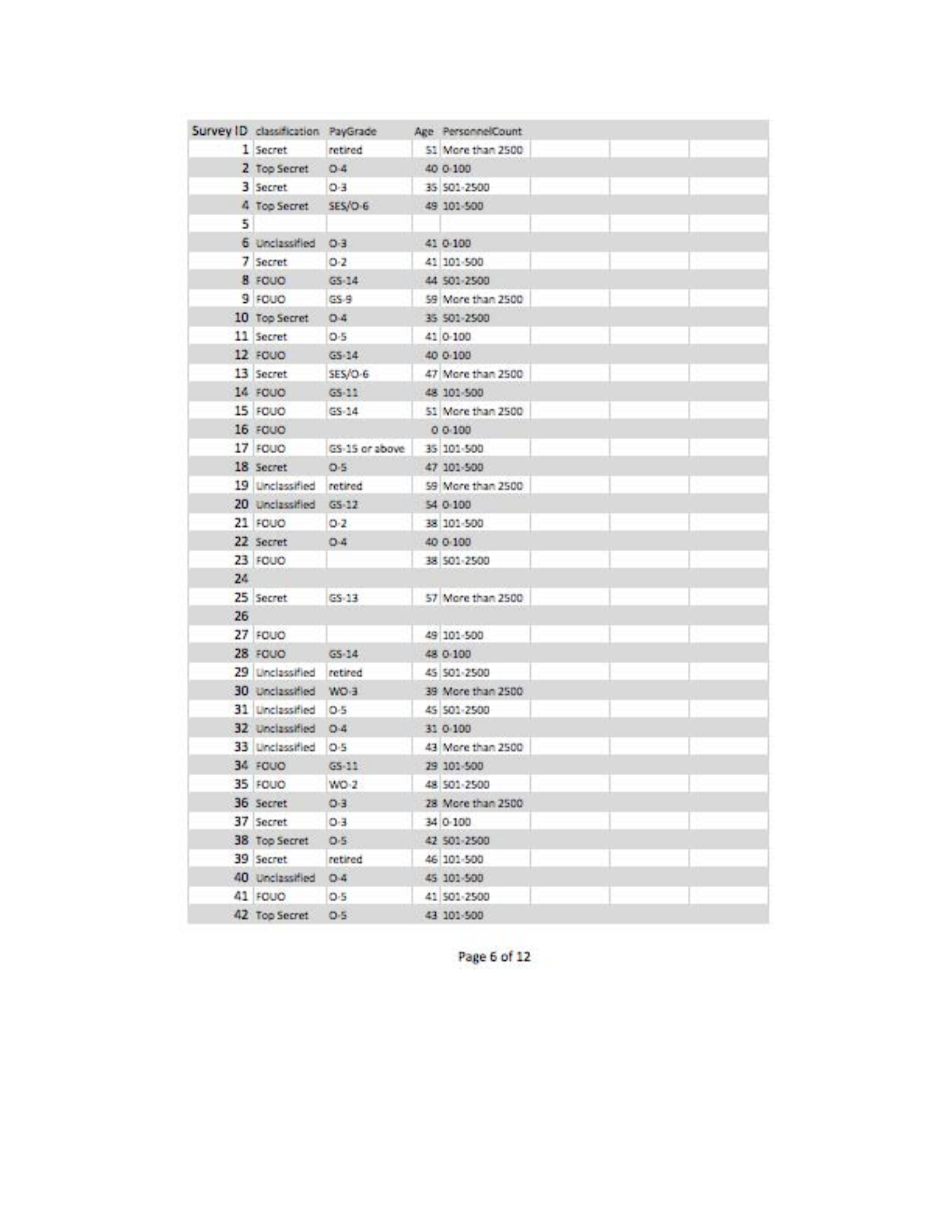
84
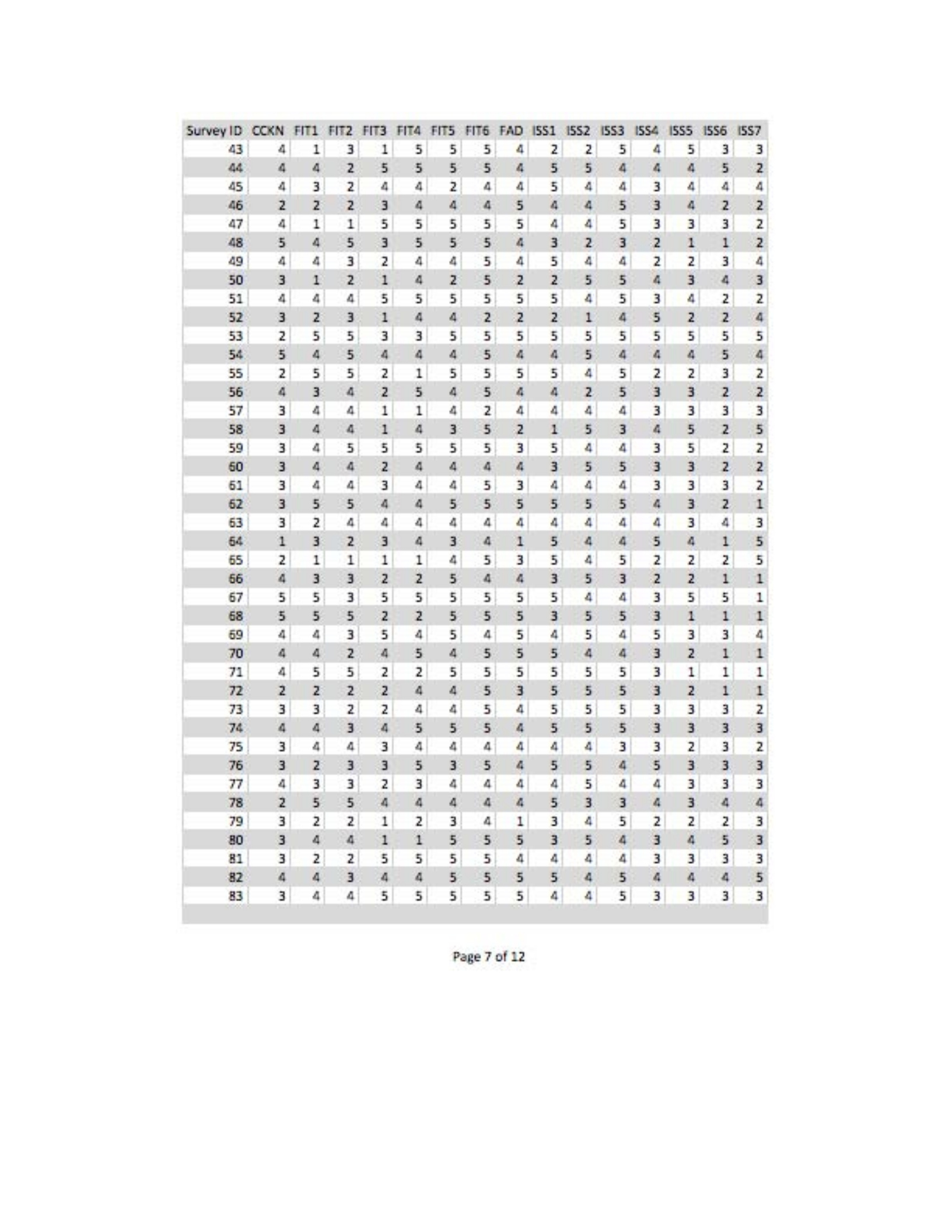
85
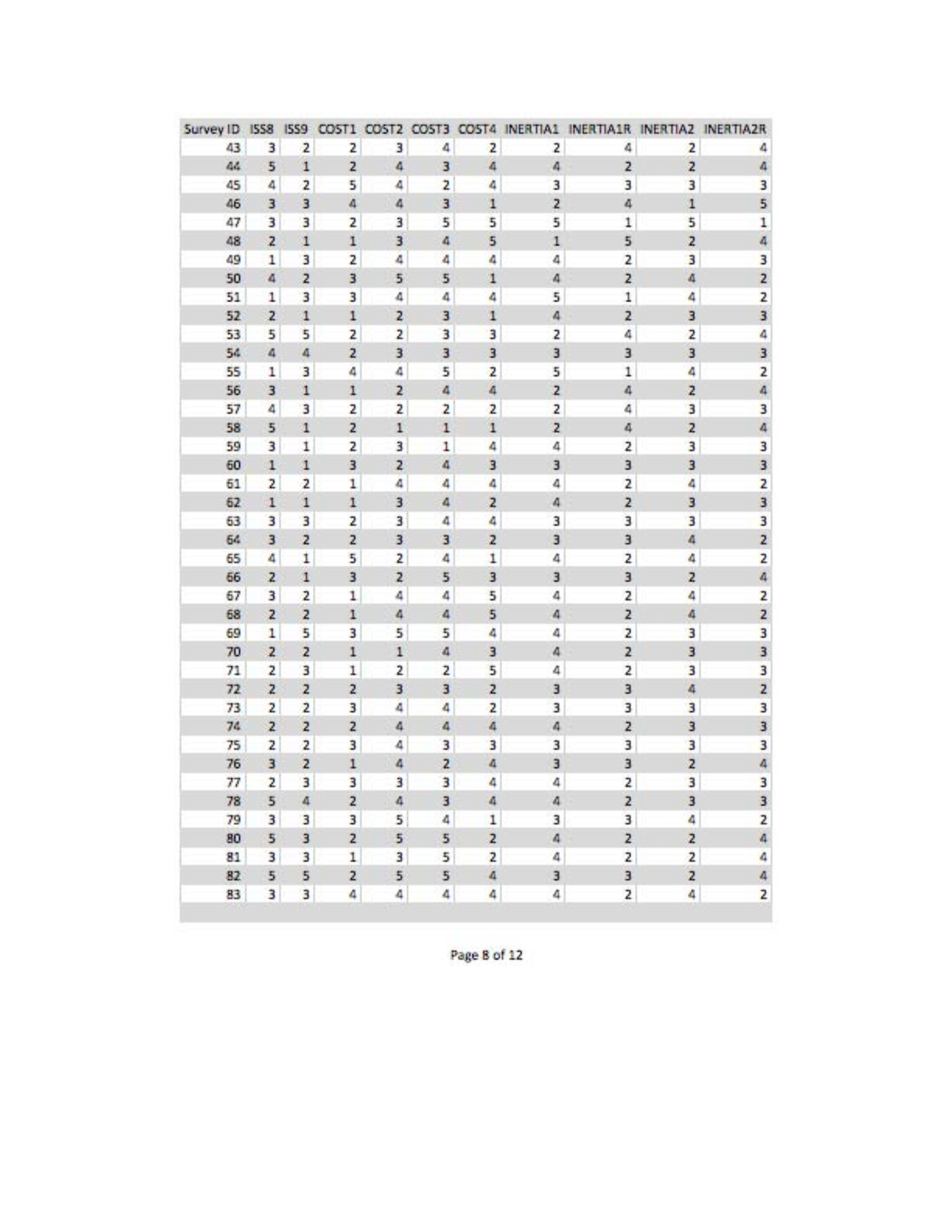
86
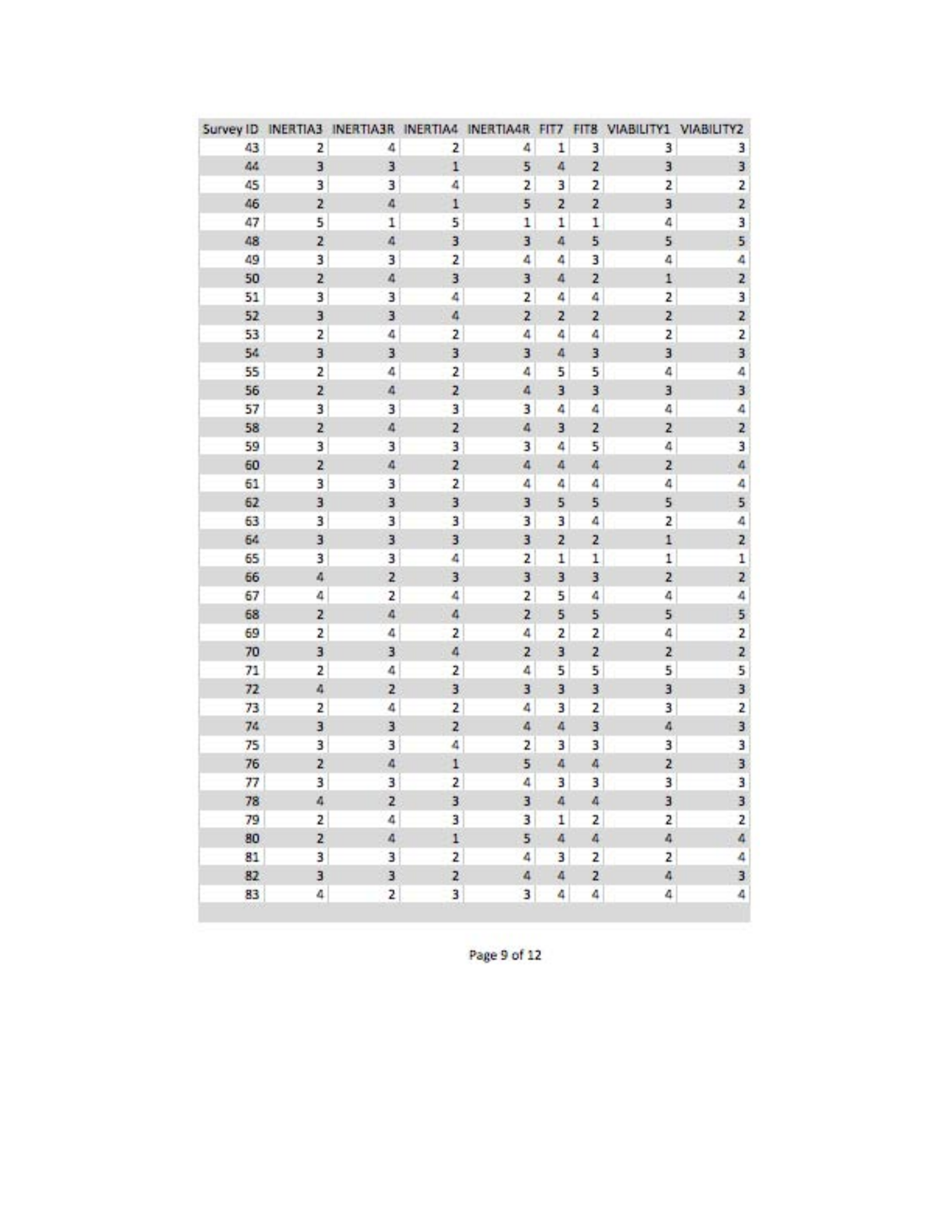
87
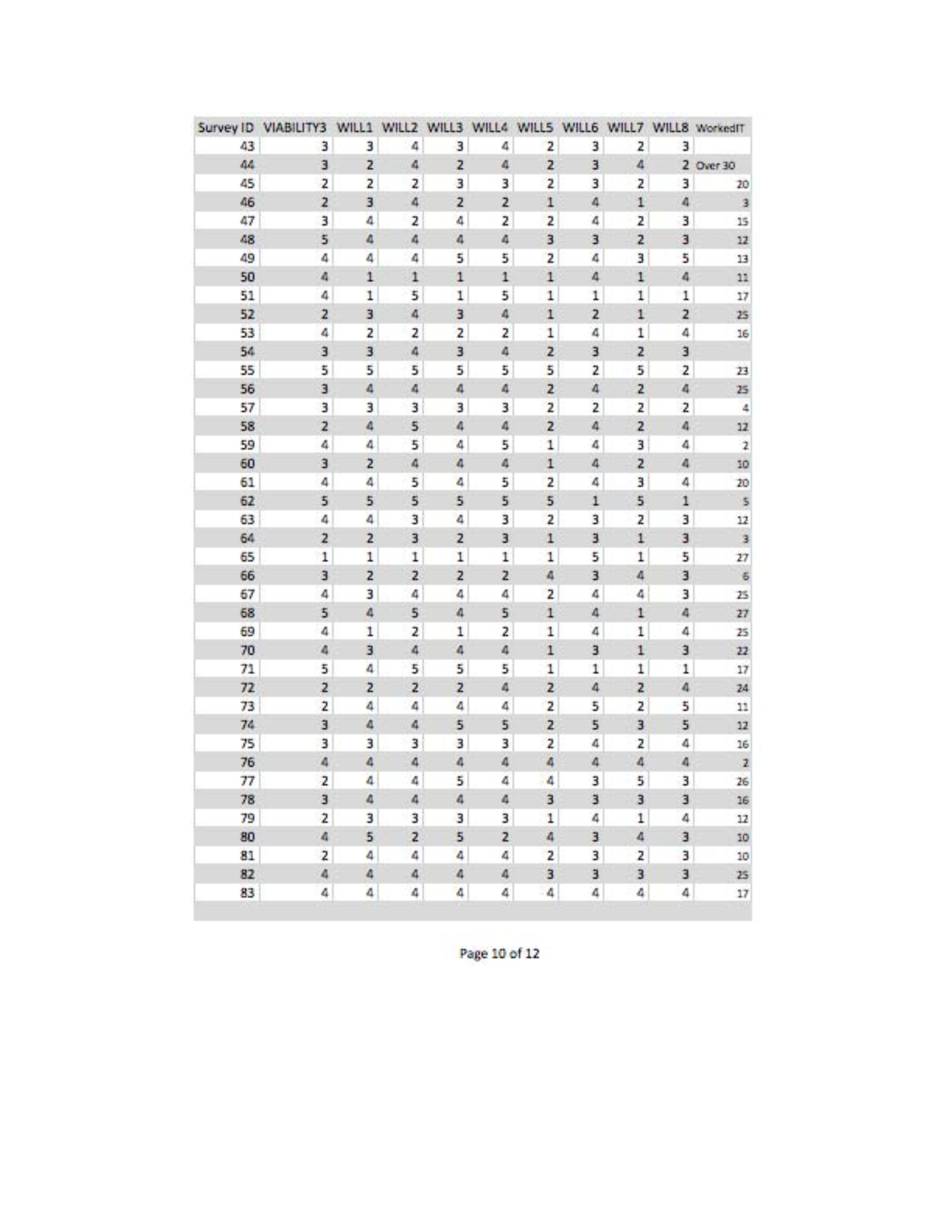
88
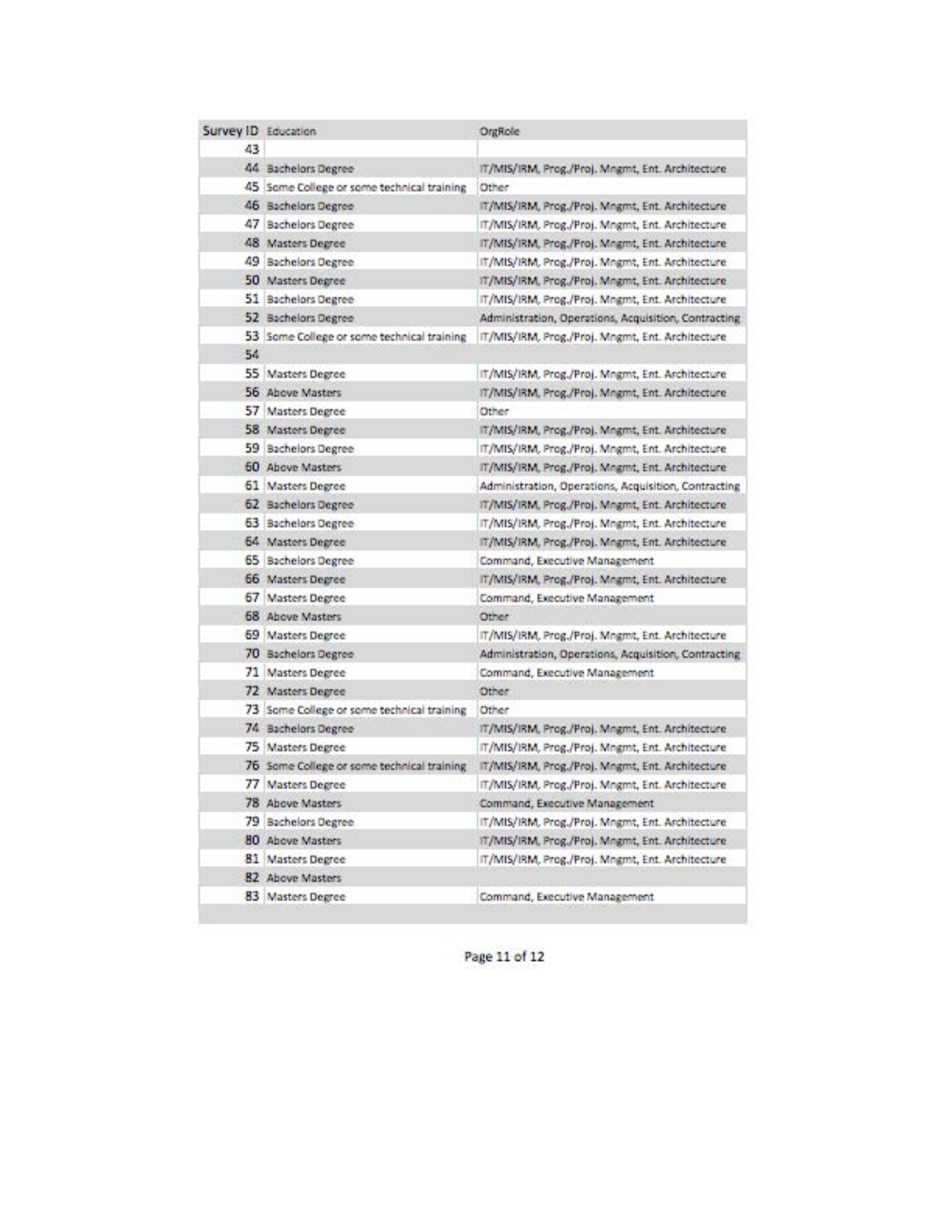
89
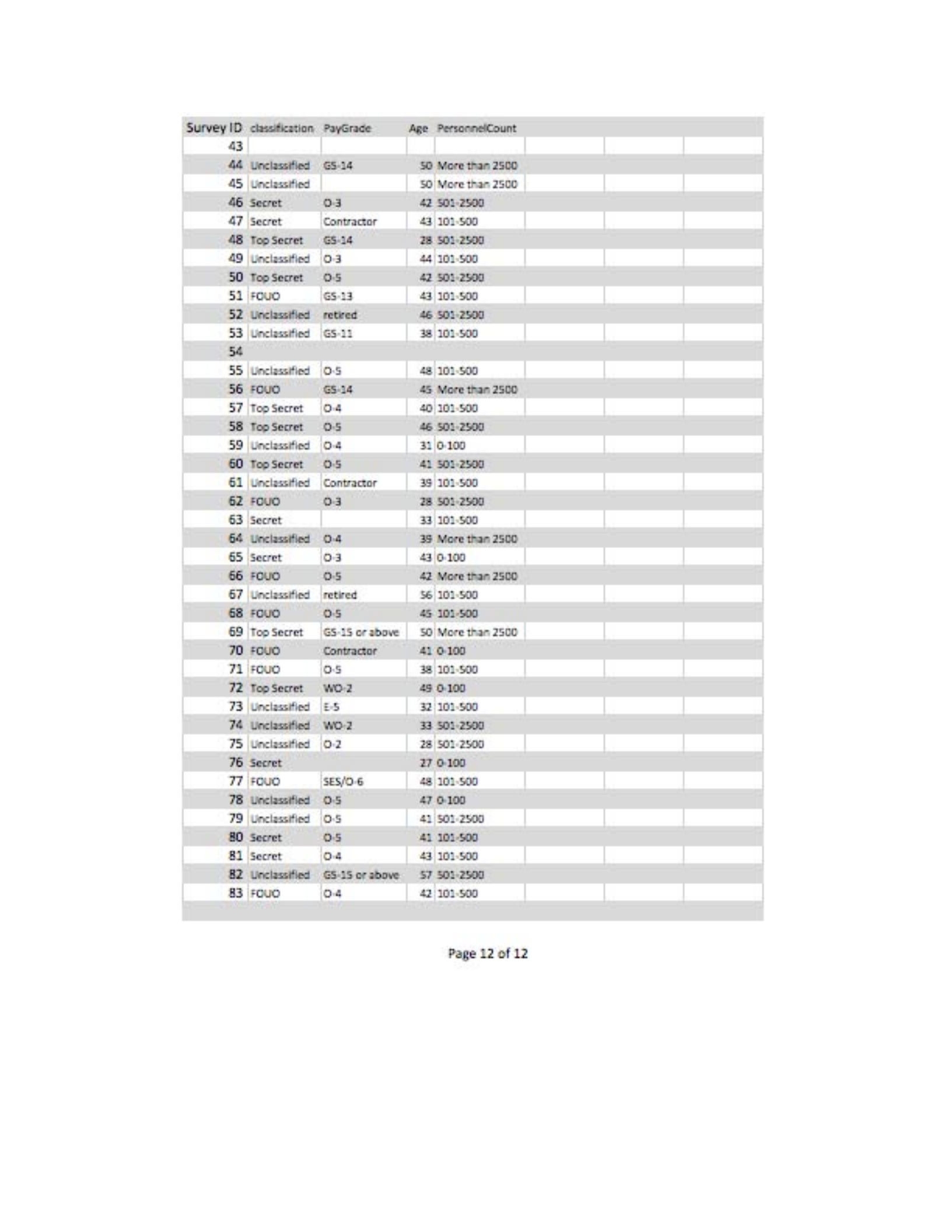
90
91
Appendix D: SmartPLS Report
Cross Loadings
cost fit inertia viability willingness
COST1 1.000000 -0.264952
-0.175177 -0.289511 -0.264672
FIT1 -0.236876 0.852295 0.185243 0.481584 0.320945
FIT2 -0.227624 0.894746 0.085833 0.564070 0.368675
INERTIA1r -0.109283 0.109694 0.827469 -0.201456 -0.058347
INERTIA2r -0.218048 0.099498 0.858527 -0.148874 -0.004516
INERTIA3r -0.110787 0.160601 0.811124 -0.196712 -0.049526
INERTIA4r -0.175709 0.115351 0.783988 -0.085278 0.101325
VIABILITY1 -0.203887 0.374463 -0.260587 0.804765 0.319953
VIABILITY2 -0.178400 0.452789 -0.320048 0.871319 0.528174
VIABILITY3 -0.342609 0.662744 0.049104 0.829887 0.371739
WILL1 -0.243832 0.270462 0.022472 0.431683 0.867694
WILL2 -0.239663 0.453971 -0.002378 0.432329 0.876659
WILL3 -0.204982 0.291138 -0.020901 0.454964 0.899804
WILL4 -0.245830 0.383365 -0.091208 0.428251 0.882597
AVE
AVE
cost 1.000000
fit 0.763489
inertia 0.673584
viability 0.698519
willingness 0.777512
92
Outer Loadings
cost fit inertia viability willingness
COST1 1.000000
FIT1 0.852295
FIT2 0.894746
INERTIA1r 0.827469
INERTIA2r 0.858527
INERTIA3r 0.811124
INERTIA4r 0.783988
VIABILITY1 0.804765
VIABILITY2 0.871319
VIABILITY3 0.829887
WILL1 0.867694
WILL2 0.876659
WILL3 0.899804
WILL4 0.882597
Path Coefficients
cost fit inertia viability willingness
cost -0.188419 -0.132310
fit 0.601123
inertia -0.332106
viability 0.457193
willingness

