


CO-CULTURAL COMMUNICATION IN THE AMERICAN WORKPLACE:
A QUANTITATIVE CORRELATIONAL STUDY
Chapter 1 Introduction
Organizational workplaces are becoming more ethnically diverse and
multicultural, reflecting the various populations of workers in 21st Century America
(Castle Bell et al., 2015; Brannick, 2014; Martin & Nakayama, 2015; Seibert et al., 2002;
Wiggins, 2012; Zirulnik & Orbe, 2019). A survey of more than 1,000 employees
indicated that while organizational leaders expended nearly 80% of the workday on
operational communication, 17% of the leaders communicated effectively with
subordinate employees (Odine, 2015). Adler (1991) defined communication as an
exchange of meaning to ensure the receiver understands the sender’s message. Thus,
many authors (DeKay, 2012; Odine, 2015; Perkins, 2008; Rajhans, 2012; Seibert et al.,
2002) refer to effective communication as an element for personal and professional
success recognized as the art and science of sending and receiving information or
messages verbally through a two-way instead of a one-way process.
Hence, the leader and employee (leader-member) communicatively exchange
two-way dialogue, thereby creating the leader-member exchange (LMX), which is a
component of effective communication in the 21st Century America workplace
(OmilionHodges & Baker, 2017). Root (2017) characterized nonverbal communication as
an illustration of communicative orientation, while Deetz (2001) recognized effective
communication as the “ideal speech situation” (Deetz, 2001, p. 45). Thus, effective
communication, whether verbal or nonverbal, influences an organizational leader’s
interactions or communicative exchange with employees (Gkorezis, 2015;

Gkorezis et al., 2015; Odine, 2015). The study conducted by Odine (2015) revealed that a
leader’s interactions as perceived by subordinate employees is essential in building the
employees’ relational identity with the organization (Eisenberger et al., 2010; Meares et
al., 2004). Relational identity created through LMX affects employee behavior in terms
of increased performance and productivity, contributing to organizational success
(Gkorezis et al., 2015).
The frequency and quality of LMX and interactions between the leader and
subordinate employees contribute substantially to the employees’ perceived
organizational support (Neves & Eisenberger, 2012; Omilion-Hodges & Baker, 2017;
Shoss et al., 2013). Certain scholars determined that the employees’ perception of
organizational support illustrated by the leader positively influences the employee’s
organizational citizenship behavior and commitment (Brown & Roloff, 2015;
OmilionHodges & Baker, 2017). An employee’s commitment to an organization through
relational identity is based mostly on the employee’s perception stemming from a work
culture where open communication is the norm. Also, the work climate or environment is
one where employees from ethnically diverse and multicultural backgrounds feel
acceptance and diverse inclusivity (Cubbage, 2018; Downey et al., 2015; Hayes-Thomas
& Bendick, 2013; Liu et al., 2010; Razzante, 2018a, 2018b).
A subordinate employee’s commitment to an organization (assimilation) indicates
a climate in which nonverbal communication gestures (e.g., visual contact, head nodding
in agreement, and smiling) portray “non-dominance” to an employee (Gkorezis et al.,
2015, p. 1007) in relationship identity. Gkorezis et al. (2015) pointed out that verbal and
nonverbal communication complements the other; whereas, alleviation of intentional or

unintentional inconsistencies remain plausible. Like Omilion-Hodges and Bakers’ (2017)
LMX, Goldman and Myers’ (2015) study revealed that an employee’s ability to assimilate
in a workplace is mainly based on the perceived quality of communicative interaction
between the leader and the employee. As stated previously, effective communication
involves a non-threatening verbal and non-verbal exchange between an organizational
leader and an employee (Gkorezis et al., 2015; Goldman & Myers, 2017). The degree of
an employee’s perceived interactions or relational identification with the organization
depends on the degree of comfort the employee feels with the LMX
(Gkorezis et al., 2015).
Consequently, De Janasz et al. (2002), DeKay (2012), Gkorezis (2015), Gkorezis
et al. (2015), Liu et al. (2010), Odine (2015), and Orbe (2016b) posited that effective
LMX occurs where awareness of personal filters and emotions exist when engaging in
culturally different or difficult conversations. Communication problems or conflicts in the
workplace may manifest from different and difficult conversations or miscommunication.
Both difficult conversations and miscommunication can occur intentionally or
unintentionally (Emerson & Murphy, 2014; Odine, 2015; Richard et al.,
2013; Wing Sue, 2010). Regarding the experience of some organizations, Gkorezis et al.
(2015), Groysberg and Slind (2012), Odine (2015), and Osborne and Hammoud (2017)
found that a less than optimal LMX negatively influenced employee engagement, job
satisfaction, and workplace conflict within the context of organizational behavior.
Organizational behavior encompasses negotiation in and navigation through a
workplace, albeit as an outsider from within (Cubbage, 2018; Han & Price, 2017;
Hendrix & Wilson, 2014; Liu et al., 2010; Murugavel & Somaraju, 2016; Orbe, 1998a,

1998b, 2016a, 2016b; Orbe & Harris, 2015). Orbe (1998a) defined an outsider within as
minority or marginalized individuals integrating into the workplace where marginalized
individuals were traditionally excluded.
Engaging in the social processes of communication involve accommodation of
and adaptation to the quality of communication demonstrated in the workplace (Liu et al.,
2010), along with the perceived organizational support (Brown & Roloff, 2015; Omilion-
Hodges & Baker, 2017; Shoss et al., 2013), and diversity inclusion (Cubbage, 2018;
Richard et al., 2013; Riggio, 2018), with known or inconspicuous constraints (Allison &
Hibbler, 2004; Orbe, 1996, 1998; Orbe & Roberts, 2012; Parker, 2002). Inconspicuous
invisible constraints put forth by Hendrix and Wilson (2014) concerns the workplace
communication climate and culture established by the dominant cultural group.
The constraints also involve the oppressive and suppressive silencing of the
people of color in corporate America (Hendrix & Wilson, 2014). Allison and Hibbler
(2004) recognized barriers existent in communicative interactions between different
cultures, including the dominant and non-dominant culture groups. Allison and Hibbler
(2004) and Buzzanell (1999), like Hendrix and Wilson (2014), recognize the dominant
culture as setting the communication parameters and interactions, thereby possessing the
inherent and inequitable power over the subordinates or traditionally marginalized people
of color (Allison & Hibbler, 2004).
Literature emerging in the industrial and organizational psychology field remains
underrepresented concerning communicative interactions in American workplaces
(Ahmed et al., 2010; Averbeck-Lietz, 2013; Brannick, 2014; Ferdman & Sagiv, 2012).
The literature gap stems from individuals with different cultures (Ahmed et al., 2010;

Averbeck-Lietz, 2013; Brannick, 2014; Ferdman & Sagiv, 2012). Communicative
interactions occur in and increase in workplaces where dominant culture group members
establish the norms of communication interactions knowingly or unknowingly (Kugler &
Brodbeck, 2014; Martin & Nakayama, 2015; Orbe, 1995, 1996, 1998a, 1998b, 2016;
Seibert et al., 2002; Singh, 2010; Zirulnik & Orbe, 2019). The non-dominant group
members negotiate identity and navigate the workplace to achieve success. A discussion
of two examples follows.
First, Zirulnik and Orbe (2019) conducted a research study with two female
African-American airline transport pilots in the United States of America. The co-cultural
communication framework involved examining the negotiation occurring in workplaces.
The dominant culture group members (White males) dominate as pilots of a large group
of legacy carriers in the industry (Zirulnik & Orbe, 2019). Of some 20 African-American
female pilots working with the group of five United States “legacy carriers,” two made up
.015% of the cumulative total of approximately 90 female pilots (Zirulnik & Orbe, 2019,
p.88). The study included 10% of 20 pilots fitting the study demographics. The study
resolved in creating a new co-cultural communication approach. “Strategic alliance
building” (Zirulnik & Orbe, 2019, p. 87) represents accommodation as the preferred
outcome. The researchers defined assertiveness as a co-cultural communication approach.
Researchers defined strategic alliance building “as instances when co-cultural group
members make the conscious decision to gain esoteric social alliances from dominant
cocultural group members within the organization through strategized interaction(s) that
have predetermined intent and goals” (Zirulnik & Orbe, 2019, p. 87).
The second example represents several sources as follows. Allison and Hibbler

(2004), Buzzanell (1999), and Hendrix and Wilson (2014) conducted studies revealing
the dominant culture group members establishing the communication culture or climate
in workplaces, communities, and higher learning institutions. Buzzanell (1999) attested
that the dominant culture group controls epistemology’s research agenda without the
nondominant culture group members’ perspectives. Several researchers (Allison &
Hibbler, 2004; Buzzanell, 1999; Camara & Orbe, 2010; Emerson & Murphy, 2014;
Hendrix & Wilson, 2014) agreed with the categories and labels assigned to the non-
dominant culture group members as any number of the following: African-American,
disenfranchised, ethnic minority, historically and traditionally marginalized, minority, and
people or person of color. Other discussions and examples of the dominant culture group
members occur in Chapter 2 of this dissertation. The dominant culture group bears the
following labels in the non-exhaustive list: Caucasian, European, and White or White
heterosexual males, possessing the inherent hierarchal power in most American
workplaces.
The familiar term diversity in organizations was adapted to add an inclusion
component (Downey et al., 2015; Hayes-Thomas & Bendick, 2013). Diversity inclusion
affects organizational and communicative interactions between leaders and employees
(Coughlin, 2014; Meares et al., 2004; Richard et al., 2013; Rudick & Golsan, 2016).
Enriching diversity by integrating different cultures into various workplaces is not
synonymous with enhancing interpersonal or communicative interactions (Richard et al.,
2013; Swarnalatha & Prasanna, 2013). However, interpersonal and communicative
interactions are inherent in co-cultural communication strategies (Richard et al., 2013;
Swarnalatha & Prasanna, 2013). Although the term diversity combined with inclusion
creates diversity inclusion, co-cultural and cross-culture do not share vernacular in this

proposal. The interpersonal and communicative interactions inherent in co-cultural
communication strategies align with communicative and organizational behaviors
(Gkorezis, 2015; Keyton et al., 2013).
Leaders tasked with creating an inclusive climate or culture in organizations learn
and embrace individual differences extending beyond matters of sensitivity to include
recognition of cognitive, behavioral, and emotional interactions intertwined with
communication (Gillet et al., 2017; Jiong & Men, 2017; Osborne & Hammoud, 2017;
Richard et al., 2013; Shuler et al., 2016). Diversity inclusion involves the quality of LMX
interactions (Cubbage, 2018; Liu et al., 2010; Odine, 2015; Omilion-Hodges, & Baker,
2017; Sherbin & Rashid, 2017), and the employees’ perceived organizational support
from the leaders (Brown & Roloff, 2015; Neves & Eisenberger, 2012; Omilion-Hodges &
Baker, 2017; Shoss et al., 2013).
Communication interactions perceived by employees over time foster feelings of
job satisfaction (Omilion-Hodges & Baker, 2017). Literature supports the finding of
increased job satisfaction resulting from high levels of the quality and frequency of LMX
(Omilion-Hodges & Baker, 2017; Robles, 2012; Shoss et al., 2013). Employees’
perception of low or decreased organizational support aligns with counterproductive
behavior (Shoss et al., 2013).
Communication behavior and interactions can lead to organizational success
through the achievement of workplace goals, which increases organizational productivity
through employees’ performance (Ahmed et al., 2010; Gillet et al., 2017; Groysberg &
Slind, 2012; Keyton et al., 2013; Odine, 2015; Osborne & Hammoud, 2017; Perkins
2008; Richard et al., 2013). Ahmed et al. (2010), DeKay (2012), Odine (2015), and Orbe

and Roberts (2012) indicated the opposite, where ineffective or poor communication
occurred. A leading cause of ineffective communication in a culturally diverse workplace
is the unfamiliarity with variations of communicative interactions between individuals
from different cultural backgrounds and groups (Osborne & Hammoud, 2017; Scott,
2013; Seibert et al., 2002). Castle Bell et al. (2015), Odine (2015), Osborne and
Hammoud (2017), and Steele and Plenty (2014) indicated ineffective communication in
the workplace can lead to counterproductive behavior such as employee disengagement,
dissatisfaction, and workplace conflict.
However, with effective communication as a focus, an organization can benefit
from goal achievement through employees’ performance, which leads to increased
productivity (Odine, 2015; Rajhans, 2012; Seibert et al., 2002). However, DeKay (2012),
Odine (2015), Rajhans (2012), Richard et al. (2013), and Wiggins (2012) indicated a
perceived lack of effective communication was prevalent in some workplaces where
individuals (e.g., managers and employees) differed in cultural backgrounds. Effective
communication can lead to engaged and satisfied employees and help reduce workplace
conflict (Osborne & Hammoud, 2017; Rajhans, 2012; Richard et al., 2013; Shuler et al.,
2016).
When members of the non-dominant cultural group utilized co-cultural
communication strategies, the subtle or inconspicuous constraints magnified, thereby
affecting employees psychologically and physiologically (Ahmed et al., 2010; DeKay,
2012; Heradstveit & Narvesen, 1998; Jones et al., 2017; Omilion-Hodges & Baker, 2017;
Osborne & Hammoud, 2017; Rajhans, 2012; Richard et al., 2013). For example, the
nondominant culture group members (subordinates) often encountered muteness or

silencing in communicative interactions with dominant culture group members (Ahmed
et al., 2010; DeKay, 2012; Rajhans, 2012; Richard et al., 2013).
Three psychological features related to effective communicative interaction
between an organizational leader and an employee is the unconstrained cognitive,
behavioral, and emotional status (Cohen, M., & Avanzino, 2010; Odine, 2015; Orbe &
Roberts, 2012; Osborne & Hammoud, 2017; Swarnalatha & Prasanna, 2013). Co-cultural
communication in the American workplace between dominant and non-dominate leaders
and employees has pronounced psychological and physiological effects (Benjamin &
Simpson, 2009; Brown & Roloff, 2015; Emerson & Murphy, 2014; Riggio, 2018; Shuler,
2016).
Chapter 1 focuses on information relating to communicative interactions between
African-American female employees and European American male managers from
different cultural backgrounds. Chapter 1 also includes an introduction to the topic,
beginning with a background of the problem. After that, the problem statement, purpose,
and significance of the study, nature and methodology of the study, research questions
and hypotheses, the theoretical framework, definitions of operational terminology,
assumptions, limitations, and delimitations collectively form the introduction to this study
of co-cultural communication in the American workplace.
Background of the Problem
Non-dominant cultural group members practicing co-cultural communication in a
business environment is a largely unfamiliar phenomenon, which is not without
negotiation and navigation in the workplace (Allen, 2007; Castle Bell et al., 2015;
Lapinski & Orbe, 2007; Mammen & Sano, 2012; Mills, 2009; Murphy, 1998; Shoss et

al., 2013). Co-cultural communication can inform organizational communication,
organizational behavior (performance), and the organizational culture—with diversity
inclusion (Ahmed et al., 2010; Castle Bell et al., 2015; Lapinski & Orbe, 2007; Liu et al.,
2010; Mammen & Sano, 2012; Meares et al., 2004; Mills, 2009; Rudick & Golsan, 2016;
Shoss et al., 2013; Spector, 1997). Co-cultural communication in this study is not used
synonymously with the term cross-culture.
Researchers have shown effective communication in the workplace can help
increase employee engagement and job satisfaction while mitigating for conflict (Ahmed
et al., 2010; Meares et al., 2004; Odine, 2015; Osborne & Hammoud, 2017; Rajhans,
2012; Richard et al., 2013; Steel & Plenty, 2014). However, not recognizing cultural
communication strategies in the workplace can prove costly to an organization (Camara
& Orbe, 2010; Castle Bell et al., 2015 DeKay, 2012; Osborne & Hammoud, 2017). The
American workplace includes individuals from differing cultures, and message confusion
is inevitable (Keyton et al., 2013), notably absent knowledge of co-cultural
communication strategies.
Message confusion synonymous with miscommunication occurs between
managers and employees, stemming from cultural differences (Allison, 2004; Castle Bell
et al., 2015; DeKay, 2012; Orbe, 1995; Parker, 2002; Shoss et al., 2013). According to
Keyton et al. (2013), miscommunication in an organization can lead to counterproductive
or non-citizenry behavior. Organizational behaviors such as employee disengagement, job
dissatisfaction, and workplace conflict negatively affect organizational productivity
(Ahmed et al., 2010; Allen, 2007; Mammen & Sano, 2012; Mills, 2009; Murugavel &
Somaraju, 2016; Osborne & Hammoud, 2017; Shoss et al., 2013).

Unfamiliar with co-cultural communication strategies, some employees, although
using co-cultural communication strategies to interact communicatively with dominant
cultural group managers, may be unaware of the communication strategy (Castle Bell et
al., 2015). Consequently, an employee may be aware of and may intentionally use a
communication adjustment when conversing with a dominant culture group manager.
More likely than not, an employee using co-cultural communication in the workplace
may not recognize the co-cultural communication strategy as a form of organizational,
communicative interactions (Castle Bell et al., 2015; Orbe, 1998a, 2016b).
Unknowingly, a non-dominant cultural group member makes a communication
adjustment depending on the preferred or expected outcome from the communicative
interaction (Castle Bell et al., 2015; Orbe, 2016b). However, when an employee
intentionally makes a communication adjustment, the same employee may be aware of
the adjustment made although psychologically unaware of the learned behavior (Castle
Bell et al., 2015; Jiang, 2017; Orbe, 2016b; Osborne & Hammoud, 2017). The behavior
stems from the individual’s cognition, behavior, and emotion (Castle Bell et al., 2015;
Jiang, 2017; Orbe, 2016b; Osborne & Hammoud, 2017).
While co-cultural communication is a culturally learned behavior, the employees
using co-cultural communication are probably unaware the technique is a formally
recognized orientation to organizational, communicative behavior (Castle Bell et al.,
2015; Orbe, 1995, 1996, 1998, 2005, 2006, 2016b; Orbe & Roberts, 2012). Empirical
literature indicates that co-cultural communication strategies first studied during the early
1990s and continually developed through the year 2020 (Barkman, 2018; Castle Bell et
al., 2015; Orbe, 2016a, 2016b; Tang et al., 2020; Zirulnik & Orbe, 2019) have yet to

permeate the industrial and organizational psychology field of study (Bell & Muir, 2014).
A review of empirical literature revealed makeshift labels such as interpersonal and
intercultural communication (Castle Bell et al., 2015; DeKay, 2012; Downey, 2015;
Wiggins, 2012) and multicultural communication (Castaneda et al., 2013; Han & Price,
2017; Orbe, 1996; Swarnalatha & Prasanna, 2013b).
Some dominant culture group managers may not recognize co-cultural
communication as an extension of organizational communication practiced in the
workplace by non-dominant culture group members (Castle Bell et al., 2015).
Consequently, some dominant culture group managers may be unfamiliar with cocultural
communication as a component of organizational behavior or workplace diversity (Castle
Bell et al., 2015). Nevertheless, message confusion and miscommunication can prompt
employee disengagement and dissatisfaction or may lead to conflict (Congdon, 2014;
Femi, 2014; Gillet et al., 2017; Kugler & Brodbeck, 2014;
Odine, 2015; Orbe & Roberts, 2012; Osborne & Hammoud, 2017; Steel & Plenty, 2015).
Empirical research on co-cultural communication phenomenon has steadily
developed over time from its inception in the mid-1990s through 2020 (Barkman, 2018;
Camara & Orbe, 2010; Castle Bell et al., 2015; Orbe, 1998a, 2006, 2016a, 2016b; Orbe &
Roberts, 2012; Tang et al., 2020; Zirulnik & Orbe, 2019). In 2020, 28 co-cultural
communication practices exist with rationalization (Castle Bell et al., 2015) and strategic
alliance building (Zirulnik & Orbe, 2019) as the two most recently identified. This
present study’s focus includes two existing communication approaches, (e.g.,
assertiveness and non-assertiveness) and two existing preferred outcomes (e.g.,
assimilation and separation).

Rationalization and strategic alliance building extend the co-cultural
communication theory and relate to the existing strategies and outcomes identified for
this present study. For example, Castle Bell et al. (2015) integrated rationalization under
the assertiveness approach and assimilation as the preferred outcome. Like Castle Bell et
al. (2015), Zirulnik and Orbe (2019) integrated strategic alliance building as an
assertiveness approach. However, Zirulnik and Orbe (2019) selected accommodation as
the preferred outcome instead of separation. This present study uses separation instead of
accommodation as the preferred outcome. Definitions of rationalization and strategic
alliance building follow in the latter part of Chapter 1.
The co-cultural communication phenomenon has evolved to include numerous
multicultural groups of marginalized or non-dominant cultural group members (Castle
Bell et al., 2015; Lapinski & Orbe, 2007). The present study focuses on working-class,
African-American females, ages 18 through and including age 85 (or no upper limit). The
eligible respondents should have experience working in an American established
workplace physically situated in the United States instead of virtual (Hendrix & Muir,
2014) organizational settings. The samples may include individual incumbents at any
level, such as leader, manager, or employee.
Without awareness, co-cultural communication in some workplaces can impact
non-dominant cultural group members, leaders, and organizations (Bell & Muir, 2014;
Castaneda et al., 2013). For example, a non-dominant group member may become
disengaged, dissatisfied, or experience workplace conflict (Castaneda et al., 2013;
Gelfand et al., 2012; Kugler & Brodbeck, 2014). Each of the three variables—
disengagement, dissatisfaction, and workplace conflict—may affect performance

(Goldman & Myers, 2015; Murugavel & Somaraju, 2016) of a non-dominant culture
group member. Cognition, behavior, and emotion contribute to employee performance, as
does a leader who supports a culture of diversity inclusion (Downey et al., 2015; Orbe,
2016a; Zanoni et al., 2010).
Organizational communication can differ based on employees’ different cultural
backgrounds (Castaneda et al., 2013; Murugavel & Somaraju, 2016). Co-cultural
communication, as an extension of organizational communication and organizational
behavior, with diversity inclusion, is worthy of research and contributes to the field of
industrial and organizational psychology (Downey et al., 2015; Murugavel & Somaraju,
2016; Odine, 2015; Orbe, 1998a; Rauschenberger & Mellon, 2014; Riggio, 2018; Rudick
& Golsan, 2016). For example, Sorenson et al. (2015) supported the notion that
integrating research with practice makes “a theoretical and empirical contribution to [the]
field” (p. 21) of industrial and organizational psychology. Sorenson et al. (2015) further
indicated that both communication and behavior have a place within industrial and
organizational psychology.
Organizational communication (Ahmed et al., 2010; Bray & Williams, 2010;
Coughlin, 2014; Keyton et al., 2013; Orbe 1998a, 1998b; Rajhans, 2012; Shelby, 1993),
organizational behavior (Bravo & Roloff, 2015; Bray & Williams, 2017; Gates, 2003;
Stewart & Garcia-Prieto, 2008), and diversity inclusion (Allison & Hibbler, 2004;
Ferdman & Sagiv, 2012; Hays-Thomas & Bendick, 2013; Jones et al., 2017); are three
separate and stand-alone disciplines within distinctive fields of study. However, each of
the separate fields, communication, behavior, and diversity, aligns with industrial and

organizational psychology (Brannick, 2014; Rauschenberger & Mellon, 2014; Riggio,
2018; Sherbin & Rashid, 2017; Sorenson et al., 2015; Steelman, 2013).
For this study, a non-dominant cultural group referred to socially marginalized
African-American females who have not had continued access to or influence upon or
within the dominant cultural group consisting of White, Euro-American, or Caucasian
males in the workplace (Cubbage, 2018). The non-dominant cultural group of
AfricanAmerican females in this present study differs from Orbe’s (1996) study
participants. For example, the present study participants involve socially marginalized
African-American females (Zanoni et al., 2010). Orbe (1996, 2004, 2016a, 2016b) and
other researchers
(e.g., Camara & Orbe, 2010; Congdon, 2014; Hendrix & Wilson, 2014; Lapinski & Orbe,
2007; Rudick & Golsan, 2016; Scott, 2013) conducted studies involving numerous
marginalized minority cultural groups, including African-Americans,
Latino/Hispanic/Mexicans, Filipinos, Asian and Pacific Islanders, Jewish Americans, and
various genders. This study’s cultural difference is between or among White males as the
dominant cultural group and African-American females as the non-dominant cultural
group meeting the criteria for participation.
Problem Statement
The general problem is message confusion in workplace communication. Message
confusion is synonymous with miscommunication between managers and employees
(Garnero et al., 2014), or LMX (Ahmed et al., 2010; Bell & Muir, 2014). Message
confusion due to unfamiliar communication strategies stems from cultural differences
(Allison, 2004; Castle Bell et al., 2015; DeKay, 2012; Orbe, 1995; Parker, 2002; Shoss et

al., 2013). Miscommunication may result in conflict, adversely affecting organizational
behavior and performance or productivity (Ahmed et al., 2010; Allen, 2007; Mammen &
Sano, 2012; Mills, 2009; Shoss et al., 2013).
The specific problem is that some employees may use co-cultural communication
strategies in workplace communication with managers, and some managers may not
recognize or be unfamiliar with the co-cultural communicative approaches. Message
confusion or miscommunication may lead to employee disengagement, dissatisfaction, or
conflict (Congdon, 2014; Femi, 2014; Orbe & Roberts, 2012; Steel & Plenty, 2015).
Therefore, research is needed to examine relationships between co-cultural
communication strategies (Camara & Orbe, 2010) and constructs of organizational
behavior.
The co-cultural communication strategies selected for this study include preferred
outcomes and communication approaches. Assimilating and separating are preferred
outcomes, and assertive and non-assertive are the communication approaches. Two
preferred outcomes and two communication approaches selected for this study reside
within the 26 initial co-cultural communication strategies (Camara & Orbe, 2010;
Razzante, 2018a, 2018b), identified in Appendix A, Table A1 in this study.
Of the three preferred outcomes--assimilate, separate, and accommodate--one of
the three, accommodate, does not appear in this study often except to acknowledge
strategic alliance-building as Zirulnik and Orbe’s (2019) newest co-cultural
communication approach and preferred outcome. Of the three communication approaches
—assertive, non-assertive, and aggressive—one of the three, aggressive, does not appear
in this study. Nevertheless, subsequent studies generated two additional cocultural

communication strategies, which equate to 28 total co-cultural communication strategies.
Castle Bell et al. (2015) developed rationalization, and Zirulnik and Orbe (2019) revealed
strategic alliance-building. In addition to selecting four of the 28 cocultural
communication strategies proposed in this study are three salient constructs of
organizational behavior, employee engagement, job satisfaction, and diversity inclusion
(Bray & Williams, 2017; Steele & Plenty, 2015; Swarnalatha & Prasanna, 2013a).
Several studies omit many of the co-cultural communication strategies and
emphasize only a few selected factors or constructs (e.g., Camara & Orbe 2010;
Congdon, 2014; Orbe, 1998a; Rudick et al., 2017). Similarly, neither accommodation as a
preferred outcome nor aggressiveness, a communication approach, appear in the analyses
of this present study. As such, the number of factors selected for this study set no
precedent compared to previous studies. The two preferred outcomes (e.g., assimilate and
separate), and two communication approaches (e.g., assertiveness and non-assertiveness),
represent the co-cultural communication strategies chosen for this study. Also included
are three factors or constructs of organizational behavior.
Purpose of the Study
The purpose of this non-experimental, quantitative, correlation research study was to
examine and determine the relationships, if any, between co-cultural communication
strategies and constructs of organizational behavior. As the independent variables, the two
communication strategies included: (a) preferred outcomes—assimilate and separate, and
(b) communication approaches—assertiveness and non-assertiveness. The dependent
variables, also under examination, were three constructs of organizational behavior: (a)

disengagement, (b) dissatisfaction, and (c) conflict. Tools for data collection included two
valid and reliable instruments depicted in Appendices B1 and B2 Sections 2 and 3 .
Appendices B1 and B2 Section 2, for the Co-Cultural Communication Scale (Lapinski &
Orbe, 2007) and Appendices B1 and B2 Sections 3, the Job Satisfaction Survey (Sector,
1997).
The independent variables included the two co-cultural communication strategies. The
communication approaches—assertiveness and non-assertiveness as a proxy for the
preferred outcomes—assimilate and separate, respectively (Camara & Orbe, 2010; Castle
Bell et al., 2015; Congdon, 2014; Keyton et al., 2013; Lapinski & Orbe, 2007; Orbe,
1996, 1998a; Orbe & Roberts, 2012). The independent variables selected aligned with the
study purpose and evidentiary reasoning, as did the dependent variables. The dependent
variables—disengagement, dissatisfaction, and conflict—are components of
organizational behavior.
Data collection occurred using existing instrumentations. Lapinski and Orbe’s (2007)
Cocultural Theory Scale (C-CTS) for the co-cultural communication strategies was one,
and Spector’s (1985, 1997) Job Satisfaction Scale (JSS) for the constructs of
organizational behavior was the other. Additionally, data collection occurred using the
Qualtrics online software program, where both instruments were uploaded. (See
Appendices B1 at
Sections 1 - 3, manual versions, and B2 at Sections 1 – 3, automated versions). The
Qualtrics software program provided an easily accessible venue and user-friendly
navigation for the respondents. The C-CTS measured co-cultural communication
strategies, while the JSS measured the constructs of organizational behaviors.

Population and Sample
The population criteria for the study participants, the sampling type, and sample
size follow. The population needed for this study involved Black-American or
AfricanAmerican females ages 18 years and up with no upper age limit, except that; three
states required different minimum ages of 19 and 21, addressed in this study. The
Statistical
Package for Social Sciences data analysis software (http://www.spss.com) (Meyers et al.,
2013; Ozgur et al., 2015) data analysis software was used to determine the sample size of
participants needed for this study. Using a convenience sampling recruitment method
required no less than 100 samples to power the study, as demonstrated in this section.
The population age criteria differed for Mississippi with a minimum age of 21
years old, and both Alabama and Nebraska required a minimum of 19 years old as
provided at https://www.irbnet.org. Except for the three identified states’ population age
criteria, 21 was the minimum age of eligible participants needed for the study. Eligible
study participants were either working for or had worked in an American established
business that operated in the United States instead of solely virtual or global
organizations.
Multiple-choice categories required the participants to self-report their race. The
six multiple-choice responses included the following: Black American, African-
American, bi-racial (Black/African-American and another ethnicity), mixed
(Black/African-American and two or more races), prefer not to answer, and other (please
specify) as options. The participants either occupy one or both job roles, as a
leadermanager or a subordinate-employee. Students may include individuals who have

attended or are attending a public or private academic institution within the United States.
See Appendix C titled Preliminary Assessment—Selection Criteria for Research
Participants, as the automated replica of Appendix B Section 1, Demographics.
Developed during the proposal planning phase, Appendix C remained a stand-alone
Appendix throughout the study.
A convenience sampling recruitment method was used to obtain the study
participants. The minimum sample size of 82 participants was based on power analyses
using the Statistical Package for Social Science™ data analysis software (Algina &
Olejnik 2010; Meyers et al., 2013; Ozgur et al., 2015). For example, the 82 samples
needed were based on an alpha level of .05, power of .80, and .30 effect size (Cohen,
1992; Meyers et al., 2013). However, with a 20% mitigation, adding 16.4 samples to the
82 participants allowed for incomplete surveys or missing data. Therefore, no less than
98.4 samples or at least 100 viable records were needed to power the study.
Significance of the Study
This study’s significance involved several research components that added
uniqueness and provided the significant benefit of informing organizational leaders and
employees while concurrently contributing to the field of industrial and organizational
psychology. The results contribute to current and future studies and add to leadership
knowledge and literature. Also significant to this study was the non-experimental,
quantitative research method with a correlational design and the different population
demographics. The literature indicated the previous studies used qualitative research
methods (Camara & Ore, 2010; Groscurth & Orbe, 2006; Lapinski & Orbe, 2007).

Unlike the qualitative research method and phenomenological designs presented
in much of the seminal literature on co-cultural communication strategies (Anfara, 2008;
Bryman, 1984; Camara & Orbe, 2010; Groscurth & Orbe, 2006; Lapinski & Orbe, 2007;
Orbe, 1995, 1998a, 1998b; Orbe & Roberts, 2012), a quantitative correlational study was
proposed (Bray & Williams, 2017; Prematunga, 2012; Reio, 2010). Much of the
empirical literature contained support for and differences between qualitative and
quantitative research methods (Bryman, 1984; Cazan, 2012; Fassinger & Morrow, 2013;
Neuman, 2011). However, Lapinski and Orbe (2007) developed the first reliable and
validated co-cultural theory scale that measured co-cultural communication strategies.
Lapinski and Orbe’s (2007) study and scale opened the research agenda and
included the quantitative research method. This quantitative research study’s potential
benefits or benefactors involved quality and effective communication between
organizational leaders and employees in the leader-member communicative exchange. An
employee’s perception of quality communication and perceived organizational support
can positively or negatively influence organizational behavior (performance) by
contributing to the success and profitability of an organization (Garnero et al., 2014;
Hays-Thomas & Bendick, 2013; Meares et al., 2004; Odine, 2015; Riggio, 2018; Steele
& Plenty, 2014; Swarnalatha & Prasanna, 2013b; Visagie et al., 2011, 2017).
Organizational behavior based on effective workplace communication can help
employees achieve workplace goals, thus potentially increasing performance and
organizational productivity (Ahmed et al., 2010; Garnero et al., 2014; Gillet et al., 2017;
Odine, 2015; Richard et al., 2013; Riggio, 2018).

This quantitative research method results contribute originality to industrial and
organizational psychology, current research, and future research while adding to
leadership knowledge and literature. For example, the co-cultural communication theory
resides in business-related communication and the diverse fields of study (Allen, 2005,
2007; Brannick, 2014; Buzzanell et al., 2014; Emerson & Murphy, 2015; Orbe, 1995;
Zirulnik & Orbe, 2019; Shuler et al., 2016). Through this one of the few quantitative
studies on co-cultural communication, the phenomenon was integrated with the industrial
and organizational psychology field (Ferdman & Sagiv, 2012; Rauschenberger & Mellon,
2014; Society of Industrial and Organizational Psychology [SIOP], 2015).
Integrating co-cultural communication as a form of business-related
communication akin to workplace behavior and diversity inclusion informs and aligns
with (for purposes of this study) the field of industrial and organizational psychology. The
industrial and organizational psychology field of study encompasses scientific principles
and methods to study human behavior and resolve workplace problems (Sorenson, 2015),
including improving employee behavior (e.g., engagement, job satisfaction, and
minimizing conflicts). In turn, the quality of communication can enhance the workplace
environment, generate increased employee performance and organizational productivity,
thereby influencing economic profitability (Garnero et al., 2014; Richard et al., 2013;
Riggio, 2018).
Another significant and original contribution of this study compared to seminal
literature was the research participants’ different demographic characteristics. Empirical
literature showed qualitative studies recruiting university-level students as the research
participants (Lapinski & Orbe, 2007; Orbe, 1995, 1996, 1998a, 1998b). Unlike much of

the empirical literature, the present study included working and retired adults experienced
in communicating (Rauschenberger & Mellon, 2014) and interacting (Murugavel &
Somaraju, 2016) with members of the dominant culture. Also, individuals no longer
working but who possessed experience working and interacting with the dominant culture
could participate.
Unlike prior studies encompassing varying ethnicities and multiple genders, this
study focused on one ethnicity (Black/African-American) and one gender (female) as
self-reported. This study on co-cultural communication advances the importance of
organizational communication (interpersonal relations and communicative interactions)
to industrial and organizational psychology. Results from this study contributes to
organizational communication and behavior with a secondary contribution to the ongoing
application and building of the co-cultural communication phenomenon (Castle Bell et
al., 2015; Orbe & Roberts, 2012; Zirulnik & Orbe, 2019). This study’s significance and
nature aligned with the quantitative research method and correlation design used to
examine and determine if any relationship exists between and among the co-cultural
communication strategies and organizational behaviors.
Nature of the Study
This study involved a quantitative research method using a correlational design
with regression analysis as the statistical technique to determine if any relationship
existed between or among the independent and dependent variables (Bryman, 1984;
Leatham, 2012; Prematunga, 2012). The focus of this study was to determine if a
predictive relationship existed between communication approaches, preferred outcomes,

and job satisfaction for one group of African-American female participants. Neither a
qualitative research method nor other quantitative research designs fit this study.
The three research questions and three sets of hypotheses of this study were
consistent with using a quantitative methodology. Data collection occurred through the
Qualtrics Panel and software program with two existing valid and reliable instruments
developed by Lapinski and Orbe (2007), the Co-cultural Communication Approaches
(CAPPR), and Spector’s (1985, 1997) Job Satisfaction Survey (JSS) (Meyers et al., 2013;
Ozgur et al., 2015; Rudick et al., 2017). Data analysis began with Qualtrics’ StatIQ and
Describe software (https://www.qualtrics.com), which is similar to the Statistical Package
for Social Science™ (SPSS) data analysis software (Algina & Olejnik, 2010; Ozgur et al.,
2015).
The quantitative research method is appropriate when investigating the
relationship between two numerical or quantitatively expressed variables (Cozby &
Bates, 2012). Like Cozby and Bates (2012), Fassinger and Morrow (2013) posited that
the identified problem under investigation dictated the research method. Determining the
independent and dependent variables can help guide the researcher in selecting the
appropriate statistical tool (Fassinger & Morrow, 2013). Depending on the research
questions and hypotheses, the study variables are distinctly independent and dependent
(Prematunga, 2012).
The independent variables, assertive and non-assertive communication strategies,
were extracted from the co-cultural communication strategies provided in Tables A1 and
A2 in this study. Table A1, titled Co-Cultural Practices and Orientations Summary, has
nine categories of Example Practices with 26 items (Orbe & Roberts, 2021). Appendix A,

Table A2, titled Co-Cultural Strategies, Communication Approaches, and Preferred
Outcomes, extracted from Castle Bell et al. (2015), has nine categories of practices with
35 items (Castle Bell et al., 2015).
Some of the 26 and 35 items were identical and overlapping between both;
however, the literature depicted each Table 1 and 2 as stand-alone (Camara, 2002;
Camara & Orbe, 2010; Castle Bell et al., 2019; Gates, 2003). For example, several items
were identical in Tables A1 and A2. The co-cultural communication strategies are used by
some minority individuals, as noted in the empirical literature (Groscurth & Orbe, 2006;
Orbe, 1998a, 2006). The dependent variables disengagement, dissatisfaction, and conflict
were used interchangeably with organizational interactions or behaviors. This quantitative
methodology’s strength with a correlational design was in showing support, if any, or a
lack of support for a relationship established directly in the data (Prematunga, 2012;
Rajhan, 2012).
Correlational designs are a type of non-experimental research that is befitting a
statistical analysis of the relationship between at least two variables (Paul & Cozby,
2012). The correlational approach will allow comprehension of the variability in two
variables matching to one another in examining and determining relationships if any
(Allison & Hibbler, 2004; Orbe & Roberts, 2012; Parker, 2002). Also, knowledge of such
relationships could help organizational leaders focus on strategies to achieve positive
outcomes inherent in the organizational communication and organizational behavior “in
the United States workplace” (Buzzanell, 1999, p. 1).
Using qualitative research methods in discovering patterns and themes and
exploring how and why phenomena happen (Morris & Monroe, 2009; Yin, 2006) also

allows inductive reasoning to study reality perceptions (Emerson & Murphy, 2014), as
defined by the observer. Although using a qualitative methodology allows a more
comprehensive array of detail, the qualitative methodology does not determine whether
relationships exist between variables without introducing bias or individual perspectives
(Bryman, 1984; Rozas & Klein, 2010). Since the purpose of this study was to determine
if a predictive relationship existed between variables, and the focus of qualitative research
is discovering motivations and opinions, a qualitative method was deemed inappropriate
for this study. Another drawback of not performing a qualitative study was the distance
involved between potential respondents. Online samples of AfricanAmerican women in
the workplace are accessible in different venues throughout the United States. Therefore,
acquiring qualitative data can pose problems.
Researchers use causal-comparative analysis to determine if a cause-effect
relationship exists between variables (Ellis & Levy, 2009; Prematunga, 2012; Rusagara &
Sreedhara, 2017). Superficially, causal-comparative analysis is like correlational analysis
(Bray, 2017; Bryman, 1984; Sampson, 2012). Unlike a causal-comparative analysis,
correlation analysis does not indicate causation, even when the relationship between
independent and dependent variables is strong (Paul & Cozby, 2012). No group
comparisons occurred among the participants in this study, thus, making
causalcomparative analysis unwarranted.
The experimental research design is another quantitative research method
considered but not selected for this study. Experimental research designs allow
examination of cause-effect relationships, but unlike correlational research, experimental
research involves the researcher’s manipulation of variables (Fassinger & Morrow, 2013;

Leedy & Ormrod, 2010). In an experimental design, a researcher uses two or more groups
that receive different treatments of the independent variable (Meyers et al., 2013). A
researcher then determines if a difference exists in the independent variable’s effect on
the dependent variable in each group (Ellis & Levy, 2009). The researcher in this study
did not choose an experimental analysis because the study focused on determining the
predictive relationship between variables in an unaltered environment at a moment in
time (e.g., a cross-sectional design).
Choosing regression analysis as the statistical tool was appropriate for the quantitative
research method with correlational design. Using regression analysis, a researcher can
identify the predictor (independent) variables and dependent (criterion) variables while
allowing more than one predictor to be part of the model simultaneously. Some
researchers view surveys as preferred instruments of quantitative methods because
surveys are adapted easily to many situations (Crouse Quinn et al., 2012; Neuman, 2011).
Researchers can administer surveys using remote, virtual, electronic, or digital techniques
and can replicate a study using the same survey (Hendrix & Wilson, 2014). Also, surveys
are suited for regression analysis and are prevalent in quantitative research (Bryman,
1984).
Thus, the data were collected using two instruments combined, which assess
factors relating to Co-Cultural Theory Communication Approaches and Preferred
Outcomes (Lapinski & Orbe, 2007; Rudick et al., 2017), and the Job Satisfaction Survey
(Astrauskaite et al., 2011; Spector, 1985, 1997). Both validated instruments generate
interval data. Also, data collection will occur online using the software program. The
combined instruments represented a single questionnaire as depicted in Appendices B1,

Sections 2 and 3--manual versions and B2, Sections 2 and 3-- automated version. Data
analysis occurred using the Statistical Package for Social Sciences™ (SPSS) data
analysis software that interfaces well with the Qualtrics software program
(https://www.qualtrics.com/). The following research questions and hypotheses are
consistent with using the quantitative methodology. The study outcomes were rigorous,
with direction and visual depictions of the results.
Research Questions
The research questions are broad enough to allow investigation of relationships
while preserving the study focus. Standardized and measurable research questions follow
the quantitative research method and correlational design. When measuring for the levels
or the degrees of relationships, the quality of communication (clarity, responsiveness, and
comfort) denotes employee disengagement, while workplace performance coincides with
employee dissatisfaction; and the perception of organizational support signifies
workplace conflict. The three research questions focusing this study were:
RQ1: How does communication approach relate to disengagement for
nondominant culture group females in the workplace?
RQ2: How does communication approach relate to job dissatisfaction for
nondominant culture group females in the workplace?
RQ3: How does communication approach relate to conflict for non-dominant
culture group females in the workplace?
Hypotheses
The research hypotheses for this study were constructed to determine if any
relationship exists between the factors of Orbe’s (1998a, 1998b) co-cultural

communication theory and disengagement, dissatisfaction, or conflict among
organizational leaders and non-dominant culture group members. The independent
variables are preferred outcomes—assimilating and separating and the communication
approaches—assertiveness or non-assertiveness. The independent variables were
extracted from the co-cultural communication strategies in Table A2 with 35-line items.
The stated independent variables and the following dependent variables—employee
disengagement, job dissatisfaction, and minimal conflict—appropriately align with the
stated null and alternative hypotheses.
According to Light et al. (1990), the null hypotheses are either accepted or failed
to accept. The formulation of the hypotheses characterizes the research variables and
explains the dependent variables, focusing on the relationships of interest and whether
statistical support will be evident. Hence the hypotheses proposed for this study were.
Hypotheses – Disengagement
H10: No statistically significant relationship exists between the use of Orbe’s
communication strategy of assertiveness and employee disengagement of
non-dominant culture group females.
H1a:
A statistically significant relationship exists between the use of Orbe’s
communication strategy of assertiveness and employee disengagement of
non-dominant culture group females.
H20:
No statistically significant relationship exists between the use of Orbe’s
communication strategy of non-assertiveness and employee
disengagement of non-dominant culture group females.
H2a: A statistically significant relationship exists between the use of Orbe’s

communication strategy of non-assertive and employee disengagement of
non-dominant culture group females.
Hypotheses – Dissatisfaction
H30: No statistically significant relationship exists between the use of Orbe’s
communication strategy of assertiveness and employee dissatisfaction of
non-dominant culture group females.
H3a:
A statistically significant relationship exists between the use of Orbe’s
communication strategy of assertiveness and employee dissatisfaction of
non-dominant culture group females.
H40:
No statistically significant relationship exists between the use of Orbe’s
communication strategy of non-assertive and employee dissatisfaction of
non-dominant culture group females.
H4a: A statistically significant relationship exists between the use of Orbe’s
communication strategy of non-assertive and employee dissatisfaction of
non-dominant culture group females.
Hypotheses – Conflict
H50: No statistically significant relationship exists between the use of Orbe’s
communication strategy of assertiveness and employee conflict of
nondominant culture group females.
H5a:
A statistically significant relationship exists between the use of Orbe’s
communication strategy of assertive and employee conflict of
nondominant culture group females.
H60: No statistically significant relationship exists between the use of Orbe’s
communication strategy of non-assertiveness and employee conflict of
non-dominant culture group females.

H6a: A statistically significant relationship exists between the use of Orbe’s
communication strategy of non-assertive and employee conflict of
nondominant culture group females.
Theoretical Framework
The co-cultural theory coined by Orbe (1995) represents the theoretical
framework guiding this study. The theoretical framework includes the critical variables of
co-cultural communication used in the American workplaces by non-dominant cultural
group members interacting with dominant cultural group members (Castle Bell et al.,
2015; Lapinski & Orbe, 2007; Orbe, 1995, 1996, 1998a, 1998b; Orbe & Roberts, 2012;
Zirulnik & Orbe, 2019). In this study, co-cultural communication reflects organizational
communication as a feature of organizational behavior and workplace diversity, with a
prototype of an inclusion component (Beebe & Biggers, 1986; Brannick, 2014; Downey
et al., 2015; Hendrix & Wilson, 2014; Kramarae 1981, 2005; Krapels & Arnold, 1998;
Kugler & Brodbeck, 2014; Murphy, 1998; Odine, 2015; Riggio, 2018). The theoretical
framework further guides this study by linking workplace diversity (Gkorezis, 2015;
Gkorezis et al., 2015; Heradstveit & Narvesen, 1978; Meares et al., 2004) to psychology
(Benjamin & Simpson, 2009).
Psychology relates to three behavioral constraints, and cultural diversity. For
example, organizational communication and co-cultural communication are the
communicative interactions, with consideration of the three constraints—cognitive,
behavioral, and emotional; organizational culture and cultural diversity; plus, an element
of diversity inclusion (Brown & Roloff, 2015; Heradstveit & Narvesen; 1978; Scott,
2013; Swarnalath & Prasanna, 2014).

Depending on the context used, such as in familial relations or societal
interactions, some communicative practices could be less conducive to and situational in
some workplaces. Using one or more of the co-cultural communication orientations is
possible based on situational occurrences at any given point in time (Orbe, 1998a). For
example, whether communicating with a family member or communicating in a social
setting is not comparable to communicating professionally in a workplace setting. Each
communicative occurrence depends on the situation and relative circumstances (Orbe &
Camara, 2010; Richard et al., 2013).
Co-Cultural Theory
Co-cultural theory, as the framework guiding this study, includes key variables of
co-cultural communication used in some American workplaces by non-dominant cultural
group members interacting with dominant cultural group members (Castle Bell et al.,
2015; Lapinski & Orbe, 2007; Orbe, 1995, 1996, 1998a, 1998b; Orbe & Roberts, 2012;
Zirulnik & Orbe, 2019). Co-cultural theory examines how “co-cultural groups (groups
which have been historically marginalized) interact with dominant groups (groups which
have been historically privileged)” (Razzante & Orbe, 2018, p. 355). Subsequently to
Orbe coining the co-cultural theory in the 1990s, researchers continued explicating
cocultural communication from inception and as recent as 2020 (Camara & Orbe, 2010;
Castle Bell et. al., 2015; Groscurth & Orbe, 2006; Han & Price, 2017; Hopson & Orbe,
2007; Lapinski & Orbe, 2007; Orbe, 1995, 1996, 1998a, 1998b, 2000, 2004, 2005, 2006,
2016a, 2016b; Orbe & Camara, 2010; Orbe & Roberts, 2012; Orbe & Warren, 2000;
Razzante 2018a, 2018b; Razzante & Orbe, 2019; Tang et al., 2020; Zirulnik & Orbe,
2019).

Co-cultural theory as the framework guiding this study involves related workplace
or organizational communication (Jiang & Men, 2017; Omilion-Hodges & Baker, 2017);
organizational behavior (Brown & Roloff, 2015; Spector, 1997; Stewart & Garcia-Prieto,
2008); and diversity-inclusion (Downey et al., 2015; Suh & Lee, 2016; Visagie et al.,
2011, 2017). Business-related communication (Allen, 2007; Buzzanell, et al., 2014;
Emerson & Murphy, 2015; Shuler et al., 2016) aligns with and informs the body of
knowledge in the field of industrial and organizational psychology (Allen, 2007;
Brannick, 2014; Rauschenberger & Mellon, 2014; Riggio, 2018; SIOP, 2015).
Psychological encoding occurs in the workplace where individuals encounter
muteness or silencing (Camara & Orbe, 2010). Encountering such psychological
subjection or psychological constraints involves cognitive, behavioral, and emotional
tendencies (Brown & Roloff, 2015; Camara & Orbe, 2010; Hays-Thomas & Bendick,
2013; Heradstveit & Narvesen, 1978; Scott, 2013; Swarnalatha & Prasanna, 2013a). The
empirical literature on the co-cultural communication theory frequently identifies
nondominant cultural group members as marginalized, stigmatized, muted, or silenced
individuals (Camara & Orbe, 2010). Camara and Orbe (2010) further indicate that a lack
of diversity inclusion “intensely impacts marginalized groups personally and
psychologically” (p. 86).
Three behavioral constraints relate to an employee’s subordinate role in the
American workplace. The behavioral constraints include (a) cognitive, behavioral, and
emotional; (b) organizational culture and cultural diversity; and (c) an element of
diversity inclusion (Brown & Roloff, 2015; Heradstveit & Narvesen; 1978; Scott, 2013;
Swarnalath & Prasanna, 2014). For example, organizational communication and

cocultural communication are communicative interactions with a nexus to the three
constraints.
Depending on the context used, such as familial relations or societal interactions,
some communicative practices may be much less conducive to and situational in some
workplaces. A non-dominant cultural group member may use any one or more co-cultural
communication orientations dependent upon situational occurrences at any given point in
time (Orbe, 1998a). For example, communicating with a family member or
communicating in a social setting are not comparable to communicating professionally in
a workplace setting. Each communicative occurrence depends on the situation and
relative circumstances (Orbe & Camara, 2010; Richard et al., 2013).
Co-cultural Communication
Co-cultural communication is the conversing approach and communicative
interactions of “subjugated groups” operating “within an oppressive system” (Razzante &
Orbe, 2019, p. 356), like that between non-dominant cultural group members and
dominant culture group members. In the 1990s, Orbe (1995, 1996, 1998a, 1998b)
introduced the co-cultural communication theory through qualitative research studies
with the participants, also known as “co-researchers” (Orbe & Roberts, 2012). The
qualitative study methods allow the co-researchers a voice to reveal their lived experience
(Orbe & Roberts, 2012).
Camara and Orbe (2012) and Orbe and Roberts (2012) posited that co-cultural
communication is a form of communicative behavior practiced consciously and
unconsciously or knowingly and unknowingly in American workplaces. Examining
cocultural communication in this study necessitates an awareness of the 28 Co-Cultural

Communication Orientations outlined in Appendix A, Table A3 in this study (Castle Bell
et al., 2015; Rudick et al., 2017; Zirulnik & Orbe, 2019). Two co-cultural communication
items make up the independent variables for this study. Knowledge of the many other
items outlined in Tables A1 and A2 provide a fundamental premise for the phenomenon.
In 2019 and 2020, co-cultural communication research continued (Tang et al., 2020;
Zirulnik & Orbe, 2019).
Some non-dominant culture group members use the co-cultural communication
strategies in American workplaces when interacting with organizational leaders (Camara
& Orbe, 2010; Castle Bell et al., 2015; Zirulnik & Orbe, 2019). Assertiveness and
nonassertiveness represent two of 28 co-cultural communication approaches. The two
cocultural communication strategies, assimilating and separating, are the preferred
outcome variables central to this study (see Tables A1 through A4).
Co-cultural communication strategies enable non-dominant cultural group
members to manage psychologically during the leader-member exchange and varying
interactions with the dominant cultural group members (Camara & Orbe, 2010; Scott,
2013). As supported in the literature, oppression of non-dominant culture group members
in the workplace leaves a psychological imprint (Benjamin & Simpson, 2009; Brown &
Roloff, 2015;). Psychological encoding affects individuals’ cognition, behavior, and
emotion—as does negative or demeaning labels assigned to the non-dominant cultural
group members; such as marginalized, stigmatized, muted, and silenced (Brown &
Roloff, 2015; Hays-Thomas & Bendick, 2013; Heradstveit & Narvesen, 1978; Scott,
2013; Swarnalatha & Prasanna, 2013a).
Scott (2013) referred to the daily interactions occurring between non-dominant
culture group members and the dominant culture group members as negotiating identity

in the “predominantly White environments” (p. 312) and in “cultural communities” (p.
313). The use of varying combinations of co-cultural communication in organizations
depends on the non-dominant cultural group members (Orbe, 1998a, 199b). For example,
the non-dominant culture group member’s desired, expected, or preferred outcomes drive
the decision for determining which communication approach to enact. Enacting occurs
situationally (Emerson & Murphy, 2014; Murphy & Dweck, 2010; Orbe, 1998a, 1998b).
Organizational Communication
Organizational communication or communication in the workplace refers to
sending and receiving messages between and among individuals, verbally, or nonverbally
(Omilion-Hodges & Baker, 2017). Communication “is at the heart of all workplace
[sic]” . . . (Omilion-Hodges & Baker, 2017 p. 115). Root (2017) characterized non-verbal
communication as an illustration of communicative orientation, while Deetz (2001)
recognized communication as the “ideal speech situation” (Deetz, 2001, p. 45). Fleck
(2013), as cited in Hendrix and Wilson (2014), indicated that listening to nonverbal
communication or hearing what is not voiced is a powerful element in effective
organizational communication. However, other literature indicated organizational
communication differs based on individuals’ diverse cultural backgrounds (Castaneda et
al., 2013; Gkorezis et al., 2015; Murugavel & Somaraju, 2016; Omilion-Hodges & Baker,
2017).
Organizational communication differences posited by Rudick and Golsan (2016)
involved power, privilege, and oppression. The literature on organizational
communication combining race and communication is sparse as posited by Allen (2007)
and Orbe (1998a, 1998b, 2000). Historically, where non-dominant cultural group

members participated as respondents in the research agenda, the empirical literature did
not integrate or bolster organizational communication concurrently (Orbe, 1998a, 1998b).
Instead, traditionally marginalized individuals were muted or silenced in much
organizational communication research (Ardener, 1978; Ardener, 1975; Hendrix &
Wilson, 2014; Orbe, 1998a, 1998b, 2000).
Several of the most explored organizational communication styles in mainstream
America include passive, assertive, aggressive, and passive-aggressive (Camara & Orbe,
2010; Congdon, 2014; Groscurth & Orbe, 2006; Nuru & Arendt, 2019; Odine, 2015;
Orbe, 1996; Turner & Shuter, 2004). The four communication styles are significantly like
Orbe’s (1995, 1996, 1998a, 1998b) co-cultural communication theory. For example,
nonassertive is opposite Orbe’s passivity. Orbe’s assertiveness is respectful.
Aggressiveness is verbally abusive and disregards others. Passive-aggressive
communicative behavior seems subtle but demonstrates anger as an underlying emotion
(Orbe 1995, 1996, 1998a,
1998b).
As supported by several researchers, a statement of the organizational
communication styles (Congdon, 2014; Groscurth & Orbe, 2006; Nuru & Arendt, 2019;
Turner & Shuter, 2004) is presented here. Passive communication indicates an avoidance
of one’s need to meet the need of others (Turner & Shuter, 2004). Assertive
communication indicates an allowance for meeting one’s own needs while not violating
the need of another (Congdon, 2014). An aggressive communication style indicates one’s
expression of needs at the cost of violating someone else’s need or perceived entitlement
(Groscurth & Orbe, 2006; Holling, 2019; Nuru & Arendt, 2019). The passive-aggressive

communication style appears passive; however, underneath the surface, one harbors anger
or ill will. The ill will may present in organizational communication practices and
organizational behavior (Brown & Roloff, 2015; Omilion-Hodges & Baker, 2017;
Rajhans, 2012; Shuler et al., 2016).
Organizational Behavior
Organizational behavior as a subsidiary of communicative behavior occurs
consciously or unconsciously in some American workplaces (Camara & Orbe, 2010;
Omilion-Hodges & Baker, 2017; Orbe & Roberts, 2012; Razzante, 2018b). Psychological
tendencies salient to organizational or citizenry behavior involve cognitive, behavioral,
and emotional processing (Camara & Orbe, 2010; Heradstveit & Narvesen, 1978; Jiang
& Men, 2017; Odine, 2015; Orbe & Roberts, 2012; Riggio, 2018; Swarnalatha &
Prasanna, 2013). Consciously or unconsciously, organizational or communicative
behavior involves verbal and nonverbal body language and psychological processes
(Heradstveit & Narvesen, 1978).
Like Orbe’s (1995, 1996, 1998a, 1998b, 2016) co-cultural communication
approaches, communicative behavior also involves assertive and non-assertive
communication styles or preferred outcomes (Congdon, 2014; Groscurth & Orbe, 2006;
Odine, 2015). While some studies differentiate between organizational communication
and organizational behavior, other studies differentiate between organizational
communication and business communication as two different entities (Ahmed et al.,
2010; Bell & Muir, 2014; Riggio, 2018). However, communicative behavior (Keyton et
al., 2013) as a subsidiary of industrial and organizational psychology (Brannick, 2014;
Riggio, 2018) recognizes both organizational communication (Rajhans, 2012; Reinsch &

Gardner, 2014) and business communication as salient to the similarities and variances
between the two (Ahmed et al., 2010; Bell & Muir, 2014).
The leader-member exchange (communicative and behavioral interactions)
occurring in the workplace affects an employee’s perception of organizational support
(Brown & Roloff, 2015; Gkorezis, 2015; Steele & Plenty, 2015). Organizational support
salient to an organization’s cultural environment manifests as diversity inclusion (Odine,
2015; Richard et al., 2013; Singh, 2009; Swarnalatha & Prasanna, 2013a). Diversity
inclusion encompasses individuals with and from different cultural experiences such as
backgrounds, thoughts, and beliefs (Odine, 2015; Richard et al., 2013; Singh, 2009;
Swarnalatha & Prasanna, 2013a).
Diversity Inclusion
Diversity inclusion and cultural differences (Rudick & Golsan, 2016)
acknowledged among leaders and subordinates in a multicultural workplace influence an
employee’s perception of the organizational support (Brown & Roloff, 2015; Shoss et al.,
2013). A workplace climate of diversity refers to cultural differences (Richard et al.,
2013; Rudick & Golsan, 2016). Several differences existent in workplace culture include
individuals’ backgrounds, thoughts, and beliefs (Odine, 2015; Richard et al., 2013; Singh,
2009; Swarnalatha & Prasanna, 2013a).
For instance, a study conducted by Shuler et al. (2016) identified organizational
leaders as responsible for modeling an inclusive workplace culture. Similarly, Riggio
(2018), Steele and Plenty (2015), and Eisenberger et al. (2010) do not disagree in that the
leaders’ contributions link to the employees’ perceptions of the organization. In a diverse
workplace, where cultural differences exist, so does a need for effective leader-member

exchange in communications for the profitability of an organization (Coughlin, 2014;
Garnero et al., 2014; Gkorezis, 2015; Gkorezis et al., 2015; Odine, 2015; Riggio, 2018;
Shuler et al., 2016; Steele & Plenty, 2015).
Diversity inclusion and cultural differences in organizational communication and
behavior influence the quality of the leader-member exchange interactions and the
employees’ perception of such quality (Allen, 2007; Brannick, 2014; Downey et al.,
2015; Emerson & Murphy, 2014; Liu et al., 2010). The increasing number of diverse
individuals reflected in the 21st Century American workplaces demonstrates a change in
the evolving workplaces (Coleman Selden & Selden, 2001; Hays-Thomas & Bendick,
2013; Liu et al., 2010; Luttrell, 2014; Oliha-Donaldson, 2018; Orbe, 1998a, 2004;
Rauschenberger & Mellon, 2014; Razzante, 2018a, 2018b; Zirulnik & Orbe, 2019). In the
1990s, Orbe (1998a) contended that little research linking diversity and organizational
communication existed.
Rauschenberger and Mellon (2014) and Shelby (1993) revealed a gap in the
literature on business-related issues in the workplace. Literature shows that researchers
continued developing literature on diversity as well as c-cultural communication as
follows. Castle Bell et al. (2015), Emerson and Murphy (2014), Ferdman and Sagiv
(2012), Hayes-Thomas and Bendick (2013), Razzante and Orbe (2016a, 2018), Root
(2018), Rudick et al. (2017), Tang et al. (2020) and Zirulnik and Orbe (2019) conducted
research and authored study results.
Diversity inclusion in a workplace affects the non-dominant cultural group
members’ negotiation of cultural identity (Camara & Orbe, 2010; Coughlin, 2014; Orbe,

2004, 2016; Scott, 2013). A non-dominant cultural group member contributes to the
cultural identity negotiation as an outsider within an organization (Hopson & Orbe, 2007;
Orbe, 1998a, 2016b; Rauschenberger & Mellon, 2014; Razzante, 2018b). Hendrix and
Wilson (2014) indicated that non-dominant cultural group members experience the
dominant culture group members’ control in communication climates and organizational
expressions. Hendrix and Wilson (2014) also stated that negotiating or navigating a place
in American corporate organizations, the non-dominant culture group members “must
assimilate with the terms and perceptions as the dominant group” (p. 415).
In understanding the linguistics of the co-cultural communication theory,
definitions of veracious terms enable an audience to understand from the same point of
reference (Ramirez-Sanchez, 2008). For example, Orbe (1998a) revered the phrase
“outsider within” as marginalized individuals integrating into workplaces where they
were traditionally excluded (p. 237). Razzante (2018b) addressed “outsiders within” and
“insiders within” (p. 341). Hopson and Orbe (2007) also addressed the “outsider within”
approach (p. 73). Shuler et al. (2016) and Omilion-Hodges and Baker (2017), like
Rauschenberger and Mellon (2014), posited that the organizational leaders are
responsible for governing workplace diversity and inclusion in a manner conducive to the
diverse populations in the workplace (Shuler et al., 2016).
Definition of Terms
The following section contains definitions of operational terms or words used
uniquely in this study and explains the meaning.

Assimilation
Assimilation is a preferred outcome of co-cultural communication. “Assimilation
involves attempts to eliminate cultural differences, including the loss of any distinctive
characteristics, to fit in with dominant” cultural group members in organizations (Orbe,
1998a, p. 243).
Co-cultural Communication
Co-cultural communication is the conversing approach and communicative
interactions of “subjugated groups” operating “within an oppressive system” (Razzante &
Orbe, 2019, p. 356), such as between non-dominant cultural group members and
dominant culture group members.
Co-cultural Theory Scale (C-CTS)
The C-CTS was designed to measure, through self-report, two main components
of co-cultural communication theory known as communication approaches (CAPPR) and
preferred communication outcomes (PO). “Co-cultural theory provides a theoretical
framework that examines the ways that members of co-cultural groups communicate
when interacting with members of the dominant culture” (Lapinski & Orbe, 2007, p.
137).
Culture
Culture refers to the mechanism wherein individuals understand the world and
strive to survive (Orbe, 1995). Hogan and Coote (2014) and Swarnalatha and Prasanna
(2013) define culture as a valid assumption of the pattern and values adopted and
perceived as the norms in cognition—thinking, behavior—communicating, and emotion

—feeling. Culture is also the beliefs learned through overcoming challenges and is
resistant to change (Hogan & Coote, 2014; Swarnalatha & Prasanna, 2013).
Decision Maker
Decision maker represents the role of the organizational positions of power,
including leaders, supervisors, or managers, which points to management (Heradstveit &
Narvesen, 1978; Odine, 2015; Reinsch & Gardner, 2014; Richard et al., 2013). The
identifying terms may be used interchangeably and synonymously in this study
(Heradstveit & Narvesen, 1978; Odine, 2015; Reinsch & Gardner, 2014; Richard et al.,
2013).
Diversity
Diversity is the assortment of managers and employees’ attributes in
organizations, and which influences thoughts—cognition, behaviors—performance, and
feelings—emotions of individuals in the workplace (Hays-Thomas & Bendick, 2013).
Diversity is a system of different cultural groups identifying with varying cultural
significance (Meares et al., 2004). Many researchers associate diversity with inclusion
(Liu et al., 2010; Richard et al., 2013; Riggio, 2018; Singh, 2010; Swarnalatha &
Prasanna, 2013b).
Diversity Inclusion
Diversity inclusion, as defined by Allison and Hibbler (2004), Odine (2015), and
Singh (2010), refers to consciously accepting different cultural values and overcoming
challenges of relational identity. Swarnalatha and Prasanna (2013b) referred to diversity
inclusion as welcoming or accepting dissimilar employees through teams and work

groups. Rudick and Golsan (2016) refer to diversity as differences in power, privilege,
and oppression.
Dominant Culture
Dominant culture refers to perceptions and core values, norms, or behaviors of the
Anglo-Saxon, Caucasian, European American, or White heterosexual males in the
American workplace (Buzzanell, 1999; Hendrix & Wilson, 2014). Dominant culture
relates to the perception of one culture more superior over another (Murugavel &
Somaraju, 2016; Steel & Plenty, 2015). Dominant culture represents the hierarchal
structure (Castle Bell et al., 2015; Congdon, 2014) in organizations where
decisionmaking power is held inherently (Hendrix & Wilson, 2014; Ramirez-Sanchez,
2008;
Rudick & Golsan, 2016).
Dominant Culture Group or Dominant Culture Group Members
The dominant cultural group or dominant cultural group members are the Angelo
Saxon, Caucasian, European American, or White heterosexual males perceived and
revered in the American workplace as the decision-makers and hierarchical management
in organizational structures (Buzzanell, 1999; Camara & Orbe, 2010; Orbe & Roberts,
2012; Scott, 2013; Stephens et al., 2011).
Inconspicuous Difficulties
Inconspicuous difficulties are the unseen barriers or challenges in the hierarchy of
an organization that inhibits non-dominant cultural group members from achieving upper
or senior level management positions (Buzzanell, 1999; Buzzanell et al., 2014; Buzzanell
& Lucas, 2013; Odine, 2015; Orbe, 1998a, 2015; Ramirez-Sanchez, 2008; Simmons et

al., 2011). For example, cognitive, behavioral, and emotional (Mears et al., 2004; Scott,
2013; Swarnalatha & Prasanna, 2013a; 2013b; Zanoni et al., 2010).
Job Satisfaction Survey (JSS)
Spector (1985, 1997) developed the nine-facet scale to assess employees’ attitudes
about the job and the job aspects. Although the development of the Job Satisfaction
Survey (JSS) was intended for measurement of human service staff satisfaction
(Spector,1985), the JSS evolved and now applies to any organization (Spector, 1985,
1997).
Leader-Member or Leader-Member Exchange
Leader-member or leader-member exchange (LMX) is used interchangeably and
synonymously, referring to communicative interactions in the workplace between
decision-makers (leaders) and subordinate employees (members) (Gkorezis, 2015;
Hendrix & Wilson, 2014; Odine, 2015; Orbe, 1996; Ramirez-Sanchez, 2008; Razzante &
Orbe, 2019). The decision-maker exercises hierarchical power over subordinate
employees (Gkorezis, 2015; Hendrix & Wilson, 2014; Odine, 2015; Orbe, 1996;
Ramirez-Sanchez, 2008; Razzante & Orbe, 2019). The dominant culture group members
include leaders and supervisors with the difference of leaders/supervisors guiding
employees and managers directing and controlling individuals (Buzzanell et al., 2014).
Muted Group Member(s)
Muted group members or non-dominant culture group members refer to socially
marginalized African-Americans living in the United States who have not had continued
access to or influence upon or within the dominant culture group (Orbe,1996, 1998a).
One group’s dominance, causing silence or ineffective communication of another (E.

Ardener, 1978; S. Ardener, 1975).
Navigate
Navigate salient to co-cultural communication theory is different tactics, the
nondominant cultural group members use in moving through or contending with powerful
and disadvantaged, structural-hierarchy or communicative oppression (Camara & Orbe,
2010; Castle Bell et al., 2015; Razzante & Orbe, 2018; Zirulnik & Orbe, 2019). Navigate
is employees maneuvering through and using co-cultural “communicative behaviors
within the organization”. . . which when achieved reflects the employees’ “assimilated
progress in the workplace” (Goldman & Myers, 2015, p. 26).
Negotiate
Negotiate means a non-dominant cultural group member maneuvering within and
through an organizational hierarchy or structure to achieve a degree of success among
members of the dominant cultural group (Camara & Orbe, 2010; Groscurth & Orbe,
2006; Orbe, 1998a; Zirulnik & Orbe, 2019). Orbe (2016a, 2016b) further indicated,
negotiate applies to “the costs and rewards inherent with being a white” or dominant
cultural group member (Orbe, 2016a, 2016b, p. 29).
Non-Dominant Culture Group Member(s)
Non-dominant culture group member or members refer to traditional socially
marginalized African-Americans also known as Black, co-cultural group members,
minority, muted, Negro, an outsider within, people or person of color, silenced,
stigmatized, traditionally marginalized group members, underrepresented group
members, and working-class (Buzzanell, 1999; Camara & Orbe, 2010; Castle Bell et al.,
2015; Cubbage, 2018; Emerson & Murphy, 2014; Hendrix & Wilson, 2014; Orbe, 1998a;

Rocco et al., 2014; Solorzano, 2000; Zirulnik & Orbe, 2019). Expressions of a
nondominant cultural group member or members will be used interchangeably with
similar expressions adapted in singular or plural forms such as employee or employees;
individual or individuals; participant or participants; respondent or respondents; sample
or samples; socially marginalized minority or -minorities; and subordinate or
subordinates.
Organizational Communication Behavior
Organizational communication behavior refers to the interactions among two or
more individuals to achieve progress (Keyton et al., 2013). Jiang and Men (2015), Keyton
et al. (2013), and Orbe and Camara (2010) assert that conversing in the workplace is
organizational, communicative behavior, is social and engages interactive relations within
groups and connects individuals and group-level communicative actions.
Perceived Organizational Support
Perceived organizational support refers to employees’ insight into the workplace’s
leaders’ behavior, whether supportive or abusive (Shoss et al., 2013). The employees’
view of leader support influences employees’ engagement levels and satisfaction, as
evidenced through employee emotions as a commitment to the “organizational values”
(Gillet et al., 2017, p. 422).
Quality of Communication
The communication quality is based on the communicative exchange between the
dominant culture group members and the non-dominant culture group members (Liu et
al., 2010; Omilion-Hodges & Baker, 2017). The quality of communicative interaction is
the leader’s responsibility, who observes or examines the non-dominant cultural group

members’ assimilation (Goldman & Myers, 2015; Liu et al., 2010; Omilion-Hodges &
Baker, 2017; Orbe, 1998a). The frequency of communication affects employees’
satisfaction. Employees distanced from the organizational leader with less frequent
communication encounters perceive communication quality as constrained (Bray &
Williams, 2017).
Rationalization
Rationalization is an instance where consciously or unconsciously, a nondominant
cultural group member uses alternative justifications vs. truth in communicating the
injustices prompted by dominant culture group members (Castle-Bell et al., 2015).
Minimizing communicative injustice in the workplace means denying reality or lessening
the truth (Castle Bell et al., 2015). For example, assigning alternative explanations to the
realities of insensitive, prejudicial, or discriminatory—verbal or nonverbal—
communicative behavior—removes dominant culture group members from the place of
accountability (Castle Bell et al., 2015). Rationalization is one of the newest
communication approaches that increased Orbe’s (1998) co-cultural communication
theory to 27 instead of 26 approaches.
Separation
Separation is a preferred outcome of co-cultural communication (Orbe, 1998a).
Separation refers to reframing from “a common bond” with dominant culture group
members and rather seeking to establish and preserve distinct characteristics of “group
identities outside or within dominant structures” including “in White corporate America
(Orbe, 1998a, pp. 245-246).

Socially Marginalized African-Americans
Socially marginalized African-Americans represent underrepresented minority
individuals who have experienced limited interaction or minimally meaningful
engagement with the dominant culture group (Castle Bell et al., 2015; Groscurth & Orbe,
2006; Orbe, 1998a; Zirulnik & Orbe, 2019). Socially marginalized African-Americans
may be used interchangeably with a non-dominant group or non-dominant cultural group
members.
Strategic Alliance Building
Strategic alliance building refers to a non-dominant culture group member
intentionally interacting with a dominant culture group member to create a productive
relationship, whether professionally or socially (Zirulnik & Orbe, 2019). Strategic
alliance building is the newest communication approach extending Orbe’s (1998)
cocultural communication theory to 28 approaches.
Workplace Conflict
Workplace conflict is a by-product of different cultural backgrounds illustrated
through communication or miscommunication in the organization (DeIuliis & Flinko,
2016; Orbe & Camara, 2010). Workplace conflict is a misunderstanding in co-cultural
encounters relating to leaders’ communicative exchanges with subordinate employees
(Turner & Shuter, 2004). Differing interpretation or understanding among leaders and
employees’ manifests through communicative and organizational behaviors (Camara &
Orbe, 2010; Odine, 2015; Prause & Mujtaba, 2015; Steele & Plenty, 2014; Turner &
Shuter, 2004).

Assumptions
Assumption represents what is taken for granted in the study and which the
researcher does not control. For example, one assumes the participants will respond
honestly and candidly on the survey, provide accurate self-reports on the demographics,
and complete the surveys. Insufficient knowledge or awareness of the co-cultural
communication strategies may exist among study participants. Also, a lack of awareness
regarding the co-cultural communication strategies may exist in some workplaces.
In contrast, diversity in this 21st Century, according to Martin and Nakayama
(2016), may remain a sensitive topic in some American workplaces. For example, the
topic of diversity is used simultaneously with terms such as African-American, Black,
marginalized, minorities, Negro, people or person of color, stigmatized, or
underrepresented (Hendrix & Wilson, 2014; Ramirez-Sanchez, 2008; Rollock, 2011;
Root, 2018; Scott, 2013; Tang et al., 2020; Zirulnik & Orbe, 2019). In discussing
diversity, the terms Anglo Saxon, Euro or European American, Caucasian, or White
heterosexual males (Allen, 2007; Camara & Orbe, 2010; Cubbage, 2018; Goering &
Breidenstein-Cutspec, 1990; Orbe & Camara, 2010) may present a negative connotation.
Therefore, the non-dominant culture representing minorities in this study will be
referred to as employees, individuals, members, non-dominant culture groups,
nondominant culture group members, participants, respondents, samples, and subordinate
workers, with a focus on African-American or Black females. The term dominant culture
referring to the males identified above as Anglo Saxon, Euro or European American,

Caucasian, or White males (Orbe & Camara, 2010) will be represented in this study as
decision-makers, dominant culture group, dominant culture group members, employers,
executives, leaders, organizations, and supervisors.
Limitations
Limitations may adversely affect the results and generalization of the study results
(Orbe, 1995). In addition to the civil unrest and the COVID-19 pandemic in America in
2020 and 2021, other constraints or limitations existed. For example, the quantitative
research methodology made the random recruitment of research participants difficult. The
nation’s stay at home and masks-wearing mandates made hardcopy survey distribution
impossible. Therefore, the constraints involved the number of respondents participating
and returning the survey within the timeline. Also, the number of participants who
withdrew from the study prematurely caused the need for more participants or
replacement participants.
Consequently, the researcher had no control over limitations, such as the number
of individuals who did not respond to the survey. Accordingly, an investigation of all
Orbe’s co-cultural communication practices (Castle Bell et al., 2015) was not possible in
this focused study. An analysis of more than the two of 28 communication strategies
identified for this study was much too large and complex.
The self-report, online survey in the present study was limited based on some
respondents’ inability or unwillingness to be transparent by honestly disclosing
information about their cultural and communicative behaviors. Some respondents may
have unknowingly used some form of the co-cultural communication approach while
lacking familiarity with such practice. Subconsciously using co-cultural communicative

approaches did not indicate one’s awareness that co-cultural communication practices
existed or that non-dominant culture group members used the communication techniques.
Willingness or unwillingness to disclose information honestly with a stranger (even if
online) was probably not uncommon (Camara & Orbe, 2010; Keyton et al., 2013).
Some co-cultural communication practices may be generalizable to the
workplaces, as there are numerous theories linked to the co-cultural communication
theory. Examples include mainstream communication theory, muted group theory, critical
race theory, and standpoint theory (Allen, 2007; Hendrix & Wilson, 2014;
Kramarae, 2005; Liggett, 2014; Murugavel & Somaraju, 2016; Orbe, 1998b; Rocco et al.,
2014; Rudick & Golsan, 2016). This present study focused on two co-cultural
communication strategies.
Delimitations
Delimitations refer to mitigating the identified constraints to allow for a rigorous
and scientifically sound study. The mitigated sample recruitment strategy involved
securing an agreement with Qualtrics Panel services. This mitigated recruitment method
counteracted the effects of the Nation’s civil unrest and COVID-19 pandemic. The
sample recruitment and data collection address the federal and state government
shelterin-place requirements. The Qualtrics Panel online recruitment method could
produce the number of viable samples needed in one-half the time required for a face-to-
face recruitment method. Qualtrics maintains a Panel database (https://qualtrics.com).
Qualtrics Panel entered into an agreement wherein the researcher’s needs were doable.
While mitigating for every limitation was impossible, studying two of 28
cocultural communication practices was wholly possible. Although non-dominant cultural

group members may be unfamiliar with the co-cultural communication approaches, this
study may have brought some degree of awareness. Generalizing co-cultural
communication practices in American workplaces can occur based on several related
positions, for example, mainstream communication theory, muted group theory, critical
race theory, and standpoint theory.
Data collection occurred only from Black/African-American females instead of
collecting and including data from dominant culture group organizational leaders.
Collecting data from the dominant culture group members may artificially inflate the
communicative interactions due to common method variance or bias (Gkorezis, 2015;
Podsakoff et al., 2003; Reio, 2010). The electronic or online survey method might have
affected study results for participants unfamiliar with the online platform differently than
respondents familiar with the software program, Qualtrics (Gkorezis, 2015; Podsakoff et
al., 2003; Reio, 2010).
The sample included individuals either working or who have worked in or for an
organization or industry of any size, established and operating in the United States.
Organizations or industries also include academic institutions such as public and private
colleges and universities established and physically operating in the United States instead
of a virtual workplace (Cubbage, 2018). Delimitations could include difficulty obtaining
the sample size needed to ensure the rigor of the study (Heim et al., 2011). Qualtrics
recruit samples electronically and digitally online (Cubbage, 2018).
Chapter Summary
Chapter 1 introduced an emerging area in industrial and organizational
psychology that involves organizational communication (Riggio, 2018), organizational

behavior (Adler, 1991; Bell et al., 2015; Keyton et al., 2013; Orbe & Camara, 2010;
Stewart & Garcia-Prieto, 2008), and diversity with an inclusion component (Richard et
al., 2013). The background section of this study revealed 28 co-cultural communication
strategies (see Table A3) developed over time with origination in the 1990s (Orbe, 1995,
1996, 1998a) and extending through 2019 (Castle Bell et al., 2015; Razzante & Orbe,
2018; Zirulnik & Orbe, 2019). The problem of message confusion or miscommunication
in workplace conversing between managers and employees stems from cultural
differences (Allison, 2004; Castle Bell et al., 2015; DeKay, 2012; Orbe, 1995; Parker,
2002; Shoss et al., 2013).
Miscommunication may result in conflict, which can adversely affect
organizational behavior or performance and productivity (Ahmed et al., 2010; Allen,
2007; Mammen & Sano, 2012; Mills, 2009; Shoss et al., 2013). Some employees may use
co-cultural strategies in organizational communication with managers, while managers
may not recognize or may be unfamiliar with the co-cultural communicative approaches
(Castle Bell et al., 2015; DeKay, 2012; Orbe, 1998a, 2006; Shoss et al., 2013). Similarly,
managers and employees may be unfamiliar with or unable to detect when co-cultural
communication occurs (Castle Bell et al., 2015; DeKay, 2012; Orbe, 1998a, 2006; Shoss
et al., 2013).
Whether intentional or unintentional, co-cultural communicative practice in the
workplace can influence organizational communication (Liu et al., 2010). For example,
the employees’ perceived organizational support and view of the LMX quality can
potentially prompt employee engagement or disengagement, job satisfaction or
dissatisfaction, and positive interpersonal communicative relationships or conflict

(Congdon, 2014; Femi, 2014; Mammen & Sano, 2012; Mills, 2009; Orbe & Roberts,
2012; Shoss et al., 2013; Steele & Plenty, 2014).
The purpose of this study was to examine and determine if any relationship
existed between Orbe’s 1990s co-cultural communication strategies of assertiveness and
non-assertiveness as a proxy for assimilation and separation used in some American
workplaces by non-dominant cultural group members and the constructs of
disengagement, dissatisfaction, and conflict. Of the 28 co-cultural communication
strategies or approaches identified in Table A3, the independent variables included
cocultural communication strategies of assertiveness and non-assertiveness, as a proxy
for assimilating and separating in Appendix A, Tables A1 through A4 (Camara & Orbe,
2010; Castle Bell et al., 2015; Congdon, 2014; Keyton et al., 2013; Lapinski & Orbe,
2007; Orbe, 1996, 1998; Orbe & Roberts, 2012).
The study findings of determining whether specific components of co-cultural
communication relate to specific organizational behavior components can enlighten
managers working with diverse workforces in American workplaces. The need for the
study stemmed from the unfamiliar communicative practices that inform organizational
communication and behavior. Researchers have shown that communication in the
workplace, whether verbal or otherwise, can influence an organization’s bottom line
(Richard et al., 2013; Riggio, 2018), performance, and productivity (Garnero et al., 2014).
The problem the study was designed for involves communication or message
confusion and miscommunication (Orbe, & Camara, 2010; Solorzano, 2000) between
managers and subordinate employees in a culturally diverse workforce (Richard et al.,
2013). Managers and employees may be unfamiliar with or unable to detect when

cocultural communication occurs (Castle Bell et al., 2015; DeKay, 2012; Orbe, 1998a,
2006; Shoss et al., 2013). Co-cultural communicative practice in the workplace can
influence quality organizational communication (Liu et al., 2010).
Research on co-cultural communication was primarily produced by scholars from
the dominant culture, who used qualitative methodologies in the communication field
(Brown & Roloff, 2015; Orbe, 1995, 1998a, 2004, 2016b; Orbe & Camara, 2010).
According to Orbe’s earlier work (1995, 1996, 1998a), African-American or minority
voices in communication research scarcely existed. In 2012, Orbe and Roberts conducted
a study, introducing the reference co-researchers in the co-cultural theory.
The word co-researcher in the co-cultural theorization represented those
previously muted and silenced voices of the non-dominant cultural group members (Orbe
& Roberts, 2012; Zirulnik & Orbe, 2019). However, more recent research on co-cultural
theorizing does include data collected from the minority or non-dominant cultural groups
(Rudick et al., 2017; Zirulnik & Orbe, 2019). Although quantitative with the correlational
design, this present study involved African-American females from the non-dominant
culture group.
Using a quantitative research methodology in this study of the co-cultural
communication phenomenon was unique as most studies to date were conducted using
the qualitative method and different qualitative designs. The co-cultural communication
phenomenon is original to industrial and organizational psychology and makes a
significant contribution to the field.
In conclusion, the problem and purpose statements, the study’s significance,
quantitative research method, and correlational design aligned appropriately with the

research questions and hypotheses needed to conduct the investigation. While the
cocultural communication phenomenon was emphasized in the theoretical framework,
defining the operational terms provided clarity and unified meaning throughout the
dissertation. Chapter 1 also contained a discussion of the assumptions, limitations, and
delimitations of the study. This study assumed that miscommunication or message
confusion occurring in workplaces between managers and culturally diverse employees
may prompt employee behavior, which may adversely influence organizational
performance and productivity (Mammen & Sano, 2012; Mills, 2009; Shoss et al., 2013).
Chapter 2 includes the literature review and expansion of the framework guiding
this study based on organizational communication, organizational behavior, diversity with
an inclusion component (Kramarae, 1981, 2005; Steele & Plenty, 2014), co-cultural
theory, and co-cultural communication (Orbe & Roberts, 2012). The theoretical
framework guiding the study is consistent with the empirical literature on the co-cultural
communication phenomenon (Callahan, 2014; Randolph, 2009; Timmins & McCabe,
2005).
Chapter 2 Literature Review
Chapter 2 includes a synthesis of the literature reviewed in examining co-cultural
communication strategies (Camara & Orbe, 2010) and constructs of organizational
communication, organizational behavior, and workplace diversity. Some United States
organizations risk losing "$350 billion annually" in costs of adverse effects (Osborne &
Hammoud, 2017, p. 50). For example, disengaged or dissatisfied employees encounter
workplace conflict stemming from ineffective communication among the increasingly
diverse workforces (Brown & Roloff, 2015; Deluliis & Flinko, 2016; Osborne &
Hammoud, 2017).

In a culturally diverse workplace, a leading cause of ineffective communication is
unfamiliar variations of communicative interactions between individuals from different
cultural backgrounds and groups (Osborne & Hammoud, 2017; Scott, 2013; Seibert et al.,
2002). In addition to a comprehensive introduction, Chapter 2 includes the title searches
and documentation, historical and current content, literature for the theoretical
framework, methodology, and research design. Finally, conclusions are derived from the
literature review.
Effective communication is verbally or non-verbally sending and receiving
information or messages through a two-way instead of a one-way process (De Janasz et
al., 2002; DeKay, 2012; Odine, 2015; Perkins, 2008; Rajhans, 2012; Seibert et al., 2002).
According to De Janasz et al. (2002), effective communication is a mechanism within
which interpersonal relations develop and influence organizational performance and
productivity. Co-cultural communication as an extension of organizational
communication, organizational behavior, and workplace diversity (Brown & Roloff,
2015; Camara & Orbe, 2010; Coleman Selden, & Selden, 2001; Steele & Plenty, 2014),
served as the theoretical framework guiding this study theory (Callahan, 2014; Groscurth
& Orbe, 2006; Orbe, 1998a; Randolph, 2009; Timmins & McCabe, 2005).
Co-cultural communication is synonymous with or used interchangeably with
cocultural theory (Callahan, 2014; Groscurth & Orbe, 2006; Orbe, 1998a; Randolph,
2009; Timmins & McCabe, 2005). Message confusion or miscommunication may occur
between managers and employees at work (Garnero et al., 2014); during the
leadermember communicative exchange (Ahmed et al., 2010; Bell & Muir, 2014); or in
the interpersonal behaviors (Osborne & Hammoud, 2017). Message confusion due to the

use of unfamiliar communication strategies stemming from cultural differences (Allison,
2004; Castle Bell et al., 2015; DeKay, 2012; Orbe, 1995; Parker, 2002; Shoss et al., 2013)
may result in conflict. Conflict can adversely affect organizational behavior performance
or productivity (Ahmed et al., 2010; Allen, 2007; Mammen & Sano, 2012;
Mills, 2009; Shoss et al., 2013).
Psychological constraints influencing organizational behavior in terms of
performance or productivity are the individuals’ cognition, physical ability, or emotions
(Brown & Roloff, 2015; De Janasz et al., 2002). Each of the psychological constraints
may positively or adversely affect or hinder effective communication (De Janasz et al.,
2002; Heradstveit & Narvesen, 1978; Liu et al., 2010; Scott, 2013; Swarnalatha &
Prasanna, 2013a). For instance, some employees may use co-cultural communication
strategies in workplace communication with managers. Some managers may not
recognize or may be unfamiliar with the co-cultural communicative approaches. Hence,
message confusion or miscommunication may lead to employee disengagement,
dissatisfaction, or conflict (Congdon, 2014; Femi, 2014; Orbe & Roberts, 2012; Steel &
Plenty, 2015). Therefore, research was needed to examine relationships between
cocultural communication (Camara & Orbe, 2010) and organizational behavior
constructs.
Title Searches and Documentation
The title searches and documentation included a series of keywords used in data
retrieval from various sources for analysis and retention or exclusion. The series of
keywords used in data retrieval, for example, included Boolean expressions and syntax,
such as AND, OR, and NOT with "quotation marks," and parentheses ( ) accompanying

the terms such as co-cultural communication, co-cultural communication theory, and
cocultural theory; cultural development; diversity and diversity inclusion; dominant
group member and non-dominant group member; employee engagement and job
satisfaction; organizational behavior, organizational communication, and organizational
culture; workplace civility, workplace conflict, and workplace culture. Data retrieved and
analyzed for this systematic literature review originated through electronic platforms,
mostly from the following databases and sources.
The virtual library catalog maintained by the University of Phoenix (UOPX)
included databases and resources such as EBSCO, ERIC, Google Scholar, ProQuest,
PsychINFO, PsychARTICLES, SAGE research, methods online, and Social Science
Abstracts. The UOPX library contained scholars (of theories), although sparse, on
cocultural communication. Other terms used in browsing the sources include employee
engagement, job satisfaction, and workplace conflict.
Additionally, the UOPX College of Doctoral Studies maintains an online source
such as Apollo libraries and the World Wide Web. The sources analyzed and retained are
identified in the Reference list at the end of this proposal. Salient peer-reviewed journal
articles were retained. The UOPX's digital databases of published dissertations with
topics similar or related to co-cultural communication were considered as examples but
not cited in this systematic literature review.
Systematic Literature Review
Data gathering occurred through a systematic literature review for three clear and
unambiguous research questions on co-cultural theory (Cronin et al., 2008; Kucan, 2011;
Randolph, 2009). Conducting a systematic literature review ensures consistency and

transparency within the study (Newman & Covrig, 2013). Additionally, using a
systematic literature review in this study, for example, informed the co-cultural
communication phenomena while revealing operational terminology used in existing
studies (Rozas & Klein, 2010; Timmins & McCabe, 2005). The existing studies appear
later in the Historical Content of this Chapter 2. Criteria used in selecting and retaining
the literature for a rigorous and quality review included six items outlined in Appendix D
of this study and herein restated as follows.
A set of six questions was used in assessing the literature criteria for inclusion or
exclusion in the study. The literature criteria for each article retained focused on the
following: (a) What is the study title?; (b) When was the study conducted, and where?;
(c) What were the study methods and research designs?; (d) Were study demographics
revealed for human subjects?; (e) How many samples were recruited?; and (f) the number
of viable records included in the study.
The six criteria used to choose a publication for a rigorous study were applied to
the germinal and seminal literature alike. Literature retained for the study is expected to
lead to an outcome revealing positive and--or negative characteristics (Brown & Roloff,
2015; Goldman & Myers, 2015; Omilion-Hodges & Baker, 2017; Reinsch & Gardner,
2014) of the co-cultural communication theory (Barkman, 2018; Castle Bell et al., 2015).
An expanded narrative follows in the historical contents.
Historical Content
The historical or seminal literature content refers to publications relevant to the
study and published at least five years before this proposed research study. This historical
content includes comprehensive discussions on the following topics: co-cultural theory

and co-cultural communication, organizational communication and organizational
behavior, and workplace diversity. The co-cultural theory phenomenon began with Orbe
seeking to increase awareness and “a deeper understanding of interethnic
communication” (1995, p. 61), referred to as co-cultural communication.
Culture represents individuals’ identities, ways of doing things such as
understanding the world, and the ability to strive and survive in the world (Hopson &
Orbe, 2007; Orbe, 1995; Rajhans, 2012). In 1995, Orbe’s call to action was “two-fold” (p.
70). Orbe (1995) desired “to advance an understanding of the impact ethnicity has on
communication and disseminating this information to the general public” (p. 70). In
1996, Orbe began developing “the foundation for co-cultural communication theory as an
inductive approach to studying ‘non-dominant’ communication strategies and the factors
that influence them” (p. 157).
In 1996, Orbe conducted a qualitative study by interviewing 27 minority
participants, conducting 14 interviews, and four focus groups. Orbe’s (1996) study
revealed 12 communication styles used when non-dominant cultural group members
interacted with the dominant cultural group members. The 12 identified communication
styles follow “avoidance, idealized communication, mirroring, respectful communication,
self‐censorship, extensive preparation, countering stereotypes, manipulating stereotypes,
self‐assured communication, increased visibility, utilization of liaisons, and
confrontational tactics” (Orbe, 1996, p. 157). However, this proposed study focuses on
two co-cultural communication strategies, assertive and non-assertive, and two preferred
outcomes, assimilate and separate (Camara & Orbe, 2010; Castle Bell et al., 2015;

Congdon, 2014; Keyton et al., 2013; Lapinski & Orbe, 2007; Orbe, 1996, 1998; Orbe &
Roberts, 2012).
The co-cultural communication variables for the study correlation are assertive
and non-assertive as proxies for assimilating and separating. The co-cultural
communication study variables will be measured with Lapinski and Orbe’s (2007)
cocultural theory scale. The variables of organizational behavior for the study include
engagement/disengagement and satisfaction/dissatisfaction, and conflict. Job satisfaction
as the organizational behavior variable will be measured with Spector’s (1985, 1997) job
satisfaction survey (Spector, 1985, 1997).
Co-cultural communication in American workplaces aligns with three fields of
study. The fields are organizational communication (Allen 2007; Buzzanell 1999;
Goldman & Myers, 2015; Jiang & Men, 2017; Odine, 2015; Orbe & Harris, 2015;
Rajhans, 2012; Suh & Lee, 2016); organizational behavior (Riggio, 2018; Spector, 1997;
Stewart & Garcia-Prieto, 2008); and diversity as re-engineered to incorporate inclusion
(Hays-Thomas & Bendick, 2013; Jerome, 2013; Liu et al., 2010; Richard et al., 2013;
Sherbin & Rashid, 2017). The first field includes co-cultural, organizational, and business
communication (verbal and nonverbal). Next, organizational behavior includes
constraints such as cognitive, physical, and emotional psychology. Diversity inclusion is
the third field of study. The three components, communication, behavior, and diversity
inclusion, align with the field of industrial and organizational psychology (Allen, 2007;
Allison & Hibbler, 2004; Averbeck-Lietz, 2013; Bell & Muir, 2014; Brown & Roloff,
2015; Rauschenberger & Mellon, 2014).
Industrial and organizational psychology refers to the scientific study of the
workplaces and application of industrial and organizational psychology to critically

relevant problems or business issues (Rauschenberger & Mellon, 2014). This study’s
problem or business issue involves verbal communications, such as co-cultural,
organizational, or business. Mainly, miscommunication may occur among the leaders and
subordinate employees during the leader-member exchange in an increasingly culturally
diverse workforce (Eisenberger et al., 2010; Osborne & Hammoud, 2017). Some socially
marginalized or non-dominant culture group members’ co-cultural communication is
mostly an unfamiliar communication approach practiced in some American workplaces,
perhaps unsuspectingly or even naively (Camara & Orbe, 2010; Congdon, 2014; Hendrix
& Wilson, 2014; Orbe, 1998b).
Unfamiliarity with co-cultural communication is prevalent among organizational
leaders and employees (Emerson & Murphy, 2014; Odine, 2015; Richards et al., 2013).
Rudick et al. (2017) conducted an empirical literature review revealing that most research
on co-cultural communication was conducted using various qualitative research designs.
Rudick et al. also used minority student populations from American colleges and
universities (Hendrix & Wilson, 2014; Morris & Monroe, 2009; Orbe, 2004; Rudick et
al., 2017; White & Ali-Khan, 2013). Discussion on the qualitative research designs occurs
in Chapters 2 and 3.
Over a period, Orbe (1996, 1998, 2006, 2005) either authored or co-authored
much of the literature on co-cultural communication from inception in the early 1990s
until approximately 2019 (Barkman, 2018; Orbe 1995, 1996, 1998a, 1988b, 2016a,
2016b; Orbe & Camara, 2010; Lapinski & Orbe, 2007; Orbe & Harris, 2015; Orbe &
Roberts, 2012; Orbe & Warren, 2000; Razzante & Orbe, 2018; Zirulnik & Orbe, 2019).
Since the early 1990s, numerous authors and co-authors with Orbe contributed to the

cocultural communication phenomenon in the field of communication. Other researchers
investigated across disciplines, such as this proposed study. Organizational
communication, organizational behavior, and workplace diversity are salient in corporate
discussions and align with the industrial and organizational field of study (Brannick,
2014; Downey et al., 2015; Ferdman & Sagiv, 2012; Morrison & von Glinow, 1990;
Rauschenberger & Mellon, 2014; Riggio, 2018).
This study’s American workplace refers to a domestically established organization
situated within and conducting business in the United States (Shuler et al., 2016; Scott,
2013). Neither the size of a workplace nor the number of individuals was a focus in this
study. Organizational criteria for a workplace in this study remains a place of business
situated in and operating within the United States of America. Like an ongoing trend in
21st Century America, the “Make America Great Again” cliché refers to preserving and
retaining jobs in the United States of America for American citizens (Trump, 2018a,
2018b). Communication strategies used in the American workplaces by traditionally
muted or minority groups is an objective of co-cultural communication (Orbe, 1996).
Whether verbal or non-verbal, effective communication is an element of success in
productive organizations or workplaces (Downey et al., 2015; Rajhans, 2012).
Workplace communication is complex and varied, but essential for overall
organizational functioning (Rajhans, 2012). The organizational leaders’ communication
or lack of communication and interpersonal interactions with the workers are reflected in
the employees’ performance (Rajhans, 2012). Therefore, an employee’s perception of
organizational support from the leaders or dominant culture group members serves a
critical role in the leader-member communicative exchange or interactions (Allen, 2007).

The dominant culture group leaders influence each facet of the leader-member
communicative exchange in a social yet systemic hierarchy (Buzzanell, 1999; Gkorezis et
al., 2015; Odine, 2015; Orbe, 2016).
Organizational behavior (e.g., cognitive, physical, and emotional) is indicative of
and aligns with the field of industrial and organizational psychology (Allen, 2007;
Allison & Hibbler, 2004; Averbeck-Lietz, 2013; Bell & Muir, 2014; Brown & Roloff,
2015; Rauschenberger & Mellon, 2014). Employees look to the organizational leaders for
the “pro-environmental behavior” (Gkorezis, 2015, p. 1045). Employees also hold the
organization and its leaders responsible for the quality of workplace communication and
organizational support (Keyton et al., 2013; Liu et al., 2010; Shoss et al., 2013).
Across three samples at different intervals, Shoss et al. (2013) study findings
revealed that low or decreased “perceived organizational support” (p. 158) correlated
with employees’ counterproductive or damaging behavior in the workplace. Dependent
on the employees’ perceived organizational support measure led to employees
withholding positive contributions to the organization (Omilion-Hodges & Baker, 2017;
Shoss et al., 2013). The employees view the leaders as representing the organization
(embodiment), meaning; an organization is responsible for its leaders (Shoss et al., 2013).
Employees view the embodiment of leaders in the workplace as organizational
partners (Shoss et al., 2013). As such, employees hold the organization partly responsible
and accountable for the degree of corporate support provided and the quality of
workplace interactions (Eisenberger et al., 2010; Shoss et al., 2013). Employees hold the
organization responsible for corporate leaders. A higher degree of performance occurs
where employees perceive “that the organization values their contributions” (Shoss et al.,

2013, p. 158). Employees look to the organization and its leaders for nurturing workplace
environments of professional civility and diversity inclusivity (Deluliis & Flinko, 2016;
Richard et al., 2013; Shoss et al., 2013).
“Professional civility” refers to a climate of respect within which the
leadermember exchange occurs in the workplace (Deluliis & Flinko, 2016, p. 4).
According to Garnero et al. (2014), “workforce diversity” (p. 430) affects corporate
profits. Literature supports workforce diversity as indicative of and aligning with the field
of industrial and organizational psychology (Allen, 2007; Allison & Hibbler, 2004;
Averbeck-Lietz, 2013; Bell & Muir, 2014; Brown & Roloff, 2015; Downey et al., 2015;
Hayes-Thomas & Bendick, 2013; Rauschenberger & Mellon, 2014). An organizational
climate of diversity inclusion supports individuals with differing backgrounds and beliefs
(Castel Bell et al., 2015; Richard et al., 2013). Diversity inclusivity engrosses individuals
cognitively, behaviorally, and emotionally in the workplace.
Diversity in leadership impacts an organization’s financial performance (Richard
et al., 2013). Richard et al. posit that diversity can be both positive and negative in the
workplace. For example, Richard et al. indicate that diversity enhances an organization’s
competitiveness. Additionally, employee differences, including communication
differences, can lead to workplace conflict or miscommunication (Richard et al., 2013).
Richard et al. (2013) further indicate that the probability of miscommunication
and misunderstanding can increase with diversity and negatively influence workgroup
cohesion. One notion is avoiding or decreasing communicative challenges or barriers and
placating consensus building in diverse workgroups (Richard et al., 2013). The authors

discovered efficacy where frequent leader-member exchange and interactions occurred
(Richard et al., 2013), where differences exist.
Seemingly, more literature supports diversity inclusion (Littrell, 2014; Liu et al.,
2010; Razzante, 2018b; Richard et al., 2013; Shore et al., 2011) compared to oppositional
viewpoints (Cubbage, 2018; Luttrell, 2014; Richard et al., 2013). Differences or diversity
in the 21st Century American workforce steadily increases (Luttrell, 2014). In this study,
differences and diversity involved non-dominant culture group members like socially
marginalized African-American or Black, and non-Hispanic females, migrating into the
American workplaces (Luttrell, 2014). The non-dominant culture group members
unknowingly use socially cultured or co-cultural communication strategies to negotiate
and navigate an organization (Camara & Orbe, 2010; Hays-Thomas & Bendick, 2013;
Orbe, 2004; Rollock, 2011; Scott, 2013; Zirulnik & Orbe, 2019).
Negotiating and navigating informs employee engagement and job satisfaction,
but not without inconspicuous difficulties or challenges, which are synonymous with
workplace conflict (Brown & Roloff, 2015; Buzzanell, 1999; DeKay, 2012; Heradstveit
& Narvesen, 1978; Kugler & Brodbeck, 2014; Murugavel & Somaraju, 2016; Odine,
2015; Osborne & Hammoud, 2017). Organizational conflict, as Murugavel and Somaraju
(2016) defined, means “the exchange of opposing viewpoints within the workplace” (p.
135). African-Americans (people of color) are traditionally situated on the margins of the
United States’ society and perceived as “muted” groups, which affect communicative
interactions “with members of dominant society” (Orbe, 1996, p. 158).
Negotiation and navigation, which refer to the promotion progression from the
bottom up as an employee and through the systemic hierarchical structure of an
organization typically controlled or managed by dominant cultural group members

(Gkorezis, 2015; Hendrix & Wilson, 2014; Ramirez-Sanchez, 2008; Reinsch & Gardner,
2014; Swarnalatha & Prasanna, 2013b). A non-dominant culture group member
negotiates and navigates in and through an organization to achieve a degree of
satisfaction (e.g., career or job satisfaction and communication satisfaction). The
adaptation to or enacting the dominant culture communicative behavior through
assimilation or accommodation depending on the preferred outcome desired (Castle Bell
et al., 2015; Lapinski & Orbe, 2007; Omilion-Hodges & Baker, 2017; Orbe, 1998a).
A non-dominant culture group member engaging in the workplace to attain job
satisfaction may do so by enacting any one or more of 28 co-cultural communicative
strategies (Castle Bell et al., 2015; Orbe, 1998a; Zirulnik & Orbe, 2019). Enacting the
cocultural communication strategies may occur with or without awareness (Brown &
Roloff, 2015; Gelfand et al., 2012; Kugler & Brodbeck, 2014; Murugavel & Somaraju,
2016; Osborne & Hammoud, 2017; Richard et al., 2013; Turner & Shuter, 2004). For
example, a non-dominant culture group member, while unfamiliar with the co-cultural
communication strategies, is more likely than not aware of the intentional acts of
engagement and adaptation when striving to attain job satisfaction. However, the
difference is the gap between the familiar behavioral adjustment and the unknown labels
of co-cultural communication.
The negotiation and navigation interactions occur between a dominant cultural
group leader and a non-dominant culture group member (Buzzanell, 1999; Goldman &
Myers, 2015; Hays-Thomas & Bendick, 2013), to the extent of individualized workplace
responsibilities (Murugavel & Somaraju, 2016). According to Murugavel and Somaraju
(2016), some researchers often used Hofstede’s cultural dimensions to categorize

culture’s effect on workplace behavior. Power distance is a seminal term where Minkov et
al. (2017) coined exclusionism parallel to universalism. The employees’ individualism is
one of the dimensions accounting for the most considerable difference in employee
workplace behavior (Minkov et al., 2017).
Minkov et al. (2017) conducted a national study in more than 55 countries
yielding more than 53,000 participants. The Minkov et al. (2017) study led to some
revisions of Greet Hofstede’s individualism-collectivism dimension. In so doing, Minkov
et al. (2017) created a new individual/collectivism measure as a revised valid and reliable
national index in studies comparing cultures on the socio-economic status.
The new scale reducing the items to seven makes future use practical (Minkov et
al., 2017). For instance, Hofstede’s individualism and collectivism evolved to include
dimensions of “universalism” and “exclusionism” (Minkov et al., 2017, p. 389). The
literature revealed conflict avoidance, ingroup, and outgroup practices in some countries
(Minkov et al., 2017). Ingroup and outgroup differences refer to favorable and inequitable
treatment, respectively (Minkov et al., 2017). Exclusionism based on power distance or
societal standing seemed similar to Orbe’s (1998a) “outsider from within” concept (p.
230). However, Murugavel and Somaraju (2016) posited that research does not
universally support the cultural dimension to explain behavioral differences between
diverse cultures.
Murugavel and Somaraju (2016) further examined relationships between conflict
strategies and cultural differences of foreign individuals migrating to the United States.
Although the participants were from South Asian and East Asian populations, the
research strategy used and the cultural differences focused on the immigrant populations

situated in the United States (Murugavel & Somaraju, 2016). The instrument used in the
study is titled Organizational Communication Conflict Instrument (Murugavel &
Somaraju, 2016). The study participants selected for the research favored westernization
as the process for immigrants to modify their indigenous behaviors and values and adapt
to more traditional Western principles (Murugavel & Somaraju, 2016). The researchers
advocated for shared socialization leading to behavioral and social conformity while
suggesting that foreign individuals migrating to the United States consider converging
towards western ideals over time.
Theoretical Framework Literature
As stated previously, the theoretical framework for this study on co-cultural
communication reflects, in part, three features of organizational communication (Jiang &
Men, 2017; Omilion-Hodges & Baker, 2017). The features are organizational behavior,
communicative interaction, and workplace diversity with a prototype of inclusion
(Downey et al., 2015; Suh & Lee, 2016; Visagie et al., 2011, 2017). The prototype of
inclusion is a critical component of diversity (Beebe & Biggers, 1986; Brannick, 2014;
Downey et al., 2015; Hendrix & Wilson, 2014; Kramarae 1981, 2005; Krapels & Arnold,
1998; Kugler & Brodbeck, 2014; Murphy, 1998; Odine, 2015; Riggio, 2018).
Industrial and organizational psychology as the scientific study of human behavior
in the workplace (SIOP, 2015) involves effectively communicating in the workplace,
which also informs communicative interaction (Brown & Roloff, 2015; Spector, 1997;
Stewart & Garcia-Prieto, 2008), as features of organizational behavior and performance.
Thus, the emphasis on studying co-cultural communication in the American workplace
(Allen, 2007; Buzzanell et al., 2014; Emerson & Murphy, 2015;

Rauschenberger & Mellon, 2014; Shuler et al., 2016).
Examples of communication (e.g., mainstream communication) identified for this
study comprise organizational communication, effective communication, and
interpersonal communication (Allen, 2007; Hendrix & Wilson, 2014; Rudick & Golsan,
2016). Also included are communication barriers such as ineffective or poor
communication. Perspectives of communication in the business field consist of two forms
of communication (Rajhans, 2012). The two forms include the communication discipline
or curriculum in higher learning and communication categories like organizational
communication, management communication, and corporate communication. Each
business field communication perspective can converge with co-cultural communication
as a form of organizational communication.
Co-Cultural Communication
Co-cultural communication is a mostly unfamiliar phenomenon used naively by
subordinate employees during communicative interactions with the dominant culture
group (Allison & Hibbler, 2004; Parker, 2002; Shoss et al., 2013). Co-cultural
communication tendencies often demonstrated by non-dominant cultural group members
include: being overly gracious and polite, downplaying co-cultural differences, averting
controversy, overcompensating for fear of discrimination, bargaining, disassociating with
one’s cultural group, ridiculing self, and dispelling stereotypes (Orbe & Roberts, 2012).
The most recent development added the strategy labeled rationalization as a co-culture
tendency demonstrated by non-dominant group members (Castle Bell et al., 2015). As
additional discussion implicates, co-cultural communication is somewhat a novel
communicative interaction used in the workplace by non-dominant culture group

members and mostly unfamiliar to some dominant culture group members (Orbe, 1998a).
Thus, in the American workplace, the dominant culture group members possess the power
to render co-cultural communicative tactics silenced, invisible, and muted (Camara &
Orbe, 2010; Orbe, 1996; Orbe & Roberts, 2012).
The literature on the 26 co-cultural communication tactics was formed during the
inception of the co-cultural theory in the 1990s and has continued advancing through
2019 (Barkman, 2018; Castle Bell et al., 2015; Zirulnik & Orbe, 2019). Several authors
and coauthors (e.g., Orbe and others) contributed to the co-cultural communication
phenomenon (Castle Bell et al., 2015; Congdon, 2014; Groscurth & Orbe, 2006; Holling,
2019; Orbe, 1995, 1996, 1998a, 1998b, 2000, 2004, 2005, 2006, 2016a, 2016b; Orbe &
Camara, 2010; Orbe & Roberts, 2012; Zirulnik & Orbe, 2019). Literature remains
somewhat vague concerning the revelation of how or where members of the nondominant
culture group learn to enact co-cultural communication approaches or strategies during
interactions with organizational leaders in the workplace (Rauschenberger & Mellon,
2014).
Castle Bell et al. (2015) studied rationalization as a new or an additional
cocultural communication category. Consequently, rationalization increased the number
of co-cultural communication approaches from 26 to 27. Castle Bell et al. (2015) defined
rationalization as situations where non-dominant cultural group members use an
alternative rationale for inappropriate communication experiences. Instead of the
nondominant cultural group members labeling the inappropriate communicative
interactions as forms of “injustice such as racially insensitive, prejudice, or
discriminatory” (Castle Bell et al., 2015, p. 1). As an alternative co-cultural

communication approach, rationalization presented a false-positive by inappropriately
minimizing an adverse communicative interaction (Castle Bell et al., 2015). For example,
a non-dominant cultural group member designates an inappropriate and interpersonal
encounter or interaction as a minor offense. Rationalization equates to an act of
mislabeling, overlooking, and ignoring communicative infractions in the workplace
(Castle Bell et al., 2015; Orbe, 1996; Deetz, 1992; Rogers, 1993; Thackaberry, 2004).
The non-dominant culture group members use alternative communication tactics
(Orbe, 1996) to manage the discursive closure by withdrawing or separating. Discursive
closure refers to miscommunication or distortion of communication relative to
organizational practices but without the opportunity of asking questions of the leaders
(Deetz, 1992; Rogers, 1993; Thackaberry, 2004). For example, distorted communication
or message confusion in a culturally structured workplace forbids individuals from
questioning an organization’s distorted or inconsistent communicative practices
(Buzzanell et al., 2014; Deetz, 1992; Rogers, 1993; Thackaberry, 2004; White &
AliKhan, 2013).
However, based on an examination of some literature, non-dominant culture
group members negotiate (Camara & Orbe, 2010; Castle Bell et al., 2015; Worthen, 2008)
and navigate (Castle Bell et al., 2015; Orbe, 1998; Orbe & Roberts, 2012) the saliency of
workplace success (Gillet et al., 2017). The non-dominant culture group members “strive
to survive” (Orbe, 1995, p. 62) in the American workplace. For example, a non-dominant
culture group member may use any one or combination of cocultural communication
strategies, realizing ethnicity influences communication experience (Hendrix et al., 2016;
Orbe, 1995, 2000; Scott, 2013). For example, a nondominant culture group of females

found themselves navigating between the workplace environment of their non-dominant
culture group and the dominant culture group’s cultural borders (Scott, 2013). According
to Scott (2013), African-American females negotiating between two cultures could occur
intentionally or unintentionally. Scott (2013) further posited that adapting or the
flexibility to adjust provides a means for the non-dominant culture group members to
survive in the American workplace.
Research has shown effective communication in the workplace as profitable for
an organization (leaders) and the employees Osborne & Hammoud, 2017; Rajhans,
2012). Not recognizing effective or co-cultural communication strategies can be costly to
an organization (Camara & Orbe, 2010; Castle Bell et al., 2015; DeKay, 2012). A lack of
awareness is costly in reducing organizational success and profitability based on
employee performance (Osborne & Hammoud, 2017). Accordingly, Osborne and
Hammoud (2017) conducted a study of four leaders in a large corporation employing no
less than 200 workers in an industry situated within more than 200 countries. The study
revealed that a disengaged or dissatisfied workforce jeopardizes an organization’s
achievement of success and profitability (Osborne & Hammoud, 2017). Conversely,
employee engagement, job satisfaction, and mitigation of conflict empowered an
organization and the workforce to achieve success and financial gains (Ahmed et al.,
2010; Meares et al., 2004; Odine, 2015; Osborne & Hammoud, 2017; Rajhans, 2012;
Richard et al., 2013; Steel & Plenty, 2014).
In addition to effective communication, Scott (2013), like Osborne and Hammoud
(2017), proclaimed several factors as drivers of an employee’s motivation to perform,
such as engagement, satisfaction, and reduced workplace conflict. Osborne and

Hammoud (2017) linked several critical drivers of employee engagement and
satisfaction. For example, an employee’s psychological (cognitive, behavioral, and
emotional) and physiological states (physical wellbeing, or work like balance) drive
engagement and satisfaction (Osborne & Hammoud, 2017).
Rationalization is one of the latest co-cultural communication practices and was
postulated by Castle Bell et al. (2015) as the 27th practice. The item increase is shown
only in Tables A2 and A4. Accordingly, Zirulnik and Orbe (2019) branded Strategic
Alliance Building as the 28th practice. Strategic alliance-building, however, appears in no
strategy-table or matrix as of December 2021. Researchers (Camara & Orbe, 2010; Castle
Bell et al., 2015; Orbe, 2016b; Orbe & Roberts, 2012; Root, 2018; Zirulnik & Orbe,
2019) revealed the communication approach and preferred outcome as the two most
commonly used co-cultural communication orientation influencing the co-cultural
communication practice (Orbe 1998, 2016b; Rudick et al., 2017).
Co-cultural Communication Orientations
The leading co-cultural communication orientations used most widely by
nondominant culture group members include co-cultural communication approach and
cocultural communication preferred outcome (Camara & Orbe, 2010; Castle Bell et al.,
2015; Orbe, 2016b; Orbe & Roberts, 2012; Root, 2018). Of nine primary communication
orientations posited by Orbe (1998) and Orbe and Roberts (2012), the three most favored
co-cultural communication orientations are assimilating, accommodating, and separating
(Castle Bell et al., 2015; Orbe, 2016b; Rudick et al., 2017). In 1998, near the inception of
the co-cultural communication phenomenon, Orbe published a table titled, “Co-cultural
Communication Orientations” (p. 15). Refer to Table A3 depicting nine dimensions

containing what Orbe and Roberts (2012) later dubbed as a lessor-dimensional table
containing two columns, unlike Orbe’s (1998) nine cells.
For example, Orbe and Robert’s (2012) table contains the same co-cultural
communication orientations as Orbe’s (1998) nine-dimensional table using a different
heading titled, “Example of Practices” (p. 295). Another difference between Orbe’s
(1998) nine-dimensional table and Orbe & Robert’s (2012) two-column table is the
“Brief Description” correlated with each identified Example of Practices (see Table A1).
Castle Bell et al. (2015) introduced “rationalization” as the then-new or 27th
cocultural communication approach affixed under the label “Assertive Assimilation
Approach” (p. 19). Except for integrating rationalization into Table A2, the initial 26
Cocultural Communication approaches in Table A1 remained somewhat constant
throughout the years, as evidenced by Orbe (1998a, 1998b), Camara and Orbe (2010),
and Orbe and Roberts (2010).
However, Camara and Orbe (2010) indicated several approaches not otherwise
considered before their 2010 study (noted in Appendix A, Table A4). For example,
Camara and Orbe (2010) highlighted three practices: (a) “Reporting the incident” (p. 96),
(b) “Leaving the situation” (p. 97), and (c) “Reporting to authorities” (p. 103). The
statement, “New strategies not originally conceptualized by Orbe as a co-cultural
practice” (Camara & Orbe, 2010, pp. 97 & 103), was affixed to the varying tables, as
seen in Table A4.
Although the three practices were included in Camara and Orbe’s (2010) study, no
definitive proclamations were declared. Thus, Castle Bell et al. (2015) introduced
rationalization by announcing clearly the discovery as a co-cultural communication

strategy under the assertive assimilation approach. The label rationalization represents an
alternative justification in which non-dominant culture group members assigned to a
cocultural communication approach (Castle Bell et al., 2015).
The alternative justification for rationalization occurs where a non-dominant
culture group member experiences communicative injustice such as harmful or
oppressive speech perpetuated by a dominant culture group member (Castle Bell et al.,
2015). The non-dominant culture group member may consciously or unconsciously
assign an alternative explanation. Thus, the non-dominant culture group member lessens
the inappropriate communicative reality by exempting a dominant culture group member
from the communicative interaction and accountability (Castle Bell et al., 2015).
Employing rationalization elevates a dominant culture group member from the
reality equation, thereby reducing the reality of insensitive, prejudicial, or discriminatory
communicative behaviors (Castle Bell et al., 2015, p. 2). An employee feeling included or
perceiving inclusiveness in the workplace informs the organizational culture, climate, or
work environment (Downey et al., 2015; Hayes-Thomas & Bendick, 2013; Osborne &
Hammoud, 2017). Interpersonal interaction paired with communicative behavior shows
clearly the use of one or more co-cultural communication orientations (Camara & Orbe,
210; Downey et al., 2015; Groscurth & Orbe, 2006; Orbe, 1998b; Orbe & Roberts 2012).
Co-Cultural Communication Approaches
The three co-cultural communication approaches are non-assertive, assertive, and
aggressive (Emerson & Murphy, 2014; Orbe, 1996, 1998; Orbe & Harris, 2015; Orbe &
Roberts, 2012). Assertive communicative behavior strikes a balance between passivity
and aggressiveness. Assertiveness resembles selflessness in considering the needs of self

and others. However, non-assertive action confines behavior on the passive spectrum of
non-confrontational and as sacrificing self for another's needs. Aggressive or damaging
communicative behavior supports selfishness and direct or harmful speech (Camara &
Orbe, 2010; DeIuliis & Flinko, 2016; Orbe, 1998; Orbe & Roberts, 2012). The three
communication approaches, assertive, non-assertive, and aggressive, apply to each of the
preferred outcomes addressed next (Camara & Orbe, 2010).
Co-Cultural Communication Preferred Outcomes
Assimilate, accommodate, and separate are three strategies practiced in the
American workplace by some non-dominant culture group members. First, non-dominant
culture group members may elect to assimilate consciously or unconsciously (aware or
unaware) and situationally (Buzzanell, 1999; Buzzanell et al., 2014; Buzzanell & Lucas,
2013; Orbe & Roberts, 2012). Assimilation as a preferred outcome emphasizes
organization-person fit as adapting normalcy of the dominant cultural group and
exterminating cultural or group differences (Camara & Orbe, 2010).
At a job interview, for example, a non-dominant culture group member may
present in professional apparel to assimilate and accommodate an interview panel perhaps
of the dominant culture group persuasion such as organizational leaders
(Buzzanell, 1999; Buzzanell et al., 2014; Buzzanell & Lucas, 2013; Hays-Thomas &
Bendick, 2013). To the degree possible, assimilation through professional attire means
dressing to resemble an interview panel or selection officials (Buzzanell et al., 2014). An
intent of appearing familiar, as assimilating, encourages a degree of comfort between the
interviewee (non-dominant culture group member) and the dominant culture group
member (Goldman & Myers, 2015).

Secondly, the preference for accommodating allows focusing on adjusting the
existing dominant culture hierarchical and institutional structures. On the other hand,
accommodating equates to appreciating some multicultural perspectives (Camara & Orbe,
2010). Third, a desired outcome of separation refers to negotiating a distinct group
identity, not otherwise resembling the dominant culture. In addition to negotiating or
creating a group identity, separating refers to maintaining a specific group identity
(Camara & Orbe, 2010). Ironically, disengagement, dissatisfaction, and conflict are
components of the co-cultural communication orientations and approaches posited by
Orbe and Roberts (2012). For example, non-assertive separation and aggressive
separation represent avoidance and intentional barriers to place distance between the
nondominant culture group members and those of the dominant culture group (Orbe &
Roberts, 2012).
Co-Cultural Communication Revealed
American educational institutions, whether public or private, operating in the
United States and that have a communication curriculum, do not necessarily include
coursework on co-cultural communication occurring in the workplace among
organizational leaders of the dominant culture and employees of the non-dominant
culture group (Castle Bell et al., 2015; Cubbage, 2018; Congdon, 2014; DeKay, 2012;
Hopson & Orbe, 2007; Orbe, 1995, 1996, 1998a, 1998b, 2005, 2006, 2016b; Orbe &
Roberts, 2012; Reinsch & Gardner, 2014). Additionally, co-cultural communication
literature from the inception of the phenomenon has yet to reveal definitively how or
from where members of the non-dominant cultural group learn negotiation and navigation
(Barkman, 2018; Jerome, 2013; Rajhans, 2012) of the communication approaches.

Negotiation and navigation in the dominant societal structure are necessary for
professional success and survival (Barkman, 2018; Hopson & Orbe, 2007; Jerome, 2013;
Rajhans, 2012). Non-dominant cultural group members use co-cultural communication
strategies when interacting with dominant culture group members (Barkman, 2018;
Hopson & Orbe, 2007; Jerome, 2013). Based on some qualitative study findings, several
factors inform the selection of a combination of communicative orientation over another
(Averbeck-Lietz, 2013; Buzzanell et al., 2014; Buzzanell & Lucas, 2013; Camara &
Orbe, 2010; Orbe & Roberts, 2012).
Orbe and Roberts (2012) determined that non-dominant culture group members
adopt one or more co-cultural communicative behaviors based on “situational context”
(p. 294). Orbe and Roberts (2012) produced a framework providing six insightful factors
on how non-dominant culture group members determine which co-cultural
communication orientations and approaches to use. The six factors include “preferred
outcome, field of experience, abilities, situational context, perceived costs and rewards,
and communication approach” (Orbe & Roberts, 2012, pp. 296). Of the six preceding
factors listed, “preferred outcome” and “communication approach” (Orbe & Roberts,
2012, p. 298) appear in this study.
Apart from interpersonal and intercultural theories, few studies were conducted
focusing on the experiences of the non-dominant culture group members. Even fewer
studies were conducted using a quantitative research method (Lapinski & Orbe, 2007;
Orbe & Roberts, 2012). As far back as 2012, Orbe and Roberts predicted theorizing
cocultural communication would continue evolving and expanding beyond the
communication field of study as has been the exemplar (Castle Bell et al., 2015).

Managers and employees may be unfamiliar with or unable to detect when
cocultural communication occurs (Barkman, 2018; Castle Bell et al., 2015; DeKay, 2012;
Orbe, 1998a, 2006; Shoss et al., 2013). Regardless if used intentionally or unintentionally,
the co-cultural communicative practice can influence the perceived quality of
organizational communication (Mammen & Sano, 2012; Mills, 2009; Shoss et al., 2013,
2013). Co-cultural communication can prompt employee disengagement, job
dissatisfaction, and conflict (Mammen & Sano, 2012; Mills, 2009; Shoss et al., 2013,
2013).
The accessible genre of literature on co-cultural communication seemingly was
formed mostly by scholars from the dominant culture group using samples from
educational institutions (Allen, 2007; Averbeck-Lietz, 2013; Barkman, 2018; Buzzanell,
1999; Crouse et al., 2012; Hendrix & Wilson, 2014; Orbe, 2016a; Orbe & Roberts, 2012).
However, this study’s discoveries may inform organizational communication, behavior,
and diversity from the perspectives of the industrial and organizational psychology field
(Allen, 2007; Carerra-Fernandez et al., 2014; Riggio, 2018). Much of the empirical
literature on co-cultural communication derived in and from the fields of anthropology
and communication (Ardener, 1975; Ardener, 1978; Averbeck-Lietz, 2013; Barkman,
2018; Bray & Williams, 2017; Orbe & Roberts, 2012; Root, 2018).
Studying co-cultural communication began in the mid-1990s (Castle Bell et al.,
2015; Orbe, 1996, 1998, 2006; Orbe & Roberts, 2012). Before Orbe entered the research
scene on the co-cultural communication phenomenon, E. Ardener (1978) and S. Ardener
(1975) explored muted group theory as the dominance of one group causing silence or
ineffective communication of another. As evidenced in the lack of literature in 2018,

cocultural communication has remained largely unrecognized in the workplace among
managers and individuals of the non-dominant cultural group (Allison & Hibbler, 2004;
Castle Bell et al., 2015; Parker, 2002; Shoss et al., 2013). Often, co-cultural group
members encountered inconspicuous difficulty, such as silencing or muting, while
engaging in negotiated interactions with leaders of the dominant cultural group and
navigating through the path of dominance by adjusting communication within an
organization through assimilating, accommodating, or separating (Fragale et al., 2012;
Hendrix & Wilson, 2014; Lapinski & Orbe, 2007; Orbe, 1996, 2000, 2005; Richard et al.,
2013).
Orbe (2006) proclaimed that early research on co-cultural communication
included minimal perception from the marginalized group members’ standpoint until
revealing the term co-researchers into the qualitative studies (Orbe,1998, 2006, 2005). As
of 2015, the literature on silencing or muting marginalized members of the non-dominant
cultural group increased in the workplace (Camara & Orbe, 2010; Herakova, 2012;
Lapinski & Orbe, 2007; Meares et al., 2004). Conversely, in 2018 scarcity existed in the
industrial and organizational psychology literature on the co-cultural communicative
strategies practiced in the workplace by marginalized members of a non-dominant
cultural group (Lapinski & Orbe, 2007). Historically, European scholars as members of
the dominant culture group studied co-cultural communication, which included silencing
and muting marginalized, non-dominant culture group members (Lapinski & Orbe, 2007;
Meares et al., 2004; Orbe, 1998a).
Non-dominant culture group members adapt to negotiate and navigate situational
instances of workplace identification and micro-aggression through co-cultural
communication (Deetz, 2001; Orbe, 1998a, 2016a; Rollock, 2011; Rudick & Golsan,

2016; Scott, 2013). For purposes of this study, micro-aggression refers to the subtle and
unintentional adversity instigated in a workplace where individuals of diverse cultures
work together (Deetz, 2001; Forrest-Bank et al., 2015; Orbe, 2016a; Wing Sue, 2010).
According to Orbe (2016a) and Rudick and Golsan (2016), non-dominant cultural group
members enact communication orientations situationally contingent on the desired
outcome (Orbe, 2016b). The three co-cultural communication orientations applied by
non-dominant culture group members during identity negotiation and navigation include
assimilation, accommodation, or separation (Orbe, 1998a, 2016b).
Assimilation resembles communicating like the dominant cultural group members
by suppressing or camouflaging one’s own culture. Conversely, accommodation involves
recognition of and association with the dominant culture group while simultaneously
minimizing one’s own culture. Separation indicates a non-dominant culture group
member dismissing commitment to the organization, as demonstrated through diminished
citizenship behavior (Bray & Williams, 2017; Brown & Roloff, 2015). Moreover, one
may continue performing out of professional obligation but without allegiance to the
organization.
Organizational Communication
Organizational communication is multifaceted as in verbal, nonverbal, and
behavioral. Verbal communication involves tone, affect, speed, and verbal exchanges
such as conversational, presentations, and meetings. Nonverbal communication involves
body language and written forms such as emails, texting, etcetera. Behavioral or
interpersonal interactions in two-way communication comprise interpersonal and
interactive relationships and networks (Orbe & Roberts, 2012; Rajhans, 2012).

Effective communication in organizations influences interpersonal interactions
between managers and employees and fosters a work culture and climate more conducive
to improved employee engagement, job satisfaction, and reduced conflict (Ahmed et al.,
2010; Femi, 2014; Gelfand et al., 2012; Shoss et al., 2013). Rajhans (2012) identified the
following as potential drivers, motivation-engagement, satisfaction, and effective
communication, to increase organizational productivity. These drivers can lead to
increased employee engagement, job satisfaction, and reduced conflict. Although
challenging, the drivers identified herein contribute to increased organizational
productivity through employee performance (Rajhan, 2012).
According to Odine (2015), interpersonal communication is generally the most
acceptable communication channel in the workplace for several reasons. For example,
Odine (2015) says the sender can directly access and interact with the receiver in verbal
or nonverbal communication. Also, the sender can observe body language and discern
facial expressions while providing real-time feedback simultaneously. On the other hand,
interpersonal communication does not occur flawlessly. Therefore, the communicators
(sender and receiver) need an awareness of communication barriers (Adler, 1991; Allison
& Hibbler, 2004; Odine, 2015; Orbe & Harris, 2015).
The use of acronyms or operational jargon are barriers to hamper or complicate
effective communication (Odine, 2015). Furthermore, the leader’s exchange or
communication style may influence subordinate employees in ways including cognitively,
behaviorally, and emotionally (Brown & Roloff, 2015; Swarnalatha & Prasanna, 2013a,
2013b; Zanoni et al., 2010). The authors contend that situational communication in an
organization is not without adversity or constraints in the workplace (Heradstveit &

Narvesen, 1978). The consequences of ineffective or poor communication may surface in
several forms, such as message confusion, misunderstanding, and miscommunication
(Odine, 2015; Omilion-Hodges & Baker, 2017; Rajhans, 2012). Message confusion,
misunderstanding, and miscommunication can lead to loss of economic profits and
decreased employee retention in the following three fields, organizational & co-cultural
communication, organizational behavior, and diversity
(Odine, 2015; Swarnalatha & Prasanna, 2013b; Taran, 2011).
Organizational communication from the perspective of industrial and
organizational psychology encompasses multiple channels of communicative interactions
occurring in the workplace. Industrial and organizational psychology involves
researching, identifying, and analyzing workplace problems scientifically (Leedy &
Ormrod, 2018) such as organizational communication, organizational behavior, and
diversity inclusion (Camara & Orbe, 2010; Riggio, 2018). Castle Bell et al. (2015),
Lapinski and Orbe (2007) and Orbe (1998) distinguished co-cultural communication as a
form of interpersonal, communicative interactions practiced by socially marginalized
people of color, who may or may not understand the 28 labels assigned to co-cultural
communication in the workplace.
Researchers studied different communication aspects, thereby revealing varying
perspectives (Dulek, 1993; Krapels & Arnold, 1998; Murphy, 1998; Shelby, 1993). In the
first example, in the 1990s, according to Bell and Muir (2014) noted empirical literature
supported narrowly focused course work in business schools as a specific discipline or
curriculum (Bell & Muir, 2014). In a second example, the school of thought predicted a
future standalone communication discipline, as the researchers advocated support for the
following categories of communication: business communication, organizational

communication, management communication, and corporate communication, each
envisioned as interdependent disciplines under the auspices of communication (Bell &
Muir, 2014).
As stated previously and for this study’s purposes, the conceptual framework
ensues Orbe’s (1996, 1998a, 1998b) co-culture communication theory. The co-cultural
communication theory introduced in the 1990’s continues growing, as evidenced by
recent literature (Barkman, 2018; Castle Bell et al., 2015; Holling, 2019; Nuru & Arendt,
2019; Razzante & Orbe, 2018; Zirulnik & Orbe, 2019). By establishing rationalization as
the 27th and strategic alliance building as the 28th co-cultural communication strategies,
the co-cultural communication theory continues expanding (Castle Bell et al., 2015;
Zirulnik & Orbe, 2019).
Discussion of Variables
This study included two independent or predictor variables and three dependent or
criterion variables. The variables selected for this study relate to factors informing
cocultural communication (Orbe, 1998; Orbe & Camara, 2010; Orbe & Roberts, 2012).
Daily interactions between managers and employees are not possible absent effective
communication. Osborne and Hammoud (2017) indicated employee engagement affects
employee motivation, satisfaction, and performance. Bray and Williams (2017) indicated
a barrier to job satisfaction could include communication dissatisfaction, derived from a
gap between expectations and current state if different from that expected. Murugavel and
Somaraju (2016) described organizational conflict sharing of dissimilar viewpoints in the
workplace. Murugavel and Somaraju (2016) further posited that the interactions among

individuals in the workplace, such as employee to a leader and vice versa, influence
organizational conflict.
This discussion of the variables considers two independent or predictor variables
and three dependent or criterion variables. The independent variables consisted of
assertive (assimilate) and non-assertive (separate). The dependent variables consisted of
employee engagement (disengagement), job satisfaction (dissatisfaction), and workplace
communication conflict. The study variables derived from numerous studies were
conducted qualitatively over time (Castle Bell et al., 2015; Orbe, 1998; Camara & Orbe,
2010; Orbe & Roberts, 2012). Most of the 27 co-cultural communication orientations,
approaches, and preferred outcomes were studied repeatedly with various qualitative
research designs. However, like Lapinski and Orbe’s (2007) study, this present study
represented a unique view of the variables using the quantitative research method.
Employee Engagement
Employee engagement and employee disengagement are not opposites. For
example, an engaged employee contributing to the organization through active
participation is not the opposite of a disengaged employee. In this respect, a disengaged
employee performs in the organization, thereby contributing. Thus, this example shows
the difference. Disengagement, in this instance, refers to the communicative interactions
demonstrated in the workplace. Accordingly, a disengaged employee knowingly or
unknowingly either assimilate, accommodate, or separate communicatively. A disengaged
employee’s orientation, approach, or preferred outcome leads to at least one of three
communicative interactions, as Orbe (2004) prescribed. For example, an employee,
regardless if engaged or disengaged, performs from one or more of the following

approaches: (a) assimilating, (b) accommodating, or (c) separating as embedded in the co-
cultural theory or theory of co-cultural communication (Camara & Orbe, 2010; Castle
Bell et al., 2015; Cohen & Avanzino, 2010; Congdon, 2014; Groscurth & Orbe, 2006;
Han & Price, 2017; Lapinski & Orbe, 2007; Orbe, 2005;
2016b).
McGregor, a management philosopher, generalized that many managers fit into
one of two categories when compartmentalized into belief systems regarding subordinate
attitudes and behaviors (Lawter et al., 2015). First, McGregor posited that managers with
Theory X beliefs perceived workers as motivated to reach self-actualization by working
hard and striving to participate actively in the workplace (Lawter et al., 2015; Rajhans,
2012). Also, managers of the Theory X persuasion presumed an employee exemplifying
citizenry behavior in the workplace was tantamount to employee engagement (Camara &
Orbe, 2010; Downey et al., 2015; Emerson & Murphy, 2014; Gillet et al., 2017; Rajhan,
2012; Reio & Reio-Sanders, 2011; Swarnalatha & Prasanna, 2013b) or employees’ desire
to contribute to the success of the organization (Brown & Roloff, 2015). While
McGregor referred to the constructs of attitudes, behaviors, and performance, more recent
studies on leaders and subordinate employees’ interacting in the workplace included
constructs presented in this study, such as employee engagement (Downey et al., 2015;
Gillet et al., 2017; Swarnalatha & Prasanna, 2013b) and job satisfaction (Goldman &
Myers, 2015; Riggio, 2018; Spector, 1997; Steele & Plenty, 2014).
Second and conversely, McGregor’s Theory Y refers to an organizational belief
system wherein employees lack the motivation to work (Emerson & Murphy, 2014; Gillet
et al., 2017; Lawter et al., 2015). Instead, employees need encouragement or incentives to

participate actively in the workplace, such as making meaningful contributions.
McGregor declared that managerial attitudes about workers and behaviors toward
workers were driven by the leader’s belief system (Lawter et al., 2015; Rajhans,
2012) and the employees’ perceived organizational support (Brown & Roloff, 2015;
Neves & Eisenberger, 2012; Omilion-Hodges & Baker, 2017; Shoss et al., 2013).
According to Lawter et al. (2015), one of McGregor’s presumptions indicated that
Theory Y managers structured the workplace in terms of benefits to the employees.
Lawler et al. (2015), further revealed that actions comparable to encouraging a learning
environment supported growth and development. McGregor according to Lawter et al.
(2015) expressed interest in relationships that occur between and among subordinates and
managers (Lawter et al., 2015). Also, Lawter et al. (2015) noted McGregor’s agreement
deeming fairness as a key to nurturing productive relationships between and among
managers and subordinates.
Employees’ perception of fairness in a work environment influences the
employee-manager daily interactions (Bray & Williams, 2017; Lawter et al., 2015; Orbe
& Camara, 2010; Orbe & Warren, 2000; Redd et al., 2011). Daily interactions between
managers and employees are not possible absent effective communication. Similarly,
fostering an organizational climate where the Theory Y managerial beliefs are present, as
demonstrated in behavior, incentivizes already motivated employees to engage by
actively participating in accomplishing the workplace tasks.
Job Satisfaction
Bray and Williams (2017), who administered a couple of surveys in an academic
institution with 168 samples, conducted a quantitative study on communication
satisfaction. Bray and Williams used a correlation design with regression analysis. The

study revealed an association between employees’ citizenry behavior (commitment) and
satisfaction. The researchers administered two different instruments, one for
communication satisfaction, developed by Downs and Hazen, and the other for
commitment, developed by Meyer and Allen (Bray & Williams, 2017). The authors drew
a parallel between organizational communication and citizenry behavior (Bray &
Williams, 2017).
Interestingly, Bray and Williams (2017) indicated that communication
dissatisfaction derived from a gap between an employee’s expectation of an organization
passing messages or information compared to the current state of organizational
communication and the communication climate. Bray and Williams (2017) revealed that
employees experiencing positive communication in the workplace will, more likely than
not, experience significant commitment levels. Significant commitment levels translate to
citizenry behavior (Bray & Williams, 2017).
Workplace Communication Conflict
Murugavel and Somaraju (2016) described organizational conflict as “the
exchange of opposing viewpoints within the workplace” (p. 135). Murugavel and
Somaraju (2016) further posited that the interactions among individuals in the workplace
such as employee to leader and vice versa, influence organizational conflict. On the other
hand, Orbe (2004) referred to the essence of communication as both “complex and
multidimensional” (p. 134). Nonetheless, an individual possessing the ability to
communicate effectively and to interact interpersonally indicates an ability to resolve
workplace conflict and engage in difficult conversations (DeKay, 2012).
DeKay (2012) posited, conflict informs interpersonal communication in the
workplace as an unexplored region in business communication and further acknowledged

effective communication as a “moneymaker” (p. 451). Osborne and Hammoud (2017)
like DeKay (2012), realized the empowerment of frequent interpersonal interactions in
managing difficult conversations and workplace conflict. DeKay (2012) conducted a
study assessing interpersonal communicative skills in the workplace to examine the
necessity for each, workplace communication and interpersonal communication.
Of 38 training vendors responding, the resulting communication strategies were
reduced to one-half dozen training categories lending to conflict reduction and problem
resolution (DeKay, 2012). These training strategies consist of (a) facilitating difficult
conversations, (b) communicating as supervisor, (c) verbal and visual presentations, (d)
coaching / motivational speaking, (e) conversing with stakeholders, and (f) conducting
meetings. Thus, based on the data analysis, DeKay (2012) posited that effective verbal
communication could lead to reduced workplace conflict and enhanced workplace
conflict resolution.
The study output was presented in Figure 1, “Significance of Interpersonal
Communication Skills in Work-Related Environments” (p. 450). As stated previously, the
type of training offered was first reduced to six categories. Secondly, the number of offers
received ranged from seventeen as the highest and two as the lowest depicted in Figure 1.
Finally, percentages of the total offers received ranged from a high of 45% and a low of
5%, also evidenced in Figure 1 (DeKay, 2012).
Figure 1
Significance of Interpersonal Communication Skills in Work-Related Environments
Type of Training Offered
Number of
Offers Received
Percentage of
Total Offers
1. Facilitating Difficult Conversations 17 44.7%

2. Communicating as Supervisor 7 18.4%
3. Verbal & Visual Presentations 5 13.3%
4. “Coaching/Motivational Speaking” 4 10.6%
5. Conversing with Stakeholders 3 7.8%
6. Conducting Meetings 2 5.2%
Total 38 100%
Note. Figure reprinted from (DeKay, 2012, p. 450).
According to Turner and Shuter (1997, 2004), their exploratory studies on
workplace conflict from the perception among two groups of women in America
(African-Americans and Euro Americans) indicated unanimously, feelings of the African-
American females presented mostly with passivity and negativity with lack of much
regard for conflict resolution. The (2004) study revealed African-American females using
more intense word selection when expressing or communicating workplace conflict
(Turner & Shuter, 2004). On the other hand, the European American counterparts were
viewed as avoiding conflict (1997). However, Brown and Roloff (2015) revealed that
workplace communication viewed as informational exchange or communicative practice
affected employees' feelings when emersed in situational workplace conflict (Brown &
Roloff, 2015).
Unlike Turner and Shuter (2004), Brown and Roloff (2004) indicated
nondominant culture group members experienced communicative conflicts such as
behavioral challenges when expected to engage by meeting the communicative
interactions’ inherent expectations. In addition to experiencing workplace conflict in
communicative interactions, the non-dominant culture group members experience
conflict in the communicative process (Buzzanell, 1999; Emerson & Murphy, 2014;
Hendrix et al., 2016; Richard et al., 2013; Rollock, 2011; Visagie et al., 2011). Conflict

experienced in the communicative process lends to the furtherance of adverse outcomes
in the workplace, along with self-identity negotiation difficulty (Buzzanell, 1999;
Emerson & Murphy, 2014; Hendrix et al., 2016; Richard et al., 2013; Rollock, 2011;
Scott, 2013; Visagie et al., 2011).
Negotiating and Navigating
A non-dominant cultural group member negotiating and navigating refers to
interactions occurring in an organization whereby a non-dominant cultural group member
moves through an organization’s hierarchy or structure controlled or managed by
nondominant group members. The non-dominant group member negotiates and navigates
in and through the organization to achieve career success (Rajhans, 2012; Scott, 2013) by
assimilating or accommodating. An individual predicted to gain success within an
organization probably uses any number of Orbe (1998), and Lapinski and Orbe’s (2007)
communication approaches.
The negotiation and navigation interactions occur between a leader of the
dominant culture and a non-dominant group member. Negotiation and navigation also
cover an inclusion component of workplace diversity interactions (Steele & Plenty,
2014). The non-dominant cultural group member or marginalized group members learn to
negotiate and navigate discursive closure (Christensen et al., 2015; Orbe, 1996), without
significant concern of emotions or emotional constraints (Gillet et al., 2017; Liu et al.,
2010). According to Orbe (2016b) and others (Camara & Orbe, 2010; Orbe & Roberts,
2012; Rajhans, 2012; Root, 2018), some non-dominant culture group members have
developed alternative communication tactics such as co-cultural communication, to
negotiate and navigate (Scott, 2013; Worthen, 2008) similarly to choosing preferred

outcomes of assimilation and accommodation (Martin & Nakayama, 2015), as cognition
or knowledge, behavior or performance, and affection or emotion.
Quality of Communication
Quality communication synonymous with effective communication in
organizations fosters a work culture and climate conducive to improved employee
engagement, satisfaction, and reduced conflict (Ahmed et al., 2010; Bray & Williams,
2017; Femi, 2014; Gelfand et al., 2012). Rajhans (2012) indicated several potential
drivers for increased organizational productivity were increasing employee engagement,
job satisfaction, and reducing conflict. Orbe’s (1996,1998) co-cultural communication
theory is premised on 26 communication practices or approaches that non-dominant
culture group members use (Castle Bell et al., 2015; Orbe, 1996, 1998). According to
Castle Bell et al. (2015), rationalization is a new category, which increased the number of
co-cultural communication approaches from 26 to 27.
As posited by Liu et al. (2010), the quality of communication in a diverse
workforce affects interpersonal communicative interactions. Ahmed et al. (2010) and
Neves and Eisenberger (2012) focused on management communication and employee
performance, while Femi (2014), Kugler and Brodbeck (2014), Rajhans (2012), and
Odine (2015) emphasized one or more workplace elements, including employee
engagement, job satisfaction, and reduced workplace conflict.
Perceived Organizational Support
Brown and Roloff (2015) addressed perceived organizational support as an aspect
of employees’ organizational climate or culture and evident through employee behavior
such as organizational citizenship behavior. Richard et al. (2013) noted an organization

supportive of a diverse environment does well in recognizing differences and similarities
(e.g., cultures, values, and beliefs) of the employees. In an organizational environment
where employees perceive the organization as supportive of diversity and inclusion,
employees are more apt to engage in organizational citizenship behavior. Shuler et al.
(2016) denoted organizational citizenship behavior as the self-willed motivation of
employees to contribute substantively in accomplishing organizational success. Stated
differently, in the field of industrial and organizational psychology, a self-motivated and
committed employee is one who completes tasks, although the functions may be outside
the contractual job description (Brown & Roloff, 2015; Shuler et al., 2016). Other duties
as assigned are commonly used phrases where employees demonstrate organizational
citizenship behavior by performing tasks outside the required and expected work
performance (S. Black, personal communication, August 9, 2019).
Brown and Roloff (2015) recognized organizational citizenship behavior as
indicative of an employee perceiving or sensing the leader’s openness to interact in an
interpersonal manner communicatively. Consequently, an employee’s perception of
organizational support included demonstrating a leader’s removal of the barriers or
challenges, which impeded effective organizational communication (Brown & Roloff,
2015). Additionally, Richard et al. (2013) proclaimed, an organization invested in
enhancing or supporting diversity and diversity inclusion is evident where employees
engage in organizational citizenship behavior (i.e., invited and allowed to participate in
decision-making).

Brown and Roloff (2015), Richard et al. (2013), and Shuler et al. (2016) asserted
that organizational citizenship behavior stemmed from the employees’ perception of the
leaders’ organizational support. Omilion-Hodges and Baker (2017) and Shoss et al.
(2012) suggested that the perception of organizational support influenced the employees’
resultant organizational citizenship behavior. For example, the high and low leader
communicative exchange influenced communication frequency and quality
(OmilionHodges & Baker, 2017). Omilion-Hodges and Baker (2017) created a self-report
questionnaire to measure communicative behavior while recognizing that behavior can
either help or hinder effective communication among leaders and subordinate employees.
Bray and Williams (2017), like many researchers (Brown & Roloff, 2015; Odine, 2015;
Omilion-Hodges & Baker, 2017), support the notion of effective communication in the
workplace influences employee commitment.
Omilion-Hodges and Baker (2017) revealed that an increase in the frequency of
interpersonal communicative exchange, based on the quality of organizational
communication, influences employees’ perception of the leaders’ organizational support,
which also transforms into employee commitment. In this respect, Omilion-Hodges and
Baker (2017) attributed the frequency and quality of communication as the leader’s role.
Furthermore, Omilion-Hodges and Baker (2017) acknowledged a nexus between the
financial outcomes, profits, revenues, and the interpersonal communicative behavior
among the leaders and subordinate employees. Ultimately, an employee’s perception of
the interpersonal communicative relationship with the leader may affect an employee’s
feelings regarding organizational citizenship behavior (Omilion-Hodges & Baker, 2017;
Shoss et al., 2013).

Omilion-Hodges and Baker (2017) recognized employees feeling somewhat
marginalized in the workplace based on the interpersonal communicative interactions.
Similarly, in Shoss et al. (2013), the employees’ perspective of the organizational support
leaders received from the organization influenced the employees’ performance and
retaliation. The employees’ performance and revenge were in opposition to the
organization (Shoss et al., 2013). In this respect, lesser measures of “perceived
organizational support” (Shoss et al., 2013, p. 158) correlated with the employees’
blaming the organization for “abusive supervision” (Shoss et al., 2013, p. 158). The study
further revealed that less than optimal communicative interaction among employees and
leaders could promote negative employee behavior instead of organizational citizenship
behavior (Eisenberger et al., 2010; Shoss et al., 2013).
Unlike Omilion-Hodges and Baker (2017), and Shoss et al. (2013), Allen (2007)
posited that African-American communication practitioners contributed to developing
literature on mainstream communication and cultural communication. Consequently, in
2007 denial of equitable access to the dominant, Eurocentric, publication venues
remained limited to the African-American communication practitioners (Allen, 2007).
Furthermore, Allen (2007) contended that organizational culture (as part of employees’
identity) was subjected to low-level awareness of cultural communication and the
substantial influence of race and communication in workplace culture.
African-American female employees are subjected to the vulnerability of
“internalized oppression” (Allen, 2007, p. 260). Diversity with the inclusion component
partially makes up the organizational climate (Richard et al., 2013). Like Richard et al.
(2013), Allen (2005; 2007) posited employees’ perceptions have a role in the hesitation of

interpersonal communicative interactions. For instance, workplace communicative
interactions contribute to employee identity, without which, situational discussions
concerning diversity may remain difficult (Allen, 2007).
Diversity and Diversity Inclusion
The adoption of diversity and diversity inclusion initiatives by organizations in
America indicated support of a workplace climate conducive to the increasing numbers of
minorities and females entering the American workforce (Hays-Thomas & Bendick,
2013; Suh & Lee, 2016). Such support was evident based on 75% of the large
organizations and nearly 50% of the medium-sized (100 or more employees)
organizations managing diverse workforces (Hays-Thomas & Bendick, 2013; Suh & Lee,
2016). Hays-Thomas and Bendick (2013) discovered that large and medium-sized
organizations cumulatively expended approximately $10 billion on diversity and
inclusion initiatives each year. Hays-Thomas and Bendick (2013) further discovered an
estimated $10 billion allocated annually in American organizations for sustainable
diversity and diversity inclusion initiatives. Of the nearly 5,000 consultants and
practitioners who provided the diversity and diversity inclusion training and services,
Hays-Thomas and Bendick (2013) among others (Bendick et al., 2001; Forbes, 1997; the
Society for Human Resource Management, 2010) noted that 7,000 consultants were
members of the Society for Industrial and Organizational Psychology (SIOP, 2015).
Diversity and diversity inclusion are frequently viewed as synonymous
terminology (Sherbin & Rashid, 2017). However, according to Sherbin and Rashid
(2017), diversity refers best to an equitable opportunity afforded each employee in

identity representation. Suh and Lee (2016) restricted the diversity definition to those
conscious components of life (e.g., “characteristics and experiences,” p. 450), held by
individuals.
Further application by Hays-Thomas and Bendick (2013) included an operational
definition of diversity as subtle dissimilarities (e.g., demographics, cognitive, behavioral,
and emotional characteristics), which significantly affect the psyche. Psyche
characteristics such as cognition, behavior, and emotions are discussed later in this
Chapter 2, under the inconspicuous constraints postulated by Martin and Nakayama
(2015). Unlike Hays-Thomas and Bendick (2013), Orbe (2016b) noted cultural
differences and similarities in the workplace influence employees’ identity. In this respect
and as an advocate of diversity and diversity inclusion in the workplace, Verna Myers, as
quoted by Sherbin and Rashid (2017), defined diversity as “being invited to the party.
Inclusion is being asked to dance” once at the party (Sherbin & Rashid, 2017, p. 1).
Sherbin and Rashid (2017) indicated that without the nexus between diversity and
inclusion in the workplace, diversity alone could lead to negative outcomes, which
Richard et al. (2013) referred to as workplace conflict. For example, Sherbin and
Rashid’s (2017) research on multicultural professionals revealed 41% of
AfricanAmericans, 52% of other minorities (e.g., Asians & Hispanics), and 7% of
European American leaders felt an obligation to support or mentor employees of the same
ethnicity or culture as themselves. Sherbin and Rashid (2017) compiled research data
using a quantitative research method .
The authors of a study referring to researching the darkness of diversity noted that
an African-American female has the ability to and “sees perspectives of race...that reside

[sic] in the darkness for many people” (Hendrix et al., 2016, p. 106). The awareness of
different perspectives in diversity allows recognition and acknowledgment of various
experiences, such as what has occurred already, what is happening currently, what may
appear going forward, and what is unlikely to occur. In fact, without the “dual
consciousness” (Hendrix et al., 2016, p. 106) of ethnicity and gender, one may only aspire
to understand the invisible and muted experiences (Hendrix et al., 2016).
Conversely, some differences experienced within a minority race may be
unaccounted for or perhaps overlooked in social identity, academia, and research
(Hendrix et al., 2016). While gender identity aligns with diversity, Hendrix et al. (2016),
among other researchers (Frey & Palmer, 2014), questioned if diversity was moot and
should be phased out, adopting the word difference as a replacement term. Orbe’s
(2016b) investigation of diversity or difference in communication revealed a dominance
of “privileged perspectives in communication” (p.118) research. Diversity matters in
communicative interactions, as does a need for increased awareness of diversity in
research from various perspectives, disciplines, and fields of study (Orbe, 2016b).
Using a sample of recreation professionals, Allison and Hibbler (2004) conducted
a study on workplace challenges from a lack of inclusion. Riggio (2018) put forth that
while increased diversity presents challenges in the workplace, diversity also strengthens
opportunity and advantage. Several such advantages include: the varying perspectives
and standpoint, retention of high performing employees, increased productivity, and
profits (Riggio, 2018).

Diversity
Diversity is the compilation of attributes in a workplace that influences
individuals’ cognition, behavior, and emotions. An extension of the diversity definition
involves an individual’s: acceptance of and engagement in the work function, job
satisfaction, citizenship behavior, and progression via negotiation and navigation
(Buzzanell, 1999) in an organization. In 2013, Hays-Thomas and Bendick noted diversity,
having evolved beyond managing a diverse workforce to adopting an inclusion
component. Inclusion signified an ideology adjustment and observation of how
individuals and leaders respond to and among each other (Hays-Thomas & Bendick,
2013). For example, linking diversity with inclusion meant cognitively shifting to
reorienting a work culture or climate (Hays-Thomas & Bendick, 2013). While
organizations expanded diversity programs and practices by adding an inclusion
component, the focus shifted to workplace culture or climate conducive to shaping
employees’ workplace experiences (Hays-Thomas & Bendick, 2013).
Diversity Inclusion
Inclusion, a component of diversity initiatives, refers to the extent to which an
individual, employee or leader, feels accepted as a valued member based on interpersonal
interactions or the quality of communication and support (Liu et al., 2010). Feeling
valued accompanies the perception of satisfaction (Goldman & Myers, 2015),
engagement (Hay-Thomas & Bendick, 2013; Hynes, 2012), and conflict (Rajhans, 2012).
Equally important, Abraham Maslow coined a pyramid-of-needs hierarchy depicting the
possibilities for achieving higher productivity levels when lower-level, basic life needs
are met (Jerome, 2013). Of the five tiers from lowest to highest, Maslow did not consider

social interactions and managerial attention. From the bottom up, the third tier--situated
above the first two lower-level needs, indicates the desire to belong (Jerome, 2013).
Inclusion linked to diversity creates diversity inclusion (Hays-Thomas & Bendick, 2013).
Ensuring the implementation and practice of diversity inclusion lies with the
organization, as does accountability of leaders and the workforce (Ahmed et al., 2010;
Hays-Thomas & Bendick, 2013; Liu et al., 2010 Richard et al., 2013; Shoss et al., 2013).
Steele and Plenty (2014) distinguished diversity inclusion by the degree to which
subordinate employees interacted with leaders or decision-makers in informational
exchange similarly to engaging in communicative interactions. Riggio (2018) asserted
that valuing diversity influences organizational culture or climate and may lead to
“reduced organizational conflict” (p. 18). Reggio (2018) further declared that diversity,
when managed appropriately, can provide advantages to an organization, whereas
managing diversity inappropriately may lead to complexities among teams.
Diversity inclusion and diversity management involve the context for constructs
of interpersonal communication relationships and interactions occurring between and
among individuals from different cultural groups (Brannick, 2014; Ferdman & Sagiv,
2012; Han & Price, 2017; Orbe, 1998a, 2016b; Orbe & Harris, 2015; Richard et al.,
2013). Workplace diversity encompasses inclusion constraint factors of a non-dominant
culture group’s, identity negotiation, and navigation (Scott, 2013). The historical content
further includes the co-cultural communication variables under investigation in this
proposed study and contained in Appendix A, Tables A1 - A4.
Constraints
Constraints include employees' thoughts and perceptions of communication
barriers and challenges to effective communication or interpersonal interactions with

dominant culture group members (Adler, 1991; Allison & Hibbler, 2004; Cubbage, 2018;
Heim et al., 2011; Liu et al., 2010; Omilion-Hodges & Baker, 2017; Rajhans, 2012;
Swarnalatha & Prasanna, 2013). Psychological and controversial constraints seen and
unseen or audible and muted, such as cognitive, behavioral, and emotional, or cultural
differences, exist in some diverse workplaces (Hays-Thomas & Bendick, 2013;
Heradstveit & Narvesen, 1978; Liu et al., 2010; Martin & Nakayama, 2015; Orbe,
2016b). Employees' psychological and controversial constraints manifest as complex
representations of employees' reoriented thoughts in cognitive mapping and abstract
negotiation and navigation (behavior) in the American workplace. Non-dominant cultural
group members' citizenry behavior results from the reorientation of thoughts and feelings
(emotion) of inclusion (Hays-Thomas & Bendick, 2013; Heradstveit & Narvesen, 1978;
Liu et al., 2010; Martin & Nakayama, 2015; Orbe, 2016b).
As Heradstveit and Narvesen (1978) posited, some communicative constraints are
complex and measurable in predicting decision-making behavior with cognitive mapping
(Omilion-Hodges & Baker, 2017; Shoss et al., 2013). According to Orbe (2016b) and
other researchers (Camara & Orbe, 2010; Orbe & Roberts, 2012; Rajhans, 2012; Root,
2018), some non-dominant culture group members have developed alternative
communication tactics (e.g., co-cultural communication). Non-dominant culture group
members use alternative communication tactics to negotiate and navigate (assimilation
and accommodation) within the American workplace (Camara & Orbe, 2010; Orbe &
Roberts, 2012). The negotiation and navigation do not occur without inconspicuous
constraints postulated by Martin and Nakayama (2015). The inconspicuous contracts
involve cognition or thoughts, behavior or performance, and affection or emotion (Martin

& Nakayama, 2015).
Cognitive Constraints
The limitations or constraints placed upon individuals' thought processes or
information processing influence leaders' decision-making relevant to cognitive mapping
and operational coding (Heradstveit & Narvesen, 1978). Striving to survive by achieving
a status other than invisible or muted enhances the employees' perceptions of and
inclusion in the workplace culture, which affects satisfaction positively (Bray &
Williams, 2017; Emerson & Murphy, 2014; Goldman & Myers, 2015; Odine, 2015;
Omilion-Hodges & Baker, 2017; Steele & Plenty, 2014). Overcoming invisibility and
muteness affects employee engagement positively (Downey et al., 2015; Gillet et al.,
2017; Swarnalatha & Prasanna, 2013b; Vance, 2006). Overcoming communicative
constraints also reduces workplace conflict (Castaneda et al., 2013; DeKay, 2012;
Heradstveit & Narvesen, 1978; Kugler & Brodbeck, 2014; Murugavel & Somaraju, 2016;
Orbe & Warren, 2000; Riggio, 2018; Turner & Shuter, 2004). Cognitive constraints
relating to diversity and diversity inclusion in the workplace synchronizes with
employees' perceptions of organizational support and the cultural environment
(HaysThomas and Benick, 2013; Liu et al., 2010).
Cognitive mapping and operational coding involved consistencies between
individuals' thoughts and beliefs relying on thought processes and information processing
(Heradstveit & Narvesen, 1978; Liggett, 2014). Although Heradstveit and Narvesen's
(1978) study applied to matters or problems of international or foreign policy, the study
findings were generalizable to predicting how decision-makers may select the solution to
a problem. Thus, the individuals' thought processes and information processing occurred
using some form of written communication regardless of whether the decision was

foreign policy or a decision in an American organization (Heradstveit & Narvesen, 1978).
The study showed that leaders' decision-making and problem resolution behavior was
somewhat predictable (Heradstveit & Narvesen, 1978).
Behavioral Constraints
Behavioral constraints affect employees and leaders. A demonstration of
constrained behavior in the workplace may manifest in conduct as disengaged and
separated from communicative and interpersonal interactions (Congdon, 2014;
OmilionHodges & Baker, 2017; Shuler et al., 2016). Instead of demonstrating citizenship
behavior or organizational commitment (Brown & Roloff, 2015), a non-dominant culture
group member or subordinate employee may communicatively interact in the workplace
(Neves & Eisenberger, 2012) as a dissatisfied individual (Odine, 2015). Similarly,
cultural filters influence situational verbal and interpersonal exchanges when
communicatively interacting with members of the dominant culture group (Brown &
Roloff, 2015).
Shore et al. (2011) performed a study to investigate diverse workplace teams. The
meta-analysis revealed no significant relationship existed between diversity and behavior
relative to race and gender. Additionally, Shore et al. (2011) showed a lack of
considerable investigation on a combination of race and gender in decision-making. The
meta-analysis, however, predicted an increasing number of females and diverse leaders
entering the workforce. Performance behavior was affected when leaders (regardless of
gender) possessed discretionary decision-making authority and minimal job demands
(Shore et al., 2011).
Behavioral and performance constraints, synonymous with physical constraints,
are visible or invisible and silent or muted (Hendrix et al., 2016). Shore et al. (2011)

termed race and gender visible and salient. Similarly, this current study's
AfricanAmerican female research samples are visible and salient. Silencing or muting
those individuals characterized in the workplace as the non-dominant culture group
inflicts invisible and controversial constraints on the employees in thought-cognition,
physical- behavior, and feelings-emotions (Heim et al., 2011; Rajhans, 2012). The non-
dominant culture or marginalized group members learn to negotiate and navigate
discursive closure
(Orbe, 1996) without significant emotions or emotional constraints (Gillet et al., 2017).
Emotional Constraints
Exposure of non-dominant culture group members to daily communicative and
interpersonal interactions in the workplace subjects the members to cultural dominance,
where such experiences “intensely impact[s] marginalized groups personally and
psychologically” (Camara & Orbe, 2010, p. 85). Exposing a co-cultural group member to
negative psychological experiences in workplace communication dynamics (silenced or
muted) “becomes coded into memories” (Camara & Orbe, 2010, p. 85). Consequently, a
non-dominant culture group member may not feel safe interacting communicatively in a
leader-member exchange (Buzzanell, 1999; Goldman & Myers, 2015). Instead, a
nondominant culture group member adapts to the workplace communication and behavior
by assimilating (Buzzanell, 1999; Goldman & Myers, 2015), accommodating (Groscurth
& Orbe, 2006; Orbe, 2016b; Trotter et al., 2013), or separating (Congdon, 2014). On the
other hand, institutionalized practices in academics “reinforce the marginalization of
cocultural members” (Congdon, 2014, p. 20).

Hendrix and Wilson (2014) explored the silencing and muting of non-dominant
culture group members beyond the workplace challenges. Hendrix and Wilson (2014)
examined various barriers or challenges experienced by individuals (students and
professors) in the workplace and academic settings. For example, Hendrix and Wilson
(2014) identified gaps in the literature regarding the invisibleness and oppression of
inequities in the power structure.
Hendrix and Wilson (2014) further explained, the dominant culture group leaders
direct the workplace communicative culture or climate. Jerome (2013), like Maslow
(1943), suggested that basic survival needs may link to workplace culture. Jerome (2013)
further identified workplace or organizational culture as “corporate culture” (p. 39)
conducive to the basic survival needs identified by Maslow (1943). In defining the
complexity of organizational culture, Jerome (2013) revealed no one definition
dominated.
Therefore, organization culture as a process refers to workplace behaviors and
norms learned and supported over time. According to Jerome (2013), workplace culture
guides the organization to achievement and perhaps to a competitive advantage.
Achieving success and competitive advantage requires the variable of a competent
workforce with high regard for citizenship behavior. Citizenship behavior includes job
satisfaction, employee engagement, and resolving workplace conflict (Jerome, 2013).
Methodology Literature
Unlike the qualitative research method and phenomenological designs presented
in much of the seminal literature on co-cultural communication strategies (Anfara, 2008;

Bryman, 1984; Camara & Orbe, 2010; Groscurth & Orbe, 2006; Lapinski & Orbe, 2007;
Orbe, 1995, 1998a, 1998b; Orbe & Roberts, 2012), the quantitative research method
(Bray & Williams, 2017) was used for this study. The quantitative research method is
appropriate when investigating the relationship between two numerical or quantitative,
expressed variables (Cozby & Bates, 2012). However, most research conducted in
cocultural communication occurred using a qualitative research method with various
designs (Castle Bell et al., 2015; Orbe, 1998a, 1998b; Zirulnik & Orbe, 2019). For
instance, a list of several qualitative research designs follows. The phenomenological
method includes subsidiaries such as hermeneutic and heuristic. Delphi involves
descriptive, exploratory, and prescriptive approaches. Case studies focus on
particularistic, descriptive, heuristic, and inductive characteristics, to name a few (Castle
Bell et al., 2015; Orbe, 1998a, 1998b; Zirulnik & Orbe, 2019).
In comparison, using qualitative research designs allows the discovery of patterns
and themes and exploration of how and why phenomena happen (Morris & Monroe,
2009; Yin, 2006). Qualitative designs also allow inductive reasoning to study reality
perceptions (Emerson & Murphy, 2014), as defined by the observer. Although using a
qualitative methodology allows a more comprehensive array of detail, the qualitative
methods do not determine whether relationships exist between variables without
introducing bias or individual perspectives (Bryman, 1984; Rozas & Klein, 2010). Since
the purpose of this study is to determine if a predictive relationship exists between
variables, and the focus of qualitative research is discovering motivations and opinions, a
qualitative method is deemed inappropriate for this study.

In 2007, Lapinski and Orbe developed the first quantitative co-cultural theory
scale to investigate co-cultural communication strategies. Since 2007, studies citing the
co-cultural theory or co-cultural communication are designed using quantitative research
methods (Razzante & Orbe, 2018; Rudick et al., 2017). This quantitative methodology's
strength with the correlational design is in showing support or a lack of support for a
relationship established directly in the data (Prematunga, 2012; Rajhan, 2012).
Research Design Literature
A non-experimental correlational design is proposed in examining relationships
between two predictor variables, assertiveness, and non-assertiveness, related to three
criterion variables, disengagement, dissatisfaction, and conflict, regarding
AfricanAmerican females in the workplace. A correlational design and regression
analysis will be used to determine if any relationship exists among the independent and
dependent variables (Bryman, 1984; Leatham, 2012; Prematunga, 2012). Prematunga
(2012) indicated that correlational analysis is an appropriate statistical technique for use
when investigating relationships between variables in terms of "magnitude and
significance" (p.
195).
Experimental research examines cause-effect relationships and involves the
researcher's manipulation of variables (Fassinger & Morrow, 2013; Leedy & Ormrod,
2010). After variable manipulation, the researcher determines if a difference exists in the
independent variable's effect on each group's dependent variable (Ellis & Levy, 2009). An
experimental analysis was inappropriate for this study because the desire was to

determine the predictive relationship between variables in an unaltered environment at a
moment in time, a cross-sectional design.
A causal-comparative analysis was used in determining if a cause-effect
relationship exists between variables (Ellis & Levy, 2009; Prematunga, 2012; Rusagara &
Sreedhara, 2017). The focus of this study was to determine if a predictive relationship
existed between communication approaches, preferred outcomes, and job satisfaction for
one group of African-American female participants. Thus, a causal comparative analysis
was unwarranted for this study. Correlation analysis does not indicate causation, even
when the relationship between independent and dependent variables is strong (Paul &
Cozby, 2012). No group comparisons occurred among the participants in this study.
Conclusions
Some conclusions or study findings derived from the literature review signified
that non-dominant culture group members adapted to organizational communication
situationally (Buzzanell, 1999; Castle Bell et al., 2015; Congdon, 2014; Goldman &
Myers, 2015). Seemingly, the non-dominant culture group members’ situational
communicative stance is based on the quality and perception of organizational
communication as influenced by the dominant culture group leaders and contingent on
any one of three desired outcomes (Kramarae, 2005; Richard et al., 2013; Orbe, 1996,
1998, 2005, 2006, 2012, 2016). Determining the desired outcome depends mainly on a
non-dominant cultural group member’s perception of the organizational culture, as used
synonymously with organizational climate or environment (Root, 2018).
For instance, depending on a non-dominant group member’s desired outcome
requires assimilating with or separating from the dominant culture group (Orbe, 1998a;

Root, 2018). Research revealed no formal education or training curriculum on how or
where a non-dominant cultural group member learns adaptability such as identity
negotiation and navigation through an organization (Nuru & Arendt, 2019; Orbe, 2014;
Razzante, 2018a, 2018b; White & Ali-Kahn, 2013). Literature supports little if any
academic curriculum in the American colleges and universities on either using or
selecting for use the different co-cultural communication strategies (Cubbage, 2o18;
DeKay, 2012; Orbe, 1998a, 1998b; Scott et al., 2013).
Sparse empirical literature exists (Goering & Breidenstein-Cutspec, 1990; Orbe,
1998a) on co-cultural communication from a business or industrial and organizational
psychology standpoint (Rauschenberger & Mellon, 2014). The dominant culture group
members lead the American workforce, thereby establishing the communication culture
or climate (Averbeck-Lietz, 2013; Cubbage, 2018; Odine, 2015; Redd et al., 2011; Shuler
et al., 2016). As leaders, the dominant culture group members manage the organizational
culture, whether knowingly or unknowingly (Odine, 2015; Razzante, 2018b; Richard et
al., 2013; Rudick & Golsan, 2016).
Root (2017), on the other hand, denounced favoring any co-cultural
communication strategy based on outcome as the most effective. Instead, Root (2017)
provided rationales and scenarios for teaching, assessing, and fostering familiarity with
co-cultural theory based on minority or marginalized group members’ interactions with
privileged or dominant group members. Castle Bell et al. (2015) asserted the co-cultural
communication study would contribute to the field of communication by an expansion of
“the theory-building process” (p. 3). This present study, with an emphasis on co-cultural

communication practiced in some American workplaces, will inform industrial and
organizational psychology.
Chapter Summary
This Chapter 2 review of the literature synthesized sources and information salient in
creating the lens from which the co-cultural communication framework derived.
A review of the literature illustrated co-cultural communication with various
communication terminology (e.g., keywords, title searches, and articles). The co-cultural
communication strategies relate theoretically; however, this study's two strategies are
predicted to inform distinctions or recognizable perspectives without exploring the entire
28 co-cultural communication strategies.
Two co-cultural communication approaches guiding the study were assertive and
non-assertive with two preferred outcomes, assimilate and separate. Employee
engagement/disengagement, job satisfaction/dissatisfaction, and conflict represented the
framework's organizational behaviors. Additionally, the literature review included
keywords and titles searches, with an analysis of articles resulting from a systematic
literature review.
Finally, organizational communication, paired with co-cultural communication
and workplace diversity, provided much of the framework for this study. The literature
review and the co-cultural communication discussions included the variables, quality
communication, perceived organizational support, employee disengagement, job
dissatisfaction, conflict, and negotiation and navigation, including cognitive, behavioral,
and emotional constraints (Swarnalatha & Prasanna, 2013). A detailed discussion of the

quantitative research method with a correlation design and multiple regression analysis
follows Chapter 3.
Chapter 3 Research Methodology
A quantitative research method with a correlational design and regression analysis
was used to determine if any relationship exists among the independent and dependent
variables (Bryman, 1984; Leatham, 2012; Prematunga, 2012). The quantitative research
method and correlational design were appropriate for this study based on several reasons,
as discussed in this Chapter 3. For example, Prematunga (2012) indicated that
correlational analysis is an appropriate statistical technique for use when investigating
relationships between variables in terms of "magnitude and significance" (p. 195). The
strength of this quantitative methodology, with the correlational design--is in showing
support or a lack of support for a relationship established directly in the data
(Prematunga, 2012; Rajhan, 2012). The multiple regression analysis is appropriate for the
correlational design because the researcher can identify the predictor (independent)
variables and dependent (criterion) variables while also allowing more than one predictor
to be part of the model simultaneously. Presented in this Chapter 3 are discussions on the
research method and design appropriateness, research questions and hypotheses,
population with study power and sample size, sampling method, informed consent and
confidentiality, geographic location, instrumentation, validity and reliability, data
collection and analysis, with a summation of Chapter 3.
An examination of relationships between two predictor variables and three
criterion variables occurred in this study. The predictor variables were assertive
(assimilation) and non-assertive (separation) (Congdon, 2014; Groscurth & Orbe, 2006;

Lapinski & Orbe, 2007; Orbe, 1996, 1998a, 1998b). The criterion variables included
employee engagement/disengagement, job satisfaction/dissatisfaction, and workplace
conflict (e.g., miscommunication and message confusion); each were investigated for any
relationship with the independent variables. Emerson and Murphy (2014) revealed
insights about individuals revered as people of color or stigmatized members. The
situational cues communicated by leaders in the workplace (intentional or unintentional)
trigger the stigmatized members' perceptions. For example, the stigmatized members
perceive themselves and their self-worth as either diminished and devalued or
encouraged and valued (Emerson & Murphy, 2014).
Research Method and Design Appropriateness
The terms method and methodology represent varying analyses and are frequently
used interchangeably (Bryman, 1984). Fassinger and Morrow (2013) posited that the
identified problem undergoing an investigation dictates the research method. More
specifically, determining the independent and dependent variables can help guide the
researcher in selecting the appropriate statistical tool (Fassinger & Morrow, 2013).
Depending on the research questions and hypotheses, the study variables are distinctly
independent and dependent (Prematunga, 2012). Leatham (2012) justified the scientific
approach of identifying the independent and dependent variables through varying
methods. In support of the scientific process, Leatham (2012) explicated that math
formulae could misconstrue the fundamental “sense-making” (p. 349) process in
determining the independent and dependent variables.

Research Method
The research questions and hypotheses of this study are consistent with the use of
a quantitative methodology. The quantitative research method is appropriate when
investigating the relationship between two numerical, or quantitatively, expressed
variables (Cozby & Bates, 2012). The quantitative method aimed to answer the research
questions concerning the predictive relationship between predictors of co-cultural
communication strategies and the dependent variables relating to disengagement,
dissatisfaction, and conflict as components of organizational behavior. A quantitative
study was performed to collect and analyze numerical data. Factors from two valid and
reliable instruments (Orbe & Lapinski, 2007; Spector, 1985, 1997) were used to collect
data, which are indicative of a quantitative methodology.
The data were collected using both an instrument which assesses factors relating
to Co-Cultural Theory Communication Approaches and Preferred Outcomes (Lapinski &
Orbe, 2007; Rudick et al., 2017), and the Job Satisfaction Survey (Spector, 1985, 1997).
Both instruments are validated and generate interval data. Some researchers view surveys
as the preferred instrument of quantitative method because surveys are easily adapted to
many situations (Crouse Quinn et al., 2012; Neuman, 2011). Researchers can administer
surveys using several remote or virtual techniques (electronically/digitally) and replicate
a study using the same survey (Hendrix & Wilson, 2014). Also, surveys are suited for
regression analysis and are prevalent in quantitative research (Bryman, 1984).
A researcher uses quantitative methods to test hypotheses concerning the
relationship of variables and the strength or magnitude of relationships, if any, based on
the data collected (Cozby & Bates, 2012). The data were collected using two existing,

validated instruments. One instrument related to Orbe's co-cultural theory communication
approaches and preferred outcome measures (Lapinski & Orbe, 2007; Rudick et al.,
2017). The other instrument was Spector's (1985, 1997) validated Job Satisfaction
Survey. Both instruments generate interval level data. The two validated surveys form the
instrumentation for this study and enable the researcher to collect and examine
quantitative data for any relationship between the two predictor variables of assertiveness
and non-assertiveness as related to three criterion variables of disengagement,
dissatisfaction, and conflict pertinent to African-American females in the workplace.
A quantitative method was used in this study. Cubbage (2018) and Murugavel and
Somaraju (2016) observed, the researcher's subjective preferences, biases, and values,
which should not affect the research. The researcher can state the research problem in
specific terms and use controlled observation, limiting the researcher's bias and
contributing to improved reliability (Van Saane et al., 2003).
Most research conducted in co-cultural communication occurred using a
qualitative research method with various designs (Castle Bell et al., 2015; Orbe, 1998a,
1998b; Zirulnik & Orbe, 2019). For instance, the phenomenological method includes
subsidiaries such as hermeneutic and heuristic. Delphi involves descriptive, exploratory,
and prescriptive approaches. Case studies focus on particularistic, descriptive, heuristic,
and inductive characteristics, to name a few (Castle Bell et al., 2015; Orbe, 1998a, 1998b;
Zirulnik & Orbe, 2019). Consequently, in a qualitative study, the researcher is the
instrument. To avoid the potential for bias, the researcher decided against being the
instrument.

The quantitative research method and predictive correlational design use
inferential statistics rather than descriptive information to make inferences about a
population (Cozby & Bates, 2012; Parylo, 2012; Prematunga, 2012; Udovičić et al.,
2007). However, the correlation research design with inferential statistics determines if
any relationship is expressed between two quantitative variables (Cozby & Bates, 2012;
Parylo, 2012). Quantitative research forms conclusions based on collecting and analyzing
numerical data and examining relationships between variables (Parylo, 2012).
Conversely, qualitative methods are used to discover patterns and themes and explore
how and why phenomena happen (Morris & Monroe, 2009; Yin, 2006).
Also, qualitative methods use inductive reasoning to study perceptions of reality
(Emerson & Murphy, 2014) defined by the observer. In comparison, using qualitative
research designs allows the discovery of patterns and themes and exploration of how and
why phenomena happen (Morris & Monroe, 2009; Yin, 2006). Qualitative designs also
allow inductive reasoning to study reality perceptions (Emerson & Murphy, 2014), as
defined by the observer.
Although using a qualitative methodology allowed a more comprehensive array of
detail, the qualitative methods did not determine whether relationships exist between
variables without introducing bias or individual perspectives (Bryman, 1984; Rozas &
Klein, 2010). Since the purpose of this study was to determine if a predictive relationship
existed between variables, and the focus of qualitative research is discovering motivations
and opinions, a qualitative method was deemed inappropriate for this study.
The researcher chose not to use a qualitative methodology because this study
aimed to determine if a predictive relationship existed between variables. Given the focus

of qualitative research in discovering motivations and opinions, a qualitative method was
inappropriate for this study. Another reason for deciding not to perform a qualitative
study was the distance involved between potential respondents and inability to
congregate. Online, African-American women in the workplace can be recruited from
differing venues in the United States, thereby deeming that acquiring qualitative data can
pose problems. Thus, the quantitative method was considered the best approach to
address the research questions in this study.
Research Design Appropriateness
The researcher used a non-experimental correlational design to examine the
relationships between the two predictor variables of assertiveness and non-assertiveness
related to three criterion variables of disengagement, dissatisfaction, and conflict as
related to African-American females in the workplace. Ellis and Levy (2009) stated that
predictive correlational research ascertains if a predictive relationship is present between
independent variables (predictors) and continuous dependent variables (criterion).
Correlational designs are a type of non-experimental research that is befitting a statistical
analysis of the relationship between at least two variables (Paul & Cozby, 2012).
Furthermore, correlational designs differ from other types of quantitative studies,
such as comparative designs (Ellis & Levy, 2009; Fassinger & Morrow, 2013). The stated
differences made a correlational design ideal for examining the relationship between
predictors of co-cultural communication strategies and the dependent variables relating to
disengagement, dissatisfaction, and conflict, as components of organizational behavior.
The purpose of this study was to determine if a predictive relationship existed between
variables.

Experimental research examines cause-effect relationships, but unlike a
correlational study, experimental research involves the researcher's manipulation of
variables (Fassinger & Morrow, 2013; Leedy & Ormrod, 2010). In an experimental
design, a researcher uses two or more groups that receive different treatments of the
independent variable (Meyers et al., 2013). A researcher then determines if a difference
exists in the independent variable's effect on the dependent variable in each group (Ellis
& Levy, 2009). The researcher in this study did not choose an experimental analysis
because the desire is to determine the predictive relationship between variables in an
unaltered environment at a moment in time, a cross-sectional design.
A causal-comparative analysis is used to determine if a cause-effect relationship
exists between variables (Ellis & Levy, 2009; Prematunga, 2012; Rusagara & Sreedhara,
2017). Superficially, causal-comparative analysis is like correlational analysis (Bray,
2017; Bryman, 1984; Sampson, 2012). The focus of this study was to determine if a
predictive relationship existed between communication approaches, preferred outcomes,
and job satisfaction for one group of African-American female participants, thus making
causal-comparative analysis unwarranted. Correlation analysis does not indicate
causation, even when the relationship between independent and dependent variables is
strong (Paul & Cozby, 2012). No group comparisons occurred among the participants in
this study. Three research questions and three sets of hypotheses were considered in this
study.
Research Questions
Three research questions were narrow and involved a single group of females in
or from conventionally operating workplaces--physically situated within the United

States instead of global or virtual organizations without brick and mortar (Agnihotri,
2015) United States of America soil. The three research questions focusing this study and
the research hypotheses were:
RQ1: How does communication approach relate to disengagement for non-
dominant culture group females in the workplace?
RQ2: How does communication approach relate to job dissatisfaction for
nondominant culture group females in the workplace?
RQ3: How does communication approach relate to conflict for non-dominant
culture group females in the workplace?
Research Hypotheses
The factors derived from the co-cultural theory communication approach and
preferred outcomes and the Job Satisfaction Survey tools tested the null hypotheses of
three sets of statistical hypotheses. According to Light et al. (1990), the null hypotheses
are either accepted or failed to accept. The hypotheses' formulation characterized the
research variables and explained the dependent variables, focus on the relationships of
interest and whether statistical support was evident. Hence the following three sets of
hypotheses were used in this study: disengagement, dissatisfaction, and conflict.
Hypotheses - Disengagement
H10: No statistically significant relationship exists between the use of Orbe’s
communication strategy of assertiveness and employee disengagement of
non-dominant culture group females.
H1a:
A statistically significant relationship exists between the use of Orbe’s
communication strategy of assertiveness and employee disengagement of
non-dominant culture group females.

H20: No statistically significant relationship exists between the use of Orbe’s
communication strategy of non-assertiveness and employee
disengagement of non-dominant culture group females.
H2a: A statistically significant relationship exists between the use of Orbe’s
communication strategy of non-assertiveness and employee
disengagement of non-dominant culture group females.
Hypotheses - Dissatisfaction
H30: No statistically significant relationship exists between the use of Orbe’s
communication strategy of assertiveness and employee dissatisfaction of
non-dominant culture group females.
H3a:
A statistically significant relationship exists between the use of Orbe’s
communication strategy of assertiveness and employee dissatisfaction of
non-dominant culture group females.
H40:
No statistically significant relationship exists between the use of Orbe’s
communication strategy of non-assertiveness and employee dissatisfaction
of non-dominant culture group females.
H4a: A statistically significant relationship exists between the use of Orbe’s
communication strategy of non-assertiveness and employee dissatisfaction
of non-dominant culture group females.
Hypotheses - Conflict
H50: No statistically significant relationship exists between the use of Orbe’s
communication strategy of assertiveness and employee conflict of
nondominant culture group females.

H5a: A statistically significant relationship exists between the use of Orbe’s
communication strategy of assertiveness and employee conflict of
nondominant culture group females.
H60: No statistically significant relationship exists between the use of Orbe’s
communication strategy of non-assertiveness and employee conflict of
non-dominant culture group females.
H6a: A statistically significant relationship exists between the use of Orbe’s
communication strategy of non-assertiveness and employee conflict of
non-dominant culture group females.
Population and Sample
The sample for this study will derived from a population of African-American
females either working for or who have worked in an American established business
operating in the United States instead of a virtual or global organization. The samples
included African-American females from ages 21-years and up with no upper limit, who
meet the study criteria as will be self-reported and deemed appropriate for participation.
While most regions throughout the United States deem those individuals at least 21 years
old can participate in research studies, there are three limitations: Mississippi requires
participants to be 21 years old, and Alabama and Nebraska require participants to be 19
years old (https://multimedia.phoenix.edu).
Like Lapinski and Orbe (2007), the study participants' self-reporting of their
racial/ethnic background as Black, African-American, or bi-racial (Black and White)
were the targeted population. The sample may have occupied either one or both joblevels,
leaders-managers, or employees. A participant met the eligibility criteria based on having

experience interacting with, reporting to, or accountable to, or for another. The
participating students could include individuals who either had attended or were attending
a public or private academic institution. The participants were selected as they could
provide insight to determine if co-cultural communication practices remain true in the 21st
Century American workplaces.
Although not eligible for nor participating in this present study, some
nondominant culture group members in certain United States regions or geographic
locations begin paid-work experience as early as age 15 years old, in summer jobs, or
vocational, and work-study programs. Before COVID-19 (https://www.cdc.gov) affected
the nation, a Hayward, California, high school advertised student employment job
openings for summer hires (https://hhs-haywardusd-ca.schoolloop.com) as did the United
States
Comprehensive Employment Training Act (CETA) Program (https://www.cbo.gov). More
likely than not, such programs are temporarily suspended. Such programs generally
included school facilities (cafeteria), fast food industries, and community recreational
facilities (S. Black-Johnson, personal communication, January 30, 2020; L. Chambers,
personal communication, April 2, 2019). Most regions throughout the United States deem
those individuals at least 21 years old can participate in research studies.
Sample
A convenience sampling method was used in this study to recruit research
participants. Recruitment for study participants occurred among a population of
Black/African-American females. Participants must have met the established eligibility

screening criteria outlined in Appendix C of this study titled, Preliminary
AssessmentSelection Criteria for Research Participants.
The convenience sampling method, although easier, can be limiting. Convenience
sampling generally assumes a homogeneous population, where one respondent expresses
the idea of others (Triola, 2008). Introducing bias with the convenience sampling method
is possible because convenience sampling does not represent an entire population. Using
convenience sampling, the researcher chooses the individuals most accessible, rather than
randomly choosing from a population (Triola, 2008).
A random sampling approach was not feasible for this study because the study
was cross-sectional and not experimental. A cross-sectional study design compares
different groups at a single point in time and does not contribute to determining cause and
effect (Triola, 2008). An experimental sampling framework would require participants'
randomization into a treatment or intervention (Rusagara & Sreedhara; Triola, 2008). No
interventions occurred in this correlational study.
The questionnaire was accessible for up to two weeks (14 consecutive days). By
the survey closing date, enough viable surveys needed for a rigorous study manifested.
No additional data collection time was triggered, which meant enough data were
collected to meet the targeted number of viable surveys. The study parameters required a
minimum of 77 surveys. With the 20% cushion of 15.4, no less than 100 viable surveys
were needed. Of the 209 surveys returned, 89 did not meet the most recent five-year work
experience. The data analyses included 120 viable surveys included in the data analyses.
Recruitment of samples occurred through electronic or digital channels such as
those used by the Qualtrics Panel service. Coordination included Black-American and

African-American females as were self-reported. The participants’ professions and
organizations varied. Interested individuals could access the Qualtrics questionnaire link
anonymously. No IP addresses or personally identifiable information was requested or
collected. Individuals accessing the Qualtrics link could review the preliminary
information before entering the survey. For example, the invitation page included the
purpose and benefit of the dissertation study and the survey terms and conditions, such as
voluntary participation, anonymity, and instructions on withdrawing from the study
anytime without consequence. It was impossible for a participant who wanted to
withdraw from the study after submitting the survey because the researcher had no
information nor any way of associating a questionnaire with any participant. The
University of Phoenix adjusted the informed consent to mitigate the concern
(https://multimedia.phoenix.edu).
Individuals considering participation were instructed to select "Accept" or
"Decline" to either participate in the research study or not to participate. Selecting Accept
indicated an individual understood the study’s purpose and voluntarily agreed to
participate. By agreeing to participate, an individual proceeded to the questionnaire.
Otherwise, to select Decline meant an individual was denied further access and, instead,
exited out of the Qualtrics Questionnaire platform.
Geographic Location
The study locations encompassed broad outreach to the online forums within the
United States. Qualtrics Audience has access to varying masses of individuals. Qualtrics
Panel recruited consistently with the Institutional Review Board’s Nondisclosure
Agreement in Appendix I. Individuals invited to participate in the research study did so

via different electronic or digital devices. Such as computers and laptops, smartphones,
and iPads. As long as an individual had access to download the questionnaire from the
Qualtrics website (https://www.qualtrics.com). The questionnaire from this study is no
longer available.
Study Power and Sample Size
An a priori power analysis was performed to determine the sample size needed to
power the study (Algina & Olejnik, 2010; Meyers et al., 2013). Pearson's productmoment
correlation analysis and three multiple linear regression analyses were performed on the
data collected. The Pearson correlation measures the strength of a relationship between
two variables, while the multiple linear regression analysis uses explanatory variables to
predict the outcome of a variable. (Meyers et al., 2013). Power is (1-β), where β is the
chance of Type II error--when one rejects the null hypothesis when it is false. At a power
of .80, one has an 80% chance of seeing significance truly in the data.
The Statistical Package for Social Sciences™ data analysis software (Algina & Olejnik,
2010; Meyers et al., 2013; Ozgur et al., 2015) was used to determine the sample size of
participants needed for this study. The first power analysis was performed for a twotailed
test of correlation, with an alpha level of .05, power of .80, and r = .30 as an effect size.
The two-tailed test checks the null hypothesis of zero correlation between two variables.
The left-tailed test checks the null hypotheses of non-negative, and the righttailed checks
the null hypotheses non-positive correlation. The results indicated that to achieve 80%
power, a sample of 82 participants was required.
Furthermore, the sample size required for adequate power in the multiple linear
regressions derived from the Statistical Package for Social Science™ data analysis

software using an alpha level of .05, power of .80, and an effect size 0.15, a medium
effect according to Cohen (1992) and Meyers et al. (2013). The minimum sample size
required to power the multiple regressions was 77 participants. However, to account for
possible incomplete surveys or missing data, a 20% cushion was added to the sample size
of 82. Therefore, all attempts were made to collect no less than 100 viable records for the
study (n = 120).
Informed Consent and Confidentiality
According to Crouse Quinn et al. (2012), ethics assumes prime importance in
research. This means the first step to conducting academic research is obtaining approval
from the Doctor for the Dissertation Chair, then the Committee Members perform the
Quality Review. Upon approval by the Dissertation Team, the next step involves the
electronic transmission of the Dissertation Proposal to the Institutional Review Board
(IRB). The IRB reviews the Dissertation Proposal and evaluates the data collection
strategy as human subjects are involved (Wassenaar, 2013). Participants' protection,
confidentiality, and privacy are imperative, as are signed informed consent documents
(Crouse Quinn et al., 2012; SIOP, 2015).
Informed Consent
Appendices E through H of this study depict different versions of informed
consent and guidance. The Institutional Review Board (IRB) website contained several
informed consent versions with guidance (https://www.irbnet.org). For example,
Appendix E is an Informed Consent for Participants 21 Years of Age and Older
(longform). Appendix F is Guidance for Online Surveys and IRB Waiving
Documentation of Informed Consent. Appendix G, however, is An Adjusted Online

Informed Consent (short-version) conformed to the Qualtrics software program
instructions. Appendix G is the shortened introductory page of the Communication and
Job Satisfaction Survey. In addition to a shortened version of the informed consent, the
7.9 Flesch readability met the IRB criteria. Finally, Appendix H contains the Statement on
the Process for
Waiver/Adjusted Informed Consent provided as guidance.
The Guidance for Waiver/Adjusted Informed Consent, the invitation for study
participants includes a short-version of an Adjusted Online Informed Consent (Appendix
G). An adjusted informed consent short-version (Appendix F), was provided on the
Qualtrics “introductory” page. Respondents selecting “Accept” were advanced to the
survey. Respondents selecting "Decline" were exited out of the Qualtrics platform.
Additionally, each participant completing the study in the online platform was asked first
to review the informed consent (Appendix G). An individual who understood the study's
nature and voluntarily agreed to participate was further instructed to select "Next" to
access the questionnaire.
The Statement on the Process for Waiver/Adjusted Informed Consent requires that
an online questionnaire provides easy navigation, allows participants to go forward and
backward, and to stop and continue later. The instruction, Appendix G, indicated that the
respondent agreed to participate and consented to do so voluntarily by progressing
forward in the study. Appendix F also informed the study participants about withdrawing
from the study at any time without consequences. Withdrawal from the study would
require appropriate notification to the practitioner. The Qualtrics introductory-page
(Appendix G) contained easy instructions for withdrawing and the practitioner's contact

telephone number, and electronic mail address. No voluntary participant withdrew from
the study early.
Confidentiality
Assurance to the study participants of the confidentiality and privacy of any data
collected was provided in writing in advance of the participants responding to the survey
questions. Providing written assurance was appropriate in an introduction or invitation
letter to participants, regardless if distributed electronically or digitally. When data are
downloaded from the Qualtrics questionnaire, numerical coding was assigned
automatically and was a privacy protection mechanism. As a precautionary measure or
matter of privacy/anonymity, no participant’s personally identifiable information (PII)
was needed nor collected in the survey. For example, no names, dates of birth, addresses,
or other PII was needed in data collection.
Nonetheless, the electronic survey results were downloaded from Qualtrics and
onto the researcher’s Apple, MacBookPro™ computer. In addition to the password
protected MacBookPro, data were backed up onto an encrypted, external hard drive. The
hard drive was saved and stored when not in use. Additionally, as a temporary backup, the
Qualtrics data were managed and saved onto an encrypted, universal serial bus (USB),
flash drive. Qualtrics automatically assigned or linked survey data by numerical coding.
If a participant terminated participation in the study prematurely, and data were collected
but not yet analyzed, the individual's responses could be excluded from the study. The
participants' anonymity would remain and confidential data protected (Crouse Quinn et
al., 2012).

Confidentiality applied to all study participants, whether prematurely withdrawn
or not. Study results were reported in a manner that protected the research participants’
information. The data were deleted from the researcher’s computer and hard drive
storage. Data collected remained on a password-protected USB flash drive. The password
protected USB flash drive was stored in a locked, fireproof safe. Any hardcopy or
duplicate data resulting from the data analysis were shredded after the analyses were
completed (Crouse Quinn et al., 2012). However, electronic data on the external drive
will be retained electronically for three years as required by the IRB
(https://multimedia.phoenix.edu).
Instrumentation
The survey questionnaires in Appendices B1 and B2 include a brief demographic
Section "1" with Likert-type scaled response items retrieved from two sources (see
Appendices B1 and B2, Sections 2 and 3). The first source in Sections 2 is the
Communication Questionnaire (manual and automated) (CQ; Lapinski & Orbe, 2007;
Rudick et al., 2017). The second source in Sections 3, is the Job Satisfaction Survey
(Spector, 1985, 1997). Authors of both instruments provided written approval granting
permission to use the instruments (see Appendices J1, J2, & K). Lapinski and Orbe, and
Rudick et al. (2017) authorized using the Communication Questionnaire in Appendix J1
(Marie K. Lapinski, personal communication, January 6, 2020). Also, Rudick et al.
(2017) used the same Communication Questionnaire in their study titled, "Comparing
Hispanic-to-White Co-cultural Communication at Four-Year, Public Hispanic Serving
and Predominately White Institutions (Rudick et al., 2018). Appendix K contains an
approval to use the instrument (C. K. Rudick, personal communication, June 5, 2018).

Second, permission to use the Job Satisfaction Survey in Appendix K was granted in an
online copyright site granting open approval to university-level research practitioners
https://www.JSS.com (Spector, 1985, 1997). The authors' permissions to use the
instruments free of charge came with conditional provisions instructing the researcher
how and where to share the study results. The researcher commits to following up with
the instrument developers in sharing the study results after the dissertation publication.
Communication Questionnaire
Of the two instruments selected for this study, the Communication Questionnaire
assesses the communication of co-cultural groups. The Communication Questionnaire
was first developed by Lapinski and Orbe (2007) and later refined in a study by Rudick et
al. (2017). The Communication Questionnaire contains 34 questions corresponding to six
different factors: assertiveness, aggressiveness, non-assertiveness, assimilation,
accommodation, and separation. Only the factors of assertiveness, non-assertiveness,
assimilation, and separation were analyzed in the present study. Possible response scores
for each Communication Questionnaire item in Section 2 of Appendices B1 and B2 range
from 1 (Never) to 5 (Always), as adapted from Lapinski and Orbe (2007) and Rudick et
al. (2017) and depicted in Figure 2.
Figure 2
The 5-point Likert-type Scaled Response Co-Cultural Communication Item Selection.
Never Rarely Neutral Sometimes Always
( ) ( ) ( ) ( ) ( )
1 2 3 4 5

The Communication Questionnaire takes approximately 5 minutes to complete.
The items for each of the four selected factors were averaged into factor scores, and the
factor scores were used in the analyses. The factor scores for assertiveness and
nonassertiveness were used as the independent variables (Leatham, 2012; Orbe, 2016;
Odine, 2015; Omilion-Hodges & Baker, 2017; Rudick et al., 2017). The two Preferred
Outcome factors, assimilation and separation, were used as proxies for the criterion
variables of disengagement and workplace conflict, respectively (Orbe, 2016b).
Job Satisfaction Survey
The Job Satisfaction Survey (Spector, 1985, 1997) measures job satisfaction in
any organization. Spector developed the Job Satisfaction Survey (1985, 1997) to access
human services in organizations (http://paulspector.com). However, the Job Satisfaction
Survey instrument is feasible for any organization, public and private (Spector 1997). The
Job Satisfaction Survey in section 3 of Appendix B consists of 36 one-line statements that
participants rate using a 6-point Likert scale ranging from 1 (disagree very much) to 6
(agree very much) as shown in Figure 3. Two paraphrased sample statements of the Job
Satisfaction Survey include: (a) I like my coworkers and (b) raises occur sporadically
(Spector, 1997). The Job Satisfaction Survey takes approximately 5 minutes to complete.
A total score is derived from the sum of scores from the 36 items (Spector 1985, 1997);
the total score was used as a proxy to measure the criterion variable of disengagement.
Figure 3
The Likert-type Scaled Response Job Satisfaction Items Selection

Validity and Reliability
Cohen et al. (2003) defined validity as the ability of a researcher to obtain
justifiable and meaningful conclusions from data about a population or sample and to
assess the extent to which an instrument measures the identified variables. Straub (1989),
however, emphasized that researchers should ensure an instrument assesses every
possible measure of the investigated variables. Researchers use validity to provide the
foundation for making meaningful conclusions from an instrument score (Paul & Cozby,
2012). Reliability measures how consistently an instrument produces the same results
when the unit measured has not changed. Cozby and Bates (2015) stated that reliability is
the consistency of the results obtained when researchers use the instrument with different
samples from the same population. Researchers determine an instrument's reliability by
comparing the Cronbach's alpha coefficient ranges acquired through study repetition.
Reliability allows researchers to ensure that measures display stability across the
population measured (Straub, 1989).
The Job Satisfaction Survey has been used extensively and validated in the
literature (Astrauskaite et al., 2011; Spector, 1997; Van Saane et al., 2003). During the
Job Satisfaction Survey development, Spector (1985, 1997) performed an extensive
investigation, including pilot studies, to ensure the Job Satisfaction Survey instrument's
Disagree very much
Disagree moderately
Disagree slightly
Agree slightly
Agree Moderately
Agree very much
1 2 3 4 5 6

validity and reliability (Survey in Appendix B, Section 3). Appendix L provides the
Description for the Job Satisfaction Survey, including the accompanying subscales.
Appendix M provides the Instructions for Scoring the Job Satisfaction Survey. Spector
(1997) discovered alpha coefficient values of .60 to .91 ranges. Van Saane et al. (2003)
stated that Spector's (1985, 1997) Job Satisfaction Survey was one of only seven job
satisfaction instruments to meet the validity and reliability criteria established in the Van
Saane et al. (2003) study. Spector (1997) tested for reliability by assessing the
instrument's internal consistency and the test-retest coefficient. The time between the
initial test and the retest for the Job Satisfaction Survey was 18 months. Spector (1997)
did not discover any responsiveness to change but noted, however, an initial internal
consistency of 0.91 and a retest of 0.71. The initial test coefficient had to be at least 0.80,
and the retest coefficient had to be at least 0.70 for Spector (1997) to consider the test
reliable. The authors, Van Saane et al. (2003), tested the degree of inclusion of the nine
work factors investigated in the survey and found that the Job Satisfaction Survey
displayed a convergent validity of 0.61 to 0.80 when compared with the Job Descriptive
Index. Astrauskaite et al. (2011) found alpha coefficients ranging from 0.60 to 0.82 and
concluded that the Job Satisfaction Survey is a valid instrument to measure job
satisfaction.
Lapinski and Orbe (2007) originally developed and established the validity and
reliability of the Communication Questionnaire. The items Lapinski and Orbe (2007)
developed included the communication approach (CAPPR) and preferred outcomes (PO).
Lapinski and Orbe (2007) conducted two studies at different intervals. Lapinski and
Orbe's (2007) two studies were somewhat similar except for study number two,

addressing the limitations revealed in study number one. For example, the populations
differed between the two studies. Lapinski and Orbe's (2007) first study included college
students with an average age of around 21. Study one contained numerous ethnicities and
two genders, male and female. On the other hand, study two had only African-American
males and females (Lapinski & Orbe, 2007).
Additionally, study number two involved several existing instruments used to
create and test the construct validity and reliability. Lapinski and Orbe (2007) extracted
constructs and items from several existing instruments, including "Argumentativeness
Scale," "Verbal Aggressiveness Scale," "Personal Report of Communication
Apprehension," and the "Perspective Taking Scale" (Lapinski & Orbe, 2007, p. 153). The
constructs were developed based on the communication approaches (CAPPR) and
preferred communication outcomes (PO), which the authors asserted were tendencies
contributing to the non-dominant group members' selection of one communication
approach over another (Lapinski & Orbe, 2007).
The authors assessed construct validity via "logical/content-based assessment"
and used factor analysis, among other statistical methods (Lapinski & Orbe, 2007, p.
144). For example, a confirmatory factor analysis was used to estimate the parameters
(Lapinski & Orbe, 2007, p. 145). Confirmatory factor analysis as a statistical tool test
measured variables for the representation of the number of constructs. In study number
two, the authors adjusted the instruction to the research participants. Instead of retaining
the open-ended and broad instruction statement from the first study, the authors modified
the instruction statement by inserting a time frame from which the participants would

reflect in responding to the survey questions. The revised instructions provided a specific
scenario for the participants:
The following questions ask you to think about your general communication
patterns and what you might typically do or not do when you are/were in a
situation as the only minority group member. In other words, you were the only
person of your race or ethnicity in a workgroup.
Using the scale provided in which 1=Never [True] and 5=Always [True]. Please
circle [fill-in the circle manually or click on the choice electronically] the number
that best represents your behavior how you usually communicate with others
when you are a minority within a group. (Lapinski & Orbe, 2007, p. 155).
The one-year reflection period provided a frame of reference for the participants.
The authors performed the "tests of internal consistency, parallelism, and reliability"
(Lapinski & Orbe, 2007, p. 155) for the Communication Questionnaire and the existing
scales. The "correlations were calculated among" and between the dimensions of the
Communication Questionnaire factors "and the established scales," respectively (Lapinski
& Orbe, 2007, p. 155). Cronbach's alpha reliability coefficients in the studies ranged from
.66 to .81 (Lapinski & Orbe, 2007). A Cronbach alpha of .70 or higher represents good,
with incremental increases boosting the ranking to better at .80 and best at .90 or higher.
According to Rudick et al. (2017), the original Communication Approach and
Preferred Outcome Measures tool developed by Lapinski and Orbe (2007) included three
Co-Cultural Communication Approach factors (assertive, non-assertive, and aggressive)
and three factors of Preferred Outcomes (assimilation, accommodation, and separation).
An exploratory factor analysis was conducted, and the communication approach

produced a "two-factor solution with seven items" (Rudick et al., 2017, p. 6). The authors
(Rudick et al., 2017) concurred with Lapinski and Orbe (2007) in that assertiveness as the
first factor included four items; the second factor, non-assertiveness has three items; the
third factor representing aggression did not emerge. The three preferred outcome
measures "produced a three-factor solution with eleven items" (Rudick et al., 2017, p. 6).
Assimilation and accommodation as the first and second preferred outcome factors,
respectively, each included four items. Separation, the third factor, had three items
(Rudick et al., 2017).
Data Collection
Data collection occurred through electronic/digital technology online through the
Qualtrics host site, requiring a subscription. The Qualtrics design summary indicated the
questionnaire would take approximately 10 minutes to complete, including the
demographic questions in Section 1 of Appendices B1 and B2. Lapinski and Orbe's
(2007) questionnaire and Spector's (1997) survey are presented in Appendices B1 and B2
under Sections 2 and 3, respectively. Section B1 contains the manual versions used to
upload into the Qualtrics platform, and Section B2 shows the upload results.
The data collection period remained open for approximately two weeks until 100
viable records were obtained. After completing the data collection, the Qualtrics platform
will closed and displayed language thanking the participants for their interest the survey
was closed. Upon completing data collection, the data were exported/downloaded from
Qualtrics into a Statistical Package for Social Science™ data analysis software and a
Microsoft Excel spreadsheet. The automation feature encrypted the data using numerical
identifiers to protect the confidentiality of the participants' personally identifiable

information, if any. However, this questionnaire neither required nor collected any
personally identifiable information or Internet Protocol (IP) addresses.
The collected data were saved in a password protected, external hard drive, and
stored in a locked, fireproof safe. After completing the analyses, any hard copy, electronic
and digital data, and supporting information (surveys) remain stored and will be
destroyed appropriately after the three years allotted by deleting and shredding study data
and information (Ozgur et al., 2015). The record-keeping process coincides with the
Informed Consent resources in Appendices E - H. The Informed Consent in Appendix E -
H provided as a sample of a primary or standard Online Informed Consent document
(https://multimedia.phoenix.edu). Of the Informed Consent resources in Appendices E -
H, Appendix G was used in this study also as depicted in Appendix B.
Data Analysis
Upon termination of the data collection phase, data were downloaded from
Qualtrics and used with the Statistical Package for the Social Sciences™ (SPSS) data
analysis software. Descriptive statistics were conducted on the demographic survey data
results, where means and standard deviations were used to describe continuous variables,
such as age and number of years in the workforce. Frequencies and percentages were
calculated to describe any categorical demographic information. A series of linear
regression analyses were then be conducted to examine relationships between the
cocultural communication orientation as independent variables and the dependent
variables, disengagement, dissatisfaction, and conflict.

Summary
In Chapter 3, an overview of the quantitative research methodology with the
correlational design was justified as appropriate for Lapinski and Orbe's (2007)
CoCultural Theory Scale development. The same communication approach factors,
assertiveness, non-assertiveness, and possibly separation, were used in this study as
predictors in three multiple regression models. Orbe's (1995, 1996) preferred outcomes
communication orientations and Spector's (1997) Job Satisfaction Survey total score as a
criterion of disengagement, dissatisfaction, and conflict, were all organizational
behaviors. Using the correlational research design was appropriate for investigating
relationships between the variables, if any, existed. Chapter 3 also included discussion on
the research participants, recruitment of the samples via Qualtrics (convenience sampling
method), steps for obtaining informed consent and confidentiality (privacy and protection
of the study participants), the geographic location, instrumentation with the validity and
reliability of the tools, and data collection and analyses (Denissen et al., 2010).
In Chapter 4, the study results are presented with discussion on data gathering.
The researcher examined the descriptive statistics and provided appropriate charts, plots,
and tables necessary in explaining the research findings. The researcher expounds on the
data analysis procedures and the study results of three multiple regression analyses.
Finally, the researcher reports the research results, answers the research questions and
hypotheses, and discusses any data analyses findings.
Chapter 4 Analysis and Results
Chapter 4 contains the research report of the study results, answers the research
questions and hypotheses, and discusses the data analyses findings. The researcher used a

quantitative research method with a correlational design and regression analysis to
determine if any relationship existed between independent and dependent variables. The
independent variables included preferred outcomes, communication approaches, and job
satisfaction for African-American, Mixed, and Biracial females in the American
Workplace. The study involved three research questions and three sets of four hypotheses.
This Chapter 4 presentation contains the data collection and analysis used in the study, as
discussed previously in Chapter 3.
Research Questions and Hypotheses
Research Questions
Three narrowly focused research questions (RQ) involved a single group of
females in or from conventionally operating workplaces physically situated within the
United States instead of global or virtual organizations abroad. The three research
questions and the research hypotheses were:
RQ1: How does communication approach relate to disengagement for
nondominant culture group females in the workplace?
RQ2: How does communication approach relate to job dissatisfaction for
nondominant culture group females in the workplace?
RQ3: How does communication approach relate to conflict for non-dominant
culture group females in the workplace?
Research Hypotheses
The factors derived from the co-cultural theory communication approach and
preferred outcomes and the Job Satisfaction Survey tools were used to test the null
hypotheses of three sets of statistical hypotheses. The null hypotheses were either

accepted or failed to accept. The hypotheses' formulation characterized the research
variables and explained the dependent variables, focused on the relationships of interest
and whether statistical support was evident. Hence the three sets of hypotheses used for
this study were disengagement, dissatisfaction, and conflict.
Hypotheses - Disengagement
H10: No statistically significant relationship existed between the use of
Orbe’s communication strategy of assertiveness and employee
disengagement of non-dominant culture group females.
H1a:
A statistically significant relationship existed between the use of
Orbe’s communication strategy of assertiveness and employee
disengagement of non-dominant culture group females.
H20:
No statistically significant relationship existed between the use of
Orbe’s communication strategy of non-assertiveness and employee
disengagement of non-dominant culture group females.
H2a: A statistically significant relationship existed between the use of
Orbe’s communication strategy of non-assertiveness and employee
disengagement of non-dominant culture group females.
Hypotheses - Dissatisfaction
H30: No statistically significant relationship existed between the use of
Orbe’s communication strategy of assertiveness and employee
dissatisfaction of non-dominant culture group females.
H3a:
A statistically significant relationship existed between the use of
Orbe’s communication strategy of assertiveness and employee
dissatisfaction of non-dominant culture group females.
H40: No statistically significant relationship existed between the use of
Orbe’s communication strategy of non-assertiveness and employee

dissatisfaction of non-dominant culture group females.
H4a: A statistically significant relationship existed between the use of
Orbe’s communication strategy of non-assertiveness and employee
dissatisfaction of non-dominant culture group females.
Hypotheses - Conflict
H50: No statistically significant relationship existed between the use of
Orbe’s communication strategy of assertiveness and employee
conflict of non-dominant culture group females.
H5a:
A statistically significant relationship existed between the use of
Orbe’s communication strategy of assertiveness and employee
conflict of non-dominant culture group females.
H60: No statistically significant relationship existed between the use of
Orbe’s communication strategy of non-assertiveness and employee
conflict of non-dominant culture group females.
H6a: A statistically significant relationship existed between the use of
Orbe’s communication strategy of non-assertiveness and employee
conflict of non-dominant culture group females.
Data Collection
Data collected for this quantitative study occurred through an online survey
questionnaire. The researcher focused this quantitative study on examining if any
predictive relationships existed between the co-cultural communication strategies and
organizational behavior. The co-cultural communication strategies included two preferred
outcomes: assimilate and separate with the communication approaches of assertiveness
and non-assertiveness. The organizational behaviors consisted of disengagement, job

satisfaction, and conflict. The study samples in the American Workplace included Black
or African-American females and Mixed and Biracial individuals.
Using the Qualtrics survey software and consulting with a Qualtrics project
manager, data collection occurred via an online platform referred to as a Panel. In
addition to addressing the intricacies of the data collection process, this section contains
details about the waiver of participants’ wet signatures on the informed consent
document. Instead of signing informed consent, a potential participant selected one of two
choices, either “Accepted” or “Declined” participation in the study. Accepted meant an
individual acknowledged voluntary involvement in the research and agreed to the terms
of the informed consent. Using a “skip logic” function meant the Qualtrics program
would advance a volunteer participant to the Navigation Instruction page, then to Block
2, Demographics, Block 3, Co-Cultural Communication Questionnaire, and Block 4
contained a Job Satisfaction Survey questionnaire. However, if an individual selected
“Decline,” the “skip logic” function exited an individual from the study online platform
without further action (see Appendix B).
Although a full-launch data collection process occurred in a single phase over six
days, Qualtrics employed a soft launch allowing the researcher to review and confirm that
the survey was functioning as intended or make any adjustment if needed. Absent any
significant discrepancy in the survey functioning; the researcher informed Qualtrics to
distribute the survey for recruitment as planned and agreed. Qualtrics’ first and only full
launch successfully yielded more than enough samples for a rigorous study.
Demographics
The ethnic and gender demographics of this study involved African-American,

Black-American, and mixed-race females, providing that at least one ethnicity was
African-American or Black-American. Ages ranged from the minimum of 21 years and
no upward limit. The study participants were either working or had worked in an
American workplace anytime from 2015-2021. One hundred twenty respondents or
samples represented by n = 120 out of the total number of respondents (population)
represented by = 209 met these criteria and were included in the analysis. The sample
included participants from 30 different United States and territories, with Texas (n = 12,
10.0%), Alabama (n = 10, 8.3%), and North Carolina (n = 10, 8.3%) being the most
highly represented. Demographic characteristics of the participants are displayed in Table
1. Participants were most commonly in the 21-31 age range (n = 50, 41.7%), and the
largest proportion of participants were college graduates (n = 34, 28.3%). Participants
most commonly reported being at their job for 1 to 5 years (n = 56, 46.7%), and the
largest proportion of participants (41.7%) reported working at small jobs (n = 50).
Table 1
Sample Demographic Characteristics
Variable Number of Respondents (n) Percent
Age 21-31
50 41.7
32-42 29 24.2
43-53 12 10.0
54-64 22 18.3
65 or more 7 5.8
Education
Did not complete high school
5
4.2
High school graduate or GED 28 23.3
Some college or technical school 31 25.8
College graduate 34 28.3
Some graduate or professional level 11 9.2
Graduate or professional degree 10 8.3
Missing or N/A 1 0.8

Tenure at job Less
than one year
15
12.5
1 - 5 years 56 46.7
6 - 10 years 26 21.7
11 - 15 years 6 5.0
More than 15 years 17
14.2
Workplace size
Small (employed 1 to 50 individuals)
50
41.7
Medium (employed 51 to 99 individuals) 28 23.3
Large (employed 100 or more individuals) 42 35.0
Data Analysis
First, composite scores were computed for the subscales of the Communication
Questionnaire and the Job Satisfaction Survey used in this study. Specifically, the
subscales of assertiveness, non-assertiveness, assimilation (used to measure
disengagement), and separation (used to measure conflict) were used from the
Communication Questionnaire, and the total job satisfaction score (used to measure
dissatisfaction) was used from the Job Satisfaction Survey. Composite scores for the
Communication Questionnaire subscales were created by averaging the responses to the
corresponding items. The total score of the Job Satisfaction Survey was computed by
summing the responses to all 36 items. Table 2 displays the descriptive statistics for the
composite scores for each of the study variables.
Table 2
Descriptive Statistics for Study Variables
Variable Minimu
m
Maximu
m
Mea
n
Std.
Deviation
Skewne
ss
Kurtos
is
Assertive 1.00 5.00 3.67 0.75 -0.30 0.15

Non-assertive 1.00 5.00 3.08 0.79 -0.17 0.24
Disengagement
(Assimilation)
1.00 5.00 3.18 0.86 -0.09 -0.04
Conflict (Separation) 1.00 5.00 3.26 0.73 0.01 0.52
Job Satisfaction 59.00 208.00 134.9
1
28.93 0.33 0.45
Bivariate correlations and Cronbach’s alpha reliability coefficients were computed
for the study variables. Table 3 displays the Correlation Matrix and Cronbach’s Alpha
Coefficients for Study Variables. Assertiveness and non-assertiveness were both
significantly positively correlated with disengagement and conflict. The Cronbach’s alpha
coefficients for the study variables ranged from .67 to .92.
Table 3
Correlation Matrix and Cronbach’s Alpha Coefficients for Study Variables
Variable Asserti
ve
Non-
assertive
Disengageme
nt
(Assimilation
)
Conflict
(Separatio
n)
Job
Satisfacti
on
Assertive .79
Non-assertive .15 .69
Disengagement
(Assimilation)
.22* .39** .83
Conflict (Separation) .43** .42** .07 .67
Job Satisfaction .14 -.14 .00 -.05 .92
Notes. Bolded values on diagonal are Cronbach’s alpha coefficients. * p < .05. ** p < .01.
To address the research questions and hypotheses, a series of multiple linear
regressions were performed. For each regression, the independent variables were the
scores for the assertive and non-assertive subscales. For Research Question 1, the

dependent variable was the assimilation subscale (disengagement). For Research
Question 2, the dependent variable was the total job satisfaction score (dissatisfaction).
For Research Question 3, the dependent variable was separation subscale (conflict).
Before interpreting the results of each regression, the assumptions of normality,
homoscedasticity, and absence of multicollinearity were tested. Normality was tested by
creating normal P-P plots of the regression residuals. Homoscedasticity was tested by
plotting standardized residuals against predicted values, and Multicollinearity was tested
by calculating variance inflation factors.
Results
Effectively reporting study results is essential. The quantitative data are included
in the analyses tables and figures presenting the study analyses and results. The results
section contains a sub-section for each of the three research questions (RQ) and reiterates
the associated hypotheses (H). Also contained are discussions on the meaning of the
results in terms of support of or no support of the null hypotheses and which clearly
describe the meaning ascribed to those results. There were no missing data in the analyses
that follow. Outlier data, if any, are described.
RQ1: How does communication approach relate to disengagement for
nondominant culture group females in the workplace?
H10: No statistically significant relationship existed between the use of
Orbe’s communication strategy of assertiveness and employee
disengagement of non-dominant culture group females.
H1a:
A statistically significant relationship existed between the use of
Orbe’s communication strategy of assertiveness and employee
disengagement of non-dominant culture group females.

H20:
No statistically significant relationship existed between the use of
Orbe’s communication strategy of non-assertiveness and employee
disengagement of non-dominant culture group females.
H2a: A statistically significant relationship existed between the use of
Orbe’s communication strategy of non-assertiveness and employee
disengagement of non-dominant culture group females.
A multiple linear regression was conducted to address Hypotheses 1 and 2. In this
analysis, the independent variables were the scores for the assertive and non-assertive
subscales, and the dependent variable was the assimilation subscale (disengagement). A
normal P-P plot of the regression residuals in Figure 4 showed no marked deviations from
the diagonal, indicating that normality was met. A scatterplot of residuals and predicted
values in Figure 5 showed that the data were approximately randomly distributed around
zero. The zero-distribution indicated that the data were homoscedastic. Homoscedastic
then describes whether the error term is constant or the same for all values of the
independent variables. The Variance inflation factors were all below 10, which indicated
that there was no severe multicollinearity among the variables. Outliers were assessed
based on standardized residual values greater than 3.00 in magnitude, with no outliers
detected based on this criterion.
Figure 4
Normal P-P Plot for Regression Predicting Disengagement (Assimilation)

Figure 5
Residuals Versus Predicted Values for Regression Predicting Disengagement
(Assimilation)

The regression model predicting disengagement was significant, F(2, 117) =
12.68, R2 = .18, p < .001, indicating that the non-assertive communication strategy
explained a significant proportion of variance in disengagement. Table 4 displays the
results for the individual regression coefficients. The regression coefficient for assertive
communication was not significant (B = 0.19, p = .050), indicating that assertiveness was
not significantly related to disengagement; the null hypothesis (H10) was not rejected.
The regression coefficient for non-assertive communication was significant (B = 0.40, p <
.001), indicating that non-assertiveness was significantly related to disengagement; the
null hypothesis (H20) was rejected.
Table 4
Multiple Linear Regression Predicting Disengagement (Assimilation)
Variable B Std. Error Beta t Sig. Lower Upper VIF
Assertive 0.19 0.10 0.17 1.98 .050 0.00 0.39 1.02
Non-assertive 0.40 0.09 0.36 4.27 < .001 0.21 0.58 1.02
RQ2: How does communication approach relate to job dissatisfaction for
nondominant culture group females in the workplace?
H30: No statistically significant relationship exists between the use of
Orbe’s communication strategy of assertiveness and employee
dissatisfaction of non-dominant culture group females.
H3a:
A statistically significant relationship exists between the use of
Orbe’s communication strategy of assertiveness and employee
dissatisfaction of non-dominant culture group females.
95% CI

H40:
No statistically significant relationship exists between the use of
Orbe’s communication strategy of non-assertiveness and employee
dissatisfaction of non-dominant culture group females.
H4a: A statistically significant relationship exists between the use of
Orbe’s communication strategy of non-assertiveness and employee
dissatisfaction of non-dominant culture group females.
A multiple linear regression was conducted to address Hypotheses 3 and 4. In this
analysis, the independent variables were the scores of the assertive and non-assertive
subscales, and the dependent variable was the total job satisfaction score (dissatisfaction).
A normal P-P plot of the regression residuals in Figure 6 showed deviation from the
diagonal, indicating that normality was not met. However, the F-test is robust toward
deviations from normality when the sample size is larger than 30 to 50 participants, so the
analysis was continued. A scatterplot of residuals and predicted values in Figure 7 showed
that the data were approximately randomly distributed around zero, indicating that the
data were homoscedastic. Variance inflation factors were all below 10, indicating that
there was no severe multicollinearity among variables. Outliers were assessed based on
standardized residual values greater than 3.00 in magnitude, with no outliers detected
based on this criterion.
Figure 6
Normal P-P Plot for Regression Predicting Dissatisfaction
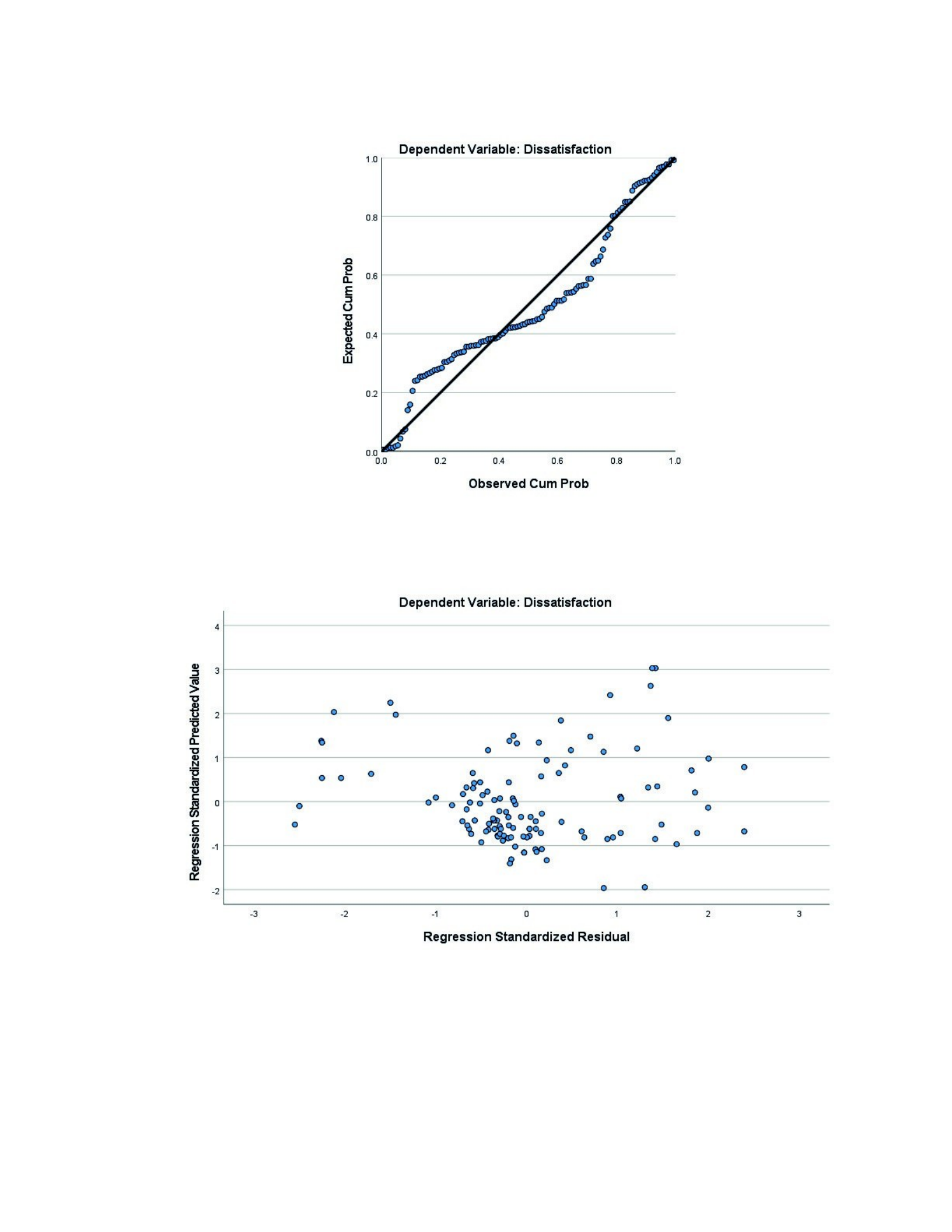
Figure 7
Residuals Versus Predicted Values for Regression Predicting Dissatisfaction
The regression model predicting dissatisfaction was not significant, F(2, 117) =
2.78, R2 = .05, p = .066, indicating that assertive and non-assertive communication
strategies did not explain a significant proportion of variance in dissatisfaction. Table 5

95% CI
B Std. Error t
displays the results for the individual regression coefficients. The regression coefficient
for assertive communication was not significant (B = 6.40, p = .073), indicating that
assertiveness was not significantly related to dissatisfaction; the null hypothesis (H30)
was not rejected. The regression coefficient for non-assertive communication was not
significant (B = -5.91, p = .080), indicating that non-assertiveness was not significantly
related to dissatisfaction; the null hypothesis (H40) was not rejected.
Table 5
Multiple Linear Regression Predicting Dissatisfaction
Variable Beta Sig. Lower Upper VIF
Assertive 6.40 3.53 0.17 1.81 .073 -0.60 13.40 1.02
Non-assertive -5.91 3.34 -0.16 -1.77 .080 -12.54 0.71 1.02
RQ3: How does communication approach relate to conflict for non-dominant
culture group females in the workplace?
H50: No statistically significant relationship exists between the use of
Orbe’s communication strategy of assertiveness and employee
conflict of non-dominant culture group females.
H5a:
A statistically significant relationship exists between the use of
Orbe’s communication strategy of assertiveness and employee
conflict of non-dominant culture group females.
H60:
No statistically significant relationship exists between the use of
Orbe’s communication strategy of non-assertiveness and employee
conflict of non-dominant culture group females.
H6a: A statistically significant relationship exists between the use of

Orbe’s communication strategy of non-assertiveness and employee
conflict of non-dominant culture group females.
A multiple linear regression was conducted to address Hypotheses 5 and 6. In this
analysis, the independent variables were the scores for the assertive and non-assertive
subscales, and the dependent variable was the separation scale (conflict). A normal P-P
plot of the regression residuals in Figure 8 showed no marked deviations from the
diagonal, indicating that normality was met. A scatterplot of residuals and predicted
values in Figure 9 showed that the data were approximately randomly distributed around
zero, indicating the data were homoscedastic describing whether the error term is
constant or the same for all independent variables’ values. Variance inflation factors were
all below 10, indicating there was no severe multicollinearity among the variables.
Outliers were assessed based on standardized residual values greater than 3.00 in
magnitude with two outliers detected based on this criterion. The analysis was conducted
both with and without the outliers included to determine if the outliers impacted the
results. The outcome of the analysis did not change after removing the outliers, so the
results are reported with the outliers retained.
Figure 8
Normal P-P Plot for Regression Predicting Conflict (Separation)
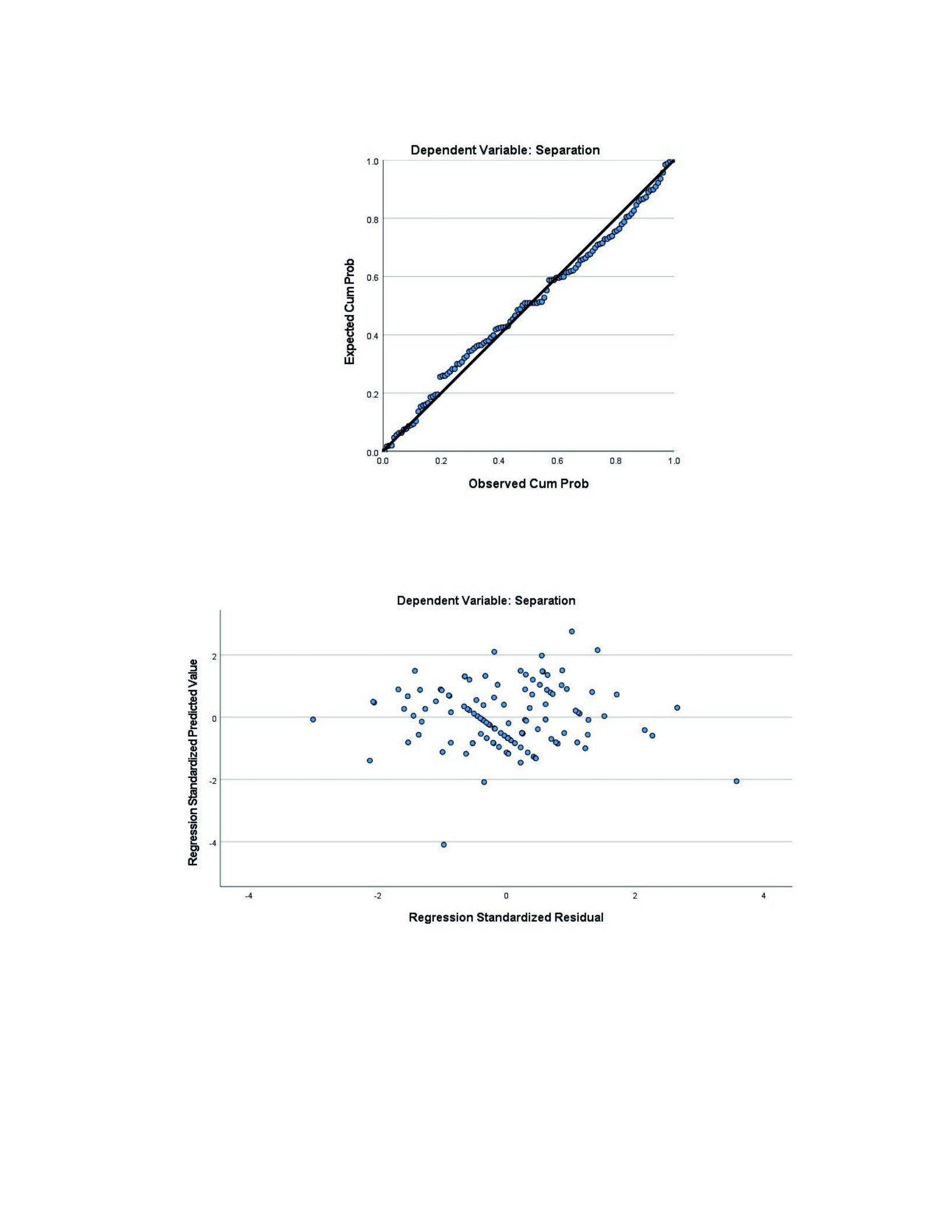
Figure 9
Residuals Versus Predicted Values for Regression Predicting Conflict (Separation)
The regression model predicting conflict was significant, F(2, 117) = 26.57, R2
= .31, p < .001, indicating that assertive and non-assertive communication strategies
explained a significant proportion of variance in conflict. Table 6 displays the results for
the individual regression coefficients. The regression coefficient for assertive

communication was significant (B = 0.37, p < .001), indicating that assertiveness was
significantly related to conflict; the null hypothesis (H50) was rejected. The regression
coefficient for non-assertive communication was significant (B = 0.33, p < .001),
indicating that non-assertiveness was significantly related to conflict; the null hypothesis
(H60) was rejected.
Table 6
Multiple Linear Regression Predicting Conflict (Separation)
Variable B Std. Error Beta t Sig. Lower Upper VIF
Assertive 0.37 0.08 0.38 4.83 < .001 0.22 0.51 1.02
Non-assertive 0.33 0.07 0.36 4.65 < .001 0.19 0.47 1.02
Summary
This Chapter 4 contained the research report of the study results, answered the
research questions, and revealed if the null hypotheses were supported or rejected, and
discussed the findings of the data analyses. A series of multiple linear regression analyses
were conducted to answer the research questions. Of the three research questions and
three sets of hypotheses, three were significantly related and therefore rejected and three
were not significantly related and therefore rejected. No significant relationship was
found between assertiveness and disengagement, therefore H10 was not rejected. A
significant relationship was found between non-assertiveness and disengagement,
therefore H20 was rejected. No significant relationship was found between assertiveness
and dissatisfaction, therefore H30 was not rejected. No significant relationship was found
between non-assertiveness and dissatisfaction therefore, H40 was not rejected. A
95% CI

significant relationship was found between assertiveness and conflict, therefore, H50 was
rejected. A significant relationship was found between non-assertiveness and conflict,
therefore H60 was rejected. Chapter 5 contains sub-sections for the results of each set of
hypotheses, and each result is compared and contrasted with empirical literature.
Chapter 5 Conclusions and Recommendations
The purpose of this quantitative correlational study was to examine the
relationships between co-cultural communication strategies and the constructs of
organizational behavior. Message confusion and miscommunication between managers
and employees (Garnero et al., 2014) can stem from unfamiliar communication strategies
based on cultural differences (Allison, 2004; Castle Bell et al., 2015; DeKay, 2012; Orbe,
1995; Parker, 2002; Shoss et al., 2013). Thus, the general problem was message
confusion in workplace communication. Miscommunication can lead to employee
disengagement, dissatisfaction, or conflict, thereby adversely affecting organizational
behavior, performance, and productivity (Ahmed et al., 2010; Allen, 2007; Mammen &
Sano, 2012; Mills, 2009; Shoss et al., 2013). The specific problem was that some
employees may use co-cultural communication strategies in workplace communication
with managers who may not recognize or be familiar with co-cultural communicative
approaches. Therefore, research was needed on the relationships between co-cultural
communication approaches (Camara & Orbe, 2010) and the constructs of organizational
behavior. Chapter 5 includes a summary of the findings, discussion of the findings, study
limitations, recommendations to leaders and practitioners, recommendations for future
research, and a chapter summary.

To examine the relationships between co-cultural communication strategies and
the constructs of organizational behavior, the researcher focused on two independent and
three dependent variables. The independent variables represented two
salientcommunication approaches: assertiveness and non-assertiveness. The dependent
variables included disengagement, job satisfaction, and conflict. The research questions
(RQ) with the hypotheses were:
RQ1: How does communication approach relate to disengagement for
nondominant culture group females in the workplace?
H10: No statistically significant relationship existed between the use of
Orbe’s communication strategy of assertiveness and employee
disengagement of non-dominant culture group females.
H1a:
A statistically significant relationship existed between the use of
Orbe’s communication strategy of assertiveness and employee
disengagement of non-dominant culture group females.
H20:
No statistically significant relationship existed between the use of
Orbe’s communication strategy of non-assertiveness and employee
disengagement of non-dominant culture group females.
H2a: A statistically significant relationship existed between the use of
Orbe’s communication strategy of non-assertiveness and employee
disengagement of non-dominant culture group females.
RQ2: How does communication approach relate to job dissatisfaction for
nondominant culture group females in the workplace?
H30: No statistically significant relationship exists between the use of
Orbe’s communication strategy of assertiveness and employee
dissatisfaction of non-dominant culture group females.

H3a: A statistically significant relationship exists between the use of
Orbe’s communication strategy of assertiveness and employee
dissatisfaction of non-dominant culture group females.
H40: No statistically significant relationship exists between the use of
Orbe’s communication strategy of non-assertiveness and employee
dissatisfaction of non-dominant culture group females.
H4a: A statistically significant relationship exists between the use of
Orbe’s communication strategy of non-assertiveness and employee
dissatisfaction of non-dominant culture group females.
RQ3: How does communication approach relate to conflict for non-dominant
culture group females in the workplace?
H50: No statistically significant relationship exists between the use of
Orbe’s communication strategy of assertiveness and employee
conflict of non-dominant culture group females.
H5a:
A statistically significant relationship exists between the use of
Orbe’s communication strategy of assertiveness and employee
conflict of non-dominant culture group females.
H60:
No statistically significant relationship exists between the use of
Orbe’s communication strategy of non-assertiveness and employee
conflict of non-dominant culture group females.
H6a: A statistically significant relationship exists between the use of
Orbe’s communication strategy of non-assertiveness and employee
conflict of non-dominant culture group females.
Lapinski and Orbe’s (2007) Co-Cultural Communication Scale and Spector’s

(1997) Job Satisfaction Survey (JSS) were the two valid and reliable instruments used for
data collection. A series of multiple linear regression analyses were conducted to answer
the research questions. No significant relationship was found between assertiveness and
disengagement, so H10 was not rejected. A significant relationship was found between
non-assertiveness and disengagement; therefore, H20 was rejected. No significant
relationship was found between assertiveness and dissatisfaction; H30 was not rejected.
No significant relationship was found between non-assertiveness and dissatisfaction;
therefore, H40 was not rejected. A significant relationship was found between
assertiveness and conflict, so H50 was rejected. A significant relationship was found
between non-assertiveness and conflict; therefore, H60 was rejected.
Discussion of Findings
This discussion of the findings contains sub-sections for the results of the three
research questions (RQ) and three sets of hypotheses with each set containing four
Hypotheses. The first RQ addressed assertive and non-assertive disengagement, while
RQ 2 addressed assertive and non-assertive dissatisfaction, and RQ 2 addressed conflict.
For RQ 1, non-assertiveness was linked to employee disengagement, thereby
suggesting that when females of the non-dominant cultural group are not assertive, they
separate by becoming disengaged. This non-assertive disengagement resembles the
preferred outcome, separation, and may relate to dominant cultural group standards. The
dominant cultural group standards characterize assertive females, whether in the
dominant (Lapinski & Orbe, 2007) or non-dominant groups, as conflicting (Murugavel &
Somaraju, 2016; Osborne & Hamoud, 2017). Conflicting as used in this study

characterized or symbolized workplace misunderstanding in co-cultural encounters
related to the leaders’ communicative exchanges with subordinate employees.
Determining the desired outcome depends mainly on a non-dominant cultural group
member’s perception of the organizational culture, climate, or environment (Gkorezis et
al., 2015; Orbe, 2016; Root, 2018).
Non-assertive separation represents avoidance and intentional barriers to place
distance between the non-dominant culture group members and the dominant culture
groups (Orbe & Roberts, 2012). Consequently, some females in the non-dominant culture
group may succumb to remaining non-assertive. By disengaging or separating, a
nondominant culture group member avoids engaging and interacting in the leader-
member exchange (Allen, 2007). The non-dominant culture groups are perceived as
“muted,” which affect communicative interactions with members of dominant society
(Orbe, 1996
p. 158). Withholding one’s ideas or avoiding communicative interactions may occur
knowingly or unknowingly (Murugavel & Somaraju, 2016; Osborne & Hammoud, 2017;
Zirulnik & Orbe, 2019).
RQ 2 for dissatisfaction revealed no significance, which indicated that neither
assertiveness nor non-assertiveness were linked to dissatisfaction in the non-dominant
culture group females. However, Bray and Williams (2017) used Downs and Hazen’s
1977 Communication Satisfaction Instrument and Meyer and Allen’s 1990 Commitment
Instrument, to conduct two quantitative studies. Bray and Williams’ (2017) quantitative
correlational study with regression analysis revealed a link between employees’ citizenry
behavior (commitment) and satisfaction.

Accordingly, Bray and Williams (2017) indicated that communication
dissatisfaction in the workplace may derive from a gap in an employee’s expectation of
the communication processes. For example, the gap occurs based on employees’
expectations of an organization passing or sharing of information and messages compared
to the actual communication exchange and climate. Bray and Williams (2017) also
posited that employees experiencing positive communication in the workplace would
more likely than not demonstrate significant commitment levels. The significant
commitment levels linked citizenry behavior and job satisfaction. Like Osborne and
Hammoud (2017), Scott (2013) proclaimed job satisfaction and reduced workplace
conflict as drivers of employees’ motivation to perform. Lack of productive performance
in the workplace leads counter-productive workplace behavior (Shoss et al., 2013).
RQ 3 revealed that assertiveness and non-assertiveness were both connected to
conflict. The finding for RQ3 indicated that conflict existed in the non-dominant culture
group participants in this study whether respondents were assertive or non-assertive.
Because regression analysis does not provide causality (Paul & Cozby, 2012; Rusagara &
Sreedhara, 2017), one may speculate that something other than communication strategies
or something else entirely drives the conflict.
The empirical literature (Goering & Breidenstein-Cutspec, 1990; Orbe, 1998a) on
co-cultural communication from a business, industrial, or organizational psychology
standpoint is sparse (Rauschenberger & Mellon, 2014). Nonetheless, dominant culture
group members still lead and influence the American workforce, thereby establishing the
communication culture or climate nurtured in the organization (Averbeck-Lietz, 2013;
Cubbage, 2018; Odine, 2015; Razzante & Orbe, 2018; Redd et al., 2011; Shuler et al.,

2016). As leaders, the dominant culture group members’ influence on the organizational
culture, could occur knowingly or unknowingly (Odine, 2015; Razzante, 2018b; Richard
et al., 2013; Rudick & Golsan, 2016).
DeKay (2012) conducted a study on communication strategies that lend to conflict
reduction and problem resolution. DeKay (2018) found that effective verbal
communication could reduce workplace conflict and enhance workplace conflict
resolution. Root (2018) denounced favoring any co-cultural communication strategy over
another as the most effective communication approach, especially if the favorable support
is based on the preferred outcome (e.g., assimilate or separate). Additionally, Root (2018)
provided rationales and scenarios for teaching, assessing, and fostering familiarity with
co-cultural theory based on minority or marginalized group members' interactions with
privileged or dominant culture group members.
Previous research showed that non-dominant culture group members adapted to
organizational communication situationally (Buzzanell, 1999; Castle Bell et al., 2015;
Congdon, 2014; Goldman & Myers, 2015). Seemingly, the non-dominant culture group
members' situational communicative stance was based on the quality and perception of
organizational communication as influenced by the dominant culture group leaders and
contingent on any one of three desired outcomes (Kramarae, 2005; Richard et al., 2013;
Orbe, 2016). Determining the desired outcome depends mainly on a non-dominant
cultural group member's perception of the organizational culture, as used synonymously
with organizational climate or environment (Root, 2017).
For instance, depending on a non-dominant group member's desired outcome
requires assimilating with or separating from the dominant culture group (Orbe, 1998a;

Root, 2018). White and Ali-Kahn's (2013) research revealed no formal education or
training curriculum on how or where a non-dominant cultural group member learns
adaptability, such as identity negotiation and navigation through an organization (Nuru &
Arendt, 2019; Orbe, 2014; Razzante, 2018a, 2018b). Previous research seldom supported
that academic curriculum existed in colleges and universities on either selecting for use or
using the different co-cultural communication strategies (Cubbage, 2018; DeKay, 2012;
Orbe, 1998a, 1998b; Scott et al., 2013; Zirulnik & Orbe, 2019).
Limitations
There were unforeseen research limitations while conducting the study, which
were outside the researcher's control, and which could have affected the study results and
generalization of the study findings (Orbe, 1995). However, the researcher mitigated most
limitations discussed in this section. In addition to the civil unrest during the United
States’ Presidential election of (2020), coupled with the COVID-19 virus and the Delta
and Omicron variants in 2020 and 2021, other less concerting constraints or limitations
existed as follow.
For example, using a quantitative research methodology during the national
(Center for Disease Control and Prevention, https://www.cdc.gov) and state-wide
(California Department of Public Health, htpps://www.cdph.ca.gov) shelter-in-place
mandates made random recruiting of research participants difficult. The nation's
shelterin-place mandate required all but essential businesses and activities to cease and
close temporarily. Mandatory mask-wearing for safety and protection made hardcopy
survey distribution impossible. Consistent with an established recruitment plan approved
by the University of Phoenix's Institutional Review Board, a reputable research vendor

managed the participants' recruitment process (for less than seven non-consecutive days)
to mitigate the participants' recruitment limitation. The short recruitment period yielded
more than the 89 respondents needed for a rigorous study. Alternatively, the vendor
grossed N = 209 surveys or 43% more respondents than required. However, 89
respondents had no work experience from 2015 through 2021, thereby yielding the 120
completed surveys analyzed. Consequently, the researcher had no control over the
number of individuals responding to the survey.
Another limitation was the inability to investigate all Orbe's co-cultural
communication practices (Castle Bell et al., 2015; Zirulnik & Orbe, 2019). Analysis of 28
communication strategies was much too large. Therefore, the study focused on two
salient-communication strategies. Additionally, the self-report format for the online
survey could have been somewhat limited based on some respondents' inability or
unwillingness to disclose information transparently and honestly about their cultural and
communicative behaviors. Participants may have placed themselves in a positive light by
not revealing their actual communication practices, which is known as social desirability
bias (Camara & Orbe, 2010; Keyton et al., 2013). Respondents may have also
unknowingly used some form of the co-cultural communication approach while lacking
familiarity with such practice (Root, 2018). Subconsciously using any of the co-cultural
communicative approaches does not in itself indicate one’s awareness of or familiarity
with the co-cultural communication practices or that non-dominant culture group
members use or practice the communication techniques at all. Willingness or
unwillingness to disclose information honestly with a stranger (even if online) was
probably not an uncommon instance (Camara & Orbe, 2010; Keyton et al., 2013).

Some collected data regarding the co-cultural communication practices could
have been generalizable because the co-cultural communication theory links to other
theories. Some examples included mainstream communication theory, muted group
theory, critical race theory, and standpoint theory (Allen, 2007; Hendrix & Wilson, 2014;
Kramarae, 2005; Liggett, 2014; Murugavel & Somaraju, 2016; Orbe, 1998b; Rocco et al.,
2014; Rudick & Golsan, 2016). The present study focused only on two co-cultural
communication strategies, assertiveness and non-assertiveness and two preferred
outcomes. assimilate and separate.
Recommendations to Leaders and Practitioners
Based on the research findings for research questions (RQ) 1 and 3, some
practical recommendations to the leaders and practitioners follow. Non-assertiveness
connected to disengagement, while assertive and non-assertive both connected to conflict.
Leaders can and should encourage acceptable or situational assertiveness to prevent an
employee’s disengagement. Also, leaders may need training on recognizing
disengagement or non-assertiveness as preconditional to an employee’s separation.
Industrial and Organizational Psychologists, Organizations, and institutions of higher
learning can train leaders in identifying and addressing potential conflict.
Castle Bell et al. (2015) asserted that conducting studies on co-cultural
communication would contribute to the field of communication by an expansion of “the
theory-building process” (p. 3). The current study emphasized co-cultural communication
practiced in some American workplaces that inform industrial and organizational
psychology. This quantitative study added to the body of knowledge that has been
modeled mostly through qualitative research methods and designs. Examining the

cocultural communication theory from the industrial and organizational psychology
perspective expands awareness of the theory in a field other than communication.
As demonstrated in this study, a need for increased awareness of co-cultural
communication exists in the American workplace. As such, industrial and organizational
psychologists and practitioners should arise to the cause of helping organizations meet
this trending need. Through training and development of the co-cultural communication
practices, consciousness-raising promotes a different communication perspective. For
example, leaders and practitioners are empowered and accountable as the first-line
champions of decision-making and change management. The champions of change
should first aspire to fully understand the co-cultural communication phenomenon. To
transform an environment or climate of knowledge acquisition for the American
workforce to cultivate the theory by ensuring a more profitable and competitive
organization. Leaders and practitioners should encourage diversity, equity, and inclusion
(DEI) in the workplace.
Little if any literature exists on co-cultural communication from the field or
perspective of industrial and organizational psychology. Markets for curriculum
development to impart knowledge of the co-cultural communication theory exist in
public, private, and non-profit academic institutions. Institutions of higher learning
include state and community colleges and universities (Historically Black Colleges and
Universities). Most United States federal and state government organizations are
mandated to implement DEI in the increasingly culturally diverse workplaces.

Root (2018) provided rationales and scenarios for teaching, assessing, and
fostering familiarity with co-cultural theory based on minority or marginalized group
members' interactions with privileged or dominant culture group members. Additionally,
Root (2018) developed academic activities and concise instructions on the practical
application of co-cultural communication theory. Root (2018) sought to raise awareness
of the co-cultural communication theory among college students. Root (2018) wanted to
achieve the goal of ensuring the students could demonstrate an understanding of
"different communicative approaches and desired outcomes based on communication
between marginalized and dominant group identities" (p. 13). Root (2018) also provided
proposed questions to guide professors in debriefing students who participated in the
inclass scenarios to learn if the students understood the co-cultural communication theory
from personal experiences. In 2020, Tang et al. conducted a study whereby the cocultural
communication theory applied concurrently to dominant and non-dominant cultural
groups outside the United States.
Recommendations for Future Research
Although this study was conducted using a quantitative research method,
additional research is needed using the quantitative and mixed methods because much of
the seminal research was conducted using various qualitative methods, such as
Phenomenological (hermeneutic & heuristic), Delphi (descriptive, exploratory, and
prescriptive approaches), and case studies (inductive characteristics). Random sampling
is recommended to help increase the representativeness of the sample and the
generalizability of the results.

A mixed-method approach may prove beneficial as both quantitative and
qualitative research methods can help obtain in-depth information on communication and
conflict as non-assertive related to disengagement and both assertiveness and
nonassertiveness linked to conflict. Future studies could include aggressiveness as the
third communication approach; accommodation as the third preferred outcome; and
several of the remaining co-cultural communication orientations like those depicted in
Table A2, titled Co-Cultural Strategies, Communication Approaches, and Preferred
Outcomes. Perhaps additional research and more information can provide better
understanding of the research findings in this study.
It would also be helpful to conduct more research on modifying and adapting the
theory in diverse and situational contexts. As an influx of more diverse individuals and
groups gravitate to the American workplaces, more strategies could be included.
Expanding co-cultural communication theory through future research could benefit the
workplace and the academic community. As evidenced by Orbe’s continued co-authoring
of qualitative research on co-cultural communication strategies and approaches, the
literature is not yet overly saturated with the co-cultural communication theory (Camara
& Orbe, 2010; Lapinski & Orbe, 2007; Orbe & Harris, 2015; Orbe & Price, 2015;
Razzante & Orbe, 2018; Zirulnik & Orbe, 2019).
A lack of evidence exists on examining the co-cultural communication theory in
the field of industrial and organizational psychology. Cultural diversity, equity, and
inclusion (DEI) continue increasing in the American workplace. The DEI phenomenon
creates a need for increased awareness of co-cultural communication implications on the
leader-member exchange and interactions with subordinate employees. The industrial and

organizational psychology field covers a multitude of the workplace and organizational
behaviors, which aligns with day-to-day communications between people of diverse
cultures. Thus, co-cultural communication as manifested in this study warrants additional
research from within the field of industrial and organizational psychology.
As shown in this study, workplace communication, message confusion, ineffective
communication, and miscommunication are somewhat synonymous and fit with
organizational behavior. Disengagement, dissatisfaction, and conflict were examined to
reveal relationships with communication approaches, orientations, and preferred
outcomes. Leader-member day-to-day communicative exchange and interactions occur
between people of diverse cultures in the workplace. Thus, the implications for co-
cultural communication as manifested in this study demands an adaptation of the co-
cultural communication practices to align with research in the field of industrial and
organizational psychology.
Summary
The three research questions (RQ) and four sets of the hypotheses for each
question revealed three significant relationships where the null hypotheses were rejected
and three with no significant relationships where the null hypotheses failed to reject.
First, non-assertive connected significantly to disengagement while both assertive and
non-assertive linked to conflict. Second, no significant relationships were found between
assertive disengagement nor assertive or non-assertive dissatisfaction.
The co-cultural communication theory is a highly unrecognized phenomenon in
the United States workplace. An influx of individuals with varying cultures and
ethnicities assimilates into the United States and the American workplace alongside the

dominant culture group leaders. An innumerable number of foreign refuges enter the
United States annually and seek employment within the American economy.
In the United States, organizations are mandated to implement Diversity, Equity, and
Inclusion (DEI) programs. Complaints derived from workplace conflict affects
employees’ performance organizations’ bottom line and resources (e.g., people, money,
and time). An infinite number of conflicts in the American workplace occur where
individuals of different cultural backgrounds interact communicatively. More likely than
not, a substantial percentage of conflicts stem from communicative misunderstanding and
message confusion. While this quantitative correlational study could not address
causality, this study revealed significant relationships found between assertive and
nonassertive conflict and non-assertive disengagement. Workplace conflicts and
complaints negatively affects the non-dominant culture group members (subordinate
employees)
cognitively, behaviorally, and emotionally.

