


1
Ch. 14 Kimball Spring 2019
Discussion Worksheet - Chapter 15
Chemical Equilibrium - KEY
Dr Cabirac Lecture
1. Write the equilibrium constant expressions for Kc , and for Kp if applicable, for the
following processes:
𝐾𝑐= [𝑁𝐻3]2
[𝑁𝑂2]2[𝐻2]7 or 𝐾𝑃= 𝑃(𝑁𝐻3)2
𝑃(𝑁𝑂2)2𝑃(𝐻2)7
𝐾𝑐= [𝑍𝑛𝑂]2[𝑆𝑂2]2
[𝑂2]3 or 𝐾𝑃= 𝑃(𝑍𝑛𝑂)2(𝑆𝑂2)2
𝑃(𝑂2)3
𝐾𝑐= [𝐶𝑂]2
[𝐶𝑂2]or 𝐾𝑃= 𝑃(𝐶𝑂)2
𝑃(𝐶𝑂2)
𝐾𝑐= [𝐶6𝐻5𝐶𝑂𝑂−][𝐻+]
[𝐶6𝐻5𝐶𝑂𝑂]
2. The equilibrium constant for the reaction A ⇋ B is Kc = 10 at a certain temperature.
Consider the diagrams below to answer the following questions: (A=grey, B=green)
A. Starting with only reactant A, which of the diagrams best represents the system
at equilibrium? Figure A 𝐾𝑐= [𝐵]
[𝐴] =10
1=10
B. Which of the diagrams best represents the system at equilibrium if Kc = 0.10?
Figure C 𝐾𝑐= [𝐵]
[𝐴] =1
10 = 0.10
C. Explain why you can calculate Kc in each case without knowing the volume of the
Container.
𝐾𝑐=
𝑚𝑜𝑙 𝑜𝑓 𝐵
𝑉
𝑚𝑜𝑙 𝑜𝑓 𝐴
𝑉
= 𝑚𝑜𝑙 𝑜𝑓 𝐵
𝑚𝑜𝑙 𝑜𝑓𝐴 volume is constant

2
Ch. 14 Kimball Spring 2019
3. The following diagrams represent the equilibrium state for three different reactions of the
type A + X ⇋ AX (x = B, C, or D):
A. Which reaction has the largest equilibrium constant?
B. Which reaction has the smallest equilibrium constant?
4. Consider the following equilibrium reaction:
PCl5 (g) ⇋ PCl3 (g) + Cl2 (g) Kp = 1.10 at 298 K ΔH° = 92.5 kJ/mol
a. Predict the effect on the above equilibrium if
i. The temperature is raised Endothermic, heat is reactant, shift right
ii. More chlorine gas is added Cl2 is product added, shift left
iii. Some PCl3 is removed PCl3 is product removed , shift right
iv. The pressure on the gases is increased shift to lower overall P, shift left
b. What is value of Kc for the above reaction?
Kc = 0.0450
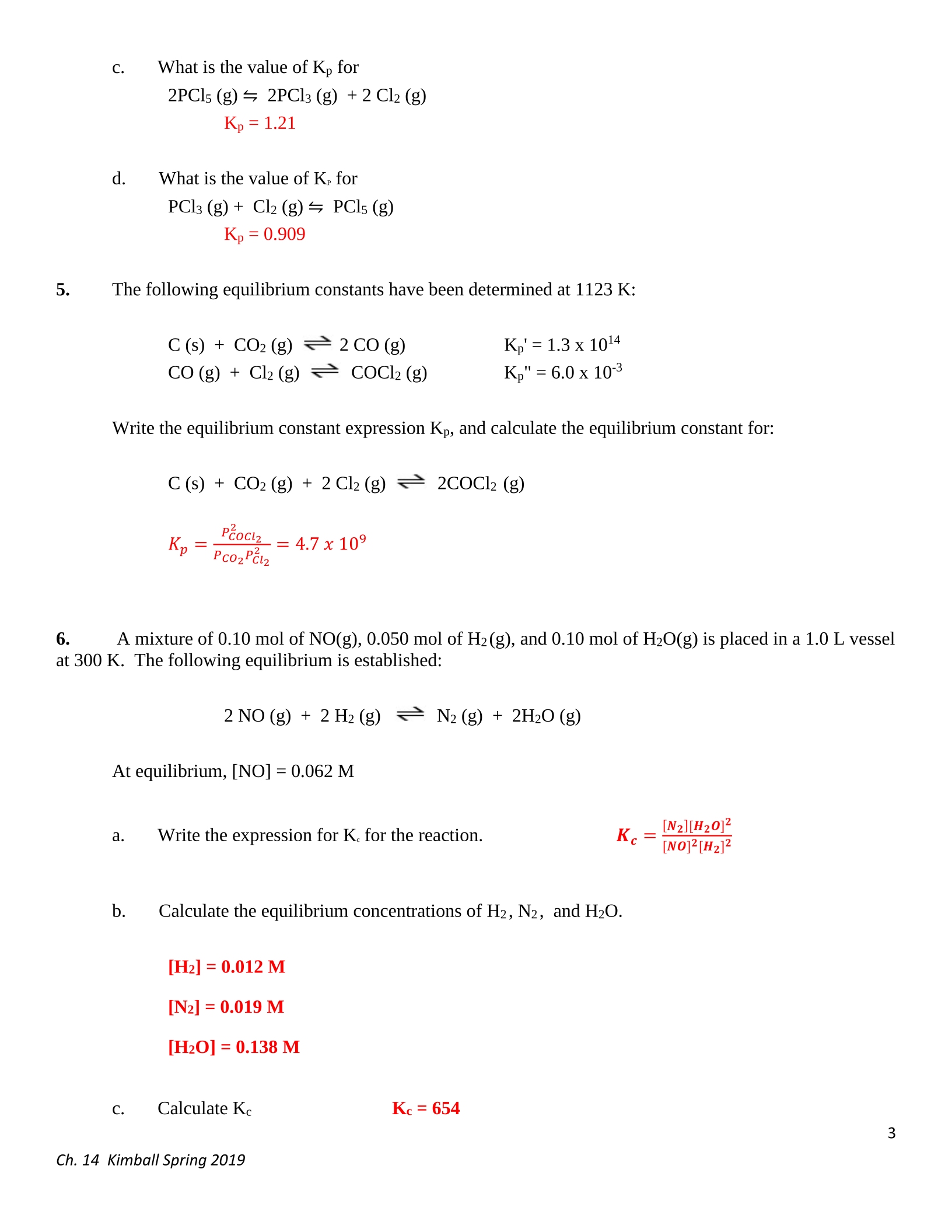
3
Ch. 14 Kimball Spring 2019
c. What is the value of Kp for
2PCl5 (g) ⇋ 2PCl3 (g) + 2 Cl2 (g)
Kp = 1.21
d. What is the value of KP for
PCl3 (g) + Cl2 (g) ⇋ PCl5 (g)
Kp = 0.909
5. The following equilibrium constants have been determined at 1123 K:
C (s) + CO2 (g) 2 CO (g) Kp' = 1.3 x 10¹⁴
CO (g) + Cl2 (g) COCl2 (g) Kp" = 6.0 x 10⁻³
Write the equilibrium constant expression Kp, and calculate the equilibrium constant for:
C (s) + CO2 (g) + 2 Cl2 (g) 2COCl2 (g)
𝐾𝑝=𝑃𝐶𝑂𝐶𝑙2
2
𝑃𝐶𝑂2𝑃𝐶𝑙2
2= 4.7 𝑥 109
6. A mixture of 0.10 mol of NO(g), 0.050 mol of H2 (g), and 0.10 mol of H2O(g) is placed in a 1.0 L vessel
at 300 K. The following equilibrium is established:
2 NO (g) + 2 H2 (g) N2 (g) + 2H2O (g)
At equilibrium, [NO] = 0.062 M
a. Write the expression for Kc for the reaction. 𝑲𝒄=[𝑵𝟐][𝑯𝟐𝑶]𝟐
[𝑵𝑶]𝟐[𝑯𝟐]𝟐
b. Calculate the equilibrium concentrations of H2 , N2 , and H2O.
[H2] = 0.012 M
[N2] = 0.019 M
[H2O] = 0.138 M
c. Calculate KcKc = 654

4
Ch. 14 Kimball Spring 2019
7. Consider the following reaction:
2SO2 (g) + O2 (g) 2SO3 (g) Kp = 2.5 x 10⁹
A. Does this reaction favor the formation of reactants or products?
Since Kp >> 1, rxn favors products
B. If the pressures of mixture are P(SO2) = 0.0034 atm, P(O2) = 0.0055 atm, and
P(SO3) = 0.98 atm, is the reaction at equilibrium? If it is not, will the reaction shift
toward the reactants or the products?
Qp = 1.5 x 10⁷
since Qp < Kp, the equilibrium will shift to the right to increase product conc.
8. For the equilibrium, Br2 (g) + Cl2 (g) 2BrCl (g) at 400 K, Kc = 7.0.
If 0.25 mol of Br2 and 0.55 mol of Cl2 are introduced into a 3.0 L container at 400 K, what will be the
equilibrium concentrations of Br2 , Cl2 and BrCl? (**Hint: Use an ICE table.)
[Br2] = 0.020 M
[Cl2] = 0.0117] M
[BrCl] = 0.126 M
9. For the equilibrium H2 (g) + I2 (g) ↔ 2HI (g) at 400°C, Kc = 64
If 3.00 mol H2 and 3.00 mol I2 are introduced into a 4.0 L vessel, what will be the equilibrium
concentration of HI at 400°C?
[HI]eq = 1.2 M
Powered by TCPDF (www.tcpdf.org)

