


Workload and Academic Staff Performance
Name
COUN 8111 - Leadership and Organizational Change
Walden University
2022

Workload and Academic Staff Performance
The workload is the all-encompassing and wide-ranging activity that consumes
employees’ time. This includes but is not limited to executing professional duties and
responsibilities, as well as the direct/indirect pursuit of work-related interests. In the context
of higher education, numerous researchers used similar workload definitions when studying
the academic staff cohort (Pace et al., 2019; Sallehuddin et al., 2019). Rahman and Avan
(2016) defined lecturers’ specific workload as the amount of time spent in performing a
portfolio of researching and teaching tasks, facilitating co-curricular activities, and being
involved in meetings, among others. In the context of Malaysian universities, the workloads
of academics are grouped into at least five categories, which are teaching and supervision,
publication, research and consultation, managerial work, and community services (Basarudin
et al., 2016). All academic staff members are expected to perform in the above-mentioned
areas, regardless of being employed on a teaching-research or research-only basis. At present,
the university academia faces constant challenges in meeting the diverse needs of students
and performance requirements. The pressure becomes overwhelming for academic staff, and
when stress ensues, their capacity declines (Martin-Sardesai & Guthrie, 2018). As commonly
reported, when subjected to greater job demand of tasks, the common manifestation is
numerous errors and delayed responses. Additionally, two causes of diminishing performance
quality are high-task workload and task complexity (Lyell et al., 2018). Sufficient studies
have found that work overload is a stress trigger when employees are confronted with either
the quantity or difficulty of tasks (Kimura et al., 2018) . As the task quantity/volume and
difficulty increases, employees’ level of job stress rises in tandem. Finally, many studies have
examined the workload-job stress-job performance dynamics (Pace et al., 2019). Thus, we
propose the next hypothesis:
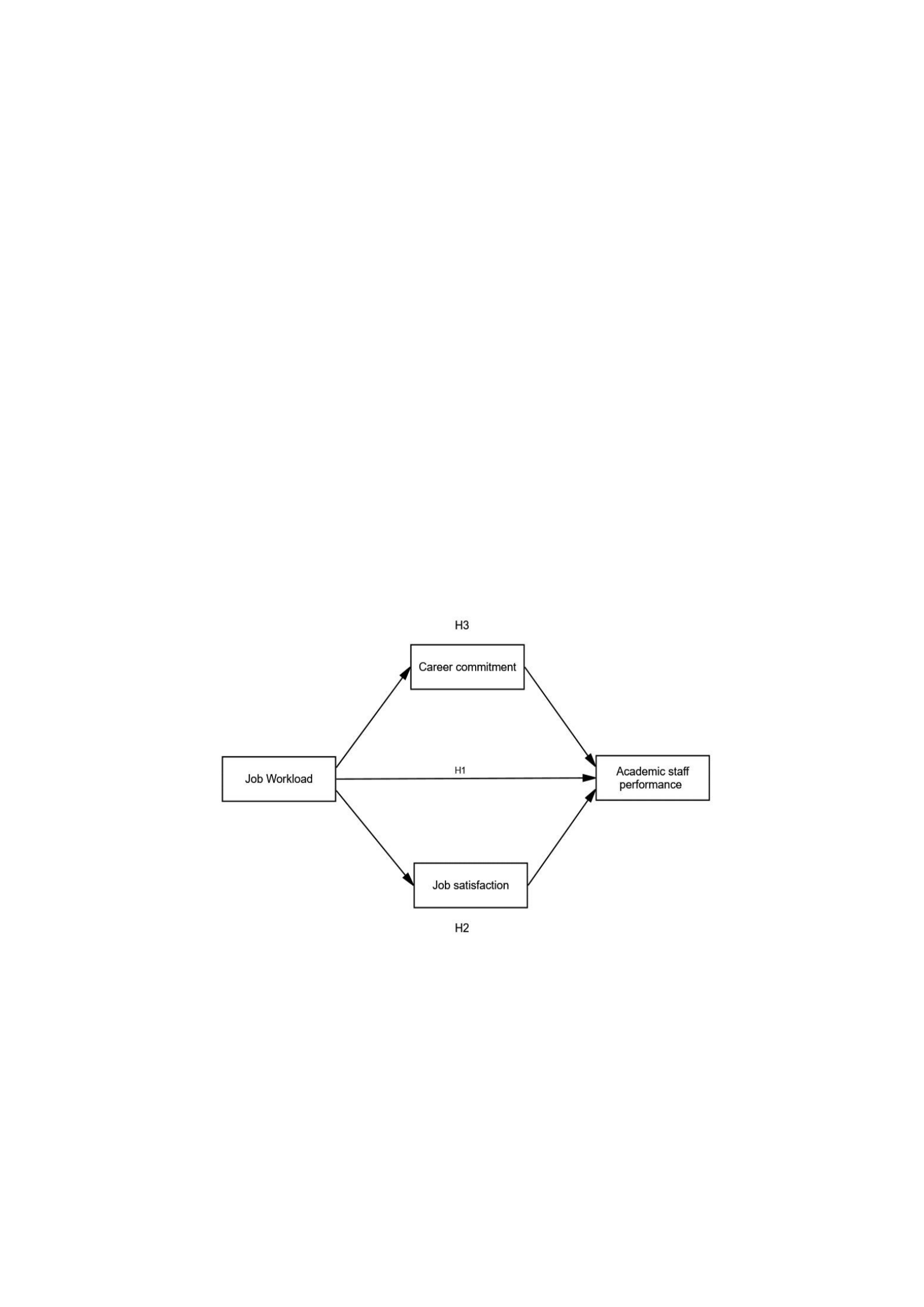
H1. Job workload will be negatively related to academic staff performance.
The Mediating Role of Job Satisfaction
This study adopts the job satisfaction definition of Joung et al. (2015), which refers to
the emotional contentment that shapes attitudes about the job. Accordingly, this construct is
built with two components, namely cognitive and affective. Weiss (2002) has reported that
both components affect overall attitude and behavior. In a study situated within the university
context, the researcher observed a negative relationship between job overload and satisfaction
at work among academic staff (Ahsan et al., 2009). In a Malaysian context, one study found
that job workload negates job satisfaction among university teaching staff (Leung et al.,
2000). Conversely, a strong and positive relationship was found between job satisfaction and
job performance where job satisfaction was suggested as a good predictor for superior
performance at work (Diamantidis & Chatzoglou, 2019). Another study observed how job
satisfaction had led to an increase in work efficiency and performance (Aziri, 2011). This
underscores the importance of employee satisfaction in the aspect of organizational
productivity and performance (Aksoy et al., 2018). In an Arabic culture-centric study, the
researcher reported that job satisfaction displayed mediating effects when role conflict and
role ambiguity influenced multiple aspects of organizational commitment (Yousef, 2017). In
a study of southern Indian employees in a transportation company, job stress, job satisfaction,
and job commitment displayed partial mediating effects between the quality of work-life and
work-life balance (Aruldoss et al., 2020). As far as the profession in academia is concerned,
academic staff’s level of satisfaction may implicate how emotionally attached they are
towards their university (Szromek & Wolniak, 2020). Looking into the aspect of employee
health, researchers observed that psychological health was impacted by workload as a work
stressor and job satisfaction as a mediator (Jou et al., 2013). Similar findings were reported
when job satisfaction mediated the workload-job performance relationship (Jalal & Zaheer,
2017). The mediating role of job satisfaction and its importance were upheld by Crede et al.
(2007) as it carries various situational and dispositional characteristics and is an agency of
organizational outcomes. Thus, we propose the next hypothesis:

H2. Job satisfaction will mediate the association between workload and performance of
university academic staff.
The Mediating Role of Career Commitment
This study adopts the career commitment definition provided by Blau (1985), which
refers to employee’s emotional experience of being satisfied with and their aspiration to
further develop themselves in their current career. According to Colarelli and Bishop (1990),
committed workers tend to first set career-centric aims, recognize viable paths, and then
endeavor to achieve them. Lee et al. (2000) highlighted that career-committed employees are
dedicated to work engagements and display exemplary performance compared to those who
are less committed. This is reflected in the attitudes of university academics who are highly
committed to their career. This cohort tends to establish an understanding of their institution’s
needs, and then proactively adjust and align their career goals with institutional goals (Wang
et al., 2017), ideally supporting job involvement and innovation-driven behaviors. Chang
(1999) observed that career-committed academic staff became highly motivated when their
expectations were matched by their institution. In extending the commitment-stress-outcome
literature, Suliman (2002) interestingly reported a converse outcome; career-committed
employees professed greater intensity of stress than their less-committed colleagues.
Specifically, academic staff
87
Asian Journal of University Education (AJUE)
Volume 17, Number 2, April 2021
with a high level of commitment to their job tend to undertake more responsibilities or work
longer hours which does not necessarily result in more productivity. Instead, it can result in
overworked and dissatisfied staff members, adversely impacting the bottom line in
eventuality. Such faculty members ultimately bear academic hardships due to their vested
emotional investment and identification with their esteemed institution (Szromek & Wolniak,
2020).
In addition to the stress‐to-outcome link, the mediating role of commitment has been
tested within numerous management contexts. In the study of work commitment, Morrow’s
(1993) suggestion involves the examination of a reciprocal effect lending to the fact that joint
work commitment is possibly a superior work outcome predictor. This examination angle
may be better compared to separate examinations of each work commitment forms of
influence on outcomes at work. A past study found that job satisfaction and organizational
commitment played full mediating roles on the dynamics of person-job fit and turnover
intentions (Chhabra, 2015). In a self-evaluation impact study, the researchers scrutinized job
satisfaction with the principal aim to confirm career commitment as a mediator (Zhang et al.,
2014). Consequently, career commitment only played a partial mediating role in the core self-
evaluation and job satisfaction relationship. To the best of the researcher’s knowledge, studies
on the workload‐ performance relationship where commitment is examined and tested as a
mediator have yet to emerge (see Figure 1). Thus, we propose that:
H3. Career commitment will mediate the negative relationship between workload and
academic staff performance.
Figure1: The research framework
Methods
Research Design
It is an integral part of the research. It is a basic structure covering the overall strategy
regarding the method to be used in the study. Selecting a correct research design that tallies
with the objectives helps obtain an authentic result (Haegele & Hodge, 2015). Survey
research design and quantitative methods have been used for this study as we do hypothesis-
generating research (exploratory research) (Andrade, 2019).
Sample

Globally, research universities (RUs) are leading in terms of scholarship, innovation,
and solutions - key ingredients in the makings of a developed country. These contributions
from RUs create
88

Asian Journal of University Education (AJUE)
Volume 17, Number 2, April 2021
impacts on the country’s economy, security, and wellbeing. Malaysia’s higher education
sector comprises two major providers, namely public and private institutions (Fernandez,
2010). To foster competition and boost performance rankings, public universities are
classified into three groups: RUs, wide-ranging universities, and focus universities. The
concept of Malaysian Research Universities (MRUs) was first introduced as a response for
Malaysia to successfully transition from a developing country status to developed country
status. Consequently, five public universities have been designated as MRUs (Ministry of
Education, 2015) . It can be discerned that the faculty members of these MRUs may face
more occupational issues than what is previously known since university management teams
are dealing with the pressure of participating in fierce competition with their institutional
peers (Ramli et al., 2020). Notably, the success of academic programs heavily relies on
competent faculty leaders and members - their dedication towards teaching as well as their
commitment and integrity towards competitive, rigorous research (Noordin & Jusoff, 2010;
Roslan et al., 2021).
The respondents of this study were faculty members employed in the five Malaysian
Research Universities (MRUs). The targeted population was 9,333 academic staff selected
based on their institution’s latest number of academic staff by position, citizenship, and
gender (Ministry of Education, 2015). The final sample consisted of 191 completed responses
through the stratified random sampling technique. The response rate was 76.4% from the 250
sets of questionnaires initially distributed. Women represented 46.59% (89 respondents) and
men 53.4% (102 respondents) of the sample with an average age of 45 years old. The sample
includes diverse positions, ranging from senior lecturers (47.6%) and lecturers (5.8%),
followed by associate professors (33.5%), and professors (13.1%) (See Table 1).
Table1. Demographic results.
Demography
Gender
N Percentage
Female
89
46.59%
Male
102
53.4%
Position
Senior lecturers
91
47.6%
Lecturers
11
5.8%
Associate professors
64
33.5%
Professors
25
13.1%
Research University
UM
40
20.94%
Faculty of Science
13
Faculty of Education
14
Faculty of Business and Accountancy
13
UKM
37
19.37%
Faculty of Social Science and Humanities
10
Faculty of Science and Technology
10
Faculty of Economics and Business
17
USM
37
19.37%
Faculty of Biological Sciences
12
Faculty of Medical Sciences
13
Faculty of Educational Studies
12
UPM
38
19.89%
Faculty of Human Ecology
15
Faculty of Educational Studies
14
Faculty of Medicine 9
UTM
39
20.41%

Faculty of Engineering
13
Faculty of Science
13
Faculty of Built Environment and
Surveying
13
89

Asian Journal of University Education (AJUE)
Volume 17, Number 2, April 2021
Note. UM= University of Malaya, UKM= Universiti Kebangsaan
Malaysia, USM= Universiti Sains Malaysia, UPM= Universiti Putra
Malaysia, UTM= Universiti Teknologi Malaysia.
Procedure
We used a stratified random sampling technique and identified the samples that
represented specific academic ranks in several selected faculties or schools from each MRU.
Firstly, we determined the sample according to the faculty research areas (pure science and
social sciences). Then, we selected the related department and the sample according to the rank
of academicians (lecturer, senior lecturer, associate professor, and professor). A sample of 191
staff was selected and distributed among selected faculties. We ensured that the number of
academic ranks selected in a faculty or school must be in the same proportion as the overall
academic ranks available in the university itself. The proposed stratified random sampling
procedure is according to the number of faculties and academic ranks being selected, given the
population was N = 9,333. Questionnaires were distributed to the respondents after signing a
consent form. The permission for questionnaire completion was obtained from university
chairpersons and faculty deans. The respondents took an average of 30 minutes to complete and
return the questionnaires. The data collection period ended within two months.
Measures
The qualification of variables was based on several criteria, specifically the validity and
reliability of measures. The variables have already been examined in past studies where they also
demonstrate sound psychometric properties.
Job Workload. This measure was estimated using a scale with nine items, some of which
include academic workloads in management over the past 12 months, the quality and quantity of
teaching and research-related works, adequate time, and a reasonable number of consultations
undertaken (Houston et al., 2006). A sample item is “I regularly need to work after hours to meet
my work necessities.” This 5-point Likert scale is anchored in the extreme scores of one
(strongly disagree) and five (strongly agree) at both ends, with a Cronbach’s alpha value of
0.872.
Academic Performance. The 10-item global academic performance scale was used to
measure staff’s academic performance (Abubakar et al., 2018). The items are academic
reputations, employability of graduates, faculty ratio, study output, globalization, academic prize
and field medals, research grant, abundant resources, infrastructures and facilities, and
community service. This 5-point Likert scale is anchored in the extreme scores of one (strongly
disagree) and five (strongly agree) at both ends, with a Cronbach’s alpha value of 0.974.
Career Commitment. Blau’s (1985) scale was used to assess this measure. Sample items
are “I like the advocatory profession too much to give it up,” and “I am disappointed with being
a lawyer” (reverse-scored). This 5- point Likert scale is anchored in the extreme scores of one
(strongly disagree) and five (strongly agree) at both ends, with a Cronbach’s alpha value of 0.90.
Job Satisfaction. Tsui et al.’s (1992) 6-item scale was used to estimate this measure.
Sample items are “How satisfied are you with the nature of the work you perform?” and

“Considering everything, how satisfied are you with your current job situation?”. This 5-point
Likert scale is anchored in the extreme scores of one (very dissatisfied) and five (very satisfied at
both ends, with a Cronbach’s alpha value of 0.79.
References
Abubakar, A., Hilman, H., & Kaliappen, N. (2018). New tools for measuring global academic
performance. Sage Open, 8(3), 1–10.doi: 10.1177/2158244018790787
Ahsan, N., Abdullah, Z., Fie, D. Y. G., & Alam, S. S. (2009). A study of job stress on job
satisfaction among university staff in Malaysia: Empirical study. European Journal of
Social Science, 8(1), 121–131.
Aksoy, C., Sengül, H. İ., & Yilmaz, Y. (2018). Examination of the relationship between job
satisfaction levels and organizational commitments of tourism sector employees: A
research in the Southeastern Anatolia region of Turkey. Elektronik Sosyal Bilimler
Dergisi, 17(65), 356–365. doi: 10.17755/esosder.343032
Andrade, C. (2019). Describing research design. Indian Journal of Psychological Medicine,
41(2), 201– 202. doi: 10.4103/ijpsym.ijpsym_66_19
Aruldoss, A., Kowalski, K. B., & Parayitam, S. (2020). The relationship between quality of work
life and work life balancemediating role of job stress, job satisfaction and job
commitment: Evidence from India. Journal of Advances in Management Research, 18(1),
36–62. doi: 10.1108/jamr-05-2020-0082
Aziri, B. (2011). Job satisfaction: A literature review. Management Research & Practice, 3(4),
77–86. Basarudin, N. A., Yeon, A. L., Yaacob, N., & Yusof, R. (2016). Faculty workload and
employment benefits in public universities. International Review of Management and Marketing,
6(S7), 73–
82.
Blau, G. J. (1985). The measurement and prediction of career commitment. Journal of
Occupational Psychology, 58(4), 277–288. doi: 10.1111/j.2044-8325.1985.tb00201.x
Cao, J., Liu, C., Wu, G., Zhao, X., & Jiang, Z. (2020). Work–family conflict and job outcomes
for construction professionals: The mediating role of affective organizational
commitment. International Journal of Environmental Research and Public Health, 17(4),
1–24. doi: 10.3390/ijerph17041443
Chang, E. (1999). Career commitment as a complex moderator of organizational commitment
and turnover intention. Human Relations, 52, 1257–1278. doi:
10.1177/001872679905201002
Chhabra, B. (2015). Person–job fit: Mediating role of job satisfaction & organizational
commitment.
The Indian Journal of Industrial Relations, 50(4), 638–651.

Chin, W. S., & Mohd. Rasdi, R. (2014). Protean career development: Exploring the individuals,
organizational and job-related factors. Asian Social Science, 10(21), 203–215. doi:
10.5539/ass.v10n21p203
Colarelli, S. M., & Bishop, R. C. (1990). Career commitment: Functions, correlates, and
management.
Group & Organization Studies, 15(2), 158–176. doi: 10.5539/ass.v10n21p203
Crede, M., Chernyshenko, O. S., Stark, S., Dalal, R. S., & Bashshur, M. (2007). Job satisfaction
as mediator: An assessment of job satisfaction’s position within the nomological network.
Journal of Occupational and Organizational Psychology, 80(3), 515–538. doi:
10.1348/096317906x136180
Diamantidis, A. D., & Chatzoglou, P. (2019). Factors affecting employee performance: An
empirical approach. International Journal of Productivity and Performance Management,
68(1), 171– 193. doi: 10.1108/ijppm-01-2018-0012
Dorenkamp, I., & Ruhle, S. (2019). Work–life conflict, professional commitment, and job
satisfaction among academics. The Journal of Higher Education, 90(1), 56–84. doi:
10.1080/00221546.2018.1484644
Fernandez, J.L. (2010). An exploratory study of factors influencing the decision of students to
study at Universiti Sains Malaysia. Kajian Malaysia, 28(2), 107-136.
Fu, W., & Deshpande, S. P. (2014). The impact of caring climate, job satisfaction, and
organizational commitment on job performance of employees in a China’s insurance
company. Journal of Business Ethics, 124, 339–349. doi: 10.1007/s10551-013-1876-y
Gaither, C. A. (1999). Career commitment: A mediator of the effects of job stress on
pharmacists’ work-related attitudes. Journal of the American Pharmaceutical Association
(1996), 39(3), 353–361. doi: 10.1016/s1086-5802(16)30437-5
Hair, J. F., Hult, G. T. M., Ringle, C. M., & Sarstedt, M. (2017). A primer on partial least
squares structural equation modeling (PLS-SEM) (2nd ed.). Sage.
Han, J., Yin, H., Wang, J., & Zhang, J. (2020). Job demands and resources as antecedents of
university teachers’ exhaustion, engagement and job satisfaction. Educational
Psychology, 40(3), 318– 335. doi: 10.1080/01443410.2019.1674249
Haegele, J. A., & Hodge, S. R. (2015) . Quantitative methodology: A guide for emerging
physical education and adapted physical education researchers. The Physical Educator,
72(5), 59–75. doi: 10.18666/TPE-2015-V72-I5-6133

