


Consumer Behavior of International
Students

Introduction
When students immigrate to foreign countries in
pursuit of higher learning, they find things very
strange in their host country. This forces their
purchase behavior to undergo radical changes in
order to get used to the new dwelling place. The
changes occur because they find different
commodities from the ones they are used to back
at home. This paper will address these changes
and their underlying causes with regards to
grocery shopping.
Relocating from one geographical location
causes the purchase behavior of international
students to change drastically. According to
Pride, Hughes and Kapoor, this is because they
are far away from home and when they buy
items they prefer the ones that remind them
about their origin (1).

When they go shopping they select the items
they want to purchase depending on their taste.
Sometimes this is difficult because the kind of
food stuff in most grocery stores may not be
familiar to them but then they have to buy
something because they cannot survive without
food.
At times, the item that they are used to could be
available but at a very high price. In such a case
the students have to find an alternative item that
is pocket friendly. For instance, a student from
Japan may see food to be very expensive in
America compared to its price in Japan, and thus
the student may opt to go for chicken instead
because it is relatively cheap.
There are some students who become home sick
in the first few days of arrival and hence they opt
to drive a few kilometers just to have that home
feeling when they buy products from their

countries. Others prefer to buy products from
their mother country simply because they feel
obligated to help their home industries grow by
promoting them.
Stages of International Consumer Behavior
Before an international student buys an item, he
or she goes through several steps and in fact the
act of buying is among the steps of making that
decision. It is important to note that the steps are
not always the same for all products because
some require simple analysis.
The first step is the acknowledgement of the
requirement of a particular item. Doole and
Lowe outline that the acknowledgement could
be induced by either internal pressure or external
pressure (2). Internal pressure is limited body
requirements such as the need of water which
may cause someone to be thirsty and hence buy

a drink to quench the thirst. External pressure is
normally brought by the things happening
around us, such as the commercials about certain
outfits that may induce the urge to buy a new
pair of trousers or even a dress.
This means that the thoughts of buying must be
invoked because they do not just come from
nowhere. When the students are walking around,
they actually see the items of trade being
displayed but the thoughts of even making an
inquiry about those items will only come when
there is a need that has to be attended to.
The second step involves the searching of
information about the item that is required by the
consumer. The consumer has two options; the
first one being to consult his experience and
secondly, seek information from other persons.
In the first option the consumer will visualize in
the mind about the places that he or she knows

that might be selling a particular product or
service. Alternatively the consumer may
consider the sellers that are most popular among
his or her peers.
In this case the peers are people who share a
common nationality with the foreign student
because the locals may not know why a
particular item is preferred by students from a
given region. For instance, a female Muslim
student from Saudi Arabia can only consult
fellow Muslims about the genuine food joints
while in America because they are the only ones
who share the common cultural background
with her and in any case if she consults
American Christians they may not know
anything about Islamic dietary laws.
The third step in consumer behavior involves
gauging the options provided. In this step the
student goes for the item that fully satisfies his

or her needs. This implies that the consumer will
buy the item that is tailor made to meet his or her
needs. This is one of the areas where many
organizations fail because majority of them do
not consider international markets hence they
fail to capture such markets.
For instance, when Arabs go to restaurants they
prefer the ones that offer halal (certified) meat
products because according to their religious
teachings it is a sin to eat meat that has not been
slaughtered by one of their own. If the consumer
does not find what he or she is looking for he or
she goes back to the drawing board to identify
other possible options.
The fourth step involves buying the item which
is determined by various factors such as the
location of the grocery store, packaging of the
item, and method of payment. After having
analyzed the available choices the international

student may decide to buy from the store that is
conveniently located. The choice of grocery
store could be determined by the people who
work in that store, that is, how they interact with
the foreign students.
If the student is received warmly he or she will
spread the word about the outlet among his or
her fellow nationals. Foreigners trust the counsel
that is offered by people who share a common
background with them. Besides, foreign
students may prefer to buy from less crowded
shops because they want to feel safe while
moving around. The student may opt to buy
from the seller who best understands his or her
needs without compromise (2).
The choice of grocery store is also determined
by observing the behavior of the locals because
they are the ones who are much informed.
Foreign students are likely to flood an outlet that

is frequented by many locals because that way,
they can be sure that they will buy items at the
same price with the locals. Foreign students tend
to be loyal to one shop or outlet.
Packaging of the product could also influence
the buying behavior. Students prefer to buy
items that look attractive from the outside
because they are still young hence they want
other students to notice their new purchase. This
is common among young students. In addition to
that the mode of payment could influence the
buying behavior.
Furthermore, Kapoor asserts that international
students prefer to buy items from shops that
offer convenient mode of payment. This implies
that they cannot buy from stores that use
sophisticated methods of payment because they
are always busy with their studies (3). Foreign
students like to buy items that have been

endorsed by local or international stars because
they assume they are of high quality.
The fifth step may sound similar to fourth step
because it also entails purchasing. In this step the
student considers the availability of the item
while deciding the one that he or she wants to
buy. A locally available item could be bought
just to satisfy the need of the student temporarily
as he or she waits for the arrival of the items that
have the features that he or she is interested in.
This is because the student considers the
expenses that could be incurred in shipping the
commodity and thinks otherwise. Lastly, the
student examines his or her buying behavior. In
this last step international students gauge the
item to see if it is worth the price they have paid
for.
Types of Consumer Buying Behaviors

The first kind of behavior is called impulse
buying which is common among foreign
students from wealthy families. Such students
buy an item that they come across even when
they do not actually need it. But some foreign
students buy on impulse because they feel that
they need enough reserves of items such as food
stuffs in their houses. To rich students shopping
is a hobby hence they feel incomplete when they
return to their rooms empty handed.
On the other hand foreign students who come
from middle class families are very careful when
buying items because they know that their
parents and sponsors did them a big favor by
sending them abroad. It is in this regard that they
buy items once in a while. This implies that they
buy items that can last them until a given
duration after which they will buy more items.
Such students buy items of low cost and they

have it in their mind that on certain days of the
month they must buy some items.
There is also a behavior of buying items
occasionally especially the ones that require
limited consultations. These items include
clothes and accessories like cosmetics. Students
who exhibit such behavior buy brands that they
are used to and hesitate to buy newer brands
unless they have been verified by their peers.
When students are buying complex items such
as computers they consult widely through
friends because they want to be sure that what
they are buying is durable and genuine. This is
because such deals entail transactions of huge
amounts of money. Such items are bought once
after a few years (2).
Factors Influencing Types of Consumer
Buying Behaviors

There are various types of consumer buying
behaviors that are exhibited by international
students. However, the types are determined by
the level of involvement in buying the items by
the student. The intensity of participation
influences the buyer’s interest in gaining
knowledge about the item. This implies that if
the student buys the commodity through another
person he/she may not pay attention to details of
the item because he/she knows there is someone
to play that role.
The level of participation also depends on the
risks that come with it. If the risks are worth the
usefulness of an item the international students
will dare to risk compared to when the item
being sought for has less importance. The risks
include personal risks such the effects of an item
to the consumer. For instance, an African foreign
student could cease from buying American beef

if he/she knows that their growth is induced by
antibiotics for fear of becoming obese.
Factors Influencing Consumer Buying
Behavior
Consumer buying is mainly influenced by three
factors namely social, Psychological, and
personal (1, 2). In personal aspects, the students’
behavior is determined by their gender, age, and
race among many others. Depending on the
foreign student’s age the older ones tend to be
more conservative when buying items. This is
because they feel that being away does not mean
that they can be absorbed by foreign cultures.
For instance, an Arab may find it difficult to put
on his kanzu in a Christian dominated region.
When it comes to gender women tend to be more
aggressive compared to men when they are in a
host nation. Women are said to be fast learners

compared to males because they easily get used
to strange markets. Ladies are normally the first
to know where the cheapest groceries are
because they are able to move around places
unlike males who settle for what they come
across.
Female students usually want to be ahead of the
trends in their neighborhood and thus may
concentrate on foodstuffs that are low in calories
because most of them want to retain their body
figure. Ladies are very choosy and sensitive and
thus they prefer to buy from people who tolerate
them.
Men on the other hand like to buy stuffs that are
consumed without leaving the remainder for the
next day. Female students can at times sound
stubborn because they complain about very
minor things unlike men who are comfortable
with almost everything. Besides, female

students are very sensitive to smells hence any
foul smell to them means the fruits are not fresh.
In some instances the gender may determine the
reason for buying a given item. For instance, a
female student may buy an expensive fruit
simply because she likes its color unlike men
who settle on quantity. Male students are fond of
visiting groceries that offer items in large
quantities and convenience. For instance, male
students may prefer to buy potatoes that are
already chopped than their female counterparts
who like to chop the potatoes personally because
they know they can spare a few for the next day.
Religion plays an important role in consumer
buying behavior. This is because when
international students are buying food stuffs
they are influenced by their religions. This
implies that they will buy items that are
acceptable in their religion. For instance,

students from India may not buy beef because
according to their religious teachings the cow
represents a god. Some food stuffs are thought
to be meant for specific religious festivals hence
purchasing them in other days may not look
appropriate.
Buyers are also thought to be affected by their
immediate friends because they like buying
things that would be acceptable by their friends
even if it is of poor quality. But this happens to
students who are not principled and tend to poke
their noses into other people’s affairs. This
means a student can cease from buying from a
particular grocery because his/her friends have
said that they sell poor quality goods just to
retain his/her friendship with the other students.
Culture also influences buying habit and this is
because in international learning institutions, the
learners come from various backgrounds and

thus they have diverse cultures. For instance,
African students would find it difficult to have
only bananas for lunch because in most African
communities bananas are taken during leisure
time. Thus, they can opt for other foodstuffs that
can satisfy their needs.
Psychology also influences the buying behavior
of foreign students and this is determined by
their attitudes, perceptions, learning and
personality. If the foreign student is bright
enough he/she will not argue about the lack of
certain items because his/her understanding says
that the seller can not sell what is missing.

Conclusion
Consumer buying behavior determines the types
of products and services that a certain population
of customers can use. International students are
in many instances challenged by the need to
purchase satisfactory food products from
groceries. This paper has discussed the buying
behavior of international students while grocery
shopping.
Factors that influence the buying behavior of
this category of consumers include culture,
religion, psychology, personal, and social.
Therefore, international students should get used
to foreign groceries because they are only there
for a short while and furthermore cross cultural
interaction fosters interpersonal skills.

Consumer Behavior: A Case Study of Apple’s
iPod
Introduction
With the availability of a large number of
products that serve to satisfy the same need, it
becomes very had for the consumer to make a
choice as to which product to by and which one
to avoid. This is why the marketers have to come
in to find out ways of to changing the consumer
attitudes towards their brands in order for them
to gain more customers.
They have to come up with the marketing
strategies that enable them to win the
competition. These strategies give shape to the
consumer behavior. Consumer behavior can be
defined as “actions undertaken by people
(consumers) that involve the satisfaction of

wants and needs…such actions often, but not
always, involve the acquisition of goods and
servcies through markets” Economic Glossary,
2011).
The focus of this paper is on the consumer
behavior in regard to the Apple’s iPod.
Introduced in 1971 by Steve Jacobs, beginning
from that time, the company has turned out to be
a brand to reckon with. Apple’s customers are
very loyal to the company’s brand. Among the
most innovative products that have been brought
to the market is the iPod (VERTGO Team,
2011).
This product is the market leader “in the product
category of portable music players and has
created a niche for itself” (Weisbein, 2008). A
large number of people have been attracted by
the iPod’s fashionable appearance and ease of

use and there has been no defined specific target
market for the product.
However, the young people play a great part in
the expansion of the iPod market since they have
given the product the representation of being
stylish and youthful. This paper seeks to explain
how marketers try to generate positive attitudes
toward the iPod product.
In order to achieve this, a behavioral analysis is
carried out in which the role of individuals
factors such as motivation and values, learning
and perception are considered. Other individual
actors considered are; individual decision
making process, attitudes and personality. These
are looked at in relation to how the Apple
Company is able to develop its marketing
strategies for the iPod product through
understanding the consumer behavior.
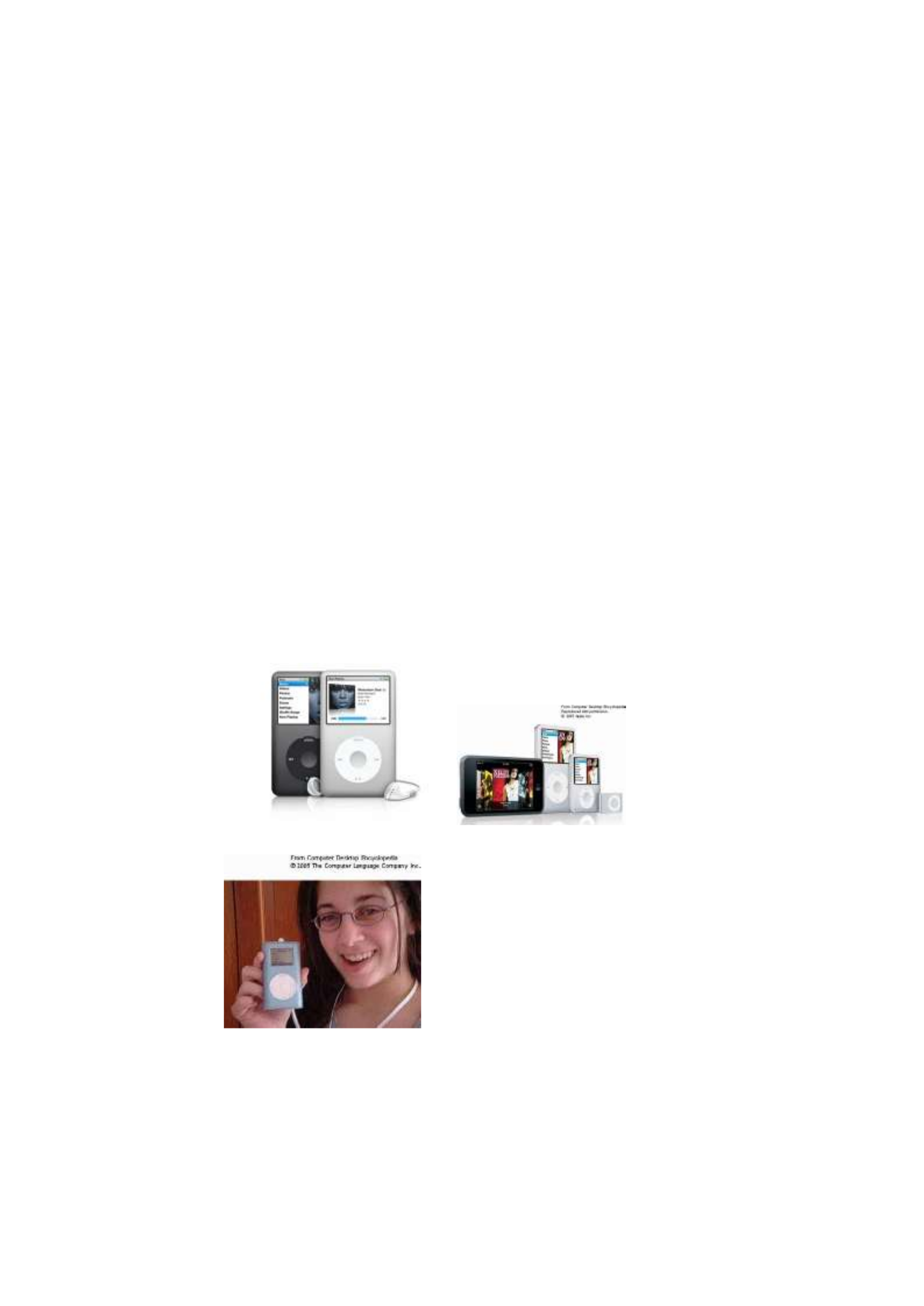
Perception
There are various individual factors that are
linked to the iPod which include the
sensory receptors such as hearing, vision and
touch. The Apple Company has used these to
influence the consumer behavior. The iPod
product can be seen as being a simple device and
yet fashionable, stylish and attractive (See
images below).
The wheel, which is found below the screen, that
is used for controls, is “an innovative technology

never seen before” (iBummed.com,. 2011, p.1).
As it can be seen in the photographs above, the
screen of the iPod is big, making it possible for
the users to be able to see the functions such as
the song list.
According to Varian (2007), “the material used
to build the iPod are of high quality and smooth
to touch” (Varian, 2007, p.1). The iPod’s wheel
has “touch sensing ability for voice controls”
(iBammed.com, 2011, p.1). In addition, the iPod
is a digital musical player that plays the entire
much loved tracks of the owners.
There is use of “behavioral pricing” because the
iPod is of high quality, thus the price is higher
than that charged by the competitors. It is
pointed out that “it is normally hedonic
consumption as mostly all the sensory organs are
associated with it and the purchase decision for

specifically iPod can not be justified”
(iBammed.com, 2011, p.1).
The main target of the advertisement campaigns
is the young audience and this is for the reason
that there is a higher likelihood that young
consumers will use this product and go on
remaining loyal to the brand for a longer time.
Another reason is that the younger consumers
will be attracted to the fashionable appearance
and offering it “a young and trendy look”
(iBammed.com, 2011).
Learning and Memory
Positive reinforcement serves a significant role
as the iPod consumers become members of a
community and develops a sense of belonging to
this community. In addition, the iPod consumers
are considered to be young, fashionable, modish,
and attractive by other people in the society

which assist in boosting these consumers’
morale and image. Also, the consumer can listen
to his or her much loved music “on the go” and
this is an additional benefit.
In addition, “there is a form of observational
learning or vicarious learning as many people
buy the iPod because they see many famous
celebrities, models, actors, loved ones owning
and sharing their playlists and songs with each
other” (iBummed.com, 2011, p.1). Moreover, it
is observed that a large number of designers are
coming up with “luxury accessories” for the
iPod with an intention of personalizing it”
(Costello, 2008).
Motivation and Values
The main objective of the motivation process is
“the need to listen to music while on the move
and the need to be trendy, young and belonging

to the iPod community” (iBammed.com, 2011,
p.1). The stimulating factor is the pressure that
is brought about by the people surrounding the
consumer which makes him to be exposed to the
iPod.
The want is the eventual buying of the iPod at a
time the consumer realizes satisfaction as he has
attained his goal. The measurement of the
motivational power can be carried out by the
“expectancy theory” since the consumer expects
this product to play his much love music. The
iPod is entirely linked to “hedonic needs since it
is a need for excitement” (iBammed.com, 2011,
p.1).
In addition, it as well portrays the need for
affiliation since those who own the iPod can
engage in the exchanging of the playlists, music
and iPod amongst themselves, forming an iPod
community. More so, it can portray the need for

achievement in part since the Apple Company is
regarded as a luxury brand and the iPod is
regarded as a “luxury technological product”
(iBummed.com, 2011, p.1).
Furthermore, the iPod is identified with two
brands in the Maslow’s hierarchy and these are
belongingness and self-actualization. There are
reasons for that. One of the reasons is that those
who own the iPod are majorly the people who
engage in travelling and have a desire to listen
to music they love most as being their hobby or
as a source of entertainment.
In addition, the belongingness is linked to the
iPod since it has formed up a community and
each person that possesses it is part of that
community. It is also pointed out that particular
type of channel is brought about in the
community referred to as podcast that has
“news, favorite TV shows, music albums, talk

shows etc, relayed on the portable music player,
primarily iPod” (PCMag, 2008, p.1).
The iPod is a “high involvement” product
because various choices of iPods are available to
the consumers and this depends on the needs
they have. Adding to this, the consumers have a
great relationship with their iPods they have and
they have the “fondness to accessorize it in
accordance with their needs” (iBammed.com,
2011, p.1).
The number of songs an iPod can carry is
determined by the capacity and this is a
significant decision since the price is higher than
the one charged on the similar products brought
to the market by the competitors. However, the
iPod can not be regarded as a “materialistic”
device and this is for the reason that it is bought
with an intention of wanting to listen to music.
Moreover, the iPod is used for personal

satisfaction as well as for entertainment. Thus,
there is a high likelihood that the non-
materialistic people will buy it.
Personality and lifestyles
The research that has been carried out by Apple
has assisted in understanding the kind of
personality the iPod instills in the minds of the
people. The focus of the iPod’s personality is on
“simplicity, emotions, imagination, lifestyle,
innovation and passion” (iBammed.com, 2011,
p.1).
According to the analysis carried out by
iBammed.com (2011), it was established that the
iPod would be associated with “individuality or
Social Acceptance in the Dichter’s Motives of
Consumption” (iBammed.com, 2011, p.1). The
playlists of their own kind together with selected
“accessorizing iPods” indicate that individuality

as well as the need for belonging to the iPod
community could exhibit “social acceptance”
(iBammed.com, 2011).
Additional personality characteristics analysis
assists “to define BrandAsset Valuator
Archetypes devised by Young and Rubicam”
(iBammed.com, 2011, p.1). The iPod do have
two main archetypes; “being Queen and
Actress” (iBammed.com, 2011). ‘Queen being’
possesses characteristics of “relaxing,
comforting, and sociable which are similar to
that of iPod that it helps relaxing, comforting,
and is very sociable device” (iBammed.com,
2011, p.1). On the other hand, ‘Actress’
possesses traits of “glamorous, dramatic, and
involved and similarly users of iPod are highly
involved with the product, and consider it as a
trend setter” (iBammed.com, 2011, p.1).

The kind of lifestyle which the iPod consumers
have is an immense one. People who engage in
travelling for various reasons are all included
since a larger number of them have the fondness
of listening to the music they love the most in
the course of carrying out their activities. Even
those who sit at home and those who don’t want
to move around carrying their CD’s prefer
buying the iPod because it is convenient to carry
since it fits well in the pocket and has a complete
music library that one may desire to have.
Attitudes
The attitude is possibly formed as a consequence
of a negative or positive personal experience.
According to Oskamp and Schultz (2005),
“maybe outside influences of other individuals
persuaded the consumer’s opinion of a product
or service…..attitudes are relatively enduring”
(Oskamp and Schultz, 2005, p.8). Attitudes are

learned tendency to go ahead in line with or
against a given object. In regard to marketing,
“an attitude is the filter to which every product
and service is scrutinized” (Dean, 2010, p1).
Among the most recognized defined functions
presented by Katz is the utilitarian function. This
function is formed on the basis of the ethical
theory of utilitarianism, “where as an individual
will make decisions based entirely on producing
the greatest amount of happiness as a whole”
(Sidgwick, 1907, p.33). The attitude of the
consumer is apparently formed on the basis of a
utility function at a time the decision revolves
around the quantity of happiness or suffering it
brings (rewards or punishment).
The iPod product can be linked to the
“Utilitarian function” and this is for the reason
that it has punishments and rewards involved.
“The reward of owning are listening to quality

music whenever and wherever, storing and
possessing huge music collection in a device that
can fit in to one’s pocket, and to belong to a
community” (iBammed.com, 2011, p1). On the
other hand, the punishments for not having an
iPod may involve “alienation, discomfort and
maybe purchasing a competitor brand”
(iBammed.com, 2011, p1).
Considering the Apple iPod in relation to the
ABC model, because the iPod is a product of
“high involvement” the “standard learning” may
apply to it. “According to which initially the
consumer has the phase of cognition where he
has a belief about the iPod”( iBammed.com,
2011, p1). This belief in turn is changed to the
feeling the consumer sets up for the iPod and he
eventually makes a decision to buy it or decides
to take any action concerning the iPod.
Individual Decision Making Process

The “individual decision making process” can
either be collectivistic or individualistic. In the
case where this process is individualistic, it is
greatly “experiential perspective” since the
individual purchases the iPod purely for the
reason that the product is appealing. This
process encompasses problem solving as the
iPod is a product of “high involvement” and a
decision to buy it consists of particular risks.
It is pointed out that the decision to buy the iPod
has an ‘Opportunity Recognition’ as the Actual
state “remains the same, where the consumer is
using the CD player and buying several CD’s,
but the Ideal state is uplifted where the consumer
can carry all his songs in one device which can
fit in the pocket” (iBammed.com, 2011, p.1).
Comprehensive external search is carried out by
visiting friends and family, company website,
and looking at the reviews and blogs. In

addition, a lot o search is carried out before
purchasing the product because it is a “high
involvement” product and important
information is required to make the buying
decision. The single perceived risk which is
involved is the price since the iPod is a very
expensive device in comparison to the
competitors’ products.
The consumers who form the “Apple
Community” do not just go for any alternatives
buy they rather purchase it right away. Those
consumers who are not part of the Apple
Community have very limited alternatives from
the competitors and the only existing competitor
that may “match with iPod is the Microsoft
Zune” (iBammed.com, 2011, p.1).
In view of the fact that the iPod has created a
unique niche and is on the highest level of the
product category, “it dominates the market of

portable music players and according to the
Zipf’s Law; it is 50 percent more profitable
when compared to its nearest competitor that is
Microsoft Zune” (iBammed.com, 2011, p.1).
At a time the consumers want to buy an iPod,
they can approach a group of family members or
friends. The “basic reference group will be the
family members and this is followed by friends
and colleagues” (iBammed.com, 2011, p.1). A
large number of offices do have a culture of
engaging in the sharing of the iPod playlists or
even iPods. In addition, the consumers who have
similar outdoor activity taste and have fondness
for music among other things will associate with
and look for advice from amongst them.
Before buying, the consumer’s decision to buy
can be influenced by the opinion leaders. In
addition, in the household decision making
process, in most cases, “the young people are the

ones who come up with decisions first for
purchasing the iPod because they are ‘techno-
savvy’ and other family members will follow
this decision later on” (iBammed.com, 2011,
p.1).
Moreover, peer pressure can as well have a great
influence on the decision since the iPod is
regarded as a fashion setter and if a person does
not have one, he or she feels out of the place or
not being part of his or her own group.

Conclusion
The Apple iPod is a market leader and a large
number of consumers are always willing to buy
even if it is obtained at a higher price than
similar products offered by the competitors on
the market. The Apple Company has been able
to instill a positive attitude in the consumers’
mind. It has been able to change the consumer
behavior and many of them are willing to belong
to the “iPod Community”.
This has been realized through understanding
the consumer behavior and applying the
appropriate models in setting up the successful
marketing strategy. However, there is need for
the company to continue understanding the
consumer behavior and coming up with new
strategies to deal with the ever increasing
competition.

References
Costello, S, 2008. The Onion’s Celebrity iPod
Interviews. Web.
Dean, G., 2010. Understanding consumer
attitudes. Web.
Economic Glossary, 2011. Economic definition
of consumer behavior. Web.
iBammed.com, 2011. Consumer behavior
report – Apple iPod. Web.
Oskamp, S. and Schultz, W., 2005. Attitudes and
opinions. New Jersey: Lawrence Erlbaum
Associates.
PCMag, 2008. Definition of podcast. Web.
Sidgwick, H., 1907. Methods of ethics. London:
Macmillan and Company.
Varian, H. R., 2007. An iPod Has Global Value.
Ask the Countries That Make It. Web.


Insurance: Purchasing Trends on Consumer
Behavior
Introduction
The auto insurance sector has continued to
experience dramatic changes over the past
decade. Analysts suggest the emerging trends in
culture, globalization, and technological
changes promise even much change in the future
(Castells, 2011). Therefore, the marketing of
auto insurance products will be driven by these
trends that shift consumer buying behavior.
These aspects have been seen to create dynamics
for marketers in the insurance sector because
they have continuously influenced the
psychology and expectations of insurance
consumers across the world (Usunier, 2000).

Discussion
Cultural trends
Culture plays a critical role in shaping the
psychology of buying and consumer
expectations across the world. While culture has
been neglected in the recent past, researchers
agree that cultural trends carry the future of
marketers. Changes in social networking breed a
new form of integrated culture, which changes
the perceptual concerns of most consumers
(Castells, 2011). The shifts from single and
distinct cultures continue to be demystified rigid
culture toward a more inclusive approach for
multiculturalism. Currently, the growing social
networks enabled by internet technology have
transformed the cultural face of consumers
across the world.
Globalization

Researchers and analysts have suggested that the
recent financial crises have provided a fertile
ground for enhanced communication,
collaboration, and integration of various
industry players. This shows that the future of
the auto insurance sector will be directed by the
successful negotiation and collaboration by
marketers and insurance regulators (Usunier,
2000). This will cause a relative shift in policy
to yield standardization of product offerings and
promote the globalization of the insurance value
chain.
The creation of global regulations underpinning
market activities will influence the ability of
industry payers to approach and manipulate the
market. One of the conceivable implications of
globalization is the development of limits that
will affect the marketing ability of insurance
marketers (Castells, 2011). On the side of

consumers, these global trends promise an
overall shift from supply power to customer
sovereignty.
Technological trends
Technological improvements have introduced
advances in software and hardware, which have
created a shift in information power from
marketers to consumers. The insurance industry
has registered tremendous gains from recent
information technology waves in terms of
automation. These technologies have continued
to promise enhanced operational efficiencies,
increased revenue opportunities, and support
customer experience (Usunier, 2000). The
industry players have been able to transmit large
scale data in real-time via the internet-enabled

by devices such as tablets, pads, and smartphone
technologies.
The ability of firms to manage large amounts of
data and convert it into actionable insights
enables them to approach the market with more
objectivity. In the recent past, the insurance
industry has over-relied on traditional sources of
the market and consumer purchasing
data(Usunier, 2000). Research shows that a lack
of objective data rendered the traditional
industry less efficient (Castells, 2011). Today,
technology growth enables marketers to
evaluate customer needs and assess the
effectiveness of their marketing strategies.
Therefore, these changes continue to reverse
these trends in firms dealing with auto
insurance.

Conclusion
The insurance industry has experienced
enormous changes in the manner in which
consumers perceive marketing information.
Similarly, marketers in the insurance industry,
especially the auto insurance sector have shifted
their emphasis from the traditional sense of
consumer behavior toward a modern view. The
global insurance industry is expected to witness
changes due to global changes. The effect of
technology growth has availed benefits for both
marketers and consumers.

Marketing: the 4 Ps Consumer Behavior
Consumer behavior reflects the totality of the
decisions made by consumers with regard to the
acquisition, consumption, and disposition of
services, goods, experiences, activities, people
and ideas. The meaning of consumer behavior is
more than just the manner in which people buy
tangible products such as clothes and
automobiles. It entails the use of services,
experiences, ideas, and activities by the
consumers. Moreover, consumers make
decisions about people, like voting for particular
politicians and deciding to read a book written
by a particular author (Hoyer, 2008).
Another aspect of consumer behavior involves
choices made by consumers with regard to the
manner in which they spend time, such as going
for a trip or using time in a manner that portrays
who they really are. Consumers prefer doing

different things since their tastes and preferences
vary.
In summary, consumer behavior refers to the
study of consumer buying practices. People who
go shopping do not necessarily buy the product
in the end. They go through various stages
before they decide to buy products available in
the market. They are influenced by various
factors among them social, cultural,
psychological or personal. The definition of
consumer behavior is closely related to the
subject of consumer behavior marketing. For
example, marketers who record increased sales
first understand the buying patterns and
behaviors of their consumers. It is crucial for
them to understand what drives their consumers
to buy or not to buy certain products.
The 4 Ps in consumer behavior marketing
represent product, price, promotion, and place.

These are important factors that influence the
purchasing decisions of the consumers.
Recently, I went to purchase a Macbook
computer in a reputable computer company
where my purchasing decision was influenced
by the 4 Ps. The first P that influenced my
decision was the product. A product is
something offered by a company to meet the
needs of the consumers. It can either be tangible
or a service.
The computer company had stocked different
brands of computers which offered me a wide
range of choice. After doing a careful selection
process, I eventually picked the type of
computer I was looking for. I compared it with
others I had seen in other companies and I could
see the difference. I was looking for the type of
computer that could serve me in the best way

possible. In addition, my preference for a certain
color influenced my decision to purchase it.
The computer company had taken some time to
find out the exact qualities that consumers
looked for in computers. Business organizations
that carry out intensive research on the kind of
products that their consumers prefer are able to
attract and retain more customers. Finding the
Macbook computer that I was looking for
influenced my decision to purchase it since it
had all the qualities I preferred. I would not have
been convinced to purchase it if it was of poor
quality.
The second P that influenced my decision to
purchase the Macbook computer I was looking
for was its price. Different business
organizations offer different prices for their
products. It is possible for similar products to
exhibit huge price differences depending on

what business organizations factor in when they
set prices for their products. Consumers always
compare prices before purchasing and it is
obvious that they opt to purchase their products
where the prices are cheaper. This element of
price influenced my decision to purchase the
Macbook computer I wanted.
Before I started shopping for it, I had a fixed
amount of money that I was willing to spend. As
a result, I first visited different computer
companies and compared the prices. I was
surprised to discover that there were huge price
differences for the same computer in different
companies. Since I had a fixed amount of money
that I intended to spend on it, I chose the
company that offered the cheapest price. This
was how the price factor affected my purchasing
decision.

The third P that affected my purchasing decision
was promotion. Promotion is a crucial marketing
strategy for business organizations that involves
advertising, selling, public relations, trade
shows and other forms of communication
techniques. Most consumers buy certain
products because they have seen them being
advertised (Marketing’s 4 Ps: The Consumer
Angle, 2009). Before I started shopping for the
Macbook computer I wanted to buy, I had seen
it on advertisements, something that increased
my desire to purchase it. Through the adverts, I
understood its uniqueness in terms of durability
and effectiveness. Public relations is also
important for business organizations because it
influences consumer behavior. Once I entered
into the business enterprise, the attendants
handled me very well and gave me all the
information I required. I was impressed by their

communication strategies thus I ended up
purchasing the computer from that particular
computer company.
The fourth P that influenced my decision to
purchase was placed. It is important for business
organizations to look for strategic locations to
establish their businesses. This is advantageous
since it attracts consumers because they can
access the business premises with ease. As I tried
to look for my preferred computer, I went to
different places and discovered that some
locations were not easily accessible. As a result,
I ended up purchasing it from the most
convenient and easily accessible company.

Nike Consumer Behavior Analysis
Consumer responses towards the product are
based on distinguish feature and reliability
factor. There are several immunity may occur
during the selection of Nike sports shoes due to
the demographic characteristic of a consumer.
Consumer behavior is rational in front of Nike
product selection.
The basal concept leads towards the customer
retention via offering the quality feature product,
thus essential part for Nike is to influence the
targeted customer. Consumer intention plays a
vital role for better analyzing the whole scenario
of purchasing Nike sports shoes. Most of the
time consumer prefer branded products and pay
less attention towards the price issue.
An observer can measure the responses of the
customer and find the actual information in

regard of selection preferences that are based on
the brand attachment. Reputed organizations
pay worthy attention towards studying their
valued customer due to his/her response towards
the product selection. Consumer behavior needs
to be understood at deeper level by analyzing the
need and wants at a place where product is
displayed.
Consumer buying process is largely based on the
valued information, which gathers from several
sources. Analyzing the brand with its quality
feature comes on the top priority of the
customer. Attitude and behavioral changes of
others directly effects the purchase decision at
the end of consumer. Non-verbal reflection may
alert the consumer to revise the decision for
purchasing branded product.
Nike become a corporate brand from last few
decades, and captures the market on the basis of

sports goods manufacturer. Nike invests a huge
amount in their research departments for
statistical measurement of consumer behavior
on the basis of their purchasing decision and
how long it can generate the effective results.
More focused to recognize the need of existing
and new customer comes on the top priority of
the Nike products. Distinguish feature of Nike
sports shoes may attract the customer and build
an intention to attach with product for a longer
period i.e. brand loyalty. Most preferable factors
for the customer are the quality and design of the
product which gives a unique look in his/her
personality.
Brand recognition and quality in sports shoes
divert the negative approach of customer into
positive ones and create a link with loyal
customers. Nike’s designer brings the innovative
ideas and creativity in products after critical

evaluation of the consumer demands. The main
focus of Nike is to design the close loop sports
shoe that is comfortable for the consumer and
give edge in sports activities.
Nike’s strategies are based on the customer
satisfaction and keep them motivated for
purchasing the branded products. Nike
management has also worked on the price issue
which is not warmly welcomed by the new
customers. Minimize the cost of sports shoes by
recycling of defective items.
Management of Nike recognized that, consumer
behavior is not constant all the time. The
intention and preference factor create the
difference in purchase decision by the customer.
The habitual nature of the particular customer
highly focused to divert into regular purchase of
Nike sports shoes and timely encourage the

customer to purchase the product and create a
word of mouth for attracting new customer.

Influencing Consumer Behavior: the
changing image of ‘fast food’
Introduction
Fast-Food providers are developing new
strategies to penetrate more market. Examples of
such strategies include change of menu,
remodeling and redesigning of premises, just to
mention but a few. This work highlights the
recent strategies made by Burger King and
McDonald Fast, as well as how they manipulate
the perception, attitude, motivation, and
personality of customers.
Burger King’s Strategy
Knowing the tastes of their customers,
restaurants that provide fast foods have devised
marketing strategies that will enable them meet

the needs of their customers. While other
restaurants are leading the supply of meals that
cater for health and fitness of their clients,
Burger King is initiating a trend that is new.
It is leading in providing its clients with meals
whose flavor is comprised of fat and salt. On the
other hand, the media and consumer advocacy
groups are directing pressure towards
McDonald. In response to this criticism,
McDonald is providing its clients with health
menu offerings that are more healthful.
Further more, those clients who want their
waistlines trimmed are having their needs being
met by other restaurants that are collaborating
with organizations such as weight watchers.
However, instead of succumbing to such
pressure, Burger Kings has moved ahead to find
out the kind of customers who eats from its
outlets and their exact needs with an intention of

ensuring that they are served appropriately
(Kurtz, McKenzie and Snow, 2009, p. 156).
Although a choice of both the place of eating and
what some one should eat may not appear to be
a big deal, it entails several factors. Some of the
factors that consumers may be influenced with
include the cost, what their friends and family
members say, where the restaurant is located, the
duration the meal takes, and by how the
consumers perceive the restaurant and its meals.
Burger King had tried to sell low fat menu to its
customers on anticipation that it was what they
needed. However, the course had to be changed
completely.
A survey in marketing revealed that 49% of
Burger Kings clients were part of the 18%
population who had been identified as regular
fast food eaters. According to the company

executives, 18 – 34 aged men are great sports
fans. They have been named Super Fans. They
do not only prefer there meals to come along
with sauces and meat, but they also prefer it to
be served in large portions.
Therefore, in a bid to tailor-make a product that
suits their needs, Burger King has come up with
a new sandwich omelet. The new sandwich
omelet is suitable for individuals who would
prefer to begin their day with a hearty breakfast
and has seen an improvement of the company’s
breakfast sales by about 20% (Kurtz, McKenzie
and Snow, 2009, p. 156).
Powerful Advertising
Besides the new menu items whose target is the
Super Fan market, a new promotional strategy
has been undertaken by Burger Kings to ensure

that its products reach this market. The company
had purposed to have a promotional budget that
was smaller than that of its rivals. This made it
to channel its resources to young men.
What followed was a sequence of promotions
that were carried out with an attitude. Two
adverts were then carried out which enabled
Burger Kings to have an 18% increase in its
sales volume in comparison to McDonald that
registered an increase 7% lower than that of
Burger Kings.
Since the new promotional method was working
greatly, Burger Kings proceeded with another
series of adverts through the television and the
website. In one of the television adverts, a young
man was seen jumping up while maintaining that
he was a man. He could then proceed to the
Burger King and have a fleshy sandwich. While
doing this he could assert that he was too angry

that he could not settle for food meant for chicks
(Kurtz, McKenzie and Snow, 2009, p. 156).
An alternative means that the company has used
to penetrate to the market of the Super Fans
(young men) has been placing the ads on the
mobile websites such as the CBS Sports line
where a large number of people who fit the
Super Fan profile are reached.
Despite stepped up criticisms from various
nutrition-based groups, clients like what Burger
Kings serves them. Besides, Burger Kings has
been able to single out who its clients are, their
preferred meals and how to obtain the
information from them (Kurtz, McKenzie and
Snow, 2009, p. 156).

Remodel of Restaurants
Burger Kings is the main competitor to
McDonald’s (Campbell, 1979, p. 51; Haig,
2006, p. 94). These entail red flame chandeliers
that rotate, great television screens and walls of
brick. The move was meant to give Burger
Kings the feeling of an upscale restaurant. The
move was also expected to cost Franchisees who
run a greater portion of Burger King’s business.
Remember! This is just a sample
You can get your custom paper by oneof our
expert writers
It may take the company several years for the
plan to be adopted in all of its locations. There
has been a climb in sales for both the restaurants
that have been remodeled and those that were
torn and have been completely rebuilt.

However, the latter have registered a greater
improvement in sales than the former. The
company has plans to make all new restaurants
be built based on the plan. Observers have
already noted that the new remodel may appeal
more to the Burger Kings’ young men who are
more loyal to the company.
Although drive through and carry out orders
form a greater percentage of the fast – food
restaurants’ business, interior remodeling makes
them be able to compete with their sit down
counterparts who attract more customers as a
result of their attractive ambiance and quality
meals.
This may also enable Burger Kings be able to
outdo its greatest competitor, McDonald and
other rivals who have began including burgers in
their menu so as to gain a share from the ever
growing burger market (Royle, 2000, p. 26).

Although most of these changes are inside the
restaurants, Burger Kings has plans to change
the exteriors also with both metal canopies and
great advertising signs. Moreover, the company
is adjusting its menu by adding cheeseburger to
its menu in the United States. This is apart from
its decisions to introduce energy cutting broiler
ovens. More menu items are to be rolled out in
future (Heher, 2010).
Burger King’s plan on Beer
The plans by Burger King’s to introduce
alcoholic beverages came when there were
reports that sales from the restaurant industry
had declined. The sale of Burger King’s beer is
to be done through whooper bars.
The company’s move to taste the sale of
alcoholic beverages is not a new. This is because

during the year before, besides selling coffee and
tea, Starbucks was inspired to introduce regional
beer and wine. On the hand Spain’s Burger King
has been selling beer (Harriman, 2007, p. 56).
By launching into the arena of fast-dining
dining, Burger King is targeting the population
of people aged 30 years and below since, the
industry’s growth is mainly dependent on this.
However, critics assert that the move could be
tricky since most people understand Burger
King to be a Fast-Foods dealer (Horovitz, 2010).
However, pro-Burger King’s people say that the
move to introduce the beer is timely because
given the company’s customer is growing old,
Burger King is growing with the customer.
More so, the company’s challenge lies in
training new staff to sell alcohol.Already,
Germany, Venezuela and Singapore Burger

Kings sell beer. There has yet been no reported
improvement in sales due to the company’s
move. Besides, Burger Kings plans to deliver all
its items with an exception of beer (Horovitz,
2010).
Although the introduction of a new product is
step in the Category Management Process, its
realization is still partial. Most producers still
have a focus on introduction of new products
and this is likely to go on in future. This is
because the customers’ acceptance of the new
product determines the success or failure of the
product introduced (Kracklauer, Mills and
Seifert, 2004, p. 166).
Burger King’s introduction of beer in the United
States may be motivated by the fact that since
the customers in Singapore, Germany, and
Venezuela use it, the customers in the United
States will as well accept its introduction.

Producers will therefore remain worried of
cooperating with retailers on introductions of
new product since this could make their rivals
aware and hence minimize their competitive
advantage.
McDonald’s Strategy
The Manhattan McDonald restaurant has been
renovated to take after the form of those in the
United Kingdom and France. The restaurant has
places where laptops can be positioned and the
upholstered vinyl chairs have replaced
Fiberglass seats that used to be fixed to the floor.
Additionally, the lighting is subdued and all
employees seem to suggest a hip boutique from
their black uniforms (The Associated Press,
2009).

What makes the restaurant look unique from all
others McDonald’s is its beautiful and lounge-
like appearance. The new look of the restaurant
targets the young people and is meant to make
them get relaxed over a newspaper and not feel
rushed when in. McDonald’s spokesperson
asserted that although most of the company’s
14,000 restaurants had been updated, although
in the United States, the Chelsea location was
the first to be accorded the urban design.
The new look has enabled customers to be able
to multitask while in the restaurant. For instance,
while eating, one can log his laptop on and do
some other tasks. The growth of McDonald’s in
Europe can be attributed to not only the
redesigning of the restaurants but also to its
menu items. The strategy has enabled
McDonald’s to record an increase in sales even

during the recession (The Associated Press,
2009).
There is no difference in menu at Chelsea
McDonald’s and that from other locations.
Differences are in the way the restaurant has
been internally designed and decorated. The
restaurant has tables of small size made for small
groups of clients who may want to hold informal
meetings.
One of the McDonald’s New York restaurants
has a grand piano displayed to the public.
McDonald’s redesigning is not in reaction to any
other brand. It is McDonald’s initiative (The
Associated Press, 2009).
The redesigning concept that McDonald’s has
undergone is about the community center
phenomenon that is making the McDonald a
place where young people can hang out.

McDonald’s had to start focusing more on show
casing and the eating experience as a way of it
coping with the trend of slow – food.
Since France took the lead in the redesigning of
McDonald, attempts have been made to ensure
that its core customers comprises of not only
young adults but also young professionals. Olive
and sage green are also to replace the company’s
emblematic red and yellow colors (Design Woo,
2010).
The redesigning of McDonald’s enabled the
company to introduce three main areas that
would enable customers to have more choices.
The three areas comprised of comfortable
armchairs and sofa sets found in the “linger
area,” the bar-like-zone for customers who
prefer to eat alone and the family region that
comprises of a colorful and flexible ambience
where families can sit and enjoy meals.

About seven thousand restaurants in the United
States are to undergo rebuilding or modernizing.
The company’s approach has been given a three
dimensional expansion approach. These include
changes in menu, renovation of the stores and a
different ordering experience (Design Woo,
2010).
Understanding Consumer’s Behavior and
Personality
Personality is the inner attribute that show how
someone responds to his/her surrounding
(Reynolds and Kamphaus, 2003, p. 53; Lauwers
and Swisher, 2010). Particular characteristics,
traits and mannerisms constitute inner attributes.
Although people may possess similar traits, they
cannot have all identical aspects.

Since the environmental, circumstantial, socio-
cultural, and psychological factors that influence
behavior vary, the consumption behavior of
customers often varies. Individuals interact with
different circumstances and this makes them to
manifest different patterns of behavior. There
are two main implications for personality
aspects in marketing.
First, specific behaviors of customers such as the
kind of brand that they will buy cannot be
anticipated by single measures of their
personality traits. Secondly, a different behavior
is exhibited by consumers when either their
purchase is being observed by other people or
when they are making purchases in the company
of their friends or relatives (Majumdar, 2010, p.
106).
Put in a different way, both situational variables
and presence of other people bring about social

pressure on the decisions revolving about
making product choices. This is due to the
interaction between the presence of others and
situational variables with the consumer’s
personality.
Although personality is generally consistent and
may depict the uniqueness of an individual,
however some major events in life may cause it
to change over time. There are two implications
for personality on marketing.
First, it influences how people may consume a
given product or service. This includes its
influence on consumers’ brand choices and the
response of a consumer to marketing and
advertising attempts by the marketer. Secondly,
it gives marketers guidelines on hoe they should
categorize consumers based on their traits.

How McDonald’s strategies match consumer
behavior and personality
Therefore, cognizance of the trends in consumer
behavior and personality patterns, both
McDonalds and Burger King’s has devised
marketing strategies that fit them. On one hand,
McDonald’s has partitioned its new redesigned
restaurants into three parts.
The comfortable place with sofa sets and
armchairs are designed for those clients who
may not be in a hurry and prefer eating from
comfortable sitting positions. These are
consumers with a high need for cognition. This
will therefore make them order meals that will
enable them linger in this area for a long time.
Those customers who prefer eating alone have
their own area catered for them. Individuals who
prefer eating in the presence of their fellow

family members have their family region tailor
made for them. There are cases at McDonald’s
restaurant in Beijing of young couples or
teenagers lingering in the restaurant.
This is because they consider the surrounding to
romantic for them. Women also tend to stay
there for long whether they are alone or in
company. Lonely men tend to eat hurriedly and
leave. Differences in this behavior across gender
is said to be due to the absence of alcohol
(Counihan, 2008, p. 513).
Those clients who would prefer to eat while
doing some other task like reading a newspaper
or working with their laptops have outfits on
eateries where they can do all these tasks from.
Customers who prefer music as their hobby have
their needs catered for due to the presence of a
grand piano that is displayed to people outside
through one of the McDonald restaurant’s

windows. Use of music has the ability to attract
clients with similar traits (Madura, 2006, p.
531).
Music has different impacts on the customer. For
example, country, western and Classical music
can help to enhance ambiance. Slow music can
entice clients to linger in the restaurant and eat
more for while fast music will enable them eat
quickly and leave the store for others (Lamb,
Hair and McDaniel, 2007, p. 426).
McDonald’ move to introduce a playing ground
for children and new items on its menu is a
strategy to attract more customers (Bloomberg,
2006; Solomon, 2005, p. 206; Nelson, 2009, p.
96). The move is likely to make more clients
come in as families due to presence of places
where children can play and then eat.

The new menu is meant to reach out to those
customers who have different tastes or like
making more choices. The use of red and yellow
colors serves as a tool of attracting the attention
of customers and pulling them to the excitement
of its surrounding. The restaurant has also
introduced a unique lighting system. Although
this can also affect consumer choice behavior,
more research is yet to be done to ascertain how
this actually takes place (Marshall, 1995, p.
304).
How Burger King’s strategies match
consumer behavior and personality
Burger King’s CEO is known for devising
marketing strategies that increase the company’s
sales (Pride and Ferrell, 2008, p. 57). Its
aggressive advertising through the commercials

on television targeting the Super Fans saw the
company record high sales.
The same was also observed through its
promotions on websites on mobiles phones.
Besides, its recent internal remodeling of its
restaurants in most of its locations has also led
to an increase in sales. The remodeled image of
the internal environment changes the perception
of consumers in several ways.
First, the appearance is attractive and it has cost
Burger King a lot of money. This has given it an
executive look that is mainly attractive to the
upper class customers who are quick to identify
with such a restaurant that matches their
economic status for instance the Thailand
restaurant (Spooner, Borrowman and Baldwin,
2007).

Secondly, the remodeling has given the
restaurant a friendly internal ambiance that
makes the customers present to linger in for
more time. As this happens, they continue to buy
more meals from the menu and in the long run
increase its sales.
Thirdly, the commercials directed to the young
men make them feel superior and change their
attitude towards the meals offered by the Burger
Kings restaurant where they flood to continue
buying more. Advertising through the mobile
phone websites is also another way of targeting
the youth since most of them can access mobile
phones. This is also a relevant media of
advertising to them (Donovan and Henley, 2010,
p. 355; Koplan, 2010, p. 215).
This is strategic because it targets the youth who
are likely to use the company’s product. The
internet is a non-personal form of advertisement

that cannot only increase the awareness of
clients, but can also persuade them (Madura,
2006, p. 531).
Burger King’s promotional efforts have targeted
different forms of personalities. Such a category
of personalities is the dogmatic personality. This
personality is for people who are rigid and do not
show a tendency of accepting the choices made
or suggested by others (Sahaf, 2008, p. 113).
Messages that these consumers are receptive to
are those that focus on aspects like factual
differences and possible benefits of the products.
Therefore, to influence their choices, celebrity
endorsements are often used. In ensuring that its
promotional message gets to this category of
clients, Burger King’s advertising features a
young man who asserts to be a man and then
goes for the company’s sandwich cheese instead
of any other food.

Comparisons with other fast-food
competitors in influencing consumer
behavior
In, the above-described firms are among the key
multinational-based companies in the fast-food
market. Various emerging market companies
within the same market provide similar services.
Being local does not only mean having a
presence that is locally established, but also
having a local knowledge that is superior with
regard to tastes and differences of consumers
within a given region.
Survival of local brands is therefore dependent
on leveraging of this superiority. By being local,
some of the strengths available are reduced
production costs, being able to make quick
decisions and moves that are pre-emptive,
possibility of collaborating with international

competitors and that of counterattacking (Batra,
1999, p. 226-227).
An example of such a home based fast-food
provider in Philippines is Jollibee. It has given
McDonald (a global competitor) a great
challenge in the home (Philippine) market. 75%
of the burger market and 56% of fast food
business is owned by Jollibee in its home market
where McDonald operates as well. This has been
achieved mainly customizing and tailor making
its services, delivery standards, and menu to suit
the needs of its local customers.
This has really attracted many consumers to the
firm. It has made it to maintain its market share
against McDonald, which has only 19% of the
same market (Batra, 1999, p. 227). Additionally,
McDonald’s and other competitors, in a bid to
increase profits through influencing consumer
behavior is their introduction of new menu

products which have often led to sales increase
(Ferrante, 2008, p. 150).
Relationship with theories of Consumer
behavior
Burger King was following Pavlov’s theory on
Classical conditioning, which states that
presenting the same stimuli to an organism
continuously produces similar repeated response
from it (Raji, 2007, p. 33). Therefore, in this
case, two kinds of promotions were used as
marketing stimuli and after they had led to
increased sales, the company decided to use
advertising as another marketing stimulus again.
On the other hand, B.F. Skinner’s instrumental
learning was carried out by placing a cat in
closed box. In its attempt to get out of the box,
the cat had to press a spring that either released

food or let it to move out. By doing this
repeatedly, the cat made a distinction between
the spring and other levers, making it to keep on
pressing it.
Slow learning resulted from the reinforcement
(Raji, 2007, p. 33). In the same way, the intense
advertising done by Barger Kings to reach out to
the young men (Super fans) was done repeatedly
in manner that made them make a strong
association between the new omelet sandwich
and its nutritional significance to those who used
it.
In addition, the cognitive learning theory states
that learning is enhanced when a person’s
cognition is restructured according to the
problem. The person solves a problem using
systematic reasoning and mental activity.

When a person encounters a problem, he gathers
information that can be used in the formation of
both attitude and experience towards the object.
For example, using intelligence and problem-
solving skills, a consumer can end up buying a
product that they have never bought before.
Thus, before making a purchasing decision, they
will make an evaluation of the psychological,
economic, and sociological factors (Raji, 2007,
p. 36-37).
For example, the remodeling of the McDonald’s
restaurants creates a serene and romantic
environment to the young people who see it as a
facility to address their social needs. In addition,
customers purchase newly introduced meals
from these fast-food providers since they can
attribute the goodness and quality of the
previous products to the new ones.

Moreover, observational is learning by
imitation. It explains how consumers acquire
new behavioral patterns by watching what other
do and then using it in their own situations
(Nelissen, 2002, p. 311). For example,
McDonald’s redesigning of the restaurant into
an area that is for customers who prefer dining
in the presence of others may result
observational learning.
Some customers may decide on what to eat
based on what other customers in the same place
are having. In addition, the increase in Burger
King’s sales was as a result of young men
imitating what they saw from the series of
television adverts on its new product – omelet
sandwich.

Conclusion
Most fast-food companies have devised
strategies that tend to influence and motivate the
choices, behavior, and personalities of
customers. Burger King has remodeled its
restaurant and has introduced some changes on
the menu. The company has used television and
internet advertising to get its message to the
target audience.
On the other hand, McDonald’s has rebuilt some
of its restaurants with outfits that attract more
clients. These include change of color, furnish,
menu and introduction of both music and
children’s playing ground. All these strategies
have led to increase in sales volume for the two
companies. This is because they have the ability
to manipulate the perceptions, learning, attitude
formation, and purchasing behavior of
consumers.

References List
Batra, R. 1999. Marketing Issues in Transitional
Economies. Massachusetts: Kluwer Academic
Publishers.
Bloomberg. 2006. Mickey D’s
McMakeover. Web.
Campbell, M. J., 1979. Orange Coast
Magazine, Vol. 5, No. 4. NY: Emmis
Communications. Web.
Counihan, C., 2008. Food and Culture: a
Reader. New York: Routledge. Web.
Design Woo. 2010. McDonald’s Redesign: a
New Era for Fast-Food Restaurants. Web.
Donovan, R. and Henley, N., 2010. Principles
and Practice of Social Marketing: An
International Perspective. Cambridge:
Cambridge University Press.

Ferrante, J. 2008. Sociology: A global
Perspective. Belmont: Thomson Wadsworth.
Haig, M., 2006. Brand Royalty: How the
World’s Top 100 Brands Thrive &
Survive. London: Kogan Page Limited.
Harriman, C., 2007. Take Your Kids to Europe:
How to Travel Safely (and Sanely) in Europe
with Your Children. Guilford: Globe Pequot
Press.
Heher, A. M., 2010. The Huffington
Post: Burger King Plans Edgy, Futuristic
Remodel of Restaurants. Web.
Horovitz, B., 2010. Burger King plans beer-
selling Whopper Bar in South Beach. Web.
Koplan, J. 2010. Progress in preventing
childhood obesity: how do we measure
up? Washington DC: The National Academies
Press.

Kracklauer, A. Mills, D. and Seifert, D.,
2004. Collaborative customer relationship
management: taking CRM to the next
level. Boston: Springer.
Kurtz, D. McKenzie, H. and Snow, K.,
2009. Contemporary Marketing. Ontario:
Cengage learning.
Lamb, C. Hair, J. and McDaniel, C.,
2007. Marketing. Mason: Cengage Learning.
Lauwers, J. and Swisher, A., 2010. Counseling
the Nursing Mother. Ontario: Jones and Bartlett
learning.
Madura, J., 2006. Introduction to
Business. Mason: Thompson Learning Inc.
Majumdar, R., 2010. Consumer Behavior:
Insights from Indian Market. New Delhi: PHI
Learning.

Marshall, D., 1995. Food Choice and the
Consumer. London: Blackie Academic and
Professional.
Nelson, M. K., 2009. Who’s watching? Daily
practices of surveillance among contemporary
families. Nashville, Tennessee: Vanderbilt
University Press.
Nelissen, W. 2002. Marketing for suitability:
Towards Transactional Policy
Making. Amsterdam: IOS Press.
Pride, W. M. and Ferrell, O.C.,
2008. Marketing. Mason: Cengage Learning.
Raji, P. T. 2007. Consumers’ buying secrets
revealed. Ebookboxs. Web.
Reynolds, C. R. and Kamphaus, R. W., 2003.
Handbook of psychological and educational
assessment of children. NY: Guilford Press.

Royle, T., 2000. Working for McDonald’s in
Europe: the Unequal Struggle. New York:
Routledge.
Sahaf, M. A., 2008. Strategic Marketing:
Making Decisions for Strategic Advantage. New
Delhi: Prentice-Hall of India.
Solomon, S. G., 2005. American playgrounds:
Revitalizing Community Space. Lebanon:
University Press of New England.
Spooner, A. Borrowman, H. and Baldwin, W.,
2007. Thailand. NY: Foot prints Travel Guides.
The Associated Press. 2009. Foreign operation
methods: theory, analysis, strategy. Web.

