


Understanding Its Nature and Evolution
JUDC 1035 - Introduction to Judaism
University of Cincinnati

The Nature of Judaism as a “Religion”
Judaism:
- Less simplistic than seems, more than just a monotheistic religion
- Judaism is an ethno-religion (people`s religion)
- There are tenets of the religion agreed upon with clearly identifiable religious aspects of
laws, customs, ethics, morals, and identifiable symbols
- Judaism is a religion, culture, relationship, and discourse
- Many sects (people who don`t recognize others as Jews anymore) and denominations
(people within a religion with different beliefs but still share the same religion)
- Judaism is a group of people settled on Monotheism (evidence of Asherah is what divides
ancient Israelites to Judaism).
Religion:
- From the Latin word Religio, the binding of the past, present, and future.
- Some define religion as worshiping a deity, but some religions follow a divine system or
something of values, stories, symbols or knowledge that binds past, present, and future.
- Religion is an artificial academic term set to define a set of features that were not
separated from life prior to the enlightenment– much in connection to Christianity and a
Christian contextual lens.
- Judaism provides a set of ethics and values, gives meaning to a series of symbols,
represents a shared world view and contains meaningful stories/histories. It’s laws,
customs, recommended behaviours
- Judaism has religious texts, and minhagim (holidays, unwritten traditions, culture)
Civilization:
- Has a history
- There is material evidence of its existence
- Judaism changes and evolves as society evolves Culture:
- Grouped behaviour with key identifiable features which may include traditions that may
revolve around religion but do not necessarily have to be directly related Relationship:
- Faith is Judaism in relationship with the divine and with traditions of the community
- Is part of a Jews relationship to themselves, their community, the world, their family,
their ancestors, their descendants etc
- To their god or ultimate concern Discourse:
- a mode of study, teaching, learning, action, adapting, encounter, discussion, conceptual
zing, interpreting etc
- Taught, understood, discussed and learned over the course of lifetimes; it is fluid and
interactive
- “Judaism” is created/changed by various forces over time
- Tradition is central, but participation is also essential

- Is interactional Socio Sacred:
- things that become sacred to communities or families because they have just been sacred
for some time
- We tend to overemphasise the role of major texts within Judaism
- There is a world outside of text which leads to “Civilization”
Monotheism-
- Often known as the belief in one G-d, which is problematic within a Jewish context
- There are Jews that are atheistic
- Jews originally were henotheistic (Acknowledged there were others g-d`s but theirs was
superior)
- Only in the 4th-5th century did Jews become strictly monotheistic
- There are forms of Judaism for people who don’t always define themselves as Jews or
that are Jewish by Culture and not faith or religion
How all the parts of Judaism come together (religion, texts, culture, socio-sacred, discourse,
relationship, and civilization):
Judaism is a textual religion; it is a text itself that is part of the story, but it is also a lived
religion, which is a way of life. Minhag is a sacred way of partaking in the customs of the elders,
which inherently becomes sacred being socio-sacred within families because they’ve been
carried in a cultural society for so long. There is a world outside of the texts in Judaism, where
the civilization aspect comes out in Judaism of past, present, future, and why it is a history.
There is art, culture, clothing, and a relationship providing order to a universe to relationships to
their descendants, further flowing to communities. Judaism is what has been taught in
generational learning, making it fluid, resilient, discourse and change. This is a stream of how
people lived in an aspect of history.
Basic Jewish History:
Shares in an origin story with sources and interpretations
The four periods (Jacob Neusner)
- The first age of diversity becomes more recognizable (500BCE- 70CE)
- In the age of definition, rabbinic Judaism makes books (70-640 CE)
- The age of cogency, the dominant form of Judaism in the middle ages, self-isolated the
community (640-1800 CE)
- The second age of diversity (ca. 1800CE- present)

Judaism was originally from people who studied it through practice, but through academia, it is a
historical and anthropological approach.
The fallacy of Judaism- the belief in `normative Judaism and Diverse Judaism` is not just one
rabbinic path, but there are several paths. There are valid forms of Judaism that may slip through
the cracks.
Henotheism
- We worship one god. Others exist they just aren’t as good/ we believe in only one
- Judaism was originally henotheistic, however Ezra strived to stop this belief through his
reforms
(reforming what Judaism meant after completing the second temple)
Clifford Geertz (an Anthropologist)
- “Religion is a system of symbols which acts to establish powerful, pervasive and long-
lasting moods and motivations in men by formulating conceptions of a general order of
existence and clothing these conceptions with such an aura of factuality that the moods
and motivations seem uniquely realistic” (From the Geertz reading)
- Geertz explains religion's role in establishing relationships between ideas and feelings
that may seem uniquely unrealistic
- Criticism of Geertz`s view is that religion is not just in one`s mind, as he admits, as some
practicing Jews feel, it is also in one's body (i.e. what they eat).
What is Judaism
- The sacred history/story, ideals, ethics, practices, traditions, folkways, concepts, identity,
civilization, and art/philosophy of the Jewish people. It is also the core of what created
the Jewish people and binds them together
- Generally characterized by monotheism, the reverence of a core corpus of central text and
a foundational idea of covenant with god and all of Israel, through which the Jews find a
shared, mutually recognized point of origin, distinctiveness and imagined community
- It is the legendary and recorded history of the civilization of the Jews and all of the sacred
socio-cultural tenets/ways of life maintained and passed down through their generations,
around the globe
- “Imagined community”
- You can not picture how many people are part of the community
Concepts and Characteristics; Perspectives
Monotheism- belief of one G-d
Henotheism- belief that multiple G-d’s exist, but the belief in only one (pick the “best” G-d)
Ethno Religion- relegio + ethnicity, culture, civilization

Normative Judaism- one Rabinic path that is generally accepted as the main form of
Judaism Rabinic Judaism- Judaism that emphasizes daily habits, ethical monotheism, and
learning as Judaism outside of a Temple
Talmudic Judaism- Rabinic Judaism but with the Talmud→ very little difference in core beliefs
(came later on in history)
Sectarian Judaism- Established in the Second Temple Period→ pharisees, sadducees, Esseens,
Zealots
JEPD- historical view that the Torah was written by four people over several centuries
Patriarchs- Abraham, Issac, and Jacob→ fathers of ancient Judaism
Israelites- what the people of Judah were called up until around the creation of the
Second Temple HebrewsKosher- dietary laws
Purity laws- laws observed in Talmudic Judaism, priestly Judaism in the Second Temple Period,
laws of how one interacts with others and stays pure. Talmudic Judaism→ everyone needs to be
pure to fulfill the covenant
Diaspora- Jews living outside of the land promised by G-d in his covenant with Abraham
Ethical monotheism- individual relationship with G-d through study and prayer→ democratizes
Judaism from just priests
Messiah- Jesus and Bar Kochba identified as a messiah. Jews believe the messiah hasn’t come
yet but messiah brings redemption→ Talmudic Judaism believes to live life to the fullest because
the messiah will come
Hellenism- Greek culture→ valued philosophy, science, sports, libraries, etc.
Covenant→ pact/promise between G-d and Abraham/Israelites/different person depending on the
covenant
Circumcision- requirement of the covenant between Yahweh and Abraham
Books (explained under texts and concepts):
- Torah
- Neviim
- Ketuvim
- Mishna (oral Torah)
- Talmud (commentary on the Mishna→ includes the Mishan and the commentary which is
called Gemara)
- Talmud Bavli (commentary discussed by Rabbis in Babylon)
- Talmud Yerushalmi (commentary discussed by Rabbis in Jerusalem)
The Texts and Concepts of Judaism
Judaism is taught generationally, which is part of why it is dynamic as it adapts to current times.

The Triad of Judaism- G-d, Torah/covenant, Israel– how the group understands these
Texts-
Everything in Judaism is related to the texts, lots of books. Hebrew is the language of the Jewish
people; translation is always interpretation.
Torah- the legal code, the first five books of the Torah. Religiously these are the book of the
covenant, the legal constitution between jews and god. Tanach is the Hebrew bible, Torah,
neviim, Ketuvim. These texts have history so there are many slightly different translations.
Today the Maseretic text translations is what jews use. The Masereats are the rabbis who added
the nikoodim. Midrash is retellings or expansions of stories from the bible to fill in the gaps–
could be history, stories, legal etc.
Mishna- oral Torah, Torah shebe al pheh. When g-d gave written Torah to Moshe, he also gave
the oral Torah which would be taught to teachers who could apply it with flexibility unlike the
written Torah which is not meant to change or adapt. Mishna is what makes rabbinic Judaism. It
is the foundation for rabbinic Jews.
Judah ha nasi- He writes down what amounts to the oral traditions and that is when the mishna
becomes a book because he realizes that with a few wars, the torah shebe al pheh could be
whipped out.
Talmud- also a rabbinic text, it is an explanation of oral law. Rabbinic commentary on the
mishna (oral Torah). Gamara is the Babylonian Talmud.
Rashi- he clarifies the language, helps students be able to understand and makes connections
to written torah and references. The Hagadah is a rite– a prayer book
Central Concepts:
G-d- G-d is one, a unity and a singular. G-d is the creator and has no creator, he is the universal
creator of everything
Covenant; Paradigms; Creation/History -
Origins and Ancient Israelite Religion - In
the Tanakh there are 6 covenants:

1. Edenic (relates to all humans)
2. Noachide (relates to all humans)
3. Abrahamic (relates to the Jews)
4. Sinai (relates to the Jews)
5. Levitical (Priestly) (relates to the Jewish priests)
6. Davidic (Royal or Messianic) (relates to the Jewish royalty)
- Covenant means relationship, membership, or identity
Order of the Tanakh
-
- Genesis 1-3 covers the creation of the world
- Edenic Covenant, take care of the world and I will bless you with food/water/life
- The origins of Shabbat on the 7th day on creation
- Noah and the Deluge, Genesis 6-9
- Covenant with the Nations
- Remnant is Noah, tasked with two of every animal on the arc - A rainbow in
the sky is the symbol that G-d will not destroy the earth
- The seven commandments of the Noachide Covenant:

- Believe in G-d, respect G-d, do not murder, do not commit adultery, do not stea
steal, create a justice system, do not eat living animals
Summary of the covenants:
-Edenic ( Genesis 1. 28-30) — g-d to humans, Adam and Eve -
Noachide (Genesis 9.8-17) — all humans after Noah and g-d
-Abrahamic (Genesis 12-17) — hebrews, circumcision
-Sinai (Exodus 19-24) — Israelites, most commonly discussed/known covenant
-Levitical (Exodus 29. 44-46) — priests of the Hebrew nation (priestly Jews)
-Davidic (2 Samuel 7) — g-d to David and his dependents (royal Jews)
- Abraham and the Patriarchs
- Origins of the covenant community and paradigms of faith
- Family based, no priesthood
- Abraham got a message from G-d and breaks all the idols in his father’s shop
(Iconoclastic)
- He leaves to start a new line, he circumcised himself and he becomes the leader of
the
Hebrews
- The The Conquest of Canaan main G-d “El” → Elohim
Isralite → is when the people are in the land of Israel, civilization that starts to form from
the
Hebrews, follows the Ancient Israelite Religion
Hebrew → is the tribal term of the followers of Abraham, ancestral or tribal origin
- 11th-10th century the United Davidic Kingdom (when they became united as one
group) 3 Kings
→ Saul, David, and Solomon
-
-

- King David was considered the glory days, the pinnacle of Israelite power,
conquers Jerusalem for the capital of the 12 tribes, King Solomon builds the first
Temple
The Origins of Judaism
Before the 5-6th century we say the ancient Israelite religion
- Mount Zion is established under King David and the first Temple is built under King
Solomon
- King David thought there was only supposed to be one Temple as they believed in only
one G-d, and sacrifices were only supposed to be made inside the Temple (although they
happened outside and were not reported)
- Descendants of Aaron are responsible for priestly duties
- Kosher Laws applied to all Jews when Judaism is established, previously in the Ancient
Isralite
Religion only the priests followed them (Leviticus)
- After Solomon there was a division (Northern Kingdom Israel (Sameria) and Southern
Kingdom
Judah (Jerusalem))
- Rituals of the first Temples included animal sacrifices (avodah), regular offerings (tamid)
(wine, oil, grain, cakes), pilgrimage festivals (Pesach, Shavuot, Sukkot)
- The second Temple created the Hebrew calendar
Terminology review
- Hebrew — ancestors
- Israelites and ancient israelite religion — civilization that starts to form rooted in the
origin being Hebrew but move out when they start to live in the land
- Jews
Origins of the Israelites
- a word about terms
-

- Hebrews, Israelites, Jews
- When do the Israelites arise as a distinct people
- Very little evidence of when
- In Egyptian text we see people called the Habiro — people say is the Egyptian spelling of
Hebrew
- The tribal period is israelites→ kingdoms split up after King Solomon
- Under king solomon the temple in jerusalem is built
- 931 BCE the kingdom splits into Israel and Judah
- 740 BCE Israel falls to the Asyrian emr
- 586 BCE Jerusalem falls to the Babylonians→ first temple destroyed
- There is a fundamental transition from ancient Israelites to Judaism
Pre-Judaism (Israelites); Biblical/Historical Roots; ANE Contexts
Exile/Return and the Dawn of “Judaism”
We call Noah, Adam and eve etc as the legendary events as the Bible is the only source for this.
Israelites: Their encounters with communities around them
- Egyptions
- Babylonians
- Phenitions
- Cannanits
- Mesapotanians
Origins of Israelites:
Hebrew- tribal, ethnic language, legendary past language.
Israelites- the switch of designation from legendary past to the identity of Israelites when they
leave egypts. There is little true evidence making specific dates difficult to identify. This is when
the modern tribal period was the monarchy and temples occur.
Habiru- means stubborn or qweroralsom from the Egyptian's view, but some think it means
Hebrew
The Merneptah Stele- a stone with the detail of the “israels” being wiped out in 1208 BCE

The Bible as “History” is an important source, but it is not an accurate portrayal and is more of
trying to hit upon their objectives. Historians try to use the bible as a supplementary source, not a
primary source, as it took roughly 800 years to come together along with bias. There are various
types of documents within the bible from different sources. Though the author may sound like a
first-person narration, it may not be, and that is why archeology is so vital.
The Conquest of Canaan
- Abraham`s covenant with Yaweh (G-d)promised him the land of Cannan
- The Jewish bible discusses two different ways the Israelites were told to receive the land
of Cannan.
- One through the Israelites being told by Yaweh to kill out all the cananites and take over
that land
- Another expressing a gradual takeover of Cannan through buying land gradually
- There is no evidence of Canaanites disappearing or a mass murder but there is evidence
of the defacing of art beings and idols.
- A theory is that the Israelites were Canaanites who felt in opposition to the cannonites
that surrounded them.
- Some believe Cannonites were the successors of Noah because the root of the name is
similar to Shem Noah, the name of Noah
- Academia gathers that by 1208, the Israelites have a separate identity. The Canonites
were not a separate group but possibly living among the Israelites where the term El
came up as a god with ideas of henotheism and monaltry. El often was equated with a
woman figure of name ashera.
There is fair certainty of Saul, David, and Solomon. The Tel Dan Inscription was found to
identifying
Messiah means the anointed one, though david, saul and solomon were all anointed as kings,
david was the one that david will produce a messianic heir. David establishes Jerusalem and
brings the tabernacle there. Solomon, a man of wisdom built the temple as opposed to his father
who was a man of war. Solomon had many wives, he was charged in the bible of having multiple
wives who he let build temples and polotheism. Another reason people say the temple fell was
after the temple was built israelites went to get the taxes lowered, as a result solomon doubled
the taxes which was bad.
The Two Temples
The First Temple
- Built roughly around 957 BCE and stood for around 400 years
- Known as Solomons Temple

- In 930 BCE there was a split of power. There was tension and a power struggle if the
priests or kings should be ruling
- One explanation is that Solomon lost faith in g-d
- The kingdom of Israel fell to the Assrians
- Story: Assyrians took a Babylonian and forced them to grind their families bones
- Israel was the north, Judea South. Judah made a truce with Assyrians but Israel did not,
so Israel was taken but some were able to flee to Africa or Judea
- The fall of the temple led to a spiritual crisis of why would g-d make a covenant for
canaan and not protect them, this is a theodicy. Juddha explains that it is because Israel
had sinned and was not a monotheist
- Getting rid of Ashuhahs, banning worship outside Jerusalem and more intensity about
Judaism came about not
- Theodicy is what meaning can be made of a situation, like why do bad things happen to
good people etc.
-
The Second Temple
Differences?
Rites/Purpose; Differences; History; Meaning; Priests/Prophets
Purity
- refers to your hygiene habits
- Your diet
- Your marital/sexual choices
- The laws of the priesthood — in exile, they said it isn’t enough for the priests to be pure
but maybe we all have to do this
- Keep kosher
- Avoid touching the dead
- Etc
Catastrophe and Transformation; Exile and Diaspora
Babylonians
Babylonians take Assyria, they rule by both sheer brutality but also power, taking away money
that may be used against them and though taking out any royals and keeping only farmers or
who they need. Judah is taken by the babylonians, there are multiple revolts, sieges etc, this was
a drawn out process. Everytime the babylonians won they would ship off the elite with 3-4
deportations. As they shipped off the elites of Judah, they imported elites of other places who
spoke different languages so they wouldn't revolte. In 597 BCE the Babylonians destroyed the

temple. The farmers left still after it was destroyed continued to go there to do pilgrimage. Left a
lot of Israelites in the land and didnt get rid/move all of them.
The Diaspora
The Zadok was a levit who brought the exilarchs together (those in exile). This is when the
sacred narratives were written down in Babylon and the schools in Babylon for teaching and etc
happened. There was also a diaspora in egypt.
The exiles in Babylon left for a lot of memory, in Judaism to remember is a commandment, but
as a verb to not just remember but to call forth a meaning or action in you– not a passive verb
but an active verb to commemorate and act in its past. Judaism as seen later has its origins in the
acts of mourning and commemorating the temple. This is Zahor– lezhor, to remember. This is
where the theology of suffering takes route.This is when the idea of intermarriage came abouts.
- “By the rivers of Babylon, there we sat down, and wept, when we remembered Zion” →
said by
Psalmist, and demonstrates grief
People of the land
The people the babylonians did not send out of the area, this is where ancient israelite religion
takes a backseat to a folk religion where the people continue to make sacrifices while the priests
arent there. The Samaritans focus on a different mountain (gerazim instead of zion) in their
thoughts of whats important.
Ancient israel religion is concidered the problem and Judaism the religion was thought of as the
solusion. Who is the legit Jew is in question; the ones who stayed in the land or those who were
exciled and returned.
THe exiled:
Now they have the bible. At the babylonian academy there was a scrible effort to copy older
books and write down multiple perspectives off memory which had them putting hebrew into
heavy importance, texts are super important– you can take them with you in diaspora. The Exiles
were allowed to return but they hadnt have political autonomy, this is where they came up with
different things they could do and avoid (intermarriage, two stories of what to do about the
cannnanites, lack of faith and loyalty, lack of impurity– hygiene, diet, sex and marriage, multiple
wives etc).
THe return from babylon to judea: 539 BCE
Yehud was the provice of judea, this is the origin of judaism and jew as a term and not israelite.
This is where cyrus the great publishes the Edict of Resoration, got people to likke him and be

happy so they don’t revolt. Cyrus is all for his people having their own ethnic legal code, which
for jews is Torah with initates the control the priests never had had.
Aramaic is the language people spoke in the streets– blending ancient persian and ancient
hebrew like yiddish but persian. Aramic is a big innovation of this period
Ezra and Nechemia
Ezra and his great assembly of who was a jew and how was a jew etc. Building in courts that are
legal and religious which the temple becomes the center of jewish world.
Nechemia focused on the rebuilding of the temple nad then harod renovated it. Not all jews
return from excile, they remian in the schools in dyaspera. This is when the elephanine temple
is created where outside of Jerusalem they did sacrifices.Ezra was intensely interested in the
reconstruction of the religion, he helped firm up identity, membership and push to remove
ancient israel religious attributes and emphasized jewish law, torah and emphasis on law for all
jew. Here ezra creates the great assembly which is an influential aspect to later Judaism.
Ethical monotheism- not solely reliant on sacrifice but through study and prayer one can
develop an individual relationship and develops into a more democratic religion not solely for
priests but study and prayer as valid.
First temple period: Solomons's Temple, built by king Solomon and destroyed by Babylonians
just prior to babylonian exile. This period focused on priests, sacrifice, and competition due to
the diversity within Judaism there.
The Second Temple Period- rebuilt under Cyrus the great and was heavily renovated by herod.
Classical Judaism
Classical Judaism- What comes out of the second temple period which was influenced by greek
and Romans.
Hellenism- a component that distinguishes classical judaism. This is a greek structure but it also
influences the roman period so its both in the greek and roman periods, the classical periods.
Lots of naked activities because the body was sacred and jewish men were prohibited from some
activities because they were circumcised, which was considered bad. Some medical textbooks
were talking about reversing circumcision. Jews want to access goyshe life but the human body
almost didnt allow them because theres a series of excelling in public life or being jewish,
creating tention in different aspects.
Alexander the great- he dies young and his empire does not stay whole so the greek empire gets
split into Egyptian ptolemaic empire and the syrian seleucid empire.

Egyptian Ptolemaic Empire- didnt make many changes post alexander the great
Syrian seleucid empire- made changes cuz they found the jews not follow zues so it was
offensibe.
70 CE: The second temple is destoryed
Helleistic Judaism- A hellenization of judaism, this is where philosophy was intertwined with
Judaism. This is where the philosopher phylo rationalized judaism for both jewish and non
jewish audieces. Hellenism also impacted the way jews understood jewish life, this is where
upper class jews also saw jerusalem as a polis city state. Jews started to see Jerusalem as much
more important than the rural places. There is a rise of a middle class as judea had free access to
trade with other parts of the greek empire. This is when public baths and gymnasium became a
big part of social life and business happened. How much jews can hellenise and remain jewish
was a very touchy topic, if one is an authentic jew was a big issue of the time.
Syncretism- the melding of different cultures or religions. What can be adopted while keeping
Judaism.
Selucid rule- there was a decree that everywhere needed to have a place for sacrifice to Zeus
and when jews were upset the romans were offended. Mattisiyahu says no to sacrificing to zeus
and then the whole chanukkah story war breaks out.
Hasmonians- the dynasty that comes from the maccabees. Still ongoing hellenizer controversy
which is uncomfortable for their major critics despite their roots in the maccabean revolt and the
hassidim felt the hasmonians were too helenised and not jewish enough. There are
uncomfortable practices of making the king the high priest as the same person which is so not
like the history of the israel concept. They were not descendants of zadik or david and were not
two separate people so the hasmonians broke these two taboos even though they had a role in the
revolt.
The pharasees- they consider themselves the descendants of Ezras great assembly, they began
as supporters of both the hasidim and the hasmonians but once the hasmonians broke the taboo
of king and priest being two people.
Roman period- also socialized very naked and were disgusted by cercumsison. Social
advancement verses faith were a big question. They went to help judea but ended up colonizing
when they were called upon to help between a dispute of domination. Romans make a lot of
arrogant mistaktes early on.
Herod- Harod overthrows and ends the Hasmonians and makes his own dynasty because he
knew they werent universally loved. He was super hellenized and liked art and architecture.

Second temple wasnt finished until after his death and generationally so many people were
employed by the renovation that when it was finished people started to loose their jobs and
people got so mad over roman stupidity.
Jewish Revolt- Romans were stupid and said more taxes, and Jews said no, so the Romans took
gold out of the temple, so basically, the Jews went bat shit. The Romans send in reinforcements
to seize Jerusalem and Jerusalem was overpopulated and becomes a state with a lack of water,
food and disease– this became very traumatic for the people. In 70 CE, the Romans get to the
temple, take it over and put it on fire. Revolt in Masada. Then the bar kochba revolt and what
then began the great diaspora. The outcomes of the revolt were that the hasmonians (maccabees
generations) brought jewish people together as the threat to the temple not being pure and for
judaism as a religion became clear as they fought against hellenism and foreign intrusion. But
this also left for a hasmonian to takeon priesthood when they are not apart of the linage of david
that was supposed to but as long as a representative who prioritized torah law then the
hasmonian rule was okay by the people, this lasted until alexander yannai tried to get rid of the
legislative assembly and just have the king and high priest be absolute, this is when it got more
questioned and the other jewish groups became more in question about the legitimacy.
Benefits of roman rule
It improved the material quality for judea and for ideological reasons of not affecting the sects
religious practices it was better not to revolt until the zealots came along.
Influences (Greco-Roman); History; Forms; Politics; Conflicts
The Great Diaspora: 135 CE
Jews were moved into Turkey, Europe, Asia and northern Africa. Babylonian communities had
already been there from 70 CE, and they had money and lived to build up academies so they
could learn and Judaism could continue.
UNSURE WHICH PERIOD
Jews were in intense relations with Greece and Rome. The classical area in the 4th-5th centuries
is the fall of the roman area. This gives texts of Jewish philosophy (Hellenistic influence,
Example: Philo of Alexandria the exploration of Judaism in a systematic rational thought),
Jewish “history” (Josephus the first-century historian’s outlook which is similar to the way a
history department at university would, the attempt to record historical events using scientific
methods to record events as a reality), and Jewish theology/Rabbinic Literature (the Talmud).
Rabbinic literature is the application of interpretation of knowledge from god, it is about
applying credentials in tradition to sacred scripture this stems from the rabbinic Jews who felt
they had access to oral and written Torah, it really depends on having legal experts of rabbis to
really interpret the law. Rabbinic Judaism is not literal, halacha is based on experts. The rabbinic

Judaism absorbed different sects of Judaism and were how to make sense of Judaism after the
chaos after 70CE with themes of how to survive and adapt. The rabbinic period takes what ezras
great assembly shaped with kosher and self views their roots in the leaders of the Sanhedrin.
Hillel and Shammi are a great balanced example of the need for law and human emotion work
ideas.
Bar Kochba
Too many people die, and in 220 CE the oral law (Mishna) is written down, and then the Talmud
is created and the age of cogency.
The Canonization of the Bible leading to the Masoretic Text
A discouraging of translating the bible but a push of studying the bible in Hebrew to keep the
language alive.
Pirkeh Avot- Chapters/sayings of the fathers/ethics
Torah means Mishna, Talmud, Gammara, it's all hand in hand with Torah so it is used
interchangeably.
Talmudic Judaism
Rabbinic tradition is recorded in the Talmud, through the proper interpretation of the law.
Protecting the law by saying not to do things that are even further (don't murder, don't get angry)
like putting up barriers, so there's a massive extension of the law to make things unthinkable.
Rabbinic Judaism answered concerns that the covenant would be vaccaded and what Judaism
mean without sacrifices (which was love and kindness, Tikkun Olam). Rabbinic Judaism
becomes intensely pro social which ends up becoming apart of pro jewish survilval.
Normative Judaism
The fallacy (big issue) that there is only one way of judaism, rabbinic judaism is not the only
form of judaism to develop into the middle ages even if it is the most common.
Non-Talmudic Judaism
Those forms of Judaism that reject the Talmud and oral law
Samaritans
They practice an Israelite, Torah based religion that pre-dates the Talmud. They are a minority
but quite ancient in origin. Antagonism between jews and samartism was bad at times as
samaritans claimed that god said they could only sacrifice at one place but disagreed at where
that was. They also have their own torah.

Karaite Judaism
An ancient sect of Judaism which considered only written Torah authoritative and does not
recognize oral law (mishna and talmud) to be authentic to Judaism they are thus distinct from
rabbinic judaism. Anan ben david didnt want to be seen as a salary hereditary but an ananite.
They see Deutaronimy 4. 1-2 differently and are more literal to Judaism so thats why they think
rabbinic judism is inauthentic and wrong.
Beta Israel
Many practice rabbinic judaism as they had to convert but their judaism predates the rabbis as
they have an 8-book bible from etheopia called the octateuch, the orit is their torah.
Early Rabbinic Judaism
The Remnant
- After 70CE
- Judaism without the temple
- Sage Ben Zakkai and the salvation of Judaism
- Gathers students and books, goal is to protect knowledge
- Pretends to be ill, rumors that he’s dying
- He “dies”
- Get put into a coffin full of his books, convince guards to let them through
the wall
- Visits Vaspasian and tells him he will become emperor
- In return he receives Javne and its sages
- All of the Jewish books are collected, Pharasaic Judaism becomes
Judaism
- Bible is cannonized
- Early rabbinic judaism is oral law
- Ben Zakkai proposed new way of Judaism without sacrifices
- Acts of love and kindess instead of sacrifices, gave positive spin to all the
destruction
- Rabbinic Judaism becomes a “portable” way of Judaism
Formation; Origins; Authority; Characteristics
Diversity in Early Judaism
Sects; Non-Rabbinic Judaisms; Dialogue/Polemics
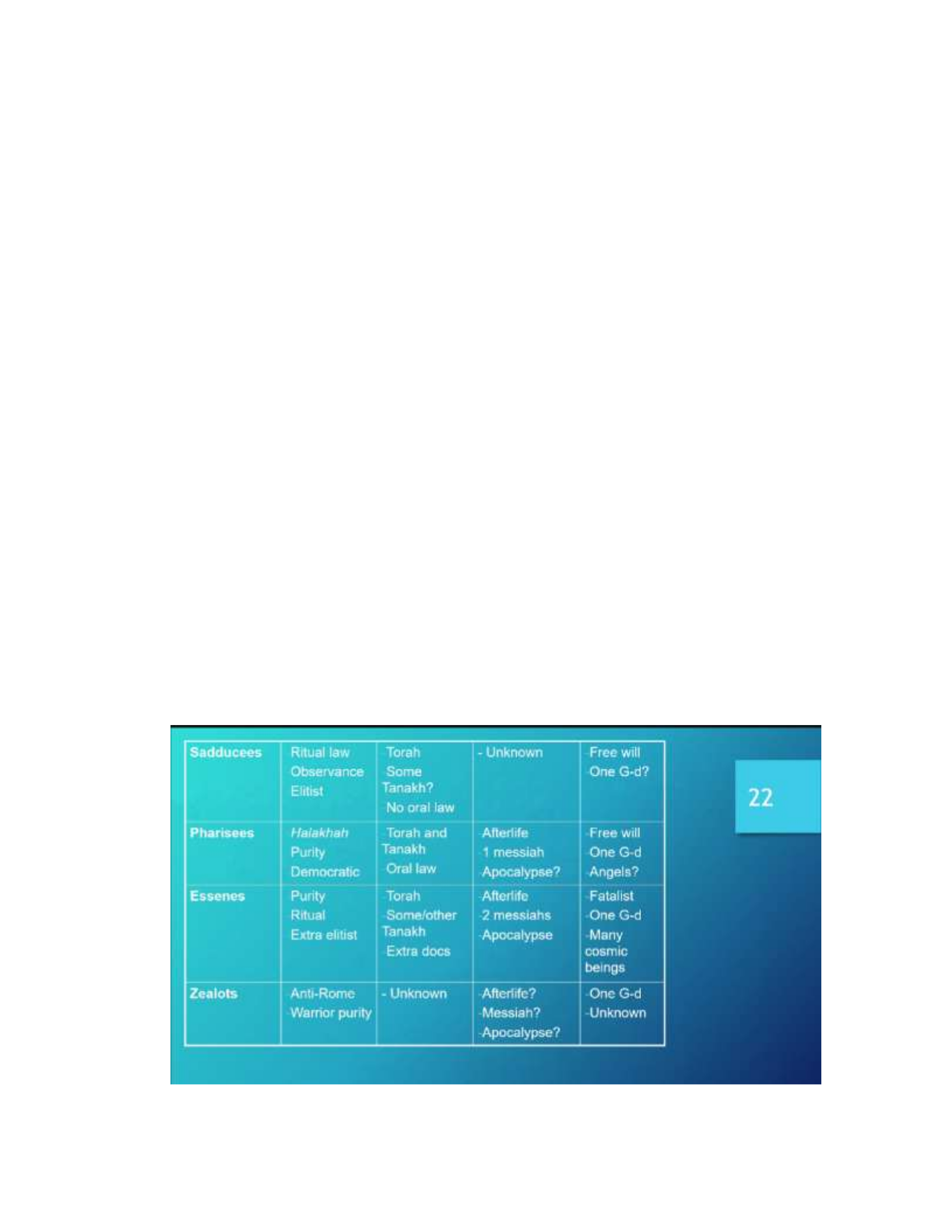
- Major sects active in judea
- 17
- Sadducees
- Claimed descent from zadokites
- Priestly class
- Few documents belonging to them, possible religious
“Textbook(s)” in addition to the Torah
- Pharisees
- Sages
- Academic
- Popular amongst the people - Essenes
- The qumran community, called themselves Zadokites believed
they were the real Sadducees
- Created the dead sea scrolls
- Monastic – doesn't have a huge role in judaism, judaism does not
support celibacy (first law is to be fruitful and multiply) - They
were celibate
- “Cosmic elitism”- Believed they were the army of good
- Had additional documents- Apocrypha and Pseudopigryphas,
polemics (Arguments against enemies)
- Zealots
- Sicarii, assassins that were part of the zealots
-

UNSUREÉ
Documentary Hypothosis:
How scholars understand the bible; JEPD– came from all different places and all over and
redacted to the torah.
Timeline:
- Around 2000 BCE patriarch Abraham, son Isaac and grandson Jacob and Jacob's twelve
sons lived (patriarchs)
- G-d made a pact with Abraham promising him and his descendants a permanent home in
the land of the Canaanites (covenant)
- In return, Abraham and his descendants would follow G-d and if they were male they
would get circumcised as a sign of their covenant
- Famine forces Jacob and his family to immigrate to Egypt where the Jews lived
peacefully until they were enslaved around 1300 BCE→ later liberated by Moses
- After leaving Egypt, Moses spoke with G-d on Mount Sinai, and brought down the 10
commandments (second covenant between Israelites and Yahweh)
- They wandered the desert for 40 years because the Israelites doubted G-ds might that
they would be able to conquer the land of the Canannites
- The Jews, Philistines, and Canaanites fought for more than two hundred years until the
Jewish tribes (under the leader of King David) captured Jerusalm and occupied parts of
Palestine in the eleventh century BCE
- Solomon (David’s son) built the first temple in Jerusalem and had all religious activities
performed at this Temple
- After Solomon died, the northern tribes rebelled (high taxes) and the kingdom was split
in two.
- The northern section was called Israel, and the southern section was called Juda.
- Assyrians conquered Israel in 721 BCE
- Babylonians conquered Judah in 586 BCE
- The Babylonians destroyed Solomon’s temple, tore down the walls of Jerusalem and sent
most Jews into exile in Babylon (left some of the poor Jews that farmed the lands)
- “By the rivers of Babylon, there we sat down, and wept, when we remembered Zion” →
said by Psalmist, and demonstrates grief
- 70 years after the destruction of the First Temple, the Persian king Cyrus the Great
conquered Babylonia and let the Jews return to Jerusalem
- Two Babylonian Jews, Ezra and Nehemia, returned to Jerusalem and made a Jewish state
- The Second Temple was completed in 515 BCE (Western Wall is what remains of it)

- The Jews who remained in Babylon finished compiling the Mishnah (Oral Law)
- Alexander the Great conquered Judah in 332 BCE, and brought a Greek influence
(Hellenism) → sports, customs, theaters, libraries
- All until the rule of King Antiochus the fourth
- Around 175-164 BCE Antiochus tried to force the Hellenization of Jews and make them
assimilated by banning Jews from keeping Shabbat and owning copies of the Torah and
tried to make them worship Zeus
- This started a revolt amongst the Jews→ the Macabee line reconquered Jerusalem in
165 BCE → this is the Maccabean Revolt
- Generation later, there was a dispute within the Maccabean dynasty. They asked
Potolesimist to arbitrate their dispute. Instead he conquered the land
- In 63 BCE, a Roman general was asked to mediate a dispute within Jerusalem, instead he
occupied Judah and claimed it as a new Roman province
- Under the rules of the Greeks and Romans, Hellenism was popular, and the Torah was
even translated into Greek (the Septuagint)
- During the Greco-Roman rule, the books of RUth, Esther, HOnah, Job, and Ecclesiastes
appeared
- While Palestine was occupied by the Romans, Jewish sects emerged
- Essenes→ non-violence, communal celibate life, isolated
- Sadducees→ members of priestly families who were in charge of the Temple, mostly
lived in Jerusalem. Only accepted Torah (not oral law), focused on temple worship
- Pharisees→ most pious, members came from all social classes, emphasized daily
religious practice, observance of religious laws and traditions. Accepted oral and written
law
- Zealots→ very opposed to Roman rule of Palestine. Thought the Messiah would be a war
leader who would lead forces that would defeat the Romans and restore Jewish political
rule in Palestine
- The Jews rebelled against Romans in 66 CE
- Jerusalem was sacked, and the Temple was destroyed
- The destruction of the second temple ended the power of the priesthood→ no longer
anywhere for priests to practice their rituals
- The Romans forbade them to rebuilt→ the Jewish population dispersed
- Without a temple, a greater emphasis was placed on scripture and interpretation of it
- In 90 CE, a group of Rabbis met in Yavneh to decide which religious books would be
recognized with the Torah as sacred literature

The Nature of Judaism as a “Religion”
Judaism:
- Less simplistic than seems, more than just a monotheistic religion
- Judaism is an ethno-religion (people`s religion)
- There are tenets of the religion agreed upon with clearly identifiable religious aspects of
laws, customs, ethics, morals, and identifiable symbols
- Judaism is a religion, culture, relationship, and discourse
- Many sects (people who don`t recognize others as Jews anymore) and denominations
(people within a religion with different beliefs but still share the same religion)
- Judaism is a group of people settled on Monotheism (evidence of Asherah is what divides
ancient Israelites to Judaism).
Religion:
- From the Latin word Religio, the binding of the past, present, and future.
- Some define religion as worshiping a deity, but some religions follow a divine system or
something of values, stories, symbols or knowledge that binds past, present, and future.
- Religion is an artificial academic term set to define a set of features that were not
separated from life prior to the enlightenment– much in connection to Christianity and a
Christian contextual lens.
- Judaism provides a set of ethics and values, gives meaning to a series of symbols,
represents a shared world view and contains meaningful stories/histories. It’s laws,
customs, recommended behaviours
- Judaism has religious texts, and minhagim (holidays, unwritten traditions, culture)
Civilization:
- Has a history
- There is material evidence of its existence
- Judaism changes and evolves as society evolves Culture:
- Grouped behaviour with key identifiable features which may include traditions that may
revolve around religion but do not necessarily have to be directly related Relationship:
- Faith is Judaism in relationship with the divine and with traditions of the community
- Is part of a Jews relationship to themselves, their community, the world, their family,
their ancestors, their descendants etc
- To their god or ultimate concern Discourse:
- a mode of study, teaching, learning, action, adapting, encounter, discussion, conceptual
zing, interpreting etc
- Taught, understood, discussed and learned over the course of lifetimes; it is fluid and
interactive
- “Judaism” is created/changed by various forces over time
- Tradition is central, but participation is also essential

- Is interactional Socio Sacred:
- things that become sacred to communities or families because they have just been sacred
for some time
- We tend to overemphasise the role of major texts within Judaism
- There is a world outside of text which leads to “Civilization”
Monotheism-
- Often known as the belief in one G-d, which is problematic within a Jewish context
- There are Jews that are atheistic
- Jews originally were henotheistic (Acknowledged there were others g-d`s but theirs was
superior)
- Only in the 4th-5th century did Jews become strictly monotheistic
- There are forms of Judaism for people who don’t always define themselves as Jews or
that are Jewish by Culture and not faith or religion
How all the parts of Judaism come together (religion, texts, culture, socio-sacred, discourse,
relationship, and civilization):
Judaism is a textual religion; it is a text itself that is part of the story, but it is also a lived
religion, which is a way of life. Minhag is a sacred way of partaking in the customs of the elders,
which inherently becomes sacred being socio-sacred within families because they’ve been
carried in a cultural society for so long. There is a world outside of the texts in Judaism, where
the civilization aspect comes out in Judaism of past, present, future, and why it is a history.
There is art, culture, clothing, and a relationship providing order to a universe to relationships to
their descendants, further flowing to communities. Judaism is what has been taught in
generational learning, making it fluid, resilient, discourse and change. This is a stream of how
people lived in an aspect of history.
Basic Jewish History:
Shares in an origin story with sources and interpretations
The four periods (Jacob Neusner)
- The first age of diversity becomes more recognizable (500BCE- 70CE)
- In the age of definition, rabbinic Judaism makes books (70-640 CE)
- The age of cogency, the dominant form of Judaism in the middle ages, self-isolated the
community (640-1800 CE)
- The second age of diversity (ca. 1800CE- present)

Judaism was originally from people who studied it through practice, but through academia, it is a
historical and anthropological approach.
The fallacy of Judaism- the belief in `normative Judaism and Diverse Judaism` is not just one
rabbinic path, but there are several paths. There are valid forms of Judaism that may slip through
the cracks.
Henotheism
- We worship one god. Others exist they just aren’t as good/ we believe in only one
- Judaism was originally henotheistic, however Ezra strived to stop this belief through his
reforms
(reforming what Judaism meant after completing the second temple)
Clifford Geertz (an Anthropologist)
- “Religion is a system of symbols which acts to establish powerful, pervasive and long-
lasting moods and motivations in men by formulating conceptions of a general order of
existence and clothing these conceptions with such an aura of factuality that the moods
and motivations seem uniquely realistic” (From the Geertz reading)
- Geertz explains religion's role in establishing relationships between ideas and feelings
that may seem uniquely unrealistic
- Criticism of Geertz`s view is that religion is not just in one`s mind, as he admits, as some
practicing Jews feel, it is also in one's body (i.e. what they eat).
What is Judaism
- The sacred history/story, ideals, ethics, practices, traditions, folkways, concepts, identity,
civilization, and art/philosophy of the Jewish people. It is also the core of what created
the Jewish people and binds them together
- Generally characterized by monotheism, the reverence of a core corpus of central text and
a foundational idea of covenant with god and all of Israel, through which the Jews find a
shared, mutually recognized point of origin, distinctiveness and imagined community
- It is the legendary and recorded history of the civilization of the Jews and all of the sacred
socio-cultural tenets/ways of life maintained and passed down through their generations,
around the globe
- “Imagined community”
- You can not picture how many people are part of the community
Concepts and Characteristics; Perspectives
Monotheism- belief of one G-d
Henotheism- belief that multiple G-d’s exist, but the belief in only one (pick the “best” G-d)
Ethno Religion- relegio + ethnicity, culture, civilization

Normative Judaism- one Rabinic path that is generally accepted as the main form of
Judaism Rabinic Judaism- Judaism that emphasizes daily habits, ethical monotheism, and
learning as Judaism outside of a Temple
Talmudic Judaism- Rabinic Judaism but with the Talmud→ very little difference in core beliefs
(came later on in history)
Sectarian Judaism- Established in the Second Temple Period→ pharisees, sadducees, Esseens,
Zealots
JEPD- historical view that the Torah was written by four people over several centuries
Patriarchs- Abraham, Issac, and Jacob→ fathers of ancient Judaism
Israelites- what the people of Judah were called up until around the creation of the
Second Temple HebrewsKosher- dietary laws
Purity laws- laws observed in Talmudic Judaism, priestly Judaism in the Second Temple Period,
laws of how one interacts with others and stays pure. Talmudic Judaism→ everyone needs to be
pure to fulfill the covenant
Diaspora- Jews living outside of the land promised by G-d in his covenant with Abraham
Ethical monotheism- individual relationship with G-d through study and prayer→ democratizes
Judaism from just priests
Messiah- Jesus and Bar Kochba identified as a messiah. Jews believe the messiah hasn’t come
yet but messiah brings redemption→ Talmudic Judaism believes to live life to the fullest because
the messiah will come
Hellenism- Greek culture→ valued philosophy, science, sports, libraries, etc.
Covenant→ pact/promise between G-d and Abraham/Israelites/different person depending on the
covenant
Circumcision- requirement of the covenant between Yahweh and Abraham
Books (explained under texts and concepts):
- Torah
- Neviim
- Ketuvim
- Mishna (oral Torah)
- Talmud (commentary on the Mishna→ includes the Mishan and the commentary which is
called Gemara)
- Talmud Bavli (commentary discussed by Rabbis in Babylon)
- Talmud Yerushalmi (commentary discussed by Rabbis in Jerusalem)
The Texts and Concepts of Judaism
Judaism is taught generationally, which is part of why it is dynamic as it adapts to current times.

The Triad of Judaism- G-d, Torah/covenant, Israel– how the group understands these
Texts-
Everything in Judaism is related to the texts, lots of books. Hebrew is the language of the Jewish
people; translation is always interpretation.
Torah- the legal code, the first five books of the Torah. Religiously these are the book of the
covenant, the legal constitution between jews and god. Tanach is the Hebrew bible, Torah,
neviim, Ketuvim. These texts have history so there are many slightly different translations.
Today the Maseretic text translations is what jews use. The Masereats are the rabbis who added
the nikoodim. Midrash is retellings or expansions of stories from the bible to fill in the gaps–
could be history, stories, legal etc.
Mishna- oral Torah, Torah shebe al pheh. When g-d gave written Torah to Moshe, he also gave
the oral Torah which would be taught to teachers who could apply it with flexibility unlike the
written Torah which is not meant to change or adapt. Mishna is what makes rabbinic Judaism. It
is the foundation for rabbinic Jews.
Judah ha nasi- He writes down what amounts to the oral traditions and that is when the mishna
becomes a book because he realizes that with a few wars, the torah shebe al pheh could be
whipped out.
Talmud- also a rabbinic text, it is an explanation of oral law. Rabbinic commentary on the
mishna (oral Torah). Gamara is the Babylonian Talmud.
Rashi- he clarifies the language, helps students be able to understand and makes connections
to written torah and references. The Hagadah is a rite– a prayer book
Central Concepts:
G-d- G-d is one, a unity and a singular. G-d is the creator and has no creator, he is the universal
creator of everything
Covenant; Paradigms; Creation/History -
Origins and Ancient Israelite Religion - In
the Tanakh there are 6 covenants:
7. Edenic (relates to all humans)
8. Noachide (relates to all humans)
9. Abrahamic (relates to the Jews)
10. Sinai (relates to the Jews)
11. Levitical (Priestly) (relates to the Jewish priests)
12. Davidic (Royal or Messianic) (relates to the Jewish royalty)
- Covenant means relationship, membership, or identity
Order of the Tanakh
-
- Genesis 1-3 covers the creation of the world
- Edenic Covenant, take care of the world and I will bless you with food/water/life
- The origins of Shabbat on the 7th day on creation
- Noah and the Deluge, Genesis 6-9
- Covenant with the Nations
- Remnant is Noah, tasked with two of every animal on the arc - A rainbow in
the sky is the symbol that G-d will not destroy the earth
- The seven commandments of the Noachide Covenant:

- Believe in G-d, respect G-d, do not murder, do not commit adultery, do not stea
steal, create a justice system, do not eat living animals
Summary of the covenants:
-Edenic ( Genesis 1. 28-30) — g-d to humans, Adam and Eve -
Noachide (Genesis 9.8-17) — all humans after Noah and g-d
-Abrahamic (Genesis 12-17) — hebrews, circumcision
-Sinai (Exodus 19-24) — Israelites, most commonly discussed/known covenant
-Levitical (Exodus 29. 44-46) — priests of the Hebrew nation (priestly Jews)
-Davidic (2 Samuel 7) — g-d to David and his dependents (royal Jews)
- Abraham and the Patriarchs
- Origins of the covenant community and paradigms of faith
- Family based, no priesthood
- Abraham got a message from G-d and breaks all the idols in his father’s shop
(Iconoclastic)
- He leaves to start a new line, he circumcised himself and he becomes the leader of
the
Hebrews
- The The Conquest of Canaan main G-d “El” → Elohim
Isralite → is when the people are in the land of Israel, civilization that starts to form from
the
Hebrews, follows the Ancient Israelite Religion
Hebrew → is the tribal term of the followers of Abraham, ancestral or tribal origin
- 11th-10th century the United Davidic Kingdom (when they became united as one
group) 3 Kings
→ Saul, David, and Solomon
-
-

- King David was considered the glory days, the pinnacle of Israelite power,
conquers Jerusalem for the capital of the 12 tribes, King Solomon builds the first
Temple
The Origins of Judaism
Before the 5-6th century we say the ancient Israelite religion
- Mount Zion is established under King David and the first Temple is built under King
Solomon
- King David thought there was only supposed to be one Temple as they believed in only
one G-d, and sacrifices were only supposed to be made inside the Temple (although they
happened outside and were not reported)
- Descendants of Aaron are responsible for priestly duties
- Kosher Laws applied to all Jews when Judaism is established, previously in the Ancient
Isralite
Religion only the priests followed them (Leviticus)
- After Solomon there was a division (Northern Kingdom Israel (Sameria) and Southern
Kingdom
Judah (Jerusalem))
- Rituals of the first Temples included animal sacrifices (avodah), regular offerings (tamid)
(wine, oil, grain, cakes), pilgrimage festivals (Pesach, Shavuot, Sukkot)
- The second Temple created the Hebrew calendar
Terminology review
- Hebrew — ancestors
- Israelites and ancient israelite religion — civilization that starts to form rooted in the
origin being Hebrew but move out when they start to live in the land
- Jews
Origins of the Israelites
- a word about terms
-

- Hebrews, Israelites, Jews
- When do the Israelites arise as a distinct people
- Very little evidence of when
- In Egyptian text we see people called the Habiro — people say is the Egyptian spelling of
Hebrew
- The tribal period is israelites→ kingdoms split up after King Solomon
- Under king solomon the temple in jerusalem is built
- 931 BCE the kingdom splits into Israel and Judah
- 740 BCE Israel falls to the Asyrian emr
- 586 BCE Jerusalem falls to the Babylonians→ first temple destroyed
- There is a fundamental transition from ancient Israelites to Judaism
Pre-Judaism (Israelites); Biblical/Historical Roots; ANE Contexts
Exile/Return and the Dawn of “Judaism”
We call Noah, Adam and eve etc as the legendary events as the Bible is the only source for this.
Israelites: Their encounters with communities around them
- Egyptions
- Babylonians
- Phenitions
- Cannanits
- Mesapotanians
Origins of Israelites:
Hebrew- tribal, ethnic language, legendary past language.
Israelites- the switch of designation from legendary past to the identity of Israelites when they
leave egypts. There is little true evidence making specific dates difficult to identify. This is when
the modern tribal period was the monarchy and temples occur.
Habiru- means stubborn or qweroralsom from the Egyptian's view, but some think it means
Hebrew
The Merneptah Stele- a stone with the detail of the “israels” being wiped out in 1208 BCE

The Bible as “History” is an important source, but it is not an accurate portrayal and is more of
trying to hit upon their objectives. Historians try to use the bible as a supplementary source, not a
primary source, as it took roughly 800 years to come together along with bias. There are various
types of documents within the bible from different sources. Though the author may sound like a
first-person narration, it may not be, and that is why archeology is so vital.
The Conquest of Canaan
- Abraham`s covenant with Yaweh (G-d)promised him the land of Cannan
- The Jewish bible discusses two different ways the Israelites were told to receive the land
of Cannan.
- One through the Israelites being told by Yaweh to kill out all the cananites and take over
that land
- Another expressing a gradual takeover of Cannan through buying land gradually
- There is no evidence of Canaanites disappearing or a mass murder but there is evidence
of the defacing of art beings and idols.
- A theory is that the Israelites were Canaanites who felt in opposition to the cannonites
that surrounded them.
- Some believe Cannonites were the successors of Noah because the root of the name is
similar to Shem Noah, the name of Noah
- Academia gathers that by 1208, the Israelites have a separate identity. The Canonites
were not a separate group but possibly living among the Israelites where the term El
came up as a god with ideas of henotheism and monaltry. El often was equated with a
woman figure of name ashera.
There is fair certainty of Saul, David, and Solomon. The Tel Dan Inscription was found to
identifying
Messiah means the anointed one, though david, saul and solomon were all anointed as kings,
david was the one that david will produce a messianic heir. David establishes Jerusalem and
brings the tabernacle there. Solomon, a man of wisdom built the temple as opposed to his father
who was a man of war. Solomon had many wives, he was charged in the bible of having multiple
wives who he let build temples and polotheism. Another reason people say the temple fell was
after the temple was built israelites went to get the taxes lowered, as a result solomon doubled
the taxes which was bad.
The Two Temples
The First Temple
- Built roughly around 957 BCE and stood for around 400 years
- Known as Solomons Temple

- In 930 BCE there was a split of power. There was tension and a power struggle if the
priests or kings should be ruling
- One explanation is that Solomon lost faith in g-d
- The kingdom of Israel fell to the Assrians
- Story: Assyrians took a Babylonian and forced them to grind their families bones
- Israel was the north, Judea South. Judah made a truce with Assyrians but Israel did not,
so Israel was taken but some were able to flee to Africa or Judea
- The fall of the temple led to a spiritual crisis of why would g-d make a covenant for
canaan and not protect them, this is a theodicy. Juddha explains that it is because Israel
had sinned and was not a monotheist
- Getting rid of Ashuhahs, banning worship outside Jerusalem and more intensity about
Judaism came about not
- Theodicy is what meaning can be made of a situation, like why do bad things happen to
good people etc.
-
The Second Temple
Differences?
Rites/Purpose; Differences; History; Meaning; Priests/Prophets
Purity
- refers to your hygiene habits
- Your diet
- Your marital/sexual choices
- The laws of the priesthood — in exile, they said it isn’t enough for the priests to be pure
but maybe we all have to do this
- Keep kosher
- Avoid touching the dead
- Etc
Catastrophe and Transformation; Exile and Diaspora
Babylonians
Babylonians take Assyria, they rule by both sheer brutality but also power, taking away money
that may be used against them and though taking out any royals and keeping only farmers or
who they need. Judah is taken by the babylonians, there are multiple revolts, sieges etc, this was
a drawn out process. Everytime the babylonians won they would ship off the elite with 3-4
deportations. As they shipped off the elites of Judah, they imported elites of other places who
spoke different languages so they wouldn't revolte. In 597 BCE the Babylonians destroyed the

temple. The farmers left still after it was destroyed continued to go there to do pilgrimage. Left a
lot of Israelites in the land and didnt get rid/move all of them.
The Diaspora
The Zadok was a levit who brought the exilarchs together (those in exile). This is when the
sacred narratives were written down in Babylon and the schools in Babylon for teaching and etc
happened. There was also a diaspora in egypt.
The exiles in Babylon left for a lot of memory, in Judaism to remember is a commandment, but
as a verb to not just remember but to call forth a meaning or action in you– not a passive verb
but an active verb to commemorate and act in its past. Judaism as seen later has its origins in the
acts of mourning and commemorating the temple. This is Zahor– lezhor, to remember. This is
where the theology of suffering takes route.This is when the idea of intermarriage came abouts.
- “By the rivers of Babylon, there we sat down, and wept, when we remembered Zion” →
said by
Psalmist, and demonstrates grief
People of the land
The people the babylonians did not send out of the area, this is where ancient israelite religion
takes a backseat to a folk religion where the people continue to make sacrifices while the priests
arent there. The Samaritans focus on a different mountain (gerazim instead of zion) in their
thoughts of whats important.
Ancient israel religion is concidered the problem and Judaism the religion was thought of as the
solusion. Who is the legit Jew is in question; the ones who stayed in the land or those who were
exciled and returned.
THe exiled:
Now they have the bible. At the babylonian academy there was a scrible effort to copy older
books and write down multiple perspectives off memory which had them putting hebrew into
heavy importance, texts are super important– you can take them with you in diaspora. The Exiles
were allowed to return but they hadnt have political autonomy, this is where they came up with
different things they could do and avoid (intermarriage, two stories of what to do about the
cannnanites, lack of faith and loyalty, lack of impurity– hygiene, diet, sex and marriage, multiple
wives etc).
THe return from babylon to judea: 539 BCE
Yehud was the provice of judea, this is the origin of judaism and jew as a term and not israelite.
This is where cyrus the great publishes the Edict of Resoration, got people to likke him and be

happy so they don’t revolt. Cyrus is all for his people having their own ethnic legal code, which
for jews is Torah with initates the control the priests never had had.
Aramaic is the language people spoke in the streets– blending ancient persian and ancient
hebrew like yiddish but persian. Aramic is a big innovation of this period
Ezra and Nechemia
Ezra and his great assembly of who was a jew and how was a jew etc. Building in courts that are
legal and religious which the temple becomes the center of jewish world.
Nechemia focused on the rebuilding of the temple nad then harod renovated it. Not all jews
return from excile, they remian in the schools in dyaspera. This is when the elephanine temple
is created where outside of Jerusalem they did sacrifices.Ezra was intensely interested in the
reconstruction of the religion, he helped firm up identity, membership and push to remove
ancient israel religious attributes and emphasized jewish law, torah and emphasis on law for all
jew. Here ezra creates the great assembly which is an influential aspect to later Judaism.
Ethical monotheism- not solely reliant on sacrifice but through study and prayer one can
develop an individual relationship and develops into a more democratic religion not solely for
priests but study and prayer as valid.
First temple period: Solomons's Temple, built by king Solomon and destroyed by Babylonians
just prior to babylonian exile. This period focused on priests, sacrifice, and competition due to
the diversity within Judaism there.
The Second Temple Period- rebuilt under Cyrus the great and was heavily renovated by herod.
Classical Judaism
Classical Judaism- What comes out of the second temple period which was influenced by greek
and Romans.
Hellenism- a component that distinguishes classical judaism. This is a greek structure but it also
influences the roman period so its both in the greek and roman periods, the classical periods.
Lots of naked activities because the body was sacred and jewish men were prohibited from some
activities because they were circumcised, which was considered bad. Some medical textbooks
were talking about reversing circumcision. Jews want to access goyshe life but the human body
almost didnt allow them because theres a series of excelling in public life or being jewish,
creating tention in different aspects.
Alexander the great- he dies young and his empire does not stay whole so the greek empire gets
split into Egyptian ptolemaic empire and the syrian seleucid empire.

Egyptian Ptolemaic Empire- didnt make many changes post alexander the great
Syrian seleucid empire- made changes cuz they found the jews not follow zues so it was
offensibe.
70 CE: The second temple is destoryed
Helleistic Judaism- A hellenization of judaism, this is where philosophy was intertwined with
Judaism. This is where the philosopher phylo rationalized judaism for both jewish and non
jewish audieces. Hellenism also impacted the way jews understood jewish life, this is where
upper class jews also saw jerusalem as a polis city state. Jews started to see Jerusalem as much
more important than the rural places. There is a rise of a middle class as judea had free access to
trade with other parts of the greek empire. This is when public baths and gymnasium became a
big part of social life and business happened. How much jews can hellenise and remain jewish
was a very touchy topic, if one is an authentic jew was a big issue of the time.
Syncretism- the melding of different cultures or religions. What can be adopted while keeping
Judaism.
Selucid rule- there was a decree that everywhere needed to have a place for sacrifice to Zeus
and when jews were upset the romans were offended. Mattisiyahu says no to sacrificing to zeus
and then the whole chanukkah story war breaks out.
Hasmonians- the dynasty that comes from the maccabees. Still ongoing hellenizer controversy
which is uncomfortable for their major critics despite their roots in the maccabean revolt and the
hassidim felt the hasmonians were too helenised and not jewish enough. There are
uncomfortable practices of making the king the high priest as the same person which is so not
like the history of the israel concept. They were not descendants of zadik or david and were not
two separate people so the hasmonians broke these two taboos even though they had a role in the
revolt.
The pharasees- they consider themselves the descendants of Ezras great assembly, they began
as supporters of both the hasidim and the hasmonians but once the hasmonians broke the taboo
of king and priest being two people.
Roman period- also socialized very naked and were disgusted by cercumsison. Social
advancement verses faith were a big question. They went to help judea but ended up colonizing
when they were called upon to help between a dispute of domination. Romans make a lot of
arrogant mistaktes early on.
Herod- Harod overthrows and ends the Hasmonians and makes his own dynasty because he
knew they werent universally loved. He was super hellenized and liked art and architecture.

Second temple wasnt finished until after his death and generationally so many people were
employed by the renovation that when it was finished people started to loose their jobs and
people got so mad over roman stupidity.
Jewish Revolt- Romans were stupid and said more taxes, and Jews said no, so the Romans took
gold out of the temple, so basically, the Jews went bat shit. The Romans send in reinforcements
to seize Jerusalem and Jerusalem was overpopulated and becomes a state with a lack of water,
food and disease– this became very traumatic for the people. In 70 CE, the Romans get to the
temple, take it over and put it on fire. Revolt in Masada. Then the bar kochba revolt and what
then began the great diaspora. The outcomes of the revolt were that the hasmonians (maccabees
generations) brought jewish people together as the threat to the temple not being pure and for
judaism as a religion became clear as they fought against hellenism and foreign intrusion. But
this also left for a hasmonian to takeon priesthood when they are not apart of the linage of david
that was supposed to but as long as a representative who prioritized torah law then the
hasmonian rule was okay by the people, this lasted until alexander yannai tried to get rid of the
legislative assembly and just have the king and high priest be absolute, this is when it got more
questioned and the other jewish groups became more in question about the legitimacy.
Benefits of roman rule
It improved the material quality for judea and for ideological reasons of not affecting the sects
religious practices it was better not to revolt until the zealots came along.
Influences (Greco-Roman); History; Forms; Politics; Conflicts
The Great Diaspora: 135 CE
Jews were moved into Turkey, Europe, Asia and northern Africa. Babylonian communities had
already been there from 70 CE, and they had money and lived to build up academies so they
could learn and Judaism could continue.
UNSURE WHICH PERIOD
Jews were in intense relations with Greece and Rome. The classical area in the 4th-5th centuries
is the fall of the roman area. This gives texts of Jewish philosophy (Hellenistic influence,
Example: Philo of Alexandria the exploration of Judaism in a systematic rational thought),
Jewish “history” (Josephus the first-century historian’s outlook which is similar to the way a
history department at university would, the attempt to record historical events using scientific
methods to record events as a reality), and Jewish theology/Rabbinic Literature (the Talmud).
Rabbinic literature is the application of interpretation of knowledge from god, it is about
applying credentials in tradition to sacred scripture this stems from the rabbinic Jews who felt
they had access to oral and written Torah, it really depends on having legal experts of rabbis to
really interpret the law. Rabbinic Judaism is not literal, halacha is based on experts. The rabbinic

Judaism absorbed different sects of Judaism and were how to make sense of Judaism after the
chaos after 70CE with themes of how to survive and adapt. The rabbinic period takes what ezras
great assembly shaped with kosher and self views their roots in the leaders of the Sanhedrin.
Hillel and Shammi are a great balanced example of the need for law and human emotion work
ideas.
Bar Kochba
Too many people die, and in 220 CE the oral law (Mishna) is written down, and then the Talmud
is created and the age of cogency.
The Canonization of the Bible leading to the Masoretic Text
A discouraging of translating the bible but a push of studying the bible in Hebrew to keep the
language alive.
Pirkeh Avot- Chapters/sayings of the fathers/ethics
Torah means Mishna, Talmud, Gammara, it's all hand in hand with Torah so it is used
interchangeably.
Talmudic Judaism
Rabbinic tradition is recorded in the Talmud, through the proper interpretation of the law.
Protecting the law by saying not to do things that are even further (don't murder, don't get angry)
like putting up barriers, so there's a massive extension of the law to make things unthinkable.
Rabbinic Judaism answered concerns that the covenant would be vaccaded and what Judaism
mean without sacrifices (which was love and kindness, Tikkun Olam). Rabbinic Judaism
becomes intensely pro social which ends up becoming apart of pro jewish survilval.
Normative Judaism
The fallacy (big issue) that there is only one way of judaism, rabbinic judaism is not the only
form of judaism to develop into the middle ages even if it is the most common.
Non-Talmudic Judaism
Those forms of Judaism that reject the Talmud and oral law
Samaritans
They practice an Israelite, Torah based religion that pre-dates the Talmud. They are a minority
but quite ancient in origin. Antagonism between jews and samartism was bad at times as
samaritans claimed that god said they could only sacrifice at one place but disagreed at where
that was. They also have their own torah.

Karaite Judaism
An ancient sect of Judaism which considered only written Torah authoritative and does not
recognize oral law (mishna and talmud) to be authentic to Judaism they are thus distinct from
rabbinic judaism. Anan ben david didnt want to be seen as a salary hereditary but an ananite.
They see Deutaronimy 4. 1-2 differently and are more literal to Judaism so thats why they think
rabbinic judism is inauthentic and wrong.
Beta Israel
Many practice rabbinic judaism as they had to convert but their judaism predates the rabbis as
they have an 8-book bible from etheopia called the octateuch, the orit is their torah.
Early Rabbinic Judaism
The Remnant
- After 70CE
- Judaism without the temple
- Sage Ben Zakkai and the salvation of Judaism
- Gathers students and books, goal is to protect knowledge
- Pretends to be ill, rumors that he’s dying
- He “dies”
- Get put into a coffin full of his books, convince guards to let them through
the wall
- Visits Vaspasian and tells him he will become emperor
- In return he receives Javne and its sages
- All of the Jewish books are collected, Pharasaic Judaism becomes
Judaism
- Bible is cannonized
- Early rabbinic judaism is oral law
- Ben Zakkai proposed new way of Judaism without sacrifices
- Acts of love and kindess instead of sacrifices, gave positive spin to all the
destruction
- Rabbinic Judaism becomes a “portable” way of Judaism
Formation; Origins; Authority; Characteristics
Diversity in Early Judaism
Sects; Non-Rabbinic Judaisms; Dialogue/Polemics
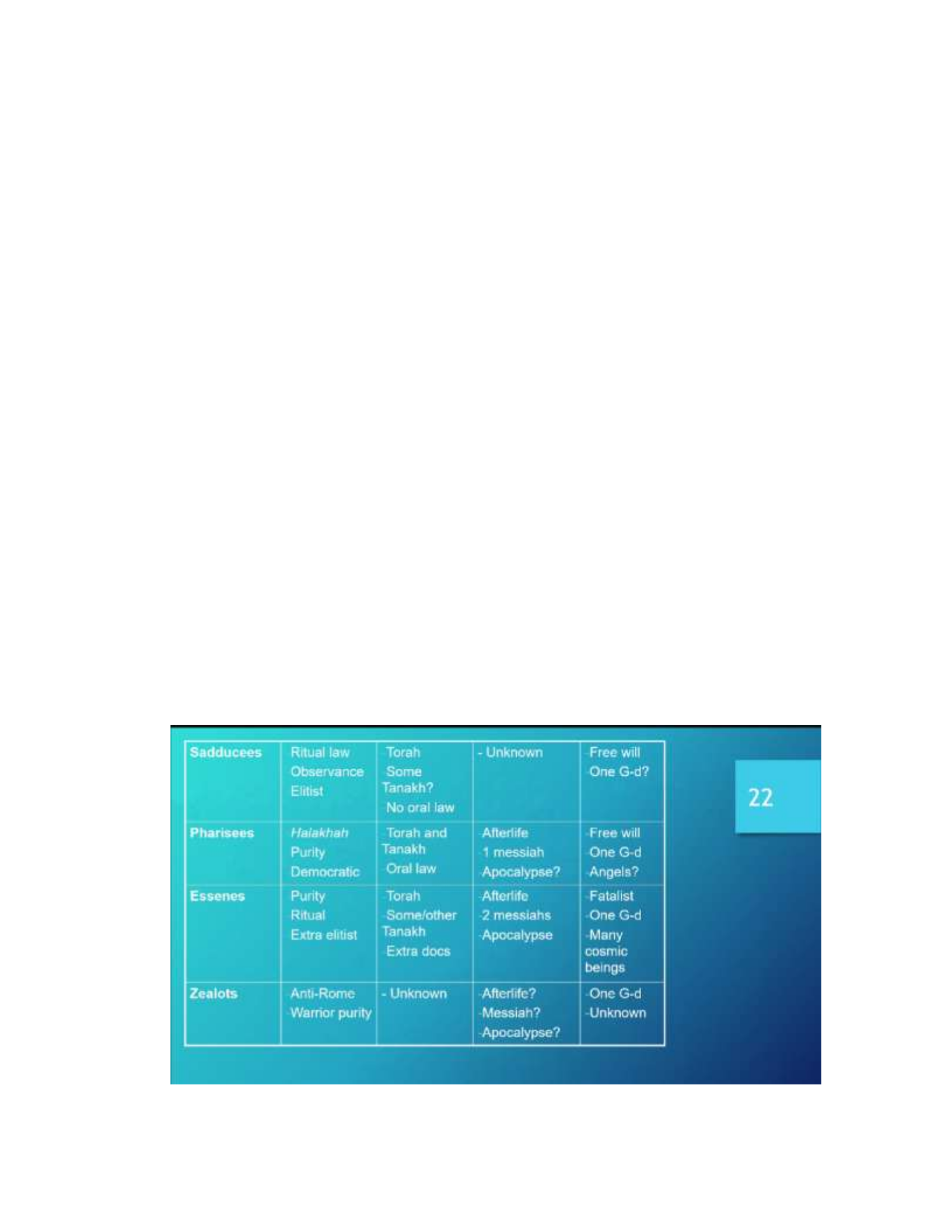
- Major sects active in judea
- 17
- Sadducees
- Claimed descent from zadokites
- Priestly class
- Few documents belonging to them, possible religious
“Textbook(s)” in addition to the Torah
- Pharisees
- Sages
- Academic
- Popular amongst the people - Essenes
- The qumran community, called themselves Zadokites believed
they were the real Sadducees
- Created the dead sea scrolls
- Monastic – doesn't have a huge role in judaism, judaism does not
support celibacy (first law is to be fruitful and multiply) - They
were celibate
- “Cosmic elitism”- Believed they were the army of good
- Had additional documents- Apocrypha and Pseudopigryphas,
polemics (Arguments against enemies)
- Zealots
- Sicarii, assassins that were part of the zealots
-

UNSUREÉ
Documentary Hypothosis:
How scholars understand the bible; JEPD– came from all different places and all over and
redacted to the torah.
Timeline:
- Around 2000 BCE patriarch Abraham, son Isaac and grandson Jacob and Jacob's twelve
sons lived (patriarchs)
- G-d made a pact with Abraham promising him and his descendants a permanent home in
the land of the Canaanites (covenant)
- In return, Abraham and his descendants would follow G-d and if they were male they
would get circumcised as a sign of their covenant
- Famine forces Jacob and his family to immigrate to Egypt where the Jews lived
peacefully until they were enslaved around 1300 BCE→ later liberated by Moses
- After leaving Egypt, Moses spoke with G-d on Mount Sinai, and brought down the 10
commandments (second covenant between Israelites and Yahweh)
- They wandered the desert for 40 years because the Israelites doubted G-ds might that
they would be able to conquer the land of the Canannites
- The Jews, Philistines, and Canaanites fought for more than two hundred years until the
Jewish tribes (under the leader of King David) captured Jerusalm and occupied parts of
Palestine in the eleventh century BCE
- Solomon (David’s son) built the first temple in Jerusalem and had all religious activities
performed at this Temple
- After Solomon died, the northern tribes rebelled (high taxes) and the kingdom was split
in two.
- The northern section was called Israel, and the southern section was called Juda.
- Assyrians conquered Israel in 721 BCE
- Babylonians conquered Judah in 586 BCE
- The Babylonians destroyed Solomon’s temple, tore down the walls of Jerusalem and sent
most Jews into exile in Babylon (left some of the poor Jews that farmed the lands)
- “By the rivers of Babylon, there we sat down, and wept, when we remembered Zion” →
said by Psalmist, and demonstrates grief
- 70 years after the destruction of the First Temple, the Persian king Cyrus the Great
conquered Babylonia and let the Jews return to Jerusalem
- Two Babylonian Jews, Ezra and Nehemia, returned to Jerusalem and made a Jewish state
- The Second Temple was completed in 515 BCE (Western Wall is what remains of it)

- The Jews who remained in Babylon finished compiling the Mishnah (Oral Law)
- Alexander the Great conquered Judah in 332 BCE, and brought a Greek influence
(Hellenism) → sports, customs, theaters, libraries
- All until the rule of King Antiochus the fourth
- Around 175-164 BCE Antiochus tried to force the Hellenization of Jews and make them
assimilated by banning Jews from keeping Shabbat and owning copies of the Torah and
tried to make them worship Zeus
- This started a revolt amongst the Jews→ the Macabee line reconquered Jerusalem in
165 BCE → this is the Maccabean Revolt
- Generation later, there was a dispute within the Maccabean dynasty. They asked
Potolesimist to arbitrate their dispute. Instead he conquered the land
- In 63 BCE, a Roman general was asked to mediate a dispute within Jerusalem, instead he
occupied Judah and claimed it as a new Roman province
- Under the rules of the Greeks and Romans, Hellenism was popular, and the Torah was
even translated into Greek (the Septuagint)
- During the Greco-Roman rule, the books of RUth, Esther, HOnah, Job, and Ecclesiastes
appeared
- While Palestine was occupied by the Romans, Jewish sects emerged
- Essenes→ non-violence, communal celibate life, isolated
- Sadducees→ members of priestly families who were in charge of the Temple, mostly
lived in Jerusalem. Only accepted Torah (not oral law), focused on temple worship
- Pharisees→ most pious, members came from all social classes, emphasized daily
religious practice, observance of religious laws and traditions. Accepted oral and written
law
- Zealots→ very opposed to Roman rule of Palestine. Thought the Messiah would be a war
leader who would lead forces that would defeat the Romans and restore Jewish political
rule in Palestine
- The Jews rebelled against Romans in 66 CE
- Jerusalem was sacked, and the Temple was destroyed
- The destruction of the second temple ended the power of the priesthood→ no longer
anywhere for priests to practice their rituals
- The Romans forbade them to rebuilt→ the Jewish population dispersed
- Without a temple, a greater emphasis was placed on scripture and interpretation of it
- In 90 CE, a group of Rabbis met in Yavneh to decide which religious books would be
recognized with the Torah as sacred literature

The Nature of Judaism as a “Religion”
Judaism:
- Less simplistic than seems, more than just a monotheistic religion
- Judaism is an ethno-religion (people`s religion)
- There are tenets of the religion agreed upon with clearly identifiable religious aspects of
laws, customs, ethics, morals, and identifiable symbols
- Judaism is a religion, culture, relationship, and discourse
- Many sects (people who don`t recognize others as Jews anymore) and denominations
(people within a religion with different beliefs but still share the same religion)
- Judaism is a group of people settled on Monotheism (evidence of Asherah is what divides
ancient Israelites to Judaism).
Religion:
- From the Latin word Religio, the binding of the past, present, and future.
- Some define religion as worshiping a deity, but some religions follow a divine system or
something of values, stories, symbols or knowledge that binds past, present, and future.
- Religion is an artificial academic term set to define a set of features that were not
separated from life prior to the enlightenment– much in connection to Christianity and a
Christian contextual lens.
- Judaism provides a set of ethics and values, gives meaning to a series of symbols,
represents a shared world view and contains meaningful stories/histories. It’s laws,
customs, recommended behaviours
- Judaism has religious texts, and minhagim (holidays, unwritten traditions, culture)
Civilization:
- Has a history
- There is material evidence of its existence
- Judaism changes and evolves as society evolves Culture:
- Grouped behaviour with key identifiable features which may include traditions that may
revolve around religion but do not necessarily have to be directly related Relationship:
- Faith is Judaism in relationship with the divine and with traditions of the community
- Is part of a Jews relationship to themselves, their community, the world, their family,
their ancestors, their descendants etc
- To their god or ultimate concern Discourse:
- a mode of study, teaching, learning, action, adapting, encounter, discussion, conceptual
zing, interpreting etc
- Taught, understood, discussed and learned over the course of lifetimes; it is fluid and
interactive
- “Judaism” is created/changed by various forces over time
- Tradition is central, but participation is also essential

- Is interactional Socio Sacred:
- things that become sacred to communities or families because they have just been sacred
for some time
- We tend to overemphasise the role of major texts within Judaism
- There is a world outside of text which leads to “Civilization”
Monotheism-
- Often known as the belief in one G-d, which is problematic within a Jewish context
- There are Jews that are atheistic
- Jews originally were henotheistic (Acknowledged there were others g-d`s but theirs was
superior)
- Only in the 4th-5th century did Jews become strictly monotheistic
- There are forms of Judaism for people who don’t always define themselves as Jews or
that are Jewish by Culture and not faith or religion
How all the parts of Judaism come together (religion, texts, culture, socio-sacred, discourse,
relationship, and civilization):
Judaism is a textual religion; it is a text itself that is part of the story, but it is also a lived
religion, which is a way of life. Minhag is a sacred way of partaking in the customs of the elders,
which inherently becomes sacred being socio-sacred within families because they’ve been
carried in a cultural society for so long. There is a world outside of the texts in Judaism, where
the civilization aspect comes out in Judaism of past, present, future, and why it is a history.
There is art, culture, clothing, and a relationship providing order to a universe to relationships to
their descendants, further flowing to communities. Judaism is what has been taught in
generational learning, making it fluid, resilient, discourse and change. This is a stream of how
people lived in an aspect of history.
Basic Jewish History:
Shares in an origin story with sources and interpretations
The four periods (Jacob Neusner)
- The first age of diversity becomes more recognizable (500BCE- 70CE)
- In the age of definition, rabbinic Judaism makes books (70-640 CE)
- The age of cogency, the dominant form of Judaism in the middle ages, self-isolated the
community (640-1800 CE)
- The second age of diversity (ca. 1800CE- present)

Judaism was originally from people who studied it through practice, but through academia, it is a
historical and anthropological approach.
The fallacy of Judaism- the belief in `normative Judaism and Diverse Judaism` is not just one
rabbinic path, but there are several paths. There are valid forms of Judaism that may slip through
the cracks.
Henotheism
- We worship one god. Others exist they just aren’t as good/ we believe in only one
- Judaism was originally henotheistic, however Ezra strived to stop this belief through his
reforms
(reforming what Judaism meant after completing the second temple)
Clifford Geertz (an Anthropologist)
- “Religion is a system of symbols which acts to establish powerful, pervasive and long-
lasting moods and motivations in men by formulating conceptions of a general order of
existence and clothing these conceptions with such an aura of factuality that the moods
and motivations seem uniquely realistic” (From the Geertz reading)
- Geertz explains religion's role in establishing relationships between ideas and feelings
that may seem uniquely unrealistic
- Criticism of Geertz`s view is that religion is not just in one`s mind, as he admits, as some
practicing Jews feel, it is also in one's body (i.e. what they eat).
What is Judaism
- The sacred history/story, ideals, ethics, practices, traditions, folkways, concepts, identity,
civilization, and art/philosophy of the Jewish people. It is also the core of what created
the Jewish people and binds them together
- Generally characterized by monotheism, the reverence of a core corpus of central text and
a foundational idea of covenant with god and all of Israel, through which the Jews find a
shared, mutually recognized point of origin, distinctiveness and imagined community
- It is the legendary and recorded history of the civilization of the Jews and all of the sacred
socio-cultural tenets/ways of life maintained and passed down through their generations,
around the globe
- “Imagined community”
- You can not picture how many people are part of the community
Concepts and Characteristics; Perspectives
Monotheism- belief of one G-d
Henotheism- belief that multiple G-d’s exist, but the belief in only one (pick the “best” G-d)
Ethno Religion- relegio + ethnicity, culture, civilization

Normative Judaism- one Rabinic path that is generally accepted as the main form of
Judaism Rabinic Judaism- Judaism that emphasizes daily habits, ethical monotheism, and
learning as Judaism outside of a Temple
Talmudic Judaism- Rabinic Judaism but with the Talmud→ very little difference in core beliefs
(came later on in history)
Sectarian Judaism- Established in the Second Temple Period→ pharisees, sadducees, Esseens,
Zealots
JEPD- historical view that the Torah was written by four people over several centuries
Patriarchs- Abraham, Issac, and Jacob→ fathers of ancient Judaism
Israelites- what the people of Judah were called up until around the creation of the
Second Temple HebrewsKosher- dietary laws
Purity laws- laws observed in Talmudic Judaism, priestly Judaism in the Second Temple Period,
laws of how one interacts with others and stays pure. Talmudic Judaism→ everyone needs to be
pure to fulfill the covenant
Diaspora- Jews living outside of the land promised by G-d in his covenant with Abraham
Ethical monotheism- individual relationship with G-d through study and prayer→ democratizes
Judaism from just priests
Messiah- Jesus and Bar Kochba identified as a messiah. Jews believe the messiah hasn’t come
yet but messiah brings redemption→ Talmudic Judaism believes to live life to the fullest because
the messiah will come
Hellenism- Greek culture→ valued philosophy, science, sports, libraries, etc.
Covenant→ pact/promise between G-d and Abraham/Israelites/different person depending on the
covenant
Circumcision- requirement of the covenant between Yahweh and Abraham
Books (explained under texts and concepts):
- Torah
- Neviim
- Ketuvim
- Mishna (oral Torah)
- Talmud (commentary on the Mishna→ includes the Mishan and the commentary which is
called Gemara)
- Talmud Bavli (commentary discussed by Rabbis in Babylon)
- Talmud Yerushalmi (commentary discussed by Rabbis in Jerusalem)
The Texts and Concepts of Judaism
Judaism is taught generationally, which is part of why it is dynamic as it adapts to current times.

The Triad of Judaism- G-d, Torah/covenant, Israel– how the group understands these
Texts-
Everything in Judaism is related to the texts, lots of books. Hebrew is the language of the Jewish
people; translation is always interpretation.
Torah- the legal code, the first five books of the Torah. Religiously these are the book of the
covenant, the legal constitution between jews and god. Tanach is the Hebrew bible, Torah,
neviim, Ketuvim. These texts have history so there are many slightly different translations.
Today the Maseretic text translations is what jews use. The Masereats are the rabbis who added
the nikoodim. Midrash is retellings or expansions of stories from the bible to fill in the gaps–
could be history, stories, legal etc.
Mishna- oral Torah, Torah shebe al pheh. When g-d gave written Torah to Moshe, he also gave
the oral Torah which would be taught to teachers who could apply it with flexibility unlike the
written Torah which is not meant to change or adapt. Mishna is what makes rabbinic Judaism. It
is the foundation for rabbinic Jews.
Judah ha nasi- He writes down what amounts to the oral traditions and that is when the mishna
becomes a book because he realizes that with a few wars, the torah shebe al pheh could be
whipped out.
Talmud- also a rabbinic text, it is an explanation of oral law. Rabbinic commentary on the
mishna (oral Torah). Gamara is the Babylonian Talmud.
Rashi- he clarifies the language, helps students be able to understand and makes connections
to written torah and references. The Hagadah is a rite– a prayer book
Central Concepts:
G-d- G-d is one, a unity and a singular. G-d is the creator and has no creator, he is the universal
creator of everything
Covenant; Paradigms; Creation/History -
Origins and Ancient Israelite Religion - In
the Tanakh there are 6 covenants:
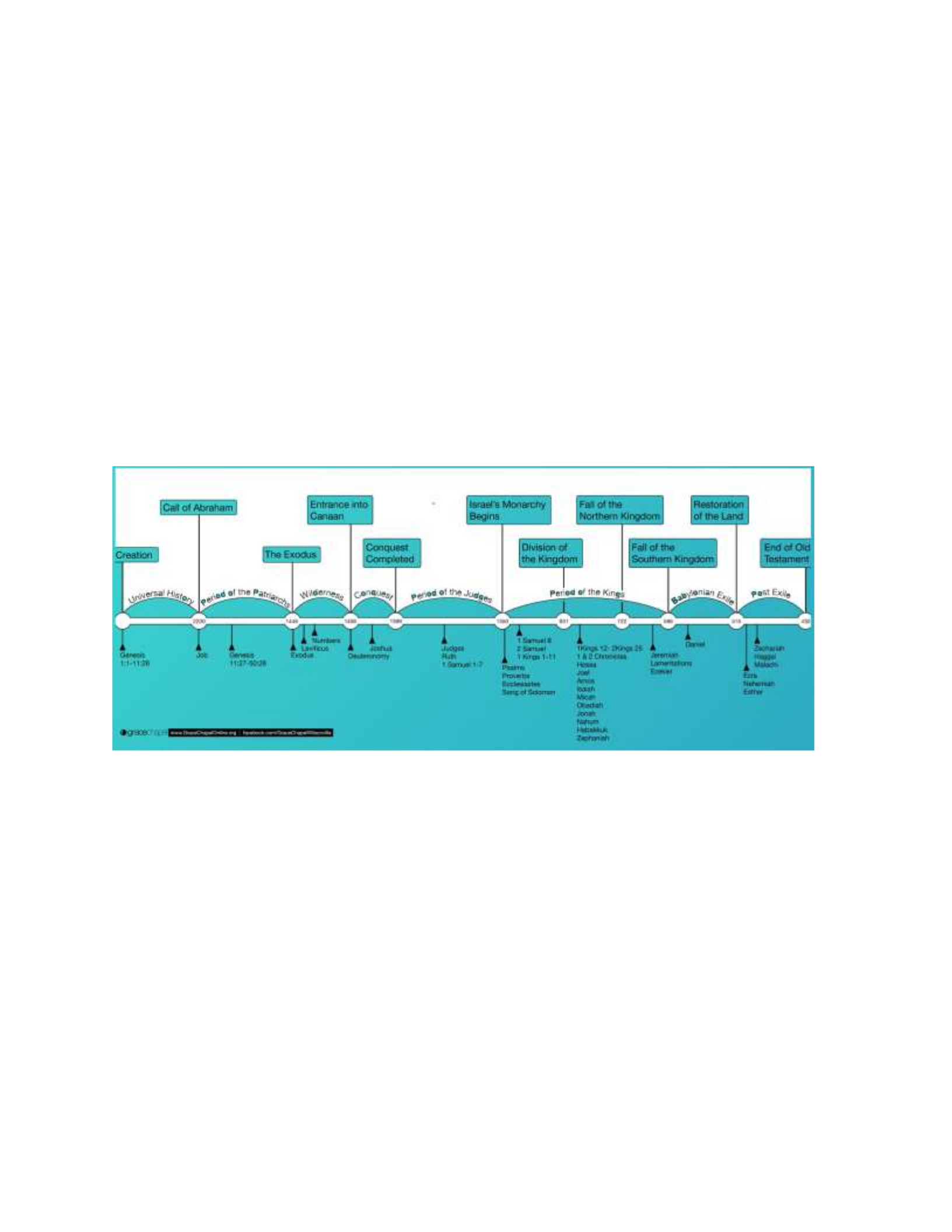
13. Edenic (relates to all humans)
14. Noachide (relates to all humans)
15. Abrahamic (relates to the Jews)
16. Sinai (relates to the Jews)
17. Levitical (Priestly) (relates to the Jewish priests)
18. Davidic (Royal or Messianic) (relates to the Jewish royalty)
- Covenant means relationship, membership, or identity
Order of the Tanakh
-
- Genesis 1-3 covers the creation of the world
- Edenic Covenant, take care of the world and I will bless you with food/water/life
- The origins of Shabbat on the 7th day on creation
- Noah and the Deluge, Genesis 6-9
- Covenant with the Nations
- Remnant is Noah, tasked with two of every animal on the arc - A rainbow in
the sky is the symbol that G-d will not destroy the earth
- The seven commandments of the Noachide Covenant:

- Believe in G-d, respect G-d, do not murder, do not commit adultery, do not stea
steal, create a justice system, do not eat living animals
Summary of the covenants:
-Edenic ( Genesis 1. 28-30) — g-d to humans, Adam and Eve -
Noachide (Genesis 9.8-17) — all humans after Noah and g-d
-Abrahamic (Genesis 12-17) — hebrews, circumcision
-Sinai (Exodus 19-24) — Israelites, most commonly discussed/known covenant
-Levitical (Exodus 29. 44-46) — priests of the Hebrew nation (priestly Jews)
-Davidic (2 Samuel 7) — g-d to David and his dependents (royal Jews)
- Abraham and the Patriarchs
- Origins of the covenant community and paradigms of faith
- Family based, no priesthood
- Abraham got a message from G-d and breaks all the idols in his father’s shop
(Iconoclastic)
- He leaves to start a new line, he circumcised himself and he becomes the leader of
the
Hebrews
- The The Conquest of Canaan main G-d “El” → Elohim
Isralite → is when the people are in the land of Israel, civilization that starts to form from
the
Hebrews, follows the Ancient Israelite Religion
Hebrew → is the tribal term of the followers of Abraham, ancestral or tribal origin
- 11th-10th century the United Davidic Kingdom (when they became united as one
group) 3 Kings
→ Saul, David, and Solomon
-
-

- King David was considered the glory days, the pinnacle of Israelite power,
conquers Jerusalem for the capital of the 12 tribes, King Solomon builds the first
Temple
The Origins of Judaism
Before the 5-6th century we say the ancient Israelite religion
- Mount Zion is established under King David and the first Temple is built under King
Solomon
- King David thought there was only supposed to be one Temple as they believed in only
one G-d, and sacrifices were only supposed to be made inside the Temple (although they
happened outside and were not reported)
- Descendants of Aaron are responsible for priestly duties
- Kosher Laws applied to all Jews when Judaism is established, previously in the Ancient
Isralite
Religion only the priests followed them (Leviticus)
- After Solomon there was a division (Northern Kingdom Israel (Sameria) and Southern
Kingdom
Judah (Jerusalem))
- Rituals of the first Temples included animal sacrifices (avodah), regular offerings (tamid)
(wine, oil, grain, cakes), pilgrimage festivals (Pesach, Shavuot, Sukkot)
- The second Temple created the Hebrew calendar
Terminology review
- Hebrew — ancestors
- Israelites and ancient israelite religion — civilization that starts to form rooted in the
origin being Hebrew but move out when they start to live in the land
- Jews
Origins of the Israelites
- a word about terms
-

- Hebrews, Israelites, Jews
- When do the Israelites arise as a distinct people
- Very little evidence of when
- In Egyptian text we see people called the Habiro — people say is the Egyptian spelling of
Hebrew
- The tribal period is israelites→ kingdoms split up after King Solomon
- Under king solomon the temple in jerusalem is built
- 931 BCE the kingdom splits into Israel and Judah
- 740 BCE Israel falls to the Asyrian emr
- 586 BCE Jerusalem falls to the Babylonians→ first temple destroyed
- There is a fundamental transition from ancient Israelites to Judaism
Pre-Judaism (Israelites); Biblical/Historical Roots; ANE Contexts
Exile/Return and the Dawn of “Judaism”
We call Noah, Adam and eve etc as the legendary events as the Bible is the only source for this.
Israelites: Their encounters with communities around them
- Egyptions
- Babylonians
- Phenitions
- Cannanits
- Mesapotanians
Origins of Israelites:
Hebrew- tribal, ethnic language, legendary past language.
Israelites- the switch of designation from legendary past to the identity of Israelites when they
leave egypts. There is little true evidence making specific dates difficult to identify. This is when
the modern tribal period was the monarchy and temples occur.
Habiru- means stubborn or qweroralsom from the Egyptian's view, but some think it means
Hebrew
The Merneptah Stele- a stone with the detail of the “israels” being wiped out in 1208 BCE

The Bible as “History” is an important source, but it is not an accurate portrayal and is more of
trying to hit upon their objectives. Historians try to use the bible as a supplementary source, not a
primary source, as it took roughly 800 years to come together along with bias. There are various
types of documents within the bible from different sources. Though the author may sound like a
first-person narration, it may not be, and that is why archeology is so vital.
The Conquest of Canaan
- Abraham`s covenant with Yaweh (G-d)promised him the land of Cannan
- The Jewish bible discusses two different ways the Israelites were told to receive the land
of Cannan.
- One through the Israelites being told by Yaweh to kill out all the cananites and take over
that land
- Another expressing a gradual takeover of Cannan through buying land gradually
- There is no evidence of Canaanites disappearing or a mass murder but there is evidence
of the defacing of art beings and idols.
- A theory is that the Israelites were Canaanites who felt in opposition to the cannonites
that surrounded them.
- Some believe Cannonites were the successors of Noah because the root of the name is
similar to Shem Noah, the name of Noah
- Academia gathers that by 1208, the Israelites have a separate identity. The Canonites
were not a separate group but possibly living among the Israelites where the term El
came up as a god with ideas of henotheism and monaltry. El often was equated with a
woman figure of name ashera.
There is fair certainty of Saul, David, and Solomon. The Tel Dan Inscription was found to
identifying
Messiah means the anointed one, though david, saul and solomon were all anointed as kings,
david was the one that david will produce a messianic heir. David establishes Jerusalem and
brings the tabernacle there. Solomon, a man of wisdom built the temple as opposed to his father
who was a man of war. Solomon had many wives, he was charged in the bible of having multiple
wives who he let build temples and polotheism. Another reason people say the temple fell was
after the temple was built israelites went to get the taxes lowered, as a result solomon doubled
the taxes which was bad.
The Two Temples
The First Temple
- Built roughly around 957 BCE and stood for around 400 years
- Known as Solomons Temple

- In 930 BCE there was a split of power. There was tension and a power struggle if the
priests or kings should be ruling
- One explanation is that Solomon lost faith in g-d
- The kingdom of Israel fell to the Assrians
- Story: Assyrians took a Babylonian and forced them to grind their families bones
- Israel was the north, Judea South. Judah made a truce with Assyrians but Israel did not,
so Israel was taken but some were able to flee to Africa or Judea
- The fall of the temple led to a spiritual crisis of why would g-d make a covenant for
canaan and not protect them, this is a theodicy. Juddha explains that it is because Israel
had sinned and was not a monotheist
- Getting rid of Ashuhahs, banning worship outside Jerusalem and more intensity about
Judaism came about not
- Theodicy is what meaning can be made of a situation, like why do bad things happen to
good people etc.
-
The Second Temple
Differences?
Rites/Purpose; Differences; History; Meaning; Priests/Prophets
Purity
- refers to your hygiene habits
- Your diet
- Your marital/sexual choices
- The laws of the priesthood — in exile, they said it isn’t enough for the priests to be pure
but maybe we all have to do this
- Keep kosher
- Avoid touching the dead
- Etc
Catastrophe and Transformation; Exile and Diaspora
Babylonians
Babylonians take Assyria, they rule by both sheer brutality but also power, taking away money
that may be used against them and though taking out any royals and keeping only farmers or
who they need. Judah is taken by the babylonians, there are multiple revolts, sieges etc, this was
a drawn out process. Everytime the babylonians won they would ship off the elite with 3-4
deportations. As they shipped off the elites of Judah, they imported elites of other places who
spoke different languages so they wouldn't revolte. In 597 BCE the Babylonians destroyed the

temple. The farmers left still after it was destroyed continued to go there to do pilgrimage. Left a
lot of Israelites in the land and didnt get rid/move all of them.
The Diaspora
The Zadok was a levit who brought the exilarchs together (those in exile). This is when the
sacred narratives were written down in Babylon and the schools in Babylon for teaching and etc
happened. There was also a diaspora in egypt.
The exiles in Babylon left for a lot of memory, in Judaism to remember is a commandment, but
as a verb to not just remember but to call forth a meaning or action in you– not a passive verb
but an active verb to commemorate and act in its past. Judaism as seen later has its origins in the
acts of mourning and commemorating the temple. This is Zahor– lezhor, to remember. This is
where the theology of suffering takes route.This is when the idea of intermarriage came abouts.
- “By the rivers of Babylon, there we sat down, and wept, when we remembered Zion” →
said by
Psalmist, and demonstrates grief
People of the land
The people the babylonians did not send out of the area, this is where ancient israelite religion
takes a backseat to a folk religion where the people continue to make sacrifices while the priests
arent there. The Samaritans focus on a different mountain (gerazim instead of zion) in their
thoughts of whats important.
Ancient israel religion is concidered the problem and Judaism the religion was thought of as the
solusion. Who is the legit Jew is in question; the ones who stayed in the land or those who were
exciled and returned.
THe exiled:
Now they have the bible. At the babylonian academy there was a scrible effort to copy older
books and write down multiple perspectives off memory which had them putting hebrew into
heavy importance, texts are super important– you can take them with you in diaspora. The Exiles
were allowed to return but they hadnt have political autonomy, this is where they came up with
different things they could do and avoid (intermarriage, two stories of what to do about the
cannnanites, lack of faith and loyalty, lack of impurity– hygiene, diet, sex and marriage, multiple
wives etc).
THe return from babylon to judea: 539 BCE
Yehud was the provice of judea, this is the origin of judaism and jew as a term and not israelite.
This is where cyrus the great publishes the Edict of Resoration, got people to likke him and be

happy so they don’t revolt. Cyrus is all for his people having their own ethnic legal code, which
for jews is Torah with initates the control the priests never had had.
Aramaic is the language people spoke in the streets– blending ancient persian and ancient
hebrew like yiddish but persian. Aramic is a big innovation of this period
Ezra and Nechemia
Ezra and his great assembly of who was a jew and how was a jew etc. Building in courts that are
legal and religious which the temple becomes the center of jewish world.
Nechemia focused on the rebuilding of the temple nad then harod renovated it. Not all jews
return from excile, they remian in the schools in dyaspera. This is when the elephanine temple
is created where outside of Jerusalem they did sacrifices.Ezra was intensely interested in the
reconstruction of the religion, he helped firm up identity, membership and push to remove
ancient israel religious attributes and emphasized jewish law, torah and emphasis on law for all
jew. Here ezra creates the great assembly which is an influential aspect to later Judaism.
Ethical monotheism- not solely reliant on sacrifice but through study and prayer one can
develop an individual relationship and develops into a more democratic religion not solely for
priests but study and prayer as valid.
First temple period: Solomons's Temple, built by king Solomon and destroyed by Babylonians
just prior to babylonian exile. This period focused on priests, sacrifice, and competition due to
the diversity within Judaism there.
The Second Temple Period- rebuilt under Cyrus the great and was heavily renovated by herod.
Classical Judaism
Classical Judaism- What comes out of the second temple period which was influenced by greek
and Romans.
Hellenism- a component that distinguishes classical judaism. This is a greek structure but it also
influences the roman period so its both in the greek and roman periods, the classical periods.
Lots of naked activities because the body was sacred and jewish men were prohibited from some
activities because they were circumcised, which was considered bad. Some medical textbooks
were talking about reversing circumcision. Jews want to access goyshe life but the human body
almost didnt allow them because theres a series of excelling in public life or being jewish,
creating tention in different aspects.
Alexander the great- he dies young and his empire does not stay whole so the greek empire gets
split into Egyptian ptolemaic empire and the syrian seleucid empire.

Egyptian Ptolemaic Empire- didnt make many changes post alexander the great
Syrian seleucid empire- made changes cuz they found the jews not follow zues so it was
offensibe.
70 CE: The second temple is destoryed
Helleistic Judaism- A hellenization of judaism, this is where philosophy was intertwined with
Judaism. This is where the philosopher phylo rationalized judaism for both jewish and non
jewish audieces. Hellenism also impacted the way jews understood jewish life, this is where
upper class jews also saw jerusalem as a polis city state. Jews started to see Jerusalem as much
more important than the rural places. There is a rise of a middle class as judea had free access to
trade with other parts of the greek empire. This is when public baths and gymnasium became a
big part of social life and business happened. How much jews can hellenise and remain jewish
was a very touchy topic, if one is an authentic jew was a big issue of the time.
Syncretism- the melding of different cultures or religions. What can be adopted while keeping
Judaism.
Selucid rule- there was a decree that everywhere needed to have a place for sacrifice to Zeus
and when jews were upset the romans were offended. Mattisiyahu says no to sacrificing to zeus
and then the whole chanukkah story war breaks out.
Hasmonians- the dynasty that comes from the maccabees. Still ongoing hellenizer controversy
which is uncomfortable for their major critics despite their roots in the maccabean revolt and the
hassidim felt the hasmonians were too helenised and not jewish enough. There are
uncomfortable practices of making the king the high priest as the same person which is so not
like the history of the israel concept. They were not descendants of zadik or david and were not
two separate people so the hasmonians broke these two taboos even though they had a role in the
revolt.
The pharasees- they consider themselves the descendants of Ezras great assembly, they began
as supporters of both the hasidim and the hasmonians but once the hasmonians broke the taboo
of king and priest being two people.
Roman period- also socialized very naked and were disgusted by cercumsison. Social
advancement verses faith were a big question. They went to help judea but ended up colonizing
when they were called upon to help between a dispute of domination. Romans make a lot of
arrogant mistaktes early on.
Herod- Harod overthrows and ends the Hasmonians and makes his own dynasty because he
knew they werent universally loved. He was super hellenized and liked art and architecture.

Second temple wasnt finished until after his death and generationally so many people were
employed by the renovation that when it was finished people started to loose their jobs and
people got so mad over roman stupidity.
Jewish Revolt- Romans were stupid and said more taxes, and Jews said no, so the Romans took
gold out of the temple, so basically, the Jews went bat shit. The Romans send in reinforcements
to seize Jerusalem and Jerusalem was overpopulated and becomes a state with a lack of water,
food and disease– this became very traumatic for the people. In 70 CE, the Romans get to the
temple, take it over and put it on fire. Revolt in Masada. Then the bar kochba revolt and what
then began the great diaspora. The outcomes of the revolt were that the hasmonians (maccabees
generations) brought jewish people together as the threat to the temple not being pure and for
judaism as a religion became clear as they fought against hellenism and foreign intrusion. But
this also left for a hasmonian to takeon priesthood when they are not apart of the linage of david
that was supposed to but as long as a representative who prioritized torah law then the
hasmonian rule was okay by the people, this lasted until alexander yannai tried to get rid of the
legislative assembly and just have the king and high priest be absolute, this is when it got more
questioned and the other jewish groups became more in question about the legitimacy.
Benefits of roman rule
It improved the material quality for judea and for ideological reasons of not affecting the sects
religious practices it was better not to revolt until the zealots came along.
Influences (Greco-Roman); History; Forms; Politics; Conflicts
The Great Diaspora: 135 CE
Jews were moved into Turkey, Europe, Asia and northern Africa. Babylonian communities had
already been there from 70 CE, and they had money and lived to build up academies so they
could learn and Judaism could continue.
UNSURE WHICH PERIOD
Jews were in intense relations with Greece and Rome. The classical area in the 4th-5th centuries
is the fall of the roman area. This gives texts of Jewish philosophy (Hellenistic influence,
Example: Philo of Alexandria the exploration of Judaism in a systematic rational thought),
Jewish “history” (Josephus the first-century historian’s outlook which is similar to the way a
history department at university would, the attempt to record historical events using scientific
methods to record events as a reality), and Jewish theology/Rabbinic Literature (the Talmud).
Rabbinic literature is the application of interpretation of knowledge from god, it is about
applying credentials in tradition to sacred scripture this stems from the rabbinic Jews who felt
they had access to oral and written Torah, it really depends on having legal experts of rabbis to
really interpret the law. Rabbinic Judaism is not literal, halacha is based on experts. The rabbinic

Judaism absorbed different sects of Judaism and were how to make sense of Judaism after the
chaos after 70CE with themes of how to survive and adapt. The rabbinic period takes what ezras
great assembly shaped with kosher and self views their roots in the leaders of the Sanhedrin.
Hillel and Shammi are a great balanced example of the need for law and human emotion work
ideas.
Bar Kochba
Too many people die, and in 220 CE the oral law (Mishna) is written down, and then the Talmud
is created and the age of cogency.
The Canonization of the Bible leading to the Masoretic Text
A discouraging of translating the bible but a push of studying the bible in Hebrew to keep the
language alive.
Pirkeh Avot- Chapters/sayings of the fathers/ethics
Torah means Mishna, Talmud, Gammara, it's all hand in hand with Torah so it is used
interchangeably.
Talmudic Judaism
Rabbinic tradition is recorded in the Talmud, through the proper interpretation of the law.
Protecting the law by saying not to do things that are even further (don't murder, don't get angry)
like putting up barriers, so there's a massive extension of the law to make things unthinkable.
Rabbinic Judaism answered concerns that the covenant would be vaccaded and what Judaism
mean without sacrifices (which was love and kindness, Tikkun Olam). Rabbinic Judaism
becomes intensely pro social which ends up becoming apart of pro jewish survilval.
Normative Judaism
The fallacy (big issue) that there is only one way of judaism, rabbinic judaism is not the only
form of judaism to develop into the middle ages even if it is the most common.
Non-Talmudic Judaism
Those forms of Judaism that reject the Talmud and oral law
Samaritans
They practice an Israelite, Torah based religion that pre-dates the Talmud. They are a minority
but quite ancient in origin. Antagonism between jews and samartism was bad at times as
samaritans claimed that god said they could only sacrifice at one place but disagreed at where
that was. They also have their own torah.

Karaite Judaism
An ancient sect of Judaism which considered only written Torah authoritative and does not
recognize oral law (mishna and talmud) to be authentic to Judaism they are thus distinct from
rabbinic judaism. Anan ben david didnt want to be seen as a salary hereditary but an ananite.
They see Deutaronimy 4. 1-2 differently and are more literal to Judaism so thats why they think
rabbinic judism is inauthentic and wrong.
Beta Israel
Many practice rabbinic judaism as they had to convert but their judaism predates the rabbis as
they have an 8-book bible from etheopia called the octateuch, the orit is their torah.
Early Rabbinic Judaism
The Remnant
- After 70CE
- Judaism without the temple
- Sage Ben Zakkai and the salvation of Judaism
- Gathers students and books, goal is to protect knowledge
- Pretends to be ill, rumors that he’s dying
- He “dies”
- Get put into a coffin full of his books, convince guards to let them through
the wall
- Visits Vaspasian and tells him he will become emperor
- In return he receives Javne and its sages
- All of the Jewish books are collected, Pharasaic Judaism becomes
Judaism
- Bible is cannonized
- Early rabbinic judaism is oral law
- Ben Zakkai proposed new way of Judaism without sacrifices
- Acts of love and kindess instead of sacrifices, gave positive spin to all the
destruction
- Rabbinic Judaism becomes a “portable” way of Judaism
Formation; Origins; Authority; Characteristics
Diversity in Early Judaism
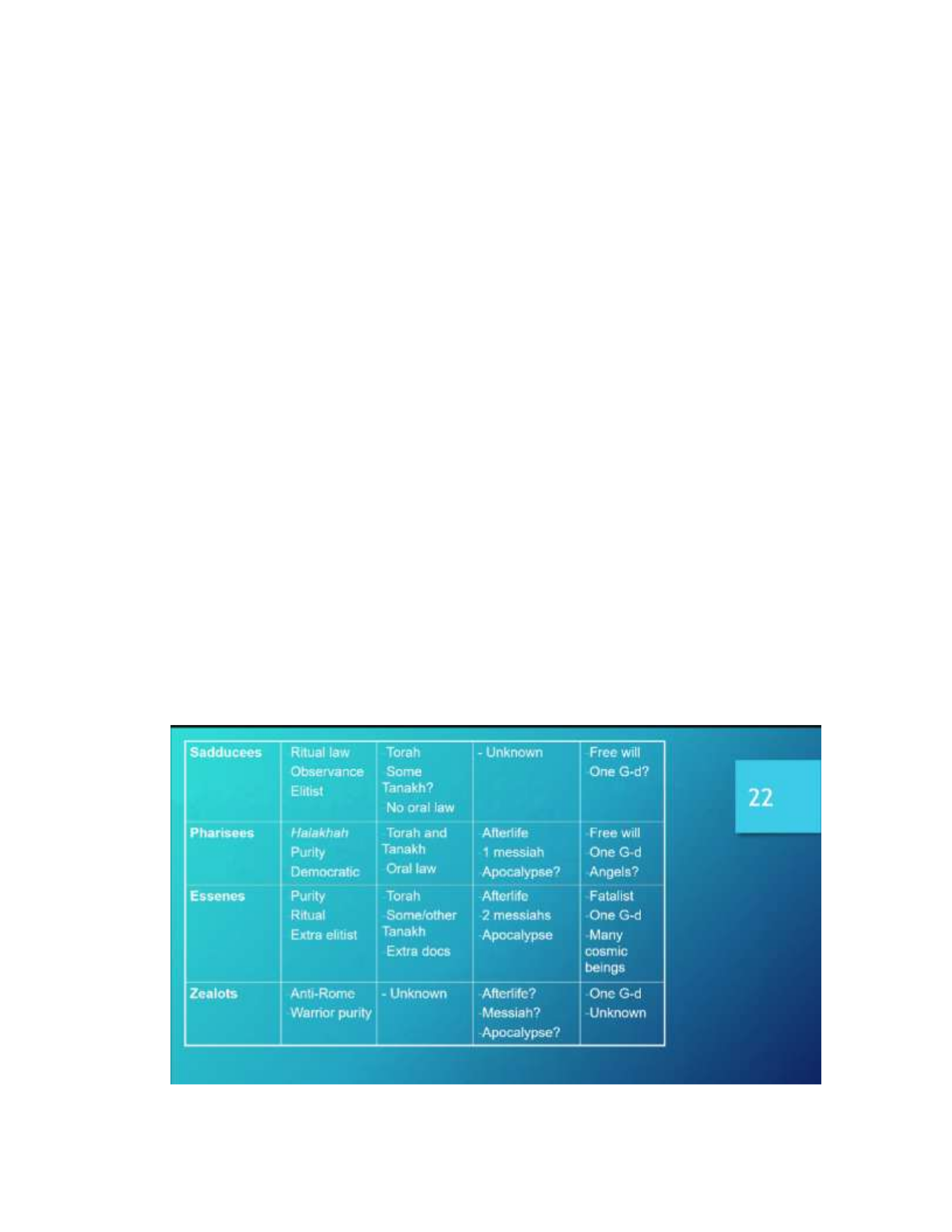
Sects; Non-Rabbinic Judaisms; Dialogue/Polemics
- Major sects active in judea
- 17
- Sadducees
- Claimed descent from zadokites
- Priestly class
- Few documents belonging to them, possible religious
“Textbook(s)” in addition to the Torah
- Pharisees
- Sages
- Academic
- Popular amongst the people - Essenes
- The qumran community, called themselves Zadokites believed
they were the real Sadducees
- Created the dead sea scrolls
- Monastic – doesn't have a huge role in judaism, judaism does not
support celibacy (first law is to be fruitful and multiply) - They
were celibate
- “Cosmic elitism”- Believed they were the army of good
- Had additional documents- Apocrypha and Pseudopigryphas,
polemics (Arguments against enemies)
- Zealots
- Sicarii, assassins that were part of the zealots
-

UNSUREÉ
Documentary Hypothosis:
How scholars understand the bible; JEPD– came from all different places and all over and
redacted to the torah.
Timeline:
- Around 2000 BCE patriarch Abraham, son Isaac and grandson Jacob and Jacob's twelve
sons lived (patriarchs)
- G-d made a pact with Abraham promising him and his descendants a permanent home in
the land of the Canaanites (covenant)
- In return, Abraham and his descendants would follow G-d and if they were male they
would get circumcised as a sign of their covenant
- Famine forces Jacob and his family to immigrate to Egypt where the Jews lived
peacefully until they were enslaved around 1300 BCE→ later liberated by Moses
- After leaving Egypt, Moses spoke with G-d on Mount Sinai, and brought down the 10
commandments (second covenant between Israelites and Yahweh)
- They wandered the desert for 40 years because the Israelites doubted G-ds might that
they would be able to conquer the land of the Canannites
- The Jews, Philistines, and Canaanites fought for more than two hundred years until the
Jewish tribes (under the leader of King David) captured Jerusalm and occupied parts of
Palestine in the eleventh century BCE
- Solomon (David’s son) built the first temple in Jerusalem and had all religious activities
performed at this Temple
- After Solomon died, the northern tribes rebelled (high taxes) and the kingdom was split
in two.
- The northern section was called Israel, and the southern section was called Juda.
- Assyrians conquered Israel in 721 BCE
- Babylonians conquered Judah in 586 BCE
- The Babylonians destroyed Solomon’s temple, tore down the walls of Jerusalem and sent
most Jews into exile in Babylon (left some of the poor Jews that farmed the lands)
- “By the rivers of Babylon, there we sat down, and wept, when we remembered Zion” →
said by Psalmist, and demonstrates grief
- 70 years after the destruction of the First Temple, the Persian king Cyrus the Great
conquered Babylonia and let the Jews return to Jerusalem
- Two Babylonian Jews, Ezra and Nehemia, returned to Jerusalem and made a Jewish state
- The Second Temple was completed in 515 BCE (Western Wall is what remains of it)

- The Jews who remained in Babylon finished compiling the Mishnah (Oral Law)
- Alexander the Great conquered Judah in 332 BCE, and brought a Greek influence
(Hellenism) → sports, customs, theaters, libraries
- All until the rule of King Antiochus the fourth
- Around 175-164 BCE Antiochus tried to force the Hellenization of Jews and make them
assimilated by banning Jews from keeping Shabbat and owning copies of the Torah and
tried to make them worship Zeus
- This started a revolt amongst the Jews→ the Macabee line reconquered Jerusalem in
165 BCE → this is the Maccabean Revolt
- Generation later, there was a dispute within the Maccabean dynasty. They asked
Potolesimist to arbitrate their dispute. Instead he conquered the land
- In 63 BCE, a Roman general was asked to mediate a dispute within Jerusalem, instead he
occupied Judah and claimed it as a new Roman province
- Under the rules of the Greeks and Romans, Hellenism was popular, and the Torah was
even translated into Greek (the Septuagint)
- During the Greco-Roman rule, the books of RUth, Esther, HOnah, Job, and Ecclesiastes
appeared
- While Palestine was occupied by the Romans, Jewish sects emerged
- Essenes→ non-violence, communal celibate life, isolated
- Sadducees→ members of priestly families who were in charge of the Temple, mostly
lived in Jerusalem. Only accepted Torah (not oral law), focused on temple worship
- Pharisees→ most pious, members came from all social classes, emphasized daily
religious practice, observance of religious laws and traditions. Accepted oral and written
law
- Zealots→ very opposed to Roman rule of Palestine. Thought the Messiah would be a war
leader who would lead forces that would defeat the Romans and restore Jewish political
rule in Palestine
- The Jews rebelled against Romans in 66 CE
- Jerusalem was sacked, and the Temple was destroyed
- The destruction of the second temple ended the power of the priesthood→ no longer
anywhere for priests to practice their rituals
- The Romans forbade them to rebuilt→ the Jewish population dispersed
- Without a temple, a greater emphasis was placed on scripture and interpretation of it
- In 90 CE, a group of Rabbis met in Yavneh to decide which religious books would be
recognized with the Torah as sacred literature

The Nature of Judaism as a “Religion”
Judaism:
- Less simplistic than seems, more than just a monotheistic religion
- Judaism is an ethno-religion (people`s religion)
- There are tenets of the religion agreed upon with clearly identifiable religious aspects of
laws, customs, ethics, morals, and identifiable symbols
- Judaism is a religion, culture, relationship, and discourse
- Many sects (people who don`t recognize others as Jews anymore) and denominations
(people within a religion with different beliefs but still share the same religion)
- Judaism is a group of people settled on Monotheism (evidence of Asherah is what divides
ancient Israelites to Judaism).
Religion:
- From the Latin word Religio, the binding of the past, present, and future.
- Some define religion as worshiping a deity, but some religions follow a divine system or
something of values, stories, symbols or knowledge that binds past, present, and future.
- Religion is an artificial academic term set to define a set of features that were not
separated from life prior to the enlightenment– much in connection to Christianity and a
Christian contextual lens.
- Judaism provides a set of ethics and values, gives meaning to a series of symbols,
represents a shared world view and contains meaningful stories/histories. It’s laws,
customs, recommended behaviours
- Judaism has religious texts, and minhagim (holidays, unwritten traditions, culture)
Civilization:
- Has a history
- There is material evidence of its existence
- Judaism changes and evolves as society evolves Culture:
- Grouped behaviour with key identifiable features which may include traditions that may
revolve around religion but do not necessarily have to be directly related Relationship:
- Faith is Judaism in relationship with the divine and with traditions of the community
- Is part of a Jews relationship to themselves, their community, the world, their family,
their ancestors, their descendants etc
- To their god or ultimate concern Discourse:
- a mode of study, teaching, learning, action, adapting, encounter, discussion, conceptual
zing, interpreting etc
- Taught, understood, discussed and learned over the course of lifetimes; it is fluid and
interactive
- “Judaism” is created/changed by various forces over time
- Tradition is central, but participation is also essential

- Is interactional Socio Sacred:
- things that become sacred to communities or families because they have just been sacred
for some time
- We tend to overemphasise the role of major texts within Judaism
- There is a world outside of text which leads to “Civilization”
Monotheism-
- Often known as the belief in one G-d, which is problematic within a Jewish context
- There are Jews that are atheistic
- Jews originally were henotheistic (Acknowledged there were others g-d`s but theirs was
superior)
- Only in the 4th-5th century did Jews become strictly monotheistic
- There are forms of Judaism for people who don’t always define themselves as Jews or
that are Jewish by Culture and not faith or religion
How all the parts of Judaism come together (religion, texts, culture, socio-sacred, discourse,
relationship, and civilization):
Judaism is a textual religion; it is a text itself that is part of the story, but it is also a lived
religion, which is a way of life. Minhag is a sacred way of partaking in the customs of the elders,
which inherently becomes sacred being socio-sacred within families because they’ve been
carried in a cultural society for so long. There is a world outside of the texts in Judaism, where
the civilization aspect comes out in Judaism of past, present, future, and why it is a history.
There is art, culture, clothing, and a relationship providing order to a universe to relationships to
their descendants, further flowing to communities. Judaism is what has been taught in
generational learning, making it fluid, resilient, discourse and change. This is a stream of how
people lived in an aspect of history.
Basic Jewish History:
Shares in an origin story with sources and interpretations
The four periods (Jacob Neusner)
- The first age of diversity becomes more recognizable (500BCE- 70CE)
- In the age of definition, rabbinic Judaism makes books (70-640 CE)
- The age of cogency, the dominant form of Judaism in the middle ages, self-isolated the
community (640-1800 CE)
- The second age of diversity (ca. 1800CE- present)

Judaism was originally from people who studied it through practice, but through academia, it is a
historical and anthropological approach.
The fallacy of Judaism- the belief in `normative Judaism and Diverse Judaism` is not just one
rabbinic path, but there are several paths. There are valid forms of Judaism that may slip through
the cracks.
Henotheism
- We worship one god. Others exist they just aren’t as good/ we believe in only one
- Judaism was originally henotheistic, however Ezra strived to stop this belief through his
reforms
(reforming what Judaism meant after completing the second temple)
Clifford Geertz (an Anthropologist)
- “Religion is a system of symbols which acts to establish powerful, pervasive and long-
lasting moods and motivations in men by formulating conceptions of a general order of
existence and clothing these conceptions with such an aura of factuality that the moods
and motivations seem uniquely realistic” (From the Geertz reading)
- Geertz explains religion's role in establishing relationships between ideas and feelings
that may seem uniquely unrealistic
- Criticism of Geertz`s view is that religion is not just in one`s mind, as he admits, as some
practicing Jews feel, it is also in one's body (i.e. what they eat).
What is Judaism
- The sacred history/story, ideals, ethics, practices, traditions, folkways, concepts, identity,
civilization, and art/philosophy of the Jewish people. It is also the core of what created
the Jewish people and binds them together
- Generally characterized by monotheism, the reverence of a core corpus of central text and
a foundational idea of covenant with god and all of Israel, through which the Jews find a
shared, mutually recognized point of origin, distinctiveness and imagined community
- It is the legendary and recorded history of the civilization of the Jews and all of the sacred
socio-cultural tenets/ways of life maintained and passed down through their generations,
around the globe
- “Imagined community”
- You can not picture how many people are part of the community
Concepts and Characteristics; Perspectives
Monotheism- belief of one G-d
Henotheism- belief that multiple G-d’s exist, but the belief in only one (pick the “best” G-d)
Ethno Religion- relegio + ethnicity, culture, civilization

Normative Judaism- one Rabinic path that is generally accepted as the main form of
Judaism Rabinic Judaism- Judaism that emphasizes daily habits, ethical monotheism, and
learning as Judaism outside of a Temple
Talmudic Judaism- Rabinic Judaism but with the Talmud→ very little difference in core beliefs
(came later on in history)
Sectarian Judaism- Established in the Second Temple Period→ pharisees, sadducees, Esseens,
Zealots
JEPD- historical view that the Torah was written by four people over several centuries
Patriarchs- Abraham, Issac, and Jacob→ fathers of ancient Judaism
Israelites- what the people of Judah were called up until around the creation of the
Second Temple HebrewsKosher- dietary laws
Purity laws- laws observed in Talmudic Judaism, priestly Judaism in the Second Temple Period,
laws of how one interacts with others and stays pure. Talmudic Judaism→ everyone needs to be
pure to fulfill the covenant
Diaspora- Jews living outside of the land promised by G-d in his covenant with Abraham
Ethical monotheism- individual relationship with G-d through study and prayer→ democratizes
Judaism from just priests
Messiah- Jesus and Bar Kochba identified as a messiah. Jews believe the messiah hasn’t come
yet but messiah brings redemption→ Talmudic Judaism believes to live life to the fullest because
the messiah will come
Hellenism- Greek culture→ valued philosophy, science, sports, libraries, etc.
Covenant→ pact/promise between G-d and Abraham/Israelites/different person depending on the
covenant
Circumcision- requirement of the covenant between Yahweh and Abraham
Books (explained under texts and concepts):
- Torah
- Neviim
- Ketuvim
- Mishna (oral Torah)
- Talmud (commentary on the Mishna→ includes the Mishan and the commentary which is
called Gemara)
- Talmud Bavli (commentary discussed by Rabbis in Babylon)
- Talmud Yerushalmi (commentary discussed by Rabbis in Jerusalem)
The Texts and Concepts of Judaism
Judaism is taught generationally, which is part of why it is dynamic as it adapts to current times.

The Triad of Judaism- G-d, Torah/covenant, Israel– how the group understands these
Texts-
Everything in Judaism is related to the texts, lots of books. Hebrew is the language of the Jewish
people; translation is always interpretation.
Torah- the legal code, the first five books of the Torah. Religiously these are the book of the
covenant, the legal constitution between jews and god. Tanach is the Hebrew bible, Torah,
neviim, Ketuvim. These texts have history so there are many slightly different translations.
Today the Maseretic text translations is what jews use. The Masereats are the rabbis who added
the nikoodim. Midrash is retellings or expansions of stories from the bible to fill in the gaps–
could be history, stories, legal etc.
Mishna- oral Torah, Torah shebe al pheh. When g-d gave written Torah to Moshe, he also gave
the oral Torah which would be taught to teachers who could apply it with flexibility unlike the
written Torah which is not meant to change or adapt. Mishna is what makes rabbinic Judaism. It
is the foundation for rabbinic Jews.
Judah ha nasi- He writes down what amounts to the oral traditions and that is when the mishna
becomes a book because he realizes that with a few wars, the torah shebe al pheh could be
whipped out.
Talmud- also a rabbinic text, it is an explanation of oral law. Rabbinic commentary on the
mishna (oral Torah). Gamara is the Babylonian Talmud.
Rashi- he clarifies the language, helps students be able to understand and makes connections
to written torah and references. The Hagadah is a rite– a prayer book
Central Concepts:
G-d- G-d is one, a unity and a singular. G-d is the creator and has no creator, he is the universal
creator of everything
Covenant; Paradigms; Creation/History -
Origins and Ancient Israelite Religion - In
the Tanakh there are 6 covenants:
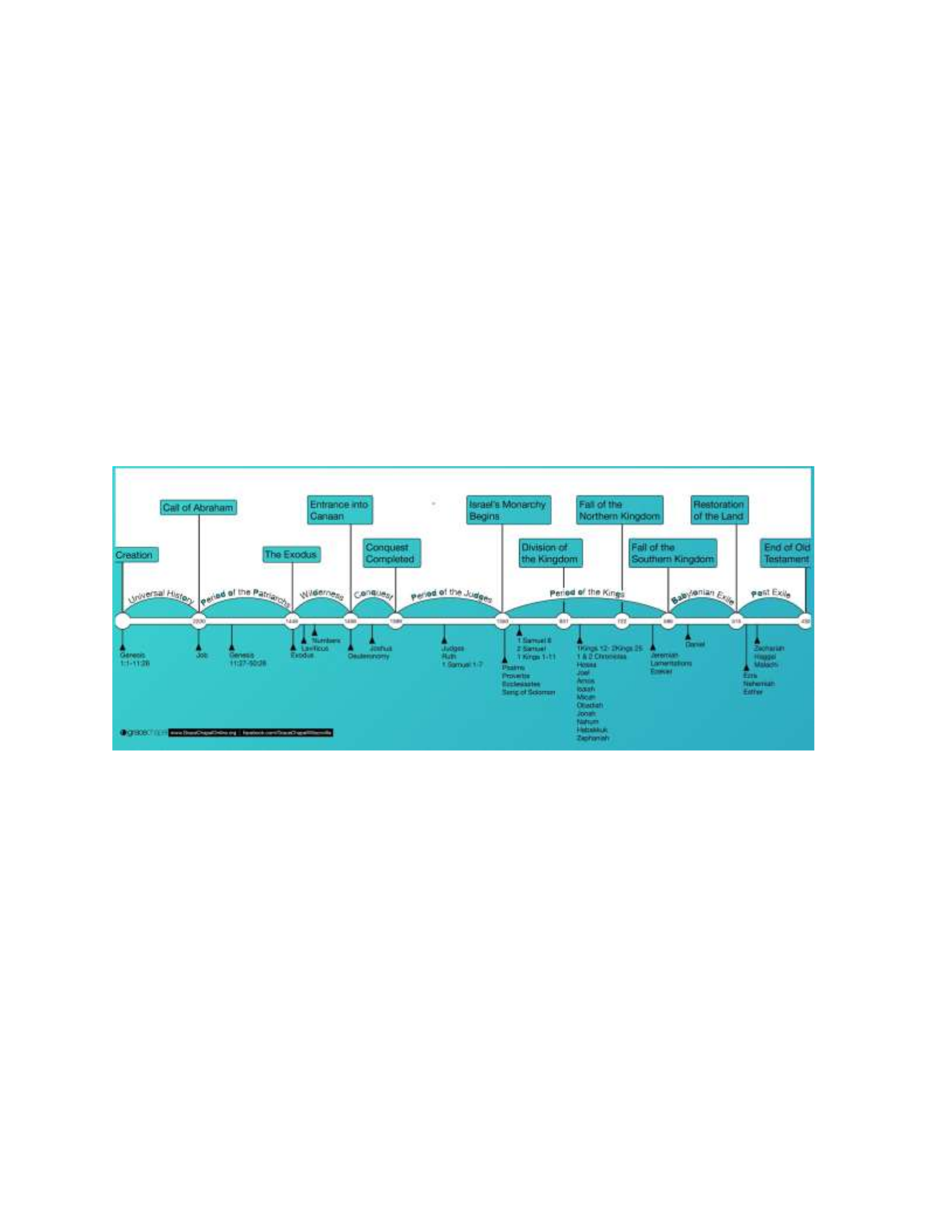
19. Edenic (relates to all humans)
20. Noachide (relates to all humans)
21. Abrahamic (relates to the Jews)
22. Sinai (relates to the Jews)
23. Levitical (Priestly) (relates to the Jewish priests)
24. Davidic (Royal or Messianic) (relates to the Jewish royalty)
- Covenant means relationship, membership, or identity
Order of the Tanakh
-
- Genesis 1-3 covers the creation of the world
- Edenic Covenant, take care of the world and I will bless you with food/water/life
- The origins of Shabbat on the 7th day on creation
- Noah and the Deluge, Genesis 6-9
- Covenant with the Nations
- Remnant is Noah, tasked with two of every animal on the arc - A rainbow in
the sky is the symbol that G-d will not destroy the earth
- The seven commandments of the Noachide Covenant:

- Believe in G-d, respect G-d, do not murder, do not commit adultery, do not stea
steal, create a justice system, do not eat living animals
Summary of the covenants:
-Edenic ( Genesis 1. 28-30) — g-d to humans, Adam and Eve -
Noachide (Genesis 9.8-17) — all humans after Noah and g-d
-Abrahamic (Genesis 12-17) — hebrews, circumcision
-Sinai (Exodus 19-24) — Israelites, most commonly discussed/known covenant
-Levitical (Exodus 29. 44-46) — priests of the Hebrew nation (priestly Jews)
-Davidic (2 Samuel 7) — g-d to David and his dependents (royal Jews)
- Abraham and the Patriarchs
- Origins of the covenant community and paradigms of faith
- Family based, no priesthood
- Abraham got a message from G-d and breaks all the idols in his father’s shop
(Iconoclastic)
- He leaves to start a new line, he circumcised himself and he becomes the leader of
the
Hebrews
- The The Conquest of Canaan main G-d “El” → Elohim
Isralite → is when the people are in the land of Israel, civilization that starts to form from
the
Hebrews, follows the Ancient Israelite Religion
Hebrew → is the tribal term of the followers of Abraham, ancestral or tribal origin
- 11th-10th century the United Davidic Kingdom (when they became united as one
group) 3 Kings
→ Saul, David, and Solomon
-
-

- King David was considered the glory days, the pinnacle of Israelite power,
conquers Jerusalem for the capital of the 12 tribes, King Solomon builds the first
Temple
The Origins of Judaism
Before the 5-6th century we say the ancient Israelite religion
- Mount Zion is established under King David and the first Temple is built under King
Solomon
- King David thought there was only supposed to be one Temple as they believed in only
one G-d, and sacrifices were only supposed to be made inside the Temple (although they
happened outside and were not reported)
- Descendants of Aaron are responsible for priestly duties
- Kosher Laws applied to all Jews when Judaism is established, previously in the Ancient
Isralite
Religion only the priests followed them (Leviticus)
- After Solomon there was a division (Northern Kingdom Israel (Sameria) and Southern
Kingdom
Judah (Jerusalem))
- Rituals of the first Temples included animal sacrifices (avodah), regular offerings (tamid)
(wine, oil, grain, cakes), pilgrimage festivals (Pesach, Shavuot, Sukkot)
- The second Temple created the Hebrew calendar
Terminology review
- Hebrew — ancestors
- Israelites and ancient israelite religion — civilization that starts to form rooted in the
origin being Hebrew but move out when they start to live in the land
- Jews
Origins of the Israelites
- a word about terms
-

- Hebrews, Israelites, Jews
- When do the Israelites arise as a distinct people
- Very little evidence of when
- In Egyptian text we see people called the Habiro — people say is the Egyptian spelling of
Hebrew
- The tribal period is israelites→ kingdoms split up after King Solomon
- Under king solomon the temple in jerusalem is built
- 931 BCE the kingdom splits into Israel and Judah
- 740 BCE Israel falls to the Asyrian emr
- 586 BCE Jerusalem falls to the Babylonians→ first temple destroyed
- There is a fundamental transition from ancient Israelites to Judaism
Pre-Judaism (Israelites); Biblical/Historical Roots; ANE Contexts
Exile/Return and the Dawn of “Judaism”
We call Noah, Adam and eve etc as the legendary events as the Bible is the only source for this.
Israelites: Their encounters with communities around them
- Egyptions
- Babylonians
- Phenitions
- Cannanits
- Mesapotanians
Origins of Israelites:
Hebrew- tribal, ethnic language, legendary past language.
Israelites- the switch of designation from legendary past to the identity of Israelites when they
leave egypts. There is little true evidence making specific dates difficult to identify. This is when
the modern tribal period was the monarchy and temples occur.
Habiru- means stubborn or qweroralsom from the Egyptian's view, but some think it means
Hebrew
The Merneptah Stele- a stone with the detail of the “israels” being wiped out in 1208 BCE

The Bible as “History” is an important source, but it is not an accurate portrayal and is more of
trying to hit upon their objectives. Historians try to use the bible as a supplementary source, not a
primary source, as it took roughly 800 years to come together along with bias. There are various
types of documents within the bible from different sources. Though the author may sound like a
first-person narration, it may not be, and that is why archeology is so vital.
The Conquest of Canaan
- Abraham`s covenant with Yaweh (G-d)promised him the land of Cannan
- The Jewish bible discusses two different ways the Israelites were told to receive the land
of Cannan.
- One through the Israelites being told by Yaweh to kill out all the cananites and take over
that land
- Another expressing a gradual takeover of Cannan through buying land gradually
- There is no evidence of Canaanites disappearing or a mass murder but there is evidence
of the defacing of art beings and idols.
- A theory is that the Israelites were Canaanites who felt in opposition to the cannonites
that surrounded them.
- Some believe Cannonites were the successors of Noah because the root of the name is
similar to Shem Noah, the name of Noah
- Academia gathers that by 1208, the Israelites have a separate identity. The Canonites
were not a separate group but possibly living among the Israelites where the term El
came up as a god with ideas of henotheism and monaltry. El often was equated with a
woman figure of name ashera.
There is fair certainty of Saul, David, and Solomon. The Tel Dan Inscription was found to
identifying
Messiah means the anointed one, though david, saul and solomon were all anointed as kings,
david was the one that david will produce a messianic heir. David establishes Jerusalem and
brings the tabernacle there. Solomon, a man of wisdom built the temple as opposed to his father
who was a man of war. Solomon had many wives, he was charged in the bible of having multiple
wives who he let build temples and polotheism. Another reason people say the temple fell was
after the temple was built israelites went to get the taxes lowered, as a result solomon doubled
the taxes which was bad.
The Two Temples
The First Temple
- Built roughly around 957 BCE and stood for around 400 years
- Known as Solomons Temple

- In 930 BCE there was a split of power. There was tension and a power struggle if the
priests or kings should be ruling
- One explanation is that Solomon lost faith in g-d
- The kingdom of Israel fell to the Assrians
- Story: Assyrians took a Babylonian and forced them to grind their families bones
- Israel was the north, Judea South. Judah made a truce with Assyrians but Israel did not,
so Israel was taken but some were able to flee to Africa or Judea
- The fall of the temple led to a spiritual crisis of why would g-d make a covenant for
canaan and not protect them, this is a theodicy. Juddha explains that it is because Israel
had sinned and was not a monotheist
- Getting rid of Ashuhahs, banning worship outside Jerusalem and more intensity about
Judaism came about not
- Theodicy is what meaning can be made of a situation, like why do bad things happen to
good people etc.
-
The Second Temple
Differences?
Rites/Purpose; Differences; History; Meaning; Priests/Prophets
Purity
- refers to your hygiene habits
- Your diet
- Your marital/sexual choices
- The laws of the priesthood — in exile, they said it isn’t enough for the priests to be pure
but maybe we all have to do this
- Keep kosher
- Avoid touching the dead
- Etc
Catastrophe and Transformation; Exile and Diaspora
Babylonians
Babylonians take Assyria, they rule by both sheer brutality but also power, taking away money
that may be used against them and though taking out any royals and keeping only farmers or
who they need. Judah is taken by the babylonians, there are multiple revolts, sieges etc, this was
a drawn out process. Everytime the babylonians won they would ship off the elite with 3-4
deportations. As they shipped off the elites of Judah, they imported elites of other places who
spoke different languages so they wouldn't revolte. In 597 BCE the Babylonians destroyed the

temple. The farmers left still after it was destroyed continued to go there to do pilgrimage. Left a
lot of Israelites in the land and didnt get rid/move all of them.
The Diaspora
The Zadok was a levit who brought the exilarchs together (those in exile). This is when the
sacred narratives were written down in Babylon and the schools in Babylon for teaching and etc
happened. There was also a diaspora in egypt.
The exiles in Babylon left for a lot of memory, in Judaism to remember is a commandment, but
as a verb to not just remember but to call forth a meaning or action in you– not a passive verb
but an active verb to commemorate and act in its past. Judaism as seen later has its origins in the
acts of mourning and commemorating the temple. This is Zahor– lezhor, to remember. This is
where the theology of suffering takes route.This is when the idea of intermarriage came abouts.
- “By the rivers of Babylon, there we sat down, and wept, when we remembered Zion” →
said by
Psalmist, and demonstrates grief
People of the land
The people the babylonians did not send out of the area, this is where ancient israelite religion
takes a backseat to a folk religion where the people continue to make sacrifices while the priests
arent there. The Samaritans focus on a different mountain (gerazim instead of zion) in their
thoughts of whats important.
Ancient israel religion is concidered the problem and Judaism the religion was thought of as the
solusion. Who is the legit Jew is in question; the ones who stayed in the land or those who were
exciled and returned.
THe exiled:
Now they have the bible. At the babylonian academy there was a scrible effort to copy older
books and write down multiple perspectives off memory which had them putting hebrew into
heavy importance, texts are super important– you can take them with you in diaspora. The Exiles
were allowed to return but they hadnt have political autonomy, this is where they came up with
different things they could do and avoid (intermarriage, two stories of what to do about the
cannnanites, lack of faith and loyalty, lack of impurity– hygiene, diet, sex and marriage, multiple
wives etc).
THe return from babylon to judea: 539 BCE
Yehud was the provice of judea, this is the origin of judaism and jew as a term and not israelite.
This is where cyrus the great publishes the Edict of Resoration, got people to likke him and be

happy so they don’t revolt. Cyrus is all for his people having their own ethnic legal code, which
for jews is Torah with initates the control the priests never had had.
Aramaic is the language people spoke in the streets– blending ancient persian and ancient
hebrew like yiddish but persian. Aramic is a big innovation of this period
Ezra and Nechemia
Ezra and his great assembly of who was a jew and how was a jew etc. Building in courts that are
legal and religious which the temple becomes the center of jewish world.
Nechemia focused on the rebuilding of the temple nad then harod renovated it. Not all jews
return from excile, they remian in the schools in dyaspera. This is when the elephanine temple
is created where outside of Jerusalem they did sacrifices.Ezra was intensely interested in the
reconstruction of the religion, he helped firm up identity, membership and push to remove
ancient israel religious attributes and emphasized jewish law, torah and emphasis on law for all
jew. Here ezra creates the great assembly which is an influential aspect to later Judaism.
Ethical monotheism- not solely reliant on sacrifice but through study and prayer one can
develop an individual relationship and develops into a more democratic religion not solely for
priests but study and prayer as valid.
First temple period: Solomons's Temple, built by king Solomon and destroyed by Babylonians
just prior to babylonian exile. This period focused on priests, sacrifice, and competition due to
the diversity within Judaism there.
The Second Temple Period- rebuilt under Cyrus the great and was heavily renovated by herod.
Classical Judaism
Classical Judaism- What comes out of the second temple period which was influenced by greek
and Romans.
Hellenism- a component that distinguishes classical judaism. This is a greek structure but it also
influences the roman period so its both in the greek and roman periods, the classical periods.
Lots of naked activities because the body was sacred and jewish men were prohibited from some
activities because they were circumcised, which was considered bad. Some medical textbooks
were talking about reversing circumcision. Jews want to access goyshe life but the human body
almost didnt allow them because theres a series of excelling in public life or being jewish,
creating tention in different aspects.
Alexander the great- he dies young and his empire does not stay whole so the greek empire gets
split into Egyptian ptolemaic empire and the syrian seleucid empire.

Egyptian Ptolemaic Empire- didnt make many changes post alexander the great
Syrian seleucid empire- made changes cuz they found the jews not follow zues so it was
offensibe.
70 CE: The second temple is destoryed
Helleistic Judaism- A hellenization of judaism, this is where philosophy was intertwined with
Judaism. This is where the philosopher phylo rationalized judaism for both jewish and non
jewish audieces. Hellenism also impacted the way jews understood jewish life, this is where
upper class jews also saw jerusalem as a polis city state. Jews started to see Jerusalem as much
more important than the rural places. There is a rise of a middle class as judea had free access to
trade with other parts of the greek empire. This is when public baths and gymnasium became a
big part of social life and business happened. How much jews can hellenise and remain jewish
was a very touchy topic, if one is an authentic jew was a big issue of the time.
Syncretism- the melding of different cultures or religions. What can be adopted while keeping
Judaism.
Selucid rule- there was a decree that everywhere needed to have a place for sacrifice to Zeus
and when jews were upset the romans were offended. Mattisiyahu says no to sacrificing to zeus
and then the whole chanukkah story war breaks out.
Hasmonians- the dynasty that comes from the maccabees. Still ongoing hellenizer controversy
which is uncomfortable for their major critics despite their roots in the maccabean revolt and the
hassidim felt the hasmonians were too helenised and not jewish enough. There are
uncomfortable practices of making the king the high priest as the same person which is so not
like the history of the israel concept. They were not descendants of zadik or david and were not
two separate people so the hasmonians broke these two taboos even though they had a role in the
revolt.
The pharasees- they consider themselves the descendants of Ezras great assembly, they began
as supporters of both the hasidim and the hasmonians but once the hasmonians broke the taboo
of king and priest being two people.
Roman period- also socialized very naked and were disgusted by cercumsison. Social
advancement verses faith were a big question. They went to help judea but ended up colonizing
when they were called upon to help between a dispute of domination. Romans make a lot of
arrogant mistaktes early on.
Herod- Harod overthrows and ends the Hasmonians and makes his own dynasty because he
knew they werent universally loved. He was super hellenized and liked art and architecture.

Second temple wasnt finished until after his death and generationally so many people were
employed by the renovation that when it was finished people started to loose their jobs and
people got so mad over roman stupidity.
Jewish Revolt- Romans were stupid and said more taxes, and Jews said no, so the Romans took
gold out of the temple, so basically, the Jews went bat shit. The Romans send in reinforcements
to seize Jerusalem and Jerusalem was overpopulated and becomes a state with a lack of water,
food and disease– this became very traumatic for the people. In 70 CE, the Romans get to the
temple, take it over and put it on fire. Revolt in Masada. Then the bar kochba revolt and what
then began the great diaspora. The outcomes of the revolt were that the hasmonians (maccabees
generations) brought jewish people together as the threat to the temple not being pure and for
judaism as a religion became clear as they fought against hellenism and foreign intrusion. But
this also left for a hasmonian to takeon priesthood when they are not apart of the linage of david
that was supposed to but as long as a representative who prioritized torah law then the
hasmonian rule was okay by the people, this lasted until alexander yannai tried to get rid of the
legislative assembly and just have the king and high priest be absolute, this is when it got more
questioned and the other jewish groups became more in question about the legitimacy.
Benefits of roman rule
It improved the material quality for judea and for ideological reasons of not affecting the sects
religious practices it was better not to revolt until the zealots came along.
Influences (Greco-Roman); History; Forms; Politics; Conflicts
The Great Diaspora: 135 CE
Jews were moved into Turkey, Europe, Asia and northern Africa. Babylonian communities had
already been there from 70 CE, and they had money and lived to build up academies so they
could learn and Judaism could continue.
UNSURE WHICH PERIOD
Jews were in intense relations with Greece and Rome. The classical area in the 4th-5th centuries
is the fall of the roman area. This gives texts of Jewish philosophy (Hellenistic influence,
Example: Philo of Alexandria the exploration of Judaism in a systematic rational thought),
Jewish “history” (Josephus the first-century historian’s outlook which is similar to the way a
history department at university would, the attempt to record historical events using scientific
methods to record events as a reality), and Jewish theology/Rabbinic Literature (the Talmud).
Rabbinic literature is the application of interpretation of knowledge from god, it is about
applying credentials in tradition to sacred scripture this stems from the rabbinic Jews who felt
they had access to oral and written Torah, it really depends on having legal experts of rabbis to
really interpret the law. Rabbinic Judaism is not literal, halacha is based on experts. The rabbinic

Judaism absorbed different sects of Judaism and were how to make sense of Judaism after the
chaos after 70CE with themes of how to survive and adapt. The rabbinic period takes what ezras
great assembly shaped with kosher and self views their roots in the leaders of the Sanhedrin.
Hillel and Shammi are a great balanced example of the need for law and human emotion work
ideas.
Bar Kochba
Too many people die, and in 220 CE the oral law (Mishna) is written down, and then the Talmud
is created and the age of cogency.
The Canonization of the Bible leading to the Masoretic Text
A discouraging of translating the bible but a push of studying the bible in Hebrew to keep the
language alive.
Pirkeh Avot- Chapters/sayings of the fathers/ethics
Torah means Mishna, Talmud, Gammara, it's all hand in hand with Torah so it is used
interchangeably.
Talmudic Judaism
Rabbinic tradition is recorded in the Talmud, through the proper interpretation of the law.
Protecting the law by saying not to do things that are even further (don't murder, don't get angry)
like putting up barriers, so there's a massive extension of the law to make things unthinkable.
Rabbinic Judaism answered concerns that the covenant would be vaccaded and what Judaism
mean without sacrifices (which was love and kindness, Tikkun Olam). Rabbinic Judaism
becomes intensely pro social which ends up becoming apart of pro jewish survilval.
Normative Judaism
The fallacy (big issue) that there is only one way of judaism, rabbinic judaism is not the only
form of judaism to develop into the middle ages even if it is the most common.
Non-Talmudic Judaism
Those forms of Judaism that reject the Talmud and oral law
Samaritans
They practice an Israelite, Torah based religion that pre-dates the Talmud. They are a minority
but quite ancient in origin. Antagonism between jews and samartism was bad at times as
samaritans claimed that god said they could only sacrifice at one place but disagreed at where
that was. They also have their own torah.

Karaite Judaism
An ancient sect of Judaism which considered only written Torah authoritative and does not
recognize oral law (mishna and talmud) to be authentic to Judaism they are thus distinct from
rabbinic judaism. Anan ben david didnt want to be seen as a salary hereditary but an ananite.
They see Deutaronimy 4. 1-2 differently and are more literal to Judaism so thats why they think
rabbinic judism is inauthentic and wrong.
Beta Israel
Many practice rabbinic judaism as they had to convert but their judaism predates the rabbis as
they have an 8-book bible from etheopia called the octateuch, the orit is their torah.
Early Rabbinic Judaism
The Remnant
- After 70CE
- Judaism without the temple
- Sage Ben Zakkai and the salvation of Judaism
- Gathers students and books, goal is to protect knowledge
- Pretends to be ill, rumors that he’s dying
- He “dies”
- Get put into a coffin full of his books, convince guards to let them through
the wall
- Visits Vaspasian and tells him he will become emperor
- In return he receives Javne and its sages
- All of the Jewish books are collected, Pharasaic Judaism becomes
Judaism
- Bible is cannonized
- Early rabbinic judaism is oral law
- Ben Zakkai proposed new way of Judaism without sacrifices
- Acts of love and kindess instead of sacrifices, gave positive spin to all the
destruction
- Rabbinic Judaism becomes a “portable” way of Judaism
Formation; Origins; Authority; Characteristics
Diversity in Early Judaism
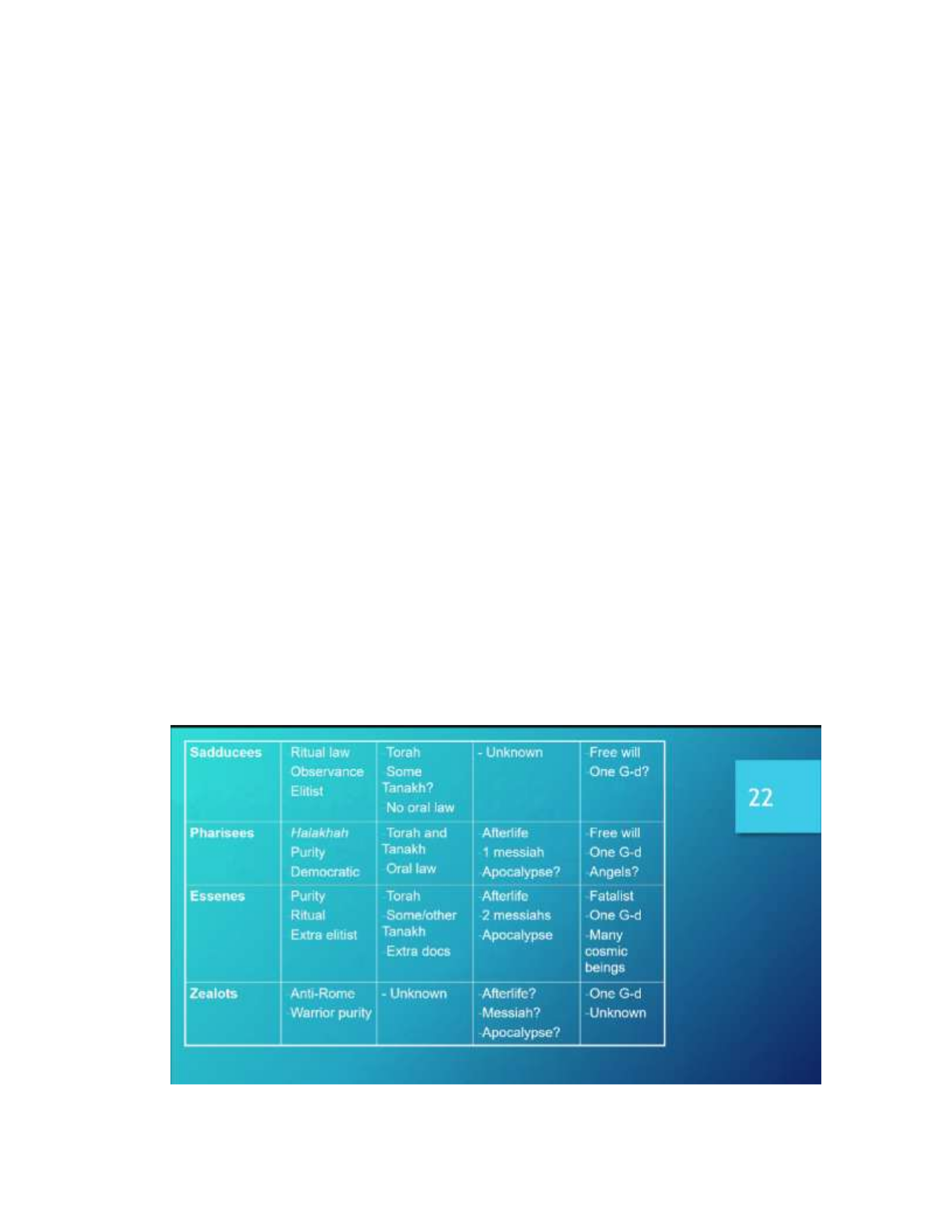
Sects; Non-Rabbinic Judaisms; Dialogue/Polemics
- Major sects active in judea
- 17
- Sadducees
- Claimed descent from zadokites
- Priestly class
- Few documents belonging to them, possible religious
“Textbook(s)” in addition to the Torah
- Pharisees
- Sages
- Academic
- Popular amongst the people - Essenes
- The qumran community, called themselves Zadokites believed
they were the real Sadducees
- Created the dead sea scrolls
- Monastic – doesn't have a huge role in judaism, judaism does not
support celibacy (first law is to be fruitful and multiply) - They
were celibate
- “Cosmic elitism”- Believed they were the army of good
- Had additional documents- Apocrypha and Pseudopigryphas,
polemics (Arguments against enemies)
- Zealots
- Sicarii, assassins that were part of the zealots
-

UNSUREÉ
Documentary Hypothosis:
How scholars understand the bible; JEPD– came from all different places and all over and
redacted to the torah.
Timeline:
- Around 2000 BCE patriarch Abraham, son Isaac and grandson Jacob and Jacob's twelve
sons lived (patriarchs)
- G-d made a pact with Abraham promising him and his descendants a permanent home in
the land of the Canaanites (covenant)
- In return, Abraham and his descendants would follow G-d and if they were male they
would get circumcised as a sign of their covenant
- Famine forces Jacob and his family to immigrate to Egypt where the Jews lived
peacefully until they were enslaved around 1300 BCE→ later liberated by Moses
- After leaving Egypt, Moses spoke with G-d on Mount Sinai, and brought down the 10
commandments (second covenant between Israelites and Yahweh)
- They wandered the desert for 40 years because the Israelites doubted G-ds might that
they would be able to conquer the land of the Canannites
- The Jews, Philistines, and Canaanites fought for more than two hundred years until the
Jewish tribes (under the leader of King David) captured Jerusalm and occupied parts of
Palestine in the eleventh century BCE
- Solomon (David’s son) built the first temple in Jerusalem and had all religious activities
performed at this Temple
- After Solomon died, the northern tribes rebelled (high taxes) and the kingdom was split
in two.
- The northern section was called Israel, and the southern section was called Juda.
- Assyrians conquered Israel in 721 BCE
- Babylonians conquered Judah in 586 BCE
- The Babylonians destroyed Solomon’s temple, tore down the walls of Jerusalem and sent
most Jews into exile in Babylon (left some of the poor Jews that farmed the lands)
- “By the rivers of Babylon, there we sat down, and wept, when we remembered Zion” →
said by Psalmist, and demonstrates grief
- 70 years after the destruction of the First Temple, the Persian king Cyrus the Great
conquered Babylonia and let the Jews return to Jerusalem
- Two Babylonian Jews, Ezra and Nehemia, returned to Jerusalem and made a Jewish state
- The Second Temple was completed in 515 BCE (Western Wall is what remains of it)

- The Jews who remained in Babylon finished compiling the Mishnah (Oral Law)
- Alexander the Great conquered Judah in 332 BCE, and brought a Greek influence
(Hellenism) → sports, customs, theaters, libraries
- All until the rule of King Antiochus the fourth
- Around 175-164 BCE Antiochus tried to force the Hellenization of Jews and make them
assimilated by banning Jews from keeping Shabbat and owning copies of the Torah and
tried to make them worship Zeus
- This started a revolt amongst the Jews→ the Macabee line reconquered Jerusalem in
165 BCE → this is the Maccabean Revolt
- Generation later, there was a dispute within the Maccabean dynasty. They asked
Potolesimist to arbitrate their dispute. Instead he conquered the land
- In 63 BCE, a Roman general was asked to mediate a dispute within Jerusalem, instead he
occupied Judah and claimed it as a new Roman province
- Under the rules of the Greeks and Romans, Hellenism was popular, and the Torah was
even translated into Greek (the Septuagint)
- During the Greco-Roman rule, the books of RUth, Esther, HOnah, Job, and Ecclesiastes
appeared
- While Palestine was occupied by the Romans, Jewish sects emerged
- Essenes→ non-violence, communal celibate life, isolated
- Sadducees→ members of priestly families who were in charge of the Temple, mostly
lived in Jerusalem. Only accepted Torah (not oral law), focused on temple worship
- Pharisees→ most pious, members came from all social classes, emphasized daily
religious practice, observance of religious laws and traditions. Accepted oral and written
law
- Zealots→ very opposed to Roman rule of Palestine. Thought the Messiah would be a war
leader who would lead forces that would defeat the Romans and restore Jewish political
rule in Palestine
- The Jews rebelled against Romans in 66 CE
- Jerusalem was sacked, and the Temple was destroyed
- The destruction of the second temple ended the power of the priesthood→ no longer
anywhere for priests to practice their rituals
- The Romans forbade them to rebuilt→ the Jewish population dispersed
- Without a temple, a greater emphasis was placed on scripture and interpretation of it
- In 90 CE, a group of Rabbis met in Yavneh to decide which religious books would be
recognized with the Torah as sacred literature

The Nature of Judaism as a “Religion”
Judaism:
- Less simplistic than seems, more than just a monotheistic religion
- Judaism is an ethno-religion (people`s religion)
- There are tenets of the religion agreed upon with clearly identifiable religious aspects of
laws, customs, ethics, morals, and identifiable symbols
- Judaism is a religion, culture, relationship, and discourse
- Many sects (people who don`t recognize others as Jews anymore) and denominations
(people within a religion with different beliefs but still share the same religion)
- Judaism is a group of people settled on Monotheism (evidence of Asherah is what divides
ancient Israelites to Judaism).
Religion:
- From the Latin word Religio, the binding of the past, present, and future.
- Some define religion as worshiping a deity, but some religions follow a divine system or
something of values, stories, symbols or knowledge that binds past, present, and future.
- Religion is an artificial academic term set to define a set of features that were not
separated from life prior to the enlightenment– much in connection to Christianity and a
Christian contextual lens.
- Judaism provides a set of ethics and values, gives meaning to a series of symbols,
represents a shared world view and contains meaningful stories/histories. It’s laws,
customs, recommended behaviours
- Judaism has religious texts, and minhagim (holidays, unwritten traditions, culture)
Civilization:
- Has a history
- There is material evidence of its existence
- Judaism changes and evolves as society evolves Culture:
- Grouped behaviour with key identifiable features which may include traditions that may
revolve around religion but do not necessarily have to be directly related Relationship:
- Faith is Judaism in relationship with the divine and with traditions of the community
- Is part of a Jews relationship to themselves, their community, the world, their family,
their ancestors, their descendants etc
- To their god or ultimate concern Discourse:
- a mode of study, teaching, learning, action, adapting, encounter, discussion, conceptual
zing, interpreting etc
- Taught, understood, discussed and learned over the course of lifetimes; it is fluid and
interactive
- “Judaism” is created/changed by various forces over time
- Tradition is central, but participation is also essential

- Is interactional Socio Sacred:
- things that become sacred to communities or families because they have just been sacred
for some time
- We tend to overemphasise the role of major texts within Judaism
- There is a world outside of text which leads to “Civilization”
Monotheism-
- Often known as the belief in one G-d, which is problematic within a Jewish context
- There are Jews that are atheistic
- Jews originally were henotheistic (Acknowledged there were others g-d`s but theirs was
superior)
- Only in the 4th-5th century did Jews become strictly monotheistic
- There are forms of Judaism for people who don’t always define themselves as Jews or
that are Jewish by Culture and not faith or religion
How all the parts of Judaism come together (religion, texts, culture, socio-sacred, discourse,
relationship, and civilization):
Judaism is a textual religion; it is a text itself that is part of the story, but it is also a lived
religion, which is a way of life. Minhag is a sacred way of partaking in the customs of the elders,
which inherently becomes sacred being socio-sacred within families because they’ve been
carried in a cultural society for so long. There is a world outside of the texts in Judaism, where
the civilization aspect comes out in Judaism of past, present, future, and why it is a history.
There is art, culture, clothing, and a relationship providing order to a universe to relationships to
their descendants, further flowing to communities. Judaism is what has been taught in
generational learning, making it fluid, resilient, discourse and change. This is a stream of how
people lived in an aspect of history.
Basic Jewish History:
Shares in an origin story with sources and interpretations
The four periods (Jacob Neusner)
- The first age of diversity becomes more recognizable (500BCE- 70CE)
- In the age of definition, rabbinic Judaism makes books (70-640 CE)
- The age of cogency, the dominant form of Judaism in the middle ages, self-isolated the
community (640-1800 CE)
- The second age of diversity (ca. 1800CE- present)

Judaism was originally from people who studied it through practice, but through academia, it is a
historical and anthropological approach.
The fallacy of Judaism- the belief in `normative Judaism and Diverse Judaism` is not just one
rabbinic path, but there are several paths. There are valid forms of Judaism that may slip through
the cracks.
Henotheism
- We worship one god. Others exist they just aren’t as good/ we believe in only one
- Judaism was originally henotheistic, however Ezra strived to stop this belief through his
reforms
(reforming what Judaism meant after completing the second temple)
Clifford Geertz (an Anthropologist)
- “Religion is a system of symbols which acts to establish powerful, pervasive and long-
lasting moods and motivations in men by formulating conceptions of a general order of
existence and clothing these conceptions with such an aura of factuality that the moods
and motivations seem uniquely realistic” (From the Geertz reading)
- Geertz explains religion's role in establishing relationships between ideas and feelings
that may seem uniquely unrealistic
- Criticism of Geertz`s view is that religion is not just in one`s mind, as he admits, as some
practicing Jews feel, it is also in one's body (i.e. what they eat).
What is Judaism
- The sacred history/story, ideals, ethics, practices, traditions, folkways, concepts, identity,
civilization, and art/philosophy of the Jewish people. It is also the core of what created
the Jewish people and binds them together
- Generally characterized by monotheism, the reverence of a core corpus of central text and
a foundational idea of covenant with god and all of Israel, through which the Jews find a
shared, mutually recognized point of origin, distinctiveness and imagined community
- It is the legendary and recorded history of the civilization of the Jews and all of the sacred
socio-cultural tenets/ways of life maintained and passed down through their generations,
around the globe
- “Imagined community”
- You can not picture how many people are part of the community
Concepts and Characteristics; Perspectives
Monotheism- belief of one G-d
Henotheism- belief that multiple G-d’s exist, but the belief in only one (pick the “best” G-d)
Ethno Religion- relegio + ethnicity, culture, civilization

Normative Judaism- one Rabinic path that is generally accepted as the main form of
Judaism Rabinic Judaism- Judaism that emphasizes daily habits, ethical monotheism, and
learning as Judaism outside of a Temple
Talmudic Judaism- Rabinic Judaism but with the Talmud→ very little difference in core beliefs
(came later on in history)
Sectarian Judaism- Established in the Second Temple Period→ pharisees, sadducees, Esseens,
Zealots
JEPD- historical view that the Torah was written by four people over several centuries
Patriarchs- Abraham, Issac, and Jacob→ fathers of ancient Judaism
Israelites- what the people of Judah were called up until around the creation of the
Second Temple HebrewsKosher- dietary laws
Purity laws- laws observed in Talmudic Judaism, priestly Judaism in the Second Temple Period,
laws of how one interacts with others and stays pure. Talmudic Judaism→ everyone needs to be
pure to fulfill the covenant
Diaspora- Jews living outside of the land promised by G-d in his covenant with Abraham
Ethical monotheism- individual relationship with G-d through study and prayer→ democratizes
Judaism from just priests
Messiah- Jesus and Bar Kochba identified as a messiah. Jews believe the messiah hasn’t come
yet but messiah brings redemption→ Talmudic Judaism believes to live life to the fullest because
the messiah will come
Hellenism- Greek culture→ valued philosophy, science, sports, libraries, etc.
Covenant→ pact/promise between G-d and Abraham/Israelites/different person depending on the
covenant
Circumcision- requirement of the covenant between Yahweh and Abraham
Books (explained under texts and concepts):
- Torah
- Neviim
- Ketuvim
- Mishna (oral Torah)
- Talmud (commentary on the Mishna→ includes the Mishan and the commentary which is
called Gemara)
- Talmud Bavli (commentary discussed by Rabbis in Babylon)
- Talmud Yerushalmi (commentary discussed by Rabbis in Jerusalem)
The Texts and Concepts of Judaism
Judaism is taught generationally, which is part of why it is dynamic as it adapts to current times.

The Triad of Judaism- G-d, Torah/covenant, Israel– how the group understands these
Texts-
Everything in Judaism is related to the texts, lots of books. Hebrew is the language of the Jewish
people; translation is always interpretation.
Torah- the legal code, the first five books of the Torah. Religiously these are the book of the
covenant, the legal constitution between jews and god. Tanach is the Hebrew bible, Torah,
neviim, Ketuvim. These texts have history so there are many slightly different translations.
Today the Maseretic text translations is what jews use. The Masereats are the rabbis who added
the nikoodim. Midrash is retellings or expansions of stories from the bible to fill in the gaps–
could be history, stories, legal etc.
Mishna- oral Torah, Torah shebe al pheh. When g-d gave written Torah to Moshe, he also gave
the oral Torah which would be taught to teachers who could apply it with flexibility unlike the
written Torah which is not meant to change or adapt. Mishna is what makes rabbinic Judaism. It
is the foundation for rabbinic Jews.
Judah ha nasi- He writes down what amounts to the oral traditions and that is when the mishna
becomes a book because he realizes that with a few wars, the torah shebe al pheh could be
whipped out.
Talmud- also a rabbinic text, it is an explanation of oral law. Rabbinic commentary on the
mishna (oral Torah). Gamara is the Babylonian Talmud.
Rashi- he clarifies the language, helps students be able to understand and makes connections
to written torah and references. The Hagadah is a rite– a prayer book
Central Concepts:
G-d- G-d is one, a unity and a singular. G-d is the creator and has no creator, he is the universal
creator of everything
Covenant; Paradigms; Creation/History -
Origins and Ancient Israelite Religion - In
the Tanakh there are 6 covenants:
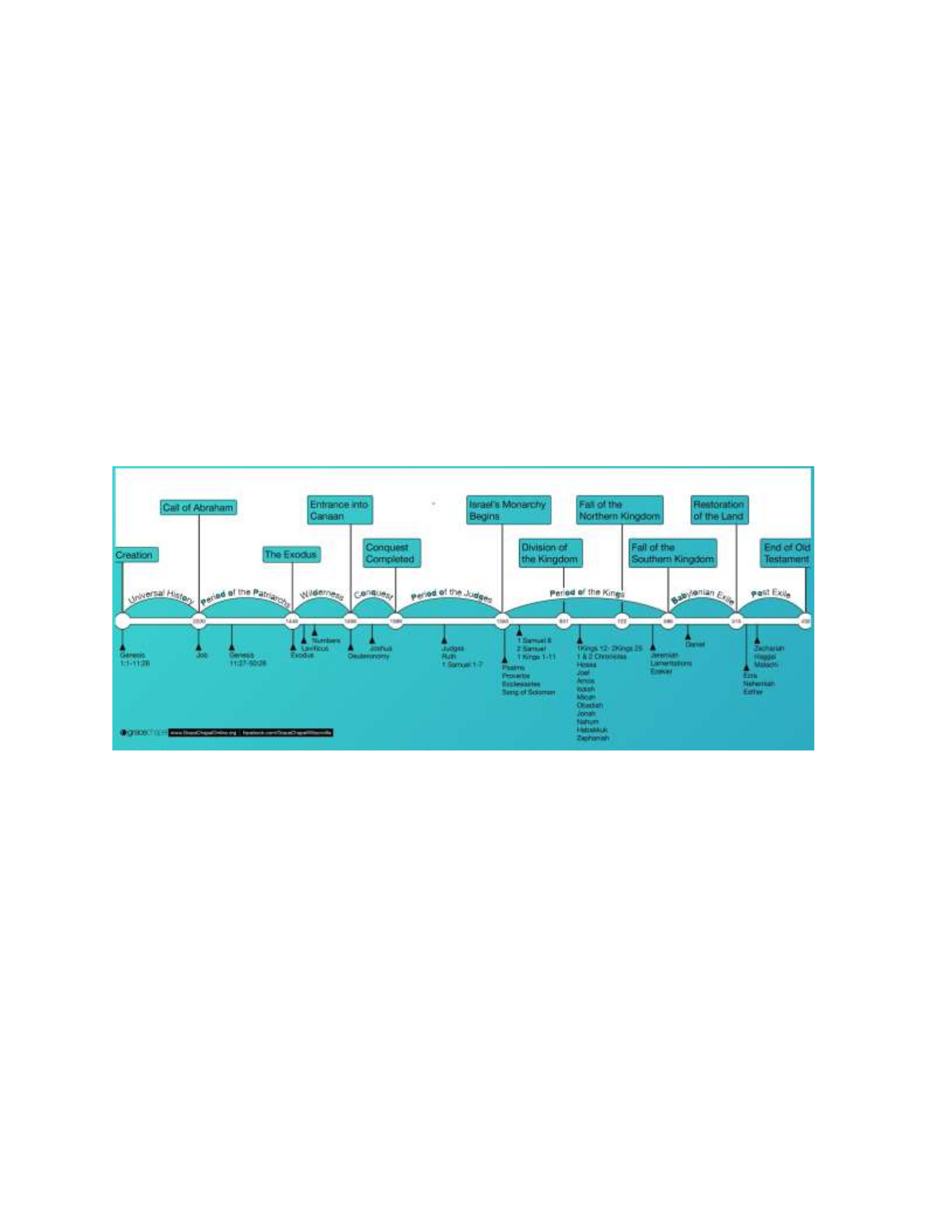
25. Edenic (relates to all humans)
26. Noachide (relates to all humans)
27. Abrahamic (relates to the Jews)
28. Sinai (relates to the Jews)
29. Levitical (Priestly) (relates to the Jewish priests)
30. Davidic (Royal or Messianic) (relates to the Jewish royalty)
- Covenant means relationship, membership, or identity
Order of the Tanakh
-
- Genesis 1-3 covers the creation of the world
- Edenic Covenant, take care of the world and I will bless you with food/water/life
- The origins of Shabbat on the 7th day on creation
- Noah and the Deluge, Genesis 6-9
- Covenant with the Nations
- Remnant is Noah, tasked with two of every animal on the arc - A rainbow in
the sky is the symbol that G-d will not destroy the earth
- The seven commandments of the Noachide Covenant:

- Believe in G-d, respect G-d, do not murder, do not commit adultery, do not stea
steal, create a justice system, do not eat living animals
Summary of the covenants:
-Edenic ( Genesis 1. 28-30) — g-d to humans, Adam and Eve -
Noachide (Genesis 9.8-17) — all humans after Noah and g-d
-Abrahamic (Genesis 12-17) — hebrews, circumcision
-Sinai (Exodus 19-24) — Israelites, most commonly discussed/known covenant
-Levitical (Exodus 29. 44-46) — priests of the Hebrew nation (priestly Jews)
-Davidic (2 Samuel 7) — g-d to David and his dependents (royal Jews)
- Abraham and the Patriarchs
- Origins of the covenant community and paradigms of faith
- Family based, no priesthood
- Abraham got a message from G-d and breaks all the idols in his father’s shop
(Iconoclastic)
- He leaves to start a new line, he circumcised himself and he becomes the leader of
the
Hebrews
- The The Conquest of Canaan main G-d “El” → Elohim
Isralite → is when the people are in the land of Israel, civilization that starts to form from
the
Hebrews, follows the Ancient Israelite Religion
Hebrew → is the tribal term of the followers of Abraham, ancestral or tribal origin
- 11th-10th century the United Davidic Kingdom (when they became united as one
group) 3 Kings
→ Saul, David, and Solomon
-
-

- King David was considered the glory days, the pinnacle of Israelite power,
conquers Jerusalem for the capital of the 12 tribes, King Solomon builds the first
Temple
The Origins of Judaism
Before the 5-6th century we say the ancient Israelite religion
- Mount Zion is established under King David and the first Temple is built under King
Solomon
- King David thought there was only supposed to be one Temple as they believed in only
one G-d, and sacrifices were only supposed to be made inside the Temple (although they
happened outside and were not reported)
- Descendants of Aaron are responsible for priestly duties
- Kosher Laws applied to all Jews when Judaism is established, previously in the Ancient
Isralite
Religion only the priests followed them (Leviticus)
- After Solomon there was a division (Northern Kingdom Israel (Sameria) and Southern
Kingdom
Judah (Jerusalem))
- Rituals of the first Temples included animal sacrifices (avodah), regular offerings (tamid)
(wine, oil, grain, cakes), pilgrimage festivals (Pesach, Shavuot, Sukkot)
- The second Temple created the Hebrew calendar
Terminology review
- Hebrew — ancestors
- Israelites and ancient israelite religion — civilization that starts to form rooted in the
origin being Hebrew but move out when they start to live in the land
- Jews
Origins of the Israelites
- a word about terms
-

- Hebrews, Israelites, Jews
- When do the Israelites arise as a distinct people
- Very little evidence of when
- In Egyptian text we see people called the Habiro — people say is the Egyptian spelling of
Hebrew
- The tribal period is israelites→ kingdoms split up after King Solomon
- Under king solomon the temple in jerusalem is built
- 931 BCE the kingdom splits into Israel and Judah
- 740 BCE Israel falls to the Asyrian emr
- 586 BCE Jerusalem falls to the Babylonians→ first temple destroyed
- There is a fundamental transition from ancient Israelites to Judaism
Pre-Judaism (Israelites); Biblical/Historical Roots; ANE Contexts
Exile/Return and the Dawn of “Judaism”
We call Noah, Adam and eve etc as the legendary events as the Bible is the only source for this.
Israelites: Their encounters with communities around them
- Egyptions
- Babylonians
- Phenitions
- Cannanits
- Mesapotanians
Origins of Israelites:
Hebrew- tribal, ethnic language, legendary past language.
Israelites- the switch of designation from legendary past to the identity of Israelites when they
leave egypts. There is little true evidence making specific dates difficult to identify. This is when
the modern tribal period was the monarchy and temples occur.
Habiru- means stubborn or qweroralsom from the Egyptian's view, but some think it means
Hebrew
The Merneptah Stele- a stone with the detail of the “israels” being wiped out in 1208 BCE

The Bible as “History” is an important source, but it is not an accurate portrayal and is more of
trying to hit upon their objectives. Historians try to use the bible as a supplementary source, not a
primary source, as it took roughly 800 years to come together along with bias. There are various
types of documents within the bible from different sources. Though the author may sound like a
first-person narration, it may not be, and that is why archeology is so vital.
The Conquest of Canaan
- Abraham`s covenant with Yaweh (G-d)promised him the land of Cannan
- The Jewish bible discusses two different ways the Israelites were told to receive the land
of Cannan.
- One through the Israelites being told by Yaweh to kill out all the cananites and take over
that land
- Another expressing a gradual takeover of Cannan through buying land gradually
- There is no evidence of Canaanites disappearing or a mass murder but there is evidence
of the defacing of art beings and idols.
- A theory is that the Israelites were Canaanites who felt in opposition to the cannonites
that surrounded them.
- Some believe Cannonites were the successors of Noah because the root of the name is
similar to Shem Noah, the name of Noah
- Academia gathers that by 1208, the Israelites have a separate identity. The Canonites
were not a separate group but possibly living among the Israelites where the term El
came up as a god with ideas of henotheism and monaltry. El often was equated with a
woman figure of name ashera.
There is fair certainty of Saul, David, and Solomon. The Tel Dan Inscription was found to
identifying
Messiah means the anointed one, though david, saul and solomon were all anointed as kings,
david was the one that david will produce a messianic heir. David establishes Jerusalem and
brings the tabernacle there. Solomon, a man of wisdom built the temple as opposed to his father
who was a man of war. Solomon had many wives, he was charged in the bible of having multiple
wives who he let build temples and polotheism. Another reason people say the temple fell was
after the temple was built israelites went to get the taxes lowered, as a result solomon doubled
the taxes which was bad.
The Two Temples
The First Temple
- Built roughly around 957 BCE and stood for around 400 years
- Known as Solomons Temple

- In 930 BCE there was a split of power. There was tension and a power struggle if the
priests or kings should be ruling
- One explanation is that Solomon lost faith in g-d
- The kingdom of Israel fell to the Assrians
- Story: Assyrians took a Babylonian and forced them to grind their families bones
- Israel was the north, Judea South. Judah made a truce with Assyrians but Israel did not,
so Israel was taken but some were able to flee to Africa or Judea
- The fall of the temple led to a spiritual crisis of why would g-d make a covenant for
canaan and not protect them, this is a theodicy. Juddha explains that it is because Israel
had sinned and was not a monotheist
- Getting rid of Ashuhahs, banning worship outside Jerusalem and more intensity about
Judaism came about not
- Theodicy is what meaning can be made of a situation, like why do bad things happen to
good people etc.
-
The Second Temple
Differences?
Rites/Purpose; Differences; History; Meaning; Priests/Prophets
Purity
- refers to your hygiene habits
- Your diet
- Your marital/sexual choices
- The laws of the priesthood — in exile, they said it isn’t enough for the priests to be pure
but maybe we all have to do this
- Keep kosher
- Avoid touching the dead
- Etc
Catastrophe and Transformation; Exile and Diaspora
Babylonians
Babylonians take Assyria, they rule by both sheer brutality but also power, taking away money
that may be used against them and though taking out any royals and keeping only farmers or
who they need. Judah is taken by the babylonians, there are multiple revolts, sieges etc, this was
a drawn out process. Everytime the babylonians won they would ship off the elite with 3-4
deportations. As they shipped off the elites of Judah, they imported elites of other places who
spoke different languages so they wouldn't revolte. In 597 BCE the Babylonians destroyed the

temple. The farmers left still after it was destroyed continued to go there to do pilgrimage. Left a
lot of Israelites in the land and didnt get rid/move all of them.
The Diaspora
The Zadok was a levit who brought the exilarchs together (those in exile). This is when the
sacred narratives were written down in Babylon and the schools in Babylon for teaching and etc
happened. There was also a diaspora in egypt.
The exiles in Babylon left for a lot of memory, in Judaism to remember is a commandment, but
as a verb to not just remember but to call forth a meaning or action in you– not a passive verb
but an active verb to commemorate and act in its past. Judaism as seen later has its origins in the
acts of mourning and commemorating the temple. This is Zahor– lezhor, to remember. This is
where the theology of suffering takes route.This is when the idea of intermarriage came abouts.
- “By the rivers of Babylon, there we sat down, and wept, when we remembered Zion” →
said by
Psalmist, and demonstrates grief
People of the land
The people the babylonians did not send out of the area, this is where ancient israelite religion
takes a backseat to a folk religion where the people continue to make sacrifices while the priests
arent there. The Samaritans focus on a different mountain (gerazim instead of zion) in their
thoughts of whats important.
Ancient israel religion is concidered the problem and Judaism the religion was thought of as the
solusion. Who is the legit Jew is in question; the ones who stayed in the land or those who were
exciled and returned.
THe exiled:
Now they have the bible. At the babylonian academy there was a scrible effort to copy older
books and write down multiple perspectives off memory which had them putting hebrew into
heavy importance, texts are super important– you can take them with you in diaspora. The Exiles
were allowed to return but they hadnt have political autonomy, this is where they came up with
different things they could do and avoid (intermarriage, two stories of what to do about the
cannnanites, lack of faith and loyalty, lack of impurity– hygiene, diet, sex and marriage, multiple
wives etc).
THe return from babylon to judea: 539 BCE
Yehud was the provice of judea, this is the origin of judaism and jew as a term and not israelite.
This is where cyrus the great publishes the Edict of Resoration, got people to likke him and be

happy so they don’t revolt. Cyrus is all for his people having their own ethnic legal code, which
for jews is Torah with initates the control the priests never had had.
Aramaic is the language people spoke in the streets– blending ancient persian and ancient
hebrew like yiddish but persian. Aramic is a big innovation of this period
Ezra and Nechemia
Ezra and his great assembly of who was a jew and how was a jew etc. Building in courts that are
legal and religious which the temple becomes the center of jewish world.
Nechemia focused on the rebuilding of the temple nad then harod renovated it. Not all jews
return from excile, they remian in the schools in dyaspera. This is when the elephanine temple
is created where outside of Jerusalem they did sacrifices.Ezra was intensely interested in the
reconstruction of the religion, he helped firm up identity, membership and push to remove
ancient israel religious attributes and emphasized jewish law, torah and emphasis on law for all
jew. Here ezra creates the great assembly which is an influential aspect to later Judaism.
Ethical monotheism- not solely reliant on sacrifice but through study and prayer one can
develop an individual relationship and develops into a more democratic religion not solely for
priests but study and prayer as valid.
First temple period: Solomons's Temple, built by king Solomon and destroyed by Babylonians
just prior to babylonian exile. This period focused on priests, sacrifice, and competition due to
the diversity within Judaism there.
The Second Temple Period- rebuilt under Cyrus the great and was heavily renovated by herod.
Classical Judaism
Classical Judaism- What comes out of the second temple period which was influenced by greek
and Romans.
Hellenism- a component that distinguishes classical judaism. This is a greek structure but it also
influences the roman period so its both in the greek and roman periods, the classical periods.
Lots of naked activities because the body was sacred and jewish men were prohibited from some
activities because they were circumcised, which was considered bad. Some medical textbooks
were talking about reversing circumcision. Jews want to access goyshe life but the human body
almost didnt allow them because theres a series of excelling in public life or being jewish,
creating tention in different aspects.
Alexander the great- he dies young and his empire does not stay whole so the greek empire gets
split into Egyptian ptolemaic empire and the syrian seleucid empire.

Egyptian Ptolemaic Empire- didnt make many changes post alexander the great
Syrian seleucid empire- made changes cuz they found the jews not follow zues so it was
offensibe.
70 CE: The second temple is destoryed
Helleistic Judaism- A hellenization of judaism, this is where philosophy was intertwined with
Judaism. This is where the philosopher phylo rationalized judaism for both jewish and non
jewish audieces. Hellenism also impacted the way jews understood jewish life, this is where
upper class jews also saw jerusalem as a polis city state. Jews started to see Jerusalem as much
more important than the rural places. There is a rise of a middle class as judea had free access to
trade with other parts of the greek empire. This is when public baths and gymnasium became a
big part of social life and business happened. How much jews can hellenise and remain jewish
was a very touchy topic, if one is an authentic jew was a big issue of the time.
Syncretism- the melding of different cultures or religions. What can be adopted while keeping
Judaism.
Selucid rule- there was a decree that everywhere needed to have a place for sacrifice to Zeus
and when jews were upset the romans were offended. Mattisiyahu says no to sacrificing to zeus
and then the whole chanukkah story war breaks out.
Hasmonians- the dynasty that comes from the maccabees. Still ongoing hellenizer controversy
which is uncomfortable for their major critics despite their roots in the maccabean revolt and the
hassidim felt the hasmonians were too helenised and not jewish enough. There are
uncomfortable practices of making the king the high priest as the same person which is so not
like the history of the israel concept. They were not descendants of zadik or david and were not
two separate people so the hasmonians broke these two taboos even though they had a role in the
revolt.
The pharasees- they consider themselves the descendants of Ezras great assembly, they began
as supporters of both the hasidim and the hasmonians but once the hasmonians broke the taboo
of king and priest being two people.
Roman period- also socialized very naked and were disgusted by cercumsison. Social
advancement verses faith were a big question. They went to help judea but ended up colonizing
when they were called upon to help between a dispute of domination. Romans make a lot of
arrogant mistaktes early on.
Herod- Harod overthrows and ends the Hasmonians and makes his own dynasty because he
knew they werent universally loved. He was super hellenized and liked art and architecture.

Second temple wasnt finished until after his death and generationally so many people were
employed by the renovation that when it was finished people started to loose their jobs and
people got so mad over roman stupidity.
Jewish Revolt- Romans were stupid and said more taxes, and Jews said no, so the Romans took
gold out of the temple, so basically, the Jews went bat shit. The Romans send in reinforcements
to seize Jerusalem and Jerusalem was overpopulated and becomes a state with a lack of water,
food and disease– this became very traumatic for the people. In 70 CE, the Romans get to the
temple, take it over and put it on fire. Revolt in Masada. Then the bar kochba revolt and what
then began the great diaspora. The outcomes of the revolt were that the hasmonians (maccabees
generations) brought jewish people together as the threat to the temple not being pure and for
judaism as a religion became clear as they fought against hellenism and foreign intrusion. But
this also left for a hasmonian to takeon priesthood when they are not apart of the linage of david
that was supposed to but as long as a representative who prioritized torah law then the
hasmonian rule was okay by the people, this lasted until alexander yannai tried to get rid of the
legislative assembly and just have the king and high priest be absolute, this is when it got more
questioned and the other jewish groups became more in question about the legitimacy.
Benefits of roman rule
It improved the material quality for judea and for ideological reasons of not affecting the sects
religious practices it was better not to revolt until the zealots came along.
Influences (Greco-Roman); History; Forms; Politics; Conflicts
The Great Diaspora: 135 CE
Jews were moved into Turkey, Europe, Asia and northern Africa. Babylonian communities had
already been there from 70 CE, and they had money and lived to build up academies so they
could learn and Judaism could continue.
UNSURE WHICH PERIOD
Jews were in intense relations with Greece and Rome. The classical area in the 4th-5th centuries
is the fall of the roman area. This gives texts of Jewish philosophy (Hellenistic influence,
Example: Philo of Alexandria the exploration of Judaism in a systematic rational thought),
Jewish “history” (Josephus the first-century historian’s outlook which is similar to the way a
history department at university would, the attempt to record historical events using scientific
methods to record events as a reality), and Jewish theology/Rabbinic Literature (the Talmud).
Rabbinic literature is the application of interpretation of knowledge from god, it is about
applying credentials in tradition to sacred scripture this stems from the rabbinic Jews who felt
they had access to oral and written Torah, it really depends on having legal experts of rabbis to
really interpret the law. Rabbinic Judaism is not literal, halacha is based on experts. The rabbinic

Judaism absorbed different sects of Judaism and were how to make sense of Judaism after the
chaos after 70CE with themes of how to survive and adapt. The rabbinic period takes what ezras
great assembly shaped with kosher and self views their roots in the leaders of the Sanhedrin.
Hillel and Shammi are a great balanced example of the need for law and human emotion work
ideas.
Bar Kochba
Too many people die, and in 220 CE the oral law (Mishna) is written down, and then the Talmud
is created and the age of cogency.
The Canonization of the Bible leading to the Masoretic Text
A discouraging of translating the bible but a push of studying the bible in Hebrew to keep the
language alive.
Pirkeh Avot- Chapters/sayings of the fathers/ethics
Torah means Mishna, Talmud, Gammara, it's all hand in hand with Torah so it is used
interchangeably.
Talmudic Judaism
Rabbinic tradition is recorded in the Talmud, through the proper interpretation of the law.
Protecting the law by saying not to do things that are even further (don't murder, don't get angry)
like putting up barriers, so there's a massive extension of the law to make things unthinkable.
Rabbinic Judaism answered concerns that the covenant would be vaccaded and what Judaism
mean without sacrifices (which was love and kindness, Tikkun Olam). Rabbinic Judaism
becomes intensely pro social which ends up becoming apart of pro jewish survilval.
Normative Judaism
The fallacy (big issue) that there is only one way of judaism, rabbinic judaism is not the only
form of judaism to develop into the middle ages even if it is the most common.
Non-Talmudic Judaism
Those forms of Judaism that reject the Talmud and oral law
Samaritans
They practice an Israelite, Torah based religion that pre-dates the Talmud. They are a minority
but quite ancient in origin. Antagonism between jews and samartism was bad at times as
samaritans claimed that god said they could only sacrifice at one place but disagreed at where
that was. They also have their own torah.

Karaite Judaism
An ancient sect of Judaism which considered only written Torah authoritative and does not
recognize oral law (mishna and talmud) to be authentic to Judaism they are thus distinct from
rabbinic judaism. Anan ben david didnt want to be seen as a salary hereditary but an ananite.
They see Deutaronimy 4. 1-2 differently and are more literal to Judaism so thats why they think
rabbinic judism is inauthentic and wrong.
Beta Israel
Many practice rabbinic judaism as they had to convert but their judaism predates the rabbis as
they have an 8-book bible from etheopia called the octateuch, the orit is their torah.
Early Rabbinic Judaism
The Remnant
- After 70CE
- Judaism without the temple
- Sage Ben Zakkai and the salvation of Judaism
- Gathers students and books, goal is to protect knowledge
- Pretends to be ill, rumors that he’s dying
- He “dies”
- Get put into a coffin full of his books, convince guards to let them through
the wall
- Visits Vaspasian and tells him he will become emperor
- In return he receives Javne and its sages
- All of the Jewish books are collected, Pharasaic Judaism becomes
Judaism
- Bible is cannonized
- Early rabbinic judaism is oral law
- Ben Zakkai proposed new way of Judaism without sacrifices
- Acts of love and kindess instead of sacrifices, gave positive spin to all the
destruction
- Rabbinic Judaism becomes a “portable” way of Judaism
Formation; Origins; Authority; Characteristics
Diversity in Early Judaism

Sects; Non-Rabbinic Judaisms; Dialogue/Polemics
- Major sects active in judea
- 17
- Sadducees
- Claimed descent from zadokites
- Priestly class
- Few documents belonging to them, possible religious
“Textbook(s)” in addition to the Torah
- Pharisees
- Sages
- Academic
- Popular amongst the people - Essenes
- The qumran community, called themselves Zadokites believed
they were the real Sadducees
- Created the dead sea scrolls
- Monastic – doesn't have a huge role in judaism, judaism does not
support celibacy (first law is to be fruitful and multiply) - They
were celibate
- “Cosmic elitism”- Believed they were the army of good
- Had additional documents- Apocrypha and Pseudopigryphas,
polemics (Arguments against enemies)
- Zealots
- Sicarii, assassins that were part of the zealots
-

UNSUREÉ
Documentary Hypothosis:
How scholars understand the bible; JEPD– came from all different places and all over and
redacted to the torah.
Timeline:
- Around 2000 BCE patriarch Abraham, son Isaac and grandson Jacob and Jacob's twelve
sons lived (patriarchs)
- G-d made a pact with Abraham promising him and his descendants a permanent home in
the land of the Canaanites (covenant)
- In return, Abraham and his descendants would follow G-d and if they were male they
would get circumcised as a sign of their covenant
- Famine forces Jacob and his family to immigrate to Egypt where the Jews lived
peacefully until they were enslaved around 1300 BCE→ later liberated by Moses
- After leaving Egypt, Moses spoke with G-d on Mount Sinai, and brought down the 10
commandments (second covenant between Israelites and Yahweh)
- They wandered the desert for 40 years because the Israelites doubted G-ds might that
they would be able to conquer the land of the Canannites
- The Jews, Philistines, and Canaanites fought for more than two hundred years until the
Jewish tribes (under the leader of King David) captured Jerusalm and occupied parts of
Palestine in the eleventh century BCE
- Solomon (David’s son) built the first temple in Jerusalem and had all religious activities
performed at this Temple
- After Solomon died, the northern tribes rebelled (high taxes) and the kingdom was split
in two.
- The northern section was called Israel, and the southern section was called Juda.
- Assyrians conquered Israel in 721 BCE
- Babylonians conquered Judah in 586 BCE
- The Babylonians destroyed Solomon’s temple, tore down the walls of Jerusalem and sent
most Jews into exile in Babylon (left some of the poor Jews that farmed the lands)
- “By the rivers of Babylon, there we sat down, and wept, when we remembered Zion” →
said by Psalmist, and demonstrates grief
- 70 years after the destruction of the First Temple, the Persian king Cyrus the Great
conquered Babylonia and let the Jews return to Jerusalem
- Two Babylonian Jews, Ezra and Nehemia, returned to Jerusalem and made a Jewish state
- The Second Temple was completed in 515 BCE (Western Wall is what remains of it)

- The Jews who remained in Babylon finished compiling the Mishnah (Oral Law)
- Alexander the Great conquered Judah in 332 BCE, and brought a Greek influence
(Hellenism) → sports, customs, theaters, libraries
- All until the rule of King Antiochus the fourth
- Around 175-164 BCE Antiochus tried to force the Hellenization of Jews and make them
assimilated by banning Jews from keeping Shabbat and owning copies of the Torah and
tried to make them worship Zeus
- This started a revolt amongst the Jews→ the Macabee line reconquered Jerusalem in
165 BCE → this is the Maccabean Revolt
- Generation later, there was a dispute within the Maccabean dynasty. They asked
Potolesimist to arbitrate their dispute. Instead he conquered the land
- In 63 BCE, a Roman general was asked to mediate a dispute within Jerusalem, instead he
occupied Judah and claimed it as a new Roman province
- Under the rules of the Greeks and Romans, Hellenism was popular, and the Torah was
even translated into Greek (the Septuagint)
- During the Greco-Roman rule, the books of RUth, Esther, HOnah, Job, and Ecclesiastes
appeared
- While Palestine was occupied by the Romans, Jewish sects emerged
- Essenes→ non-violence, communal celibate life, isolated
- Sadducees→ members of priestly families who were in charge of the Temple, mostly
lived in Jerusalem. Only accepted Torah (not oral law), focused on temple worship
- Pharisees→ most pious, members came from all social classes, emphasized daily
religious practice, observance of religious laws and traditions. Accepted oral and written
law
- Zealots→ very opposed to Roman rule of Palestine. Thought the Messiah would be a war
leader who would lead forces that would defeat the Romans and restore Jewish political
rule in Palestine
- The Jews rebelled against Romans in 66 CE
- Jerusalem was sacked, and the Temple was destroyed
- The destruction of the second temple ended the power of the priesthood→ no longer
anywhere for priests to practice their rituals
- The Romans forbade them to rebuilt→ the Jewish population dispersed
- Without a temple, a greater emphasis was placed on scripture and interpretation of it
- In 90 CE, a group of Rabbis met in Yavneh to decide which religious books would be
recognized with the Torah as sacred literature

The Nature of Judaism as a “Religion”
Judaism:
- Less simplistic than seems, more than just a monotheistic religion
- Judaism is an ethno-religion (people`s religion)
- There are tenets of the religion agreed upon with clearly identifiable religious aspects of
laws, customs, ethics, morals, and identifiable symbols
- Judaism is a religion, culture, relationship, and discourse
- Many sects (people who don`t recognize others as Jews anymore) and denominations
(people within a religion with different beliefs but still share the same religion)
- Judaism is a group of people settled on Monotheism (evidence of Asherah is what divides
ancient Israelites to Judaism).
Religion:
- From the Latin word Religio, the binding of the past, present, and future.
- Some define religion as worshiping a deity, but some religions follow a divine system or
something of values, stories, symbols or knowledge that binds past, present, and future.
- Religion is an artificial academic term set to define a set of features that were not
separated from life prior to the enlightenment– much in connection to Christianity and a
Christian contextual lens.
- Judaism provides a set of ethics and values, gives meaning to a series of symbols,
represents a shared world view and contains meaningful stories/histories. It’s laws,
customs, recommended behaviours
- Judaism has religious texts, and minhagim (holidays, unwritten traditions, culture)
Civilization:
- Has a history
- There is material evidence of its existence
- Judaism changes and evolves as society evolves Culture:
- Grouped behaviour with key identifiable features which may include traditions that may
revolve around religion but do not necessarily have to be directly related Relationship:
- Faith is Judaism in relationship with the divine and with traditions of the community
- Is part of a Jews relationship to themselves, their community, the world, their family,
their ancestors, their descendants etc
- To their god or ultimate concern Discourse:
- a mode of study, teaching, learning, action, adapting, encounter, discussion, conceptual
zing, interpreting etc
- Taught, understood, discussed and learned over the course of lifetimes; it is fluid and
interactive
- “Judaism” is created/changed by various forces over time
- Tradition is central, but participation is also essential

- Is interactional Socio Sacred:
- things that become sacred to communities or families because they have just been sacred
for some time
- We tend to overemphasise the role of major texts within Judaism
- There is a world outside of text which leads to “Civilization”
Monotheism-
- Often known as the belief in one G-d, which is problematic within a Jewish context
- There are Jews that are atheistic
- Jews originally were henotheistic (Acknowledged there were others g-d`s but theirs was
superior)
- Only in the 4th-5th century did Jews become strictly monotheistic
- There are forms of Judaism for people who don’t always define themselves as Jews or
that are Jewish by Culture and not faith or religion
How all the parts of Judaism come together (religion, texts, culture, socio-sacred, discourse,
relationship, and civilization):
Judaism is a textual religion; it is a text itself that is part of the story, but it is also a lived
religion, which is a way of life. Minhag is a sacred way of partaking in the customs of the elders,
which inherently becomes sacred being socio-sacred within families because they’ve been
carried in a cultural society for so long. There is a world outside of the texts in Judaism, where
the civilization aspect comes out in Judaism of past, present, future, and why it is a history.
There is art, culture, clothing, and a relationship providing order to a universe to relationships to
their descendants, further flowing to communities. Judaism is what has been taught in
generational learning, making it fluid, resilient, discourse and change. This is a stream of how
people lived in an aspect of history.
Basic Jewish History:
Shares in an origin story with sources and interpretations
The four periods (Jacob Neusner)
- The first age of diversity becomes more recognizable (500BCE- 70CE)
- In the age of definition, rabbinic Judaism makes books (70-640 CE)
- The age of cogency, the dominant form of Judaism in the middle ages, self-isolated the
community (640-1800 CE)
- The second age of diversity (ca. 1800CE- present)

Judaism was originally from people who studied it through practice, but through academia, it is a
historical and anthropological approach.
The fallacy of Judaism- the belief in `normative Judaism and Diverse Judaism` is not just one
rabbinic path, but there are several paths. There are valid forms of Judaism that may slip through
the cracks.
Henotheism
- We worship one god. Others exist they just aren’t as good/ we believe in only one
- Judaism was originally henotheistic, however Ezra strived to stop this belief through his
reforms
(reforming what Judaism meant after completing the second temple)
Clifford Geertz (an Anthropologist)
- “Religion is a system of symbols which acts to establish powerful, pervasive and long-
lasting moods and motivations in men by formulating conceptions of a general order of
existence and clothing these conceptions with such an aura of factuality that the moods
and motivations seem uniquely realistic” (From the Geertz reading)
- Geertz explains religion's role in establishing relationships between ideas and feelings
that may seem uniquely unrealistic
- Criticism of Geertz`s view is that religion is not just in one`s mind, as he admits, as some
practicing Jews feel, it is also in one's body (i.e. what they eat).
What is Judaism
- The sacred history/story, ideals, ethics, practices, traditions, folkways, concepts, identity,
civilization, and art/philosophy of the Jewish people. It is also the core of what created
the Jewish people and binds them together
- Generally characterized by monotheism, the reverence of a core corpus of central text and
a foundational idea of covenant with god and all of Israel, through which the Jews find a
shared, mutually recognized point of origin, distinctiveness and imagined community
- It is the legendary and recorded history of the civilization of the Jews and all of the sacred
socio-cultural tenets/ways of life maintained and passed down through their generations,
around the globe
- “Imagined community”
- You can not picture how many people are part of the community
Concepts and Characteristics; Perspectives
Monotheism- belief of one G-d
Henotheism- belief that multiple G-d’s exist, but the belief in only one (pick the “best” G-d)
Ethno Religion- relegio + ethnicity, culture, civilization

Normative Judaism- one Rabinic path that is generally accepted as the main form of
Judaism Rabinic Judaism- Judaism that emphasizes daily habits, ethical monotheism, and
learning as Judaism outside of a Temple
Talmudic Judaism- Rabinic Judaism but with the Talmud→ very little difference in core beliefs
(came later on in history)
Sectarian Judaism- Established in the Second Temple Period→ pharisees, sadducees, Esseens,
Zealots
JEPD- historical view that the Torah was written by four people over several centuries
Patriarchs- Abraham, Issac, and Jacob→ fathers of ancient Judaism
Israelites- what the people of Judah were called up until around the creation of the
Second Temple HebrewsKosher- dietary laws
Purity laws- laws observed in Talmudic Judaism, priestly Judaism in the Second Temple Period,
laws of how one interacts with others and stays pure. Talmudic Judaism→ everyone needs to be
pure to fulfill the covenant
Diaspora- Jews living outside of the land promised by G-d in his covenant with Abraham
Ethical monotheism- individual relationship with G-d through study and prayer→ democratizes
Judaism from just priests
Messiah- Jesus and Bar Kochba identified as a messiah. Jews believe the messiah hasn’t come
yet but messiah brings redemption→ Talmudic Judaism believes to live life to the fullest because
the messiah will come
Hellenism- Greek culture→ valued philosophy, science, sports, libraries, etc.
Covenant→ pact/promise between G-d and Abraham/Israelites/different person depending on the
covenant
Circumcision- requirement of the covenant between Yahweh and Abraham
Books (explained under texts and concepts):
- Torah
- Neviim
- Ketuvim
- Mishna (oral Torah)
- Talmud (commentary on the Mishna→ includes the Mishan and the commentary which is
called Gemara)
- Talmud Bavli (commentary discussed by Rabbis in Babylon)
- Talmud Yerushalmi (commentary discussed by Rabbis in Jerusalem)
The Texts and Concepts of Judaism
Judaism is taught generationally, which is part of why it is dynamic as it adapts to current times.

The Triad of Judaism- G-d, Torah/covenant, Israel– how the group understands these
Texts-
Everything in Judaism is related to the texts, lots of books. Hebrew is the language of the Jewish
people; translation is always interpretation.
Torah- the legal code, the first five books of the Torah. Religiously these are the book of the
covenant, the legal constitution between jews and god. Tanach is the Hebrew bible, Torah,
neviim, Ketuvim. These texts have history so there are many slightly different translations.
Today the Maseretic text translations is what jews use. The Masereats are the rabbis who added
the nikoodim. Midrash is retellings or expansions of stories from the bible to fill in the gaps–
could be history, stories, legal etc.
Mishna- oral Torah, Torah shebe al pheh. When g-d gave written Torah to Moshe, he also gave
the oral Torah which would be taught to teachers who could apply it with flexibility unlike the
written Torah which is not meant to change or adapt. Mishna is what makes rabbinic Judaism. It
is the foundation for rabbinic Jews.
Judah ha nasi- He writes down what amounts to the oral traditions and that is when the mishna
becomes a book because he realizes that with a few wars, the torah shebe al pheh could be
whipped out.
Talmud- also a rabbinic text, it is an explanation of oral law. Rabbinic commentary on the
mishna (oral Torah). Gamara is the Babylonian Talmud.
Rashi- he clarifies the language, helps students be able to understand and makes connections
to written torah and references. The Hagadah is a rite– a prayer book
Central Concepts:
G-d- G-d is one, a unity and a singular. G-d is the creator and has no creator, he is the universal
creator of everything
Covenant; Paradigms; Creation/History -
Origins and Ancient Israelite Religion - In
the Tanakh there are 6 covenants:

31. Edenic (relates to all humans)
32. Noachide (relates to all humans)
33. Abrahamic (relates to the Jews)
34. Sinai (relates to the Jews)
35. Levitical (Priestly) (relates to the Jewish priests)
36. Davidic (Royal or Messianic) (relates to the Jewish royalty)
- Covenant means relationship, membership, or identity
Order of the Tanakh
-
- Genesis 1-3 covers the creation of the world
- Edenic Covenant, take care of the world and I will bless you with food/water/life
- The origins of Shabbat on the 7th day on creation
- Noah and the Deluge, Genesis 6-9
- Covenant with the Nations
- Remnant is Noah, tasked with two of every animal on the arc - A rainbow in
the sky is the symbol that G-d will not destroy the earth
- The seven commandments of the Noachide Covenant:

- Believe in G-d, respect G-d, do not murder, do not commit adultery, do not stea
steal, create a justice system, do not eat living animals
Summary of the covenants:
-Edenic ( Genesis 1. 28-30) — g-d to humans, Adam and Eve -
Noachide (Genesis 9.8-17) — all humans after Noah and g-d
-Abrahamic (Genesis 12-17) — hebrews, circumcision
-Sinai (Exodus 19-24) — Israelites, most commonly discussed/known covenant
-Levitical (Exodus 29. 44-46) — priests of the Hebrew nation (priestly Jews)
-Davidic (2 Samuel 7) — g-d to David and his dependents (royal Jews)
- Abraham and the Patriarchs
- Origins of the covenant community and paradigms of faith
- Family based, no priesthood
- Abraham got a message from G-d and breaks all the idols in his father’s shop
(Iconoclastic)
- He leaves to start a new line, he circumcised himself and he becomes the leader of
the
Hebrews
- The The Conquest of Canaan main G-d “El” → Elohim
Isralite → is when the people are in the land of Israel, civilization that starts to form from
the
Hebrews, follows the Ancient Israelite Religion
Hebrew → is the tribal term of the followers of Abraham, ancestral or tribal origin
- 11th-10th century the United Davidic Kingdom (when they became united as one
group) 3 Kings
→ Saul, David, and Solomon
-
-

- King David was considered the glory days, the pinnacle of Israelite power,
conquers Jerusalem for the capital of the 12 tribes, King Solomon builds the first
Temple
The Origins of Judaism
Before the 5-6th century we say the ancient Israelite religion
- Mount Zion is established under King David and the first Temple is built under King
Solomon
- King David thought there was only supposed to be one Temple as they believed in only
one G-d, and sacrifices were only supposed to be made inside the Temple (although they
happened outside and were not reported)
- Descendants of Aaron are responsible for priestly duties
- Kosher Laws applied to all Jews when Judaism is established, previously in the Ancient
Isralite
Religion only the priests followed them (Leviticus)
- After Solomon there was a division (Northern Kingdom Israel (Sameria) and Southern
Kingdom
Judah (Jerusalem))
- Rituals of the first Temples included animal sacrifices (avodah), regular offerings (tamid)
(wine, oil, grain, cakes), pilgrimage festivals (Pesach, Shavuot, Sukkot)
- The second Temple created the Hebrew calendar
Terminology review
- Hebrew — ancestors
- Israelites and ancient israelite religion — civilization that starts to form rooted in the
origin being Hebrew but move out when they start to live in the land
- Jews
Origins of the Israelites
- a word about terms
-

- Hebrews, Israelites, Jews
- When do the Israelites arise as a distinct people
- Very little evidence of when
- In Egyptian text we see people called the Habiro — people say is the Egyptian spelling of
Hebrew
- The tribal period is israelites→ kingdoms split up after King Solomon
- Under king solomon the temple in jerusalem is built
- 931 BCE the kingdom splits into Israel and Judah
- 740 BCE Israel falls to the Asyrian emr
- 586 BCE Jerusalem falls to the Babylonians→ first temple destroyed
- There is a fundamental transition from ancient Israelites to Judaism
Pre-Judaism (Israelites); Biblical/Historical Roots; ANE Contexts
Exile/Return and the Dawn of “Judaism”
We call Noah, Adam and eve etc as the legendary events as the Bible is the only source for this.
Israelites: Their encounters with communities around them
- Egyptions
- Babylonians
- Phenitions
- Cannanits
- Mesapotanians
Origins of Israelites:
Hebrew- tribal, ethnic language, legendary past language.
Israelites- the switch of designation from legendary past to the identity of Israelites when they
leave egypts. There is little true evidence making specific dates difficult to identify. This is when
the modern tribal period was the monarchy and temples occur.
Habiru- means stubborn or qweroralsom from the Egyptian's view, but some think it means
Hebrew
The Merneptah Stele- a stone with the detail of the “israels” being wiped out in 1208 BCE

The Bible as “History” is an important source, but it is not an accurate portrayal and is more of
trying to hit upon their objectives. Historians try to use the bible as a supplementary source, not a
primary source, as it took roughly 800 years to come together along with bias. There are various
types of documents within the bible from different sources. Though the author may sound like a
first-person narration, it may not be, and that is why archeology is so vital.
The Conquest of Canaan
- Abraham`s covenant with Yaweh (G-d)promised him the land of Cannan
- The Jewish bible discusses two different ways the Israelites were told to receive the land
of Cannan.
- One through the Israelites being told by Yaweh to kill out all the cananites and take over
that land
- Another expressing a gradual takeover of Cannan through buying land gradually
- There is no evidence of Canaanites disappearing or a mass murder but there is evidence
of the defacing of art beings and idols.
- A theory is that the Israelites were Canaanites who felt in opposition to the cannonites
that surrounded them.
- Some believe Cannonites were the successors of Noah because the root of the name is
similar to Shem Noah, the name of Noah
- Academia gathers that by 1208, the Israelites have a separate identity. The Canonites
were not a separate group but possibly living among the Israelites where the term El
came up as a god with ideas of henotheism and monaltry. El often was equated with a
woman figure of name ashera.
There is fair certainty of Saul, David, and Solomon. The Tel Dan Inscription was found to
identifying
Messiah means the anointed one, though david, saul and solomon were all anointed as kings,
david was the one that david will produce a messianic heir. David establishes Jerusalem and
brings the tabernacle there. Solomon, a man of wisdom built the temple as opposed to his father
who was a man of war. Solomon had many wives, he was charged in the bible of having multiple
wives who he let build temples and polotheism. Another reason people say the temple fell was
after the temple was built israelites went to get the taxes lowered, as a result solomon doubled
the taxes which was bad.
The Two Temples
The First Temple
- Built roughly around 957 BCE and stood for around 400 years
- Known as Solomons Temple

- In 930 BCE there was a split of power. There was tension and a power struggle if the
priests or kings should be ruling
- One explanation is that Solomon lost faith in g-d
- The kingdom of Israel fell to the Assrians
- Story: Assyrians took a Babylonian and forced them to grind their families bones
- Israel was the north, Judea South. Judah made a truce with Assyrians but Israel did not,
so Israel was taken but some were able to flee to Africa or Judea
- The fall of the temple led to a spiritual crisis of why would g-d make a covenant for
canaan and not protect them, this is a theodicy. Juddha explains that it is because Israel
had sinned and was not a monotheist
- Getting rid of Ashuhahs, banning worship outside Jerusalem and more intensity about
Judaism came about not
- Theodicy is what meaning can be made of a situation, like why do bad things happen to
good people etc.
-
The Second Temple
Differences?
Rites/Purpose; Differences; History; Meaning; Priests/Prophets
Purity
- refers to your hygiene habits
- Your diet
- Your marital/sexual choices
- The laws of the priesthood — in exile, they said it isn’t enough for the priests to be pure
but maybe we all have to do this
- Keep kosher
- Avoid touching the dead
- Etc
Catastrophe and Transformation; Exile and Diaspora
Babylonians
Babylonians take Assyria, they rule by both sheer brutality but also power, taking away money
that may be used against them and though taking out any royals and keeping only farmers or
who they need. Judah is taken by the babylonians, there are multiple revolts, sieges etc, this was
a drawn out process. Everytime the babylonians won they would ship off the elite with 3-4
deportations. As they shipped off the elites of Judah, they imported elites of other places who
spoke different languages so they wouldn't revolte. In 597 BCE the Babylonians destroyed the

temple. The farmers left still after it was destroyed continued to go there to do pilgrimage. Left a
lot of Israelites in the land and didnt get rid/move all of them.
The Diaspora
The Zadok was a levit who brought the exilarchs together (those in exile). This is when the
sacred narratives were written down in Babylon and the schools in Babylon for teaching and etc
happened. There was also a diaspora in egypt.
The exiles in Babylon left for a lot of memory, in Judaism to remember is a commandment, but
as a verb to not just remember but to call forth a meaning or action in you– not a passive verb
but an active verb to commemorate and act in its past. Judaism as seen later has its origins in the
acts of mourning and commemorating the temple. This is Zahor– lezhor, to remember. This is
where the theology of suffering takes route.This is when the idea of intermarriage came abouts.
- “By the rivers of Babylon, there we sat down, and wept, when we remembered Zion” →
said by
Psalmist, and demonstrates grief
People of the land
The people the babylonians did not send out of the area, this is where ancient israelite religion
takes a backseat to a folk religion where the people continue to make sacrifices while the priests
arent there. The Samaritans focus on a different mountain (gerazim instead of zion) in their
thoughts of whats important.
Ancient israel religion is concidered the problem and Judaism the religion was thought of as the
solusion. Who is the legit Jew is in question; the ones who stayed in the land or those who were
exciled and returned.
THe exiled:
Now they have the bible. At the babylonian academy there was a scrible effort to copy older
books and write down multiple perspectives off memory which had them putting hebrew into
heavy importance, texts are super important– you can take them with you in diaspora. The Exiles
were allowed to return but they hadnt have political autonomy, this is where they came up with
different things they could do and avoid (intermarriage, two stories of what to do about the
cannnanites, lack of faith and loyalty, lack of impurity– hygiene, diet, sex and marriage, multiple
wives etc).
THe return from babylon to judea: 539 BCE
Yehud was the provice of judea, this is the origin of judaism and jew as a term and not israelite.
This is where cyrus the great publishes the Edict of Resoration, got people to likke him and be

happy so they don’t revolt. Cyrus is all for his people having their own ethnic legal code, which
for jews is Torah with initates the control the priests never had had.
Aramaic is the language people spoke in the streets– blending ancient persian and ancient
hebrew like yiddish but persian. Aramic is a big innovation of this period
Ezra and Nechemia
Ezra and his great assembly of who was a jew and how was a jew etc. Building in courts that are
legal and religious which the temple becomes the center of jewish world.
Nechemia focused on the rebuilding of the temple nad then harod renovated it. Not all jews
return from excile, they remian in the schools in dyaspera. This is when the elephanine temple
is created where outside of Jerusalem they did sacrifices.Ezra was intensely interested in the
reconstruction of the religion, he helped firm up identity, membership and push to remove
ancient israel religious attributes and emphasized jewish law, torah and emphasis on law for all
jew. Here ezra creates the great assembly which is an influential aspect to later Judaism.
Ethical monotheism- not solely reliant on sacrifice but through study and prayer one can
develop an individual relationship and develops into a more democratic religion not solely for
priests but study and prayer as valid.
First temple period: Solomons's Temple, built by king Solomon and destroyed by Babylonians
just prior to babylonian exile. This period focused on priests, sacrifice, and competition due to
the diversity within Judaism there.
The Second Temple Period- rebuilt under Cyrus the great and was heavily renovated by herod.
Classical Judaism
Classical Judaism- What comes out of the second temple period which was influenced by greek
and Romans.
Hellenism- a component that distinguishes classical judaism. This is a greek structure but it also
influences the roman period so its both in the greek and roman periods, the classical periods.
Lots of naked activities because the body was sacred and jewish men were prohibited from some
activities because they were circumcised, which was considered bad. Some medical textbooks
were talking about reversing circumcision. Jews want to access goyshe life but the human body
almost didnt allow them because theres a series of excelling in public life or being jewish,
creating tention in different aspects.
Alexander the great- he dies young and his empire does not stay whole so the greek empire gets
split into Egyptian ptolemaic empire and the syrian seleucid empire.

Egyptian Ptolemaic Empire- didnt make many changes post alexander the great
Syrian seleucid empire- made changes cuz they found the jews not follow zues so it was
offensibe.
70 CE: The second temple is destoryed
Helleistic Judaism- A hellenization of judaism, this is where philosophy was intertwined with
Judaism. This is where the philosopher phylo rationalized judaism for both jewish and non
jewish audieces. Hellenism also impacted the way jews understood jewish life, this is where
upper class jews also saw jerusalem as a polis city state. Jews started to see Jerusalem as much
more important than the rural places. There is a rise of a middle class as judea had free access to
trade with other parts of the greek empire. This is when public baths and gymnasium became a
big part of social life and business happened. How much jews can hellenise and remain jewish
was a very touchy topic, if one is an authentic jew was a big issue of the time.
Syncretism- the melding of different cultures or religions. What can be adopted while keeping
Judaism.
Selucid rule- there was a decree that everywhere needed to have a place for sacrifice to Zeus
and when jews were upset the romans were offended. Mattisiyahu says no to sacrificing to zeus
and then the whole chanukkah story war breaks out.
Hasmonians- the dynasty that comes from the maccabees. Still ongoing hellenizer controversy
which is uncomfortable for their major critics despite their roots in the maccabean revolt and the
hassidim felt the hasmonians were too helenised and not jewish enough. There are
uncomfortable practices of making the king the high priest as the same person which is so not
like the history of the israel concept. They were not descendants of zadik or david and were not
two separate people so the hasmonians broke these two taboos even though they had a role in the
revolt.
The pharasees- they consider themselves the descendants of Ezras great assembly, they began
as supporters of both the hasidim and the hasmonians but once the hasmonians broke the taboo
of king and priest being two people.
Roman period- also socialized very naked and were disgusted by cercumsison. Social
advancement verses faith were a big question. They went to help judea but ended up colonizing
when they were called upon to help between a dispute of domination. Romans make a lot of
arrogant mistaktes early on.
Herod- Harod overthrows and ends the Hasmonians and makes his own dynasty because he
knew they werent universally loved. He was super hellenized and liked art and architecture.

Second temple wasnt finished until after his death and generationally so many people were
employed by the renovation that when it was finished people started to loose their jobs and
people got so mad over roman stupidity.
Jewish Revolt- Romans were stupid and said more taxes, and Jews said no, so the Romans took
gold out of the temple, so basically, the Jews went bat shit. The Romans send in reinforcements
to seize Jerusalem and Jerusalem was overpopulated and becomes a state with a lack of water,
food and disease– this became very traumatic for the people. In 70 CE, the Romans get to the
temple, take it over and put it on fire. Revolt in Masada. Then the bar kochba revolt and what
then began the great diaspora. The outcomes of the revolt were that the hasmonians (maccabees
generations) brought jewish people together as the threat to the temple not being pure and for
judaism as a religion became clear as they fought against hellenism and foreign intrusion. But
this also left for a hasmonian to takeon priesthood when they are not apart of the linage of david
that was supposed to but as long as a representative who prioritized torah law then the
hasmonian rule was okay by the people, this lasted until alexander yannai tried to get rid of the
legislative assembly and just have the king and high priest be absolute, this is when it got more
questioned and the other jewish groups became more in question about the legitimacy.
Benefits of roman rule
It improved the material quality for judea and for ideological reasons of not affecting the sects
religious practices it was better not to revolt until the zealots came along.
Influences (Greco-Roman); History; Forms; Politics; Conflicts
The Great Diaspora: 135 CE
Jews were moved into Turkey, Europe, Asia and northern Africa. Babylonian communities had
already been there from 70 CE, and they had money and lived to build up academies so they
could learn and Judaism could continue.
UNSURE WHICH PERIOD
Jews were in intense relations with Greece and Rome. The classical area in the 4th-5th centuries
is the fall of the roman area. This gives texts of Jewish philosophy (Hellenistic influence,
Example: Philo of Alexandria the exploration of Judaism in a systematic rational thought),
Jewish “history” (Josephus the first-century historian’s outlook which is similar to the way a
history department at university would, the attempt to record historical events using scientific
methods to record events as a reality), and Jewish theology/Rabbinic Literature (the Talmud).
Rabbinic literature is the application of interpretation of knowledge from god, it is about
applying credentials in tradition to sacred scripture this stems from the rabbinic Jews who felt
they had access to oral and written Torah, it really depends on having legal experts of rabbis to
really interpret the law. Rabbinic Judaism is not literal, halacha is based on experts. The rabbinic

Judaism absorbed different sects of Judaism and were how to make sense of Judaism after the
chaos after 70CE with themes of how to survive and adapt. The rabbinic period takes what ezras
great assembly shaped with kosher and self views their roots in the leaders of the Sanhedrin.
Hillel and Shammi are a great balanced example of the need for law and human emotion work
ideas.
Bar Kochba
Too many people die, and in 220 CE the oral law (Mishna) is written down, and then the Talmud
is created and the age of cogency.
The Canonization of the Bible leading to the Masoretic Text
A discouraging of translating the bible but a push of studying the bible in Hebrew to keep the
language alive.
Pirkeh Avot- Chapters/sayings of the fathers/ethics
Torah means Mishna, Talmud, Gammara, it's all hand in hand with Torah so it is used
interchangeably.
Talmudic Judaism
Rabbinic tradition is recorded in the Talmud, through the proper interpretation of the law.
Protecting the law by saying not to do things that are even further (don't murder, don't get angry)
like putting up barriers, so there's a massive extension of the law to make things unthinkable.
Rabbinic Judaism answered concerns that the covenant would be vaccaded and what Judaism
mean without sacrifices (which was love and kindness, Tikkun Olam). Rabbinic Judaism
becomes intensely pro social which ends up becoming apart of pro jewish survilval.
Normative Judaism
The fallacy (big issue) that there is only one way of judaism, rabbinic judaism is not the only
form of judaism to develop into the middle ages even if it is the most common.
Non-Talmudic Judaism
Those forms of Judaism that reject the Talmud and oral law
Samaritans
They practice an Israelite, Torah based religion that pre-dates the Talmud. They are a minority
but quite ancient in origin. Antagonism between jews and samartism was bad at times as
samaritans claimed that god said they could only sacrifice at one place but disagreed at where
that was. They also have their own torah.

Karaite Judaism
An ancient sect of Judaism which considered only written Torah authoritative and does not
recognize oral law (mishna and talmud) to be authentic to Judaism they are thus distinct from
rabbinic judaism. Anan ben david didnt want to be seen as a salary hereditary but an ananite.
They see Deutaronimy 4. 1-2 differently and are more literal to Judaism so thats why they think
rabbinic judism is inauthentic and wrong.
Beta Israel
Many practice rabbinic judaism as they had to convert but their judaism predates the rabbis as
they have an 8-book bible from etheopia called the octateuch, the orit is their torah.
Early Rabbinic Judaism
The Remnant
- After 70CE
- Judaism without the temple
- Sage Ben Zakkai and the salvation of Judaism
- Gathers students and books, goal is to protect knowledge
- Pretends to be ill, rumors that he’s dying
- He “dies”
- Get put into a coffin full of his books, convince guards to let them through
the wall
- Visits Vaspasian and tells him he will become emperor
- In return he receives Javne and its sages
- All of the Jewish books are collected, Pharasaic Judaism becomes
Judaism
- Bible is cannonized
- Early rabbinic judaism is oral law
- Ben Zakkai proposed new way of Judaism without sacrifices
- Acts of love and kindess instead of sacrifices, gave positive spin to all the
destruction
- Rabbinic Judaism becomes a “portable” way of Judaism
Formation; Origins; Authority; Characteristics
Diversity in Early Judaism
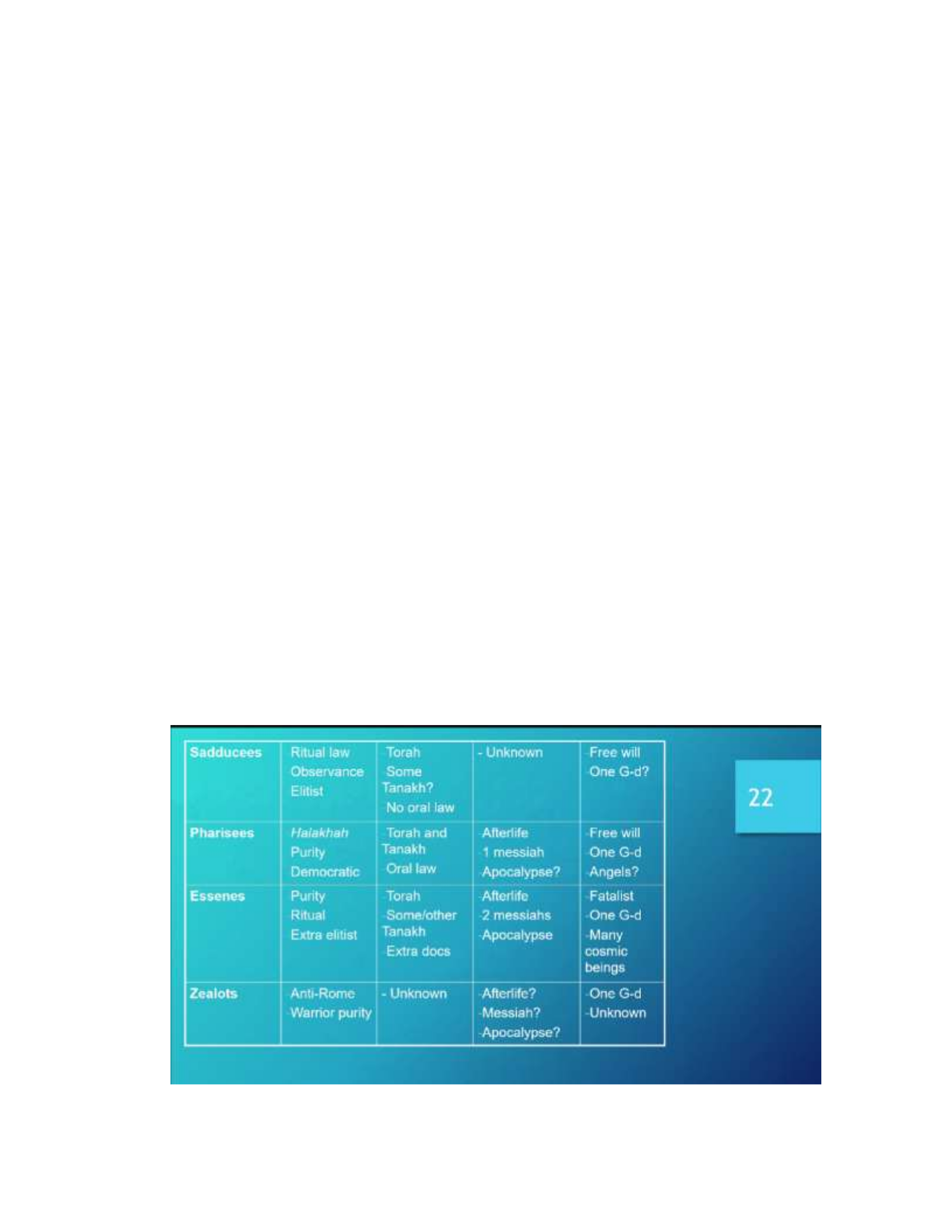
Sects; Non-Rabbinic Judaisms; Dialogue/Polemics
- Major sects active in judea
- 17
- Sadducees
- Claimed descent from zadokites
- Priestly class
- Few documents belonging to them, possible religious
“Textbook(s)” in addition to the Torah
- Pharisees
- Sages
- Academic
- Popular amongst the people - Essenes
- The qumran community, called themselves Zadokites believed
they were the real Sadducees
- Created the dead sea scrolls
- Monastic – doesn't have a huge role in judaism, judaism does not
support celibacy (first law is to be fruitful and multiply) - They
were celibate
- “Cosmic elitism”- Believed they were the army of good
- Had additional documents- Apocrypha and Pseudopigryphas,
polemics (Arguments against enemies)
- Zealots
- Sicarii, assassins that were part of the zealots
-

UNSUREÉ
Documentary Hypothosis:
How scholars understand the bible; JEPD– came from all different places and all over and
redacted to the torah.
Timeline:
- Around 2000 BCE patriarch Abraham, son Isaac and grandson Jacob and Jacob's twelve
sons lived (patriarchs)
- G-d made a pact with Abraham promising him and his descendants a permanent home in
the land of the Canaanites (covenant)
- In return, Abraham and his descendants would follow G-d and if they were male they
would get circumcised as a sign of their covenant
- Famine forces Jacob and his family to immigrate to Egypt where the Jews lived
peacefully until they were enslaved around 1300 BCE→ later liberated by Moses
- After leaving Egypt, Moses spoke with G-d on Mount Sinai, and brought down the 10
commandments (second covenant between Israelites and Yahweh)
- They wandered the desert for 40 years because the Israelites doubted G-ds might that
they would be able to conquer the land of the Canannites
- The Jews, Philistines, and Canaanites fought for more than two hundred years until the
Jewish tribes (under the leader of King David) captured Jerusalm and occupied parts of
Palestine in the eleventh century BCE
- Solomon (David’s son) built the first temple in Jerusalem and had all religious activities
performed at this Temple
- After Solomon died, the northern tribes rebelled (high taxes) and the kingdom was split
in two.
- The northern section was called Israel, and the southern section was called Juda.
- Assyrians conquered Israel in 721 BCE
- Babylonians conquered Judah in 586 BCE
- The Babylonians destroyed Solomon’s temple, tore down the walls of Jerusalem and sent
most Jews into exile in Babylon (left some of the poor Jews that farmed the lands)
- “By the rivers of Babylon, there we sat down, and wept, when we remembered Zion” →
said by Psalmist, and demonstrates grief
- 70 years after the destruction of the First Temple, the Persian king Cyrus the Great
conquered Babylonia and let the Jews return to Jerusalem
- Two Babylonian Jews, Ezra and Nehemia, returned to Jerusalem and made a Jewish state
- The Second Temple was completed in 515 BCE (Western Wall is what remains of it)

- The Jews who remained in Babylon finished compiling the Mishnah (Oral Law)
- Alexander the Great conquered Judah in 332 BCE, and brought a Greek influence
(Hellenism) → sports, customs, theaters, libraries
- All until the rule of King Antiochus the fourth
- Around 175-164 BCE Antiochus tried to force the Hellenization of Jews and make them
assimilated by banning Jews from keeping Shabbat and owning copies of the Torah and
tried to make them worship Zeus
- This started a revolt amongst the Jews→ the Macabee line reconquered Jerusalem in
165 BCE → this is the Maccabean Revolt
- Generation later, there was a dispute within the Maccabean dynasty. They asked
Potolesimist to arbitrate their dispute. Instead he conquered the land
- In 63 BCE, a Roman general was asked to mediate a dispute within Jerusalem, instead he
occupied Judah and claimed it as a new Roman province
- Under the rules of the Greeks and Romans, Hellenism was popular, and the Torah was
even translated into Greek (the Septuagint)
- During the Greco-Roman rule, the books of RUth, Esther, HOnah, Job, and Ecclesiastes
appeared
- While Palestine was occupied by the Romans, Jewish sects emerged
- Essenes→ non-violence, communal celibate life, isolated
- Sadducees→ members of priestly families who were in charge of the Temple, mostly
lived in Jerusalem. Only accepted Torah (not oral law), focused on temple worship
- Pharisees→ most pious, members came from all social classes, emphasized daily
religious practice, observance of religious laws and traditions. Accepted oral and written
law
- Zealots→ very opposed to Roman rule of Palestine. Thought the Messiah would be a war
leader who would lead forces that would defeat the Romans and restore Jewish political
rule in Palestine
- The Jews rebelled against Romans in 66 CE
- Jerusalem was sacked, and the Temple was destroyed
- The destruction of the second temple ended the power of the priesthood→ no longer
anywhere for priests to practice their rituals
- The Romans forbade them to rebuilt→ the Jewish population dispersed
- Without a temple, a greater emphasis was placed on scripture and interpretation of it
- In 90 CE, a group of Rabbis met in Yavneh to decide which religious books would be
recognized with the Torah as sacred literature

The Nature of Judaism as a “Religion”
Judaism:
- Less simplistic than seems, more than just a monotheistic religion
- Judaism is an ethno-religion (people`s religion)
- There are tenets of the religion agreed upon with clearly identifiable religious aspects of
laws, customs, ethics, morals, and identifiable symbols
- Judaism is a religion, culture, relationship, and discourse
- Many sects (people who don`t recognize others as Jews anymore) and denominations
(people within a religion with different beliefs but still share the same religion)
- Judaism is a group of people settled on Monotheism (evidence of Asherah is what divides
ancient Israelites to Judaism).
Religion:
- From the Latin word Religio, the binding of the past, present, and future.
- Some define religion as worshiping a deity, but some religions follow a divine system or
something of values, stories, symbols or knowledge that binds past, present, and future.
- Religion is an artificial academic term set to define a set of features that were not
separated from life prior to the enlightenment– much in connection to Christianity and a
Christian contextual lens.
- Judaism provides a set of ethics and values, gives meaning to a series of symbols,
represents a shared world view and contains meaningful stories/histories. It’s laws,
customs, recommended behaviours
- Judaism has religious texts, and minhagim (holidays, unwritten traditions, culture)
Civilization:
- Has a history
- There is material evidence of its existence
- Judaism changes and evolves as society evolves Culture:
- Grouped behaviour with key identifiable features which may include traditions that may
revolve around religion but do not necessarily have to be directly related Relationship:
- Faith is Judaism in relationship with the divine and with traditions of the community
- Is part of a Jews relationship to themselves, their community, the world, their family,
their ancestors, their descendants etc
- To their god or ultimate concern Discourse:
- a mode of study, teaching, learning, action, adapting, encounter, discussion, conceptual
zing, interpreting etc
- Taught, understood, discussed and learned over the course of lifetimes; it is fluid and
interactive
- “Judaism” is created/changed by various forces over time
- Tradition is central, but participation is also essential

- Is interactional Socio Sacred:
- things that become sacred to communities or families because they have just been sacred
for some time
- We tend to overemphasise the role of major texts within Judaism
- There is a world outside of text which leads to “Civilization”
Monotheism-
- Often known as the belief in one G-d, which is problematic within a Jewish context
- There are Jews that are atheistic
- Jews originally were henotheistic (Acknowledged there were others g-d`s but theirs was
superior)
- Only in the 4th-5th century did Jews become strictly monotheistic
- There are forms of Judaism for people who don’t always define themselves as Jews or
that are Jewish by Culture and not faith or religion
How all the parts of Judaism come together (religion, texts, culture, socio-sacred, discourse,
relationship, and civilization):
Judaism is a textual religion; it is a text itself that is part of the story, but it is also a lived
religion, which is a way of life. Minhag is a sacred way of partaking in the customs of the elders,
which inherently becomes sacred being socio-sacred within families because they’ve been
carried in a cultural society for so long. There is a world outside of the texts in Judaism, where
the civilization aspect comes out in Judaism of past, present, future, and why it is a history.
There is art, culture, clothing, and a relationship providing order to a universe to relationships to
their descendants, further flowing to communities. Judaism is what has been taught in
generational learning, making it fluid, resilient, discourse and change. This is a stream of how
people lived in an aspect of history.
Basic Jewish History:
Shares in an origin story with sources and interpretations
The four periods (Jacob Neusner)
- The first age of diversity becomes more recognizable (500BCE- 70CE)
- In the age of definition, rabbinic Judaism makes books (70-640 CE)
- The age of cogency, the dominant form of Judaism in the middle ages, self-isolated the
community (640-1800 CE)
- The second age of diversity (ca. 1800CE- present)

Judaism was originally from people who studied it through practice, but through academia, it is a
historical and anthropological approach.
The fallacy of Judaism- the belief in `normative Judaism and Diverse Judaism` is not just one
rabbinic path, but there are several paths. There are valid forms of Judaism that may slip through
the cracks.
Henotheism
- We worship one god. Others exist they just aren’t as good/ we believe in only one
- Judaism was originally henotheistic, however Ezra strived to stop this belief through his
reforms
(reforming what Judaism meant after completing the second temple)
Clifford Geertz (an Anthropologist)
- “Religion is a system of symbols which acts to establish powerful, pervasive and long-
lasting moods and motivations in men by formulating conceptions of a general order of
existence and clothing these conceptions with such an aura of factuality that the moods
and motivations seem uniquely realistic” (From the Geertz reading)
- Geertz explains religion's role in establishing relationships between ideas and feelings
that may seem uniquely unrealistic
- Criticism of Geertz`s view is that religion is not just in one`s mind, as he admits, as some
practicing Jews feel, it is also in one's body (i.e. what they eat).
What is Judaism
- The sacred history/story, ideals, ethics, practices, traditions, folkways, concepts, identity,
civilization, and art/philosophy of the Jewish people. It is also the core of what created
the Jewish people and binds them together
- Generally characterized by monotheism, the reverence of a core corpus of central text and
a foundational idea of covenant with god and all of Israel, through which the Jews find a
shared, mutually recognized point of origin, distinctiveness and imagined community
- It is the legendary and recorded history of the civilization of the Jews and all of the sacred
socio-cultural tenets/ways of life maintained and passed down through their generations,
around the globe
- “Imagined community”
- You can not picture how many people are part of the community
Concepts and Characteristics; Perspectives
Monotheism- belief of one G-d
Henotheism- belief that multiple G-d’s exist, but the belief in only one (pick the “best” G-d)
Ethno Religion- relegio + ethnicity, culture, civilization

Normative Judaism- one Rabinic path that is generally accepted as the main form of
Judaism Rabinic Judaism- Judaism that emphasizes daily habits, ethical monotheism, and
learning as Judaism outside of a Temple
Talmudic Judaism- Rabinic Judaism but with the Talmud→ very little difference in core beliefs
(came later on in history)
Sectarian Judaism- Established in the Second Temple Period→ pharisees, sadducees, Esseens,
Zealots
JEPD- historical view that the Torah was written by four people over several centuries
Patriarchs- Abraham, Issac, and Jacob→ fathers of ancient Judaism
Israelites- what the people of Judah were called up until around the creation of the
Second Temple HebrewsKosher- dietary laws
Purity laws- laws observed in Talmudic Judaism, priestly Judaism in the Second Temple Period,
laws of how one interacts with others and stays pure. Talmudic Judaism→ everyone needs to be
pure to fulfill the covenant
Diaspora- Jews living outside of the land promised by G-d in his covenant with Abraham
Ethical monotheism- individual relationship with G-d through study and prayer→ democratizes
Judaism from just priests
Messiah- Jesus and Bar Kochba identified as a messiah. Jews believe the messiah hasn’t come
yet but messiah brings redemption→ Talmudic Judaism believes to live life to the fullest because
the messiah will come
Hellenism- Greek culture→ valued philosophy, science, sports, libraries, etc.
Covenant→ pact/promise between G-d and Abraham/Israelites/different person depending on the
covenant
Circumcision- requirement of the covenant between Yahweh and Abraham
Books (explained under texts and concepts):
- Torah
- Neviim
- Ketuvim
- Mishna (oral Torah)
- Talmud (commentary on the Mishna→ includes the Mishan and the commentary which is
called Gemara)
- Talmud Bavli (commentary discussed by Rabbis in Babylon)
- Talmud Yerushalmi (commentary discussed by Rabbis in Jerusalem)
The Texts and Concepts of Judaism
Judaism is taught generationally, which is part of why it is dynamic as it adapts to current times.

The Triad of Judaism- G-d, Torah/covenant, Israel– how the group understands these
Texts-
Everything in Judaism is related to the texts, lots of books. Hebrew is the language of the Jewish
people; translation is always interpretation.
Torah- the legal code, the first five books of the Torah. Religiously these are the book of the
covenant, the legal constitution between jews and god. Tanach is the Hebrew bible, Torah,
neviim, Ketuvim. These texts have history so there are many slightly different translations.
Today the Maseretic text translations is what jews use. The Masereats are the rabbis who added
the nikoodim. Midrash is retellings or expansions of stories from the bible to fill in the gaps–
could be history, stories, legal etc.
Mishna- oral Torah, Torah shebe al pheh. When g-d gave written Torah to Moshe, he also gave
the oral Torah which would be taught to teachers who could apply it with flexibility unlike the
written Torah which is not meant to change or adapt. Mishna is what makes rabbinic Judaism. It
is the foundation for rabbinic Jews.
Judah ha nasi- He writes down what amounts to the oral traditions and that is when the mishna
becomes a book because he realizes that with a few wars, the torah shebe al pheh could be
whipped out.
Talmud- also a rabbinic text, it is an explanation of oral law. Rabbinic commentary on the
mishna (oral Torah). Gamara is the Babylonian Talmud.
Rashi- he clarifies the language, helps students be able to understand and makes connections
to written torah and references. The Hagadah is a rite– a prayer book
Central Concepts:
G-d- G-d is one, a unity and a singular. G-d is the creator and has no creator, he is the universal
creator of everything
Covenant; Paradigms; Creation/History -
Origins and Ancient Israelite Religion - In
the Tanakh there are 6 covenants:

37. Edenic (relates to all humans)
38. Noachide (relates to all humans)
39. Abrahamic (relates to the Jews)
40. Sinai (relates to the Jews)
41. Levitical (Priestly) (relates to the Jewish priests)
42. Davidic (Royal or Messianic) (relates to the Jewish royalty)
- Covenant means relationship, membership, or identity
Order of the Tanakh
-
- Genesis 1-3 covers the creation of the world
- Edenic Covenant, take care of the world and I will bless you with food/water/life
- The origins of Shabbat on the 7th day on creation
- Noah and the Deluge, Genesis 6-9
- Covenant with the Nations
- Remnant is Noah, tasked with two of every animal on the arc - A rainbow in
the sky is the symbol that G-d will not destroy the earth
- The seven commandments of the Noachide Covenant:

- Believe in G-d, respect G-d, do not murder, do not commit adultery, do not stea
steal, create a justice system, do not eat living animals
Summary of the covenants:
-Edenic ( Genesis 1. 28-30) — g-d to humans, Adam and Eve -
Noachide (Genesis 9.8-17) — all humans after Noah and g-d
-Abrahamic (Genesis 12-17) — hebrews, circumcision
-Sinai (Exodus 19-24) — Israelites, most commonly discussed/known covenant
-Levitical (Exodus 29. 44-46) — priests of the Hebrew nation (priestly Jews)
-Davidic (2 Samuel 7) — g-d to David and his dependents (royal Jews)
- Abraham and the Patriarchs
- Origins of the covenant community and paradigms of faith
- Family based, no priesthood
- Abraham got a message from G-d and breaks all the idols in his father’s shop
(Iconoclastic)
- He leaves to start a new line, he circumcised himself and he becomes the leader of
the
Hebrews
- The The Conquest of Canaan main G-d “El” → Elohim
Isralite → is when the people are in the land of Israel, civilization that starts to form from
the
Hebrews, follows the Ancient Israelite Religion
Hebrew → is the tribal term of the followers of Abraham, ancestral or tribal origin
- 11th-10th century the United Davidic Kingdom (when they became united as one
group) 3 Kings
→ Saul, David, and Solomon
-
-

- King David was considered the glory days, the pinnacle of Israelite power,
conquers Jerusalem for the capital of the 12 tribes, King Solomon builds the first
Temple
The Origins of Judaism
Before the 5-6th century we say the ancient Israelite religion
- Mount Zion is established under King David and the first Temple is built under King
Solomon
- King David thought there was only supposed to be one Temple as they believed in only
one G-d, and sacrifices were only supposed to be made inside the Temple (although they
happened outside and were not reported)
- Descendants of Aaron are responsible for priestly duties
- Kosher Laws applied to all Jews when Judaism is established, previously in the Ancient
Isralite
Religion only the priests followed them (Leviticus)
- After Solomon there was a division (Northern Kingdom Israel (Sameria) and Southern
Kingdom
Judah (Jerusalem))
- Rituals of the first Temples included animal sacrifices (avodah), regular offerings (tamid)
(wine, oil, grain, cakes), pilgrimage festivals (Pesach, Shavuot, Sukkot)
- The second Temple created the Hebrew calendar
Terminology review
- Hebrew — ancestors
- Israelites and ancient israelite religion — civilization that starts to form rooted in the
origin being Hebrew but move out when they start to live in the land
- Jews
Origins of the Israelites
- a word about terms
-

- Hebrews, Israelites, Jews
- When do the Israelites arise as a distinct people
- Very little evidence of when
- In Egyptian text we see people called the Habiro — people say is the Egyptian spelling of
Hebrew
- The tribal period is israelites→ kingdoms split up after King Solomon
- Under king solomon the temple in jerusalem is built
- 931 BCE the kingdom splits into Israel and Judah
- 740 BCE Israel falls to the Asyrian emr
- 586 BCE Jerusalem falls to the Babylonians→ first temple destroyed
- There is a fundamental transition from ancient Israelites to Judaism
Pre-Judaism (Israelites); Biblical/Historical Roots; ANE Contexts
Exile/Return and the Dawn of “Judaism”
We call Noah, Adam and eve etc as the legendary events as the Bible is the only source for this.
Israelites: Their encounters with communities around them
- Egyptions
- Babylonians
- Phenitions
- Cannanits
- Mesapotanians
Origins of Israelites:
Hebrew- tribal, ethnic language, legendary past language.
Israelites- the switch of designation from legendary past to the identity of Israelites when they
leave egypts. There is little true evidence making specific dates difficult to identify. This is when
the modern tribal period was the monarchy and temples occur.
Habiru- means stubborn or qweroralsom from the Egyptian's view, but some think it means
Hebrew
The Merneptah Stele- a stone with the detail of the “israels” being wiped out in 1208 BCE

The Bible as “History” is an important source, but it is not an accurate portrayal and is more of
trying to hit upon their objectives. Historians try to use the bible as a supplementary source, not a
primary source, as it took roughly 800 years to come together along with bias. There are various
types of documents within the bible from different sources. Though the author may sound like a
first-person narration, it may not be, and that is why archeology is so vital.
The Conquest of Canaan
- Abraham`s covenant with Yaweh (G-d)promised him the land of Cannan
- The Jewish bible discusses two different ways the Israelites were told to receive the land
of Cannan.
- One through the Israelites being told by Yaweh to kill out all the cananites and take over
that land
- Another expressing a gradual takeover of Cannan through buying land gradually
- There is no evidence of Canaanites disappearing or a mass murder but there is evidence
of the defacing of art beings and idols.
- A theory is that the Israelites were Canaanites who felt in opposition to the cannonites
that surrounded them.
- Some believe Cannonites were the successors of Noah because the root of the name is
similar to Shem Noah, the name of Noah
- Academia gathers that by 1208, the Israelites have a separate identity. The Canonites
were not a separate group but possibly living among the Israelites where the term El
came up as a god with ideas of henotheism and monaltry. El often was equated with a
woman figure of name ashera.
There is fair certainty of Saul, David, and Solomon. The Tel Dan Inscription was found to
identifying
Messiah means the anointed one, though david, saul and solomon were all anointed as kings,
david was the one that david will produce a messianic heir. David establishes Jerusalem and
brings the tabernacle there. Solomon, a man of wisdom built the temple as opposed to his father
who was a man of war. Solomon had many wives, he was charged in the bible of having multiple
wives who he let build temples and polotheism. Another reason people say the temple fell was
after the temple was built israelites went to get the taxes lowered, as a result solomon doubled
the taxes which was bad.
The Two Temples
The First Temple
- Built roughly around 957 BCE and stood for around 400 years
- Known as Solomons Temple

- In 930 BCE there was a split of power. There was tension and a power struggle if the
priests or kings should be ruling
- One explanation is that Solomon lost faith in g-d
- The kingdom of Israel fell to the Assrians
- Story: Assyrians took a Babylonian and forced them to grind their families bones
- Israel was the north, Judea South. Judah made a truce with Assyrians but Israel did not,
so Israel was taken but some were able to flee to Africa or Judea
- The fall of the temple led to a spiritual crisis of why would g-d make a covenant for
canaan and not protect them, this is a theodicy. Juddha explains that it is because Israel
had sinned and was not a monotheist
- Getting rid of Ashuhahs, banning worship outside Jerusalem and more intensity about
Judaism came about not
- Theodicy is what meaning can be made of a situation, like why do bad things happen to
good people etc.
-
The Second Temple
Differences?
Rites/Purpose; Differences; History; Meaning; Priests/Prophets
Purity
- refers to your hygiene habits
- Your diet
- Your marital/sexual choices
- The laws of the priesthood — in exile, they said it isn’t enough for the priests to be pure
but maybe we all have to do this
- Keep kosher
- Avoid touching the dead
- Etc
Catastrophe and Transformation; Exile and Diaspora
Babylonians
Babylonians take Assyria, they rule by both sheer brutality but also power, taking away money
that may be used against them and though taking out any royals and keeping only farmers or
who they need. Judah is taken by the babylonians, there are multiple revolts, sieges etc, this was
a drawn out process. Everytime the babylonians won they would ship off the elite with 3-4
deportations. As they shipped off the elites of Judah, they imported elites of other places who
spoke different languages so they wouldn't revolte. In 597 BCE the Babylonians destroyed the

temple. The farmers left still after it was destroyed continued to go there to do pilgrimage. Left a
lot of Israelites in the land and didnt get rid/move all of them.
The Diaspora
The Zadok was a levit who brought the exilarchs together (those in exile). This is when the
sacred narratives were written down in Babylon and the schools in Babylon for teaching and etc
happened. There was also a diaspora in egypt.
The exiles in Babylon left for a lot of memory, in Judaism to remember is a commandment, but
as a verb to not just remember but to call forth a meaning or action in you– not a passive verb
but an active verb to commemorate and act in its past. Judaism as seen later has its origins in the
acts of mourning and commemorating the temple. This is Zahor– lezhor, to remember. This is
where the theology of suffering takes route.This is when the idea of intermarriage came abouts.
- “By the rivers of Babylon, there we sat down, and wept, when we remembered Zion” →
said by
Psalmist, and demonstrates grief
People of the land
The people the babylonians did not send out of the area, this is where ancient israelite religion
takes a backseat to a folk religion where the people continue to make sacrifices while the priests
arent there. The Samaritans focus on a different mountain (gerazim instead of zion) in their
thoughts of whats important.
Ancient israel religion is concidered the problem and Judaism the religion was thought of as the
solusion. Who is the legit Jew is in question; the ones who stayed in the land or those who were
exciled and returned.
THe exiled:
Now they have the bible. At the babylonian academy there was a scrible effort to copy older
books and write down multiple perspectives off memory which had them putting hebrew into
heavy importance, texts are super important– you can take them with you in diaspora. The Exiles
were allowed to return but they hadnt have political autonomy, this is where they came up with
different things they could do and avoid (intermarriage, two stories of what to do about the
cannnanites, lack of faith and loyalty, lack of impurity– hygiene, diet, sex and marriage, multiple
wives etc).
THe return from babylon to judea: 539 BCE
Yehud was the provice of judea, this is the origin of judaism and jew as a term and not israelite.
This is where cyrus the great publishes the Edict of Resoration, got people to likke him and be

happy so they don’t revolt. Cyrus is all for his people having their own ethnic legal code, which
for jews is Torah with initates the control the priests never had had.
Aramaic is the language people spoke in the streets– blending ancient persian and ancient
hebrew like yiddish but persian. Aramic is a big innovation of this period
Ezra and Nechemia
Ezra and his great assembly of who was a jew and how was a jew etc. Building in courts that are
legal and religious which the temple becomes the center of jewish world.
Nechemia focused on the rebuilding of the temple nad then harod renovated it. Not all jews
return from excile, they remian in the schools in dyaspera. This is when the elephanine temple
is created where outside of Jerusalem they did sacrifices.Ezra was intensely interested in the
reconstruction of the religion, he helped firm up identity, membership and push to remove
ancient israel religious attributes and emphasized jewish law, torah and emphasis on law for all
jew. Here ezra creates the great assembly which is an influential aspect to later Judaism.
Ethical monotheism- not solely reliant on sacrifice but through study and prayer one can
develop an individual relationship and develops into a more democratic religion not solely for
priests but study and prayer as valid.
First temple period: Solomons's Temple, built by king Solomon and destroyed by Babylonians
just prior to babylonian exile. This period focused on priests, sacrifice, and competition due to
the diversity within Judaism there.
The Second Temple Period- rebuilt under Cyrus the great and was heavily renovated by herod.
Classical Judaism
Classical Judaism- What comes out of the second temple period which was influenced by greek
and Romans.
Hellenism- a component that distinguishes classical judaism. This is a greek structure but it also
influences the roman period so its both in the greek and roman periods, the classical periods.
Lots of naked activities because the body was sacred and jewish men were prohibited from some
activities because they were circumcised, which was considered bad. Some medical textbooks
were talking about reversing circumcision. Jews want to access goyshe life but the human body
almost didnt allow them because theres a series of excelling in public life or being jewish,
creating tention in different aspects.
Alexander the great- he dies young and his empire does not stay whole so the greek empire gets
split into Egyptian ptolemaic empire and the syrian seleucid empire.

Egyptian Ptolemaic Empire- didnt make many changes post alexander the great
Syrian seleucid empire- made changes cuz they found the jews not follow zues so it was
offensibe.
70 CE: The second temple is destoryed
Helleistic Judaism- A hellenization of judaism, this is where philosophy was intertwined with
Judaism. This is where the philosopher phylo rationalized judaism for both jewish and non
jewish audieces. Hellenism also impacted the way jews understood jewish life, this is where
upper class jews also saw jerusalem as a polis city state. Jews started to see Jerusalem as much
more important than the rural places. There is a rise of a middle class as judea had free access to
trade with other parts of the greek empire. This is when public baths and gymnasium became a
big part of social life and business happened. How much jews can hellenise and remain jewish
was a very touchy topic, if one is an authentic jew was a big issue of the time.
Syncretism- the melding of different cultures or religions. What can be adopted while keeping
Judaism.
Selucid rule- there was a decree that everywhere needed to have a place for sacrifice to Zeus
and when jews were upset the romans were offended. Mattisiyahu says no to sacrificing to zeus
and then the whole chanukkah story war breaks out.
Hasmonians- the dynasty that comes from the maccabees. Still ongoing hellenizer controversy
which is uncomfortable for their major critics despite their roots in the maccabean revolt and the
hassidim felt the hasmonians were too helenised and not jewish enough. There are
uncomfortable practices of making the king the high priest as the same person which is so not
like the history of the israel concept. They were not descendants of zadik or david and were not
two separate people so the hasmonians broke these two taboos even though they had a role in the
revolt.
The pharasees- they consider themselves the descendants of Ezras great assembly, they began
as supporters of both the hasidim and the hasmonians but once the hasmonians broke the taboo
of king and priest being two people.
Roman period- also socialized very naked and were disgusted by cercumsison. Social
advancement verses faith were a big question. They went to help judea but ended up colonizing
when they were called upon to help between a dispute of domination. Romans make a lot of
arrogant mistaktes early on.
Herod- Harod overthrows and ends the Hasmonians and makes his own dynasty because he
knew they werent universally loved. He was super hellenized and liked art and architecture.

Second temple wasnt finished until after his death and generationally so many people were
employed by the renovation that when it was finished people started to loose their jobs and
people got so mad over roman stupidity.
Jewish Revolt- Romans were stupid and said more taxes, and Jews said no, so the Romans took
gold out of the temple, so basically, the Jews went bat shit. The Romans send in reinforcements
to seize Jerusalem and Jerusalem was overpopulated and becomes a state with a lack of water,
food and disease– this became very traumatic for the people. In 70 CE, the Romans get to the
temple, take it over and put it on fire. Revolt in Masada. Then the bar kochba revolt and what
then began the great diaspora. The outcomes of the revolt were that the hasmonians (maccabees
generations) brought jewish people together as the threat to the temple not being pure and for
judaism as a religion became clear as they fought against hellenism and foreign intrusion. But
this also left for a hasmonian to takeon priesthood when they are not apart of the linage of david
that was supposed to but as long as a representative who prioritized torah law then the
hasmonian rule was okay by the people, this lasted until alexander yannai tried to get rid of the
legislative assembly and just have the king and high priest be absolute, this is when it got more
questioned and the other jewish groups became more in question about the legitimacy.
Benefits of roman rule
It improved the material quality for judea and for ideological reasons of not affecting the sects
religious practices it was better not to revolt until the zealots came along.
Influences (Greco-Roman); History; Forms; Politics; Conflicts
The Great Diaspora: 135 CE
Jews were moved into Turkey, Europe, Asia and northern Africa. Babylonian communities had
already been there from 70 CE, and they had money and lived to build up academies so they
could learn and Judaism could continue.
UNSURE WHICH PERIOD
Jews were in intense relations with Greece and Rome. The classical area in the 4th-5th centuries
is the fall of the roman area. This gives texts of Jewish philosophy (Hellenistic influence,
Example: Philo of Alexandria the exploration of Judaism in a systematic rational thought),
Jewish “history” (Josephus the first-century historian’s outlook which is similar to the way a
history department at university would, the attempt to record historical events using scientific
methods to record events as a reality), and Jewish theology/Rabbinic Literature (the Talmud).
Rabbinic literature is the application of interpretation of knowledge from god, it is about
applying credentials in tradition to sacred scripture this stems from the rabbinic Jews who felt
they had access to oral and written Torah, it really depends on having legal experts of rabbis to
really interpret the law. Rabbinic Judaism is not literal, halacha is based on experts. The rabbinic

Judaism absorbed different sects of Judaism and were how to make sense of Judaism after the
chaos after 70CE with themes of how to survive and adapt. The rabbinic period takes what ezras
great assembly shaped with kosher and self views their roots in the leaders of the Sanhedrin.
Hillel and Shammi are a great balanced example of the need for law and human emotion work
ideas.
Bar Kochba
Too many people die, and in 220 CE the oral law (Mishna) is written down, and then the Talmud
is created and the age of cogency.
The Canonization of the Bible leading to the Masoretic Text
A discouraging of translating the bible but a push of studying the bible in Hebrew to keep the
language alive.
Pirkeh Avot- Chapters/sayings of the fathers/ethics
Torah means Mishna, Talmud, Gammara, it's all hand in hand with Torah so it is used
interchangeably.
Talmudic Judaism
Rabbinic tradition is recorded in the Talmud, through the proper interpretation of the law.
Protecting the law by saying not to do things that are even further (don't murder, don't get angry)
like putting up barriers, so there's a massive extension of the law to make things unthinkable.
Rabbinic Judaism answered concerns that the covenant would be vaccaded and what Judaism
mean without sacrifices (which was love and kindness, Tikkun Olam). Rabbinic Judaism
becomes intensely pro social which ends up becoming apart of pro jewish survilval.
Normative Judaism
The fallacy (big issue) that there is only one way of judaism, rabbinic judaism is not the only
form of judaism to develop into the middle ages even if it is the most common.
Non-Talmudic Judaism
Those forms of Judaism that reject the Talmud and oral law
Samaritans
They practice an Israelite, Torah based religion that pre-dates the Talmud. They are a minority
but quite ancient in origin. Antagonism between jews and samartism was bad at times as
samaritans claimed that god said they could only sacrifice at one place but disagreed at where
that was. They also have their own torah.

Karaite Judaism
An ancient sect of Judaism which considered only written Torah authoritative and does not
recognize oral law (mishna and talmud) to be authentic to Judaism they are thus distinct from
rabbinic judaism. Anan ben david didnt want to be seen as a salary hereditary but an ananite.
They see Deutaronimy 4. 1-2 differently and are more literal to Judaism so thats why they think
rabbinic judism is inauthentic and wrong.
Beta Israel
Many practice rabbinic judaism as they had to convert but their judaism predates the rabbis as
they have an 8-book bible from etheopia called the octateuch, the orit is their torah.
Early Rabbinic Judaism
The Remnant
- After 70CE
- Judaism without the temple
- Sage Ben Zakkai and the salvation of Judaism
- Gathers students and books, goal is to protect knowledge
- Pretends to be ill, rumors that he’s dying
- He “dies”
- Get put into a coffin full of his books, convince guards to let them through
the wall
- Visits Vaspasian and tells him he will become emperor
- In return he receives Javne and its sages
- All of the Jewish books are collected, Pharasaic Judaism becomes
Judaism
- Bible is cannonized
- Early rabbinic judaism is oral law
- Ben Zakkai proposed new way of Judaism without sacrifices
- Acts of love and kindess instead of sacrifices, gave positive spin to all the
destruction
- Rabbinic Judaism becomes a “portable” way of Judaism
Formation; Origins; Authority; Characteristics
Diversity in Early Judaism
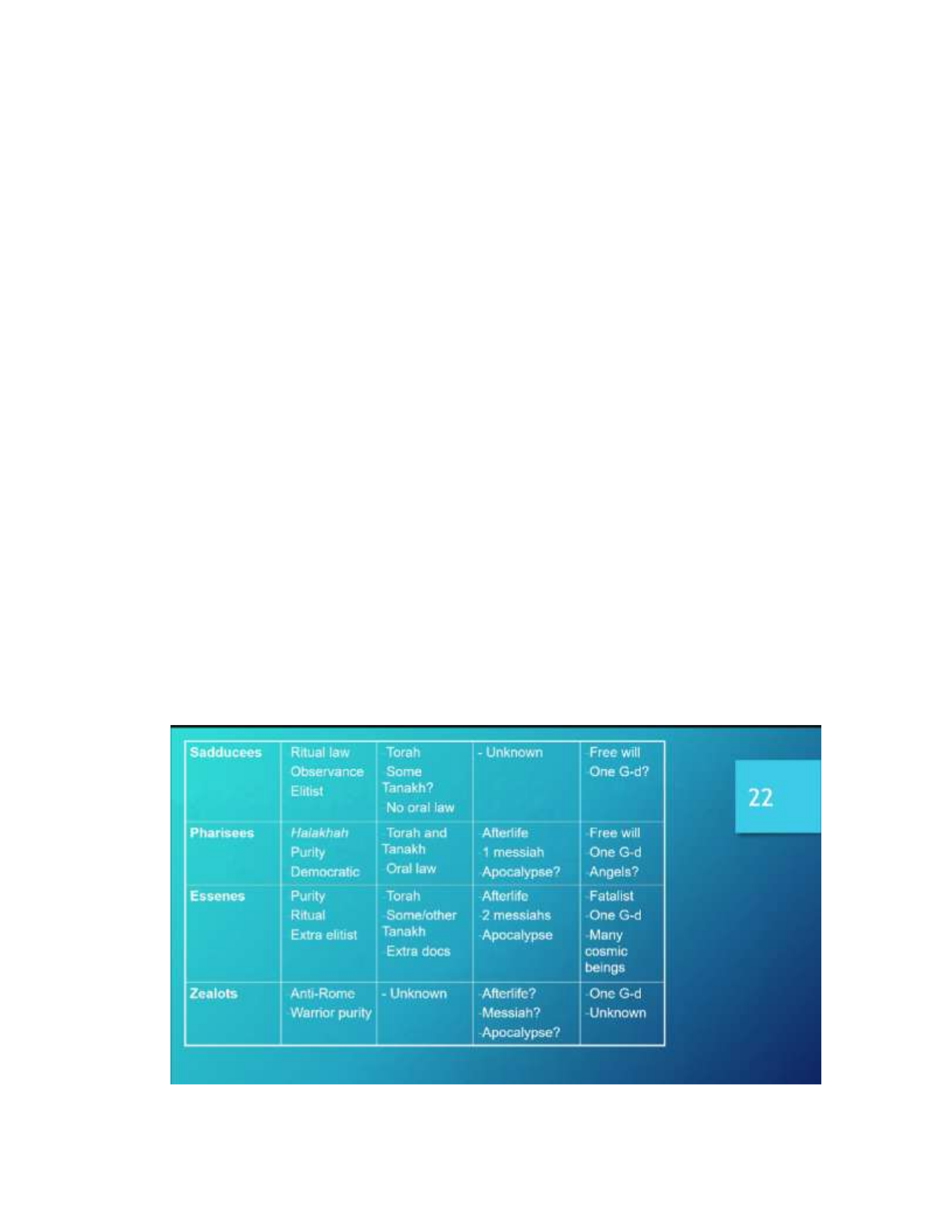
Sects; Non-Rabbinic Judaisms; Dialogue/Polemics
- Major sects active in judea
- 17
- Sadducees
- Claimed descent from zadokites
- Priestly class
- Few documents belonging to them, possible religious
“Textbook(s)” in addition to the Torah
- Pharisees
- Sages
- Academic
- Popular amongst the people - Essenes
- The qumran community, called themselves Zadokites believed
they were the real Sadducees
- Created the dead sea scrolls
- Monastic – doesn't have a huge role in judaism, judaism does not
support celibacy (first law is to be fruitful and multiply) - They
were celibate
- “Cosmic elitism”- Believed they were the army of good
- Had additional documents- Apocrypha and Pseudopigryphas,
polemics (Arguments against enemies)
- Zealots
- Sicarii, assassins that were part of the zealots
-

UNSUREÉ
Documentary Hypothosis:
How scholars understand the bible; JEPD– came from all different places and all over and
redacted to the torah.
Timeline:
- Around 2000 BCE patriarch Abraham, son Isaac and grandson Jacob and Jacob's twelve
sons lived (patriarchs)
- G-d made a pact with Abraham promising him and his descendants a permanent home in
the land of the Canaanites (covenant)
- In return, Abraham and his descendants would follow G-d and if they were male they
would get circumcised as a sign of their covenant
- Famine forces Jacob and his family to immigrate to Egypt where the Jews lived
peacefully until they were enslaved around 1300 BCE→ later liberated by Moses
- After leaving Egypt, Moses spoke with G-d on Mount Sinai, and brought down the 10
commandments (second covenant between Israelites and Yahweh)
- They wandered the desert for 40 years because the Israelites doubted G-ds might that
they would be able to conquer the land of the Canannites
- The Jews, Philistines, and Canaanites fought for more than two hundred years until the
Jewish tribes (under the leader of King David) captured Jerusalm and occupied parts of
Palestine in the eleventh century BCE
- Solomon (David’s son) built the first temple in Jerusalem and had all religious activities
performed at this Temple
- After Solomon died, the northern tribes rebelled (high taxes) and the kingdom was split
in two.
- The northern section was called Israel, and the southern section was called Juda.
- Assyrians conquered Israel in 721 BCE
- Babylonians conquered Judah in 586 BCE
- The Babylonians destroyed Solomon’s temple, tore down the walls of Jerusalem and sent
most Jews into exile in Babylon (left some of the poor Jews that farmed the lands)
- “By the rivers of Babylon, there we sat down, and wept, when we remembered Zion” →
said by Psalmist, and demonstrates grief
- 70 years after the destruction of the First Temple, the Persian king Cyrus the Great
conquered Babylonia and let the Jews return to Jerusalem
- Two Babylonian Jews, Ezra and Nehemia, returned to Jerusalem and made a Jewish state
- The Second Temple was completed in 515 BCE (Western Wall is what remains of it)

- The Jews who remained in Babylon finished compiling the Mishnah (Oral Law)
- Alexander the Great conquered Judah in 332 BCE, and brought a Greek influence
(Hellenism) → sports, customs, theaters, libraries
- All until the rule of King Antiochus the fourth
- Around 175-164 BCE Antiochus tried to force the Hellenization of Jews and make them
assimilated by banning Jews from keeping Shabbat and owning copies of the Torah and
tried to make them worship Zeus
- This started a revolt amongst the Jews→ the Macabee line reconquered Jerusalem in
165 BCE → this is the Maccabean Revolt
- Generation later, there was a dispute within the Maccabean dynasty. They asked
Potolesimist to arbitrate their dispute. Instead he conquered the land
- In 63 BCE, a Roman general was asked to mediate a dispute within Jerusalem, instead he
occupied Judah and claimed it as a new Roman province
- Under the rules of the Greeks and Romans, Hellenism was popular, and the Torah was
even translated into Greek (the Septuagint)
- During the Greco-Roman rule, the books of RUth, Esther, HOnah, Job, and Ecclesiastes
appeared
- While Palestine was occupied by the Romans, Jewish sects emerged
- Essenes→ non-violence, communal celibate life, isolated
- Sadducees→ members of priestly families who were in charge of the Temple, mostly
lived in Jerusalem. Only accepted Torah (not oral law), focused on temple worship
- Pharisees→ most pious, members came from all social classes, emphasized daily
religious practice, observance of religious laws and traditions. Accepted oral and written
law
- Zealots→ very opposed to Roman rule of Palestine. Thought the Messiah would be a war
leader who would lead forces that would defeat the Romans and restore Jewish political
rule in Palestine
- The Jews rebelled against Romans in 66 CE
- Jerusalem was sacked, and the Temple was destroyed
- The destruction of the second temple ended the power of the priesthood→ no longer
anywhere for priests to practice their rituals
- The Romans forbade them to rebuilt→ the Jewish population dispersed
- Without a temple, a greater emphasis was placed on scripture and interpretation of it
- In 90 CE, a group of Rabbis met in Yavneh to decide which religious books would be
recognized with the Torah as sacred literature

The Nature of Judaism as a “Religion”
Judaism:
- Less simplistic than seems, more than just a monotheistic religion
- Judaism is an ethno-religion (people`s religion)
- There are tenets of the religion agreed upon with clearly identifiable religious aspects of
laws, customs, ethics, morals, and identifiable symbols
- Judaism is a religion, culture, relationship, and discourse
- Many sects (people who don`t recognize others as Jews anymore) and denominations
(people within a religion with different beliefs but still share the same religion)
- Judaism is a group of people settled on Monotheism (evidence of Asherah is what divides
ancient Israelites to Judaism).
Religion:
- From the Latin word Religio, the binding of the past, present, and future.
- Some define religion as worshiping a deity, but some religions follow a divine system or
something of values, stories, symbols or knowledge that binds past, present, and future.
- Religion is an artificial academic term set to define a set of features that were not
separated from life prior to the enlightenment– much in connection to Christianity and a
Christian contextual lens.
- Judaism provides a set of ethics and values, gives meaning to a series of symbols,
represents a shared world view and contains meaningful stories/histories. It’s laws,
customs, recommended behaviours
- Judaism has religious texts, and minhagim (holidays, unwritten traditions, culture)
Civilization:
- Has a history
- There is material evidence of its existence
- Judaism changes and evolves as society evolves Culture:
- Grouped behaviour with key identifiable features which may include traditions that may
revolve around religion but do not necessarily have to be directly related Relationship:
- Faith is Judaism in relationship with the divine and with traditions of the community
- Is part of a Jews relationship to themselves, their community, the world, their family,
their ancestors, their descendants etc
- To their god or ultimate concern Discourse:
- a mode of study, teaching, learning, action, adapting, encounter, discussion, conceptual
zing, interpreting etc
- Taught, understood, discussed and learned over the course of lifetimes; it is fluid and
interactive
- “Judaism” is created/changed by various forces over time
- Tradition is central, but participation is also essential

- Is interactional Socio Sacred:
- things that become sacred to communities or families because they have just been sacred
for some time
- We tend to overemphasise the role of major texts within Judaism
- There is a world outside of text which leads to “Civilization”
Monotheism-
- Often known as the belief in one G-d, which is problematic within a Jewish context
- There are Jews that are atheistic
- Jews originally were henotheistic (Acknowledged there were others g-d`s but theirs was
superior)
- Only in the 4th-5th century did Jews become strictly monotheistic
- There are forms of Judaism for people who don’t always define themselves as Jews or
that are Jewish by Culture and not faith or religion
How all the parts of Judaism come together (religion, texts, culture, socio-sacred, discourse,
relationship, and civilization):
Judaism is a textual religion; it is a text itself that is part of the story, but it is also a lived
religion, which is a way of life. Minhag is a sacred way of partaking in the customs of the elders,
which inherently becomes sacred being socio-sacred within families because they’ve been
carried in a cultural society for so long. There is a world outside of the texts in Judaism, where
the civilization aspect comes out in Judaism of past, present, future, and why it is a history.
There is art, culture, clothing, and a relationship providing order to a universe to relationships to
their descendants, further flowing to communities. Judaism is what has been taught in
generational learning, making it fluid, resilient, discourse and change. This is a stream of how
people lived in an aspect of history.
Basic Jewish History:
Shares in an origin story with sources and interpretations
The four periods (Jacob Neusner)
- The first age of diversity becomes more recognizable (500BCE- 70CE)
- In the age of definition, rabbinic Judaism makes books (70-640 CE)
- The age of cogency, the dominant form of Judaism in the middle ages, self-isolated the
community (640-1800 CE)
- The second age of diversity (ca. 1800CE- present)

Judaism was originally from people who studied it through practice, but through academia, it is a
historical and anthropological approach.
The fallacy of Judaism- the belief in `normative Judaism and Diverse Judaism` is not just one
rabbinic path, but there are several paths. There are valid forms of Judaism that may slip through
the cracks.
Henotheism
- We worship one god. Others exist they just aren’t as good/ we believe in only one
- Judaism was originally henotheistic, however Ezra strived to stop this belief through his
reforms
(reforming what Judaism meant after completing the second temple)
Clifford Geertz (an Anthropologist)
- “Religion is a system of symbols which acts to establish powerful, pervasive and long-
lasting moods and motivations in men by formulating conceptions of a general order of
existence and clothing these conceptions with such an aura of factuality that the moods
and motivations seem uniquely realistic” (From the Geertz reading)
- Geertz explains religion's role in establishing relationships between ideas and feelings
that may seem uniquely unrealistic
- Criticism of Geertz`s view is that religion is not just in one`s mind, as he admits, as some
practicing Jews feel, it is also in one's body (i.e. what they eat).
What is Judaism
- The sacred history/story, ideals, ethics, practices, traditions, folkways, concepts, identity,
civilization, and art/philosophy of the Jewish people. It is also the core of what created
the Jewish people and binds them together
- Generally characterized by monotheism, the reverence of a core corpus of central text and
a foundational idea of covenant with god and all of Israel, through which the Jews find a
shared, mutually recognized point of origin, distinctiveness and imagined community
- It is the legendary and recorded history of the civilization of the Jews and all of the sacred
socio-cultural tenets/ways of life maintained and passed down through their generations,
around the globe
- “Imagined community”
- You can not picture how many people are part of the community
Concepts and Characteristics; Perspectives
Monotheism- belief of one G-d
Henotheism- belief that multiple G-d’s exist, but the belief in only one (pick the “best” G-d)
Ethno Religion- relegio + ethnicity, culture, civilization

Normative Judaism- one Rabinic path that is generally accepted as the main form of
Judaism Rabinic Judaism- Judaism that emphasizes daily habits, ethical monotheism, and
learning as Judaism outside of a Temple
Talmudic Judaism- Rabinic Judaism but with the Talmud→ very little difference in core beliefs
(came later on in history)
Sectarian Judaism- Established in the Second Temple Period→ pharisees, sadducees, Esseens,
Zealots
JEPD- historical view that the Torah was written by four people over several centuries
Patriarchs- Abraham, Issac, and Jacob→ fathers of ancient Judaism
Israelites- what the people of Judah were called up until around the creation of the
Second Temple HebrewsKosher- dietary laws
Purity laws- laws observed in Talmudic Judaism, priestly Judaism in the Second Temple Period,
laws of how one interacts with others and stays pure. Talmudic Judaism→ everyone needs to be
pure to fulfill the covenant
Diaspora- Jews living outside of the land promised by G-d in his covenant with Abraham
Ethical monotheism- individual relationship with G-d through study and prayer→ democratizes
Judaism from just priests
Messiah- Jesus and Bar Kochba identified as a messiah. Jews believe the messiah hasn’t come
yet but messiah brings redemption→ Talmudic Judaism believes to live life to the fullest because
the messiah will come
Hellenism- Greek culture→ valued philosophy, science, sports, libraries, etc.
Covenant→ pact/promise between G-d and Abraham/Israelites/different person depending on the
covenant
Circumcision- requirement of the covenant between Yahweh and Abraham
Books (explained under texts and concepts):
- Torah
- Neviim
- Ketuvim
- Mishna (oral Torah)
- Talmud (commentary on the Mishna→ includes the Mishan and the commentary which is
called Gemara)
- Talmud Bavli (commentary discussed by Rabbis in Babylon)
- Talmud Yerushalmi (commentary discussed by Rabbis in Jerusalem)
The Texts and Concepts of Judaism
Judaism is taught generationally, which is part of why it is dynamic as it adapts to current times.

The Triad of Judaism- G-d, Torah/covenant, Israel– how the group understands these
Texts-
Everything in Judaism is related to the texts, lots of books. Hebrew is the language of the Jewish
people; translation is always interpretation.
Torah- the legal code, the first five books of the Torah. Religiously these are the book of the
covenant, the legal constitution between jews and god. Tanach is the Hebrew bible, Torah,
neviim, Ketuvim. These texts have history so there are many slightly different translations.
Today the Maseretic text translations is what jews use. The Masereats are the rabbis who added
the nikoodim. Midrash is retellings or expansions of stories from the bible to fill in the gaps–
could be history, stories, legal etc.
Mishna- oral Torah, Torah shebe al pheh. When g-d gave written Torah to Moshe, he also gave
the oral Torah which would be taught to teachers who could apply it with flexibility unlike the
written Torah which is not meant to change or adapt. Mishna is what makes rabbinic Judaism. It
is the foundation for rabbinic Jews.
Judah ha nasi- He writes down what amounts to the oral traditions and that is when the mishna
becomes a book because he realizes that with a few wars, the torah shebe al pheh could be
whipped out.
Talmud- also a rabbinic text, it is an explanation of oral law. Rabbinic commentary on the
mishna (oral Torah). Gamara is the Babylonian Talmud.
Rashi- he clarifies the language, helps students be able to understand and makes connections
to written torah and references. The Hagadah is a rite– a prayer book
Central Concepts:
G-d- G-d is one, a unity and a singular. G-d is the creator and has no creator, he is the universal
creator of everything
Covenant; Paradigms; Creation/History -
Origins and Ancient Israelite Religion - In
the Tanakh there are 6 covenants:

43. Edenic (relates to all humans)
44. Noachide (relates to all humans)
45. Abrahamic (relates to the Jews)
46. Sinai (relates to the Jews)
47. Levitical (Priestly) (relates to the Jewish priests)
48. Davidic (Royal or Messianic) (relates to the Jewish royalty)
- Covenant means relationship, membership, or identity
Order of the Tanakh
-
- Genesis 1-3 covers the creation of the world
- Edenic Covenant, take care of the world and I will bless you with food/water/life
- The origins of Shabbat on the 7th day on creation
- Noah and the Deluge, Genesis 6-9
- Covenant with the Nations
- Remnant is Noah, tasked with two of every animal on the arc - A rainbow in
the sky is the symbol that G-d will not destroy the earth
- The seven commandments of the Noachide Covenant:

- Believe in G-d, respect G-d, do not murder, do not commit adultery, do not stea
steal, create a justice system, do not eat living animals
Summary of the covenants:
-Edenic ( Genesis 1. 28-30) — g-d to humans, Adam and Eve -
Noachide (Genesis 9.8-17) — all humans after Noah and g-d
-Abrahamic (Genesis 12-17) — hebrews, circumcision
-Sinai (Exodus 19-24) — Israelites, most commonly discussed/known covenant
-Levitical (Exodus 29. 44-46) — priests of the Hebrew nation (priestly Jews)
-Davidic (2 Samuel 7) — g-d to David and his dependents (royal Jews)
- Abraham and the Patriarchs
- Origins of the covenant community and paradigms of faith
- Family based, no priesthood
- Abraham got a message from G-d and breaks all the idols in his father’s shop
(Iconoclastic)
- He leaves to start a new line, he circumcised himself and he becomes the leader of
the
Hebrews
- The The Conquest of Canaan main G-d “El” → Elohim
Isralite → is when the people are in the land of Israel, civilization that starts to form from
the
Hebrews, follows the Ancient Israelite Religion
Hebrew → is the tribal term of the followers of Abraham, ancestral or tribal origin
- 11th-10th century the United Davidic Kingdom (when they became united as one
group) 3 Kings
→ Saul, David, and Solomon
-
-

- King David was considered the glory days, the pinnacle of Israelite power,
conquers Jerusalem for the capital of the 12 tribes, King Solomon builds the first
Temple
The Origins of Judaism
Before the 5-6th century we say the ancient Israelite religion
- Mount Zion is established under King David and the first Temple is built under King
Solomon
- King David thought there was only supposed to be one Temple as they believed in only
one G-d, and sacrifices were only supposed to be made inside the Temple (although they
happened outside and were not reported)
- Descendants of Aaron are responsible for priestly duties
- Kosher Laws applied to all Jews when Judaism is established, previously in the Ancient
Isralite
Religion only the priests followed them (Leviticus)
- After Solomon there was a division (Northern Kingdom Israel (Sameria) and Southern
Kingdom
Judah (Jerusalem))
- Rituals of the first Temples included animal sacrifices (avodah), regular offerings (tamid)
(wine, oil, grain, cakes), pilgrimage festivals (Pesach, Shavuot, Sukkot)
- The second Temple created the Hebrew calendar
Terminology review
- Hebrew — ancestors
- Israelites and ancient israelite religion — civilization that starts to form rooted in the
origin being Hebrew but move out when they start to live in the land
- Jews
Origins of the Israelites
- a word about terms
-

- Hebrews, Israelites, Jews
- When do the Israelites arise as a distinct people
- Very little evidence of when
- In Egyptian text we see people called the Habiro — people say is the Egyptian spelling of
Hebrew
- The tribal period is israelites→ kingdoms split up after King Solomon
- Under king solomon the temple in jerusalem is built
- 931 BCE the kingdom splits into Israel and Judah
- 740 BCE Israel falls to the Asyrian emr
- 586 BCE Jerusalem falls to the Babylonians→ first temple destroyed
- There is a fundamental transition from ancient Israelites to Judaism
Pre-Judaism (Israelites); Biblical/Historical Roots; ANE Contexts
Exile/Return and the Dawn of “Judaism”
We call Noah, Adam and eve etc as the legendary events as the Bible is the only source for this.
Israelites: Their encounters with communities around them
- Egyptions
- Babylonians
- Phenitions
- Cannanits
- Mesapotanians
Origins of Israelites:
Hebrew- tribal, ethnic language, legendary past language.
Israelites- the switch of designation from legendary past to the identity of Israelites when they
leave egypts. There is little true evidence making specific dates difficult to identify. This is when
the modern tribal period was the monarchy and temples occur.
Habiru- means stubborn or qweroralsom from the Egyptian's view, but some think it means
Hebrew
The Merneptah Stele- a stone with the detail of the “israels” being wiped out in 1208 BCE

The Bible as “History” is an important source, but it is not an accurate portrayal and is more of
trying to hit upon their objectives. Historians try to use the bible as a supplementary source, not a
primary source, as it took roughly 800 years to come together along with bias. There are various
types of documents within the bible from different sources. Though the author may sound like a
first-person narration, it may not be, and that is why archeology is so vital.
The Conquest of Canaan
- Abraham`s covenant with Yaweh (G-d)promised him the land of Cannan
- The Jewish bible discusses two different ways the Israelites were told to receive the land
of Cannan.
- One through the Israelites being told by Yaweh to kill out all the cananites and take over
that land
- Another expressing a gradual takeover of Cannan through buying land gradually
- There is no evidence of Canaanites disappearing or a mass murder but there is evidence
of the defacing of art beings and idols.
- A theory is that the Israelites were Canaanites who felt in opposition to the cannonites
that surrounded them.
- Some believe Cannonites were the successors of Noah because the root of the name is
similar to Shem Noah, the name of Noah
- Academia gathers that by 1208, the Israelites have a separate identity. The Canonites
were not a separate group but possibly living among the Israelites where the term El
came up as a god with ideas of henotheism and monaltry. El often was equated with a
woman figure of name ashera.
There is fair certainty of Saul, David, and Solomon. The Tel Dan Inscription was found to
identifying
Messiah means the anointed one, though david, saul and solomon were all anointed as kings,
david was the one that david will produce a messianic heir. David establishes Jerusalem and
brings the tabernacle there. Solomon, a man of wisdom built the temple as opposed to his father
who was a man of war. Solomon had many wives, he was charged in the bible of having multiple
wives who he let build temples and polotheism. Another reason people say the temple fell was
after the temple was built israelites went to get the taxes lowered, as a result solomon doubled
the taxes which was bad.
The Two Temples
The First Temple
- Built roughly around 957 BCE and stood for around 400 years
- Known as Solomons Temple

- In 930 BCE there was a split of power. There was tension and a power struggle if the
priests or kings should be ruling
- One explanation is that Solomon lost faith in g-d
- The kingdom of Israel fell to the Assrians
- Story: Assyrians took a Babylonian and forced them to grind their families bones
- Israel was the north, Judea South. Judah made a truce with Assyrians but Israel did not,
so Israel was taken but some were able to flee to Africa or Judea
- The fall of the temple led to a spiritual crisis of why would g-d make a covenant for
canaan and not protect them, this is a theodicy. Juddha explains that it is because Israel
had sinned and was not a monotheist
- Getting rid of Ashuhahs, banning worship outside Jerusalem and more intensity about
Judaism came about not
- Theodicy is what meaning can be made of a situation, like why do bad things happen to
good people etc.
-
The Second Temple
Differences?
Rites/Purpose; Differences; History; Meaning; Priests/Prophets
Purity
- refers to your hygiene habits
- Your diet
- Your marital/sexual choices
- The laws of the priesthood — in exile, they said it isn’t enough for the priests to be pure
but maybe we all have to do this
- Keep kosher
- Avoid touching the dead
- Etc
Catastrophe and Transformation; Exile and Diaspora
Babylonians
Babylonians take Assyria, they rule by both sheer brutality but also power, taking away money
that may be used against them and though taking out any royals and keeping only farmers or
who they need. Judah is taken by the babylonians, there are multiple revolts, sieges etc, this was
a drawn out process. Everytime the babylonians won they would ship off the elite with 3-4
deportations. As they shipped off the elites of Judah, they imported elites of other places who
spoke different languages so they wouldn't revolte. In 597 BCE the Babylonians destroyed the

temple. The farmers left still after it was destroyed continued to go there to do pilgrimage. Left a
lot of Israelites in the land and didnt get rid/move all of them.
The Diaspora
The Zadok was a levit who brought the exilarchs together (those in exile). This is when the
sacred narratives were written down in Babylon and the schools in Babylon for teaching and etc
happened. There was also a diaspora in egypt.
The exiles in Babylon left for a lot of memory, in Judaism to remember is a commandment, but
as a verb to not just remember but to call forth a meaning or action in you– not a passive verb
but an active verb to commemorate and act in its past. Judaism as seen later has its origins in the
acts of mourning and commemorating the temple. This is Zahor– lezhor, to remember. This is
where the theology of suffering takes route.This is when the idea of intermarriage came abouts.
- “By the rivers of Babylon, there we sat down, and wept, when we remembered Zion” →
said by
Psalmist, and demonstrates grief
People of the land
The people the babylonians did not send out of the area, this is where ancient israelite religion
takes a backseat to a folk religion where the people continue to make sacrifices while the priests
arent there. The Samaritans focus on a different mountain (gerazim instead of zion) in their
thoughts of whats important.
Ancient israel religion is concidered the problem and Judaism the religion was thought of as the
solusion. Who is the legit Jew is in question; the ones who stayed in the land or those who were
exciled and returned.
THe exiled:
Now they have the bible. At the babylonian academy there was a scrible effort to copy older
books and write down multiple perspectives off memory which had them putting hebrew into
heavy importance, texts are super important– you can take them with you in diaspora. The Exiles
were allowed to return but they hadnt have political autonomy, this is where they came up with
different things they could do and avoid (intermarriage, two stories of what to do about the
cannnanites, lack of faith and loyalty, lack of impurity– hygiene, diet, sex and marriage, multiple
wives etc).
THe return from babylon to judea: 539 BCE
Yehud was the provice of judea, this is the origin of judaism and jew as a term and not israelite.
This is where cyrus the great publishes the Edict of Resoration, got people to likke him and be

happy so they don’t revolt. Cyrus is all for his people having their own ethnic legal code, which
for jews is Torah with initates the control the priests never had had.
Aramaic is the language people spoke in the streets– blending ancient persian and ancient
hebrew like yiddish but persian. Aramic is a big innovation of this period
Ezra and Nechemia
Ezra and his great assembly of who was a jew and how was a jew etc. Building in courts that are
legal and religious which the temple becomes the center of jewish world.
Nechemia focused on the rebuilding of the temple nad then harod renovated it. Not all jews
return from excile, they remian in the schools in dyaspera. This is when the elephanine temple
is created where outside of Jerusalem they did sacrifices.Ezra was intensely interested in the
reconstruction of the religion, he helped firm up identity, membership and push to remove
ancient israel religious attributes and emphasized jewish law, torah and emphasis on law for all
jew. Here ezra creates the great assembly which is an influential aspect to later Judaism.
Ethical monotheism- not solely reliant on sacrifice but through study and prayer one can
develop an individual relationship and develops into a more democratic religion not solely for
priests but study and prayer as valid.
First temple period: Solomons's Temple, built by king Solomon and destroyed by Babylonians
just prior to babylonian exile. This period focused on priests, sacrifice, and competition due to
the diversity within Judaism there.
The Second Temple Period- rebuilt under Cyrus the great and was heavily renovated by herod.
Classical Judaism
Classical Judaism- What comes out of the second temple period which was influenced by greek
and Romans.
Hellenism- a component that distinguishes classical judaism. This is a greek structure but it also
influences the roman period so its both in the greek and roman periods, the classical periods.
Lots of naked activities because the body was sacred and jewish men were prohibited from some
activities because they were circumcised, which was considered bad. Some medical textbooks
were talking about reversing circumcision. Jews want to access goyshe life but the human body
almost didnt allow them because theres a series of excelling in public life or being jewish,
creating tention in different aspects.
Alexander the great- he dies young and his empire does not stay whole so the greek empire gets
split into Egyptian ptolemaic empire and the syrian seleucid empire.

Egyptian Ptolemaic Empire- didnt make many changes post alexander the great
Syrian seleucid empire- made changes cuz they found the jews not follow zues so it was
offensibe.
70 CE: The second temple is destoryed
Helleistic Judaism- A hellenization of judaism, this is where philosophy was intertwined with
Judaism. This is where the philosopher phylo rationalized judaism for both jewish and non
jewish audieces. Hellenism also impacted the way jews understood jewish life, this is where
upper class jews also saw jerusalem as a polis city state. Jews started to see Jerusalem as much
more important than the rural places. There is a rise of a middle class as judea had free access to
trade with other parts of the greek empire. This is when public baths and gymnasium became a
big part of social life and business happened. How much jews can hellenise and remain jewish
was a very touchy topic, if one is an authentic jew was a big issue of the time.
Syncretism- the melding of different cultures or religions. What can be adopted while keeping
Judaism.
Selucid rule- there was a decree that everywhere needed to have a place for sacrifice to Zeus
and when jews were upset the romans were offended. Mattisiyahu says no to sacrificing to zeus
and then the whole chanukkah story war breaks out.
Hasmonians- the dynasty that comes from the maccabees. Still ongoing hellenizer controversy
which is uncomfortable for their major critics despite their roots in the maccabean revolt and the
hassidim felt the hasmonians were too helenised and not jewish enough. There are
uncomfortable practices of making the king the high priest as the same person which is so not
like the history of the israel concept. They were not descendants of zadik or david and were not
two separate people so the hasmonians broke these two taboos even though they had a role in the
revolt.
The pharasees- they consider themselves the descendants of Ezras great assembly, they began
as supporters of both the hasidim and the hasmonians but once the hasmonians broke the taboo
of king and priest being two people.
Roman period- also socialized very naked and were disgusted by cercumsison. Social
advancement verses faith were a big question. They went to help judea but ended up colonizing
when they were called upon to help between a dispute of domination. Romans make a lot of
arrogant mistaktes early on.
Herod- Harod overthrows and ends the Hasmonians and makes his own dynasty because he
knew they werent universally loved. He was super hellenized and liked art and architecture.

Second temple wasnt finished until after his death and generationally so many people were
employed by the renovation that when it was finished people started to loose their jobs and
people got so mad over roman stupidity.
Jewish Revolt- Romans were stupid and said more taxes, and Jews said no, so the Romans took
gold out of the temple, so basically, the Jews went bat shit. The Romans send in reinforcements
to seize Jerusalem and Jerusalem was overpopulated and becomes a state with a lack of water,
food and disease– this became very traumatic for the people. In 70 CE, the Romans get to the
temple, take it over and put it on fire. Revolt in Masada. Then the bar kochba revolt and what
then began the great diaspora. The outcomes of the revolt were that the hasmonians (maccabees
generations) brought jewish people together as the threat to the temple not being pure and for
judaism as a religion became clear as they fought against hellenism and foreign intrusion. But
this also left for a hasmonian to takeon priesthood when they are not apart of the linage of david
that was supposed to but as long as a representative who prioritized torah law then the
hasmonian rule was okay by the people, this lasted until alexander yannai tried to get rid of the
legislative assembly and just have the king and high priest be absolute, this is when it got more
questioned and the other jewish groups became more in question about the legitimacy.
Benefits of roman rule
It improved the material quality for judea and for ideological reasons of not affecting the sects
religious practices it was better not to revolt until the zealots came along.
Influences (Greco-Roman); History; Forms; Politics; Conflicts
The Great Diaspora: 135 CE
Jews were moved into Turkey, Europe, Asia and northern Africa. Babylonian communities had
already been there from 70 CE, and they had money and lived to build up academies so they
could learn and Judaism could continue.
UNSURE WHICH PERIOD
Jews were in intense relations with Greece and Rome. The classical area in the 4th-5th centuries
is the fall of the roman area. This gives texts of Jewish philosophy (Hellenistic influence,
Example: Philo of Alexandria the exploration of Judaism in a systematic rational thought),
Jewish “history” (Josephus the first-century historian’s outlook which is similar to the way a
history department at university would, the attempt to record historical events using scientific
methods to record events as a reality), and Jewish theology/Rabbinic Literature (the Talmud).
Rabbinic literature is the application of interpretation of knowledge from god, it is about
applying credentials in tradition to sacred scripture this stems from the rabbinic Jews who felt
they had access to oral and written Torah, it really depends on having legal experts of rabbis to
really interpret the law. Rabbinic Judaism is not literal, halacha is based on experts. The rabbinic

Judaism absorbed different sects of Judaism and were how to make sense of Judaism after the
chaos after 70CE with themes of how to survive and adapt. The rabbinic period takes what ezras
great assembly shaped with kosher and self views their roots in the leaders of the Sanhedrin.
Hillel and Shammi are a great balanced example of the need for law and human emotion work
ideas.
Bar Kochba
Too many people die, and in 220 CE the oral law (Mishna) is written down, and then the Talmud
is created and the age of cogency.
The Canonization of the Bible leading to the Masoretic Text
A discouraging of translating the bible but a push of studying the bible in Hebrew to keep the
language alive.
Pirkeh Avot- Chapters/sayings of the fathers/ethics
Torah means Mishna, Talmud, Gammara, it's all hand in hand with Torah so it is used
interchangeably.
Talmudic Judaism
Rabbinic tradition is recorded in the Talmud, through the proper interpretation of the law.
Protecting the law by saying not to do things that are even further (don't murder, don't get angry)
like putting up barriers, so there's a massive extension of the law to make things unthinkable.
Rabbinic Judaism answered concerns that the covenant would be vaccaded and what Judaism
mean without sacrifices (which was love and kindness, Tikkun Olam). Rabbinic Judaism
becomes intensely pro social which ends up becoming apart of pro jewish survilval.
Normative Judaism
The fallacy (big issue) that there is only one way of judaism, rabbinic judaism is not the only
form of judaism to develop into the middle ages even if it is the most common.
Non-Talmudic Judaism
Those forms of Judaism that reject the Talmud and oral law
Samaritans
They practice an Israelite, Torah based religion that pre-dates the Talmud. They are a minority
but quite ancient in origin. Antagonism between jews and samartism was bad at times as
samaritans claimed that god said they could only sacrifice at one place but disagreed at where
that was. They also have their own torah.

Karaite Judaism
An ancient sect of Judaism which considered only written Torah authoritative and does not
recognize oral law (mishna and talmud) to be authentic to Judaism they are thus distinct from
rabbinic judaism. Anan ben david didnt want to be seen as a salary hereditary but an ananite.
They see Deutaronimy 4. 1-2 differently and are more literal to Judaism so thats why they think
rabbinic judism is inauthentic and wrong.
Beta Israel
Many practice rabbinic judaism as they had to convert but their judaism predates the rabbis as
they have an 8-book bible from etheopia called the octateuch, the orit is their torah.
Early Rabbinic Judaism
The Remnant
- After 70CE
- Judaism without the temple
- Sage Ben Zakkai and the salvation of Judaism
- Gathers students and books, goal is to protect knowledge
- Pretends to be ill, rumors that he’s dying
- He “dies”
- Get put into a coffin full of his books, convince guards to let them through
the wall
- Visits Vaspasian and tells him he will become emperor
- In return he receives Javne and its sages
- All of the Jewish books are collected, Pharasaic Judaism becomes
Judaism
- Bible is cannonized
- Early rabbinic judaism is oral law
- Ben Zakkai proposed new way of Judaism without sacrifices
- Acts of love and kindess instead of sacrifices, gave positive spin to all the
destruction
- Rabbinic Judaism becomes a “portable” way of Judaism
Formation; Origins; Authority; Characteristics
Diversity in Early Judaism

Sects; Non-Rabbinic Judaisms; Dialogue/Polemics
- Major sects active in judea
- 17
- Sadducees
- Claimed descent from zadokites
- Priestly class
- Few documents belonging to them, possible religious
“Textbook(s)” in addition to the Torah
- Pharisees
- Sages
- Academic
- Popular amongst the people - Essenes
- The qumran community, called themselves Zadokites believed
they were the real Sadducees
- Created the dead sea scrolls
- Monastic – doesn't have a huge role in judaism, judaism does not
support celibacy (first law is to be fruitful and multiply) - They
were celibate
- “Cosmic elitism”- Believed they were the army of good
- Had additional documents- Apocrypha and Pseudopigryphas,
polemics (Arguments against enemies)
- Zealots
- Sicarii, assassins that were part of the zealots
-

UNSUREÉ
Documentary Hypothosis:
How scholars understand the bible; JEPD– came from all different places and all over and
redacted to the torah.
Timeline:
- Around 2000 BCE patriarch Abraham, son Isaac and grandson Jacob and Jacob's twelve
sons lived (patriarchs)
- G-d made a pact with Abraham promising him and his descendants a permanent home in
the land of the Canaanites (covenant)
- In return, Abraham and his descendants would follow G-d and if they were male they
would get circumcised as a sign of their covenant
- Famine forces Jacob and his family to immigrate to Egypt where the Jews lived
peacefully until they were enslaved around 1300 BCE→ later liberated by Moses
- After leaving Egypt, Moses spoke with G-d on Mount Sinai, and brought down the 10
commandments (second covenant between Israelites and Yahweh)
- They wandered the desert for 40 years because the Israelites doubted G-ds might that
they would be able to conquer the land of the Canannites
- The Jews, Philistines, and Canaanites fought for more than two hundred years until the
Jewish tribes (under the leader of King David) captured Jerusalm and occupied parts of
Palestine in the eleventh century BCE
- Solomon (David’s son) built the first temple in Jerusalem and had all religious activities
performed at this Temple
- After Solomon died, the northern tribes rebelled (high taxes) and the kingdom was split
in two.
- The northern section was called Israel, and the southern section was called Juda.
- Assyrians conquered Israel in 721 BCE
- Babylonians conquered Judah in 586 BCE
- The Babylonians destroyed Solomon’s temple, tore down the walls of Jerusalem and sent
most Jews into exile in Babylon (left some of the poor Jews that farmed the lands)
- “By the rivers of Babylon, there we sat down, and wept, when we remembered Zion” →
said by Psalmist, and demonstrates grief
- 70 years after the destruction of the First Temple, the Persian king Cyrus the Great
conquered Babylonia and let the Jews return to Jerusalem
- Two Babylonian Jews, Ezra and Nehemia, returned to Jerusalem and made a Jewish state
- The Second Temple was completed in 515 BCE (Western Wall is what remains of it)

- The Jews who remained in Babylon finished compiling the Mishnah (Oral Law)
- Alexander the Great conquered Judah in 332 BCE, and brought a Greek influence
(Hellenism) → sports, customs, theaters, libraries
- All until the rule of King Antiochus the fourth
- Around 175-164 BCE Antiochus tried to force the Hellenization of Jews and make them
assimilated by banning Jews from keeping Shabbat and owning copies of the Torah and
tried to make them worship Zeus
- This started a revolt amongst the Jews→ the Macabee line reconquered Jerusalem in
165 BCE → this is the Maccabean Revolt
- Generation later, there was a dispute within the Maccabean dynasty. They asked
Potolesimist to arbitrate their dispute. Instead he conquered the land
- In 63 BCE, a Roman general was asked to mediate a dispute within Jerusalem, instead he
occupied Judah and claimed it as a new Roman province
- Under the rules of the Greeks and Romans, Hellenism was popular, and the Torah was
even translated into Greek (the Septuagint)
- During the Greco-Roman rule, the books of RUth, Esther, HOnah, Job, and Ecclesiastes
appeared
- While Palestine was occupied by the Romans, Jewish sects emerged
- Essenes→ non-violence, communal celibate life, isolated
- Sadducees→ members of priestly families who were in charge of the Temple, mostly
lived in Jerusalem. Only accepted Torah (not oral law), focused on temple worship
- Pharisees→ most pious, members came from all social classes, emphasized daily
religious practice, observance of religious laws and traditions. Accepted oral and written
law
- Zealots→ very opposed to Roman rule of Palestine. Thought the Messiah would be a war
leader who would lead forces that would defeat the Romans and restore Jewish political
rule in Palestine
- The Jews rebelled against Romans in 66 CE
- Jerusalem was sacked, and the Temple was destroyed
- The destruction of the second temple ended the power of the priesthood→ no longer
anywhere for priests to practice their rituals
- The Romans forbade them to rebuilt→ the Jewish population dispersed
- Without a temple, a greater emphasis was placed on scripture and interpretation of it
- In 90 CE, a group of Rabbis met in Yavneh to decide which religious books would be
recognized with the Torah as sacred literature

