


Data Warehouse and Data Mining in
Business Qualitative

Introduction
Operation of organisations requires the
possession of an immense wealth of
information, which makes the application of
data warehouses and data mining valuable in
modern business operation environments.
Fundamentally, enterprise data warehouse,
alternatively termed as a data warehouse, refers
to databases that are deployed in data analysis
coupled with reporting (Inmon 5).
Data warehouses are meant to provide a
storeroom for historical and recent data that is
deployed for the making and dispensation of
information that are utilised when preparing
superior management plans such as the
assemblage of periodical and yearly reports for
comparison purposes.

Data contained in the warehouses is normally
uploaded to various operational systems of an
organisation including sales and marketing,
among others. Opposed to data warehouse, data
mining refers to “the computational process of
discovering patterns in large data sets involving
the methods of intersection of artificial
intelligence, machine learning, statistics, and
data systems” (Haughton et al. 290).
The main aim of putting in place a system for
data mining in an organisation is to provide a
means of retrieving reports from data stores with
the overall objective of converting the retrieved
reports into forms, which can be altered into an
appropriate arrangement.
Considering that both data warehouse and data
mining may avail an incredible data to an
organisation, which can be deployed in making
vital decision and or aid in taking corrective

measures upon its analysis, it sounds imperative
for all nations to have organisations placing
central emphasis on data warehouse and data
mining.
This paper aims at conducting a comparative
analysis for the extent to which data warehouse
and data mining have been deployed in the UAE
and Europe. Before this section, a brief history
of data mining and data warehouse is
considered.
Research Project Questions
Data warehouse and data mining are incredible
in providing business support solutions. From
this assertion, the two important research
questions related to this research include:
I. In which industry are data warehousing
and data mining most beneficial? As

revealed later, data mining and data
warehousing have been applied in science
and engineering, surveillance, medical
fields, and in the business field in both the
UAE and the international arena.
However, it is most beneficial in the
business field.
II. Is the application of data mining and data
warehousing a reserve of some
organisations, and to what extent are they
utilised within the UAE and other parts of
the world? In response, data mining and
data warehousing are in all organisations,
with the UAE organisations using it the
most in all its organisations.

History of data warehouse and data mining
Data warehouse
The concept of data warehousing was first
introduced at a practical level in the 1980s. In
this time, an IBM researcher Barry Delvin and
his colleague Paul Murphy developed the
concept with the intention of providing a model
for enhancing the flow of various forms of
organisational data from an operation system
into an environmental decisions support system.
With regard to Inmon, “the concept attempted to
address the various problems associated with
this flow, mainly the high cost associated with
it” (13).
The circumstances leading to the establishment
and development of the concept of data
warehousing was attributed to the fact that
failure to have a data warehouse led to the need

of putting in place large amounts of redundancy
to help in supporting a myriad of decision
support environments.
As information systems within large
organisation become complex coupled with
disintegration of a single organisation into
several parts to enhance service delivery and
specialisations, it becomes crucial for each
department within an organisation to have its
information database and buffer systems.
Consequently, “…in large corporations, it was
typical for multiple decision support
environments to operate independently” (Zhu
and Davidson 67). For instance, in a business set
up, an organisation can implement a data
warehouse plan that monitors clients’ purchases,
as shown below.

Source: (Browning and Mundy)
However, even though different departments
held different information, each department’s
operations depended on the information held by
other departments. Data stored by various
departments within an organisation is also
similar in one way or another.
For this reason, Barry Delvin and his colleague
Paul Murphy found it necessary to develop a
“process of gathering, cleaning and integrating
data from various sources, usually from long-
term existing operational systems, which could
be replicated for each environment” (Zhu and
Davidson 71).
Although the 1980s marked the period in which
the concept of data warehousing was developed
into a form that could be utilised within an
organisation, the initial formulations of the
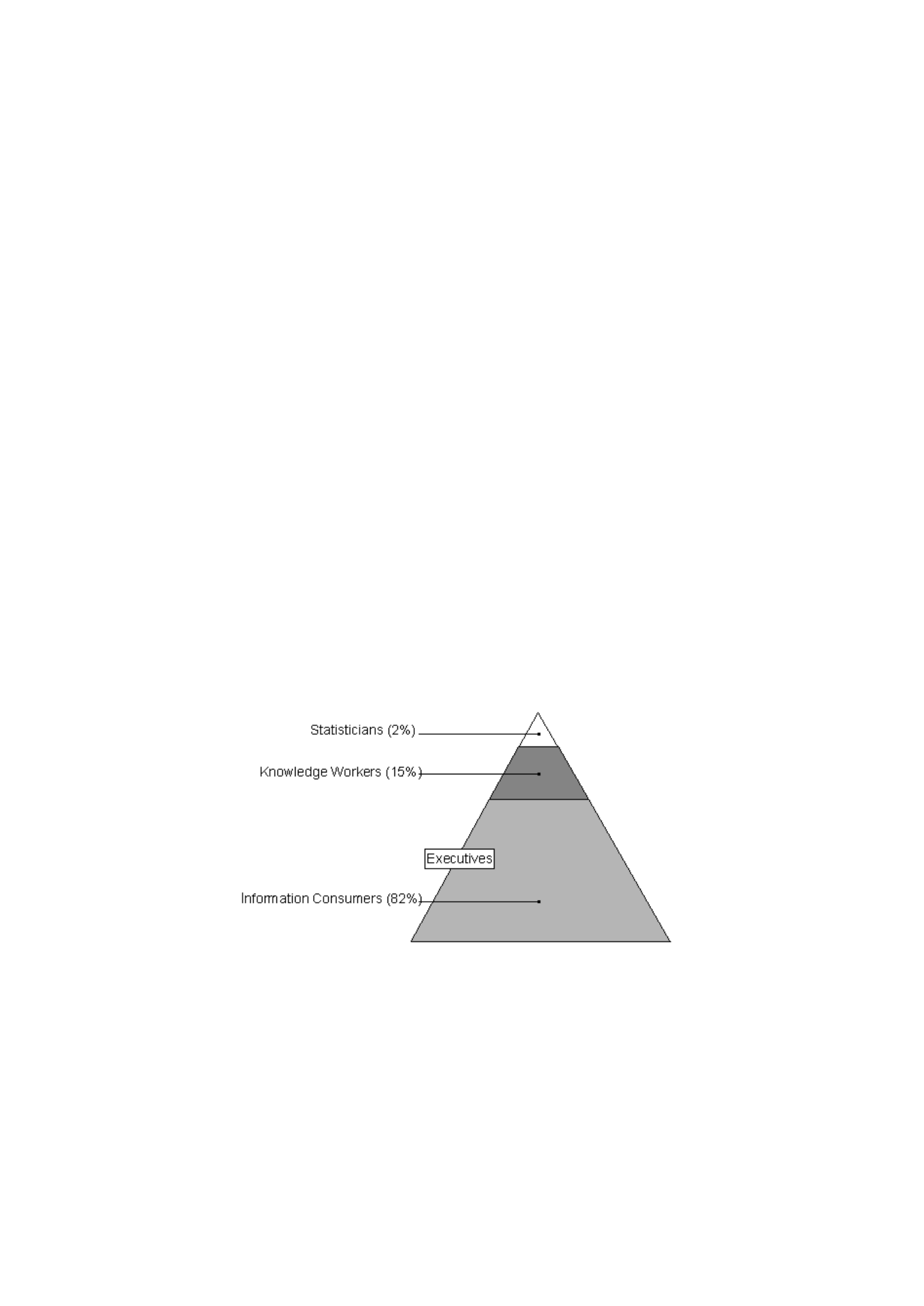
concept can be traced as early as1960s. The
pyramid below shows the beneficiaries of data
warehousing and the extent to which they use
the technology.
In 1960, General Mills came up with the terms
facts and dimensions as they are applied in data
warehousing. A decade later, IRI together with

ACNielsen speared headed the invention of data
marts utilised in retail sales.
In the same decade, Bill Inmon attempted to
define the term data house. In 1975, Sperry
Univac introduced the concept of MAPPER. It
refers to “data management and reporting
systems that include the world’s first 4GL,
which formed the first platform specifically
designed for building information centres (a
forerunner of contemporary enterprise data
warehousing platform)” (O’Brien and Marakas
93).
The work acted as an insight into the work of
Taradata in 1983 who designed and practically
tested a database management system meant to
enhance decision support. Development of data
warehouse in the application of decision support
systems acquired principal focus in the 1990s

when Raph Kimball introduced the red brick
warehouse.
This data management system was particularly
designed for data warehousing. Bill Inmon
developed further this work when he designed
software for data warehouse development in
1991. Later, in the year 2000, Daniel Linstedt
released Data Vault.
Data Mining
Data mining has established central roles in
knowledge engineering and artificial
intelligence discourses. It refers to “the process
of discovering meaningful correlations, patterns,
and trends by sifting through large amounts of
data stored in databases” (Haughton et al. 290)
following the procedure below.

Its roots are ingrained in statistics and machine
learning though applied mainly in computer
science. The subject of data mining has attracted
an immense interest over the last two decade,
although its study started four decades ago. Data
mining started as a statistical analysis tool
advocated for by two main companies: SPSS
and SAS (O’Brien and Marakas 31).
Nevertheless, some of the applications of data
mining in the past four decades remain relevant
today. They include regression analysis and
cluster analysis, among others. The modern
statistics routines used in data mining have

incredibly improved on the past application of
data mining.
New approaches to data mining like heuristics,
fuzzy logic, and neural networks began to gain
substantive scholarly attention in the 1980s.
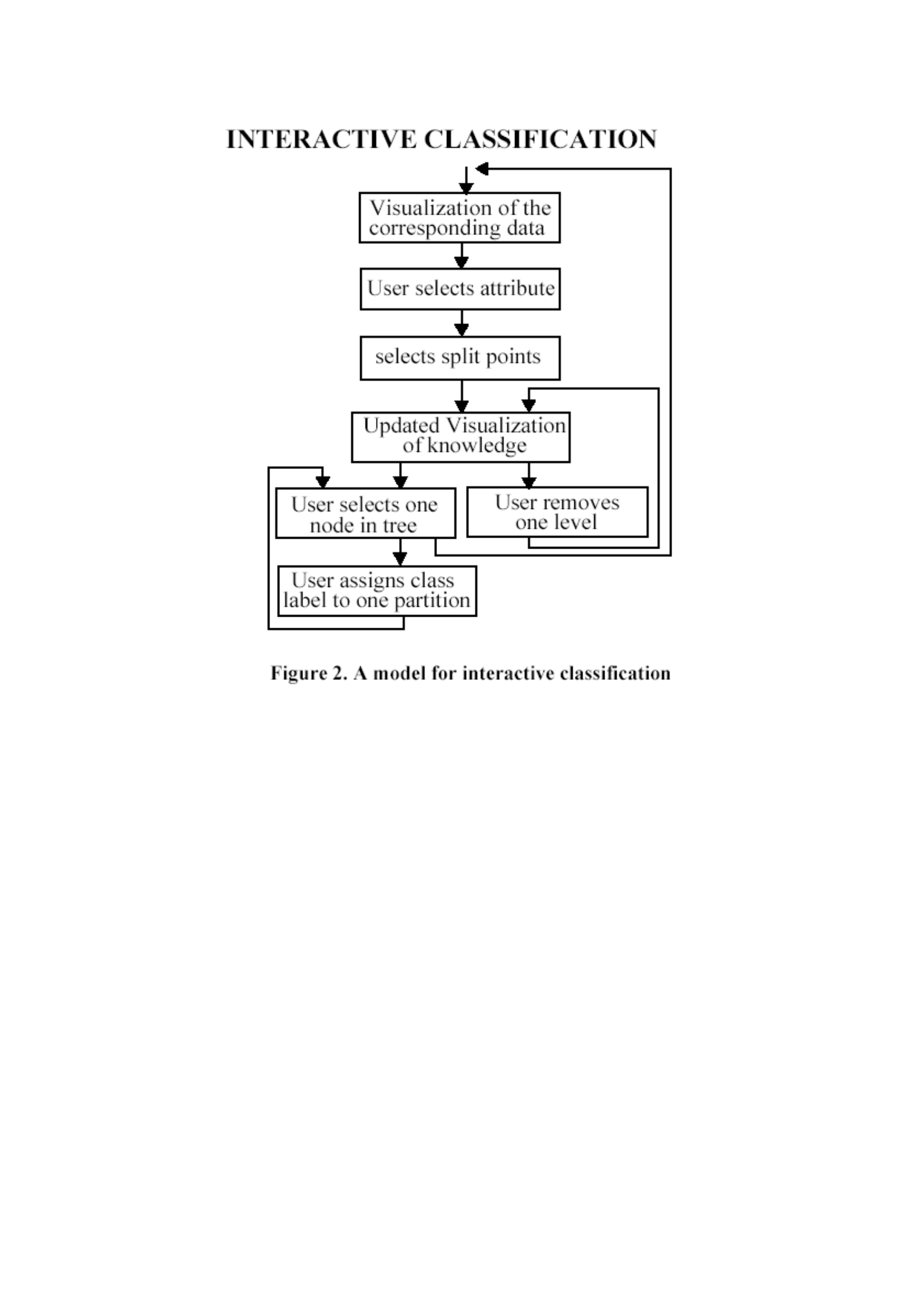
With improved computational power of
computers, more extensive analysis and
analyses that are more powerful could be done
through interactive classification.
Workshops on data mining, alternatively called
knowledge discovery in databases, were first
held in the 1990s. However, such conferences
have been incredibly on the hike over the last
decade. Precisely, data mining can be traced
from three primary sources. These are statistics,
artificial intelligence, and machine learning.
Data mining can be accomplished through

simple strategies such as graphing coupled with
charting.
A good example of enhancing data mining
through charting is the case of scatter graphs. In
an organisation, data mining has broad
applications including identification of customer
patterns, finding various associations existing
between various demographic traits of clients,
and identification of the most royal customers,
among other tasks. Arguably, multiple
departments within an organisation need such
information.
Comparison and evaluation of data
warehousing and data mining in the UAE vs.
International level
Different nations across the globe, including the
UAE, have received and applied data

warehousing and data mining in a variety of
fields.
Data mining has been applied in science and
engineering, surveillance, medical fields, and in
the business field in both the UAE and the
international arena. However, this section
discusses the application of data mining and data
warehousing in business only since other
application are beyond the scope of the paper.
In commercial applications, data warehouse and
data mining are incredibly helpful in analysing
various chronological performances of a
company often available in the company’s
records in the form of inactive data. The purpose
of the analysis of data is principally to unveil
trends and patterns of hidden business
performance.

This task is accomplished in data mining
through the deployment of data mining software,
which makes use of “advanced pattern
recognition algorithms to sift through large
amounts of data to assist in discovering
previously unknown strategic business
information” (O’Brien and Marakas 107). Data
mining has been used throughout the world,
including in the UAE to perform several
business-related tasks.
The tasks include market analysis in the effort to
identify potential new products, determine the
causes of manufacturing problems, prevent
withdrawal of some customers from consuming
an organisation’s products, acquire new
customers, generate customer profiles for
purposes of evaluation, and determine the
appropriate marketing strategies to sell across
both existing and potential customers.

Valid examples of global organisation have
invested heavily on data warehousing and data
mining to enhance their performances in the
dynamic business environment. For instance,
“Wal-Mart processes over 20 million point-of-
sale transactions every day” (O’Brien and
Marakas 141) with the transactions’ information
being contained in a centralised database.
Every department within Wal-Mart has to
extract information that is necessary to perform
its operations from the database. Although
information extracted this way is crucial for the
making of decisions that would help to better the
performance of every department within the
company, such raw data is not of any use without
having some sort of software to analyse the data.
The need to analyse such data underlines the
significance of data mining software within any

company having a large pool of customers and
with global operations.
For the case of Wal-Mart, the use of data mining
techniques to conduct an analysis of the
information contained in the centralised
database enables the company to develop
necessary campaigns for marketing and even
predict loyalties developed by customers in
relation to a myriad of brands offered by the
company with better precision.
Data mining techniques are also helpful in
aiding to build and manage customer
relationships across all organisations in the
world, including in the UAE. From the analysis
of data contained in a data warehouse of an
organisation using data mining techniques, the
UAE organisations have ceased from
maintaining a centralised call centre for
contacting potential customers.

Rather, the focus shifts to targeting customers
who have the highest probability for responding
to a given offer from the analysis of their
purchasing patterns.
Additionally, with regard to Zhu and Davidson,
from the analysis of the data contained in a data
warehouse using data mining statistical and
other tools, “more sophisticated methods may be
used to optimise resources across campaigns so
that one may predict to which channel and to
which offer an individual is most likely to
respond (across all potential offers)” (88).
Once analysis is done to determine response
patterns for potential clients for an
organisation’s products, automation of mails can
be done in the effort to solicit the potential
customers to respond. This practice has been
well developed and used not only in the UAE but
also in the global arena.

Real world examples for the application of
data warehousing and data mining used by
the UAE organisations
Data warehouses and data mining used by the
UAE are available in a variety of places across
the globe. For instance, they are used in India in
health care settings. One of such practical
application is the use of data mining to aid in
decision making as tools for evaluation of
treatment choice for various ailments such as
fibroids (Campbell 201).
In the installation process of such software, the
main challenging question that appeared was
whether data mining could indeed be applicable
in facilitation of the treatment process for
fibroids to provide means of predicating
possible treatment choices.

If the answers were yes, the hospital
technologists within India questioned on the
most appropriate data mining techniques that
would help to predict the outcomes of various
treatment options. In the effort to address these
queries, generation of an archive of data relating
to different available treatment options and the
responses of patients upon undergoing the
procedure were maintained.
Based on the characteristics of the patients,
analysis of the data warehouse helps to predict
the most viable treatment option that is
consistent with every patient’s fibroid
treatments needs in India.
Extension of this decision through data mining
and database warehouse in India to the diagnosis
and treatment of other complex ailments has
seen the nation rise up as one of the nations in
the world housing the most successful treatment

facilities with many cases of ailments requiring
advanced treatment being referred to India.
Oracle software: how it supports the business
The Oracle Company makes and sells various
software applications for business support
across the globe. The oracle software carries a
myriad of functional modules deploying
RDBMS, which functions as back-end.
The various functional modules ingrained
within business support software produced by
oracle include Oracle HRMS (human resource
management systems), oracle CRM (customer
relations management), Oracle financials, oracle
projects, and oracle procurement among others.
The first business support software to be
released by oracle was oracle financials in the
1980s. Later, the company released a myriad of
business support software, including the

database warehouse management systems and
data mining software.
The oracle data-mining module (ODM) is
essentially an optional relational data
management system (RDBMS). It constitutes
data analysis and data management algorithms
designed to support business through easing
tasks such as feature selection, classification of
data, regression analysis, detection of various
anomalies, making predictions, and other
specialised analytics necessary when making
organisational decisions.
With regard to Davenport, oracle data mining
software is pivotal in “providing a means of
creation, management, and operational
deployment of data mining models inside the
database” (214). Making of decisions within an
organisation requires immense scrutiny and
analysis of quantitative data that helps to explain

trends in business operations and in general the
industry trends.
Purposing to help an organisation to realise these
functions, regression analysis-support and
modules are incorporated into the ODM. The
implementation of various business functional-
support modules are done such that “the
implementations are integrated right into the
oracle database kernel operating natively on
stored data in the relational database tables”
(Davenport 215).
From these databases, different departments of
an organisation can tap the necessary data,
which upon its analysis helps in making vital
decisions.
Use of Carrefour Technology in Europe and
in the UAE

Carrefour is one of the leading global
distributors of various commodities. The
company has various classes of distribution
networks such as supermarkets and
hypermarkets coupled with convenience and
hard discount stores in America, Europe, the
UAE, and other regions in the world. The
organisation has been endeavouring to maintain
its leadership within a competitive grocery
industry.
The company planned to achieve this goal
through “gaining control over its marketing
process and more effectiveness in leveraging its
business intelligence- with the ultimate aim of
strengthening customer loyalty” (IBM Para 4).
The solution to resolve challenges facing
Carrefour was arrived at by strategically
deciding to partner with IBM coupled with other
parents to design and implement a system for in-

house promotion throughout the supermarkets
and hypermarkets owned by the organisation.
This strategy was found to be incredible in
aiding to plan and execute more focused
marketing plans, which would ensure rapid
assessment of the campaign feedbacks. It was
essential in the quick evaluation of marketing
efforts of the company. Getting information on
how customers respond to a given promotional
campaign may be measured from various
dimensions.
The most significant way of measuring is
assessing changes in sale levels of an
organisation. Given that Carrefour has many
retail stores across the globe, garnering all such
information requires the creation of computer-
enabled interfaces.

Faced with the need of rapid analysis of sales
data, Carrefour had limited options rather than
deploying data mining and data warehousing
technology, which consisted of various solution
components, which were an IBM Supermarket
Application coupled with IBM DB2 from the
paradigm of software.
Following the success of its technology in
helping to establish better relationships with
customers, suppliers, and in helping to plan for
short but effective marketing campaigns, the
Carrefour technology has been used in many
European and the UAE organisations to the
extent of being deployed in the retail industry
and national organisations.
Pros, Cons, Strengths, and Weaknesses with
respect to data warehousing and data mining
systems

The goal of using data management systems is
to facilitate decision-making processes in a more
rapid way. However, irrespective of the extent to
which systems may be helpful to achieve this
noble purpose, no systems lack pros and cons,
and strengths and weakness. In case of data
warehouse, copies of information garnered form
transactions within organisations are
maintained.
This case provides an essential opportunity for
an organisation to “congregate data from
multiple sources into a single database so that a
single query engine can be used to present data”
(Inmon 52).
Data warehouse also makes it possible to keep
historical records of transactions even though
systems for the transaction may fail to do so.
This data is utilised in making future forecasts,
which help to inform critical activities of a

business, including the sale and forecasting of
production patterns in the future.
Through a data warehouse, it also becomes
possible for an organisation to come up with a
means of integration of data from a number of
sources in the effort to create an overall means
for decision making in an entire enterprise.
It also enables an organisation to provide data
and information that is consistent since the
results of the analysis are representative of both
current and historical trends from the analysis of
data using data mining tools.
Furthermore, data warehousing is essential in
“restructuring data so that it makes sense to the
business users, restructuring the data so that it
delivers an excellent query performance, even
for complex analytic queries, without impacting
the operational systems, and adding value to

operational business applications, notably
customer relationship (CRM) systems” (Inmon
55).
Consequently, through data warehousing, it is
possible to provide data models for all data of
interest irrespective of the sources of the data
within an organisation. Although data
warehousing has all these merits, it has central
weaknesses (cons) in that data is usually stored
in a ‘soft’ form.
The link between data warehousing and data
mining is that it is easier to mine data, which is
properly housed meaning that the effectiveness
of data mining is dependent on data housing.
Consequently, data mining has the demerit that
it cannot be effective without the existence of an
integrated organisational information database.

In case databases are corrupted, or information
contained in them is lost through malicious acts
of some employees of an organisation or
unauthenticated access to an organisation’s
database systems, it implies that data mining
software loaded in an organisation’s systems
would have no data source from which to carry
out analysis.
In addition, as Haughton et al. reckon, “if a data
mining query has to run through terabytes of
data spread across multiple databases, which sit
on different physical networks, the query is not
efficient and that getting results will take a long
time” (301). This demerit puts a pre-condition to
data systems developers since data warehouse
systems must be developed such that they are
able to interconnect with other databases.

Market analysis for data warehousing and
data mining systems
The market for data warehouses and data mining
systems is immense in the UAE and in the
international fronts across many industries. For
instance, in the discipline of human resource,
data mining can be utilised in the identification
of employees who are most productive to an
organisation based on their historic efficiency
and outputs recorded and maintained in an
organisation’s integrated database (data
warehouse).
This argument means that the market is
substantive for the systems in organisations,
which want to have an overall means for
evaluation and interrelating data for different
organisations’ departments for integration
followed by the analysis of the integrated data in

the effort to draw more decisions that are
conclusive.
The market potential for data warehouse and
data mining software has grown in multiple
figures following the high demand for decision
support systems in the field of engineering and
general science. Such areas include education,
genetics, bioinformatics, and mechanical and
electrical engineering without negating the
discipline of medicine.
For instance, with regard to Zhu and Davidson,
“in human genetics, sequence mining addresses
the important goal of understanding the mapping
relationship between the inter-individual
variations in human DNA sequence and the
variability in disease susceptibility” (109).
The main aim for using data mining in the
human genetics is to help in the determination of

how alterations of gene structure influence the
danger for contracting ailments such as tumour.
This argument is significant in the attempt to
design and implement strategies for ailment
prevention, diagnosis, and treatments. Arguably,
the subject of immunology is beyond regional
physical boundaries between nations.
Consequently, data mining software such as the
software for the multifactor dimensionality
reduction would gain positive market reception
in the UAE and internationally, including
Europe. In fact, European nations have been
committing hefty amounts of money to
investments in the new immunology and
diseases diagnosis technologies in the past three
decades.
From a business dimension, the UAE has been
noted as being a significant business hub within
Middle East. Organisations operating in the

region largely depend on information garnering,
integration, and processing to make decisions
for vibrant growth.
These organisations are able to withstand global
market dynamics so that minimal impacts of
global financial crunch are experienced in the
UAE organisations in comparison to
organisations operating in Europe. Growth and
the ability to develop resilience to business
dynamic depend on how much an organisation
is risk-aware.
Analysis of the degree of susceptibility of an
organisation to risks is dependent on cute
establishment of the trends of business
performance based on the historical data.
Indeed, this goal cannot be realised without
analysis tools such as data mining techniques.

As argued before, these tools and techniques
cannot operate free of data. Since the goal of any
organisation is to ensure its long-term operation
in the effort to return value to its owners, data
warehousing and data mining possess an
incredibly high potential not only in the UAE
but also globally.
Main suppliers’ systems
Data warehousing and data mining systems can
be designed in-house within an organisation.
However, such an attempt would attract hefty
costs. The alternative is hiring the service of an
external supplier of the systems. Such suppliers
include IBM and Oracle Foundation, among
others.
It is important to note that, with globalisation
and diversification of markets, it is no longer

necessary to consider sources of suppliers for
information systems of an organisation from just
only potential supplier operating with a
particular trade region or a country.
Rather, consideration of global dimensions is
vital while evaluating the best information
systems for procurement. Important aspects for
considering when seeking the suppliers to
procure data warehousing and data mining
systems include the system availability, quality,
reliability, and system security, among others.
Trends, perspectives, recommendations, and
conclusion
Many industries in all business fields operating
in a competitive business world recognise the
relevance of developing information-based
organisations to help in decision supports.

The trend in the corporate world has been to seek
mechanisms of ensuring that decisions affecting
the business of an organisation are based on data
that is accumulated by an organisation for a span
of time in the effort to make the future forecast-
based for instance on data on consumption
patterns of certain customers in particular
markets.
In the attempt to remain competitive through the
establishment of specific market campaigns that
would see potential competitors pose lesser
threats of new entrants, organisations must
integrate all data handled by different
organisation’s departments into a single source
from which all departments can tap.
The paper discussed this matter as one of noble
factors that favour positive reception of data
warehousing technology both in the UAE and in
the international arena. The trend of data mining

has been the deployment of three leading data
mining techniques.
These are clustering, neural networks, and
association rule and decision trees. They have
been vital in alleviating the challenge of an
organisation having too much data accompanied
with little information.
Although an organisation can hold a tremendous
amount of data in its warehouse that documents
every transaction, such data is worthless if a
means of its analysis is not available so that
appropriate decisions based on the statistical
data inferences can be made. In this perspective,
the paper argued that data mining is the aspect
that enables an organisation to conduct an
analysis of data to reveal business trends.

Works Cited
Browning, Dave, and Joy Mundy. Data
Warehouse Design Considerations, 2000. Web.
Campbell, Kevin. Exploration of Classification
Techniques as a Treatment Decision Support
Tool for Patients with Uterine Fibroids:
Proceedings of International Workshop on Data
Mining for HealthCare Management. New
York: PAKDD, 2010. Print.
Davenport, Henry. “Competing on
analytics.” Harvard Business Review 3.1
(2006): 213-217. Print.
Haughton, Dominique et al. “A review of
software packages for data mining.” The
American Statistician 57. 4(2003): 290–309.
Print.

IBM. Carrefour strengthens customer loyalty
and its brand with a new promotions strategy,
2013. Web.
Inmon, William. Building the Data
Warehouse. New York, NY: John Wiley and
Sons, 2005. Print.
O’Brien, Jonhston, and George
Marakas. Management Information Systems.
New York, NY: McGraw-Hill/Irwin, 2011. Print.
Zhu, Xingquan, and Ian Davidson. Knowledge
Discovery and Data Mining: Challenges and
Realities. New York, NY: Hershey, 2007. Print.

Levi’s Company’s Data Mining & Customer
Analytics Report
Introduction
Levi, the renowned name in jeans is feeling the
heat of competition from a number of other
brands, which have come upon the scene well
after Levi’s but today appear to be approaching
Levi’s market with a variety of measures to
attract customers. What is worrying for Levi’s is,
these companies are also succeeding in their
efforts and giving a tough time to Levi’s. The
company desires to make intelligent decisions
based on the factual positions and circumstances
prevailing in the market. Data mining is one
such process that the company intends to adopt.

Data mining
Data mining is the process through which a
company or an organization tries to extract
useful information by compiling data from
various sources, analyzing it, and subsequently
coming out with some key components, which
can be further probed to predict the future trend
for the market and the company. In fact, as the
name itself suggests, this process involves
mining the data from almost everywhere having
a direct or indirect link with the business
operations of the company.
The useful data is then sifted with the help of
available analysis techniques to narrow down to
usable data. Subsequently, the company is
supposed to take a number of decisions like
deciding about the range of products, pricing
strategies, marketing communication, and
promotion strategies, etc. For example, a

product can be priced in many ways depending
upon the cost of manufacturing, variations in the
cost of raw materials, the cost of reaching out to
customers, the prevailing economic conditions,
the income levels of the market segment, etc.
Product pricing also depends on the availability
of competitors in the market and certain rules
and regulations of the land.
Similarly, propagating a brand and making
investments for creating a brand identity also
depends upon the potential of the market
assessed with the help of data mining.
Brand promotion
Biswas et al. (1998) state that technological
advancements have made it possible to collect
and store data quite easily. What actually causes
the problem is the abundance of data and it

becomes quite challenging to effectively and
efficiently analyze this data using the automated
mechanism to better understand, characterize
and validate known phenomenon and trends and
discover the new and interesting phenomenon.
This appears to be the case with Levi’s. Levi’s is
an internationally renowned name for jeans. It
all began in 1853 when a Bavarian immigrant
named Levi Strauss opened a wholesale dry
goods business.
He continued to be a small-time business for the
next twenty years, till he patented the process of
putting rivets in pants for strength. This gave
birth to the world’s first jeans[1]. The rest is
history. Today we have a number of well-known
brands in jeans, but Levi’s continued its
dominance over denim, the cloth which was
initially meant for sailors but became a fashion
statement gradually, for well over a century.

Today, there are a number of brands that are
vying for the market space, therefore, Levi’s is
supposed to;
1. Make efforts to retain the existing
customer base
2. Tie up with major retail outlets to make the
brand available with prominence.
Nowadays retail outlets have their own
loyal customer base.
3. Work out the maximum benefit that can be
passed on to the customers as well as the
retailers, which might imply constraints on
the company’s profit margin.
4. Look for volume sales as well. Having a
strategic tie-up with high-end stores
definitely gives a value proposition to the
brand and its customers, but the
association with high-end stores only

might result in alienating the major
consumer base, which relies on retailers
like Wal-Mart, Tesco, etc. Today we are
living in a competitive era, which implies
more the merrier. As has been pointed out
in the article in San Francisco, last year, the
company’s profit plunged 32% to $151
million on sales of $4.25 billion. The need
for having a pair of denim pants that sells
for under $25 has been pointed out in the
article as well.
Data mining will certainly help Levi’s in making
an informed decision and understanding the
socio-cultural and economic profile of its
customer base. Data mining can be carried out
by;
1. Analyzing the sales figures of previous
years and comparison of targets with
actual achievements.

2. Analyzing the variations in sales figures
i.e. increase or decrease over the years.
3. Taking a look at the motivation levels of its
employees. A satisfied and motivated
workforce proves to be a big boost for the
competitive strategies of the company.
4. Comparing the effect of factors like
pricing, brand promotion, salary hikes, etc.
on the production and sales.
But the company will do a world of good if it
could take a lead from other available indicators
like the general profile of jeans customers.
Similarly, it will also help the company if it
could start exploring the customer base outside
the developed market. For instance, the Asian
region in general and markets like China and
India particular are major consumer markets for

such items. Questions might be raised on such
strategies by way of;
1. Questioning the dilution of brand value
2. Doubting the success of strategies in
somewhat closed and protected economies
like China
3. Viability of investing huge amounts in
generating demand for the Levi’s
But the company needs to answer such criticism
by taking a round look at the prevailing scenario
of consumerism and its compulsions for a
sustainably profitable business. For example;
1. Brand value depends upon its recognition
by people. Trying to give a premium look
to a product like Jeans, might not be a wise
move in these times of market-driven
economies.

2. China is gradually opening up its economy
to the outside world and the billion-strong
consumer base is a big attraction for
companies nowadays.
3. Investing towards establishing brand
awareness certainly helps in remaining in
public memory, which is translated
towards sales in the long run. The kind of
advertisement and promotion did by
companies like Coke and Pepsi even
during off-peak seasons like winters, is an
example.
In order to make a mark in the developing
markets, Levi’s will certainly have to adopt a
competitive and penetrative pricing strategy
instead of skimming strategies. Online retailing
by supermarkets is a new trend nowadays, which
can work to the advantage of the company if it
is able to create awareness and desire amongst

the prospective customers. For this marketing
communication strategies prove quite handy. Of
late Levi’s has certainly realized this and
ventured on to a promotion campaign. It needs
to continue the momentum.

Disadvantages of Using Web 2.0 for Data
Mining Applications
Introduction
With the advancement of technology, data
mining has increased dramatically. Data mining
refers to the process of analyzing data to identify
unrecognized data patterns or trends to make
decisions (Bourgeois et al., 2019). Both large
and small companies use this technology to
ensure that they gather and assess the
information regarding their performance and
customers’ satisfaction before they can make
new investments.
Discussion
The shift in internet usage has led to Web 2.0,
where websites and other applications have

changed to user interactive. Various bloggers
can now gather information from different
websites or companies and post such
information on social media. On the other hand,
the readers can comment and give their views
freely. Although Web 2.0 can be used in data
mining, it has several disadvantages.
Too much information is posted daily; hence,
there is data overload. With Web 2.0, people
with different thoughts post a lot of content on
the internet. This data can be confusing to the
readers and may not be reliable. The freedom
allowed by Web 2.0 to post a comment on the
posted content allows rivals of the company to
give negative feedback (Bourgeois et al., 2019).
Therefore, the information gathered may not be
reliable for making decisions. There could be an
issue of forgery and hacking crimes (Gallaugher,
2015). This happens when an individual

impersonates or tries to access data to use
maliciously. Such crimes are possible with the
use of Web 2.0 in data mining. For example, a
person may create a Facebook account with
company details and post irrelevant information.
This is likely to attract negative comments and
may ruin the reputability of the affected
company.
Conclusion
In conclusion, although Web 2.0 can be a good
way of obtaining data through user comments,
its disadvantages are significant. For instance,
information overload can be confusing and may
lead to unreliability. The freedom to express
views allows rivals to post negative comments
that may perplex decision-making. Lastly, with
the use of Web 2.0, forging and hacking crimes
can be experienced, leading to privacy threats
over confidential information.

A Discussion on the Acceptability of Data
Mining
Data mining has been defined differentially in
diverse contexts, but the major underlying theme
is that it is an activity that engages in nontrivial
extraction of previously unknown data for
purposes of collecting useful information that
can be applied to a wide-range of settings.
Today, more than ever before, individuals,
organizations and governments have access to
seemingly endless amounts of data that has been
stored electronically on the World Wide Web
and the Internet, and thus it makes much sense
for these entities to internalize the desire to
analyze and synthesize this data in a focused
attempt to discover meaningful patterns hidden
within the data (Ethics in Computing para. 1-2).

However, it should always be remembered that
data mining may occasion devastating effects if
proper regulations are not adopted by the
participating entities or stakeholders. The
purpose of this paper, therefore, is to
demonstrate that data mining is acceptable and
advantageous if proper regulations are put in
place.
The first reason why data mining is acceptable
is that it facilitates organizations to provide
better services to customers. This capability
provides organizations with a distinct advantage
over competitors as they are more able to learn
about customer purchase behaviors, beliefs and
expectations through data mining. Indeed,
extant literature demonstrates that data mining
assists organizations “to build detailed customer
profiles, and gain marketing intelligence (van
Wel & Royakkers 129).

Within the business context, therefore, it can be
argued that data mining assists marketers and
business organizations to not only build models
based on data to predict the target audience that
is likely to respond to new marketing initiatives
or new products in the market, but also to
reinforce customer buying behavior and
experience (Zentut para. 2).
However, companies utilizing data mining to
forecast customer trends should understand that
there is always a probability of breach to
security, which may lead to several negative
ramifications, including theft of sensitive
personally identifiable information. Such risks
should be countered by putting in place adequate
security measures to guarantee information
privacy (van Well & Royakkers 138).
The second reason why data mining is
acceptable is that it assists governments to not

only provide effective and efficient services to
citizens, but also identify and deal with criminal
activities.
Indeed, extant literature demonstrates that “data
mining helps government agency by digging and
analyzing records of financial transaction to
build patterns that can detect money laundering
or criminal activities” (van Well & Royakkers
132). This is a worthy function considering the
fact that governments all over the world lose
huge amounts of money annually to money
launderers.
Of course there exists a threat arising from the
fact that government agencies may fail to
exercise ethical responsibilities of data
disclosure when dealing with personally
identifiable information, but such a threat can be
addressed through developing and
implementing stringent security measures and

rules of engagement when dealing with sensitive
personal data. Privacy and confidentiality of
data must be maintained at all times for data
mining to achieve its desired objective within
this context (Seltzer 1442).
The third reason is premised on the fact that data
mining can be applied within the manufacturing
sector to “detect faulty equipments and
determine optimal control parameters” (Zentut
para. 5).
This is a noble achievement by virtue of its
capability to ensure the products coming out of
our factories are safe to use and can also be
depended upon to make life easier and more
fulfilling. This benefit is intrinsically tied with a
disadvantage that industries may engage in
misuse of information or the usage of inaccurate
information (Zentut para. 9), but then statutory
and governmental rules and regulations

governing the use of data mining information
should be put in place to avoid misuse.

