


CREATIVE STRATEGY AND SUCCESS IN
BUSINESS ENTERPRISE

It is by no doubt that the success of a business enterprise
depends on a number of key factors that ought to be put
into consideration. We are living in information age
where economies are driven by crucial information
technology. In fact, start-ups that flourish from the early
stage have to set up or establish robust information
technologies in place. In particular, creative industries
have a lot at stake if they are to succeed and outwit
market competition. Various complex challenges
experienced in the modern global economies may as
well be turned into opportunities for business growth
and development. For instance, a highly competitive
market structure is a vivid indication that innovation
should follow (Duggan 88). In other words, innovative
solutions are needed out there all the time.
Leading creative effort towards innovation might be a
toll order to some organizational leadership because it
demands thorough commitment. Contrary to the
popular belief that innovation originates from genius
minds, it is vital to mention that it takes effort of team
leaders and the wider organizational workforce to bring

innovation to light. This does not rule out the fact that
talent management comes in handy in innovation.
Perhaps, Organizational leaders should approach
innovation as social architects and not social
visionaries since any piece of innovation combines
several ideas from different talented minds.
Leading a team of creative workers can be even more
challenging if innovation is to be applied. In any case,
teams have to put their minds together, deliberate on the
matter at hand and eventually come up with functional
solution. The final product of a task being executed by
a team is the most important attribute. Hence,
successful innovative teams can only be proud of their
inputs after assessing the final product.
Numerous examples of successful and innovative
organizations exist just as we have those entities that
have failed in the marketplace. Nonetheless, successful
organizations share a number of outstanding abilities.
These include creative resolution, creative agility and
creative abrasion. When debate and discourse are used
to generate ideas, it is referred to as creative abrasion.

Of course differences can hardly be avoided at
workplace (Duggan 62). However, successful
organizations strive to minimize individual differences
within teams instead of magnifying them. Healthy
arguments should be allowed. As much as points of
view may differ, innovation cannot be obtained in the
absence of diversity. When portfolios of alternatives are
available, creative innovation can be realized.
After various innovative ideas have been availed,
adjustment, reflection and quick pursuit are necessary
in order to refine and experiment the ideas. Running
experiments through the proposed ideas is vital in
ensuring effectiveness. Eventually, innovative teams
are supposed to devise creative resolutions before
adopting the proposed ideas.
On the other hand, failed organizations probably lack
leaders who are ready to learn and lead. Some of the
traditional notions of leadership may not yield the much
needed creative innovations that are in tandem with the
fast-changing business world.

Creative innovation should not just be within the
process of production. Creativity is required even at the
point of marketing. Organizations that succeed at
marketplace go beyond innovative production. This
implies that a complete chain of innovative ideas
should be in place before creativity can leave a positive
and lasting impact in an organization (Duggan 54).
Better still, creative innovation should not be a one-off
event. It ought to be an on-going and continuous
process.

Business Goals Achievement: Risk Assessment
Strategy
Introduction
An integral part of all activities, the risk is one of the
most important issues that should be taken into account.
To achieve one’s goals and reap profit with minimal
loss, it is necessary to consider several components and
design a corresponding risk assessment strategy
because financing and risk management are correlated
(Rampini, Sufi, and Viswanathan 283). While the
approaches may differ, the following elements are to be
addressed.
Hazard Identification
First and foremost, one should single out possible
hazards in terms of natural and human factors. Fires,
explosions, pandemic diseases, terrorism, and
workplace violence may serve as examples
(Department of Homeland Security par. 8). Every
sphere is associated with a certain set of hazards and
they may develop over time, especially if a business
changes its location and domains of influence. To

formulate an effective strategy and refer to the urgent
issues, one should list the hazards, constantly monitor
them, and make corrections if necessary.
Probability and Magnitude
The diagnosed risks are not equal. One can use the
possibility and magnitude to describe their imbalance.
The first criterion pertains to the degree of probability
of a particular scenario. The likelihood that a given
event will occur is different in different areas and
regions; for instance, the earthquake hazards are high
in Indonesia, Japan, Nepal, and some other countries
(Curtis and Carey 5). As for magnitude, the possible
level of risk should be estimated. The assessment
strategy should be based on the data concerning the
most frequent, destructive, and probable disasters.
Assets at Risk
After hazards and their probability are identified, it is
significant to find which assets may be affected and to
what extent they are subject to risks. Again, there are
numerous assets, such as people, property, supply
chain, business operations, systems and equipment,

reputation, and confidence (MITRE par. 5). Human
resources will become a matter of greatest concern
(Leveson 30). Other priorities should be determined by
the opportunities to restore assets and approximate
expenditures.
Vulnerability
Apart from ranking its assets, a company should also
estimate the level of its vulnerability. In other words,
the importance of an asset does not imply its extreme
vulnerability (Rupert par. 20). Consequently, the task of
great significance is to explore the strengths and
weaknesses of each asset and find out which of them is
crucial. This analysis also helps to recognize future
solutions and make recommendations.
Impacts
Taking into consideration the components mentioned
above, one can assume the impacts connected with
risks and assets. Casualties, property damage, loss of
clients and partners, financial obstacles, fines and
penalties, and lawsuits are some of the common
impacts (Department of Homeland Security par. 8).

When possible impacts are identified, one can use them
as constituents of a certain situation because outcomes
usually cover more than one asset.
Conclusion
In sum, it is possible to state that risk assessment
strategies are vital because any business has to deal
with hazards. One can argue that there are several
elements of assessment strategies, namely hazard
identification, possibility and magnitude, assets at risk,
vulnerability, and impacts that largely depend on each
other. Their connection is linear: having registered the
relevant hazards, it is important to evaluate their
probability and magnitude because they directly
influence assets. According to the vulnerability of
assets, the impacts may be different. Thus, all the
elements are linked, and a good risk assessment
strategy addresses all of them.

Business Intelligence Strategy and Framework
The organisations emerging and developing in the
modern environment encounter huge amounts of
information which they should process to gain effective
performance and remain competitive. Business
Intelligence (BI) is a set of methodologies, techniques,
and strategies that allow collecting raw data and
transforming it into functional information that can
provide various insights regarding an organisation
(Hawking & Sellitto 2015). For example, tactical,
operational, or strategic decisions can be made on the
basis of BI. The value of successful BI lies in the facts
that it can decrease the total cost of ownership (TCO)
for information technology (IT) and raise the return on
investment (ROI) for hardware along with software;
enhance IT infrastructure to make enterprise-wide
information accessible for users so that they would be
able to come up with critical solutions; boost up
collaboration and establish a decision-support structure
(Boyer et al. 2010).

Galliers’ new problem-oriented strategising framework
views Information Systems Strategy as an inalienable
constituent of Business Strategy. The mentioned
framework distinguishes between three areas,
including exploitation, exploration, and change
management strategies, the collaborative implication of
which ensures knowledge creation and infrastructure
sharing. The exploitation strategy focuses on
empowering business operations such as information
services or Enterprise Resource Planning (ERP)
software.
The exploration strategy that is considered as the
emergent one addresses the complexity of business
processes through learning, generating, and sharing
innovative ideas. The organisational change based on
continuous learning composes the change management
strategy. Among the benefits of Galliers’ BI framework,
one may note the capacity to identify competitive
advantage, address alignment complications, and, most
importantly, adjust to the changing environment. In
other words, flexibility and relevance are the two key

indicators of this framework, making it rather
significant. However, it should also be specified that
companies may experience some difficulties while
implementing Galliers’ BI framework as it prioritises
the process and exploration rather than the outcome.
Nevertheless, it is an essential way to apply on-going
learning and the strategising process within an
organisation.
The business intelligence strategy framework offers an
organisation a wide range of opportunities in the field
of measurement, interpretation, and decision-making,
thus serving as an essential instrument to enhance it.
This framework can be employed as guidance on the
way to design an effective BI by considering all the
necessary details. Most importantly, the BI strategy
framework monitors the alignment of the corporate
mission to the current business strategy that leads to
resilience (Hasan, Lotfollah & Negar 2012).
Furthermore, such challenges as cultural, political, and
economic ones may affect an organisation and also BI.
Therefore, the latter takes into account that every

organisation is a unique structure, having its strengths
and weaknesses, organisational culture and structure
level, etc. That is why BI is not a ready-made plan but
rather a framework that guides an organisation.
It should also be emphasised that BI is quite dynamic
and may alter with some changes in an organisation’s
internal and external environment. For instance, certain
economic fluctuations may lead to the situation, when
a company would transform its BI strategy to fit new
requirements. In this connection, it becomes evident
that BI needs to be verified on a regular basis and
compared to the accepted benchmarks. In order to
implement BI, the following questions may be posed:
what happened? why? when? how many? (Loshin
2012). In effect, the results are to be transformed into
meaningful information that, in its turn, may be
presented in reporting, automated monitoring,
dashboard scorecards, and so on. The mentioned data
visualisation instruments assist business leaders in
timely access to data and the subsequent appropriate
decisions.

Along with the basic BI instruments that were
enumerated above, there is a broader set of tools that
compose this framework. In particular, financial
planning and forecasting as well as technologies and
programs, including integration, data warehouse, and
governance can be noted (Sherman 2015). Thus, the BI
framework presents essential capabilities to elaborate
on business strategy monitoring and improvement. The
review of the current BI tendencies reveals that the
scope of BI is increasingly penetrated by the ideas of
Software as a Service (SaaS), covering analytical
applications, data integration tools, and information
services (Rausch, Sheta & Ayesh 2013).
The decision-making process tends to be less
comprehensive and based on unstructured or poorly
structured information, thus making the means of its
search and transformation to the form accessible to
analytical tools extremely demanded. Besides, there is
a wave of innovations in the field of visual
representation of information, which promises to
simplify the work with information. To conclude, BI

presents a composition of rather significant tools to
collect data and transform it into beneficial information
the use of which is critical to the decision-making
process.
The General Motors Firm’s Business Strategy
Summary
The consequences of the strike are often disturbing:
people do not understand how to work afterward. In
General Motors, there are significant concerns about
imbalanced teamwork. These include new contracts,
lower wages, staff decline, and improper medical
insurance.
Moreover, some past events collapsed the working
atmosphere in General Motors (GM), such as the
multiple struggles of the 2000s, the ignition key
incident, recalls of many cars, and multimillion debt.
The issues should be solved on many levels:
operational, technological, leadership, employee
engagement, morale, etc. Applying organizational
psychology theories is also helpful: Maslow’s
hierarchy, Theories X and Y, McKinsey’s 7S, and other

approaches. Maintaining a safe workplace for
employees is necessary, implying high motivation and
productivity and developing strategies that will allow
workers to feel comfortable within their workplace.
Background
General Motors (GM) is a huge multinational
corporation that designs, produces, and distributes cars
and vehicle details worldwide. The company was one
of the most successful vehicle manufacturers and
owned significant stakes in foreign brands. However,
General Motors faced difficulties in 2007, leading to
bankruptcy in 2009; the company’s CEO had to appeal
for financial support. In 2009, GM had to announce
their bankrupts; indeed, the company had to accept a
considerable debt. The company decides to deal with
this problem by excluding multiple models of their
vehicles, closing factories, and firing many employees.
Despite being the leader in the international market of
cars, GM still has an enormous doubts.
United Automobile Workers (UAW), a labor union,
agreed to support GM’s employees by increasing their

wages and giving them certain benefits. However,
workers still suffered from lowered salaries with the
flow of time. The lack of a workforce was apparent:
GM lost their employees, despite workers accepting
structural changes. Moreover, the incident of 2014
subjected GM to more complicated struggles. The
strike connected with the dismissal of employees’
medical insurance and lowered wages due to staff
reduction happened. These main issues collapsed the
company and led to the instability.
Business Strategy Development
It is crucial to determine which problems arose during
employees’ strikes and seek practical solutions. On the
operational level, which means supervising employees
and being first-line managers, it can be effective to
calm people down and listen to them. Moreover, it is
crucial to understand that a similar idea unites people
that go to strike: their behavior, thoughts, and values
often split and create a united intelligence. This
phenomenon usually refers to the collective
unconscious, and it is essential to appeal to the group

as a whole (Fordham, 2018). There is a necessity to
calm people down and listen to their terms and
requirements. A compassionate, kind, and emphatic
leader will keep people calm (Hakanen and Pessi,
2018). Accessibility, empathy, and responsiveness are
critical features of operational-level managers.
The technological level uses technical knowledge and
solves related issues, and different decisions might
affect the company’s workers. It can be an excellent
solution to provide workers with a fixed salary, which
the government and company’s policies establish
minimum. Therefore, wages cannot be less than a set
minimum. Concerns about the new contract changing
the company’s policy can be clear, and employees’
reactions are negatively predictable. The agreement
should be reviewed to satisfy the needs of CEOs,
managers, and employees. The CEO of GM, Mary
Barra, claims that closing plants are connected with
automatization (Euronews, 2018). It might become a
reason for firing 14,000 employees (Euronews, 2018).
Indeed, it is possible to requalify many workers into IT

specialists and technical support workers. It can save a
vast part of the staff. It is vital to fix the supply chain
and achieve it through proper planning and execution.
It is necessary to think about possible supply chain
scenarios, generate connections with reliable linking
elements of the chain, and invent different solutions to
provide quality management.
Abraham Maslow’s theory is a famous approach for
measuring human needs. The theory of hierarchy needs
first appeared in Maslow’s book Motivation and
Personality, and this date is considered a foundation of
the approach (Suyono and Mudjanarko, 2017). Overall,
the policy deals with five concepts of human life. It
includes physiological, safety, love, esteem, and self-
actualization needs (Oved, 2017). The main idea of
Maslow’s theory is that the person cannot reach the
next step of the pyramid until he is done with the
previous. Maslow’s theory applies to the situation with
the General Motors strike, and it is essential to look at
why: employees seek to have financial stability, and
their motivation is clear. Moreover, employees’ desire

for money and safety is proven by the company’s
absence of proper medical and economic conditions.
Therefore, it is crucial to create the pyramid of GM
employees’ needs:
It is also essential to motivate people and maintain
collective employee morale. According to Theories X
and Y, people are encouraged to work when their needs
and expectations are satisfied. X assumes little
motivation and responsibility avoidance, while Y is
inspired to work without direct reward. Therefore, it is
essential to lead GM employees in the Y direction, as
workers are encouraged to work for the long run when
their expectations are fulfilled (Tahir and Iraqi, 2018).

Several issues that can raise motivation in employees
and improve the overall atmosphere are monthly
financial bonuses, discounts for vehicles, and extra
bonuses.
Moreover, one organizational psychology approach to
work is the self-leadership theory. It states that people
use several strategies to motivate themselves to do
tasks. It includes thinking methods and self-rewards,
with the help of which employees can raise their
awareness and focus on work (Maykrantz and
Houghton, 2018). Strategies of the self-leadership
approach strive to increase inner motivation by
changing the attitude to the task in a positive direction
(Neck et al., 2019). It might be helpful to arrange
business training to inspire GM workers; it will also
help understand their values, preferences, and desires at
the workplace to improve relations between managers
and employees. In addition, leadership positioning and
relations with employees might be enhanced by
lowering power distance, as workers want to be heard,
and smaller spaces can fix the problem.

Strike avoidance is a complex issue; however, it might
be possible to conduct. Employees require being heard
and listened to their complaints during and after the
strike. The struggle requires understanding the basics
of human psychology, and it is necessary not to mute
employees to prevent a huge problem. Interaction,
communication, and feedback might help the leaders
and employees to hear each other. It is possible to
gather reviews and complaints with the help of online
or offline surveys twice a year to avoid serious
problems. Surveys can become good indicators of
changes and dynamics of the company’s success.
Middle managers can serve as mediators between
employees and leaders of GM – it might help avoid
misunderstanding, and every member will interact to
solve the issue.
Moreover, determining employees’ terms and leaders’
goals is essential. For example, it will be helpful to
identify precise facts that do not satisfy the staff—in
addition to avoiding pressure from both sides to
understand the problems to be addressed. It is possible

to evaluate tradeoffs concerning workers’ salaries
according to the established wage standards and the
GM’s policy. Furthermore, it is helpful to implement
strategies of organizational psychology. For instance,
the path-goal theory is an excellent framework to
motivate employees with the help of compassionate
leadership. It is essential to maintain friendly and
trustful relations within all layers of the staff to improve
the workplace atmosphere.
The business solution for GM will be the following:
identifying the company’s mission and values,
development of corporate culture and maintenance of
good relations in the company, and developing unique
working skills. Making smart investments and
implementing innovations are also ways to achieve the
goal.
Moreover, McKinsey 7S is a working framework for
determining the precise goals and objectives of the
company. After implementing and combining these
approaches, every member of the staff is involved, the
interaction between people will improve, and every

worker will understand the company’s direction. The
framework for General Motors will be the following:
From both personal and professional perspectives,
organizational psychology knowledge, undergoing
psychological business training, and intercultural
communication experience would help me investigate,
assess, and improve the situation in GM. I might be an
appropriate candidate to solve issues of the company
due to the unique combination of business and
psychological approaches. According to some studies,
combining professional and theoretical knowledge is
one of the best ways to make significant improvements
(Hakanen and Pessi, 2018). For instance, a similar

business strategy leads the Lego company to success,
so I rely on constant development (Sommer, 2019).
Moreover, I think that my compassion, empathy,
purposefulness, and care skills might attract the GM to
choose me as a consultant.
Reference List
Euronews. (2018). General Motors to close plants and
cut jobs to cope with ailing market. Web.
Fordham, M. (2018). Analytical Psychology. Great
Britain: Taylor & Francis.
Hakanen, J. J., and Pessi, A. B. (2018). ‘Practicing
compassionate leadership and building spirals of
inspiration in business and in public sector’, Practicing
Servant Leadership, pp. 119–140. Web.
Maykrantz, S. A., & Houghton, J. D. (2018). ‘Self-
leadership and stress among college students:
examining the moderating role of coping
skills’, Journal of American College Health, 68(1), pp.
89–96. Web.

Neck, C. P., Manz, C. C., and Houghton, J. D.
(2019). Self-Leadership. New York: SAGE
Publications.
Oved, O. (2017). ‘Rethinking the place of love needs in
Maslow’s Hierarchy of Needs’, Society, 54(6), pp.
537–538. Web.
Sommer, A. F. (2019). ‘Agile transformation at LEGO
Group’, Research-Technology Management, 62(5), pp.
20–29. Web.
Suyono, J., and Mudjanarko, S. W. (2017). ‘Motivation
engineering to employee by employees Abraham
Maslow theory’, Journal of Education, Teaching and
Learning, 2(1), pp. 86-92. Web.
Tahir, H. K., and Iraqi, M. K. (2018). ‘Employee
performance and retention: a comparative analysis of
theory X, Y and Maslow’s theory’,Journal of
Management Sciences, 5(1), pp. 100–110. Web.

Marks & Spencer Irish Business Strategy
Business Strategy of M&S in Ireland
Nowadays, M&S is known as a household name in the
realm of the apparel and, recently, food industry.
However, the market environment has not always been
just as auspicious for M&S as it currently is. Quite the
contrary, the organization faced a significant crisis
recently due to a string of bad decisions made as early
as 2001 (Mellahi, Jackson & Sparks 2002). Having
failed at several critical steps in the development of its
business strategy, the organization could not retain its
customers, not to mention attracting new ones, and,
therefore, found itself in a deep crisis (Molinero,
Bishop & Turner 2005).
By failing to isolate the factors that affected its
performance in the Irish market, M&S created a vortex
of bad decisions into which it ultimately fell, only
having revived its business after reconsidering its
business strategy toward product diversification,
customer relationships, and thorough market analysis.
Strategic Analysis and Positioning

Table 1. SWOT Analysis.
Strengths
• Strong success in the target market;
• Strongly established brand;
•
Weaknesses
• Lack of insight into the target market;
• Poor market analysis and, therefore, inadequate marketing strategy;
• Inability to develop and maintain the company’s strategic direction;
• Inability to manage changes.
Opportunities
• Expanding into a new market;
• Diversifying the company’s products.
Threats
• Failure to be introduced to a new market;
• Failure to develop a sustainable marketing strategy.
According to the SWOT assessment performed above,
M&S’s performance was faltering in 2001. The
organization could not determine its strategic direction,
which resulted in the mismanagement of its financial
decisions and a range of poorly thought-out choices that

inevitably led to a crisis within the company. M&S had
obvious strengths, including a very impressive
presence developed in the Irish market, as well as the
focus on diversifying its production line (Scott &
Walker 2017). However, the company’s strategy toward
the management of the challenges associated with the
new market, as well as its approach toward handling the
difficulties observed in the Irish economy, appeared to
be entirely backward.
The refusal to consider other channels except for
British suppliers for its clothes has also played a
notorious role in the company’s downward progression
in the Irish market. While maintaining collaboration
with the British partners would help in producing
exquisite clothes by M&S’s traditional performance
standards, the necessity to invest in product
diversification and the development of the firm’s food
sector made it quite difficult to maintain the established
extent of quality given the demands of British suppliers
(Shapira 2017). Outsourcing would have been a better
option, yet it would have meant a drop in the quality of

clothes, which M&S could not afford without an
appropriate rebranding strategy, which the organization
neglected to conduct.
The absence of a business strategy that would have
helped the organization to become instantly
recognizable and gain the trust and support of new
customers is the main contributor to M&S’s failure in
Ireland. Having to split between the promotion of its
clothing as a part of its traditional routine and the
marketing of its food products, M&S could not get the
amount of attention that it needed to establish itself as
a recognizable brand (Soltani-Fesaghandis & Pooya
2018). As a result, an immediate failure ensued.
When dissecting the exact factors that led to M&S’s
demise in Ireland, one should name not only the
inability to market its products adequately but also the
misunderstanding of what would have made the
promotion process successful. The absence of any
preparedness toward the challenges that the digital
market suggested entailed a string of disappointments
for the company, making a lot f its target audience

neglect its offers. As a result, M&S, which was
supposed to become a memorable and recognizable
brand, remained in obscurity.
Table 2. Porter’s 5 Forces Analysis.
Bargaining
power of
suppliers
Medium: resources clothes and food being a very common product, the
bargaining power of suppliers used to be considerably low. However, the
company’s focus on high-profile clothing made the bargaining power of
suppliers slightly higher.
Bargaining
power of buyers
Medium: At the start of its business journey, M&S did not have many rivals
that could offer the same combination of exquisiteness and chic in clothing.
The threat of new
entries
Low: Due to the high bar that M&S set for the quality of its services from
the start, there was very little risk of other companies trying to match its
performance.
Threat of
substitutes
Medium: While M&S clothes are very easily substituted with similar items,
the company developed the competitive advantage that made its brand
associated with a certain social status.

Competition
High: In the target setting, M&S had to deal with the substantial competition
since a range of other companies had already made a name for themselves in
the apparel industry.
The results of Porter’s 5 Forces analysis show clearly
that M&S was not ready to expand its business.
Therefore, while the organization’s intent to diversify
products was quite reasonable, the lack of market
analysis and the assessment of customers’ demands, as
well as previously made financial decisions that did not
reflect well on the company’s performance, led to
M&S’s hasty retreat from the European economic
environment.

Figure 1. Ansoff Matrix: M&S (own development).
As the Ansoff Matrix (see Fig. 1 above) shows, the
organization attempted at entering an entirely new
market environment with the products that it has
already developed for its home market, which is a
reasonable choice in case a firm is willing to reduce
risks.
By focusing on diversification and yet neglecting the
research of its target market, M&S Ireland failed to
establish a presence in its new setting and, thus,
suffered a severe blow to its popularity, financial
capacity, and overall reputation that it used to enjoy

before the 2001 catastrophe. In 2001, the organization
announced that it was going to shut down a range of its
outlets in most of the European market, including the
United Kingdom, France, Germany, Belgium, Spain,
and several other countries (Toms & Zhang 2016). The
observed situation became particularly prominent in
the Irish market, where M&S had to cease all of its
activities to retain some of its financial assets and
reduce the expected losses and the damage to its
reputation to a minimum.
What M&S Ireland Did After 2001 to Create /
Renew Sustainable Competitive Advantage for the
Organisation
2001 has been particularly difficult for M&S Ireland,
with the company’s reputation having been soured
significantly after several noticeable blunders. The
company made a string of bad decisions that caused it
to close the majority of its shops across Europe and face
a very real threat of closing the business down entirely
(Osborn 2001). Looking back at the 2001 catastrophe,
one will realize that the marketing failure and the losses

that M&S sustained did not occur overnight; quite the
contrary, the rapid downfall of the organization in
Europe was predetermined in 1998 when M&S made
the life-changing decision to foray into the U.S.
economy (Osborn 2001).
To address the embarrassment that M&S faced in 1998-
2001, the company had to revisit its business strategy
entirely and set the course for a different approach
toward marketing, customer segmentation, and brand
development.
The decision to shift from the traditionally rigid
principles of managing its internal processes defined by
the British culture and standards, in turn, was one of the
core changes within M&S’s business strategy that
allowed the company to move away from its 2001
failure. After the unsuccessful attempt to establish a
presence in the European markets with the marketing
model intact, the organization decided to consider
making its production line more diverse. Specifically,
further development of Per Una, a new clothing brand
that would help the firm to attract the attention and

support of new and younger audiences, made future
revival possible (Eley 2019). Therefore, the shift from
the stale traditions and the attempt at bringing
innovative solutions into the company worked quite
well for M&S.
To make its competitive advantage sustainable, M&S
began to increase the extent of product differentiation
as a means of increasing its sales and, therefore, its
profit margins. The described approach seems to be the
direct response to the limitations of the digital
economy, which does not have the exact equivalent of
the strategy of increasing the number of online outlets,
as M&S used to do when it operated primarily in the
offline context. Therefore, the company’s current
approach seems to be based on maximizing value at all
costs, which is why M&S may seem indiscriminate
regarding the strategies that it chooses to increase its
revenue.
Although the observed trend in M&S’s range of
strategic approaches toward managing the business is
quite expected, it still comes off as rather desperate.

Therefore, altering the specified framework slightly
may have a positive effect on M&S’s performance. The
redesign of the company’s cost management approach
will help to reduce the economic shock that it
experienced on the described time slot and encourage
M&S to accept change as a part of its business strategy.
Evaluating M&S Using SWOT and Porter’s Five
Forces
Current Situation
Admittedly, the actions taken by M&S have been quite
successful so far, with the company has recovered from
its recent failure in the 2000s and restoring faith in its
services among its customers. However, the company
has been struggling in its attempt at expanding and
catering to a wider range of people from other
backgrounds. Therefore, the incorporation of the tools
that would help the firm to implement better customer
segmentation and product differentiation strategies is
currently required. As a result, M&S will develop the
competitive advantage that will help it to market its
products more effectively and gain a much stronger

position in the Irish market, as well as enter the global
economic setting.
Being prolific in the apparel and retail industry is quite
a challenging task given the range of competition, the
complexity of the supply chain that one has to establish
in it, and the multiple quality standards that an
organization has to uphold to gain traction within the
global community. However, M&S has managed to
gain both an impressive reputation and a range of
devoted customers despite its unexpected dive in
revenues and overall performance in late 2018 – early
2019 (Force 2019). Although the organization showed
a tremendous decline in its performance and revenue on
the specified time slot, it managed to revisit its
corporate strategy by making a complete turnaround in
its corporate strategy and revisiting its approach toward
product branding.
Strategic Analysis and Positioning
Table 1. SWOT Analysis.

Strengths
• Brand name recognition: the company has made a huge name for itself in
the Irish apparel and retail market (Calu et al., 2016);
• High rates of product diversification: starting as an important player in
the apparel industry, M&S has introduced new products, which included
food (fruit and vegetables);
• Success in retail: M&S has a huge number of retail outlets that people
frequent quite often (Jin, Miao & Park 2018).
Weaknesses
• High expense rate: due to the specifics of the company’s supply chain,
namely, the production process, its costs often skyrocket, which reduces
the number of customers and, therefore, the company’s sales;
• Publicity issues: while M&S has been enjoying a mostly positive
reputation in the Irish and global markets, the company has failed to
attract younger audiences, which tend to perceive M&S as old-fashioned.
In its public relations approach, the company has done nothing to correct
it (Tan & Yu 2019).
Opportunities
• Entering the global market: M&S needs to pursue chances of partnering
with new organizations, expanding its supply chain, and attracting new
customers;

• Appealing to new audiences: introducing segmentation into its marketing
approach will help M&S to sell its products to a much greater number of
customers (Yu, Cao & Tan 2019).
Threats
• Failure to build competitive advantage: the current competitive rates
within the apparel and retail industry are very high;
• Inability to utilize the latest technological advantages to its benefit and
introduce effective digital solutions for improving the supply chain
(Hasnin, Tanim & Alam 2017).
As far as the weaknesses are concerned, addressing
them will require revisiting the presently applied
framework for managing the company’s supply chain,
specifically, the manufacturing process. Currently, the
use of manual labor has been the main source of the
observed rapid increase in the extent of costs suffered
by the company (Grębosz-Krawczyk & Siuda 2019).
However, reducing the amount of manual labor and
transitioning to a new model of production that
involves automation may cause M&S its trademark
quality and the distinguished look that its products
have. The specified concern is related mainly to the

clothes that the organization produces since the
specified items are typically positioned as luxury
brands and marketed to the target audiences as such to
capitalize on the luxury trend (Kumagai & Nagasawa
2016).
Table 2. Porter’s 5 Forces Analysis.
Bargaining
power of
suppliers
Low: since the products in question (namely, food and clothes) are very
common items to sell, there are a lot of suppliers whose services M&S can
use.
Bargaining
power of buyers
High: due to high levels of market saturation, a large number of customers,
and the presence of numerous alternatives, the bargaining power of buyers
is quite high.
The threat of new
entries
Low: with numerous agents present in the market and the vast number of
expenses required to establish a supply chain, the probability of another
company entering the market is quite low.
Threat of
substitutes
High: although the elasticity of products such as food and clothes is typically
very low since they are commonly required, M&S offers luxurious items,
the alternatives to which can be found wherever apparel or food stores are.

Competition
Very high: the levels of competition in the apparel, food, and retail
industries, in which M&S operates, are extraordinarily high due to the
presence of numerous companies and the high levels of buyers’ bargaining
power.
The current extent of the company’s performance has
been moderately effective, with M&S’s business
strategy representing a significant improvement
compared to the crisis suffered by the organization in
2007 (Toms & Zhang 2016). However, the current level
of competition in the market coupled with the fact that
M&S fails to attract a very large segment of the
possible target population leads to the realization that
M&S may need to update its current marketing
approach. Introducing diversification and
encompassing other market segments, the organization
will be able to attain even greater success.
Table 3. Strategic Planning.
Mission and vision
• Producing the goods of the highest quality;

• “Sustainable multichannel retail” (Rigby 2016, par. 1)
Core Values
• “Product, value for money, innovation and choice”
(M&S 2019, p. 16).
SWOT
• Strong presence in the apparel market;
• Publicity and expenses issues;
• Global market expansion;
• Poor competitive advantage.
Objectives, measurements, and
tactics
• Entering the global retail and apparel market;
• Establishing an improved and diversified brand;
• Creating a multifaceted supply chain network.
Funding streams and resources
• Combination of different funding resources;
• Banks and other funding organizations.
The mission and vision of M&S in 2019 are strikingly
different from those of the 2000s, mostly due to the
decision to use a new business strategy. Currently,
M&S targets to increase its sustainability and introduce

environmentalism into the set of its functions (Calu et
al., 2016). The trend that M&S has been pursuing is
quite lucrative due to the opportunity to attract the
attention of Millennials (Kumagai & Nagasawa 2016).
Moreover, the change in the firm’s values will allow
M&S to introduce a more ethically sound approach
toward its production processes.
However, even the current rendition of the company’s
mission, vision, values, and objectives could use
improvements. Presently, the company lacks a
sustainable approach toward financial management that
would allow for a cost-efficient framework. The
specified change would lead to better marketing due to
the availability of a greater range of tools and strategies
for introducing M&S’s new products into the target
environment.
Moreover, the fact that M&S has been omitting several
segments of potential customers due to its current focus
on luxury items and the unwillingness to transfer to the
marketing approach that would attract the attention of
younger audiences shows that the company could use a

massive change. Therefore, the focus on developing the
marketing strategies that would allow M&S to grab
younger audiences’ attention should become the main
vector of the firm’s development.
In its turn, the lack of a clear competitive advantage that
would help M&S to be seen as superior when compared
to cheaper alternatives is quite noticeable. M&S needs
to introduce a new competitive element into its
marketing equation to garner success among the
younger crowd, which is why the existing vision and
mission of the organization will require further shaping.
Along with the focus on expansion and the marketing
strategy, the company should also consider
implementing the financial framework that would help
it manage its resources more sparingly. Thus, the firm
will maintain its status, also exploring the opportunities
with attracting younger audiences.
Further Strategic Chances
Given the current situation at M&S, one might
recommend the company to revisit its marketing
technique to target younger audiences and appeal to

other segments apart from the current one. While being
quite lucrative, the current marketing strategy exempts
a vast variety of buyers from its equation, which
suggests that M&S loses a range of opportunities in its
selected market. The company needs to learn from past
mistakes and avoid investing in the idea that has worn
out its welcome a decade ago. Instead, M&S will need
to learn to consider future trends and make
comparatively accurate forecasts regarding shifts in the
demands within the target market.
Admittedly, the idea of product diversification has been
a breeze of fresh air for M&S since it has helped to
refocus the organization’s framework for operating in
the global market. Moreover, the foray into the industry
of supermarkets and grocery stores has helped the
company to create new ties with a different segment of
customers, thus establishing itself as a company that
caters to the needs of different types of buyers
(Kumagai & Nagasawa 2016).
Moreover, the company is clearly in need of an
innovation-based business strategy that will make the

process of introducing change into its setting
comparatively effortless. Although M&S has updated
its business strategy to refrain from the traditionalist
approach that it has inherited as a part of the company’s
British cultural legacy, few steps have been made to
integrate the idea of change into M&S’s very body of
operations. As a result, while having improved its
business performance significantly, the organization
still needs to adjust to the ever-changing market and the
constantly shifting trends in market demand.
Given the need to expand and the risks that M&S will
face in a new setting and with new audiences, as the
2001 foray into the European market has proven, M&S
will need the support of other influential companies.
Therefore, the reconsideration of the current business
strategy aimed at restricting M&S’s marketing
approach and its supply chain will be needed.
Specifically, the supply chain of M&S will have to be
expanded to include a greater number of retailers and
distributors. While the current set of suppliers that
M&S uses seems to be sufficient, the company may

require a greater number of new options, which is why
the infrastructure of M&S’s supply chain will change.
Finally, the set of marketing techniques and strategies
currently used by the organization will need to be
altered. While the change in the customer segmentation
framework that M&S adopted can be seen as a major
step toward progress, further changes will be needed to
make the organization gain weight in the target
economies once again. Applying the STP model, one
will see that the company will have to perform a better
analysis of the needs and demands in the target
environment, primarily, in the Irish and European
markets for clothing, as well as food and groceries (see
Fig. 2). By splitting its target audiences into clusters
based on their age, gender, socio-cultural background,
and other characteristics, M&S will be able to create
the marketing approach that will appeal to them.
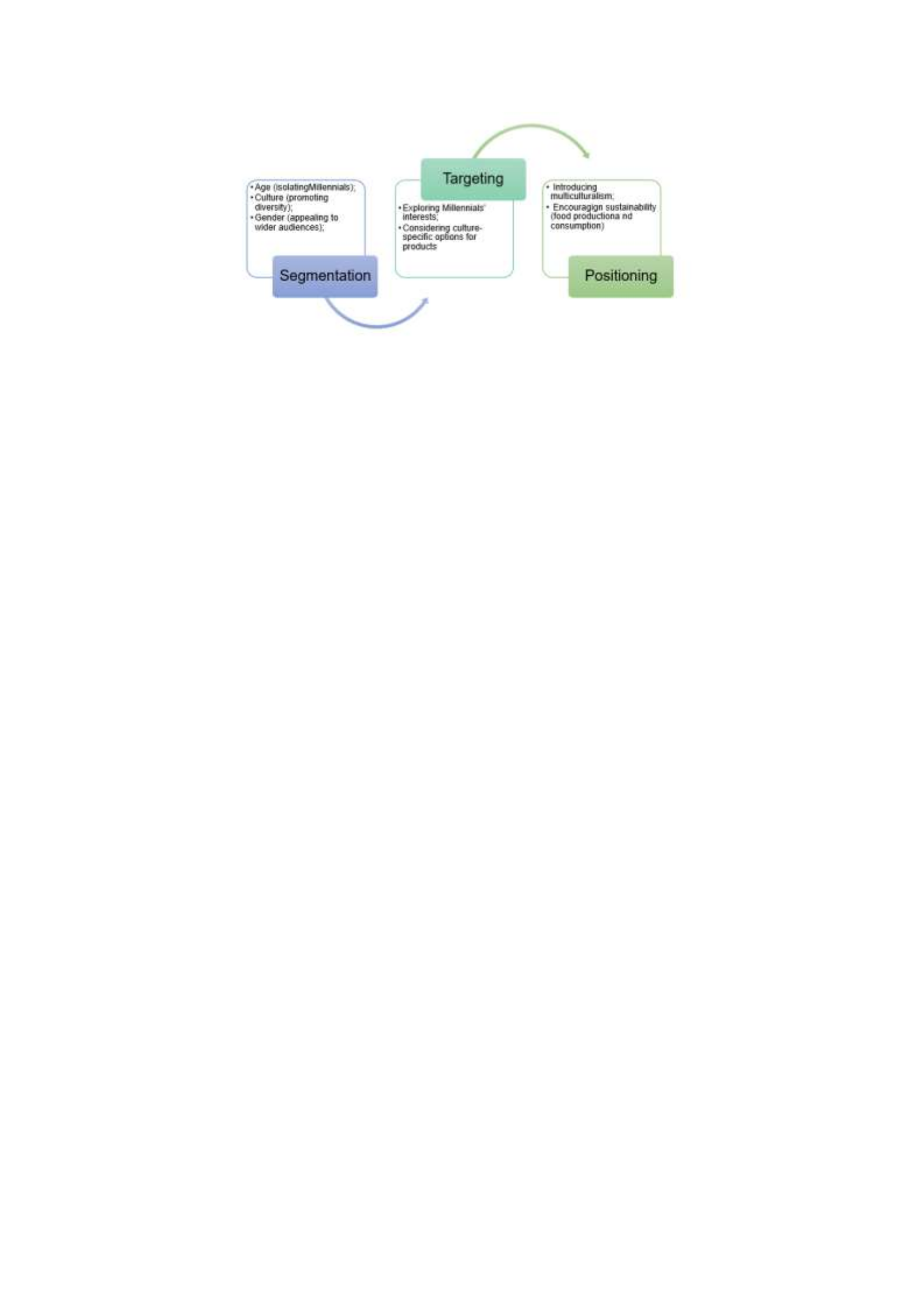
Figure 2. M&S: STP.
Currently, the company seems to have been
experiencing difficulties in attracting audiences
belonging to the younger generation, as well as creating
a framework for appealing to customers from different
cultural backgrounds. Similarly, M&S has been
encountering difficulties positioning its products and
creating a strong brand image that would appeal to a
wide range of buyers. Therefore, one may advise the
company to invest in market research and R&D, at the
same time reducing the costs taken for certain processes
within its supply chain, such as transportation. The
latter, in turn, can be achieved by revisiting the
infrastructure of the SCM process. As a result of
changes in the current business strategy, the company’s

performance can become salvageable and even reach a
new level of efficacy.
Furthermore, the appeal to a wider audience and a new
marketing strategy for attracting younger audiences
may help M&S in increasing its competitive advantage
and creating a unique brand identity. A detailed
psychographic analysis of the company’s potential
customers will be most needed since it will define the
marketing approach that the company will undertake.
Given the current situation in the apparel industry, as
well as in the one of food and grocery, the company
may need to focus on the strategy of product
diversification and the use of digital channels,
specifically, social media, to appeal to buyers.
The organization has already started exploring the
options for customer-specific marketing rather than the
generic approach that it has been adopting for years
(Calu et al., 2016). However, the described step will
require changing M&S’s priorities from managing its
business as a set of separate processes linked by a
common goal to the creation of an interactive

interdisciplinary environment where collaboration and
information sharing become the main priority (Killian
& McManus 2015).
Remarkably, with the proposed change, one will be able
to introduce the concept of innovation and a customer-
oriented approach in the development of the marketing
tools into M&S’s setting more actively. While the
company has been contemplating the idea of innovative
production and decision-making, there has been no
consensus regarding the application of innovative
principles to the company’s design (Calu et al., 2016).
However, with change being brought to M&S, the
company may shift toward innovative thinking as the
method of making decisions and managing key
operations.
As far as the marketing issue and especially the change
in branding is concerned, M&S will have to change its
approach toward the promotion of its products,
especially as far as the clothes are concerned. To appeal
to a younger generation ad connect to a different age
group, the organization will need to create an entirely

new brand that will be based on the idea of being unique
and delicately leveling the specified need with the
necessity to reduce costs. The latter might become quite
a problem for M&S given the fact that the organization
has built its entire reputation based on the concept of
using clothes as the marker of the buyer’s wealth and
social status (Bahng, Yang & Reilly 2016).
However, after redefining the corporate values and
focusing on the exploration of the culture of buyers and
other customer-specific information, M&S will address
one of the major demands of its new audience, which is
the appeal to the uniqueness and individual experiences
of each customer (Calu et al., 2016). The emphasis on
the enhancement of customer-specific strategies will
also help to improve M&S’s competitive advantage,
making it unique due to the combination of high-quality
standards and the ability to appeal to a wide range of
audiences by establishing rapport with them and
meeting their culture-specific needs.
The current use of responsible marketing is one of the
highlights of M&S’s recent change in its business

strategy since it allows positioning the company as
caring and moral due to its focus on making ethical
decisions. In its attempt at diversifying its services and
creating new brands, the company should make the
audiences notice the fact that it adopts only sustainable
practice and strives to meet the set environmental and
sustainability-geared standards. The appeal to
sustainability is expected to become one of the major
drivers in building the company’s competitive
advantage and creating a name for its new brand.
Finally, M&S has to revisit its approach toward
managing external and internal processes. The
principles of corporate governance as a critical part of
the business strategy are needed to maintain control
over every aspect of M&S’s performance. With an
increase in the number of details added to its supply
chain, M&S may fail to keep the track of each f them
individually, which suggests that M&S should offer
greater flexibility in its controlling functions.
Reference List

Bahng, Y, Yang, JH & Reilly, A 2016, ‘A qualitative
approach to understanding Hawaiian apparel
manufacturers’ exports: strategic marketing resources,
dynamic capabilities and export barriers’, International
Journal of Export Marketing, vol. 1, no. 1, pp. 96-113.
Calu, A, Negrei, C, Calu, DAS & Viorel, A 2016,
‘Reporting of non-financial performance indicators‒a
useful tool for a sustainable marketing
strategy’, Ecostor, vol. 1, no. 1, 977-993.
Eley, J 2019, ‘The formidable challenge of rejuvenating
M&S’, Financial Times. Web.
Force, ET 2016, ‘Opinion statement ECJ-TF 2/2015 of
the CFE on the decision of the European Court of
Justice in Commission v. United Kingdomm (‘final
lossess’)(case C-172/13), concerning the’Marks &
Spencer exception’, European Taxation, vol. 56, no.
2/3, p. 87-93.
Grębosz-Krawczyk, M & Siuda, D 2019, ‘Attitudes of
young European consumers toward recycling
campaigns of textile companies’, Autex Research
Journal, vol. 19, no. 4, pp. 394-399.

Hasnin, NE, Tanim, TR & Alam, KMS 2017, ‘A study
on selected firms of the apparel industry to find out the
motive behind firms to exercise corporate social
responsibility–‘to buy goodwill’or ‘out of good
intention’, Australian Academy of Accounting and
Finance Review, vol. 2, no. 1, pp. 23-43.
Jin, H, Miao, Y & Park, ST 2018, ‘A case study of
Marks and Spencer lost China’, Journal of Industrial
Convergence, vol. 16, no. 2, pp. 15-23.
Killian, G & McManus, K 2015, ‘A marketing
communications approach for the digital era:
managerial guidelines for social media
integration’, Business Horizons, vol. 58, no. 5, pp. 539-
549.
Kumagai, K & Nagasawa, SY 2016, ‘The influence of
social self-congruity on Japanese consumers’ luxury
and non-luxury apparel brand attitudes’, Luxury
Research Journal, vol. 1, no. 2, pp. 128-149.
M&S 2019, M&S is a leading retailer with a strong and
unique heritage of brand values, extraordinary

colleagues and customers who want to see it succeed
again. Web.
Mellahi, K, Jackson, P & Sparks, L 2002, ‘An
exploratory study into failure in successful
organizations: the case of Marks & Spencer’, British
Journal of Management, vol. 13, no. 1, pp. 15-29.
Molinero, CM, Bishop, H & Turner, M 2005, ‘The
distress of Marks & Spencer PLC in 2001: a
multidimensional scaling analysis/Los problemas de
Marks & Spencer PLC en el 2001: análisis de
escalamiento multidimensional’, Cuadernos De
Estudios Empresariales, vol. 15, p. 107.
Osborn, A 2001, ‘M&S’s European catastrophe’, The
Guardian. Web.
Rigby, E 2016, Marks & Spencer sets out new vision of
‘sustainable’ multichannel retail. Web.
Scott, P & Walker, JT 2017, ‘Barriers to
‘industrialisation’for interwar British retailing? The
case of Marks & Spencer Ltd.’, Business History, vol.
59, no. 2, pp. 179-201.

Shapira, Z 2017, ‘Entering new markets: the effect of
performance feedback near aspiration and well below
and above it’, Strategic Management Journal, vol. 38,
no. 7, pp. 1416-1434.
Soltani-Fesaghandis, G & Pooya, A 2018, ‘Design of
an artificial intelligence system for predicting success
of new product development and selecting proper
market-product strategy in the food
industry’, International Food and Agribusiness
Management Review, vol. 21, no. 7, pp. 847-864.
Tan, JY & Yu, M 2019, ‘Corporate social responsibility:
consumer perception for the UK apparel
companies’, Journal of Marketing Management and
Consumer Behavior, vol. 2, no. 4, pp. 32-45.
Toms, S & Zhang, Q 2016, ‘Marks & Spencer and the
decline of the British textile industry, 1950–
2000’, Business History Review, vol. 90, no. 1, pp. 3-
30.
Yu, M, Cao, D & Tan, JY 2019, ‘CSR-consumption
paradox: examination of UK apparel
companies’, Journal of Fashion Marketing and

Management: An International Journal, vol. 23, no. 1,
pp. 124-137.

Business Strategy for Promoting a Promising
Market
Introduction
This paper presents an analysis of market data provided
in Table 1 and 2 (both of which are market indicators
for a competitive market). Firm ‘A’ is personified and
the business strategies, tactics, and plans for driving a
prospective market have been discussed appropriately
with references made periodically to factual and
theoretical justifications.
Focus Groups – Period 0
Customer
RetailSales(mill.)
UnitSales(000’s)
%Chg(units)
1E $
$5,735
479
-10.00%
1T $
$6,891
334
7.00%
2E $
$6,885
466
5.00%

2F $
$20,798
952
4.00%
2M $
$3,983
181
8.00%
3S $
$5,649
204
6.00%
3T $
$5,568
286
4.00%
3U $
$6,833
322
5.00%
4F $
$6,849
237
5.00%
4L $
$4,401
111
5.00%
5L $
$5,652
158
5.00%
5U $
$10,335
413
9.00%
Total
$89,576
4142
4.00%
1E: Value Seekers – Economy
UnitShare
ClassFit
Size
Price

Delite
0.69
Economygood
good
$11kbest
Alec
0.3
Economygood
big
$14kworst
1T: Value Seekers – Truck
UnitShare
ClassFit
Size
Price
Estruck
0.61
Truckgood
too small
$21kworst
Detonka
0.27
Truckgood
too small
$19kbest
2E: Families – Economy
UnitShare
ClassFit
Size
Price
Alec
0.69
Economygood
small
$14kgood
Delite
0.15
Economygood
too small
$11kbest
Efizz
0.09
Familyok
big
$18kavg.
Alfa
0.03
Familyok
good
$23kavg.

Defy
0.02
Familyok
big
$24kavg.
Cafav
0.01
Familyok
big
$29kpoor
Boffo
0
Familyok
big
$32kworst
2F: Families – Family
UnitShare
ClassFit
Size
Price
Defy
0.32
Familygood
good
$24kavg.
Efizz
0.3
Familygood
good
$18kbest
Alfa
0.25
Familygood
too small
$23kavg.
Cafav
0.04
Familygood
big
$29kpoor
Boffo
0.01
Familygood
big
$32kworst
2M: Families – Minivan
UnitShare
ClassFit
Size
Price

Camini
0.64
Minivangood
big
$22kworst
Estruck
0.09
Truckpoor
good
$21kavg.
Detonka
0.07
Truckpoor
small
$19kbest
3S: Singles – Sports
UnitShare
ClassFit
Size
Price
Buzzy
0.43
Sportsgood
big
$33kworst
Alfa
0.1
Familypoor
small
$23kavg.
Defy
0.1
Familypoor
big
$24kavg.
Awesome
0.07
Utilitypoor
good
$20kgood
Efizz
0.07
Familypoor
good
$18kbest
Cafav
0.06
Familypoor
big
$29kavg.
Boffo
0.05
Familypoor
big
$32kpoor

3T: Singles – Truck
UnitShare
ClassFit
Size
Price
Detonka
0.73
Truckgood
good
$19kbest
Estruck
0.11
Truckgood
big
$21kgood
Buzzy
0.01
Sportsok
small
$33kworst
3U: Singles – Utility
UnitShare
ClassFit
Size
Price
Awesome
0.55
Utilitygood
too small
$20kavg.
Euro
0.14
Utilitygood
big
$25kavg.
Detonka
0.06
Truckpoor
big
$19kgood
Efizz
0.06
Familypoor
too small
$18kgood
Alec
0.06
Economypoor
too small
$14kbest

Buzzy
0.02
Sportsok
good
$33kworst
4F: High Income – Family
UnitShare
ClassFit
Size
Price
Cafav
0.46
Familygood
small
$29kavg.
Boffo
0.19
Familygood
small
$32kavg.
Defy
0.1
Familygood
too small
$24kavg.
Alfa
0.05
Familygood
too small
$23kgood
Beaut
0.04
Luxuryok
big
$36kavg.
Efizz
0.03
Familygood
too small
$18kbest
Climax
0.02
Luxuryok
big
$43kworst
4L: High Income – Luxury
UnitShare
ClassFit
Size
Price

Climax
0.65
Luxurygood
good
$43kworst
Beaut
0.26
Luxurygood
small
$36kbest
5L: Enterprisers – Luxury
UnitShare
ClassFit
Size
Price
Beaut
0.67
Luxurygood
good
$36kavg.
Climax
0.12
Luxurygood
big
$43kworst
Buzzy
0.08
Sportsok
small
$33kbest
5U: Enterprisers – Utility
UnitShare
ClassFit
Size
Price
Euro
0.54
Utilitygood
small
$25kworst
Awesome
0.17
Utilitygood
too small
$20kbest
Camini
0.06
Minivanpoor
big
$22kavg.

Industry: ind1 : Middlesex University Spring 2010
Period 0
Table 1: Market indicators for a competitive market.
Emphatically, the deliberation on the market
performance is conducted with the context provided
below:
• A summary of Period 0 (starting) situation for
Firm ‘A’ and employed an initial strategy;
• Firm A’s performance objectives and actual
performance;
• Key strategic moves that led to success for Firm
‘A’;
• How Firm ‘A’ is projected for the future; and
• Important lessons learned from the simulation
experience.
A Brief Summary of the Period 0 (Starting)
Situation for Firm ‘A’ and Employed Initial
Strategy

The principal aim of getting a company started is to
achieve financial profit, to make money, or earn
appreciable returns! There may also be other
necessities that could bring about one starting a
company/industry. But what the reason would be for
getting a business started, there must be a stable and
well-defined growth layout. There must be the
satisfaction of customers. There must be resources to
keep the company up and ahead.
Products – Period 0
(Vehicles, Classes, New Vehicles, Upgrades)
Vehicle
Class
UnitShare
MSRP
Alec
Economy
13.00%
15351
Alfa
Family
7.50%
24084
Awesome
Utility
7.40%
21149
Beaut
Luxury
4.10%
38385

Boffo
Family
2.30%
35003
Buzzy
Sports
3.30%
34652
Cafav
Family
4.70%
31361
Camini
Minivan
4.20%
24144
Climax
Luxury
2.50%
45997
Defy
Family
9.30%
25921
Delite
Economy
10.00%
11293
Detonka
Truck
8.80%
19572
Efizz
Family
9.40%
18869
Estruck
Truck
6.60%
21843
Euro
Utility
7.10%
26528
Table 2: Industrial performance reflecting the
competitive market progressive report from period 0.

Resources, in this case, include materials and labor-
drives. Without very well defined and stratified
structures or goals, a company no matter the liquidity
will collapse. From Table 1, it can be seen that quite a
several firms have demonstrated workable market
strategies.
For example, Alec capitalizes on the economy offers
safer products, and has achieved a 13.00% market
index. On the other hand, Alfa is a business based on
family delivery, has emphasized safety, and achieves a
7.50% market index. This lag behind Alec could be
consequent of limitations in family patronages of the
product from the Alfa group. It can notice however that
the strategy sales better than Beaut which capitalizes on
luxury and offers higher stylish products- yet the firms
achieve a net market index of 4.10%.
Lately, to have a better understanding of market drift,
firms have employed the application of data mining in
evaluating products as they attract marketing. Even
though data mining is only an emerging concept in
addressing market expectations, it is already a one-stop

point for the unification of parallel/distribution
processes, visualizations, artificial-intelligence,
machine-learning, as well as statistical visualization of
market trends.
This tool could also be seen as a process involving the
review of a pattern, an association, an anomaly, and a
statistically relevant structure for projecting market
expectations (Maskell and Baggaley, 2003, p.231). The
significance of this important tool in aiding knowledge-
based marketing discoveries, the realization of
emergent phenomenal, and enhancing the general
understanding of analytical situations is tremendous.
This could be effective for a better position market
index for the firms in Table 1.
Firm A’s Performance Objectives and Actual
Performance
It is not just enough to start a company but it is worth
ensuring that there is the availability of a quality
product for the maximum benefit and satisfaction of the
customer through a price check. For Firm ‘A’, there was
a staffing inadequacy that made the actualization

effective product production and distribution. To deal
with the problem of staffing, which is internal to the
company, there is a need to scout for staff, especially
online through freelance marketing.
In Africa, where much of the population constitutes
young desperate youths, a well-defined strategy which
may be in the form of community incentives may be
adopted by Firm ‘A’ and this will market the product
through the people. The cost of maintaining staff will
then be reduced.
Generally, the performance objectives of the firm ‘a’
are as follow:
• Promotion of fairness, efficiency, and maintain
an orderly market;
• Aid customers in retailing fair transactions; and
• Improve the capabilities of business and enhance
the efficiency of a return index.
Firm ‘A’ could also utilize cost allocation as a tool for
ensuring its equitable running. Cost allocation entails a
way of attributing costs to specified cost-centers in an

organizational setting. Usually, the allocation of costs
by companies is necessitated by the need to adequately
satisfy the sharing of relevantly incurred costs. This can
be likened to spreading costs across end-users. The
allocation of costs is therefore a mere assignment of
costs to several units that constitute a company.
In a multidivisional business that requires security
services for the protection of its infrastructure, for
instance, the various units that constitute the business
will be incorporated in costs for securing the required
security. Allocating costs to the various departments of
a company is usually done arbitrary (as practiced by
coca-cola international, for instance). One other firm
that has adopted the use of cost allocation effectively is
CPK.
CPK is a household name in restaurant service and
offers California-style cuisine, represented through
creative pizzas, pasta, soups, sandwiches, appetizers,
and desserts. Opened on March 27, 1985, by the
attorney’s Rick Rosenfield and Larry Flax, CPK is

currently owned, licensed, or franchised at 265
locations in 321 states and 10 foreign countries.
This makes it a chain company with networked units
that are centrally controlled from its managerial
framework. The chain has two directions of
development, the full-service restaurants, and the
CPK/ASAP concept which focuses on the fast-casual
service in significantly smaller restaurants.
The consideration of CPK here for an analysis of its
cost allocation is limited to the year 2010, and is based
on the company’s systematic administration through
which it has achieved distinct allocation of cost to its
various sects. The performance credibility and an
effective cost allocation of CPK have been reflected in
its rating by Forbes magazine as been self-made, and
on enlistment as one of America’s best small
companies. This rating takes into consideration the fact
that CPK has annual revenues in the range between
$5million and $750 million, being publicly traded at
least for a year.

Key Strategic Moves that Led to a Success for Firm
‘A’
Recently, business operatives have realized the need to
adopt the use of social media in reaching out to
customers. The tool is so far turning in impressive
results – and the need for attractive branding of
software is made pronounced. Jive is directly engaged
in the process of designing sophisticated but user-
friendly software that targets attracting customers on
mediums like Facebook/Twitter. But apart from this, a
company must have a clearly defined target and
sectionalize its production line to benefit demand.
Caterpillar Inc (Abbreviated as CAT on the NYSE) as
one leading global company, by revenue, for instance,
has consistently led its industrial sector in the United
States in past few decades and at the same time
competing in the global market basically from a
domestic-manufacturing-base (DMB) recording over
half of the sales made to overseas clients.
In its last quarterly report in 2010, this was reflecting
when the company presented a $707million profit; an

increment of 91.0% as of what was obtained a year
earlier. The profit was realized through an increment of
about 31.0% in sales/revenues which amounted to
$10.40billion for the quarter.
Firm ‘A’ therefore adopted a customer-based marketing
approach- this fresh approach constituted four elements
as noted by Hutt and Speh:
1. “Growing the core business, pursuing
acquisitions, concentrating on emerging business
opportunities and;
2. “Doubling investments in investments in
emerging markets’ (Hutt and Speh, 2009, p.505).
These guidelines were generally grown through:
• “Drive scale in large markets;
• “Take higher related share in small markets;
• “Go for customization
• “Manage customer retention;
• “Develop local and differential products
• “Extend private labeling

• “Fill in product white spaces, and
• “Plan for cannibalization” (Hutt and Speh, 2009,
p.513).
However, to improve upon these market strategies:
1. Firm ‘A’ will support second-language training
to ensure employees meet their position
requirements — with a focus on those in
administrative, clerical, and commerce
positions. Second-language training will also
support the Department’s succession planning by
enabling career progression, particularly into EX
positions;
2. Enhancing diversity and employment equity
remains a priority for Firm ‘A’, and efforts in
2010–2011 will concentrate on targeted
recruitment for visible minorities across the
Department, and for women, persons with
disabilities, and Aboriginal people. Also, there
will be focused attention on creating a workplace
that encourages and supports diversity and
professional growth for all Firm ‘A’ employees

through the various sector and departmental
awareness initiatives;
3. Projected turnover for a variety of groups —
including commerce officers, statisticians,
economists, and policy officers — will create
opportunities to attract new employees and help
current employees develop new skills and
competencies;
4. Firm ‘A’ will advance work aimed at
modernizing intellectual property (IP) legislation
to better facilitate innovation and ensure
effective rights enforcement, decrease
uncertainty for businesses and inventors, support
the commercialization of ideas, and support
inventors who operate on a global scale by
aligning to laws. Work will include support for
the introduction and passage of copyright
legislation that balances the needs of creators and
users;
5. Firm ‘A’ will work with the Communications and
Marketing Branch to implement a strategy to

promote awareness of the rights and
responsibilities of the stakeholders in the
insolvency system and to encourage compliance
with the legislative framework;
6. To ensure the orderly and effective succession of
executive talent, sectors will enhance learning,
training, development, and mentoring
opportunities to ensure executive feeder groups
have the critical management competencies and
effective leadership skills needed to take on
leadership roles vacated due to retirements; and
7. Firm ‘A’ will employ the implementation of new
technologies, tools, and systems to address
service delivery needs, including collaboration,
case management, customer management,
reporting, web portal, content management/web
publishing, and similar common systems that
may arise (Johnson, 2011, p.47).
How Firm ‘A’ Projects for the Future
Every institution, organization, or company has forces
by which it stands or weakness that if not appropriately

curtailed hampers its advancement systematically. The
analysis of Firm ‘A’ is dependent on its progressive
activities over the years. To achieve a reliable expected
market, there is a need for the administration of firm ‘A’
to consider previous and present market situations by
analysis.
Traditional tools for analyzing profit/costing are more
effective when used in expressing market values. A
particular significant role that management plays
(using these tools) has to do with the identification and
elimination of non-value-adding activities in the entire
chain-value (Alan, 1997, p.57). The fundamental target
of management has to do with the promotion of
activities that add value to the market structure (Barry,
1998, p.122).
There could be incidences whereby there is a disjoint
between strategy and tactics majorly not been
deliberate, and this would clearly define the target of
triggering the operation of the organization. Activities
that do not add value to the profitability of the
organization are capable of generating an increased

production cost, inefficiency, and consequently, result
in loss of profit. For an institution or an organization to
continue to be active in terms of performance and value
creation, there is the need to monitor constantly the
performance of the system particularly using cost-value
analysis.
Cost value presents an analysis of various business
aspects in an institution or an organization in terms of
opportunity-cost and economic-rents (Gulfer, 2010,
p.88). Cost value as a market monitoring tool is
effective in determining the aspect or unit of a business
that is worth expansion, selling, or shutting down
(Schermerhorn, 2004, p.9). This constitutes a very vital
aspect of evaluating the market or an economy,
particularly in terms of self-assessment as well as
planning (Armstrong and Philip, 2010, p.98).
If a boom is to be achieved by Firm ‘A’, the production
must supersede the breakeven point. Breakeven
analysis is an expression of the breakeven quantity
which has been very effective in the determination of
the breakeven point. Mathematically:

BEQ= FC/P-VC …. (Equation 1)
Defining the terms from equation 1:
F C = Fixed-Costs; P = Price-Charged-per-unit; and V
C = Variable-Costs-of-production.
Important Lessons Learned from the Simulation
Experience
It is clear from the investigative analogy that Firm ‘A’
is aware of a customer-diverse demand, and then a
competitive market. These, and a threat in the market,
are significant for proper analysis of the prospect of the
market. Investigations have also revealed that Firm ‘A’
could also utilize cost allocation as a tool for ensuring
its equitable running.
Cost allocation entails a way of attributing costs to
specified cost-centers in an organizational setting. The
allocation of costs by companies is necessitated by the
need to adequately satisfy the sharing of relevantly
incurred costs. The need to adopt the use of social
media in reaching out to customers is equally
emphasized. This strategy will distinguish the company

and its products which are not just fanciful but also
available to most customers in a compact form.
There are two ways of reaching the target — finding
new customers for existing products, processes. They
are the industrial equivalents of consumer “Big Box”
stores and can take revenue (Hutt and Speh, 2009,
p.509).
Conclusion
As an effort to bring about an increment in profit
realized from the market transaction, there is the need
to understanding articulately the precise
expenditure/cost as well as income ratio of an
organization, especially in the 21st century. It is the
responsibility of management to put in place necessary
strategies in decision processes for the increment of the
flow of case without comprising structural components
that are comparable with bottom-line and expected
profit margin. This paper is built on the need for users
to be in enhancing marketing processes in the
21st century.

This paper presents an analysis of market data provided
in table 1 and appendix 1 (both of which are market
indicators for a competitive market). Firm ‘A’ is
personified and the business strategies, tactics, and
plans for driving a prospective market have been
discussed appropriately with references made
periodically to factual and theoretical justifications.

Reference List
Alan, D., 1997. Political Handbook of the World 1997.
Binghamton, NY: CSA.
Armstrong, G. and Philip, K., 2010. Marketing: An
Introduction. New York: Pearson & Prentice Hall.
Barry, T., 1998. Statesman Yearbook 1998-99. New
York: St. Martin’s Press.
Gulfer, H., 2010. Ethics in International Business. LA:
Weldom House Press.
Hutt, M. and Speh, T. 2009. Business Marketing
Management. New Delhi: South- Western Cengage
Learning.
Johnson, H. H., 2011. Consortium for Advanced
Manufacturing-International. New York: Longman.
Maskell, P. and Baggaley, Y., 2003. Practical Lean
Accounting. New York: Productivity Press.
Schermerhorn, J. 2004. Core Concepts of
Management. Canada: John Wiley & Sons, Inc.

Work-Life Programmes in Business Strategy
Abstract
Both workers and employers started experiencing
remarkable changes in the workplace in the 1990s when
many firms were downsized and adopted more number
of part-time and temporary personnel. In addition,
many females in the labour force have resulted in an
increase in conflicts between work and life matters. A
business strategy is an approach that is adopted by
companies to achieve their business objectives.
Many firms use business strategies that address a wide
range of activities that would be accomplished within a
certain period. Many scholars recognise the need to
utilise unique approaches to solve business issues. In a
business world that is exemplified by high levels of
competition, it would be prudent for management
teams to focus on understanding various work and life
issues that could impact their staff. In fact, there is a
need to establish a work-life balance (WLB) by
adopting excellent work-life programmes.

Many researchers have focused on understanding and
proposing various work-life strategies that could be
essential in attaining WLB. It is important to
underscore that WLB is critical in attaining competitive
advantage and increased market shares. This paper
aims at evaluating research-based positive impacts that
work-life programmes could have on business strategy.
Introduction
WLB is the “extent to which an individual is engaged
in an equally satisfied with his or her work roles and
family roles” (Chimote & Srivastava, 2013, p. 70). The
two types of roles should have the following:
involvement balance, time balance and satisfaction
balance. It is believed that WLB is an individual notion
that is based on compatibility of work and non-work
activities. Modern human resource departments in
various organisations focused on WLB employment
practices, which provide excellent platforms on which
personnel balance their work activities with
responsibilities that they could have outside work
(Chalawadi, 2014; Konrad & Mangel, 2000).

It is essential to note that WLB could be achieved if
work and non-work interests are reconciled. This paper
focuses on discussing the role of work-life programmes
with regard to promoting business strategy in the
workplace.
Discussion
The work-family conflict could be termed as an inter-
role conflict that makes it difficult for an individual to
participate in both work and non-work (for example,
family) activities. Programmes should be aimed at
promoting work-family synergy, which refers to the
positive energy that exemplifies persons who
participate in both work and family roles. Research has
established that both synergy and conflict are
bidirectional (Greenfield & Terry, 1995).
It has been argued that supervisors could act as vital
persons with regard to resolving WLB conflicts. In fact,
previous studies have demonstrated a relationship
between supervisor support and improved performance
outcomes of personnel. The outcomes could be
categorised into “work overload, job satisfaction and

life satisfaction” (Chimote & Srivastava, 2013, p. 71).
Conflicts are found in situations where workers are
involved in paid and unpaid work responsibilities.
However, it has been proposed that WLB programmes
could be important in resolving conflicts by enabling
staff to be satisfied both in the workplace and at home.
It is important to recognise that conflict that is caused
by paid and unpaid work responsibilities is associated
with “lack of engagement, absenteeism, turnover rates,
low productivity, and poor retention levels, which may
compromise the availability and use of work-life
programmes” (Chimote & Srivastava, 2013, p. 71). It
has been shown that workers who achieve WLB have
relatively low rates of absenteeism and relatively high
levels of productivity.
A study was conducted in Gurgaon with the aim of
establishing the positive impacts of WLB on
organisations and employees. Using a sample size of
100 respondents working in call centres, the study
authors analysed data using multiple regression
analysis and t-test. It was found that WLB could be

effective in reducing absenteeism. Personnel believed
that work-life initiatives could be critical in job
satisfaction, stress reduction and autonomy (Chimote &
Srivastava, 2013).
With regard to the organisational perspective, it was
established that WLB was associated with reducing
rates of absenteeism and turnover, promoting
performance outcomes, and increasing levels of loyalty.
However, the study did not find a correlation between
organisational perspective and employees’ perspective
(Chimote & Srivastava, 2013). Another study focused
on deciphering the extent to which WLB is fulfilled
from the organisational perspective. The study
underscored that many scholars examine “policy
development and execution with regard to creating
family-friendly job environments from personal
perspectives rather than from a group of workers
working under the same supervisor” (Mazerolle &
Goodman, 2013, p. 670).
The study utilised eight athletic trainers who were
important in giving responses in alignment with three

themes. First, supportive work environments were
shown to foster and encourage WLB through the
attainment of personally and professionally shared
ambitions. Second, non-work outlets were
demonstrated to be important in providing time away
from the workplace. They included exercise and
hobbies. Finally, individualistic approaches showed
that although persons could aim at achieving common
goals, they should also focus on attaining individual
objectives. Thus, it would be prudent to contend that
work-life programmes that would be aimed at
promoting a business strategy should focus on
encouraging workers to achieve both personal and
professional objectives (Mazerolle & Goodman, 2013).
One of the factors that characterise the modern
workplace is a relatively large number of personnel.
The personnel have precise needs and resources, which
are critical in establishing a balance between work and
life roles (Balkan, 2014). Many scholars have focused
on describing WLB using personal and career
dimensions of staff in organisations across the world.

Work-life programmes have come to the fore with
regard to correlations between improved conditions in
the workplace and increased flexibility of paid work.
Many studies assert that job stress could have negative
impacts on the wellbeing and performance outcomes of
workers across the globe (Balkan, 2014).
Thus, work-life programmes focus on preventing the
negative impacts of job stress. An example of such
programmes is the stress management programme,
which argues that problems that are related to stress are
inbuilt. Thus, initiatives are applied based on particular
workers with the aim of enabling them to improve
performance outcomes. While stress management
initiatives are aimed at helping personnel in stressful
conditions, they are not focused on eradicating the
source of the stress (Balkan, 2014). Issues have been
raised with regard to firms that aim at eliminating stress
without analysing the needs of the individual.
The results of such programmes could only be short-
term. Policymakers are worried that many firms are
avoiding adopting excellent WLB programmes due to

high costs. However, scholars propose that business
establishments should focus on adopting tested work-
life approaches that would be important in achieving
long-term positive impacts. The proposal is in the
context of more competitive markets that require
strategic business actions (Balkan, 2014).
Many workers aim at attaining WLB, but they rarely
achieve it because they work for relatively long hours
and hardly find an association between home and work.
If workers have many non-work issues that affect them,
then they would have relatively low levels of
productivity in the workplace. Currently, the work-life
conflict could be viewed from two perspectives. First,
it could be noted that work aspects could interfere with
family issues. Second, it is notable that family matters
could have negative impacts on work outcomes. Thus,
it is prudent for work-life programmes to address both
work interference and family interference.
A study was conducted to investigate the impacts of
WLB on job stress and individual performance
outcomes. It used a sample size of 1000 students, but

only 300 students were accessed for the survey, and 232
students were used for statistical analyses (Balkan,
2014). The study authors concluded that job stress
issues could significantly impact performance
outcomes. In addition, job outcomes were impacted by
WLB factors.
Due to the strong association that was established, it
would be critical to underscore that stress would be
characterised by three stages (Balkan, 2014). The first
stage is exemplified by an individual who perceives
stress, and he or she releases hormones to mediate
processes that show signs of being stressed. The second
stage is involved with resistance to stress, which is
brought about by adaptation. At this stage, stress signs
disappear.
The third stage is exemplified by exhaustion, which
implies that the body can no longer defend stressful
conditions. Thus, diseases can easily result from stress.
It is evident that workers could have their health
outcomes negatively impacted by work-life stress
factors. Therefore, it could be prudent for management

teams of business establishments to focus on
addressing WLB issues by adopting effective work-life
programmes (Balkan, 2014).
Studies have also dealt with WLB and health
commitment of organisations. For example, a study
published in 2014 found that a strong correlation exists
among the following: WLB, job satisfaction among
personnel and commitment (Azeem & Akhtar, 2014).
In fact, 37% variance was attributed to a commitment
by firms and job satisfaction, which were critical in the
achievement of WLB (Azeem & Akhtar, 2014). Thus,
it can be asserted that organisations that are committed
to achieving exemplary results are exemplified by
personnel who have relatively high levels of job
satisfaction and WLB.
Scholars have also focused their studies on
understanding various aspects that could be important
for maintaining WLB. It is notable that multiplication
of duties in the workplace could be a key factor for
lowering efficiencies of workers of firms across the
globe (Stankiewicz, Bortnowska & Łychmus, 2014).

This could be explained by the increased expectations
among personnel. Another negative impact of
multiplication of duties is that personnel spend
relatively more time in their professional engagements
than they spend in their private responsibilities.
In addition, excessive working time could negatively
impact cognitive functions of an individual and lead to
other health conditions such as insomnia and chronic
stress. The consequences signify the need to focus on
the actions that could be critical in fostering WLB of
employees (Stankiewicz et al., 2014).
It is evident that modern workers encounter more
social, economic and technological challenges
(Greenfield & Terry, 1995). Thus, many scholars have
pronounced the realities of the workplace that have
brought more stress and complicated the lives of
millions of workers across the world (Khan & Agha,
2013). Business establishments should aim at adopting
excellent work-life programmes that would help to
achieve WLB.

Within an organisational level, such programmes
would be applied to support credible and corporate
business activities, which would result in a gain of
competitive advantage and increased market shares.
However, it should be noted that work-life initiatives
are focused on providing employers and personnel with
long-term mutual benefits. WLB initiatives have been
shown to be effective ways that could be used by HR
departments with a view to recruiting, retaining and
motivating their valued workers (Khan & Agha, 2013).
Furthermore, work-life programmes could be
important tools for changing organisational cultures
and helping to change how various personnel view their
careers and work (Chalofsky, 2008).
The proposal to engage HR departments in executing
WLB approaches is based on the observation that
human resource management (HRM) plays more
proactive and strategic roles to manage staff in the
workplace. In fact, HRM plays roles that are viewed in
the context of the larger society where different
business establishments belong. Thus, several changes

characterise modern HR practices (Khan & Agha,
2013). For example, commitment is now preferred to
compliance, and modern HR professionals ensure that
they staff their firms with highly skilled employees. In
addition, training of all staff is a critical feature of
proactive HR practices. Thus, HRM could be important
in achieving flexible working, which could be utilised
to describe WLB.
Many study authors argue that there is a positive
relationship between policies that promote WLB and
performance outcomes of individual workers.
However, some researchers assert that “wide gaps exist
with regard to the policies and the reality in most
workplaces” (Wei, Yili, Tian, 2013, p. 105). Thus, it has
been argued that supportive work-life culture that is
adopted by an organisation could have important
implications for the execution of work-life programmes
(Chalofsky, 2008).
Four cultural aspects have been cited as the most
important factors (Wei et al., 2013). First, managerial
support ensures that all employees are motivated to

achieve personal and professional goals. Second,
gender-based perceptions are crucial in helping
management teams to understand and address gender
issues that could negatively impact performance
outcomes. Third, career consequences could be
essential factors to motivate or discourage workers
from working hard in the workplace. For example, if an
organisation promotes workers who have excellent
performance results, then workers would be
encouraged to work in order to be promoted.
On the other hand, unmotivated personnel could
exemplify firms that do not reward industrious workers
with job promotions. Fourth, co-workers’ support is
important in enabling personnel to achieve both
personal and professional goals and solve various work
and non-work issues. Research shows that HRM can
only be effective if the top management and middle-
level management show commitment to supporting
proactive HR practices (Greenfield & Terry, 1995). In
fact, the following have been proposed to be effective

ways that management teams could adopt to encourage
workers to achieve WLB (Wei et al., 2013):
• Encouraging women’s positions.
• I am considering fairness among workers.
• Adopting new methods to evaluate performance
outcomes.
Leeds City Council proposed the following nine
policies that could be used to establish a flexible
working environment, which could result in improved
performance outcomes (“Leeds lists the benefits of
better work-life balance”, 2004):
1. Annualised hours.
2. Job share.
3. Self-rostering.
4. Employment break.
5. Compressed hours.
6. Homeworking.
7. Differences in hours.
8. Flexible working time.

9. Term-time only working.
The policies were proposed with a view to realising
more benefits from flexible working options. In fact,
the policies would go a long way in promoting WLB
because, despite the growing alternatives of flexible
working, it is notable that much work across the world
is correlated with “long working hours, high-stress
levels among workers and low levels of job
attachment” (“Leeds lists the benefits of better work-
life balance”, 2004, p. 21).
While the policies would be important in implementing
work-life programmes, it would be important for
managers to adopt approaches that would be
compatible with formal work-life policies. “Low levels
of stress, absence through employer flexibility,
improved recruitment and retention” have been cited as
the key elements of WLB (“Leeds lists the benefits of
better work-life balance”, 2004, p. 22).
It is argued that work-life initiatives have not been
successfully implemented because many persons
believe that they are approaches that should be used by

female parents in the workplace. In fact, the perception
has negatively impacted its potential achievement with
regard to promoting strategic business benefits
(Chalawadi, 2014).
Millions of workers are increasingly adopting
telecommuting across the world. The concept implies
that employees can carry out their tasks at home instead
of going to the workplace (Osoian, Lazar & Ratiu,
2014). The approach has several advantages. For
example, it reduces costs related to travelling to the
workplace, it enables workers to organise their work
more effectively, it offers personnel the chances of
working in less stressful environments, and it helps
workers with disabilities to work from their homes
(Osoian et al., 2014).
A company’s bottom line could be impacted either
positively or negatively by telecommuting because
staff can decide whether to work during their peak
productive periods. Telecommuting is one of the best
programmes that could be adopted by business
establishments to improve their business strategies.

Compressed workweeks are arrangements that are
adopted by the management teams of firms to “enable
their personnel to work for relatively long hours so that
they would have a reduction in the number of working
days in their work cycle” (Osoian et al., 2014, p. 334).
The approach provides additional days off work to
personnel. The days off would be utilised by workers to
solve their family issues.
Thus, family issues would rarely interfere with their
professional work aspects. Part-time work could also be
used to allow staff with some problems, such as
disabilities, to work productively, improve their job
skills and gain job experience. From an organisation’s
perspective, the adoption of this strategy would be
critical in “maximising human resources and increasing
the levels of operational flexibilities by providing
additional coverage during peak periods” (Osoian et al.,
2014, p. 335).
The initiative would be an excellent platform on which
WLB would be achieved. Job sharing is a programme
that is adopted to allow two or more workers to carry

out tasks on a full-time basis. If two or more personnel
collectively accomplish tasks, then it would imply that
they would have more time for other tasks such as
family responsibilities. The net result of the programme
would be that there would be fewer chances of work-
family conflicts that would negatively impact the
performance outcomes of individual workers and
organisations.
Conclusion
In conclusion, it is apparent that the modern business
world is characterised by many changes, which have
resulted in a number of challenges that negatively
impact the productivity levels of workers. Work-family
conflicts occur when both work and family issues affect
the output of workers. Thus, management teams are
supposed to focus on understanding the various factors
that could affect performance outcomes of their
business establishments.
In fact, in the contemporary competitive world,
businesses are required to adopt strategic business
approaches that would enable them to gain competitive

advantage and more market shares. Business strategies
are supposed to be unique and feasible. WLB is focused
on achieving flexible working environments, which
would positively correlate with increased productivity
levels. Work-life programmes are aimed at enabling
workers to appreciate that they are required to perform
excellently in the workplace and at home. One common
feature of all work-life initiatives is that they prioritise
matters of employees.
Various studies have identified strategies that would be
utilised by firms to attain WLB. Although many people
have argued that the approaches could only be applied
to solve issues related to female parents, scholars have
shown that they could be used to solve work-life issues
that are experienced by both female and male workers.
The extent to which companies would thrive in the
competitive business environments would largely
depend on the work-life programmes that they would
adopt to address workers’ work-family conflicts.
References

Azeem, S. M., & Akhtar, N. (2014). The Influence of
Work Life Balance and Job Satisfaction on
Organizational Commitment of Healthcare
Employees. International Journal of Human Resource
Studies, 4(2), 18-24.
Balkan, D. O. (2014). Work-Life Balance, Job Stress
and Individual Performance: An
Application. International Journal of Management
Sciences and Business Research, 3(3), 38-47.
Chalawadi, C. I., (2014). A study on work life balance
and women: Issues and challenges. SUM EDHA
Journal of Management, 3(2), 80-91.
Chalofsky, N., (2008). Work-life programs and
organizational culture: The Essence of Workplace
community. Organizational Developmental
Journal, 26(1), 11-18.
Chimote, N. K., & Srivastava, V. N. (2013). Work-Life
Balance Benefits: From the Perspective of
Organizations and Employees. The IUP Journal of
Management Research, 12(1), 62-73.

Greenfield, C., & Terry, M., (1995). Work/life: From a
set of programs to a set of strategic way of
management. Employment Relations Today, 22(2), 67-
81.
Khan, S. A., & Agha, K. (2013). Dynamics of the Work
Life Balance at the Firm Level: Issues and
Challenges. Journal of Management, 14(4), 103-113.
Konrad, A. M., & Mangel, R., (2000). The impact of
work-life programs on firm productivity. Strategic
Management Journal, 21(2), 1225-1237.
Leeds lists the benefits of better work-life balance:
Councils reap the rewards of family- friendly policies
(2004). Human Resource Management International
Digest, 12(7), 21-23.
Mazerolle, S. M., & Goodman, A. (2013). Fulfillment
of Work-Life Balance From the Organizational
Perspective: A Case Study. Journal of athletic
training, 48(5), 668-677.
Osoian, C., Lazar, L., & Ratiu, P., (2014). The benefits
of implementing and supporting work-life balance

policies in organizations. International Journal of
Management Sciences and Business Research, 30(13),
333-339.
Stankiewicz, J., Bortnowska, H., & Łychmus, P.
(2014). Conditions necessary to maintain work-life
balance of employees-in the light of the research
results. Management, 18(1), 326-340.
Wei, C., Yili, L., Tian, Y., (2013). How Can HRM Help
Organizations Build the Supportive “Work-
Life/family” Balance Culture? International Journal of
Business and Social Science, 4(9), 104-110.
Esprit Company: Business Strategy
Competitive Profile Matrix
Bossini
Critical success factors
Weight
Rating
Score
Adv and promotion
0.10
2
0.20

Product quality
0.15
1
0.15
Price competitiveness
0.10
3
0.30
Brand image
0.10
1
0.10
Customer loyalty
0.10
1
0.10
Sales distribution
0.15
3
0.45
Customer service
0.15
2
0.30
Global expansion
0.15
1
0.15
Total
1.00
1.35
Esprit is chasing Zara and heading Gap. Competitive
analysis should be between Gap and Zara.
According to the figures shown in the Competitive
Profile Matrix (CPM), the total score of Gap is 1.9
while that of Zara is 2.15. Areas for improvement in
strategic planning should include.

Esprits should expand globally. Its markets at the
moment include Germany, Europe, Asia Pacific, North
America. Germany should not only be the major
market. The awareness of its brands should be
improved because there is so much competition in the
market. Research and development are very necessary
for North America to determine why it is the smallest
segment of Esprit and why it contributes only 4% of
total international sales. Pricing strategies should be
sought to determine why its products are facing stiff
price competition. The different cultures’ fashion trends
need to be determined. The focus should not only be on
New York or Los Angeles but should also target other
cities and states. Esprit’s products should be able to
meet the lifestyle demands of young people because
they prefer European/German products. Esprit should
take advantage of economies of scale in the Asia Pacific
due to the strong economic growth. Expansion of Esprit
market should be in Italy and Spain. The brand image
by Esprit needs to be made better.

Esprit’s products should be able to match with
customers/clients’ attitudes. The research will be
necessary to determine the tastes and preferences of
customers all over the world. Products should have a
brand image that is attractive so that more sales can be
achieved, more market values acquired and earnings
per share will also be improved. Esprits casual should
be of designer quality for the young. Clothing should
match with personality and people should be in Esprit
brands that are attractive and showing styles. The need
for making the brand name image to be positive is
necessary. The quality of brands should match with
price and right fitting. The brand image should also be
impressive to the middle age and the learned. Hong
Kong people are not ready to spend on brands that can
not be valued and are ready to spend more on high-
quality brands. This could be the season as to why
Esprits is losing its market share to Zara. Edc should
also target other body shapes apart from the petite size.
The Quality of Esprits products should be advanced:
With changing socio-cultural trends and the increase in

the number of people in Asia, quality should be
matching with customers’ needs. Esprit’s poor quality
of products may be contributing to excess competition
from Gap and Zara.
External Factors Analysis
External Factor Evaluation (EFE) Matrix
Other negative macroeconomic factors0.2700
Opportunities
Opportunities
Weight (∑ = 1)
Rating 1-4
Ethic and quality awareness
0.08
3
Brand extension on edc
0.10
4
Move to the upper brand fashion grade market
0.10
3
Develop quality fashion
0.10
3
Total: 0.38 1.24
Threats

Threats
Weight (∑
= 1)
Rating
1-4
Rivalry (existing competitions, low entry barrier, online
shopping)
0.1
2
Declining childbearing rate (change in the ratio of young
generation)
0.05
1
Bargaining power of customer (high alertness on pricing,
product quality, fashion trend, and choices)
0.20
2
Total: 0.62 0.65
David F.R. (2006)
Overall speaking, Esprit’s performance in reacting to
the external environment is a little bit above average
1.89. According to the subtotal score calculation;
opportunities have a weighted score of 1.24 and threats
0.65. Apparently, the company is utilizing more efforts
to capitalize on its opportunities rather than to deal with
the threats that they are facing.David F.R. (2006)

Areas that the management needs to focus on are:
• Rivalry: Esprits should also consider doing
business on the Internet in order to deal with
current competitors and lack of entry barriers
threats that have lead to over flooding of the
markets and Esprits products are not being
considered.
• Change in ratio of the young
generation: People are not bearing kids as
before and product lines for children’s
commodities may shut down due to lack of
market. Products should be made in such a way
that they can fit all age groups.
• Bong aiming power of customers: Esprits
selling neat, affordable luxury goods and coming
up with new products that are stylish. Prices
should be fixed to avoid reductions. Their
products for women, children, and men should
not have bargain-able options.
Internal Factor Analysis

Internal factor evaluation (IFE) Matrix
Strengths
Strengths
Weight
(∑ = 1)
Rating (1-4)
Weighted score
Brand image
0.15
3
0.45
Customer loyalty
0.10
3
0.30
Total: 0.25 0.75
Weakness
Weakness
Weight
(∑ = 1)
Rating (1-4)
Weighted score
Low advertising budget
0.10
2
0.20
Sales distribution
0.20
2
0.40
Other negative microeconomic factors
0.45
0
0

Total: 0.75 0.6
The overall score of Esprit internal factor evaluation is
1.35 and weaknesses is a little bit better (above
average).
In terms of breakdown, score Esprit performs much in
building strengths. (0.70,55% of the total score) rather
than dealing with its weaknesses (0.6, 455 of the total
score).
The management should focus on:
• Marketing Esprit products more and this will call
for a high budget for advertising expenses and
research to determine customers/clients
preferences. Esprit should have other marketing
branches outside Hong Kong because it is a
global company. The supply network should also
be modified and advanced to ensure high market
value and hence the Esprit value.
• Esprit collection for the upper class that is those
who need professional new wear; if marketing is

good enough sales will generate funds enough to
fund other capital investment programs.
• Sales should be advanced and improved in order
to increase the company’s market value. High
turnover brings about high-profit margins and
this increases the earnings per share resulting in
a market leader position in the industry.
• In strategic planning, the idea is to deal with
microeconomic factors, which are within Esprit
control. These factors affect the Esprits
Company regardless of other players in the
industry.
• Returns should be maximized at a low cost to
improve profitability. Strategic planning will
also relate to taking advantage of all possible
economies of scale in order to have a
comparative advantage and to avoid opportunity
costs. The brand image and customers loyalty
should also be improved to ensure that
clients/customers for Esprit are maintained to the
disadvantage of competitors.

SWOT Analysis
STRENGTH (S)
WEAKNESS (W)
1. Brand image
2. Customer loyalty
1. Low Advertising budget
2. Sales distribution
3. Other negative microeconomic
factors
OPPORTUNITIES (O)
1. Ethnic and quality awareness
2. Brand extension on edc
3. Move to the upper brand
fashion grade market
4. Develop quality fashion
So strategy (Aggressive)
1. Revitalize the Esprits
collection and Esprits
casual
2. Put more marketing
efforts in Germany,
Europe, North America,
South Pacific
3. By using a strong brand
image Esprits can crease
sales volume.
No strategy (conservative)
1. Employ/hire more overseas labor
in Germany, Europe, North
America, and South Pacific to
achieve the cost leadership
strategy
2. Provide special discounts for
Esprits products (edc) in North
America and Europe.

4. Provide different kinds
of Esprits products
3. Design differentiates Esprit
products lower bargaining power
of customers.
THREATS (T)
1. Rivalry (existing
competitions, low entry
barrier, online shopping
2. Declining childbearing rate
(change in the ration of young
generation)
3. Bargaining power of
customers (high alertness on
pricing, product quality,
fashion trend, and choices
4. Other negative
macroeconomic factors
ST strategy (competitive
1. Differentiate the Esprits
collection and Esprits
casuals
2. Create various special
Esprits products (edc)
for different age groups.
3. Enhance Esprits quality
in Europe, North
America, South Pacific,
and Germany.
4. Sophisticate gifts on
Esprit’s products to
make purchases more
productive
WT strategy (defensive.)
1. Hire part-time or contract workers
in Europe and North America.
2. Give more training to Esprit’s
workers in order to increase their
skills and knowledge.
3. Invite models to advertise their
clothes.
4. Put more Research and
development t develop a new
strategy to cope with high demand
in Gap, Zara, Bossini

These are microeconomic factors facing Esprit and
macroeconomic factors facing the industry and market
that Esprit operates in. Microeconomic factors in this
case will be Esprit’s strengths and weaknesses while
macroeconomic factors will be opportunities and
threats in Esprit’s industry or business environment.
Esprit’s strengths should take advantage of available
opportunities. Esprit should make use of these
opportunities to minimize its weaknesses. Esprits
strengths should be used to overcome the threat in the
industry while weaknesses should be dealt with to
avoid future threats. Strengths, weaknesses,
opportunities, and threats (SWOT) analysis is the
foundation for strategic planning because it helps to
come up with programs and investment decisions for
the company to be successful in the long run.
Ethics and quality awareness in Hong Kong should
facilitate Esprits brand image. The beliefs and culture
of the Hong Kong people should enable the marketing
of Esprits goods and services.

Brand extension on edc enables customer loyalty
because customers need to be faithful to what they
believe in.
Hong Kong people are moving to the upper brand
fashion grade market, which means that more customer
loyalty will be enabled.
Esprits strategic plan should be to take advantage of
developed quality functions to build on its brand name
and increase sales.
Due to the Ethics, quality awareness in Hong Kong.
Esprit’s budget for advertising should be improved.
Brand extensions on edc should enable more sales
through advanced and network sales channels. The
move to the upper brand fashion grade Esprit should
deal with the problem of lack of sales distribution. Due
to the development in quality fashion, the advertising
budget should be increased to attract more
customers/clients to Esprits products.
Rivalry, which is a negative macroeconomic factor, can
be dealt with by the positive brand image. Competition
brought about by other companies in the industry can

be reduced because the brand image has so much value
due to its packaging which improves its outcome. The
industry/ business environment has low barriers of
entry increasing the number of firms producing similar
products. David F.R. (2006).
Declining childbearing rate should not affect the
company sales due to the enormous customer’s loyalty
and faithfulness and thus by customers for the Esprits.
Change in the ratio of the young generation has had a
negative implication on the company’s market value.
Purchases of Esprit causal and Esprit’s collections are
highly alerted on pricing, product quality, fashion trend,
and choices should not reduce the Esprit’s sales because
of the brand image and customers loyalty. Esprits
products have been in the market for a long and have a
good public image.
Esprits should improve its advertising budget and
improve marketability to deal with strong rivalry from
existing competition due to low entry barriers and
online shopping which has lead to flooding in the
market.

World markets in Europe, South Asia, and North
America, and Germany should be enhanced through
good research and development programs to match
with the declining childbearing rate due to the changes
in the ratio of the young generation.
The threat of bargaining power of customers due to
high alertness or pricing, products quality, fashion
trend, and choices can be dealt with with a strong
strategic plan. Esprits should be focused enough to
determine the long-term implication of low advertising
budget and lack of adequate and sufficient sales
distribution.
Strategic planning by Esprit should ensure the success
of the company by considering and dealing with all the
microeconomic factors given that macroeconomic
factors exist in the industry and may hinder Esprit’s
success. Threats and weaknesses work negatively on
Esprit’s performance. Strength and opportunities are
the advantages of the company and should be made use
of. David F.R. (2006).
Quantitative Strategic Planning matrix

Important factors, alternatives strategies, their
aggregate values, the impressiveness of score, total
impressiveness, the sum total of impressiveness score
are all relevant: These include:
• Listing opportunities, threats, strengths, and
weaknesses should be on the life of the
quantitative strategic planning matrix.
• Weights assigned for Esprit’s Strengths,
weaknesses, opportunities, and threats are:
Opportunities sum up to 1.24, Threats equal
0.65, Strengths equal 0.75, weaknesses equal
0.6.
• Determining impressiveness scores: These are
the values indicating the relative impressiveness
of every strategy. Every major external and
internal factor at a given time should be
considered to enable a comprehensive evaluation
of the strategic plan to be taken by the company
to improve Esprit’s market value in the long run.
Questions to be asked, whether their factors
affect strategy to be made. In case its true

strategies are compared to the major economic
and financial factors which include, strengths,
weaknesses, opportunities, and threats.
Impressiveness scores are 1 for not impressive, 2
for somehow impressive, 3 for reasonably
impressive, and 4 for highly compressive. If it is
not true, then they don’t affect the strategy to be
chosen.
• Computation of total impassiveness scores. This
gives the relative impresses of every alternative
strategy. The more the total impressiveness score
shows more impressiveness of strategy.
• Computation of sum total impressiveness score.
Long Term Objective
A strategic plan involves coming up with programs and
putting up systems to ensure that Esprit succeeds in the
future and sticks to the going concern principles to
perpetuity or the unseen future. Current Esprits
strengths, weaknesses, and existing industry/market
and business environment opportunities and threats
should be dealt with at present. Esprits is experiencing

a strong brand image, customer loyalty, a low
advertising budget, low sales distribution, and other
microeconomic factors. Esprit operates in an industry
that has ethics and quality awareness, brand extension
on edc, customers are moving to the upper brand
fashion grade market and development of quality
fashion is in place. Other players in the fashion and
design productions are giving revelry due to
competition, low entry barriers, and online shopping all
causing flooding of both causal and professional wear.
The childbearing rate is also going down and the young
generation is changing every day. Customers’
bargaining power is high due to alertness pricing
awareness on product quality, a fashion trend, and
choices. David F.R. (2006).
Broad objectives
Esprit should have a thorough understanding of the
areas that it needs to continue operating. Esprit has a
market in Europe, Asia Pacific, North America, and
Germany where the headquarters are located. Esprit’s
mission and vision are carried into real actions and

objectives and later to goals that need to be realized.
Objectives are wide and should cover using strengths
to take advantage of existing opportunities, dealing
with weakness by making use of opportunities, the
threats in the market can be countered by the Esprit’s
strengths and its strategic plan should mainly be
centered on neutralizing current weaknesses to avoid
future threat in the Hong Kong market. Stockholders,
third parties, auditors, and Esprit are all worried about
the company’s future given that the image and opinion
by stockholders determine the funds available for
funding investment and other capital-intensive
projects.
The long-term objective will be, not dated, continuous,
and nonmeasurable. Objectives initiate action. Esprit’s
objectives should drive the mission statement as
presented to shareholders, third parties, regulators, and
customers for the Esprits collection and Esprit’s
casuals.

Esprits should expand sales for Esprits collection and
Esprits casuals to the current customers given the
strong brand name.
Esprits management should consider introducing
current products into a new market in some places all
over the world as a strength given that it can claim
customer’s loyalty. Given the current competition
(rivalry), strong bargaining power, low advertising
budget and lack of adequate and sufficient sales
distribution the market department in Esprit should
develop a strong research and development plan to
come up with creativity and innovation to boost Esprits
market value.
Financial objectives
Given the unmatched competition in the market,
declining childbearing, and change in the ratio of the
young generation high bargaining power of customers,
Esprit should have financial objectives focused on
gaining high profitability in order to be in line with its
mission/vision, company’s perpetuity or the going
concern for the Esprit. The financial objective, in the

long run, shows a commitment to providing admirable
cash flows, credit relationships, high earnings per
share, good returns on employed capital investment,
growth on dividends to shareholders, and improved
stock prices to provide funds and finances for capital
investments. Markets in Germany, the South Pacific,
North America, and Europe should be diversified to
increase the revenue of the company. To financially
survive, revenue or returns should be increased or
maximized at the lowest cost possible for the given
financial year.
Strategic market goals
Esprit has been experiencing a lot of competition from
other companies in the industry. The marketing
objective should enable the company to sustain and
increase Esprit’s competition strength and together
with long-term market position by creating customers
value and improved firms value.
The idea here is to win more market share by dealing
with the issue of rivalry.

Long-term internal objectives
Esprit should aim at its strength and weaknesses to
ensure its internal success. These are the business
process factors which have an effect on improving the
firm’s value and customer’s satisfaction in Germany,
South pacific Asia, North America, and European
nations. Esprit’s management’s goals should focus on
operating a critical functional activity.
Esprit’s efforts should target advertising and marketing,
customers care, financing, human capital, strategic
major activities, and sales distribution manufacturing
functions.
Esprits front line organizational units within a business
should be organized for long-term survival. Input
purchases, stock control, holding and maintenance,
shipping to the various markets are all factors of
consideration. David F.R. (2006).

McDonald’s and Its Blue Ocean Business Strategy
Executive summary
This paper centers on business strategy known as the
Blue Ocean. It is going to look at how the blue ocean
operates in business environment. The case study for
this paper is going to be McDonald’s Corporation. In
addition, the way in how the strategy operates is going
to be discussed. The paper also focuses on the way
McDonald’s has applied the “strategy” canvas and the
“four action framework” to suit its business
environment. Moreover the McCafe concept and how
it was started by McDonald’s is going to be discussed.
Introduction
Blue Ocean is a metaphor that was developed by W.
Chan Kim and Renee Mauborqne. According to Kim
and Mauborgne 2007 the concept of the Blue Ocean
strategy operates on nine key principles. First the book
by the two authors is as a result of study of more than
150 strategic moves spanning more than 30 industries
over a period of 100 years. Blue ocean will bring a

change for in the past competition has always been base
on red ocean strategy ( Robert Morris 2005).
How does the strategy Operate?
Blue Ocean Strategy (BOS) first principle is the
concurrent chase of differentiation and low cost. BOS
does not seek a company to do better than its rivals in a
competitive market but rather its aim is to craft new
market space otherwise known as a blue ocean hence
rendering competition immaterial.(amazon.com
2009).BOS usually creates and offers a set of
methodologies and tools that are used in generating
new market space. In some instances it has been
pointed out that the innovation is merely an
experimental process; BOS on the other hand offers
logical, efficient and reproducible methodologies and
processes in search of innovation through the existing
and also new firms. In principle the BOS frameworks
and tools consist of; strategy canvas, value curve, four
actions framework, six paths, buyer experience cycle,
buyer utility map and blue ocean idea index.
Frameworks and tools are generally deliberately crafted

to visual so as to not only build the collective wisdom
of the company but also to successfully implement
through easy communication. BOS encompasses both
strategy formulation and strategy execution. In
summary, BOS has three major conceptual building
blocks; value innovation, tipping point, fair process and
leadership. The normal competitive market is referred
to as the red oceans; this is where industries are
crowded in one space and they compete with their
rivals for the market share. In contrast to the blue ocean,
in the red ocean there is so much input but the profits
keep on reducing because of the bloody competition.
Blue Ocean operates under the notion that all other
firms are not in existence. Under this strategy the
market environment created is unique for there is no
competition. In Blue Ocean there is no scrambling for
competition rather competition is created. In this
strategy there is room for growth both in terms of
profitability and rapidity..(ECO MAX Training and
Learning Centre,2008).

In formulating the blue ocean strategy the companies
use what is known as “value innovation” which is
mainly the cornerstone of this strategy. Moreover, Blue
Ocean can only be created when a company actually
achieves value innovation that creates value
simultaneously for both the buyer and the company. To
formulate a blue ocean strategy a company has to be
very innovative in its marketing ventures. In order to be
innovative a firm needs a vibrant and innovative
marketing that can come up with workable ideas and
implement them successfully. Company should exhibit
innovativeness in their products; such that there should
always be creation and introduction of new products
into the market and at the same time improving the
existing ones. Innovativeness should also be
experienced in the products and delivery of services
that result in the creation of value for the market. In
delivery of services the company should strive to
improve and at the same time do away with services
that do not add value to the company. Value innovation
is tapping the new market and spaces for growth.

Through this value innovation rivals are rendered
obsolete for quite sometime.
Creating a Blue Ocean
There are two ways of creating a blue ocean; by starting
a totally new industry or by creating a blue ocean from
the red ocean.
To illustrate how companies are using the blue oceans
approach we are going to take recent examples of
companies that have made use of this strategy. An HCL
technology limited of India has created its own blue
ocean through a combination of collaborative
outsourcing management. HCL has widened its blue
ocean through the acquisition of a British company
known as Axon Group plc. Through this merger there
is potential for new capabilities in the market. It is
important to note that through this integration HCL has
formulated its own blue ocean strategy. A second
company known as Nintendo Wii has succeeded in
creating its own marketing space. For three years the
Wii product has continued to control the entertainment
market. Nintendo has been able to create its own market

space through its mold-breaking wii console. To further
demonstrate its innovativeness Nintendo has continued
to create more market space around the Wii; this has
mainly been through a partnership with another
company, ad agency Dentsu, Inc. Nintendo therefore
has made a step ahead of its rival companies, for it is
known to be able to dispense HD content by means of
its Wii gaming consoles. Nintendo is aiming to win the
non-customers through its Wii product. (Creating Blue
Oceans.com 2008). Cirque du Soleil improved in its
profits by reinventing the circus. (Harvard Business
Review, 2004).
“Strategy Canvas”
The authors of the book Blue Oceans have provided a
framework that they refer to as “strategy canvas.” This
framework is actually meant to set out the current state
of the competition in terms of what a firm is offering in
value, as seen by the customer. (SpringerLink, 2009).
Mc Donald’s as a company is a blue ocean as it has
employed the use of “strategy canvas”. To show their
customers that what they are offering is of value the

firm emphasized the importance of healthier foods and
that is why they revamped a line of fancier salads. In
2003 the company came up with what was to be known
as McGriddles breakfast that proved to be a very
successful venture. McGriddles was an addition to the
normal breakfast that was being offered by
McDonald’s; a couple of syrup-drenched pancakes,
stamped with golden arches acted as the top and bottom
of the sandwich to hold eggs, cheese, sausage and
bacon in three different combinations. This addition to
its normal breakfast attracted 1milion customers on a
daily basis. To appeal and attract the adult customer
base Mc Donald’s introduced the low-fat Mc Lean
Deluxe and Arch Deluxe burgers. It was a good move
as the firm was bringing into the market a healthier
product with low fat content. In the late 1990s the firm
made and upgraded restaurants so as to speed up orders
and to also accommodate new menu items. This was
actually meant to improve service delivery. In 1997, in
order for the firm to attract more customer base it cut
on the prices of its products. This was being done with
the aim of driving up sales. On its menu Mac Donald

was sticking on the $ 1 pricing that it had lowered in
the year 2002. By doing so the company was creating
its own market space and at the same time it was
squeezing the prices of its rival market players. In the
year 2003 with a new person in charge of the company;
a new, young and vibrant management team was set up.
This team provided fresh point of view. In fact, one of
the team members started 17000, square-foot showcase
unit in New York’s Times Square, with video
monitoring showing movie trailers, brick walls and
theatrical lighting. With this kind of idea the firm was
estimated to make a profit of over $5 million. By
having a fresh team in management the firm was in fact
adding value to its products and services. Addition of
new products to its menu was one of the strategies that
the company was using so as to add value to its own
products. The company put a person in charge to work
out new items to be added on the menu. The firm made
rigorous campaigns to popularize its new menus. To
help them market their brands they created their own
slogan “I am loving it,” In addition the firm came up
with appealing TV commercials that were meant to

woo non customers. Pop idols and celebrities were used
to popularize the firm’s new products through the
slogan “I am loving it.” The firm also opened new
outlets outside the United States. These new stores
were modeled to be different from the normal ones. The
firm experimented the new stores by decorating them
with fancier fashionable décor. The seats that were put
in these outlets were made of cushions while table tops
were made of wood. The walls were made more
colorful by decorating them with attractive art. All this
was meant to popularize the firm’s brand even further.
All these experimentations that turned out to be
successful were meant to continue keeping the firm
relevant to its consumers. This new luxurious furniture
was accompanied by an all improved menu for the Mac
Donald customers. The “canvas strategy” has also been
expanded and used to tap into the kids market. The
company towards its efforts to appeal to the kids
opened a Mckids line and. Mckids line was expanded
beyond the kids clothing and toys into interactive
videos and books. The firm exploited its brand name to
expand its market to clothing lines videos and books;

Mac Donald’s has created its own blue ocean by simply
launching the McKids line. In addition Mac Donald
partnered with Mattel, Hasbro and creative designs to
get some royalties off the items that were being sold to
kids. This added value to the company’s product as the
brand remained to be prominent in the minds of the
kids. MacDonald is not aimed at selling fast food alone
but to also becoming a lifestyle brand.
McDonald’s Success
Through the “canvas strategy” Mc Donald’s has
demonstrated that success is not reliant on fierce
competition, expensive marketing or heavy budgets;
what is needed is simple, smart and strategic move to
take a company to another level. The brand is not only
focused on the selling of fast food; it has through its
canvas strategy become successful in selling of
alternative products and provision of alternative
services. For instance, as discussed earlier the firm has
launched the Mc Kids line; sells videos and books in
partnership with other firms; the brand is always
improving its menu and it has been busy building

comfortable outlets for its consumers; providing
healthy fast food has always been aim of the firm. To a
large extent Mac Donald’s “canvas strategy” has been
a success. Strategy canvas is therefore a framework that
locates out the current state of play of the competition
in terms of what the firm is presenting in value to the
market as seen by the consumers. The firm is simply
using a method called “value map” which is done in
recognizing the connection between particular benefits
on offer and, and how these benefits are configured by
the competition. (Computer Sciences Corporation
2005). From this analysis it is clear that Mc Donald’s
has made use of value map to create its own blue
oceans.
The Four Actions Framework
The four Actions framework is one of the basic tools of
the blue ocean strategy. The blue ocean advocates for
four actions framework that include: Reduction of
some factors well below the industry’s standard,
creating new factors which the firm never had, raising
the standards that can be raised well above the

industry’s standard and to eliminate the factors that the
industry takes for granted. To create a value curve the
Mac Donald has used the four actions frame.
Figure 1. The
four Actions framework
The above graph represents a picture of what is Mac
Donald’s value curve that is as a result of the
application of the four actions framework of the blue
oceans strategy. From the curve it is evident that Mac
Donald’s has a fundamental different value proposition
from that of other restaurants. The space in the curve
represents the blue ocean that Mac Donald’s has created
for itself.
Mac Donald’s has reduced some of the factors that are
well below the industry’s standard. First Mac Donald
cut down on its expansion plans to concentrate on
improving the firm’s rapport with the existing
franchisees. Moreover the firm made it a priority to get

rid of the other under performing subsidiaries by
centrally focusing on its hamburger business. With the
introduction of the Mc Cafe concept ; in Europe Mac
Donald’s abandoned its cookie-cutter orange and
yellow stores for individualized ones that did offer local
fare like the ham and the cheese croquet, Mac Donald
also reinstituted a tough “up or out” grading system that
would kick out under performing franchisees. The
second of the four actions framework is; creating new
factors which the firm has never had. For instance, Mc
Donald has been known to have created some new
factors; like the opening up of a 17000 square foot
showcase unit in the New York’s Times square with
video monitors showing movie trailers, brick walls and
theatrical lighting; there was the creation of a new
menu by introducing some items that were never there
before; Mac Donald’s also introduced the all new Mc
kids line that was expanded into kids clothing, toys,
interactive videos and books. The third of the four
action frameworks; is the raising of the standards that
can be raised well above the industry’s standard. Mac
Donald’s for instance, has partnered with other firms

like the Mattel, Hasbro, and Creative Designs; this was
a move that was meant to raise the industry’s standard.
This move was meant to get some royalties off the
newly introduced Mc Kid’s line. The fourth of the four
actions framework; is the elimination of the factors that
the industry takes for granted. One of the major moves
taken by McDonald’s was cutting back on its expansion
plans. The firm had taken for granted its expansion
operation. McDonald’s at a certain point has had to cut
down on its training of employees.
The concept of “McCafe”
The McCafe initiative is a coffee house concept that
was introduced by chief operating officer of
McDonald’s, Charles Bell. McCafe was first launched
in Australia and is a chain that mirrors a consumer trend
towards traditional European coffee. McCafe is a
coffee house approach of food and drinks chain that is
possessed by and located in Mc Donald’s restaurants.
The McCafe initiative has been very successful since
its introduction; there has been vigorous growth that
has been experienced across Asia, middle East, Latin

America and Europe. (Progress Media Group 2009).
After its introduction it was reported that McCafe
outlets had actually produced 15 % revenue more than
the regular Mc Donald’s. The concept has been very
successful because it was reported that by the year 2002
there were already 300 McCafe outlets worldwide.
From its rapid growth it can be concluded that the
McCafe has been able to create an uncontested market
space. In addition McCafe presents a wide selection of
great tasting, exclusive expresso coffee, gourmet cakes
and muffins and delicious snacks. According to
HighBeam Research, Inc 2009 the real market of
McCafe is in the overseas, in 33 countries. In the year
2007 McCafe expanded into Japan where they boosted
their sales by introducing a healthier soup and sandwich
offerings. They were also able to reach out to various
audiences that preferred traditional coffee shops. Just to
demonstrate how the McCafe concept has been able to
create an uncontested market space; in South Africa the
McDonald’s franchise is already a household name and
is one of the largest fast food chains in the country at
present.

Why McDonald’s is a Blue Ocean
The best strategic approach to explain Mc Donald’s
strategy is the blue Oceans strategy. Despite some
shortcomings in the McDonald’s attempt to create its
own uncontested market space, the industry still
remains to be Blue Ocean. First, McDonald’s has been
able to introduce an innovative strategy; McCafe
initiative that has been successful in the United States
and more so abroad. The graph that has been presented
in this paper best illustrates how McDonald’s has been
able to create an uncontested space. From the curve,
McDonald’s has a different value proposition from its
competitors; the spaces in the curve show the
uncontested space that has been created by the
company. Mc Donald’s has been able to introduce so
many items on the menu list; therefore Mc Donald is
not a restaurant like the others for it competes with
meals at home, and it has created a new way of getting
the kids fed. In a nutshell Mc Donald’s is a blue ocean
because it is highly innovative.

The other reasons as to why McDonald’s should
continue using Blue Ocean Strategy is because, as it
invests heavily in innovation, it has set itself apart from
the rest of the other players in the industry thus making
it a leader in its field. This is good for Mcdonald’s as it
helps to drive its popularity and preference for more
customers in the market.
As McDonald’s innovates to creates its own markets, it
develops a culture of constant creativity, it reduces
costs incurred by the company and the new demand it
creates it not contested for and therefore it is able to
maximize the profits. The table below gives a
comparison of blue ocean and the red ocean strategies
and highlights its main strong points.
Red Ocean and Blue Ocean Strategy.
Red Ocean Strategy
Blue Ocean Strategy
Red Ocean Companies compete in the existing
space.
Blue Ocean Companies create uncontested
market space.

The Red Ocean Companies are working on
beating the competition
Blue Ocean Companies work on making the
competition irrelevant.
The Red Ocean Companies are interested in
exploiting the existing demand.
Blue Ocean Companies create and capture
new demands
The Red Ocean Companies are making the
value/cost trade-offs.
Blue Ocean Companies break the value/cost
trade-offs.
The Red Ocean Companies align the system of a
company’s activities with its strategic choice of
differentiation or low cost.
Blue Ocean Companies align the system of a
company’s activities in pursuit of
differentiation and low cost.
Canvas strategy in the coffee industry
Strategy Canvas in the coffee industry has been used by
a number of companies by employing different
techniques i.e. introducing various services. This has
been done by creating new markets in areas where the
residents had not yet been exposed to the espresso! by
Starbucks. These were basically the small towns
particularly in the Mid West. (Fisenko, 2008). Initially
there were no coffee shops that had the drive through

stands, but with the increasing competition, some shops
for the Espresso started opening shops with the drive
through coffee stands. This seemed to offer a lot of
convenience to customers it attracted new customers to
the stands.
The first area of concentration for most of the
companies in the coffee industry was offering diversity
in their menus. Starbucks offered among many others,
snacks, drip brewed coffee, ice cream, espresso drinks
and other non-food items in the entertainment branch
like music, movies and books. Starbucks on its side, at
a time when it was facing difficulties in its coffee
business as the competition got stiffer and its sales went
on a constant decline, decided to make a change with
the strategy canvas. Instead of concentrating on just
making more sales of its coffee to the general public
without making any distinctions, Starbucks
differentiated its clientele from the rest of the other
coffee consumers. This it achieved by venturing into a
different kind of environment, integrating the
entertainment and socializing scenes like the cinemas

and the operas within their outlets. The new
environment proved attractive to the corporate
customers and mainly adults, a group that was initially
neglected. (Trombetta, 2006).
In as much as coffee has been projected in many
markets as a luxury drink, Starbucks has used this
perception to its advantage by presenting it as a luxury
drink yes, but at a lower cost for the moneyed
customers. This has blended in well with its objective
of attracting the corporate customers. In an effort to
create more value for their customers, Starbucks
decided to install fast wireless internet access for its
customers in its stores in order to transform their
experience of the services. This was aimed at
accommodating the technology savvy young customers
and those who continued to work even during the coffee
breaks.(Anders, 2008).
References
1. Amazon.com 2009 Blue Ocean Strategy: How to
Create Uncontested Market Space and Make
Competition Irrelevant. Web.

2. Chan W. K.and Renee Maubourgne. Computer
Sciences Corporation. 2005. Blue
3. Ocean Strategy, Cambridge, Mass: Harvard
Business School Press.
4. Computer Sciences Corporation. 2005. Blue
Ocean Strategy, W. Chan Kim and Renee
Maubourgne. Cambridge, Mass: Harvard
Business School Press, 2004.
5. Creating Blue Oceans.com 2008. Creating Blue
Oceans.
6. ECO MAX Training and Learning Centre. 2008.
Blue Ocean –Set your company Apart from
competition.
7. Fisenko M. 2008. Coffee Business Q and A.
8. George A., 2008. Fast Company. Starbucks
Brews a New Strategy. 2001.
9. Harvard Business Review, 2004.Item Detail and
Ordering. Web.

10. HighBeam Research Inc 2009. McCafes: a
foreign concept; McD’s bars take off
Overseas.News Company overview.
11. Kim and Mauborgne. 2007. What is BOS? Web.
12. Progress Media Group. 2009. Drinks Business
Review: Mc Donald’s trials McCafe in the US.
13. Ralph G. Trombetta. 2006. The Executive MBA
Council.
14. Robert Morris. 2005.To Strive, to seek to find.
Web.
15. Springer Link. 2009. A Decision-Analytic
Approach to Blue-Ocean Strategy Development.

