


Introduction to Hadoop and HBase Concepts
Date: 01/25/2022
Part 1
Introduction:
As the volume and the speed at which data are being collected increase exponentially, the
approach to process and analyze these data are, equally, changed from the traditional computing
techniques to big data analysis. Hadoop is one of the platforms that can handle big data without

many challenges. With all the good news about Hadoop, there are some limitations, such as
inability to handle large volume of read and write requests simultaneously, and so on. To tackle
these limitations, the need for an application like HBase arises. i HBase is a column-oriented
database built on top of the Hadoop file system. It is an open-source project and is horizontally
scalable. This is designed to provide quick random access to huge amounts of data. Since Hadoop
File System (HDFS) has fault tolerance, HBase leverages this feature to provides random real-
time read/write access to data in the HDFS.
The Key Components of HBase and the Functions.
There are 3 key components of HBase; HMaster, Region Server (Slaves), and the Zookeeper.
HMaster: This is the master server, the “boss”. Just as its name, HMaster manages and assigns
regions to Region Servers. It controls load balancing, failover etc., manages the Region Server
and Hadoop cluster, handle the Data Defining Language (DDL) operations such as creating and
deleting tables, manages changes in metadata operations, and accepts requests and sends it to the
relevant Region Server.
Region Server: If the HMaster is the “boss”, then, Region Servers are the subordinates. Region
Servers are the end nodes that handle all user requests. It communicates with the client and handle
data-related operations, handles read and write requests for all the regions under it and decides the
size of the region by following the region size thresholds.
Zookeeper: this is the administrative guy within HBase. Clients communicate with region servers
via zookeeper. Zookeeper establishes communication across the Hadoop cluster, maintains
configuration information, tracks Region Server and HMaster failure, maintains Region Server
information.
The Differences Between Row-Oriented and Column-Oriented Databases. i Provide
examples of each:
Row-Oriented Databases are the traditional databases, the Relational Database Management
Systems (RBDMS) like Oracle, MySQL and so on. While the Column-Oriented Databases are
database management systems like HBase, MongoDB etc. They are not only SQL (NoSQL)
databases. Unlike the RDBMS, Column-Oriented Databases store data tables by column instead
of rows.
Row-Oriented Databases are suitable for Online Transaction Process (OLTP). While Column-
Oriented Databases suitable for Online Analytical Processing (OLAP).
The traditional databases are designed for small number of rows and columns. But Column-
oriented databases are designed for huge tables.
Hive vs. HBase:
Hive is best used for analytical querying of data, and HBase is primarily used to store or process
unstructured Hadoop data as a lake. Hive is not suitable for real-time querying, but HBase is used
for real-time querying or Big Data.

Hive is used to pull of the data and other basic things from the HDFS. For example, management
personal can use Hive to generate reports
HBase shell data manipulation commands and their uses:
HBase shell commands are the commands we use to communicate with the HBase when storing
data. Some of these shell commands are.
1. whoami – this command is used to return the current HBase user information from the
HBase cluster.
2. create – this command will create table(s) and table schema(s) with row and column
families.
3. list - this command will list all the tables that are preset or created in HBase.
4. Describe – this command describes the table name, by displaying more information about
column families present in the mentioned-table.
5. Alter – to edit, or rename a table, we use the command alter
6. Put – to insert into a table, we use the command, put.
7. Get – to retrieve the information in a table, we use the get command.
How would you implement a query that joins multiple tables in HBase?
HBase uses MapReduce jobs to process terabytes of data in a scalable fashion. It does not directly
support joins, but the join queries are implemented by retrieving data from HBase tables.
What is a namespace in HBase?
The namespace is used for logical table grouping into a database system. It helped to resource
management, Security, isolation.
What happens when you delete table cell(s) in HBase?
When a Delete command is issued through the HBase client, no data is actually deleted. Instead, a
tombstone marker is set, making the deleted cells effectively invisible.
Discuss the approaches for storing multimedia data, including videos and images, in HBase.
One of the approaches for storing multimedia data, including videos and images, in HBase, is to
convert image to byte array and you can prepare put request and insert to table. Similarly, audio
and video files also can be achieved.
The short pseudocode example concludes with discussion of conceptual view after parsing 2
sample records. i i Show the conceptual view after parsing the following third sample record.
Member ID: 2011078; Member Name: Ozcan Ozan; Member since: 2011; Exercise: Exercise:
Bicep Curl, Weight: 25; Exercise: Triceps Deeps, Weight: Body Weight; Exercise: Plank,

Weight: Body Weight; Trainer 1: Heather Smith; Trainer 2: Barbara Eden; Trainer 3: James
Martin
The pseudocode for the sample record is attached to this assignment during submission, while the
conceptual view after parsing the following third sample record is shown below.
Row_Key – Unique identifier
Column families and Columns
Member_Info – Member_ID, Member_Name, Member_Since
Weight_Shed_from_Exercise – a column for each exercise to be tracked. i New exercises can be
added on a fly.
Trainer – Trainer1, Trainer2, Trainer3, ….
End of Part 1
Part 2
1. The Big Data Systems that will be used to solve the UMGC academic record system
problem is HBase. HBase uses Hadoop files as storage system to store the large amounts
of data. The UMGC academic records system data will be stored in HBase, which will be
in the form of regions, and these regions will be split up and stored in multiple region
servers. A random rowkey design is good for performance.
2. The pseudocode for this function will read each record, parse it, and transform it into
HBase table. See the attached copy for the pseudocode.
Member_Info
Weight_Shed_from_Exercise
Trainer
Row_Key
Member_ID
Member_Name
Member_Since
Bicep_Curl
Triceps_Deeps
Plank
Trainer1
Trainer2
Trainer3
0001
2011078
Ozcan Ozan
2011
25
Body_weight
Body_weight
Heather
Smith
Barbara
Eden
James
Martin

3.
On the higher level,
the Column families and Columns
Row_Key – Unique identifier
Student_Info - Student_Name , EmplID, User_Name, Instructor_ID, Graduation_Status
Program_Info –Program, Specialization1, Specialization2, Specialization3
(a column for each program information to be tracked. A student enrolled in a program may
choose multiple specializations. New specializations could be added to a program.)
Course_Grades_ITEC - ITEC610, ITEC620, ITEC630
(a column for each course grade in ITEC to be tracked. Students can repeat class and the grade
received on the last attempt overwrites.)
Course_Grades_DBST - DBST651, DBST651, DBST667
(a column for each course grade in DBST to be tracked. Students can repeat class and the grade
received on the last attempt overwrites.)
Course_Grades_DATA - DATA610, DATA620, DATA630, DATA630, DATA640, DATA650,
DATA670
(a column for each course grade in DATA to be tracked. Students can repeat class and the grade
received on the last attempt overwrites.)
Course_Instructors_ITEC - ITEC610 , ITEC620, ITEC630
Course_Instructors_DBST - DBST651, DBST651, DBST651_TA, DBST667
Course_Instructors_DATA - DATA610, DATA620, DATA630, DATA640, DATA650,
DATA650, DATA650_TA, DATA670, DATA670
And the table below shows the HBase table model showing column families and columns
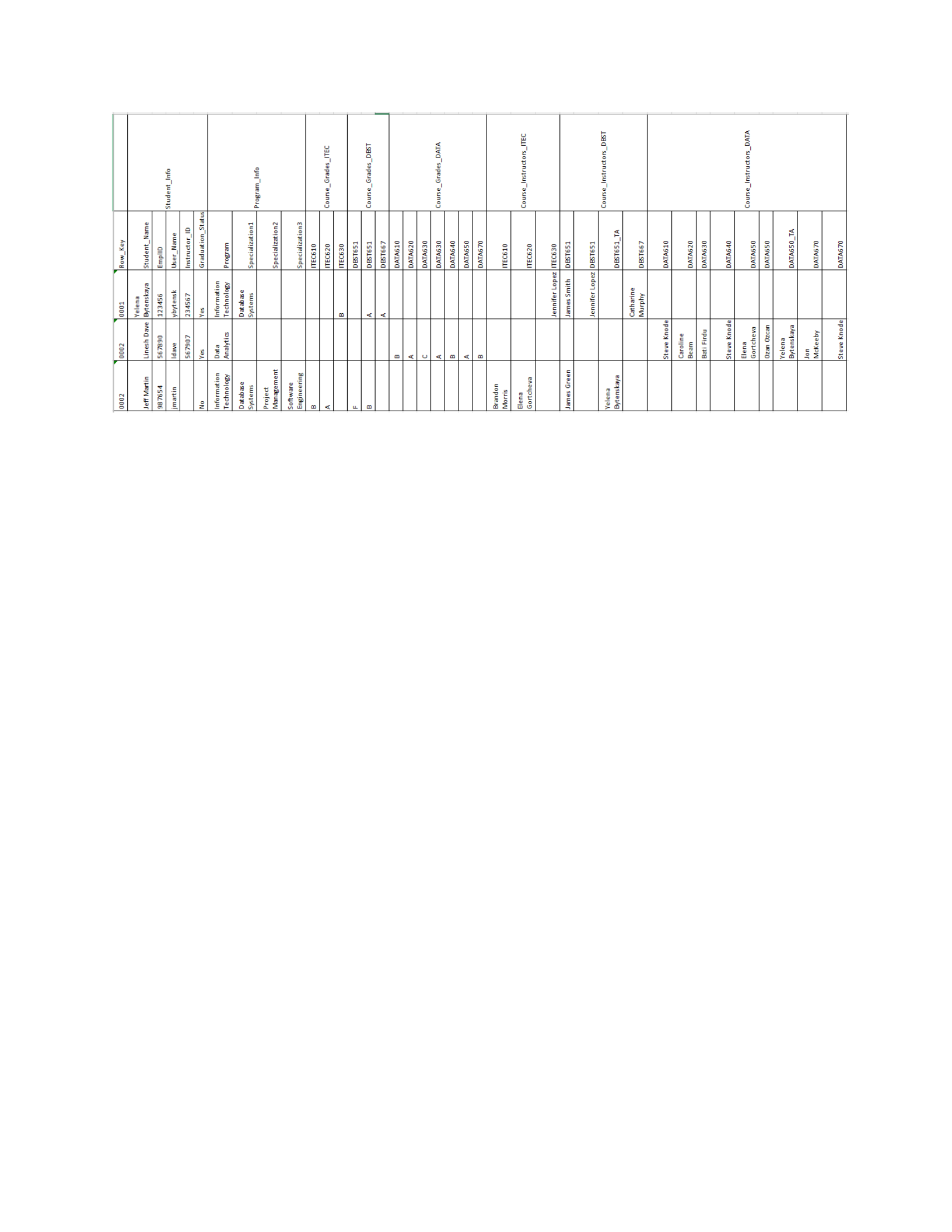
HBase table model showing column families and columns
4. The student in record 3 above, who is enrolled in Information Technology program,
would handle adding a new specialization to Information Technology program by
5. The CAP theorem states that any distributed data store can only provide two of the
following three guarantees. Consistency, Availability, and Partition tolerance CAP.
Consistency means that when server receives reads, all clients see the same data at the
same time. Availability, a guarantee that every request sees a response whether it’s a
success or a failure. Partition tolerance means that the system will continue to function
when a node fails. A distributed system can only guarantee two of the three properties.
HBase is considered eventually consistent and implements consistency and partition
tolerance. When a node in a region is down, it is recoverable, meaning that the data will
still be available at the later time. While streaming a live video on Facebook or YouTube
and it was interrupted for some reason, you can still view the life streaming to see what
was missed.
Another property is the ACID Properties. The A stands for Atomicity meaning that an
operation is considered atomic if it either completes entirely or not at all. Consistency and
Isolation means that all rows returned from a request will be a complete row that existed at
some point in time. Durability means that any updates will not be lost and HBase has this
property. HBase in this case provides row-level atomicity.
6. Potential queries that database users would run include the following.
• To display students who enrolled in a program
• To display instructors and the courses they teach
• To display students who are enrolled in a program, and choose number of
specializations
• To display student who takes multiple classes
• To display students who repeats classes.
• To display number of students who were hired as an instructor
• To display class session with multiple instructors.

• To display student who take multiple classes with the same instructor.
7. Ideas for improving the speed of the query tool is to use MapReduce algorithms.
MapReduce is a programming model for writing i applications and queries that can process
Big Data in parallel on multiple nodes.

