


I. Key Clinical Issues
A. Client Demographics
Ms. S is a 17-year-old, female who is currently employed as a fast-food worker. Ms.
S reports that she is the oldest of two. She resides in a middle-class neighborhood in
the southern city, where her wealthy parents work as a teacher’s aide, mother, and
successful business owner as a master carpenter, father. Ms. S reports that she
struggled with school, dropped out of her junior year.
B. Presenting Problem
Ms. S. gives a few interrelated difficulties that influenced different parts of her life: 1)
battling with language abilities, especially in perusing, spelling, and verbal
familiarity, not completing school and 2) not having the option to get her drivers
licenses which brings about her not having the option to get another line of work. She
presents that a new neuropsychological assessment demonstrates critical troubles in
language-related errands, with a particular conclusion of dyslexia recommended. The
inconsistency between her verbal level of intelligence (74) and nonverbal level of
intelligence (106) features the presence of a language problem.
II. Diagnosis
A. Diagnostic Impressions
1. Specific Learning Disorder (SLD):
2. Ms. S. gives a few interrelated difficulties that influenced different parts of
her life: 1) battling with language abilities, especially in perusing, spelling,
and verbal familiarity, not completing school and 2) not having the option to
get her drivers licenses which brings about her not having the option to get
another line of work. She presents that a new neuropsychological assessment
demonstrates critical troubles in language-related errands, with a particular
conclusion of dyslexia recommended. The inconsistency between her verbal
level of intelligence (74) and nonverbal level of intelligence (106) features the
presence of a language problem (Snowling, 2020).
3. Avoidant Personality Disorder (DSM-5 code 301.82):
Clients have and are confronting evasion of specific scholarly exercises, for
example, completing school, which made her exit school, and likely moves in
looking for elective work because of not having a driver's permit.
4. Intellectual Disorder (DSM-5 code 317):
The client has a full-scale IQ of 85, which was confirmed by the left
hemisphere after a specific test, indicating that her overall intellectual
functioning is below average.
B. Differential Diagnosis:
1. The client may not be encountering Avoidant Behavioral conditions as her
reports for the situation record give little proof of social and scholastic
difficulties, yet it doesn't firmly uphold the unavoidable example of social
hindrance, insecurities, and extreme touchiness to pessimistic assessment of
normal for Avoidant Behavioral condition. Other factors, such as learning
difficulties and academic struggles, may be able to explain the client's
avoidance of academic activities, dropout, and difficulty finding employment
rather than a pervasive personality disorder. (Fariba, 2023).
2. The client's overall intellectual functioning falls within the low normal
reach (full-scale intelligence level of 85), but it doesn't meet the measures for
Scholarly Formative Problem, which regularly includes fundamentally less
than ideal scholarly working (typically an intelligence level under 70). Even
though it was accounted for that there were a few disparities between her
verbal scoring and her presentation, the case record doesn't give data about
shortages or debilitations in versatile working, which are fundamental for a
determination of Scholarly Formative Issue (Lee, Cascella, & Marwaha, 2023).
C. Full DSM Diagnosis
1. After reviewing the client’s full case, the diagnosis for Ms. S would be Specific
Learning Disorder (DSM-5 code 315.00) (DMS-5, 2013).
(A) Client has shown troubles acquiring and utilizing scholastic abilities, as
demonstrated by her relentless and critical hardships in perusing, spelling, and
verbal familiarity, alongside scholarly underachievement and difficulties in
everyday working that have continued for somewhere around a half year,
notwithstanding the arrangement of mediations that focus on those challenges
(American Psychiatric Association, 2013).
(B) The client's learning difficulties are not more likely to be attributed to
intellectual disabilities, uncorrected visual or auditory acuity, other mental or
neurological disorders, psychosocial adversity, a lack of proficiency in the
academic instruction language, or inadequate educational instruction.
2. While the case record features the client's critical hardships in perusing,
spelling, and verbal familiarity, there is restricted data about her exhibition in
other scholastic areas like arithmetic. An exhaustive evaluation of different
scholarly abilities is vital to preclude or recognize expected challenges in
different regions. The DSM-5 measures underline precluding other possible
causes, including scholarly handicaps, uncorrected tangible issues, mental or
neurological problems, psychosocial affliction, and insufficient instructive
guidance. While the neuropsychological assessment takes note of an
inconsistency among verbal and nonverbal level of intelligence, a more
extensive investigation of potential contributing variables is essential.
3. Until a more in-depth evaluation is carried out, a provisional diagnosis may be
necessary due to these potential information gaps. A certified psychological
wellness expert needs to address these missing measures and lead an intensive
assessment to show a conclusive finding and figure out a suitable mediation
plan for Ms. S.
4. Using the limited information provided, a temporary thought for Social
Anxiety Disorder (DSM-5 code 300.23) could be investigated, in light of Ms.
S's. accounted for humiliation during her school years, especially while perusing
so anyone might hear. Nonetheless, the data about friendly nervousness isn't
thorough, and further investigation is expected to lay out a conclusive
determination.
III. Etiology of the Problem/Disorder
A. Biological Theory: The neurobiological theory places that dyslexia, a particular
learning problem influencing perusing, has an organic premise including primary and
utilitarian contrasts in the mind. In this client's, the neuropsychological assessment
gives bits of knowledge into the neurobiological underpinnings of her learning
troubles. According to a study by (Richlan, Kronbichler, & Wimmer, 2013) there is proof
of primary contrasts in the cerebrums of people with dyslexia, especially in districts
related with language handling, for example, the left temporoparietal and
occipitotemporal locales. Practical neuroimaging concentrates likewise demonstrate
abnormal actuation designs during perusing errands in people with dyslexia. Extra
neuroimaging or definite neurological evaluations intended for the client's would
improve the comprehension of the primary and useful perspectives adding to her
dyslexia. A more top to bottom examination of her cerebrum design and capability,
through methods like utilitarian attractive reverberation imaging (fMRI) or dispersion
tensor imaging (DTI), would give a more exhaustive perspective on the
neurobiological factors engaged with her learning hardships.
B. Psychosocial Theory: The psychosocial hypothesis recommends that the client's
learning hardships, explicitly dyslexia, might be impacted by socioeconomic elements
and parts of her instructive climate. This hypothesis places that natural stressors,
instructive encounters, and relational intricacies might add to the appearance and
perseverance of explicit learning problems. The study (Shaywitz, et al., 2002)
accentuates the impact of ecological elements on the improvement of dyslexia. It
proposes that a mix of hereditary and natural impacts adds to the neurobiological
contrasts found in people with dyslexia. Financial variables, like admittance to quality
training and proficiency-rich conditions, may impact the advancement of
understanding abilities (Shaywitz, et al., 2002). Ms. S.'s mother's occupation as a
teacher's aide is mentioned in the case file, which may have increased Ms. S.'s access
to educational assistance despite her continued personal difficulties. The psychosocial
theory agrees with the idea that dyslexia is caused by a combination of genetic
predisposition and environmental factors.
IV. Treatment Recommendations
A. Biological Intervention: According to the neurobiological theory, dyslexia has a
neurocognitive cause that stems from differences in the brain's structure and function. A
deeply grounded mediation for dyslexia is Multisensory Organized Language (MSL)
intercession. MSL approaches draw in different tactile modalities (visual, hearable,
sensation) to fortify brain associations connected with language handling. The client can
take part in MSL mediation meetings with a prepared advisor or in specific projects
intended for dyslexia. These meetings include organized, efficient, and unequivocal
educating of phonetic and interpreting abilities utilizing multisensory procedures.
(B) Ms. S. faces in perusing, spelling, and verbal familiarity, a designated mediation
zeroing in on phonological mindfulness is suggested. Phonological mindfulness includes
the capacity to perceive and control the hints of communicated in language, which is a
critical part in major areas of strength for creating abilities. People with dyslexia frequently
display shortfalls in phonological handling, and addressing these deficiencies can add to
further developed understanding results.
(C) Training in phonological awareness directly addresses the neurobiological causes of
dyslexia, which are issues with the brain's ability to process and manipulate phonological
information. By focusing on these particular shortages, the mediation expects to reinforce
the brain associations related with phonological handling, subsequently further developing
understanding abilities. The natural reasoning is upheld by neuroimaging studies showing
that compelling phonological mediations can prompt changes in cerebrum actuation
designs related with perusing (Shaywitz, et al., 2002).
B. Psychosocial Intervention: Taking into account Ms. S's. history of scholastic battles,
humiliation, and difficulties connected with dyslexia, a psychosocial intercession zeroing
in on psychoeducation is suggested. Psychoeducational mediations furnish data and
backing to people with dyslexia, meaning to upgrade how they might interpret the
condition, foster survival methods, and work on confidence. Ms. S. can partake in
psychoeducational mediation meetings worked with by a prepared proficient or through
organized programs. These meetings might incorporate conversations about dyslexia,
techniques for conquering difficulties, and building self-assurance. Furthermore,
including Ms. S's. family in psychoeducational meetings can encourage understanding
and backing.
The psychosocial treatment proposal of psychoeducational intercession straightforwardly
addresses the psychosocial challenges related with dyslexia. By expanding Ms. S's.
information about dyslexia, offering procedures to adapt to its effect, and including her
family all the while, the intercession intends to engage Ms. S., decrease sensations of
humiliation, and further develop her general prosperity. The psychosocial reasoning is
upheld by research demonstrating that psychoeducational mediations add to expanded
confidence and scholarly trust in people with dyslexia (Alexander-Passe, 2006).
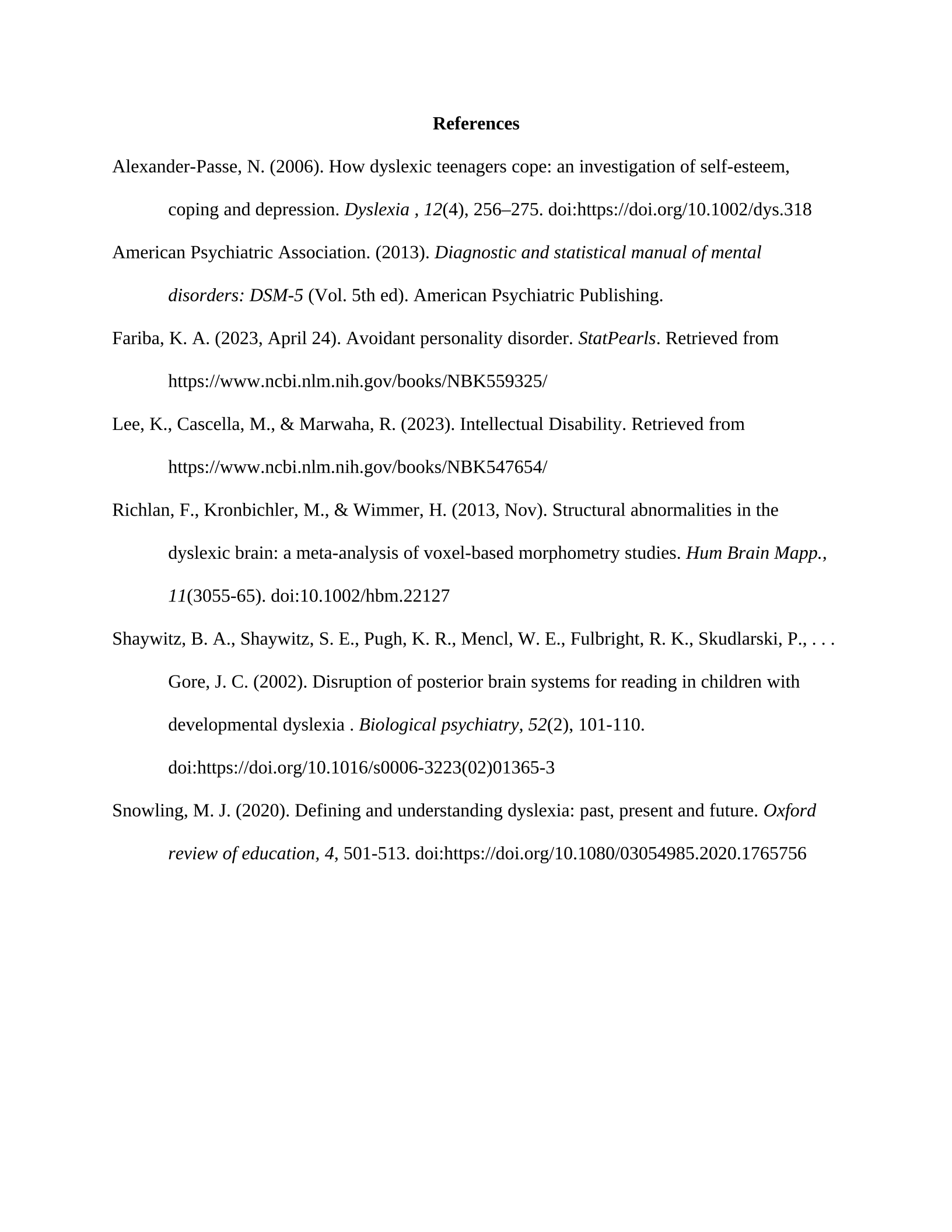
References
Alexander-Passe, N. (2006). How dyslexic teenagers cope: an investigation of self-esteem,
coping and depression. Dyslexia , 12(4), 256–275. doi:https://doi.org/10.1002/dys.318
American Psychiatric Association. (2013). Diagnostic and statistical manual of mental
disorders: DSM-5 (Vol. 5th ed). American Psychiatric Publishing.
Fariba, K. A. (2023, April 24). Avoidant personality disorder. StatPearls. Retrieved from
https://www.ncbi.nlm.nih.gov/books/NBK559325/
Lee, K., Cascella, M., & Marwaha, R. (2023). Intellectual Disability. Retrieved from
https://www.ncbi.nlm.nih.gov/books/NBK547654/
Richlan, F., Kronbichler, M., & Wimmer, H. (2013, Nov). Structural abnormalities in the
dyslexic brain: a meta-analysis of voxel-based morphometry studies. Hum Brain Mapp.,
11(3055-65). doi:10.1002/hbm.22127
Shaywitz, B. A., Shaywitz, S. E., Pugh, K. R., Mencl, W. E., Fulbright, R. K., Skudlarski, P., . . .
Gore, J. C. (2002). Disruption of posterior brain systems for reading in children with
developmental dyslexia . Biological psychiatry, 52(2), 101-110.
doi:https://doi.org/10.1016/s0006-3223(02)01365-3
Snowling, M. J. (2020). Defining and understanding dyslexia: past, present and future. Oxford
review of education, 4, 501-513. doi:https://doi.org/10.1080/03054985.2020.1765756
Powered by TCPDF (www.tcpdf.org)

