


Dating Violence and Religiousness 1
Running Head: DATING VIOLENCE AND RELIGIOUSNESS
The Intergenerational Transmission
of
Violence as Seen in
College Dating and Religiousness as a Moderator
Justin Alexander Dewberry
A Senior Thesis submitted in partial fulfillment
of
the requirements for graduation
in the Honors Program
Liberty University
Fall Semester 2004

Dating Violence and Religiousness 2
Acceptance
of
Senior Honors Thesis
This Senior Honors Thesis is accepted in partial
fulfillment
of
the requirements for graduation from the
Honors Program
of
Liberty University.
ancy nderson, Ph.D.
Chailman
of
Thesis
~.
Committee Member
~~
Committ e Member
Honors Program Director
Date
Dating Violence and Religiousness 3
Abstract
Literature conceming the intergenerational transmission
of
violence has a strong
foundation
of
data that supports specific causes for the transmission. What is lacking are
studies that focus on moderating the cycle
of
the intergenerational transmission
of
violence. This study looked for a correlation between witnessing abuse as a child and
dating violence in college undergraduate females. Religiousness was looked
at
as a
moderator that would hinder the transmission
of
violence into a dating relationship. The
sample consisted
of
101
college female undergraduates at one liberal arts, all female
institution; one liberal arts, coeducational, religiously affiliated institution; and one liberal
mis, coeducational, loosely religiously affiliated institution in a southeastem state.
Women were asked to complete surveys on inhinsic and extrinsic religiousness,
involvement in dating violence since they started college, and their past expeliences
of
witnessing abuse in their family. Results showed that the intergenerational transmission
of
violence as seen in college dating is not an inevitable cycle. However, religiousness
does not seem to be a direct moderating factor in breaking that cycle, but may be an
important factor in more directive interventions such as mentOling or conflict resolution
programs.

Dating Violence and Religiousness 4
The Intergenerational Transmission
of
Violence as Seen in
College Dating and Religiousness as a Moderator
Over time, the phenomenon
of
the intergenerational transmission
of
violence has been
utilized
as
an overarching heading for many research endeavors. The concept has led to
groundbreaking research conceming the experience
of
physical abuse in childhood and
its connection to becollling an abusive parent (Kempe, Silvennan, Steele, Droegeumuller,
& Silver, 1962), which led to what has become known as the battered child syndrome.
The concept
of
intergenerational transmission
of
violence has also been applied in the
study
of
study the effect
of
family
of
Oligin violence and witnessed and/or expelienced
child abuse on delinquency (Widom, 1989), violence against other adolescents (Benda &
Corwyn, 2002), spouse abuse and trauma symptomology (Bevan & Higgins, 2002),
aggression, depression, and anxiety (Forsstrom-Cohen & Rosenbaum, 1985), attitudes
about women (Alexander, Moore, & Alexander, 1991), and suicide (Dube, Anda, Felitti,
Chapman, Williamson, & Giles, 2001). The intergenerational transmission
of
violence in
dating has received new attention in light
of
several recent studies finding that it is not
uncommon for both adolescents and college students to experience some type
of
dating
violence (Halpem, Oslak, Young, Martin, & Kupper, 2001; Howard, Qiu, & Boekeloo,
2003; Smith, White, & Holland, 2003).
What has not been focused on in
CUlTent
research is what can moderate the
transmission
of
family
of
origin violence into dating violence. Palfai (2000) found social
support to be a moderator in the transmission
of
violence, while others had found a strong
impact
of
parental monitoring on the prevention
of
dating violence (Howard
et
aI.,
2003).
Several researchers had found that religious service attendance (Benda & Corwyn, 2002;

Dating Violence and Religiousness 5
Howard et al., 2003) and importance
of
religion in
one's
life (Halpern et al., 2001) have
decreased the transmission
of
dating violence. With all the research on the
intergenerational transmission
of
violence, and specifically the transmission
ofthe
violence into dating relationships, the results remain inconclusive. These inconclusive
results give support to what Kaufinan and Zigler (1987) said in their analysis
of
"cycle
of
violence" (p. 186) literature, and what Smith and Williams (1992) gave credence to in
regards to the transmission
of
dating violence, still holds true. There is ultimately no
inevitability to the intergenerational transmission
of
violence theory.
Overall the literature on dating violence can
be
placed into two categories: adolescent
(high school) dating violence (Halpern et al., 2001; Howard et al., 2003; McCloskey &
Lichter, 2003; Molidor & Tolman, 1998) and young adult (college) dating violence (Carr
& VanDeusen, 2002; Jankowski, Leitenberg, Henning & Coffey, 1999; Smith et al.,
2003). Recently in both categories there has been consistent findings that dating violence
is a problem at both the college (Smith et al., 2003) and the high school levels (Halpern et
al., 2001). Through the use
of
the National Longitudinal Study
of
Adolescent Health,
Halpern et al. (2001) found that 30%
of
adolescents ages
12
to
21
have experienced some
type
of
dating victimization in the last
18
months. Howard et al. (2003) found 7%
of
their
sample
of
444 students had experienced some fonn
of
dating violence in the past three
months. Smith
et
al. (2003) found particularly stunning results, noting that 88%
of
their
sample (female adolescence through the fourth year
of
college) had experienced dating
victimization at least once. They also found that women who were physically assaulted
as adolescents were at a greater risk
of
dating violence throughout their college years than
women who had not been victimized as adolescents. Smith et al. (2003) noted that not all
Dating Violence and Religiousness 6
of
the 88%
of
dating violence experience came from females who had been assaulted in
either adolescence or childhood.
Much
ofthe
basis for the concept
ofthe
intergenerational transmission
of
dating
violence comes from the socialleal11ing theory. In a landmark study, Bandura (1977)
found that children would imitate or model the aggressive nature
of
the adult they
observed. Many researchers have suggested, either :directly or indirectly, that it is
by
the
process
of
socialleal11ing that
an
adolescent will reproduce his or her parent's violent
behavior in a dating relationship (Bevan & Higgins, 2002; Foshee, Bauman, & Linder,
1999; Jankowski et
aI.,
1999; O'Keefe, 1998). In the Jankowski et
aI.
(1999) study on
witnessing interparental violence and its transmission into dating violence, it was
hypothesized that witnessing the same sex parent as the sole perpetrator
of
aggression
would increase the lisk
of
the child being the perpetrator
of
aggression in a dating
relationship. This hypothesis was suppOlied
by
the results. The study's second highest
percentage
of
adolescents that perpetrated violence in a dating relationship came from the
group that had witnessed both parents perpetrate violence towards each other. These
findings differ from O'Keefe's studies (1997, 1998) in which the results reflected that
males who witnessed interparental conflict were at a higher lisk
of
inflicting dating
violence, but that females were not. O'Keefe found females were more likely to inflict or
e~pelience
dating violence
if
they had been abused as children.
Like Jankowski
et
aI.
(1999), Foshee et
aI.
(1999) lended support to the social
leal11ing
connection between family violence and male/female adolescent dating violence.
The study also found that females were more likely to report being a perpetrator
of
dating
violence than males. The results also showed that females who were exposed to family

Dating Violence and Religiousness 7
violence had a more aggressive conflict response style and were also more accepting
of
dating violence. These two findings along with the finding
of
females reporting dating
violence more often sets up an interesting paradigm
of
how females view dating violence.
A more recent study
by
Carr and VanDeusen (2002) found that witnessing
interparental violence increased the risk
of
males perpetrating violence in a dating
r.elationship. They went on to conclude that through socialleaming:processes, witnessed
interparental violence may be leamed and later utilized with an intimate partner. Other
studies focusing on males have also found results similar to Carr and VanDeusen.
For
example, Bevan and Higgins (2002) found that witnessing family violence increased the
risk that males would abuse their spouses. The researchers also suggested that a certain
amount
of
vicmlous reinforcement occurs because, in essence, the father models who are
taking aggressive actions to fix a situation are deeming those actions appropllate to their
children appropriate. Bevan and Higgins (2002) also commented that the father's violent
conflict resolution style acts
as
positive reinforcement because the father shows approval
for violent behavior.
Yet, strong correlations are not always evident. Smith and Williams (1992) studied
1353 high school students in northwest North Dakota. They hypothesized that
adolescents from abusive family environments would exhibit, justify, or condone
violence in dating relationships because they viewed it as normal and traditional. Their
findings indicated that these students denied instances
of
dating violence, and students
from non-violent and violent families saw dating violence as wrong. Ultimately only
one-fourth
of
their students from an abusive household had participated in dating
violence.
Dating Violence and Religiousness 8
Religiosity or religiousness as a moderator has been largely overlooked in the
literature
of
dating violence. Glenn (1997) showed that there was a positive relationship
between good mental health and religiosity. GleIm defines religiosity
as
a subject's
self
assessment
of
depth
of
personal devotion and commitment to faith. Earlier, Gorsuch
(1994) had defined the intrinsic aspect
of
religiousness as a person's pursuit
of
religious
faith as an end llnto itself void
of
external reinforcement.
When religiosity had been studied within the context
of
dating violence, the findings
were consistent with Glem1's results. Halpern et al. (2001) found that females who did
not hold religion
as
important to them were 1.5 to 2 times more likely to
be
psychologically victimized than females who felt religion was very important. Howard et
al. (2003) found similar results showing that attending religious services decreased the
risk
of
being involved in dating violence. Howard goes on to make some strong
statements about this relationship, but the entire premise was based on one Likeli scale
question of, How often
do
you attend religious
senices.
Halpern et al. (2001) used an
open-ended question about how important religion was in their lives. This variable was
based on a non-reliable self-report measure, and yet Halpern chose to make a relational
statement
of
its importance to stopping dating violence.
Benda and Corwyn (2002) found results consistent with Halpern et al. (2001) and
Howard et al. (2003), but Benda and Corwyn used five item Likert type questions about
different characteristics
of
religiousness. Their research focused on the effect
religiousness had on the prevalence
of
violence between adolescents and their peers.
Benda and Corwyn (2002) found that children with a favorable score on the religiousness
scale were less likely to commit violence against their adolescent peers. These findings
Dating Violence and Religiousness 9
can be generalized into a dating violence context because
of
its consistency with the other
two studies. One study that had contrary findings was Makepeace (1987) which found
that the male perpetrators had higher levels
of
religious service attendance than their
female victims.
These studies are foundational to this research. They show the theories that are the
underpimlings
of
the present re;;earch and the lack ofliterature adequately focusing on
religiousness
as
a moderator. These studies, with the exception that the Benda and
Corwyn (2002) study, can be generalized into a dating violence context.
This cunent research served two purposes. First, the literature that has been produced
on the topic
of
the intergenerational transmission
of
dating violence has focused greatly
on the lisk factors involved in the transmission. Few studies have focused plimarily on
finding a moderator for the transmission, but many have used it
as
a secondary
hypothesis and have found promising results. This cunent study aims to fill the void
of
moderator driven studies. This research may also allow for possible reduction
of
any rate
of
transmission instead
of
study the after effects
of
the abuse. Second, it may provide a
more reliable and valid measure for the moderator
of
religiousness than has been offered
in previous studies.
This study sought to examine three hypotheses:
1)
It
was expected that females with
high family
of
origin violence would experience more dating violence; 2)
It
was also
expected that there would be a strong relationship between intrinsic religiousness and a
female not expeliencing dating violence; 3)
It
was expected that extrinsic religiousness
would have no significant relationship to experienced dating violence.

Dating Violence and Religiousness
10
Method
Participants
One hundred and twenty four undergraduate females from upper level and
introductory level psychology classes from three colleges in a southeastern state were
surveyed for this study. One school was a liberal arts, all women college with no
religious affiliation. Two schools were liberal qrts, coeducational colleges. One has some
religious affiliation, while the other has strong religious affiliation. The sample was
collected dUling the first half
of
the 2004 spring semester. All females in the psychology
classes were eligible to patiicipate, and all were given class credit or extra credit for
participating in the study at the discretion
of
the professor. Only the participants who
completed the
I1E-R,
CTS2S, CTS2-CA, and infonnational questionnaire were included
in the final analysis. Others that were excluded are participants over the age
of
25
and
manied. Anyone who had not patiicipated in an opposite sex or same sex dating
relationship since entering college was excluded from the final analysis to control for
accurate significance
of
religiousness as a moderator
of
dating violence. After these
exclusions were made, the final sample consisted
of
one hundred and one females. As
part
of
the infonned consent agreement, participants
of
this study were allowed not to
complete the study for any reason they deemed necessary (see Appendix A).
After the above critelia were met, the age range
of
the participants was eighteen to
twenty-five years old (M=19.7, s=1.32), and had dated for at least one month duration
within the last eighteen months.
In
this research, 90.1 %
of
the patiicipants identified
themselves as Caucasian.
It
was also found that 96%
of
the participants responded that

Dating Violence and Religiousness
11
they were heterosexual and
86.1
% were Christian in religious orientation, which was
inclusive
of
both Protestant and Catholic groups.
Procedures
Pennission was received from the psychology depmiments at all three schools
to
solicit students for their participation in this study outside
of
regular class time. Overall
there were six testing days (two at each school). Each testing
~ession
was overseen
by
the researcher and lasted approximately twenty minutes. Pmiicipants were allowed to
spread around the room so there was at least one seat in between each subject so they
could have some semblance
of
privacy. This seating alTangement was to minimize the
effect
of
influence that other people may see their test, which might have hindered true
answers on some
of
the test questions.
A small introduction was given to the research explaining the need for honest answers
on the questionnaires. A written infonned consent (Appendix A) was given out by the
researcher, signed and retumed
by
the participants before they received their testing
packet. The order
of
the tests in the packet was first the Conflict Tactics Scale Revised
Short (CTS2S), which measured dating violence (Straus, unpublished) (See Appendix B).
The next test was the Intrinsic/ Extrinsic Religiousness Revised Scales (Gorsuch &
McPherson, 1989), which measures four types
of
religiousness styles (Appendix C). Then
Conflict Tactics Scale Revised Short-Child Adult (CTS2-CA), which measured abuse the
participant had witnessed between their parents while living at home (Straus,
unpublished) (Appendix D). The final questionnaire in the packet was the infonnational
demographics, which asked for age, ethnicity, sexual orientation, classification in school,
and
if
they had been or were in a dating relationship since entering college (Appendix E).

Dating Violence and Religiousness
12
Measures
Each test is a paper and pencil retrospective self-report questionnaire. The
approximate time to complete the tests did not exceed 30 minutes although all
participants could have used as much time as needed.
Dating violence. The most popular measure
of
relationship violence in the past two
decades has been the Conflict Tactics Scale (CTS) by Straus (1979). The current version
is known as the CTS2 when the CTS was revised in 1996 by Straus, Hamby, Boney-
McCoy, and Sugam1an. While this study tried to use the full version
of
the CTS2, it was
ultimately deemed uneconomical for the sample size that would be used. However,
Straus granted permission to this researcher to use the unpublished
ShOli
form version
of
the CTS2. The CTS2S measures the violence in a relationship in the areas
of
verbal,
physical, and sexual aggression since the participants started college. This test has shown
strong reliability and validity ranging
from.
79 to .95 (Straus et
aI.,
1996). This measure
has 10 types
of
questions with each type
of
question having two versions. Each version
is directed at one
of
the people in the relationship. This question design gives the test a
total
of
twenty items and requires only about five to ten minutes to complete. The
CTS2S has subscales for psychological aggression, physical assault, injury, sexual
coercion, and negotiation. For the purpose
ofthis
study, all subscales were used except
negotiation. This subscale was excluded because it assessed quality
of
communication
style during
an
argument and not a characteristic
of
violence as the other subscales did.
Due to the nature
of
the survey, the results
of
the study were highly skewed because
within a general population about two thirds does not experience victimization. To
account for this skewness, the results were grouped into two dichotomous variables
of
Dating Violence and Religiousness
13
victimized and not victimized. In this study the 34.7%
of
the participants had been
victimized, while 64.4% had not been victimized in their dating relationships.
Child abuse questions. To measure witnessed abuse between parents as a child this
study utilized an altemative version
of
Straus' (unpublished) CTS2S. This measure is
referred to as the Conflicts Tactics Scale Revised Sh01i- Child/Adult (CTS2-CA). This
test was also acquired through the wonderful generosity
of
Dr. Straus and like the CTS2S
was unpublished at the time
of
this investigation.
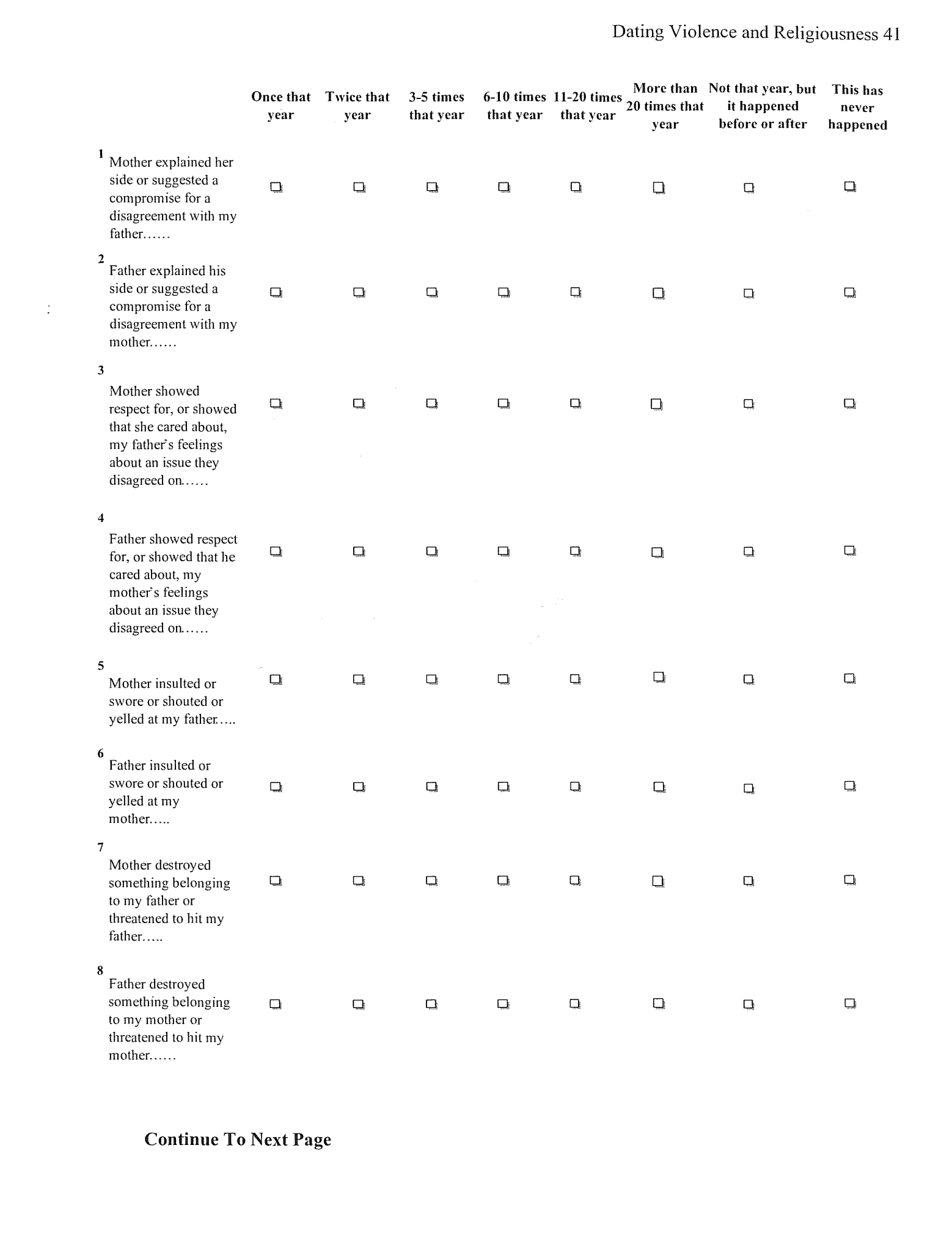
The CTS2-CA consisted
of
eight questions with two versions
of
each question. One
version refers to the actions
of
the father against the mother and the other version refers
to the actions
of
the mother against the father. This resulted in a total
of
sixteen items
requiring no more than five to ten minutes to complete. The pmiicipants were asked to
remember back to the time when they were thilieen and rep01i the interactions between
their parents that they had witnessed. The CTS2-CA incorporates subscales on
negotiation, psychological aggression, physical assault, and physical injury. This
measure does not include a subscale for sexual coercion because
of
the assumption that
the number
of
children witnessing such an event is extremely small. For this study all
subscales were used for analysis with the exception
of
the negotiation subscale for the
same reasons as stated above in the section on the CTS2S. Currently there has been very
few studies that have used this measure resulting in a lack
of
info
TIn
at ion on validity and
reliability for this measure.
As with the CTS2S the results
of
the CTS2-CA are highly skewed. These results
were also put in to the dichotomous categories
of
not abuse and abused. In this study

Dating Violence and Religiousness 14
84.2%
of
the pmiicipants had not witnessed abuse, while the small percentage
of
13.9%
of
participants had witnessed abuse between their parents.
Intrinsic/Extrinsic Religiousness scales. Gorsuch and McPherson's (1989) Intrinsic
and Extrinsic Revised scale (I/E-R) (Appendix C) was utilized to obtain a person's
estimated religiousness. The
I/E-R
is well-used and has reliability scores ranging from
.65 on the combine extrinsic scales to .83 on the intIinsic scale. The test consists
of
42
items and is divided into a scale for intrinsic, extlinsic personal, extrinsic social, extIinsic
moral, and non-factor. The non-factor subscale was not one
of
the original subscales, but
after checking with Dr. Gorsuch, pennission was received to use this as a subscale
because it had the second largest percentage
of
participants. This test is non-
discriminatory toward both religious belief and faith Olientation. Both the intrinsic and
extrinsic scales are measured on a five point Likert type scale with answers ranging from
Strongly Disagree to Strongly Agree. To score the scale, each item is summed and then
divided
by
the number
of
items for that subscale.
If
a participant's score is above the
mid-point ofthree, then the participant can be labeled as either having intIinsic
religiousness, or any
of
the extrinsic religiousness labels.
In this study a large majOlity
of
the pmiicipants had intrinsic religiousness with
64.4%. The next lm·gest subscale was the non-factor scale which included 17.8%
of
the
participants. The extrinsic subscales were the smallest
of
the study with extrinsic
personal having 9.9%
of
the participants and extrinsic moral and extrinsic social having
5% and 1 %
of
the total participants respectively.

Dating Violence and Religiousness
15
Results
To analyze the hypothesis that females who had witnessed family
of
origin violence
would experience significantly higher levels
of
dating violence, a Chi Square test
of
independence was utilized. This analysis was necessary for two reasons. First, because
the results were
so
skewed, it was better to use a non-parametric test
to
identify
relationship. Second, the Chi Square proves to be most useful when comparing two
dichotomous variables. Ultimately hypothesis one was not suppOlied. The Chi Square
showed the relationship between witnessing abuse as a child and transmitted abuse into a
college dating relationship to be
X2
(l,
98) = 1.452, which was not significant. Table 1
shows the percentages within each group. This makes it easier to see the skewness
of
the
data.
It
is interesting
to
note in this sample that
of
the females who had witnessed abuse
between their parents, the exact same number had been in violent dating relationships as
had not experienced violence in their dating relationships (see Figure
1).
It
was also hypothesized that there would
be
a strong relationship between intrinsic
religiousness and a female not expeliencing dating violence. To identify any possible
relationship a Chi Square test
of
independence was used once again. This was useful
because the nature
of
the data for this hypothesis was nominal. This second hypothesis
was also not supported because there was no significant relationship between type
of
religiousness and dating victimization [X2 (4, 98) = 5.052 n.s.] (see Table 2). However,
these results do support the third hypothesis, because extrinsic religiousness had no
significant relationship to dating victimization. In Figure 2 it is interesting to note that
of
the females identifying themselves in the non-factor group, the same number
of
females
had experienced dating victimization as had not.

Dating Violence and Religiousness
16
Table 1
Percentages/or Dating Violence Victimization in Relation
to
Witnessed Abuse
Crosstab
Abuse
Not Abused Abused Total
Victimization Not Victim Count 56 7 63
Expected Count 54.0 9.0 63.0
% within Victimization 88.9% 11.1% 100.0%
% within Abuse 66.7% 50.0% 64.3%
%
of
Total 57.1% 7.1% 64.3%
Victim Count 28 7
35
Expected Count 30.0 5.0 35.0
% within Victimization 80.0% 20.0% 100.0%
% within Abuse 33.3% 50.0% 35.7%
%
of
Total 28.6% 7.1% 35.7%
Total Count 84 14 98
Expected Count 84.0 14.0 98.0
% within Victimization 85.7% 14.3% 100.0%
% within Abuse 100.0% 100.0% 100.0%
%
of
Total 85.7% 14.3% 100.0%

60
50
40
30
0,;>0"0""";,;0'','';";
20
10
o Abused
Dating Violence and Religiousness
17
Not Abused
II1II
Not Victim
II1II
Victim
Family of Origin Violence
Figure
1.
Relationship between Family
of
Origin Violence and Dating Violence

Dating Violence and Religiousness
18
Table 2
Chi Square Test
of
Independence
for
Victimization in Dating in Relation
to
Religiousness
Type.
Pearson Chi-Square
Likelihood Ratio
Linear-by-Linear Association
N of Valid Cases
Chi-Square Tests
Value
5.190
1.613
98
df
4
4
Asymp. Sig.
(2-sided)
.282
.268
.204
a·5
cells (50.0%) have expected count less than 5.
The
minimum expected count is .34.

Dating Violence and Religiousness
19
45
40
35
30
25
20
15
i III Victim
10
III Not Victim
5
0
Religiousness
Figure
2.
Relationship between Religiousness Type and Dating Violence

Dating Violence and Religiousness 20
One unsuspected finding in this study was a relationship between the school that the
females attended and whether or not they were victims
of
dating violence (p=.061) (Table
3). As can be seen from Figure 3 these results are especially important for School C in
which almost
as
many females had experienced dating victimization as had not. This is
well outside the population nonn
of
two thirds
of
females not being involved in violent
. dating relationships.
Discussion & Conclusions
While the two most seemingly important hypotheses for this study were unsupported,
it would seem that in this topic, non-significant results are tremendously significant!
It
is
important to look at the finding's implications from more than one viewpoint. When
looking closely at the results, it would appear that females who come from abusive
homes are not transmitting that violence into their relationships but that religiousness
type has nothing to
do
with it.
It
could be these females know that what they have
witnessed their parents doing is the wrong way to resolve conflict in their own
relationships. This understanding
of
right from wrong may
be
inherent knowledge for
these females whether or not they have intrinsic religiousness.
It
may also
be
generalized
their religiousness plays a very small role in deciding a person's morality when it comes
to their style
of
conflict resolution. However, this possibility may be questioned by the
results displayed in Figure 2 where it clearly shows that for the females that indicated
religiousness played no important role in their life just as many had been in abusive
dating relationships as had not been in abusive dating relationships. These results
strengthen the case for the findings in the intrinsic religiousness group where less

Dating Violence
and
Religiousness
21
Table 3
Percentage o.fNon-Victim
and
Victim
in
Relation to School Attendance.
Crosstab
School
School 1 School 2 School 3 Total
Victimization Not Victim Count 23
30
12 65
Expected Count 21.5 26.7 16.9 65.0
% within Victimization 35.4% 46.2% 18.5% 100.0%
% within School 69.7% 73.2% 46.2% 65.0%
%
of
Total 23.0% 30.0% 12.0% 65.0%
Victim Count 10
11
14 35
Expected Count 11.5 14.4
9.1
35.0
% within Victimization 28.6% 31.4% 40.0% 100.0%
% within School 30.3% 26.8% 53.8% 35.0%
% of Total 10.0% 11.0% 14.0% 35.0%
Total Count 33
41
26
100
Expected Count 33.0 41.0 26.0 100.0
% within Victimization 33.0% 41.0% 26.0% 100.0%
% within School 100.0% 100.0% 100.0% 100.0%
%
of
Total 33.0% 41.0% 26.0% 100.0%

30
25
20
15
10
5
o School A School B
Dating Violence and Religiousness 22
School C
III Non-Victim
III Victim
Figure
3.
Relationship between School and Dating Violence

Dating Violence and Religiousness
23
than a third
of
females who had intrinsic religiousness had been involved in a violent
college dating relationship.
The
other possible implication
of
these findings is taken from a more optimistic
angle. This researcher's theory is that while the majority
of
these females have intrinsic
religiousness, it may
be
that the concept
of
religiousness is very esoteric, and it may not
have the direct and significant effect on how these females perceive and
calTY
out proper
conflict resolution. What is also possible is that because religiousness is very esoteric it
may
be
possible that these females had been exposed to a more concrete socialization
of
proper conflict resolution. This moderating effect may
be
through the process
of
mentorship, parental involvement,
or
other cOlmections in social circles religious or
otherwise.
It
would seem that the most impOliant conclusion to
be
drawn from this study is the
fact that the intergenerational transmission
of
family
of
origin violence is not inevitably
transmitted into dating relationships. Yet as seen in Figure 3 females in some schools are
apparently at more
of
a risk for being victimized in a dating relationship. This type
of
information needs to
be
acted on
by
providing intervention measures such as relationship
courses
or
conflict management training.
It
could also
be
gathered through Figures 1 and
2 that females with religiousness as a non-factor in their life
or
females from abusive
home
have a fifty percent chance
of
being involved in a violent dating relationship.
While on a larger scale, it may not
be
significant it is still important to make note
of
it.
While the measures used in this study exhibited strong reliability and validity in their
areas a certain measure
of
variability must
be
assumed in the measures because they were
all
self
report. Another draw back to this study was the lack
of
a standardized testing

Dating Violence and Religiousness 24
environment. Because the researcher had to use the rooms available at the certain
schools, optimal privacy for the participants had to be saclificed. The undesirable seating
arrangement may have influenced answers from some participants, fearing they would
be
discovered by their peers as being victims or perpetrators
of
certain actions.
This study offers possibilities for moderating the intergenerational transmission
of
family
of
origin violence into college dating. Whether or not.this moderating effect is
directly related to something as esoteric as religiousness or something more concrete as
mentOling or parental moderating, it is becoming clearer that the transmission
of
violence
is not inevitable. Study in this area needs to continue as research affinning the fact that
while the transmission
of
violence may not be inevitable, it is a reality for some people.
For these people the importance
of
finding an effective method
of
moderating, and
preferably stopping, the transmission
of
family
of
origin violence into their college dating
habits is imperative.

Dating Violence and Religiousness 25
Acknowledgments
I would like to thank Dr. Murray Straus and Dr. Richard Gorsuch for their generosity
towards this project. Without their passion to invest time and energy into the next
generation
of
social scientists this project would have been impossible because
of
a lack
of
resources.
I am also gracious for the time and effort
of
Dr. Nancy Anderson, Dr.
Fr~d
Milacci,
Mrs. Carolyn Towles, and Dr. James Nutter. With their revisions and guidance this
report has become something for me to truly
be
proud of.
Most importantly,
my
Lord and Savior Jesus Cluist deserves the highest praise for His
involvement with the project. His strength and calm during
my
stressful times were the
only things that kept me from quitting this project many times.
Dating Violence and Religiousness 26
References
Alexander, P.C., Moore, S., & Alexander, E.R. (1991).
What
is transmitted in the
intergenerational transmission
of
violence? Journal
of
Marriage and the Family,
53,657-668.
Bandura, A. (1977). Social learning
the01Jl.
Englewood Cliffs,
Nl:
Prentice Hall.
Banyard, V.L., Arnold, S., & Smith,
l.
(2000). Childhood sexual abuse and dating
experiences
of
undergraduate women. Child Maltreatment,
5,39-48.
Benda, B.B., & Corwyn, R.F. (2002). The effect
of
abuse in childhood and in
adolescence on violence among adolescents. Youth & Society, 33,339-365.
Bevan, H., & Higgins,
D.l.
(2002). Is domestic violence learned? The consideration
of
five
fonTIs
of
child maltreatment to
men's
violence and adjustment. Journal
of
Family Violence, 17, 223-245.
Dube, S.R., Anda, R.F., Felitti, V.l., Chapman, D.P., Williamson, D.F., & Giles, W.H.
(2001). Childhood abuse, household dysfunction, and the risk
of
attempted
suicide throughout the lifespan: Findings from adverse childhood experiences
study. The Journal
of
the American Medical Association, 286,3089-3097.
Retrieved October
1,
2002 from INFOTRAC databases.
Can-,
l.L.,
VanDeusen, K.M. (2002). The relationship between family origin violence
and dating violence in college men. Journal
of
Interpersonal Violence, 17, 630-
646.
Forsstrom-Cohen, B., & Rosenbaum, A. (1985).
The
effects
of
parental marital
violence on young adults: An exploratory investigation. Journal
of
Marriage and
the Family, 47, 467-472.

Dating Violence and Religiousness 27
Foshee, V.A., Bauman, K.E., & Linder, G.F. (1999). Family violence and the
perpetration
of
adolescent dating violence: Examining
socialleaming
and social
control processes. Journal
of
Marriage
and
the Family, 61. Retrieved September
10,2003
from EBSCO
HOST
databases.
GleIm, C.L. (1997). Relationship
of
mental health to religiosity. McGill Journal
of
Medicine,
3,
86-92.
Gorsuch, R.L., & McPherson, S.E. (1989). lntrinsic/extlinsic measurements:
VE
revised
and single item scales.
Journalfor
the Scientific Study
of
Religion, 28, 348-354.
Gorsuch, R.L. (1994). Toward motivational theOlies
of
intrinsic religious
commitment. Journalfor the Scient(fic Research
of
Religion, 33, 315-325.
Halpem, C.T., Oslak, S.G., Young, M.L., Martin, S.L., & Kupper, L.L. (2001). Pminer
violence among adolescents in opposite-sex romm1tic relationships: Findings from
the national longitudinal study
of
adolescent health. American Journal o.fPublic
Health, 91. Retrieved on September 5, 2003 from EBSCO
HOST
databases.
Howard, D., Qiu, Y., & Boekeloo, B. (2003). Personal and social contextual correlates
of
adolescent dating violence.
Societyfor
Adolescent Medicine, 33, 9-17.
Jankowski, K.M., Leitenberg, H., Henning, K., & Coffey, P. (1999). Intergenerational
transmission
of
dating aggression as a function
of
witnessing only same sex
parents vs. opposite sex parents vs. both parents as perpetrators
of
domestic
violence. Journal o.fFamily Violence,
14,267-279.
Kaufinan, J., & Zigler,
E.
(1987). Do abused children
become
abusive parents?
American Journal 0.( OrthopsychiatlY, 57, 186-192.

Dating Violence and Religiousness 28
Kempe, C.H., Silvennan, F.N., Steele, B.F., Droegemueller, W., & Silver, H.K. (1962).
The battered-child syndrome. Journal
of
the American Medical Association, 181,
105-112.
Makepeace, J .M. (1987). Social factor and victim-offender difference in courtship
violence. Family Relations, 36, 87-91.
McCloskey, L.A., & Lichter, E.L. (2003). The contribution
of
marital violence to
adolescent aggression across different relationships. Journal
of
Interpersonal
Violence, 18,390-412.
Molidor,
c.,
& Tolman, R.M. (1998). Gender and contextual factors in adolescent
dating violence. Violence Against Women,
4,
180-194.
O'Keefe,
M.
(1997). Predictors
of
dating violence among high school students. Journal
of
Intel
personal
Violence, 12,546-569. RetIieved on November
16,2002
from
INFOTRAC databases.
O'Keefe, M. (1998). Factors mediating the link between witnessing interparental
violence and dating violence. Journal
of
Family Violence, 13,39-57.
Palfai, J .H. (2000). The intergenerational transmission
of
dating violence: Social support
as a moderator. Dissertation Abstracts International: Section B: the Sciences &
Engineering, 61, 1647.
Smith, J.P., & Williams, J.G. (1992). From abusive household to dating violence.
Journal
of
Family Violence, 7,153-165.
Smith, P.H., White, J.W., & Holland, L.J. (2003). A longitudinal perspective on dating
violence among adolescent and college age women. American Journal
of
Public
Health, 93, 1104. Retrieved on September
5,
2003 from EBSCO HOST databases.

Dating Violence and Religiousness 29
Straus, M.A. (1979). Measuring intrafamily conflict and violence: The conflict tactics
(CT) scales. Journal o/Marriage and the Family, 41, 75-88.
Straus, M.A., Hamby, S.L., Boney-McCoy, S., & Sugarman, D.B. (1996). The revised
conflict tactics scale (CTS2): Development and preliminary psychometric data.
Journal
of
Family Issues, 17, 283-316.
Widom, C.S. (1989). The cycle
of
violence. Science, 244, 160-167. Rettieved on
November 15, 2002 from INFOTRAC databases.

Dating Violence and Religiousness 30
Appendix A
Informed Consent Form
Page 1
of3
P alii cipant' s Copy
Project Title: Dating Violence Moderators
***Please
read
this
consent
agreement
carefully
before
you
decide to
participate
in
the
study.
You
will receive a copy
of
this
agreement.
Purpose
of
research:
Recently dating violence has been shown to be prevalent at both
the high school and college levels. While many studies continue to find the reason
behind this prevalence this study aims to understand sufficient moderators that will stop
or
hinder dating violence. Findings from this study can provide a better understanding
for what will stop someone from being in a violent dating relationship.
What
you will do:
If
you choose to participate in the study, you will
be
required to take a
series
of
questionnaires that are untimed.
You
are also asked to provide the most truthful
and honest answers to the questions. This will provide better data for the study and give
greater understanding
of
the best moderator. NOTICE: Some questions
on
the test are
of
sexual content.
Time
Required:
Even though the tests are untimed, the total time for testing should take
no longer than 45-50 minutes. The tests need to
be
taken in one sitting, although you, are
free to get up to go to the bathroom
or
get a drink.
If
you do so, please respect others
space and privacy as you move around the room.
Benefits: While there are no direct benefits from this study you
may
leam some things
about yourself
by
participating in the study about how you relate to other people in dating
relationships. You may also receive some sort
of
compensation for your time such
as
fulfilling a class requirement
or
extra credit. This is between you and your professor to
decide, and the head experimenter cannot
be
held responsible for the amount
or
type
of
compensation received.
Dating Violence and Religiousness
31
Informed Consent Form
Page 2
of3
Pmiicipant's Copy
Project Title: Dating Violence Moderators
Confidentiality: The answers you give on these questiomlaires are anonymous. Your
name will only appear on the infonned consent, which will be collected and filed
separately from the tests. There are no linking codes between the infonned consent and
the test packets, although there wili be linking codes within the test packets. Only the
head experimenter and the faculty advisor will have access to the infonned consent
fOTITIs.
Infonned consent
fOTITIS
will be kept up to six months after the completion
of
the
study and then destroyed.
Voluntary
Participation:
Your pmiicipation throughout this study is completely
voluntary and you may choose to tenninate your participation at any time.
How
to
Withdraw
and
Penalty
for
Withdrawing:
If
you choose to withdraw from the
study quietly and discreetly place your test packet at the designated tum in spot in the
room and then you may leave. There will
be
no penalty for withdrawing from this study.
Who
to
Contact
with
Questions
About
Study:
Head experimenter:
Justin Dewbeny
LU Box 21716
Lynchburg, VA 24506
E-mail: [email protected]
Phone: 434-582-3068
Faculty Advisor:
Dr. Nancy Anderson
Department
of
Psychology
E-mail: [email protected]
Phone: 434-582-2559
Who
to
contact
about
your
rights
in
the
study:
Dr. Randall Davy, Chainnan,
Institutional Review Board, Liberty University, Lynchburg, VA 24502. Telephone (434)
582-2440

Dating Violence and Religiousness 32
Informed Consent Form
Page 3
of3
Experimenter's Copy
Project Title: Dating Violence Moderators
Agreement: The study desclibed above has been explained to me. I voluntaIily consent
to participate in this activity. I have had an opportunity to ask questions. I understaI1d that
future questions I may have about the research
or
about
my
lights as a subject will be
answered by one
of
the investigators listed above. I hereby release and agree to
indemnify and hold hannless Liberty University, its agents, employees, successors and
assigns, from any liability for any claims that
may
arise as a result
of
this research study
and/or
my
participation therein, and in consideration
of
the benefits delived by me from
this research study. I also hereby agree not to sue or otherwise assert any claim against
Liberty University, its agent or employees for any cause
of
action arising out
of
the
research study referenced above.
Participant's Signature
__________________
_
Participant's Name (Please Print)
_____________
_
Date
------------

Dating Violence and Religiousness
33
Appendix B
THE
CTS2S
Copyright © 2002
by
Murray A. Straus
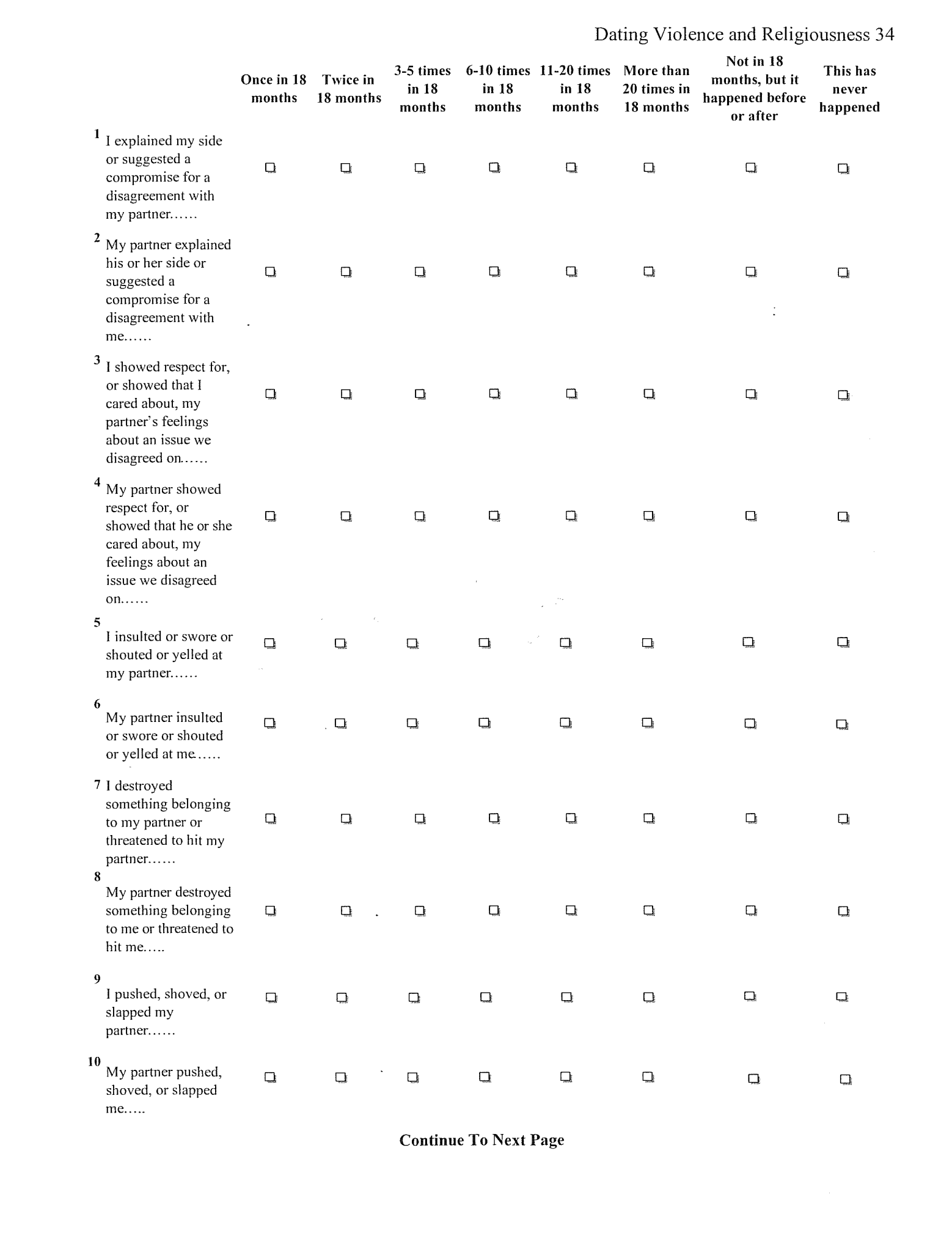
COUPLE CONFLICTS
No matter how well a couple gets along, there are times when they disagree, get annoyed
with the other person, want different things from each other,
or
just
have spats or fights
because they are in a bad mood, are tired or for some other reason. Couples also have
many different ways
of
trying to settle their differences. This is a list
of
things that might
happen when you have differences. Please mark how many times you did each to these
things in the
18
months prior to this study, and how many times your partner did them in
the
18
months prior to this study.
Please
Continue
On
Next
Page
~ ~ ~
Dating Violence and Religiousness 34
6-10 times
1I-20
times
More
than
Not in 18
This
has
3-5 times
months,
but
it Once in 18 Twice in in 18 in 18 in 18 20 times in
happened
before
never
months
18
months months months
months
18
months
happened
or
after
1 I explained my side
or
suggested a 0 0 0 0 0 0 0
compromise for a
disagreement with
my partner
......
2 My partner explained
his
or
her side
or
0 0 0
suggested a 0 0 0 0 0
compromise for a
disagreement with
me
......
3 I showed respect for,
or
showed that I 0 0 0
cared about, my 0 0 0 0
partner's feelings
about
an
issue we
disagreed on
......
4 My partner showed
respect for,
or
0 0 a 0 0 0
showed that he or she
cared about, my
feelings about
an
issue we disagreed
on
......
5 I insulted or swore
or
shouted
or
yelled
at
0 0 0 0 0 0 0
my pminer.
.....
6 My partner insulted 0 0 a
or
swore
or
shouted a a a a 0
or
yelled at
me.
.....
7 I destroyed
something belonging
to my partner
or
0 0 0 0 0 0 0 0
threatened to hit my
partner.
.....
8 My partner destroyed
something belonging 0 0 a a 0 0 a 0
to me or threatened to
hit me .....
9 I pushed, shoved,
or
0 a a a a a a a
slapped my
partner.
.....
10
My partner pushed, 0 a 0
shoved,
or
slapped 0 0 0 a a
me
.....
Continue
To
Next Page

Dating Violence and Religiousness 35
3-5 times 6-10 times 11-20 times
More
than
Not in 18
This
has
Once in 18 Twice in in 18 in 18 in 18 20 times in months,
but
it
months
18
months
happened
before
never
months
months months
18
months
or
after
happened
11
I punched
or
kicked
OJ OJ
OJ
OJ OJ OJ
OJ
or
beat-up my
partner. .....
17
-My pminer punched 0: 0: 0: 0: 0:
OJ
OJ
or
kicked or beat me
up
......
13
I insisted on sex
when my partner did
not want to
or
0: 0: 0 0 0:
OJ OJ
0:
insisted on sex
without a condom
(but did not use
physical force)
......
14
M . . d
y pminer
1l1S1ste
on sex when I did not
want to or insisted
on
0: 0: 0: 0: 0: 0:
OJ
0:
sex without a condom
(but did not use
physical force) .....
15 I used force (like
hitting, holding 0: 0: 0: 0: 0: 0:
OJ
down,
or
using a
weapon) to make my
partner have sex
......
16 My pminer used
force (like hitting,
holding down,
or
OJ
0:
OJ
0:
OJ
0: 0:
using a weapon) to
makeme
have
sex
......
17 I had a sprain, bruise,
small cut,
or
felt pain
OJ
0
OJ
OJ
0:
OJ
the next day because
of
a tight with my
partner
......
18 My partner had a
sprain, bruise, small
cut, or felt pain the 0 0 0 0 0: 0:
next day because
of
a
fight with me
......
19
I went to see a doctor
(M.D.) or needed to
[J
0
[J
see a doctor because
[J
OJ OJ
[J
of
a tight with my
partner.
.....
20
M.y
partner went to
see a doctor (M.D.) 0: 0: 0:
[J
OJ
0: 0: 0:
or
needed
to
see a
doctor because
of
a
tight with me
......

Dating Violence and Religiousness 36
Appendix C
I/E-R
scales
Please rate each
ofthe
items below. Tell us how much they describe what you believe.
There are no right or wrong answers. Answering is voluntary and you need not answer
any item that you don't want to, but please answer them all
if
you can.
Please note: For the following questionnaire, "religion" refers to your personal faith and
beliefs (for example, Buddhist, Christian, Jewish, Muslim, etc. "Place
of
Worship" can
include church, mosque, temple, synagogue, etc.
Continue to Next Page
~ ~
~

Dating Violence
and
Religiousness 37
Strongly Disagree Undecided Agree Strongly
Disagree
.,
., .,
Agree
., .,
The best thing about my place 0 0 0 0 0
orwOfship is that I can meet
my Iii ends.
2 It
is
imp0l1ant for
me
to spend
time in pri,'ate thought and 0 0 0 0 0
prayer.
3
The best time to pray is when 0 0 0 0 0
you
are
real1y
in
need.
4 The main thing my religion
gives me
is
help
making
moral
0 0 0 0 0
decisions.
5 The main reason I go to my
place
of
worship is because it 0 0 0 0 0
helps
me
make new friends.
6 It doesn't matter much what I
believe so long as I
am
good. 0 0 0 0 0
7 The main time I remember
God's love is when I am in 0 0 0 0 0
trouble.
8 Religion's primary benetit
is
0 0 0 0
that
it
allolVs me to feel safe in
this dangerous world.
9
Ifit
weren't for meeting new 0 0 0 0 0
people there. I would seldom
attend my place
of
worship,
10
I have often had a strong sense
ofGod's
presence. 0 0 0 0 0
II
The only reason I pray is for
protection against bad things 0 0 0 0 0
happening to me.
12
Religion is only usetul as a
means
of
detennining absolute 0 0 0 0
right and wrong for me.
13
The main reason I attend my
place
of
worship
is
to meet 0 0 0 0 0
people my own age.
14
I try hard
to
live all my life
according to
my
religious 0 0 0 0 0
beliefs.
Continue To Next
Page~
~

Dating Violence and Religiousness 38
Strongly
Disagree
Undecided
Agree
Strongly
Disagree
'f
'f
'f
Agree
'f 'f
15
The main reason I pray is so
that I will be protected in times 0 0 0 0 0
of
trouble.
16
Religion is primarily needed
lor a basis
of
good laws. 0 0 0 0 0
17 After I make new tiiends at my
place
of
worship, I seldom 0 0 0 0 0
attend the worship services.
18
Without religion I would
struggle
to
tind purpose tor my 0 0
life. 0 0 0
19
What prayer otTers me most is
relief and comfort in times
of
0 0 0 0 0
trouble.
20
Religion mainly helps me learn 0 0 0 0
more about myself.
21
The prim3lY reason 1 go
to
my 0 0 0 0 0
place
of
worship is
to
meet
new people.
22 My religious faith
is
important
because
it
answers many 0 0 0 0 0
questions about the meaning
of
lite.
23
I mainly go
to
my faith when 1 0 0 0 0 0
leel threatened.
24
What religion ofjers me most 0 0 0 0 0
is
com fort when sorrows and
misfortunes strike.
25
My primary goal in my 0 0 0 0 0
religious faith is
to
develop a
strong sense
of
purpose in my
life.
26
I go to my place
of
worship
mainly
to
socialize with other 0 0 0 0 0
people
of
my same religion.
27
My whole approach
to
Ii
fe
is
based on my religious faith. 0 0 0 0 0
28
The main reason I pray is
to
ask tor and receive protection. 0 0 0 0 0
Continue
To
Next
Page
~ ~

Dating Violence and Religiousness 39
Strongly
Disagree
Undecided
Agree
Strongly
Disagree
T T T
Agree
T T
29
I believe in the teaching
of
my 0 0 0 0 0
religion primarily so I will live
a good life.
30
The primary reason I attend
my place
of
worship
is
to
meet 0 0 0 0 0
a potential spouse.
31
Although I am religious, I
don't let it atTect my daily life. 0 0 0 0 0
3~
The primary purpose
of
prayer 0 0 0 0 0
is
to
gain relief and protection.
33
Society should encourage 0 0 0 0 0
religion solely because
it
helps
keep people moral.
34
If
I could meet equally good 0 0 0 0 0
people someplace else, there
would be
no
reason
for
me
to
attend my place
of
worship.
3S
My religious commitment does 0 0 0 0 0
not provide the purpose for my
life.
36
My religion's main role is
to
0 0 0 0 0
help me get past trouble.
37
I only look
to
my religion for 0 0 0 0 0
moral standards.
38
I am religious solely because 0 0 0 0 0
my faith helps me chart a path
for my life.
39
Although I am a religious
person I refuse
to
let religious 0 0 0 0 0
considerations inlluence my
everyday affairs.
40
The primary strength
of
my 0 0 0 0 0
religion is its moral standards.
41
Although I believe in my 0 0 0 0 0
religion. many other things are
more imp0l1ant
in
my lile.
42
The most important part
of
my
religion is that
it
tells me how 0 0 0 0 0
to
behave righteously
..
Dating Violence and Religiousness 40
Appendix D
THE
CTS2S-CA
CopYlight © 2002
by
Murray A. Straus
Relationships
Between
My
Parents
No matter how well a set
of
parents gets along, there are times when they disagree, get
annoyed with the other person, want different things from each other,
or
just
have spats
or fights because they are in a bad mood, are tired or for some other reason. Parents also
have many different ways
of
trying to settle their differences. This is a list
of
things that
might have happened when your parents had differences. Please mark how many times
your mother did each to these things in the year when you were about
13
years old, and
how many times your father did them in the year when you were about
13
years old.
If
your mother or father (or step mother
or
step father) were not living together in the
year when you were about
13
years old and you were living with your mother, please
answer about your mother and the man she was living with then.
If
you were living with
your father
or
step father, but not your mother, please answer about your father and the
woman
he
was living with then.
Please Continue To Next Page
~ ~ ~
Dating Violence and Religiousness
41
Once
that
Twice
that
3-5 times 6-10 times
11
20 .
More
than
Not
that
year,
but
This
has
-times . it
happened
that
year
that
year
h 20 times
that
never
year year
t
at
year
year
before
or
after
happened
1 Mother explained her
side or suggested a
compromise for a
0;
0
0;
a 0 0
0;
disagreement with my
father.
.....
2 Father explained his
side or suggested a
0; 0;
0;
0 a
0;
0 0
compromise for a
disagreement with my
mother
......
3
Mother showed
respect for, or showed 0 0 a 0 0
that she cared about,
my father's feelings
about
an
issue they
disagreed on
......
4
Father showed respect
for, or showed that he 0 0 0 0 a 0 a
0;
cared about, my
mother's feelings
about
an
issue they
disagreed on
......
5
Mother insulted or
0;
0 0 0 0 0 0
0;
swore or shouted or
yelled at my
father.
....
6 Father insulted or
swore or shouted or 0 0 0
0;
0 0
0;
yelled at my
mother. ....
7
Mother destroyed
something belonging
0;
0;
0;
0
0;
a
0;
to my father
or
threatened
to
hit my
father. ....
S Father destroyed
something belonging
0;
0;
0 a 0 a 0
to
my mother or
threatened
to
hit my
mother.
.....
Continue
To
Next
Page

Dating Violence and Religiousness 42
More
than
Not
that
year,
but
This
has
Once
that
Twice
that
3-5 times 6-10 times 11-20 times 20 times
that
it
happened
never
year year
that
year
that
year
that
year
year
before
or
after
happened
9
Mother pushed,
shoved, or slapped my 0 Q Q Q 0 0 0 Q
father.
.....
10
Father pushed, shoved, 0 Q Q 0
C!:
Q
0
or slapped my
mother.
.....
II
Mother punched or 0 Q Q 0 0 0 Q
kicked or beat-up my Q
father. .....
12
Father punched or Q 0 0 0 0 0
kicked or beat-up my 0
mother.
.....
13
Mother had a sprain,
bruise,
or
small cut,
or
0 0 0 0 0 0
felt pain the next day
because
of
a fight with
my father.
.....
14
Father had a sprain, Q Q Q Q 0 Q
q;
bruise, or small cut or
felt pain the next day
because
of
a fight with
my
mother ......
IS Mother went
to
see a Q Q Q
OJ
OJ OJ
doctor (M.D.) or
needed to sce a doctor
because
of
a fight with
my father
......
16
Father went
to
see a Q 0 Q Q
Q
doctor (M.D.) or
needed
to
see a doctor
because
of
a tight with
my
mother
......

Dating Violence and Religiousness
43
Appendix E
Infonnational QuestiOlU1aire
(For use in dating study conducted
by
Justin A. Dewberry)
1.
Date: School Affiliation:
------
--------------------
2. Age:
-------
3.
Classification:
Freshmen
Sophomore
Junior
Senior
4. Ethnicity (Circle one or fill in Other):
African
Hjspanic
Caucasian
Asian/Pacific
Islander
Multicultural
Other
-------
5.
Sexual Orientation (Circle one):
Homosexual
Heterosexual
Bisexual
6.
Have you been in monogamous same sex or opposite sex dating relationship
18
months prior to your participation in this study for a duration
of
at least one month?
(Circle one): Yes No
7.
Have you been in a same sex or opposite sex relationship since you entered college?
(Circle one): Yes No
8.
Are you manied? (Circle one): Yes No
9.
Limiting yourself to the choices at hand, what would you consider your religious
Olientation to be? (Circle one):
Jewish
Buddhist
Hindu
Islamic
New Age
Atheist
Agnostic
Christian
(Catholic
and
Protes~ant)
Thank you for your pmiicipation in this study.

