



PHYS 305 - INTRODUCTION TO
MODERN PHYSICS - Rotational
kinematics
Question Bank - Set 10
Liberty University
Question 1
Question
A thin uniform rod of length Land mass Mis rotating about one end with
an angular velocity ω. What is the angular momentum of the rod about the
rotation axis?
Solution
Step 1: The angular momentum of a rigid body rotating about an axis is given
by the formula L=Iω, where Lis the angular momentum, Iis the moment of
inertia, and ωis the angular velocity.
Step 2: The moment of inertia of a thin uniform rod rotating about one end
is I=1
3ML2. Substituting this into the formula for angular momentum, we get
L=1
3ML2ω.
Step 3: Therefore, the angular momentum of the rod about the rotation axis
is 1
3ML2ω.
Question 2
Question
A car is initially moving at a speed of 20 m/s. The driver suddenly applies
the brakes, causing the car to skid to a stop. Assume the coefficient of kinetic
friction between the tires and the road is 0.7. Find the distance the car travels
while skidding to a stop.

Solution
Step 1: Understand the problem and identify knowns and unknowns. The initial
speed of the car, vi, is 20 m/s. The coefficient of kinetic friction, µk, is 0.7. The
final speed of the car, vf, is 0 m/s (since the car comes to a stop). The distance
the car travels while skidding to a stop, d, is the unknown.
Step 2: Determine the acceleration of the car. The acceleration of the car,
a, can be found using the equation of motion:
v2
f=v2
i+ 2ad
Substitute the known values into the equation:
0 = (20)2+ 2(−µkg)d
Solve for acceleration:
0 = 400 −2(0.7×9.81)d
0 = 400 −13.74d
13.74d= 400
d=400
13.74
d≈29.10 m
Step 3: Answer The car travels approximately 29.10 meters while skidding
to a stop.
Question 3
Question
A wheel initially at rest undergoes constant angular acceleration for 10 seconds
until it reaches an angular velocity of 30 rad/s. If the wheel’s angular accel-
eration is given as α= 2trad/s2, determine the initial angular velocity of the
wheel.
Solution
Step 1: Determine the final angular velocity using the kinematic equation for
rotational motion:
ωf=ωi+αt
where ωfis the final angular velocity, ωiis the initial angular velocity, αis the
angular acceleration, and tis the time.
Step 2: Substitute the given values into the equation:
30 rad/s = ωi+ (2t)(10 s)
2

Step 3: Simplify the equation to solve for ωi:
30 rad/s = ωi+ 20t
Step 4: Since the wheel was initially at rest, the initial angular velocity is 0
rad/s. Therefore, we have:
0 rad/s = ωi+ 20(0 s)
ωi= 0 rad/s
Step 5: The initial angular velocity of the wheel is 0 rad/s .
Question 4
Question
A disk of radius Rand mass Mis rotating with an angular velocity ω0about
an axis through its center. Suddenly, a constant torque τis applied to the disk
in the opposite direction to its initial rotation. How long will it take for the disk
to come to a complete stop?
Solution
Step 1: Find the moment of inertia of the disk. The moment of inertia of a disk
rotating about an axis through its center is given by I=1
2MR2.
Step 2: Find the final angular velocity of the disk when it comes to a complete
stop. The angular acceleration of the disk is given by α=τ
I. The final angular
velocity ωfcan be found using the equation ωf=ω0+αt, where ω0is the initial
angular velocity and tis the time taken to stop.
Step 3: Determine the time taken for the disk to come to a complete stop.
When the disk comes to a complete stop, its final angular velocity is zero.
Substituting this into the equation ωf=ω0+αt gives 0 = ω0−τ
It. Solving for
t, we get t=Iω0
τ.
Therefore, the disk will come to a complete stop in time t=MR2ω0
2τ.
Question 5
Question
A wheel starts from rest and accelerates with a constant angular acceleration
of 2 rad/s2. After 3 seconds, what is the angular velocity of a point on the rim
of the wheel?
3

Solution
Step 1: Identify the given quantities: The initial angular velocity ω0= 0 rad/s,
The angular acceleration α= 2 rad/s2, The time t= 3 s.
Step 2: Use the equation of rotational kinematics to find the angular velocity:
ω=ω0+αt
Step 3: Substitute the known values into the equation:
ω= 0 + 2 ×3 = 6 rad/s
Step 4: Therefore, after 3 seconds, the angular velocity of a point on the rim
of the wheel is 6 rad/s.
Question 6
Question
A disk of radius Ris rotating counterclockwise about its center with a constant
angular acceleration of α. At time t= 0, a small bead is placed on the rim of
the disk and released. Determine the angle θthrough which the bead has fallen
(with respect to the vertical) by the time it reaches the bottom of the disk.
Solution
Step 1: First we need to find the angular velocity of the disk at time t. The
equation relating angular displacement, initial angular velocity, angular accel-
eration, and time is:
ω=ω0+αt
At t= 0, the initial angular velocity ω0is 0, so the angular velocity ωat time
tis:
ω=αt
Step 2: Next, we can find the angular position of the bead at time t. The
angular position θof the bead is given by:
θ=1
2αt2
Step 3: To determine the angle through which the bead has fallen when it
reaches the bottom of the disk, we set θequal to π
2(since the bead will be at
the bottom of the disk). Solving for t, we get:
π
2=1
2αt2
t=rπ
α
4

Step 4: Finally, we substitute the value of tinto the expression for θ:
θ=1
2αrπ
α2
θ=π
2
Therefore, the angle θthrough which the bead has fallen when it reaches
the bottom of the disk is π
2radians.
Question 7
Question
A solid disk with a radius of 0.2 m and a mass of 1 kg is free to rotate about a
frictionless axis through its center. Initially at rest, the disk has a 0.1 kg mass
glued to its edge. Calculate the angular acceleration of the disk immediately
after the mass is released from rest. Assume the mass of the disk is concentrated
at its rim.
Solution
Step 1: Calculate the moment of inertia of the disk.
The moment of inertia of a solid disk rotating around its center is I=1
2mR2,
where mis the mass of the disk and Ris the radius. Since the mass is concen-
trated at the rim, we can do I=mR2. Substituting the values, we get:
I= 1 kg ×(0.2m)2= 0.04 kg ·m2
Step 2: Calculate the torque on the disk.
The torque on the disk is given by the formula τ=Iα, where αis the angular
acceleration. The only torque acting on the system is due to the gravitational
force on the mass, which equals mgR, where mis the mass of the hanging mass,
gis the acceleration due to gravity, and Ris the radius. Substituting the values,
we get:
τ= 0.1kg ×9.81 m/s2×0.2m= 0.1962 N·m
Step 3: Use Newton’s Second Law for Rotational Motion.
Newton’s Second Law for rotation states that Pτ=Iα. Setting the torque
equal to the moment of inertia times the angular acceleration, we have:
Iα = 0.1962 N·m
α=0.1962 N·m
0.04 kg ·m2= 4.905 rad/s2
Therefore, the angular acceleration of the disk immediately after the mass
is released from rest is 4.905 rad/s2.
5

Question 8
Question
A solid cylinder of radius Rand mass Mis initially at rest. A constant force
Fis applied tangentially to the edge of the cylinder, causing it to start rolling
without slipping. If the coefficient of kinetic friction between the cylinder and
the surface is µk, determine the distance dthe cylinder travels before coming
to a stop.
Solution
Step 1: Find the acceleration of the cylinder. The net torque on the cylinder is
given by
τ=F R −fkR=Iα
where fk=µkNis the kinetic friction force, Nis the normal force, I=1
2MR2
is the moment of inertia of the cylinder, and αis the angular acceleration.
Since the cylinder is rolling without slipping, a=Rα, where ais the linear
acceleration. Therefore, we have
F R −µkNR =1
2MR2·a
R
Solving for agives
a=2F−2µkMg
3M
Step 2: Find the time it takes for the cylinder to stop. The time it takes
for the cylinder to stop can be found by setting the final velocity to zero in the
equation of motion: v2=u2+ 2as. The final velocity is zero, the initial velocity
is zero, and the acceleration is given by a. The stopping time is then
t=v−u
a=−u
a=3M
2F−2µkMg
Step 3: Find the distance traveled before stopping. The distance traveled
before stopping is given by
d=ut +1
2at2
Substituting the values of u,a, and tinto the above equation gives
d=1
2·2F
3·3M
2F−2µkMg ·3M
2F−2µkMg
Simplifying further yields
d=3M2
4(F−µkMg)2
Therefore, the distance the cylinder travels before coming to a stop is 3M2
4(F−µkMg)2.
6

Question 9
Question
A disk with a radius of 0.2 m starts from rest and accelerates at a constant rate
of 5 rad/s2. Find the angular velocity of the disk after 3 seconds.
Solution
Step 1: Given parameters for the disk: Let’s denote: - the initial angular velocity
of the disk as ω0(which is 0 for this case), - the angular acceleration of the disk
as α= 5 rad/s2, - the time after which we want to find the angular velocity as
t= 3 s, - the radius of the disk as r= 0.2 m.
Step 2: Using the kinematic equation for rotational motion: The angular
velocity of the disk after a certain time tcan be found using the equation:
ω=ω0+αt
Substitute the given values to find the angular velocity after 3 seconds:
ω= 0 + 5 ×3 = 15 rad/s
Step 3: Answer The angular velocity of the disk after 3 seconds is 15 rad/s.
Question 10
Question
A solid cylinder of radius Rand mass Mis initially at rest. A light rope is
wound around the cylinder and a small object of mass mis attached to the free
end of the rope. The object is allowed to fall, causing the cylinder to rotate.
Calculate the linear acceleration of the object when it has fallen a distance h.
Solution
1. The gravitational force on the object causes an acceleration gdownwards.
The tension in the rope will be less than mg and will cause an acceleration of
magnitude aupwards. Let Tbe the tension in the rope at this instant.
2. The net force on the object causing the acceleration ais:
ΣF=T−mg =ma
Where mis the mass of the object.
3. The object’s acceleration ais also related to the angular acceleration α
of the cylinder:
a=αR
7

4. The torque on the cylinder due to the net force applied by the object is:
τ= (T−mg)R
τ=Iα
Where Iis the moment of inertia of the cylinder.
5. The moment of inertia of the cylinder is I=1
2MR2.
6. Substituting for τin terms of aand α:
(T−mg)R=1
2MR2α
7. Substituting for ain terms of α:
T−mg =1
2MRα
8. We also have the relationship between linear acceleration a, angular
acceleration α, and the radius R:
a=αR
9. Substituting a=αR into T−mg =1
2MRα:
T−mg =1
2Ma
10. Solving for a:
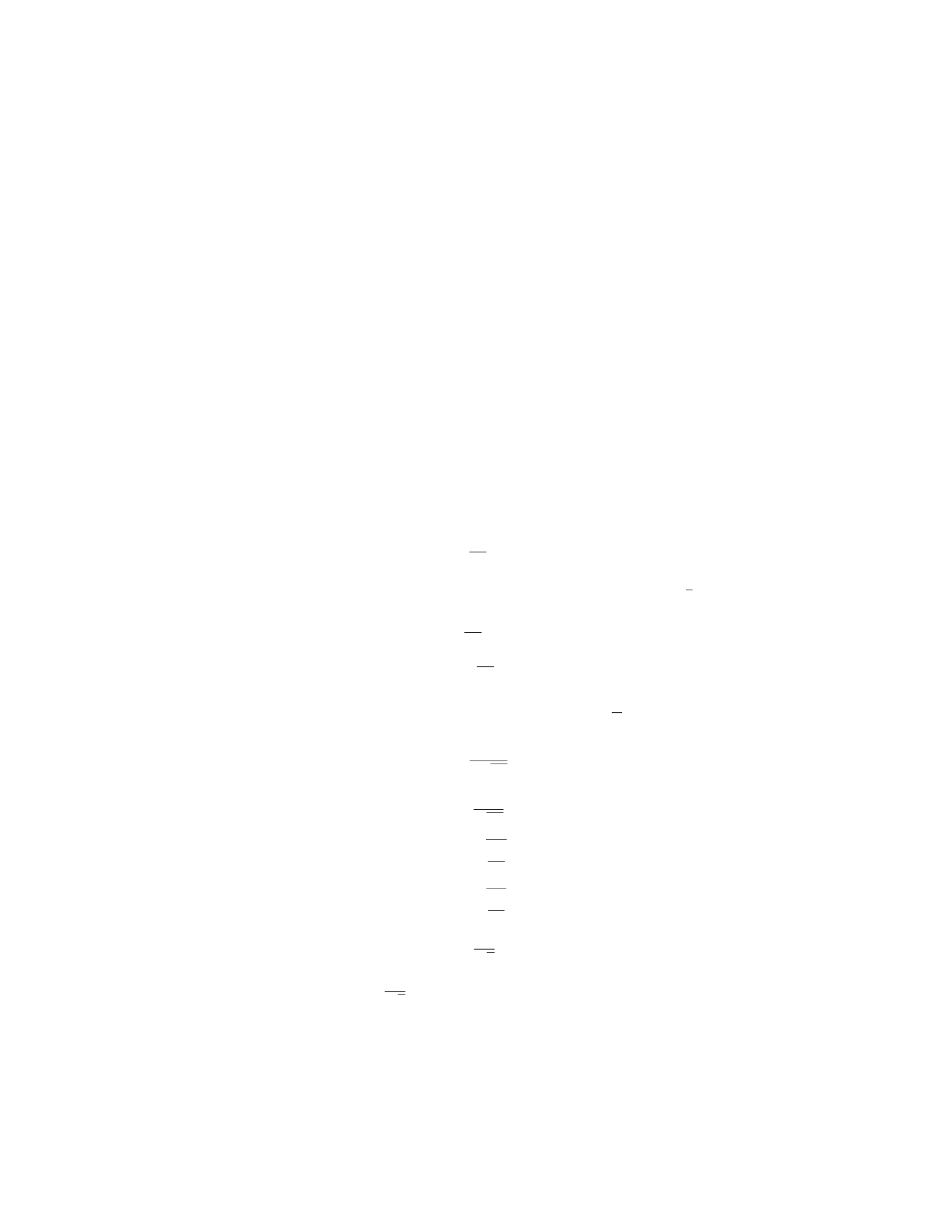
a=2(T−mg)
M
11. When the object has fallen a distance h, the work done by gravity is
equal to the increase in kinetic energy:
mgh =1
2mv2
v=p2gh
12. The linear acceleration of the object is then:
a=2(T−mg)
M=2(mg −T)
m= 2g−2T
m
13. Using v=√2gh:
a= 2g−2T
m= 2g−2mg
m= 2g−2g= 0
Therefore, the linear acceleration of the object when it has fallen a distance
his zero.
8
Question 11
Question
An object is initially at rest on the edge of a horizontal turntable. The turntable
is rotating counterclockwise with a constant angular acceleration of 2.0 rad/s2.
If the object is a distance of 0.50 m from the center of the turntable, how long
will it take for the object to rotate through an angle of 2πradians and reach
the center of the turntable?
Solution
Step 1: Find the angular velocity at the center of the turntable. The angular
acceleration α= 2.0 rad/s2and the object is 0.50 m from the center. We can
use the equation ω2=ω2
0+ 2αθ, where ωis the final angular velocity, ω0is the
initial angular velocity (which is 0), αis the angular acceleration, and θis the
angle rotated. Using θ= 2π, we have:
ω2= 0 + 2(2.0)(2π)
ω=√8πrad/s
Step 2: Find the time taken to reach the center. We know that ω=v
r, where
vis the linear velocity. At the center of the turntable, r= 0.50 m. So, v=ωr.
v=√8π×0.50
v= 2√2πm/s
The time taken to reach the center can be found using t=θ
ω:
t=2π
2√2π
t=π
√2π
t=rπ3
2π
t=rπ2
2
t=π
√2s
Therefore, it will take π
√2seconds for the object to rotate through an angle
of 2πradians and reach the center of the turntable.
9

Question 12
Question
A solid sphere of radius Rand mass Mstarts from rest and rolls without
slipping down an inclined plane that makes an angle θwith the horizontal. The
sphere reaches the bottom of the incline with a velocity v. Calculate the linear
acceleration of the sphere while it is rolling down the plane.
Solution
Step 1: We first need to determine the moment of inertia of the solid sphere
about its center. The moment of inertia of a solid sphere rotating about an axis
passing through its center is 2
5MR2.
Step 2: Next, we calculate the net torque acting on the sphere while it
is rolling down the plane. The torque due to the gravitational force can be
calculated as τ=mgR sin(θ), where mis the mass of the sphere.
Step 3: The net torque is also equal to the moment of inertia (2
5MR2) times
the angular acceleration, α. Thus, we have τ=Iα.
Step 4: Using the relationship between linear and angular acceleration for a
rolling object, a=Rα, we can rewrite the torque equation as τ=2
5MR2a
R.
Step 5: Equating the torque equations from step 2 and step 4, we get
mgR sin(θ) = 2
5Ma.
Step 6: Solving for the acceleration, a, we find a=5
2gsin(θ). Therefore, the
linear acceleration of the sphere while it is rolling down the plane is 5
2gsin(θ).
Question 13
Question
A thin rod of length Land mass Mis rotating about one end with an angular
velocity ω. What is the angular momentum of the rod about its center?
Solution
Step 1: The angular momentum of an object rotating about an axis can be
calculated using the formula L=Iω, where Lis the angular momentum, Iis
the moment of inertia, and ωis the angular velocity.
Step 2: To find the moment of inertia of the rod rotating about its center, we
need to use the parallel axis theorem. The moment of inertia of a rod rotating
about one end is 1
3ML2. Therefore, the moment of inertia of the rod rotating
about its center is I=1
3ML2+M
4L2.
Step 3: Substitute the moment of inertia found in Step 2 into the formula
for angular momentum: L= ( 1
3ML2+M
4L2)ω.
Step 4: Simplify the expression: L= ( 7
12 ML2)ω.
10

Step 5: Finally, the angular momentum of the rod about its center is
7
12 ML2ω.
Question 14
Question
A uniform solid sphere of radius Rand mass Mis released from rest at the
top of a ramp inclined at an angle θ. The sphere rolls down the ramp without
slipping. What is the velocity of the center of mass of the sphere when it reaches
the bottom of the ramp?
Solution
Step 1: The potential energy at the top of the ramp is converted into kinetic
energy at the bottom. We can equate the two energies to find the velocity of
the center of mass.
Step 2: The potential energy at the top is due to the sphere’s height above
the ground, given by U=Mgh, where his the vertical height. Given that the
ramp is inclined at an angle θ, we have h=R(1 −cos(θ)).
Step 3: At the bottom of the ramp, the kinetic energy of the sphere is
due to its translational and rotational motion. The kinetic energy is given by
K=1
2Mv2
CM +1
2Iω2, where vCM is the velocity of the center of mass and ωis
the angular velocity.
Step 4: For a solid sphere rolling without slipping, we have the relation
ω=vCM
R. The moment of inertia for a solid sphere rotating about its center is
I=2
5MR2.
Step 5: Substituting the expressions for potential energy, kinetic energy, and
the relation between ωand vCM into the energy conservation equation U=K,
we get:
Mgh =1
2Mv2
CM +1
22
5MR2vCM
R2
Step 6: Simplifying the equation, we find the velocity of the center of mass
vCM when the sphere reaches the bottom of the ramp:
vCM =r5
7gR(1 −cos(θ))
Question 15
Question
An object initially at rest starts rotating with a constant angular acceleration of
α= 0.15 rad/s2. After 4 seconds, it has rotated through an angle of 10 radians.
What is the angular velocity of the object at this time?
11

Solution
To solve this problem, we can use the equations of rotational kinematics. We
can relate the angular acceleration, angular velocity, initial angular velocity,
angle rotated, and time using the following equation:
ωf=ωi+αt
where: - ωfis the final angular velocity, - ωiis the initial angular velocity
(which is 0 rad/s since the object starts from rest), - αis the angular accelera-
tion, - tis the time.
Step 1: Find the final angular velocity We are given: - α= 0.15 rad/s2,
-ωi= 0 rad/s, - t= 4 s.
Plugging these values into the equation, we get:
ωf= 0 + 0.15 ×4
ωf= 0.6 rad/s
Therefore, the angular velocity of the object at that time is 0.6 rad/s.
Question 16
Question
A solid sphere of mass mand radius rstarts from rest and rolls down a 30◦
incline without slipping. What is the linear acceleration of the center of mass
of the sphere?
Solution
Step 1: The gravitational force on the sphere can be decomposed into two com-
ponents: one perpendicular to the incline (mg cos(30◦)) and the other parallel
to the incline (mg sin(30◦)).
Step 2: The torque due to the gravitational force about the center of the
sphere causes an angular acceleration. Since the sphere is rolling without slip-
ping, we can relate the linear acceleration aof the center of mass to the angular
acceleration αusing a=rα.
Step 3: The net torque (τnet) about the center of mass of the sphere is equal
to the moment of inertia (I) times the angular acceleration (α): τnet =Iα =
2
5mr2α.
Step 4: The torque causing the motion down the incline is solely due to
the component of the gravitational force parallel to the incline, which is r·
mg sin(30◦).
Step 5: Setting up the equation for the net torque, we have r·mg sin(30◦) =
2
5mr2α. Solving for α, we get α=5gsin(30◦)
2r.
12

Step 6: Now, using the relationship a=rα, we can find the linear ac-
celeration of the center of mass: a=r·5gsin(30◦)
2r. Simplifying, we get a=
5
2gsin(30◦) = 5
4g.
Step 7: Therefore, the linear acceleration of the center of mass of the sphere
rolling down the incline is 5
4g.
Question 17
Question
A wheel starts from rest and accelerates with a constant angular acceleration of
α= 2.0 rad/s2. After 3.0 seconds, what is the angular velocity of the wheel? If
the wheel completes 10 revolutions during this time, what is the radius of the
wheel?
Solution
Step 1: Calculate the angular velocity after 3.0 seconds using the formula:
ω=ω0+αt
where: ω= angular velocity of the wheel after 3.0 seconds, ω0= initial angular
velocity of the wheel (which is 0 rad/s), α= angular acceleration of the wheel,
t= time elapsed (3.0 seconds).
Therefore,
ω= 0 + (2.0 rad/s2)(3.0 s) = 6.0 rad/s
Step 2: Convert the angular velocity to rotational speed in revolutions per
second. Since 1 revolution is equal to 2πradians, we can use the conversion
factor:
Rotational speed = ω
2πrev/s
Substitute the value of ωto find the rotational speed:
Rotational speed = 6.0 rad/s
2π≈0.955 rev/s
Step 3: Calculate the total number of revolutions completed in 3.0 seconds
using the rotational speed:
Number of revolutions = (Rotational speed×time) = (0.955 rev/s×3.0 s) = 2.865 revolutions
Step 4: Use the given information that the wheel completes 10 revolutions
in 3.0 seconds to find the radius of the wheel. Let Rbe the radius of the wheel.
Since the distance traveled by the wheel in one revolution is 2πR, the total
distance traveled in 10 revolutions is 10 ×2πR.
Set up the equation:
10 ×2πR = total distance traveled by the wheel
13

10 ×2πR = 2.865 ×2πR
Solve for R:
R=2.865 ×2πR
10 ×2π= 0.14325 m = 14.325 cm
Therefore, the radius of the wheel is 14.325 cm.
Question 18
Question
A solid cylinder of radius Rand mass Mis rotating about a frictionless axle
through its center with an angular speed ω0. A second cylinder, identical to
the first in every aspect, is gently placed onto the first cylinder. Find the final
angular speed of the system. Assume the two cylinders remain in contact at all
times.
Solution
1. Identify the initial angular momentum of the system.
The initial angular momentum of the system can be calculated as the sum of
the angular momenta of the individual cylinders. Since they are rotating about
the same axis, we have:
Linitial = 2Iω0
where Iis the moment of inertia of one cylinder.
2. Determine the moment of inertia of one cylinder.
The moment of inertia of a solid cylinder rotating about its central axis is
given by:
I=1
2MR2
3. Substitute the moment of inertia into the initial angular mo-
mentum expression.
Substituting I=1
2MR2into the initial angular momentum expression:
Linitial = 2 1
2MR2ω0=MR2ω0
4. Determine the moment of inertia of the combined cylinders.
When the two cylinders are combined, the moment of inertia becomes:
Icombined = 2I= 2 1
2MR2=MR2
5. Apply conservation of angular momentum.
14

By the conservation of angular momentum, the initial angular momentum
must be equal to the final angular momentum:
Linitial =Lfinal
MR2ω0=Icombinedωfinal
6. Solve for the final angular speed ωfinal.
Substitute known values into the conservation of angular momentum equa-
tion:
MR2ω0=MR2ωfinal
ωfinal =ω0
Therefore, the final angular speed of the combined system is the same as the
initial angular speed ω0.
Question 19
Question
A wheel of radius 0.2 m starts from rest and rotates with a constant angular
acceleration of 2 rad/s2. Determine the angular velocity of the wheel after 3
seconds.
Solution
Step 1: Use the equation for angular velocity in terms of angular acceleration
and time:
ωf=ωi+αt
where - ωfis the final angular velocity, - ωiis the initial angular velocity (which
is zero in this case), - αis the angular acceleration, and - tis the time.
Step 2: Substitute the given values into the equation:
ωf= 0 + 2 ×3
Step 3: Calculate the final angular velocity:
ωf= 6 rad/s
Therefore, the angular velocity of the wheel after 3 seconds is 6 rad/s.
Question 20
Question
A disc of radius Ris initially at rest. It starts rotating with an angular accel-
eration α=2
t2, where tis the time in seconds. Find the angular velocity of the
disc after 4 seconds.
15

Solution
Let’s first determine the angular velocity of the disc as a function of time using
the given angular acceleration.
Step 1: Find the angular velocity as a function of time. The angular
acceleration is given by α=dω
dt , where ωis the angular velocity.
α=dω
dt =2
t2
Integrating both sides with respect to tgives:
Zα dt =Z2
t2dt
ω=−2
t+C
where Cis the constant of integration.
Step 2: Apply the initial condition to determine the value of the constant
C. Since the disc is initially at rest, the initial angular velocity ω0= 0 at t= 0.
Substituting this into the expression for ω:
ω0=0=−2
0+C
C= 0
So, the angular velocity as a function of time is ω=−2
t.
Step 3: Find the angular velocity after 4 seconds. Substitute t= 4 into the
expression for ω:
ω=−2
4=−1
2rad/s
Therefore, the angular velocity of the disc after 4 seconds is −1
2rad/s.
Question 21
Question
A disk of radius Rstarts from rest and accelerates with a constant angular
acceleration α. At a certain time t, the angular velocity of the disk is ω. What
is the linear velocity of a point on the rim of the disk at this time?
Solution
Step 1: Find the angular displacement of the disk at time tusing the equation
of rotational kinematics:
θ=ω0t+1
2αt2
16

Step 2: Calculate the angular velocity of a point on the rim of the disk at
time tusing the relationship between linear and angular velocities:
v=Rω
Step 3: Substitute the values of θand ωinto the expression for linear velocity
to find the final answer.
Question 22
Question
A disk of radius 0.5 m starts from rest and accelerates with a constant angular
acceleration of 2 rad/s2. What is the angular velocity of the disk after 3 seconds?
Solution
Step 1: Find the angular velocity of the disk after 3 seconds using the formula
for angular velocity with constant angular acceleration:
ω=ω0+αt
where:
ω= final angular velocity
ω0= initial angular velocity (0 in this case)
α= angular acceleration (2 rad/s2)
t= time (3 seconds)
Step 2: Substituting the given values into the formula:
ω= 0 + (2 rad/s2)(3 s) = 6 rad/s
Therefore, the angular velocity of the disk after 3 seconds is 6 rad/s.
Question 23
Question
A disk of radius 0.4 m starts from rest and accelerates with a constant angular
acceleration of 2 rad/s2.
1. Determine the angular velocity of the disk after 3 seconds.
2. Calculate the angular displacement of the disk during the first 3 seconds
of its motion.
17

Solution
1. We can find the angular velocity of the disk after 3 seconds using the equation
for angular velocity with constant angular acceleration:
ωf=ωi+αt
Where: - ωfis the final angular velocity, - ωiis the initial angular velocity
(which is 0 since the disk starts from rest), - αis the angular acceleration, - tis
the time.
Step 1: Substitute the known values into the equation:
ωf= 0 + 2 ×3 = 6 rad/s
So, the angular velocity of the disk after 3 seconds is 6 rad/s.
2. To find the angular displacement of the disk during the first 3 seconds
of its motion, we can use the equation for angular displacement with constant
angular acceleration:
θ=ωit+1
2αt2
Where: - θis the angular displacement, - ωiis the initial angular velocity, -
αis the angular acceleration, - tis the time.
Step 2: Substitute the known values into the equation:
θ= 0 ×3 + 1
2×2×32= 9 radians
Therefore, the angular displacement of the disk during the first 3 seconds of
its motion is 9 radians.
Question 24
Question
A wheel starts from rest and accelerates uniformly for 12.0 s through 330 revo-
lutions. Find the radial acceleration of a point on the rim of the wheel and the
translational acceleration of this point.
Solution
Step 1: Find the angular acceleration of the wheel. Given: Time, t= 12.0 s
Number of revolutions, N= 330
The angular displacement (θ) of the wheel can be calculated using the for-
mula: θ= 2πN
θ= 2π×330 = 660πrad
The angular acceleration (α) can be calculated using the formula: α=∆ω
∆t,
where ∆ωis the change in angular velocity.
18

α=2π−0
12.0=2π
12.0=π
6rad/s2
Step 2: Find the radial acceleration of a point on the rim of the wheel. The
radial acceleration of a point on the rim of the wheel is given by the formula:
ar=rα, where ris the radius of the wheel.
Given: Radius, r=C
2π(where Cis the circumference of the wheel)
The circumference of the wheel can be calculated using the formula: C= 2πr
C= 2π×r
2π=r
Therefore, ar=rα =r×π
6=rπ
6
Step 3: Find the translational acceleration of the point. The translational
acceleration of the point is given by the formula: at=rα =rπ
6, which is the
same as the radial acceleration due to the tangential nature of the acceleration
in circular motion.
Hence, the radial acceleration of a point on the rim of the wheel is rπ
6and
the translational acceleration of this point is also rπ
6.
Question 25
Question
A thin rod of length Land mass Mis rotating about an axis through one end
with an angular speed ω. Find the angular momentum of the rod with respect
to this axis.
Solution
Step 1: The angular momentum of a point mass mrotating about an axis with
angular velocity ωat a distance rfrom the axis is given by L=m·r2·ω.
Step 2: To find the angular momentum of the entire rod, we need to consider
all the point masses that make up the rod. We can treat the rod as a collection
of infinitesimally small point masses and integrate to find the total angular
momentum.
Step 3: Let’s consider a small element of the rod at a distance rfrom the
axis and with a mass dm. The mass dm is located at a distance ralong the rod.
The angular momentum contribution dL from this element is dL =r·dm ·r2·ω.
Step 4: The mass dm can be expressed in terms of the linear mass density
λ=M
Las dm =λ·dr. Substituting this into the expression for dL gives
dL =λ·r·dr ·r2·ω.
Step 5: To find the total angular momentum LTof the rod, we need to
integrate dL over the entire length of the rod. Therefore, LT=RdL =RL
0λ·
r3·ω dr.
19
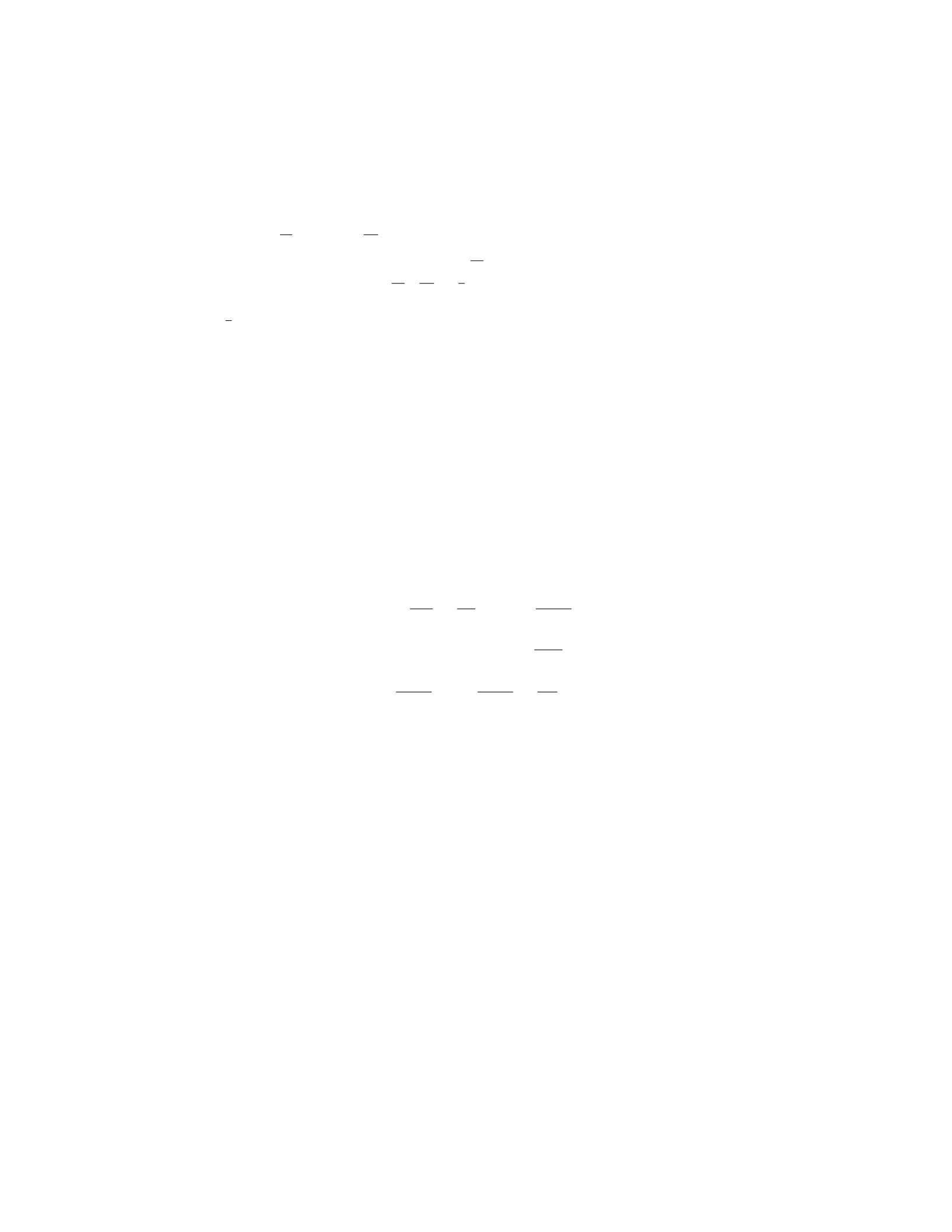
Step 6: Simplifying the integral gives LT=ωλ RL
0r3dr. Integrating gives
LT=ωλ hr4
4iL
0=ωλ ·L4
4.
Step 7: Finally, substituting λ=M
Linto the expression for total angular
momentum gives LT=ω·M
L·L4
4=1
4MωL3.
Therefore, the angular momentum of the rod with respect to the given axis
is 1
4MωL3.
Question 26
Question
A wheel starts from rest and rotates with a constant angular acceleration of
2.0 rad/s2. How long will it take the wheel to make 10 complete revolutions?
Solution
Step 1: Find the angular acceleration in terms of revolutions per minute (rpm).
Given: Angular acceleration, α= 2.0 rad/s2We know that 1 rev = 2πrad.
So, the angular acceleration in terms of revolutions per minute (rpm) is:
α=d2θ
dt2=dω
dt = 2π×drpm
dt
Given α= 2.0 rad/s2, we can substitute to find drpm
dt .
2π= 2.0×drpm
dt =⇒drpm
dt =2π
2.0=πrpm/s
Step 2: Find the time taken to make 1 complete revolution. Using the
relation ω=ω0+αt, where ω0= 0 (initial angular velocity) and ω= 2πrad/s
(angular velocity after 1 revolution).
2π= 2πrad/s2×t=⇒t= 1 s
Step 3: Find the time taken to make 10 complete revolutions. Since it takes
1 second to make 1 complete revolution, it will take 10×1 = 10 seconds to make
10 complete revolutions.
Therefore, it will take the wheel 10 seconds to make 10 complete revolutions.
Question 27
Question
A disk starts from rest and rotates with a constant angular acceleration of
2.0 rad/s2. If the disk rotates through an angle of 15 revolutions, what is the
angular velocity after completing 15 revolutions?
20

Solution
Step 1: The relationship between angular acceleration (α), initial angular veloc-
ity (ω0), final angular velocity (ω), and the angle rotated through (θ) is given
by the equation
ω2=ω2
0+ 2αθ
Step 2: We are given α= 2.0 rad/s2,θ= 15 ×2πrad (as 1 revolution is
equal to 2πradians), and ω0= 0 (as the disk starts from rest).
Step 3: Substitute the given values into the equation:
ω2= 0 + 2(2.0)(15 ×2π)
Step 4: Simplify the equation to solve for ω:
ω=p2(2.0)(15 ×2π)
Step 5: Calculate the angular velocity after completing 15 revolutions:
ω≈√60 ×2π≈24.49 rad/s
Question 28
Question
A thin rod of length Land mass Mis pivoted about one end and released from
rest in a vertical position. What is the angular speed of the rod when it is
horizontal?
Solution
Step 1: The potential energy of the rod when it is vertical will be converted
to kinetic energy when it is horizontal. The potential energy when the rod is
vertical is given by:
P E =Mgh
where h=Lis the length of the rod and gis the acceleration due to gravity.
Step 2: The kinetic energy when the rod is horizontal is given by:
KE =1
2Iω2
where I=1
3ML2is the moment of inertia of a thin rod rotating about one end
and ωis the angular speed of the rod.
Step 3: Since energy is conserved, we have:
P E =KE
Mgh =1
21
3ML2ω2
21

Step 4: Solving for ω, we get:
ω=r3gh
2L
Step 5: Substituting h=L, we find the angular speed of the rod when it is
horizontal to be:
ω=r3g
2L
Question 29
Question
A wheel with a radius of 0.4 m starts from rest and accelerates uniformly for 10
seconds. It then rotates for an additional 20 seconds under a constant angular
velocity. If the total angular displacement of the wheel during this time is 50
revolutions, what is the angular acceleration of the wheel during the first 10
seconds?
Solution
Step 1: Find the initial angular velocity of the wheel after the first 10 seconds.
The angular displacement θ1during the first 10 seconds can be found using
the formula:
θ1=1
2αt2
1
where αis the angular acceleration, t1is the time period, and we know that the
initial angular velocity ωiis 0. Also, t1= 10 seconds and the wheel accelerates
uniformly, so the final angular velocity ωfat t1is related to ωiand αas:
ωf=ωi+αt1
Solving these equations gives us:
θ1=1
2α(10)2and ωf=α×10
Step 2: Find the angular velocity after the additional 20 seconds.
For the wheel rotating for another 20 seconds with constant angular velocity,
the angular displacement θ2can be found using the formula: θ2=ωft2. We
know that θ2= 50 revolutions.
Step 3: Calculate the angular acceleration during the first 10 seconds.
The total angular displacement is the sum of the angular displacements
during the two time periods:
θtotal =θ1+θ2
22

Substituting the expressions for θ1and θ2and solving for αgives:
1
2α(10)2+ 10α×20 = 50 ×2π
Solving for αwill give us the angular acceleration during the first 10 seconds.
Question 30
Question
A thin rod of length Lis rotating about one end with an angular speed ω. If
the other end of the rod suddenly comes to rest, determine the angular velocity
of the rod immediately after.
Solution
Step 1: We will start by considering the conservation of angular momentum
about the rotating end of the rod. Initially, the rod has angular momentum
L1=I1ω, where I1is the moment of inertia of the rod with respect to the
rotating end.
Step 2: When the other end of the rod suddenly comes to rest, the moment
of inertia of the rod changes. The new moment of inertia I2for the rod about the
rotating end can be determined using the parallel axis theorem: I2=Icm+M L2,
where Icm =1
3ML2is the moment of inertia about the center of mass and M
is the mass of the rod.
Step 3: Now, we can write the conservation of angular momentum equation:
L1=L2, where L2=I2ω′, with ω′being the angular velocity of the rod
immediately after the other end comes to rest.
Step 4: Substituting I1ωfor L1and I2ω′for L2into the conservation of
angular momentum equation, we get I1ω=I2ω′.
Step 5: Substituting I1=1
3ML2and I2=4
3ML2into the equation and
solving for ω′, we find ω′=1
4ω.
Therefore, the angular velocity of the rod immediately after the other end
comes to rest is 1
4of the initial angular speed.
Question 31
Question
A solid sphere of radius Rand mass Mstarts from rest and rolls without slipping
down a 30◦incline that is 10 meters long. Find the speed of the sphere at the
bottom of the incline.
23

Solution
Step 1: Set up the conservation of energy equation. Step 2: Solve for the final
velocity of the sphere at the bottom of the incline.
Step 1: The conservation of energy equation can be written as:
mgh =1
2Iω2+1
2mv2
where: mis the mass of the object, his the height of the incline, gis the
acceleration due to gravity, Iis the moment of inertia of the object, ωis the
angular velocity of the object, vis the linear velocity of the object.
Given that the sphere rolls without slipping, we have the following relations:
ω=v
Rand v=Rω.
The potential energy mgh can be written in terms of the angle of the incline:
mgh =mgL sin(30◦)
where Lis the length of the incline.
The kinetic energy terms can be written in terms of v. The moment of
inertia of a solid sphere about its center of mass is 2
5MR2.
Step 2: Substitute the expressions from above into the conservation of
energy equation and solve for v:
mgL sin(30◦) = 1
22
5MR2v
R2+1
2Mv2
mgL sin(30◦) = 1
5Mv2+1
2Mv2
mgL sin(30◦) = 7
10Mv2
v=r10
7
mgL sin(30◦)
M
Now, plug in the values and calculate the final velocity v:
v=r10
7
(9.81)(10) sin(30◦)
M
Thus, the speed of the sphere at the bottom of the incline is v=q10
7·(9.81)(10)·0.5
M.
Question 32
Question
A disk of radius 0.5 m is rotating at an angular velocity of 4 rad/s. A constant
angular acceleration of -2 rad/s2is applied to the disk for 3 seconds in the
opposite direction. Find the final angular velocity of the disk.
24

Solution
Step 1: Calculate the angular displacement during the 3-second period. Given
the initial angular velocity ωi= 4 rad/s, the angular acceleration α=−2 rad/s2,
and the time t= 3 s, we can use the kinematic equation:
θ=ωit+1
2αt2
Substitute the given values to find θ:
θ= 4 ×3 + 1
2×(−2) ×32= 12 −9 = 3 rad
Step 2: Determine the final angular velocity. The final angular velocity ωf
can be found using the equation:
ωf=ωi+αt
Substitute the values to solve for ωf:
ωf= 4 + (−2) ×3=4−6 = −2 rad/s
Therefore, the final angular velocity of the disk is −2 rad/s.
Question 33
Question
A disk of radius 0.2 m starts from rest and accelerates with a constant angular
acceleration of 2 rad/s2. What is the angular velocity of the disk after 3 seconds?
Solution
Step 1: First, we need to determine the angular velocity of the disk after 3
seconds using the equation for angular velocity under constant angular acceler-
ation:
ω=ω0+αt
where: - ωis the final angular velocity, - ω0is the initial angular velocity (which
is 0 since the disk starts from rest), - αis the angular acceleration, - tis the
time.
Plugging in the values, we get:
ω= 0 + 2 ×3 = 6 rad/s
Therefore, the angular velocity of the disk after 3 seconds is 6 rad/s.
25

Question 34
Question
A merry-go-round is initially at rest. It starts rotating with a constant angular
acceleration of 2.0 rad/s2. What is its angular velocity after 4.0 seconds?
Solution
Step 1: We can use the equation for angular velocity with constant angular
acceleration, which is ωf=ωi+αt, where ωfis the final angular velocity, ωiis
the initial angular velocity, αis the angular acceleration, and tis the time.
Step 2: Since the merry-go-round is initially at rest, the initial angular
velocity ωiis 0. Therefore, we have ωf= 0 + (2.0 rad/s2)(4.0 s).
Step 3: Calculating the final angular velocity, we get ωf= 8.0 rad/s.
Step 4: Hence, the angular velocity of the merry-go-round after 4.0 seconds
is 8.0 rad/s.
Question 35
Question
A thin rod of length Land mass Mis rotating about an axis through one end
with an angular speed ω. Suddenly, a small mass mis attached at the other
end of the rod. What is the new angular speed of the system?
Solution
Step 1: Find the moment of inertia of the system before the mass mis attached.
The moment of inertia of a thin rod rotating about an axis through one end is
given by I=1
3ML2.
Step 2: Find the initial angular momentum of the system. The initial angular
momentum Liis given by Li=Iω =1
3ML2ω.
Step 3: Find the final moment of inertia of the system after attaching mass
m. The moment of inertia of the system after attaching mass mat the end of
the rod is Inew =I+mL2.
Step 4: Find the final angular momentum of the system. The final angular
momentum Lfis given by Lf=Inewωnew, where ωnew is the new angular speed
of the system.
Step 5: Apply conservation of angular momentum. Since angular momentum
is conserved, we have Li=Lf, which gives 1
3ML2ω= (I+mL2)ωnew.
Step 6: Solve for the new angular speed ωnew. Solving the above equation
for ωnew, we get ωnew =1
3Mω +m
M+1
3mω.
26

Question 8
Question
A solid cylinder of radius Rand mass Mis initially at rest. A constant force
Fis applied tangentially to the edge of the cylinder, causing it to start rolling
without slipping. If the coefficient of kinetic friction between the cylinder and
the surface is µk, determine the distance dthe cylinder travels before coming
to a stop.
Solution
Step 1: Find the acceleration of the cylinder. The net torque on the cylinder is
given by
τ=F R −fkR=Iα
where fk=µkNis the kinetic friction force, Nis the normal force, I=1
2MR2
is the moment of inertia of the cylinder, and αis the angular acceleration.
Since the cylinder is rolling without slipping, a=Rα, where ais the linear
acceleration. Therefore, we have
F R −µkNR =1
2MR2·a
R
Solving for agives
a=2F−2µkMg
3M
Step 2: Find the time it takes for the cylinder to stop. The time it takes
for the cylinder to stop can be found by setting the final velocity to zero in the
equation of motion: v2=u2+ 2as. The final velocity is zero, the initial velocity
is zero, and the acceleration is given by a. The stopping time is then
t=v−u
a=−u
a=3M
2F−2µkMg
Step 3: Find the distance traveled before stopping. The distance traveled
before stopping is given by
d=ut +1
2at2
Substituting the values of u,a, and tinto the above equation gives
d=1
2·2F
3·3M
2F−2µkMg ·3M
2F−2µkMg
Simplifying further yields
d=3M2
4(F−µkMg)2
Therefore, the distance the cylinder travels before coming to a stop is 3M2
4(F−µkMg)2.
6

Question 9
Question
A disk with a radius of 0.2 m starts from rest and accelerates at a constant rate
of 5 rad/s2. Find the angular velocity of the disk after 3 seconds.
Solution
Step 1: Given parameters for the disk: Let’s denote: - the initial angular velocity
of the disk as ω0(which is 0 for this case), - the angular acceleration of the disk
as α= 5 rad/s2, - the time after which we want to find the angular velocity as
t= 3 s, - the radius of the disk as r= 0.2 m.
Step 2: Using the kinematic equation for rotational motion: The angular
velocity of the disk after a certain time tcan be found using the equation:
ω=ω0+αt
Substitute the given values to find the angular velocity after 3 seconds:
ω= 0 + 5 ×3 = 15 rad/s
Step 3: Answer The angular velocity of the disk after 3 seconds is 15 rad/s.
Question 10
Question
A solid cylinder of radius Rand mass Mis initially at rest. A light rope is
wound around the cylinder and a small object of mass mis attached to the free
end of the rope. The object is allowed to fall, causing the cylinder to rotate.
Calculate the linear acceleration of the object when it has fallen a distance h.
Solution
1. The gravitational force on the object causes an acceleration gdownwards.
The tension in the rope will be less than mg and will cause an acceleration of
magnitude aupwards. Let Tbe the tension in the rope at this instant.
2. The net force on the object causing the acceleration ais:
ΣF=T−mg =ma
Where mis the mass of the object.
3. The object’s acceleration ais also related to the angular acceleration α
of the cylinder:
a=αR
7

4. The torque on the cylinder due to the net force applied by the object is:
τ= (T−mg)R
τ=Iα
Where Iis the moment of inertia of the cylinder.
5. The moment of inertia of the cylinder is I=1
2MR2.
6. Substituting for τin terms of aand α:
(T−mg)R=1
2MR2α
7. Substituting for ain terms of α:
T−mg =1
2MRα
8. We also have the relationship between linear acceleration a, angular
acceleration α, and the radius R:
a=αR
9. Substituting a=αR into T−mg =1
2MRα:
T−mg =1
2Ma
10. Solving for a:
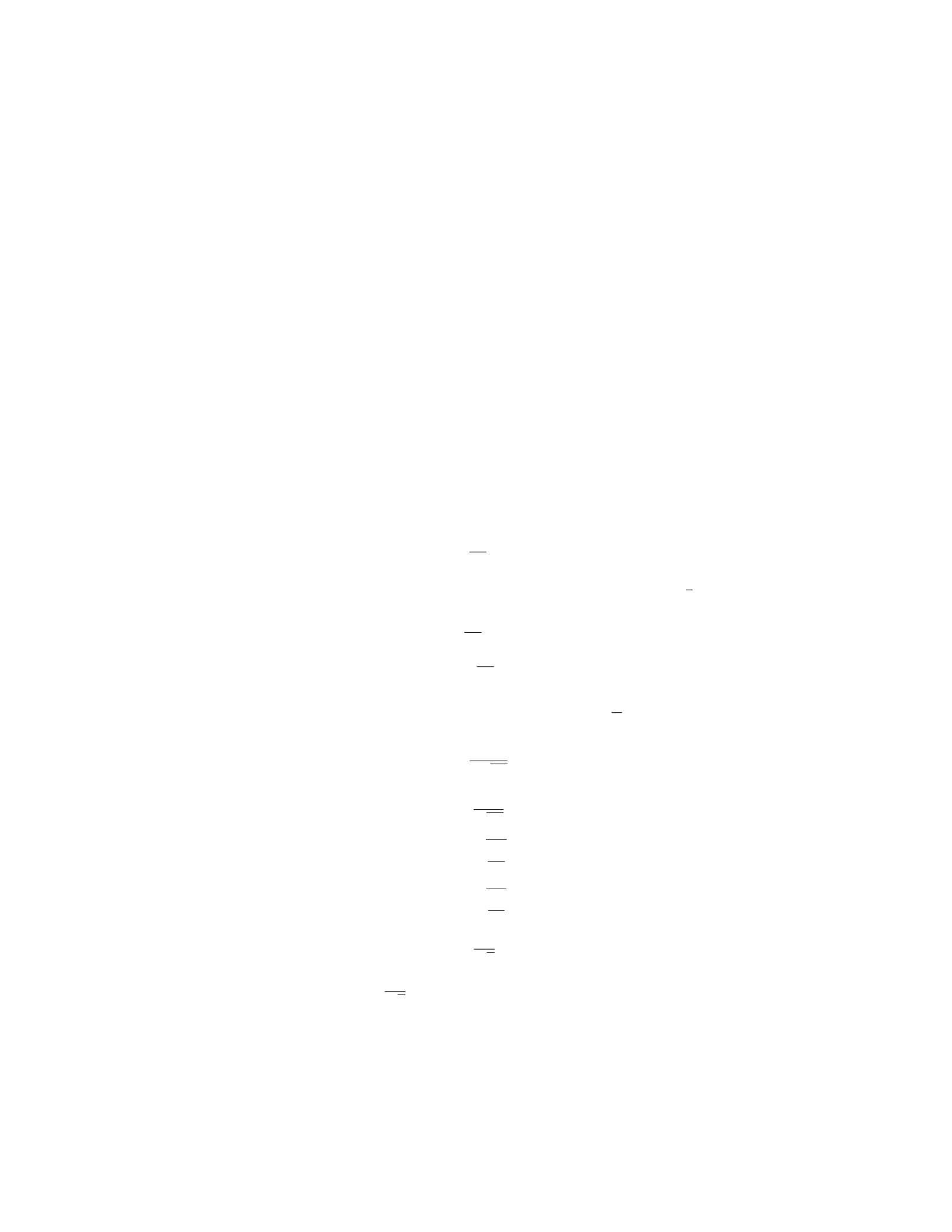
a=2(T−mg)
M
11. When the object has fallen a distance h, the work done by gravity is
equal to the increase in kinetic energy:
mgh =1
2mv2
v=p2gh
12. The linear acceleration of the object is then:
a=2(T−mg)
M=2(mg −T)
m= 2g−2T
m
13. Using v=√2gh:
a= 2g−2T
m= 2g−2mg
m= 2g−2g= 0
Therefore, the linear acceleration of the object when it has fallen a distance
his zero.
8
Question 11
Question
An object is initially at rest on the edge of a horizontal turntable. The turntable
is rotating counterclockwise with a constant angular acceleration of 2.0 rad/s2.
If the object is a distance of 0.50 m from the center of the turntable, how long
will it take for the object to rotate through an angle of 2πradians and reach
the center of the turntable?
Solution
Step 1: Find the angular velocity at the center of the turntable. The angular
acceleration α= 2.0 rad/s2and the object is 0.50 m from the center. We can
use the equation ω2=ω2
0+ 2αθ, where ωis the final angular velocity, ω0is the
initial angular velocity (which is 0), αis the angular acceleration, and θis the
angle rotated. Using θ= 2π, we have:
ω2= 0 + 2(2.0)(2π)
ω=√8πrad/s
Step 2: Find the time taken to reach the center. We know that ω=v
r, where
vis the linear velocity. At the center of the turntable, r= 0.50 m. So, v=ωr.
v=√8π×0.50
v= 2√2πm/s
The time taken to reach the center can be found using t=θ
ω:
t=2π
2√2π
t=π
√2π
t=rπ3
2π
t=rπ2
2
t=π
√2s
Therefore, it will take π
√2seconds for the object to rotate through an angle
of 2πradians and reach the center of the turntable.
9

Question 12
Question
A solid sphere of radius Rand mass Mstarts from rest and rolls without
slipping down an inclined plane that makes an angle θwith the horizontal. The
sphere reaches the bottom of the incline with a velocity v. Calculate the linear
acceleration of the sphere while it is rolling down the plane.
Solution
Step 1: We first need to determine the moment of inertia of the solid sphere
about its center. The moment of inertia of a solid sphere rotating about an axis
passing through its center is 2
5MR2.
Step 2: Next, we calculate the net torque acting on the sphere while it
is rolling down the plane. The torque due to the gravitational force can be
calculated as τ=mgR sin(θ), where mis the mass of the sphere.
Step 3: The net torque is also equal to the moment of inertia (2
5MR2) times
the angular acceleration, α. Thus, we have τ=Iα.
Step 4: Using the relationship between linear and angular acceleration for a
rolling object, a=Rα, we can rewrite the torque equation as τ=2
5MR2a
R.
Step 5: Equating the torque equations from step 2 and step 4, we get
mgR sin(θ) = 2
5Ma.
Step 6: Solving for the acceleration, a, we find a=5
2gsin(θ). Therefore, the
linear acceleration of the sphere while it is rolling down the plane is 5
2gsin(θ).
Question 13
Question
A thin rod of length Land mass Mis rotating about one end with an angular
velocity ω. What is the angular momentum of the rod about its center?
Solution
Step 1: The angular momentum of an object rotating about an axis can be
calculated using the formula L=Iω, where Lis the angular momentum, Iis
the moment of inertia, and ωis the angular velocity.
Step 2: To find the moment of inertia of the rod rotating about its center, we
need to use the parallel axis theorem. The moment of inertia of a rod rotating
about one end is 1
3ML2. Therefore, the moment of inertia of the rod rotating
about its center is I=1
3ML2+M
4L2.
Step 3: Substitute the moment of inertia found in Step 2 into the formula
for angular momentum: L= ( 1
3ML2+M
4L2)ω.
Step 4: Simplify the expression: L= ( 7
12 ML2)ω.
10

Step 5: Finally, the angular momentum of the rod about its center is
7
12 ML2ω.
Question 14
Question
A uniform solid sphere of radius Rand mass Mis released from rest at the
top of a ramp inclined at an angle θ. The sphere rolls down the ramp without
slipping. What is the velocity of the center of mass of the sphere when it reaches
the bottom of the ramp?
Solution
Step 1: The potential energy at the top of the ramp is converted into kinetic
energy at the bottom. We can equate the two energies to find the velocity of
the center of mass.
Step 2: The potential energy at the top is due to the sphere’s height above
the ground, given by U=Mgh, where his the vertical height. Given that the
ramp is inclined at an angle θ, we have h=R(1 −cos(θ)).
Step 3: At the bottom of the ramp, the kinetic energy of the sphere is
due to its translational and rotational motion. The kinetic energy is given by
K=1
2Mv2
CM +1
2Iω2, where vCM is the velocity of the center of mass and ωis
the angular velocity.
Step 4: For a solid sphere rolling without slipping, we have the relation
ω=vCM
R. The moment of inertia for a solid sphere rotating about its center is
I=2
5MR2.
Step 5: Substituting the expressions for potential energy, kinetic energy, and
the relation between ωand vCM into the energy conservation equation U=K,
we get:
Mgh =1
2Mv2
CM +1
22
5MR2vCM
R2
Step 6: Simplifying the equation, we find the velocity of the center of mass
vCM when the sphere reaches the bottom of the ramp:
vCM =r5
7gR(1 −cos(θ))
Question 15
Question
An object initially at rest starts rotating with a constant angular acceleration of
α= 0.15 rad/s2. After 4 seconds, it has rotated through an angle of 10 radians.
What is the angular velocity of the object at this time?
11

Solution
To solve this problem, we can use the equations of rotational kinematics. We
can relate the angular acceleration, angular velocity, initial angular velocity,
angle rotated, and time using the following equation:
ωf=ωi+αt
where: - ωfis the final angular velocity, - ωiis the initial angular velocity
(which is 0 rad/s since the object starts from rest), - αis the angular accelera-
tion, - tis the time.
Step 1: Find the final angular velocity We are given: - α= 0.15 rad/s2,
-ωi= 0 rad/s, - t= 4 s.
Plugging these values into the equation, we get:
ωf= 0 + 0.15 ×4
ωf= 0.6 rad/s
Therefore, the angular velocity of the object at that time is 0.6 rad/s.
Question 16
Question
A solid sphere of mass mand radius rstarts from rest and rolls down a 30◦
incline without slipping. What is the linear acceleration of the center of mass
of the sphere?
Solution
Step 1: The gravitational force on the sphere can be decomposed into two com-
ponents: one perpendicular to the incline (mg cos(30◦)) and the other parallel
to the incline (mg sin(30◦)).
Step 2: The torque due to the gravitational force about the center of the
sphere causes an angular acceleration. Since the sphere is rolling without slip-
ping, we can relate the linear acceleration aof the center of mass to the angular
acceleration αusing a=rα.
Step 3: The net torque (τnet) about the center of mass of the sphere is equal
to the moment of inertia (I) times the angular acceleration (α): τnet =Iα =
2
5mr2α.
Step 4: The torque causing the motion down the incline is solely due to
the component of the gravitational force parallel to the incline, which is r·
mg sin(30◦).
Step 5: Setting up the equation for the net torque, we have r·mg sin(30◦) =
2
5mr2α. Solving for α, we get α=5gsin(30◦)
2r.
12

Step 6: Now, using the relationship a=rα, we can find the linear ac-
celeration of the center of mass: a=r·5gsin(30◦)
2r. Simplifying, we get a=
5
2gsin(30◦) = 5
4g.
Step 7: Therefore, the linear acceleration of the center of mass of the sphere
rolling down the incline is 5
4g.
Question 17
Question
A wheel starts from rest and accelerates with a constant angular acceleration of
α= 2.0 rad/s2. After 3.0 seconds, what is the angular velocity of the wheel? If
the wheel completes 10 revolutions during this time, what is the radius of the
wheel?
Solution
Step 1: Calculate the angular velocity after 3.0 seconds using the formula:
ω=ω0+αt
where: ω= angular velocity of the wheel after 3.0 seconds, ω0= initial angular
velocity of the wheel (which is 0 rad/s), α= angular acceleration of the wheel,
t= time elapsed (3.0 seconds).
Therefore,
ω= 0 + (2.0 rad/s2)(3.0 s) = 6.0 rad/s
Step 2: Convert the angular velocity to rotational speed in revolutions per
second. Since 1 revolution is equal to 2πradians, we can use the conversion
factor:
Rotational speed = ω
2πrev/s
Substitute the value of ωto find the rotational speed:
Rotational speed = 6.0 rad/s
2π≈0.955 rev/s
Step 3: Calculate the total number of revolutions completed in 3.0 seconds
using the rotational speed:
Number of revolutions = (Rotational speed×time) = (0.955 rev/s×3.0 s) = 2.865 revolutions
Step 4: Use the given information that the wheel completes 10 revolutions
in 3.0 seconds to find the radius of the wheel. Let Rbe the radius of the wheel.
Since the distance traveled by the wheel in one revolution is 2πR, the total
distance traveled in 10 revolutions is 10 ×2πR.
Set up the equation:
10 ×2πR = total distance traveled by the wheel
13

10 ×2πR = 2.865 ×2πR
Solve for R:
R=2.865 ×2πR
10 ×2π= 0.14325 m = 14.325 cm
Therefore, the radius of the wheel is 14.325 cm.
Question 18
Question
A solid cylinder of radius Rand mass Mis rotating about a frictionless axle
through its center with an angular speed ω0. A second cylinder, identical to
the first in every aspect, is gently placed onto the first cylinder. Find the final
angular speed of the system. Assume the two cylinders remain in contact at all
times.
Solution
1. Identify the initial angular momentum of the system.
The initial angular momentum of the system can be calculated as the sum of
the angular momenta of the individual cylinders. Since they are rotating about
the same axis, we have:
Linitial = 2Iω0
where Iis the moment of inertia of one cylinder.
2. Determine the moment of inertia of one cylinder.
The moment of inertia of a solid cylinder rotating about its central axis is
given by:
I=1
2MR2
3. Substitute the moment of inertia into the initial angular mo-
mentum expression.
Substituting I=1
2MR2into the initial angular momentum expression:
Linitial = 2 1
2MR2ω0=MR2ω0
4. Determine the moment of inertia of the combined cylinders.
When the two cylinders are combined, the moment of inertia becomes:
Icombined = 2I= 2 1
2MR2=MR2
5. Apply conservation of angular momentum.
14

By the conservation of angular momentum, the initial angular momentum
must be equal to the final angular momentum:
Linitial =Lfinal
MR2ω0=Icombinedωfinal
6. Solve for the final angular speed ωfinal.
Substitute known values into the conservation of angular momentum equa-
tion:
MR2ω0=MR2ωfinal
ωfinal =ω0
Therefore, the final angular speed of the combined system is the same as the
initial angular speed ω0.
Question 19
Question
A wheel of radius 0.2 m starts from rest and rotates with a constant angular
acceleration of 2 rad/s2. Determine the angular velocity of the wheel after 3
seconds.
Solution
Step 1: Use the equation for angular velocity in terms of angular acceleration
and time:
ωf=ωi+αt
where - ωfis the final angular velocity, - ωiis the initial angular velocity (which
is zero in this case), - αis the angular acceleration, and - tis the time.
Step 2: Substitute the given values into the equation:
ωf= 0 + 2 ×3
Step 3: Calculate the final angular velocity:
ωf= 6 rad/s
Therefore, the angular velocity of the wheel after 3 seconds is 6 rad/s.
Question 20
Question
A disc of radius Ris initially at rest. It starts rotating with an angular accel-
eration α=2
t2, where tis the time in seconds. Find the angular velocity of the
disc after 4 seconds.
15

Solution
Let’s first determine the angular velocity of the disc as a function of time using
the given angular acceleration.
Step 1: Find the angular velocity as a function of time. The angular
acceleration is given by α=dω
dt , where ωis the angular velocity.
α=dω
dt =2
t2
Integrating both sides with respect to tgives:
Zα dt =Z2
t2dt
ω=−2
t+C
where Cis the constant of integration.
Step 2: Apply the initial condition to determine the value of the constant
C. Since the disc is initially at rest, the initial angular velocity ω0= 0 at t= 0.
Substituting this into the expression for ω:
ω0=0=−2
0+C
C= 0
So, the angular velocity as a function of time is ω=−2
t.
Step 3: Find the angular velocity after 4 seconds. Substitute t= 4 into the
expression for ω:
ω=−2
4=−1
2rad/s
Therefore, the angular velocity of the disc after 4 seconds is −1
2rad/s.
Question 21
Question
A disk of radius Rstarts from rest and accelerates with a constant angular
acceleration α. At a certain time t, the angular velocity of the disk is ω. What
is the linear velocity of a point on the rim of the disk at this time?
Solution
Step 1: Find the angular displacement of the disk at time tusing the equation
of rotational kinematics:
θ=ω0t+1
2αt2
16

Step 2: Calculate the angular velocity of a point on the rim of the disk at
time tusing the relationship between linear and angular velocities:
v=Rω
Step 3: Substitute the values of θand ωinto the expression for linear velocity
to find the final answer.
Question 22
Question
A disk of radius 0.5 m starts from rest and accelerates with a constant angular
acceleration of 2 rad/s2. What is the angular velocity of the disk after 3 seconds?
Solution
Step 1: Find the angular velocity of the disk after 3 seconds using the formula
for angular velocity with constant angular acceleration:
ω=ω0+αt
where:
ω= final angular velocity
ω0= initial angular velocity (0 in this case)
α= angular acceleration (2 rad/s2)
t= time (3 seconds)
Step 2: Substituting the given values into the formula:
ω= 0 + (2 rad/s2)(3 s) = 6 rad/s
Therefore, the angular velocity of the disk after 3 seconds is 6 rad/s.
Question 23
Question
A disk of radius 0.4 m starts from rest and accelerates with a constant angular
acceleration of 2 rad/s2.
1. Determine the angular velocity of the disk after 3 seconds.
2. Calculate the angular displacement of the disk during the first 3 seconds
of its motion.
17

Solution
1. We can find the angular velocity of the disk after 3 seconds using the equation
for angular velocity with constant angular acceleration:
ωf=ωi+αt
Where: - ωfis the final angular velocity, - ωiis the initial angular velocity
(which is 0 since the disk starts from rest), - αis the angular acceleration, - tis
the time.
Step 1: Substitute the known values into the equation:
ωf= 0 + 2 ×3 = 6 rad/s
So, the angular velocity of the disk after 3 seconds is 6 rad/s.
2. To find the angular displacement of the disk during the first 3 seconds
of its motion, we can use the equation for angular displacement with constant
angular acceleration:
θ=ωit+1
2αt2
Where: - θis the angular displacement, - ωiis the initial angular velocity, -
αis the angular acceleration, - tis the time.
Step 2: Substitute the known values into the equation:
θ= 0 ×3 + 1
2×2×32= 9 radians
Therefore, the angular displacement of the disk during the first 3 seconds of
its motion is 9 radians.
Question 24
Question
A wheel starts from rest and accelerates uniformly for 12.0 s through 330 revo-
lutions. Find the radial acceleration of a point on the rim of the wheel and the
translational acceleration of this point.
Solution
Step 1: Find the angular acceleration of the wheel. Given: Time, t= 12.0 s
Number of revolutions, N= 330
The angular displacement (θ) of the wheel can be calculated using the for-
mula: θ= 2πN
θ= 2π×330 = 660πrad
The angular acceleration (α) can be calculated using the formula: α=∆ω
∆t,
where ∆ωis the change in angular velocity.
18

α=2π−0
12.0=2π
12.0=π
6rad/s2
Step 2: Find the radial acceleration of a point on the rim of the wheel. The
radial acceleration of a point on the rim of the wheel is given by the formula:
ar=rα, where ris the radius of the wheel.
Given: Radius, r=C
2π(where Cis the circumference of the wheel)
The circumference of the wheel can be calculated using the formula: C= 2πr
C= 2π×r
2π=r
Therefore, ar=rα =r×π
6=rπ
6
Step 3: Find the translational acceleration of the point. The translational
acceleration of the point is given by the formula: at=rα =rπ
6, which is the
same as the radial acceleration due to the tangential nature of the acceleration
in circular motion.
Hence, the radial acceleration of a point on the rim of the wheel is rπ
6and
the translational acceleration of this point is also rπ
6.
Question 25
Question
A thin rod of length Land mass Mis rotating about an axis through one end
with an angular speed ω. Find the angular momentum of the rod with respect
to this axis.
Solution
Step 1: The angular momentum of a point mass mrotating about an axis with
angular velocity ωat a distance rfrom the axis is given by L=m·r2·ω.
Step 2: To find the angular momentum of the entire rod, we need to consider
all the point masses that make up the rod. We can treat the rod as a collection
of infinitesimally small point masses and integrate to find the total angular
momentum.
Step 3: Let’s consider a small element of the rod at a distance rfrom the
axis and with a mass dm. The mass dm is located at a distance ralong the rod.
The angular momentum contribution dL from this element is dL =r·dm ·r2·ω.
Step 4: The mass dm can be expressed in terms of the linear mass density
λ=M
Las dm =λ·dr. Substituting this into the expression for dL gives
dL =λ·r·dr ·r2·ω.
Step 5: To find the total angular momentum LTof the rod, we need to
integrate dL over the entire length of the rod. Therefore, LT=RdL =RL
0λ·
r3·ω dr.
19
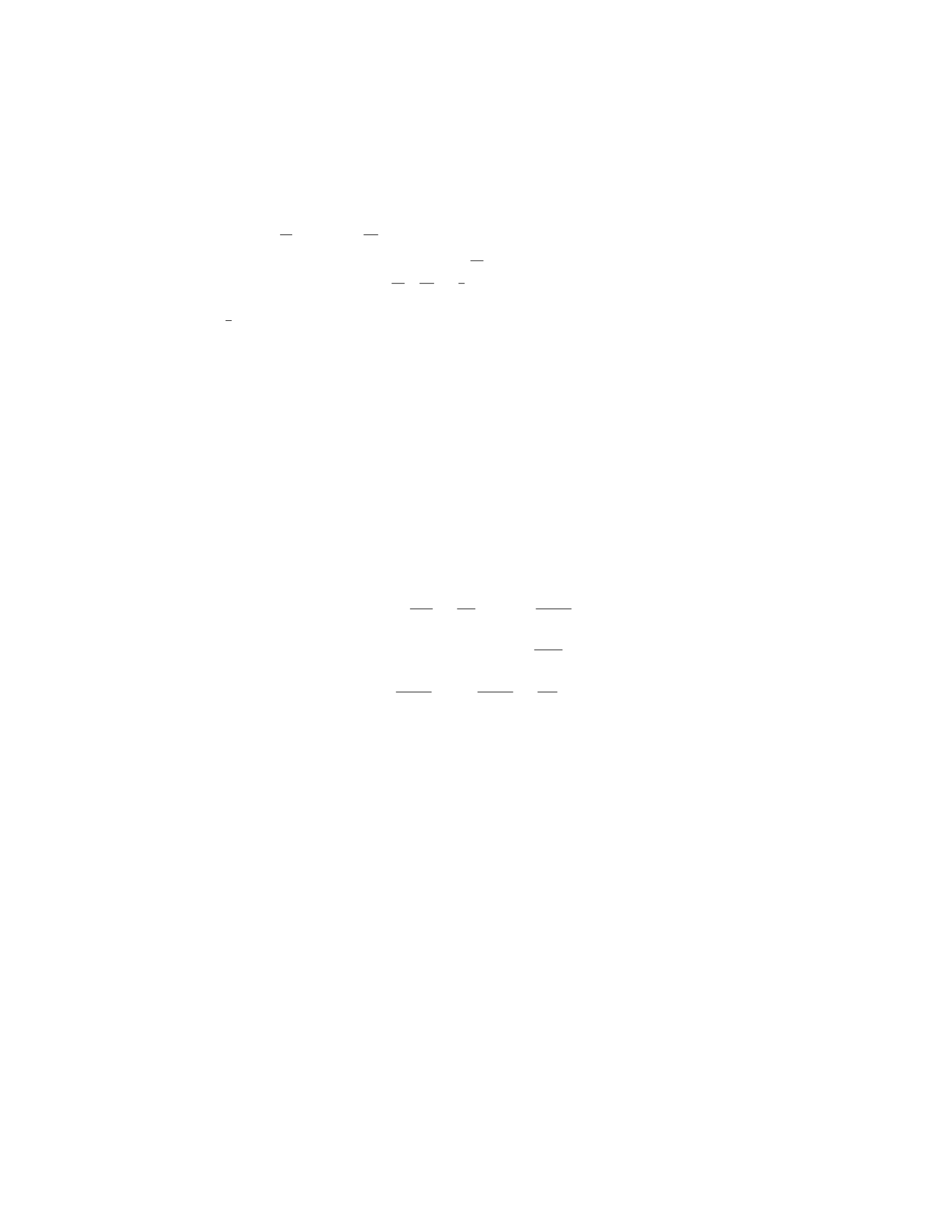
Step 6: Simplifying the integral gives LT=ωλ RL
0r3dr. Integrating gives
LT=ωλ hr4
4iL
0=ωλ ·L4
4.
Step 7: Finally, substituting λ=M
Linto the expression for total angular
momentum gives LT=ω·M
L·L4
4=1
4MωL3.
Therefore, the angular momentum of the rod with respect to the given axis
is 1
4MωL3.
Question 26
Question
A wheel starts from rest and rotates with a constant angular acceleration of
2.0 rad/s2. How long will it take the wheel to make 10 complete revolutions?
Solution
Step 1: Find the angular acceleration in terms of revolutions per minute (rpm).
Given: Angular acceleration, α= 2.0 rad/s2We know that 1 rev = 2πrad.
So, the angular acceleration in terms of revolutions per minute (rpm) is:
α=d2θ
dt2=dω
dt = 2π×drpm
dt
Given α= 2.0 rad/s2, we can substitute to find drpm
dt .
2π= 2.0×drpm
dt =⇒drpm
dt =2π
2.0=πrpm/s
Step 2: Find the time taken to make 1 complete revolution. Using the
relation ω=ω0+αt, where ω0= 0 (initial angular velocity) and ω= 2πrad/s
(angular velocity after 1 revolution).
2π= 2πrad/s2×t=⇒t= 1 s
Step 3: Find the time taken to make 10 complete revolutions. Since it takes
1 second to make 1 complete revolution, it will take 10×1 = 10 seconds to make
10 complete revolutions.
Therefore, it will take the wheel 10 seconds to make 10 complete revolutions.
Question 27
Question
A disk starts from rest and rotates with a constant angular acceleration of
2.0 rad/s2. If the disk rotates through an angle of 15 revolutions, what is the
angular velocity after completing 15 revolutions?
20

Solution
Step 1: The relationship between angular acceleration (α), initial angular veloc-
ity (ω0), final angular velocity (ω), and the angle rotated through (θ) is given
by the equation
ω2=ω2
0+ 2αθ
Step 2: We are given α= 2.0 rad/s2,θ= 15 ×2πrad (as 1 revolution is
equal to 2πradians), and ω0= 0 (as the disk starts from rest).
Step 3: Substitute the given values into the equation:
ω2= 0 + 2(2.0)(15 ×2π)
Step 4: Simplify the equation to solve for ω:
ω=p2(2.0)(15 ×2π)
Step 5: Calculate the angular velocity after completing 15 revolutions:
ω≈√60 ×2π≈24.49 rad/s
Question 28
Question
A thin rod of length Land mass Mis pivoted about one end and released from
rest in a vertical position. What is the angular speed of the rod when it is
horizontal?
Solution
Step 1: The potential energy of the rod when it is vertical will be converted
to kinetic energy when it is horizontal. The potential energy when the rod is
vertical is given by:
P E =Mgh
where h=Lis the length of the rod and gis the acceleration due to gravity.
Step 2: The kinetic energy when the rod is horizontal is given by:
KE =1
2Iω2
where I=1
3ML2is the moment of inertia of a thin rod rotating about one end
and ωis the angular speed of the rod.
Step 3: Since energy is conserved, we have:
P E =KE
Mgh =1
21
3ML2ω2
21

Step 4: Solving for ω, we get:
ω=r3gh
2L
Step 5: Substituting h=L, we find the angular speed of the rod when it is
horizontal to be:
ω=r3g
2L
Question 29
Question
A wheel with a radius of 0.4 m starts from rest and accelerates uniformly for 10
seconds. It then rotates for an additional 20 seconds under a constant angular
velocity. If the total angular displacement of the wheel during this time is 50
revolutions, what is the angular acceleration of the wheel during the first 10
seconds?
Solution
Step 1: Find the initial angular velocity of the wheel after the first 10 seconds.
The angular displacement θ1during the first 10 seconds can be found using
the formula:
θ1=1
2αt2
1
where αis the angular acceleration, t1is the time period, and we know that the
initial angular velocity ωiis 0. Also, t1= 10 seconds and the wheel accelerates
uniformly, so the final angular velocity ωfat t1is related to ωiand αas:
ωf=ωi+αt1
Solving these equations gives us:
θ1=1
2α(10)2and ωf=α×10
Step 2: Find the angular velocity after the additional 20 seconds.
For the wheel rotating for another 20 seconds with constant angular velocity,
the angular displacement θ2can be found using the formula: θ2=ωft2. We
know that θ2= 50 revolutions.
Step 3: Calculate the angular acceleration during the first 10 seconds.
The total angular displacement is the sum of the angular displacements
during the two time periods:
θtotal =θ1+θ2
22

Substituting the expressions for θ1and θ2and solving for αgives:
1
2α(10)2+ 10α×20 = 50 ×2π
Solving for αwill give us the angular acceleration during the first 10 seconds.
Question 30
Question
A thin rod of length Lis rotating about one end with an angular speed ω. If
the other end of the rod suddenly comes to rest, determine the angular velocity
of the rod immediately after.
Solution
Step 1: We will start by considering the conservation of angular momentum
about the rotating end of the rod. Initially, the rod has angular momentum
L1=I1ω, where I1is the moment of inertia of the rod with respect to the
rotating end.
Step 2: When the other end of the rod suddenly comes to rest, the moment
of inertia of the rod changes. The new moment of inertia I2for the rod about the
rotating end can be determined using the parallel axis theorem: I2=Icm+M L2,
where Icm =1
3ML2is the moment of inertia about the center of mass and M
is the mass of the rod.
Step 3: Now, we can write the conservation of angular momentum equation:
L1=L2, where L2=I2ω′, with ω′being the angular velocity of the rod
immediately after the other end comes to rest.
Step 4: Substituting I1ωfor L1and I2ω′for L2into the conservation of
angular momentum equation, we get I1ω=I2ω′.
Step 5: Substituting I1=1
3ML2and I2=4
3ML2into the equation and
solving for ω′, we find ω′=1
4ω.
Therefore, the angular velocity of the rod immediately after the other end
comes to rest is 1
4of the initial angular speed.
Question 31
Question
A solid sphere of radius Rand mass Mstarts from rest and rolls without slipping
down a 30◦incline that is 10 meters long. Find the speed of the sphere at the
bottom of the incline.
23

Solution
Step 1: Set up the conservation of energy equation. Step 2: Solve for the final
velocity of the sphere at the bottom of the incline.
Step 1: The conservation of energy equation can be written as:
mgh =1
2Iω2+1
2mv2
where: mis the mass of the object, his the height of the incline, gis the
acceleration due to gravity, Iis the moment of inertia of the object, ωis the
angular velocity of the object, vis the linear velocity of the object.
Given that the sphere rolls without slipping, we have the following relations:
ω=v
Rand v=Rω.
The potential energy mgh can be written in terms of the angle of the incline:
mgh =mgL sin(30◦)
where Lis the length of the incline.
The kinetic energy terms can be written in terms of v. The moment of
inertia of a solid sphere about its center of mass is 2
5MR2.
Step 2: Substitute the expressions from above into the conservation of
energy equation and solve for v:
mgL sin(30◦) = 1
22
5MR2v
R2+1
2Mv2
mgL sin(30◦) = 1
5Mv2+1
2Mv2
mgL sin(30◦) = 7
10Mv2
v=r10
7
mgL sin(30◦)
M
Now, plug in the values and calculate the final velocity v:
v=r10
7
(9.81)(10) sin(30◦)
M
Thus, the speed of the sphere at the bottom of the incline is v=q10
7·(9.81)(10)·0.5
M.
Question 32
Question
A disk of radius 0.5 m is rotating at an angular velocity of 4 rad/s. A constant
angular acceleration of -2 rad/s2is applied to the disk for 3 seconds in the
opposite direction. Find the final angular velocity of the disk.
24

Solution
Step 1: Calculate the angular displacement during the 3-second period. Given
the initial angular velocity ωi= 4 rad/s, the angular acceleration α=−2 rad/s2,
and the time t= 3 s, we can use the kinematic equation:
θ=ωit+1
2αt2
Substitute the given values to find θ:
θ= 4 ×3 + 1
2×(−2) ×32= 12 −9 = 3 rad
Step 2: Determine the final angular velocity. The final angular velocity ωf
can be found using the equation:
ωf=ωi+αt
Substitute the values to solve for ωf:
ωf= 4 + (−2) ×3=4−6 = −2 rad/s
Therefore, the final angular velocity of the disk is −2 rad/s.
Question 33
Question
A disk of radius 0.2 m starts from rest and accelerates with a constant angular
acceleration of 2 rad/s2. What is the angular velocity of the disk after 3 seconds?
Solution
Step 1: First, we need to determine the angular velocity of the disk after 3
seconds using the equation for angular velocity under constant angular acceler-
ation:
ω=ω0+αt
where: - ωis the final angular velocity, - ω0is the initial angular velocity (which
is 0 since the disk starts from rest), - αis the angular acceleration, - tis the
time.
Plugging in the values, we get:
ω= 0 + 2 ×3 = 6 rad/s
Therefore, the angular velocity of the disk after 3 seconds is 6 rad/s.
25

Question 34
Question
A merry-go-round is initially at rest. It starts rotating with a constant angular
acceleration of 2.0 rad/s2. What is its angular velocity after 4.0 seconds?
Solution
Step 1: We can use the equation for angular velocity with constant angular
acceleration, which is ωf=ωi+αt, where ωfis the final angular velocity, ωiis
the initial angular velocity, αis the angular acceleration, and tis the time.
Step 2: Since the merry-go-round is initially at rest, the initial angular
velocity ωiis 0. Therefore, we have ωf= 0 + (2.0 rad/s2)(4.0 s).
Step 3: Calculating the final angular velocity, we get ωf= 8.0 rad/s.
Step 4: Hence, the angular velocity of the merry-go-round after 4.0 seconds
is 8.0 rad/s.
Question 35
Question
A thin rod of length Land mass Mis rotating about an axis through one end
with an angular speed ω. Suddenly, a small mass mis attached at the other
end of the rod. What is the new angular speed of the system?
Solution
Step 1: Find the moment of inertia of the system before the mass mis attached.
The moment of inertia of a thin rod rotating about an axis through one end is
given by I=1
3ML2.
Step 2: Find the initial angular momentum of the system. The initial angular
momentum Liis given by Li=Iω =1
3ML2ω.
Step 3: Find the final moment of inertia of the system after attaching mass
m. The moment of inertia of the system after attaching mass mat the end of
the rod is Inew =I+mL2.
Step 4: Find the final angular momentum of the system. The final angular
momentum Lfis given by Lf=Inewωnew, where ωnew is the new angular speed
of the system.
Step 5: Apply conservation of angular momentum. Since angular momentum
is conserved, we have Li=Lf, which gives 1
3ML2ω= (I+mL2)ωnew.
Step 6: Solve for the new angular speed ωnew. Solving the above equation
for ωnew, we get ωnew =1
3Mω +m
M+1
3mω.
26

Question 8
Question
A solid cylinder of radius Rand mass Mis initially at rest. A constant force
Fis applied tangentially to the edge of the cylinder, causing it to start rolling
without slipping. If the coefficient of kinetic friction between the cylinder and
the surface is µk, determine the distance dthe cylinder travels before coming
to a stop.
Solution
Step 1: Find the acceleration of the cylinder. The net torque on the cylinder is
given by
τ=F R −fkR=Iα
where fk=µkNis the kinetic friction force, Nis the normal force, I=1
2MR2
is the moment of inertia of the cylinder, and αis the angular acceleration.
Since the cylinder is rolling without slipping, a=Rα, where ais the linear
acceleration. Therefore, we have
F R −µkNR =1
2MR2·a
R
Solving for agives
a=2F−2µkMg
3M
Step 2: Find the time it takes for the cylinder to stop. The time it takes
for the cylinder to stop can be found by setting the final velocity to zero in the
equation of motion: v2=u2+ 2as. The final velocity is zero, the initial velocity
is zero, and the acceleration is given by a. The stopping time is then
t=v−u
a=−u
a=3M
2F−2µkMg
Step 3: Find the distance traveled before stopping. The distance traveled
before stopping is given by
d=ut +1
2at2
Substituting the values of u,a, and tinto the above equation gives
d=1
2·2F
3·3M
2F−2µkMg ·3M
2F−2µkMg
Simplifying further yields
d=3M2
4(F−µkMg)2
Therefore, the distance the cylinder travels before coming to a stop is 3M2
4(F−µkMg)2.
6

Question 9
Question
A disk with a radius of 0.2 m starts from rest and accelerates at a constant rate
of 5 rad/s2. Find the angular velocity of the disk after 3 seconds.
Solution
Step 1: Given parameters for the disk: Let’s denote: - the initial angular velocity
of the disk as ω0(which is 0 for this case), - the angular acceleration of the disk
as α= 5 rad/s2, - the time after which we want to find the angular velocity as
t= 3 s, - the radius of the disk as r= 0.2 m.
Step 2: Using the kinematic equation for rotational motion: The angular
velocity of the disk after a certain time tcan be found using the equation:
ω=ω0+αt
Substitute the given values to find the angular velocity after 3 seconds:
ω= 0 + 5 ×3 = 15 rad/s
Step 3: Answer The angular velocity of the disk after 3 seconds is 15 rad/s.
Question 10
Question
A solid cylinder of radius Rand mass Mis initially at rest. A light rope is
wound around the cylinder and a small object of mass mis attached to the free
end of the rope. The object is allowed to fall, causing the cylinder to rotate.
Calculate the linear acceleration of the object when it has fallen a distance h.
Solution
1. The gravitational force on the object causes an acceleration gdownwards.
The tension in the rope will be less than mg and will cause an acceleration of
magnitude aupwards. Let Tbe the tension in the rope at this instant.
2. The net force on the object causing the acceleration ais:
ΣF=T−mg =ma
Where mis the mass of the object.
3. The object’s acceleration ais also related to the angular acceleration α
of the cylinder:
a=αR
7

4. The torque on the cylinder due to the net force applied by the object is:
τ= (T−mg)R
τ=Iα
Where Iis the moment of inertia of the cylinder.
5. The moment of inertia of the cylinder is I=1
2MR2.
6. Substituting for τin terms of aand α:
(T−mg)R=1
2MR2α
7. Substituting for ain terms of α:
T−mg =1
2MRα
8. We also have the relationship between linear acceleration a, angular
acceleration α, and the radius R:
a=αR
9. Substituting a=αR into T−mg =1
2MRα:
T−mg =1
2Ma
10. Solving for a:
a=2(T−mg)
M
11. When the object has fallen a distance h, the work done by gravity is
equal to the increase in kinetic energy:
mgh =1
2mv2
v=p2gh
12. The linear acceleration of the object is then:
a=2(T−mg)
M=2(mg −T)
m= 2g−2T
m
13. Using v=√2gh:
a= 2g−2T
m= 2g−2mg
m= 2g−2g= 0
Therefore, the linear acceleration of the object when it has fallen a distance
his zero.
8
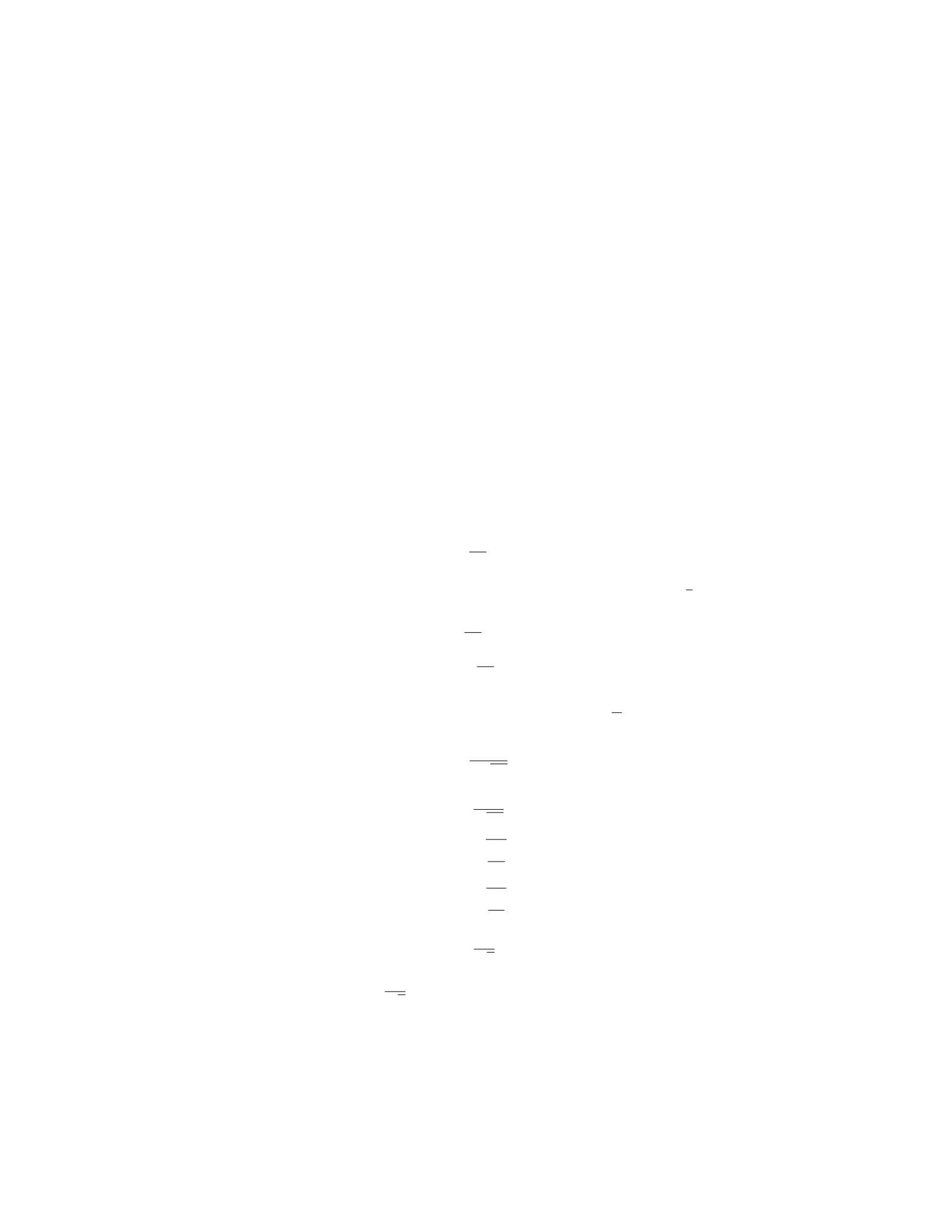
Question 11
Question
An object is initially at rest on the edge of a horizontal turntable. The turntable
is rotating counterclockwise with a constant angular acceleration of 2.0 rad/s2.
If the object is a distance of 0.50 m from the center of the turntable, how long
will it take for the object to rotate through an angle of 2πradians and reach
the center of the turntable?
Solution
Step 1: Find the angular velocity at the center of the turntable. The angular
acceleration α= 2.0 rad/s2and the object is 0.50 m from the center. We can
use the equation ω2=ω2
0+ 2αθ, where ωis the final angular velocity, ω0is the
initial angular velocity (which is 0), αis the angular acceleration, and θis the
angle rotated. Using θ= 2π, we have:
ω2= 0 + 2(2.0)(2π)
ω=√8πrad/s
Step 2: Find the time taken to reach the center. We know that ω=v
r, where
vis the linear velocity. At the center of the turntable, r= 0.50 m. So, v=ωr.
v=√8π×0.50
v= 2√2πm/s
The time taken to reach the center can be found using t=θ
ω:
t=2π
2√2π
t=π
√2π
t=rπ3
2π
t=rπ2
2
t=π
√2s
Therefore, it will take π
√2seconds for the object to rotate through an angle
of 2πradians and reach the center of the turntable.
9

Question 12
Question
A solid sphere of radius Rand mass Mstarts from rest and rolls without
slipping down an inclined plane that makes an angle θwith the horizontal. The
sphere reaches the bottom of the incline with a velocity v. Calculate the linear
acceleration of the sphere while it is rolling down the plane.
Solution
Step 1: We first need to determine the moment of inertia of the solid sphere
about its center. The moment of inertia of a solid sphere rotating about an axis
passing through its center is 2
5MR2.
Step 2: Next, we calculate the net torque acting on the sphere while it
is rolling down the plane. The torque due to the gravitational force can be
calculated as τ=mgR sin(θ), where mis the mass of the sphere.
Step 3: The net torque is also equal to the moment of inertia (2
5MR2) times
the angular acceleration, α. Thus, we have τ=Iα.
Step 4: Using the relationship between linear and angular acceleration for a
rolling object, a=Rα, we can rewrite the torque equation as τ=2
5MR2a
R.
Step 5: Equating the torque equations from step 2 and step 4, we get
mgR sin(θ) = 2
5Ma.
Step 6: Solving for the acceleration, a, we find a=5
2gsin(θ). Therefore, the
linear acceleration of the sphere while it is rolling down the plane is 5
2gsin(θ).
Question 13
Question
A thin rod of length Land mass Mis rotating about one end with an angular
velocity ω. What is the angular momentum of the rod about its center?
Solution
Step 1: The angular momentum of an object rotating about an axis can be
calculated using the formula L=Iω, where Lis the angular momentum, Iis
the moment of inertia, and ωis the angular velocity.
Step 2: To find the moment of inertia of the rod rotating about its center, we
need to use the parallel axis theorem. The moment of inertia of a rod rotating
about one end is 1
3ML2. Therefore, the moment of inertia of the rod rotating
about its center is I=1
3ML2+M
4L2.
Step 3: Substitute the moment of inertia found in Step 2 into the formula
for angular momentum: L= ( 1
3ML2+M
4L2)ω.
Step 4: Simplify the expression: L= ( 7
12 ML2)ω.
10

Step 5: Finally, the angular momentum of the rod about its center is
7
12 ML2ω.
Question 14
Question
A uniform solid sphere of radius Rand mass Mis released from rest at the
top of a ramp inclined at an angle θ. The sphere rolls down the ramp without
slipping. What is the velocity of the center of mass of the sphere when it reaches
the bottom of the ramp?
Solution
Step 1: The potential energy at the top of the ramp is converted into kinetic
energy at the bottom. We can equate the two energies to find the velocity of
the center of mass.
Step 2: The potential energy at the top is due to the sphere’s height above
the ground, given by U=Mgh, where his the vertical height. Given that the
ramp is inclined at an angle θ, we have h=R(1 −cos(θ)).
Step 3: At the bottom of the ramp, the kinetic energy of the sphere is
due to its translational and rotational motion. The kinetic energy is given by
K=1
2Mv2
CM +1
2Iω2, where vCM is the velocity of the center of mass and ωis
the angular velocity.
Step 4: For a solid sphere rolling without slipping, we have the relation
ω=vCM
R. The moment of inertia for a solid sphere rotating about its center is
I=2
5MR2.
Step 5: Substituting the expressions for potential energy, kinetic energy, and
the relation between ωand vCM into the energy conservation equation U=K,
we get:
Mgh =1
2Mv2
CM +1
22
5MR2vCM
R2
Step 6: Simplifying the equation, we find the velocity of the center of mass
vCM when the sphere reaches the bottom of the ramp:
vCM =r5
7gR(1 −cos(θ))
Question 15
Question
An object initially at rest starts rotating with a constant angular acceleration of
α= 0.15 rad/s2. After 4 seconds, it has rotated through an angle of 10 radians.
What is the angular velocity of the object at this time?
11

Solution
To solve this problem, we can use the equations of rotational kinematics. We
can relate the angular acceleration, angular velocity, initial angular velocity,
angle rotated, and time using the following equation:
ωf=ωi+αt
where: - ωfis the final angular velocity, - ωiis the initial angular velocity
(which is 0 rad/s since the object starts from rest), - αis the angular accelera-
tion, - tis the time.
Step 1: Find the final angular velocity We are given: - α= 0.15 rad/s2,
-ωi= 0 rad/s, - t= 4 s.
Plugging these values into the equation, we get:
ωf= 0 + 0.15 ×4
ωf= 0.6 rad/s
Therefore, the angular velocity of the object at that time is 0.6 rad/s.
Question 16
Question
A solid sphere of mass mand radius rstarts from rest and rolls down a 30◦
incline without slipping. What is the linear acceleration of the center of mass
of the sphere?
Solution
Step 1: The gravitational force on the sphere can be decomposed into two com-
ponents: one perpendicular to the incline (mg cos(30◦)) and the other parallel
to the incline (mg sin(30◦)).
Step 2: The torque due to the gravitational force about the center of the
sphere causes an angular acceleration. Since the sphere is rolling without slip-
ping, we can relate the linear acceleration aof the center of mass to the angular
acceleration αusing a=rα.
Step 3: The net torque (τnet) about the center of mass of the sphere is equal
to the moment of inertia (I) times the angular acceleration (α): τnet =Iα =
2
5mr2α.
Step 4: The torque causing the motion down the incline is solely due to
the component of the gravitational force parallel to the incline, which is r·
mg sin(30◦).
Step 5: Setting up the equation for the net torque, we have r·mg sin(30◦) =
2
5mr2α. Solving for α, we get α=5gsin(30◦)
2r.
12

Step 6: Now, using the relationship a=rα, we can find the linear ac-
celeration of the center of mass: a=r·5gsin(30◦)
2r. Simplifying, we get a=
5
2gsin(30◦) = 5
4g.
Step 7: Therefore, the linear acceleration of the center of mass of the sphere
rolling down the incline is 5
4g.
Question 17
Question
A wheel starts from rest and accelerates with a constant angular acceleration of
α= 2.0 rad/s2. After 3.0 seconds, what is the angular velocity of the wheel? If
the wheel completes 10 revolutions during this time, what is the radius of the
wheel?
Solution
Step 1: Calculate the angular velocity after 3.0 seconds using the formula:
ω=ω0+αt
where: ω= angular velocity of the wheel after 3.0 seconds, ω0= initial angular
velocity of the wheel (which is 0 rad/s), α= angular acceleration of the wheel,
t= time elapsed (3.0 seconds).
Therefore,
ω= 0 + (2.0 rad/s2)(3.0 s) = 6.0 rad/s
Step 2: Convert the angular velocity to rotational speed in revolutions per
second. Since 1 revolution is equal to 2πradians, we can use the conversion
factor:
Rotational speed = ω
2πrev/s
Substitute the value of ωto find the rotational speed:
Rotational speed = 6.0 rad/s
2π≈0.955 rev/s
Step 3: Calculate the total number of revolutions completed in 3.0 seconds
using the rotational speed:
Number of revolutions = (Rotational speed×time) = (0.955 rev/s×3.0 s) = 2.865 revolutions
Step 4: Use the given information that the wheel completes 10 revolutions
in 3.0 seconds to find the radius of the wheel. Let Rbe the radius of the wheel.
Since the distance traveled by the wheel in one revolution is 2πR, the total
distance traveled in 10 revolutions is 10 ×2πR.
Set up the equation:
10 ×2πR = total distance traveled by the wheel
13

10 ×2πR = 2.865 ×2πR
Solve for R:
R=2.865 ×2πR
10 ×2π= 0.14325 m = 14.325 cm
Therefore, the radius of the wheel is 14.325 cm.
Question 18
Question
A solid cylinder of radius Rand mass Mis rotating about a frictionless axle
through its center with an angular speed ω0. A second cylinder, identical to
the first in every aspect, is gently placed onto the first cylinder. Find the final
angular speed of the system. Assume the two cylinders remain in contact at all
times.
Solution
1. Identify the initial angular momentum of the system.
The initial angular momentum of the system can be calculated as the sum of
the angular momenta of the individual cylinders. Since they are rotating about
the same axis, we have:
Linitial = 2Iω0
where Iis the moment of inertia of one cylinder.
2. Determine the moment of inertia of one cylinder.
The moment of inertia of a solid cylinder rotating about its central axis is
given by:
I=1
2MR2
3. Substitute the moment of inertia into the initial angular mo-
mentum expression.
Substituting I=1
2MR2into the initial angular momentum expression:
Linitial = 2 1
2MR2ω0=MR2ω0
4. Determine the moment of inertia of the combined cylinders.
When the two cylinders are combined, the moment of inertia becomes:
Icombined = 2I= 2 1
2MR2=MR2
5. Apply conservation of angular momentum.
14

By the conservation of angular momentum, the initial angular momentum
must be equal to the final angular momentum:
Linitial =Lfinal
MR2ω0=Icombinedωfinal
6. Solve for the final angular speed ωfinal.
Substitute known values into the conservation of angular momentum equa-
tion:
MR2ω0=MR2ωfinal
ωfinal =ω0
Therefore, the final angular speed of the combined system is the same as the
initial angular speed ω0.
Question 19
Question
A wheel of radius 0.2 m starts from rest and rotates with a constant angular
acceleration of 2 rad/s2. Determine the angular velocity of the wheel after 3
seconds.
Solution
Step 1: Use the equation for angular velocity in terms of angular acceleration
and time:
ωf=ωi+αt
where - ωfis the final angular velocity, - ωiis the initial angular velocity (which
is zero in this case), - αis the angular acceleration, and - tis the time.
Step 2: Substitute the given values into the equation:
ωf= 0 + 2 ×3
Step 3: Calculate the final angular velocity:
ωf= 6 rad/s
Therefore, the angular velocity of the wheel after 3 seconds is 6 rad/s.
Question 20
Question
A disc of radius Ris initially at rest. It starts rotating with an angular accel-
eration α=2
t2, where tis the time in seconds. Find the angular velocity of the
disc after 4 seconds.
15

Solution
Let’s first determine the angular velocity of the disc as a function of time using
the given angular acceleration.
Step 1: Find the angular velocity as a function of time. The angular
acceleration is given by α=dω
dt , where ωis the angular velocity.
α=dω
dt =2
t2
Integrating both sides with respect to tgives:
Zα dt =Z2
t2dt
ω=−2
t+C
where Cis the constant of integration.
Step 2: Apply the initial condition to determine the value of the constant
C. Since the disc is initially at rest, the initial angular velocity ω0= 0 at t= 0.
Substituting this into the expression for ω:
ω0=0=−2
0+C
C= 0
So, the angular velocity as a function of time is ω=−2
t.
Step 3: Find the angular velocity after 4 seconds. Substitute t= 4 into the
expression for ω:
ω=−2
4=−1
2rad/s
Therefore, the angular velocity of the disc after 4 seconds is −1
2rad/s.
Question 21
Question
A disk of radius Rstarts from rest and accelerates with a constant angular
acceleration α. At a certain time t, the angular velocity of the disk is ω. What
is the linear velocity of a point on the rim of the disk at this time?
Solution
Step 1: Find the angular displacement of the disk at time tusing the equation
of rotational kinematics:
θ=ω0t+1
2αt2
16

Step 2: Calculate the angular velocity of a point on the rim of the disk at
time tusing the relationship between linear and angular velocities:
v=Rω
Step 3: Substitute the values of θand ωinto the expression for linear velocity
to find the final answer.
Question 22
Question
A disk of radius 0.5 m starts from rest and accelerates with a constant angular
acceleration of 2 rad/s2. What is the angular velocity of the disk after 3 seconds?
Solution
Step 1: Find the angular velocity of the disk after 3 seconds using the formula
for angular velocity with constant angular acceleration:
ω=ω0+αt
where:
ω= final angular velocity
ω0= initial angular velocity (0 in this case)
α= angular acceleration (2 rad/s2)
t= time (3 seconds)
Step 2: Substituting the given values into the formula:
ω= 0 + (2 rad/s2)(3 s) = 6 rad/s
Therefore, the angular velocity of the disk after 3 seconds is 6 rad/s.
Question 23
Question
A disk of radius 0.4 m starts from rest and accelerates with a constant angular
acceleration of 2 rad/s2.
1. Determine the angular velocity of the disk after 3 seconds.
2. Calculate the angular displacement of the disk during the first 3 seconds
of its motion.
17

Solution
1. We can find the angular velocity of the disk after 3 seconds using the equation
for angular velocity with constant angular acceleration:
ωf=ωi+αt
Where: - ωfis the final angular velocity, - ωiis the initial angular velocity
(which is 0 since the disk starts from rest), - αis the angular acceleration, - tis
the time.
Step 1: Substitute the known values into the equation:
ωf= 0 + 2 ×3 = 6 rad/s
So, the angular velocity of the disk after 3 seconds is 6 rad/s.
2. To find the angular displacement of the disk during the first 3 seconds
of its motion, we can use the equation for angular displacement with constant
angular acceleration:
θ=ωit+1
2αt2
Where: - θis the angular displacement, - ωiis the initial angular velocity, -
αis the angular acceleration, - tis the time.
Step 2: Substitute the known values into the equation:
θ= 0 ×3 + 1
2×2×32= 9 radians
Therefore, the angular displacement of the disk during the first 3 seconds of
its motion is 9 radians.
Question 24
Question
A wheel starts from rest and accelerates uniformly for 12.0 s through 330 revo-
lutions. Find the radial acceleration of a point on the rim of the wheel and the
translational acceleration of this point.
Solution
Step 1: Find the angular acceleration of the wheel. Given: Time, t= 12.0 s
Number of revolutions, N= 330
The angular displacement (θ) of the wheel can be calculated using the for-
mula: θ= 2πN
θ= 2π×330 = 660πrad
The angular acceleration (α) can be calculated using the formula: α=∆ω
∆t,
where ∆ωis the change in angular velocity.
18

α=2π−0
12.0=2π
12.0=π
6rad/s2
Step 2: Find the radial acceleration of a point on the rim of the wheel. The
radial acceleration of a point on the rim of the wheel is given by the formula:
ar=rα, where ris the radius of the wheel.
Given: Radius, r=C
2π(where Cis the circumference of the wheel)
The circumference of the wheel can be calculated using the formula: C= 2πr
C= 2π×r
2π=r
Therefore, ar=rα =r×π
6=rπ
6
Step 3: Find the translational acceleration of the point. The translational
acceleration of the point is given by the formula: at=rα =rπ
6, which is the
same as the radial acceleration due to the tangential nature of the acceleration
in circular motion.
Hence, the radial acceleration of a point on the rim of the wheel is rπ
6and
the translational acceleration of this point is also rπ
6.
Question 25
Question
A thin rod of length Land mass Mis rotating about an axis through one end
with an angular speed ω. Find the angular momentum of the rod with respect
to this axis.
Solution
Step 1: The angular momentum of a point mass mrotating about an axis with
angular velocity ωat a distance rfrom the axis is given by L=m·r2·ω.
Step 2: To find the angular momentum of the entire rod, we need to consider
all the point masses that make up the rod. We can treat the rod as a collection
of infinitesimally small point masses and integrate to find the total angular
momentum.
Step 3: Let’s consider a small element of the rod at a distance rfrom the
axis and with a mass dm. The mass dm is located at a distance ralong the rod.
The angular momentum contribution dL from this element is dL =r·dm ·r2·ω.
Step 4: The mass dm can be expressed in terms of the linear mass density
λ=M
Las dm =λ·dr. Substituting this into the expression for dL gives
dL =λ·r·dr ·r2·ω.
Step 5: To find the total angular momentum LTof the rod, we need to
integrate dL over the entire length of the rod. Therefore, LT=RdL =RL
0λ·
r3·ω dr.
19
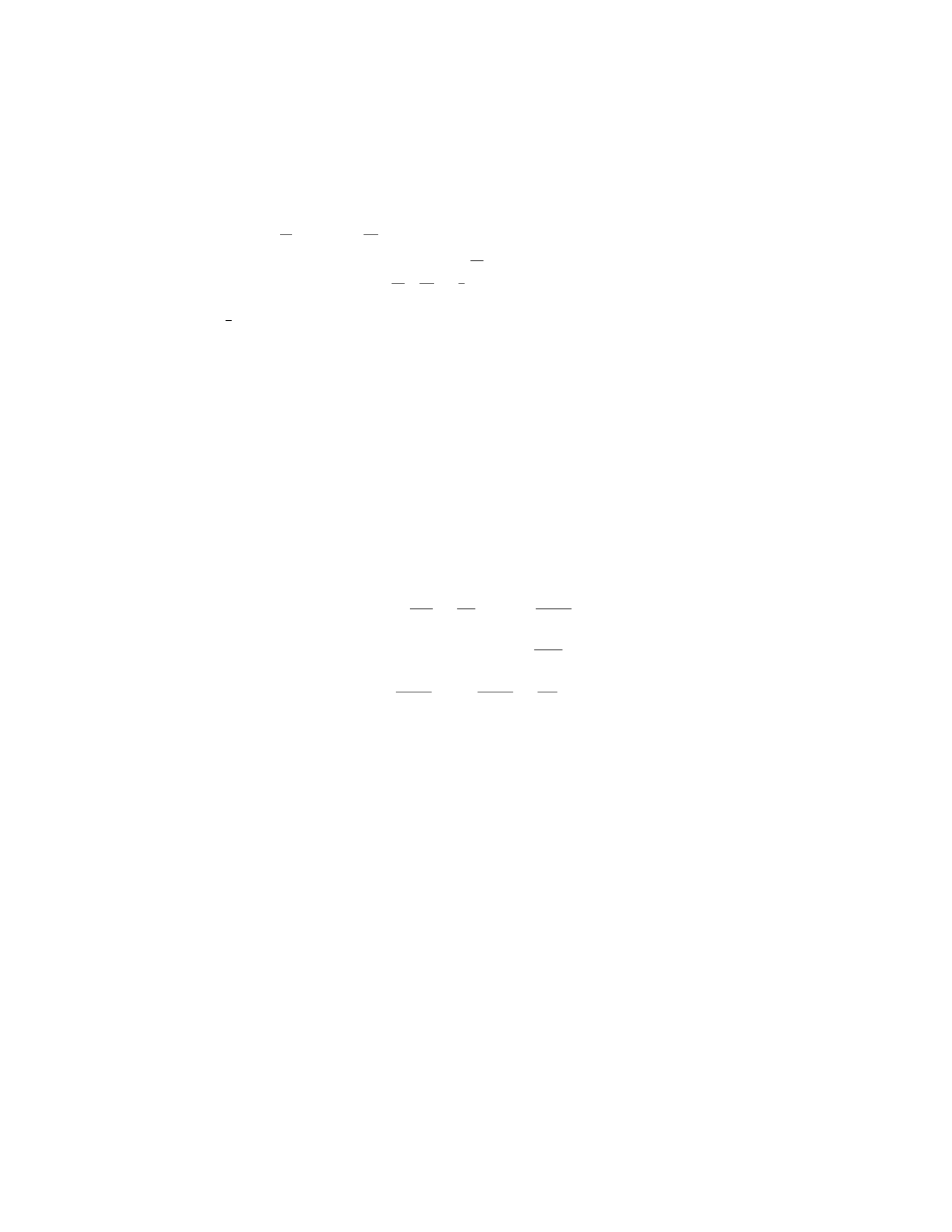
Step 6: Simplifying the integral gives LT=ωλ RL
0r3dr. Integrating gives
LT=ωλ hr4
4iL
0=ωλ ·L4
4.
Step 7: Finally, substituting λ=M
Linto the expression for total angular
momentum gives LT=ω·M
L·L4
4=1
4MωL3.
Therefore, the angular momentum of the rod with respect to the given axis
is 1
4MωL3.
Question 26
Question
A wheel starts from rest and rotates with a constant angular acceleration of
2.0 rad/s2. How long will it take the wheel to make 10 complete revolutions?
Solution
Step 1: Find the angular acceleration in terms of revolutions per minute (rpm).
Given: Angular acceleration, α= 2.0 rad/s2We know that 1 rev = 2πrad.
So, the angular acceleration in terms of revolutions per minute (rpm) is:
α=d2θ
dt2=dω
dt = 2π×drpm
dt
Given α= 2.0 rad/s2, we can substitute to find drpm
dt .
2π= 2.0×drpm
dt =⇒drpm
dt =2π
2.0=πrpm/s
Step 2: Find the time taken to make 1 complete revolution. Using the
relation ω=ω0+αt, where ω0= 0 (initial angular velocity) and ω= 2πrad/s
(angular velocity after 1 revolution).
2π= 2πrad/s2×t=⇒t= 1 s
Step 3: Find the time taken to make 10 complete revolutions. Since it takes
1 second to make 1 complete revolution, it will take 10×1 = 10 seconds to make
10 complete revolutions.
Therefore, it will take the wheel 10 seconds to make 10 complete revolutions.
Question 27
Question
A disk starts from rest and rotates with a constant angular acceleration of
2.0 rad/s2. If the disk rotates through an angle of 15 revolutions, what is the
angular velocity after completing 15 revolutions?
20

Solution
Step 1: The relationship between angular acceleration (α), initial angular veloc-
ity (ω0), final angular velocity (ω), and the angle rotated through (θ) is given
by the equation
ω2=ω2
0+ 2αθ
Step 2: We are given α= 2.0 rad/s2,θ= 15 ×2πrad (as 1 revolution is
equal to 2πradians), and ω0= 0 (as the disk starts from rest).
Step 3: Substitute the given values into the equation:
ω2= 0 + 2(2.0)(15 ×2π)
Step 4: Simplify the equation to solve for ω:
ω=p2(2.0)(15 ×2π)
Step 5: Calculate the angular velocity after completing 15 revolutions:
ω≈√60 ×2π≈24.49 rad/s
Question 28
Question
A thin rod of length Land mass Mis pivoted about one end and released from
rest in a vertical position. What is the angular speed of the rod when it is
horizontal?
Solution
Step 1: The potential energy of the rod when it is vertical will be converted
to kinetic energy when it is horizontal. The potential energy when the rod is
vertical is given by:
P E =Mgh
where h=Lis the length of the rod and gis the acceleration due to gravity.
Step 2: The kinetic energy when the rod is horizontal is given by:
KE =1
2Iω2
where I=1
3ML2is the moment of inertia of a thin rod rotating about one end
and ωis the angular speed of the rod.
Step 3: Since energy is conserved, we have:
P E =KE
Mgh =1
21
3ML2ω2
21

Step 4: Solving for ω, we get:
ω=r3gh
2L
Step 5: Substituting h=L, we find the angular speed of the rod when it is
horizontal to be:
ω=r3g
2L
Question 29
Question
A wheel with a radius of 0.4 m starts from rest and accelerates uniformly for 10
seconds. It then rotates for an additional 20 seconds under a constant angular
velocity. If the total angular displacement of the wheel during this time is 50
revolutions, what is the angular acceleration of the wheel during the first 10
seconds?
Solution
Step 1: Find the initial angular velocity of the wheel after the first 10 seconds.
The angular displacement θ1during the first 10 seconds can be found using
the formula:
θ1=1
2αt2
1
where αis the angular acceleration, t1is the time period, and we know that the
initial angular velocity ωiis 0. Also, t1= 10 seconds and the wheel accelerates
uniformly, so the final angular velocity ωfat t1is related to ωiand αas:
ωf=ωi+αt1
Solving these equations gives us:
θ1=1
2α(10)2and ωf=α×10
Step 2: Find the angular velocity after the additional 20 seconds.
For the wheel rotating for another 20 seconds with constant angular velocity,
the angular displacement θ2can be found using the formula: θ2=ωft2. We
know that θ2= 50 revolutions.
Step 3: Calculate the angular acceleration during the first 10 seconds.
The total angular displacement is the sum of the angular displacements
during the two time periods:
θtotal =θ1+θ2
22

Substituting the expressions for θ1and θ2and solving for αgives:
1
2α(10)2+ 10α×20 = 50 ×2π
Solving for αwill give us the angular acceleration during the first 10 seconds.
Question 30
Question
A thin rod of length Lis rotating about one end with an angular speed ω. If
the other end of the rod suddenly comes to rest, determine the angular velocity
of the rod immediately after.
Solution
Step 1: We will start by considering the conservation of angular momentum
about the rotating end of the rod. Initially, the rod has angular momentum
L1=I1ω, where I1is the moment of inertia of the rod with respect to the
rotating end.
Step 2: When the other end of the rod suddenly comes to rest, the moment
of inertia of the rod changes. The new moment of inertia I2for the rod about the
rotating end can be determined using the parallel axis theorem: I2=Icm+M L2,
where Icm =1
3ML2is the moment of inertia about the center of mass and M
is the mass of the rod.
Step 3: Now, we can write the conservation of angular momentum equation:
L1=L2, where L2=I2ω′, with ω′being the angular velocity of the rod
immediately after the other end comes to rest.
Step 4: Substituting I1ωfor L1and I2ω′for L2into the conservation of
angular momentum equation, we get I1ω=I2ω′.
Step 5: Substituting I1=1
3ML2and I2=4
3ML2into the equation and
solving for ω′, we find ω′=1
4ω.
Therefore, the angular velocity of the rod immediately after the other end
comes to rest is 1
4of the initial angular speed.
Question 31
Question
A solid sphere of radius Rand mass Mstarts from rest and rolls without slipping
down a 30◦incline that is 10 meters long. Find the speed of the sphere at the
bottom of the incline.
23

Solution
Step 1: Set up the conservation of energy equation. Step 2: Solve for the final
velocity of the sphere at the bottom of the incline.
Step 1: The conservation of energy equation can be written as:
mgh =1
2Iω2+1
2mv2
where: mis the mass of the object, his the height of the incline, gis the
acceleration due to gravity, Iis the moment of inertia of the object, ωis the
angular velocity of the object, vis the linear velocity of the object.
Given that the sphere rolls without slipping, we have the following relations:
ω=v
Rand v=Rω.
The potential energy mgh can be written in terms of the angle of the incline:
mgh =mgL sin(30◦)
where Lis the length of the incline.
The kinetic energy terms can be written in terms of v. The moment of
inertia of a solid sphere about its center of mass is 2
5MR2.
Step 2: Substitute the expressions from above into the conservation of
energy equation and solve for v:
mgL sin(30◦) = 1
22
5MR2v
R2+1
2Mv2
mgL sin(30◦) = 1
5Mv2+1
2Mv2
mgL sin(30◦) = 7
10Mv2
v=r10
7
mgL sin(30◦)
M
Now, plug in the values and calculate the final velocity v:
v=r10
7
(9.81)(10) sin(30◦)
M
Thus, the speed of the sphere at the bottom of the incline is v=q10
7·(9.81)(10)·0.5
M.
Question 32
Question
A disk of radius 0.5 m is rotating at an angular velocity of 4 rad/s. A constant
angular acceleration of -2 rad/s2is applied to the disk for 3 seconds in the
opposite direction. Find the final angular velocity of the disk.
24

Solution
Step 1: Calculate the angular displacement during the 3-second period. Given
the initial angular velocity ωi= 4 rad/s, the angular acceleration α=−2 rad/s2,
and the time t= 3 s, we can use the kinematic equation:
θ=ωit+1
2αt2
Substitute the given values to find θ:
θ= 4 ×3 + 1
2×(−2) ×32= 12 −9 = 3 rad
Step 2: Determine the final angular velocity. The final angular velocity ωf
can be found using the equation:
ωf=ωi+αt
Substitute the values to solve for ωf:
ωf= 4 + (−2) ×3=4−6 = −2 rad/s
Therefore, the final angular velocity of the disk is −2 rad/s.
Question 33
Question
A disk of radius 0.2 m starts from rest and accelerates with a constant angular
acceleration of 2 rad/s2. What is the angular velocity of the disk after 3 seconds?
Solution
Step 1: First, we need to determine the angular velocity of the disk after 3
seconds using the equation for angular velocity under constant angular acceler-
ation:
ω=ω0+αt
where: - ωis the final angular velocity, - ω0is the initial angular velocity (which
is 0 since the disk starts from rest), - αis the angular acceleration, - tis the
time.
Plugging in the values, we get:
ω= 0 + 2 ×3 = 6 rad/s
Therefore, the angular velocity of the disk after 3 seconds is 6 rad/s.
25

Question 34
Question
A merry-go-round is initially at rest. It starts rotating with a constant angular
acceleration of 2.0 rad/s2. What is its angular velocity after 4.0 seconds?
Solution
Step 1: We can use the equation for angular velocity with constant angular
acceleration, which is ωf=ωi+αt, where ωfis the final angular velocity, ωiis
the initial angular velocity, αis the angular acceleration, and tis the time.
Step 2: Since the merry-go-round is initially at rest, the initial angular
velocity ωiis 0. Therefore, we have ωf= 0 + (2.0 rad/s2)(4.0 s).
Step 3: Calculating the final angular velocity, we get ωf= 8.0 rad/s.
Step 4: Hence, the angular velocity of the merry-go-round after 4.0 seconds
is 8.0 rad/s.
Question 35
Question
A thin rod of length Land mass Mis rotating about an axis through one end
with an angular speed ω. Suddenly, a small mass mis attached at the other
end of the rod. What is the new angular speed of the system?
Solution
Step 1: Find the moment of inertia of the system before the mass mis attached.
The moment of inertia of a thin rod rotating about an axis through one end is
given by I=1
3ML2.
Step 2: Find the initial angular momentum of the system. The initial angular
momentum Liis given by Li=Iω =1
3ML2ω.
Step 3: Find the final moment of inertia of the system after attaching mass
m. The moment of inertia of the system after attaching mass mat the end of
the rod is Inew =I+mL2.
Step 4: Find the final angular momentum of the system. The final angular
momentum Lfis given by Lf=Inewωnew, where ωnew is the new angular speed
of the system.
Step 5: Apply conservation of angular momentum. Since angular momentum
is conserved, we have Li=Lf, which gives 1
3ML2ω= (I+mL2)ωnew.
Step 6: Solve for the new angular speed ωnew. Solving the above equation
for ωnew, we get ωnew =1
3Mω +m
M+1
3mω.
26

