


PHYS 232 - UNIVERSITY PHYSICS
II - Superposition and interference of
waves
Question Bank - Set 3
Liberty University
Question 1
Question
Two coherent waves with amplitudes Aand 2Aare superimposed on each other.
If the phase difference between the two waves is 3π
4, find the resultant amplitude
of the superimposed wave.
Solution
1. Let’s denote the two waves as y1=Asin(kx −ωt) and y2= 2Asinkx −ωt +3π
4.
2. The superimposed wave is given by y=y1+y2.
3. Using the trigonometric identity sin(A+B) = sin Acos B+ cos Asin B,
we can simplify y:
y=Asin(kx −ωt)+2Asin(kx −ωt) cos 3π
4+ 2Acos(kx −ωt) sin 3π
4
4. Simplifying further, we get:
y=Asin(kx −ωt)+2Asin(kx −ωt) −√2
2!+ 2Acos(kx −ωt) √2
2!
5. This simplifies to:
y=Asin(kx −ωt)−√2Asin(kx −ωt) + √2Acos(kx −ωt)
6. Now, we can combine the sin and cos terms:
y=Ahsin(kx −ωt)−√2 sin(kx −ωt) + √2 cos(kx −ωt)i

7. We can rewrite the above expression as:
y=A√2 cos kx −ωt −3π
4
8. The amplitude of the superimposed wave is the coefficient of cos in the
above expression, which is A√2 .
Question 2
Question
Two waves are traveling in the positive x-direction along a string. Wave 1 has an
amplitude of 3.0 cm and a wavelength of 8.0 cm, while Wave 2 has an amplitude
of 5.0 cm and a wavelength of 12.0 cm. If both waves have the same frequency
and are 180 degrees out of phase with each other, what is the displacement of
the string at x= 14.0 cm?
Solution
1. We can express the equations of the two waves as: Wave 1: y1(x, t) =
3.0 sin 2π
8.0x−t
TWave 2: y2(x, t)=5.0 sin 2π
12.0x−t
T−π
2. The total displacement of the string at x= 14.0 cm and time tcan
be found by adding the individual displacements: ytotal(14.0, t) = y1(14.0, t) +
y2(14.0, t)
3. Substituting x= 14.0 cm into the wave equations: ytotal(14.0, t) =
3.0 sin 2π
8.014.0−t
T+ 5.0 sin 2π
12.014.0−t
T−π
4. Given that the waves are 180 degrees out of phase, we can simplify the
expression: ytotal(14.0, t) = 3.0 sin π
2+ 5.0 sin 3π
2
5. Evaluating the sines of π
2and 3π
2:ytotal(14.0, t)=3.0(1) + 5.0(−1) =
3.0−5.0 = −2.0 cm
Therefore, the displacement of the string at x= 14.0 cm is -2.0 cm.
Question 3
Question
A sound wave with a frequency of 1000 Hz travels through a medium. After
reflecting off a wall, the sound wave interferes with the original wave. The two
waves are in phase with each other. If the original wave has an amplitude of
2.0 units and the amplitude of the reflected wave is 1.5 units, determine the
intensity at a point where constructive interference occurs.
2

Solution
Step 1: Calculate the intensity of the original wave using the formula I=
1
2ρvω2A2, where ρis the density of the medium, vis the speed of sound in the
medium, ωis the angular frequency, and Ais the amplitude. Since the two
waves are in phase, the total amplitude is the sum of the two amplitudes.
Given: Frequency, f= 1000 Hz Amplitude of original wave, A1= 2.0 Am-
plitude of reflected wave, A2= 1.5
Calculate: Angular frequency, ω= 2πf
Substitute the values: ω= 2π(1000) = 2000π
Total amplitude, A=A1+A2= 2.0+1.5=3.5 units
Intensity of the original wave: I1=1
2ρvω2A2
1
Step 2: Calculate the intensity of the reflected wave using the same formula.
Intensity of the reflected wave: I2=1
2ρvω2A2
2
Step 3: Determine the total intensity at the point where constructive inter-
ference occurs. Since the waves are in phase, the total intensity at that point is
the sum of the intensities of the two waves.
Total intensity: Itotal =I1+I2
Step 4: Substitute the values to find the total intensity. Recall that intensity
is proportional to the square of the amplitude, so the total amplitude will be
squared in the final calculation.
Question 4
Question
Consider two waves with different frequencies traveling in the same direction.
Wave 1 has a frequency of 50 Hz and an amplitude of 2 units, while wave 2
has a frequency of 80 Hz and an amplitude of 3 units. If the waves interfere
constructively at a certain point, what is the resultant amplitude at that point?
Solution
To find the resultant amplitude at the point where the waves interfere construc-
tively, we need to consider the superposition of the two waves.
Step 1: Calculate the angular frequencies of the two waves. The angular
frequency ωis related to the frequency fby the formula ω= 2πf. For wave 1
with frequency f1= 50 Hz:
ω1= 2π×50 = 100πrad/s
For wave 2 with frequency f2= 80 Hz:
ω2= 2π×80 = 160πrad/s
Step 2: Calculate the resultant amplitude. The superposition principle
states that the total displacement at a point due to the interference of two
3

waves is the algebraic sum of the individual displacements. For constructive
interference, the two waves will be in phase, so we add their amplitudes. The
resultant amplitude Aresultant can be calculated using the formula:
Aresultant =qA2
1+A2
2+ 2A1A2cos(ϕ2−ϕ1)
where A1and A2are the amplitudes of waves 1 and 2 and ϕ2−ϕ1= (ω2−ω1)t.
Substitute the given values into the formula:
Aresultant =p22+ 32+ 2 ×2×3 cos((160π−100π)t)
Aresultant =p4 + 9 + 12 cos(60πt)
Aresultant =p13 + 12 cos(60πt)
Therefore, the resultant amplitude at the point where the waves interfere
constructively is p13 + 12 cos(60πt) units.
Question 5
Question
Two waves are traveling in the same direction along a string. The first wave
has an amplitude of 0.1 cm, a wavelength of 5 cm, and a frequency of 50 Hz.
The second wave has an amplitude of 0.2 cm, a wavelength of 10 cm, and a
frequency of 100 Hz. At a certain point on the string, the two waves interfere.
Determine the amplitude at that point.
Solution
Step 1: Calculate the wave number for each wave using the formula k=2π
λ.
For the first wave: k1=2π
5 cm =2π
0.05 m = 125.66 m−1. For the second wave:
k2=2π
10 cm =2π
0.10 m = 62.83 m−1.
Step 2: Calculate the phase difference between the two waves at the point
of interference. The phase difference can be calculated using the formula ∆ϕ=
2π(∆x·k), where ∆xis the distance from the point to the source of the first wave.
Let’s assume the distance from the first wave source to the point of interference is
∆x= 0 (for simplicity). Then, the phase difference is: ∆ϕ= 2π(0 ·125.66) = 0.
Step 3: Calculate the resultant amplitude using the formula Aresultant =
pA2
1+A2
2+ 2A1A2cos(∆ϕ). Substitute the given values: Aresultant =p(0.1)2+ (0.2)2+ 2(0.1)(0.2) cos(0).
Aresultant =√0.01 + 0.04 + 0.04 = √0.09 = 0.3 cm.
Therefore, the amplitude at the point of interference is 0.3 cm.
4

Question 6
Question
Two identical waves are traveling in the positive x-direction with different wave-
lengths. Wave A has a wavelength of 0.1 m and an amplitude of 2 m, while
wave B has a wavelength of 0.05 m and an amplitude of 1 m. At x= 0, both
waves have maximum amplitude. Calculate the amplitude of the resulting wave
at a point x= 0.15 m assuming the waves interfere constructively.
Solution
Step 1: Calculate the wave numbers kAand kBfor waves A and B, respectively:
kA=2π
λA
=2π
0.1= 20πrad/m
kB=2π
λB
=2π
0.05 = 40πrad/m
Step 2: The general equation for the resultant wave is given by:
y(x, t) = Asin(kAx−ωt) + Bsin(kBx−ωt)
where Aand Bare the amplitudes of waves A and B.
Step 3: At x= 0 and assuming constructive interference:
y(0, t) = Asin(−ωt) + Bsin(−ωt)=(A+B) sin(−ωt) = 3 sin(−ωt)
Step 4: To find the amplitude of the resulting wave at x= 0.15 m, substitute
x= 0.15 into the general equation:
y(0.15, t) = 3 sin(kA·0.15 −ωt) = 3 sin(3π−ωt)
Therefore, the amplitude of the resulting wave at x= 0.15 m is 3 meters.
Question 7
Question
Two waves are described by y1(x, t) = Asin(kx −ωt) and y2(x, t) = Asin(kx +ωt),
where A,k, and ωare positive constants. If these waves interfere at a point
x= 0 such that they are in phase with each other, find the resulting wave
equation and describe the nature of interference at this point.
5

Solution
Step 1: Find the superposition of the two waves at the point x= 0.
y(x= 0, t) = y1(0, t) + y2(0, t)
=Asin(0 −ωt) + Asin(0 + ωt)
=−Asin(ωt) + Asin(ωt)
= 0
Step 2: Determine the resulting wave equation. Since the two waves interfere
to give zero amplitude at x= 0, the resulting wave equation is y(x, t) = 0.
Step 3: Describe the nature of interference at this point. At point x= 0,
the two waves destructively interfere, resulting in zero amplitude. This means
that there will be no disturbance at this point at any time.
Question 8
Question
Consider two waves traveling in the same medium with wave equations y1=
0.1 sin(5πx −2πt) and y2= 0.3 sin5πx +π
4t. Find the equation of the resul-
tant wave when the two waves interfere.
Solution
Let the equation of the resultant wave be y=Asin(kx −ωt +ϕ), where Ais
the amplitude, kis the wave number, ωis the angular frequency, and ϕis the
phase shift. To find the equation of the resultant wave, we need to find the
values of A,k,ω, and ϕ.
Step 1: Find the angular frequency and wave number The angular
frequency of a wave is related to its frequency by ω= 2πf. In this case, both
waves have the same frequency of f=5
2Hz. Thus, ω= 2π·5
2= 5π.
The wave number kis related to the wavelength λby k=2π
λ. Since the
waves have the same wavelength, k= 5π.
Step 2: Find the amplitude The amplitude of the resultant wave is given
by A=pA2
1+A2
2+ 2A1A2cos(ϕ1−ϕ2), where A1and A2are the amplitudes
of the individual waves. Substitute the given values A1= 0.1, A2= 0.3, ϕ1= 0,
and ϕ2=π
4:A=q(0.1)2+ (0.3)2+ 2(0.1)(0.3) cos0−π
4.
Step 3: Find the phase shift The phase shift of the resultant wave relative
to the first wave is given by ϕ= arctan A1sin ϕ1+A2sin ϕ2
A1cos ϕ1+A2cos ϕ2. Substitute the given
values A1= 0.1, A2= 0.3, ϕ1= 0, and ϕ2=π
4:ϕ= arctan 0.1·0+0.3·
√2
2
0.1·1+0.3·
√2
2.
Calculate the above expression using a calculator to find the phase shift.
Therefore, the equation of the resultant wave when the two waves interfere
is y=Asin(5πx −5πt +ϕ).
6

Question 9
Question
Two waves with different wavelengths, amplitudes, and phases are traveling in
the same medium. Wave 1 has a wavelength of 3.0 m, an amplitude of 2.0
m, and a phase angle of π
3. Wave 2 has a wavelength of 2.0 m, an amplitude
of 3.0 m, and a phase angle of π
4. At a certain point in space, the peaks of
the two waves arrive simultaneously. What is the resulting amplitude of the
superposition of the two waves at this point?
Solution
Step 1: The general equation for a wave traveling in the positive x-direction is
given by:
y=Asin(kx −ωt +ϕ)
where: - Ais the amplitude, - kis the wave number (k=2π
λ), - λis the
wavelength, - ωis the angular frequency (ω= 2πf where fis the frequency), -
tis time, - ϕis the phase angle.
Step 2: We can express the wave equations for wave 1 and wave 2 as:
y1= 2 sin 2π
3x−ωt +π
3
y2= 3 sin πx −ωt +π
4
Step 3: Since the peaks of the two waves arrive simultaneously at the point in
question, the total displacement at that point will be the sum of the individual
displacements:
ytotal =y1+y2
Step 4: Let’s find the total amplitude by considering the superposition of
the waves. To do this, we add the two waves algebraically when expressed in
terms of sine and cosine functions.
Step 5: After finding the total amplitude from the superposition of the two
waves, we evaluate it at the point in question where the peaks of the two waves
arrive simultaneously.
Step 6: Based on the calculation, we determine the resulting amplitude of
the superposition of the two waves at the given point.
Question 10
Question
Two waves with different wavelengths are traveling in the same medium. The
first wave has a wavelength of 2 meters and an amplitude of 3 units, while the
7

second wave has a wavelength of 1.5 meters and an amplitude of 4 units. If the
waves interfere constructively at a certain point, what is the resulting amplitude
at that point?
Solution
Step 1: Calculate the phase difference between the two waves. The phase dif-
ference ∆ϕbetween two waves can be calculated using the formula:
∆ϕ=2π(∆x)
λ
Where: ∆x= path length difference = 0 (since the waves interfere construc-
tively)
λ1= wavelength of the first wave = 2 meters
λ2= wavelength of the second wave = 1.5 meters
Substitute the values into the formula:
∆ϕ=2π(0)
2−2π(0)
1.5= 0
Step 2: Calculate the resulting amplitude. The resulting amplitude of the
waves is given by:
Aresult =A1+A2
Where: A1= amplitude of the first wave = 3 units
A2= amplitude of the second wave = 4 units
Substitute the values into the formula:
Aresult = 3 + 4 = 7 units
Therefore, the resulting amplitude at the point where the two waves interfere
constructively is 7 units.
Question 11
Question
Two waves are traveling in the same medium towards each other. The first wave
has an amplitude of 3.0 cm and wavelength of 8.0 cm, while the second wave
has an amplitude of 4.0 cm and wavelength of 6.0 cm. At a certain point, the
waves interfere constructively and the resultant amplitude is 8.0 cm. Determine
the distance between adjacent nodes.
Solution
Let A1= 3.0 cm and A2= 4.0 cm be the amplitudes of the first and second
waves, λ1= 8.0 cm and λ2= 6.0 cm be the wavelengths of the first and second
8

waves, and Ar= 8.0 cm be the resultant amplitude. We want to find the
distance between adjacent nodes.
Step 1: The condition for constructive interference of waves is when their
path difference corresponds to an integer multiple of the wavelength. Thus, the
condition in this case is
δ=mλ,
where mis an integer representing the number of wavelengths of path difference.
Step 2: The path difference δcan be calculated as the difference in distances
(travelled by the waves) from their starting points to the point of interest. Since
the waves are moving towards each other and their resultant amplitude is 8.0
cm, the path difference is half of the distance between the waves, which we
denote as d. Thus, δ=d
2.
Step 3: We can express the distance between the nodes as
d=λeff =λ1+λ2.
Step 4: Substituting the given values, we get
d=λeff =λ1+λ2= 8.0 cm + 6.0 cm = 14.0 cm.
Therefore, the distance between adjacent nodes is 14.0 cm.
Question 12
Question
Two waves with the same frequency are traveling in the positive x-direction.
The first wave has an amplitude of 2 units and is given by y1= 2 sin(3x−2t),
while the second wave has an amplitude of 3 units and is given by y2=
3 sin3x−2t−π
4. Determine the resulting wave function ynet due to the su-
perposition of the two waves.
Solution
To find the net wave function due to the superposition of the two waves, we can
simply add them together.
Step 1: Write out the individual wave functions. The first wave
function is given by:
y1= 2 sin(3x−2t)
The second wave function is given by:
y2= 3 sin 3x−2t−π
4
Step 2: Find the net wave function. The net wave function ynet is the
sum of the two individual wave functions:
ynet =y1+y2
9
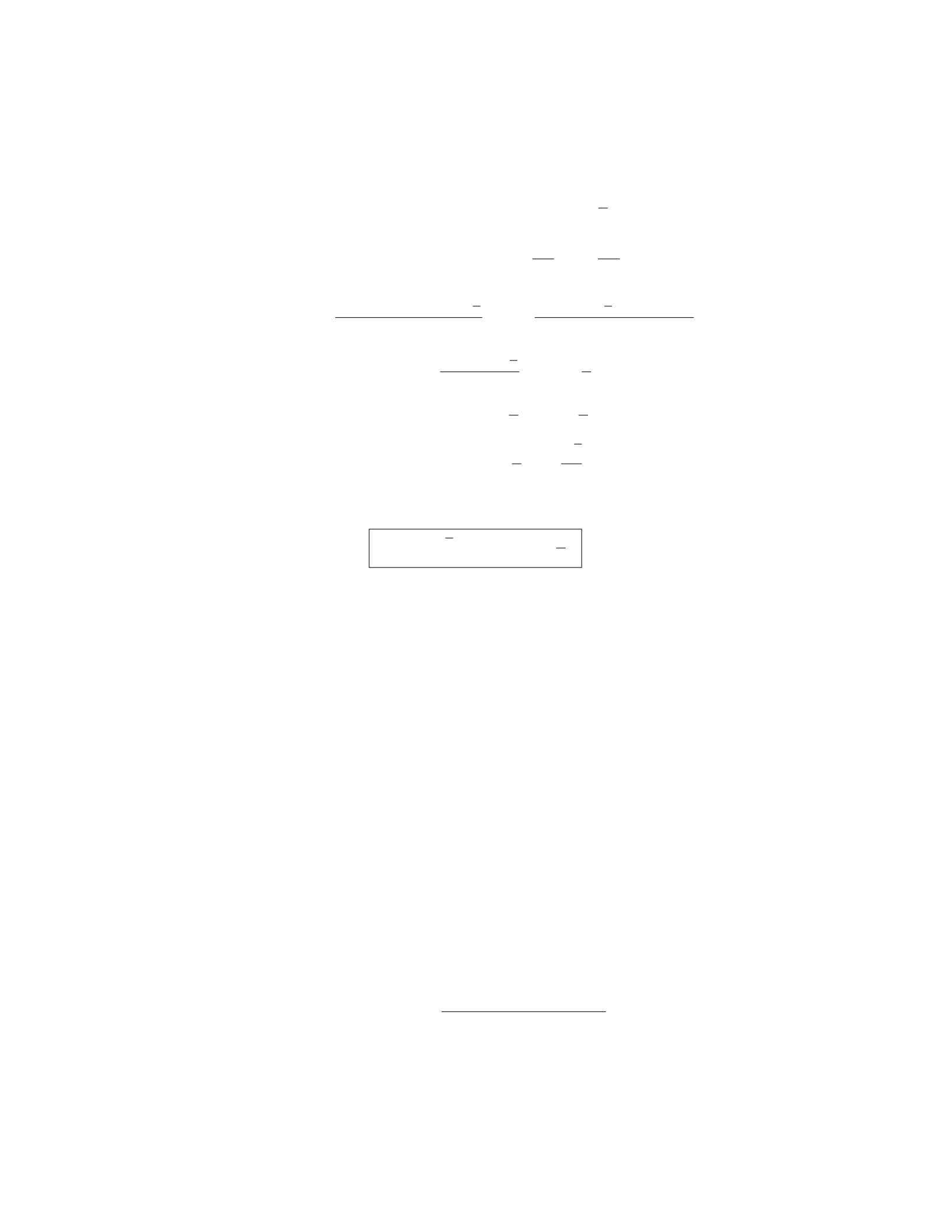
ynet = 2 sin(3x−2t) + 3 sin 3x−2t−π
4
Step 3: Apply the sum-to-product trigonometric identity. Using the
sum-to-product identity sin(a) + sin(b) = 2 sin a+b
2cos a−b
2, we can simplify
the net wave function:
ynet = 2 sin 3x−2t+ 3x−2t−π
4
2cos 3x−2t−π
4−(3x−2t)
2
ynet = 2 sin 6x−4t−π
4
2cos −π
4
ynet = 2 sin 3x−2t−π
8cos −π
4
ynet = 2 sin 3x−2t−π
8 −√2
2!
Therefore, the resulting wave function due to the superposition of the two
waves is:
ynet =−√2 sin 3x−2t−π
8
Question 13
Question
Two waves are traveling in the same medium towards a fixed point. The first
wave has an amplitude of 4 V and a frequency of 500 Hz, while the second wave
has an amplitude of 3 V and a frequency of 600 Hz. If the waves are completely
in phase with each other when they reach the fixed point, what is the resulting
amplitude at that point?
Solution
Step 1: Calculate the angular frequencies of the waves. The angular frequency
of a wave is given by the formula ω= 2πf, where fis the frequency. For the
first wave:
ω1= 2π×500 = 1000πrad/s
For the second wave:
ω2= 2π×600 = 1200πrad/s
Step 2: Calculate the resultant amplitude. The amplitude of the resultant
wave can be found using the formula:
Aresultant =qA2
1+A2
2+ 2A1A2cos(ϕ)
10

where A1and A2are the amplitudes of the individual waves. Given that the
waves are completely in phase, the phase difference ϕ= 0.
Plugging in the values:
Aresultant =p(4)2+ (3)2+ 2(4)(3) cos(0)
Aresultant =√16 + 9 + 24
Aresultant =√49 + 24
Aresultant =√73 V
Therefore, the resulting amplitude at the fixed point where the waves inter-
fere completely in phase is √73 V.
Question 14
Question
Two identical waves, each with an amplitude of 0.15 m, are traveling in the
positive x-direction with a wavelength of 2.5 m. The waves are in phase when
they meet at x= 0. What is the amplitude of the resulting wave at x= 1.0 m?
Solution
Step 1: Calculate the wave number kusing the formula k=2π
λwhere λis the
wavelength.
k=2π
2.5 m =2π
2.5m−1≈2.5133 m−1
Step 2: Since the waves are in phase, the superposition of waves at x= 1.0
m is given by y(x)=2Acos(kx), where Ais the amplitude of each wave.
y(1.0 m) = 2(0.15 m) cos2.5133 m−1×1.0 m
y(1.0 m) = 0.3 cos(2.5133) ≈0.3×0.8017 ≈0.2405 m
Answer: The amplitude of the resulting wave at x= 1.0 m is approximately
0.2405 m.
Question 15
Question
Two waves are traveling in the same direction along a string with the following
equations:
y1(x, t)=0.2 sin(2π(0.1x−100t))
y2(x, t)=0.3 sin(2π(0.08x−120t))
Calculate the resulting wave when the two waves interfere.
11

Solution
Step 1: Find the superposition of the two waves. The superposition of the two
waves is found by adding the equations together:
y(x, t) = y1(x, t) + y2(x, t)
y(x, t)=0.2 sin(2π(0.1x−100t)) + 0.3 sin(2π(0.08x−120t))
Step 2: Use the trigonometric identity sin(a) + sin(b) = 2 sina+b
2cosa−b
2
to simplify. Applying the identity gives us:
y(x, t) = 2 ×0.25 sin (2π(0.09x−110t)) cos (2π(0.02x+ 10t))
So the resulting wave when the two waves interfere is:
y(x, t)=0.5 sin (2π(0.09x−110t)) cos (2π(0.02x+ 10t))
Question 16
Question
Two identical waves, each with an amplitude of 2.0 cm and wavelength of 10.0
cm, are traveling in the same direction along a string. The waves are 180 degrees
out of phase. Determine the resulting amplitude of the superposition at a point
along the string that is 15.0 cm from the source of the waves.
Solution
Let’s denote the equation of one of the waves as y1= 2 sin 2π
10 x−2πftand
the equation of the second wave as y2= 2 sin 2π
10 x−2πft +π.
To find the resulting amplitude of the superposition at a point 15.0 cm from
the source, we can use the principle of superposition, which states that the total
displacement of the medium at any point is the vector sum of the individual
displacements of each wave at that point.
Step 1: Find the individual displacements of each wave at the given point.
Plugging in x= 15.0 cm into the equations of the waves: - For wave
1: y1= 2 sin 2π
10 ×15 −2πf ×t= 2 sin(3π−2πf ×t) - For wave 2: y2=
2 sin 2π
10 ×15 −2πf ×t+π= 2 sin(3π−2πf ×t+π)
Step 2: Calculate the total displacement at the given point using superpo-
sition principle.
The total displacement ytotal at the point 15.0 cm from the source is given
by:
ytotal =y1+y2= 2 sin(3π−2πf ×t) + 2 sin(3π−2πf ×t+π)
Applying the trigonometric identity sin(α+β) = sin αcos β+ cos αsin β, we
can simplify the above equation.
12

ytotal = 2(sin(3π) cos(π)−cos(3π) sin(π))
ytotal = 2(0 × −1−(−1) ×0) = 0
Therefore, the resulting amplitude of the superposition at a point 15.0 cm
from the source is 0 cm .
Question 17
Question
Two wave sources produce waves that interfere with each other. The first source
emits a wave with an amplitude of 1.5 cm and a frequency of 400 Hz. The second
source emits a wave with an amplitude of 2 cm and a frequency of 600 Hz. At
a point 3 m away from both sources, the waves interfere constructively. What
is the phase difference between the two sources at that point?
Solution
Step 1: Find the angular frequencies of the two sources. The angular frequencies
of the waves are given by:
ω1= 2πf1and ω2= 2πf2
where f1= 400 Hz and f2= 600 Hz. Therefore,
ω1= 2π×400 = 800πrad/s and ω2= 2π×600 = 1200πrad/s
Step 2: Calculate the wave numbers of the two sources. The wave numbers
of the waves are given by:
k=ω
v
where vis the speed of the wave in the medium. Since both waves travel the
same distance, the wave numbers are equal for both sources. Therefore,
k1=k2=k
Step 3: Find the phase difference between the two sources. The phase
difference is given by:
ϕ=kx
where x= 3 m is the distance from the sources to the point of constructive
interference. Since k1=k2=k, the phase difference is the same for both
sources. Therefore,
ϕ=k×3=3k
13

Step 4: Calculate the phase difference in terms of π. Substitute k=ω
vinto
the expression for the phase difference:
ϕ= 3 ω
v= 3 2πf
v= 6πf
v
Substitute f= 1/T (where Tis the period of the wave) and v=fλ (where λis
the wavelength) into the expression:
ϕ= 6π1/T
f/λ = 6πλ
T
From the relation v=fλ, we have λ=v/f. Substitute this into the expression:
ϕ= 6πv/f
T= 6πv
fT
Since T= 1/f, substitute T= 1/f into the expression:
ϕ= 6πv
1= 6πv
Therefore, the phase difference between the two sources at the point of con-
structive interference is 6πradians.
Question 18
Question
Two waves are interfering in a medium. The first wave has an amplitude of 8
cm and a wavelength of 12 cm. The second wave has an amplitude of 6 cm
and a wavelength of 8 cm. If they are in phase at a certain point, what is the
resultant amplitude at that point?
Solution
Let’s denote the amplitude of the first wave as A1= 8 cm, the wavelength of
the first wave as λ1= 12 cm, the amplitude of the second wave as A2= 6 cm,
and the wavelength of the second wave as λ2= 8 cm.
Step 1: Since the waves are in phase, the conditions for constructive inter-
ference are met. The resultant amplitude Aresultant can be calculated using the
formula for the superposition of waves:
Aresultant =A1+A2
So,
Aresultant = 8 + 6 = 14 cm
Therefore, the resultant amplitude at that point where the waves interfere
constructively is 14 cm.
14

Question 19
Question
Two waves, represented by the equations y1=Asin(kx −ωt) and y2=Asin(kx −ωt +π/2),
are traveling along the same medium. Find the resultant wave when the two
waves interfere.
Solution
To find the resultant wave when the two waves interfere, we need to sum the
individual waves.
Step 1: Given the equations of the two waves:
y1=Asin(kx −ωt)
y2=Asinkx −ωt +π
2
Step 2: The resultant wave can be found by summing the individual waves:
y=y1+y2
y=Asin(kx −ωt) + Asinkx −ωt +π
2
Step 3: Use the trigonometric identity sin(a+b) = sin acos b+ cos asin b
to expand the expression:
y=Ahsin(kx −ωt) cos π
2+ cos(kx −ωt) sin π
2i
Step 4: Simplify the expression:
y=Acos(kx −ωt)
Step 5: Therefore, the resultant wave when the two waves interfere is:
y=Acos(kx −ωt)
So, the resultant wave is a cosine wave with the same amplitude A, wave-
length 2π/k, and frequency ω/2π.
Question 20
Question
Two harmonic waves are traveling in opposite directions along a string. The first
wave is represented by y1= 2 sin(10x−5t) and the second wave is represented
by y2= 3 sin(10x+ 5t). Determine the equation of the resulting wave formed
by the interference of these two waves.
15

Solution
Step 1: The superposition principle states that the displacement of the medium
at any point and time due to the presence of multiple waves is the algebraic
sum of the displacements due to each individual wave. Therefore, the equation
of the resulting wave will be the sum of the two individual waves:
y=y1+y2= 2 sin(10x−5t) + 3 sin(10x+ 5t)
Step 2: To simplify the equation, we can use the trigonometric identity
sin(a) + sin(b) = 2 sina+b
2cosa−b
2. Applying this identity, we get:
y= 2 sin10x−5t+ 10x+ 5t
2cos10x−5t−10x−5t
2
y= 2 sin(10x) cos(−5t)
Step 3: Recall that cos(−θ) = cos(θ). Therefore, simplifying further:
y= 2 sin(10x) cos(5t)
So, the resulting wave formed by the interference of the two waves y1and
y2is given by y= 2 sin(10x) cos(5t).
Question 21
Question
Two waves with wavelengths of 4 cm and 6 cm are traveling along the same
medium. At a certain point, the amplitudes of the two waves are 2 cm and 3
cm respectively. If the waves interfere constructively at that point, what is the
phase difference between the two waves?
Solution
Let’s denote the wavelengths of the two waves as λ1= 4 cm and λ2= 6
cm, and the amplitudes as A1= 2 cm and A2= 3 cm. We need to find the
phase difference between the two waves at the specific point where they interfere
constructively.
Step 1: Find the wave numbers for each wave. Since the wave number kis
related to the wavelength λby k=2π
λ, we have: For the first wave with λ1= 4
cm: k1=2π
4=π
2cm−1.
For the second wave with λ2= 6 cm: k2=2π
6=π
3cm−1.
Step 2: Write the expressions for the two waves. The general form of a
wave traveling in the positive x-direction is yi(x, t) = Aisin(kix−ωt), where i
represents the wave index.
So, for the first wave: y1(x, t) = 2 sinπ
2x−ωt.
And for the second wave: y2(x, t) = 3 sinπ
3x−ωt.
16

Step 3: Use the condition for constructive interference. For the waves to
interfere constructively, the total displacement at that point should be the sum
of the individual displacements. This condition is met when the phase difference
between the two waves is an integer multiple of 2π.
Since the waves interfere constructively, we have: π
2x−π
3x= 2nπ, where n
is an integer representing the number of complete cycles.
Solving for x, we get: x
6= 2n, which simplifies to x= 12n.
Therefore, the phase difference between the two waves is such that when the
first wave has completed 12 cycles, the second wave has completed 18 cycles.
Hence, the phase difference is π
2.
Question 22
Question
Consider two waves traveling in the same medium, with wave functions given by
y1= 2 sin(3x−4t) and y2= 3 sin(3x+ 4t). What is the resultant wave function
when both waves interfere?
Solution
To find the resultant wave function when both waves interfere, we need to
consider the principle of superposition. The resultant wave function is the sum
of the individual wave functions.
Step 1: Find the resultant wave function The resultant wave function
yresult is given by:
yresult =y1+y2
Step 2: Substitute the given wave functions Substitute y1= 2 sin(3x−4t)
and y2= 3 sin(3x+ 4t) into the expression for yresult:
yresult = 2 sin(3x−4t) + 3 sin(3x+ 4t)
Step 3: Simplify the expression To simplify the expression, we use the
trigonometric identity sin(A) + sin(B) = 2 sinA+B
2cosA−B
2:
yresult = 2 sin (3x−4t) + (3x+ 4t)
2cos (3x−4t)−(3x+ 4t)
2
yresult = 2 sin(3x) cos(−4t)
Step 4: Final answer Therefore, the resultant wave function when both
waves interfere is yresult = 2 sin(3x) cos(4t).
17

Question 23
Question
A wave given by the equation y1(x, t) = 3 sin(2x−3t) interferes with another
wave y2(x, t) = 4 sin(3x+ 4t). Find the resultant wave function y(x, t) when
superposed.
Solution
Step 1: Write down the given wave equations:
y1(x, t) = 3 sin(2x−3t)
y2(x, t) = 4 sin(3x+ 4t)
Step 2: The total wave function y(x, t) is the sum of the individual wave
functions:
y(x, t) = y1(x, t) + y2(x, t)
Step 3: Substitute the given wave functions into the total wave function and
simplify:
y(x, t) = 3 sin(2x−3t) + 4 sin(3x+ 4t)
Step 4: Use the trigonometric identity sin(a) + sin(b) = 2 sina+b
2cosa−b
2
to simplify the expression:
y(x, t) = 6 sin 5x+t
2cos x−7t
2
Question 24
Question
Consider two waves traveling in the same medium. The first wave has an ampli-
tude of 2.0 cm and a wavelength of 4.0 m. The second wave has an amplitude
of 3.0 cm and a wavelength of 6.0 m. If these waves interfere constructively at
a certain point, what is the resulting amplitude at that point?
Solution
Let’s denote the amplitude of the first wave as A1= 2.0 cm, the wavelength of
the first wave as λ1= 4.0 m, the amplitude of the second wave as A2= 3.0 cm,
and the wavelength of the second wave as λ2= 6.0 m.
The condition for constructive interference is that the waves are in phase.
In this case, the phase difference between the two waves is 0 or a multiple of
2π. Mathematically, this is expressed as
2π
λ1
x−2π
λ2
x= 2πn
18

where xis the distance from the source where the waves interfere constructively
and nis an integer.
Solving for x, we have 2π
λ1
x−2π
λ2
x= 2πn
2π
λ1
x(1 −λ1
λ2
) = 2πn
x=2πn
2π
λ1(1 −λ1
λ2)
x=nλ1λ2
λ2−λ1
The resulting amplitude at point xcan be found by summing the individual
amplitudes of the two waves at that point. Using the formula for the amplitude
of a wave A=A1+A2, the resulting amplitude is
A=A1+A2= 2.0+3.0=5.0 cm
Therefore, the resulting amplitude at the point where the waves interfere
constructively is 5.0 cm.
Question 25
Question
Two waves given by the equations y1= 2 sin(2πx −πt) and y2= 3 sin3πx +π
2t
are traveling in the same medium. Determine the resulting wave function when
the two waves interfere.
Solution
Step 1: The resulting wave function is determined by adding the individual
wave functions together, taking into account the amplitudes and phases of each
wave.
Step 2: The resultant wave function is given by yresult =y1+y2.
Step 3: Substitute the given wave functions for y1and y2into the equation
for the resultant wave function.
Step 4: The resultant wave function is yresult = 2 sin(2πx −πt)+3 sin3πx +π
2t.
Step 5: To simplify the expression further, we need to apply trigonometric
identities to combine the terms.
Step 6: Using the trigonometric identity sin(A)+sin(B) = 2 sinA+B
2cosA−B
2,
we rewrite the resultant wave function as yresult = 2 sinπx −π
2tcosπx +π
2t+
3 sin3πx +π
2t.
Step 7: Further simplifying, we get yresult = 2 sinπx −π
2tcosπx +π
2t+
3 sin3πx +π
2t.
Therefore, the resulting wave function when the two waves interfere is yresult =
2 sinπx −π
2tcosπx +π
2t+ 3 sin3πx +π
2t.
19

Question 26
Question
Two identical waves with an amplitude of 0.15 m and wavelength of 2.5 m are
traveling in the same direction along a string. At a certain point, one wave is
displaced upward by 0.05 m while the other is displaced downward by 0.08 m.
Determine the amplitude, wavelength, and direction of travel of the resultant
wave formed by the interference of these two waves.
Solution
Step 1: To find the amplitude of the resultant wave, we need to consider the
principle of superposition. The amplitude of the resultant wave is given by the
sum of the individual amplitudes of the two waves.
Aresultant =A1+A2= 0.15 m + 0.15 m = 0.30 m
Step 2: Next, we determine the wavelength of the resultant wave. Since
both waves have the same wavelength, the wavelength of the resultant wave is
also the same.
λresultant =λ1=λ2= 2.5 m
Step 3: The direction of travel of the resultant wave can be determined by
examining the phase difference between the two waves at the point of interfer-
ence. In this case, one wave is displaced upward while the other is displaced
downward. This corresponds to a phase difference of πradians or half a wave-
length (since the displacement corresponds to one wavelength). Thus, the two
waves are 180 degrees out of phase and interfere destructively. Therefore, the
resultant wave will have an amplitude of 0.30 m, a wavelength of 2.5 m, and it
will travel in the same direction as the original waves with a reduced amplitude
due to destructive interference.
Question 27
Question
Two waves, y1(x, t) = Asin(kx −ωt) and y2(x, t) = Asin(kx −ωt +π/2), are
traveling in the same medium. Determine the superposition of these waves,
y(x, t), and find the resulting wave equation.
Solution
Step 1: We first find the superposition of the two waves by adding them together:
y(x, t) = y1(x, t) + y2(x, t)
20

Step 2: Substitute the expressions for y1and y2:
y(x, t) = Asin(kx −ωt) + Asinkx −ωt +π
2
Step 3: Use the sum-to-product trigonometric identity: sin(a) + sin(b) =
2 sina+b
2cosa−b
2.
y(x, t) = 2Asin2kx −2ωt +π
4cosωt
2
Step 4: Simplify the expression further:
y(x, t) = 2Asin2kx −2ωt +π
4cosωt
2
Thus, the resulting wave equation for the superposition of the two waves is
y(x, t)=2Asin2kx−2ωt+π
4cosωt
2.
Question 28
Question
Two waves on a string have amplitudes of 4 cm and 5 cm, wavelengths of 8 cm
and 10 cm, and frequencies of 12 Hz and 15 Hz. At a particular point, the waves
arrive in phase. Calculate the maximum and minimum amplitudes that can be
produced by superposition at this point.
Solution
Step 1: Calculate the wave numbers kfor each wave. Given that k=2π
λ, the
wave numbers k1and k2are: k1=2π
8 cm =π
4cm−1k2=2π
10 cm =π
5cm−1
Step 2: Write the equations for the two waves. The equations for the two
waves can be written as: y1(x, t) = 4 cm sinπ
4x−24πty2(x, t) = 5 cm sinπ
5x−30πt
Step 3: Calculate the maximum and minimum amplitudes. The maximum
amplitude is found by adding the amplitudes of the two waves, and the minimum
amplitude is found by subtracting the amplitudes of the two waves: Amax =
4 cm + 5 cm = 9 cm Amin =|4 cm −5 cm|= 1 cm
Therefore, the maximum amplitude that can be produced by superposition
at the specified point is 9 cm, and the minimum amplitude is 1 cm.
Question 29
Question
Two waves with the equations y1(x, t)=0.05 sin(4x−5t) and y2(x, t)=0.03 sin(4x+ 5t)
are travelling in the same medium. Determine the resulting wave when these
two waves interfere.
21

Solution
1. We can find the resulting wave by adding the two waves together:
y(x, t) = y1(x, t) + y2(x, t)=0.05 sin(4x−5t)+0.03 sin(4x+ 5t)
2. To simplify the expression, we can use the trigonometric identity sin(A)+
sin(B) = 2 sinA+B
2cosA−B
2:
y(x, t)=0.05 sin(4x−5t)+0.03 sin(4x+ 5t)
= 0.05 (sin(4x) cos(5t)−cos(4x) sin(5t)) + 0.03 (sin(4x) cos(5t) + cos(4x) sin(5t))
= 0.05 sin(4x) cos(5t)−0.05 cos(4x) sin(5t)+0.03 sin(4x) cos(5t)+0.03 cos(4x) sin(5t)
= (0.05 + 0.03) sin(4x) cos(5t) + (0.03 −0.05) cos(4x) sin(5t)
= 0.08 sin(4x) cos(5t)−0.02 cos(4x) sin(5t)
3. Therefore, the resulting wave when the two waves interfere is y(x, t) =
0.08 sin(4x) cos(5t)−0.02 cos(4x) sin(5t).
Question 30
Question
Two waves with the same amplitude Aand wavelength λare traveling in the
same direction. The first wave has a frequency f1while the second wave has a
frequency f2. If the phase difference between the two waves is π/4, determine
the resulting wave function formed by the superposition of the two waves.
Solution
The general equation for a wave is given by y(x, t) = Asin(kx −ωt +ϕ), where
Ais the amplitude, kis the wave number, ωis the angular frequency, and ϕis
the phase angle.
Step 1: Determine the wave number kand angular frequency ωfor each
wave. For a wave traveling in the x-direction, the wave number is related to
the wavelength λby k=2π
λ. The angular frequency is related to the frequency
by ω= 2πf. For the first wave with frequency f1:k1=2π
λω1= 2πf1For the
second wave with frequency f2:k2=2π
λω2= 2πf2
Step 2: Write the equations for the individual waves. The wave function for
the first wave is: y1(x, t) = Asin(k1x−ω1t) The wave function for the second
wave is: y2(x, t) = Asin(k2x−ω2t)
Step 3: Determine the resulting wave function from the superposition of the
two waves. The resulting wave function y(x, t) from the superposition of the
two waves is given by: y(x, t) = y1(x, t) + y2(x, t) Substitute the expressions for
y1(x, t) and y2(x, t): y(x, t) = Asin(k1x−ω1t) + Asin(k2x−ω2t)
Step 4: Apply the phase difference to form the resulting wave function.
Given that the phase difference between the two waves is π/4, this corresponds
22

to a phase shift of k1x−ω1t−(k2x−ω2t) = π/4. Substitute the expressions
for k1,k2,ω1, and ω2:2π
λx−2πf1t−(2π
λx−2πf2t) = π
4Simplify the equation
to find the resulting wave function with the phase difference: 2π
λ(f2−f1)t=π
4
The resulting wave function is: y(x, t)=2Asin 2π
λx−2π(f1+f2)t+π
4
Question 31
Question
Two waves traveling in the same medium collide with each other. The first wave
has an amplitude of 2 cm and a wavelength of 5 cm while the second wave has
an amplitude of 3 cm and a wavelength of 8 cm. At what distance from the
source do the waves first produce destructive interference?
Solution
1. The waves will produce destructive interference when they are exactly λ
2out
of phase.
2. The first step is to find the difference in path lengths between the two
waves that results in a phase difference of π. Let’s call this difference in path
lengths ∆x.
3. Since the waves have different wavelengths, we will express ∆xin terms
of the wavelengths.
4. For destructive interference, the path difference is equal to λ
2.
∆x=n·λ1·λ2
λ1−λ2
5. Substituting the given values into this formula, we get:
∆x=n·5·8
5−8=n·40
−3=−40n
3
6. We know that nis an integer because we need a whole number of wave-
lengths to get back to the original phase. We want to find the smallest positive
value of nfor which ∆xis positive.
7. Since we are looking for the distance from the source where destructive
interference first occurs, we take n= 1.
8. Substituting n= 1 into the formula, we find the distance from the source
where destructive interference first occurs:
∆x=−40
3
So, the waves first produce destructive interference at a distance of 40
3cm
from the source.
23

Question 32
Question
A string under tension Tis fixed at both ends and supports a standing wave
with nodes at x= 0 and x=L. The waves on the string have a wavelength λ.
If the speed of the waves on the string is v, determine the relationship between
λ,L, and the harmonic number nfor standing waves on the string.
Solution
To find the relationship between λ,L, and n, we need to consider the standing
waves formed on the string.
Step 1: The nth harmonic is characterized by nantinodes on the string.
Step 2: The length of the string, L, must equal an integer multiple of half
the wavelength for resonance. Therefore, for the nth harmonic,
L=nλ
2
Step 3: From the wave equation, we have
v=fλ
where vis the speed of the wave, fis the frequency, and λis the wavelength.
Step 4: The frequency fof the wave is related to the harmonic number n
since the frequency is determined by the number of antinodes. The speed of the
wave is constant, so
f=v
λ
Step 5: Substituting f=v
λinto L=nλ
2, we get
L=n
2v
f
L=nv
2f
Step 6: Substituting f=n
2Lvback into the equation v=fλ, we get
v=n
2Lvλ
λ= 2L
Step 7: Therefore, the relationship between λ,L, and the harmonic number
nfor standing waves on the string is λ=2L
n.
24

Question 33
Question
Two waves are traveling in the same medium. The first wave has an amplitude
of 2 cm, a wavelength of 4 cm, and a frequency of 10 Hz. The second wave has
an amplitude of 3 cm, a wavelength of 6 cm, and a frequency of 15 Hz.
If these two waves are in phase, determine the amplitude of the resultant
wave at a point where the waves interfere constructively.
Solution
Step 1: Calculate the wave numbers. The wave number (k) is related to the
wavelength (λ) by the equation k=2π
λ. For the first wave: k1=2π
4 cm =π
2cm−1.
For the second wave: k2=2π
6 cm =π
3cm−1.
Step 2: Determine the angular frequencies. The angular frequency (ω) is
related to the frequency (f) by the equation ω= 2πf. For the first wave: ω1=
2π×10 Hz = 20πrad/s. For the second wave: ω2= 2π×15 Hz = 30πrad/s.
Step 3: Find the resultant wave’s amplitude. Since the waves are in phase,
the resultant wave’s amplitude Aresultant at a point where they interfere con-
structively is given by Aresultant =A1+A2. Substitute the given amplitudes:
Aresultant = 2 cm + 3 cm = 5 cm.
Therefore, at a point where the waves interfere constructively, the amplitude
of the resultant wave is 5 cm.
Question 34
Question
Two waves with the equations y1=Asin(kx −ωt) and y2=Asin(kx −ωt +ϕ)
are travelling in the positive xdirection on a stretched string. Find the condition
for constructive interference to occur at a point P located at x=x0and t=t0.
Solution
Step 1: Find the equations of the two waves at point P.
At point P, the equations for the two waves become:
y1=Asin(kx0−ωt0)
y2=Asin(kx0−ωt0+ϕ)
Step 2: Calculate the resultant amplitude of the waves at point P.
For constructive interference to occur, the waves must reinforce each other.
This means that the resultant amplitude of the waves must be the sum of the
individual amplitudes:
Aresultant =Asin(kx0−ωt0) + Asin(kx0−ωt0+ϕ)
25

Aresultant =A(sin(kx0−ωt0) + sin(kx0−ωt0+ϕ))
Step 3: Apply the condition for constructive interference.
For the waves to interfere constructively at point P, the phase difference
between them should be a multiple of 2π. This gives us the condition:
kx0−ωt0+ϕ−(kx0−ωt0) = 2nπ
ϕ= 2nπ
where nis an integer.
Therefore, the condition for constructive interference to occur at point P is
ϕ= 2nπ, where nis an integer.
Question 35
Question
Two waves, y1= 2 sin(2πx −π/2) and y2= 3 sin(2πx +π/3), are traveling on
a string. Determine the superposition of the two waves at x= 0.1 m and find
the amplitude and phase of the resulting wave.
Solution
Let’s denote the superposition of the two waves as y=y1+y2. At a specific
point x, the superposition is the sum of the individual waves at that point.
Step 1: Find the wave equation for the superposition
y=y1+y2= 2 sin2πx −π
2+ 3 sin2πx +π
3
Step 2: Evaluate the superposition at x= 0.1m
y(0.1) = 2 sin2π×0.1−π
2+ 3 sin2π×0.1 + π
3
y(0.1) = 2 sinπ
5−π
2+ 3 sinπ
5+π
3
y(0.1) = 2 sin −π
10 + 3 sin 7π
15
Step 3: Simplify the expression and find the amplitude and phase
Using trigonometric identities, we get
y(0.1) = 2 sin 3π
2+ 3 sin 7π
15
y(0.1) = −2 + 3√3
2
Therefore, the amplitude of the resulting wave is r(−2)2+3√3
22
=q4 + 27
4=
q43
4=√43
2, and the phase is given as arctan 3√3/2
−2= arctan 3√3
−4.
26

7. We can rewrite the above expression as:
y=A√2 cos kx −ωt −3π
4
8. The amplitude of the superimposed wave is the coefficient of cos in the
above expression, which is A√2 .
Question 2
Question
Two waves are traveling in the positive x-direction along a string. Wave 1 has an
amplitude of 3.0 cm and a wavelength of 8.0 cm, while Wave 2 has an amplitude
of 5.0 cm and a wavelength of 12.0 cm. If both waves have the same frequency
and are 180 degrees out of phase with each other, what is the displacement of
the string at x= 14.0 cm?
Solution
1. We can express the equations of the two waves as: Wave 1: y1(x, t) =
3.0 sin 2π
8.0x−t
TWave 2: y2(x, t)=5.0 sin 2π
12.0x−t
T−π
2. The total displacement of the string at x= 14.0 cm and time tcan
be found by adding the individual displacements: ytotal(14.0, t) = y1(14.0, t) +
y2(14.0, t)
3. Substituting x= 14.0 cm into the wave equations: ytotal(14.0, t) =
3.0 sin 2π
8.014.0−t
T+ 5.0 sin 2π
12.014.0−t
T−π
4. Given that the waves are 180 degrees out of phase, we can simplify the
expression: ytotal(14.0, t) = 3.0 sin π
2+ 5.0 sin 3π
2
5. Evaluating the sines of π
2and 3π
2:ytotal(14.0, t)=3.0(1) + 5.0(−1) =
3.0−5.0 = −2.0 cm
Therefore, the displacement of the string at x= 14.0 cm is -2.0 cm.
Question 3
Question
A sound wave with a frequency of 1000 Hz travels through a medium. After
reflecting off a wall, the sound wave interferes with the original wave. The two
waves are in phase with each other. If the original wave has an amplitude of
2.0 units and the amplitude of the reflected wave is 1.5 units, determine the
intensity at a point where constructive interference occurs.
2

Solution
Step 1: Calculate the intensity of the original wave using the formula I=
1
2ρvω2A2, where ρis the density of the medium, vis the speed of sound in the
medium, ωis the angular frequency, and Ais the amplitude. Since the two
waves are in phase, the total amplitude is the sum of the two amplitudes.
Given: Frequency, f= 1000 Hz Amplitude of original wave, A1= 2.0 Am-
plitude of reflected wave, A2= 1.5
Calculate: Angular frequency, ω= 2πf
Substitute the values: ω= 2π(1000) = 2000π
Total amplitude, A=A1+A2= 2.0+1.5=3.5 units
Intensity of the original wave: I1=1
2ρvω2A2
1
Step 2: Calculate the intensity of the reflected wave using the same formula.
Intensity of the reflected wave: I2=1
2ρvω2A2
2
Step 3: Determine the total intensity at the point where constructive inter-
ference occurs. Since the waves are in phase, the total intensity at that point is
the sum of the intensities of the two waves.
Total intensity: Itotal =I1+I2
Step 4: Substitute the values to find the total intensity. Recall that intensity
is proportional to the square of the amplitude, so the total amplitude will be
squared in the final calculation.
Question 4
Question
Consider two waves with different frequencies traveling in the same direction.
Wave 1 has a frequency of 50 Hz and an amplitude of 2 units, while wave 2
has a frequency of 80 Hz and an amplitude of 3 units. If the waves interfere
constructively at a certain point, what is the resultant amplitude at that point?
Solution
To find the resultant amplitude at the point where the waves interfere construc-
tively, we need to consider the superposition of the two waves.
Step 1: Calculate the angular frequencies of the two waves. The angular
frequency ωis related to the frequency fby the formula ω= 2πf. For wave 1
with frequency f1= 50 Hz:
ω1= 2π×50 = 100πrad/s
For wave 2 with frequency f2= 80 Hz:
ω2= 2π×80 = 160πrad/s
Step 2: Calculate the resultant amplitude. The superposition principle
states that the total displacement at a point due to the interference of two
3

waves is the algebraic sum of the individual displacements. For constructive
interference, the two waves will be in phase, so we add their amplitudes. The
resultant amplitude Aresultant can be calculated using the formula:
Aresultant =qA2
1+A2
2+ 2A1A2cos(ϕ2−ϕ1)
where A1and A2are the amplitudes of waves 1 and 2 and ϕ2−ϕ1= (ω2−ω1)t.
Substitute the given values into the formula:
Aresultant =p22+ 32+ 2 ×2×3 cos((160π−100π)t)
Aresultant =p4 + 9 + 12 cos(60πt)
Aresultant =p13 + 12 cos(60πt)
Therefore, the resultant amplitude at the point where the waves interfere
constructively is p13 + 12 cos(60πt) units.
Question 5
Question
Two waves are traveling in the same direction along a string. The first wave
has an amplitude of 0.1 cm, a wavelength of 5 cm, and a frequency of 50 Hz.
The second wave has an amplitude of 0.2 cm, a wavelength of 10 cm, and a
frequency of 100 Hz. At a certain point on the string, the two waves interfere.
Determine the amplitude at that point.
Solution
Step 1: Calculate the wave number for each wave using the formula k=2π
λ.
For the first wave: k1=2π
5 cm =2π
0.05 m = 125.66 m−1. For the second wave:
k2=2π
10 cm =2π
0.10 m = 62.83 m−1.
Step 2: Calculate the phase difference between the two waves at the point
of interference. The phase difference can be calculated using the formula ∆ϕ=
2π(∆x·k), where ∆xis the distance from the point to the source of the first wave.
Let’s assume the distance from the first wave source to the point of interference is
∆x= 0 (for simplicity). Then, the phase difference is: ∆ϕ= 2π(0 ·125.66) = 0.
Step 3: Calculate the resultant amplitude using the formula Aresultant =
pA2
1+A2
2+ 2A1A2cos(∆ϕ). Substitute the given values: Aresultant =p(0.1)2+ (0.2)2+ 2(0.1)(0.2) cos(0).
Aresultant =√0.01 + 0.04 + 0.04 = √0.09 = 0.3 cm.
Therefore, the amplitude at the point of interference is 0.3 cm.
4

Question 6
Question
Two identical waves are traveling in the positive x-direction with different wave-
lengths. Wave A has a wavelength of 0.1 m and an amplitude of 2 m, while
wave B has a wavelength of 0.05 m and an amplitude of 1 m. At x= 0, both
waves have maximum amplitude. Calculate the amplitude of the resulting wave
at a point x= 0.15 m assuming the waves interfere constructively.
Solution
Step 1: Calculate the wave numbers kAand kBfor waves A and B, respectively:
kA=2π
λA
=2π
0.1= 20πrad/m
kB=2π
λB
=2π
0.05 = 40πrad/m
Step 2: The general equation for the resultant wave is given by:
y(x, t) = Asin(kAx−ωt) + Bsin(kBx−ωt)
where Aand Bare the amplitudes of waves A and B.
Step 3: At x= 0 and assuming constructive interference:
y(0, t) = Asin(−ωt) + Bsin(−ωt)=(A+B) sin(−ωt) = 3 sin(−ωt)
Step 4: To find the amplitude of the resulting wave at x= 0.15 m, substitute
x= 0.15 into the general equation:
y(0.15, t) = 3 sin(kA·0.15 −ωt) = 3 sin(3π−ωt)
Therefore, the amplitude of the resulting wave at x= 0.15 m is 3 meters.
Question 7
Question
Two waves are described by y1(x, t) = Asin(kx −ωt) and y2(x, t) = Asin(kx +ωt),
where A,k, and ωare positive constants. If these waves interfere at a point
x= 0 such that they are in phase with each other, find the resulting wave
equation and describe the nature of interference at this point.
5

Solution
Step 1: Find the superposition of the two waves at the point x= 0.
y(x= 0, t) = y1(0, t) + y2(0, t)
=Asin(0 −ωt) + Asin(0 + ωt)
=−Asin(ωt) + Asin(ωt)
= 0
Step 2: Determine the resulting wave equation. Since the two waves interfere
to give zero amplitude at x= 0, the resulting wave equation is y(x, t) = 0.
Step 3: Describe the nature of interference at this point. At point x= 0,
the two waves destructively interfere, resulting in zero amplitude. This means
that there will be no disturbance at this point at any time.
Question 8
Question
Consider two waves traveling in the same medium with wave equations y1=
0.1 sin(5πx −2πt) and y2= 0.3 sin5πx +π
4t. Find the equation of the resul-
tant wave when the two waves interfere.
Solution
Let the equation of the resultant wave be y=Asin(kx −ωt +ϕ), where Ais
the amplitude, kis the wave number, ωis the angular frequency, and ϕis the
phase shift. To find the equation of the resultant wave, we need to find the
values of A,k,ω, and ϕ.
Step 1: Find the angular frequency and wave number The angular
frequency of a wave is related to its frequency by ω= 2πf. In this case, both
waves have the same frequency of f=5
2Hz. Thus, ω= 2π·5
2= 5π.
The wave number kis related to the wavelength λby k=2π
λ. Since the
waves have the same wavelength, k= 5π.
Step 2: Find the amplitude The amplitude of the resultant wave is given
by A=pA2
1+A2
2+ 2A1A2cos(ϕ1−ϕ2), where A1and A2are the amplitudes
of the individual waves. Substitute the given values A1= 0.1, A2= 0.3, ϕ1= 0,
and ϕ2=π
4:A=q(0.1)2+ (0.3)2+ 2(0.1)(0.3) cos0−π
4.
Step 3: Find the phase shift The phase shift of the resultant wave relative
to the first wave is given by ϕ= arctan A1sin ϕ1+A2sin ϕ2
A1cos ϕ1+A2cos ϕ2. Substitute the given
values A1= 0.1, A2= 0.3, ϕ1= 0, and ϕ2=π
4:ϕ= arctan 0.1·0+0.3·
√2
2
0.1·1+0.3·
√2
2.
Calculate the above expression using a calculator to find the phase shift.
Therefore, the equation of the resultant wave when the two waves interfere
is y=Asin(5πx −5πt +ϕ).
6

Question 9
Question
Two waves with different wavelengths, amplitudes, and phases are traveling in
the same medium. Wave 1 has a wavelength of 3.0 m, an amplitude of 2.0
m, and a phase angle of π
3. Wave 2 has a wavelength of 2.0 m, an amplitude
of 3.0 m, and a phase angle of π
4. At a certain point in space, the peaks of
the two waves arrive simultaneously. What is the resulting amplitude of the
superposition of the two waves at this point?
Solution
Step 1: The general equation for a wave traveling in the positive x-direction is
given by:
y=Asin(kx −ωt +ϕ)
where: - Ais the amplitude, - kis the wave number (k=2π
λ), - λis the
wavelength, - ωis the angular frequency (ω= 2πf where fis the frequency), -
tis time, - ϕis the phase angle.
Step 2: We can express the wave equations for wave 1 and wave 2 as:
y1= 2 sin 2π
3x−ωt +π
3
y2= 3 sin πx −ωt +π
4
Step 3: Since the peaks of the two waves arrive simultaneously at the point in
question, the total displacement at that point will be the sum of the individual
displacements:
ytotal =y1+y2
Step 4: Let’s find the total amplitude by considering the superposition of
the waves. To do this, we add the two waves algebraically when expressed in
terms of sine and cosine functions.
Step 5: After finding the total amplitude from the superposition of the two
waves, we evaluate it at the point in question where the peaks of the two waves
arrive simultaneously.
Step 6: Based on the calculation, we determine the resulting amplitude of
the superposition of the two waves at the given point.
Question 10
Question
Two waves with different wavelengths are traveling in the same medium. The
first wave has a wavelength of 2 meters and an amplitude of 3 units, while the
7

second wave has a wavelength of 1.5 meters and an amplitude of 4 units. If the
waves interfere constructively at a certain point, what is the resulting amplitude
at that point?
Solution
Step 1: Calculate the phase difference between the two waves. The phase dif-
ference ∆ϕbetween two waves can be calculated using the formula:
∆ϕ=2π(∆x)
λ
Where: ∆x= path length difference = 0 (since the waves interfere construc-
tively)
λ1= wavelength of the first wave = 2 meters
λ2= wavelength of the second wave = 1.5 meters
Substitute the values into the formula:
∆ϕ=2π(0)
2−2π(0)
1.5= 0
Step 2: Calculate the resulting amplitude. The resulting amplitude of the
waves is given by:
Aresult =A1+A2
Where: A1= amplitude of the first wave = 3 units
A2= amplitude of the second wave = 4 units
Substitute the values into the formula:
Aresult = 3 + 4 = 7 units
Therefore, the resulting amplitude at the point where the two waves interfere
constructively is 7 units.
Question 11
Question
Two waves are traveling in the same medium towards each other. The first wave
has an amplitude of 3.0 cm and wavelength of 8.0 cm, while the second wave
has an amplitude of 4.0 cm and wavelength of 6.0 cm. At a certain point, the
waves interfere constructively and the resultant amplitude is 8.0 cm. Determine
the distance between adjacent nodes.
Solution
Let A1= 3.0 cm and A2= 4.0 cm be the amplitudes of the first and second
waves, λ1= 8.0 cm and λ2= 6.0 cm be the wavelengths of the first and second
8

waves, and Ar= 8.0 cm be the resultant amplitude. We want to find the
distance between adjacent nodes.
Step 1: The condition for constructive interference of waves is when their
path difference corresponds to an integer multiple of the wavelength. Thus, the
condition in this case is
δ=mλ,
where mis an integer representing the number of wavelengths of path difference.
Step 2: The path difference δcan be calculated as the difference in distances
(travelled by the waves) from their starting points to the point of interest. Since
the waves are moving towards each other and their resultant amplitude is 8.0
cm, the path difference is half of the distance between the waves, which we
denote as d. Thus, δ=d
2.
Step 3: We can express the distance between the nodes as
d=λeff =λ1+λ2.
Step 4: Substituting the given values, we get
d=λeff =λ1+λ2= 8.0 cm + 6.0 cm = 14.0 cm.
Therefore, the distance between adjacent nodes is 14.0 cm.
Question 12
Question
Two waves with the same frequency are traveling in the positive x-direction.
The first wave has an amplitude of 2 units and is given by y1= 2 sin(3x−2t),
while the second wave has an amplitude of 3 units and is given by y2=
3 sin3x−2t−π
4. Determine the resulting wave function ynet due to the su-
perposition of the two waves.
Solution
To find the net wave function due to the superposition of the two waves, we can
simply add them together.
Step 1: Write out the individual wave functions. The first wave
function is given by:
y1= 2 sin(3x−2t)
The second wave function is given by:
y2= 3 sin 3x−2t−π
4
Step 2: Find the net wave function. The net wave function ynet is the
sum of the two individual wave functions:
ynet =y1+y2
9
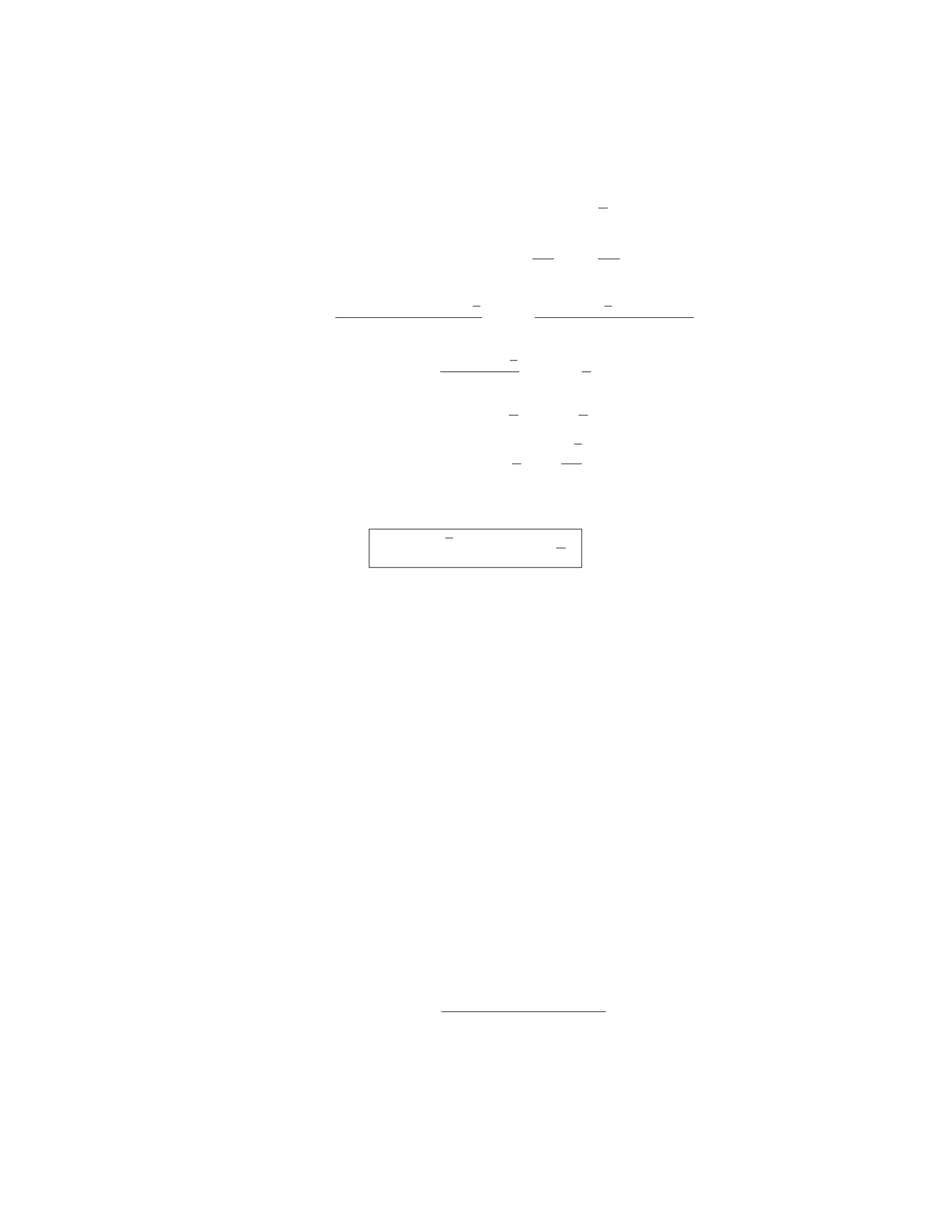
ynet = 2 sin(3x−2t) + 3 sin 3x−2t−π
4
Step 3: Apply the sum-to-product trigonometric identity. Using the
sum-to-product identity sin(a) + sin(b) = 2 sin a+b
2cos a−b
2, we can simplify
the net wave function:
ynet = 2 sin 3x−2t+ 3x−2t−π
4
2cos 3x−2t−π
4−(3x−2t)
2
ynet = 2 sin 6x−4t−π
4
2cos −π
4
ynet = 2 sin 3x−2t−π
8cos −π
4
ynet = 2 sin 3x−2t−π
8 −√2
2!
Therefore, the resulting wave function due to the superposition of the two
waves is:
ynet =−√2 sin 3x−2t−π
8
Question 13
Question
Two waves are traveling in the same medium towards a fixed point. The first
wave has an amplitude of 4 V and a frequency of 500 Hz, while the second wave
has an amplitude of 3 V and a frequency of 600 Hz. If the waves are completely
in phase with each other when they reach the fixed point, what is the resulting
amplitude at that point?
Solution
Step 1: Calculate the angular frequencies of the waves. The angular frequency
of a wave is given by the formula ω= 2πf, where fis the frequency. For the
first wave:
ω1= 2π×500 = 1000πrad/s
For the second wave:
ω2= 2π×600 = 1200πrad/s
Step 2: Calculate the resultant amplitude. The amplitude of the resultant
wave can be found using the formula:
Aresultant =qA2
1+A2
2+ 2A1A2cos(ϕ)
10

where A1and A2are the amplitudes of the individual waves. Given that the
waves are completely in phase, the phase difference ϕ= 0.
Plugging in the values:
Aresultant =p(4)2+ (3)2+ 2(4)(3) cos(0)
Aresultant =√16 + 9 + 24
Aresultant =√49 + 24
Aresultant =√73 V
Therefore, the resulting amplitude at the fixed point where the waves inter-
fere completely in phase is √73 V.
Question 14
Question
Two identical waves, each with an amplitude of 0.15 m, are traveling in the
positive x-direction with a wavelength of 2.5 m. The waves are in phase when
they meet at x= 0. What is the amplitude of the resulting wave at x= 1.0 m?
Solution
Step 1: Calculate the wave number kusing the formula k=2π
λwhere λis the
wavelength.
k=2π
2.5 m =2π
2.5m−1≈2.5133 m−1
Step 2: Since the waves are in phase, the superposition of waves at x= 1.0
m is given by y(x)=2Acos(kx), where Ais the amplitude of each wave.
y(1.0 m) = 2(0.15 m) cos2.5133 m−1×1.0 m
y(1.0 m) = 0.3 cos(2.5133) ≈0.3×0.8017 ≈0.2405 m
Answer: The amplitude of the resulting wave at x= 1.0 m is approximately
0.2405 m.
Question 15
Question
Two waves are traveling in the same direction along a string with the following
equations:
y1(x, t)=0.2 sin(2π(0.1x−100t))
y2(x, t)=0.3 sin(2π(0.08x−120t))
Calculate the resulting wave when the two waves interfere.
11

Solution
Step 1: Find the superposition of the two waves. The superposition of the two
waves is found by adding the equations together:
y(x, t) = y1(x, t) + y2(x, t)
y(x, t)=0.2 sin(2π(0.1x−100t)) + 0.3 sin(2π(0.08x−120t))
Step 2: Use the trigonometric identity sin(a) + sin(b) = 2 sina+b
2cosa−b
2
to simplify. Applying the identity gives us:
y(x, t) = 2 ×0.25 sin (2π(0.09x−110t)) cos (2π(0.02x+ 10t))
So the resulting wave when the two waves interfere is:
y(x, t)=0.5 sin (2π(0.09x−110t)) cos (2π(0.02x+ 10t))
Question 16
Question
Two identical waves, each with an amplitude of 2.0 cm and wavelength of 10.0
cm, are traveling in the same direction along a string. The waves are 180 degrees
out of phase. Determine the resulting amplitude of the superposition at a point
along the string that is 15.0 cm from the source of the waves.
Solution
Let’s denote the equation of one of the waves as y1= 2 sin 2π
10 x−2πftand
the equation of the second wave as y2= 2 sin 2π
10 x−2πft +π.
To find the resulting amplitude of the superposition at a point 15.0 cm from
the source, we can use the principle of superposition, which states that the total
displacement of the medium at any point is the vector sum of the individual
displacements of each wave at that point.
Step 1: Find the individual displacements of each wave at the given point.
Plugging in x= 15.0 cm into the equations of the waves: - For wave
1: y1= 2 sin 2π
10 ×15 −2πf ×t= 2 sin(3π−2πf ×t) - For wave 2: y2=
2 sin 2π
10 ×15 −2πf ×t+π= 2 sin(3π−2πf ×t+π)
Step 2: Calculate the total displacement at the given point using superpo-
sition principle.
The total displacement ytotal at the point 15.0 cm from the source is given
by:
ytotal =y1+y2= 2 sin(3π−2πf ×t) + 2 sin(3π−2πf ×t+π)
Applying the trigonometric identity sin(α+β) = sin αcos β+ cos αsin β, we
can simplify the above equation.
12

ytotal = 2(sin(3π) cos(π)−cos(3π) sin(π))
ytotal = 2(0 × −1−(−1) ×0) = 0
Therefore, the resulting amplitude of the superposition at a point 15.0 cm
from the source is 0 cm .
Question 17
Question
Two wave sources produce waves that interfere with each other. The first source
emits a wave with an amplitude of 1.5 cm and a frequency of 400 Hz. The second
source emits a wave with an amplitude of 2 cm and a frequency of 600 Hz. At
a point 3 m away from both sources, the waves interfere constructively. What
is the phase difference between the two sources at that point?
Solution
Step 1: Find the angular frequencies of the two sources. The angular frequencies
of the waves are given by:
ω1= 2πf1and ω2= 2πf2
where f1= 400 Hz and f2= 600 Hz. Therefore,
ω1= 2π×400 = 800πrad/s and ω2= 2π×600 = 1200πrad/s
Step 2: Calculate the wave numbers of the two sources. The wave numbers
of the waves are given by:
k=ω
v
where vis the speed of the wave in the medium. Since both waves travel the
same distance, the wave numbers are equal for both sources. Therefore,
k1=k2=k
Step 3: Find the phase difference between the two sources. The phase
difference is given by:
ϕ=kx
where x= 3 m is the distance from the sources to the point of constructive
interference. Since k1=k2=k, the phase difference is the same for both
sources. Therefore,
ϕ=k×3=3k
13

Step 4: Calculate the phase difference in terms of π. Substitute k=ω
vinto
the expression for the phase difference:
ϕ= 3 ω
v= 3 2πf
v= 6πf
v
Substitute f= 1/T (where Tis the period of the wave) and v=fλ (where λis
the wavelength) into the expression:
ϕ= 6π1/T
f/λ = 6πλ
T
From the relation v=fλ, we have λ=v/f. Substitute this into the expression:
ϕ= 6πv/f
T= 6πv
fT
Since T= 1/f, substitute T= 1/f into the expression:
ϕ= 6πv
1= 6πv
Therefore, the phase difference between the two sources at the point of con-
structive interference is 6πradians.
Question 18
Question
Two waves are interfering in a medium. The first wave has an amplitude of 8
cm and a wavelength of 12 cm. The second wave has an amplitude of 6 cm
and a wavelength of 8 cm. If they are in phase at a certain point, what is the
resultant amplitude at that point?
Solution
Let’s denote the amplitude of the first wave as A1= 8 cm, the wavelength of
the first wave as λ1= 12 cm, the amplitude of the second wave as A2= 6 cm,
and the wavelength of the second wave as λ2= 8 cm.
Step 1: Since the waves are in phase, the conditions for constructive inter-
ference are met. The resultant amplitude Aresultant can be calculated using the
formula for the superposition of waves:
Aresultant =A1+A2
So,
Aresultant = 8 + 6 = 14 cm
Therefore, the resultant amplitude at that point where the waves interfere
constructively is 14 cm.
14

Question 19
Question
Two waves, represented by the equations y1=Asin(kx −ωt) and y2=Asin(kx −ωt +π/2),
are traveling along the same medium. Find the resultant wave when the two
waves interfere.
Solution
To find the resultant wave when the two waves interfere, we need to sum the
individual waves.
Step 1: Given the equations of the two waves:
y1=Asin(kx −ωt)
y2=Asinkx −ωt +π
2
Step 2: The resultant wave can be found by summing the individual waves:
y=y1+y2
y=Asin(kx −ωt) + Asinkx −ωt +π
2
Step 3: Use the trigonometric identity sin(a+b) = sin acos b+ cos asin b
to expand the expression:
y=Ahsin(kx −ωt) cos π
2+ cos(kx −ωt) sin π
2i
Step 4: Simplify the expression:
y=Acos(kx −ωt)
Step 5: Therefore, the resultant wave when the two waves interfere is:
y=Acos(kx −ωt)
So, the resultant wave is a cosine wave with the same amplitude A, wave-
length 2π/k, and frequency ω/2π.
Question 20
Question
Two harmonic waves are traveling in opposite directions along a string. The first
wave is represented by y1= 2 sin(10x−5t) and the second wave is represented
by y2= 3 sin(10x+ 5t). Determine the equation of the resulting wave formed
by the interference of these two waves.
15

Solution
Step 1: The superposition principle states that the displacement of the medium
at any point and time due to the presence of multiple waves is the algebraic
sum of the displacements due to each individual wave. Therefore, the equation
of the resulting wave will be the sum of the two individual waves:
y=y1+y2= 2 sin(10x−5t) + 3 sin(10x+ 5t)
Step 2: To simplify the equation, we can use the trigonometric identity
sin(a) + sin(b) = 2 sina+b
2cosa−b
2. Applying this identity, we get:
y= 2 sin10x−5t+ 10x+ 5t
2cos10x−5t−10x−5t
2
y= 2 sin(10x) cos(−5t)
Step 3: Recall that cos(−θ) = cos(θ). Therefore, simplifying further:
y= 2 sin(10x) cos(5t)
So, the resulting wave formed by the interference of the two waves y1and
y2is given by y= 2 sin(10x) cos(5t).
Question 21
Question
Two waves with wavelengths of 4 cm and 6 cm are traveling along the same
medium. At a certain point, the amplitudes of the two waves are 2 cm and 3
cm respectively. If the waves interfere constructively at that point, what is the
phase difference between the two waves?
Solution
Let’s denote the wavelengths of the two waves as λ1= 4 cm and λ2= 6
cm, and the amplitudes as A1= 2 cm and A2= 3 cm. We need to find the
phase difference between the two waves at the specific point where they interfere
constructively.
Step 1: Find the wave numbers for each wave. Since the wave number kis
related to the wavelength λby k=2π
λ, we have: For the first wave with λ1= 4
cm: k1=2π
4=π
2cm−1.
For the second wave with λ2= 6 cm: k2=2π
6=π
3cm−1.
Step 2: Write the expressions for the two waves. The general form of a
wave traveling in the positive x-direction is yi(x, t) = Aisin(kix−ωt), where i
represents the wave index.
So, for the first wave: y1(x, t) = 2 sinπ
2x−ωt.
And for the second wave: y2(x, t) = 3 sinπ
3x−ωt.
16

Step 3: Use the condition for constructive interference. For the waves to
interfere constructively, the total displacement at that point should be the sum
of the individual displacements. This condition is met when the phase difference
between the two waves is an integer multiple of 2π.
Since the waves interfere constructively, we have: π
2x−π
3x= 2nπ, where n
is an integer representing the number of complete cycles.
Solving for x, we get: x
6= 2n, which simplifies to x= 12n.
Therefore, the phase difference between the two waves is such that when the
first wave has completed 12 cycles, the second wave has completed 18 cycles.
Hence, the phase difference is π
2.
Question 22
Question
Consider two waves traveling in the same medium, with wave functions given by
y1= 2 sin(3x−4t) and y2= 3 sin(3x+ 4t). What is the resultant wave function
when both waves interfere?
Solution
To find the resultant wave function when both waves interfere, we need to
consider the principle of superposition. The resultant wave function is the sum
of the individual wave functions.
Step 1: Find the resultant wave function The resultant wave function
yresult is given by:
yresult =y1+y2
Step 2: Substitute the given wave functions Substitute y1= 2 sin(3x−4t)
and y2= 3 sin(3x+ 4t) into the expression for yresult:
yresult = 2 sin(3x−4t) + 3 sin(3x+ 4t)
Step 3: Simplify the expression To simplify the expression, we use the
trigonometric identity sin(A) + sin(B) = 2 sinA+B
2cosA−B
2:
yresult = 2 sin (3x−4t) + (3x+ 4t)
2cos (3x−4t)−(3x+ 4t)
2
yresult = 2 sin(3x) cos(−4t)
Step 4: Final answer Therefore, the resultant wave function when both
waves interfere is yresult = 2 sin(3x) cos(4t).
17

Question 23
Question
A wave given by the equation y1(x, t) = 3 sin(2x−3t) interferes with another
wave y2(x, t) = 4 sin(3x+ 4t). Find the resultant wave function y(x, t) when
superposed.
Solution
Step 1: Write down the given wave equations:
y1(x, t) = 3 sin(2x−3t)
y2(x, t) = 4 sin(3x+ 4t)
Step 2: The total wave function y(x, t) is the sum of the individual wave
functions:
y(x, t) = y1(x, t) + y2(x, t)
Step 3: Substitute the given wave functions into the total wave function and
simplify:
y(x, t) = 3 sin(2x−3t) + 4 sin(3x+ 4t)
Step 4: Use the trigonometric identity sin(a) + sin(b) = 2 sina+b
2cosa−b
2
to simplify the expression:
y(x, t) = 6 sin 5x+t
2cos x−7t
2
Question 24
Question
Consider two waves traveling in the same medium. The first wave has an ampli-
tude of 2.0 cm and a wavelength of 4.0 m. The second wave has an amplitude
of 3.0 cm and a wavelength of 6.0 m. If these waves interfere constructively at
a certain point, what is the resulting amplitude at that point?
Solution
Let’s denote the amplitude of the first wave as A1= 2.0 cm, the wavelength of
the first wave as λ1= 4.0 m, the amplitude of the second wave as A2= 3.0 cm,
and the wavelength of the second wave as λ2= 6.0 m.
The condition for constructive interference is that the waves are in phase.
In this case, the phase difference between the two waves is 0 or a multiple of
2π. Mathematically, this is expressed as
2π
λ1
x−2π
λ2
x= 2πn
18

where xis the distance from the source where the waves interfere constructively
and nis an integer.
Solving for x, we have 2π
λ1
x−2π
λ2
x= 2πn
2π
λ1
x(1 −λ1
λ2
) = 2πn
x=2πn
2π
λ1(1 −λ1
λ2)
x=nλ1λ2
λ2−λ1
The resulting amplitude at point xcan be found by summing the individual
amplitudes of the two waves at that point. Using the formula for the amplitude
of a wave A=A1+A2, the resulting amplitude is
A=A1+A2= 2.0+3.0=5.0 cm
Therefore, the resulting amplitude at the point where the waves interfere
constructively is 5.0 cm.
Question 25
Question
Two waves given by the equations y1= 2 sin(2πx −πt) and y2= 3 sin3πx +π
2t
are traveling in the same medium. Determine the resulting wave function when
the two waves interfere.
Solution
Step 1: The resulting wave function is determined by adding the individual
wave functions together, taking into account the amplitudes and phases of each
wave.
Step 2: The resultant wave function is given by yresult =y1+y2.
Step 3: Substitute the given wave functions for y1and y2into the equation
for the resultant wave function.
Step 4: The resultant wave function is yresult = 2 sin(2πx −πt)+3 sin3πx +π
2t.
Step 5: To simplify the expression further, we need to apply trigonometric
identities to combine the terms.
Step 6: Using the trigonometric identity sin(A)+sin(B) = 2 sinA+B
2cosA−B
2,
we rewrite the resultant wave function as yresult = 2 sinπx −π
2tcosπx +π
2t+
3 sin3πx +π
2t.
Step 7: Further simplifying, we get yresult = 2 sinπx −π
2tcosπx +π
2t+
3 sin3πx +π
2t.
Therefore, the resulting wave function when the two waves interfere is yresult =
2 sinπx −π
2tcosπx +π
2t+ 3 sin3πx +π
2t.
19

Question 26
Question
Two identical waves with an amplitude of 0.15 m and wavelength of 2.5 m are
traveling in the same direction along a string. At a certain point, one wave is
displaced upward by 0.05 m while the other is displaced downward by 0.08 m.
Determine the amplitude, wavelength, and direction of travel of the resultant
wave formed by the interference of these two waves.
Solution
Step 1: To find the amplitude of the resultant wave, we need to consider the
principle of superposition. The amplitude of the resultant wave is given by the
sum of the individual amplitudes of the two waves.
Aresultant =A1+A2= 0.15 m + 0.15 m = 0.30 m
Step 2: Next, we determine the wavelength of the resultant wave. Since
both waves have the same wavelength, the wavelength of the resultant wave is
also the same.
λresultant =λ1=λ2= 2.5 m
Step 3: The direction of travel of the resultant wave can be determined by
examining the phase difference between the two waves at the point of interfer-
ence. In this case, one wave is displaced upward while the other is displaced
downward. This corresponds to a phase difference of πradians or half a wave-
length (since the displacement corresponds to one wavelength). Thus, the two
waves are 180 degrees out of phase and interfere destructively. Therefore, the
resultant wave will have an amplitude of 0.30 m, a wavelength of 2.5 m, and it
will travel in the same direction as the original waves with a reduced amplitude
due to destructive interference.
Question 27
Question
Two waves, y1(x, t) = Asin(kx −ωt) and y2(x, t) = Asin(kx −ωt +π/2), are
traveling in the same medium. Determine the superposition of these waves,
y(x, t), and find the resulting wave equation.
Solution
Step 1: We first find the superposition of the two waves by adding them together:
y(x, t) = y1(x, t) + y2(x, t)
20

Step 2: Substitute the expressions for y1and y2:
y(x, t) = Asin(kx −ωt) + Asinkx −ωt +π
2
Step 3: Use the sum-to-product trigonometric identity: sin(a) + sin(b) =
2 sina+b
2cosa−b
2.
y(x, t) = 2Asin2kx −2ωt +π
4cosωt
2
Step 4: Simplify the expression further:
y(x, t) = 2Asin2kx −2ωt +π
4cosωt
2
Thus, the resulting wave equation for the superposition of the two waves is
y(x, t)=2Asin2kx−2ωt+π
4cosωt
2.
Question 28
Question
Two waves on a string have amplitudes of 4 cm and 5 cm, wavelengths of 8 cm
and 10 cm, and frequencies of 12 Hz and 15 Hz. At a particular point, the waves
arrive in phase. Calculate the maximum and minimum amplitudes that can be
produced by superposition at this point.
Solution
Step 1: Calculate the wave numbers kfor each wave. Given that k=2π
λ, the
wave numbers k1and k2are: k1=2π
8 cm =π
4cm−1k2=2π
10 cm =π
5cm−1
Step 2: Write the equations for the two waves. The equations for the two
waves can be written as: y1(x, t) = 4 cm sinπ
4x−24πty2(x, t) = 5 cm sinπ
5x−30πt
Step 3: Calculate the maximum and minimum amplitudes. The maximum
amplitude is found by adding the amplitudes of the two waves, and the minimum
amplitude is found by subtracting the amplitudes of the two waves: Amax =
4 cm + 5 cm = 9 cm Amin =|4 cm −5 cm|= 1 cm
Therefore, the maximum amplitude that can be produced by superposition
at the specified point is 9 cm, and the minimum amplitude is 1 cm.
Question 29
Question
Two waves with the equations y1(x, t)=0.05 sin(4x−5t) and y2(x, t)=0.03 sin(4x+ 5t)
are travelling in the same medium. Determine the resulting wave when these
two waves interfere.
21

Solution
1. We can find the resulting wave by adding the two waves together:
y(x, t) = y1(x, t) + y2(x, t)=0.05 sin(4x−5t)+0.03 sin(4x+ 5t)
2. To simplify the expression, we can use the trigonometric identity sin(A)+
sin(B) = 2 sinA+B
2cosA−B
2:
y(x, t)=0.05 sin(4x−5t)+0.03 sin(4x+ 5t)
= 0.05 (sin(4x) cos(5t)−cos(4x) sin(5t)) + 0.03 (sin(4x) cos(5t) + cos(4x) sin(5t))
= 0.05 sin(4x) cos(5t)−0.05 cos(4x) sin(5t)+0.03 sin(4x) cos(5t)+0.03 cos(4x) sin(5t)
= (0.05 + 0.03) sin(4x) cos(5t) + (0.03 −0.05) cos(4x) sin(5t)
= 0.08 sin(4x) cos(5t)−0.02 cos(4x) sin(5t)
3. Therefore, the resulting wave when the two waves interfere is y(x, t) =
0.08 sin(4x) cos(5t)−0.02 cos(4x) sin(5t).
Question 30
Question
Two waves with the same amplitude Aand wavelength λare traveling in the
same direction. The first wave has a frequency f1while the second wave has a
frequency f2. If the phase difference between the two waves is π/4, determine
the resulting wave function formed by the superposition of the two waves.
Solution
The general equation for a wave is given by y(x, t) = Asin(kx −ωt +ϕ), where
Ais the amplitude, kis the wave number, ωis the angular frequency, and ϕis
the phase angle.
Step 1: Determine the wave number kand angular frequency ωfor each
wave. For a wave traveling in the x-direction, the wave number is related to
the wavelength λby k=2π
λ. The angular frequency is related to the frequency
by ω= 2πf. For the first wave with frequency f1:k1=2π
λω1= 2πf1For the
second wave with frequency f2:k2=2π
λω2= 2πf2
Step 2: Write the equations for the individual waves. The wave function for
the first wave is: y1(x, t) = Asin(k1x−ω1t) The wave function for the second
wave is: y2(x, t) = Asin(k2x−ω2t)
Step 3: Determine the resulting wave function from the superposition of the
two waves. The resulting wave function y(x, t) from the superposition of the
two waves is given by: y(x, t) = y1(x, t) + y2(x, t) Substitute the expressions for
y1(x, t) and y2(x, t): y(x, t) = Asin(k1x−ω1t) + Asin(k2x−ω2t)
Step 4: Apply the phase difference to form the resulting wave function.
Given that the phase difference between the two waves is π/4, this corresponds
22

to a phase shift of k1x−ω1t−(k2x−ω2t) = π/4. Substitute the expressions
for k1,k2,ω1, and ω2:2π
λx−2πf1t−(2π
λx−2πf2t) = π
4Simplify the equation
to find the resulting wave function with the phase difference: 2π
λ(f2−f1)t=π
4
The resulting wave function is: y(x, t)=2Asin 2π
λx−2π(f1+f2)t+π
4
Question 31
Question
Two waves traveling in the same medium collide with each other. The first wave
has an amplitude of 2 cm and a wavelength of 5 cm while the second wave has
an amplitude of 3 cm and a wavelength of 8 cm. At what distance from the
source do the waves first produce destructive interference?
Solution
1. The waves will produce destructive interference when they are exactly λ
2out
of phase.
2. The first step is to find the difference in path lengths between the two
waves that results in a phase difference of π. Let’s call this difference in path
lengths ∆x.
3. Since the waves have different wavelengths, we will express ∆xin terms
of the wavelengths.
4. For destructive interference, the path difference is equal to λ
2.
∆x=n·λ1·λ2
λ1−λ2
5. Substituting the given values into this formula, we get:
∆x=n·5·8
5−8=n·40
−3=−40n
3
6. We know that nis an integer because we need a whole number of wave-
lengths to get back to the original phase. We want to find the smallest positive
value of nfor which ∆xis positive.
7. Since we are looking for the distance from the source where destructive
interference first occurs, we take n= 1.
8. Substituting n= 1 into the formula, we find the distance from the source
where destructive interference first occurs:
∆x=−40
3
So, the waves first produce destructive interference at a distance of 40
3cm
from the source.
23

Question 32
Question
A string under tension Tis fixed at both ends and supports a standing wave
with nodes at x= 0 and x=L. The waves on the string have a wavelength λ.
If the speed of the waves on the string is v, determine the relationship between
λ,L, and the harmonic number nfor standing waves on the string.
Solution
To find the relationship between λ,L, and n, we need to consider the standing
waves formed on the string.
Step 1: The nth harmonic is characterized by nantinodes on the string.
Step 2: The length of the string, L, must equal an integer multiple of half
the wavelength for resonance. Therefore, for the nth harmonic,
L=nλ
2
Step 3: From the wave equation, we have
v=fλ
where vis the speed of the wave, fis the frequency, and λis the wavelength.
Step 4: The frequency fof the wave is related to the harmonic number n
since the frequency is determined by the number of antinodes. The speed of the
wave is constant, so
f=v
λ
Step 5: Substituting f=v
λinto L=nλ
2, we get
L=n
2v
f
L=nv
2f
Step 6: Substituting f=n
2Lvback into the equation v=fλ, we get
v=n
2Lvλ
λ= 2L
Step 7: Therefore, the relationship between λ,L, and the harmonic number
nfor standing waves on the string is λ=2L
n.
24

Question 33
Question
Two waves are traveling in the same medium. The first wave has an amplitude
of 2 cm, a wavelength of 4 cm, and a frequency of 10 Hz. The second wave has
an amplitude of 3 cm, a wavelength of 6 cm, and a frequency of 15 Hz.
If these two waves are in phase, determine the amplitude of the resultant
wave at a point where the waves interfere constructively.
Solution
Step 1: Calculate the wave numbers. The wave number (k) is related to the
wavelength (λ) by the equation k=2π
λ. For the first wave: k1=2π
4 cm =π
2cm−1.
For the second wave: k2=2π
6 cm =π
3cm−1.
Step 2: Determine the angular frequencies. The angular frequency (ω) is
related to the frequency (f) by the equation ω= 2πf. For the first wave: ω1=
2π×10 Hz = 20πrad/s. For the second wave: ω2= 2π×15 Hz = 30πrad/s.
Step 3: Find the resultant wave’s amplitude. Since the waves are in phase,
the resultant wave’s amplitude Aresultant at a point where they interfere con-
structively is given by Aresultant =A1+A2. Substitute the given amplitudes:
Aresultant = 2 cm + 3 cm = 5 cm.
Therefore, at a point where the waves interfere constructively, the amplitude
of the resultant wave is 5 cm.
Question 34
Question
Two waves with the equations y1=Asin(kx −ωt) and y2=Asin(kx −ωt +ϕ)
are travelling in the positive xdirection on a stretched string. Find the condition
for constructive interference to occur at a point P located at x=x0and t=t0.
Solution
Step 1: Find the equations of the two waves at point P.
At point P, the equations for the two waves become:
y1=Asin(kx0−ωt0)
y2=Asin(kx0−ωt0+ϕ)
Step 2: Calculate the resultant amplitude of the waves at point P.
For constructive interference to occur, the waves must reinforce each other.
This means that the resultant amplitude of the waves must be the sum of the
individual amplitudes:
Aresultant =Asin(kx0−ωt0) + Asin(kx0−ωt0+ϕ)
25

Aresultant =A(sin(kx0−ωt0) + sin(kx0−ωt0+ϕ))
Step 3: Apply the condition for constructive interference.
For the waves to interfere constructively at point P, the phase difference
between them should be a multiple of 2π. This gives us the condition:
kx0−ωt0+ϕ−(kx0−ωt0) = 2nπ
ϕ= 2nπ
where nis an integer.
Therefore, the condition for constructive interference to occur at point P is
ϕ= 2nπ, where nis an integer.
Question 35
Question
Two waves, y1= 2 sin(2πx −π/2) and y2= 3 sin(2πx +π/3), are traveling on
a string. Determine the superposition of the two waves at x= 0.1 m and find
the amplitude and phase of the resulting wave.
Solution
Let’s denote the superposition of the two waves as y=y1+y2. At a specific
point x, the superposition is the sum of the individual waves at that point.
Step 1: Find the wave equation for the superposition
y=y1+y2= 2 sin2πx −π
2+ 3 sin2πx +π
3
Step 2: Evaluate the superposition at x= 0.1m
y(0.1) = 2 sin2π×0.1−π
2+ 3 sin2π×0.1 + π
3
y(0.1) = 2 sinπ
5−π
2+ 3 sinπ
5+π
3
y(0.1) = 2 sin −π
10 + 3 sin 7π
15
Step 3: Simplify the expression and find the amplitude and phase
Using trigonometric identities, we get
y(0.1) = 2 sin 3π
2+ 3 sin 7π
15
y(0.1) = −2 + 3√3
2
Therefore, the amplitude of the resulting wave is r(−2)2+3√3
22
=q4 + 27
4=
q43
4=√43
2, and the phase is given as arctan 3√3/2
−2= arctan 3√3
−4.
26

