



PHYS 232 - UNIVERSITY PHYSICS
II - Calculation of electric forces
between point charges
Question Bank - Set 10
Liberty University
Question 1
Question
Two point charges, q1= 3.2×10⁻⁶C and q2=−4.8×10⁻⁶C, are placed 6.0
cm apart in a vacuum. Calculate the magnitude of the electric force between
the charges.
Solution
Step 1: Convert the distance from cm to meters. Given that 1 cm = 1×10⁻²
m, the distance between the charges is:
d= 6.0cm ×1×10−2m/cm = 0.06 m
Step 2: Calculate the electric force using Coulomb’s Law. The electric force
between two point charges is given by Coulomb’s Law:
F=k×|q1×q2|
d2
where kis the Coulomb constant (k≈8.99 ×10⁹N m2/C2).
Substitute the given values into the equation:
F= (8.99 ×10⁹)×|3.2×10⁻⁶× −4.8×10⁻⁶|
(0.06)2
Step 3: Perform the calculations.
F= 8.99 ×109×3.2×4.8×10−12
0.0036

F= 8.99 ×109×15.36 ×10−12
0.0036
F= 8.99 ×15.36
0.0036 ×10⁻³
F= 8.99 ×4266.67
1×10⁻³
F= 3.84 ×10⁴N
Therefore, the magnitude of the electric force between the charges is 3.84 ×
104N.
Question 2
Question
Two point charges q1= 3.0µC and q2=−4.0µC are placed 10.0 cm apart in
air. Calculate the magnitude and direction of the electric force that q1exerts
on q2.
Solution
Step 1: Convert the charges to coulombs. Given: q1= 3.0µC = 3.0×10⁻⁶C
q2=−4.0µC =−4.0×10⁻⁶C
Step 2: Find the distance between the charges in meters. Given: r= 10.0
cm = 10.0×10⁻²m= 0.10 m
Step 3: Calculate the magnitude of the electric force using Coulomb’s law.
Coulomb’s law states:
F=k|q1q2|
r2
where kis Coulomb’s constant, k= 8.9875 ×10⁹N·m2/C2.
Plugging in the values:
F= 8.9875 ×10⁹×|3.0×10⁻⁶× −4.0×10⁻⁶|
(0.10)2
F= 8.9875 ×109×12 ×10−12
0.01
F= 8.9875 ×109×1.2×10−9
F= 10.785 ×10⁻¹
F= 10.785 N
Step 4: Determine the direction of the force. The force is attractive since
one charge is positive and the other is negative.
Therefore, the magnitude of the electric force that q1exerts on q2is 10.785 N
directed towards q2.
2

Question 3
Question
Three point charges are arranged in an equilateral triangle. The charges are
+q,−2q, and +3qwith sides of length d. Calculate the magnitude of the net
electrostatic force on the +3qcharge due to the other two charges. Assume the
charges are free to move.
Solution
1. First, let’s calculate the electrostatic force between the +qand +3qcharges.
Since the charges are the same sign, this force will be repulsive. The magnitude
of the electrostatic force F1between a pair of charges qand Qis given by
Coulomb’s Law:
F1=k· |q|·|Q|
r2
where kis the Coulomb constant (8.99 ×10⁹N m2/C2), |q|is the magnitude of
the +qcharge, |Q|is the magnitude of the +3qcharge, and ris the distance
between the charges. Since this distance is din an equilateral triangle, r=d.
2. Substituting the given values into the formula, we get:
F1=(8.99 ×10⁹)(q)(3q)
d2=26.97 ×10⁹q2
d2
So, the magnitude of the force F1between the +qand +3qcharges is 26.97×10⁹q2
d2
3. Next, let’s calculate the electrostatic force between the −2qand +3q
charges. Since the charges are opposite signs, this force will be attractive. Let’s
denote this force as F2.
4. Using Coulomb’s Law again, we have:
F2=k· |(−2q)|·|3q|
d2=6kq2
d2
5. Now, to find the net force on the +3qcharge, we need to consider the
directions. Since F1and F2are along the same line, we simply subtract these
two forces:
Net force =F1−F2=26.97 ×10⁹q2
d2−6kq2
d2
=26.97 ×10⁹−6×8.99 ×109q2
d2
6. Therefore, the magnitude of the net electrostatic force on the +3qcharge
due to the other two charges is (26.97 −53.94) ×109q2
d2=−26.97 ×10⁹q2
d2.
3

Question 4
Question
Three point charges are arranged along the x-axis: a charge of +3µC at the
origin, a charge of −5µC at x= 0.1m, and a charge of +2µC at x= 0.2m.
Calculate the net electric force on the charge of −5µC.
Solution
Step 1: Calculate the electric force between the charge of +3µC at the origin
and the charge of −5µC at x= 0.1m. The electric force F1between two charges
q1and q2separated by a distance ris given by Coulomb’s law:
F1=k·|q1q2|
r2
where k= 8.99 ×10⁹Nm²/C² is Coulomb’s constant.
Substitute the given values:
F1= 8.99 ×109·3×10−6×5×10−6
(0.1)2
Calculating F1gives:
F1= 1.35 ×10⁻³N
Step 2: Calculate the electric force between the charge of +2µC at x= 0.2
m and the charge of −5µC at x= 0.1m. Using Coulomb’s law again:
F2=k·|q1q2|
r2
Substitute the given values:
F2= 8.99 ×109·2×10−6×5×10−6
(0.2−0.1)2
Calculating F2gives:
F2= 4.49 ×10⁻³N
Step 3: Find the net force on the charge of −5µC. Since the forces are in
opposite directions, we need to consider them as negative and positive values.
The net force is the sum of the forces:
Fnet =F1−F2= 1.35 ×10⁻³N−4.49 ×10⁻³N
Calculating Fnet gives:
Fnet =−3.14 ×10⁻³N
Therefore, the net electric force on the charge of −5µC is −3.14 ×10⁻³N,
pointing towards the charge of +2µC at x= 0.2m.
4

Question 5
Question
Two point charges, q1=−6.0µC and q2= 4.0µC, are placed 10.0 cm apart in
air. Calculate the magnitude of the electric force between these charges.
Solution
Given: q1=−6.0µC
q2= 4.0µC
r= 10.0cm
The electric force between two point charges q1and q2separated by a dis-
tance ris given by Coulomb’s law:
F=k·|q1·q2|
r2
where kis the electrostatic constant equal to 8.99 ×10⁹N·m2/C2.
Step 1: Convert the distance rfrom cm to m:
r= 10.0cm = 0.1m
Step 2: Calculate the magnitude of the electric force using Coulomb’s law:
F= (8.99 ×10⁹)·| − 6.0×10−6·4.0×10−6|
(0.1)2
F= 8.99 ×109·24 ×10−12
0.01
F= 8.99 ×109·2.4×10−10
F= 2.1576 ×10⁻¹N
The magnitude of the electric force between the charges q1and q2is 0.216 N.
Question 6
Question
Three point charges are located on the vertices of an equilateral triangle of side
length a. The charges are +q,−2q, and +q. Calculate the magnitude and
direction of the electric force on the positive charge +qdue to the other two
charges.
5

Solution
Given: - Charge at vertex A = +q, - Charge at vertex B = -2q, - Charge
at vertex C = +q, - Distance between charges = a(side length of equilateral
triangle), - Coulomb’s constant = k.
The direction of the electric force on the positive charge +qdue to the other
two charges will depend on the configuration of the charges. Since the charges
are symmetrical with respect to the positively charged particle, the net force on
the positive charge will be directed vertically downwards.
Step 1: Calculate the force on +qdue to −2qat vertex B: The electric force
FAB on the charge at A due to the charge at B is given by Coulomb’s law:
FAB =k· |q|·|−2q|
a2=2kq2
a2
Step 2: Calculate the force on +qdue to +q at vertex C: The electric force
FAC on the charge at A due to the charge at C is given by Coulomb’s law:
FAC =k· |q|·|q|
a2=kq2
a2
Step 3: Calculate the net force and its direction: The net force on the
charge at A will be the sum of the forces FAB and FAC in the vertical downward
direction:
Fnet =FAB +FAC =2kq2
a2+kq2
a2=3kq2
a2
Therefore, the magnitude of the net force on the charge +qis 3kq2
a2and it is
directed vertically downwards.
Question 7
Question
Two point charges, q1= 3 µC and q2=−2µC, are placed 10 cm apart in air.
Calculate the magnitude of the electric force between these charges.
Solution
Step 1: Determine the distance between the charges in meters. Given that the
charges are 10 cm apart, we need to convert this distance to meters:
10 cm = 0.1m
Step 2: Calculate the magnitude of the electric force between the charges
using Coulomb’s Law: Coulomb’s Law states that the magnitude of the electric
force between two point charges is given by:
F=k· |q1·q2|
r2
6

where: - Fis the magnitude of the electric force, - kis the electrostatic constant
(8.99 ×10⁹N m2/C2), - q1and q2are the magnitudes of the two charges, - ris
the distance between the charges.
Plugging in the given values:
F=(8.99 ×10⁹N m2/C2)· |3×10⁻⁶C· −2×10⁻⁶C|
(0.1m)2
Step 3: Calculate the electric force.
F=8.99 ×109·6×10−6·2×10−6
0.01
F=8.99 ×6×2
10 ×10−3
F=107.88
10 ×10−3
F= 10.788 ×10⁻³
F= 10.788 mN
Therefore, the magnitude of the electric force between the two charges is
10.788 mN.
Question 9
Question
Two point charges q1= +2.5µC and q2=−4.0µC are placed 10 cm apart.
Calculate the magnitude of the electric force between the charges.
Solution
To calculate the magnitude of the electric force between the charges, we can use
Coulomb’s Law. Coulomb’s Law states that the magnitude of the electric force
between two point charges is given by:
F=k|q1q2|
r2
where: - Fis the magnitude of the electric force, - kis Coulomb’s constant
(8.9875 ×10⁹N·m2/C2), - q1and q2are the magnitudes of the charges, and -
ris the separation distance between the charges.
Step 1: Convert the given charges to coulombs:
q1= +2.5µC = 2.5×10⁻⁶C
q2=−4.0µC =−4.0×10⁻⁶C
7

Step 2: Determine the separation distance in meters:
r= 10 cm = 0.1m
Step 3: Calculate the magnitude of the electric force:
F= (8.9875 ×10⁹)|2.5×10⁻⁶× −4.0×10⁻⁶|
(0.1)2
F= 8.9875 ×109×1.0×10−11 ×100
F= 8.9875 ×10¹³N
Therefore, the magnitude of the electric force between the charges is 8.9875×
1013 N.
Question 10
Question
Two point charges, q1=−3.0µC and q2= +6.0µC, are placed 0.20 m apart.
Calculate the magnitude and direction of the electric force that q2exerts on q1.
Solution
Step 1: Convert the given charges to standard units.
•q1=−3.0µC =−3.0×10⁻⁶C
•q2= +6.0µC = 6.0×10⁻⁶C
Step 2: Calculate the magnitude of the electric force using Coulomb’s Law:
F=k·|q1·q2|
r2
where kis the Coulomb constant (8.99 ×10⁹N·m2/C2) and ris the distance
between the charges.
Step 3: Substitute the given values into the equation:
F= (8.99 ×10⁹)·| − 3.0×10−6·6.0×10−6|
0.202
Step 4: Simplify the expression to find the magnitude of the electric force.
F= (8.99 ×109)·18 ×10−12
0.04 = 4.497 ×10⁻²N
Step 5: Determine the direction of the electric force. Since q2is positive, it
exerts a repulsive force on q1, which is negative. Thus, the direction of the force
is away from q2.
Therefore, the magnitude of the electric force that q2exerts on q1is 4.497 ×
10−2N, directed away from q2.
8

Question 11
Question
Three point charges are arranged in a line. Charge q1=−3.0µC is located
at x=−1.0m, charge q2= 6.0µC is located at the origin, and charge q3=
−4.0µC is located at x= 2.0m. Calculate the magnitude and direction of the
net electrostatic force on q1due to q2and q3.
Solution
Step 1: Calculate the force on q1due to q2. The electrostatic force between two
point charges is given by Coulomb’s Law:
F=k·|q1·q2|
r2
where k= 8.99 ×10⁹Nm2/C2is Coulomb’s constant, q1=−3.0µC =−3.0×
10−6C,q2= 6.0µC = 6.0×10⁻⁶C, and r= 1.0mis the distance between q1
and q2.
Plugging in these values, we get
Fq1,q2= 8.99 ×10⁹·| − 3.0×10−6·6.0×10−6|
(1.0)2
Fq1,q2= 8.99 ×109·18 ×10−12
1.0
Fq1,q2= 161.82 ×10⁻³N
Step 2: Determine the direction of the force on q1due to q2. Since q1and
q2are oppositely charged, the force will be attractive. Therefore, the force will
act towards q2.
Step 3: Calculate the force on q1due to q3. Similarly, using Coulomb’s Law,
we find the force on q1due to q3:
Fq1,q3= 8.99 ×10⁹·| − 3.0×10⁻⁶· −4.0×10⁻⁶|
(3.0)2
Fq1,q3= 8.99 ×109·12 ×10−12
9.0
Fq1,q3= 119.76 ×10⁻³N
Step 4: Determine the direction of the force on q1due to q3. As q1and q3
are both negative charges, the force between them will also be attractive, acting
towards q3.
Step 5: Calculate the net force on q1by summing the individual forces from
q2and q3. The net force is given by
Fnet =Fq1,q2+Fq1,q3
9

Fnet = 161.82 ×10⁻³+ 119.76 ×10⁻³
Fnet = 281.58 ×10⁻³N
The net force on q1is 281.58 ×10⁻³Ntowards the right.
Question 12
Question
Three point charges are placed at the following positions: q1= +3 nC at (0,0),
q2=−1nC at (4,0), and q3= +2 nC at (0,3). Calculate the net electric force
on q2due to q1and q3.
Solution
Step 1: Calculate the electric force on q2due to q1: The electric force between
two point charges q1and q2separated by a distance ris given by Coulomb’s
Law:
F1,2=k|q1||q2|
r2
In this case, q1= +3 nC, q2=−1nC, and r= 4 (since q1and q2are 4 units
apart horizontally). Using k= 8.99 ×10⁹N m2/C2, we have:
F1,2= (8.99 ×10⁹)(3 ×10⁻⁹)(1 ×10⁻⁹)
(4)2
F1,2= (8.99 ×10⁹)3
16 ×10−18
F1,2=2697
16 ×10−9
F1,2= 168.56 ×10⁻⁹
F1,2= 1.69 ×10⁻⁶N
Step 2: Calculate the electric force on q2due to q3: Similarly, using q2=
−1nC, q3= +2 nC, and r= 3 (since q2and q3are 3 units apart vertically), we
have:
F2,3=k|q2||q3|
r2
F2,3= (8.99 ×10⁹)(1 ×10⁻⁹)(2 ×10⁻⁹)
(3)2
F2,3=2×8.99
9×10⁻⁹
F2,3= 1.99 ×10⁻⁶N
10

Step 3: Calculate the net electric force on q2: The net force is the vector
sum of the two forces:
Net force on q2=F1,2+F2,3
Net force on q2= 1.69 ×10⁻⁶+ 1.99 ×10⁻⁶
Net force on q2= 3.68 ×10⁻⁶N
Therefore, the net electric force on q2due to q1and q3is 3.68 ×10⁻⁶N.
Question 13
Question
Three point charges are placed at the corners of an equilateral triangle of side
length d= 2.0m as shown below. The charges are +3.0µC at the upper corner,
−2.0µC at the lower left corner, and +6.0µC at the lower right corner. Calcu-
late the magnitude and direction of the net electric force on the charge at the
upper corner.
`
` `
U
-
3.0µC
−2.0µC6.0µC
d
Solution
Step 1: Calculate the electric force between the upper corner charge at +3.0µC
and the lower left corner charge at −2.0µC. The electric force F1between two
point charges q1and q2separated by a distance ris given by Coulomb’s Law:
F1=k· |q1|·|q2|
r2
where kis the Coulomb constant 8.99 ×10⁹N·m2/C2.
Substitute the given values into Coulomb’s Law:
F1=(8.99 ×10⁹N·m2/C2)·(3.0×10−6C)·(2.0×10−6C)
(2.0m)2
F1=8.99 ×109×3.0×2.0
4
F1=53.94 ×10⁹
4
F1= 13.485 ×10⁹N
Step 2: Calculate the electric force between the upper corner charge at
+3.0µC and the lower right corner charge at +6.0µC. Similarly, use Coulomb’s
Law with the appropriate charges and distance:
F2=k· |3.0×10⁻⁶|·|6.0×10⁻⁶|
(2.0m)2
11

F2=8.99 ×109×3.0×6.0
4
F2= 13.485 ×10⁹N
Step 3: Find the net force on the upper corner charge. Since the forces
between the upper corner charge and the two lower corner charges are along the
same line but in opposite directions, the net force will be the difference of these
two forces.
Net Force =F2−F1
Net Force = 13.485 ×10⁹N−13.485 ×10⁹N
Net Force = 0
Question 14
Question
Three point charges are arranged along the x-axis as follows: q1=−2.0µC at
x= 0.0m, q2= 4.0µC at x= 4.0m, and q3=−6.0µC at x= 8.0m. Calculate
the magnitude and direction of the net electrostatic force on q2.
Solution
Step 1: Calculate the force between q2and q1. The force between two charges
is given by Coulomb’s Law:
F=k·|q1·q2|
r2
where Fis the magnitude of the force, kis Coulomb’s constant (8.99 ×10⁹N·
m2/C2), q1, q2are the point charges, ris the distance between the charges.
The distance between q1and q2is r= 4.0m. Plugging in the values, we get:
F12 = 8.99 ×10⁹·| − 2.0×10−6·4.0×10−6|
(4.0)2= 3.59 N
Step 2: Calculate the force between q2and q3. The distance between q2and
q3is r= 4.0m. Plugging in the values, we get:
F23 = 8.99 ×10⁹·|4.0×10−6·6.0×10−6|
(4.0)2= 6.74 N
Step 3: Calculate the net force on q2. The net force on q2is the vector sum
of F12 and F23. Since F12 is to the left (negative x-direction) and F23 is to the
right (positive x-direction), their magnitudes will be subtracted to find the net
force.
Fnet =|F23 −F12|=|6.74 −3.59|= 3.15 N
The direction of the net force will be towards the positive x-axis.
12
Question 15
Question
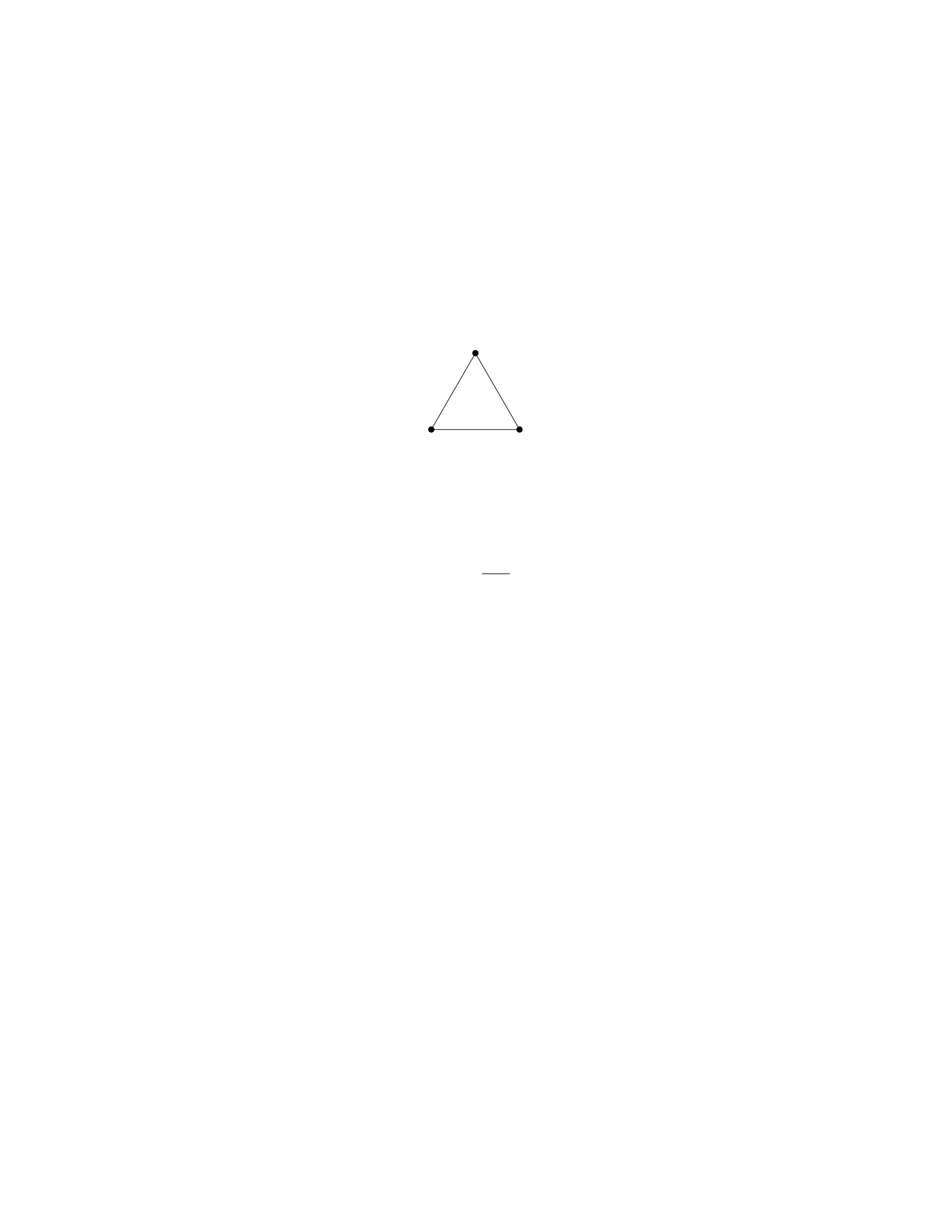
Three point charges are arranged in an equilateral triangle as shown below. The
charges are q1= +2.0µC, q2=−3.0µC, and q3= +4.0µC. Calculate the
magnitude of the net force on q2due to the other two charges.
q1q2
q3
Solution
Step 1: Calculate the electric force between q2and q1. The force between two
charges q1and q2separated by a distance ris given by Coulomb’s law:
F=kq1q2
r2
where - kis the Coulomb constant (8.99 ×10⁹N·m2/C2), - q1and q2are
the magnitudes of the charges, - ris the distance between the charges.
In our case, q1= +2.0µC, q2=−3.0µC, and r=[distance between q1and
q2in the equilateral triangle]. Let’s denote this distance as a.
The distance between q1and q2in an equilateral triangle can be calculated
using trigonometry. Since all sides of an equilateral triangle are equal, the
distance between q1and q2is a= 2lcos(30◦), where lis the side length of the
equilateral triangle. Given an equilateral triangle, l=[side length] and thus
a=[calculated distance].
Substitute the charges and distances into Coulomb’s law to find the force
F12 between q1and q2.
Step 2: Calculate the electric force between q2and q3(F23 ) and the angle
between F12 and F23.
Step 3: Using vector addition, calculate the net force on q2due to q1and
q3. The net force is the vector sum of F12 and F23.
Step 4: Calculate the magnitude of the net force on q2.
Question 16
Question
Two point charges, q1=−3µC and q2= 5 µC, are placed 10 cm apart in
a vacuum. Calculate the magnitude of the electric force between these two
charges.
13

Solution
Step 1: Convert all given quantities to standard SI units.
•q1=−3µC=−3×10⁻⁶C
•q2= 5 µC= 5 ×10⁻⁶C
•r= 10 cm = 10 ×10−2m
Step 2: Calculate the magnitude of the electric force using Coulomb’s Law.
F=k·|q1|·|q2|
r2
where kis the electrostatic constant with a value of 8.99 ×10⁹N·m2/C2.
Step 3: Plug in the given values to find the magnitude of the electric force.
F= 8.99 ×10⁹N·m2/C2·3×10−6C·5×10−6C
(10 ×10−2m)2
Step 4: Perform the calculations to find the numerical value of the electric
force.
F= 8.99 ×109×15 ×10−12 N
F= 134.85 ×10⁻³N
F= 0.13485 N
Therefore, the magnitude of the electric force between the two charges is
0.13485 N.
Question 17
Question
Three point charges are arranged as shown in the diagram below. The charge
q1=−5.0µC is located at point A at coordinates (0,0), the charge q2= 8.0µC
is located at point B at coordinates (2,0), and the charge q3=−3.0µC is located
at point C at coordinates (0,3).
Calculate the magnitude and direction of the net force on the charge at point
A due to the other two charges.
Solution
Step 1: Calculate the force exerted on the charge at point A due to the charge
at point B. Using Coulomb’s law, the magnitude of the force exerted by charge
q2on charge q1is given by:
FA,B =k|q1||q2|
r2
A,B
14

Where k= 8.99 ×10⁹Nm2/C2is the Coulomb constant, rA,B is the distance
between charge q1and charge q2which is 2 meters in this case. Plugging in the
values, we get:
FA,B =(8.99 ×10⁹Nm2/C2)(5.0×10−6C)(8.0×10−6C)
(2 m)2
FA,B =35.96
4= 8.99 N
Step 2: Calculate the force exerted on the charge at point A due to the
charge at point C. Similarly, using Coulomb’s law, the magnitude of the force
exerted by charge q3on charge q1is given by:
FA,C =k|q1||q3|
r2
A,C
Where rA,C is the distance between charge q1and charge q3which is 3 meters
in this case. Plugging in the values, we get:
FA,C =(8.99 ×10⁹Nm2/C2)(5.0×10−6C)(3.0×10−6C)
(3 m)2
FA,C =13.485
9= 1.498 N
Step 3: Calculate the net force on the charge at point A. Since the charges
at B and C are at right angles to each other, the net force on charge q1is given
by the vector sum of the forces due to q2and q3. Using Pythagoras theorem,
the magnitude of the net force is:
Fnet =qF2
A,B +F2
A,C
Fnet =p(8.99 N)2+ (1.498 N)2
Fnet =√80.82 + 2.244
Fnet =√83.064
Fnet ≈9.12 N
The direction of the net force can be found by determining the angle between
the net force and the x-axis:
θ= tan−1FA,C
FA,B
θ= tan−11.498
8.99
θ≈
15

Question 18
Question
Three point charges, q1= +3 nC, q2=−2nC, and q3= +4 nC, are placed at
the vertices of an equilateral triangle with sides of length d= 0.10 m. What is
the magnitude of the net electric force on q1due to the other two charges?
Solution
Step 1: Find the electric force on q1due to q2. The formula to calculate the
electric force between two point charges is given by Coulomb’s Law:
Felec =k·|q1|·|q2|
r2
where kis the Coulomb constant (8.99 ×10⁹N m2/C2) and ris the distance
between the charges.
Substituting the given values, the force on q1due to q2is:
F1,2= (8.99 ×109)·3×10−9·2×10−9
(0.10)2
Step 2: Calculate the electric force on q1due to q3. Following the same steps
as in Step 1, the force on q1due to q3is:
F1,3= (8.99 ×109)·3×10−9·4×10−9
(0.10)2
Step 3: Find the net force on q1. The net force on q1is the vector sum of
the forces due to q2and q3, so
|
Fnet|=q(
F1,2+
F1,3)2
After calculating the individual forces using Coulomb’s Law, you can find
the total magnitude of the net electric force on q1. Remember to consider the
directions of the forces as well.
Question 19
Question
Two point charges, q1= 4.0µC and q2=−6.0µC, are placed 2.0 meters apart.
Determine the magnitude and direction of the electric force that each charge
exerts on the other.
16

Solution
Given: q1= 4.0µC= 4.0×10⁻⁶C, q2=−6.0µC=−6.0×10⁻⁶C, r= 2.0m.
We’ll first calculate the magnitude of the electric force between the two
charges using Coulomb’s Law:
F=k· |q1|·|q2|
r2
where k= 8.99 ×10⁹N·m2/C2is the Coulomb constant.
Step 1: Calculate the magnitude of the force
F=8.99 ×10⁹· |4.0×10⁻⁶|·|−6.0×10⁻⁶|
(2.0)2
F=8.99 ×109·4.0×10−6·6.0×10−6
4.0
F=2.1576 ×10⁻²
4.0
F= 5.394 ×10⁻³N
Step 2: Determine the direction of the force Since q1is positive and q2
is negative, the forces between them are attractive. Thus, the force that charge
q1exerts on charge q2is directed towards q2, and the force that charge q2exerts
on charge q1is directed towards q1(in the opposite direction).
Therefore, the magnitude of the force is 5.394 ×10⁻³N and the direction
of the force on q1by q2is attractive and directed towards q2. Similarly, the
direction of the force on q2by q1is attractive and directed towards q1.
Question 20
Question
Two point charges, q1= +2.0nC and q2=−3.0nC, are placed 6.0cm apart
in air. Calculate the magnitude and direction of the electric force between the
charges.
Solution
Let’s solve this problem step by step:
Step 1: Find the distance between the charges in meters. Given
that the charges are 6.0cm apart, we convert this to meters:
6.0cm = 6.0×10⁻²m= 0.06 m
Step 2: Calculate the magnitude of the electric force. The magnitude
of the electric force between two point charges is given by Coulomb’s law:
F=k· |q1·q2|
r2
17

where kis the Coulomb constant (8.99×10⁹N m2/C2), q1and q2are the charges,
and ris the distance between the charges in meters.
Plugging in the values:
F=(8.99 ×10⁹N m2/C2)· |2.0×10⁻⁹C· −3.0×10⁻⁹C|
(0.06 m)2
F=(8.99 ×109)·(6 ×10−18)
0.0036
F=53.94 ×10⁻⁹
0.0036
F= 14.95 ×10⁻⁹N= 1.5×10⁻⁸N
Thus, the magnitude of the electric force between the charges is 1.5×10⁻⁸N.
Step 3: Determine the direction of the electric force. The electric
force between the charges is attractive since the charges have opposite signs.
Therefore, the direction of the force is from q1to q2or from −3.0nC to +2.0nC.
Question 21
Question
Two point charges, q1= +3.00 µC and q2=−5.00 µC, are placed 8.00 cm
apart in a vacuum. Calculate the magnitude of the electric force between these
charges.
Solution
Step 1: Convert the given charges to Coulombs for calculation:
q1= +3.00 µC= 3.00 ×10⁻⁶C
q2=−5.00 µC=−5.00 ×10⁻⁶C
Step 2: Convert the distance between the charges to meters:
d= 8.00 cm = 8.00 ×10⁻²m
Step 3: Calculate the magnitude of the electric force between these charges
using Coulomb’s law:
F=k· |q1·q2|
d2
where k= 8.99 ×10⁹N m2/C2is the Coulomb’s constant.
18

Step 4: Substitute the known values into the equation:
F=(8.99 ×10⁹N m2/C2)· |(3.00 ×10⁻⁶C)·(−5.00 ×10⁻⁶C)|
(8.00 ×10⁻²m)2
=(8.99 ×109)·(3.00 ×10−6)·(5.00 ×10−6)
(8.00 ×10⁻²)2
=(8.99 ×109)·(15 ×10−12)
(0.08)2
=134.85 ×10⁻³
0.0064
= 21,132.81 N
Therefore, the magnitude of the electric force between the charges is 21,132.81 N.
Question 22
Question
Two point charges, q1= 3µC and q2=−5µC, are placed 10 cm apart in a
vacuum. Calculate the magnitude of the electric force between them.
Solution
Step 1: Convert the charges to coulombs. Step 2: Calculate the distance in
meters. Step 3: Use Coulomb’s Law to find the magnitude of the electric force
between the charges.
Step 1: Converting the charges to coulombs: q1= 3µC = 3×10⁻⁶C
q2=−5µC = −5×10⁻⁶C
Step 2: Calculating the distance in meters: The distance between the
charges is 10 cm = 10 ×10−2m = 0.1 m.
Step 3: Using Coulomb’s Law to find the magnitude of the electric force:
Coulomb’s Law states that the magnitude of the electric force between two point
charges is given by:
F=k· |q1·q2|
r2,
where kis the electrostatic constant (8.99 ×10⁹Nm2/C2), q1and q2are the
charges, and ris the distance between the charges.
Substitute the given values into the formula:
F=(8.99 ×10⁹)· |3×10⁻⁶·(−5×10⁻⁶)|
(0.1)2
F=(8.99 ×109)·15 ×10−12
0.01
19

F=1.3485 ×10⁻²
0.01
F= 1.3485 N
Therefore, the magnitude of the electric force between the charges q1and q2
is 1.3485 N.
Question 23
Question
Three point charges are arranged as shown in the diagram below. Calculate the
magnitude and direction of the electric force on the charge q1due to the other
two charges. Use q= 2.0µC and d= 2.0m.
•q1= +2.0µC
•q2=−4.0µC•q3= +6.0µC
Solution
Step 1: Calculate the electric force on q1due to q2. The electric force between
two point charges is given by Coulomb’s law:
F=kq1q2
r2
where k≈8.99 ×10⁹Nm2/C2is the Coulomb constant, q1and q2are the
magnitudes of the charges, and ris the distance between the charges.
Given that q1= 2.0µC, q2=−4.0µC, and d= 2.0m, we can substitute
these values into Coulomb’s law to find the force F12 on q1due to q2:
F12 =k|q1||q2|
d2
F12 = (8.99 ×10⁹Nm2/C2)(2.0×10−6C)(4.0×10−6C)
(2.0m)2
F12 = (8.99 ×109)×(8.0×10−12)×(4) = 287.68 nN
The force F12 on q1due to q2is 287.68 nN.
Step 2: Determine the direction of the force F12 . Since q1and q2have
opposite charges, the force F12 will be attractive, i.e., it will act along the line
joining q1and q2from q2towards q1.
Step 3: Calculating the electric force on q1due to q3. Repeat the same
process as in Step 1 to find the force F13 on q1due to q3:
F13 =k|q1||q3|
d2
20

F13 = (8.99 ×10⁹)(2.0×10⁻⁶)(6.0×10⁻⁶)
(2.0)2= 674.04 nN
The force F13 on q1due to q3is 674.04 nN.
Step 4: Determine the direction of the force F13 . Since q1and q3have like
charges, the force F13 will be repulsive, i.e., it will act along the line joining q1
and q3from q1towards q3.
Step 5: Finding the net force on q1. In order to find the net force on q1, we
need to combine the forces F12
Question 24
Question
Two point charges, q1=−2.0µC and q2= 4.0µC, are placed 10.0 cm apart on
the x-axis. Calculate the magnitude and direction of the electric force that q1
exerts on q2.
Solution
Step 1: Calculate the distance between the charges in meters. Given that
1cm = 0.01 m, the distance between the charges is
r= 10.0cm ×0.01 m/cm = 0.10 m.
Step 2: Calculate the magnitude of the electric force using Coulomb’s Law:
F=k
q1q2
r2
,
where k= 8.99×10⁹N m2/C2is the Coulomb constant. Plugging in the values:
F= 8.99 ×10⁹N m2
C2
−2.0×10−6C×4.0×10−6C
(0.10 m)2
,
F= 8.99 ×10⁹N m2
C2
−8.0×10⁻¹² C2
0.01 m2
,
F= 8.99 ×10⁹N m2
C2×8.0×10−10 C= 7.2×10⁻¹N.
Step 3: Determine the direction of the force. The force is attractive because
the charges have opposite signs. Thus, the force is directed from q1towards q2
along the x-axis.
Therefore, the magnitude of the electric force that q1exerts on q2is 7.2×
10−1N, directed from q1towards q2along the x-axis.
21

Question 25
Question
Two identical point charges, each with a charge of +2.0µC, are placed at a
distance of 5.0m apart. Determine the magnitude and direction of the electric
force between the charges.
Solution
Step 1: Convert the charges to standard units by using the conversion factor
1µC= 10−6C. Given that each charge is +2.0µC, the charges can be converted
to +2.0×10⁻⁶C.
Step 2: Calculate the magnitude of the electric force using Coulomb’s law:
F=k· |q1·q2|
r2
where F= magnitude of the electric force, k= Coulomb’s constant (8.99 ×
109N m2/C2), q1and q2= magnitudes of the charges, and r= distance between
the charges. Plugging in the values:
F=(8.99 ×10⁹N m2/C2)· |(+2.0×10⁻⁶C)2|
(5.0m)2
Step 3: Calculate the magnitude of the electric force:
F=8.99 ×109·(2.0×10−6)2
5.02
Step 4: Simplify the expression further:
F=8.99 ×109·4.0×10−12
25.0
Step 5: Calculate the final answer:
F=35.96 ×10⁻³
25.0= 1.44 ×10⁻³N
Step 6: Determine the direction of the force. Since the charges are the same,
they will repel each other. Therefore, the direction of the force will be along
the line connecting the charges, pointing away from each charge.
Therefore, the magnitude of the electric force between the charges is 1.44 ×
10−3N, and the direction of the force is along the line connecting the charges,
pointing away from each charge.
22
A B
C
23

F= 8.99 ×109×15.36 ×10−12
0.0036
F= 8.99 ×15.36
0.0036 ×10⁻³
F= 8.99 ×4266.67
1×10⁻³
F= 3.84 ×10⁴N
Therefore, the magnitude of the electric force between the charges is 3.84 ×
104N.
Question 2
Question
Two point charges q1= 3.0µC and q2=−4.0µC are placed 10.0 cm apart in
air. Calculate the magnitude and direction of the electric force that q1exerts
on q2.
Solution
Step 1: Convert the charges to coulombs. Given: q1= 3.0µC = 3.0×10⁻⁶C
q2=−4.0µC =−4.0×10⁻⁶C
Step 2: Find the distance between the charges in meters. Given: r= 10.0
cm = 10.0×10⁻²m= 0.10 m
Step 3: Calculate the magnitude of the electric force using Coulomb’s law.
Coulomb’s law states:
F=k|q1q2|
r2
where kis Coulomb’s constant, k= 8.9875 ×10⁹N·m2/C2.
Plugging in the values:
F= 8.9875 ×10⁹×|3.0×10⁻⁶× −4.0×10⁻⁶|
(0.10)2
F= 8.9875 ×109×12 ×10−12
0.01
F= 8.9875 ×109×1.2×10−9
F= 10.785 ×10⁻¹
F= 10.785 N
Step 4: Determine the direction of the force. The force is attractive since
one charge is positive and the other is negative.
Therefore, the magnitude of the electric force that q1exerts on q2is 10.785 N
directed towards q2.
2

Question 3
Question
Three point charges are arranged in an equilateral triangle. The charges are
+q,−2q, and +3qwith sides of length d. Calculate the magnitude of the net
electrostatic force on the +3qcharge due to the other two charges. Assume the
charges are free to move.
Solution
1. First, let’s calculate the electrostatic force between the +qand +3qcharges.
Since the charges are the same sign, this force will be repulsive. The magnitude
of the electrostatic force F1between a pair of charges qand Qis given by
Coulomb’s Law:
F1=k· |q|·|Q|
r2
where kis the Coulomb constant (8.99 ×10⁹N m2/C2), |q|is the magnitude of
the +qcharge, |Q|is the magnitude of the +3qcharge, and ris the distance
between the charges. Since this distance is din an equilateral triangle, r=d.
2. Substituting the given values into the formula, we get:
F1=(8.99 ×10⁹)(q)(3q)
d2=26.97 ×10⁹q2
d2
So, the magnitude of the force F1between the +qand +3qcharges is 26.97×10⁹q2
d2
3. Next, let’s calculate the electrostatic force between the −2qand +3q
charges. Since the charges are opposite signs, this force will be attractive. Let’s
denote this force as F2.
4. Using Coulomb’s Law again, we have:
F2=k· |(−2q)|·|3q|
d2=6kq2
d2
5. Now, to find the net force on the +3qcharge, we need to consider the
directions. Since F1and F2are along the same line, we simply subtract these
two forces:
Net force =F1−F2=26.97 ×10⁹q2
d2−6kq2
d2
=26.97 ×10⁹−6×8.99 ×109q2
d2
6. Therefore, the magnitude of the net electrostatic force on the +3qcharge
due to the other two charges is (26.97 −53.94) ×109q2
d2=−26.97 ×10⁹q2
d2.
3

Question 4
Question
Three point charges are arranged along the x-axis: a charge of +3µC at the
origin, a charge of −5µC at x= 0.1m, and a charge of +2µC at x= 0.2m.
Calculate the net electric force on the charge of −5µC.
Solution
Step 1: Calculate the electric force between the charge of +3µC at the origin
and the charge of −5µC at x= 0.1m. The electric force F1between two charges
q1and q2separated by a distance ris given by Coulomb’s law:
F1=k·|q1q2|
r2
where k= 8.99 ×10⁹Nm²/C² is Coulomb’s constant.
Substitute the given values:
F1= 8.99 ×109·3×10−6×5×10−6
(0.1)2
Calculating F1gives:
F1= 1.35 ×10⁻³N
Step 2: Calculate the electric force between the charge of +2µC at x= 0.2
m and the charge of −5µC at x= 0.1m. Using Coulomb’s law again:
F2=k·|q1q2|
r2
Substitute the given values:
F2= 8.99 ×109·2×10−6×5×10−6
(0.2−0.1)2
Calculating F2gives:
F2= 4.49 ×10⁻³N
Step 3: Find the net force on the charge of −5µC. Since the forces are in
opposite directions, we need to consider them as negative and positive values.
The net force is the sum of the forces:
Fnet =F1−F2= 1.35 ×10⁻³N−4.49 ×10⁻³N
Calculating Fnet gives:
Fnet =−3.14 ×10⁻³N
Therefore, the net electric force on the charge of −5µC is −3.14 ×10⁻³N,
pointing towards the charge of +2µC at x= 0.2m.
4

Question 5
Question
Two point charges, q1=−6.0µC and q2= 4.0µC, are placed 10.0 cm apart in
air. Calculate the magnitude of the electric force between these charges.
Solution
Given: q1=−6.0µC
q2= 4.0µC
r= 10.0cm
The electric force between two point charges q1and q2separated by a dis-
tance ris given by Coulomb’s law:
F=k·|q1·q2|
r2
where kis the electrostatic constant equal to 8.99 ×10⁹N·m2/C2.
Step 1: Convert the distance rfrom cm to m:
r= 10.0cm = 0.1m
Step 2: Calculate the magnitude of the electric force using Coulomb’s law:
F= (8.99 ×10⁹)·| − 6.0×10−6·4.0×10−6|
(0.1)2
F= 8.99 ×109·24 ×10−12
0.01
F= 8.99 ×109·2.4×10−10
F= 2.1576 ×10⁻¹N
The magnitude of the electric force between the charges q1and q2is 0.216 N.
Question 6
Question
Three point charges are located on the vertices of an equilateral triangle of side
length a. The charges are +q,−2q, and +q. Calculate the magnitude and
direction of the electric force on the positive charge +qdue to the other two
charges.
5

Solution
Given: - Charge at vertex A = +q, - Charge at vertex B = -2q, - Charge
at vertex C = +q, - Distance between charges = a(side length of equilateral
triangle), - Coulomb’s constant = k.
The direction of the electric force on the positive charge +qdue to the other
two charges will depend on the configuration of the charges. Since the charges
are symmetrical with respect to the positively charged particle, the net force on
the positive charge will be directed vertically downwards.
Step 1: Calculate the force on +qdue to −2qat vertex B: The electric force
FAB on the charge at A due to the charge at B is given by Coulomb’s law:
FAB =k· |q|·|−2q|
a2=2kq2
a2
Step 2: Calculate the force on +qdue to +q at vertex C: The electric force
FAC on the charge at A due to the charge at C is given by Coulomb’s law:
FAC =k· |q|·|q|
a2=kq2
a2
Step 3: Calculate the net force and its direction: The net force on the
charge at A will be the sum of the forces FAB and FAC in the vertical downward
direction:
Fnet =FAB +FAC =2kq2
a2+kq2
a2=3kq2
a2
Therefore, the magnitude of the net force on the charge +qis 3kq2
a2and it is
directed vertically downwards.
Question 7
Question
Two point charges, q1= 3 µC and q2=−2µC, are placed 10 cm apart in air.
Calculate the magnitude of the electric force between these charges.
Solution
Step 1: Determine the distance between the charges in meters. Given that the
charges are 10 cm apart, we need to convert this distance to meters:
10 cm = 0.1m
Step 2: Calculate the magnitude of the electric force between the charges
using Coulomb’s Law: Coulomb’s Law states that the magnitude of the electric
force between two point charges is given by:
F=k· |q1·q2|
r2
6

where: - Fis the magnitude of the electric force, - kis the electrostatic constant
(8.99 ×10⁹N m2/C2), - q1and q2are the magnitudes of the two charges, - ris
the distance between the charges.
Plugging in the given values:
F=(8.99 ×10⁹N m2/C2)· |3×10⁻⁶C· −2×10⁻⁶C|
(0.1m)2
Step 3: Calculate the electric force.
F=8.99 ×109·6×10−6·2×10−6
0.01
F=8.99 ×6×2
10 ×10−3
F=107.88
10 ×10−3
F= 10.788 ×10⁻³
F= 10.788 mN
Therefore, the magnitude of the electric force between the two charges is
10.788 mN.
Question 9
Question
Two point charges q1= +2.5µC and q2=−4.0µC are placed 10 cm apart.
Calculate the magnitude of the electric force between the charges.
Solution
To calculate the magnitude of the electric force between the charges, we can use
Coulomb’s Law. Coulomb’s Law states that the magnitude of the electric force
between two point charges is given by:
F=k|q1q2|
r2
where: - Fis the magnitude of the electric force, - kis Coulomb’s constant
(8.9875 ×10⁹N·m2/C2), - q1and q2are the magnitudes of the charges, and -
ris the separation distance between the charges.
Step 1: Convert the given charges to coulombs:
q1= +2.5µC = 2.5×10⁻⁶C
q2=−4.0µC =−4.0×10⁻⁶C
7

Step 2: Determine the separation distance in meters:
r= 10 cm = 0.1m
Step 3: Calculate the magnitude of the electric force:
F= (8.9875 ×10⁹)|2.5×10⁻⁶× −4.0×10⁻⁶|
(0.1)2
F= 8.9875 ×109×1.0×10−11 ×100
F= 8.9875 ×10¹³N
Therefore, the magnitude of the electric force between the charges is 8.9875×
1013 N.
Question 10
Question
Two point charges, q1=−3.0µC and q2= +6.0µC, are placed 0.20 m apart.
Calculate the magnitude and direction of the electric force that q2exerts on q1.
Solution
Step 1: Convert the given charges to standard units.
•q1=−3.0µC =−3.0×10⁻⁶C
•q2= +6.0µC = 6.0×10⁻⁶C
Step 2: Calculate the magnitude of the electric force using Coulomb’s Law:
F=k·|q1·q2|
r2
where kis the Coulomb constant (8.99 ×10⁹N·m2/C2) and ris the distance
between the charges.
Step 3: Substitute the given values into the equation:
F= (8.99 ×10⁹)·| − 3.0×10−6·6.0×10−6|
0.202
Step 4: Simplify the expression to find the magnitude of the electric force.
F= (8.99 ×109)·18 ×10−12
0.04 = 4.497 ×10⁻²N
Step 5: Determine the direction of the electric force. Since q2is positive, it
exerts a repulsive force on q1, which is negative. Thus, the direction of the force
is away from q2.
Therefore, the magnitude of the electric force that q2exerts on q1is 4.497 ×
10−2N, directed away from q2.
8

Question 11
Question
Three point charges are arranged in a line. Charge q1=−3.0µC is located
at x=−1.0m, charge q2= 6.0µC is located at the origin, and charge q3=
−4.0µC is located at x= 2.0m. Calculate the magnitude and direction of the
net electrostatic force on q1due to q2and q3.
Solution
Step 1: Calculate the force on q1due to q2. The electrostatic force between two
point charges is given by Coulomb’s Law:
F=k·|q1·q2|
r2
where k= 8.99 ×10⁹Nm2/C2is Coulomb’s constant, q1=−3.0µC =−3.0×
10−6C,q2= 6.0µC = 6.0×10⁻⁶C, and r= 1.0mis the distance between q1
and q2.
Plugging in these values, we get
Fq1,q2= 8.99 ×10⁹·| − 3.0×10−6·6.0×10−6|
(1.0)2
Fq1,q2= 8.99 ×109·18 ×10−12
1.0
Fq1,q2= 161.82 ×10⁻³N
Step 2: Determine the direction of the force on q1due to q2. Since q1and
q2are oppositely charged, the force will be attractive. Therefore, the force will
act towards q2.
Step 3: Calculate the force on q1due to q3. Similarly, using Coulomb’s Law,
we find the force on q1due to q3:
Fq1,q3= 8.99 ×10⁹·| − 3.0×10⁻⁶· −4.0×10⁻⁶|
(3.0)2
Fq1,q3= 8.99 ×109·12 ×10−12
9.0
Fq1,q3= 119.76 ×10⁻³N
Step 4: Determine the direction of the force on q1due to q3. As q1and q3
are both negative charges, the force between them will also be attractive, acting
towards q3.
Step 5: Calculate the net force on q1by summing the individual forces from
q2and q3. The net force is given by
Fnet =Fq1,q2+Fq1,q3
9

Fnet = 161.82 ×10⁻³+ 119.76 ×10⁻³
Fnet = 281.58 ×10⁻³N
The net force on q1is 281.58 ×10⁻³Ntowards the right.
Question 12
Question
Three point charges are placed at the following positions: q1= +3 nC at (0,0),
q2=−1nC at (4,0), and q3= +2 nC at (0,3). Calculate the net electric force
on q2due to q1and q3.
Solution
Step 1: Calculate the electric force on q2due to q1: The electric force between
two point charges q1and q2separated by a distance ris given by Coulomb’s
Law:
F1,2=k|q1||q2|
r2
In this case, q1= +3 nC, q2=−1nC, and r= 4 (since q1and q2are 4 units
apart horizontally). Using k= 8.99 ×10⁹N m2/C2, we have:
F1,2= (8.99 ×10⁹)(3 ×10⁻⁹)(1 ×10⁻⁹)
(4)2
F1,2= (8.99 ×10⁹)3
16 ×10−18
F1,2=2697
16 ×10−9
F1,2= 168.56 ×10⁻⁹
F1,2= 1.69 ×10⁻⁶N
Step 2: Calculate the electric force on q2due to q3: Similarly, using q2=
−1nC, q3= +2 nC, and r= 3 (since q2and q3are 3 units apart vertically), we
have:
F2,3=k|q2||q3|
r2
F2,3= (8.99 ×10⁹)(1 ×10⁻⁹)(2 ×10⁻⁹)
(3)2
F2,3=2×8.99
9×10⁻⁹
F2,3= 1.99 ×10⁻⁶N
10

Step 3: Calculate the net electric force on q2: The net force is the vector
sum of the two forces:
Net force on q2=F1,2+F2,3
Net force on q2= 1.69 ×10⁻⁶+ 1.99 ×10⁻⁶
Net force on q2= 3.68 ×10⁻⁶N
Therefore, the net electric force on q2due to q1and q3is 3.68 ×10⁻⁶N.
Question 13
Question
Three point charges are placed at the corners of an equilateral triangle of side
length d= 2.0m as shown below. The charges are +3.0µC at the upper corner,
−2.0µC at the lower left corner, and +6.0µC at the lower right corner. Calcu-
late the magnitude and direction of the net electric force on the charge at the
upper corner.
`
` `
U
-
3.0µC
−2.0µC6.0µC
d
Solution
Step 1: Calculate the electric force between the upper corner charge at +3.0µC
and the lower left corner charge at −2.0µC. The electric force F1between two
point charges q1and q2separated by a distance ris given by Coulomb’s Law:
F1=k· |q1|·|q2|
r2
where kis the Coulomb constant 8.99 ×10⁹N·m2/C2.
Substitute the given values into Coulomb’s Law:
F1=(8.99 ×10⁹N·m2/C2)·(3.0×10−6C)·(2.0×10−6C)
(2.0m)2
F1=8.99 ×109×3.0×2.0
4
F1=53.94 ×10⁹
4
F1= 13.485 ×10⁹N
Step 2: Calculate the electric force between the upper corner charge at
+3.0µC and the lower right corner charge at +6.0µC. Similarly, use Coulomb’s
Law with the appropriate charges and distance:
F2=k· |3.0×10⁻⁶|·|6.0×10⁻⁶|
(2.0m)2
11

F2=8.99 ×109×3.0×6.0
4
F2= 13.485 ×10⁹N
Step 3: Find the net force on the upper corner charge. Since the forces
between the upper corner charge and the two lower corner charges are along the
same line but in opposite directions, the net force will be the difference of these
two forces.
Net Force =F2−F1
Net Force = 13.485 ×10⁹N−13.485 ×10⁹N
Net Force = 0
Question 14
Question
Three point charges are arranged along the x-axis as follows: q1=−2.0µC at
x= 0.0m, q2= 4.0µC at x= 4.0m, and q3=−6.0µC at x= 8.0m. Calculate
the magnitude and direction of the net electrostatic force on q2.
Solution
Step 1: Calculate the force between q2and q1. The force between two charges
is given by Coulomb’s Law:
F=k·|q1·q2|
r2
where Fis the magnitude of the force, kis Coulomb’s constant (8.99 ×10⁹N·
m2/C2), q1, q2are the point charges, ris the distance between the charges.
The distance between q1and q2is r= 4.0m. Plugging in the values, we get:
F12 = 8.99 ×10⁹·| − 2.0×10−6·4.0×10−6|
(4.0)2= 3.59 N
Step 2: Calculate the force between q2and q3. The distance between q2and
q3is r= 4.0m. Plugging in the values, we get:
F23 = 8.99 ×10⁹·|4.0×10−6·6.0×10−6|
(4.0)2= 6.74 N
Step 3: Calculate the net force on q2. The net force on q2is the vector sum
of F12 and F23. Since F12 is to the left (negative x-direction) and F23 is to the
right (positive x-direction), their magnitudes will be subtracted to find the net
force.
Fnet =|F23 −F12|=|6.74 −3.59|= 3.15 N
The direction of the net force will be towards the positive x-axis.
12
Question 15
Question
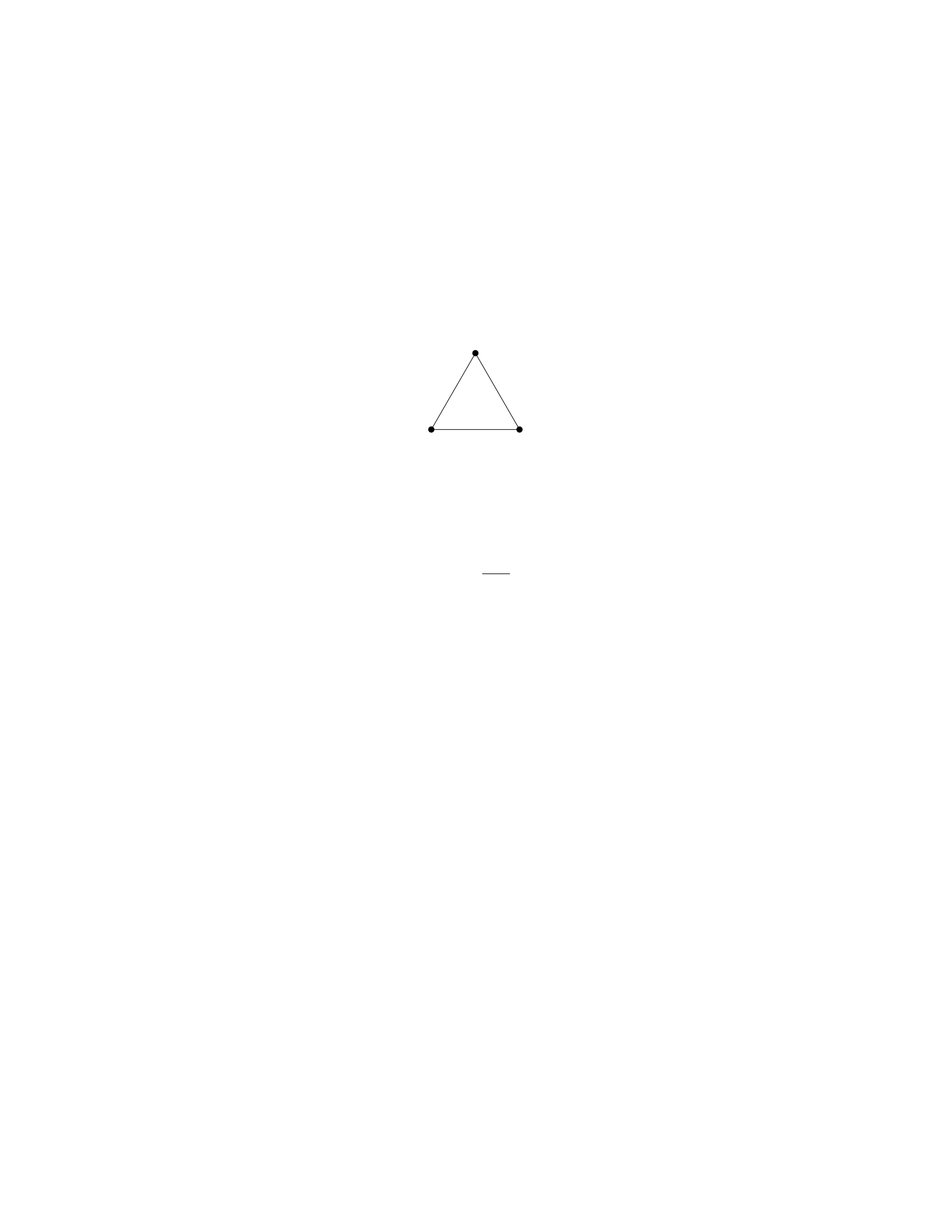
Three point charges are arranged in an equilateral triangle as shown below. The
charges are q1= +2.0µC, q2=−3.0µC, and q3= +4.0µC. Calculate the
magnitude of the net force on q2due to the other two charges.
q1q2
q3
Solution
Step 1: Calculate the electric force between q2and q1. The force between two
charges q1and q2separated by a distance ris given by Coulomb’s law:
F=kq1q2
r2
where - kis the Coulomb constant (8.99 ×10⁹N·m2/C2), - q1and q2are
the magnitudes of the charges, - ris the distance between the charges.
In our case, q1= +2.0µC, q2=−3.0µC, and r=[distance between q1and
q2in the equilateral triangle]. Let’s denote this distance as a.
The distance between q1and q2in an equilateral triangle can be calculated
using trigonometry. Since all sides of an equilateral triangle are equal, the
distance between q1and q2is a= 2lcos(30◦), where lis the side length of the
equilateral triangle. Given an equilateral triangle, l=[side length] and thus
a=[calculated distance].
Substitute the charges and distances into Coulomb’s law to find the force
F12 between q1and q2.
Step 2: Calculate the electric force between q2and q3(F23 ) and the angle
between F12 and F23.
Step 3: Using vector addition, calculate the net force on q2due to q1and
q3. The net force is the vector sum of F12 and F23.
Step 4: Calculate the magnitude of the net force on q2.
Question 16
Question
Two point charges, q1=−3µC and q2= 5 µC, are placed 10 cm apart in
a vacuum. Calculate the magnitude of the electric force between these two
charges.
13

Solution
Step 1: Convert all given quantities to standard SI units.
•q1=−3µC=−3×10⁻⁶C
•q2= 5 µC= 5 ×10⁻⁶C
•r= 10 cm = 10 ×10−2m
Step 2: Calculate the magnitude of the electric force using Coulomb’s Law.
F=k·|q1|·|q2|
r2
where kis the electrostatic constant with a value of 8.99 ×10⁹N·m2/C2.
Step 3: Plug in the given values to find the magnitude of the electric force.
F= 8.99 ×10⁹N·m2/C2·3×10−6C·5×10−6C
(10 ×10−2m)2
Step 4: Perform the calculations to find the numerical value of the electric
force.
F= 8.99 ×109×15 ×10−12 N
F= 134.85 ×10⁻³N
F= 0.13485 N
Therefore, the magnitude of the electric force between the two charges is
0.13485 N.
Question 17
Question
Three point charges are arranged as shown in the diagram below. The charge
q1=−5.0µC is located at point A at coordinates (0,0), the charge q2= 8.0µC
is located at point B at coordinates (2,0), and the charge q3=−3.0µC is located
at point C at coordinates (0,3).
Calculate the magnitude and direction of the net force on the charge at point
A due to the other two charges.
Solution
Step 1: Calculate the force exerted on the charge at point A due to the charge
at point B. Using Coulomb’s law, the magnitude of the force exerted by charge
q2on charge q1is given by:
FA,B =k|q1||q2|
r2
A,B
14

Where k= 8.99 ×10⁹Nm2/C2is the Coulomb constant, rA,B is the distance
between charge q1and charge q2which is 2 meters in this case. Plugging in the
values, we get:
FA,B =(8.99 ×10⁹Nm2/C2)(5.0×10−6C)(8.0×10−6C)
(2 m)2
FA,B =35.96
4= 8.99 N
Step 2: Calculate the force exerted on the charge at point A due to the
charge at point C. Similarly, using Coulomb’s law, the magnitude of the force
exerted by charge q3on charge q1is given by:
FA,C =k|q1||q3|
r2
A,C
Where rA,C is the distance between charge q1and charge q3which is 3 meters
in this case. Plugging in the values, we get:
FA,C =(8.99 ×10⁹Nm2/C2)(5.0×10−6C)(3.0×10−6C)
(3 m)2
FA,C =13.485
9= 1.498 N
Step 3: Calculate the net force on the charge at point A. Since the charges
at B and C are at right angles to each other, the net force on charge q1is given
by the vector sum of the forces due to q2and q3. Using Pythagoras theorem,
the magnitude of the net force is:
Fnet =qF2
A,B +F2
A,C
Fnet =p(8.99 N)2+ (1.498 N)2
Fnet =√80.82 + 2.244
Fnet =√83.064
Fnet ≈9.12 N
The direction of the net force can be found by determining the angle between
the net force and the x-axis:
θ= tan−1FA,C
FA,B
θ= tan−11.498
8.99
θ≈
15

Question 18
Question
Three point charges, q1= +3 nC, q2=−2nC, and q3= +4 nC, are placed at
the vertices of an equilateral triangle with sides of length d= 0.10 m. What is
the magnitude of the net electric force on q1due to the other two charges?
Solution
Step 1: Find the electric force on q1due to q2. The formula to calculate the
electric force between two point charges is given by Coulomb’s Law:
Felec =k·|q1|·|q2|
r2
where kis the Coulomb constant (8.99 ×10⁹N m2/C2) and ris the distance
between the charges.
Substituting the given values, the force on q1due to q2is:
F1,2= (8.99 ×109)·3×10−9·2×10−9
(0.10)2
Step 2: Calculate the electric force on q1due to q3. Following the same steps
as in Step 1, the force on q1due to q3is:
F1,3= (8.99 ×109)·3×10−9·4×10−9
(0.10)2
Step 3: Find the net force on q1. The net force on q1is the vector sum of
the forces due to q2and q3, so
|
Fnet|=q(
F1,2+
F1,3)2
After calculating the individual forces using Coulomb’s Law, you can find
the total magnitude of the net electric force on q1. Remember to consider the
directions of the forces as well.
Question 19
Question
Two point charges, q1= 4.0µC and q2=−6.0µC, are placed 2.0 meters apart.
Determine the magnitude and direction of the electric force that each charge
exerts on the other.
16

Solution
Given: q1= 4.0µC= 4.0×10⁻⁶C, q2=−6.0µC=−6.0×10⁻⁶C, r= 2.0m.
We’ll first calculate the magnitude of the electric force between the two
charges using Coulomb’s Law:
F=k· |q1|·|q2|
r2
where k= 8.99 ×10⁹N·m2/C2is the Coulomb constant.
Step 1: Calculate the magnitude of the force
F=8.99 ×10⁹· |4.0×10⁻⁶|·|−6.0×10⁻⁶|
(2.0)2
F=8.99 ×109·4.0×10−6·6.0×10−6
4.0
F=2.1576 ×10⁻²
4.0
F= 5.394 ×10⁻³N
Step 2: Determine the direction of the force Since q1is positive and q2
is negative, the forces between them are attractive. Thus, the force that charge
q1exerts on charge q2is directed towards q2, and the force that charge q2exerts
on charge q1is directed towards q1(in the opposite direction).
Therefore, the magnitude of the force is 5.394 ×10⁻³N and the direction
of the force on q1by q2is attractive and directed towards q2. Similarly, the
direction of the force on q2by q1is attractive and directed towards q1.
Question 20
Question
Two point charges, q1= +2.0nC and q2=−3.0nC, are placed 6.0cm apart
in air. Calculate the magnitude and direction of the electric force between the
charges.
Solution
Let’s solve this problem step by step:
Step 1: Find the distance between the charges in meters. Given
that the charges are 6.0cm apart, we convert this to meters:
6.0cm = 6.0×10⁻²m= 0.06 m
Step 2: Calculate the magnitude of the electric force. The magnitude
of the electric force between two point charges is given by Coulomb’s law:
F=k· |q1·q2|
r2
17

where kis the Coulomb constant (8.99×10⁹N m2/C2), q1and q2are the charges,
and ris the distance between the charges in meters.
Plugging in the values:
F=(8.99 ×10⁹N m2/C2)· |2.0×10⁻⁹C· −3.0×10⁻⁹C|
(0.06 m)2
F=(8.99 ×109)·(6 ×10−18)
0.0036
F=53.94 ×10⁻⁹
0.0036
F= 14.95 ×10⁻⁹N= 1.5×10⁻⁸N
Thus, the magnitude of the electric force between the charges is 1.5×10⁻⁸N.
Step 3: Determine the direction of the electric force. The electric
force between the charges is attractive since the charges have opposite signs.
Therefore, the direction of the force is from q1to q2or from −3.0nC to +2.0nC.
Question 21
Question
Two point charges, q1= +3.00 µC and q2=−5.00 µC, are placed 8.00 cm
apart in a vacuum. Calculate the magnitude of the electric force between these
charges.
Solution
Step 1: Convert the given charges to Coulombs for calculation:
q1= +3.00 µC= 3.00 ×10⁻⁶C
q2=−5.00 µC=−5.00 ×10⁻⁶C
Step 2: Convert the distance between the charges to meters:
d= 8.00 cm = 8.00 ×10⁻²m
Step 3: Calculate the magnitude of the electric force between these charges
using Coulomb’s law:
F=k· |q1·q2|
d2
where k= 8.99 ×10⁹N m2/C2is the Coulomb’s constant.
18

Step 4: Substitute the known values into the equation:
F=(8.99 ×10⁹N m2/C2)· |(3.00 ×10⁻⁶C)·(−5.00 ×10⁻⁶C)|
(8.00 ×10⁻²m)2
=(8.99 ×109)·(3.00 ×10−6)·(5.00 ×10−6)
(8.00 ×10⁻²)2
=(8.99 ×109)·(15 ×10−12)
(0.08)2
=134.85 ×10⁻³
0.0064
= 21,132.81 N
Therefore, the magnitude of the electric force between the charges is 21,132.81 N.
Question 22
Question
Two point charges, q1= 3µC and q2=−5µC, are placed 10 cm apart in a
vacuum. Calculate the magnitude of the electric force between them.
Solution
Step 1: Convert the charges to coulombs. Step 2: Calculate the distance in
meters. Step 3: Use Coulomb’s Law to find the magnitude of the electric force
between the charges.
Step 1: Converting the charges to coulombs: q1= 3µC = 3×10⁻⁶C
q2=−5µC = −5×10⁻⁶C
Step 2: Calculating the distance in meters: The distance between the
charges is 10 cm = 10 ×10−2m = 0.1 m.
Step 3: Using Coulomb’s Law to find the magnitude of the electric force:
Coulomb’s Law states that the magnitude of the electric force between two point
charges is given by:
F=k· |q1·q2|
r2,
where kis the electrostatic constant (8.99 ×10⁹Nm2/C2), q1and q2are the
charges, and ris the distance between the charges.
Substitute the given values into the formula:
F=(8.99 ×10⁹)· |3×10⁻⁶·(−5×10⁻⁶)|
(0.1)2
F=(8.99 ×109)·15 ×10−12
0.01
19

F=1.3485 ×10⁻²
0.01
F= 1.3485 N
Therefore, the magnitude of the electric force between the charges q1and q2
is 1.3485 N.
Question 23
Question
Three point charges are arranged as shown in the diagram below. Calculate the
magnitude and direction of the electric force on the charge q1due to the other
two charges. Use q= 2.0µC and d= 2.0m.
•q1= +2.0µC
•q2=−4.0µC•q3= +6.0µC
Solution
Step 1: Calculate the electric force on q1due to q2. The electric force between
two point charges is given by Coulomb’s law:
F=kq1q2
r2
where k≈8.99 ×10⁹Nm2/C2is the Coulomb constant, q1and q2are the
magnitudes of the charges, and ris the distance between the charges.
Given that q1= 2.0µC, q2=−4.0µC, and d= 2.0m, we can substitute
these values into Coulomb’s law to find the force F12 on q1due to q2:
F12 =k|q1||q2|
d2
F12 = (8.99 ×10⁹Nm2/C2)(2.0×10−6C)(4.0×10−6C)
(2.0m)2
F12 = (8.99 ×109)×(8.0×10−12)×(4) = 287.68 nN
The force F12 on q1due to q2is 287.68 nN.
Step 2: Determine the direction of the force F12 . Since q1and q2have
opposite charges, the force F12 will be attractive, i.e., it will act along the line
joining q1and q2from q2towards q1.
Step 3: Calculating the electric force on q1due to q3. Repeat the same
process as in Step 1 to find the force F13 on q1due to q3:
F13 =k|q1||q3|
d2
20

F13 = (8.99 ×10⁹)(2.0×10⁻⁶)(6.0×10⁻⁶)
(2.0)2= 674.04 nN
The force F13 on q1due to q3is 674.04 nN.
Step 4: Determine the direction of the force F13 . Since q1and q3have like
charges, the force F13 will be repulsive, i.e., it will act along the line joining q1
and q3from q1towards q3.
Step 5: Finding the net force on q1. In order to find the net force on q1, we
need to combine the forces F12
Question 24
Question
Two point charges, q1=−2.0µC and q2= 4.0µC, are placed 10.0 cm apart on
the x-axis. Calculate the magnitude and direction of the electric force that q1
exerts on q2.
Solution
Step 1: Calculate the distance between the charges in meters. Given that
1cm = 0.01 m, the distance between the charges is
r= 10.0cm ×0.01 m/cm = 0.10 m.
Step 2: Calculate the magnitude of the electric force using Coulomb’s Law:
F=k
q1q2
r2
,
where k= 8.99×10⁹N m2/C2is the Coulomb constant. Plugging in the values:
F= 8.99 ×10⁹N m2
C2
−2.0×10−6C×4.0×10−6C
(0.10 m)2
,
F= 8.99 ×10⁹N m2
C2
−8.0×10⁻¹² C2
0.01 m2
,
F= 8.99 ×10⁹N m2
C2×8.0×10−10 C= 7.2×10⁻¹N.
Step 3: Determine the direction of the force. The force is attractive because
the charges have opposite signs. Thus, the force is directed from q1towards q2
along the x-axis.
Therefore, the magnitude of the electric force that q1exerts on q2is 7.2×
10−1N, directed from q1towards q2along the x-axis.
21

Question 25
Question
Two identical point charges, each with a charge of +2.0µC, are placed at a
distance of 5.0m apart. Determine the magnitude and direction of the electric
force between the charges.
Solution
Step 1: Convert the charges to standard units by using the conversion factor
1µC= 10−6C. Given that each charge is +2.0µC, the charges can be converted
to +2.0×10⁻⁶C.
Step 2: Calculate the magnitude of the electric force using Coulomb’s law:
F=k· |q1·q2|
r2
where F= magnitude of the electric force, k= Coulomb’s constant (8.99 ×
109N m2/C2), q1and q2= magnitudes of the charges, and r= distance between
the charges. Plugging in the values:
F=(8.99 ×10⁹N m2/C2)· |(+2.0×10⁻⁶C)2|
(5.0m)2
Step 3: Calculate the magnitude of the electric force:
F=8.99 ×109·(2.0×10−6)2
5.02
Step 4: Simplify the expression further:
F=8.99 ×109·4.0×10−12
25.0
Step 5: Calculate the final answer:
F=35.96 ×10⁻³
25.0= 1.44 ×10⁻³N
Step 6: Determine the direction of the force. Since the charges are the same,
they will repel each other. Therefore, the direction of the force will be along
the line connecting the charges, pointing away from each charge.
Therefore, the magnitude of the electric force between the charges is 1.44 ×
10−3N, and the direction of the force is along the line connecting the charges,
pointing away from each charge.
22
A B
C
23

F= 8.99 ×109×15.36 ×10−12
0.0036
F= 8.99 ×15.36
0.0036 ×10⁻³
F= 8.99 ×4266.67
1×10⁻³
F= 3.84 ×10⁴N
Therefore, the magnitude of the electric force between the charges is 3.84 ×
104N.
Question 2
Question
Two point charges q1= 3.0µC and q2=−4.0µC are placed 10.0 cm apart in
air. Calculate the magnitude and direction of the electric force that q1exerts
on q2.
Solution
Step 1: Convert the charges to coulombs. Given: q1= 3.0µC = 3.0×10⁻⁶C
q2=−4.0µC =−4.0×10⁻⁶C
Step 2: Find the distance between the charges in meters. Given: r= 10.0
cm = 10.0×10⁻²m= 0.10 m
Step 3: Calculate the magnitude of the electric force using Coulomb’s law.
Coulomb’s law states:
F=k|q1q2|
r2
where kis Coulomb’s constant, k= 8.9875 ×10⁹N·m2/C2.
Plugging in the values:
F= 8.9875 ×10⁹×|3.0×10⁻⁶× −4.0×10⁻⁶|
(0.10)2
F= 8.9875 ×109×12 ×10−12
0.01
F= 8.9875 ×109×1.2×10−9
F= 10.785 ×10⁻¹
F= 10.785 N
Step 4: Determine the direction of the force. The force is attractive since
one charge is positive and the other is negative.
Therefore, the magnitude of the electric force that q1exerts on q2is 10.785 N
directed towards q2.
2

Question 3
Question
Three point charges are arranged in an equilateral triangle. The charges are
+q,−2q, and +3qwith sides of length d. Calculate the magnitude of the net
electrostatic force on the +3qcharge due to the other two charges. Assume the
charges are free to move.
Solution
1. First, let’s calculate the electrostatic force between the +qand +3qcharges.
Since the charges are the same sign, this force will be repulsive. The magnitude
of the electrostatic force F1between a pair of charges qand Qis given by
Coulomb’s Law:
F1=k· |q|·|Q|
r2
where kis the Coulomb constant (8.99 ×10⁹N m2/C2), |q|is the magnitude of
the +qcharge, |Q|is the magnitude of the +3qcharge, and ris the distance
between the charges. Since this distance is din an equilateral triangle, r=d.
2. Substituting the given values into the formula, we get:
F1=(8.99 ×10⁹)(q)(3q)
d2=26.97 ×10⁹q2
d2
So, the magnitude of the force F1between the +qand +3qcharges is 26.97×10⁹q2
d2
3. Next, let’s calculate the electrostatic force between the −2qand +3q
charges. Since the charges are opposite signs, this force will be attractive. Let’s
denote this force as F2.
4. Using Coulomb’s Law again, we have:
F2=k· |(−2q)|·|3q|
d2=6kq2
d2
5. Now, to find the net force on the +3qcharge, we need to consider the
directions. Since F1and F2are along the same line, we simply subtract these
two forces:
Net force =F1−F2=26.97 ×10⁹q2
d2−6kq2
d2
=26.97 ×10⁹−6×8.99 ×109q2
d2
6. Therefore, the magnitude of the net electrostatic force on the +3qcharge
due to the other two charges is (26.97 −53.94) ×109q2
d2=−26.97 ×10⁹q2
d2.
3

Question 4
Question
Three point charges are arranged along the x-axis: a charge of +3µC at the
origin, a charge of −5µC at x= 0.1m, and a charge of +2µC at x= 0.2m.
Calculate the net electric force on the charge of −5µC.
Solution
Step 1: Calculate the electric force between the charge of +3µC at the origin
and the charge of −5µC at x= 0.1m. The electric force F1between two charges
q1and q2separated by a distance ris given by Coulomb’s law:
F1=k·|q1q2|
r2
where k= 8.99 ×10⁹Nm²/C² is Coulomb’s constant.
Substitute the given values:
F1= 8.99 ×109·3×10−6×5×10−6
(0.1)2
Calculating F1gives:
F1= 1.35 ×10⁻³N
Step 2: Calculate the electric force between the charge of +2µC at x= 0.2
m and the charge of −5µC at x= 0.1m. Using Coulomb’s law again:
F2=k·|q1q2|
r2
Substitute the given values:
F2= 8.99 ×109·2×10−6×5×10−6
(0.2−0.1)2
Calculating F2gives:
F2= 4.49 ×10⁻³N
Step 3: Find the net force on the charge of −5µC. Since the forces are in
opposite directions, we need to consider them as negative and positive values.
The net force is the sum of the forces:
Fnet =F1−F2= 1.35 ×10⁻³N−4.49 ×10⁻³N
Calculating Fnet gives:
Fnet =−3.14 ×10⁻³N
Therefore, the net electric force on the charge of −5µC is −3.14 ×10⁻³N,
pointing towards the charge of +2µC at x= 0.2m.
4

Question 5
Question
Two point charges, q1=−6.0µC and q2= 4.0µC, are placed 10.0 cm apart in
air. Calculate the magnitude of the electric force between these charges.
Solution
Given: q1=−6.0µC
q2= 4.0µC
r= 10.0cm
The electric force between two point charges q1and q2separated by a dis-
tance ris given by Coulomb’s law:
F=k·|q1·q2|
r2
where kis the electrostatic constant equal to 8.99 ×10⁹N·m2/C2.
Step 1: Convert the distance rfrom cm to m:
r= 10.0cm = 0.1m
Step 2: Calculate the magnitude of the electric force using Coulomb’s law:
F= (8.99 ×10⁹)·| − 6.0×10−6·4.0×10−6|
(0.1)2
F= 8.99 ×109·24 ×10−12
0.01
F= 8.99 ×109·2.4×10−10
F= 2.1576 ×10⁻¹N
The magnitude of the electric force between the charges q1and q2is 0.216 N.
Question 6
Question
Three point charges are located on the vertices of an equilateral triangle of side
length a. The charges are +q,−2q, and +q. Calculate the magnitude and
direction of the electric force on the positive charge +qdue to the other two
charges.
5

Solution
Given: - Charge at vertex A = +q, - Charge at vertex B = -2q, - Charge
at vertex C = +q, - Distance between charges = a(side length of equilateral
triangle), - Coulomb’s constant = k.
The direction of the electric force on the positive charge +qdue to the other
two charges will depend on the configuration of the charges. Since the charges
are symmetrical with respect to the positively charged particle, the net force on
the positive charge will be directed vertically downwards.
Step 1: Calculate the force on +qdue to −2qat vertex B: The electric force
FAB on the charge at A due to the charge at B is given by Coulomb’s law:
FAB =k· |q|·|−2q|
a2=2kq2
a2
Step 2: Calculate the force on +qdue to +q at vertex C: The electric force
FAC on the charge at A due to the charge at C is given by Coulomb’s law:
FAC =k· |q|·|q|
a2=kq2
a2
Step 3: Calculate the net force and its direction: The net force on the
charge at A will be the sum of the forces FAB and FAC in the vertical downward
direction:
Fnet =FAB +FAC =2kq2
a2+kq2
a2=3kq2
a2
Therefore, the magnitude of the net force on the charge +qis 3kq2
a2and it is
directed vertically downwards.
Question 7
Question
Two point charges, q1= 3 µC and q2=−2µC, are placed 10 cm apart in air.
Calculate the magnitude of the electric force between these charges.
Solution
Step 1: Determine the distance between the charges in meters. Given that the
charges are 10 cm apart, we need to convert this distance to meters:
10 cm = 0.1m
Step 2: Calculate the magnitude of the electric force between the charges
using Coulomb’s Law: Coulomb’s Law states that the magnitude of the electric
force between two point charges is given by:
F=k· |q1·q2|
r2
6

where: - Fis the magnitude of the electric force, - kis the electrostatic constant
(8.99 ×10⁹N m2/C2), - q1and q2are the magnitudes of the two charges, - ris
the distance between the charges.
Plugging in the given values:
F=(8.99 ×10⁹N m2/C2)· |3×10⁻⁶C· −2×10⁻⁶C|
(0.1m)2
Step 3: Calculate the electric force.
F=8.99 ×109·6×10−6·2×10−6
0.01
F=8.99 ×6×2
10 ×10−3
F=107.88
10 ×10−3
F= 10.788 ×10⁻³
F= 10.788 mN
Therefore, the magnitude of the electric force between the two charges is
10.788 mN.
Question 9
Question
Two point charges q1= +2.5µC and q2=−4.0µC are placed 10 cm apart.
Calculate the magnitude of the electric force between the charges.
Solution
To calculate the magnitude of the electric force between the charges, we can use
Coulomb’s Law. Coulomb’s Law states that the magnitude of the electric force
between two point charges is given by:
F=k|q1q2|
r2
where: - Fis the magnitude of the electric force, - kis Coulomb’s constant
(8.9875 ×10⁹N·m2/C2), - q1and q2are the magnitudes of the charges, and -
ris the separation distance between the charges.
Step 1: Convert the given charges to coulombs:
q1= +2.5µC = 2.5×10⁻⁶C
q2=−4.0µC =−4.0×10⁻⁶C
7

Step 2: Determine the separation distance in meters:
r= 10 cm = 0.1m
Step 3: Calculate the magnitude of the electric force:
F= (8.9875 ×10⁹)|2.5×10⁻⁶× −4.0×10⁻⁶|
(0.1)2
F= 8.9875 ×109×1.0×10−11 ×100
F= 8.9875 ×10¹³N
Therefore, the magnitude of the electric force between the charges is 8.9875×
1013 N.
Question 10
Question
Two point charges, q1=−3.0µC and q2= +6.0µC, are placed 0.20 m apart.
Calculate the magnitude and direction of the electric force that q2exerts on q1.
Solution
Step 1: Convert the given charges to standard units.
•q1=−3.0µC =−3.0×10⁻⁶C
•q2= +6.0µC = 6.0×10⁻⁶C
Step 2: Calculate the magnitude of the electric force using Coulomb’s Law:
F=k·|q1·q2|
r2
where kis the Coulomb constant (8.99 ×10⁹N·m2/C2) and ris the distance
between the charges.
Step 3: Substitute the given values into the equation:
F= (8.99 ×10⁹)·| − 3.0×10−6·6.0×10−6|
0.202
Step 4: Simplify the expression to find the magnitude of the electric force.
F= (8.99 ×109)·18 ×10−12
0.04 = 4.497 ×10⁻²N
Step 5: Determine the direction of the electric force. Since q2is positive, it
exerts a repulsive force on q1, which is negative. Thus, the direction of the force
is away from q2.
Therefore, the magnitude of the electric force that q2exerts on q1is 4.497 ×
10−2N, directed away from q2.
8

Question 11
Question
Three point charges are arranged in a line. Charge q1=−3.0µC is located
at x=−1.0m, charge q2= 6.0µC is located at the origin, and charge q3=
−4.0µC is located at x= 2.0m. Calculate the magnitude and direction of the
net electrostatic force on q1due to q2and q3.
Solution
Step 1: Calculate the force on q1due to q2. The electrostatic force between two
point charges is given by Coulomb’s Law:
F=k·|q1·q2|
r2
where k= 8.99 ×10⁹Nm2/C2is Coulomb’s constant, q1=−3.0µC =−3.0×
10−6C,q2= 6.0µC = 6.0×10⁻⁶C, and r= 1.0mis the distance between q1
and q2.
Plugging in these values, we get
Fq1,q2= 8.99 ×10⁹·| − 3.0×10−6·6.0×10−6|
(1.0)2
Fq1,q2= 8.99 ×109·18 ×10−12
1.0
Fq1,q2= 161.82 ×10⁻³N
Step 2: Determine the direction of the force on q1due to q2. Since q1and
q2are oppositely charged, the force will be attractive. Therefore, the force will
act towards q2.
Step 3: Calculate the force on q1due to q3. Similarly, using Coulomb’s Law,
we find the force on q1due to q3:
Fq1,q3= 8.99 ×10⁹·| − 3.0×10⁻⁶· −4.0×10⁻⁶|
(3.0)2
Fq1,q3= 8.99 ×109·12 ×10−12
9.0
Fq1,q3= 119.76 ×10⁻³N
Step 4: Determine the direction of the force on q1due to q3. As q1and q3
are both negative charges, the force between them will also be attractive, acting
towards q3.
Step 5: Calculate the net force on q1by summing the individual forces from
q2and q3. The net force is given by
Fnet =Fq1,q2+Fq1,q3
9

Fnet = 161.82 ×10⁻³+ 119.76 ×10⁻³
Fnet = 281.58 ×10⁻³N
The net force on q1is 281.58 ×10⁻³Ntowards the right.
Question 12
Question
Three point charges are placed at the following positions: q1= +3 nC at (0,0),
q2=−1nC at (4,0), and q3= +2 nC at (0,3). Calculate the net electric force
on q2due to q1and q3.
Solution
Step 1: Calculate the electric force on q2due to q1: The electric force between
two point charges q1and q2separated by a distance ris given by Coulomb’s
Law:
F1,2=k|q1||q2|
r2
In this case, q1= +3 nC, q2=−1nC, and r= 4 (since q1and q2are 4 units
apart horizontally). Using k= 8.99 ×10⁹N m2/C2, we have:
F1,2= (8.99 ×10⁹)(3 ×10⁻⁹)(1 ×10⁻⁹)
(4)2
F1,2= (8.99 ×10⁹)3
16 ×10−18
F1,2=2697
16 ×10−9
F1,2= 168.56 ×10⁻⁹
F1,2= 1.69 ×10⁻⁶N
Step 2: Calculate the electric force on q2due to q3: Similarly, using q2=
−1nC, q3= +2 nC, and r= 3 (since q2and q3are 3 units apart vertically), we
have:
F2,3=k|q2||q3|
r2
F2,3= (8.99 ×10⁹)(1 ×10⁻⁹)(2 ×10⁻⁹)
(3)2
F2,3=2×8.99
9×10⁻⁹
F2,3= 1.99 ×10⁻⁶N
10

Step 3: Calculate the net electric force on q2: The net force is the vector
sum of the two forces:
Net force on q2=F1,2+F2,3
Net force on q2= 1.69 ×10⁻⁶+ 1.99 ×10⁻⁶
Net force on q2= 3.68 ×10⁻⁶N
Therefore, the net electric force on q2due to q1and q3is 3.68 ×10⁻⁶N.
Question 13
Question
Three point charges are placed at the corners of an equilateral triangle of side
length d= 2.0m as shown below. The charges are +3.0µC at the upper corner,
−2.0µC at the lower left corner, and +6.0µC at the lower right corner. Calcu-
late the magnitude and direction of the net electric force on the charge at the
upper corner.
`
` `
U
-
3.0µC
−2.0µC6.0µC
d
Solution
Step 1: Calculate the electric force between the upper corner charge at +3.0µC
and the lower left corner charge at −2.0µC. The electric force F1between two
point charges q1and q2separated by a distance ris given by Coulomb’s Law:
F1=k· |q1|·|q2|
r2
where kis the Coulomb constant 8.99 ×10⁹N·m2/C2.
Substitute the given values into Coulomb’s Law:
F1=(8.99 ×10⁹N·m2/C2)·(3.0×10−6C)·(2.0×10−6C)
(2.0m)2
F1=8.99 ×109×3.0×2.0
4
F1=53.94 ×10⁹
4
F1= 13.485 ×10⁹N
Step 2: Calculate the electric force between the upper corner charge at
+3.0µC and the lower right corner charge at +6.0µC. Similarly, use Coulomb’s
Law with the appropriate charges and distance:
F2=k· |3.0×10⁻⁶|·|6.0×10⁻⁶|
(2.0m)2
11

F2=8.99 ×109×3.0×6.0
4
F2= 13.485 ×10⁹N
Step 3: Find the net force on the upper corner charge. Since the forces
between the upper corner charge and the two lower corner charges are along the
same line but in opposite directions, the net force will be the difference of these
two forces.
Net Force =F2−F1
Net Force = 13.485 ×10⁹N−13.485 ×10⁹N
Net Force = 0
Question 14
Question
Three point charges are arranged along the x-axis as follows: q1=−2.0µC at
x= 0.0m, q2= 4.0µC at x= 4.0m, and q3=−6.0µC at x= 8.0m. Calculate
the magnitude and direction of the net electrostatic force on q2.
Solution
Step 1: Calculate the force between q2and q1. The force between two charges
is given by Coulomb’s Law:
F=k·|q1·q2|
r2
where Fis the magnitude of the force, kis Coulomb’s constant (8.99 ×10⁹N·
m2/C2), q1, q2are the point charges, ris the distance between the charges.
The distance between q1and q2is r= 4.0m. Plugging in the values, we get:
F12 = 8.99 ×10⁹·| − 2.0×10−6·4.0×10−6|
(4.0)2= 3.59 N
Step 2: Calculate the force between q2and q3. The distance between q2and
q3is r= 4.0m. Plugging in the values, we get:
F23 = 8.99 ×10⁹·|4.0×10−6·6.0×10−6|
(4.0)2= 6.74 N
Step 3: Calculate the net force on q2. The net force on q2is the vector sum
of F12 and F23. Since F12 is to the left (negative x-direction) and F23 is to the
right (positive x-direction), their magnitudes will be subtracted to find the net
force.
Fnet =|F23 −F12|=|6.74 −3.59|= 3.15 N
The direction of the net force will be towards the positive x-axis.
12
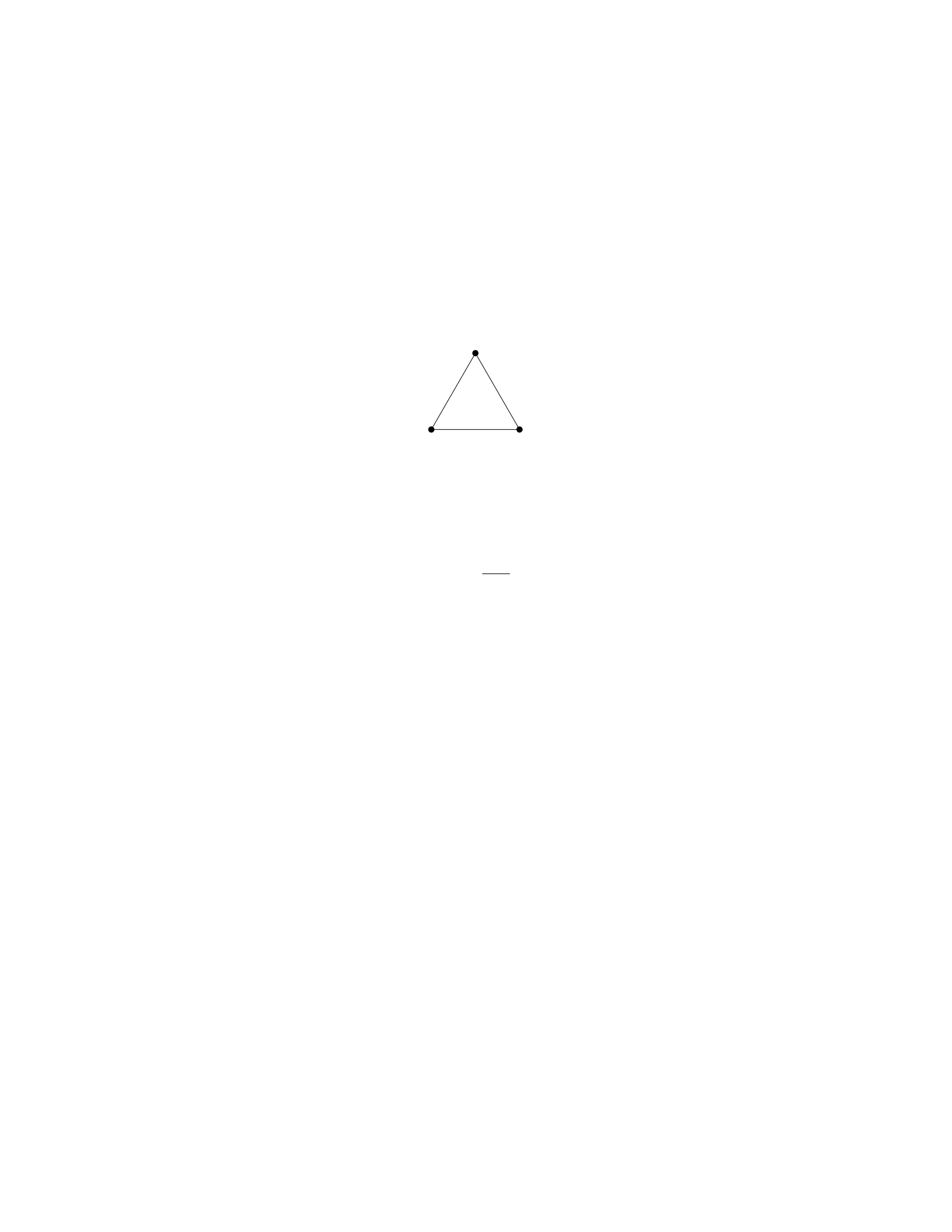
Question 15
Question
Three point charges are arranged in an equilateral triangle as shown below. The
charges are q1= +2.0µC, q2=−3.0µC, and q3= +4.0µC. Calculate the
magnitude of the net force on q2due to the other two charges.
q1q2
q3
Solution
Step 1: Calculate the electric force between q2and q1. The force between two
charges q1and q2separated by a distance ris given by Coulomb’s law:
F=kq1q2
r2
where - kis the Coulomb constant (8.99 ×10⁹N·m2/C2), - q1and q2are
the magnitudes of the charges, - ris the distance between the charges.
In our case, q1= +2.0µC, q2=−3.0µC, and r=[distance between q1and
q2in the equilateral triangle]. Let’s denote this distance as a.
The distance between q1and q2in an equilateral triangle can be calculated
using trigonometry. Since all sides of an equilateral triangle are equal, the
distance between q1and q2is a= 2lcos(30◦), where lis the side length of the
equilateral triangle. Given an equilateral triangle, l=[side length] and thus
a=[calculated distance].
Substitute the charges and distances into Coulomb’s law to find the force
F12 between q1and q2.
Step 2: Calculate the electric force between q2and q3(F23 ) and the angle
between F12 and F23.
Step 3: Using vector addition, calculate the net force on q2due to q1and
q3. The net force is the vector sum of F12 and F23.
Step 4: Calculate the magnitude of the net force on q2.
Question 16
Question
Two point charges, q1=−3µC and q2= 5 µC, are placed 10 cm apart in
a vacuum. Calculate the magnitude of the electric force between these two
charges.
13

Solution
Step 1: Convert all given quantities to standard SI units.
•q1=−3µC=−3×10⁻⁶C
•q2= 5 µC= 5 ×10⁻⁶C
•r= 10 cm = 10 ×10−2m
Step 2: Calculate the magnitude of the electric force using Coulomb’s Law.
F=k·|q1|·|q2|
r2
where kis the electrostatic constant with a value of 8.99 ×10⁹N·m2/C2.
Step 3: Plug in the given values to find the magnitude of the electric force.
F= 8.99 ×10⁹N·m2/C2·3×10−6C·5×10−6C
(10 ×10−2m)2
Step 4: Perform the calculations to find the numerical value of the electric
force.
F= 8.99 ×109×15 ×10−12 N
F= 134.85 ×10⁻³N
F= 0.13485 N
Therefore, the magnitude of the electric force between the two charges is
0.13485 N.
Question 17
Question
Three point charges are arranged as shown in the diagram below. The charge
q1=−5.0µC is located at point A at coordinates (0,0), the charge q2= 8.0µC
is located at point B at coordinates (2,0), and the charge q3=−3.0µC is located
at point C at coordinates (0,3).
Calculate the magnitude and direction of the net force on the charge at point
A due to the other two charges.
Solution
Step 1: Calculate the force exerted on the charge at point A due to the charge
at point B. Using Coulomb’s law, the magnitude of the force exerted by charge
q2on charge q1is given by:
FA,B =k|q1||q2|
r2
A,B
14

Where k= 8.99 ×10⁹Nm2/C2is the Coulomb constant, rA,B is the distance
between charge q1and charge q2which is 2 meters in this case. Plugging in the
values, we get:
FA,B =(8.99 ×10⁹Nm2/C2)(5.0×10−6C)(8.0×10−6C)
(2 m)2
FA,B =35.96
4= 8.99 N
Step 2: Calculate the force exerted on the charge at point A due to the
charge at point C. Similarly, using Coulomb’s law, the magnitude of the force
exerted by charge q3on charge q1is given by:
FA,C =k|q1||q3|
r2
A,C
Where rA,C is the distance between charge q1and charge q3which is 3 meters
in this case. Plugging in the values, we get:
FA,C =(8.99 ×10⁹Nm2/C2)(5.0×10−6C)(3.0×10−6C)
(3 m)2
FA,C =13.485
9= 1.498 N
Step 3: Calculate the net force on the charge at point A. Since the charges
at B and C are at right angles to each other, the net force on charge q1is given
by the vector sum of the forces due to q2and q3. Using Pythagoras theorem,
the magnitude of the net force is:
Fnet =qF2
A,B +F2
A,C
Fnet =p(8.99 N)2+ (1.498 N)2
Fnet =√80.82 + 2.244
Fnet =√83.064
Fnet ≈9.12 N
The direction of the net force can be found by determining the angle between
the net force and the x-axis:
θ= tan−1FA,C
FA,B
θ= tan−11.498
8.99
θ≈
15

Question 18
Question
Three point charges, q1= +3 nC, q2=−2nC, and q3= +4 nC, are placed at
the vertices of an equilateral triangle with sides of length d= 0.10 m. What is
the magnitude of the net electric force on q1due to the other two charges?
Solution
Step 1: Find the electric force on q1due to q2. The formula to calculate the
electric force between two point charges is given by Coulomb’s Law:
Felec =k·|q1|·|q2|
r2
where kis the Coulomb constant (8.99 ×10⁹N m2/C2) and ris the distance
between the charges.
Substituting the given values, the force on q1due to q2is:
F1,2= (8.99 ×109)·3×10−9·2×10−9
(0.10)2
Step 2: Calculate the electric force on q1due to q3. Following the same steps
as in Step 1, the force on q1due to q3is:
F1,3= (8.99 ×109)·3×10−9·4×10−9
(0.10)2
Step 3: Find the net force on q1. The net force on q1is the vector sum of
the forces due to q2and q3, so
|
Fnet|=q(
F1,2+
F1,3)2
After calculating the individual forces using Coulomb’s Law, you can find
the total magnitude of the net electric force on q1. Remember to consider the
directions of the forces as well.
Question 19
Question
Two point charges, q1= 4.0µC and q2=−6.0µC, are placed 2.0 meters apart.
Determine the magnitude and direction of the electric force that each charge
exerts on the other.
16

Solution
Given: q1= 4.0µC= 4.0×10⁻⁶C, q2=−6.0µC=−6.0×10⁻⁶C, r= 2.0m.
We’ll first calculate the magnitude of the electric force between the two
charges using Coulomb’s Law:
F=k· |q1|·|q2|
r2
where k= 8.99 ×10⁹N·m2/C2is the Coulomb constant.
Step 1: Calculate the magnitude of the force
F=8.99 ×10⁹· |4.0×10⁻⁶|·|−6.0×10⁻⁶|
(2.0)2
F=8.99 ×109·4.0×10−6·6.0×10−6
4.0
F=2.1576 ×10⁻²
4.0
F= 5.394 ×10⁻³N
Step 2: Determine the direction of the force Since q1is positive and q2
is negative, the forces between them are attractive. Thus, the force that charge
q1exerts on charge q2is directed towards q2, and the force that charge q2exerts
on charge q1is directed towards q1(in the opposite direction).
Therefore, the magnitude of the force is 5.394 ×10⁻³N and the direction
of the force on q1by q2is attractive and directed towards q2. Similarly, the
direction of the force on q2by q1is attractive and directed towards q1.
Question 20
Question
Two point charges, q1= +2.0nC and q2=−3.0nC, are placed 6.0cm apart
in air. Calculate the magnitude and direction of the electric force between the
charges.
Solution
Let’s solve this problem step by step:
Step 1: Find the distance between the charges in meters. Given
that the charges are 6.0cm apart, we convert this to meters:
6.0cm = 6.0×10⁻²m= 0.06 m
Step 2: Calculate the magnitude of the electric force. The magnitude
of the electric force between two point charges is given by Coulomb’s law:
F=k· |q1·q2|
r2
17

where kis the Coulomb constant (8.99×10⁹N m2/C2), q1and q2are the charges,
and ris the distance between the charges in meters.
Plugging in the values:
F=(8.99 ×10⁹N m2/C2)· |2.0×10⁻⁹C· −3.0×10⁻⁹C|
(0.06 m)2
F=(8.99 ×109)·(6 ×10−18)
0.0036
F=53.94 ×10⁻⁹
0.0036
F= 14.95 ×10⁻⁹N= 1.5×10⁻⁸N
Thus, the magnitude of the electric force between the charges is 1.5×10⁻⁸N.
Step 3: Determine the direction of the electric force. The electric
force between the charges is attractive since the charges have opposite signs.
Therefore, the direction of the force is from q1to q2or from −3.0nC to +2.0nC.
Question 21
Question
Two point charges, q1= +3.00 µC and q2=−5.00 µC, are placed 8.00 cm
apart in a vacuum. Calculate the magnitude of the electric force between these
charges.
Solution
Step 1: Convert the given charges to Coulombs for calculation:
q1= +3.00 µC= 3.00 ×10⁻⁶C
q2=−5.00 µC=−5.00 ×10⁻⁶C
Step 2: Convert the distance between the charges to meters:
d= 8.00 cm = 8.00 ×10⁻²m
Step 3: Calculate the magnitude of the electric force between these charges
using Coulomb’s law:
F=k· |q1·q2|
d2
where k= 8.99 ×10⁹N m2/C2is the Coulomb’s constant.
18

Step 4: Substitute the known values into the equation:
F=(8.99 ×10⁹N m2/C2)· |(3.00 ×10⁻⁶C)·(−5.00 ×10⁻⁶C)|
(8.00 ×10⁻²m)2
=(8.99 ×109)·(3.00 ×10−6)·(5.00 ×10−6)
(8.00 ×10⁻²)2
=(8.99 ×109)·(15 ×10−12)
(0.08)2
=134.85 ×10⁻³
0.0064
= 21,132.81 N
Therefore, the magnitude of the electric force between the charges is 21,132.81 N.
Question 22
Question
Two point charges, q1= 3µC and q2=−5µC, are placed 10 cm apart in a
vacuum. Calculate the magnitude of the electric force between them.
Solution
Step 1: Convert the charges to coulombs. Step 2: Calculate the distance in
meters. Step 3: Use Coulomb’s Law to find the magnitude of the electric force
between the charges.
Step 1: Converting the charges to coulombs: q1= 3µC = 3×10⁻⁶C
q2=−5µC = −5×10⁻⁶C
Step 2: Calculating the distance in meters: The distance between the
charges is 10 cm = 10 ×10−2m = 0.1 m.
Step 3: Using Coulomb’s Law to find the magnitude of the electric force:
Coulomb’s Law states that the magnitude of the electric force between two point
charges is given by:
F=k· |q1·q2|
r2,
where kis the electrostatic constant (8.99 ×10⁹Nm2/C2), q1and q2are the
charges, and ris the distance between the charges.
Substitute the given values into the formula:
F=(8.99 ×10⁹)· |3×10⁻⁶·(−5×10⁻⁶)|
(0.1)2
F=(8.99 ×109)·15 ×10−12
0.01
19

F=1.3485 ×10⁻²
0.01
F= 1.3485 N
Therefore, the magnitude of the electric force between the charges q1and q2
is 1.3485 N.
Question 23
Question
Three point charges are arranged as shown in the diagram below. Calculate the
magnitude and direction of the electric force on the charge q1due to the other
two charges. Use q= 2.0µC and d= 2.0m.
•q1= +2.0µC
•q2=−4.0µC•q3= +6.0µC
Solution
Step 1: Calculate the electric force on q1due to q2. The electric force between
two point charges is given by Coulomb’s law:
F=kq1q2
r2
where k≈8.99 ×10⁹Nm2/C2is the Coulomb constant, q1and q2are the
magnitudes of the charges, and ris the distance between the charges.
Given that q1= 2.0µC, q2=−4.0µC, and d= 2.0m, we can substitute
these values into Coulomb’s law to find the force F12 on q1due to q2:
F12 =k|q1||q2|
d2
F12 = (8.99 ×10⁹Nm2/C2)(2.0×10−6C)(4.0×10−6C)
(2.0m)2
F12 = (8.99 ×109)×(8.0×10−12)×(4) = 287.68 nN
The force F12 on q1due to q2is 287.68 nN.
Step 2: Determine the direction of the force F12 . Since q1and q2have
opposite charges, the force F12 will be attractive, i.e., it will act along the line
joining q1and q2from q2towards q1.
Step 3: Calculating the electric force on q1due to q3. Repeat the same
process as in Step 1 to find the force F13 on q1due to q3:
F13 =k|q1||q3|
d2
20

F13 = (8.99 ×10⁹)(2.0×10⁻⁶)(6.0×10⁻⁶)
(2.0)2= 674.04 nN
The force F13 on q1due to q3is 674.04 nN.
Step 4: Determine the direction of the force F13 . Since q1and q3have like
charges, the force F13 will be repulsive, i.e., it will act along the line joining q1
and q3from q1towards q3.
Step 5: Finding the net force on q1. In order to find the net force on q1, we
need to combine the forces F12
Question 24
Question
Two point charges, q1=−2.0µC and q2= 4.0µC, are placed 10.0 cm apart on
the x-axis. Calculate the magnitude and direction of the electric force that q1
exerts on q2.
Solution
Step 1: Calculate the distance between the charges in meters. Given that
1cm = 0.01 m, the distance between the charges is
r= 10.0cm ×0.01 m/cm = 0.10 m.
Step 2: Calculate the magnitude of the electric force using Coulomb’s Law:
F=k
q1q2
r2
,
where k= 8.99×10⁹N m2/C2is the Coulomb constant. Plugging in the values:
F= 8.99 ×10⁹N m2
C2
−2.0×10−6C×4.0×10−6C
(0.10 m)2
,
F= 8.99 ×10⁹N m2
C2
−8.0×10⁻¹² C2
0.01 m2
,
F= 8.99 ×10⁹N m2
C2×8.0×10−10 C= 7.2×10⁻¹N.
Step 3: Determine the direction of the force. The force is attractive because
the charges have opposite signs. Thus, the force is directed from q1towards q2
along the x-axis.
Therefore, the magnitude of the electric force that q1exerts on q2is 7.2×
10−1N, directed from q1towards q2along the x-axis.
21

Question 25
Question
Two identical point charges, each with a charge of +2.0µC, are placed at a
distance of 5.0m apart. Determine the magnitude and direction of the electric
force between the charges.
Solution
Step 1: Convert the charges to standard units by using the conversion factor
1µC= 10−6C. Given that each charge is +2.0µC, the charges can be converted
to +2.0×10⁻⁶C.
Step 2: Calculate the magnitude of the electric force using Coulomb’s law:
F=k· |q1·q2|
r2
where F= magnitude of the electric force, k= Coulomb’s constant (8.99 ×
109N m2/C2), q1and q2= magnitudes of the charges, and r= distance between
the charges. Plugging in the values:
F=(8.99 ×10⁹N m2/C2)· |(+2.0×10⁻⁶C)2|
(5.0m)2
Step 3: Calculate the magnitude of the electric force:
F=8.99 ×109·(2.0×10−6)2
5.02
Step 4: Simplify the expression further:
F=8.99 ×109·4.0×10−12
25.0
Step 5: Calculate the final answer:
F=35.96 ×10⁻³
25.0= 1.44 ×10⁻³N
Step 6: Determine the direction of the force. Since the charges are the same,
they will repel each other. Therefore, the direction of the force will be along
the line connecting the charges, pointing away from each charge.
Therefore, the magnitude of the electric force between the charges is 1.44 ×
10−3N, and the direction of the force is along the line connecting the charges,
pointing away from each charge.
22
A B
C
23

F= 8.99 ×109×15.36 ×10−12
0.0036
F= 8.99 ×15.36
0.0036 ×10⁻³
F= 8.99 ×4266.67
1×10⁻³
F= 3.84 ×10⁴N
Therefore, the magnitude of the electric force between the charges is 3.84 ×
104N.
Question 2
Question
Two point charges q1= 3.0µC and q2=−4.0µC are placed 10.0 cm apart in
air. Calculate the magnitude and direction of the electric force that q1exerts
on q2.
Solution
Step 1: Convert the charges to coulombs. Given: q1= 3.0µC = 3.0×10⁻⁶C
q2=−4.0µC =−4.0×10⁻⁶C
Step 2: Find the distance between the charges in meters. Given: r= 10.0
cm = 10.0×10⁻²m= 0.10 m
Step 3: Calculate the magnitude of the electric force using Coulomb’s law.
Coulomb’s law states:
F=k|q1q2|
r2
where kis Coulomb’s constant, k= 8.9875 ×10⁹N·m2/C2.
Plugging in the values:
F= 8.9875 ×10⁹×|3.0×10⁻⁶× −4.0×10⁻⁶|
(0.10)2
F= 8.9875 ×109×12 ×10−12
0.01
F= 8.9875 ×109×1.2×10−9
F= 10.785 ×10⁻¹
F= 10.785 N
Step 4: Determine the direction of the force. The force is attractive since
one charge is positive and the other is negative.
Therefore, the magnitude of the electric force that q1exerts on q2is 10.785 N
directed towards q2.
2

Question 3
Question
Three point charges are arranged in an equilateral triangle. The charges are
+q,−2q, and +3qwith sides of length d. Calculate the magnitude of the net
electrostatic force on the +3qcharge due to the other two charges. Assume the
charges are free to move.
Solution
1. First, let’s calculate the electrostatic force between the +qand +3qcharges.
Since the charges are the same sign, this force will be repulsive. The magnitude
of the electrostatic force F1between a pair of charges qand Qis given by
Coulomb’s Law:
F1=k· |q|·|Q|
r2
where kis the Coulomb constant (8.99 ×10⁹N m2/C2), |q|is the magnitude of
the +qcharge, |Q|is the magnitude of the +3qcharge, and ris the distance
between the charges. Since this distance is din an equilateral triangle, r=d.
2. Substituting the given values into the formula, we get:
F1=(8.99 ×10⁹)(q)(3q)
d2=26.97 ×10⁹q2
d2
So, the magnitude of the force F1between the +qand +3qcharges is 26.97×10⁹q2
d2
3. Next, let’s calculate the electrostatic force between the −2qand +3q
charges. Since the charges are opposite signs, this force will be attractive. Let’s
denote this force as F2.
4. Using Coulomb’s Law again, we have:
F2=k· |(−2q)|·|3q|
d2=6kq2
d2
5. Now, to find the net force on the +3qcharge, we need to consider the
directions. Since F1and F2are along the same line, we simply subtract these
two forces:
Net force =F1−F2=26.97 ×10⁹q2
d2−6kq2
d2
=26.97 ×10⁹−6×8.99 ×109q2
d2
6. Therefore, the magnitude of the net electrostatic force on the +3qcharge
due to the other two charges is (26.97 −53.94) ×109q2
d2=−26.97 ×10⁹q2
d2.
3

Question 4
Question
Three point charges are arranged along the x-axis: a charge of +3µC at the
origin, a charge of −5µC at x= 0.1m, and a charge of +2µC at x= 0.2m.
Calculate the net electric force on the charge of −5µC.
Solution
Step 1: Calculate the electric force between the charge of +3µC at the origin
and the charge of −5µC at x= 0.1m. The electric force F1between two charges
q1and q2separated by a distance ris given by Coulomb’s law:
F1=k·|q1q2|
r2
where k= 8.99 ×10⁹Nm²/C² is Coulomb’s constant.
Substitute the given values:
F1= 8.99 ×109·3×10−6×5×10−6
(0.1)2
Calculating F1gives:
F1= 1.35 ×10⁻³N
Step 2: Calculate the electric force between the charge of +2µC at x= 0.2
m and the charge of −5µC at x= 0.1m. Using Coulomb’s law again:
F2=k·|q1q2|
r2
Substitute the given values:
F2= 8.99 ×109·2×10−6×5×10−6
(0.2−0.1)2
Calculating F2gives:
F2= 4.49 ×10⁻³N
Step 3: Find the net force on the charge of −5µC. Since the forces are in
opposite directions, we need to consider them as negative and positive values.
The net force is the sum of the forces:
Fnet =F1−F2= 1.35 ×10⁻³N−4.49 ×10⁻³N
Calculating Fnet gives:
Fnet =−3.14 ×10⁻³N
Therefore, the net electric force on the charge of −5µC is −3.14 ×10⁻³N,
pointing towards the charge of +2µC at x= 0.2m.
4

Question 5
Question
Two point charges, q1=−6.0µC and q2= 4.0µC, are placed 10.0 cm apart in
air. Calculate the magnitude of the electric force between these charges.
Solution
Given: q1=−6.0µC
q2= 4.0µC
r= 10.0cm
The electric force between two point charges q1and q2separated by a dis-
tance ris given by Coulomb’s law:
F=k·|q1·q2|
r2
where kis the electrostatic constant equal to 8.99 ×10⁹N·m2/C2.
Step 1: Convert the distance rfrom cm to m:
r= 10.0cm = 0.1m
Step 2: Calculate the magnitude of the electric force using Coulomb’s law:
F= (8.99 ×10⁹)·| − 6.0×10−6·4.0×10−6|
(0.1)2
F= 8.99 ×109·24 ×10−12
0.01
F= 8.99 ×109·2.4×10−10
F= 2.1576 ×10⁻¹N
The magnitude of the electric force between the charges q1and q2is 0.216 N.
Question 6
Question
Three point charges are located on the vertices of an equilateral triangle of side
length a. The charges are +q,−2q, and +q. Calculate the magnitude and
direction of the electric force on the positive charge +qdue to the other two
charges.
5

Solution
Given: - Charge at vertex A = +q, - Charge at vertex B = -2q, - Charge
at vertex C = +q, - Distance between charges = a(side length of equilateral
triangle), - Coulomb’s constant = k.
The direction of the electric force on the positive charge +qdue to the other
two charges will depend on the configuration of the charges. Since the charges
are symmetrical with respect to the positively charged particle, the net force on
the positive charge will be directed vertically downwards.
Step 1: Calculate the force on +qdue to −2qat vertex B: The electric force
FAB on the charge at A due to the charge at B is given by Coulomb’s law:
FAB =k· |q|·|−2q|
a2=2kq2
a2
Step 2: Calculate the force on +qdue to +q at vertex C: The electric force
FAC on the charge at A due to the charge at C is given by Coulomb’s law:
FAC =k· |q|·|q|
a2=kq2
a2
Step 3: Calculate the net force and its direction: The net force on the
charge at A will be the sum of the forces FAB and FAC in the vertical downward
direction:
Fnet =FAB +FAC =2kq2
a2+kq2
a2=3kq2
a2
Therefore, the magnitude of the net force on the charge +qis 3kq2
a2and it is
directed vertically downwards.
Question 7
Question
Two point charges, q1= 3 µC and q2=−2µC, are placed 10 cm apart in air.
Calculate the magnitude of the electric force between these charges.
Solution
Step 1: Determine the distance between the charges in meters. Given that the
charges are 10 cm apart, we need to convert this distance to meters:
10 cm = 0.1m
Step 2: Calculate the magnitude of the electric force between the charges
using Coulomb’s Law: Coulomb’s Law states that the magnitude of the electric
force between two point charges is given by:
F=k· |q1·q2|
r2
6

where: - Fis the magnitude of the electric force, - kis the electrostatic constant
(8.99 ×10⁹N m2/C2), - q1and q2are the magnitudes of the two charges, - ris
the distance between the charges.
Plugging in the given values:
F=(8.99 ×10⁹N m2/C2)· |3×10⁻⁶C· −2×10⁻⁶C|
(0.1m)2
Step 3: Calculate the electric force.
F=8.99 ×109·6×10−6·2×10−6
0.01
F=8.99 ×6×2
10 ×10−3
F=107.88
10 ×10−3
F= 10.788 ×10⁻³
F= 10.788 mN
Therefore, the magnitude of the electric force between the two charges is
10.788 mN.
Question 9
Question
Two point charges q1= +2.5µC and q2=−4.0µC are placed 10 cm apart.
Calculate the magnitude of the electric force between the charges.
Solution
To calculate the magnitude of the electric force between the charges, we can use
Coulomb’s Law. Coulomb’s Law states that the magnitude of the electric force
between two point charges is given by:
F=k|q1q2|
r2
where: - Fis the magnitude of the electric force, - kis Coulomb’s constant
(8.9875 ×10⁹N·m2/C2), - q1and q2are the magnitudes of the charges, and -
ris the separation distance between the charges.
Step 1: Convert the given charges to coulombs:
q1= +2.5µC = 2.5×10⁻⁶C
q2=−4.0µC =−4.0×10⁻⁶C
7

Step 2: Determine the separation distance in meters:
r= 10 cm = 0.1m
Step 3: Calculate the magnitude of the electric force:
F= (8.9875 ×10⁹)|2.5×10⁻⁶× −4.0×10⁻⁶|
(0.1)2
F= 8.9875 ×109×1.0×10−11 ×100
F= 8.9875 ×10¹³N
Therefore, the magnitude of the electric force between the charges is 8.9875×
1013 N.
Question 10
Question
Two point charges, q1=−3.0µC and q2= +6.0µC, are placed 0.20 m apart.
Calculate the magnitude and direction of the electric force that q2exerts on q1.
Solution
Step 1: Convert the given charges to standard units.
•q1=−3.0µC =−3.0×10⁻⁶C
•q2= +6.0µC = 6.0×10⁻⁶C
Step 2: Calculate the magnitude of the electric force using Coulomb’s Law:
F=k·|q1·q2|
r2
where kis the Coulomb constant (8.99 ×10⁹N·m2/C2) and ris the distance
between the charges.
Step 3: Substitute the given values into the equation:
F= (8.99 ×10⁹)·| − 3.0×10−6·6.0×10−6|
0.202
Step 4: Simplify the expression to find the magnitude of the electric force.
F= (8.99 ×109)·18 ×10−12
0.04 = 4.497 ×10⁻²N
Step 5: Determine the direction of the electric force. Since q2is positive, it
exerts a repulsive force on q1, which is negative. Thus, the direction of the force
is away from q2.
Therefore, the magnitude of the electric force that q2exerts on q1is 4.497 ×
10−2N, directed away from q2.
8

Question 11
Question
Three point charges are arranged in a line. Charge q1=−3.0µC is located
at x=−1.0m, charge q2= 6.0µC is located at the origin, and charge q3=
−4.0µC is located at x= 2.0m. Calculate the magnitude and direction of the
net electrostatic force on q1due to q2and q3.
Solution
Step 1: Calculate the force on q1due to q2. The electrostatic force between two
point charges is given by Coulomb’s Law:
F=k·|q1·q2|
r2
where k= 8.99 ×10⁹Nm2/C2is Coulomb’s constant, q1=−3.0µC =−3.0×
10−6C,q2= 6.0µC = 6.0×10⁻⁶C, and r= 1.0mis the distance between q1
and q2.
Plugging in these values, we get
Fq1,q2= 8.99 ×10⁹·| − 3.0×10−6·6.0×10−6|
(1.0)2
Fq1,q2= 8.99 ×109·18 ×10−12
1.0
Fq1,q2= 161.82 ×10⁻³N
Step 2: Determine the direction of the force on q1due to q2. Since q1and
q2are oppositely charged, the force will be attractive. Therefore, the force will
act towards q2.
Step 3: Calculate the force on q1due to q3. Similarly, using Coulomb’s Law,
we find the force on q1due to q3:
Fq1,q3= 8.99 ×10⁹·| − 3.0×10⁻⁶· −4.0×10⁻⁶|
(3.0)2
Fq1,q3= 8.99 ×109·12 ×10−12
9.0
Fq1,q3= 119.76 ×10⁻³N
Step 4: Determine the direction of the force on q1due to q3. As q1and q3
are both negative charges, the force between them will also be attractive, acting
towards q3.
Step 5: Calculate the net force on q1by summing the individual forces from
q2and q3. The net force is given by
Fnet =Fq1,q2+Fq1,q3
9

Fnet = 161.82 ×10⁻³+ 119.76 ×10⁻³
Fnet = 281.58 ×10⁻³N
The net force on q1is 281.58 ×10⁻³Ntowards the right.
Question 12
Question
Three point charges are placed at the following positions: q1= +3 nC at (0,0),
q2=−1nC at (4,0), and q3= +2 nC at (0,3). Calculate the net electric force
on q2due to q1and q3.
Solution
Step 1: Calculate the electric force on q2due to q1: The electric force between
two point charges q1and q2separated by a distance ris given by Coulomb’s
Law:
F1,2=k|q1||q2|
r2
In this case, q1= +3 nC, q2=−1nC, and r= 4 (since q1and q2are 4 units
apart horizontally). Using k= 8.99 ×10⁹N m2/C2, we have:
F1,2= (8.99 ×10⁹)(3 ×10⁻⁹)(1 ×10⁻⁹)
(4)2
F1,2= (8.99 ×10⁹)3
16 ×10−18
F1,2=2697
16 ×10−9
F1,2= 168.56 ×10⁻⁹
F1,2= 1.69 ×10⁻⁶N
Step 2: Calculate the electric force on q2due to q3: Similarly, using q2=
−1nC, q3= +2 nC, and r= 3 (since q2and q3are 3 units apart vertically), we
have:
F2,3=k|q2||q3|
r2
F2,3= (8.99 ×10⁹)(1 ×10⁻⁹)(2 ×10⁻⁹)
(3)2
F2,3=2×8.99
9×10⁻⁹
F2,3= 1.99 ×10⁻⁶N
10

Step 3: Calculate the net electric force on q2: The net force is the vector
sum of the two forces:
Net force on q2=F1,2+F2,3
Net force on q2= 1.69 ×10⁻⁶+ 1.99 ×10⁻⁶
Net force on q2= 3.68 ×10⁻⁶N
Therefore, the net electric force on q2due to q1and q3is 3.68 ×10⁻⁶N.
Question 13
Question
Three point charges are placed at the corners of an equilateral triangle of side
length d= 2.0m as shown below. The charges are +3.0µC at the upper corner,
−2.0µC at the lower left corner, and +6.0µC at the lower right corner. Calcu-
late the magnitude and direction of the net electric force on the charge at the
upper corner.
`
` `
U
-
3.0µC
−2.0µC6.0µC
d
Solution
Step 1: Calculate the electric force between the upper corner charge at +3.0µC
and the lower left corner charge at −2.0µC. The electric force F1between two
point charges q1and q2separated by a distance ris given by Coulomb’s Law:
F1=k· |q1|·|q2|
r2
where kis the Coulomb constant 8.99 ×10⁹N·m2/C2.
Substitute the given values into Coulomb’s Law:
F1=(8.99 ×10⁹N·m2/C2)·(3.0×10−6C)·(2.0×10−6C)
(2.0m)2
F1=8.99 ×109×3.0×2.0
4
F1=53.94 ×10⁹
4
F1= 13.485 ×10⁹N
Step 2: Calculate the electric force between the upper corner charge at
+3.0µC and the lower right corner charge at +6.0µC. Similarly, use Coulomb’s
Law with the appropriate charges and distance:
F2=k· |3.0×10⁻⁶|·|6.0×10⁻⁶|
(2.0m)2
11

F2=8.99 ×109×3.0×6.0
4
F2= 13.485 ×10⁹N
Step 3: Find the net force on the upper corner charge. Since the forces
between the upper corner charge and the two lower corner charges are along the
same line but in opposite directions, the net force will be the difference of these
two forces.
Net Force =F2−F1
Net Force = 13.485 ×10⁹N−13.485 ×10⁹N
Net Force = 0
Question 14
Question
Three point charges are arranged along the x-axis as follows: q1=−2.0µC at
x= 0.0m, q2= 4.0µC at x= 4.0m, and q3=−6.0µC at x= 8.0m. Calculate
the magnitude and direction of the net electrostatic force on q2.
Solution
Step 1: Calculate the force between q2and q1. The force between two charges
is given by Coulomb’s Law:
F=k·|q1·q2|
r2
where Fis the magnitude of the force, kis Coulomb’s constant (8.99 ×10⁹N·
m2/C2), q1, q2are the point charges, ris the distance between the charges.
The distance between q1and q2is r= 4.0m. Plugging in the values, we get:
F12 = 8.99 ×10⁹·| − 2.0×10−6·4.0×10−6|
(4.0)2= 3.59 N
Step 2: Calculate the force between q2and q3. The distance between q2and
q3is r= 4.0m. Plugging in the values, we get:
F23 = 8.99 ×10⁹·|4.0×10−6·6.0×10−6|
(4.0)2= 6.74 N
Step 3: Calculate the net force on q2. The net force on q2is the vector sum
of F12 and F23. Since F12 is to the left (negative x-direction) and F23 is to the
right (positive x-direction), their magnitudes will be subtracted to find the net
force.
Fnet =|F23 −F12|=|6.74 −3.59|= 3.15 N
The direction of the net force will be towards the positive x-axis.
12
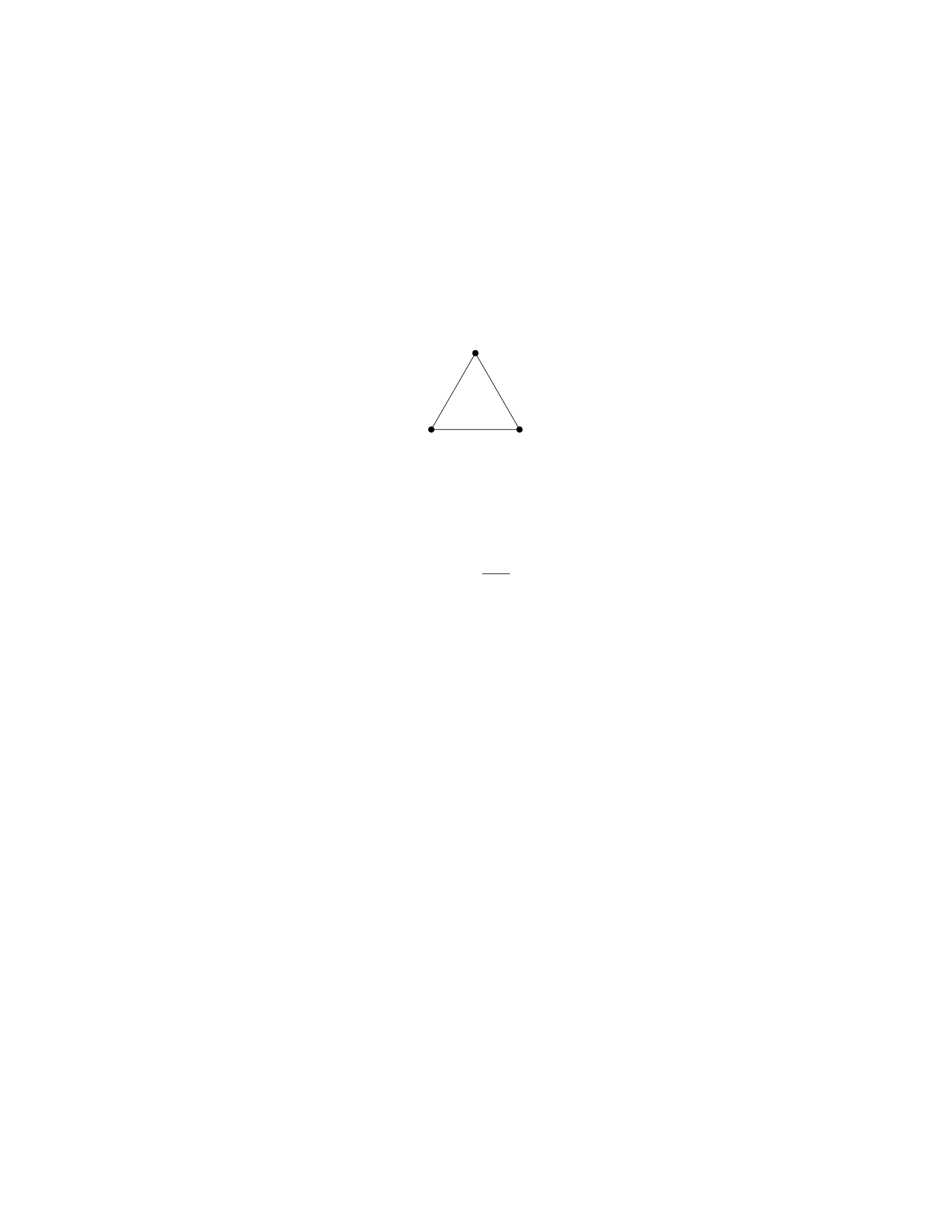
Question 15
Question
Three point charges are arranged in an equilateral triangle as shown below. The
charges are q1= +2.0µC, q2=−3.0µC, and q3= +4.0µC. Calculate the
magnitude of the net force on q2due to the other two charges.
q1q2
q3
Solution
Step 1: Calculate the electric force between q2and q1. The force between two
charges q1and q2separated by a distance ris given by Coulomb’s law:
F=kq1q2
r2
where - kis the Coulomb constant (8.99 ×10⁹N·m2/C2), - q1and q2are
the magnitudes of the charges, - ris the distance between the charges.
In our case, q1= +2.0µC, q2=−3.0µC, and r=[distance between q1and
q2in the equilateral triangle]. Let’s denote this distance as a.
The distance between q1and q2in an equilateral triangle can be calculated
using trigonometry. Since all sides of an equilateral triangle are equal, the
distance between q1and q2is a= 2lcos(30◦), where lis the side length of the
equilateral triangle. Given an equilateral triangle, l=[side length] and thus
a=[calculated distance].
Substitute the charges and distances into Coulomb’s law to find the force
F12 between q1and q2.
Step 2: Calculate the electric force between q2and q3(F23 ) and the angle
between F12 and F23.
Step 3: Using vector addition, calculate the net force on q2due to q1and
q3. The net force is the vector sum of F12 and F23.
Step 4: Calculate the magnitude of the net force on q2.
Question 16
Question
Two point charges, q1=−3µC and q2= 5 µC, are placed 10 cm apart in
a vacuum. Calculate the magnitude of the electric force between these two
charges.
13

Solution
Step 1: Convert all given quantities to standard SI units.
•q1=−3µC=−3×10⁻⁶C
•q2= 5 µC= 5 ×10⁻⁶C
•r= 10 cm = 10 ×10−2m
Step 2: Calculate the magnitude of the electric force using Coulomb’s Law.
F=k·|q1|·|q2|
r2
where kis the electrostatic constant with a value of 8.99 ×10⁹N·m2/C2.
Step 3: Plug in the given values to find the magnitude of the electric force.
F= 8.99 ×10⁹N·m2/C2·3×10−6C·5×10−6C
(10 ×10−2m)2
Step 4: Perform the calculations to find the numerical value of the electric
force.
F= 8.99 ×109×15 ×10−12 N
F= 134.85 ×10⁻³N
F= 0.13485 N
Therefore, the magnitude of the electric force between the two charges is
0.13485 N.
Question 17
Question
Three point charges are arranged as shown in the diagram below. The charge
q1=−5.0µC is located at point A at coordinates (0,0), the charge q2= 8.0µC
is located at point B at coordinates (2,0), and the charge q3=−3.0µC is located
at point C at coordinates (0,3).
Calculate the magnitude and direction of the net force on the charge at point
A due to the other two charges.
Solution
Step 1: Calculate the force exerted on the charge at point A due to the charge
at point B. Using Coulomb’s law, the magnitude of the force exerted by charge
q2on charge q1is given by:
FA,B =k|q1||q2|
r2
A,B
14

Where k= 8.99 ×10⁹Nm2/C2is the Coulomb constant, rA,B is the distance
between charge q1and charge q2which is 2 meters in this case. Plugging in the
values, we get:
FA,B =(8.99 ×10⁹Nm2/C2)(5.0×10−6C)(8.0×10−6C)
(2 m)2
FA,B =35.96
4= 8.99 N
Step 2: Calculate the force exerted on the charge at point A due to the
charge at point C. Similarly, using Coulomb’s law, the magnitude of the force
exerted by charge q3on charge q1is given by:
FA,C =k|q1||q3|
r2
A,C
Where rA,C is the distance between charge q1and charge q3which is 3 meters
in this case. Plugging in the values, we get:
FA,C =(8.99 ×10⁹Nm2/C2)(5.0×10−6C)(3.0×10−6C)
(3 m)2
FA,C =13.485
9= 1.498 N
Step 3: Calculate the net force on the charge at point A. Since the charges
at B and C are at right angles to each other, the net force on charge q1is given
by the vector sum of the forces due to q2and q3. Using Pythagoras theorem,
the magnitude of the net force is:
Fnet =qF2
A,B +F2
A,C
Fnet =p(8.99 N)2+ (1.498 N)2
Fnet =√80.82 + 2.244
Fnet =√83.064
Fnet ≈9.12 N
The direction of the net force can be found by determining the angle between
the net force and the x-axis:
θ= tan−1FA,C
FA,B
θ= tan−11.498
8.99
θ≈
15

Question 18
Question
Three point charges, q1= +3 nC, q2=−2nC, and q3= +4 nC, are placed at
the vertices of an equilateral triangle with sides of length d= 0.10 m. What is
the magnitude of the net electric force on q1due to the other two charges?
Solution
Step 1: Find the electric force on q1due to q2. The formula to calculate the
electric force between two point charges is given by Coulomb’s Law:
Felec =k·|q1|·|q2|
r2
where kis the Coulomb constant (8.99 ×10⁹N m2/C2) and ris the distance
between the charges.
Substituting the given values, the force on q1due to q2is:
F1,2= (8.99 ×109)·3×10−9·2×10−9
(0.10)2
Step 2: Calculate the electric force on q1due to q3. Following the same steps
as in Step 1, the force on q1due to q3is:
F1,3= (8.99 ×109)·3×10−9·4×10−9
(0.10)2
Step 3: Find the net force on q1. The net force on q1is the vector sum of
the forces due to q2and q3, so
|
Fnet|=q(
F1,2+
F1,3)2
After calculating the individual forces using Coulomb’s Law, you can find
the total magnitude of the net electric force on q1. Remember to consider the
directions of the forces as well.
Question 19
Question
Two point charges, q1= 4.0µC and q2=−6.0µC, are placed 2.0 meters apart.
Determine the magnitude and direction of the electric force that each charge
exerts on the other.
16

Solution
Given: q1= 4.0µC= 4.0×10⁻⁶C, q2=−6.0µC=−6.0×10⁻⁶C, r= 2.0m.
We’ll first calculate the magnitude of the electric force between the two
charges using Coulomb’s Law:
F=k· |q1|·|q2|
r2
where k= 8.99 ×10⁹N·m2/C2is the Coulomb constant.
Step 1: Calculate the magnitude of the force
F=8.99 ×10⁹· |4.0×10⁻⁶|·|−6.0×10⁻⁶|
(2.0)2
F=8.99 ×109·4.0×10−6·6.0×10−6
4.0
F=2.1576 ×10⁻²
4.0
F= 5.394 ×10⁻³N
Step 2: Determine the direction of the force Since q1is positive and q2
is negative, the forces between them are attractive. Thus, the force that charge
q1exerts on charge q2is directed towards q2, and the force that charge q2exerts
on charge q1is directed towards q1(in the opposite direction).
Therefore, the magnitude of the force is 5.394 ×10⁻³N and the direction
of the force on q1by q2is attractive and directed towards q2. Similarly, the
direction of the force on q2by q1is attractive and directed towards q1.
Question 20
Question
Two point charges, q1= +2.0nC and q2=−3.0nC, are placed 6.0cm apart
in air. Calculate the magnitude and direction of the electric force between the
charges.
Solution
Let’s solve this problem step by step:
Step 1: Find the distance between the charges in meters. Given
that the charges are 6.0cm apart, we convert this to meters:
6.0cm = 6.0×10⁻²m= 0.06 m
Step 2: Calculate the magnitude of the electric force. The magnitude
of the electric force between two point charges is given by Coulomb’s law:
F=k· |q1·q2|
r2
17

where kis the Coulomb constant (8.99×10⁹N m2/C2), q1and q2are the charges,
and ris the distance between the charges in meters.
Plugging in the values:
F=(8.99 ×10⁹N m2/C2)· |2.0×10⁻⁹C· −3.0×10⁻⁹C|
(0.06 m)2
F=(8.99 ×109)·(6 ×10−18)
0.0036
F=53.94 ×10⁻⁹
0.0036
F= 14.95 ×10⁻⁹N= 1.5×10⁻⁸N
Thus, the magnitude of the electric force between the charges is 1.5×10⁻⁸N.
Step 3: Determine the direction of the electric force. The electric
force between the charges is attractive since the charges have opposite signs.
Therefore, the direction of the force is from q1to q2or from −3.0nC to +2.0nC.
Question 21
Question
Two point charges, q1= +3.00 µC and q2=−5.00 µC, are placed 8.00 cm
apart in a vacuum. Calculate the magnitude of the electric force between these
charges.
Solution
Step 1: Convert the given charges to Coulombs for calculation:
q1= +3.00 µC= 3.00 ×10⁻⁶C
q2=−5.00 µC=−5.00 ×10⁻⁶C
Step 2: Convert the distance between the charges to meters:
d= 8.00 cm = 8.00 ×10⁻²m
Step 3: Calculate the magnitude of the electric force between these charges
using Coulomb’s law:
F=k· |q1·q2|
d2
where k= 8.99 ×10⁹N m2/C2is the Coulomb’s constant.
18

Step 4: Substitute the known values into the equation:
F=(8.99 ×10⁹N m2/C2)· |(3.00 ×10⁻⁶C)·(−5.00 ×10⁻⁶C)|
(8.00 ×10⁻²m)2
=(8.99 ×109)·(3.00 ×10−6)·(5.00 ×10−6)
(8.00 ×10⁻²)2
=(8.99 ×109)·(15 ×10−12)
(0.08)2
=134.85 ×10⁻³
0.0064
= 21,132.81 N
Therefore, the magnitude of the electric force between the charges is 21,132.81 N.
Question 22
Question
Two point charges, q1= 3µC and q2=−5µC, are placed 10 cm apart in a
vacuum. Calculate the magnitude of the electric force between them.
Solution
Step 1: Convert the charges to coulombs. Step 2: Calculate the distance in
meters. Step 3: Use Coulomb’s Law to find the magnitude of the electric force
between the charges.
Step 1: Converting the charges to coulombs: q1= 3µC = 3×10⁻⁶C
q2=−5µC = −5×10⁻⁶C
Step 2: Calculating the distance in meters: The distance between the
charges is 10 cm = 10 ×10−2m = 0.1 m.
Step 3: Using Coulomb’s Law to find the magnitude of the electric force:
Coulomb’s Law states that the magnitude of the electric force between two point
charges is given by:
F=k· |q1·q2|
r2,
where kis the electrostatic constant (8.99 ×10⁹Nm2/C2), q1and q2are the
charges, and ris the distance between the charges.
Substitute the given values into the formula:
F=(8.99 ×10⁹)· |3×10⁻⁶·(−5×10⁻⁶)|
(0.1)2
F=(8.99 ×109)·15 ×10−12
0.01
19

F=1.3485 ×10⁻²
0.01
F= 1.3485 N
Therefore, the magnitude of the electric force between the charges q1and q2
is 1.3485 N.
Question 23
Question
Three point charges are arranged as shown in the diagram below. Calculate the
magnitude and direction of the electric force on the charge q1due to the other
two charges. Use q= 2.0µC and d= 2.0m.
•q1= +2.0µC
•q2=−4.0µC•q3= +6.0µC
Solution
Step 1: Calculate the electric force on q1due to q2. The electric force between
two point charges is given by Coulomb’s law:
F=kq1q2
r2
where k≈8.99 ×10⁹Nm2/C2is the Coulomb constant, q1and q2are the
magnitudes of the charges, and ris the distance between the charges.
Given that q1= 2.0µC, q2=−4.0µC, and d= 2.0m, we can substitute
these values into Coulomb’s law to find the force F12 on q1due to q2:
F12 =k|q1||q2|
d2
F12 = (8.99 ×10⁹Nm2/C2)(2.0×10−6C)(4.0×10−6C)
(2.0m)2
F12 = (8.99 ×109)×(8.0×10−12)×(4) = 287.68 nN
The force F12 on q1due to q2is 287.68 nN.
Step 2: Determine the direction of the force F12 . Since q1and q2have
opposite charges, the force F12 will be attractive, i.e., it will act along the line
joining q1and q2from q2towards q1.
Step 3: Calculating the electric force on q1due to q3. Repeat the same
process as in Step 1 to find the force F13 on q1due to q3:
F13 =k|q1||q3|
d2
20

F13 = (8.99 ×10⁹)(2.0×10⁻⁶)(6.0×10⁻⁶)
(2.0)2= 674.04 nN
The force F13 on q1due to q3is 674.04 nN.
Step 4: Determine the direction of the force F13 . Since q1and q3have like
charges, the force F13 will be repulsive, i.e., it will act along the line joining q1
and q3from q1towards q3.
Step 5: Finding the net force on q1. In order to find the net force on q1, we
need to combine the forces F12
Question 24
Question
Two point charges, q1=−2.0µC and q2= 4.0µC, are placed 10.0 cm apart on
the x-axis. Calculate the magnitude and direction of the electric force that q1
exerts on q2.
Solution
Step 1: Calculate the distance between the charges in meters. Given that
1cm = 0.01 m, the distance between the charges is
r= 10.0cm ×0.01 m/cm = 0.10 m.
Step 2: Calculate the magnitude of the electric force using Coulomb’s Law:
F=k
q1q2
r2
,
where k= 8.99×10⁹N m2/C2is the Coulomb constant. Plugging in the values:
F= 8.99 ×10⁹N m2
C2
−2.0×10−6C×4.0×10−6C
(0.10 m)2
,
F= 8.99 ×10⁹N m2
C2
−8.0×10⁻¹² C2
0.01 m2
,
F= 8.99 ×10⁹N m2
C2×8.0×10−10 C= 7.2×10⁻¹N.
Step 3: Determine the direction of the force. The force is attractive because
the charges have opposite signs. Thus, the force is directed from q1towards q2
along the x-axis.
Therefore, the magnitude of the electric force that q1exerts on q2is 7.2×
10−1N, directed from q1towards q2along the x-axis.
21

Question 25
Question
Two identical point charges, each with a charge of +2.0µC, are placed at a
distance of 5.0m apart. Determine the magnitude and direction of the electric
force between the charges.
Solution
Step 1: Convert the charges to standard units by using the conversion factor
1µC= 10−6C. Given that each charge is +2.0µC, the charges can be converted
to +2.0×10⁻⁶C.
Step 2: Calculate the magnitude of the electric force using Coulomb’s law:
F=k· |q1·q2|
r2
where F= magnitude of the electric force, k= Coulomb’s constant (8.99 ×
109N m2/C2), q1and q2= magnitudes of the charges, and r= distance between
the charges. Plugging in the values:
F=(8.99 ×10⁹N m2/C2)· |(+2.0×10⁻⁶C)2|
(5.0m)2
Step 3: Calculate the magnitude of the electric force:
F=8.99 ×109·(2.0×10−6)2
5.02
Step 4: Simplify the expression further:
F=8.99 ×109·4.0×10−12
25.0
Step 5: Calculate the final answer:
F=35.96 ×10⁻³
25.0= 1.44 ×10⁻³N
Step 6: Determine the direction of the force. Since the charges are the same,
they will repel each other. Therefore, the direction of the force will be along
the line connecting the charges, pointing away from each charge.
Therefore, the magnitude of the electric force between the charges is 1.44 ×
10−3N, and the direction of the force is along the line connecting the charges,
pointing away from each charge.
22
A B
C
23

F= 8.99 ×109×15.36 ×10−12
0.0036
F= 8.99 ×15.36
0.0036 ×10⁻³
F= 8.99 ×4266.67
1×10⁻³
F= 3.84 ×10⁴N
Therefore, the magnitude of the electric force between the charges is 3.84 ×
104N.
Question 2
Question
Two point charges q1= 3.0µC and q2=−4.0µC are placed 10.0 cm apart in
air. Calculate the magnitude and direction of the electric force that q1exerts
on q2.
Solution
Step 1: Convert the charges to coulombs. Given: q1= 3.0µC = 3.0×10⁻⁶C
q2=−4.0µC =−4.0×10⁻⁶C
Step 2: Find the distance between the charges in meters. Given: r= 10.0
cm = 10.0×10⁻²m= 0.10 m
Step 3: Calculate the magnitude of the electric force using Coulomb’s law.
Coulomb’s law states:
F=k|q1q2|
r2
where kis Coulomb’s constant, k= 8.9875 ×10⁹N·m2/C2.
Plugging in the values:
F= 8.9875 ×10⁹×|3.0×10⁻⁶× −4.0×10⁻⁶|
(0.10)2
F= 8.9875 ×109×12 ×10−12
0.01
F= 8.9875 ×109×1.2×10−9
F= 10.785 ×10⁻¹
F= 10.785 N
Step 4: Determine the direction of the force. The force is attractive since
one charge is positive and the other is negative.
Therefore, the magnitude of the electric force that q1exerts on q2is 10.785 N
directed towards q2.
2

Question 3
Question
Three point charges are arranged in an equilateral triangle. The charges are
+q,−2q, and +3qwith sides of length d. Calculate the magnitude of the net
electrostatic force on the +3qcharge due to the other two charges. Assume the
charges are free to move.
Solution
1. First, let’s calculate the electrostatic force between the +qand +3qcharges.
Since the charges are the same sign, this force will be repulsive. The magnitude
of the electrostatic force F1between a pair of charges qand Qis given by
Coulomb’s Law:
F1=k· |q|·|Q|
r2
where kis the Coulomb constant (8.99 ×10⁹N m2/C2), |q|is the magnitude of
the +qcharge, |Q|is the magnitude of the +3qcharge, and ris the distance
between the charges. Since this distance is din an equilateral triangle, r=d.
2. Substituting the given values into the formula, we get:
F1=(8.99 ×10⁹)(q)(3q)
d2=26.97 ×10⁹q2
d2
So, the magnitude of the force F1between the +qand +3qcharges is 26.97×10⁹q2
d2
3. Next, let’s calculate the electrostatic force between the −2qand +3q
charges. Since the charges are opposite signs, this force will be attractive. Let’s
denote this force as F2.
4. Using Coulomb’s Law again, we have:
F2=k· |(−2q)|·|3q|
d2=6kq2
d2
5. Now, to find the net force on the +3qcharge, we need to consider the
directions. Since F1and F2are along the same line, we simply subtract these
two forces:
Net force =F1−F2=26.97 ×10⁹q2
d2−6kq2
d2
=26.97 ×10⁹−6×8.99 ×109q2
d2
6. Therefore, the magnitude of the net electrostatic force on the +3qcharge
due to the other two charges is (26.97 −53.94) ×109q2
d2=−26.97 ×10⁹q2
d2.
3

Question 4
Question
Three point charges are arranged along the x-axis: a charge of +3µC at the
origin, a charge of −5µC at x= 0.1m, and a charge of +2µC at x= 0.2m.
Calculate the net electric force on the charge of −5µC.
Solution
Step 1: Calculate the electric force between the charge of +3µC at the origin
and the charge of −5µC at x= 0.1m. The electric force F1between two charges
q1and q2separated by a distance ris given by Coulomb’s law:
F1=k·|q1q2|
r2
where k= 8.99 ×10⁹Nm²/C² is Coulomb’s constant.
Substitute the given values:
F1= 8.99 ×109·3×10−6×5×10−6
(0.1)2
Calculating F1gives:
F1= 1.35 ×10⁻³N
Step 2: Calculate the electric force between the charge of +2µC at x= 0.2
m and the charge of −5µC at x= 0.1m. Using Coulomb’s law again:
F2=k·|q1q2|
r2
Substitute the given values:
F2= 8.99 ×109·2×10−6×5×10−6
(0.2−0.1)2
Calculating F2gives:
F2= 4.49 ×10⁻³N
Step 3: Find the net force on the charge of −5µC. Since the forces are in
opposite directions, we need to consider them as negative and positive values.
The net force is the sum of the forces:
Fnet =F1−F2= 1.35 ×10⁻³N−4.49 ×10⁻³N
Calculating Fnet gives:
Fnet =−3.14 ×10⁻³N
Therefore, the net electric force on the charge of −5µC is −3.14 ×10⁻³N,
pointing towards the charge of +2µC at x= 0.2m.
4

Question 5
Question
Two point charges, q1=−6.0µC and q2= 4.0µC, are placed 10.0 cm apart in
air. Calculate the magnitude of the electric force between these charges.
Solution
Given: q1=−6.0µC
q2= 4.0µC
r= 10.0cm
The electric force between two point charges q1and q2separated by a dis-
tance ris given by Coulomb’s law:
F=k·|q1·q2|
r2
where kis the electrostatic constant equal to 8.99 ×10⁹N·m2/C2.
Step 1: Convert the distance rfrom cm to m:
r= 10.0cm = 0.1m
Step 2: Calculate the magnitude of the electric force using Coulomb’s law:
F= (8.99 ×10⁹)·| − 6.0×10−6·4.0×10−6|
(0.1)2
F= 8.99 ×109·24 ×10−12
0.01
F= 8.99 ×109·2.4×10−10
F= 2.1576 ×10⁻¹N
The magnitude of the electric force between the charges q1and q2is 0.216 N.
Question 6
Question
Three point charges are located on the vertices of an equilateral triangle of side
length a. The charges are +q,−2q, and +q. Calculate the magnitude and
direction of the electric force on the positive charge +qdue to the other two
charges.
5

Solution
Given: - Charge at vertex A = +q, - Charge at vertex B = -2q, - Charge
at vertex C = +q, - Distance between charges = a(side length of equilateral
triangle), - Coulomb’s constant = k.
The direction of the electric force on the positive charge +qdue to the other
two charges will depend on the configuration of the charges. Since the charges
are symmetrical with respect to the positively charged particle, the net force on
the positive charge will be directed vertically downwards.
Step 1: Calculate the force on +qdue to −2qat vertex B: The electric force
FAB on the charge at A due to the charge at B is given by Coulomb’s law:
FAB =k· |q|·|−2q|
a2=2kq2
a2
Step 2: Calculate the force on +qdue to +q at vertex C: The electric force
FAC on the charge at A due to the charge at C is given by Coulomb’s law:
FAC =k· |q|·|q|
a2=kq2
a2
Step 3: Calculate the net force and its direction: The net force on the
charge at A will be the sum of the forces FAB and FAC in the vertical downward
direction:
Fnet =FAB +FAC =2kq2
a2+kq2
a2=3kq2
a2
Therefore, the magnitude of the net force on the charge +qis 3kq2
a2and it is
directed vertically downwards.
Question 7
Question
Two point charges, q1= 3 µC and q2=−2µC, are placed 10 cm apart in air.
Calculate the magnitude of the electric force between these charges.
Solution
Step 1: Determine the distance between the charges in meters. Given that the
charges are 10 cm apart, we need to convert this distance to meters:
10 cm = 0.1m
Step 2: Calculate the magnitude of the electric force between the charges
using Coulomb’s Law: Coulomb’s Law states that the magnitude of the electric
force between two point charges is given by:
F=k· |q1·q2|
r2
6

where: - Fis the magnitude of the electric force, - kis the electrostatic constant
(8.99 ×10⁹N m2/C2), - q1and q2are the magnitudes of the two charges, - ris
the distance between the charges.
Plugging in the given values:
F=(8.99 ×10⁹N m2/C2)· |3×10⁻⁶C· −2×10⁻⁶C|
(0.1m)2
Step 3: Calculate the electric force.
F=8.99 ×109·6×10−6·2×10−6
0.01
F=8.99 ×6×2
10 ×10−3
F=107.88
10 ×10−3
F= 10.788 ×10⁻³
F= 10.788 mN
Therefore, the magnitude of the electric force between the two charges is
10.788 mN.
Question 9
Question
Two point charges q1= +2.5µC and q2=−4.0µC are placed 10 cm apart.
Calculate the magnitude of the electric force between the charges.
Solution
To calculate the magnitude of the electric force between the charges, we can use
Coulomb’s Law. Coulomb’s Law states that the magnitude of the electric force
between two point charges is given by:
F=k|q1q2|
r2
where: - Fis the magnitude of the electric force, - kis Coulomb’s constant
(8.9875 ×10⁹N·m2/C2), - q1and q2are the magnitudes of the charges, and -
ris the separation distance between the charges.
Step 1: Convert the given charges to coulombs:
q1= +2.5µC = 2.5×10⁻⁶C
q2=−4.0µC =−4.0×10⁻⁶C
7

Step 2: Determine the separation distance in meters:
r= 10 cm = 0.1m
Step 3: Calculate the magnitude of the electric force:
F= (8.9875 ×10⁹)|2.5×10⁻⁶× −4.0×10⁻⁶|
(0.1)2
F= 8.9875 ×109×1.0×10−11 ×100
F= 8.9875 ×10¹³N
Therefore, the magnitude of the electric force between the charges is 8.9875×
1013 N.
Question 10
Question
Two point charges, q1=−3.0µC and q2= +6.0µC, are placed 0.20 m apart.
Calculate the magnitude and direction of the electric force that q2exerts on q1.
Solution
Step 1: Convert the given charges to standard units.
•q1=−3.0µC =−3.0×10⁻⁶C
•q2= +6.0µC = 6.0×10⁻⁶C
Step 2: Calculate the magnitude of the electric force using Coulomb’s Law:
F=k·|q1·q2|
r2
where kis the Coulomb constant (8.99 ×10⁹N·m2/C2) and ris the distance
between the charges.
Step 3: Substitute the given values into the equation:
F= (8.99 ×10⁹)·| − 3.0×10−6·6.0×10−6|
0.202
Step 4: Simplify the expression to find the magnitude of the electric force.
F= (8.99 ×109)·18 ×10−12
0.04 = 4.497 ×10⁻²N
Step 5: Determine the direction of the electric force. Since q2is positive, it
exerts a repulsive force on q1, which is negative. Thus, the direction of the force
is away from q2.
Therefore, the magnitude of the electric force that q2exerts on q1is 4.497 ×
10−2N, directed away from q2.
8

Question 11
Question
Three point charges are arranged in a line. Charge q1=−3.0µC is located
at x=−1.0m, charge q2= 6.0µC is located at the origin, and charge q3=
−4.0µC is located at x= 2.0m. Calculate the magnitude and direction of the
net electrostatic force on q1due to q2and q3.
Solution
Step 1: Calculate the force on q1due to q2. The electrostatic force between two
point charges is given by Coulomb’s Law:
F=k·|q1·q2|
r2
where k= 8.99 ×10⁹Nm2/C2is Coulomb’s constant, q1=−3.0µC =−3.0×
10−6C,q2= 6.0µC = 6.0×10⁻⁶C, and r= 1.0mis the distance between q1
and q2.
Plugging in these values, we get
Fq1,q2= 8.99 ×10⁹·| − 3.0×10−6·6.0×10−6|
(1.0)2
Fq1,q2= 8.99 ×109·18 ×10−12
1.0
Fq1,q2= 161.82 ×10⁻³N
Step 2: Determine the direction of the force on q1due to q2. Since q1and
q2are oppositely charged, the force will be attractive. Therefore, the force will
act towards q2.
Step 3: Calculate the force on q1due to q3. Similarly, using Coulomb’s Law,
we find the force on q1due to q3:
Fq1,q3= 8.99 ×10⁹·| − 3.0×10⁻⁶· −4.0×10⁻⁶|
(3.0)2
Fq1,q3= 8.99 ×109·12 ×10−12
9.0
Fq1,q3= 119.76 ×10⁻³N
Step 4: Determine the direction of the force on q1due to q3. As q1and q3
are both negative charges, the force between them will also be attractive, acting
towards q3.
Step 5: Calculate the net force on q1by summing the individual forces from
q2and q3. The net force is given by
Fnet =Fq1,q2+Fq1,q3
9

Fnet = 161.82 ×10⁻³+ 119.76 ×10⁻³
Fnet = 281.58 ×10⁻³N
The net force on q1is 281.58 ×10⁻³Ntowards the right.
Question 12
Question
Three point charges are placed at the following positions: q1= +3 nC at (0,0),
q2=−1nC at (4,0), and q3= +2 nC at (0,3). Calculate the net electric force
on q2due to q1and q3.
Solution
Step 1: Calculate the electric force on q2due to q1: The electric force between
two point charges q1and q2separated by a distance ris given by Coulomb’s
Law:
F1,2=k|q1||q2|
r2
In this case, q1= +3 nC, q2=−1nC, and r= 4 (since q1and q2are 4 units
apart horizontally). Using k= 8.99 ×10⁹N m2/C2, we have:
F1,2= (8.99 ×10⁹)(3 ×10⁻⁹)(1 ×10⁻⁹)
(4)2
F1,2= (8.99 ×10⁹)3
16 ×10−18
F1,2=2697
16 ×10−9
F1,2= 168.56 ×10⁻⁹
F1,2= 1.69 ×10⁻⁶N
Step 2: Calculate the electric force on q2due to q3: Similarly, using q2=
−1nC, q3= +2 nC, and r= 3 (since q2and q3are 3 units apart vertically), we
have:
F2,3=k|q2||q3|
r2
F2,3= (8.99 ×10⁹)(1 ×10⁻⁹)(2 ×10⁻⁹)
(3)2
F2,3=2×8.99
9×10⁻⁹
F2,3= 1.99 ×10⁻⁶N
10

Step 3: Calculate the net electric force on q2: The net force is the vector
sum of the two forces:
Net force on q2=F1,2+F2,3
Net force on q2= 1.69 ×10⁻⁶+ 1.99 ×10⁻⁶
Net force on q2= 3.68 ×10⁻⁶N
Therefore, the net electric force on q2due to q1and q3is 3.68 ×10⁻⁶N.
Question 13
Question
Three point charges are placed at the corners of an equilateral triangle of side
length d= 2.0m as shown below. The charges are +3.0µC at the upper corner,
−2.0µC at the lower left corner, and +6.0µC at the lower right corner. Calcu-
late the magnitude and direction of the net electric force on the charge at the
upper corner.
`
` `
U
-
3.0µC
−2.0µC6.0µC
d
Solution
Step 1: Calculate the electric force between the upper corner charge at +3.0µC
and the lower left corner charge at −2.0µC. The electric force F1between two
point charges q1and q2separated by a distance ris given by Coulomb’s Law:
F1=k· |q1|·|q2|
r2
where kis the Coulomb constant 8.99 ×10⁹N·m2/C2.
Substitute the given values into Coulomb’s Law:
F1=(8.99 ×10⁹N·m2/C2)·(3.0×10−6C)·(2.0×10−6C)
(2.0m)2
F1=8.99 ×109×3.0×2.0
4
F1=53.94 ×10⁹
4
F1= 13.485 ×10⁹N
Step 2: Calculate the electric force between the upper corner charge at
+3.0µC and the lower right corner charge at +6.0µC. Similarly, use Coulomb’s
Law with the appropriate charges and distance:
F2=k· |3.0×10⁻⁶|·|6.0×10⁻⁶|
(2.0m)2
11

F2=8.99 ×109×3.0×6.0
4
F2= 13.485 ×10⁹N
Step 3: Find the net force on the upper corner charge. Since the forces
between the upper corner charge and the two lower corner charges are along the
same line but in opposite directions, the net force will be the difference of these
two forces.
Net Force =F2−F1
Net Force = 13.485 ×10⁹N−13.485 ×10⁹N
Net Force = 0
Question 14
Question
Three point charges are arranged along the x-axis as follows: q1=−2.0µC at
x= 0.0m, q2= 4.0µC at x= 4.0m, and q3=−6.0µC at x= 8.0m. Calculate
the magnitude and direction of the net electrostatic force on q2.
Solution
Step 1: Calculate the force between q2and q1. The force between two charges
is given by Coulomb’s Law:
F=k·|q1·q2|
r2
where Fis the magnitude of the force, kis Coulomb’s constant (8.99 ×10⁹N·
m2/C2), q1, q2are the point charges, ris the distance between the charges.
The distance between q1and q2is r= 4.0m. Plugging in the values, we get:
F12 = 8.99 ×10⁹·| − 2.0×10−6·4.0×10−6|
(4.0)2= 3.59 N
Step 2: Calculate the force between q2and q3. The distance between q2and
q3is r= 4.0m. Plugging in the values, we get:
F23 = 8.99 ×10⁹·|4.0×10−6·6.0×10−6|
(4.0)2= 6.74 N
Step 3: Calculate the net force on q2. The net force on q2is the vector sum
of F12 and F23. Since F12 is to the left (negative x-direction) and F23 is to the
right (positive x-direction), their magnitudes will be subtracted to find the net
force.
Fnet =|F23 −F12|=|6.74 −3.59|= 3.15 N
The direction of the net force will be towards the positive x-axis.
12
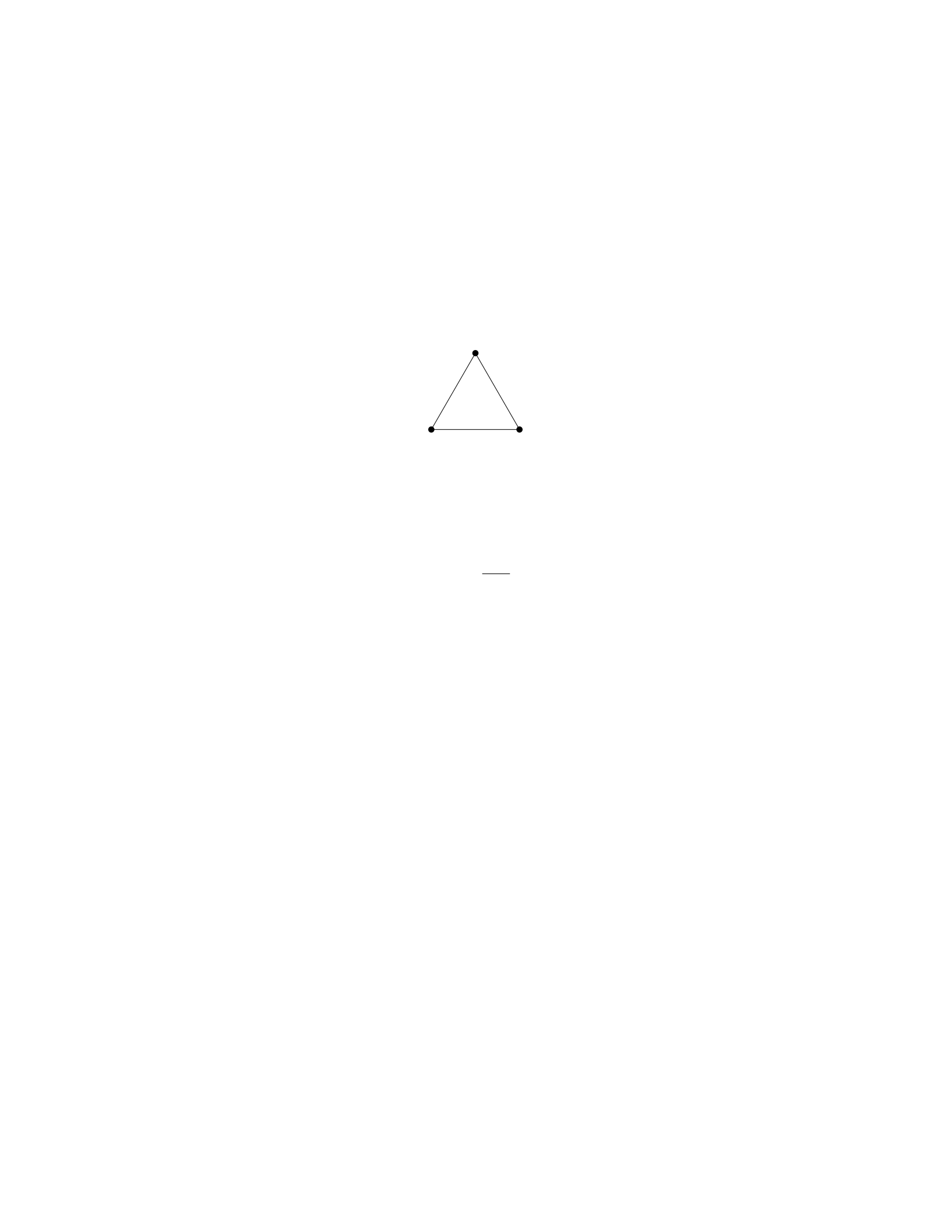
Question 15
Question
Three point charges are arranged in an equilateral triangle as shown below. The
charges are q1= +2.0µC, q2=−3.0µC, and q3= +4.0µC. Calculate the
magnitude of the net force on q2due to the other two charges.
q1q2
q3
Solution
Step 1: Calculate the electric force between q2and q1. The force between two
charges q1and q2separated by a distance ris given by Coulomb’s law:
F=kq1q2
r2
where - kis the Coulomb constant (8.99 ×10⁹N·m2/C2), - q1and q2are
the magnitudes of the charges, - ris the distance between the charges.
In our case, q1= +2.0µC, q2=−3.0µC, and r=[distance between q1and
q2in the equilateral triangle]. Let’s denote this distance as a.
The distance between q1and q2in an equilateral triangle can be calculated
using trigonometry. Since all sides of an equilateral triangle are equal, the
distance between q1and q2is a= 2lcos(30◦), where lis the side length of the
equilateral triangle. Given an equilateral triangle, l=[side length] and thus
a=[calculated distance].
Substitute the charges and distances into Coulomb’s law to find the force
F12 between q1and q2.
Step 2: Calculate the electric force between q2and q3(F23 ) and the angle
between F12 and F23.
Step 3: Using vector addition, calculate the net force on q2due to q1and
q3. The net force is the vector sum of F12 and F23.
Step 4: Calculate the magnitude of the net force on q2.
Question 16
Question
Two point charges, q1=−3µC and q2= 5 µC, are placed 10 cm apart in
a vacuum. Calculate the magnitude of the electric force between these two
charges.
13

Solution
Step 1: Convert all given quantities to standard SI units.
•q1=−3µC=−3×10⁻⁶C
•q2= 5 µC= 5 ×10⁻⁶C
•r= 10 cm = 10 ×10−2m
Step 2: Calculate the magnitude of the electric force using Coulomb’s Law.
F=k·|q1|·|q2|
r2
where kis the electrostatic constant with a value of 8.99 ×10⁹N·m2/C2.
Step 3: Plug in the given values to find the magnitude of the electric force.
F= 8.99 ×10⁹N·m2/C2·3×10−6C·5×10−6C
(10 ×10−2m)2
Step 4: Perform the calculations to find the numerical value of the electric
force.
F= 8.99 ×109×15 ×10−12 N
F= 134.85 ×10⁻³N
F= 0.13485 N
Therefore, the magnitude of the electric force between the two charges is
0.13485 N.
Question 17
Question
Three point charges are arranged as shown in the diagram below. The charge
q1=−5.0µC is located at point A at coordinates (0,0), the charge q2= 8.0µC
is located at point B at coordinates (2,0), and the charge q3=−3.0µC is located
at point C at coordinates (0,3).
Calculate the magnitude and direction of the net force on the charge at point
A due to the other two charges.
Solution
Step 1: Calculate the force exerted on the charge at point A due to the charge
at point B. Using Coulomb’s law, the magnitude of the force exerted by charge
q2on charge q1is given by:
FA,B =k|q1||q2|
r2
A,B
14

Where k= 8.99 ×10⁹Nm2/C2is the Coulomb constant, rA,B is the distance
between charge q1and charge q2which is 2 meters in this case. Plugging in the
values, we get:
FA,B =(8.99 ×10⁹Nm2/C2)(5.0×10−6C)(8.0×10−6C)
(2 m)2
FA,B =35.96
4= 8.99 N
Step 2: Calculate the force exerted on the charge at point A due to the
charge at point C. Similarly, using Coulomb’s law, the magnitude of the force
exerted by charge q3on charge q1is given by:
FA,C =k|q1||q3|
r2
A,C
Where rA,C is the distance between charge q1and charge q3which is 3 meters
in this case. Plugging in the values, we get:
FA,C =(8.99 ×10⁹Nm2/C2)(5.0×10−6C)(3.0×10−6C)
(3 m)2
FA,C =13.485
9= 1.498 N
Step 3: Calculate the net force on the charge at point A. Since the charges
at B and C are at right angles to each other, the net force on charge q1is given
by the vector sum of the forces due to q2and q3. Using Pythagoras theorem,
the magnitude of the net force is:
Fnet =qF2
A,B +F2
A,C
Fnet =p(8.99 N)2+ (1.498 N)2
Fnet =√80.82 + 2.244
Fnet =√83.064
Fnet ≈9.12 N
The direction of the net force can be found by determining the angle between
the net force and the x-axis:
θ= tan−1FA,C
FA,B
θ= tan−11.498
8.99
θ≈
15

Question 18
Question
Three point charges, q1= +3 nC, q2=−2nC, and q3= +4 nC, are placed at
the vertices of an equilateral triangle with sides of length d= 0.10 m. What is
the magnitude of the net electric force on q1due to the other two charges?
Solution
Step 1: Find the electric force on q1due to q2. The formula to calculate the
electric force between two point charges is given by Coulomb’s Law:
Felec =k·|q1|·|q2|
r2
where kis the Coulomb constant (8.99 ×10⁹N m2/C2) and ris the distance
between the charges.
Substituting the given values, the force on q1due to q2is:
F1,2= (8.99 ×109)·3×10−9·2×10−9
(0.10)2
Step 2: Calculate the electric force on q1due to q3. Following the same steps
as in Step 1, the force on q1due to q3is:
F1,3= (8.99 ×109)·3×10−9·4×10−9
(0.10)2
Step 3: Find the net force on q1. The net force on q1is the vector sum of
the forces due to q2and q3, so
|
Fnet|=q(
F1,2+
F1,3)2
After calculating the individual forces using Coulomb’s Law, you can find
the total magnitude of the net electric force on q1. Remember to consider the
directions of the forces as well.
Question 19
Question
Two point charges, q1= 4.0µC and q2=−6.0µC, are placed 2.0 meters apart.
Determine the magnitude and direction of the electric force that each charge
exerts on the other.
16

Solution
Given: q1= 4.0µC= 4.0×10⁻⁶C, q2=−6.0µC=−6.0×10⁻⁶C, r= 2.0m.
We’ll first calculate the magnitude of the electric force between the two
charges using Coulomb’s Law:
F=k· |q1|·|q2|
r2
where k= 8.99 ×10⁹N·m2/C2is the Coulomb constant.
Step 1: Calculate the magnitude of the force
F=8.99 ×10⁹· |4.0×10⁻⁶|·|−6.0×10⁻⁶|
(2.0)2
F=8.99 ×109·4.0×10−6·6.0×10−6
4.0
F=2.1576 ×10⁻²
4.0
F= 5.394 ×10⁻³N
Step 2: Determine the direction of the force Since q1is positive and q2
is negative, the forces between them are attractive. Thus, the force that charge
q1exerts on charge q2is directed towards q2, and the force that charge q2exerts
on charge q1is directed towards q1(in the opposite direction).
Therefore, the magnitude of the force is 5.394 ×10⁻³N and the direction
of the force on q1by q2is attractive and directed towards q2. Similarly, the
direction of the force on q2by q1is attractive and directed towards q1.
Question 20
Question
Two point charges, q1= +2.0nC and q2=−3.0nC, are placed 6.0cm apart
in air. Calculate the magnitude and direction of the electric force between the
charges.
Solution
Let’s solve this problem step by step:
Step 1: Find the distance between the charges in meters. Given
that the charges are 6.0cm apart, we convert this to meters:
6.0cm = 6.0×10⁻²m= 0.06 m
Step 2: Calculate the magnitude of the electric force. The magnitude
of the electric force between two point charges is given by Coulomb’s law:
F=k· |q1·q2|
r2
17

where kis the Coulomb constant (8.99×10⁹N m2/C2), q1and q2are the charges,
and ris the distance between the charges in meters.
Plugging in the values:
F=(8.99 ×10⁹N m2/C2)· |2.0×10⁻⁹C· −3.0×10⁻⁹C|
(0.06 m)2
F=(8.99 ×109)·(6 ×10−18)
0.0036
F=53.94 ×10⁻⁹
0.0036
F= 14.95 ×10⁻⁹N= 1.5×10⁻⁸N
Thus, the magnitude of the electric force between the charges is 1.5×10⁻⁸N.
Step 3: Determine the direction of the electric force. The electric
force between the charges is attractive since the charges have opposite signs.
Therefore, the direction of the force is from q1to q2or from −3.0nC to +2.0nC.
Question 21
Question
Two point charges, q1= +3.00 µC and q2=−5.00 µC, are placed 8.00 cm
apart in a vacuum. Calculate the magnitude of the electric force between these
charges.
Solution
Step 1: Convert the given charges to Coulombs for calculation:
q1= +3.00 µC= 3.00 ×10⁻⁶C
q2=−5.00 µC=−5.00 ×10⁻⁶C
Step 2: Convert the distance between the charges to meters:
d= 8.00 cm = 8.00 ×10⁻²m
Step 3: Calculate the magnitude of the electric force between these charges
using Coulomb’s law:
F=k· |q1·q2|
d2
where k= 8.99 ×10⁹N m2/C2is the Coulomb’s constant.
18

Step 4: Substitute the known values into the equation:
F=(8.99 ×10⁹N m2/C2)· |(3.00 ×10⁻⁶C)·(−5.00 ×10⁻⁶C)|
(8.00 ×10⁻²m)2
=(8.99 ×109)·(3.00 ×10−6)·(5.00 ×10−6)
(8.00 ×10⁻²)2
=(8.99 ×109)·(15 ×10−12)
(0.08)2
=134.85 ×10⁻³
0.0064
= 21,132.81 N
Therefore, the magnitude of the electric force between the charges is 21,132.81 N.
Question 22
Question
Two point charges, q1= 3µC and q2=−5µC, are placed 10 cm apart in a
vacuum. Calculate the magnitude of the electric force between them.
Solution
Step 1: Convert the charges to coulombs. Step 2: Calculate the distance in
meters. Step 3: Use Coulomb’s Law to find the magnitude of the electric force
between the charges.
Step 1: Converting the charges to coulombs: q1= 3µC = 3×10⁻⁶C
q2=−5µC = −5×10⁻⁶C
Step 2: Calculating the distance in meters: The distance between the
charges is 10 cm = 10 ×10−2m = 0.1 m.
Step 3: Using Coulomb’s Law to find the magnitude of the electric force:
Coulomb’s Law states that the magnitude of the electric force between two point
charges is given by:
F=k· |q1·q2|
r2,
where kis the electrostatic constant (8.99 ×10⁹Nm2/C2), q1and q2are the
charges, and ris the distance between the charges.
Substitute the given values into the formula:
F=(8.99 ×10⁹)· |3×10⁻⁶·(−5×10⁻⁶)|
(0.1)2
F=(8.99 ×109)·15 ×10−12
0.01
19

F=1.3485 ×10⁻²
0.01
F= 1.3485 N
Therefore, the magnitude of the electric force between the charges q1and q2
is 1.3485 N.
Question 23
Question
Three point charges are arranged as shown in the diagram below. Calculate the
magnitude and direction of the electric force on the charge q1due to the other
two charges. Use q= 2.0µC and d= 2.0m.
•q1= +2.0µC
•q2=−4.0µC•q3= +6.0µC
Solution
Step 1: Calculate the electric force on q1due to q2. The electric force between
two point charges is given by Coulomb’s law:
F=kq1q2
r2
where k≈8.99 ×10⁹Nm2/C2is the Coulomb constant, q1and q2are the
magnitudes of the charges, and ris the distance between the charges.
Given that q1= 2.0µC, q2=−4.0µC, and d= 2.0m, we can substitute
these values into Coulomb’s law to find the force F12 on q1due to q2:
F12 =k|q1||q2|
d2
F12 = (8.99 ×10⁹Nm2/C2)(2.0×10−6C)(4.0×10−6C)
(2.0m)2
F12 = (8.99 ×109)×(8.0×10−12)×(4) = 287.68 nN
The force F12 on q1due to q2is 287.68 nN.
Step 2: Determine the direction of the force F12 . Since q1and q2have
opposite charges, the force F12 will be attractive, i.e., it will act along the line
joining q1and q2from q2towards q1.
Step 3: Calculating the electric force on q1due to q3. Repeat the same
process as in Step 1 to find the force F13 on q1due to q3:
F13 =k|q1||q3|
d2
20

F13 = (8.99 ×10⁹)(2.0×10⁻⁶)(6.0×10⁻⁶)
(2.0)2= 674.04 nN
The force F13 on q1due to q3is 674.04 nN.
Step 4: Determine the direction of the force F13 . Since q1and q3have like
charges, the force F13 will be repulsive, i.e., it will act along the line joining q1
and q3from q1towards q3.
Step 5: Finding the net force on q1. In order to find the net force on q1, we
need to combine the forces F12
Question 24
Question
Two point charges, q1=−2.0µC and q2= 4.0µC, are placed 10.0 cm apart on
the x-axis. Calculate the magnitude and direction of the electric force that q1
exerts on q2.
Solution
Step 1: Calculate the distance between the charges in meters. Given that
1cm = 0.01 m, the distance between the charges is
r= 10.0cm ×0.01 m/cm = 0.10 m.
Step 2: Calculate the magnitude of the electric force using Coulomb’s Law:
F=k
q1q2
r2
,
where k= 8.99×10⁹N m2/C2is the Coulomb constant. Plugging in the values:
F= 8.99 ×10⁹N m2
C2
−2.0×10−6C×4.0×10−6C
(0.10 m)2
,
F= 8.99 ×10⁹N m2
C2
−8.0×10⁻¹² C2
0.01 m2
,
F= 8.99 ×10⁹N m2
C2×8.0×10−10 C= 7.2×10⁻¹N.
Step 3: Determine the direction of the force. The force is attractive because
the charges have opposite signs. Thus, the force is directed from q1towards q2
along the x-axis.
Therefore, the magnitude of the electric force that q1exerts on q2is 7.2×
10−1N, directed from q1towards q2along the x-axis.
21

Question 25
Question
Two identical point charges, each with a charge of +2.0µC, are placed at a
distance of 5.0m apart. Determine the magnitude and direction of the electric
force between the charges.
Solution
Step 1: Convert the charges to standard units by using the conversion factor
1µC= 10−6C. Given that each charge is +2.0µC, the charges can be converted
to +2.0×10⁻⁶C.
Step 2: Calculate the magnitude of the electric force using Coulomb’s law:
F=k· |q1·q2|
r2
where F= magnitude of the electric force, k= Coulomb’s constant (8.99 ×
109N m2/C2), q1and q2= magnitudes of the charges, and r= distance between
the charges. Plugging in the values:
F=(8.99 ×10⁹N m2/C2)· |(+2.0×10⁻⁶C)2|
(5.0m)2
Step 3: Calculate the magnitude of the electric force:
F=8.99 ×109·(2.0×10−6)2
5.02
Step 4: Simplify the expression further:
F=8.99 ×109·4.0×10−12
25.0
Step 5: Calculate the final answer:
F=35.96 ×10⁻³
25.0= 1.44 ×10⁻³N
Step 6: Determine the direction of the force. Since the charges are the same,
they will repel each other. Therefore, the direction of the force will be along
the line connecting the charges, pointing away from each charge.
Therefore, the magnitude of the electric force between the charges is 1.44 ×
10−3N, and the direction of the force is along the line connecting the charges,
pointing away from each charge.
22
A B
C
23

F= 8.99 ×109×15.36 ×10−12
0.0036
F= 8.99 ×15.36
0.0036 ×10⁻³
F= 8.99 ×4266.67
1×10⁻³
F= 3.84 ×10⁴N
Therefore, the magnitude of the electric force between the charges is 3.84 ×
104N.
Question 2
Question
Two point charges q1= 3.0µC and q2=−4.0µC are placed 10.0 cm apart in
air. Calculate the magnitude and direction of the electric force that q1exerts
on q2.
Solution
Step 1: Convert the charges to coulombs. Given: q1= 3.0µC = 3.0×10⁻⁶C
q2=−4.0µC =−4.0×10⁻⁶C
Step 2: Find the distance between the charges in meters. Given: r= 10.0
cm = 10.0×10⁻²m= 0.10 m
Step 3: Calculate the magnitude of the electric force using Coulomb’s law.
Coulomb’s law states:
F=k|q1q2|
r2
where kis Coulomb’s constant, k= 8.9875 ×10⁹N·m2/C2.
Plugging in the values:
F= 8.9875 ×10⁹×|3.0×10⁻⁶× −4.0×10⁻⁶|
(0.10)2
F= 8.9875 ×109×12 ×10−12
0.01
F= 8.9875 ×109×1.2×10−9
F= 10.785 ×10⁻¹
F= 10.785 N
Step 4: Determine the direction of the force. The force is attractive since
one charge is positive and the other is negative.
Therefore, the magnitude of the electric force that q1exerts on q2is 10.785 N
directed towards q2.
2

Question 3
Question
Three point charges are arranged in an equilateral triangle. The charges are
+q,−2q, and +3qwith sides of length d. Calculate the magnitude of the net
electrostatic force on the +3qcharge due to the other two charges. Assume the
charges are free to move.
Solution
1. First, let’s calculate the electrostatic force between the +qand +3qcharges.
Since the charges are the same sign, this force will be repulsive. The magnitude
of the electrostatic force F1between a pair of charges qand Qis given by
Coulomb’s Law:
F1=k· |q|·|Q|
r2
where kis the Coulomb constant (8.99 ×10⁹N m2/C2), |q|is the magnitude of
the +qcharge, |Q|is the magnitude of the +3qcharge, and ris the distance
between the charges. Since this distance is din an equilateral triangle, r=d.
2. Substituting the given values into the formula, we get:
F1=(8.99 ×10⁹)(q)(3q)
d2=26.97 ×10⁹q2
d2
So, the magnitude of the force F1between the +qand +3qcharges is 26.97×10⁹q2
d2
3. Next, let’s calculate the electrostatic force between the −2qand +3q
charges. Since the charges are opposite signs, this force will be attractive. Let’s
denote this force as F2.
4. Using Coulomb’s Law again, we have:
F2=k· |(−2q)|·|3q|
d2=6kq2
d2
5. Now, to find the net force on the +3qcharge, we need to consider the
directions. Since F1and F2are along the same line, we simply subtract these
two forces:
Net force =F1−F2=26.97 ×10⁹q2
d2−6kq2
d2
=26.97 ×10⁹−6×8.99 ×109q2
d2
6. Therefore, the magnitude of the net electrostatic force on the +3qcharge
due to the other two charges is (26.97 −53.94) ×109q2
d2=−26.97 ×10⁹q2
d2.
3

Question 4
Question
Three point charges are arranged along the x-axis: a charge of +3µC at the
origin, a charge of −5µC at x= 0.1m, and a charge of +2µC at x= 0.2m.
Calculate the net electric force on the charge of −5µC.
Solution
Step 1: Calculate the electric force between the charge of +3µC at the origin
and the charge of −5µC at x= 0.1m. The electric force F1between two charges
q1and q2separated by a distance ris given by Coulomb’s law:
F1=k·|q1q2|
r2
where k= 8.99 ×10⁹Nm²/C² is Coulomb’s constant.
Substitute the given values:
F1= 8.99 ×109·3×10−6×5×10−6
(0.1)2
Calculating F1gives:
F1= 1.35 ×10⁻³N
Step 2: Calculate the electric force between the charge of +2µC at x= 0.2
m and the charge of −5µC at x= 0.1m. Using Coulomb’s law again:
F2=k·|q1q2|
r2
Substitute the given values:
F2= 8.99 ×109·2×10−6×5×10−6
(0.2−0.1)2
Calculating F2gives:
F2= 4.49 ×10⁻³N
Step 3: Find the net force on the charge of −5µC. Since the forces are in
opposite directions, we need to consider them as negative and positive values.
The net force is the sum of the forces:
Fnet =F1−F2= 1.35 ×10⁻³N−4.49 ×10⁻³N
Calculating Fnet gives:
Fnet =−3.14 ×10⁻³N
Therefore, the net electric force on the charge of −5µC is −3.14 ×10⁻³N,
pointing towards the charge of +2µC at x= 0.2m.
4

Question 5
Question
Two point charges, q1=−6.0µC and q2= 4.0µC, are placed 10.0 cm apart in
air. Calculate the magnitude of the electric force between these charges.
Solution
Given: q1=−6.0µC
q2= 4.0µC
r= 10.0cm
The electric force between two point charges q1and q2separated by a dis-
tance ris given by Coulomb’s law:
F=k·|q1·q2|
r2
where kis the electrostatic constant equal to 8.99 ×10⁹N·m2/C2.
Step 1: Convert the distance rfrom cm to m:
r= 10.0cm = 0.1m
Step 2: Calculate the magnitude of the electric force using Coulomb’s law:
F= (8.99 ×10⁹)·| − 6.0×10−6·4.0×10−6|
(0.1)2
F= 8.99 ×109·24 ×10−12
0.01
F= 8.99 ×109·2.4×10−10
F= 2.1576 ×10⁻¹N
The magnitude of the electric force between the charges q1and q2is 0.216 N.
Question 6
Question
Three point charges are located on the vertices of an equilateral triangle of side
length a. The charges are +q,−2q, and +q. Calculate the magnitude and
direction of the electric force on the positive charge +qdue to the other two
charges.
5

Solution
Given: - Charge at vertex A = +q, - Charge at vertex B = -2q, - Charge
at vertex C = +q, - Distance between charges = a(side length of equilateral
triangle), - Coulomb’s constant = k.
The direction of the electric force on the positive charge +qdue to the other
two charges will depend on the configuration of the charges. Since the charges
are symmetrical with respect to the positively charged particle, the net force on
the positive charge will be directed vertically downwards.
Step 1: Calculate the force on +qdue to −2qat vertex B: The electric force
FAB on the charge at A due to the charge at B is given by Coulomb’s law:
FAB =k· |q|·|−2q|
a2=2kq2
a2
Step 2: Calculate the force on +qdue to +q at vertex C: The electric force
FAC on the charge at A due to the charge at C is given by Coulomb’s law:
FAC =k· |q|·|q|
a2=kq2
a2
Step 3: Calculate the net force and its direction: The net force on the
charge at A will be the sum of the forces FAB and FAC in the vertical downward
direction:
Fnet =FAB +FAC =2kq2
a2+kq2
a2=3kq2
a2
Therefore, the magnitude of the net force on the charge +qis 3kq2
a2and it is
directed vertically downwards.
Question 7
Question
Two point charges, q1= 3 µC and q2=−2µC, are placed 10 cm apart in air.
Calculate the magnitude of the electric force between these charges.
Solution
Step 1: Determine the distance between the charges in meters. Given that the
charges are 10 cm apart, we need to convert this distance to meters:
10 cm = 0.1m
Step 2: Calculate the magnitude of the electric force between the charges
using Coulomb’s Law: Coulomb’s Law states that the magnitude of the electric
force between two point charges is given by:
F=k· |q1·q2|
r2
6

where: - Fis the magnitude of the electric force, - kis the electrostatic constant
(8.99 ×10⁹N m2/C2), - q1and q2are the magnitudes of the two charges, - ris
the distance between the charges.
Plugging in the given values:
F=(8.99 ×10⁹N m2/C2)· |3×10⁻⁶C· −2×10⁻⁶C|
(0.1m)2
Step 3: Calculate the electric force.
F=8.99 ×109·6×10−6·2×10−6
0.01
F=8.99 ×6×2
10 ×10−3
F=107.88
10 ×10−3
F= 10.788 ×10⁻³
F= 10.788 mN
Therefore, the magnitude of the electric force between the two charges is
10.788 mN.
Question 9
Question
Two point charges q1= +2.5µC and q2=−4.0µC are placed 10 cm apart.
Calculate the magnitude of the electric force between the charges.
Solution
To calculate the magnitude of the electric force between the charges, we can use
Coulomb’s Law. Coulomb’s Law states that the magnitude of the electric force
between two point charges is given by:
F=k|q1q2|
r2
where: - Fis the magnitude of the electric force, - kis Coulomb’s constant
(8.9875 ×10⁹N·m2/C2), - q1and q2are the magnitudes of the charges, and -
ris the separation distance between the charges.
Step 1: Convert the given charges to coulombs:
q1= +2.5µC = 2.5×10⁻⁶C
q2=−4.0µC =−4.0×10⁻⁶C
7

Step 2: Determine the separation distance in meters:
r= 10 cm = 0.1m
Step 3: Calculate the magnitude of the electric force:
F= (8.9875 ×10⁹)|2.5×10⁻⁶× −4.0×10⁻⁶|
(0.1)2
F= 8.9875 ×109×1.0×10−11 ×100
F= 8.9875 ×10¹³N
Therefore, the magnitude of the electric force between the charges is 8.9875×
1013 N.
Question 10
Question
Two point charges, q1=−3.0µC and q2= +6.0µC, are placed 0.20 m apart.
Calculate the magnitude and direction of the electric force that q2exerts on q1.
Solution
Step 1: Convert the given charges to standard units.
•q1=−3.0µC =−3.0×10⁻⁶C
•q2= +6.0µC = 6.0×10⁻⁶C
Step 2: Calculate the magnitude of the electric force using Coulomb’s Law:
F=k·|q1·q2|
r2
where kis the Coulomb constant (8.99 ×10⁹N·m2/C2) and ris the distance
between the charges.
Step 3: Substitute the given values into the equation:
F= (8.99 ×10⁹)·| − 3.0×10−6·6.0×10−6|
0.202
Step 4: Simplify the expression to find the magnitude of the electric force.
F= (8.99 ×109)·18 ×10−12
0.04 = 4.497 ×10⁻²N
Step 5: Determine the direction of the electric force. Since q2is positive, it
exerts a repulsive force on q1, which is negative. Thus, the direction of the force
is away from q2.
Therefore, the magnitude of the electric force that q2exerts on q1is 4.497 ×
10−2N, directed away from q2.
8

Question 11
Question
Three point charges are arranged in a line. Charge q1=−3.0µC is located
at x=−1.0m, charge q2= 6.0µC is located at the origin, and charge q3=
−4.0µC is located at x= 2.0m. Calculate the magnitude and direction of the
net electrostatic force on q1due to q2and q3.
Solution
Step 1: Calculate the force on q1due to q2. The electrostatic force between two
point charges is given by Coulomb’s Law:
F=k·|q1·q2|
r2
where k= 8.99 ×10⁹Nm2/C2is Coulomb’s constant, q1=−3.0µC =−3.0×
10−6C,q2= 6.0µC = 6.0×10⁻⁶C, and r= 1.0mis the distance between q1
and q2.
Plugging in these values, we get
Fq1,q2= 8.99 ×10⁹·| − 3.0×10−6·6.0×10−6|
(1.0)2
Fq1,q2= 8.99 ×109·18 ×10−12
1.0
Fq1,q2= 161.82 ×10⁻³N
Step 2: Determine the direction of the force on q1due to q2. Since q1and
q2are oppositely charged, the force will be attractive. Therefore, the force will
act towards q2.
Step 3: Calculate the force on q1due to q3. Similarly, using Coulomb’s Law,
we find the force on q1due to q3:
Fq1,q3= 8.99 ×10⁹·| − 3.0×10⁻⁶· −4.0×10⁻⁶|
(3.0)2
Fq1,q3= 8.99 ×109·12 ×10−12
9.0
Fq1,q3= 119.76 ×10⁻³N
Step 4: Determine the direction of the force on q1due to q3. As q1and q3
are both negative charges, the force between them will also be attractive, acting
towards q3.
Step 5: Calculate the net force on q1by summing the individual forces from
q2and q3. The net force is given by
Fnet =Fq1,q2+Fq1,q3
9

Fnet = 161.82 ×10⁻³+ 119.76 ×10⁻³
Fnet = 281.58 ×10⁻³N
The net force on q1is 281.58 ×10⁻³Ntowards the right.
Question 12
Question
Three point charges are placed at the following positions: q1= +3 nC at (0,0),
q2=−1nC at (4,0), and q3= +2 nC at (0,3). Calculate the net electric force
on q2due to q1and q3.
Solution
Step 1: Calculate the electric force on q2due to q1: The electric force between
two point charges q1and q2separated by a distance ris given by Coulomb’s
Law:
F1,2=k|q1||q2|
r2
In this case, q1= +3 nC, q2=−1nC, and r= 4 (since q1and q2are 4 units
apart horizontally). Using k= 8.99 ×10⁹N m2/C2, we have:
F1,2= (8.99 ×10⁹)(3 ×10⁻⁹)(1 ×10⁻⁹)
(4)2
F1,2= (8.99 ×10⁹)3
16 ×10−18
F1,2=2697
16 ×10−9
F1,2= 168.56 ×10⁻⁹
F1,2= 1.69 ×10⁻⁶N
Step 2: Calculate the electric force on q2due to q3: Similarly, using q2=
−1nC, q3= +2 nC, and r= 3 (since q2and q3are 3 units apart vertically), we
have:
F2,3=k|q2||q3|
r2
F2,3= (8.99 ×10⁹)(1 ×10⁻⁹)(2 ×10⁻⁹)
(3)2
F2,3=2×8.99
9×10⁻⁹
F2,3= 1.99 ×10⁻⁶N
10

Step 3: Calculate the net electric force on q2: The net force is the vector
sum of the two forces:
Net force on q2=F1,2+F2,3
Net force on q2= 1.69 ×10⁻⁶+ 1.99 ×10⁻⁶
Net force on q2= 3.68 ×10⁻⁶N
Therefore, the net electric force on q2due to q1and q3is 3.68 ×10⁻⁶N.
Question 13
Question
Three point charges are placed at the corners of an equilateral triangle of side
length d= 2.0m as shown below. The charges are +3.0µC at the upper corner,
−2.0µC at the lower left corner, and +6.0µC at the lower right corner. Calcu-
late the magnitude and direction of the net electric force on the charge at the
upper corner.
`
` `
U
-
3.0µC
−2.0µC6.0µC
d
Solution
Step 1: Calculate the electric force between the upper corner charge at +3.0µC
and the lower left corner charge at −2.0µC. The electric force F1between two
point charges q1and q2separated by a distance ris given by Coulomb’s Law:
F1=k· |q1|·|q2|
r2
where kis the Coulomb constant 8.99 ×10⁹N·m2/C2.
Substitute the given values into Coulomb’s Law:
F1=(8.99 ×10⁹N·m2/C2)·(3.0×10−6C)·(2.0×10−6C)
(2.0m)2
F1=8.99 ×109×3.0×2.0
4
F1=53.94 ×10⁹
4
F1= 13.485 ×10⁹N
Step 2: Calculate the electric force between the upper corner charge at
+3.0µC and the lower right corner charge at +6.0µC. Similarly, use Coulomb’s
Law with the appropriate charges and distance:
F2=k· |3.0×10⁻⁶|·|6.0×10⁻⁶|
(2.0m)2
11

F2=8.99 ×109×3.0×6.0
4
F2= 13.485 ×10⁹N
Step 3: Find the net force on the upper corner charge. Since the forces
between the upper corner charge and the two lower corner charges are along the
same line but in opposite directions, the net force will be the difference of these
two forces.
Net Force =F2−F1
Net Force = 13.485 ×10⁹N−13.485 ×10⁹N
Net Force = 0
Question 14
Question
Three point charges are arranged along the x-axis as follows: q1=−2.0µC at
x= 0.0m, q2= 4.0µC at x= 4.0m, and q3=−6.0µC at x= 8.0m. Calculate
the magnitude and direction of the net electrostatic force on q2.
Solution
Step 1: Calculate the force between q2and q1. The force between two charges
is given by Coulomb’s Law:
F=k·|q1·q2|
r2
where Fis the magnitude of the force, kis Coulomb’s constant (8.99 ×10⁹N·
m2/C2), q1, q2are the point charges, ris the distance between the charges.
The distance between q1and q2is r= 4.0m. Plugging in the values, we get:
F12 = 8.99 ×10⁹·| − 2.0×10−6·4.0×10−6|
(4.0)2= 3.59 N
Step 2: Calculate the force between q2and q3. The distance between q2and
q3is r= 4.0m. Plugging in the values, we get:
F23 = 8.99 ×10⁹·|4.0×10−6·6.0×10−6|
(4.0)2= 6.74 N
Step 3: Calculate the net force on q2. The net force on q2is the vector sum
of F12 and F23. Since F12 is to the left (negative x-direction) and F23 is to the
right (positive x-direction), their magnitudes will be subtracted to find the net
force.
Fnet =|F23 −F12|=|6.74 −3.59|= 3.15 N
The direction of the net force will be towards the positive x-axis.
12
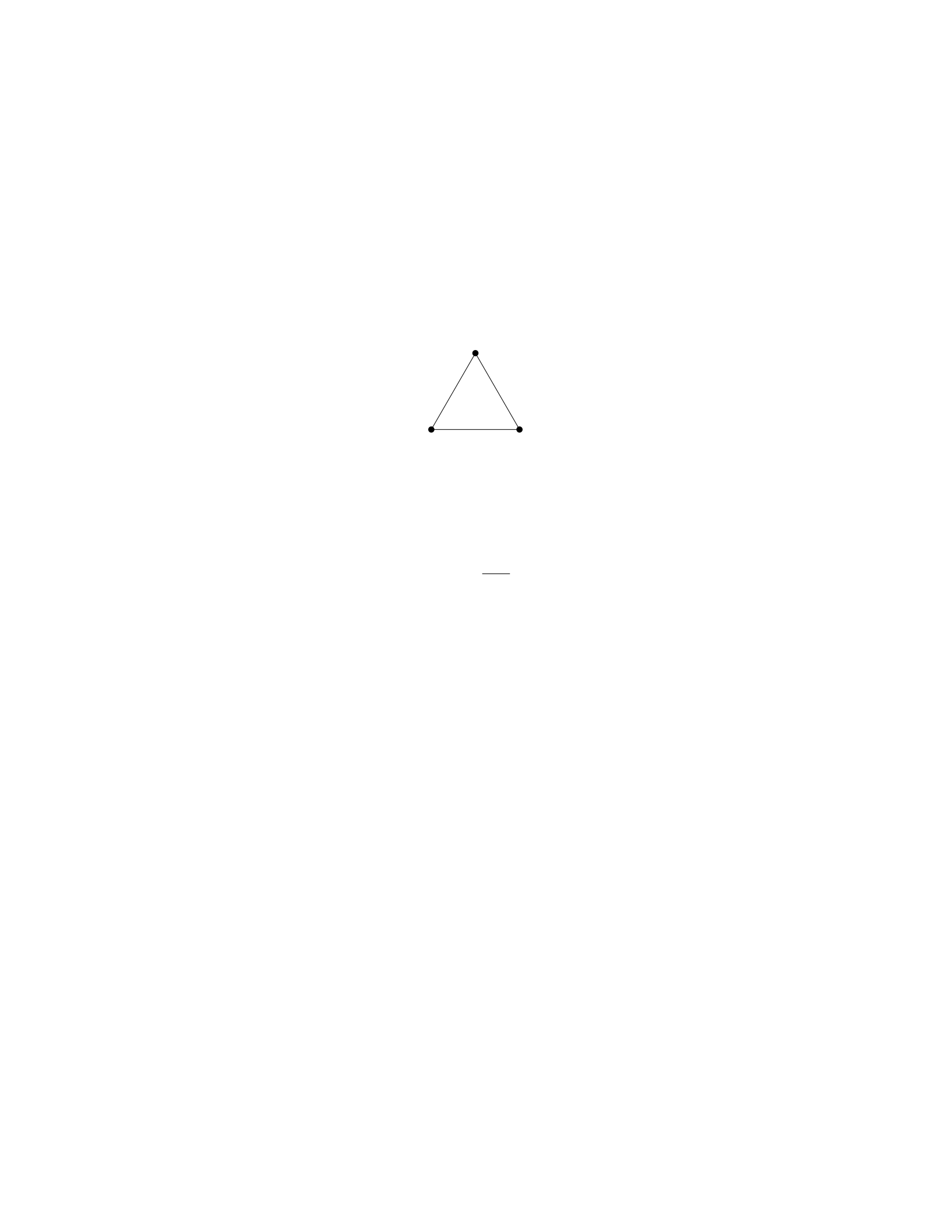
Question 15
Question
Three point charges are arranged in an equilateral triangle as shown below. The
charges are q1= +2.0µC, q2=−3.0µC, and q3= +4.0µC. Calculate the
magnitude of the net force on q2due to the other two charges.
q1q2
q3
Solution
Step 1: Calculate the electric force between q2and q1. The force between two
charges q1and q2separated by a distance ris given by Coulomb’s law:
F=kq1q2
r2
where - kis the Coulomb constant (8.99 ×10⁹N·m2/C2), - q1and q2are
the magnitudes of the charges, - ris the distance between the charges.
In our case, q1= +2.0µC, q2=−3.0µC, and r=[distance between q1and
q2in the equilateral triangle]. Let’s denote this distance as a.
The distance between q1and q2in an equilateral triangle can be calculated
using trigonometry. Since all sides of an equilateral triangle are equal, the
distance between q1and q2is a= 2lcos(30◦), where lis the side length of the
equilateral triangle. Given an equilateral triangle, l=[side length] and thus
a=[calculated distance].
Substitute the charges and distances into Coulomb’s law to find the force
F12 between q1and q2.
Step 2: Calculate the electric force between q2and q3(F23 ) and the angle
between F12 and F23.
Step 3: Using vector addition, calculate the net force on q2due to q1and
q3. The net force is the vector sum of F12 and F23.
Step 4: Calculate the magnitude of the net force on q2.
Question 16
Question
Two point charges, q1=−3µC and q2= 5 µC, are placed 10 cm apart in
a vacuum. Calculate the magnitude of the electric force between these two
charges.
13

Solution
Step 1: Convert all given quantities to standard SI units.
•q1=−3µC=−3×10⁻⁶C
•q2= 5 µC= 5 ×10⁻⁶C
•r= 10 cm = 10 ×10−2m
Step 2: Calculate the magnitude of the electric force using Coulomb’s Law.
F=k·|q1|·|q2|
r2
where kis the electrostatic constant with a value of 8.99 ×10⁹N·m2/C2.
Step 3: Plug in the given values to find the magnitude of the electric force.
F= 8.99 ×10⁹N·m2/C2·3×10−6C·5×10−6C
(10 ×10−2m)2
Step 4: Perform the calculations to find the numerical value of the electric
force.
F= 8.99 ×109×15 ×10−12 N
F= 134.85 ×10⁻³N
F= 0.13485 N
Therefore, the magnitude of the electric force between the two charges is
0.13485 N.
Question 17
Question
Three point charges are arranged as shown in the diagram below. The charge
q1=−5.0µC is located at point A at coordinates (0,0), the charge q2= 8.0µC
is located at point B at coordinates (2,0), and the charge q3=−3.0µC is located
at point C at coordinates (0,3).
Calculate the magnitude and direction of the net force on the charge at point
A due to the other two charges.
Solution
Step 1: Calculate the force exerted on the charge at point A due to the charge
at point B. Using Coulomb’s law, the magnitude of the force exerted by charge
q2on charge q1is given by:
FA,B =k|q1||q2|
r2
A,B
14

Where k= 8.99 ×10⁹Nm2/C2is the Coulomb constant, rA,B is the distance
between charge q1and charge q2which is 2 meters in this case. Plugging in the
values, we get:
FA,B =(8.99 ×10⁹Nm2/C2)(5.0×10−6C)(8.0×10−6C)
(2 m)2
FA,B =35.96
4= 8.99 N
Step 2: Calculate the force exerted on the charge at point A due to the
charge at point C. Similarly, using Coulomb’s law, the magnitude of the force
exerted by charge q3on charge q1is given by:
FA,C =k|q1||q3|
r2
A,C
Where rA,C is the distance between charge q1and charge q3which is 3 meters
in this case. Plugging in the values, we get:
FA,C =(8.99 ×10⁹Nm2/C2)(5.0×10−6C)(3.0×10−6C)
(3 m)2
FA,C =13.485
9= 1.498 N
Step 3: Calculate the net force on the charge at point A. Since the charges
at B and C are at right angles to each other, the net force on charge q1is given
by the vector sum of the forces due to q2and q3. Using Pythagoras theorem,
the magnitude of the net force is:
Fnet =qF2
A,B +F2
A,C
Fnet =p(8.99 N)2+ (1.498 N)2
Fnet =√80.82 + 2.244
Fnet =√83.064
Fnet ≈9.12 N
The direction of the net force can be found by determining the angle between
the net force and the x-axis:
θ= tan−1FA,C
FA,B
θ= tan−11.498
8.99
θ≈
15

Question 18
Question
Three point charges, q1= +3 nC, q2=−2nC, and q3= +4 nC, are placed at
the vertices of an equilateral triangle with sides of length d= 0.10 m. What is
the magnitude of the net electric force on q1due to the other two charges?
Solution
Step 1: Find the electric force on q1due to q2. The formula to calculate the
electric force between two point charges is given by Coulomb’s Law:
Felec =k·|q1|·|q2|
r2
where kis the Coulomb constant (8.99 ×10⁹N m2/C2) and ris the distance
between the charges.
Substituting the given values, the force on q1due to q2is:
F1,2= (8.99 ×109)·3×10−9·2×10−9
(0.10)2
Step 2: Calculate the electric force on q1due to q3. Following the same steps
as in Step 1, the force on q1due to q3is:
F1,3= (8.99 ×109)·3×10−9·4×10−9
(0.10)2
Step 3: Find the net force on q1. The net force on q1is the vector sum of
the forces due to q2and q3, so
|
Fnet|=q(
F1,2+
F1,3)2
After calculating the individual forces using Coulomb’s Law, you can find
the total magnitude of the net electric force on q1. Remember to consider the
directions of the forces as well.
Question 19
Question
Two point charges, q1= 4.0µC and q2=−6.0µC, are placed 2.0 meters apart.
Determine the magnitude and direction of the electric force that each charge
exerts on the other.
16

Solution
Given: q1= 4.0µC= 4.0×10⁻⁶C, q2=−6.0µC=−6.0×10⁻⁶C, r= 2.0m.
We’ll first calculate the magnitude of the electric force between the two
charges using Coulomb’s Law:
F=k· |q1|·|q2|
r2
where k= 8.99 ×10⁹N·m2/C2is the Coulomb constant.
Step 1: Calculate the magnitude of the force
F=8.99 ×10⁹· |4.0×10⁻⁶|·|−6.0×10⁻⁶|
(2.0)2
F=8.99 ×109·4.0×10−6·6.0×10−6
4.0
F=2.1576 ×10⁻²
4.0
F= 5.394 ×10⁻³N
Step 2: Determine the direction of the force Since q1is positive and q2
is negative, the forces between them are attractive. Thus, the force that charge
q1exerts on charge q2is directed towards q2, and the force that charge q2exerts
on charge q1is directed towards q1(in the opposite direction).
Therefore, the magnitude of the force is 5.394 ×10⁻³N and the direction
of the force on q1by q2is attractive and directed towards q2. Similarly, the
direction of the force on q2by q1is attractive and directed towards q1.
Question 20
Question
Two point charges, q1= +2.0nC and q2=−3.0nC, are placed 6.0cm apart
in air. Calculate the magnitude and direction of the electric force between the
charges.
Solution
Let’s solve this problem step by step:
Step 1: Find the distance between the charges in meters. Given
that the charges are 6.0cm apart, we convert this to meters:
6.0cm = 6.0×10⁻²m= 0.06 m
Step 2: Calculate the magnitude of the electric force. The magnitude
of the electric force between two point charges is given by Coulomb’s law:
F=k· |q1·q2|
r2
17

where kis the Coulomb constant (8.99×10⁹N m2/C2), q1and q2are the charges,
and ris the distance between the charges in meters.
Plugging in the values:
F=(8.99 ×10⁹N m2/C2)· |2.0×10⁻⁹C· −3.0×10⁻⁹C|
(0.06 m)2
F=(8.99 ×109)·(6 ×10−18)
0.0036
F=53.94 ×10⁻⁹
0.0036
F= 14.95 ×10⁻⁹N= 1.5×10⁻⁸N
Thus, the magnitude of the electric force between the charges is 1.5×10⁻⁸N.
Step 3: Determine the direction of the electric force. The electric
force between the charges is attractive since the charges have opposite signs.
Therefore, the direction of the force is from q1to q2or from −3.0nC to +2.0nC.
Question 21
Question
Two point charges, q1= +3.00 µC and q2=−5.00 µC, are placed 8.00 cm
apart in a vacuum. Calculate the magnitude of the electric force between these
charges.
Solution
Step 1: Convert the given charges to Coulombs for calculation:
q1= +3.00 µC= 3.00 ×10⁻⁶C
q2=−5.00 µC=−5.00 ×10⁻⁶C
Step 2: Convert the distance between the charges to meters:
d= 8.00 cm = 8.00 ×10⁻²m
Step 3: Calculate the magnitude of the electric force between these charges
using Coulomb’s law:
F=k· |q1·q2|
d2
where k= 8.99 ×10⁹N m2/C2is the Coulomb’s constant.
18

Step 4: Substitute the known values into the equation:
F=(8.99 ×10⁹N m2/C2)· |(3.00 ×10⁻⁶C)·(−5.00 ×10⁻⁶C)|
(8.00 ×10⁻²m)2
=(8.99 ×109)·(3.00 ×10−6)·(5.00 ×10−6)
(8.00 ×10⁻²)2
=(8.99 ×109)·(15 ×10−12)
(0.08)2
=134.85 ×10⁻³
0.0064
= 21,132.81 N
Therefore, the magnitude of the electric force between the charges is 21,132.81 N.
Question 22
Question
Two point charges, q1= 3µC and q2=−5µC, are placed 10 cm apart in a
vacuum. Calculate the magnitude of the electric force between them.
Solution
Step 1: Convert the charges to coulombs. Step 2: Calculate the distance in
meters. Step 3: Use Coulomb’s Law to find the magnitude of the electric force
between the charges.
Step 1: Converting the charges to coulombs: q1= 3µC = 3×10⁻⁶C
q2=−5µC = −5×10⁻⁶C
Step 2: Calculating the distance in meters: The distance between the
charges is 10 cm = 10 ×10−2m = 0.1 m.
Step 3: Using Coulomb’s Law to find the magnitude of the electric force:
Coulomb’s Law states that the magnitude of the electric force between two point
charges is given by:
F=k· |q1·q2|
r2,
where kis the electrostatic constant (8.99 ×10⁹Nm2/C2), q1and q2are the
charges, and ris the distance between the charges.
Substitute the given values into the formula:
F=(8.99 ×10⁹)· |3×10⁻⁶·(−5×10⁻⁶)|
(0.1)2
F=(8.99 ×109)·15 ×10−12
0.01
19

F=1.3485 ×10⁻²
0.01
F= 1.3485 N
Therefore, the magnitude of the electric force between the charges q1and q2
is 1.3485 N.
Question 23
Question
Three point charges are arranged as shown in the diagram below. Calculate the
magnitude and direction of the electric force on the charge q1due to the other
two charges. Use q= 2.0µC and d= 2.0m.
•q1= +2.0µC
•q2=−4.0µC•q3= +6.0µC
Solution
Step 1: Calculate the electric force on q1due to q2. The electric force between
two point charges is given by Coulomb’s law:
F=kq1q2
r2
where k≈8.99 ×10⁹Nm2/C2is the Coulomb constant, q1and q2are the
magnitudes of the charges, and ris the distance between the charges.
Given that q1= 2.0µC, q2=−4.0µC, and d= 2.0m, we can substitute
these values into Coulomb’s law to find the force F12 on q1due to q2:
F12 =k|q1||q2|
d2
F12 = (8.99 ×10⁹Nm2/C2)(2.0×10−6C)(4.0×10−6C)
(2.0m)2
F12 = (8.99 ×109)×(8.0×10−12)×(4) = 287.68 nN
The force F12 on q1due to q2is 287.68 nN.
Step 2: Determine the direction of the force F12 . Since q1and q2have
opposite charges, the force F12 will be attractive, i.e., it will act along the line
joining q1and q2from q2towards q1.
Step 3: Calculating the electric force on q1due to q3. Repeat the same
process as in Step 1 to find the force F13 on q1due to q3:
F13 =k|q1||q3|
d2
20

F13 = (8.99 ×10⁹)(2.0×10⁻⁶)(6.0×10⁻⁶)
(2.0)2= 674.04 nN
The force F13 on q1due to q3is 674.04 nN.
Step 4: Determine the direction of the force F13 . Since q1and q3have like
charges, the force F13 will be repulsive, i.e., it will act along the line joining q1
and q3from q1towards q3.
Step 5: Finding the net force on q1. In order to find the net force on q1, we
need to combine the forces F12
Question 24
Question
Two point charges, q1=−2.0µC and q2= 4.0µC, are placed 10.0 cm apart on
the x-axis. Calculate the magnitude and direction of the electric force that q1
exerts on q2.
Solution
Step 1: Calculate the distance between the charges in meters. Given that
1cm = 0.01 m, the distance between the charges is
r= 10.0cm ×0.01 m/cm = 0.10 m.
Step 2: Calculate the magnitude of the electric force using Coulomb’s Law:
F=k
q1q2
r2
,
where k= 8.99×10⁹N m2/C2is the Coulomb constant. Plugging in the values:
F= 8.99 ×10⁹N m2
C2
−2.0×10−6C×4.0×10−6C
(0.10 m)2
,
F= 8.99 ×10⁹N m2
C2
−8.0×10⁻¹² C2
0.01 m2
,
F= 8.99 ×10⁹N m2
C2×8.0×10−10 C= 7.2×10⁻¹N.
Step 3: Determine the direction of the force. The force is attractive because
the charges have opposite signs. Thus, the force is directed from q1towards q2
along the x-axis.
Therefore, the magnitude of the electric force that q1exerts on q2is 7.2×
10−1N, directed from q1towards q2along the x-axis.
21

Question 25
Question
Two identical point charges, each with a charge of +2.0µC, are placed at a
distance of 5.0m apart. Determine the magnitude and direction of the electric
force between the charges.
Solution
Step 1: Convert the charges to standard units by using the conversion factor
1µC= 10−6C. Given that each charge is +2.0µC, the charges can be converted
to +2.0×10⁻⁶C.
Step 2: Calculate the magnitude of the electric force using Coulomb’s law:
F=k· |q1·q2|
r2
where F= magnitude of the electric force, k= Coulomb’s constant (8.99 ×
109N m2/C2), q1and q2= magnitudes of the charges, and r= distance between
the charges. Plugging in the values:
F=(8.99 ×10⁹N m2/C2)· |(+2.0×10⁻⁶C)2|
(5.0m)2
Step 3: Calculate the magnitude of the electric force:
F=8.99 ×109·(2.0×10−6)2
5.02
Step 4: Simplify the expression further:
F=8.99 ×109·4.0×10−12
25.0
Step 5: Calculate the final answer:
F=35.96 ×10⁻³
25.0= 1.44 ×10⁻³N
Step 6: Determine the direction of the force. Since the charges are the same,
they will repel each other. Therefore, the direction of the force will be along
the line connecting the charges, pointing away from each charge.
Therefore, the magnitude of the electric force between the charges is 1.44 ×
10−3N, and the direction of the force is along the line connecting the charges,
pointing away from each charge.
22
A B
C
23

